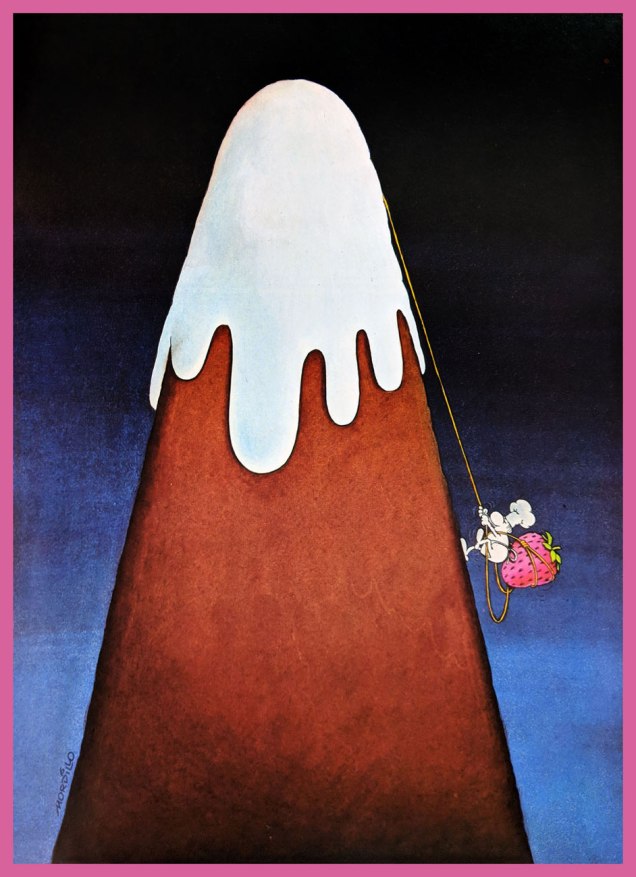
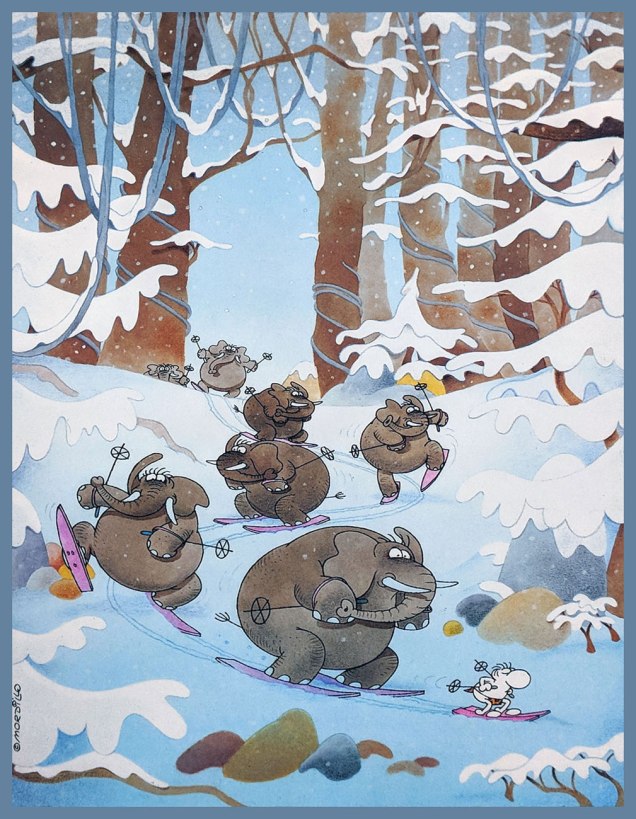
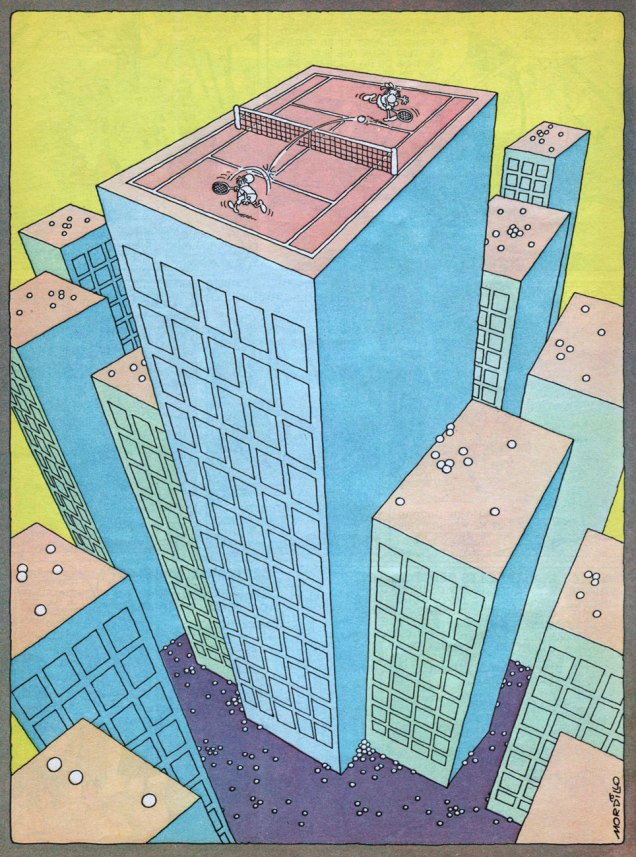
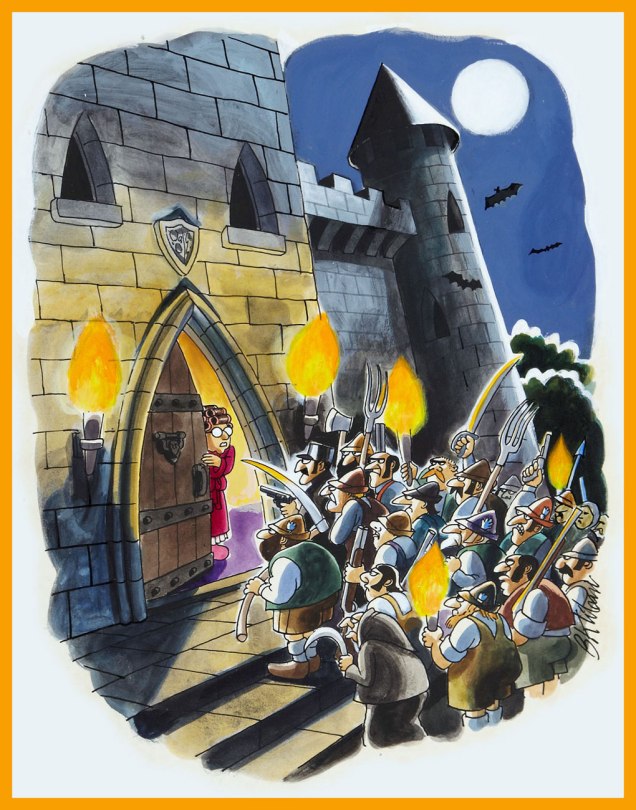
« … his appreciation for city life was such that when I was a little girl and we would be going on walks, he would periodically draw my attention to the colorful and interesting patterns created by garbage strewn about on the streets, or by dilapidated storefronts with their torn-off signs. » — Gina Kovarsky on her father’s perspective
Funny how history works: for every world-famous New Yorker cartoonist, there’s another who’s just about been forgotten, yet is every bit the equal of his more celebrated colleague.
Anatol Kovarsky (born in Moscow in 1919, lived and thrived to the impressive age of 97) began working for the New Yorker in 1947, who published his cartoons and cover illustrations until 1969, when the man turned his full attention to painting.
This specific piece first saw print in The New Yorker in 1956, and was collected later that year as part of the classic Kovarsky’s World (Alfred A. Knopf).
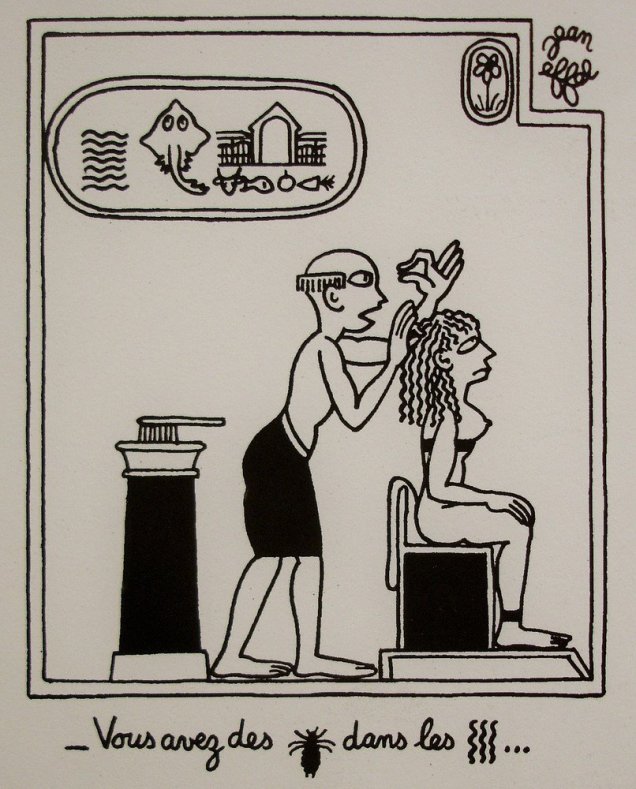
Despite his father’s insistence on a commercial career, French illustrator Jean Effel (1908-1982) pursued studies in music, art and philosophy. When his attempts to become a theatrical writer failed, he switched gears and started working as a caricaturist for newspapers in the 1930s. By the 1940s, his work was widely known and widely published, mostly in socialist/communist newspapers sponsored by the French Communist Party. After the second World War, he also branched out into book illustration (his work on Fables de la Fontaine is quite charming). Today, he’s mostly remembered (if barely) for his La création du monde (The Creation of the World).
I learned about Jean Effel (a nom de plume; François Lejeune was his true name) from a couple of books my parents had lying around when I was growing up. He was, I believe, my first exposure to cartoons, and the warm place his work holds in my heart is partly dictated by nostalgia. Only in part, however; few would deny that Effel’s animals and humans, his God, his Devil and his various angels are charming in that plump, childlike way that young animals are irresistibly cute. Some grouchy contrarians might get annoyed by that cuteness; the rest of us will enjoy his kind world. Oh, vexations and sarcasm are part of its tapestry, but nobody stays angry for long, pranks are witty but inoffensive, and problems are creatively resolved. Effel was an atheist, but his God was so kind and paternal that even priests didn’t object to their parishioners reading his work.
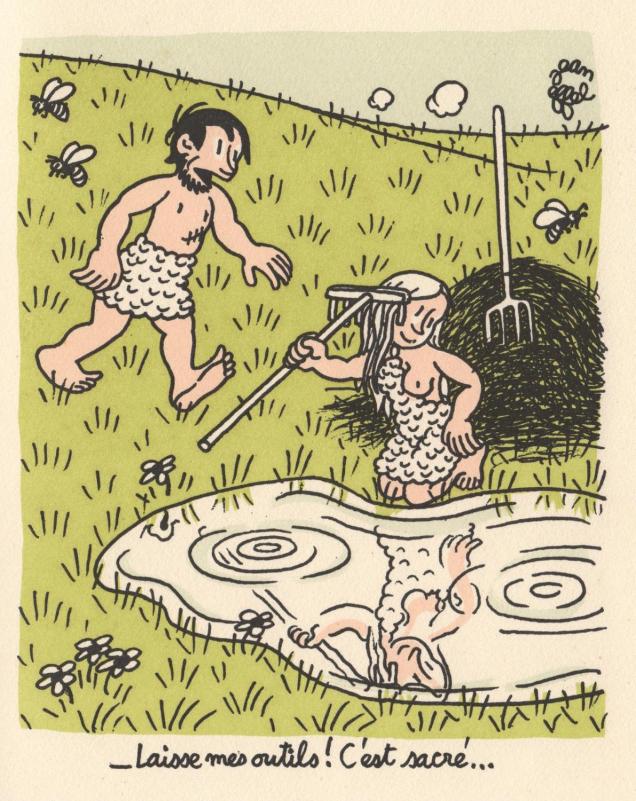
“How was it?” “Divine!” Even Effel’s handwriting/lettering is adorably rounded, childlike.“Leave my tools alone! It’s a sacred thing…” Note Adam’s scar, mute testimony to his missing rib.
To come back to my childhood, the twist in the story is that the books were in Russian: Soviet translations from French. The main collection of Jean Effel’s work was published in 1963 by the Hermitage Museum’s publishing press. The introduction calls him a « sincere friend of the Soviet Union », pointing out that Effel even learned to use Russian letters. In 1967, he was awarded the Lenin Peace Prize, which was mostly reserved for non-Soviets, foreign prominent Communists and supporters of the Soviet Union (Nelson Mandela also had one, as did Linus Pauling and Pablo Picasso).
Jean Effel’s present to the U.S.S.R.: a detailed map of France, with a hand-lettered dedication – “to my Soviet friends, with all my heart”.
It’s odd, but I can’t give you the exact date of the conception or publication of The Creation of the World: the Soviet book mentions that it was begun in 1950, English Wiki gives the date as 1945, French Wiki says 1953, Encyclopaedia Universalis (a French site) posits 1937, etc. Rather absurdly, there are a lot more detailed articles about Effel in Russian than in French, so for once I actually tend to trust the Russian side of things. It was clear that Effel genuinely liked Russians, and admired what he saw on his many visits to the U.S.S.R. I assume he only saw what he wanted to see (or what he was shown by his tour guides); still, he was clearly an idealist, a kind and gentle man by all accounts who believed in pacifism and loved animals.
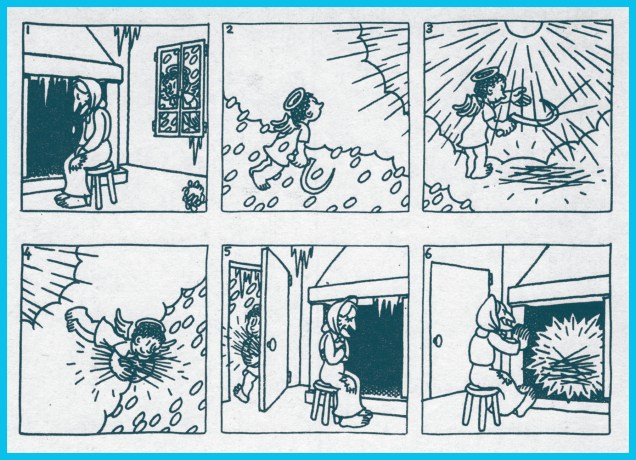
A few pages from my 1963 Soviet edition:
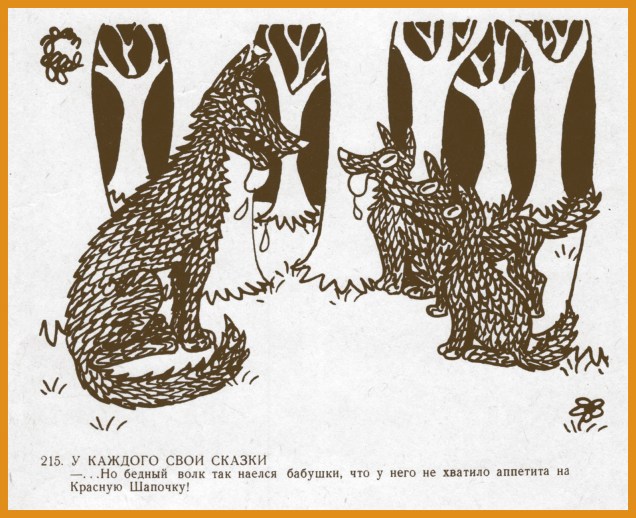
Dog meteorology: “He’s raising his paw: now water will pour down…”To each his own fairy tale: “But the poor wolf was so stuffed after eating grandmother that he had no appetite left for Red Riding Hood!”
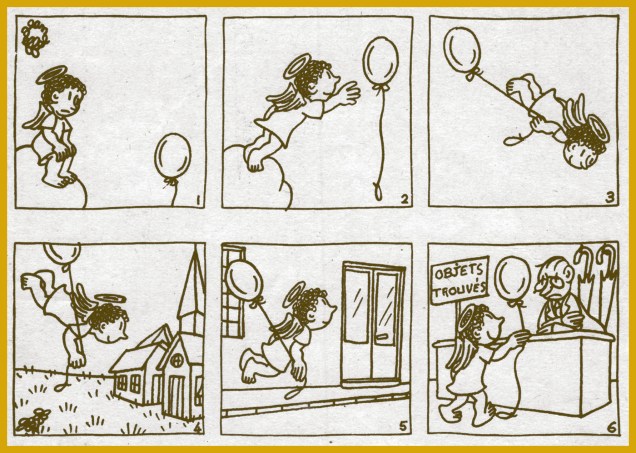
The desk caption says “found objects”.141: “He’s making projects for something…” 143: “How hilarious! If this keeps up, I’ll lose a rib from laughing too hard…” 144: “This is but a sketch. Just wait ’til you see the 3D version…”
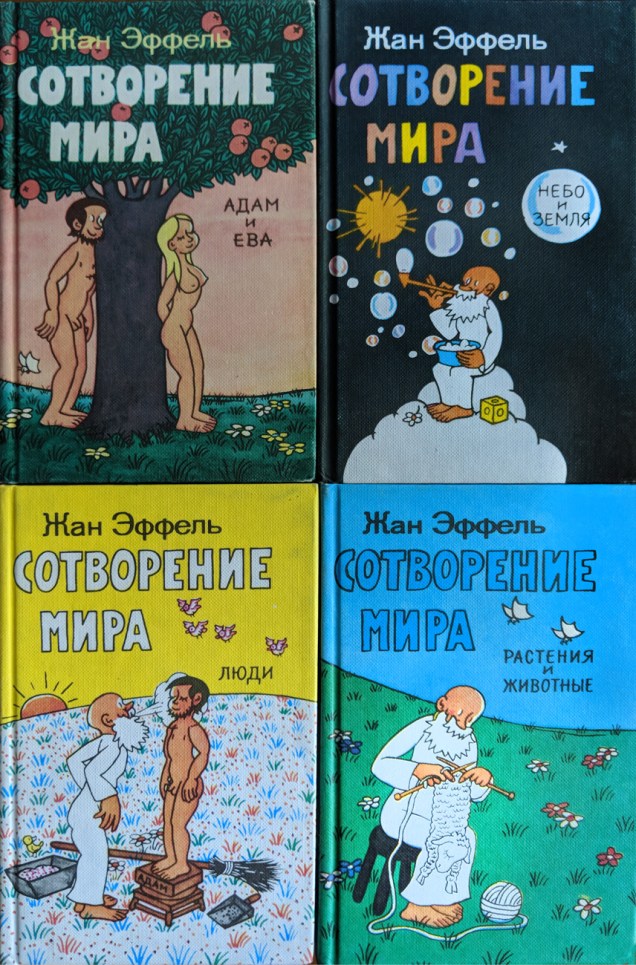
A few years ago, I found another Russian edition in some Canadian (how books travel..) second hand bookstore, a collection in four volumes:
Clockwise, left to right: Adam and Eve, Sky and Earth, Plants and Animals, and People.
The back covers are also worth a look:
Oddly, Animals and Plants is marked as costing 75 kopecks, and the other three are 80 kopecks each, though this was clearly sold as a set with a slipcase.
There can be no god without a devil! The charming Lucifer is probably my favourite character. This is a page from the Russian-Estonian edition. 173: “He likes us: he’s wagging his tail!” 174: “My name is Lucifer, but you can simply call me Lulu!” 175: “Oh, Mister Lucifer! You’re just the devil!” 176: “Perhaps I can tempt you with an apple?”The most recent edition of La création de l’homme, published in 1997.
A few other odds and ends from Effel’s multi-faceted career…
Sylvain is inviting you… to visit the PROTECTION OF NATURE exhibit at the Paris Fair.
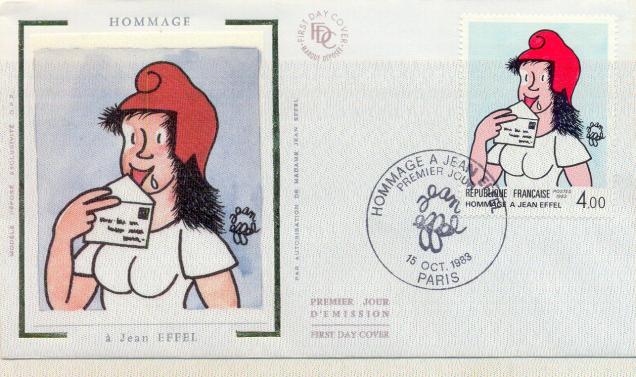
The French Postal Service issued a stamp in 1983 to celebrate Jean Effel and his sweet version of Marianne, a cheerful young woman with a red cap who symbolized the new French Republic.
« Everything is vague to a degree you do not realize till you have tried to make it precise. » — Bertrand Russell
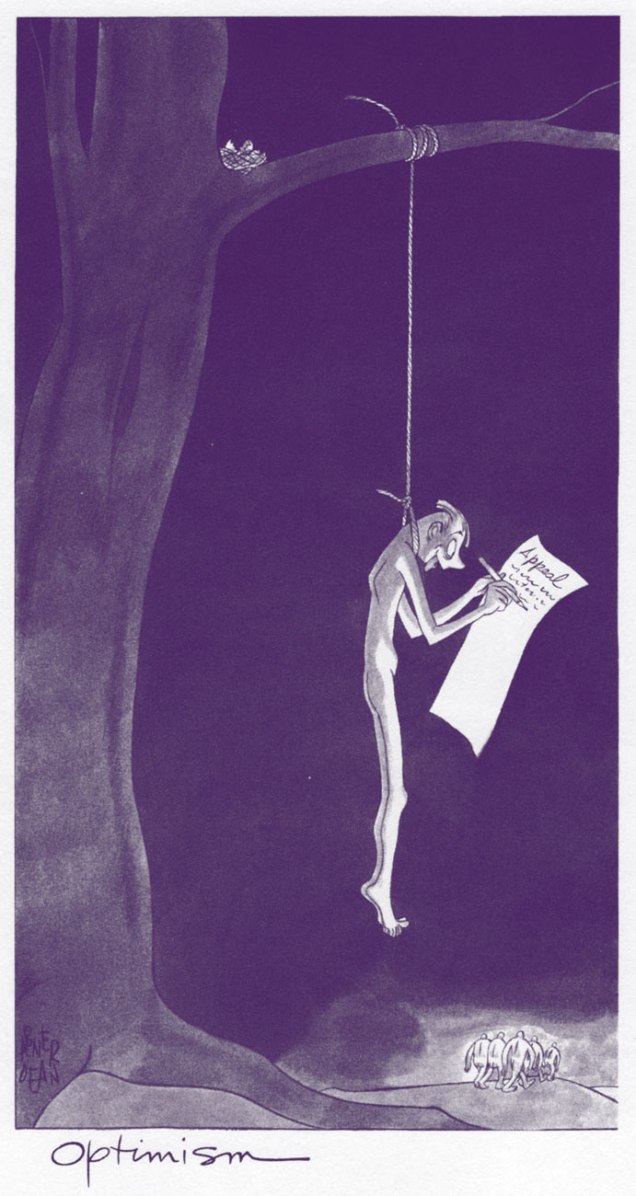
When last we left Abner Dean (catch up with Part One), he was contemplating a professional change, something transcendent, something more lasting, but still using most of the traditional tools of cartooning. We can surmise that, at first, the resultant works weren’t necessarily to be shared widely: “I’m at work on a long series of drawings now that are not intended for publication ”, Dean had confided to a friend in 1941.
First came, in 1942, a Life Magazine article premiering a handful of these drawings. Then, in 1945, It’s a Long Way to Heaven landed in bookshelves.
Incredibly (if you’ll forgive the cynicism), the book, and its sequels, were solid sellers. Given the groundbreaking character of these cartoons (for the lack of a more fitting term), such well-merited success is quintuply impressive. Hell, maybe the audience for such material actually existed then.
« Much as he hates to admit it, the life of the average man (which means virtually all of us) tends to assume the form of a longish doze, interrupted by fits and starts of bewildered semi-alertness. We will invent a hundred ways of heading off self-alertness to one that may force us to ask ourselves who the devil we are. You cannot turn on your radio or unfold your newspaper without being offered all the answers. But where shall we go if we wish to be asked the questions? » — Clifton Fadiman, from his “Prefatory Note” to What Am I Doing Here?
Regrettably, Dean’s five books in this new idiom [It’s a Long Way to Heaven (1945); What Am I Doing Here? (1947); And On the Eighth Day (1949); Come As You Are: A Book about People at Parties (1952) and Cave Drawings for the Future (1954)] have all-but-entirely faded from collective memory, but there have been encouraging stirrings of a revival in recent years, owing to the efforts of a dedicated handful of brave souls.
Dedicated… and perhaps influential: What Am I Doing Here? was granted a new facsimile edition in 2016. Here’s a brief review.
As in the case of the couldn’t-be-more-highly-recommended Abner Dean’s Naked People: A Selection of Drawings from Four of His Books (1963), we’re omitting any excerpts from Come As You Are, not because it’s inferior work, quite the contrary, but because it deserves a showcase of its own. We’ll return to it.
In the meantime, enjoy these peeks into Abner Dean’s Id and, I daresay, the human condition at large. Thanks to Dean’s visionary approach, these haven’t acquired a wrinkle in the past eighty or so years.
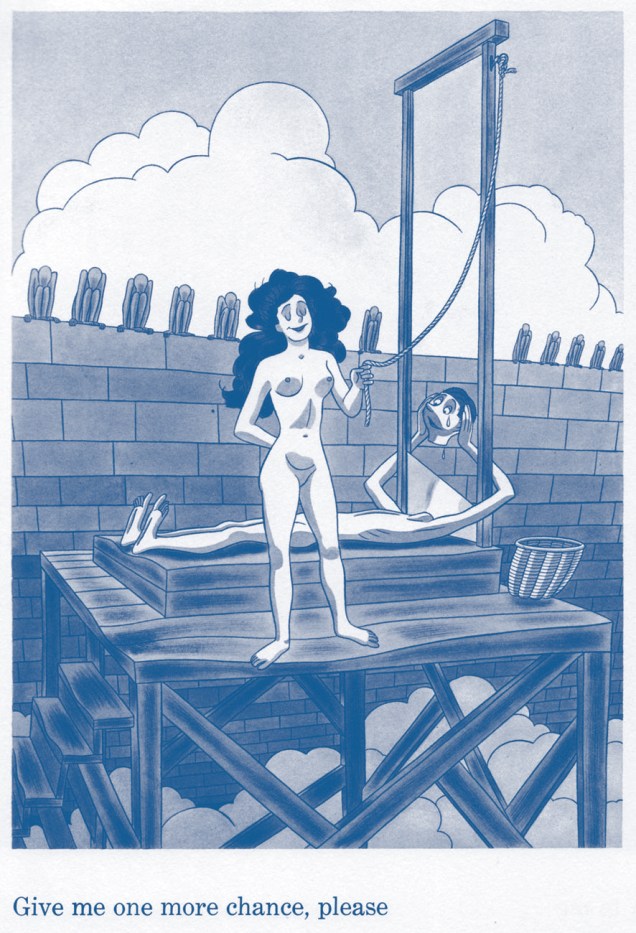
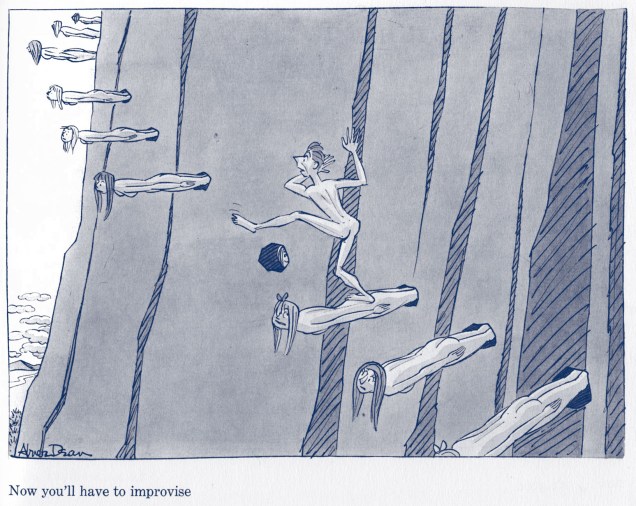
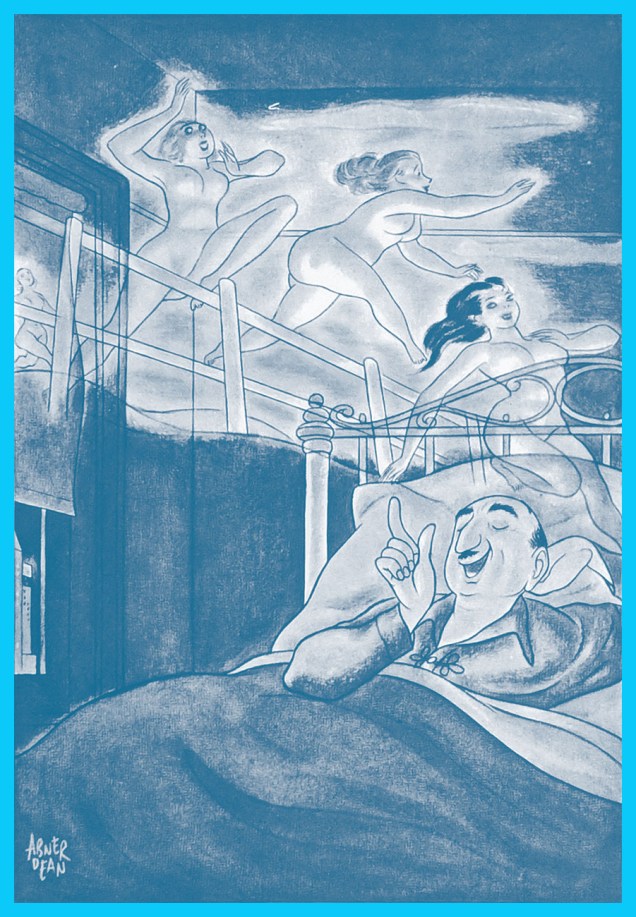
From It’s a Long Way to Heaven (1945)From It’s a Long Way to Heaven (1945)From What Am I Doing Here? (1947)From What Am I Doing Here? (1947)From What Am I Doing Here? (1947)From What Am I Doing Here? (1947)From What Am I Doing Here? (1947)From And On the Eighth Day (1949)From Cave Drawings for the Future (1954)
« No other state of confusion is as interesting as yours. »
By the mid-1930s, Abner Dean (1910–1982), né Abner Epstein in New York City, had reached the pinnacle of his profession, and begun to make rewarding inroads into other pursuits and endeavours. Fruitfully and prolifically published in most of the top magazines of the era (and top era for magazines), such as The New Yorker, Life, Esquire, Coronet, Time, Newsweek, Collier’s, Look, Ladies’ Home Journal and so forth, he’d also scored in the advertising field (most notably through a fifteen-year association with Aetna Insurance).
Yet he was restless; he bristled at the limitations, conventions and formulae of the era’s gag cartooning world and had something grander in mind and up his sleeve. We’ll get to that.
But first, here’s a sampling of what Abner accomplished as a commercial illustrator and cartoonist early in his career.
The following four cartoons appeared in the pages of Esquire, for which Dean produced in excess of forty colour cartoons, and scads more in good old black and white (frequently with spot colour adornment) between 1934 and 1955.Spot the influence? The girl is a dead ringer for one of Jack Cole‘s celebrated beauties.
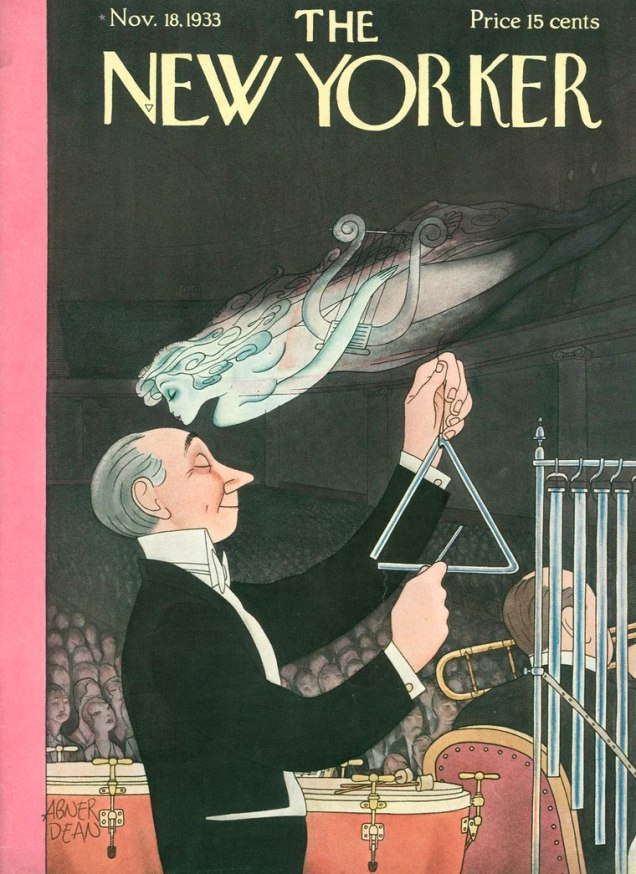
As Abner created five covers for The New Yorker (1933-35), it seemed absurd to leave any of them out, especially given their high calibre. Here they are, in order of their appearance.
Two examples of Dean’s illustrations for Aetna Insurance‘s long-running advertising and prevention campaign, for which Dean produced a whopping one hundred and ten drawings between 1940 and 1955. This one hails from 1946.To better convey the tone and tenor of the campaign, I’ve transcribed some of its text. This entry is from 1955.Our boy, wearing an appropriately skeptical expression, from the back cover of his Come As You Are (1955, Simon & Schuster).
Incidentally, what little remains publicly known about this once-famous man is the fruit of diligent research conducted by the eclectically erudite Ken Parille. As usual, we stand on the shoulders of giants. Thank you!
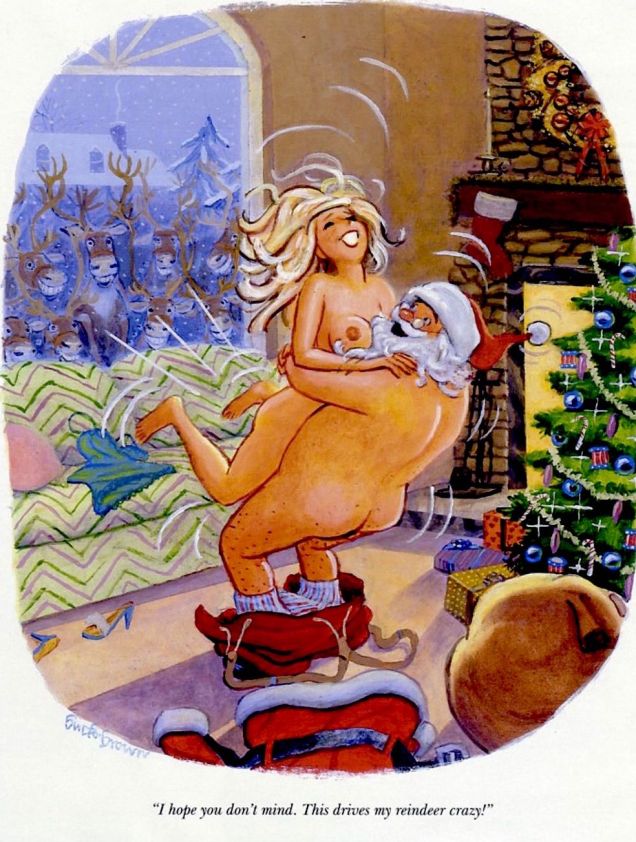
With every passing year, I have more and more trouble getting into the spirit of Christmas (especially since all the snow has now melted). An early present of Rodney Crowell’s Christmas Everywhere helped a bit, but to speed things along some more – and before Christmas Eve takes me by surprise – I’d like to titillate everybody’s taste buds with this spread of Playboy Christmas cartoons.
Cartoon by Buck Brown (real name Robert Brown), an African-American cartoonist and painter, creator of the naughty (and adorable!) Granny.Cartoon by Austrian Erich Sokol. A little linguistic tidbit: “sokol” means “hawk” in Russian.
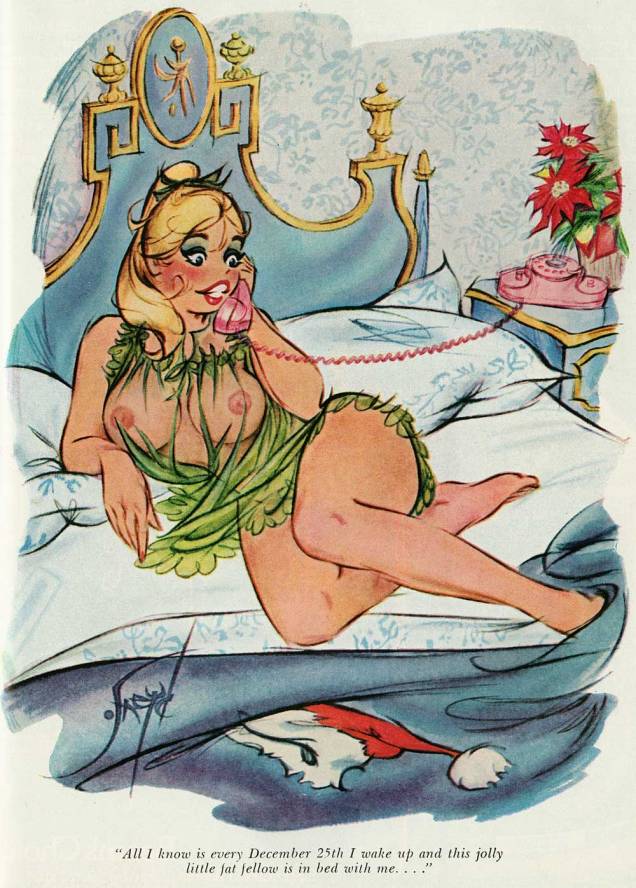
And on the topic of bedding Santa Claus…
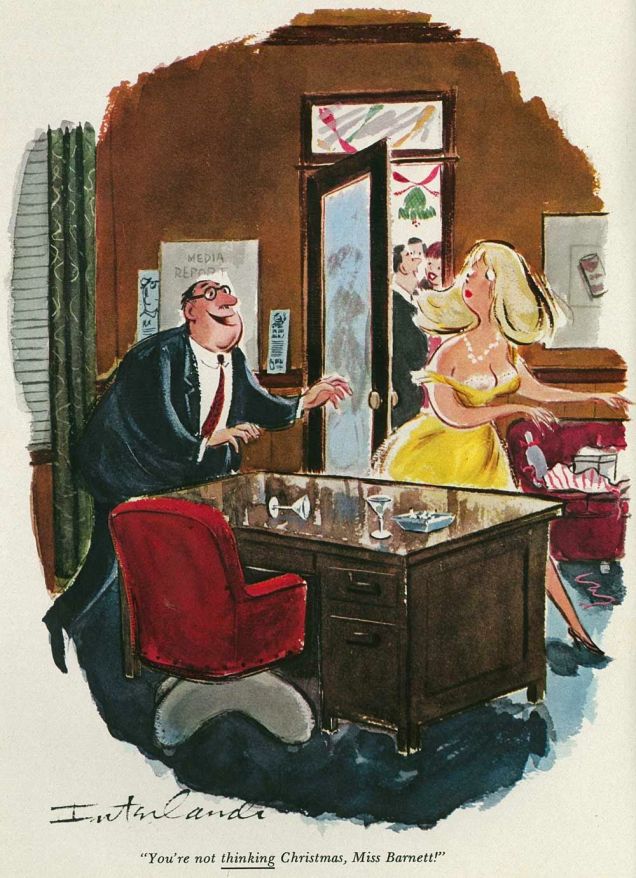
Cartoon by Canadian Doug Sneyd.Eldon Dedini! (We ran an earlier exposé about him here.) Who needs naked women when you have the (slightly grabby) three magi?Cartoon by the ineluctable Jack Cole! Don’t forget to take a peek at my mate’s post, The Unforgettable Jack Cole.Cartoon by Phil Interlandi.
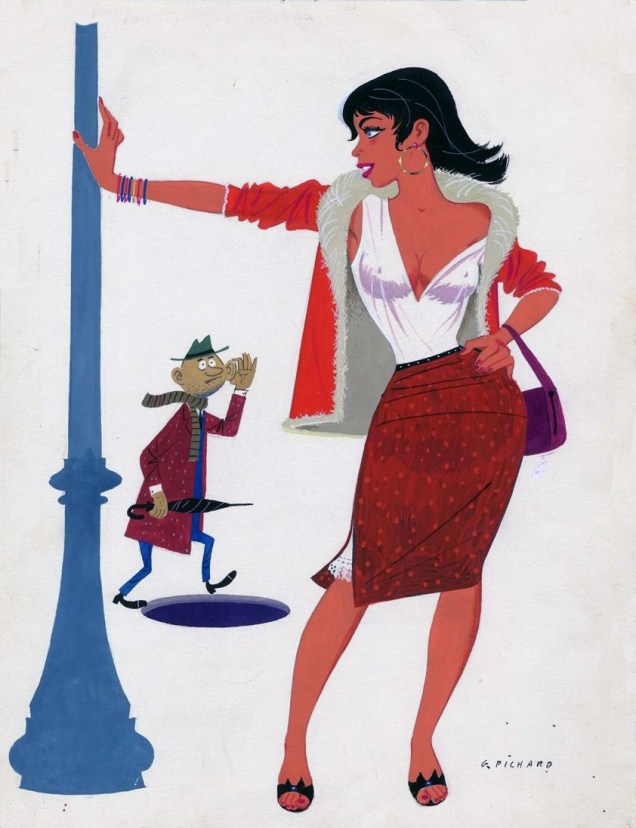
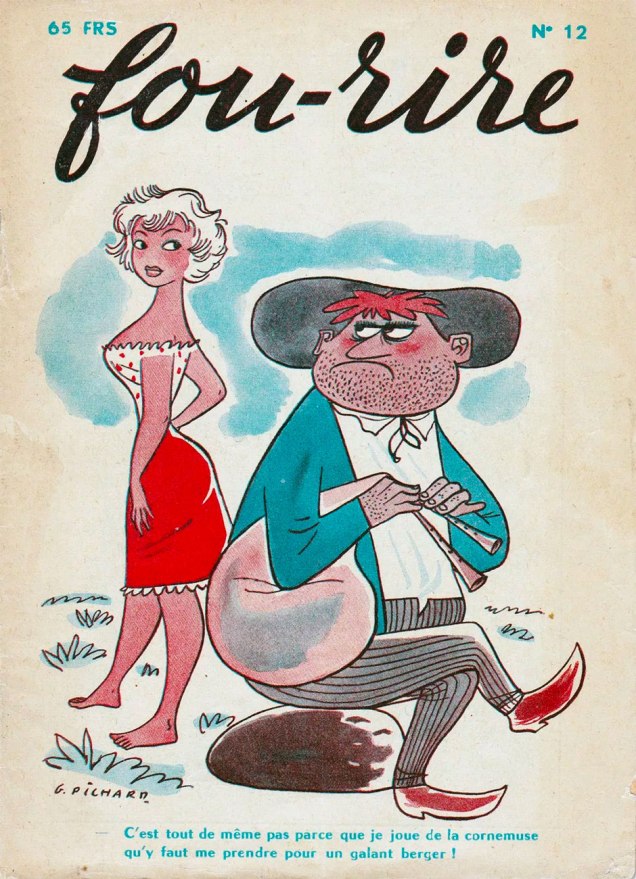
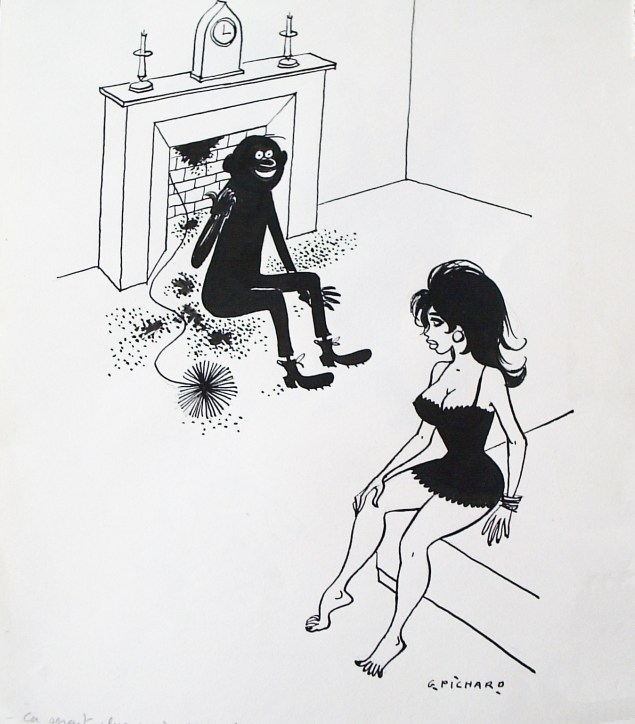
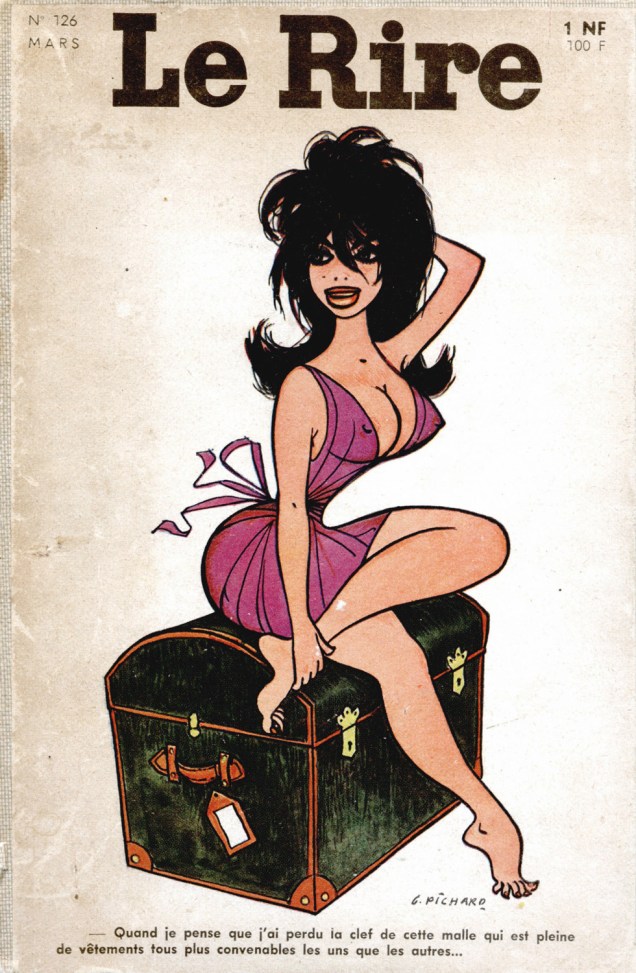
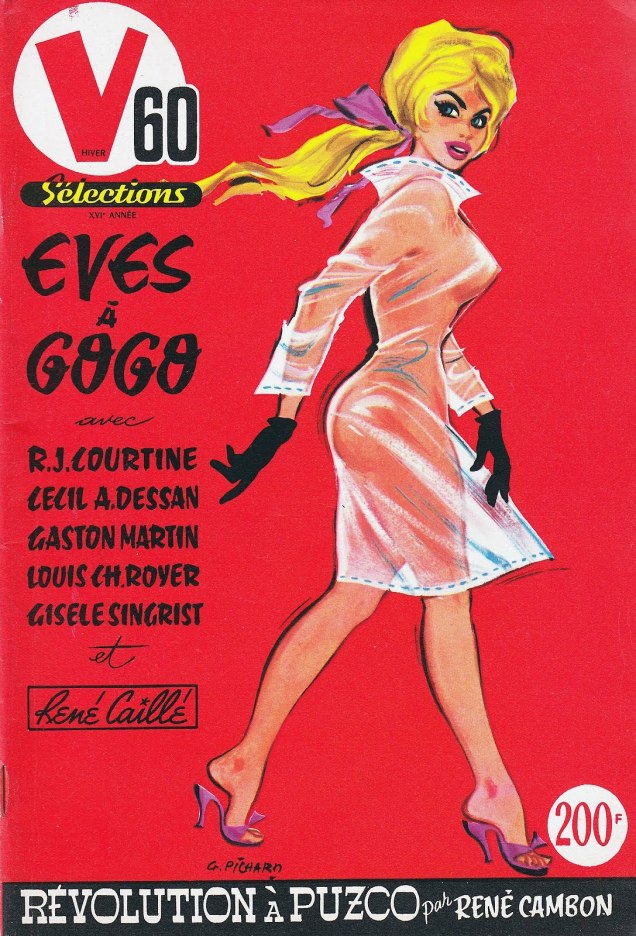
In 1946, Georges Pichard (not sure who he is? Visit our Pichard’s Distressing Damsels for an overview of his later work), heretofore toiling in a marketing agency, started his career as an illustrator. He worked for various French magazines and newspapers (like Le Rire, Fou-Rire and Les Veillées des Chaumières), providing them with covers, cartoons and pin-ups in black-and-white or gorgeous watercolour until the mid 70s, when he switched gears somewhat and dedicated himself to erotic bandes dessinées.
I left image imperfections (due mostly to yellowing of paper over time) and hand-written captions (when available) as is, as I find they provide pleasant texture and context. The jokes are really lame, but we translated them, anyway.
The following three cartoons were published in Le Rire. This first one saw print on the cover of Le Rireno. 22 (nouvelle série, July 1953).
This one was featured on the cover of Le Rireno. 66 (nouvelle série, March 1957).
« I’m the sort of guy who’s kind of like an iceberg, the main part is beneath the surface. » The man in question looks very much like a V.I.P. type.
The following are all from Fou-rire:
Cover of Fou-rire n°12, mid-50s. « It’s not because I’m playing the bagpipes that you have to take me for a gallant shepherd! »Cartoon from Fou-Rire n° 76, early 60s. « Please be assured, my dear friend, that we are all here quite touched by your wife’s endeavours to set a mood… ».Cartoon from Fou-Rire n° 118, early 60s. « It would be prudent to seal up your chimney, because when I tell the boss about this… »Fou-Rire n° 118, mid 60s. « And to think that I’ve mislaid the key to this chest full of outfits, each more decent than the last… »
Finally, a couple of pretty loose ends:
Original art from Le Rire magazine, 1960s. « But the funniest part happened before I ran into the police officer! »Early 60s.
« At one time, I sold general cartoons to some of the men’s magazines, the girlies — until I went into a newsstand one day and looked at one. » — Betty Swords
If female cartoonists were fairly uncommon in the American mainstream magazine field for much of the twentieth century, they were doubly so within the so-called girlie mags.
« During the 1950s, Abe Goodman — brother of Marvel Comics publisher Moe ‘Martin’ Goodman — was the largest buyer of cartoons in the world. Publishing out of New York City under the Humorama banner, Goodman churned out scores of cheap digest-sized magazines boasting inventive titles like Romp, Stare and Joker that featured hackneyed jokes, cheesecake photos and the publications’ bread and butter, single panel pin-up cartoons.
These magazines were an unlikely proving ground for neophyte gag cartoonists as well as a welcomed alternative to the daily grind of comic book sweatshops. In the 1950s and 1960s, these digests featured the likes of Playboy’s Jack Cole, Archie’s Dan DeCarlo and glamour girl legend Bill Ward. »
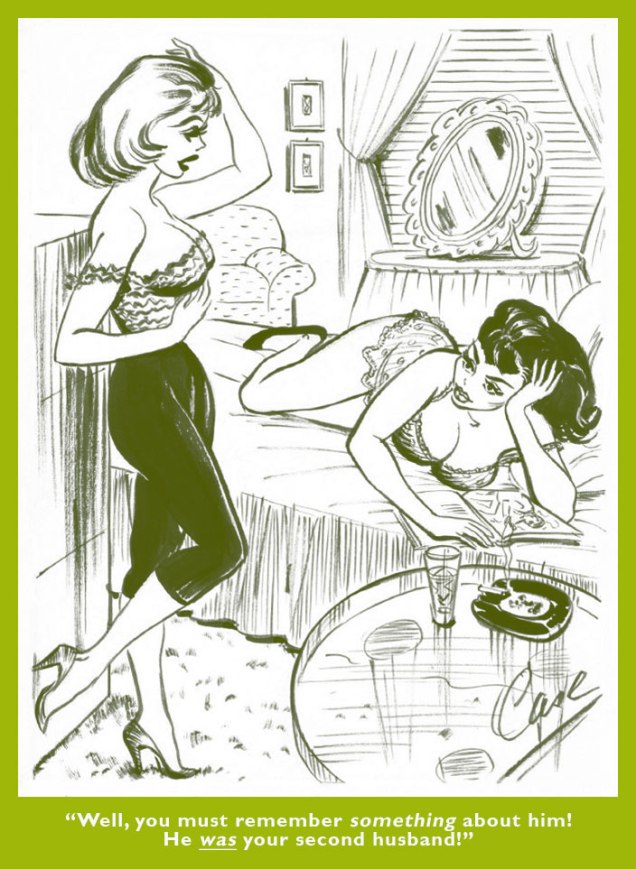
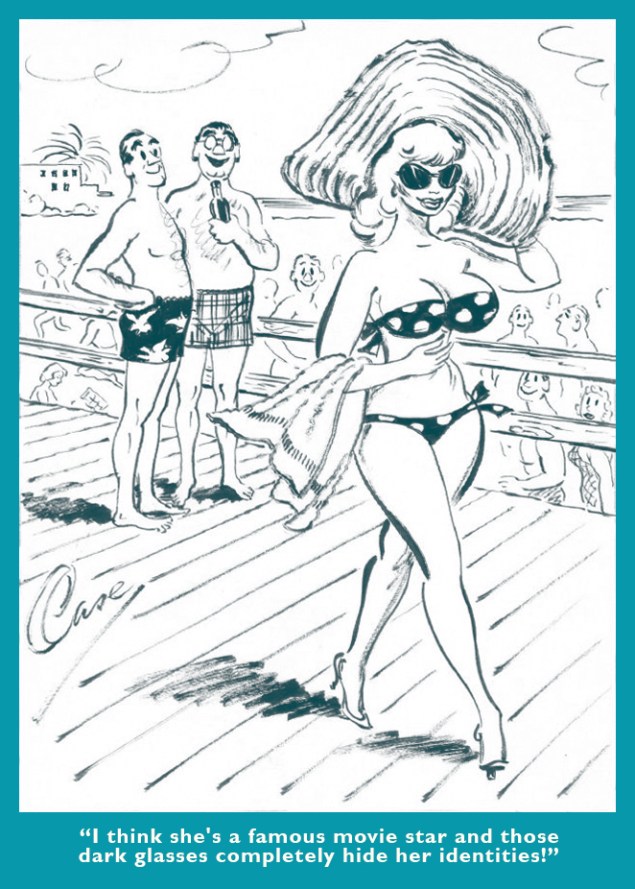
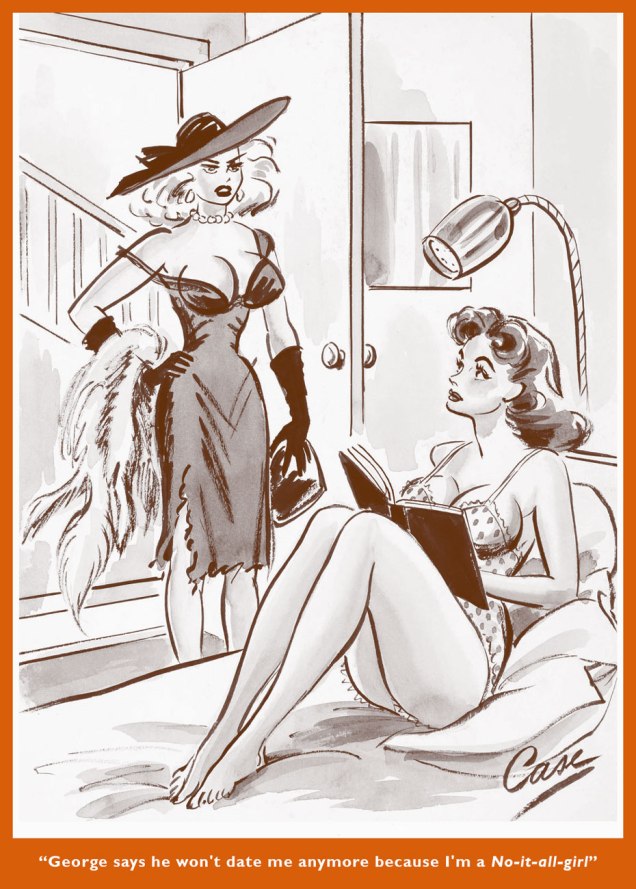
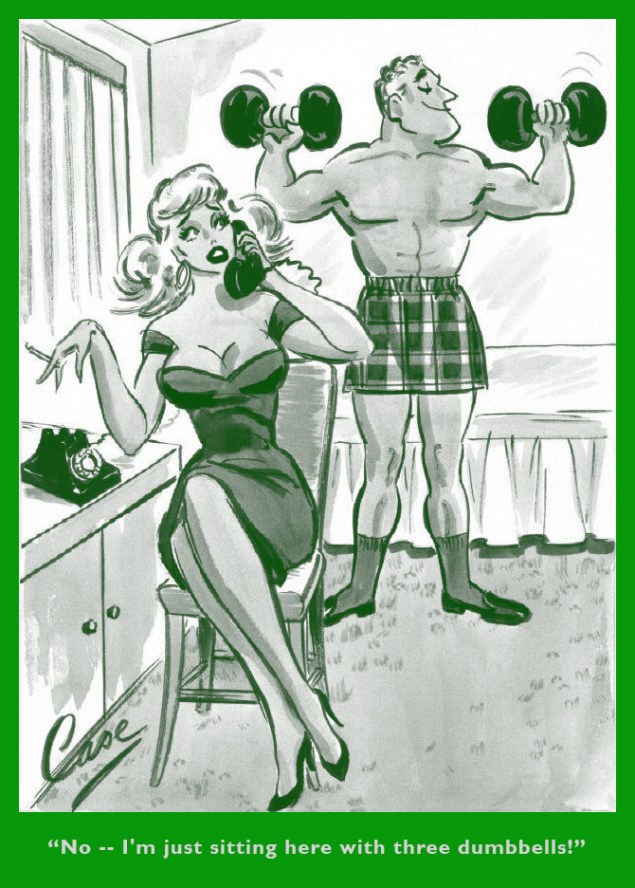
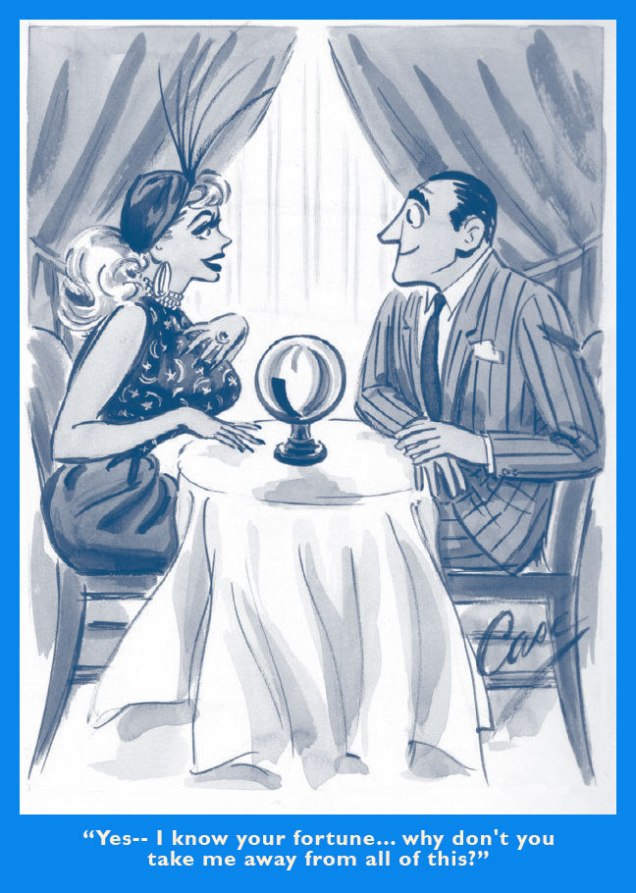
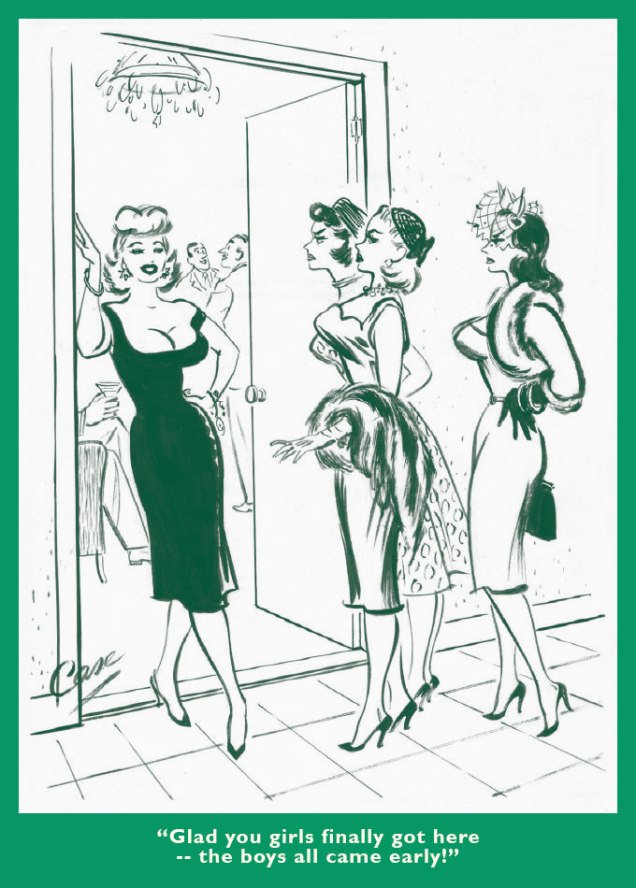
While I can unreservedly recommend Alex Chun and Alex Covey’s The Pin-Up Art of Humorama (Fantagraphics, 2011), I’m frankly puzzled as to its wholesale snubbing of Helen Case, who might have brought a welcome bit of variety to the all-male revue. God knows some lesser lights did make the cut.
While feminist cartoonist Betty Swords would likely have dismissed Case’s protagonists the way she did Barbara Shermund‘s, as « gold diggers, dames — amateur prostitutes », Case’s cartoons (I’m afraid I don’t know whether she wrote and illustrated, or simply illustrated… at Humorama’s pauper’s rates, the former is somewhat preferable) provide a refreshing female perspective to the battle of the sexes. To quote Betty Swords again (from R.C. Harvey‘s excellent Insider Histories of Cartooning (2014, University Press of Mississippi): « I remember one editor who shuffled through my cartoons then tossed them on the desk and said, ‘You gal cartoonists are all alike — you don’t attack and hit hard enough!‘ »
While scant information is available regarding Ms. Case (she appears to have lived in Kingston, New York in the early 1960s), at least online, much of her work survives, which surely has to count for something. We present some of the finer cuts, and if the gags aren’t transcendentally great, they are a brace o’ notches above the average knuckle-dragging drollery pervading the pages of Breezy, Snappy or Eyeful of Fun. Most of these gags were drawn and initially published (Humorama’s cheapskate policy was to print, reprint, and reprint again) between 1960 and 1964. Enjoy!
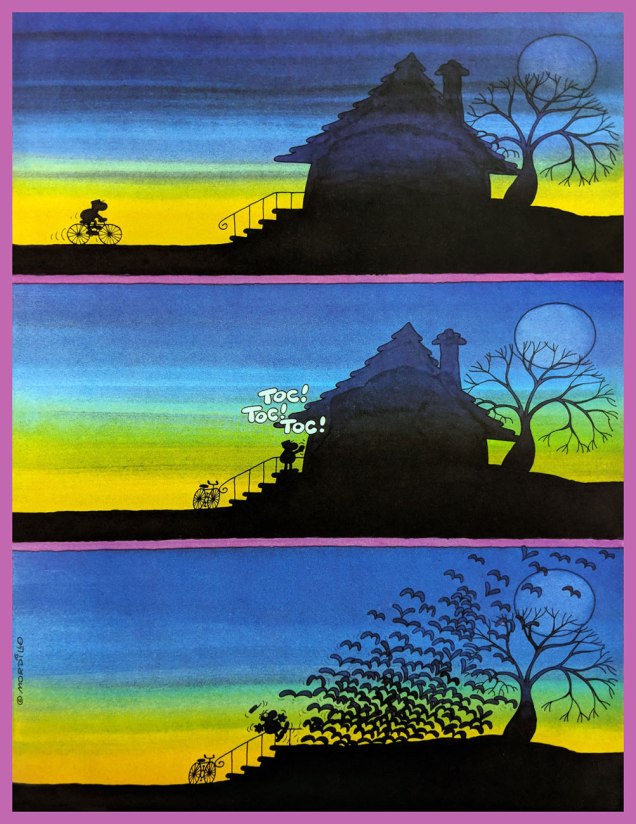
Guillermo Mordillo (1932 – 2019), known simply as Mordillo, was an Argentine artist of Spanish parentage. Through his long and productive career, he released more comic albums than you could shake a stick at… and at 86, was still active in the comics field. His easily recognizable style, love of bright colours and oft-surreal humour make his work memorable despite his persistent profligacy.
It would be impossible to provide an overview of his body of work in one post, but it is my pleasure to furnish a fun sampling of his œuvre. Most images below have been gleaned from Opus 5 (Glénat, 1984) and Safari (Glénat, 1990), unless indicated otherwise.
The following two images were scanned from early 1970s issues of Pif Gadget.
In the mid-70s, Mordillo’s cartoons were used by Slovenian artist Miki Muster to create Mordillo, a series of cartoon animations that ended up being 400 “episodes” long (for a total of 300 minutes – each episode is under a minute). These droll snippets were broadcast in over 30 countries between 1976 and 1981. Should you have a few minutes to spare for a chuckle or two, have a look at this video (recorded by somebody in Germany on VHS tape in the 90s and, many years later, uploaded to Youtube – what lovely, contorted pathways some of these things take).
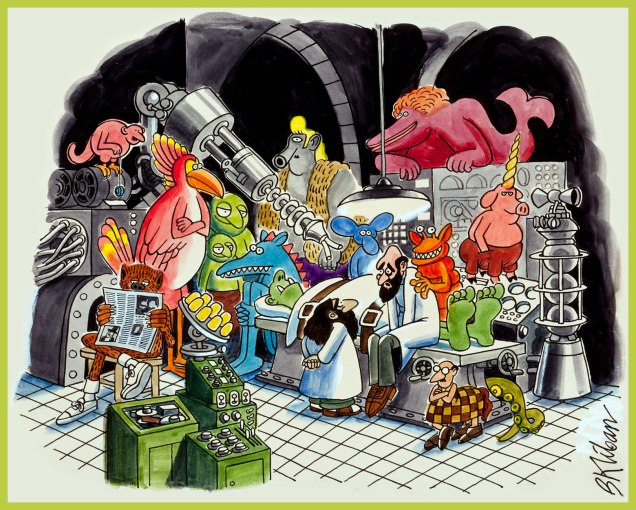
Another astonishing madman from the Playboy magazine stable, Bernard Kliban (1935-1990) is mainly remembered for his much-merchandised « Cat » cartoons, but he was a true master of a vein of absurdist humour that few mine with such success. It’s high time for a collected œuvre or at the very least a comprehensive anthology. Fantagraphics, are you listening?
« Since when do we use the red thread on a green monster? »« I’m the monster’s wife… can I help you? »« Harry, you startled me! »« I spend twenty-seven years making monsters and what does it get me? A roomful of monsters! »« Look, Igor, the monster lives! … and not badly, either! »
These pieces were gathered in the Playboy’s Kliban collection (1979) and its sequel, Playboy’s New Kliban (1980). Every single one of the man’s books (of which only the Cat books remain in print, I believe) is assuredly worth seeking out, but fair warning: left to his own devices, and away from the Playboy ethos, Kliban goes much farther afield into (extremely inspired) absurdity and abstraction.
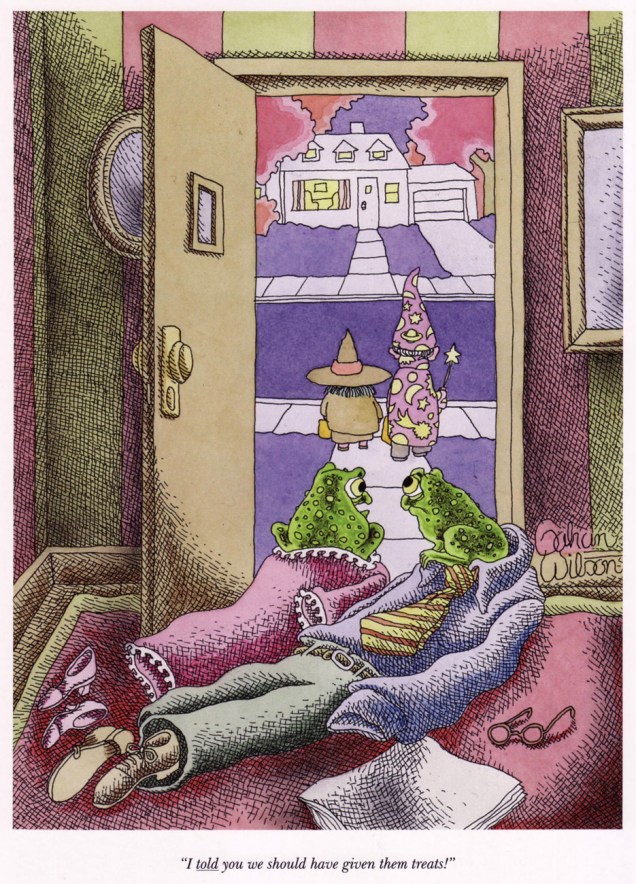
« It’s astonishing how terrible people can be. » – Gahan Wilson
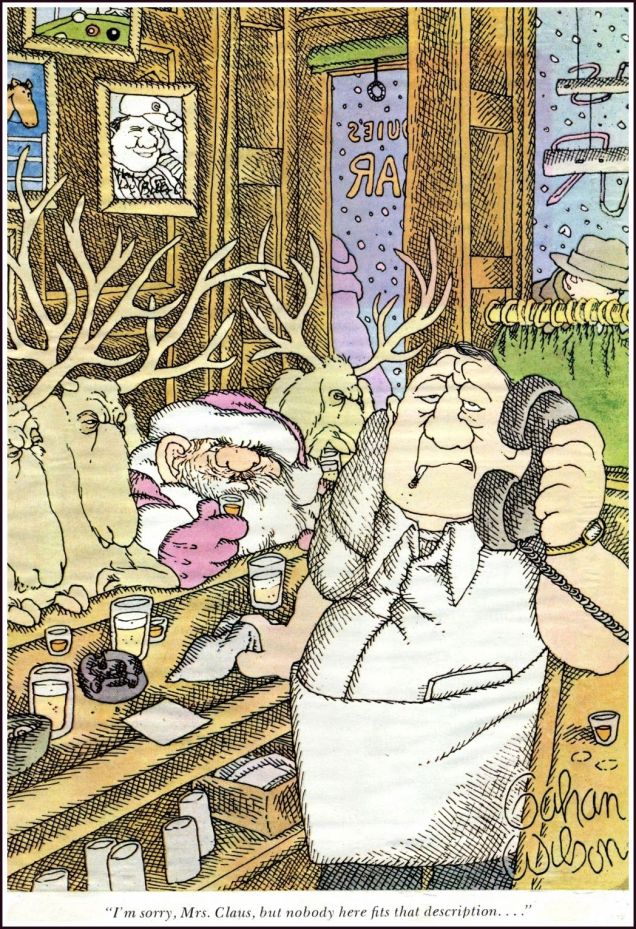
Chez Gahan Wilson (as with his esteemed colleagues Charles Addams and Edward Gorey, for instance), it’s always Hallowe’en! Here’s a trio of particularly fitting cartoons published over the years in Playboy magazine, always one of the finest homes for wayward cartoonists. Gahan was pretty much the only guy Hugh Hefner didn’t encourage to draw buxom females.
Playboy, October 1959.Playboy, November 1967.Playboy, October 2005.
Early in the magazine’s existence, Hef was looking for a Chas. Addams to call his own (the man himself was under exclusive contract with The New Yorker), and he found him. Yet, as Hefner said in his introduction to Fantagraphics’ extraordinary collection, Gahan Wilson: Fifty Years of Playboy Cartoons: « I don’t think I could have imagined before the fact how Gahan was going to grow. What one saw in the beginning was only the promise. »