Maurice Henry: Make Way for Surrealism

« The man who cannot visualize a horse galloping on a tomato is an idiot. » ― André Breton

What is one to do, in a mere blog post, with a polymorphous artist such as Maurice Henry (1907-1984)?

Here’s a handy bit of compressed biography, from his Lambiek page:

Henry was a French painter, poet, filmmaker, as well as a cartoonist. Between 1930 until his death, he published over 25,000 cartoons in 150 newspapers and a dozen books. His cartoons were generally surrealistic and satirical.

In 1926, he co-founded the magazine Le Grand Jeu with René Daumal, Roger Gilbert-Lecomte and Roger Vaillard, with whom he formed the “Phrères simplistes” collective. Henry provided poems, texts and drawings, while also making his debut as a journalist in Le Petit Journal.

He left Le Grand Jeu in 1933 to join André Breton’s group of Surrealists and their magazine Surréalisme au service de la Révolution. He also worked with the artist and photographer Artür Harfaux on the screenplay of twenty films, including ones starring the comic characters ‘Les Pieds Nickelés’ and ‘Bibi Fricotin’. Maurice Henry spent the final years of his life making paintings, sculptures and collages. He passed away in Milan, Lombardy, in 1984.

The answer? My default solution, which is to focus on some small parcel of the much greater whole. A number of Henry’s works bear revisiting (for instance, Les métamorphoses du vide [1955], a truly groundbreaking picture book about the world of dreams; À bout portant [1958], a collection of literary portraits; or Les 32 positions de l’androgyne [1961, also issued in the US in 1963], a chapbook of… gender recombinations) and deserve a turn in the spotlight.

To quote co-anthologists Jacques Sternberg and/or Michael Caen in their indispensable Les chefs-d’oeuvre du dessin d’humour (1968, Éditions Planète, Louis Pauwels, director):

Surrealism — he was part of the group before 1930 — left its mark on him and it’s because he was already well-cultured as he launched his career that he was among the first, in the desert that was the publishing world of the 1930s, to attempt unusual drawings calling upon often startling ingredients, such as poetry, black humour, the fantastic and the absurd. He caused no less of a surprise by doing away with captions, at a time when bawdy jabbering was the fashion all over. In short, Maurice Henry was indisputably a pioneer of that grey and stinging brand of humour that would explode like an H-bomb some fifteen years later.

HenriEscapeeA
A lovely bit of conceptual humour from 1938. A rare one bearing a caption, but the joke called for it. At this early stage, you won’t be wrong to point out a certain stylistic debt (it’s the roundness and simplicity of line!) to his contemporary and compatriot Jean Effel. Henry was indeed a fan. Do check out my co-admin ds’ fine post spotlighting the good Monsieur Effel.
HenryMinotoréadorA
An example of what enlightened creators such as Henry were fighting for: making room for cartoons that weren’t just about the cheap chuckles. Consider, for instance, the existential plight of the Minotoreador . Published in K. Revue de la poésie no. 3 (“De l’humour à la terreur”, May 1949).
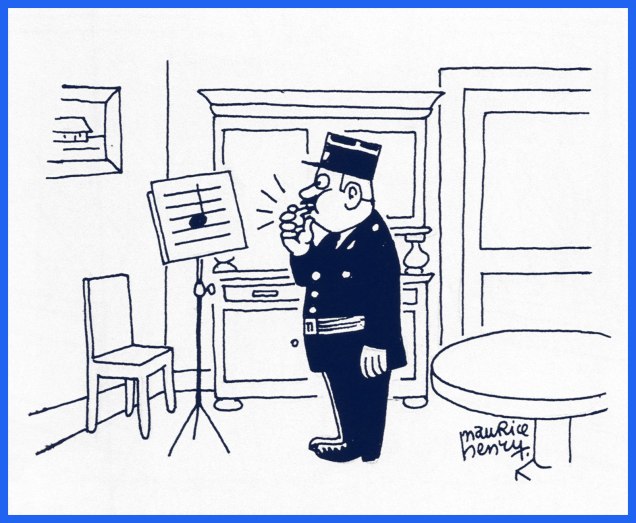
HenriGendarmeA
The Military, Government, Constabulary and Clergy were favourite targets, naturally. When it was (barely) tolerated. It helped to be ambiguous, even if one wasn’t ambivalent (1951).
HenryPrieurA
Here’s one for the clergy; though mocking, it’s hardly what you’d call hostile. From the first issue of epochal surrealist magazine Bizarre (1955-1968).
HenriCèneA
Yes, it’s Card Sharp Jesus entertaining, confounding (and possibly fleecing) his disciples. Note the ace up his right sleeve (1941).
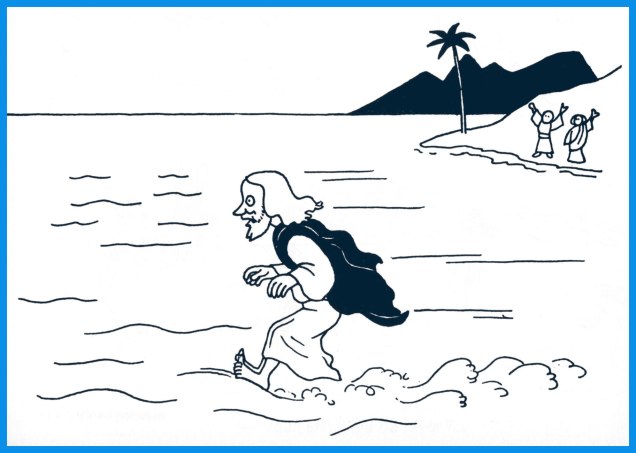
HenriSkiNautiqueA
Walking on water was clearly just the beginning (1948).
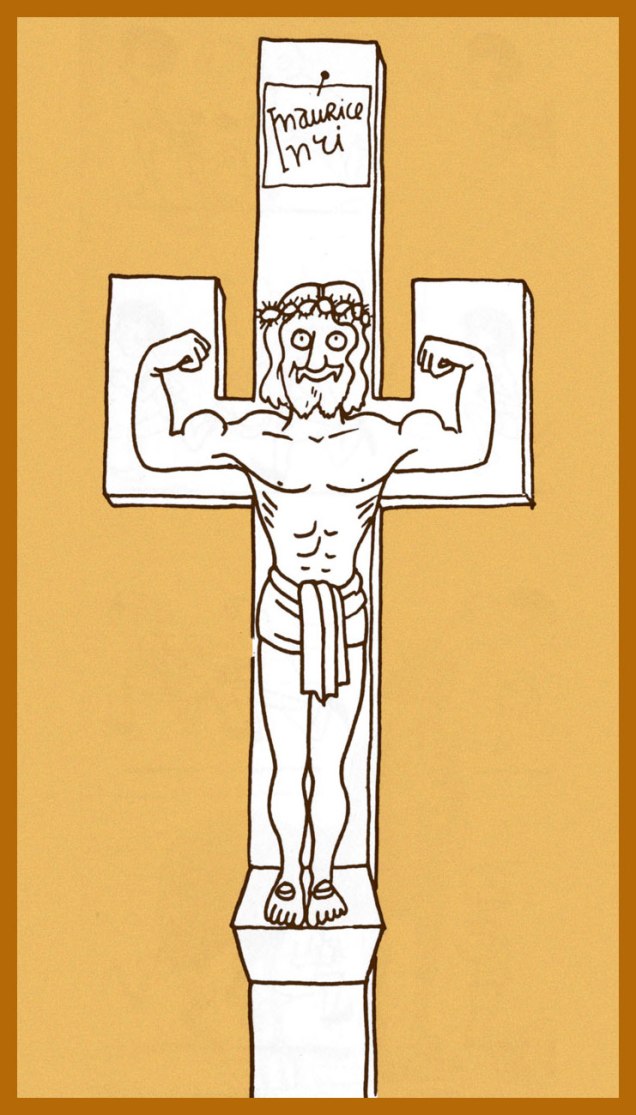
HenriJesusMuscleA
Henry’s Jesus seems like a swell fellow, really. A bit on the roguish side, which is fine by me (1958).
Easter'sCancelledDarkness
See? A case of a joke’s that’s more than a half-century old still finding echoes in the present day. Cover from The Darkness‘ prophetic 2019 album, Easter Is Cancelled.
HenryCanons02A
That soldier’s scared yet dismayed expression brings to mind Futurama’s hapless Philip J. Fry.
HenryCanons01A
That’s one relaxed elephant.
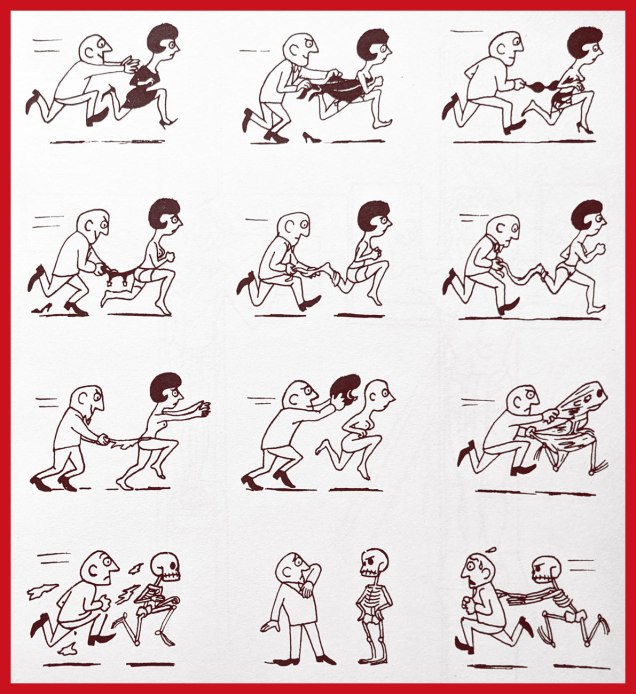
HenryPoursuiteA
Another illusion shattered.

HenryVoitureA

HenryAutophageA
The little hand wave at the end really makes this one.
MauriceHenryLoupeA
The artist in 1935, photographed by his friend and frequent co-conspirator Arthur Harfaux.

-RG

Tentacle Tuesday Masters: The Far Side of Gary Larson, Pt. 2

« Octopuses have a lot in common with other species that are known to thrive in cities—not only can they use human-made structures for shelter, but they’re highly adaptable and good at problem solving. So maybe we’re justified in adding to our list of neighbours, next to the raccoon at the sliding glass patio door and the coyote in the halo of the street lamp, the octopus casting its appraising eye from under the sunken hull of a rowboat. » |source|

Octopuses in a mundane, urban setting? Address yourself to Gary Larson!

As promised a couple of weeks ago, we’re back with another Larson-copia of tentacles! Pt. 1 can be found here. Again, thanks to co-admin RG for all the scanning and colouring work.

FarSideWhoseEyeA
If you think we’re somewhat stretching the definition of “tentacle”, I think the husband’s, err, feet definitely qualify.

FarSideSharkFrenzyA

FarSideGuessWhoA

FarSideSquidKidsA

FarSideSpoiledA
Incidentally, one the world’s largest sea creatures is the lion’s mane jellyfish, whose tentacles are the longest of them all (they can attain lengths up to 37 metres or 120 feet).

FarSideSquidBGoneA

FarSideShakeJarA

FarSideGallery4A
Letting us know what we’re in for straight away, even the cover of the fourth Far Side collection features a tentacle.

∼ ds

Some content on this page was disabled on June 3, 2022 as a result of a DMCA takedown notice from Gary Larson. You can learn more about the DMCA here:

https://wordpress.com/support/copyright-and-the-dmca/
Some content on this page was disabled on June 3, 2022 as a result of a DMCA takedown notice from Gary Larson. You can learn more about the DMCA here:

https://wordpress.com/support/copyright-and-the-dmca/
Some content on this page was disabled on June 3, 2022 as a result of a DMCA takedown notice from Gary Larson. You can learn more about the DMCA here:

https://wordpress.com/support/copyright-and-the-dmca/
Some content on this page was disabled on June 3, 2022 as a result of a DMCA takedown notice from Gary Larson. You can learn more about the DMCA here:

https://wordpress.com/support/copyright-and-the-dmca/
Some content on this page was disabled on June 3, 2022 as a result of a DMCA takedown notice from Gary Larson. You can learn more about the DMCA here:

https://wordpress.com/support/copyright-and-the-dmca/
Some content on this page was disabled on June 3, 2022 as a result of a DMCA takedown notice from Gary Larson. You can learn more about the DMCA here:

https://wordpress.com/support/copyright-and-the-dmca/
Some content on this page was disabled on June 3, 2022 as a result of a DMCA takedown notice from Gary Larson. You can learn more about the DMCA here:

https://wordpress.com/support/copyright-and-the-dmca/
Some content on this page was disabled on June 3, 2022 as a result of a DMCA takedown notice from Gary Larson. You can learn more about the DMCA here:

https://wordpress.com/support/copyright-and-the-dmca/

Mr. Mum’s International ‘Anything Can Happen’ Club

« The observer, when he seems to himself to be observing a stone, is really, if physics is to be believed, observing the effects of the stone upon himself. » — Bertrand Russell

Irv Phillips‘ (1904-2000) Mr. Mum was a comic strip that ran between 1958 and 1974 (at which point both author and alter ego took their well-earned retirement), attaining a quite considerable level of popularity, thanks its appearance in over 180 newspapers in 22 countries or so. The pantomime approach certainly helped sell it abroad. The titular character is a bystander, an eternal witness to… everything and especially anything.

In an interview published in Cartoonist Profiles no. 4 (Fall, 1969; Jud Hurd, editor), we learn that Phillips « ... has been an actor, a violinist, a Hollywood script writer, the Humor Editor of ‘Esquire’ magazine, a playwright, as well as a very successful syndicated  cartoonist. » He goes on to reveal that « I didn’t draw until I became Humor Editor of Esquire Magazine in my thirties. I used to make little rough sketches to try to illustrate gags that I had written for the various Esquire cartoonists. I would take these sketches in to Dave Smart, the founder and publisher of Esquire, and together we would make the choices as to which cartoonist would handle one idea best, which man would be best suited to another idea, etc. It seems that these little sketches sort of intrigued Dave for a while and finally he said, ‘Why don’t you try to draw?’ »

While Phillips’ style is deceptively rudimentary (but still distinctive), it’s evident that his years as a gag man taught him the fundamentals: economy, clarity and substance. Here are a few samples drawn from a variety of sources:

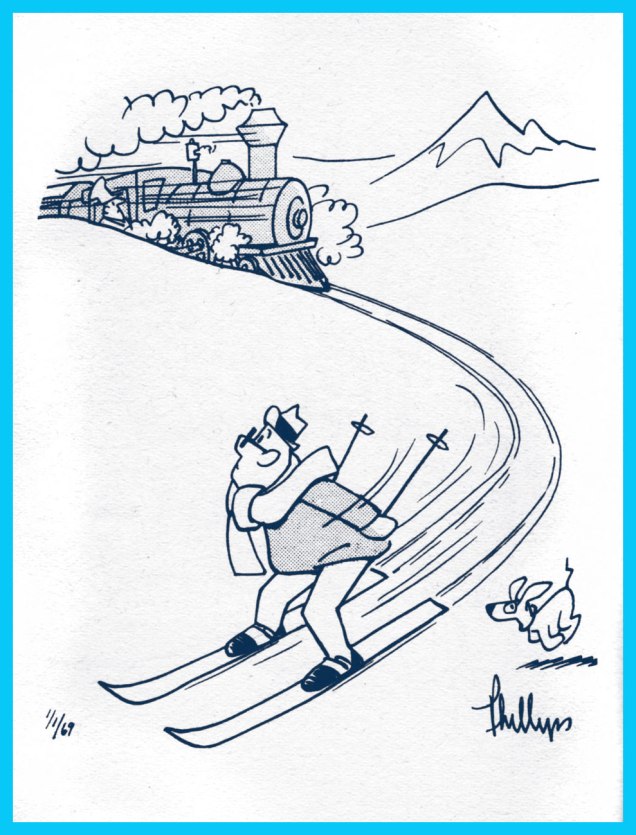
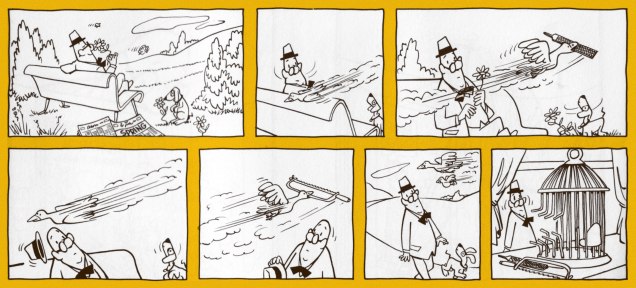
MrMumMysteryAMrMumBailoutAMrMumBewareAMrMumSkiTrainA

MrMumJailbreakA

MrMumLighthouseA

MrMumMannikinA
Sunday strip from March 2, 1969.
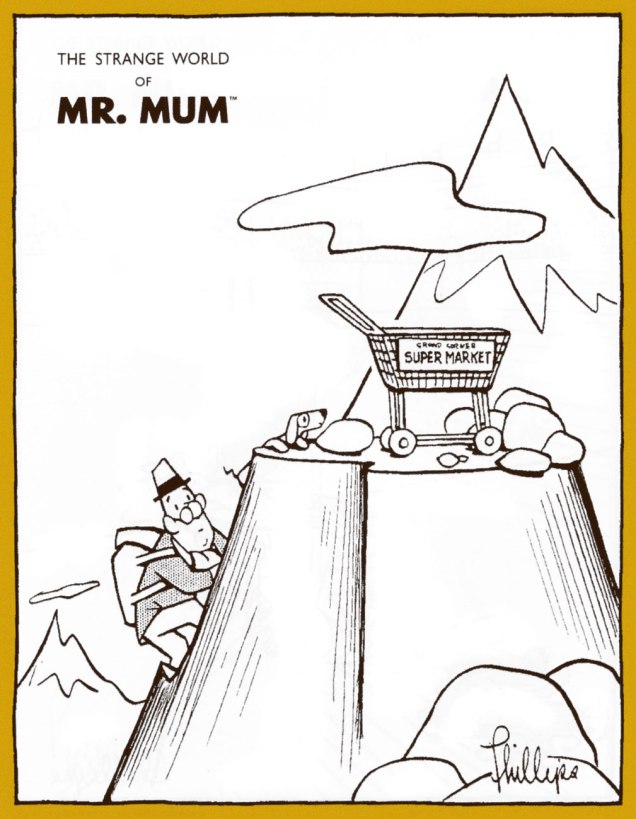
MrMumCartA
I’ve often wondered myself just how certain stray shopping carts arrived at their unlikely destination.
MrMumSundayFeb1471A
The Valentine’s Day Sunday of 1971, as it appeared in print. There’s always something to fret about, isn’t there?
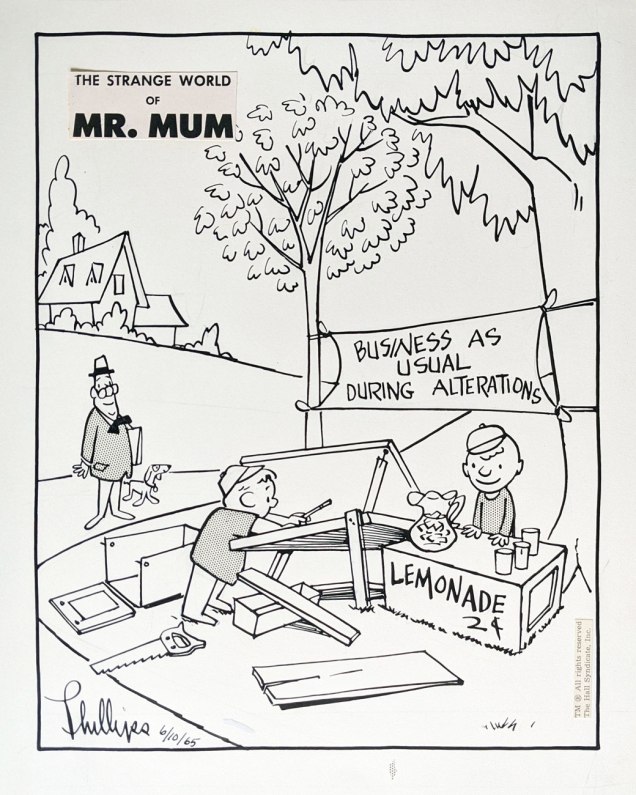
MrMumOriginalA
The lone Mr. Mum original piece in my collection, it’s the June 10, 1965 daily. It was a Thursday. The artwork is surprisingly large, at 22 x 28,5 cm (8,75″ x 11″). Note the little bit of halftone film stranded outside the frame.
StrangeWorldMrMumA
During the strip’s run, three collections appeared: this is the first, published in 1960 by Pocket Books.
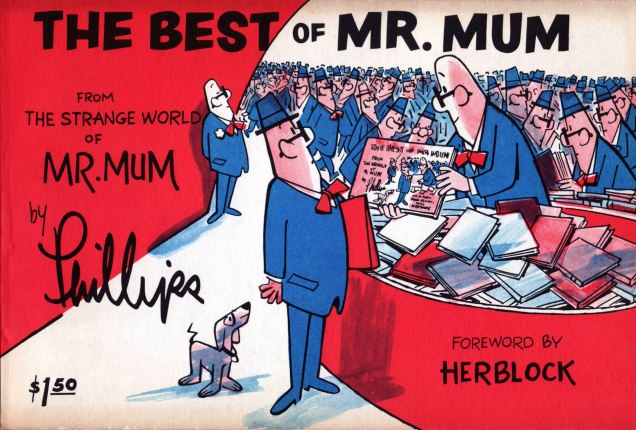
MrMumBestOfA
Issued in 1965 by G. P. Putnam’s Sons, this is the second and finest of the collections, its format comfortably allowing the presentation of dailies (two to a page) and Sunday strips. Hell to scan from, though.
MrMumNoCommentA
Finally, The Popular Library brought us the third collection, 1971’s No Comment by Mr. Mum. A slim, unprepossessing volume, it’s nonetheless filled to the brim with great picks.
MrMumCardA
A sample of a card he has given people who have sent him ideas. Phillips said: « Most of the fan mail seems to come from intellectuals and children. When people send in ideas, I send them the card, write them a letter, and if I use the idea, I send them a signed original. »

The Mum aficionado will seek sustenance wherever he can find it, but it helps that in this century, a pair of easy-to-find, affordable print-on-demand collections have seen the light of day. They are Classic Mr. Mum Volume 1 (2010, iUniverse) and The Strange World of Mr. Mum (2011, Empty-Grave Publishing).

One unexpected hurdle that stands in the way of a Mr. Mum revival is that an overwhelming number of Phillips’ originals repose in one man’s private collection. Not to put too fine a point on it, painter Andrew Massullo, though evidently a man of discernment, is hogging all the Mr. Mum original art. In a profile that appears in the San Francisco Chronicle’s website, SFGate, he reveals the appeal and the breadth of his collection:

Mr. Mum Cartoon Collection
by Irving Phillips
How many: 1,385 –
« It’s like potato chips, you can’t just have one. »

Why? The deadpan humor and the beautiful drawing.
« They remind me of my childhood. »

From? From his estate and eBay.
Any more? « No, I have all I want. »

Ah, that’s probably why I managed to snag one for myself. Let’s hope Andrew, if someone should make the request, will be open to the idea of a definitive Mr. Mum collection. I heartily concur with Mr. Massullo’s verdict on the addictive power of the strip. It vividly brings to mind the québécois adage « Le plaisir croît avec l’usage. » The deeper one delves into Mr. Mum’s oddly comforting universe, the more one appreciates the depth of his brilliance. For a start, scope out this fine selection of strips on Ger Apeldoorn’s ever-excellent blog The Fabulous Fifties. And while you’re at it, sneak a peek at my Christmas-themed ode to this loveable bystander.

– RG


Gerard Hoffnung’s Constant Readers

« Outside of a dog, a book is a man’s best friend. Inside of a dog, it’s too dark to read. » – Groucho Marx

Today, we salute the remarkably versatile and woefully short-lived Gerard Hoffnung (born in 1925, died in 1959 of a brain haemorrhage, aged 34): cartoonist, illustrator, educator, musician, raconteur… and voracious reader, ça va de soit.

While he’s perhaps most fondly recalled for his music and his music-related cartooning, I hold in special regard a slender volume of his gentle celebration of the act and art of reading, Hoffnung’s Constant Readers, from which I offer you the following samples.

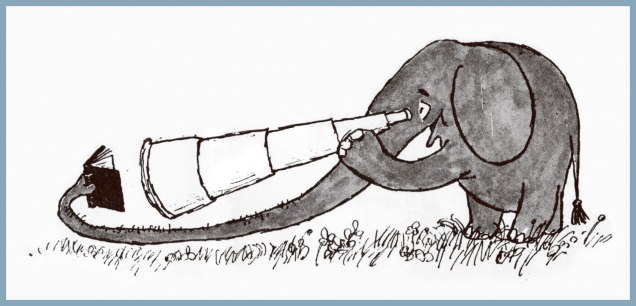
HoffnungLongLimbedAHoffnungElephantA

HoffnungUnpluggedA
This piece evokes echoes of another cozy favourite, this one, by two-headed cartoonist Anton.

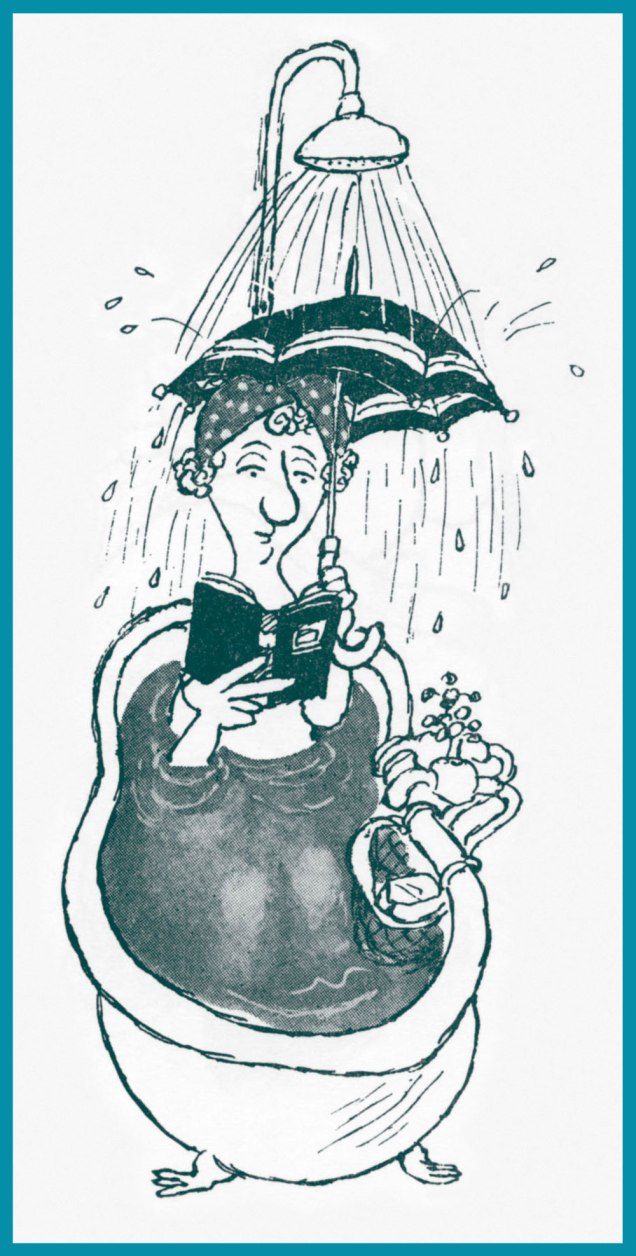
HoffnungBathttubA

HoffnungTVReaderA
Ah, the familiar struggle, this time with the unlikelier outcome… for a change.
HoffnungPeltA
The dread of every true bibliophile.
HoffnungPeekerA
Not a scene you’re likely to witness these days, nor should you!
HoffnungBakerA
I’m told that flour and yeast have lately been vanishing with dizzying speed from grocery shelves. It appears that home-confined bread lovers have, in tremendous numbers, taken up the noble art of making their own.

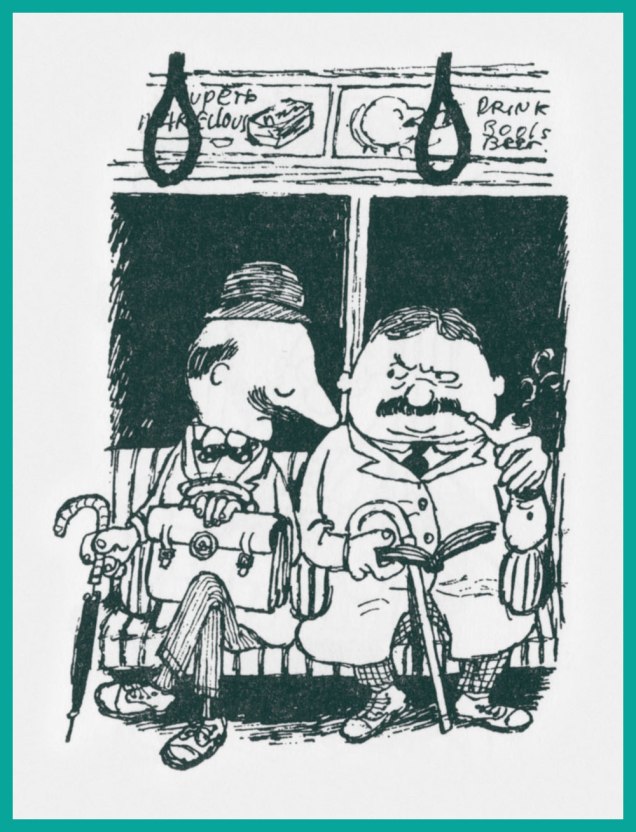
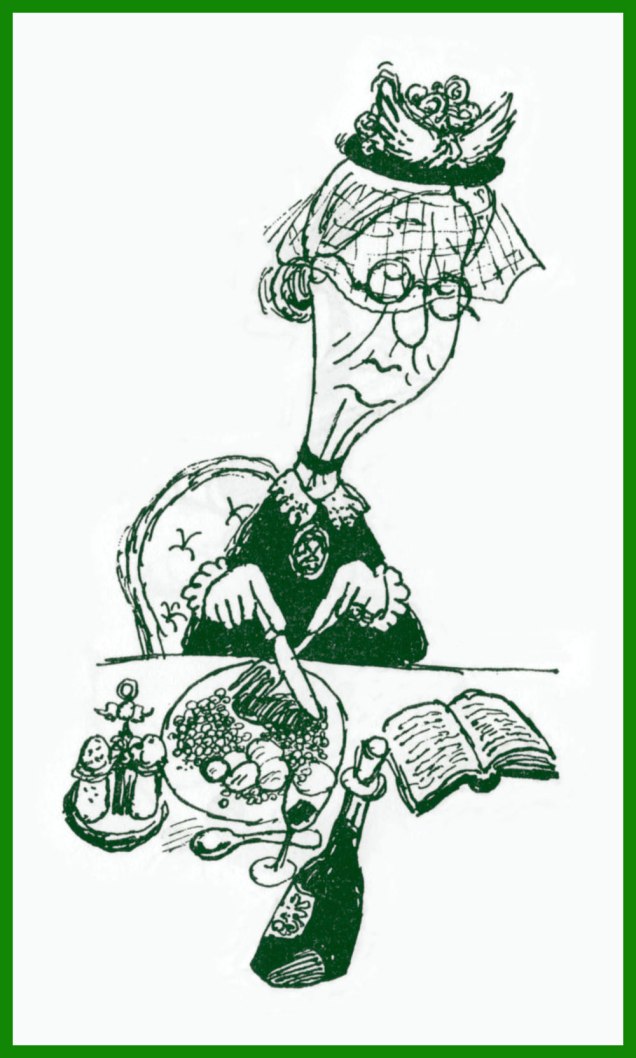
HoffnungDinerAHoffnungLorgnetteA

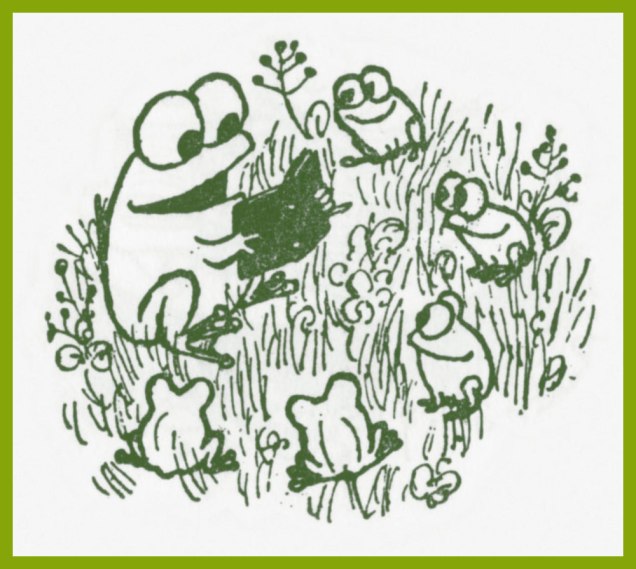
HoffnungFroggiesA
« Children are made readers on the laps of their parents. » – Emilie Buchwald
HoffnungReadersA
Front and back covers; like much of the man’s œuvre, Hoffnung’s Constant Readers (1962, Dennis Dobson, London) was published posthumously. For some dad-blamed reason, the book was at some point reissued under the rather disparaging title Hoffnung’s Bookworms. Bleh.
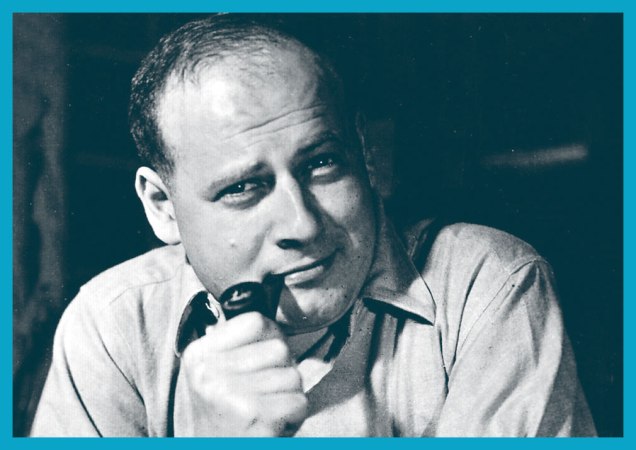
HoffnungPortraitA
The debonair (what else?) Mr. Hoffnung.

Born and raised in Berlin, teenage Gerard was sent to England in 1938 to flee the encroaching tide of Nazism. He was a lifelong (however brief the life) doodler, and most of his thousand-plus drawings (in a style bearing a touch of his noted compatriot Wilhelm Busch‘s influence) were carefully preserved. For such a short life and career, this irrepressible fellow left behind an outstanding discography and bibliography.

His devoted widow, Annetta Hoffnung, née Perceval (they wed in 1952), attended unflaggingly to his memory during the nearly sixty years that she outlived him by (she passed away in 2018); the website she created to celebrate and promote his work remains active, and there you’ll find a fuller biography. Thank you, madam.

-RG

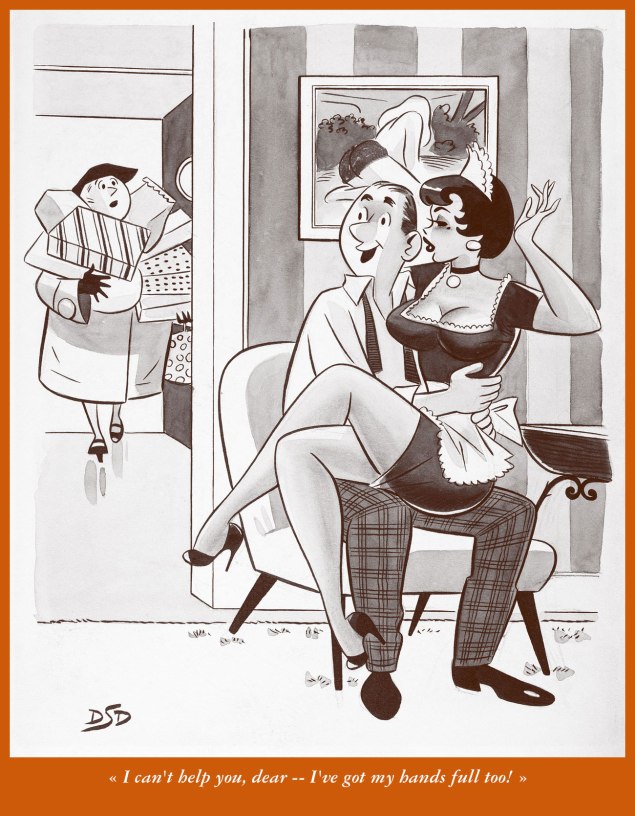
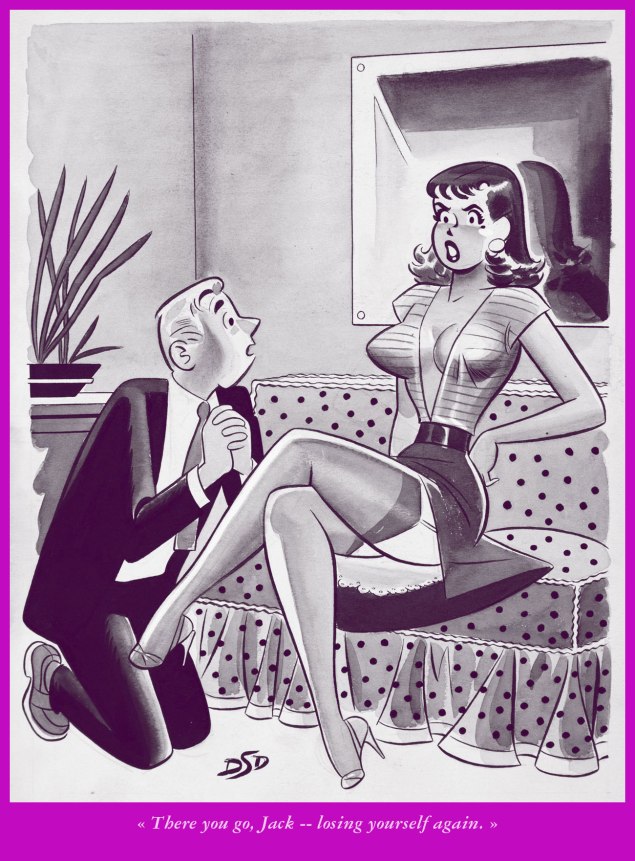
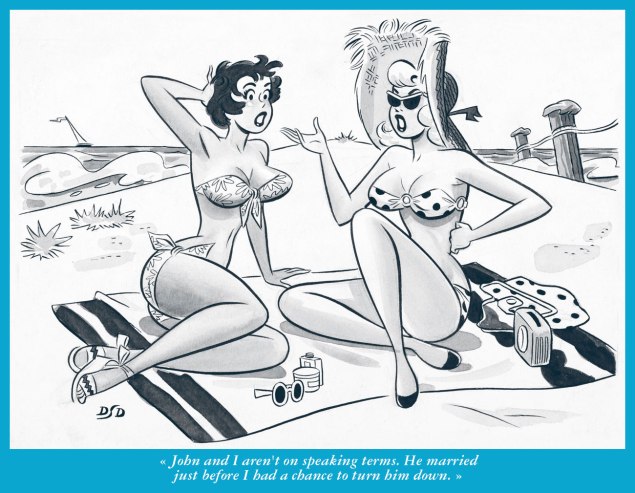
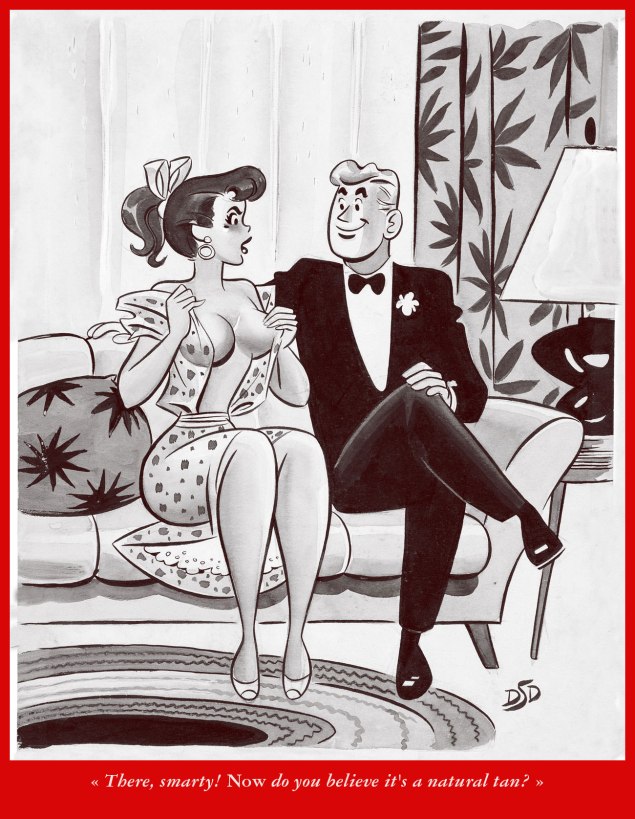
Dan DeCarlo at Humorama (1956-63)

« Discovering this girlie mag stuff was like expecting a bike for Christmas and getting a car. » — Jaime Hernandez on his personal DeCarlo epiphany

As assiduous readers of this blog may already know, I don’t rate Dan DeCarlo (1919-2001) all that highly as an Archie artist. Simply put, once he committed himself fully to the publisher (in 1963), he strapped himself onto a treadmill of exploitation for the next several decades, and on-model hackwork quickly became the norm. Archie consumers (can we truly call it reading?) didn’t know or care then, or now, who produced the stuff, nor how.

While grinding out sexy panel cartoons for Moe ‘Martin’ Goodman’s Humorama line of girlie digests also constituted exploitation (at 15 bucks a pop, sometimes less), the results were sturdier and far more expressive, which is surprising, given that DeCarlo produced hundreds of these (at the cited figure* of ten a month, it adds up to over 800!) over the course of a mere seven-year span. But then DeCarlo was at his peak, having acquired sufficient experience (he’d gotten his start in the field in 1947), and he was hungry and brimming with stamina.

DeCarlo buddy / biographer Bill Morrison, in his fine preface to Alex Chun and Jacob Covey’s The Pin-up Art of Dan DeCarlo (2005, Fantagraphics), sadly out of print and nowadays quite costly (though volume 2’s still available from the publisher, hint hint!), recounts the way things went down:

« According to Dan, Stan Lee wanted to make a little extra money, so he offered to introduce Dan to the editor of the Humorama line of men’s humor magazines. In return for the introduction, Stan would collect 10% of the fee for every single panel gag cartoon Dan contributed. Dan saw this as an chance to develop as a magazine cartoonist, and he decided to pull out all the stops. Dan recalled, ‘So I did five, and I brought them over, all black and white wash, you know. I thought they were beautiful, and he [the editor] loved them. He paid me $15.00 each, and I had to give 10% to Stan!’ Dan soon decided not to continue doing the cartoons, even when Stan declined to take his cut. So the editor offered a compromise. He said, ‘Well, would it be easier if you just draw the situations, and I put the gags in?’ Dan agreed that would help to make it worthwhile. He had been paying his comic book inker Rudy Lapick $3.00 a piece to come up with the gags, so with that cost eliminated, he could nearly clear a full $15.00 on each cartoon after buying supplies. Incidentally, Dan later learned that Rudy had been swiping the gags cold from a book of Peter Arno’s New Yorker cartoons, so it’s probably a good thing that this arrangement didn’t continue. »

Here’s a baker’s dozen samples of what I deem the cream of the DeCarlo crop…. visually, anyway.

DeCarloHandsFullADeCarloLosingYourselfADeCarloSpeakingTermsADeCarloNaturalTanA

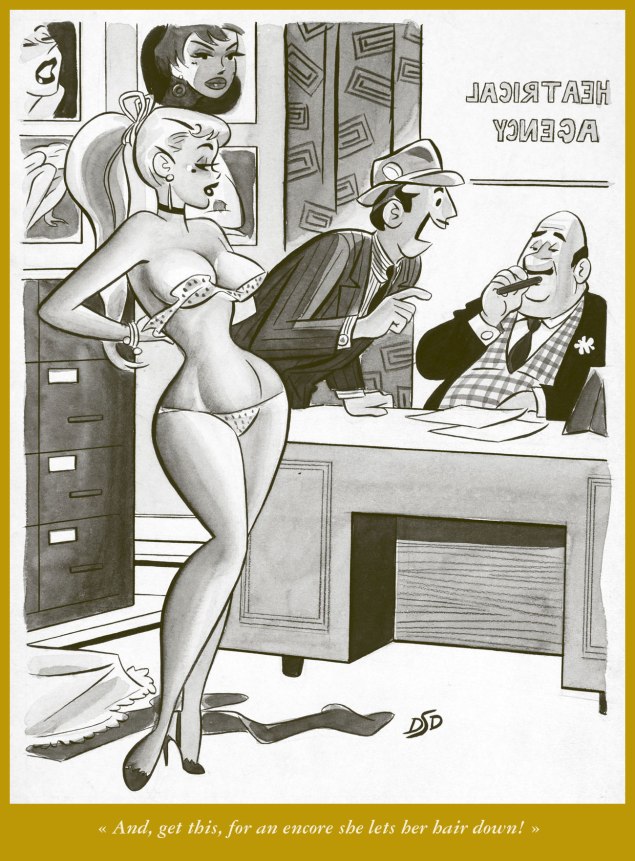
DeCarloHairDownA
You’ve got to love the utterly blasé impresario and the ebullient talent scout. It’s to his eternal credit that DeCarlo somehow managed to keep things… if not squeaky clean, then somehow innocent, whatever the situation.

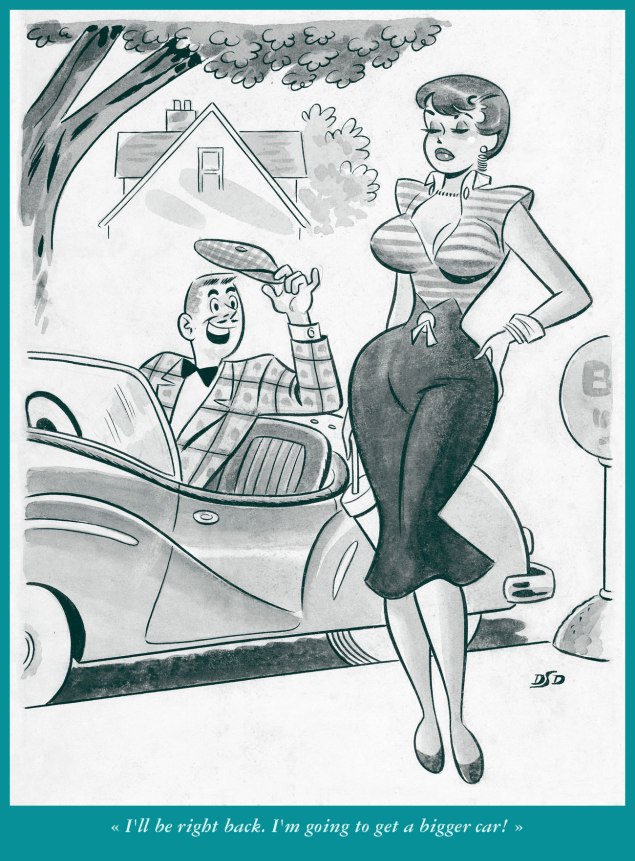
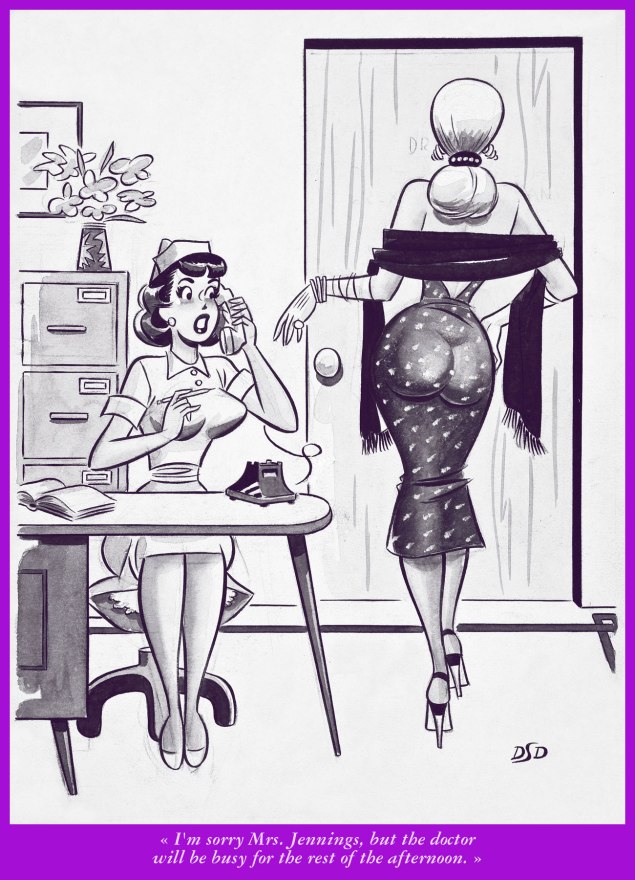
DeCarloBiggerCarADeCarloDoctorA

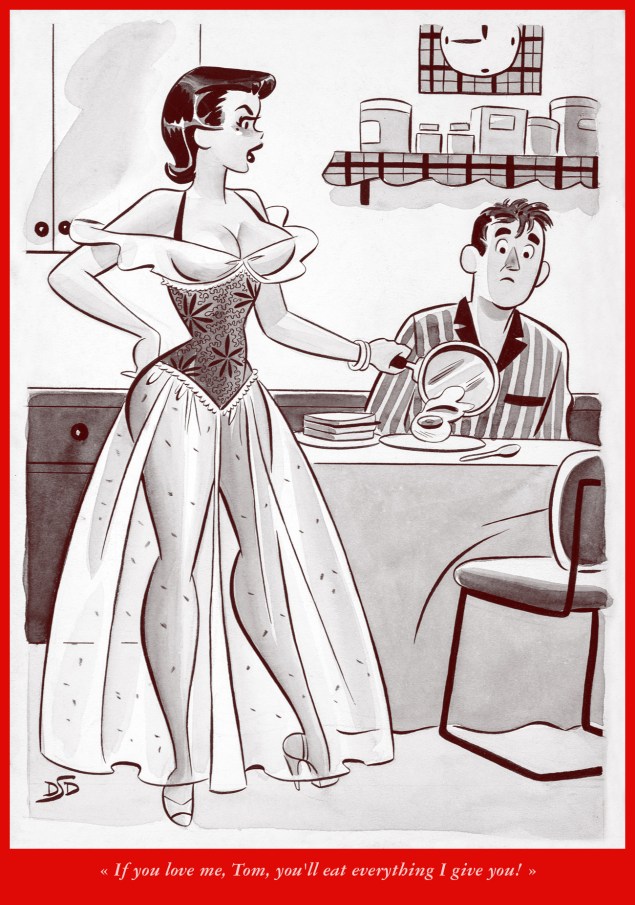
DeCarloEatEverythingA

DeCarloBlankADeCarloOnePieceA

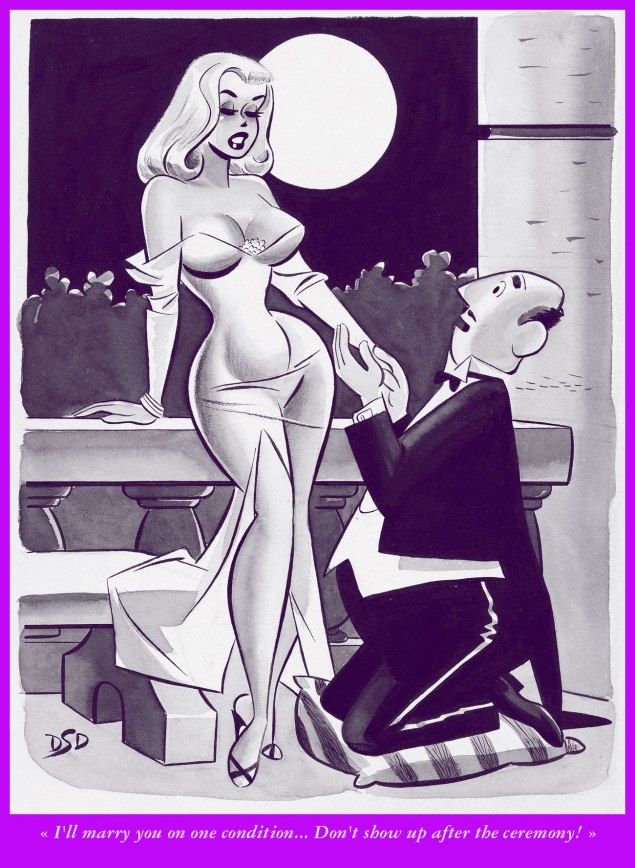
DeCarloDon'tShowA
The pillow is a nice touch, both for elevation and for comfort.
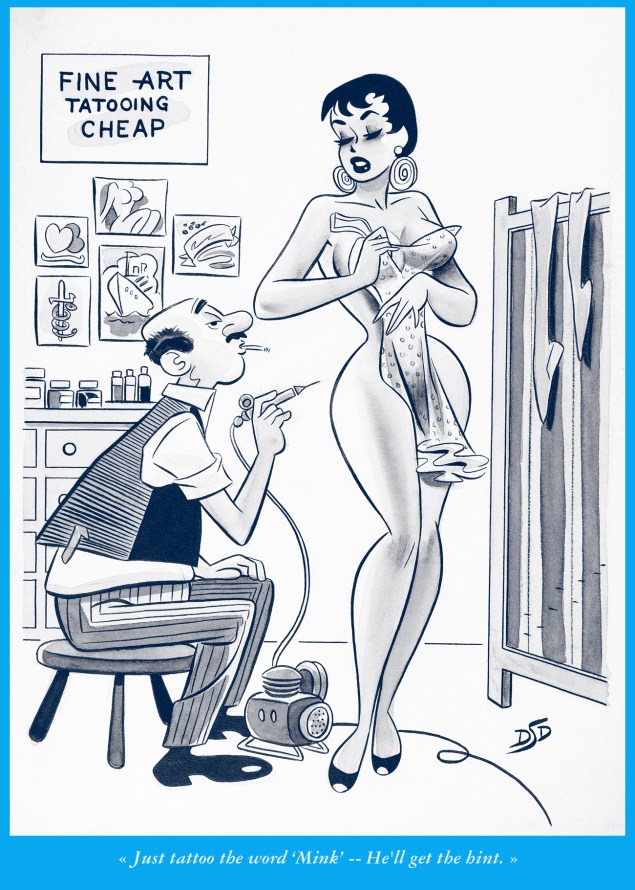
DeCarloMinkA
Another delightful characterization, a loveably blasé tattooist. Business as usual.
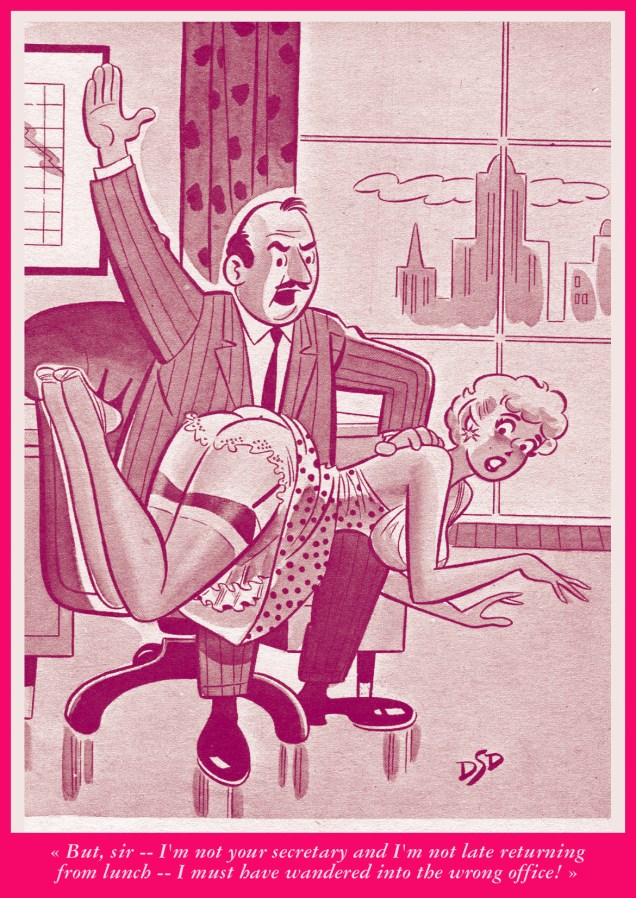
DeCarloSpankA
It would have been heresy to *not* feature at least one “spanker”. Care for more details on this striking sub-genre? Look no further, friend.

DeCarloShowgirlA

As you can witness, the gags are a bit of an afterthought, a side dish to stock situations. Over the years, these cartoons were endlessly recycled, and the captions updated, though rarely… upgraded.

– RG

*valuable info from Bill Morrison.

Robert Gring’s Wits-Sharpening Fun

« We do not stop playing because we grow old. We grow old because we stop playing. » — G. Stanley Hall

Despite the ubiquity of his work over several decades, very little is known of Robert Gring, at least online. Ah, but thankfully, ‘one reads books‘… and so I turned to Richard Medioni‘s indispensable ouvrage on the history of Mon camarade, Vaillant and Pif Gadget, L’histoire complète 1901-1994. About Mr. Gring (likely born in 1922 and died in 1995), we discover that he was for several years a press illustrator for centrist daily newspaper France-Soir, that he spent some time in a work camp during WW2, that, post-war, his work appeared in L’Almanach Vermot, Paris Match, Télé 7 Jours, La vie parisienne… and so forth.

That he was a reserved, bashful man who treasured his work above all else. And most admirably, that he was a man of great personal integrity and principles, as evidenced by the following anecdote, recounted by Mr. Medioni: « In parallel to his intensive work with (Pif-Vaillant), he occasionally works for Le journal de Mickey, but it ends on a sour note! In 1980, it is gently brought to his notice that his collaboration to a periodical associated with the French communist party is incompatible with his presence within the pages of Mickey. He must choose! Gring, who does not appreciate this type of pressure and has lofty ideas of honour, does not dither the slightest bit: he opts for fidelity. » I’m strongly reminded of Howard Prince’s valiant words to the House Un-American Activities Committee in The Front (1976).

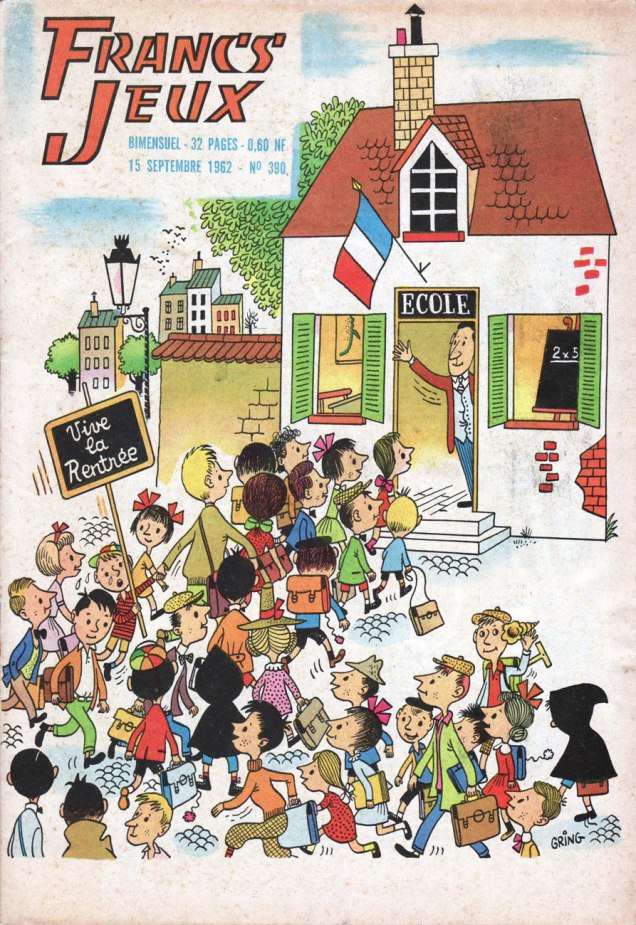
GringFrancsJeux390A
Francs-Jeux was a long-lived kids’ magazine published from 1946 to 1979… 777 issues!), and Gring provided a number of its covers and several interior illustrations and strips. This is Francs-Jeux no. 390 (Sept. 15, 1962). See: even then, you had a couple of kids in black hoodies skulking to class.
GringFrancsJeux393A
This is Francs-Jeux no. 393 (Nov. 1st, 1962). The title feature, Le coucou qui ne voulait plus dire ‘coucou’ is the touching tale of a clock birdie who decides to make a dash for freedom, only to discover that life on the outside is intolerably uncertain and perilous. This is a France straight out of Jacques Tati‘s Mon oncle.
GringFablesA
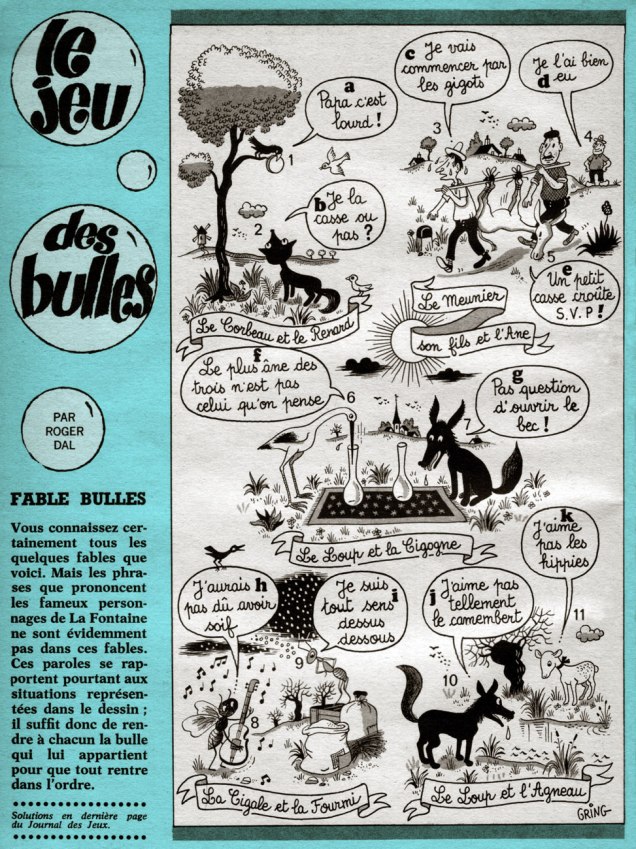
Another Gring specialty: Le jeu des bulles, wherein errant word balloons must be restored to their proper speaker. If you must know: 1-g, 2-j, 3-a, 4-f, 5-i, 6-d, 7-b, 8-e, 9-k, 10-c, 11-h; Published in Pif gadget no. 33 (Oct. 1969, Vaillant). Plots from the fables of Jean de la Fontaine, script by Roger Dal.
GringKiosqueA
Gring could always be counted on to compose and depict complex but lucid crowd settings, and this is a fine example. It’s also a 5-in-1 game: 1) Find the five anomalies; 2) Find the hidden umbrella; 3) Spot the five differences between the nearly-identical Durant Père and Durant Fils boutiques; 4) Four objects appear three times apiece. Find them; and 5) To whom does the stopwatch on the pavement belong? Published in Pif gadget no. 71 (June 1970, Vaillant); game conceived by Odette-Aimée Grandjean.
GringPasdeclientsA
No customers! « The café is deserted and the barman leans forlornly on his bar counter. This is abnormal, of course, but certains things are even more abnormal. » During our current state of all-around home confinement, it seemed sadly à propos. From Pif gadget no 143 (Nov. 1971, Vaillant).
GringSculptureA
From Pif gadget no. 185 (Sept. 1972, Vaillant). You wouldn’t see this sort of thing in an American kids’ publication, that’s for certain. The object of the game: find the anomalies.
GringAssimilCouleurA
« But he would attain fame in most unexpected fashion. In order to enliven the austere pages of the Méthode Assimil, he is called upon to illustrate a variety of idioms for the manuals. Not only does his drawing prove itself effective for the learning of English, German or Spanish, but it makes these volumes funny and user-friendly. » This undated gouache illustration Gring created for Assimil is scanned from the original, a prized part of my collection.

Here, then, are some excerpts from a couple of Assimil guides from my shelves:

GringAssimilA
1) « No smoking is allowed in here. » 2) « Personally, I’m really not hungry at all. » 3) « I love him, he loves me, and that’s what matters most. » 4) « All streets are exactly alike in these parts. » 5) « We’d always rather be where we’re not. » — from Le russe sans peine (1971, Assimil) and 6) « We’re headed to Dubrovnik by way of Zagreb. » — from Le serbo-croate sans peine (1972, Assimil). Thanks to Darko Macan for confirming that last translation!

GringTemoignage01A

GringTemoignage02A
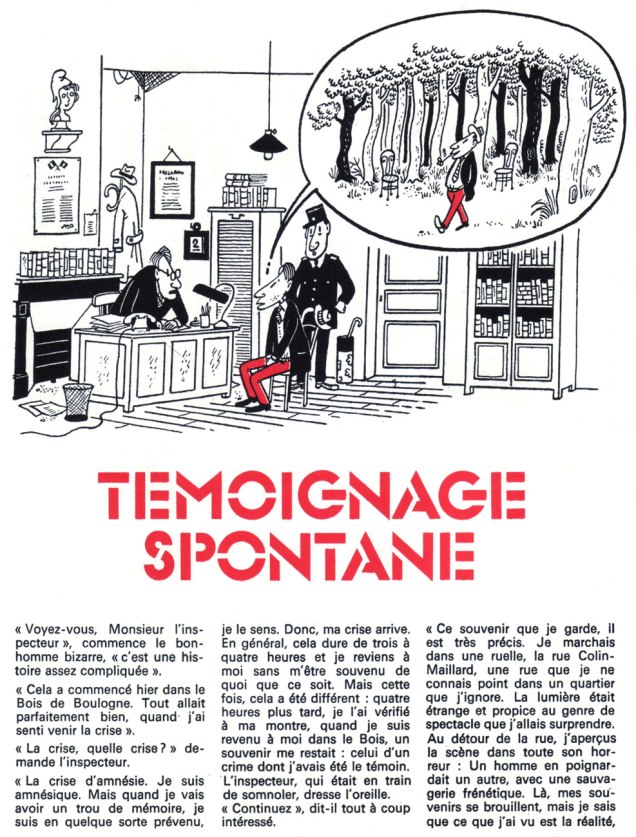
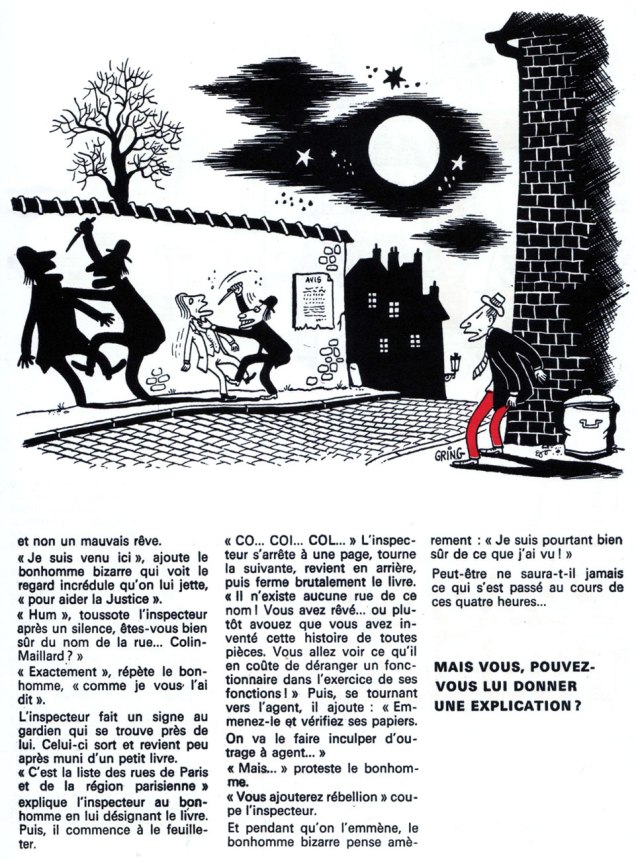
Gring was also a regular contributor to Ludo, Le journal des amateurs d’énigmes. If you can read this, here’s the solution, which I’m afraid requires prior knowledge of Paris in the 1970s: « Pendant sa crise, le bonhomme a sans doute marché jusqu’aux studios de Boulogne. La scène qu’il a surprise se déroulait dans les décors de cinéma. » Incidentally, a quality hardbound collection of this material was published in 2013 by Les Éditions Taupinambour. under the title of Les énigmes de Snark & autres mystères.
GringVirluxA
In the 1960s, Gring illustrated a popular series of keychains for Norman dairy company Virlux, featuring the signs of the Zodiac. I’m still missing Taurus, Aquarius, and Cancer (thanks, Matt!) as you can see.
RobertGringRogerDalA
A rare photograph of Monsieur Gring (left), and one of his writing partner, Roger ‘Dal’ Dalméras, date unknown.

-RG


More Playboy Cartoons for a Festive Mood!

« … every idiot who goes about with a ‘Merry Christmas‘ on his lips should be boiled with his own pudding, and buried with a stake of holly through his heart. » — Charles Dickens, A Christmas Carol (1843)

Whoa, is the accursed Holiday Season upon us again already? Given the rather baffling (but greatly appreciated) popularity of our previous brochette of Christmas-themed Playboy cartoons, which took off in… April and just kept gathering steam, we’ve chosen to just go with the flow and present you with a sequel. We’ve had more time and opportunity to dig further, so we’ve cherry-picked a dozen, both naughty and nice, with plenty left over for next year. We’ve taken pains to include some of the worthy cartoonists who were somehow left out of last year’s legendary Playboy Cartoons for a Festive Mood.

Here we go, then. Season’s greetings and all that rot!

DediniXmasTreeA
One from adorable bon vivant Eldon Dedini (1921-2006), previously spotlighted here.
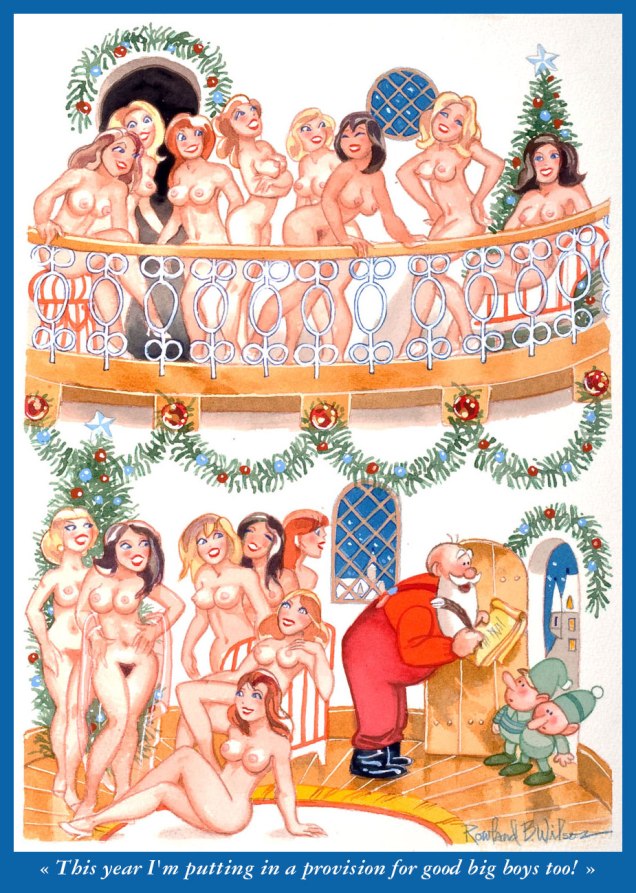
RowlandProvisionA
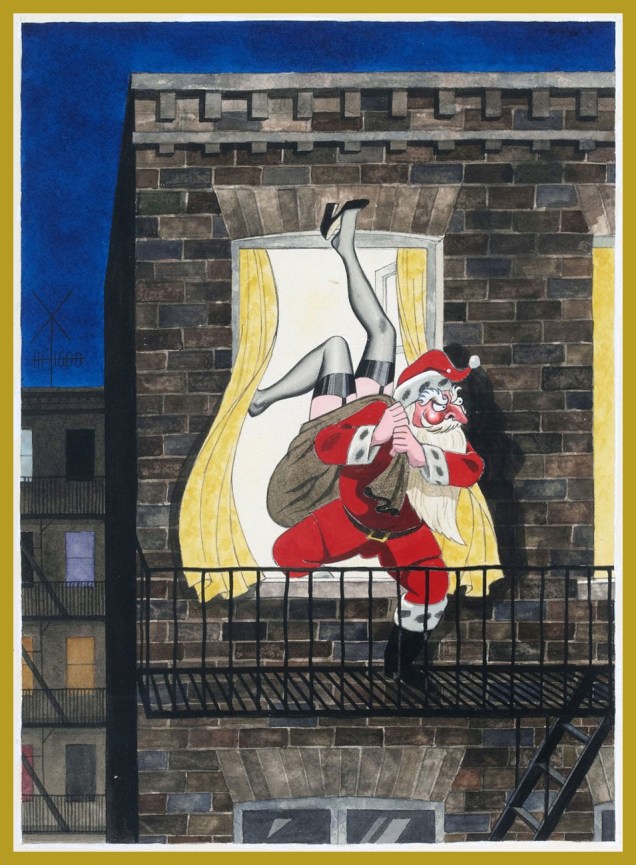
A late-career entry from Rowland Bragg Wilson (1930-2005), from Playboy’s January, 2002 issue.
SmilbySantaBagA
It was bound to happen: for a change, Santa decided to indulge in a little *receiving* of his own. This mutely eloquent cartoon from the pages of Playboy is by the steady hand of Smilby, pseudonym of American blues-loving Englishman Francis Wilford-Smith (1927-2009).
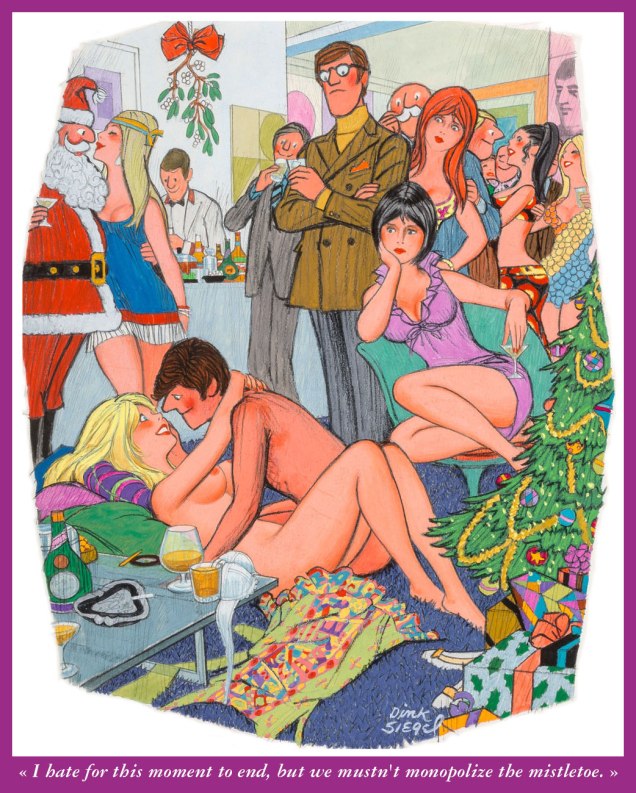
DinkMistletoeA
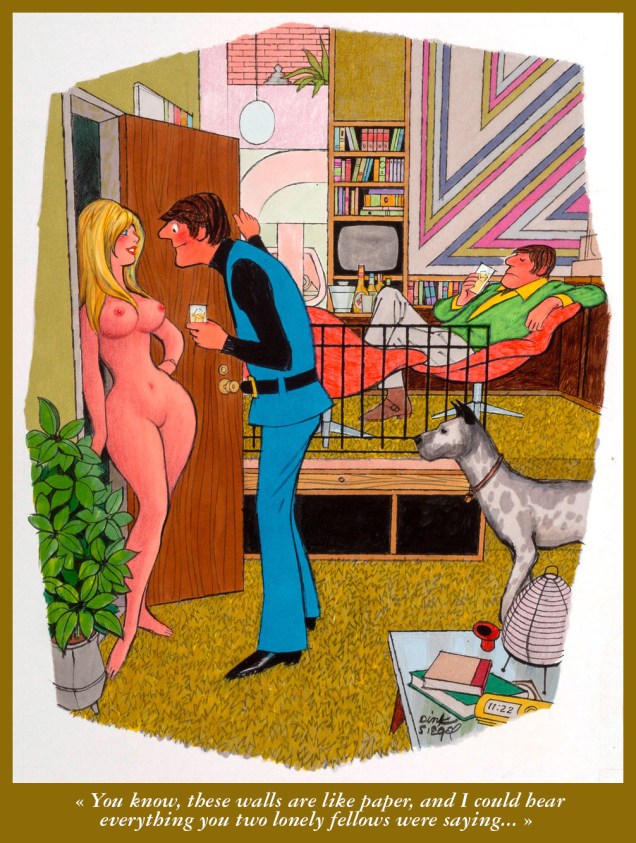
Here’s a Dink Siegel piece I’d saved for this occasion, once more featuring his “roommates”. It debuted in Playboy’s December, 1969 issue. Feast your jaded eyeballs upon our recent Dink Siegel spotlight right here.
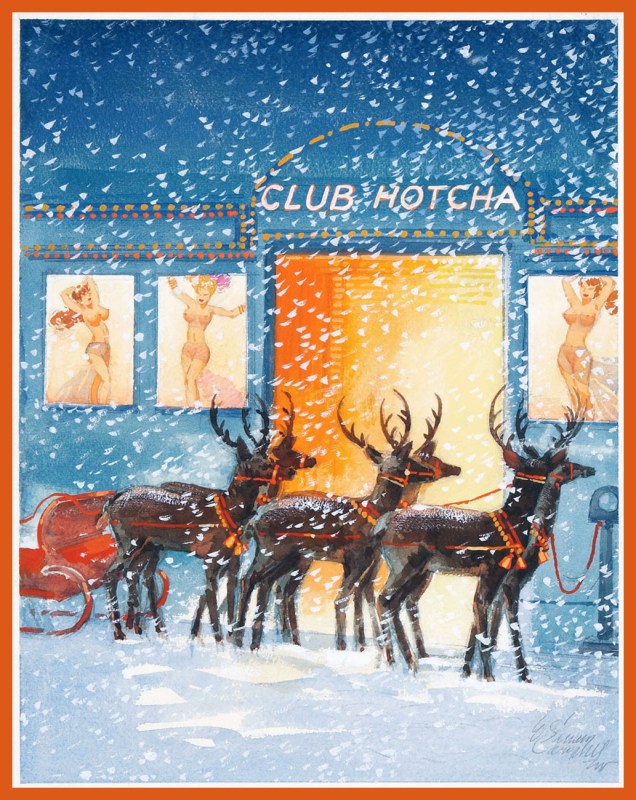
ESimsCampbellClubA
A lush yet understated œuvre by pioneering African-American genius Elmer Simms Campbell (1906-1971), from Playboy’s December, 1962 numéro.
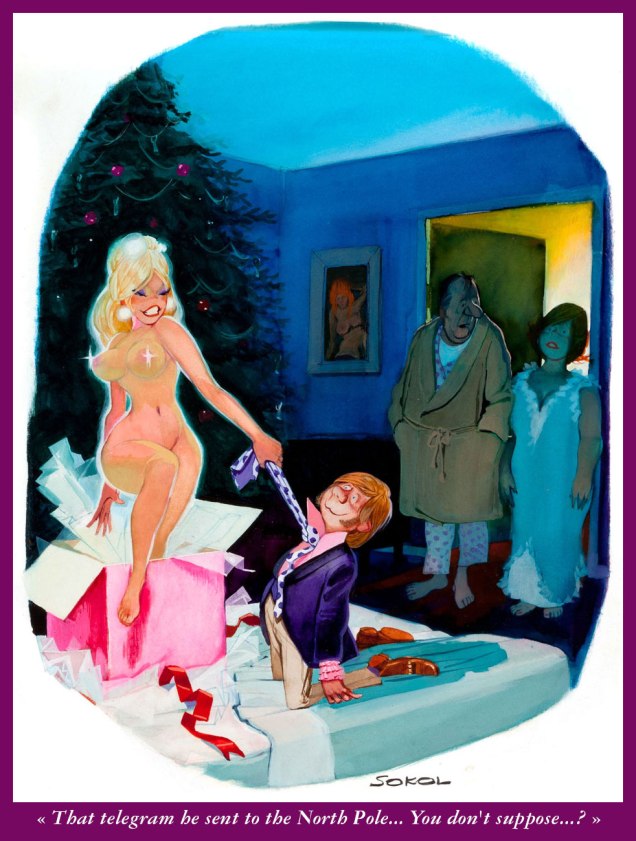
SokolTelegramA
Austrian künstlerisches Genie Erich Sokol (1933 – 2003), whose work, for my money packs the strongest erotic charge of all the Playboy cartoonists’, painted this marvel for the December, 1969 issue of Playboy.
BuckBrownFoulPlayA
We couldn’t, in good conscience, leave out Buck Brown’s famously naughty ‘Granny’. This undated cartoon is likely a marker preliminary.
ThorneRosesA
Noted comic book artist Frank Thorne provides this whimsical quote from Clement Moore’s perennial The Night Before Christmas, featuring a gorgeous aurora borealis night sky. The candy cane keepsake is a lovely signature, Not-so-Saint(ly)-Nick.
MikeWilliamsHoHoHoA
For a change of pace, here’s an unctuously cynical one from Liverpudlian stunner Mike Williams (b. 1940); from Playboy’s January, 1982 issue.
BuckBrownConcessionsA
A more colourful specimen of the lush artwork of Robert “Buck” Brown (1936 – 2007), another brilliant African-American whose Playboy work was but a single facet of his incisive, multifarious and socially-engaged œuvre.
SneydTinyTimA
I must confess that my fellow Canadian Doug Sneyd‘s (b. 1931 in Orillia, ON, birthplace of Gordon Lightfoot and Mitch the Ferret) style isn’t really my cup of tea. But my partner ds enjoys his work, and that’s good enough for me.
GahanCloggingA
And last but not least, our dear Gahan Wilson, who just recently left us. Here’s our earlier salute to this macabre maestro. This bittersweet creation appeared in the October, 1964 Playboy.

-RG

Dink Siegel’s Swingin’ Roommates

« I have the best roommates in the world! It creates a fun sense of family… and that’s really important to me. Things can get so lonely without it. » — Kristen Bell

It’s late November, and, to quote John, the Wolfking of L.A., « All the leaves are brown, and the sky is gray ». Outside my window, just about everyone’s dressed for a funeral and there’s a traffic jam in dire shades of monochrome.

How did we come to this? Bah.

I think it first struck me how afraid of bright colour* we’d become, as a society, from years of ads for Bose’s odiously-designed Wave® sound systems, as consistently expensive are they are hideous (so they must sound fantastic!), circa the early 2000s.

BoseWaveAdA
Available in all your favourite colours, neither of which is technically a colour: Platinum White or Graphite Gray.
BoseWaveSilverAdA
Be still my fluttering heart: in 2009, Bose figured “what the heck, let the paint chips fall where they may!” and introduced a new “colour”: yes baby, Titanium Silver!

Today, I’m going to (gasp!) restore some colour to your lives. This may lead to a sudden jolt, so avert your eyes if necessary.

Strictly speaking, I don’t have a favourite Playboy cartoonist — honestly, how could I, with that sumptuous, half-century-plus embarrassment of multifarious riches? Ah, but I certainly hold Leo ‘Dink’ Siegel (June 30, 1910 — Dec. 28, 2003) in quite lofty regard, thanks to his fantastic sense of design, his bold, delicious colour palette and his fastidious attention to detail (pay and treat your cartoonists well, and see what you get!). Today, I’ll concentrate on Siegel’s ‘roommates’ series; there’s generally a black pussycat hanging about, a fine furry bonus.

Here we go!

DinkFortuneSellerA
From Playboy Magazine (Mar. 1966). From what I can discern, Siegel mostly worked in gouache and coloured pencils.
DinkSoonerA
From Playboy Magazine (Nov. 1966).
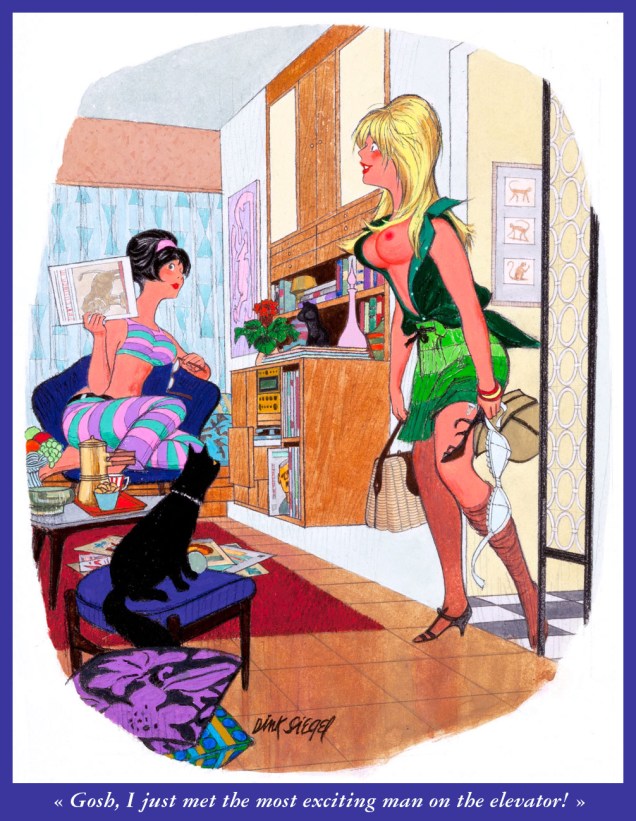
DinkElevatorA
From Playboy Magazine (Dec. 1966). One can’t help but wonder whether Mr. Siegel had a sideline in interior design.
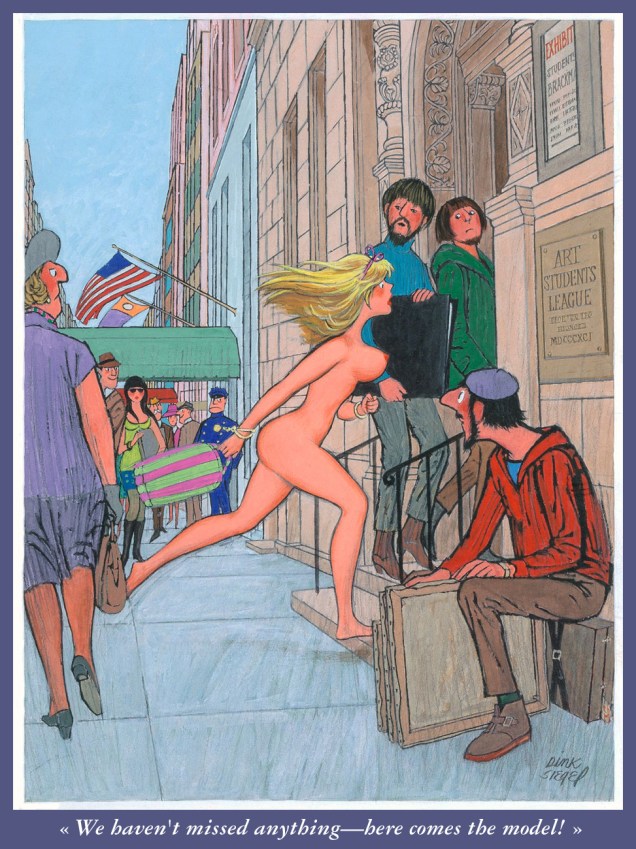
DinkModelA
From Playboy Magazine (Aug. 1967). I see art students were always fairly blasés.
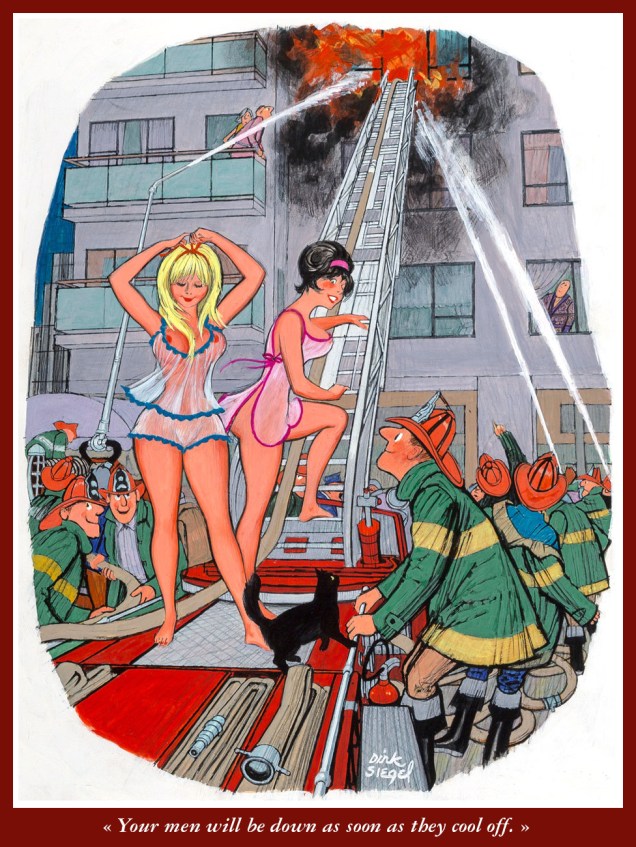
DinkFiremenA
From Playboy Magazine (Sept. 1967).
DinkMouthwashA
From Playboy Magazine (Jun. 1968).
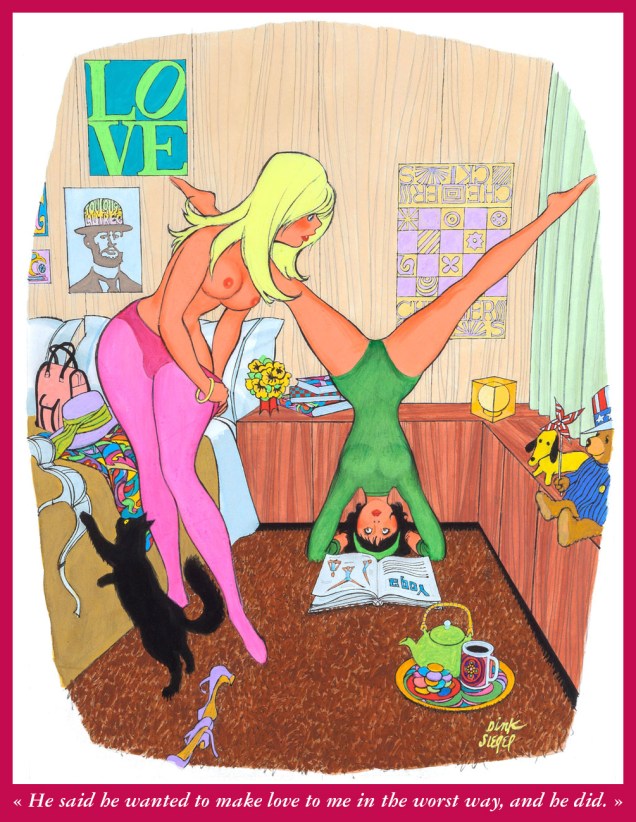
DinkWorstWayA
From Playboy Magazine (date unknown).
DinkDidn't-TomA
From Playboy Magazine (Mar. 1970).
DinkDullPartyA
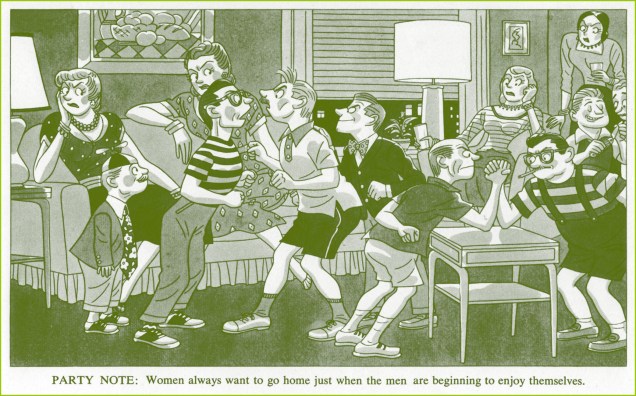
From Playboy Magazine (Apr. 1970). I love that the girls seem to have an existence beyond the confines of the jokes: they have jobs, various hobbies and interests and, obviously, active social lives.
DinkWallsA
From Playboy Magazine (Aug. 1971).

– RG

*Oh, do check out this pseudo-scientific cluster of twaddle and pop-psych claptrap!

Social Perils and Pitfalls: Abner Dean’s ‘Come As You Are’ (1952)

« What I don’t like about office Christmas parties is looking for a job the next day. » — Phyllis Diller

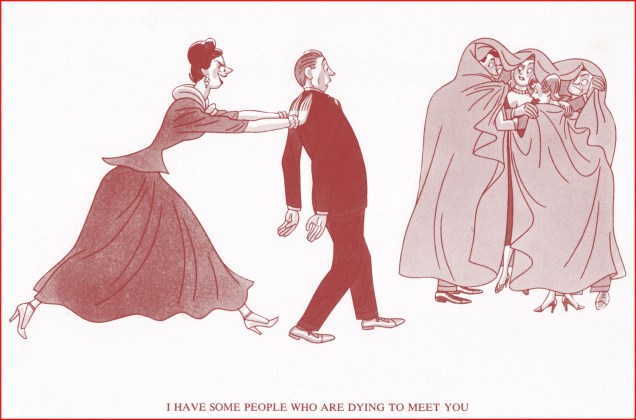
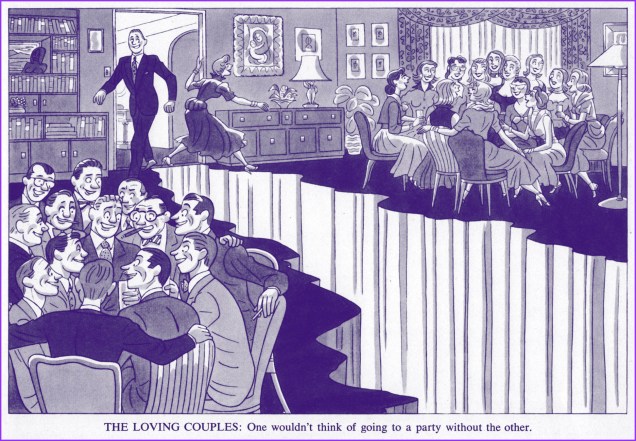
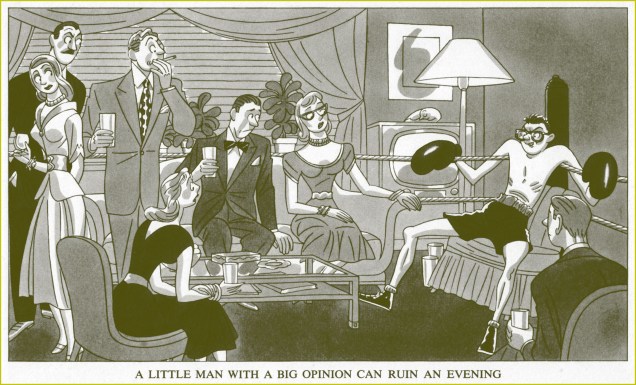
Between the poles of Abner Dean’s more normal magazine work and his often quite abstract, therapy-inspired books, lies his neglected Come As You Are, his most accessible single-theme work.

In few words but with devastating visual lucidity, Dean turns a probing spotlight on party dynamics, laying bare the casual cruelty, manipulations and seductions, feints and blindsides, alliances and betrayals, thrusts and parries. The results are often hilarious… but laden with uneasy recognition; despite the distance of nearly three-quarters of a century, little appears to have changed in the fundamentals… which really should come as no surprise to anyone.

Witness the following excerpts…

DeanComeAsYouAreFrontA
The front cover. The book is tellingly dedicated « To all those wonderful people who I hope will still ask me back. »

AbnerDeanCome08A

AbnerDeanCome02AAbnerDeanCome06AAbnerDeanCome05AAbnerDeanCome04AAbnerDeanCome03AAbnerDeanCome07A

AbnerDeanCome01A
According to our resident mycologist, these are pretty much all toxic. The game is rigged!

AbnerDeanCome09A

From the back end of the book: « This is Abner Dean’s fourth adventure with the cross-eyed muse in that area of unexpected turning and hilarious insights that is particularly his own.

The first, in 1945, was It’s a Long Way to Heaven. People began seeing themselves and their friends as Dean saw them. They were startled and fascinated by the view. With What Am I Doing Here? in 1947 they winced and laughed again. Psychiatrists started using certain of his drawings for discussion with their patients. People began playing games of identification with individual pictures.

In 1949 came And on the Eight Day to make more Dean converts. And now here’s a fourth book about people to smoke out any unbelievers who may be lurking in corners at parties.

For those who like their incidental intelligence in an unbalanced phrase — Abner Dean was born in 1910, attended the National Academy in 1927, was graduated from Dartmouth in 1931, and hasn’t been away from a drawing board for more than a few days since then. He is happily married and lives in New York. »

WhoThereLogotype

This is our third look at Mr. Dean’s œuvre. If you’re left longing for more, read on:

Abner Dean’s Universe: Before… 
followed of course by Abner Dean’s Universe: … After.

-RG

Hallowe’en Countdown III, Day 18

« There is nothing new under the sun but there are lots of old things we don’t know. » — Ambrose Bierce

Here’s an unusual specimen: a two-headed, twin-gendered Australian cartoonist. Beryl Antonia Yeoman (1912-1970, b. Brisbane, Queensland) formed, in 1937, a cartooning partnership with her brother, Harold Underwood Thompson (1911-1996, b. West Kirby, Cheshire) when they adopted the nom de plume of Anton.

AntonGhostStoryA

From the sound of it, Beryl was the power behind the throne, as she produced the Anton cartoons on her own during Harold’s active duty in the Royal Navy during WWII. The pair reconvened after the war and created wonderful cartoons for such publications as Punch, Lilliput, Men Only (ha!), Tatler, The Evening Standard (solo Harold!) and Private Eye. Beryl was the only female member of Punch’s exclusive Toby Club.

Today, a charming bistro named in honour of the artful siblings still operates in Wells, Somerset; it features Anton’s art on its walls. How’s that for posterity?

This slyly cozy cartoon made the cut for the splendid 1952 anthology The Best Cartoons From Punch.

And while we’re on the subject of ghostly radio stories, give one of these a try.

– RG