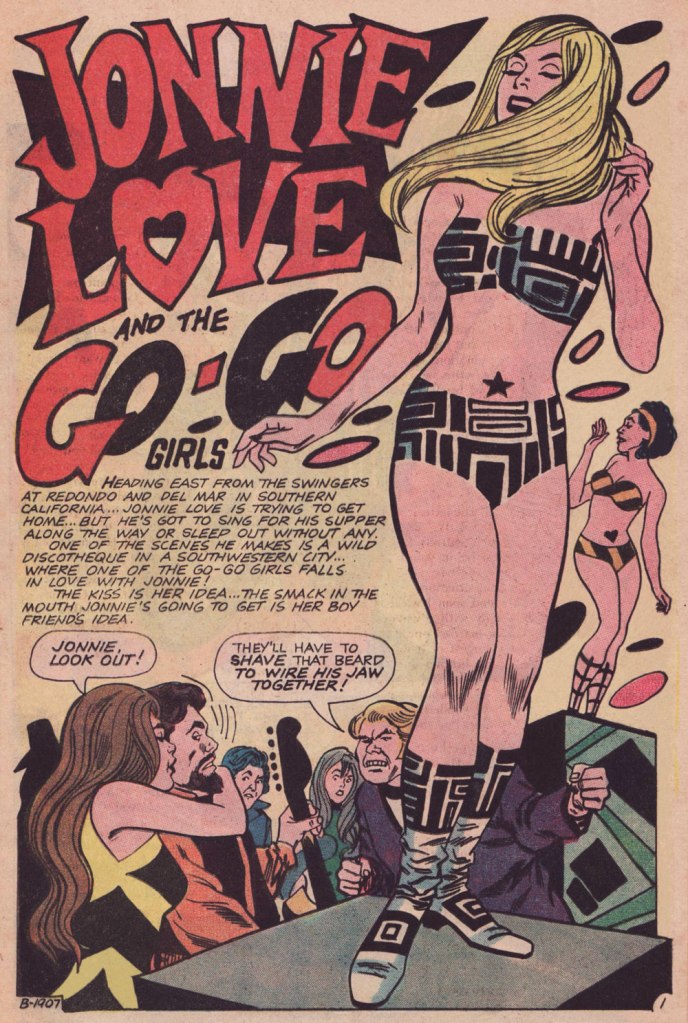
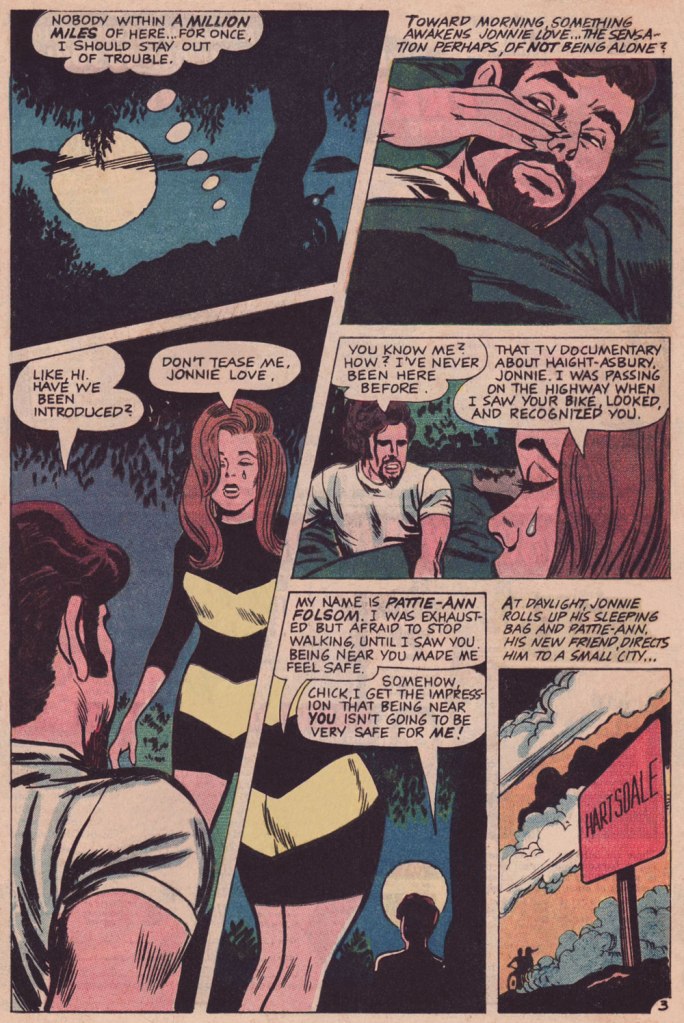
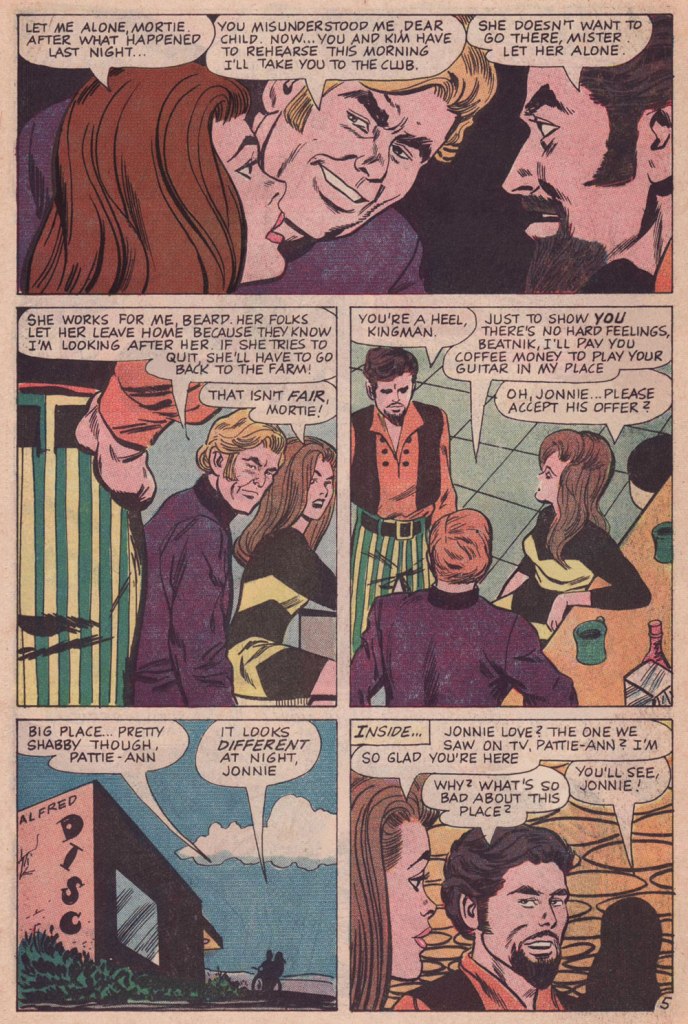
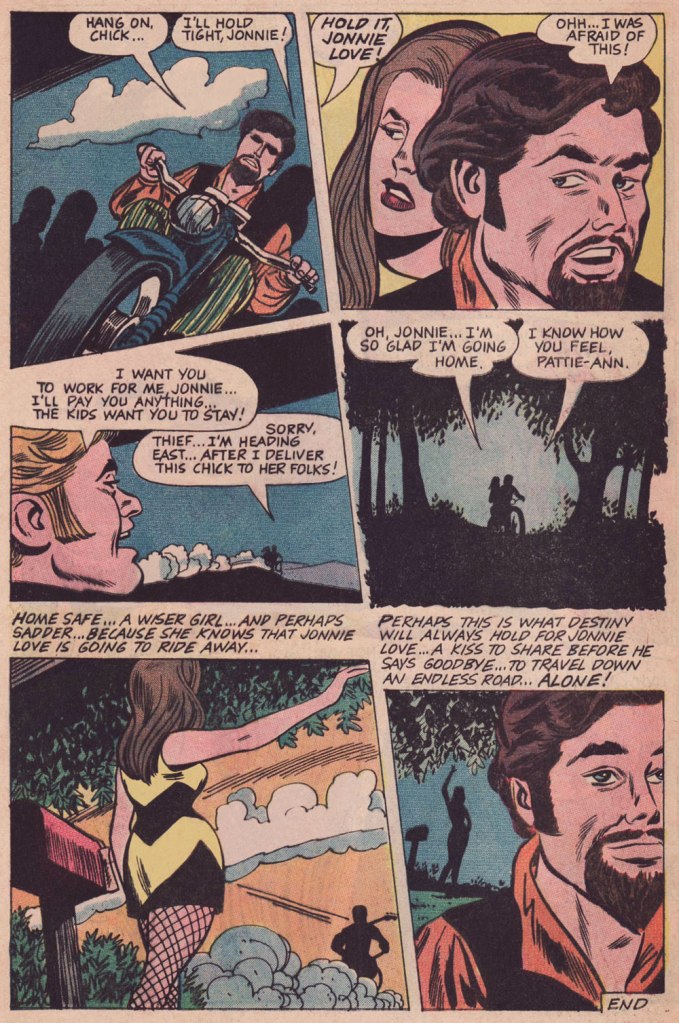
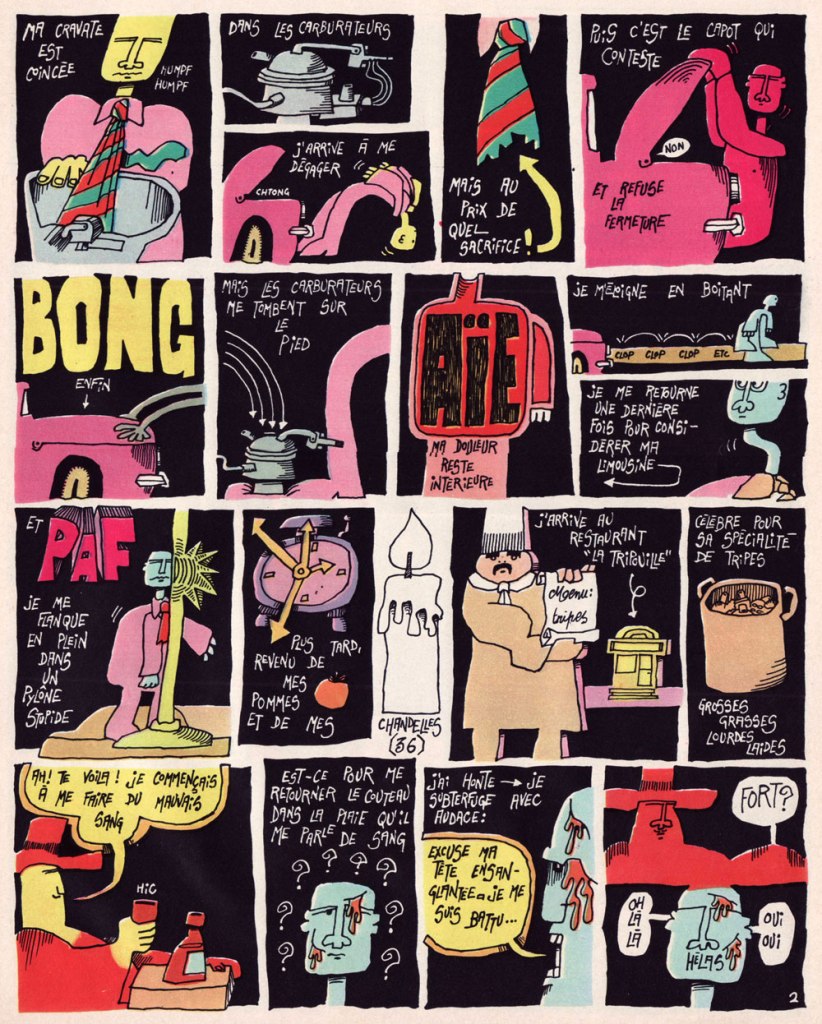
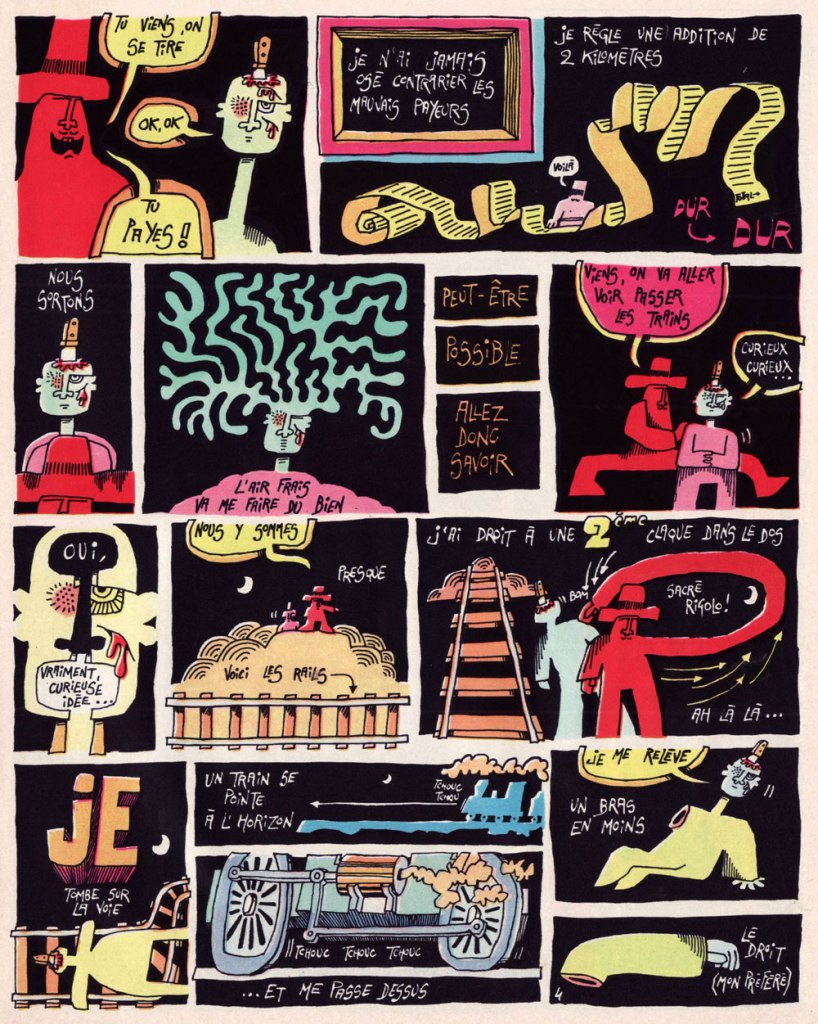
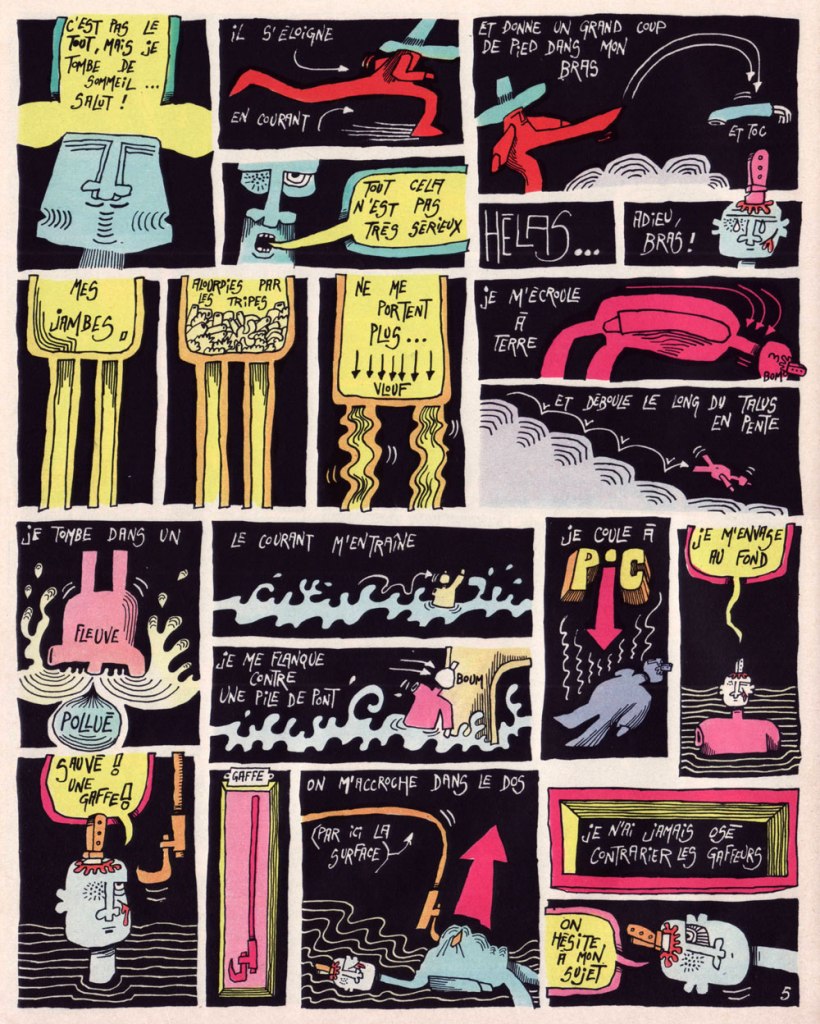
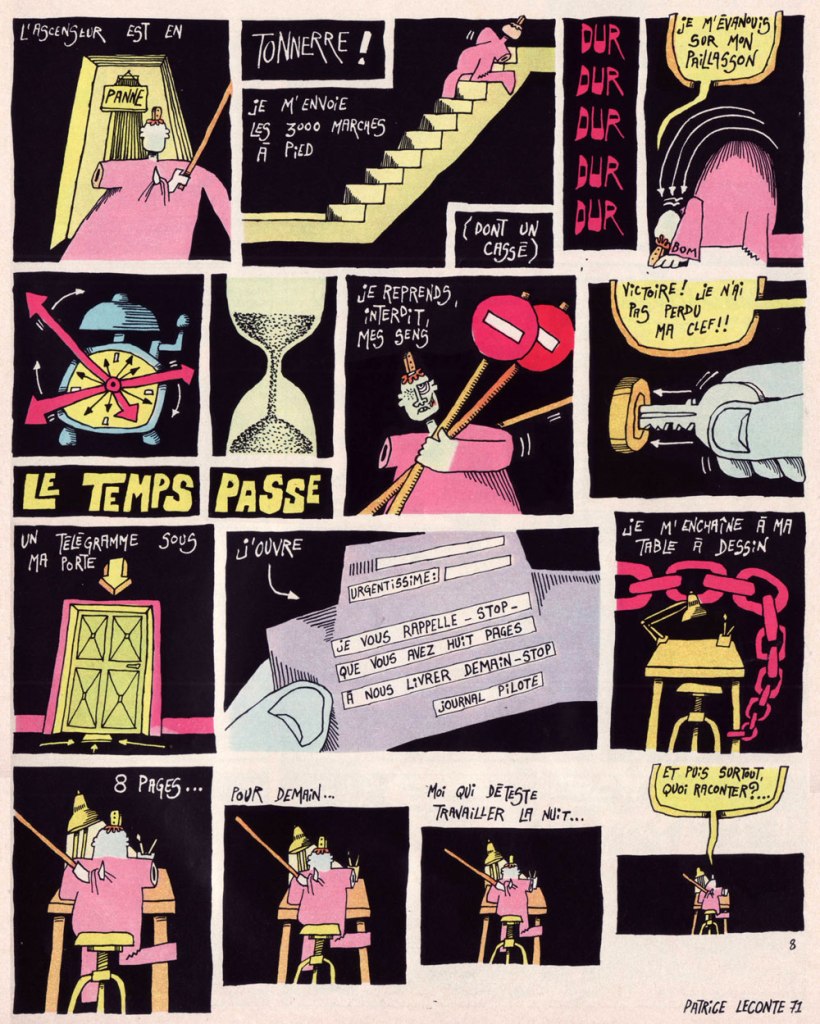
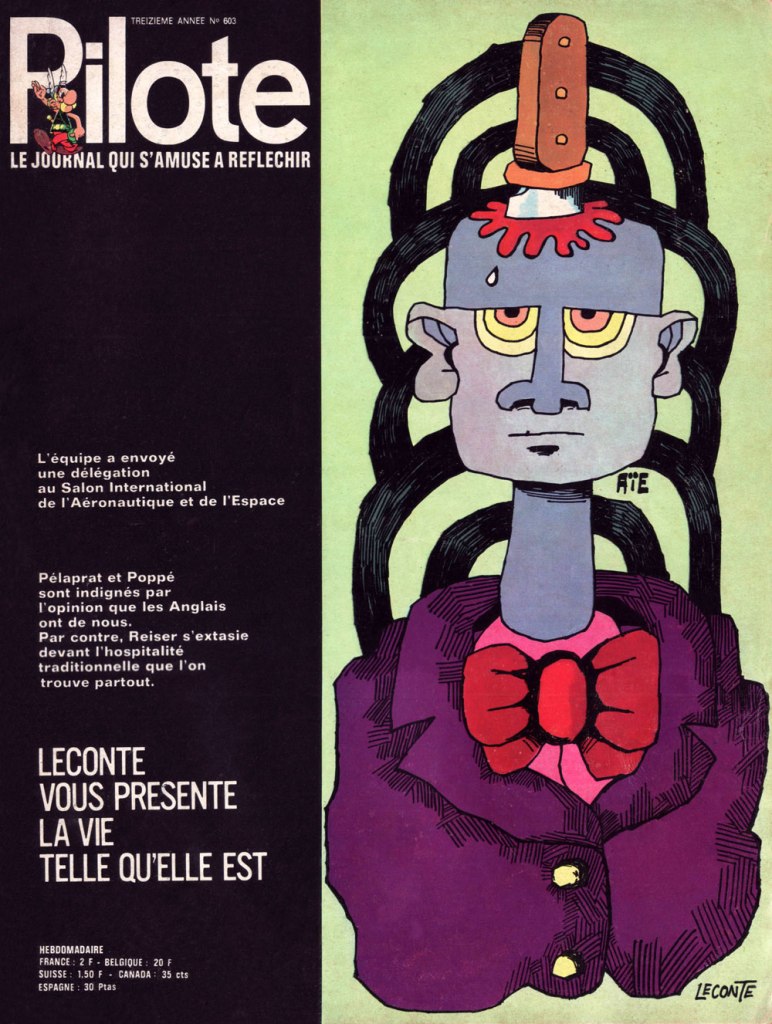
« An editorial team that gathers within a magazine such as Pilote constitutes a true family, as it’s a small group and everybody knows everybody. There’s friendship, admiration, competition, hijinks and the pleasure of being together, even if we didn’t take the bus to Quiberon together in the summer. » — Patrice Leconte
It would be terribly reasonable to presume that Patrice Leconte‘s elegant passage through the world of Franco-Belgian was, on the part of the future cinematic auteur (the Les Bronzés series, Monsieur Hire, Le mari de la coiffeuse, Ridicule, L’homme du train — my favourite, and even an animated film, Le magasin des suicides… quite a range!) some sort of dilettantish detour, but it wasn’t… is it ever? — quite so simple. As he recalls it:
« As a child, I dreamed of nothing but cinema. Well, I also dreamed of drawing. As they say, I went up to Paris and went to film school. But I kept on drawing. And I was a Pilote reader. I wrote to [ Marcel ] Gotlib, who responded, looked at my drawings, showed them to René Goscinny, who liked them, invited me to the office and found me likeable, published my drawings and encouraged me to carry on, which I did. For five years. 1970 to 1975. I was happy. Then I shot my first film [the frankly unpromising Les vécés étaient fermés de l’intérieur, co-scripted with Gotlib] and everything began to unravel, because I haven’t made anything but films since, and I gave up comics. »
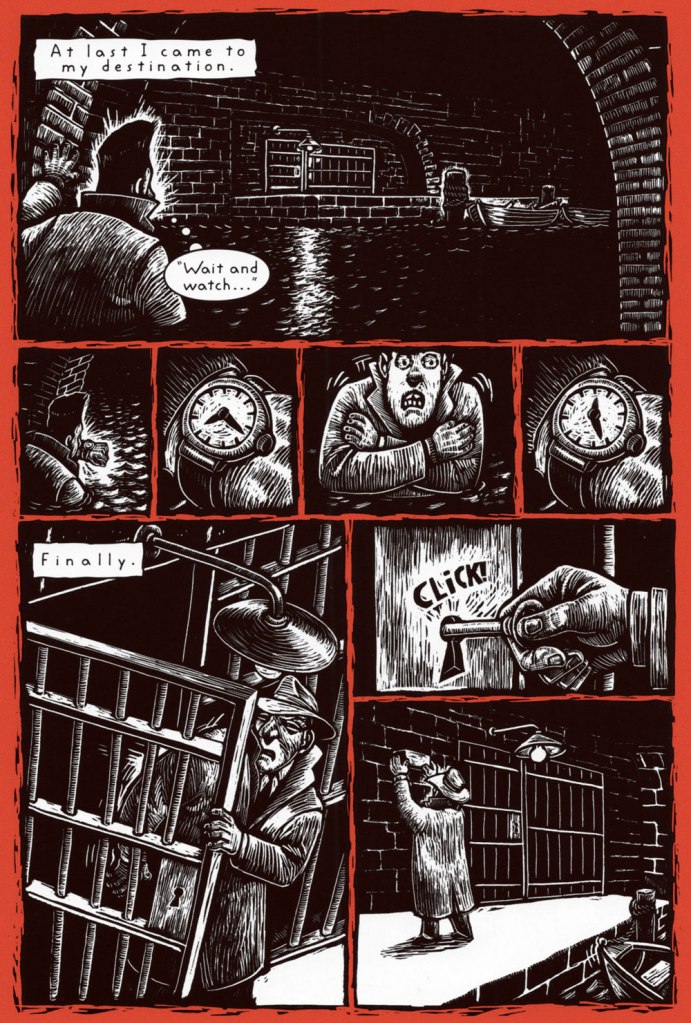
La vie telle qu’elle est — a title that a cinephile of Leconte’s ilk could simply *not* have failed to nick from pioneering cinéasteLouis Feuillade (1873-1925, whose immortal Fantomas, Judex and Les vampires serials still thrill) and his 1911-1913 series of films bearing that name… seventeen in all! The tale appeared in Pilote no. 603 (May, 1971, Dargaud), and here’s the cover. René Goscinny, publication director; Jean-Michel Charlier and Gérard Pradal, editors in chief; Albert Uderzo, art director.
Humble to a fault, Leconte is well aware of his limitations as a “classical” draughtsman (largely beside the point in his case, imho, as he’s a superb designer and stylist):
« I think that my personal touch was tied to my drawing handicap, that self-taught aspect which meant than I absolutely had to find a workaround. I’ve always held to the rule that constraints constitute a first-rate engine of creation, coupled with the magical notion of “let us make qualities of our flaws“. Well, it works! »
By all means, read the full conversation with Leconte about his bédé days, conducted by Jean-Luc Brunet and Vivian Lecuivre en 2007. It is, however, in French, but we currently have the technological means to let you grasp the gist of it.
By the way, Leconte’s got a new feature out, an adaptation of Georges Simenon‘s 45th Jules Maigret novel, Maigret et la jeune morte (“Maigret and the Dead Girl“, first published in 1954), starring deplorable human being but splendid actor Gérard Depardieu. Among Simenon’s eighty Maigret books, this must surely be the most adaptable, as this marks the fifth time this novel is brought to the screen! The trailer looks great.
« Women: what do they want? They might want to float into the sky while hosting a brunch party. They might want a couple of handsome cops to come over and get rid of a snake problem. They might seek a doctor’s treatment for ‘wise-ass disease‘ or fantasize about revenge and forgiveness at the dentist’s office. And what about men? Mr. Science just wants to carry out his pointless experiments. Earl D. Porker, Social Worker, converses with household items and forgets the cat food. One fellow’s head is a basket of laundry. »
Not much is known about the personal life of the mysterious M. K. Brown*. From her official website, we know that she grew up in Connecticut and New Brunswick, but that’s pretty much it. On the other hand, details from her long and prolific career abound**: she was a mainstay at the National Lampoon Magazine between 1972 and 1981 (including the regular series Aunt Mary’s Kitchen); a frequent contributor to various magazines, most notably Playboy, The New Yorker, and Mother Jones; creator of the animated series Dr. N!Godatu, which ran in the Tracey Ullman Show in 1987 for a mere 6 episodes (two more remain unaired) until it was supplanted by the Simpsons; illustrator of children’s books… and so it goes.
In more recent years, Brown has been hanging out at The American Bystander, which I discovered by accident when co-admin RG (whose intuition for quality is fairly unfailing) picked up an issue of this magazine. A delightful surprise.
Despite the scope of her oeuvre and her very recognizable style, she’s not nearly as well known as she deserves to be. Fantagraphics, coming, as usual, to the rescue, published a sort of best-of in 2014, titled Stranger Than Life: Cartoons and Comics 1970-2013. Interestingly, this collection did little to dispel the clearly purposefully cultivated mystique. Whereas usually one expects an introduction with the author’s birth date and a quick summary of their childhood and proclivities, in this case M.K. Brown remained firmly ensconced within her initials*** and shrouded in pleasant mystery.
* I will mention straight away that she was married to equally eccentric cartoonist B. Kliban (another WOT favourite), not because a woman’s worth is in being a wife to her husband, but because ‘M.K. Brown married to B. Kliban’ has a harmonious ring to it.
** From the category of things not entirely related to her career, she is also an enthusiastic horse owner and rider [source].
*** Her name is Mary Kathleen, which I first found on the Wiki page for B. Kliban, later confirmed through a podcast she was featured on (more about this later).
The first episode of Dr. N!Godatu. Janice’s voice (for those on a first-name basis!) is provided by Julie Payne.
Brown is clearly a female cartoonist, in the sense of never eschewing topics that a doltish reader would expect a woman to talk about just because it’s a ‘female’ leitmotif. She can start with something mundane like a hostess organizing a party, put a surreal spin on it, pepper it with playful language, and end up with a concoction that’s devilishly acerbic, quite strange, and very funny. Bill Griffith put it well – she ‘makes the personal universal, makes the universal personal‘. The result seems quite polarising; it’s the sort of thing you instantly click with, or something so foreign that it’s unappealing. Is any of it dated, as I’ve seen some people suggest? Not in the slightest. Human relationships haven’t changed much over the years, though we like to pat ourselves on the back for being so much more evolved. Focusing on the fact that someone is wearing a suit with shoulder pads (which are, by the way, coming back into fashion) to decide it’s no longer relevant to modern life is daft.
Here are some examples scanned from Stranger than Life of different vintages, lightly colourized by co-admin RG.
This one features Brown’s alter-ego, ‘White Girl’. « She can’t dance or sing the blues, but cluelessly does both anyway. It’s fun to speak through this character. I’m very fond of her. »
Here are three pages from more recent years, which also showcase Brown’s watercolours:
Published in The American Bystander no. 1 (Fall, 2015).
Published in The American Bystander no. 2 (Spring, 2016).
Published in The American Bystander no. 5 (Summer, 2017).
The American Bystander conducted a fun, hour-long podcast with Brown in 2016. I am a visually oriented person, and have immense trouble sitting through a podcast, so I had to tell myself I had to listen for the sake of this blog post – I hope you appreciate this sacrifice. It was a pleasure to listen to Brown, who sounds exactly like I pictured it, though I was somewhat underwhelmed by some of the softball questions she was asked – questions interviewer (in this case, Gil Roth) usually asks of a cartoonist, ‘what were your art influences?’, ‘what explains your sense of humour?’ I believe this has more to do with me than with the actual interview – I by far prefer to glean some understanding of a person through their work, as opposed to discussions about their work (which is a slightly strange stance for a blog writer). There is, however, a fun anecdote about how she used to put up her paintings on the walls to work on them, and had to cover her sleeping nocturnal husband and the bed he was on with plastic not to splatter him with paint. Brown also mentions that she has a stash of drawings which she could never get published because they’re too risqué – oh, how we would all love to see those! Click here if you’d care to listen to it!
« To prevent enabling oppression, we demand that black people be twice as good. To prevent verifying stereotypes, we pledge to never eat a slice a watermelon in front of white people.* » — Ta-Nehisi Coates
On a scorching day last week, we were at home digging into a particularly tasty watermelon.
As neither of us grew up in the U.S. of A., the simple act of eating juicy pastèque has not been tainted, as it has for many, by racism and stereotypes. We’ve been allowed to appreciate the watermelon for itself, as a healthy, refreshing, tasty treat. A lightbulb came on as I recalled a relevant sequence in one of Spain Rodriguez‘s ‘Fred Toote’ stories, set in the 1950’s Buffalo of his youth — and so here it is:
And that’s not all: a few days later, a friend’s news feed presented me with a most insightful, eye-opening *and* heartbreaking tweet:
« It seems almost silly to say that watermelons have been racialized, but that is exactly what happened in this culture. » Here’s the full article, a fascinating summary of the issue from Dr. David Pilgrim of Ferris State University’s Jim Crow Museum of Racist Memorabilia, written in response to the rather hostile comment of “Judging from the pictures on your website, you seem to be saying to me that black people don’t like watermelons? Sometimes you liberals make me shake my head.“« Boys Stealing Watermelons Bank. Made by Kyser & Rex of Philadelphia, PA. circa 1894. When a lever is pressed and the coin deposited, a dog runs out to keep the boys from their prize. »Comics pioneer Gustave Verbek (1867-1937), known as Verbeek after he “moved to the United States, where an immigration officer misspelled his name“, tackles a familiar subject in his Upside-Downs strip of Aug. 7, 1904 . Don’t forget to read it upside down for the second half of the story! My warmest thanks to Sunday Press‘ Peter Maresca for providing me with this rare image.
A piece in graphite on manila by James Ellsworth “Worth” Brehm (b. 1883 – d. 1928) illustrating one of Booth Tarkington‘s ‘Penrod’ novels, circa the 1910s. Seems like any and all scamps — of all races — would raid the watermelon patch, given half a chance.
An ice cream advertising sign, circa 1922. If you’ll bear with me, here’s a longish, must-read quote from the indispensable Wicked Words by Hugh Rawson (1989, Crown Publishers, New York):
Pickaninny. A black child. Thus, from a book that was being sold in 1987 in order to raise money for the state of California’s observance of the bicentennial of the United States Constitution. ” If the pickaninnies ran naked it was generally from choice, and when the white boys had to put on shoes and go away to school they were likely to envy the freedom of their colored playmates” (Fred Albert Shannon, essay on slavery, 1934, in The Making of America, W. Clean Skousen, ed., 1985).
Pickaninny arose among slaves in the West Indies, where it was recorded as early as 1653. The original users based the term either on the Portuguese pequenino, little child, or its Spanish equivalent. They employed the term affectionately, of course, and, on the evidence of Captain Frederick Marryat, who was a sensitive recorder of language, applied it to little children generally, regardless of color, e.g. “And den, Mass Easy, you marry wife – hab pickaninny — lib like gentleman” (Mr. Midshipman Easy, 1836).
But no white person can get away with this today. The essential informality of the word makes it seem too condescending, too offensive, to most modern sensibilities. The California Bicentennial Commission, in fact, halted the sale of The Making of America, and issued a formal apology for having authorized it in the first place, after this use of pickaninny was called to their attention (along with other matters, the text also concluding that “slave owners were the worst victims of the system [of slavery].”
One Sheet poster from Donald’s Garden (RKO, 1942), written by Ralph Wright and directed by Dick Lundy. « During WWII, Americans were expected to help their country in the war effort by participating in “Victory Gardens.” This was a measure to conserve produce domestically so food could be shipped to the troops overseas. » Watch it here!This is Krazy Krow no. 2 (Fall 1945, Timely). Racist stereotype or not? It’s not always the case, as R.C. Harvey soberly argues in an excellent article on Walt Kelly‘s Pogo, Sometimes a Watermelon Is Just a Watermelon. Here’s a sample: Harvey — « This is ultimately a failure to understand what the watermelon stereotype actually entails. Surely you realize that there’s nothing intrinsically degrading in liking to eat watermelon. Watermelon was one of the props in a general stereotype of the African American as filled with infantile enthusiasm, easily distracted and reduced to paroxysms of delight at the rattling of dice, the smell of fried chicken, or the sight of a watermelon. This is not what’s happening in Kelly’s story at all. But then, Andrae hardly seems to have an idea of his own on this subject at all. Rather, he has a grab bag of received notions, incompletely understood and haphazardly applied. Watermelon equals racism, that is all you know and all you need to know. »A slice of Mal Eaton’s delightful Rocky Stoneaxe (né Peter Piltdown); undated, but since it bears the Stoneaxe name, it’s post-1953 and saw print in the pages of Boy’s Life Magazine. Eaton’s a local favourite, and my co-admin ds has twice written about his signature creation. First came Mal Eaton’s Peter Piltdown, then Tentacle Tuesday Masters: Mal Eaton — Peter Piltdown Goes Fishing!And now for something more progressive: called ‘the most successful Jewish ad campaign of all time’ (*explicitly* Jewish would be my caveat), the truly classic Levy’s rye bread campaign was launched in 1961 and lasted into the 1970s, spawning along the way countless imitations, parodies and ripostes, including, circa 1967, the You Don’t Have to be Negro to Love Watermelon seen here front and centre. Keen readers surely will have spotted the unmistakable deadpan mug of the rightly legendary Buster Keaton, bottom left.
According to a New York Times article, « Malcolm X liked the poster featuring the black child so much that he had himself photographed alongside it. »
Given the right writer, I’ve always enjoyed the Dilton-Moose pairing more than the Moose-Midge combo. The boy genius and the dunce are genuine friends, while Midge only serves as a vehicle for Moose’s jealousy and as a way to land Reggie in traction. This one appeared in Archie’s Joke Book Magazine no. 46 (May 1960, Archie). Writer unknown, art by Joe Edwards (1921-2207).
A page from Little Audrey and Melvin no. 4 (November 1962, Harvey); kudos to Melvin — I can’t even get a proper boomerang to return to me, let alone a piece of rind used in its stead.
I suppose your stomach acids would have done the trick just as well, Lotta. A page from Little Lotta no. 65 (May 1966, Harvey).
A special watermelon sequence by the Lieber Bros, Stan & Larry, with inks by Mike Esposito (moonlighting as Mikey DeMeo); this is from The Parents of Peter Parker!, published in The Amazing Spider-Man Special no. 5 (Nov. 1968, Marvel).
And finally, a collaboration between prankster and cultural scholar Sam Henderson and late-in-life eccentric poet Ernest Noyes Brookings; it appeared in Duplex Planet Illustrated no. 7 (March 1994, Fantagraphics), edited by David Greenberger. And if you’ve enjoyed the visual version, try the 1991 musical adaptation by Maestro Subgum & The Whole!
-RG
*He’s not even slightly exaggerating: the heinous stereotype just won’t die.
So little is known about cartoonist-illustrator Don Madden (especially given the existence of John Madden, American football coach, who tends to smother all other search results), that I can’t really say much. Born on October 14, 1927, he has drawn a number of cartoons for Playboy, and illustrated and/or written a number of children’s books. Apparently he lives in Ballston Spa, New York… or at least he did in 1993, as claims the blurb to one of his books.
On the (absolutely highly recommended) blog My Retro Reads, I found this, likely taken from the back cover of Oxygen Keeps You Alive (illustrated by Madden and written by Franklyn M. Branley, 1971):
« Don Madden attended the Philadelphia Museum College of Art on a full scholarship. Following graduation, he became a member of the faculty as an instructor in experimental drawing and design. The recipient of gold and silver medals at the Philadelphia Art Director’s Club exhibitions, Madden’s work was selected for reproduction in the New York Art Director’s Annual, in the international advertising art publication, Graphis, and in the Society of Illustrators Annual. In addition to being the author of The Wartville Wizard and Lemonade Serenade: Or the Thing in the Garden, Madden is a well-known children’s book illustrator who has worked on a variety of projects, including Incognito Mosquito, and many books in the HarperCollins Let’s Read and Find Out series. »
The first part of this quick biography is dreadfully boring (I have a short attention span!), but at least it provides us with some context. Interestingly, this makes no mention whatsoever of his Playboy cartoons, probably having decided that children’s books and Playboy do not go hand-in-hand. Madden’s style is easy to recognize, so I have no doubt that all these Maddens are the same person (excepting the football coach, of course). Well, hey, there’s always Shel Silverstein to explore these kinds of dichotomies; see Shel Silverstein: Without Borders and Take Ten With Shel Silverstein, although we’ve never specifically talked about his contribution to children’s literature.
We can assume that Madden has written two books (the aforementioned Lemonade Serenade, Or, the thing in the Garden, 1966 and The Wartville Wizard, 1986) and illustrated a myriad of others. In the latter category, I will make a special note of Harold S. Longman’ The Castle of a Thousand Cats (1972), which I would love to get my hands on someday.
Here is a selection of Don Madden’s Playboy 60s and 70s cartoons (he joined the magazine’s stable at the dawn of the 1960s), as always graciously scanned by co-admin RG from a score of anthologies in our collection.
I see no antagonism between Madden’s girly cartoons and his illustrations of boys hanging out with dogs or cats living in castles; his florid style lends itself equally well to voluptuous women or magical ships, and he clearly has a real affinity for drawing animals replete with personality and charm.
~ ds
A small, sad update: Mr. Madden passed away, after a long, well-lived life — surely, ninety-six years and that body of work ably pass muster — in June of 2024.
« Goodbye—if you hear of my being stood up against a Mexican stone wall and shot to rags, please know that I think that a pretty good way to depart this life. It beats old age, disease, or falling down the cellar stairs. To be a Gringo in Mexico — ah, that is euthanasia. » — Ambrose Bierce, writing to his niece in the fall of 1913.
There’s a profusion of biographical material out there on the topic of Ambrose Gwinnett Bierce (June 24, 1842- ??), but here’s a capsule version to get the preliminaries out of the way:
« Ambrose Bierce was an angry young man who got angrier as he grew older. His strong talent was directed always by bitterness and despair. His wonderful stories were weird, cynical, shocking. His life was restless, his temper outrageous, and his death violent. »
Bearce belongs to a select club of larger-than-life American literary figures (among which we might also encounter Messrs. Poe, Twain, Lovecraft, Hemingway, and perhaps Vonnegut), whose life and work inspired, and continues to inspire, countless adaptations in all media, imitations and parodies, appropriations. You know the drill: works by, works about, works starring the author as protagonist.
In addition to the expected adaptations of varying quality, Bierce’s own nebulous ending inspired both fiction (Gerald Kersh‘s 1957 short story ‘The Oxoxoco Bottle‘, in which the narrator discovers a manuscript, in Bierce’s hand, that recounts the extraordinary events that followed his disappearance) and speculative non-fiction, by which I mean Jake Silverstein‘s fascinating 2002 essay, The Devil and Ambrose Bierce: Well Met in Marfa, which you can read here).
Since there’s so much to take in, I’ll fall back on my usual coping strategy, keeping my focus narrow to avoid (further) losing it. We’re going to explore my two favourite editions of a defining Bierce work, The Devil’s Dictionary, first published in 1906 as The Cynic’s Word Book.
Abasement, n. A decent and customary mental attitude in the presence of wealth or power. Peculiarly appropriate in an employee when addressing an employer.Commerce, n. A kind of transaction in which A plunders from B the goods of C, and for compensation B picks the pocket of D of money belonging to E.Edible, adj. Good to eat, and wholesome to digest, as a worm to a toad, a toad to a snake, a snake to a pig, a pig to a man, and a man to a worm.Prescription, n. A physician’s guess at what will best prolong the situation with least harm to the patient.This lovely edition, featuring illustrations by Joseph Low (1911-2007) was published in 1958 by the Peter Pauper Press of Mount Vernon, NY. This, as it happens, was my introduction to the series, picked up at a long-gone bookstore during a 1992 visit to Victoria, BC, a city that last year finally broke with its proud, longstanding tradition (begun in 1894!) of dumping its raw sewage into the Pacific ocean, surely to the relief of most Seattlites.
Then in 1979 came along a most handsome edition (Thomas Y. Crowell, Publishers) boasting a wealth of illustrations by Egyptian-born force of nature Jean-Claude Suarès (1942-2013).
Interpreter, n. One who enables two persons of different languages to understand each other by repeating to each what it would have been to the interpreter’s advantage to have said.Lawyer, n. One skilled in circumvention of the law.Longevity, n. Uncommon extension of the fear of death.
Medicine, n. A stone flung down the Bowery to kill a dog on Broadway.
Reflection, n. An action of the mind whereby we obtain a clearer view of our relation to the things of yesterday and are able to avoid the perils that we shall not again encounter.
Respite, n. A suspension of hostilities against a sentenced assassin, to enable the Executive to determine whether the murder may not have been done by the prosecuting attorney. Any break in the continuity of a disagreeable expectation.
Witch, n. (1) An ugly and repulsive old woman, in a wicked league with the devil. (2) A beautiful and attractive young woman, in wickedness a league beyond the devil.
For the sake of comparison, here’s Mr. Low’s rendition of same:
.
Zoology, n. The science and history of the animal kingdom, including its king, the House Fly (Musca maledicta). The father of zoology was Aristotle, as is universally conceded, but the name of its mother has not come down to us. Two of the science’s most illustrious expounders were Buffon and Oliver Goldsmith, from both of whom we learn (L’histoire générale des animaux and A History of Animated Nature) that the domestic cow sheds its horns every two years.
Happy 180th anniversary, Mr. Bierce, wherever you may roam!
I’ve been interested in comics for as long as I can remember, but didn’t really have easy access to them in my teenage years (meaning, I was far too shy to actually walk into a comic book store). So I turned to webcomics, keeping bookmarks organized by days of updates, faithfully opening 20+ tabs every time I turned on my computer to read a new instalment of the dailies. I’ve drifted away from all this over the years – partially because I’m a big girl now, but mostly because most webcomics really aren’t very good, the gems scattered in a murky swamp of badly drawn slice-of-life peppered with Star Wars jokes… not to mention the mind-numbingly boring takes on fantasy/science-fiction/elves-with-big-boobs. A few I’ve retained an affection for, a few have my respect and gratitude (and live rent-free in my head*).
*I’ve only encountered this idiom in a positive context (somebody cooing over a picture of a cute capybara, for example), but I just discovered that it’s supposed to be an insult. Apparently it can be used as either; I associate ‘rent-free’ not with loafers on welfare, but, say, our cats’ lifestyle.
One of the leftovers of that era is Subnormality, created in 2007, priding itself in being a ‘comix with too many words‘. While it can certainly be accused of being quite heavy-handed at times, not to mention self-consciously ponderous, it can also be genuinely touching, portraying society’s outcasts (and supposed bimbos, and successful businessmen…) with unflagging empathy and understanding. Its author is Winston Rowntree, who I believe lives in Toronto, Canada, and is very evasive on the subject of himself.
Subnormality not only has a lot of words, it also has sprawling expanses of panels, so that sometimes reading a comic feels like playing a board game. For that reason, as much as I would love to have a printed version of the stuff, I realize that it would be impossible to fit all that inside physical pages, lest somebody springs for an edition where each page folds out to a poster. It was quite difficult to choose which strips to feature, but below are a few examples that are on the smaller and less wordy side (for an example of the aforementioned mushrooming sequence of panels or prolixity, have a look at no. 244, Subnormality Tells the Truth, or no. 98, 7 Dichotomies in a Bar).
Rowntree also occasionally writes for CRACKED, has two published books (Finding Jesus, 2014, in which you have to locate Jesus in a crowd à la Waldo, and the graphic novel Watching, 2016) and recently-ish (2017 is recent, right?) started an animated web series, People Watching, that’s now in its second season.
No. 42, Sphynx III. An early appearance of the Sphynx, shown in company of other monsters, whereas in latter strips she is usually hanging out with (or devouring) humans.
No. 97, The Further Adventures of the Sphynx. She may be a man-eater, but she’s a very personable one, and one of many recurring characters who’s considerably fleshed out (heh, heh) as the series goes on.
No. 198, Mini-Golf Hell. The green demon lady (sitting on top of Oblivion) is also a recurring character.
One of my favourites, no. 199 (titled ‘…’), in which two friends hang out and watch the world go by. Read the full thing here.
New strips do come out, though not often (which is understandable, given all the other projects Rowntree is engaged in, not to mention the sheer size of latter-day instalments) – follow Subnormality’s Facebook page, or keep abreast of recent developments on his Twitter.
« Taking sartorial risks and not following other people is what makes you stand out. » — Zac Posen
I was planning a big commemorative post for today, but I got tangled up in my calendar and realised in time that I was a couple of weeks off. So instead, I’ll just blow off a little steam.
Some cartoonists are born character designers. Others, not so much. The Rhino, a Stan Lee-John Romita Sr. creation, first appeared in The Amazing Spider-Man no. 41 (Oct. 1966, Marvel), soon after Steve Ditko‘s abrupt but quite justified resignation. Isn’t that just a dog of a cover? (pencils and inks by Romita, colours by Stan Goldberg).
“I’ve been getting these migraine headaches, Doc” “What do you do for a living?” “Uh…” Seriously, what can you do with a character who obviously can’t move that fast, has to lean his head down to strike… blindly, and isn’t particularly smart? All Spidey has to do is duck, which is one of his chief talents.Answer: you pit him against a more suitable adversary, preferably a dumber one. This later, but still ludicrous, appearance is The Incredible Hulk no. 104 (June 1968, Marvel). Cover by Marie Severin and Frank Giacoia.
Somehow, Daredevil seems to wind up with more than his share of poorly-attired villains. It’s as if they know he’s blind and won’t judge them too harshly on sartorial grounds.
The Beetle first scurried into view in Strange Tales no. 123 (Aug. 1964, Marvel), tackling the Human Torch (and The Thing). Too bad it wasn’t Doctor Strange he was sparring with, since his threads would then have been designed by Mr. Ditko instead of by Carl Burgos.
He then went on to bug the aforementioned ‘hornhead’. This is Daredevil no. 34 (Nov. 1967); pencils by Gene Colan, inks by Bill Everett. Why does everyone on stage appear to wear a size 15 shoe? At least!
The costume of the Tarantula (a glorious Gerry Conway-Ross Andru creation!) is such an impractical conceit that they pretty much have to use him in the same position on every cover. The guy can barely walk in such, er — calzado, let alone fly at Spider-Man with such force. Just a lousy idea, on every level — tarantulas bite, they don’t sting, Gerry.
This is The Amazing Spider-Man no. 134 (July 1974, Marvel). Art by John Romita Sr. So… much… pointless…. exposition.They just had to bring him back! This time, Gil Kane and John Romita Jr. do the honours. This is The Amazing Spider-Man no. 147 (Aug. 1975, Marvel).No formula at work here, no sir. This is Peter Parker, the Spectacular Spider-Man no. 1 (Dec. 1976, Marvel). Cover by Sal Buscema. Tarantula creator Conway was the editor, which explains a lot — but hardly excuses it.
Poor Razor-Fist was created by writer Doug Moench and artist Paul Gulacy. How did he get dressed? How did he go to the bathroom? How did he feed himself? How did he get his head to bend that far back? (Perhaps he’s a Pez Dispenser).
This is The Hands of Shang-Chi, Master of Kung Fu no. 30 (July 1975, Marvel). Cover by Gil Kane and (most likely) Frank Giacoia. I guess all the male lions were taking a nap somewhere.
Should you hanker for more of these, er… dressing-downs, you might want to inspect our earlier instalment along these lines, « You’re going out wearing THAT? ».
«— Pickin’ flowers, Lucy? — No, you simple-minded piece of cream cheese – I’m filling the coal scuttle with apple sauce.»
My first exposure to a Rube Goldberg machine was through The Incredible Machine, a DOS game from 1993. I didn’t know at the time who Goldberg was, but I really liked the idea of setting up a chain of events triggering one another in the most convoluted-yet-satisfying of ways.
The machine was of course named after Rube Goldberg (Reuben Garrett Goldberg, 1883-1970), cartoonist, inventor, sculptor, et j’en passe. Given his lasting contribution to culture, it is interesting to consider that in the early days of his career, when he was a struggling cartoonist, Goldberg almost changed his family name to hide his Jewish roots – ultimately deciding that he couldn’t live with himself, had he followed his colleagues’ counsel. ‘Then I realized it was idiotic to even consider such a thing; that I would be ashamed of it all the remainder of my life; and that, if a man’s achievements are no bigger than the sound of his name, it doesn’t much matter what his name may be‘, he later wrote.
While Goldberg had a degree in engineering and worked for a short while for the San Francisco’s Water and Sewers Department (which perhaps honed his sense of the absurd, if anecdotes about a city’s treatment of sewage are anything to go by), his ambitions lay in the direction of cartooning from a very early age. His first comic, after a couple of years of being a sports cartoonist, was The Look-A-Like Boys, published at the beginning of the century (1907-1908) by the World Color Syndicate. In parallel, he was also working for the New York Evening Mail, for which he created the short-lived Reincarnation, a goofy, modern-day take on historical characters. His next attempt at a series is what initially made him famous (after which he went on to even greater fame): he produced around 450 Foolish Questions between 1908 and 1910; the very first one, published on October 23, 1908 was prosaically titled ‘Foolish Question No. 1’. Questions remained as witless as ever, but the answers got kookier and more surreal over the years!
FQ continued all the way into 1939 with plenty of enthusiasm from readers (who started sending in their own daft questions). It even inspired a song by Billy Murray. Here are some postcards:
In 1909, Goldberg expanded the FQ world into a Sunday strip, Don’t Some People Ask the Biggest Fool Questions?, which collected previously published strips by grouping them into tiers (and occasionally padding this format out with new artwork). In 1912, he went on to unleash the madcap inventions he’s remembered for today upon the world in the shape of The Inventions of Professor Lucifer Gorgonzola Butts, A.K., then shifted to political cartooning (for which he won a Pulitzer Prize in 1948) in 1938, and then recycled himself as a sculptor in the 1960s. Truly a life filled to the brim with adventure!
The examples below have been scanned from Foolish Questions & Other Odd Observations (Early Comics 1909-1919), published by the wonderful Sunday Press in 2017. I highly recommend it; abounding in bonus materials, it also has two introductions for the price of one, namely one by Goldberg’s granddaughter Jennifer George, and another written by comics historian Paul C. Tumey (author of the equally magnificent tome, SCREWBALL! The Cartoonists Who Made the Funnies Funny – read a review of it by Eddie Campbell* here). Goldberg’s sense of the absurd is truly a delight, and I dare you to not giggle while perusing these.
~ ds
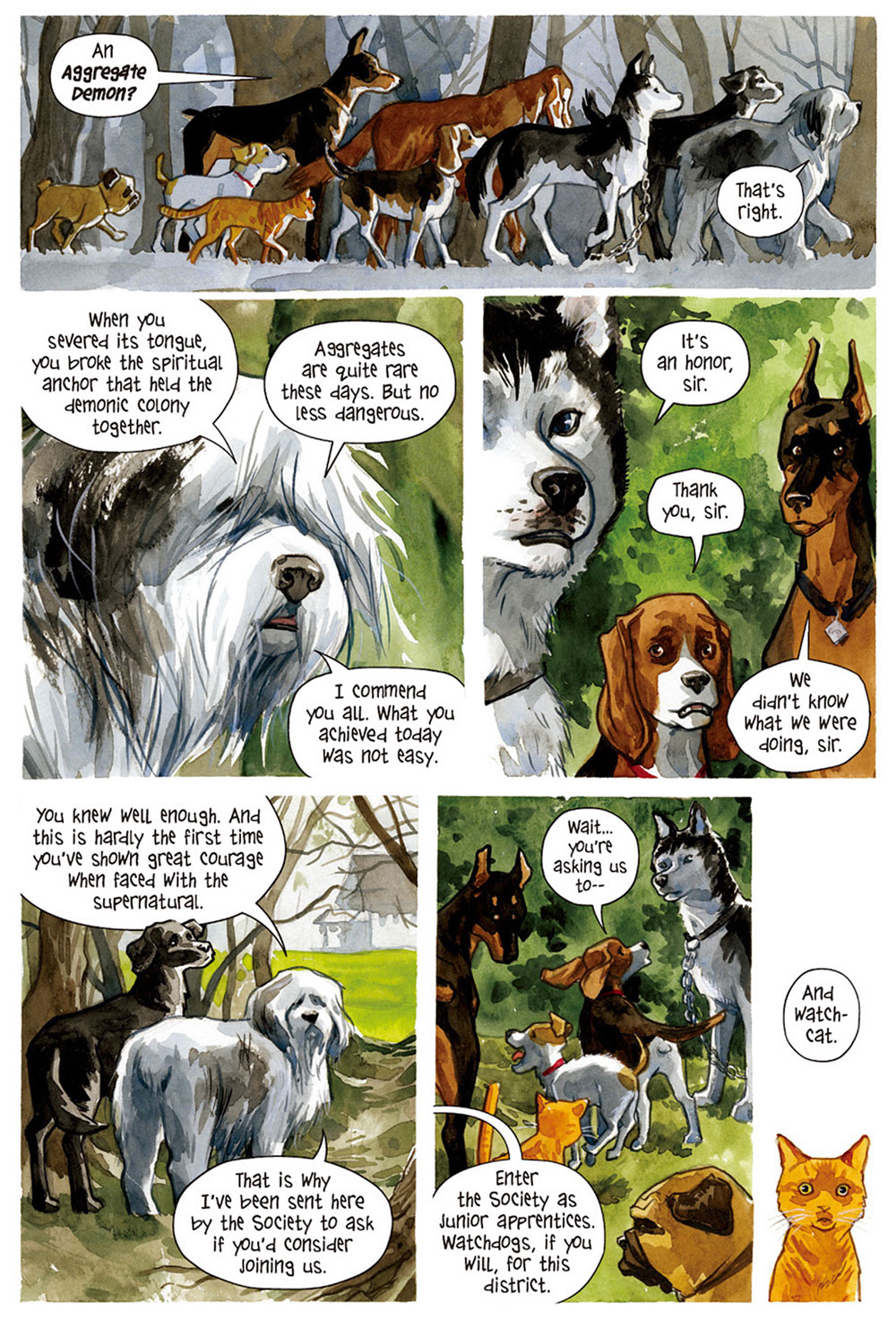
* Another WOT favourite that we never really got around to talking about. I will, however, refer you to this interesting discussion about comprehending/perusing comics, in which Cambpell conjures an entertaining mental image, relating to his appearance on TV to talk about why ‘some people just can’t read comics’: «My blather would have been mercifully cut because I launched into an insane mimicry of a theoretical middle-aged woman in tears from not being able to interpret the TV guide.»
« Bicycles are pieces of art. You get that combination of kinetic engineering, but then, besides the welds, the paint jobs, the kind of the sculpture of it all is quite beautiful. Bikes have such great lines, and all different styles. » — Robin Williams
I’ve been cycling a lot more of late. I’d been using my bike less frequently in recent years, unnerved by the increasingly frantic (and distracted, not a good combo) vehicular traffic of the city. But with my wife taking an interest in the activity, I found myself with a reason to get back in the saddle. This spring, we found a newly opened bike shop, earthy, grimy and unpretentious, where we got our bikes expertly tuned up.
I’ve always loathed those cliquish hipster joints that, in addition to selling overpriced junk, also seem responsible for the ubiquity of those middle-aged, over-equipped, spandex-clad Sunday cyclists, who feel it their sacred duty to pass you, whatever the pace, weather or road conditions, looking for all the world like overstuffed sausages in their lycra casings. The sporting analogue, if you will, of the rich kid who ‘needs’ the most expensive guitar in the shop… never mind that he can’t play a note.
You hopefully will indulge me in this little exercise in nostalgia. I miss the days when our bikes got us around, granted us greater autonomy and kept us in shape. This lifestyle took a backseat in the 1980s, when the BMX craze began to overstate the extreme and the competitive facets of the sport. Now, it’s all ultimate sport this and boot-camp fitness that. Ah, whatever happened to plain old utilitarian fun?
Judging from this ad (circa July, 1951), bicycle makers were trying to make their steeds mimic the clunky look of the era’s motorcycles. Aesthetics would soon improve. Here’s a fairly typical ad, circa 1961. Free catalogue, not to mention a healthy dollop of American jingoism, like it or lump it. Speaking of Schwinn, check out their well-produced promo comics Bicycle Book, from 1949.Ah, yes, the U.S. Royal twins, Roy and Al. In the tradition of the accidentally named Smith Brothers, “Trade” and “Mark”. Unsurprisingly, scouting magazine Boys’ Life was an ideal market for bike-themed ads. This one appeared in the May, 1966 issue. Artist unknown… anyone?You can tell how important the bicycle scene was: not only were manufacturers hawking bicycles, but there was also the ‘aftermarket’ trade of gizmos and doodads. I’ve long supposed ‘speedometer’ to be a dumbed-down term for a tachometer. Even after consulting this ‘helpful’ chart, I’m still not convinced it isn’t. To quote sometime Beach Boys lyricist, DJ and racing enthusiast Roger Christian: “Tach it up, tach it up / Buddy, gonna shut you down.“
Through much of the 1960s, Bendix (the corporation, not Bill!) commissioned a long-running series of custom ads featuring the Riverdale Gang, illustrated by resident Archie artist Harry Lucey.
This one’s from April, 1965.Archie, the voice of reason? Only in ads and public service announcements. This one’s from October, 1966.This one’s from July, 1968.Ah, that’s more like the Archie Andrews we’re accustomed to. This one’s from August, 1968. I daresay we’ve all encountered too many such ‘cyclists’.An apt reminder that the rich kids always did boast the best, most up-to-date equipment, whatever the sport. Also, I can’t help but think that the cape and tiger tail are just kind of… reckless. Clearly, corporate shill Tigerboy is failing to heed the lessons of Isadora Duncan’s tragic death. Thanks to the ever-thrilling Jack Davis artwork, this is the unsurpassed classic among bicycle ads. It appeared in select DC and Archie titles cover-dated November, 1968. While banana seats may be considered in most quarters as retro kitsch, I earnestly hold that they were bold and cool. Aesthetic and structural experimentation had arrived at the forefront of the cycling industry. This ad appeared in comics cover-dated February, 1969. And here’s a look at a (flawlessly) surviving model. Man, the elegance of those lines!
As the 1960s drew to a close, another series of custom comics ads appeared — just under the wire. They spotlight the creations of the famous ‘King of the Kustomizers’, George “Barris” Salapatas (1925-2015), very much in demand thanks to his recent triumph with the Batman tv show’s Batmobile.
This one appeared in various DC titles cover-dated November, 1969. If I had to take a stab at artistic attribution, I would go with the versatile Creig Flessel (1912-2008). Something tells me that in real life, the human chain stunt the Mighty i Patrol pulls would have led to four drowned kids instead of just one — but I’m sure Woofie would have dog-paddled his way to safety.This one appeared in DC titles cover-dated December, 1969. Read a gripping first-hand account of working on the assembly line at the Iverson bicycle factory, circa 1975!I’m assuming that the kid with the sombrero nicked it from Bazooka Joe’s kid brother Pesty. This final adventure saw print in DC titles cover-dated January, 1970.This, however, is the advert that really worked on me. When I got my first grown-up ten speed bike, a few years later, it was a Browning, which lasted me at least a quarter-century, until it snapped right at the load-bearing juncture of the rear fork… the one place where even welding wouldn’t help.
I switched to my backup, a hybrid bike I bought in 1987. It’s still running beautifully. In terms of value for money, a well-maintained bicycle is pretty unbeatable.
My well-thumbed copy of Adventure Cycling in Europe (1981). « Say, Uncle John, did Browning replace you with a pretty-boy model for your comic book ad? » « They sure did, but you know what’s even worse? » « I don’t know, Uncle John, what is? » « I don’t even have a nephew either! » All kidding aside, though it’s over forty years old, it’s still an insightful, entertaining and helpful book. When you go low-tech, change occurs at a slower, more forgiving pace.
I leave you with a song, whence comes the title of this article. It’s from a lesser-known but excellent Donovan album, Open Road, from 1970.
« All my life I’ve been torn between frivolity and despair, between the desire to amuse and the desire to annoy, between dread-filled insomnia and a sense of my own goofiness. Just like you, I worry about love and sex and work and suffering and injustice and death, but I also dig drawing bulgy-eyed rabbits with tragic overbites. » — Matt Groening
Unlike most of my peers, I didn’t grow up absorbing The Simpsons, probably because I only watched cartoons on videocassettes instead of actual TV. I also somehow managed to skip Futurama (catching up with it years and years later, with great enjoyment). So the work of Matt Groening* (who probably needs no introduction, but you can get one here) was not really familiar to me at all when co-admin RG introduced me to The Big Book of Hell, though of course I was aware of the Simpsons aesthetic, as one would truly have to live under a rock not to be acquainted with it to at least some degree.
*Here’s how to pronounce ‘Grœning’ correctly and impress all your friends.
Life in Hell crept into the world in 1977 as a self-published book that Groening, freshly moved to Los Angeles from Portland to pursue his ambition of becoming a writer, would give out to friends. He also sold it for two bucks a pop in Licorice Pizza, one of a chain of record stores operated by James Greenwood. As is often the case, Groening’s cartoonist/writer/producer/animator career kicked off by way of serendipity: in 1978, an editor from the charming WET: The Magazine of Gourmet Bathing liked Life in Hell enough to print a few of its strips. From then on, the strip’s popularity snowballed slowly but steadily (from its first regular weekly appearance in the Los Angeles Reader in 1980, to the huge success of a compilation of LIH’s love-centric cartoons, titled Love Is Hell, in 1984, to the strip’s presence in over 250 newspapers by 1986), which eventually led to The Simpsons. Speaking of the latter, I am now shamelessly going to plug a previous post, namely Tentacle Tuesday: Treehouse of Tentacular Horror.
Here’s a selection from several out-of-print anthologies co-admin RG had handy, namely from Love Is Hell (1984), Work Is Hell (1986), School Is Hell (1987), Childhood Is Hell (1988), and How to Get to Hell (1991).
Personal favourites Akbar and Jeff were apparently introduced so that Groening could incorporate real-life conflicts he had with his girlfriend into the strip without it being too obvious about who was who. When we noticed a couple living across the street (two men always dressed in matching, brightly coloured sportswear) we instantly nicknamed them Akbar and Jeff.