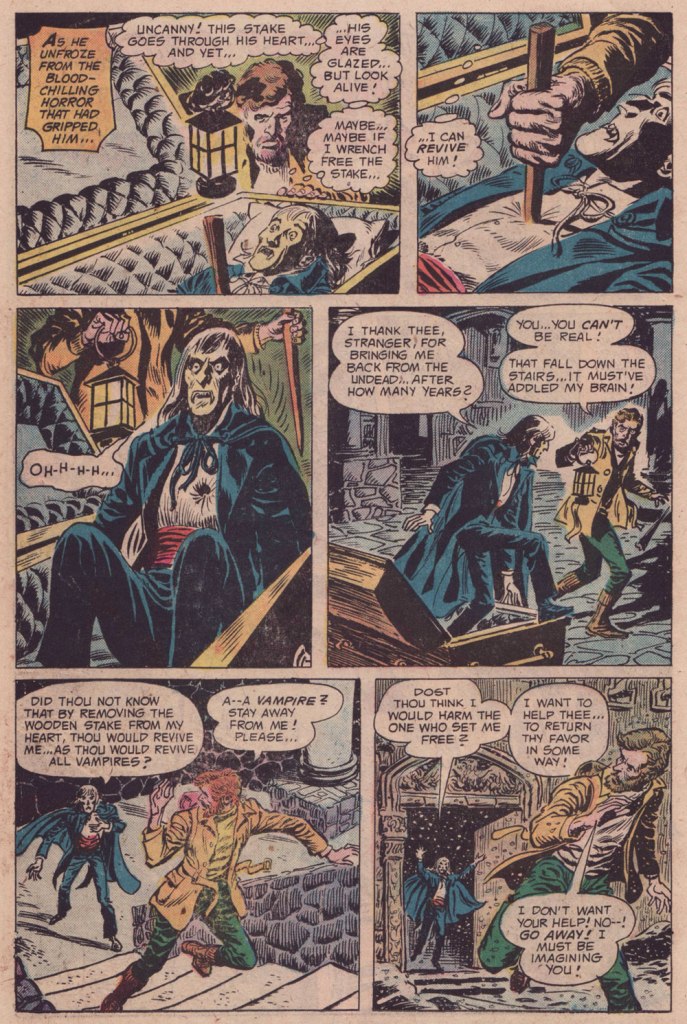
« The last I saw of Count Dracula was his kissing his hand to me, with a red light of triumph in his eyes, and with a smile that Judas in hell might be proud of. » — Bram Stoker
Comics fans of my generation might be forgiven for not fully appreciating Lee Elias‘ artistic assets if they encountered him, say, in Mystery in Space when he took over its lead feature, Adam Strange, from visionary Carmine Infantino. The series was mercifully soon discontinued, the victim of a game of editorial musical chairs designed to save the Batman titles, then — believe it or not — facing cancellation thanks to Jack Schiff‘s mismanagement.
While I do have a soft spot for Elias’ work on Ultra, the Multi-Alien (in Mystery in Space) and Eclipso (in House of Secrets), it wasn’t until I found out about his earlier, far edgier pre-Code shenanigans at Harvey Comics (with art director/designer/co-conspirator Warren Kremer) and, more directly and subtly his handful of stories for editor Murray Boltinoff‘s spooky titles (Ghosts, The Unexpected, The Witching Hour) in the 1970s, that I came to discern his light.
Boltinoff wisely played to Elias’ strengths in interests, handing him historical gothics to play with, and he delivered some of the finest work of his career.
Written by George Kashdan, The Most Fearful Villain of the Supernatural was published in Ghosts no. 50 (Nov.-Dec. 1976, DC).
Editor Boltinoff had this amusing idée fixe, commissioning purported ‘true’ stories wherein famous authors were “inspired” to pen their immortal works by some supernatural encounter earlier in life. From what I recall, Mary Shelley, Charles Dickens, Robert Louis Stevenson and — in this case — Bram Stoker were among the elected.
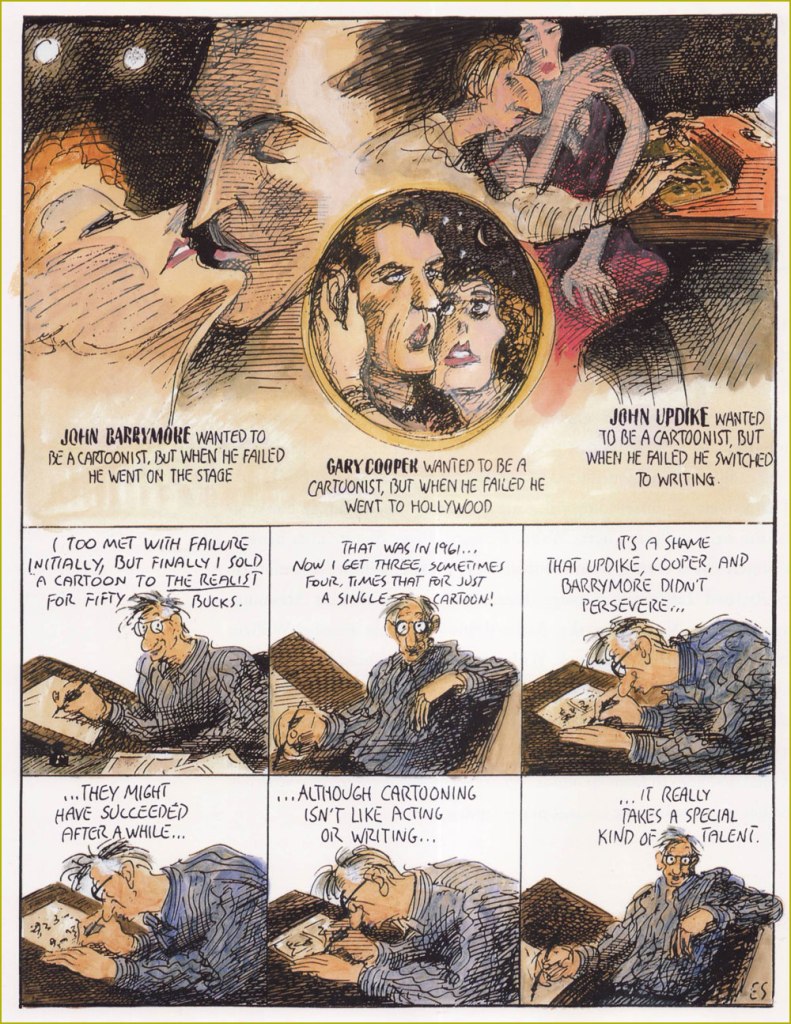
« If you take drawing seriously, you never quite feel you’ve arrived. » — Ed Sorel
This time out, I’m pinch-hitting for my co-admin ds, who’s burning the midnight oil these days.
Just about a month ago, when I wrote a piece about Seymour Chwast (b. Aug. 18, 1931), it occurred to me that I should also devote post-haste (just in case) some column space to his fellow surviving Push Pin Studios co-founder, Edward Sorel (b. March 26, 1929). Let us celebrate the living while we can. The dead don’t appreciate nearly as well such gestures .
Opting for a freelancing career, Sorel left Push Pin, just a few years after its founding. He made it, all right, becoming one of the greatest caricaturists of the century. But he was every bit as accomplished a writer, which elevates his work above the ‘merely’ visual.
I’ve always been blown away by how deceptively easy he makes it all look, and that’s what’s so impressive: very loose on the surface, but with an underlying, laser-sharp precision. I could easily go on at some length, but Sorel’s career and art are well-documented themes. Check out, for instance, The Enigmatic Edward Sorel(From The Comics Journal), or this fine New York Times review of his recent memoir (circa 2021), Profusely Illustrated.
And now, some of the man’s work:
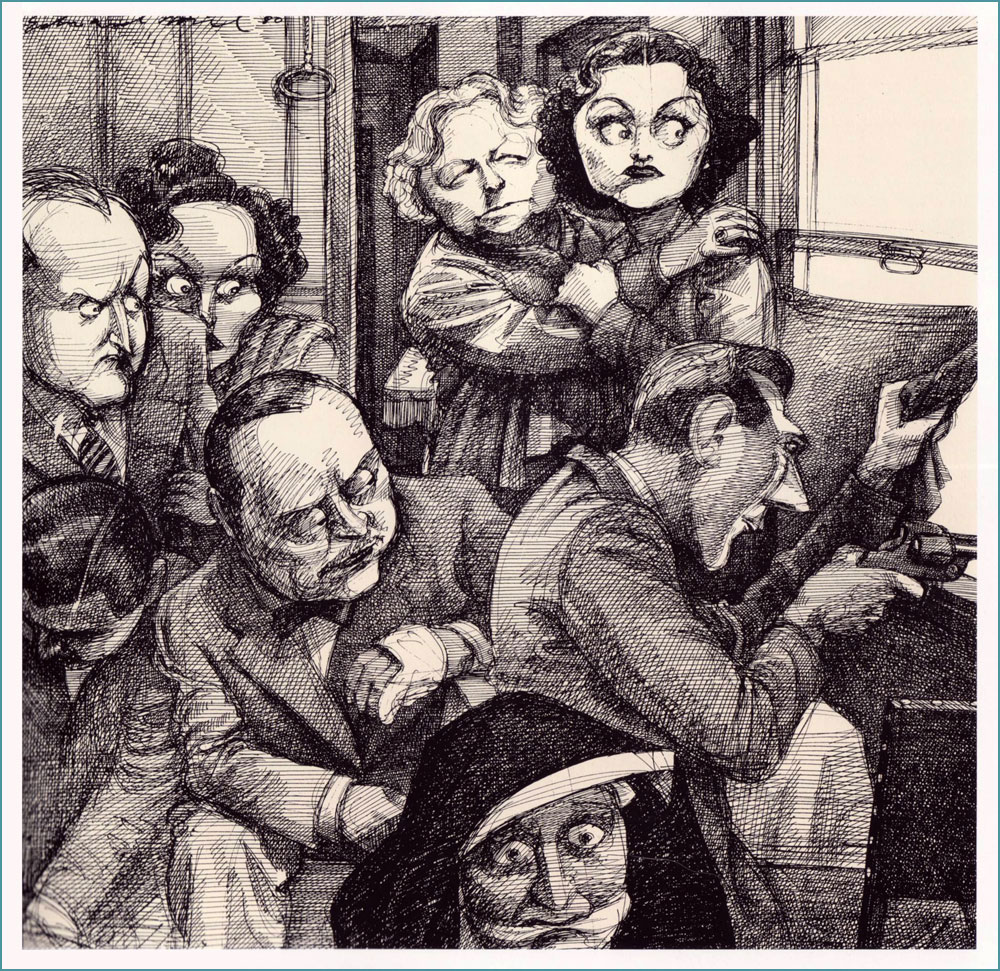
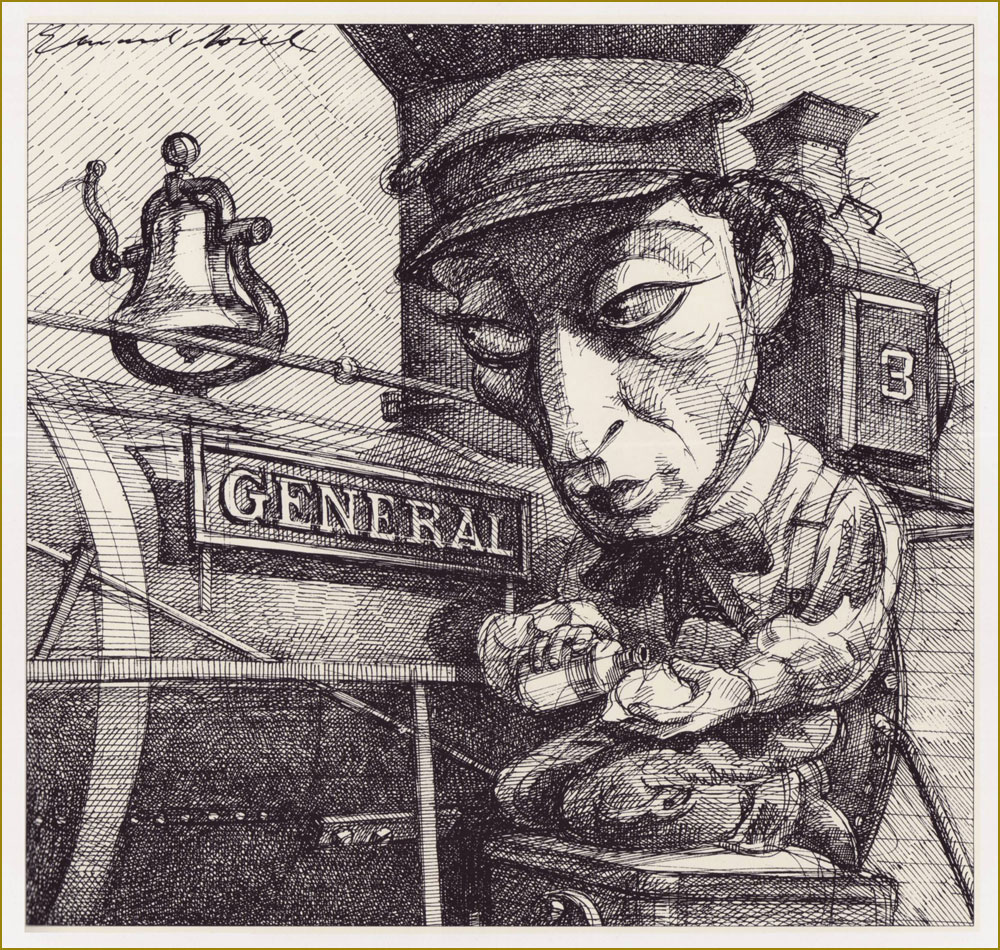
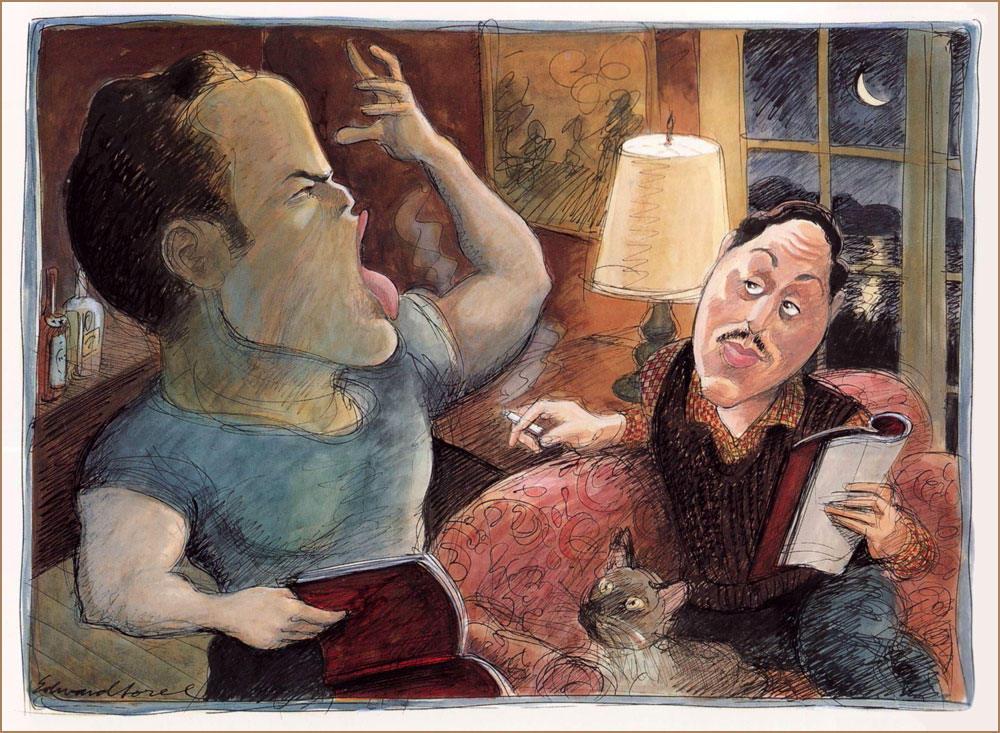
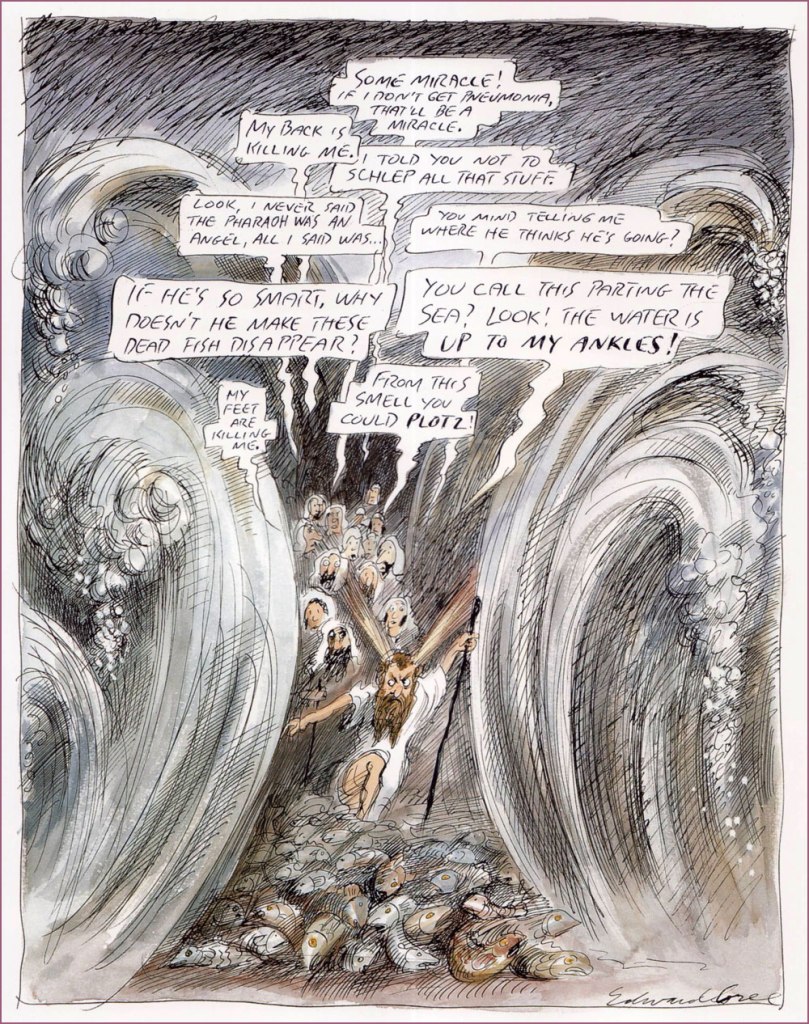
« My long association with Penthouse was unique. They bought every idea I submitted to them, and never changed anything except my spelling. This solipsistic strip appeared in 1990. »He can draw *anything*! This one appeared as The New Yorker‘s Jan. 31, 1994 cover illustration.I suppose every cinephile has his favourite Hitchcock film; mine’s The Lady Vanishes (1938). An entry in Sorel’s “Movie Classics” series, published in the March, 1981 issue of Esquire. « The General, starring Buster Keaton, is the only silent movie I included in my “Movie Classics” series. Based on an actual incident in the Civil War, it often has the look of a Mathew Brady photograph. » From Esquire, Dec. 1980.« Tenor Enrico Caruso is a guest at the St. Francis Hotel when the 1906 earthquake hits San Francisco. He vows *never* to return to a city “where things like this are permitted”. From Sorel’s pictorial essay “Keyhole History” (GQ, Oct. 1984).More rollicking blasphemy for Penthouse (Dec., 1992). Ah, yes. « The 1973 Academy Awards are remembered for Marlon Brando’s refusal to accept his Oscar for The Godfather. His emissary, Apache tribe member Sacheen Littlefeather, explained that Brando’s rejection of the award was to protest Hollywood’s depiction of Native Americans. Backstage, John Wayne was apoplectic. As John Lahr wrote in his article “The Birth of the Oscar“, “The Duke, who had dispatched many an Apache on film, didn’t take kindly to Brando’s protest… Wayne had to be restrained by six men from yanking Littlefeather off the stage.” From The New Yorker, March. 21, 1994. And speaking of Brando… « Marlon Brando is sent up to Cape Cod to read the part of Stanley Kowalski in A Streetcar Named Desire for Tennessee Williams‘ approval. First he fixes the nonfunctioning electricity and plumbing, then he auditions. His performance was stellar in every role. From Sorel’s “First Encounters” series, this entry appeared in Atlantic Monthly‘s July, 1994 issue. Note the kitty’s rapt expression.« Exodus revisited: an educated guess as to what Moses endured as he led his people through the Red Sea. A cartoon for Penthouse, the only mass-circulation magazine to welcome my blasphemy. » Penthouse (like the man said), Apr. 1995. Oh, and Plotz: To burst from strong emotion; often used humorously to express minor shock or disappointment (פּלאַצן, platsn, ‘crack’; cf. German: platzen;) and Schlep: To drag or haul (an object); to walk, esp. to make a tedious journey (שלעפּן, shlepn; cf. German: schleppen;).« Another of my egocentric ramblings, this one a rationalization for not becoming a great artist. » It appeared in the Aug. 21/28 issue of The Nation.« How Was I Supposed to Know? », from The Nation, Sept. 24, 1990. Oh, the sequels just write themselves.Here’s a rather famous one: « Back in the mid-sixties, my friend George Lois had an idea for an Esquire cover that couldn’t be done with photography. He asked me to do it, and I panicked — i.e. I tightened up. When I handed him my finish, he rolled his eyes and said he’d give me until the next morning to do it over. I went beyond panic, but nevertheless did a drawing we were both happy with. » It appeared on the cover of Esquire’s April, 1966 issue, with the caption of “The problems of power for Frank Sinatra”.« Director Michael Blakemore, at a rehearsal of Woody Allen’s one-act contribution to Death Defying Acts, watches in horror as Allen scribbles copious stage directions for him to execute. (Caricaturing Woody Allen is so easy that after drawing him, many an amateur comes to think of himself as a pro.) » From The New Yorker, June 3, 1996. Look at that pen move!
Ah, the nineteen seventies… and their Satanic panic, in which we can recognize so closely the roots (or at least relatives) of today’s disinformation maelstrom, before the politicisation and weaponisation of septic paranoia and lies had become honed to such an anti-science. In a lot of sordid ways, Lawrence Pazder was an Andrew Wakefield of his day.
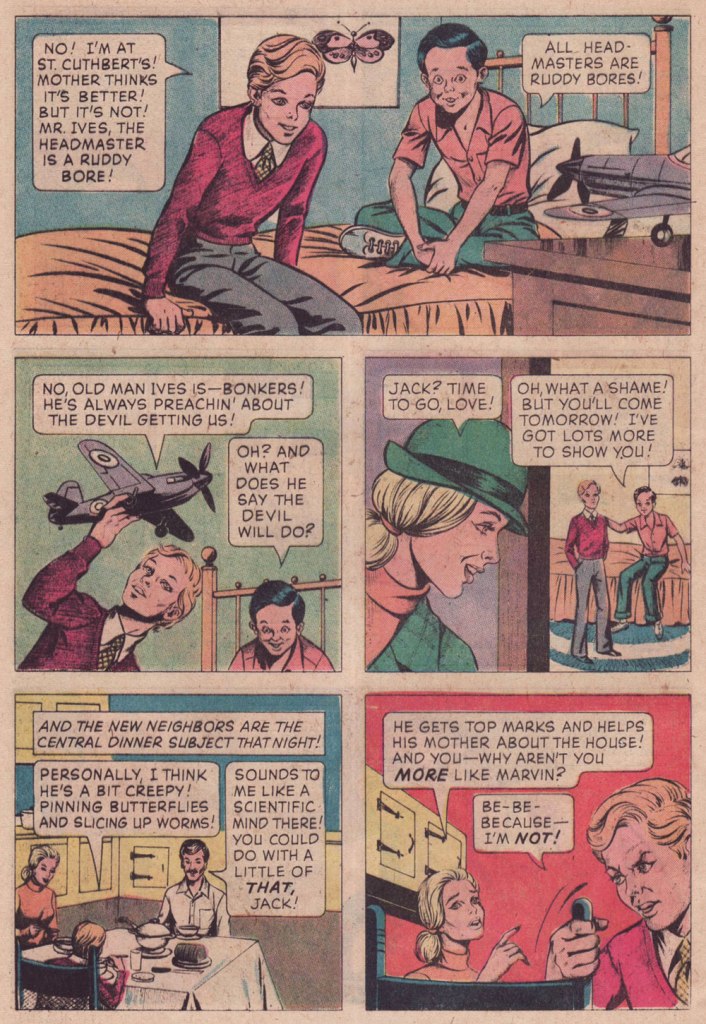
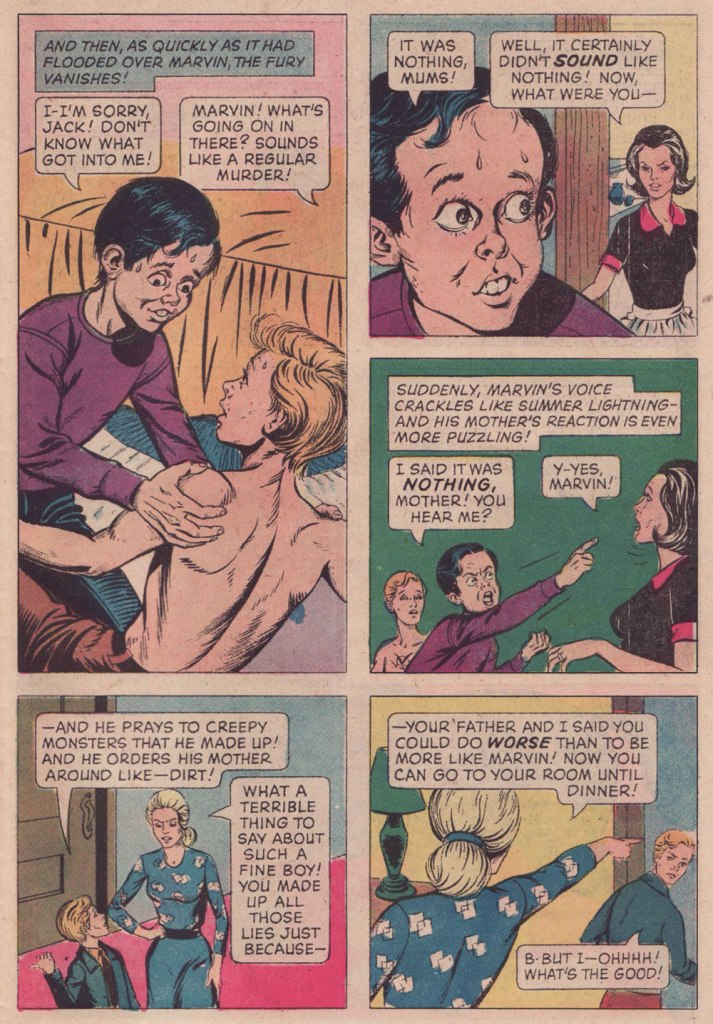
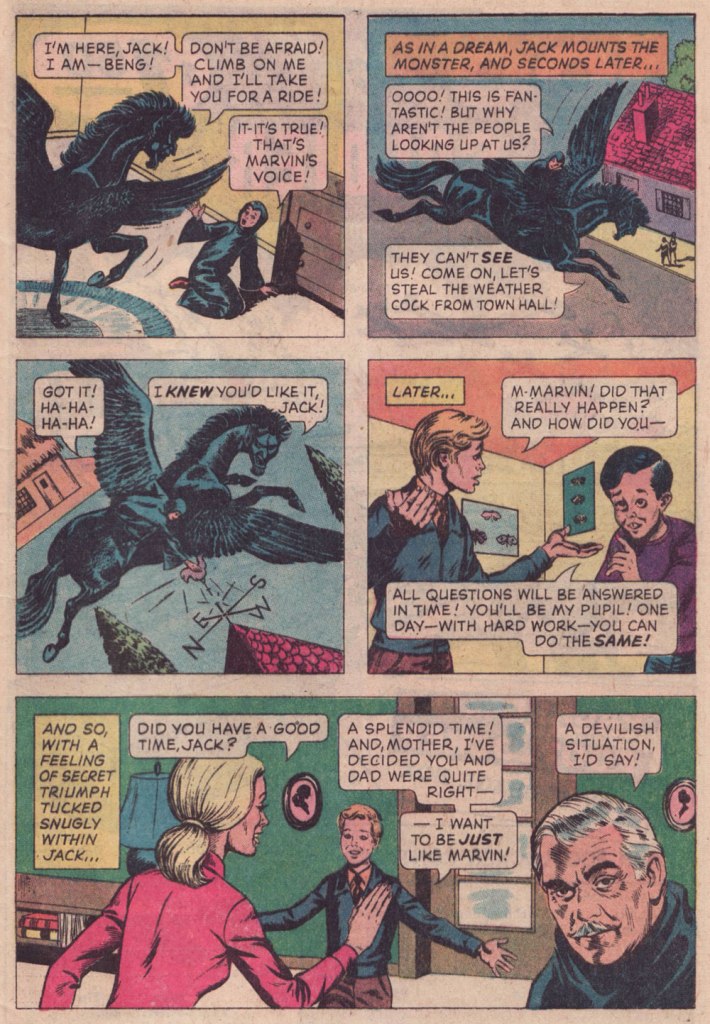
Here’s a story that I first encountered around the time of its release, remembered, but didn’t revisit until a couple of weeks ago, when a good friend (merci, Keith!) helpfully snapped up a copy for me. This deceptively dark tale was created by writer Arnold Drake (I surmise), penciller John Celardo and mysterious inker Wanda Ippolito, who may have a been a spouse or relative of Celardo’s. It’s odd to find someone else inking Celardo, as this was his chief, most enduring and distinctive strength. For comparison’s sake — and presumably, reading enjoyment — here’s another Drake-Celardo outing, The Anti-13!
I won’t make any claims that this is great art: by this time, Gold Key’s printing was shoddy, they barely bothered with the colouring (straight Magenta and Cyan and Yellow everywhere — how lazy can you get?)… but I treasure this one because of the story. Given its moral — what moral? — it’s hard to imagine The Comics Code Authority giving this one a pass, as it merrily violates several of its key precepts. I’ve got another such blasphemous entry in the pipeline… this one duly Code-Approved! Just you wait…
I had a childhood friend who was a lot like Marvin (minus the devil worship — for all I know)… he was incredibly talented, but also scarily unpredictable, and not in a good way. One day, he just disappeared.
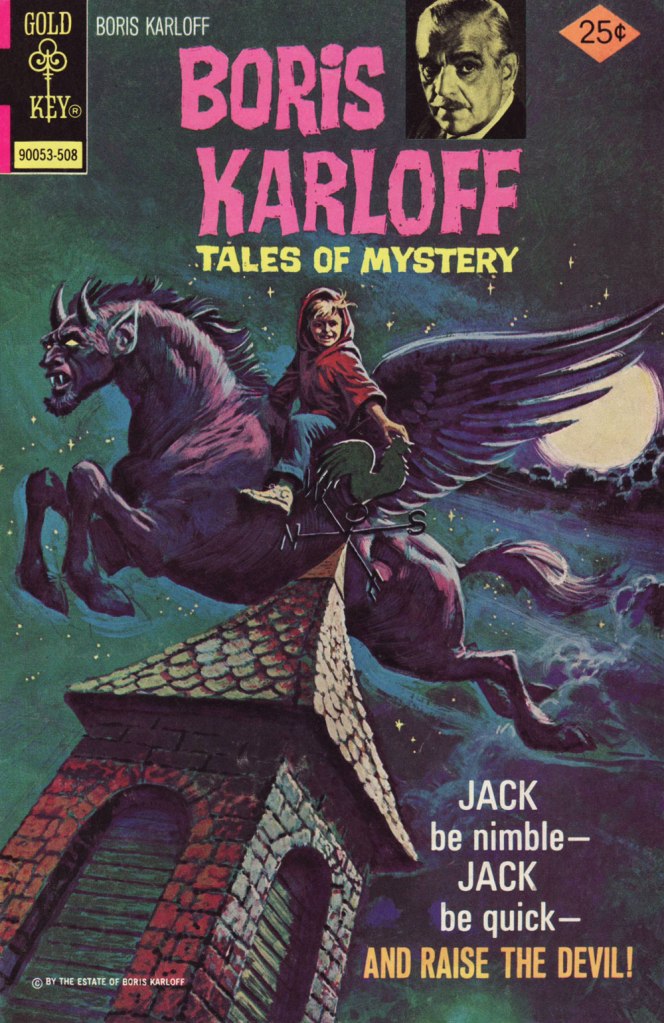
On the other hand, the accompanying cover is spectacular.
« Why Can’t You Be More Like Marvin? » originally appeared in Boris Karloff Tales of Mystery no. 63 (Aug. 1975, Gold Key), which bore this masterfully disquieting cover by Luis Domínguez. It would have made it into my Domínguez retrospective, Luis Domínguez (1923-2020): A Farewell in Twelve Covers but for the fact that I didn’t own a decent copy of the issue.
And as (nearly) always, a bonus for context: Celardo had a long and fruitful career, and I’m sure one of its highlights was to number among Fiction House’s elite cadre of cover artists. I’ve said it before, but despite their mind-numbing repetitiveness, FH covers were tops in the Golden Age in terms of draftsmanship and production values.
Aw, poor Ka’a’nga — always left at home to feed the jackals while Ann Mason goes off on escapades with her other boyfriends. And who insisted on adopting them in the first place? Ann, that’s who! This is Jungle Comics no. 98 (Feb. 1948, Fiction House). Judging from his ability in the jungle antics genre, it’s no wonder that Celardo was picked to illustrate the real thing (at least comics-wise): the Tarzan comic strip, from 1954 to 1968, between Bob Lubbers (another FH cover artiste!) and Russ Manning. And here’s one of Celardo’s Tarzan Sundays (March 27, 1954, United Feature Syndicate).
« With such precautions the courtiers might bid defiance to contagion. The external world could take care of itself. » — Edgar Allan Poe, The Masque of the Red Death
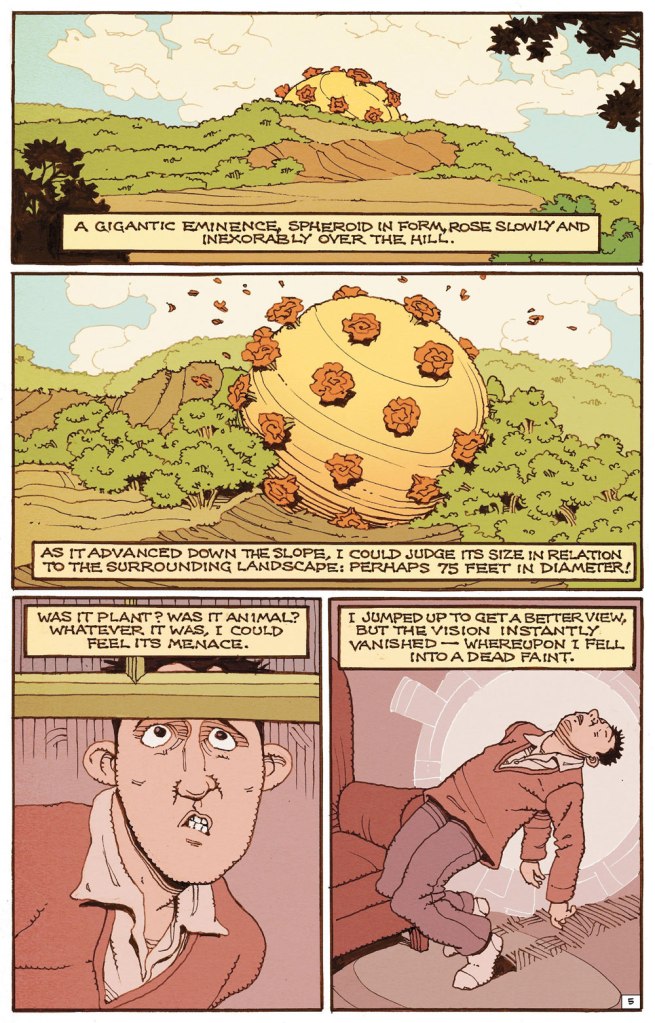
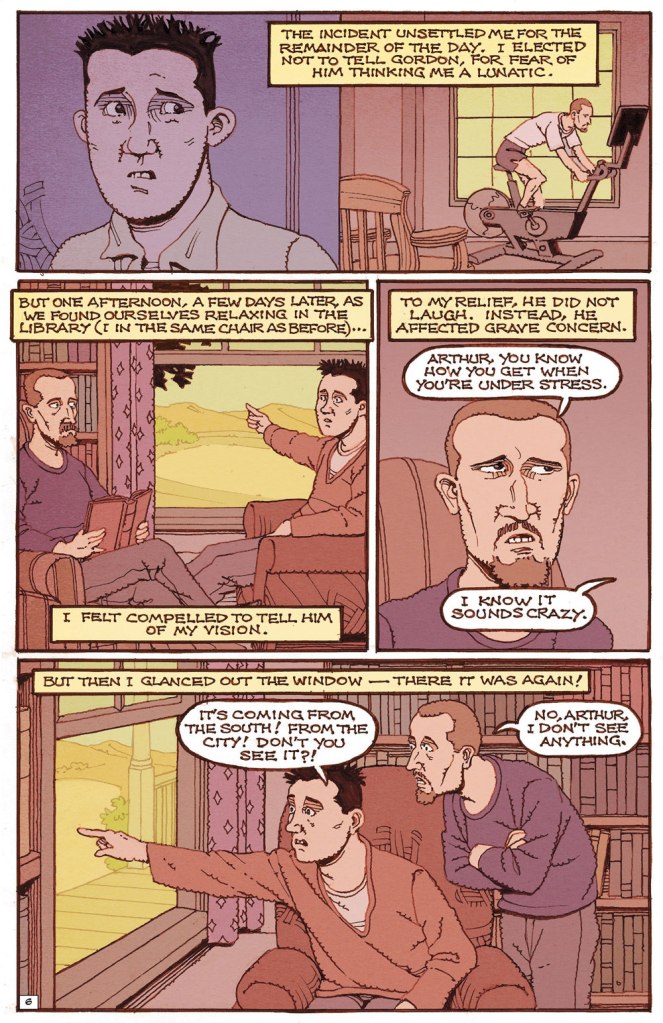
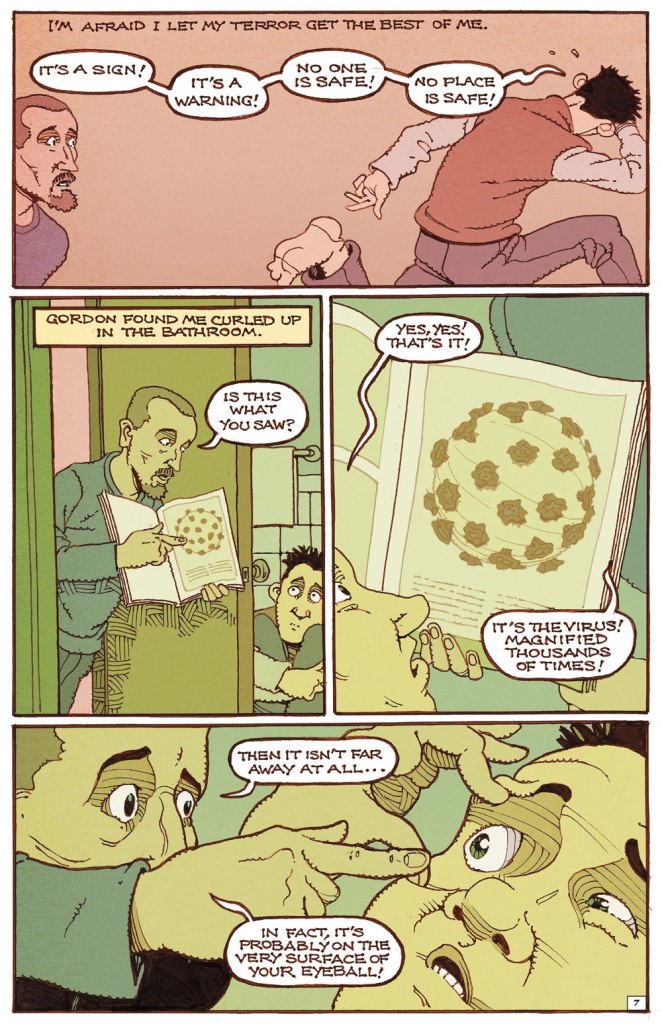
And now, a piece from — gasp — 2022! It’s at once most timely and a link to the dim past, with WOT? favourite Rick Geary drawing nimble parallels* to Mr. Poe’s famous tale of arrogant (and happy and dauntless and sagacious) Prince Prospero’s well-earned comeuppance. This other great plague, however, isn’t greeted with hubris by our everyman protagonists. While Poe provides the spirit and the starting point, Geary wends his own way, bless his soul.
Ahoy Comics‘ series of Poe-themed anthologies are of course uneven — such is their nature — but their peaks are joltingly, exceptionally good, and they make the whole enterprise quite worthwhile.
A Tale of The Great Plague appeared in Edgar Allan Poe’s Snifter of Death no. 4 (Jan. 2022, Ahoy Comics).
-RG
*and also, you might say, to The Fall of the House of Usher and perhaps even The Tell-tale Heart. Clever chap, this Geary.
Today, Paul Reubens (born Paul Rubenfeld on Aug. 27, 1952) celebrates (in the coolest style, to be sure) his seventieth birthday. What’s he got to do with comics? Well, he obviously reads them, and his alter-ego, Pee-wee Herman, once met legendary small-scale comics hero Bazooka Joe.
This momentous occasion took place on the back of card no. 18 (of 33) from Topps’ delirious Pee-wee’s Playhouse set (1988). Introductions were arranged by that dapper bon vivant, Mark Newgarden.
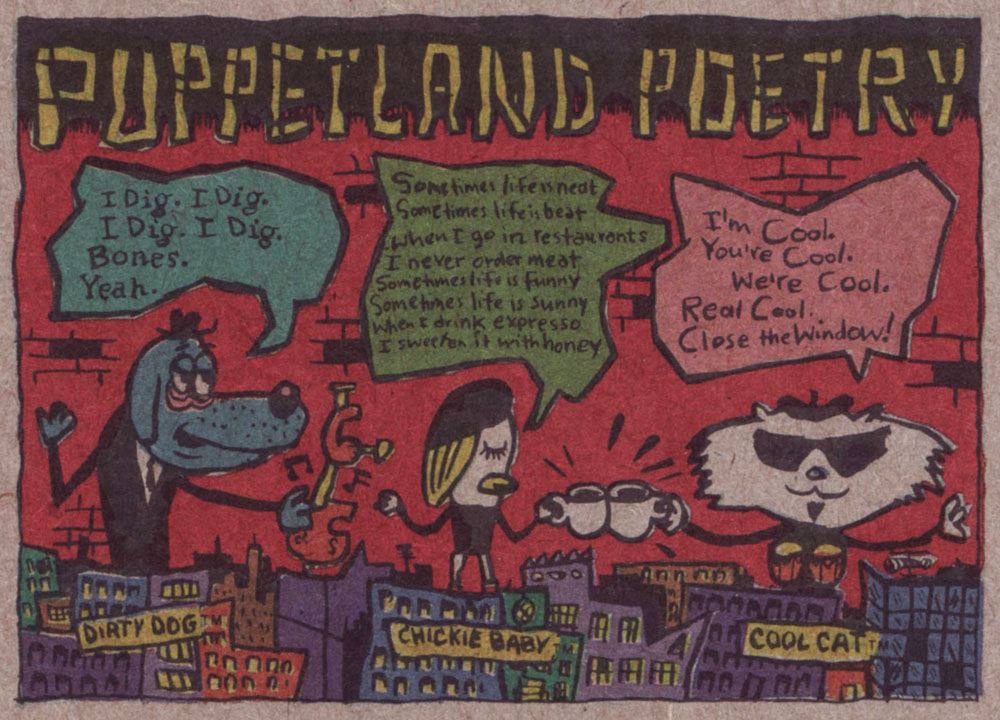
This is happily one of those rare occasions when the word ‘Fun’ is accurately evoked. While Mr. Reubens wasn’t directly involved with the conception and concoction of this splendid ‘Pak’, he signed off on every aspect of it — no generic licenced product, this.While the front of the cards bore the standard, time-tested ‘photographs with captions’ images, the backs is where the anarchic action was. Here are a few samples. Note the unbleached cardboard, which adds a certain primitive je ne sais quoi.“Remember — you are an ARTIST!”The Puppetland Band, those adorable beatniks, were always favourites.Cartoonists Mark Newgarden and Kazimieras ‘Kaz‘ Prapuolenis write in!
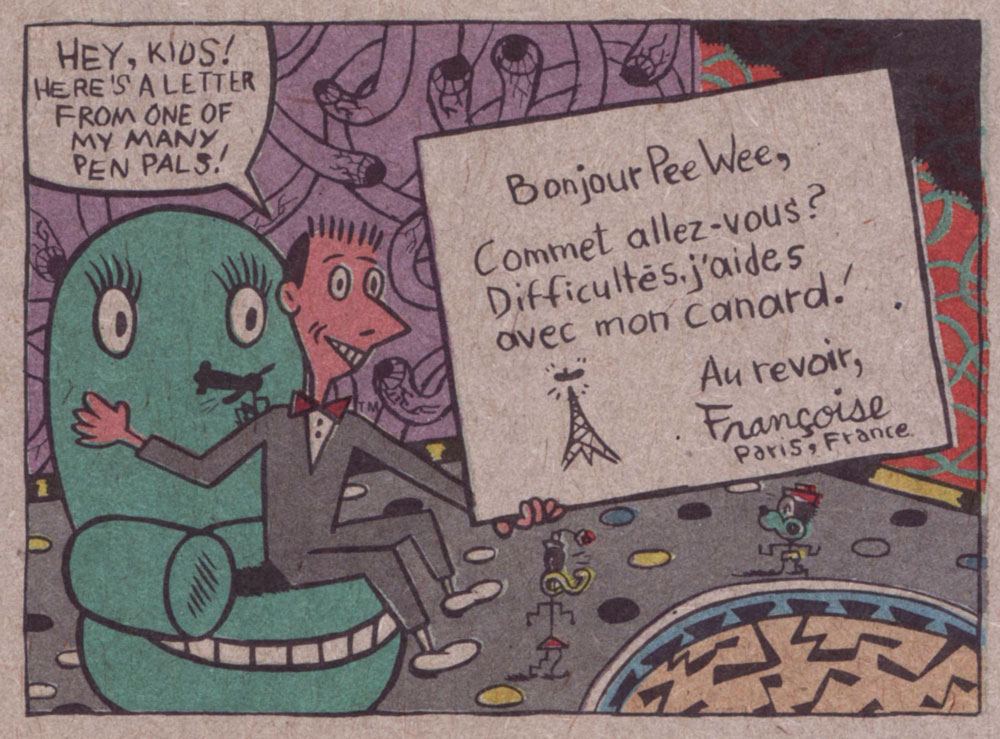
Funny, I would have expected Françoise Mouly‘s french to be better than this. Perhaps that’s why she moved to NYC. A sheet of stickers… featuring, front and centre, Roger from Monsterland (‘Look’ was the secret word that week).Temporary (sorry) tattoos. It was just to difficult to pick just one sheet, so here are two. The “Pee-wee Copter”, front and back.If you think you recognized the distinctive stylings of messrs. Charles Burns on the front and those of J.D. King* on the back… kudos on your discerning eye, keen one.
At one time, during Pee-wee’s heyday, I dated for a few months this girl from a, to put it mildly, conservative family. Her little brother was expressly forbidden from watching Pee-wee’s Playhouse, for fear that ‘it might turn him gay’. Live and learn… do check out this smart list of The Best 25 Pee-wee’s Playhouse Moments.
Happy birthday Paul, and a great weekend to you, Pee-wee!
Bonus time: in a case of ‘biting the hand that feeds’, Topps issued this snarky entry as part of its 1991 Wacky Packages series. Concept, writing and layout by Mark Newgarden, painted art by John Pound.
– RG
*a grateful tip of the hat to Mark Newgarden for the inside dope!
« Fistfightin’ may not be your style, Marshall Earp! If you want to crawl, I’ll let ye off easy! » « Crawl, Irish John? I’m going to tie a knot in your cauliflower ears! » — ‘Hired to Die’ (1965)
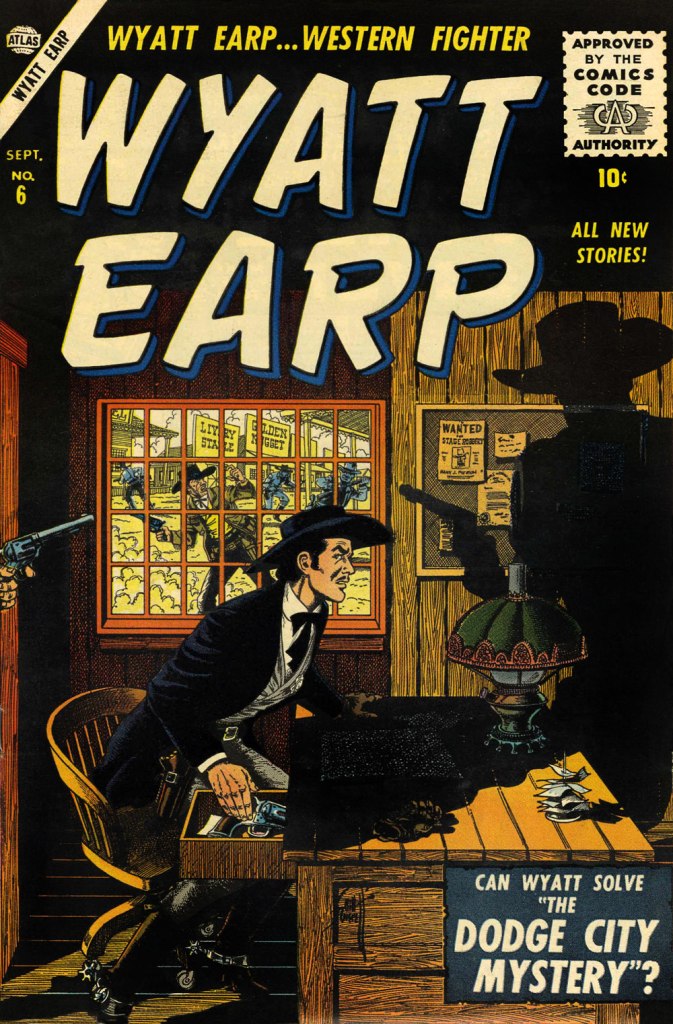
Happy one hundred and seventy-fourth birthday to Wyatt Berry Stapp Earp (March 19, 1848 – January 13, 1929), bison hunter, teamster, bouncer, saloon-keeper, gambler, brothel owner, pimp, miner, boxing referee, constable, city policeman, county sheriff, and, lest we forget, comic book hero… for several publishers at once!
This is Wyatt Earp no. 6 (Sept. 1956, Atlas); ultra-detailed cover by Bill Everett, colours by Stan Goldberg.This is Wyatt Earp no. 9 (March 1957, Atlas); cover by John Severin, colours by Goldberg.This is Wyatt Earp no. 11 (May 1957, Atlas); cover by John Severin, colours by Goldberg.This is Wyatt Earp no. 15 (Feb. 1958, Atlas); cover by Joe Maneely, colours by Goldberg.To cash in on the success of The Life and Legend of Wyatt Earp (1955-61) tv series, Dell also threw their Stetson into the ring. This is Hugh O’Brian, Famous Marshal Wyatt Earp (sheesh!) no. 13 (Dec. 1960-Feb. 1961, Dell), the final issue.
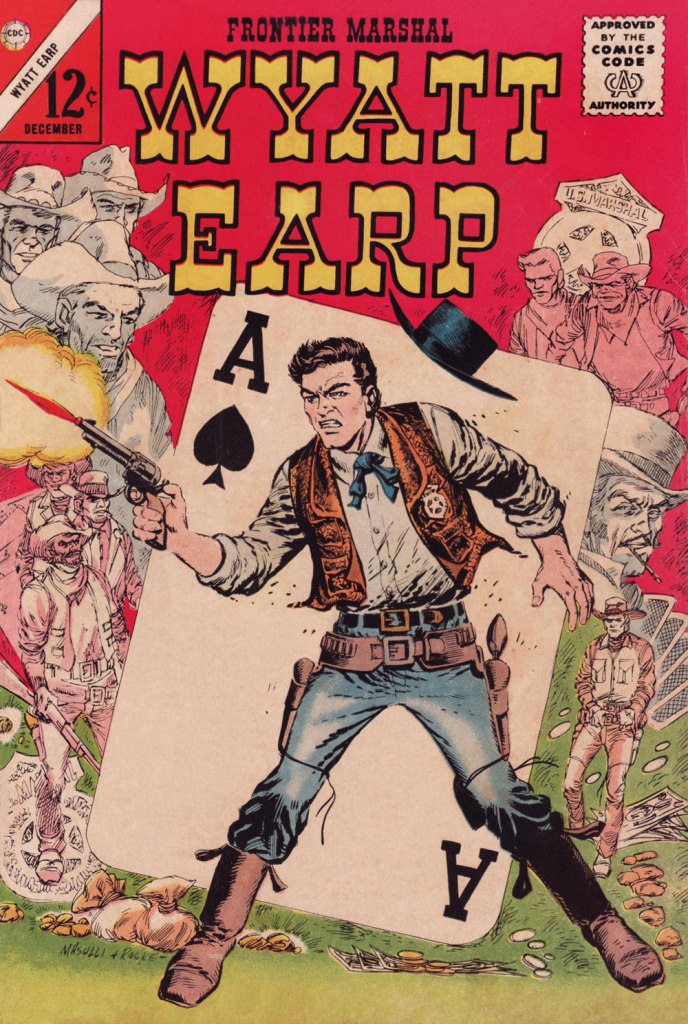
Mr. Earp had an especially notable run at Charlton (and by far the best title logo), with sixty-one issues of his very own title published between 1956 and 1967. And with Joe Gill scripts, so it’s solid stuff. This is Wyatt Earp, Frontier Marshal no. 61 (Dec. 1965, Charlton); cover by Pat Masulli and Rocco Mastroserio. I’d saved this one for this occasion, having withheld it from my M/M showcase The Masulli-Mastroserio Cover Deluge of ’65!
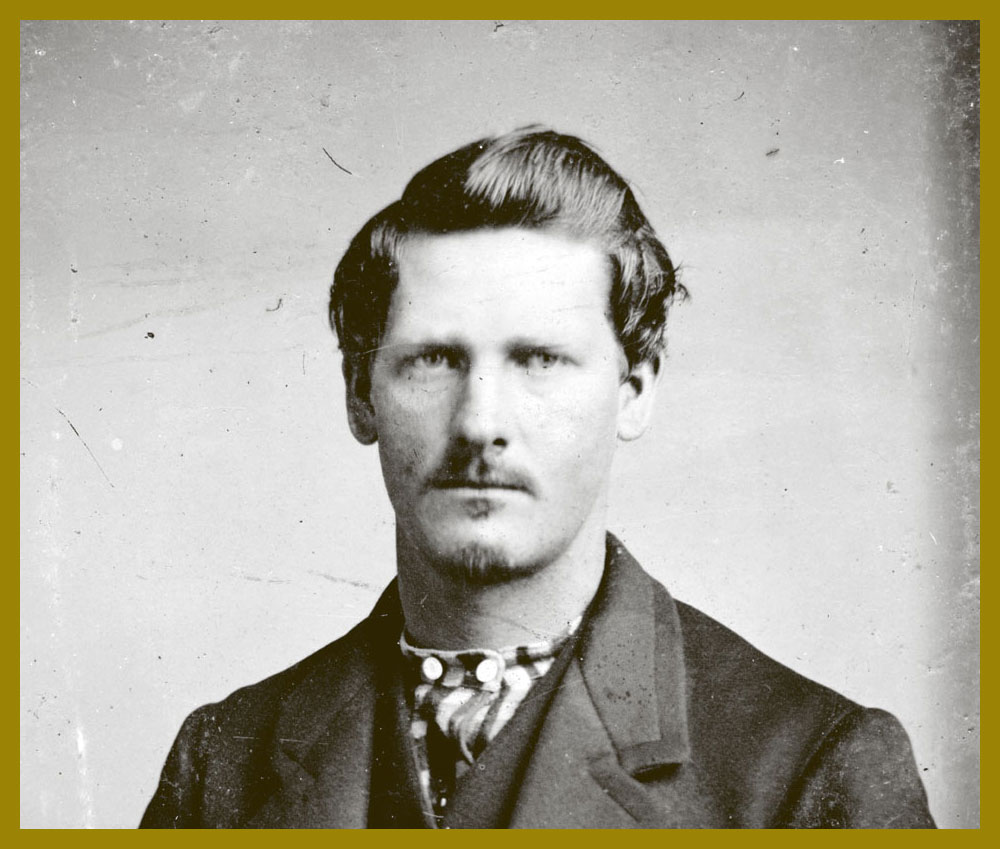
This is Wyatt Earp, Frontier Marshal no. 64 (July 1966, Charlton); cover by Mastroserio, lettering by Jon d’Agostino.This is Wyatt Earp, Frontier Marshal no. 69 (June 1967, Charlton); cover by Mastroserio.This is Wyatt Earp, Frontier Marshal no. 72 (Dec. 1967, Charlton), the fiery finale of *that* run. Another effective cover by Mr. Mastroserio, who passed away a few months later, aged a mere 40.And here’s a shot of the real-life Mr. Earp. Don’t look so glum, hombre — it’s your birthday!
« Dreams surround our desires with ugliness and dread. » — Mason Cooley
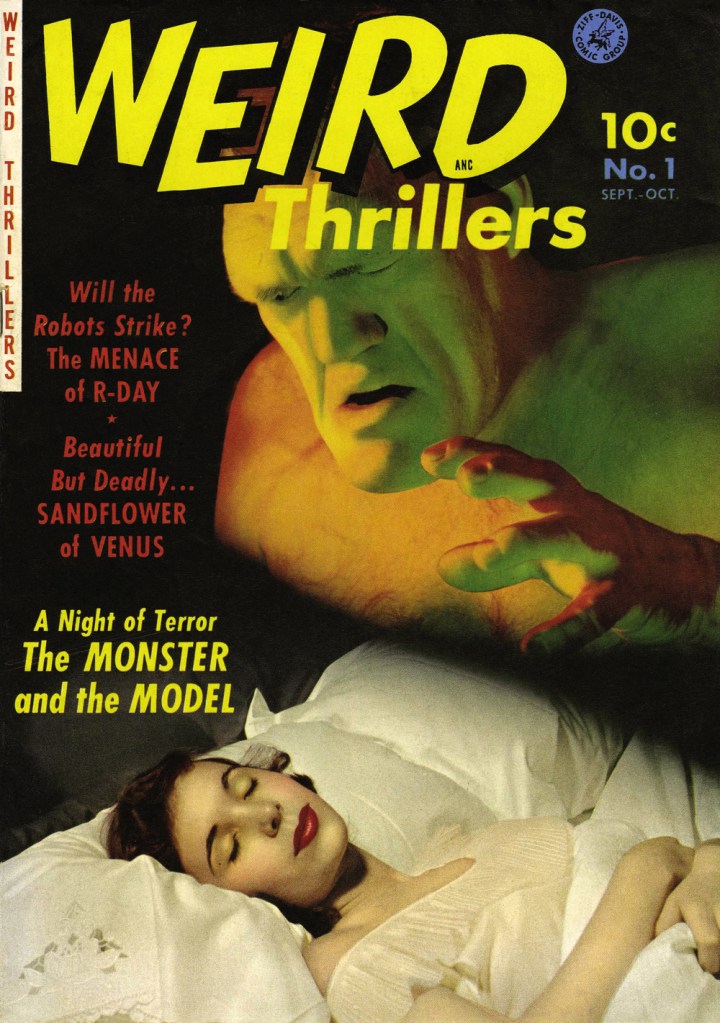
As everyone knows, the early fifties were a more innocent and wholesome era, when the average bobbysoxer would swoon away the nights with fantasies of dishy teen idol Rondo Hatton. I mean, just look at her blissful expression!
This is Weird Thrillers no. 1 (Sept. 1951, Ziff-Davis). Disappointingly, given the cover’s promise, the issue comprises mostly science-fiction and crime stories.
Surprisingly, the cover scene does, for once, occur within!
The opening pages from our cover tale, The Monster and the Model, pencilled by future Rip Kirby artist John Prentice. The entire issue is available for your perusal, legally and gratis, right here!
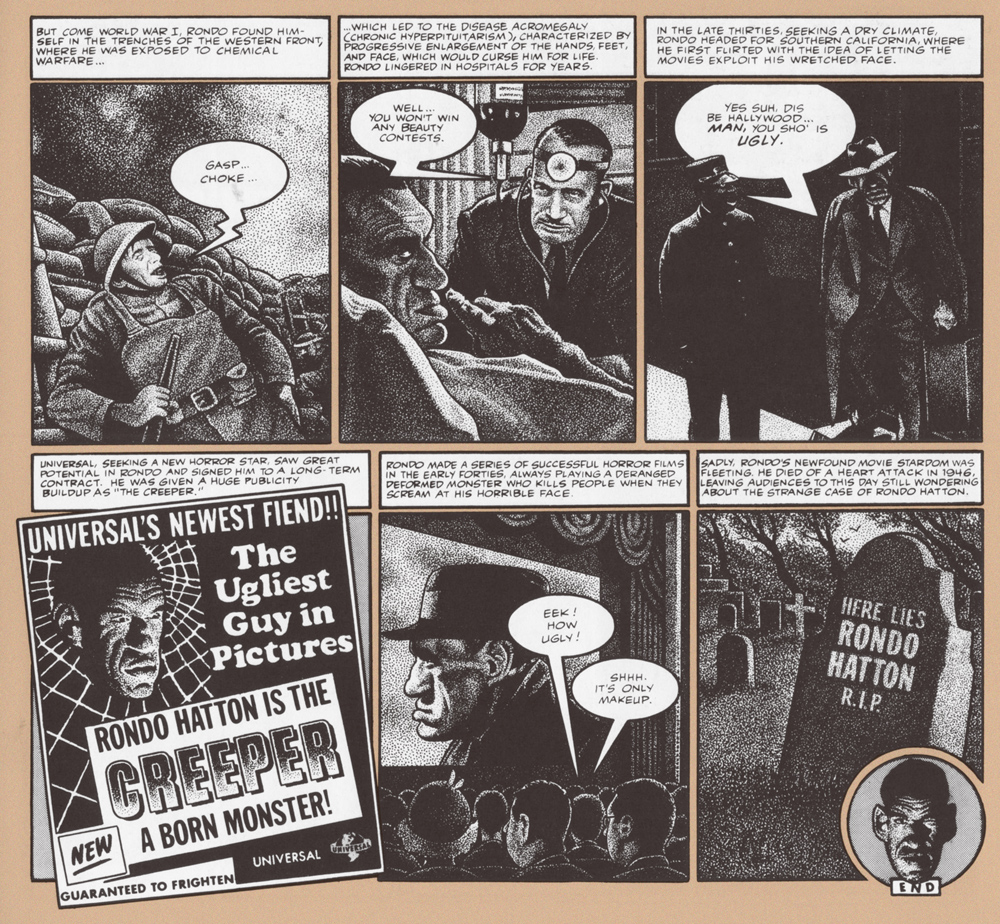
“So, who is this Rondo guy?”, you may ask. Before Mr. Hatton became a household name, got an award named after him and was the subject of his own book-length biography (Beauty Within the Brute), cartoonist Drew Friedman, ahead of the curve as usual, was endeavouring to preserve from oblivion the unfortunate man’s memory… in his own sardonic way.
One more for the road?
Originally published in Raw no. 8 (Sept. 1986, Raw Books). You may have heard of some other folks tragically afflicted with acromegaly.
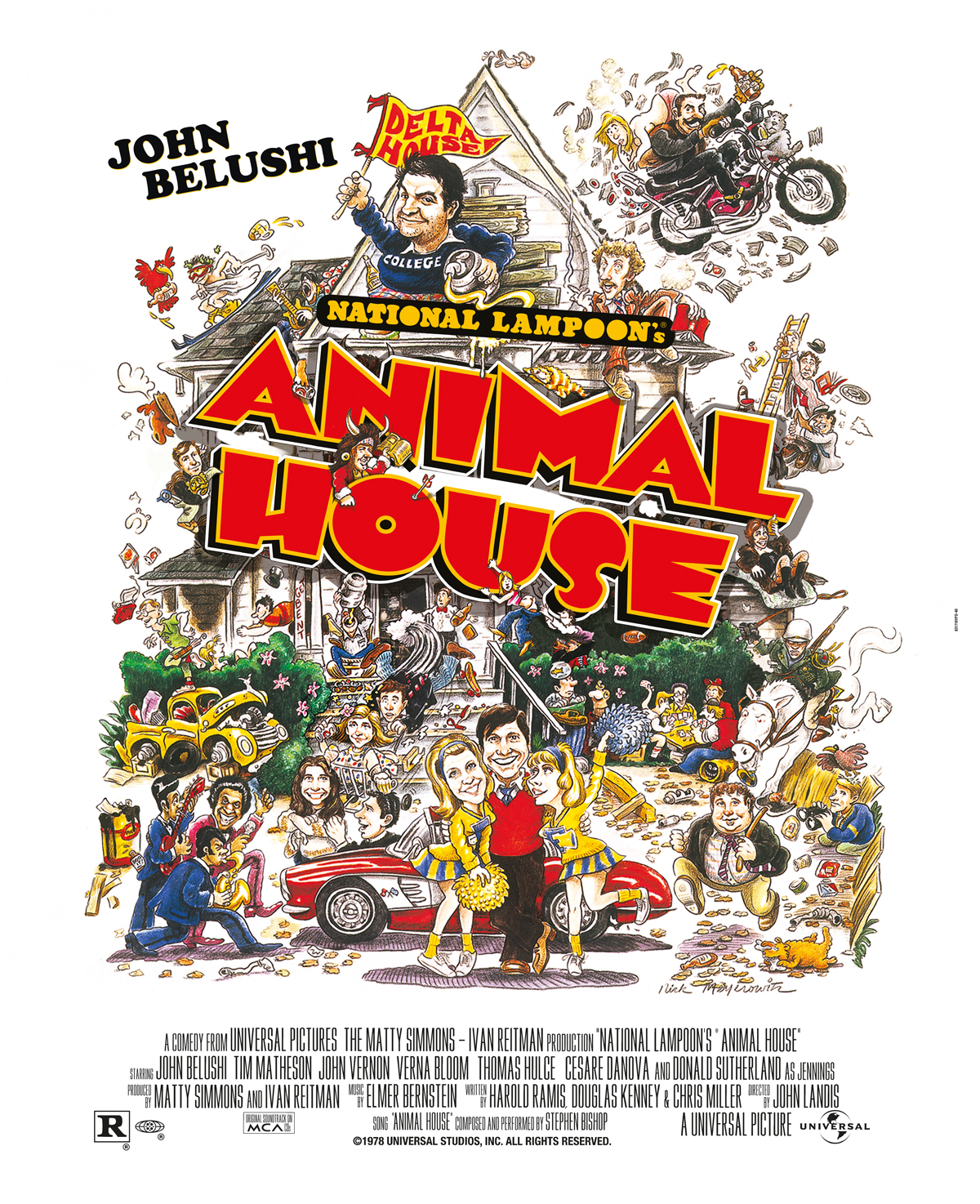
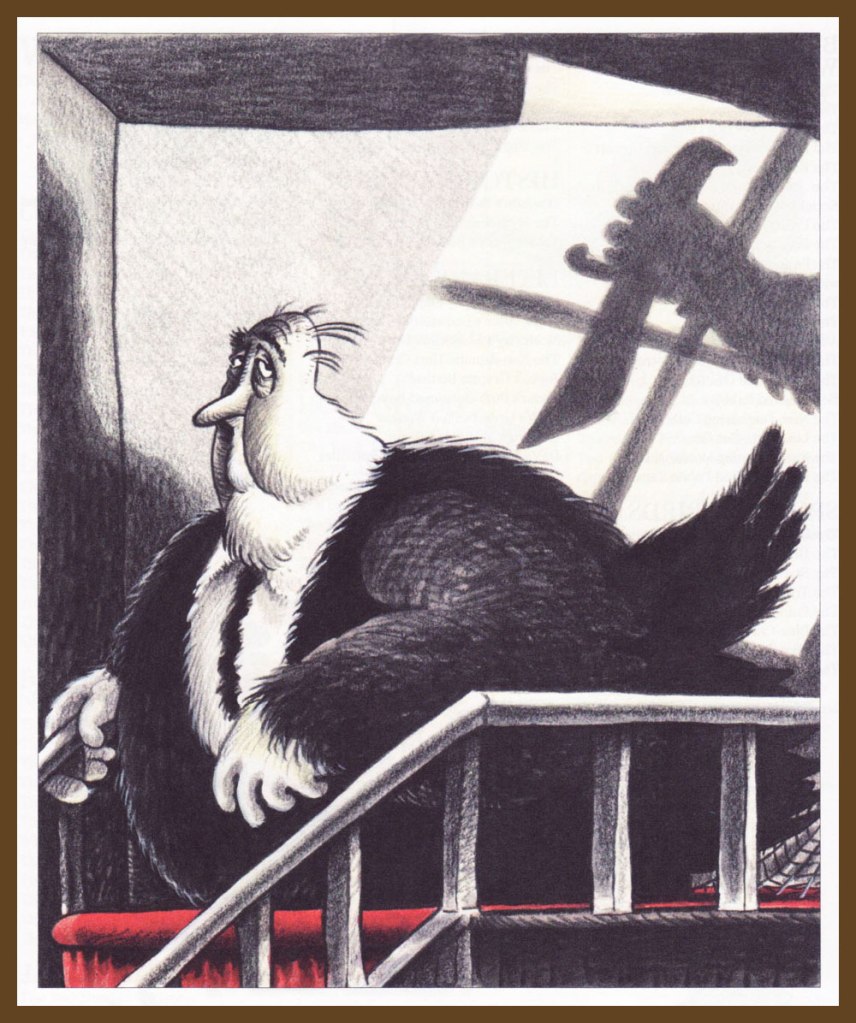
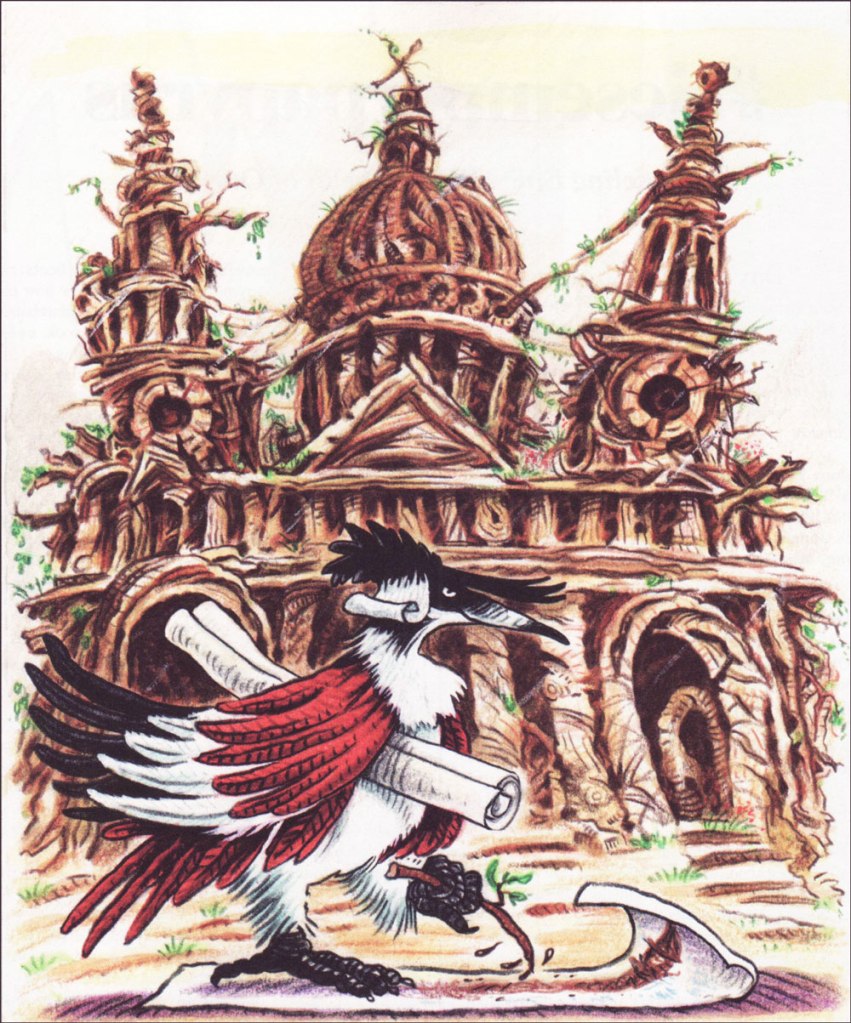
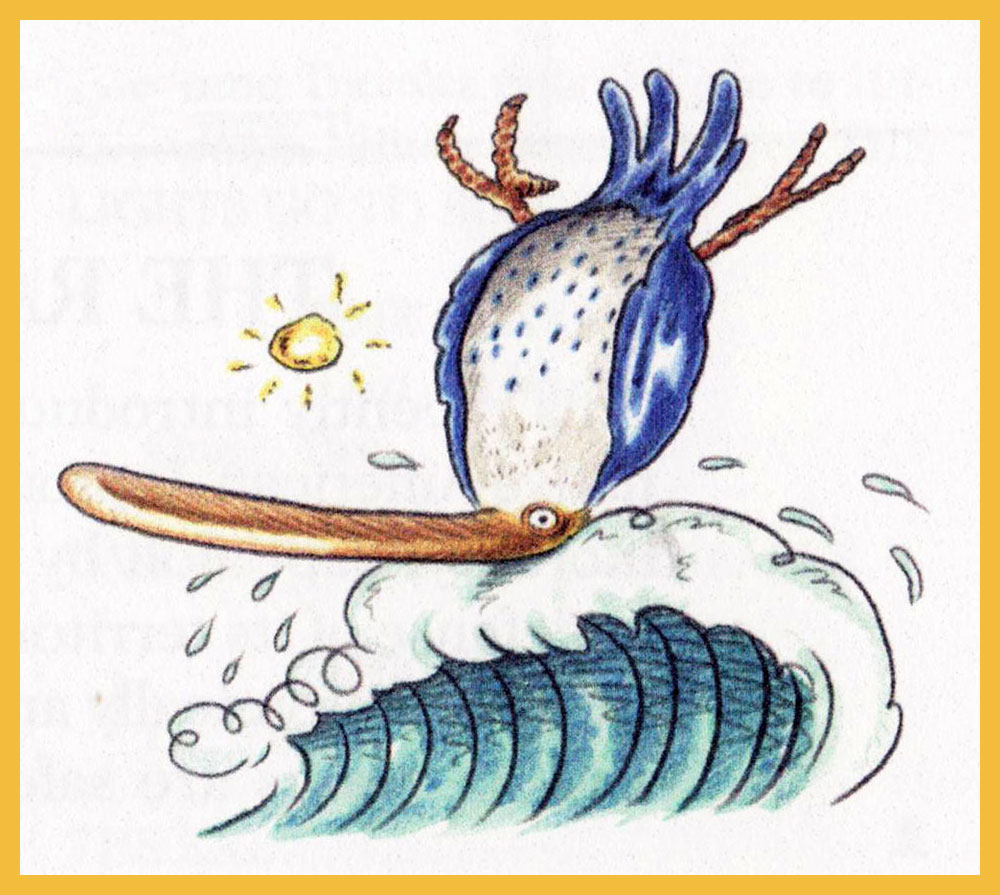
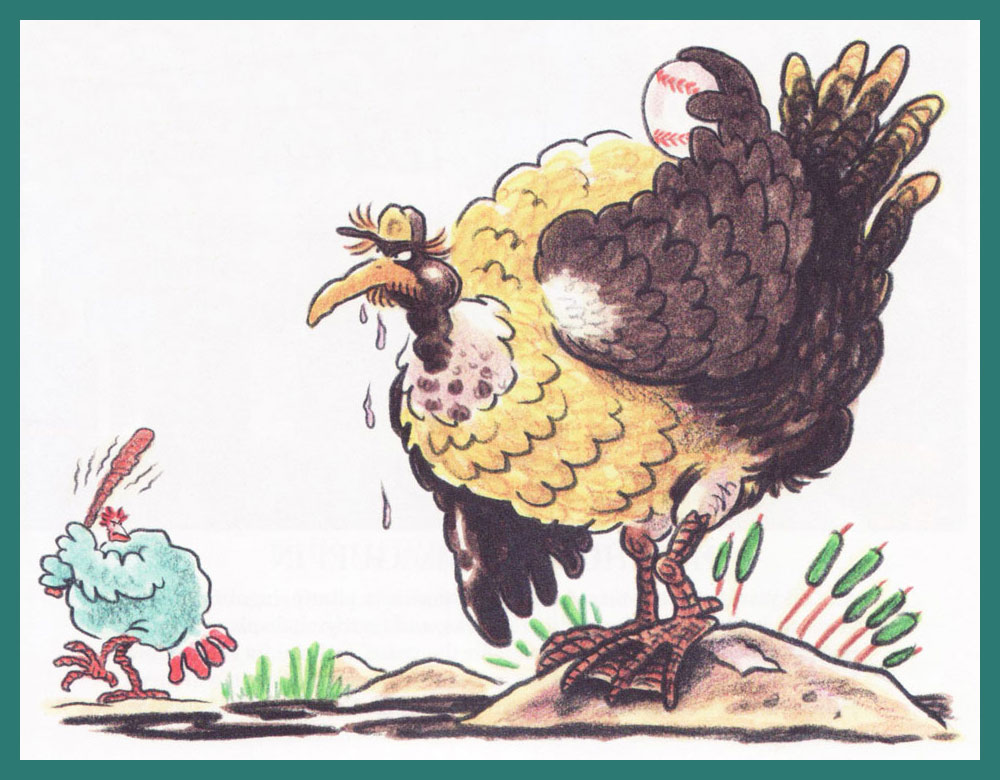
In 1973, he gave us Birds of Israel (included at the end of this post); farther along, he (with his frequent collaborator, Montréal-born writer Sean Kelly) gave us a look at The Birds of Summer, (2007, The New York Times). And in 2016, these ardent but irreverent crypto-ornithologists were at it again with Odd Birds, which added in excess of one hundred and fifty fascinating new species to the tally. However, Meyerowitz only illustrated a handful (but such a handful!), which I present to you here. Still, how I would love to behold his depictions of, for instance: The Three-Day Lark; the Venomous Spite; the Oblivious Walking Jay; the Perpetual Jackhammer; the Yellow-Bellied Stool Pigeon; the Groveling Wince; the Hoodwinked Bagholder; the Celibate Tot-Fondler; Zimmerman’s Cryptic Drone; the Barecheeked Thongbird; the Bald-Faced Lyre; the Fact-Spinning Mockingbird; the Screaming Scarlet Manager; the Gulf Coast Petrel Dumper; Oscar’s Pink-Bottomed Boychick; the Crapulous Binge; the Free-Screech Owl… or the Swaggering Gut-Sucker! Man, this project needs to go the full book route.
THE RAVING HOMELAND JINGO: « This recently introduced European species is often mistaken (by itself) for native American. It proudly displays its red neck, white knuckles, and bluenosed morality, kept aloft by drafts of hot air. The Jingo emits gruesome shrieks in defense of its territory against the occasional Left-Winged News Hawk. The Jingo is anatomically anomalous, in that its testicles are located in its cranium, and its brains are safely secured behind and exceptionally tight sphincter. »
« The all-too-common Back Lot Goose, with its natural prey, the Wide-eyed Chippy. »
Meet HITCHCOCK’S MacGUFFIN — « An Old World species, introduced to California: a plump, lugubrious bird given to stealthy silences, sudden shrieks, and terrifying displays. Its diet consists of red herrings and snakes in the grass. Despite its reputation, has laid the occasional egg. Sometimes mistaken for Hammett’s Maltese Falcon; not to be confused with any of Spielberg’s Mawkish Cliff Hangers. »
THE CHRISTOPHER WREN: « Like the Francis Drake, the Dean Swift and the Florence Nightingale, this bird prefers a cold, damp, dreary environment such as the city of London, England, in which the Christopher Wren constructs nests of preposterous design, monumental size, and no apparent use. (This species is not related to the similarly named Christopher Robin, native to the Hundred Acre Wood in East Sussex.) »
« A grizzled Hoary-Headed Junk Chucker faces down a Stat-Grubbing Peckerhead. »
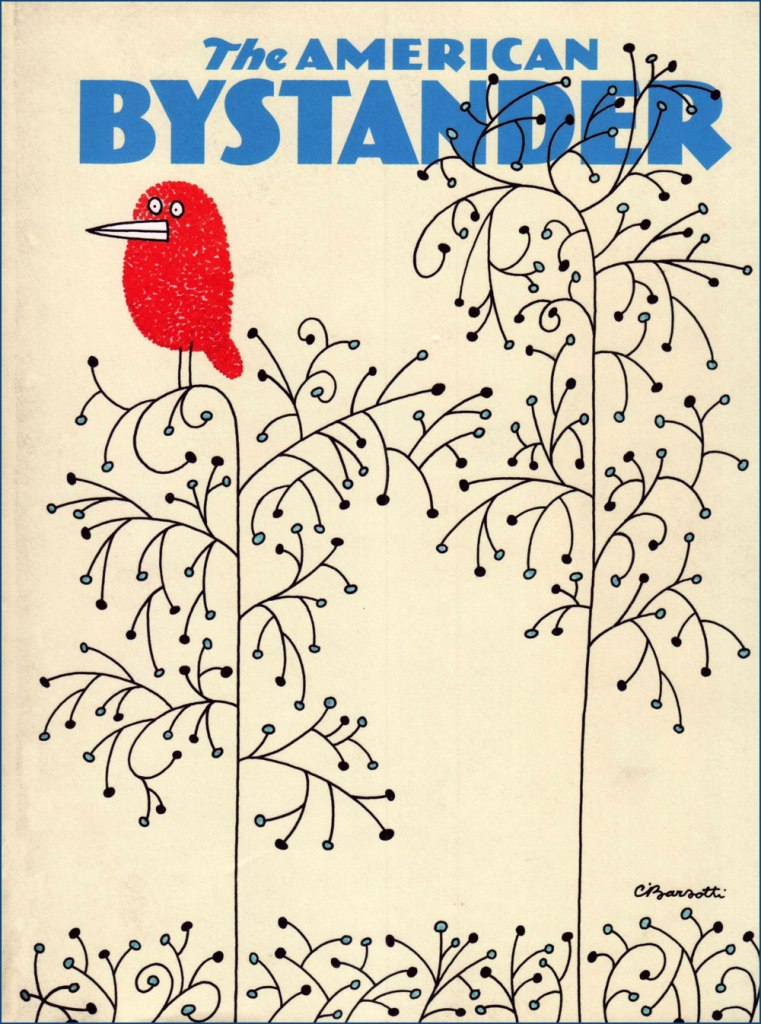
These cartoons appeared within the pages of The American Bystanderno. 2 (Spring 2016), bearing this soothing cover by the esteemed Charles Barsotti (1933-2014). Do check out and lend your support to the Bystander, which has most deservedly been deemed “The last great humor magazine“.
Where the good Mr. Meyerowitz seems to have first hatched his theme: Birds of Israel, from The National Lampoon Encyclopedia of Humor (1973, edited by Michael O’Donoghue).
« Night after night, Shepherd forged the inchoate thoughts and feelings of a whole generation of fans into an axiom that went something like: ‘The language of our culture no longer describes real life and, pretty soon, something’s gonna blow.‘. » — Donald Fagen
Today’s a very august occasion, for it marks the birth centennial of that sublime storyteller, Jean Shepherd (July 26, 1921 – October 16, 1999), so we’ll celebrate it… in comics!
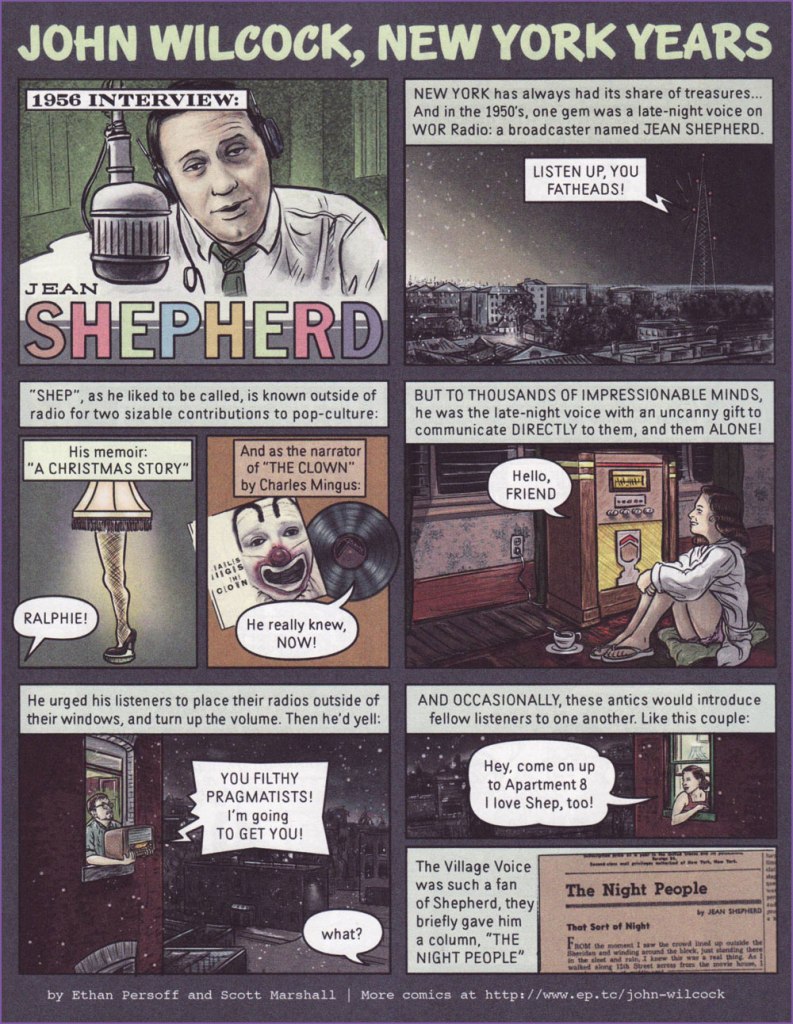
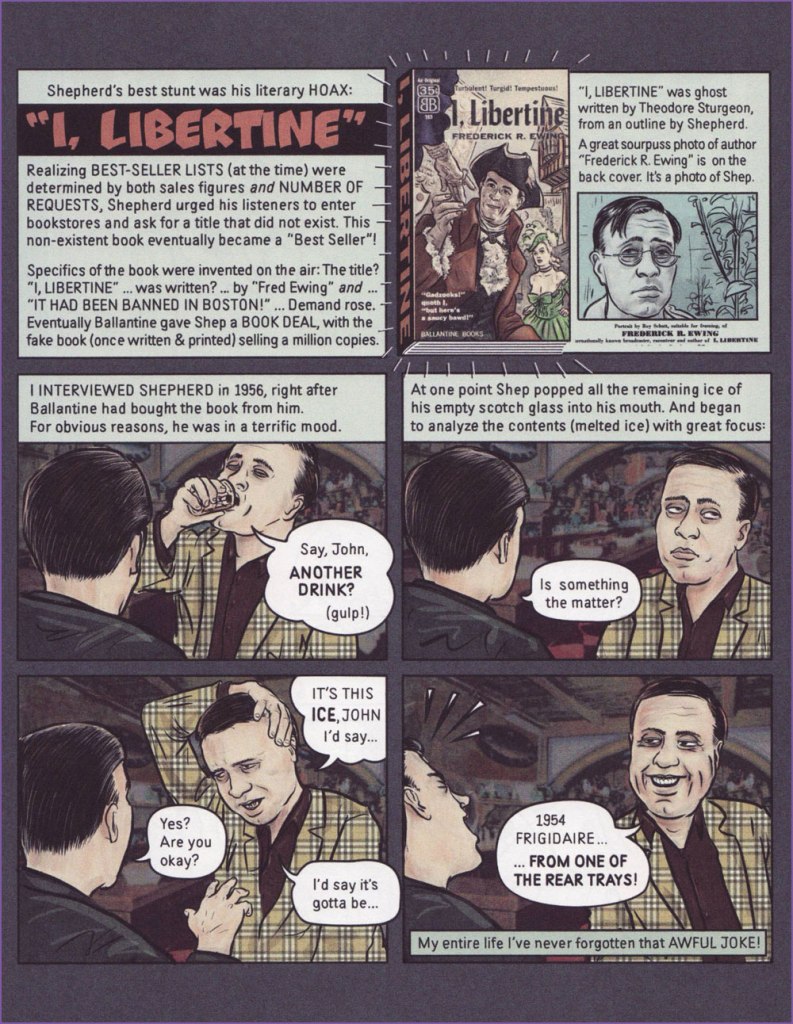
« Since 2012, cartoonists Ethan Persoff and Scott Marshall have been collaborating on an extensive interview project with John Wilcock, an underground publisher of the 1960s. The graphic novel biography… focuses a year-at-a-time on Wilcock’s interesting and largely undocumented life, from co-founding the Village Voice in 1955, to becoming a member of Andy Warhol’s Factory in the early Sixties, establishing the Underground Press Syndicate, and other interesting moments, until Wilcock left NYC in 1972. » This particular entry appeared in the pages of The American Bystander no. 2 (Spring, 2016). For more info on the project (including a generous helping of choice excerpts), now complete and available for purchase, direct your browser here.
The front and back covers of I, Libertine‘s paperback edition (1956, Ballantine). Here’s a full, fascinating account of how this literary hoax unfolded. Take note, fellow Theodore Sturgeon fans!
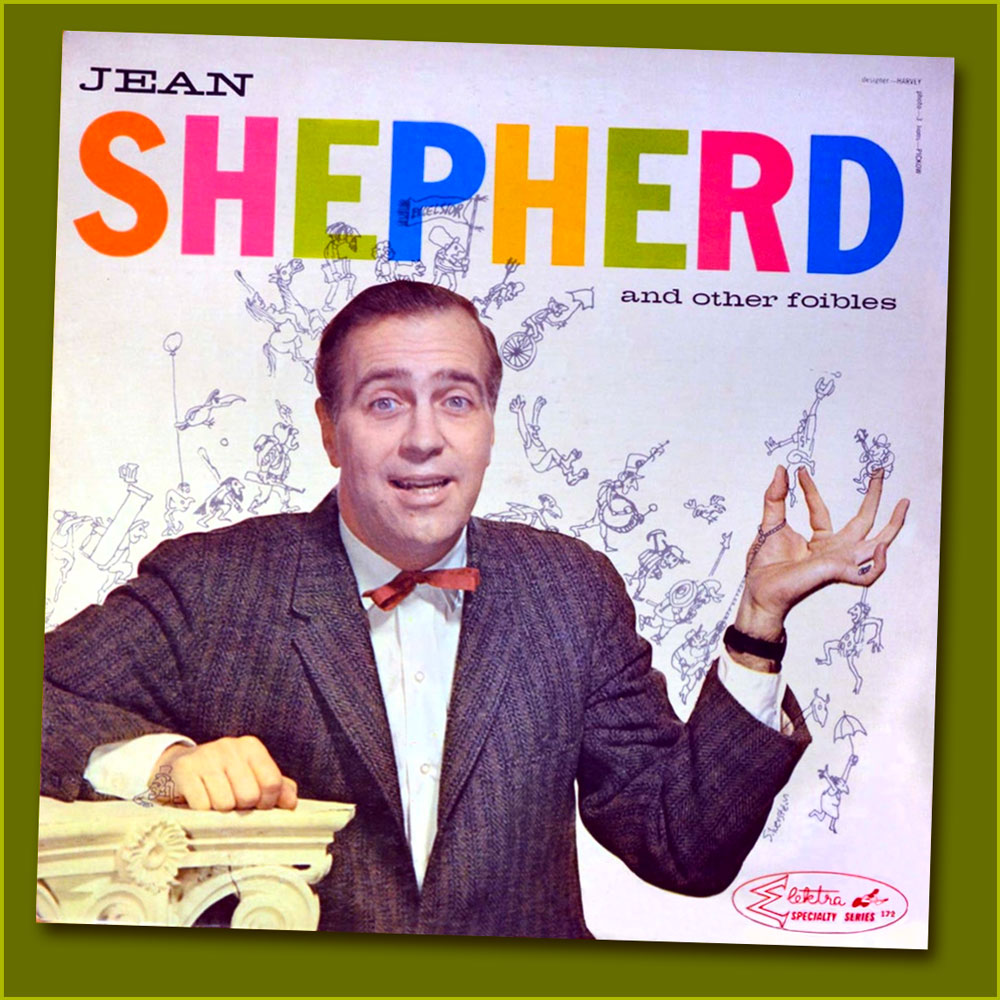
Shep’s second LP, Jean Shepherd and Other Foibles (1959, Elektra), was abundantly illustrated by his good friend, Renaissance Man (and local favourite) Shel Silverstein, who also authored the liner notes and played washboard and kazoo!
« In addition to the liner notes, Shel drew a veritable parade of characters marching across the front and back album cover of Foibles, incorporating the message, ‘Jean Shepherd is a dirty rotten, one-way sneaky son of a bitch‘, spelling it out backwards to escape the censors. » (from Lisa Rogak’s A Boy Named Shel (2007, St. Martin’s Press)
Another interesting comics connection: In Foibles‘ opening track, [ hear it here] Shep recalls an old favourite: « How many of you remember ol’ Peter Pain? He used to work in the comic strips, you remember, in those little strips that appeared under Moon Mullins, under The Gumps? He was green, was shaped like a pickle, he had stubble all over, he wore a black derby. He was a tremendous figure… a great American! He was the first Beat Poet. » Here’s one of Peter’s misadventures, circa 1948, illustrated by Jack Betts. You’ll find many more of these entertaining ads on Ger Apeldoorn’s highly-recommended blog, The Fabulous Fifties.
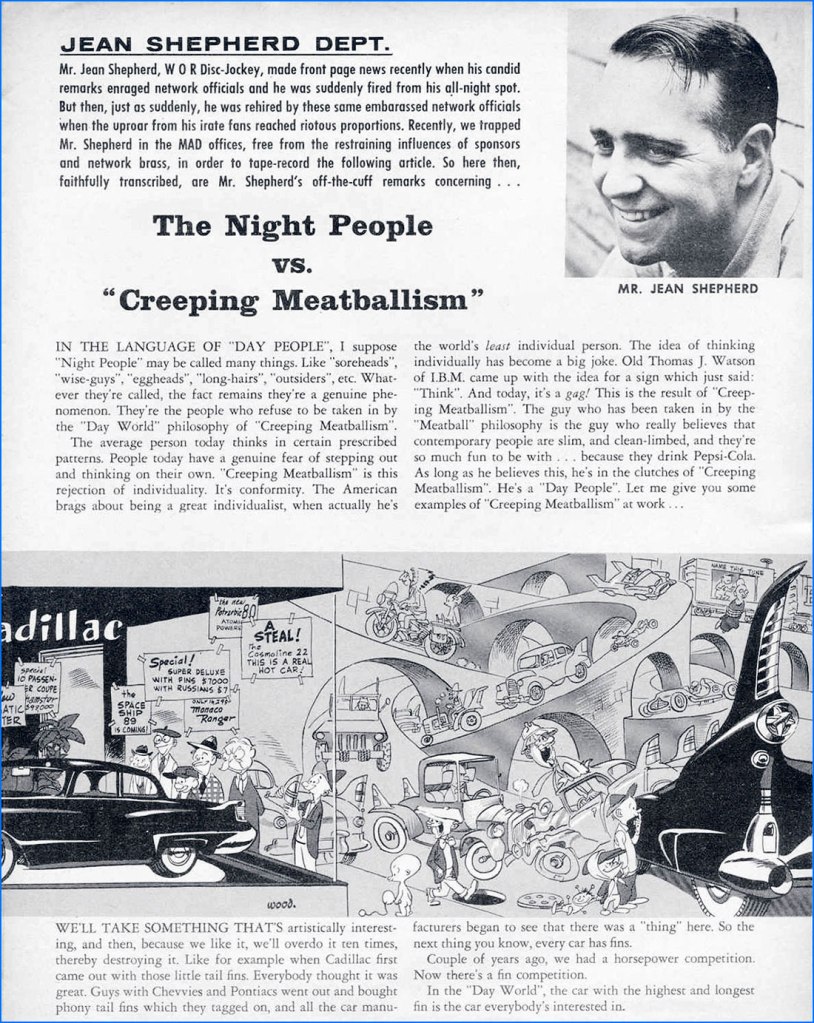
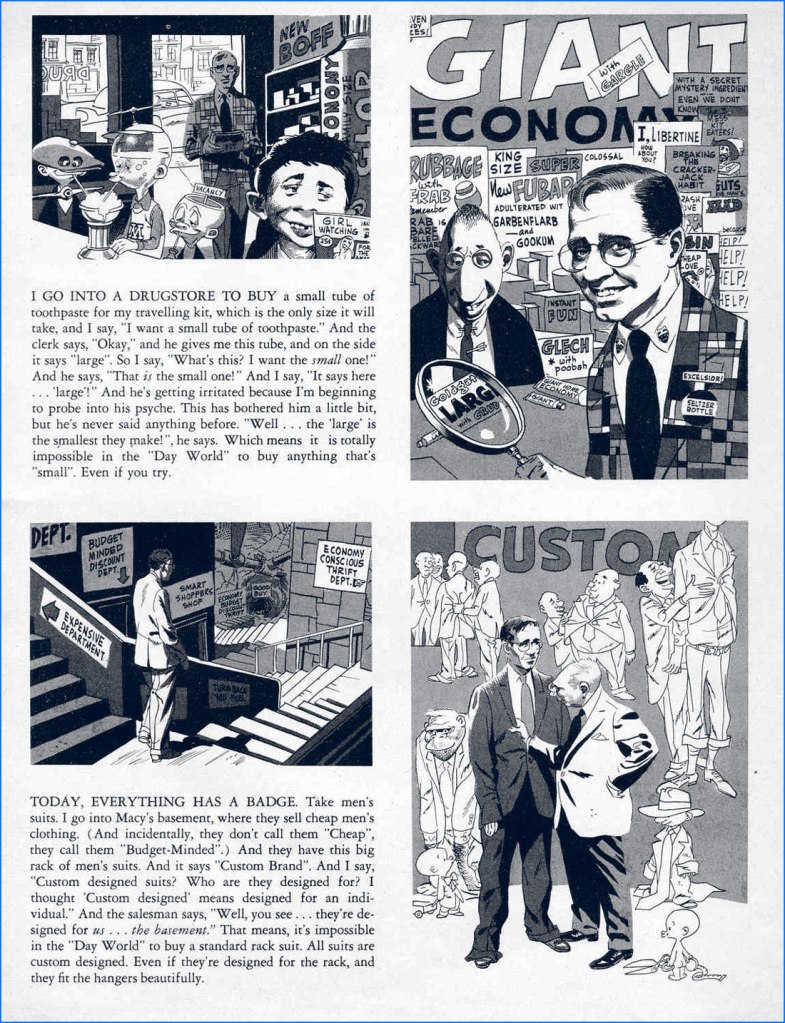
Seldom seen since its publication, this was Shepherd’s collaboration with Wally Wood at the height of his powers. The Night People vs. “Creeping Meatballism“ appeared in Mad Magazine no. 32 (Apr. 1957, EC).
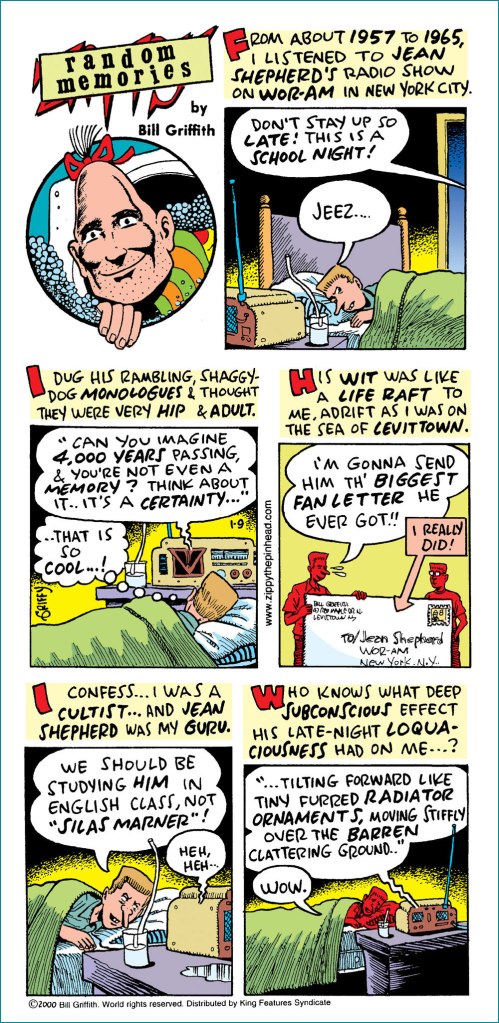
One gets a sense of Shepherd’s outsize and hopefully abiding significance from the quality of the minds he has helped warp. For example, here’s Underground Comix pioneer and Zippy the Pinhead creator Bill Griffith‘s fond tribute to Mr. Shepherd, published soon after Shep’s passing. A grateful tip of the hat to Mr. Griffith, who graciously provided me with a high-quality image of this, his Sunday, January 9, 2000 strip.
Let’s close in highfalutin fashion with a most pertinent bit of Longfellow (1807–1882):
The shades of night were falling fast, As through an Alpine village passed A youth, who bore, ‘mid snow and ice, A banner with the strange device, Excelsior!
His brow was sad; his eye beneath, Flashed like a falchion from its sheath, And like a silver clarion rung The accents of that unknown tongue, Excelsior!
In happy homes he saw the light Of household fires gleam warm and bright; Above, the spectral glaciers shone, And from his lips escaped a groan, Excelsior!
“Try not the Pass!” the old man said; “Dark lowers the tempest overhead, The roaring torrent is deep and wide!” And loud that clarion voice replied, Excelsior!
“Oh stay,” the maiden said, “and rest Thy weary head upon this breast! “ A tear stood in his bright blue eye, But still he answered, with a sigh, Excelsior!
“Beware the pine-tree’s withered branch! Beware the awful avalanche!” This was the peasant’s last Good-night, A voice replied, far up the height, Excelsior!
At break of day, as heavenward The pious monks of Saint Bernard Uttered the oft-repeated prayer, A voice cried through the startled air, Excelsior!
A traveller, by the faithful hound, Half-buried in the snow was found, Still grasping in his hand of ice That banner with the strange device, Excelsior!
There in the twilight cold and gray, Lifeless, but beautiful, he lay, And from the sky, serene and far, A voice fell like a falling star, Excelsior!
« That’s the conditions that prevail! » — Jimmy Durante
Today, we salute noted vaudevillian, piano player, comedian, singer, film and radio star, raconteur and unlikely comics legend James Francis “Jimmy” Durante, born on this day, February 10, in 1893 (as it was a Friday, the family presumably fasted or had fish for dinner). He truly was a master of all media, as you’ll witness.
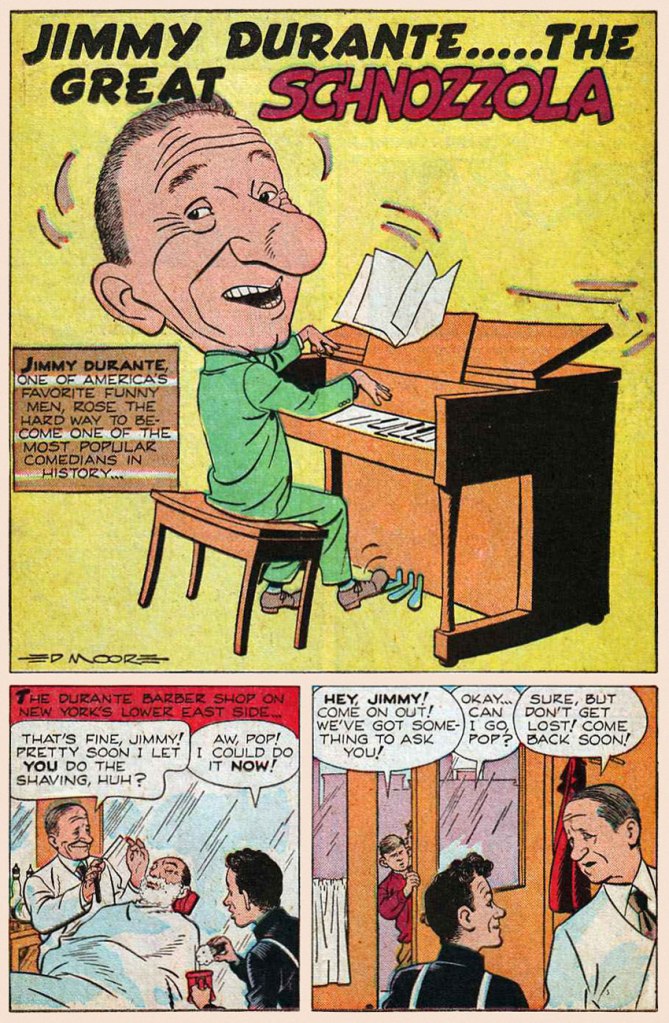
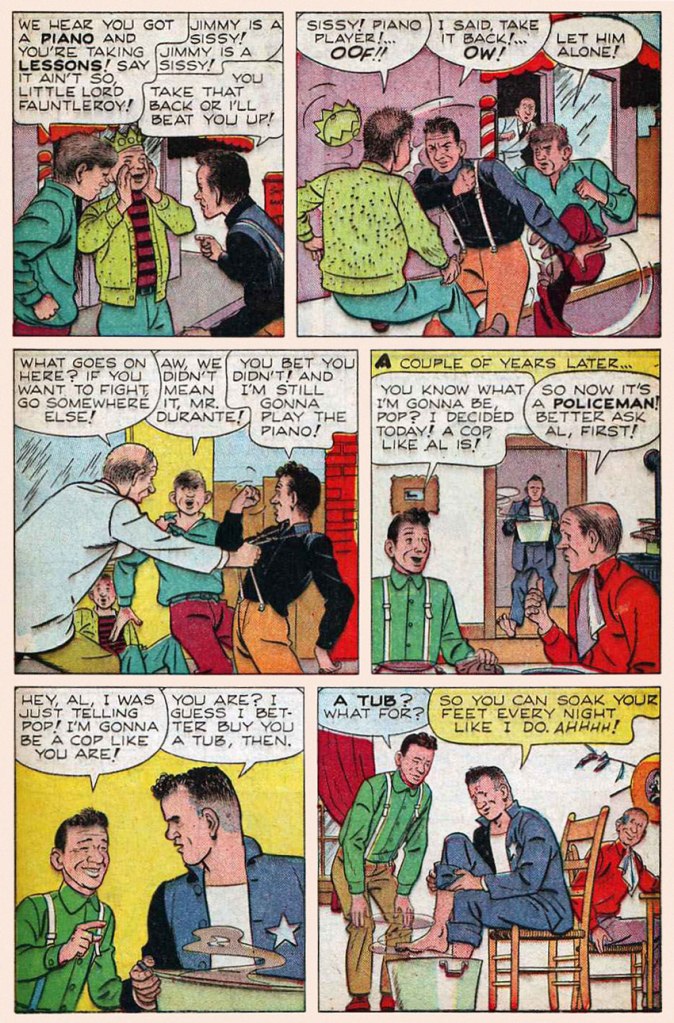
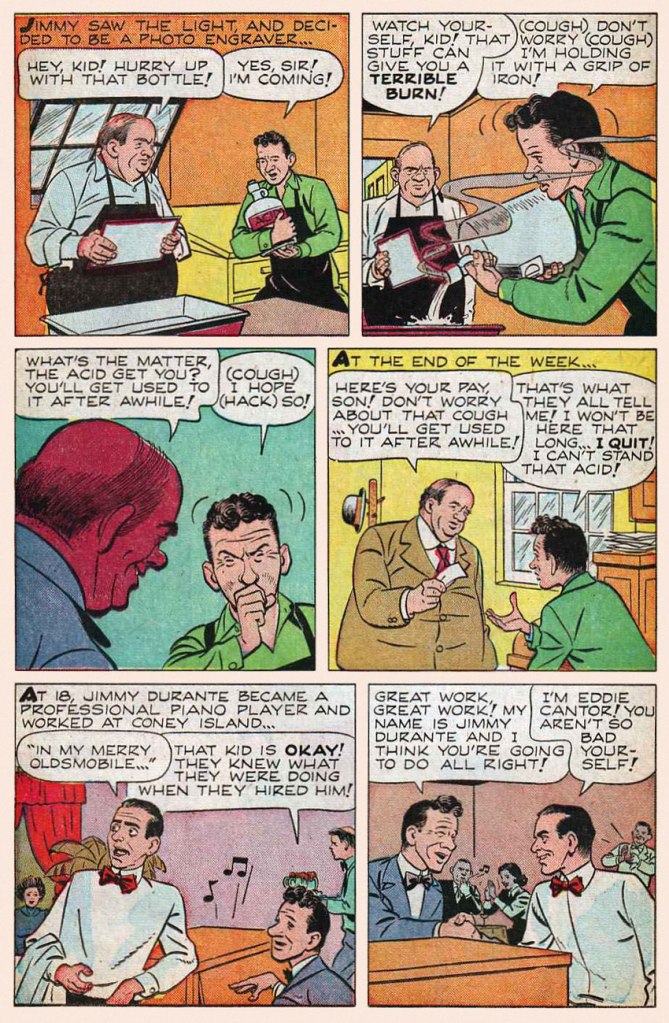
This early bit of biography appeared in Juke Box Comics no. 4 (Sept. 1948, Eastern Color); it was illustrated by Ed Moore. Hear Cantor and Durante reminisce about their early days on this 1947 episode of The Jimmy Durante Show.
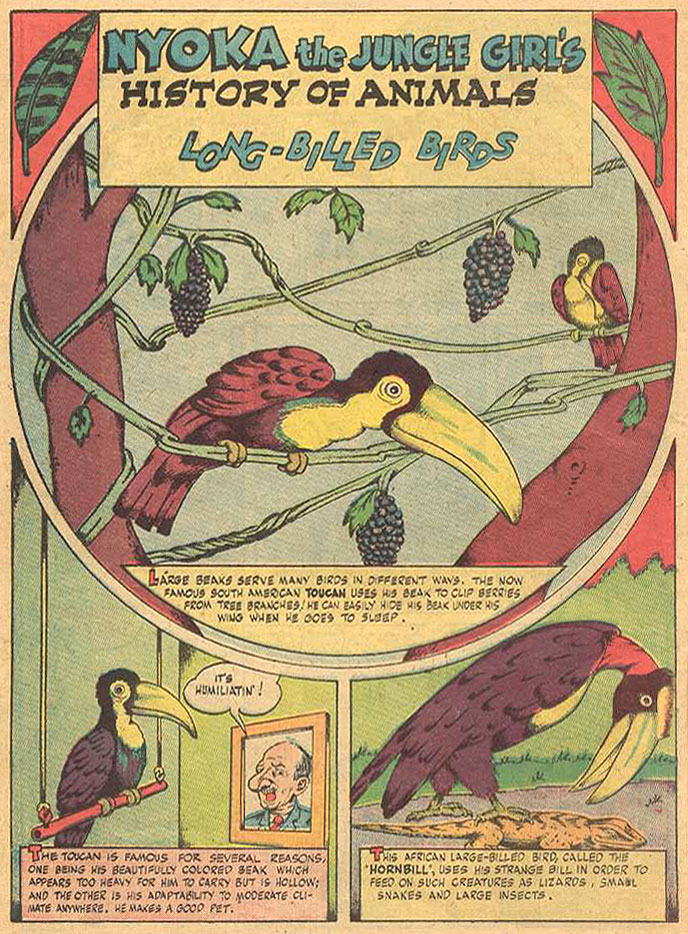
A passing mention of old Jimmy, from Nyoka the Jungle Girl no. 24 (Oct. 1948, Fawcett). Writer and artist unknown.
An early cover by Dick Ayers (1924-2014), this is Jimmy Durante Comics no. 1 (Oct. 1948, Magazine Enterprises).
The second and final issue of Jimmy Durante Comics (Winter 1948-49, Magazine Enterprises).
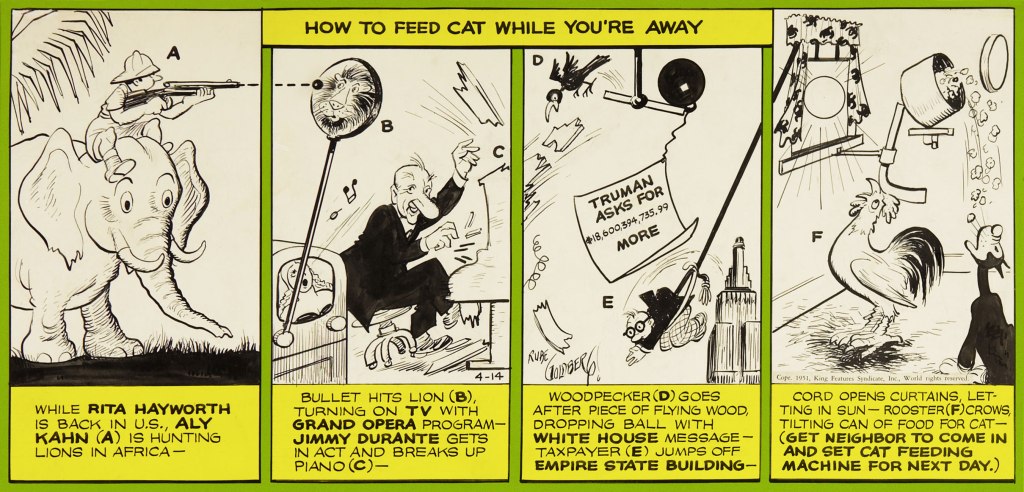
Mr. Durante rates a smashing musical appearance in this Rube Goldberg Device daily strip (Apr. 14, 1951, King Features Syndicate)… by Rube Goldberg, naturally.
And here’s the Shnozzola in the midst of a carnal melée of his fellow Old Hollywood legends (can you name them all, cinephiles?) This is Bill Griffith‘s cover for The Tiajuana Bible Revival Volume Two: Under the Stars in Hollywood (1977, Hooker, California: Paramounds Prod.). This was « An anthology reprinting 1930’s Tijuana Bibles, some of which were obscene parodies of popular newspaper comic strips of the day. Others made use of characters based on popular movie stars and sports stars of the day, such as Mae West and Joe Louis, sometimes with names thinly changed. Before the war, almost all the stories were humorous and frequently were cartoon versions of well-known dirty jokes that had been making the rounds for decades. » [ source ]
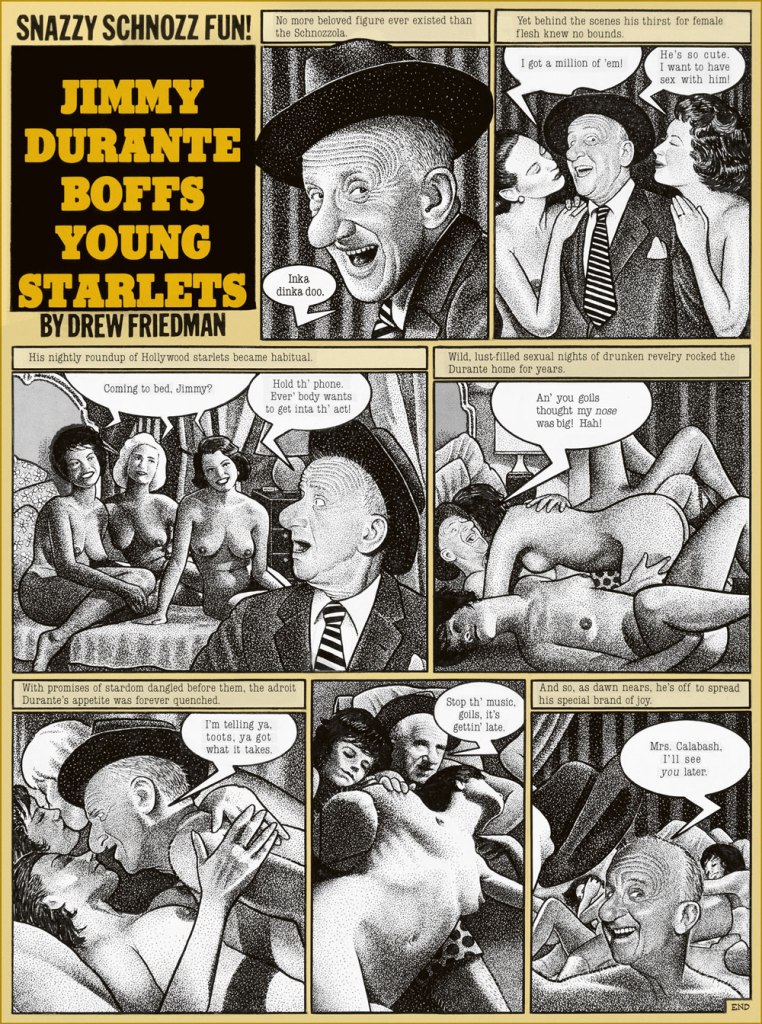
Pointillist-satirist Drew Friedman‘s immortal Jimmy Durante Boffs Young Starlets first saw print in National Lampoon vol. 2 no. 78 (Jan. 1985).
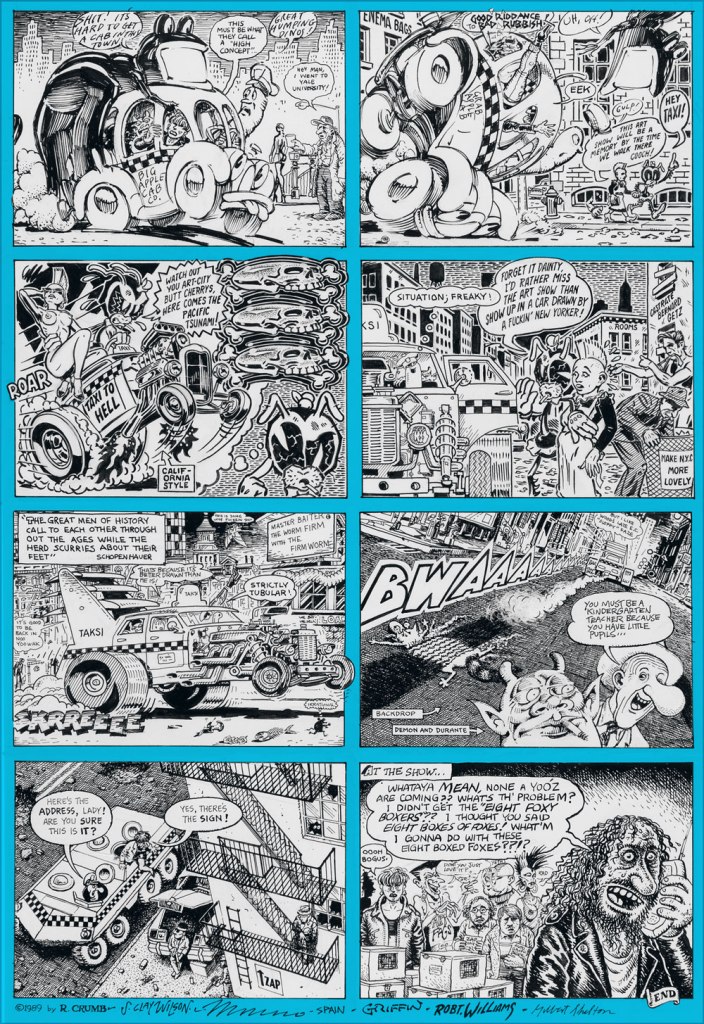
Durante briefly pops up (with the Checkered Demon!) in the second half of a truly all-star underground comix jam involving R. Crumb, Steve Clay Wilson (1941-2021… he left us just three days ago, aged 79… RIP), Victor Moscoso, Spain Rodriguez, Rick Griffin, Robert Williams and Gilbert Shelton. It appeared in Zap Comix no. 12 (1989, Last Gasp). Cartoonists are generally fond of the Schnozzola, but Underground cartoonists are just mad about him.
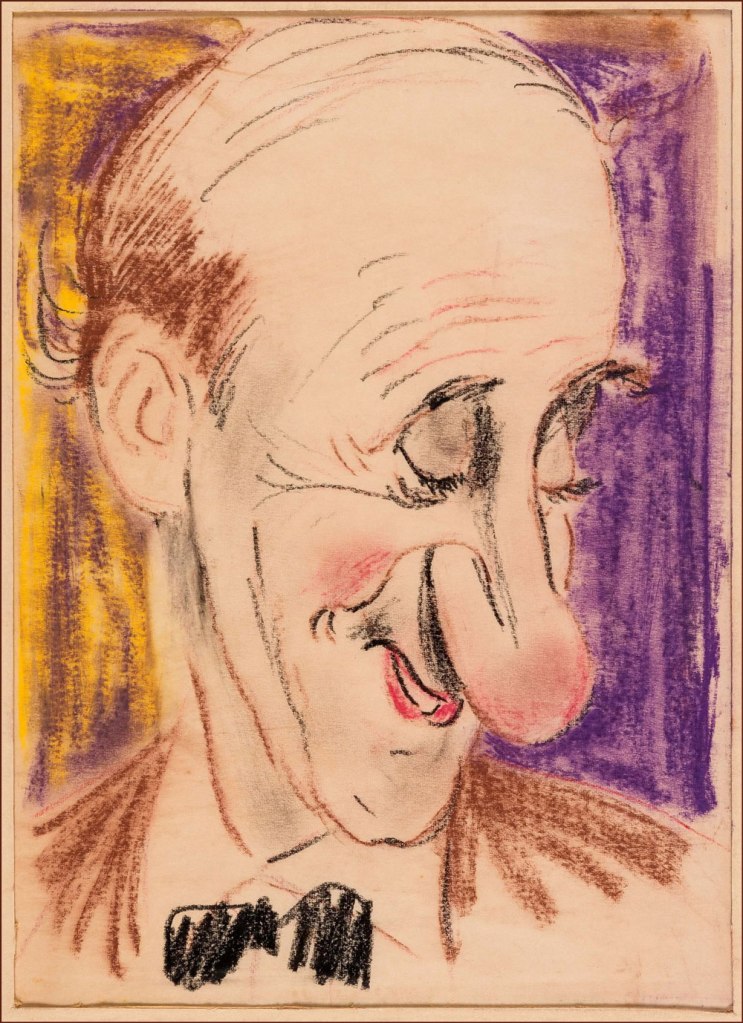
And finally, on a gentler note… here’s a clearly affectionate caricature (a preliminary sketch) of the esteemed Signor Durante (aw, he’s blushing!) by the amazing Sam Berman (crayon on onionskin paper, 1947). Berman (1907-1995) was, deservedly, quite a big deal in his day; as the erudite Drew Friedman told Print Magazine in his quality of co-curator of the 12 Legendary Caricaturists You’ve (probably) Never Heard Of exhibition at NYC’s Society of Illustrators, Berman « was indeed famous and celebrated in his day. Beginning his career in the late 1930s, he created iconic sculpted caricature covers for Esquire featuring their new mascot “Esky” (created by Berman) for an entire year. He created the sculpted caricatures of the leading actors (Fredric March, Carole Lombard, etc.) for the opening titles of the 1937 classic screwball comedy Nothing Sacred, did huge amounts of work for all the top magazines and newspapers of the day, including for Mark Hellinger’s popular column, created close to 60 amazing full-color portraits for the 1947 booklet The NBC Parade of Stars, drew children’s books, and arguably his most famous creation, the opening caricature of Jackie Gleason rising over Brooklyn for “The Honeymooners,” although he was never credited on the show for drawing that image, nor in any books. He then inexplicably went into map-making and faded quietly into obscurity. »




































 Who's Out There?