Tentacle Tuesday: Convoluted Critters

Occasionally, I notice a comic book cover with a tentacled monster so peculiar that one starts wondering whether the artist was on drugs or just couldn’t give a shit. That is not a criticism, however: where grabby appendages are concerned, the weirder, the better. Even if some of these guys have a face (muzzle? rictus?) even a mother couldn’t love, or their anatomy defies all laws of biology, we’ll welcome them with open arms!

As usual, in chronological order.

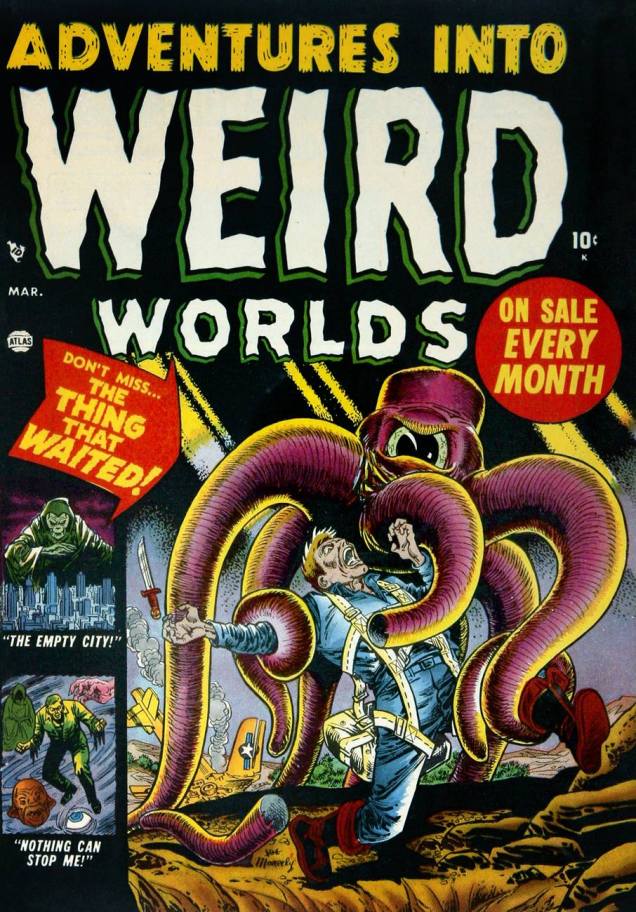
First in our line-up is this little fella in a hat. At least he looks like he’s wearing a cap, although perhaps he just has a square head with a skin flap hanging over the sides. At first glance, his tentacles are hollow, although their flesh is probably just a dull shade of battleship grey. So what’s this “thing that waited”? Soviet soldiers who are actually alien invaders. Duh.

AdventuresintoWeirdWorlds3
Adventures Into Weird Worlds no. 3 (March 1952), cover by Joe Maneely.

This next cover is probably a little more standard for pseudo-octopus fare: a lady with huge, ahem, bazooms (Russ Heath liked ’em busty, it seems – seriously, just look at the size of those things!) threatened by some horrific monster who’s dispatching her companion as expediently as possible. Still, the somewhat Wolverton-esque, grave-dwelling aliens with pincers at the end of their tentacles are odd-looking enough to squeeze their way into this post.

Spellbound20A
Spellbound no. 20 (March 1954), cover by Russ Heath.

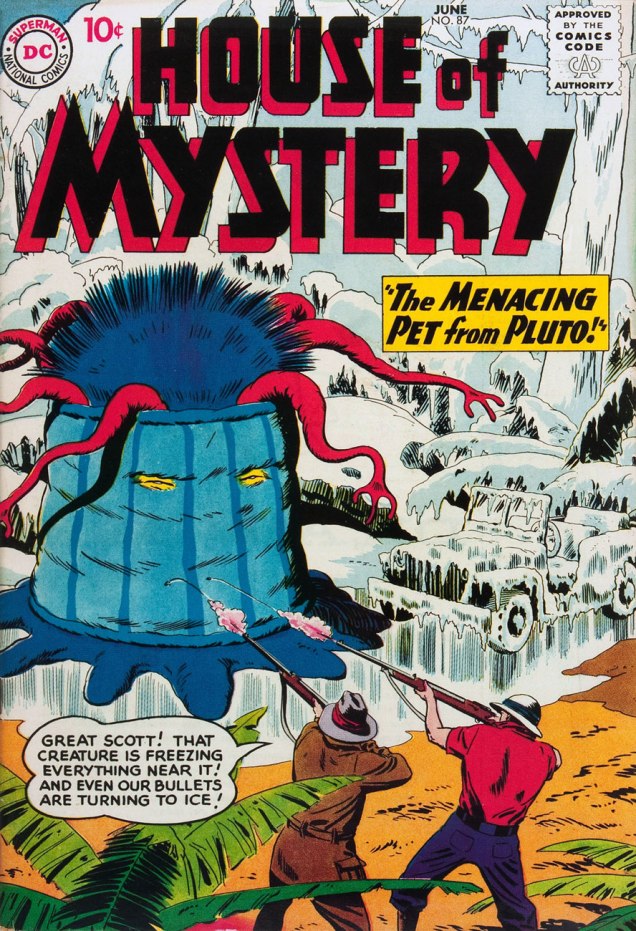
This toupee-clad creature with evil gimlet eyes doesn’t look much like a pet, if you ask me. How are those grabby little arms attached to its head, anyway? Wait, who am I talking about, again? 😉

HouseOfMystery87
House of Mystery no. 87 (June 1959), cover by Bob Brown.

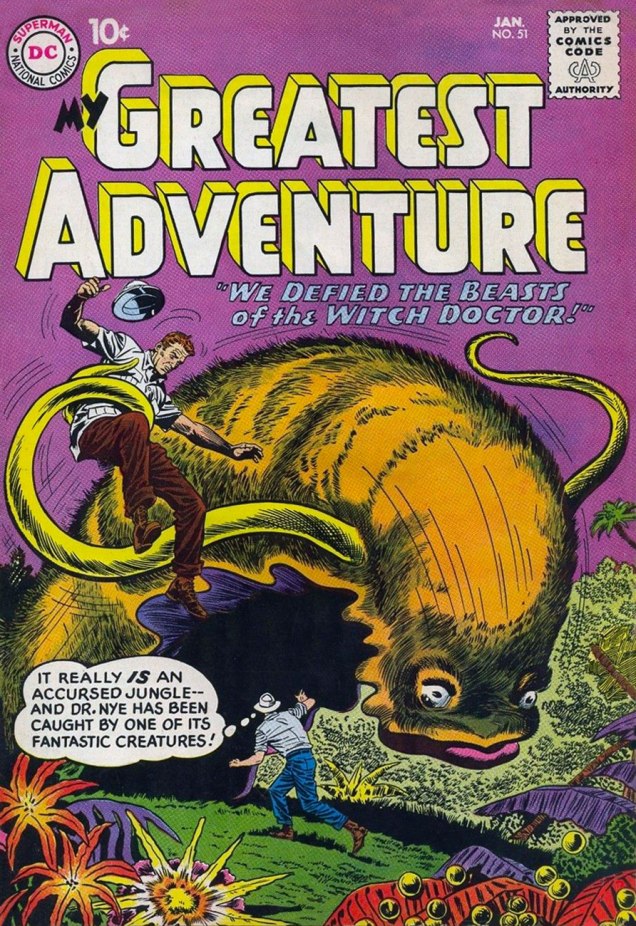
“My Greatest Adventure” was a title that promised much, and it must have been difficult to live up to it every month. Witness the following “fantastic” creature – a furry slug with disturbingly fleshy lips and tentacles. I can’t vouch for my reaction had I been an excitable ten-year old, but to this blasé adult, the poor beast summoned by some psycho witch doctor (the jungles seem to be always overrun with them) is just begging to be put out of its misery.

MyGreatestAdventure51
My Greatest Adventure no. 51 (January 1961), pencilled by Dick Dillin and inked by Sheldon Moldoff.

Our next exhibit finally features a proper alien, one who looks strange but at least makes sense as a unified, functioning creature. I love his sadly drooped whiskers, his dejected expression that’s strangely at odds with his pontifical speech.

Tales oftheUnexpected66
Tales of the Unexpected no. 66 (October 1961), cover by Bob Brown.

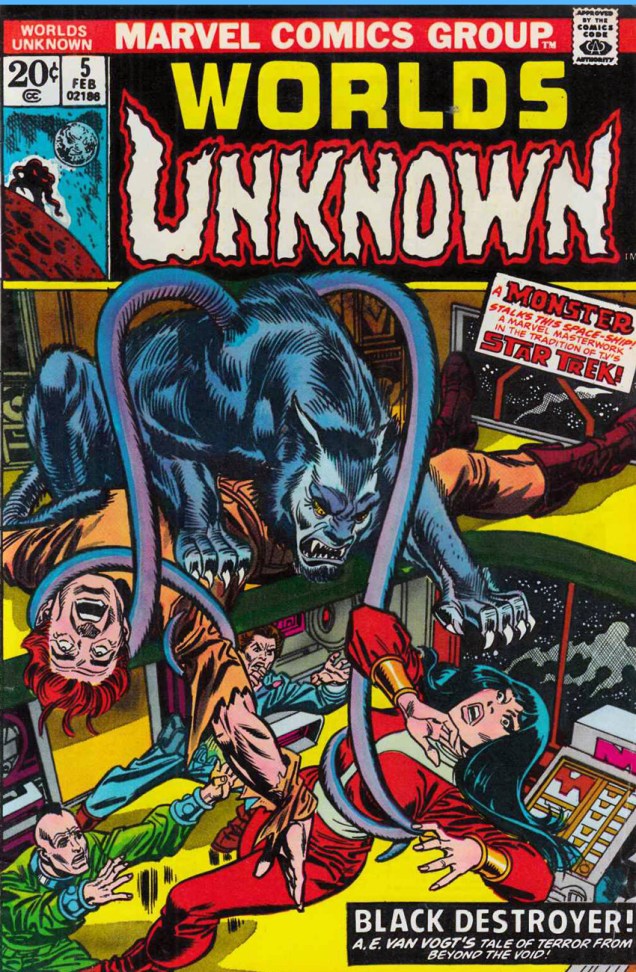
« Make him a werewolf! But in space! And give him tentacles! » Yeah, guys, that went over really well. A Marvel Masterwork, my ass. But wait: Black Destroyer! is an adaptation of A. E. van Vogt’s short story from 1939. And did Cœurl, the black cat-like creature, have tentacles in the story? Why, yes, he did.

« His great forelegs—twice as long as his hindlegs—twitched with a shuddering movement that arched every razor-sharp claw. The thick tentacles that sprouted from his shoulders ceased their weaving undulation, and grew taut with anxious alertness. Utterly appalled, he twisted his great cat head from side to side, while the little hairlike tendrils that formed each ear vibrated frantically, testing every vagrant breeze, every throb in the ether. » (read the full story here.)

WorldsofUnknown5
Worlds Unknown no. 5 (February 1974), cover pencilled by Gil Kane and inked by Frank Giacoia. Cœurl looks like he’s floating on top of the corpse – I don’t think the artists spent too much time watching an actual cat at work.

Read the comics version of Black Destroyer! here.

My last offering for today is the cutest, featuring an adorable blue varmint who gets my full sympathy and support. Weird? Sure, a bit – he’s got a tentacle sprouting out of his forehead – but beauty is in the eye of the beholder, right? This cover also proves that monsters are just as interested in tooth-whitening procedures as us humans.

TheDefenders72
The Defenders no. 72 (June 1979), pencilled by Herb Trimpe and inked by Al Milgrom.

~ ds

Ectoplasm-Bedeviled Pulchritude: Maurice Whitman’s Ghost Comics

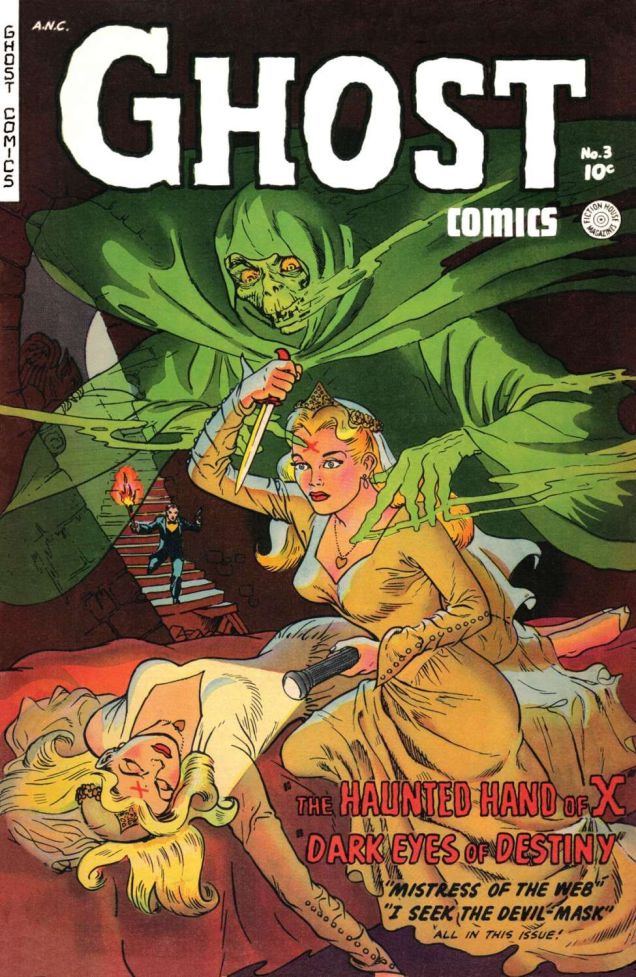
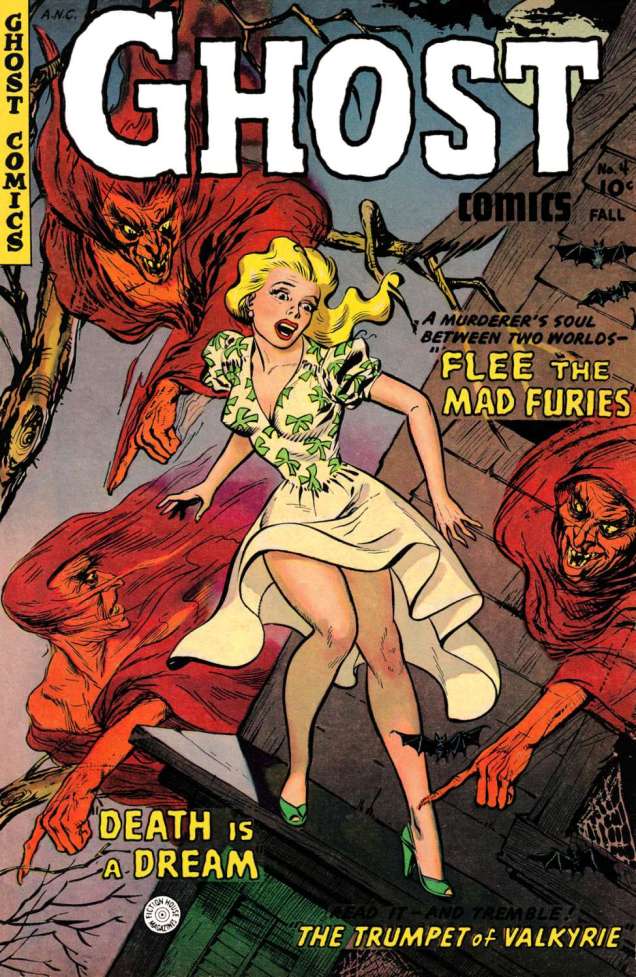
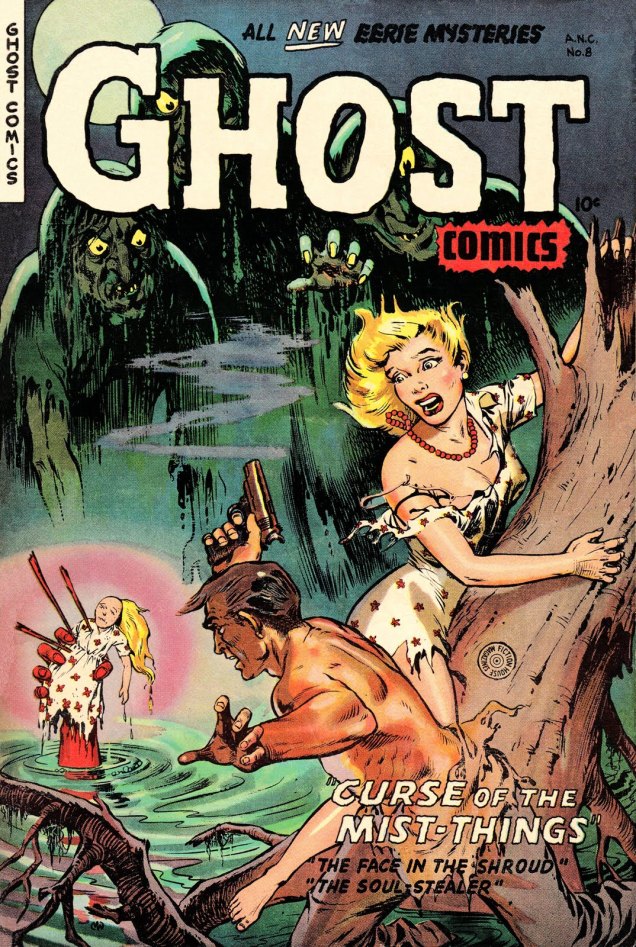
At its best, Maurice Whitman’s art has the power to capture one’s imagination. He has an excellent eye for dynamic layouts, and his ghoulies and creepies are often drawn in a kind of a squiggly, sketchy way that really brings them alive for me. Not to be forgotten are his shapely women, usually in various states of déshabillé. Sometimes his covers are too chaotic, and don’t really hold together, leading the viewer to scratch his (or her!) head in confusion; but when it works, when all the pieces fall into place, his art can be glorious.

Ghost Comics had but 11 issues published between 1951 – 1954, so I could have included all of them in this post… but you can see a gallery of these covers on other websites, and besides, some of them are firmly in the “doesn’t quite work” category. Here are my favourites, then – five out of eleven, not bad!

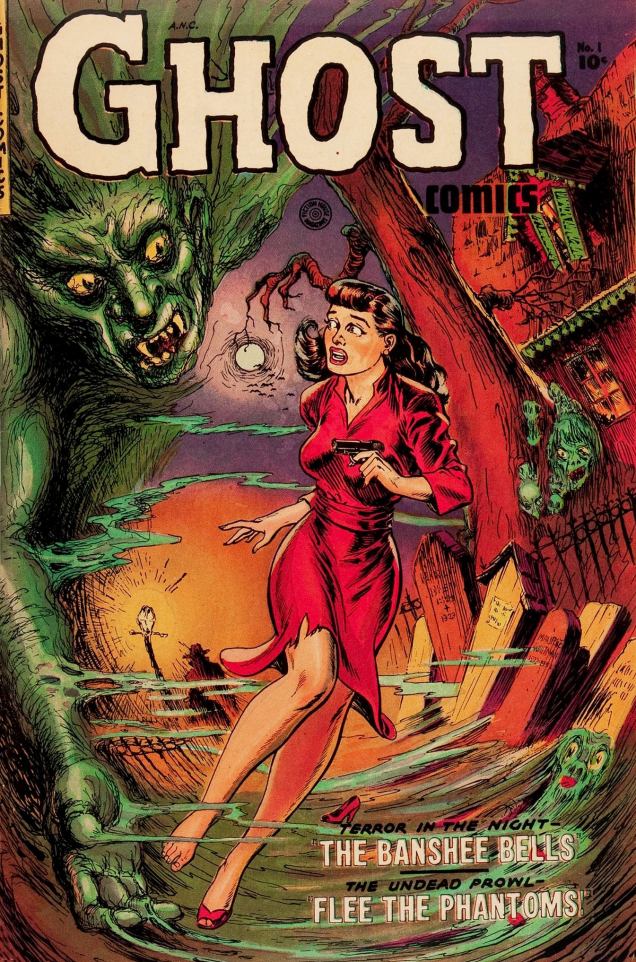
GhostComics1
Ghost Comics no. 1, 1951. I like the details, such as the lost shoe, the cute little ghost in the bottom right corner, a mysterious dark figure by a lamppost (as if the green demon wasn’t terrifying enough)… and the warping of the scene really works, imho.

The following cover is kind of the raison d’être of this whole post – I adore it. Whitman put so many reach-out-and-touch-it details into it – talk about the juxtaposition between terror and sex-appeal! The woman’s négligé is probably the sheerest it has been my pleasure to encounter in pre-code comics. Her hair is also beautifully drawn, especially that little curl that seems to be reaching for the candle.

GhostComics2

Clearly, I’m not the only one to pay special attention to this cover – it was chosen as the cover of Ghosts and Girls of Fiction House!, another addition to Craig Yoe’s Chilling Archives of Horror Comics.

GhostComics3
Ghost Comics no. 3, 1952. This one has crisper, cleaner lines, but the potent composition calls out to the viewer (and after a few minutes spent in contemplation of the art, you can start wondering what the hell is going on here, and how on earth does it make any sense?)
GhostComics4
Ghost Comics no. 4, Fall 1952. Whitman was clearly fond of a certain type of blonde… not that anyone’s objecting. The two teeny bats on the right have captured my heart.
GhostComics8
Ghost Comics no. 8, 1953. Come on, witch, you could have made a better effort with the doll’s hair! Are these the furies from no. 4?

All issues, should you want to read them, can be found at comicbookplus.

~ ds

Justin Green’s Musical Legends

« My father had a lifelong interest in helping musicians. I even encountered his presence when reading the autobiography of Anita O’Day. She said that there was a real estate man in Chicago who always made sure her band had a place to stay. That was Pop. » – Justin Green

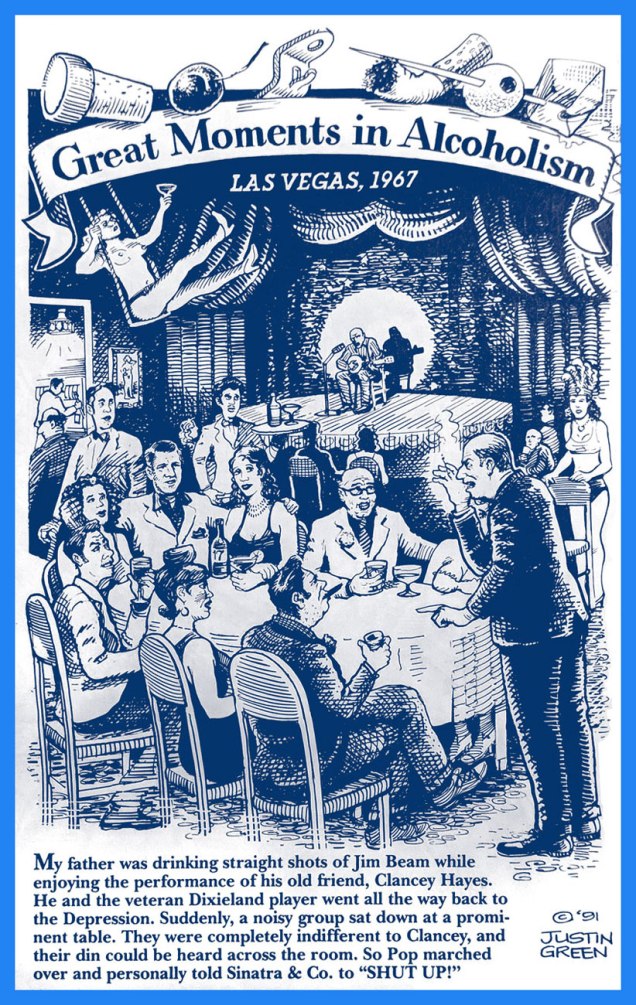
How did Justin Green, one of the Founding Fathers of the Underground Comix movement, wind up holding down a regular feature for a decade (1992-2002) in Tower Records‘ in-house magazine, Pulse!? The whole chain of events began with a strip about his dad’s drinking. Of course.

GreatMomentsA
« It was my father’s spirit that instigated this cartoon project…. this was ’91 (Blab No.6, Summer 1991, Kitchen Sink Press), and I was living in Sacramento. Mark Weidenbaum was then an editor at Pulse! Magazine, published and distributed by Tower Records, which had its headquarters in West Sacramento. He had just seen the piece when he found out I lived nearby. He wanted to explore the idea of an ongoing musical biography cartoon feature. »
MusicalLegendsGlassA
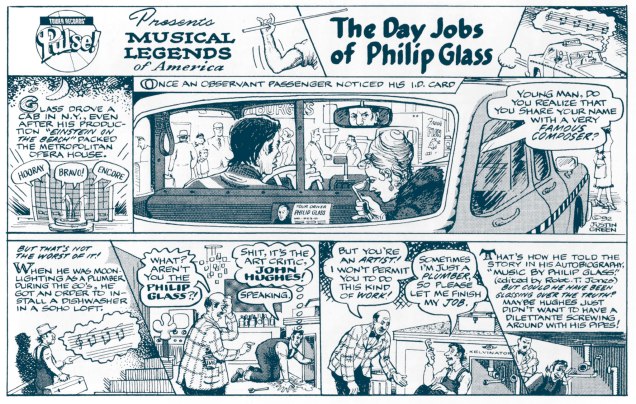
The second instalment (April, 1992). A little Einstein on the Beach, anyone?
MusicalLegendElvisA
August, 1992. Elvis certainly had his faults, but racism or ingratitude were not among these.
MusicalLegendsGaryA
My own introduction to the Reverend’s music came, as it surely came to many others, through Jackson Browne‘s fine cover of his Cocaine (Running on Empty, 1977). « I was talking to my doctor down at the hospital. He said, ‘Son, it says here you’re twenty-seven, but that’s impossible — you look like you could be forty-five’. »
MusicalLegendsVenutiA
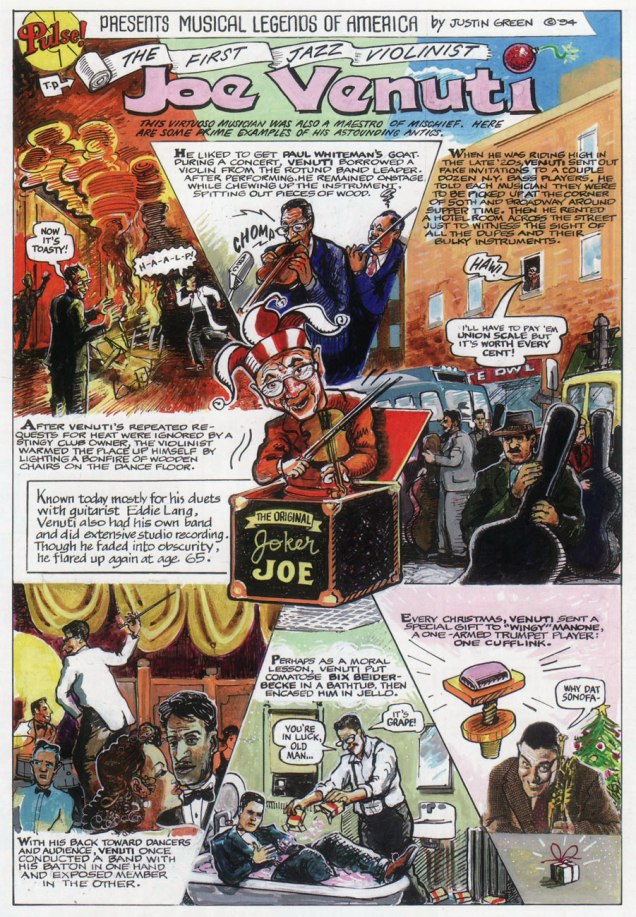
The strip frequently appeared in colour. Here’s my favourite example, from April, 1994. And here’s a fine Venuti performance. No, he wasn’t *always* joking.
MusicalLegendsRoddA
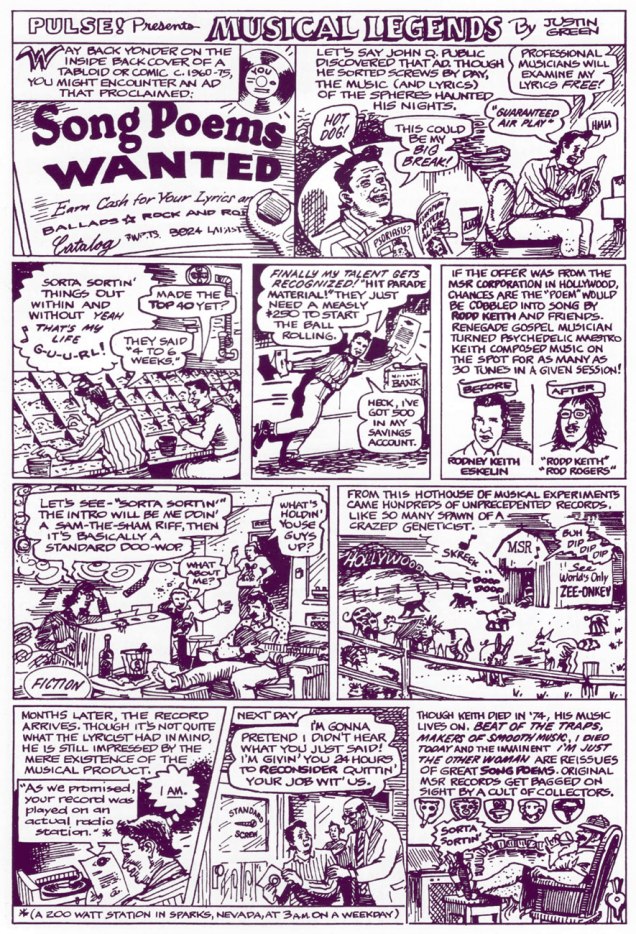
Ah, Rodd Keith, the main man behind those infamous Song Poems ads, comic book fixtures in the 1970s. The weren’t a scam… not in the traditional sense. November, 1996. Lend your ear to his Ecstasy to Frenzy.

While Green isn’t a native virtuoso draftsman like, say, R. Crumb or Rick Griffin, and he’s only fair-to-middling when it comes to likenesses, he *is* a born storyteller, and that’s really what’s most needed for an endeavour of this nature. Compressing a lifetime, or at least a career, into a single-page strip (two at the most!) is remarkably tricky and demanding, and if it looks deceptively easy here, he’s succeeded.

In selecting strips for this post, I didn’t lean towards my own favourite musicians, opting instead for what I felt were the strongest pieces, regardless of topic. However, I’m reserving my very favourite for a special New Year’s Eve post. Hope you enjoyed these musical time capsules! If you did, you’ll be happy to learn that the fine folks at Last Gasp collected the set in 2003.

-RG

Tentacle Tuesday: Have Tentacles, Will Space-travel

« When the blast of a rocket launch slams you against the wall and all the rust is shaken off your body, you will hear the great shout of the universe and the joyful crying of people who have been changed by what they’ve seen… »*

Greetings, dear astronauts! Today’s Tentacle Tuesday concerns itself with that “religious experience”, space travel… with tentacles in tow, of course. Some comics may announce their interplanetary theme by putting SPACE into the title of the series (and making sure it’s big and bold!), while others deploy a little subtlety and coyly refer to the unknown, or the unexpected. Either way, we’re in for a grand old time exploring space along with the brave men and women (err, mostly men) who found themselves exclaiming “ooh, tentacles!” while exploring some mysterious planet.

In chronological order, then…

SpaceSquadron5A
Space Squadron no. 5 (February 1952, Atlas). The cover is *probably* by Joe Maneely.
WorldsUnknown4
Worlds Unknown no. 4 (November 1973, Marvel), (bad) cover by Dick Giordano. Some people have the knack for coming up with original and scary monsters, and some don’t. ’nuff said.
StarHunters1
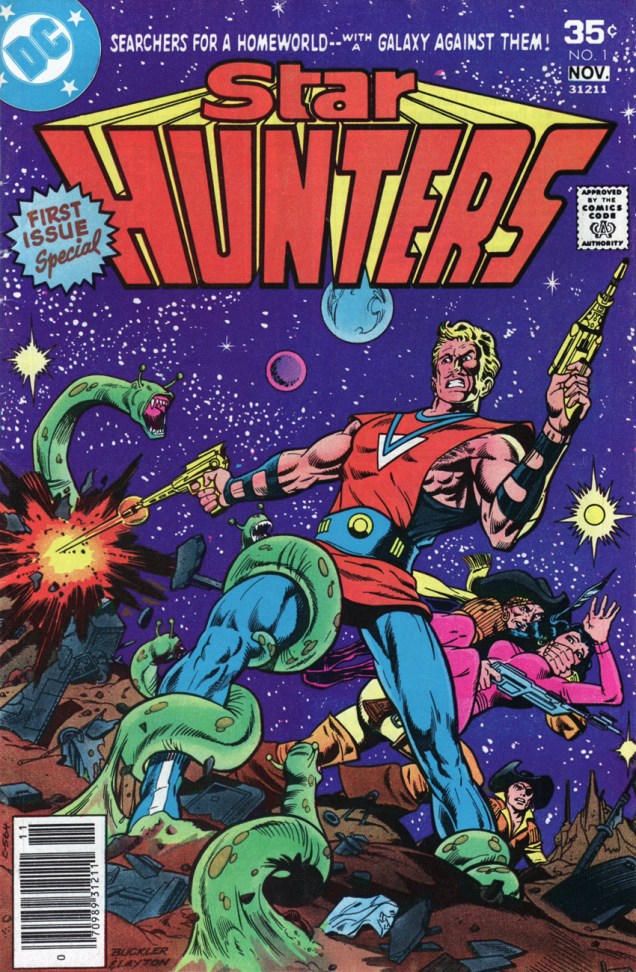
Star Hunters no. 1 (October-November 1977, DC), pencils by Rich Buckler and inks by Bob Layton. The green thingies may be snakes/dragons, not tentacles, but they’re doing a convincing impersonation.
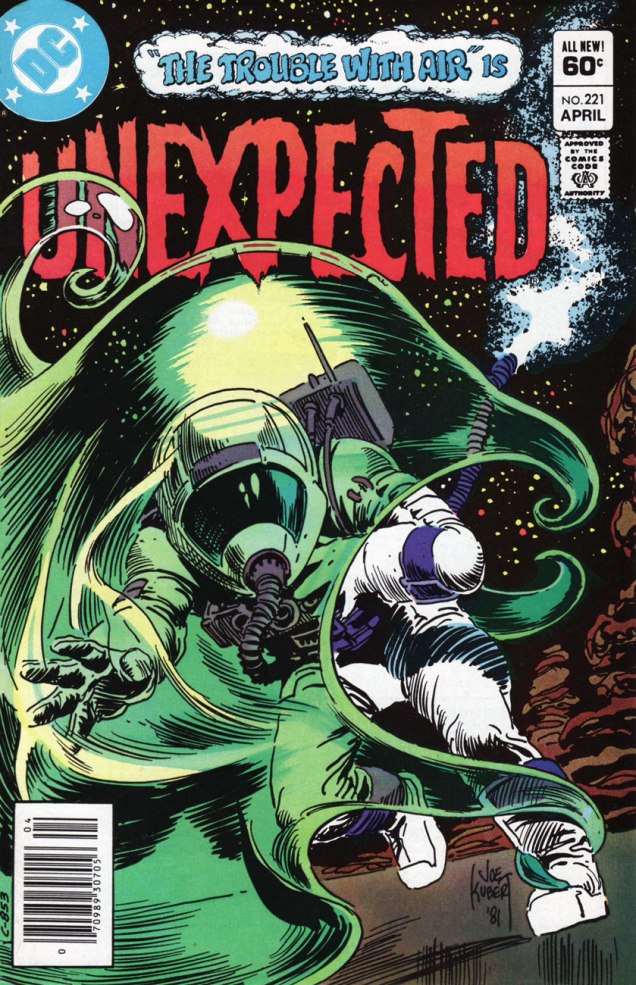
Unexpected221
The Unexpected no. 221 (April 1982, DC), cover by Joe Kubert. Now *there’s* a convincingly moody and frightening cover – no big pyrotechnics, just a strong hint of suffocation by a strangely-shaped cloud of ectoplasm. Shudder.
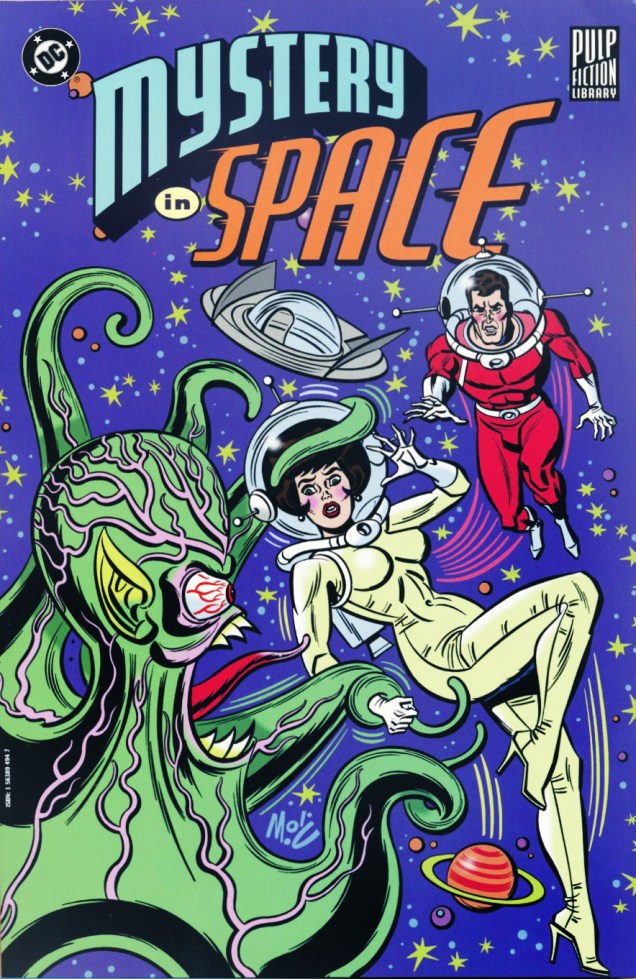
PulpFictionLibraryMysteryinSpace
Pulp Fiction Library: Mystery in Space (September 1999, DC). Cover by Mitch O’Connell. This 228-page anthology features a bunch of reprinted stories (from the early 50s to the the early 80s) originally published in Real Fact Comics, Mystery in Space, Strange Adventures and Action Comics.
TheGoon11
The Goon no. 11 (March 2005, Dark Horse), cover by Eric Powell.
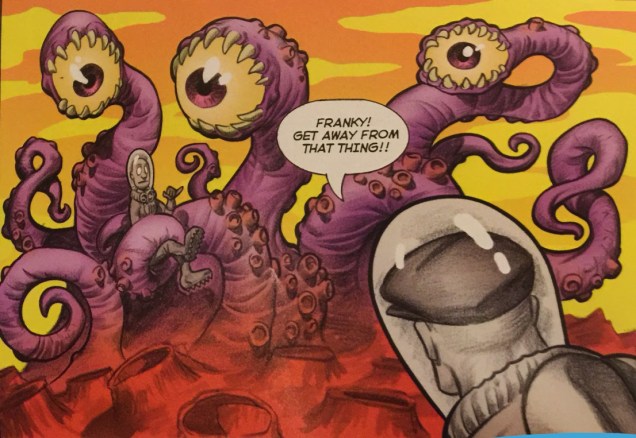
TheGoon11-detail
Yeah Franky, what the hell are you doing?

Check out part 1 of this interplanetary tentacle exhibit here: Grabby Denizens of the Airless Void.

Incidentally, today I was given a nice gift at work: Buddha’s Hand, or the fingered citron, a type of citrus someone described as a “Monsanto-produced cross between calamari and a lemon”. How very appropriate for Tentacle Tuesday! Here’s a picture of my very own tentacled beauty:

MainBouddhaA

« I have never listened to anyone who criticized my taste in space travel, sideshows or gorillas. When this occurs, I pack up my dinosaurs and leave the room. »*
~ ds
*All quotes by the great Ray Bradbury

Georges Pichard: Throwing Curves

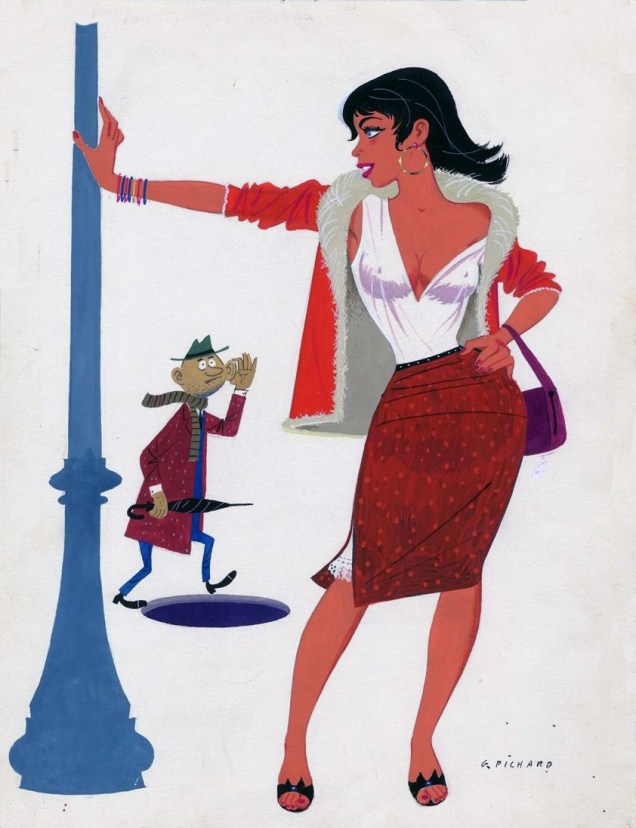
In 1946, Georges Pichard (not sure who he is? Visit our Pichard’s Distressing Damsels for an overview of his later work), heretofore toiling in a marketing agency, started his career as an illustrator. He worked for various French magazines and newspapers (like Le Rire, Fou-Rire and Les Veillées des Chaumières), providing them with covers, cartoons and pin-ups in black-and-white or gorgeous watercolour until the mid 70s, when he switched gears somewhat and dedicated himself to erotic bandes dessinées.

I left image imperfections (due mostly to yellowing of paper over time) and hand-written captions (when available) as is, as I find they provide pleasant texture and context. The jokes are really lame, but we translated them, anyway.

The following three cartoons were published in Le Rire. This first one saw print on the cover of Le Rire no. 22 (nouvelle série, July 1953).

George-Pichard-Sketch2

This one was featured on the cover of Le Rire no. 66 (nouvelle série, March 1957).

GeorgePichard-sketch

George-Pichard-sketch3
« I’m the sort of guy who’s kind of like an iceberg, the main part is beneath the surface. » The man in question looks very much like a V.I.P. type.

The following are all from Fou-rire:

GeorgesPichard-FourireA
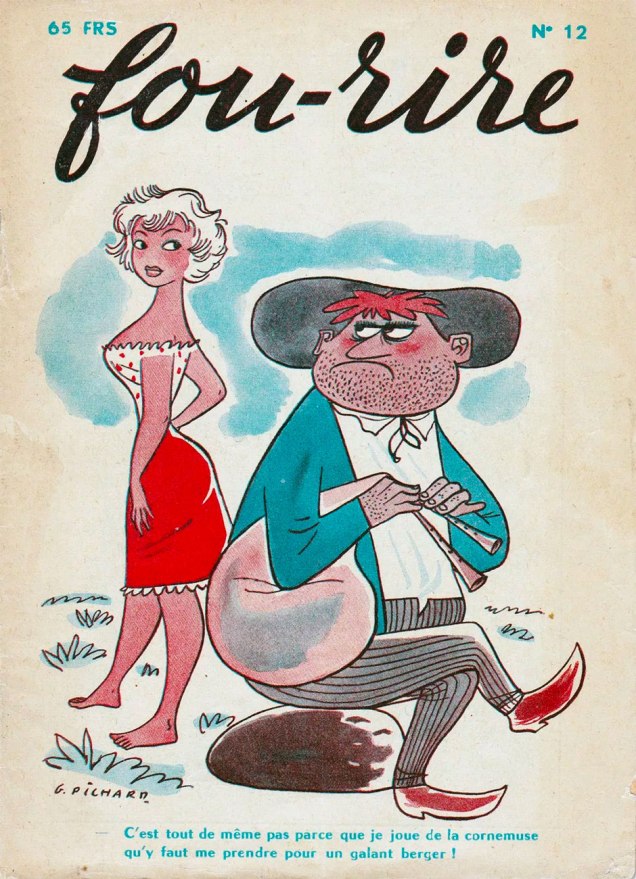
Cover of Fou-rire n°12, mid-50s. « It’s not because I’m playing the bagpipes that you have to take me for a gallant shepherd! »
GeorgePichard- LERIRE76- janvier 1958.
Cartoon from Fou-Rire n° 76, early 60s. « Please be assured, my dear friend, that we are all here quite touched by your wife’s endeavours to set a mood… ».
GeorgePichard=1962
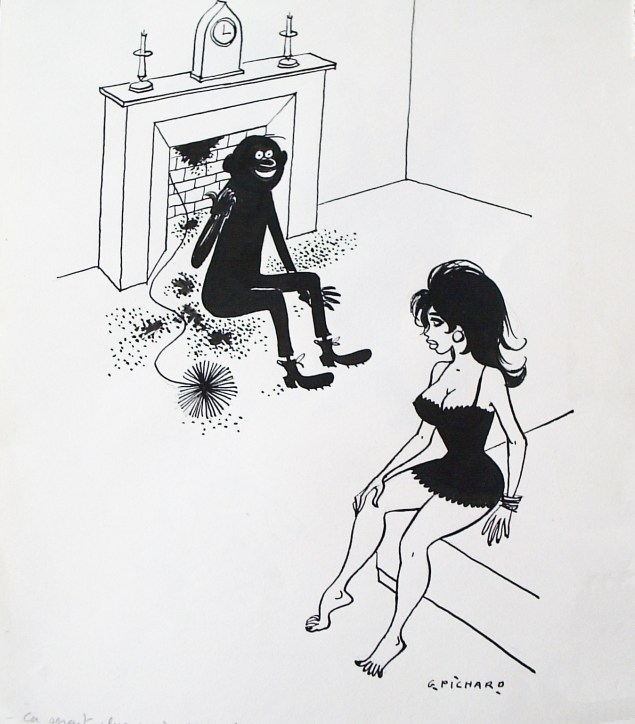
Cartoon from Fou-Rire n° 118, early 60s.  « It would be prudent to seal up your chimney, because when I tell the boss about this… »
GeorgePichard-1961---1962;-French-Magazine-Le-Rire
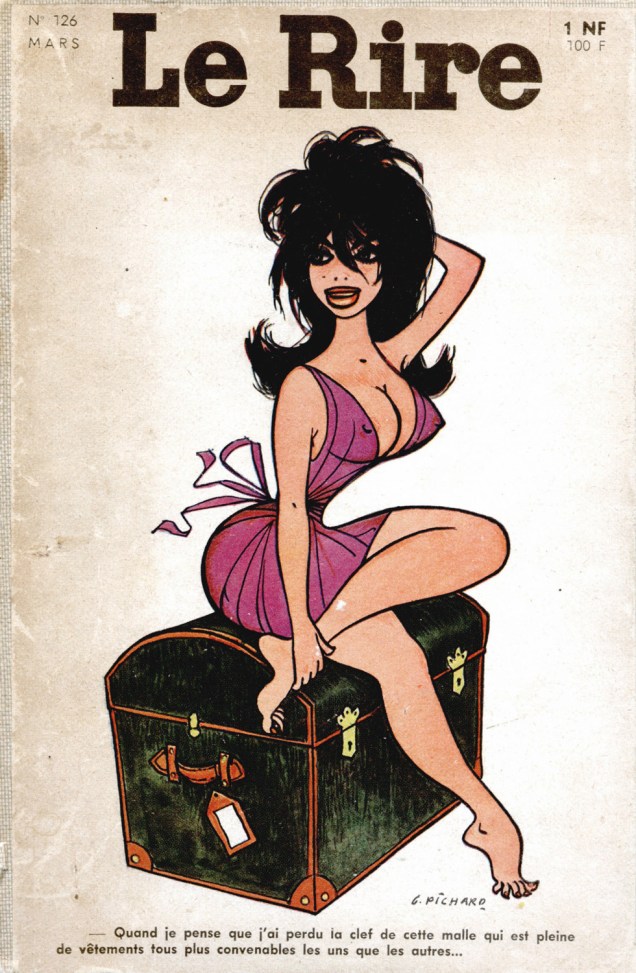
Fou-Rire n° 118, mid 60s. « And to think that I’ve mislaid the key to this chest full of outfits, each more decent than the last… »

Finally, a couple of pretty loose ends:

GeorgePichard-Jarredor
Original art from Le Rire magazine, 1960s. « But the funniest part happened before I ran into the police officer! »
GeorgePichard-V60
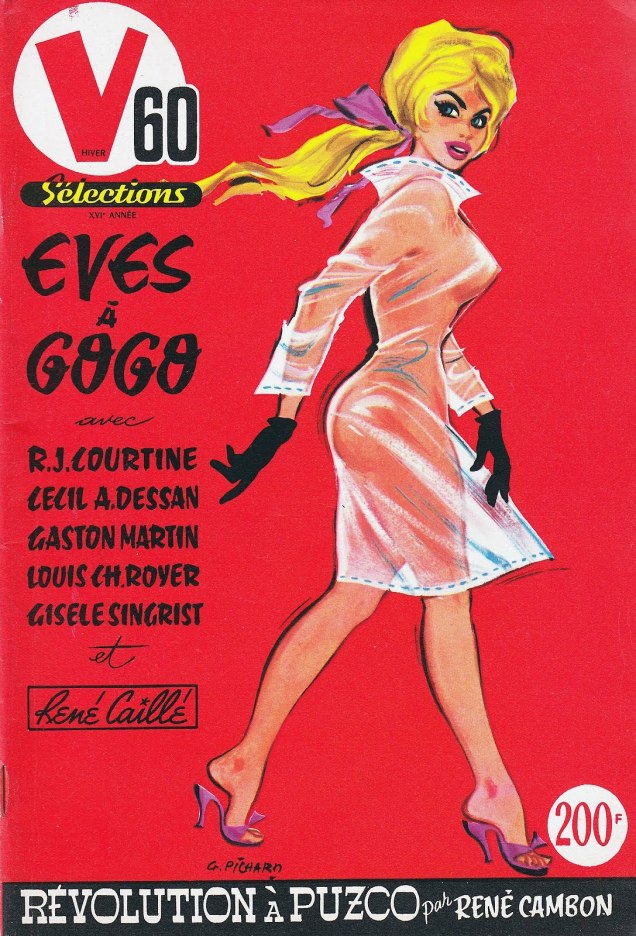
Early 60s.

~ ds

Treasured Stories: “The Servant of Chan” (1975)

« Followers in death: Attendants and relatives who were killed so they could be buried in the tomb with the person (normally someone very important or wealthy) who had died. » — The British Museum

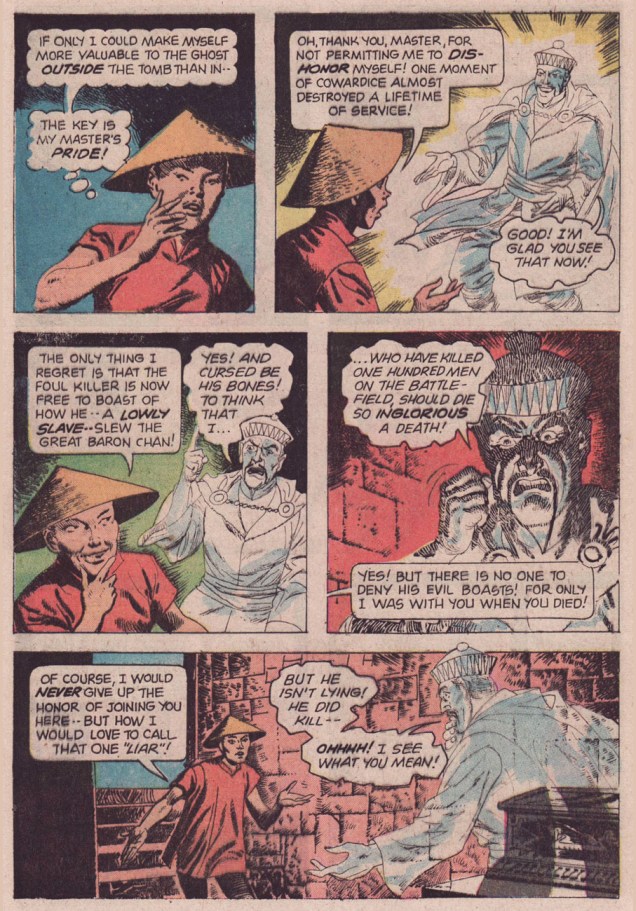
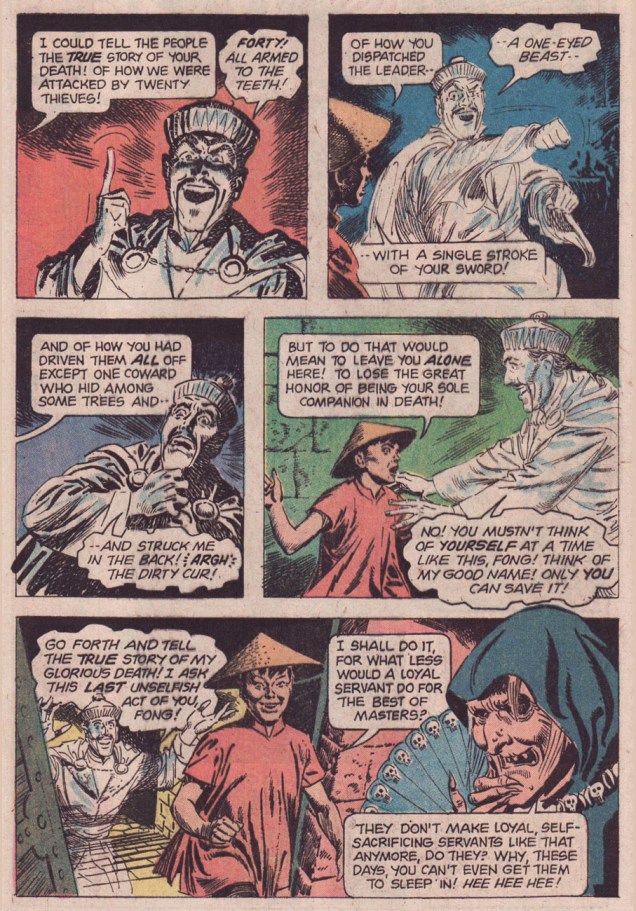
Let’s face it, Gold Key’s would-be-spooky comics rarely lived up to their habitually fine painted covers (mostly courtesy of hard-working George Wilson, with Vic Prezio, Luis Domínguez, Jesse Santos or Jack Sparling occasionally chipping in); as with most things, there were exceptions: I’ve raved earlier about a particular issue of the generally ho-hum Grimm’s Ghost Stories, namely issue 26, boasting, along with the usual Paul S. Newman sleep aids, two excellent yarns from the undervalued Arnold Drake (co-creator of The Doom Patrol, Deadman, and the original Guardians of the Galaxy).

Ah, but today, we’re celebrating Drake’s co-conspirator, the prolific Argentine master (yes, another one) Luis Ángel Domínguez, reportedly born ninety-five years ago to the day (Dec. 5, 1923), and still among the living… as far as we know. I like to envision him warmly surrounded by several generations of loved ones and well-wishers, an impish gleam in his eye.

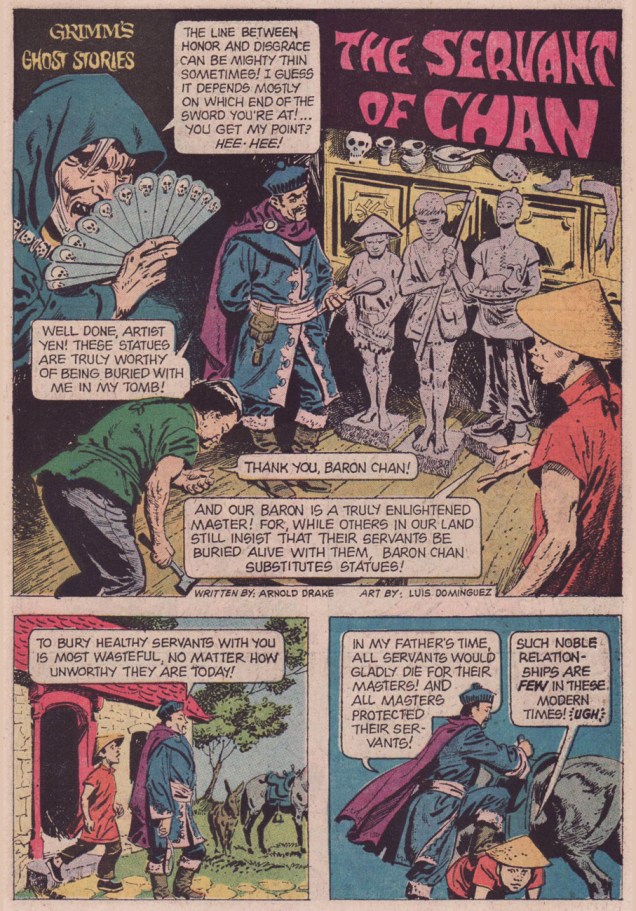
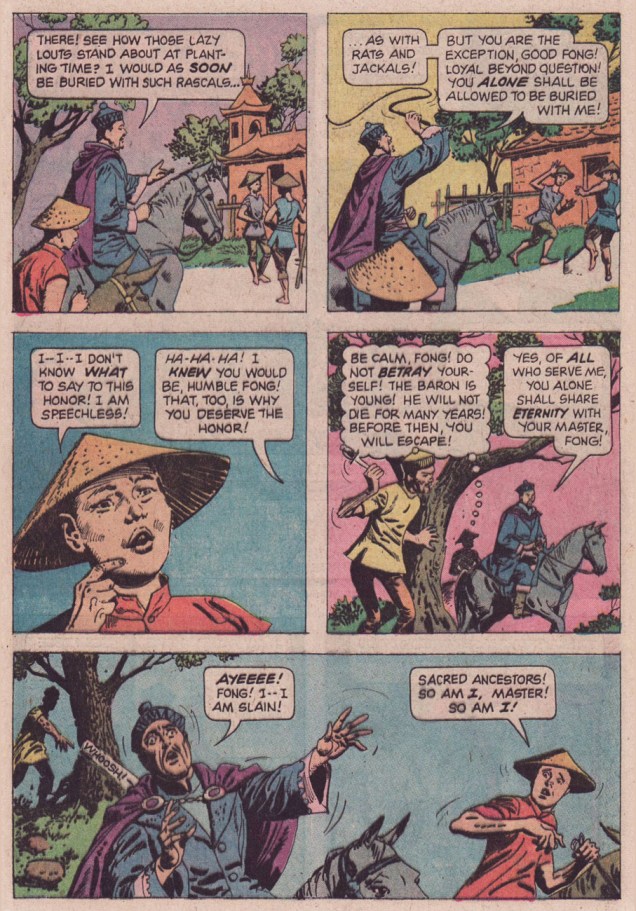
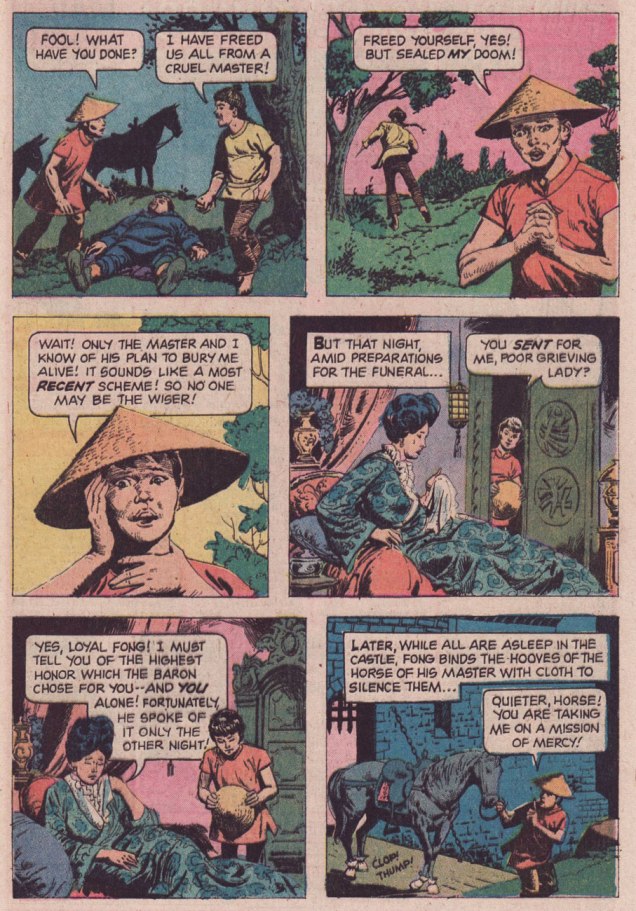
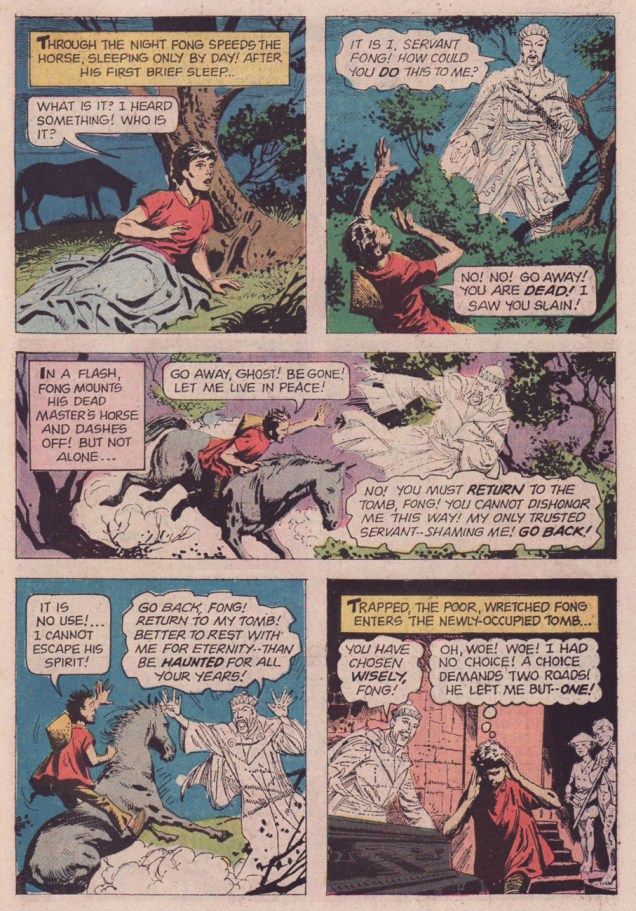
Without further foot-dragging, here’s a vintage tale of quick wits in ruling class hubris from beyond the grave, The Servant of Chan, by that dastardly duo, Drake and Domínguez.

ServantChan01AServantChan02AServantChan03AServantChan04AServantChan05AServantChan06A

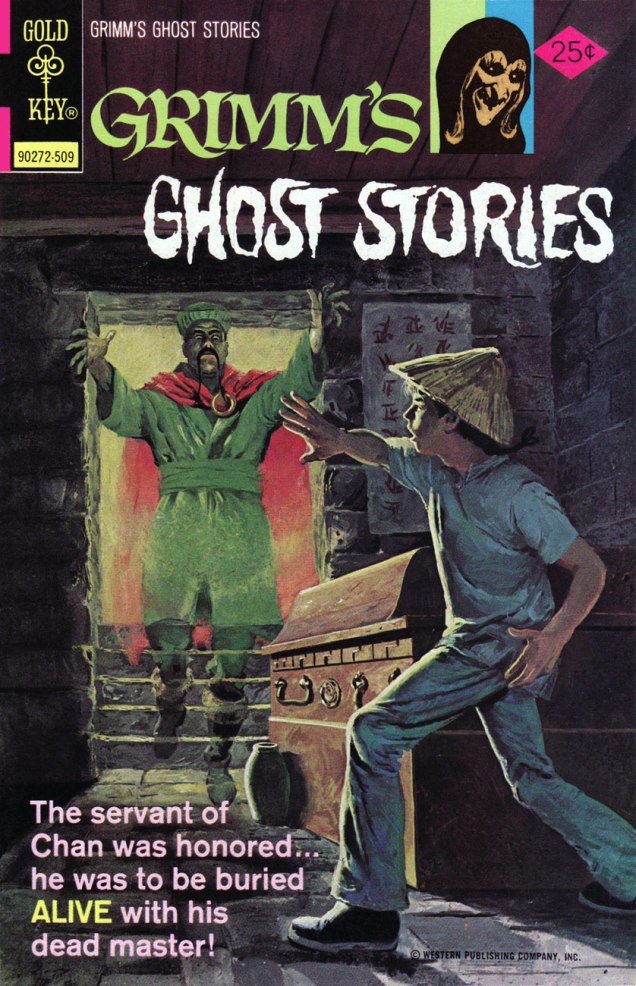
GrimmsGhost26CoverA
George Wilson’s cover highlights a dramatic scene from our little story. This is Grimm’s Ghost Stories no. 26 (Sept. 1975, Gold Key).

Some further details on historical context, from Ancient China for Kids (!):

« Slavery in ancient China was not a pleasant experience. The lives of slaves were filled with hardship. Many were abused. Many slaves were children.

Most people who were slaves worked in the fields, alongside of peasants. They did the same job, and had the same hours, and pretty much the same clothing and food, as free farmers. But they were not treated with the same respect given to farmers. Some slaves built roads. Some worked in government.

But slaves who worked for the emperor, the royal family, and sometimes the nobles, had the worst of it. They could only do what they were told to do. They were treated in any way that their master and his family felt like treating them. Many were treated with great cruelty. When their master died, they were killed, and buried with their master in his tomb, so they could continue to serve their master after his death. »

Brr. All the same, if you’ve enjoyed this yarn, check out Arnold Drake’s other contribution to this issue, The Anti-13, which we enthusiastically featured some time ago.

¡Feliz cumpleaños, Señor Domínguez… wherever you may be!

-RG

Tentacle Tuesday: The Golden Age of Grabbery

For today’s Tentacle Tuesday post, I’d like to highlight some comic book artwork from the Golden Age, which is to say the period between the early (or late, depending on who you ask) 1930s and 1956, the year Showcase #4 was published, heralding the new era of superhero comics. (Our other TT post dedicated to the Golden Age was about Planet Comics; visit it here).

BlueBoltVol1-#5
Blue Bolt vol. 1 no. 5 (October 1940), cover by W. E. Rowland. The series was created by Joe Simon, who promptly enlisted Jack Kirby’s help. This cover story, «War in the Fourth Dimension»,  is by the Simon-Kirby team. Read the issue here.

The Blue Bolt gets tangled up in quite a few (crushing, of course) tentacles. Art by Jack Kirby.

Blueboltvol1#5-detail

And a few pages later….

BlueBolvol1#5-detail2-JackKirby

TentacleTuesdayIcon

It might be surprising to see the Shadow in the grip of an octopus, but there’s probably not that many creatures he *hasn’t* grappled with!

When a radio show was introduced in 1930 to boost the sales of Detective Story Magazine, the company (Street & Smith Publications) wasn’t expecting its freshly-minted narrator, The Shadow, to hog the limelight – but that he did, as listeners found this sinister character far more compelling than the stories he was narrating.

ShadowVol3No6
Shadow Comics vol. 3 no. 6 (September 1943), cover by Vernon Greene. Just imagine the possible drama of this cover – the swordfish is actually the octopus’ friend, but he’s forced to become an instrument of his death by the merciless Shadow (only he would descend to the depths of the ocean to fight “devils” in full suit-and-cape regalia).

As his fans kept requesting copies of The Shadow magazine (which didn’t even exist at the time), Street & Smith obliged and The Shadow Magazine was born in 1931. The Shadow’s step-father is Walter B. Gibson, writing under the pen-name of Maxwell Grant. He wrote « more than 300 novel-length » Shadow stories to meet the demand of a public greedily clamouring for its hero, although at some point several writers were hired to lighten Gibson’s ridiculous workload. The Shadow soon slunk beyond the confines of pulp novels and into comics: a syndicated daily newspaper comic strip (written by Gibson and illustrated by Vernon Greene), preceded (by a month) by a comic book published by Street & Smith, which was supposed to attract a younger audience to pulp magazines (101 issues, from 1940 to 1949).

Shadow Comics v5#5
Shadow Comics vol. 5 no. 5 (August 1945), cover by Charles Coll. Everybody is making puppy eyes at the Shadow, but will he choose the pretty girl or the pretty octopus?

Speaking of heroes, Wiki calls The Shadow « a film noir antihero in every sense »; now, I’ll concede the film noir, but I’ll balk at calling him an anti-hero, at least in this incarnation, as *that* term is defined as « a character who lacks conventional heroic qualities such as idealism, courage, and morality », all of which The Shadow has abundant reserves of. He’s a bit laconic and brusque with this conspirators, but that’s understandable when he had to destroy peace-threatening crime rings and bring brilliant crime-perpetrators to ruin at least twice a month.

TentacleTuesdayIcon

Who’s that handsome guy shooting commercials for Crackety-Wackett Cereal? Why, it’s Lars of Mars, the debonair Martian! In between fighting his communist arch-enemy (it was the 50s, what can I say?) and robots harassing women, Lars likes to relax by grappling with tentacled creatures.

LarsofMars11
This lovely cover is Lars of Mars no. 11 (July-August 1951), painted by Allen Anderson (or Norman Saunders, according to another source, though Anderson seems likelier). What’s inside? Jerry Siegel scripts and Murphy Anderson art (and one story by Gene Colan). Yummy!

Lars of Mars was created by Siegel in 1951 for Ziff-Davis. There are only two issues (bizarrely numbered 10 and 11). The art for Lars of Mars, done by Murphy Anderson, is very nice indeed, but you don’t have to take my word for it. Feast your orbs on the first two delightfully nonsensical LoM stories on Pappy’s Golden Age blog.

LarsofMars
Now, is that any way to address a many-tentacled creature?

TentacleTuesdayIcon

« Scarlet’s adventures are never run-of-the-mill. Instead she enters into every phase of American life – whether on the baseball field or in a night club – always finding a way to help her clients, aid the forces of law and order… and bring plenty of thrills and laughs to her readers. »  Apparently « every phase of American life » includes being on the ocean’s floor, trying to stab an octopus with only 5 arms. Hmm…

Harvey Comics Hits #59
Harvey Comics Hits no. 59, 1952. Art (probably) by Al Avison. Interestingly, the fish is nibbling on the hand of the monster, when it could be partaking of the delicious flesh of the blub-guy. Tales of the Invisible reprints a bunch of Scarlet O’Neil stories from Black Cat, topped off with an introduction titled « Meet Russell Stamm » (the creator).

Incidentally, Invisible Scarlet O’Neil is supposed to be the first heroine with superpowers (well, one superpower: invisibility).

If I may be excused for going off-tentacle-topic,  « Blood of a Monster », the title story that takes up half of this issue, is surprisingly good (though it doesn’t really contain tentacles aside from a minor mention of cephalapoda at the beginning). The art (by the aforementioned Russell Stamm) is moody and quite unhinged in places.

Harvey Comics Hits #59-detail1-RussellStamm

I enjoyed « Grave of Greed », the second half of the issue, even more, because it involves mushroom picking as part of the plot!

Harvey Comics Hits #59-detail

Read the full issue here – it’s worth the detour, I think!

Stay tuned for our next Tentacle Tuesday post! In the meantime, visit our previous TTs (we’re getting to have quite a backlog) for your tentacle fix.

~ ds

Helen Case: Girlie Cartoonist With a Twist

« At one time, I sold general cartoons to some of the men’s magazines, the girlies — until I went into a newsstand one day and looked at one. » — Betty Swords

If female cartoonists were fairly uncommon in the American mainstream magazine field for much of the twentieth century, they were doubly so within the so-called girlie mags.

« During the 1950s, Abe Goodman — brother of Marvel Comics publisher Moe ‘Martin’ Goodman — was the largest buyer of cartoons in the world. Publishing out of New York City under the Humorama banner, Goodman churned out scores of cheap digest-sized magazines boasting inventive titles like Romp, Stare and Joker that featured hackneyed jokes, cheesecake photos and the publications’ bread and butter, single panel pin-up cartoons.

These magazines were an unlikely proving ground for neophyte gag cartoonists as well as a welcomed alternative to the daily grind of comic book sweatshops. In the 1950s and 1960s, these digests featured the likes of Playboy’s Jack Cole, Archie’s Dan DeCarlo and glamour girl legend Bill Ward. »

While I can unreservedly recommend Alex Chun and Alex Covey’s The Pin-Up Art of Humorama (Fantagraphics, 2011), I’m frankly puzzled as to its wholesale snubbing of Helen Case, who might have brought a welcome bit of variety to the all-male revue. God knows some lesser lights did make the cut.

While feminist cartoonist Betty Swords would likely have dismissed Case’s protagonists the way she did Barbara Shermund‘s, as « gold diggers, dames — amateur prostitutes », Case’s cartoons (I’m afraid I don’t know whether she wrote and illustrated, or simply illustrated… at Humorama’s pauper’s rates, the former is somewhat preferable) provide a refreshing female perspective to the battle of the sexes. To quote Betty Swords again (from R.C. Harvey‘s excellent Insider Histories of Cartooning (2014, University Press of Mississippi): « I remember one editor who shuffled through my cartoons then tossed them on the desk and said, ‘You gal cartoonists are all alike — you don’t attack and hit hard enough! »

While scant information is available regarding Ms. Case (she appears to have lived in Kingston, New York in the early 1960s), at least online, much of her work survives, which surely has to count for something. We present some of the finer cuts, and if the gags aren’t transcendentally great, they are a brace o’ notches above the average knuckle-dragging drollery pervading the pages of Breezy, Snappy or Eyeful of Fun. Most of these gags were drawn and initially published (Humorama’s cheapskate policy was to print, reprint, and reprint again) between 1960 and 1964. Enjoy!

CasePlatonicACaseSecondHusbandACaseIdentitiesACaseNoItAllAHelenCaseDumbbellACaseFortunetellerACaseBathingSuitACaseBoysEarlyACaseNewRegulationsA

-RG

Tentacle Tuesday: Tenta-come-lately

I have this tendency to overlook comics published more recently than 20 years ago. It’s not a conscious bias on my part (aw, who are we kidding?), and yet…  Why would I waste precious time trying to find something “modern” (which is a flexible concept, anyway) that’s half-decent instead of enjoying the bounty of excellent comics produced in the 60 (if not 70) years preceding the 2000s?

Having said that, tentacles are more popular than ever in the comics field – a panacea for a number of storytelling foibles, a piquant ingredient to offset blandness, a freaking deus ex machina. Unfortunately, almost all of the post-2000 comics graced by the appearance of tentacles are of the butt-ugly persuasion – for a number of reasons, although I could probably narrow them down to three or so (piss-poor anatomy, a cold metallic gleam over everything, terrible colours). Modern comics also have the lovely feature of having like a bazillion variant covers for each issue.

I could go on with covers like this one all day:

GrimmTalesofTerror6
Grimm Tales of Terror no. 6 (January 2015), pencilled by Giuseppe Cafaro and inked by Simone Di Meo.

That’s not ugly enough for you? The pretty girl is knocking out all capacity for rational thought? Are you forgiving the artist for thinking fabric needs about a thousand crinkles and folds to look, ahem, realistic? Okay, how about something like this?

Action Comics #6
A panel from “When Superman Learned to Fly”, published in Action Comics no. 6 (April, 2012). Pencilled by Andy Kubert and inked by John Dell.

Everybody knows that if you’re going to combat tentacles, you should make sure your stance is wide enough to be completely impractical and then fight them off with your crotch. While you’re doing that, your cape will develop a mind of its own and will start lifting off your shoulders. That is normal and aids in battle. Throw some terribly witty dialogue in, triple check that the men have their hands curled up in manly fisticuffs even if they’re not really connected to their wrists, and you’re all set for an Action Scene!

Okay, okay, I’ll wrap up my rant now. Let’s look at some… decent comics.

“Doctor Lovecraft” made me do a serious eye-roll, but at least the story is interesting. Read the issue here. Note the teal-and-orange in this one:

Afterlifewith-archie6
A page from « Betty R.I.P. Chapter One – Witch in the Dream House », published in Afterlife with Archie no. 6 (October 2014). Scripted by Roberto Aguirre-Sacasa, art by Francesco Francavilla.

I’m going to throw a spoiler your way with the following splash. It’s from the same issue as the previous page, so guess who gets to be bride of Cthulhu. (A more-than-slightly absurd thought. What would a Great Old One want with a human female, even if she’s a witch?) For more spoilers, head over to the Afterlife with Archie: the 13 Scariest Moments. I am aaalmost considering picking up the series. Maybe. As soon as I’m done with the piles of comics covering pretty much every surface of my office.

AfterlifewithArchie6-Cthulhu

Moving on: I never thought I’d be posting *anything* from My Little Pony franchise, but the “pastels” of this scene are rather well done. Also, these freaking ponies are annoying, so seeing them strangled is somewhat satisfying.

Mylittlepony-FrienshipIsMagic-27
My Little Pony: Friendship is Magic no. 27 (January 2015). Cover by Andy Price.

It’s even more preposterous that I should be sharing a Star Wars page, for fuck’s sake, but I like the art (pray note: more blue and orange!).

StarWarsSpecial-C3PO-Number1
«The Phantom Limb» is scripted by James Robinson and drawn by Tony Harris, and was published in Star Wars Special: C-3PO no. 1 (June 2016). Figure out why a tentacled monster is interested in a robot here.

~ ds

Dateline: Frontline – The Cary Burkett Interview, Part 2

« A reader has the right to ask for all the facts; he has no right to ask that a journalist or historian agree with him. » — Herbert Matthews

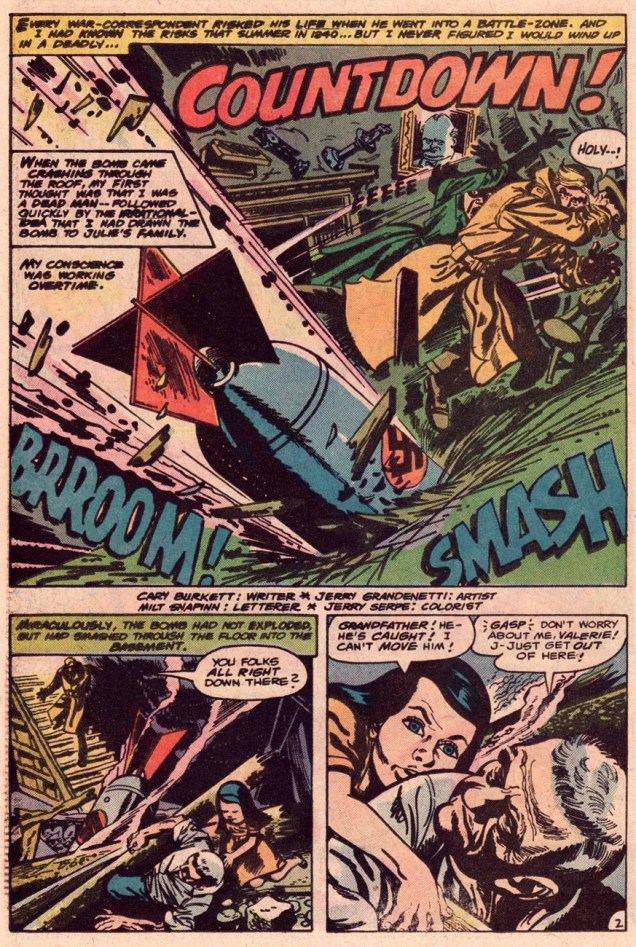
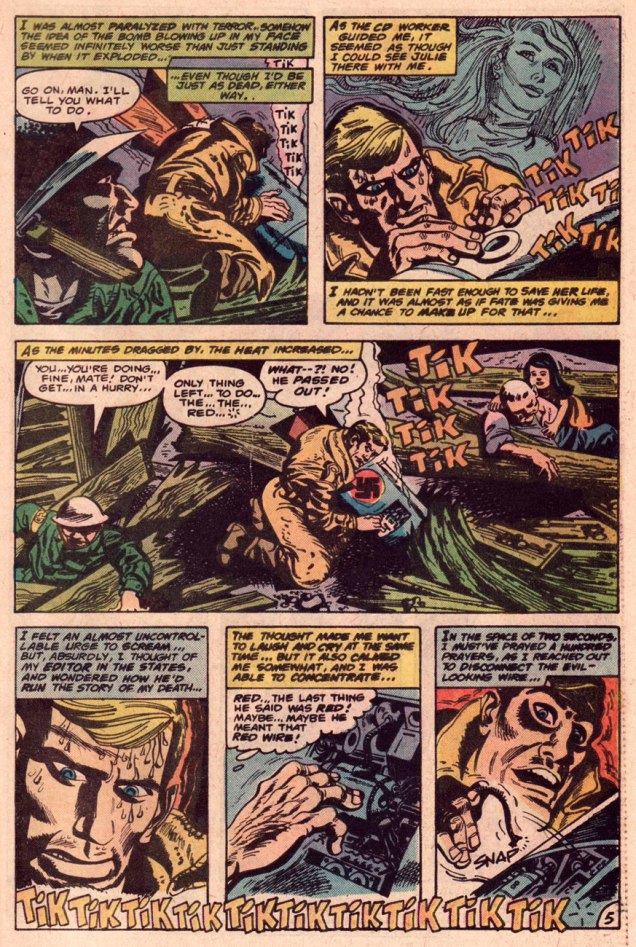
And we’re back with part two of our examination of Cary Burkett and Jerry Grandenetti‘s Dateline: Frontline (we’re not forgetting the famously-ambidextrous Ric Estrada, who took over illustrative duties in the second half of the series). In part one, Mr. Burkett graciously opened for us a window on the series’ genesis. In light of these privileged behind-the-scenes gleanings, as well as a reading of the series’ springboard text, Phillip Knightley’s The First Casualty, I formulated  a series of follow-up questions, of which we present the first half, along, of course, with Mr. Burkett’s insightful and modest responses, followed by chapter 2 of the first D:F trilogy.

Who’s Out There: Was there much deliberation on your part regarding the specific setting of the series?

Cary Burkett: I vaguely recall that in an early meeting with Paul Levitz we mentioned the possibility of setting the series during the Vietnam war. Or rather, I think he may have mentioned it. But I never had any interest in that from the beginning. That war was too close at the time, and I didn’t think I could do it. Research was a lot harder to do in those days, and I was too green as a writer to want to tackle that controversy.

If my memory is right, I think he left it up to me, and I very quickly settled on the World War II setting. There were a lot of reasons in my mind for that, including the wealth of research material available.

But the biggest thing was the fact that the U.S. started out as “neutral” in that war. I felt a story arc right away of a young reporter who began as a “neutral” observer, wanting to be an objective journalist, but over a series of events finding himself unable to keep from being drawn in and taking sides, despite his proclaimed neutrality.

At the time I didn’t know how long the series might last, but it was my intention to gradually move Wayne Clifford from a naïve journalist with laudable ideals into a conflicted character grappling with the very gray areas of war reporting and the messy questions of patriotism and propaganda.

WOT: In writing the series, did you ever find yourself at odds with the, er, ‘official record‘ of history?

CBI wouldn’t say that exactly. The truth is, I had only a sketchy knowledge of World War II history, and little idea of what the “official record” said. So I set about to educate myself.

One really good current documentary at the time was The World at War narrated by Laurence Olivier. I watched a number of episodes of that. What I realized from watching it was how much the history I had heard and read was centered on how the U.S. and England had won the war. This documentary was one of the first western pieces which really pointed out the importance of the Russian contribution.

That led me to other research and made me want to do a series of stories set in Russia. Of course, the insane difficulties of trying to report the truth during a war in the middle of Russia appealed vastly to me and provided a lot of opportunities for conflict on a lot of levels. I felt I barely scratched the surface in those Russia stories.

One thing about doing research; you start to get interested in all the little details. You want to include much more than you really can. You have to be careful to let the story reveal the details when it is important to the story, but not to let the research itself become the story.

I struggled with that in writing those Russia stories, because much of what I was finding out was really eye-opening to me. What I knew about the war in Russia I had learned mainly from watching Hogan’s Heroes. In that TV comedy, the Nazis all feared being sent to the Russian front, so you knew it was cold and terrible. But that’s about all I knew.

When I began to read about the scope of the tragedy and brutality of the war in Russia, I wanted to bring the reality of it into my stories. I wanted to shove it all in somehow. But my stories were a mere 6 pages long in each issue, so I had to just try to give little glimpses that implied a lot more.

Stephen King’s advice to writers is to “kill your darlings”, that is, to get rid of your pet favorite bits so they don’t bog down the story. Those Russia stories were ones where I felt I had to keep killing those “darlings” over and over.

WOT: Was there any friction with DC’s brass, or was the series too far under the radar for them to notice? If so, did that allow you more leeway?

CBWe were definitely way under the radar, but I don’t think that the stories would have caused any stir even if they had been noticed. I don’t think there was anything subversive or strongly controversial about them. They were different from the usual comic book war stories, but not in a way that would cause any issues.

The lead stories of the books featured Gravedigger, or later, The Unknown Soldier. These were the stories that were there to sell the book, and these would have gotten more scrutiny. They were the typical action-oriented comic book war stories, sometimes just a step away from fantasy. Sometimes not even a step.

With a long-running lead character in a war series, you have to be a bit looser with timelines in the war. I suppose it’s a convention of the genre that the character might pop up in Okinawa in one story, then many issues later have a story related to D-Day, even though D-Day would have happened well before Okinawa.

Maybe it’s because the main character was a journalist who was dedicated to getting the facts right, but I decided that my timeline was going to be accurate. The series would start with the U.S. as a neutral country, and we would later see the USA join the war, and all of the historical events would follow in the order they occurred.

WOT: Was the rotation of backup features decided from the start? Was it some sort of commercial compromise?

CBI don’t really know. I think the idea was mainly to have variety in the backups. It was a common template for older DC titles like Action Comics or Adventure Comics in the ‘60’s. One issue would have a Green Arrow backup, the next maybe Aquaman.

My own speculation is that as an editor, Paul was drawn to that kind of setup, and felt it gave the reader a little something extra. That’s just my own thought, he never told me that. But I know he was a comics fan, and I think he was glad to have a place where Enemy Ace could still fly through the pages of a DC Comic.

WOT: Given the wealth of material you dug up in the course of your research, it must have required considerable effort of concision to craft such spare chapters. Did you go through a lot of drafts?

I did struggle to find ways to get my stories into the six-page frame and did quite a few re-writes, trying to balance the pace so the story didn’t seem rushed but also had enough meat.

There were compromises, for sure. In what I considered to be one of the key stories, Clifford, still a neutral reporter, takes a rifle and kills an Axis soldier attempting to kill his English friend. I had been leading up to this decision since the beginning of the series. Here he is forced to admit that he is neither neutral nor objective as he thinks of himself.  I would have loved to have had a bit more room to let that sequence play out with more significance.

No doubt, I could have done a better job even in the space I had. In the end, I felt that it came out a bit weak and contrived.

WhoThereLogotype

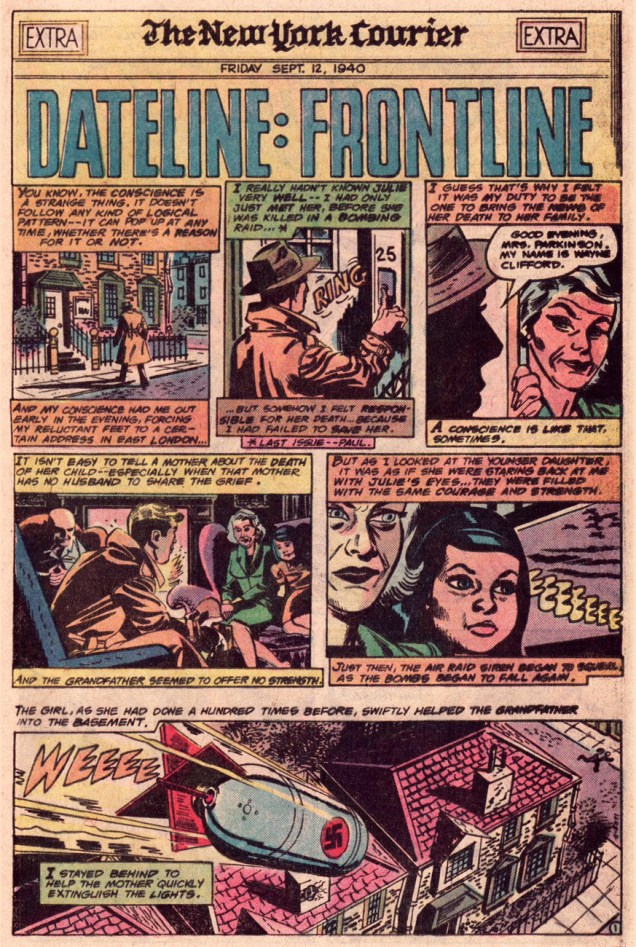
Now, let’s rejoin Wayne Clifford and his buddy Ed Barnes, who were, when we saw them last, off to the pub…

Dateline2London01ADateline2London02ADateline2London03ADateline2London04ADateline2London05ADateline2London06A

That’s it for now! Stay tuned for the conclusion of our talk with Cary Burkett, along with part three of Dateline:Frontline’s London trilogy.
-RG