« It is through his creation that the artist translates most certainly the man. Elegance of line, subtlety of colour, freshness of inspiration, modesty of feelings without ever falling into mushiness, Peynet is the antidote of all that pollutes our spirits today. He offers to us the key, key to the enchanted world where he catches in his nets that which we strive to destroy. » — Max Favalelli
Hello again! I’d been considering devoting a post to Raymond Peynet (1908-1999) for some time, but I realised at some point that this was another textbook case of ‘The tip of the iceberg‘; sure, I’d seen his Les amoureux cartoons in most of my newer issues of Le rire — which is to say issues in the merely sixty to eighty years old range — but the tiniest modicum of research revealed an impressively sustained worldview, some rather breathtaking bits of mass-marketing, and, most significantly, consistent quality and conceptual integrity.
This topic, obviously, would have made for an ideal Valentine’s Day post, but since I was out of town on family business on that day, and, more pointedly, we don’t really feel the need to mark that random occasion, it didn’t happen. And yet here we are… one month later to the day.
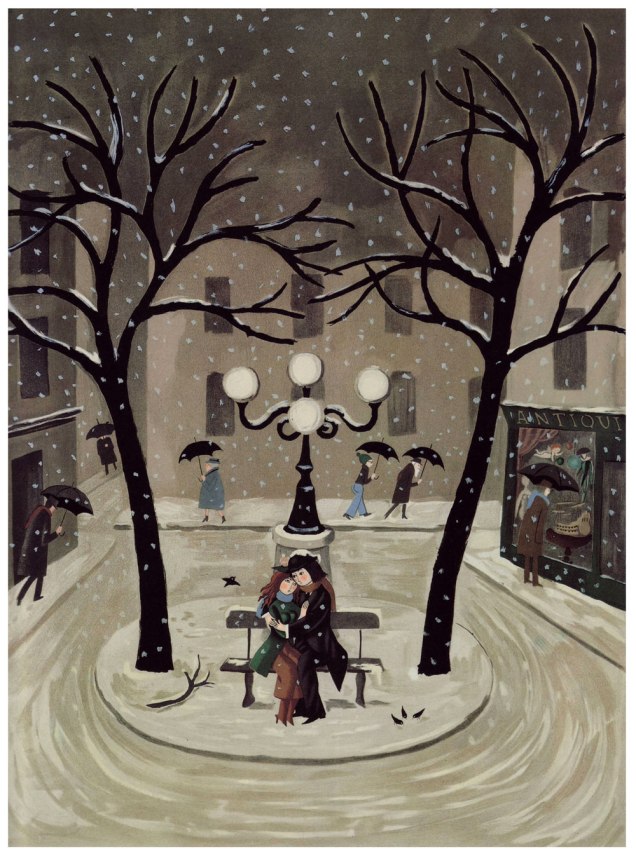
Having done my homework, I now present to you Mr. Peynet and his ‘amoureux’, immortalised through some six thousand drawings, but also four (!) museums — two in France, and two in Japan, a a life-size bronze statue in Hiroshima’s Peace Memorial Park, some 250 distinct models of latex dolls, several postage stamps, posters, champagne bottle labels… you name it.
Obviously, I’m just scratching the surface. But since Peynet-mania seems to have largely skipped over North America, this might prove a useful, if belated, introduction.
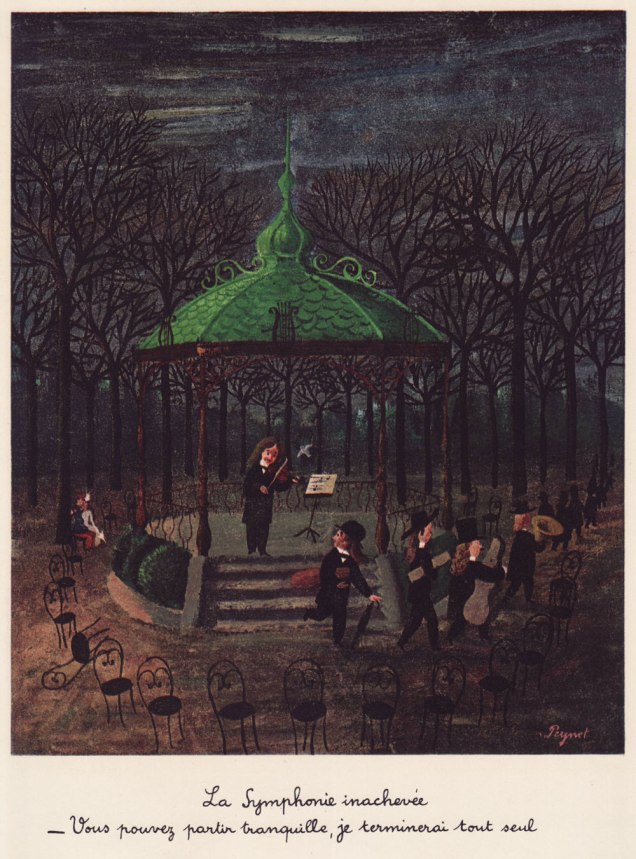
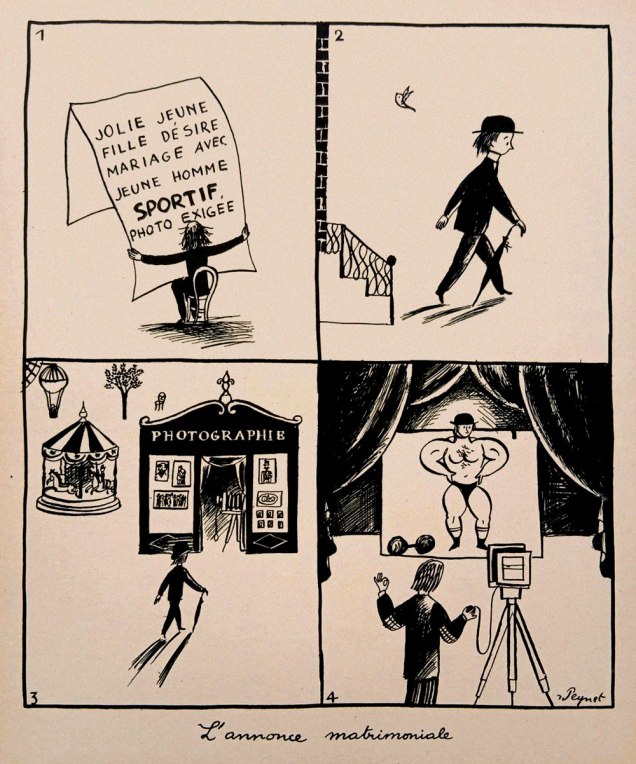
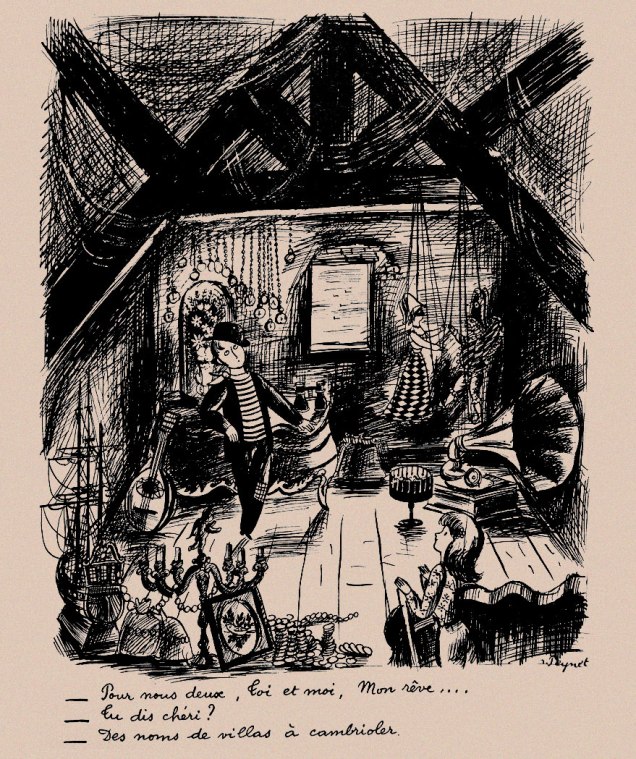
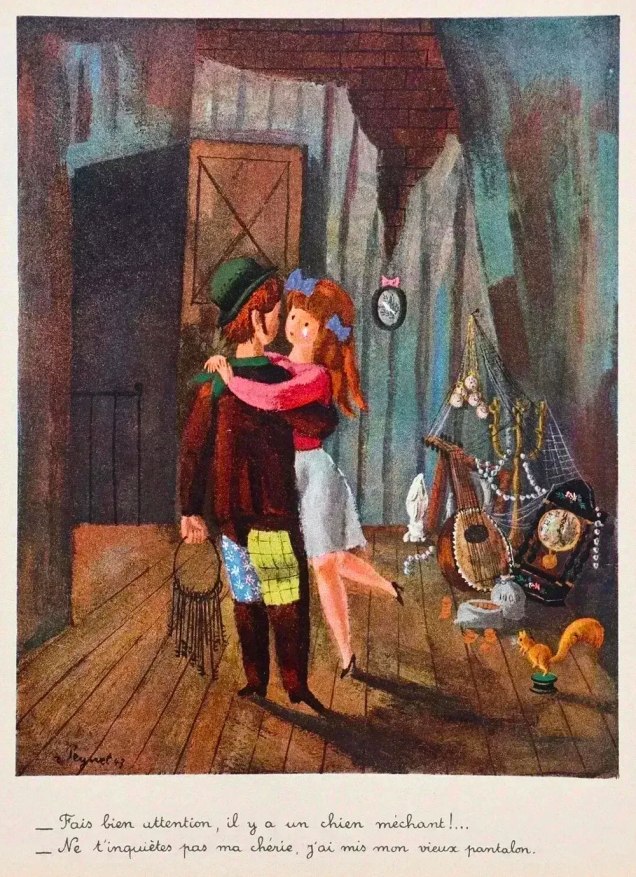
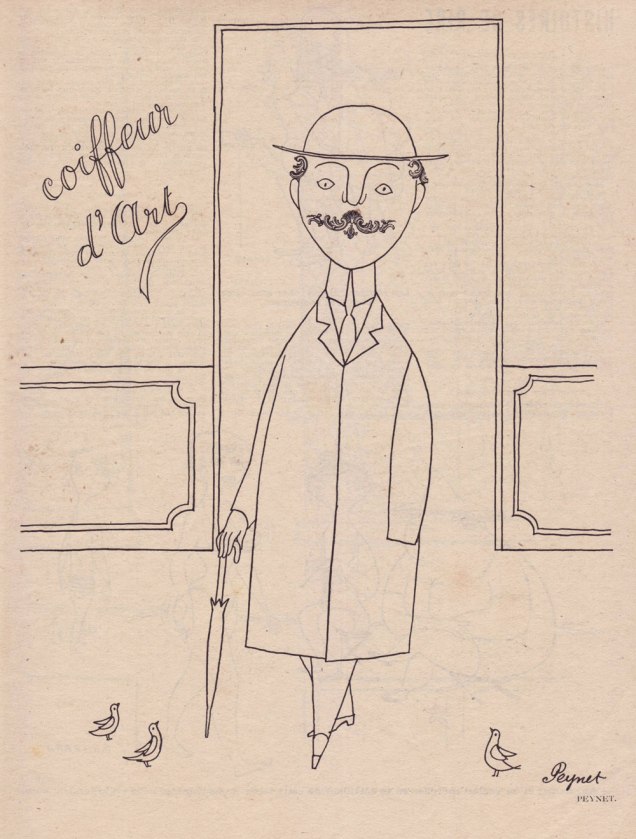
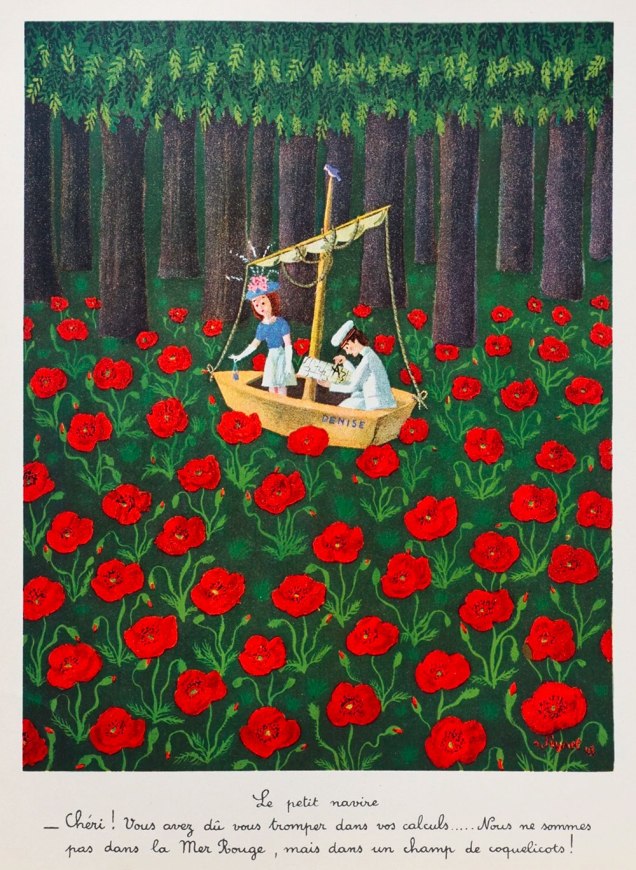
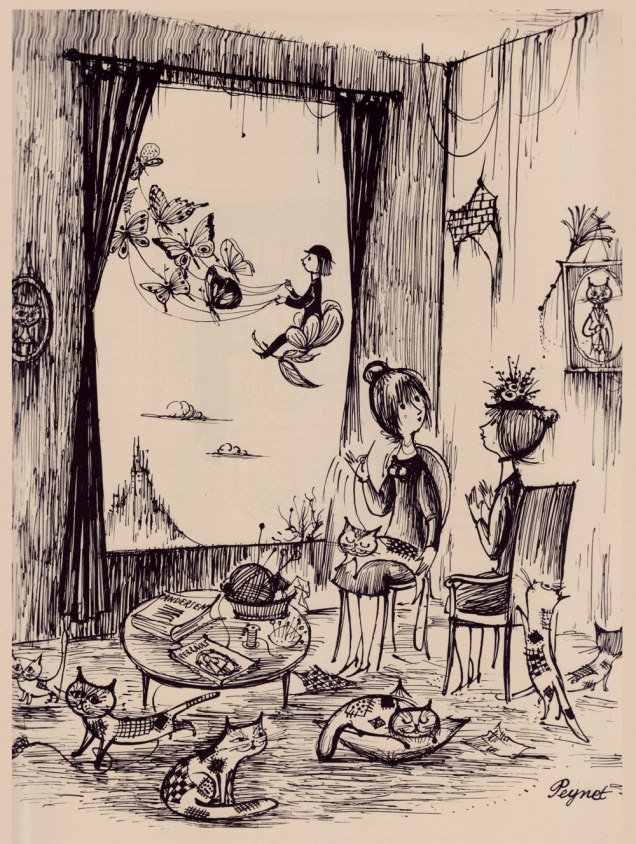
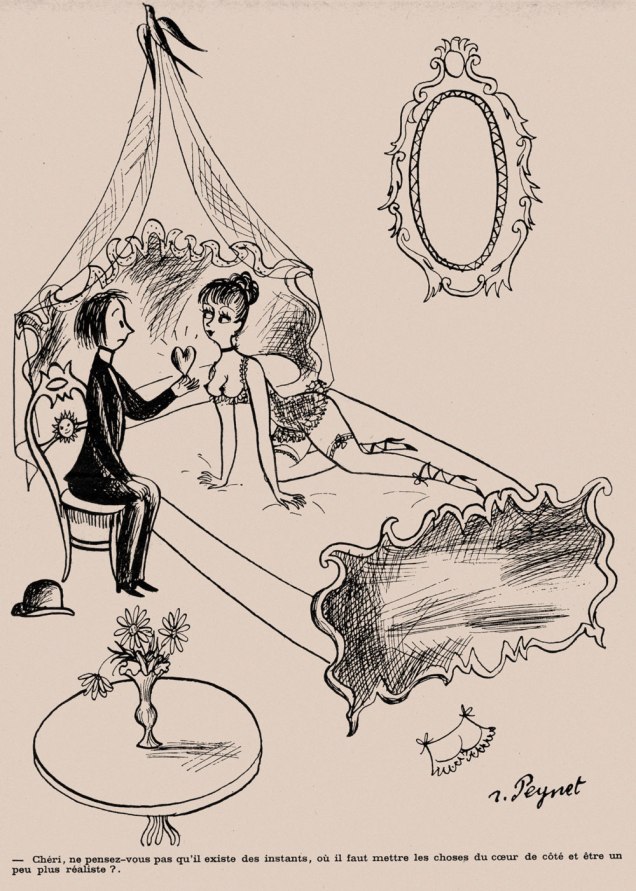
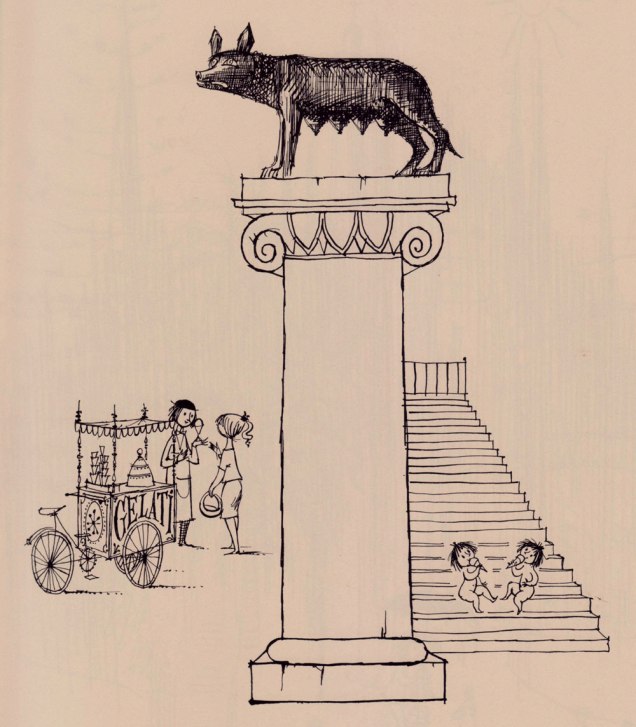
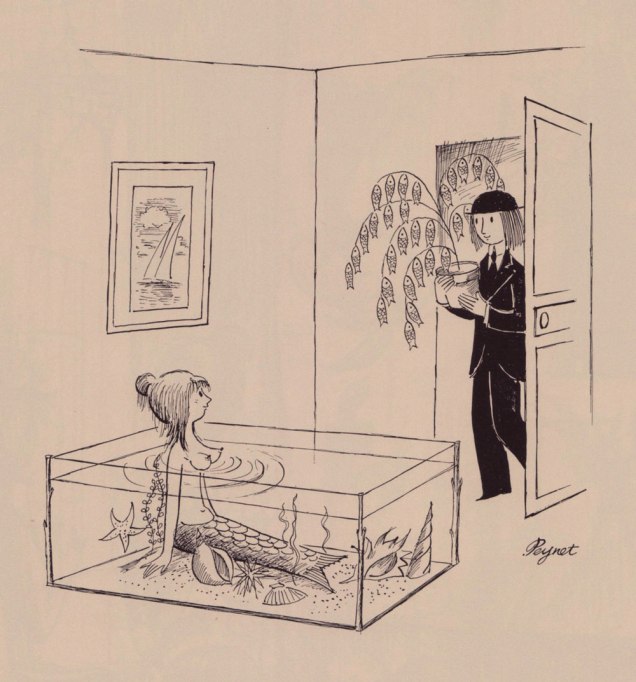
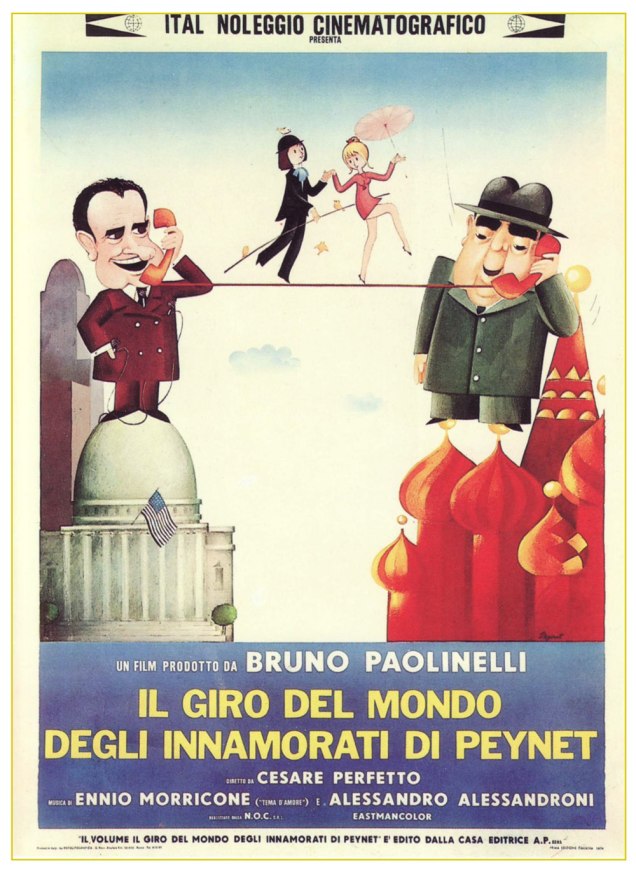
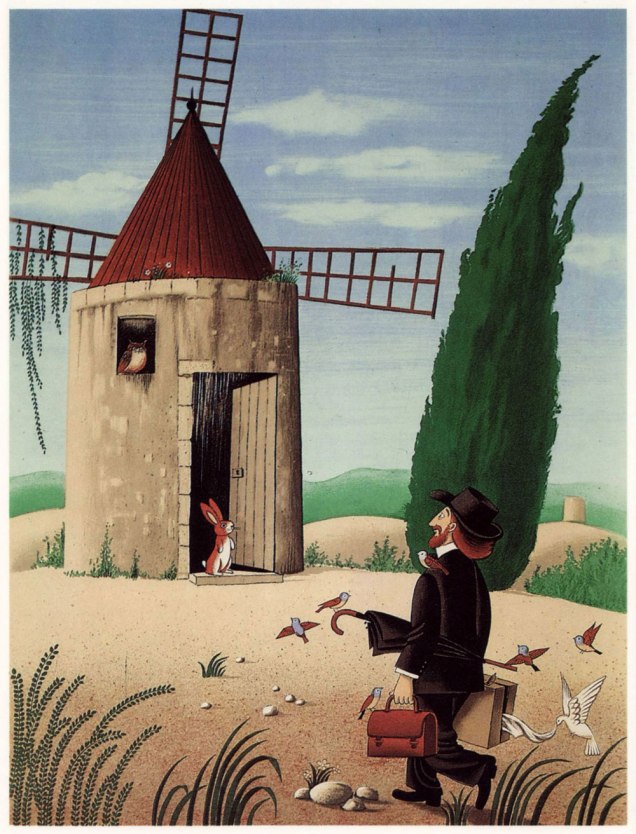
« I will give you my flu, you will give me your bronchitis… we will share the medication. » A lithograph created between 1970 and 1986 for Éditions Les Maîtres contemporains.The Unfinished Symphony: « Don’t worry, you may leave, I’ll finish it by myself. » (Limited edition litograph, 1943). This is how it all began for Peynet. Here’s the whole story of the time and place, clumsily — but charmingly — translated.The Marriage Ad: « Pretty young lady seeks marriage with athletic young man, photo required. » I doubt that Richard Sala ever encountered Peynet’s work, but I can’t help but find that this particular piece prefigures his style somewhat.« –– For Us Two, You and I, My Dream… » « — I beg your pardon, darling? » « These are names of villas to burgle. »« — Be very careful, there’s a mean dog! » « — Don’t worry, my love, I’m wearing my oldest pair of pants. » (Limited edition litograph, 1943)« The Artistic coiffeur ». From Le rireno. 22 (nouvelle série), July, 1953. Shades of the influential Saul Steinberg, which I *will* have to write about at some point.The Little Ship: « Darling! You must have erred in your calculations… we aren’t on the Red Sea, but rather in a field of poppies! » (Limited edition litograph, 1943).« — You’re not accompanying him through his dreams? » « — Never on Sundays, I’ve too much to do around the house. » « — No other lovers love each other as much as we do. » « — Well… take a look at these two below… » Lithograph created between 1970 and 1986 for Éditions Les Maîtres contemporains.« Dearest, don’t you think that there are times when one must set aside things of the heart and be more down to earth? » From Le rireno. 26 (nouvelle série), Feb. 1948. Even back in the 1940s, it wasn’t all chaste naïveté.Lithograph, Éditions Arnaud de Vesgre, 1970. Without being derivative in the least, this piece pleasantly reminds me of Francisco Botero‘s work. Okay, this one’s fairly subtle. I’ll give you a hint: the kids are named Romulus and Remus. Originally published in the collection Per le strade, per le nuvole (“Through the streets, through the clouds”) (Edizioni Elmo, Milan, 1953). Likely another cartoon from Le Rire (Peynet rarely skipped a number), but I don’t own that particular issue.In 1974, out of Italy, came an animated feature (there had been a French short film in 1961), boasting — most appropriately — a gorgeous waltz composed by Ennio Morricone at his peak. The feature is available to watch here.Lithograph from Alphonse Daudet‘s Lettres de mon moulin (« Letters From my Windmill »), Éditions Arnaud de Vesgre, 1985.
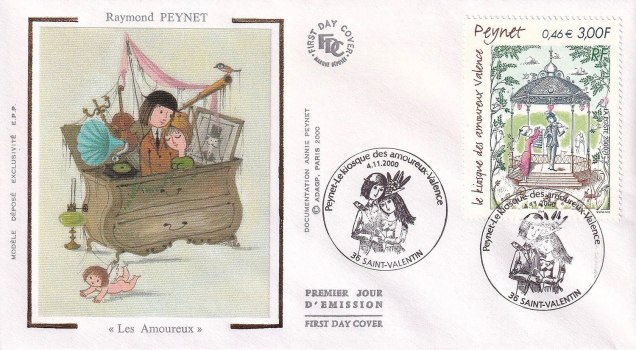
Peynet and his creations were twice honoured by the French post office with a clutch of different stamps. Here are some samples.
First day cover from Valentine’s Day, 1985.First day cover from November 11, 2000, posthumously this time, Peynet having gone to his glory the previous year, joining his wife and muse of sixty-six years, Denise, who’d passed away in 1996. Here’s a lovely obituary from The Guardian.
To see you off musically, here’s a classic song that Peynet’s best friend, Georges Brassens, wrote about the illustrator’s petits amoureux.
« Doubt is not a pleasant condition, but certainty is absurd. » — François-Marie Arouet
Going back to 1975: for a few years, I’d been buying Vaillant’s Pif poche (and sometimes its companion titles, Pifou, Arthur, Placid et Muzo, Totoche, and Gai-Luron… poche) as well. However, since the 1973 putsch by the raging primitives* and sundry bean counters, the publisher’s output had largely gone to seed.
I was still picking up, when faced with a dismal crop at the newsstand, the occasional ‘poche’, mostly for the games and puzzles, which comprised half of the editorial content. I was intrigued by an oddly-named stylist, one ‘Rik Cursat’ (unusual name for a Frenchman, I thought… still, nice of him to sign his work!), whose assured line and friendly absurdity had caught my eye.
A game page from Placid et Muzo Poche no. 80 (Aug. 1975, Éditions de Vaillant). Sometimes he used his initials, sometimes he signed in full. « Using all letters above the drawing, find the names of two fruits. » The answers: PÊCHE and CITRON. This one appeared in Pifou Poche no. 63 (Sept. 1975, Éditions de Vaillant). « Using all the letters above the drawing, put together the names of two animals. » The answers: CANE and CHIEN.
It was only decades later that I thought to dig a little deeper. To my delight, it turns out that Cursat had a long and prolific, award-festooned career. Given his international success, it’s a bit of a mystery why he would have slummed it in the (presumably) low-paying back pages of frankly disposable kids’ publications. My guess is that his output was continuous and downright profligate, but he was reluctant to let a good drawing go to waste.
Henri ‘Rik’ Cursat** (1928-2006) was born and died in France’s third-largest city, Lyon. Deeply attached to his hometown, he reportedly produced over the course of his career some 20,000 drawings for its various daily newspapers, especially Le Progrès de Lyon, in whose employ he remained for some thirty-two years.
And since his body of work was so gargantuan and diverse, I’ll keep my focus narrow, borrowing from Absurdement vôtre, a 1977 selection of his cartoons published in Éclats de rire, a gags ‘n’ gals rag not unlike the American ‘Humorama‘ digests. He was, in fact, Éclats’ editor-in-chief for nearly a decade. Yet somehow his own cartoons are anything but crass or lowbrow.
Cursat had some pet recurring themes. One was literal gallows humour.
.
« He’s a repeat offender! »« It’s the downstairs neighbour; he claims that our fish is bothering him! »« Garçon, I don’t have a knife! »« Watch out for his left hook! ». Hooks were another of Cursat’s pet motifs.
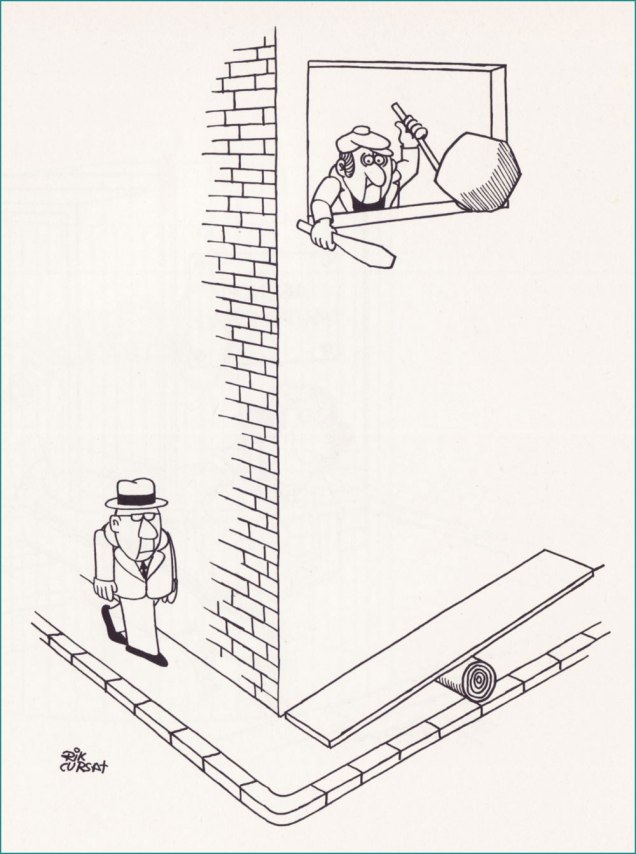
Another frequent theme was the mugger lying in wait just around the corner. Here’s a trio of variations:
.
.
.
.
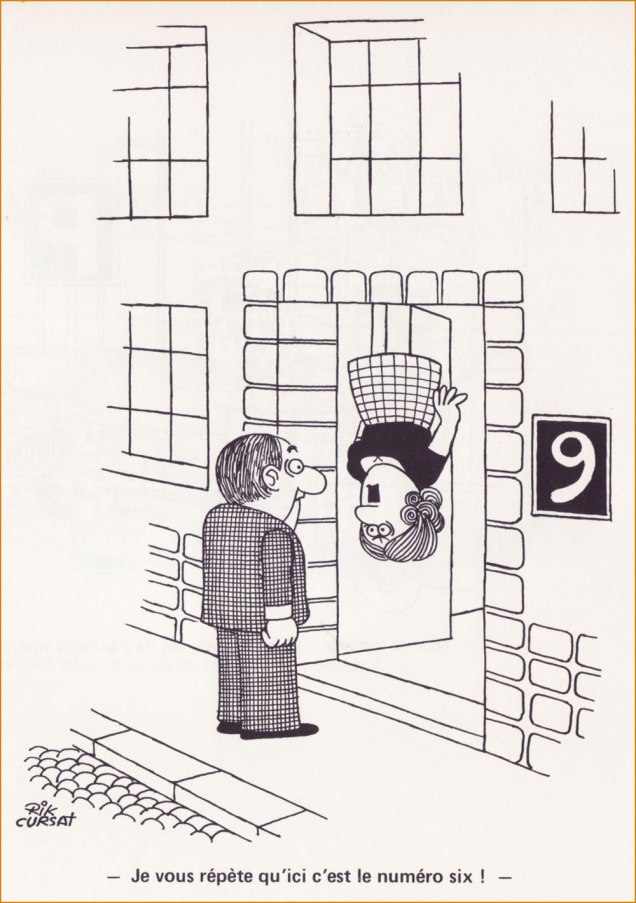
« Are you the architect? »« I keep telling you: this is number six! ». Another inspired riff on the same basic idea.
.
« Garçon, there isn’t a single fly in my soup! »Impishly looking at you, plotting a gag. The artist in the late 1970s.
« In man’s struggle against the world, bet on the world. » – Franz Kafka
Time for another entry in our leisurely, unsystematic and subjective survey of Europe’s most significant panel cartoonists. Today, we examine the life and work of Jean-Maurice Bosc (1924-1973).
His is a familiar story: guy goes to war, comes home changed (likely suffering from what was once called ‘shell shock’, then ‘battle fatigue’, and nowadays ‘post-traumatic stress disorder’ — “burying the pain under jargon“, as George Carlin put it), can’t return to old routine in the family vineyard, tries other tacks, decides on drawing; looks for gainful employment, starting at the very top, miraculously gets in. Thrives for several years, producing well over 3000 drawings, seeing print in countless magazines all over the globe. Then it turns sour.
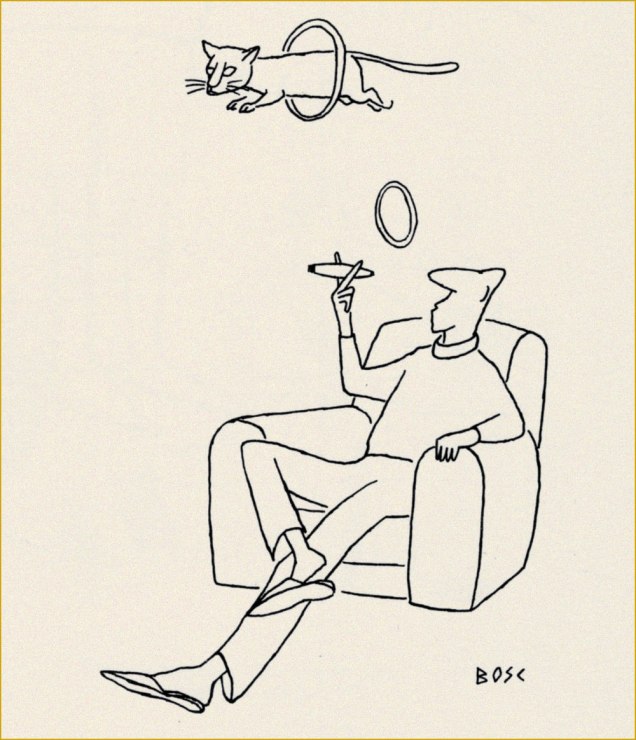
Originally published in Paris-Match, this one landed successfully in Best Cartoons From Abroad 1955 (Crown, 1955; Lawrence Lariar and Ben Roth, editors).Another Paris-Match cartoon, it was reprinted in Best Cartoons From Abroad 1958 (Crown, 1958; Lariar and Roth, editors). Sometimes gallantry just isn’t enough.
Jacques Sternberg wrote, in Les chefs-d’œuvre du dessin d’humour (1968, Éditions Planète):
« Returned in a highly weakened state from Over There, Bosc, resigned to forced rest, began to draw after falling in love with the drawings of Mose and Chaval. Over a few months, he produced hundreds of drawings, giving the humorous arts, without even realising it, a most singular starkness, a particular line that belongs quite exclusively to Bosc, though it’s been much and often mimicked since.
It was in 1952 that Bosc went up to Paris. Eight days later, a stroke of luck: he lands a whole page in Paris Match, which was to turn him into one of the magazine’s stars. »
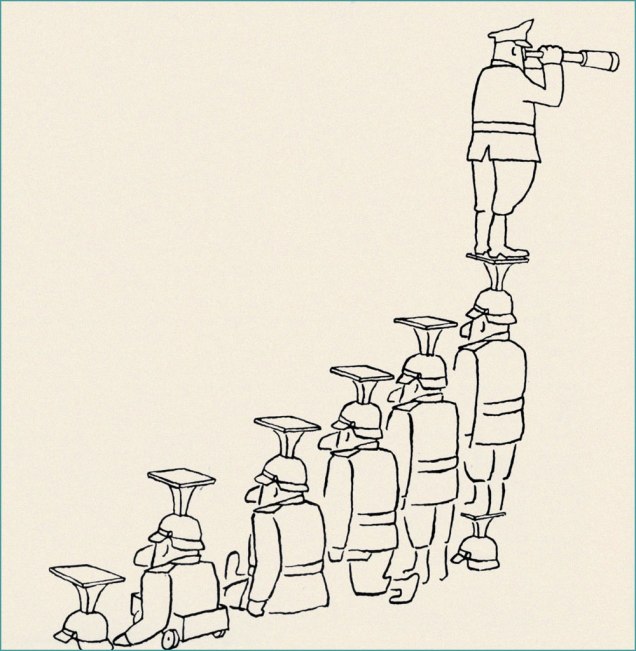
Hierarchy explained in one picture.The Touring Club de France (1890-1983) was a French social club devoted to travel, founded by enthusiasts of the vélocipède. We are told to « Please leave this place as clean on leaving as you would like to find it on entering », although ‘en vous retirant‘ might be more faithfully translated as ‘upon pulling out‘.
« After spending three years mindlessly obeying orders, two of which in the Vietnamese jungle, Bosc was severely traumatized. “After what I’ve witnessed in Indo-China“, he wrote, “I could no longer eat or sleep, ever.” He later told his sister that he had shot dozens of fellow soldiers, saw gruesome fights and, while imprisoned, heard prisoners being tortured. She recalled that he could no longer stand loud noises and got furious whenever she wanted to kill a mere spider. Bosc became a lifelong opponent of war and militarism. »
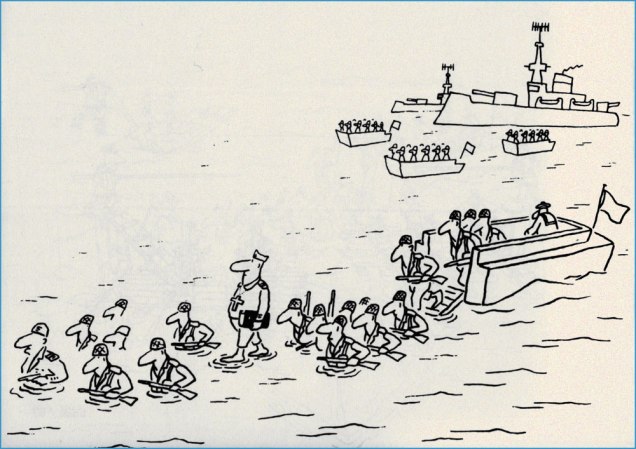
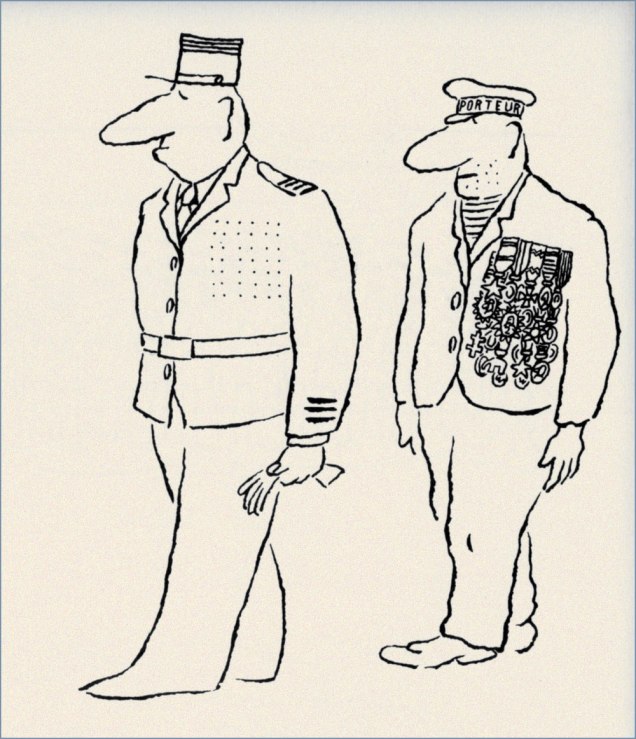
Just in case anyone’s not yet familiar with the Venus de Milo…The feat of walking on water is actually not strictly associated with Christian myth: ninjas also reportedly do it. « Porteur », as you’ve surely surmised, means ‘porter’ or ‘carrier’.
Like most of his friends and colleagues, « … Bosc had lived through the Nazi occupation in World War II. After the Liberation, he felt disgusted by his country’s attempts to keep subjugating their overseas colonies to similar oppression and exploitation. President Charles de Gaulle was the sum of everything they hated: a conservative politician who didn’t agree with the growing sentiment of anti-colonialism, the sexual revolution and disregard for Church, army and family values. Bosc often ridiculed De Gaulle in his work. Once, the cartoonist was fined 3,000 francs, with a month’s probation, for daring to mock the army in a magazine. Bosc’s work revealed he had no respect for politicians. Interviewed by Paris Match in 1965, Bosc claimed that Alexander the Great was his “favorite great statesman, since he died at age 33.” » [ source ]
A stellar example of military logic.
This way, at least *everyone* gets to keep dry.
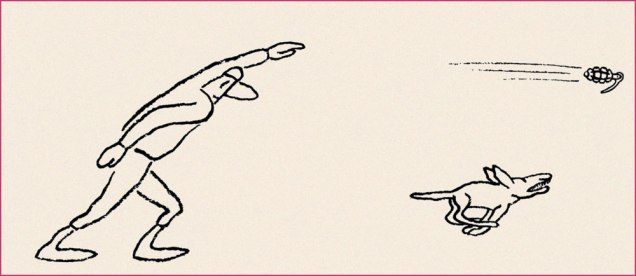
Here’s a video of a guy launching a hand grenade into a frozen lake. This one just might be Bosc’s single best-known cartoon. It goes: “My castle”; “My mill”; “My dog”; “My car”; “My farmer”; “My wheat”; “My bull”; “My wife”; “My guard”; “My pool”; “My garden”… “My ass!”.
I won’t gloss over the tragedy of his final years:
« Tragedy struck in 1968, when his good friend and colleague Chaval committed suicide. In June 1969, Bosc had a mental breakdown and was hospitalized. Suffering from an illness depigmenting his skin, he weakened more and more, often to the point of no longer being able to stand on his own two feet. He went in and out of clinics, even tried electroshock therapy, but nothing helped. As his health deteriorated, so did his mood. From 1970 on, he basically quit drawing cartoons. In 1973, the depressed cartoonist went to his garage and shot himself. He was 48 years old. »
Despite his having left us over half a century ago, Bosc is remarkably well-remembered. His Lambiek biography, written by Belgian cartoonist Kjell Knudde, is richly detailed and informative. His official website, hosted by Bosc’s devoted nieces and nephews, is a marvel of commemoration.
« Whoever digs Stine is out of his mind! Just how disturbed can Stine be? And who the heck understands his stuff? Not me. » — H.C., Hollywood (not an understanding sort)
I must open this post with a thank-you note to my past self, for picking up, decades ago and who knows where and on a whim, a somewhat pricey book by a cartoonist I’d never heard of, Richard Stine. Obviously, just because he was unknown to me doesn’t mean he’s not a known quantity. Let’s just say he has his devoted fans, and I quite understand their passion.
This is the book in question, Sparks by Stine (1982). It seems to have been intended for self-promotion (in the sense of seeking assignments, that is), given the inscription it bears: « THIS PORTFOLIO IS NUMBER ___ OF A SPECIAL FIRST EDITION PUBLISHED BY THE ARTIST ». Mine’s number 433, and the date of November 15, 1982 appears below Mr. Stine’s signature. I believe a paperback edition of Sparks — with a different, full-colour cover — was published a few years later. That one’s easier to get.Excerpts from letters to the Los Angeles Herald Examiner, where most of the drawings in this book first appeared: « … just wonder in what kindergarten “Stine” studied drawing? And how much marijuana he smokes before dreaming up his alleged “cartoons”? » — R.K., ArkadiaA zinger of a riposte: « Even my children, aged five and three, understand Stine. Their reactions aren’t vehement, they enjoy the simple drawings. And they don’t even smoke marijuana! » — M.H., San Diego« … it is stupid, insipid, has no rhyme nor reason, and so very disgusting. His humor is indicative of a thoughtless mind. By the way — what DOES he use for brains? » — Ms. R., Los Angeles « … Stine’s drawings do mean something — he shouldn’t have dropped out of art school in his first year. » — P.H., Hollywood« I demand you review Stine’s employment, comparing his productivity with the detrimental effects of his abusive creations. » — R.W., staff writer, UCLA Daily Bruin« … while you have one of the best, if not THE best cartoonist in the country, namely Karl Hubenthal, you also have one of the lousiest, if not THE lousiest cartoonist in the country, namely Stine. » — C.H., Glendale« … will you PLEASE provide us with ” A key to the understanding of Stine” in the same way that the Rosetta Stone enabled us to “read” the Egyptian hieroglyphics. » — Mr. and Mrs. L.C., Los Angeles « You’re wonderful! Only those living in ignorance fear your “message.” It’s like getting nasty for the first time: once you go through the one-way door, you’ll never be “nasty” again! I adore you. » — K.I., Venice
I won’t try to dig too deep into Stine’s oeuvre, as others — fellow blogger Ann Canright, for one — have already done a splendid job of it. What I have learned by now is that he was, circa « … a former cartoonist for the now-defunct Los Angeles Herald Examiner*, publisher of cards and author of two books… [ then ] became a full-time painter. »
And thereby hangs a tale, as the saying goes:
« Five years ago I decided to go back to painting. I started really small because I was used to working that way for publishing », Stine said. « I was working with magnifying glasses on my head and thought, ‘I need to get up and breathe and walk.‘ »
He pushed away the 3-inch-by-3-inch canvases and liberated himself size-wise, design-wise and attitude-wise. He stretched a canvas that « was bigger and taller than me », he said, and immediately felt free. [ source ]
He had by then moved from California to Bainbridge Island, in Washington state. And then… on to New Zealand, homeland of his wife Margaret. « Richard, now in his 80’s is still experimenting, exploring and creating and boy does it show in his playful spirit. » [ source ]
-RG
*Do read the history of the LA Herald Examiner if you get the chance… gripping stuff, imho.
« Well, that was the silliest tea party I ever went to! I am never going back there again! » — Lewis Carroll
One more item unearthed while rummaging through my unsorted boxes: a couple of back issues of The Funny Times, one from 2010, the other 2013. The former held a fascinating exercice by Herblock prize winning cartoonist Ward Sutton, skewering and subverting the conservative ‘mindset’ from within. Not an easy trick to pull off convincingly, I would think; yet it’s one of Sutton’s specialties, having honed it to perfection — of a sort — as The Onion‘s longtime political cartoonist (since 2006), fictive curmudgeon “Stan Kelly”. Here’s a trove of Kelly pieces, which The New Yorker deemed “brilliantly terrible”.
Remember the Tea Party? Of course, B.P. barely feels like parody, given B.C. creator’s Johnny Hart mesolithic views. A couple of samples from a 1999 interview: « Jews and Muslims who don’t accept Jesus will burn in hell », « Homosexuality is the handiwork of Satan ». [ source ]Ah, yes — that nonsense about Obama’s birth certificate, another MacGuffin in a seemingly endless parade of conservative bugaboos.By most accounts, Herbert Hoover was a pretty lousy president, though everything’s relative. Another fine myth, that of a liberally-biased media. Teanuts goes right back to the first Peanuts strip (Oct. 2, 1950) for its inspiration (though not its aspect ratio, for some reason).Here’s a pearl: « simply, homosexuality can be healed. That is, a homosexual can become a heterosexual; the homosexual orientation can be changed through prayer for inner healing and the power of the Holy Spirit. ». [ source ]Again, Diligent-Bert hews so close to its model that it might easily pass for an actual Dilbert strip.
The feature was accompanied by this deadpan caveat: « EDITOR’S NOTE: Ward Sutton, an elitist who lives in the elitist New York area, is a cartoonist, illustrator, animator and painter who has recently been lurking about the back of Tea Party gatherings, stuffing his pockets with American flag cookies, and brochures for camouflage underwear and mail-order ammo. Superpatriot and regular guy cartoonist Joe Smith disavows any knowledge of Mr. Sutton and his ilk. Need I say more? »
« I find vocabulary to be a great drawback. » — Elizabeth Taylor
I think most of us will concur — sorry, Liz — that a rich vocabulary is a useful asset on multiple levels. And in riding with that particular train of thought, if a new year brings new goals and resolutions to achieve them, what could be more judicious and feasible than picking up a handful of new words… and their proper meaning?
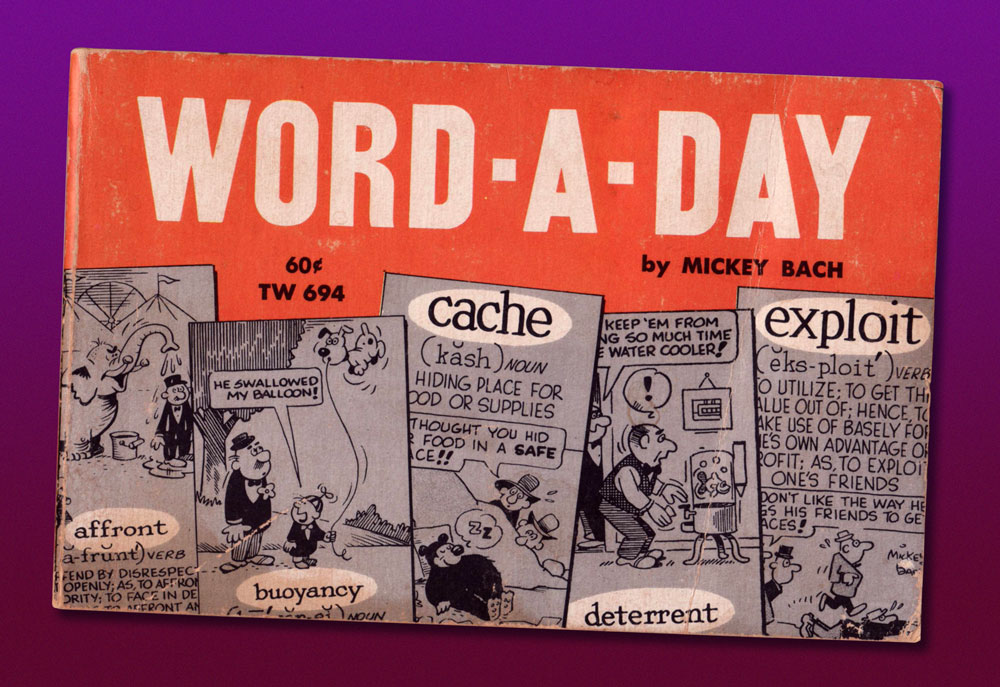
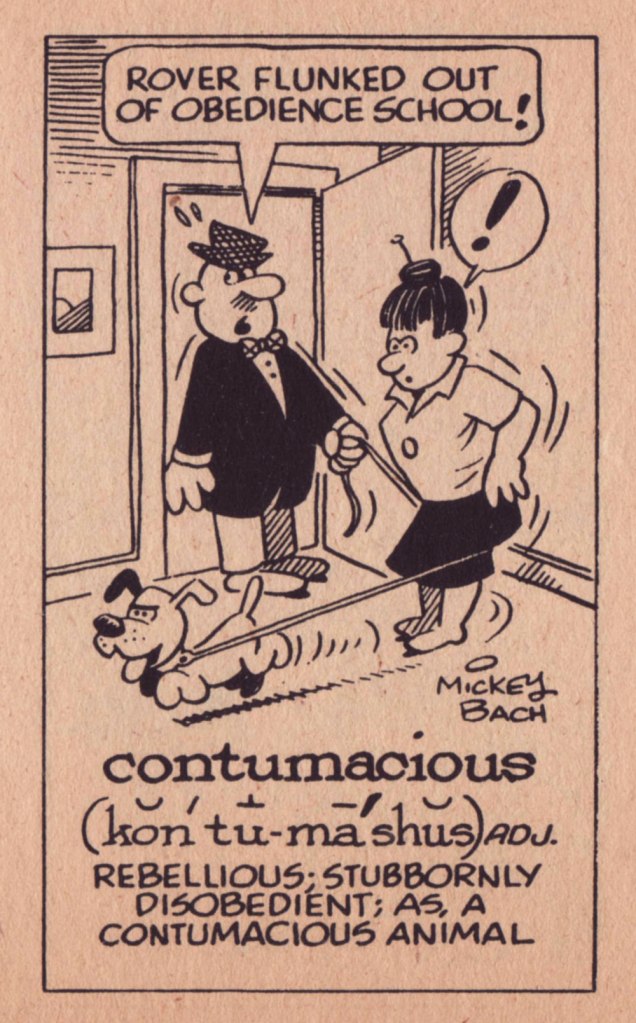
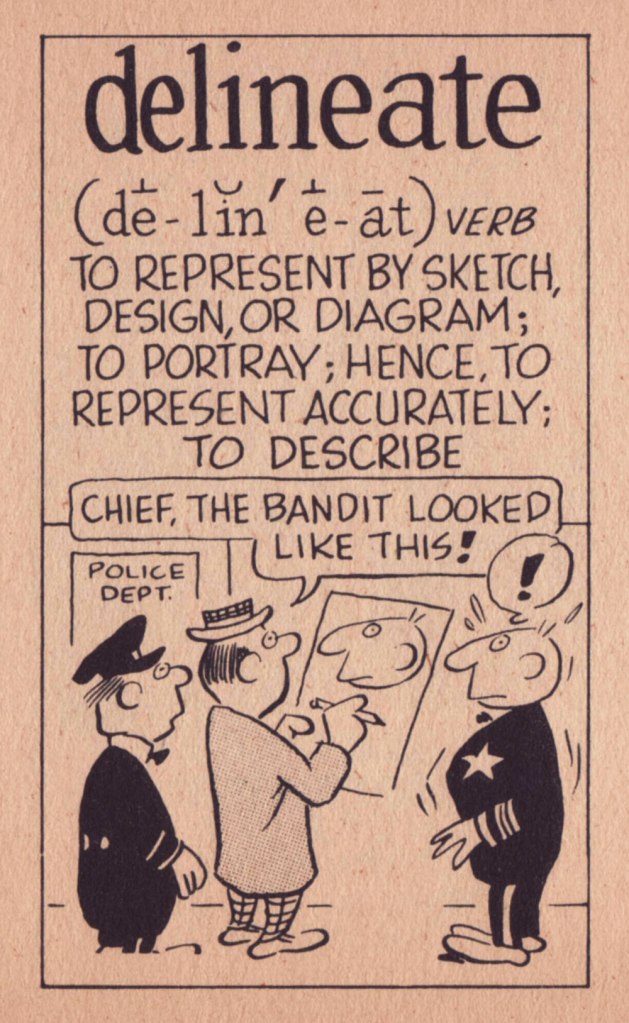
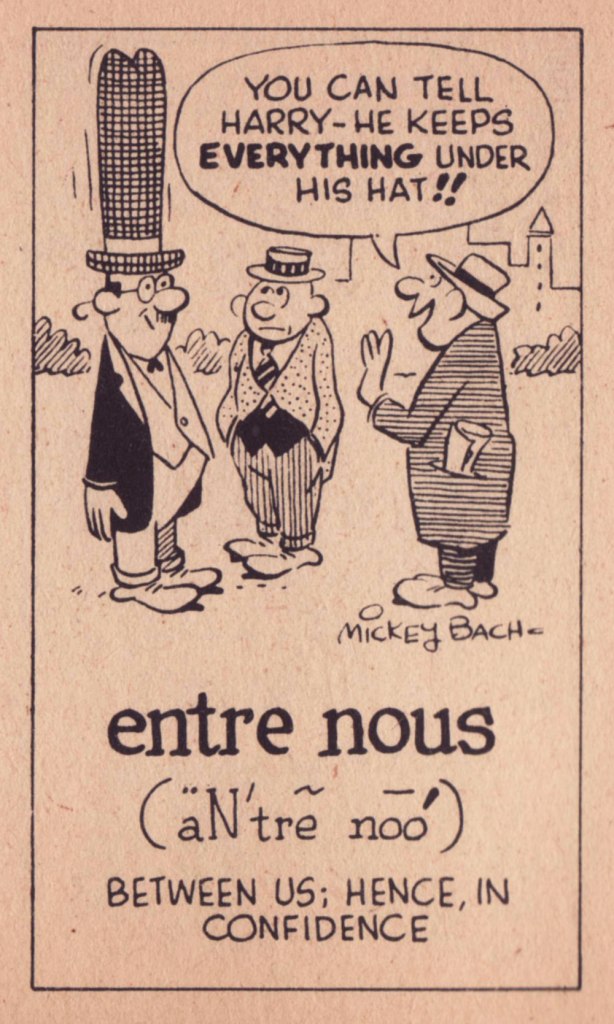
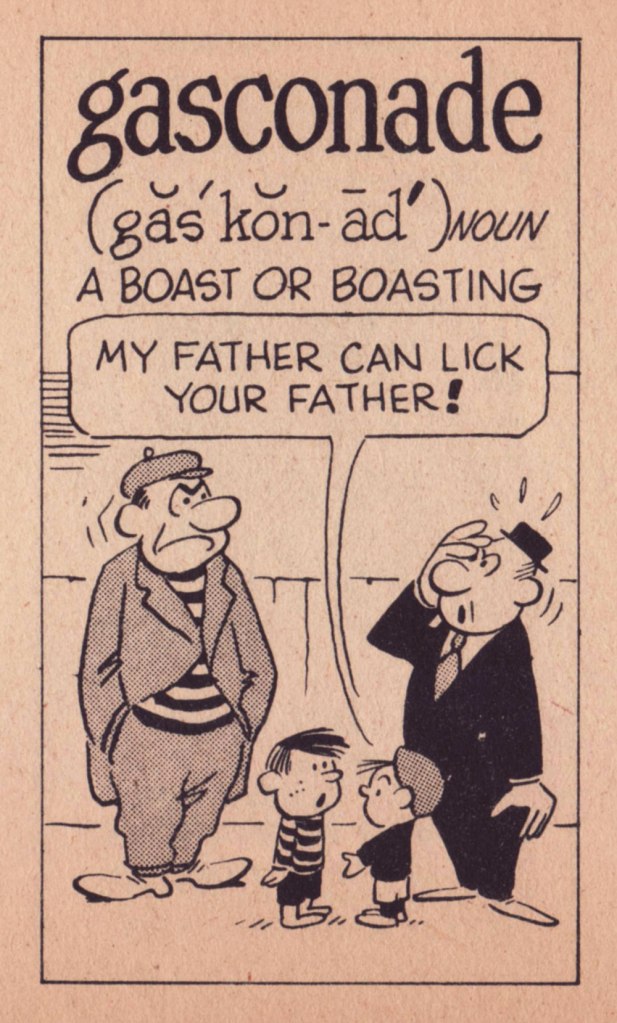
Cartoonist Mickey Bach (1909-1994) made it his mission to help the newspaper-reading masses bone up on unusual vocables. While he’s never ranked among the cartooning greats, the premise of his feature, Word-a-Day, was a rock-solid one, granting the panel a healthy run from 1946 to 1979, first with the Publishers Syndicate until 1967, when it merged with the Hall Syndicate*.
It’s also worth noting that, for a feature that’s been officially defunct for some forty-five years, it’s a pretty lively one: an admirably devoted and industrious fan has kept the Word-a-Day flame alive with the Word A Day Revisited Index. Kudos!
As far as I can tell, there was only one Word-a-Day collection published, but it was a successful one. First published by Scholastic Book Services in 1965 and comprising selections from 1960 to 1963, it received at least four printings through 1972, this being the fourth, from April of that year.
Let’s see what lies within, shall we?
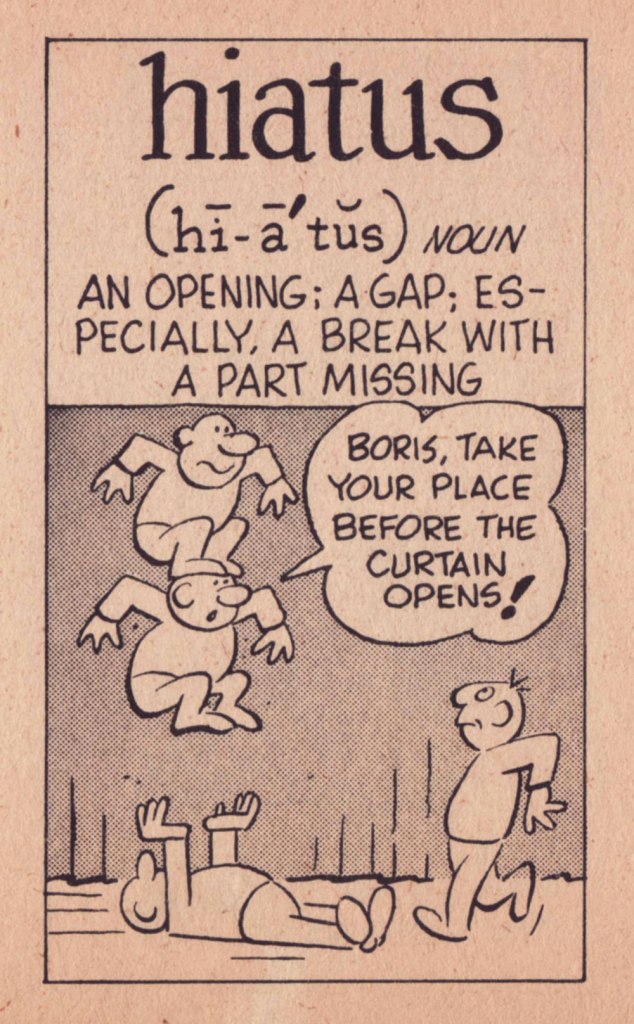
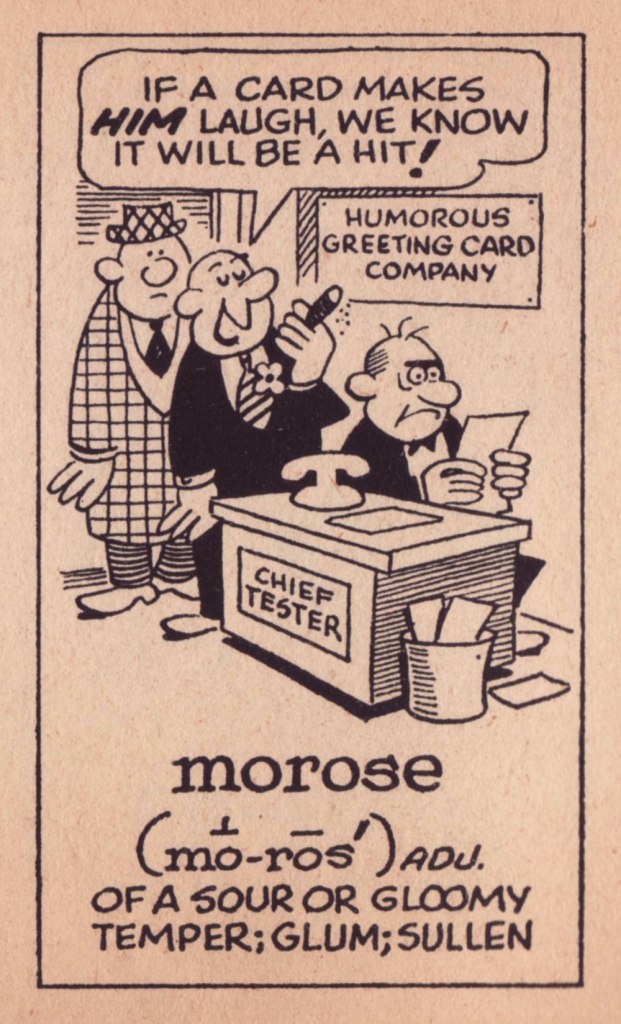
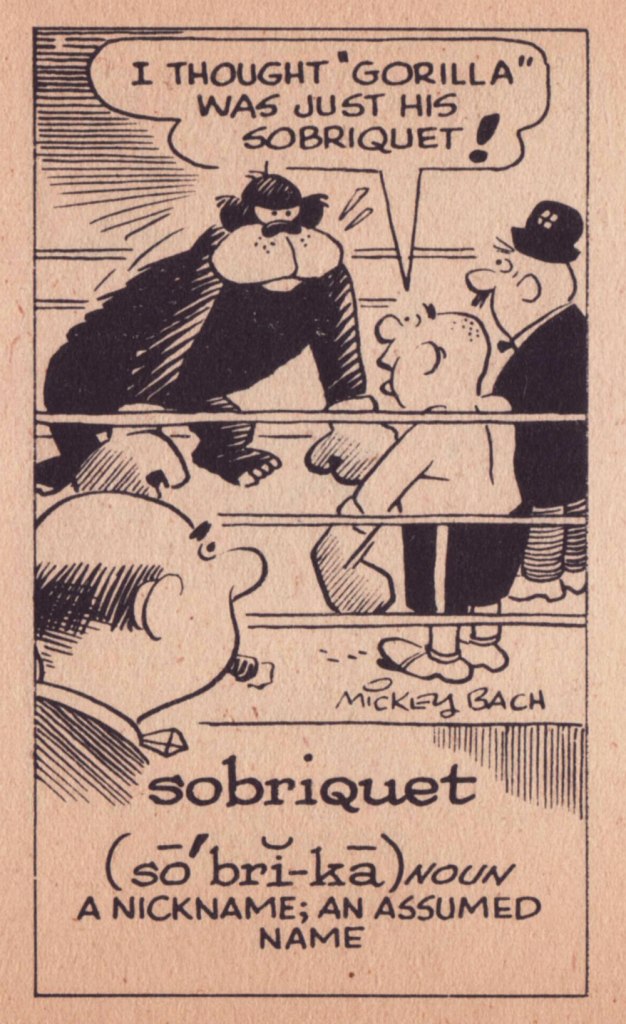
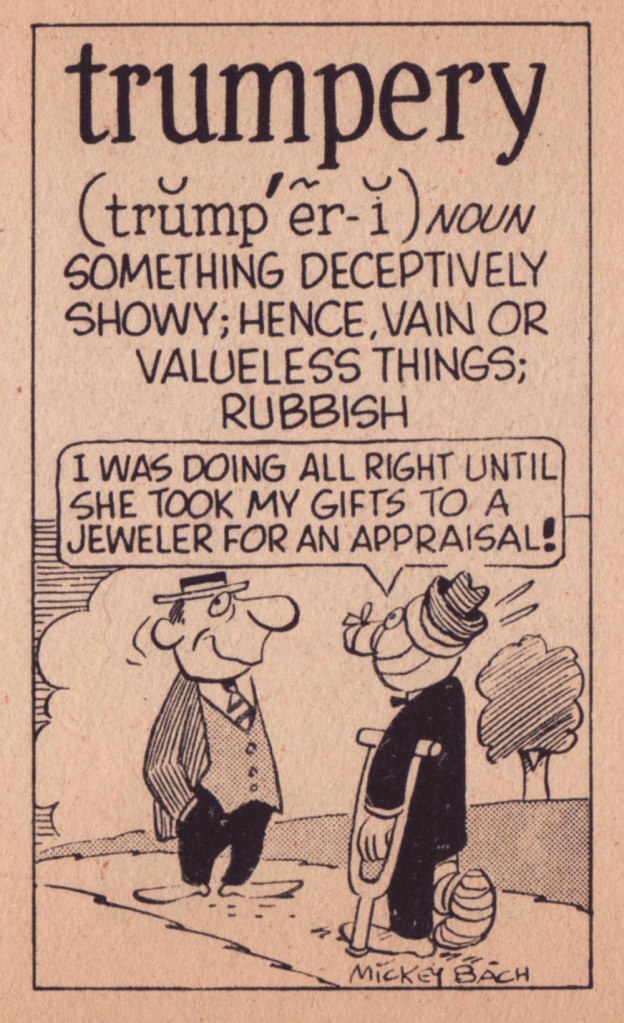
Part of the nostalgic fun in these images is their reliable repertory company of cartooning archetypes such as sandwich men, hobos, boxers, cranky bosses, talent agents, bearskin rugs, door-to-door salesmen, masked burglars, beret-sporting artistes…Ah, yes: that nagging feeling that we, as a society, are somehow regressing rather than progressing.Bach had a somewhat generic, but pleasant and competent cartoon style, wherein I detect the great Bill Holman as a principal influence. Bach clearly was a man of discernment.Don’t be that boorish chump: here’s a handy guide to tipping étiquette from no less an authority than Emily Post (not to be confused with Emily Ghost). This one’s a particular favourite of mine, having had to correct its misuse time and again; apparently, some people have surmised (without checking, naturally) that ‘fulsome’ means, ‘full’, only more so and in a fancier way. No, guys, ‘a fulsome investigation will be conducted‘ does not signify what you think it does. Derived from the French ‘Gasconnade’, which refers pejoratively to the speech of denizens of the Gascony region. « Speaking with the Gascon accent, which is to say accentuating silent ‘e’s, and letting ring out several final consonants that the French leave silent. »I find this one particularly clever.This one’s considered archaic nowadays — when it is considered at all — though its close relative, insipid, endures. Not to be confused with its homophone, incipience, which refers to the beginning of something.Sadly, Gorilla will likely pound the erudition out of that unfortunate pugilist.Here’s a sentiment most reasonable the world over are currently experiencing, to their chagrin.
« There could be no jealousy/over my poetry/it’s my weakest quality/no vocabulary » — Todd Rundgren, Chapter and Verse
From both of us at WOT?, thanks for your continued support and interest, and may the coming year bring you as little as possible of what you’re dreading.
In 1967, Field Enterprises acquired Robert M. Hall‘s New York-based Hall Syndicate, merging it with Publishers to form the Publishers-Hall Syndicate. » Phew.
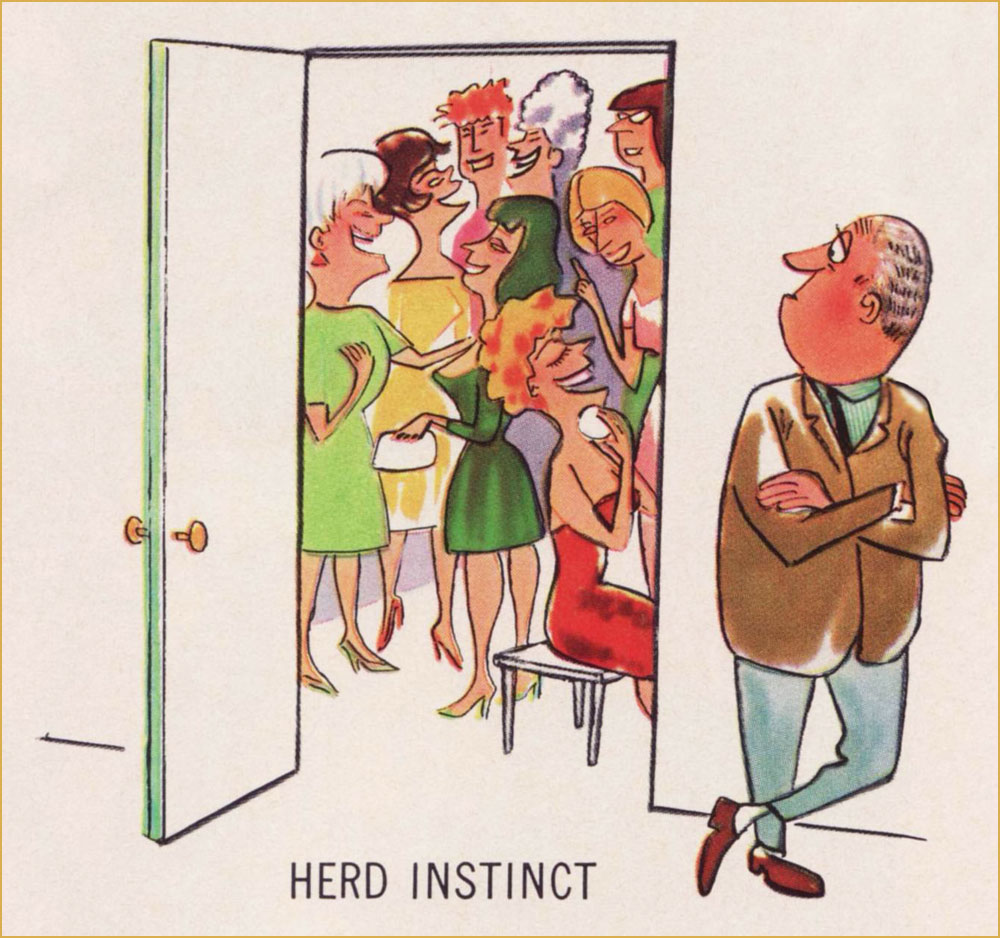
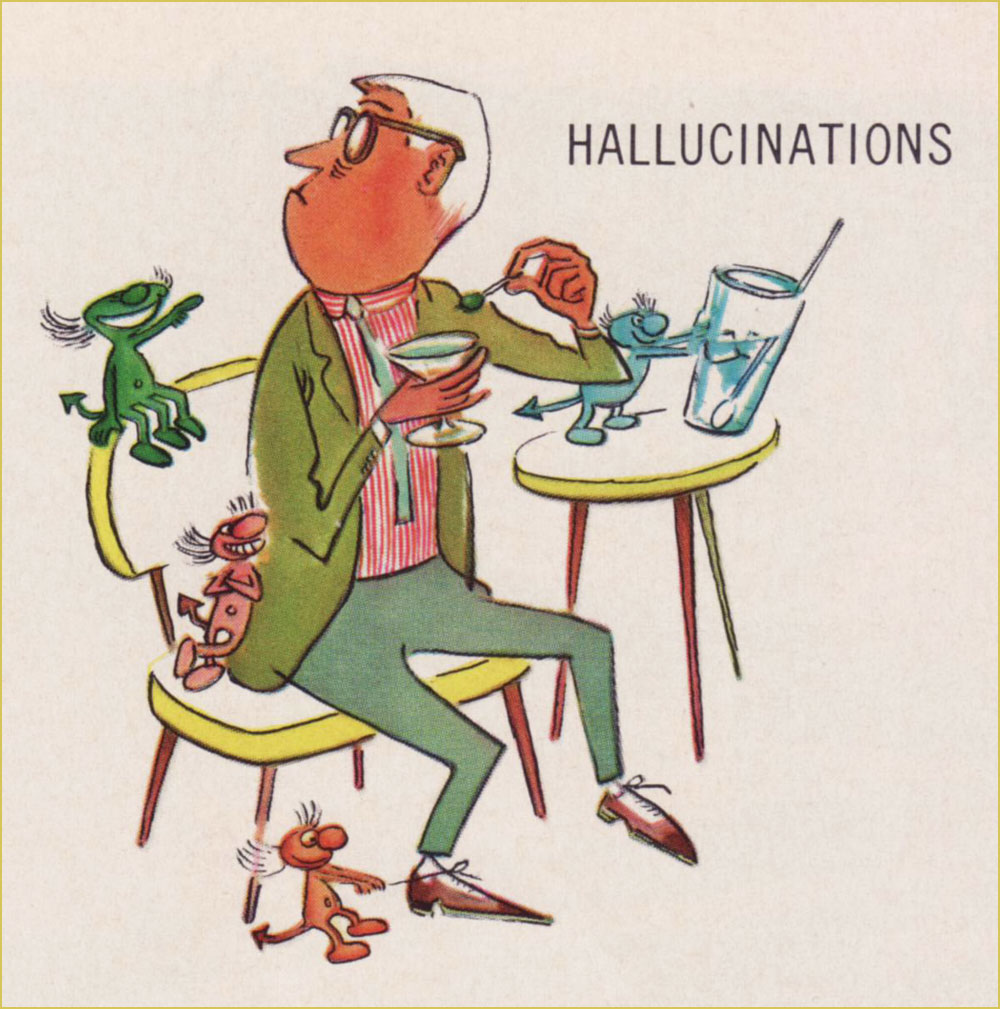
« If Freud had worn a kilt in the prescribed Highland manner he might have had a very different attitude to genitals. » — Woodrow Wilson
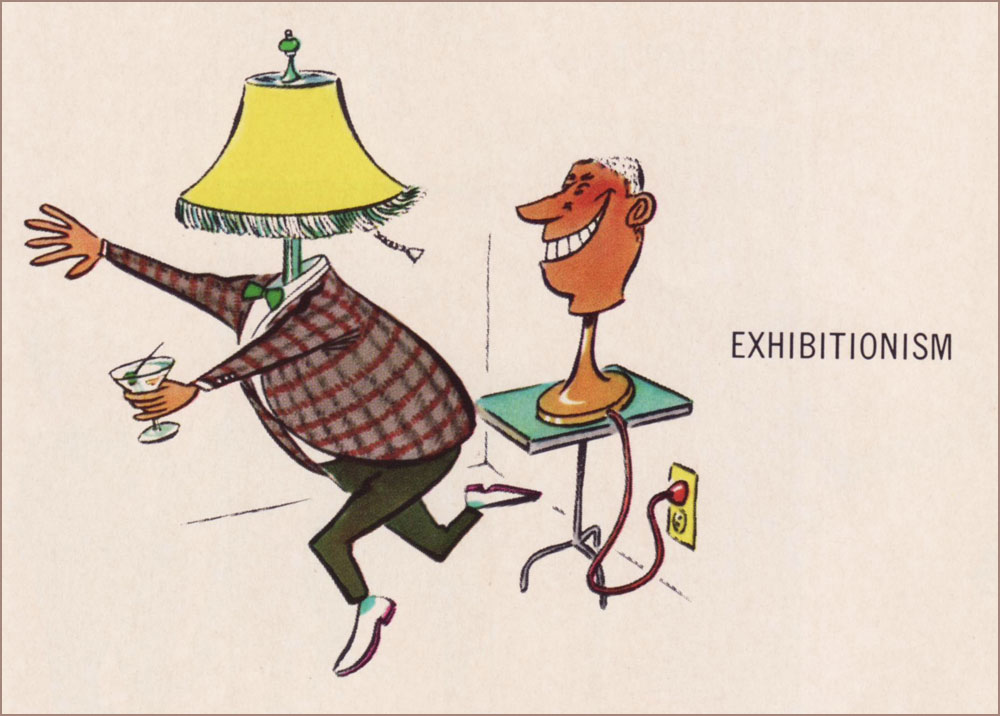
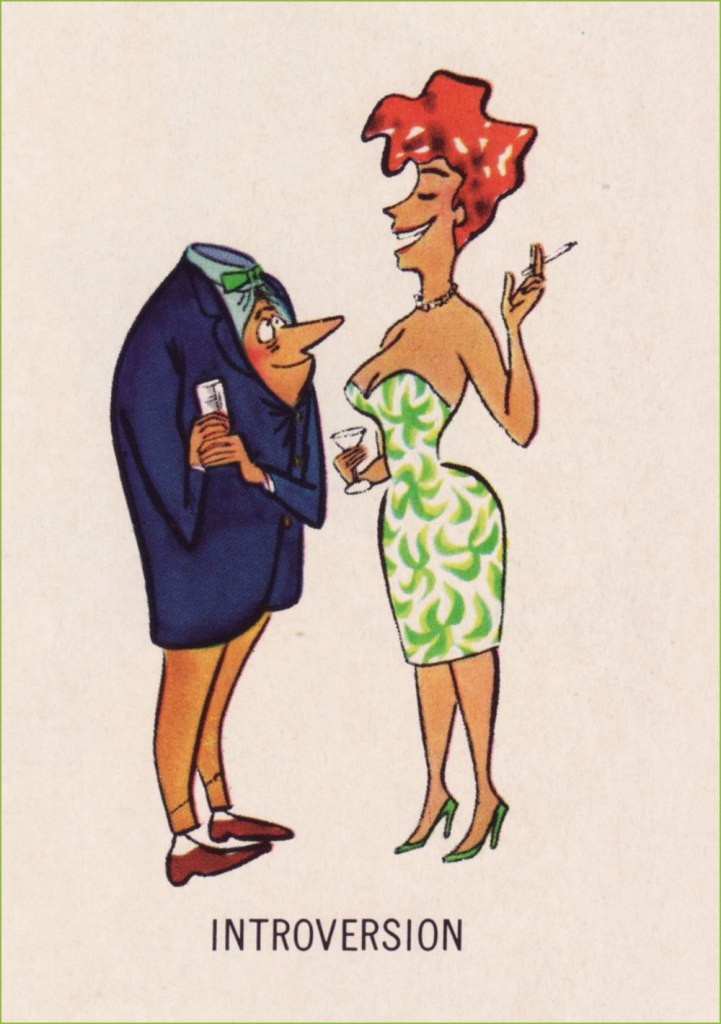
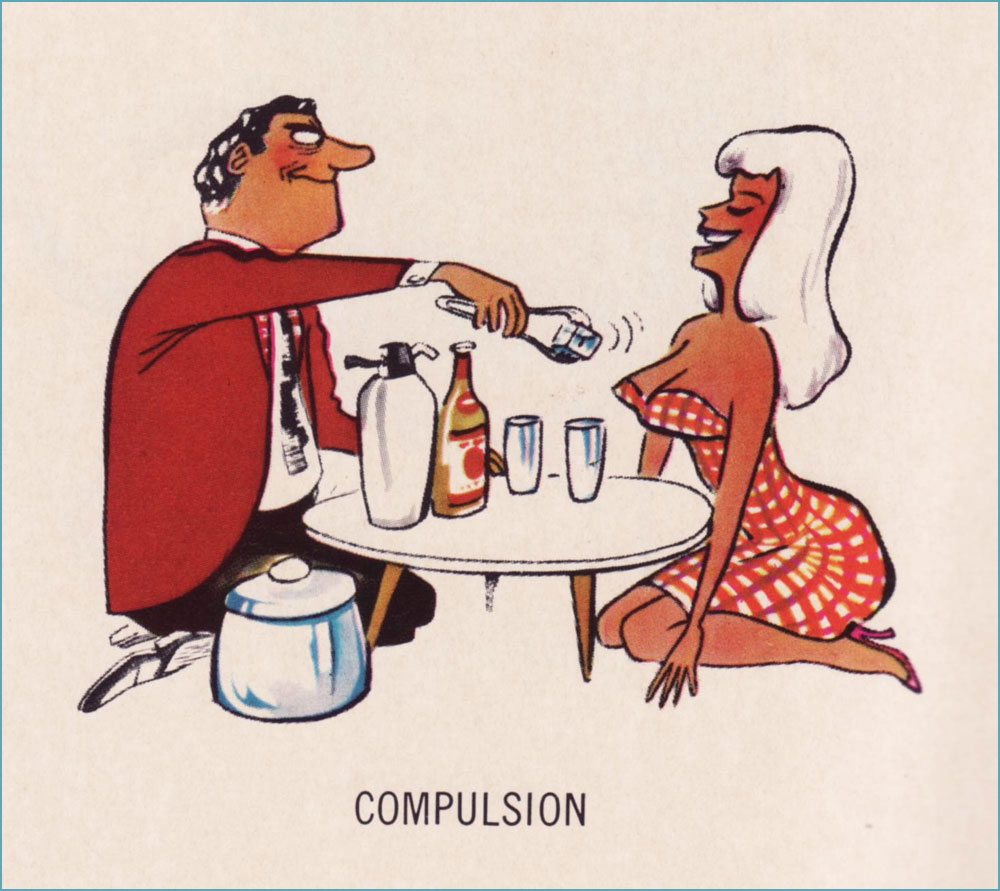
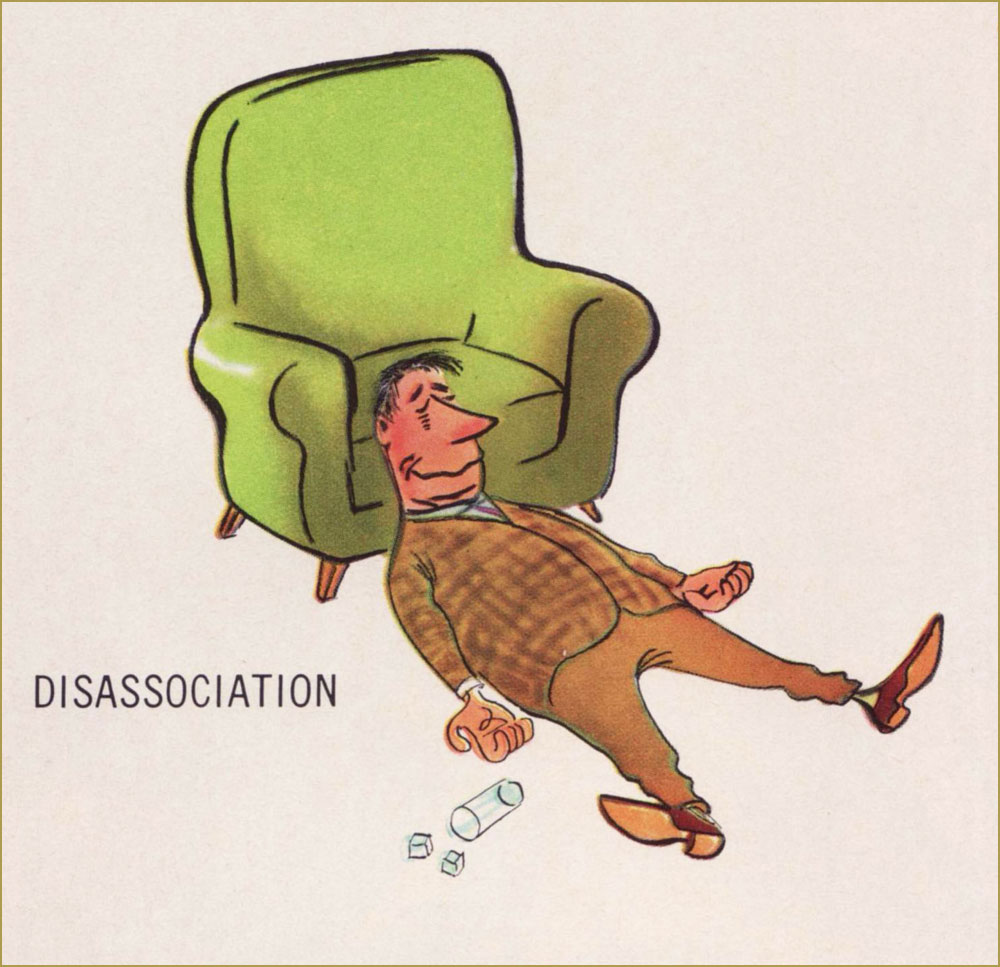
Let’s talk about your drinking.
Aw, just kidding: that’s your business and none of mine. There’s certainly no shortage of reasons — or might these be excuses? — for it nowadays. Speaking of which, here’s the recipe for the Freudian Slip Cocktail, which is presumably what ol’ Sigmund is shown energetically mixing up below. Cul sec, friends!
Virgil Partch‘s « Sigmund Freud’s Cocktail Party » originally appeared in Playboy Magazine’s August, 1962 issue.
« Save time and cut fingers with a parsley mincer. »
It seems that oodles of my posts start with ‘I found this book randomly in a second-hand bookstore…’, when ‘retrieved from the bottom of a dusty chest in a forgotten attic’ would make for a much more enthralling story. Alas, I am bound to truth… as is Can It Be True? (originally published in 1953 by MacDonald and Co; I have the 3rd edition from 1954), which was priced one measly buck despite its generally excellent condition and venerable age.
It consists of a collection of misprinted and typo’d quotes drawn from newspaper clippings, magazine articles and other paraphernalia, expertly gathered and compiled into a thin volume by Denys Parsons. This by itself makes for an amusing read, but the cherry on the cake is the occasional illustrations by blog favourite Anton (see Anton’s Spivs and Scoundrels, Baronesses and Beezers, if you’re not sure whom this nom de plume conceals).
As seen from a panel inside the book, the man is holding a poster that reads’ SHRDLUS AT IT AGIAN – Evning Srta’
« ... Spread around her was a sun-flooded valley where buttercups nodded lazily in the summer breeze and tranquil cows chewed solemnly at her elbow. » – Western Family Magazine
« Para. 27B. Men employed on quasi-clerical nature should not be provided with any clothing. » – Post Office Magazine
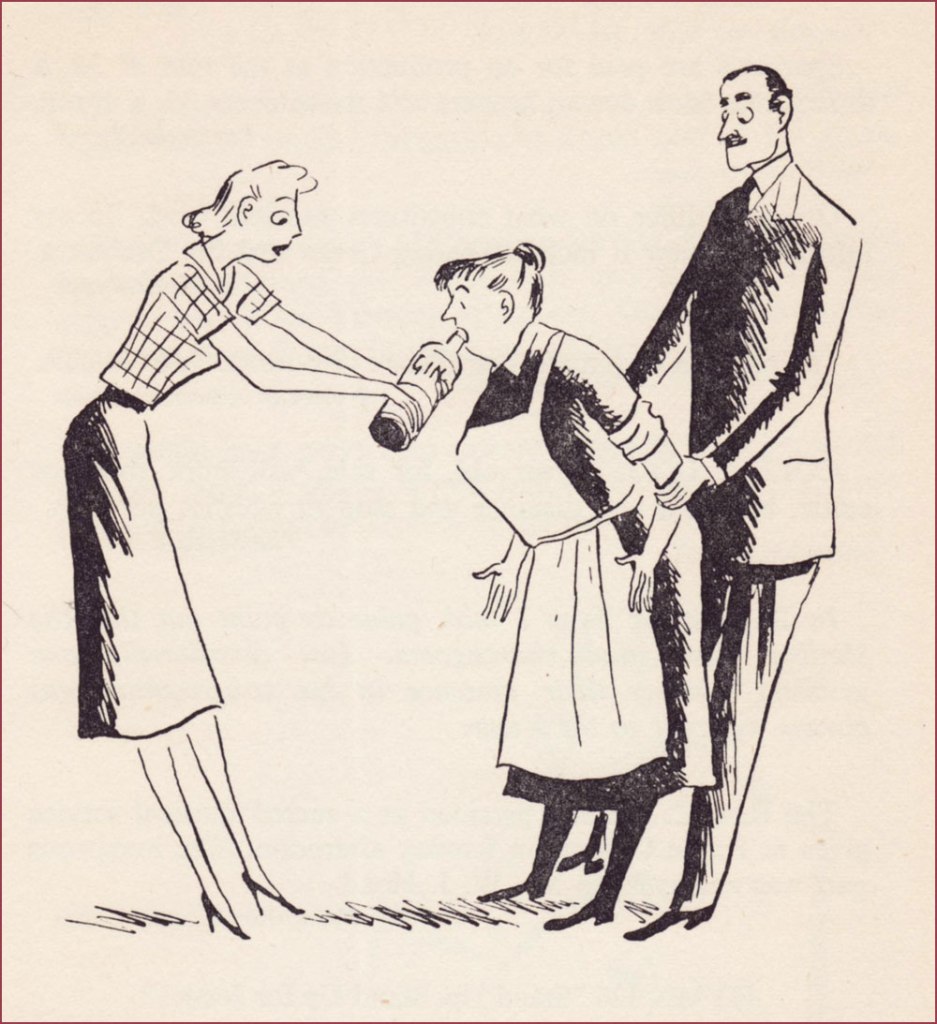
« The best plan is to hold the bottle firmly and remove the cook as gently as possible. » – Woman’s Paper
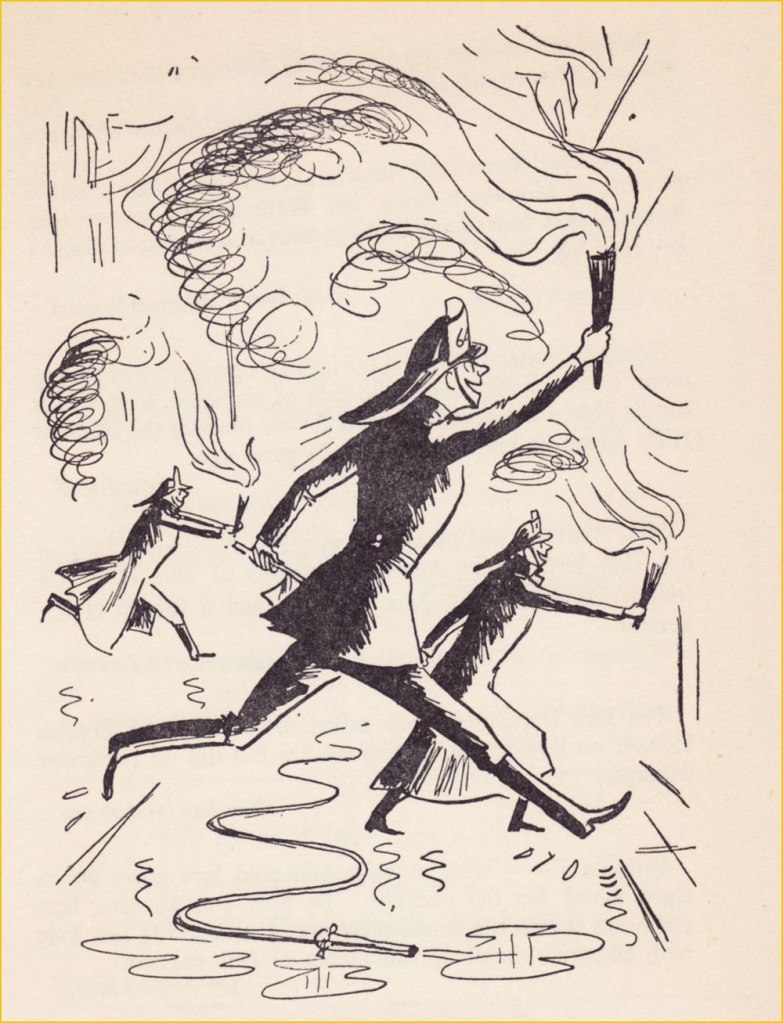
« The flames starting on the third floor of the midwest Salvage Co. spread so rapidly that the first firemen on the scene were driven back to safety and leaped across three streets to ignite other buildings. » – Cincinnati Times Star
« The word lawyer, he argued, was a general term, and was not confined to solicitors, but anybody who practised any breach of law. » – Cambridge Paper
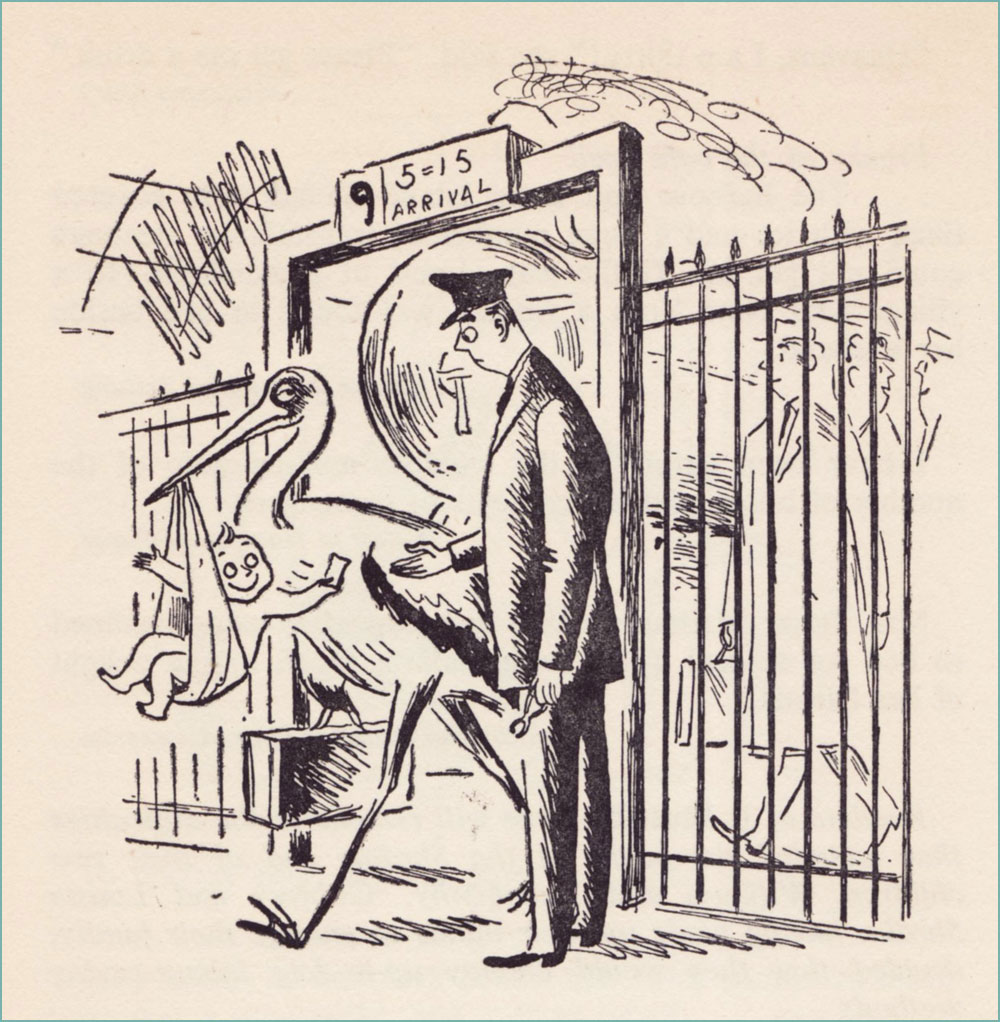
« Mr. and Mrs. Benny Croset announce the birth of a little son which arrived on the 5.15 last Thursday. » – West Union (Oregon) People’s Defender
Denys Parsons, ‘the undisputed king of the misprint’, has a few more books I’m interested in, including another volume of It Must Be True (this one illustrated by Ronald Searle), as well as Many a True Word (another Anton volume!) and All Too True (with drawings by Peter Kneebone). Perhaps another time, another p̶l̶a̶c̶e̶ used bookstore…
« Poison’s not bad. It’s a matter of how much. » — Keith Richards
Regular readers of this blog will perhaps recall my fondness for those little Peter Pauper Press books of Mount Vernon, NY — at least those of the publisher’s halcyon years (1928-1981). I’ve cast a light on their edition of Ambrose Bierce’s The Devil’s Dictionary and, in the course of last year’s countdown, their Comic Epitaphs From the Very Best Old Graveyards.
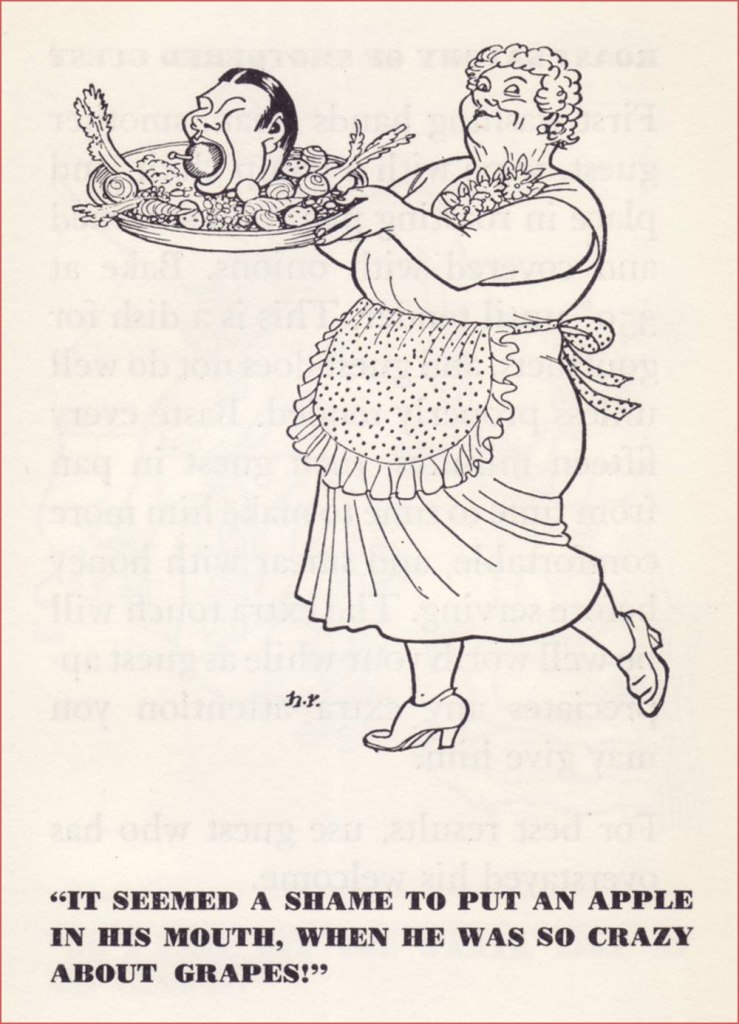
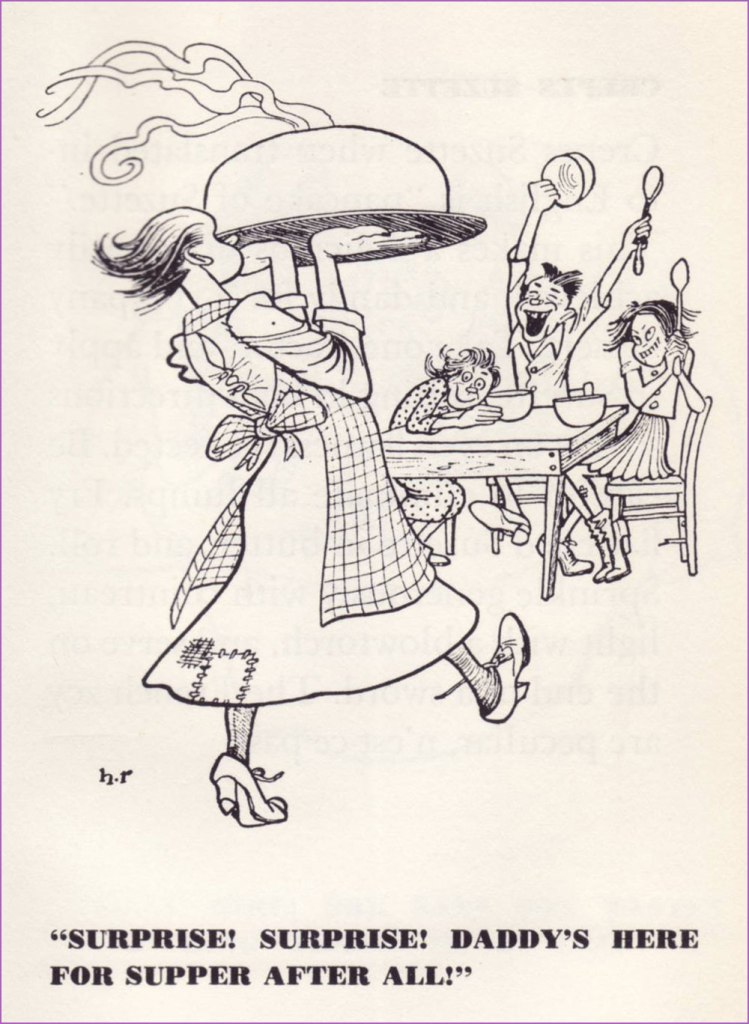
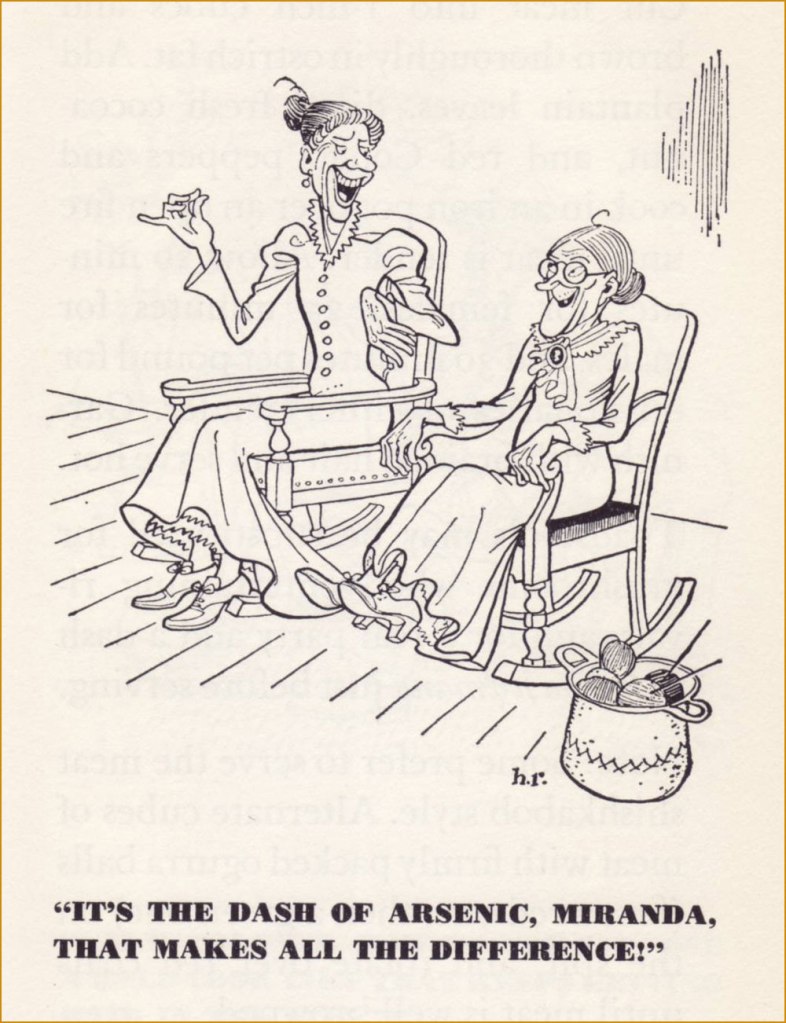
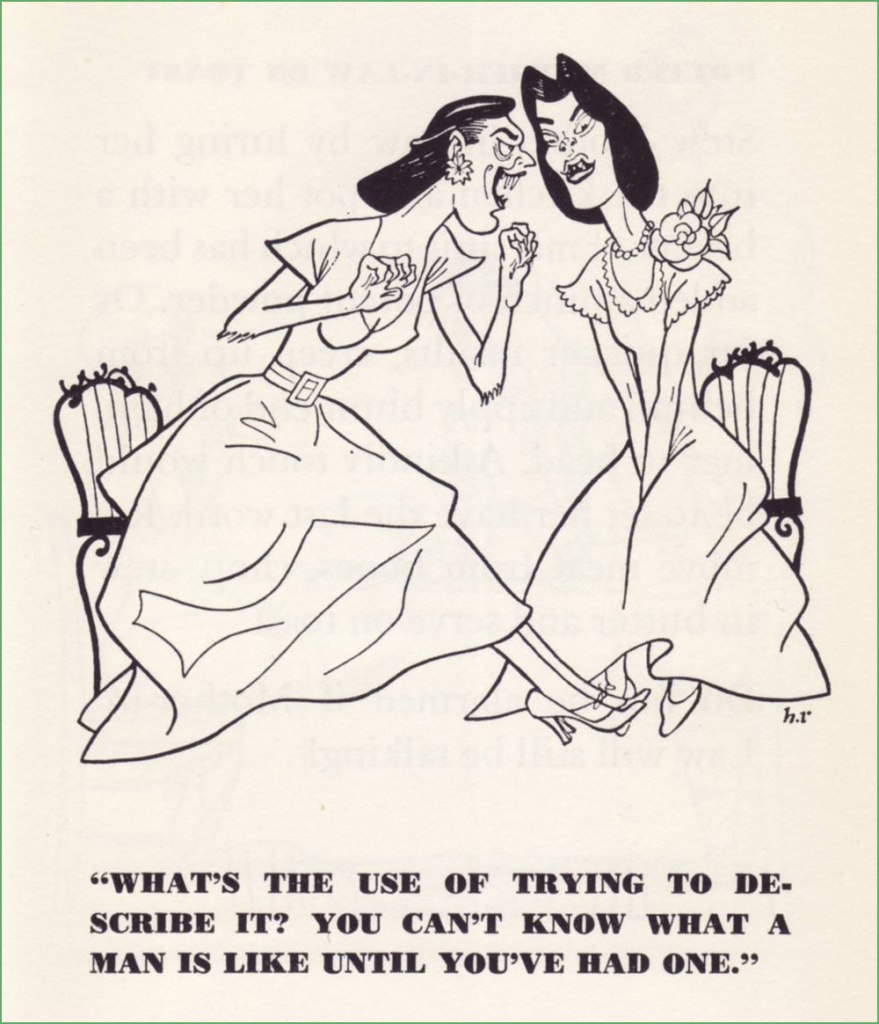
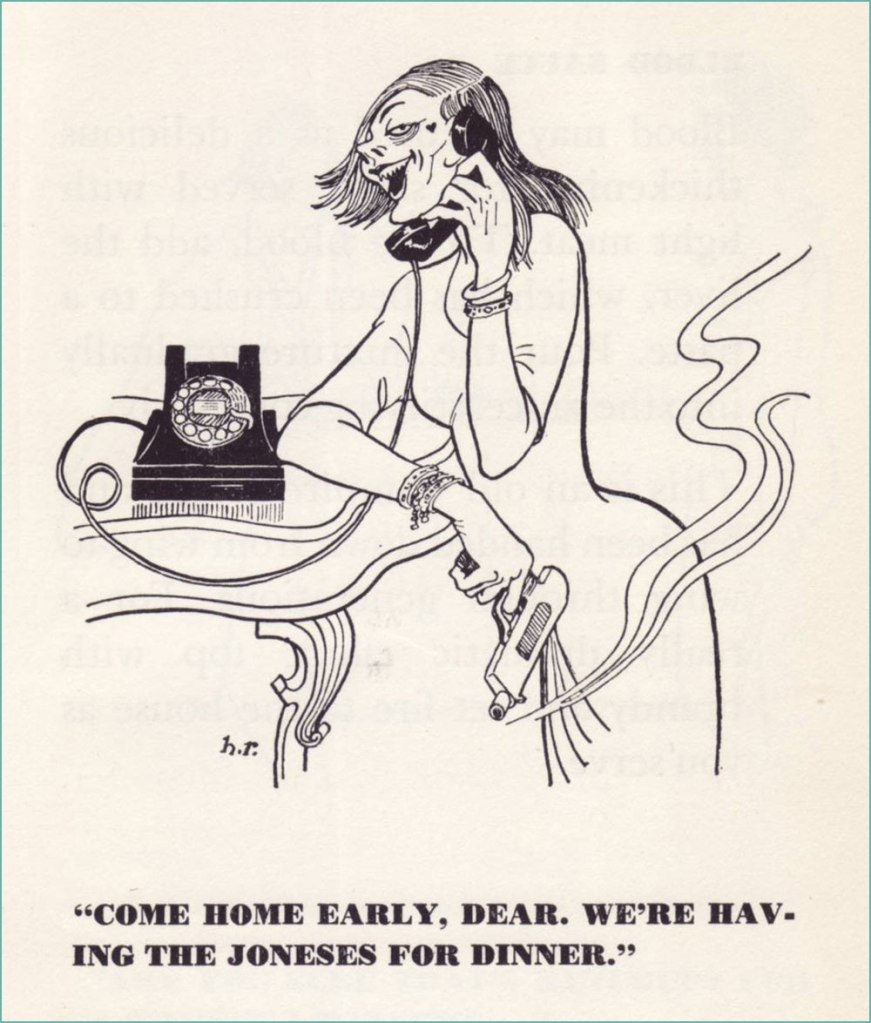
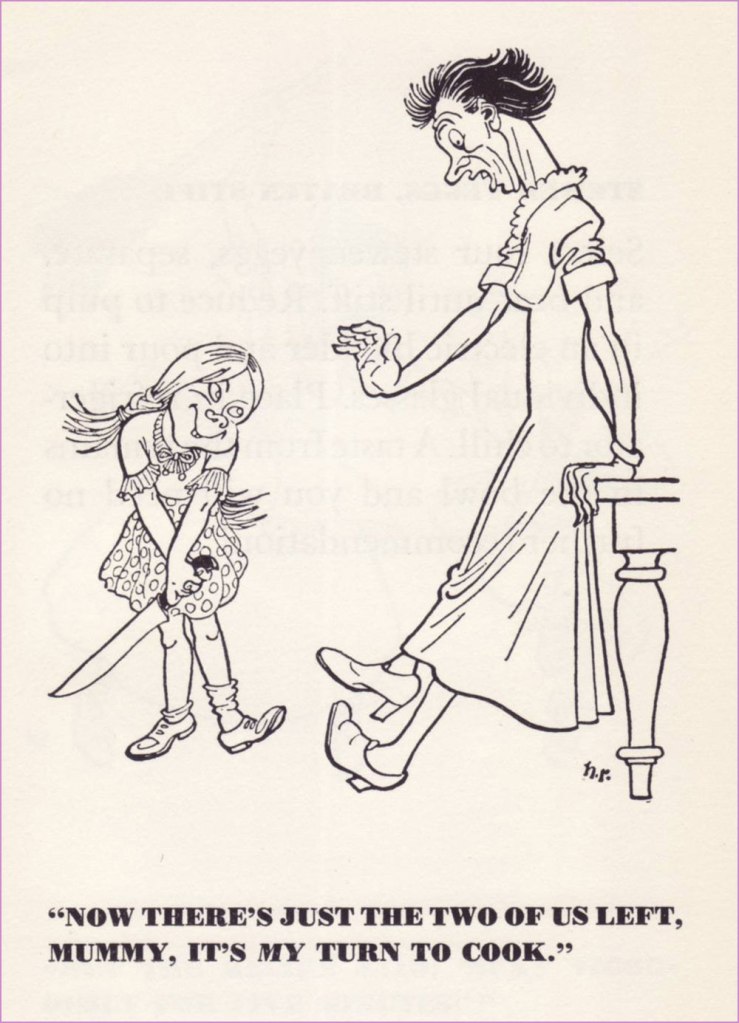
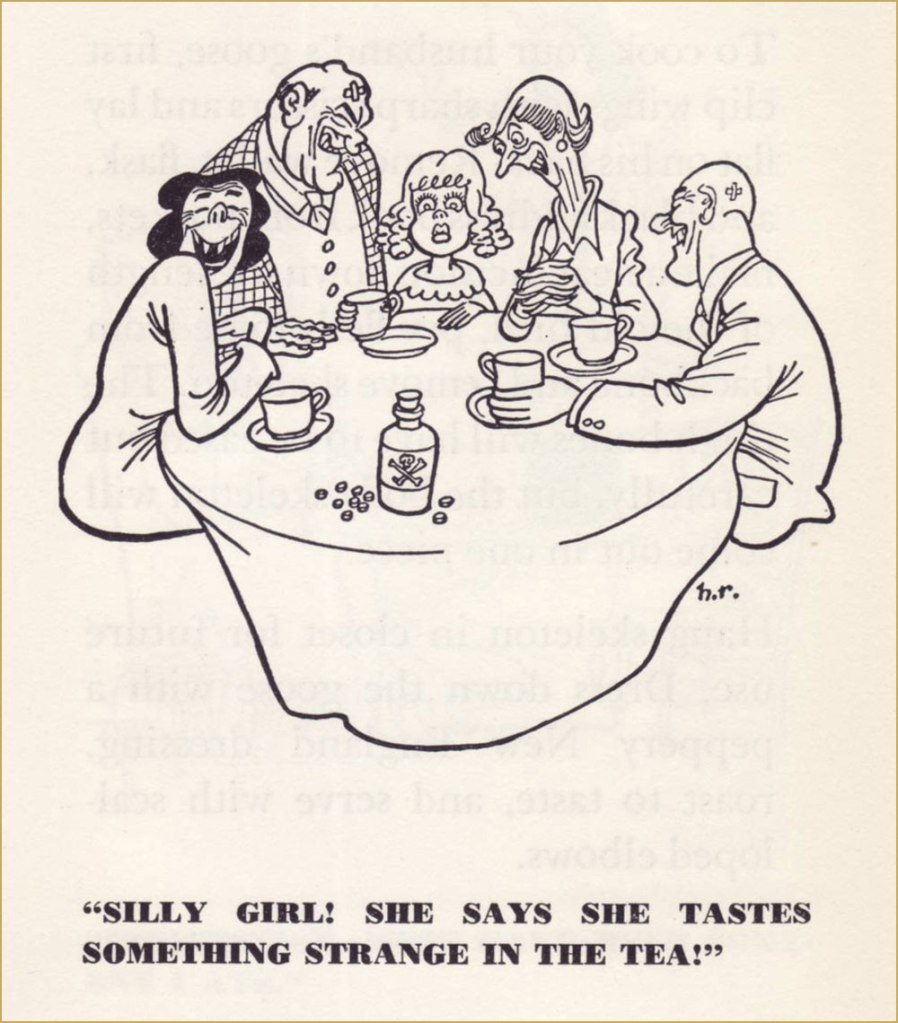
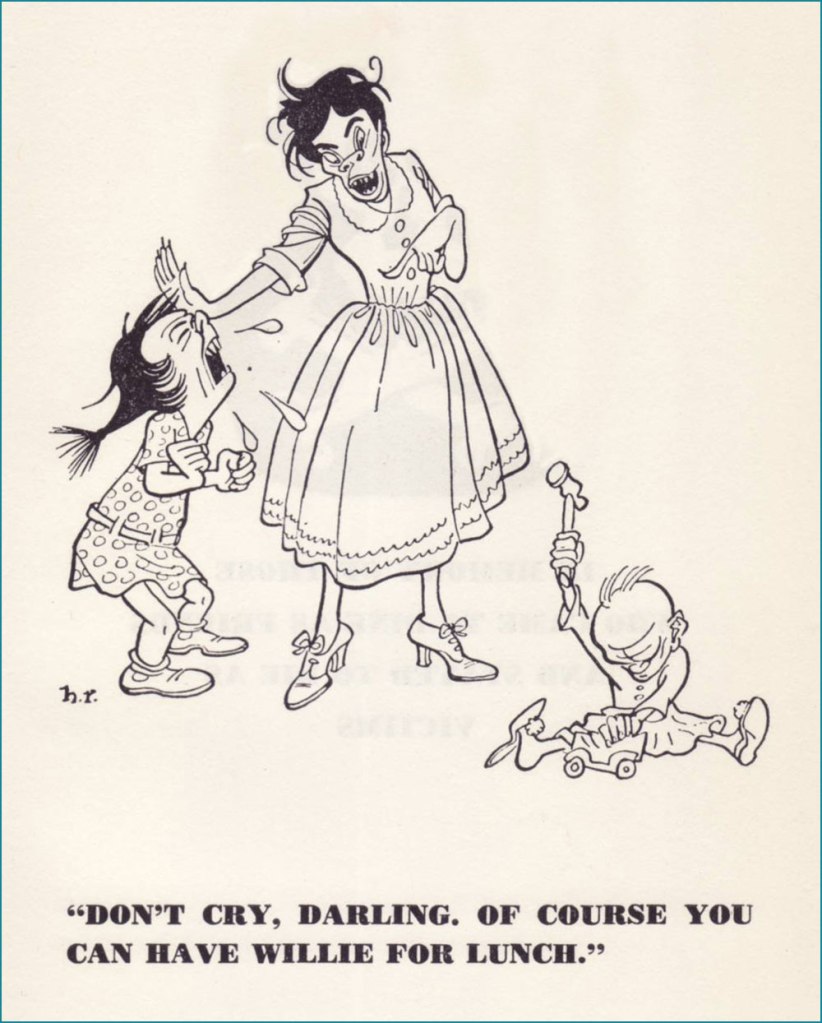
This time around, I’m tackling one of the rare and fairly expensive ones* — that I’m aware of — Cooking to Kill: the Poison Handbook (1951), which proposes « Comic recipes for the Ghoul, Cannibal, Witch & Murderer. Stewing and potting mothers-in-law. Tested recipes for spoiled brats, business rivals, and strayed lovers. »
« Anybody can kill vulgarly. But we should be above the brutal, the direct, the unappetizing approach. This little book will teach you to tickle the palates of your guests so that they will be happy to linger at your table, charmed to malinger, and grateful to take off for the Great Adventure with the taste of your superlative cooking still on their lips! » — from Prof. Ebezener Murgatroyd’s preface to his ‘gentle reader’.
The book is magnificently illustrated by Herb Roth (1887-1953), who spent much of his career toiling as H.T. Webster‘s assistant and ghost. Roth enjoyed a long association with the Peter Pauper Press, illustrating its very first two books, Faithless Sally Brown and Faithless Nellie Gray.
« Head Cheese garni à la Salomé » « Tomato Surprise (Asp in the Grass): this luncheon delicacy should be served only to ladies, as you will find their charming soprano shrieks particularly rewarding. »It’s hard to not think of Joseph Kesselring’s fabled Arsenic and Old Lace, written in 1939.« Walnut Balls: smash nuts with a hammer, fashion into balls and fry in deep fat until a golden brown. Delicious withcoq au vin. »« Chocolate Noose… will help you to execute a crime of considerable chic, and will add a je ne sais quoi to the court proceedings. »« Stuffed Spoiled Brat: select a fine specimen which has been spoiling for a good long time, and capture at opportune moment. » « Crêpes Suzette: take one tractor, and apply to Suzette, rolling in both directions so that an even flatness is achieved. Be careful to eliminate all lumps. Fry flattened Suzette in butter, and roll. Sprinkle generously with Cointreau, light with a blowtorch, and serve on the end of a sword. The French zey are peculiar, n’est-ce pas? »« Marinated Leeks: take a leek, marinate in French dressing, and combine with tender green peas. Serve with asparagus for a very special flavour. Sprinkle with cyanide for that final touch! »« Potted Mother-in-Law: stew Mother-in-law by luring her into the kitchen and pot her with a beaker of martinis to which has been added a pinch of potent powder. Or for quicker results, creep up from behind and apply blunt end of hammer to head. A kindly touch would be to let her have the last word. Remove meat from bones, chop, stew in butter and serve on toast. »This brings to mind those gleefully morbid rhymes about Little Willie, essentially the original Gashlycrumb Tiny. A sample: Willie saw some dynamite/Couldn’t understand it quite/Curiosity never pays/It rained Willie seven days.Why, some enterprising soul has even created these exclusive earrings! Just don’t sport them during the investigation and/or trial. Nobody likes a braggart.
-RG
*the single most sought-after PPP entry is without question Kathryn Paulsen‘s Witches’ Potions and Spells (1971). Just try getting your hands on a cheap copy!
« The majority has no right to impose its stupidity on the minority. » — George Wolinski (1934-2015)
I realised this morning that yesterday was Mr. Wolinski’s birthday, so here’s a quick post. Despite what one might expect from the name, Wolinski was born in Tunisia; aged eighty, he perished in the terrorist attack on the Parisian offices of Charlie-Hebdo on that grim Wednesday of January 2015. For more context, see last year’s related post Never Forget: Cabu, le grand Duduche.
It would be futile to attempt to do justice to a brilliant, prolific and varied career spanning seven decades, so I won’t waste anyone’s time with such foolishness. Here’s Lambiek’s biographical essay, and here’s a conte cruel from Wolinski’s first solo collection, Histoires lamentables (1965, Hara-Kiri).
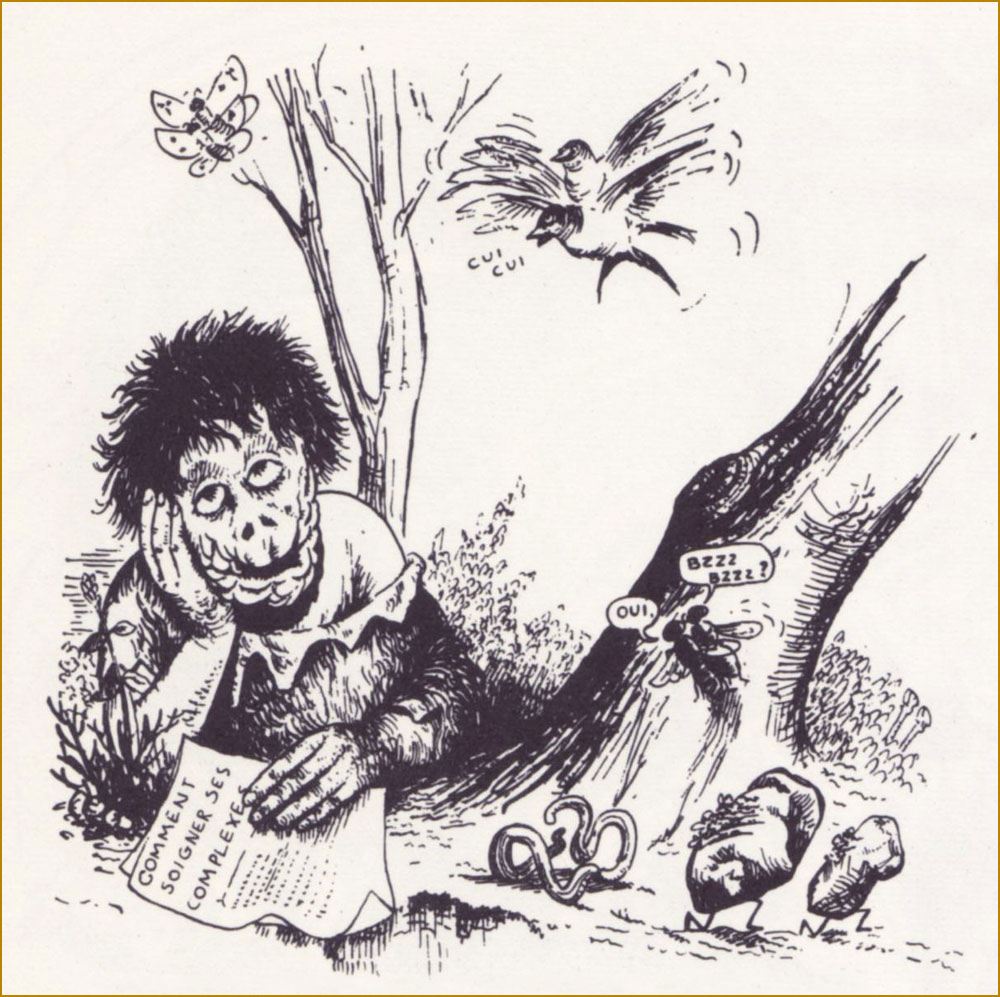
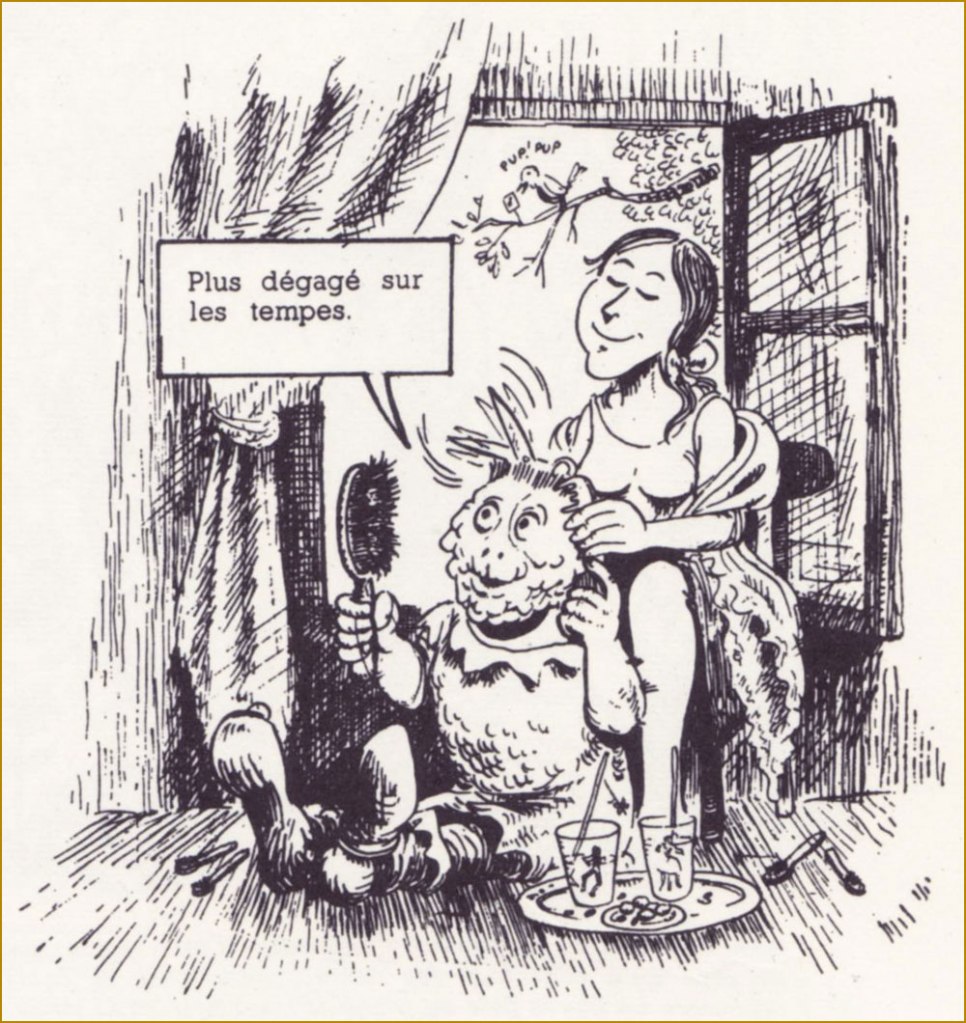
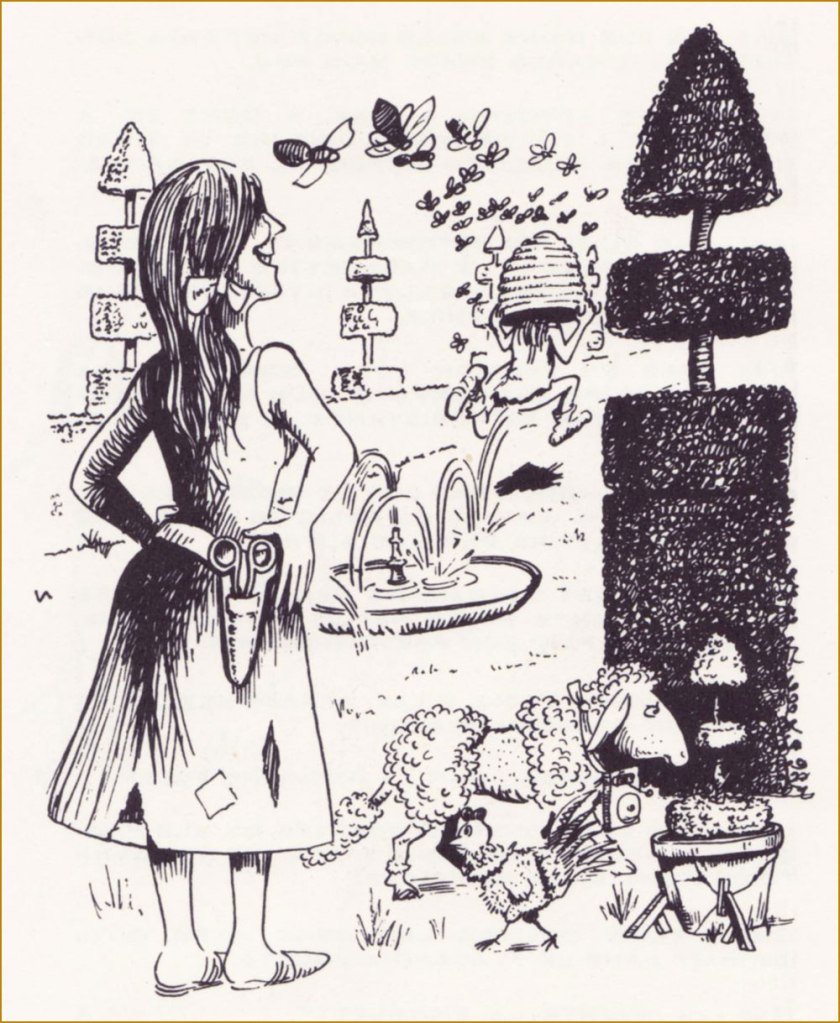
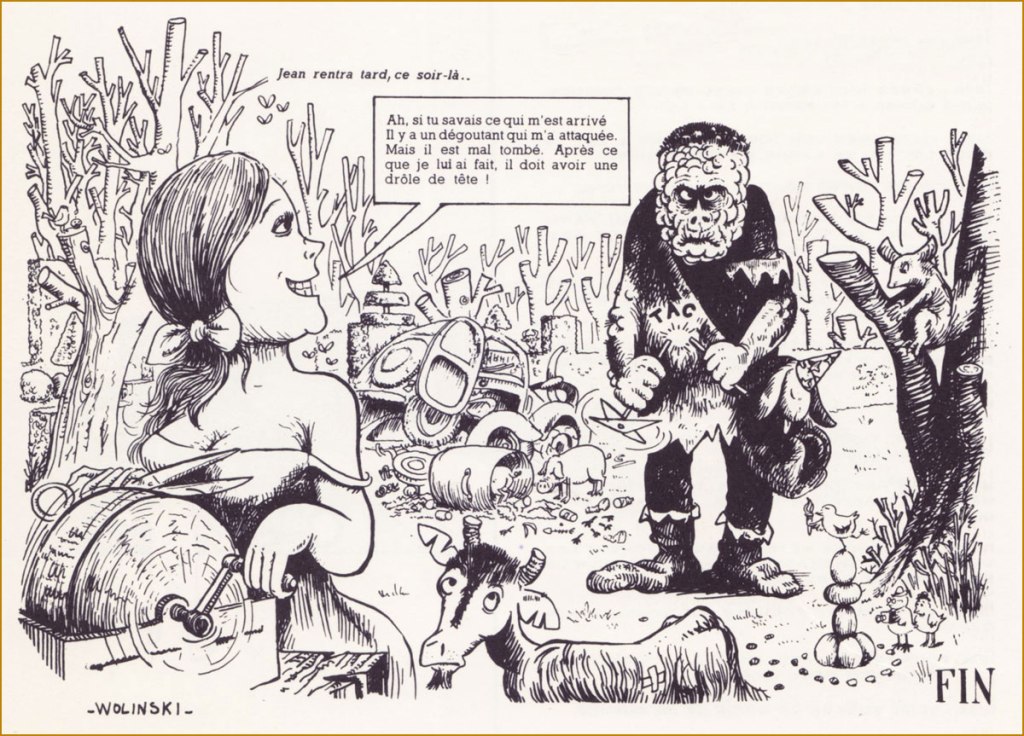
« Jean was the lone survivor of a fire that claimed his entire family. Having suffered atrocious burns to the face, he was as hideous as one could imagine. In order to avoid exposing others to that grim spectacle, he went to live deep in the woods with the wild beasts. However, each year, the returning Spring invoked in him strange reveries. » A PATHETIC TALE. « He then could not refrain from lurking about the homes of men. And so it was, one day, that he heard Isabelle’s song. Her voice made him forget his usual caution. » « Isabelle was blind. At the idea that she could not witness his ugliness, Jean felt an extraordinary emotion. He found the courage to speak to her. She responded with kindness, and he dared return. » « Soon, they became inseparable, and at last Isabelle agreed to follow him into the forest. »« Long months of happiness ensued. And then, Isabelle realised that, little by little, her sight was returning. When Jean learned the wonderful news, he was at once happy and desperate. Because he could no believe that Isabelle would remain by his side, now that she saw his ugliness. But Isabelle told him that his physical appearance mattered little to her, and that she would always love him. »« Jean, however, could not help but be miserable. One day, as he was hunting for mushrooms in the forest, he came upon a hare caught in a snare, pitied him and set him free. As it happened, that hare was a powerful genie who, in gratitude, transformed him into a handsome young man. »« Jean, delirious with joy, ran to meet Isabelle. The young girl was working at the beehive. Jean took her in his arms. »« Sweet Isabelle, assailed by this young stranger and fearing for her virtue, crowned him with the hive. »« Panicked with suffering, poor Jean fled like a madman. »« That evening, Jean returned late… » « Ah, if you only knew what happened to me. Some horrid masher attacked me. But I gave him a bad time. After what I’ve done to him, he must look quite a fright! »
from the look of this early style, I get the sense that young Wolinski was under the artistic sway of, say, Will Elder and Al Jaffee…. not a bad place to start!
Here’s a trio of his early gag cartoons (circa the early 1960s), working in a more natural, more direct style:
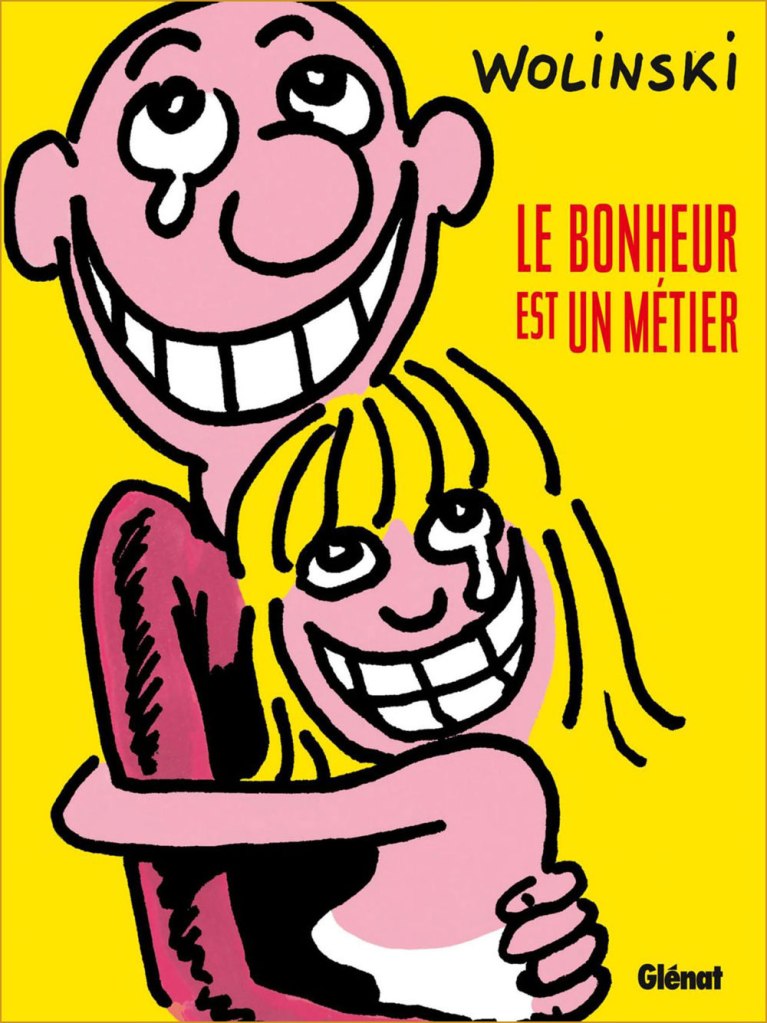
« Working in collaboration means spending half of one’s time explaining to the other that his ideas are stupid. » Wolinski served as the editor-in-chief of Charlie Mensuel from 1970 to 1981. His chief non-editorial contribution was his scripting, for his friend — and fellow Georges — Pichard, the adventures of Paulette, which ran in the magazine from 1970 to 1976. For more Pichard (and Paulette!), check out ds’ post Georges Pichard’s Distressing Damsels. This is Charlie Mensuel no. 80 (Sept. 1975), art — naturally — by Georges Pichard.« Happiness is an occupation » (2016, Glénat). Here’s an example of Wolinski’s fully evolved, more streamlined visual style, from the cover of a posthumous autobiographical collection. Wolinski was interred in Paris’ Cimetière du Montparnasse. Photo by Stéphane X. « Murdered on January 7 during the attack against Charlie-Hebdo. »















































 Who's Out There?