An elephant pink crawled outta the sink and snuggled up in my bed A purple mole’s in the goldfish bowl, he’s trying to steal a drink*
Today’s post was originally planned as a panegyric to Larry Marder’s Beanworld, but I quickly realized that attempting to write about it was a bit like trying to dissect a joke. Here I am, then, doing a 180 degree turn to talk about a Soviet cartoonist.
Evgeniy Milutka (Евгений Милутка, b. 1946) was a teacher of Russian literature by profession, but his proclivities clearly lay elsewhere. After teaching in middle school for a few years, he officially switched to the career of a cartoonist in the early 1970s, and quickly rose to the ranks of the best known caricaturists in the USSR, in part thanks to his long-lasting (from mid seventies to mid eighties) collaboration with satirical magazine Krokodil(see Krokodil Smiles: Cartoons in the USSR).
I am most interested, however, in the new, kid-oriented direction his work took in the 1980s, namely the cartoons/comics published within the pages of Веселые Картинки (something like ‘funny pictures’ in translation), a literature-bent humour magazine for kids. Founded in 1956, it was still sort-of around (with some financial issues) when I was a child, and my grandfather, who was always very preoccupied with making sure I grew up knowledgeable and smart (sorry, grandpa?), was kind enough to buy me a subscription.
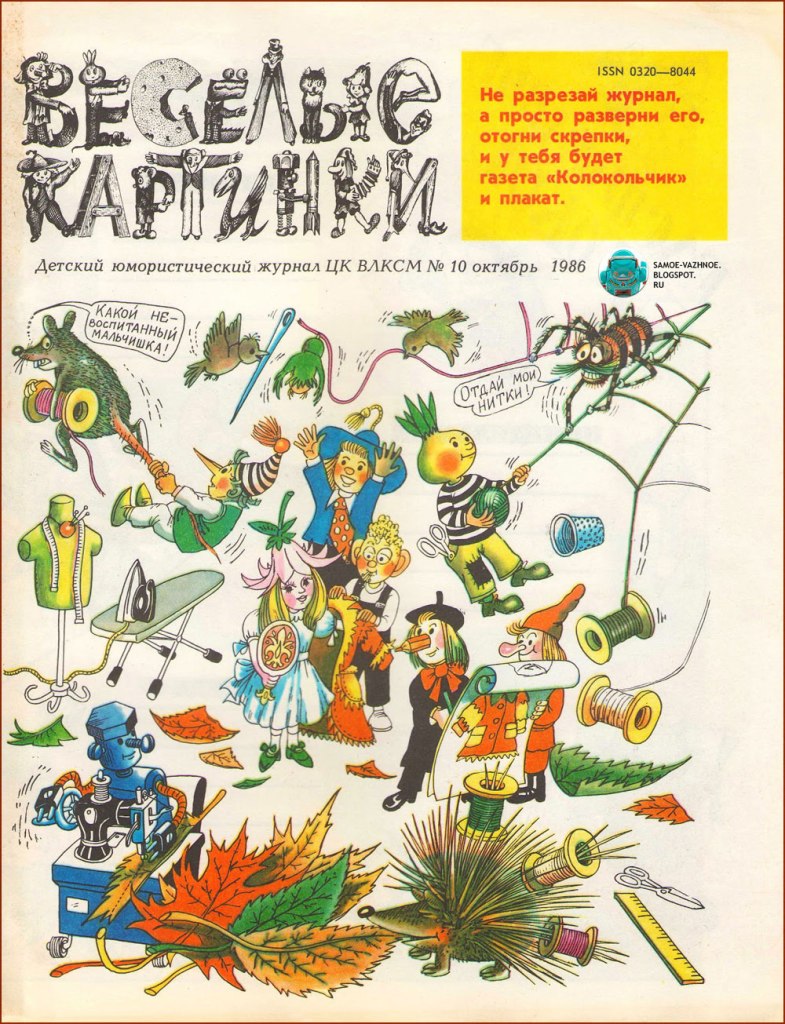
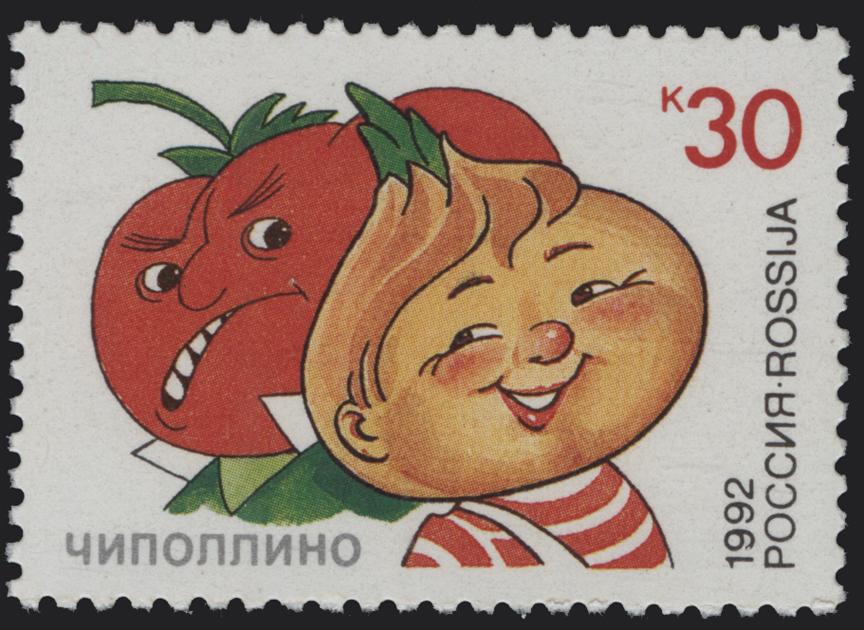
An issue from October 1986, with a cover by Milutka. It features the 8 ‘merry little people’ that were the mascots of this journal and whose adventures Milutka illustrated. This included Karandash (which in Russian means ‘pencil‘), the boy with the pencil nose; Cipollino (little onion), the boy with an onion head, from Gianni Rodari’s Cipollino, a tale that was so popular in the Soviet Union that we even have a Cipollino stamp; Buratino, the Russian Pinocchio; Neznayka, literally translated to ‘don’t know’, a favourite character from Nikolai Nosov‘s merry trilogy of fairy-tales; Petrushka, a character from Slav folk puppetry; Samodelkin, the boy robot whose name translates to something like ‘do-it-yourselfer’; Hurvínek, a character from a Czech puppet duo; and the only girl, Thumbelina.
The first thing that jumps out is that Milutka’s strips are really weird. Green elephants, watermelon men, mosquitoes capable of lifting a person, bats in a cavern made out of teeth, a giant spider wearing running shoes… a lot of it is most delirious delirium tremens. Milutka could aptly handle a variety of styles, but his basic, more recognizable modus operandi is extremely Slavic. The other interesting thing about his work, though you have to take my word for this, is how he squeezed in some distinctly unchildlike content into his strips. He was, after all, a caricaturist, with a keen eye honed by the sometimes subversive Krokodil.
Here is a selection from within the pages of Веселые Картинки from 1991 to 1996, which is pretty much the period I was able to follow in person.
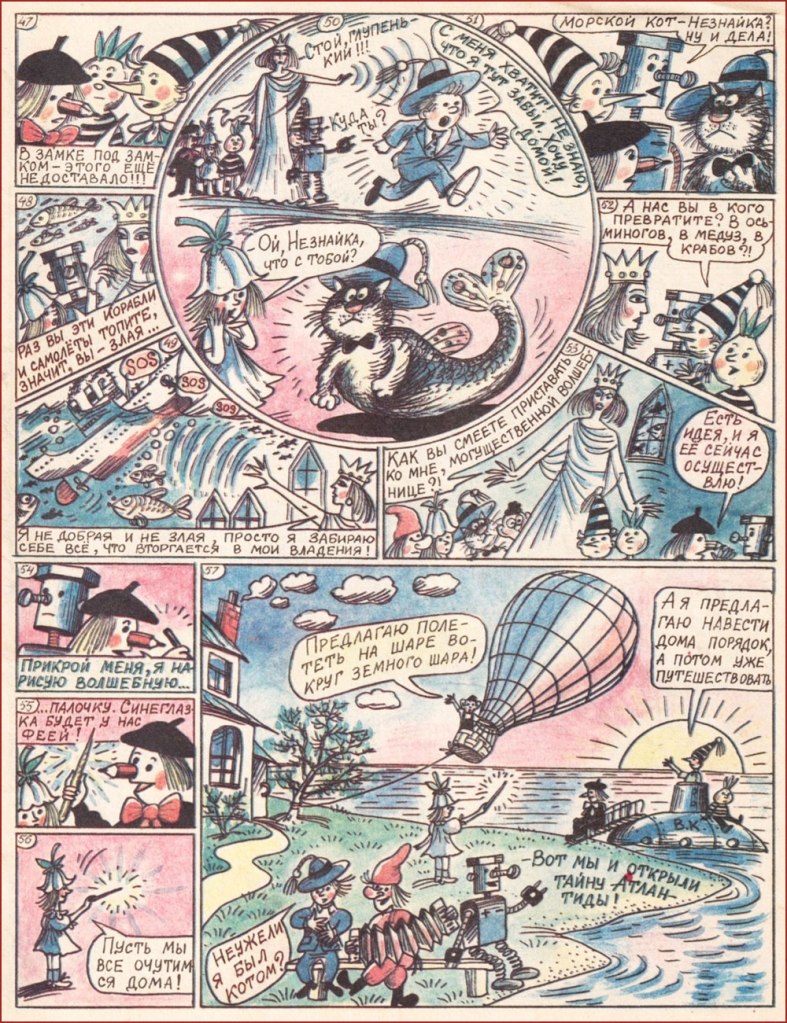
The sorceress gets accused of being evil by Thumbelina, ‘since you crash ships and airplanes‘. ‘I am nor evil nor good,‘ she responds, ‘I just take everything that barges into my kingdom.‘ Nezknayka gets turned into a mer-cat. (1991)
More metamorphosis! The kids keep asking the green elephant ‘what are you? Are you an ungulate? A mammal? Are you an insect? He’s probably an amphibian…‘ but to all their questions, he answers “I dunno…“, which is how they guess that it’s Neznayka in disguise. (1991)
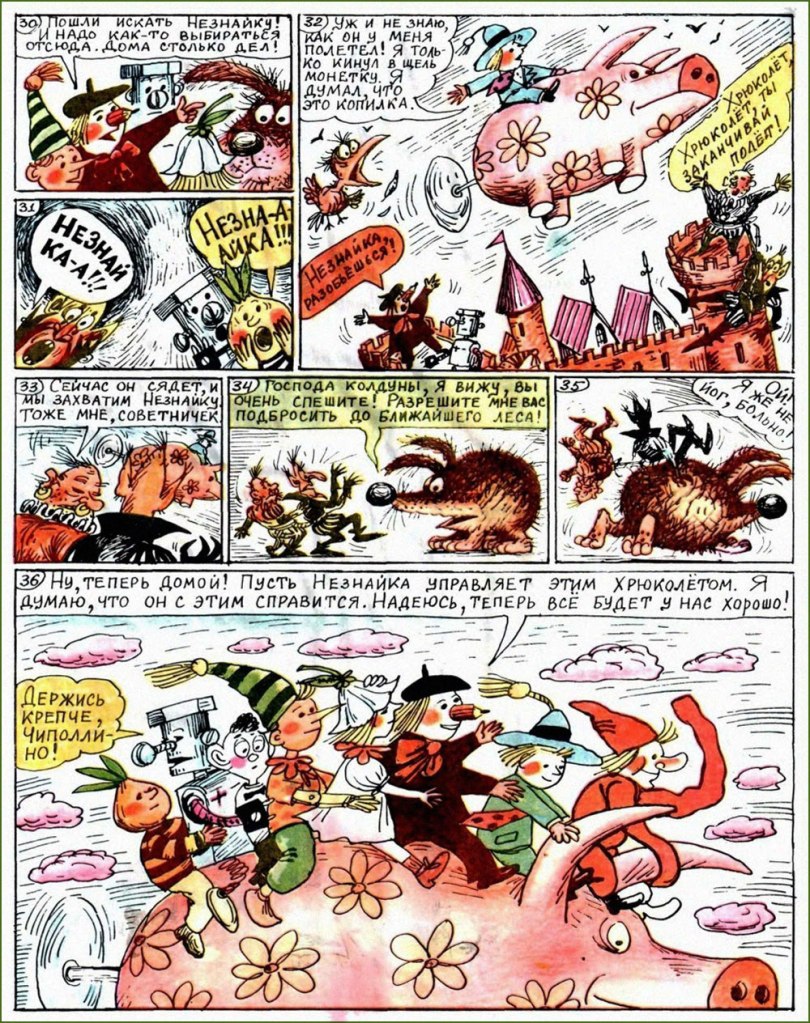
A sword-hog is turned back into a normal hedgehog once he’s fed an apple, and Neznayka, who’s named head advisor to the bad guys (everybody has untranslatable funny names), advises them to tie themselves together with a rope… (1994)
… after which the merry little people escape on a flying pig with a propeller in its ass (1994).
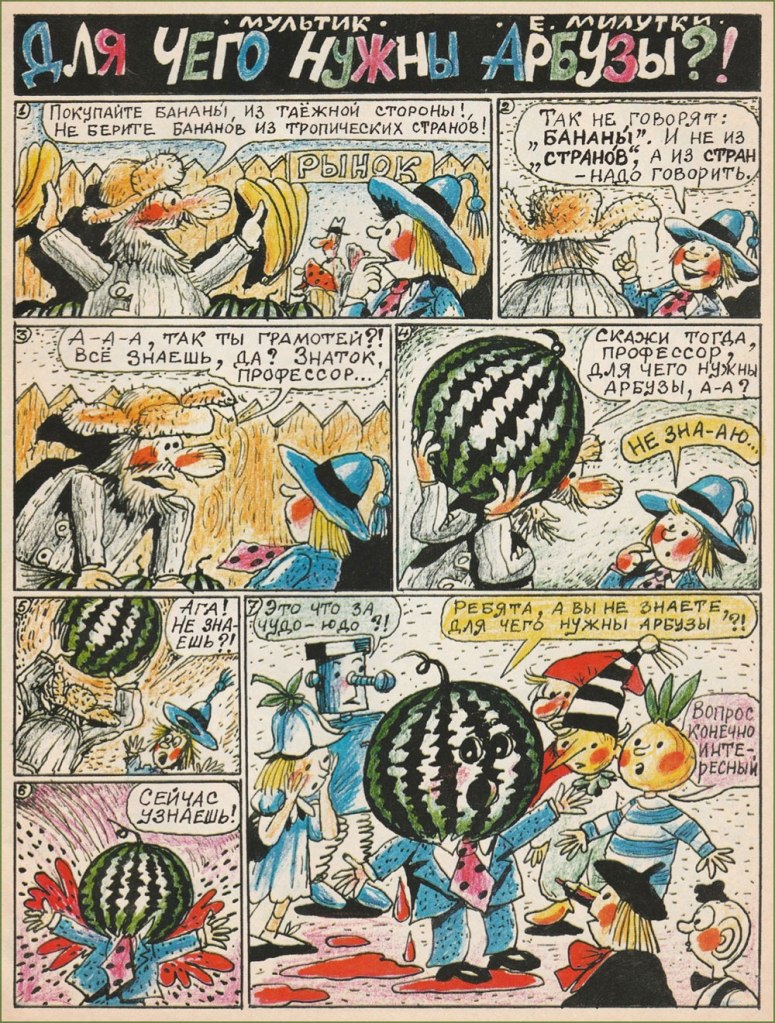
Watermelon man! “Kids, do you know what watermelons are good for?” “It’s an interesting question, of course” (1994).
This is spider named Filia, shod in very nice shoes. Isn’t he cute? (1994)
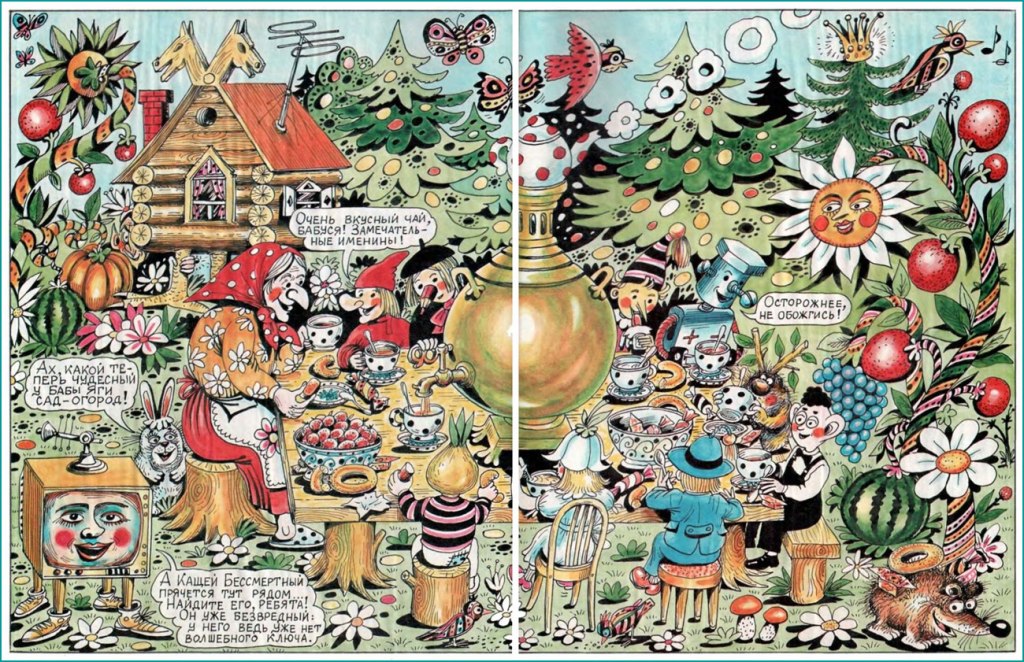
A splash page featuring a prototypical Babushka (actually a Baba Yaga in a good mood!) and an assortment of flora and fauna (1994)
After a lot of untranslatable puns on the word ‘vitamins’, the cat (who’s, once again, Nezknayka, having a pronounced tendency to transform into other creatures) is told to ‘eat the magic balls!‘ to turn back into himself. Thumbelina is also rescued from being… err, whatever that furry thing with the rolled-up nose is. (1995)
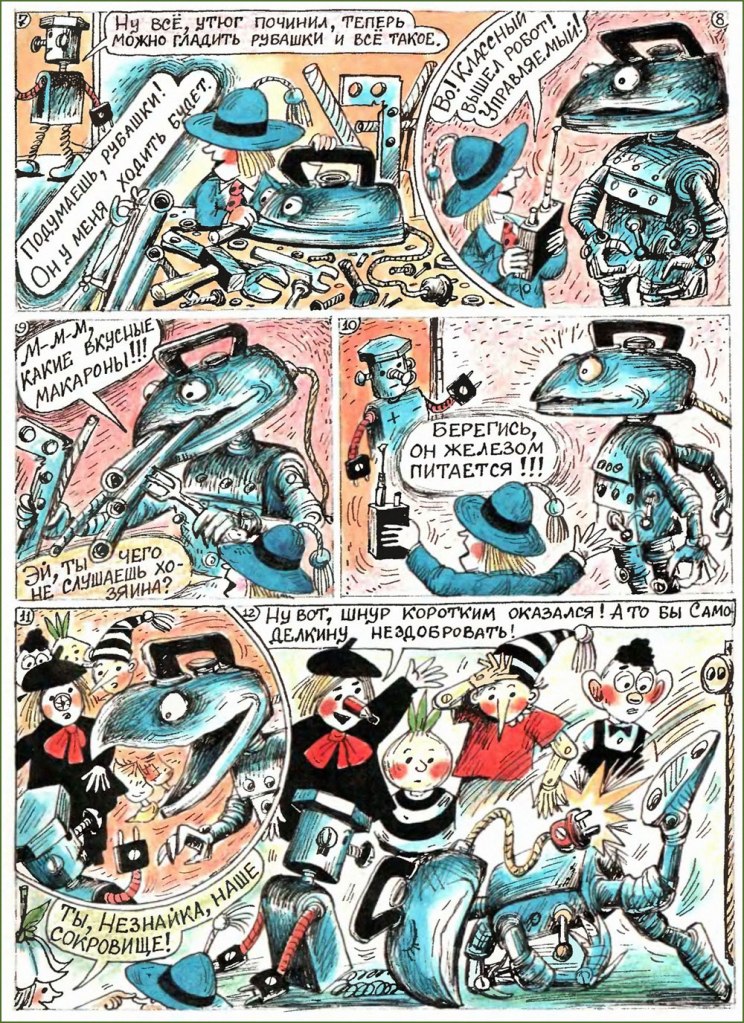
Neznayka invents a robot to do the ironing for him, but the robot is hungry for metal ‘macaroni’ (which we call anything pasta, usually some form of spaghetti) (1996).
A poster advertising the journal (1996), with mushrooms, a Pushkin reference, singing cats, some sort of flying elephant (?) with an accordion, a little furry bee-cat, and so on and so forth.
I hope you enjoyed these despite the language barrier! I’ll wrap this up with two fun illustrations from the early 90s:
‘The flight of a bumblebee’
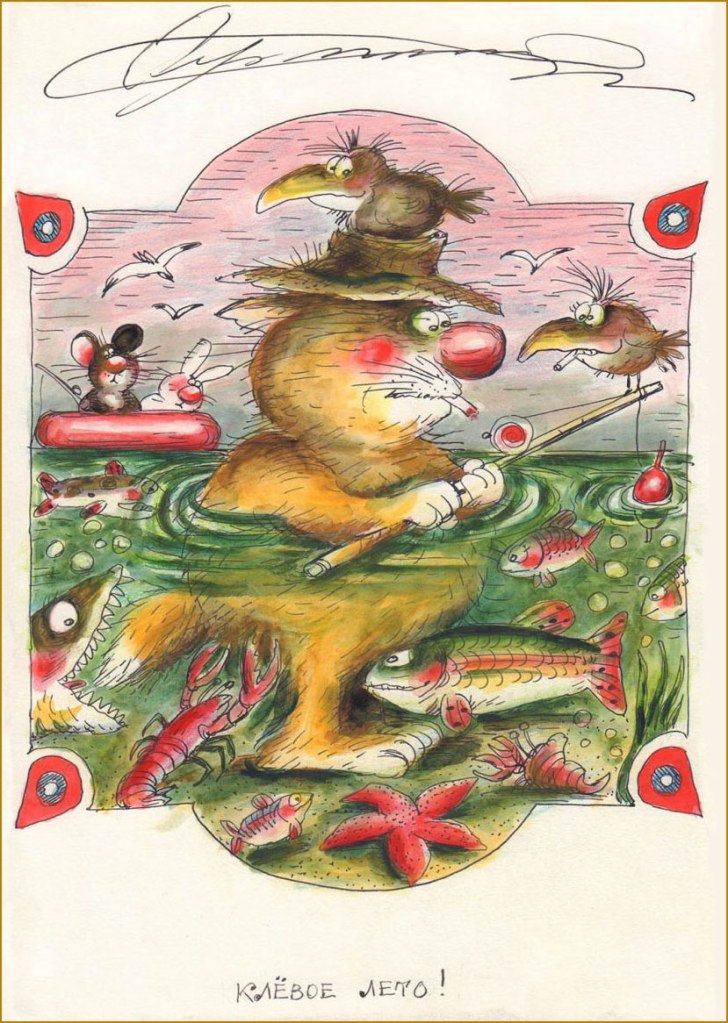
The title is a pun on fish biting and the summer being a neat one.
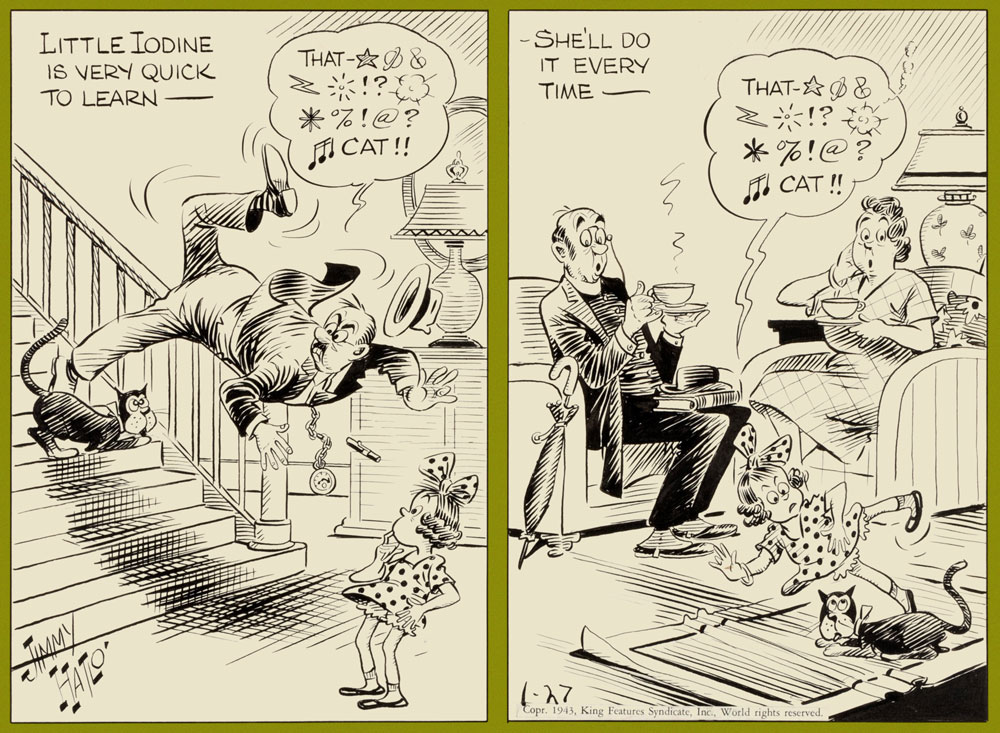
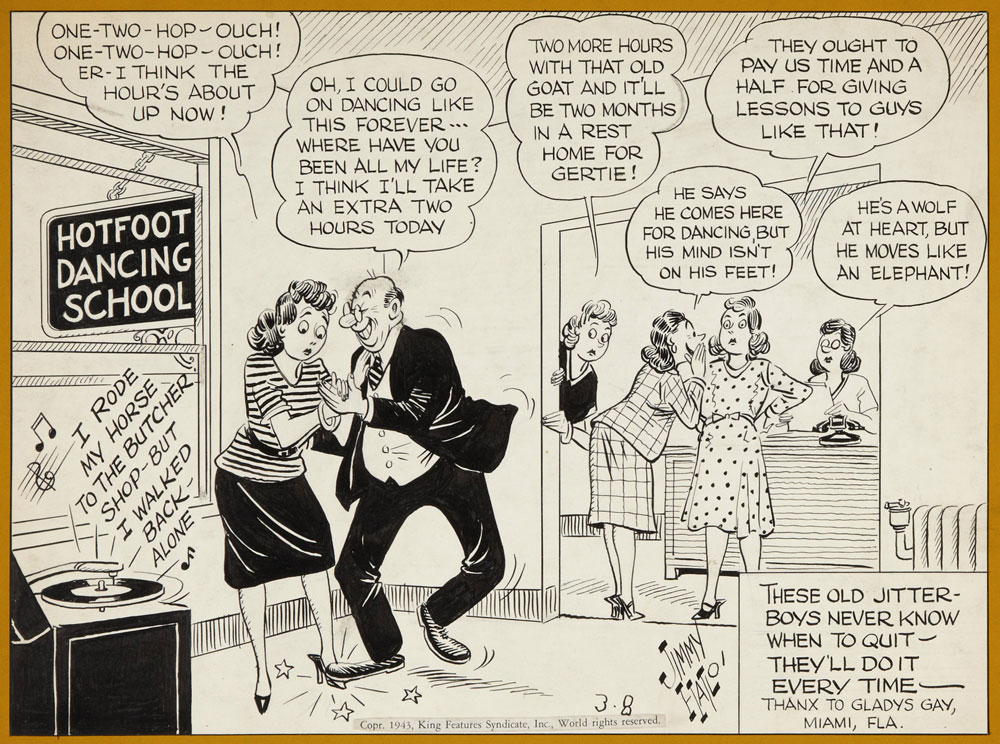
In the beginning of time… or rather the end of the 1930s, which may feel like a similar thing to some… there was Jimmy (James) Hatlo‘s They’ll Do It Every Time, a popular King Features newspaper cartoon with an impressively long run (1929 all the way until 2008, although no longer under Hatlo’s direction since 1963 due to Hatlo’s fairly early demise at 66). Hatlo, a sports cartoonist working for The San Francisco Call-Bulletin, stumbled upon the greatest success of his career by accident – scrambling to fill a void left by a shipped-yet-misplaced package of cartoons that for some reason didn’t make it to the office in time*, he drew the first couple of strips as a bouche-trou, only to find himself with an instant hit. The old problem of running out of ideas was creatively solved – Hatlo asked his readers for suggestions, and the readers, « brimming with seemingly small observations about mundane yet captivating matters, but lacking a way to tell anyone outside their own circles of friends about it » (as Bob Green described it in his Wall Street Journal epitaph A Tip of the Hat to Social Media’s Granddad), were happy to oblige. Hatlo acknowledged every submission with a ‘tip of the Hatlo hat’ – the thrilled reader would get his or her name and hometown displayed prominently in the bottom right corner of the strip.
* Jimmy Hatlo—Man of Many Hats, a detailed article by Ed Black I wholeheartedly recommend, offers another version of this story: « His managing editor, Edgar T. ‘Scoop’ Gleason, was frantic: He had a hole to fill in his comics page when Hearst abruptly ordered him to pull Billy DeBeck’s Bughouse Fables so it could run in the Examiner. Gleason prevailed upon Hatlo to produce something, pronto. »
Strip from sometime in August, 1931 (exact date unknown).
Strip from May 31st, 1939.
Strip from January 27th, 1943. The character of Little Iodine, born in the pages of They’ll Do It Every Time, « the embodiment of all brats I knew… naughty as hell — and still likable », according to Hatlo, spun off into her own strip, which ran from 1943 to 1983. La petite Iodine, a French translation, first appeared in Saturday editions of Québécois weekly La Patrie in 1945 and 1946, and also made it into some other Québec newspapers later on, where co-admin RG eventually came across it in his youth.
Strip from March 8th, 1943.
Presumed November 30th, 1945.
Strip from August 7th, 1961.
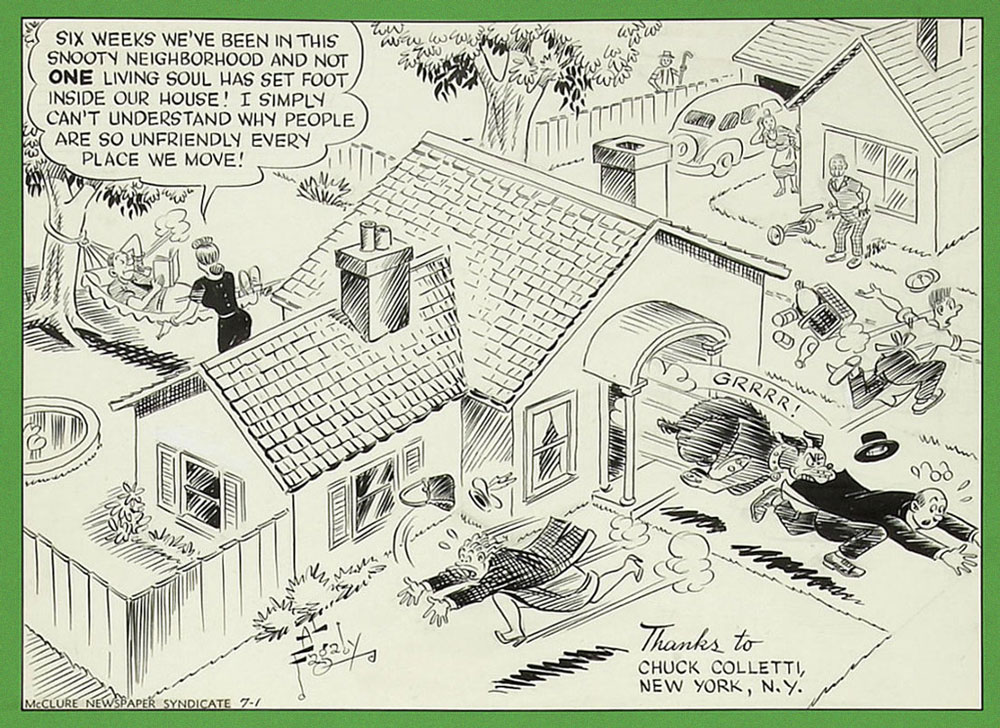
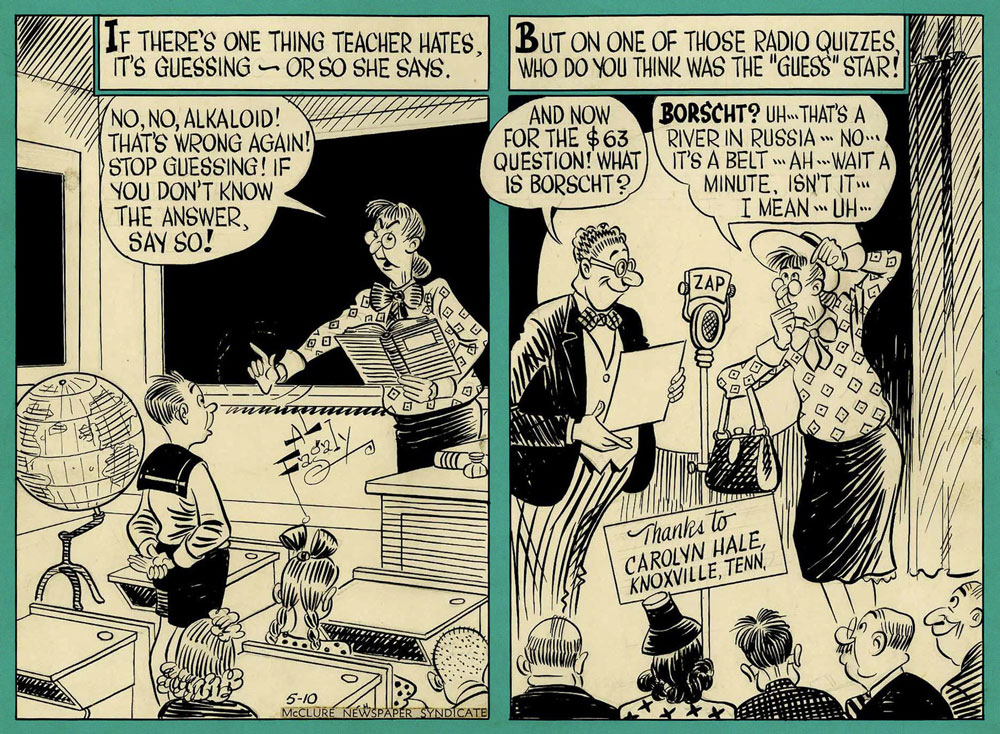
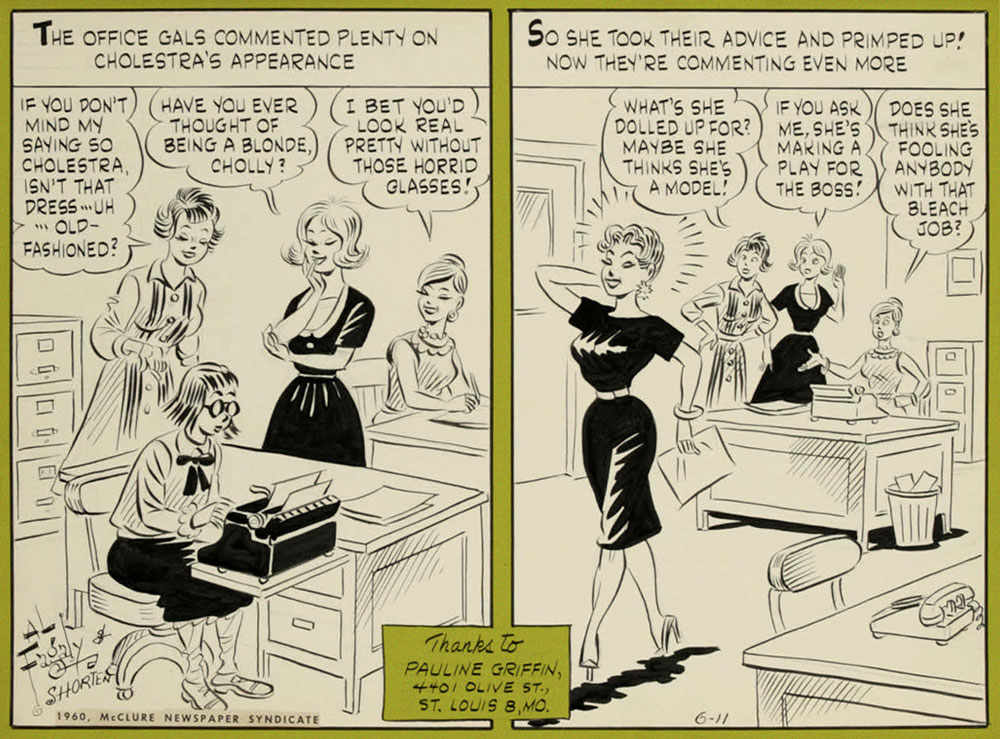
Some twenty years later, in 1948, a ‘blatant’ knock-off – There Oughta Be a Law! – was launched by the McClure Newspaper Syndicate, disturbingly similar in look and tone to the strip it was imitating. It was created by writer Harry Shorten and artist Al Fagaly. Whereas Hatlo’s strip brought him fame, There Oughta… didn’t do much for its creators – though Fagaly (creator of Archie Comics‘ Super Duck) needed no padding on his already impressive (with more to come) résumé. Just like with They’ll Do It Every Time, Fagaly died in 1963 (it was a bad year for cartoonists, it seems), and Warren Whipple took over the illustration duties. Interestingly, Whipple is supposed to have also worked on TDIET at some point (according to this source, and Wikipedia, which copy-pasted it), though I can’t find more information about it.
After a respectable run of 36 years (it ended in 1984), There Oughta Be a Law sank into relative obscurity. One could argue that Hatlo could have sued, had he sufficiently resented the copycat strip – maybe he was too cool a cat for such austerity, maybe imitation is flattery, or They’ll Do It Every Time was sufficiently well-established and popular enough not to have to worry about competition. Hatlo certainly set it up for success, evidence of which is how it ran like a well-oiled machine long after his death. Upon reflection, I prefer the art of TDIET – crisper and more dynamic, it immediately grabs the eye, making these strips enjoyable not only for their humorous observations, but also for their style. I will, however, note that Fagaly had a really fun signature. What do you think, reader?
All of the below strips are circa the 1950s.
I had to include this one, as I am appalled somebody could be unfamiliar with borscht. No, I’m not going to provide a link, look it up yourselves.
Given that I grew up in the days when PC games were just starting to be a thing (what a pleasure it is to reminisce about Secret Agent, Crystal Caves, or Jill of the Jungle…), anything pixelated immediately gives me a warm rush and a sense of pleasant nostalgia, be it the quiet appeal of Toyoi Yuuta‘s art or modern ‘pixel art’ games that go for that retro feel (the dark glory of Blasphemous, the cozy feel of Stardew Valley!). As for comics, I suspect most are drawn on a computer these days, but few of them use pixel art per se. One look at Plastic Dog, and it was puppy love, especially given its acerbic sense of humour.
Henning Wagenbreth, born in 1962 in East Germany (which is perhaps what partially gave him a lifelong anti-totalitarian stance), is an illustrator/graphic designer who actually excels in a number of techniques. Lambiek Comiclopedia touts him as ‘German pioneer in comics created with the computer‘; I don’t know enough about the development of electronically-drawn comics specifically in that part of the world to state that with certainty, although this is as good a time as any to mention that Peter B. Gillis and Mike Saenz‘ wonderful Shatter (1985-1988) is usually credited as the first significant comic book created on computer. Topic for another day, no doubt.
Be as it may, Wagenbroth did something interesting: he designed the strip Plastic Dog in 2000 specifically for perusal on early pocket computers (such as Pocket PC or Palm OS), which had a black and white screen of 160×160 pixels. In 2004, colourized versions migrated to weekly newspaper Die Zeit, printed within its pages, but also available as downloads on their website.
The French publisher L’Association released a 26-page collection of Plastic Dog strips, translated into French from German by Eugénie Pascal. As far as I know, no official English translation exists, aside from maybe one or two random strips (probably translated by Wagenbreth himself). The following pages are scans from this French edition.
Dead Wood. Plastic Dog calls the police to report a stolen wooden cabinet, to find that it’s been removed by the Tree Liberation Army, who bury their ‘felled, deported, dismembered and abused’ friend in the tree cemetery.
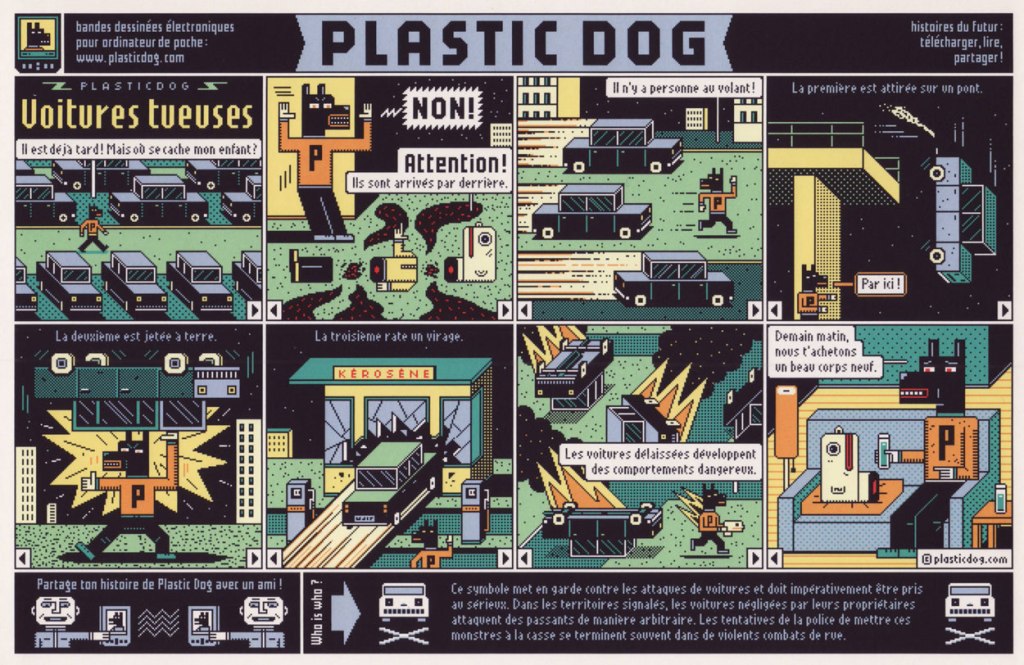
The Killer Cars. Plastic Dog goes out to search for his missing child, to find the latter in pieces after being attacked by driverless cars gone rogue. In the final panel, PD says ‘tomorrow, we’ll buy you a nice new body’.
Nothing Ever Happens. ‘A grey day, pure boredom’, bemoans Plastic Dog, ‘I am always in the wrong place at the wrong time, and everything is so predictable…’
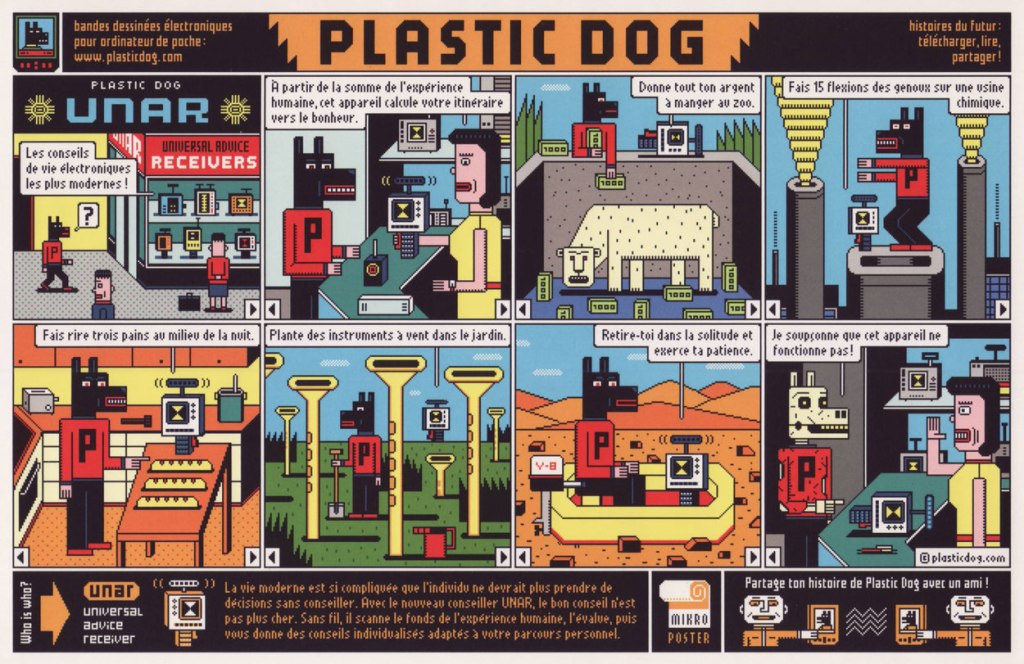
In his never-ending search for new experiences, Plastic Dog stumbles upon a device that proffers guidelines to achieve maximum happiness. Its instructions are not devoid of poetry: ‘give all your money to be eaten by zoo animals’, ‘do 15 squats on top of a chemical factory’, ‘make three loafs of bread laugh in the middle of the night’, ‘plant wind instruments in the garden’. The final piece of advice (‘withdraw into solitude and practice patience’) is what seems to defeat PD’s enthusiasm (seems like in his world, getting lost in the desert is the only way to solitude…)
The following is the last PD strip, and readers are thanked at the bottom for their many emails and downloads. There’s also something about a free TV as a reward, but I wouldn’t bank on it 😉
A family visit to the zoo! Touted as the last surviving specimens by the guide, these animals may not quite be what they seem. The flamingo complains, ’12 hours standing on the same leg!’, but Plastic Dog argues that having to constantly hang upside down is much worse.
Wagenbreth recently had an exhibition at Montréal’s UQAM university, which to my regret I completely missed… due to finding out about it far too late (i.e. now). Here is the poster for it:
~ ds
* « Every day my metal friend Shakes my bed at 6am Then the shiny serving clones Run in with my telephones »
Mention Belgian artist Peyo(real name Pierre Culliford, 1928 -1992) and the first thing that comes to mind is his hugely popular Les Schtroumpfs, introduced within the pages of his strip Johan et Pirlouit. Les Schtroumpfs, of course, are Smurfs, those blue humanoid creatures living in mushroom-houses in the forest. When I was just starting tentative forays into comics during my shy youth, it’s the local library’s Smurf albums that first attracted my attention, alongside Uderzo and Goscinny’s Astérix le Gaulois and Roba and Rosy’s Boule et Bill.
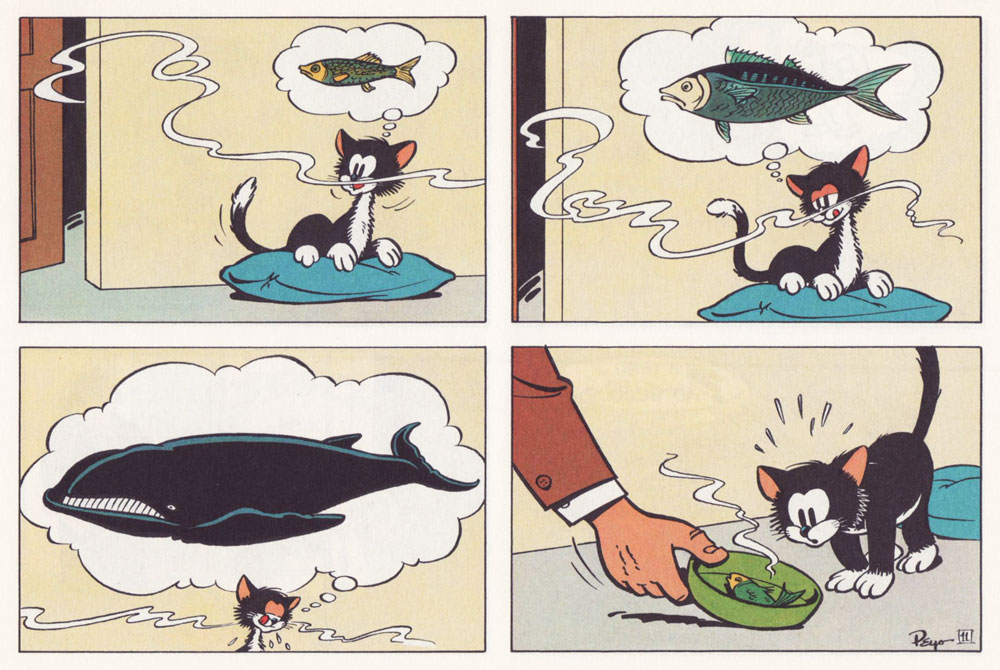
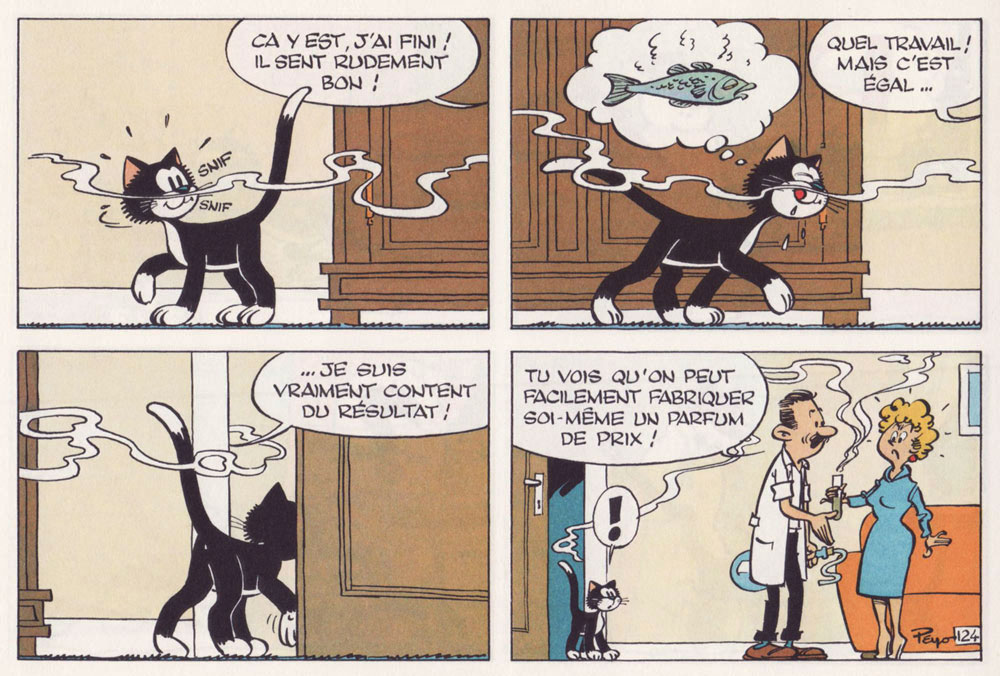
Another strip I really liked, unaware that it was created by the artist responsible for the Smurfs, is Poussy. Despite competing with all the other cat adventures one can think of (although there are far more today than there were twenty years ago), it was its old-fashioned charm that drew me in. This was a world where rambunctious (but always well-meaning) boys roasted chestnuts in a fire, mothers in high heels burned their Sunday roast, and families always went to the beach for their vacation. I wasn’t interested in these (human) characters, but they made a perfect backdrop to cat antics, comforting like watching cartoons on a rainy day.
The first Poussy album I found at the local library (1977, Dupuis).
21-year old Peyo drew 26 black-and-white gags of Poussy for the humble youth section of Belgian daily newspaper Le Soir between 1949 and 1951. Here’s an example of one of these early manifestations of Poussy, a playful black-and-white cat, up to very normal cat mischief:
‘Poussy is ambitious’, printed in Le Soir no. 175 (July 1949).
When Le Soir decided to revamp its youth section into a more ambitious version titled Le Soir Jeunesse, Peyo, who had been concentrating on his Johan series (later to become Johan et Pirlouit, or Johan and Peewit in English) for Journal de Spirou, revived Poussy, and this frisky kitten frolicked once again between Le Soir‘s pages from 1955 to 1960. Set aside again to make room for more ambitious endeavours (namely, Peyo’s Benoît Brisefer series) at the behest of publisher Charles Dupuis, for whom Peyo was working concurrently, Poussy tiptoed back into life in 1965, this time in Journal de Spirou, in colourised re-runs of previous Le Soir material, published quite out of any chronological order.
Here are a few favourites from these re-runs — I mostly chose mute strips, both because Poussy’s expressive meowing needs no translation, and because I by far prefer jokes centered on his behaviour without too much human interference.
Gag no. 11, published in Spirou no. 1552 (January 1968).
Gag no. 24, published in Spirou no. 1514 (April, 1967).
Gag no. 85, published in Spirou no. 1523 (June 1967). One can argue about the originality (or lack thereof) of Peyo’s style ’til one is blue in the face, but Poussy’s spot-on expression and body language in the last panel are unarguably perfectly executed.
Gag no. 105, published in Spirou no. 1528 (July 1967). This must have been a rare ‘be kind to mice’ day.
Gag no. 124, published in Spirou no. 1450 (January 1966). ‘I’m done, and it smells wonderful! What hard work! But it doesn’t matter, I am thrilled with the results! You see that one can easily create an expensive perfume at home!‘
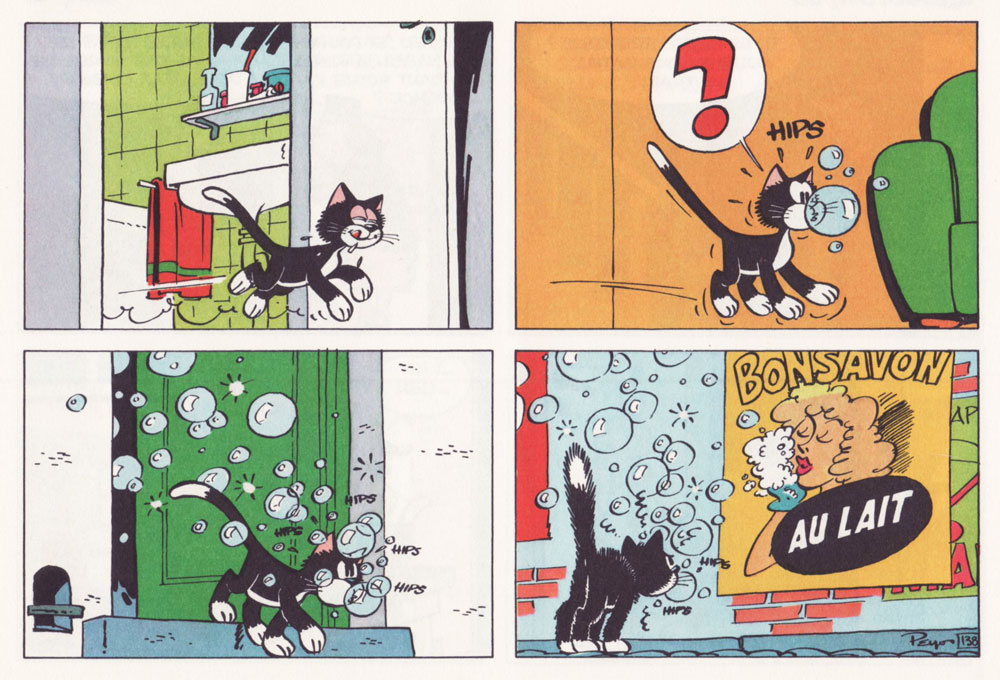
Gag no. 138, published in Spirou no. 1636 (August 1969). The final panel advertises milk-based soap.
It was only in 1969 that Peyo resumed the production of new strips, starting with gag no. 222… and by no. 233, he had a collaborator, Lucien De Gieter, who soon took over entirely as Peyo had far too many other series on his hands to be able to continue Poussy. De Gieter continued the strip until 1974.
There have been three albums collecting Poussy material, published in 1976 and 1977 – and last year, Dupuis published a very handsome and very complete collection of all Poussy strips (a painstaking and impeccable chronological presentation, accompanied by exhaustive publishing information) which I purchased at the excellent comic-and-book store Débédé in Montréal, Québec. One doesn’t always feel like revisiting books from one’s childhood (for instance, I have little desire to ever reread Boule et Bill), but in this case I spent a few warm moments smiling at the strips I remembered surprisingly well.
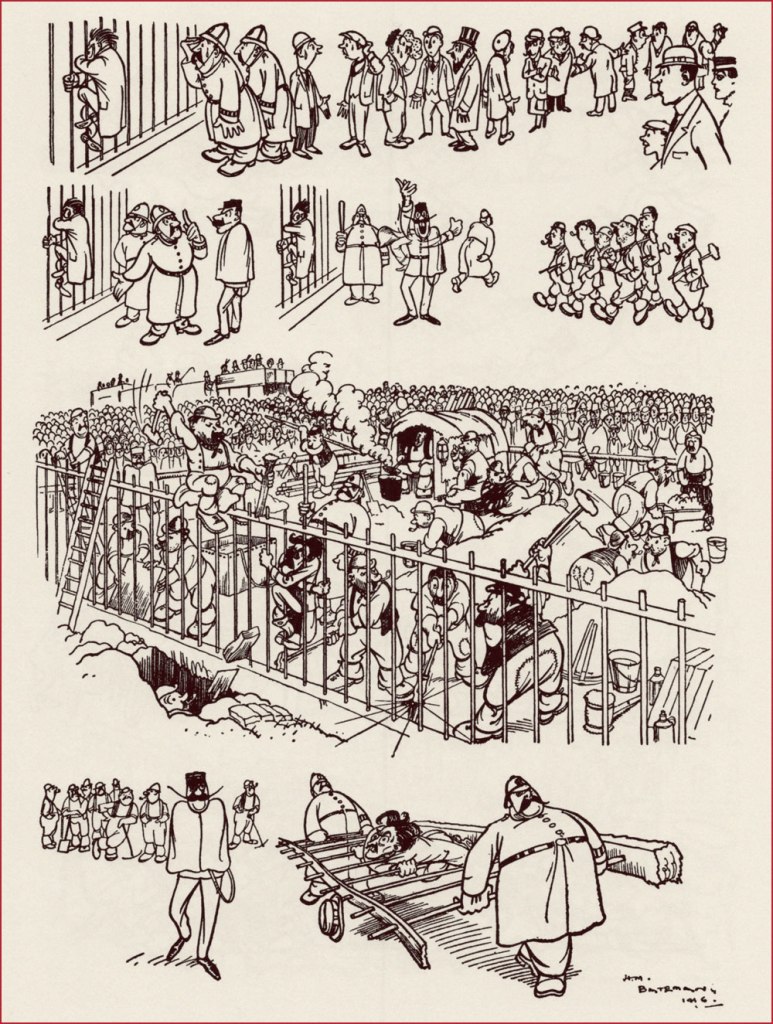
Henry Mayo Bateman (1887-1970) was a British cartoonist now frequently described as ‘the most innovative cartoonist of his generation’. His main claim to fame is the ‘The Man Who…‘ cartoons; as it often happens with when the popularity of a creation goes far beyond what the artist originally had in mind, Bateman himself was ambivalent about it, and felt constrained by its acclaim. Be as it may, a lot of his cartoon collections (most of them hopelessly out of print) are named according to this template: Man Who Drew 20th Century (1969), The Man Who Was H. M. Bateman (1982), H. M. Bateman: The Man Who Went Mad on Paper (2012)… The one I have in my collection broke away from this mold –it’s a French collection titled Mimodrames, with all text inside, including the titles of cartoons, in both French and English. Strangely, the French cartoon captions seem more à propos than the English ones.
Case in point: this was called ‘Prisoner when arrested clung to the railings‘, which in French was translated to ‘Le protestataire qui se cramponna aux grilles à l’arrivée de la police‘, and yet protestataire is more like ‘protester’, not ‘prisoner’, which I think is more fitting.
Bateman seemed to be predestined for his career; having decided at the ripe old age of 13 to dedicate his life to becoming an artist, he spent all his free time drawing and sold his first cartoon at 14 (!) Though his father was adamant that his sole male offspring should follow his footsteps and become a respectable businessman, Bateman’s small yet steadily increasing income from his cartoons and the growing demand for them by halfpenny weekly comic papers finally forced his pa to grudgingly agree to his son pursuing a career in art. Bateman was 16 at the time.
‘The Man who filled his fountain pen with the hotel ink’
Bateman continued to sell cartoons throughout his studies; by 1906, his work was in demand by many publications much fancier than the inexpensive comic papers he started out in. Percy Venner Bradshaw, fellow artist and founder of the Press Art School, meeting him that year for the first time, found a ‘quiet, shy, delicate boy who was much more interested in colour than in line work, and who could only with difficulty be induced to talk about either‘. A fitting description of a man who appeared quiet and reserved, who felt things more keenly than his peers or his colleagues – a swift glance at his best work dispels an impression of similarity between him and the rowdier cartoonists. Not that Bateman couldn’t be funny – but something lurked behind the chuckle, some dark cloud lingering over his characters. As Anthony Anderson (not the American actor, nor the British murderer; all I was able to find out about him is that he’s listed as an editor of many books) notes in the introduction to Mimodrames:
« The more one examines his drawings the more one feels that, despite his conservatism, Bateman’s sympathies lay not with the offended but with the offender, a sympathy for the underdog, the little man. Indeed, in many of his cartoons, especially during the war, the little man was often Bateman himself – a clear self-portrait. »
This sensitivity comes loud and clear through Bateman’s writing as well – to quote, for example, his description of a medical examination undergone in 1916, when conscription for WWI was in full swing:
«In company with other doubtfuls, I was made to hop naked and submit to a bombardment of tests before a glaring army doctor sternly ordered me to ‘go away and get some clothes on’, as if I was responsible for appearing before him in that condition. And in return for my afternoon’s exhibition I was handed an unhealthy looking card bearing the magic symbol of C.3. I had done what I could to convert myself to cannon fodder. I just wasn’t fit for it. »
This description reminds me of Brel’s Au suivant (for those who don’t speak French, Scott Walker’s Next).
‘The Maid who was but human’, or ‘La bonne avait de l’humour’ (something like ‘the maid had a sense of humour).
‘The Man who broke the tube’
I would also be remiss in failing to mention his work for satirical magazines Punch and the Tatler (the famous ‘The man who…’ cartoons ran in the latter, often in glorious colour double-page spreads). According to Anderson, Bateman became the highest paid cartoonist in Britain around the 1920s and 1930s.
‘The editor of a yellow newspaper receiving news of a horrible murder committed in circumstances of the most revolting atrocity’
Bateman’s dearest ambition throughout his life seemed to have been to become a serious, dedicated painter. When he was 46, he set his lucrative career aside, and went to Spain and France to paint. Anderson ends the introduction with the nicest epitaph I’ve read in a while:
«He spent the next three decades gradually shedding more and more of his old life, retiring to a small house on the edge of Dartmoor, travelling extensively and on his own […], always with his sketch books, his paints and his fishing rod. He became peaceful, solitary, content. He died on the island of Gozo in 1970, still painting every day, living in a small hotel with very few possessions but in the room with the finest view. »
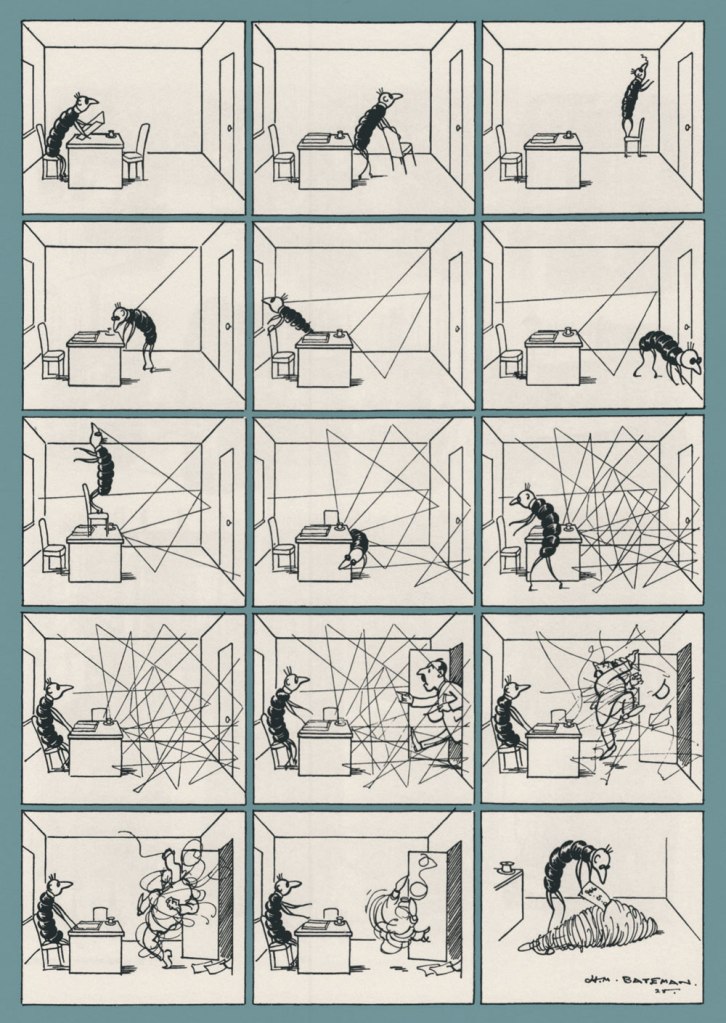
Another source mentions that Bateman fought long and hard with Inland Revenue, so perhaps his self-exile to Gozo, an island in Malta, was not as poetic as it sounds. I wasn’t able to find much information about that, other than his obvious dislike of taxmen (exemplified by cartoons such as The Income Tax Official in Hades) – but taking periodic stabs at the taxman is a traditional cartoonist sport, so it doesn’t really prove anything.
‘The Income-Tax Worm at Work’
These were some of my favourite Bateman pages, I hope you enjoyed them!
Given my appetite for recipes and the cookbooks they’re published in, it was just a matter of time before I stumbled across the hybrid genre of cooking memoir in comic book form. Needless to say, these two art forms have been friends for a long time: comics have been highlighting food in different ways for probably as long as comics have existed. As for cookbooks, it used to be common practice to include illustrations (maybe even cartoons in the margins!), not the lavishly printed photographs we are used to today, alongside the recipes. A treasured 1930s Soviet cookbook inherited from my grandparents, falling apart but no less charming for it, features little cartoons on every other page, similar to how the drawings of Robert Gring once adorned the pages of Assimil language guides (see co-admin RG’s Robert Gring’s Wits-Sharpening Fun).
But I believe that endeavours to specifically write a whole graphic novel/cooking memoir (replete with recipes!) is a fairly recent phenomenon. I’m not talking about stuff like Stan Lee Presents the Mighty Marvel Superheroes’ Cookbook (1977, complete with recipes for ‘He-Man Pancakes’ and ‘Thor’s Cabbage Rolls’), but a thoughtful examination of food functioning as connective tissue between generations and memories. It also helps when the recipes are actually appetizing.
Why is Captain America lasciviously fondling a meatball when absolutely no meatballs are involved in this recipe? Art by Joe Giella.
I’m actually not fond of cookbooks that delve into family anecdotes, as that type of narrative tends to get bogged down in saccharine sentiment that obscures the bigger picture, as the narrator collapses into dreamy sighs about how genuine cooking used to be (as compared to the sterile, hurried modern approach, presumably). The visually-oriented nature of comics seems much better suited to emphasise that telling-stories aspect, besides which drawing ingredients and techniques over and over again must get tiresome rather fast, which tilts the stories-to-recipes ratio firmly in favour of the former. Here are some excerpts from books in my library, each taking a slightly different focus on the subject.
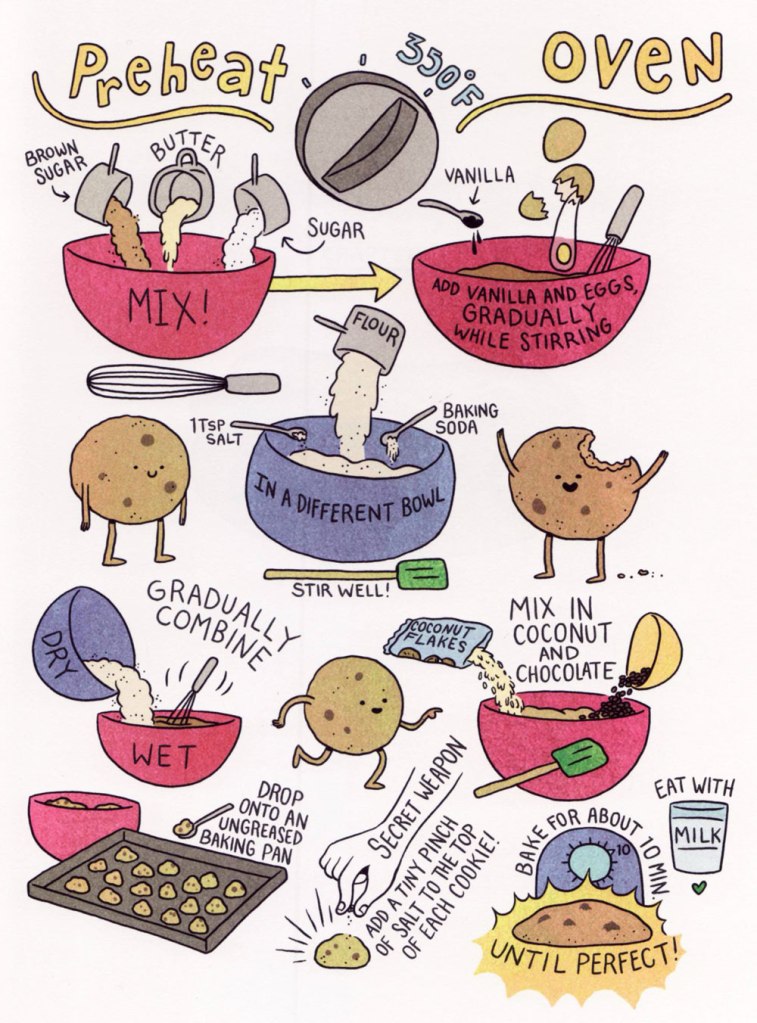
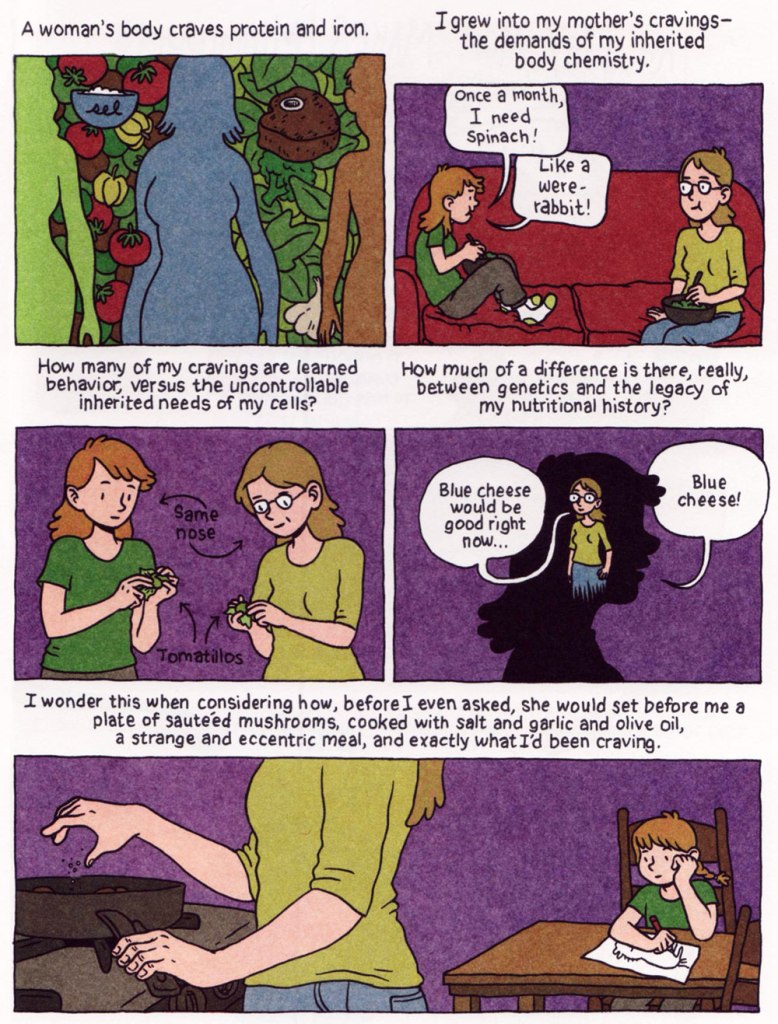
An excellent example of memoir-cum-comic-cum-cookbook is Lucy Kingsley‘s joyous Relish: My Life in the Kitchen (2013), probably my favourite example of this subgenre. Its colourful, cartoony style is the perfect backdrop for Kingsley’s pilgrimage through memories – and as the daughter of a professional chef with a penchant towards nature and an aesthete dedicated to fancy gourmet food, she has a great variety of cuisine-related reminiscences to share.
Cook Korean! (2018) by Robin Ha draws strong connections between Ha’s Korean roots and her gradually evolving relationship with her mother. Mothers, as they tend to be the first source of a newborn’s food and the child’s main guide to new flavours, crop up a lot in these recollections, but here the emphasis is more on reconnecting with one’s ancestry through traditional food. I bought this book for the recipes, but I was touched by Ha’s obvious enthusiasm and desire to make this cookbook a fun, easy-going romp through not only a lot of Korean staples, but also people’s attitudes towards them.
Dirt Candy (2012) by Amanda Cohen and Ryan Dunlavey chronicles the hard life of the chef/owner of a NYC restaurant. While I am not quite on board with Cohen’s claim that vegetables are boring unless they’re treated in very specific and fancy ways, her clear frustration at the reputation of vegetarian (I’m sorry, ‘vegetable‘) cuisine is educational and entertaining, as she spends a chunk of the cookbook discussing the evolution the Americans’ tortuous relationship with vegetables and ‘healthy’ food.
I’m still on the fence about whether I think it’s pretentious or not, but vegetarian cooking with ‘gloopy brown sauce’ is definitely a thing.
I have not tried any Dirt Candy recipes yet, as most of them require a multitude of bowls and techniques, not to mention the sort of time investment I currently reserve for other projects. The culmination of that approach is Cohen’s recipe for onion soup, which demands two days of preparation and would have also required the sacrifice of your first-born, if this hadn’t been a vegetarian (sorry, vegetable…) cookbook.
I applaud bold new ingredient combinations, but I think most of us are perfectly happy to keep our kumquats away from our onion soup.
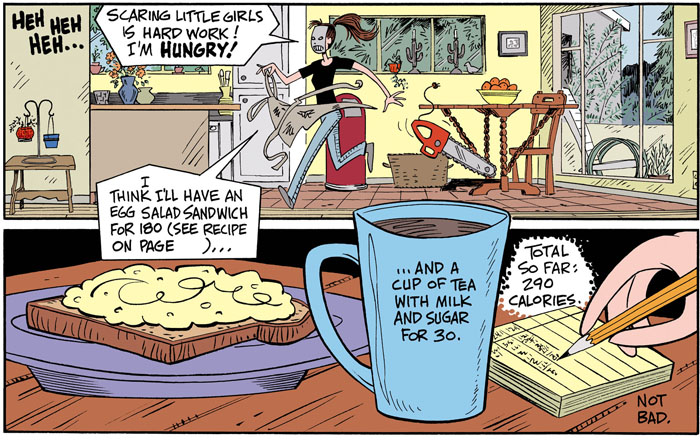
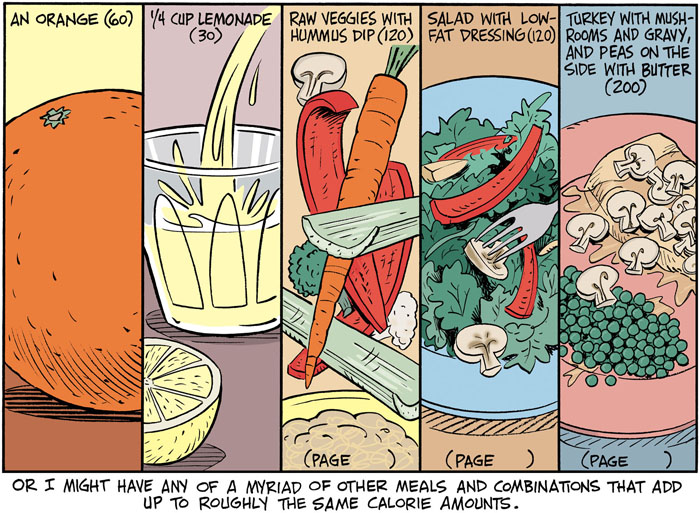
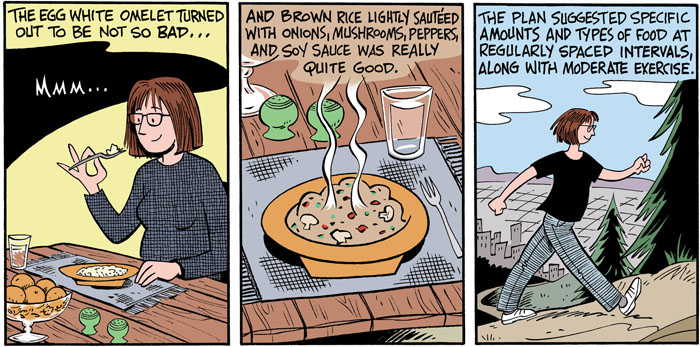
Carol Lay‘s The Big Skinny: How I Changed My Fattitude (2013) recounts her tortured relationship with food and how she finally was able to come to grips with her weight. It’s not that easy to laugh at yourself, and Lay successfully pulls it off, which makes this memoir instantly endearing whether one swears by counting calories or is convinced that it’s the sort of madness psychiatrists make a living on.
~ ds
P.S. I couldn’t write a post about comics and food without mentioning Ben Katchor, a WOT favourite. He has many beautiful perambulations into the territory of food, but one might mention The Dairy Restaurant for starters.
« Thank you for calling customer service. If you’re calm and rational, press 1. If you’re a whiner, press 2. If you’re a hot head, press 3. » — Randy Glasbergen
Comedy oriented towards employees who work in retail is its own breed of humour. I remember my ex-boss warning me early on that ‘the public is stupid’ – and that’s certainly the impression one gets, being confronted (day in, day out) by customers unable to read signs (no matter how big and prominent one makes them), pulling on doors that are meant to be pushed, and asking questions so inane that it feels slightly surreal.
There are myriad comics poking fun at the daily frustrations of retail… most of them making observations of a rather obvious nature, though frustrated employees will still chuckle at them (it feels nice to be ‘seen’!) I have mixed feelings about all the people leaping from ‘look, I doodle in my spare time’ to ‘I am an Artist who has a Webcomic!’, but that’s a topic for another day. Occasionally one stumbles onto a gem amidst all the ugly pebbles.
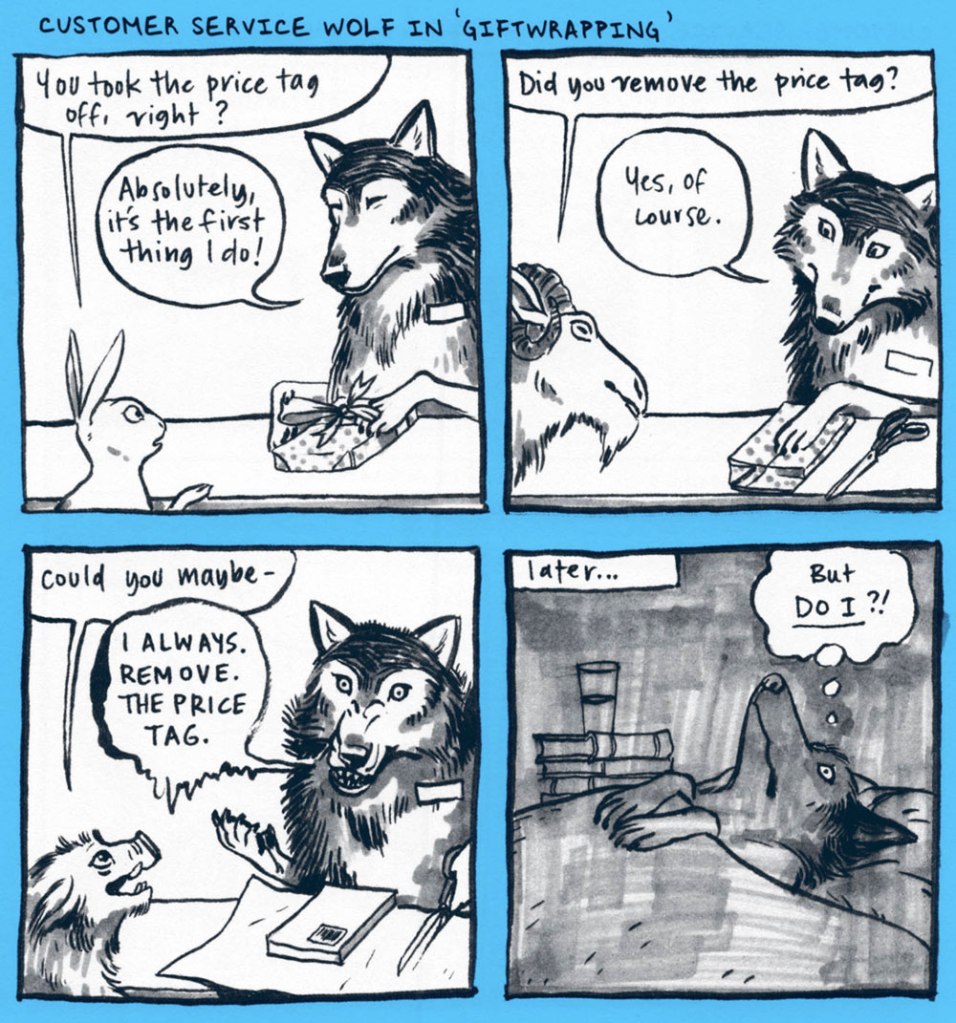
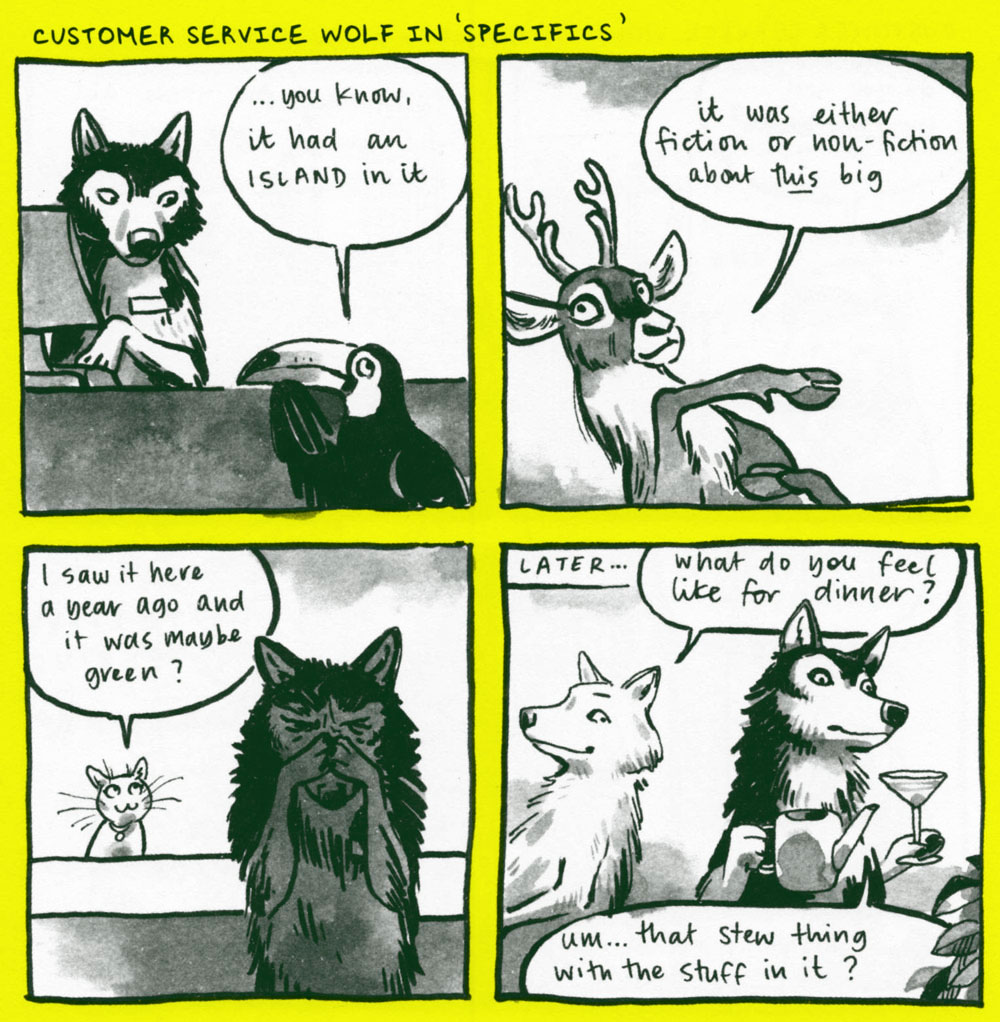
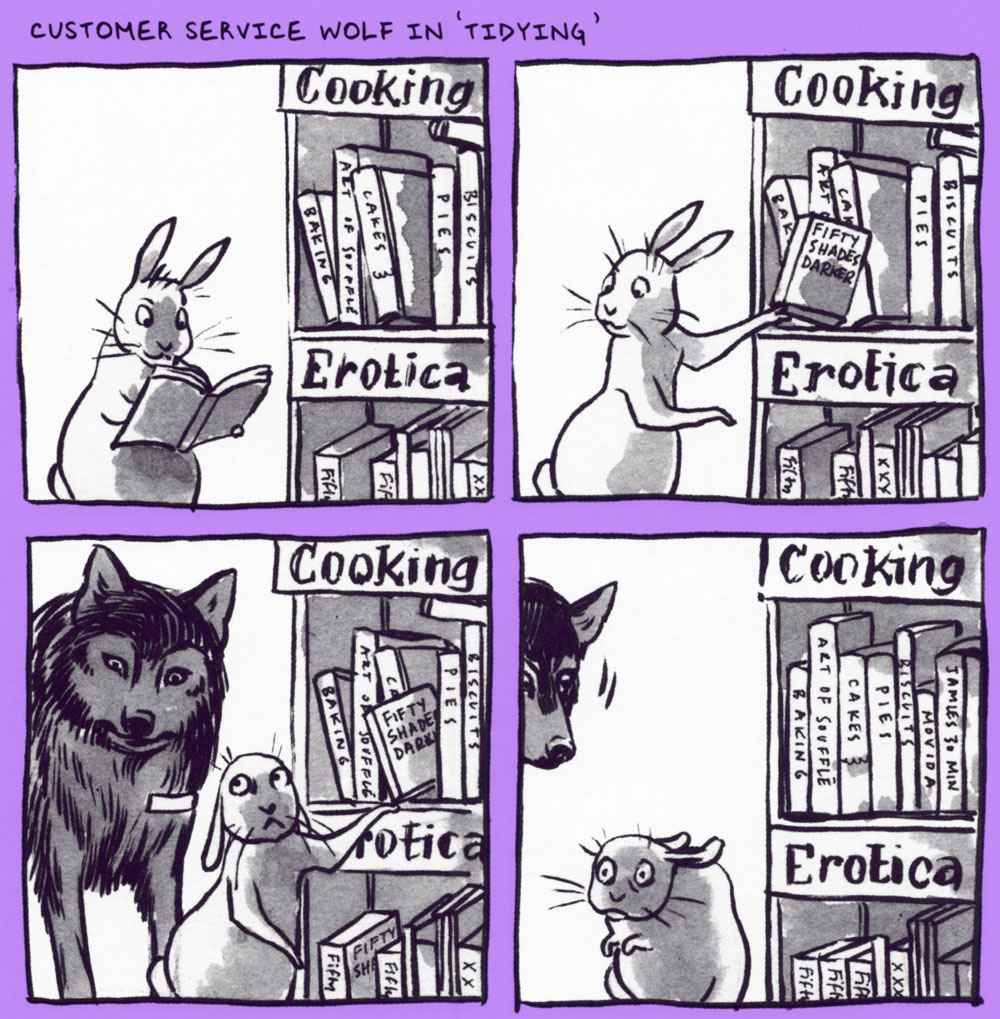
There are several things going for Customer Service Wolf, drawn by Australian illustrator Anne Barnetson. Its immediate appeal is that it’s beautifully drawn, of course. I am impressed at the variety of animals, convincingly depicted. It’s also very self-aware and funny, appending the usual ‘customers are destructive/insane’ stories with an unexpected recurring punchline (hint: it involves a wolf’s sharp jaws). A bookstore is a backdrop for a very special kind of lunacy, and Barnetson has clearly has had her share of it.
The following have been scanned from the collection (2019), but you can view all of them at the Customer Service Wolf tumblr.
One of this strip’s strengths is periodically pointing out that we the employees are not so different from the customers we mock.
« Any claim to fame I might have I owe to diligent swiping right and left and staying sober at the drawing board. »
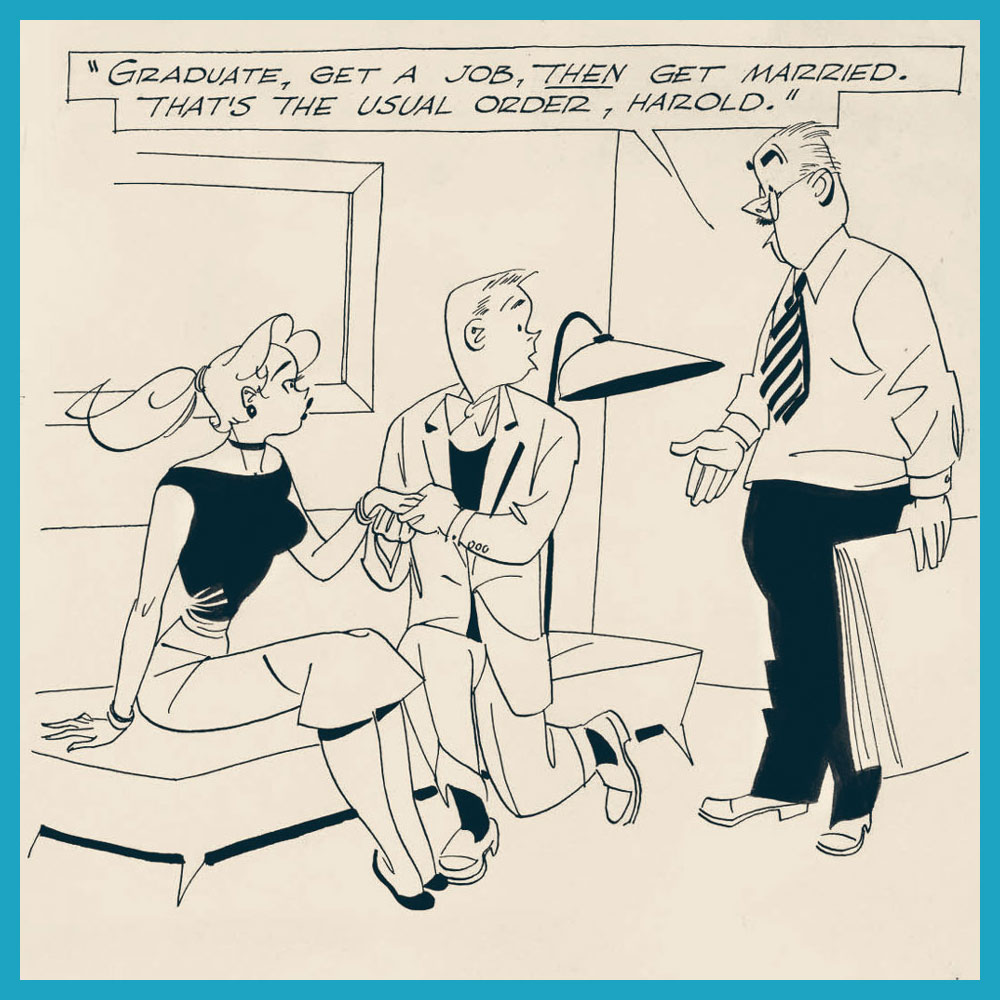
I’ve already talked about cartoonist Don Flowers (1908–1968): see Don Flowers, Sadly Neglected Cartoonist, although I wish I had given it a snappier title. I’ve been slowly ripening (like a pear, that subsequently falls off the tree with a wet, squishy thump) for a follow-up, but biding my time until I finally receive my copy of Glamor Girls of Don Flowers (2006, Fantagraphics). That goal is now (nearly) realized, and since spring seems like the perfect time for this sort of post, shall we strap on our travelling gear and fly back to the beginning of the 1930s?
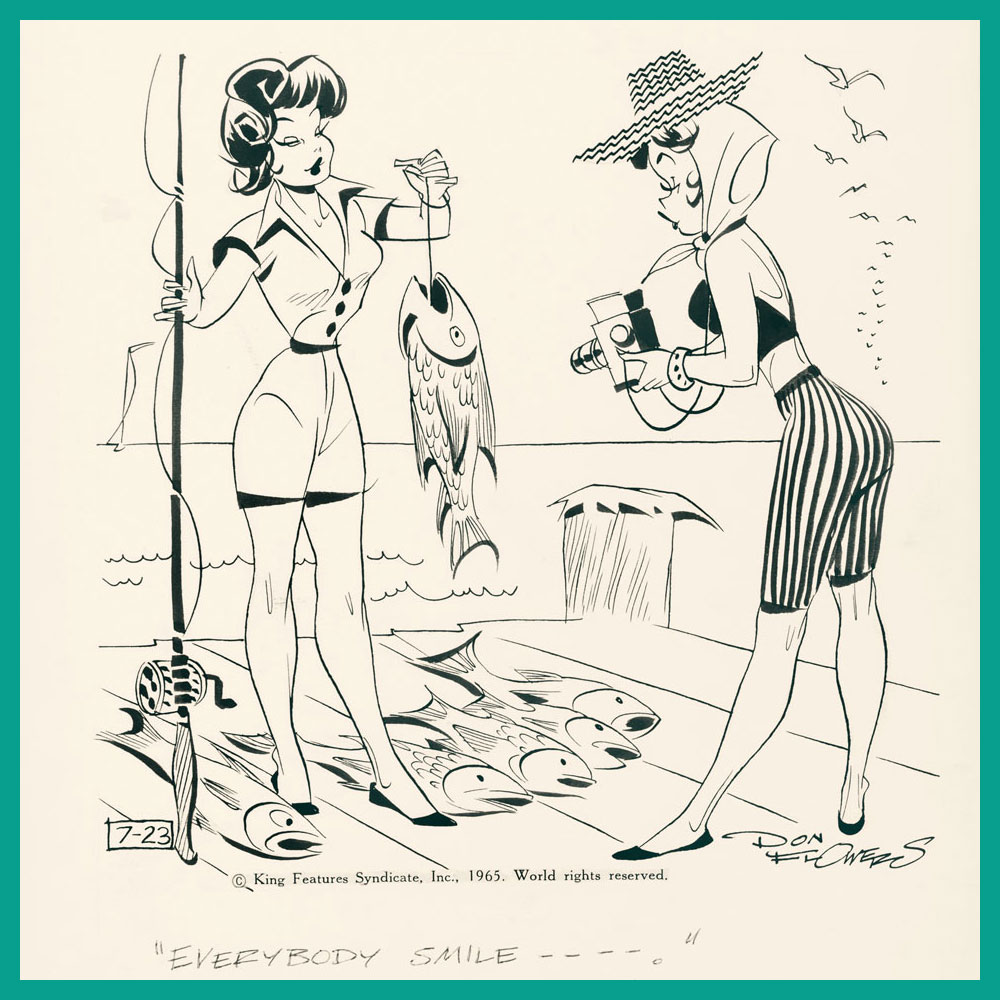
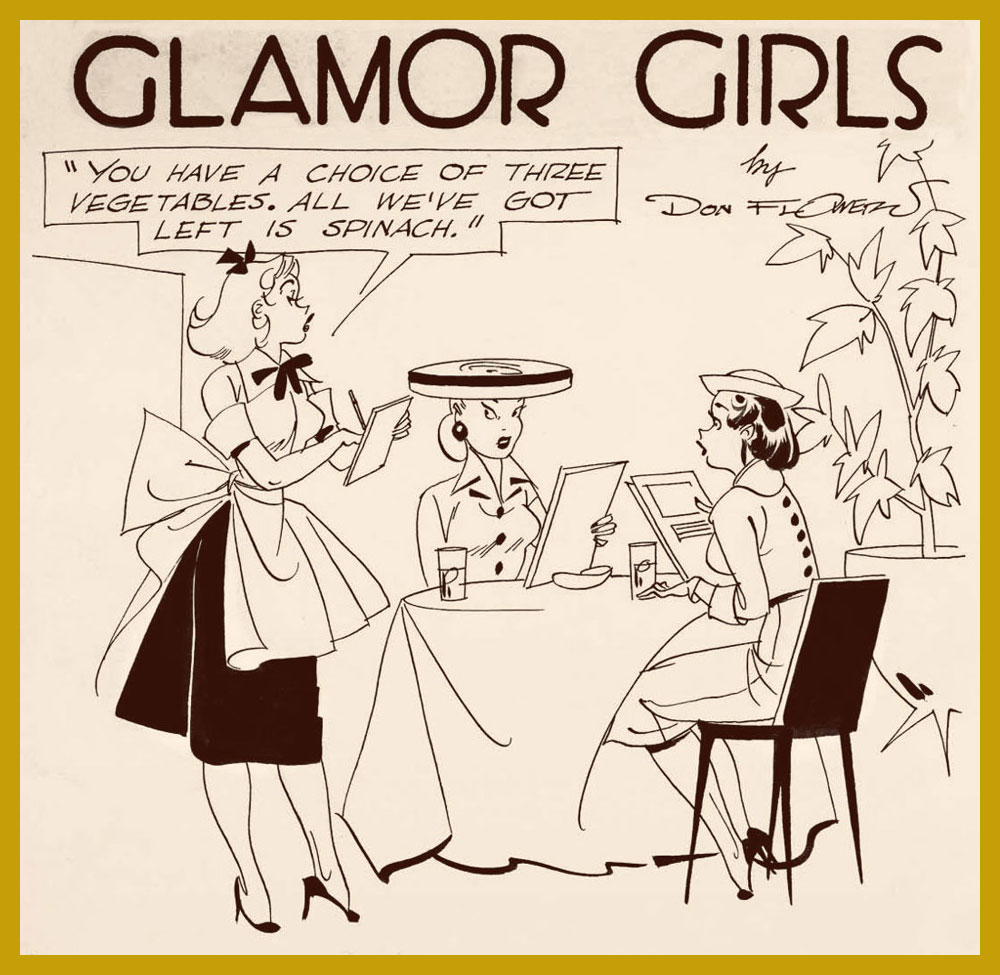
To recap, Don Flowers created the alliterative Modest Maidens (later renamed into Glamor Girls) for AP Newsfeatures in 1931. The ‘modest’ epithet in the title may seem like a misnomer, or a tongue-in-cheek allusion to the girls’ open-minded mores, but as comic historian-cum-cartoonist Coulton Waugh aptly observed in his The Comics (1947)*, a book acknowledged as the first comprehensive analysis of comic strips*, « sexy they are, and yet, despite every display, somehow they always do remain modest maidens. » This is something one often encounters in cartoon depictions of female pulchritude – the standard male audience seems best attracted to women with a sort of innocent sexuality, borderline unaware of the effect they are producing despite making a calculated effort to produce it. In other words, however disrobed these maidens may be, they are never vulgar or sexually purposeful; they’re not doing, they’re being done to.
The batch of images in my previous post about Flowers focuses more on the usual scenarios – women dating rich guys, alluring dancers in various states of undress, and so on – so today’s array is in a slightly different vein.
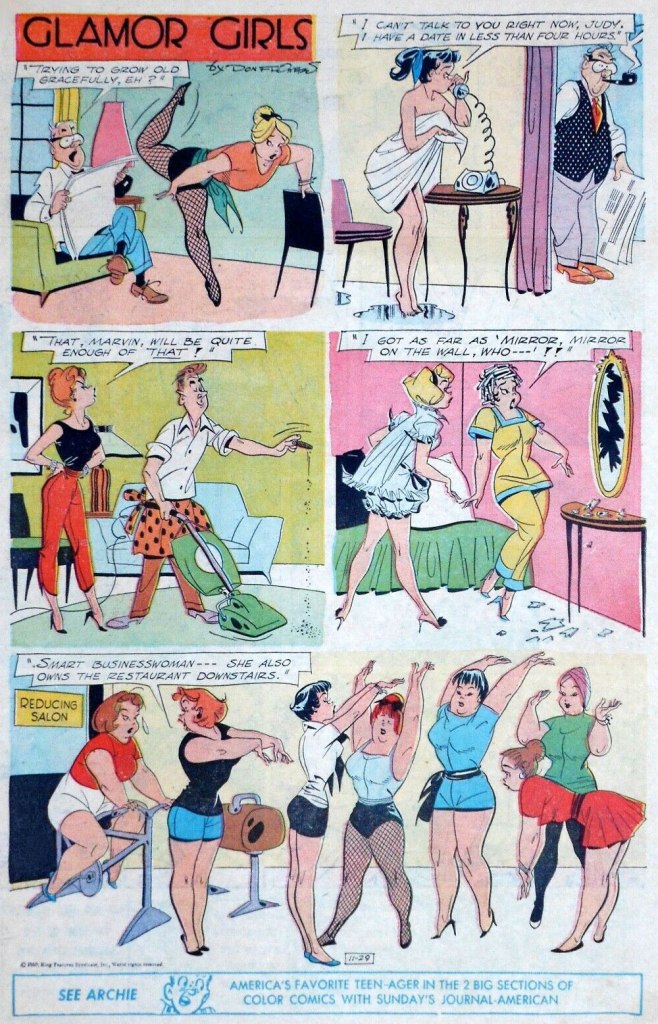
An interesting aspect of Flowers strips is that they often feature an interaction between several women with nary a man in sight; and not only that, but they’re not even discussing men.
Even when barefoot, these girls hold their feet as if they were still strapped down in some extravagant heels. On the other hand, high heels deform the foot over time, although nobody wants to be reminded of that in this context.
What the full published page of Glamor Girls looked like (November 29th, 1959).
Much has been said about Flowers’, well, flowery line (and ‘by much’, given that his popularity distinctly waned over decades, I mean ‘not really a lot’). It reminds me mostly of Hank Ketcham‘s style, he of Dennis the Menace fame. For example, add a little scruffy kid in the corner of this strip, and see what you think:
In the meantime, Waugh puts Flowers in the clan of Pattersonites, artists who followed the footsteps of illustrator Russell Patterson (1893-1977). « The Flowers girls [are] a long-legged creation. They have a a real rhythm running through them; they are, in this respect, somewhat more relaxed and graceful than the Patterson product, although the pattersonites can claim a vitality and sparkle on their side. » I would say that the Patterson girls have stronger wills, an independent streak that you can see in the slightly insolent look they give the men who ogle them. For comparison’s sake, the following three are by Patterson:
Sometimes self-defense is necessary.
~ ds
*You can read in full here; the first edition from 1947 goes for a lump sump of money these days. There is an affordable reprint from 1991, but it cannot beat the original cover:
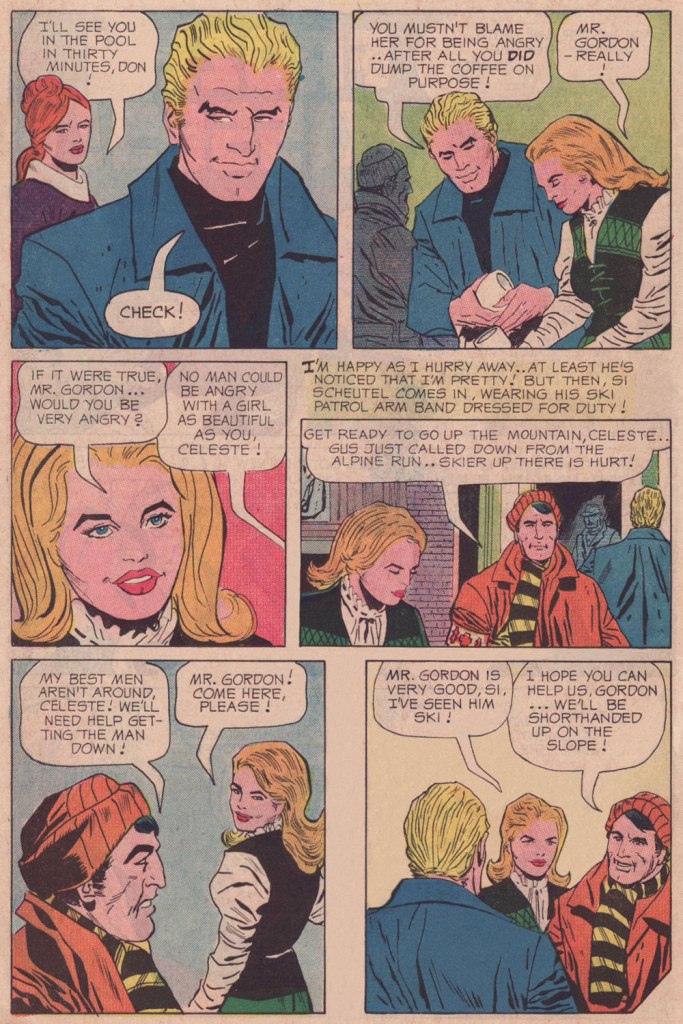
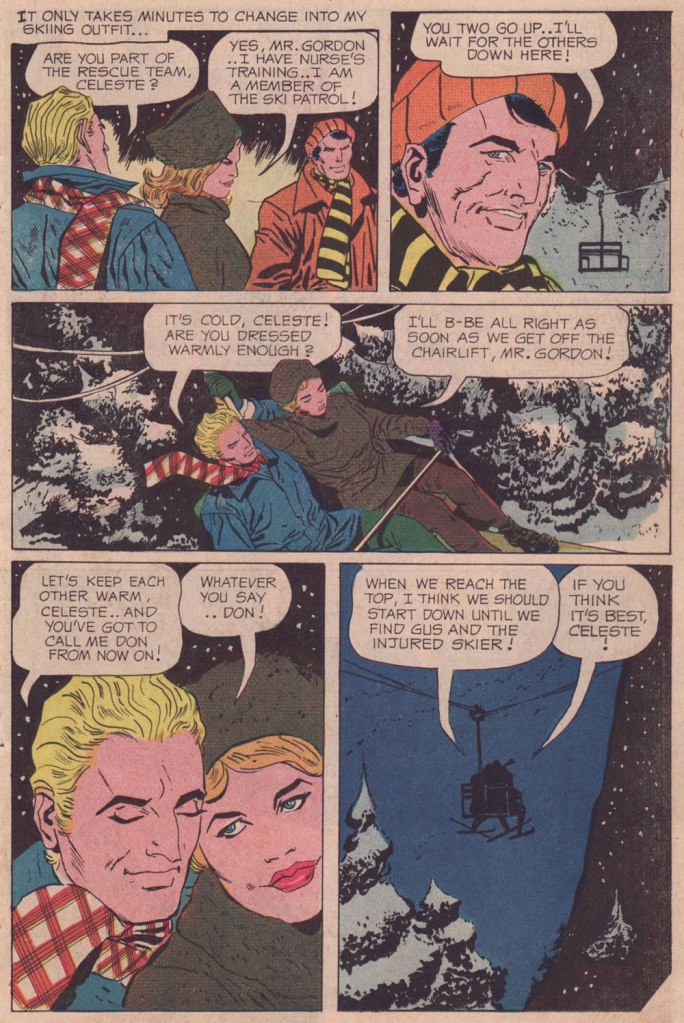
Co-admin RG has previously written about Pat Boyette (1923-2000), an artist we both hold in very high regard (see his Pat Boyette — Hillbilly Makes Good post if you missed it at the time), so there’s no need to delve into his biography. He’s a mainstay of Charlton Comics, but there aren’t too many romance stories around with his art, so I was pleasantly surprised to stumble across Frozen Kisses!, signed Bruce Lovelace (one of Boyette’s cute pseudonyms), in Secret Romance no. 10 (December 1970, Charlton).
Boyette can draw anything (even horses, the usual test for an artist’s ability!), but for me it’s the way he renders faces that’s really special. In his hands, it is instantly clear what to expect of each character. The hubris of villains shows as clear as day in each wrinkle of their face, treachery lives in the corner of their eyes; the bold gaze of the courageous challenges the injustices of life; the devious throw calculating glances from under veiled lids. That is not to say that everybody broadcasts their intentions in a Boyette story – a minute shift, and the face of a villain can suddenly subtly hint at a kind smile, or the mouth can distort, revealing a seemingly undaunted man to be a spineless weakling.
But what I like best is the way Boyette depicts women, young or old. Their strong eyebrows and willful expression signals an alluring strength of personality; such a woman will stop at nothing in pursuit of her goal, whether the goal is virtuous or evil, humble or grandiose. Never mentally broken, even in hopeless situations, his heroïnes would rather literally die than to submit to someone they despise. They’re also really elegant, even innocent young maidens possessing a kind of appealing gravitas (in that, Boyette’s women remind of Jack Kirby‘s) that normally is the territory of much older and wiser women.
Although there are pleasant exceptions, romance comic plots tend to follow a rather rigid pattern – there are maybe 5 or 6 ‘typical’ templates, with small deviations to provide an semblance of variety. Boyette art would make any story enjoyable, but in this case we were also blessed with a spunky, independent heroine that’s a pleasure to watch in action. Frozen Kisses! is actually a cynical story: our leading lady, Celeste, is a scheming sort who chooses a ‘target’ based on his good looks, but also on his showmanship and money. On the other hand, it’s hard to feel sorry for Don’s beautiful-but-vapid companion, and Celeste’s quick thinking and athleticism are genuinely attractive. She doesn’t tone it down in order not to offend the fragile sensibilities of the male (I hate stories in which girls lose at chess, in tennis or whatever else on purpose, not to turn the guy off).
« The autobiographical narrations by Cruse examining everything from Acid and UFOs, to TV punditry and death itself are priceless! So read on, and enjoy the work of a true master of wit, wisdom, and weirdess! And tell you friends to buy this book! It’s just a matter of time before all copies are seized and burned! For soon a cleansing will surely be upon us! » —Jay Lynch*
Alabama cartoonist Howard Cruse (1944-2019) is usually recognized as the author of Stuck Rubber Baby (1995), a serious graphic novel about a young gay man whose life gets swept up in the American Civil Rights Movement. It was lauded by many, some praising it for its ability to demonstrate that comics can appeal to adults (Harvey Pekar), some for its place in the comic book canon as the ‘Great American Graphic Novel’ (Justin Hall). I am not denying its historical importance, of course, but I am slightly allergic to this idea of the Important Work of Art™.
Once upon a time, my favourite Cruse material was Barefootz (more about further down), but that has changed over the years. My current treasured possession (gift of co-admin RG!) is Dancin’ Nekkid With the Angels (1987, Kitchen Sink Press), which collects some previously unpublished material as well as stories that appeared in various underground publications (Snarf, Bizarre Sex, Gay Comix, of which Cruse was a founding editor**, Dope Comix…) as well as in Village Voice, Heavy Metal, etc. The book was published in a print run limited to 1,082 copies, and strangely enough, some are still available for purchase here, a sad testament to Cruse’s relative lack of renown.
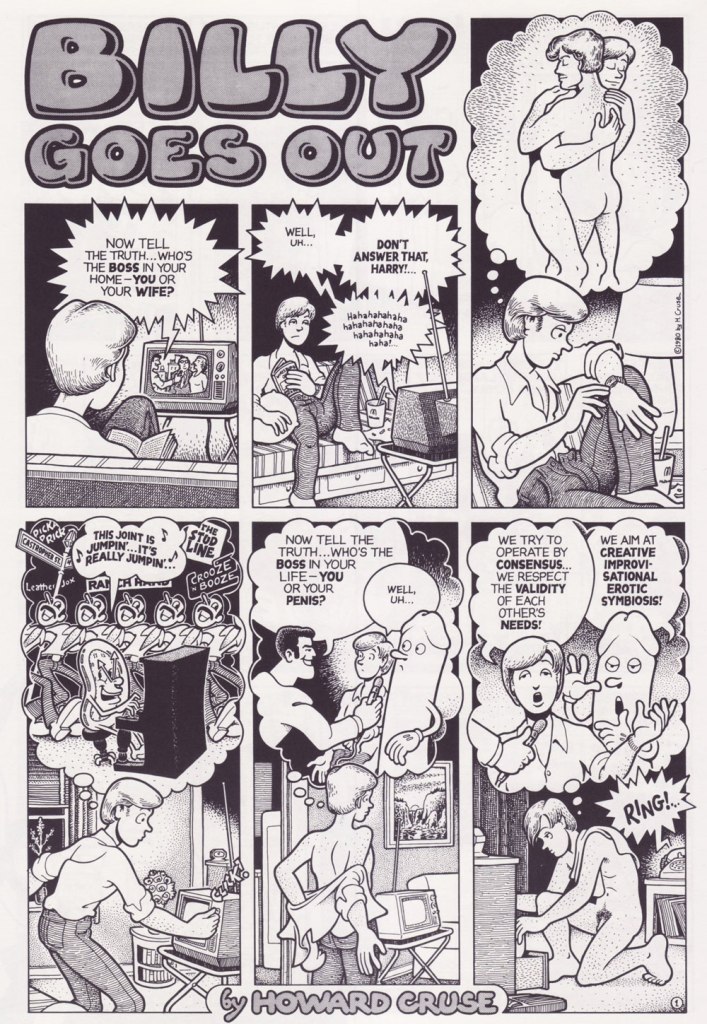
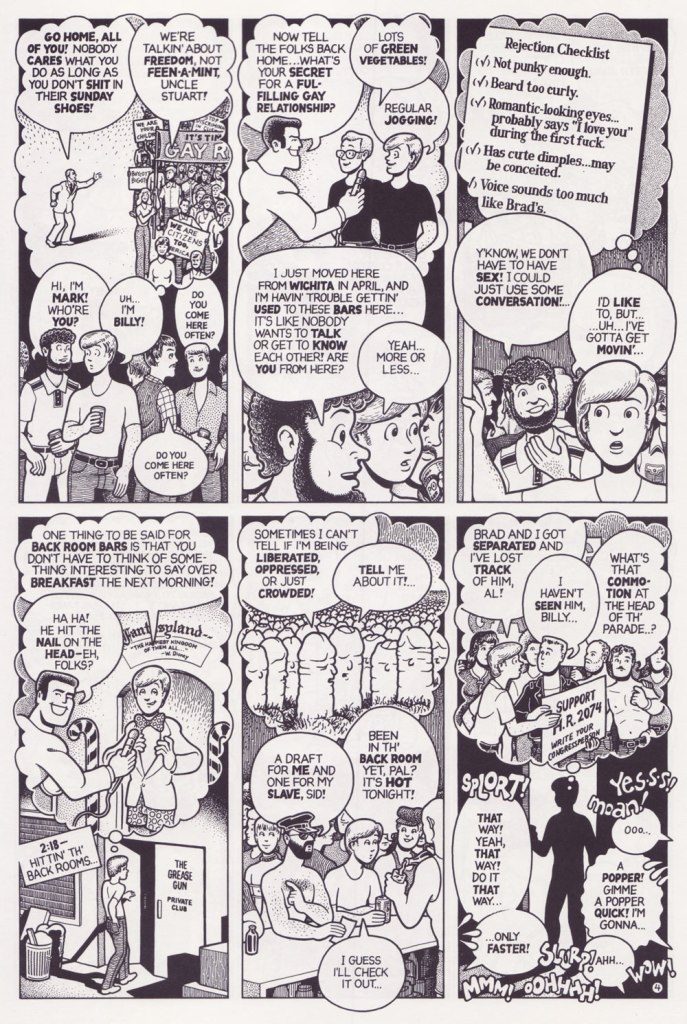
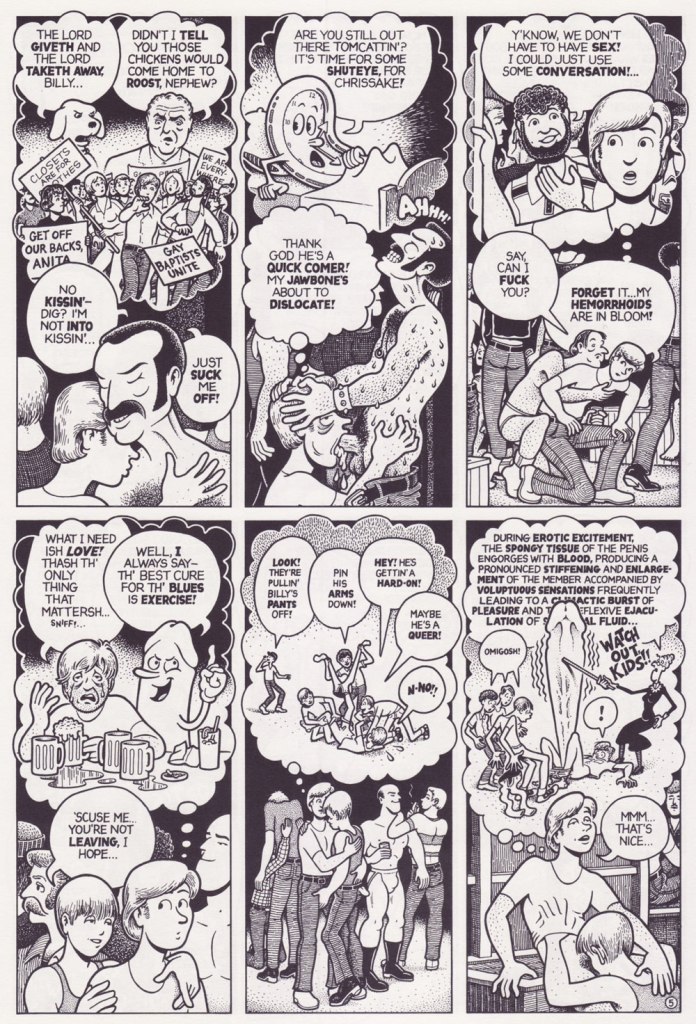
This anthology includes its share of my favourite Cruse pieces (to name a few, Unfinished Pictures, about an artist overstimulated by his own art; the absolutely brutal Creepy Snuff Porn, a satirical piece about the Meese commission of pornography; Dirty Old Lovers, featuring two older gays, Clark Stobber and Luke Tewba, prowling the streets in search of goofy, sexy fun), but the one that lingers most in memory, having sub-rented a permanent room in my brain, is the pitch-perfect, heart-breaking Billy Goes Out (1980), interestingly not even included in the best-of collection The Best Sides of Howard Cruise (2012, Boom Town). Here it is.
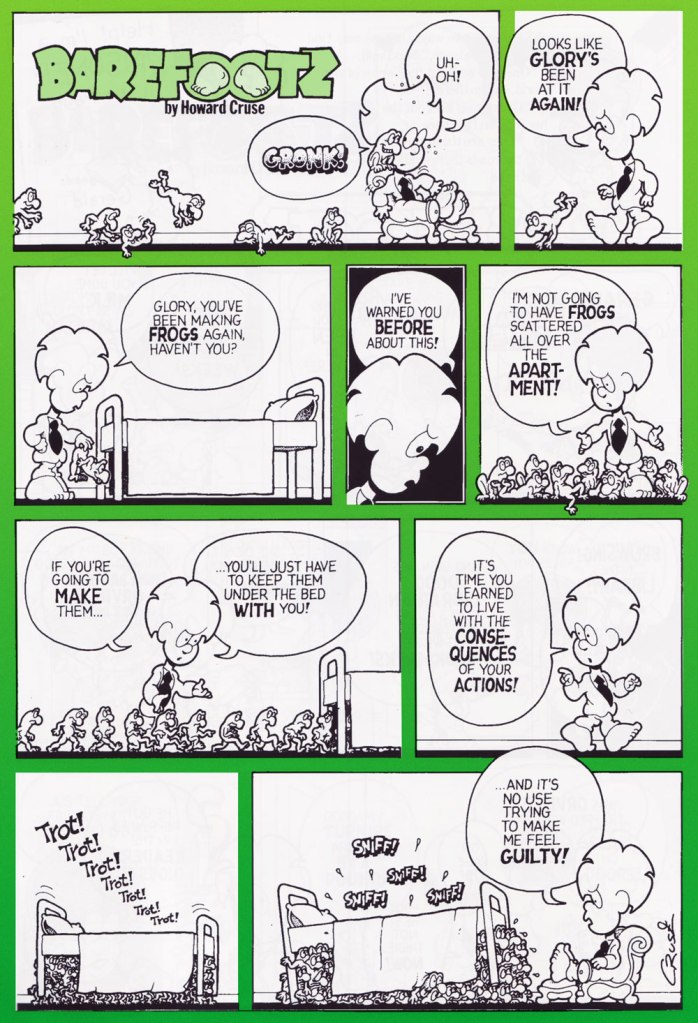
Since I mentioned it earlier, I’d also like to include two pages from Barefootz, a pleasantly surreal, somewhat drug-fueled strip. Its sense of humour is a gentle one, though it demands an ability to enjoy free-form association and controversial topics (death, abortion, cannibalism…), although the latter are inserted with such childlike enjoyment that I am hard-pressed to imagine somebody taking offense. The strip debuted in a university newspaper in 1971, migrating a year later to a few Denis Kitchen publications (Snarf, Commies from Mars, Marvel-packaged Comix Book), and then to its very own home, Barefootz Funnies.
« Compared to fellow underground comic creators, Cruse’s Barefootz character was easy to label “too cute” to be underground, and legend has it that Barefootz Funnies was widely despised by many artists from the era. Barefootz Funnies took an interesting journey from 1975 to 1979. When Barefootz debuted as a comic character in 1971, Cruse was still in the closet about being gay. Cruse later admitted the character was not the most representative of his own personality, since Barefootz wasn’t gay. But in Barefootz no. 2, Cruse revealed that Barefootz’s artist buddy Headrack was gay. This type of revelation ran counter to Barefootz’s reputation as being too cutesy to be part of the underground comic revolution. Cruse’s publicly emerging sexual orientation in real life was leading him to become more bold in his comics, which created ambivalence about the cartoony style and nature of the Barefootz character. Cruse finished the series with one final issue, which featured the cathartic “Barefootz Variations,” a story that summed up his mixed feelings about Barefootz and about cartooning itself. » [source at ComixJoint]
Barefootz himself is a man with inexplicably large and always bare feet, who lives with hundreds of cockroach roommates and a petulant under-the-bed monster called Gloria who coughs up frogs when she’s displeased.
This is Barefootz Funnies no. 2 (Apr. 1976, Kitchen Sink).
~ ds
* I don’t think I’m imagining the note of bitterness in Jay Lynch‘s voice when he says that ‘cleansing will surely be upon us‘; a cartoonist who has lived through the purges of the U.S. Supreme Court’s 1973 ruling on obscenity, followed by the aforementioned Meese Commission on pornography in 1986, which severely limited the retail outlets carrying underground comics and empowered humourless censors, surely has cause to be embittered.
** In 1979, Denis Kitchen asked Cruse to be an editor of an anthology featuring the work of gay comic artists. Although he hadn’t officially come out as gay at that point, Cruse decided that to refuse would be cowardly, and the first issue of Gay Comix was published in 1980.