« You know, the dog food that Billy Jack loves! » — The Firesign Theatre
Ah, September the 18th. Today’s the birthday of the staggeringly accomplished William Stout (born in 1949), master of ancient reptiles, bootleg record covers, friend of The Firesign Theatre, former Russ Manning assistant (none but the best would do!), and I’ll spare you the illustrious details of his career in cinema. Still, let’s look around a bit, shall we?
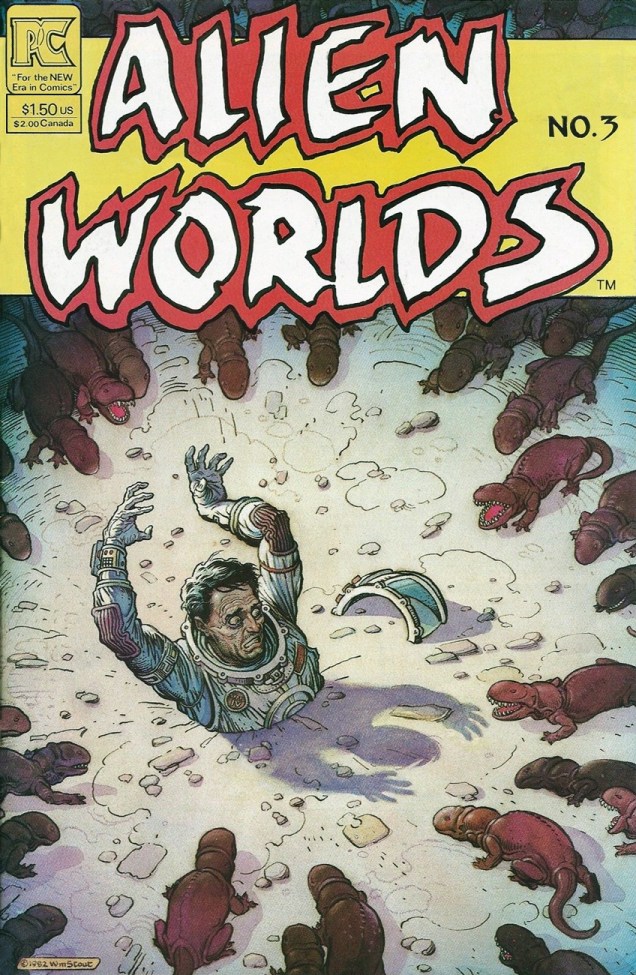
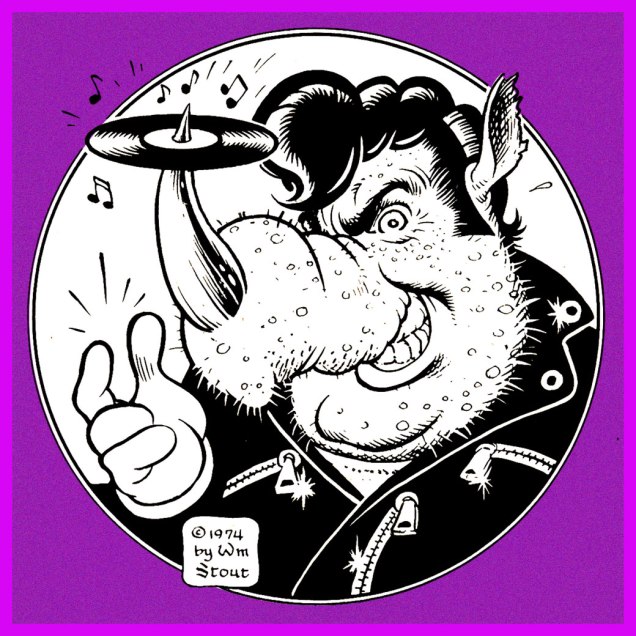
Here’s an unforgettable cover from Alien Worlds no. 3 (July, 1983, Pacific Comics). This scene gave me nightmares, and still raises a shudder. These critters look like a hybrid of a platypus and a piranha. Happy landings!Stout’s wonderful original logo for Rhino Records, circa 1974.
Speaking of ’74, isn’t that rhino a dead ringer for Swan’s oleaginous right-hand man, Philbin, from Phantom of the Paradise?
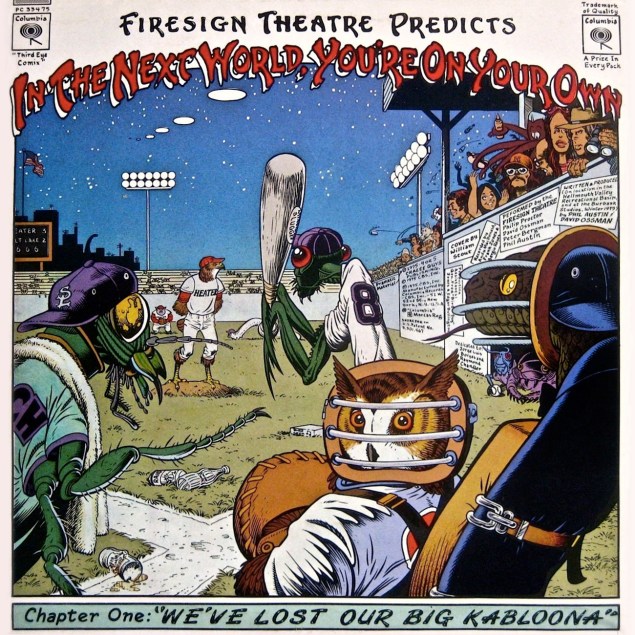
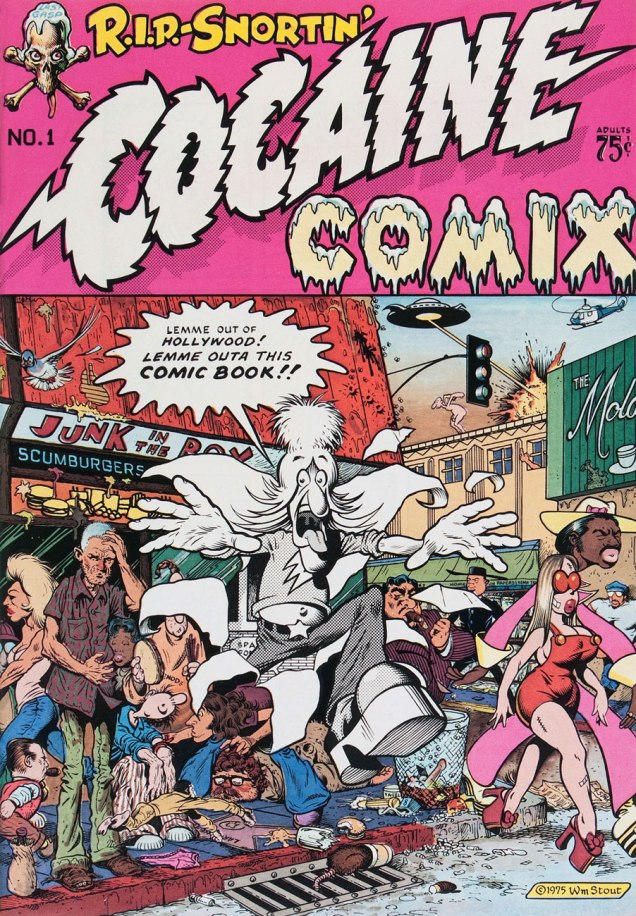
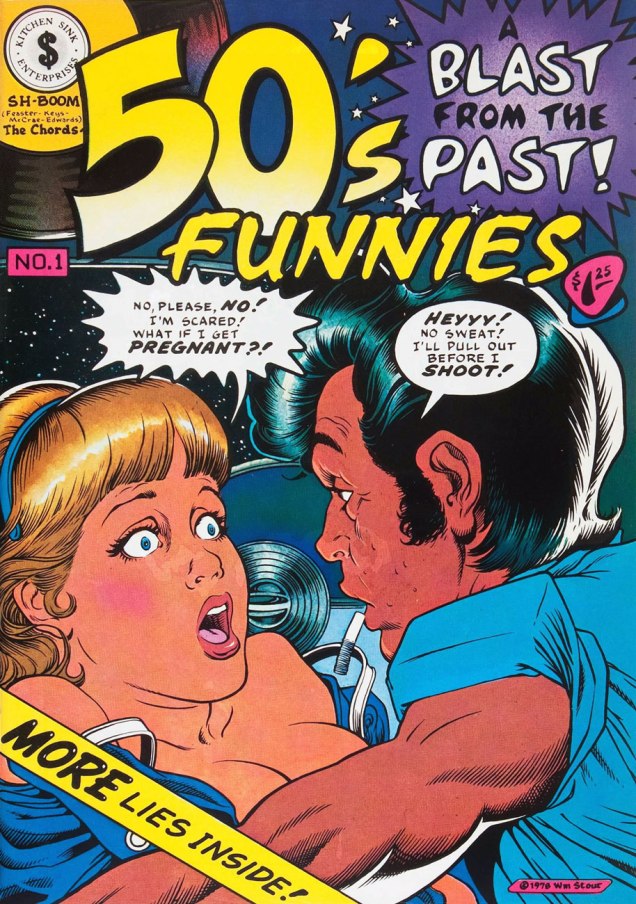
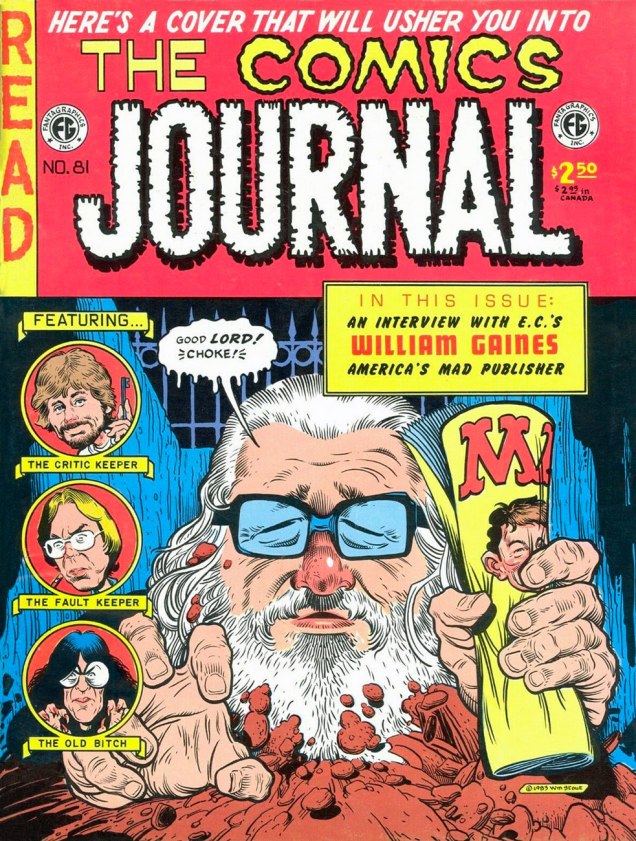
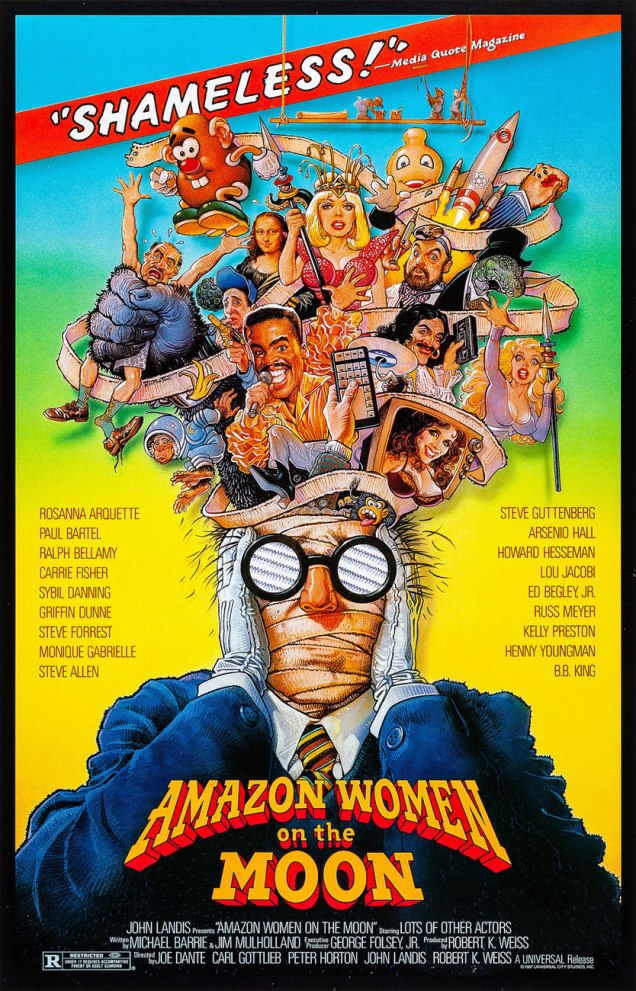
This is the back cover (the recto is equally sumptuous) for The Firesign Theatre‘s 1975 opus, In the Next World, You’re On Your Own, featuring a pair of classic sidelong suites, Police StreetandWe’ve Lost Our Big Kabloona.A clutch of underground classics? Sure. Here’s Cocaine Comix no. 1 (Feb. 1976, Last Gasp).Another number one (with a bullet, of course): 50’s Funnies no. 1 (1980, Kitchen Sink). More lies inside!A favourite page from Stout’s masterpiece (or certainly his great labour of love, at the very least): The Dinosaurs: A Fantastic New View of a Lost Era (1981, edited by Byron Preiss). This piece (the first he drew for the book) is entitled Hot Weather. « After lifting his head for air, he drank more and then wallowed his whole length and breadth into the ooze, vocalizing for the first time that day, and loudly. »Say hello to friendly Ed Gein. Weird Trips no. 2 (1978, Kitchen Sink). Please note the sinisterly customized Kitchen Sink Enterprises logo, Wrightson–brand coffee, and EC Comics narrator The Old Witch impishly peeking from a lower-right shelf. And yes, can’t go disemboweling your fellow man and woman without a copy of Gray’s Anatomy. Preparation is everything!Well, there never was any doubt that Mr. Stout was an EC Comics überfan. The Comics Journal no. 81 (May, 1983, Fantagraphics).I did bring up his Hollywood work, so here’s a sample. I wasn’t going to go with his the far-too-familiar Rock ‘n’ Roll High School poster… you all know it already, so where’s the fun in that? Of course, Joe Dante’s Amazon Women on the Moon again (1987) raises the eternal question: « Who made Steve Guttenberg a Star? »
And that’s Bill Stout for you: stunningly versatile, but always himself. Could any artist strive for more?
« We’re not very accepting of people who act strangely. » — Chester Brown
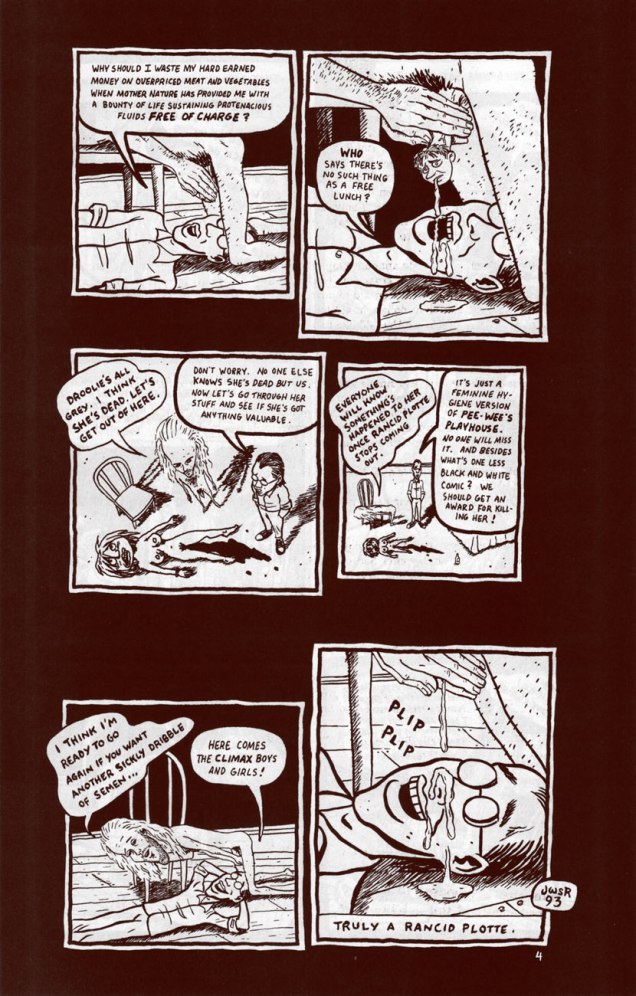
Scott Russo’s Jizz, published by Fantagraphics in 1991-93 (10 issues in all), was a fearless, often downright incendiary and frequently fascinating repository of vitriol from the heart and soul of Mr. Russo. As his own drawing style was pretty rudimentary (but clean and distinctive), the auteur drew upon collage, détournement and plain old text pieces for variety. Russo may have been embittered and misanthropic, but the entertainment he proffered was quite deliberate; a fine, dexterous trick to pull off.
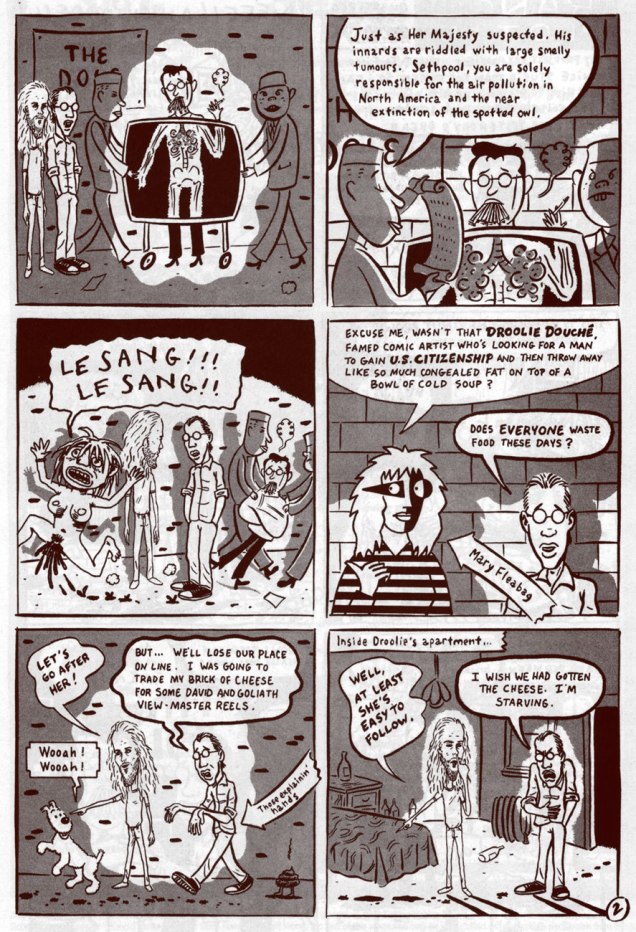
Here, from Scott Russo’s Jizz no. 10 (March 1993, Fantagraphics), is his merciless but spot-on takedown of publisher Drawn & Quarterly‘s stable of neurotics: Julie Doucet, Joe Matt, Chester Brown and Seth, rendered in a breathtakingly accurate facsimile blend of their respective styles and schticks. Script by Russo, art by his trusted confederate ‘Master’ Jeff Wong. Not particularly ‘safe for work‘, I should say.
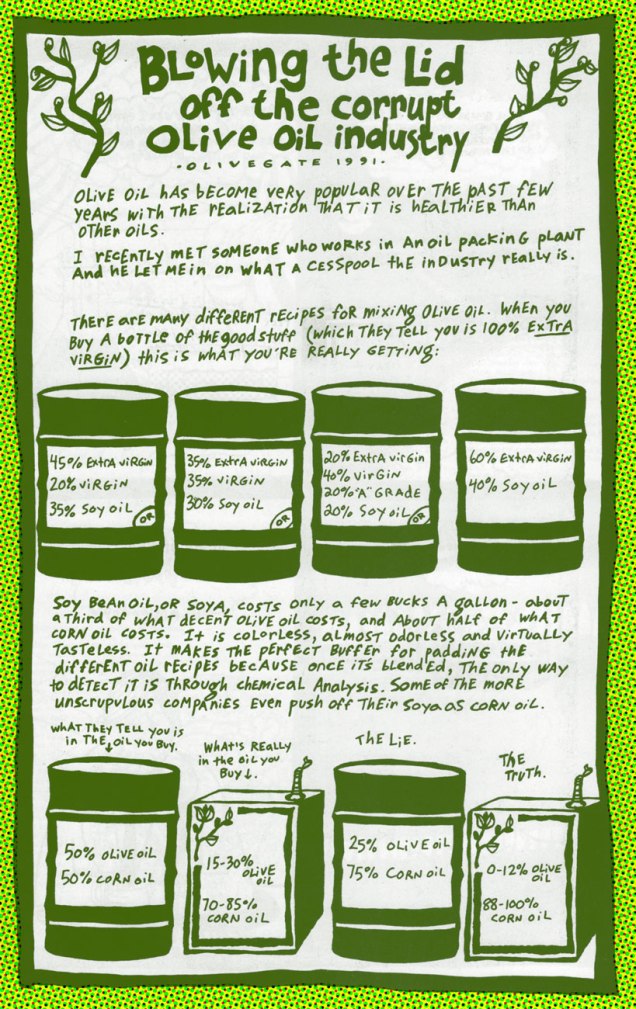
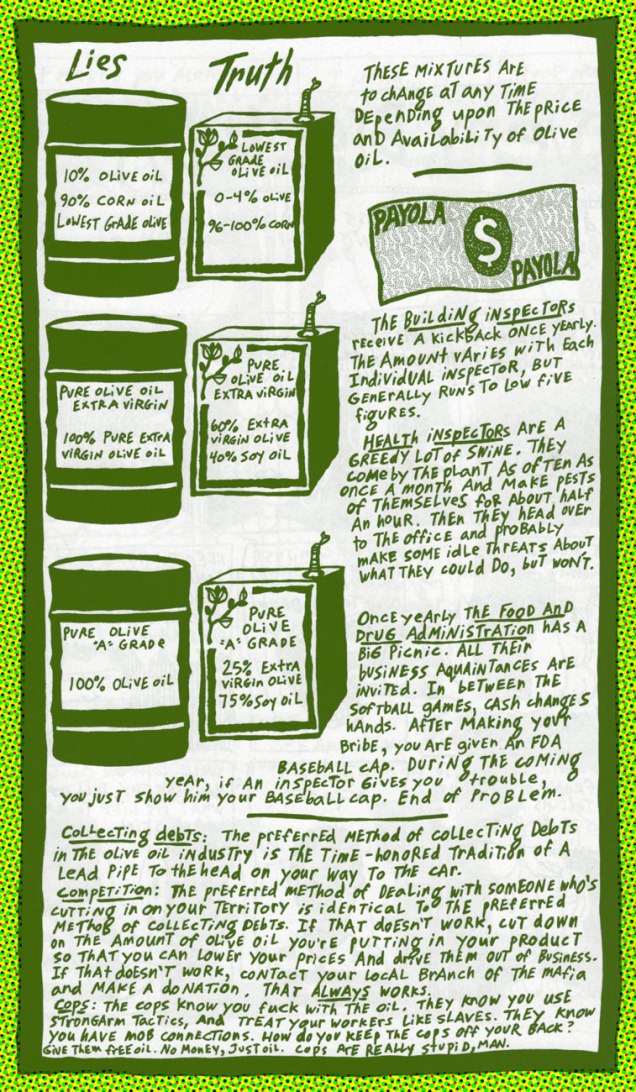
From Scott Russo’s Jizz no. 7 (Sept. 1991, Fantagraphics). I’ll always be grateful to Mr. Russo for this scathing exposé of the Olive Oil industry. My girlfriend at the time was taking a chemistry class at McGill University, during which they subjected various brands of olive oil to chemical analysis and essentially confirmed Russo’s claims. Now I merely snicker and shrug when I see someone shell out big bucks for the stuff… sometimes there’s no sense in trying to convince anyone.
«America’s top-flight intellectuals will one day hold entire conferences and seminars devoted to Sylviology. They will deconstruct her frame by frame with straight edge and compass, attempting to identify each tiny object as an Artifact of Our Time and a clue to our condition. They will bring in leading neurologists, phrenologists and psychoanalysts to study the blabbermouth pets, the thimble-sized martinis, the neurotic superheroes, to answer the inescapable question: What kind of a mind…?» \from the introduction to Planet Sylvia by Barbara Ehrenreich|
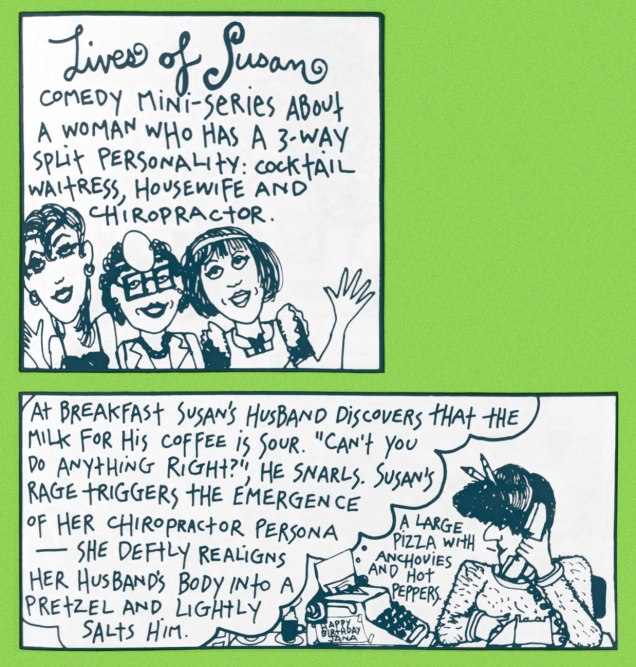
Many years ago, I was perching on a sofa in the corner of a cozy records store (the excellent Death of Vinyl in Montreal, in case anyone is wondering) when I noticed a stack of comics in a nearby bin. Something dishevelled and coverless, pages barely holding together, attracted my attention with its idiosyncratic drawing style and strangely articulated cats. There was also a big-nosed lady with giant earrings and a typewriter. I was hooked and purchased the book immediately, though I wasn’t even sure whether it was for sale or just placed there as reading material. (I located the cover, after all, albeit in a different bin.)
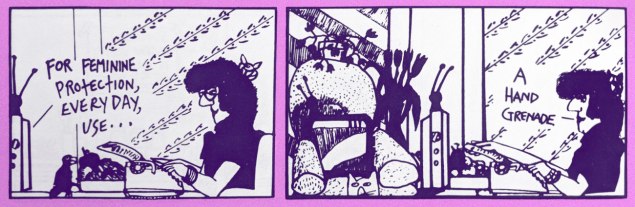
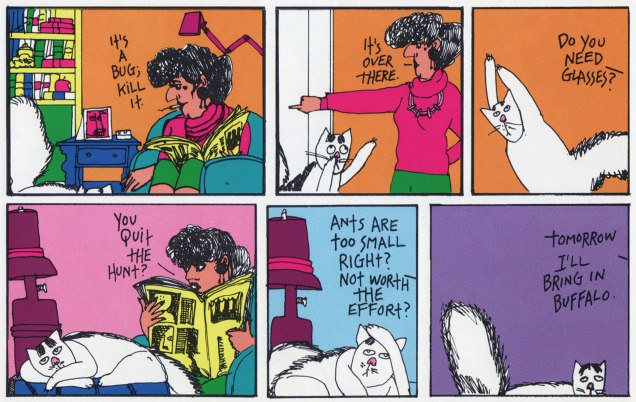
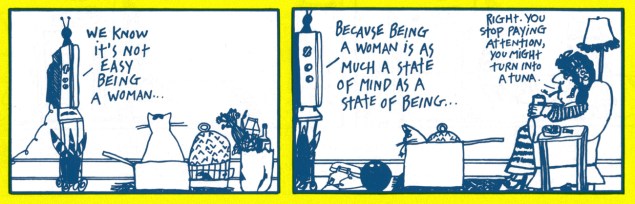
Sylvia is a more-than-slightly cantankerous woman with a wonderfully acerbic sense of humour. Sometimes she doles out social commentary from the bathtub, sometimes a local café serves as her headquarters — or she stays in her living room, dispensing wisecracks at yet another inane TV ad, or bestows advice to lost souls (typed on an honest-to-god typewriter). She’s clearly a feminist, and equally clearly fluent with clichés of womanhood, such a certain obsession with dieting and a definite obsession with cats. She embodies many tropes – she’s the crazy cat lady, an Apron Matron (albeit with a flowery hat instead of an apron), a Dear Abby-type adviser – and puts her peculiar tilt on them all. Extravagant earrings and the odd flamboyant hat (all the articles about Sylvia seem to overstate the presence of hats, yet Sylvia’s handsome head often boasts nought but big hair adorned with a hairnet or bow) are just the cherry on the cake.
As for Nicole Hollander, she is a Chicago native and brought forth something like 30 years of Sylvia. Born as a series of cartoons for the feminist magazine The Spokeswoman, it was syndicated in 1981 and continued until March 26th, 2012, upon which date Hollander declared that Sylvia was retiring.
« In the old days, the disconcerting feel of the strip as well as Sylvia’s middle-aged ‘dame’ image and her biting humour gave the artist problems. After St. Martin’s had started publishing Sylvia, even the big syndicates were forced to sit up and take note of her. But they did so in a grudging, good-old-boy sort of way, taking away with one hand what they gave with the other. After Field Enterprises took Hollander on in 1981, a rep would intermittently call Nicole to shake a finger at her – for instance, the week on Sylvia cartoon mentioned hemorrhoids, and another mentioned Lightday pantyliners. “They said, It’s your life, but you’re ruining it. If you leave stuff like this in, a lot of papers will pull the strip. I gave up the hemorrhoids, but not the Lightdays. There was this voice in my head that said, You must take a stand. So I said, I will take my stand for Lightdays, and threw hemorrhoids to the dogs.”» |From Don’t Throw That Old Diaphragm Away! by Ellen Cantarow, published in Mother Jones (June/July 1987)|
In case you’re wondering what *can* you do with a diaphragm, this handy illustration might help:
For all its popularity, there aren’t a lot of Sylvia strips available online, let alone in decent resolution. Oh, sure, you can go to GoComics and read a whole bunch of them, but that seems to be just the strips from the 2000s. Somebody got started on a documentary about Hollander in 2015, but I get the impression that that was abandoned somewhere along the way, probably for lack of funds. Even Hollander’s website, Bad Girl Chats, doesn’t seem to exist anymore. Speaking of that, please watch this adorable video in which Nicole explains what sort of things she posts on her website.
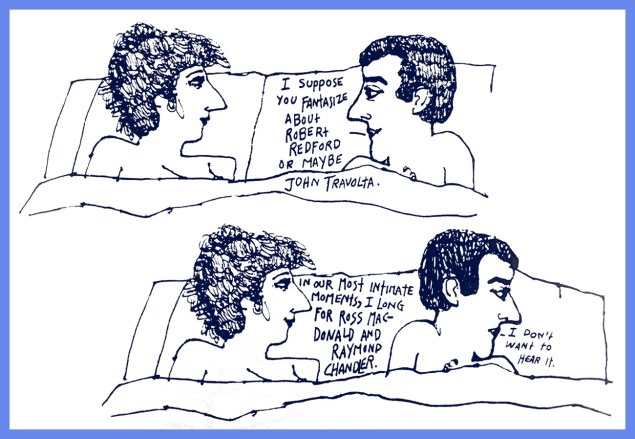
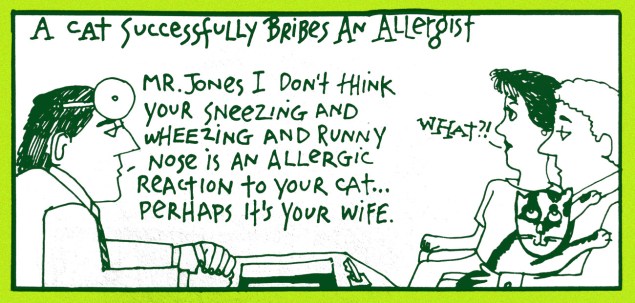
(On the brighter side, in 2018, Fantagraphics released Hollander’s autobiography-slash-graphic-novel, We Ate Wonder Bread.) I aim to remedy this situation at least a little bit, by showcasing some of my favourite strips (scanned from The Whole Enchilada, 1986 and also from Planet Sylvia, 1990; the black and white strips were “colourized” by co-admin RG, who abhors lousy greying paper.)
As Hollander points out, her mother had a whole network of witty women friends who liked to discuss events of the day over a cup of coffee. Auntie Sybil was surely one of them.
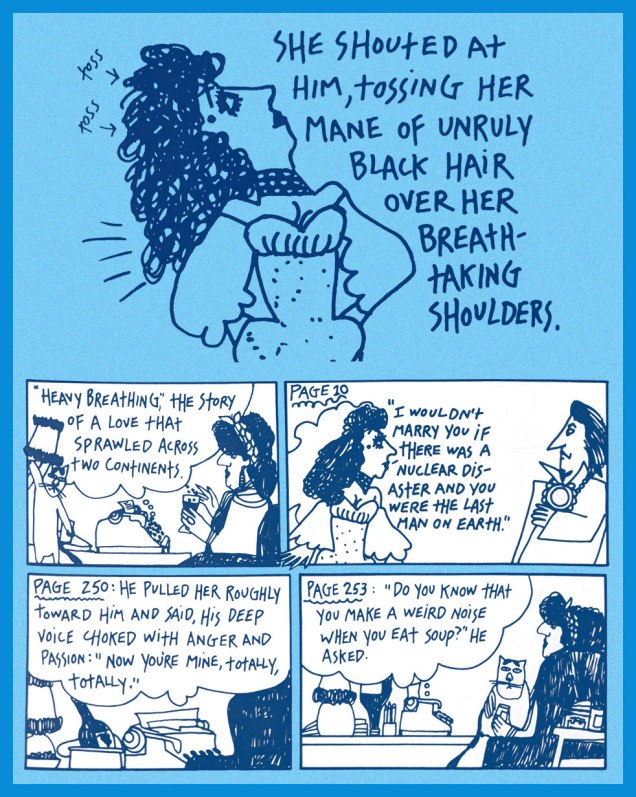
Occasionally, Sylvia ventures into writing romance novels, which do a delightful job of mocking common clichés of what passionate love is supposed to be like.
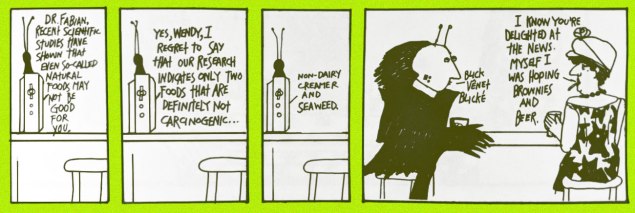
Waitress Beth Ann is every bit as sardonic as Sylvia, but with more of a food-centric accent.Gernif often shares a cup of… non-dairy creamer, I guess… with Sylvia. I wonder if she, like Broom-Hilda, stopped drinking and smoking when the proverbial Powers-that-be decreed that syndicated newspaper strips couldn’t feature characters indulging in sinful hobbies.
« When we sat down Hollander began talking about how she and her friends used to sit silent and wide-eared at a table in the deli while their mothers gabbed. I didn’t appreciate how vital a memory this is until I opened Wonder Bread and spotted a sketch of the women yakking, another of young Nicole sitting primly before a corned beef sandwich and a jar of dill pickles as the grownups dish. “We were avid listeners,” says the text, filling in details you sense from the art, “fearful of interfering with their talk, hoping they wouldn’t notice us so they would keep on talking. They were all witty women, fiercely loyal to their friendship, to the specialness of every woman in the group.”» |Life After Sylvia: Cartoonist Nicole Hollander publishes a memoir|
The cover for Planet Sylvia (St. Martin’s Griffin, 1990). « For all we know, there is a Planet Sylvia. We know that it is a place where cats write passable fiction, where ham has no cholesterol, where women are free to go out of doors without eyeliner and eat large portions of fries in public. Its atmosphere is not only breathable, but induces a delirious sense of lucidity, unknown to our own dank orb, except to the mystically enlightened and abusers of nitrous oxide. » (from the introduction)
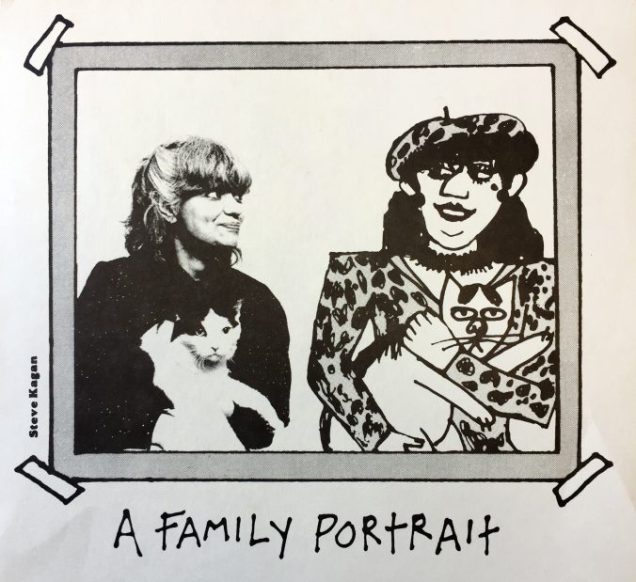
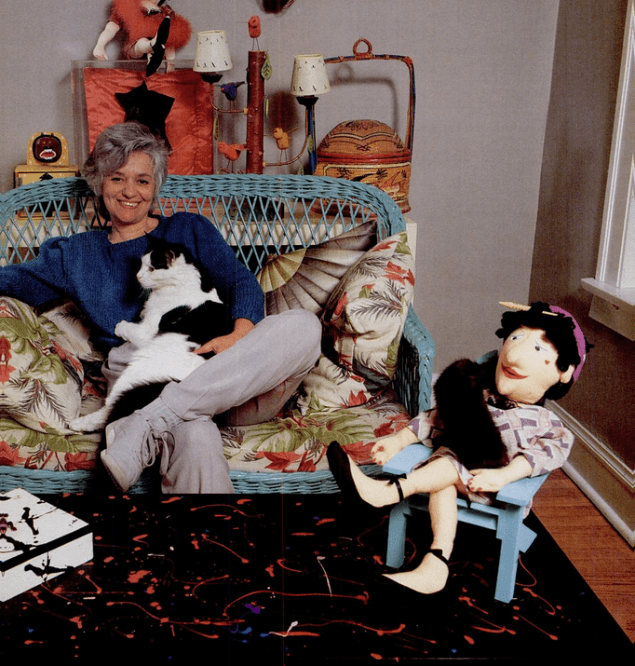
I took this picture from Spotlight on the Nicole Hollander Collection, an article about the Billy Ireland Cartoon Library & Museum’s archival collection of Hollander strips and odd and ends.Nicole Hollander in 1987. I’d like to point out that even today it is highly controversial for a woman in her late 40s NOT to dye her hair grey. She’s one awesome lady.
One last tidbit: on 2012, Nicole Hollander’s “unique collection of condom packages and sex toys” entered the collection of the Kinsey Institute for Research in Sex, Gender, and Reproduction. That raises more questions than it answers, doesn’t it?
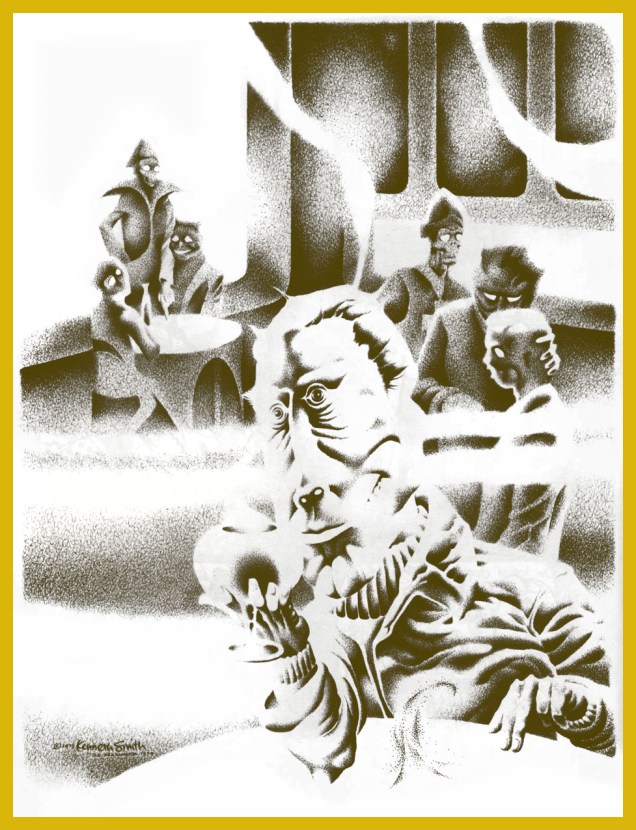
« Quodo seemed to be a paradise. It was a lush green planet of peace and solitude. Then the pilot met the blonde… » — Nicola Cuti, “Weird World”
Kenneth Smith (1943-), the fantasy artist, inhabits the same body as Kenneth Smith, the retired philosophy professor and incorrigible obfuscator. Whereas someone like, say, Bertrand Russell would make his point clearly and concisely, Kenneth would just pile it higher and higher, leaving the reader entangled in a maze of syntax and syllogism.
Since you may not be familiar with the man’s infamous column in The Comics Journal, Dramas of the Mind, here’s a typical quotation from the man, where he, er… takes on “obscurantism”:
« In characterizing realities no less than in taking positions on issues, consciousness generalizes, i.e. genericizes: in articulating or formulating, it reduces things, even our own selves, to forms, abstractions, idealizations, types, archetypes, simplisms. “Thinking” is an activity that ultimately grounds or resolves itself in the satisfying, self-certain form of orthodoxies, preconceptions, uncriticized and imperative norms; and it is overwhelmingly inept to recognize just how pathetic, parasitic or placental is its relation to its “own” fundamental norms of understanding and valuation. Rarely if ever does any act of thinking grow so laserlike or iconoclastically intensive as to escape from the dense miasma of what is acceptable. To think what actually is is even more contranatural for humans than to see what actually is: as subjectivizing as “seeing” is, “thinking” is many degrees or magnitudes more saturated with conditioned biases, delusions, self-deceptions. A program of hygiene or asepsis for the sanity, acuity and clarity of syncretic or wholesided thinking—a discipline of orthotics for sobering, grounding and polemicizing of well-formed gnoseonoesis—is needless to say unknown in modernity. Not just language but virtually all of intellect, education, culture, etc. have been adapted into utilities, tools whose very aspectivity militates against the nakedness of “evidence,” which is to say, against candor and against truth: regardless of what it may be called, “evidence,” even the most obvious and blatant, is in actuality not so “evident” to most people, and the modern development of “sophistication” or “education” typically worsens the obscurantism. »
For all that, I’ll take a guy with such an overflowing abundance of vocabulary and ideas that he doesn’t know when to quit… over most of the boneheads frequently passing for writers nowadays. Still, if you don’t mind, we’ll (mostly) stick to his Warren artwork today.
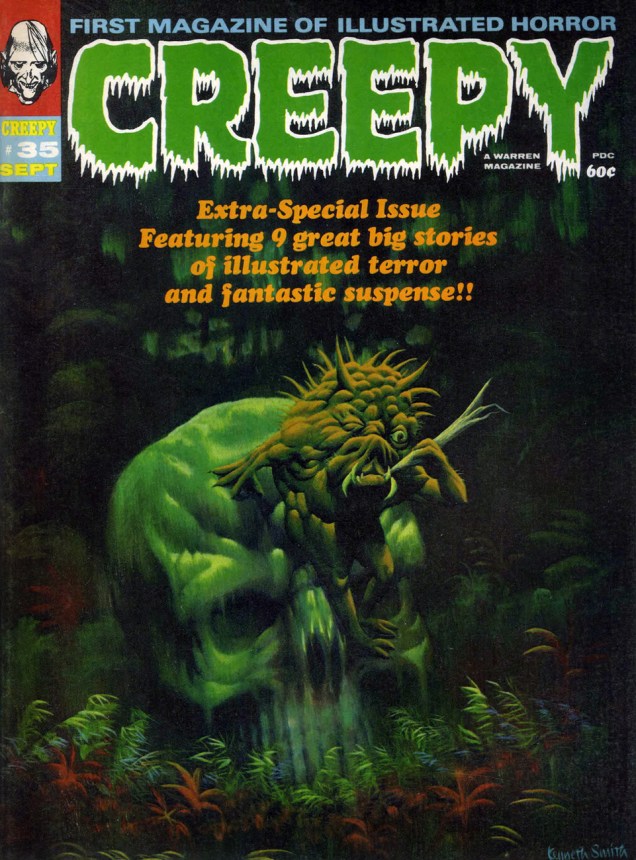
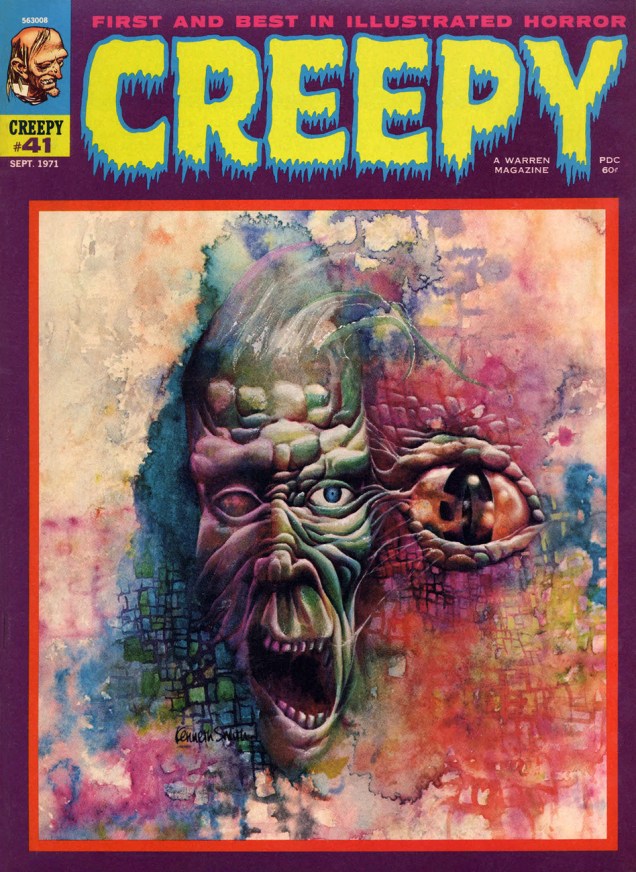
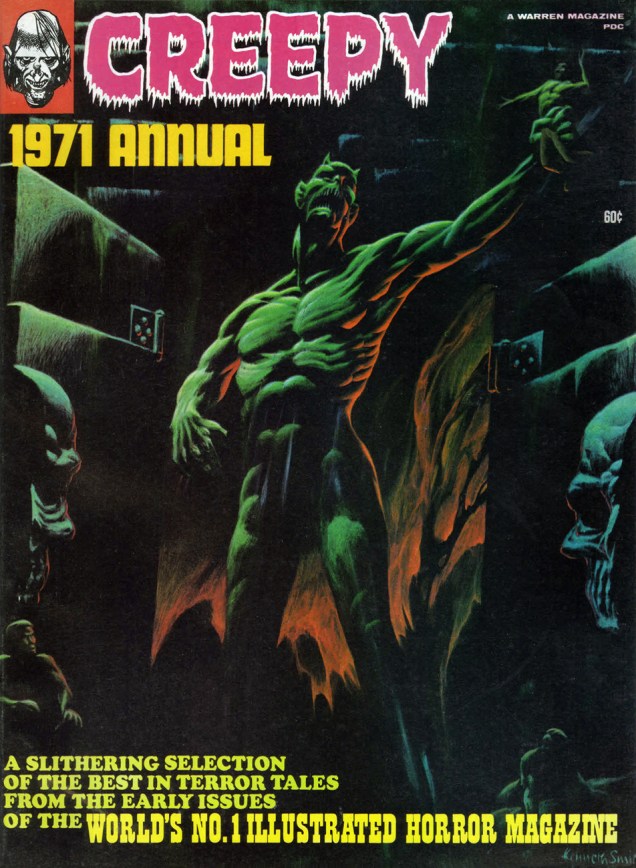
Creepy no. 35 (Sept. 1970). Regardless of its month of release, its lovely shades of emerald bring thoughts of springtime to mind.Creepy no. 36 (Nov. 1970), unique amidst Smith’s Warren covers in that it presents the human form in a somewhat less… grotesque fashion.This is Creepy no. 41 (Sept. 1971). Owing to its lower than usual print run, this ranks amongst the scarcest Warren issues.This is Creepy 1971 Annual, all reprints, but quite a choice roster of them: Ditko, Toth, Boyette, Craig, Crandall, Sutton, Adams, and Torres.And here we have Mr. Smith’s last, and arguably least, Warren cover. Only a detail of the full painting was used. Eerie 1971 Annual also features naught but reruns.And this is the original painting in its entirety. Sorry about the glare, but this is likely the only publicly available image of this privately-owned piece.
Bonus time: Mr. Smith created this lovely piece to illustrate R.A. Lafferty‘s masterful short story Mr. Hamadryad. I first encountered them* in the anthology Prime Cuts no. 1 (Jan. 1987, Fantagraphics). Hey, any fan of Old Man Lafferty’s is someone I’d happily clink glasses with. Cul sec, Mr. Smith!
« I believe that Mr. Hamadryad was the oddest-looking person I had ever seen. Surprisingly I regarded him so, for I first became aware of him in The Third Cataract Club in Dongola, and some very odd-looking gentlemen came into The Third Cataract. If you cock an eyebrow at someone in that place, then he’s really odd. » — R.A. Lafferty
*Smith’s illustration first graced Lafferty’s tale in the limited edition (1000 copies) collection Golden Gate and Other Stories (1982, Corroboree Press, MN). However, “Mr. Hamadryad” first turned up in STELLAR I (Judy-Lynn Del Rey, ed., 1974).
« You really saw that things were not at all what was portrayed in the mass media… at least not in our neighborhood. It was just a conclusion that most of the kids of that age came to, that things were extremely corrupt. » — Spain Rodriguez
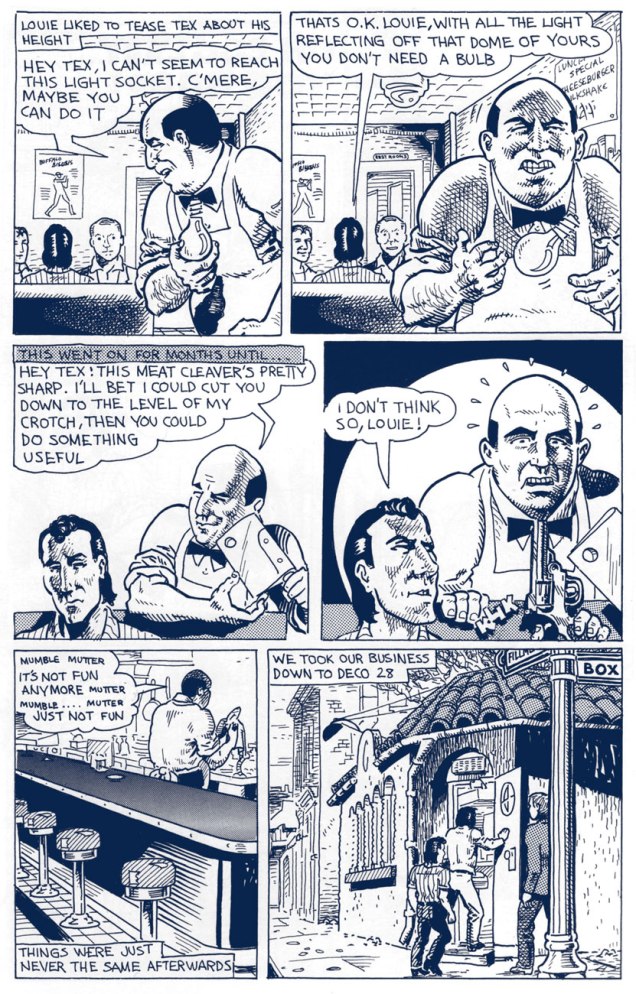
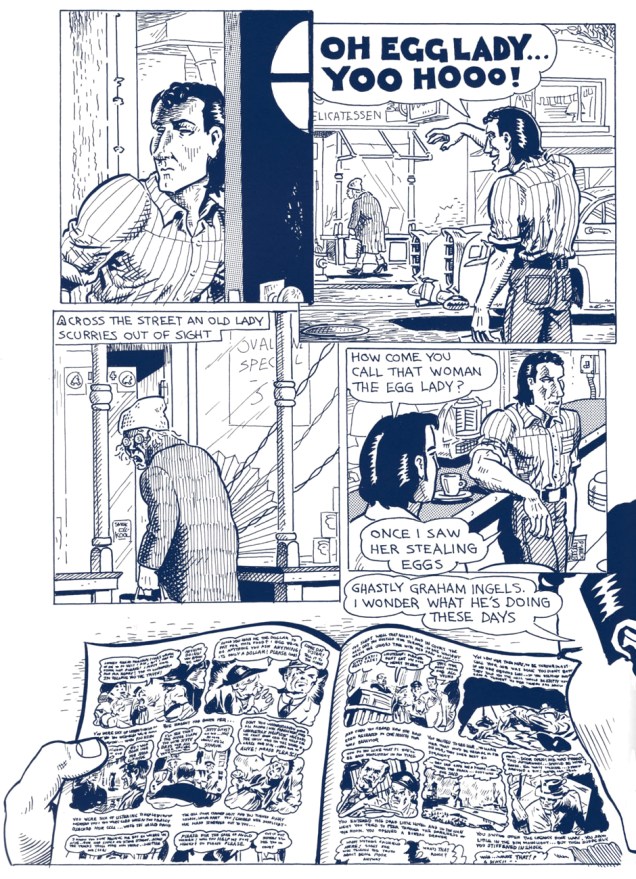
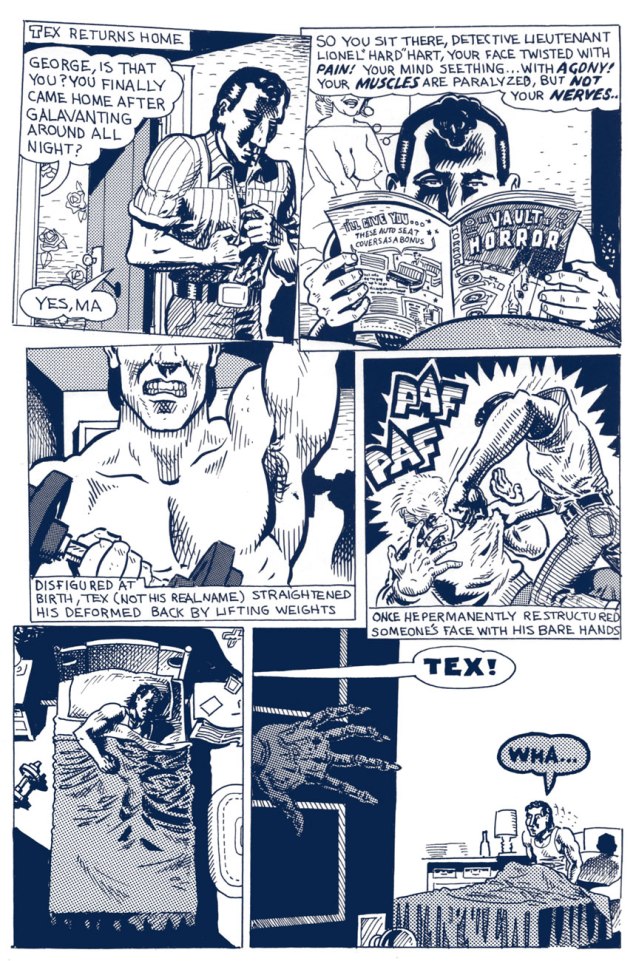
While plenty of cartoonists trod the path of autobiography before him, it took Manuel ‘Spain’ Rodriguez (1940-2012) to truly show how it should be done: here at last was a genuine full-blooded practitioner, hardly content to merely observe from the sidelines, blending with the wallpaper. Lover, brawler, consummate graphic storyteller: a scarce combination indeed.
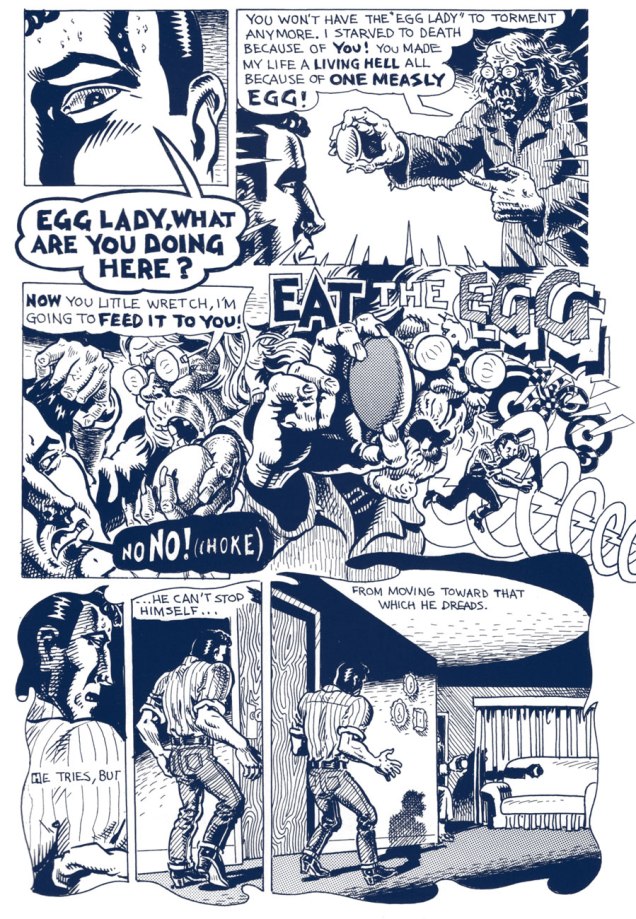
The following tale belongs to a cycle recounting the exploits and insights of The North Fillmore Intelligentsia, Spain’s closest compadres in Buffalo of the 1950s. Tex’s Bad Dream… originally appeared in Blab! No. 3 (Sept. 1988, Kitchen Sink Press); indeed, Spain’s recollections became, over time, the sole reason to purchase the once-excellent Blab! Mercifully, most of these were collected, in their usual exemplary fashion, by Fantagraphics, as Cruisin’ With the Hound (2012). You’ll still be lacking the mysteriously-omitted, quite essential « How I Almost Got Stomped to the “Still of the Night” by the “Five Satins » (Prime Cuts No. 2, Mar. 1987, Fantagraphics), which you can find in another Spain anthology, My True Story (1994, Fanta again).
In the meantime, enjoy, with my compliments, this true-life tale of original EC Fan-Addicts, facial restructuring, cautionary dreams, isometrics and pork sandwiches.
« At one time, I sold general cartoons to some of the men’s magazines, the girlies — until I went into a newsstand one day and looked at one. » — Betty Swords
If female cartoonists were fairly uncommon in the American mainstream magazine field for much of the twentieth century, they were doubly so within the so-called girlie mags.
« During the 1950s, Abe Goodman — brother of Marvel Comics publisher Moe ‘Martin’ Goodman — was the largest buyer of cartoons in the world. Publishing out of New York City under the Humorama banner, Goodman churned out scores of cheap digest-sized magazines boasting inventive titles like Romp, Stare and Joker that featured hackneyed jokes, cheesecake photos and the publications’ bread and butter, single panel pin-up cartoons.
These magazines were an unlikely proving ground for neophyte gag cartoonists as well as a welcomed alternative to the daily grind of comic book sweatshops. In the 1950s and 1960s, these digests featured the likes of Playboy’s Jack Cole, Archie’s Dan DeCarlo and glamour girl legend Bill Ward. »
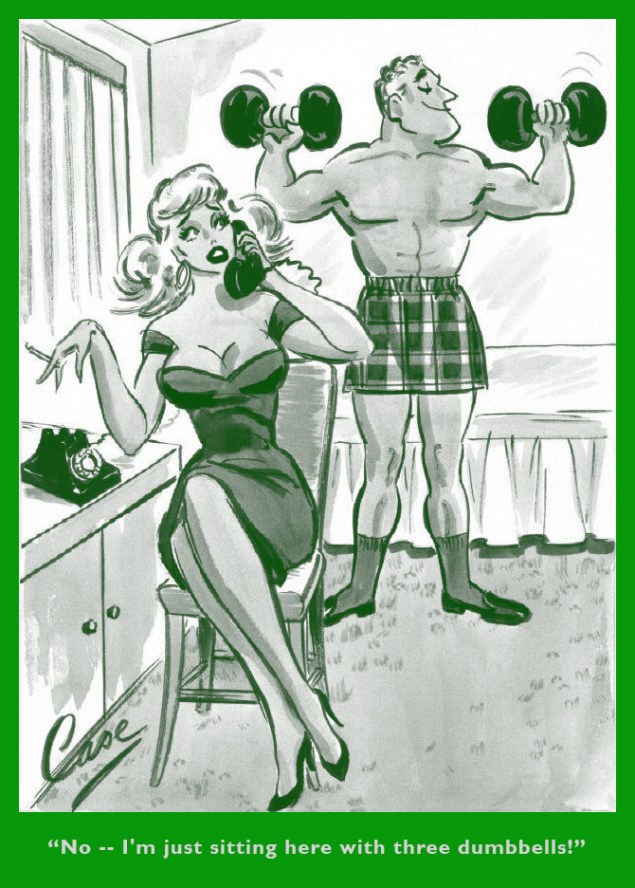
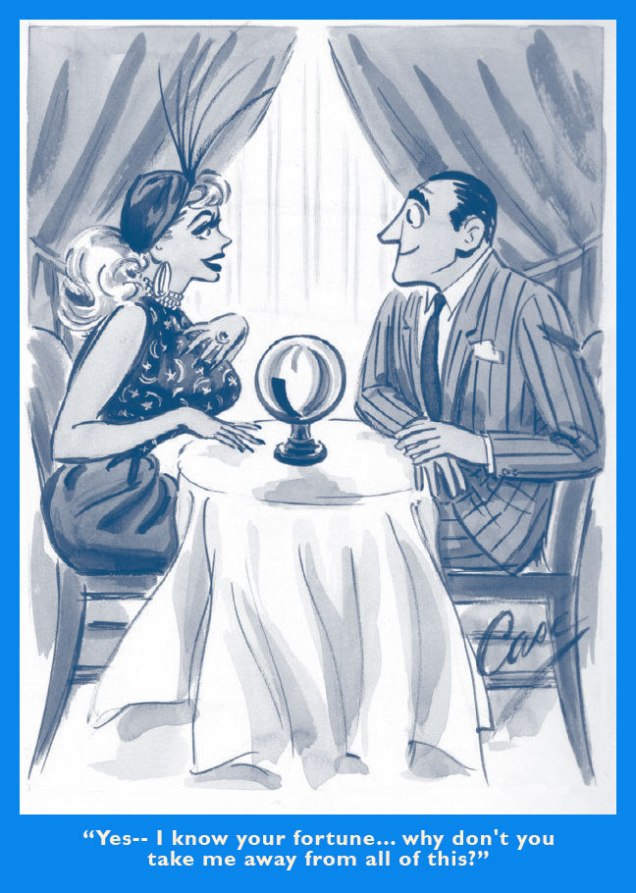
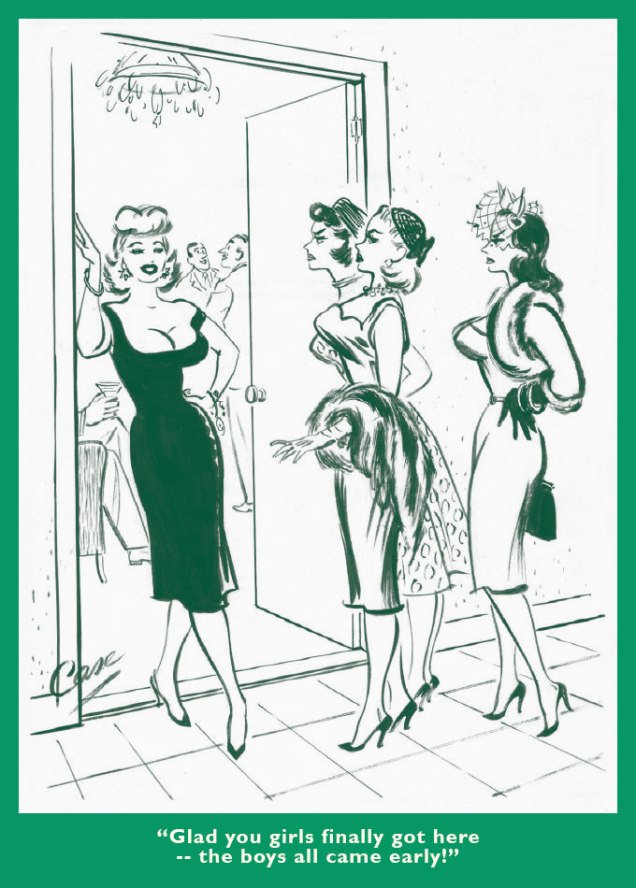
While I can unreservedly recommend Alex Chun and Alex Covey’s The Pin-Up Art of Humorama (Fantagraphics, 2011), I’m frankly puzzled as to its wholesale snubbing of Helen Case, who might have brought a welcome bit of variety to the all-male revue. God knows some lesser lights did make the cut.
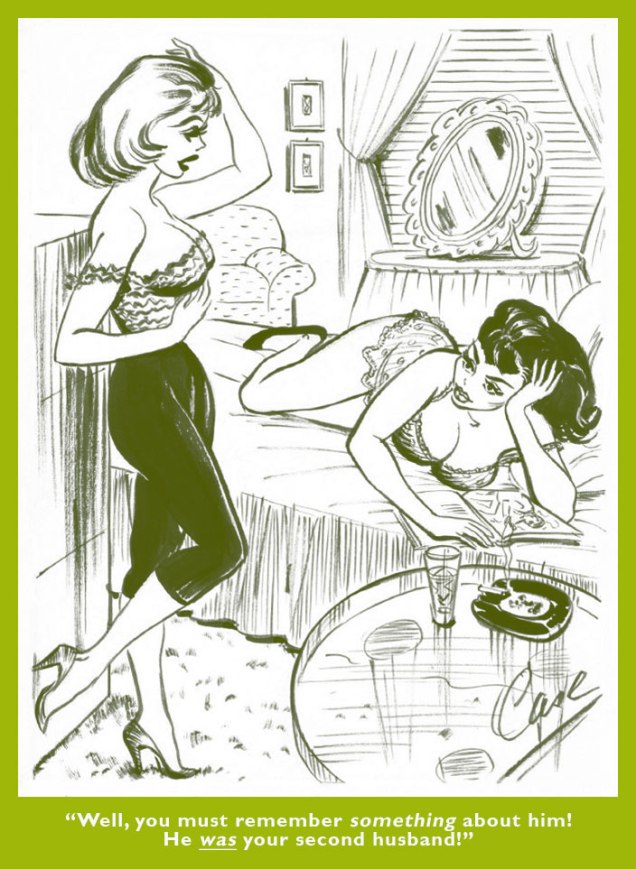
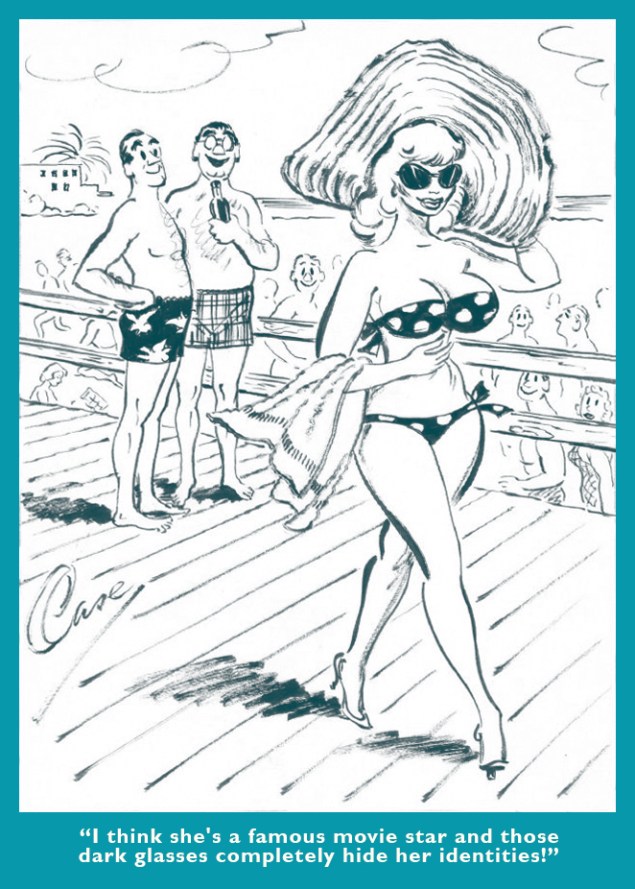
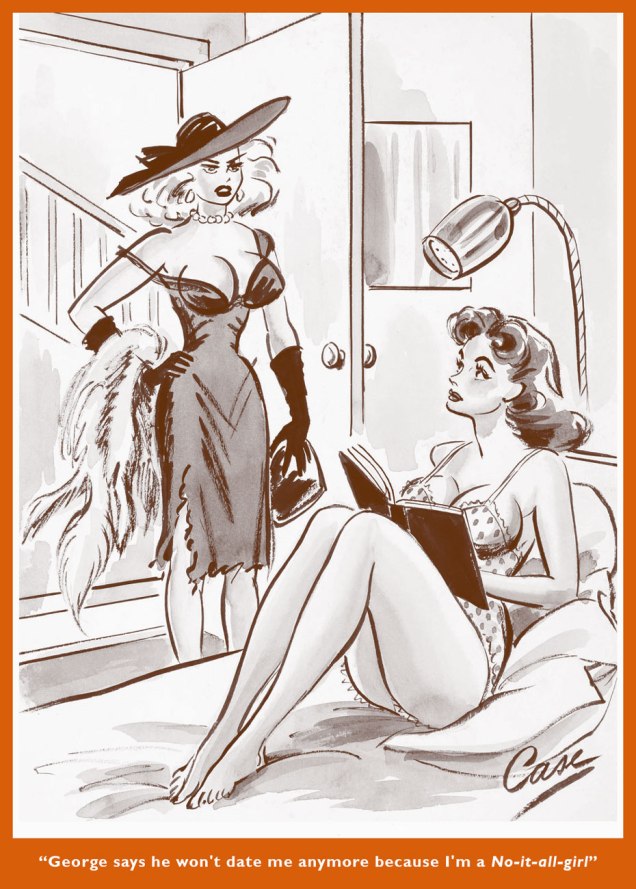
While feminist cartoonist Betty Swords would likely have dismissed Case’s protagonists the way she did Barbara Shermund‘s, as « gold diggers, dames — amateur prostitutes », Case’s cartoons (I’m afraid I don’t know whether she wrote and illustrated, or simply illustrated… at Humorama’s pauper’s rates, the former is somewhat preferable) provide a refreshing female perspective to the battle of the sexes. To quote Betty Swords again (from R.C. Harvey‘s excellent Insider Histories of Cartooning (2014, University Press of Mississippi): « I remember one editor who shuffled through my cartoons then tossed them on the desk and said, ‘You gal cartoonists are all alike — you don’t attack and hit hard enough!‘ »
While scant information is available regarding Ms. Case (she appears to have lived in Kingston, New York in the early 1960s), at least online, much of her work survives, which surely has to count for something. We present some of the finer cuts, and if the gags aren’t transcendentally great, they are a brace o’ notches above the average knuckle-dragging drollery pervading the pages of Breezy, Snappy or Eyeful of Fun. Most of these gags were drawn and initially published (Humorama’s cheapskate policy was to print, reprint, and reprint again) between 1960 and 1964. Enjoy!
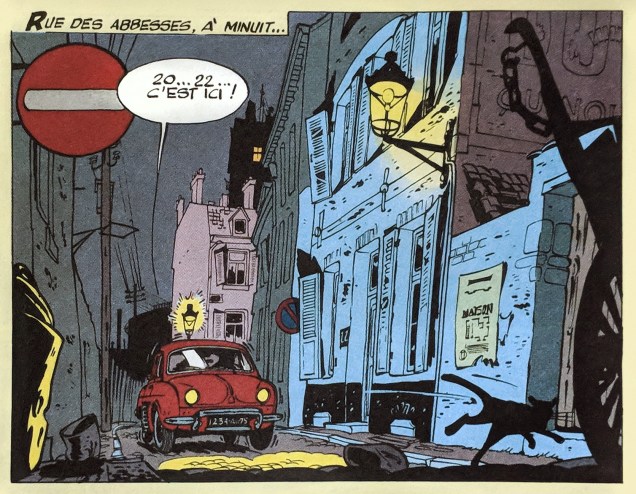
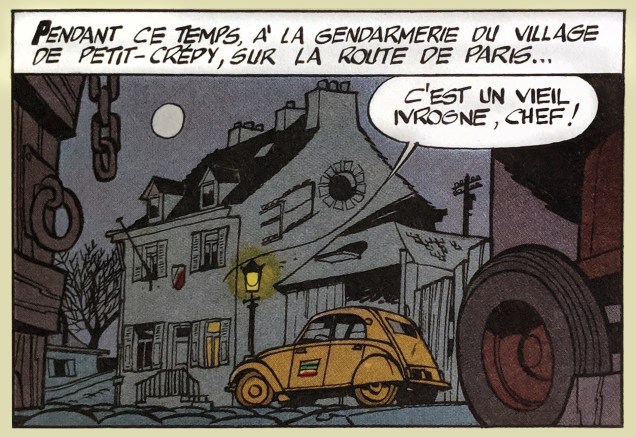
« Plenty of nocturnal ambiance in this book… It stems, I suppose, from an old childhood reminiscence. When I was little, gaslit street lamps were still around, and they created, in the evening, rather extraordinary effects of light. That slightly sinister element stuck with me, and I love to recreate this sort of thing. » – Maurice Tillieux
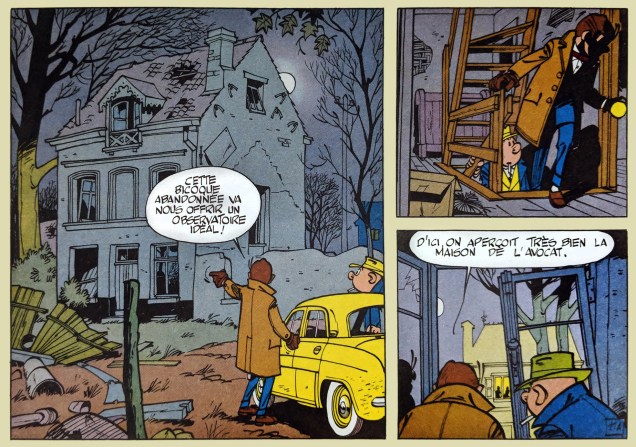
Private detective Gil Jourdan finds the proper spot from which to conduct a nocturnal stakeout, in his fourth (and possibly finest) investigation, « Les cargos du crépuscule », originally serialized weekly in issues 1113 to 1137 of Spirou magazine, back in 1959-60.
Story and art by Maurice Tillieux (1921-1978), one of the truly great European masters of…well, everything he handled: humour, atmosphere, pacing, local colour, dialogue...
Ah, but this time, non-French-fluent readers won’t be left out in the cold. The late Fantagraphics co-publisher Kim Thompson was a lifelong fan of Tillieux’s work, and was quite willing to put words into action and bleed some money in the process. Before his passing in 2013, he had time to publish a pair of twofer volumes of Jourdan (slightly renamed Gil Jordan*) adventures, « Murder by High Tide » (which contains this tale, entitled here « Leap of Faith ») and « Ten Thousand Years in Hell ». Fans of clever and suspenseful noir should not miss these babies.
Fudging a bit here, this is a panel from « La voiture immergée », aka « Murder by High Tide ». Please forgive this old sinner.
This being a Hallowe’en post, I’ve squarely put the emphasis on mood rather than action, but let me assure you that these bédés contain plenty of action, and of the highest calibre. Fantagraphics’ promotional blurb gets it right (except that the Hergé comparison is perhaps a bit lazy, but probably necessary given the audience): « Another never-before-translated classic from the Golden Age of Franco-Belgian comics, finally brought to American readers. Imagine the beautifully crisp images of Hergé (Tintin) put in service of a series of wise-cracking, fast-paced detective stories punctuated with scenes of spectacular vehicular mayhem (including in this volume a dockside pursuit via car and bulldozer) and you’ll see why 50 years later Gil Jordan is still considered a masterpiece in Europe. »
– RG
*I can’t help but think that the detective’s renaming to « Gil Jordan » was a bit of a Fantagraphics inside joke, given that the publisher employed, for a couple of decades or so, a news correspondent/translator/editor by the name of… Gil Jordan. It’s not as if « Jourdan » is such an unknown name to Americans.
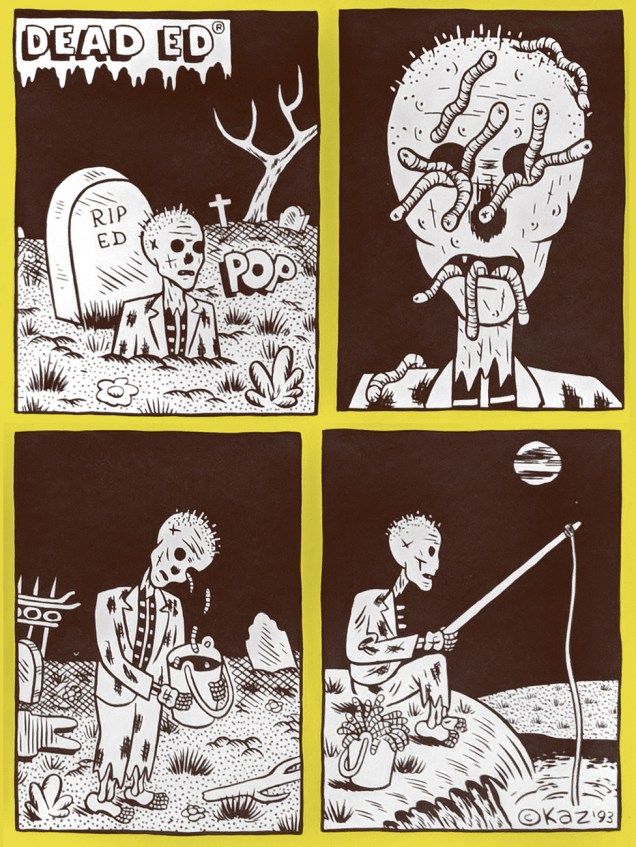
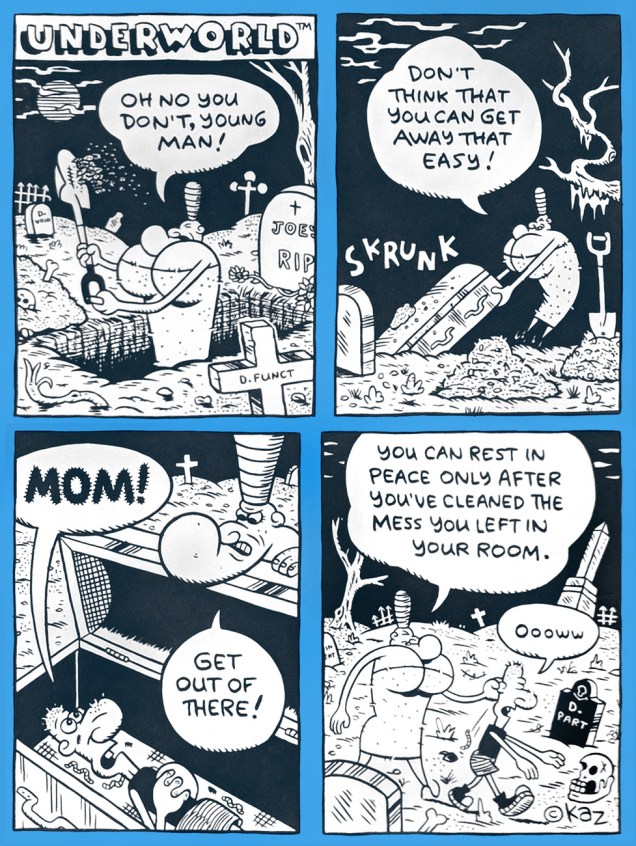
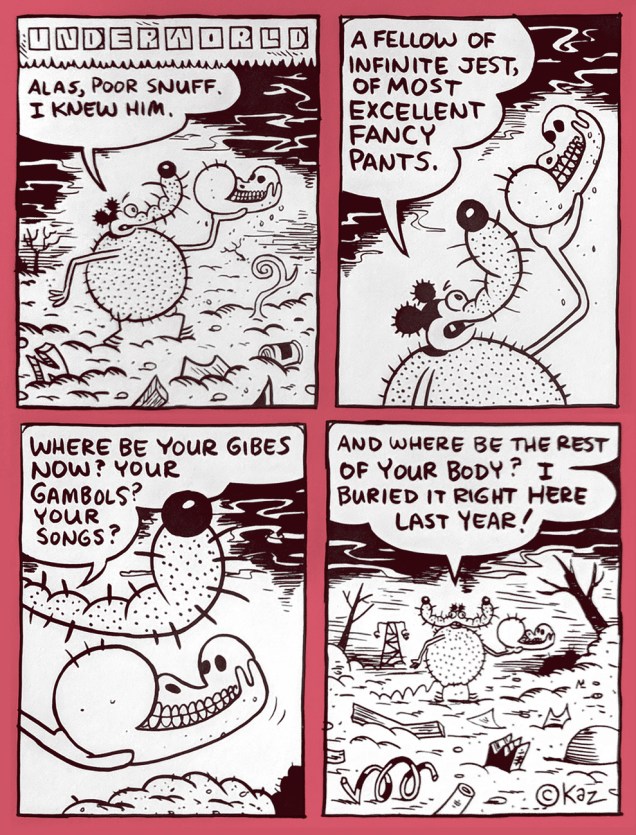
Underworld is the rabid brainchild of American cartoon god (néKazimieras Gediminas Prapuolenis in 1959) alias (for some reason) Kaz. Underworld has been appearing in various alternative weeklies since 1992. But none in my neck of the woods, naturally. Grr.
Fortunately, the discerning folks at Fantagraphics have thus far issued five Underworld collections, plus, a couple years back, an imposing omnibus, each of them wonderful, surreal, morbid and unnaturally comforting. Perfect Hallowe’en reading? You bet. Skrunk!
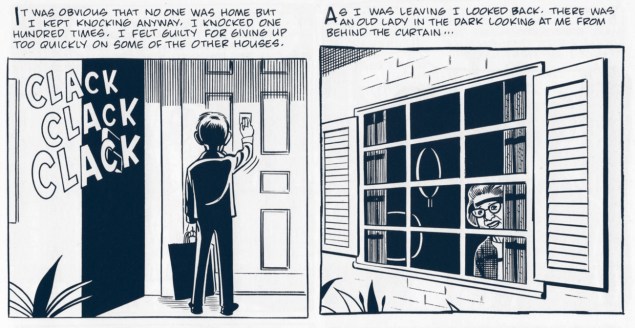
« In many ways, I thought, the perfect night would be a string of unanswered doors. » Dan Clowes, Immortal, Invisible
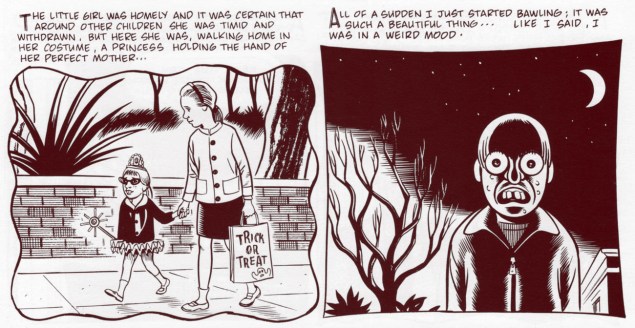
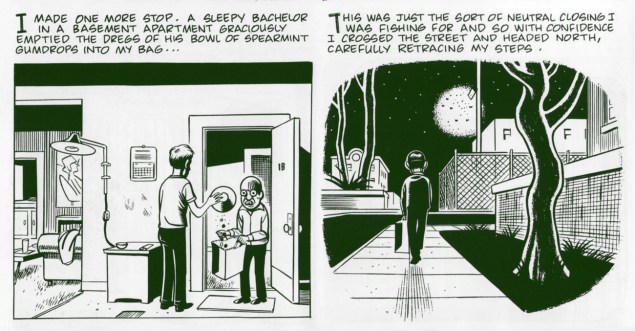
For our lucky thirteenth check on October’s calendar, we’ll stalk the neighbourhood through Dan Clowes’ eyes with his bittersweet and appropriately haunting Hallowe’en memoir, from the 16th issue of Eightball (Nov. 1995, Fantagraphics). It’s also available in their excellent “Caricature” collection.
In the mid-90s, Clowes was going from strength to strength, having gradually evolved past the vastly entertaining but immature snarkiness of his early work… he’s certainly earned full marks for being true to his muse, instead of cranking out routine variations on Zubrick and Pogeybait or Needledick the Bug-Fucker.
As an draftsman, Clowes clearly isn’t a « natural »… he had, and has to work at it. But that’s fine, because his special gift rests in his storytelling. Yet it wouldn’t be the same if he merely wrote scenarios for others to illustrate, since his writing and artwork mesh wholly and perfectly.
As a chronicle of a certain early adolescent mindset, full of turmoil and intense, unpredictable emotions, « Immortal, Invisible » is nearly without peer, matched only by its companion and issue-mate, « Like a Weed, Joe ». I figure that just about any sensitive and perceptive person who’s suffered through the stages of a somewhat solitary and awkward late childhood and adolescence can find a bit of themselves in this tale. I know I can relate to its sense of bittersweetness and longing for the fast-receding innocence of childhood.
The full story is ten pages long, and if you aren’t already familiar with it, I couldn’t recommend it more fervently.
« It’s astonishing how terrible people can be. » – Gahan Wilson
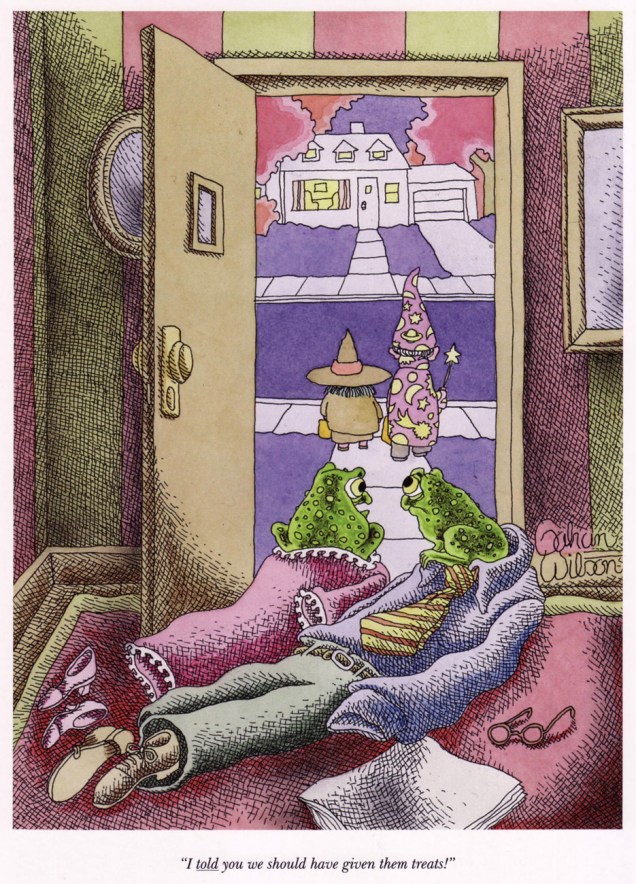
Chez Gahan Wilson (as with his esteemed colleagues Charles Addams and Edward Gorey, for instance), it’s always Hallowe’en! Here’s a trio of particularly fitting cartoons published over the years in Playboy magazine, always one of the finest homes for wayward cartoonists. Gahan was pretty much the only guy Hugh Hefner didn’t encourage to draw buxom females.
Playboy, October 1959.Playboy, November 1967.Playboy, October 2005.
Early in the magazine’s existence, Hef was looking for a Chas. Addams to call his own (the man himself was under exclusive contract with The New Yorker), and he found him. Yet, as Hefner said in his introduction to Fantagraphics’ extraordinary collection, Gahan Wilson: Fifty Years of Playboy Cartoons: « I don’t think I could have imagined before the fact how Gahan was going to grow. What one saw in the beginning was only the promise. »





























 Who's Out There?