« I love the scents of winter! For me, it’s all about the feeling you get when you smell pumpkin spice, cinnamon, nutmeg, gingerbread and spruce. » — Taylor Swift
It occurred to me, just the other day that I’d failed to feature, over the course of five and three-quarters countdowns, anything by Gene Colan. And this despite the fact that I’ve always enjoyed his work and his undeniable adroitness within the horror genre.
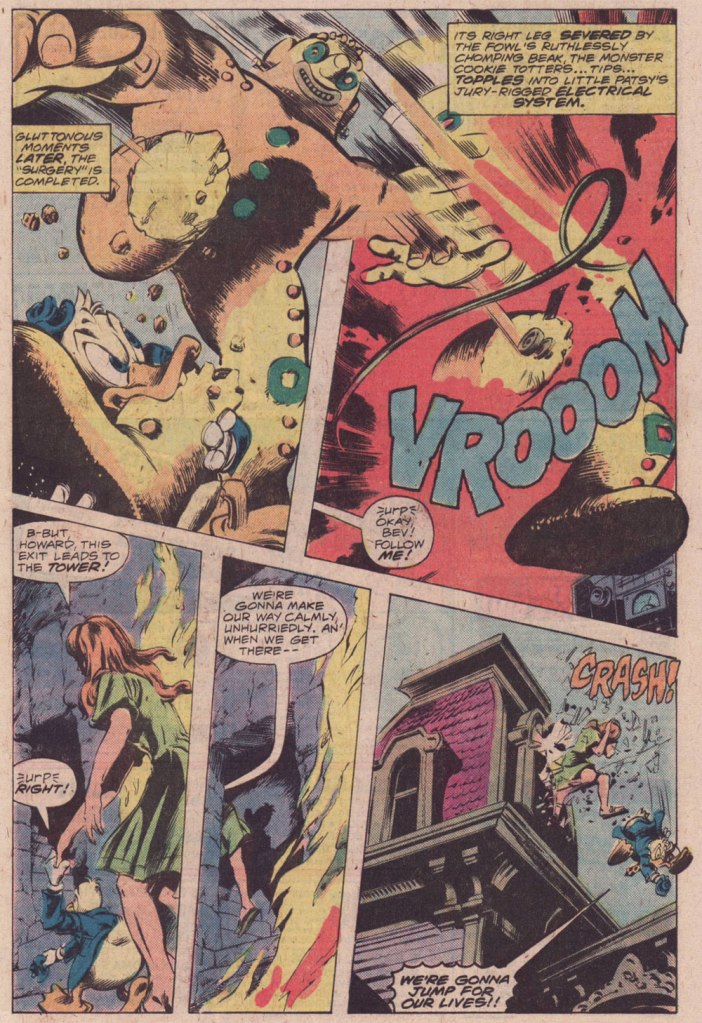
Still, I decided to sidestep the obvious touchstone, his monumental run on The Tomb of Dracula, and opted instead for another of his big series at Marvel: Howard the Duck.
I was a fervent fan of the series as a kid, but I honestly haven’t returned to it in decades. Which is not to say that I’ve forgotten it. There’s no doubt that I should give it a fresh look — I’d probably get more of Steve Gerber‘s jokes than I did as a twelve-year-old — but in the interim, let’s focus on a couple of pertinent issues.
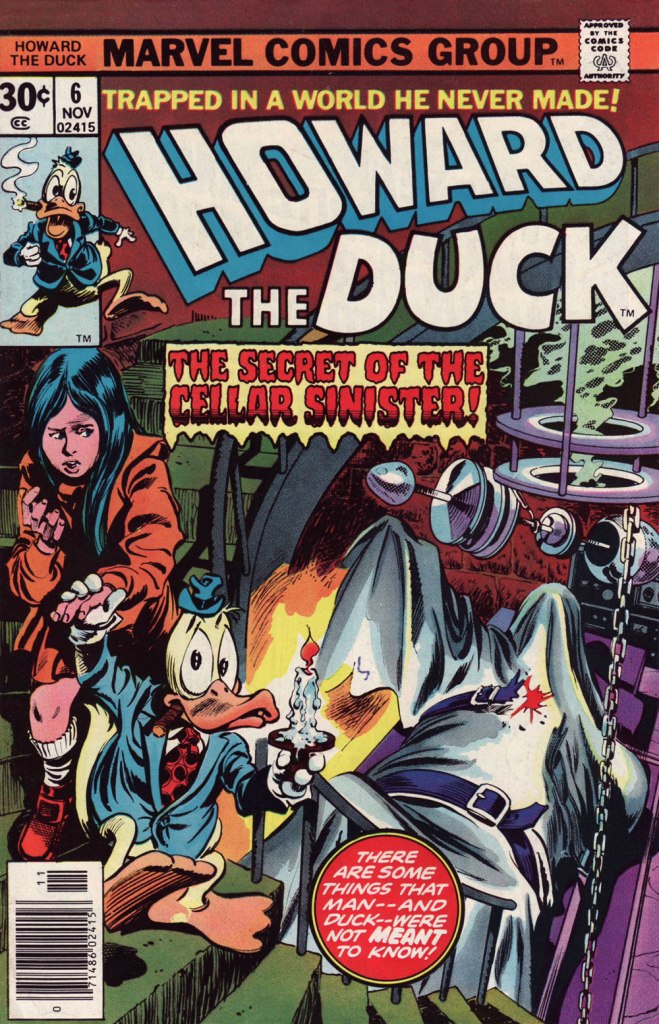
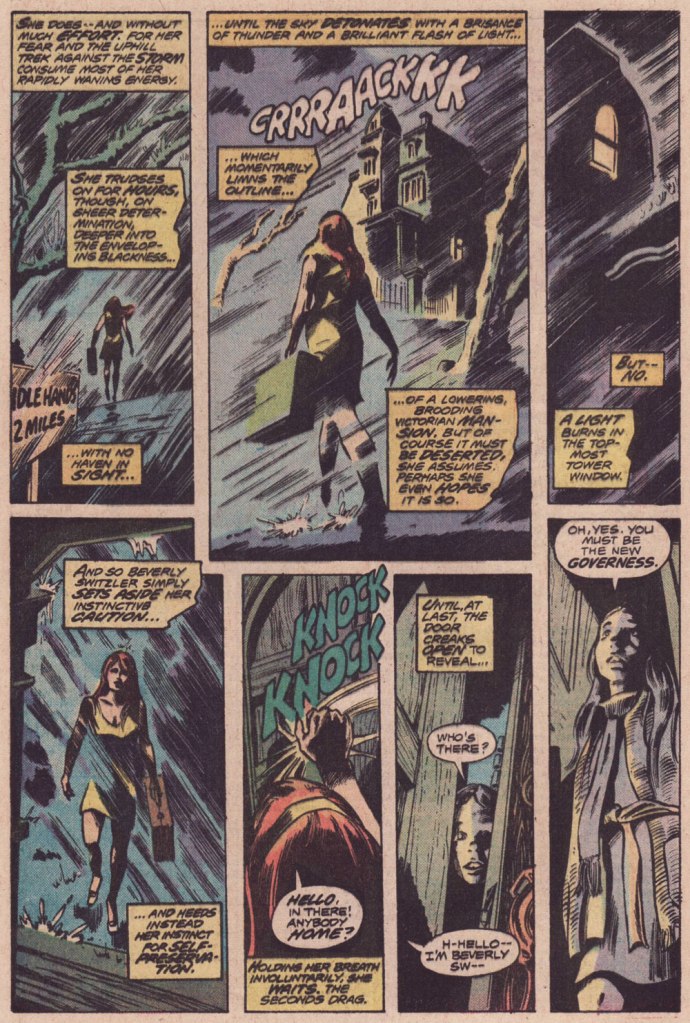
This is Howard the Duck no. 6 (Nov. 1976, Marvel); cover pencils by Gene Colan, inks by the recently departed Tom Palmer (1941-2022).Colan’s style meshes surprisingly well with Mr. Gerber‘s madcap comedy… he plays it straight, and that’s why it clicks. Savvy move.I wasn’t sure about Steve Leialoha‘s appropriateness as a Colan inker at the time, but I really don’t see what I could have objected to. Let’s see, what have we here? The Addams Family, Shelley’s Frankenstein, gothic romances, Nathaniel Hawthorne, religious sects… in this case the reverend Sun Myung Moon‘s Unification Church, better known as The Moonies…
I won’t leave you in suspense! On to the following issue…
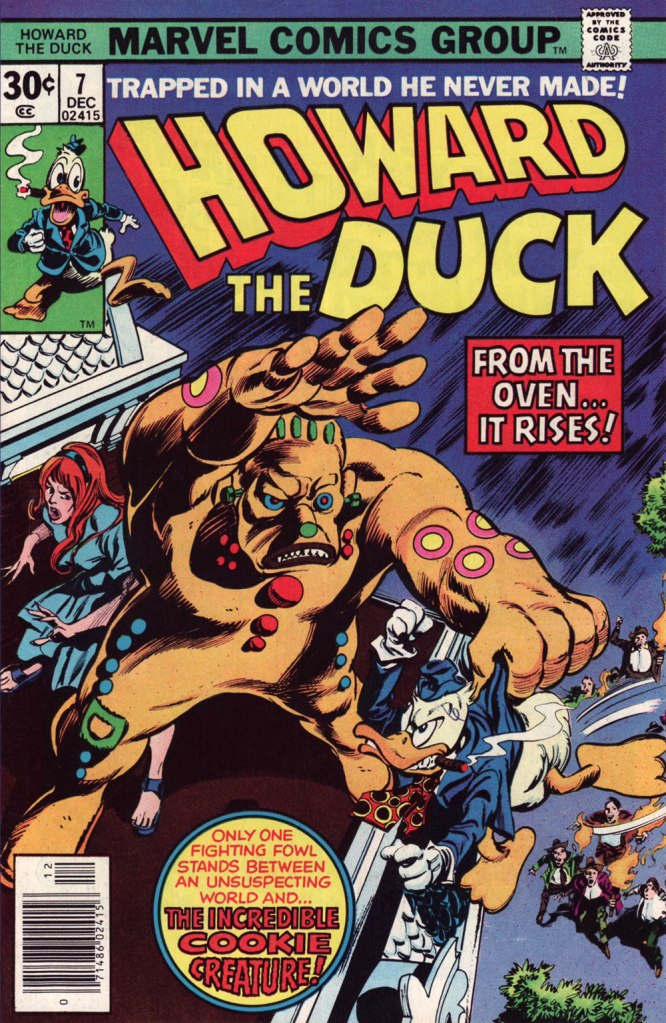
This is Howard the Duck no. 7 (Dec. 1976, Marvel); pencils by Colan, inks by Palmer.
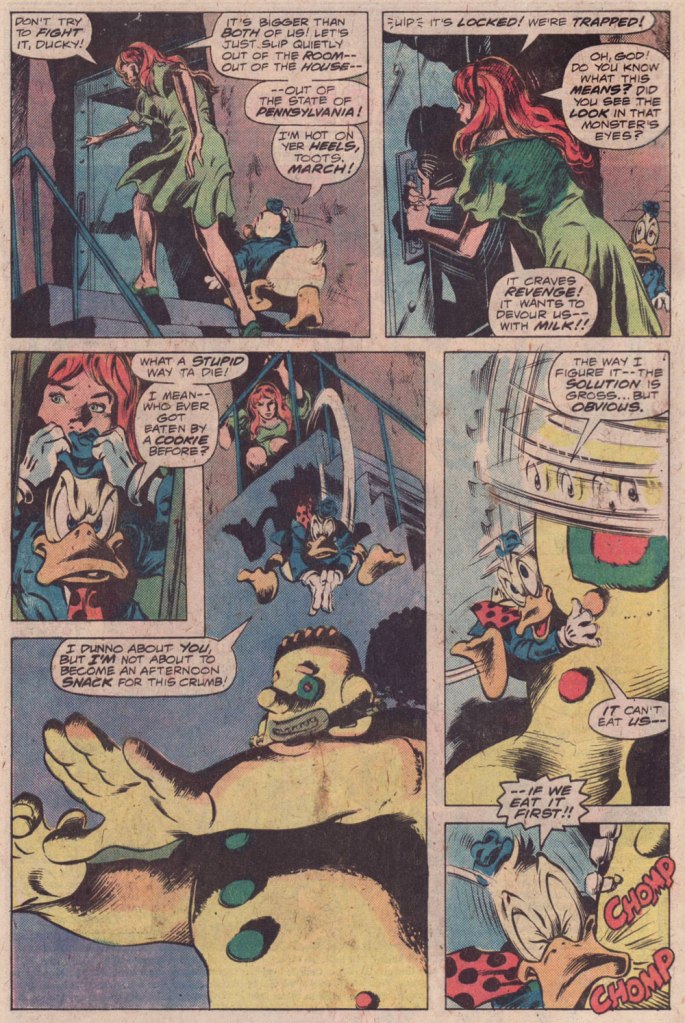
And that’s it! Steve Gerber had a refreshing knack for subverting and upending the Marvel formula: instead of some drawn-out, epic standoff, Howard disposes of the threat — a threat worth two cover features! — in a couple of panels, then the story moves on… to another range of targets.
« It’s like driving a car at night. You never see further than your headlights, but you can make the whole trip that way. » — E. L. Doctorow
Once more rooting around Europe for properly atmospheric material, we unsurprisingly dig up some gold in Belgium, a land rife with longstanding traditions of the fantastic.
While there never were — if memory serves — any explicitly supernatural elements at play in Maurice Tillieux and Arthur Piroton‘s chronicles of FBI agent Jess Long’s colourful investigations, the creators used every opportunity to instill the oppressive fog of atmosphere.
While never a massive hit, the series had solid legs, lasting from its 1969 introduction in Spirou magazine, surviving Tillieux’s tragic demise in 1978 and finally coming to the end of its road with Piroton’s own passing in 1996.
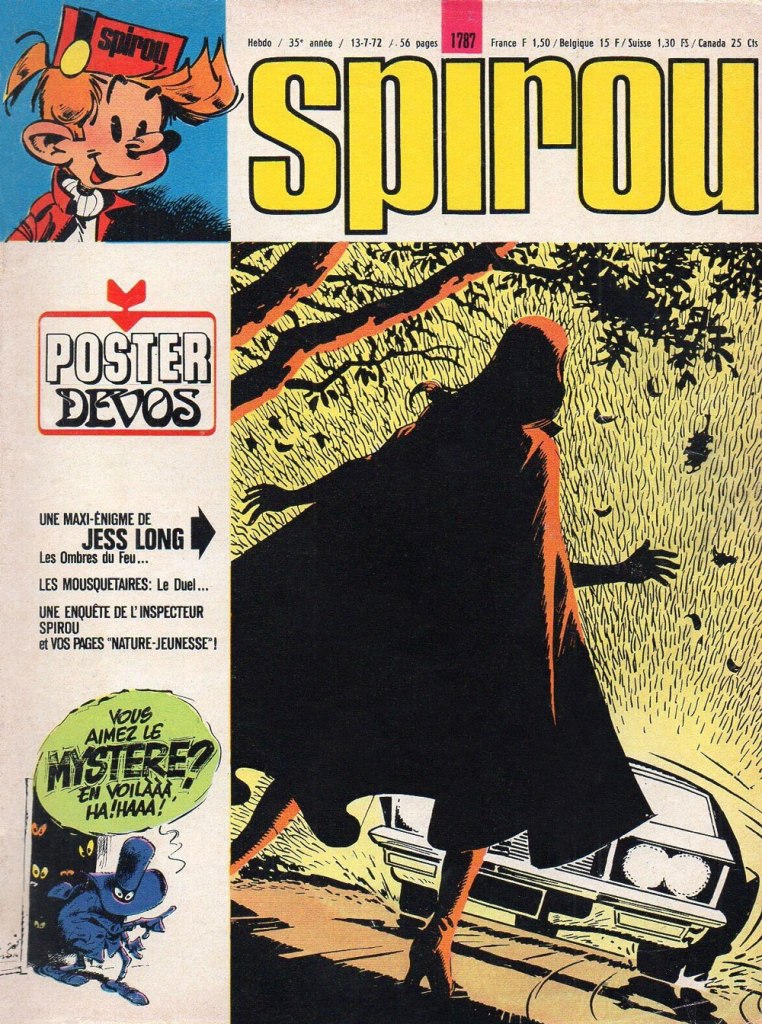
Today, we feature excerpts from Jess Long’s sixth investigation, Les ombres du feu (‘Shadows of fire’), from 1972. Fasten your seatbelts!
Pretty good spotting, Agent Corey Hart!The story runs fourteen pages, a bit long for our purposes… but I’m sure these highlights will properly convey its nocturnal essence. This is Jess Long, Police spéciale no. 2 (1977, Dupuis), comprising the fifth and sixth adventures. For some reason, the publisher didn’t start collecting the series until 1976. In the end, twenty albums were issued, a fine run!This is Spirou no. 1787 (July 13, 1972, Dupuis). Cover by Piroton, with a lower left vignette by André Franquin.Another spooky Jess Long cover, this time it’s Spirou no. 1897 (Aug. 22 1974, Dupuis), with another Franquin comment.
I’ve heard that Piroton’s style was considered a bit too ‘American’ to be that popular in Europe. Amusingly, it looked like nothing published in American comics at the time — I’d say his approach was a throwback to a mix of Bernard Krigstein and, say, Alex Raymond in Rip Kirby and Secret Agent X9 mode.
Something else worth noting about the Tillieux-Piroton collaboration: while Tillieux was the complete package — writer and artist — he was essentially forced, by some disastrously myopic editorial decisions right from the top at Dupuis (a stubborn failure to grasp that not every cartoonist can be his own writer) Tillieux had to almost entirely give up drawing, even on his own series, Gil Jourdan, to take on writing duties for a great many features. But since he was, one might say, the “Anti-Stan Lee”, he painstakingly storyboarded each page of his scripts, acting not only as scenarist, but also as metteur en scène. Thankfully, some examples of these fascinating breakdowns have survived. Check out this one and especially that one. -RG
« — I don’t know about zombies, doctor. Just what is a zombie? — A ghost. A living dead. It’s also a drink. » — I Walked With a Zombie (1943)
Has any of the classic monsters undergone more radical changes over the past century than the lowly zombie? I believe my first encounter with the walking dead (in comics, that is) came through a reprint of a relatively obscure Archie Goodwin – Rocco Mastroserio story, the imaginatively titled Zombies!* (read it here!) from Creepy no. 17 (Oct. 1967, Warren); in it, uncle Archie schooled me about zombies’ aversion to salt and, it follows, sea water. Which I presume is what kept them cooped up on tropical islands.
Confirmation of this vulnerability came in what I consider the scariest scene in the uneven Kolchak: The Night Stalker TV series, from its second episode, the imaginatively titled The Zombie, wherein Kolchak does his level best, under trying circumstances, to pour salt down the throat of a massive, dormant-but-not-for-long zombie.
But the damage to zomboid tradition had already been inflicted, for better (my vote) or for worse, by George Romero‘s ravenous shamblers in 1968’s Night of the Living Dead. While I had no trouble accepting Romero’s savvy upgrade, I recall being offended by the cheesy, mindless, anything-goes approach adopted by Lucio Fulci in his imaginatively titled Zombie**, namely this sequence.
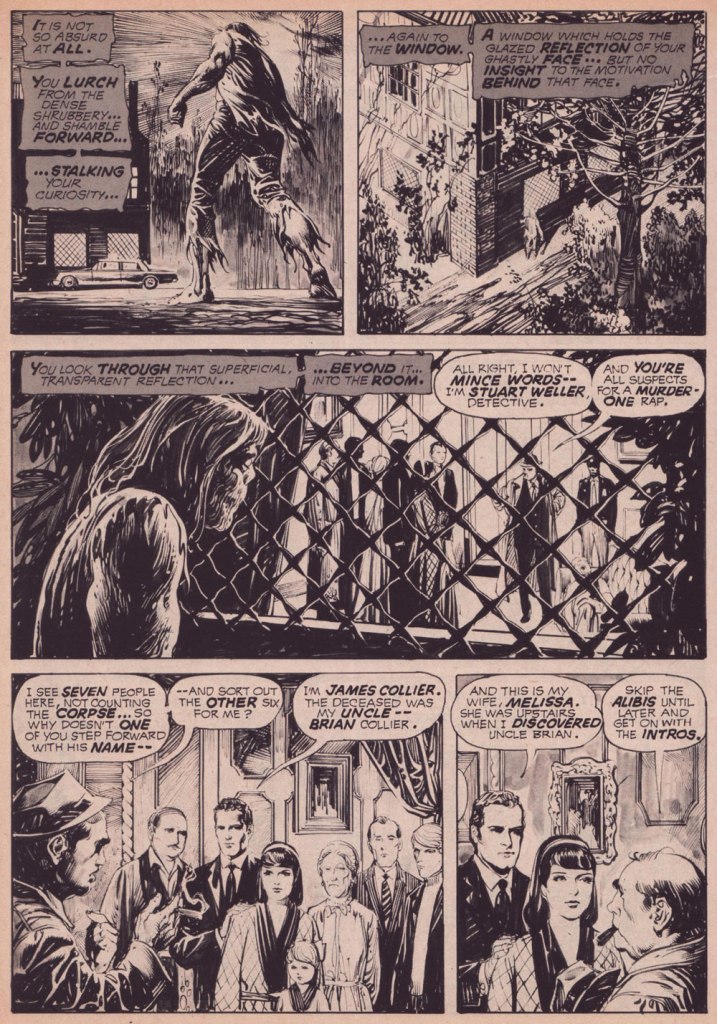
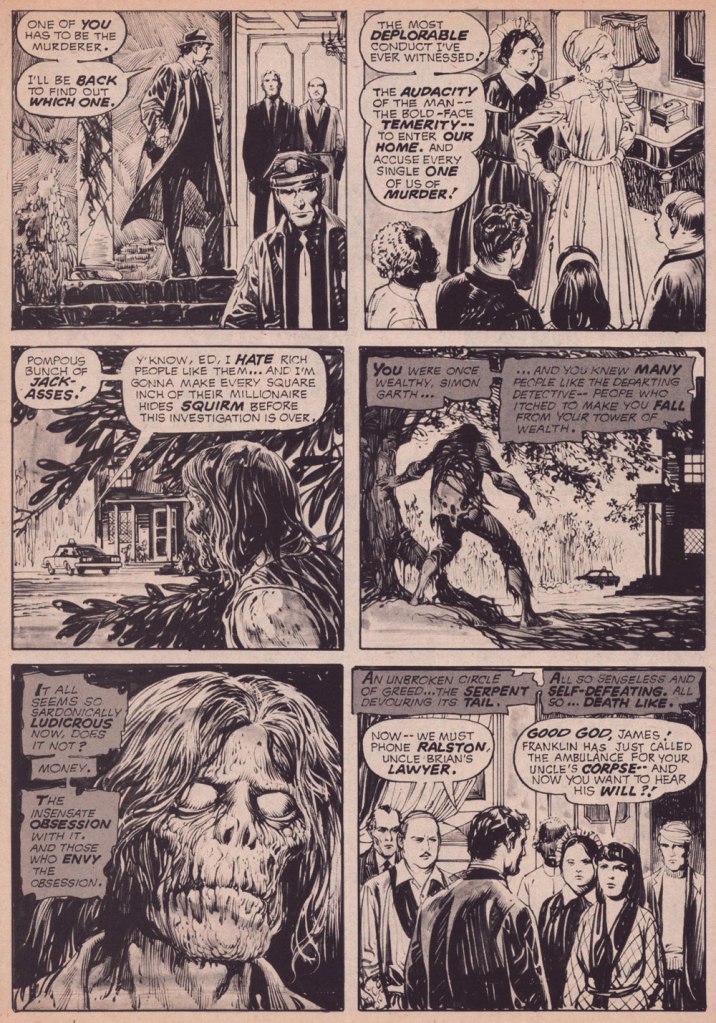
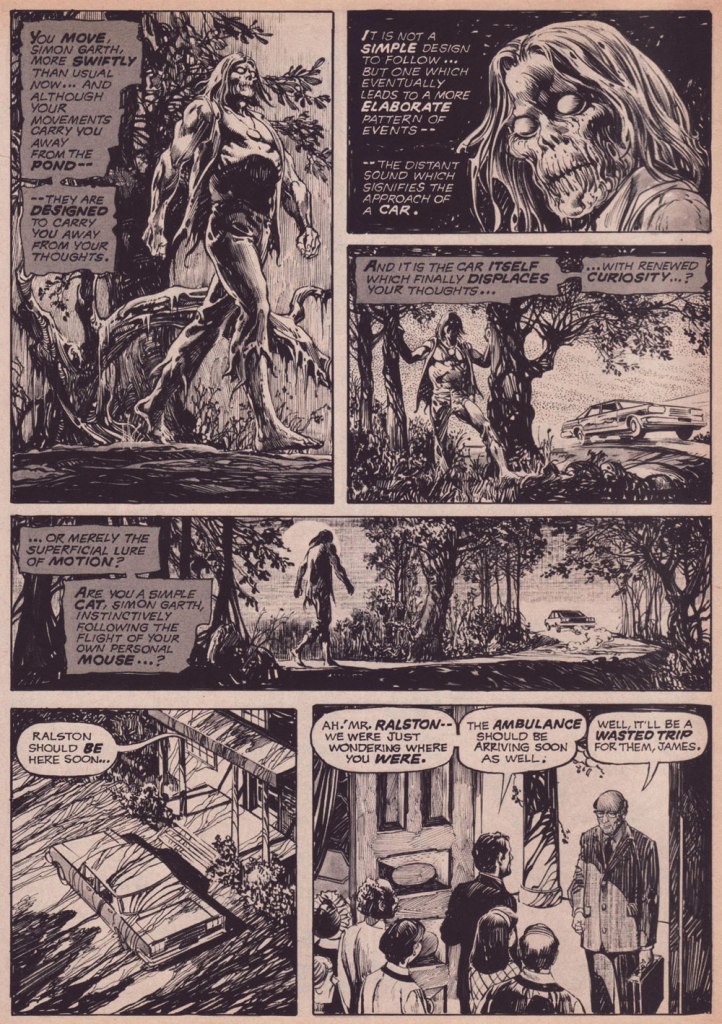
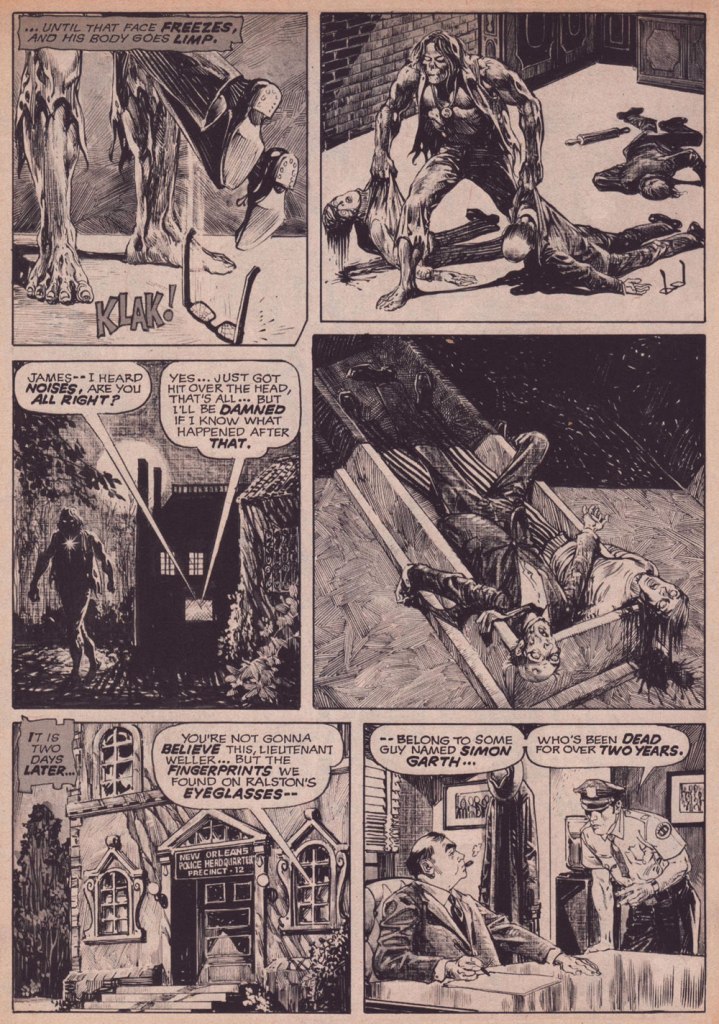
Marvel’s resident Zombie, Simon Garth, had débuted all the way back in 1953 (what is time, after all, to the living dead?) and Menace no. 5‘s imaginatively titled Zombie! (check it out here).
Aside from his Bill Everett-drawn premiere, I frankly have little use for the character, but I have a soft spot for this one story, intended as a time-buying fill-in for the feature’s regular team, writer Steve Gerber and Peruvian artist Pablo Marcos. It’s written by the often-interesting Doug Moench (Master of Kung Fu, Moon Knight) and illustrated by the masterful Alfredo Alcala, a sure consensus favourite around here. The plot itself is rather on the thin side, being one of those Agatha Christie’s Ten Little… er — And Then There Were None scenarios, with Garth mindlessly hovering around and peering in windows, until…
But the artwork is a delight. Like all of Marvel’s supernatural antiheroes (save the Man-Thing), Garth absurdly boasts the physique of a bodybuilder (despite being long dead and not eating anything), but at least Alcala truly knows his anatomy.
The original story is over thirty pages long, so I’m just providing highlights, including the conclusion, which is quite cute. While it must be incredibly hard to write mindless, invulnerable characters, Moench had a good punchline in mind all along.
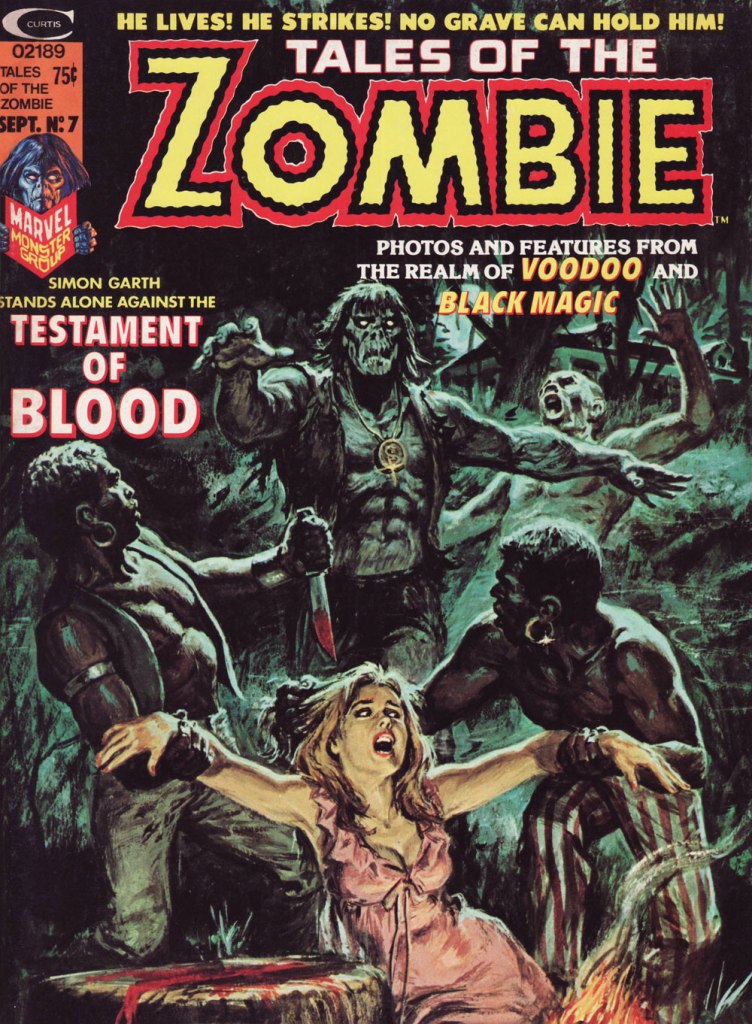
This is Earl Norem‘s cover for Tales of the Zombie no. 7 (Sept. 1974, Marvel).
-RG
*set in Brazil for the sake of the twist ending — not a bad one, either. **To be fair, called Zombi 2 in Italy, since “Romero’s Dawn of the Dead (1978) was released in Italy as Zombi.” At least the Italians, as the French once did, understand that Zombi is the male, and Zombie the female of the, er… species. Or is it simply the plural?
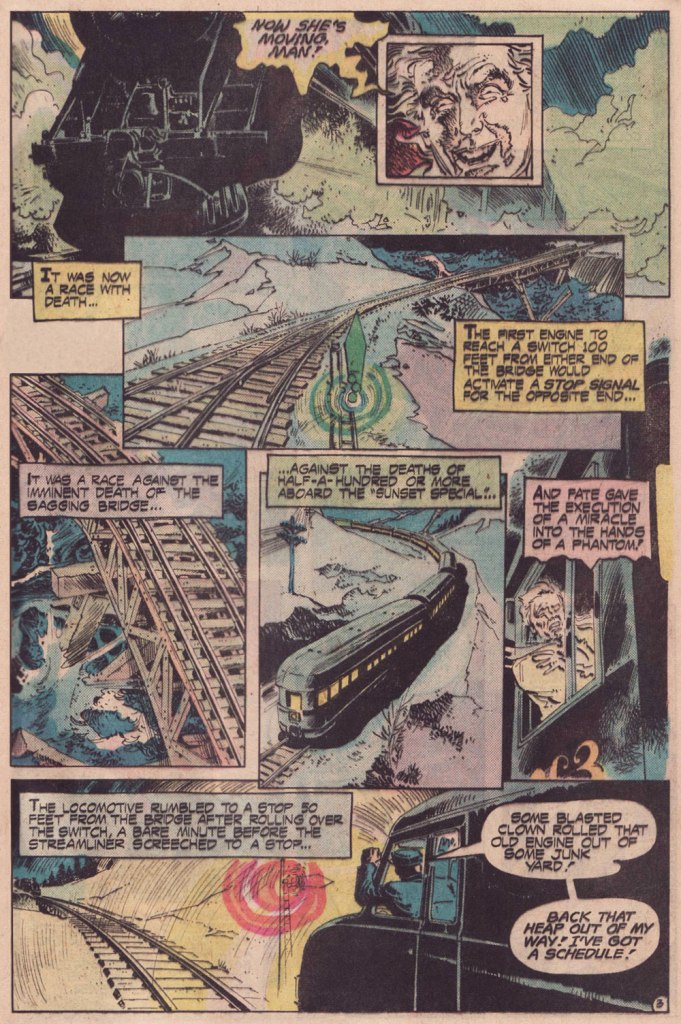
« Trouble with you is the trouble with me / Got two good eyes but we still don’t see / Come round the bend, you know it’s the end / The fireman screams and the engine just gleams » — Robert Hunter
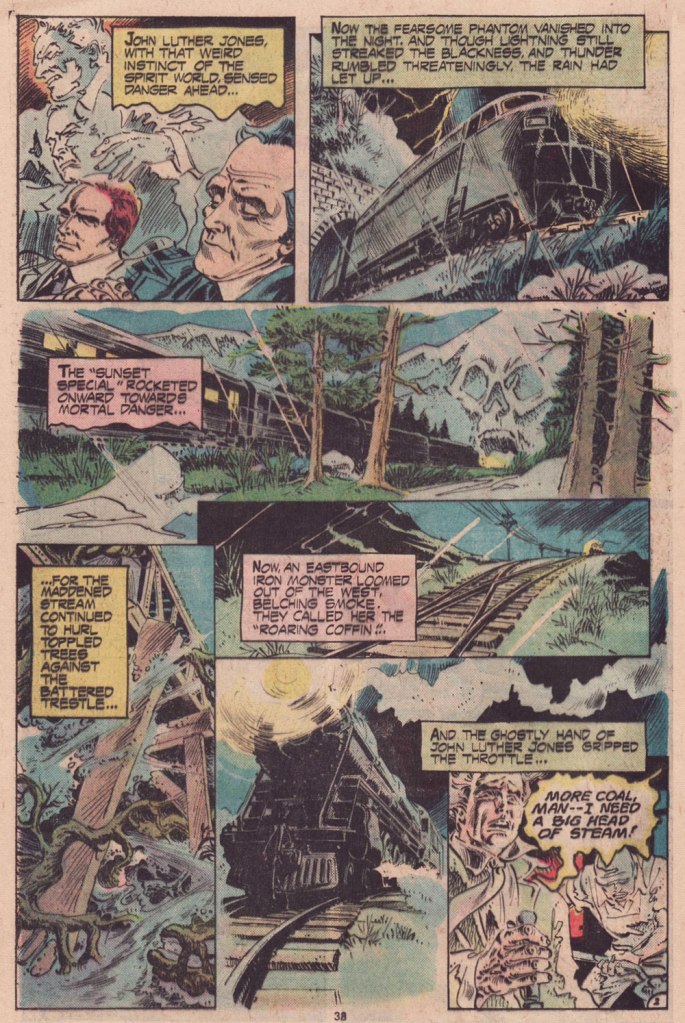
Another quite slight tale, but I’ve always loved this one for its nocturnal, storm-tossed ambiance. And it takes considerable illustrative skill to bring to life such a compact vignette with clarity and visual interest. Especially while hobbled by pedestrian colouring and hazy printing.
While the scripter goes uncredited (though it’s presumably editor Murray Boltinoff), the artist is Rodolfo “Rudy” Florese (1946-2003); he was one of the band of solid Filipino craftsmen that brought extra style and diversity to the US Comics industry in the 1970s. The lion’s share of Florese’s American contribution went to DC’s Tarzan titles. Take it away, boys!
Yeah, that’s right: in such stories, Death always betrays himself by picking an oddball moniker like “Mort Todd” or some such dead giveaway. To be fair, Satan and Dracula also indulge in the corny practice. Dr. Shreck, anyone? Think it never happens in “real” life? Let us consider the case of smarmy Albertan reprobate Pierre Poilièvre, whose name basically translates as Pierre Pea-Hare.
The Roaring Coffin originally saw print in Ghosts no. 40 (July 1975, DC), which bore this enticing Luis Domínguez cover.
« I love you more than anybody in the world… I love you for millions and millions of things, clocks and vampires and dirty nails and squiggly paintings and lovely hair and being dizzy and falling dreams. » — Dylan Thomas
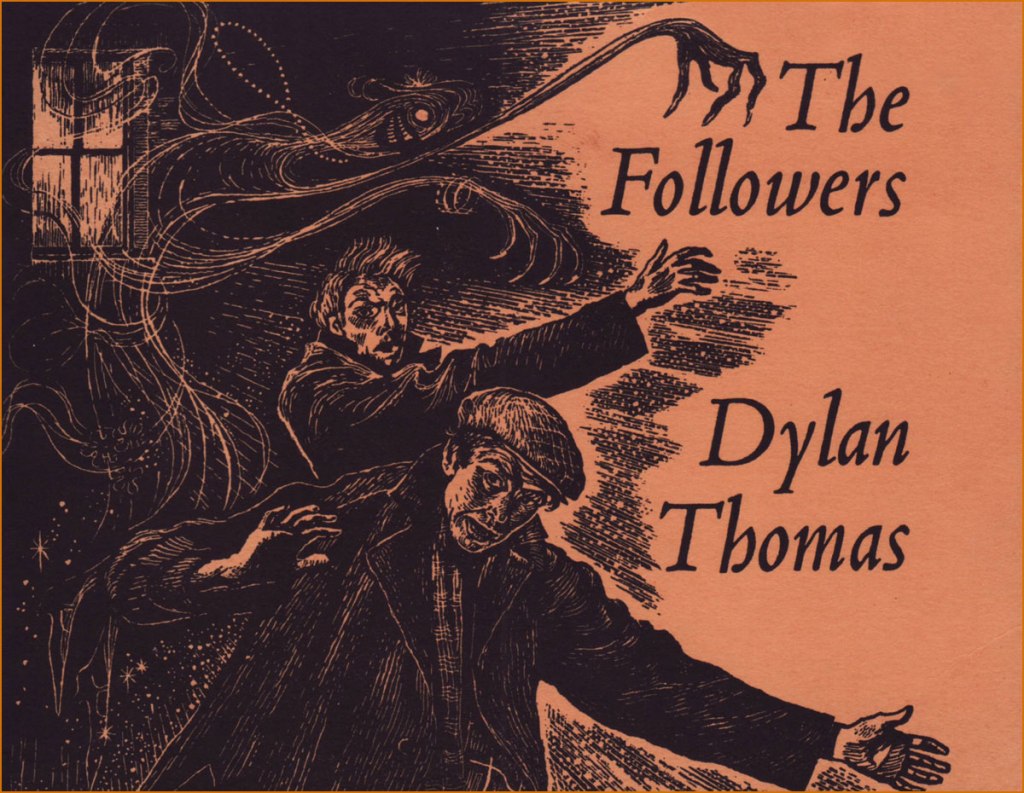
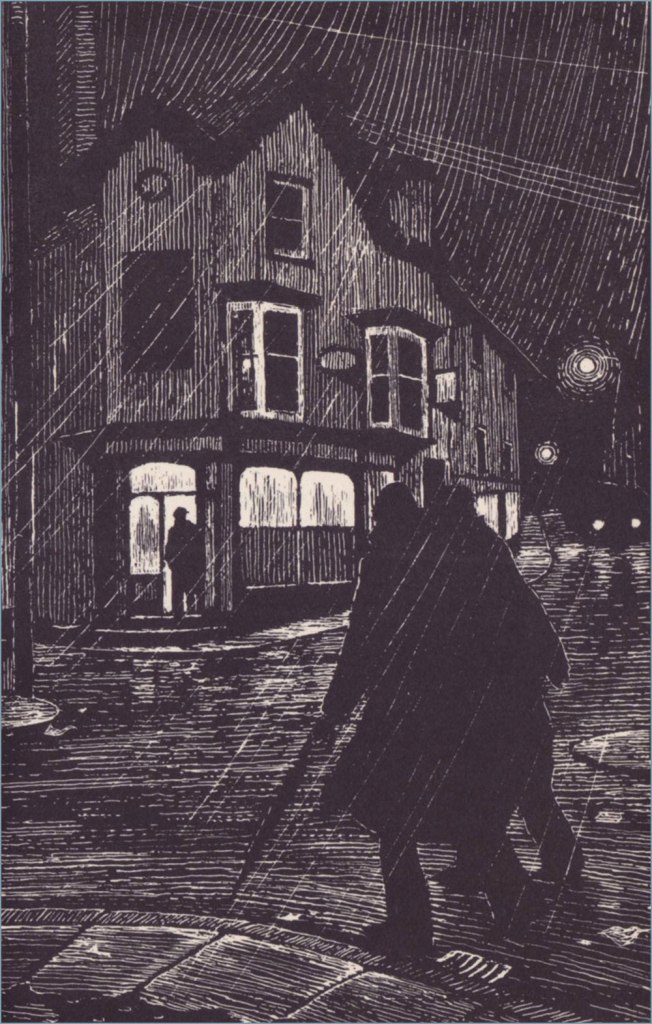
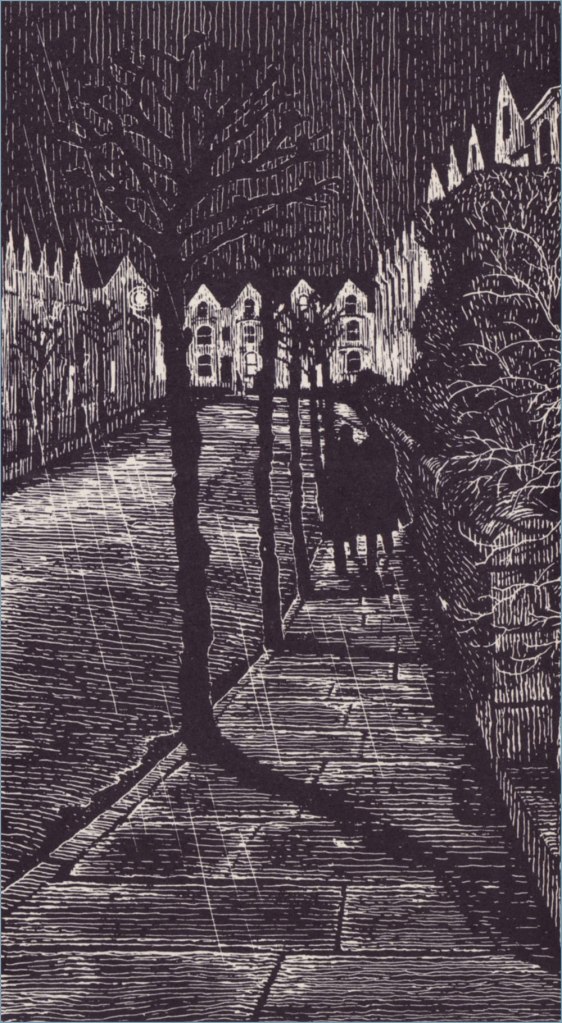
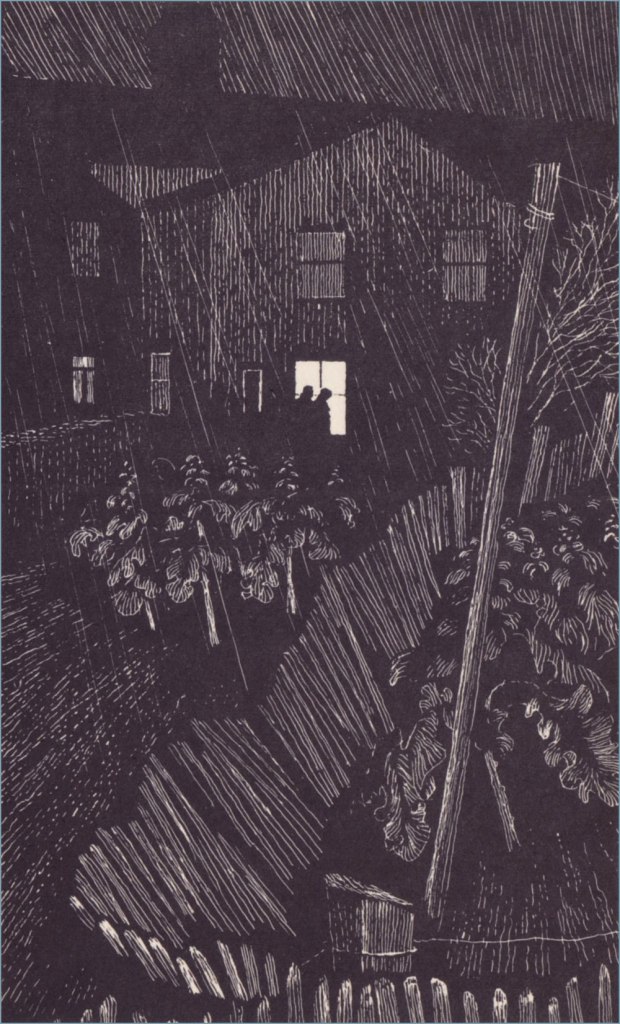
We’ve just had quite a nocturnal downpour over here, and so it seemed entirely à propos to feature that finest of all rainy night ghostly tales, Dylan Thomas’ The Followers, a late-career short story written in 1952. I would have loved to direct you to the full text of it, but can’t seem to find anything of the sort online.
« It was snowing. It was always snowing at Christmas. December, in my memory, is white as Lapland, though there were no reindeers. But there were cats. Patient, cold and callous, our hands wrapped in socks, we waited to snowball the cats. »
I’ve long been fascinated by English publisher J.M. Dent’s ‘series’ of Dylan Thomas illustrated booklets. First came the highly successful ‘A Child’s Christmas in Wales‘, in 1959, which kick-started the storied career of Ellen Raskin: « A Child’s Christmas in Wales by Dylan Thomas was the book that Raskin first printed herself to show as a sample to publishers in an effort to become a free-lance illustrator, a project that set her on her way to success in the field. Though the Christmas poem had been illustrated often, this was a memorable edition. »
A Child’s Christmas in Wales was followed — striking the iron while it was hot — by The Outing in 1971(!), then by Holiday Memory the following year. Then, finally, in 1976 came the final, and possibly finest, entry: The Followers. These last three were superbly illustrated by Meg Stevens.
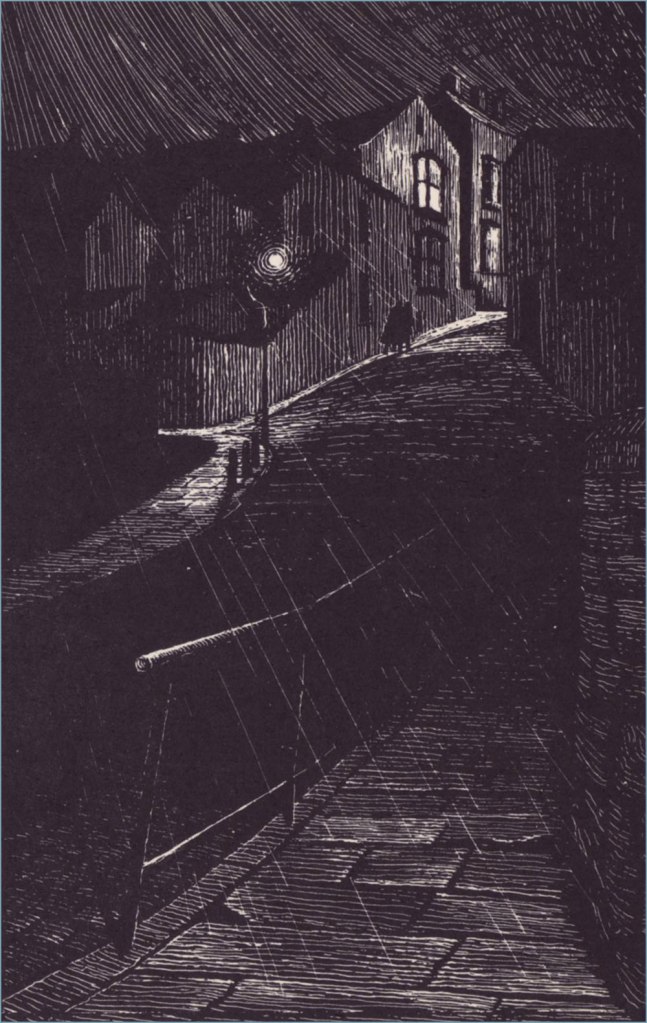
Miss Stevens demonstrated her mastery of the scratchboard medium through her three Thomas adaptations.
« It was six o’clock on a winter’s evening. Thin, dingy rain spat and drizzled past the lighted street lamps. The pavements shone long and yellow. »
« A silent man and woman, dressed in black, carried the wreaths from the front of their flower shop into the scented deadly darkness behind the window lights. Then the lights went out. »
« We walked towards the Marlborough, dodging umbrella spokes, smacked by our windy macs, stained by steaming lamplight, seeing the sodden, blown scourings and street-wash of the town, papers, rags, dregs, rinds, fag-ends, balls of fur, flap, float, and cringe along the gutters, hearing the sneeze and rattle of the bony trams and a ship hoot like a fog-ditched owl in the bay… »
« We walked on heavily, with wilful feet, splashing the passers-by. »
« “I wonder what’s the point of following people”, Leslie said, “it’s kind of daft. It never gets you anywhere. All you do is follow them home and then try to look through the window and see what they’re doing and mostly there’s curtains anyway. I bet nobody else does things like that.” »
« “Doesn’t anything happen anywhere?” I said “in the whole wide world? I think the News of the World is all made up. Nobody murders no one. There isn’t any sin any more, or love, or death, or pearls or divorces and mink-coats or anything, or putting arsenic in the cocoa…” »
« “Good night, old man,” Leslie said. “Good night,” I said. And we went our different ways. »
Regrettably, in the absence of a full text of the story, I can’t convey to you the supernatural component of the story. But I assure you, it’s well worth the looking up, and I dare hope that the palpable mood of Mr. Thomas’ prose and Ms. Stevens’ sublime scratchboard renderings were sufficient to put you in the proper, receptive frame of mind.
« I lived on a houseboat in Amsterdam for a year. It was intense, and it’s possible that I even had a few blackouts. » — Wolfgang Beltracchi
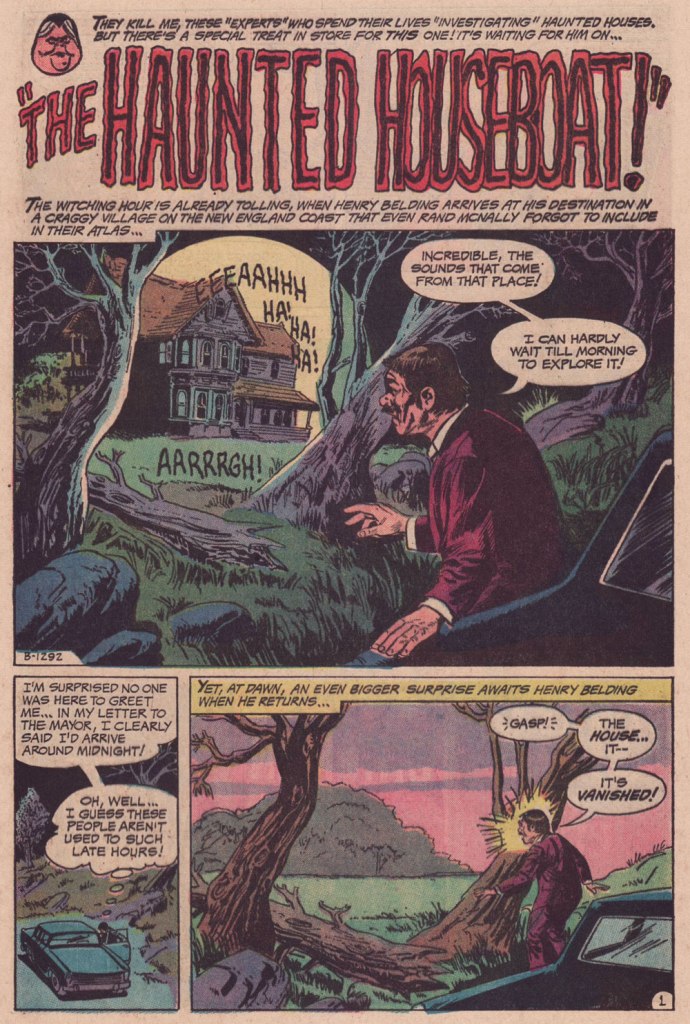
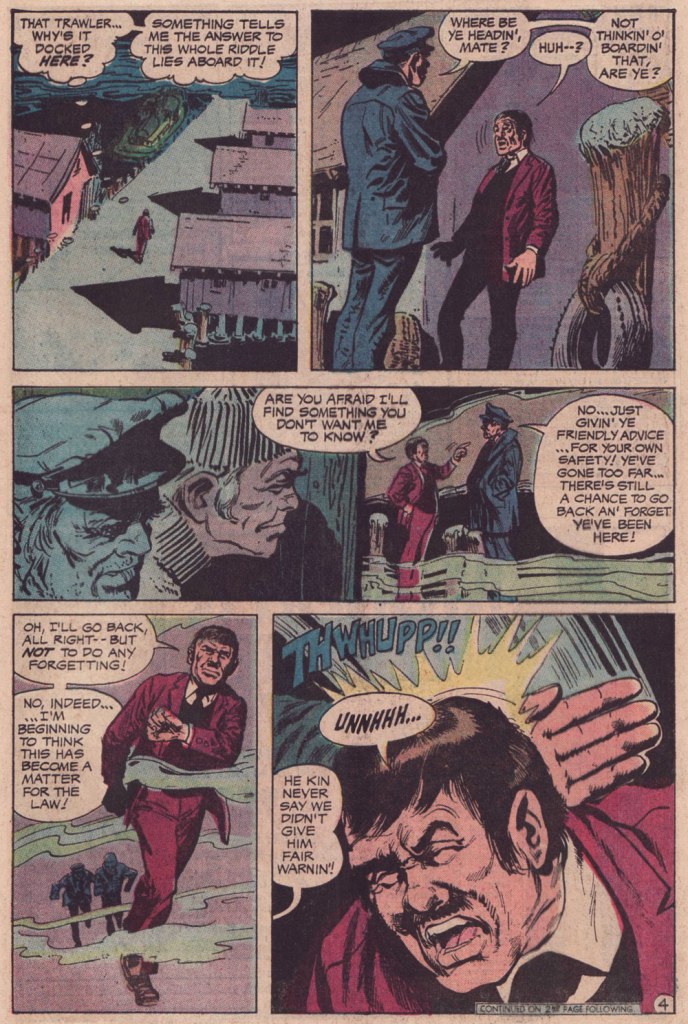
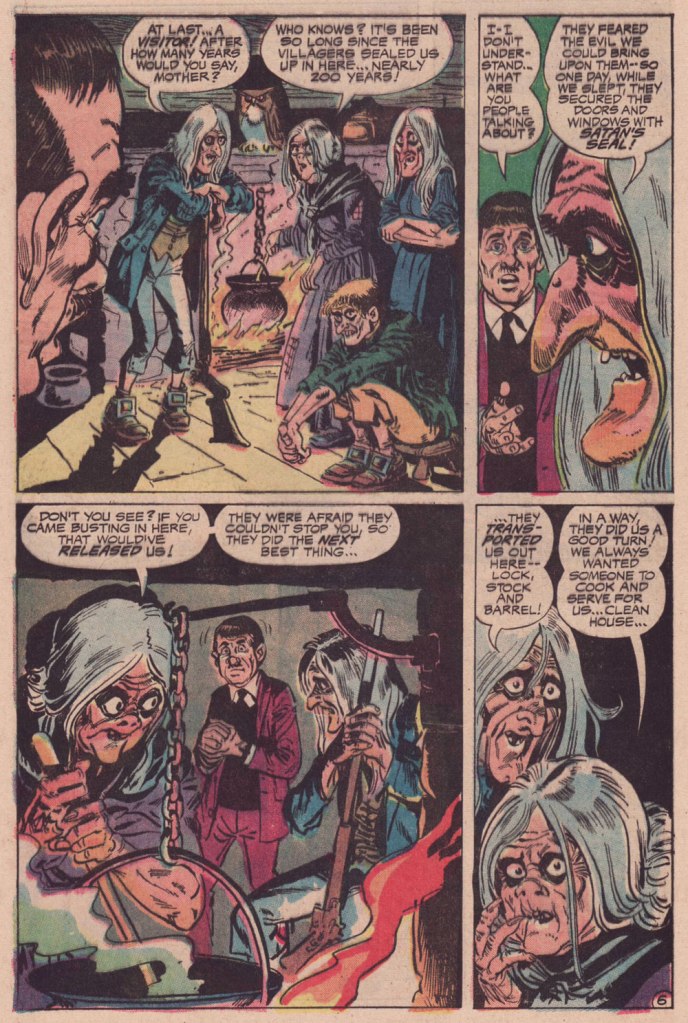
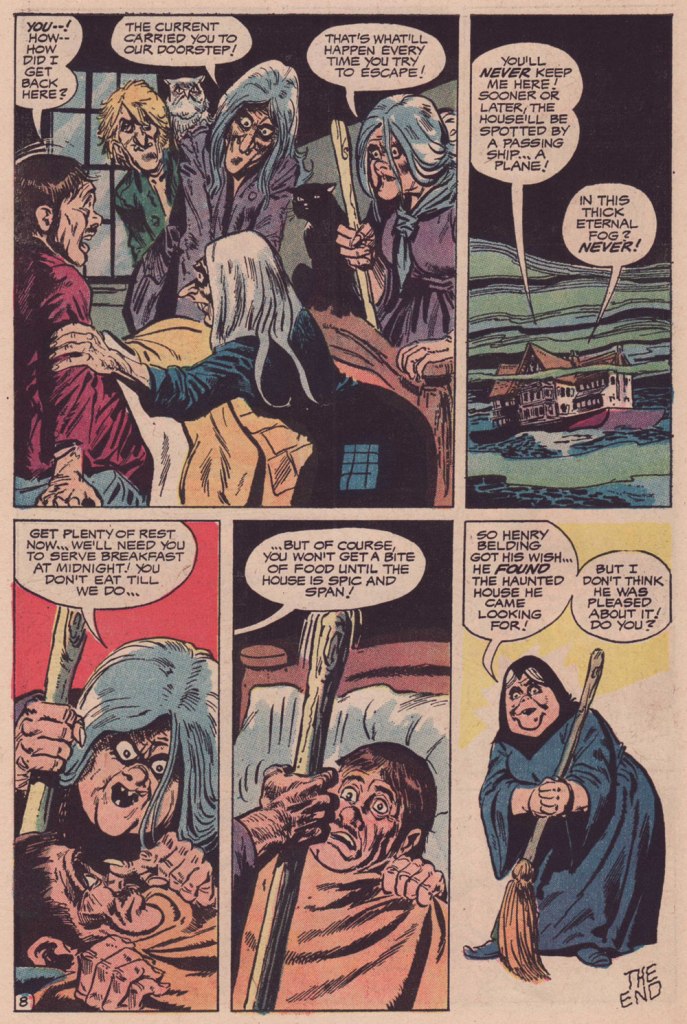
Today’s featured tale is an old favourite illustrated by one of American comics’ perennial mal-aimés, the much-maligned Jack Sparling (1916-1997), a prolific, reliable, distinctive stylist who toiled for just about every publisher on the block. Of course, he’s persona non grata with the superhero set (a compliment in my book!) but his chief strengths lay just about everywhere else, in humour, horror, crime and adventure… you name it.
I love how cosy — that pervasive, foggy ambience! — yet harrowing this tale is. Nice to see one of those insufferable, know-it-all ‘ghost busters’ get his bitter requital. And who knew that some witches were so neat, so domestically inclined? Work that mop, boy!
The writer’s uncredited, and that’s a shame, because this is anything but formulaic — and DC’s mystery books were formulaic to a fault, especially under Joe Orlando‘s guidance. I suspect the author to be editor Murray Boltinoff — he often pitched in, under sundry bynames.This is It’s Midnight… The Witching Hour!no. 21 (June-July 1972, DC), edited by Murray Boltinoff and with cover art by Nick Cardy.
« Someone at Dell Comics decided it’d be swell to turn famous monsters into superheroes — an idea whose time never came. And just to make sure there were bad, they hired Tony Tallarico to draw them. » — — James Schumeister, with the sort of brickbat typically lobbed at Mr. Tallarico.
Last week, we lost, at the venerable age of eighty-eight, the controversial, much-maligned Tony Tallarico (Sept. 20, 1933 – Jan. 7, 2022). The case of Mr. Tallarico’s reputation is typical of mainstream US cartoonists who generally eschewed the superhero genre. His mistake, I suppose, is that he drew a handful of them, and in his own distinctive fashion to boot, thus sealing his doom in Fanboy court.
Yet there’s far more depth and variety to Tallarico’s career, and that’s should be remembered. Besides, those superhero comics were just light-hearted, unpretentious fun. Obviously not what the continuity-addicted True Believers craved.
Let’s take a tour of some of the highlights!
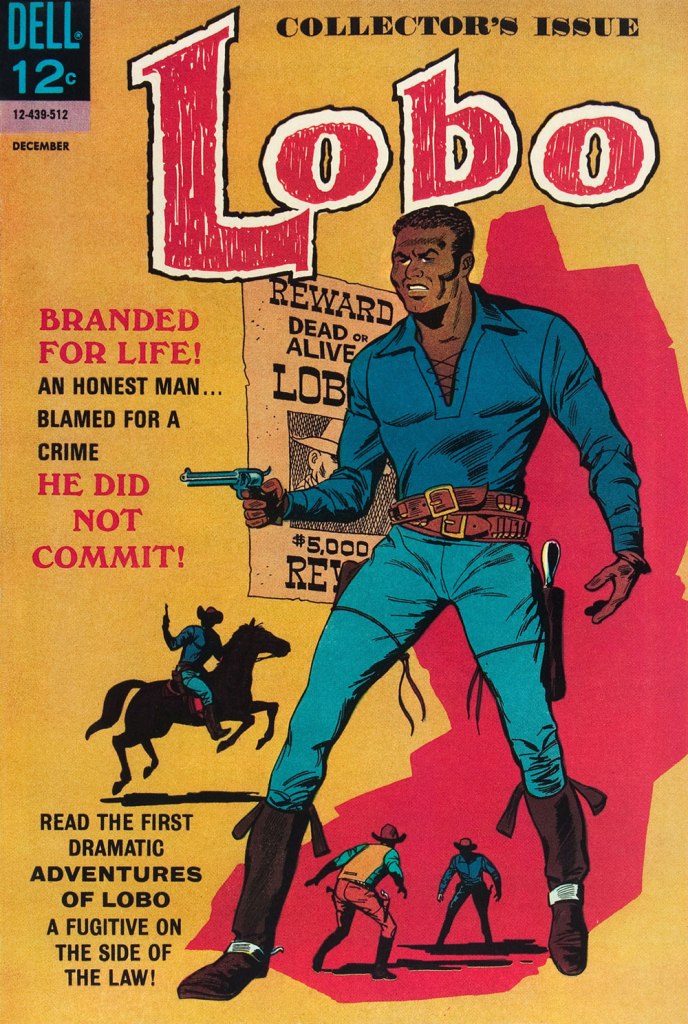
A page from Crazy Quilt, one of three stories Tallarico illustrated for my personal candidate for greatest horror comic book of all time, the unlikely one-shot Tales From the Tomb (Oct. 1962, Dell). Script and storyboard by John Stanley. Read the rest (complete with, fittingly, its analysis) of Crazy Quilthere. Arguably, if Tallarico’s going to be remembered in comics and general history, it may be for this once-obscure but significant mid-60s creation. This is Lobo no. 1 (Dec. 1965, Dell Comics). Tallarico and writer D.J. Arneson hold different views as to the character’s genesis, as Canadian researcher Jamie Coville discovered in 2016. To his credit, Coville simply let the former collaborators present their respective side of the story. Read the resulting interviews here! And do check out the début issue itself, along with Tom Brevoort’s analysis… right here.
As reported in Alter Ego no. 106 (Dec. 2011, TwoMorrows): « On May 20, 2005, Tony Tallarico received the Pioneer Award, given for his co-creation of the first African-American comic book hero, Lobo, a post-Civil War cowboy who appeared in two issues of his own Dell/Western title. The honor was given at a ceremony held at Temple University in Philadelphia, Pennsylvania. »
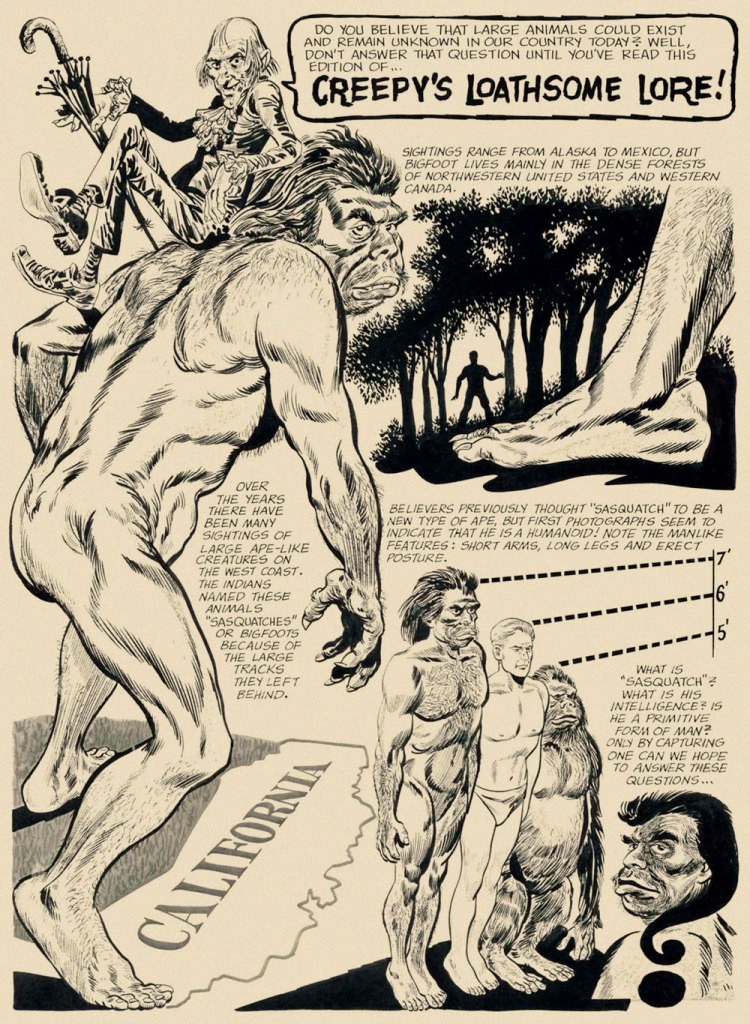
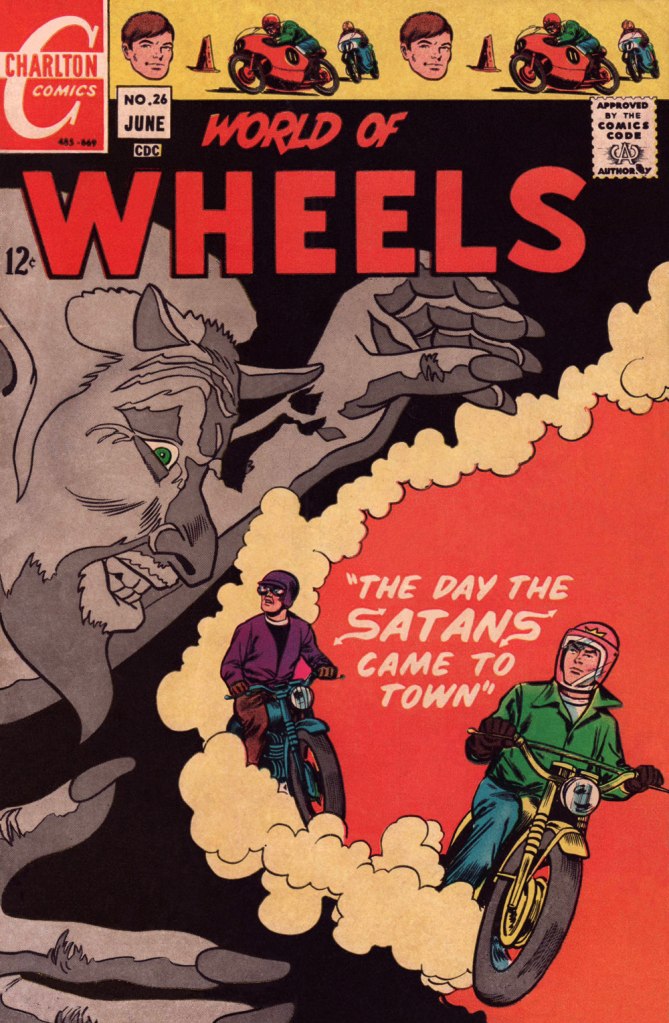
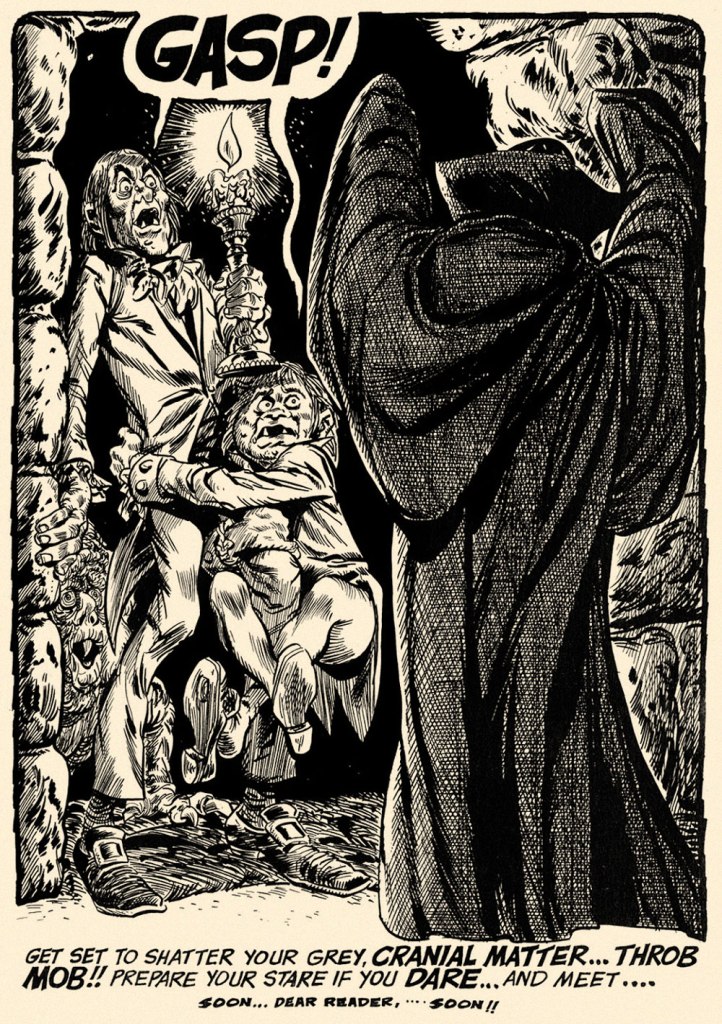
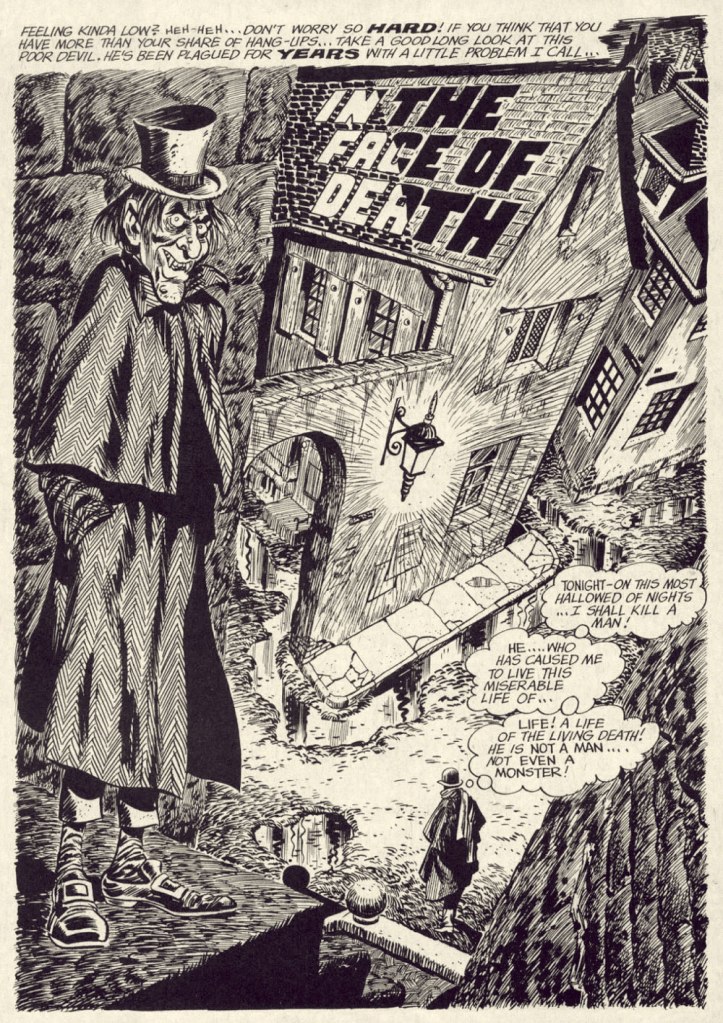
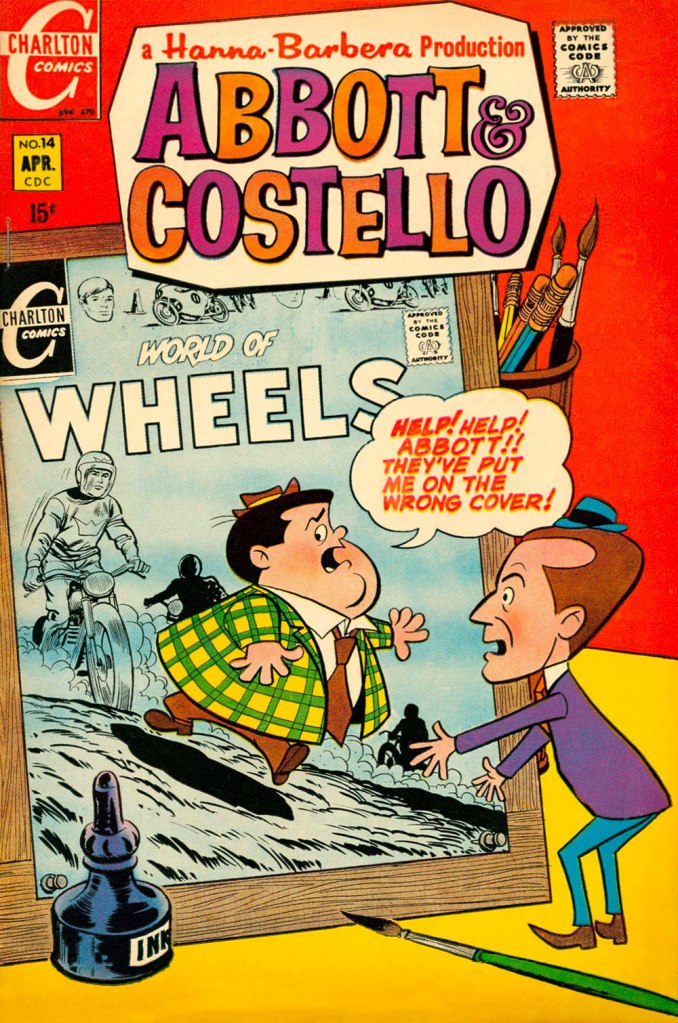
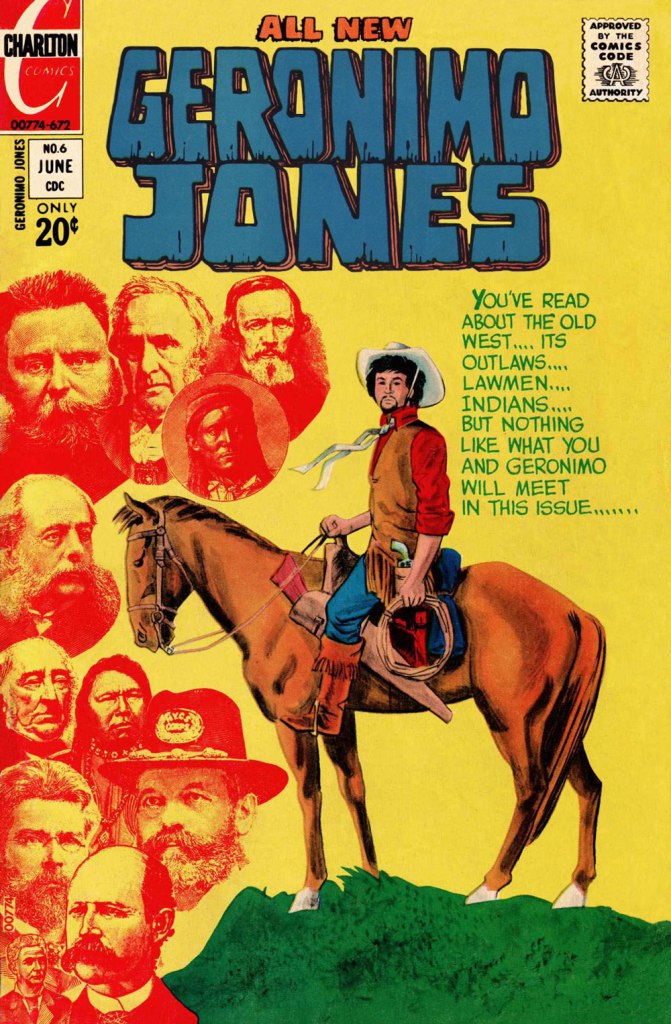
A Tallarico ad from Eerie no. 20 (March 1969, Warren); Tony enjoyed keeping things in the family, and so young “Danny Smith” was actually Tony’s wife’s nephew, Danny Grosso. My thanks to Tony’s daughter Nina for graciously divulging this bit of inside info! Cryptozoologists take note! Creepy no. 26 (April 1969, Warren); script by editor Bill Parente. I just adore Uncle Creepy’s pose (great use of props!), not to mention the question mark mullet. Should be the hit of the next tonsorial season!Joe Gill and Tallarico took over the handlebars of one of Charlton’s established hot-rodders, Ken King. Following the direction blazed by their predecessor, Jack Keller, King had become “the Most Hated Man on Wheels!” (in Drag-Strip Hotrodders no. 13, Jan. 1967, Charlton) after being unjustly accused of wrecking his best friend, Jerry Gerard, aka “The Nicest Guy in Racing” during a meet. The series’ unremittingly bleak portrayal of the racing scene is fascinating, and Gill and Tallarico wisely kept the pace. This is World of Wheels no. 26 (June 1969, Charlton); cover by Tallarico.An in-house ad from Eerie no. 23 (September 1969, Warren), technically Vampirella’s first published appearance. Art by “Tony Williamsune”, the collective nom de plume adopted by frequent collaborators Tallarico and William ‘Bill’ Fraccio. According to Tallarico, their collaboration was quite fluid: both contributed to layout, pencils and inks, but Tony was the extroverted go-getter, while Bill was the quiet one. A “Williamsune” splash from Creepy no. 31 (February 1970, Warren). Tallarico on his association with Fraccio: « I would pencil some, he would ink some, visa versa y’know one of those things. I was really the guy that went out and got the work. Bill never liked to do that. It would depend. If he was working on something else I would start a project too and do pencils. It was a fun time. » [ source ]This is Abbott & Costello no. 14 (April 1970, Charlton), featuring the beloved veteran comedians’ crossover with the aforementioned Ken King. The look of the series is based upon Hanna-Barbera‘s 1967-68 The Abbott and Costello Cartoon Show rather than on the duo’s classic movies and routines. Besides, Lou Costello having passed away in 1959, his part was voiced by Stan Irwin (with Bud Abbott as… Abbott). Preceding the advent of Jonah Hex by some months* in the Weird Western stakes, Geronimo Jones was a truly oddball oater series, in the best sense of the term. Created by Tallarico (script and inks) and José Delbo (pencils), Geronimo’s adventures ran for 9 issues (plus one that remains unpublished), from September, 1971 to January, 1973. Geronimo himself was essentially a young pacifist seeking his quiet place in the Old West, in the finest tradition. However, strange encounters and occurrences keep thwarting his laudable goal. And none is more outlandish and shocking than what he comes up against in this issue, cover warning and all. This is Geronimo Jones no. 6 (June 1972, Charlton). The GCD credits the cover to Delbo alone, but the use of collage and halftone wash are telltale Tallarico trademarks… not to mention his distinctive lettering. My guess therefore is: pencils by Delbo, layout, inks and collage by Tallarico.Tallarico and Fraccio did only a handful of stories in this wild, swirly style, including four for Charlton: The Curse of the Vampire in The Many Ghosts of Dr. Graves no. 44 (Jan. 1974, Charlton); this one, Come See Our Ghost… in Haunted no. 16 (June 1974, Charlton); The Reuger Formula in Haunted no. 24 (Nov. 1975) and A Solemn Oath! in Ghostly Tales no. 118 (Nov. 1975). Let me assure you that the sort of bold inking on display here, while deceptively simple in appearance, takes unerring confidence and skill to achieve. Bravissimo!
By the mid-70s, with his main comics accounts defunct or dormant (Dell, Treasure Chest, Charlton), Tallarico, ever the astute and tireless businessman (another rare trait among cartoonists) simply stepped up and diversified his efforts, branching out and creating a market for himself. « In the 70s the whole business went kaput. Luckily I was able to transfer over into doing children’s books. I’ve been doing children’s books ever since. My wife went though a count several months ago. It was over a thousand titles. That’s a lot of children’s books. »
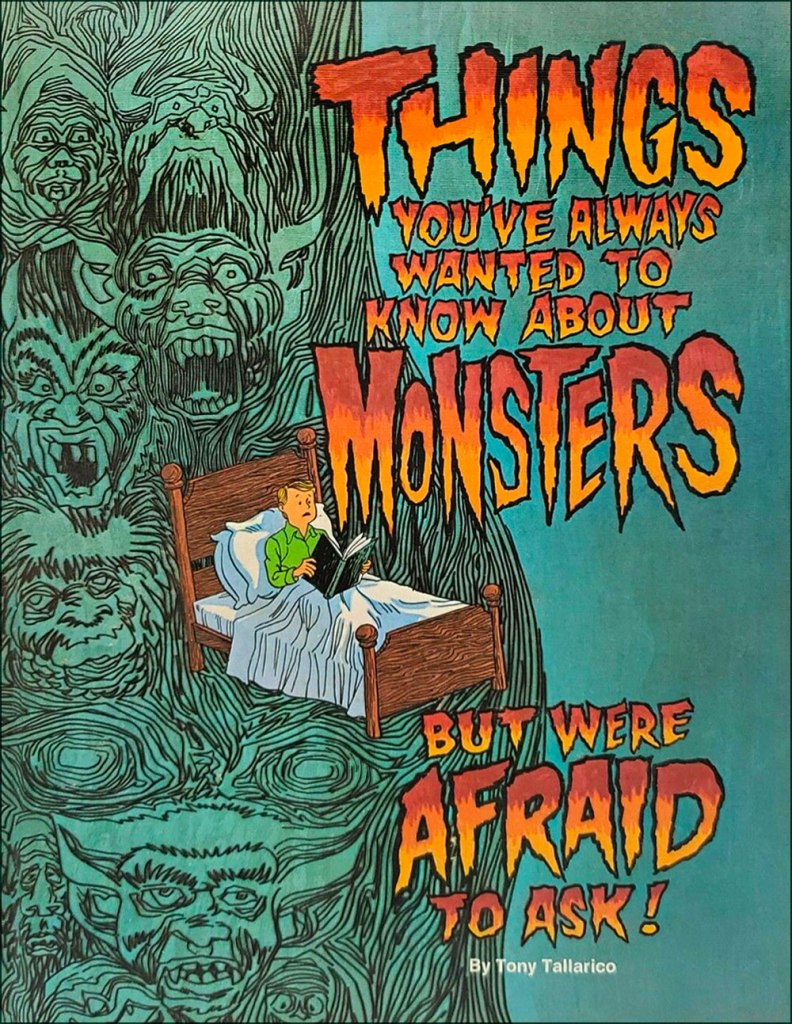
Here’s a lovely one: Things You’ve Always Wanted to Know About Monsters (1977, Grosset & Dunlap). From the author’s introduction: « My sincere thanks to the many motion picture studios who produced these great monster films. They have kept many a generation of fans ‘monsterized‘. My thanks to my parents, who did not forbid me to see these films when I was a boy. Instead, they brought out in me many of the questions that appear in this volume. They always stressed that monsters are another form of fictional entertainment. My thanks to my wife Elvira, and my daughter Nina**, who stood by while my son and I made a mess of the living room as we selected the many pictures that appear here. »
I should point out that I haven’t forgotten one of my favourite Tallarico projects, namely his charming work on the Bobby Sherman “Getting Together” comic book (7 issues, Feb.-Oct. 1972, Charlton)… it’s just that I’ve already addressed the topic: check out Let’s Hear It for Bobby Sherman!
I don’t know whether I’ll change anyone’s mind about Mr. Tallarico’s work, but I believe I can rest assured I gave it my best shot.
-RG
*Hex was introduced in All-Star Western no. 10 (Feb.-Mar. 1972, DC).
**My closest brush with the Tallaricos came in 2015 when I helped his daughter Nina identify and source some artwork she was selling on eBay for her dad. In my experience, a very nice lady. My sincere condolences to the bereaved family.
« Painting is the art of hollowing a surface. » — Georges Seurat
If you’ll forgive me the venial but gauche sin of quoting myself… three years ago, I posited:
« Luís Ángel Domínguez, reportedly born ninety-five years ago to the day… and still among the living… as far as we know. I like to envision him warmly surrounded by several generations of loved ones and well-wishers, an impish gleam in his eye. »
I found it sadly infuriating that such an important and accomplished artist’s latter-day whereabouts and circumstances were so shrouded in mystery… and largely, it would seem, indifference. The usual story: he didn’t really do superheroes.
Neither Lambiek nor the Grand Comics Database have anything to add on the subject, but a spot of digging turned up that he indeed was still alive until recently, though purportedly afflicted with Alzheimer’s in his waning years. Then I found what may well be his… very basic obituary, placing his date of birth exactly one month off (unsurprisingly, since accounts have long varied) and his date of death as July 1st, 2020, in Miami, FL. Unless something more definitive comes along, it’ll have to do.
I think we can all agree that ninety-six years is a pretty good run, even with the doleful decline near the end. Let’s look back on what’s surely his peak decade in comics, the 1970s. My picks have nothing to do with ‘key’ issues, character débuts or popular crossovers. I’ve judged these on artistic merit, keeping the pernicious influence of nostalgia at arm’s length.
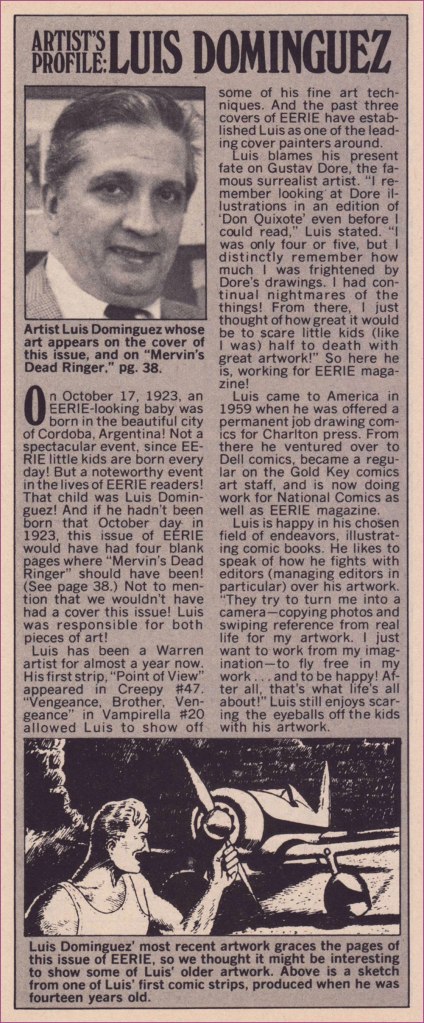
First, a little biographical background! This helpful piece appeared in the pages of Eerie no. 44 (Dec. 1972, Warren), which also boasted a Domínguez cover… albeit reproduced too small.
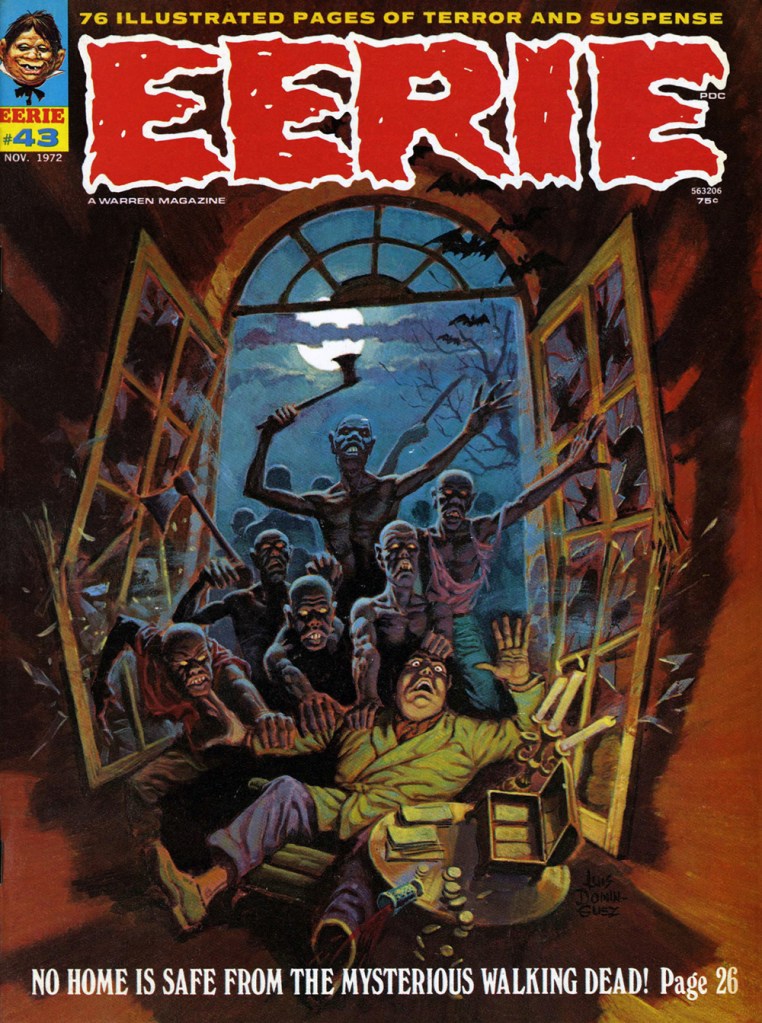
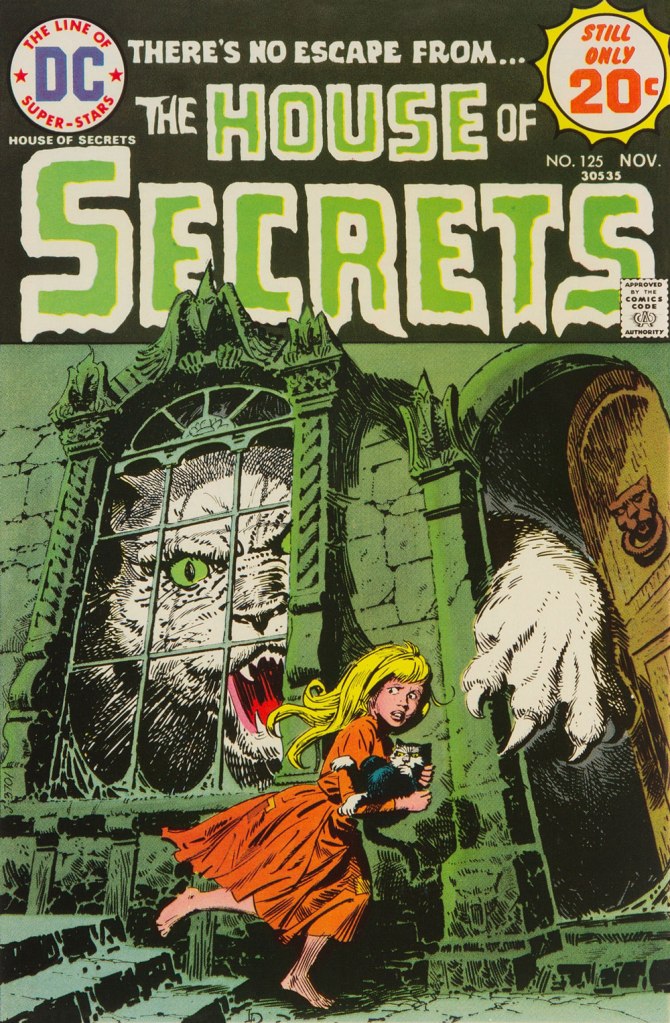
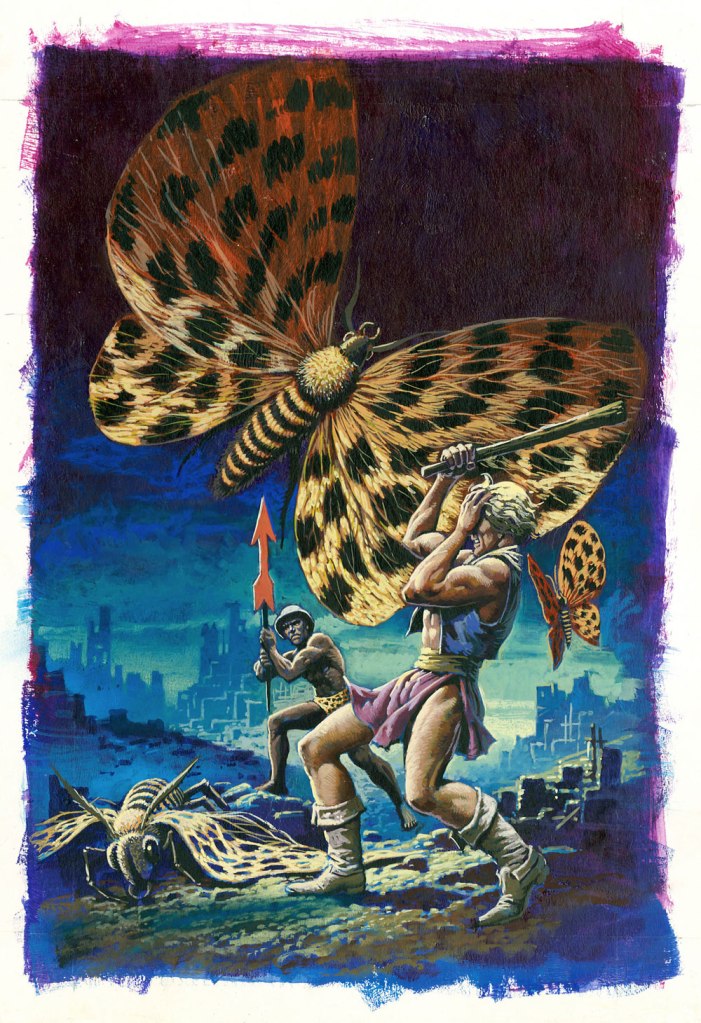
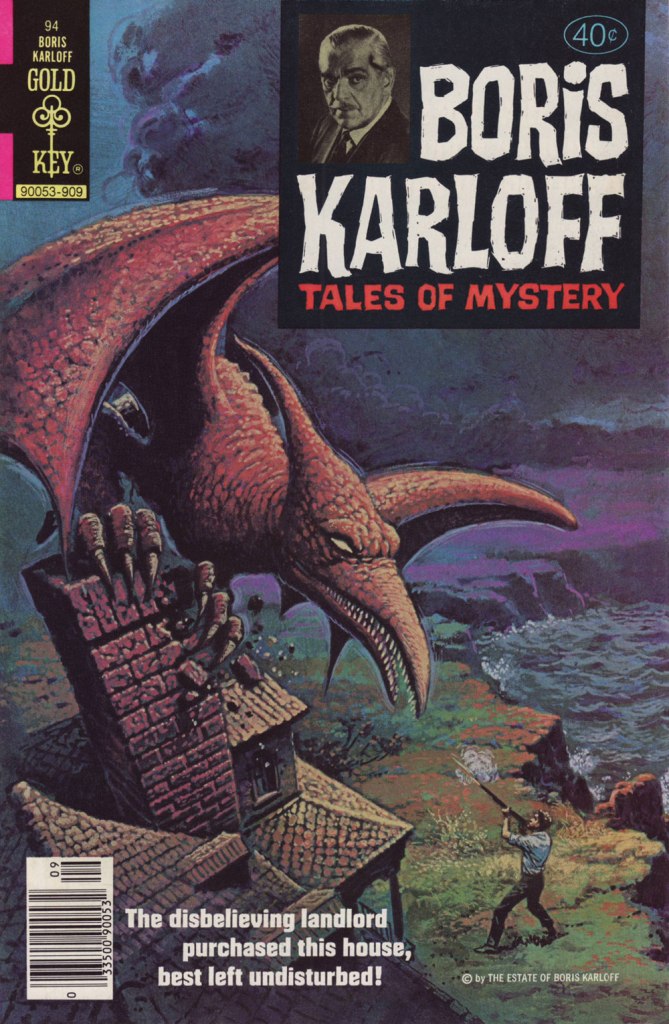
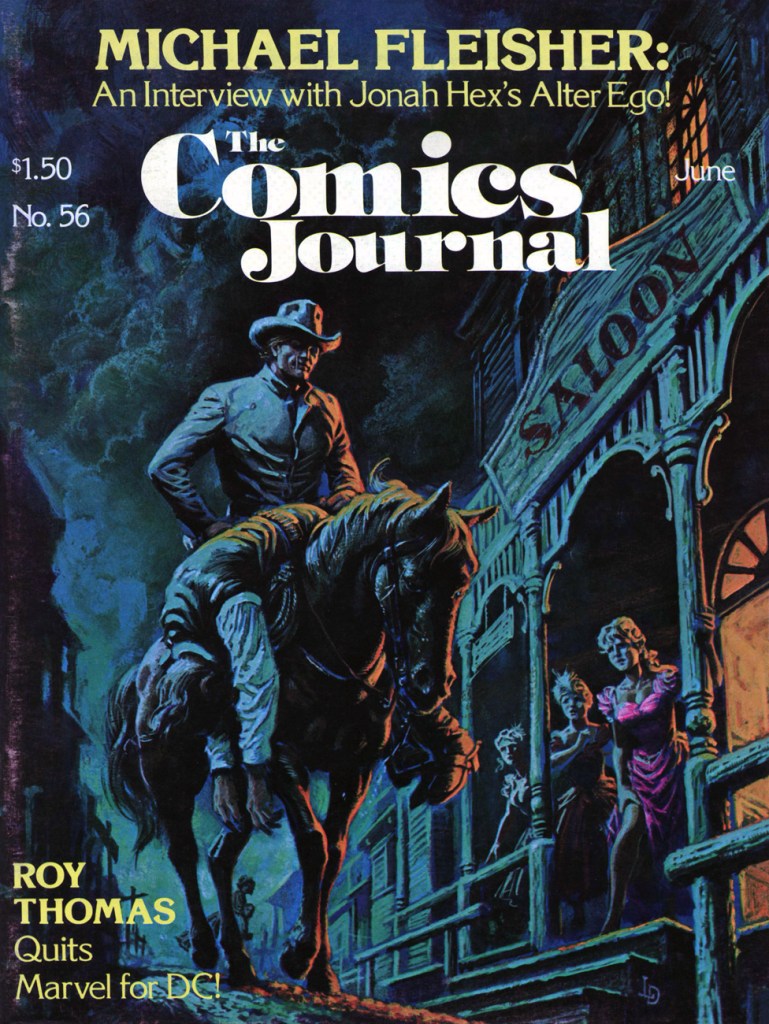
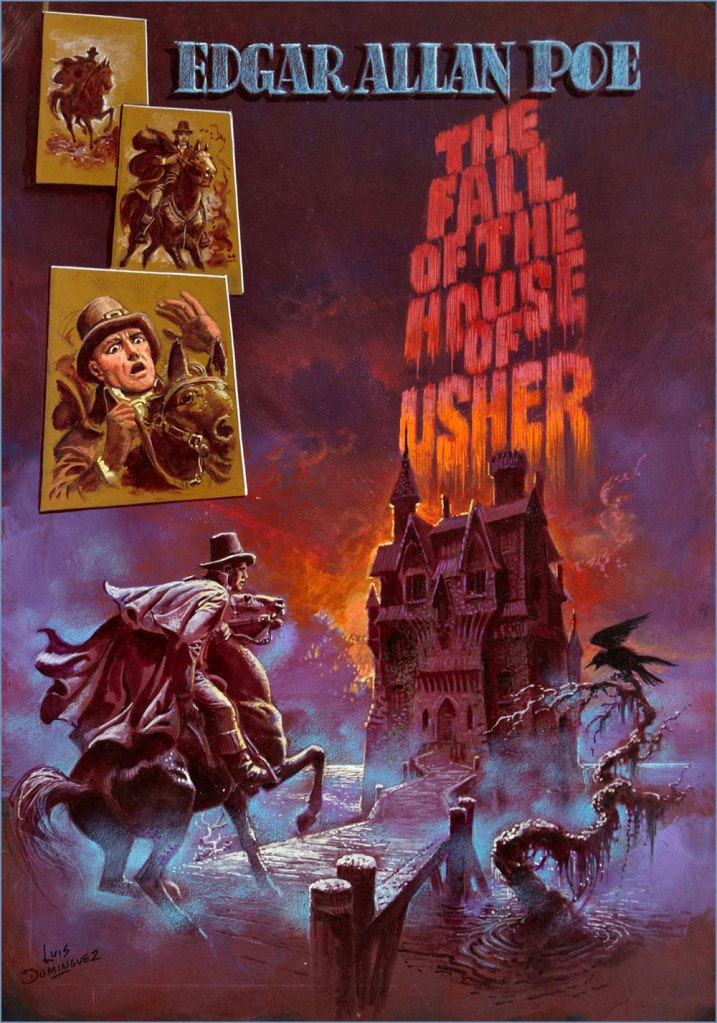
The folks at Warren were apparently first in North America to recognise and call upon señor Domínguez’s masterly painting skills. This is Famous Monsters no. 93 (Oct. 1972, Warren).My personal favourite of his too-few Warren covers, this is Eerie no. 43 (Nov. 1972, Warren).While Luís had been steadily working on the insides of Gold Key comics since 1967, it wasn’t until 1974 that they gave him a crack at a cover. That was either this one, Space Family Robinson no. 40, or Boris Karloff Tales of Mystery no. 55, both cover-dated July, 1974… (incidentally, the GCD misattributes to him several of his colleague George Wilson‘s paintings).DC hardly ever used painted covers, but they did keep Domínguez busy as a cover artist. I assure you, this ambitiously-muted cover must have been a printer’s nightmare. This is The Phantom Stranger no. 32 (Sept. 1974, DC), a great issue that features Arnold Drake and (returning to the Stranger after a 27-issue absence!) Bill Draut‘s It Takes a Witch! and a gorgeous Michael Fleisher–Nestor RedondoBlack Orchid backup.This is House of Secrets no. 125 (Nov. 1974, DC). For once, Domínguez also illustrates the cover-featured story, E. Nelson Bridwell‘s Catch as Cats Can!Then of course, Marvel soon after got in on the act. This is Dracula Lives no. 9 (Nov. 1974, Marvel). I would have picked the even better previous issue, but I’ve already featured it, so you get to enjoy both!The printed version of this piece, featured as the cover of UFO Flying Saucers no. 5 (Feb. 1975, Gold Key) pales in comparison with the surviving original art, so that was an easy choice.This issue’s original art also survived, and seeing both versions is most instructive as an insight into production manager Jack Adler’s methods. This is House of Mystery no. 235 (Sept. 1975, DC), and the original can be viewed here. As an aside, this issue’s The Spawn of the Devil, written by Maxene Fabe and drawn by Ramona Fradon, is the only DC horror story I ever found scary. Perhaps editor Joe Orlando should have hired women more often!Another one whose printed version fails on the reproduction front, this is Mighty Samson no. 31 (Mar. 1976, Gold Key), the title’s final issue. Let’s again rejoice at the original art’s survival!This is Boris Karloff Tales of Mystery no. 94 (Sept. 1979, Gold Key); I hold that Dominguez’ three finest consecutive covers came near the end of Gold Key’s Karloff anthology and, wouldn’t you know it? … we have already featured the other two. You’ll find issue 92 here, and issue 93 (and its original art) in one of ds’ posts, which also showcases another top-flight contender, which I couldn’t use for reason of… tentacles, Dagar the Invincible no. 11. This is The Comics Journal no. 56 (Fantagraphics, May 1980). According to masthead notes, « Luís Dominguez’s painting was originally scheduled for the fourth issue of DC’s Digest Comic, “Jonah Hex and Other Western Tales“, but the title was cancelled with no. 3. » The magazine’s larger size certainly affords us a better view of this richly detailed scene.And as bonus, this mysterious, undated, possibly unpublished cover painting to Edgar Allan Poe‘s famous tale. Acrylic on board, 36 x 50 cm (14″ x 20″). The corners confirm that Domínguez worked from dark to light (which largely accounts for his marvellously luminous colours) and faint lines (on this and other works) indicate that he used a grid to scale up his preliminary sketches accurately.
For more Domínguez delights, just click on this link and explore away! I daresay that I only managed to keep it to an even dozen (difficult!) choices because we’ve already spotlighted many of his finest covers.
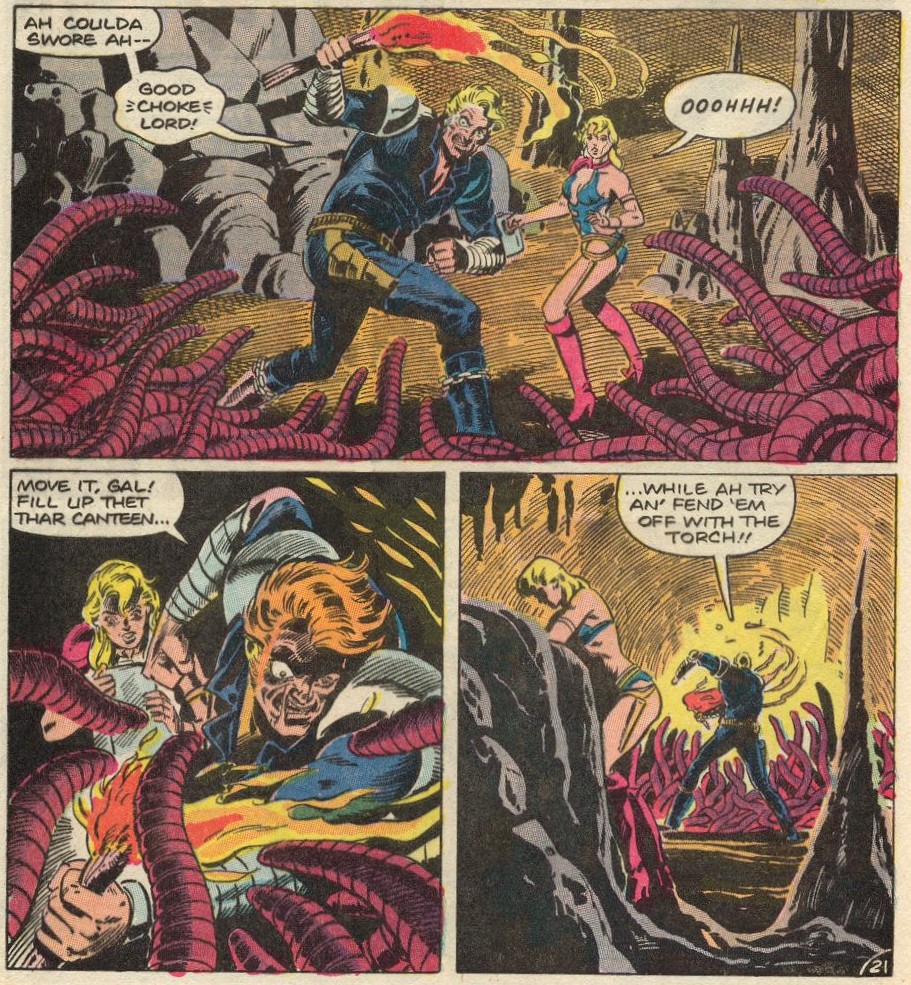
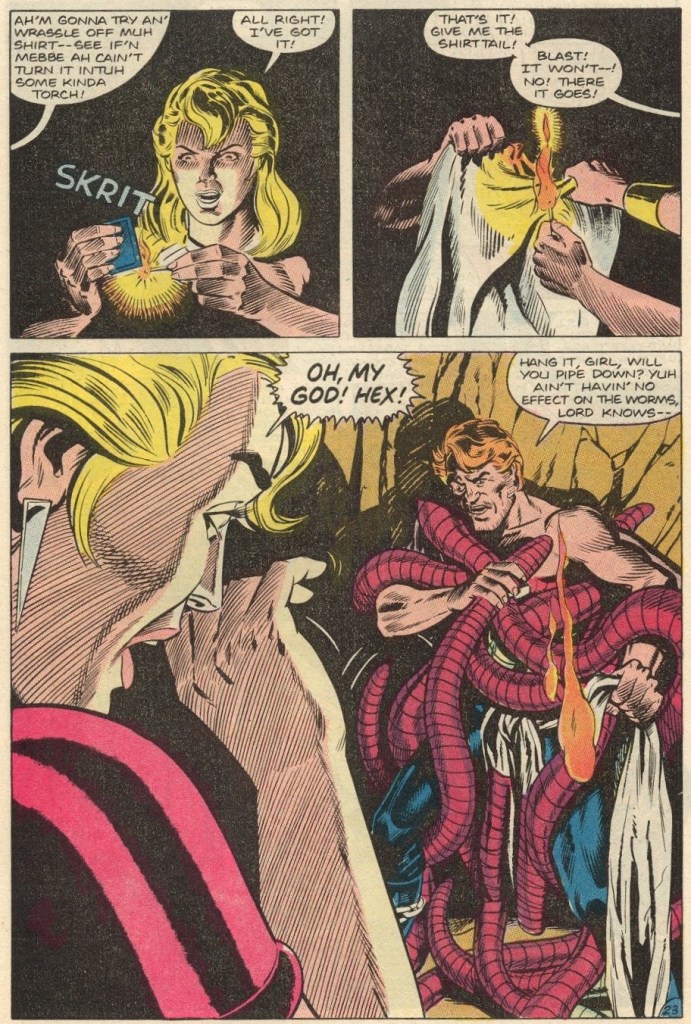
Today we play a game: yes, those long slithery things are wrapped around somebody’s ankle… but are they tentacles, or worms?
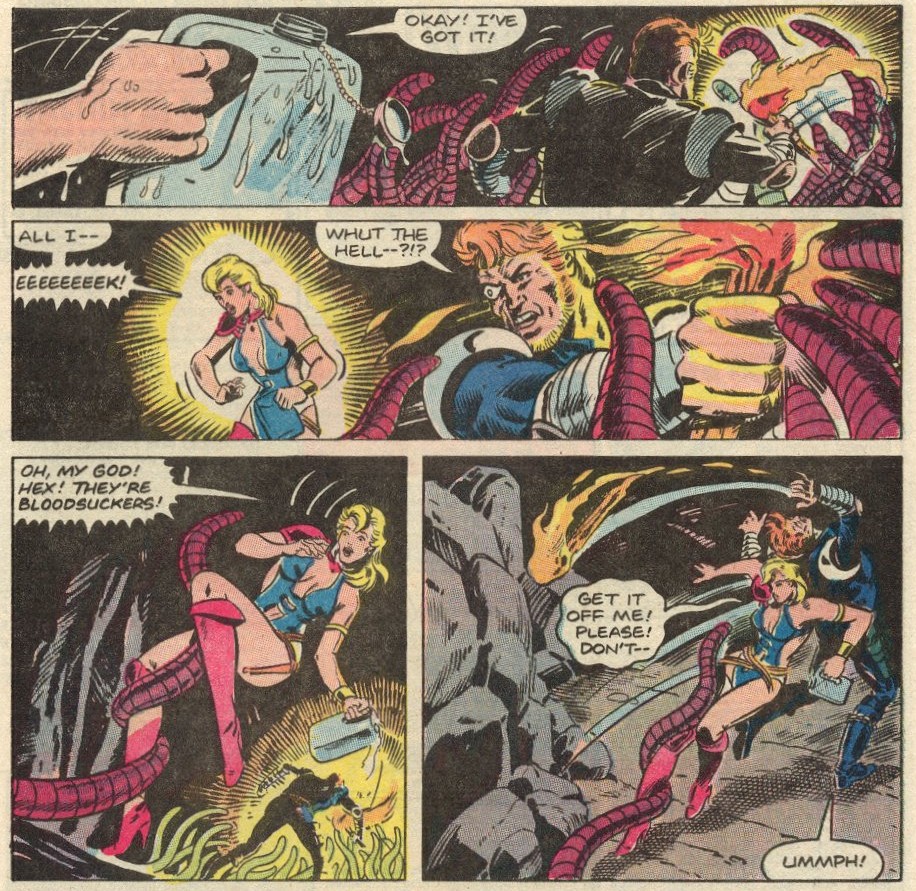
In real life, worms (even predatory) don’t really wind around their prey or suffocate them. A biologist could tell us whether they ever ‘hunt’ in huge numbers, but I think we can be fairly certain that the scenes depicted below have never happened in real life. If disbelief must be suspended, I’d rather string it up for a cephalopod invasion, rather than a worm onslaught (ick)… But the characters of this post have had to deal with both kinds of threat. Let’s get on to it!
Worm or tentacle? Well, these have eyes at the end of… of whatever it is… and they seem like individuals, so probably worm. Hey, those who have read this issue before, no spoilers, please!
The Saga of Swamp Thing no. 6 (October 1982, DC). Cover by Tom Yeates.
Let take a look inside this issue…
Page from Sins on the Water, scripted by Martin Pasko, pencilled by Tom Yeates and inked Tom Yeates.
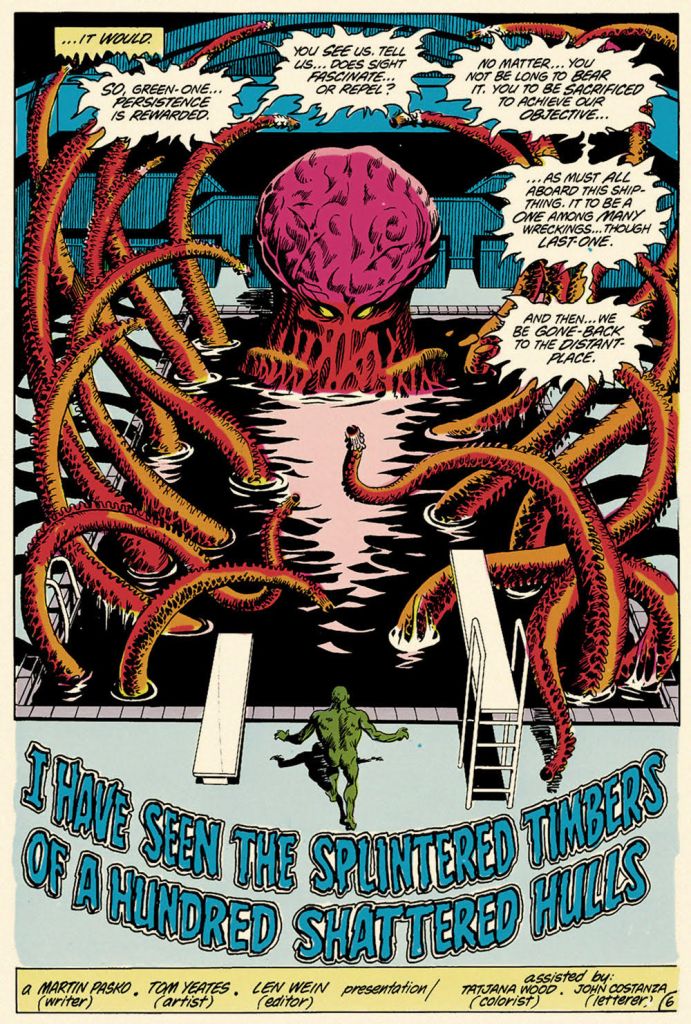
What do you think? These seem to originate from the same source. Let’s peek at the next issue – cephalopod confirmed!
Page from I Have Seen the Splintered Timbers of a Hundred Shattered Hulls, scripted by Martin Pasko and pencilled by Tom Yeates. This story was published in The Saga of Swamp Thing no. 7 (November 1982, DC).
Moving on to our next puzzle! Those are surely tentacles, belonging to some cephalopod monstrosity with a thousand arms:
Moving on! With a texture distinctly reminiscent of some sort of slug, the following whatchamacallits could be either… but the planet that hungers is using its tentacles, and not worms, to feed. Ping! Correct. This makes the following scene no less disquieting – oh, somebody bring me back to the normal, sea-faring octopus…
This is Battlestar Galactica no. 10 (December 1979, Marvel). Cover pencilled by Pat Broderick and inked by Terry Austin.
Let’s have one last go. This cover so clearly depicts Abby getting grabbed by some underwater tentacled monster, that it regularly appears in tentacle-related searches…
Swamp Thing no. 11 (July-August 1974, DC). Cover by Luis Dominguez (speaking of whom, co-admin RG has a treat for you later this week!)
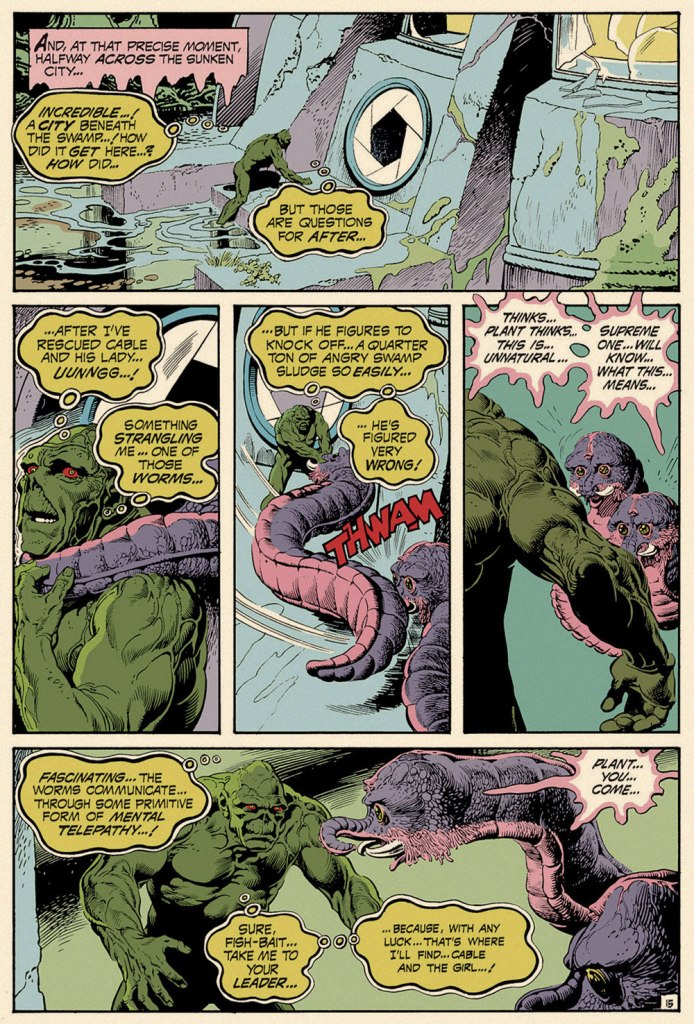
And yet! The cover is the self-explanatory The Conqueror Worms!, scripted by Len Wein and illustrated by Nestor Redondo. The star creatures of this story are actually pretty adorable, especially their mini-trunks and moist, sensitive eyes:
When somebody killed one of those things, I was seriously peeved.
I hope some of these examples gave you pause, even if for just a little bit!
« The fog comes on little cat feet. It sits looking over the harbor and city on silent haunches and then moves on. » — Carl Sandburg
The first novel I ever read was a Bob Morane… so we’re old friends.
This was the one. I ask you, how could any self-respecting, red-blooded boy resist the lure of a book entitled ‘Monsters From Space’? And no, I don’t remember a thing from it. Cover art by the prolific Pierre Joubert.
Bob Morane, created in 1953 by yet another Belgian writer* both talented and astoundingly prolific, Charles-Henri Dewisme aka Henri Vernes (1918-2021), has been the hero of over two hundred novels, movies, television shows, animated series, records, you name it.
A foray into comics logically followed in 1959, when, according to Vernes,
« Femmes d’Aujourd’hui, a women’s weekly, asked me to do a series. I said: ‘why not?‘ And so I did, that’s all. »
For brevity’s sake, we’ll stick to the comics, one album in particular at that (the series numbers, after all, over one hundred by now.) I’ve always been intrigued by this one, though I never have, as far as I know, encountered a copy in the wild. In fact, a couple of weeks ago, I queried my go-to bédé provider about it, and he responded that: « Bob Morane albums sell just as soon as they arrive. We can’t ever keep them in stock. » So I ordered a copy from Belgium. One must choose one’s battles with care.
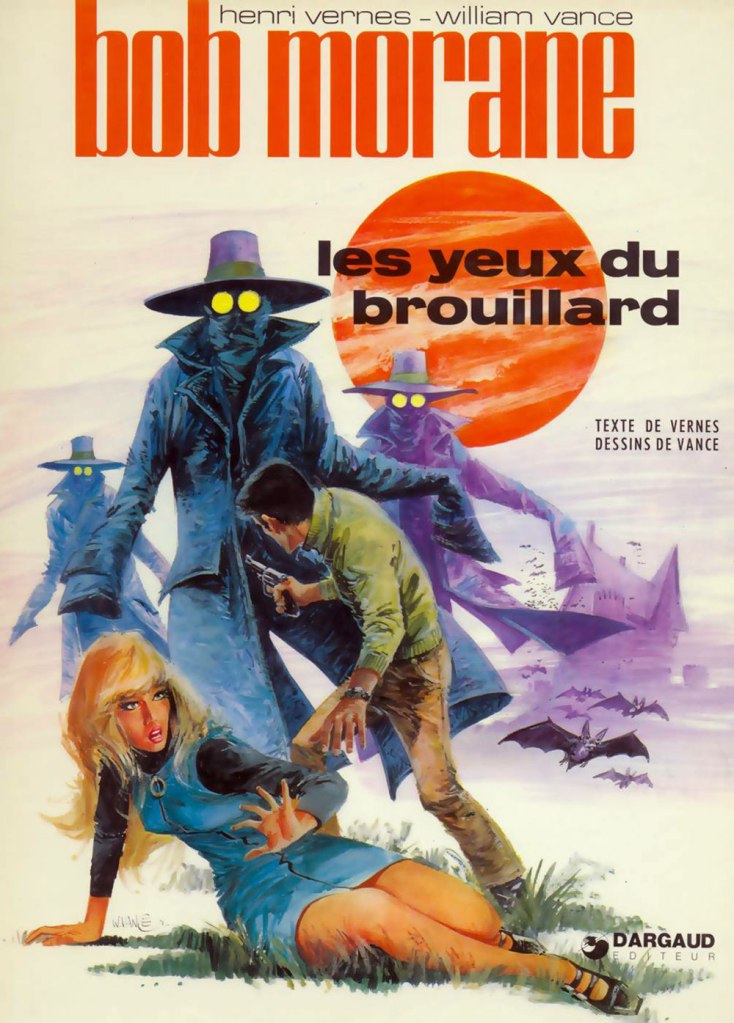
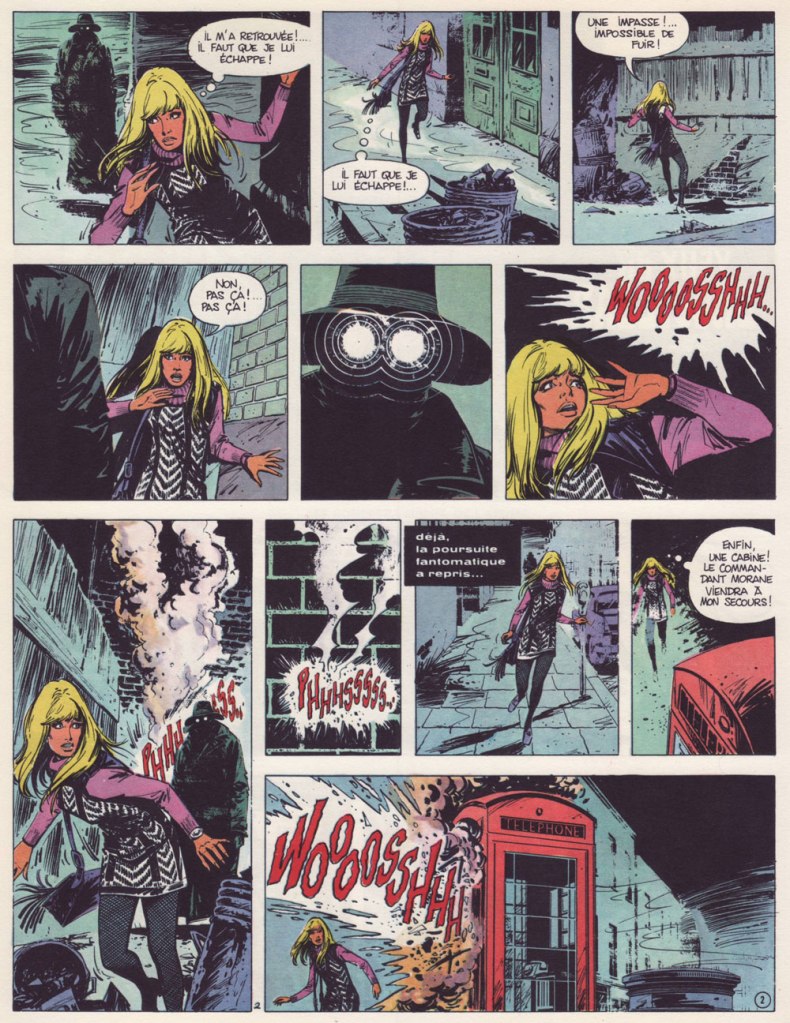
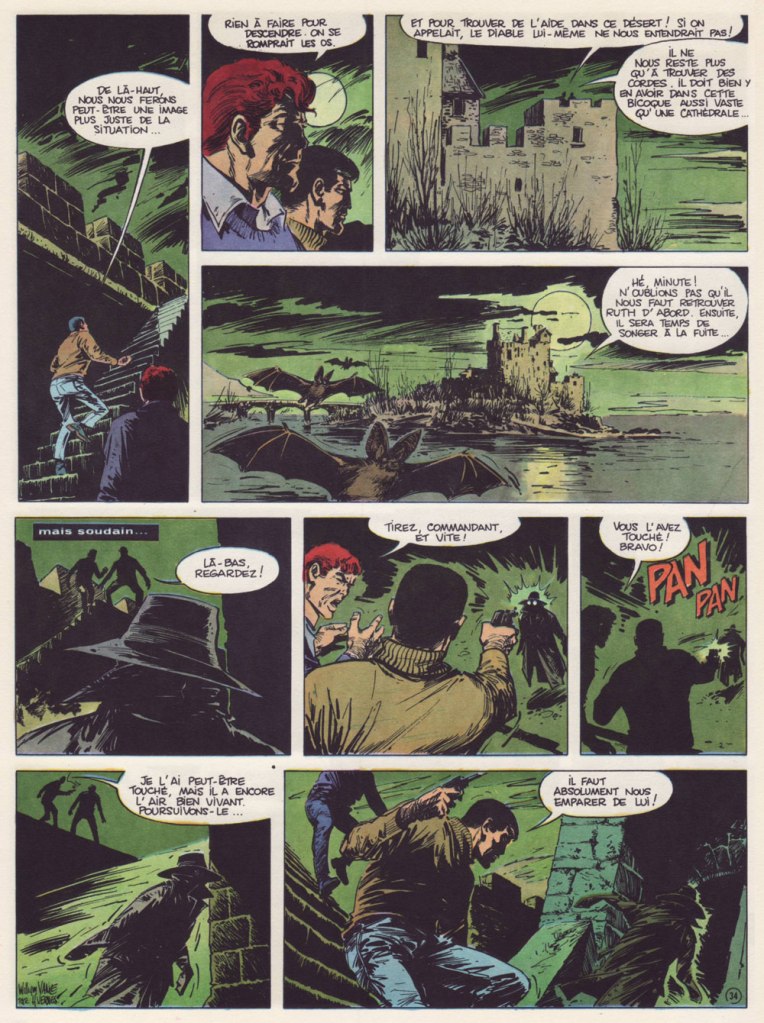
This is Les yeux du brouillard (1971, Dargaud). First serialised in Belgian women’s weekly Femmes d’aujourd’hui (issues 1295 to 1316, 1970), which might seem odd… but said magazine regularly featured several pages of comics, and not just ‘women’s comics’, whatever that may be. What can I say? The Belgians, bless ’em, appreciate their comics. Cover art by William Van Cutsen, aka William Vance (1935-2018). While I’ve never been much of Vance fan, finding him a bit stiff and generic, I’d never claim that he doesn’t get the job done, however. He’s clearly at his peak here.Spoiler alert: disappointingly, the ‘Eyes of the Fog’ turn out to be more or less what this novelty comic book ad promised, though far cooler. Plus they did a great job of keeping the superstitious natives away and the phone booth repairmen puzzled (but gainfully occupied).
Want to see what you actually received upon (well, six to eight weeks later, if memory serves) ordering your very own U-Control Life-Size Ghost? Brace yourself, and look here.
-RG
*Maigret creator Georges Simenon (nearly 500 novels!) and my favourite writer, Jean Ray, readily come to mind. Something in the water, perhaps?







































 Who's Out There?