« The fog comes on little cat feet. It sits looking over the harbor and city on silent haunches and then moves on. » — Carl Sandburg
The first novel I ever read was a Bob Morane… so we’re old friends.
This was the one. I ask you, how could any self-respecting, red-blooded boy resist the lure of a book entitled ‘Monsters From Space’? And no, I don’t remember a thing from it. Cover art by the prolific Pierre Joubert.
Bob Morane, created in 1953 by yet another Belgian writer* both talented and astoundingly prolific, Charles-Henri Dewisme aka Henri Vernes (1918-2021), has been the hero of over two hundred novels, movies, television shows, animated series, records, you name it.
A foray into comics logically followed in 1959, when, according to Vernes,
« Femmes d’Aujourd’hui, a women’s weekly, asked me to do a series. I said: ‘why not?‘ And so I did, that’s all. »
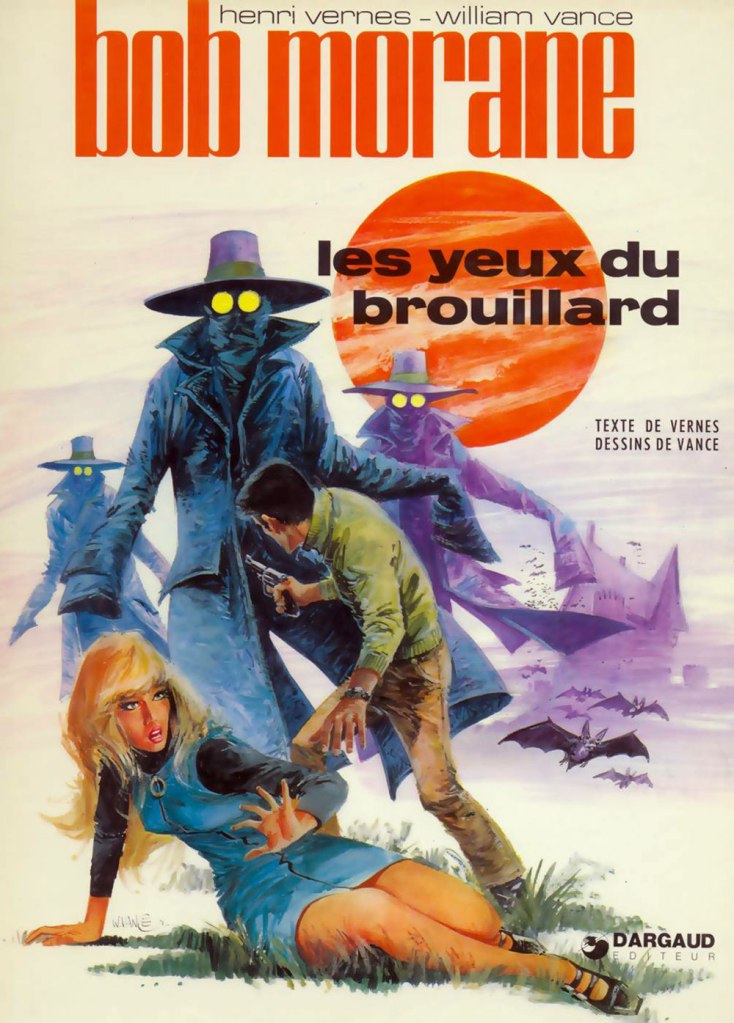
For brevity’s sake, we’ll stick to the comics, one album in particular at that (the series numbers, after all, over one hundred by now.) I’ve always been intrigued by this one, though I never have, as far as I know, encountered a copy in the wild. In fact, a couple of weeks ago, I queried my go-to bédé provider about it, and he responded that: « Bob Morane albums sell just as soon as they arrive. We can’t ever keep them in stock. » So I ordered a copy from Belgium. One must choose one’s battles with care.
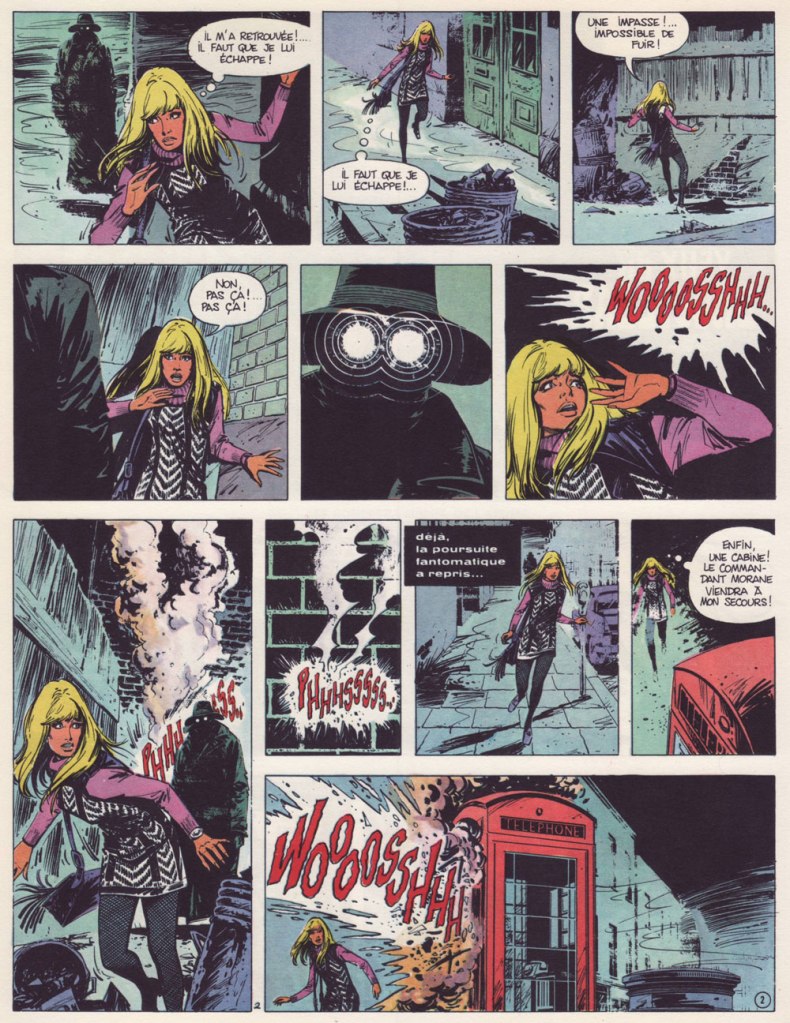
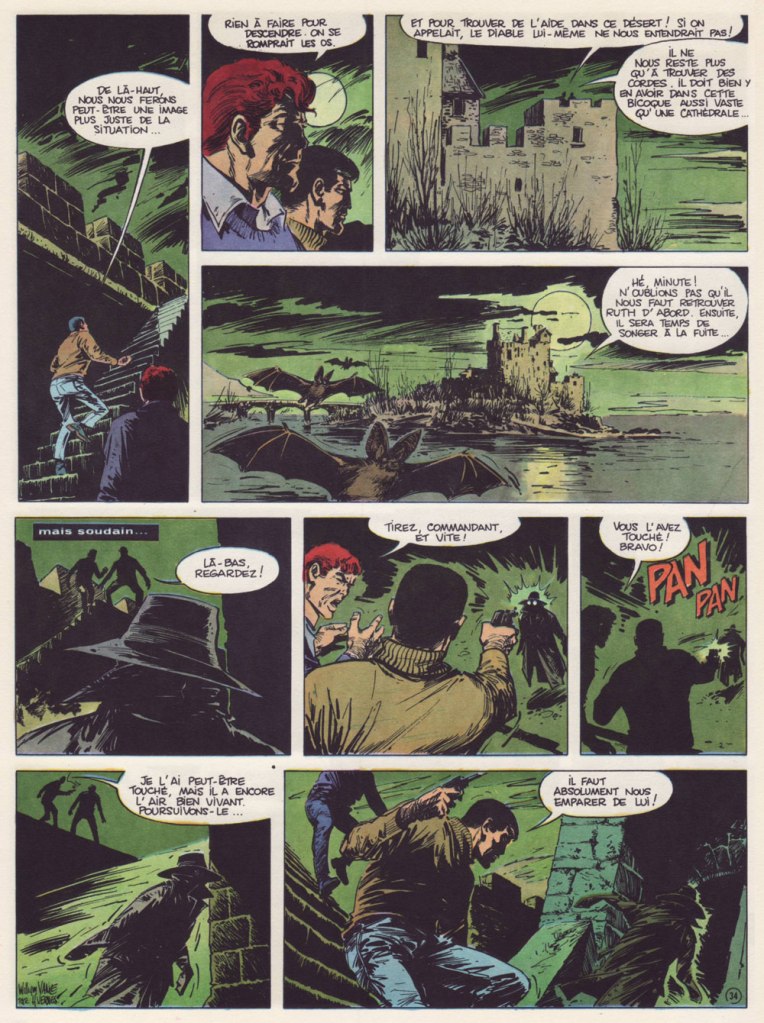
This is Les yeux du brouillard (1971, Dargaud). First serialised in Belgian women’s weekly Femmes d’aujourd’hui (issues 1295 to 1316, 1970), which might seem odd… but said magazine regularly featured several pages of comics, and not just ‘women’s comics’, whatever that may be. What can I say? The Belgians, bless ’em, appreciate their comics. Cover art by William Van Cutsen, aka William Vance (1935-2018). While I’ve never been much of Vance fan, finding him a bit stiff and generic, I’d never claim that he doesn’t get the job done, however. He’s clearly at his peak here.Spoiler alert: disappointingly, the ‘Eyes of the Fog’ turn out to be more or less what this novelty comic book ad promised, though far cooler. Plus they did a great job of keeping the superstitious natives away and the phone booth repairmen puzzled (but gainfully occupied).
Want to see what you actually received upon (well, six to eight weeks later, if memory serves) ordering your very own U-Control Life-Size Ghost? Brace yourself, and look here.
-RG
*Maigret creator Georges Simenon (nearly 500 novels!) and my favourite writer, Jean Ray, readily come to mind. Something in the water, perhaps?
Yet what had he to fear if this place were evil – was he not an upright and godly man who held no traffic with evil? If wicked spirits had power over such men as he, there would be no justice in it.
“That’s true,”said a voice behind him, “there isn’t.” — The Gibsons*
I must confess I had something else planned for today’s post, but I learned, at the last minute, of the existence of material that would vastly augment my intended post — and I wouldn’t want to drop the ball on that topic. One less piece to plan for the next Countdown, then!
I suppose I had thus far refrained from touching upon DC’s long-running Ghosts (1971-82) — too obvious? Well, here we are. Ghosts, like its presumed model, Ripley’s Believe It or Not: True Ghost Stories (1965-80, Gold Key), was always tame and rather formulaic, but frequently boasted wonderful artwork, and definitely great covers.
Ambiance, ambiance, ambiance. This is Ghosts no. 23 (Feb. 1974, DC); cover art by Nick Cardy.
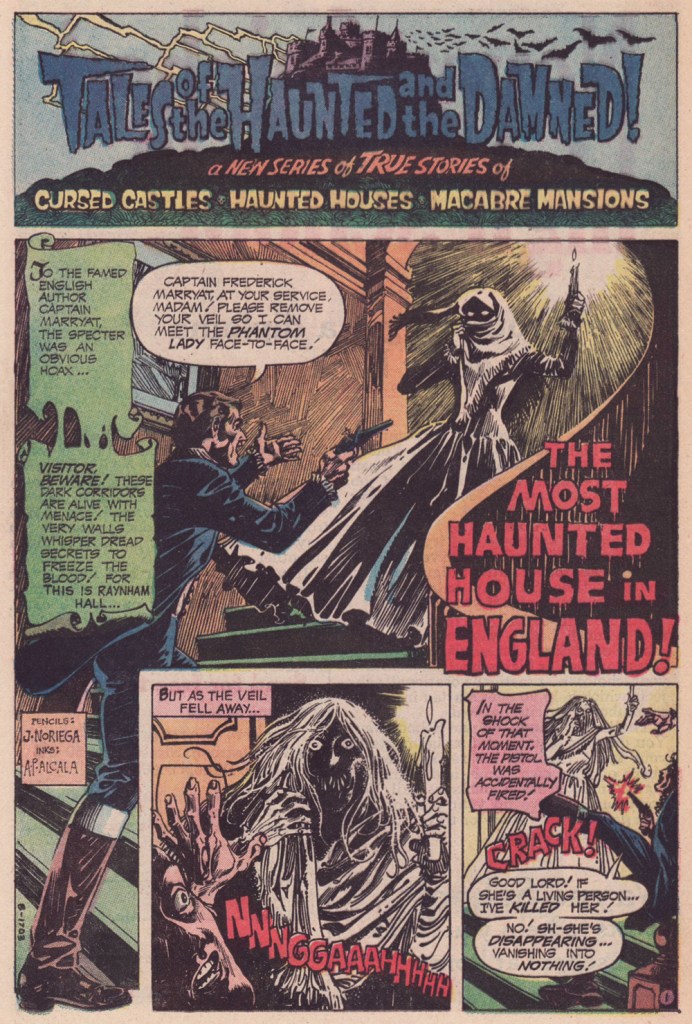
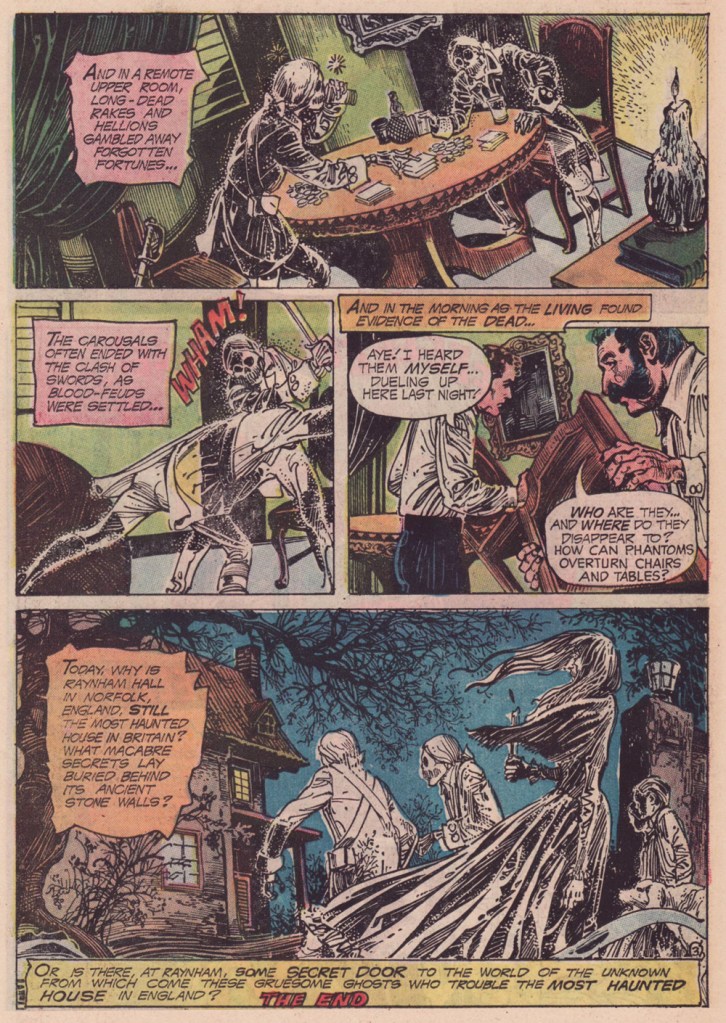
Within its pages lurks this gorgeous three-pager written by Carl Wessler, pencilled by the mysterious (how appropriate!) J. Noriega, and embellished by the peerless Alfredo Alcala.
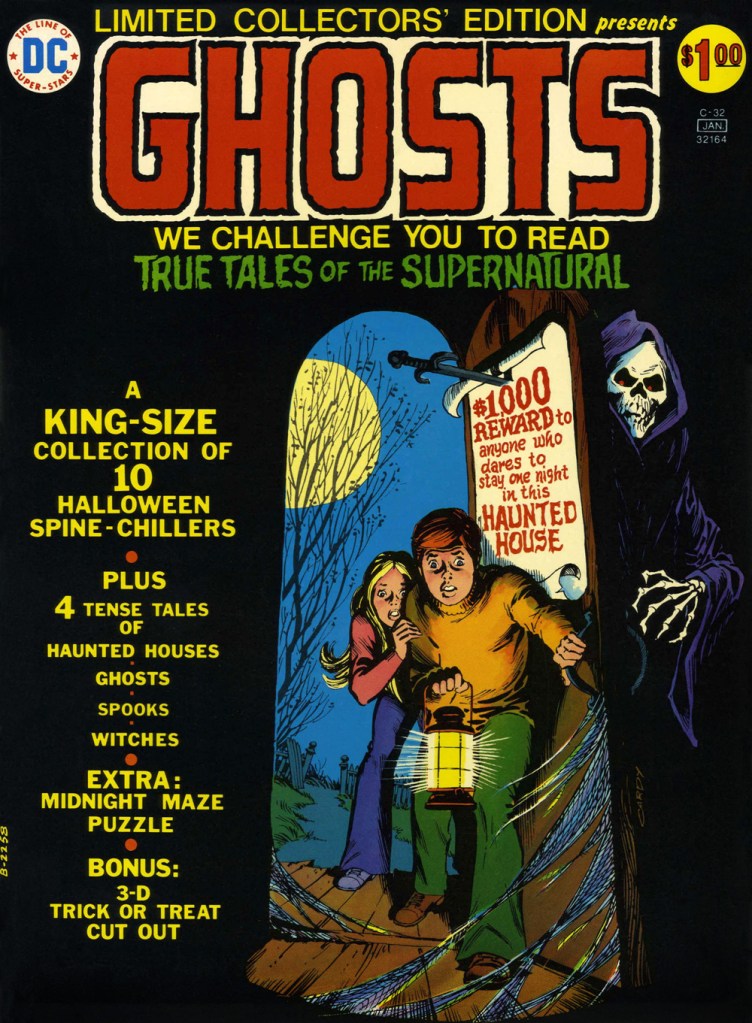
Find out more about this Captain Marryat character right here. The next time you find yourself ’round Norfolk way, you can drop by and visit the actual Raynham Hall and see for yourself if it’s truly crawling with spectres.This is the tabloid-sized Limited Collectors’ Edition C-32 (Dec. 1974-Jan. 1975, DC); edited by Murray Boltinoff, cover by Nick Cardy.
-RG
*« A couple called ‘The Gibsons’ won a New Statesman competition in Britain with a 200-worder about a man who grows increasingly nervous while walking down a winding moonlit road. » — From Dr. Van Helsing’s Handy Guide to Ghost Stories, Part III, by Kurt Van Helsing, in Twilight Zone Magazine vol. 1 no. 7 (Oct. 1981, TZ Publications).
Actually, no. Before that, there arose the idea in art director Warren Kremer‘s ever-effervescent mind:
One of Kremer’s surviving preliminary sketches.
Then there was this one, more refined and with wonderful suggestions, instructions and notions addressed to the assigned cover artist, Lee Elias.
Ah, here we are. The final (in more ways than one!) version. This is Chamber of Chills Magazine no. 18 (July 1953, Harvey). Art by Lee Elias… but you know that’s not the entire process. Check out this earlier Hallowe’en post for more of that magical Kremer-Elias collaboration.
Then, one year on…
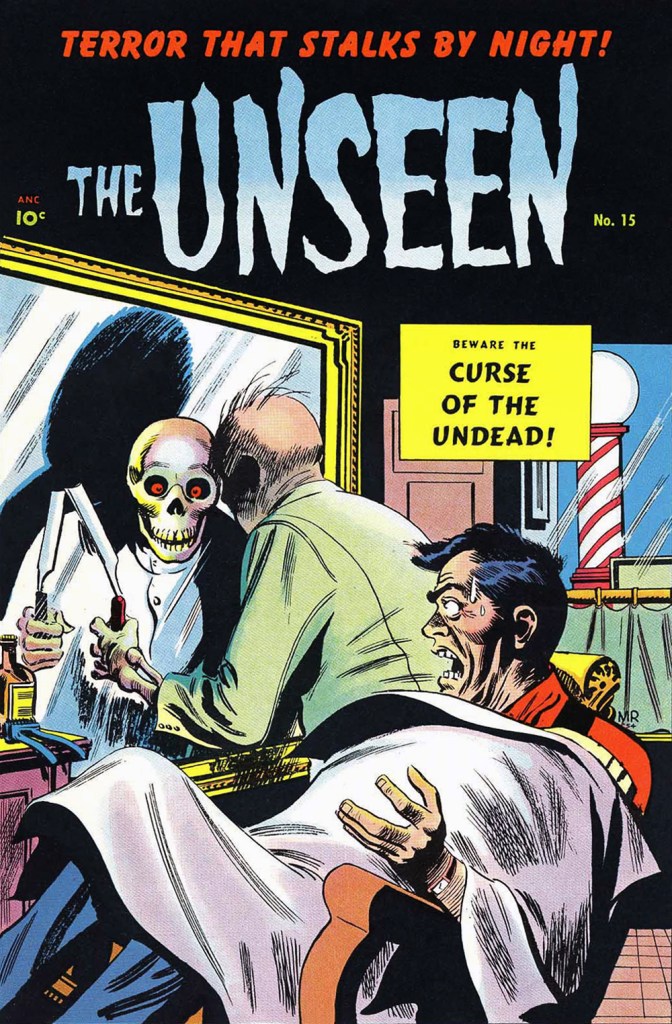
… appeared this cover entry by Québécois Joseph Michel Roy aka Mike Roy (inks likely provided by George Roussos). This is The Unseen no. 15 (July 1954, Pines), the series’ final issue. To give credit where it’s due, the death’s head reflection is a cute new wrinkle.
More than two decades down the road, Marvel, since they were already borrowing Harvey’s Chamber of Chills title (did they even ask? I wonder), figured they may as well reenact one of its classic covers.
Say, what’s this about the day’s first shave? … is there shaving after death? Hassles, hassles.
Though most would nowadays call upon electric shavers or disposable plastic razors, I presume that straight razors have made a comeback among the hipster set. Still, a niche is hardly universal.
This is Chamber of Chills no. 22 (May, 1976, Marvel). Pencils by Larry Lieber, raised on high by the masterly inks of Tom Palmer, who, not content with being one of the all-time finest ink slingers, was also an excellent colourist.
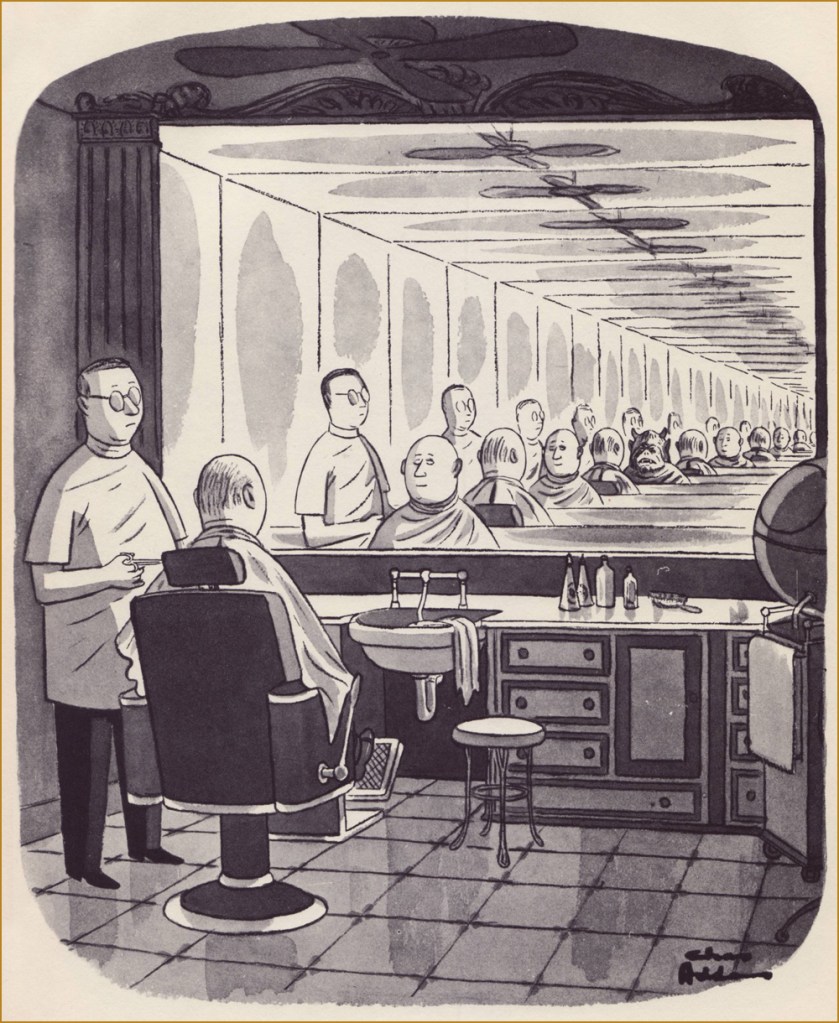
As a bonus, here’s one on the general topic by the immortal Chas Addams. It appeared in The New Yorker in 1957, then was reprinted later that year in his solo collection Nightcrawlers (Simon and Schuster). For more of that excellently-morbid Addams mirth, amble over to this earlier spotlight from our Hallowe’en Countdown’s initial edition.
Most modern reprints of Addams cartoons I’ve seen tend to be on the washed out, blurry side, so I’m grateful to have my ancient volumes of his work. Feast your weary peepers on this fine vintage!
A decade-and-a-half after his unceremonious cancellation, the Stranger was dusted off and given another shot in Showcase no. 80 (Feb. 1969), which was gorgeously illustrated by Messrs. Grandenetti and Bill Draut, and the Stranger, fedora, turtleneck and all, was soon spun off into his own title once more. It began well enough, but despite some often gorgeous covers, in no time descended into endless formulaic repetition: the PS makes vague, laughably pompous statements, his skeptic foil Dr. Thirteen fumes and rants, and my candidate for all-time most tedious arch-nemesis, Tala (introduced by Bob Kanigher and Neal Adams in issue 4) almost invariably turns out to be behind the issue’s menace.
It’s surely a minority opinion, but I only regain some interest in the series after its most celebrated creative team, Len Wein and Jim Aparo, have moved on. Scripters Arnold Drake, David Michelinie and Paul Levitz pick up the mantle, along with artists Gerry Talaoc and Fred Carrillo, and the book improves as its sales slowly tank. Near the end, editor Joe Orlando adds The Black Orchid as a back-up feature, and Deadman becomes a regular participant, both inspired decisions, but insufficient to stem the tide.
This is The Phantom Stranger no. 41 (Feb.-Mar. 1976, DC), the series’ final bow. Art by Jim Aparo. While I’m quite underwhelmed by Aparo’s work on the insides, just about every cover he provided, during and after his run, was outstanding.
A couple of years after the book’s cancellation, The Phantom Stranger and Deadman were teamed up again for a Halloween special. Beyond a decent cover, the results were rather… dire. I really, really wanted to like it, but it’s just a hodgepodge of overwritten mediocrity that can’t seem to decide what it wants to be or what its audience is: not scary in the least (even by Comics Code Standards), barely moody, a waste of trees.
This is DC Super Stars no. 18 (Jan.-Feb. 1978, DC)… also the final issue of that particular series. Cover art by Jim Aparo.
The first page, one of the better ones. Script by Martin Pasko and art by Romeo Tanghal and Dick Giordano (who’s actually in the plus column this time).
Sigh. Yet another self-indulgent reference to perhaps the Nerd-fest of the 1970s, the Rutland (VT) Halloween Parade, comes in to utterly derail the story.
Tala is behind it? You don’t say! And then the “creative” team shoehorns itself into the proceedings. How refreshingly outré. An excerpt from the second half of the, er, epic, written by Gerry Conway, pencilled by Tanghal, and inked by Bob Layton.
One of the earlier tributes to the Rutland parade, this is Batman no. 237 (Dec. 1971, DC); cover art by Neal Adams (with presumed design input by Infantino and Cardy). This has laughably been deemed The Greatest Halloween Comic Book Ever, which provides a view into the mindset of people who apparently deem only superhero comics worthy of their attention.
-RG
*helpfully reprinted, though in dribs and drabs and all over the place, through the 1970’s.
« Drinking your own blood is the paradigm of recycling. » — Gary Busey
Say, isn’t there something… sorta quaint about that cover?
In the 1970s, while DC and Charlton consistently provided all-new material*, Marvel quickly switched to an all-reprint formula (the better to save money whilst flooding the market, my dear!), sometimes even on the covers, with some amusingly inappropriate updates at times.
This is Dead of Night no. 2 (Feb. 1974). Alterations by unknown hands. Only one issue of this title would feature new material: its eleventh and final issue (introducing The Scarecrow); this number, however, reprints pre- and post-code Atlas stories from 54-56.
This is Marvel Tales no. 125 (July 1954, Atlas); cover art by Harry Anderson. The milky semi-transparency is a nice touch.
Okay, here are another pair of before and afters:
This is Tales to Astonish no. 34 (Aug. 1962, Marvel). Cover pencils by Jack Kirby, inks by Dick Ayers. Hardly a classic, not to mention that it lazily recycles the story’s opening splash. It’s also a textbook demonstration of what I dislike about Marvel colouring in the Silver Age: I’m guessing it was company policy to leave the backgrounds mostly in grey to make the characters ‘pop out’. A sound commercial policy, perhaps, but artistically, it seems pretty stale to me.
This is Monsters on the Prowl no. 29 (Aug. 1974, Marvel). A classic instance of John Romita‘s alteration-happy art direction. Making the protagonist a woman and adding a witness are both dishonest touches, for what it’s worth. On the plus side, I do like the lightning bolt (good use of existing space!), and the colouring is a marked improvement. Edited by Rascally Roy Thomas.
This is Mystic no. 30 (May, 1954, Atlas); colours by Stan Goldberg. A striking cover by Russ Heath…
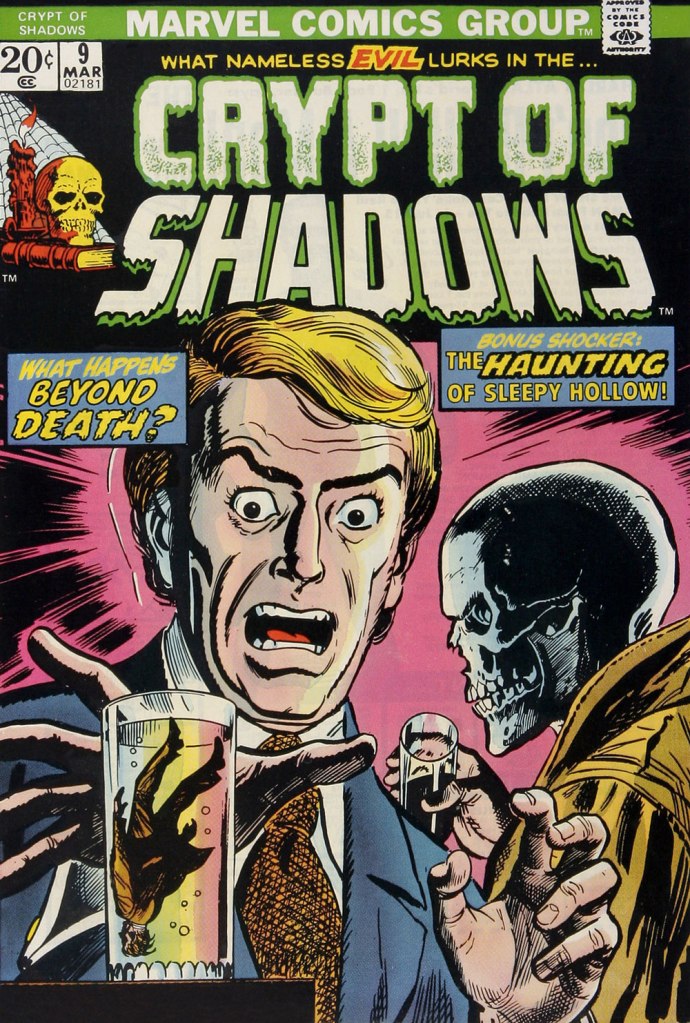
… is, if not ruined, then at the very least diminished by clumsy and pointless updates, including the removal of Heath’s signature (although upon seeing the ‘improvements’ perpetrated upon his work, he might have opted for the comics equivalent of an ‘Alan Smithee‘ or ‘Cordwainer Bird‘ credit). This is Crypt of Shadows no. 9 (Mar. 1974, Marvel). Alterations, once more, by unknown, guilty hands. Also edited by Roy Thomas (just so you know who’s responsible).
-RG
*and if and when they didn’t, they’d tell you! Not so with Marvel. As for Gold Key, they would just pretend the material was ‘reprinted by popular demand’.
« The man asked, “Who are you?” “I am Death, who makes everyone equal.” » *
Greetings! Today I am giving my co-admin RG a much-needed chance to rest, and taking over Hallowe’en count-down duties. He protested a bit, but I was persuasive. Oh, don’t worry about him – he’s quite comfortable in the basement, and I may even unchain him at the end of the evening.
We have previously dipped a toe into Gespenster Geschichten (Ghost Stories) territory before, but – and this will come as no surprise – it was through the peculiar prism of tentacles. (For example, see Tentacle Tuesday: A Torrent of Teutonic Tentacles.) Yet this long-running (1974-2006) series published by Bastei Verlag also offers plenty of Hallowe’en-appropriate thrills: witches, ghosts, demented scientists, cold-blooded killers… you name it, Gespenster Geschichten has it! Here are a few covers which seem particularly appropriate for this wonderfully dreary, grey October evening.
The insides of these issues are of lesser interest: reprints of American horror comics, and, later on in the series, new content by artists local and migrated (Argentine, Spanish, Italian, Yugoslav…) Within some of these pages dwell reprints from Gold Key Comics’ Boris Karloff Tales of Mystery (for example, with artwork by John Celardo, Sal Trapani, and Canadians Jack Sparling and Win Mortimer). I think we can safely conclude that the covers are considerably more horrifying than the innards of these issues…
With that out of the way, let’s see what German ghost stories have in store for us!
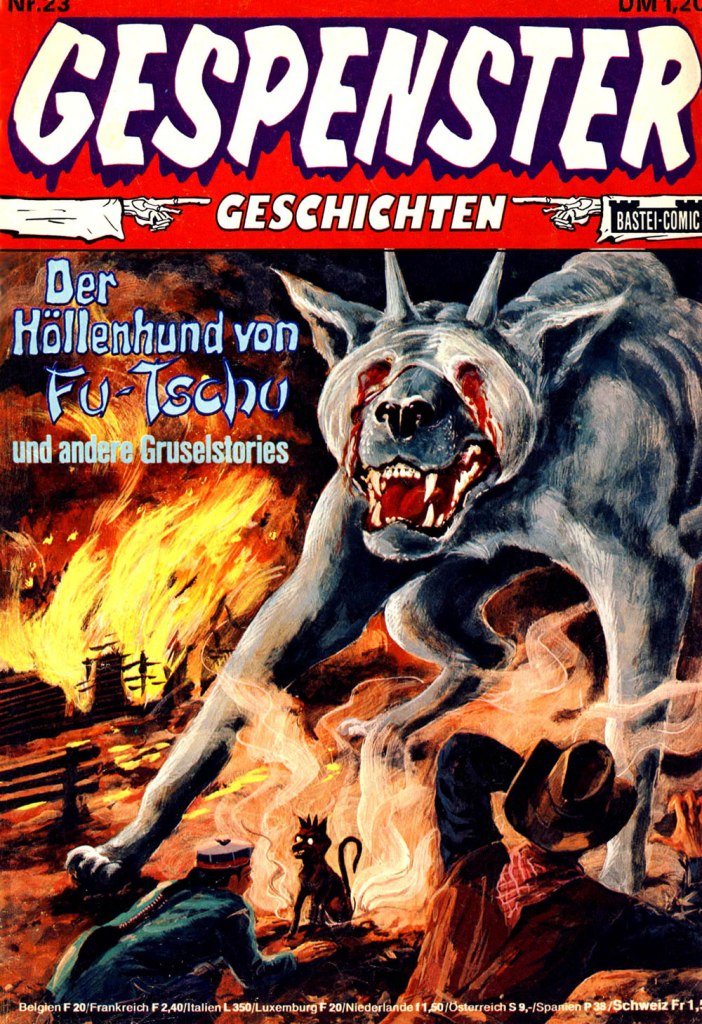
Gespenster Geschichten no. 23: Der Höllenhund von Fu-Tschu (The Hellhound from Fu-Tschu), 1974. This cover is equal parts disturbing and puzzling, with a creepy bear-dog with bleeding sockets and the little demonic effigy that is somehow simultaneously cute and clearly evil.
This charming little doggo was a rather… creative interpretation of the following painting, created for Boris Karloff Tales of Mystery no. 48 by George Wilson:
So you see how that particular Teutonic ball rolls! I admire George Wilson, but I admit I much prefer the German interpretation of this scene.
Gespenster Geschichten no. 41: Die Stunde des grünen Monsters (the hour of the green monsters), 1975. That witch looks downright friendly… the friendliness of a man smiling at a particularly appetizing piece of steak.
Gespenster Geschichten no. 59: Die Mask des Entsetzens (Mask of Horror), 1975. That’s a stylish haircut; I bet all the ladies go for this charmer.
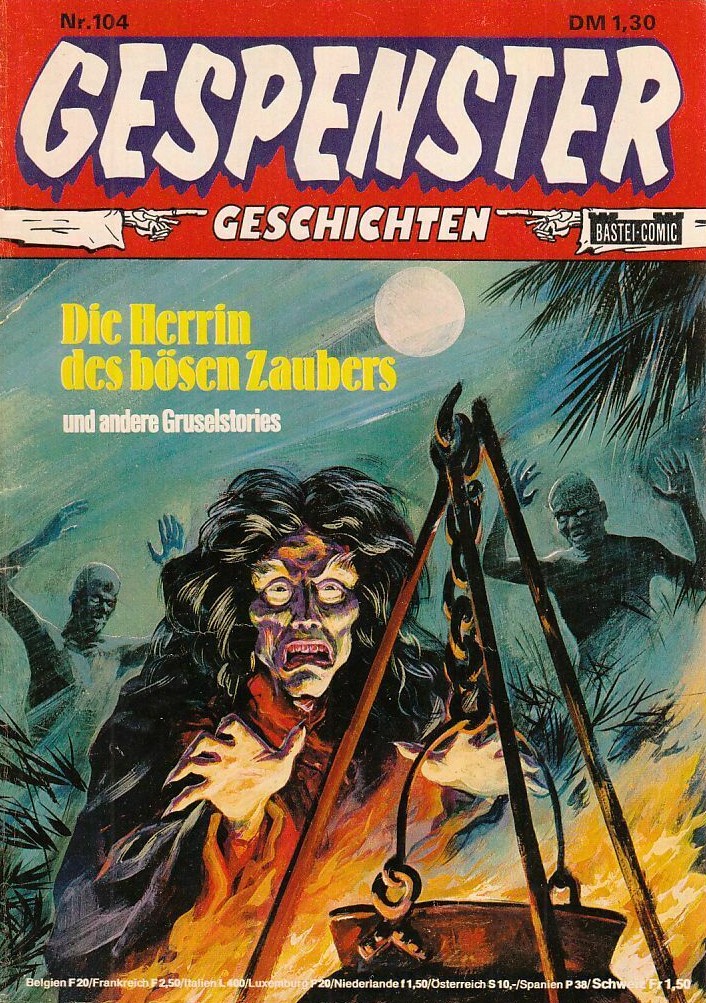
Gespenster Geschichten no. 76: Die Herrin des bösen Zaubers (The Mistress of Evil Spells), 1976.
The Ghost Stories Special (Gespenster Geschichten Spezial) was an oversized format, though I am not sure whether these babies featured reprints of their smaller-sized brethren literally in a bigger format, or just functioned as a sort of anthology. This is Die unheimlichen Gespenster Geschichten Spezial no. 208. ‘Monster-ladies’ is somewhat self-explanatory; ‘Die unheimlichen’ means ‘the scariest’.
« Hell is empty and all the devils are here. » — William Shakespeare
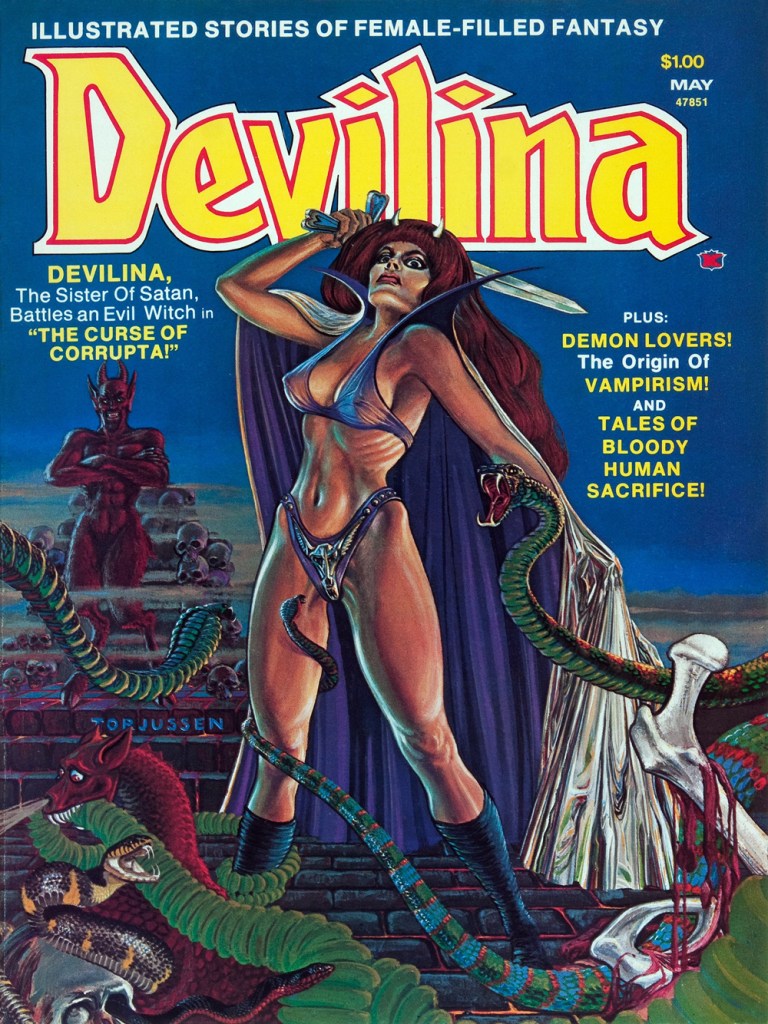
In the 1970’s, thanks to a boom of interest in all things Occult, we made the acquaintance of hordes of Satan and Dracula’s close relatives. Oh, these bad boys were prolific!
This is one of Atlas-Seaboard’s entries into the black and white magazine arena. The stylish cover is the work of George Torjussen, one of his rare forays into comics (so to speak); Mr. Torjusson is still active in the fine arts field.
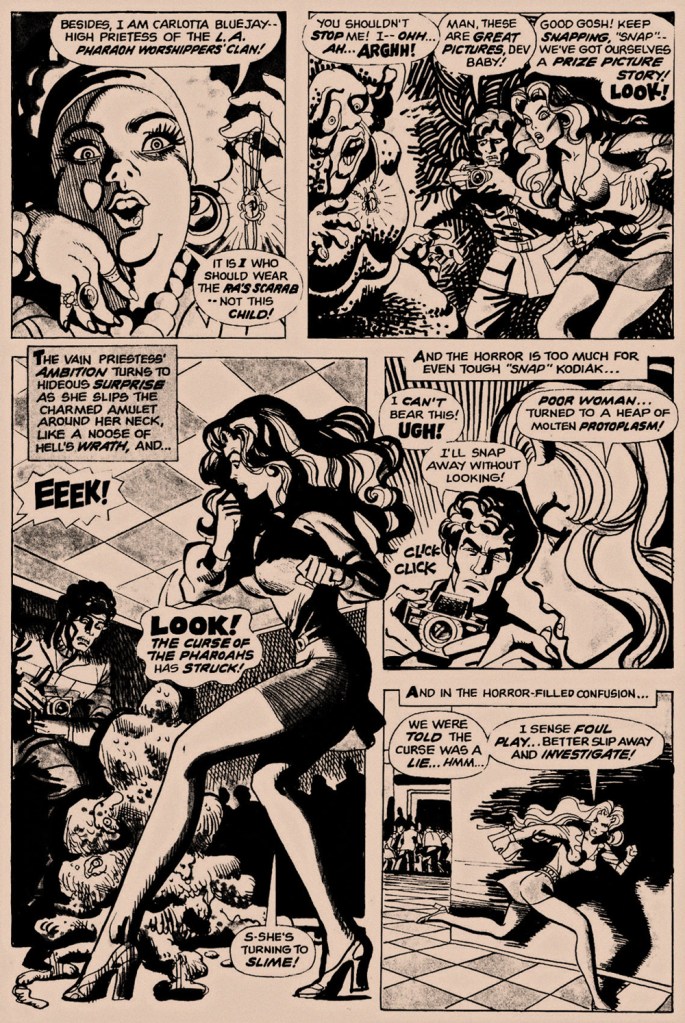
Here are a few sample pages from Curse of the Ra Scarab, written and illustrated by Mr. Estrada (1928-2009). Moody!
The story’s nothing spectacular, but I’ll take Ric Estrada‘s lively artwork any day over any of those stiff photo tracers who illustrated Vampirella’s exploits. Especially since Ric gets to ink himself in this case. Reportedly ambidextrous to an impressive degree, Estrada claimed he could pencil with his right hand while inking with his left.
It’s worth noting, I think, that this has to be the most rape-happy comics magazine I’ve encountered… that isn’t from Italy. The Devilina feature aside, only one story doesn’t feature or imply an instance of violent rape. I’m inclined to thing that editor and scripters’ notion of ‘Female-filled fantasy‘ was more like ‘Female-filling fantasy‘. I guess this is some people’s idea of exercising their freedom from the Comics Code Authority — but mature it isn’t.
« La matière en était gélatineuse et peu consistante; elle se décomposa, au bout de quelques heures, en un liquide rose et gluant, d’une odeur insupportable.* » — Jean Ray, Dans les marais du Fenn
Aw, good old muck monsters…
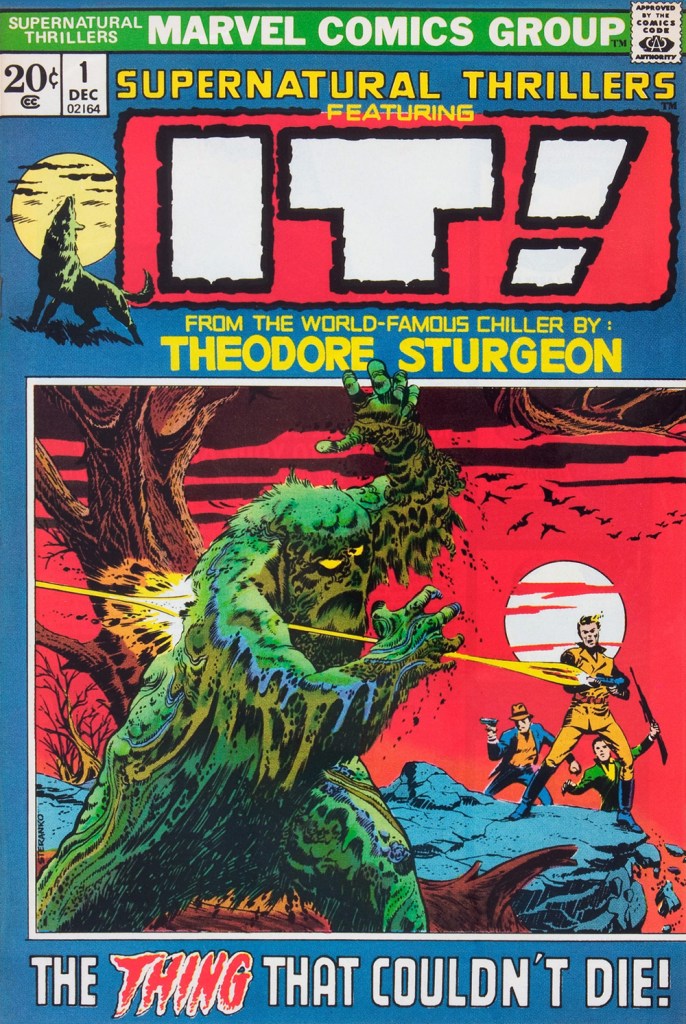
Perhaps the first to emerge, at least in the English language, was Theodore Sturgeon’s “It”, published in Unknown’s August, 1940 issue, whose title page warned: “IT wasn’t vicious, IT was simply curious — and very horribly deadly!“
But IT was preceded, by some years, by Raymond Marie de Kremer alias Jean Ray’s superb Dans les marais du Fenn (« In the Fenn Marshes »), first published in the Belgian literary magazine L’ami du livre’s issue of November 1st, 1923! A handful of Ray stories (often published under his alternate nom de plume, “John Flanders”) were published in US pulps, including the legendary Weird Tales, but “Dans les marais…” appears to have somehow, to this day, remained untranslated to English.
This is Supernatural Thrillers no. 1 (December, 1972, Marvel), an adaptation by Roy Thomas, Marie Severin and Frank Giacoia. Cover by Jimmy “Profa” Steranko.
The opening — and best — page from Marvel’s IT adaptation, which fails, imho, because Rascally Roy, overly attached to the original text, doesn’t let the visuals breathe. The mediocre results, at once too pedantically faithful and well off the mark, are no substitute for Sturgeon’s original.
IT originally saw print in this issue of Street & Smith’s Unknown, which had, just one month earlier, abandoned its striking painted covers for this money-saving but comparatively stodgy, ‘dignified’, Reader’s Digest-style design. It looks like there’s a page missing — the best one!
And they were soon at it again. How did they manage to convince themselves that this was going to succeed as an adaptation? This is Worlds Unknown no. 6 (Apr. 1974, Marvel). Pencils by Gil Kane and inks by Ernie Chan, with extensive alterations by John “Heavy Hand” Romita. This has been bestowed the impressive (if true) honour of being called The Lyingest Cover in Marvel Comics History.
-RG
*« Its matter was gelatinous and insubstantial; it decomposed, within a few hours, into a viscous pink liquid of unbearable odour. »
« We see light, not dark. But it is in the dark that we feel goblins and ghosts. » — Rex Brandt
The ever-creative Tom Eaton‘s Oliver Cool (1975-79) always reserved a special treat for Hallowe’en. In past countdowns, I’ve shared the first (1975) and second (1976) entries devoted to the beloved occasion, and here is the final pair.
From Young World Volume 14 no. 8 (Oct. 1977, The Saturday Evening Post Company).
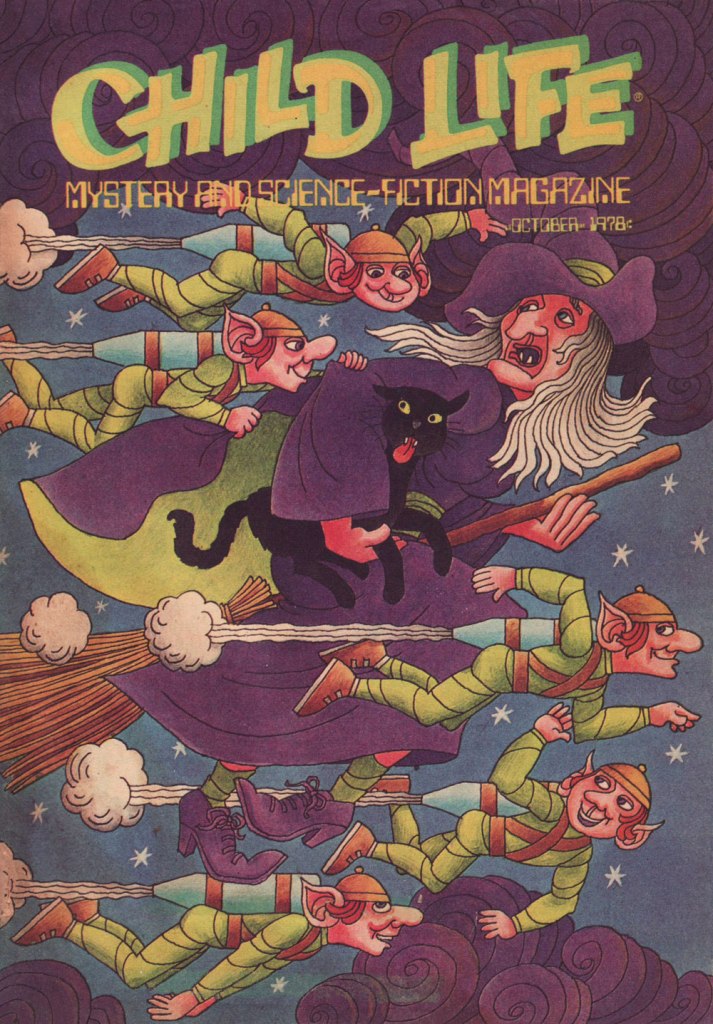
Eaton’s Fizz & Farra In the Year 2250 strip ran concurrently in Young World’s sister publication, Child Life. This seasonal cover by Arthur Wallower was simply too good not to include.
From Young World Volume 15 no. 8 (Oct. 1978, The Saturday Evening Post Company).
As a bonus, here’s one item some of you monster kids may fondly remember: Monster Stand-Up Greeting Cards (1980, Scholastic). Pricey these days, from the look of it.
« I don’t know what the hell I published. I never read the things. » — Stanley P. Morse
In the sinister wake of Warren Publishing‘s success with Creepy, Eerie and Vampirella, old-school fly-by-night 1950s comics publisher Stanley P. Morse (Aragon Magazines, Gillmor Magazines, Medal Comics, Media Publications, S. P. M. Publications, Stanmor Publications, and Timor Publications…) dusted off some of his old pre-Code chillers in the late 1960s and early 1970s in black and white magazines such as Shock (15 issues), Chilling Tales of Horror (11 issues), Ghoul Tales (5 issues) and Stark Terror (5 issues). It certainly wasn’t all junk: after all, Morse had published Weird Tales of the Future and Mister Mystery, with their Basil Wolverton and Bernard Baily classics…
Unlike Eerie Publications’ grey-toned and blood-and-gore-ified reprints, these are, as far as I know, unretouched, not to mention decently printed.
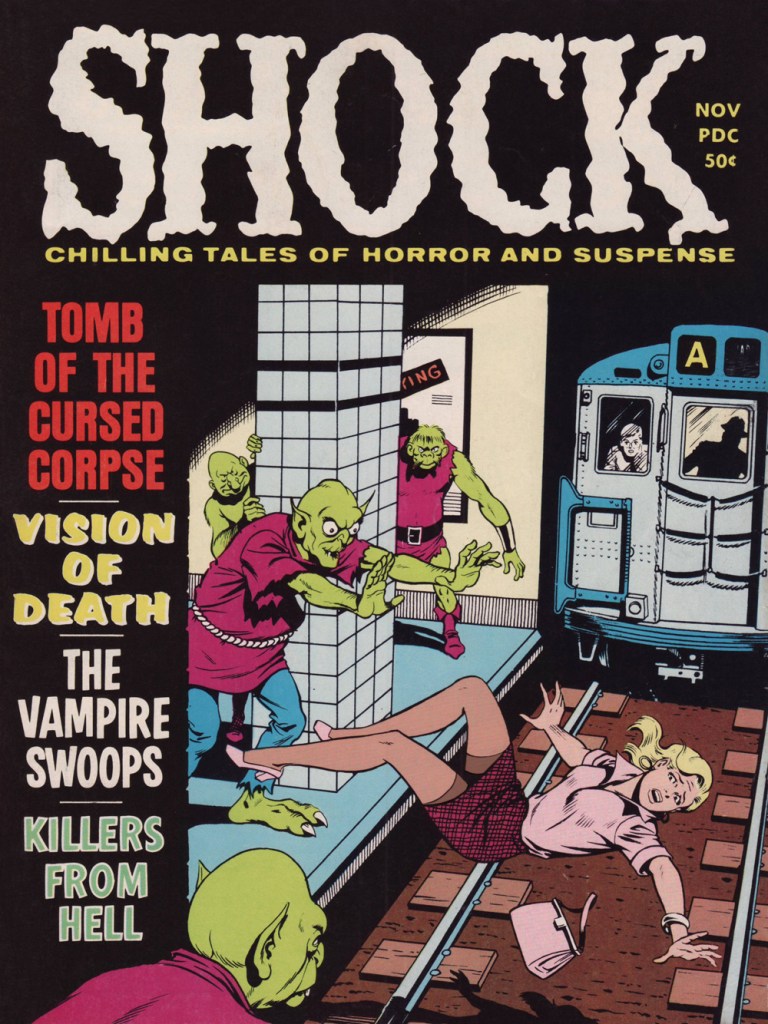
This is Shock Vol. 2 no. 5 (no. 10, November, 1970, Stanley Morse). Edited by Theodore S. Hecht.
Maybe it’s just me, but isn’t Kurt Schaffenberger just about the unlikeliest pick of cover artist for a pre-code horror anthology? Sure, he fit in nicely with ACG’s gentle moral fable aesthetic, but aren’t you just expecting the Man of Steel or The Big Red Cheese to swiftly sweep in, catching the damsel-in-distress before the A Train smooshes her?
To wit: one of Kurt’s fun ACG covers, this is Unknown Worlds no. 43 (Oct.-Nov. 1965, ACG).