Abner Dean’s Universe: Before…

« No other state of confusion is as interesting as yours. »

By the mid-1930s, Abner Dean (1910–1982), Abner Epstein in New York City, had reached the pinnacle of his profession, and begun to make rewarding inroads into other pursuits and endeavours. Fruitfully and prolifically published in most of the top magazines of the era (and top era for magazines), such as The New Yorker, Life, Esquire, Coronet, Time, Newsweek, Collier’s, Look, Ladies’ Home Journal and so forth, he’d also scored in the advertising field (most notably through a fifteen-year association with Aetna Insurance).

Yet he was restless; he bristled at the limitations, conventions and formulae of the era’s gag cartooning world and had something grander in mind and up his sleeve. We’ll get to that.

But first, here’s a sampling of what Abner accomplished as a commercial illustrator and cartoonist early in his career.

AbnerCheckInA
The following four cartoons appeared in the pages of Esquire, for which Dean produced in excess of forty colour cartoons, and scads more in good old black and white (frequently with spot colour adornment) between 1934 and 1955.
DeanCinemaA
Spot the influence? The girl is a dead ringer for one of Jack Cole‘s celebrated beauties.

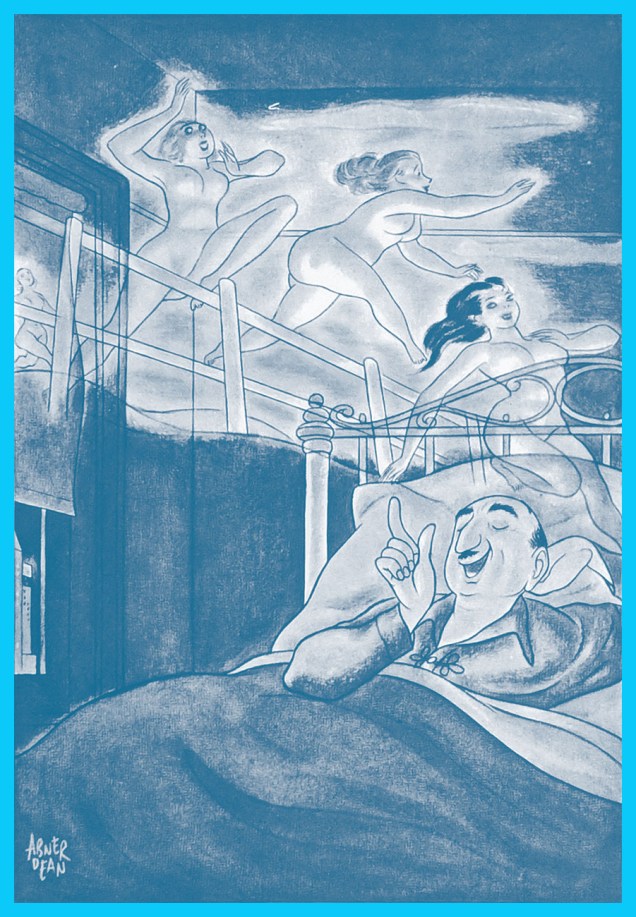
DeanCountingDreamerADeanSherbetA

DeanNewYorker1933A
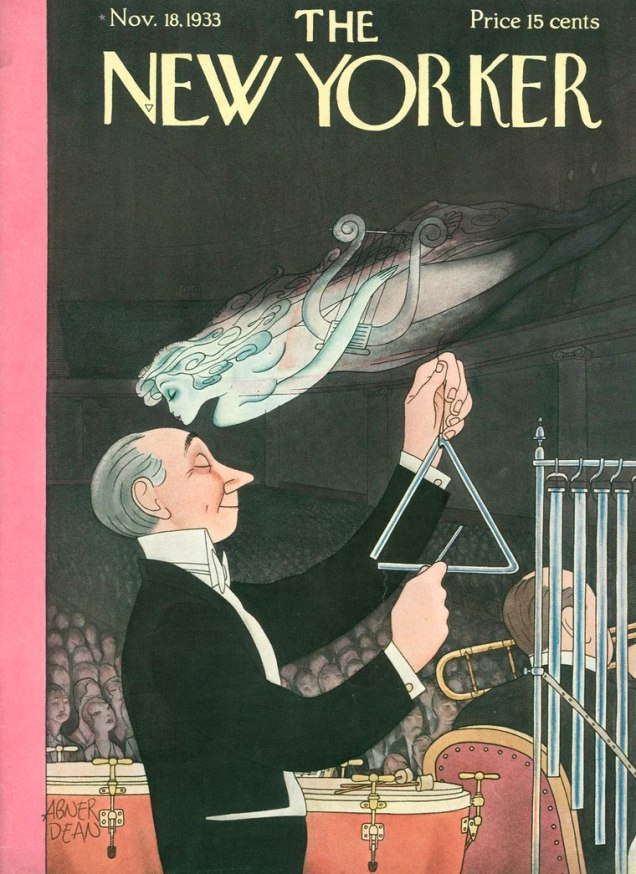
As Abner created five covers for The New Yorker (1933-35), it seemed absurd to leave any of them out, especially given their high calibre. Here they are, in order of their appearance.

DeanNewYorkerNov33ADeanNewYorker1934ADeanNewYorkerApr34ADeanNewYorker1935A

AbnerDean46AetnaAd01
Two examples of Dean’s illustrations for Aetna Insurance‘s long-running advertising and prevention campaign, for which Dean produced a whopping one hundred and ten drawings between 1940 and 1955. This one hails from 1946.
AbnerDean53AetnaAd02
To better convey the tone and tenor of the campaign, I’ve transcribed some of its text. This entry is from 1955.
AbnerDeanPortrait
Our boy, wearing an appropriately skeptical expression, from the back cover of his Come As You Are (1955, Simon & Schuster).

Incidentally, what little remains publicly known about this once-famous man is the fruit of diligent research conducted by the eclectically erudite Ken Parille. As usual, we stand on the shoulders of giants. Thank you!

-RG

Playboy Cartoons for a Festive Mood

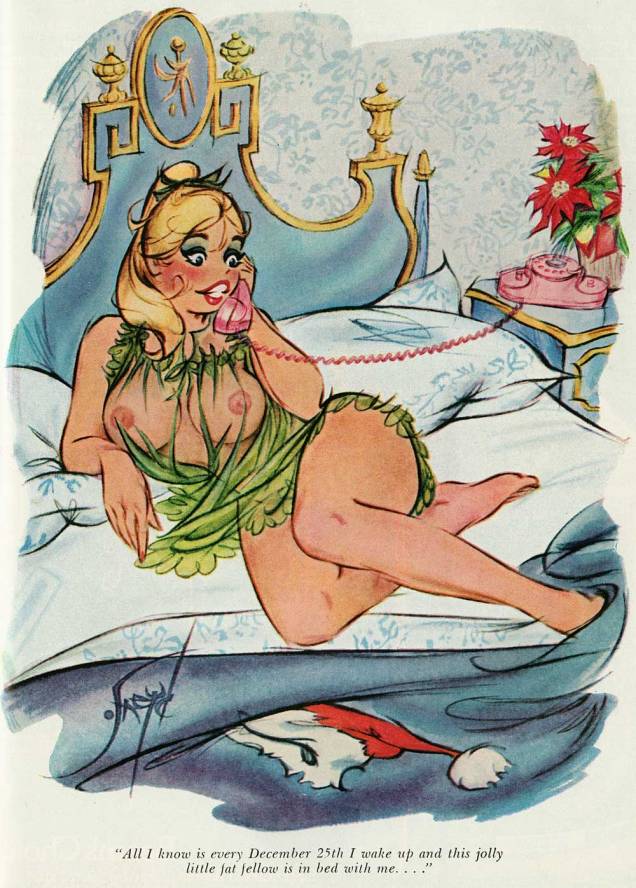
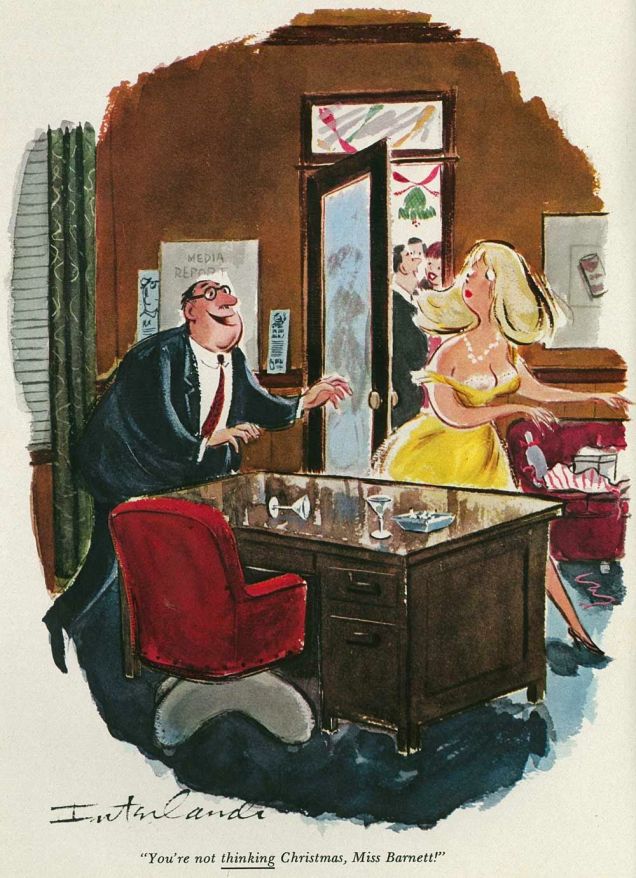
With every passing year, I have more and more trouble getting into the spirit of Christmas (especially since all the snow has now melted). An early present of Rodney Crowell’s Christmas Everywhere helped a bit, but to speed things along some more – and before Christmas Eve takes me by surprise – I’d like to titillate everybody’s taste buds with this spread of Playboy Christmas cartoons.

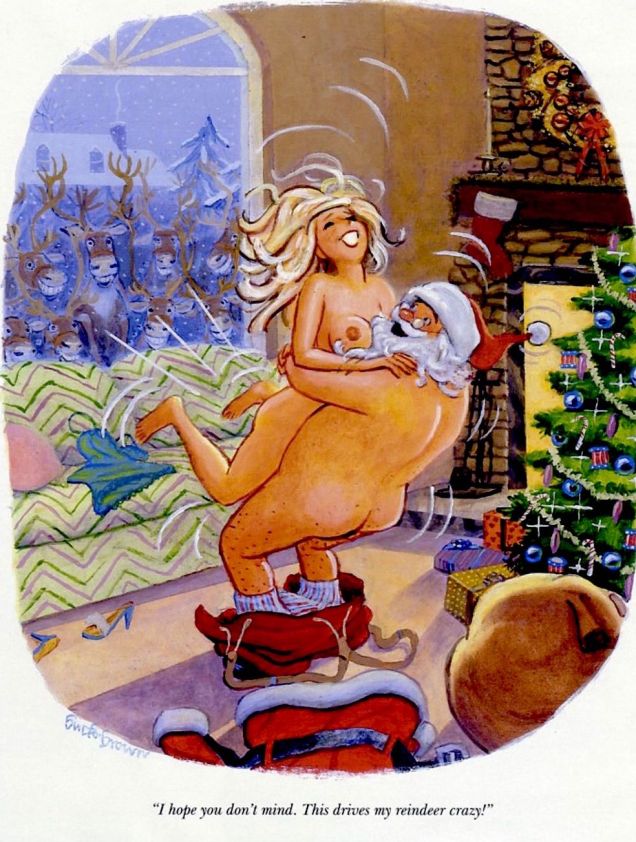
BuckBrownChristmas
Cartoon by Buck Brown (real name Robert Brown), an African-American cartoonist and painter, creator of the naughty (and adorable!) Granny.
SokolChristmas
Cartoon by Austrian Erich Sokol. A little linguistic tidbit: “sokol” means “hawk” in Russian.

And on the topic of bedding Santa Claus…

DougSneydChristmas
Cartoon by Canadian Doug Sneyd.
DediniChristmas
Eldon Dedini! (We ran an earlier exposé about him here.) Who needs naked women when you have the (slightly grabby) three magi?
JackColeChristmas1955
Cartoon by the ineluctable Jack Cole! Don’t forget to take a peek at my mate’s post, The Unforgettable Jack Cole.
PhilInterlandiChristmasPlayboy
Cartoon by Phil Interlandi.

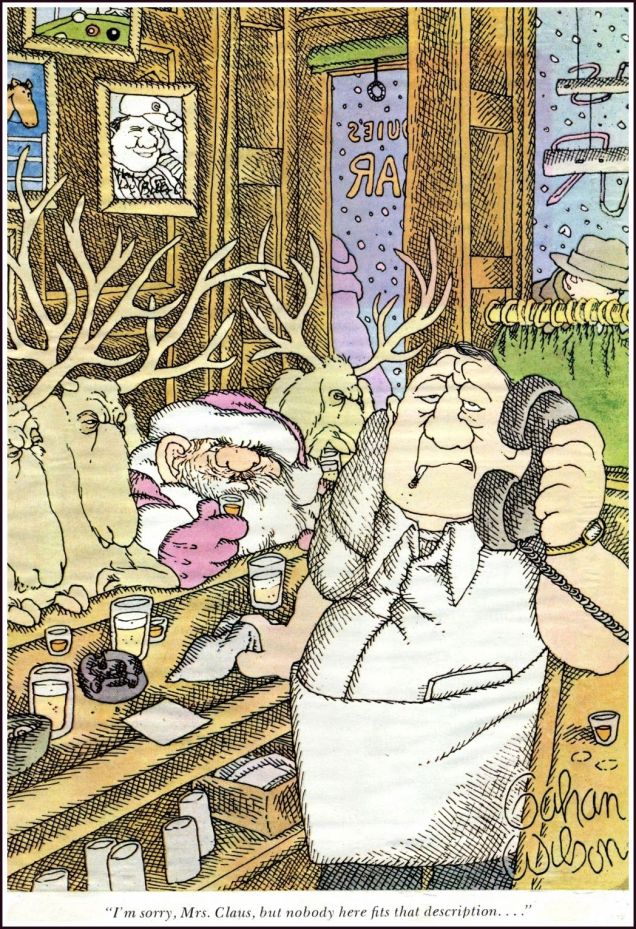
And, on a slightly morbid note, three cartoons by Gahan Wilson (who paints what he sees!)

GahanWilsonChristmasDrunk

GahanWilsonChristmasSanta

GahanWilsonChristmas

~ ds

Newsflash: check out this post’s sequel, the imaginatively-titled More Playboy Cartoons for a Festive Mood!

Georges Pichard: Throwing Curves

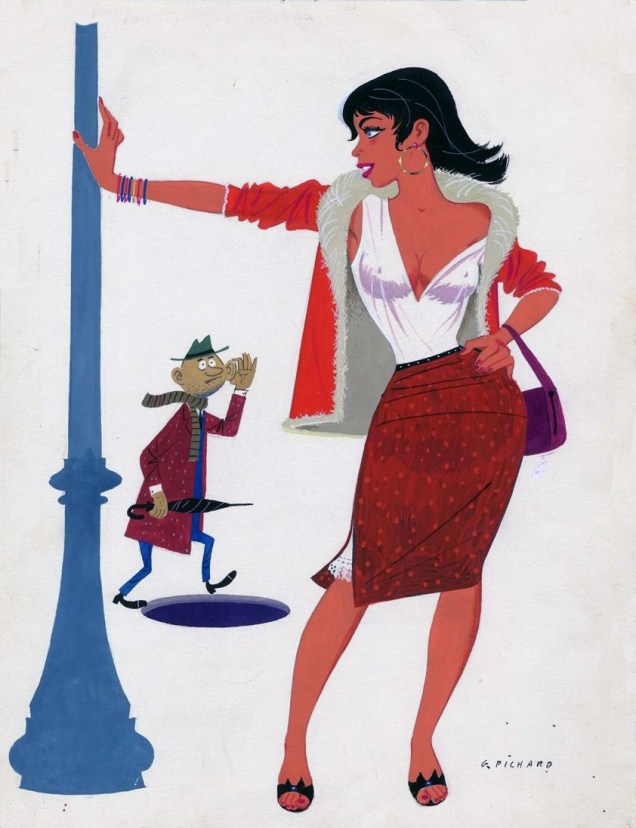
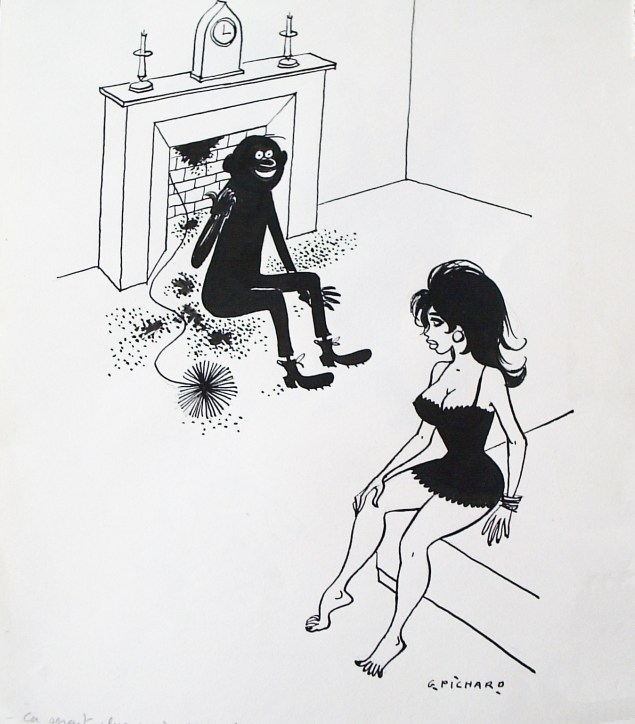
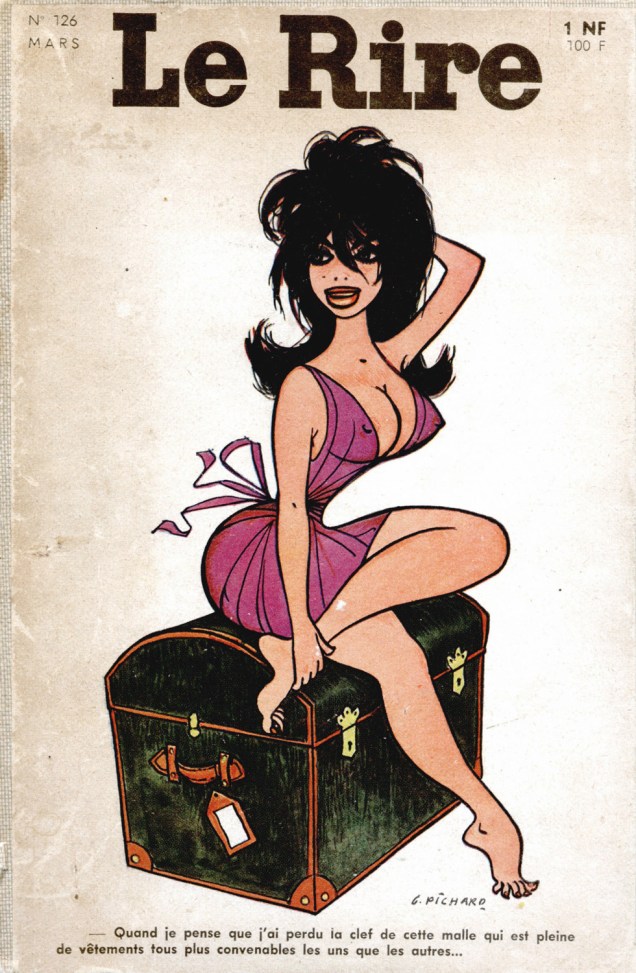
In 1946, Georges Pichard (not sure who he is? Visit our Pichard’s Distressing Damsels for an overview of his later work), heretofore toiling in a marketing agency, started his career as an illustrator. He worked for various French magazines and newspapers (like Le Rire, Fou-Rire and Les Veillées des Chaumières), providing them with covers, cartoons and pin-ups in black-and-white or gorgeous watercolour until the mid 70s, when he switched gears somewhat and dedicated himself to erotic bandes dessinées.

I left image imperfections (due mostly to yellowing of paper over time) and hand-written captions (when available) as is, as I find they provide pleasant texture and context. The jokes are really lame, but we translated them, anyway.

The following three cartoons were published in Le Rire. This first one saw print on the cover of Le Rire no. 22 (nouvelle série, July 1953).

George-Pichard-Sketch2

This one was featured on the cover of Le Rire no. 66 (nouvelle série, March 1957).

GeorgePichard-sketch

George-Pichard-sketch3
« I’m the sort of guy who’s kind of like an iceberg, the main part is beneath the surface. » The man in question looks very much like a V.I.P. type.

The following are all from Fou-rire:

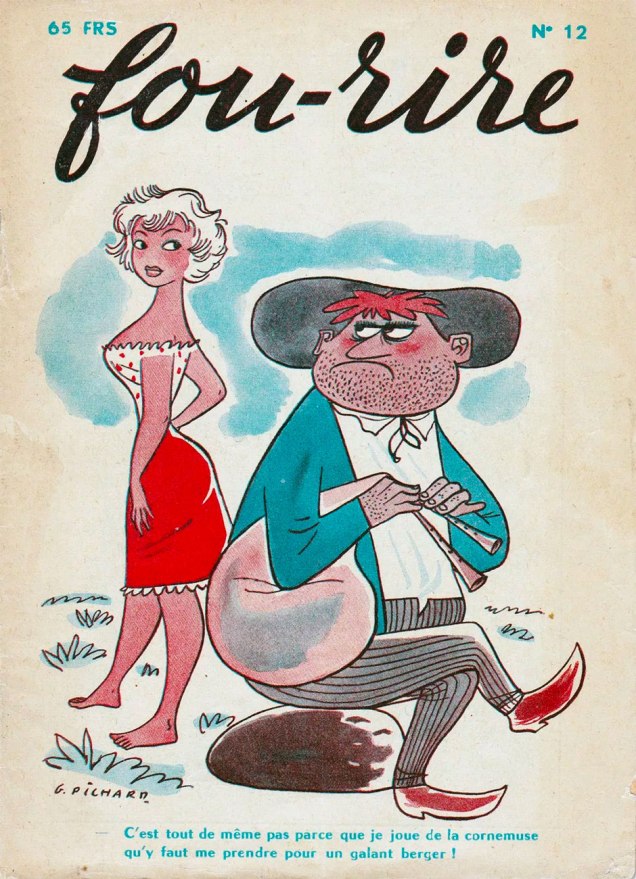
GeorgesPichard-FourireA
Cover of Fou-rire n°12, mid-50s. « It’s not because I’m playing the bagpipes that you have to take me for a gallant shepherd! »
GeorgePichard- LERIRE76- janvier 1958.
Cartoon from Fou-Rire n° 76, early 60s. « Please be assured, my dear friend, that we are all here quite touched by your wife’s endeavours to set a mood… ».
GeorgePichard=1962
Cartoon from Fou-Rire n° 118, early 60s.  « It would be prudent to seal up your chimney, because when I tell the boss about this… »
GeorgePichard-1961---1962;-French-Magazine-Le-Rire
Fou-Rire n° 118, mid 60s. « And to think that I’ve mislaid the key to this chest full of outfits, each more decent than the last… »

Finally, a couple of pretty loose ends:

GeorgePichard-Jarredor
Original art from Le Rire magazine, 1960s. « But the funniest part happened before I ran into the police officer! »
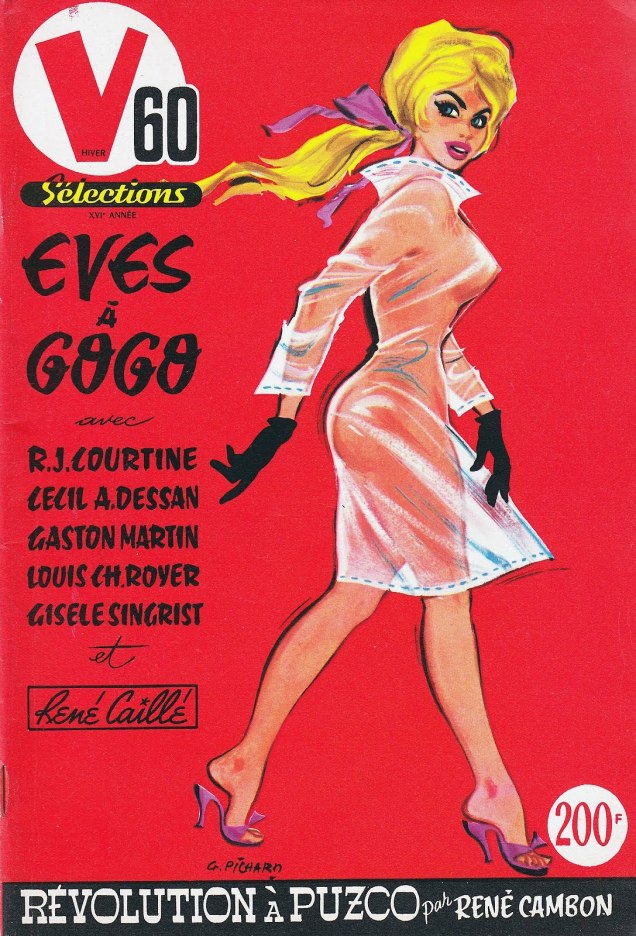
GeorgePichard-V60
Early 60s.

~ ds

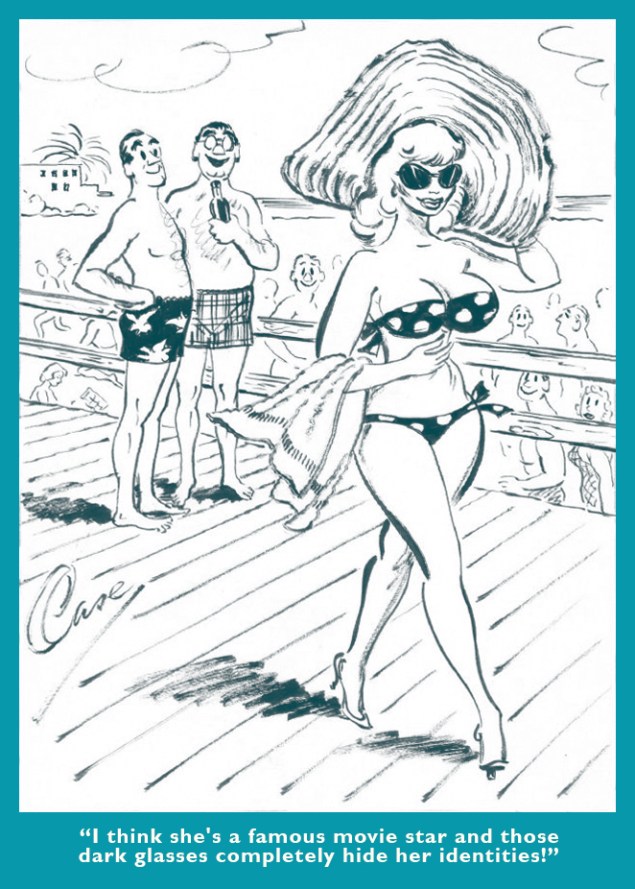
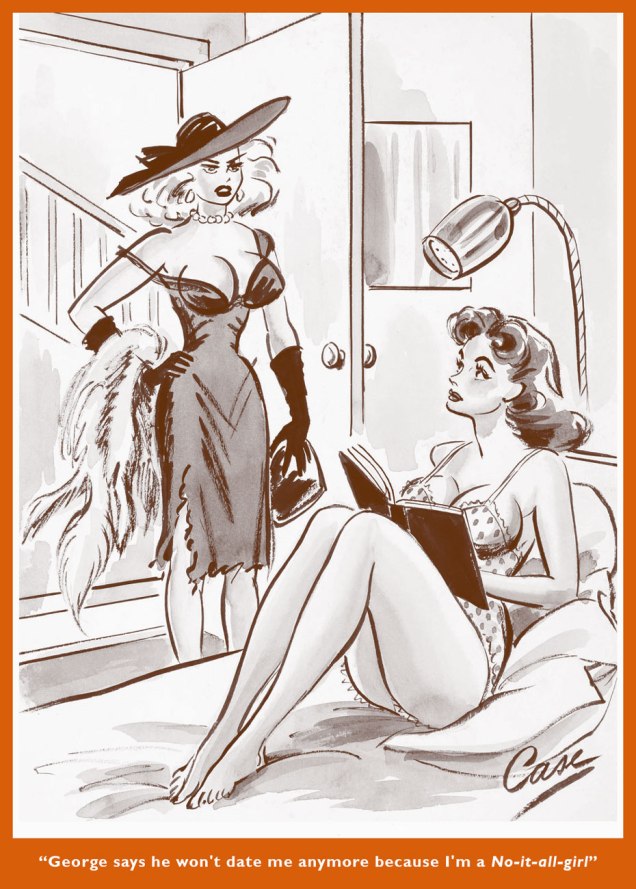
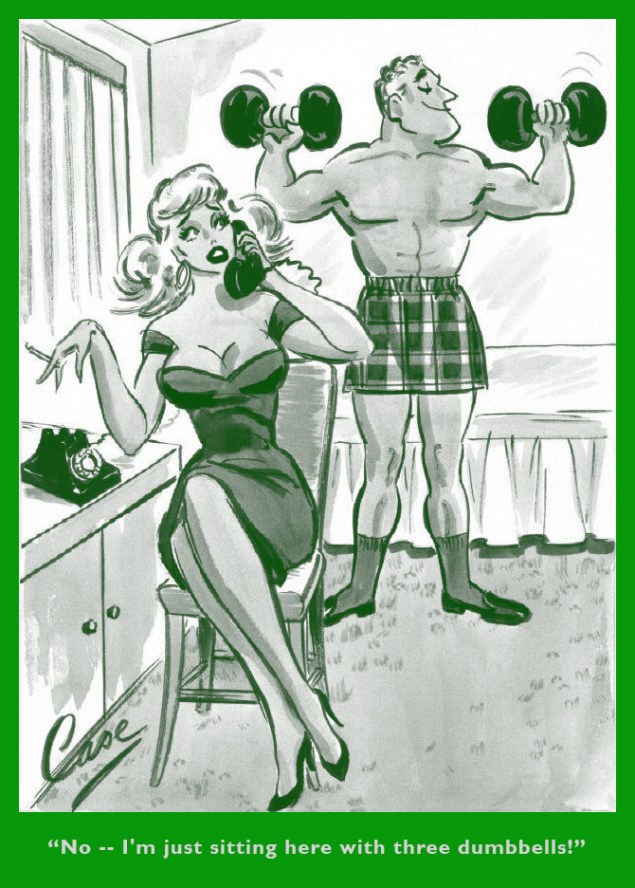
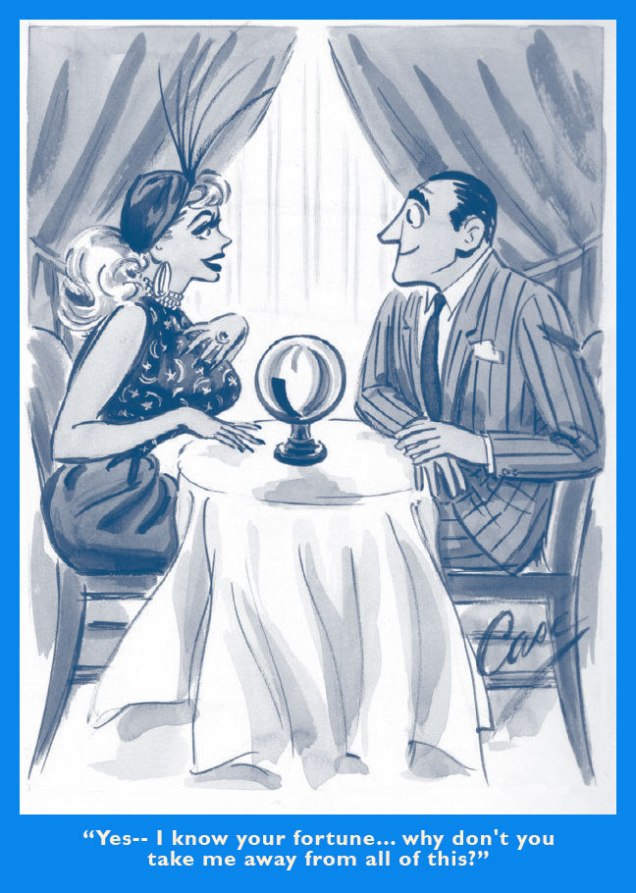
Helen Case: Girlie Cartoonist With a Twist

« At one time, I sold general cartoons to some of the men’s magazines, the girlies — until I went into a newsstand one day and looked at one. » — Betty Swords

If female cartoonists were fairly uncommon in the American mainstream magazine field for much of the twentieth century, they were doubly so within the so-called girlie mags.

« During the 1950s, Abe Goodman — brother of Marvel Comics publisher Moe ‘Martin’ Goodman — was the largest buyer of cartoons in the world. Publishing out of New York City under the Humorama banner, Goodman churned out scores of cheap digest-sized magazines boasting inventive titles like Romp, Stare and Joker that featured hackneyed jokes, cheesecake photos and the publications’ bread and butter, single panel pin-up cartoons.

These magazines were an unlikely proving ground for neophyte gag cartoonists as well as a welcomed alternative to the daily grind of comic book sweatshops. In the 1950s and 1960s, these digests featured the likes of Playboy’s Jack Cole, Archie’s Dan DeCarlo and glamour girl legend Bill Ward. »

While I can unreservedly recommend Alex Chun and Alex Covey’s The Pin-Up Art of Humorama (Fantagraphics, 2011), I’m frankly puzzled as to its wholesale snubbing of Helen Case, who might have brought a welcome bit of variety to the all-male revue. God knows some lesser lights did make the cut.

While feminist cartoonist Betty Swords would likely have dismissed Case’s protagonists the way she did Barbara Shermund‘s, as « gold diggers, dames — amateur prostitutes », Case’s cartoons (I’m afraid I don’t know whether she wrote and illustrated, or simply illustrated… at Humorama’s pauper’s rates, the former is somewhat preferable) provide a refreshing female perspective to the battle of the sexes. To quote Betty Swords again (from R.C. Harvey‘s excellent Insider Histories of Cartooning (2014, University Press of Mississippi): « I remember one editor who shuffled through my cartoons then tossed them on the desk and said, ‘You gal cartoonists are all alike — you don’t attack and hit hard enough! »

While scant information is available regarding Ms. Case (she appears to have lived in Kingston, New York in the early 1960s), at least online, much of her work survives, which surely has to count for something. We present some of the finer cuts, and if the gags aren’t transcendentally great, they are a brace o’ notches above the average knuckle-dragging drollery pervading the pages of Breezy, Snappy or Eyeful of Fun. Most of these gags were drawn and initially published (Humorama’s cheapskate policy was to print, reprint, and reprint again) between 1960 and 1964. Enjoy!

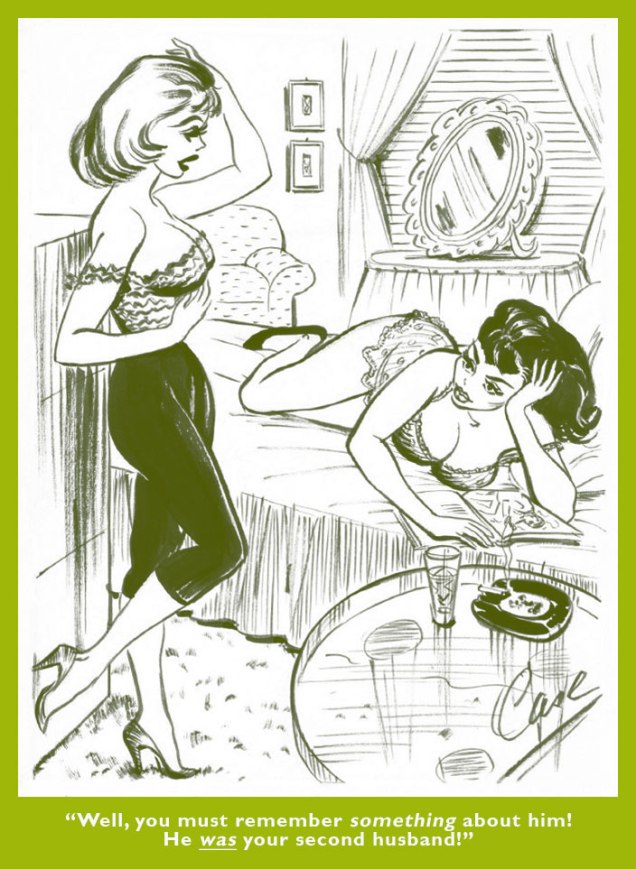
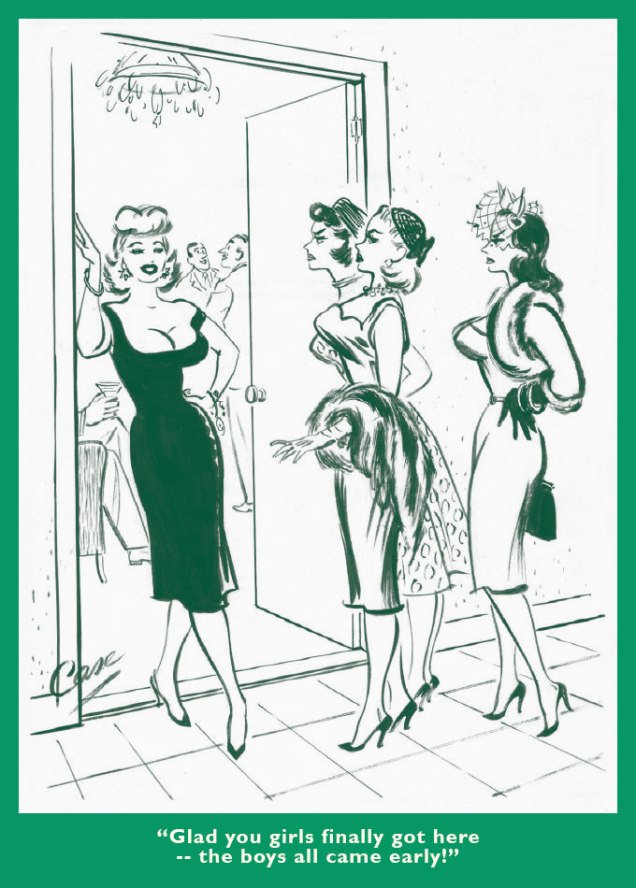
CasePlatonicACaseSecondHusbandACaseIdentitiesACaseNoItAllAHelenCaseDumbbellACaseFortunetellerACaseBathingSuitACaseBoysEarlyACaseNewRegulationsA

-RG
Mordillo’s Flights of Fancy

Guillermo Mordillo (1932 – 2019), known simply as Mordillo, was an Argentine artist of  Spanish parentage. Through his long and productive career, he released more comic albums than you could shake a stick at… and at 86, was still active in the comics field. His easily recognizable style, love of bright colours and oft-surreal humour make his work memorable despite his persistent profligacy.

It would be impossible to provide an overview of his body of work in one post, but it is my pleasure to furnish a fun sampling of his œuvre. Most images below have been gleaned from Opus 5 (Glénat, 1984) and Safari (Glénat, 1990), unless indicated otherwise.

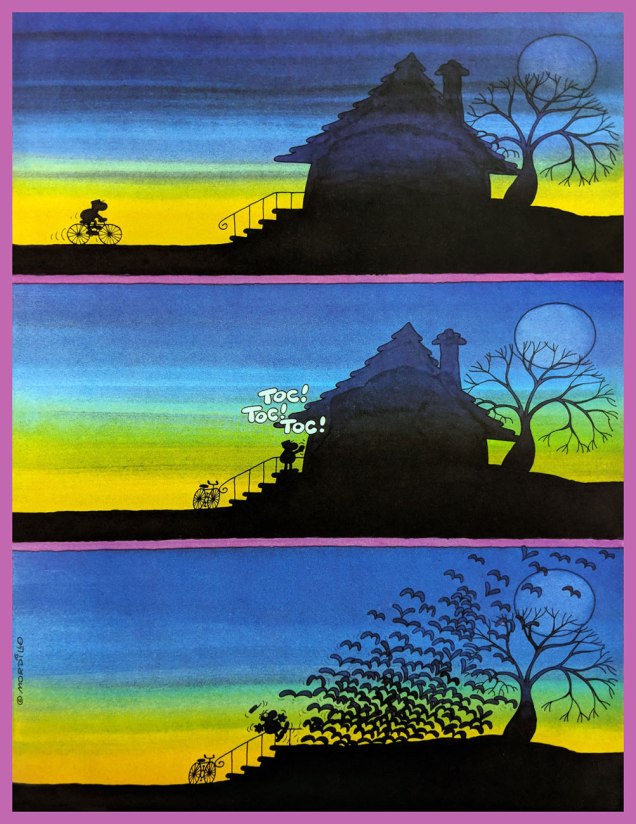
MordilloChauve-SourisA

MordilloLabyrintheA

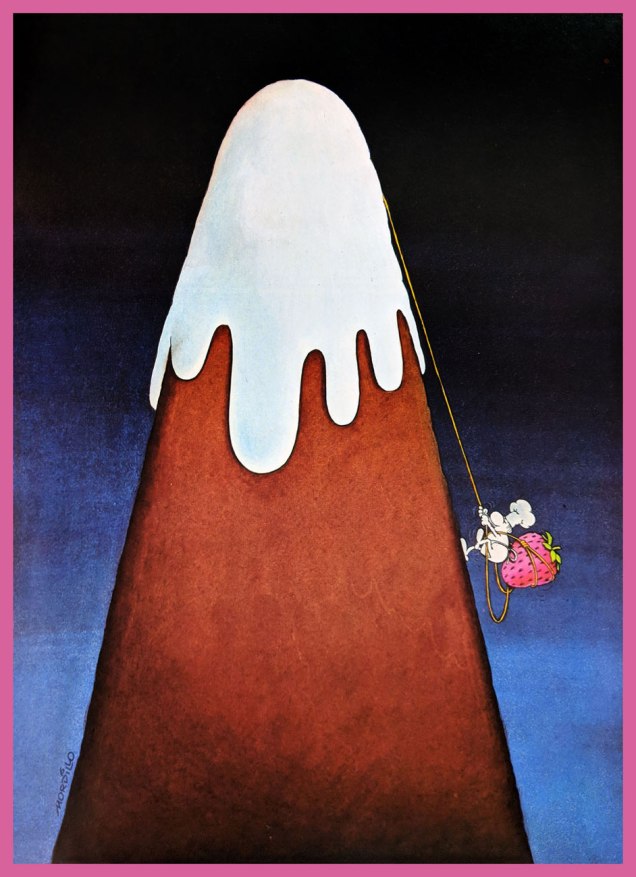
MordilloMontagneA

Mordillo-PirateShip

MordilloChaperonA

MordilloOiseauxA

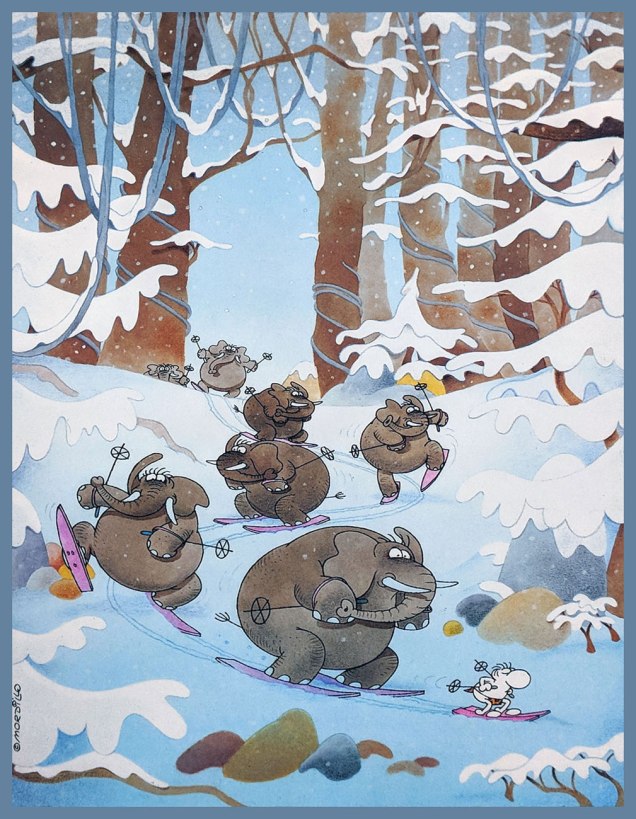
MordilloSkiA

The following two images were scanned from early 1970s issues of Pif Gadget.

MordilloEiffelA

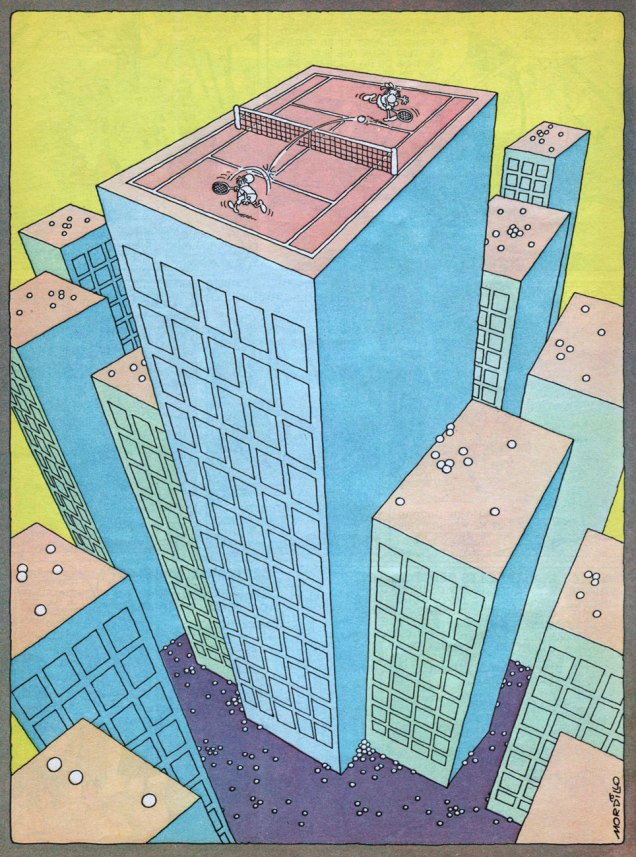
MordilloTennisA

In the mid-70s, Mordillo’s cartoons were used by Slovenian artist Miki Muster to create Mordillo, a series of cartoon animations that ended up being 400 “episodes” long (for a total of 300 minutes – each episode is under a minute). These droll snippets were broadcast in over 30 countries between 1976 and 1981. Should you have a few minutes to spare for a chuckle or two, have a look at this video (recorded by somebody in Germany on VHS tape in the 90s and, many years later, uploaded to Youtube – what lovely, contorted pathways some of these things take).

Visit Mordillo’s website here. More cartoons? More animated cartoons?

Mordillo-Argentina

~ ds

Hallowe’en Countdown II, Day 27

« It only hurts when I exist »

Another astonishing madman from the Playboy magazine stable, Bernard Kliban (1935-1990) is mainly remembered for his much-merchandised « Cat » cartoons, but he was a true master of a vein of absurdist humour that few mine with such success. It’s high time for a collected œuvre or at the very least a comprehensive anthology. Fantagraphics, are you listening?

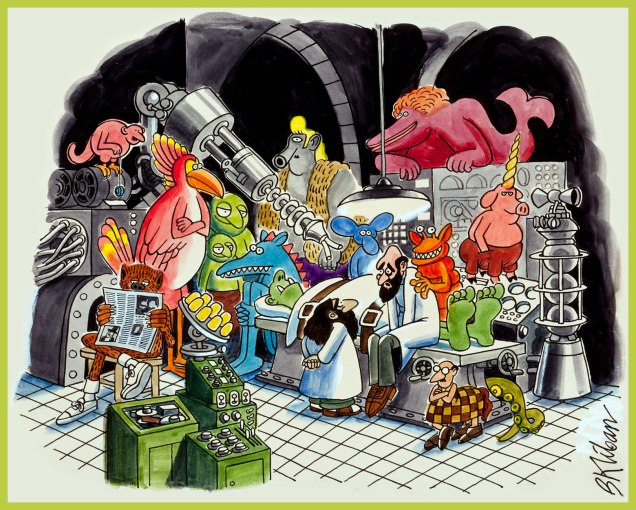
KlibanMonsterA
« Since when do we use the red thread on a green monster? »
KlibanMonsterWifeA
« I’m the monster’s wife… can I help you? »
KlibanStartledA
« Harry, you startled me! »
Kliban20YearsA
« I spend twenty-seven years making monsters and what does it get me? A roomful of monsters! »
KlibanMonsterLivesA
« Look, Igor, the monster lives! … and not badly, either! »

These pieces were gathered in the Playboy’s Kliban collection (1979) and its sequel, Playboy’s New Kliban (1980). Every single one of the man’s books (of which only the Cat books remain in print, I believe) is assuredly worth seeking out, but fair warning: left to his own devices, and away from the Playboy ethos, Kliban goes much farther afield into (extremely inspired) absurdity and abstraction.

-RG
Hallowe’en Countdown II, Day 11

« It’s astonishing how terrible people can be. » – Gahan Wilson

Chez Gahan Wilson (as with his esteemed colleagues Charles Addams and Edward Gorey, for instance), it’s always Hallowe’en! Here’s a trio of particularly fitting cartoons published over the years in Playboy magazine, always one of the finest homes for wayward cartoonists. Gahan was pretty much the only guy Hugh Hefner didn’t encourage to draw buxom females. 

GahanCommercializeA
Playboy, October 1959.
GahanSetArrivedA
Playboy, November 1967.
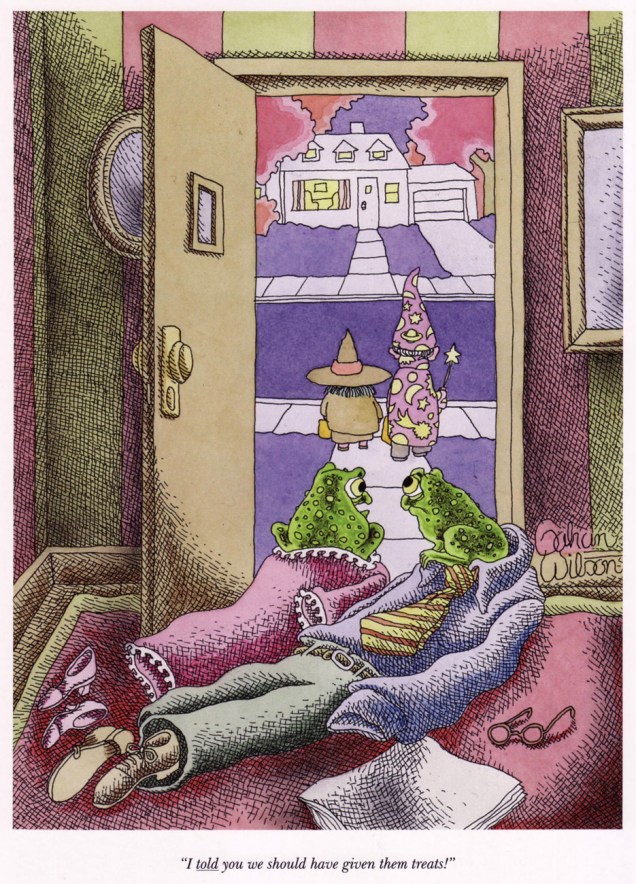
GahanTreatsA
Playboy, October 2005.

Early in the magazine’s existence, Hef was looking for a Chas. Addams to call his own (the man himself was under exclusive contract with The New Yorker), and he found him. Yet, as Hefner said in his introduction to Fantagraphics’ extraordinary collection, Gahan Wilson: Fifty Years of Playboy Cartoons: « I don’t think I could have imagined before the fact how Gahan was going to grow. What one saw in the beginning was only the promise. »

– RG

Hallowe’en Countdown II, Day 9

« But dreams come through stone walls, light up dark rooms, or darken light ones, and their persons make their exits and their entrances as they please, and laugh at locksmiths. » ― Sheridan Le Fanu, Carmilla

This splendid piece comes from the pen of legendary Belfast (Ireland, of course, Eire for you purists) artist Rowel Friers (1920-1998). I unearthed it from a lovely volume ambitiously, but not unjustifiably, titled Best Cartoons from Abroad – 1955, edited by Lawrence Lariar and Ben Roth (Crown Publishers, 1955). It first saw print in Dublin Opinion, a monthly Irish satirical magazine (1922-1968). DI was founded by a pair of cartoonists, Arthur Booth and Charles E. Kelly, and a writer, Thomas J. Collins.

RowelFriersMilkA

As Hallowe’en is Celtic in origin, it stands to reason that we salute the vital Irish contribution to this most awesome of holidays. For those needing a little refresher, here’s a most helpful précis on the subject, from irelandeye.com:

« Hallowe’en is a remnant of Ireland’s pagan, Celtic past. Samhain was an important Celtic feast celebrated on the last day of October, marking the beginning of winter and the New Year. This fire festival was celebrated at night with ritual sacrifice by the druids of animals. The Celts feasted on the fruits and harvests of the autumn. Ireland’s conversion to Christianity absorbed this Celtic festival and established two significant feast days, All Saints’ Day on 1 November and All Souls’ Day on 2 November. Ireland has always had a special reverence for the dead. Even into the twentieth century, many people in rural Ireland believed that dead family members returned to the fireside on All Souls’ Night. Families went to bed before midnight and left the fire lit. Chairs were arranged around the fireside for the dead family members who returned to the house. »

Room for one more?

FriersAntennaA
Another Friers piece published in 1955 in Dublin Opinion. I can vouch for it, Ireland is as green as it gets, but its landscape is also undeniably steeped in soulful melancholy, and I can also attest to that.

-RG

Shel Silverstein: Without Borders

« I’m not content when I’m traveling, but I’m not content when I’m not traveling. So I guess I’ll keep traveling. » – Shel Silverstein

Another one of those nice Jewish boy geniuses, Sheldon Allan Silverstein (1930-1999) was born eighty-eight years ago, on September 25, 1930, in Chicago, Illinois. Uncle Shelby lived life to the fullest, creatively in every respect. He tried his hand at many things, and what do you know? He succeeded at every often-unlikely turn, sometimes artistically if not commercially, but generally on both counts: cartoonist, singer, songwriter, screenwriter, poet, actor, playwright, children’s book author, bon vivant, raconteur and lover… yet his dad was never impressed. Old man Nathan wanted his son to join him in selling furniture. Some obstacles are just plain insurmountable.

Once more, faced with the daunting prospect of discussing a prolific and versatile creative soul, it seems well-advised to concentrate on a tiny area of his roadmap. And so…

In 1957, Playboy magazine founder and esteemed patron of cartoonists Hugh Hefner entrusted Shel with a special assignment, that of roaming the Earth and recording his special impressions. The results, published between 1957 and 1968, were twenty-three travelogues brimming with the gregarious Silverstein spark and spirit. But he first had to be sold on the approach. According to Hefner, in his foreword to the definitive collection “Playboy’s Silverstein Around the World” (2006), « I envisioned something along the travel letters Ernest Hemingway submitted to Esquire — A sort of personal diary that would be dispatched from around the globe. Shel was uncomfortable in that role. He didn’t want to include himself, but I persisted. And I’m glad I did. What we got back in those drawings was narrative storytelling of a very personal manner. We saw Shel establish himself as a character.»

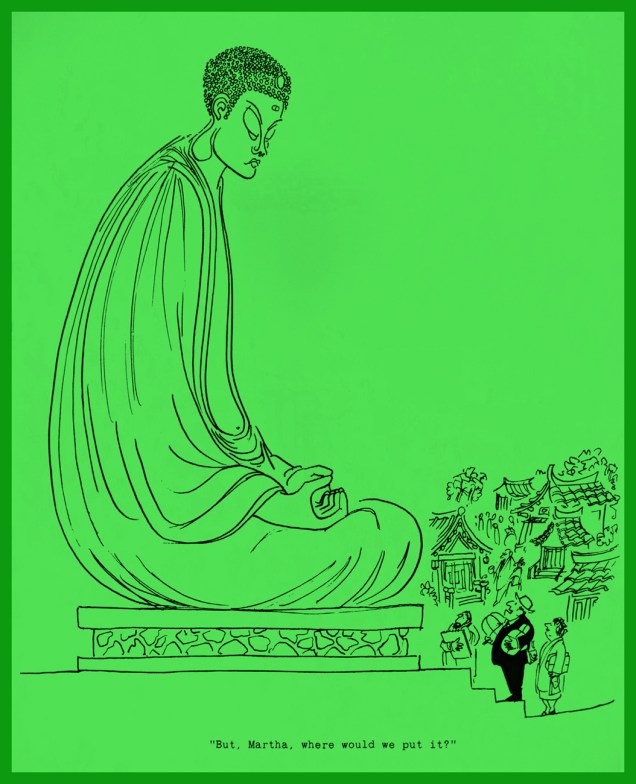
ShelBuddahA
From “Return to Tokyo” (May, 1957).
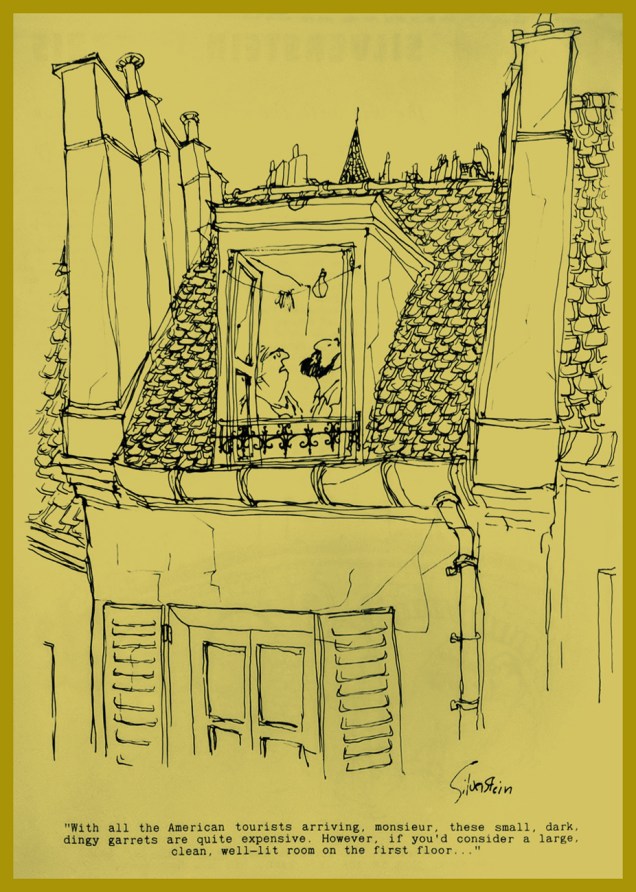
ShelGarretA
From “Silverstein in Paris” (January, 1958).
ShelMoscowA
From “Silverstein in Moscow” (March, 1958).
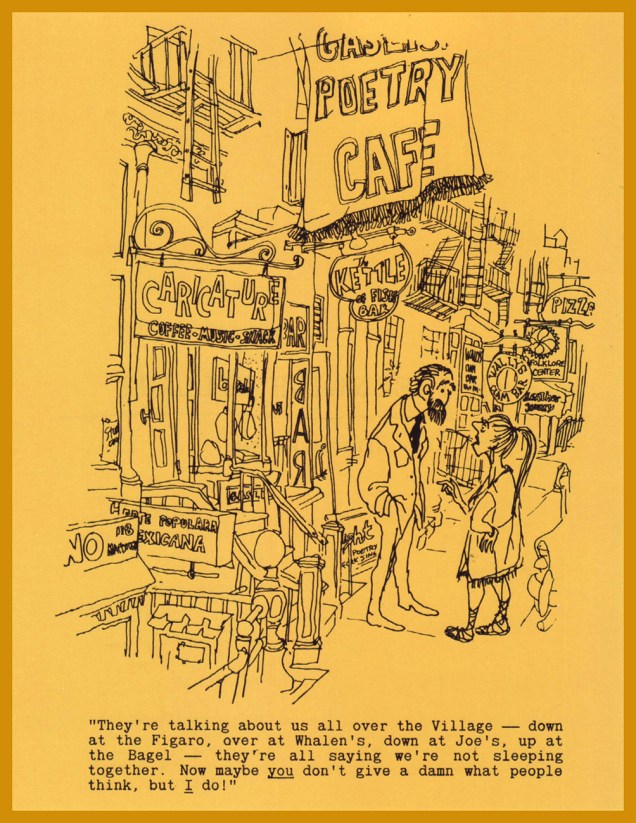
ShelGreenwichA
From “Silverstein in Greenwich Village” (September, 1960).
ShelGoofyA
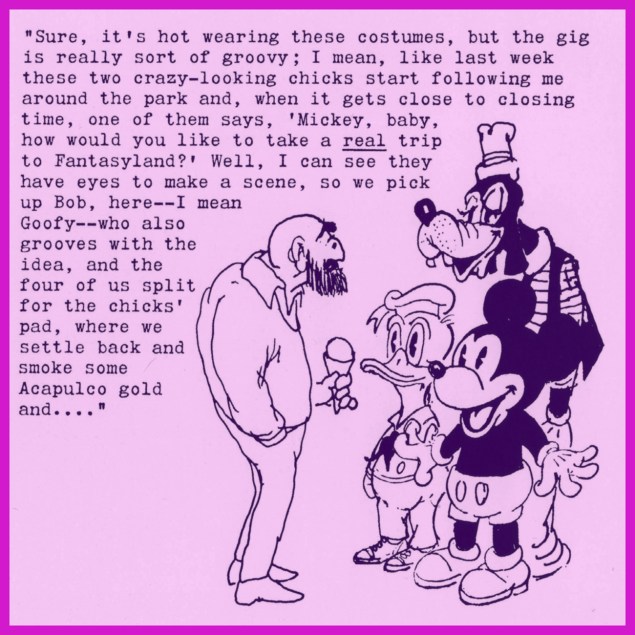
From “Silverstein in Hollywood” (January, 1968).
ShelNewsstandA
From “Silverstein Among the Hippies” (August, 1968).
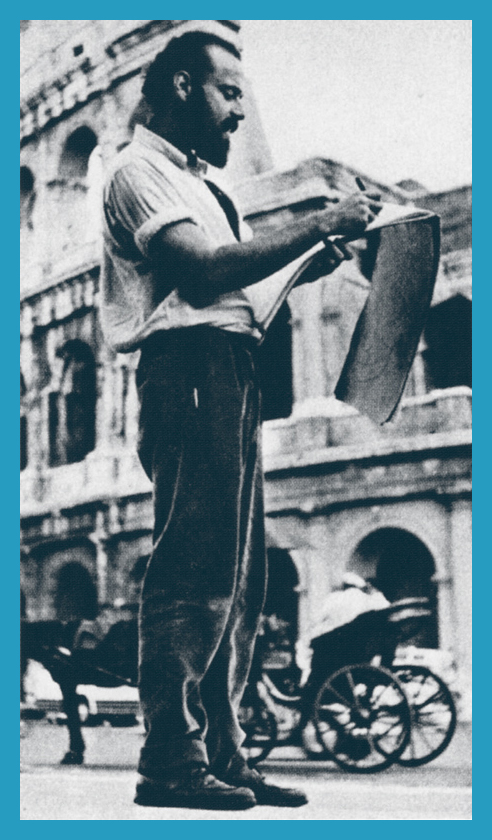
ShelPortraitA
Shel at work in Italy (1958); photograph by John Reid, Jr.

Let’s leave off with these revealing words from Playboy photographer Larry Moyer: « He was one of the funniest guys I ever knew — and it was never at anybody’s expense. A lot of humor is based on putting other people down. I don’t remember one time Shel ever put anybody down in his work — and that’s something. » That’s something indeed, now more than ever.

– RG

Mother Earth’s Plantasia

« Unless you’re some kind of masochist, I would imagine that you’d like to begin your plant experience with the easy, almost impossible-to-kill group. »

A sunny reminder of some of the plant world’s myriad of virtues, from 1973’s Mother Earth’s Hassle-free Indoor Plant Book by Lynn and Joel Rapp, a terrific little tome that bears the probably unique distinction of having yielded its own soundtrack. Not only that, but its own *excellent* soundtrack, Mother Earth’s Plantasia by Canadian-born songwriter, producer and electronic music pioneer Mort Garson. The LP was distributed through one of the wackiest marketing schemes I’ve ever encountered: it was given away with the purchase of a Simmons mattress from Sears. Uh?

PlantasiaRubinA
« A green thumb is simply a positive state of mind about growing things. »

I see Plantasia’s even been reissued a few years back on fancy 180 gram vinyl (along with other formats and impressive ancillary products). But you can hear it in its entirety without making the considerable financial investment, thanks to this lovely tribute on the Music Is My Sanctuary blog.

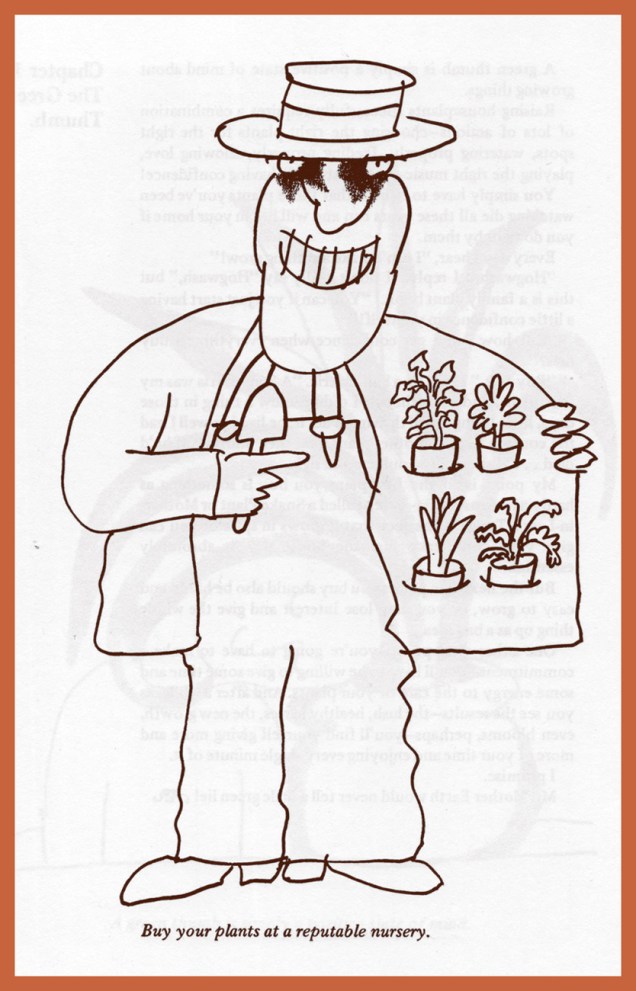
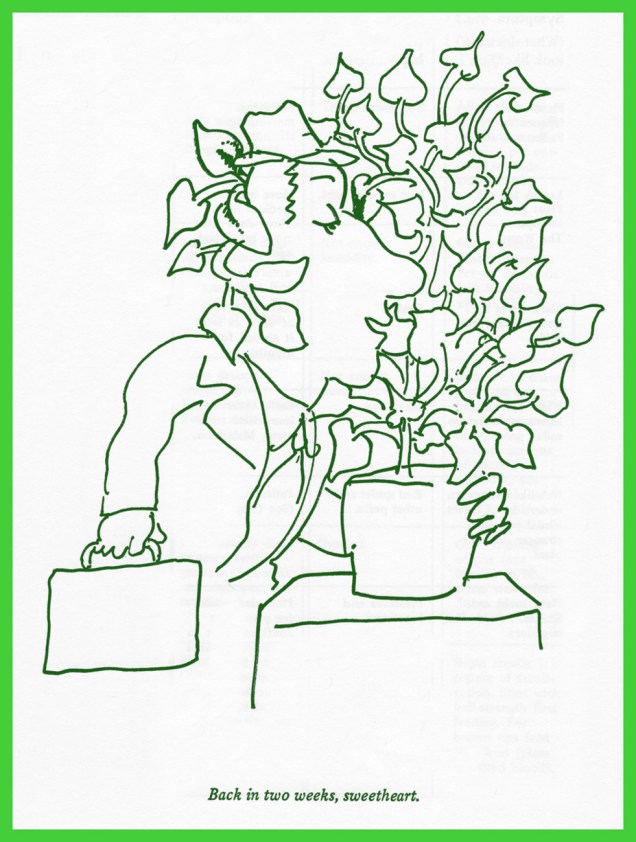
The book (and LP booklet) are illustrated by « Marvelous » Marvin Rubin… who quite deserves the sobriquet, if you ask me.

RubinPlantasia01A
« I was first introduced to Bromeliads by a 75-year-old semi-retired mechanic named Rafe ‘Frenchy’ DeLago. At least I thought I was. It turns out that I was actually first introduced to Bromeliads by my mother and the Dole Company, but neither my mother nor I knew it at the time. Truth is, my mother still doesn’t. You see, all pineapples are Bromeliads. In fact, all Bromeliads are pineapples! »

RubinPlantasia02A

RubinPlantasia03A
As confirmed by George Orwell’s sole comic novel, Keep the Aspidistra Flying.
RubinPlantasia04A
« Those plants will grow in your house, all right, but they’d grow better if you lived in a greenhouse. »
RubinPlantasia05A
« It is well known that plants grow best to classical music, but we have been told about a hip Dieffenbachia who loves The Rolling Stones. »
RubinPlantasia06A
« As people in the plant business, take it from us: the worst pest when it comes to killing plants is Homo sapiens. »

RubinPlantasia07A

– RG