Hallowe’en Countdown VI, Day 23

« It’s like driving a car at night. You never see further than your headlights, but you can make the whole trip that way. » — E. L. Doctorow

Once more rooting around Europe for properly atmospheric material, we unsurprisingly dig up some gold in Belgium, a land rife with longstanding traditions of the fantastic.

While there never were — if memory serves — any explicitly supernatural elements at play in Maurice Tillieux and Arthur Piroton‘s chronicles of FBI agent Jess Long’s colourful investigations, the creators used every opportunity to instill the oppressive fog of atmosphere.

While never a massive hit, the series had solid legs, lasting from its 1969 introduction in Spirou magazine, surviving Tillieux’s tragic demise in 1978 and finally coming to the end of its road with Piroton’s own passing in 1996.

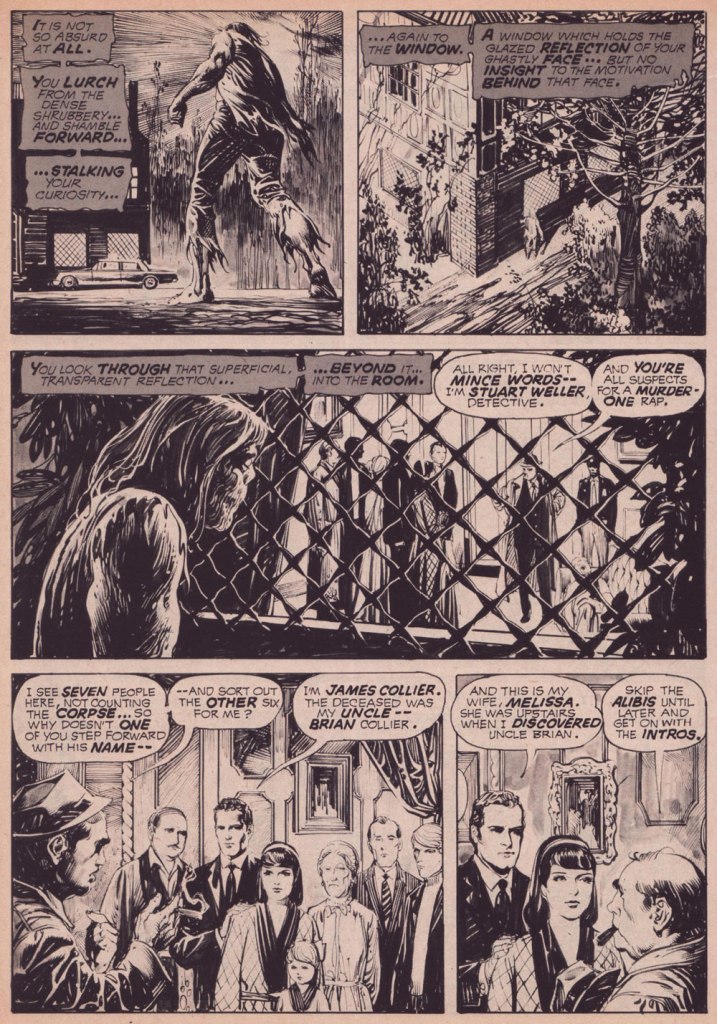
Today, we feature excerpts from Jess Long’s sixth investigation, Les ombres du feu (‘Shadows of fire’), from 1972. Fasten your seatbelts!

Pretty good spotting, Agent Corey Hart!
The story runs fourteen pages, a bit long for our purposes… but I’m sure these highlights will properly convey its nocturnal essence.
This is Jess Long, Police spéciale no. 2 (1977, Dupuis), comprising the fifth and sixth adventures. For some reason, the publisher didn’t start collecting the series until 1976. In the end, twenty albums were issued, a fine run!
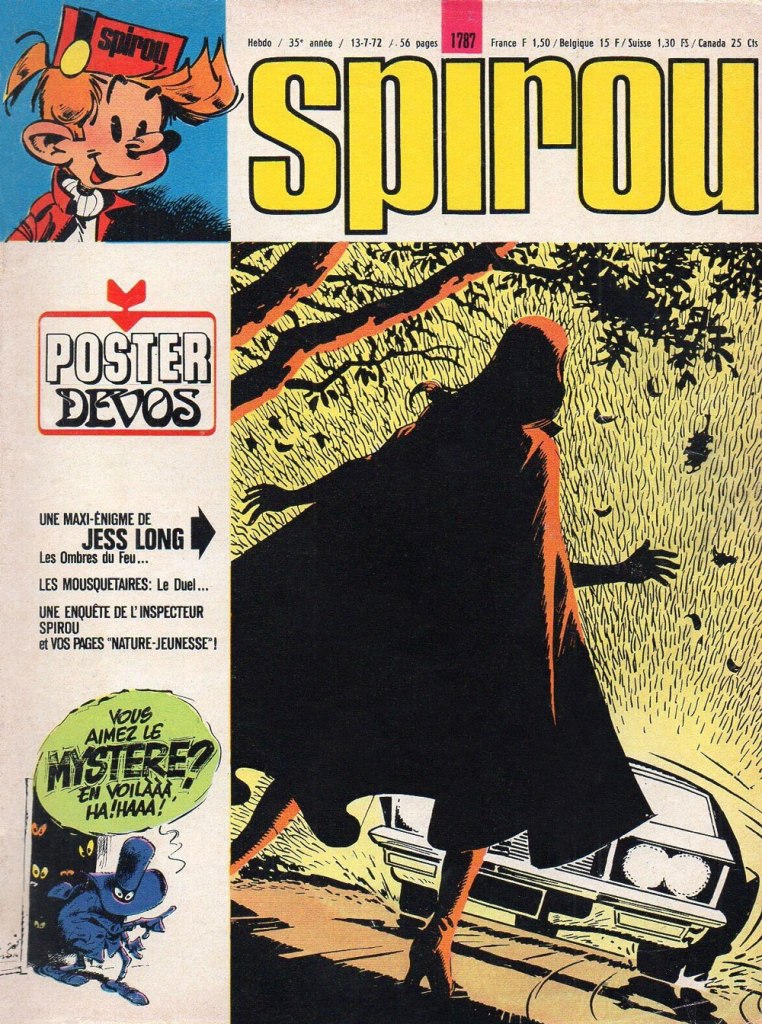
This is Spirou no. 1787 (July 13, 1972, Dupuis). Cover by Piroton, with a lower left vignette by André Franquin.
Another spooky Jess Long cover, this time it’s Spirou no. 1897 (Aug. 22 1974, Dupuis), with another Franquin comment.

I’ve heard that Piroton’s style was considered a bit too ‘American’ to be that popular in Europe. Amusingly, it looked like nothing published in American comics at the time — I’d say his approach was a throwback to a mix of Bernard Krigstein and, say, Alex Raymond in Rip Kirby and Secret Agent X9 mode.

Something else worth noting about the Tillieux-Piroton collaboration: while Tillieux was the complete package — writer and artist — he was essentially forced, by some disastrously myopic editorial decisions right from the top at Dupuis (a stubborn failure to grasp that not every cartoonist can be his own writer) Tillieux had to almost entirely give up drawing, even on his own series, Gil Jourdan, to take on writing duties for a great many features. But since he was, one might say, the “Anti-Stan Lee”, he painstakingly storyboarded each page of his scripts, acting not only as scenarist, but also as metteur en scène. Thankfully, some examples of these fascinating breakdowns have survived. Check out this one and especially that one. -RG

Hallowe’en Countdown VI, Day 21

« Do not be a magician – be magic! » — Leonard Cohen

In the spirit of celebrating the spirit of Hallowe’en even from places it’s not traditionally celebrated, it’s now my turn — and my pleasure — to draw from the wondrous inkwell of Massimo Mattioli (1943-2019) and his finest creation, M Le Magicien, which ran, largely unappreciated, in the pages of France’s Pif Gadget from 1968 to 1973. My co-admin ds devoted, back in January, a post to the artist and his creation: Massimo Mattioli Mania: M le magicien, but I’d been reserving the rare but excellent ‘spookier’ M strips for this occasion. Mattioli would delve much, much further into the macabre, in the early 1980s, with his frankly excessive Squeak the Mouse. Ahem.

And now for the good stuff!

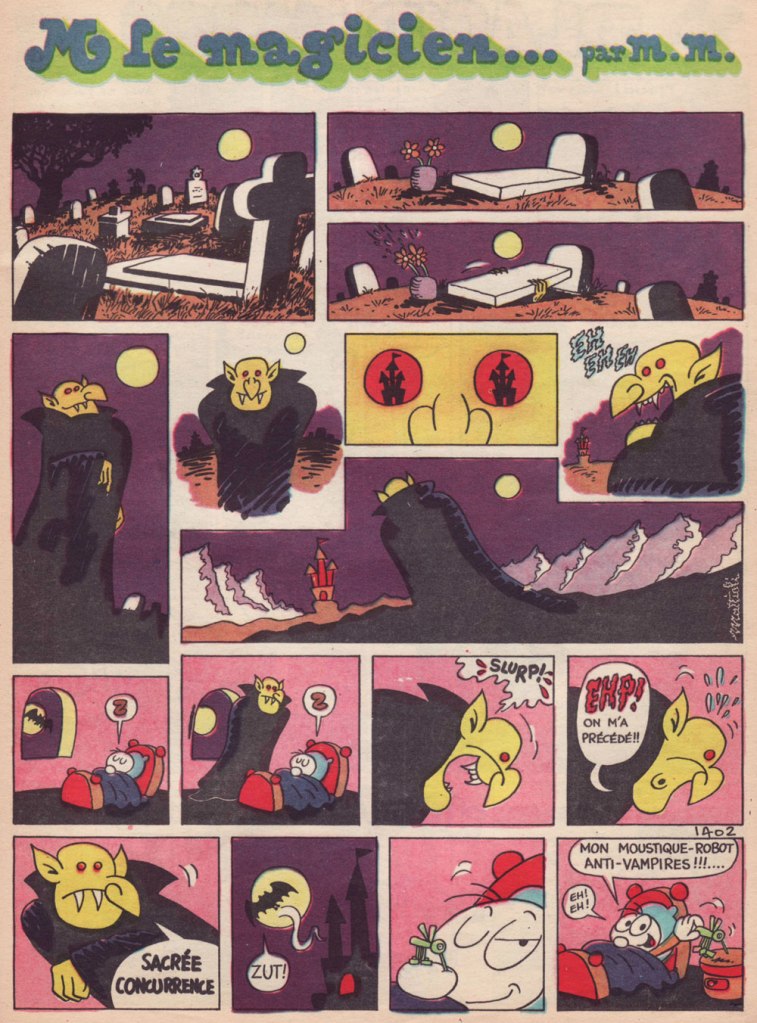
Why, hello, Nosferatu! Originally published in Pif gadget no. 164 (Apr. 1972, Vaillant). M’s robot mosquito discourages the blood-sucking competition.
This one also works for Fungus Fridays! Originally published in Pif gadget no. 205 (Jan. 1973, Vaillant). « I’m still myself! Monsters don’t exist! »
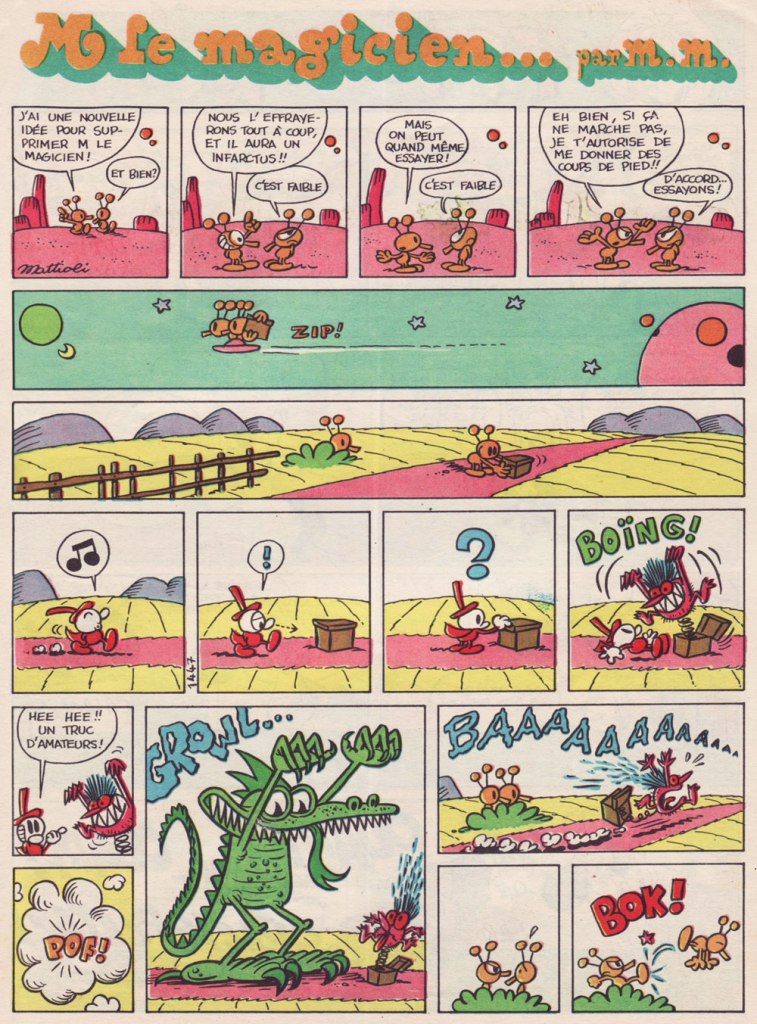
Originally published in Pif gadget no. 209 (Feb. 1973, Vaillant).
Originally published in Pif gadget no. 210 (Mar. 1973, Vaillant).

-RG

Hallowe’en Countdown VI, Day 19

« — I don’t know about zombies, doctor. Just what is a zombie?
A ghost. A living dead. It’s also a drink. » — I Walked With a Zombie (1943)

Has any of the classic monsters undergone more radical changes over the past century than the lowly zombie? I believe my first encounter with the walking dead (in comics, that is) came through a reprint of a relatively obscure Archie GoodwinRocco Mastroserio story, the imaginatively titled Zombies!* (read it here!) from Creepy no. 17 (Oct. 1967, Warren); in it, uncle Archie schooled me about zombies’ aversion to salt and, it follows, sea water. Which I presume is what kept them cooped up on tropical islands.

Confirmation of this vulnerability came in what I consider the scariest scene in the uneven Kolchak: The Night Stalker TV series, from its second episode, the imaginatively titled The Zombie, wherein Kolchak does his level best, under trying circumstances, to pour salt down the throat of a massive, dormant-but-not-for-long zombie.

But the damage to zomboid tradition had already been inflicted, for better (my vote) or for worse, by George Romero‘s ravenous shamblers in 1968’s Night of the Living Dead. While I had no trouble accepting Romero’s savvy upgrade, I recall being offended by the cheesy, mindless, anything-goes approach adopted by Lucio Fulci in his imaginatively titled Zombie**, namely this sequence.

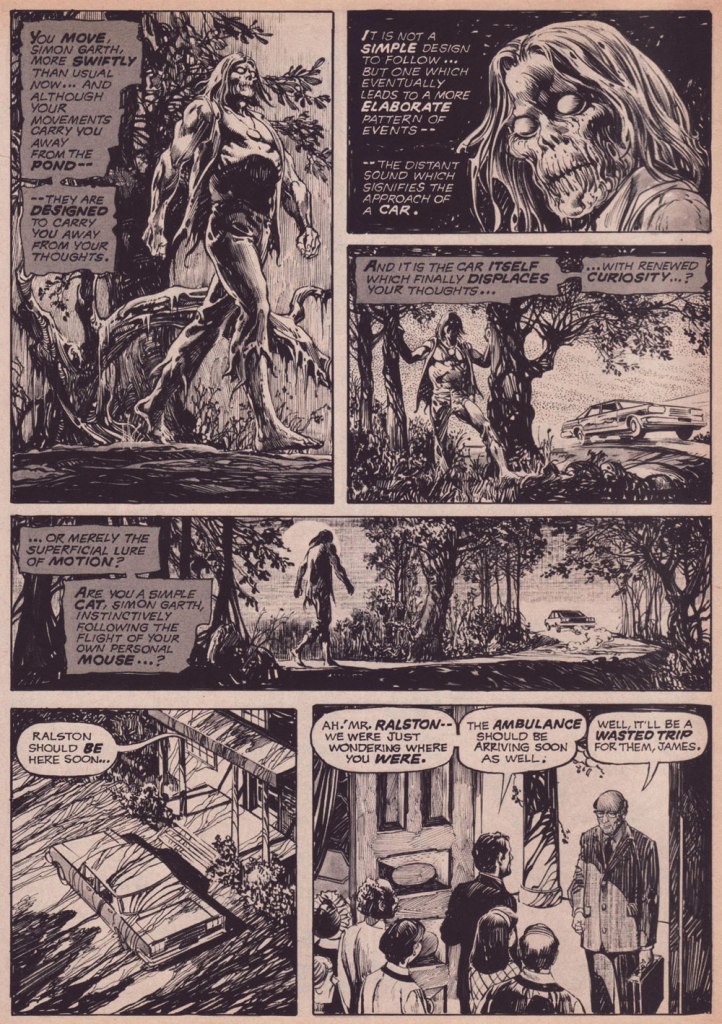
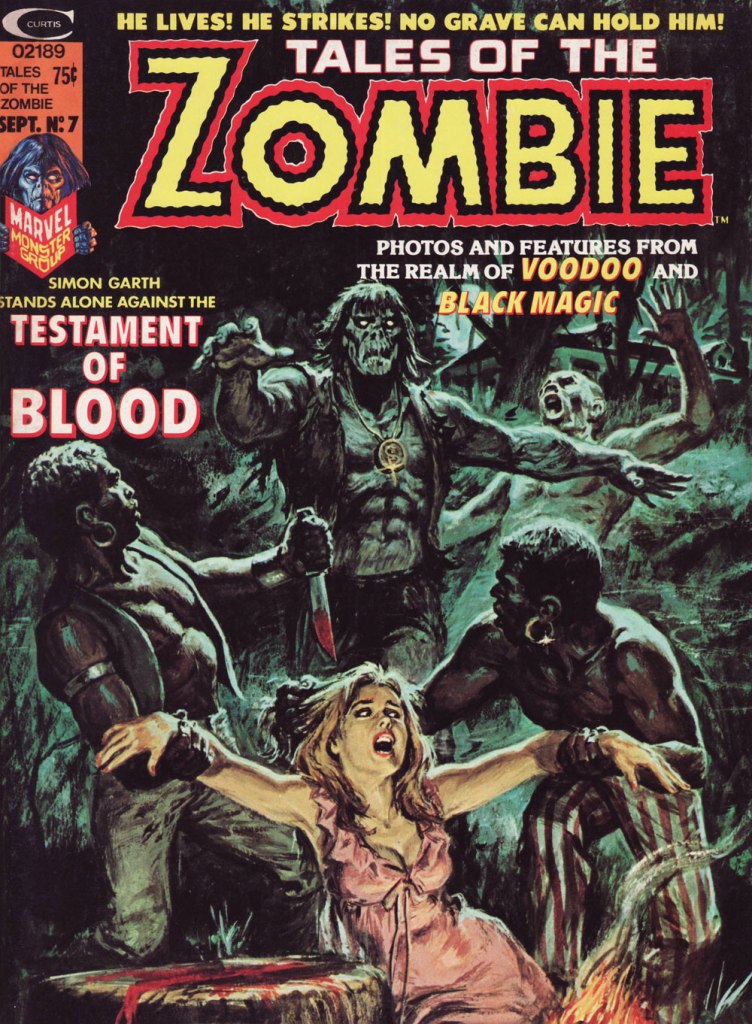
Marvel’s resident Zombie, Simon Garth, had débuted all the way back in 1953 (what is time, after all, to the living dead?) and Menace no. 5‘s imaginatively titled Zombie! (check it out here).

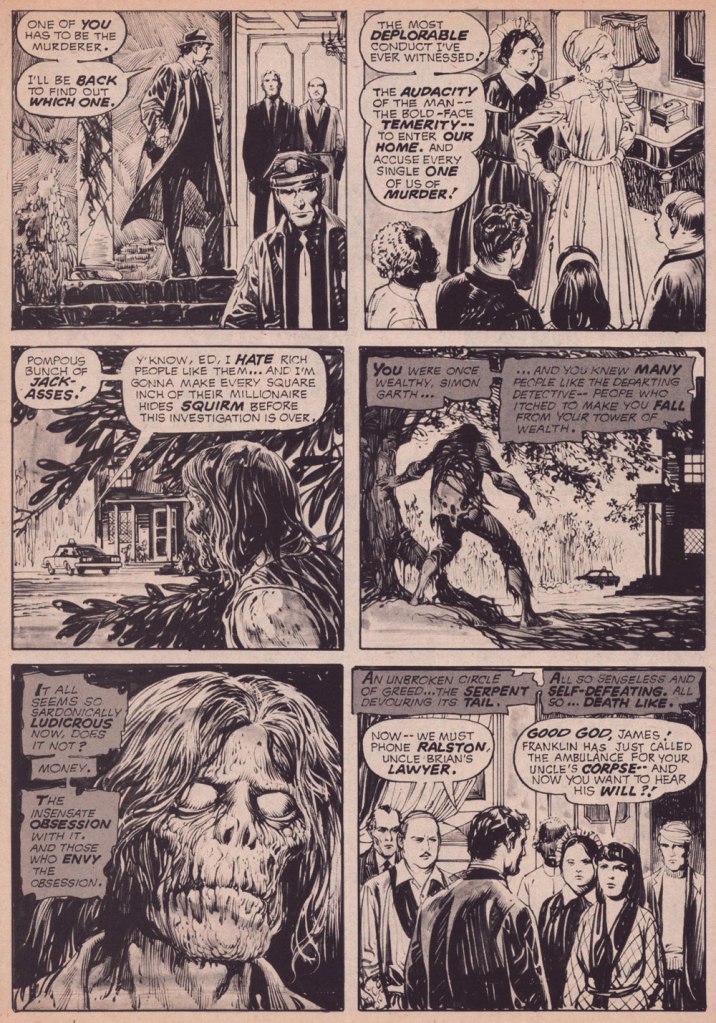
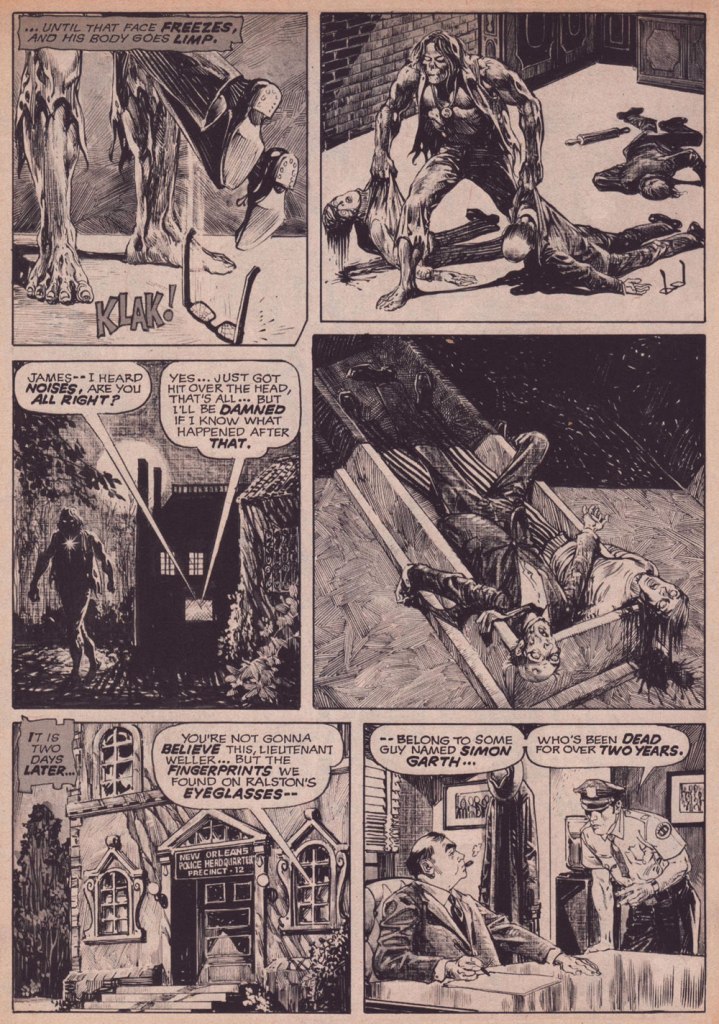
Aside from his Bill Everett-drawn premiere, I frankly have little use for the character, but I have a soft spot for this one story, intended as a time-buying fill-in for the feature’s regular team, writer Steve Gerber and Peruvian artist Pablo Marcos. It’s written by the often-interesting Doug Moench (Master of Kung Fu, Moon Knight) and illustrated by the masterful Alfredo Alcala, a sure consensus favourite around here. The plot itself is rather on the thin side, being one of those Agatha Christie’s Ten Little… er — And Then There Were None scenarios, with Garth mindlessly hovering around and peering in windows, until…

But the artwork is a delight. Like all of Marvel’s supernatural antiheroes (save the Man-Thing), Garth absurdly boasts the physique of a bodybuilder (despite being long dead and not eating anything), but at least Alcala truly knows his anatomy.

The original story is over thirty pages long, so I’m just providing highlights, including the conclusion, which is quite cute. While it must be incredibly hard to write mindless, invulnerable characters, Moench had a good punchline in mind all along.

This is Earl Norem‘s cover for Tales of the Zombie no. 7 (Sept. 1974, Marvel).

-RG

*set in Brazil for the sake of the twist ending — not a bad one, either.
**To be fair, called Zombi 2 in Italy, since “Romero’s Dawn of the Dead (1978) was released in Italy as Zombi.” At least the Italians, as the French once did, understand that Zombi is the male, and Zombie the female of the, er… species. Or is it simply the plural?

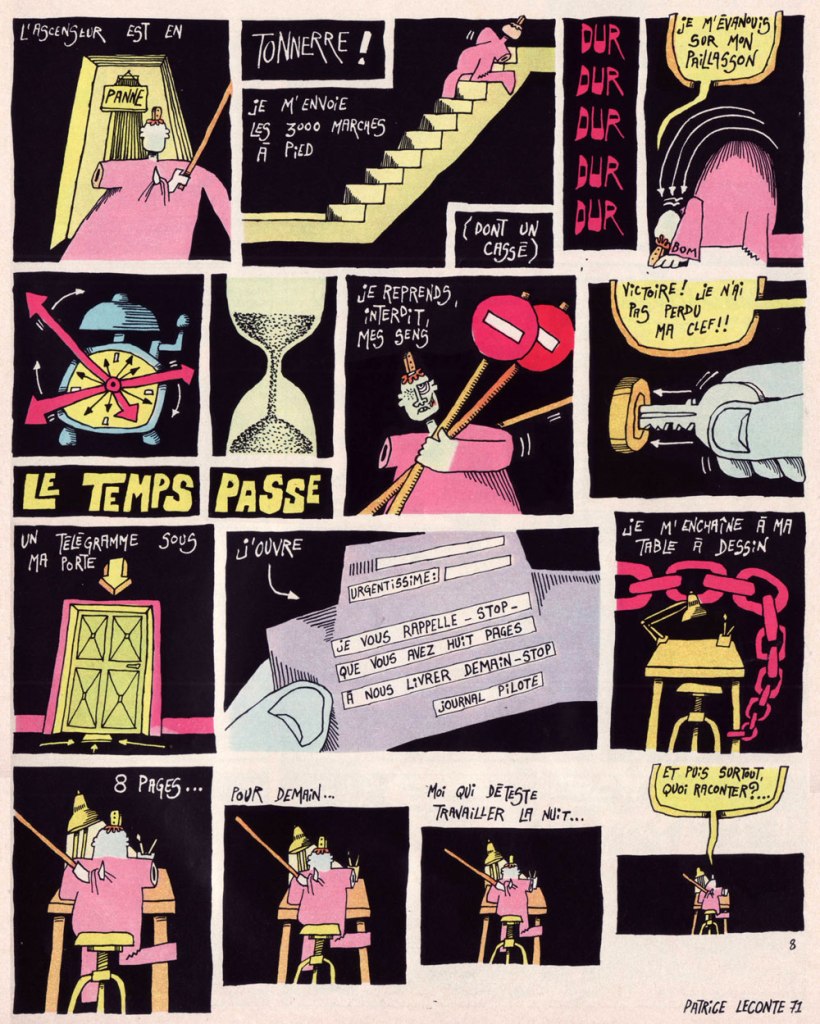
Patrice Leconte: All Was Normal and Calm…

« An editorial team that gathers within a magazine such as Pilote constitutes a true family, as it’s a small group and everybody knows everybody. There’s friendship, admiration, competition, hijinks and the pleasure of being together, even if we didn’t take the bus to Quiberon together in the summer. » — Patrice Leconte

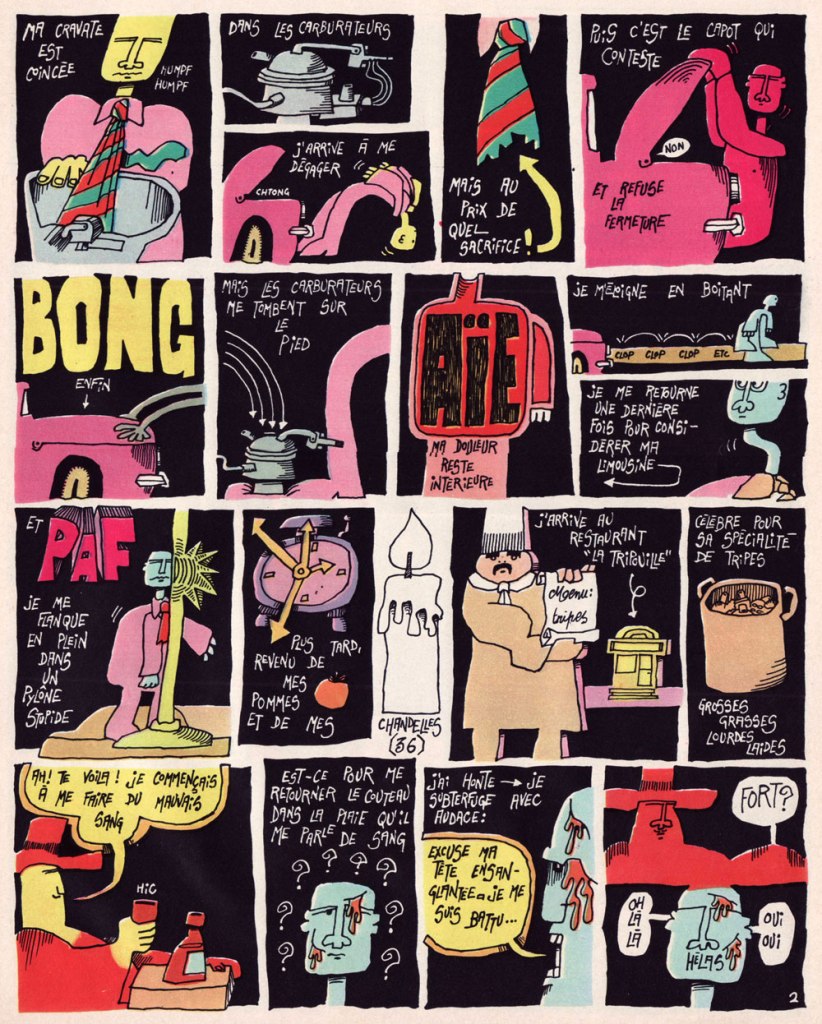
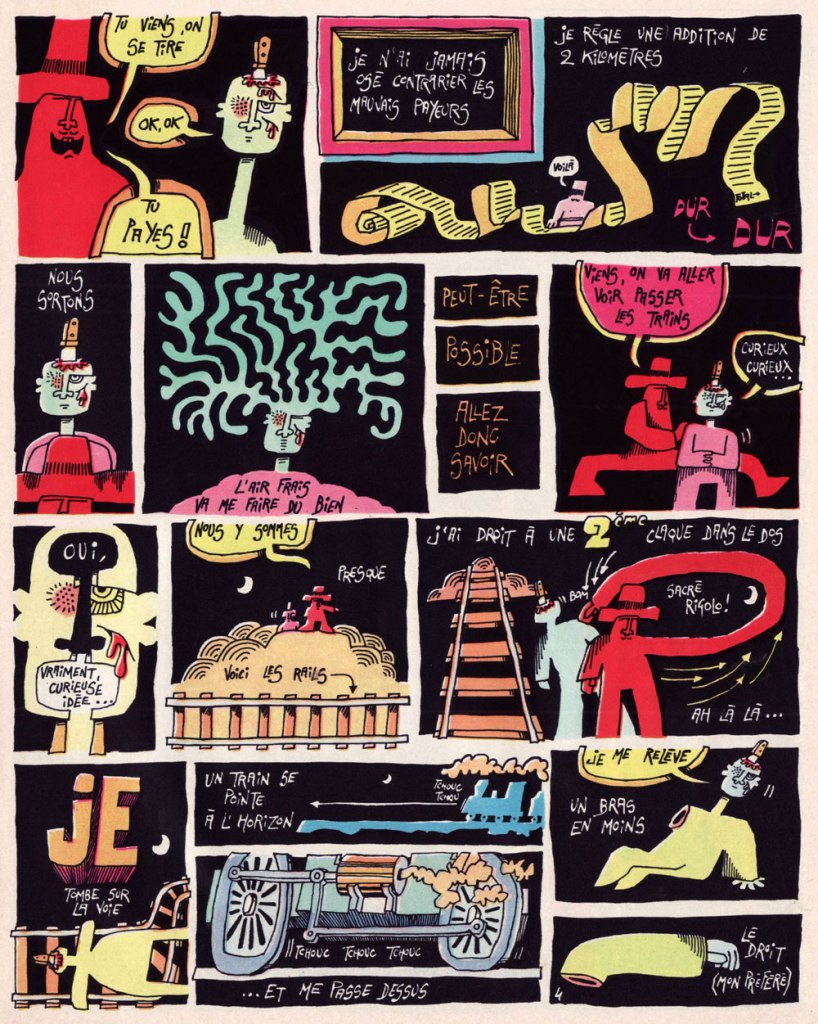
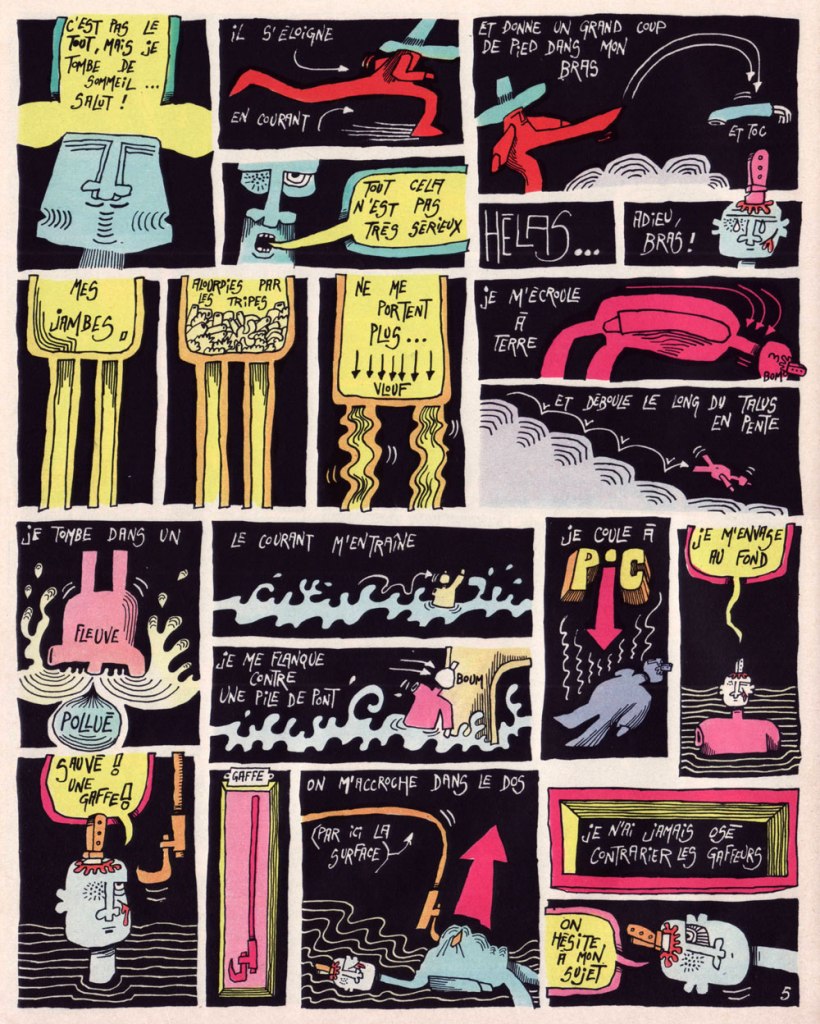
It would be terribly reasonable to presume that Patrice Leconte‘s elegant passage through the world of Franco-Belgian was, on the part of the future cinematic auteur (the Les Bronzés series, Monsieur Hire, Le mari de la coiffeuse, Ridicule, L’homme du train — my favourite, and even an animated film, Le magasin des suicides… quite a range!) some sort of dilettantish detour, but it wasn’t… is it ever? — quite so simple. As he recalls it:

« As a child, I dreamed of nothing but cinema. Well, I also dreamed of drawing. As they say, I went up to Paris and went to film school. But I kept on drawing. And I was a Pilote reader. I wrote to [ Marcel ] Gotlib, who responded, looked at my drawings, showed them to René Goscinny, who liked them, invited me to the office and found me likeable, published my drawings and encouraged me to carry on, which I did. For five years. 1970 to 1975. I was happy. Then I shot my first film [the frankly unpromising Les vécés étaient fermés de l’intérieur, co-scripted with Gotlib] and everything began to unravel, because I haven’t made anything but films since, and I gave up comics. »

La vie telle qu’elle est — a title that a cinephile of Leconte’s ilk could simply *not* have failed to nick from pioneering cinéaste Louis Feuillade (1873-1925, whose immortal Fantomas, Judex and Les vampires serials still thrill) and his 1911-1913 series of films bearing that name… seventeen in all!
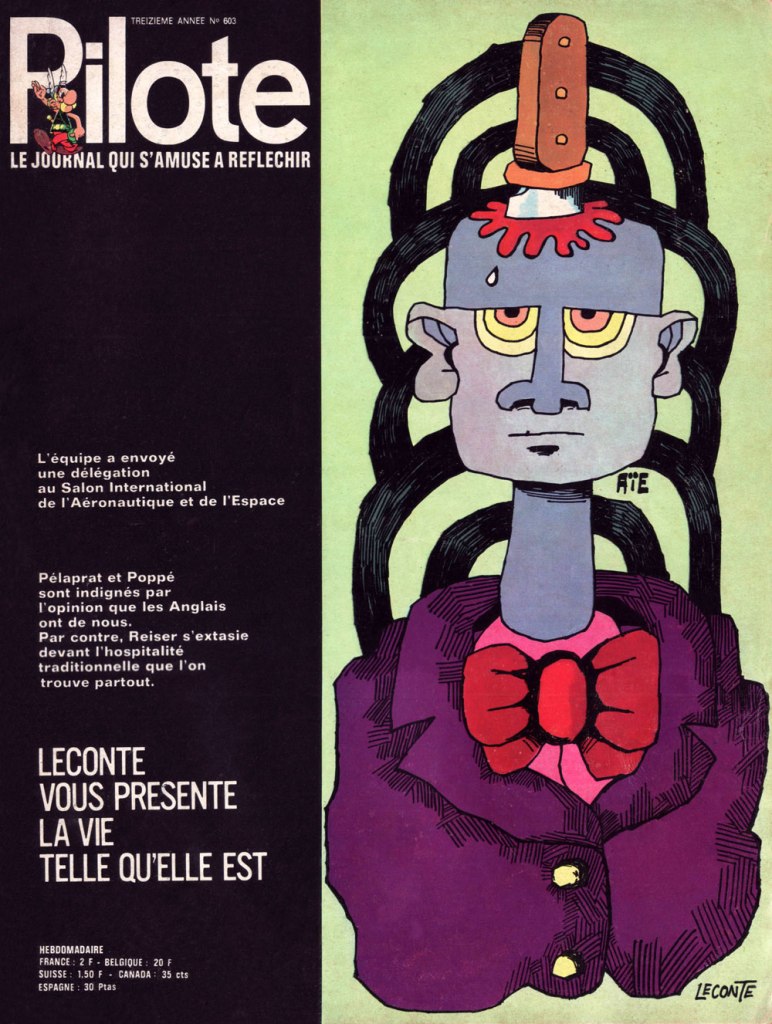
The tale appeared in Pilote no. 603 (May, 1971, Dargaud), and here’s the cover. René Goscinny, publication director; Jean-Michel Charlier and Gérard Pradal, editors in chief; Albert Uderzo, art director.

Humble to a fault, Leconte is well aware of his limitations as a “classical” draughtsman (largely beside the point in his case, imho, as he’s a superb designer and stylist):

« I think that my personal touch was tied to my drawing handicap, that self-taught aspect which meant than I absolutely had to find a workaround. I’ve always held to the rule that constraints constitute a first-rate engine of creation, coupled with the magical notion of “let us make qualities of our flaws“. Well, it works! »

By all means, read the full conversation with Leconte about his bédé days, conducted by Jean-Luc Brunet and Vivian Lecuivre en 2007. It is, however, in French, but we currently have the technological means to let you grasp the gist of it.

By the way, Leconte’s got a new feature out, an adaptation of Georges Simenon‘s 45th Jules Maigret novel, Maigret et la jeune morte (“Maigret and the Dead Girl“, first published in 1954), starring deplorable human being but splendid actor Gérard Depardieu. Among Simenon’s eighty Maigret books, this must surely be the most adaptable, as this marks the fifth time this novel is brought to the screen! The trailer looks great.

-RG

One Hundred and Eighty Bitter Years of Bierce

« Goodbye—if you hear of my being stood up against a Mexican stone wall and shot to rags, please know that I think that a pretty good way to depart this life. It beats old age, disease, or falling down the cellar stairs. To be a Gringo in Mexico — ah, that is euthanasia. » — Ambrose Bierce, writing to his niece in the fall of 1913.

There’s a profusion of biographical material out there on the topic of Ambrose Gwinnett Bierce (June 24, 1842- ??), but here’s a capsule version to get the preliminaries out of the way:

« Ambrose Bierce was an angry young man who got angrier as he grew older. His strong talent was directed always by bitterness and despair. His wonderful stories were weird, cynical, shocking. His life was restless, his temper outrageous, and his death violent. »

Bearce belongs to a select club of larger-than-life American literary figures (among which we might also encounter Messrs. Poe, Twain, Lovecraft, Hemingway, and perhaps Vonnegut), whose life and work inspired, and continues to inspire, countless adaptations in all media, imitations and parodies, appropriations. You know the drill: works by, works about, works starring the author as protagonist.

In addition to the expected adaptations of varying quality, Bierce’s own nebulous ending inspired both fiction (Gerald Kersh‘s 1957 short story ‘The Oxoxoco Bottle‘, in which the narrator discovers a manuscript, in Bierce’s hand, that recounts the extraordinary events that followed his disappearance) and speculative non-fiction, by which I mean Jake Silverstein‘s fascinating 2002 essay, The Devil and Ambrose Bierce: Well Met in Marfa, which you can read here).

There’s even an episode of Will Eisner’s The Spirit (July 25th, 1948) adapting Bierce’s The Damned Thing.

Since there’s so much to take in, I’ll fall back on my usual coping strategy, keeping my focus narrow to avoid (further) losing it. We’re going to explore my two favourite editions of a defining Bierce work, The Devil’s Dictionary, first published in 1906 as The Cynic’s Word Book.

Abasement, n. A decent and customary mental attitude in the presence of wealth or power. Peculiarly appropriate in an employee when addressing an employer.
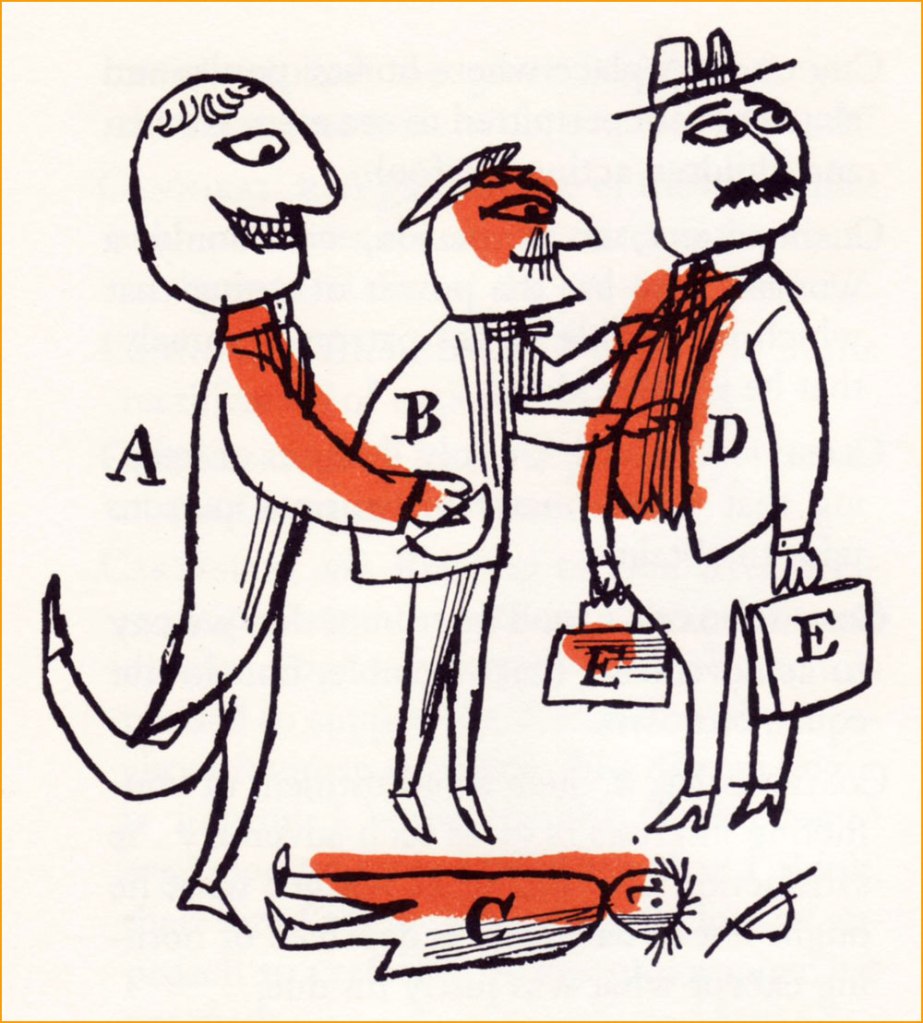
Commerce, n. A kind of transaction in which A plunders from B the goods of C, and for compensation B picks the pocket of D of money belonging to E.
Edible, adj. Good to eat, and wholesome to digest, as a worm to a toad, a toad to a snake, a snake to a pig, a pig to a man, and a man to a worm.
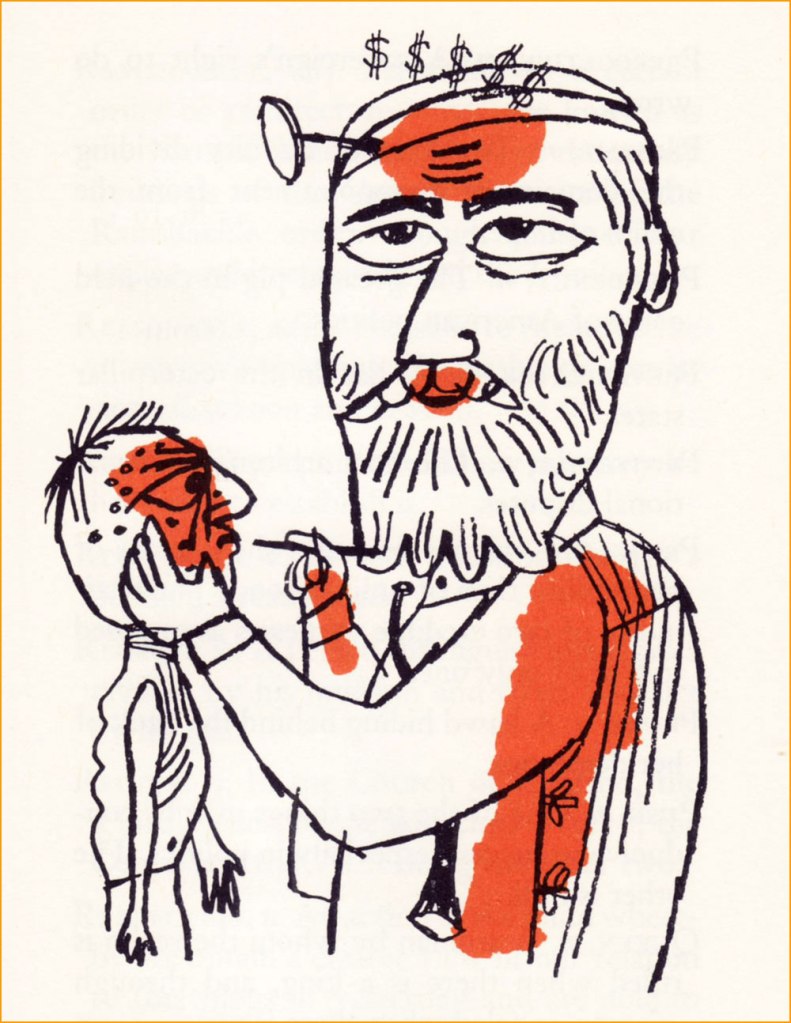
Prescription, n. A physician’s guess at what will best prolong the situation with least harm to the patient.
This lovely edition, featuring illustrations by Joseph Low (1911-2007) was published in 1958 by the Peter Pauper Press of Mount Vernon, NY. This, as it happens, was my introduction to the series, picked up at a long-gone bookstore during a 1992 visit to Victoria, BC, a city that last year finally broke with its proud, longstanding tradition (begun in 1894!) of dumping its raw sewage into the Pacific ocean, surely to the relief of most Seattlites.

Then in 1979 came along a most handsome edition (Thomas Y. Crowell, Publishers) boasting a wealth of illustrations by Egyptian-born force of nature Jean-Claude Suarès (1942-2013).

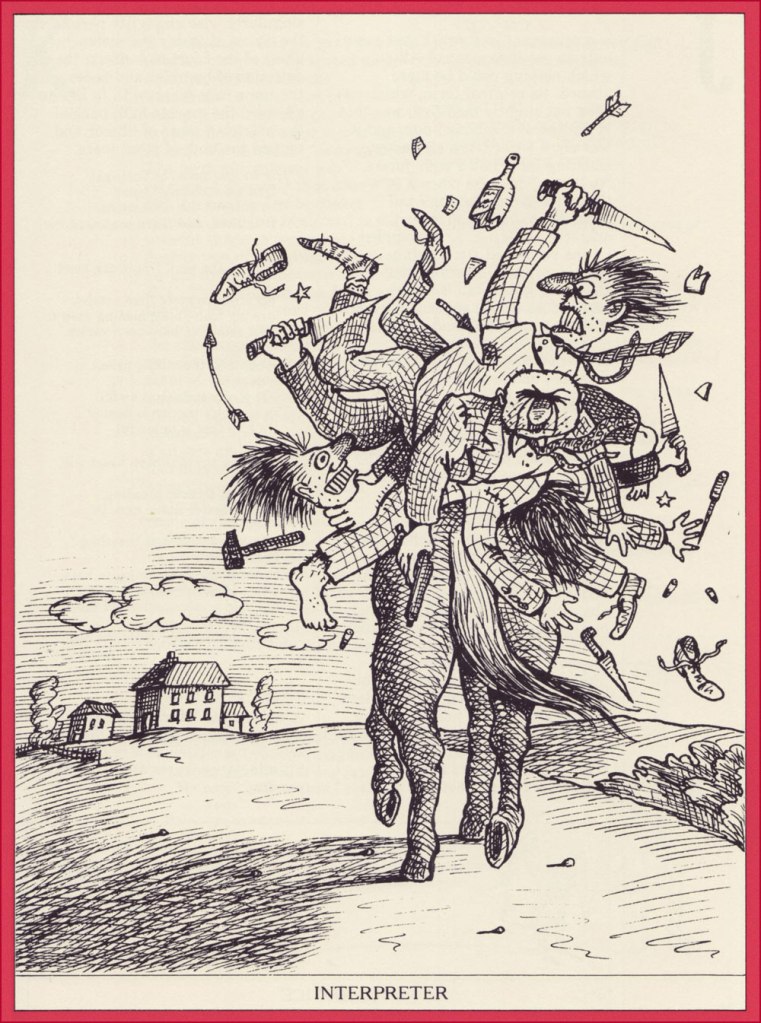
Interpreter, n. One who enables two persons of different languages to understand each other by repeating to each what it would have been to the interpreter’s advantage to have said.
Lawyer, n. One skilled in circumvention of the law.
Longevity, n. Uncommon extension of the fear of death.
Medicine, n. A stone flung down the Bowery to kill a dog on Broadway.
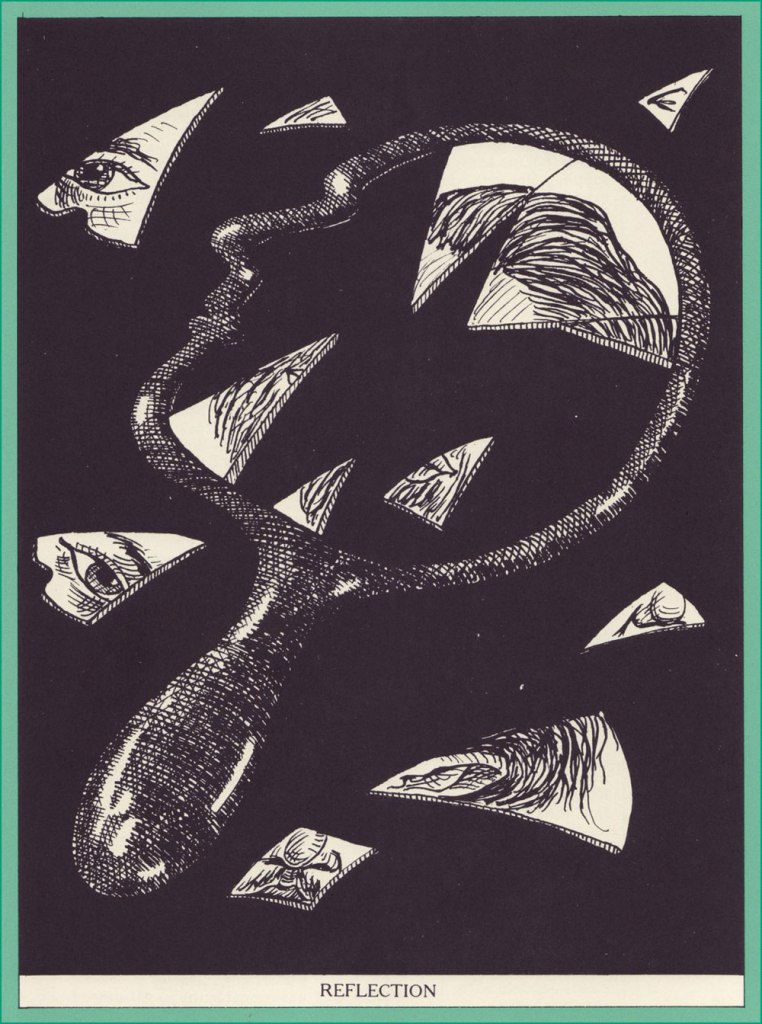
Reflection, n. An action of the mind whereby we obtain a clearer view of our relation to the things of yesterday and are able to avoid the perils that we shall not again encounter.
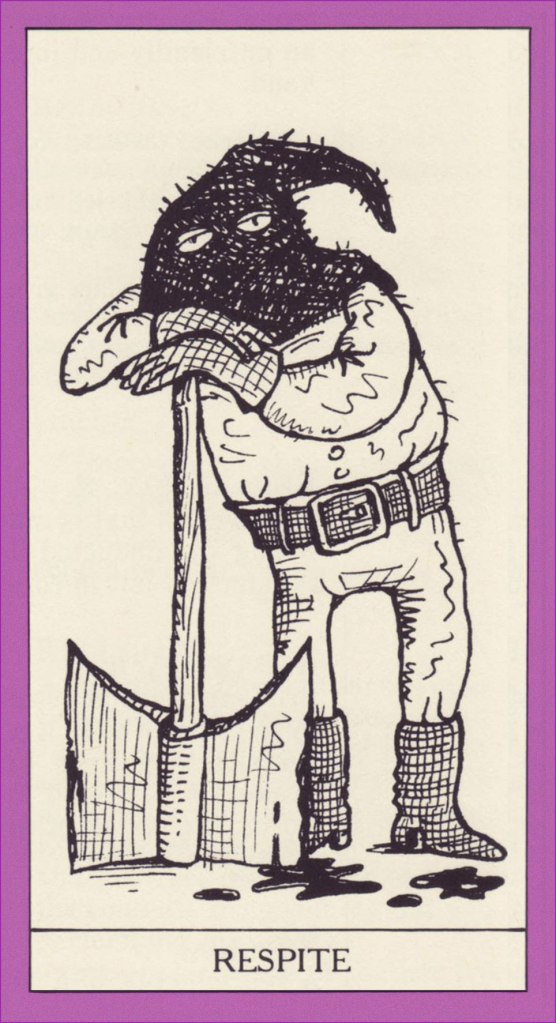
Respite, n. A suspension of hostilities against a sentenced assassin, to enable the Executive to determine whether the murder may not have been done by the prosecuting attorney. Any break in the continuity of a disagreeable expectation.
Witch, n. (1) An ugly and repulsive old woman, in a wicked league with the devil. (2) A beautiful and attractive young woman, in wickedness a league beyond the devil.

For the sake of comparison, here’s Mr. Low’s rendition of same:

.

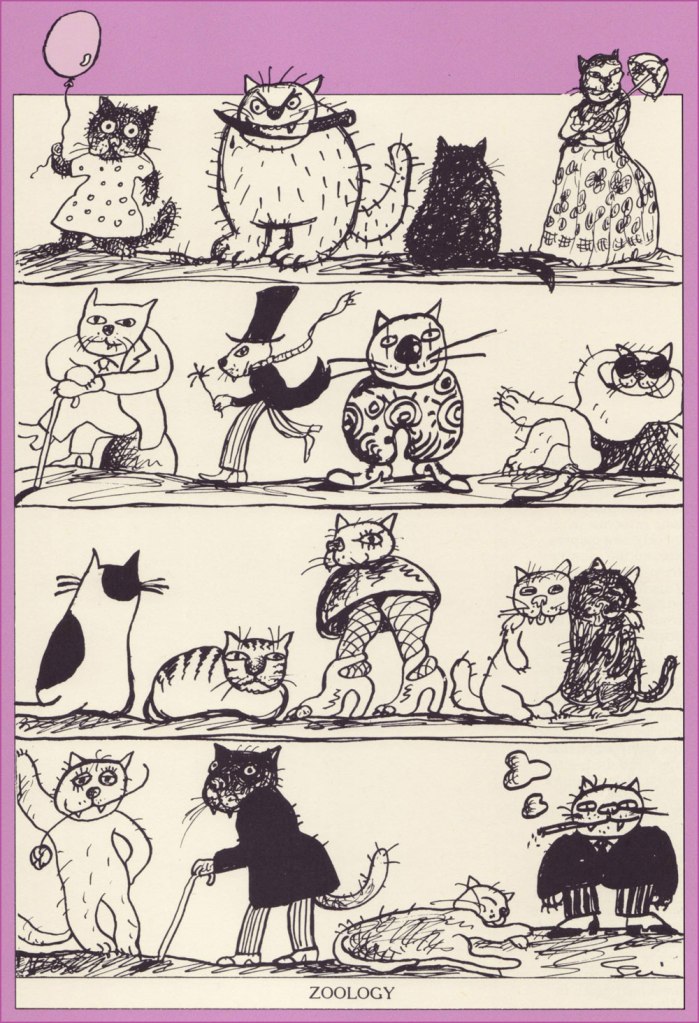
Zoology, n. The science and history of the animal kingdom, including its king, the House Fly (Musca maledicta). The father of zoology was Aristotle, as is universally conceded, but the name of its mother has not come down to us. Two of the science’s most illustrious expounders were Buffon and Oliver Goldsmith, from both of whom we learn (L’histoire générale des animaux and A History of Animated Nature) that the domestic cow sheds its horns every two years.

Happy 180th anniversary, Mr. Bierce, wherever you may roam!

-RG

Milutka’s Furry Flying Elephants

An elephant pink crawled outta the sink
and snuggled up in my bed
A purple mole’s in the goldfish bowl,
he’s trying to steal a drink
*

Today’s post was originally planned as a panegyric to Larry Marder’s Beanworld, but I quickly realized that attempting to write about it was a bit like trying to dissect a joke. Here I am, then, doing a 180 degree turn to talk about a Soviet cartoonist.

Evgeniy Milutka (Евгений Милутка, b. 1946) was a teacher of Russian literature by profession, but his proclivities clearly lay elsewhere. After teaching in middle school for a few years, he officially switched to the career of a cartoonist in the early 1970s, and quickly rose to the ranks of the best known caricaturists in the USSR, in part thanks to his long-lasting (from mid seventies to mid eighties) collaboration with satirical magazine Krokodil (see Krokodil Smiles: Cartoons in the USSR).

I am most interested, however, in the new, kid-oriented direction his work took in the 1980s, namely the cartoons/comics published within the pages of Веселые Картинки (something like ‘funny pictures’ in translation), a literature-bent humour magazine for kids. Founded in 1956, it was still sort-of around (with some financial issues) when I was a child, and my grandfather, who was always very preoccupied with making sure I grew up knowledgeable and smart (sorry, grandpa?), was kind enough to buy me a subscription.

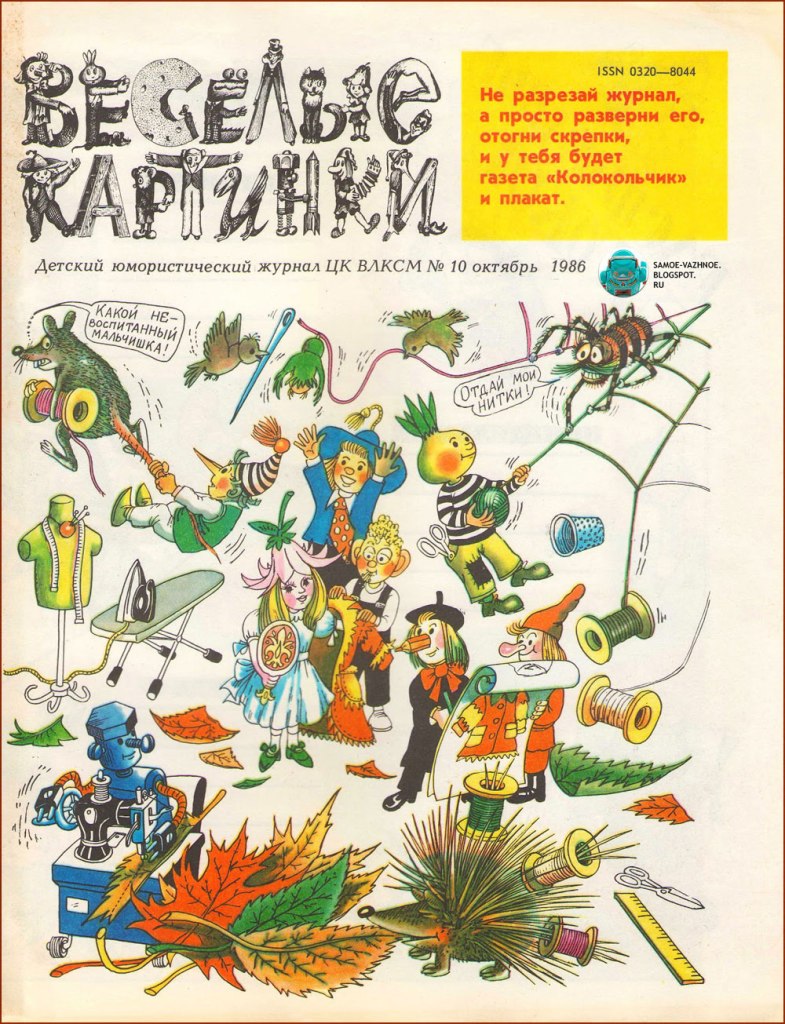
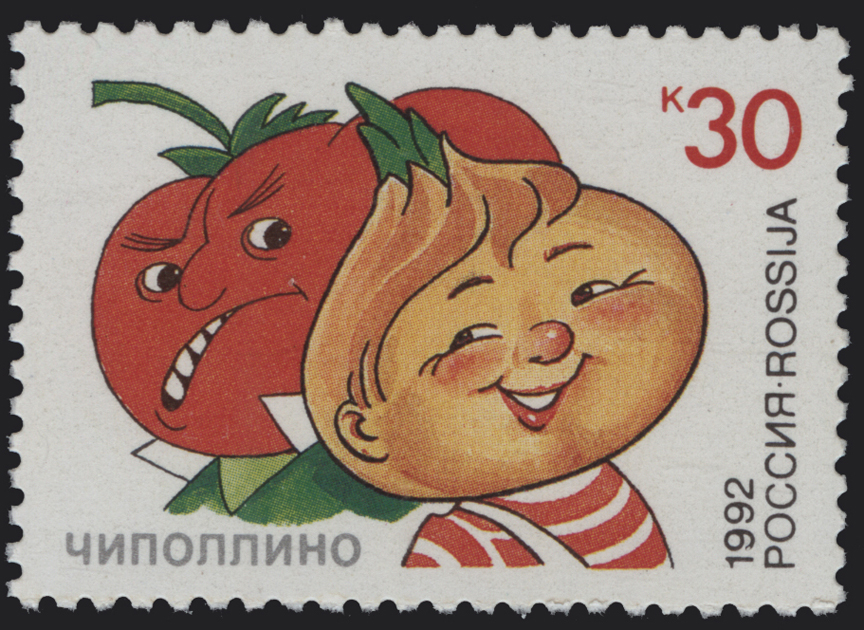
An issue from October 1986, with a cover by Milutka. It features the 8 ‘merry little people’ that were the mascots of this journal and whose adventures Milutka illustrated. This included Karandash (which in Russian means ‘pencil‘), the boy with the pencil nose; Cipollino (little onion), the boy with an onion head, from Gianni Rodari’s Cipollino, a tale that was so popular in the Soviet Union that we even have a Cipollino stamp; Buratino, the Russian Pinocchio; Neznayka, literally translated to ‘don’t know’, a favourite character from Nikolai Nosov‘s merry trilogy of fairy-tales; Petrushka, a character from Slav folk puppetry; Samodelkin, the boy robot whose name translates to something like ‘do-it-yourselfer’; Hurvínek, a character from a Czech puppet duo; and the only girl, Thumbelina.

The first thing that jumps out is that Milutka’s strips are really weird. Green elephants, watermelon men, mosquitoes capable of lifting a person, bats in a cavern made out of teeth, a giant spider wearing running shoes… a lot of it is most delirious delirium tremens. Milutka could aptly handle a variety of styles, but his basic, more recognizable modus operandi is extremely Slavic. The other interesting thing about his work, though you have to take my word for this, is how he squeezed in some distinctly unchildlike content into his strips. He was, after all, a caricaturist, with a keen eye honed by the sometimes subversive Krokodil.
Here is a selection from within the pages of Веселые Картинки from 1991 to 1996, which is pretty much the period I was able to follow in person.

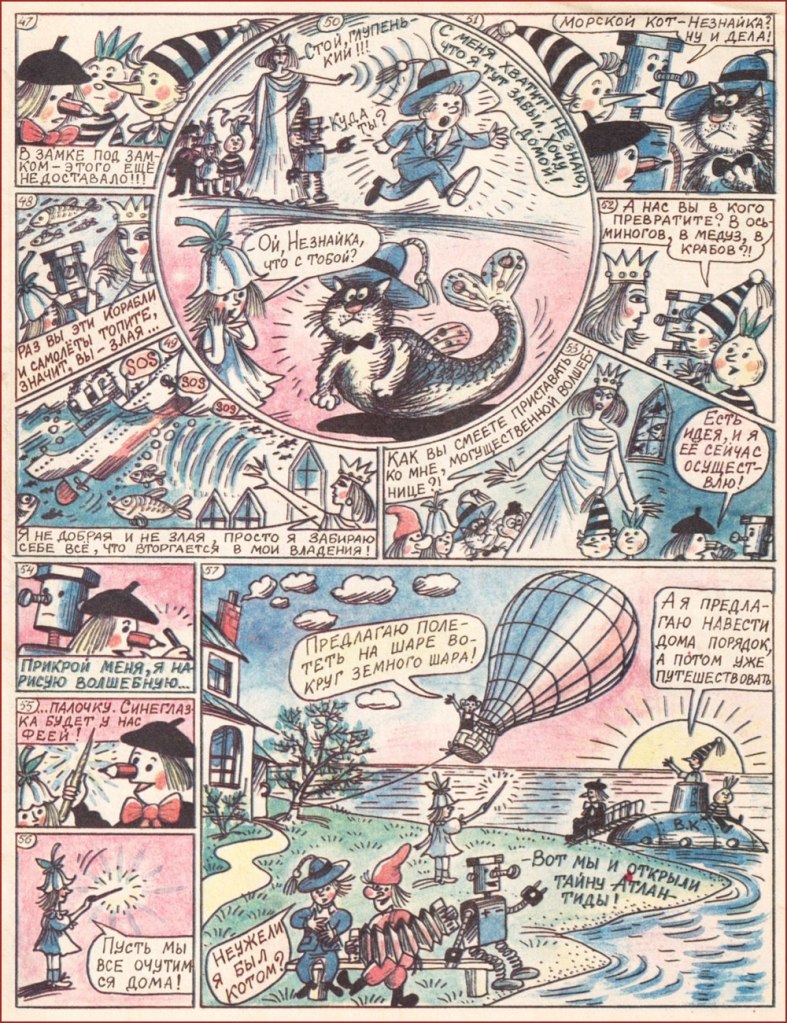
The sorceress gets accused of being evil by Thumbelina, ‘since you crash ships and airplanes‘. ‘I am nor evil nor good,‘ she responds, ‘I just take everything that barges into my kingdom.‘ Nezknayka gets turned into a mer-cat. (1991)
More metamorphosis! The kids keep asking the green elephant ‘what are you? Are you an ungulate? A mammal? Are you an insect? He’s probably an amphibian…‘ but to all their questions, he answers “I dunno…“, which is how they guess that it’s Neznayka in disguise. (1991)
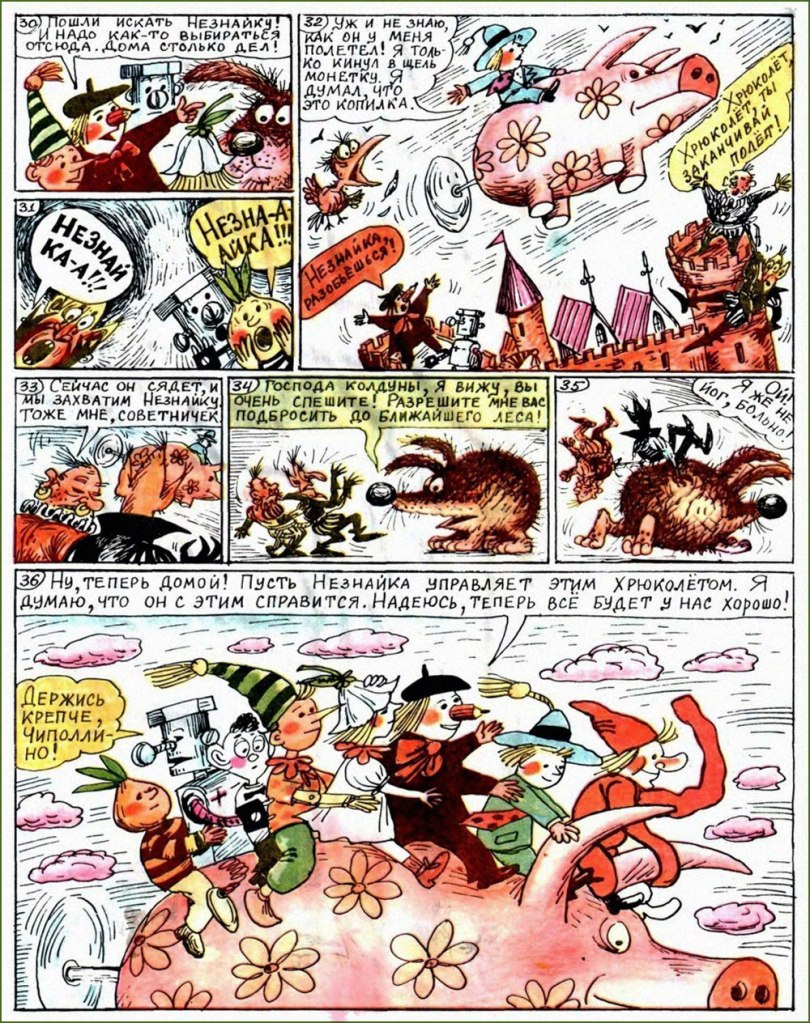
A sword-hog is turned back into a normal hedgehog once he’s fed an apple, and Neznayka, who’s named head advisor to the bad guys (everybody has untranslatable funny names), advises them to tie themselves together with a rope… (1994)
… after which the merry little people escape on a flying pig with a propeller in its ass (1994).
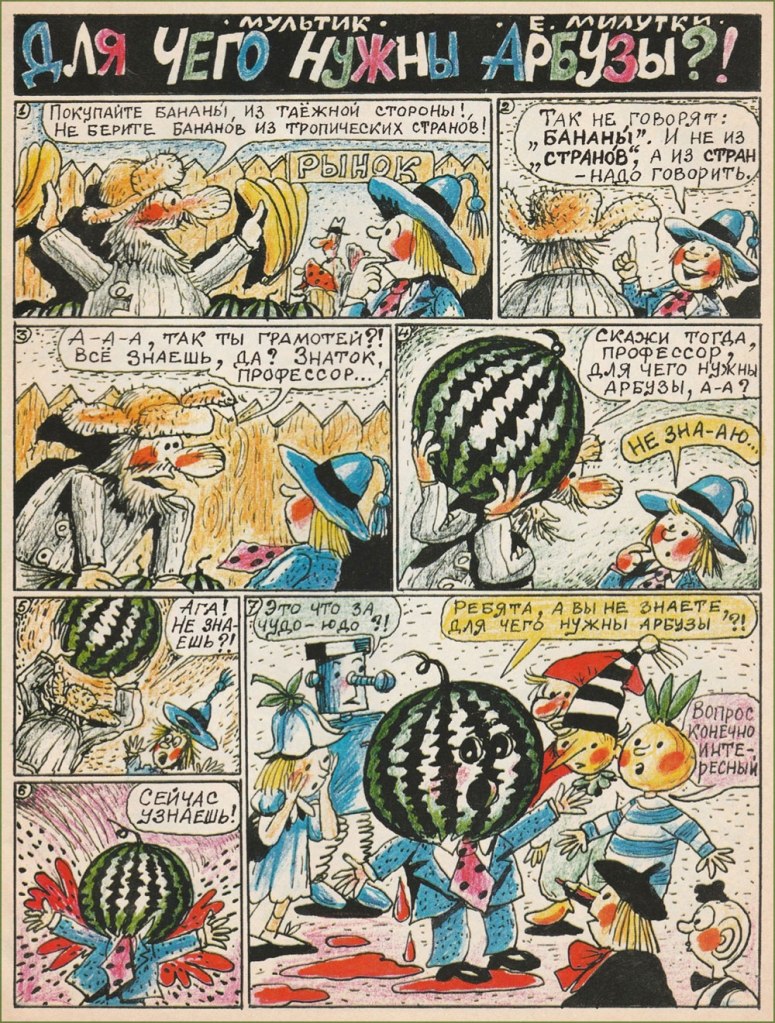
Watermelon man! “Kids, do you know what watermelons are good for?” “It’s an interesting question, of course” (1994).
This is spider named Filia, shod in very nice shoes. Isn’t he cute? (1994)
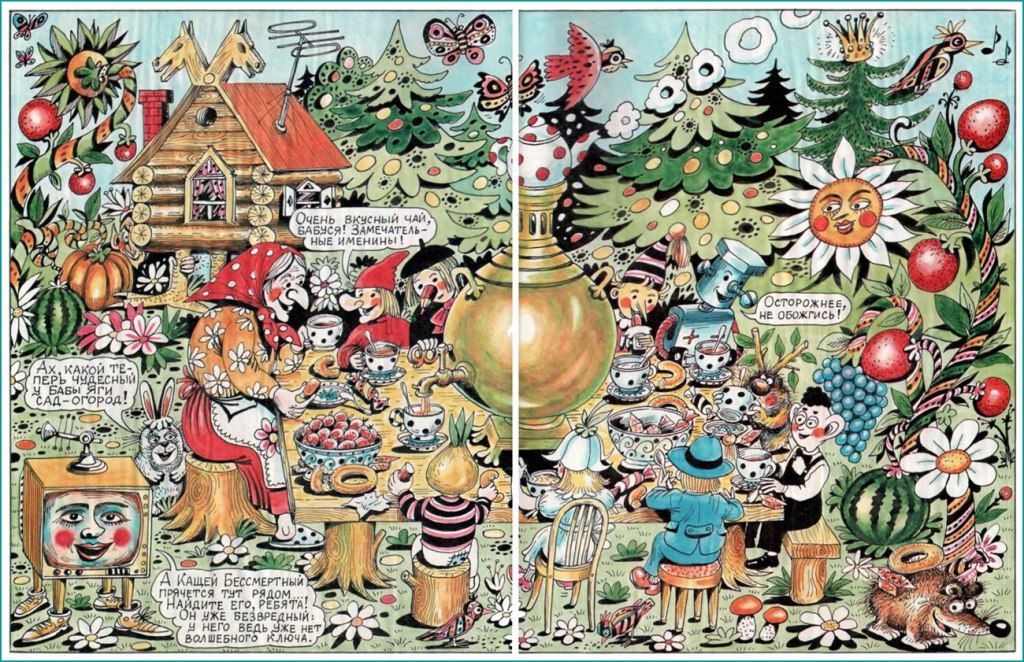
A splash page featuring a prototypical Babushka (actually a Baba Yaga in a good mood!) and an assortment of flora and fauna (1994)
After a lot of untranslatable puns on the word ‘vitamins’, the cat (who’s, once again, Nezknayka, having a pronounced tendency to transform into other creatures) is told to ‘eat the magic balls!‘ to turn back into himself. Thumbelina is also rescued from being… err, whatever that furry thing with the rolled-up nose is. (1995)
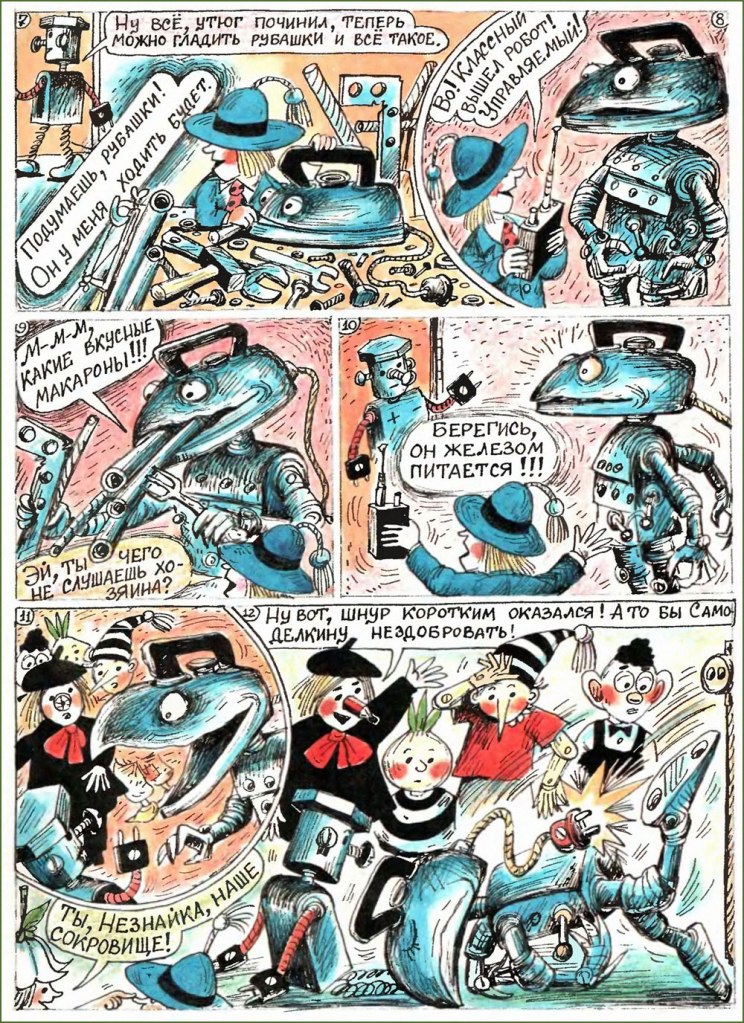
Neznayka invents a robot to do the ironing for him, but the robot is hungry for metal ‘macaroni’ (which we call anything pasta, usually some form of spaghetti) (1996).
A poster advertising the journal (1996), with mushrooms, a Pushkin reference, singing cats, some sort of flying elephant (?) with an accordion, a little furry bee-cat, and so on and so forth.

I hope you enjoyed these despite the language barrier! I’ll wrap this up with two fun illustrations from the early 90s:

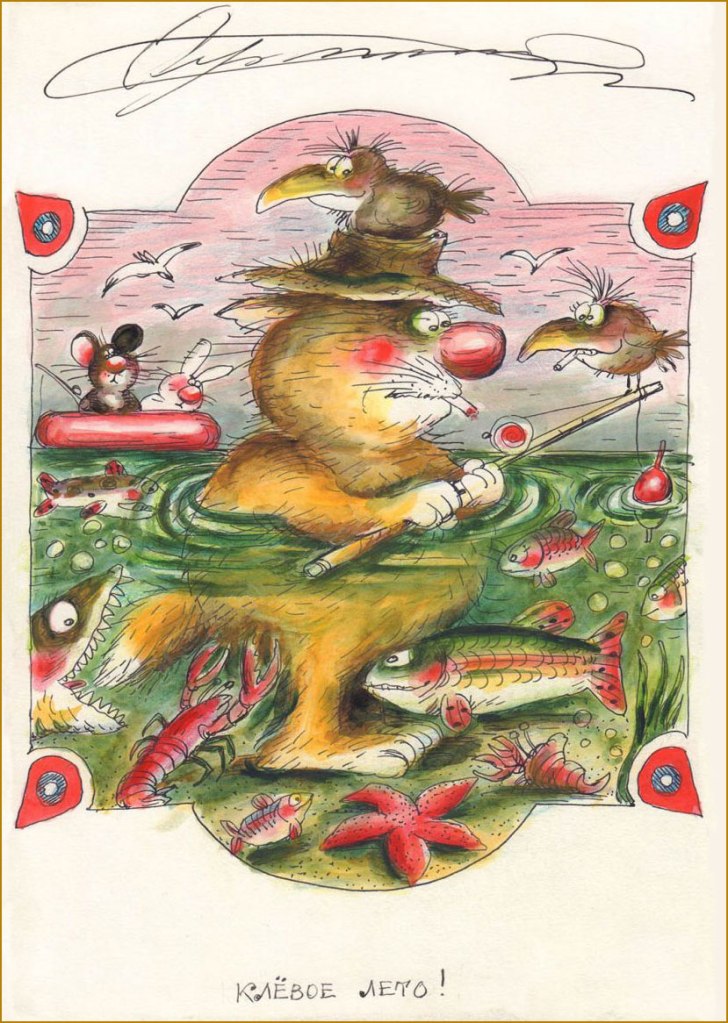
‘The flight of a bumblebee’
The title is a pun on fish biting and the summer being a neat one.

~ ds

*I See Them Everywhere!

Plastic Dog in a Plastic Age*

Given that I grew up in the days when PC games were just starting to be a thing (what a pleasure it is to reminisce about Secret Agent, Crystal Caves, or Jill of the Jungle…), anything pixelated immediately gives me a warm rush and a sense of pleasant nostalgia, be it the quiet appeal of Toyoi Yuuta‘s art or modern ‘pixel art’ games that go for that retro feel (the dark glory of Blasphemous, the cozy feel of Stardew Valley!). As for comics, I suspect most are drawn on a computer these days, but few of them use pixel art per se. One look at Plastic Dog, and it was puppy love, especially given its acerbic sense of humour.

Henning Wagenbreth, born in 1962 in East Germany (which is perhaps what partially gave him a lifelong anti-totalitarian stance), is an illustrator/graphic designer who actually excels in a number of techniques. Lambiek Comiclopedia touts him as ‘German pioneer in comics created with the computer‘; I don’t know enough about the development of electronically-drawn comics specifically in that part of the world to state that with certainty, although this is as good a time as any to mention that Peter B. Gillis and Mike Saenz‘ wonderful Shatter (1985-1988) is usually credited as the first significant comic book created on computer. Topic for another day, no doubt.

Be as it may, Wagenbroth did something interesting: he designed the strip Plastic Dog in 2000 specifically for perusal on early pocket computers (such as Pocket PC or Palm OS), which had a black and white screen of 160×160 pixels. In 2004, colourized versions migrated to weekly newspaper Die Zeit, printed within its pages, but also available as downloads on their website.

The French publisher L’Association released a 26-page collection of Plastic Dog strips, translated into French from German by Eugénie Pascal. As far as I know, no official English translation exists, aside from maybe one or two random strips (probably translated by Wagenbreth himself). The following pages are scans from this French edition.

Dead Wood. Plastic Dog calls the police to report a stolen wooden cabinet, to find that it’s been removed by the Tree Liberation Army, who bury their ‘felled, deported, dismembered and abused’ friend in the tree cemetery.
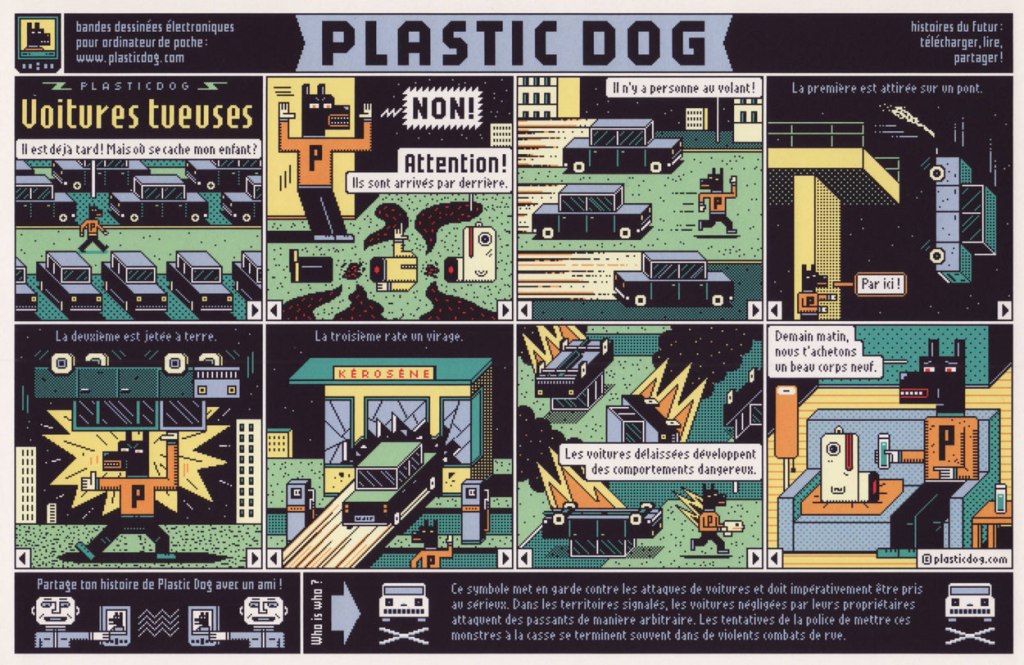
The Killer Cars. Plastic Dog goes out to search for his missing child, to find the latter in pieces after being attacked by driverless cars gone rogue. In the final panel, PD says ‘tomorrow, we’ll buy you a nice new body’.
Nothing Ever Happens. ‘A grey day, pure boredom’, bemoans Plastic Dog, ‘I am always in the wrong place at the wrong time, and everything is so predictable…’
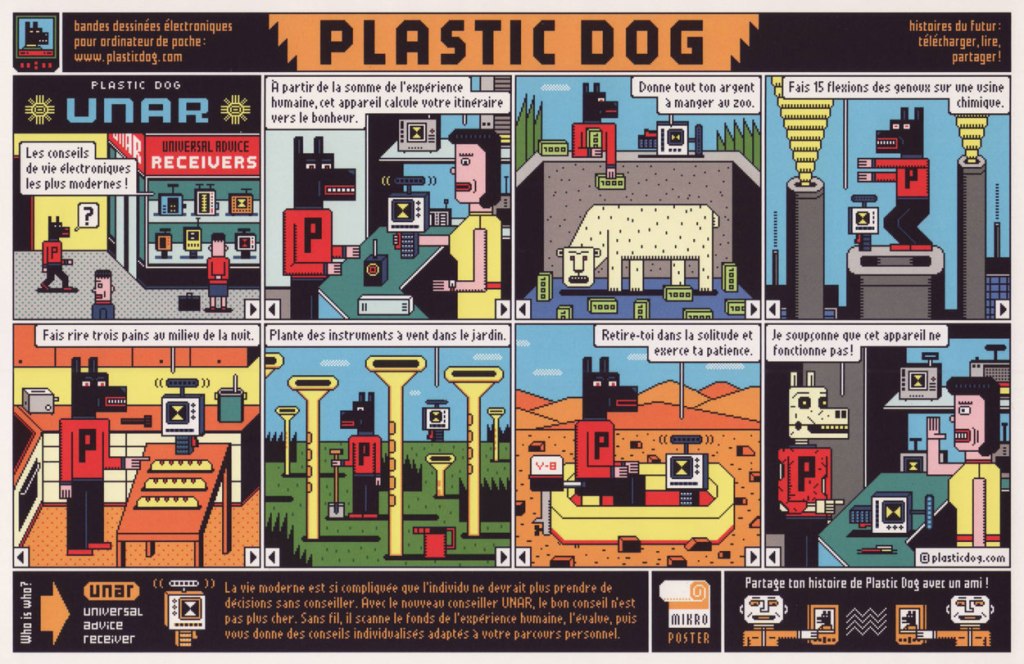
In his never-ending search for new experiences, Plastic Dog stumbles upon a device that proffers guidelines to achieve maximum happiness. Its instructions are not devoid of poetry: ‘give all your money to be eaten by zoo animals’, ‘do 15 squats on top of a chemical factory’, ‘make three loafs of bread laugh in the middle of the night’, ‘plant wind instruments in the garden’. The final piece of advice (‘withdraw into solitude and practice patience’) is what seems to defeat PD’s enthusiasm (seems like in his world, getting lost in the desert is the only way to solitude…)

The following is the last PD strip, and readers are thanked at the bottom for their many emails and downloads. There’s also something about a free TV as a reward, but I wouldn’t bank on it 😉

A family visit to the zoo! Touted as the last surviving specimens by the guide, these animals may not quite be what they seem. The flamingo complains, ’12 hours standing on the same leg!’, but Plastic Dog argues that having to constantly hang upside down is much worse.

Wagenbreth recently had an exhibition at Montréal’s UQAM university, which to my regret I completely missed… due to finding out about it far too late (i.e. now). Here is the poster for it:

~ ds

* « Every day my metal friend
Shakes my bed at 6am
Then the shiny serving clones
Run in with my telephones »

Desclozeaux, Vintner of Dreams

« Juggler of eccentric ideas, more poetic than truly macabre, Desclozeaux is served by an admirable technique that aligns him with the clan of Folon and Flora, which is to say designers for whom white space holds as much– if not more — importance than the line, the arabesque or the scroll. » — Jacques Sternberg and Michel Caen (1968)

Since the world seems to be crashing down around our ears, I figure it would be reasonable to focus on an artist who’s well-adjusted, happy, prolific, casually brilliant and, to top it off, still alive at a ripe old age. Meet, then, if haven’t already, French national treasure Jean-Pierre Desclozeaux, who will, if I’m not jinxing it for him, turn 84 this coming 5th of June.

Jean-Pierre began his career as a watercolourist and poster designer, studying under the legendary Paul Colin.

A sample of his early poster work. In this case, the client was an antique dealers’ fair.

In 1965, he branched out into press illustration and cartoons. Here are a few early samples of this endeavour:

If Wikipedia will forgive me, I’ve cribbed and translated this bit for our English-only readers: « In 1968, he began his collaboration with Le Nouvel Observateur, where he published at least one drawing each week. From that point on, Desclozeaux devoted himself almost exclusively to the press and publishing areas : satirical drawings, book and magazine illustration, posters for exhibitions and shows, postcards, book jackets. »

This one, from 1982, is entitled Songe d’une nuit d’été, which happens to be the standard translation of Shakespeare’s “A Midsummer Night’s Dream”… but with more bikes.
A pair of watercolours from his book Entre chiens et chats (1983).
He also created scores of theatre posters, such as this one for Paris’ Le Caveau de la République, circa 1986. The play’s title, which translates to “Hands off my vote”, was a riff on French anti-racism organisation SOS Racisme‘s slogan, namely Touche pas à mon pote (Hands off my pal).
This caricature festival’s most appropriate host city has been renowned for its images d’Épinal (“Epinal Prints“) since the late 18th century.
A piece entitled À la pointe du rat, a homophonic calembour on Pointe du raz, a spectacular promontory in France. “Raz” translates as “strait”.
This piece appeared on the cover of Télérama (France’s TV Guide equivalent, but inevitably a bit smarter) for its Jan. 30, 1991 issue. The headline asks “Has Television Changed Our Unconscious?
And here’s our cheeky bon vivant. Desclozeaux, whose beard was described by his friend Ronald Searle as “an enchanted space and a hideout for secrets and legends“.
A 2006 wine ad… as you can plainly see. This sort of irreverence seems largely lacking in North American advertising.

This post’s title hails from the term of endearment and respect bestowed upon Desclozeaux by no less a personage than his affichiste confrere, Raymond Savignac (1907-2002). This reference to wine-making presumably alludes to his long-standing graphic contributions to sundry gastronomic columns. In 2002, Albin Michel even issued a heady cuvée of his wine-imbibed cartoons, Cul-Sec!*

-RG

*approximately meaning ‘bottoms up!‘ or ‘down the hatch!’ — here are some hilarious mispronunciations of ‘faire cul sec’.

Meet Peyo’s Perspicacious Poussy

Mention Belgian artist Peyo (real name Pierre Culliford, 1928 -1992) and the first thing that comes to mind is his hugely popular Les Schtroumpfs, introduced within the pages of his strip Johan et Pirlouit. Les Schtroumpfs, of course, are Smurfs, those blue humanoid creatures living in mushroom-houses in the forest. When I was just starting tentative forays into comics during my shy youth, it’s the local library’s Smurf albums that first attracted my attention, alongside Uderzo and Goscinny’s Astérix le Gaulois and Roba and Rosy’s Boule et Bill.

Another strip I really liked, unaware that it was created by the artist responsible for the Smurfs, is Poussy. Despite competing with all the other cat adventures one can think of (although there are far more today than there were twenty years ago), it was its old-fashioned charm that drew me in. This was a world where rambunctious (but always well-meaning) boys roasted chestnuts in a fire, mothers in high heels burned their Sunday roast, and families always went to the beach for their vacation. I wasn’t interested in these (human) characters, but they made a perfect backdrop to cat antics, comforting like watching cartoons on a rainy day.

The first Poussy album I found at the local library (1977, Dupuis).

21-year old Peyo drew 26 black-and-white gags of Poussy for the humble youth section of Belgian daily newspaper Le Soir between 1949 and 1951. Here’s an example of one of these early manifestations of Poussy, a playful black-and-white cat, up to very normal cat mischief:

‘Poussy is ambitious’, printed in Le Soir no. 175 (July 1949).

When Le Soir decided to revamp its youth section into a more ambitious version titled Le Soir Jeunesse, Peyo, who had been concentrating on his Johan series (later to become Johan et Pirlouit, or Johan and Peewit in English) for Journal de Spirou, revived Poussy, and this frisky kitten frolicked once again between Le Soir‘s pages from 1955 to 1960. Set aside again to make room for more ambitious endeavours (namely, Peyo’s Benoît Brisefer series) at the behest of publisher Charles Dupuis, for whom Peyo was working concurrently, Poussy tiptoed back into life in 1965, this time in Journal de Spirou, in colourised re-runs of previous Le Soir material, published quite out of any chronological order.

Here are a few favourites from these re-runs — I mostly chose mute strips, both because Poussy’s expressive meowing needs no translation, and because I by far prefer jokes centered on his behaviour without too much human interference.

Gag no. 11, published in Spirou no. 1552 (January 1968).
Gag no. 24, published in Spirou no. 1514 (April, 1967).
Gag no. 85, published in Spirou no. 1523 (June 1967). One can argue about the originality (or lack thereof) of Peyo’s style ’til one is blue in the face, but Poussy’s spot-on expression and body language in the last panel are unarguably perfectly executed.
Gag no. 105, published in Spirou no. 1528 (July 1967). This must have been a rare ‘be kind to mice’ day.
Gag no. 124, published in Spirou no. 1450 (January 1966). ‘I’m done, and it smells wonderful! What hard work! But it doesn’t matter, I am thrilled with the results! You see that one can easily create an expensive perfume at home!
Gag no. 138, published in Spirou no. 1636 (August 1969). The final panel advertises milk-based soap.

It was only in 1969 that Peyo resumed the production of new strips, starting with gag no. 222… and by no. 233, he had a collaborator, Lucien De Gieter, who soon took over entirely as Peyo had far too many other series on his hands to be able to continue Poussy. De Gieter continued the strip until 1974.

There have been three albums collecting Poussy material, published in 1976 and 1977 – and last year, Dupuis published a very handsome and very complete collection of all Poussy strips (a painstaking and impeccable chronological presentation, accompanied by exhaustive publishing information) which I purchased at the excellent comic-and-book store Débédé in Montréal, Québec. One doesn’t always feel like revisiting books from one’s childhood (for instance, I have little desire to ever reread Boule et Bill), but in this case I spent a few warm moments smiling at the strips I remembered surprisingly well.

~ ds

Dreams of the Rarebit Little Ego

« RAREBIT n. A Welsh rabbit, in the speech of the humorless, who point out that it is not a rabbit. To whom it may be solemnly explained that the comestible known as toad-in-a-hole is really not a toad, and that ris-de-veau à la financière is not the smile of a calf prepared after the recipe of a she banker. » — Ambrose Bierce, The Devil’s Dictionary

It’s dicey to make a broad generalization about what people have heard of and what they haven’t, so I’ll just say that, for a comic strip more than a century old, likely Canadian Winsor McCay‘s Little Nemo in Slumberland is rather well remembered (and represented) in the greater culture.

The strip has inspired numberless adaptations and the cultural landscape is quite peppered with Nemo references, both overt and veiled.

In the early 1980s, Italian cartoonist Vittorio Giardino (1946–) created a series of short pieces (first published in issues of Comic Art and Glamour International), intended as an erotic pastiche of McCay’s brainchild.

Here are the Little Ego pieces I value most.

I must admit I only enjoy the earlier, less grandiose ones, in no small part because they’re scarcely Nemo-like. Instead, they’re patterned after an earlier McCay creation, and my personal favourite, Dreams of the Rarebit Fiend (1904-25), which I’ve long treasured in its beloved and exemplary Dover collection.

« I wonder what’s come over me to have such dreams… I’ll never be able to speak of them… even to my shrink!! »
Here’s the cover art of the original French collected edition (1989, Glénat).

To quote the late cartoonist and local favourite Richard Thompson:

« There are strips that are classics that I respond to on many levels without loving them (Little Nemo is one). I can enjoy such strips without really learning too much from them. »

I share Mr. Thompson’s ambivalent sentiment about Nemo. It’s an indisputable masterwork, mind-bogglingly accomplished, and best enjoyed in its original size.

See what I mean? An original-size Little Nemo showcase cleverly included in Graphis Magazine‘s Comics: The Art of the Comic Strip (1972, The Graphis Press, Zurich).

But its epic scale and themes fail to move me. I far prefer the quotidian-turning-absurd magic of the Rarebit Fiend.

At length, feeling perhaps constrained by the two-page format, Giardino moved on to a longer, sustained narrative full of aerial derring-do, treacherous desert vistas, opulent palaces, and lots and lots of rapes (a fumetti standard). Not my thing, thanks all the same.

I drew from the French edition of the strip since it’s the one I own, but also for its superior reproduction and as the English translation is rather flat and witless in comparison. [ see for yourself! ]

Here’s a tasty pair of sample Rarebit Fiend strips.

… and we return to Richard Thompson, who introduced his own ‘strip within a strip’ parody with Little Neuro within his Cul de sac (2004-2012).

Cul de sac’s March 26, 2008 daily, wherein Little Neuro is first touched upon. « Little Neuro is a parody/homage to the great fantasy strip Little Nemo in Slumberland. I thought up Little Neuro in the early ’80s, but I had to invent Petey before I knew what to do with it. »
Cul de sac’s Sunday, September 6, 2009 strip. Thompson: « Obviously an excuse to draw a dragon. I don’t get many. »

-RG