Jean Bosc and the Kindness of Posterity

« In man’s struggle against the world, bet on the world. » – Franz Kafka

Time for another entry in our leisurely, unsystematic and subjective survey of Europe’s most significant panel cartoonists. Today, we examine the life and work of Jean-Maurice Bosc (1924-1973).

His is a familiar story: guy goes to war, comes home changed (likely suffering from what was once called ‘shell shock’, then ‘battle fatigue’, and nowadays ‘post-traumatic stress disorder’ — “burying the pain under jargon“, as George Carlin put it), can’t return to old routine in the family vineyard, tries other tacks, decides on drawing; looks for gainful employment, starting at the very top, miraculously gets in. Thrives for several years, producing well over 3000 drawings, seeing print in countless magazines all over the globe. Then it turns sour.

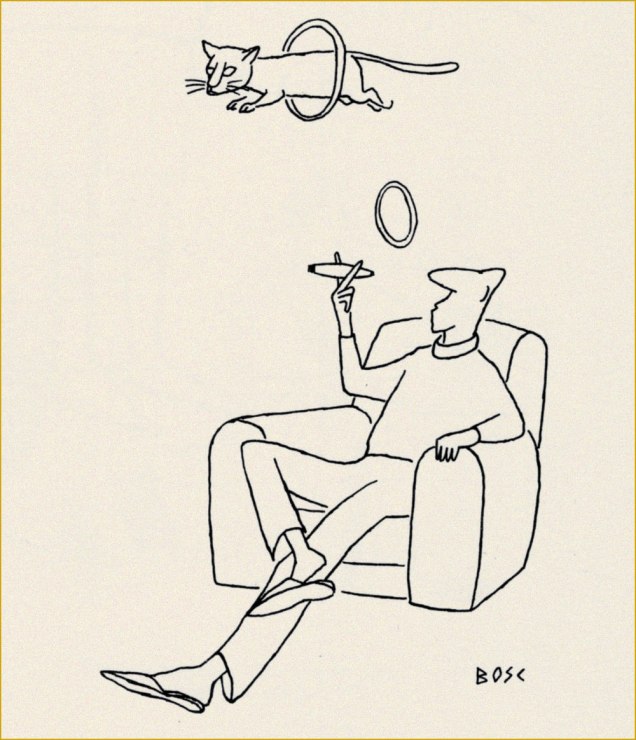
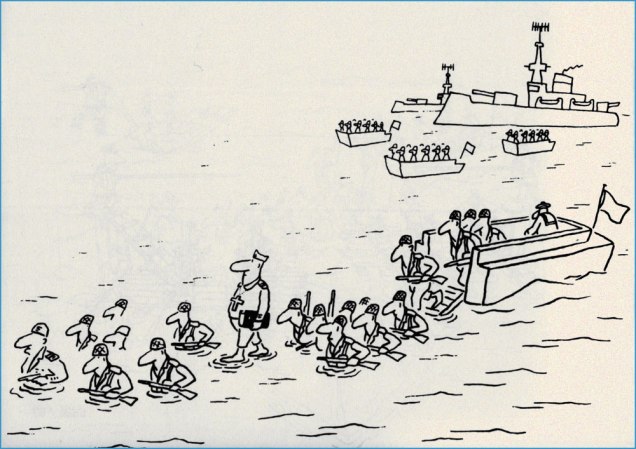
Originally published in Paris-Match, this one landed successfully in Best Cartoons From Abroad 1955 (Crown, 1955; Lawrence Lariar and Ben Roth, editors).
Another Paris-Match cartoon, it was reprinted in Best Cartoons From Abroad 1958 (Crown, 1958; Lariar and Roth, editors).
Sometimes gallantry just isn’t enough.

Jacques Sternberg wrote, in Les chefs-d’œuvre du dessin d’humour (1968, Éditions Planète):

« Returned in a highly weakened state from Over There, Bosc, resigned to forced rest, began to draw after falling in love with the drawings of Mose and Chaval. Over a few months, he produced hundreds of drawings, giving the humorous arts, without even realising it, a most singular starkness, a particular line that belongs quite exclusively to Bosc, though it’s been much and often mimicked since.

It was in 1952 that Bosc went up to Paris. Eight days later, a stroke of luck: he lands a whole page in Paris Match, which was to turn him into one of the magazine’s stars. »

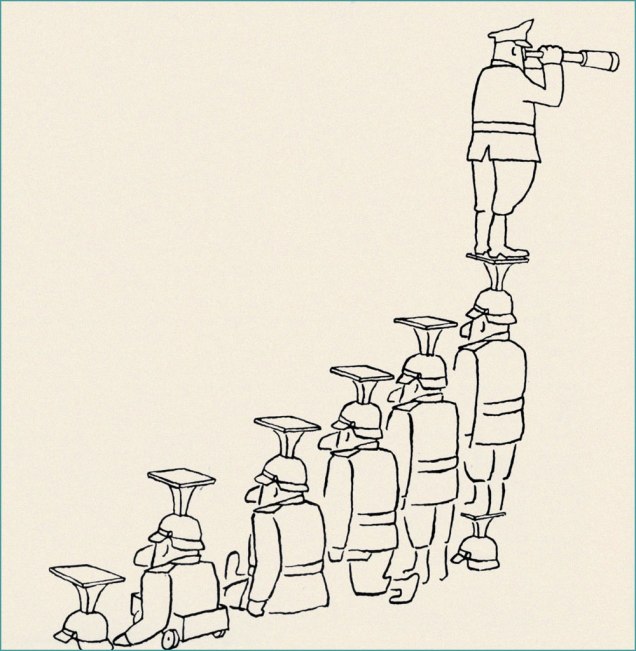
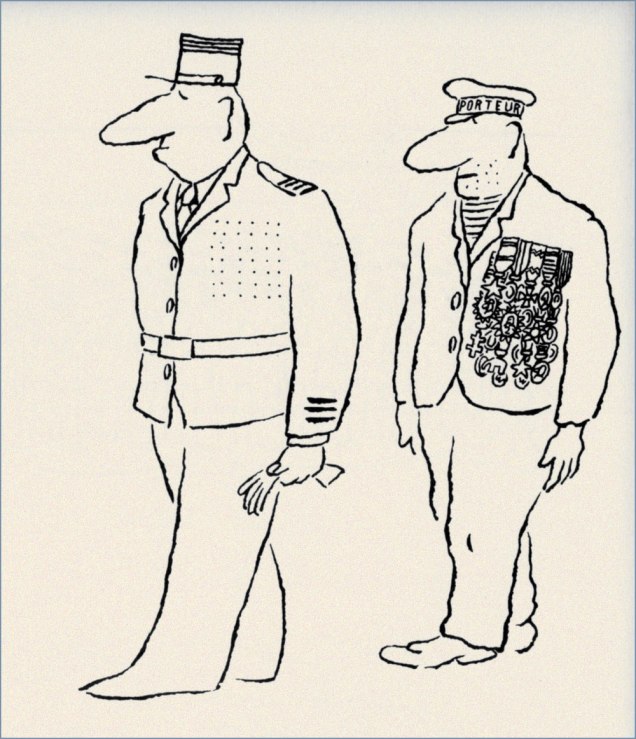
Hierarchy explained in one picture.
The Touring Club de France (1890-1983) was a French social club devoted to travel, founded by enthusiasts of the vélocipède. We are told to « Please leave this place as clean on leaving as you would like to find it on entering », although ‘en vous retirant‘ might be more faithfully translated as ‘upon pulling out‘.

« After spending three years mindlessly obeying orders, two of which in the Vietnamese jungle, Bosc was severely traumatized. “After what I’ve witnessed in Indo-China“, he wrote, “I could no longer eat or sleep, ever.” He later told his sister that he had shot dozens of fellow soldiers, saw gruesome fights and, while imprisoned, heard prisoners being tortured. She recalled that he could no longer stand loud noises and got furious whenever she wanted to kill a mere spider. Bosc became a lifelong opponent of war and militarism. »

Also, he was right: one shouldn’t kill spiders.

Just in case anyone’s not yet familiar with the Venus de Milo
The feat of walking on water is actually not strictly associated with Christian myth: ninjas also reportedly do it.
« Porteur », as you’ve surely surmised, means ‘porter’ or ‘carrier’.

Like most of his friends and colleagues, « … Bosc had lived through the Nazi occupation in World War II. After the Liberation, he felt disgusted by his country’s attempts to keep subjugating their overseas colonies to similar oppression and exploitation. President Charles de Gaulle was the sum of everything they hated: a conservative politician who didn’t agree with the growing sentiment of anti-colonialism, the sexual revolution and disregard for Church, army and family values. Bosc often ridiculed De Gaulle in his work. Once, the cartoonist was fined 3,000 francs, with a month’s probation, for daring to mock the army in a magazine. Bosc’s work revealed he had no respect for politicians. Interviewed by Paris Match in 1965, Bosc claimed that Alexander the Great was his “favorite great statesman, since he died at age 33.” » [ source ]
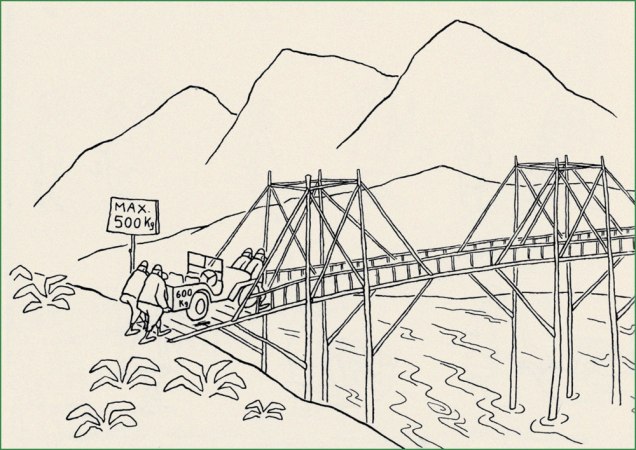
A stellar example of military logic.
This way, at least *everyone* gets to keep dry.
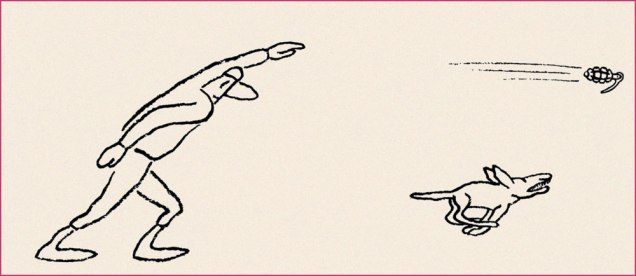
Here’s a video of a guy launching a hand grenade into a frozen lake.
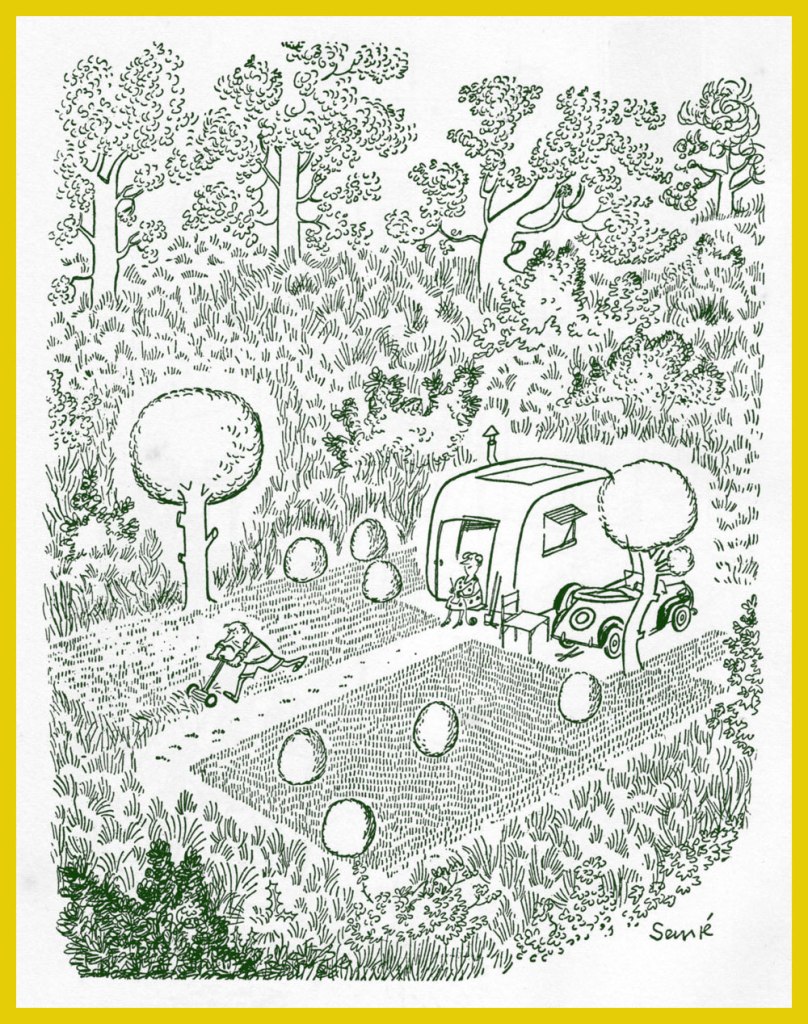
This one just might be Bosc’s single best-known cartoon. It goes: “My castle”; “My mill”; “My dog”; “My car”; “My farmer”; “My wheat”; “My bull”; “My wife”; “My guard”; “My pool”; “My garden”… “My ass!”.

I won’t gloss over the tragedy of his final years:

« Tragedy struck in 1968, when his good friend and colleague Chaval committed suicide. In June 1969, Bosc had a mental breakdown and was hospitalized. Suffering from an illness depigmenting his skin, he weakened more and more, often to the point of no longer being able to stand on his own two feet. He went in and out of clinics, even tried electroshock therapy, but nothing helped. As his health deteriorated, so did his mood. From 1970 on, he basically quit drawing cartoons. In 1973, the depressed cartoonist went to his garage and shot himself. He was 48 years old. »

Despite his having left us over half a century ago, Bosc is remarkably well-remembered. His Lambiek biography, written by Belgian cartoonist Kjell Knudde, is richly detailed and informative. His official website, hosted by Bosc’s devoted nieces and nephews, is a marvel of commemoration.

-RG

*see our posts on, alphabetically (or in any order you please!): Aldebert, Anton, Barbe, Bidstrup, Cabu, Desclozeaux, Effel, Folon, Fred, Gourmelin, Henri, Hoffnung, Lada, Pichard, Ramponi, Sempé, Topor, Wolinski… so far.

Jean Gourmelin: Tenants of the Void

« It’s true that Gourmelin’s world has everything to unsettle the general public: it contains as much horror as black humour, as much morbidness as sombre poetry. But to classify his drawings in a well-defined genre is a hopeless enterprise, and we well know how our times need clear, idiotic and exact labels. This relegates Gourmelin to some fuzzy area, a sort of no man’s land where one can find anything — even fanatics — but never a thing to eat or to drink. » — from the artist’s presentation in the anthology Les chefs-d’œuvre du dessin d’humour* (1965, Les éditions Planète; ).

While France’s Jean Gourmelin (1920-2011) started out as a painter and practiced — and often mastered — scores of artistic techniques and media (etching, technical drawing, sculpture, stained glass, wallpaper design, and so on…), he’s more commonly remembered for his stark black and white, wordless pen and ink drawings. Even as they remain open to interpretation, their power and eloquence are undeniable.

While his earliest drawings appeared in print sporadically from 1951, his crucial turning point was his 1961 encounter with Belgian writer-historian Jacques Sternberg, who encouraged Gourmelin to emphasise, in his work, idea over form. This canny shift in approach soon landed his newly-galvanised work in the pages of Planète, crucially, but also those, just as notable, of Bizarre, Midi-minuit Fantastique, Pariscope, Hara-Kiri… with occasional forays into other media, for instance some striking production design for a 1967 TV adaptation of Gustav Meyrink‘s classic novel, The Golem. Here’s an unexpected (and fine!) article in English about Gourmelin’s work on the film.

Here, then, are some (dark) highlights of Gourmelin’s work in the 1960s.

This one is entitled « En famille ».
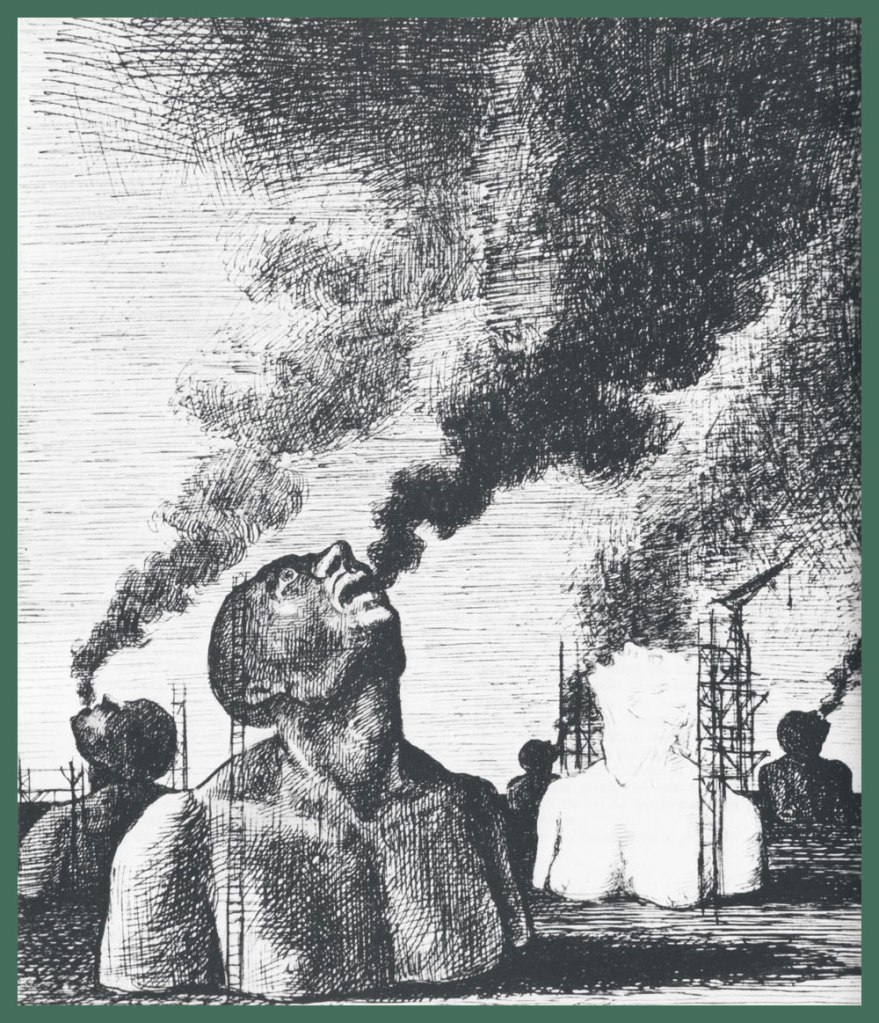
Ever had one of those weeks?
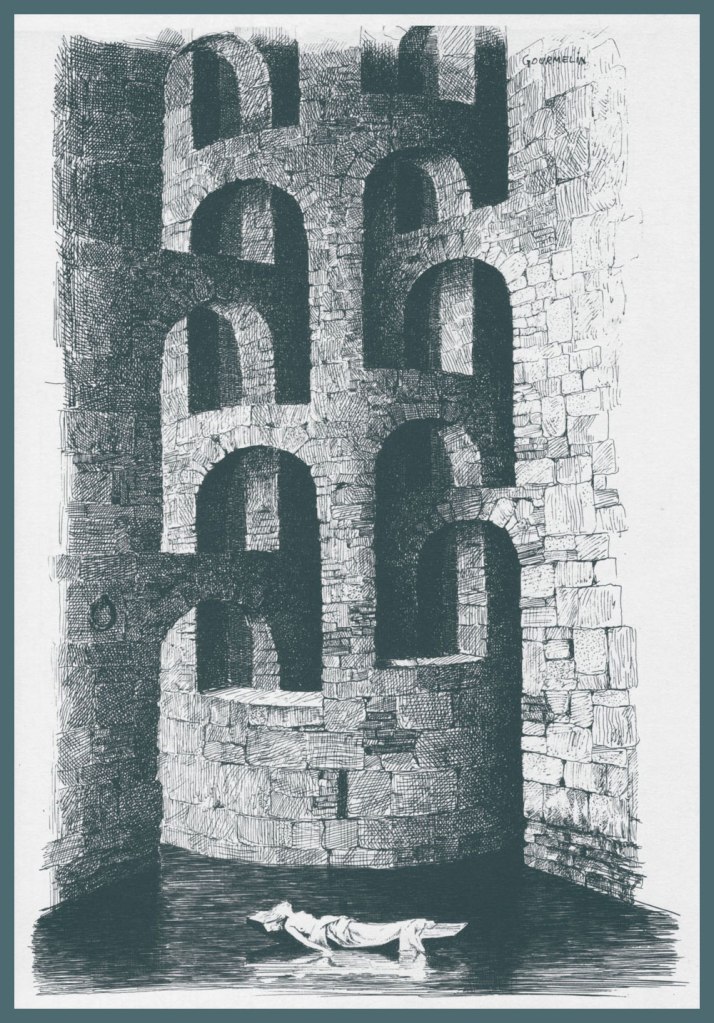
This piece appeared in Les chefs-d’œuvre de l’épouvante (1965, Les éditions Planète), accompanying Claude Farrère‘s classic 1928 short-short story, Le Train perdu, which you can read here (in the original French). Gourmelin also provided the anthology’s arresting cover and frontispiece artwork. Maybe next time…

-RG

*It says something (flattering, if you ask me) about the Gallic character that Gourmelin’s work would fall under the category of “humorous”. We’re a looong way from, say… Dave Barry.

Jean-Jacques Sempé’s Caustic Heyday

« When I grow up I would like to be an artist in France. » — Keith Haring

The other day, while weighing the idea of producing this post, I asked my wife: “Is Sempé too obvious a choice?”, to which she wisely replied: “To whom?”. To add another few grammes of perspective, I’m reminded of how, a decade-or-so ago, I was helping out a friend by manning his business phones while he took a vacation. One caller identified herself as Mme Sempé. I immediately asked whether she was related to the cartoonist. She was (they’re second cousins), but rather shockingly, this was the first time anyone had ever brought up the subject with her. Okay, so not so obvious after all.

If you only know Jean-Jacques Sempé‘s work through his cover illustrations for The New Yorker, well, you’ve missed his finest. Sempé (born August 17, 1932, in Bordeaux, France; died August 11, 2022, just a few days short of his 90th birthday) was recruited in the late 70s, in the twilight of editor William Shawn‘s tenure (1952-87) with the magazine. To be quite frank, Sempé’s New Yorker work is his weakest, comprising almost invariably mawkish scenes of the dying arts: little girls practicing scales at grand pianos, ballet rehearsals and grand operas. And the work has only grown more anachronistic and sentimental with time; I’d say he’s the least compelling cover artist currently working for the magazine, with the exception of art director Françoise Mouly‘s little chouchou, the stiff and bland Adrian Tomine, he of the lifeless line and emetic palette. Ahem.

But there was a time…

In 1968, a decade-and-a-half into Sempé’s career, ever-lucid Belgian writer and historian Jacques Sternberg perceptively summed up the artist’s appeal:

« But Sempé’s humour has earned the favour of a very wide audience. Without a doubt because he’s able to observe with a playful — but rarely sadistic — eye the drawbacks and peculiarities of our daily lives, and that his reader feels — mistakenly — reassured by this vision.

Sempé has, in fact, a way with an impressive setting, with meticulous detail, of the mise en scène that sugarcoats the bitter pill and of the lyrical flight that dampens the ferocity of the content. The miracle occurs as if by magic: Sempé, who is rather scathing, seduces rather than worries his readers. »

A cartoon that first saw print in the pages of Ici Paris in 1958.
This cartoon appeared in France Dimanche, circa 1957.
Another one that ran in France Dimanche in 1957.
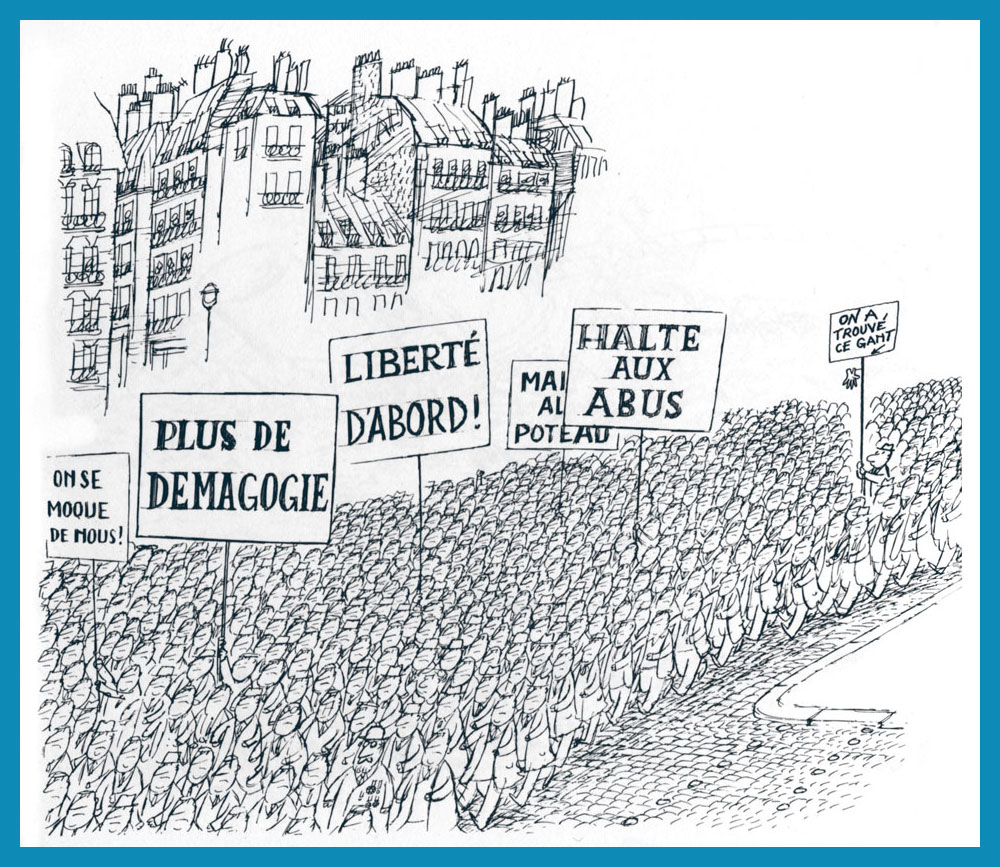
The signs say, from left to right: “They’re mocking us“; “No more demagoguery“; “Freedom First!“; “End the abuse“, “Down with…” and… “We have found this glove“.
From France Dimanche (1957). This one strikes close to home for me. Makes me think of the sort of barbarians always seeking to ‘improve upon’ nature. A passage from friendly gadfly and crime writer Carl Hiassen‘s brilliantly scathing polemic, Team Rodent: How Disney Devours the World (1998) comes to mind:

« Disney is so good at being good that it manifests an evil; so uniformly efficient and courteous, so dependably clean and conscientious, so unfailingly entertaining that it’s unreal, and therefore is an agent of pure wickedness. Imagine promoting a universe in which raw Nature doesn’t fit because it doesn’t measure up; isn’t safe enough, accessible enough, predictable enough, even beautiful enough for company standards. Disney isn’t in the business of exploiting Nature so much as striving to improve upon it, constantly fine-tuning God’s work.

Lakes, for instance. Florida’s heartland is dappled with lovely tree-lined lakes, but the waters are often tea-colored from cypress bark. For postcard purposes, tea-colored water was deemed unsuitable for Disney World’s centerpiece, Bay Lake, so in the early 1970s Team Rodent sprang into action—yanking out many of the cypresses, draining the lake, scraping out the bottom muck, replacing it with imported sand, then refilling the crater. All this was done to make the water bluish and therefore more inviting to tourists. For good measure, Disney even added beaches.» [ read it here ]
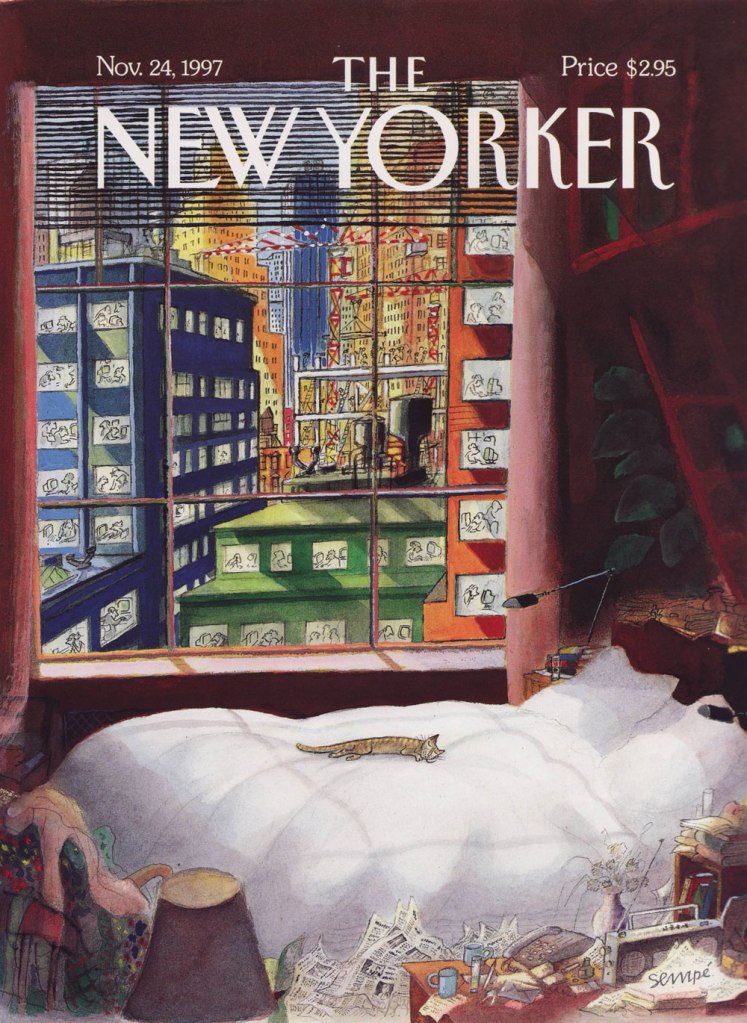
Naturally, I don’t dislike *all* of his New Yorker covers. This one, from the November 24, 1997 issue, is a peach.

-RG

Maurice Henry: Make Way for Surrealism

« The man who cannot visualize a horse galloping on a tomato is an idiot. » ― André Breton

What is one to do, in a mere blog post, with a polymorphous artist such as Maurice Henry (1907-1984)?

Here’s a handy bit of compressed biography, from his Lambiek page:

Henry was a French painter, poet, filmmaker, as well as a cartoonist. Between 1930 until his death, he published over 25,000 cartoons in 150 newspapers and a dozen books. His cartoons were generally surrealistic and satirical.

In 1926, he co-founded the magazine Le Grand Jeu with René Daumal, Roger Gilbert-Lecomte and Roger Vaillard, with whom he formed the “Phrères simplistes” collective. Henry provided poems, texts and drawings, while also making his debut as a journalist in Le Petit Journal.

He left Le Grand Jeu in 1933 to join André Breton’s group of Surrealists and their magazine Surréalisme au service de la Révolution. He also worked with the artist and photographer Artür Harfaux on the screenplay of twenty films, including ones starring the comic characters ‘Les Pieds Nickelés’ and ‘Bibi Fricotin’. Maurice Henry spent the final years of his life making paintings, sculptures and collages. He passed away in Milan, Lombardy, in 1984.

The answer? My default solution, which is to focus on some small parcel of the much greater whole. A number of Henry’s works bear revisiting (for instance, Les métamorphoses du vide [1955], a truly groundbreaking picture book about the world of dreams; À bout portant [1958], a collection of literary portraits; or Les 32 positions de l’androgyne [1961, also issued in the US in 1963], a chapbook of… gender recombinations) and deserve a turn in the spotlight.

To quote co-anthologists Jacques Sternberg and/or Michael Caen in their indispensable Les chefs-d’oeuvre du dessin d’humour (1968, Éditions Planète, Louis Pauwels, director):

Surrealism — he was part of the group before 1930 — left its mark on him and it’s because he was already well-cultured as he launched his career that he was among the first, in the desert that was the publishing world of the 1930s, to attempt unusual drawings calling upon often startling ingredients, such as poetry, black humour, the fantastic and the absurd. He caused no less of a surprise by doing away with captions, at a time when bawdy jabbering was the fashion all over. In short, Maurice Henry was indisputably a pioneer of that grey and stinging brand of humour that would explode like an H-bomb some fifteen years later.

HenriEscapeeA
A lovely bit of conceptual humour from 1938. A rare one bearing a caption, but the joke called for it. At this early stage, you won’t be wrong to point out a certain stylistic debt (it’s the roundness and simplicity of line!) to his contemporary and compatriot Jean Effel. Henry was indeed a fan. Do check out my co-admin ds’ fine post spotlighting the good Monsieur Effel.

HenryMinotoréadorA
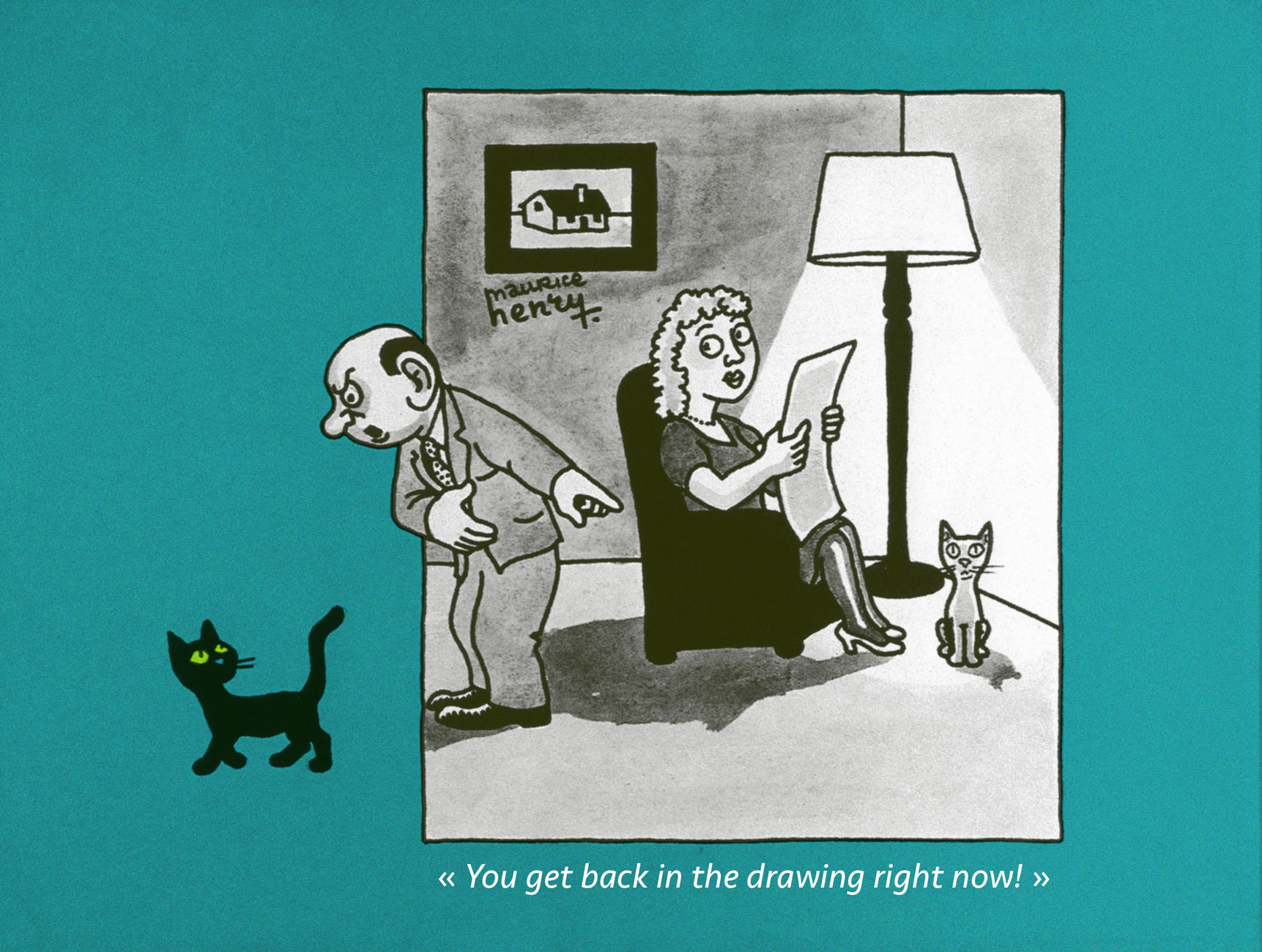
An example of what enlightened creators such as Henry were fighting for: making room for cartoons that weren’t just about the cheap chuckles. Consider, for instance, the existential plight of the Minotoreador . Published in K. Revue de la poésie no. 3 (“De l’humour à la terreur”, May 1949).

HenriGendarmeA
The Military, Government, Constabulary and Clergy were favourite targets, naturally. When it was (barely) tolerated. It helped to be ambiguous, even if one wasn’t ambivalent (1951).

HenryPrieurA
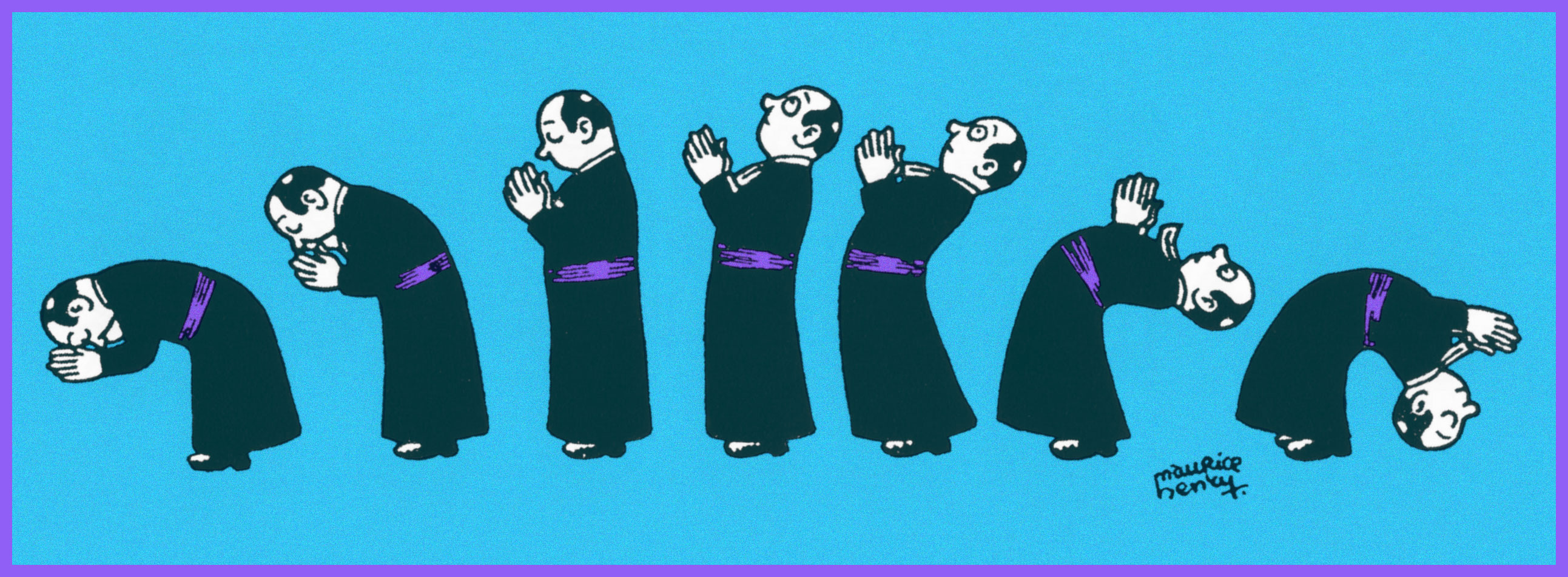
Here’s one for the clergy; though mocking, it’s hardly what you’d call hostile. From the first issue of epochal surrealist magazine Bizarre (1955-1968).

HenriCèneA
Yes, it’s Card Sharp Jesus entertaining, confounding (and possibly fleecing) his disciples. Note the ace up his right sleeve (1941).

HenriSkiNautiqueA
Walking on water was clearly just the beginning (1948).

HenriJesusMuscleA
Henry’s Jesus seems like a swell fellow, really. A bit on the roguish side, which is fine by me (1958).

Easter'sCancelledDarkness
See? A case of a joke’s that’s more than a half-century old still finding echoes in the present day. Cover from The Darkness‘ prophetic 2019 album, Easter Is Cancelled.

HenryCanons02A
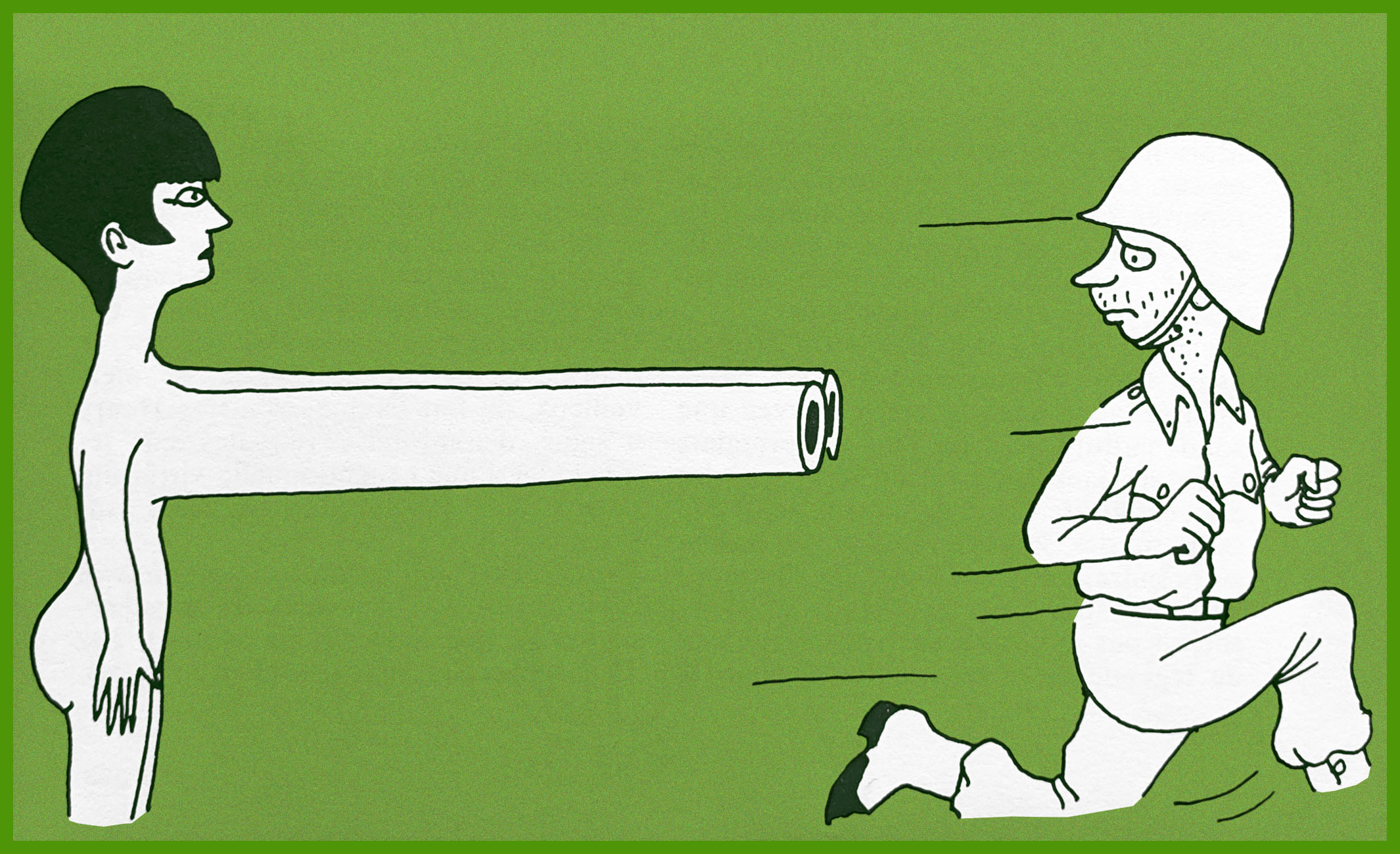
That soldier’s scared yet dismayed expression brings to mind Futurama’s hapless Philip J. Fry.

HenryCanons01A
That’s one relaxed elephant.

HenryPoursuiteA
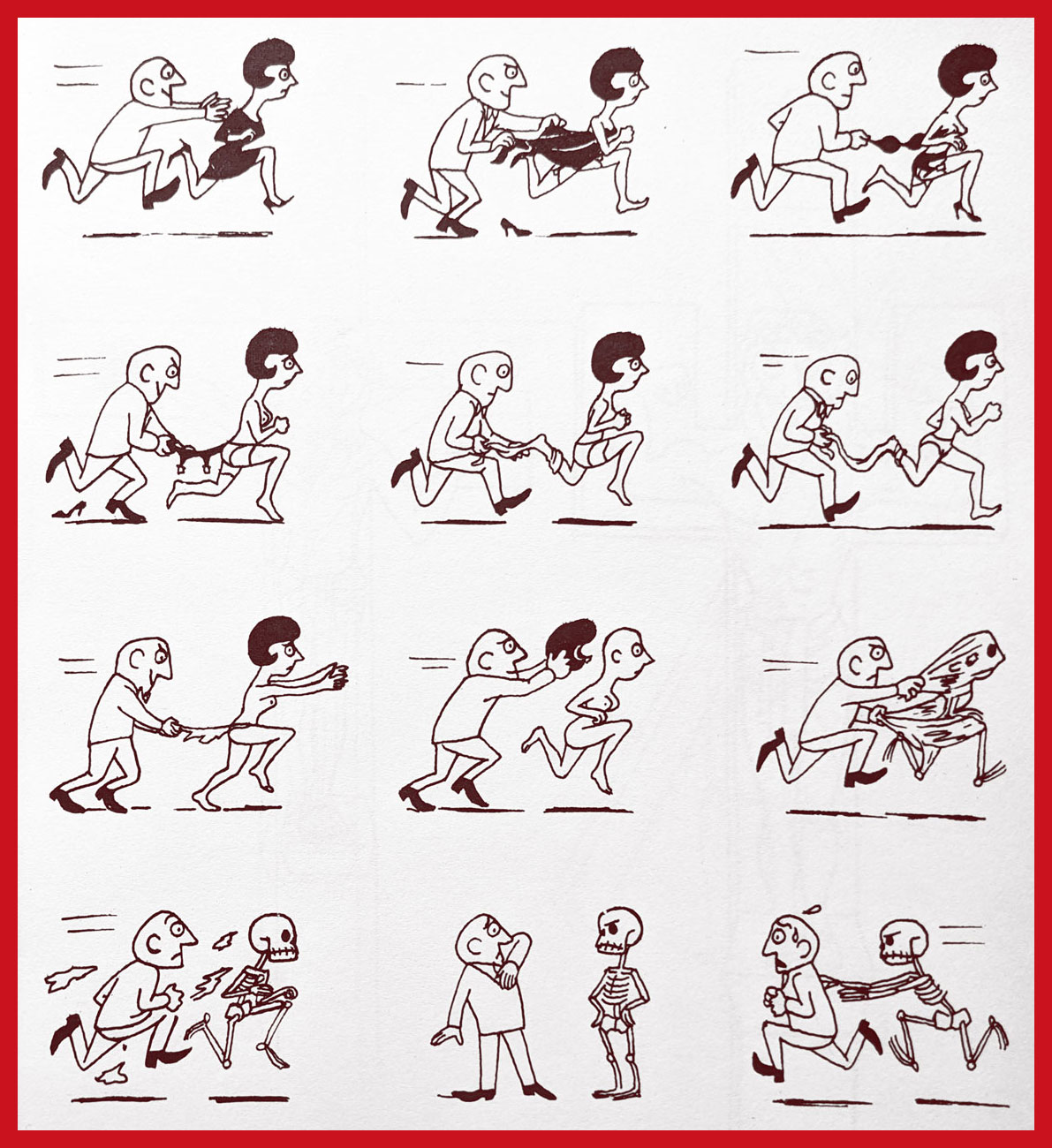
Another illusion shattered.

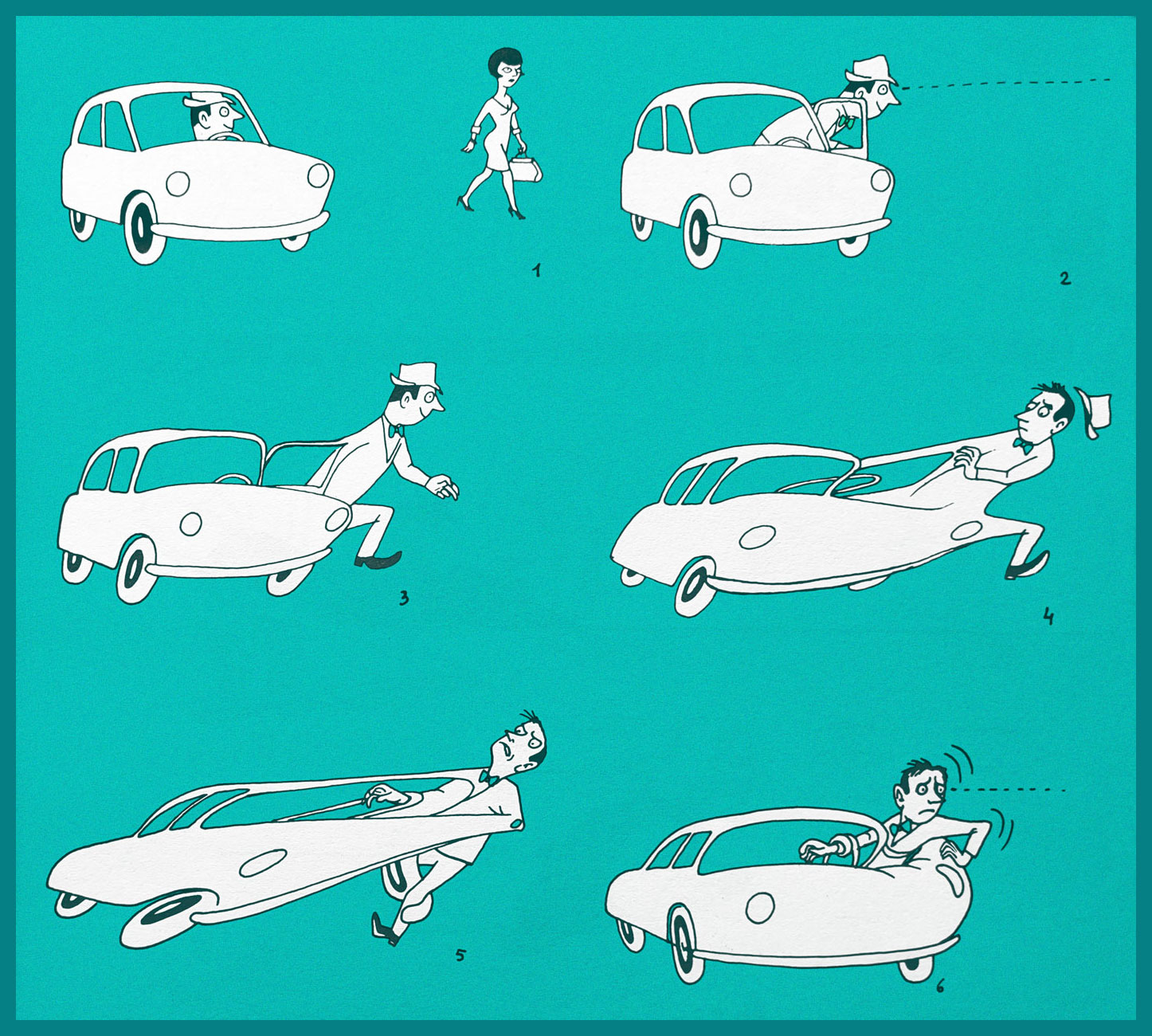
HenryVoitureA

HenryAutophageA
The little hand wave at the end really makes this one.

MauriceHenryLoupeA
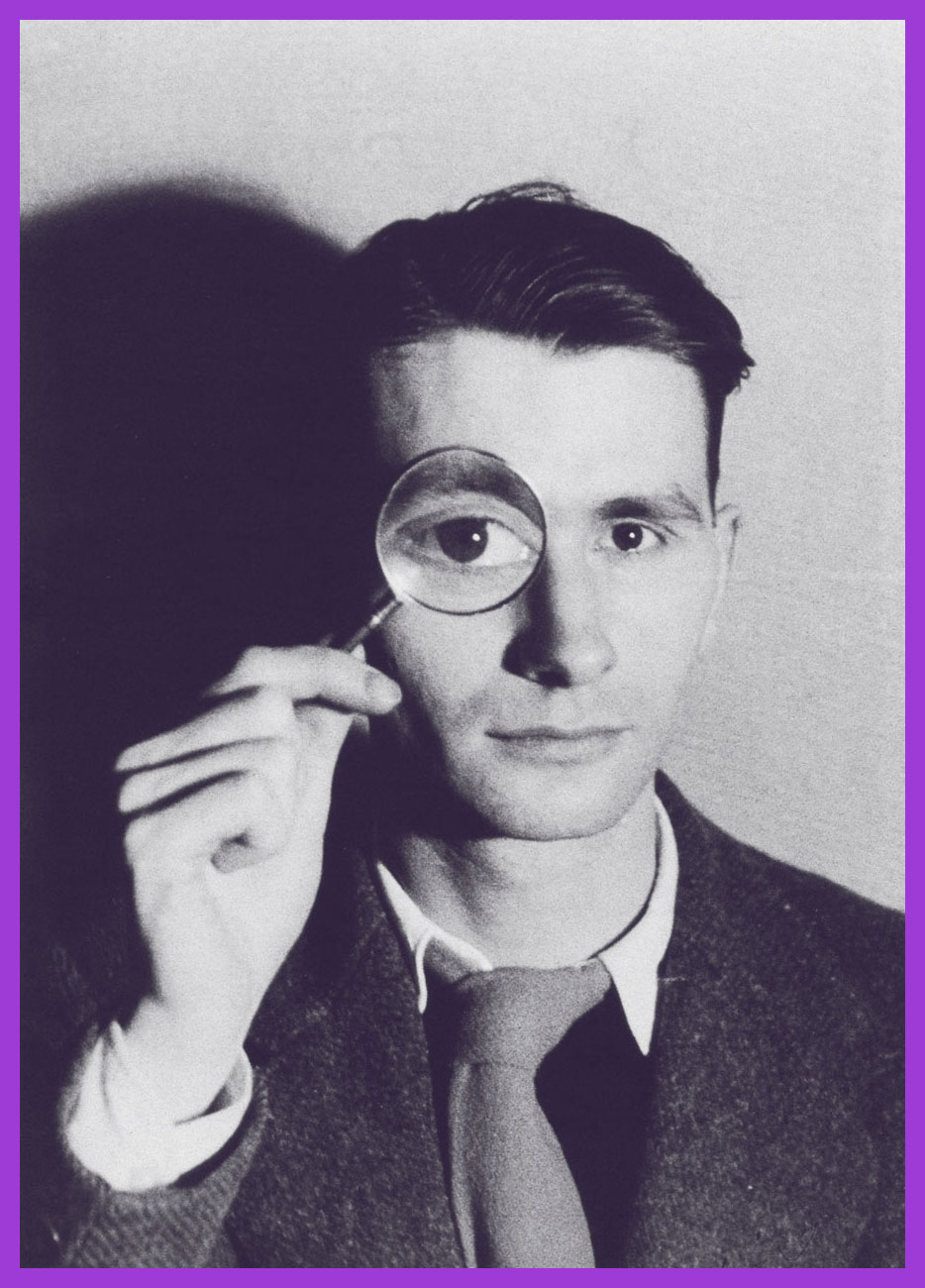
The artist in 1935, photographed by his friend and frequent co-conspirator Arthur Harfaux.

-RG