« Moonshiners put more time, energy, thought, and love into their cars than any racer ever will. Lose on the track, and you go home. Lose with a load of whiskey, and you go to jail. » — Junior Johnson
Lee Marrs (b. 1945) is not your typical « underground » cartoonist, though to be fair — what would a typical undergrounder be? The movement’s whole raison d’être was ‘vive la différence‘, wouldn’t you say?
Hers is not a prolific career, perhaps, but look at the gloriously idiosyncratic path she followed: newspaper comic strip assistant (Hi & Lois, Prince Valiant, Little Orphan Annie…), underground (Wimmen’s Comix, Pudge, Girl Blimp, The Compleat Fart and Other Body Emissions), and mainstream cartoonist — well, even better: she was a regular contributor to DC’s justly-fabled (but yet to be reprinted, ahem) Plop!; she appeared in Marvel’s Mad knock-off Crazy; she even scripted, in the early 90s, a Viking Prince (yes, Kanigher and Kubert’s 1955 creation) epic, illustrated by Bo Hampton, and even a bit of Batman (‘Stalking‘, with Eddy Newell, in 1998). But that’s merely scratching the surface: here’s a more comprehensive rundown of her captivating journey.
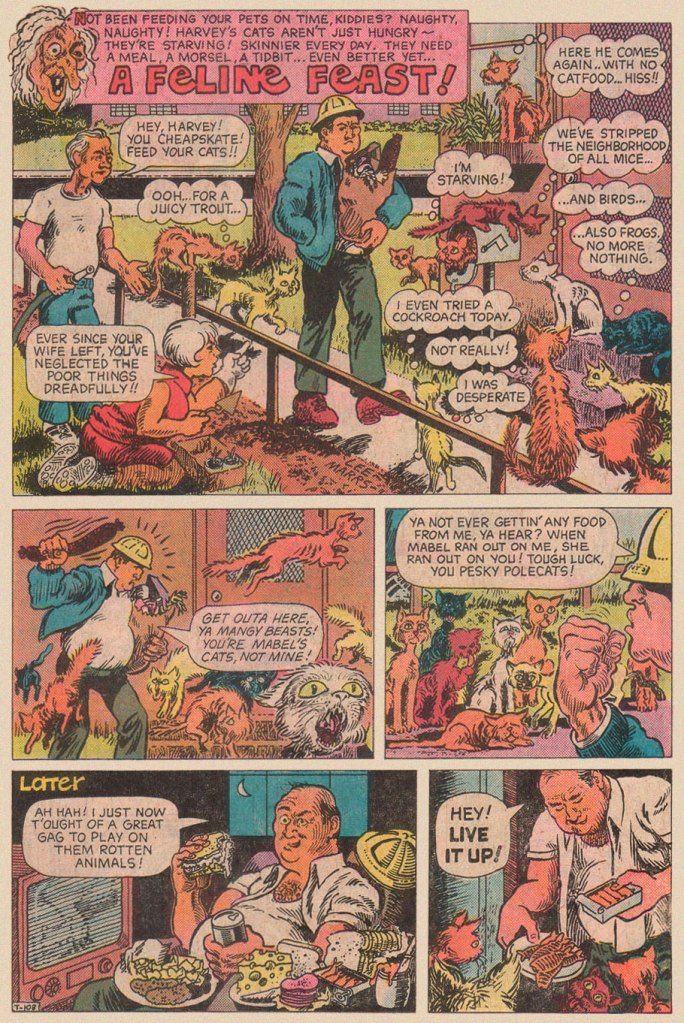
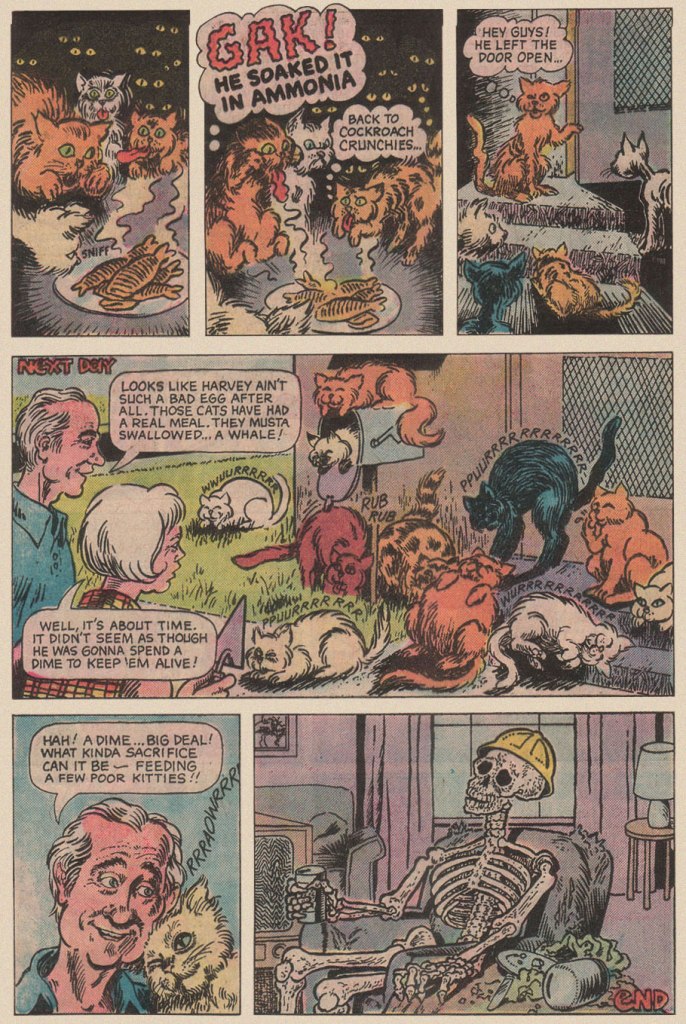
Ah, don’t you love a happy ending? Originally published in Weird Mystery Tales no. 18 (May 1975, DC), edited by Tex Blaisdell.
This is The Compleat Fart and Other Body Emissions (Jan. 1977, Kitchen Sink); colours by Pete Poplaski. Featured front-and-centre, doing his thing, is Joseph Pujol, France’s fabulous Pétomane!
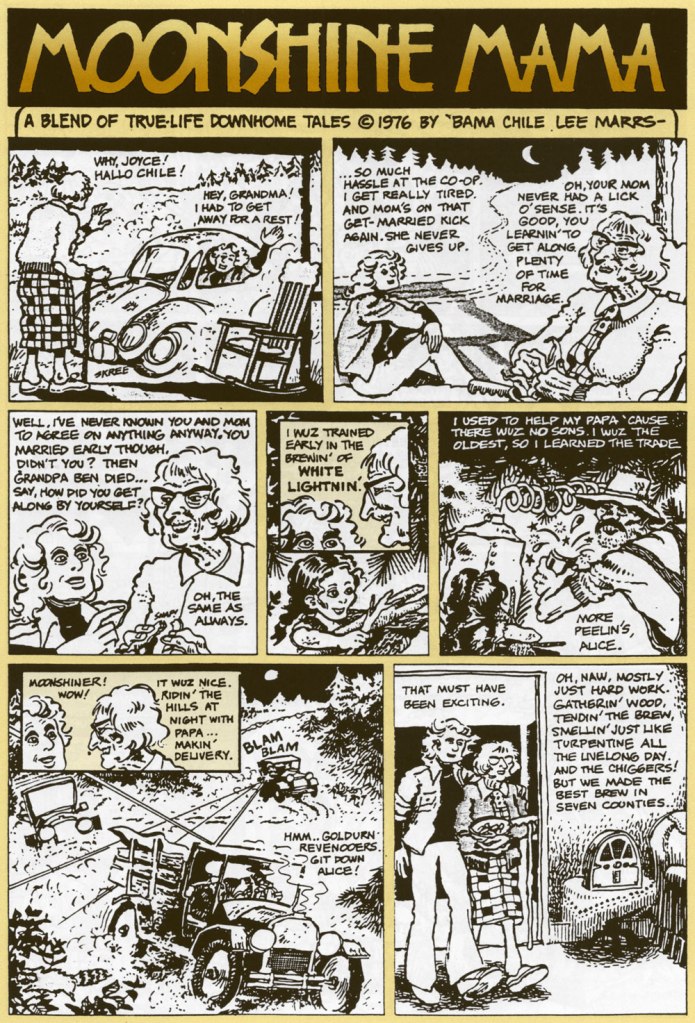
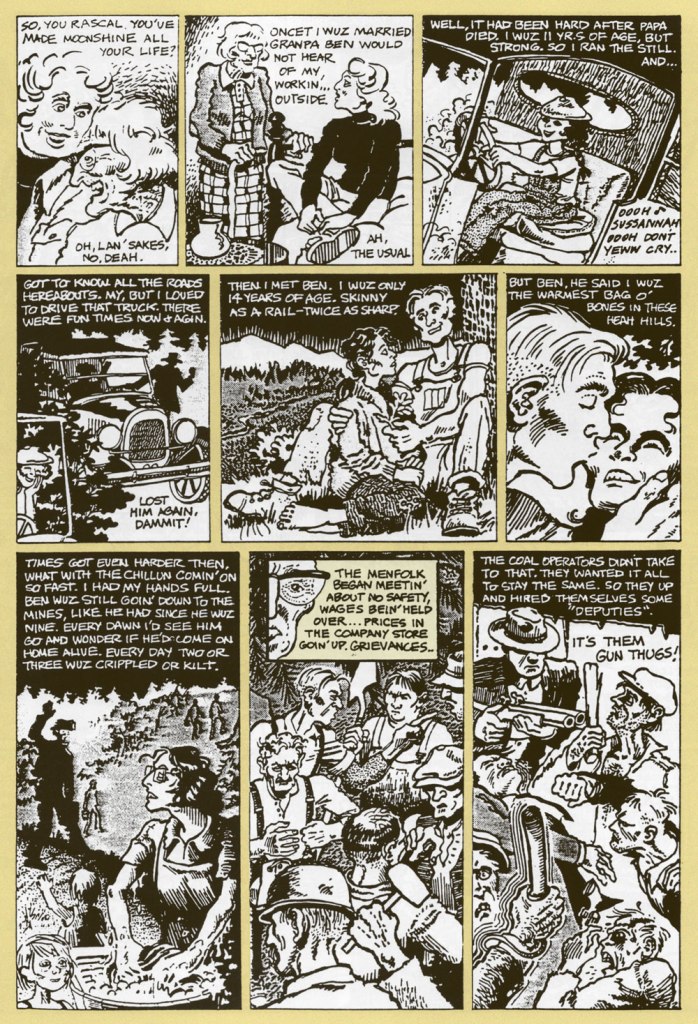
Originally published in Wimmen’s Comix no. 7 (Dec. 1976, Last Gasp). This is underground storytelling at its finest: uncompromising, political, passionate, personal, at once witty, moving and instructive. And that whole gamut gets run through in a mere four beautifully-drawn, expertly-paced pages.
And I’m delighted to report that the scintillating Ms. Marrs is still active today, her verve and talent undimmed and undiluted. By all means, check out her website for the undeniable evidence!
That SpongeBob would encounter a lot of tentacles in his day-to-day life is not at all surprising – he’s a sea sponge. What still surprises me, however, by is how much fun SpongeBob comics can be. Between 2011 and 2018, a respectable 85 issues were published by Stephen Hillenburg‘s production company, United Plankton Pictures (what a great title) and distributed by Bongo Comics.
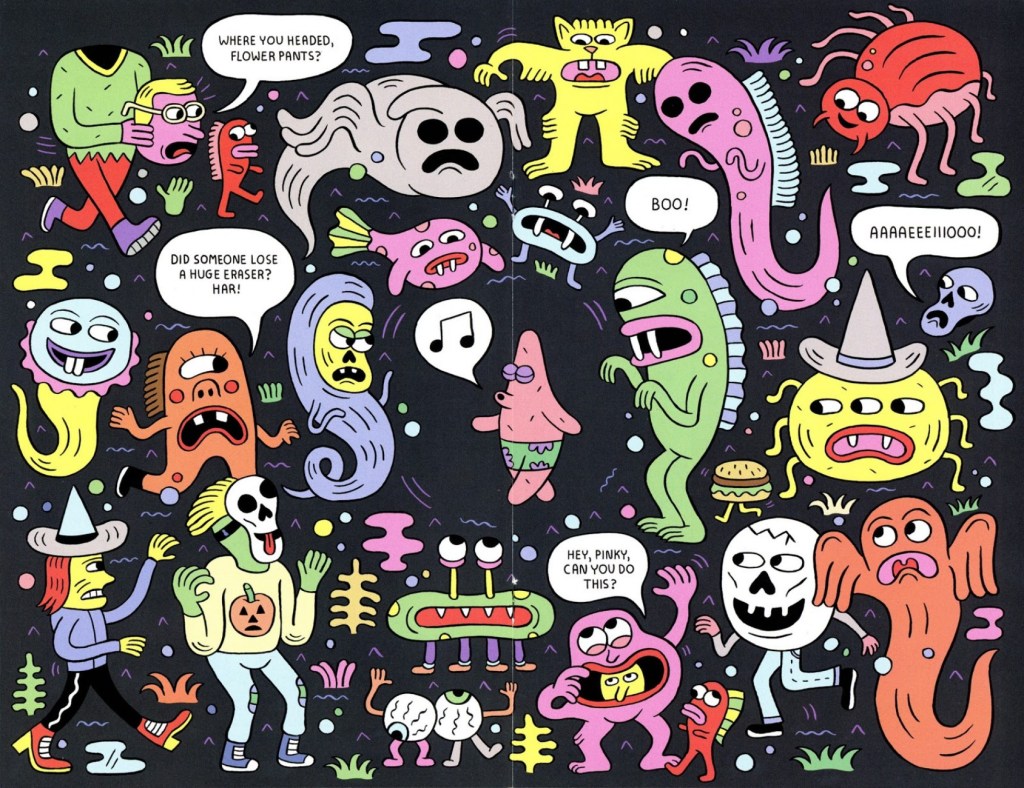
No tentacles yet, but I couldn’t resist sharing this colourful, spook-tastic spread from SpongeBob Comics No. 25 (October 2013). Art by Andy Rementer.
The formula was similar to Simpsons Comics spin-off Treehouse of Horror: plenty of famous (and talented!) cartoonists having fun with the characters. Between the roster for the regular comics and the special-themed supersized issues, quite a few artists who participated are WOT favourites, and some are Tentacle Tuesday masters, to boot: Hilary Barta, Tony Millionaire, Al Jaffee, Ramona Fradon, Michael T. Gilbert… in 2017, Stephen R. Bissette even broke up out of retirement to work on a special Hallowe’en issue. I think this post is a decent sampler of the different styles and storytelling techniques involved – I’ve concentrated on prominent tentacles, and ignored all the trimmings (the recurring jellyfish tentacles, pumpkins sprouting grabby vines, etc.)
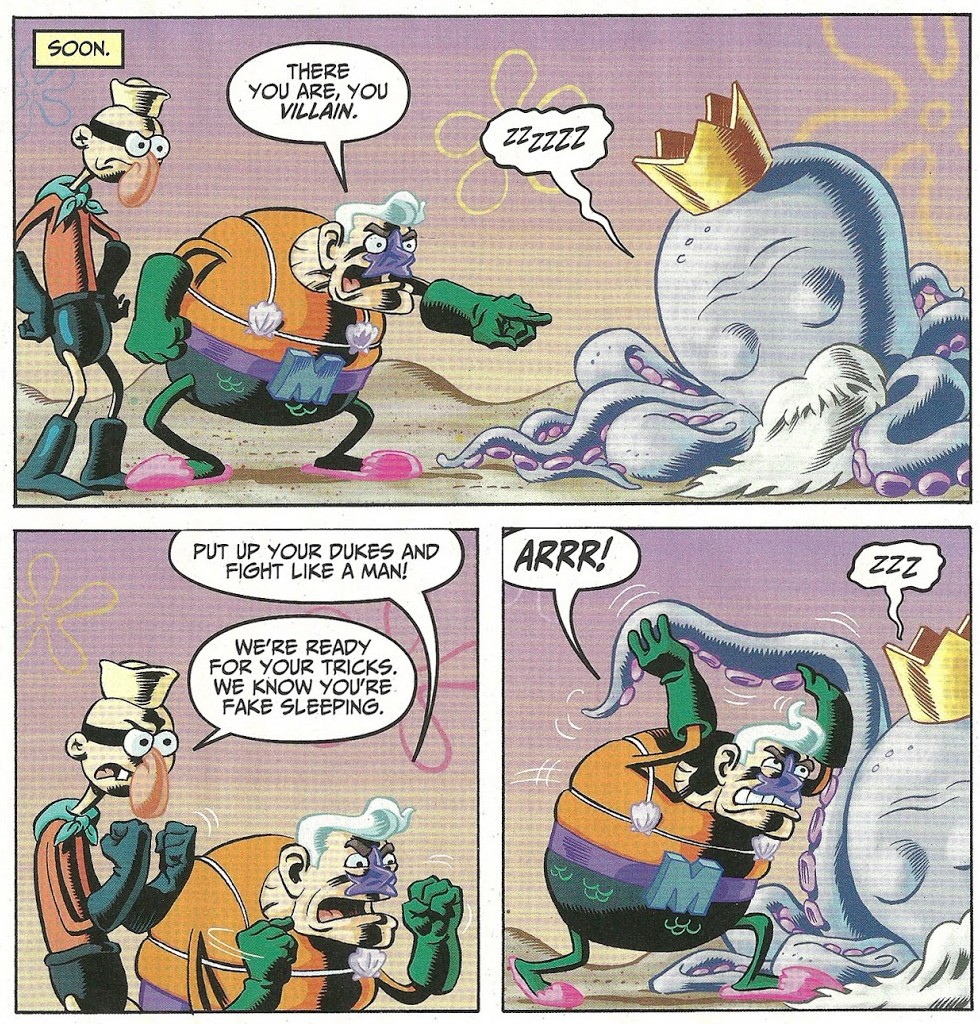
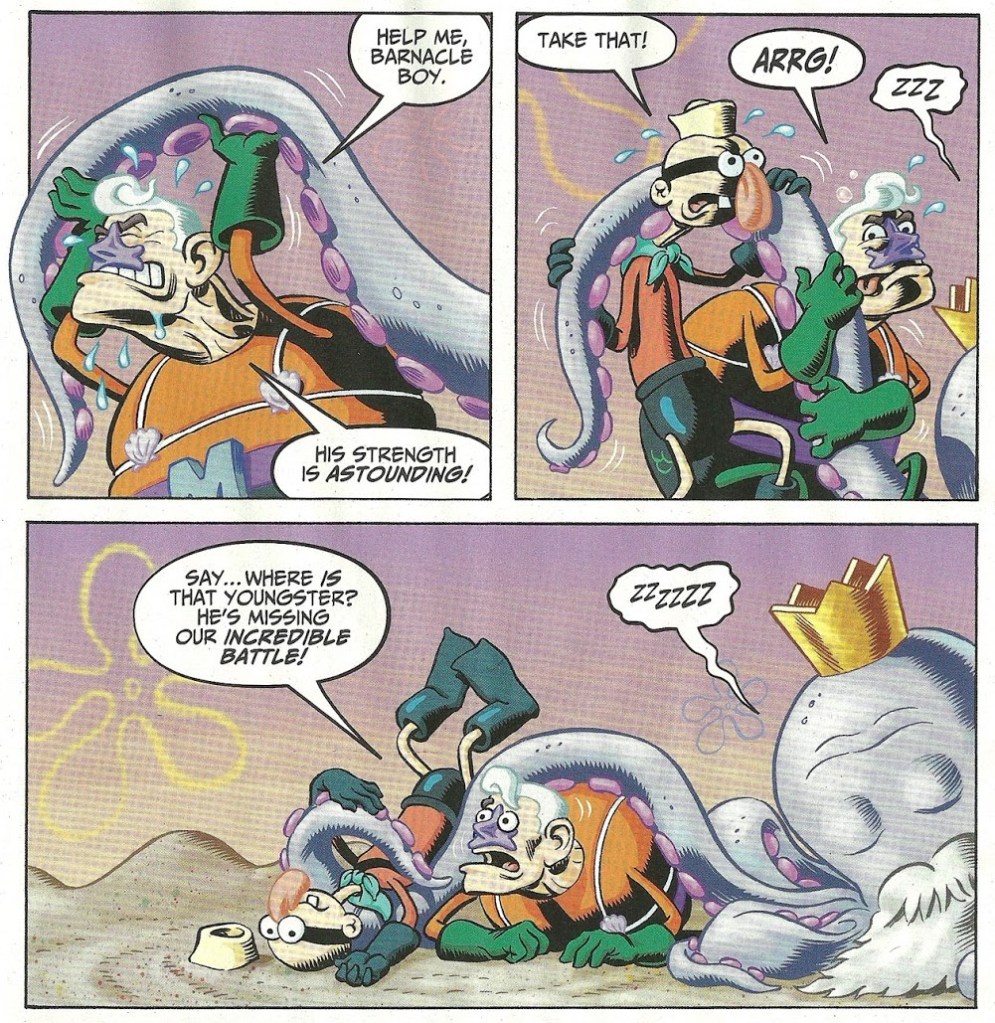
The tentacle fun starts right off with the first issue! Mermaid Man and Barnacle Boy vs. the Octopus King, written by James Kochalka and illustrated by Hilary Barta, was published in SpongeBob Comics No. 1 (February 2011):
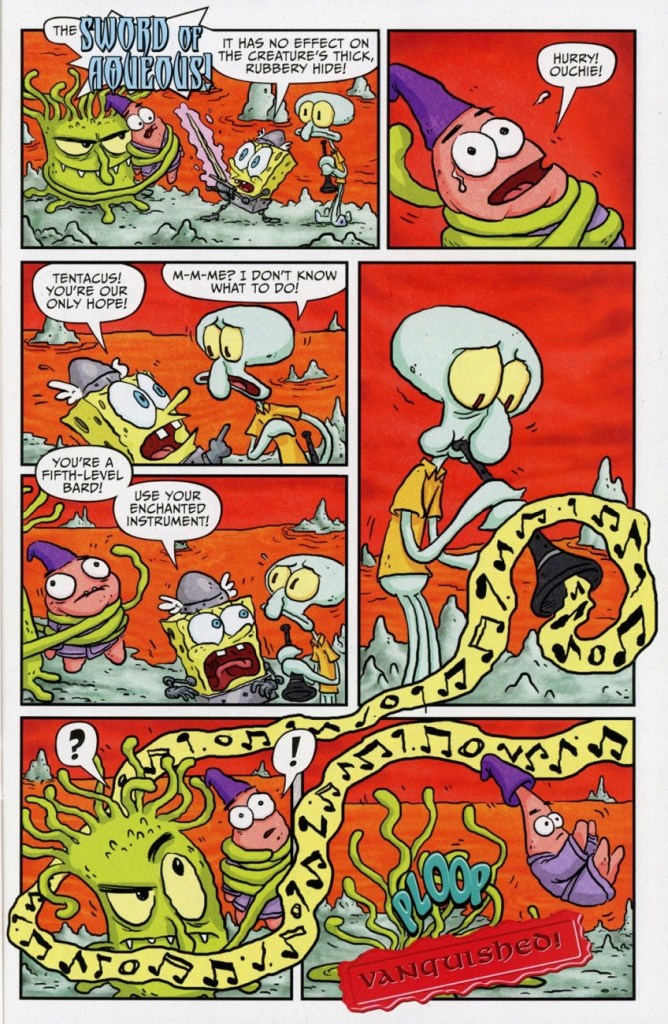
A page from Serpents & Sealords, written and illustrated by Corey Barba and published in SpongeBob Comics no. 51 (December 2015).
The following glorious illustration at the tail end of SpongeBob Comics no. 50 (November 2015) is by Jim Woodring:
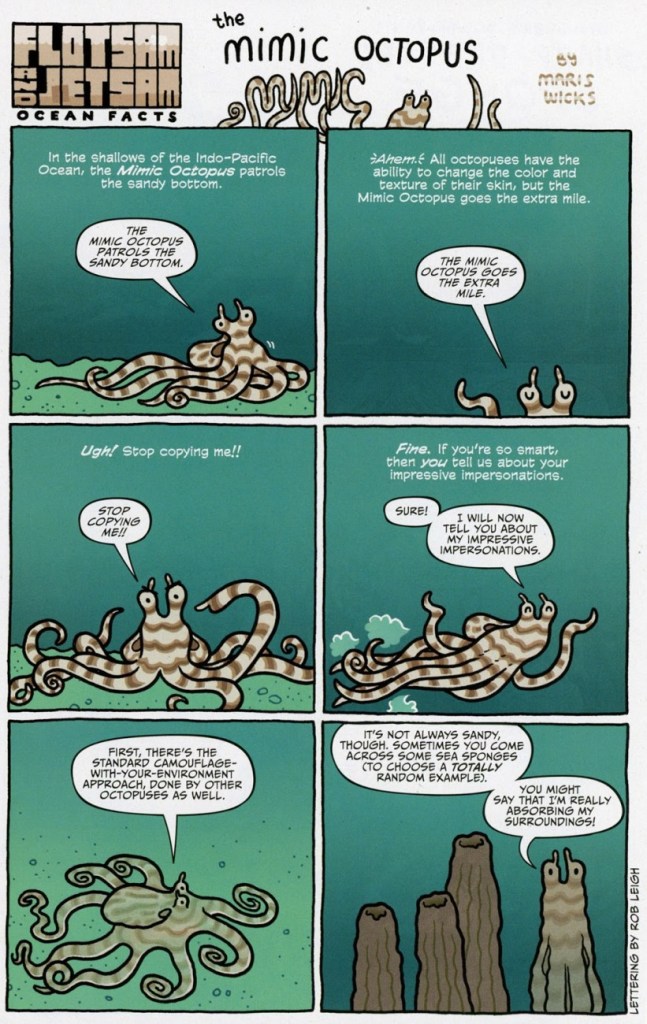
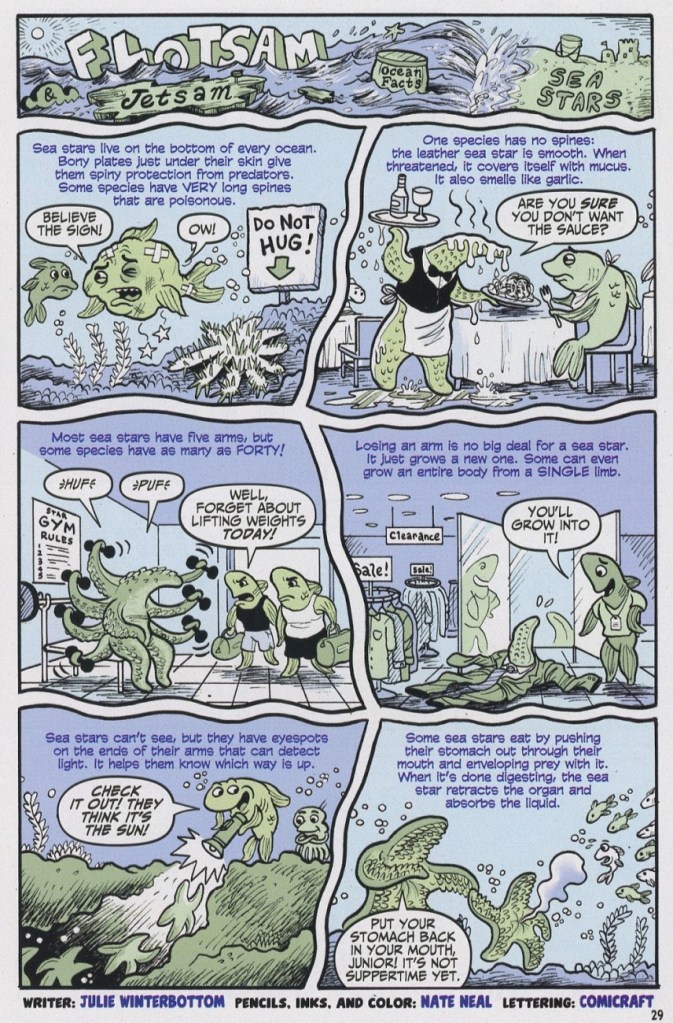
Given that Stephen Hillenburg (the creator of SpongeBob) was a marine scientist and teacher, it does not come as a surprise that the recurring feature Flotsam and Jetsam was used to talk about all manner of nautical critters and their habits. Here are a few:
Flotsam and Jetsam: Ocean Facts – The Mimic Octopus, written and illustrated by Maris Wicks and published in SpongeBob Comics no. 52 (January 2016).
Flotsam Fables: Legends of the Deep – The Kraken, written by Karen Sneider and illustrated by Vanessa Davis), was published in SpongeBob Comics no. 62 (November 2016).
Flotsam & Jetsam – Ocean Facts: Sea Stars, written by Julie Winterbottom and illustrated by Nate Neal, published in SpongeBob Comics no. 71 (August 2017).
« The cemeteries are full of irreplaceable people who were all replaced. » — Georges Clemenceau
Commercially and creatively, the 1950s held some of the best and the worst years for the American comic book industry. Basically, the first half was a glut and the second, a massacre. This is all well-trod ground. Today, we’ll stick to one artist and his main employer.
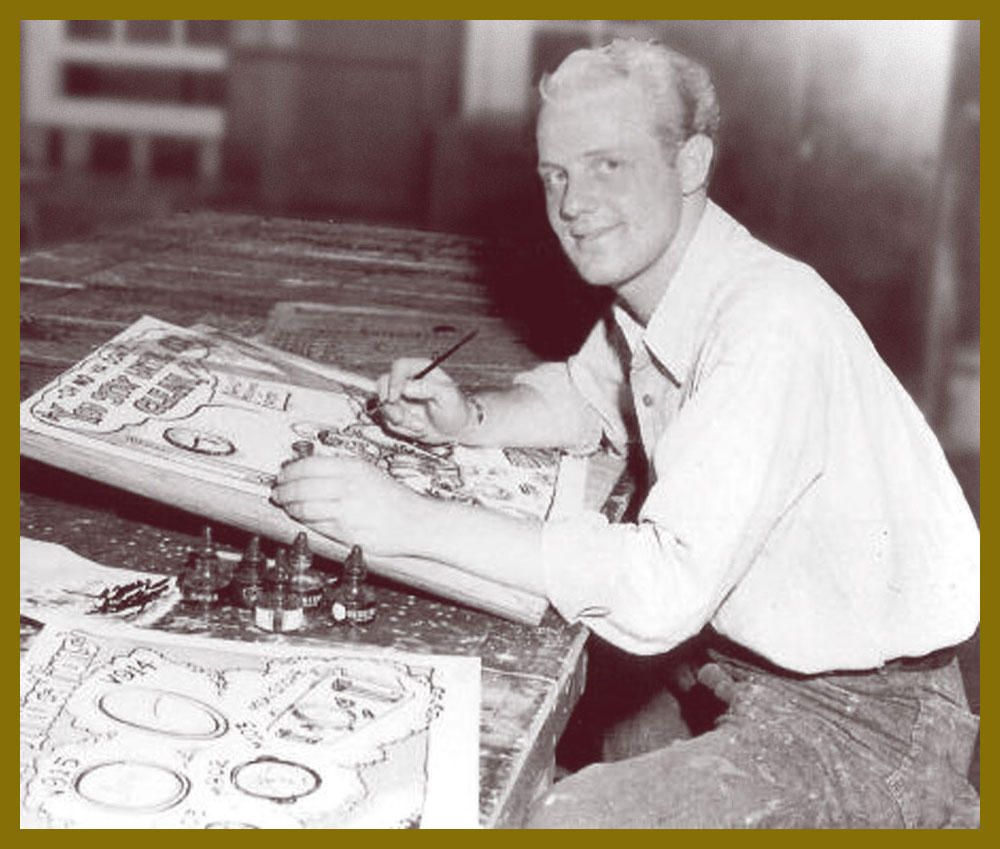
In his one intensely-prolific decade as a professional cartoonist, Joe Maneely (1926 – 1958) produced the overwhelming bulk of his work for publisher Abe ‘Martin’ Goodman’s Timely/Atlas, which would become Marvel Comics by the decade’s end.
The artist at his table. Herb Trimpe lets us in on the secret of Maneely’s prodigious speed (said to produce up to six pages a day, pencils and inks): « his pencils [were] almost nonexistent; they were like rough, lightly done layouts with no features on the faces … It was just like ovals and sticks and stuff, and he inked from that. He drew when he inked. That’s when he did the work, in the inking! ». Talk about unerring confidence!
Atlas historian Dr. Michael J. Vassallo sums up the Tao of Goodman (and, by and large, Marvel’s):
« As one genre faded, another would add titles to compensate. It didn’t matter if the new titles were basically redundant titles with new names. Goodman followed all trends in the comic book industry and the publishing industry in general.
A savvy businessman, he rarely led, mostly followed, but had the resources to follow with gusto, overwhelming competitors with product. »
As Ger Apeldoorn tells it, Maneely was a mere thirty-two years of age and at his frenetic artistic peak when tragedy struck:
« … on June 7, 1958, after going out for the night (with old-time friends John Severin and Walt Kelly assistant George Ward) he stepped out on the balcony of the train to get some air, fell between two trains and died. For a long time the story was that he had been drunk, but according to Dan Goldberg* he had lost his glasses earlier that week and that may have been a contributing factor. »
If the inspiring story of Joe Maneely, and its heartbreaking and sudden end is at all remembered these days, it has chiefly been through the diligent efforts of aficionado-historians such as Jim Vadeboncœur Jr. and the aforementioned Dr. Vassallo. Now why would an artist of such calibre fade so swiftly from memory? Since that happens all of the time (what one might term ‘invisible evidence‘), let’s move past the realm of the rhetorical and be more… specific. But first, some samples of the late Mr. Maneely’s goodies.
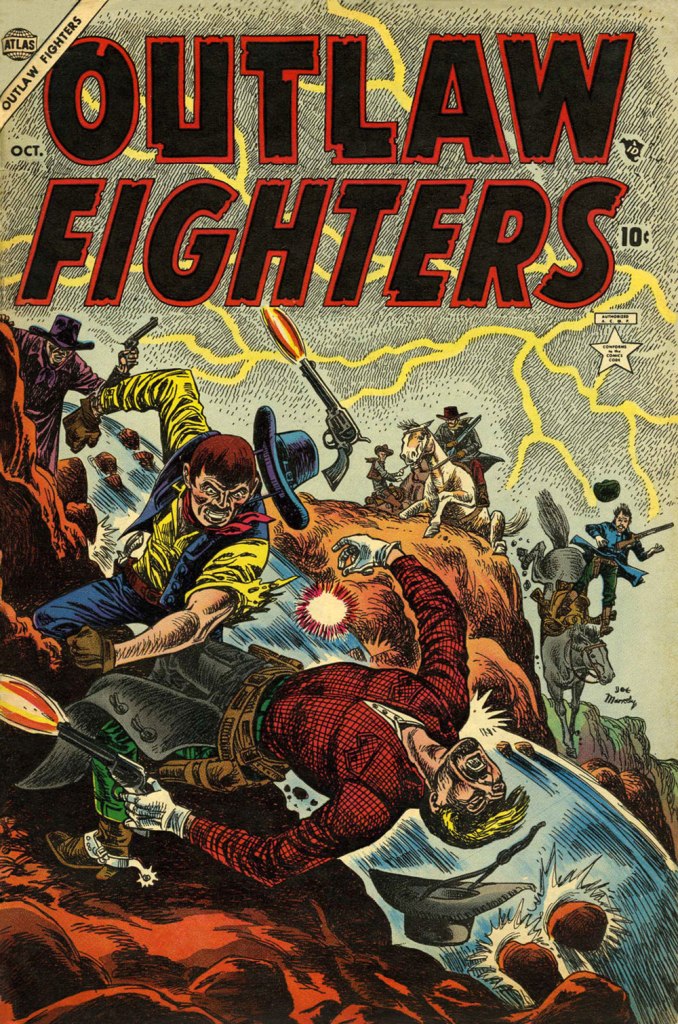
This is Outlaw Fighters no. 2 (Oct. 1954, Atlas).
This is Jungle Action no. 1 (Oct. 1954, Atlas). With spandex yet to hit the market (and even then), Leopard Girl’s costume must have been quite… stifling.
This is Mystery Tales no. 23 (Nov. 1954, Atlas).
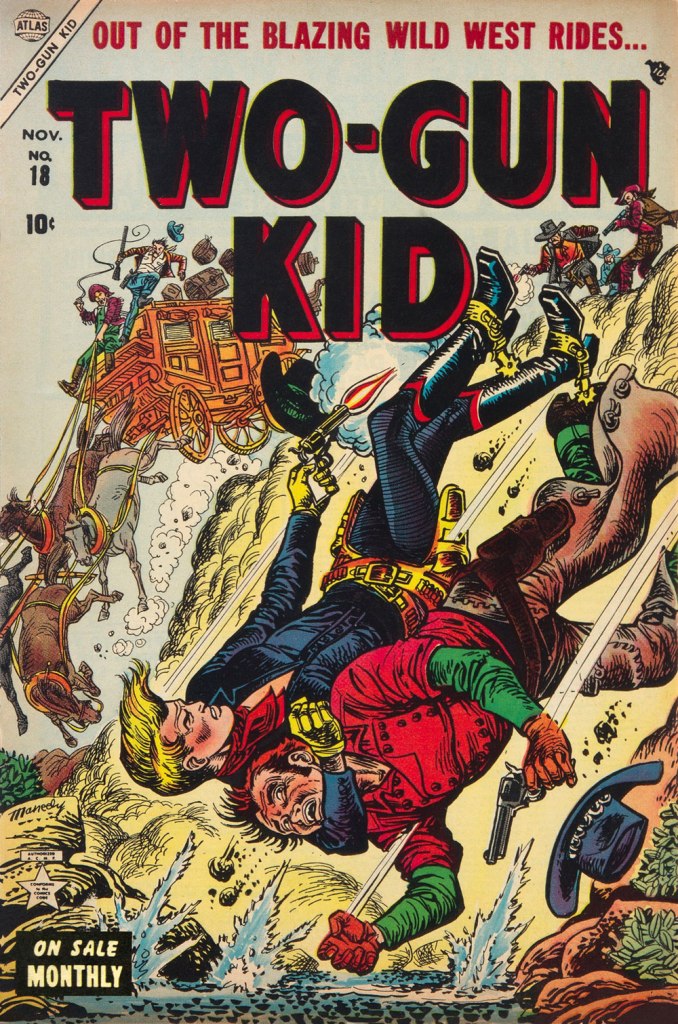
This is Two-Gun Kid no. 18 (Nov. 1954, Atlas). I doubt anyone’s going to land comfortably. Particularly those poor horses.
This is Journey Into Mystery no. 22 (Feb. 1955, Atlas).
“Oh, Stan — you’re so butch!” This is Rugged Action no. 2 (Feb. 1955, Atlas). To my eye, the bottom panel evokes Harvey Kurtzman‘s early style (think Two-Fisted Tales at EC); ironic, given that Maneely was as confident and speedy in his drawing as Kurtzman was painstaking and slow.
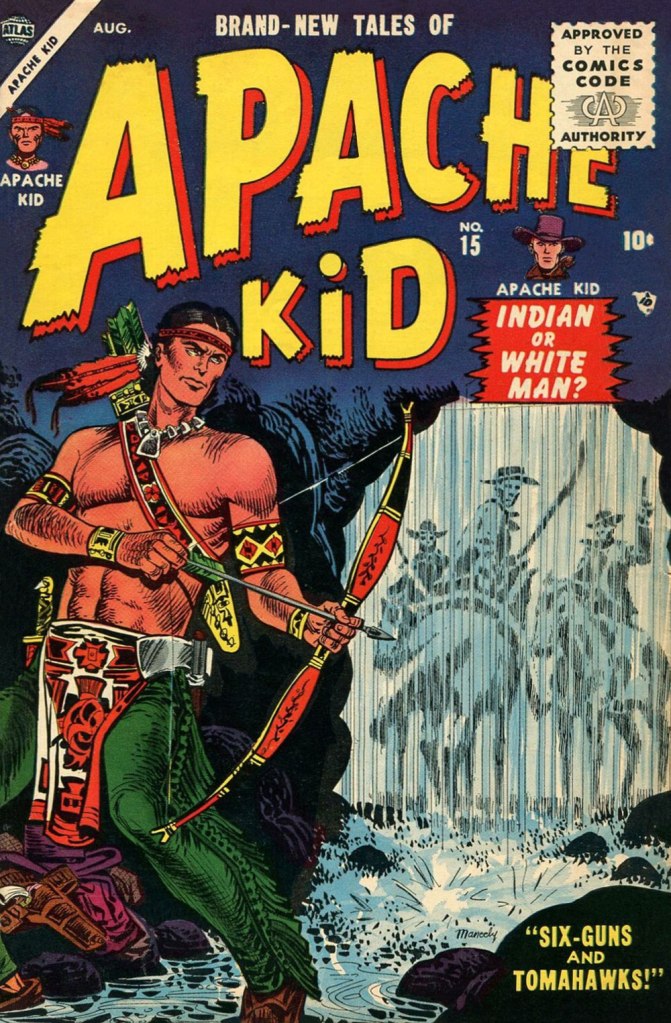
This is Apache Kid no. 15 (Aug. 1955, Atlas). The publisher also had in its roster Arizona Kid, Kid Colt, The Kid from Dodge City, The Kid from Texas, Kid Slade, The Outlaw Kid, Rawhide Kid, Ringo Kid, Texas Kid, Two-Gun Kid, The Gun-Barrel Kid… did someone say ‘redundant’? Why, yes, someone did.
This is Police Badge #479 no. 5 — the sole issue, really; its numbering picked up from Spy Thrillers… and went no further (Sept. 1955, Atlas). Maneely was another of that rare breed who could draw anything… because they enjoyed drawing everything. Dig all that well-observed detail!
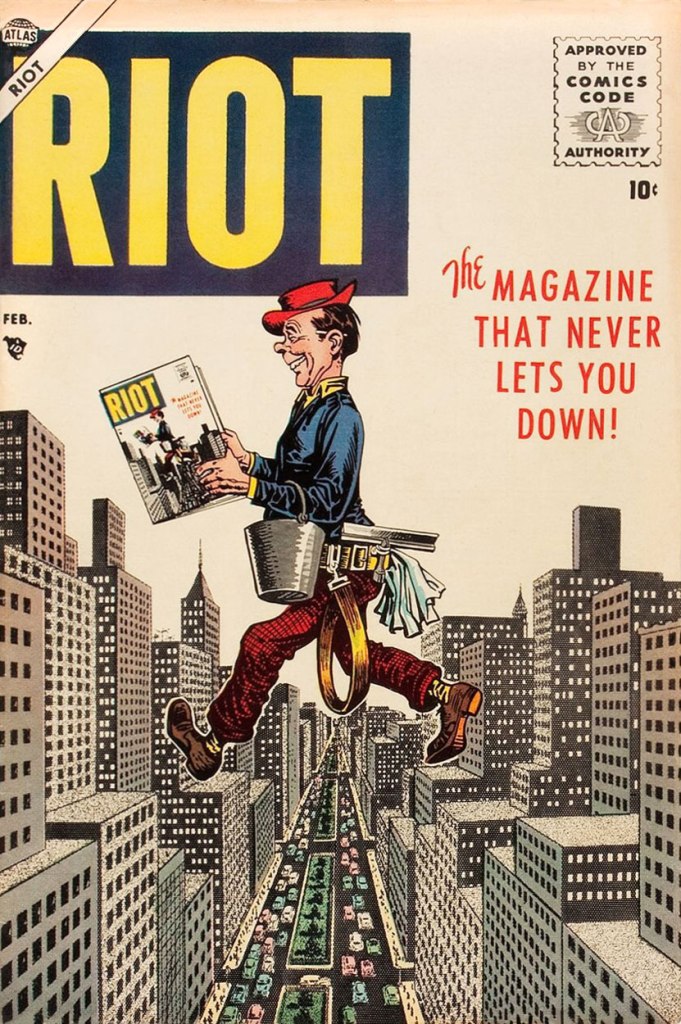
Atlas published, in quick succession, no less that four short-lived Mad clones: Crazy, Riot, Snafu and Wild, each lasting from three to seven issues. None were particularly funny either, even if they did look quite good. This is Riot no.4 (Feb. 1956, Atlas) featuring what is termed, in comic book circles, an ‘infinity’ cover.
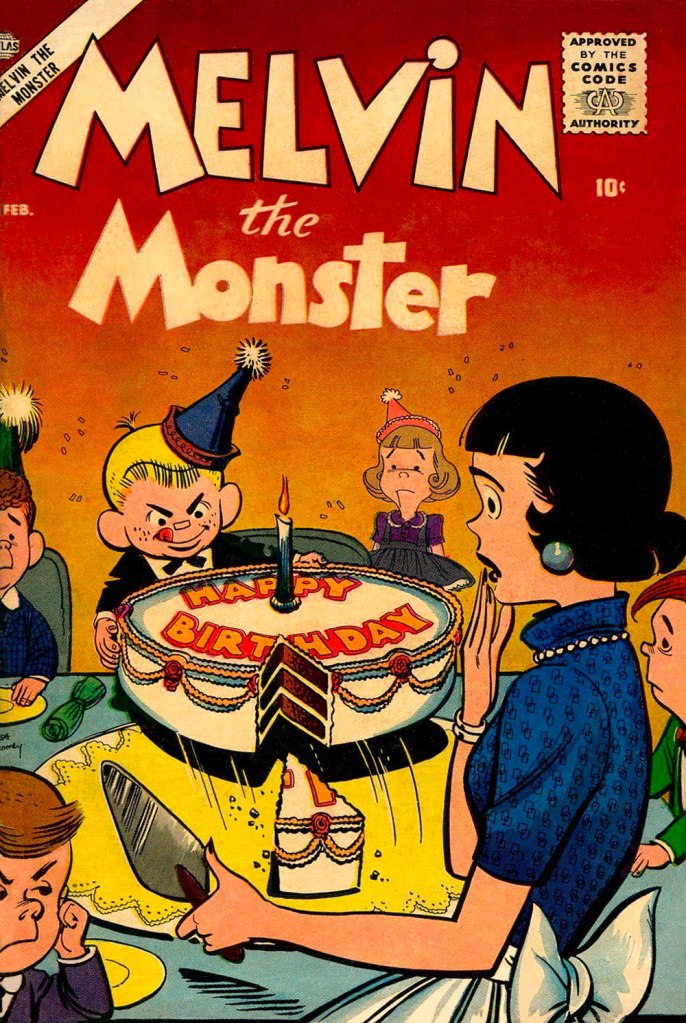
This is Melvin the Monster no. 4 (Feb. 1957, Atlas); Dr. Vassallo writes, in his in-depth Maneely overview for Alter Ego magazine (no. 28, Sept. 2003): « Stan Lee and Joe Maneely’s Melvin the Monster… duplicated everything they could about Hank Ketcham’s Dennis the Menace — art style, comic strip format, even upper-&-lower-case lettering style — everything except the warmth and innocence.»
This is Kid Colt Outlaw no. 69 (Feb. 1957, Atlas). Along with everything else, I love his way with flora and fauna. Incidentally, most of these covers were coloured by Stan Goldberg.
And so… why have Maneely’s star and memory dimmed so? It has been proposed, and I agree, that it’s because he just didn’t draw superheroes (a couple of Sub-Mariner covers being the lone exceptions), and Marvel itself hardly lifted a finger, over the years, to preserve the reputation of one of its principal architects.
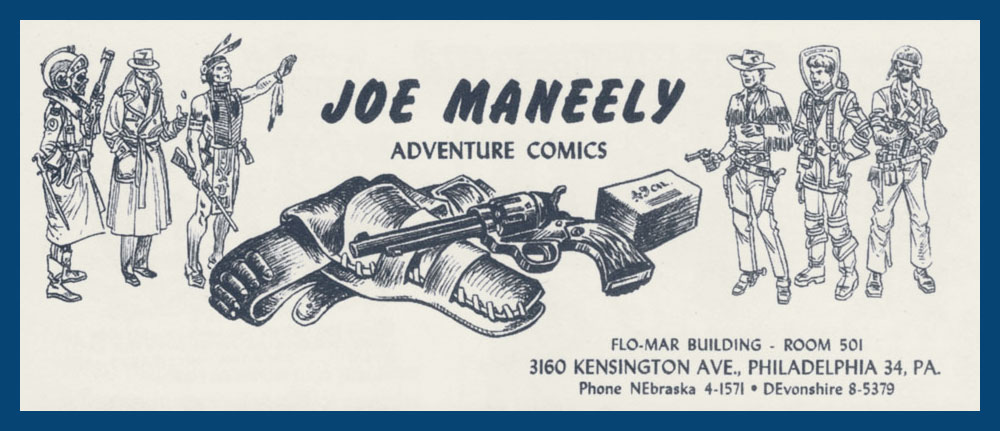
The artist’s promotional letterhead illustration, circa 1948.
There’s been much idle speculation as to what course comics history would have taken had Maneely lived. Stan Lee wrote, in his usual disingenuous way, that:
« How I wish the world (and I) could have seen what he’d have done with the F.F., Spidey, Thor and all the other Marvel super-heroes! It’s a true tragedy that we’ll never have the chance. »
Let’s be honest here: Maneely was an incredible artist, and he made Stan look good, but Joe wasn’t a writer, and certainly not a world-builder in the fashion and class of Jack Kirby, Steve Ditko, Walt Kelly, Carl Barks, John Stanley, Basil Wolverton… and precious few others. Without Kirby, the so-called Marvel Age never would have come to pass. Not to mention that Maneely, with a wife and three daughters to feed and support, had just begun to work for one of DC’s friendliest editors, Murray Boltinoff**. He would have been unlikely to drop a better-paying, likely secure gig to drop everything and return to Marvel’s uncertain prospects. Ah, and I see Mark Evanier views it along the same lines.
Oh, and I’ve mentioned in the past Maneely’s likely influence (mostly in the inks) on his contemporary Rocco Mastroserio. Take a look at this gallery of his covers and see if you agree.
-RG
*Stan Goldberg, actually.
**as a matter of fact my first encounter — as a child — with Maneely’s work was through a reprint of one of his DC stories: The Doomsday Drum (House of Secrets no. 9, March-April 1958).
Greetings to saddle sniffers, subterranean dwellers and lovers of nasty fun! Today we take a little trip into the underground, where tentacles squirm in anticipation! Through some quirk, all of today’s covers involve aliens and spaceships – underground artists clearly also liked to speculate about the possibilities of inter-planetary travel.
Tentacle Tuesday opens up with a Nicola Cuti cover, whose cutesy style, albeit not particularly original, is pretty recognizable (for example, take a look at his Weirdlings, which has really grown on me over the years). His big-breasted, doe-eyed « intergalaxtic nymph » was not devoid of charm, although she only appeared in three issues (and issue no. 3 had a print run of a hundred copies, so I don’t think many people have seen it…) For more details about Moonchild Comics, consult the ever-useful Comixjoint.
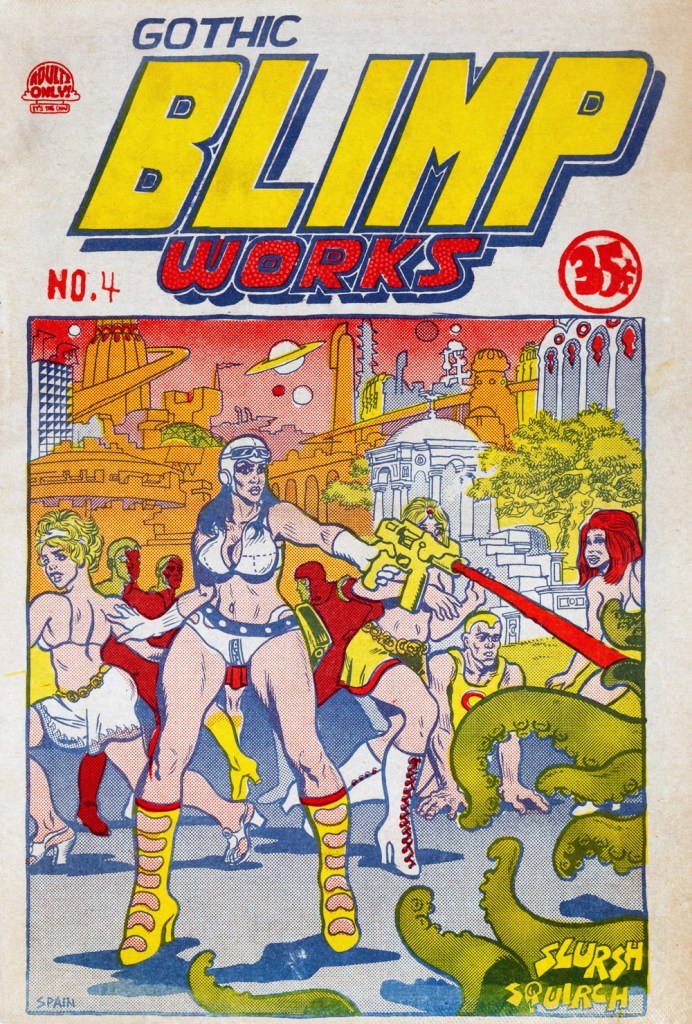
Gothic Blimp Works no. 4 (Spring 1969, East Village Other). Cover by Spain Rodriguez.
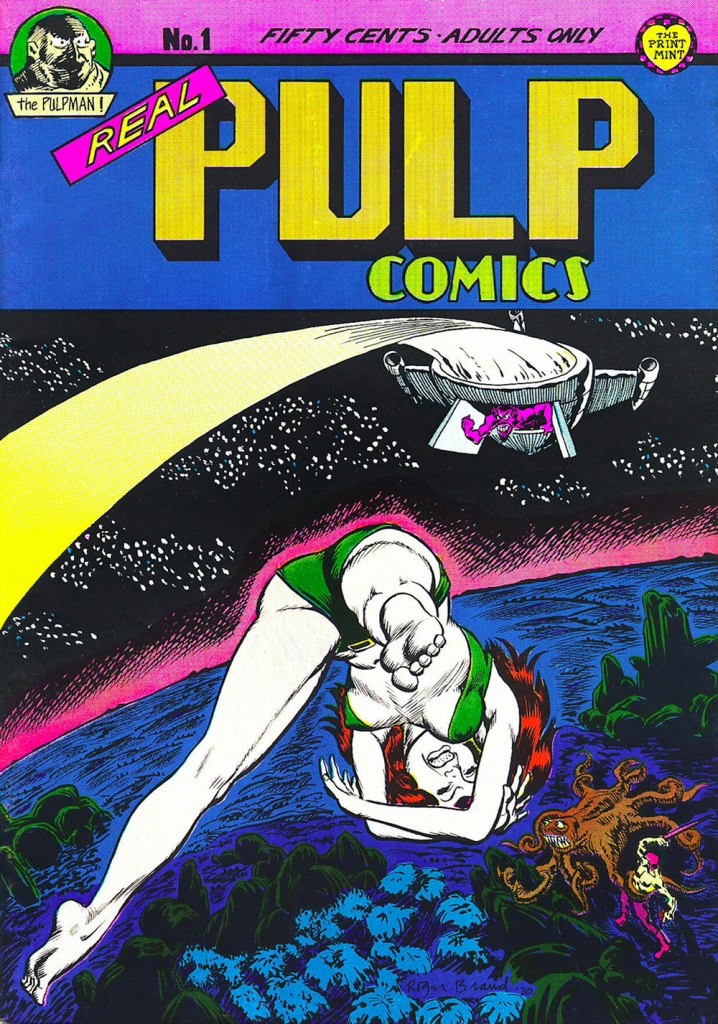
The next cover is on a similar theme: mostly naked female, tentacled alien, the shaboodle, with an interesting choice of perspective to boot. And by “to boot” I mostly mean that it looks like somebody gave her a good kick on the shapely derrière.
Real Pulp Comics no. 1 (January 1971, The Print Mint). Cover by Roger Brand, who tragically died at 42 – read a heartfelt panegyric from Kim Deitch in A Lousy Week for Woods (Remembering Roger Brand).
Staying with the same publishing house (The Print Mint was a major publisher/distributor of underground comix in their heyday in the San Francisco Bay Area!) and the same theme, another damsel in the clutches of a (pretty cute, actually) alien. She’s wearing red, which of course is the traditional colour for cephalopod attacks.
Yellow Dog no. 20 (July 1971, The Print Mint). Cover by Trina Robbins, who designed the original Vampirella costume.
« When I grow up I would like to be an artist in France. » — Keith Haring
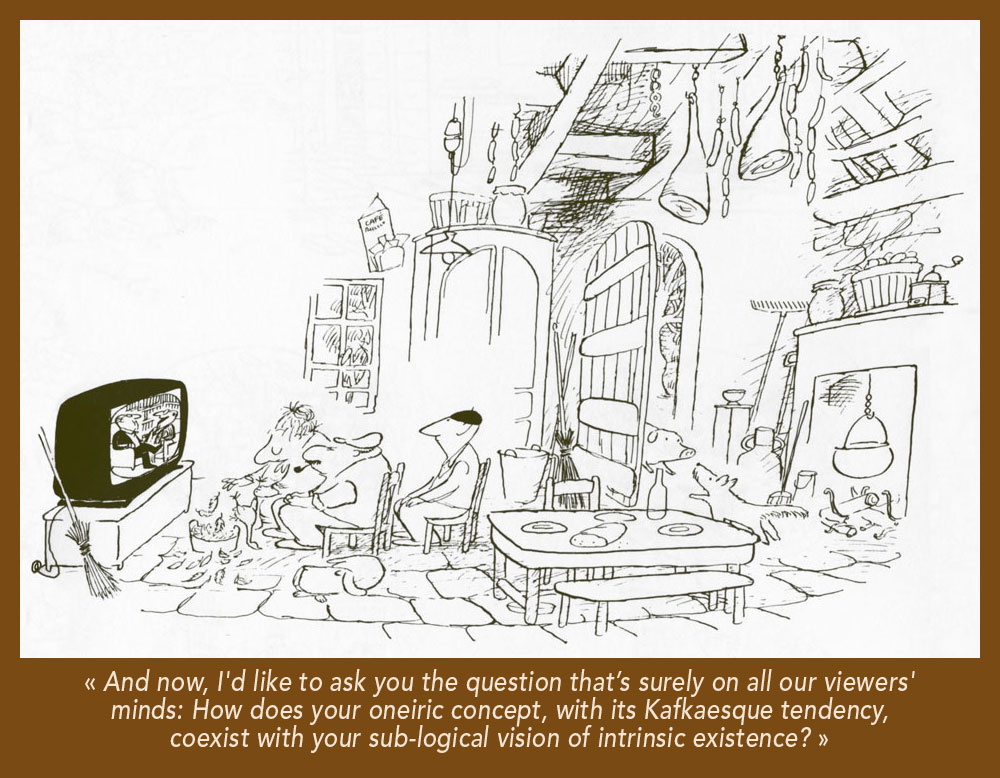
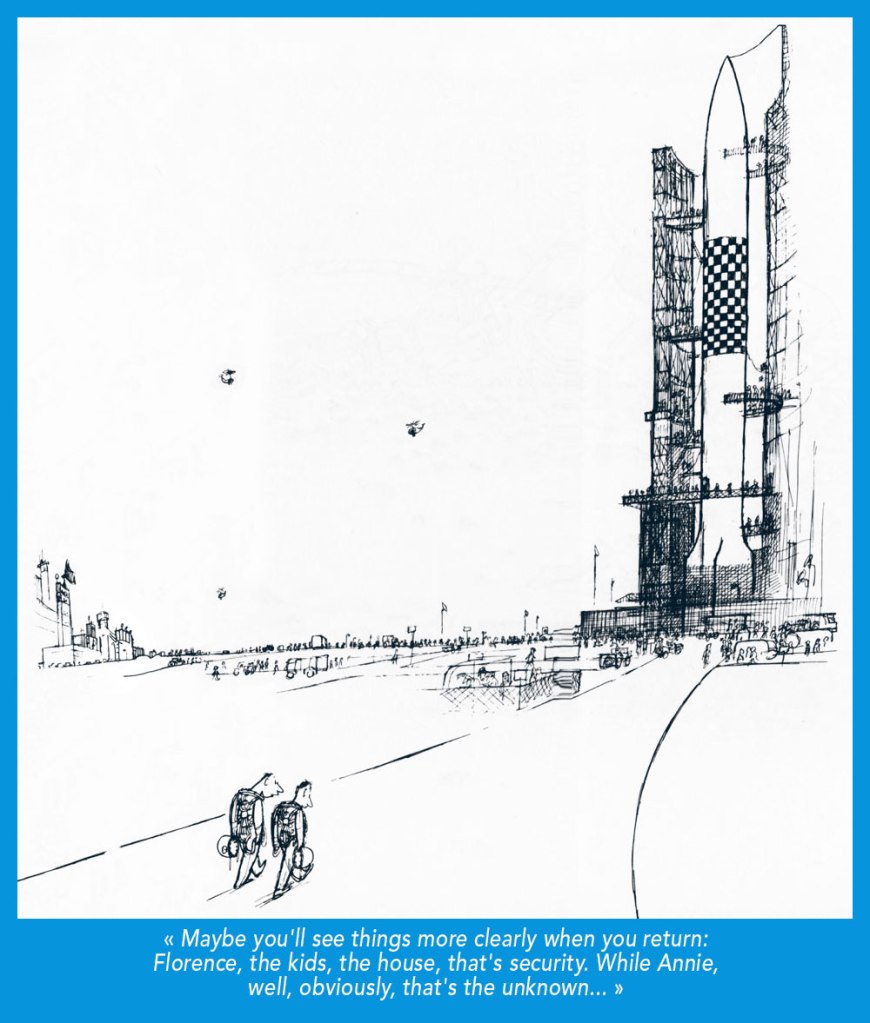
The other day, while weighing the idea of producing this post, I asked my wife: “Is Sempé too obvious a choice?”, to which she wisely replied: “To whom?”. To add another few grammes of perspective, I’m reminded of how, a decade-or-so ago, I was helping out a friend by manning his business phones while he took a vacation. One caller identified herself as Mme Sempé. I immediately asked whether she was related to the cartoonist. She was (they’re second cousins), but rather shockingly, this was the first time anyone had ever brought up the subject with her. Okay, so not so obvious after all.
If you only know Jean-Jacques Sempé‘s work through his cover illustrations for The New Yorker, well, you’ve missed his finest. Sempé (born August 17, 1932, in Bordeaux, France; died August 11, 2022, just a few days short of his 90th birthday) was recruited in the late 70s, in the twilight of editor William Shawn‘s tenure (1952-87) with the magazine. To be quite frank, Sempé’s New Yorker work is his weakest, comprising almost invariably mawkish scenes of the dying arts: little girls practicing scales at grand pianos, ballet rehearsals and grand operas. And the work has only grown more anachronistic and sentimental with time; I’d say he’s the least compelling cover artist currently working for the magazine, with the exception of art director Françoise Mouly‘s little chouchou, the stiff and bland Adrian Tomine, he of the lifeless line and emetic palette. Ahem.
But there was a time…
In 1968, a decade-and-a-half into Sempé’s career, ever-lucid Belgian writer and historian Jacques Sternberg perceptively summed up the artist’s appeal:
« But Sempé’s humour has earned the favour of a very wide audience. Without a doubt because he’s able to observe with a playful — but rarely sadistic — eye the drawbacks and peculiarities of our daily lives, and that his reader feels — mistakenly — reassured by this vision.
Sempé has, in fact, a way with an impressive setting, with meticulous detail, of the mise en scène that sugarcoats the bitter pill and of the lyrical flight that dampens the ferocity of the content. The miracle occurs as if by magic: Sempé, who is rather scathing, seduces rather than worries his readers. »
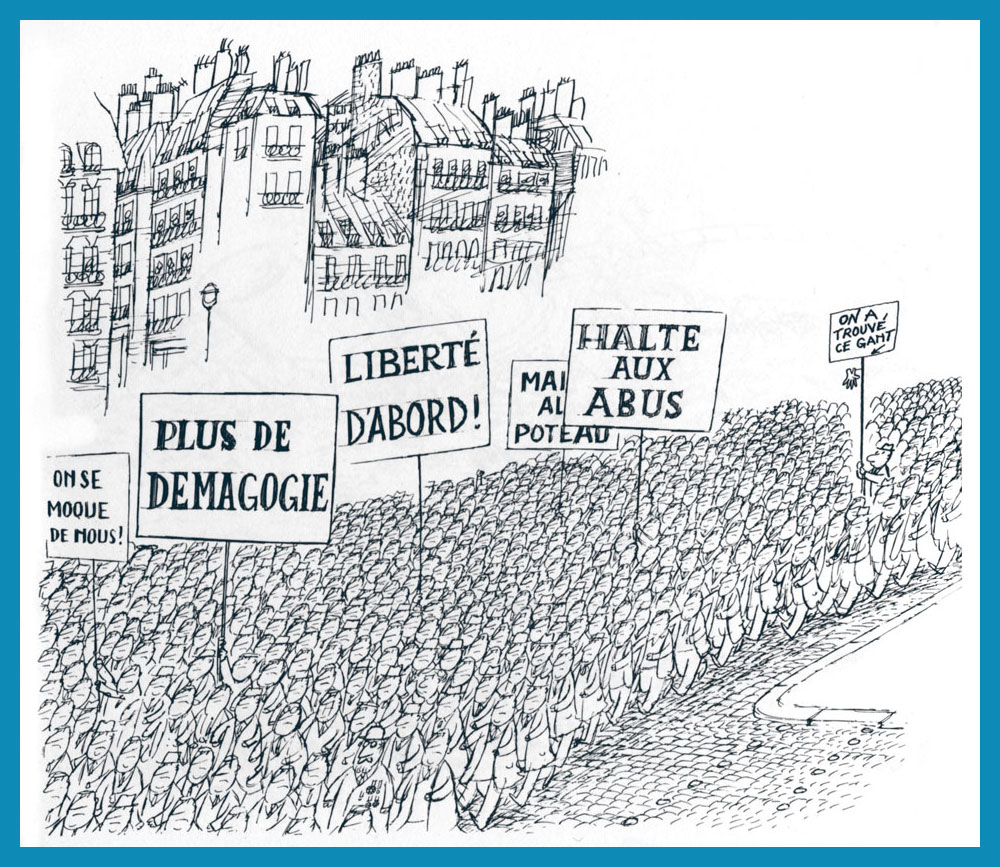
A cartoon that first saw print in the pages of Ici Paris in 1958.
The signs say, from left to right: “They’re mocking us“; “Nomore demagoguery“; “Freedom First!“; “End the abuse“, “Down with…” and… “We have found this glove“.
From France Dimanche (1957). This one strikes close to home for me. Makes me think of the sort of barbarians always seeking to ‘improve upon’ nature. A passage from friendly gadfly and crime writer Carl Hiassen‘s brilliantly scathing polemic, Team Rodent: How Disney Devours the World (1998) comes to mind:
« Disney is so good at being good that it manifests an evil; so uniformly efficient and courteous, so dependably clean and conscientious, so unfailingly entertaining that it’s unreal, and therefore is an agent of pure wickedness. Imagine promoting a universe in which raw Nature doesn’t fit because it doesn’t measure up; isn’t safe enough, accessible enough, predictable enough, even beautiful enough for company standards. Disney isn’t in the business of exploiting Nature so much as striving to improve upon it, constantly fine-tuning God’s work.
Lakes, for instance. Florida’s heartland is dappled with lovely tree-lined lakes, but the waters are often tea-colored from cypress bark. For postcard purposes, tea-colored water was deemed unsuitable for Disney World’s centerpiece, Bay Lake, so in the early 1970s Team Rodent sprang into action—yanking out many of the cypresses, draining the lake, scraping out the bottom muck, replacing it with imported sand, then refilling the crater. All this was done to make the water bluish and therefore more inviting to tourists. For good measure, Disney even added beaches.» [ read it here ]
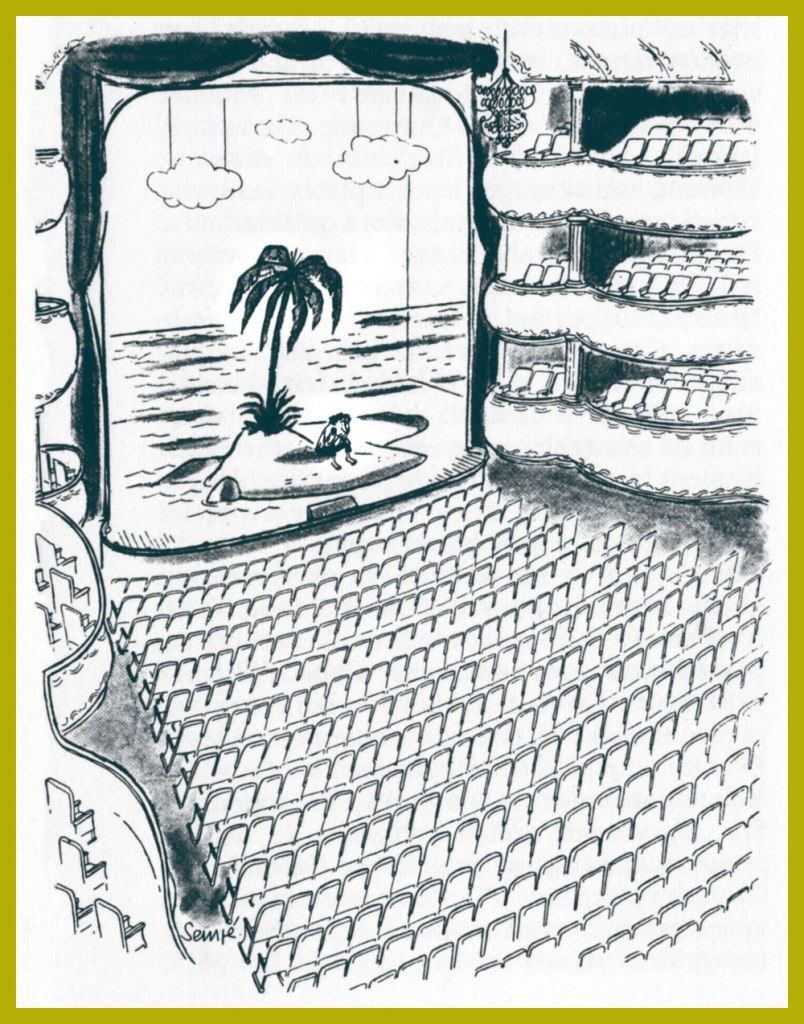
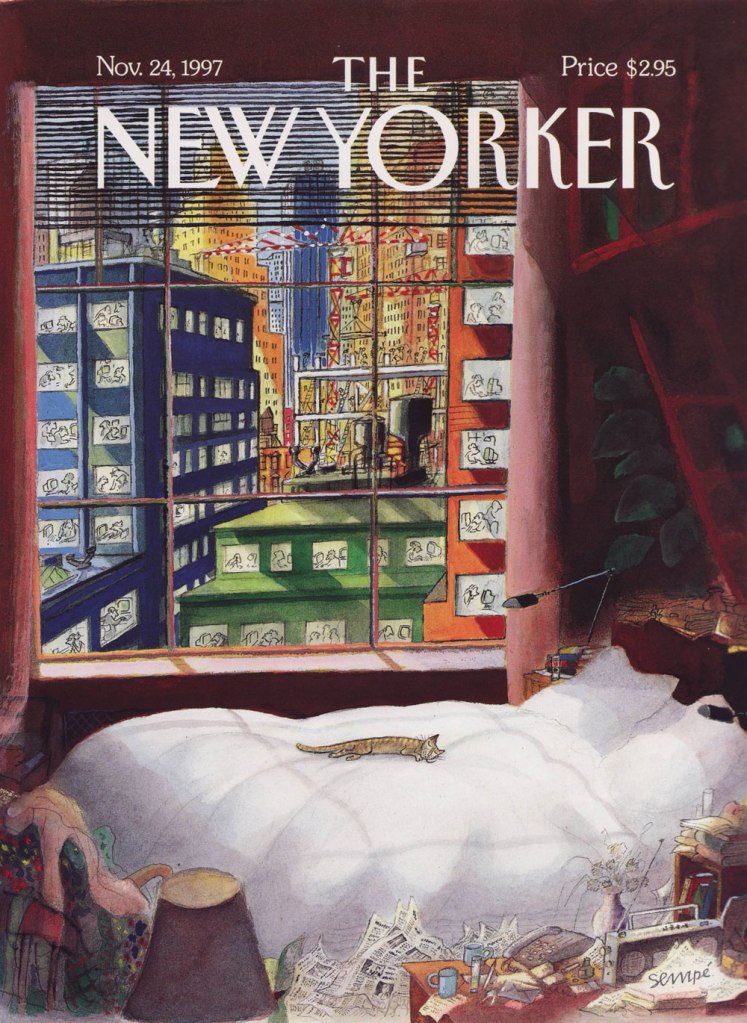
Naturally, I don’t dislike *all* of his New Yorker covers. This one, from the November 24, 1997 issue, is a peach.
This year, since I am currently working from home and spending a lot of time on the balcony, I decided to take another crack at planting a few things in containers and taking a chance with the local squirrels’ tendency to root through soil and munch on whatever’s planted. Still, for all my adorable-yet-annoying rodent problems, I have to admit that I have it much better than some folks: there are no tentacles in this garden, thank you very much.
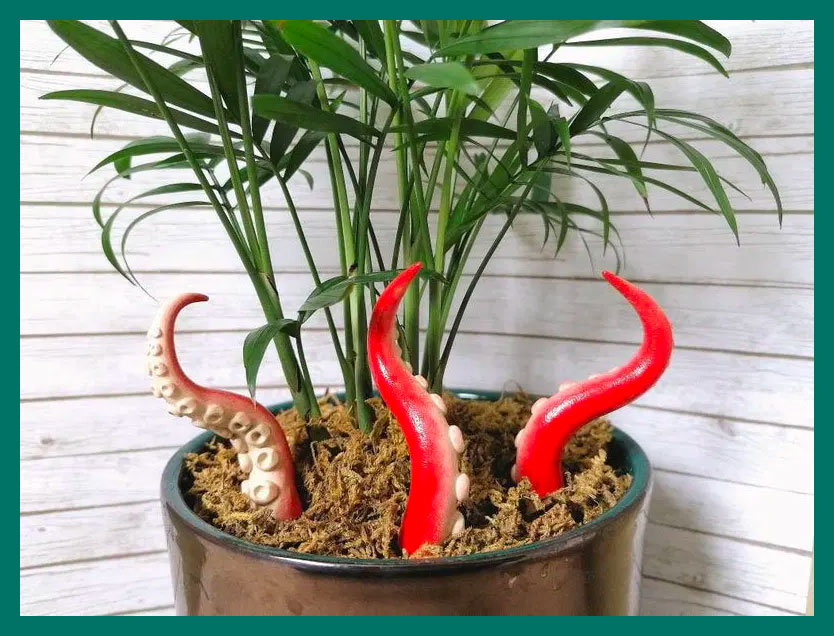
If you should ever see something of this sort emerging from the pot, run the other way!
ACG’s Adventures into the Unknown can always be relied upon for an octopus or two (or ten) – just see Tentacle Tuesday: ACG’s Adventures Into the Tentacles, for example. Tentacles of the plant variety also make a frequent appearance, of all shapes and sizes and degrees of grabbiness.
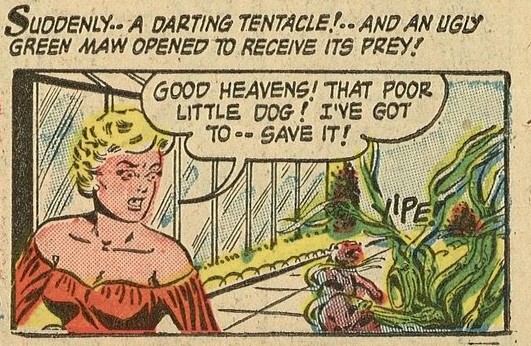
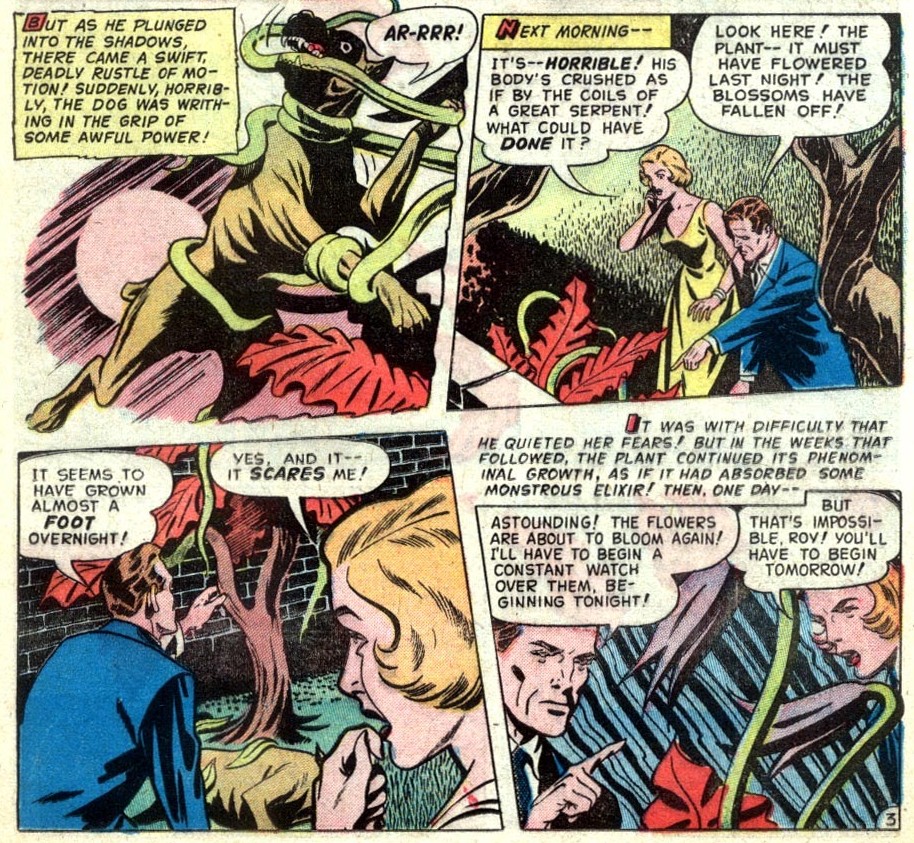
The Plant That Lived, illustrated by Harry Lazarus, was published in Adventures into the Unknown no. 38 (December 1952, KenACG). What happens when a young woman is forced to tend to a plant’s roots against her will?
It all starts with a dog in a botanical garden.
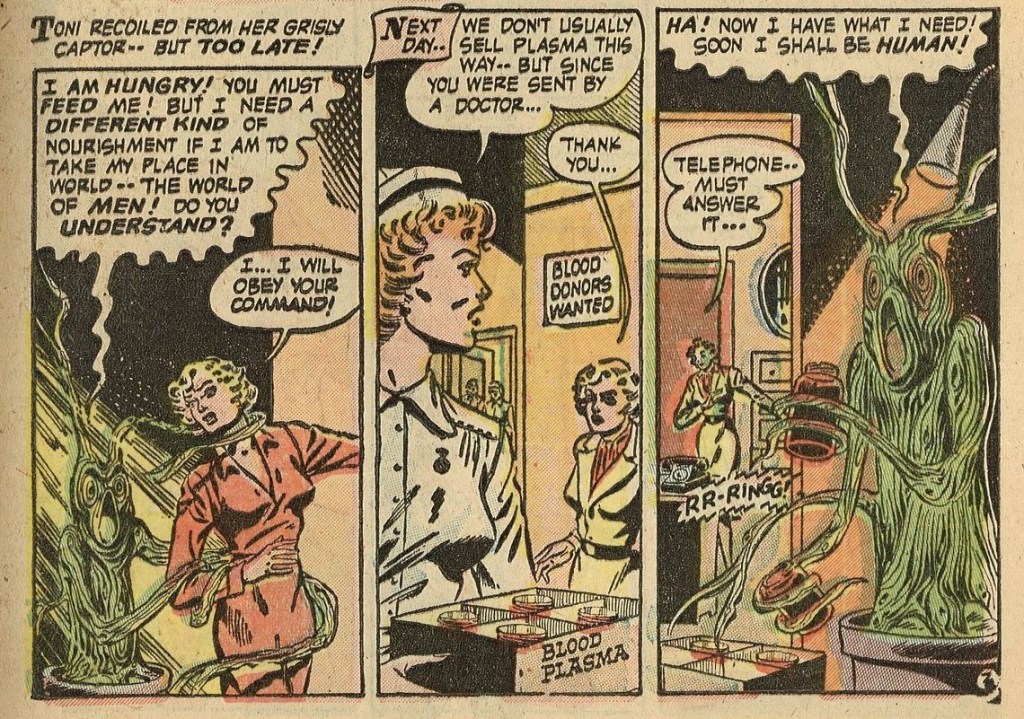
An interesting plot point, revealed at the end of the story, is that the plant’s fervent desire to become human is explained by his love for Phil Benson, the young botanist. I kind of want to see a follow-up story about that couple and the problems a plant-man pairing would be confronted with. And the classy blonde? She can find somebody else to hang out with.
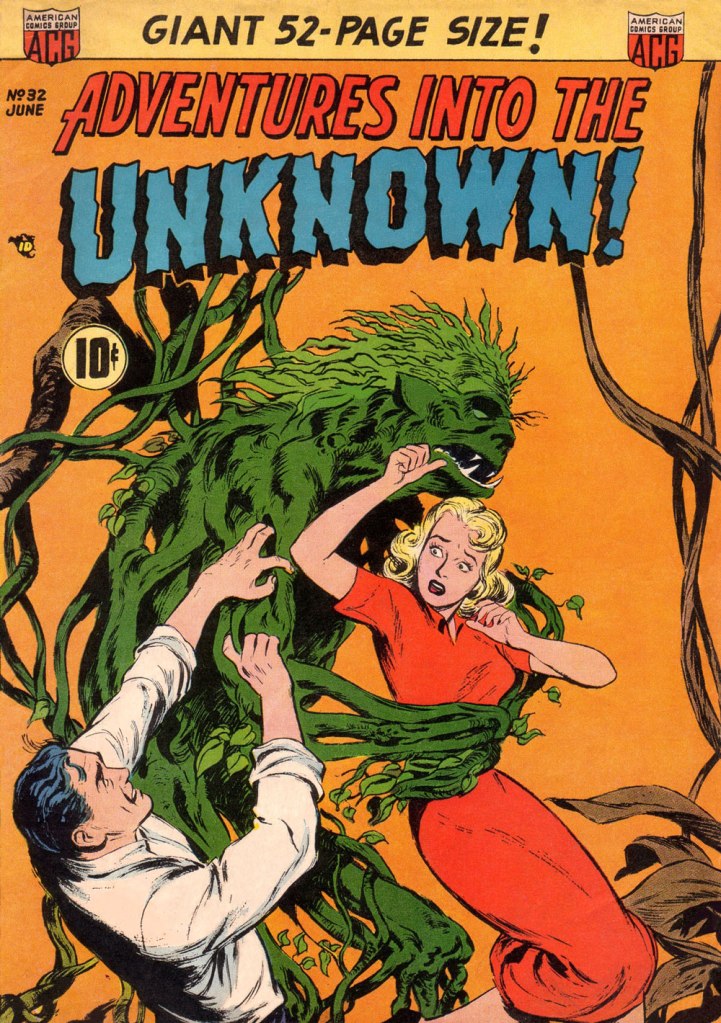
A very similar blonde in a red dress was featured on the cover of an earlier issue, Adventures into the Unknown no. 32 (June 1952, ACG). It may not explicitly feature tentacles, but it is close enough in spirit for me to happily welcome it to the fold!
Another plant-tentacle offering from ACG comes from The Garden of Horror, illustrated by Lin Streeter, published in Adventures into the Unknown no. 48 (October 1953, ACG). This somewhat wordytale concerns itself with an archeologist who comes upon some strange seeds in a ruined temple in an unspecified ‘remote corner of Africa’. Arriving home, he plants them, and – surprise, surprise! – gets a little more than he bargained for. A dog is also involved, though this time it does not escape unscathed.
Carla gives her unscientifically-minded beau (strangely unconcerned with the killed dog, and later in the story, a similarly-dispatched burglar) an ultimatum: either he destroys this evil plant, or it’s all over between them! He chooses the plant – what the hell, she was a nag, anyway.
A subsection of mansplaining is giving directions that are not needed – I think Carla had the idea of ‘cutting the coils’ long before Roy told her to.
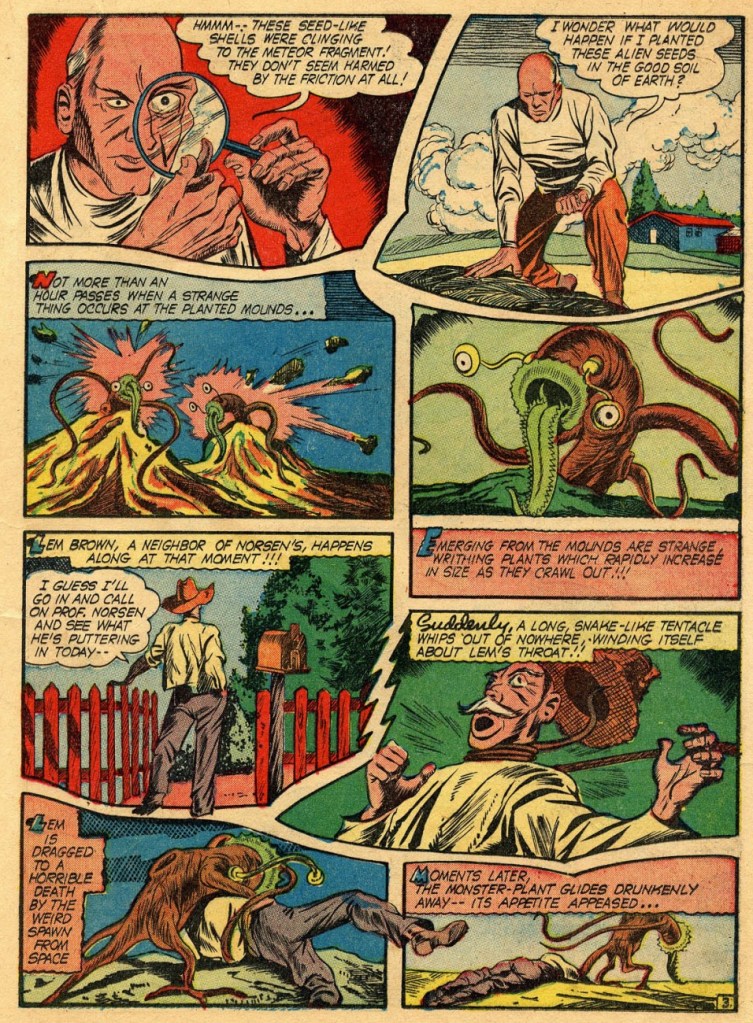
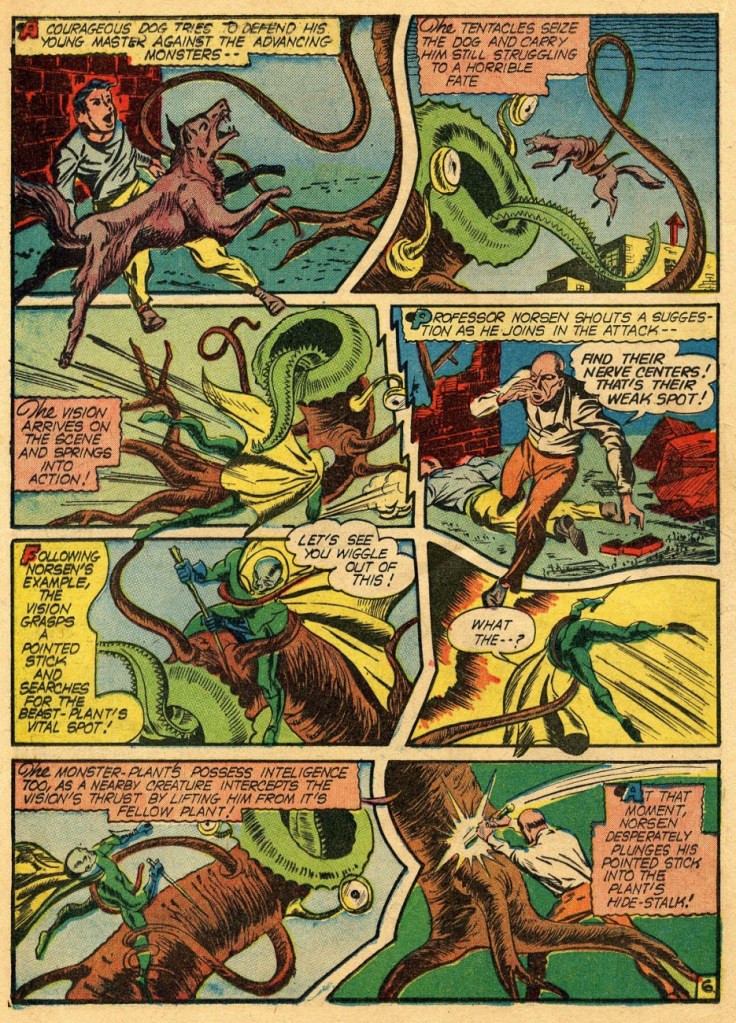
Continuing the theme of the strangulated man and the tentacle-throttled dog, we have two pages from a The Vision story (without a title) published in Marvel Mystery Comics no. 26 (December 1941, Marvel). A scientist finds some strange seeds and plants them. Does that sound familiar?
The tentacled creatures look like they’ve just woken up after a long night of partying with a terrible hangover. I love it!
Fortunately, the brave doggo that gets trapped by tentacles is saved in the nick of time by the Vision. Aarkus, aka The Vision, was created by Joe Simon and Jack Kirby (much like all roads once led to Rome, sometimes it seems that the latter has had a hand in creating nearly everything), as an alien enforcement officer from a dimension called Smokeworld. I stand by the side of any alien who saves braves doggos from a ‘horrible fate’!
This is neither here nor there, but The Vision has been repurposed by Roy Thomas in the late 1970s as part of the Avengers. I quote: « A great fan of Golden Age heroes, [Roy Thomas] first thought to bring back Aarkus, a 1940s hero who had been called the Vision due to his spectral appearance and smoke-based abilities. He discussed the matter with Marvel editor Stan Lee, who enjoyed the idea of a new member, but didn’t want it to be an alien or visitor from another dimension. After he suggested creating a new character entirely and that it could be an android instead, Thomas compromised by creating a new android character who resembled Aarkus and also called himself Vision. » Err, how is using the same name/moniker and a differently-coloured, but otherwise very similar costume considered “creating a new character”?
Glancing at some previous Tentacle Tuesdays, I realize I’ve actually built up a healthy nursery of plant instalments. If you’re still in a horticultural mood, here are some of them:
« When a naked man is chasing a woman through an alley with a butcher knife and a hard-on, I figure he isn’t out collecting for the Red Cross. » — Clint Eastwood in Dirty Harry (1971)
As is often the case, I had something else in the pipeline for this week… but then I came across a beautiful biography of a wise man whose birthday was just around the corner. Now if the other guy (he’s 88) can just hold on and stay alive another week, things’ll be just fine.
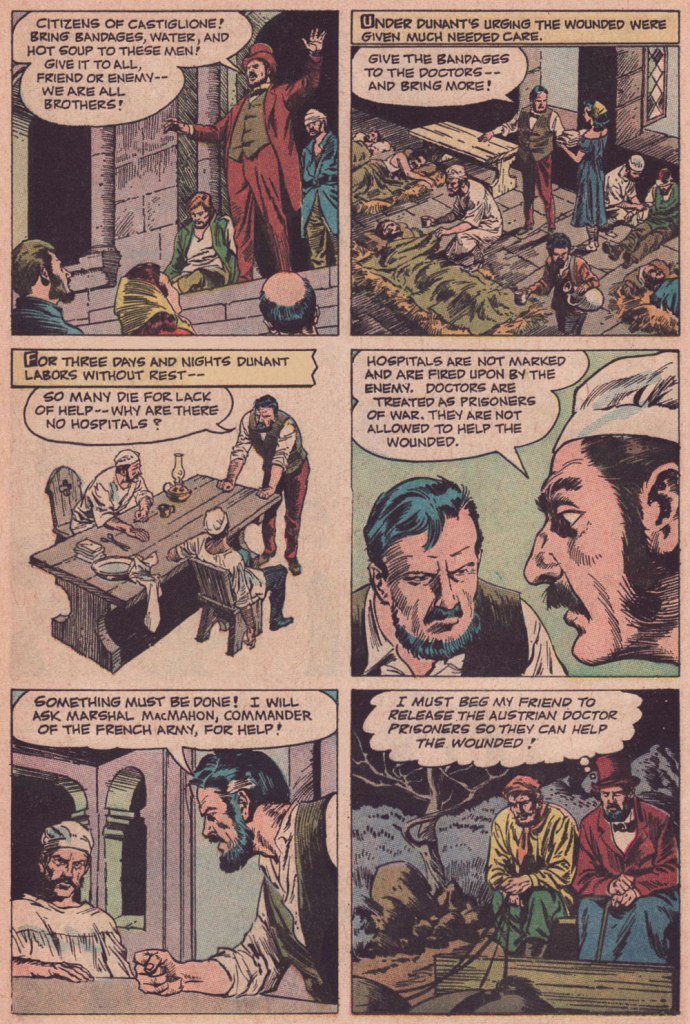
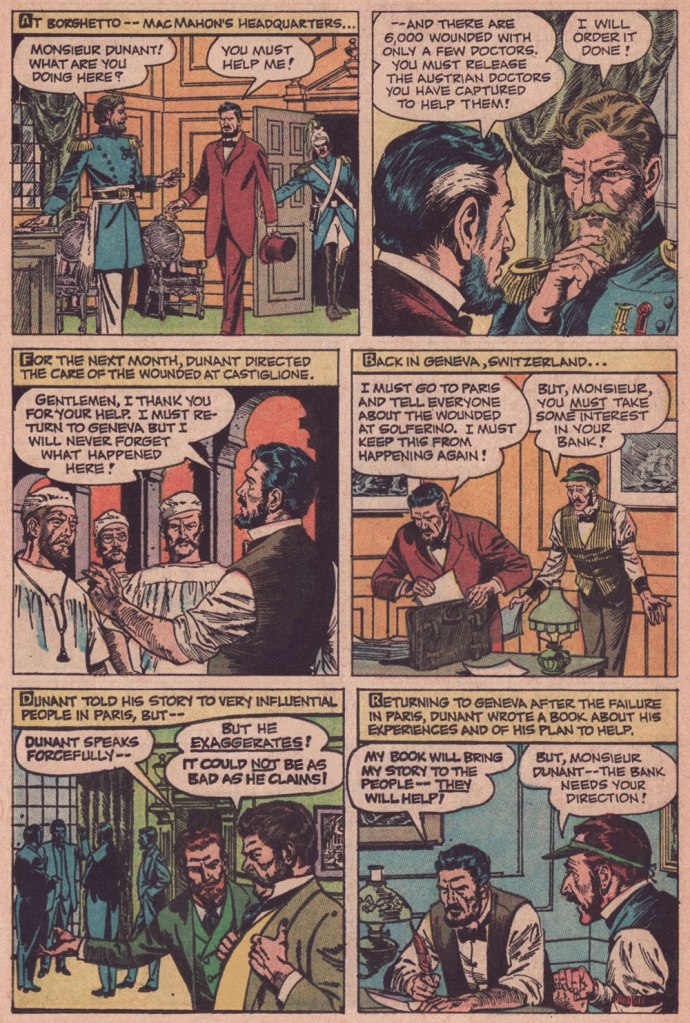
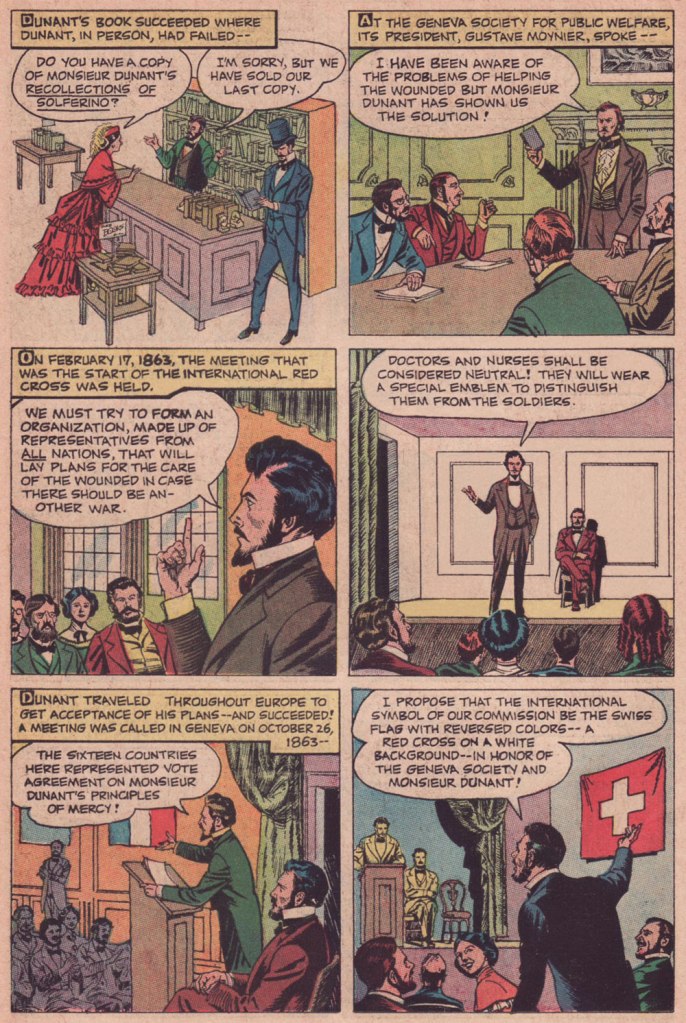
In these riotous days when acts and thoughts of kindness and compassion are being denounced as political and partisan, we would do well to remember the life and example of International Red Cross founder, Henri Dunant (né Jean-Henri Dunant, May 8, 1828 in Geneva, Switzerland). Read on…
To Treasure Chest’s credit, they’re not being tribal or sectarian at all: Dunant wasn’t even Catholic, but rather Calvinist.
As you can witness, Reed Crandall (1917-1982) was not the type of artist to cut corners. Unlike some of his peers who could not be bothered to properly draw, say, details of background, period or costume, Crandall lavished attention and care to each and every element, yet without overpowering the narrative. His pages aren’t mere sequences of panels: they’re smartly composed for smoothness of flow and tonal balance.
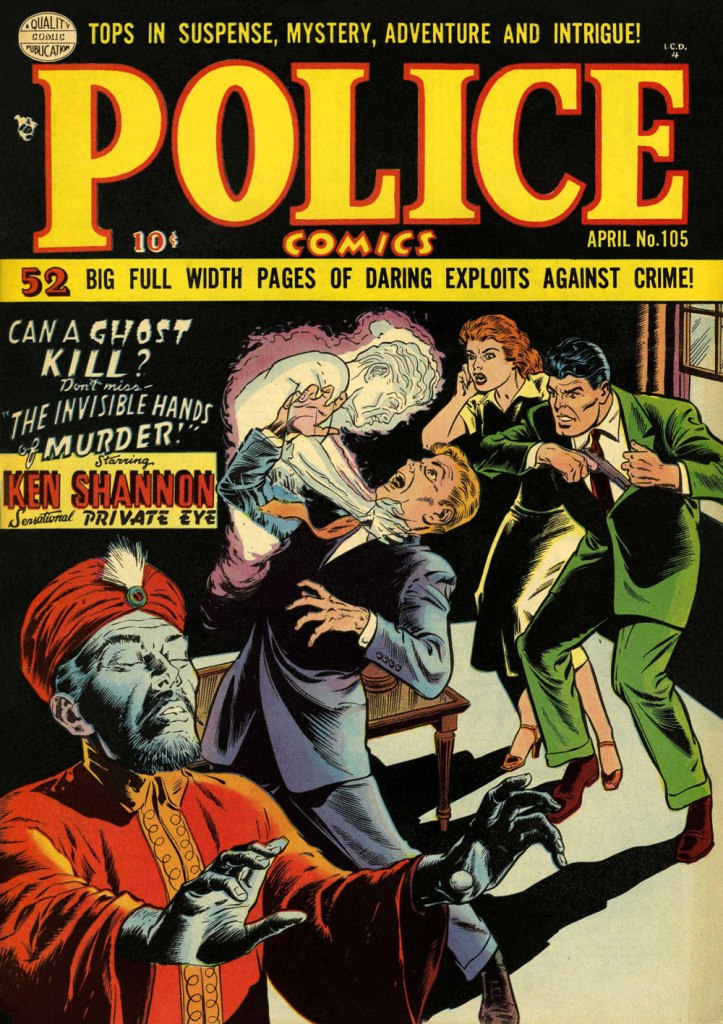
Though nowadays his fame rests largely upon his brief but fruitful association with EC Comics (1953-56) and its echo at Warren Magazines (1964-1973), the greater bulk of his work was produced for Quality Comics (1941-1956) and for the catholic comics anthology Treasure Chest of Fun & Fact (1960-1972). All Men Are Brothers was, as it happens, his first work to be published in Treasure Chest.
Here’s a tongue-in-cheek but revealing snippet from a profile of Crandall that appeared in Creepy no. 10 (Aug. 1966, Warren):
« Combined with Reed’s fantastic drawing ability and mastery of rendering technique, is the rare ability to take any subject or setting and impart to it a complete sense of realism and authenticity. This, along with the fact that he is one of the most genial and unassuming men in the comics field, has earned him the high regard of his fellow artists, in addition to a growing circle of reader-admirers.
Asked about his ambitions, Reed replied: “To live in an ivory tower and to try to learn to draw and paint, also to pursue unendurable pleasure indefinitely prolonged.” It looks to us as though the drawing and painting are pretty far along already, so surely the ivory tower and prolonged pleasure can’t be too far behind… and in our opinion, it couldn’t happen to a nicer guy! »
As for writer John Randolph, who knows? He scripted twenty or so non-fiction pieces for TC between 1955 and 1962, then appears to have moved on. It must be noted that he understood the comics medium, as his work (often with Crandall) was well-paced and not overwritten, the words and visual in steady harmony. Many a writer, lacking the restraint and finesse required for the collaborative pas de deux of comics, tends to crowd out the illustrator, box him in (j’accuse, Al Feldstein!) or pointlessly restate what’s right there in the visuals (Et tu, True Believer?). Add to that the difficulty of elegantly condensing a life or career in six pages… as in this case. Take a bow, Mr. Randolph, whoever you are.
All Men Are Brothers originally appeared in Treasure Chest of Fun & Fact vol. 16 no. 7 (Dec. 8, 1960, Geo. A. Pflaum); cover by Crandall.
Crandall is most closely associated with the long-running Quality (and DC thereafter) character of Blackhawk (a Will Eisner co-creation). This is Modern Comics no. 78 (Oct. 1948, Quality). Between the operas, musicals, and films, John Luther Long’s Madame Butterfly sure gets around! Read the issue here!
More orientalism, but what a cover! This is Police Comics no. 105 (Apr. 1951, Quality). This title was the former and first home of longtime headliner Plastic Man, who bowed out with issue 102. Superheroes, you’ll recall, suffered fading popularity by the early 1950s. Read the issue here!
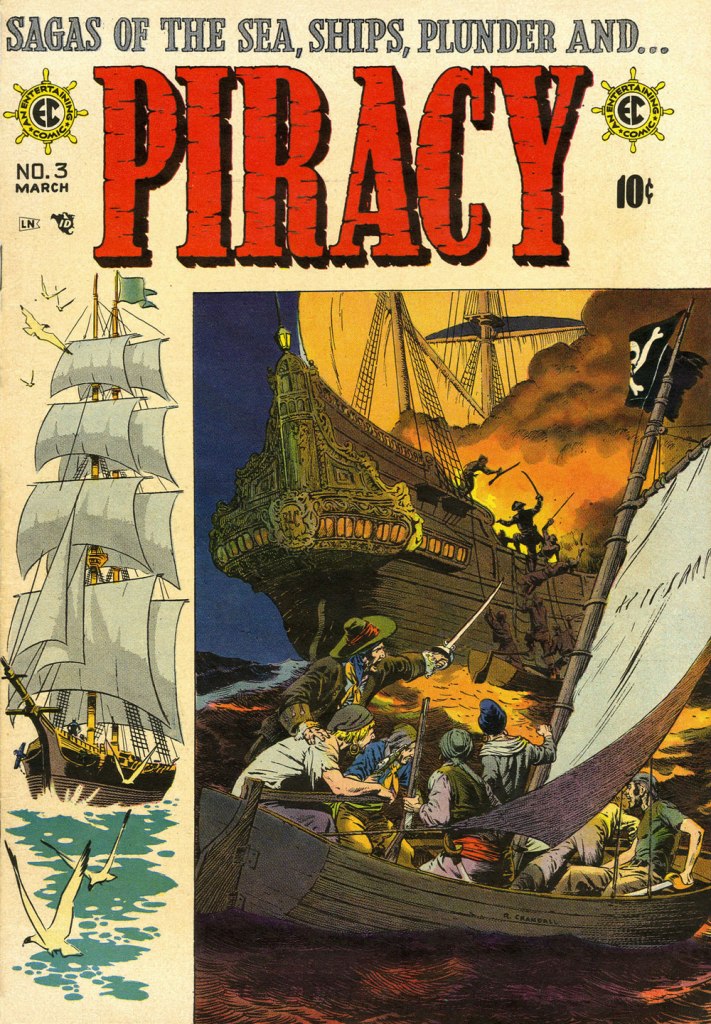
While Crandall arrived a bit late to the EC party, he made his lasting mark. Versatile as he was, I’d argue he was most in his element on this swashbuckling title, one of EC’s last-ditch, doomed attempts to placate the censors. Wally Wood drew the ship on the left, a recurring element of the cover layout. EC colourist Marie Severin (1929-2018) truly deserves a long round of applause for the sublime job she performed here. This is Piracy no. 3 (Feb.-Mar. 1955, EC).
« Don’t change your tack when the timbers crack On the dark and the rolling sea… » *
I am relatively indifferent to tales of adventure, but the siren song of the ocean sometimes prompts me to venture into reading tales about ruthless pirates or valorous seafarers and the perilous voyages they undertake on ships big and small, magnificent or modest. Who hasn’t felt a thrill at spotting a handsome vessel on the water, even if that water is but a canal running through the city? The other point of interest of this discussion is that where there’s an ocean and a ship upon it, there is a (preferably) giant octopus somewhere nearby, only waiting to shred the ship’s hull to smithereens and voraciously gobble up its shipmates.
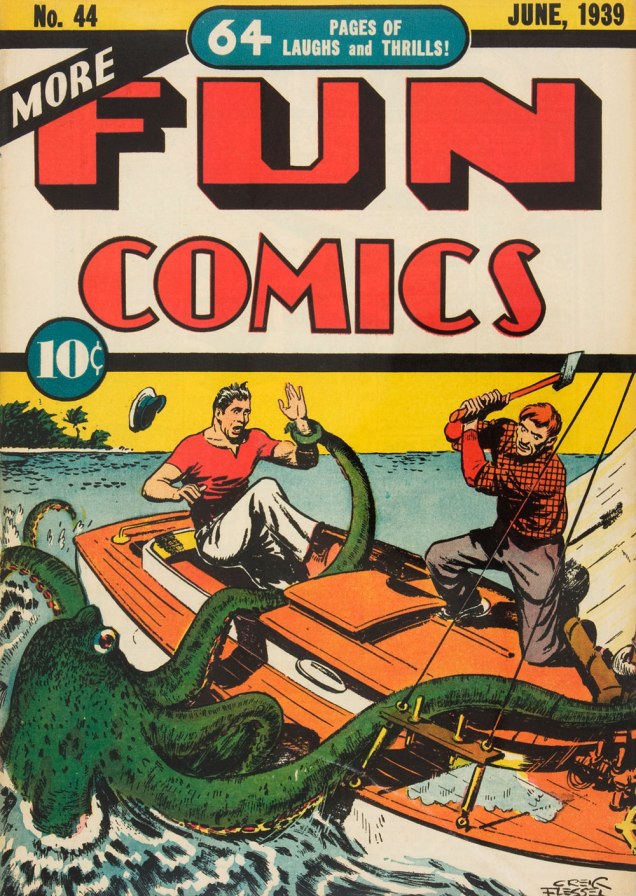
Here is a modestly-sized yet utilitarian boat with a handsome octopus in tow. Maybe he just wanted to climb on deck to rest a while, like this otter?
More Fun Comics no. 44 (June 1939). Cover by Creig Flessel.
A similar boat (I don’t know whether it’s my profound lack of knowledge of boats that makes it seem that way) was attacked by a bigger, scarier – downright malevolent! – octopus some twenty years later. See Kyle “Ace” Morgan, Matthew “Red” Ryan, Leslie “Rocky” Davis and Walter Mark “Prof” Haley scramble for safety while an enraged octopus seeks to devour them! Oh, sorry, I’m being melodramatic.
Challengers of the Unknown no. 77 (Dec. 1970 – Jan. 1971, DC). Pencilled by Jack Kirby, inked by Jack and Rosalind (Roz) Kirby.
This cover has actually been recycled from Showcase no. 12 (Jan.-Feb. 1958, DC), where the background was yellow and the water a more normal shade of blue-white. I do like how the octopus stands out against a black background, however (and the multi-coloured water really sets off his beady, evilly-glowing green eyes!)
Of course these encounters also take place within the stories, as opposed to on the cover.
Page from The Outcasts of the Seven Seas, scripted by Bob Haney, pencilled by Howard Purcell, and inked by Sheldon Moldoff, was published in Sea Devils no. 23 (May-June 1965).
Time to move underwater, a very natural setting for an octopus attack. Here we have a submarine tenderly wrapped in tentacles:
Page from The Human Torch in the Clutches of the Puppet Master!, (over)scripted by Stan Lee, pencilled by Dick Ayers and inked by George Roussos. This story was published in Strange Tales no. 116 (Jan. 1964, Marvel).
Last but not least, I’ve kept this neat little submarine until the end:
Voyage to the Deep (IDW Publishing, 2019), a collection of Dell Comics’ short-lived, four-issue series published from 1962 to 1964 and illustrated by Sam Glanzman. Note the introduction by WOT favourite Stephen Bissette!
Glanzman is also a favourite of ours, though we haven’t talked about him much (yet). In case you’re wondering what the insides of one of those issues looked like – good, they looked really good! Note the octopus proudly perched in the middle of the page.
Page from Voyage to the Deep no. 1 (September-November 1962, Dell). Art by Sam Glanzman.
« Suffering sea snakes! Can this really be happening, Aquaman? » — Aqualad has a query.
I just realised, a few days ago, that I’d left something hanging for too long: nearly two years ago, I turned the spotlight on a series of Aquaman covers, casually (in my debonair way) letting it be known that there existed another, earlier, and even longer (well, by one) run of exemplary Aquaman covers. The time has come to see whether I was talking through my hat… or not.
Now, at the risk of repeating myself, it must be stated that, since we’re dealing with DC’s late Silver Age, there’s more to any given cover than a signature. DC’s recently-ascended art director, Carmine Infantino, had a hand in designing virtually every DC cover between late 1966 and early 1976. How strong a hand varied from cover to cover, of course. A good designer sometimes knows when to hold back and be invisible, or just about.
Infantino always strove to improve himself and update and hone his skills. Well into his career (he’d started in 1940 at Timely), he pulled an unexpected (and very smart) move. As he recalled it in The Amazing World of Carmine Infantino (2000, Vanguard Productions):
« Around 1960, I went back to school again, this time to study under a gentleman named Jack Potter at the School of Visual Arts. What Jack taught me about design was monumental, and I went through a metamorphosis working with him. I’d sit there confused and he’d tear the work apart. But then it was a light bulb going off – bam! – and I’d understand everything he was getting at.
After studying with Potter at the SVA, my work started to grow by leaps and bounds. I was achieving individuality in my work that wasn’t there before.
I threw all the basics of cartooning out the window and focused on pure design. Everything I did was design-oriented. That was quite the challenging task. But that’s where Potter’s teaching took me.
… I started putting hands in captions, that was decorative. He taught us to do everything decoratively. I’d always found captions very dull. So I thought I’d break the captions into smaller paragraphs and use hands to get people to read them. I regularly pushed design and perspective to the extreme. »
And speaking of reinvention, I must also salute Nick Cardy’s own mid-career creative burst. Prior to the mid-60s, Cardy had always been one of those genteel, tasteful but entirely unexciting journeymen, the way most DC editors liked ’em. I can think of precious few long-timers that managed to convincingly reinvent themselves and greatly raise their game, well into their career, without utterly misplacing their original identity (that disqualifies you, Keith Giffen) in the process. Alex Toth, Jerry Grandenetti and perhaps Sheldon Mayer come to mind…
At any rate, when Infantino got together with Cardy on those covers, all hell broke loose, in the best possible way.
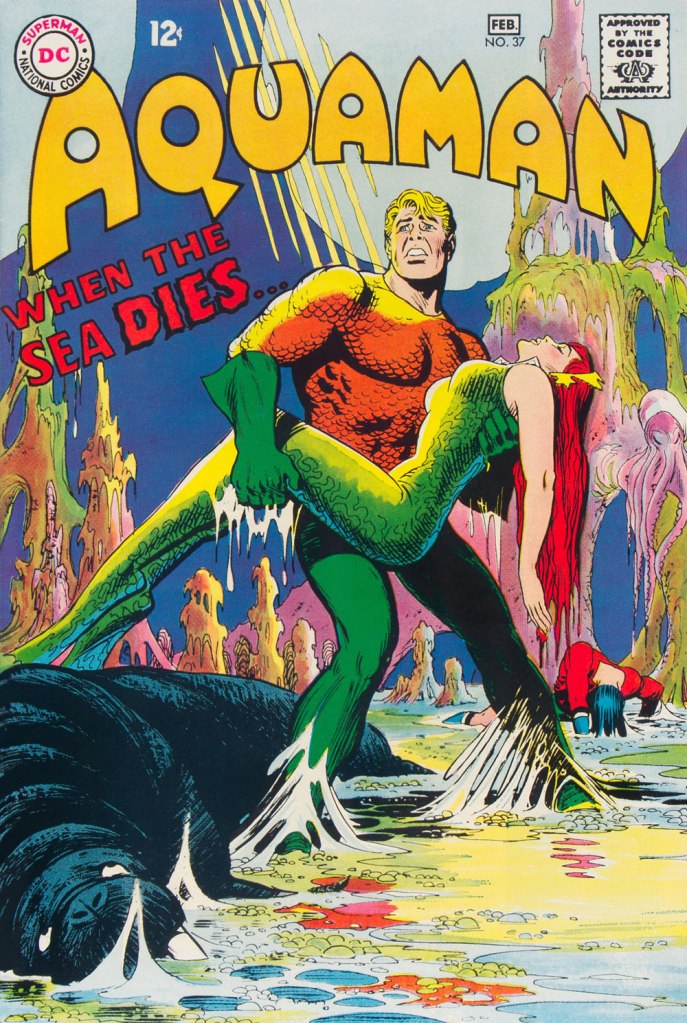
This is Aquaman no. 37 (Jan.-Feb. 1968, DC). The despondent walrus, bottom left, is family pet ‘Tusky’. Oh, and my apologies for ever-so-slightly poaching some potential Tentacle Tuesday material.
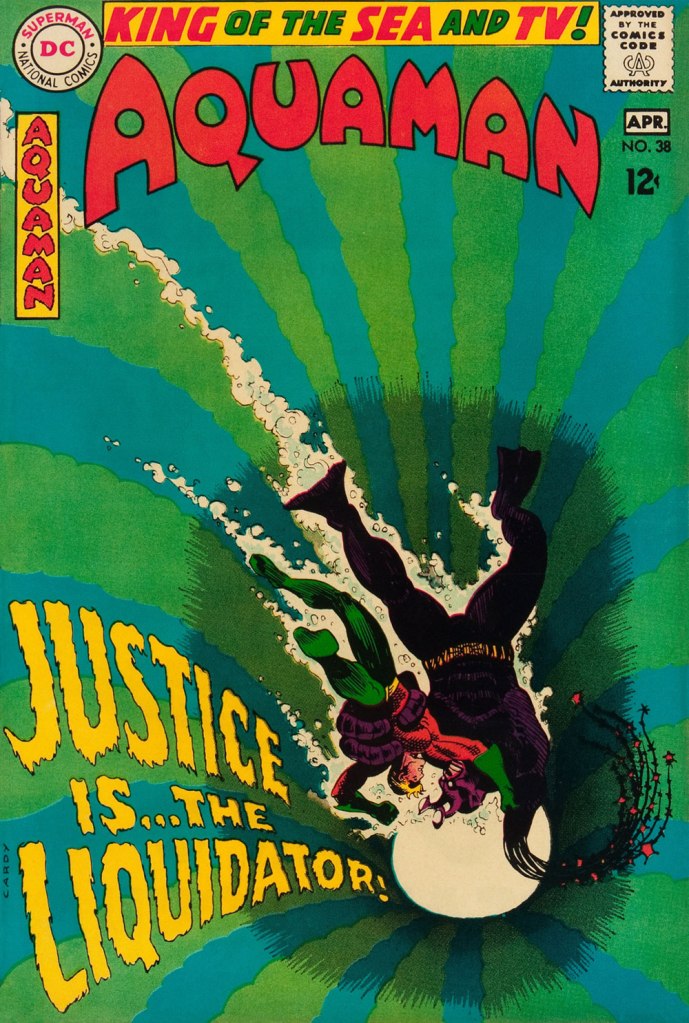
This is Aquaman no. 38 (Mar.-Apr. 1968, DC). I wonder what’s up with the redundant vertical logo, top left.
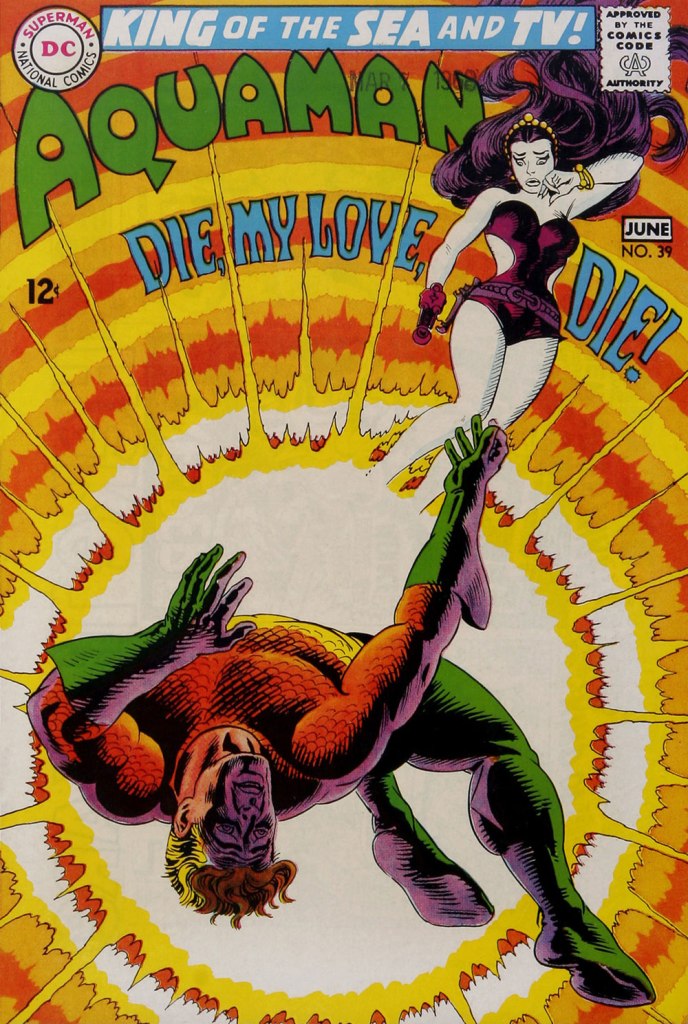
In case you’re wondering about Aquaman’s expanded regal duties (“and TV!“), they were showing repackaged reruns of his half of the previous year’s Superman / Aquaman Hour of Adventure. A Filmation production, so don’t expect too much if you haven’t seen it. But back to the comic book: this dazzling scene announces the saga of “How to Kill a Sea King!”, as our amphibious hero seeks to thwart a hostile Venusian takeover of Earth and sea. Script by Bob Haney, art by Cardy. This is Aquaman no. 39 (May-June 1968, DC). Oh, and the hottie? That’s “Aliena”. A real bolt of ‘inspiration’ there, Mister Haney.
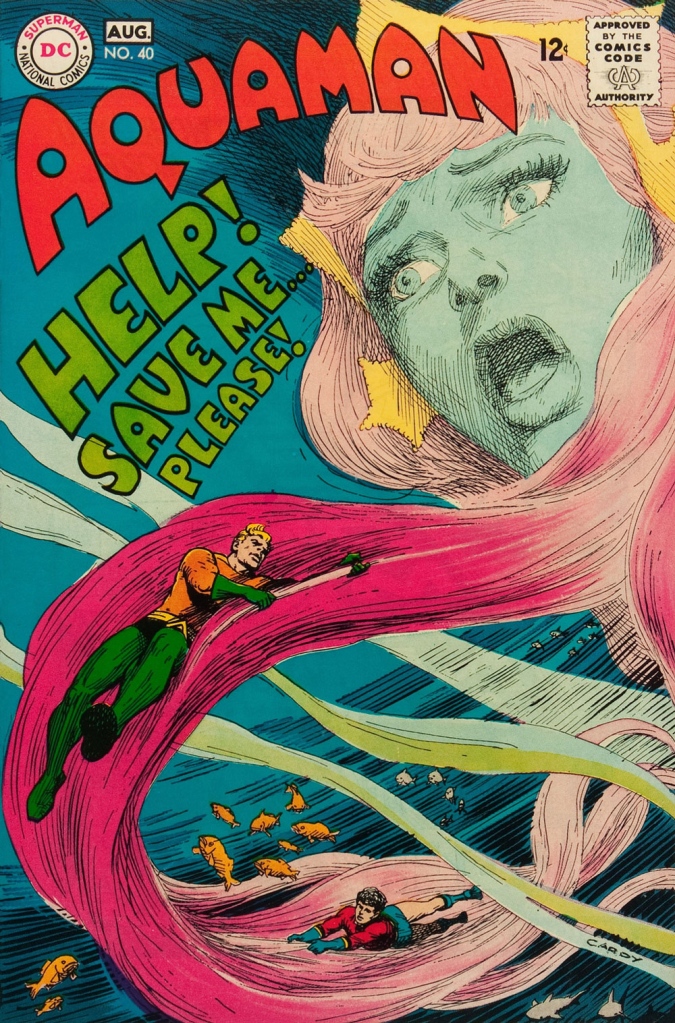
This is Aquaman 41, (July.-Aug. 1968, DC). Such dynamically-designed fun! This is where the new creative team of Stephen Skeates and Jim Aparo joins new editor Dick Giordano (his second issue), but Cardy remains on covers… because Aparo, who resided a couple of states over, couldn’t attend the cover conferences.
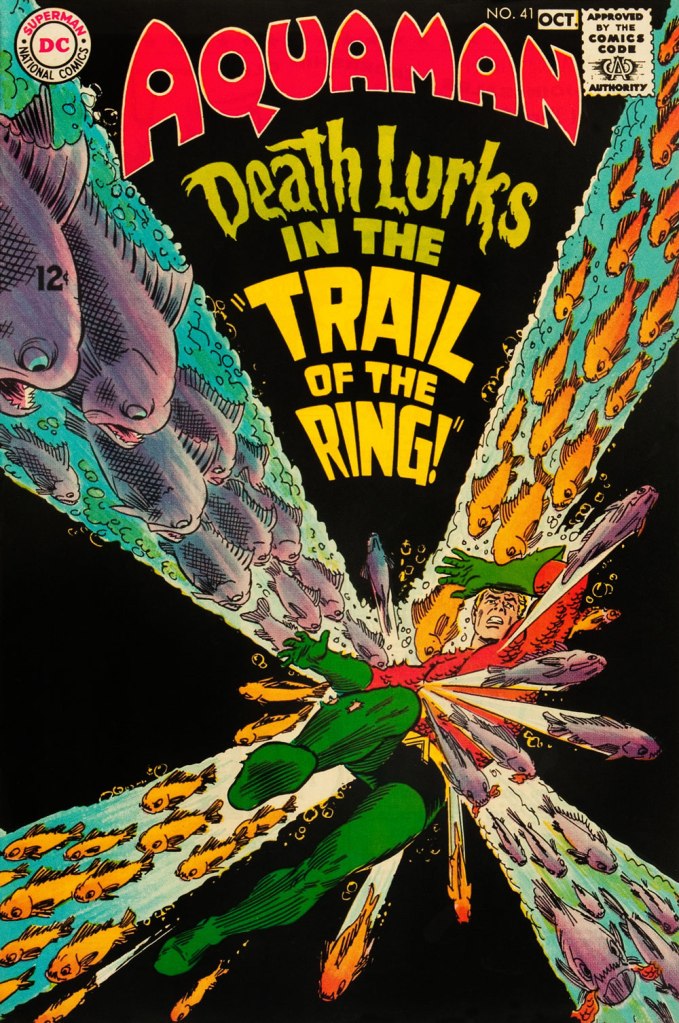
This is Aquaman 41, (Sept.-Oct. 1968, DC), a highlight among highlights from the redoubtable team of Infantino (publisher-designer), Cardy (penciller-inker), Giordano (editor), Jack Adler (production manager and colourist), and, inside, Skeates (writer) and Aparo (penciller-inker-letterer). There’s a texture to the colour work (most evident on the foreground piraña… a freshwater fish, incidentally) that’s unusual for comics of that period. I wonder how it was achieved…
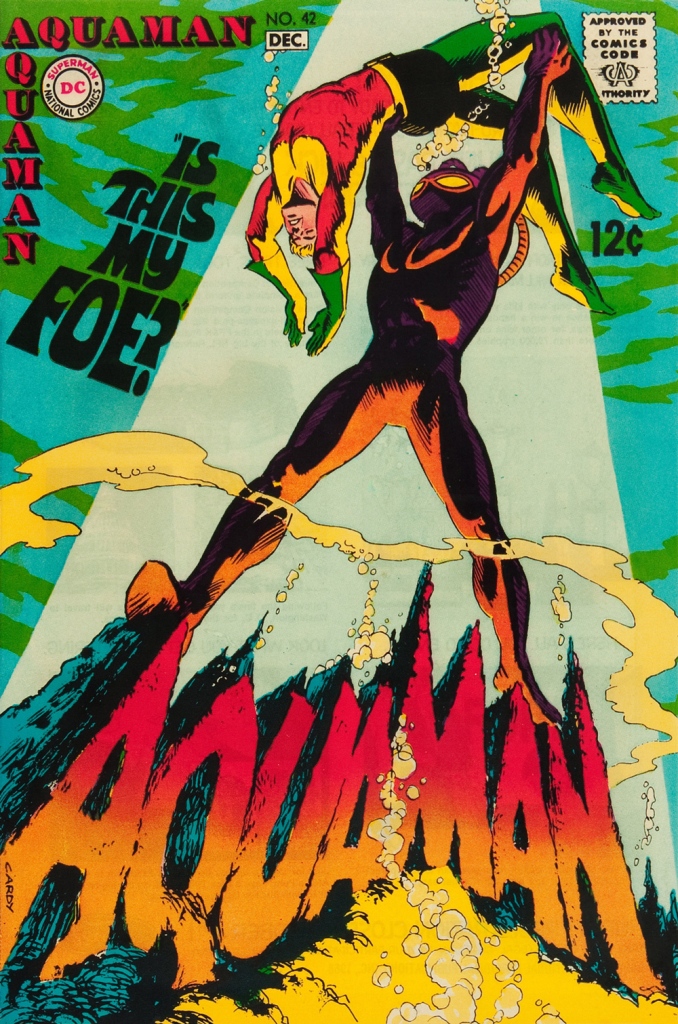
This is Aquaman no. 42 (Nov.-Dec. 1968, DC).
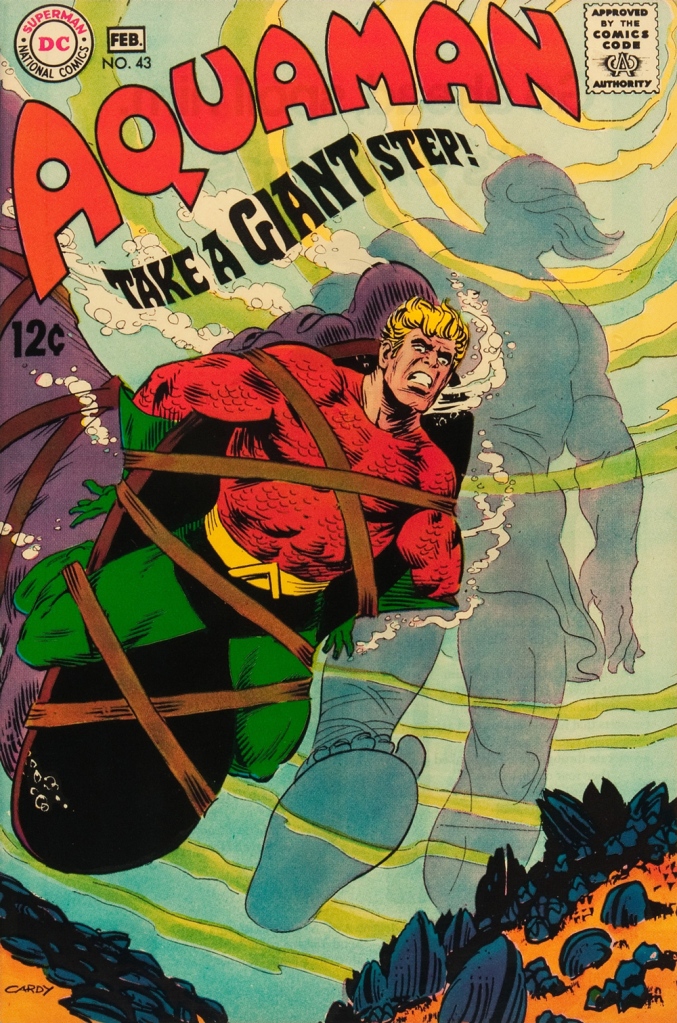
This is Aquaman no. 43 (Jan.-Feb. 1969, DC). Face-first in a bed of mussels, with several tons of pressure? Yikes.
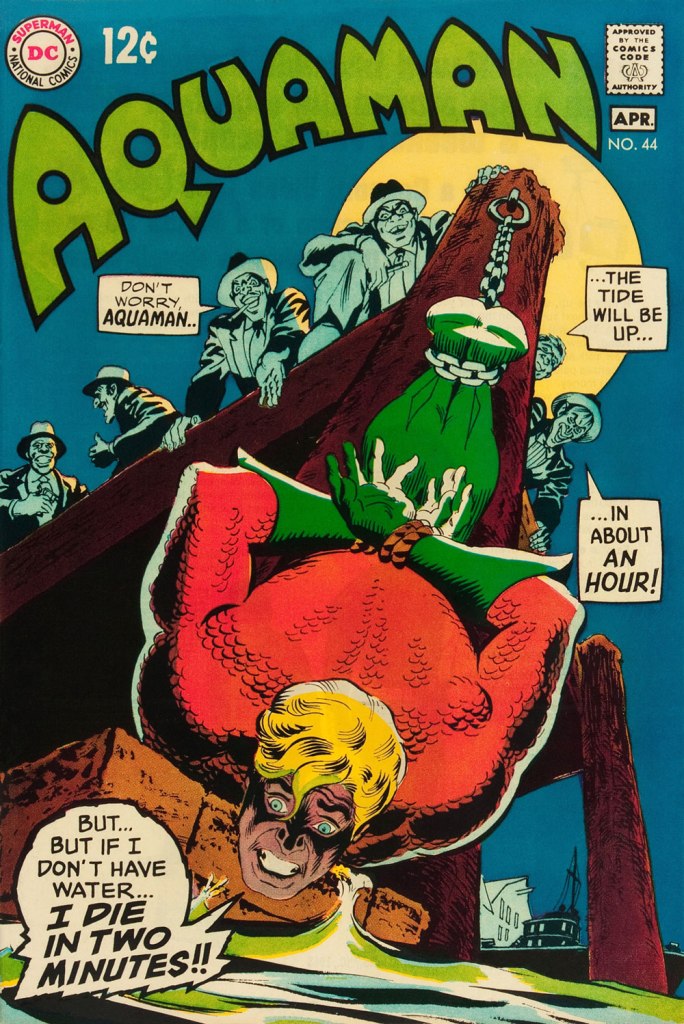
This is Aquaman no. 44 (March-April 1969, DC). I love how, despite the gravity of the situation, the mobsters are kind of cartoony. Cardy would most fruitfully mine this tragicomic vein in the brilliant but short-lived western Bat Lash (1968-69).
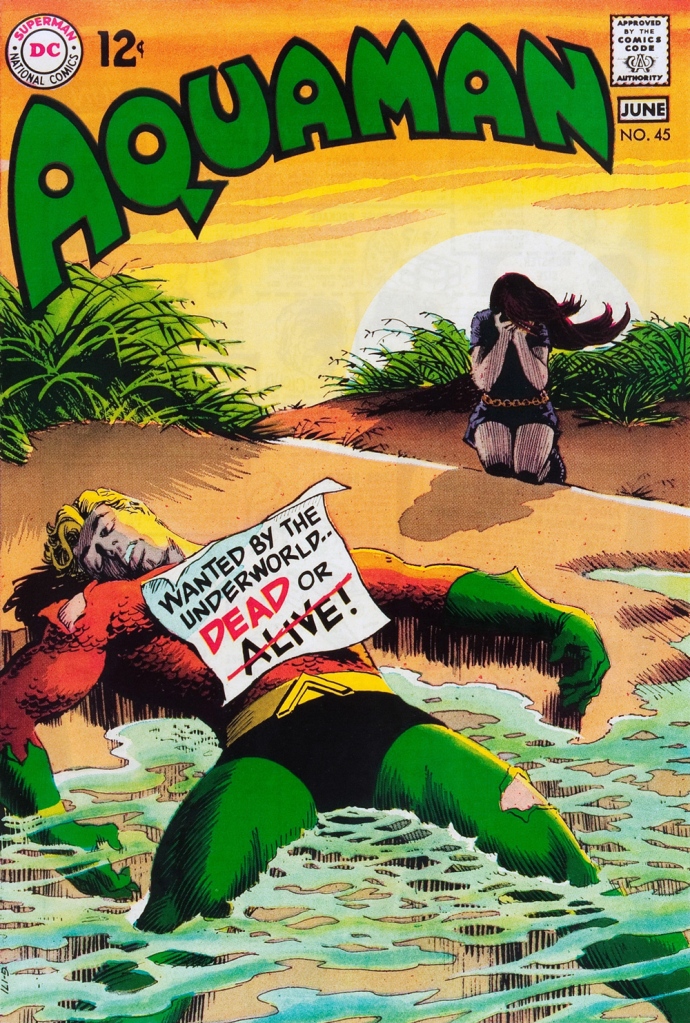
This is Aquaman no. 45 (May-June 1969, DC), concluding Skeates and Aparo’s two-parter, the self-explanatory “Underworld Reward”. An undeniably epochal cover by Mr. Cardy. To wit, so compelling and mysterious is this scene that it’s merited an astute blogger’s impressively in-depth analysis… well worth a peek.
I don’t know about you, but for me postcards are an intense evocation of nostalgia – so ubiquitous in the last century, and just a pale shadow of their former glorious selves in this day and age. Fortunately, a lot of them have survived through the years, and collectors have taken care to preserve these snippets of the past, whether crass or elegant, stunningly illustrated or just the barest sketch of an idea.
We’ll start with the oldest postcards of today’s post from quite a long time ago – the beginning of the 20th century in France.
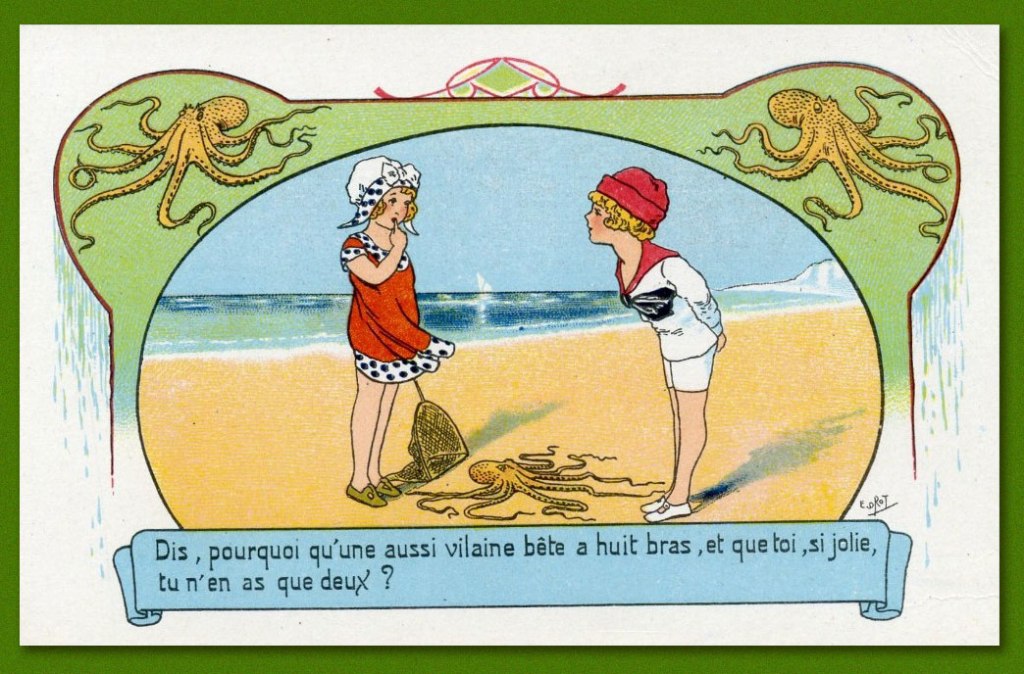
These following two French postcards from 1910 are signed by “E. Orot”, though I wasn’t able to find out whose nom de plume that was. The back of the cards says “près des grands flots bleus” (near the great blue waves) which was the name of the seaside-themed series by this mysterious artist.
The poem is something like “Why don’t I have, like this octopus, eight long arms to embrace you, for I would, without getting weary, make my kisses into true masterpieces”.
“Say, why does such a nasty beast have eight arms, and you, so pretty, have only two?”
The following postcard is French, part of a series of images depicting France in the year 2000 as seen by artists in the early 20th century. These were first published as inserts in cigar boxes, and later given second life as postcards. This one is painted by Jean-Marc Côté. « There are at least 87 cards known that were authored by various French artists, the first series being produced for the 1900 World Exhibition in Paris. Due to financial difficulties the cards by Jean-Marc Côté were never actually distributed and only came to light many years later after the science-fiction author Isaac Asimov chanced upon a set and published them in 1986, with accompanying commentary, in the book Futuredays: A Nineteenth Century Vision of the Year 2000. » To see more of these cards, visit A 19th-Century Vision of the Year 2000, which is also where that quote is taken from.
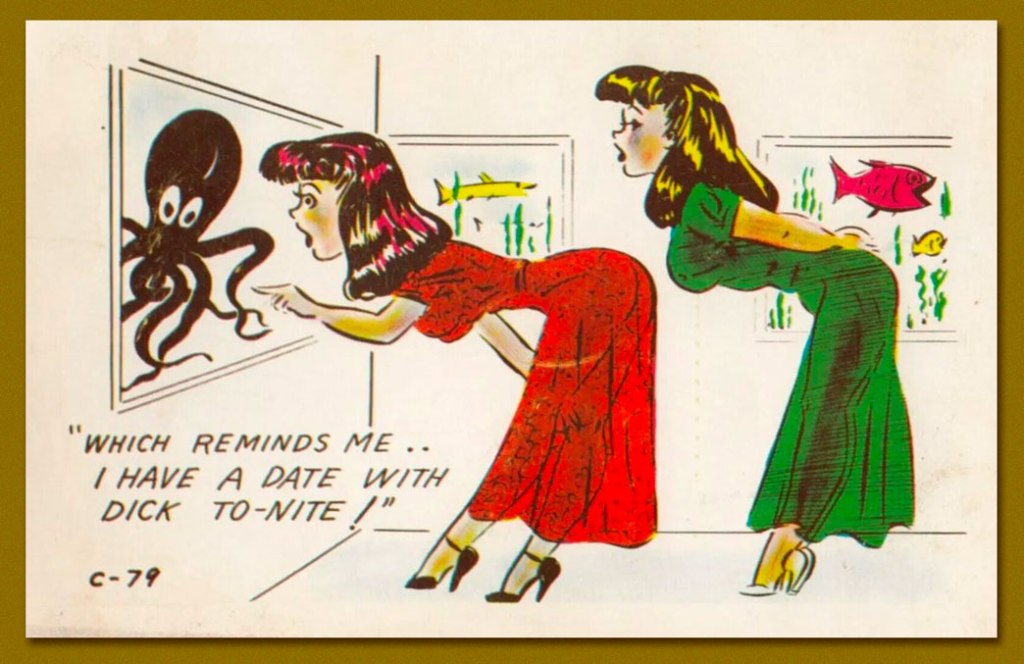
All I was able to ascertain is that this postcard is British, from the 40s or possibly 50s. Are these women giantesses, or is this aquarium exhibit meant for children or possibly dwarves? We will never know.
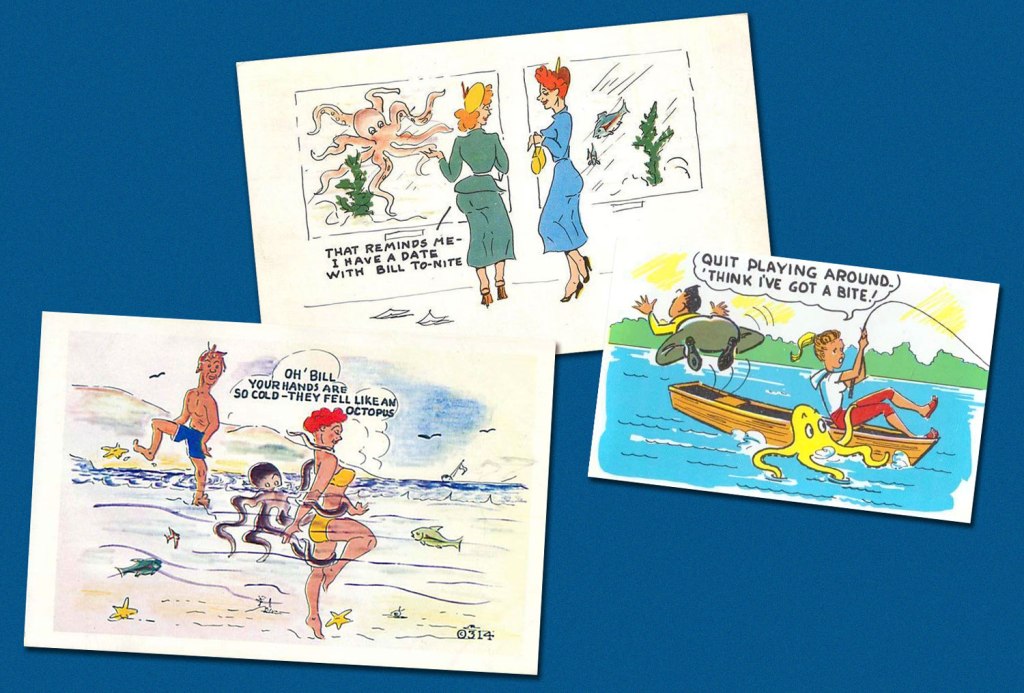
The three following postcards are British, but from varying decades. The Bill going on a date is from the 1950s. Bill’s cold, octopus-like hands (is it the same Bill, some twenty years on?!) are from the late 70s, published by Kromekolor, which seems to have had a chunk of the British market, though very little information is available online. And the nameless guy playing around with a fishing girlfriend is from sometime in the late 60s, and I would not at all be surprised if his name was William.
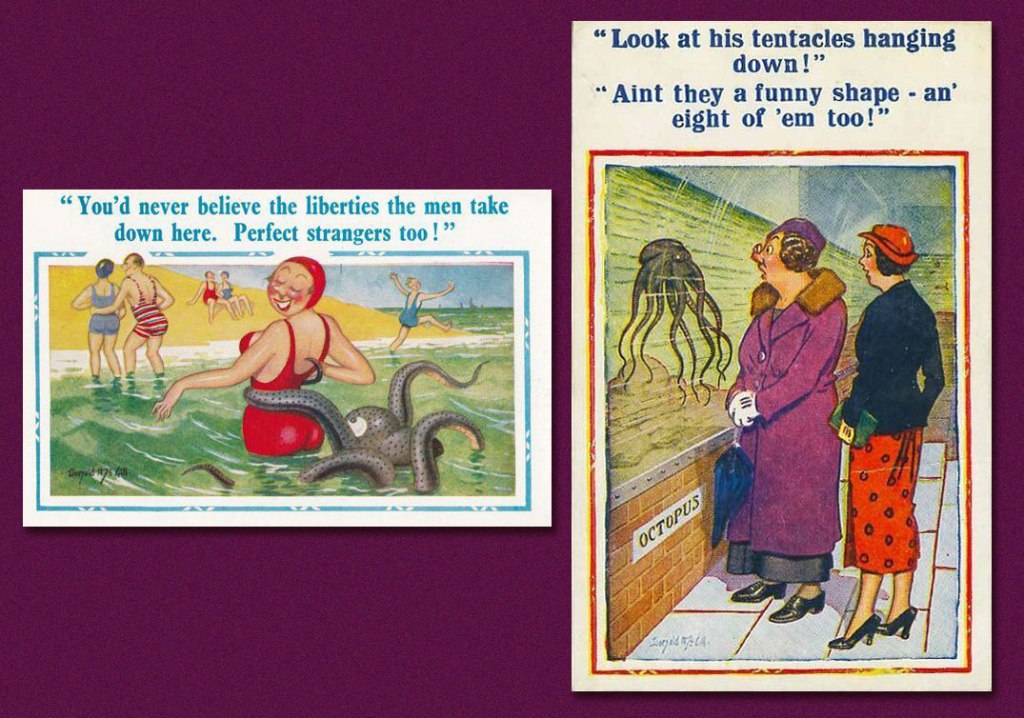
We have talked about Donald McGill, the king of comic postcards (take a look here) before. I was delighted to find two tentacular offerings from the vast collection of postcards he has drawn.
Continuing in a British vein, this postcard is part of the Seaside Spooners collection by Tom Browne, (another extremely prolific British artist and very much a contemporary of McGill) and is entitled The Lovers’ Seat.
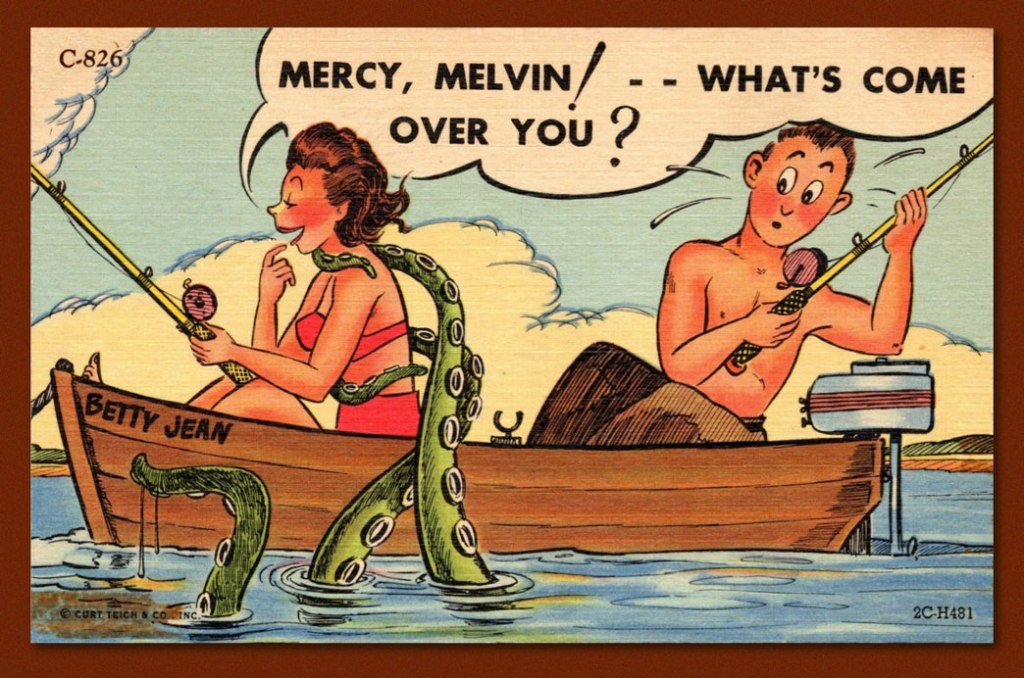
Moving on the good ole U.S. of A. – here’s a pair of American postcards from the 50s, with rather similar jokes.
It’s not very clear why Horace is being propelled out of the boat like that. Is he perhaps terrified of octopuses? Note that it is exactly the same “gag” as in a British postcard featuring William.
And another postcard from 1954. Unfortunately, I don’t know who the illustrator is in either case. I like how Melvin looks puzzled, not scared, by this cephalopod intrusion.
I hope you enjoyed this little voyage! Until next Tuesday…





























 Who's Out There?