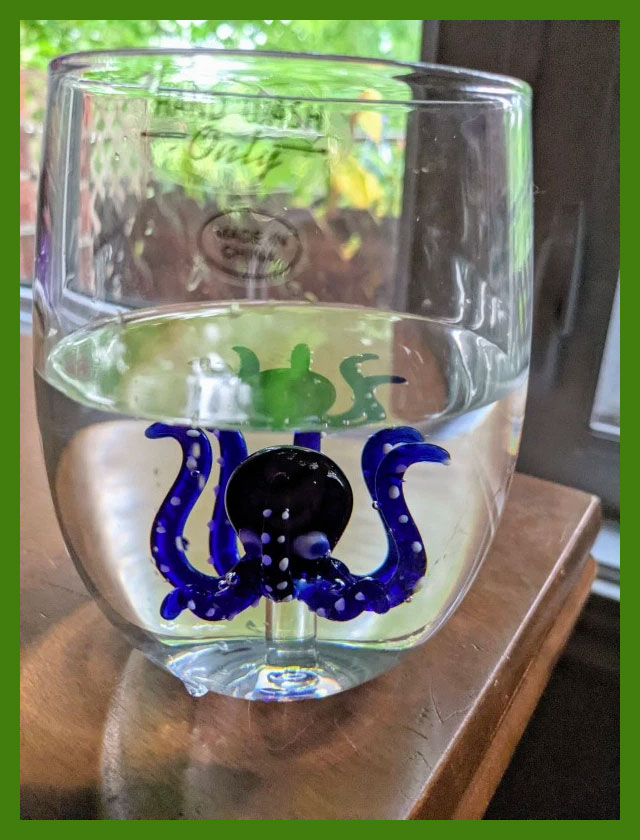
Greetings, tentacle aficionados! First of all, I’d like welcome this new octopus into our household, courtesy of a gift from my mom:
Isn’t he cute?
I felt like going with something more modern this week, though given that the last TT was set in the 60s, that still leaves a healthy 40-50 years to choose from.
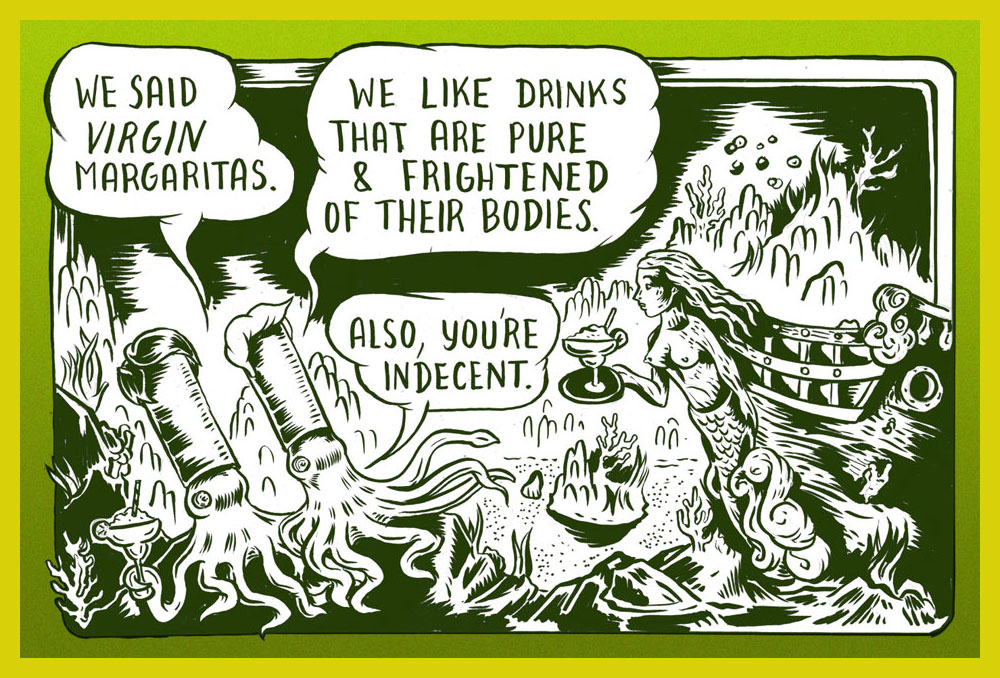
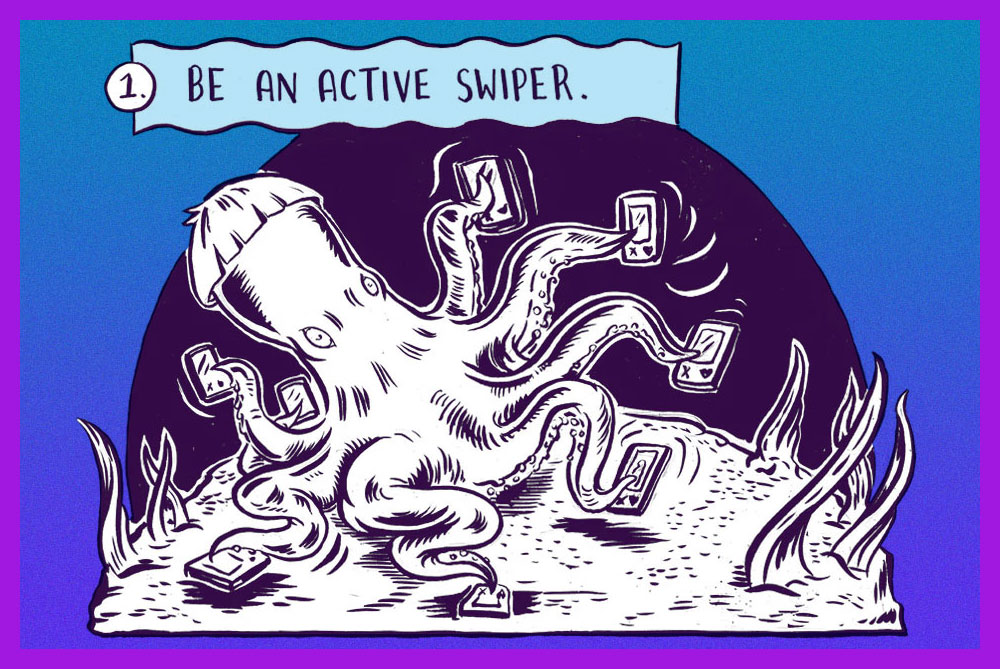
Ali Fitzgerald’s Bermuda Square waved its first ‘hi there!’ on May 16th, 2016 in the The Cut, one of New York Magazine‘s website-only divisions describing itself as ‘a site for women who want to view the latest fashion trends; read provocative takes on issues that matter, from politics to relationships; follow celebrity style icons; and preview new products.‘ I don’t believe Bermuda Square fits that neatly into any of these categories, though Iris the octopus is unarguably stylish, and politics and relationships are definitely involved. Does she and her siren friends ever try out some new face cream, or weighs the pros and cons of that foundation one sees ads for absolutely everywhere? Who knows – Bermuda Square strips only live behind The Cut’s pretty rigid paywall (not that I object to writers and illustrators actually being paid, but I would much rather buy a collection of strips than a subscription to an online-only lifestyle magazine – call me old-fashioned).
Fitzgerald describes the world her comics are set in as “a feminist enclave where everyone can co-exist” and a “delicate ecosystem”. It’s a fully fleshed world, with intricate plot lines tracking relationships between characters and some class warfare, since underwater denizens aren’t at all immune from pettiness or envy. « It’s segmented like New York: There is Astora, a Manhattanite underwater mer-city where Margox imagines building a life, and Orchid Island, which resembles a not entirely gentrified Brooklyn or Queens. Solanas Village is a ‘70s-style, separatist female commune on a rocky shore, while the social, watery Tidelands are like a club where everyone mingles. If a sailor stays too long in Bermuda Square, he goes to (and dies in) the Ghost Vortex… »
The following excerpts have been lovingly coloured by co-admin RG.
First-ever strip, with a lovely abundance of tentacles!
Iris the sex-positive octopus gives tips for using Tinder.
« I don’t mind if my skull ends up on a shelf as long as it’s got my name on it. » —Debbie Harry
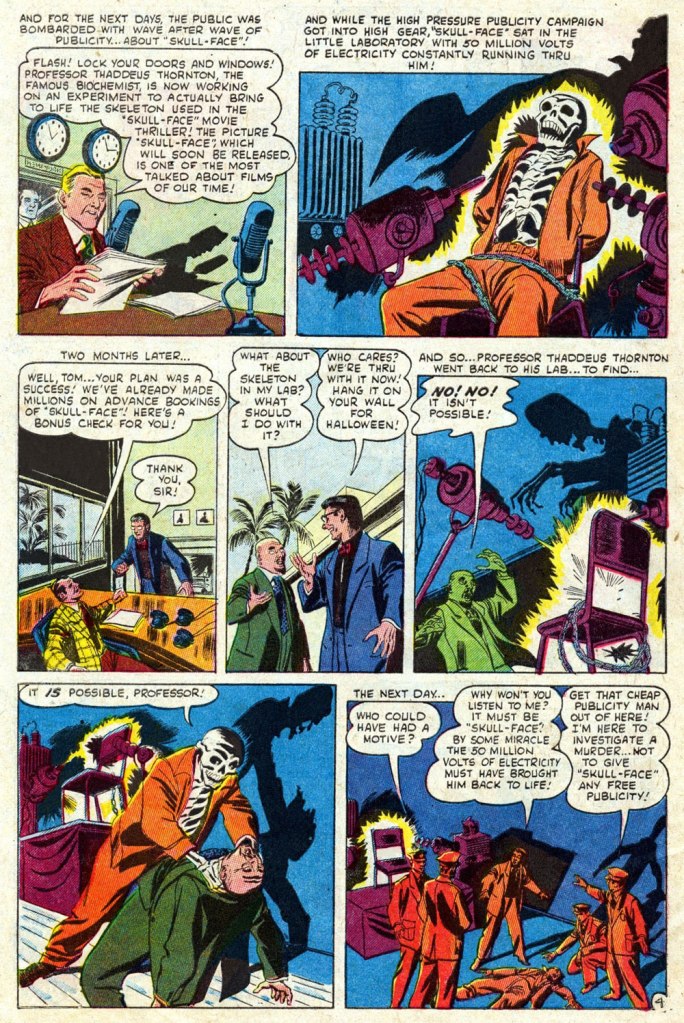
A couple of years back, I spotlighted a story by a neglected Golden Age favourite of mine, Anthony Lewis “Tony” DiPreta (July 9, 1921 – June 2, 2010), the wacky The Hidden Vampires! I advise reading it first for comparison (and a bit of background on the artist).
A whole hour! People were armed with unwavering patience back in the day.
So the suits’ great flash of inspiration is not to update a fifteen-year old movie (from 1937!), nor remake it: they’ll just trot it out again. Picture doing this with 2006’s biggest horror hit, Saw III. How do you think it would fare today?
You’d think a seasoned publicist would be a savvier negotiator. I mean, all he needs is some random skeleton. Adjusted for inflation, a thousand 1952 dollars would today be worth 9,829 bucks. But that’s nothing compared to his liberal waste of electric current: the voltage used to execute a convict in the electric chair is around 2,000 volts for less than a minute… and that makes the lights dim all over the area*. Now multiply the voltage by 25,000, and the duration (let’s round it off to a minute, for simplicity’s sake) 80,640 times longer. Picture the resulting electric bill, not to mention the repercussions on the power grid, all for a stunt that could have simply been faked (i.e. just say there’s live current… no-one’s going to check). Oh, and what’s a “famous biochemist” doing on a film studio’s payroll? Come to think of it, it’s not that odd: Thornton was a cynical, opportunistic money-grubbing parasite, the Dr. Memhet Oz of his day…
Note these stellar examples of one of DiPreta’s trademark horror ambiance moves: lighting from below, projecting stark, expertly-delineated shadows.
One has to wonder why Fenton insists on addressing the resurrected ‘Demon’ (he was a demon on the sousaphone) incorrectly as “Skull-Face” (that’ll only aggravate him, you dolt!). Would it have helped if he’d added air quotes?
The ho-hum Sol Brodsky cover of Mystery Tales no. 6 (Dec. 1952, Atlas), but hey, our pal “Skull-Face” is the featured attraction!
The comics industry’s traditional garish colour and murky reproduction fail (spectacularly!) to do justice to DiPreta’s spare, confident and elegant inking line. To remedy the situation, here’s a look at a surviving piece of original art. It hails from “One Must Die” (scripted by Carl Wessler), from Crime Can’t Win no. 11 (June 1952, Atlas), the publisher’s knockoff of Lev Gleason‘s influential Crime Does Not Pay.
A slick Joe Palooka Sunday from July 24, 1966. DiPreta enjoyed quite a run on the strip, illustrating it from 1959 to its 1984 finale.
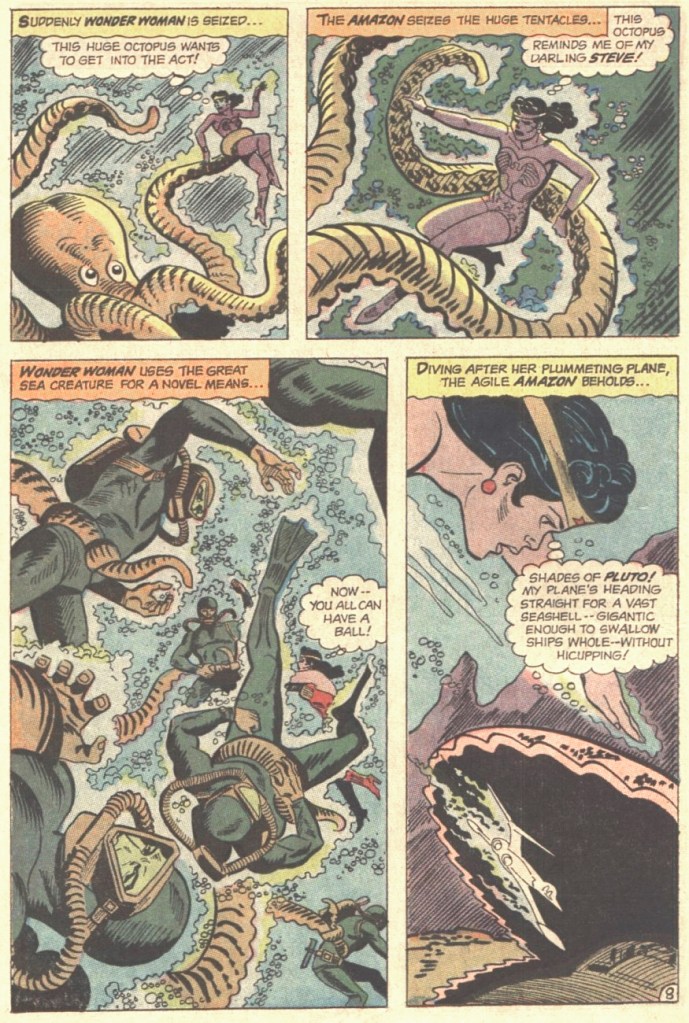
Wonder Woman is probably my most recurring area of focus when it comes to TT posts – although this is just the third, as it turns out, despite feeling like the fifteenth. The first two were devoted to the Golden Age Wonder Woman (Tentacle Tuesday: H.G. Peter and Wonder Woman lend a hand and Tentacle Tuesday: More Golden Age Wonder Woman Wonders!), and having more-or-less exhausted the GA’s tentacles, we move on the Silver Age (which, in my assessment, is considerably less interesting, but sometimes has quite nice art).
All pages are scripted by Robert Kanigher, pencilled by Ross Andru and inked by Mike Esposito, except for the first page from Stamps Of Doom!, which was scripted by Bill Finger.
Page from The Stamps of Doom!, scripted by Bill Finger (credited as Charles Moulton). printed in Wonder Woman no. 108 (August 1959).
I bitched about Kanigher WW in Tentacle Tuesday: Wonder Girl in the Silver Age, Part I and Don’t Let a Mysogynist Plan Your Wedding: Robert Kanigher and Wonder Woman’s Utterly Unsuitable Suitors. I’m starting to feel like my needle is stuck in the groove, but I will however note one more thing: in my righteous anger about Kanigher’s preposterous depiction of women, I’ve been ignoring that he’s not great at writing men, either. That is… he can write wonderful male characters (see Enemy Ace, for instance), as long as romance is totally off the menu. It’s as if he is saying that romance transforms intelligent, capable men into utter, snivelling dolts (a point of view that one could defend, but within limits). Take a look at what kind of suitors poor Wonder Woman gets saddled with (perhaps their stupidity is one more way of spiting her?) in these panels from Wonder Woman’s Impossible Decision, published in Wonder Woman no. 118 (November 1960):
To reiterate: man is sitting on a rock. One wouldn’t think that this is a particularly dangerous activity. And yet one minute he’s contemplating the injustices of life (sitting!), and the next he’s sinking (at the speed of a locomotive) into sea, right into the welcome arms of an octopus. I think the octopus planned it.
The guy’s suffocating, but he’s still fretting about Merman as a rival for WW’s affections.
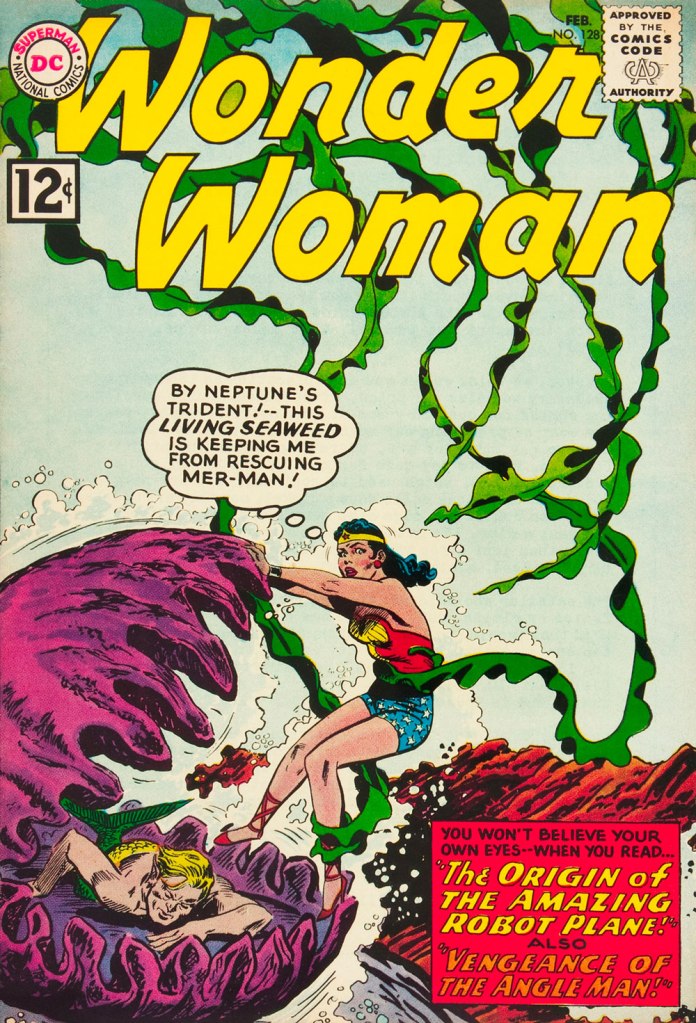
This is Wonder Woman no. 128 (February 1962). Cover by Andru and Esposito.
Allow me to drive one more nail into that coffin, and after this I shall forever hold my peace. I stumbled upon this rather entertaining quote, taken from an interview with Kanigher conducted by Tim Bateman and Steve Whitaker in 1989 (read the full thing here). Here it is, with no further comments from me:
« So Ditko […] tried to force meanings where meanings did not exist. But he tried to tell me that I knew nothing about romance, because his idea of romance was professorial, pedantic. I know what romance is, I’ve written more romance probably than anyone alive. Romance is an excess of passion, and I don’t care if there’re a thousand books that says romance is not that, romance is a time period. Tchaikovsky is a romantic. Excessive, that’s what romance is. So to say that my idea of excessive emotion is not romantic…»
And now, I shall remain mum, and let you savour these tentacles in peace!
Two pages from The Academy of Arch-Villains!, published in Wonder Woman no. 141 (October 1963).
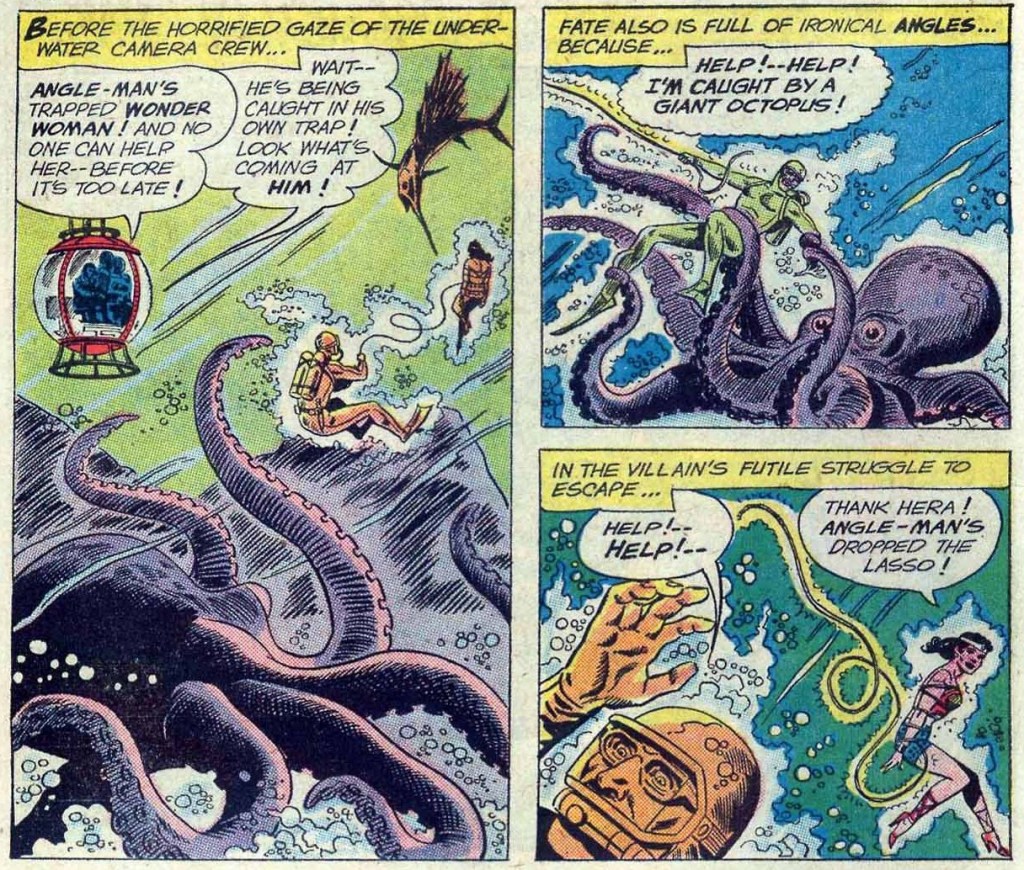
In comics, swordfish are often pitted against octopuses (one doesn’t have to go far for examples – just look at the previous story), but I wonder how often that happens in real life…
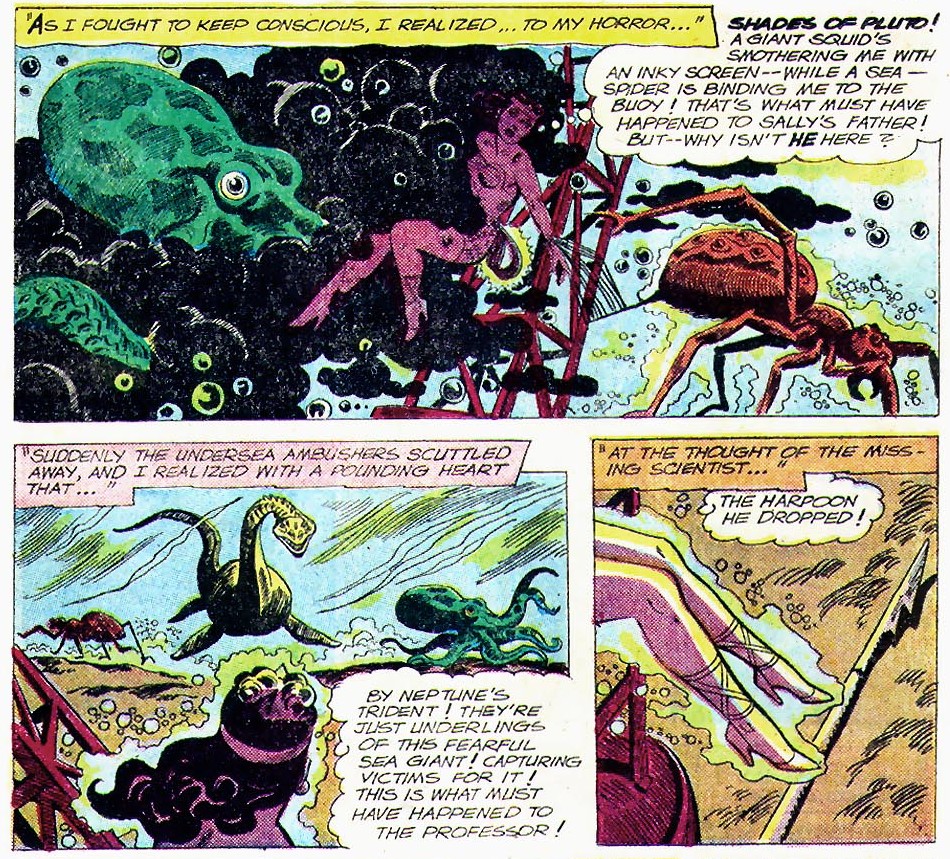
Page from War of the Underwater Giants, published in Wonder Woman no. 146 (May 1964).
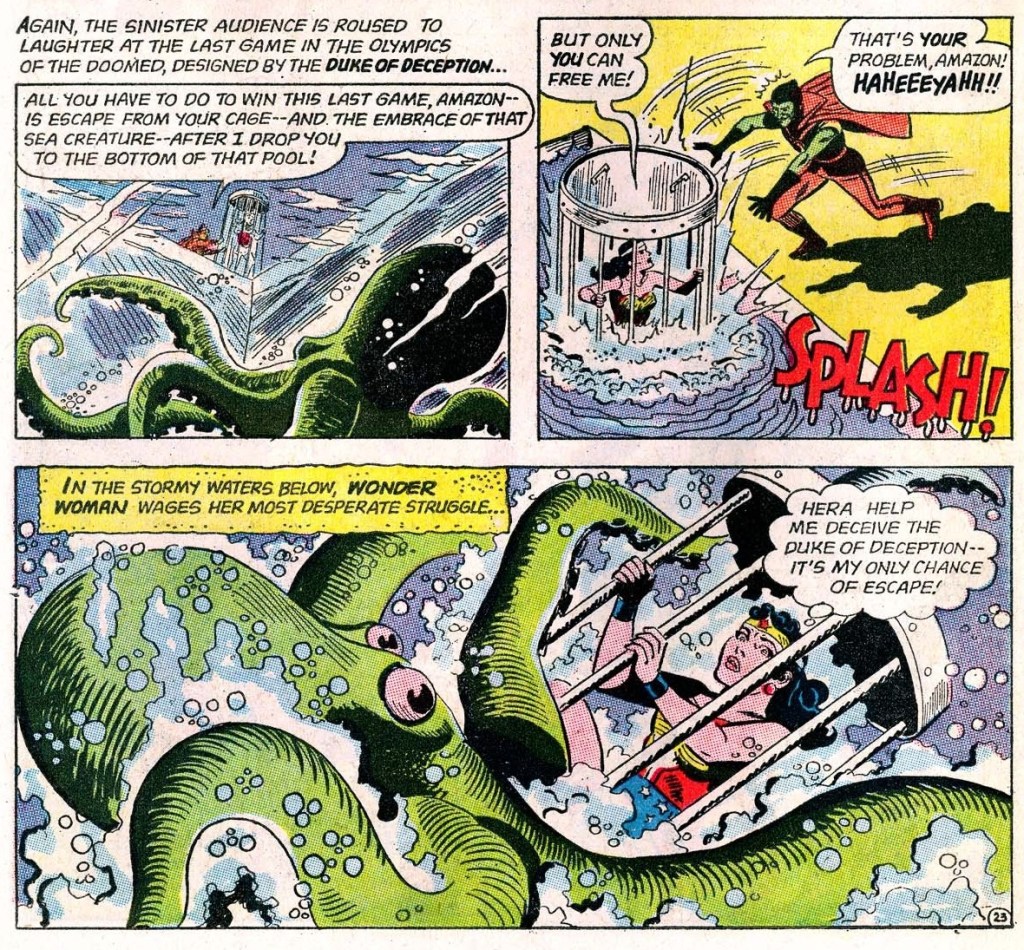
Page from The Olympics of the Doomed, published in Wonder Woman no. 148 (August 1964).
Page from I Married a Monster, published in Wonder Woman no. 155 (July 1965).
The Sinister Scheme of Egg Fu, the Fifth!, published in Wonder Woman no. 166 (November 1966).
« I have argued flying saucers with lots of people. I was interested in possible. They do not appreciate that the problem is not to demonstrate whether it’s possible or not but whether it’s going on or not. » — Richard P. Feynman
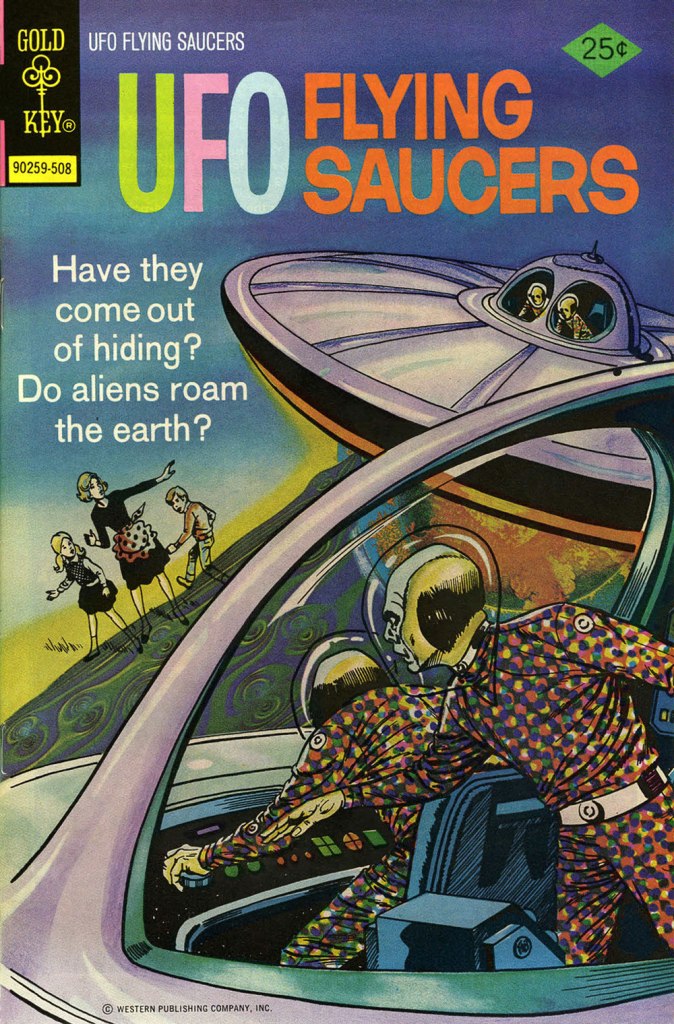
You can follow the rising pitch with the publishing frequency of Gold Key’s UFO Flying Saucers: after its premiere issue hits the stands in 1968, two full years elapsed until the second, then another two until the third… and again to the fourth. It’s fair to presume that the title had been intended as a one-shot, and that encouraging sales led the way to a regular, if sparse schedule. Then the pace picked up after issue four (Nov. 1974), and so ten issues appeared in the span of just over three years. There was a brief hiatus, a retitling to UFO & Outer Space and a further dozen issues saw print, two of them reprints. By late 1979, the series sputtered to a halt.
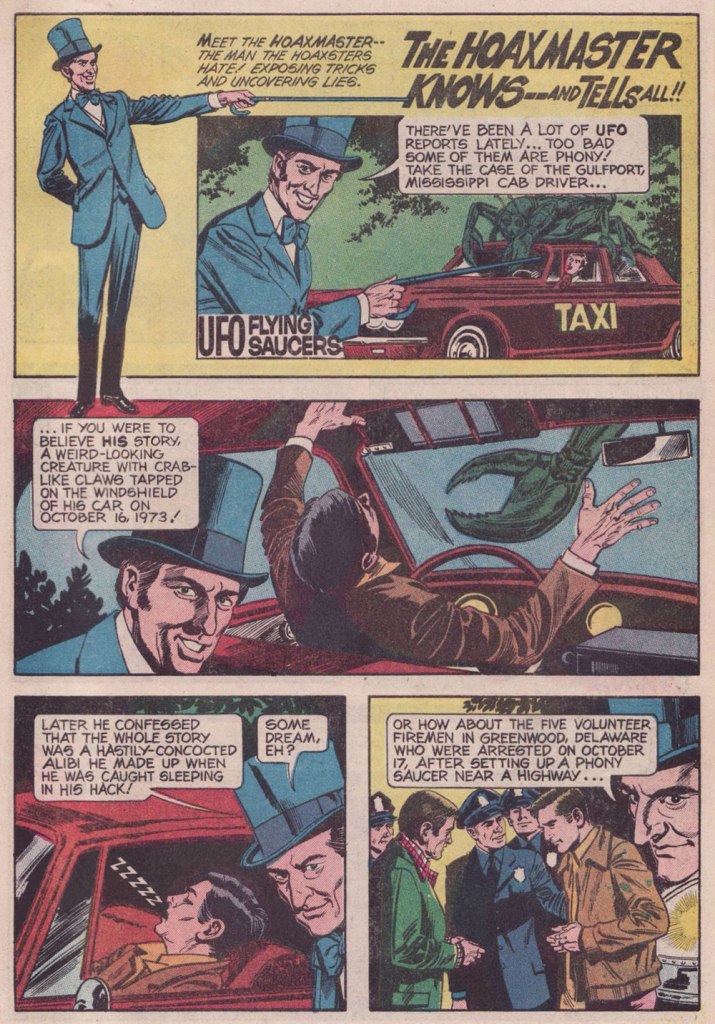
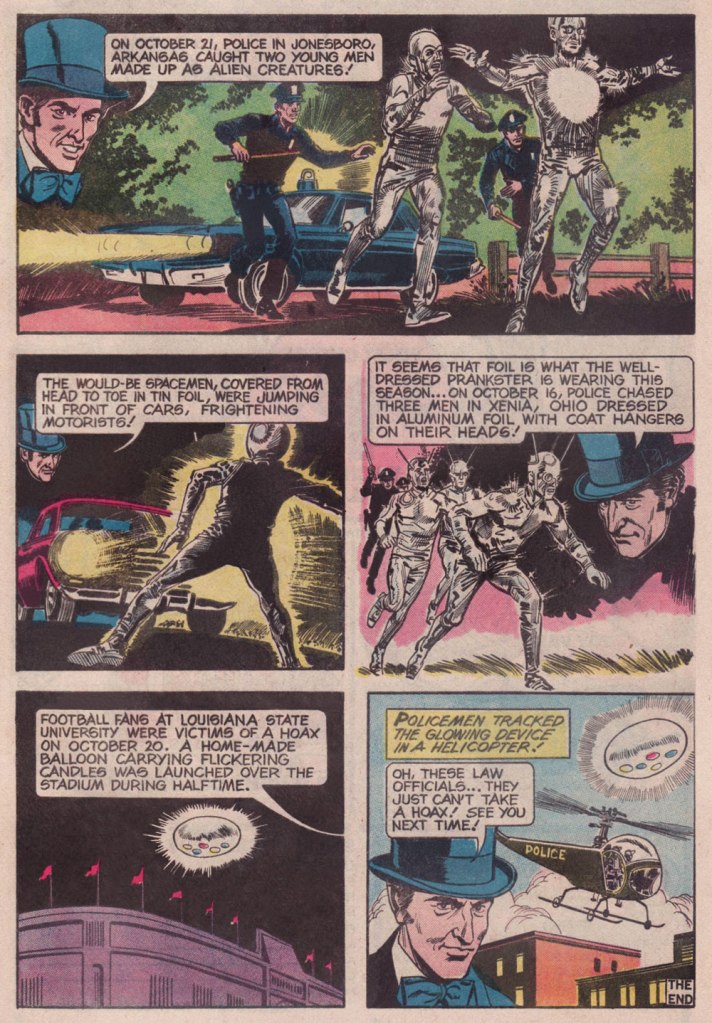
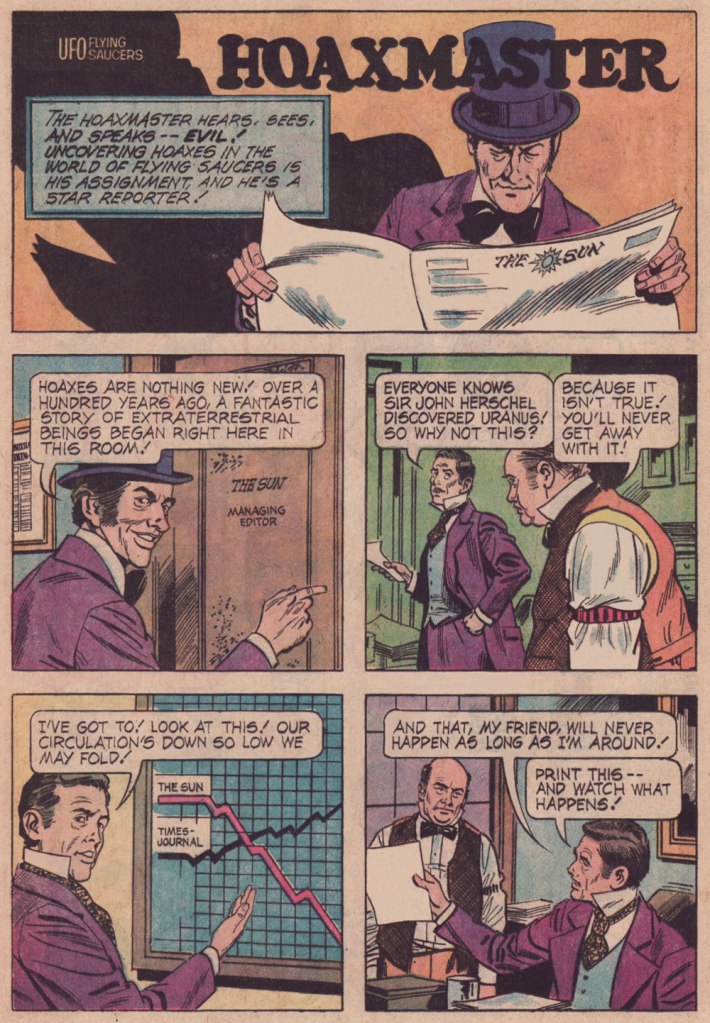
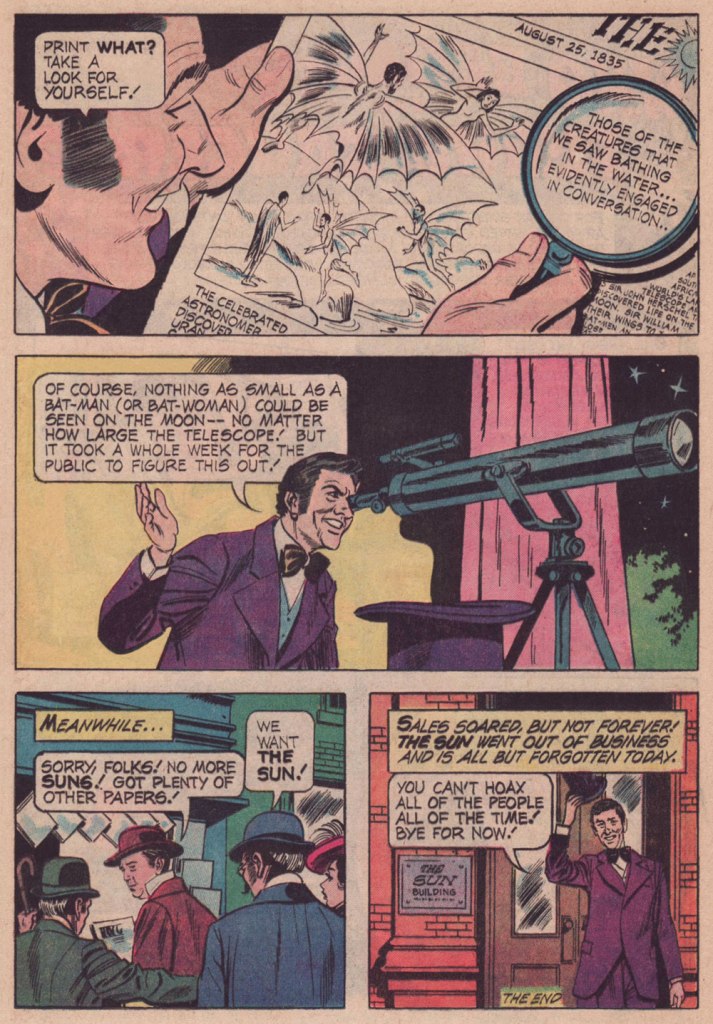
They may not have been to everyone’s taste, but Gold Key comics provided their audience with a soothing respite and change of pace from Marvel’s endless manic brutality and insipid crossovers. Even amidst the GK line, UFO Flying Saucers stood out. It did a stellar job of covering the flying saucer craze of the Cold War years, thanks to a sober, documentary-style narrative tone and strong artwork, led by Frank Bolle, who fit the template to a T. The tone was surprisingly even-handed (far more so than most modern media; j’accuse, History Channel!) They even tossed a scrumptious pinch of skepticism into the mix now and again, and it’s this delicacy that we’ll be sampling.
The modern skeptical* movement was spearheaded by the 1952 publication of mathematician and science writer Martin Gardner‘s fascinating In the Name of Science (thereafter better known as Fads & Fallacies in the Name of Science), answering the need for an organised response to a (still) rising tide of irrationality, superstition and scientific illiteracy. When UFO Flying Saucers introduced its series featuring The Hoaxmaster, the skeptics’ flagship publication, The Skeptical Inquirer, was still a couple of years away from being launched. That auspicious occasion came in the fall of 1976, under its original title of The Zetetic: Journal of the Committee for the Scientific Investigation of Claims of the Paranormal.
The introduction of The Hoaxmaster, from UFO Flying Saucers no. 4 (Nov. 1974, Gold Key).
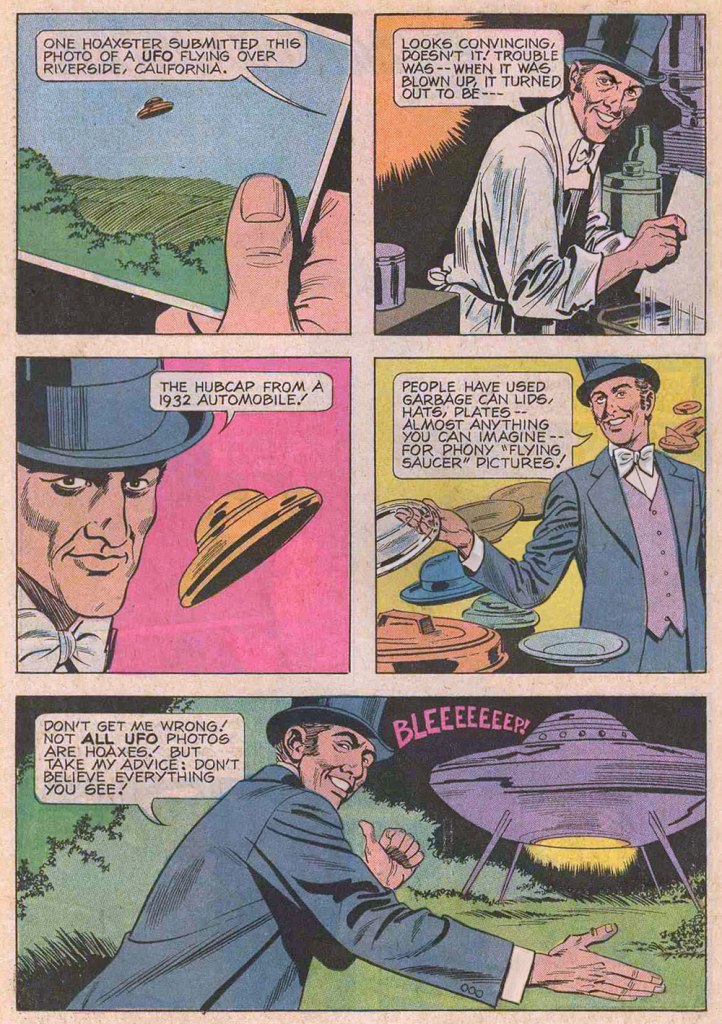
And such fakery has only become far, far easier… from UFO Flying Saucers no. 6 (May 1975, Gold Key).
Ah, that John and Marsha/Marcia routine never gets old! From UFO Flying Saucers no. 7 (Aug. 1975, Gold Key).
Mr. Bolle provided just one cover to the series, and while it’s hardly the best one, it certainly stands out amidst the lot. Again, this is UFO Flying Saucers no. 7 (Aug. 1975, Gold Key).
Say, what have we here? Could it be… fake news? From UFO Flying Saucers no. 8 (Nov. 1975, Gold Key).
Sadly, The Hoaxmaster series bears no writing credit. The only writer ever credited in the title is Western Publications staffer Patricia Fortunato, a former story editor of The Golden Magazine. If that’s your work, Pat, take a bow!
In comparison, artist identification is a cinch: the steady hand of Frank Bolle, who left us just last year, at the most venerable age of 95, is instantly recognizable. Artistically active right to the wire, he drew the final leg (1999-2015) of soap opera comic strip Apartment 3-G‘s 54-year-run. Over the course of his singularly long career, he worked for just about every comics publisher… and then some! His reliable proficiency at providing just the right tone to illuminate that delicate borderline between science fact and science fiction made him the ideal choice to adapt John Christopher‘s early young adult post-apocalyptic The Tripods trilogy (The White Mountains, The City of Gold and Lead,and The Pool of Fire), serialised in Boys’ Life magazine in the 1980s. Check it out here!
Well, that’s roughly half of the Hoaxmaster strips. If you’d like to see the rest, let us know… I can probably time it with the next edition of World Contact Day. To sign off on a musical note, here’s its catchy, Canadian-made anthem. Remember, “we are your friends“.
-RG
*as opposed to ‘denialism’, of course. It’s a crucial distinction: know the difference!
Occasionally, I like going with the flow when selecting the topic for a Tentacle Tuesday. I recently traded for a Junji Ito book I’d never heard of, Remina, and as one of its highlights (um… possibly the only highlight, but more about this later) is the profusion of tentacles within, it seemed like a natural fit for a topic of discussion.
We have only mentioned Junji Ito once before (in Tentacle Tuesday: Octopods Dig Manga!), but I am a fan of his work – or at least of the best of his work. In my assessment, that would be the genuinely disturbing Gyo (with the catchy subtitle of ‘The Death-Strench Creeps‘) and the haunting Uzumaki, as well as a handful of excellent short stories.
I’m by no means a horror manga pundit, but I’ve sampled a certain number of works by mangakas whose work has been translated to English, and found most of these œuvres quite unappealing, be it because of incompetent art, more human cruelty than I can stomach, far too much soap-opera-style drama, or glaring plot loopholes. Ito is not without his flaws, but something sets him apart from other authors working in a similar vein: he can depict stomach-churning gore and moments of quiet dread with equal aplomb. Cartoonists who rely on carnage to horrify their readers are ten a penny, those with a more subtle approach are few; those who can effortlessly transition from one to the other are something special.
As in that old joke about the horse that always takes its rider to the nearest pub, Ito does have a favourite approach: he starts with a most mundane object or incident, elicits a delectably menacing atmosphere out of it, and then gives it all a good twirl until the spiralling events send the protagonists (and sometimes the whole country, if not the whole planet as well) into the welcoming arms of total, uncompromising Armageddon. One might argue that he does that because it’s easier to finish it all than to think of a ‘proper’ ending, but it gives his work a certain surreal quality I really appreciate – everybody is going to die, and now that this little matter is out of the way, we can concentrate on the creative ways this is going to happen.
Remina was serialized in Big Comics Spirits from September 2004 to July 2005. The English volume (released by Viz Media, who have published the bulk of Ito material in English, slowly making their way through his whole bibliography in excellently designed hardcover editions) was released in December 2020. The plot concerns itself with a scientist who discovers a new planet and names it Remina in honour of his beautiful daughter. Of course, the planet turns out to be hurtling towards Earth at physics-defying speeds, annihilating everything in its path (which the main scientist somehow is completely unaware of, until his many lab assistants inform him of the latest developments).
And here it is, eating one of the planets in our Solar System with as much grace as an aristocratic lady carefully nibbling on a sliver of tomato.
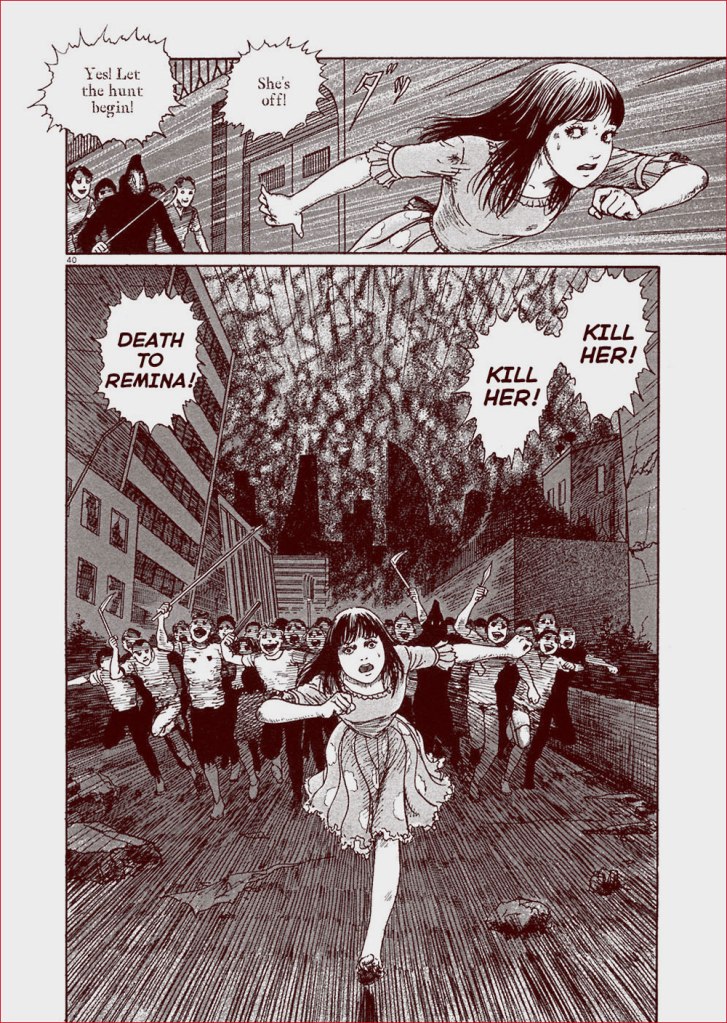
In (not entirely unbelievable) leap of logic, Japanese citizens decide that the impending destruction is caused by Remina, previously an immensely popular and celebrated girl, and that executing this ‘witch’ is going to solve the problem. What follows is a series of chase scenes, with a giant crowd pursuing Remina throughout the progressively more and more destroyed city. Remina’s three protectors (the president of her fan club, her manager, and some uber-rich fanboy who tries to rape her later in the book) drag her around, trying to keep her safe from the murderous crowd, but they don’t do such a great job – she gets crucified next to her dad but survives, set free, captured again, flogged, tortured, crucified again, and so on.
It doesn’t help that Remina, like a lot of Ito’s pretty creations, doesn’t really have a personality. She just sobs, screams for her daddy and her lost love (the manager, who apparently she was profoundly in love with), and implores people to just leave her alone. Scenes of crucifixion and the creepy robes worn by her pursuers indeed suggest religious fervour – as the earth’s gravity changes, cities are destroyed, volcanoes erupt etc., the only thing almost everybody is interested in is Remina’s mutilation and dismemberment.
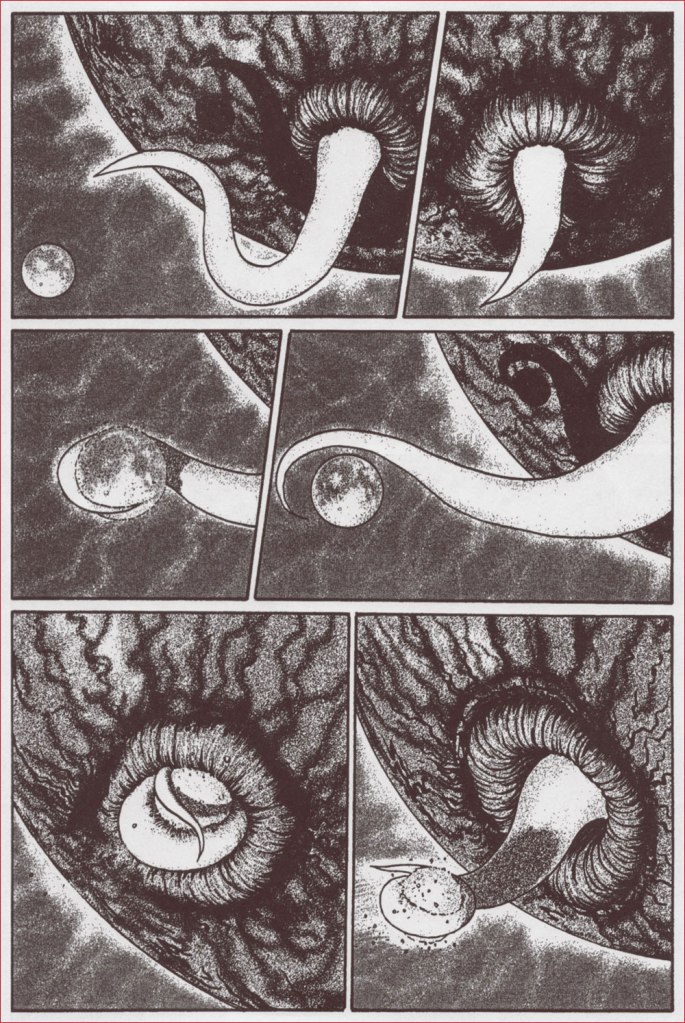
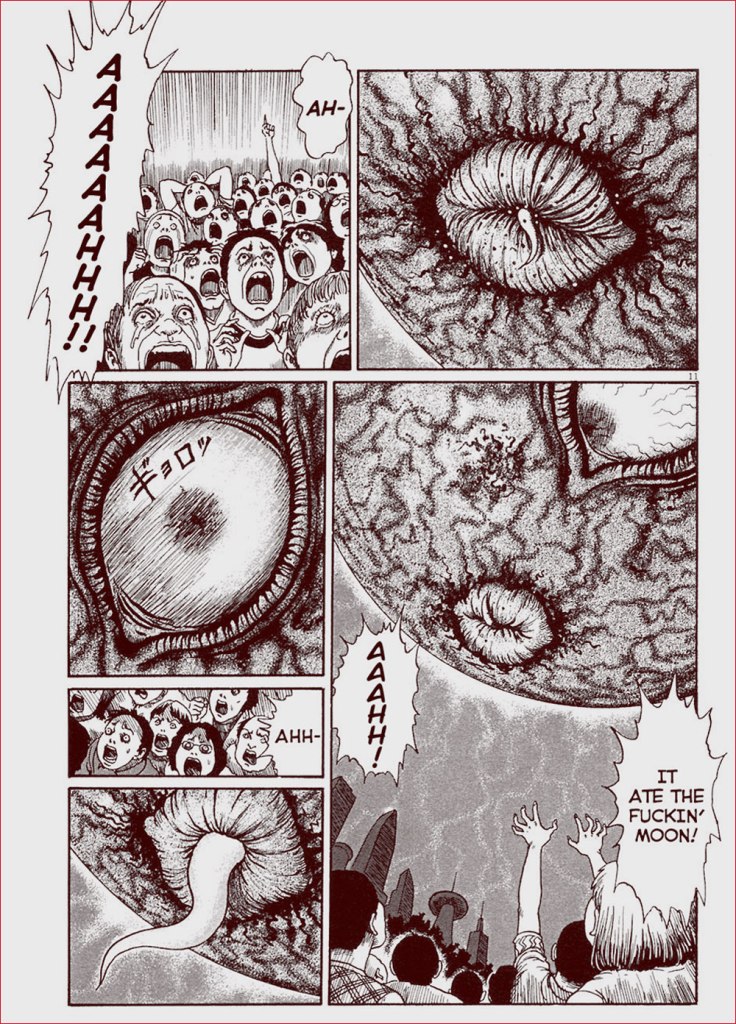
Still, there are some fun moments, most of these involving tentacles! Remina the planet has a giant eye and a coquettish, tentacular tongue that it flicks out to swallow the moon just as Remina the human is about to be killed.
One of more iconic images of Remina, the moment before the moon gets swallowed….
This is a scan from a previous edition of Remina, where the translators were a little looser with language. In the book I have, a laconic ‘it ate the moon‘ is substituted for ‘it ate the fuckin’ moon!‘.
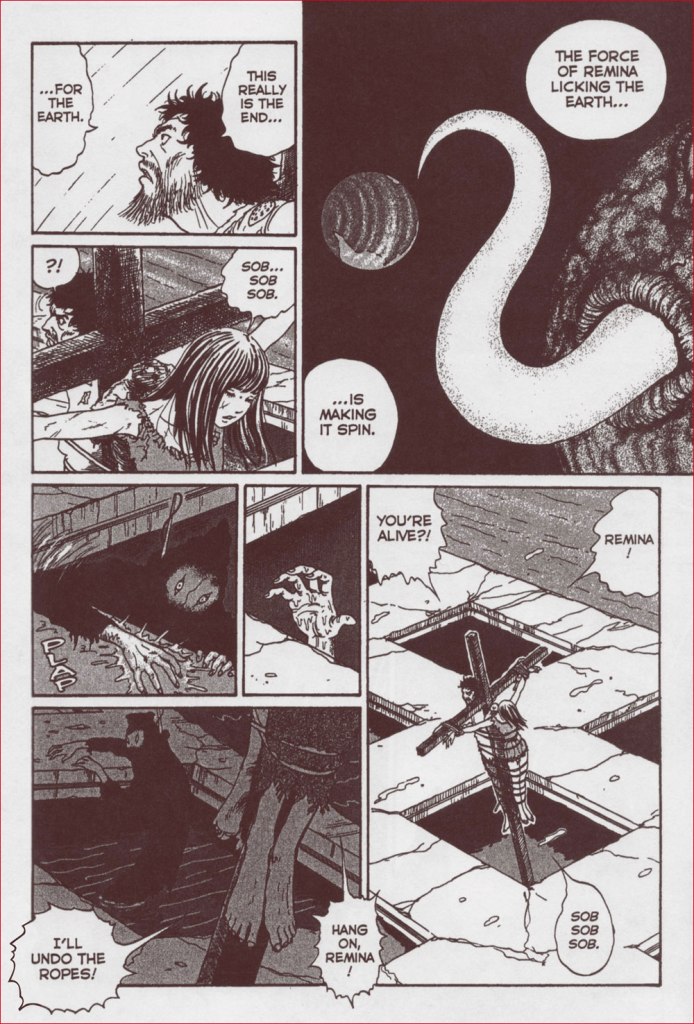
It uses the same ‘tongue’ to lick Earth and accelerate its spinning…
Typical Remina dialogue: “SOB SOB SOB.” Note that this is the second time Remina gets crucified. It is distinctly some sort of unhealthy obsession.
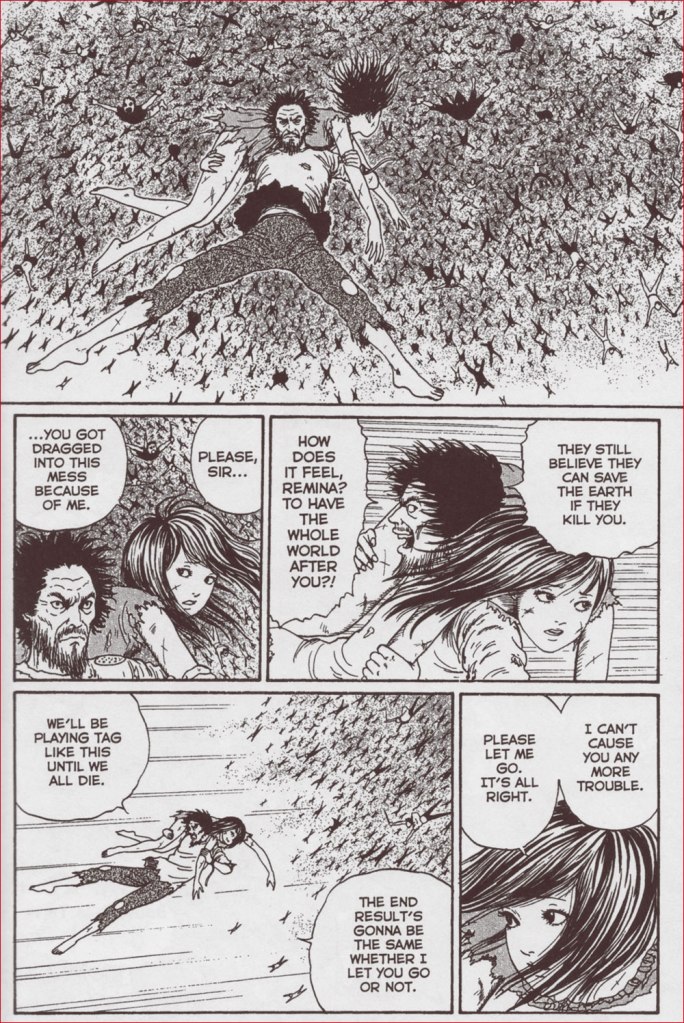
… which sends everyone airborne, and gives rise to funny kung-fu-in-the-air scenes as yet another protector kicks the collective asses of Remina’s would-be executioners.
Then there’s planet Remina’s surface, all writhing tentacles, acid pools and noxious fumes. That’s where most of the tentacle enjoyment lies.
Somewhat atypically, there is even a happy ending, albeit one involving some of the main characters floating around in space in an atomic shelter bunker with a year’s worth of provisions (and hopefully oxygen?)
« There are two kinds of Arctic problems, the imaginary and the real. Of the two, the imaginary are the most real. » — Vilhjalmur Stefansson
As it’s been a record-shattering scorcher of a week over much of North America, I’ve been daydreaming of cooler, much cooler climes whilst simmering at my desk. And why not make a post of it? A couple of years ago, I picked up one of the finest comics I’ve ever encountered, Racontars arctiques: l’intégrale (2018, Sarbacane). Its myriad of virtues, subtle and obvious, made it easy to enjoy, but a challenging work to dissect and properly discuss. But here we are — hope I did it justice!
Danish writer Jørn Riel (b. 1931 in Odense) spent the better part of his twenties and thirties in Greenland as part of a scientific expedition. This sojourn in turn inspired a successful series of tall tales set in the Arctic, fanciful accounts of the lives of hardy explorers, hunters and Inuit natives. His works have been translated into fifteen languages, and in an unusual twist, English isn’t among these.
French cartoonist-illustrator Hervé Tanquerelle (b. 1972 in Nantes) might be termed a cartoonist’s cartoonist, with all that entails: he hasn’t achieved superstar status, but it’s not through any lack of talent or toil. While I’ve often lamented the rather banal tragedy of great North-American artists who can (and do) cruise through decades-long careers without ever coming within hailing distance of a decent script, Hervé Tanquerelle’s path has been paved with glorious scenarios, most of them provided by writer-artist compères: Professeur Bell (with Joann Sfar, 2002-06, which I’ve featured here); Le legs de l’alchimiste (with Hubert Boulard, 2002-07); Les faux visages (with David B., 2012), and his most commercially successful opus thus far, Racontars arctiques (with Gwen De Bonneval, 2009-13). He has just completed work on the ambitious Le dernier Atlas (with De Bonneval and Fabien Vehlmann, 2018-2021), nothing less than a gritty, SF-infused alternate version of the Algerian War.
For Racontars, Tanquerelle even travelled to Greenland with a group of scientists and artists, with Jørn Riel among them, which added layers of authenticity and personality to what was already an undeniable labour of love. Try to envision your average US cartoonist putting out this kind of effort and commitment (one notable exception being, of course, the prodigious William Stout)! Anyway, Tanquerelle made fruitful use of this experience and its attendant documentation with a semi-autobiographical ligne claire account (fittingly published by Casterman, Tintin’s forever home), Groenland Vertigo (2017).
Despite essaying the thankless role of the invisible middleman, Gwen De Bonneval (Tanquerelle’s fellow Nantois, né Gwénaël de Bonneva in 1973), deserves full marks for admirably condensing Riel’s tales without sacrificing their appeal, not to mention cherry-picking the ones most ripe for adaptation (confirmed by co-admin ds, who’s read both the prose and the comics versions).
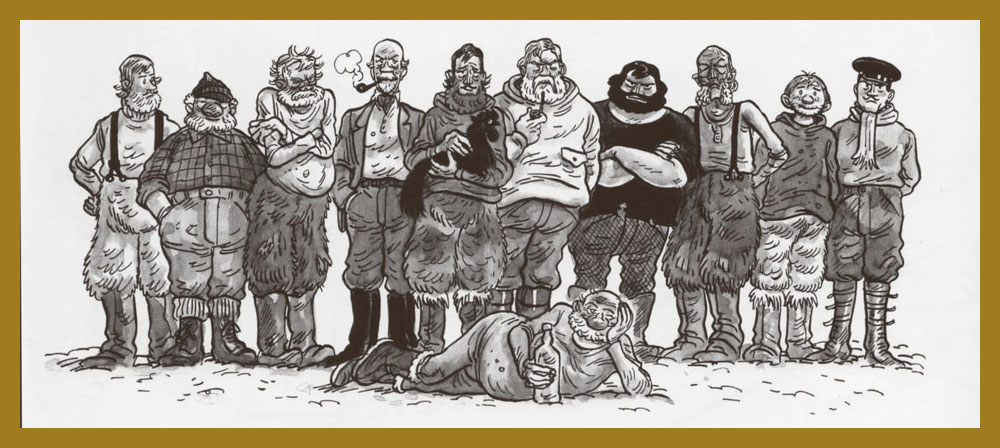
The majority of our esteemed cast: Anton, Museau, Lodvig, Le Comte, Herbert (cradling Alexandre), Mads Madsen, William le Noir, Bjørken, Lasselille, Lieutenant Hansen; and Valfred providing the beefcake in front.
The climatic extremes of the Great North aren’t for everyone, to put it mildly. Anton sinks deep into melancholy.
With its unusual day/night cycle, Greenland is no place for a normal rooster, as we learn from the woeful tale of Alexandre.
« Museau was a first-rate hunter… until he lost his glasses », explains his companion, Bjørken. While treating the puppies to some jam, a freeloader comes along.
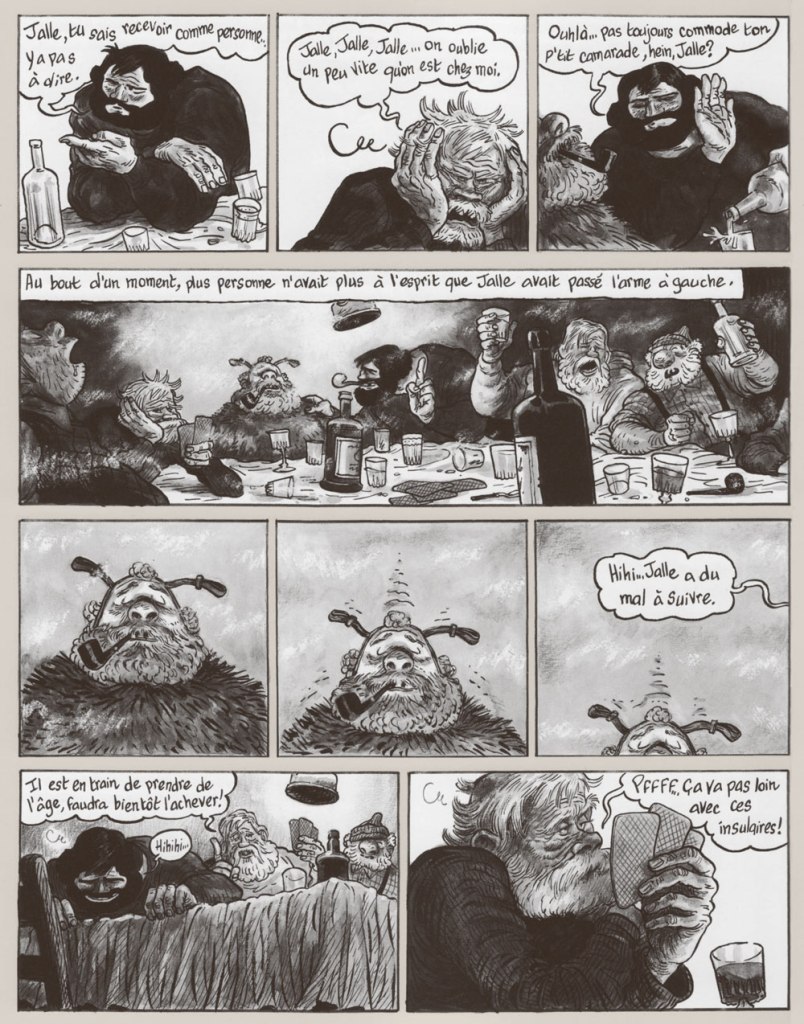
What do you do when someone kicks the bucket during the long winter? The ground being frozen solid, he can’t be buried. And if you leave him outside, foxes or other rascals are liable to carry off the corpse. In this case, you give him a proper send-off — by dropping his coffin into the sea, but first gathering everyone for a boozy feast, with the stiff in the place of honour. Oops, he’s thawing out.
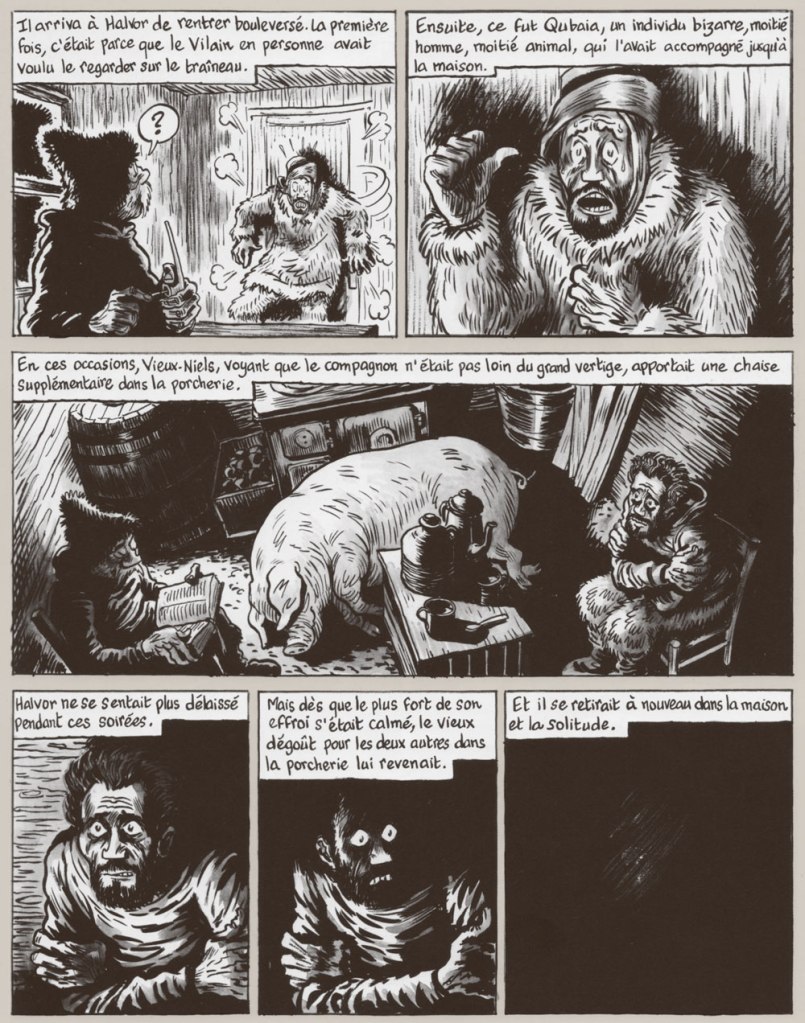
In the darkest of these tales, Le Roi Oscar (that’s the hog), Halvor loses his mind (what his companion calls “the Great Vertigo”), with dire consequences.
Callow youth Anton Pedersen arrives with a baggage of illusions and misconceptions about the trapper’s life. Reality nearly does him in.
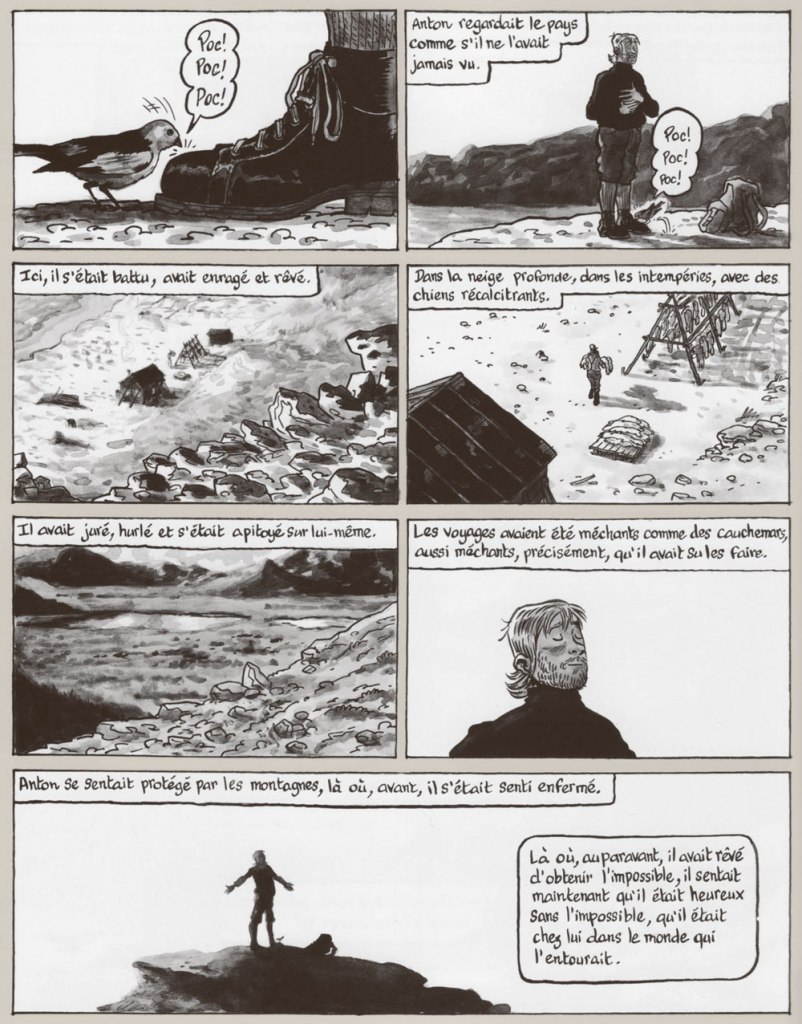
His spirit is saved in extremis by the song of Spring’s first snow bunting, a sweet little guy.
In the set’s wildest and most epic tale, Valfred and Hansen… take a little detour.
The series’ centrepiece is probably La vierge froide (“The Cold Virgin”), in which the men share a useful delusion of Emma, an ideal woman they barter back and forth. Note how Emma’s appearance shifts according to the proclivities of each current companion.
Of this adaptation, Jørn Riel said: « Opening this book is like opening the door to the arctic world as I knew it so many years ago. The trappers in these drawings are exactly as I discovered them then, and to meet them anew this way was both a surprise and a source of great joy. I thank with all my heart the authors and publisher. The trappers of Northeastern Greenland have been resurrected. » Let’s not underestimate the resilience and backbone of such men: after all, the vaunted Vikings gave up living there… because conditions were too harsh for their tender hides.
Jørn Riel defines a racontar (rumours or gossip don’t quite convey the meaning), as “a true story that could pass for a lie. Unless it’s the other way round“. I hope the language barrier doesn’t prove too much of a hurdle. These marvels truly offer a fantastic opportunity for the discerning publisher… and, unless I missed something, the overdue scoop of Riel’s first English-language publication. Hello, Fantagraphics, D&Q…
« I will eliminate this ignominious blot on the city’s reputation. I will correct this annoying oversight. And so Ostap undertook the actions dictated to him by his reason, his sound instinct, and the situation at hand. » – the magnificent Ostap Bender, from 12 Chairs by Ilf & Petrov
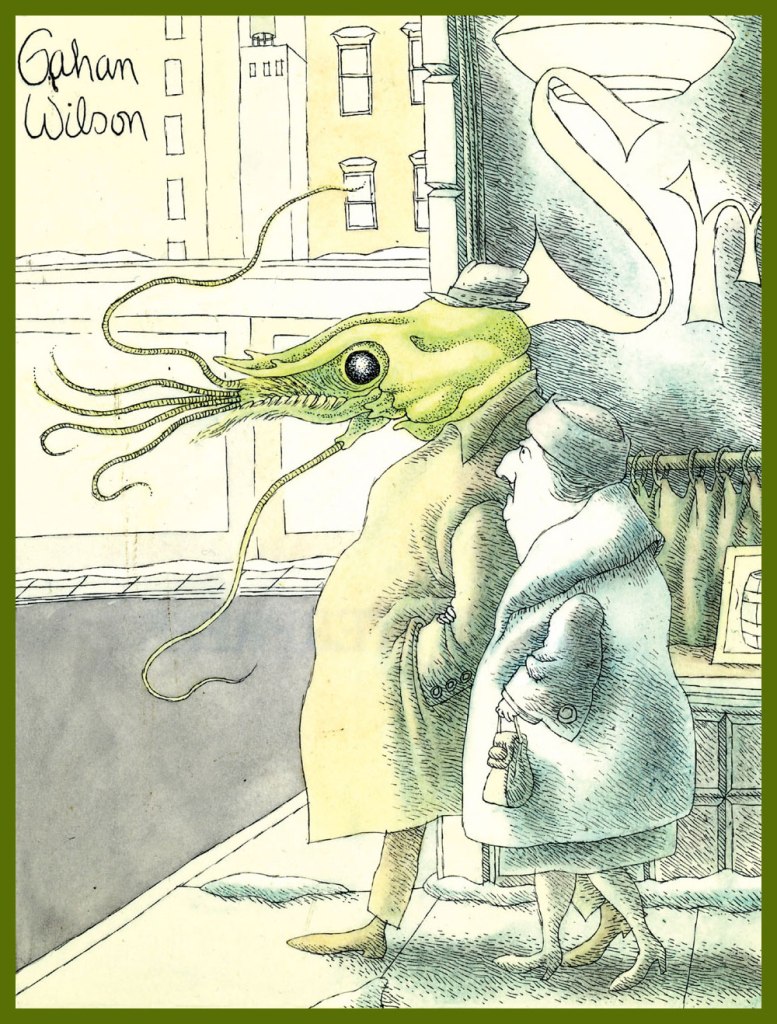
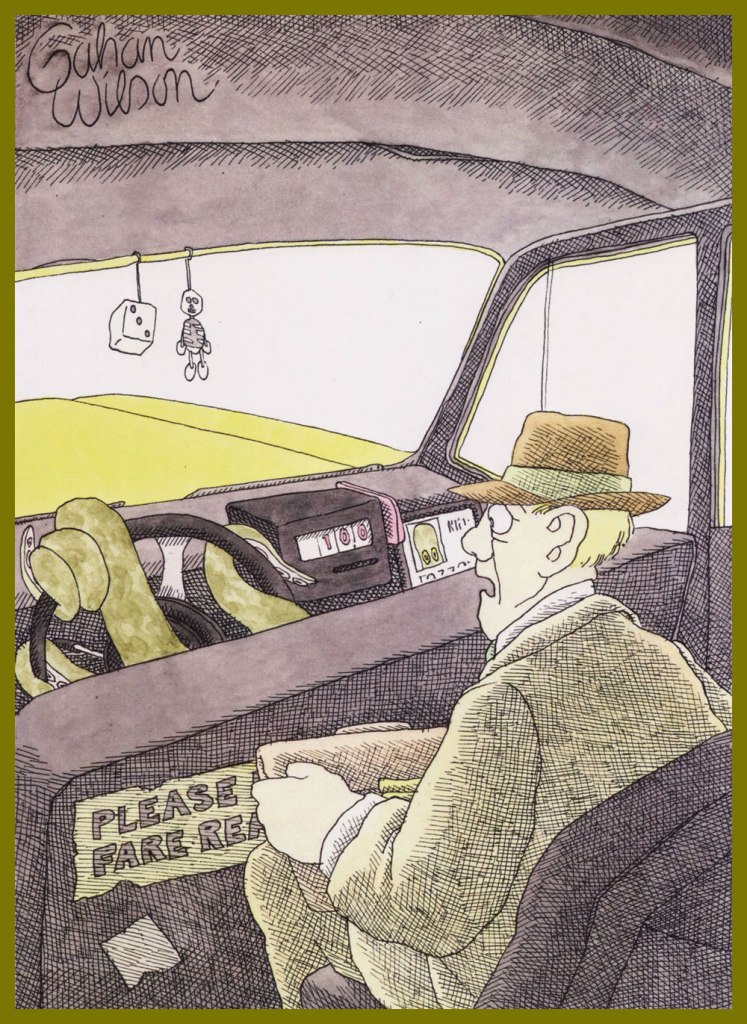
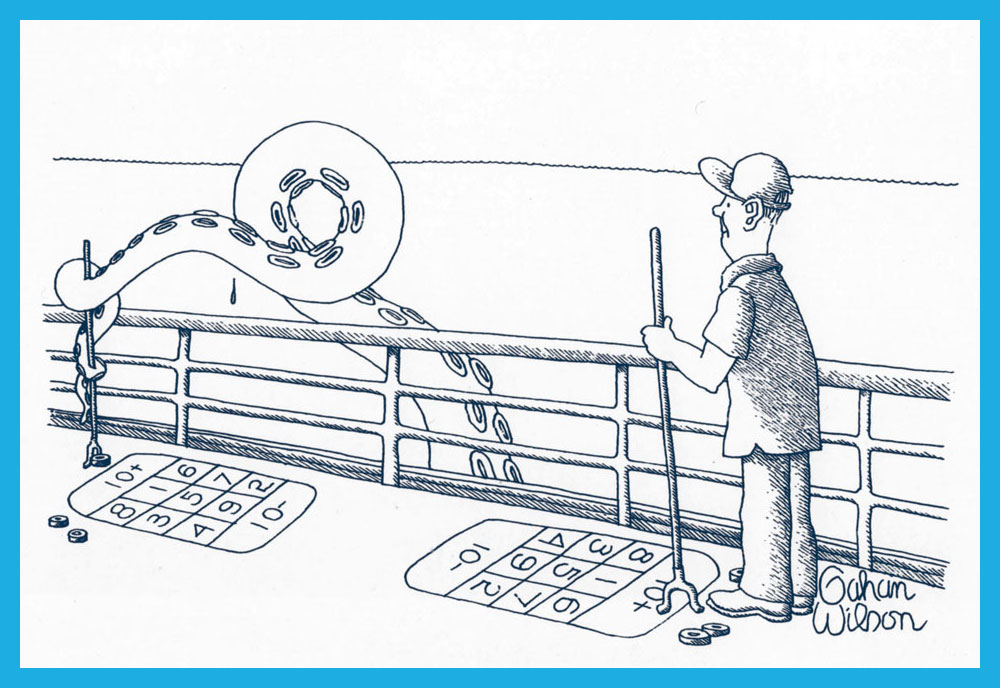
With considerable dismay, I recently realized that Gahan Wilson had yet to be featured as a Tentacle Master, despite having thoroughly deserved this title not only with the sheer number of tentacles in his cartoons, but their impeccable quality as well. Co-admin RG wrote a lovely piece on this prolific artist in Gahan Paints What He Sees!, and we’ve included his work in a multitude of posts, but he certainly deserves this official TT accolade.
Without further ado… and with many thanks to co-admin RG, who figured out where these were published and on what date, as well as doing a lot of scanning and editing while I was grappling with myriad technical issues at work (instead of grappling with tentacles, he-he).
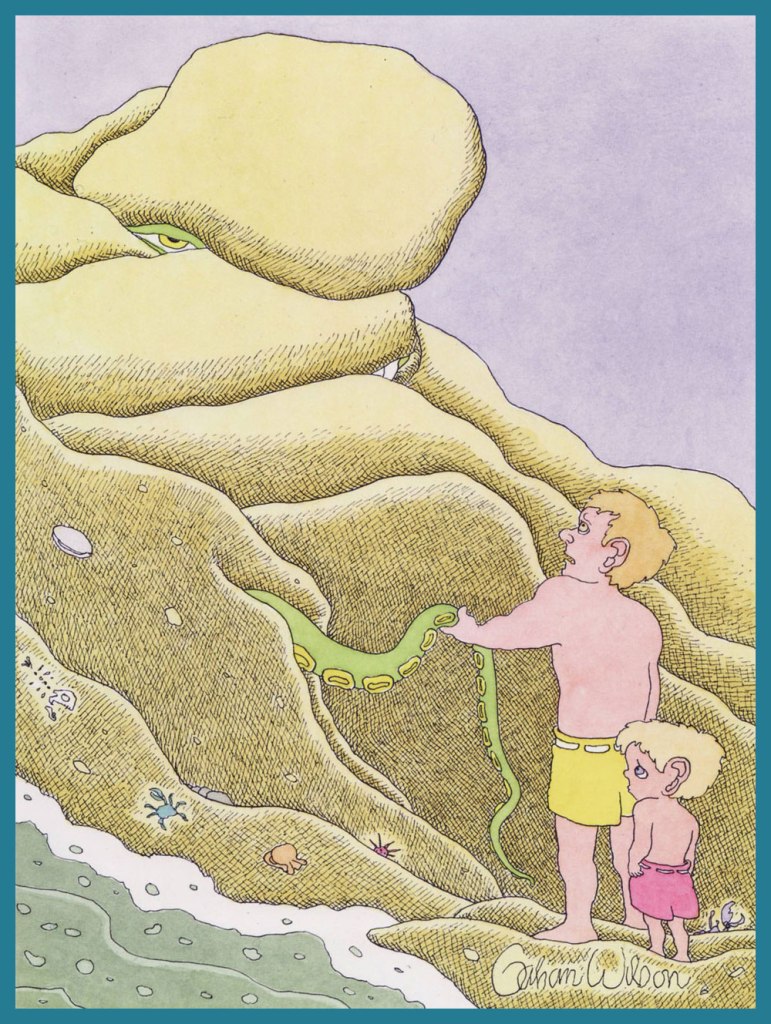
« Looks like this fellow you came across could be bigger than we thought! » (Playboy, Aug. 2007).
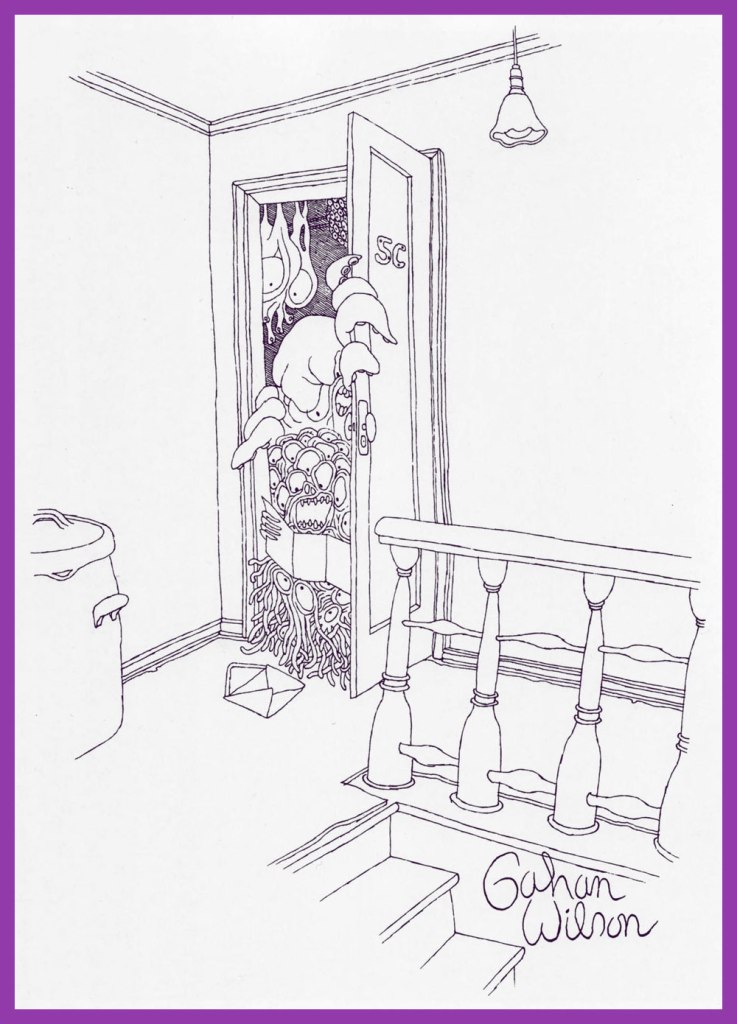
« Occupant, apartment 5C; Congratulations — you may have already won the all-electric Colonial split-level house of your dreams… » (Playboy, July 1974).
« Well, sir — it looks like things are getting pretty serious for Peter and Pauline. » (Playboy, July 1992).
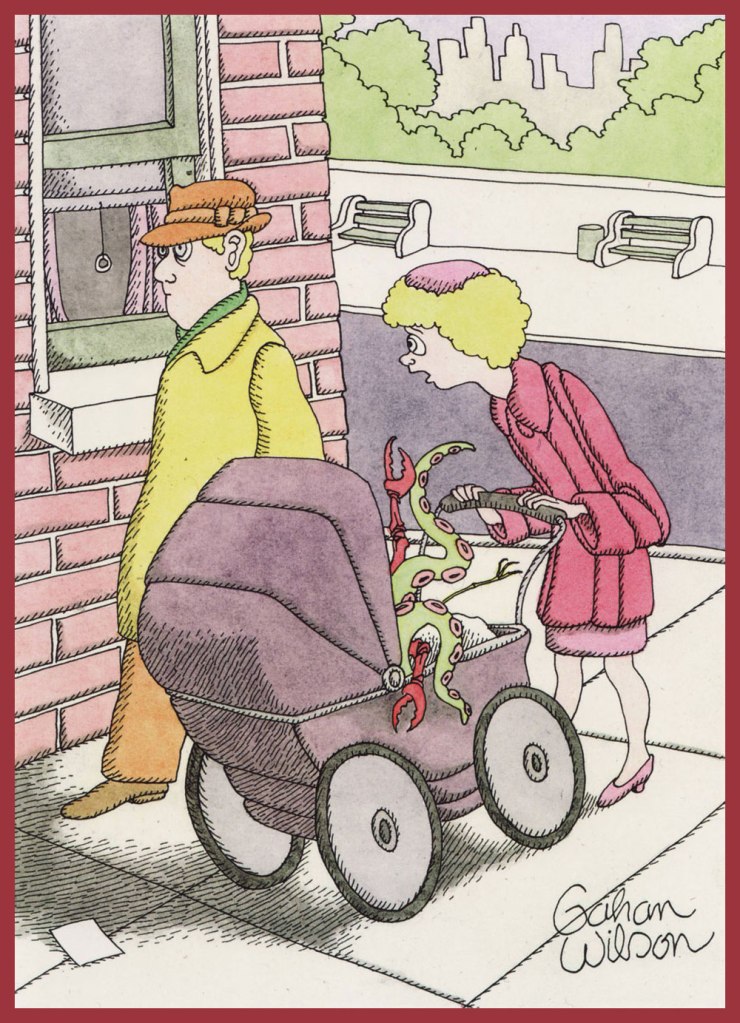
« I think something’s wrong with the baby, dear! » (Playboy, May 1997).
« Harry, I really think you ought to go to the doctor. » (Playboy, Feb. 1968).
From Playboy, Aug. 1973.
« Er, driver, just let me off right here, please! » (Playboy, Nov. 1981).
From Playboy, Oct. 1979.
A friend sent recently sent me an issue of The Magazine of Fantasy and Science Fiction from November 1974 that has that characteristic, lovely aroma of aged paper. Lo and behold, some Gahan Wilson tentacles lurked within! I came for Mushroom World by Stephen Tall, and stayed for the charming doodles introducing different sections of the magazine… Here are the three together, once again scanned & processed by RG:
I can’t help returning to Warren Kremer (today’s his birthday, not coincidentally; he was born on June 26, 1921, passing away on July 23, 2003), first because I adore his work, and second because I quite concur with Jon B. Cooke‘s bold but sensible assertion that Kremer…
« … is an extraordinarily talented artist. A master of design, character nuance and just plain exquisite drawing ability, he is perhaps the most underrated – or even worse, ignored – comic book creator of significance in the industry’s history. »
And why is that? A combination of working outside the superhero genre and of doing it, uncredited and for decades, on the ole Harvey Family Plantation.
This blog’sIt’s a Harvey World category might as well be called It’s a Kremer World, since he’s pretty much had the spotlight to himself.
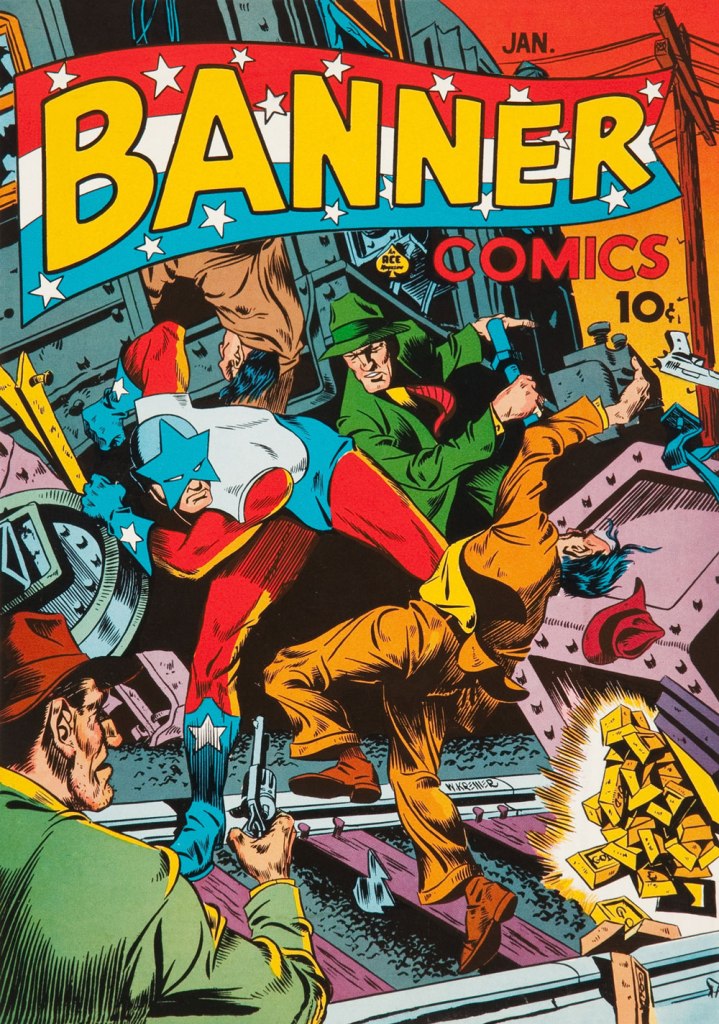
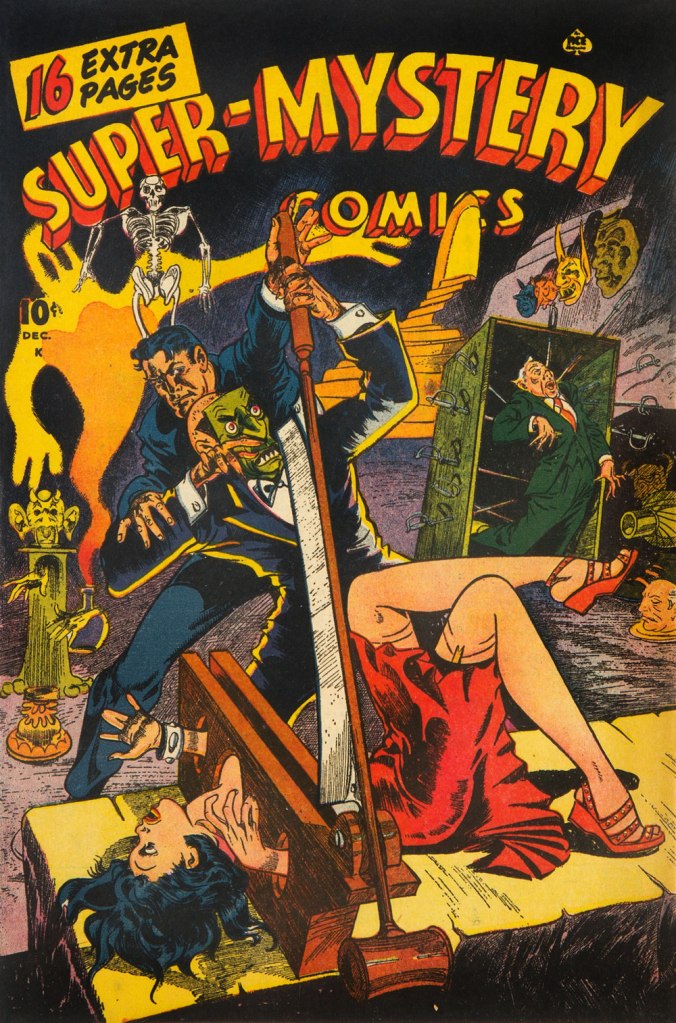
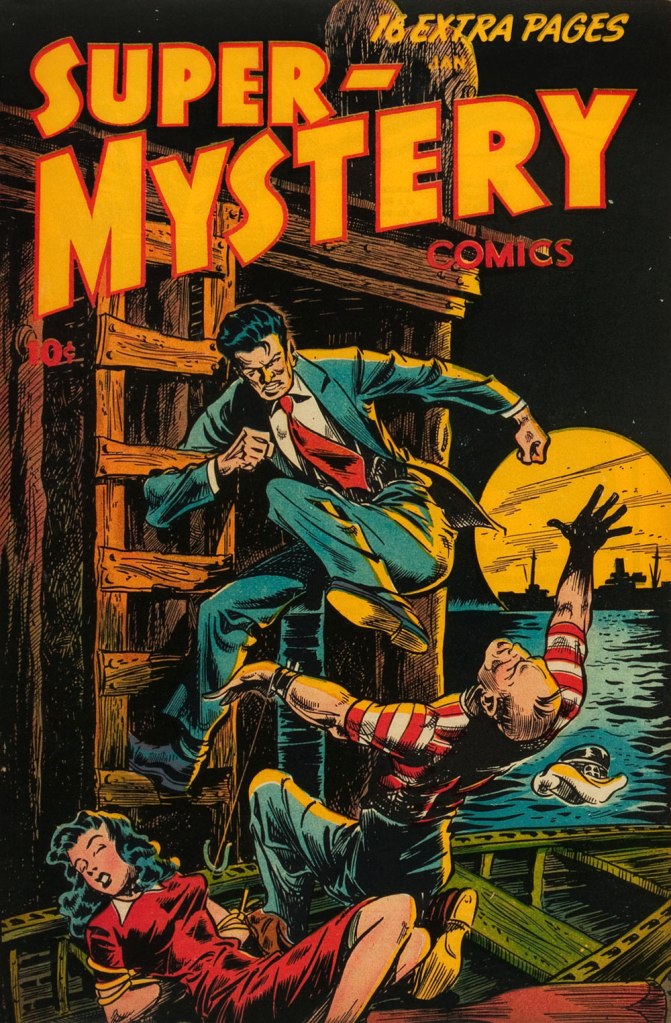
But Kremer’s comics career precedes his arrival at Harvey; after working for the pulps in the late 1930s, he entered the comic book field, and a sizeable chunk of his early work was done for Ace Magazines (1940-56), and this is the area we’ll be exploring today.
A rare foray into super-heroics, this is Banner Comics no. 5 (Jan. 1942, Ace); the guy with the star mask is ‘Captain Courageous’.
This is Super-Mystery Comics vol. 5 no. 6 (June 1946, Ace), featuring Mr. Risk in Riddle of the Revolutionary Portrait. Read it here! Kremer was signing as ‘Doc’ at the time.
Dig all that detail! This is Super-Mystery Comics vol. 6 no. 3 (Dec. 1946, Ace), featuring Bert and Sue in The Adventure of the Murdered Medium; read it here!
Boasting a snazzy new logo, this is Super-Mystery Comics vol. 7 no. 3 (Jan. 1948, Ace), featuring Bert and Sue (Ace’s Nick and Nora?) in Hell Bent for Election!. Read it here!
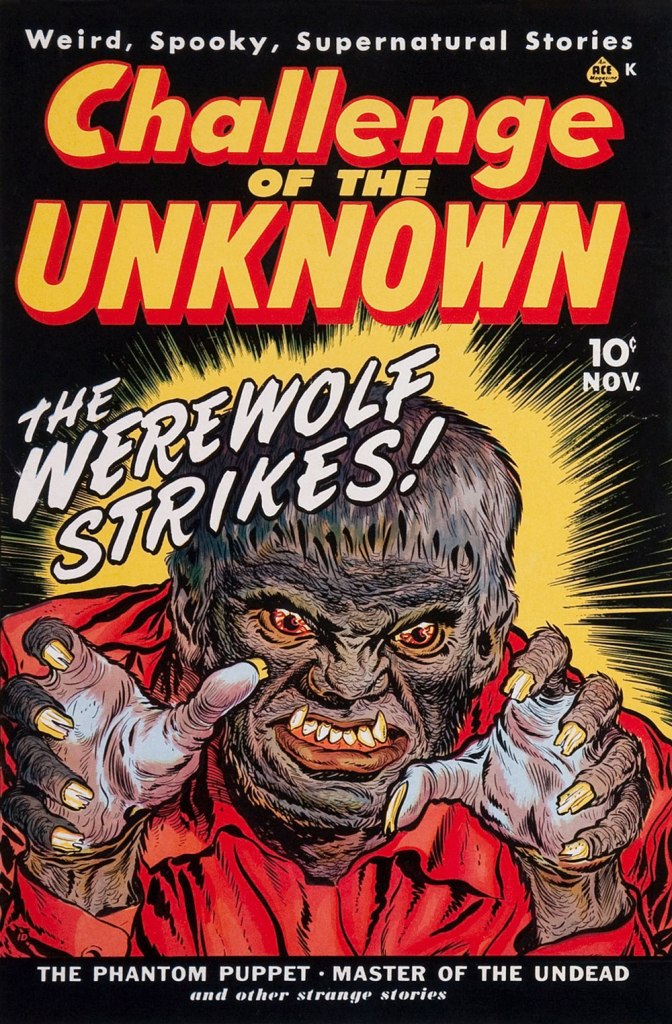
Eight years before DC’s Challengers of the Unknown, Ace came up with Challenge of the Unknown… àchacun son tour. This is the first of its two-issue run, no. 6 — but of course! (Sept. 1950, Ace); pencils by Kremer, inks possibly by Al Avison. Read it here!
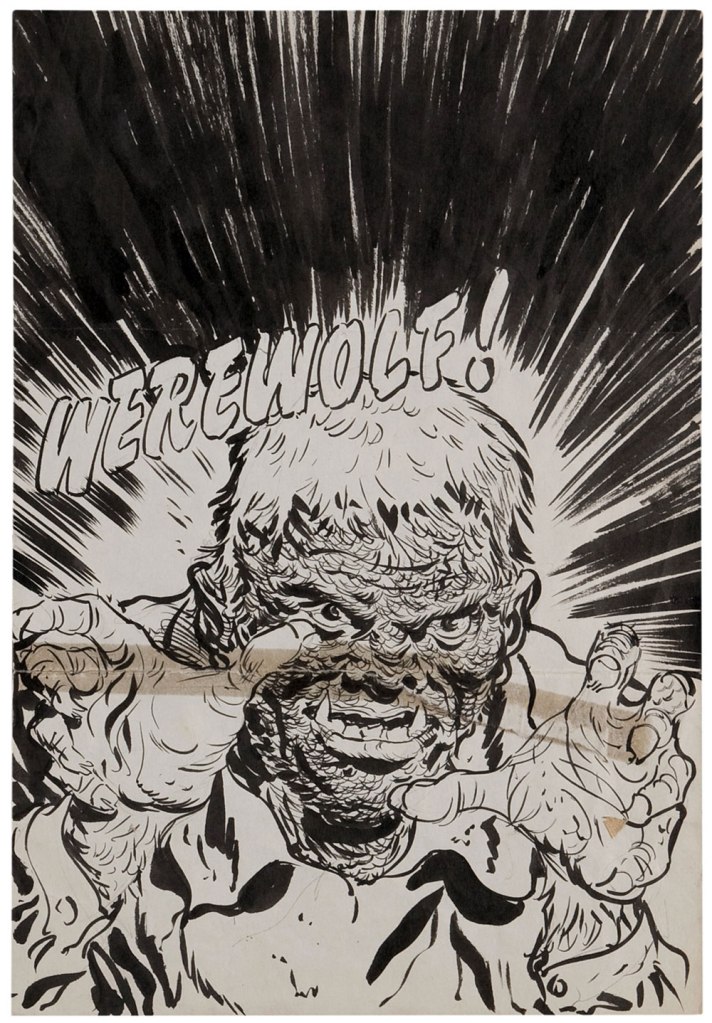
Three steps to a Werewolf. Kremer’s rough cover design…
The printer’s cover proof…
… and final publication switcheroo! One might surmise that someone got cold feet about CotU. This is The Beyond no. 1 (Nov. 1950, Ace). Read it here!
This is The Beyond no. 2 (Jan. 1951, Ace). A solid demonstration of dramatic perspective.
Here’s Mr. Risk again, in the first and penultimate issue of his own series — no. 2 (Dec. 1950, Ace) featuring The Case of the Psychopathic Lady and The Case of the Jinxed Air Line — the next issue was number 7! Read this one here.
Again, all that beautifully-rendered detail. This is The Beyond no. 3 (Mar. 1951, Ace), featuring The Keeper of the Flames. Read it here (preferably by candlelight)!
One of the most rewarding things for the Kremer fan is that the man thoroughly documented his creative process. In other words, he saved a lot of his art, including sketches, notes and preliminaries.
And the final version, from The Beyond no. 30 (Jan. 1955, Ace). See how Kremer had it all worked out, down to the colouring? Amazing. Oh — and read it here!
Happy birthday, Mr. Kremer — wherever it is you may roam!
Sometimes I stumble upon these comics I’d never previously heard of (or if I had, I had clearly promptly forgotten in a merciful fit of amnesia) but that have a hundred-something issue runs. For instance, I don’t remember this… sophisticated, steel-torso-ed and silver-haired fox at all. How poor my life must have been!
Created by Mike Grell, sword-and-sorcery champion Travis Morgan (actually an American pilot who accidentally discovers a new world in Earth’s hollow core) fights for the freedom of people from Skartaris – and also looks really good in a loincloth. Grell based Morgan on himself, using his experience as a former member of the Air Force (as an illustrator) and his own goatee* as a starting point, though hopefully the loincloth was an improvisation.
That Grell freely borrowed from Jules Verne, Edgar Rice Burroughset al. and peppered this regurgitation with Greek-mythology creatures (harpies, unicorns, a Pegasus, minotaurs, the Atlanteans…) is not by itself enough to condemn this comic, because I’m trying very hard to be fair about it. However, given the stilted dialogue, ridiculous costumes and dubious anatomy, it is distinctly starting to look like Warlord is a chapter of comic book history that’s best forgotten.
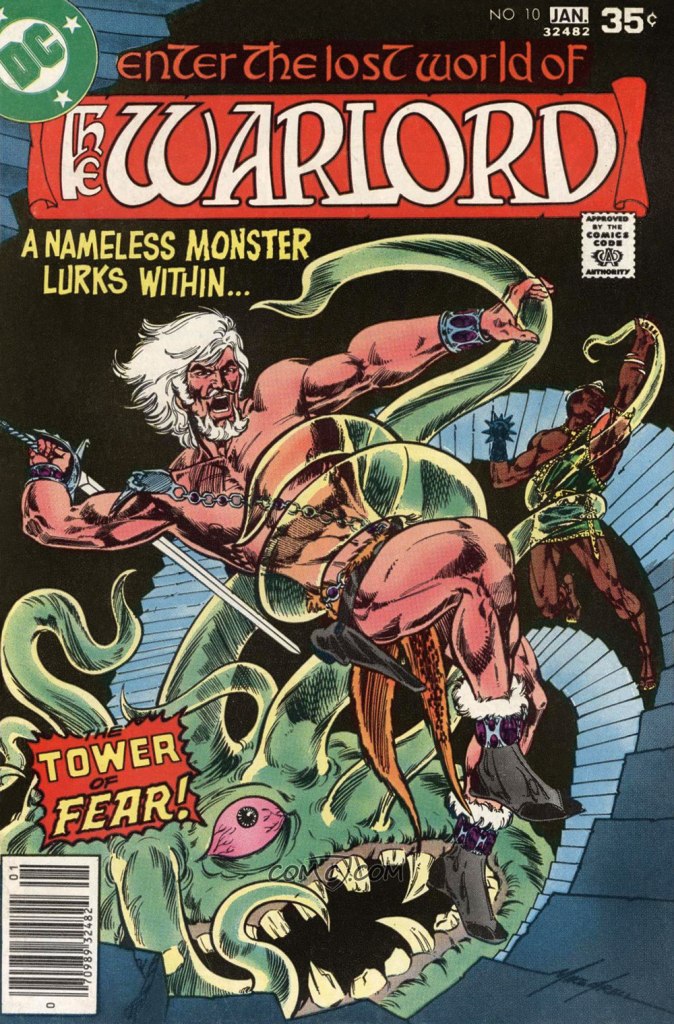
But one thing I can say about him is that in his many (MANY) fight scenes, he often struggles against tentacles, whether they belong to an amœba, an actual octopus, a plant, or a dinosaur-thing.
I understand that it’s the 80s and therefore costumes have an obligation to be profoundly embarrassing (not to mention impractical).
Let’s have a look at those tentacles I was promising.
Warlord no. 10 (Dec 1977 – Jan 1978). Cover by Mike Grell.
Page from Tower of Fear, scripted and illustrated by Mike Grell.
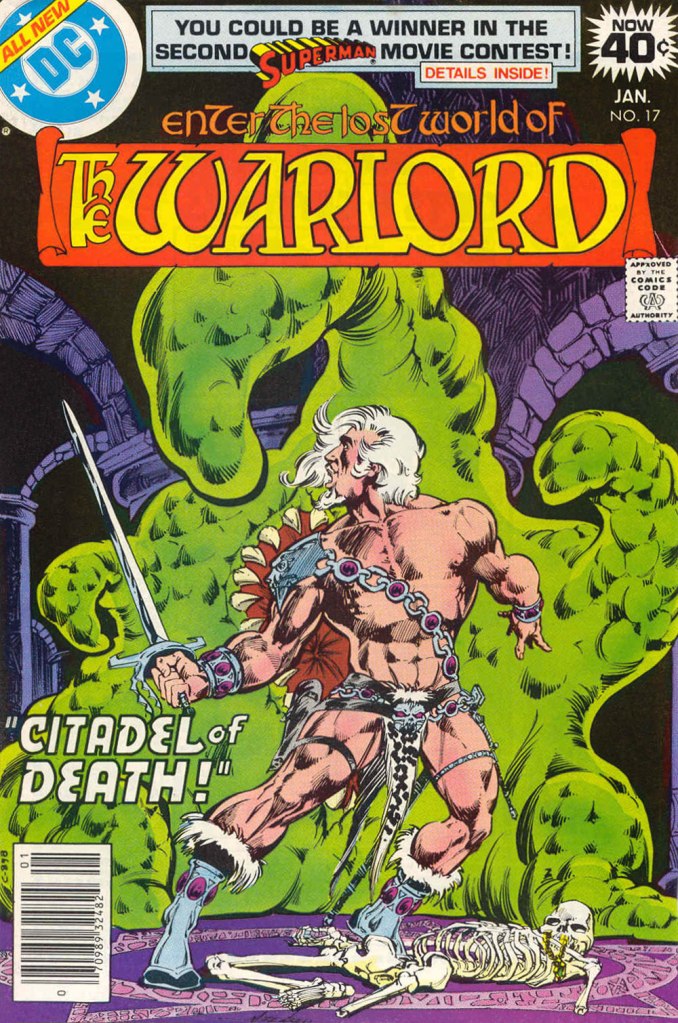
After the Tower of Fear, we get the Citadel of Death – a perfectly logical transition.
Warlord no. 17 (January 1979). Cover by Mike Grell. This is a good demonstration of what I was saying earlier about dubious anatomy – look at Morgan’s left arm, be suitably horrified, then try to compute how he’s keeping his balance at all, in this position, and give up altogether.
The Quest, Part II: Citadel of Death is scripted and pencilled by Mike Grell and inked by Vince Colletta.
Skipping ahead a few issues, we find that Morgan added some nice billowing sleeves to his outfit.
Warlord no. 41 (January 1981). Cover by Mike Grell.
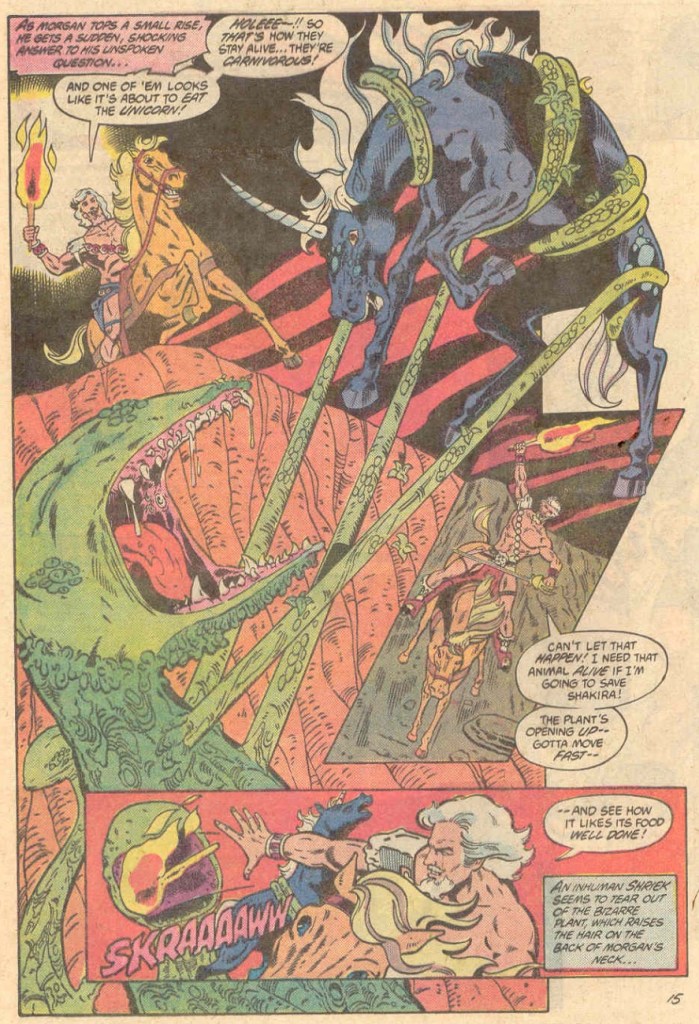
And now we go into non-Grell territory. Does this make the art or the scripting a little better? Yes, actually, for a little while. The Jurgens-Adkins team, for one thing, can draw horses that actually look like horses (okay, unicorns, whatever). They also do some fun stuff with panel transitions. Witness these two, admittedly fun, pages, taken from Curse of the Unicorn, scripted by Cary Burkett, pencilled by Dan Jurgens and inked by Dan Adkins. This was published in Warlord no. 72 (August 1983).
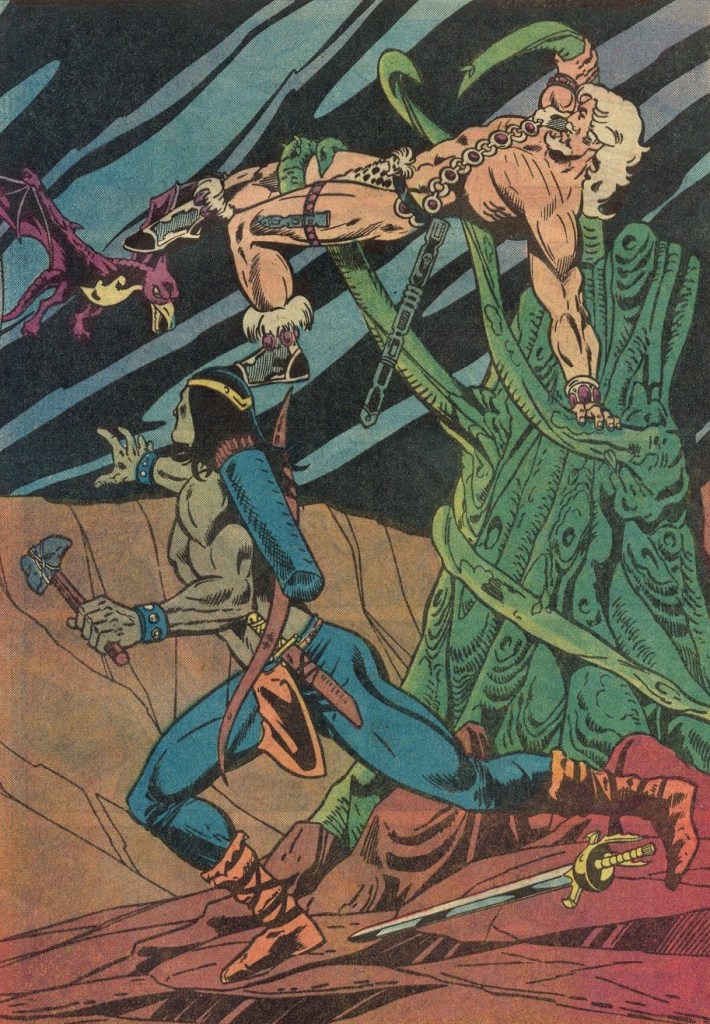
Here is the same team working on the next issue’s continuation, Cry Plague, scripted by Cary Burkett and Jennifer Reinhold, pencilled by Dan Jurgens and inked by Dan Adkins. It was published in Warlord no. 73 (September 1983).
Warlord lasted 133 issues, all the way until winter, 1988. The last couple of years also involved tentacles. For instance, this page from The Kraken Pentacle, scripted by Michael Fleisher, pencilled by Ron Randall and inked by Pablo Marcos. This story was published in Warlord no. 119 (July 1987). Morgan has a bad case of ugly horse teeth in this issue, but thankfully they’re not too visible on this page.
There are tentacles on 120’s cover, too, but it’s just too ugly to share here. The inside stories, alas, just get worse and worse (and they were none too hot to start with), dragging in characters from Jack Kirby‘s New Gods, to add insult to injury.
In case you were wondering about “ugly”. Pencilled by Art Thibert, inked by Pablo Marcos.
And so a comic that was never great to begin with – but had its readable moments, somewhere in the middle – finished as a steaming pile of shit. I can go back to pretending it never existed 😉
Pencilled by Dan Jurgens, inked by Mike DeCarlo.
Admire the dashing near-nudity of jewel-loving Travis Morgan and go on to greener pastures…
~ ds
*Now if Grell based Travis Morgan upon himself, and since Travis Morgan is just Grell’s Green Arrow stripped naked and with white instead of blond hair, and given that Grell’s GA is a continuation of Neal Adams’ GA, does it follow that Adams begat, or at least designed, Mike Grell?
« In the last analysis, a pickle is a cucumber with experience. » — Irena Chalmers
Earlier this week, the world lost another of its greatest cartoonists in Nikita Mandryka (October 20, 1940 – June 13, 2021), and he’s been among my lifelong favourites, thanks to his accessible, deceptively simple style and its nervous, explorative vitality. I’ve written about Mandryka’s Ailleurs some time ago, so there’s no pressing need to rehash his biography.
He was a giant, I tell you! The artiste circa 1975.
This freed me to opt for another tack this time. Since Nikita’s work is all-but-untranslatable (between the argot and the puns and general free-form lunacy… I’m not Even Going to Try) and his pages too dense for meaningful large-scale extraction, I’ve selected a sort of random number of panels — eleven seemed right (and winnowing things down was predictably exacting); Hope you like them.
Encore merci, Monsieur Mandryka!
An incisive entry from Rébus au pied de la lettre, published in Pilote super pocket no. 5 (Sept. 15, 1969, Dargaud); script by Marcel Gotlib.
Clopinettes: Toute une existence, from Pilote no.634 (Dec. 30, 1971, Dargaud), script by Gotlib. « I have loved… »
Clopinettes: Les bons conseils de tante Glutzenbaum, from Pilote no. 635 (Jan. 6, 1972), script by Gotlib. Background characters singing « Mammy Blue » was one of Mandryka’s most enduring recurring gags, certainly an idée fixe. The song was an inescapable, multi-lingual worldwide earworm hit in 1971 and beyond. It was composed by seasoned French songwriter Hubert Giraud, who had earlier written the standard Sous le ciel de Paris / Under Paris Skies. Chanteuse Nicoletta’s rendition was the bane of Nikita’s existence; the one that pervaded my childhood was Roger Whittaker’s, and here’s a reggae version by The Cimmarrons. Americans would know of it through Stories’ 1973 rendition. Phew!
Clopinettes: Les trois dessinateurs, from Pilote no.644 (March 3, 1972, Dargaud), script by Gotlib. In the usual order, L’Écho des Savanes‘ founding trio: Mandryka, Gotlib, (1934-2016), Claire Bretécher (1940-2020). L’Écho was but a couple of months away!
Opening panel from Initiation, collected in Les aventures potagères du Concombre Masqué (Apr. 1973, Dargaud). At left: le Concombre’s fabled home, the Cactus-Blockhaus. The cryptic cucurbit’s loyal companion, Chou-rave (kohlrabi) is seen on the right. Nice brushwork!
« Somewhere, at the world’s edge… », an excerpt from Rêves de sables 2, collected in Le retour du Concombre masqué (1975, Dargaud).
A favourite excerpt from the superb opening sequence of Comment devenir maître du monde?, another entry in the Concombre Masqué saga (1980, Dargaud). Our protagonist is a journalist making the perilous journey to conduct an exclusive interview with Le Concombre.
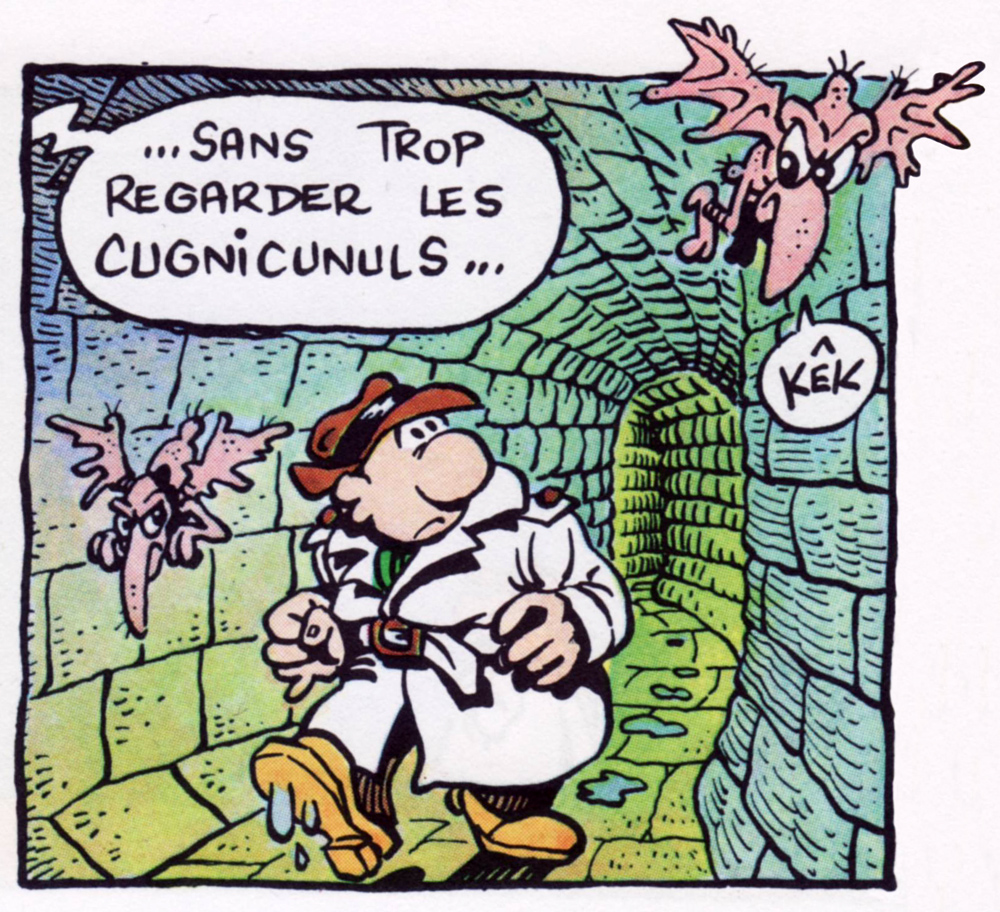
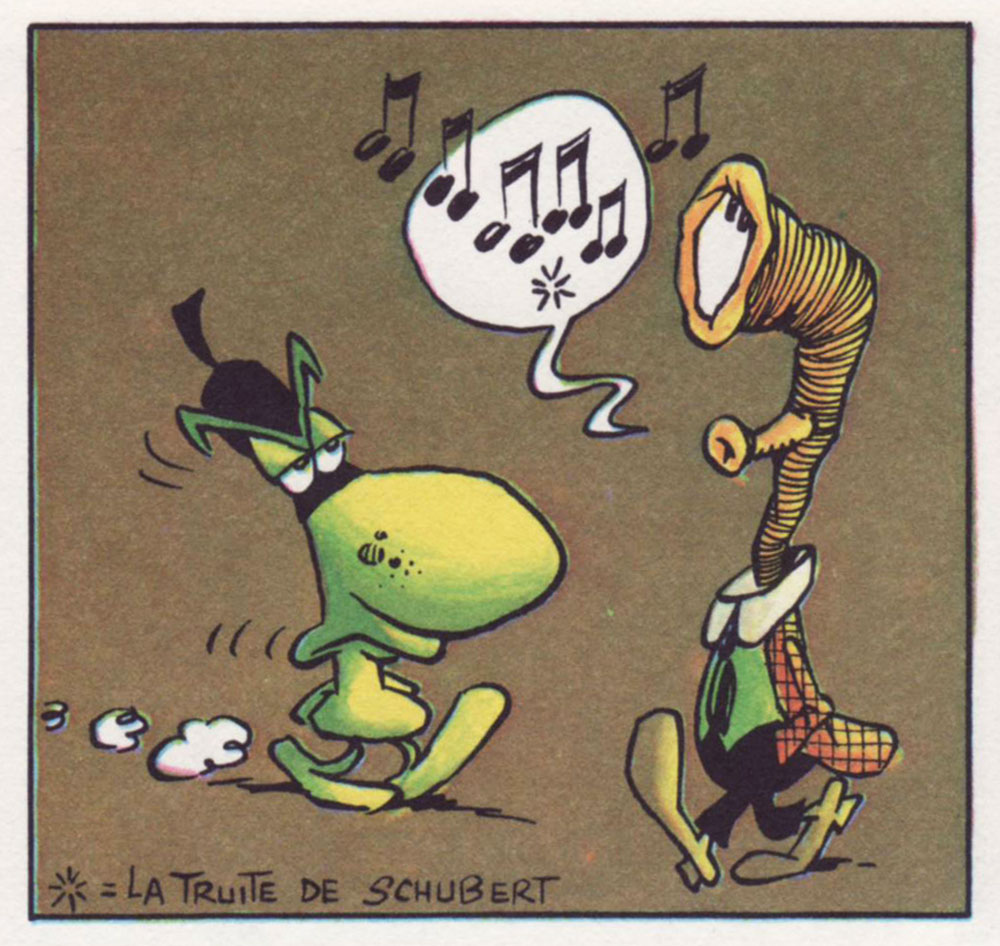
A panel from « … quelque part à l’endroit où ailleurs veut dire ici… », collected in La vie quotidienne du Concombre Masqué (1981, Dargaud). For the full effect, listen to Schubert’s La truite.
Another one from the same source. « Scram! Out! Everyone! ».
« Le Concombre is on his way to the South Seas with Zaza »; a panel from Le bain de minuit (2006, Dargaud). Meet Zaza, le Concombre’s latter-day personal secretary and Girl Friday. Incidentally, they’re travelling by bathtub, which is likely le Concombre’s favourite place to be.
A panel from La vérité ultime (2012, Dargaud). All is not what it seems aboard this flight to Timbuktu.
For more Concombre Masqué and all things Mandryka (did you know it was he who reportedly coined Métal Hurlant‘s title? ‘Howling Metal’ would have been such a better name than ‘Heavy Metal’… and ironically more Metal), check out his website (now gone, sadly). Well, try instead leconcombre.com… while it lasts (2023 update: it’s also gone).





































 Who's Out There?