The source of tentacles in Golden Age comics seems inexhaustible – every time I think I have reached the bottom of the well, I find myself awash in cephalopods. That being said, a lot of these octopusoid appearances are one-panel cameos, and even when the tentacles linger for a few pages, the shitty printing, questionable scans or bare-bones art don’t exactly incite me to use this material in a Tentacle Tuesday. Today’s crop is all Golden Age, running the gamut from 1939 to 1952, and composed of pages/covers I can enthusiastically endorse.
George (of Harry J. Tuthill’sThe Bungle Family, ‘one of the most under-rated comic strips in the history of American cartoonery’ according to Art Spiegelman,‘one of the top hundred comics of the 20th century‘, according to The Comics Journal) may be thoroughly bundled up in tentacles, but he still keeps a sort of prosaic calm that I admire.
Feature Comics no. 23 (August 1939, Quality Comics). Cover by Ed Cronin. As for Charlie Chan, he was originally a private detective in a series of novels by Earl Derr Biggers, from which a number of movies were made. Opinions are divided about whether he was a breakthrough Asian character (tired of Yellow Peril stories, Biggers conceived him specifically as an alternative to stereotypical, ‘sinister and wicked‘ Chinese) or perpetuated a lot of the same preconceived notions that were circulating at the time (and, alas, are still with us today).
Just look at the canines the red devil is ready to plunge into Black Hood’s leg! Throw in a fanged octopus, and this cover has as much action as one would possibly want. Sadly, nothing of the sort actually goes on in this issue.
Top Notch Comics no. 16 (June 1941. Archie Comics). Cover by Al Camy.
Page from Fisherman’s Luck, published Star-Spangled Comics no. 41 (February 1945, DC).
This page from Boy Meets Robotdog was printed in Star-Spangled Comics no. 75 (December 1947, DC). I would certainly come to this house!
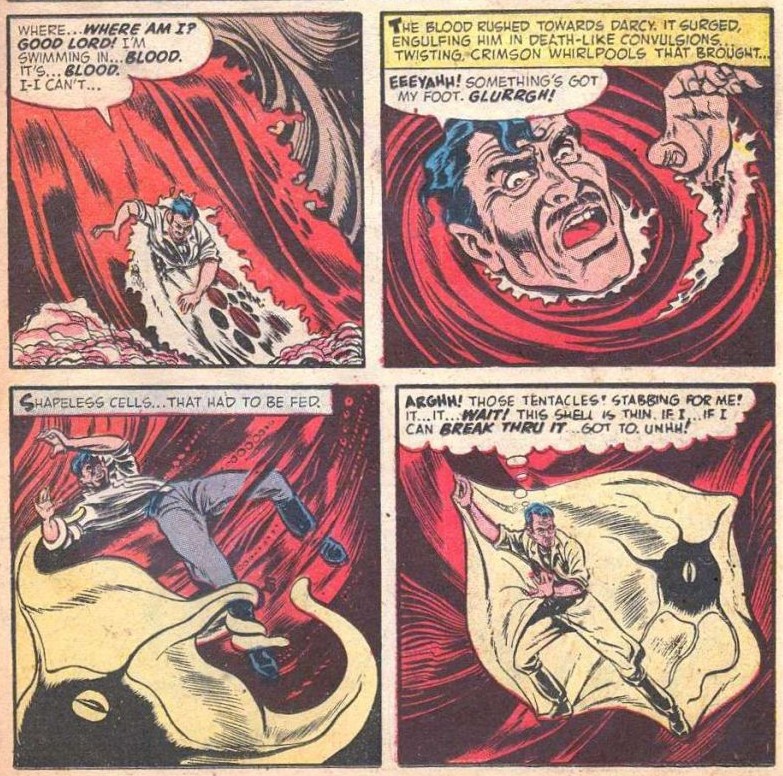
We really like Howard Nostrand at WOT, though so far he has been woefully under-featured in our posts!
This page is from The Man Germ, scripted by Nan Barnett and illustrated by Howard Nostrand. This story was published in Chamber of Chills Magazine no. 13 (October 1952, Harvey Comics).
Finally, I have a soft spot for these tiered layouts that Rugged Action employs… especially when an octopus with tender, moist eyes is moonlighting in one of them.
Rugged Action no. 1 (December 1954, Marvel). Cover by Carl Burgos.
« By 1948, the Italians had begun to pull themselves together, demonstrating once more their astonishing ability to cope with disaster, which is so perfectly balanced by their absolute inability to deal with success. » — Gore Vidal
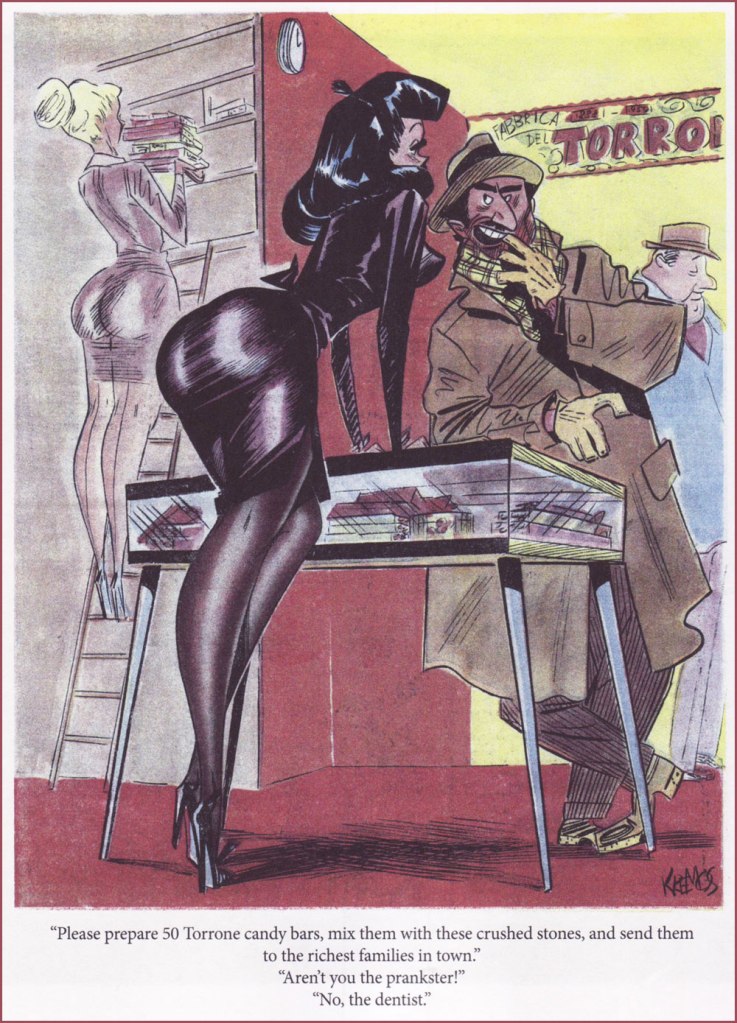
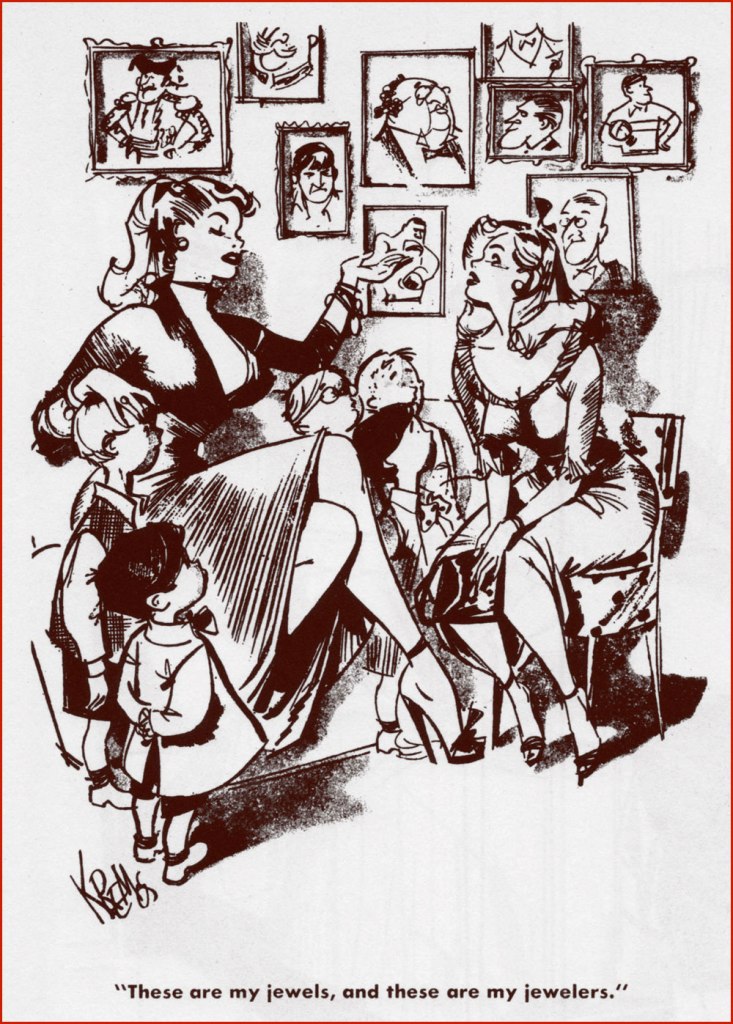
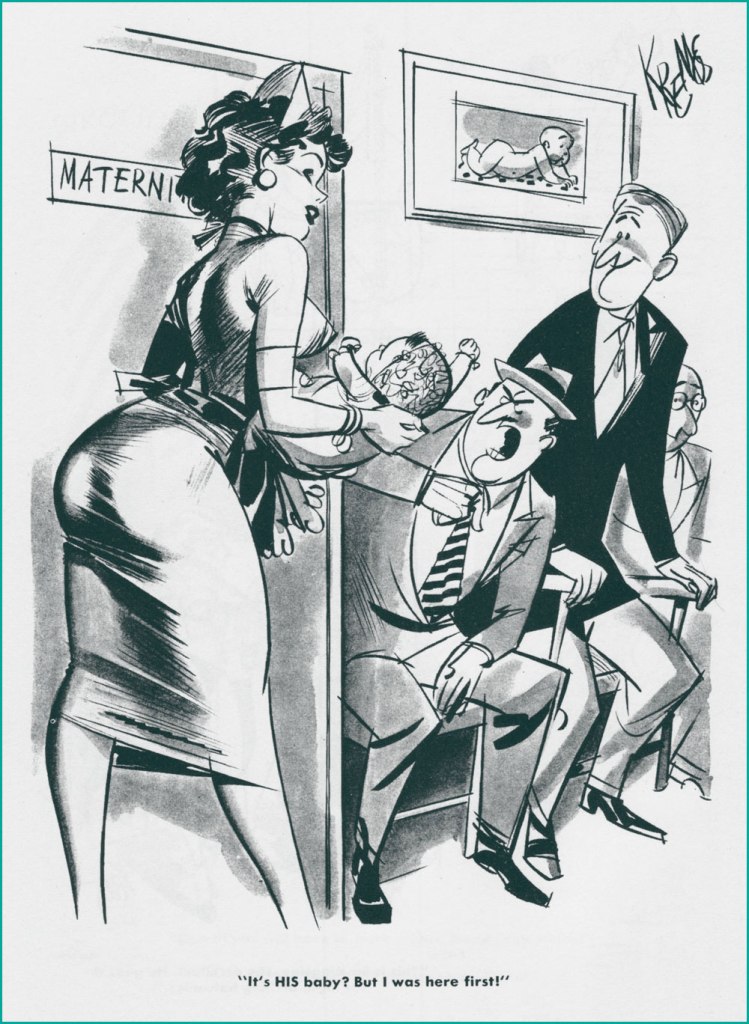
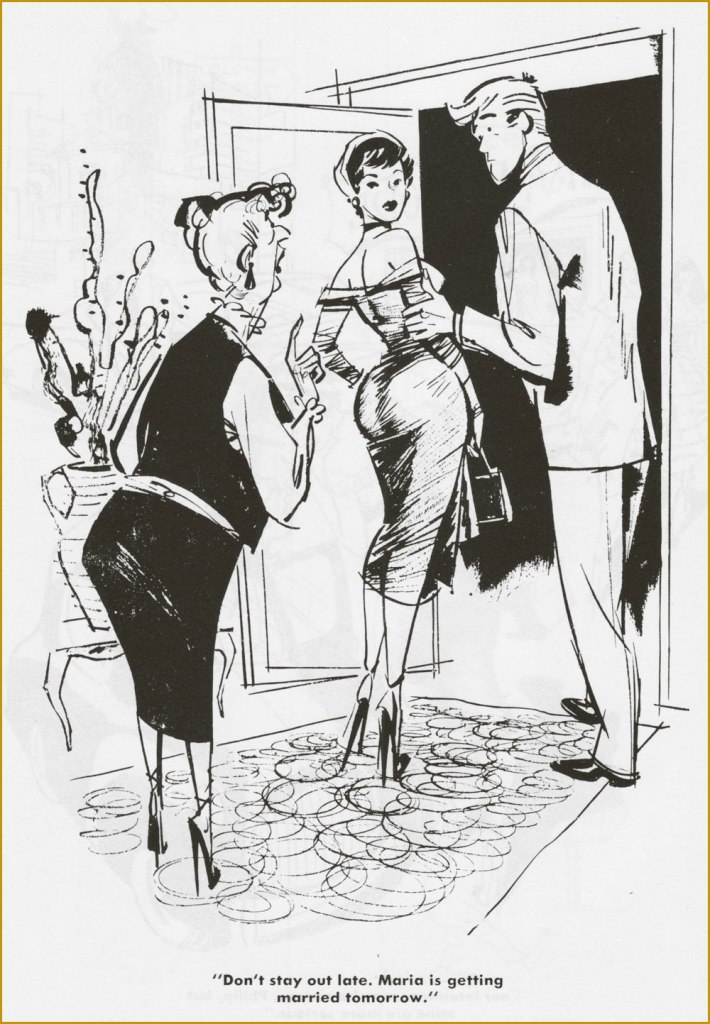
The accomplished Italian graphic designer, animator and illustrator Niso Ramponi (1924-2002), is perhaps most renowned (it’s all relative, but not to actual merit!) under his pinup cartooning nom de plume of “Kremos”.
Ramponi champion Joseph V. Procopio sheds some light on the genesis of this alias:
« Ramponi’s pen name, Kremos, was born of necessity: Like many of his generation, after the war Ramponi was conscripted into the Italian army for a year of service. Loath to abandon his budding cartooning and illustration career but barred by military regulations from working as a freelancer, Ramponi conspired with a friend named Sandro Cremo, who acted as his intermediary to secure and deliver freelance art assignments on Ramponi’s behalf. To maintain the ruse, Ramponi signed his work Kremos, a pseudonym that stuck even after his discharge from military duty. »
My own initial exposure to Ramponi/Kremos’ work came through Lawrence Lariar and Ben Roth’s splendid, but woefully short-lived Best Cartoons From Abroad collections (1955-60), which contrasted favourably against the genteel contemporary American humour anthologies. Fortuitously, Signor Procopio eventually assembled, circa 2015, twin collections of Ramponi’s finest cartoon work, ‘Kremos: The Lost Art of Niso Ramponi‘, volumes 1 (b&w) and 2 (colour). Grab ’em while you can!
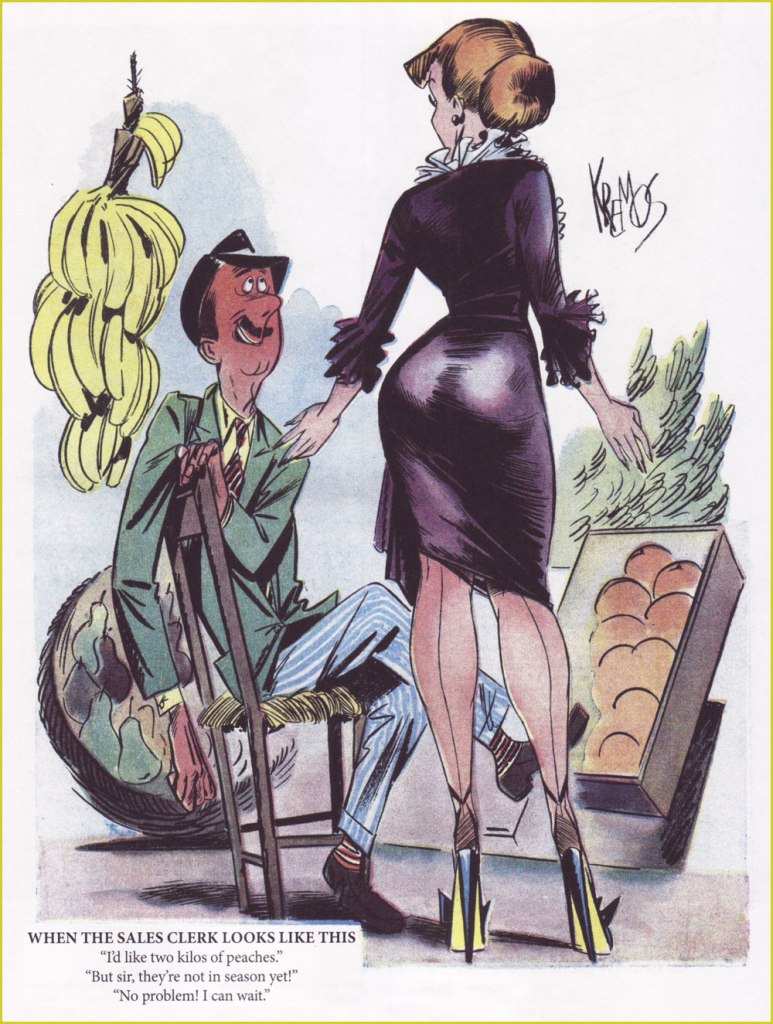
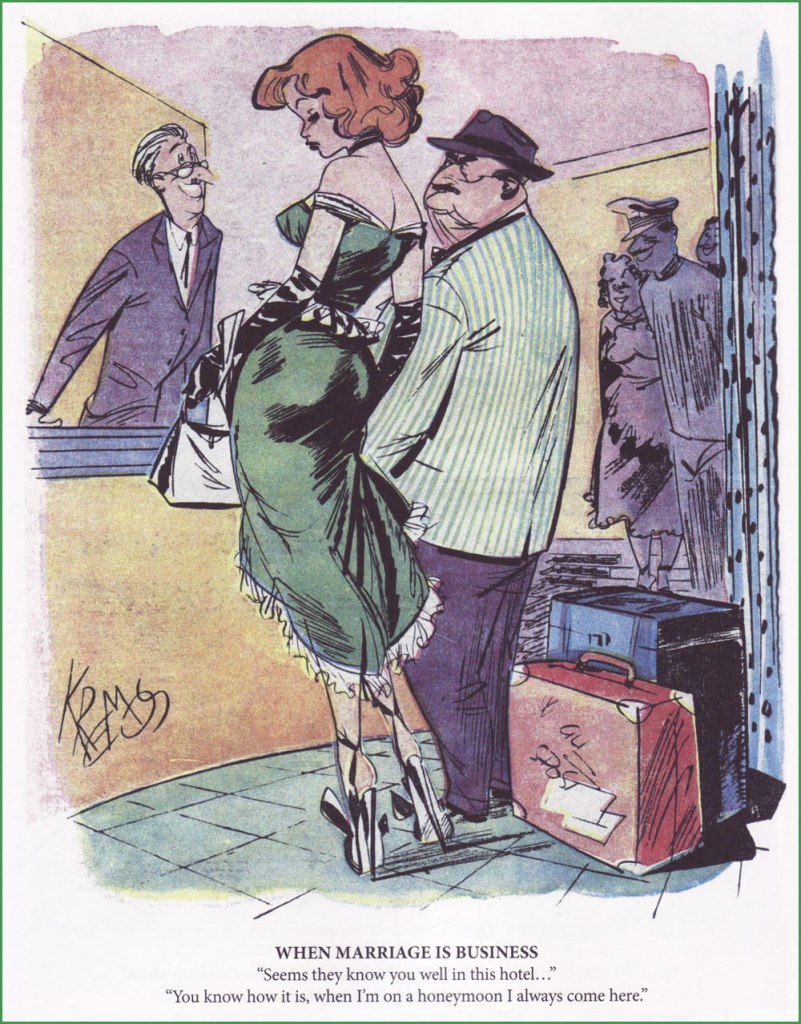
Here’s a mixed even dozen of my favourite Kremos cartoons. Buon appetito!
From Travasissimo no. 41 (Jan. 1951).
Worry not: she’s not bad, she’s just drawn that way. From Travasissimo no. 50 (Oct. 1951). I see much kinship between Ramponi and Jack Cole‘s pinup styles, don’t you?
Ah, yes, when one ate fruit and vegetables only when they were in season. I miss that; it seems more honest, less decadent and wasteful. From Travasissimo no. 57 (May 1952). For the strangest reason, this doesn’t leave me craving peaches, but rather… aubergine.
From Il Travaso (Jan. 18, 1953).
From Travasissimo no. 76 (Dec. 1953). I do believe that this is an encore appearance from the previous cartoon’s exam taker.
From Travasissimo no. 85 (Sept. 1954); translated version from Best Cartoons From Abroad 1955, my inaugural, unforgettable brush with the Kremos aesthetic.
From Travasissimo no. 88 (Dec. 1954). The caption was completely rewritten for the cartoon’s English-language appearance in Best Cartoons From Abroad 1955, edited by Lawrence Lariar and Ben Roth. The original gag went: Husband: “You know, dear… I took some swimming lessons from the lifeguard because I wanted to surprise you…“ Wife: “Now?” Husband: “No, in April!“
From Il Travaso –“The overflow” for you English speakers (May 26, 1958).
From Il Travaso, circa 1958; reprinted in Best Cartoons From Abroad 3, edited by Lariar and Roth.
From Il Travaso, circa 1958; also reprinted in Best Cartoons From Abroad 3.
From Il Travaso, circa 1958; again reprinted from Best Cartoons From Abroad 3. Those American editors loved their Kremos. I love the word “pappagallo” which, in Italian slang, means a wolf… autrement dit, a randy ragazzo.
From Il Travaso, circa 1959; reprinted in Best Cartoons From Abroad 1959, edited by Messrs. Lariar and Roth.
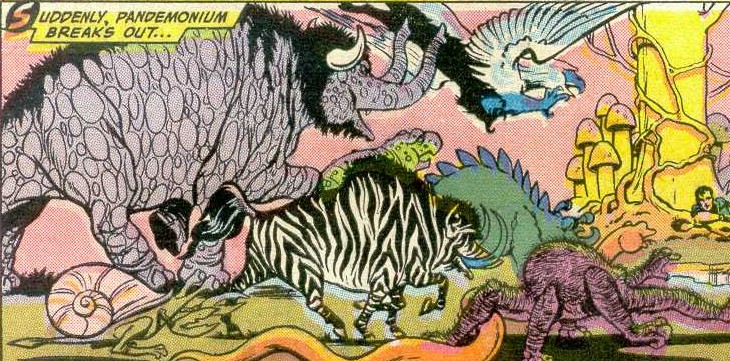
DC’s Tales of the Unexpected offer quite a ménagerie of strange looking creatures! Any peculiar combination of animals you can think of, you’ll find somewhere within the pages of this series. This possibly deserves its own post, as it’s quite entertaining to see artists combining, say, an elephant with a tiger. That being said, I tend to get annoyed at artists who can’t visualize anything truly alien-looking, thus resorting to carving up earth animals and stitching different body parts together… but that’s a different conversation.
Art by Lou Cameron.
Occasionally the artists will also add tentacles, a sure shortcut to make something mundane look properly alien, and this is today’s area of interest! For more questionable monsters, have a gander at Tentacle Tuesday: Convoluted Critters.
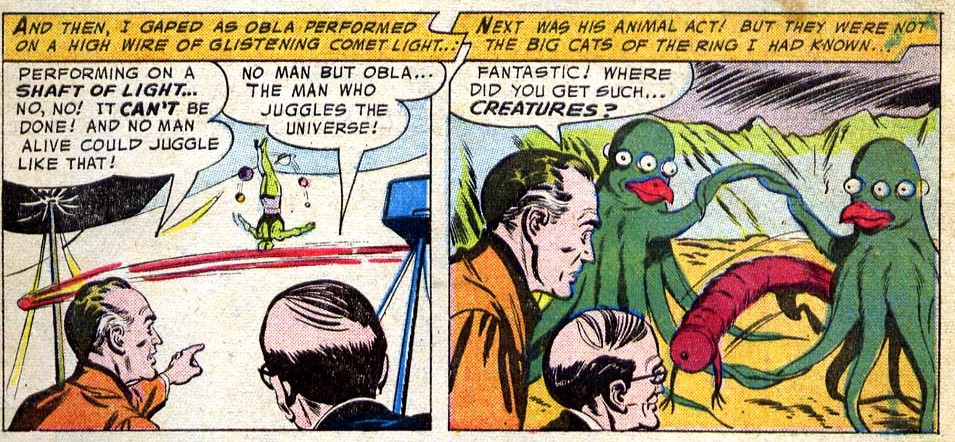
And now, onto ‘unexpected’ tentacles, even if the result of this ends up looking like badly-made puppet with a tacked-on beak…
The Strangest Show on Earth, illustrated by Jim Mooney, was published in Tales of the Unexpected no. 10 (February 1957).
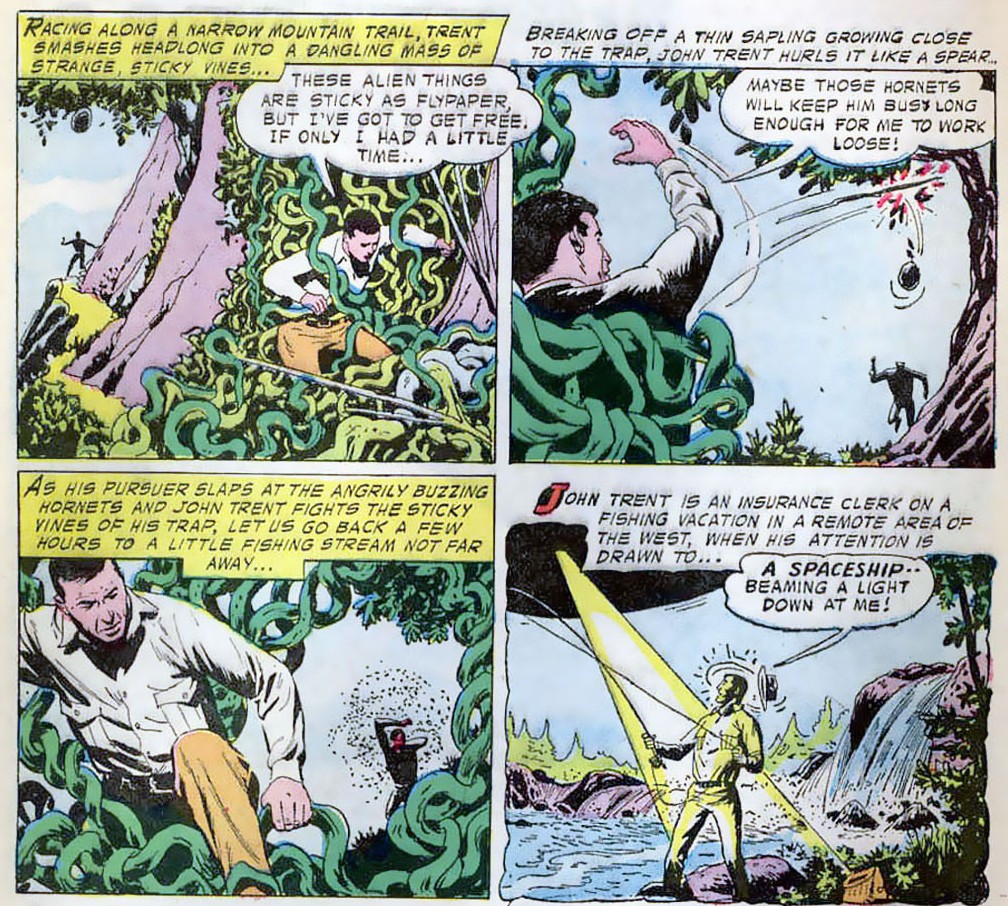
Of course one can’t discount the lasting power of classic vine-tentacles.
The Earth Gladiator, illustrated by Nick Cardy, was published in Tales of the Unexpected no. 20 (December 1957).
Whereas these mini-planets gone bonkers with tentacles-cum-hair bring to mind, but anticipate, something by Junji Ito.
The Alien Earthmen, illustrated by Ruben Moreira, was published in Tales of the Unexpected no. 62 (June 1961).
The idea of an interplanetary veterinarian makes little sense for its assumption that life on other planets would have similar physiology to ours (even limiting the scope of action to only planet earth would be too ambitious – ask a doctor to treat a sick jellyfish and see how well he would do), but here we have the satisfaction of a sweet little scene of inter-species succor.
Creature Doctor of Space, illustrated by George Roussos, was published in Tales of the Unexpected no. 63 (July 1961).
Some 30 issues later, we have another case of rabid tree-tentacles… this time composed of rubber (or something that behaves like rubber, at any rate).
Prisoners of Hate Island, illustrated by George Roussos, was published in Tales of the Unexpected no. 93 (Feb-March 1966).
Finally, this tentacled purple gorilla (so his tail is more dinosaur than gorilla, so what?) will no doubt please a regular reader of this blog!
Tales of the Unexpected no. 71(June-July 1962). Cover by Bob Brown.
« Doublethink means the power of holding two contradictory beliefs in one’s mind simultaneously, and accepting both of them. » — George Orwell
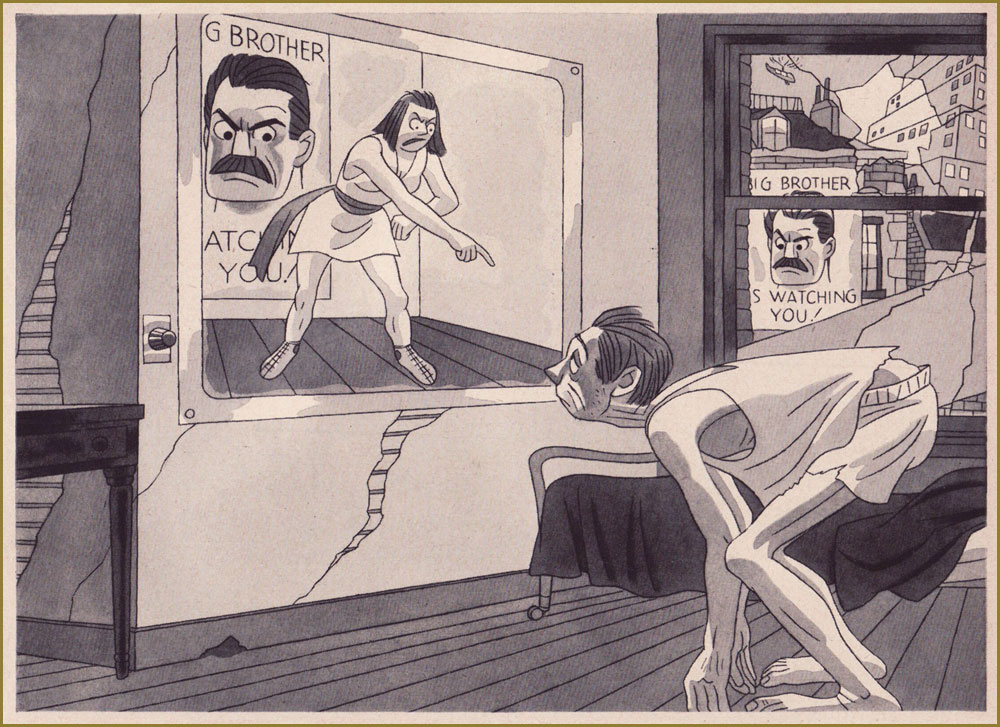
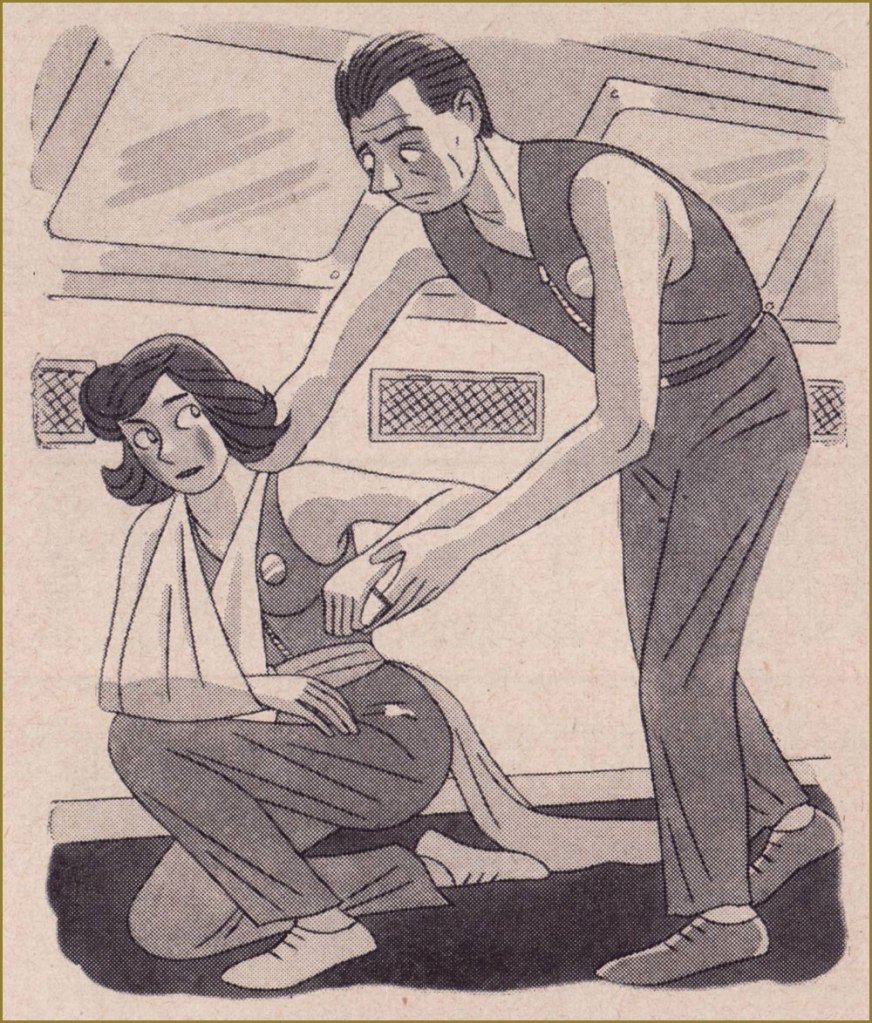
For its July 4, 1949 issue, Life Magazine pulled a couple of rather unusual moves: it featured an elaborate preview of George Orwell’s just-published novel Nineteen Eighty-Four and, as if that wasn’t weird enough, it called upon the services of renowned cartoonist Abner Dean to (copiously) illustrate the article.
Typically, given the USA’s usual political temperament and the then-prevailing climate of McCarthyism and the Red Scare, Life resorted to some choice bits of disinformation and misdirection to sell Orwell and his book to its decidedly whitebread readership. No irony whatsoever.
« British novelist George Orwell, 46, who fought in the Spanish Civil War, saw firsthand what the Communists were up to and has since devoted all his talents to warning the world of the fate which awaits it if it confuses liberalism with regimentation. His new novel, Nineteen Eighty-Four, is a terrifying forecast of what the world of human beings may be like 35 years hence. It is a July selection of the Book-of-the-Month Club and will be condensed in the September Reader’s Digest. It is guaranteed to make the flesh creep on anything except brass monkeys and commissars. »
Dean’s huge (52 cm x 24 cm) spread ushering readers into The Strange World of 1984. It’s hard to do it justice at this reduced size, but open it in a separate tab for a closer look.
Let’s see, now. Orwell fought in the Spanish Civil War. Fair enough. Let’s dwell on that detail for a bit. Which side was he on?
« In December 1936, Orwell went to Spain as a fighter for the Republican* side in the Spanish Civil War that was provoked by Francisco Franco’s Fascist uprising. He did not join the International Brigade as most leftist did, but the little known Marxist POUM. In conversation with Philip Mairet, editor of New English Weekly, Orwell said: ‘This fascism… somebody’s got to stop it’. To Orwell, liberty and democracy went together, guaranteeing, among other things, the freedom of the artist; the present capitalist civilization was corrupt, but fascism would be morally calamitous.
He joined the Independent Labour Party contingent, which consisted of some twenty-five Britons who had joined the militia of the Workers’ Party of Marxist Unification (POUM – Partido Obrero de Unificación Marxista), a revolutionary communist party. The POUM, and the radical wing of the anarcho-syndicalist CNT (Catalonia’s dominant left-wing force), believed General Franco could be defeated only if the Republic’s working class overthrew capitalism — a position at fundamental odds with the Spanish Communist Party, and its allies, which (backed by Soviet arms and aid) argued for a coalition with the bourgeois parties to defeat the fascist Nationalists. » [ source ]
So… Orwell was not merely a communist, but a Marxist advocating the overthrow of capitalism. Just like your average Reader’s Digest subscriber, obviously!
« THE TELESCREEN dominates the lives of Party members; it is a kind of television set which can never be turned off, and which can pick up as well as receive images. Over it the members hear what they are supposed to do and believe — and from the other end the dreaded Thought Police can see everything they do and hear everything they say. » Prophetic? Now don’t be silly.
« TWO MINUTES HATE is a daily institution designed to keep Party members in a frenzy of excitement and rage against the Party’s enemies. »
A LOVE AFFAIR in six panels. Spoilers galore. Protagonist Winston Smith meets Julia.
Julia hands Winston a note, which he drops into the memory hole (basically an incinerator) as a precaution.
They meet in the midst of a crowd in Victory Square, and Julia whispers some instructions to Winston.
« Now, in a trysting place beneath the trees he finds a kindred soul in the rebellious Julia; she removes the hateful sash of the Anti-Sex League and they enter upon one of the most furtive and pathetic little love affairs in all literature. » The anonymous author of the article does not seem to approve.
« Julia is good at smuggling forbidden pleasures; they have real coffee (not the ersatz ‘Victory’ mixture) and chocolate, and Julia adorns herself with cosmetics and perfumes which no Party member is ever supposed to see. »
« But eventually, the Thought Police catch up with them. For the unspeakable crime of indulging in a human emotion they are arrested and hauled away to repent their sins in the horrible confines of the Ministry of Love. » I did warn you about spoilers: indeed, Winston Smith Takes It on the Jaw!
It’s intriguing that LIFE would devote this much space to such a controversial topic, but hardly surprising that it would stack the deck. It’s a regrettable hallmark of blind hubris to believe that only ‘the opposition’ is capable of totalitarian atrocities, when allowed unchecked power. Benevolent dictators have always been very, very scarce. To quote Margaret Atwood, a lady who knows her way around a dystopia, « ‘1984’ is not a wonder tale. Not only could it happen, but it has happened, but under different names. »
I was startled to discover that after several years of WOT blogging, we still have no post dedicated to Sergio Aragonés. Perhaps this is in part because his art is ubiquitous – throughout his long career, he has contributed manifold pages to various DC publications, created an enduring barbarian parody, scripted and drawn (mostly solo but also in collaboration) an impressive number of mini-series published by Fantagraphics, Dark Horse and Bongo Comics, produced various comic-con paraphernalia, etc. And this is not to mention his lasting contributions to Mad Magazine (which I did discuss, though not at length, in A MAD dash… inside) – something in the magnitude of twelve thousand gags spread over 57 years and 491 issues of Mad.
A sequence from A Mad Look at Sharks from Mad no. 180 (January 1976, EC).
He’s also a charming, universally-liked man whose bigger-than-life persona has ensured that his participation in anything is always surrounded by fun anecdotes. It is my great pleasure to share this abridged compendium of Aragonés tentacles, of which there are many, as he enthusiastically added them into doodles and margins with great glee (and, as we know, « he has quite literally drawn more cartoons on napkins in restaurants than most cartoonists draw in their entire careers *», so just imagine how many tentacles are scattered throughout his work).
Room 13 one-pager, scripted (and edited) by Joe Orlando. This was published in House of Mystery no. 190 (Jan-Feb 1971, DC).
Incredibly, we still haven’t written a post dedicated to the great Plop! (this post is starting to sound like a to-do-in-the-nearest-future list), though Hallowe’en Countdown III, Day 30 did include a story from number 1. Plop!, “The New Magazine of Weird Humor!“, certainly included a lot of cephalopods in its 24 issues and I will doubtlessly get around them one of these days. In the meantime, here’s a very appropriate page from Plop! no. 16:
This closing page of Plop! no. 16 (September 1975, DC) was scripted by Steve Skeates.
Galloping forward through some twenty years, we briefly land at Marvel, namely these two pages from Groo the Wanderer no. 98 (February 1993, Marvel), co-plotted and scripted by Mark Evanier.
Sergio Aragonés Funnies, published between 2011 and 2014 by Bongo Comics, boast 12 issues of really enjoyable, remarkably varied material. For those who may think that Aragonés is one-trick pony who can only do ‘silly’ humour, this series offers many auto-biographical stories, some of them surprisingly poignant and heart-felt. Not to say that it’s not devoid of humour – the more serious stuff (including social criticism in the form of animal parables) is nestled among pages of slap-stick humour and imaginative goofiness, from one-pagers to longer stories that take most of an issue to develop. Aragonés also shares some background on his approach to stories, allowing us to peek into his imagination and possibly answer that hackneyed question that plagues all manner of writers, ‘where do you get your ideas from?’ If an anthology of Funnies is ever published, I’ll happily purchase it.
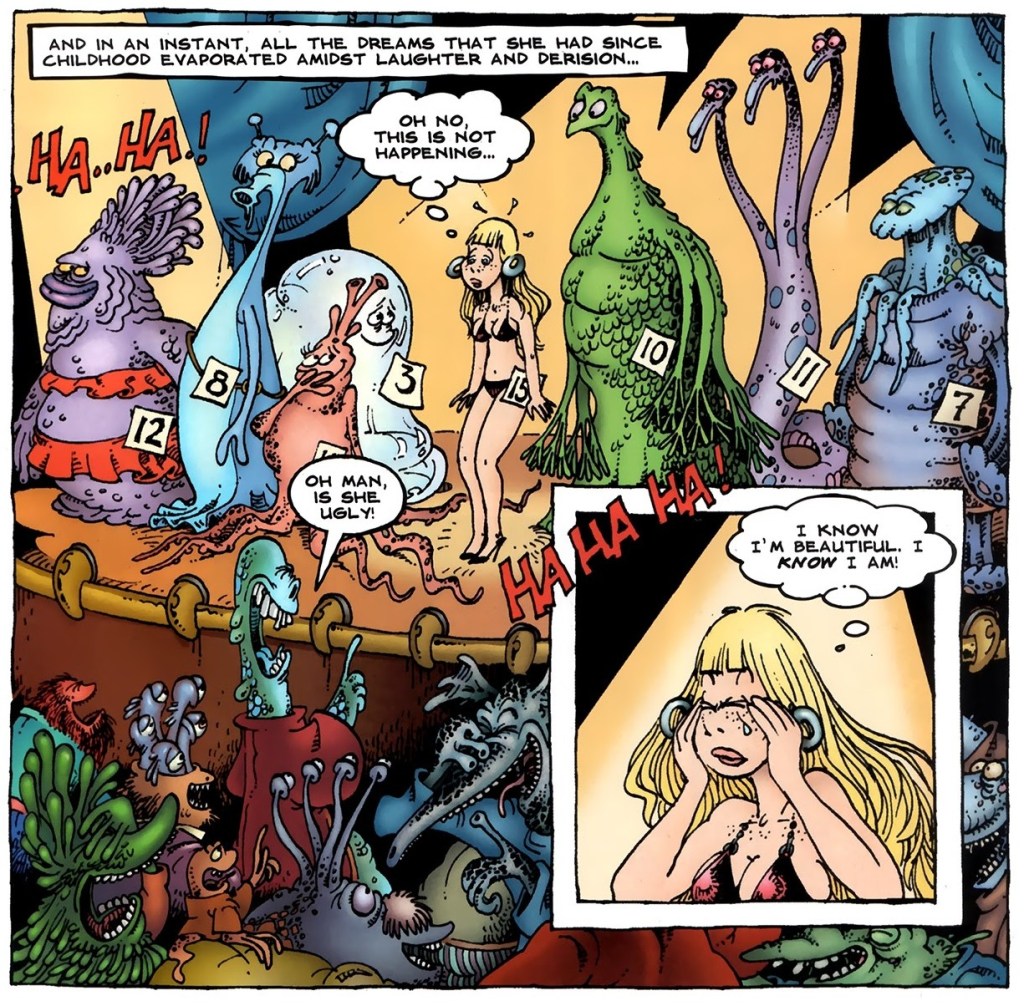
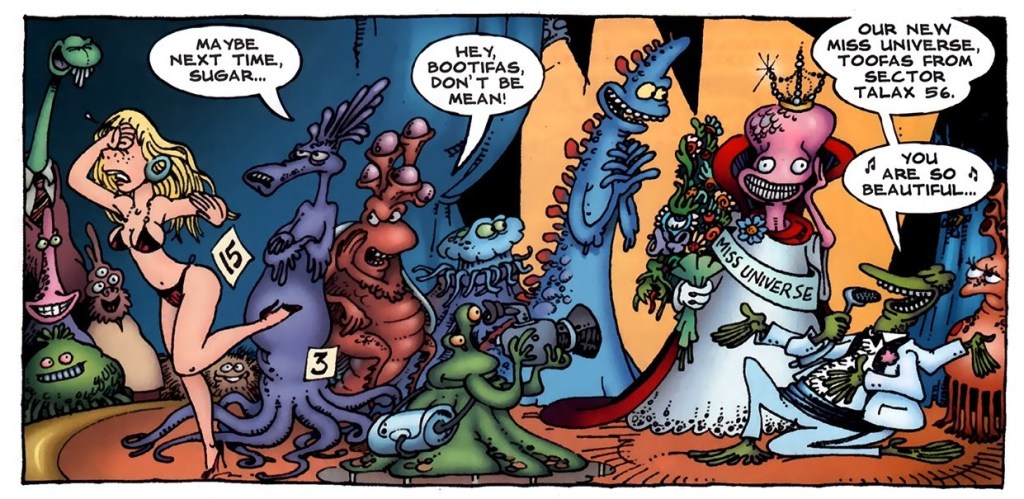
Excerpts from Kira and the Beauty Contest, published in Sergio Aragonés Funnies no. 2 (August 2011, Bongo Comics):
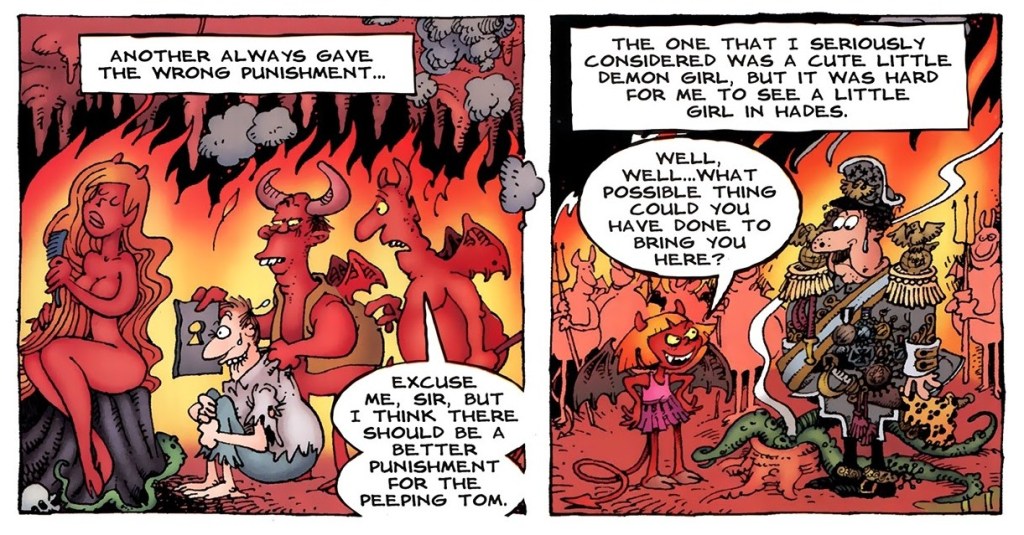
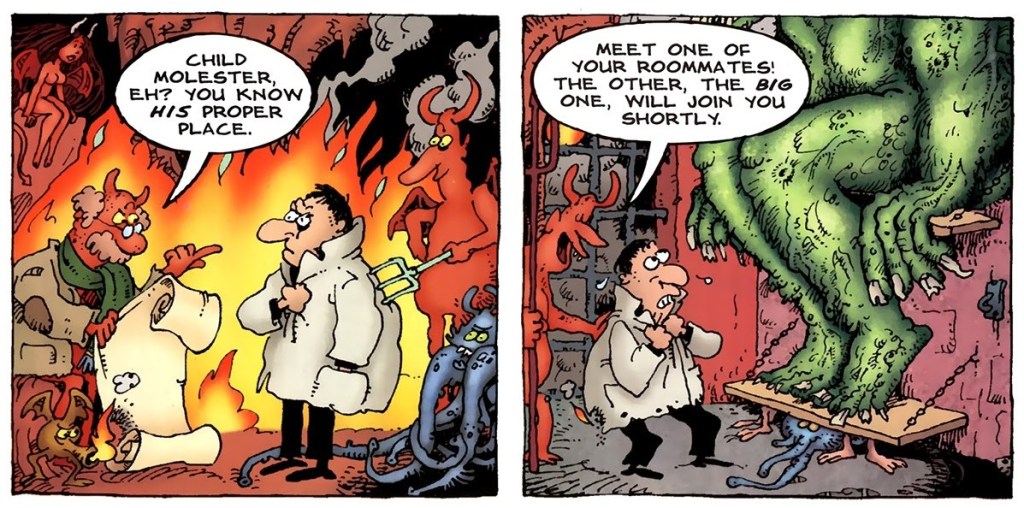
Panels from Sergio’s Inferno, published in Sergio Aragonés Funnies no. 3 (September 2011, Bongo Comics):
Finally, a panel from the back cover of Sergio Aragonés Funnies no. 10 (October 2013, Bongo Comics). Nevermind what the joke is, I just really like that octopus (as well as his other sea friends).
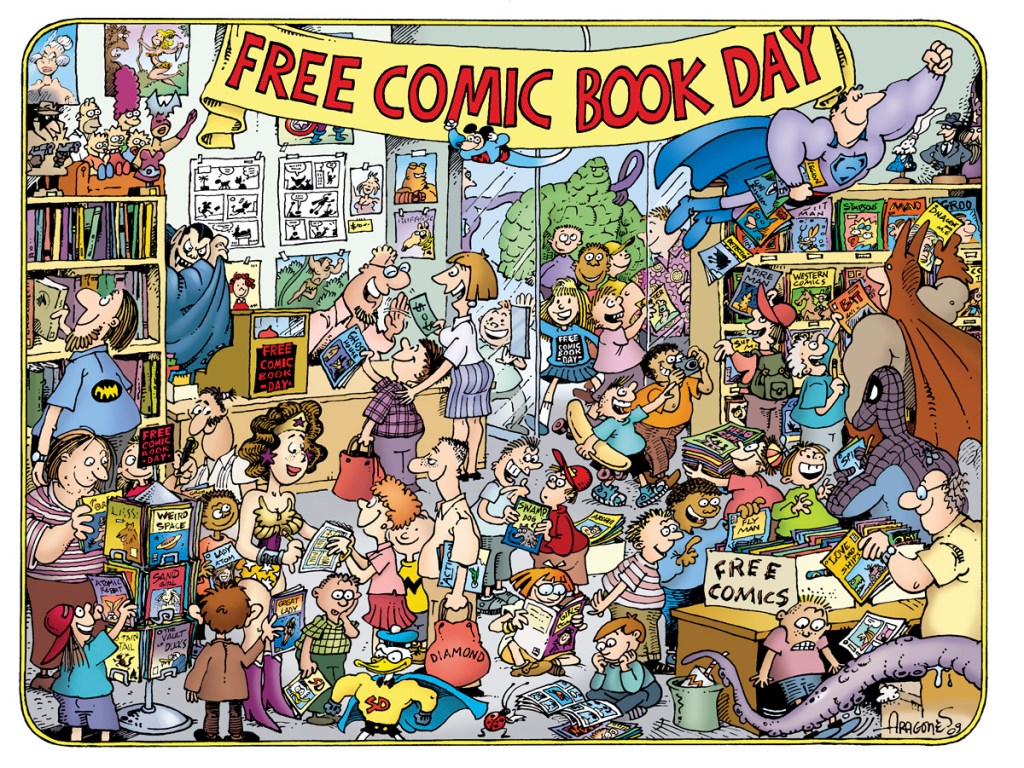
I mentioned materials related to Comic-Cons, so I would be amiss to not include at least one image of something vaguely related!
This design was created for the ‘Free Comic Book Day Commemorative Artist T-shirt’ in 2010.
I’ll end this post with a classic Aragonés anecdote, as told by Mark Evanier. This happened while these two were participating in filming The Half-Hour Comedy Hour television show for NBC in 1983, on which the model Jayne Kennedy was a guest. [source]
« This was one of the most beautiful women in the world. And she wore this dress that was very revealing, so much so the censors wouldn’t let us put her on the air in it without adding some material. So we’re all talking to her, the writers and whoever, just in awe of this woman. And Sergio comes walking in looking like a homeless person, carrying his portfolio. And Jayne sees him and she shouts, ‘Sergio!’ and she runs over and starts kissing him passionately.
They’d worked together before, it turned out. But Johnny Carson comes walking out into the hallway and he thinks Jayne Kennedy is being sexually assaulted by a homeless person in the NBC hallways. He came over to make sure she was okay. She said it was fine, that she knew him, and I said, ‘It’s okay, he’s a cartoonist.’
So Johnny gives that classic look and he says, ‘I knew I should have taken up drawing.’ »
« Competition brings out the best in products and the worst in people. » — David Sarnoff
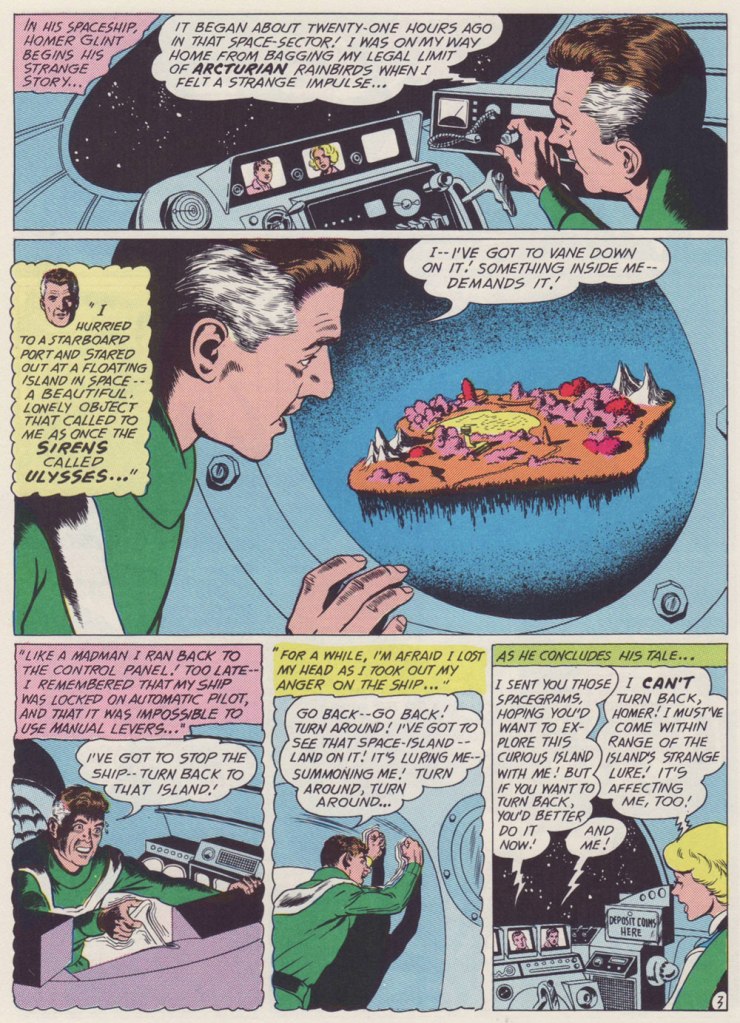
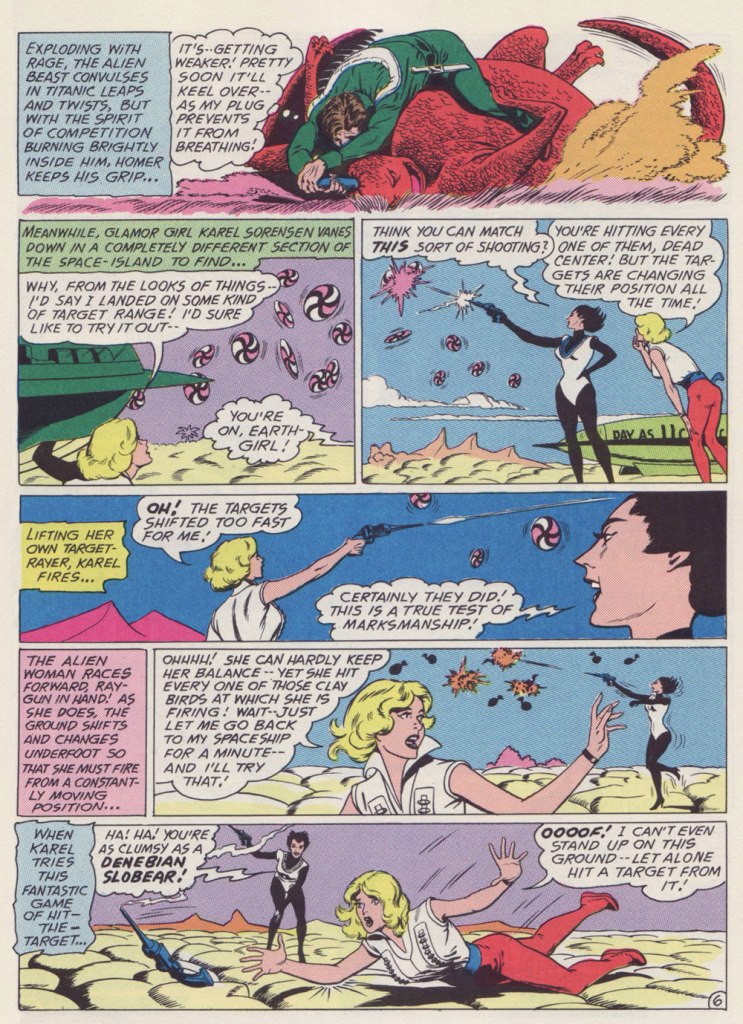
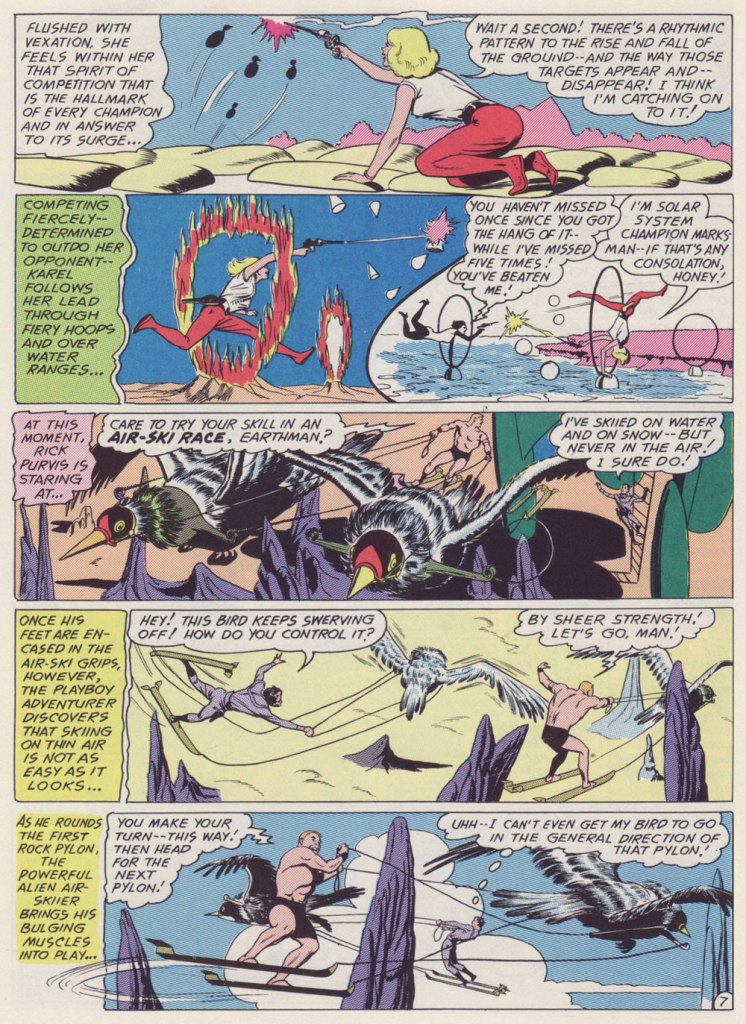
The other day, my partner was trying out a video game whose soundscape seemed exceptionally judicious and well-integrated to the action. At one point, she noticed that the optimal way to play was by matching one’s pace and movements to the musical rhythm. I said, “Oh, it’s just like that Star Rovers story!”
And now for a bit of context: The Star Rovers was a short-lived series that sporadically appeared in the back of DC’s Julius Schwartz-edited titles, mainly Mystery in Space, backing main feature Adam Strange.
As Michael Uslan beautifully puts it, in his introduction to Mysteries in Space: The Best of DC Science-fiction Comics (Fireside/Simon and Schuster, 1980):
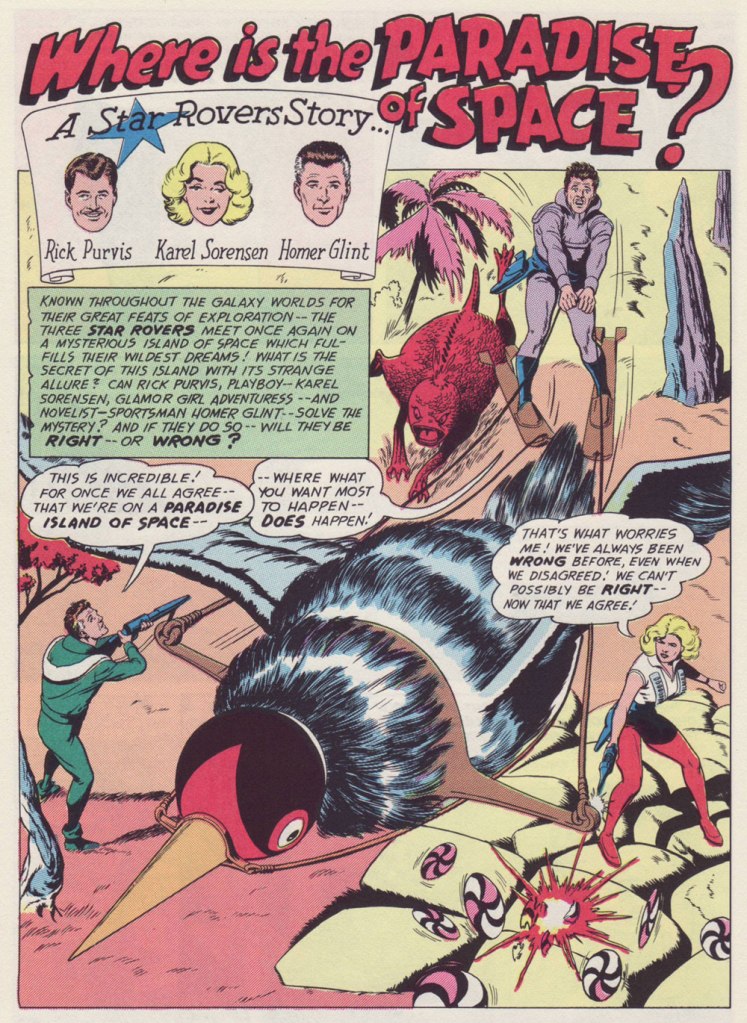
« The Star Rovers were a whole other category of space heroes, typical of the kind of originality demanded by Julius Schwartz. A transgalactic trio of playboy, glamor-girl and novelist-thrill-seeker, they rarely agreed about anything and were rarely right about anything even when they did agree. »
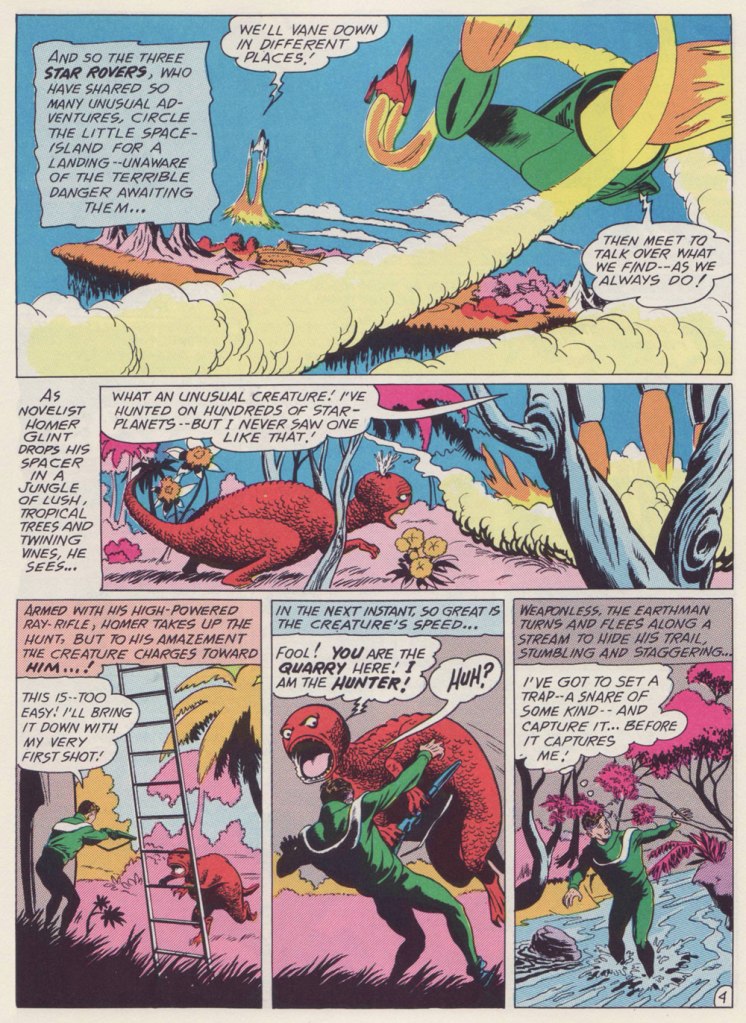
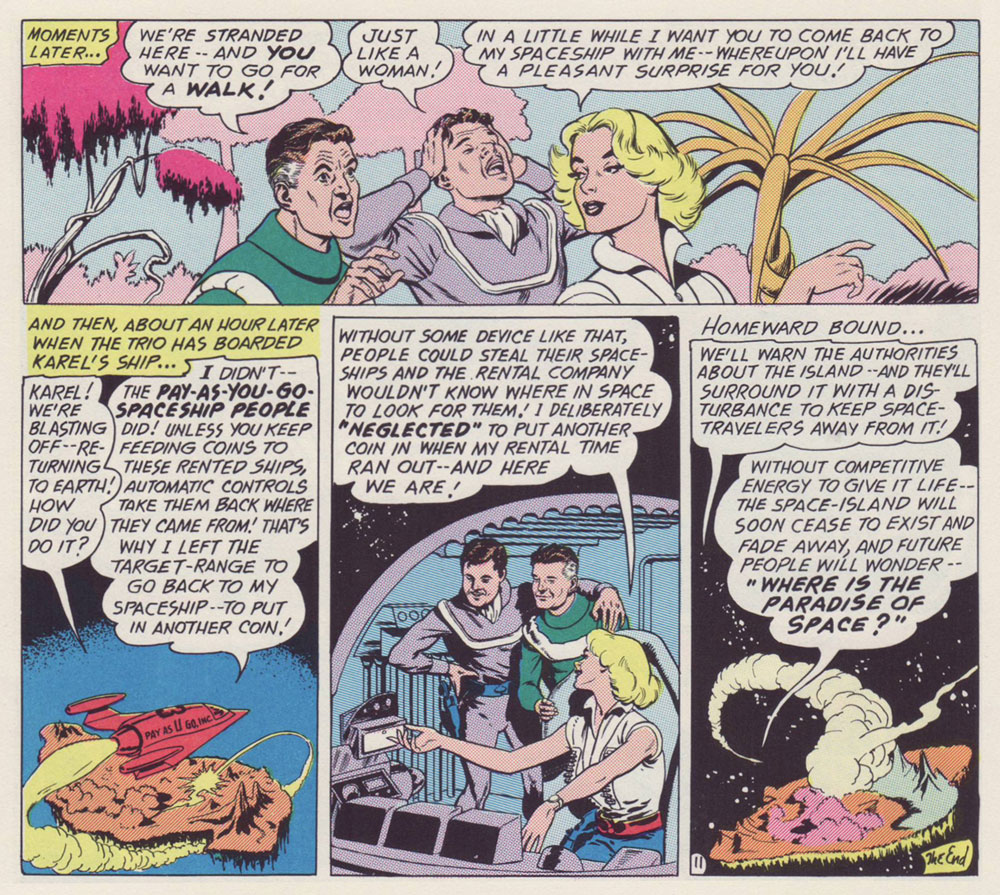
This is the third Star Rovers episode, Where Is the Paradise of Space?, from Mystery in Space no. 74,Mar. 1962, DC).
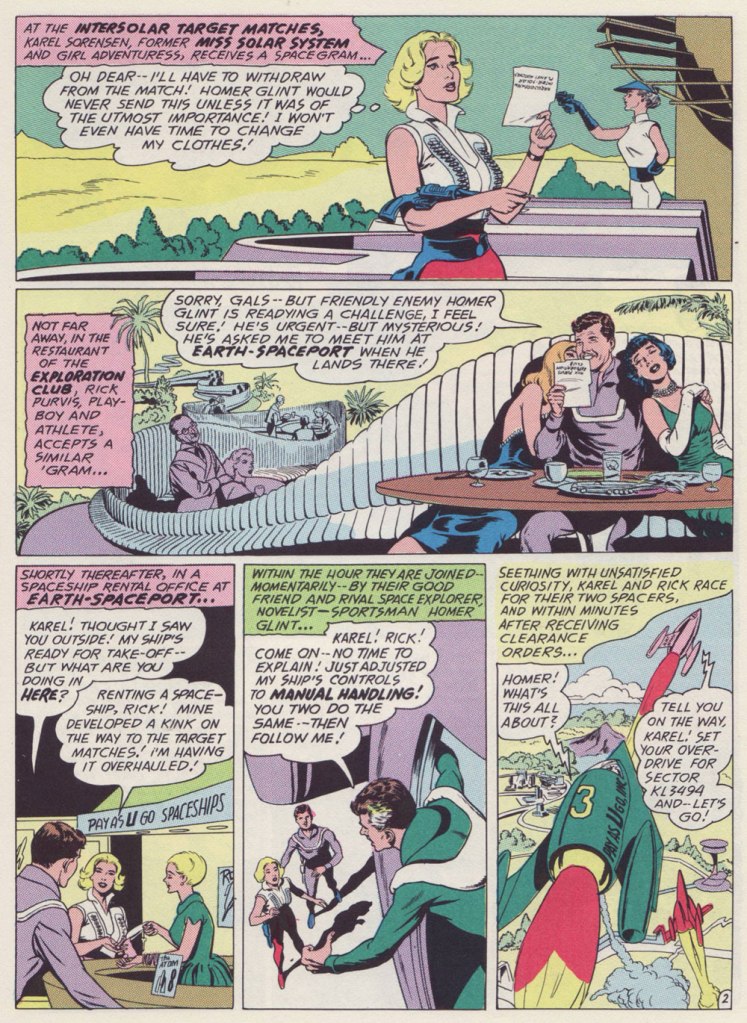
This is the sequence that brought this story to my mind.
One of the most charming aspects of the Star Rovers is the protagonists’ equal footing. In this case, Karel is a bit more than the fellows’ equal, but the series is mostly exempt of the sexism you’d expect from the period of its creation.
Much of the appeal of the Star Rovers is that they’re not a team: they’re friendly rivals, ‘frienemies’, as we’d call them these days. Aside from matching wits and theories, they never directly compete, as differences in their fields of endeavour would make the exercice pointless. There’s a light, jovial tone to these mysteries, yet they can still be taken seriously as intriguing puzzles.
All nine episodes were edited by Schwartz, scripted by Gardner Fox, and illustrated by Sid Greene (1906-72). The latter, a veteran of the comics industry with published work going back to 1940, arguably turned in the finest work of his busy career, and likely would have kept on doing so had it not been for… Batman’s troubles.
To make a long story short, as the Batman titles were shedding readers like there was no tomorrow (making it possible that there would, indeed, be no tomorrow), DC bigwigs opted to switch things around a bit, pulling editor (and Jack Kirby blackballer) Jack Schiff off Batman and Detective Comics and handing him the reins of Schwartz’s SF titles Strange Adventures and Mystery in Space. He ran those into the ground, but in goofily entertaining fashion, at least. Unlike the bat-books, there were expendable to DC.
As the ultimate Star Rovers tale appeared in the final issue of the Schwartz-edited Strange Adventures before the changeover, it seems likely that the series would have carried on under a Schwartz régime. But the Rovers weren’t at all in Schiff’s wheelhouse: the delicate premise called for deft, intricate plotting and wit, qualities not to be found within Schiff’s stable of writers. Gardner Fox and Greene were among Schwartz’s trusted confederates, and talent poaching was rarely allowed within DC’s editorial enclaves.
After this editorial switch, Greene was, with few exceptions, put to work inking the pencils of Schwartz’s big three: Carmine Infantino on Batman and The Elongated Man, Gil Kane on Green Lantern and The Atom, and Mike Sekowsky on Justice League of America. The problem, at least as I see it: Greene’s inks didn’t mesh well with any of these pencillers’ styles. Oh well — it’s a living. At least Greene was able to return to full pencil and ink duties on a handful of short stories for editor Murray Boltinoff, mostly in the pages of The Unexpected. Better late than never.
Finally, for your edification and amusement, here’s a Star Rovers checklist:
Who Caught the Loborilla? (Mystery in Space no. 66, Mar. 1961) What Happened on Sirius-4? (Mystery in Space no. 69, Aug. 1961) Where Is the Paradise of Space? (Mystery in Space no. 74, Mar. 1962) Where Was I Born– Venus? Mars? Jupiter? (Mystery in Space no. 77, Aug. 1962) Who Saved the Earth? (Mystery in Space no. 80, Dec. 1962) Who Went Where– and Why? (Mystery in Space no. 83, May 1963) When Did Earth Vanish? (Mystery in Space no. 86, Sept. 1963) Will the Star Rovers Abandon Earth? (Strange Adventures no. 159, Dec. 1963) How Can Time Be Stopped? (Strange Adventures no. 163, Apr. 1964).
Since the previous instalments of Tentacle Tuesday had specific, unified themes, the time has come for another anything-goes grab bag of goodies. That being said, I am in the mood for bright colours, as the lawns and plants around these parts have acquired that drab, dusty shade of brownish green that’s characteristic of August and its dry spells…
This epic Cthulhu-vs-Godzilla scene was drawn by Chaz Folgar for a 2010 online illustration competition – the exact wording of the challenge was “Cthulhu and Godzilla with the fate of Japan in the balance“. I’m definitely betting on Cthulhu (see Tentacle Tuesday: Ho ho ho, Mr. Lovecraft if you need a refresher!), ancient and powerful and eternal being that he is. Godzilla, in the meantime? Just a prehistoric, overgrown lizard (with apologies to all Kaiju film buffs).
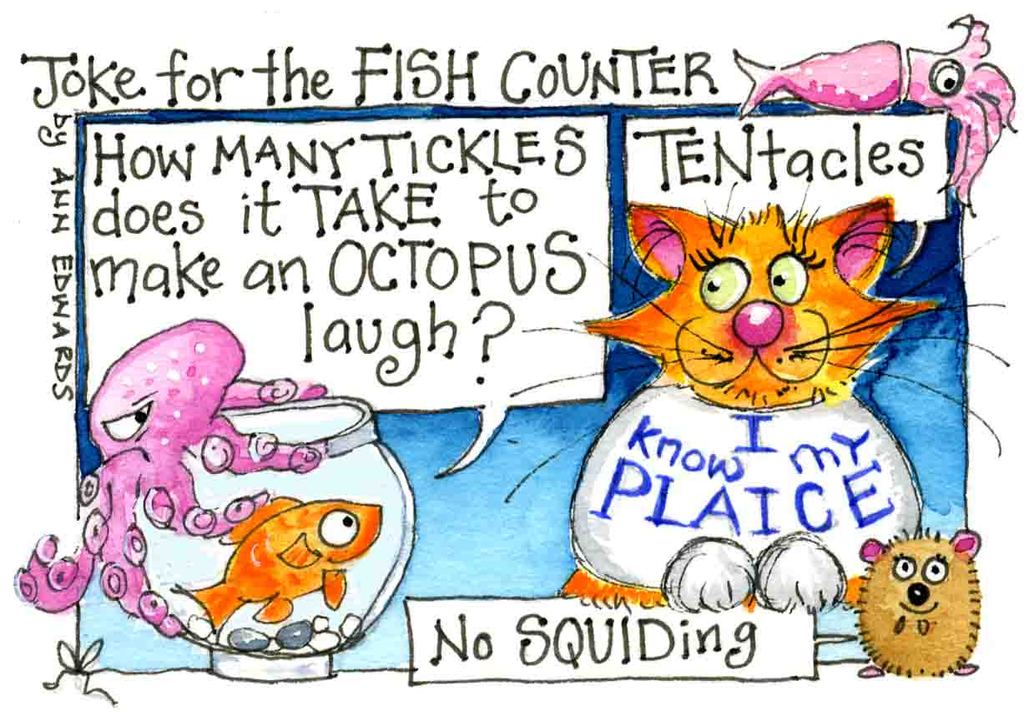
In a somewhat different vein, here is a postcard/cartoon/illustration by British artist Ann Edwards (visit her website!) She has a bouncy, colourful style that’s really fun… especially if there are tentacles involved.
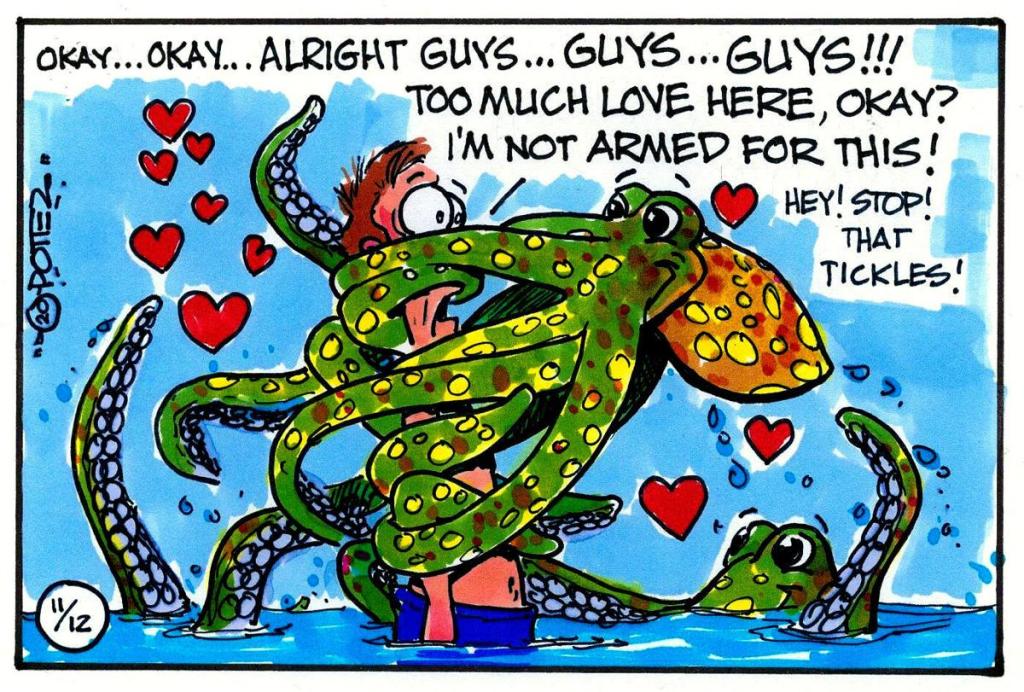
In a similar format, and perhaps even more colourful, is this cartoon that I found in an article about My Octopus Teacher, a movie about the filmmaker Craig Foster and the octopus he makes friends with. Amazingly (and not in a good way), the article did not specifically credit this image to anybody in particular. Did Foster document his octopus shenanigans with cartoons? Is this the work of some completely unrelated artist that was included because it was on topic?
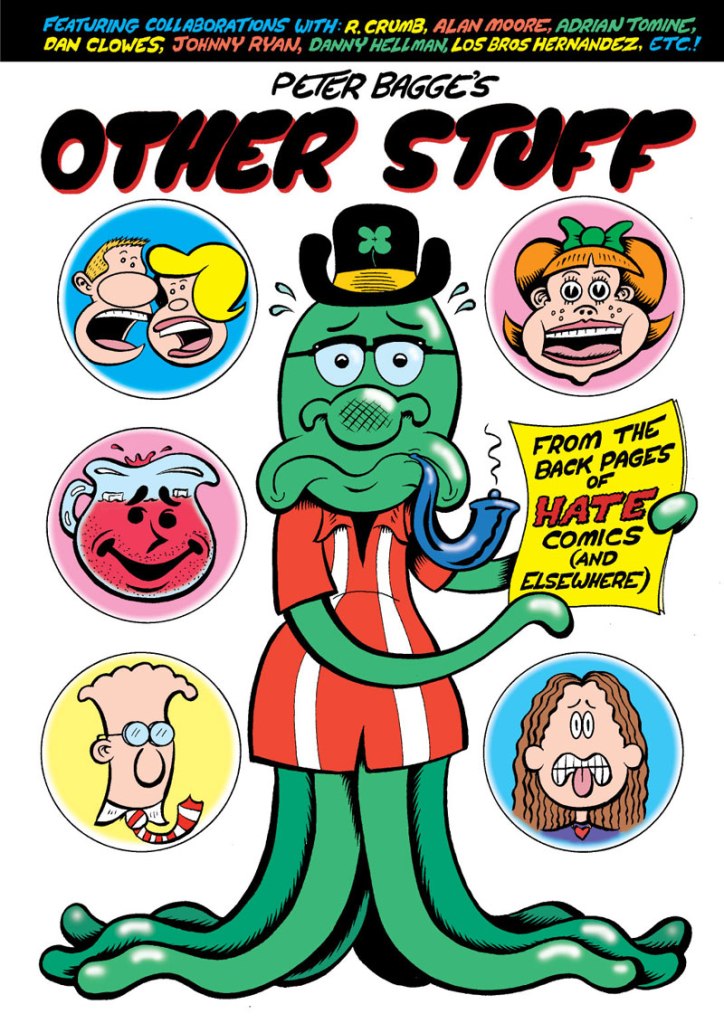
Peter Bagge’s Other Stuff (Fantagraphics, May 2013) is a collection of Bagge’s shorter stories from the 90s and 2000s. I’m not really a Bagge fan (his sense of humour is too based on making audiences cringe), but I enjoyed reading this one, though my inclination to revisit it is very low.
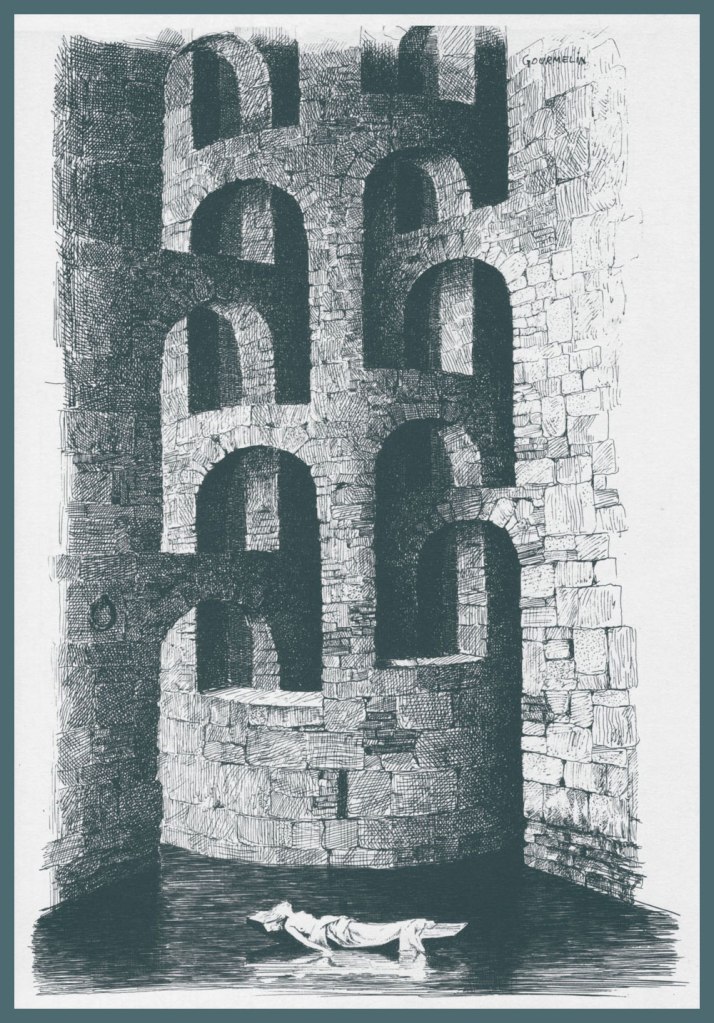
« It’s true that Gourmelin’s world has everything to unsettle the general public: it contains as much horror as black humour, as much morbidness as sombre poetry. But to classify his drawings in a well-defined genre is a hopeless enterprise, and we well know how our times need clear, idiotic and exact labels. This relegates Gourmelin to some fuzzy area, a sort of no man’s land where one can find anything — even fanatics — but never a thing to eat or to drink. » — from the artist’s presentation in the anthology Les chefs-d’œuvre du dessin d’humour*(1965, Les éditions Planète; ).
While France’s Jean Gourmelin (1920-2011) started out as a painter and practiced — and often mastered — scores of artistic techniques and media (etching, technical drawing, sculpture, stained glass, wallpaper design, and so on…), he’s more commonly remembered for his stark black and white, wordless pen and ink drawings. Even as they remain open to interpretation, their power and eloquence are undeniable.
While his earliest drawings appeared in print sporadically from 1951, his crucial turning point was his 1961 encounter with Belgian writer-historian Jacques Sternberg, who encouraged Gourmelin to emphasise, in his work, idea over form. This canny shift in approach soon landed his newly-galvanised work in the pages of Planète, crucially, but also those, just as notable, of Bizarre, Midi-minuit Fantastique, Pariscope, Hara-Kiri… with occasional forays into other media, for instance some striking production design for a 1967 TV adaptation of Gustav Meyrink‘s classic novel, The Golem. Here’s an unexpected (and fine!) article in English about Gourmelin’s work on the film.
Here, then, are some (dark) highlights of Gourmelin’s work in the 1960s.
This piece appeared in Les chefs-d’œuvre de l’épouvante (1965, Les éditions Planète), accompanying Claude Farrère‘s classic 1928 short-short story, Le Train perdu, which you can read here (in the original French). Gourmelin also provided the anthology’s arresting cover and frontispiece artwork. Maybe next time…
-RG
*It says something (flattering, if you ask me) about the Gallic character that Gourmelin’s work would fall under the category of “humorous”. We’re a looong way from, say… Dave Barry.
« When I was a young writer if you went to a party and told somebody you were a science-fiction writer you would be insulted. They would call you Flash Gordon all evening, or Buck Rogers. » —Ray Bradbury
We’ve talked about newspaper strip Flash Gordon in Tentacle Tuesday: Lurkers in the Newsprint, and now it’s time for its comic book version! Although I normally have very little interest in FG, this is no second-rate Tentacle Tuesday: there is some prime tentacular material to be enjoyed.
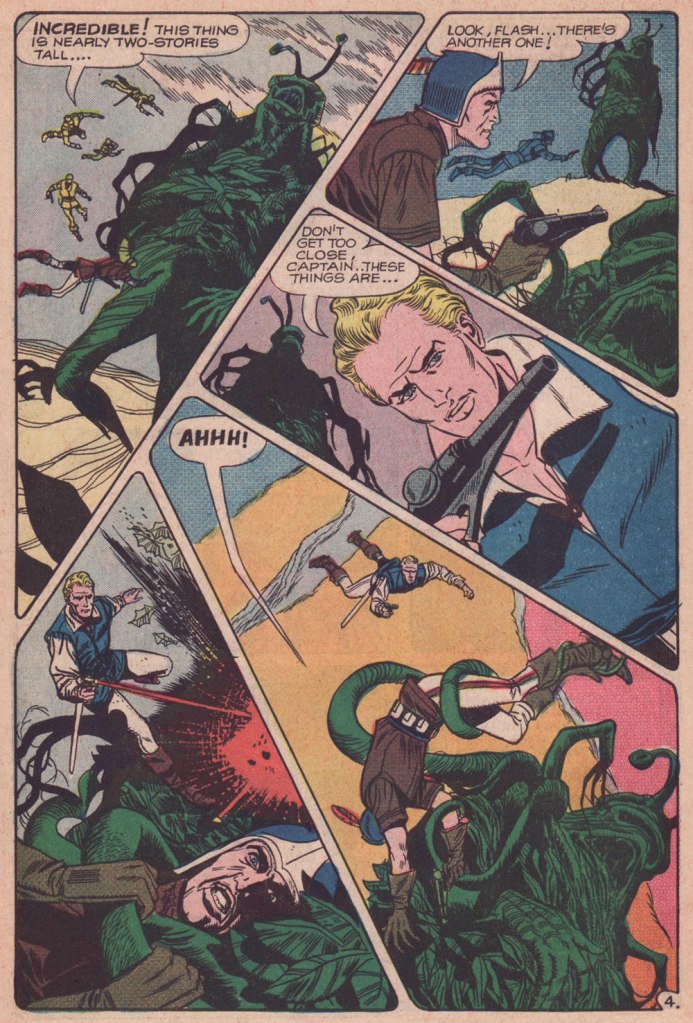
We first concern ourselves with the Flash Gordon Charlton Comics run, which picked up the count where King Comics had left it in 1967. From 1969 until 1970, Charlton published issues 12 to 18, all of which but the first had glorious covers and cover stories by Pat Boyette, an absolute WOT favourite ( you can visit co-admin RG’s Pat Boyette — Hillbilly Makes Good* for a deeper exploration of his career).
The cover of issue 14 has an octopus shortage (a serious flaw affecting many, many comic book covers!), but the monster o’nine-tentacled-tails the ’emotionless killers’ encounter is a beauty. The following page is also a good example of Boyette’s imaginative page layouts, in which things are kept dynamic, but never engender confusion about who is doing what and to whom.
Page from Rancor and the Seven Shadows of Flash Gordon, scripted by Bill Pearson and illustrated by Pat Boyette, was published in Flash Gordon no. 14 (June 1969).
Then we come to a real bevy of Boyette tentacles a few issues later –
Flash Gordon no. 17 (Charlton, November 1969). Cover by Pat Boyette.
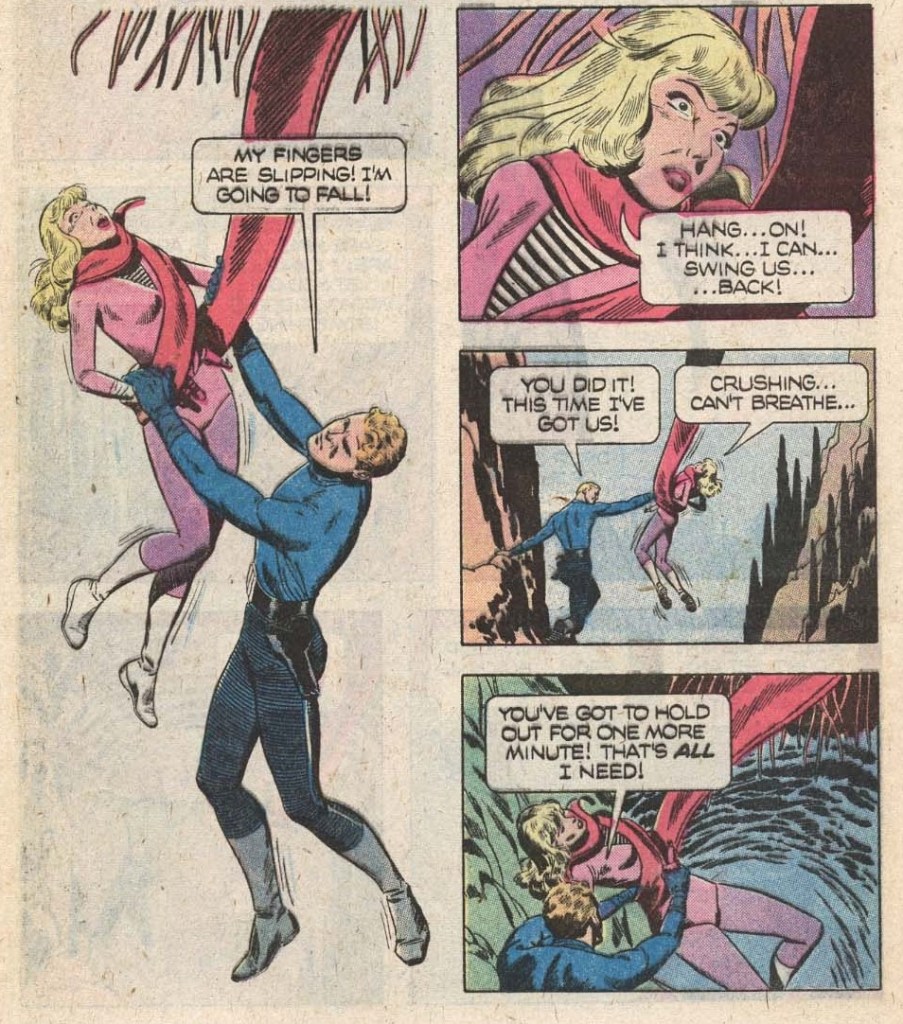
The Creeping Menace, the cover story, is scripted by Joe Gill and illustrated by Pat Boyette. I am including two pages (and a panel) because it’s too difficult to choose between them – all boast the aforementioned dynamic layouts and striking tentacles.
Isn’t this a lovely, stylish panel? I want it on a t-shirt.
The publishing history of comic-book Flash Gordon was an interesting relay race: Gold Key Comics resumed the run with issue 19 (1978), and kept it up until issue 27 (1979); finally, issues 28 to 37 were published under its Whitman imprint between 1980 and 1982. The latter category offers two tentacled covers, and some inside goodies.
Original art (sadly by an unknown artist) for the cover of Flash Gordon no. 29 (Whitman, May 1980).
The cover story The Deadly Depths is scripted by John Warner and illustrated by Carlos Garzón. Oh, this thing is not hostile… just hungry.
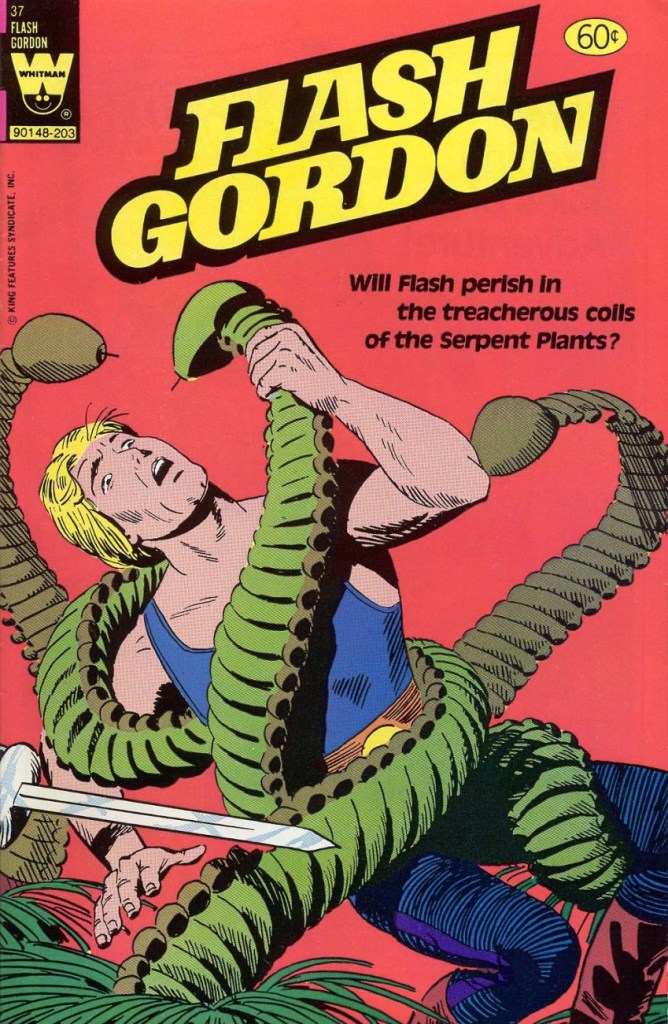
The last Whitman issue also is of some interest, though on the cover Flash looks like he’s fighting caterpillars with an martini olive for a head.
Flash Gordon no. 37 (Whitman, March 1982). Cover by Gene Fawcette.
Cover story My Friend, My Killer! is scripted by George Kashdan and illustrated by Gene Fawcette and features cute serpent plants that look like they’re wearing little hula skirts.
And that concludes our tour of Flash Gordon tentacles in the Silver Age (and with some forays into Bronze).
« Hey, Look! is essential reading for any cartoonist. » — the late and much-missed Patrick Dean, who truly knew what he was talking about.
Sometimes I think of a post topic and dismiss it with a ‘nah, too obvious’… but on some of my brighter days, I run the idea past my wife, who provides a welcome reality check: ‘Obvious to whom?‘, she asks. Well, there’s been a collected edition… which has been out of print for most of the nearly thirty years since it hit the stands. Fair enough.
As I’ve been lately foraging through the crumbling back pages of Golden Age humour comics (see my previous post), it would be negligently immoral for me to pass over one of the crown jewels of the genre, the era and the medium.
One* of the redeeming features of Marvel’s overwhelmingly crass Dynamite (magazine) rip-off, Pizzazz, was its reprinting of a handful of Harvey Kurtzman‘s majestic Hey Look! strips. Of course, it made perfect economic sense: grab some already (and barely)-paid-for, all-but-forgotten ‘filler’ from the 1940s, slap some new colour on ‘em, and wham! One less egg to fry.
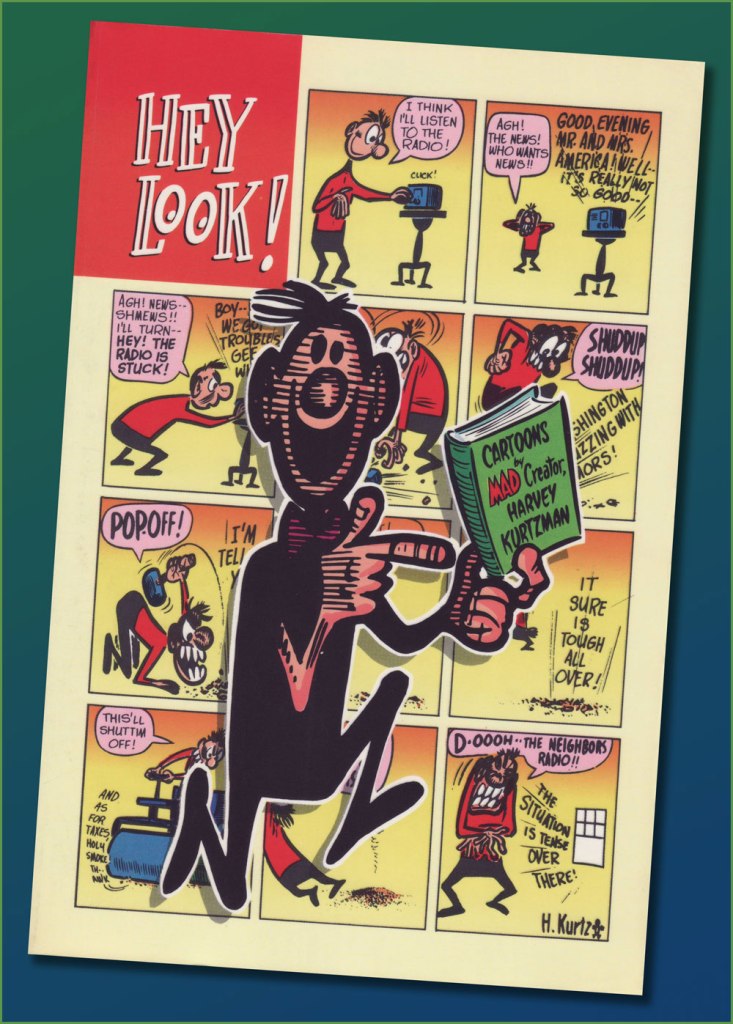
Here’s the collection in question. Published in 1992 by the venerable Kitchen Sink Press, it has yet to be improved upon. In addition to all the Hey Look! strips, it includes an unsurprisingly excellent introduction by the erudite John Benson, and further sweetens the pot with Kurtzman’s other Timely features of the era, namely Genius, Egghead Doodle and Potshot Pete. The latter is particularly worth a look-see.
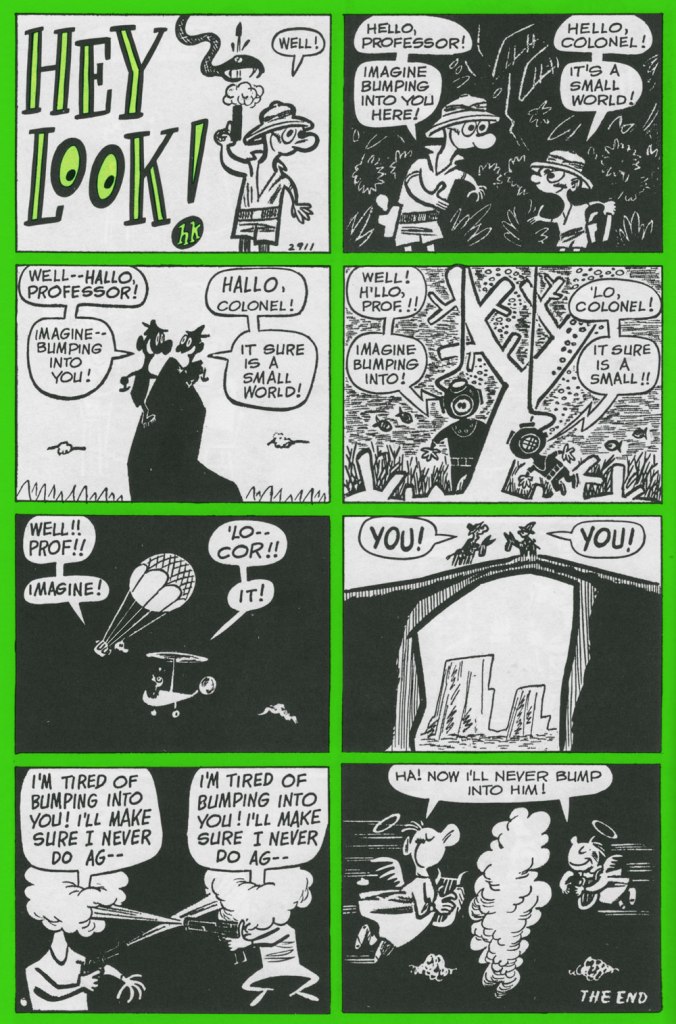
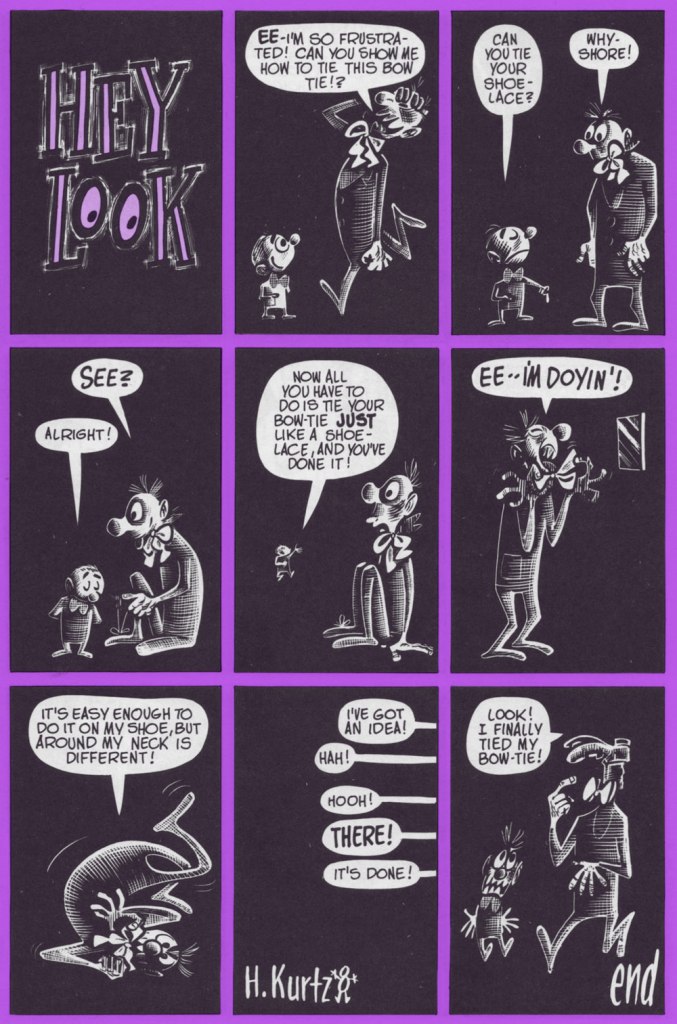
The earliest Hey Look! strips are cute and of some historical significance, but rather scattershot and tentative. Here’s roughly where Kurtzman starts to really, and consistently, cook. Originally published in Gay Comics no. 33 (Aug. 1948, Timely).
Mr. Kurtzman was ahead of the game, anticipating the superhero genre’s dark turn of the mid-80s and beyond, and pointing out its inherent fascism. Already a bit too close too home at the time of its creation, this piece languished in limbo until its publication in 1966 in a limited-edition portfolio.
Originally published in Nellie the Nurse no. 16 (Dec. 1948, Timely).
Originally published in Hedy Divine no. 30 (Dec. 1948, Timely).
Originally published in Joker no. 35 (Jan. 1949, Timely).
Originally published in Millie no. 16 (Feb. 1949, Timely). Always experimenting: dig here Kurtzman’s elegant use of the scratchboard technique.
Originally published in Nellie the Nurse no. 19 (Apr. 1949, Timely). With the miniaturisation of electronics, and cameras in particular, there’s (of course) been an opposing movement toward huge telephoto lenses. Read into it what you will.
I was, and remain, especially fond of this one, originally published in Gay Comics no. 37 (Apr., 1949) and reprinted in Pizzazz 15 (Dec. 1978)… the one with the Battlestar Galactica cover. ‘Cabazziz’ is made up, but Podunk has roots.
Originally published in Patsy Walker no. 22 (May 1949, Timely). Incidentally, generic ‘teen’ humour character Patsy Walker has since (circa 1976) been refashioned and recycled, in the tried-and-true ‘waste not, want not’ Marvel manner, into a superheroine, Hellcat. Sheesh.