If you’re looking for gory tentacles, fountains of flesh and mounds of blood (err… unless it’s the other way around?), screaming hordes being devoured by a famished cephalopod with a mean streak… go look at our other Tentacle Tuesdays posts, for today’s entry is not for you.
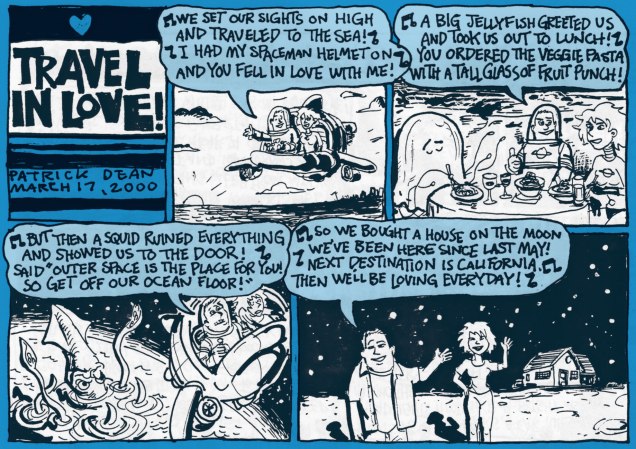
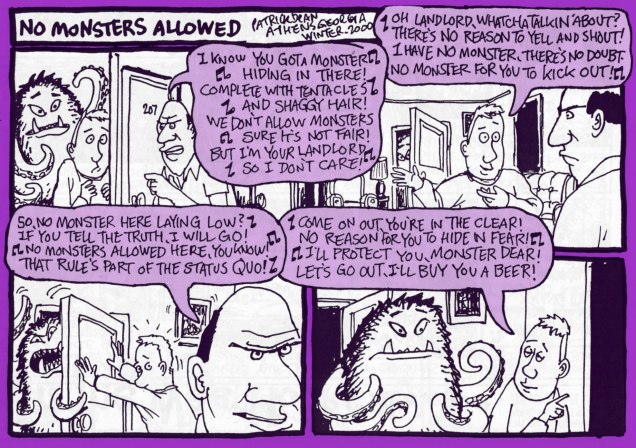
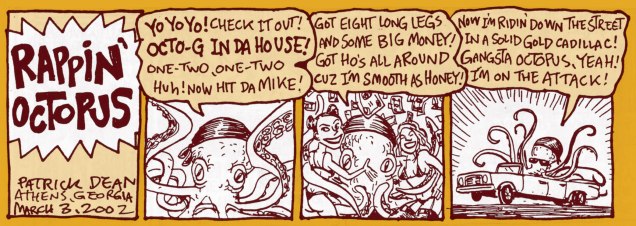
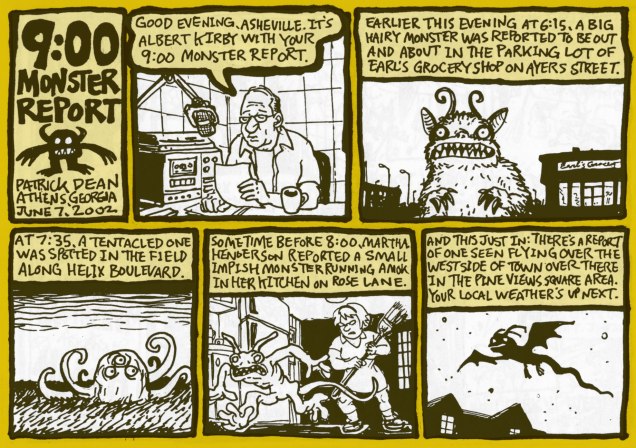
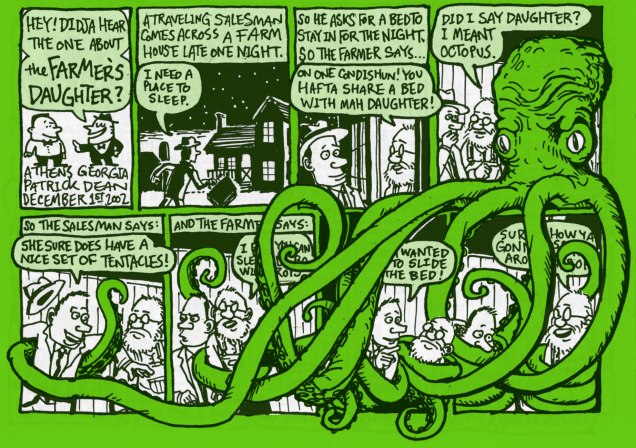
However, those of you who like a friendly octopus and can appreciate understated wit and off-beat humour, stick around as we travel into a land created by Patrick Dean (not British Ambassador to the States). A word of warning – people randomly bursting into song and cohabiting with monsters is quite normal here.
Monsieur Dean likes monsters – nay, loves them – but he likes to contemplate them in their quieter moments: wooing a potential mate, politely asking for a BLT sandwich, watching a Julia Roberts movie or even reciting poetry.
All images in this post have been scanned from Big Deal Comics & Stories numbers 1 through 4 (published from 2000 to 2004), and lovingly coloured by my co-admin-cum-partner. I reread them recently in my ceaseless quest for tentacles, and while I remembered really enjoying them a few years back, I had forgotten how good they were. A lot of comics of a random, episodic nature are very much hit or miss, but these little gems are all gold, if you pardon my mixed metaphor. For instance, here’s PD’s summary of #3:
« More assorted one page strips. 28 pages of witches, cities, investigators, sailors, big shows, haunted houses, bees, record collections, band directors, roommates, octopuses, ham, radio towers, rainy days, treasure maps, J.D. Salinger, pork chops, and four leaf clovers. »
What kind of stone-hearted, dull-witted person would say “nope, not interested” to that? Luckily, not all Big Deal Comics are sold out – three issues are still available for purchase.
The best part of Cathy’s letter is… well, you guessed.
Those musical interludes I coyly alluded to earlier? Here.
The best saved for last? I think so!
Don’t forget to visit Patrick Dean’s website, visit his FB page, or admire more of his art here.
« It was long past midnight on a hot, wet June night many years ago… Central City lay choking for breath in an eerie fog… »
In this, part three of our chronicle following as we can the meandering and sometimes mystifying odyssey of Will Eisner’s The Spirit, we reach the most outré segments of the former Denny Colt’s road.
In a unique twist, The Spirit’s next residence, nearly a decade after his Fiction House run, had nothing at all to do with Will Eisner… in terms of securing his assent, that is.
It was down to the fabulously sketchy Israel Waldman, one of those fringe-dwelling characters who made the comics industry such a colourful snake pit. To quote the Grand Comics Database: « I.W. Publications (1958-1964) was part of I.W. Enterprises, and named for the company’s owner, Israel Waldman. Reportedly, Waldman came into possession of a printing company and among the assets were the production materials for several hundred comic books previously published by various publishers as well as a limited amount of previously unpublished material. Waldman equated possession of production materials as the right to reprint and I.W. became notable for publishing unauthorized reprints of other companies’ comics, often with new covers, as Waldman’s windfall did not often include the production materials for covers. The later half of the company’s existence, it published comics under the Super Comics name. Usually these companies were out of business, but not always. »
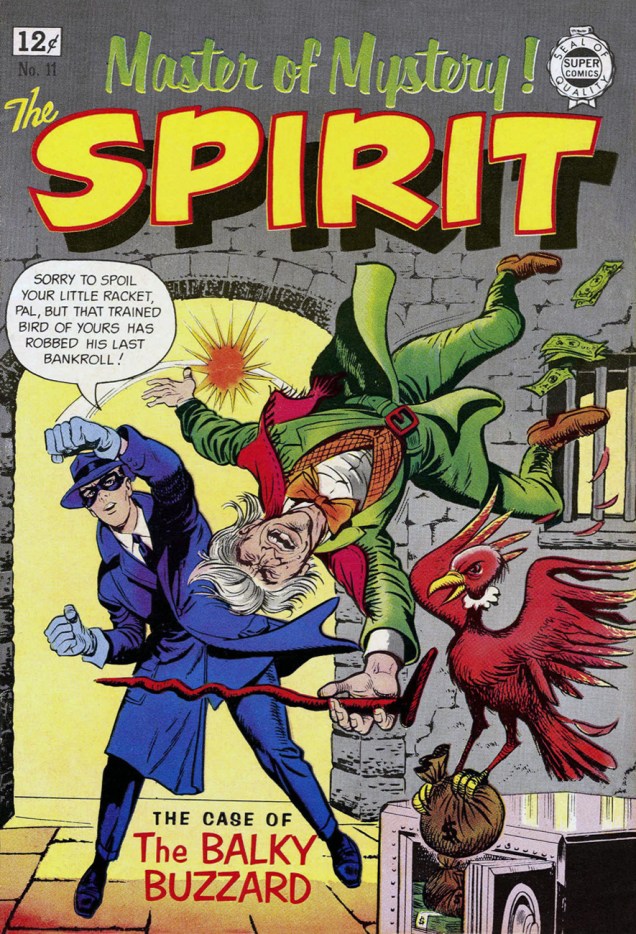
This is The Spiritno. 11 (1963), featuring The Man Who Killed The Spirit(Mar. 24, 1946), cover-featured The Case of the Balky Buzzard (Apr. 21, 1946), Carrion’s Rock (May 19, 1946), all scripted by Eisner, as well as Honeybun and Flatfoot Burns shorts. Cover by Joe Simon (“Joe, did you even read the story you’re depicting?“). This one was well worth one’s hard-earned twelve pennies. Read it here.This is The Spiritno. 12 (1964), featuring, this time, a trio of WWII-era Spirit stories scripted by Manly Wade Wellman and Bill Woolfolk and illustrated by Lou Fine, rounded off with a pair of Flatfoot Burns shorts by Al Stahl . Cover again by Joe Simon. Read it here.
If memory serves, Waldman’s comics craftily bypassed the Comics Code (another exception!) and the newsstands, being exclusively sold in sealed bags of three in bargain-basement department stores. To bait the hook, Waldman paid top dollar for new cover artwork, approaching established pros like Ross Andru (who actually delivered some fun stuff, unlike his unforgivably atrocious turn as DC’s main cover artist in the late 1970s), John Severin, Jack Abel, and in these two cases, Jacob Kurtzberg‘s old partner, Joe Simon.
Unsurprisingly, Waldman skimped on all other materials, particularly the paper his comics were printed on, which means that I.W./Super Comics are pretty hard to come by these days in any kind of decent state, so they’re ironically pricey.
A few years later, Eisner struck a deal with another rascal (albeit one with cleaner fingernails), Alfred Harvey of Harvey Comics, Stan Lee‘s only credible competition in the credit-usurping, I created-the-Universe stakes. Again, two issues, but this time with some new Eisner material, including origin stories for The Spirit (his third, but definitive one), and his arch-nemesis Zitzbath Zark, which you may know as purple glove enthusiast The Octopus.
Harvey’s The Spiritno. 1 (Oct. 1966), featuring the new Origin of the Spirit by Eisner, and classics Lorelei Rox (Sept. 19, 1948), Two Lives (Dec. 12, 1948), Agent Cosmek/Visitor (Feb. 13, 1949), The Story of Rat-Tat the Toy Machine Gun (Sept. 4, 1949), Ten Minutes (Sept. 11, 1949), Thorne Strand (Jan. 23, 1949), Gerhard Shnobble (Sept. 5, 1948), all scripted by Eisner, save Ten Minutes, which hails from the mind of Jules Feiffer.Harvey’s The Spiritno. 2 (March, 1967) features the brand-new Octopus: The Life Story of the King of Crime and 2-pager The Spirit Lab, plus a generous helping of fine oldies, namely Plaster of Paris (Nov. 7, 1948), The Deadly Comic Book (Feb. 27, 1949), Rudy the Barber (Oct. 22, 1950), The Story of Sam, the Saucer That Wanted to Fly (Sept. 17, 1950), Sam Chapparell (Oct. 10, 1948), La Cucaracha (Nov. 19, 1950), The Halloween Spirit of 1948–Ellen Meets Hazel (Oct. 31, 1948), all scripted by Eisner… the book wraps up with a preview of the next issue, which never saw print. And so it goes…
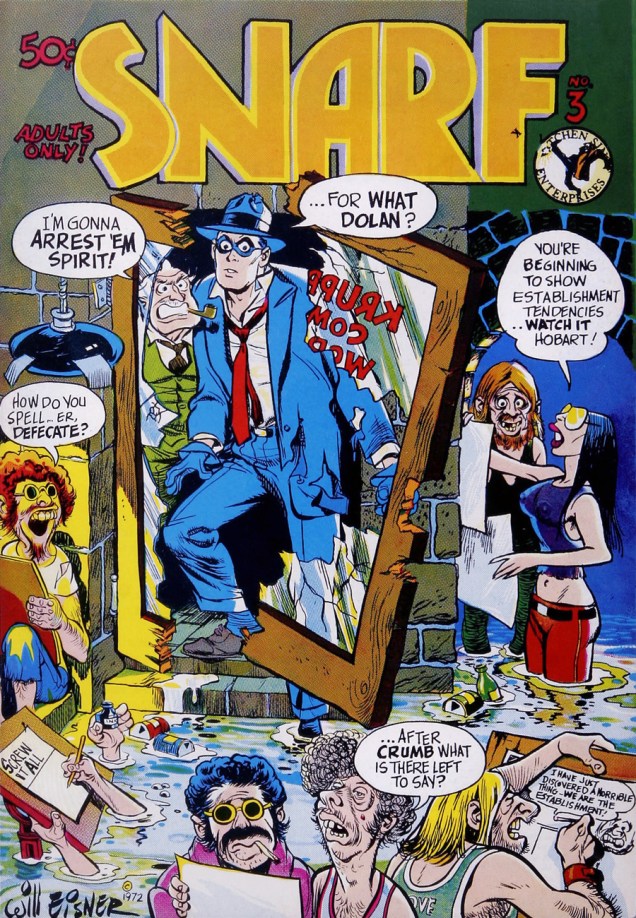
Mr. Eisner then finally had the good fortune to run into an honest man, who would prove in time to be his most steadfast ally: Mr. Denis Kitchen. Their first collaborations were a bit tentative, but quite sympathiques, with Eisner kind of slouching towards the Underground, his creation even cover-featured on Kitchen’s long-running humour anthology Snarf.
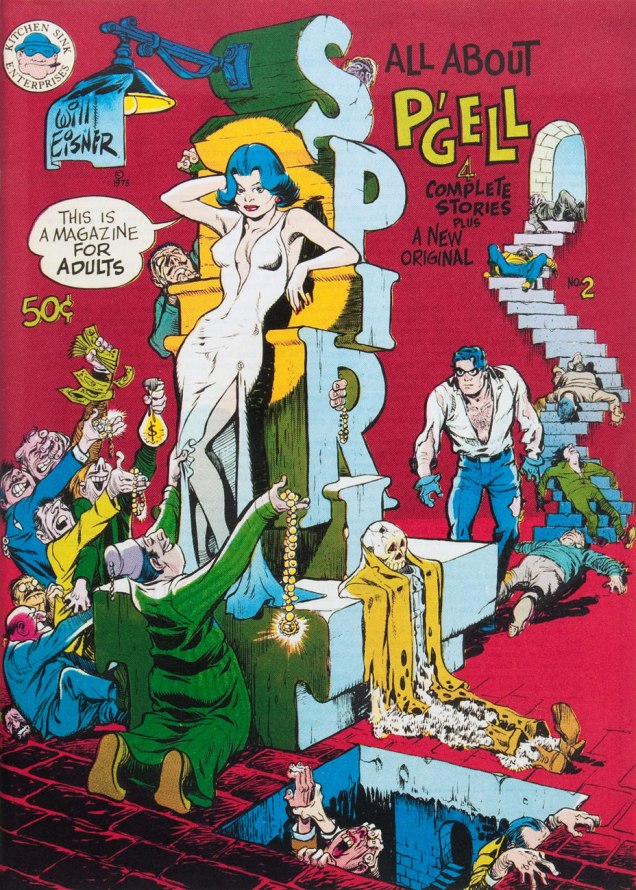
This is Kitchen Sink Enterprises’ Snarfno. 3 (Nov. 1972), featuring an original Eisner cover.Another two-issue run! Kitchen Sink’s The Spiritno. 1 (Jan. 1973), featuring a new cover by Eisner, and precious relics Max Scarr’s Map (Apr. 14, 1946), Caramba (Nov. 10, 1946), Return to Caramba (Nov. 17, 1946), The Rubber Band (June 23, 1946), plus a few brand-new short pieces.Kitchen Sink’s The Spiritno. 2 (Nov. 1973), featuring a new Eisner cover, an original four-pager, The Capistrano Jewels, and, as boasts the cover, all about P’Gell, with Meet P’Gell (Oct. 6, 1946), The School for Girls?? (Jan. 19, 1947), Competition (Aug. 3, 1947) and The Duce’s Locket (May 25, 1947).
Next time out: some interesting times with Warren.
« Greetings, friends. Did we catch any of those horrible ghosts in my famous ghost traps? » – J. Wellington Wimpy, up to no good as usual
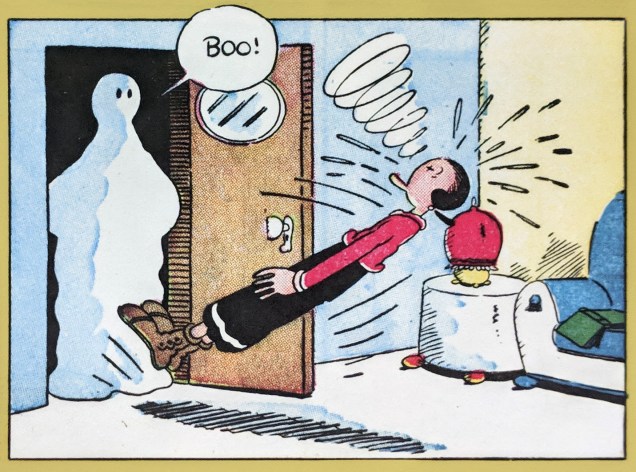
I absolutely adore how, in Popeye the sailor’s salty vernacular, revenants are referred to as « ghosks ». Aww… Let’s meet a few of these spooks, who most often, to this reader’s regret, turn out to be mere goons in sheets. Oh well.
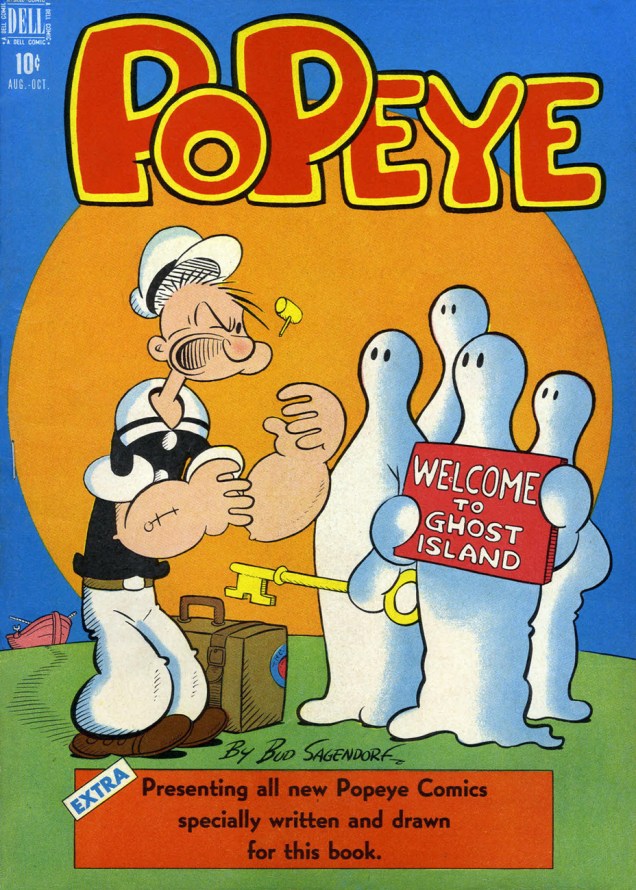
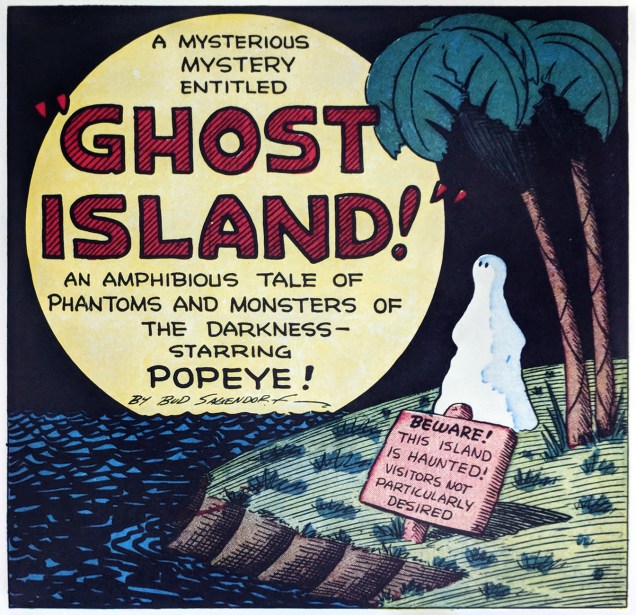
This is Popeye no.3 (Aug.-Oct. 1948, Dell). As the cover states, story and art by Bud Sagendorf, Thimble Theatre creator Elzie Segar‘s assistant and eventual successor.Here, then, a few highlights from Popeye 3’s cover story.
Crude but effective.The facts speak for themselves.
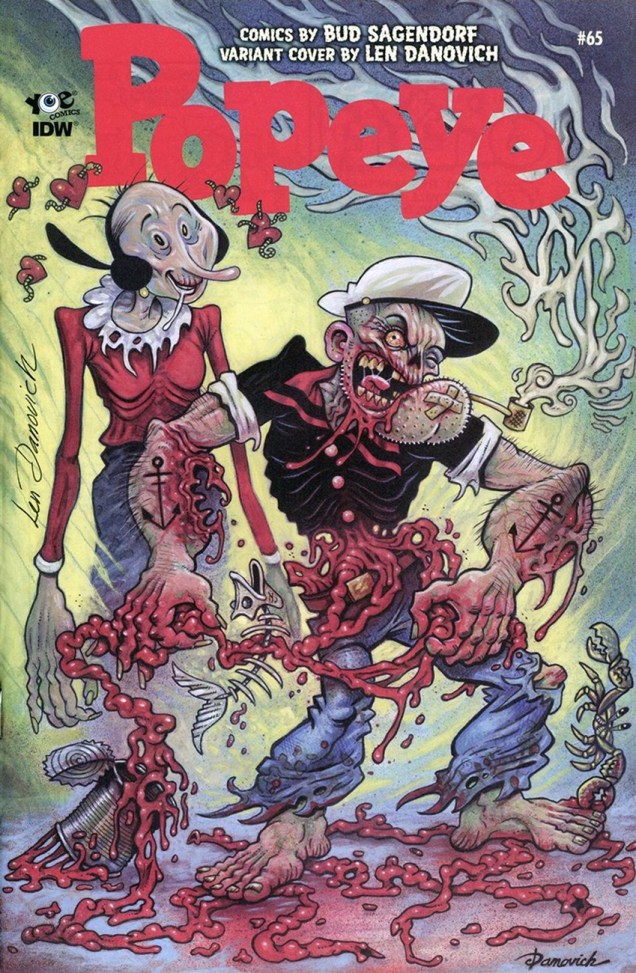
Dell published 65 issues of Popeye, then Gold Key took over… long story. This is Gold Key’s second issue, Popeye the Sailor no. 67 (Jan. 1963). Say, is that Patcheye’s Ghosk? Well, blow me down, it is! Story and art presumably by Forrest Cowles “Bud” Sagendorf. In a rather more modern, yet still topical… vein, here’s Len Danovich‘s striking variant cover to the most recent issue of IDW’s Classic Popeye (no. 65, Dec. 2017), quite a rarity and now commanding some rather formidable prices, from what I’ve observed. Is this to be the final issue of Classic Popeye, now that the end of the Dell run has been reached? Nearly a year on, the question still remains. Mr. Yoe?
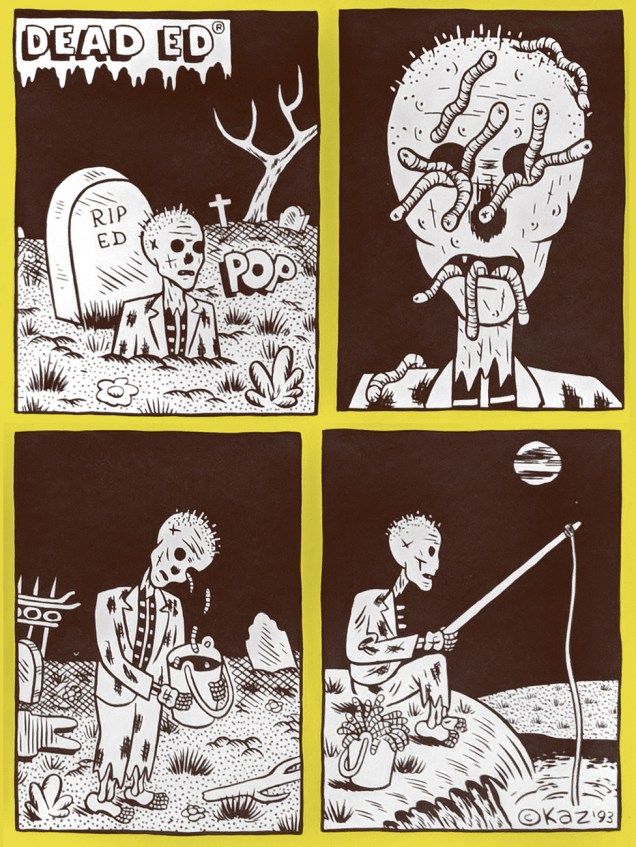
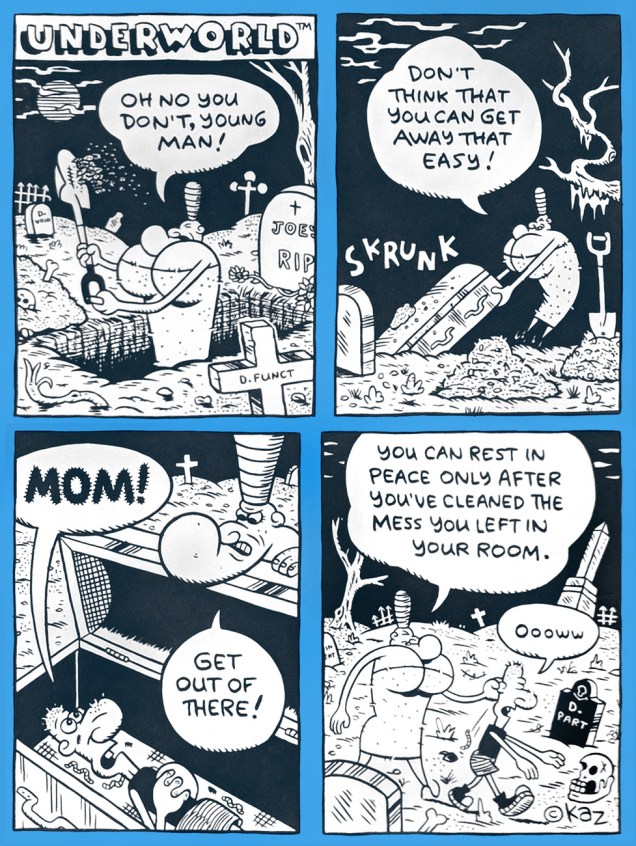
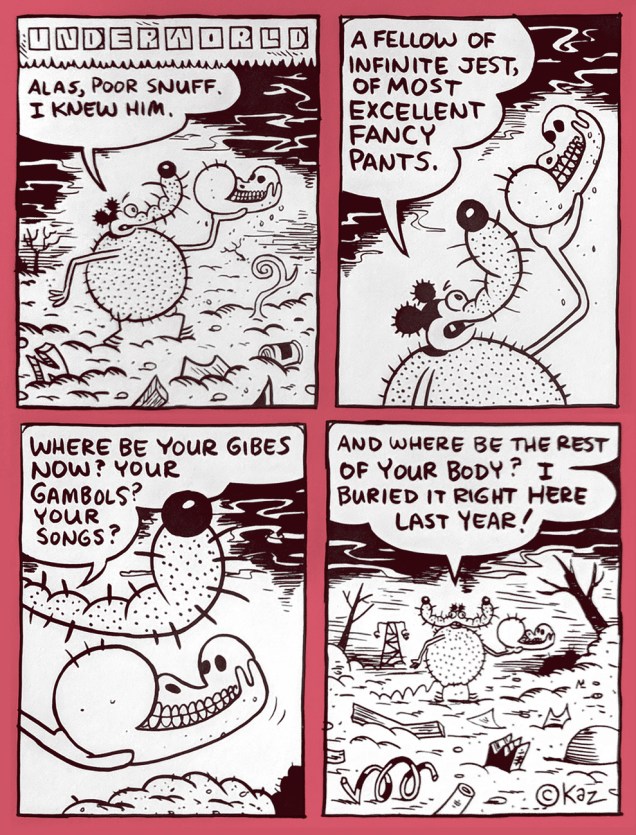
Underworld is the rabid brainchild of American cartoon god (néKazimieras Gediminas Prapuolenis in 1959) alias (for some reason) Kaz. Underworld has been appearing in various alternative weeklies since 1992. But none in my neck of the woods, naturally. Grr.
Fortunately, the discerning folks at Fantagraphics have thus far issued five Underworld collections, plus, a couple years back, an imposing omnibus, each of them wonderful, surreal, morbid and unnaturally comforting. Perfect Hallowe’en reading? You bet. Skrunk!
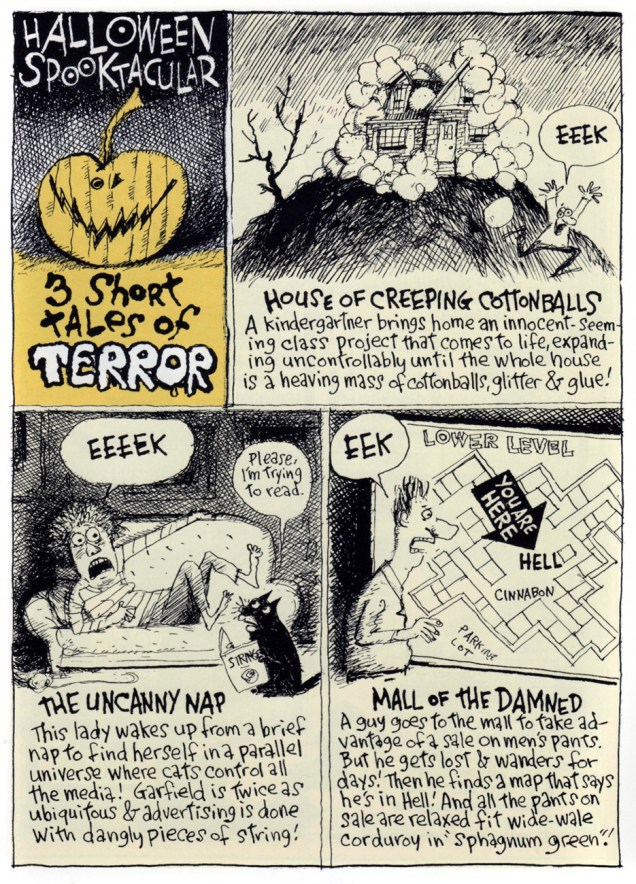
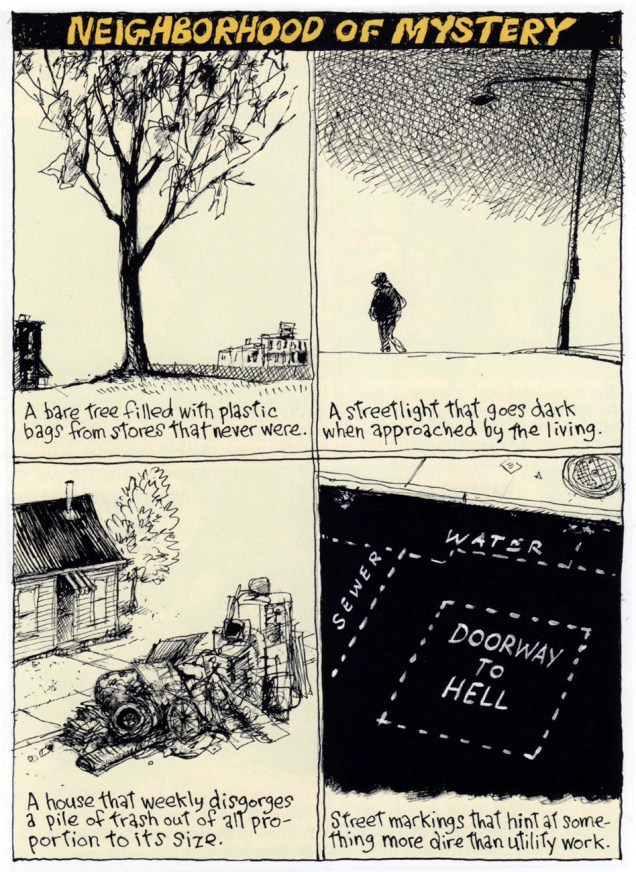
Here, then, is a trio of seasonally-and-thematically pertinent excerpts from his Richard’s Poor Almanac, a feature that made its august début in The Washington Post in 1997. Mr. Thompson is somewhat better known for his (other) masterpiece, the beyond-brilliant suburban family comic strip, Cul de Sac (2004-2012).
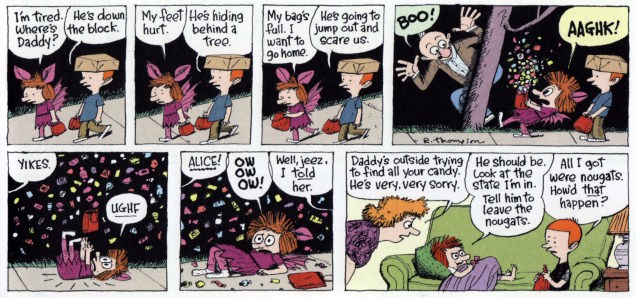
And since I brought up Cul de Sac, and insolently pilfered a panel from it for this post’s preview image, I would be remiss in my duties were I to not include the strip in its entirety. Here you are.
This one originally saw print on Sunday, October 26, 2008.
For more of Mr. Thompson’s Almanac, check out, if you will, this earlier post on the topic.
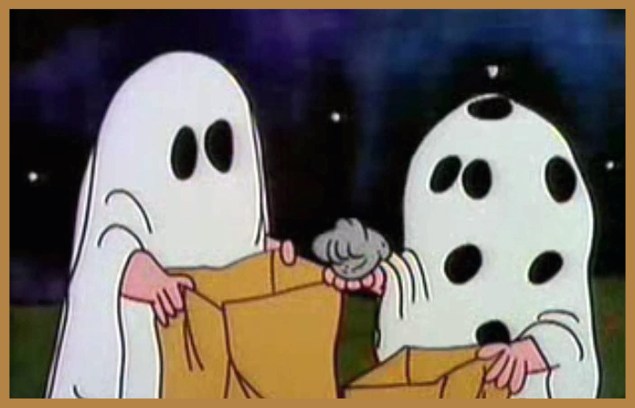
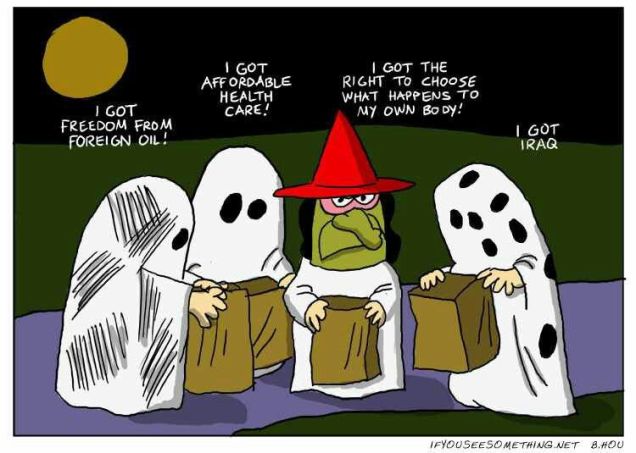
« Charlie Brown’s bad luck trick-or-treating earned him a lot of sympathy amongst young viewers, to the extent that some mailed candy for Charlie Brown to the TV channels that aired the special. In recent years, many fans have viewed the gag as disturbing, viewing it as a conspiracy among the adults to torture Charlie Brown by denying him candy. »
Interestingly, the gag about Charlie Brown’s inadvertent rock collection was introduced here, not in the strip, though it was alluded to in the November 1st, 1975 strip, a whole nine years down the line. Found it in my copy of « Think Thinner, Snoopy » As a bonus, here’s a clever modern update on the classic sequence, from the long-defunct ifyouseesomething.net.
« …the finest line ever to be bequeathed to a cartoonist. It dances; it snaps gracefully back and forth. » (Coulton Waugh in “The Comics”, 1947)
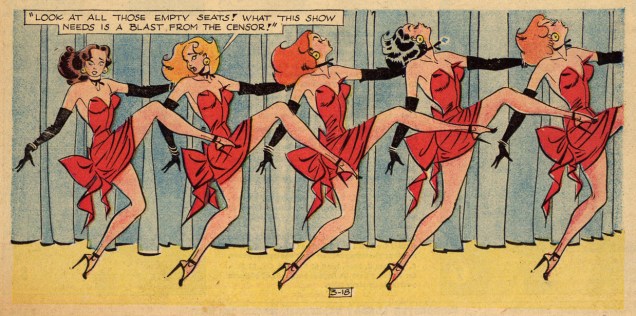
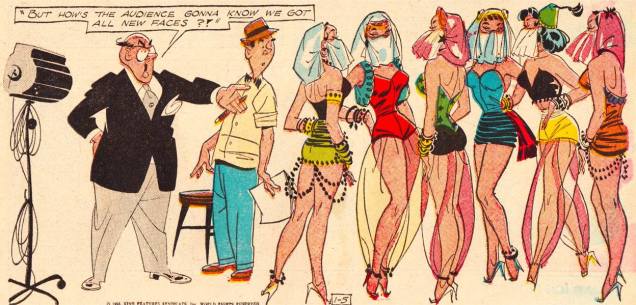
That description was written à propos of Don Flowers (1908 – 1968) and his art. Some of you may remember seeing Glamor Girls in your favourite gazette – at the height of its popularity, this syndicated strip ran in about three hundred newspapers. This story goes thus: Flowers, working for AP Newsfeatures, created a few strips, namely Oh, Diana!, Puffy the Pig, and Modest Maidens. The first two achieved very modest success, but the third one was a huge hit, so much so that newspaper magnate William Randolph Hearst (displaying his usual impeccable taste in comics) offered Flowers double salary if he came to work for Hearst’s King Features. Since AP owned the rights to Modest Maidens, the strip was renamed into Glamor Girls. Flowers drew Glamor Girls, both dailies and Sundays, until his death by emphysema in 1968.
His art is quite lovely – but I don’t expect you to take my word for it. Here are some examples. (All strips below have been published by King Features syndicate between 1958 and 1963.)
« That Flowers is not better known is both a pity and a surprise, especially given his technical expertise and the recent renaissance in the popularity of the pin-up genre. Whether blondes or brunettes, showgirls or housewives, Flowers rendered them flawlessly and elegantly, and always with equal aplomb. » (Alex Chun in Glamor Girls of Don Flowers, Fantagraphics, 2006).
«…There are things that never change, especially the early foundations. For better or worse they become part of your style. And as I continue to draw, every time I look at a page I think to myself, that nose is an Oski nose, that body is a VIP body, and every time I draw a beautiful woman, I think – no, I wish – she is as beautiful as a woman drawn by Don Flowers. » (Sergio Aragonés in his introduction to Glamor Girls of Don Flowers, Fantagraphics, 2006)
Flowers’ art looks as good, if not better, in old-fashioned black-and-white, which is often the case with artists who have a fluid inking line. The original art for some Glamor Girls strips allows us to admire details:
After his death, Flowers’ son self-published Standing on Ceremony, a collection of marriage-themed cartoons plucked from his vast collection of his father’s original art. You can see some of them here.
« Our story opens on a rainy night on Central City’s waterfront… »
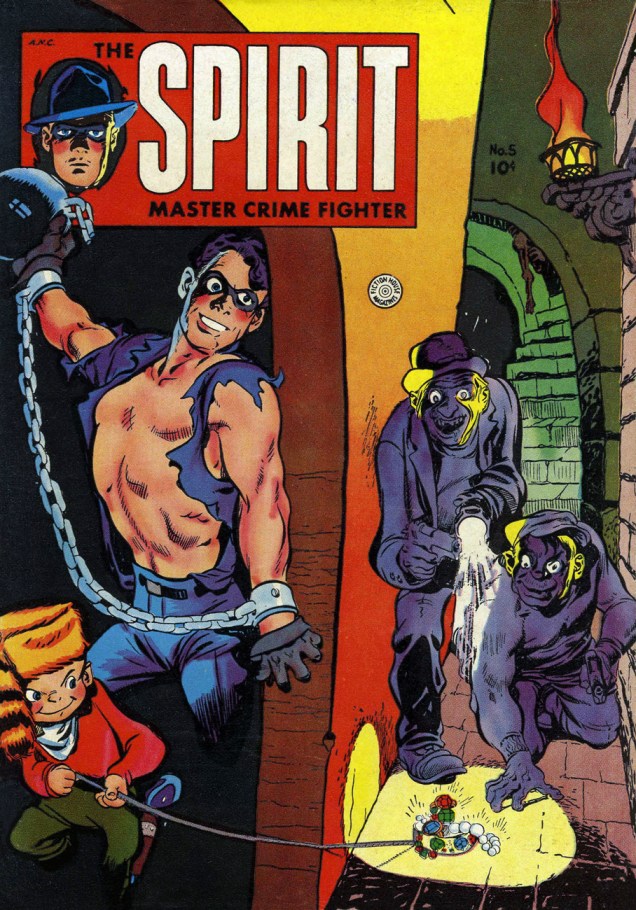
Continuing our chronicle of The Spirit’s wanderings from harbour to harbour over the decades, we make land today at pulp and comic book producer Fiction House, whose “Big Six” were the blandly-named but action-packed Fight Comics (86 issues, 1940–1954), Jumbo Comics (167 issues, 1938–1953), Jungle Comics (163 issues, 1940–1954), Planet Comics (73 issues, 1940–1953), Rangers Comics* (69 issues, 1941–1953) and Wings Comics (124 issues, 1940–1954). Compared to these, The Spirit’s five-issue stay was but a blip. Still, since FH’s art director was none other than Eisner’s old partner Samuel Maxwell “Jerry” Iger (1903-1990), this particular match is unsurprising.
Of course, it wasn’t common knowledge at the time, but these issues comprise little else but what came to be known as “the post-Eisner Spirit”, inarguably inferior work with the occasional highlight, generally a Jules Feiffer script let down by the visuals.
According to Eisner, interviewed in 1990 by Tom Heintjes: « Looking back, I have to say that it’s a blemish on my career that I allowed The Spirit to continue through this period, because I compromised the character just because I was busy with other things. That’s not to say that these are all bad stories, but they just don’t have the consistent outlook they had when I was directly involved. » « I look at these stories and I want to cringe – again, not because they’re bad, but because only the merest essence of the character is retained. »
This is The Spirit no. 1 (Spring, 1952), featuring The Case of the Counterfeit Killer (Sept. 16, 1951), cover-featured The Curse of Claymore Castle (Nov. 4, 1951), The Plot of the Perfect Crime (Oct. 28, 1951), and Panic on Pier 8 (Aug. 19, 1951), each scripted by Feiffer. Cover artist unknown, but it’s a considerable improvement over the actual story.This is The Spirit no. 2 (Summer, 1952), reprinting The Amazing Affair of the First Man on Mars (Jan. 27, 1952), Contraband Queen (May 20, 1951), The Case of the Baleful Buddha (Nov. 18, 1951), and The $50,000 Flim-Flam (Apr. 15, 1951), the final three benefiting from some Eisner involvement. Again, cover artist unknown., but isn’t that gorgeously coloured?Ah, we’re getting more Eisner-ish, though not quite all the way. This is The Spirit no. 3 (1952), featuring The Walking Corpse (Mar. 9, 1952), It Kills by Dark (Feb. 24, 1952), The League of Liars (Nov. 25, 1951), and A Man Named Nero (Feb. 3, 1952). The first three are scripted by Feiffer, and the fourth is undermined; I wouldn’t brag about that one either.This is The Spirit no. 4 (1953), featuring The Last Prowl of Mephisto (Apr. 1, 1951), scripted and illustrated by a heavily-assisted and pressed for time Eisner; Design For Doomsday (Jan. 13, 1952), The Sword and the Savage (Sept. 2, 1951), and The Great Galactic Mystery (Apr. 20, 1952), these last three scripted by Feiffer. And another nearly-Eisner cover… he never would have made it this busy, I think.This is The Spirit no. 5 (1954), cover-featuring Dragnet for Johnny Buffalo (Apr. 8, 1951), and also The Target-Man in 16-A (July 22, 1951), Damsels in Distress (a relative oldie from August 3, 1947), and The Loot of Robinson Crusoe (July 8, 1951), scripts a toss-up or a collaboration between Feiffer and Eisner. Now this cover I can buy as the genuine Eisner article: it’s a characteristic composition for him, and it’s sloppy in all the right places. The Spirit’s sidekick in this instance is Walkalong Haggerty, who saves his hide in “Dragnet..“
So concludes our masked crimefighter’s passage at Fiction House. Fortunately, the publisher’s art department and production values were top-notch, so accommodations were quite cozy. Next time out, we’ll see how The Spirit would fare at the hands of Harvey Comics and (separately) at those of that nefarious rascal, Israel Waldman, in the swinging Sixties.
-RG
*Fiction House’s Rangers Comics featured the excellent “The Secret Files of Dr. Drew“, which ran in issues 47 to 60 (1949-51); the feature was the combined work of several of Eisner’s top Spirit alumni, namely writer Marilyn Mercer, penciller-inker Jerry Grandenetti, and letterer Abe Kanegson. The first ten (of fourteen) episodes just about out-Eisnered Eisner, until he protested and put an end to that gorgeous nonsense. This lot was lovingly restored and collected by Michael “Mr. Monster” Terry Gilbert (2014, Dark Horse). If you ask me, it’s the sole reprint of vintage colour material bearing the Dark Horse brand worth a damn… because Gilbert handled the work himself.
Dennis the Menace, the syndicated strip about a monstrous little kid and the mayhem he gets up to, was created by Hank Ketcham in 1951. The strip was inspired by Ketcham’s son Dennis, who was 4 years old at the time; the title was coined by Ketcham’s then-wife, Alice Louise Mahar, who’s said to have exclaimed in exasperation “Your son is a menace!” (Interestingly, she’s supposed to have said “your son“, even though Dennis was her child, too. She died of a drug overdose in 1959, when the real Dennis was 12. I really hope there’s no connection between the cause of her death and Dennis’ rambunctiousness.)
Wikipedia describes Dennis as “precocious but lovable”. I find him to be an irritating little prick who delights in tormenting his poor parents; the kind of kid who grows up to be a sociopath, happily wrecking people’s lives and then feigning complete ignorance. Tomato, tomat-oh! 😉
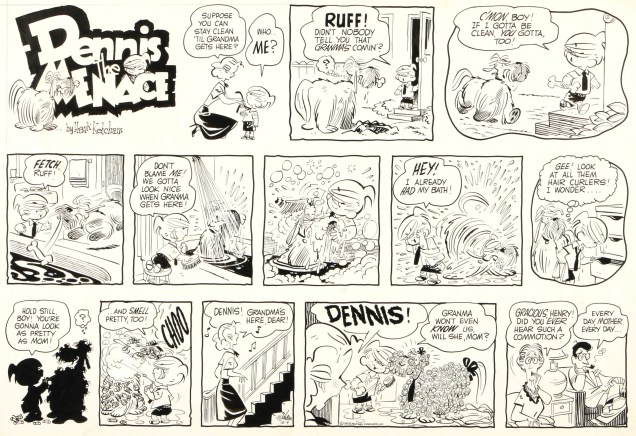
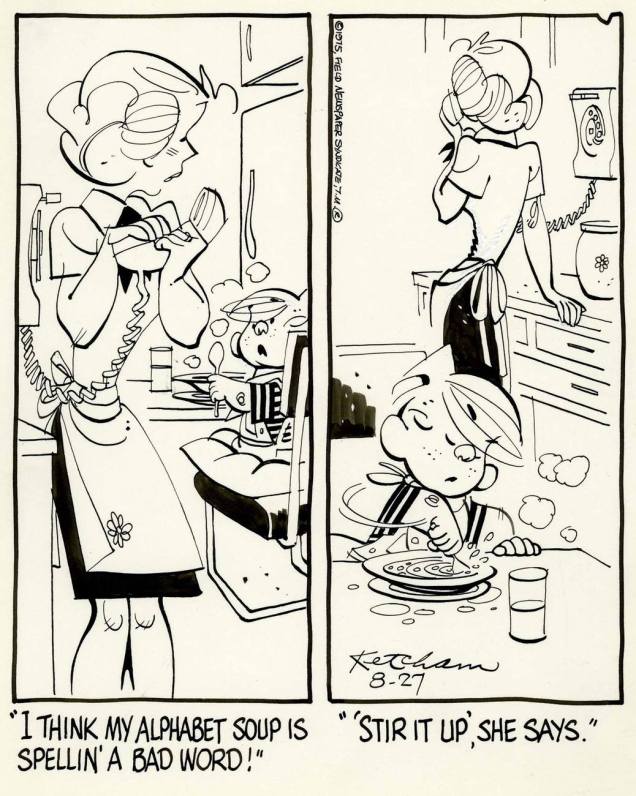
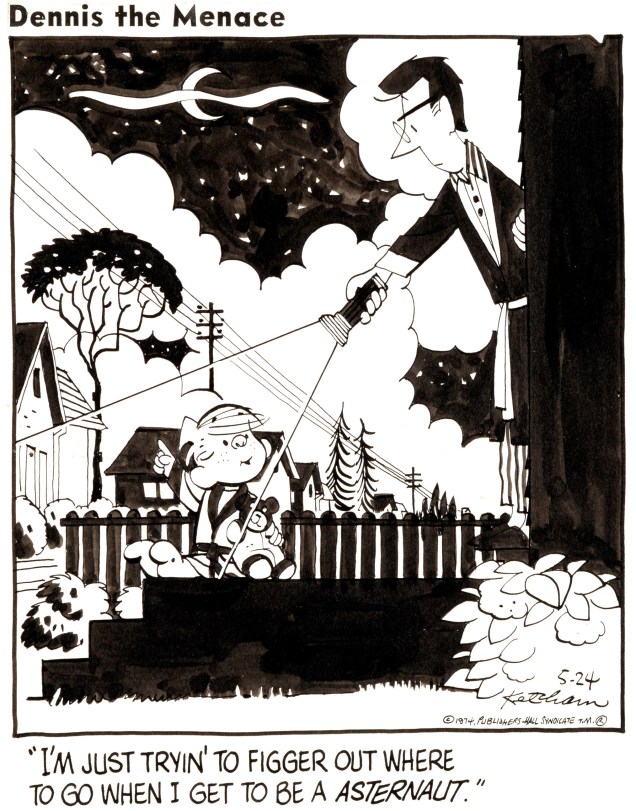
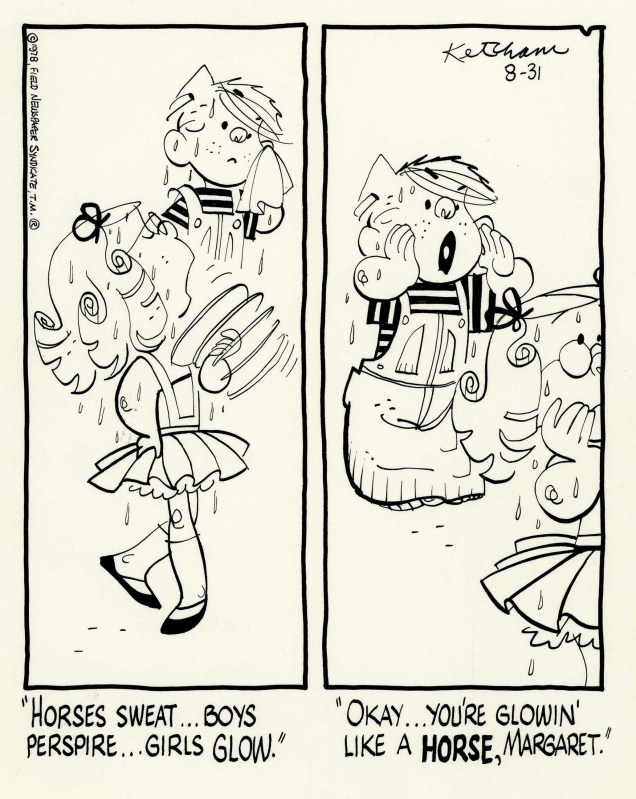
I had zero interest in Dennis until I stumbled upon a scan of the original art of a daily strip… and discovered that Ketcham’s art is stunning. I could happily stare at it for hours. Bonus: as it turns out, the stories can be quite interesting, especially the ones that don’t pivot as much around Dennis’ self-centered behaviour.
Here are a few strips for your consideration – a couple of dailies, a couple of Sundays. I much prefer looking at them in black and white, as I find that colour detracts from the purity and dynamism of Ketcham’s inking.
October 4th, 1953.August 27, 1975. May 24th, 1974.August 31st, 1978. Margaret is quite the thorn in Dennis’ side… but a dainty, girly thorn.November 8th, 1979.July 28th, 1987.A page from Ketcham’s autobiography “The Merchant of Dennis the Menace” (Fantagraphics, 2005). Visit Michael Sporn Animation to read a whole chapter of this book, complete with entertaining anecdotes involving Virgil Partch, a friend of Ketcham’s. (Small world… especially in the sphere of cartooning.)
Dennis the Menace became a hit very quickly, and Ketcham started using assistants fairly early on. In the late 1950s and 60s, the strip was ghosted by Al Wiseman. (Speaking of which, do visit this website maintained by Wiseman’s grand-daughter, who doesn’t think it’s fair that the rôle her grandad played in the creation and success of this strip is so downplayed.)
After Wiseman moved on, Ketcham hired Marcus Hamilton to help out with dailies and Ron Ferdinand to work on Sunday strips; Ketcham presided over their work until his official retirement in 1994, after which they inherited the proverbial driver’s seat. He passed away in 2001, but the strip yet continues. To quote from the Dennis the Menace website, “Hank handed over the reins to Ron Ferdinand and Marcus Hamilton… two artists totally committed to carrying forward the Ketcham legacy, and keeping Dennis’ fans entertained for decades to come. Scott Ketcham (son of Hank) joined the Dennis team in 2010, helping to keep their creative finger on the pulse of current contemporary trends.” Anytime someone expresses a desire to keep a finger on “the pulse of current contemporary trends”, I get worried. Besides, their eagerness to stay relevant to modern life is conflicting with the attempt to keep things static. That’s the thing about newspaper strips that outlast their creators by decades… They get stuck in some bizarre time-warp, but with all the humour leached out. I bravely went through 50 or so dailies to figure out how Dennis the Menace was “Staying Modern”, so you wouldn’t have to. The results are much as expected: the family roles are exactly the same, with apron-ed mothers in skirts serving lunch or cleaning up, fathers working in offices, playing golf or having a beer in front of the TV (the mere three options available to men, apparently). However, now the family has a flat TV screen and a laptop, the babysitter has her nose stuck in a cellphone, and cars have some automated features. Oh, and lest I forget: women very occasionally wear jeans, a true sign of progress.
« I tell ya, Spirit… this neighborhood is like a lit firecracker… »
I’m surprised that it took us this long to get to Will Eisner and his signature creation, The Spirit. Is it perhaps too obvious a topic? Nah. Though the ink and the pixels may flow, and even if everyone and his chiropractor has already waxed rhapsodic about old Will, the subject retains its depths of evergreen freshness.
For most generations of cartoonists, Eisner is an irresistible influence. My own initial encounter came in the early 1970s, when I glimpsed ads for Warren’s Spirit reprints in the rear section of Famous Monsters of Filmland. And then I was introduced to his groundbreaking style and storytelling approach… only it wasn’t, in this case, quite his.
In 1975, I had stumbled upon a Dutch collection of WWII-era Spirit newspaper strips (The Daily Spirit, Real Free Press, 1975-76… a publication designed by none other than Joost Swarte), and I was captivated… by the ghost work of no less than Plastic Man creator Jack Cole!
« You can do that in a comic strip? » was my general feeling as a ten-year-old aspiring cartoonist. From The Spirit daily strip, January 3, 1942 (scripted by Manly Wade Wellman, illustrated by Jack Cole).
I won’t go over the action-packed history of the character… what I’ll focus on here instead is inextricably linked to Eisner’s terrific business acumen: having held onto his character’s ownership, he could shop him around the publishing world, a process still unfolding to this day, well beyond his own passing.
The Spirit, that well-travelled rascal, has witnessed his exploits bearing many a publisher’s imprint, from Quality to Fiction House, through I.W. (naughty, naughty!), Harvey, Kitchen Sink, Warren, and DC… so far. And the coolest thing is that Eisner was along for most of the ride, creating glorious new cover visuals for the venerable archives.
Today, we’ll focus on Quality’s output (1942-50), which alone was contemporary to the strip’s tenure. About half of it was Eisner, but I’m no purist: the man hired some of the finest ghosts in the medium’s history, when it came to both story and art. To name but a few favourites: Manly Wade Wellman, Jerry Grandenetti, Jules Feiffer, Wally Wood…
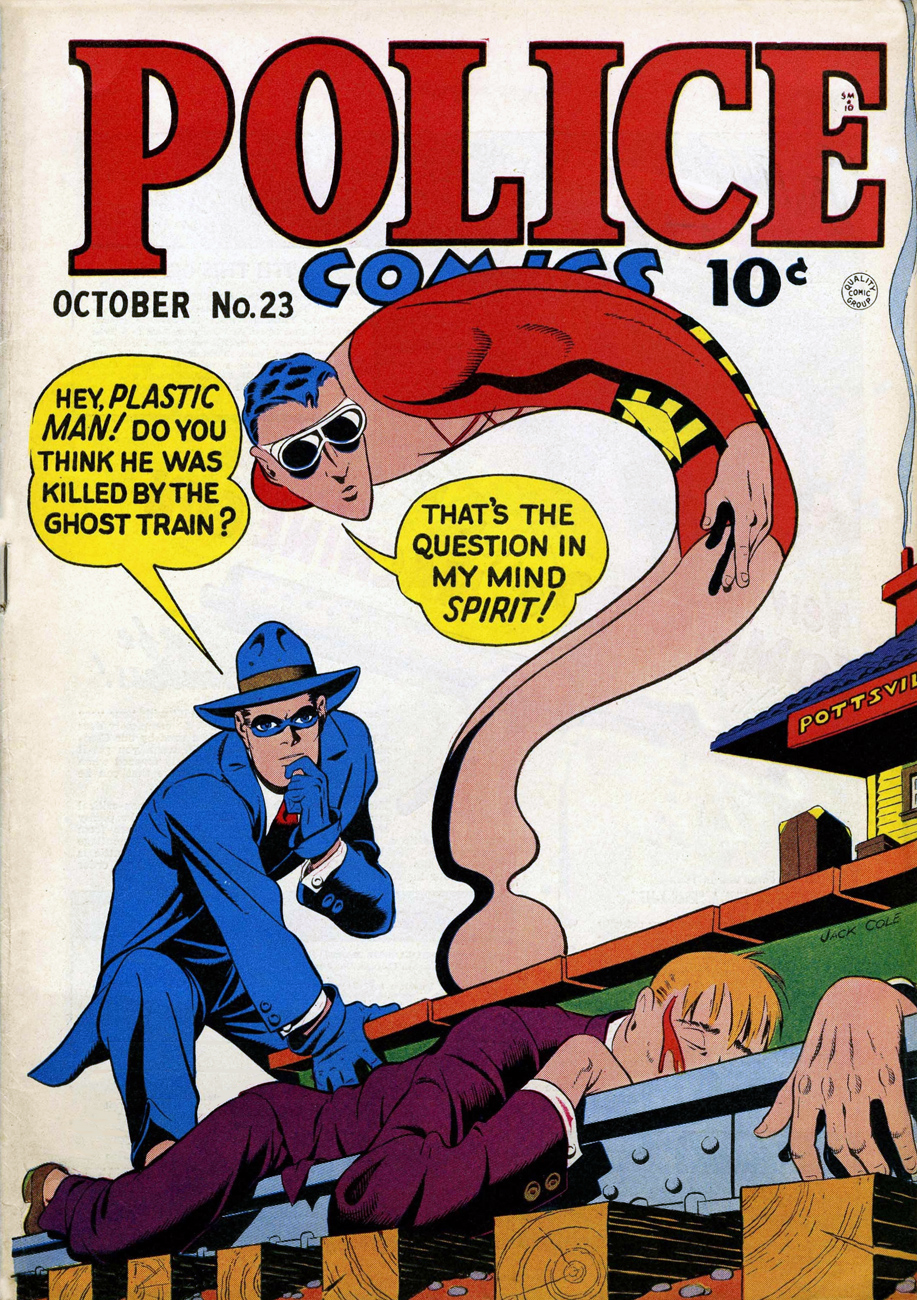
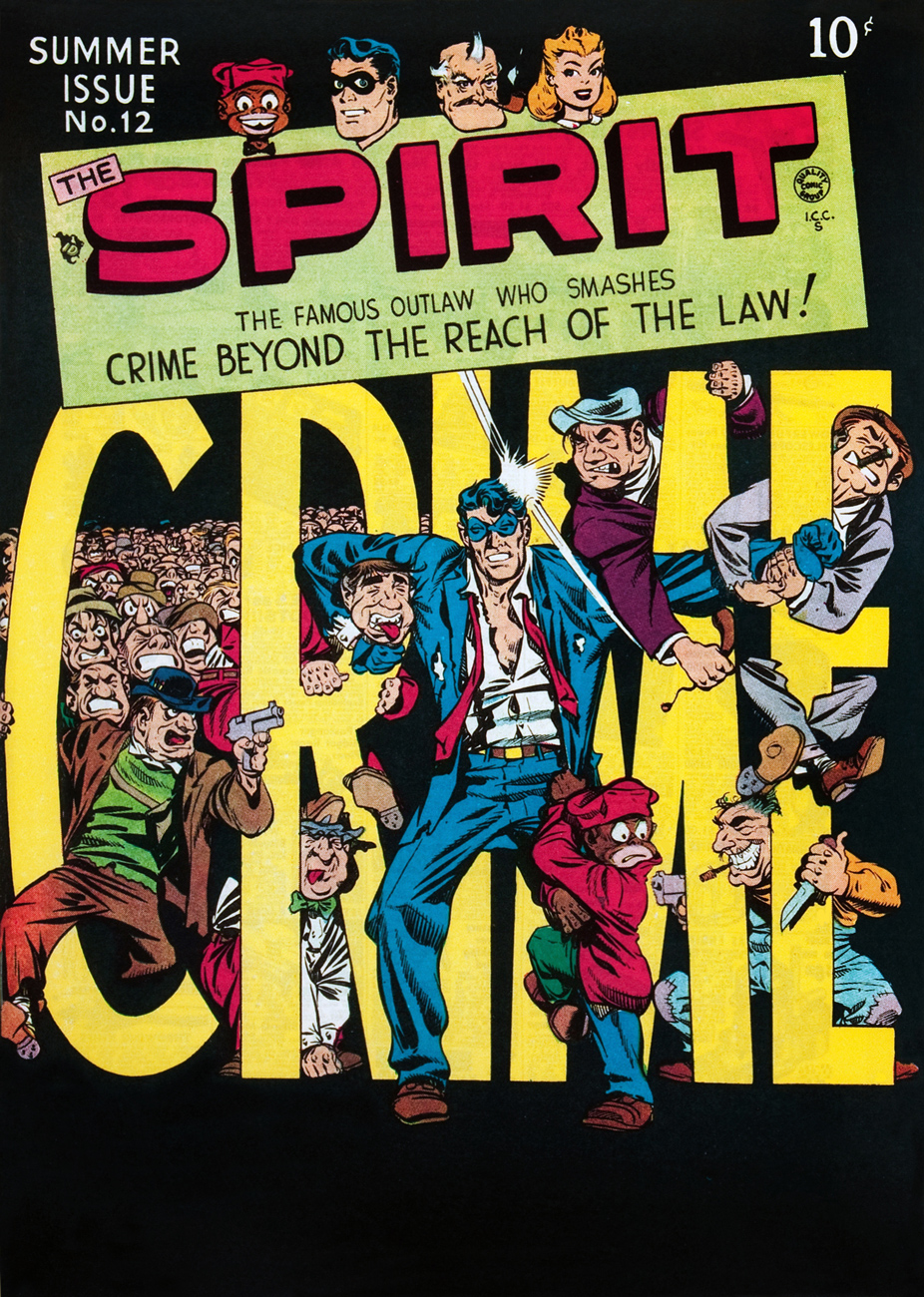
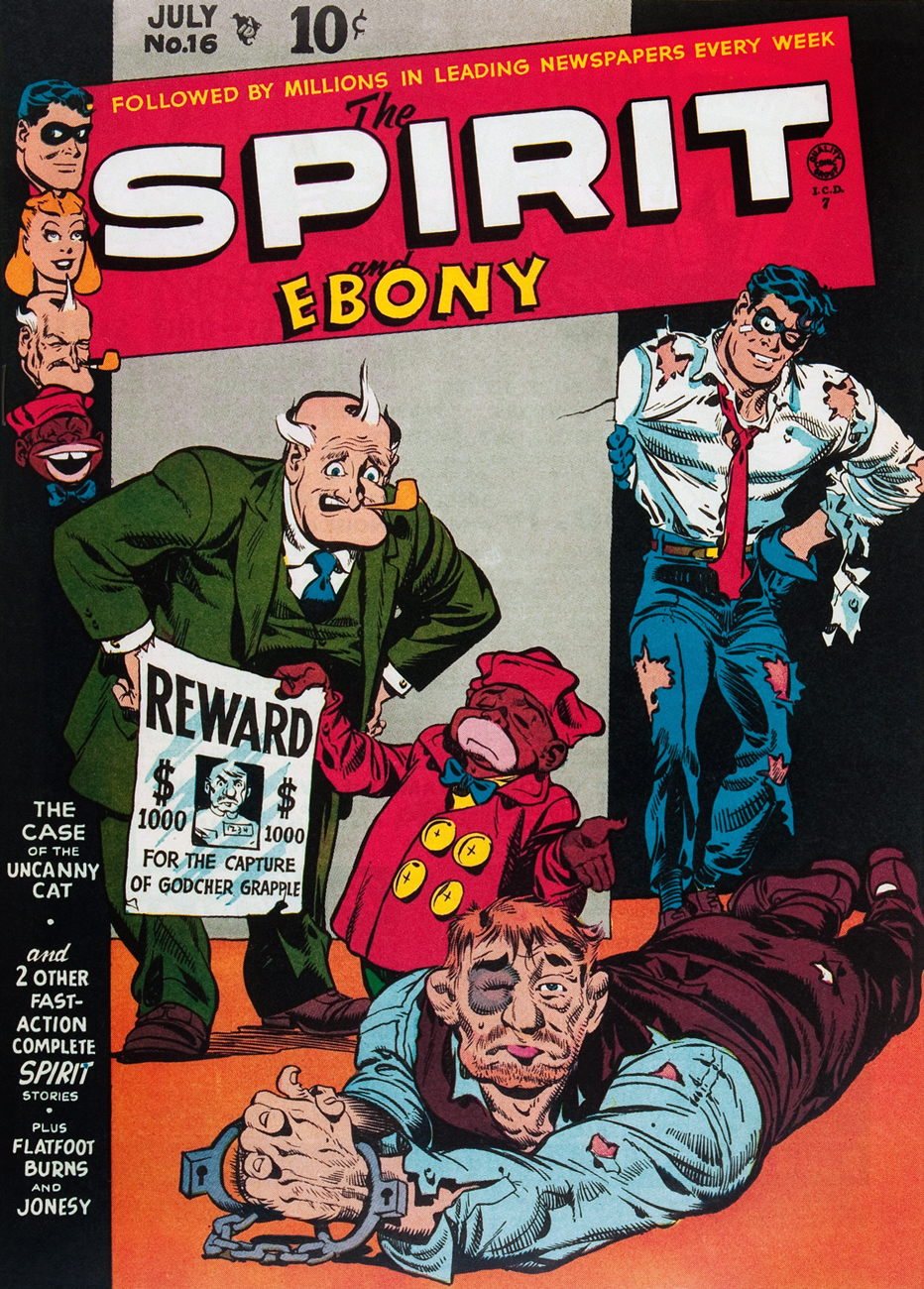
Speaking of Jack Cole… before he got his own title, The Spirit was featured for a couple of years in Quality’s Police Comics anthology. He occasionally ran into his fellow headliner, Plastic Man. This is Police Comics no. 23 (October, 1943). Cover by Jack Cole. Read this issue here.This is The Spirit no. 12 (Summer 1948), cover by Eisner, and featuring a bunch of Manly Wade Wellman / Lou Fine Spirit tales, which is to say “Eye, Feets, and Lock” (August 12th, 1945), “The Case of the Missing Undertaker” (September 30, 1945), “Skelvin’s School for Actors” (November 18, 1945), “The Whitlock Diamond Caper” (June 24, 1945) and “Nitro” (October 21, 1945).This is The Spirit no. 13 (Autumn, 1948), cover by Eisner, and gathering a clutch of Wellman / Fine outings, i.e. “Mr. Martin’s Pistols” (September 23, 1945), “Red Scandon” (June 3, 1945), “The Strange Case of the Two $5.00 Bills” (December 9, 1945), “Mr. Exter” (May 27, 1945) and “Vaudeville Vinnie” (November 4, 1945).Another high-wire master class in design and tension from Mr. Eisner. This is Quality Comics’ The Spirit no. 14 (Winter, 1948), featuring reprints of Spirit adventures (“The Alibi Factory“, “The Kuttup Shop“, “Prominent Executives Vanish“, “The Masked Magician“, “Belle La Trivet“) from 1945, written by Chapel Hill‘s foremost scribe, Manly Wade Wellman, and illustrated by Lou Fine and the Quality shop.This is The Spirit no. 15 (Spring, 1949), cover by Eisner, and gathering a bouquet of Wellman / Fine offerings, namely “Rosilind Ripsley” (June 10, 1945), “Madame Lerna’s Crystal Ball” (September 16, 1945), and “The Case of the Will O’Wisp Murders” (November 5, 1944).This is The Spirit no. 16 (Autumn, 1948), boasting an Eisner cover and rounding up a rogues’ gallery of Spirit exploits scripted by Bill Woolfolk: “The Case of the Uncanny Cat” (October 8, 1944) and “Jackie Boy” (September 9, 1944) and Manly Wade Wellman: “The Case of the Headless Burglar” (September 24, 1944), all pencilled by Lou Fine.I’ll bet Dolan could kick himself if he wasn’t so tidily trussed up. Fooled by a pretty… er, face again. This is The Spirit no. 20 (April 1950), featuring “The Vortex” (September 8, 1946); “The Siberian Dagger” (January 27, 1946); “Magnifying Glasses” (May 26, 1946), plus a couple of Flatfoot Burns stories by Al Stahl. Cover by Will Eisner, and a gold star and a hearty round of applause for the colourist.
As for the insides… I’m tickled to inform you that all of Quality’s issues of The Spirit are available gratis on comicbookplus.com. Enjoy!
– RG
p.s. For more (much more!) of Will Eisner’s famous creation, just click on the umbrella category, THAT’S THE SPIRIT!
 , those of you who like a friendly octopus and can appreciate understated wit and off-beat humour, stick around as we travel into a land created by Patrick Dean (not British Ambassador to the States). A word of warning – people randomly bursting into song and cohabiting with monsters is quite normal here.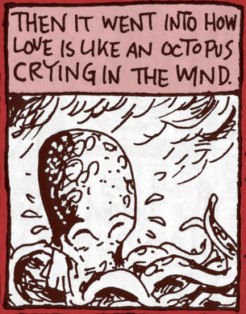






















 Who's Out There?