Luis Domínguez (1923-2020): A Farewell in Twelve Covers

« Painting is the art of hollowing a surface. » — Georges Seurat

If you’ll forgive me the venial but gauche sin of quoting myself… three years ago, I posited:

« Luís Ángel Domínguez, reportedly born ninety-five years ago to the day… and still among the living… as far as we know. I like to envision him warmly surrounded by several generations of loved ones and well-wishers, an impish gleam in his eye. »

I found it sadly infuriating that such an important and accomplished artist’s latter-day whereabouts and circumstances were so shrouded in mystery… and largely, it would seem, indifference. The usual story: he didn’t really do superheroes.

Neither Lambiek nor the Grand Comics Database have anything to add on the subject, but a spot of digging turned up that he indeed was still alive until recently, though purportedly afflicted with Alzheimer’s in his waning years. Then I found what may well be his… very basic obituary, placing his date of birth exactly one month off (unsurprisingly, since accounts have long varied) and his date of death as July 1st, 2020, in Miami, FL. Unless something more definitive comes along, it’ll have to do.

I think we can all agree that ninety-six years is a pretty good run, even with the doleful decline near the end. Let’s look back on what’s surely his peak decade in comics, the 1970s. My picks have nothing to do with ‘key’ issues, character débuts or popular crossovers. I’ve judged these on artistic merit, keeping the pernicious influence of nostalgia at arm’s length.

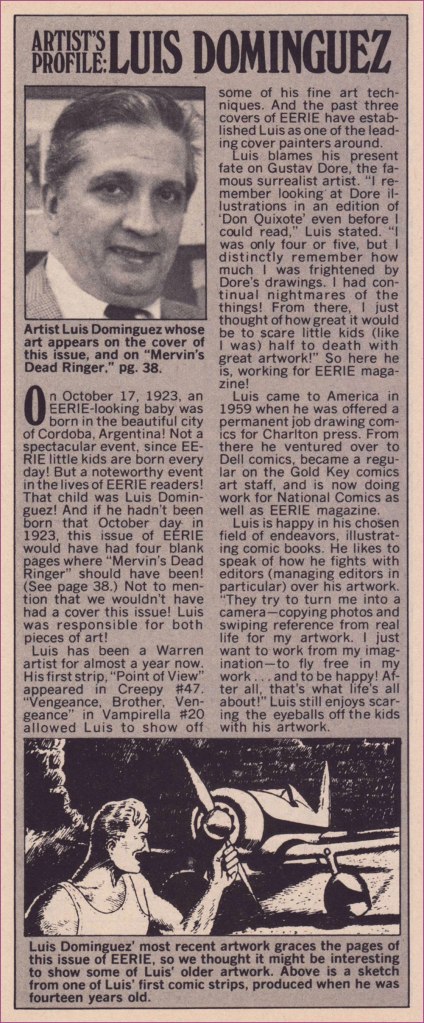
First, a little biographical background! This helpful piece appeared in the pages of Eerie no. 44 (Dec. 1972, Warren), which also boasted a Domínguez cover… albeit reproduced too small.
The folks at Warren were apparently first in North America to recognise and call upon señor Domínguez’s masterly painting skills. This is Famous Monsters no. 93 (Oct. 1972, Warren).
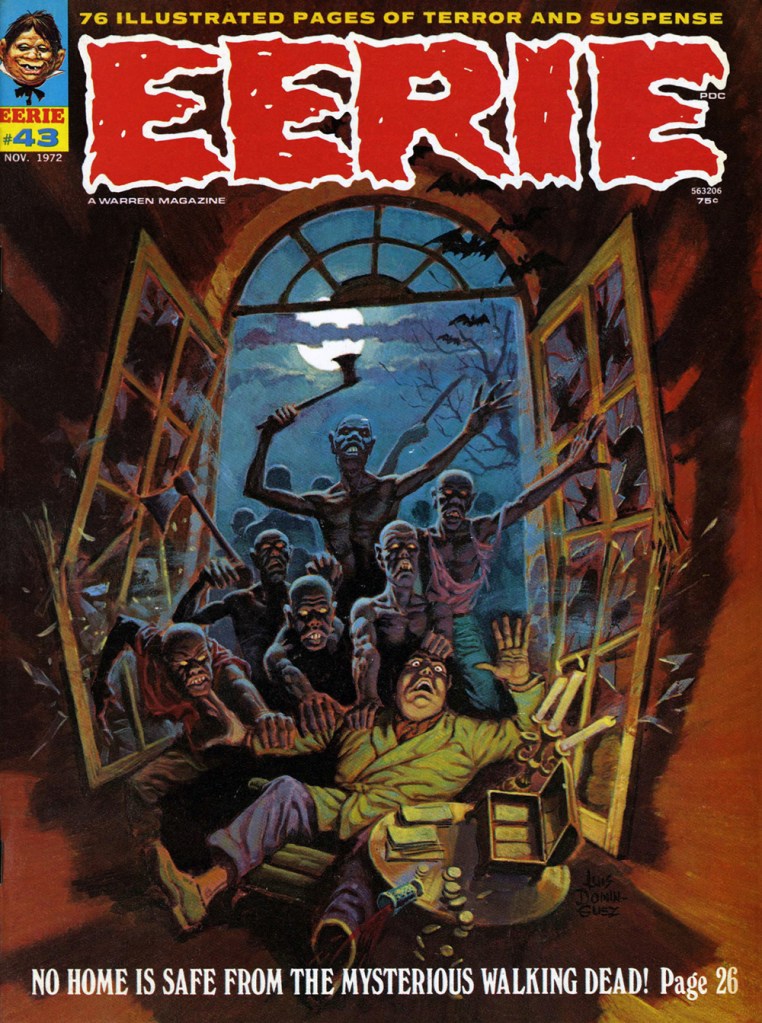
My personal favourite of his too-few Warren covers, this is Eerie no. 43 (Nov. 1972, Warren).
While Luís had been steadily working on the insides of Gold Key comics since 1967, it wasn’t until 1974 that they gave him a crack at a cover. That was either this one, Space Family Robinson no. 40, or Boris Karloff Tales of Mystery no. 55, both cover-dated July, 1974… (incidentally, the GCD misattributes to him several of his colleague George Wilson‘s paintings).
DC hardly ever used painted covers, but they did keep Domínguez busy as a cover artist. I assure you, this ambitiously-muted cover must have been a printer’s nightmare. This is The Phantom Stranger no. 32 (Sept. 1974, DC), a great issue that features Arnold Drake and (returning to the Stranger after a 27-issue absence!) Bill Draut‘s It Takes a Witch! and a gorgeous Michael FleisherNestor Redondo Black Orchid backup.
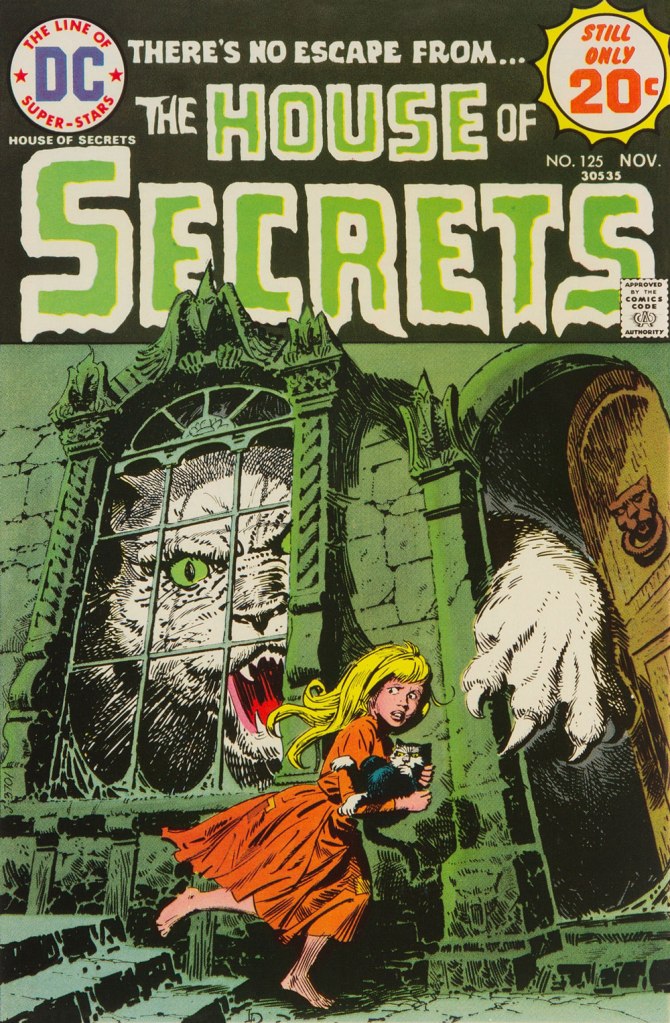
This is House of Secrets no. 125 (Nov. 1974, DC). For once, Domínguez also illustrates the cover-featured story, E. Nelson Bridwell‘s Catch as Cats Can!
Then of course, Marvel soon after got in on the act. This is Dracula Lives no. 9 (Nov. 1974, Marvel). I would have picked the even better previous issue, but I’ve already featured it, so you get to enjoy both!
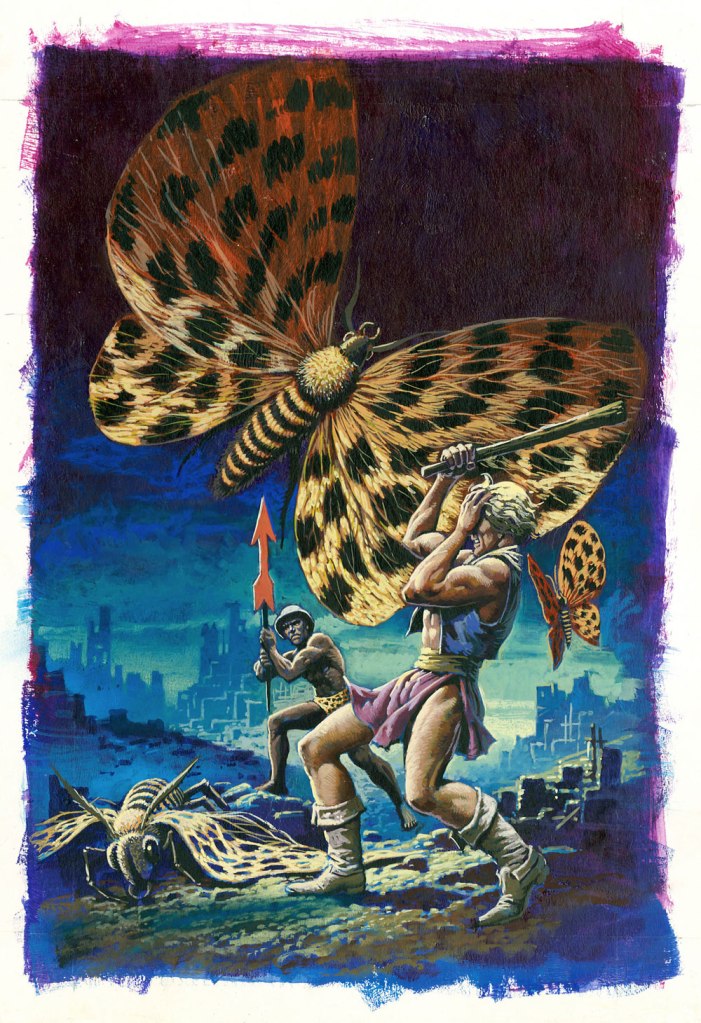
The printed version of this piece, featured as the cover of UFO Flying Saucers no. 5 (Feb. 1975, Gold Key) pales in comparison with the surviving original art, so that was an easy choice.
This issue’s original art also survived, and seeing both versions is most instructive as an insight into production manager Jack Adler’s methods. This is House of Mystery no. 235 (Sept. 1975, DC), and the original can be viewed here. As an aside, this issue’s The Spawn of the Devil, written by Maxene Fabe and drawn by Ramona Fradon, is the only DC horror story I ever found scary. Perhaps editor Joe Orlando should have hired women more often!
Another one whose printed version fails on the reproduction front, this is Mighty Samson no. 31 (Mar. 1976, Gold Key), the title’s final issue. Let’s again rejoice at the original art’s survival!
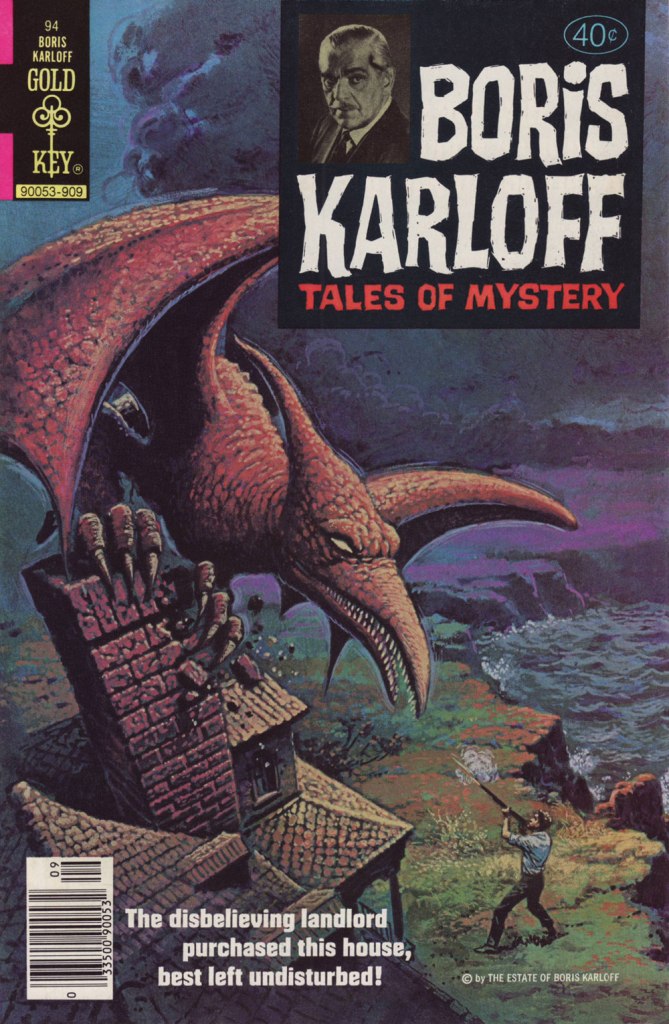
This is Boris Karloff Tales of Mystery no. 94 (Sept. 1979, Gold Key); I hold that Dominguez’ three finest consecutive covers came near the end of Gold Key’s Karloff anthology and, wouldn’t you know it? … we have already featured the other two. You’ll find issue 92 here, and issue 93 (and its original art) in one of ds’ posts, which also showcases another top-flight contender, which I couldn’t use for reason of… tentacles, Dagar the Invincible no. 11.
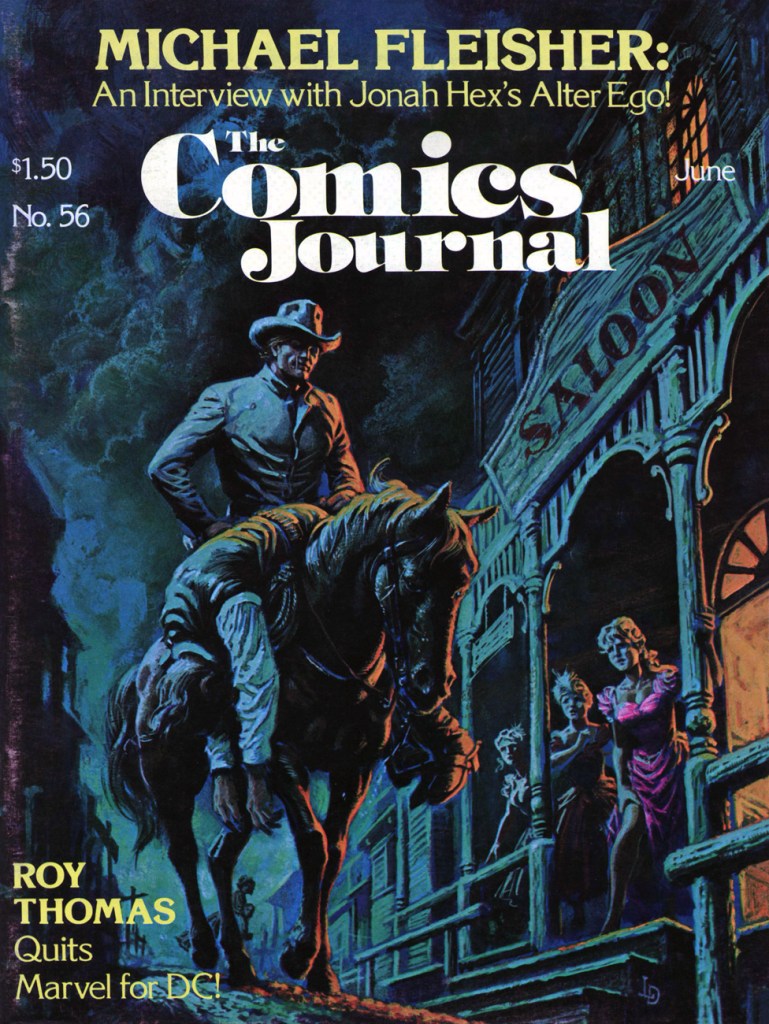
This is The Comics Journal no. 56 (Fantagraphics, May 1980). According to masthead notes, « Luís Dominguez’s painting was originally scheduled for the fourth issue of DC’s Digest Comic, “Jonah Hex and Other Western Tales“, but the title was cancelled with no. 3. » The magazine’s larger size certainly affords us a better view of this richly detailed scene.
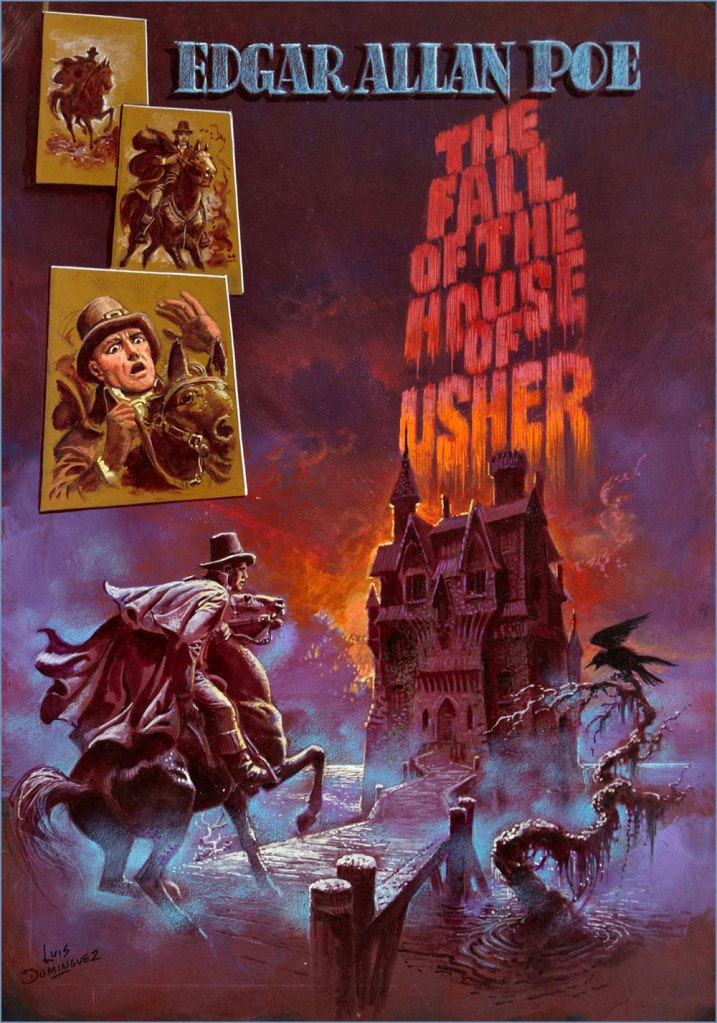
And as bonus, this mysterious, undated, possibly unpublished cover painting to Edgar Allan Poe‘s famous tale. Acrylic on board, 36 x 50 cm (14″ x 20″). The corners confirm that Domínguez worked from dark to light (which largely accounts for his marvellously luminous colours) and faint lines (on this and other works) indicate that he used a grid to scale up his preliminary sketches accurately.

For more Domínguez delights, just click on this link and explore away! I daresay that I only managed to keep it to an even dozen (difficult!) choices because we’ve already spotlighted many of his finest covers.

-RG
Tentacle Tuesday: « Do me up like one of your French girls! »

Tentacular greetings to all! Today’s post finds us with our feet firmly planted in France (well, maybe with one toe dipping into Belgium, as usual). As friend Barney might say, come for the Important & Serious Artist discussion, stay for the ‘naked man/nubile woman’ fringe benefits…

Many are fans of Jean Henri Gaston Giraud, far better known under his nom de plume, Mœbius. Co-admin RG and my humble self do not belong to this category, which is possibly why he has never been mentioned in WOT before. RG thinks he’s ‘the Serge Gainsbourg of French comics‘ (not a compliment); I do not specifically dislike his work… nor am I interested enough in it to investigate. We could argue about Mœbius’ profound influence on science-fiction and cyperpunk and his lasting impact on comics until we’re blue in the face, so I suggest we look at some tentacles instead!

The original art from Il y a un Prince-Charmant sur Phenixon (Pilote, 1973), published in English in Heavy Metal Magazine v. 4 no. 10 (January 1981) as ‘There Is a Prince Charming on Phenixon’.

The Long Tomorrow was written by American screenwriter Dan O’Bannon and illustrated by Mœbius in 1975. Published in Métal hurlant (nos. 7 and 8) in 1976, it was then picked by Heavy Metal in 1977 for the anglophone market. This story is credited with having heavily influenced a number of movies – Blade Runner gets mentioned a lot, for example. Read the full story (and a little interview with O’Bannon) here.

Page from the story published in Heavy Metal no. 5 (August 1977).

Speaking of Métal hurlant, this cover offers some quality tentacles from French comics artist/illustrator Jean Solé:

Métal Hurlant no. 3 (July 1975), cover by Jean Solé.

Solé liked the absurd, the grotesque, and the psychedelic, so naturally he has more tentacles on offer than just one cover!

Illustration painted for publication in Pilote in 1985.

The last offering of today’s TT is this very dramatic action scene by Claude Serre. Is the surgeon trying to stuff these tentacles back in, or extract them? We shall never know.

Scanned from Serre, a best-of collection published by Glénat in 2001. This illustration was an excerpt from Serre’s Humour noir et hommes en blanc (“Black Humour and Men in White”), a collection of sombrely jocular drawings on the topic of medicine.

~ ds

Hallowe’en Countdown V, Day 28

« The fog comes on little cat feet. It sits looking over the harbor and city on silent haunches and then moves on. » — Carl Sandburg

The first novel I ever read was a Bob Morane… so we’re old friends.

This was the one. I ask you, how could any self-respecting, red-blooded boy resist the lure of a book entitled ‘Monsters From Space’? And no, I don’t remember a thing from it. Cover art by the prolific Pierre Joubert.

Bob Morane, created in 1953 by yet another Belgian writer* both talented and astoundingly prolific, Charles-Henri Dewisme aka Henri Vernes (1918-2021), has been the hero of over two hundred novels, movies, television shows, animated series, records, you name it.

A foray into comics logically followed in 1959, when, according to Vernes,

« Femmes d’Aujourd’hui, a women’s weekly, asked me to do a series. I said: ‘why not?‘ And so I did, that’s all. »

For brevity’s sake, we’ll stick to the comics, one album in particular at that (the series numbers, after all, over one hundred by now.) I’ve always been intrigued by this one, though I never have, as far as I know, encountered a copy in the wild. In fact, a couple of weeks ago, I queried my go-to bédé provider about it, and he responded that: « Bob Morane albums sell just as soon as they arrive. We can’t ever keep them in stock. » So I ordered a copy from Belgium. One must choose one’s battles with care.

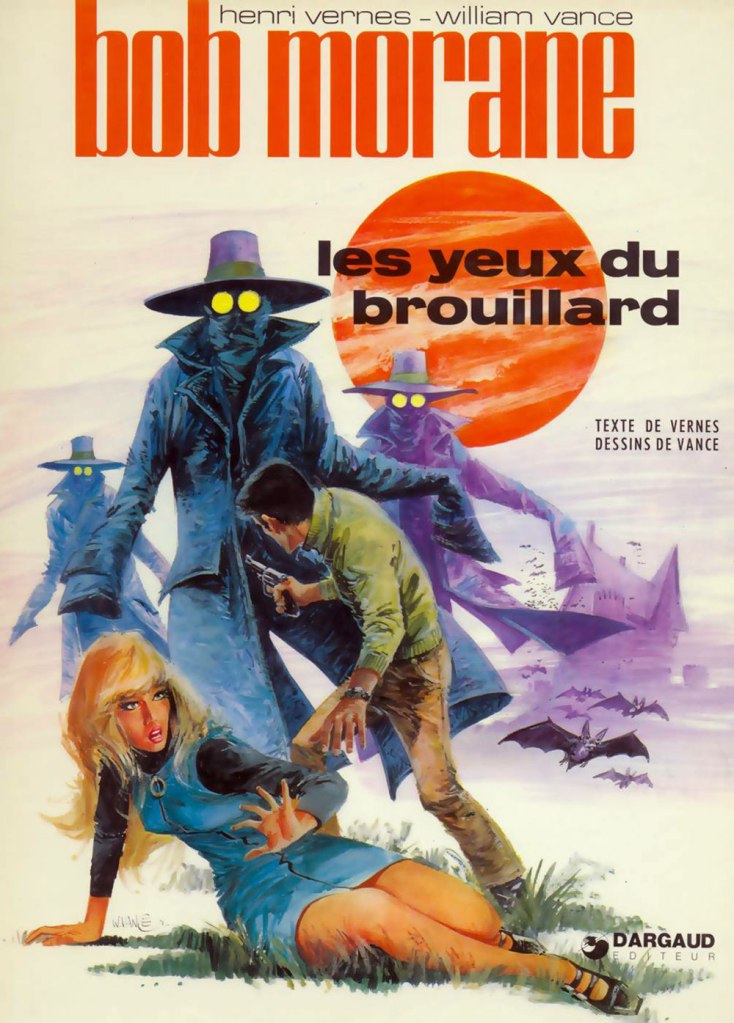
This is Les yeux du brouillard (1971, Dargaud). First serialised in Belgian women’s weekly Femmes d’aujourd’hui (issues 1295 to 1316, 1970), which might seem odd… but said magazine regularly featured several pages of comics, and not just ‘women’s comics’, whatever that may be. What can I say? The Belgians, bless ’em, appreciate their comics. Cover art by William Van Cutsen, aka William Vance (1935-2018).
While I’ve never been much of Vance fan, finding him a bit stiff and generic, I’d never claim that he doesn’t get the job done, however. He’s clearly at his peak here.
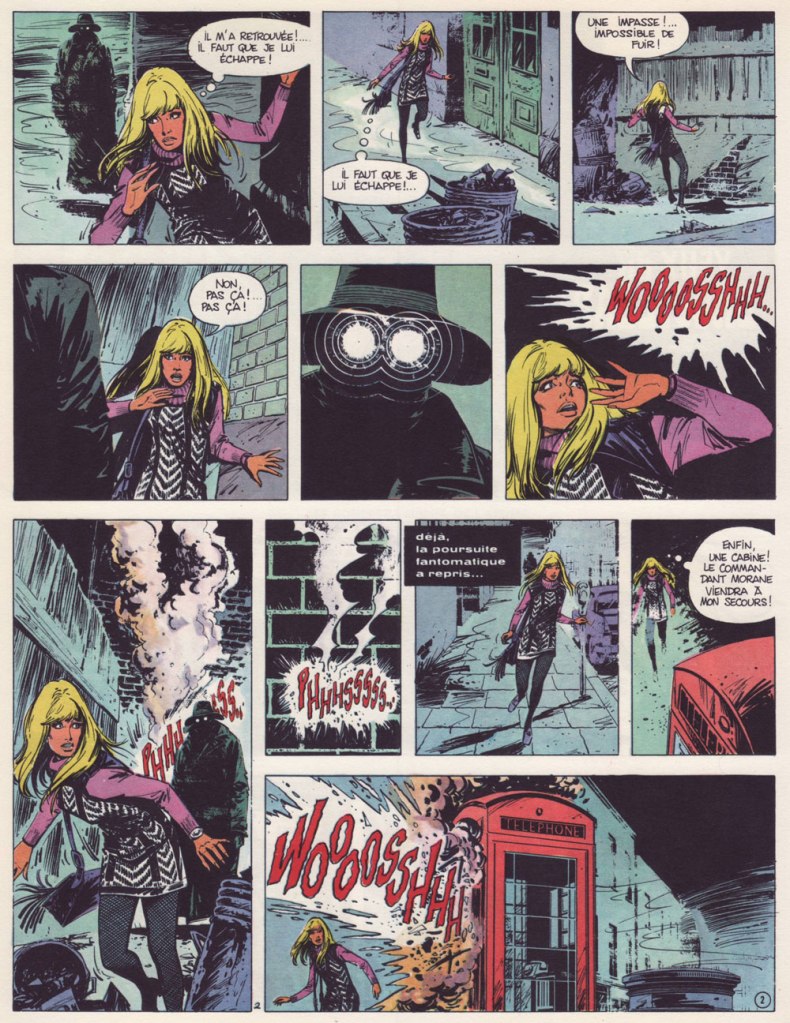
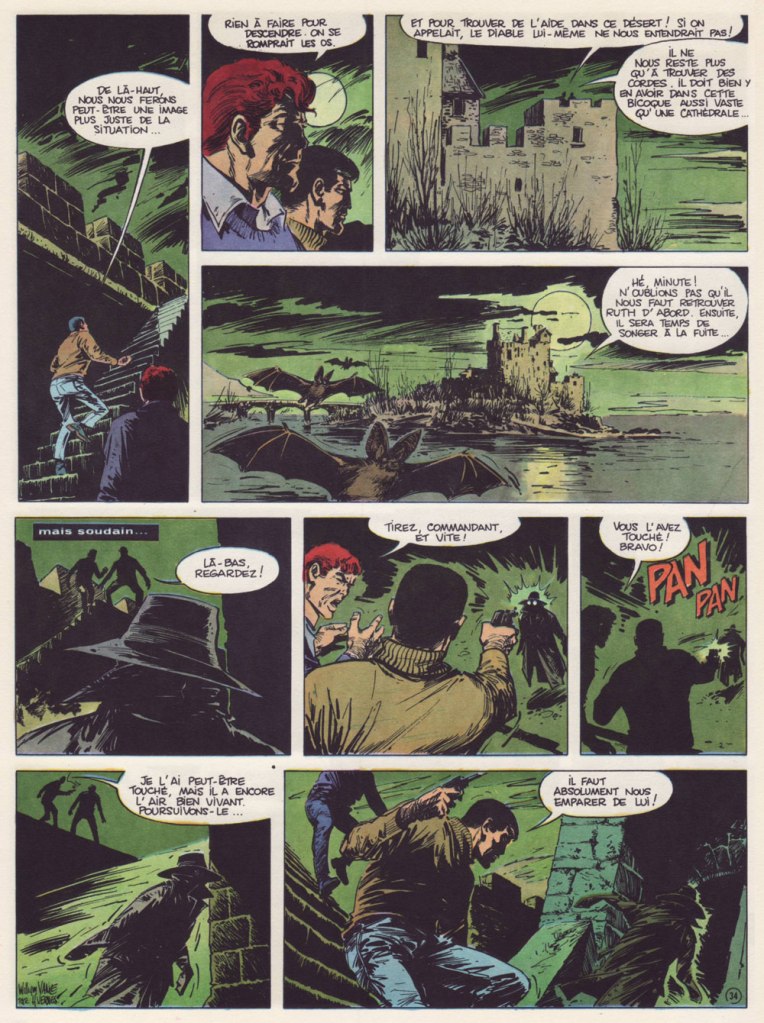
Spoiler alert: disappointingly, the ‘Eyes of the Fog’ turn out to be more or less what this novelty comic book ad promised, though far cooler. Plus they did a great job of keeping the superstitious natives away and the phone booth repairmen puzzled (but gainfully occupied).

Want to see what you actually received upon (well, six to eight weeks later, if memory serves) ordering your very own U-Control Life-Size Ghost? Brace yourself, and look here.

-RG

*Maigret creator Georges Simenon (nearly 500 novels!) and my favourite writer, Jean Ray, readily come to mind. Something in the water, perhaps?

Hallowe’en Countdown V, Day 27

Yet what had he to fear if this place were evil – was he not an upright and godly man who held no traffic with evil? If wicked spirits had power over such men as he, there would be no justice in it.

“That’s true,”said a voice behind him, “there isn’t.” — The Gibsons*

I must confess I had something else planned for today’s post, but I learned, at the last minute, of the existence of material that would vastly augment my intended post — and I wouldn’t want to drop the ball on that topic. One less piece to plan for the next Countdown, then!

I suppose I had thus far refrained from touching upon DC’s long-running Ghosts (1971-82) — too obvious? Well, here we are. Ghosts, like its presumed model, Ripley’s Believe It or Not: True Ghost Stories (1965-80, Gold Key), was always tame and rather formulaic, but frequently boasted wonderful artwork, and definitely great covers.

Ambiance, ambiance, ambiance. This is Ghosts no. 23 (Feb. 1974, DC); cover art by Nick Cardy.

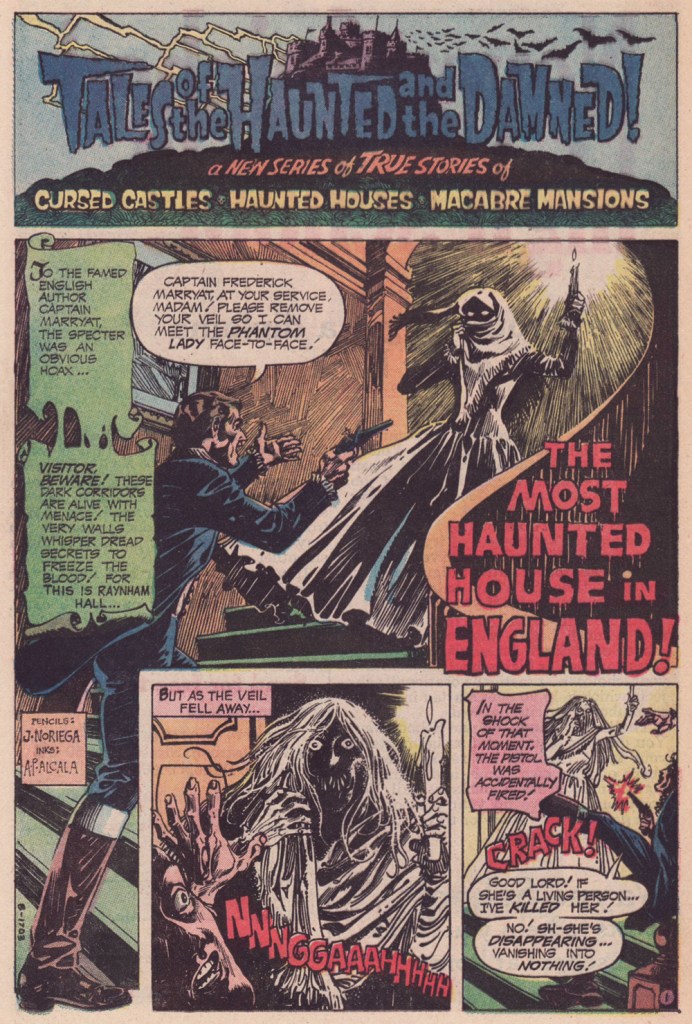
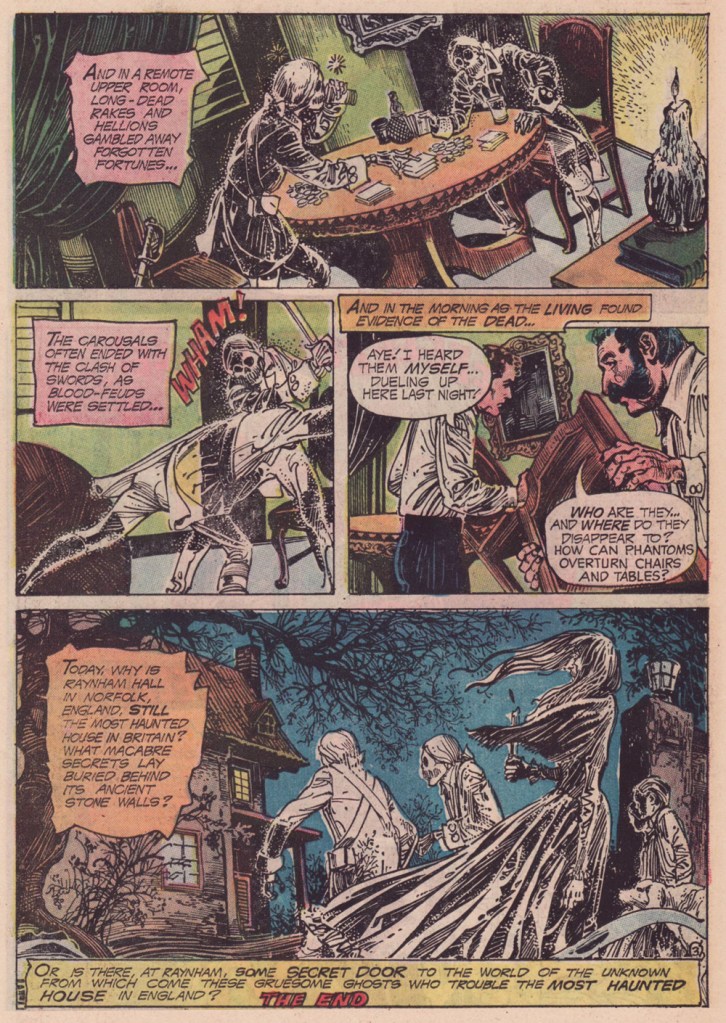
Within its pages lurks this gorgeous three-pager written by Carl Wessler, pencilled by the mysterious (how appropriate!) J. Noriega, and embellished by the peerless Alfredo Alcala.

Find out more about this Captain Marryat character right here.
The next time you find yourself ’round Norfolk way, you can drop by and visit the actual Raynham Hall and see for yourself if it’s truly crawling with spectres.
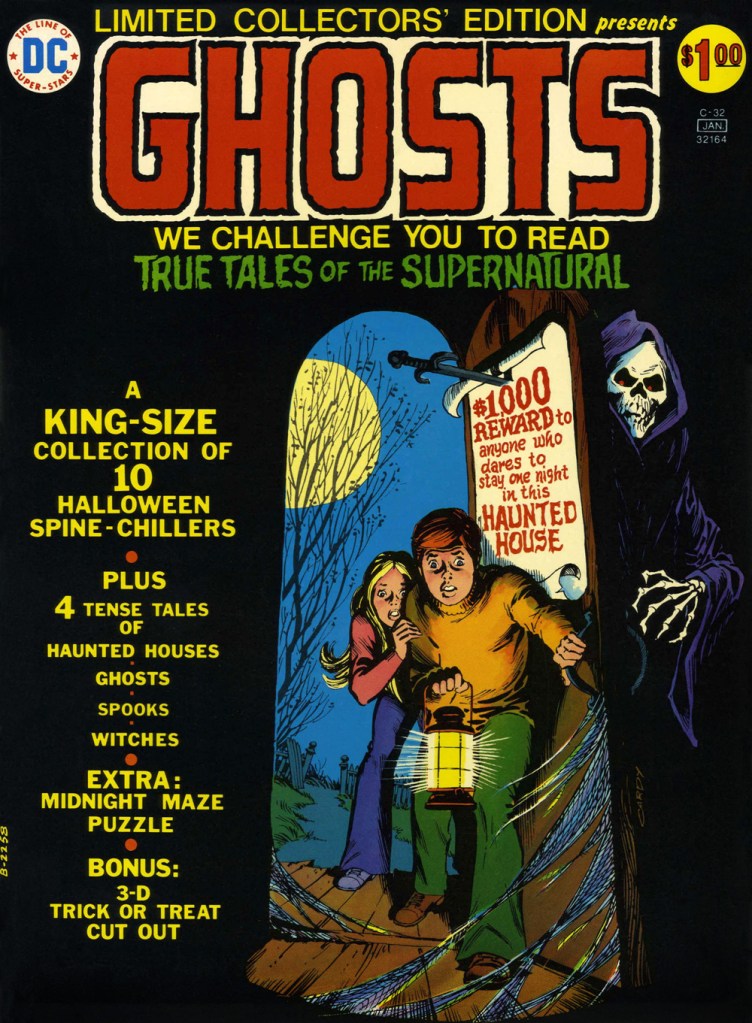
This is the tabloid-sized Limited Collectors’ Edition C-32 (Dec. 1974-Jan. 1975, DC); edited by Murray Boltinoff, cover by Nick Cardy.

-RG
*« A couple called ‘The Gibsons’ won a New Statesman competition in Britain with a 200-worder about a man who grows increasingly nervous while walking down a winding moonlit road. » — From Dr. Van Helsing’s Handy Guide to Ghost Stories, Part III, by Kurt Van Helsing, in Twilight Zone Magazine vol. 1 no. 7 (Oct. 1981, TZ Publications).

Hallowe’en Countdown V, Day 21

« The man asked, “Who are you?” “I am Death, who makes everyone equal.” » *

Greetings! Today I am giving my co-admin RG a much-needed chance to rest, and taking over Hallowe’en count-down duties. He protested a bit, but I was persuasive. Oh, don’t worry about him – he’s quite comfortable in the basement, and I may even unchain him at the end of the evening.

We have previously dipped a toe into Gespenster Geschichten (Ghost Stories) territory before, but – and this will come as no surprise – it was through the peculiar prism of tentacles. (For example, see Tentacle Tuesday: A Torrent of Teutonic Tentacles.) Yet this long-running (1974-2006) series published by Bastei Verlag also offers plenty of Hallowe’en-appropriate thrills: witches, ghosts, demented scientists, cold-blooded killers… you name it, Gespenster Geschichten has it! Here are a few covers which seem particularly appropriate for this wonderfully dreary, grey October evening.

The insides of these issues are of lesser interest: reprints of American horror comics, and, later on in the series, new content by artists local and migrated (Argentine, Spanish, Italian, Yugoslav…) Within some of these pages dwell reprints from Gold Key Comics’ Boris Karloff Tales of Mystery  (for example, with artwork by John Celardo, Sal Trapani, and Canadians Jack Sparling and Win Mortimer). I think we can safely conclude that the covers are considerably more horrifying than the innards of these issues…

With that out of the way, let’s see what German ghost stories have in store for us!

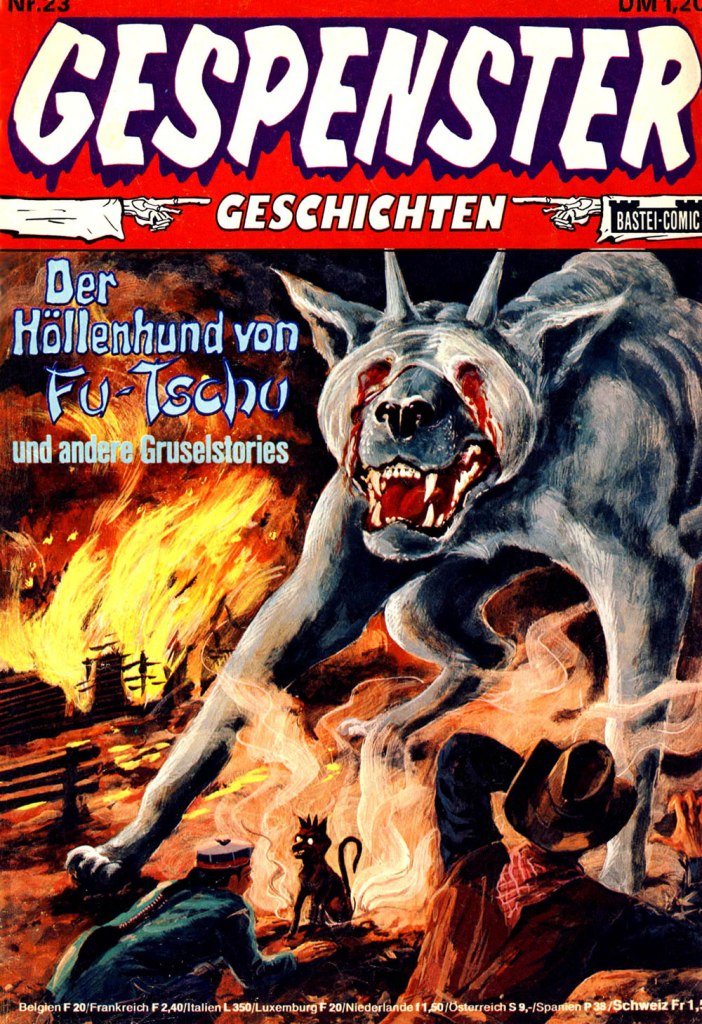
Gespenster Geschichten no. 23: Der Höllenhund von Fu-Tschu (The Hellhound from Fu-Tschu), 1974. This cover is equal parts disturbing and puzzling, with a creepy bear-dog with bleeding sockets and the little demonic effigy that is somehow simultaneously cute and clearly evil.

This charming little doggo was a rather… creative interpretation of the following painting, created for Boris Karloff Tales of Mystery no. 48 by George Wilson:

So you see how that particular Teutonic ball rolls! I admire George Wilson, but I admit I much prefer the German interpretation of this scene.

Gespenster Geschichten no. 41: Die Stunde des grünen Monsters (the hour of the green monsters), 1975. That witch looks downright friendly… the friendliness of a man smiling at a particularly appetizing piece of steak.
Gespenster Geschichten no. 59: Die Mask des Entsetzens (Mask of Horror), 1975. That’s a stylish haircut; I bet all the ladies go for this charmer.
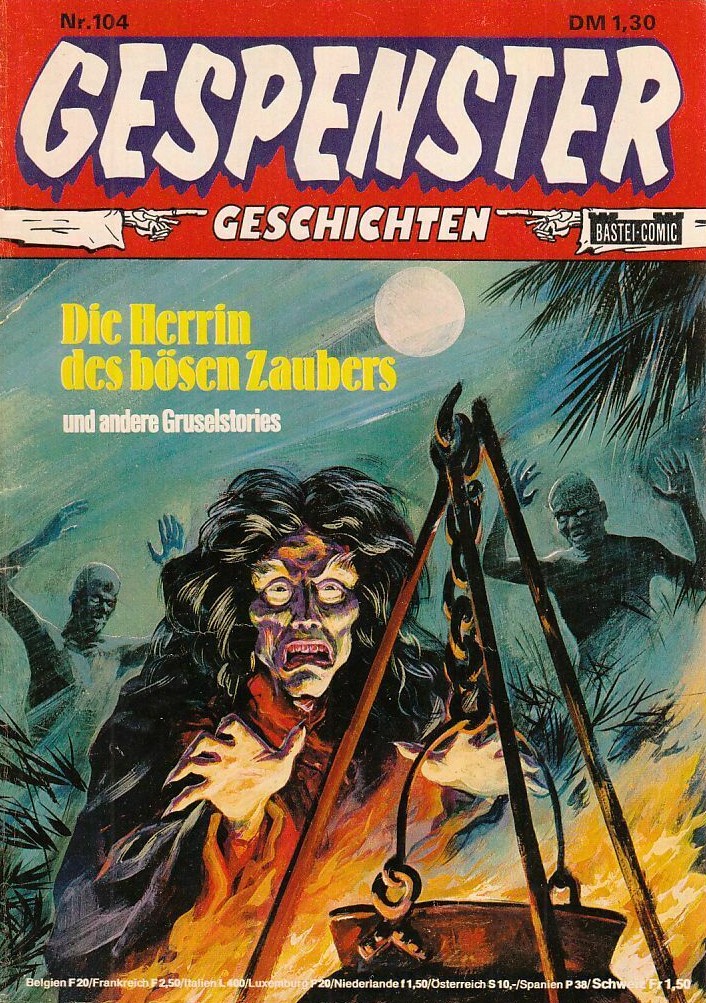
Gespenster Geschichten no. 76: Die Herrin des bösen Zaubers (The Mistress of Evil Spells), 1976.
The Ghost Stories Special (Gespenster Geschichten Spezial) was an oversized format, though I am not sure whether these babies featured reprints of their smaller-sized brethren literally in a bigger format, or just functioned as a sort of anthology. This is Die unheimlichen Gespenster Geschichten Spezial no. 208. ‘Monster-ladies’ is somewhat self-explanatory; ‘Die unheimlichen’ means ‘the scariest’.

For more Gespenster Geschichten, visit this lovely Monster Brains post. And if you’re curious about what each issue contains, head over to Comic Vine, which lists reprints featured inside some of the issues.

*(from Der Gevatter Tod, collected by Brothers Grimm)

~ ds

Hallowe’en Countdown V, Day 15

« Get ready for the future: it is murder. » — Leonard Cohen

Since Hallowe’en isn’t as widely celebrated in Europe — Ireland and the rest of the U.K. aside, obviously — as it is in North America, it’s not always evident and easy to keep the countdown truly international. No worries: in such a situation, I’m no stickler — I’ll take the spirit of the law over its letter.

The first (and until now, only) time I posted about Thomas Ott, I wound up with a contender for least-popular post in this blog’s history. Have I learned my lesson? Heavens, no. I live, perhaps naïvely, in the belief that our audience has grown in the interim, and that said audience is ever more attuned and receptive to our quirks.

Here, then, is some gallows humour from Mr. Ott. Don’t try this at home, unless…

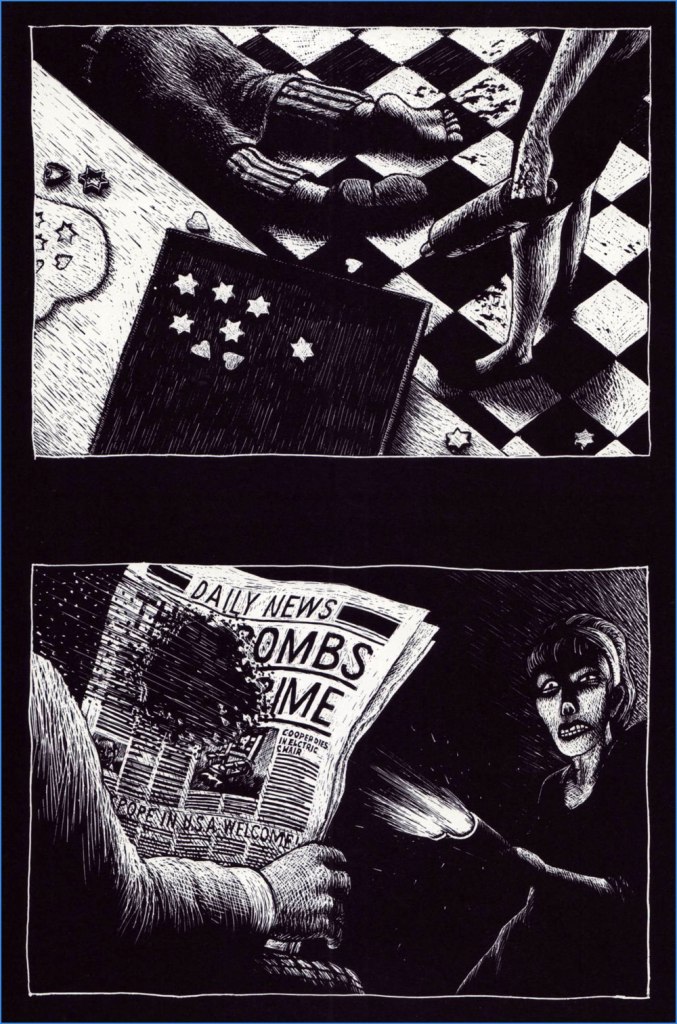
Top: The Night Porter, anyone?
Er… Top: Deadly Weapons, anyone?
Originally published in Tales of Error (Oct. 1989, Edition moderne, Switzerland). Yes, a book in English by a German-speaker from a Swiss publisher with a French name.
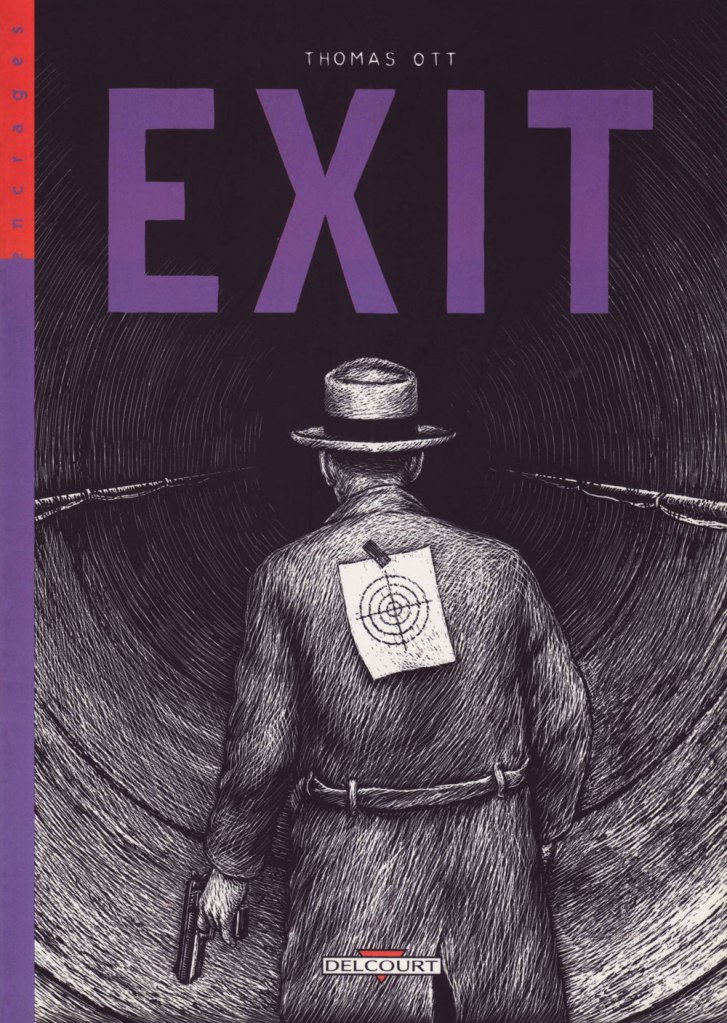
The Exit collection (Sept. 1997, Delcourt) gathers the essential bits of Ott’s first three albums (Tales of Error, Greetings from Hellville and Dead End), as well as some new pieces.

For more poisoned goodies from Mr. Ott, just plod your carcass over to his official website.

-RG

Hallowe’en Countdown V, Day 14

« Upon its head, with red extended mouth and solitary eye of fire, sat the hideous beast whose craft had seduced me into murder, and whose informing voice had consigned me to the hangman. » — The Black Cat (1845)

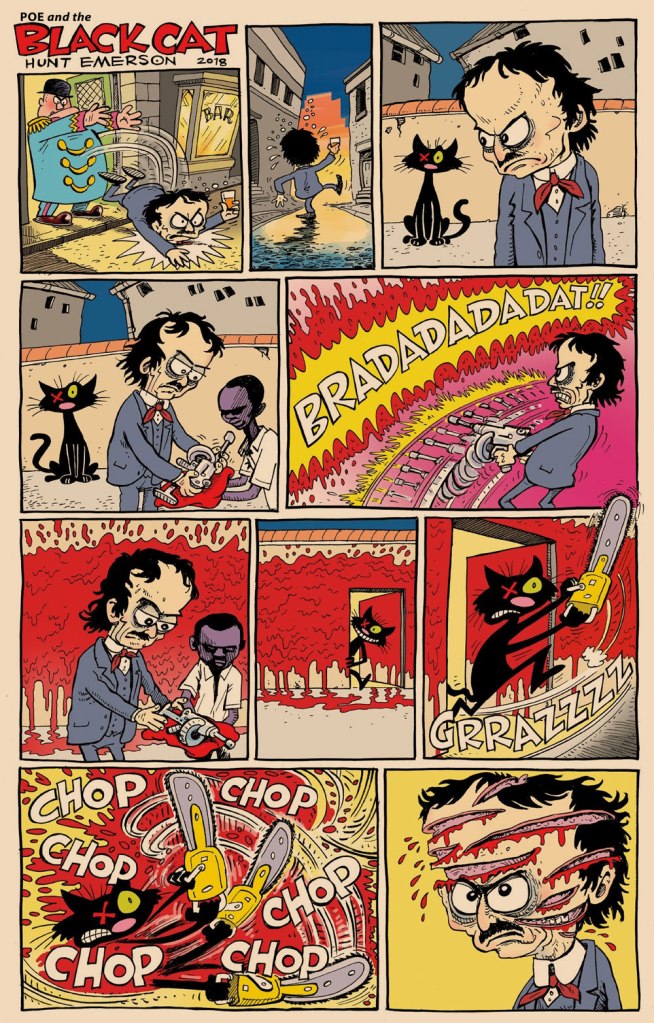
What can I tell you about the legendary English cartoonist and bon vivant Hunt Emerson — born in 1952 in Newcastle and still devilishly active these days — that he can’t tell you in his own words?

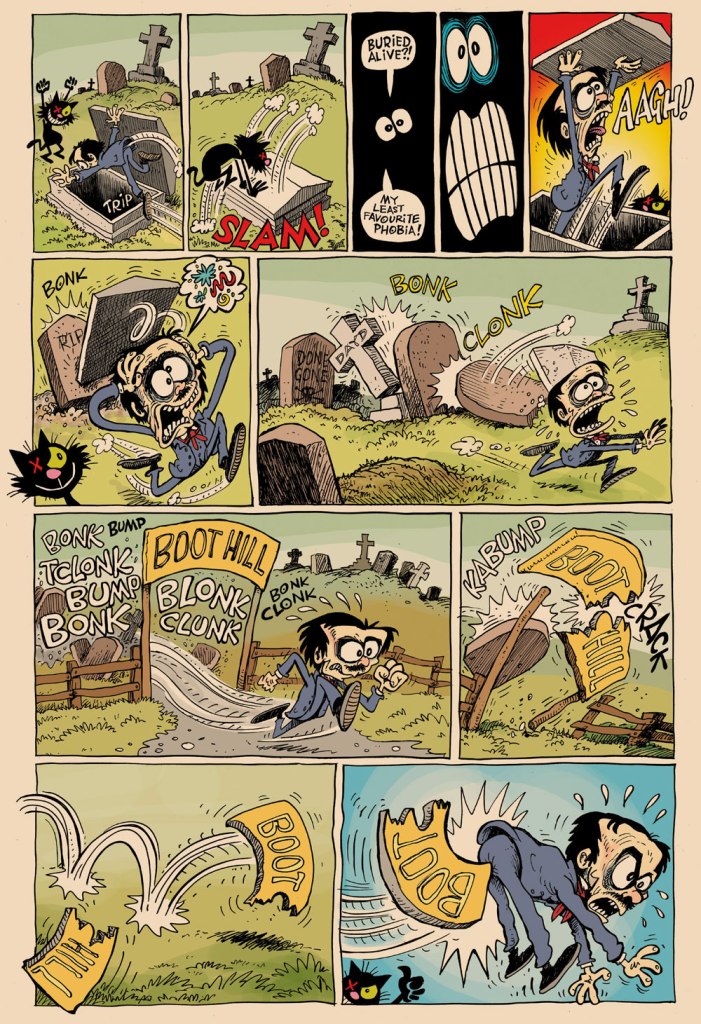
Mr. Emerson has recently (and I do mean recently!) contributed a series of hi-concept short strips to Ahoy Comics’ gamut-running Poe-themed humorous horror anthology. Taking his place in a thematic thread that includes Tom and Jerry, Antonio ProhíasSpy vs Spy, Brian McConnachie and Warren Sattler‘s Kit ‘n’ Kaboodle, Massimo Mattioli‘s Squeak the Mouse* and Simpsons cartoon-within-a-cartoon Itchy and Scratchy, Emerson merrily escalates the hostilities launched in Poe’s The Black Cat, with Poe himself in the rôle of the narrator. Assume the position!

Originally published in Edgar Allan Poe’s Snifter of Terror no. 2 (Nov. 2018, Ahoy).
Originally published in Edgar Allan Poe’s Snifter of Terror no. 4 (Jan. 2019, Ahoy).
Originally published in Edgar Allan Poe’s Snifter of Terror no. 5 (Feb. 2019, Ahoy).
You’ll get all these, and plenty more besides, in Edgar Allan Poe’s Snifter of Terror Volume 1 (Oct. 2019, Ahoy), collecting the title’s first six issues. Cover art by Richard Williams, with a title logo by Todd Klein.

-RG

* not, by a long shot, Mattioli’s best work. *That* would be, without question, his nonpareil M le magicien (1968-73).

It’s Fungus Friday!

Did you hear the joke about fungus? You won’t like it, but it will grow on you.

As promised – though you folks may by far prefer tentacles to mushrooms – I am delighted to present this post about mushrooms both real and imaginary.

First of all why mushrooms? Those who know me are aware of my passion for fungus – it’s a gastronomic interest, as both co-admin RG and I love to cook with them, and also a platonic one, an admiration for their beauty and adaptability. In terms of aliens-on-earth, fungus is surely up there with the extraterrestrial octopus. We are currently on vacation, so this is the perfect moment to both admire some of our finds, and rediscover mushrooms in comics.

Usually people react in one of two ways to mentions of gathering wild mushrooms – ‘but how do you know you won’t poison yourself?‘ or ‘magic mushrooms! yeah!‘ The first question is pertinent, although there’s no need to take that horrified tone, and the second reaction is more than slightly one-track-minded.

Just like in real life, comics fungi come in all shapes and sizes: from cute appearances in the background of a cartoony comic, to psychedelic manifestations of the underground, to horror stories peppered with a slice or two of the deadly toadstool, and everything in between! I’ve tried to go for maximum contrast in this post, and include a little bit of everything. Dive in, like we dove in yesterday into our hedgehog-and-honey-mushrooms-pasta yesterday 😉

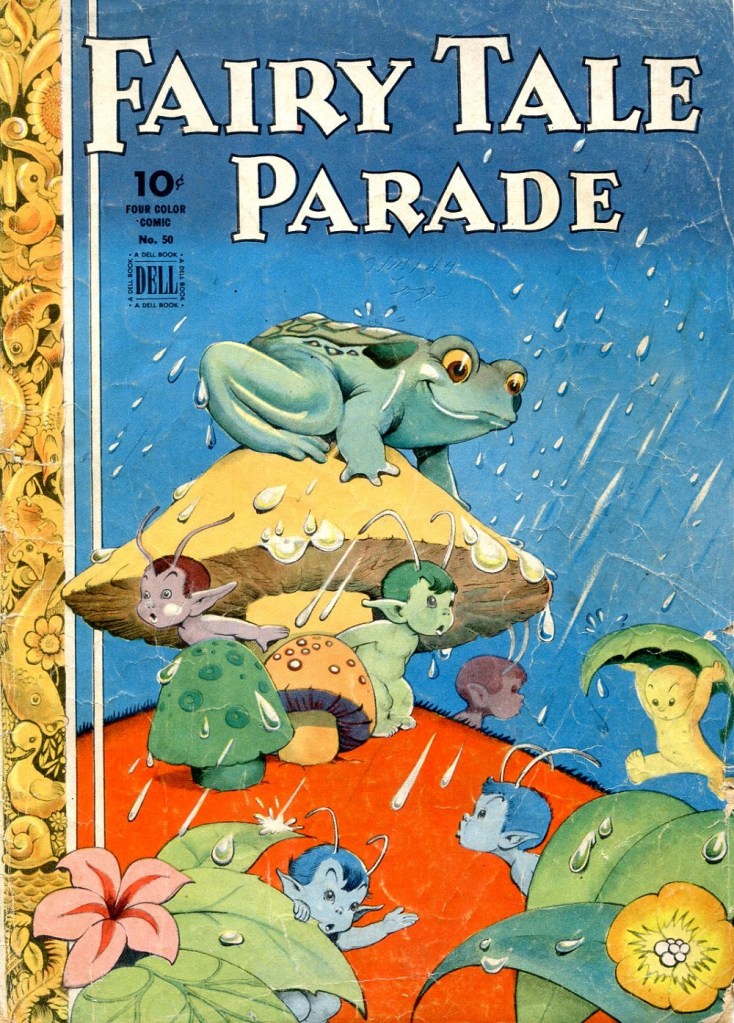
Four Color no. 50 – Fairy Tale Parade (1944-1945, Dell). Cover by Walt Kelly. This is kind of an anonymous mushroom of indeterminate species.
A cartoon by Emile Mercier, Australian cartoonist who is best remembered for his work for the Sydney Sun between 1949 and 1968. This particular piece hails from the late ’50s.

Speaking of Mercier, I love this anecdote: « One day, Claude McKay, the editor-in-chief of Smith’s Weekly, took a dim view of an X Emile Mercier had drawn under the upwardly extended tail on a cat. After a few stern words about “dirty gimmicks in cartoons”, the grim-faced McKay instructed Mercier to get rid of the cross. This presented Mercier with a challenge. He was someone who used to say you “have to think funny as well as draw funny” and he was not keen to let McKay’s prudish approach to his cat go unchallenged. Mercier’s solution was to draw a miniature roller blind under the cat’s perpendicular tail. He was in no doubt the blind would draw more attention to the cat’s anus than the X had. Fortunately for him, McKay saw the funny side of the addition and let the cartoon run. Not a man to push his luck too far, Mercier drew all future cats without an X at the base of their tails. »

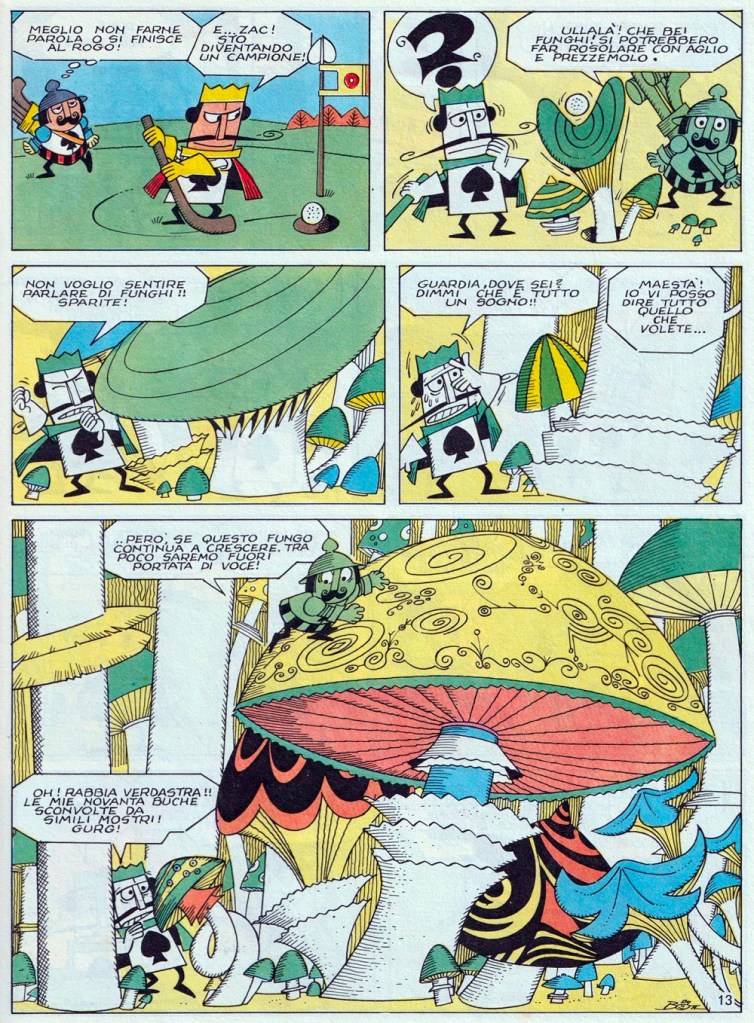
A page from Re di Picche no. 1 (AGIS, 1969), an Italian comics series created by Luciano Bottaro. Re di Picche means ‘king of spades’, and refers to the protagonist of this series (also the title of the magazine it was published in). Inspired by Alice in Wonderland? You bet! This mushroom appears to be some type of Amanita, a mostly deadly but handsome family of ‘shrooms.
The Plot to Destroy Earth, scripted by Dave Wood and illustrated by Jim Mooney, was published in Strange Adventures no. 183 (December 1965, DC). A man who refers to what is very obviously a mushroom as a ‘crazy-looking plant’ won’t impress anyone with his knowledge of nature… but this fungus-as-parachute interlude is entertaining.
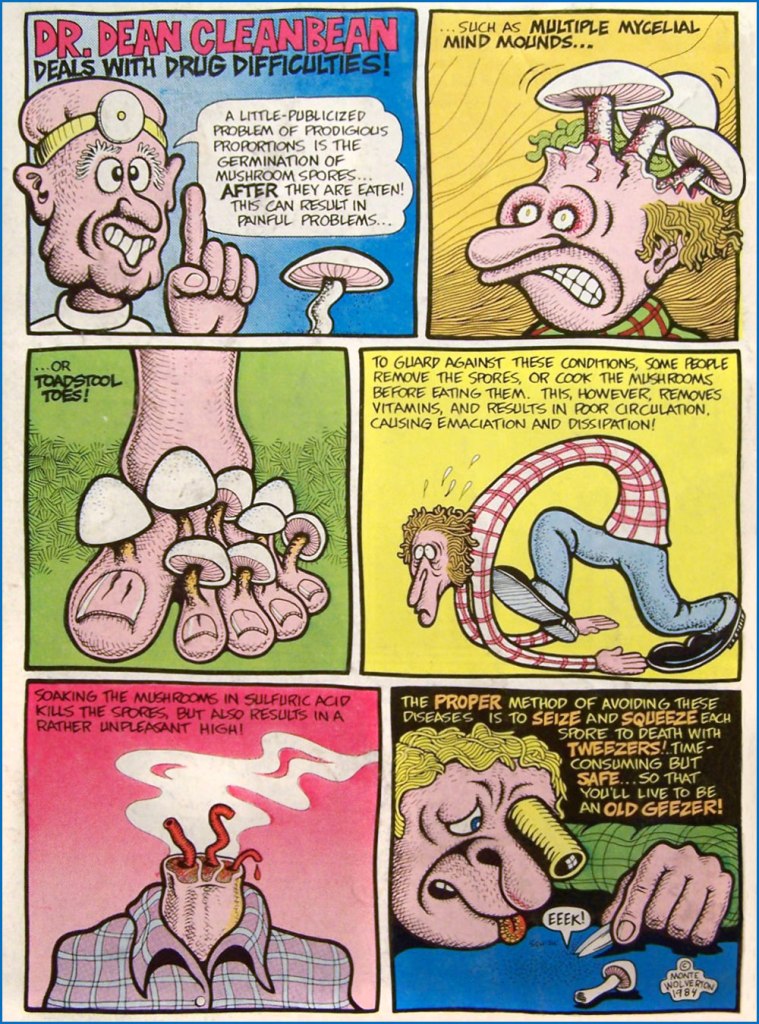
Dr. Dean Cleanbean Deals with Drug Difficulties, scripted and illustrated by Monte Wolverton (Basil Wolverton‘s son!), was the back cover of Dope Comix no. 5 (January 1984). Here we have the very prototypical magic mushrooms, which comes as no surprise.
I promised horror, didn’t I? This is a page from Chapter One, scripted by Mike Mignola and illustrated by Guy Davis, and published in B.P.R.D.: Plague of Frogs no. 1 (February 2011, Dark Horse).
A splash page from The Mushroom Fan Club by Elise Gravel (2018, Enfant – Drawn & Quarterly’s children’s imprint). I wholeheartedly agree with Gravel – mushrooms come in such a variety of shapes and sizes, that it’s crazy to even consider them as the same thing. Note the mischievous bolete (center, brown cap), probably the King Bolete, a.k.a. Penny Bun – it has a feeling of superiority, and we agree.
Some of our mushroom crop this week. In the usual clockwise order: Lactarius Deliciosus; various Leccinums (or Bolete); Armillaria gallica (Honey mushrooms) and Hydnums (Hedgehogs).

~ ds

Niso Ramponi: He’s not a Pervert, He’s… Kremos!

« By 1948, the Italians had begun to pull themselves together, demonstrating once more their astonishing ability to cope with disaster, which is so perfectly balanced by their absolute inability to deal with success. » — Gore Vidal

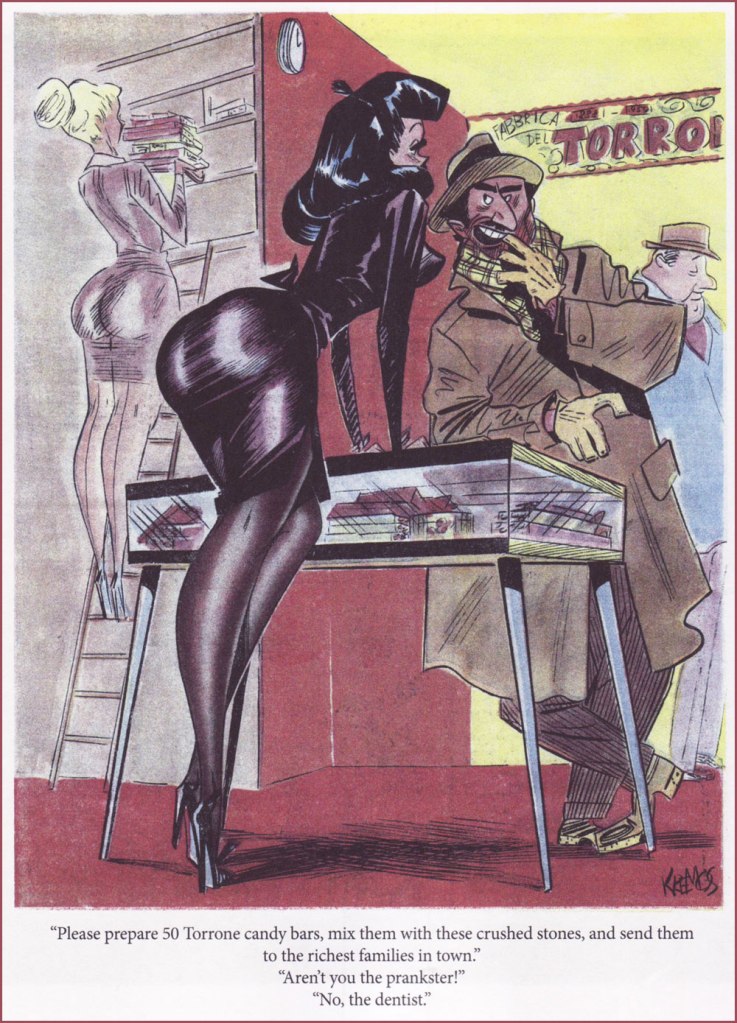
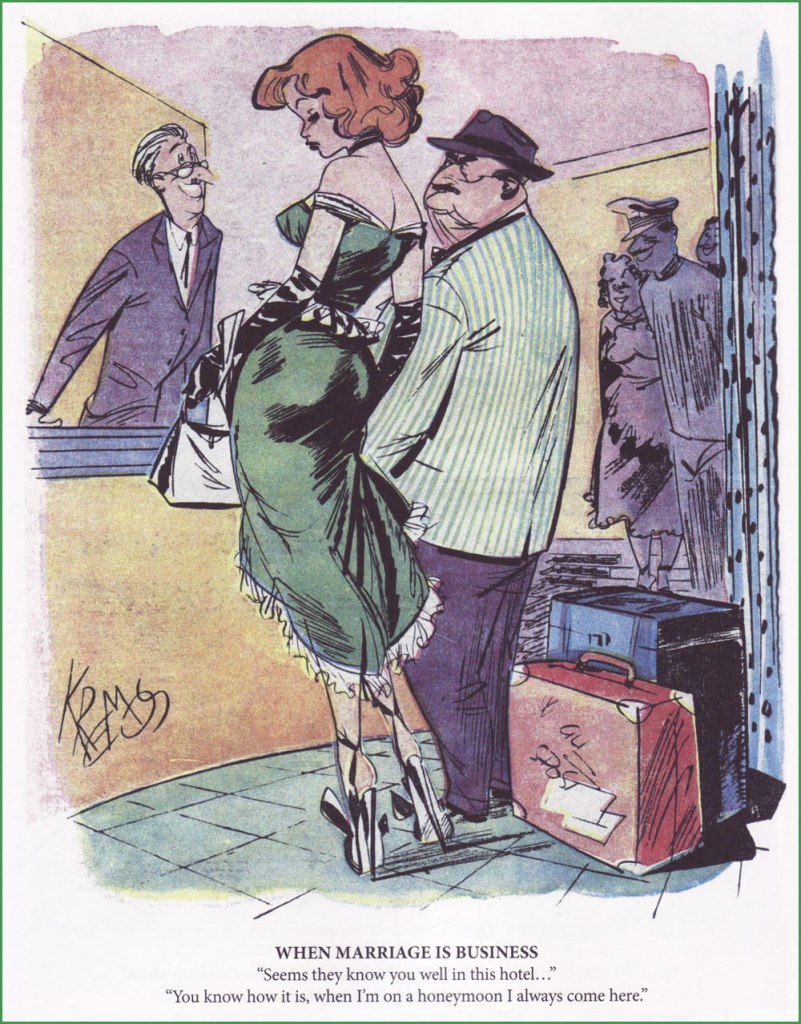
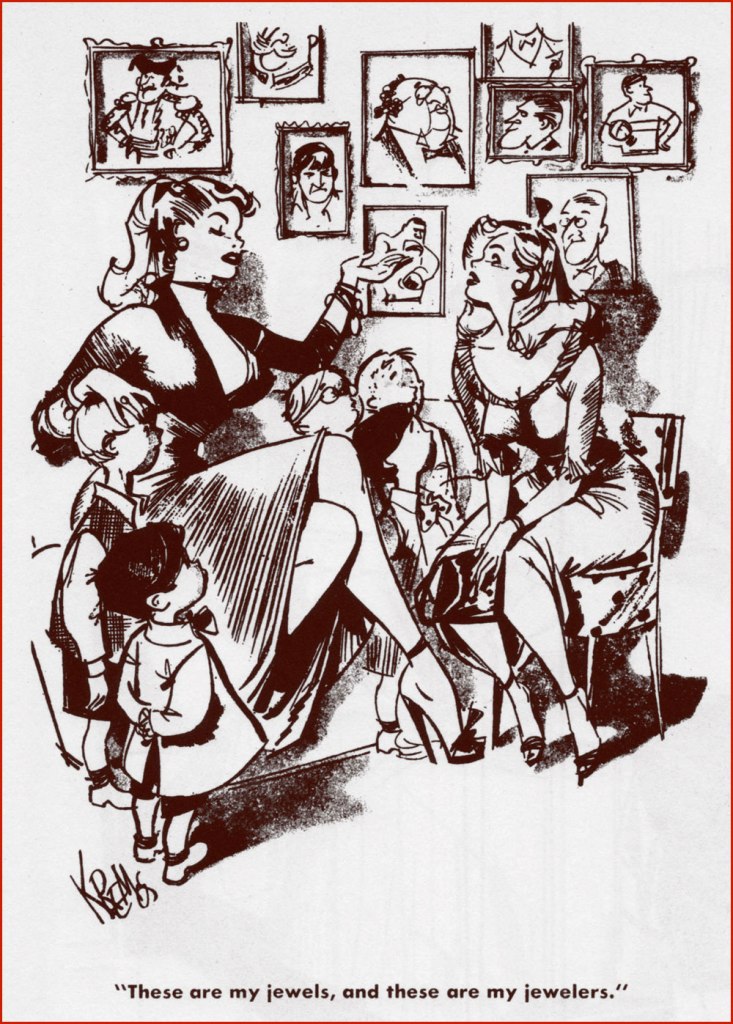
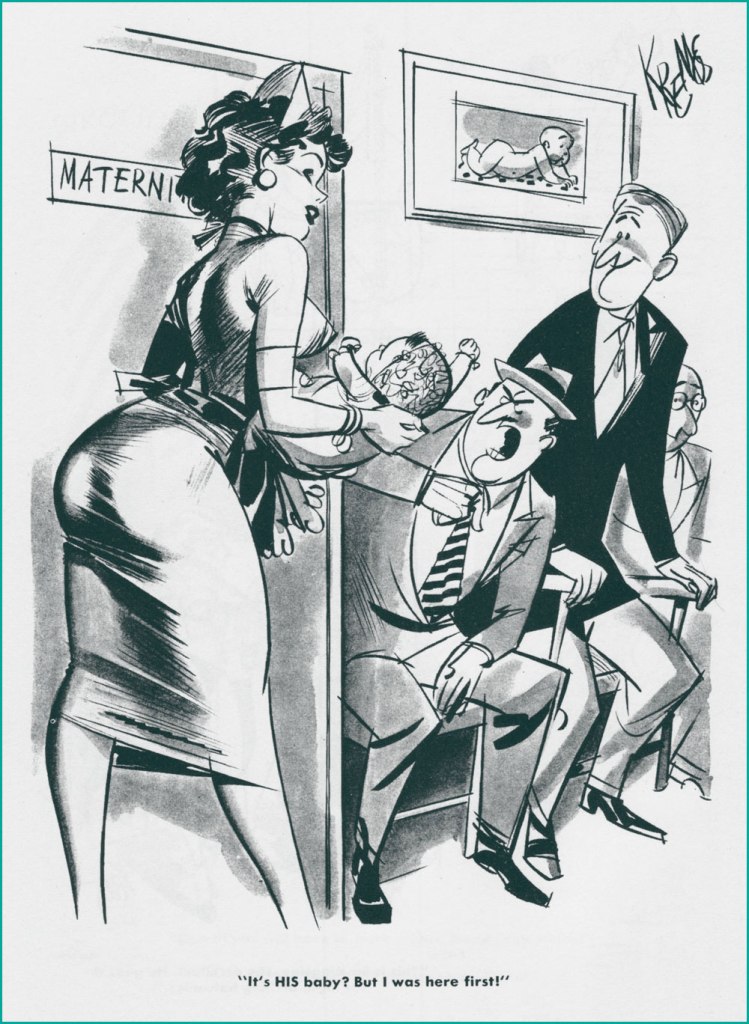
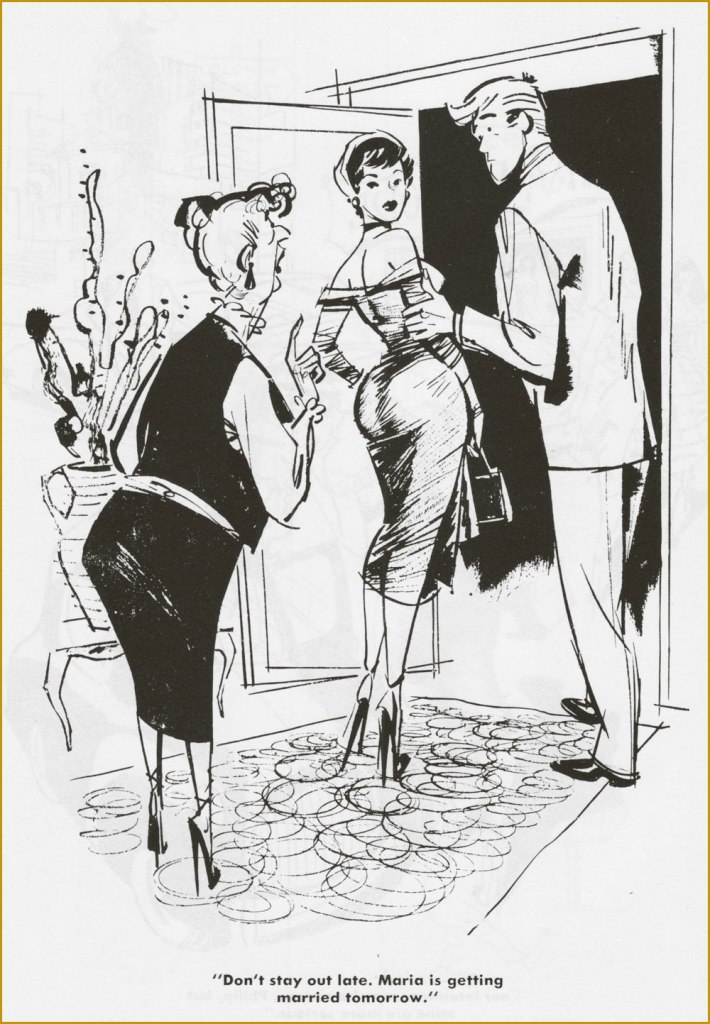
The accomplished Italian graphic designer, animator and illustrator Niso Ramponi (1924-2002), is perhaps most renowned (it’s all relative, but not to actual merit!) under his pinup cartooning nom de plume of “Kremos”.

Ramponi champion Joseph V. Procopio sheds some light on the genesis of this alias:

« Ramponi’s pen name, Kremos, was born of necessity: Like many of his generation, after the war Ramponi was conscripted into the Italian army for a year of service. Loath to abandon his budding cartooning and illustration career but barred by military regulations from working as a freelancer, Ramponi conspired with a friend named Sandro Cremo, who acted as his intermediary to secure and deliver freelance art assignments on Ramponi’s behalf. To maintain the ruse, Ramponi signed his work Kremos, a pseudonym that stuck even after his discharge from military duty. »

My own initial exposure to Ramponi/Kremos’ work came through Lawrence Lariar and Ben Roth’s splendid, but woefully short-lived Best Cartoons From Abroad collections (1955-60), which contrasted favourably against the genteel contemporary American humour anthologies. Fortuitously, Signor Procopio eventually assembled, circa 2015, twin collections of Ramponi’s finest cartoon work, ‘Kremos: The Lost Art of Niso Ramponi‘, volumes 1 (b&w) and 2 (colour). Grab ’em while you can!

Here’s a mixed even dozen of my favourite Kremos cartoons. Buon appetito!

From Travasissimo no. 41 (Jan. 1951).
Worry not: she’s not bad, she’s just drawn that way. From Travasissimo no. 50 (Oct. 1951). I see much kinship between Ramponi and Jack Cole‘s pinup styles, don’t you?
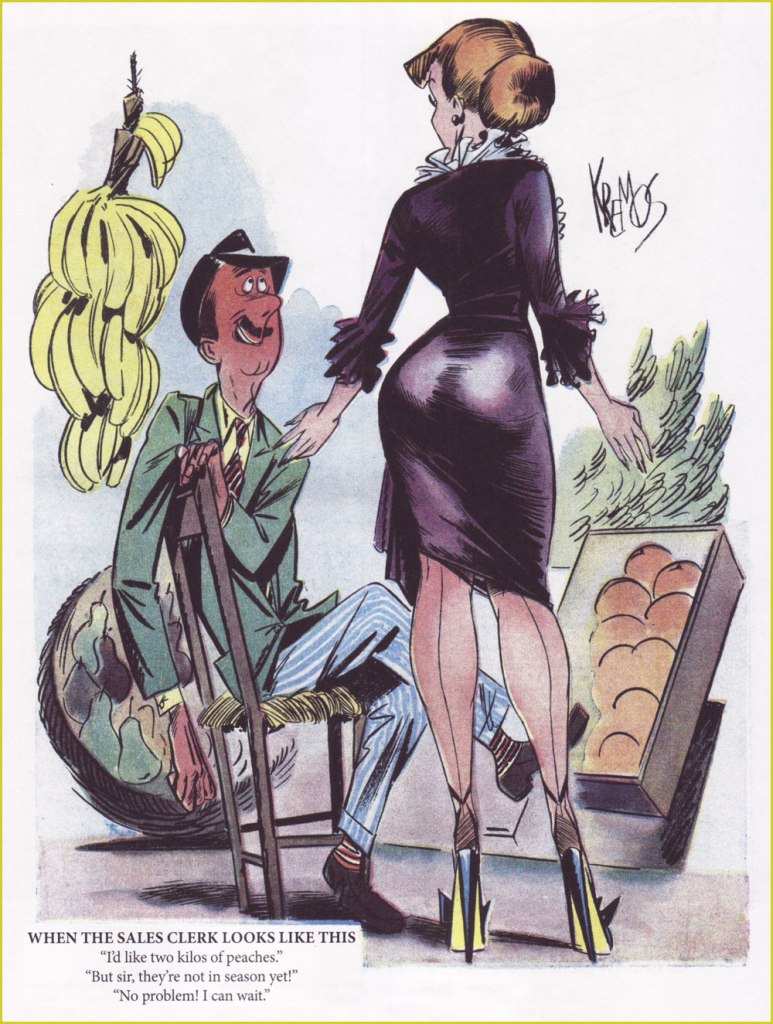
Ah, yes, when one ate fruit and vegetables only when they were in season. I miss that; it seems more honest, less decadent and wasteful. From Travasissimo no. 57 (May 1952). For the strangest reason, this doesn’t leave me craving peaches, but rather… aubergine.
From Il Travaso (Jan. 18, 1953).
From Travasissimo no. 76 (Dec. 1953). I do believe that this is an encore appearance from the previous cartoon’s exam taker.
From Travasissimo no. 85 (Sept. 1954); translated version from Best Cartoons From Abroad 1955, my inaugural, unforgettable brush with the Kremos aesthetic.
From Travasissimo no. 88 (Dec. 1954). The caption was completely rewritten for the cartoon’s English-language appearance in Best Cartoons From Abroad 1955, edited by Lawrence Lariar and Ben Roth. The original gag went: Husband: “You know, dear… I took some swimming lessons from the lifeguard because I wanted to surprise you…
Wife: “Now?”
Husband: “No, in April!
From Il Travaso –“The overflow” for you English speakers (May 26, 1958).
From Il Travaso, circa 1958; reprinted in Best Cartoons From Abroad 3, edited by Lariar and Roth.
From Il Travaso, circa 1958; also reprinted in Best Cartoons From Abroad 3.
From Il Travaso, circa 1958; again reprinted from Best Cartoons From Abroad 3. Those American editors loved their Kremos. I love the word “pappagallo” which, in Italian slang, means a wolf… autrement dit, a randy ragazzo.
From Il Travaso, circa 1959; reprinted in Best Cartoons From Abroad 1959, edited by Messrs. Lariar and Roth.

-RG

Jean Gourmelin: Tenants of the Void

« It’s true that Gourmelin’s world has everything to unsettle the general public: it contains as much horror as black humour, as much morbidness as sombre poetry. But to classify his drawings in a well-defined genre is a hopeless enterprise, and we well know how our times need clear, idiotic and exact labels. This relegates Gourmelin to some fuzzy area, a sort of no man’s land where one can find anything — even fanatics — but never a thing to eat or to drink. » — from the artist’s presentation in the anthology Les chefs-d’œuvre du dessin d’humour* (1965, Les éditions Planète; ).

While France’s Jean Gourmelin (1920-2011) started out as a painter and practiced — and often mastered — scores of artistic techniques and media (etching, technical drawing, sculpture, stained glass, wallpaper design, and so on…), he’s more commonly remembered for his stark black and white, wordless pen and ink drawings. Even as they remain open to interpretation, their power and eloquence are undeniable.

While his earliest drawings appeared in print sporadically from 1951, his crucial turning point was his 1961 encounter with Belgian writer-historian Jacques Sternberg, who encouraged Gourmelin to emphasise, in his work, idea over form. This canny shift in approach soon landed his newly-galvanised work in the pages of Planète, crucially, but also those, just as notable, of Bizarre, Midi-minuit Fantastique, Pariscope, Hara-Kiri… with occasional forays into other media, for instance some striking production design for a 1967 TV adaptation of Gustav Meyrink‘s classic novel, The Golem. Here’s an unexpected (and fine!) article in English about Gourmelin’s work on the film.

Here, then, are some (dark) highlights of Gourmelin’s work in the 1960s.

This one is entitled « En famille ».
Ever had one of those weeks?
This piece appeared in Les chefs-d’œuvre de l’épouvante (1965, Les éditions Planète), accompanying Claude Farrère‘s classic 1928 short-short story, Le Train perdu, which you can read here (in the original French). Gourmelin also provided the anthology’s arresting cover and frontispiece artwork. Maybe next time…

-RG

*It says something (flattering, if you ask me) about the Gallic character that Gourmelin’s work would fall under the category of “humorous”. We’re a looong way from, say… Dave Barry.