« True friends stab you in the front! » — Oscar Wilde
First, the update: we’re off to Belgium for a much-needed vacation… which is frankly incompatible with our usual Hallowe’en Countdown.
Surely you can still get into the spirit of the season by revisiting any of the eight previous editions.
We’ll still try to post as often as possible, and I promise you that the topics all will honour the mischievous spirit of All Hallows’ Eve.
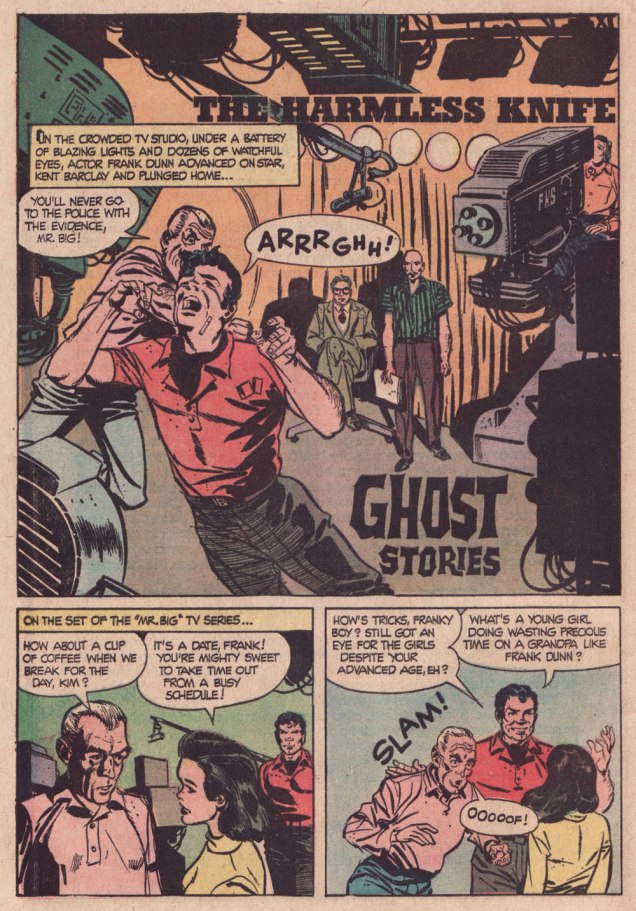
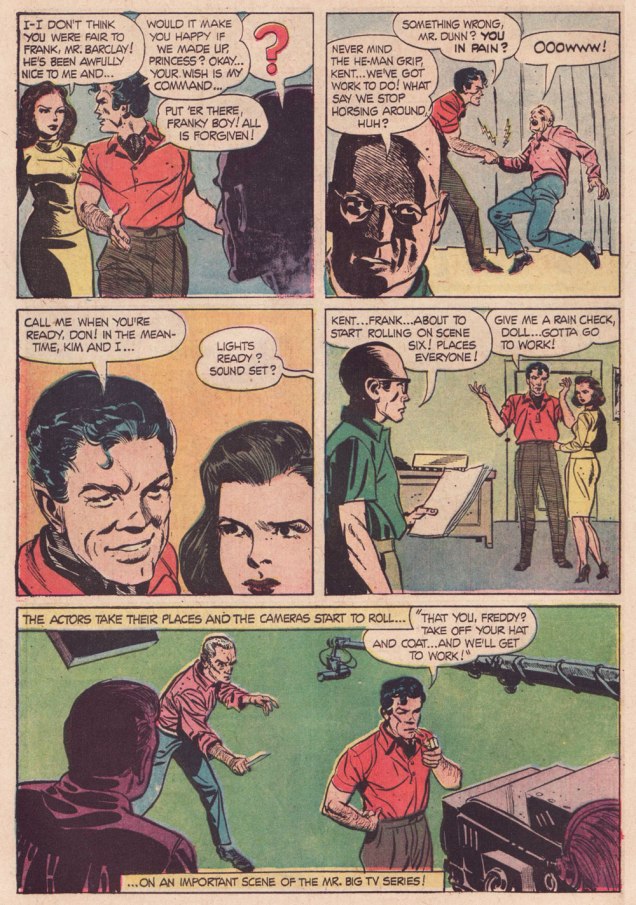
To wit: a few years ago, George, exalted founder of trefology… and assiduous friend of WOT?, asked me to track down — and hopefully feature — an elusive story he recalled from his callow youth. He described the plot, which rang a bell… at least that’s what I said at the time. Last month, he gently reminded me of my mission and, this time, I’m seeing it through.
And so here’s The Harmless Knife from Ghost Stories no. 14 (June 1966, Dell), later reprinted in Ghost Stories no. 34 (Oct. 1972, Dell)… which is where George encountered it.
Here’s his reaction:
THAT’S IT! Ah, I remember it well.
I’m pretty sure I bought that comic at a little roadside grocery near Strawberry, CA. We usually spent most of the summer on the beach, and comic books were an essential part of my day.
My mom loved the area so much she eventually moved there (with all my comics in tow—so, in a manner of speaking, my Dell horror comic returned home).
As was generally the deplorable case with Dell, no credits. Therefore… writer unknown, but pencils and inks by Frank Springer (1929-2009).
.
.
.
.
.
Amusingly, I’d featured another story, A Room With a Dreadful Secret — from the very same issue! — a few years ago. Read it so I won’t have to repeat myself needlessly… thanks!
« Well, as everyone knows, once witchcraft gets started, there’s no stopping it. » — Mikhail Bulgakov
Another, day, birthday post? Well, it’s still a mighty special occasion, as we’re celebrating the one-hundred and fourth birth anniversary of our beloved Samm Schwartz (1920-1997).
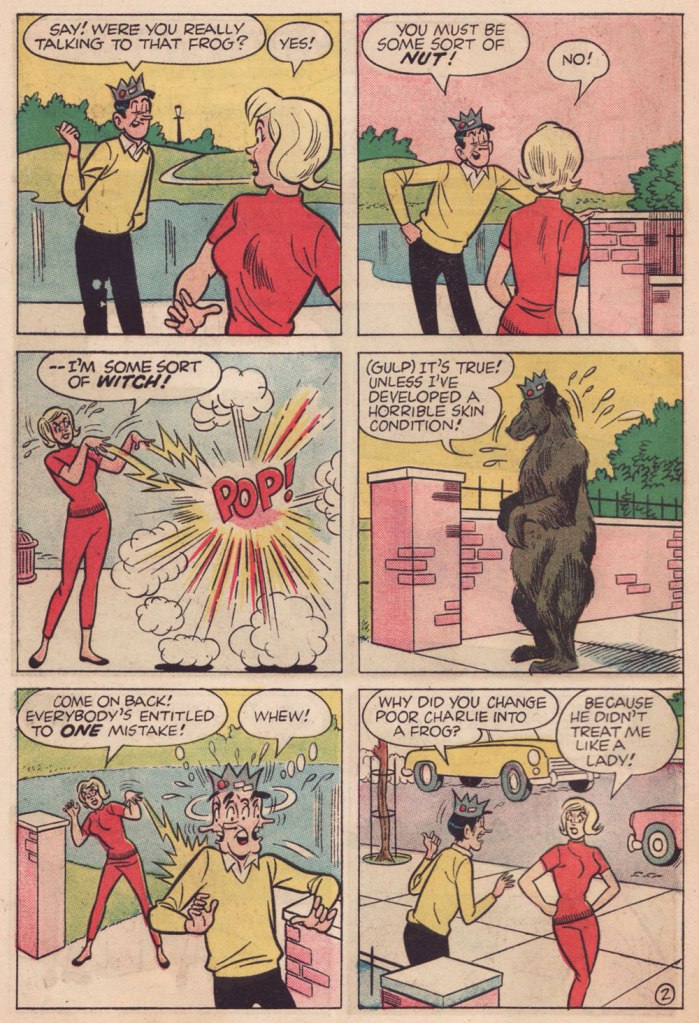
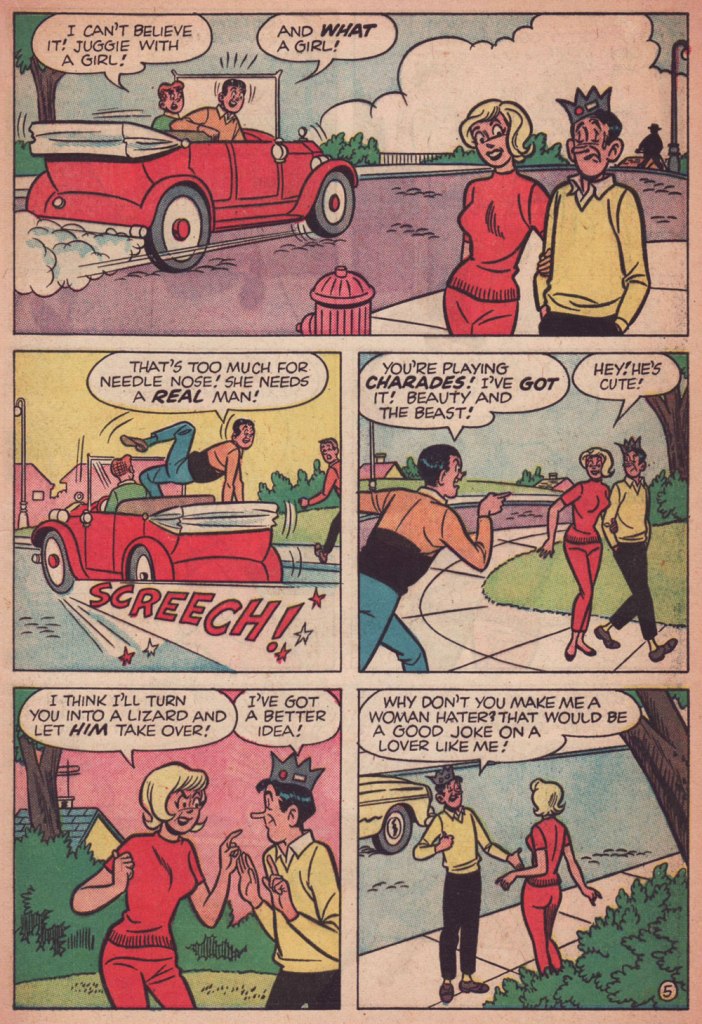
One year ago to the day, we gave you Love in Broom, first of a loosely connected two-parter (‘loosely connected’ is the strongest dose of ‘continuity’ one could expect from the Archie folks in those days).
Of course, the now-named Samantha the witch — and the rest of the cast, notably Jughead and Reggie — appear to have forgotten all about their earlier encounter… but that’s just fine: the burden of continuity is one I’m glad to see sloughed. The chief constant is that our witch has quite a yen for Jug.
Switch Witch first appeared in Archie’s Pal Jughead no. 123 (Aug. 1965, Archie). It was presumably scripted by George Gladir (not coincidentally co-creator of Sabrina the Teenage Witch a couple of years earlier), and unmistakably illustrated by Mr. Schwartz. Of Mr. Gladir, Mark Evanier wrote: « Even when they had no credits, you could generally spot a George Gladir script. They were a little wackier, a little sillier, a little more human in their humor. And oh, yes — they were usually fresher than the ones crafted by younger writers. » This certainly fits the bill.
I had to buy three different copies of this issue to get a complete one… and it’s still a brittle mess. But hey, my ordeal, your benefit!
« I’ve had great success being a total idiot. » — Jerry Lewis
Hey, it’s Bob Oksner‘s birthday! I hope you’ll forgive me for double-dipping into that particular well — he also illustrated our earlier Mary Marvel entry — but I still wanted to highlight the occasion, incorrigible Oksner booster that I am.
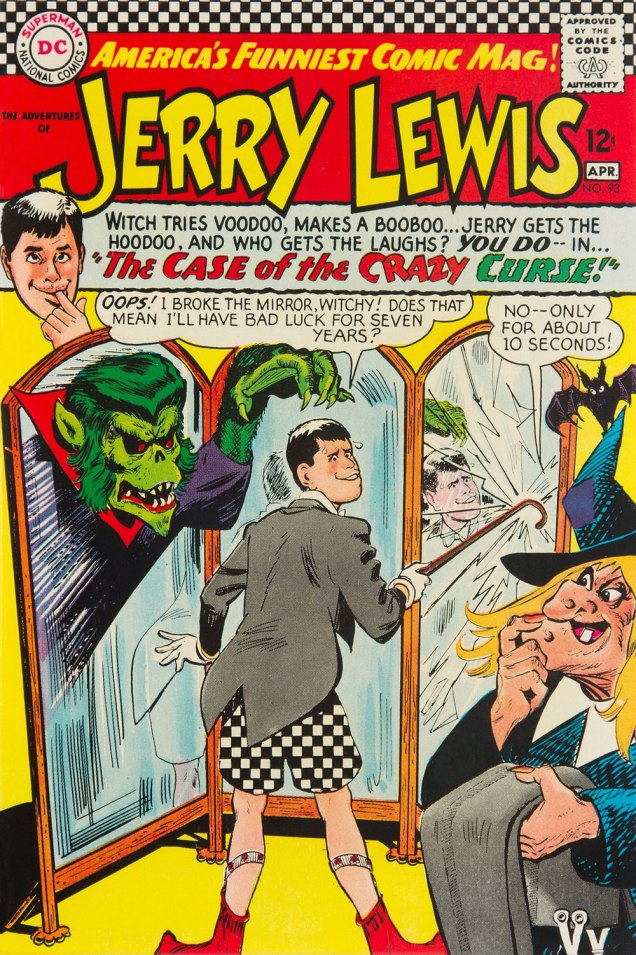
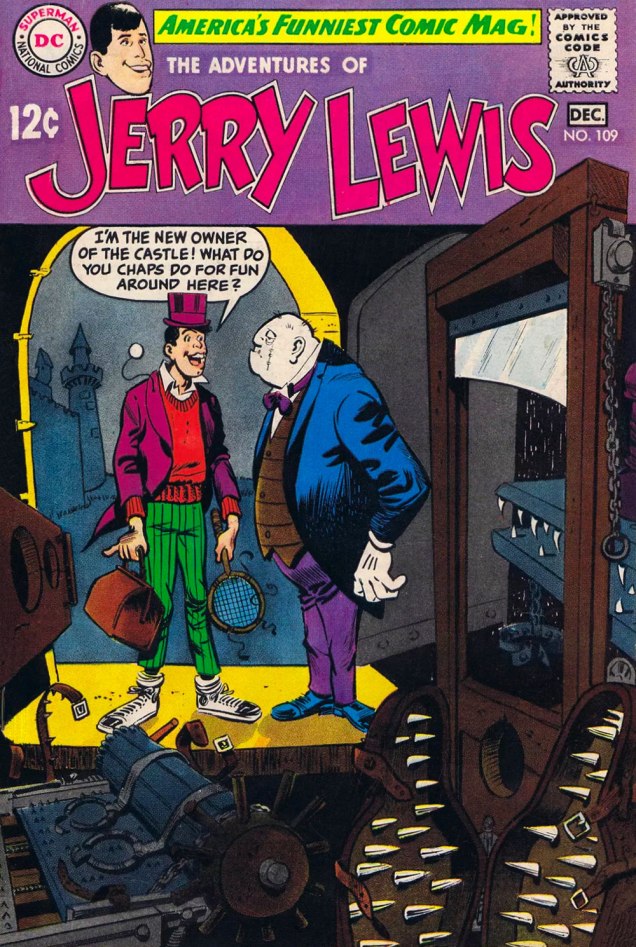
DC’s Jerry Lewis (or Bob Hope, or Dobie Gillis…) comics weren’t even remotely funny, but they sure boasted some spiffy covers. Here’s a gallery of the most Hallowe’en-appropriate, from the pencil and pen of Mr. Oksner.
This is The Adventures of Jerry Lewis no. 87 (Mar.-Apr. 1965, DC).This is The Adventures of Jerry Lewis no. 88 (May-June 1965, DC).
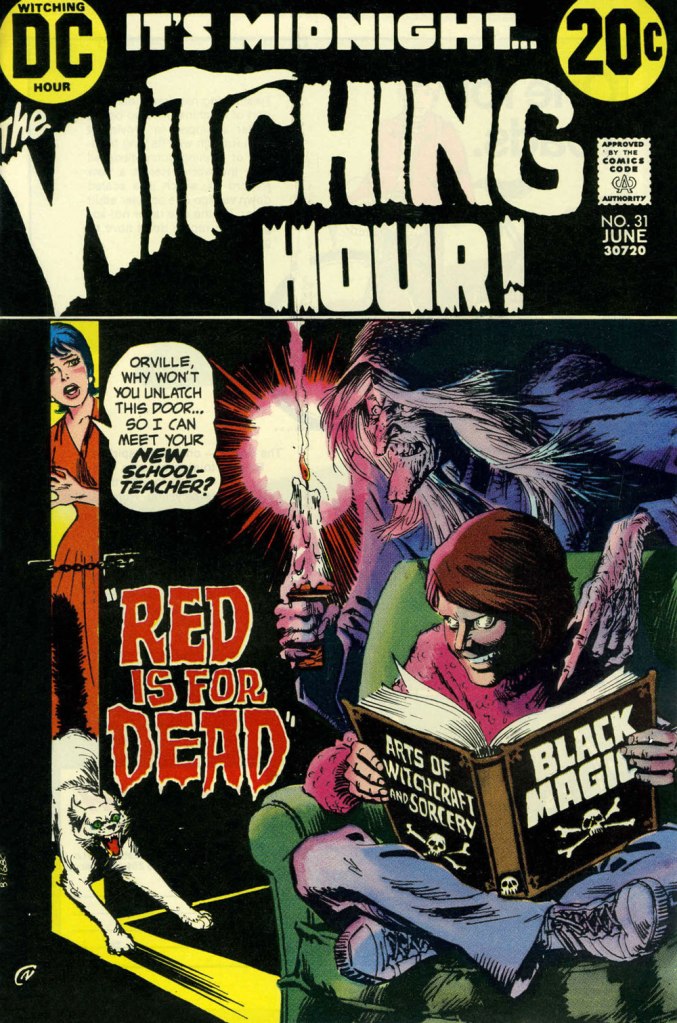
TAoJL editor Murray Boltinoff (1911-1994) had a soft sport for that particular cover concept, since he recycled it, eight years later and with a different tone, for another title he was overseeing:
Here, for comparison, is It’s Midnight… the Witching Hour no. 31 (June 1973, DC). Art by Nick Cardy.This is The Adventures of Jerry Lewis no. 93 (Mar.-Apr. 1966, DC).This is The Adventures of Jerry Lewis no. 94 (May-June 1966, DC).This is The Adventures of Jerry Lewis no. 98 (Jan.-Feb. 1967, DC).And finally, The Adventures of Jerry Lewis no. 109 (Nov.-Dec. 1968, DC). This one’s another riff on a rather hoary theme.
George Mendoza* does it again! I first stumbled upon Mr. Mendoza’s works through one of his collaborations, The Good Luck Spider: And Other Bad Luck Stories (1970, Doubleday), which was illustrated by the avuncular Gahan Wilson. Since I also happen to be a Mercer Meyer (last mentioned on this blog by ds in 2018!) fan, I did not tarry nor hesitate when I learned, a few years ago, of a dusty tome entitled The Crack in the Wall & Other Terribly Weird Tales (1968, The Dial Press).
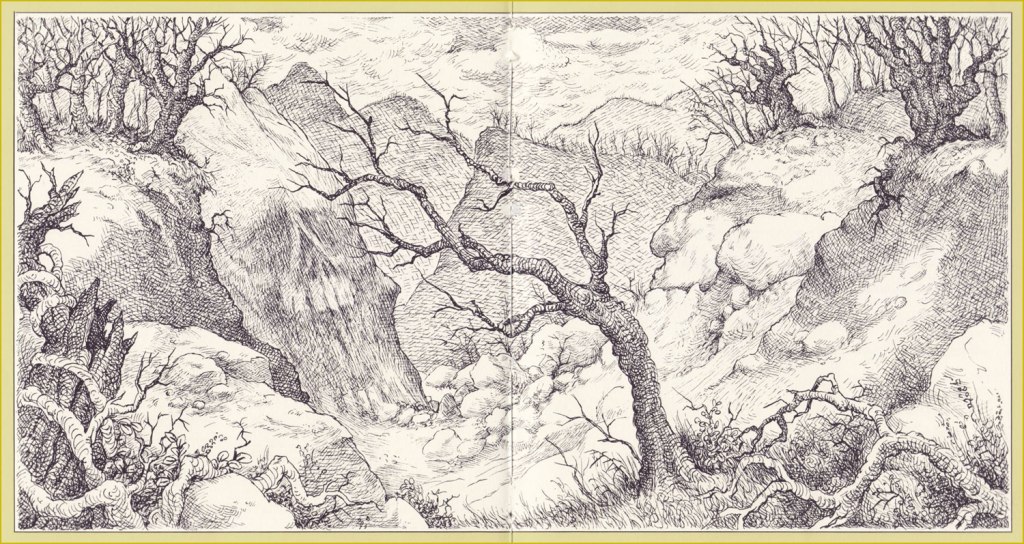
Here’s a look at the book’s first yarn, The Devil’s Pocket, a sort of cautionary folk tale/urban legend.
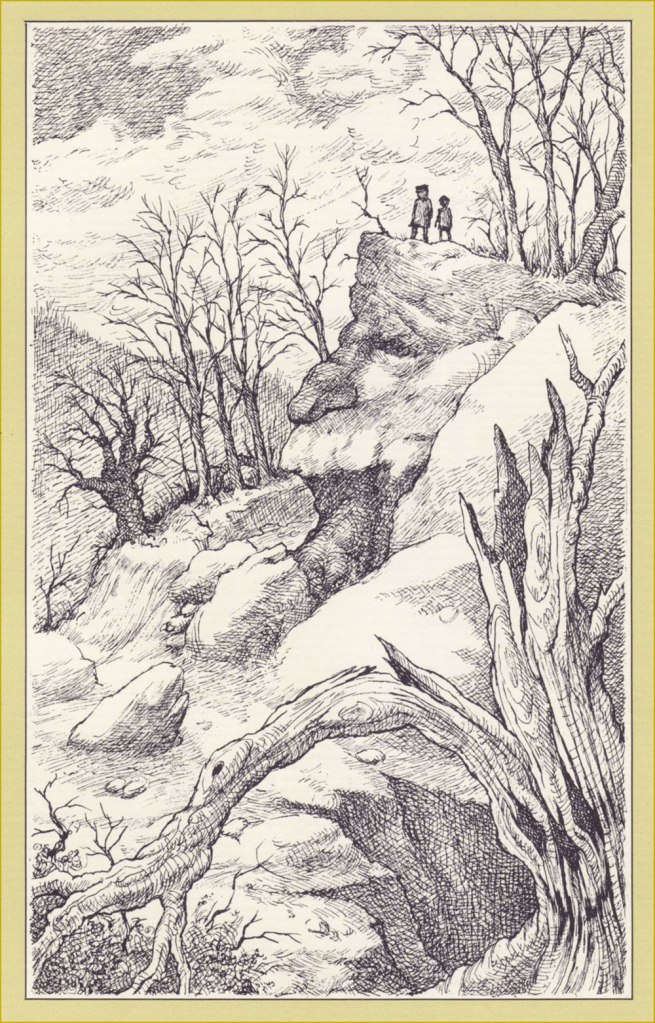
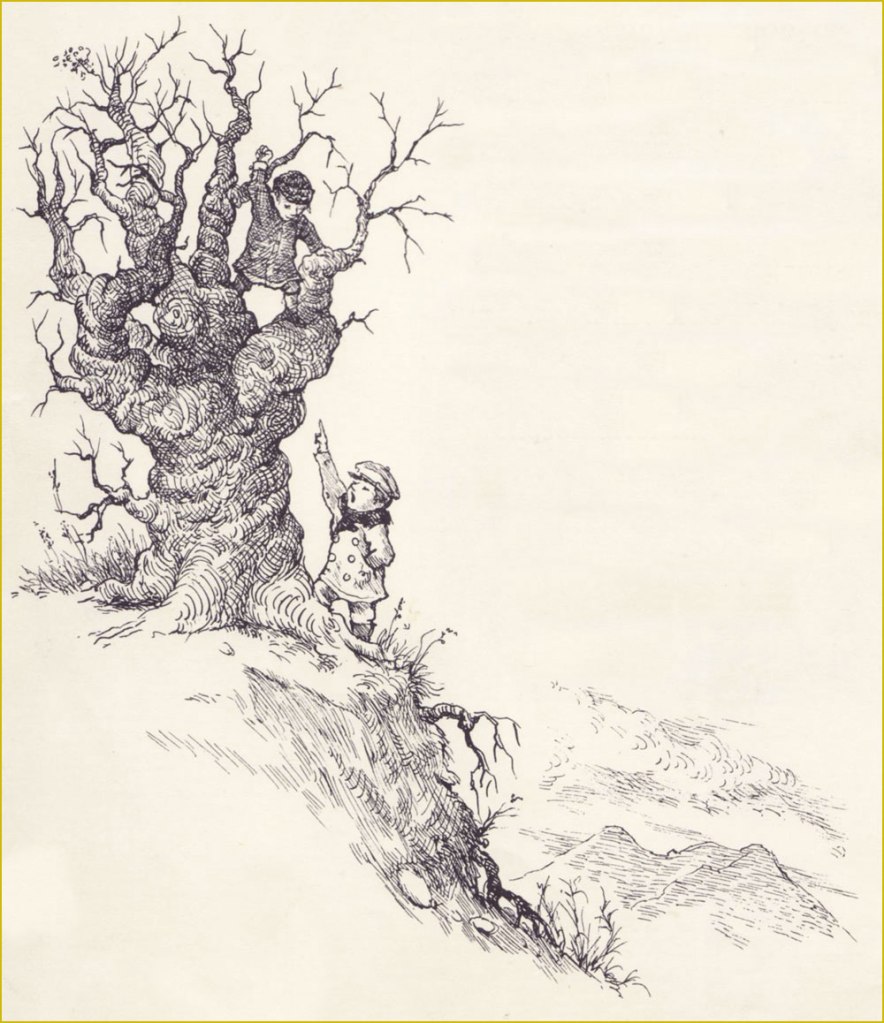
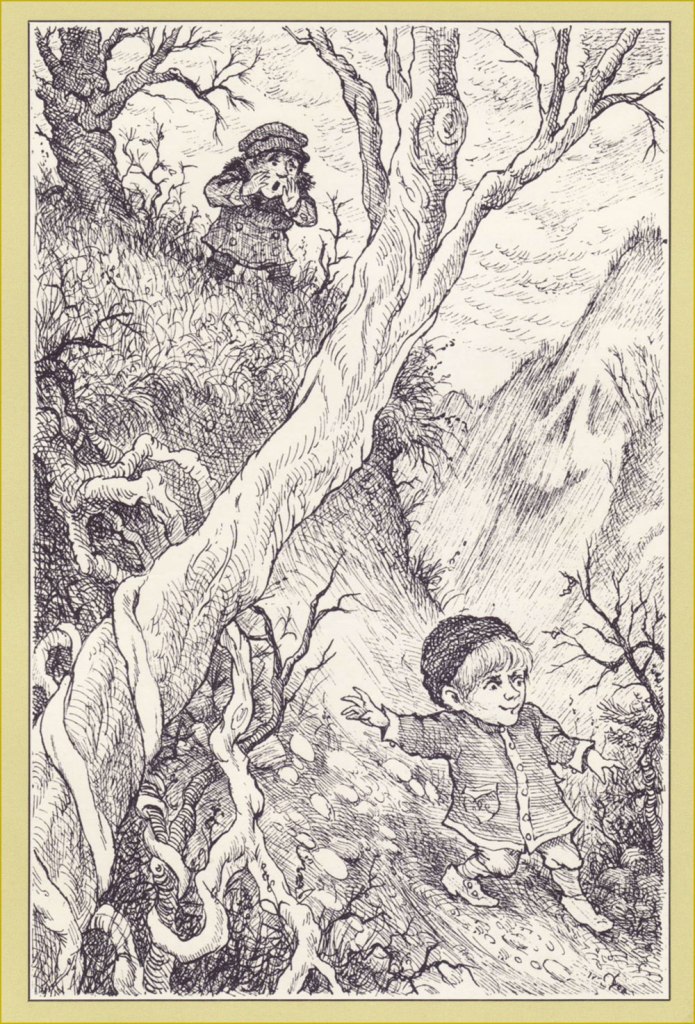
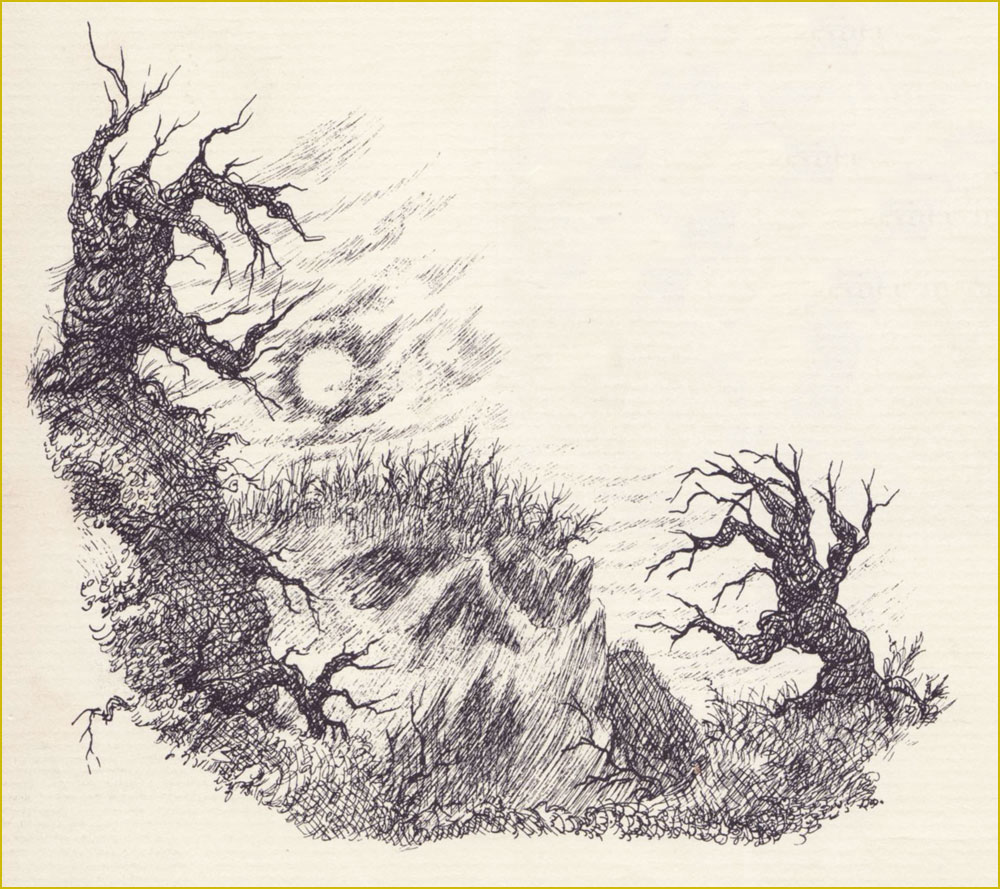
« It was an old, abandoned Vermont quarry, and the two brothers were forbidden to ever climb down into it or even go near it. » « … their father would look up under his glasses, and in his deepest voice he would say, “It’s the devil’s pocket — don’t ever throw a penny into it!” »« But the more stories the boys heard about the quarry, the more fascinated they became with the devil’s pocket. »Mercer Meyer’s uncanny ability to invest the inanimate with animist animosity is on virtuosic display here.« “I’m not afraid,” said Marty, looking down into the bottom of the quarry. “I’m going to throw a penny into it!” »« But it was too late. Marty was already running down the side of the quarry. » « I’m scared,” Marty whimpered, stuffing the penny into his pocket. “Let’s go home.” »« That night both boys had the same dream. They dreamed that the devil’s pocket was calling them, calling them to give back the penny. »« Perhaps it was only a dream, but when morning came, the two brothers found themselves huddled together in one bed, and the penny was gone! »And here’s the front cover of this delightful tome. It’s not cheap, but not entirely unaffordable, either.
-RG
*kudos to fellow blogger Antmusic for digging up as much as could be reasonably dug up about the elusive Mr. Mendoza.
I was recently asked to feature some more Archie artists (other, that is, than my perpetual favourites Samm Schwartz and Bobs Montana and White); while I suppose Orlando Busino (1926-2022) is perhaps an oddball choice to fulfill such a request, it’s his birthday today — he would be ninety-eight years old… but hey, ninety-five is still a pretty good run.
Mr. Busino passed but briefly — but oh so memorably — through the halls of Archie: from 1960 to 1962, before he understandably went off to greater success and better-paying gigs: The Saturday Evening Post, Reader’s Digest (I can confirm that they paid really good rates), McCalls, Good Housekeeping, Boys’ Life… you name it.
Mark Evanier recalls fondly that short Archie stint, where Busino was among the few artists allowed to work outside of the house style and march to his own tune: « I first became familiar with his work, as did my pal Scott Shaw!, during a brief period when Busino worked for the Archie people. His work appeared in Archie’s Madhouse and a wonderful, not-sufficiently-recognized comic book called Tales Calculated to Drive You…BATS. It was kind of like “What if Charles Addams had produced MAD?” Scott and I both remember exactly which newsstand we were patronizing in December of 1961 when we glimpsed the cover of Bats #3 and grabbed up our respective copies. » [ source ]
Signor Busino’s lovely cover for the first issue of Tales Calculated to Drive You Bats (Nov. 1961, Archie).
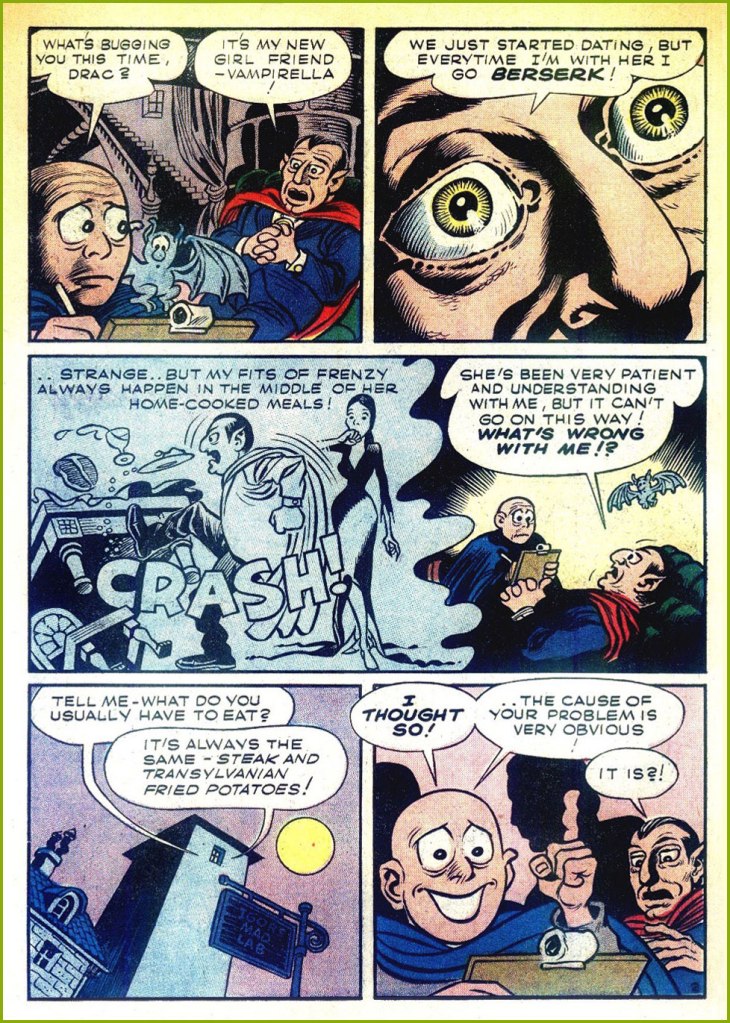
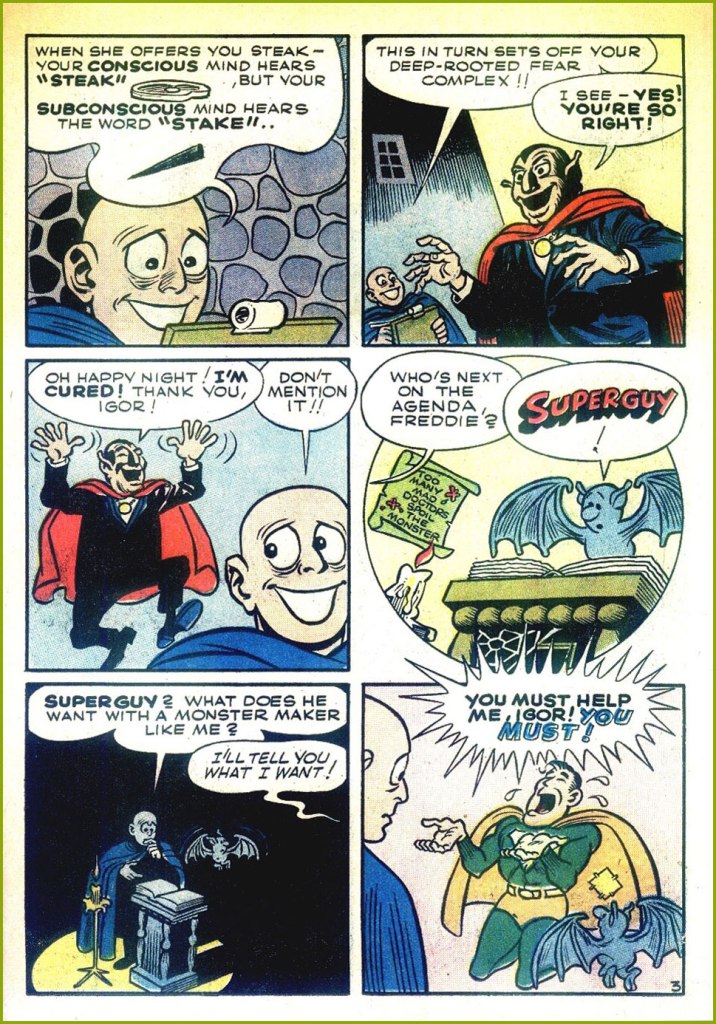
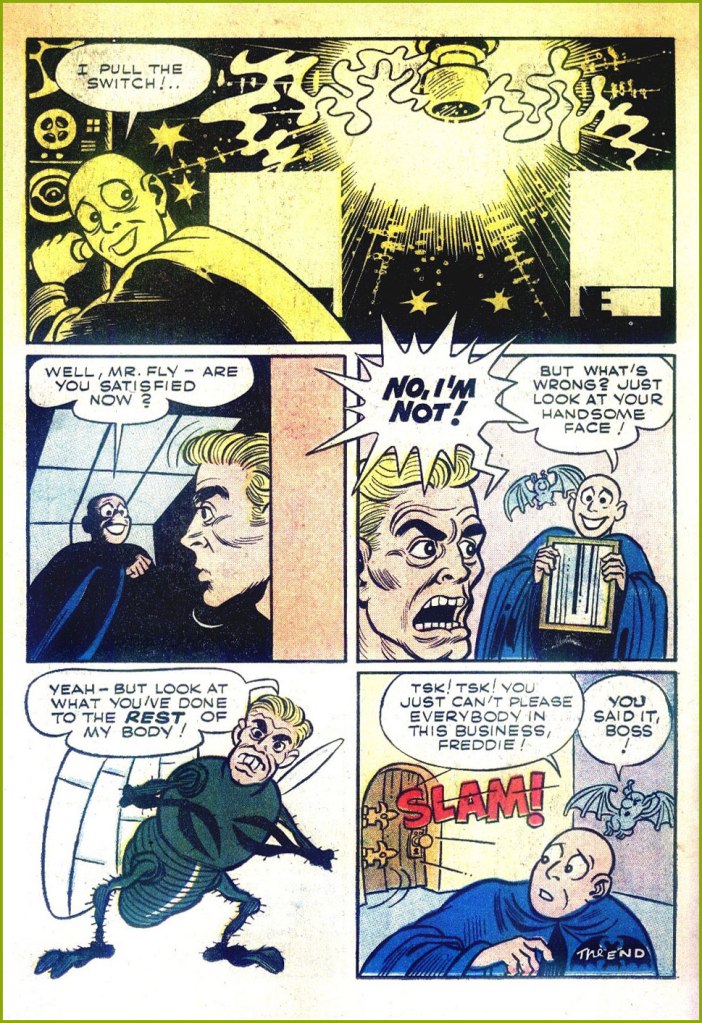
However, our featured tales hails from Tales Calculated to Drive You Bats no. 3 (Mar. 1962, Archie):
And here’s a little something extra from Archie’s Madhouse no. 14 (Aug. 1961, Archie).
Painting your nose the right shade of dill pickle green would also work.
« It’s easy, from our 21st-century perspective, to condemn Waldman as nothing but a sleazy bottom-feeder eking out a precarious living by pirating the marginal dregs of an industry he was only peripherally a part of. » — Don Markstein
It’s been suggested to me several times that I should devote some column space to Rostislav “Ross Andru” Androuchkevitch (though my co-admin ds certainly has, by dint of the man’s long stint on Bob Kanigher’s regressive Wonder Woman), but the trouble is, unlike the many of my generation who, presumably more through circumstance than discernment, imprinted on Andru and Gerry Conway*‘s The Amazing Spider-Man (1973-76), I had already lost all interest in Spidey after Steve Ditko‘s rightly acrimonious 1966 departure; I just wasn’t buying what they were selling.
My own, somewhat less agreeable run-in with Andru was through his ill-advised residency as DC’s principal cover artist (under “art director” Vinnie Colletta) paired up with Dick Giordano**, who reportedly slapped inks, and likely some coffee, on a few covers each day before catching his train to work.
However, as I always say, with a career that lengthy and prolific, there’s bound to be exceptions. Which brings me to a comment a dear friend and old comrade in ink-slinging made — just this week! — regarding an Andru cover I featured during last month’s Hallowee’n Countdown:
« Mmmm… that Ross Andru cover. Such a delightful classic! Who knew he was so good back then compared to his later work, which was pretty damn awful. »
So, like John Severin, Andru (with inking partner, for better — though mostly for worse — Mike Esposito in tow) was approached by Israel Waldman to gussy up his shoddy, oft-illegal reprints.
Redoubtable comics historian Don Markstein (1947-2012) did a breathtaking job of compiling a dossier of the whole I.W./Super Comics operation, complete with the cross-referencing of most — if not all — the ‘borrowed’ properties and personages. Essential reading if you’re at all intrigued by crafty reprobates of Waldman’s ilk.
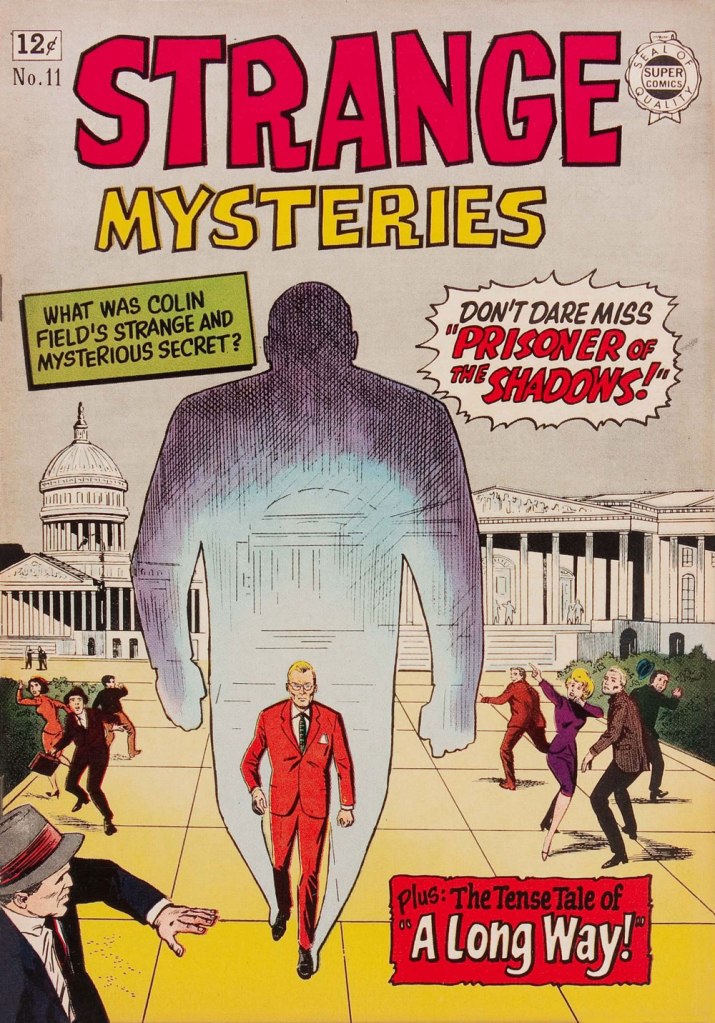
This is Doll Man no. 11 (1963, Super Comics). Read it here!This is Strange Mysteries no. 11 (1963, Super Comics). Read it here! The 60s Marvel colouring gimmick of leaving the background grey to make the foreground figures stand out (not to mention spare much time and effort) leads me to think that resident Marvel hues-man Stan Goldberg (no Rube he) may have been moonlighting for Izzy Waldman. This is Danger no. 12 (1963, Super Comics). Read it here!
Mr. Markstein on The Black Dwarf: « The first question, of any character, is — why? Putting on a bizarre outfit to battle crime on an unpaid, freelance, anonymous basis seems pretty strenuous, requiring strong motivation. But his isn’t much. He just hates crime, no particular reason cited.
Next, what’s with the name? He was shorter than average, but not so short he qualified as a Little Person. Santa Claus would reject him on sight. And would identifying himself as a dwarf instill fear in criminals, confer fighting prowess on himself, or in any other way be an asset in his war on evildoers? It just sends a message that he’s small, so the evildoers can probably beat him up. At least he made up for his shortcomings by packing a gun. »
This is Mystery Tales no. 16 (1964, Super Comics). Read it here!This is Strange Planets no. 16 (1964, Super Comics). Read it here!This is Danger no. 16 (1964, Super Comics). Read it here! I was tempted to quip that it takes tremendous chutzpah to hire the then-current Wonder Woman artist to illustrate a cover featuring one of her numerous knock-offs… but I’m pretty sure Waldman, hardly a comics insider, didn’t know and didn’t care.
Of this particular breed of characters, Markstein wrote: « Superheroes first turned up in American comic books just before World War II, and flourished during the early war years. Especially flourishing were a sub-species of superhero that wrapped themselves in the U.S. flag like a cheap politician. Inexplicably, these are referred to as “patriotic” heroes, indicating that wearing the flag like Captain Freedom or Miss Victory was deemed a mark of patriotism higher and more… »
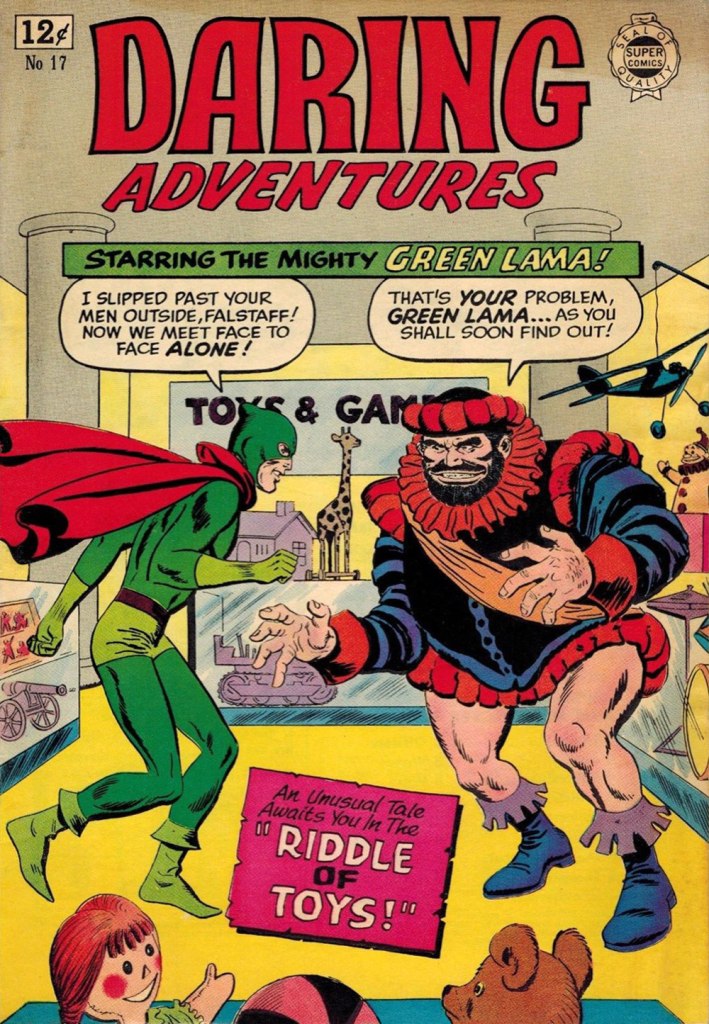
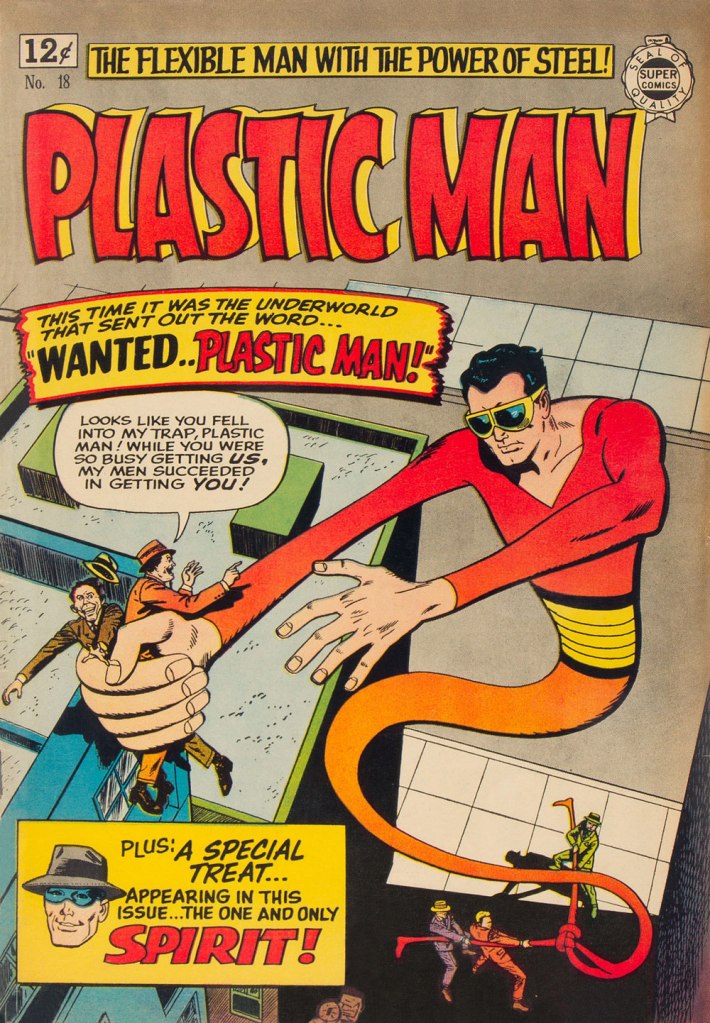
This is Fantastic Adventures no. 16 (1964, Super Comics). Read it here!This is Strange Mysteries no. 17 (1964, Super Comics). Read it here!This is Daring Adventures no. 17 (1964, Super Comics). Read it here! « May I have this dance, Green Lama? » « Why, I thought you’d never ask, Falstaff! »This is Police Trap no. 18 (1964, Super Comics). Read it here! In my opinion, this is one of the best-composed of Andru’s Super/I.W. covers: very nice sense of depth, though the effect would play out far better without the quite superfluous ‘We proudly present...’ blurb, which breaks the visual flow. I think the guy on the left is a bit ticklish. This is Plastic Man no. 18 (1964, Super Comics). This is actually a pretty spiffy issue, featuring classic work by masters Jack Cole and Will Eisner. Read it here! DC, who owned the character — having bought it from its original publisher, Quality, when it left the field (along with Doll Man, Phantom Lady, Blackhawk…) — would resurrect Plas in 1966. That didn’t click. It wasn’t until the Steve Skeates / Ramona Fradon revival of 1976-77 that someone managed to grasp the appeal of Jack Cole’s unique creation. But again, sales were low. In 1980, Andru would again depict Plastic Man on Adventure Comics covers spotlighting Jean-Claude “Martin Pasko” Rocheford and Joe Staton‘s unfunny, misguided and mercifully brief run. And hey, if you’d always longed to see Andru’s version of Eisner’s The Spirit, this is all you get!
-RG
*Harlan Ellison on Conway, circa 1979: « I mean, the first time I met Gerry Conway, who the hell would’ve known that Gerry Conway would single-handedly ruin the entire comics industry. He’s a classic example of the deification of no-talent in all industries. He’s not good, but he has it in on Thursday. And that’s all they care about. You know, fill them pages. » [ source ]
**taking over from Mike Esposito and actually making him look good in comparison!
Well, I made it through another countdown. Thanks for your interest and support!
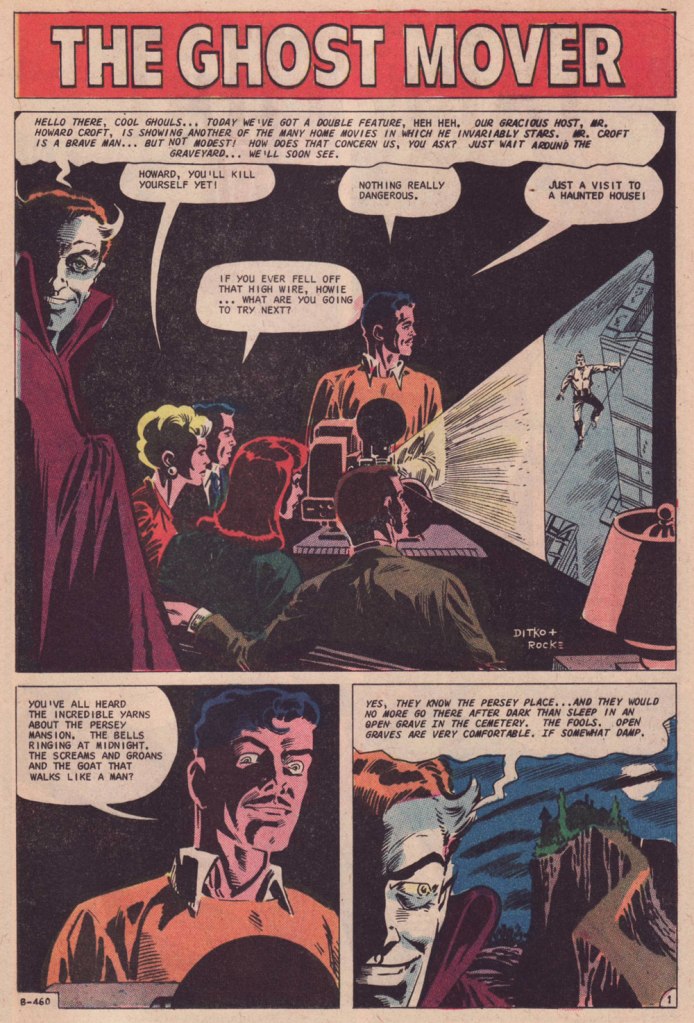
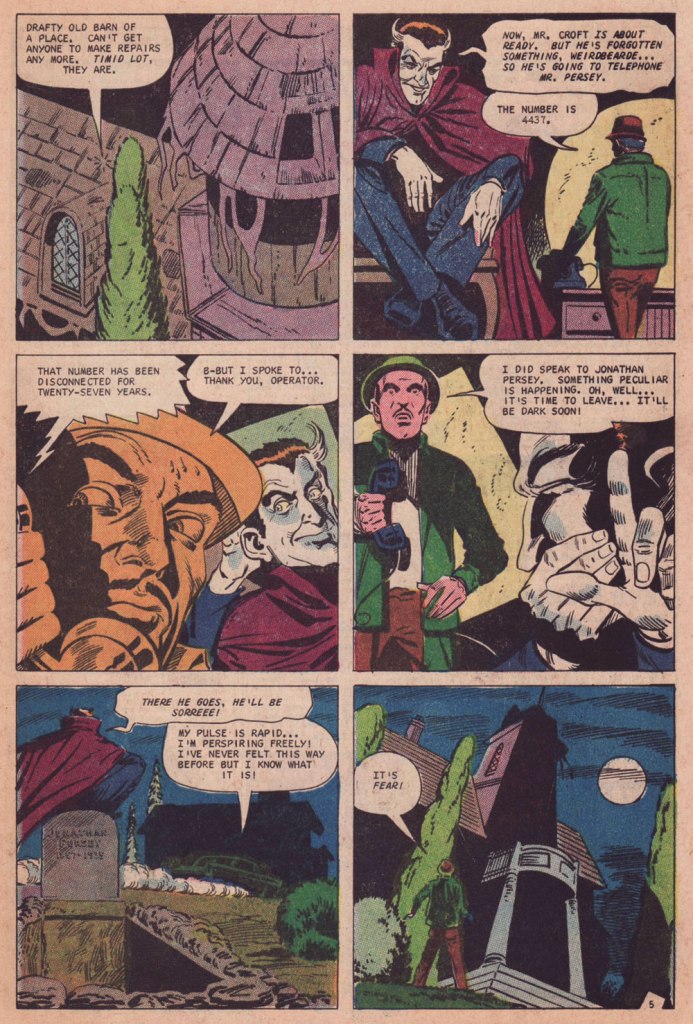
In the proper spirit of the thing, I’ve indulged and reserved my very favourite Hallowe’en treat for last, and that’s a Joe Gill–Steve Ditko chiller — for the second consecutive year!
I’ve always adored this one for its adroit juggling of hushed atmosphere and giggles, its casually dropped hints and layered subtlety. Ditko really had no peer when it came to insinuating his narrator into the visual tapestry. In this case, his first and finest host, Mr. L. Dedd (or I. M. Dedd, depending on the source). Ditko is clearly having a ball.
Unless I’m mistaken, Steve Ditko always inked himself (and sometimes gloriously inked Kirby) until 1964, when George Roussos as ‘George Bell‘ (seemingly using the wrong end of the brush, sorry) inked Ditko’s pencils on a trio of early Doctor Strange episodes (Strange Tales nos. 123-125, if you must know).
Even while working at Marvel, Ditko (wisely) kept working for Charlton. At his busiest, he was assigned an inker on a revival of Captain Atom, Rocco ‘Rocke’ Mastroserio, and the combination bore splendid fruit. Ditko was one of those cartoonists who laid down the basics in the pencils, then had most of his fun in fleshing them out in ink. Finishing Ditko’s layouts wasn’t a task just any Joe could handle, as the ensuing years would bear out.
And so we’re done, countdown-wise, for another year. If that’s not quite sufficient to slake your loathsome lust, promenade yourself through our bloated-by-now archives, at this point two hundred and seventeen posts strong :
Wishing you all a hair-raising Hallowe’en — thanks for all the creepy loitering!
-RG
*did I imagine that someone (David Mamet?) once said that her name sounded like ‘a bowling ball tumbling down the stairs’? It may have been meant as a compliment.
« This seems to be the Age of the Monsters. Monsters are all around us. They abound on the motion picture-screens, coming from the depths of the sea, from under the Arctic ice, from outer space, or other such unexplored regions. » — Robert Arthur, ghost-writing Alfred Hitchcock‘s introduction to Monster Museum (1965)
As Gold Key comics published fewer ads than most of their rivals, they could afford such frivolities as joke and riddle pages, even in addition to the legally mandated text pages.
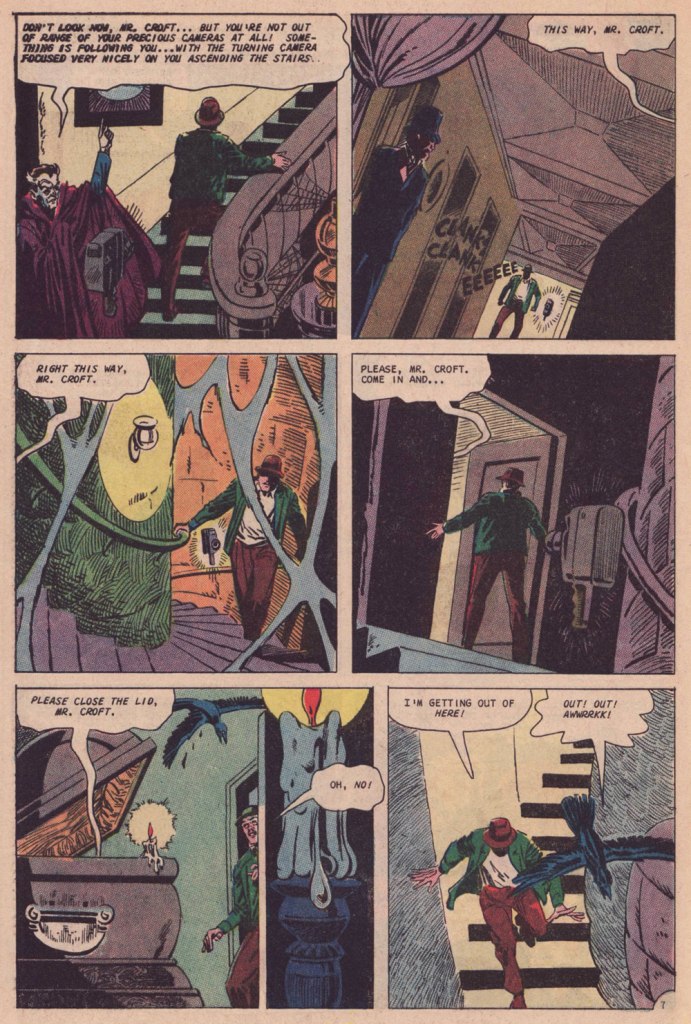
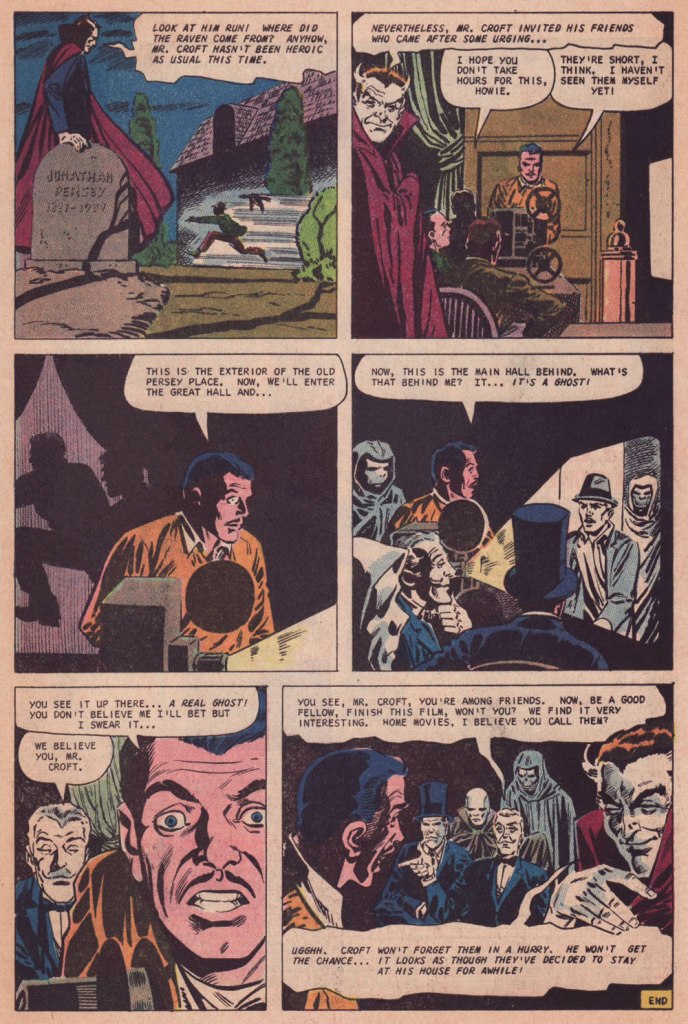
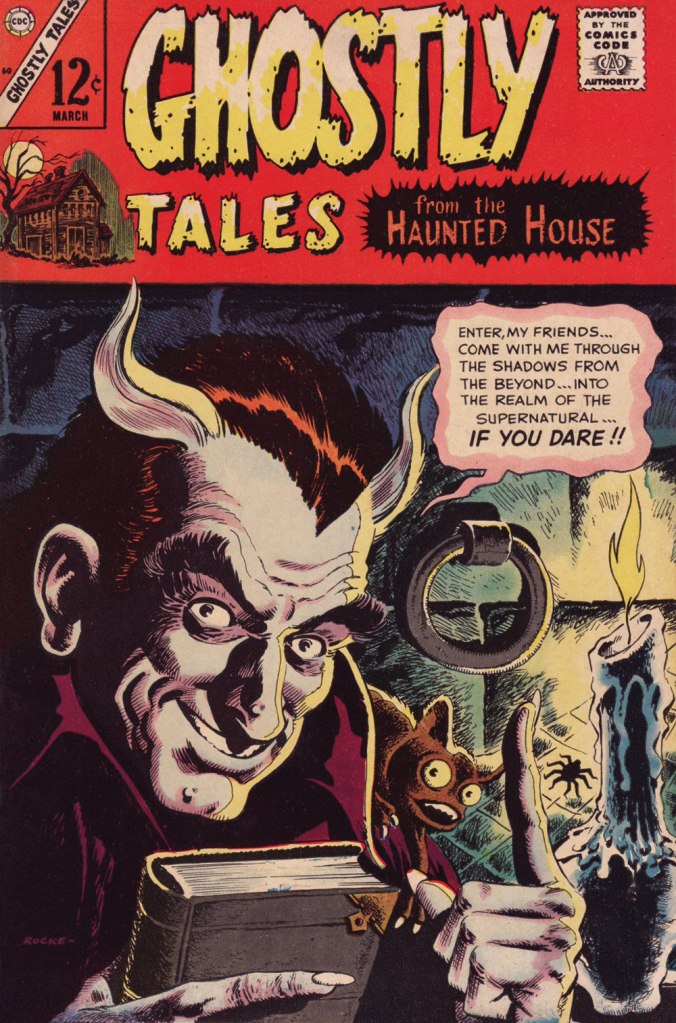
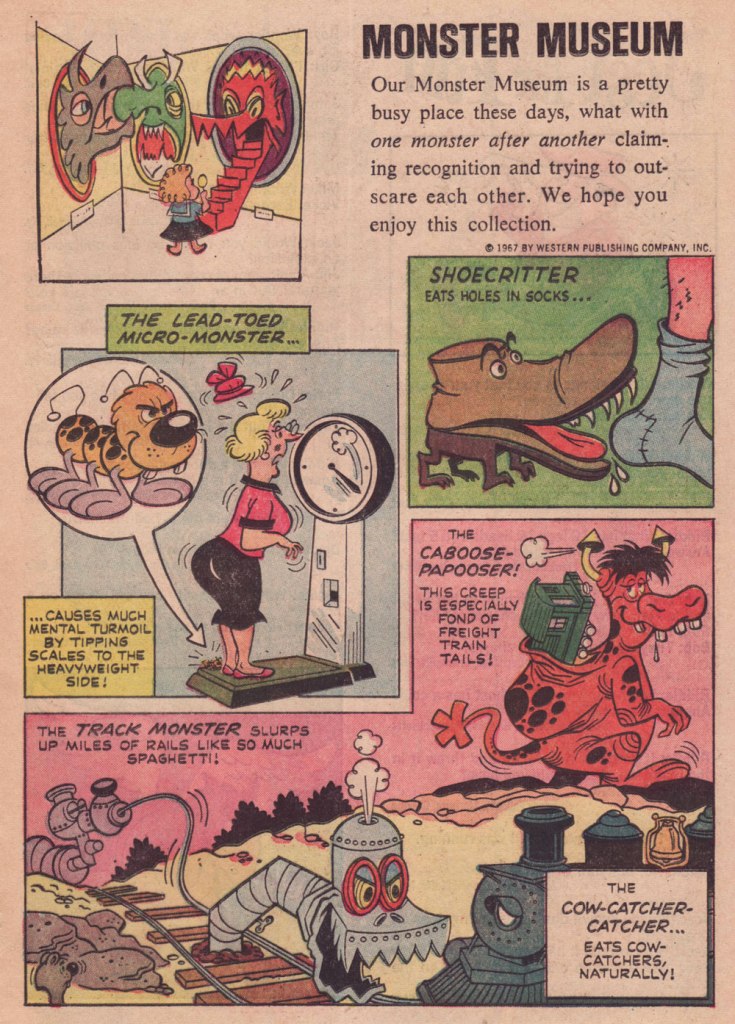
One pleasingly off-kilter feature that appeared in the publisher’s small line of ‘spooky’ titles (Boris Karloff Tales of Mystery, The Twilight Zone and Ripley’s Believe It or Not) was “Monster Museum”. Though it seemingly couldn’t settle on an approach or tone, it was witty, lightweight fun. Here are most of the highlights.
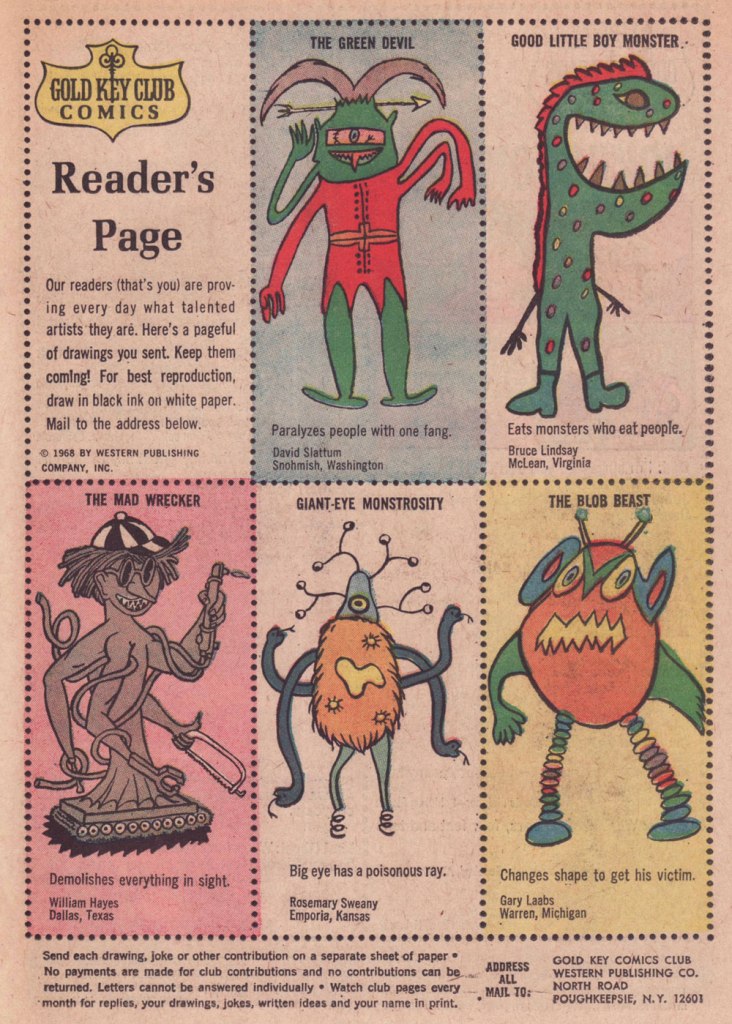
Then, as 1967 gave way to ’68, The Monster Museum became a reader-driven feature… for a single issue, namely Boris Karloff Tales of Mystery no. 22 (June 1968, Gold Key) — and two pages.
I thought it quite charming, brimming with that fascinating little-kid brand of logic we so quickly lose sight of as we ‘grow up’.
« I see a wolf-like thing coming over a dark river — at the shallows — just above a waterfall, the starlight shining up his pelt. I see a brown oak leaf blowing far up in the sky. I see a small bat flying. I see many other things, running under the forest trees and slipping through the highest branches; and they’re all coming this way! » — Ray Bradbury, The Homecoming (1946)
In the early 1960s, before Warren Magazines handled the task more decisively, there was a minor reunion of EC alumni — Joe Orlando, Reed Crandall, George Evans, Wally Wood, Williamson and Torres — at Gold Key. It resulted in some lovely art but minor, toothless stories. Even without the Comics Code, Gold Key’s material was safe as milk.
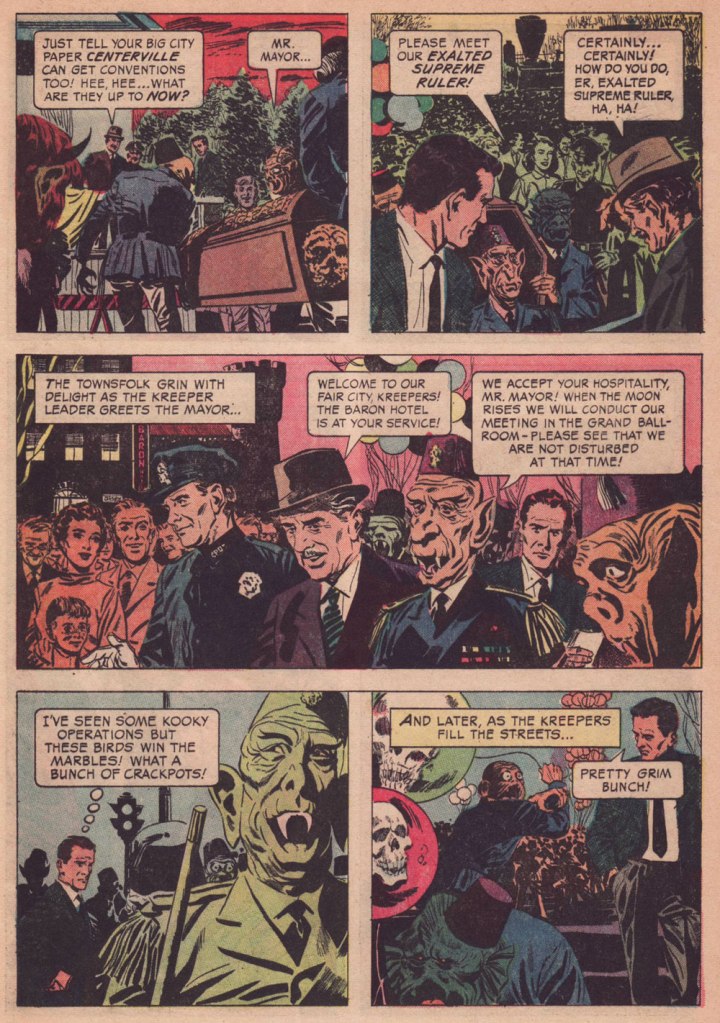
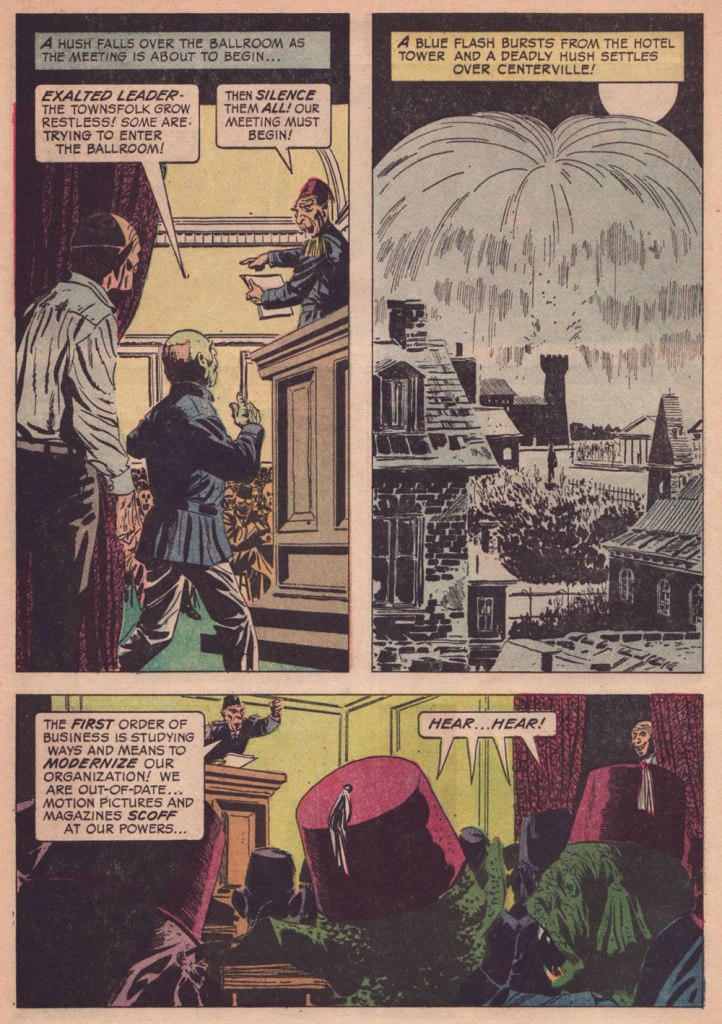
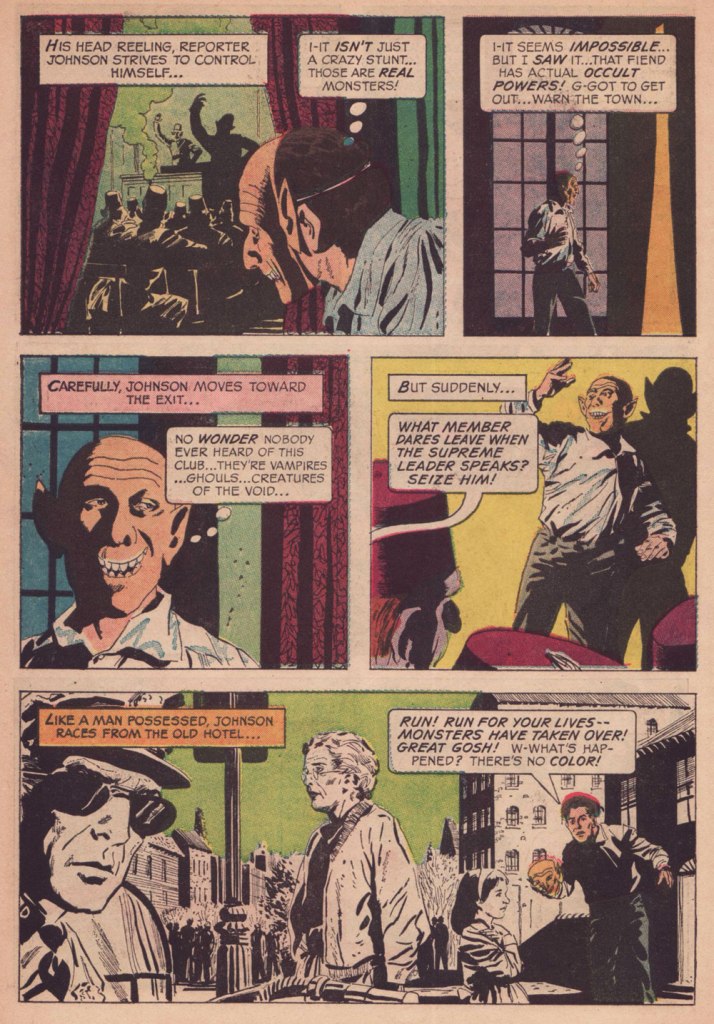
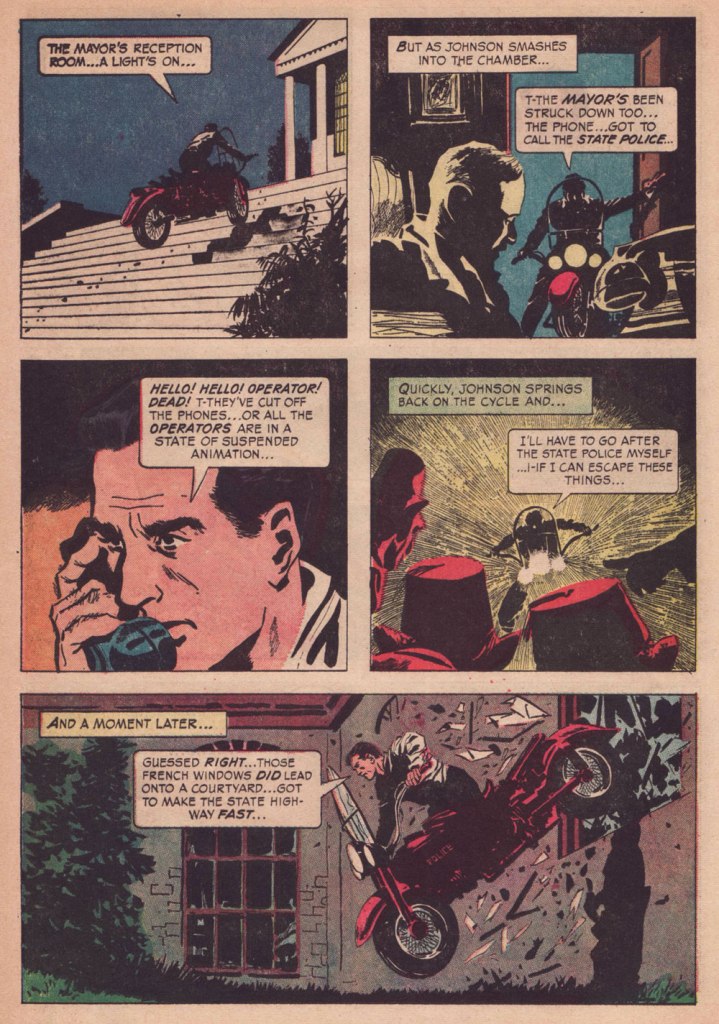
Here’s my favourite of the lot, a tale published in Boris Karloff Tales of Mystery no. 12 (Dec. 1965, Gold Key). I’ve probably tipped my hand with my choice of quote: “The Convention” reminds me of Mr. Bradbury’s timeless The Homecoming [ read it here ].
I like the point the story makes about how most towns — particularly their elected officials — will put up with a lot of obnoxiousness and outright toxicity if it fills up the hotels, bars, restaurants… and whorehouses.Really, a burning cross to vanquish evil… in 1965, given the headlines of the day? By the way, Angelo, that’s not a good Karloff.
Typically for Gold Key comics of that period, no credits are provided, but I’m strongly inclined to attribute authorship to Dave Wood (1926-1974), who happened to work for both Gold Key and DC at the time. It’s his kind of plot. Furthermore, as we’ve learned from the case of Steve Skeates, Julius Schwartz and The Spectre, there are instances when editorial changes to your original plot are significant enough that you can sell it again to someone else… and mum’s the woid.
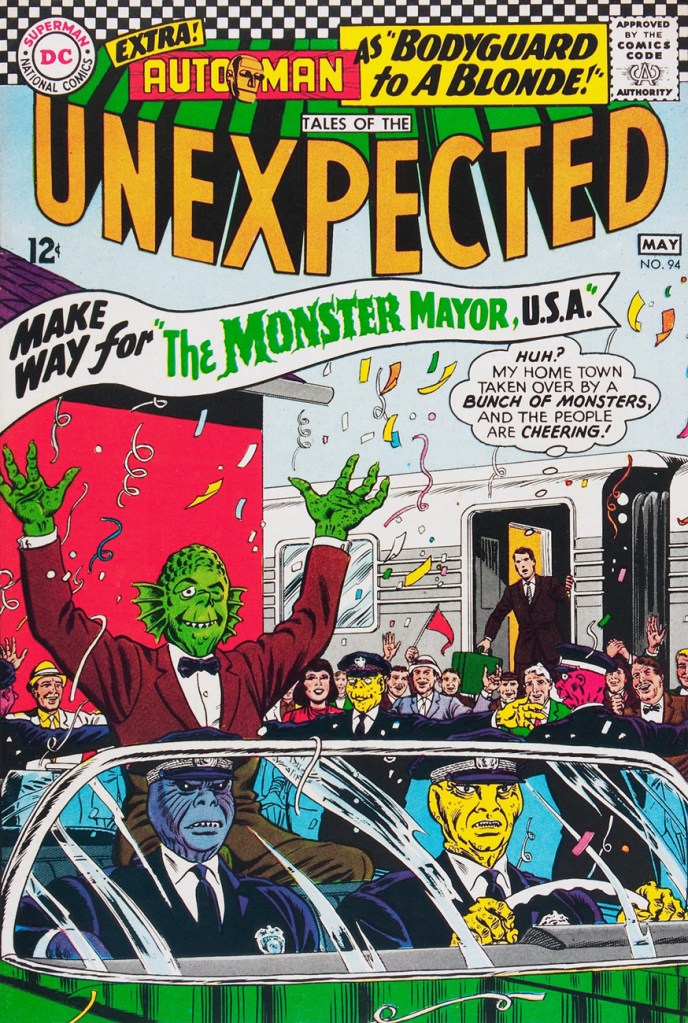
What am I getting at? Why, our bonus, a cover-featured Dave Wood gem from the following year and with a quite familiar theme.
« Our appearance makes little difference… so long as we are in power! » Evidently, political cynicism is nothing new. DC’s Jack Schiff-edited “mystery” titles were a lot of utter bushwah, but oddly mesmerising if one surrendered to the spirit of the thing. And to a Bernard Baily and Mort Meskin fan, they offered a pretty sweet cornucopia. “The Monster Mayor, U.S.A.” is one of a series of oddball situations triggered by an invisible (but green!) sentient cloud from outer space called “The Green Glob“. The sort-of series ran in TOTU 85 to 98, then 100, 102 and 103. Weirdies!
This is Tales of the Unexpected 94 (April-May, 1966). Cover by Murphy Anderson.
-RG
*One might reasonably argue that Tatjana Wood (née Weintraub in 1926), who anonymously assisted her then-husband on some EC stories, is also eligible. She’s ninety-seven if she’s a day!
« I wish I could blend into the background / I’ve no excuses for my lack of guts / What is it about me that draws attention? » — Kevin Godley & Lol Creme, Punchbag
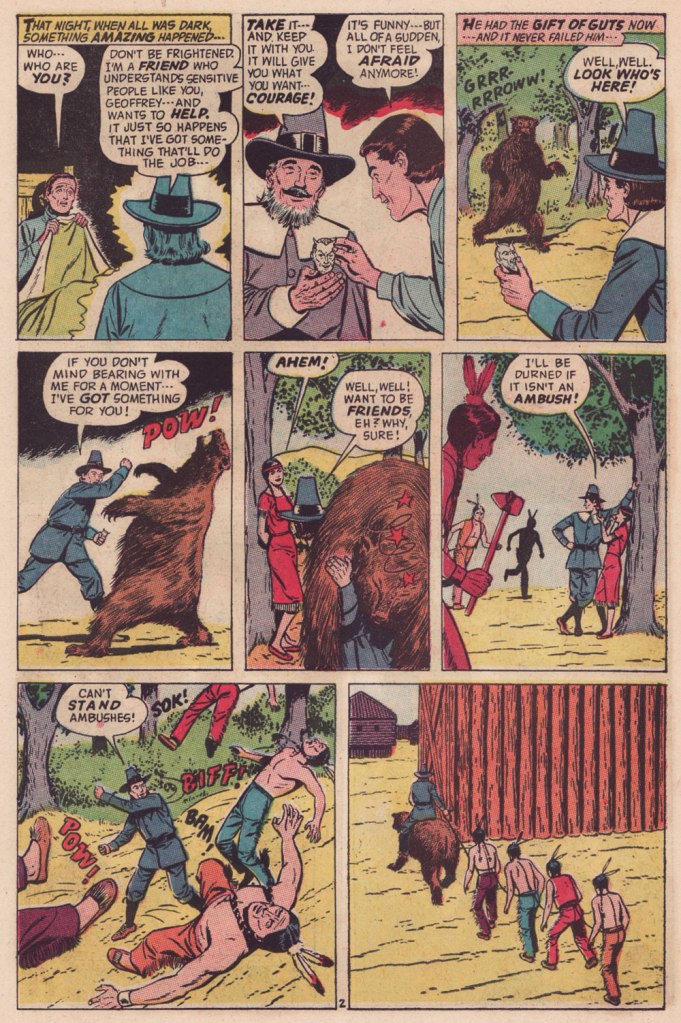
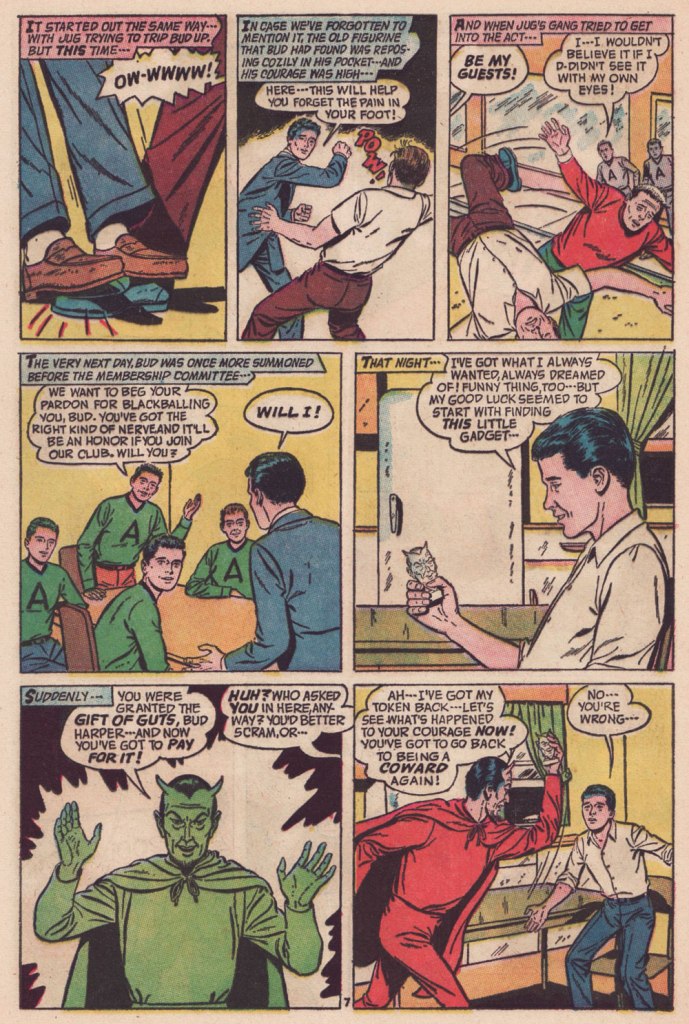
Today, let’s delve into the little-frequented wilds of that underrated little publisher that could, American Comics Group (ACG), 1943-67. The brand is chiefly recalled today for a pair of notable features: ACG pioneered the ‘horror’ anthology comic book with its Adventures Into the Unknown (1948-1967, 174 issues) and, in 1958, brought Herbie Popnecker, Richard Hughes and Ogden Whitney‘s ‘little fat nothing‘ to an unwary and undeserving world. ACG was co-founded and, briefly, co-owned by one of the field’s great villains, Harry Donenfeld.
But that’s all trivia in the end. ACG’s special appeal rests for the most part on the shoulders of one man of many monikers: writer-editor Richard E. Hughes (1909-1974).
I’ve already enumerated the man’s bona fides a couple of years back, when I featured one of his most celebrated (by ACG readers) tales, The People Versus Hendricks!, so I refer you to that particular entry.
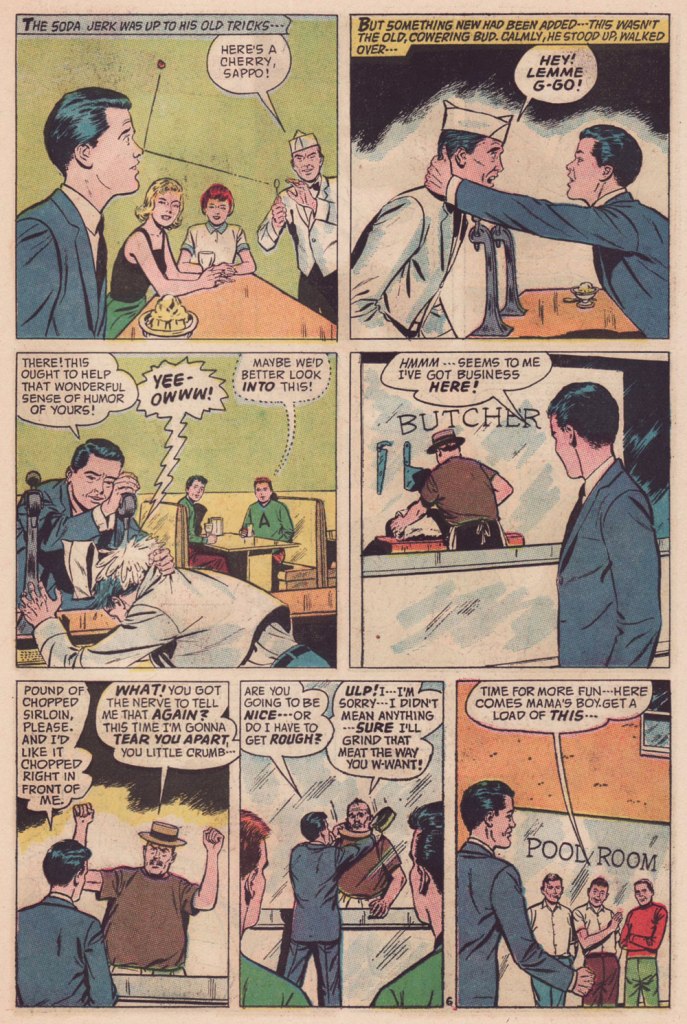
As Hendricks’ tale was a rather tragic one, and since his dry wit ranked high among Hughes’ preeminent attributes, what do you say we set him loose for a demonstration of said lighter side?
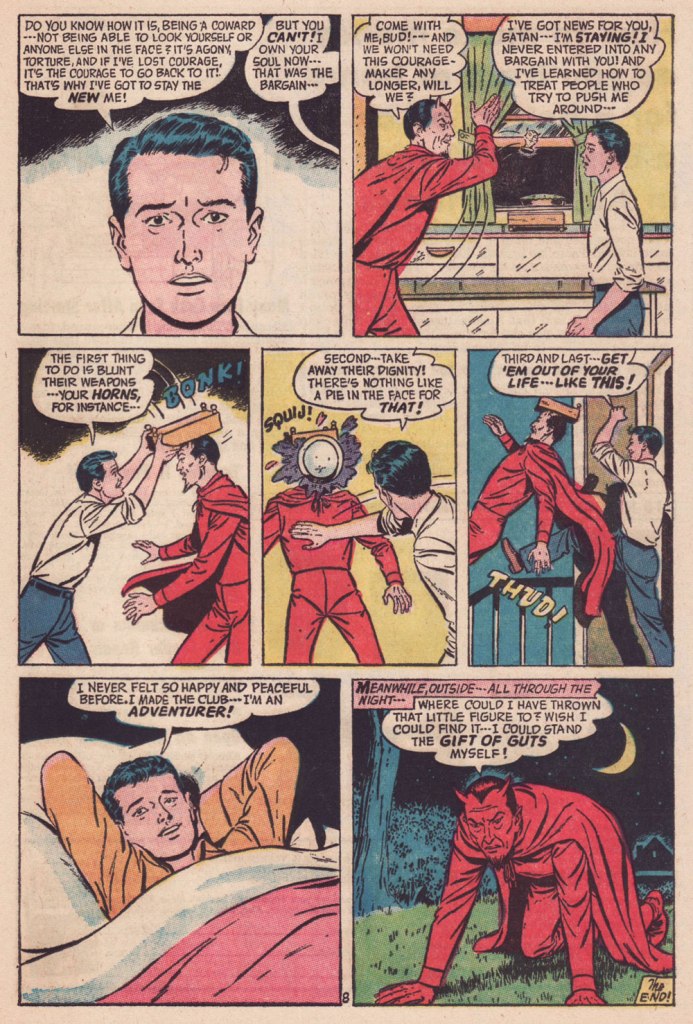
Though many a notable illustrator passed through ACG’s doors — under his given name or otherwise — it’s undeniable that Hugues’ most consistently effective comrade-in-arms was the forenamed Mr. Whitney. Don’t let his low-key, ‘square’ approach deceive you: here’s a master storyteller at play.
Read on, febrile friends of ol’ Faust!
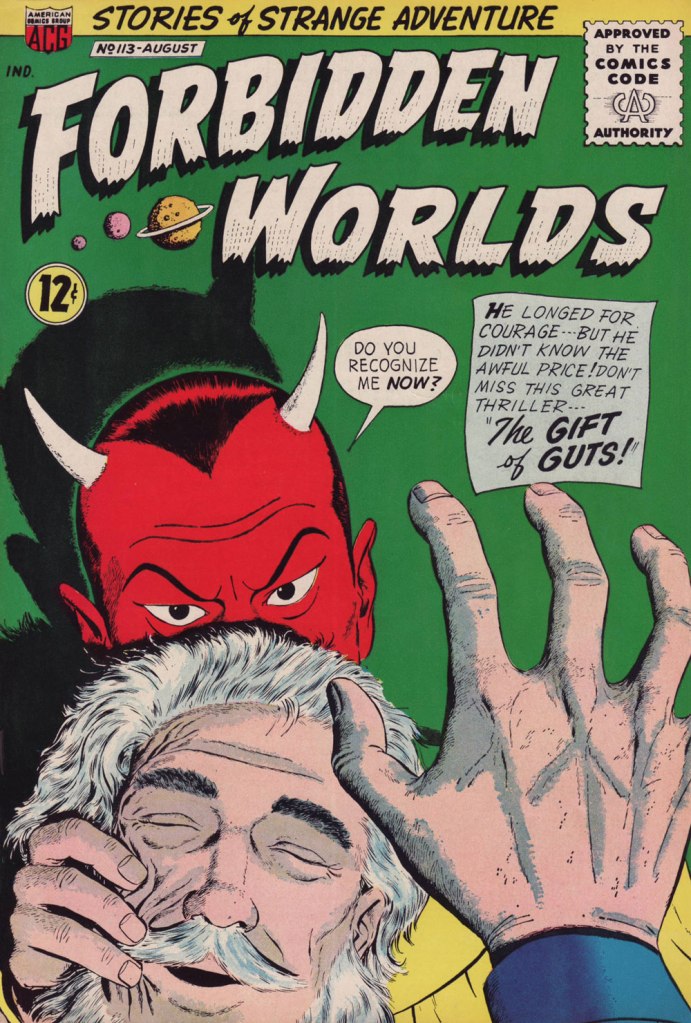
« Squij! » is now one of my favourite sound effects.The Gift of Guts was cover-featured in Forbidden Worlds no. 113 (Aug. 1963, ACG). Pencils and inks by Ogden Whitney.






































 Who's Out There?