Captain Hero Shushes the Silencer!

« My collection of criminal creeps will get a real charge of hokey hassle of heroes! » — The Collector

Just last week, I read the bittersweet news that after half a century or so*, the evergreen, once-ubiquitous Archie Comics Digests are kaput… which brings us, in the usual roundabout fashion, to today’s post.

Though it’s been nearly three years since our big move, I expect to carry on practicing box archeology for a good long while, if not indefinitely. A couple of months ago, I dug out an Archie Digest I had picked up at my local newsstand back in 1981… and quite possibly never read. Until this year.

I’ve mentioned before that comics distribution was extremely spotty in my neck of the woods, so I often found myself glaring and wincing at the racks in desperation and taking home some ungainly specimen*. This was such a case, obviously.

This is Captain Hero Comics Digest Magazine no. 1 (1981, Archie). Stan Goldberg’s cover is unspectacular, but better than his usual. Earlier this week, I got a good chuckle out of someone stating online that Goldberg “could do a damn good Dan DeCarlo“. I’d have to agree: Goldberg, at his peak, was nearly on the level of DeCarlo at his worst. Think I’m kidding? Here’s an example.

The Riverdale-Gang-as-Superheroes of the mid-1960s, just another bit of trend chasing** by the Archie brass, has never elicited much beyond a shrug from me. It certainly was intended as a cynical, junky cash grab by the higher-ups, but… sometimes it rose above the brief.

Bart Beaty wrote, in his 12 Cent Archie (2015, Rutgers University Press), that « On the whole, while the Pureheart material is remembered — and collected in contemporary trade editions — for its novelty within the Archie universe, it is clear that the innovation was not a particular success. The combination of Archie sensibilities and superheroes paid few dividends. »

Well, innovation wouldn’t quite be the term I’d opt for, but while the Pureheart stories are as underwhelming as surmised, but since Jughead, Reggie (as Evilheart) and Betty (as Superteen) are more interesting characters than plain ol’ Arch, it is fitting that their exploits are more compelling.

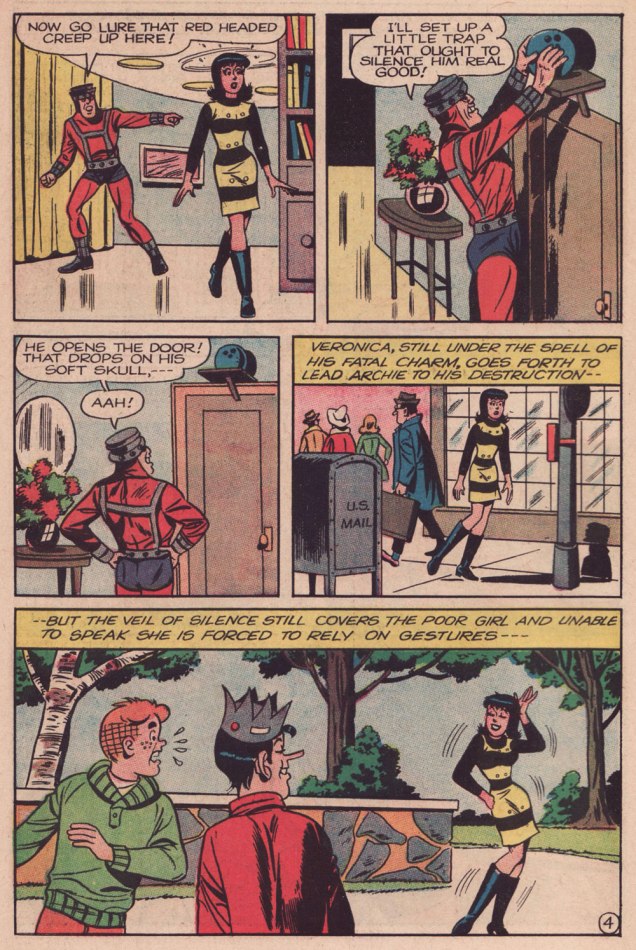
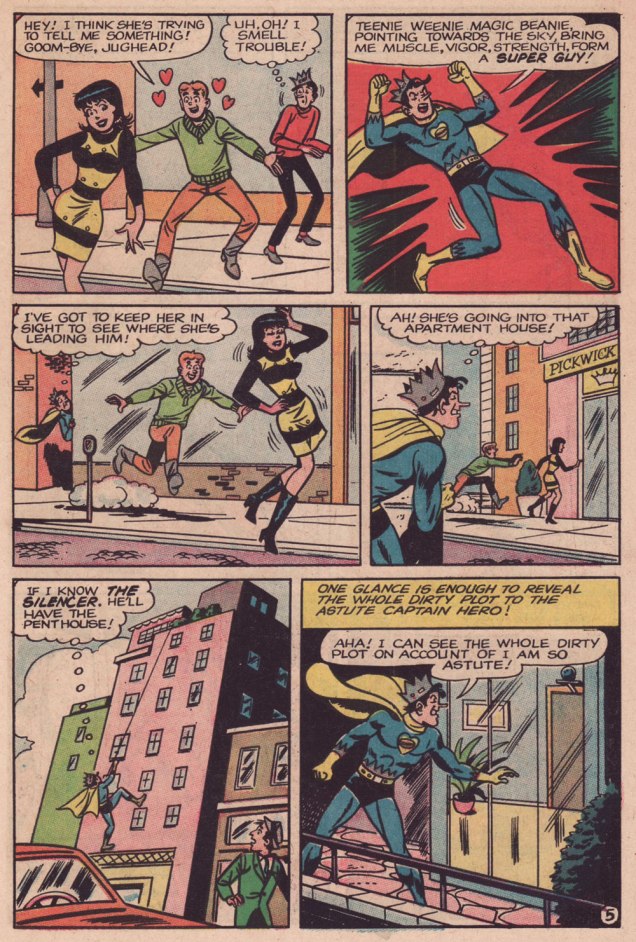
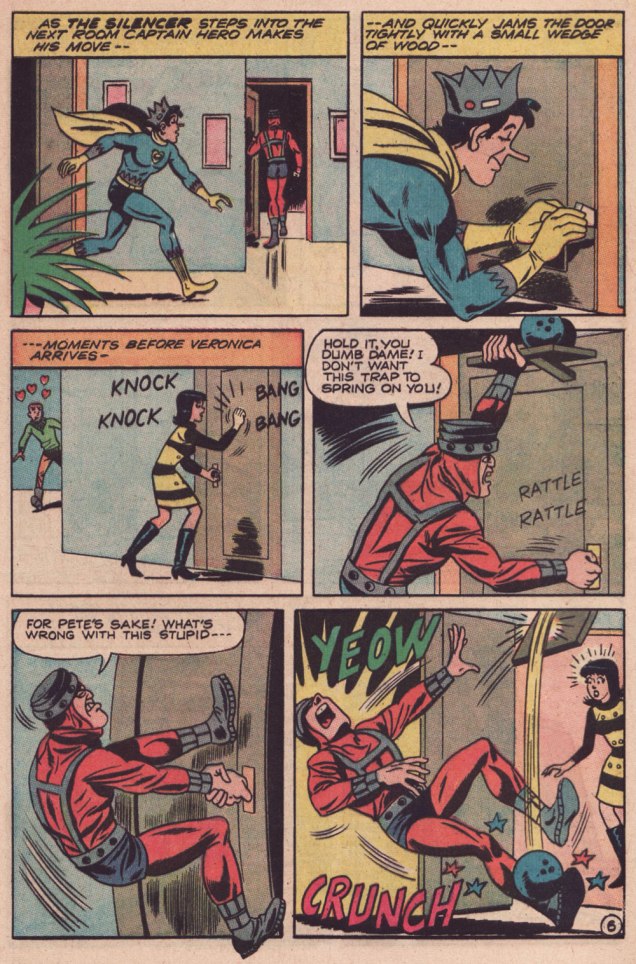
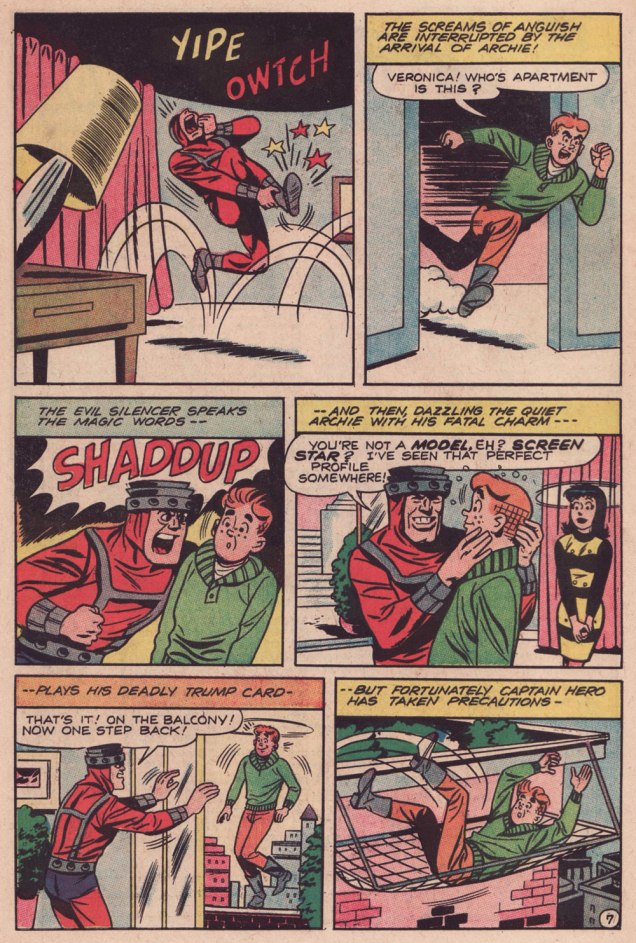
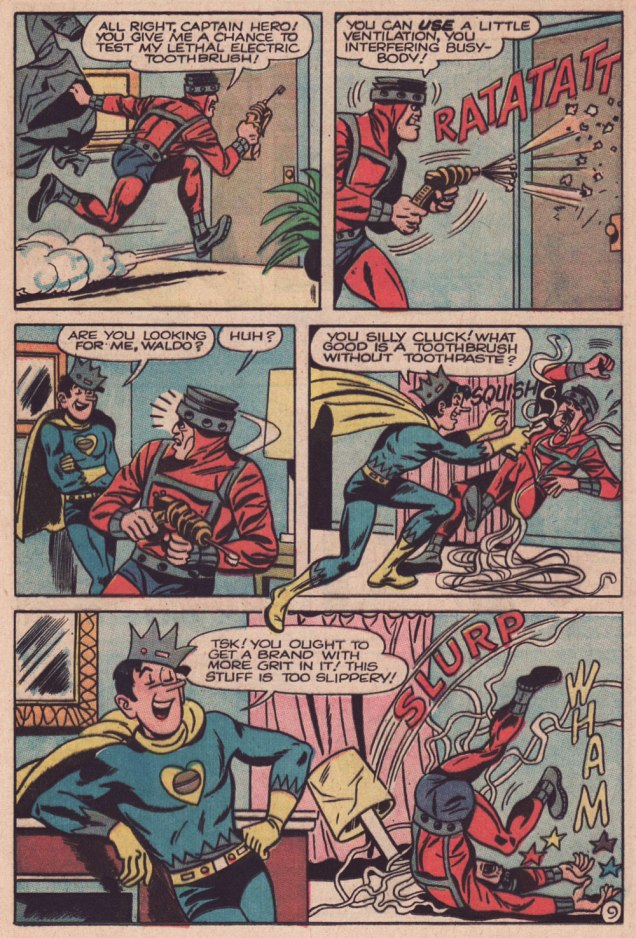
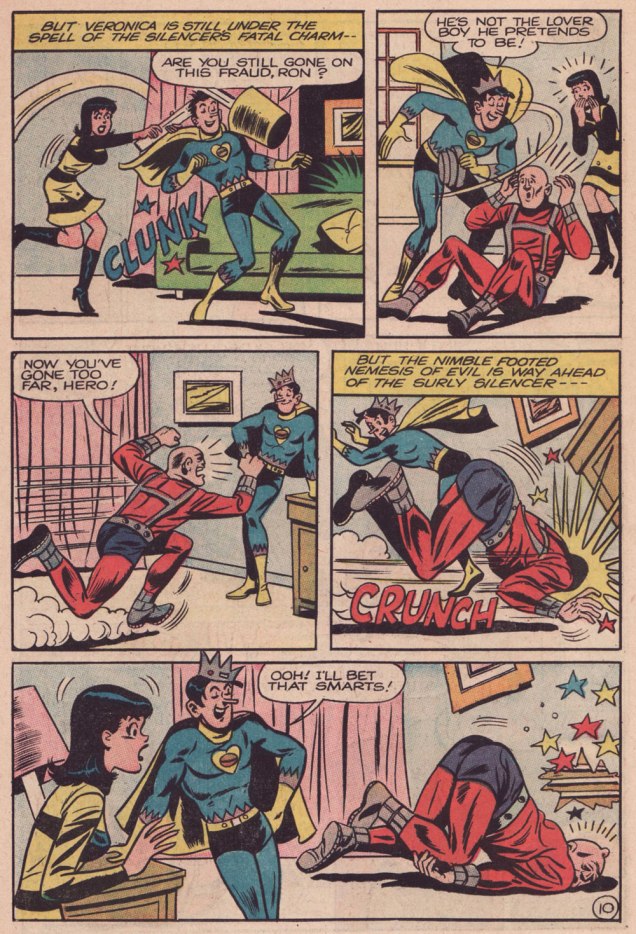
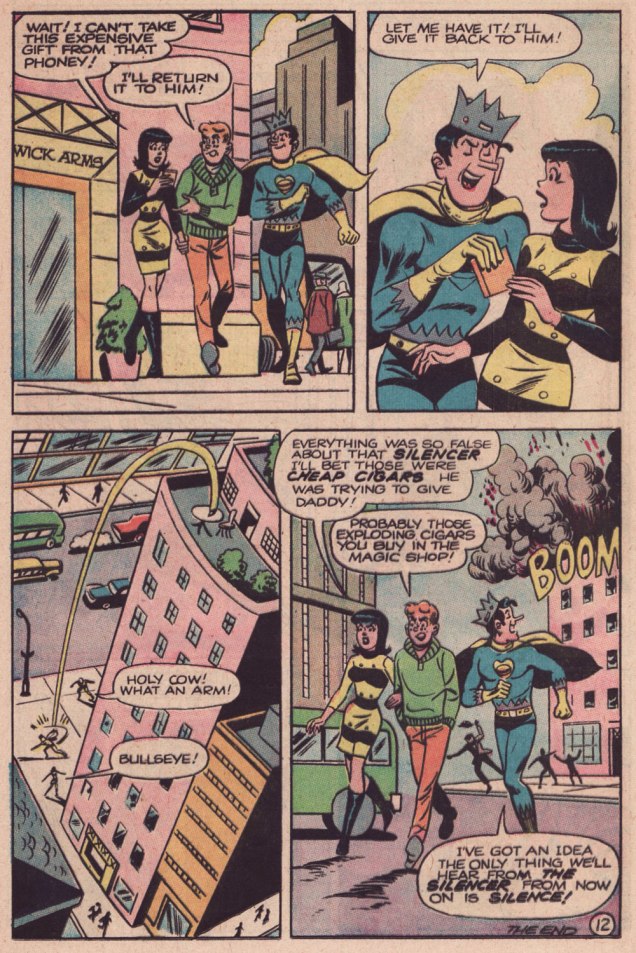
Here’s The Silencer Strikes, originally presented in Jughead as Captain Hero no. 5 (June 1967, Archie). The uncredited creators are presumably Frank Doyle, scripter; Bill Vigoda, pencils.

While Bill Vigoda (1920-1973) is hardly anyone’s favourite Archie artist, he does a creditable job here; he’s having more fun with this material than he did on the regular Jughead title, where he had the unenviable task of replacing (ha!) Samm Schwartz.

I certainly wasn’t going to use the digest for scanning, as the format’s production values weren’t much of a consideration: this was disposable entertainment, period. But I found an affordable — and in glorious condition — copy of the issue I wanted, and the printing didn’t let me down. My thanks to Keith for bringing it home!

-RG

*this also goes on in bars, I’m told.

**namely the rise of Marvel’s superheroes and the success of the campy Batman tv show, if you must know.

***Though they reaped the most bountiful rewards from the format, Archie were tardy — as usual — in adopting the digest: for instance, Gold Key had tried it out in 1968 with some Disney reprints, followed by collections of their mystery titles. DC had issued a one-shot Tarzan Digest in 1972. Marvel issued its own — slightly larger — digest in 1973, The Haunt of Horror, but it wasn’t comics, but a doomed attempt at reviving the moribund ‘Pulp’ format; finally, Archie entered the fray two months later, with Archie Comics Digest no. 1. Only Harvey lagged behind; unless I’m mistaken, it wasn’t until 1977 that some Richie Rich digests hit the glutted market.

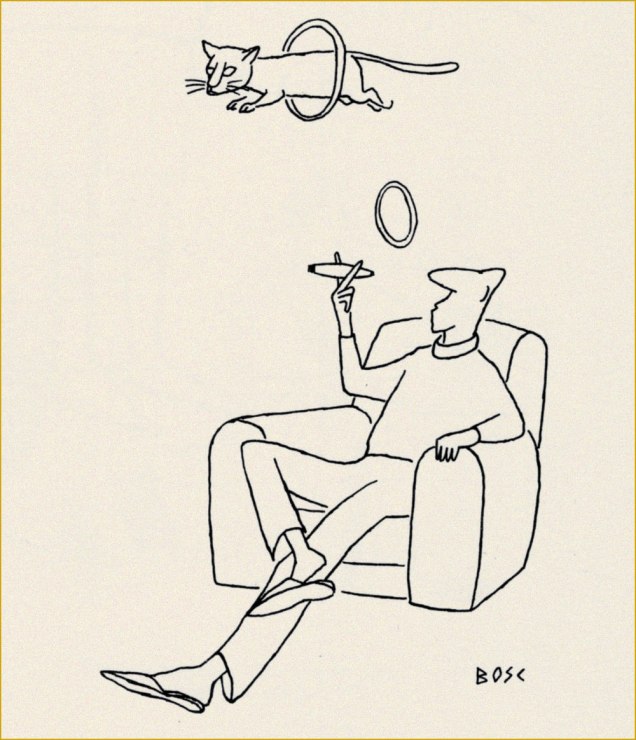
Jean Bosc and the Kindness of Posterity

« In man’s struggle against the world, bet on the world. » – Franz Kafka

Time for another entry in our leisurely, unsystematic and subjective survey of Europe’s most significant panel cartoonists. Today, we examine the life and work of Jean-Maurice Bosc (1924-1973).

His is a familiar story: guy goes to war, comes home changed (likely suffering from what was once called ‘shell shock’, then ‘battle fatigue’, and nowadays ‘post-traumatic stress disorder’ — “burying the pain under jargon“, as George Carlin put it), can’t return to old routine in the family vineyard, tries other tacks, decides on drawing; looks for gainful employment, starting at the very top, miraculously gets in. Thrives for several years, producing well over 3000 drawings, seeing print in countless magazines all over the globe. Then it turns sour.

Originally published in Paris-Match, this one landed successfully in Best Cartoons From Abroad 1955 (Crown, 1955; Lawrence Lariar and Ben Roth, editors).
Another Paris-Match cartoon, it was reprinted in Best Cartoons From Abroad 1958 (Crown, 1958; Lariar and Roth, editors).
Sometimes gallantry just isn’t enough.

Jacques Sternberg wrote, in Les chefs-d’œuvre du dessin d’humour (1968, Éditions Planète):

« Returned in a highly weakened state from Over There, Bosc, resigned to forced rest, began to draw after falling in love with the drawings of Mose and Chaval. Over a few months, he produced hundreds of drawings, giving the humorous arts, without even realising it, a most singular starkness, a particular line that belongs quite exclusively to Bosc, though it’s been much and often mimicked since.

It was in 1952 that Bosc went up to Paris. Eight days later, a stroke of luck: he lands a whole page in Paris Match, which was to turn him into one of the magazine’s stars. »

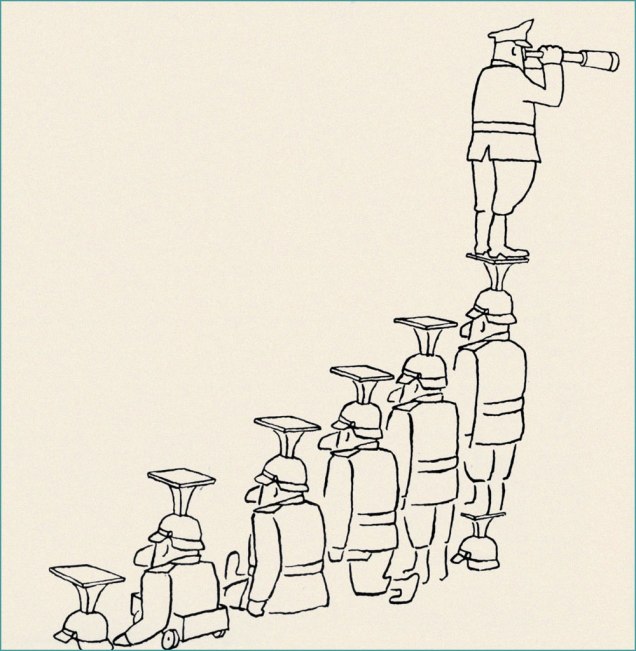
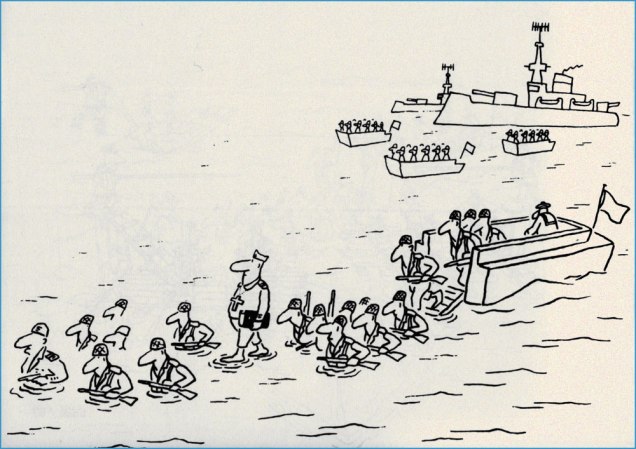
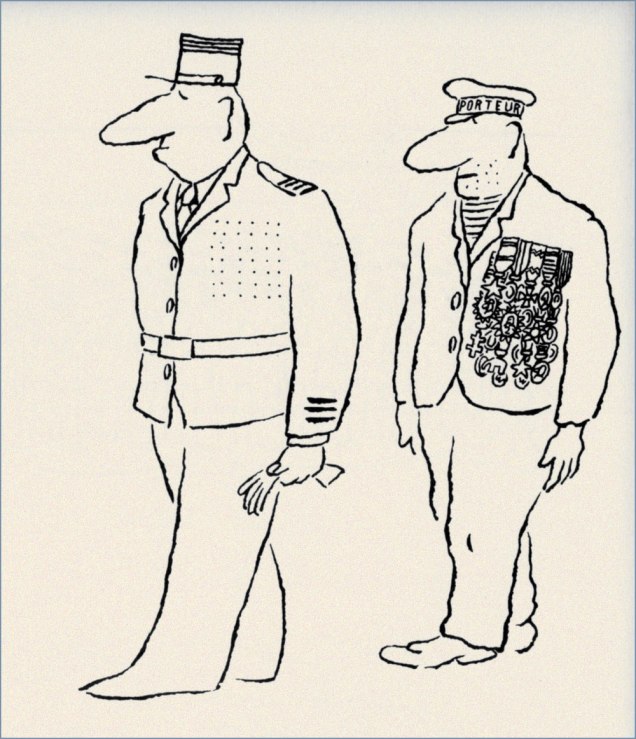
Hierarchy explained in one picture.
The Touring Club de France (1890-1983) was a French social club devoted to travel, founded by enthusiasts of the vélocipède. We are told to « Please leave this place as clean on leaving as you would like to find it on entering », although ‘en vous retirant‘ might be more faithfully translated as ‘upon pulling out‘.

« After spending three years mindlessly obeying orders, two of which in the Vietnamese jungle, Bosc was severely traumatized. “After what I’ve witnessed in Indo-China“, he wrote, “I could no longer eat or sleep, ever.” He later told his sister that he had shot dozens of fellow soldiers, saw gruesome fights and, while imprisoned, heard prisoners being tortured. She recalled that he could no longer stand loud noises and got furious whenever she wanted to kill a mere spider. Bosc became a lifelong opponent of war and militarism. »

Also, he was right: one shouldn’t kill spiders.

Just in case anyone’s not yet familiar with the Venus de Milo
The feat of walking on water is actually not strictly associated with Christian myth: ninjas also reportedly do it.
« Porteur », as you’ve surely surmised, means ‘porter’ or ‘carrier’.

Like most of his friends and colleagues, « … Bosc had lived through the Nazi occupation in World War II. After the Liberation, he felt disgusted by his country’s attempts to keep subjugating their overseas colonies to similar oppression and exploitation. President Charles de Gaulle was the sum of everything they hated: a conservative politician who didn’t agree with the growing sentiment of anti-colonialism, the sexual revolution and disregard for Church, army and family values. Bosc often ridiculed De Gaulle in his work. Once, the cartoonist was fined 3,000 francs, with a month’s probation, for daring to mock the army in a magazine. Bosc’s work revealed he had no respect for politicians. Interviewed by Paris Match in 1965, Bosc claimed that Alexander the Great was his “favorite great statesman, since he died at age 33.” » [ source ]

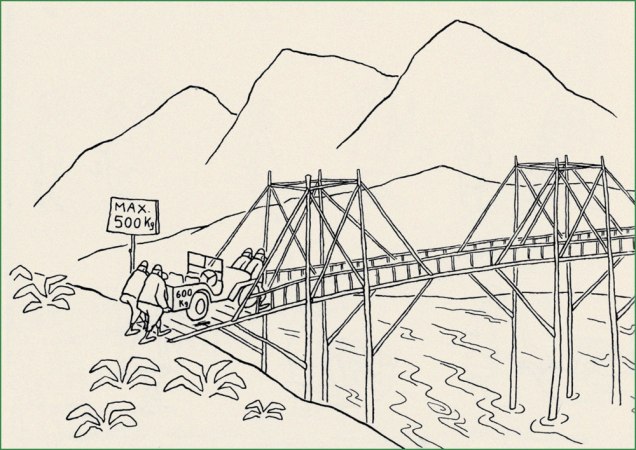
A stellar example of military logic.
This way, at least *everyone* gets to keep dry.
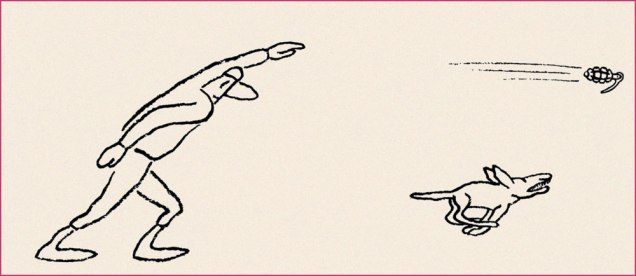
Here’s a video of a guy launching a hand grenade into a frozen lake.
This one just might be Bosc’s single best-known cartoon. It goes: “My castle”; “My mill”; “My dog”; “My car”; “My farmer”; “My wheat”; “My bull”; “My wife”; “My guard”; “My pool”; “My garden”… “My ass!”.

I won’t gloss over the tragedy of his final years:

« Tragedy struck in 1968, when his good friend and colleague Chaval committed suicide. In June 1969, Bosc had a mental breakdown and was hospitalized. Suffering from an illness depigmenting his skin, he weakened more and more, often to the point of no longer being able to stand on his own two feet. He went in and out of clinics, even tried electroshock therapy, but nothing helped. As his health deteriorated, so did his mood. From 1970 on, he basically quit drawing cartoons. In 1973, the depressed cartoonist went to his garage and shot himself. He was 48 years old. »

Despite his having left us over half a century ago, Bosc is remarkably well-remembered. His Lambiek biography, written by Belgian cartoonist Kjell Knudde, is richly detailed and informative. His official website, hosted by Bosc’s devoted nieces and nephews, is a marvel of commemoration.

-RG

*see our posts on, alphabetically (or in any order you please!): Aldebert, Anton, Barbe, Bidstrup, Cabu, Desclozeaux, Effel, Folon, Fred, Gourmelin, Henri, Hoffnung, Lada, Pichard, Ramponi, Sempé, Topor, Wolinski… so far.