« I find vocabulary to be a great drawback. » — Elizabeth Taylor
I think most of us will concur — sorry, Liz — that a rich vocabulary is a useful asset on multiple levels. And in riding with that particular train of thought, if a new year brings new goals and resolutions to achieve them, what could be more judicious and feasible than picking up a handful of new words… and their proper meaning?
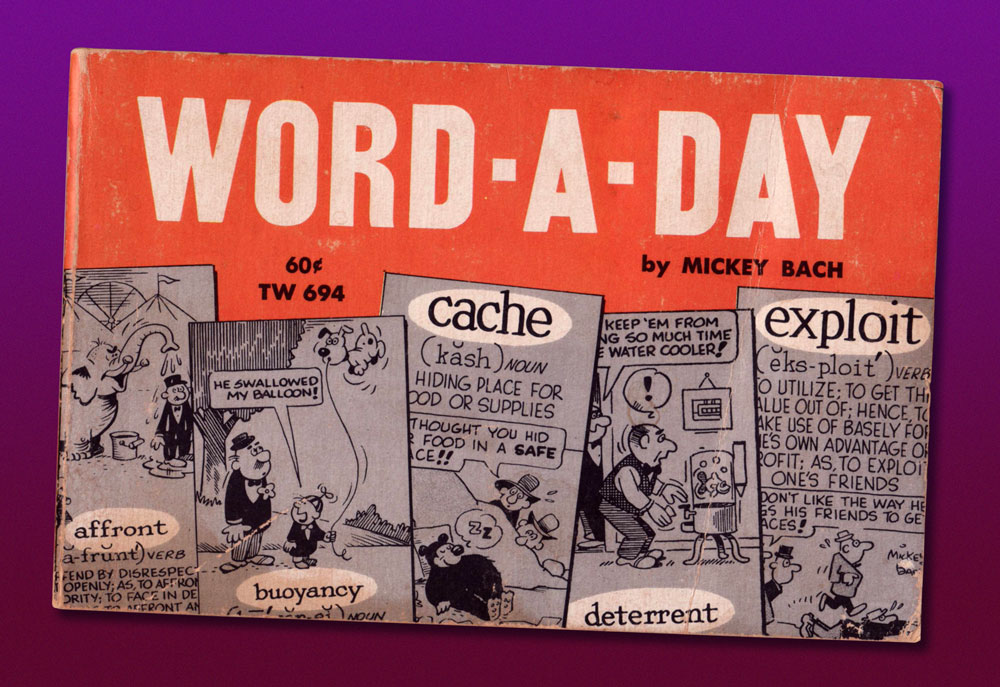
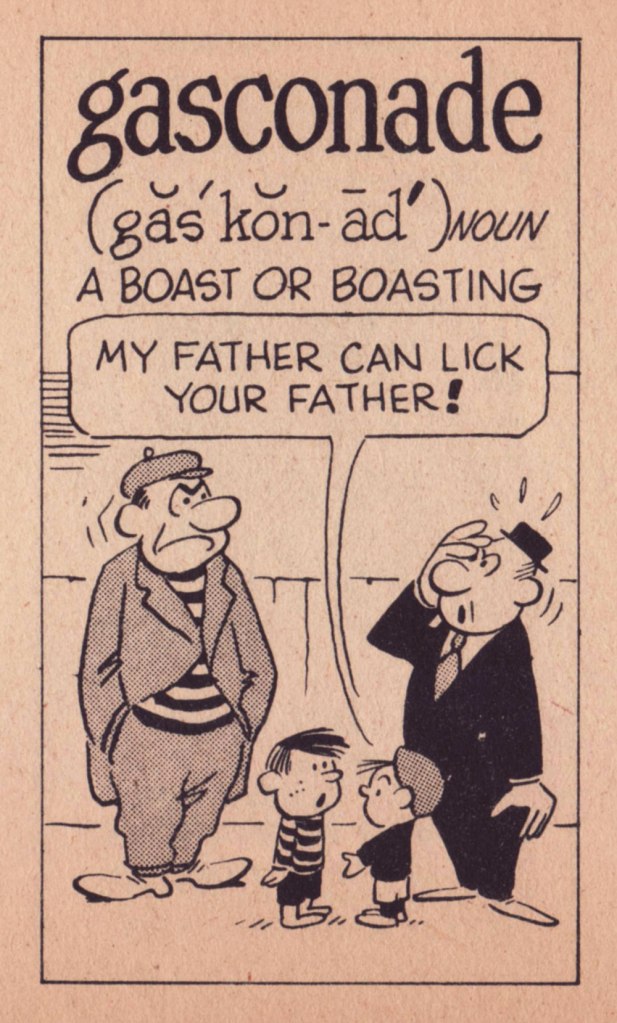
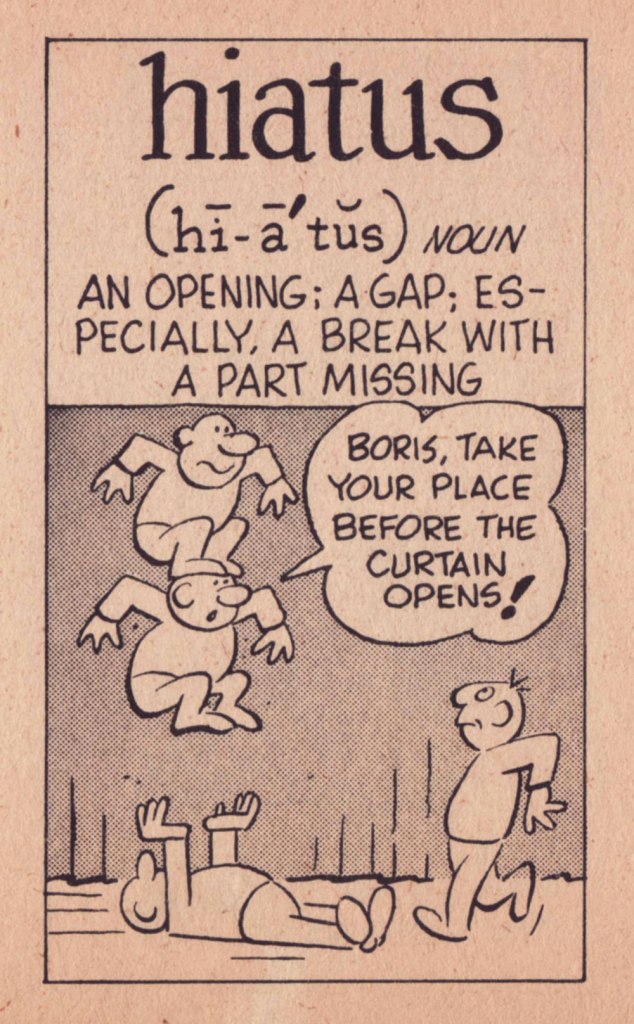
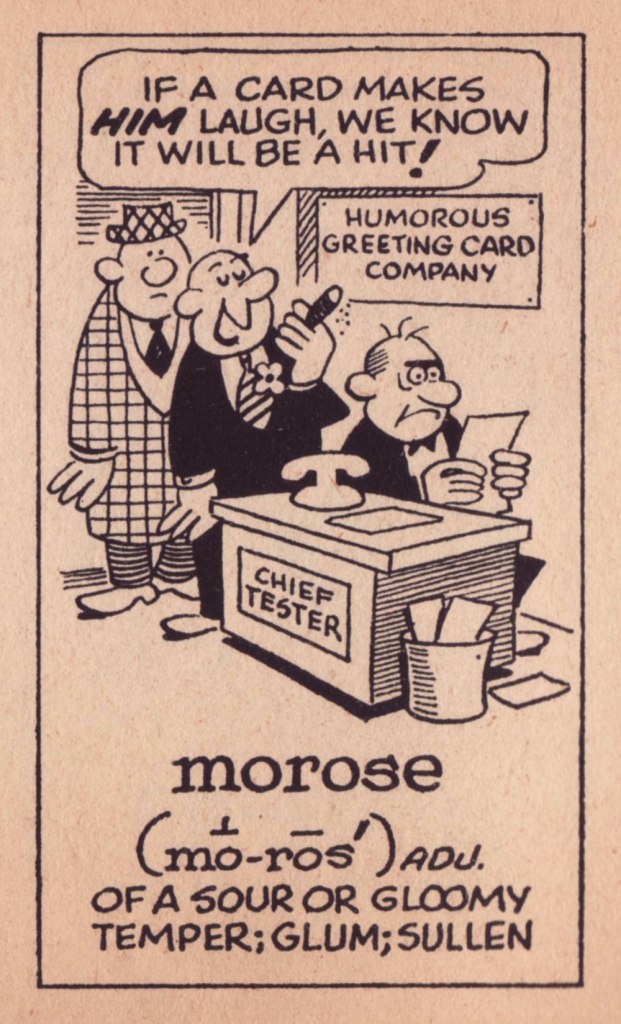
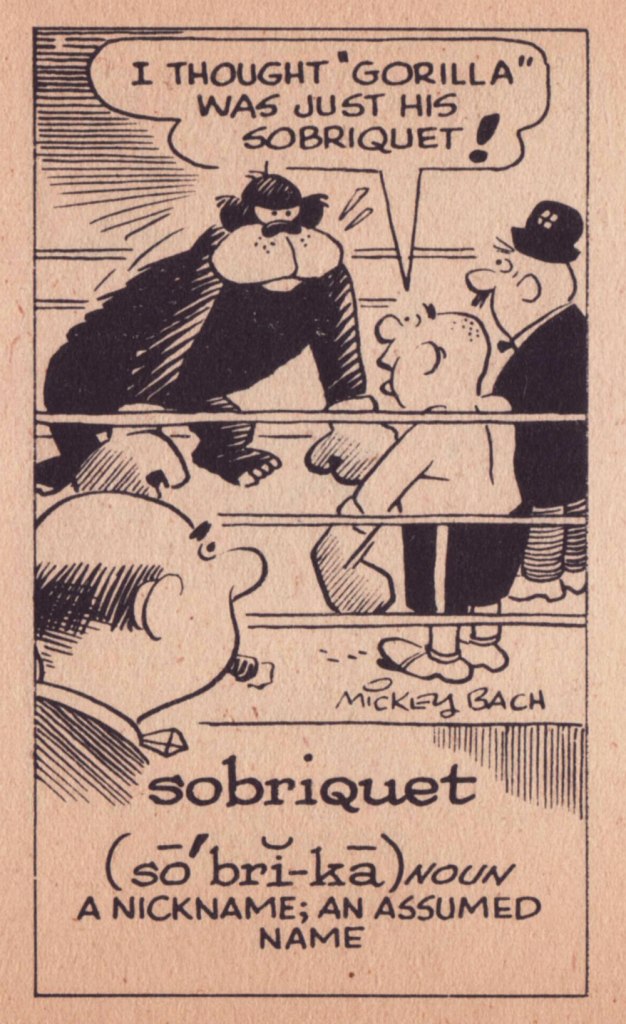
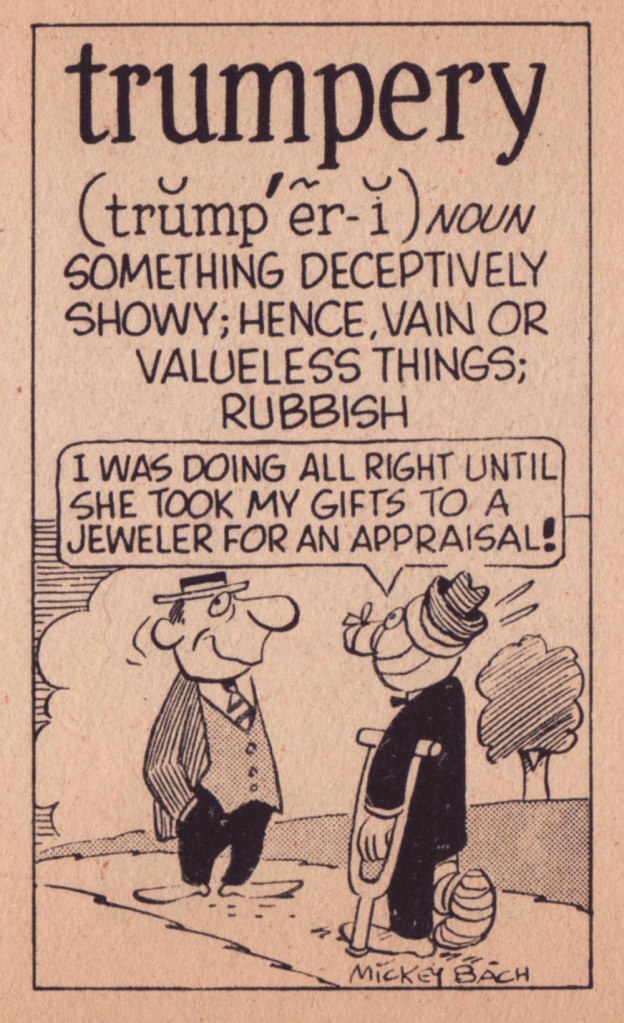
Cartoonist Mickey Bach (1909-1994) made it his mission to help the newspaper-reading masses bone up on unusual vocables. While he’s never ranked among the cartooning greats, the premise of his feature, Word-a-Day, was a rock-solid one, granting the panel a healthy run from 1946 to 1979, first with the Publishers Syndicate until 1967, when it merged with the Hall Syndicate*.
It’s also worth noting that, for a feature that’s been officially defunct for some forty-five years, it’s a pretty lively one: an admirably devoted and industrious fan has kept the Word-a-Day flame alive with the Word A Day Revisited Index. Kudos!
As far as I can tell, there was only one Word-a-Day collection published, but it was a successful one. First published by Scholastic Book Services in 1965 and comprising selections from 1960 to 1963, it received at least four printings through 1972, this being the fourth, from April of that year.
Let’s see what lies within, shall we?
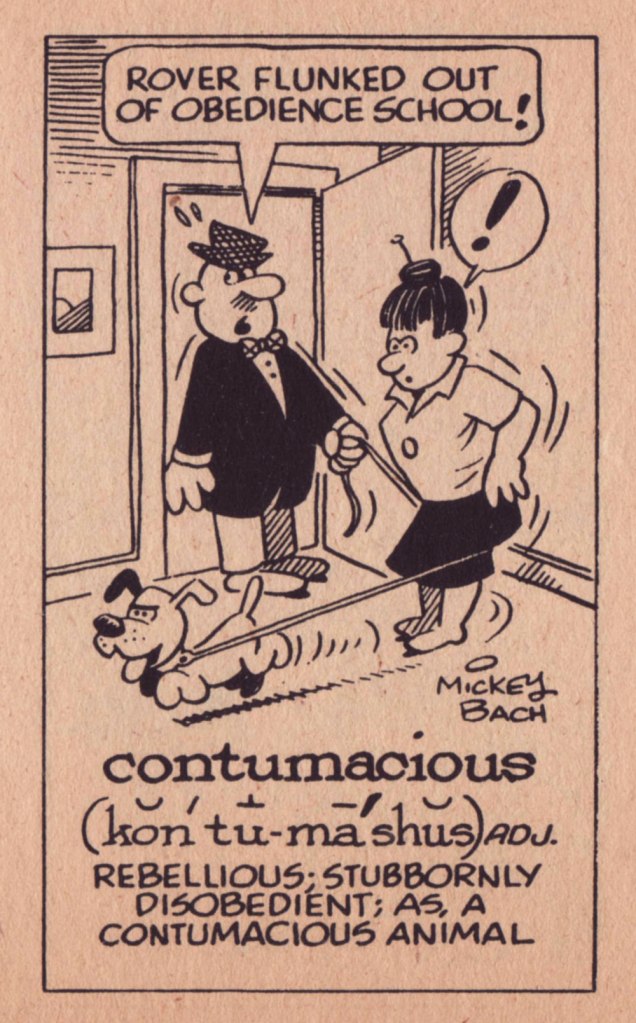
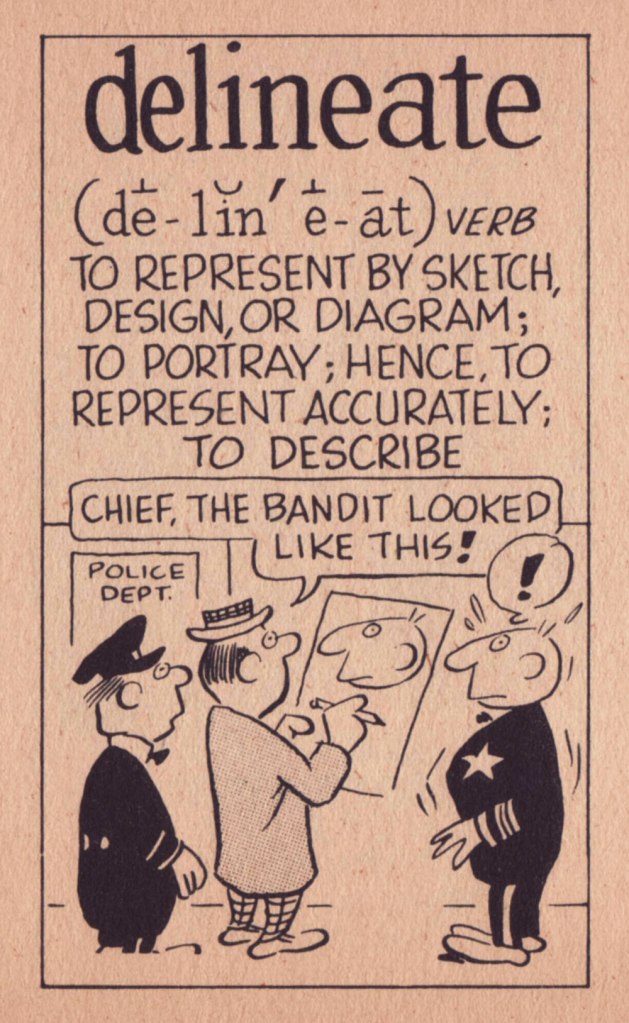
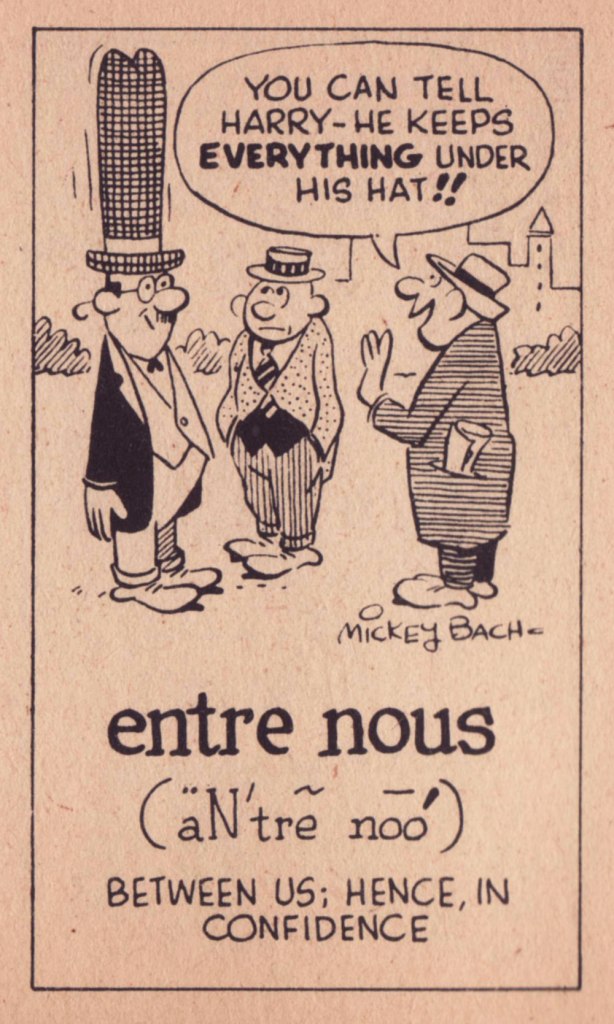
Part of the nostalgic fun in these images is their reliable repertory company of cartooning archetypes such as sandwich men, hobos, boxers, cranky bosses, talent agents, bearskin rugs, door-to-door salesmen, masked burglars, beret-sporting artistes…Ah, yes: that nagging feeling that we, as a society, are somehow regressing rather than progressing.Bach had a somewhat generic, but pleasant and competent cartoon style, wherein I detect the great Bill Holman as a principal influence. Bach clearly was a man of discernment.Don’t be that boorish chump: here’s a handy guide to tipping étiquette from no less an authority than Emily Post (not to be confused with Emily Ghost). This one’s a particular favourite of mine, having had to correct its misuse time and again; apparently, some people have surmised (without checking, naturally) that ‘fulsome’ means, ‘full’, only more so and in a fancier way. No, guys, ‘a fulsome investigation will be conducted‘ does not signify what you think it does. Derived from the French ‘Gasconnade’, which refers pejoratively to the speech of denizens of the Gascony region. « Speaking with the Gascon accent, which is to say accentuating silent ‘e’s, and letting ring out several final consonants that the French leave silent. »I find this one particularly clever.This one’s considered archaic nowadays — when it is considered at all — though its close relative, insipid, endures. Not to be confused with its homophone, incipience, which refers to the beginning of something.Sadly, Gorilla will likely pound the erudition out of that unfortunate pugilist.Here’s a sentiment most reasonable the world over are currently experiencing, to their chagrin.
« There could be no jealousy/over my poetry/it’s my weakest quality/no vocabulary » — Todd Rundgren, Chapter and Verse
From both of us at WOT?, thanks for your continued support and interest, and may the coming year bring you as little as possible of what you’re dreading.
In 1967, Field Enterprises acquired Robert M. Hall‘s New York-based Hall Syndicate, merging it with Publishers to form the Publishers-Hall Syndicate. » Phew.
« There’s a saying among prospectors: ‘Go out looking for one thing, and that’s all you’ll ever find.‘ » — Robert J. Flaherty
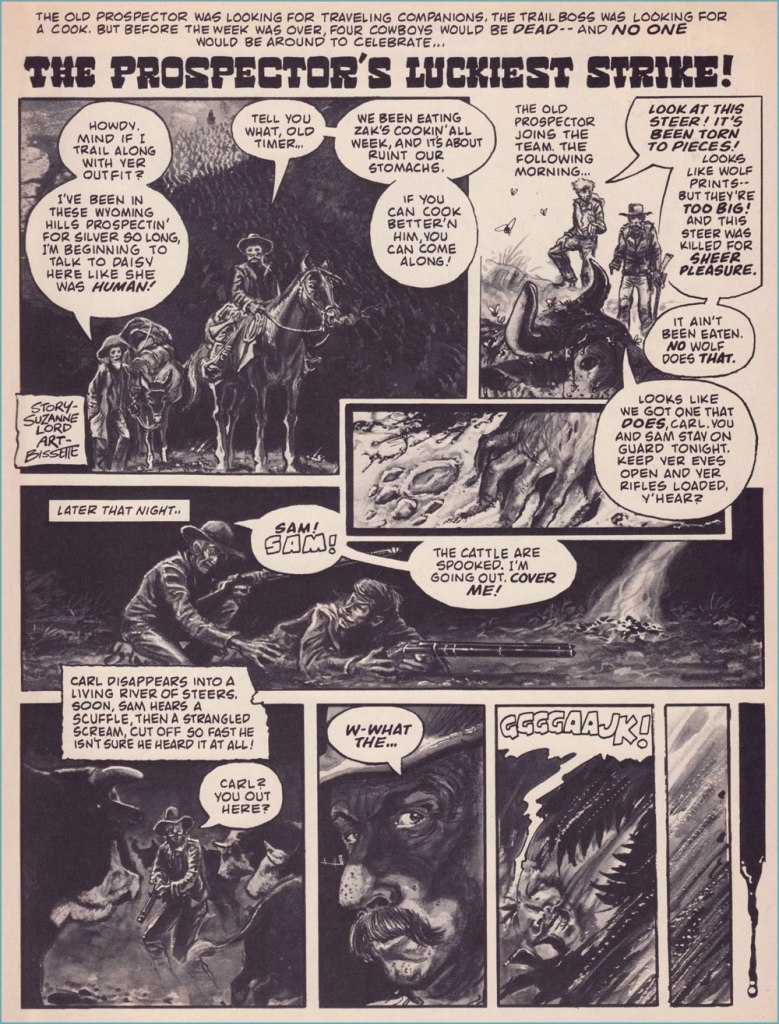
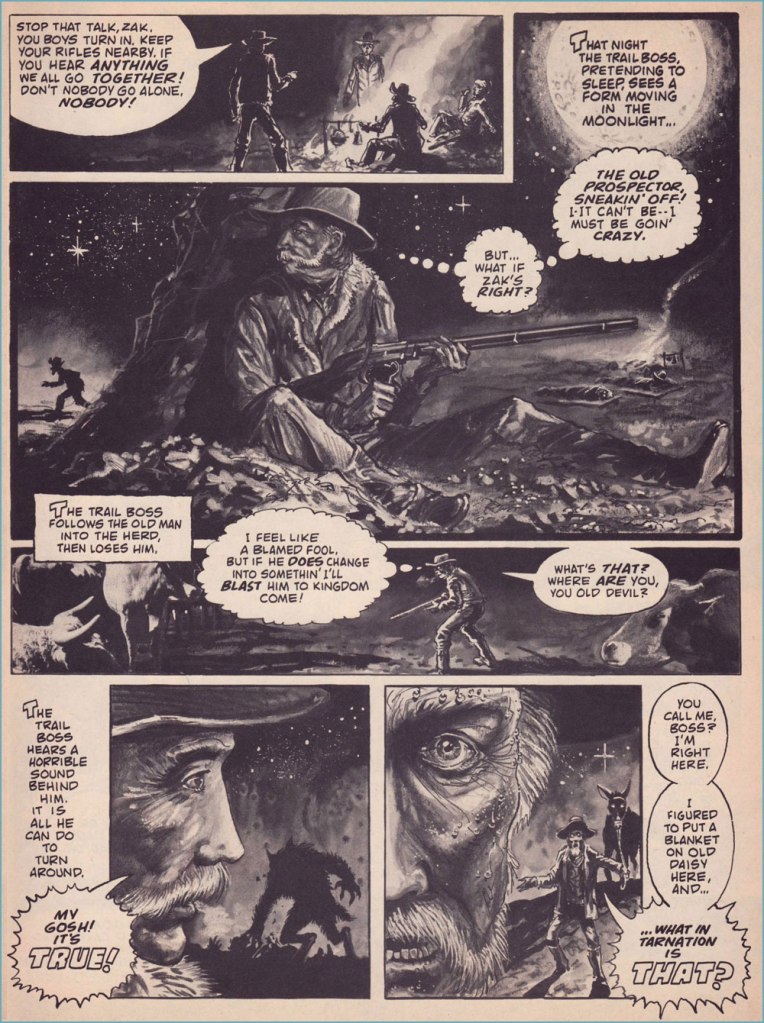
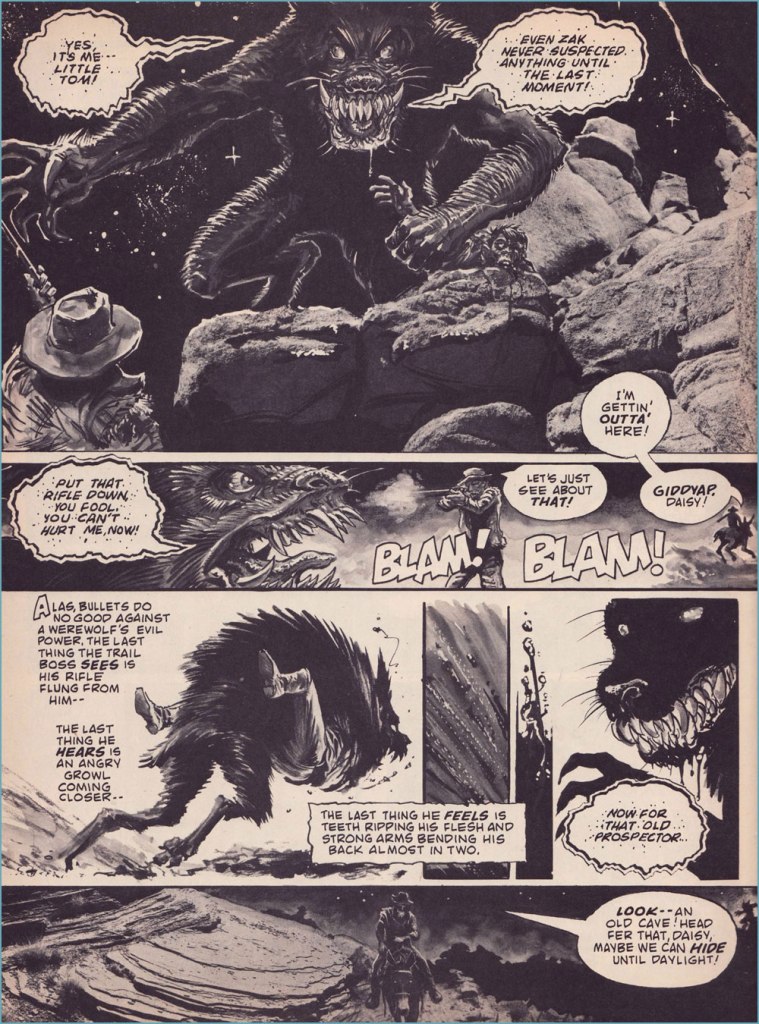
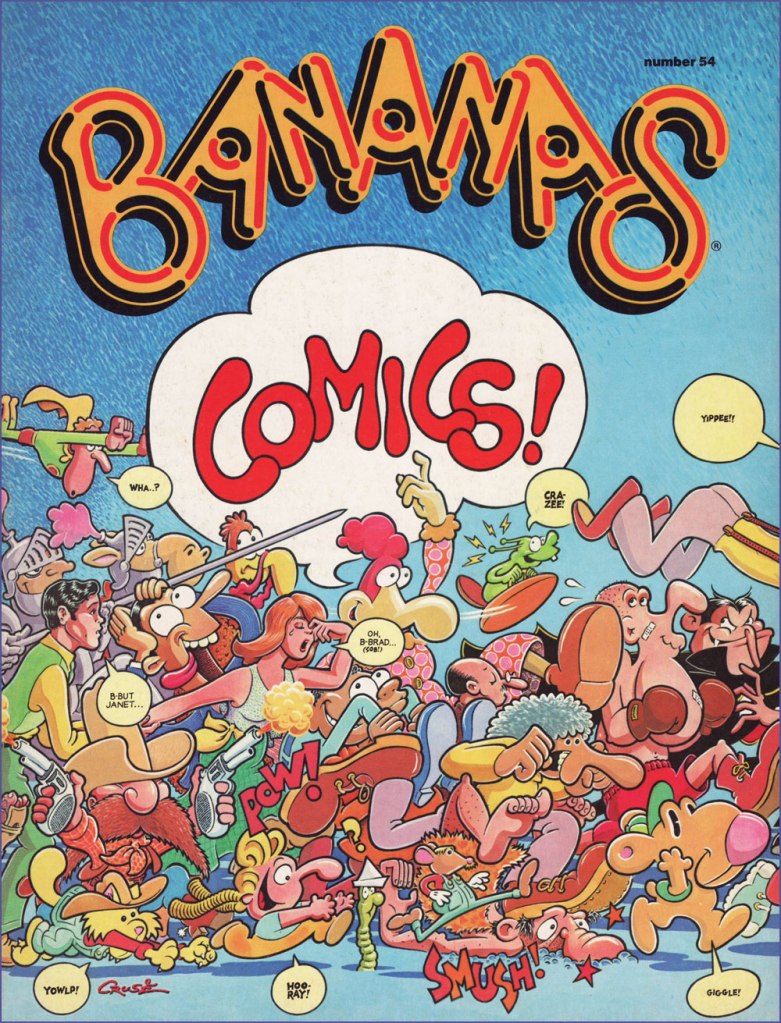
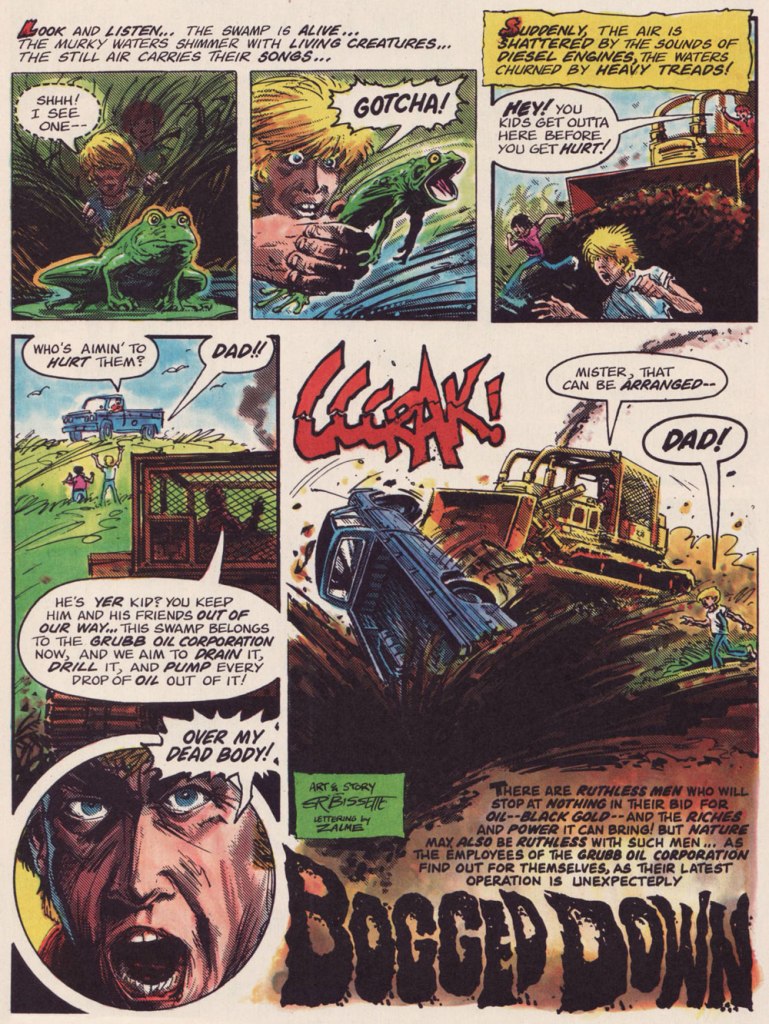
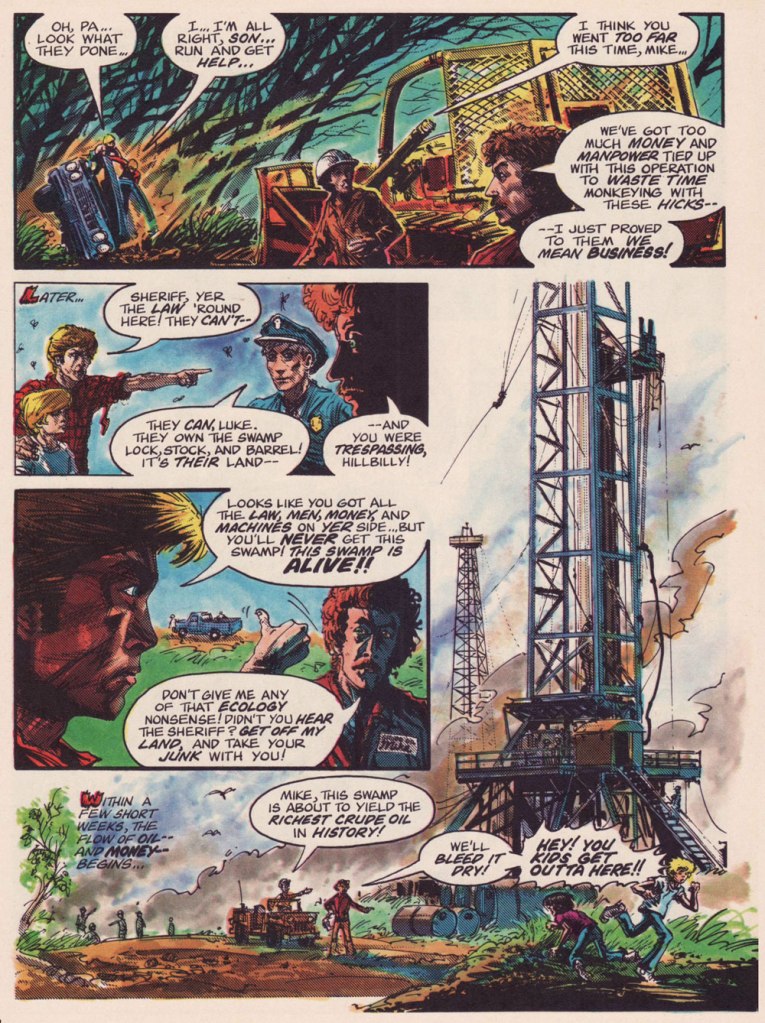
Here’s a rarely-seen Stephen R. Bissette gem, The Prospector’s Luckiest Strike! I wasn’t aware of its existence until recently, when I chanced to purchase an issue of Scholastic’s Bananas devoted entirely to comics. It turned out to hold a pair of Bissette aces, the other being A Toast to Mr. Dalyrimple!. I wondered why these dark lovelies had been left out of Eclipse’s 1985-86 Fearbook and Bedlam, collections of Scholastic material. Were they too recent?
As it turned out, these remaining tales were soon gathered in a one-shot anthology entitled Deadtime Stories (Nov. 1987) published by the short-lived New Comics Group (1987-1989).
Note the discreet, elegant use of photo backgrounds here and there.
I turned to the artist for his recollections, which he most generously provided:
« Scholastic Magazines was one of the luckiest strikes I ever had in my early freelance career, that’s for sure! Between the generous page rates (best I’d earned from any publisher at that time, better even than Heavy Metal), the very kind people I was fortunate enough to be working with—editors Bob and Jane Stine (Bob was later better known as R.L. Stine, author of the Goosebumps empire), art director Bob Feldgus, writers like Suzanne Lord, and everyone at Scholastic at that time—and the frequency of steady freelance assignments from them, I couldn’t have hallucinated a better, more rewarding work relationship or environment in my wildest dreams.
“The Prospector’s Luckiest Strike” was late in the game for me, among the Suzanne Lord scripts I was assigned, and I gave it my all for a variety of reasons. First of all, it was exciting to be invited to contribute not one but two stories to the “all comics” issue, and even more exciting because of my friend Howard Cruse doing the cover and a one-pager, closer-still friends Tom Yeates, John Totleben, and Rick Veitch also contributing top-notch work, and Alyse Newman, Bob Taylor, and John Holmstrom (hey, I was a fan of Punk Magazine) also in the lineup. It was an unusual venture and sounded like a great issue, and Bob, Jane, and Bob F. were so enthusiastic about doing it — well, that was contagious.
The issue in question, with its rollicking Howard Cruse cover.
The deadlines were tight, and I’m not entirely happy with my second story in the issue (Rick Veitch still mocks my splash page for “Mr. Dalyrimple,” justifiably so), but “Prospector’s Luckiest Strike” turned out to be one of my best jobs for Bob, Jane, and Bob.
It was, sadly, also among the last. Bananas #54 came out in 1982, if memory serves, and I was amid a really screwy project with Marvel at the time (the never-completed, never-published Titan Science Project), and one year later I was both a new father (our firstborn, Maia, born at home April 1983) and working on my first collaborative Saga of the Swamp Thing issues, major life changes, to say the least. »
A huge thank you to Mr. Bissette for his generosity and insight!
« Arrows of neon and flashing marquees out on Main Street / Chicago, New York, Detroit and it’s all on the same street / Your typical city involved in a typical daydream / Hang it up and see what tomorrow brings » — Robert Hunter
Among the foremost pleasures of a brick-and-mortar bookstore is the increased odds of stumbling upon an item whose existence you never suspected: case in point, another cheap (one buck!) gem I scooped up in Ellsworth, ME’s The Big Chicken Barn last Autumn.
Now — I’ve long been a huge fan of the pseudonymous Cecil Adams‘ sassy syndicated answer column The Straight Dope (1975-2018), in no small part thanks to resident — all the merry way! — illustrator Michele ‘Slug’ Signorino‘s waggish accompanying cartoons, rendered in what he colourfully called his ‘smudge-a-dot technique’.
And so, last October, I grabbed a lovely Scholastic publication that had until now ably eluded my radar — 1978’s Junior CB Picture Dictionary, compiled and edited by Joan Downing and dexterously illuminated by the aforementioned Mr. Signorino. I was delighted to discover that he’s still happily active well into his Eighties: « he still works and does not intend to retire. “This isn’t work,” he said. »
This slim-but-priceless tome happens to tick several of my pet boxes: a somewhat (but not quite!) passé communication technology; a lively, singular species of jargon; a merrily anarchic illustrative style… and so forth. Let’s sneak a peek, then!
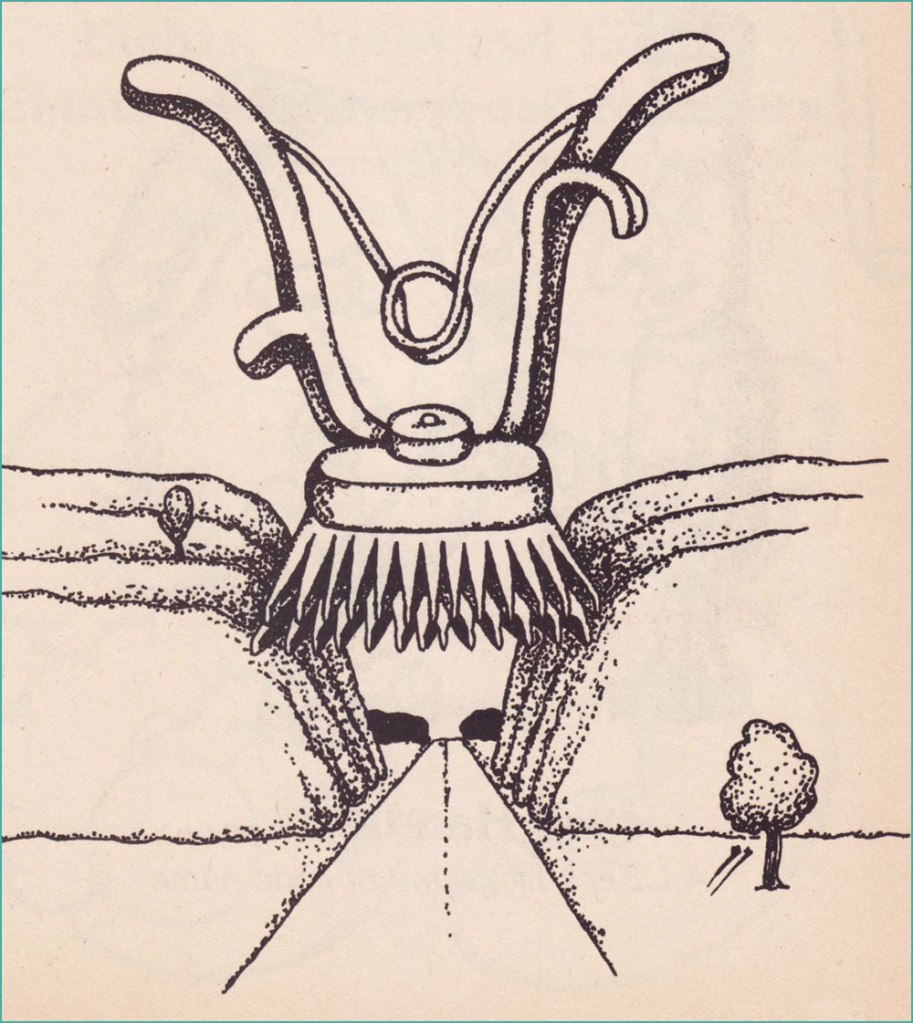
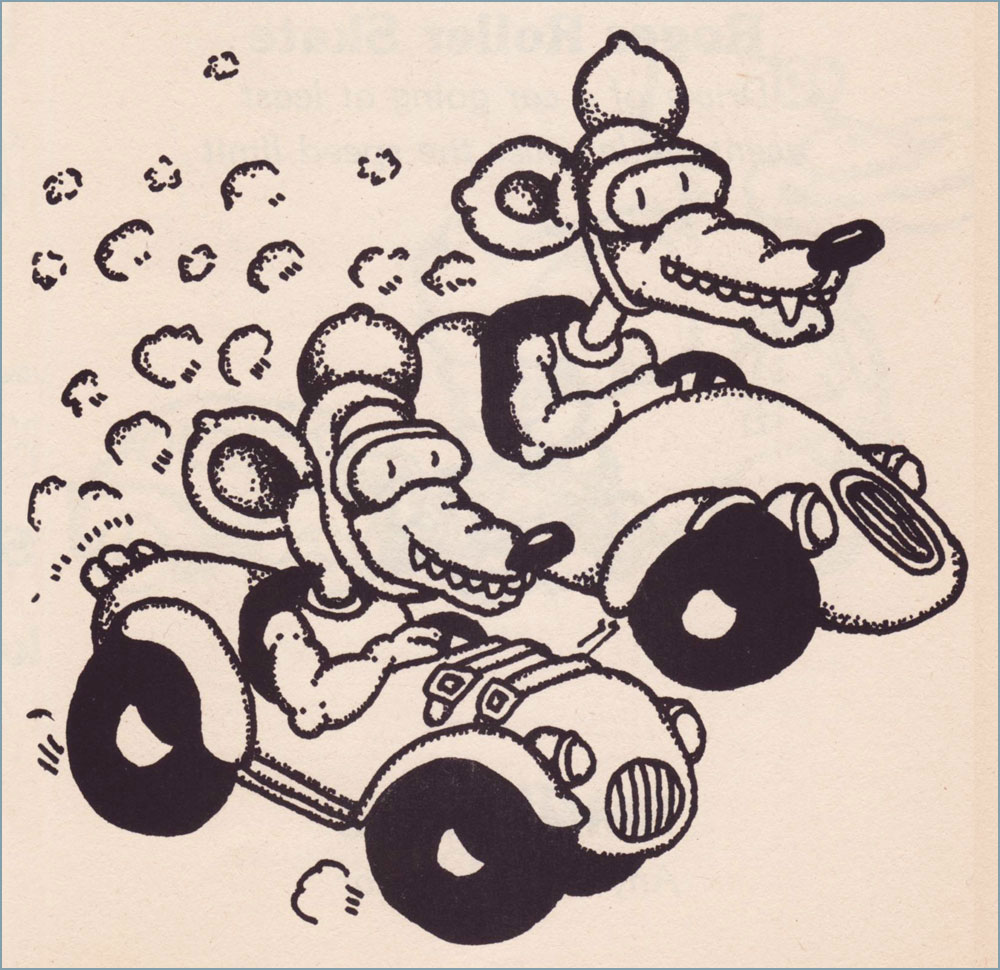
Checking My Eyelids for Pinholes: Tired; getting sleepy.City Kitty: Local police.County Mounty: Sheriff or county police.Draggin’ Wagon: Wrecker or tow truck.Eatem Up Stop: A truckstop.Flagwaver: Road construction worker.Haircut Palace: A low bridge or overpass. There’s one of these a couple of blocks up the street from where I used to live, but I suppose every big city has to live with that problem. In Boston, MA, the phenomenon is particularly colourful, as is called ‘Storrowing‘. Mama Bear: Female police officer.Mixing Bowl: Highway cloverleaf.Motor Mouth (Also: Ratchet Jaw): One who talks too much.Rat Race: Traffic during rush hour.Skating Rink: Road slippery from ice, snow, or rain.Super Skate: Sports car.Truckin’ Teenybopper: Young hitchhiker. The bulk of my first-hand experience with CB came from hitchhiking in my youth so I indeed was a truckin’ teenybopper myself! I’m still warmly grateful for the longest ride I ever got: from Portland, OR, to Long Beach, CA, thanks to a friendly truck driving man. He was actually headed for San Diego, but I was already over three thousand miles from home… and had to get back in time for college.Wall to Wall and Ten Feet Tall: Good CB reception. A visual reference to famous pooch ‘Nipper‘. Window Washer: Rain. Is that you, Dirty Danny?
For more dirt on the magnificent Signor Signorino, feast your peepers on this lovely 2022 profile. And in case you’re wondering “Does Slug have a book about his career?”, why yes, he certainly does!
I’ll let Steve Earle have the last jab at this one: « Everybody told me you can’t get far/On thirty-seven dollars and a Jap guitar/Now I’m smokin’ into Texas with the hammer down*/And a rocking little combo from the Guitar Town**. »
« Advertising – A judicious mixture of flattery and threats. » — Stephen Leacock
It’s long been established that one can scarcely be too skeptical in the face of advertising, and the sooner one starts questioning its wooly claims, the better. In the early 1950s, Harvey Kurtzman‘s Mad shone the giddily harsh light of truth on, well, just about everything, but Madison Avenue‘s tactics were a favourite and frequent target, and for good reason. In 1956, Kurtzman heatedly left his creation after a mere 28 issues; while it retained much of its cultural influence as its reach increased, it degenerated into rigid formula in the hands of his too-cautious successor at the helm, Al Feldstein.
Fast-forward to 1974, and Dynamite Magazine‘s sixth issue. Readers presumably too young for Mad could now receive their monthly inoculation against the advertising industry’s tainted baloney.
From 1974 to 1981, the feature was illustrated by Calvin Sanford “Sandy” Huffaker, Sr. (1943 – 2020); then the reins were passed into the able paws of future Mad art director (small world!) Sam Viviano. But that’s a tale for another day.
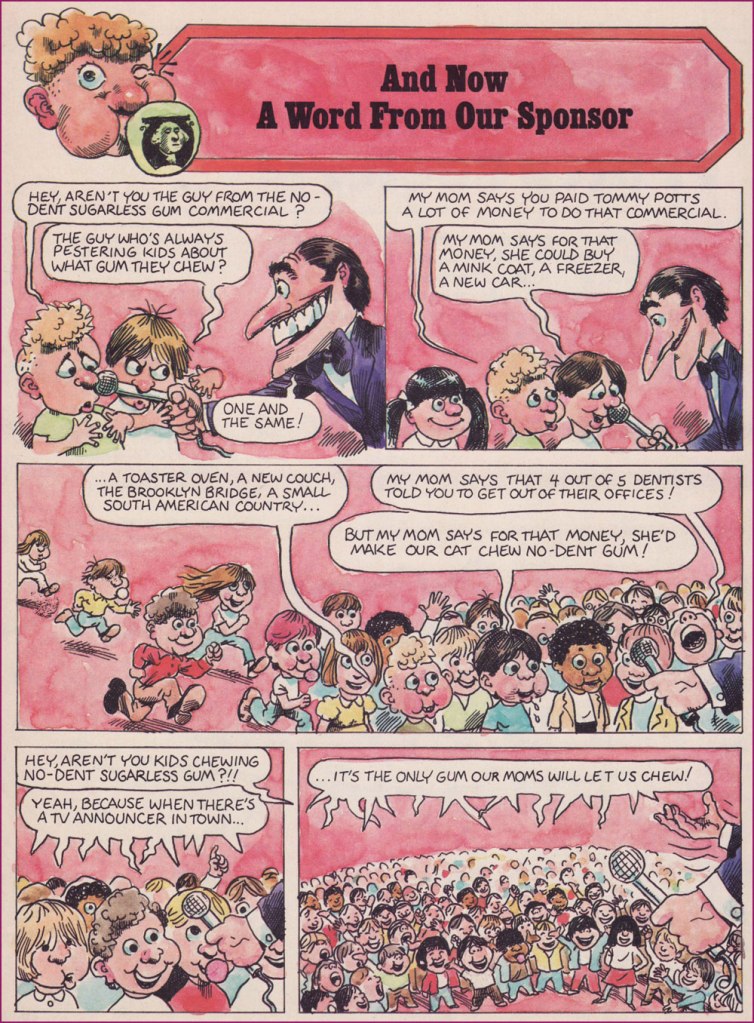
Since Huffaker was only credited for illustrating the feature, it stands to reason that it was written in-house, and that narrows it down to two main candidates: editor Jane Stine or Linda Williams Aber (aka “Magic Wanda”); my money’s on Aber, who also wrote Count Morbida’s Puzzle Monthly Puzzle Pages.
As Dynamite’s ‘Inside Stuff’ table of contents always billed it, here’s « A Dynamite look at BADvertising »!
The feature’s inaugural entry, from Dynamite no. 6 (Dec. 1974, Scholastic). The voracious oldster lampooned here is Euell Gibbons, who shilled for Post Grape-Nuts (which contain neither grapes nor nuts!) in this vintage commercial.From Dynamite no. 7 (Jan. 1975, Scholastic). You might recognize Nancy Walker, aka Rhoda’s mom Ida, and future director of Can’t Stop the Music! (trigger warning: Steve Guttenberg); here she is, pre-orange hair, in a Bounty Paper Towel spot from the Me Decade.From Dynamite no. 9 (Mar. 1975, Scholastic). Here’s a 1971 Bufferin vs. Aspirin ad. Place your bets!From Dynamite no. 19 (Jan. 1976, Scholastic). You just may be familiar with the object of this parody.From Dynamite no. 25 (July 1976, Scholastic). Here’s another ‘wonderful, quick‘ Jell-o recipe from those gelatin-happy days.From Dynamite no. 26 (Aug. 1976, Scholastic). Remember Morris? Here’s the famously fussy feline in a 1974 Nine Lives ad.From Dynamite no. 27 (Sept. 1976, Scholastic). Here’s a Hamburger Helper commercial of the corresponding vintage.From Dynamite no. 28 (Oct. 1976, Scholastic). Here’s our pal Poppin’ Fresh in a 1972 commercial.From Dynamite no. 37 (July 1977, Scholastic). On that topic, here’s our look at the 1970s bubble gum explosion!This subscription ad appeared in Dynamite no. 26. I suspect it was a draft for issue 28’s more focused Laverne and Shirley cover, which had been previewed in ads as a photo cover.From 1971, young Sandy wears his Ed Sorel influence a little heavily, but he was learning fast and from the best! For those who may not know — or who’ve forgotten — David Frye was possibly the nation’s premier Tricky Dick Nixon imitator. Was he? Listen here and judge for yourself!
Thanks to his versatility and ability to nail a likeness, Huffacker was among the most sought-after illustrators of the 1970s. Quoting from the Chattanoogan.com’s obituary:
« Huffaker was a highly acclaimed political cartoonist who started his career with The Birmingham News and the Raleigh News and Observer. He later moved to New York City and illustrated covers and articles for such publications such as Time Magazine, The New York Times, Sports Illustrated, Businessweek, People and Fortune Magazine. Some of the accolades awarded for his artwork include two Page-One Awards from the New York Newspaper Guild, three nominations for Cartoonist-of-the-Year by the National Cartoonists Society, A Desi Award of Excellence (Graphic Design Magazine), 20 Award of Merit citations from the Society of Illustrators, and was twice nominated for a Pulitzer Prize for illustration. »
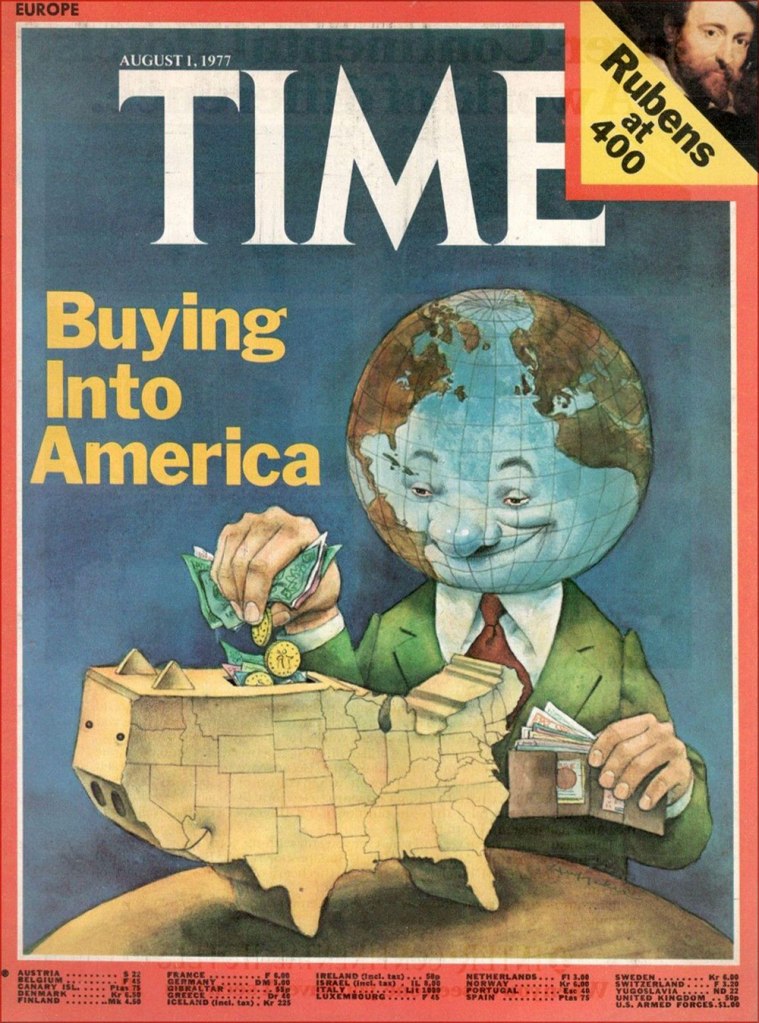
Here’s one of his aforementioned Time covers.
In a 2012 interview, he recalled those halcyon days: « During one week at the peak of his career as an illustrator, Sandy Huffaker had assignments from Time, Sports Illustrated and Businessweek. He had to turn down a fourth assignment that week from Newsweek. “I just didn’t have time.” »
« I’m not saying I’m cool. That’s your job. » — Happy Bunny
When it comes to Jim Benton‘s work, it seems I got in on the ground floor, thanks to a friend’s shrewdly chosen gift of the man’s first cartoon collection, ‘Dealing With the Idiots in Your Life‘, twenty-nine years ago this Christmas. Yikes!
In a way, Benton’s nearly too obvious a subject for a post: his work is everywhere you turn, but such a large audience seems to have been reached at the cost of relative anonymity. In other words, people know his work, but they may not know his name. I’m sure his name does, however, enjoy some currency with a couple of generations of younger readers familiar with his Dear Dumb Diary (nearly 10 million sold!) and Franny K. Stein (over five million sold) series.
Given his intimidatingly formidable output, I’ll stick to material from his first collection, which I like best anyhow… which is not to say, echoing what all and sundry tell Sandy Bates in Stardust Memories, that I strictly prefer “the early, funny ones“. Mr. Benton is possibly even funnier — or at least more sophisticated — today than he was at the dawn of his career, but these early cartoons are less ubiquitous than this century’s crop.
At this stage, Benton’s style — both in concept and execution — still wore some heavy influences, namely that of Bernard Kliban.It wouldn’t surprise me one bit if this cartoon had near-universal appeal, given the fearful hold of cognitive dissonance: after all, most of us think others have a tenuous grasp on reality.Cute Citizen Kane reference.A timeless and oddly poignant state of affairs.Some of you will likely have occasion to muse over this very question during the Holidays.This one’s *very* Kliban-esque.In this one, I see a bit of his fellow Scholastic alum Tom Eaton‘s touches. All for the good.More Kliban (surely intentional!) but with sprinklings of Nicole Hollander and perhaps Scott Adams. Taking Will Rogers’ famous bon mot to its, er… logical conclusion. Here’s a jolly one for the season.
In closing, a bonus one from quite recent days. While I’m less fond of the digital tablet aesthetic of his latest work, his writing has acquired some even sharper edges. Sadly, this strip will likely be relevant only to medieval citizens of the German town of Hamelin, right?
« I’m alone with the ghost of the swamp, somewhere near the weeping willows. » — Steven Herrick
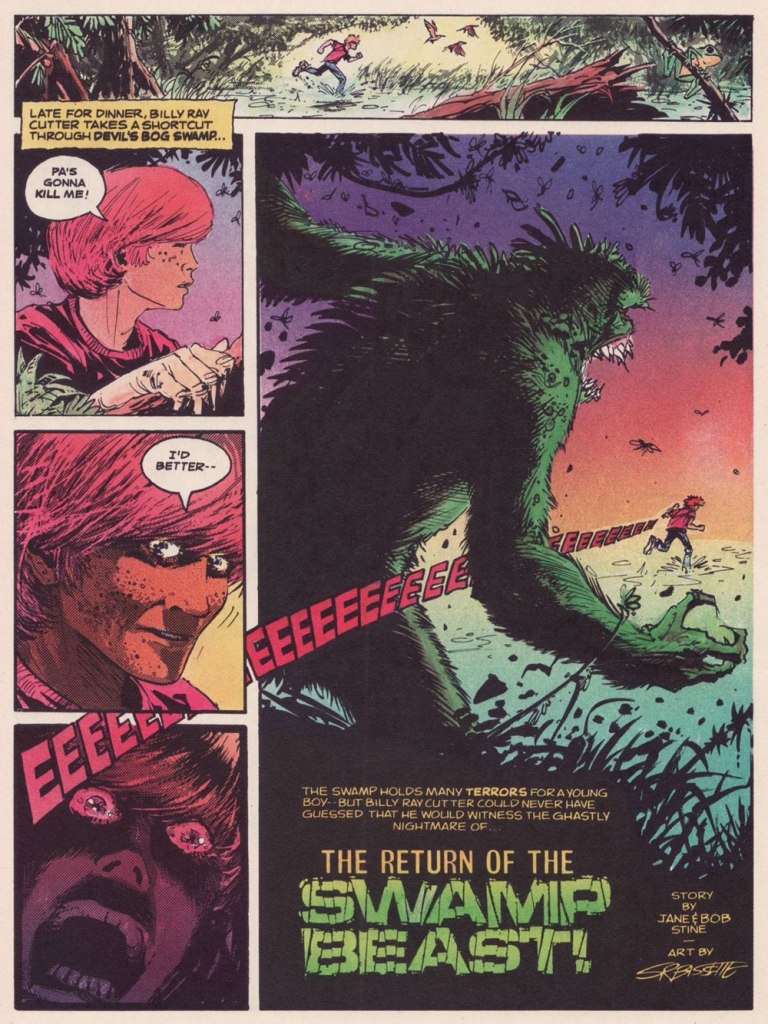
Today, we pull on our wellies and boldly venture into the depths of the mysterious swamp, but not entirely unprepared: on this occasion, I turn the microphone over to an acknowledged expert en la matière visqueuse, Mr. Stephen R. Bissette. I queried Steve about his early work for Scholastic and he most munificently lifted the veil on those wild days of youth:
« Well before my stint on Swamp Thing, I drew two swamp monster stories (one of which I’d also scripted) for Weird Worlds for Scholastic Magazines back in the day. The magazine’s editors were Bob and Jane Stine (Bob aka R.L. Stine), who wrote the first of the two stories; the magazine art director was Bob Feldgus, who was always a joy to work with, and trained me well.
The story titles are counter-intuitively reversed, in a way. “The Return of the Swamp Beast” was originally published in Weird Worlds no.3 (October 1979) in black-and-white, colored for its reprint in Yearbook no.1 (and only, 1986). Enjoy! »
The Return of the Swamp Beast was coloured by Brendan McDonough.
« These were among my favorite early freelance gigs, and remain my favorite magazine account and people I was fortunate enough to work with and for. The Stines and Bob Feldgus extended the best, most gracious, most responsive relations with this freelancer of any I had in those formative early years; it also was the best-paying of all the early freelance gigs, extending the greatest freedom for me to do the work itself, and they boasted the best production and printing of any publisher I worked for then (even better than Heavy Metal).
My entry into the Scholastic freelance pool was via a one-shot horror story for Scholastic’s then-new zine Weird Worlds. Joe Kubert brought me into his studio/office in the Baker Mansion (which has long since been the dorm for the Kubert School rather than its headquarters and main building, as it was during its first few years) and asked if I’d be willing to draw a short (three pages, if memory serves) horror story for a magazine intended for schools; I would be doing the whole art job working from a silly but fun script by Bob and Jane Stine, co-editors of the zine, and my name would not go on the job, it would be credited to The Joe Kubert School of Cartoon and Graphic Art, Inc. Fair enough! I was still a student after all, and this was my shot at doing something different.
I was overjoyed to have the shot, and did my best on it. Part of the appeal, mind you, was drawing a horror comic for schools. During my early ’60s childhood, any comics brought to school were verboten and usually confiscated, horror comics above (or beneath, in the minds of my teachers) all. So, drawing a horror story that was intended for distribution to junior high students—sanctioned horror comics for school!—was a hoot and a bit of karmic comeuppance I was happy to be part of.
Joe was delighted with what I did with the script, as was Scholastic. I wanted to do more. One of (many) great acts of generosity Joe extended my way was gifting me with the account with Scholastic when I graduated in the spring of 1978 from the Kubert School, and thus began my happy few years of working with Scholastic—an account that often paid the rent and kept me working when work in comics was hard to come by.
Scholastic treated me like a prince. They paid well, paid promptly upon delivery of the finished pages, and were always a joy to work with. Like all good things, this passed: Weird Worlds was cancelled after a few issues, and after a couple of jobs for Bananas I moved on to other things, including pencilling Saga of the Swamp Thing beginning in 1983. But I always loved working with and for Bob and Bob, and I miss ’em both. I eventually collected some of my work for Scholastic for two comicbooks in the late ’80s, and did so with Scholastic’s permission. »
That source, Bissette & Veitch’s Fear Book (Apr. 1986, Eclipse) is the one we tapped for this post, and the most affordable solution should one crave more of these sharp little tales. Here’s another, this one a Bissette solo (including the colouring), originally from Weird Worlds no. 7 (Jan. 1981, Scholastic).
« Who remembers these magazines? Bananas and Weird Worlds seem to be lost in the limbo of all school zines; no comics sites acknowledge them or offer back issues for sale (none I can find, anyway), and general online searches turned up little. Back in 1995, The New York Times ran an interview/article on Bob Stine when his Goosebumps TV series was about to debut, making mention of Bananas magazine. There’s a number of online sites dedicated to Stine’s famous and beloved Goosebumps books series, but Bananas and Weird Worlds are less than footnotes in the long shadow of Goosebumps.
There’s a handful of affordable back issues of Weird Worlds available on various online venues and auction sites; I’m in almost every issue. One cautionary note: If you go looking on eBay, though, don’t confuse the Scholastic media zine Weird Worlds with the lurid, gore-splattered Eerie Publications 1970s newsstand horror comic magazine Weird Worlds. Those are fun in their way, too, but you won’t find me in there—just my eye-tracks from reading ’em three decades+ ago.
I’ve long wished to convince Scholastic to consider a collected edition of this body of work, but each & every attempt to engage has fallen on deaf ears. I’m still proud of this work, and as a precursor to the very successful R. L. Stine Goosebumps franchise & Scholastic graphic novels of today, can still hope that one day someone at Scholastic will have the “lightbulb” moment… »
I truly can’t thank Steve enough for this bounty of information — you just can’t beat going straight to the source, particularly with a source this friendly and eloquent!
« Pretty soon, they had me working at the stat machine and the PhotoTypositor, or touching up stripper photos for the Trocadero Burlesk ads. Mostly putting some underwear on them. I may as well have been Vincent Van Gogh, for all I knew. I was in heaven. » — Brooks recalls his formative years
At first blush, I’ve immensely admired cartoonist-illustrator-historian (and so on) Lou Brooks (1944-2021) and his assured line. An ever-eager autodidact, Brooks handily achieved a feat that sets the mind a-reeling: soaking up ‘low’ illustration styles and the essence of faceless pictorial ephemera (think comic book ads, matchbooks, bar coaster and napkin art…), Brooks miraculously derived, from this primeval soup, his unique style, paradoxically bland (by design!) yet instantly recognizable.
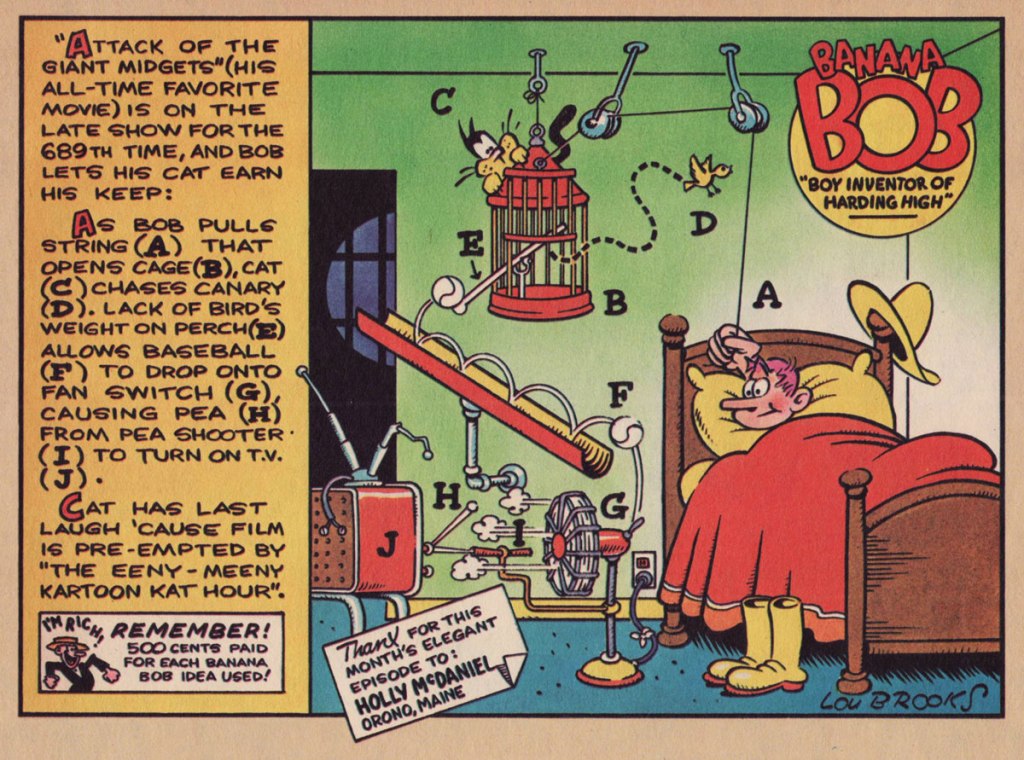
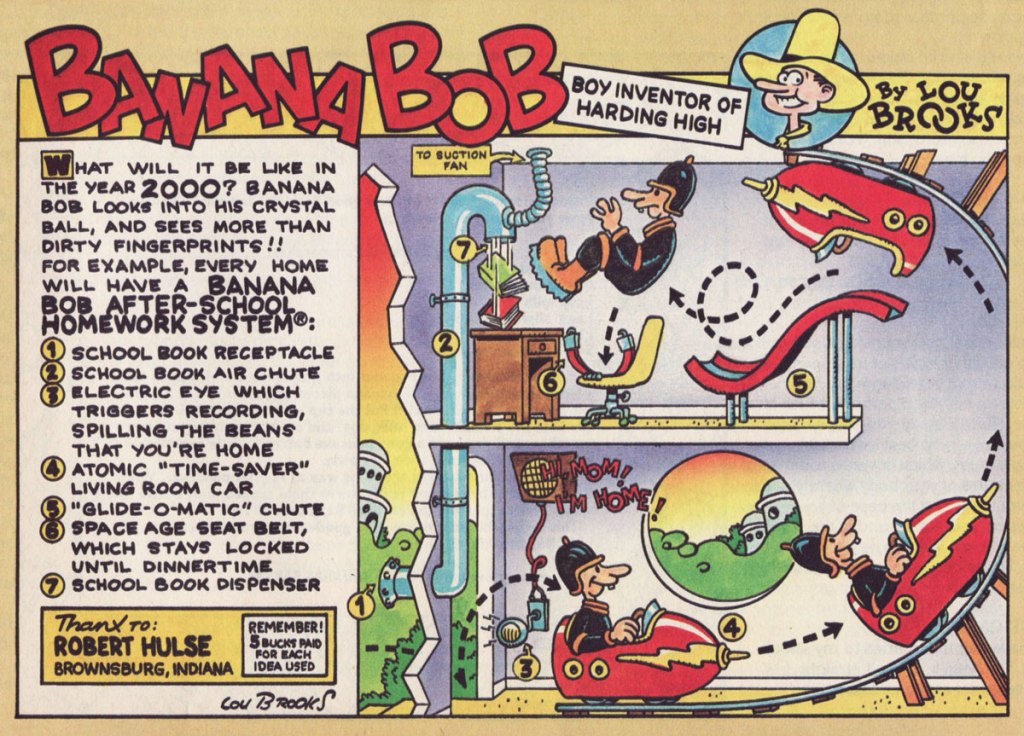
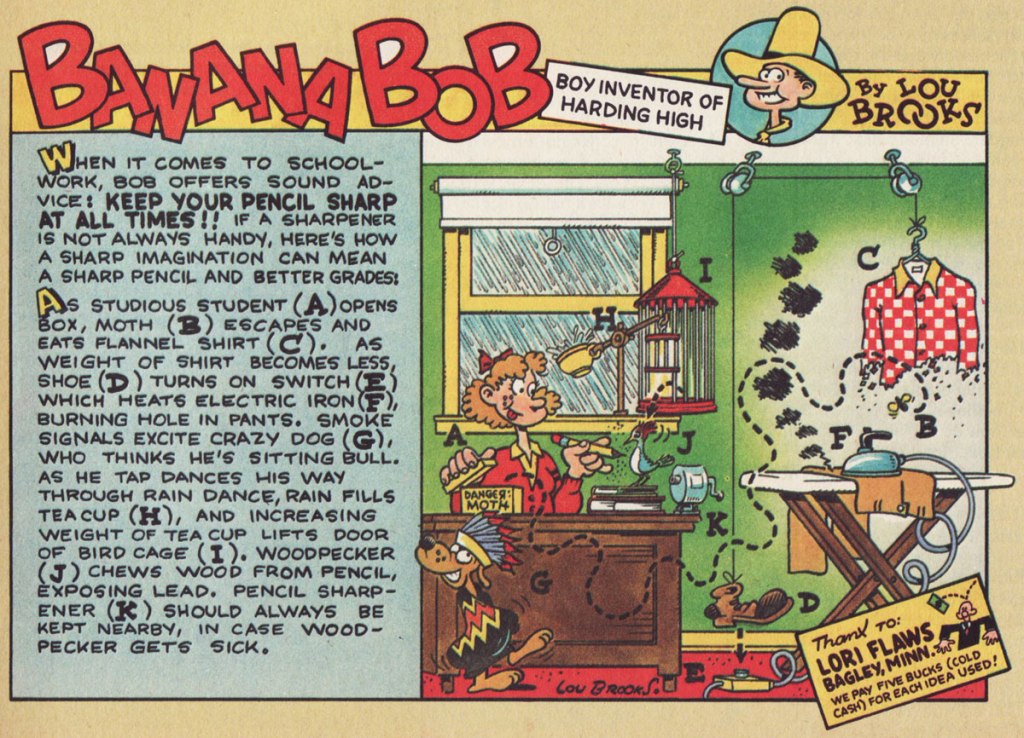
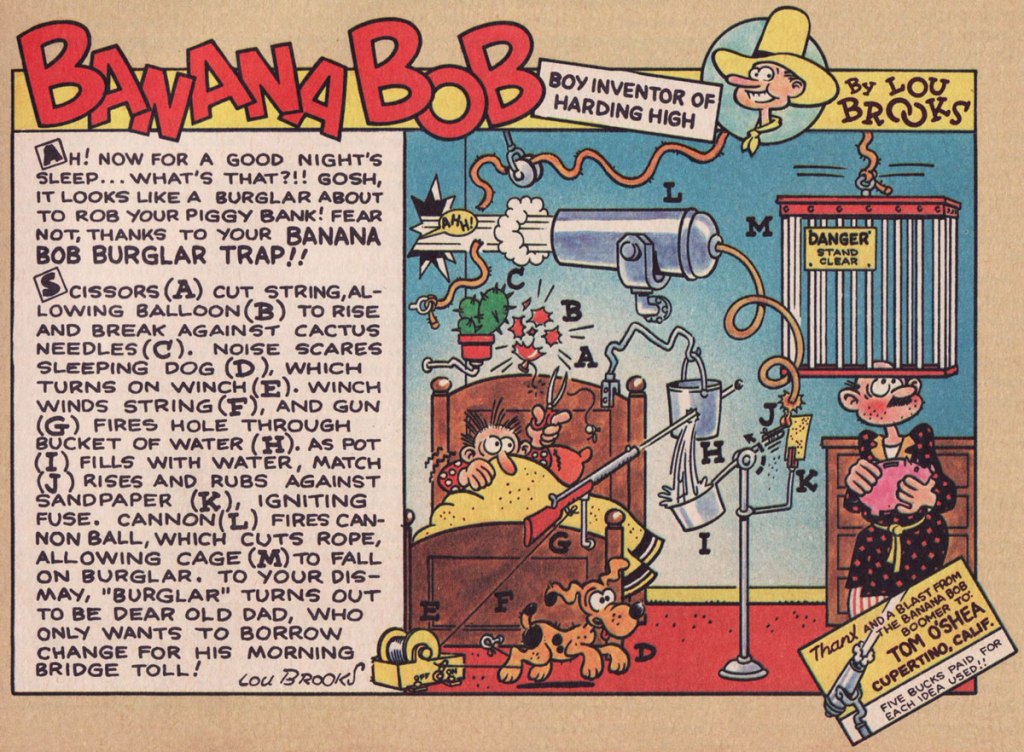
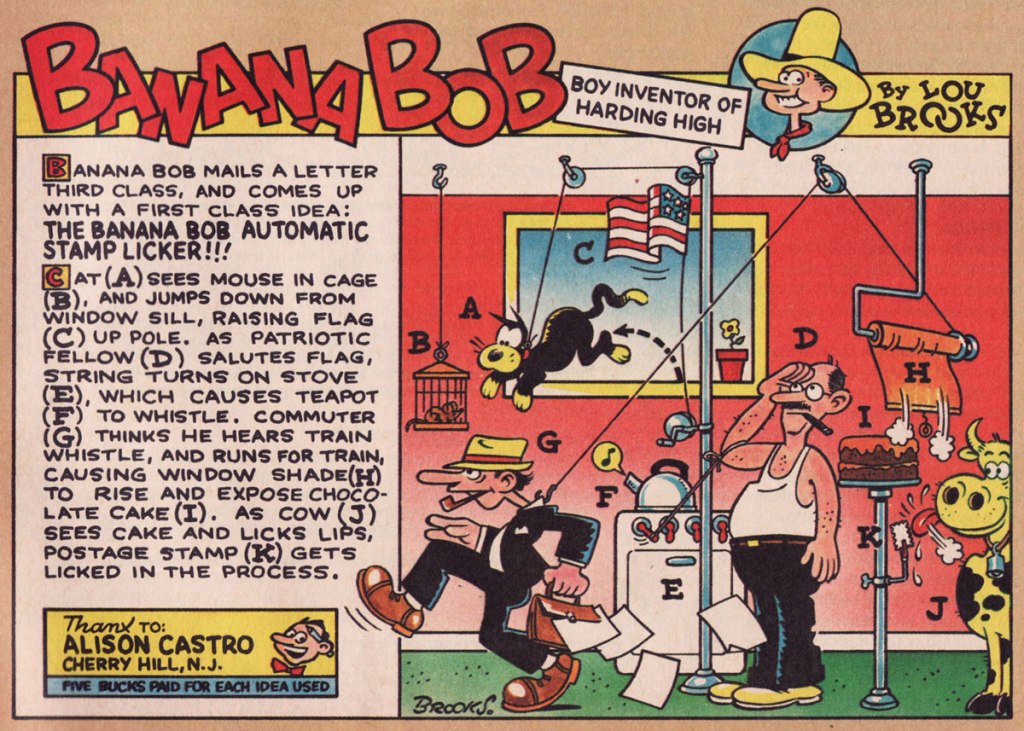
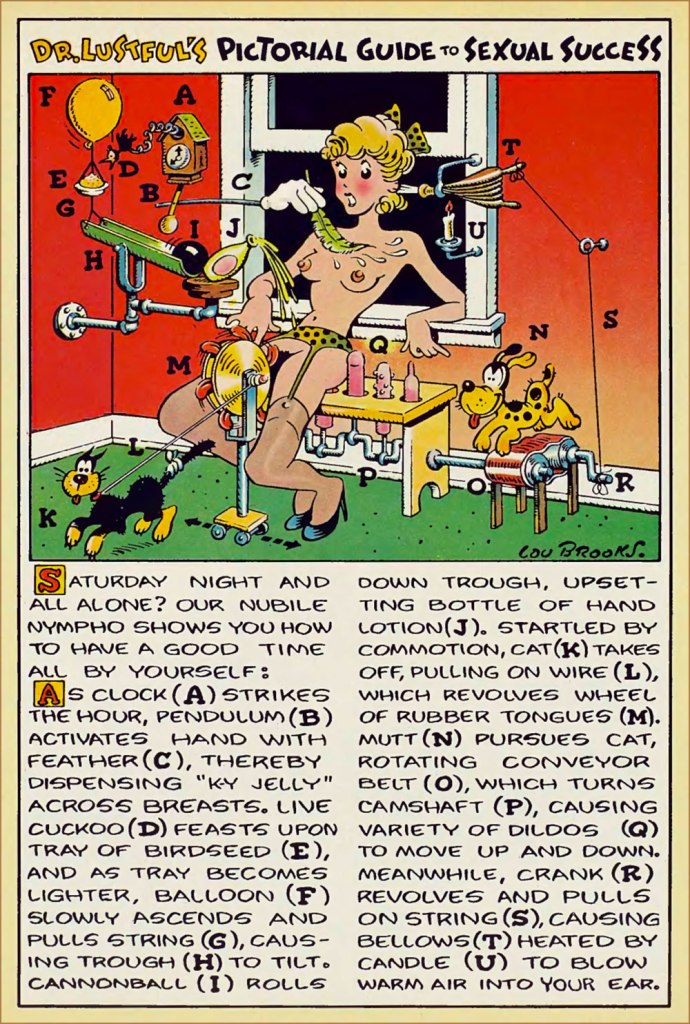
One of Brooks’ earliest jobs in the badlands of professional cartooning was a strip he produced for Scholastic‘s Bananas (1975-84), a skewing-slightly-older companion to the publisher’s big hit Dynamite (1974-92). Banana Bob, “Boy Inventor of Harding High” exploited the time-honoured gizmo formula hatched in 1912 by Rube Goldberg with the twist that here, the doodads were contrived by readers and given visual interpretation by Brooks. Banana Bob ran for the mag’s first twenty-nine issues.
With the early strips, Brooks was still fine-tuning the works. With a dozen or so under his belt, he hit his stride. This one’s from Bananas no. 12.From Bananas no. 13. Foo! There’s our pal, Bill Holman’s Spooky the cat (though he’s lost his bandage)!From Bananas no. 16.From Bananas no. 18.From Bananas no. 19. And add a dash or two of Bill Holman… Brooks knew his stuff, all right.From Bananas no. 20.From Bananas no. 21. I see shades of a Jay Lynch influence!From Bananas no. 24.From Bananas no. 25.From Bananas no. 26.From Bananas no. 27.From Bananas no. 28.… and the series’ full-page finale, from Bananas no. 29, aka the 1979 Bananas Yearbook.
Though Brooks had already developed his trademark style — as evidenced by other illustrations he did for Bananas — he didn’t fully employ it on the Banana Bob strip. If memory serves, here’s where I first encountered a full-fledged Lou Brooks wallop, and I suspect I’m not alone in this (our younger readers are likelier to have first come across his exemplary revamp of the old Monopoly game):
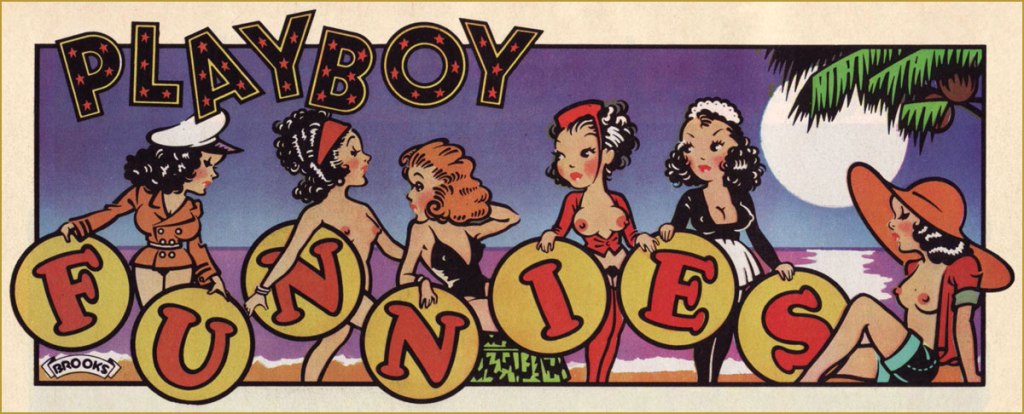
As Brooks evidently knew a good theme when he had one, here’s his Goldberg Variation for Playboy:
From Playboy’s December, 1977 issue, and featuring another fun guest appearance by Spooky the cat.
… and speaking of Mr. Spiegelman, here’s a collaboration between titans. It appeared in the January, 1980 issue of Playboy.
Of course, there’s so much more to Lou Brooks than one could conceivably cover within a mere blog post. To that end, we have a handy little biopic entitled A Guy Named Lou — filmed entirely in Illustr-O-Vision!
Brooks was an assiduous chronicler of the history of reprographics — don’t miss his jaw-dropping Museum of Forgotten Art Supplies. While he did a bit of everything to keep himself amused and occupied, he never lost sight of his vocation, of his one true love — I mean, he was in a band (with Bill Plympton!), but it was called Ben Day and the Zipatones!
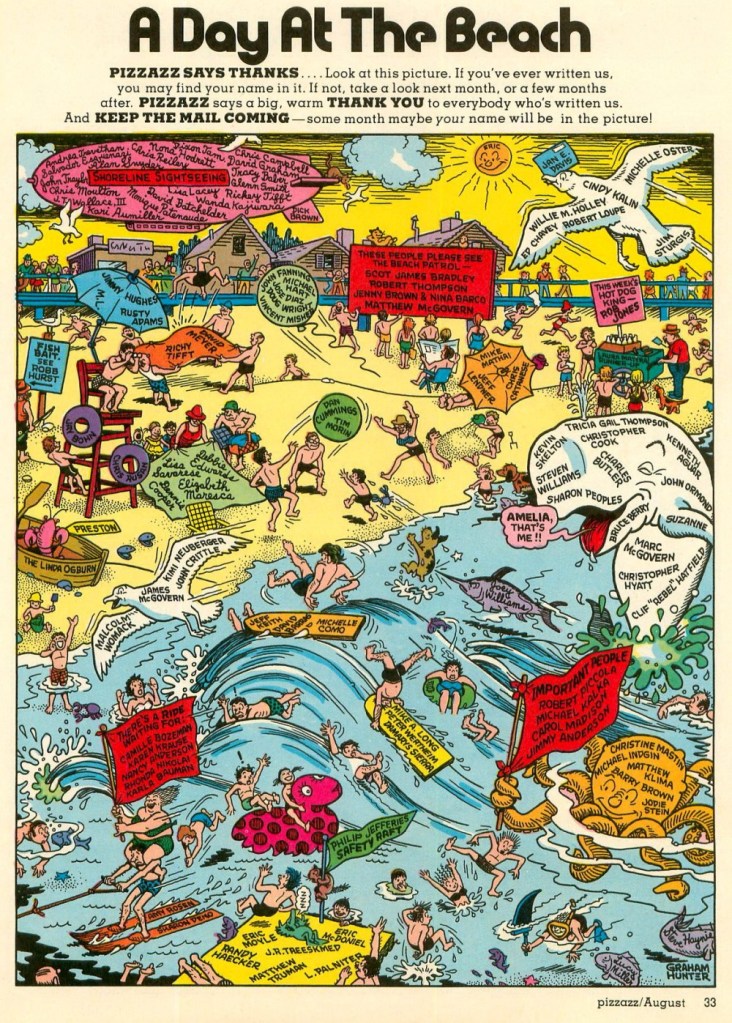
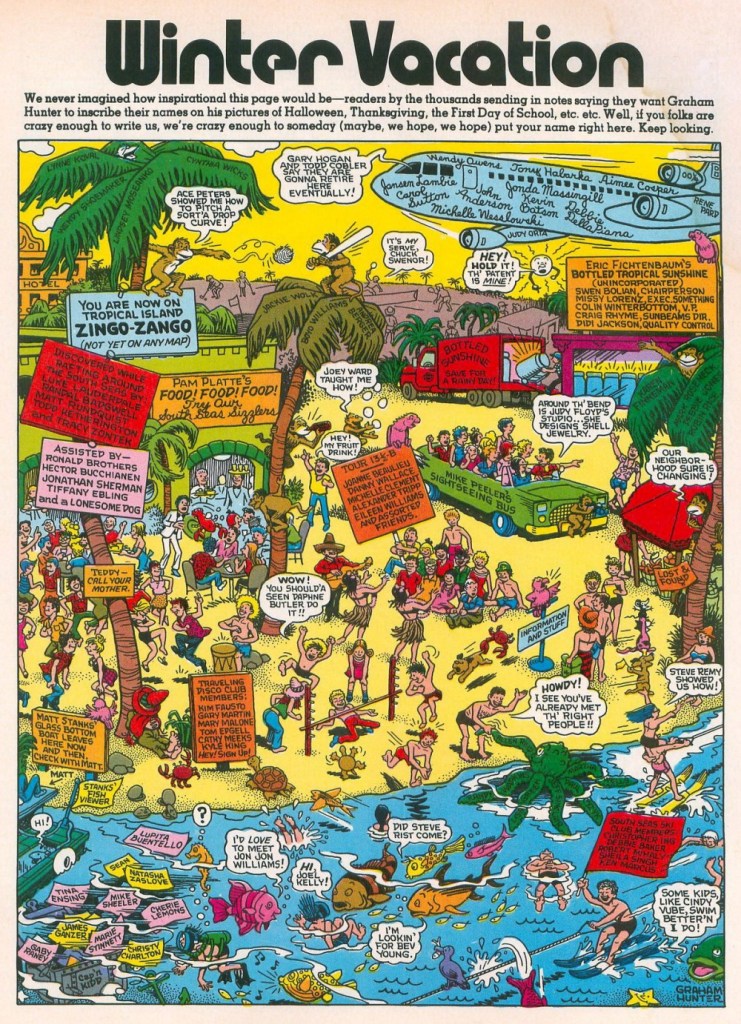
An octopus has crept into the following pages. Can you spot it before the year ends?*
*I realize this is an extremely easy assignment, but given the state of things these days, one should seek out a minor sense of accomplishment wherever one may find it!
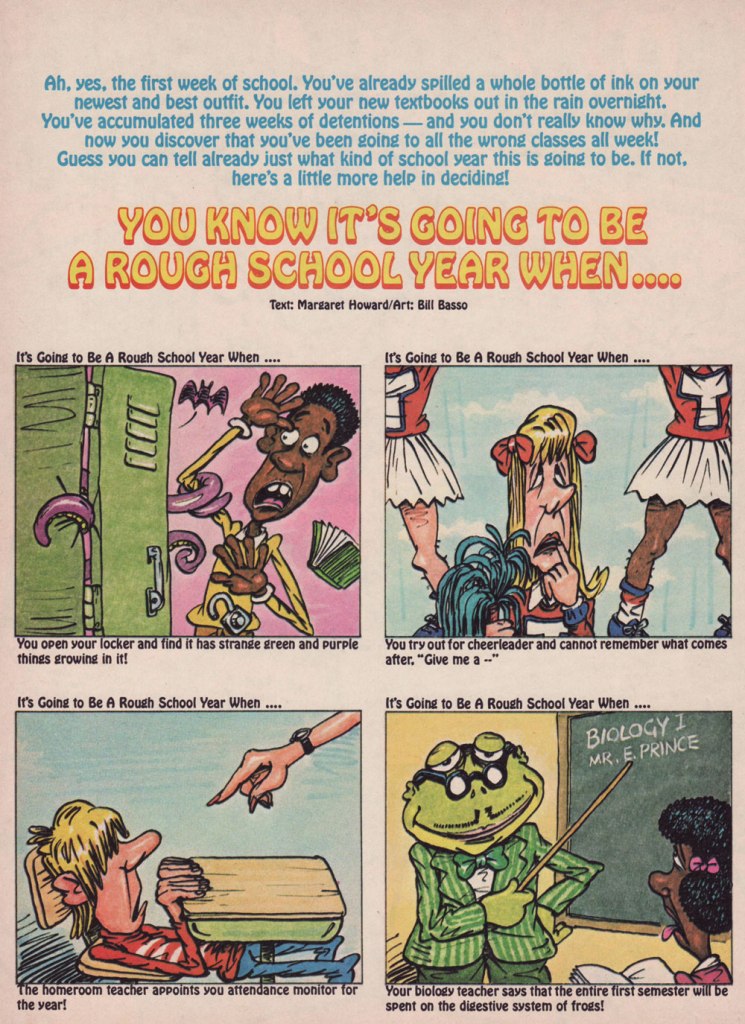
Page from Bananas no. 13 (1975, Scholastic), a kids’ magazine from the 70s. Somewhat similar to its older brother Dynamite, Bananas had (even) more of a focus on celebrities. Art by Bill Basso.
Pizzazz, published by Marvel Comics from 1977 to 1979, was pretty much a rip-off of Dynamite, and, as co-admin RG points out, rather tiresome to read with its constant insertions of Marvel plugs. From Pizzazz no. 11 (August, 1978, Marvel), this elaborate scene is by Graham Hunter – visit Hallowe’en Countdown, Day 27 for more from this great artist!
From the mag’s final issue, Pizzazz no. 16 (Jan. 1979, Marvel).
I have plenty more tentacles saved up, but after four years of weekly cephalopods, I am growing rather weary of this topic. While I endeavour to rekindle this old love of mine, I will move on to other interesting things, so this is not only the last Tentacle Tuesday of the year, but the last TT for a bit. See you on newer, fresher pastures!
« No — I’m not alive! But we’ll have time to talk about that later! » — the accident-prone stranger
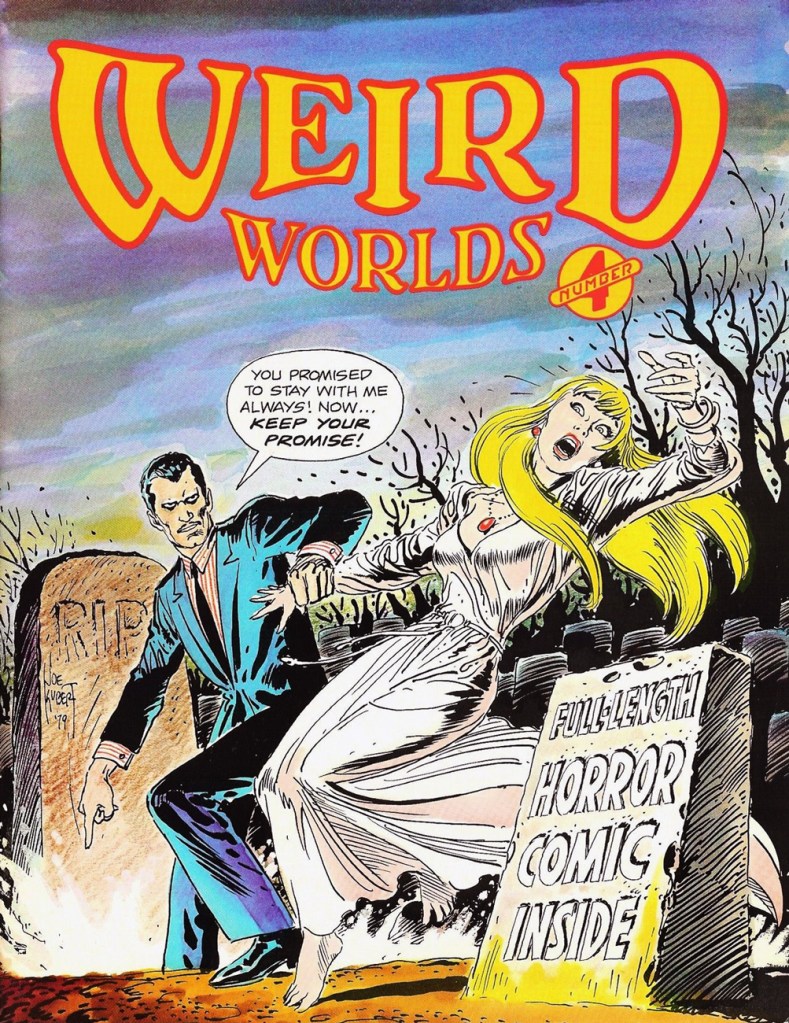
On the magazine front, Scholastic hit its peak in the mid-to-late 1970s with Dynamite (1974-92) Bananas (1975-84) and sundry periodicals aimed at various reading levels. Always comics-friendly, they struck a fruitful alliance with the fledgling Joe Kubert School of Cartoon & Graphic Art, thus granting precious early exposure to some of the institution’s promising early alumni, such as Stephen Bissette, Rick Veitch and John Totleben.
This is Weird Worlds no. 4 (1980, Scholastic). Cover by Joe Kubert. By ‘full-length’, they meant ‘four pages long’. Oh well.
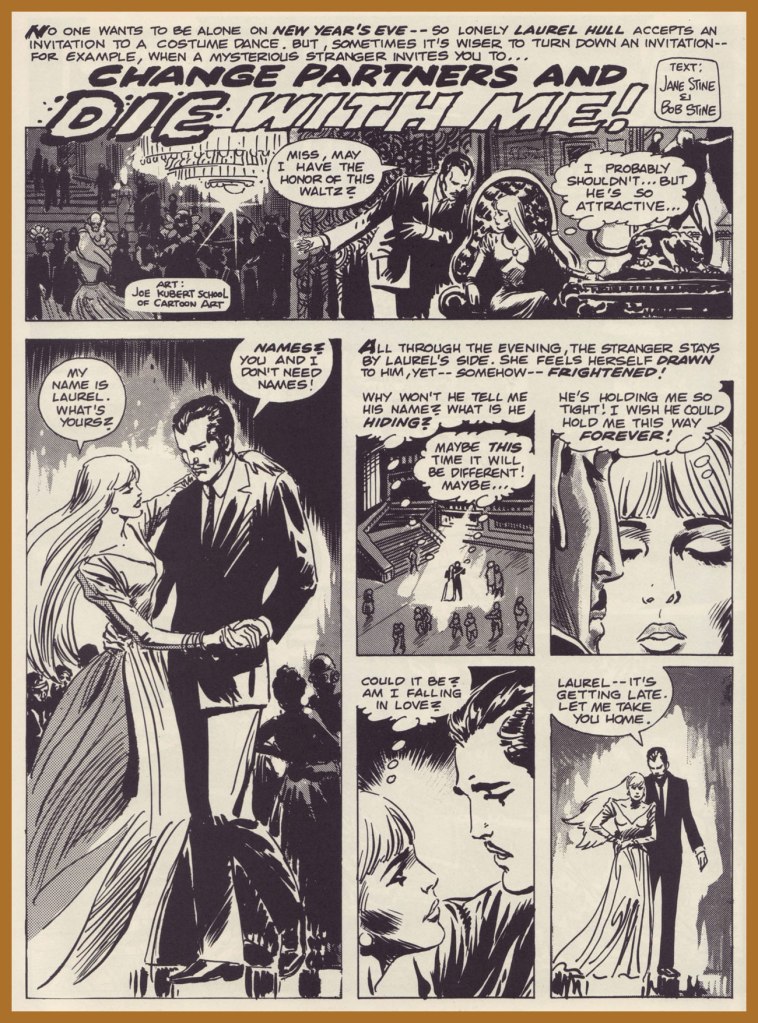
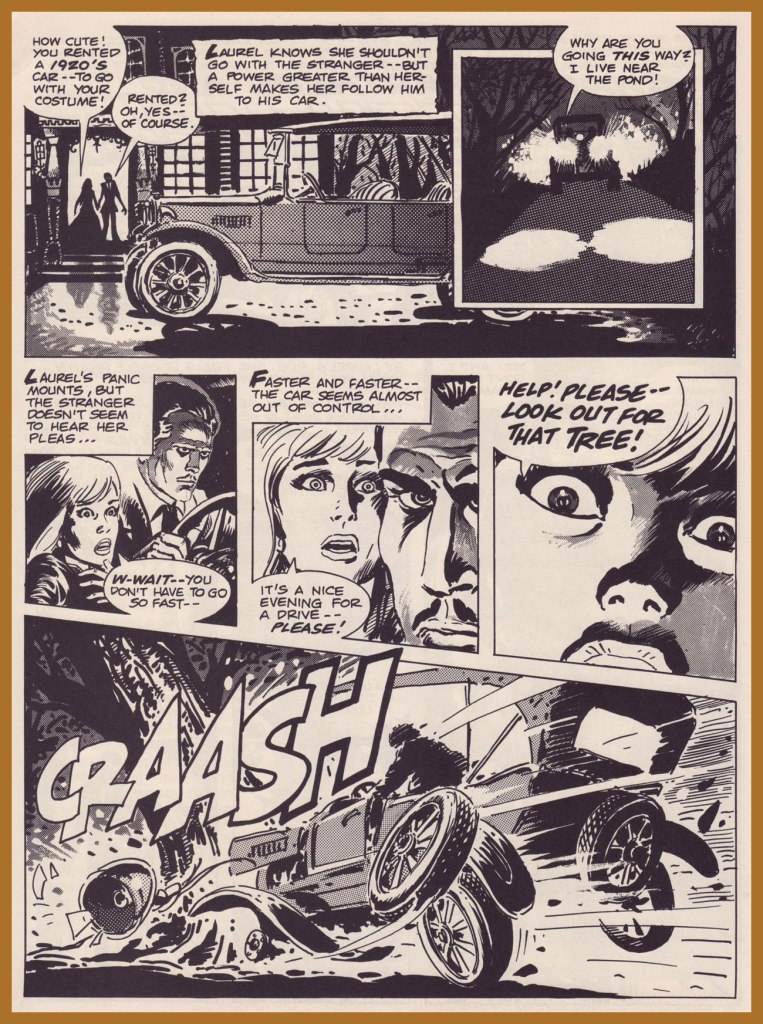
Professorial Joe Kubert leads his students into a moody collaboration with the guiding lights of Dynamite, namely the husband-and-wife team of Jane Stine and ‘Jovial’ Bob Stine (of later R.L. Stine fame and fortune).
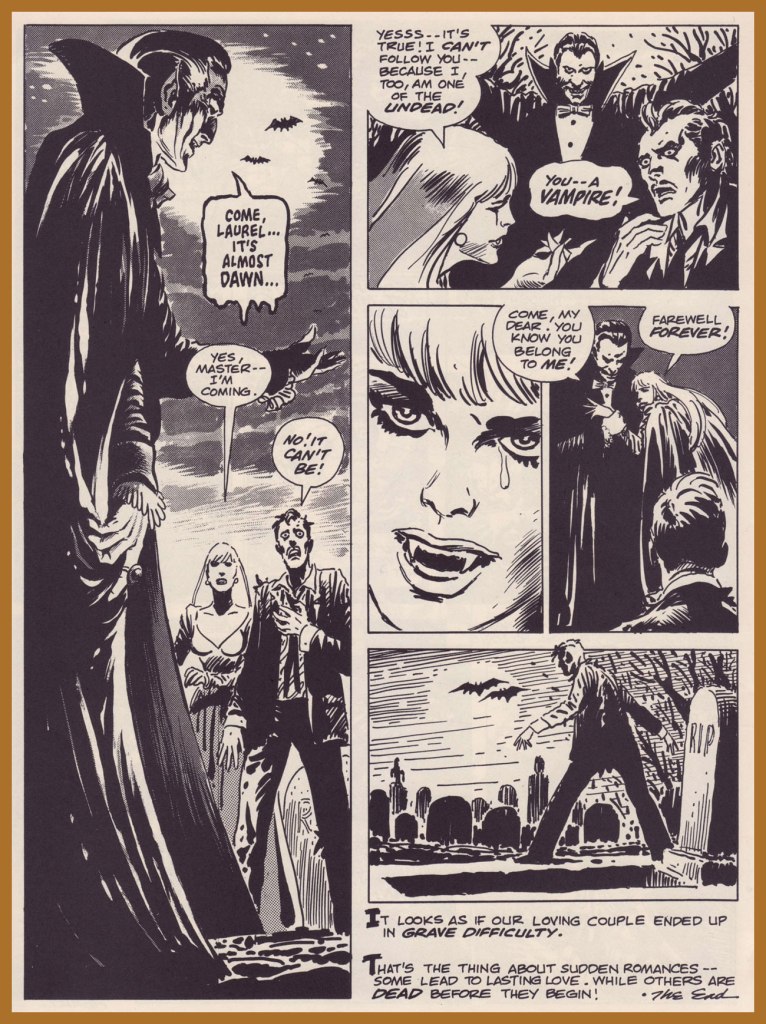
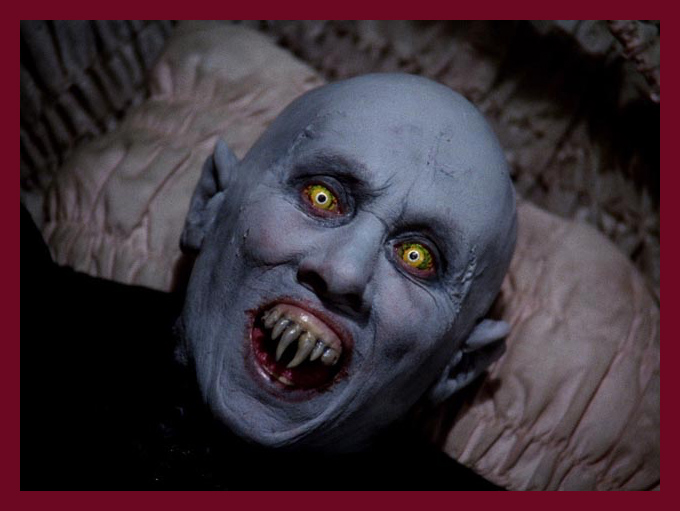
Well, Laurel could have fared far worse: her ‘Master’ is squarely in the then-fashionable Frank Langella / George Hamilton leading man mould. There was another alternative, of course:
You’ll enjoy Mr. Barlow. And he’ll enjoy you.
Weird Worlds didn’t set this world afire, enduring but eight issues. Still, Scholastic would return to mine the teenage affinity for all things spooky and on that occasion (and further ones) strike gold and raise goosebumps.
« When comics came along in the 1930s there was a talent pool waiting. And one reason is so many areas were closed to Jews. Colleges, advertising agencies, many of the corporations – the doors that were closed led to the one that was open. » — Jerry Robinson
It’s New Year’s Day, which means it’s also the titanic Sherrill David ‘Jerry’ Robinson‘s birthday. Born on the first of January in 1922, he left us not so long ago, on December 7, 2011. He played at the very least a strong rôle in the creation of Batman’s sidekick Robin, his foes the Joker and Two-Face, his butler Alfred Pennyworth… and much more. Naturally, since we’re entering the murky world of Bob Kane, the whole process is mired in controversy, conflicting accounts and perhaps a little fibbing from certain parties.
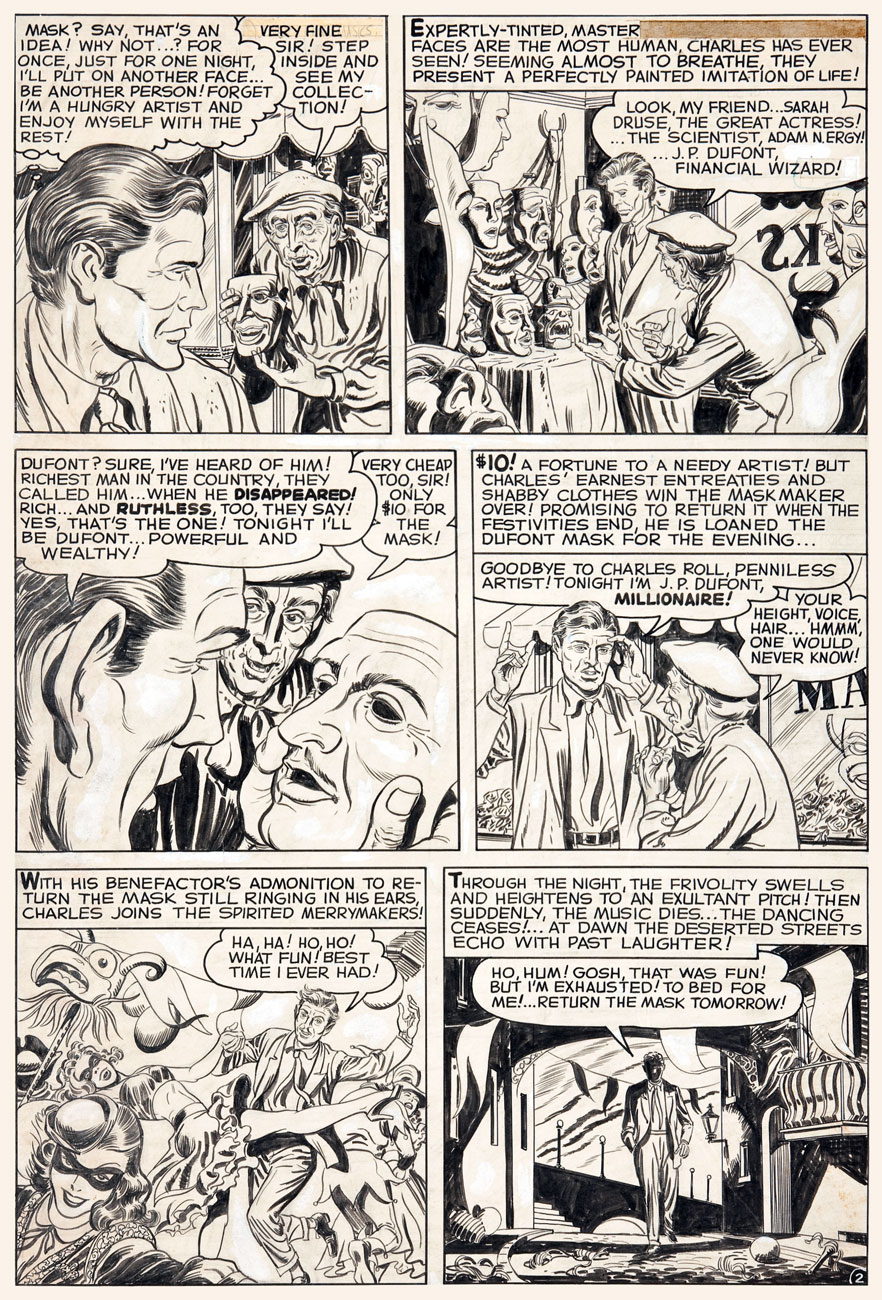
We won’t limit ourselves to the obvious Bat-imagery, which was mostly studio work anyway. Here, for instance, is a more obscure but purer œuvre, both pencilled and inked by Robinson: the original art from « Behind the Mask », page 2, originally printed in Atlas’ Marvel Talesno. 103 (Oct. 1951). Writer unknown.
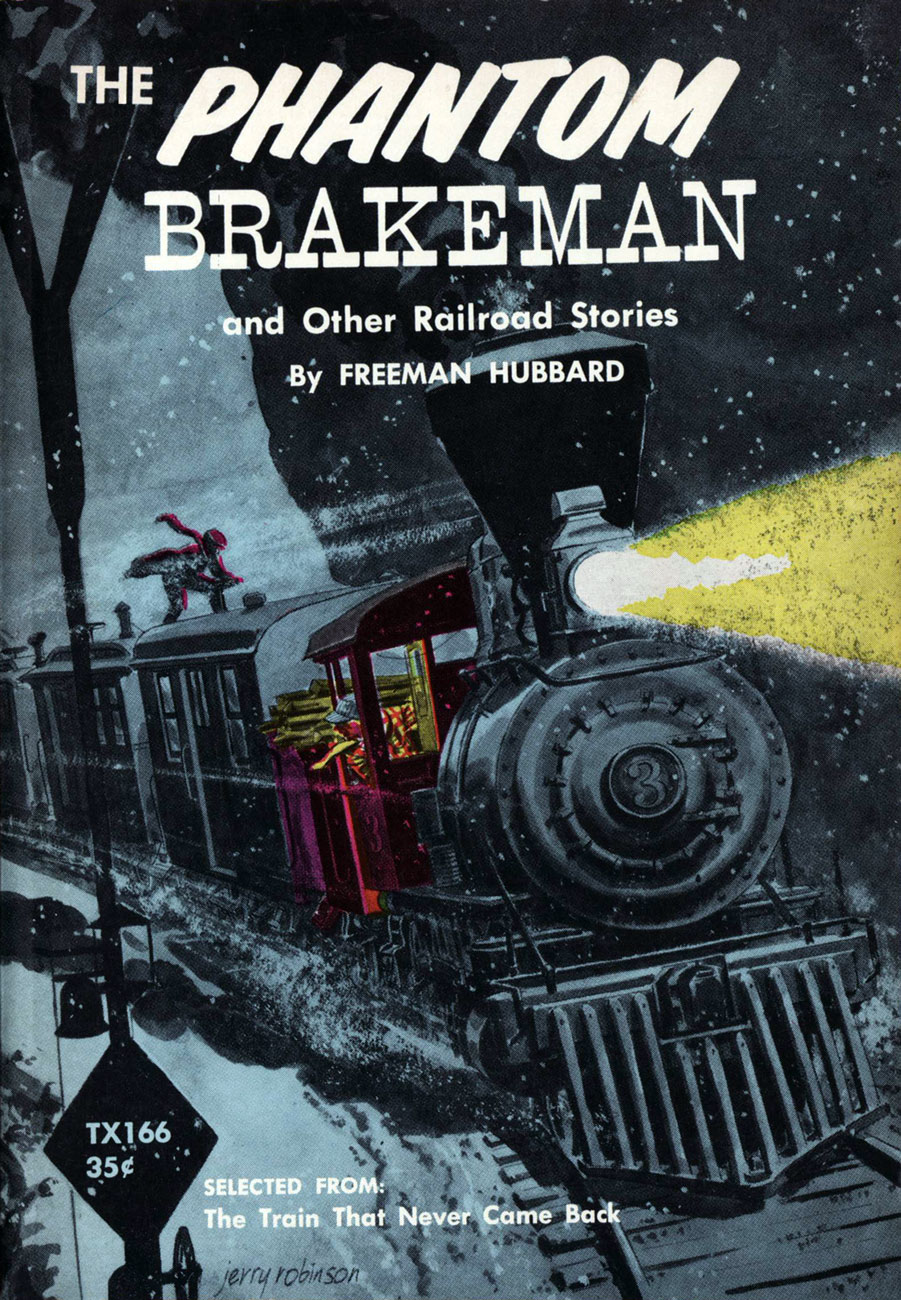
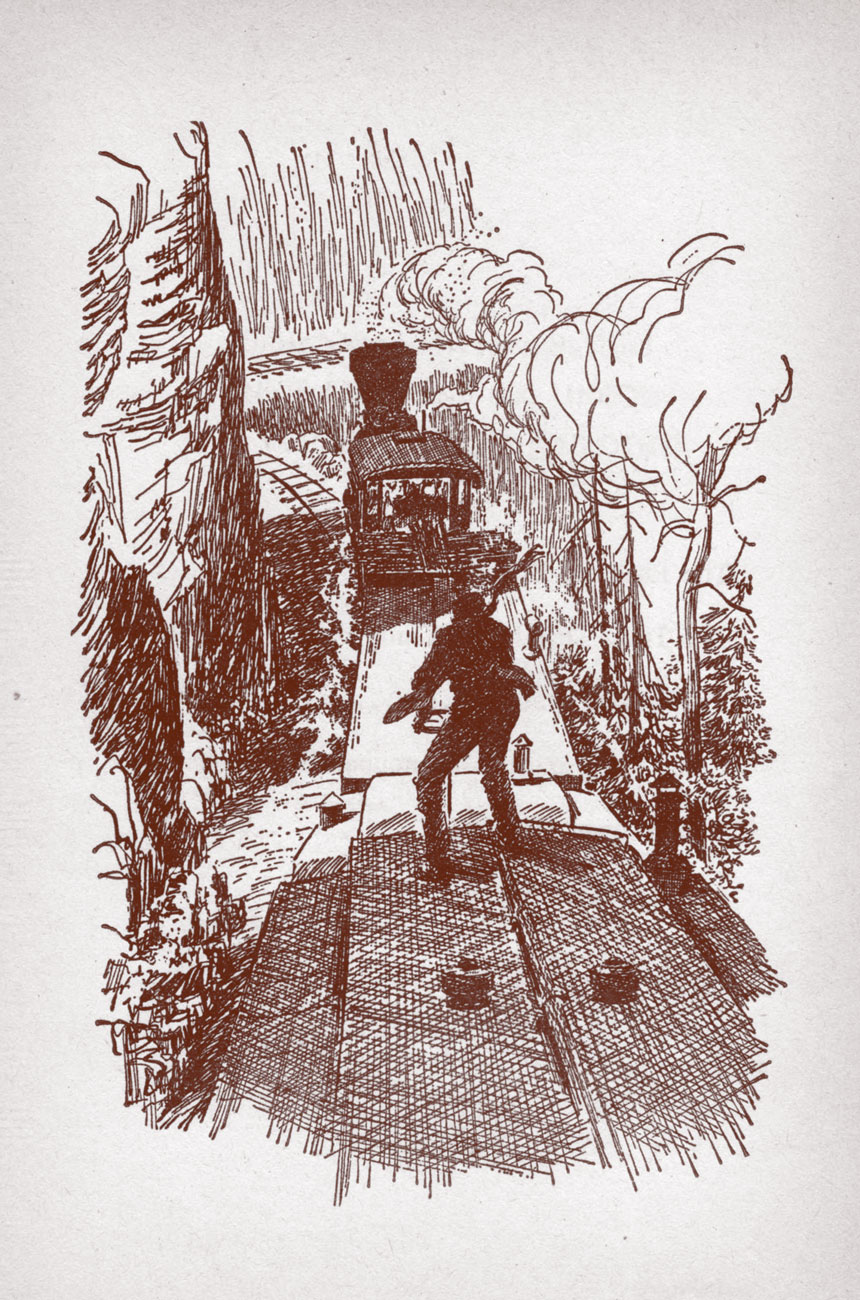
My earliest encounters with Mr. Robinson’s work were through a pair of books for young readers he illustrated in the late 1950s, in a beautifully free and expressive styles. Here’s the cover and one interior vignette from The Phantom Brakeman (1959, Scholastic), written by Freeman Hubbard, then editor of Railroad Magazine.
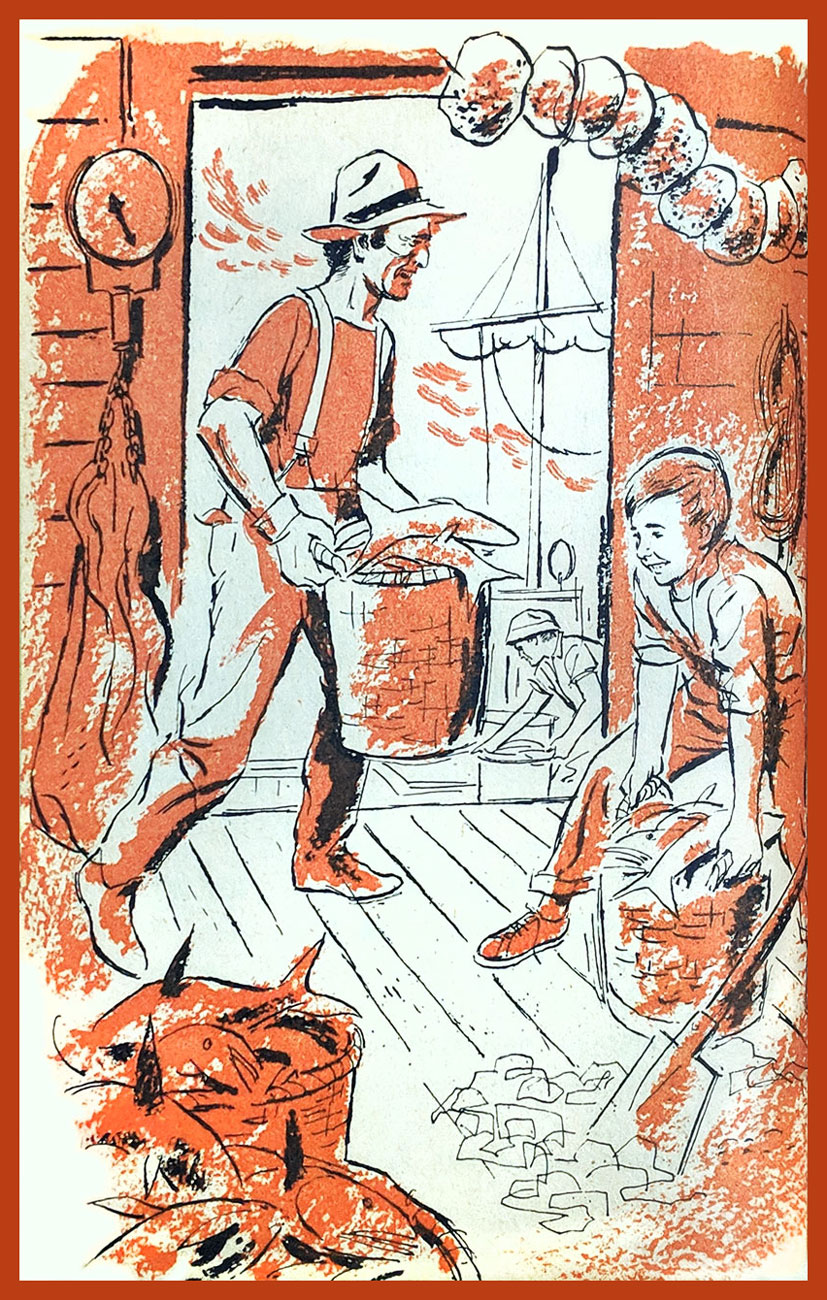
The following two pieces belong to Hurricane Luck (1959, Scholastic), written by Carl Carmer.
Spoiler alert: Peter does, in the end, win the Tarpon fishing contest.
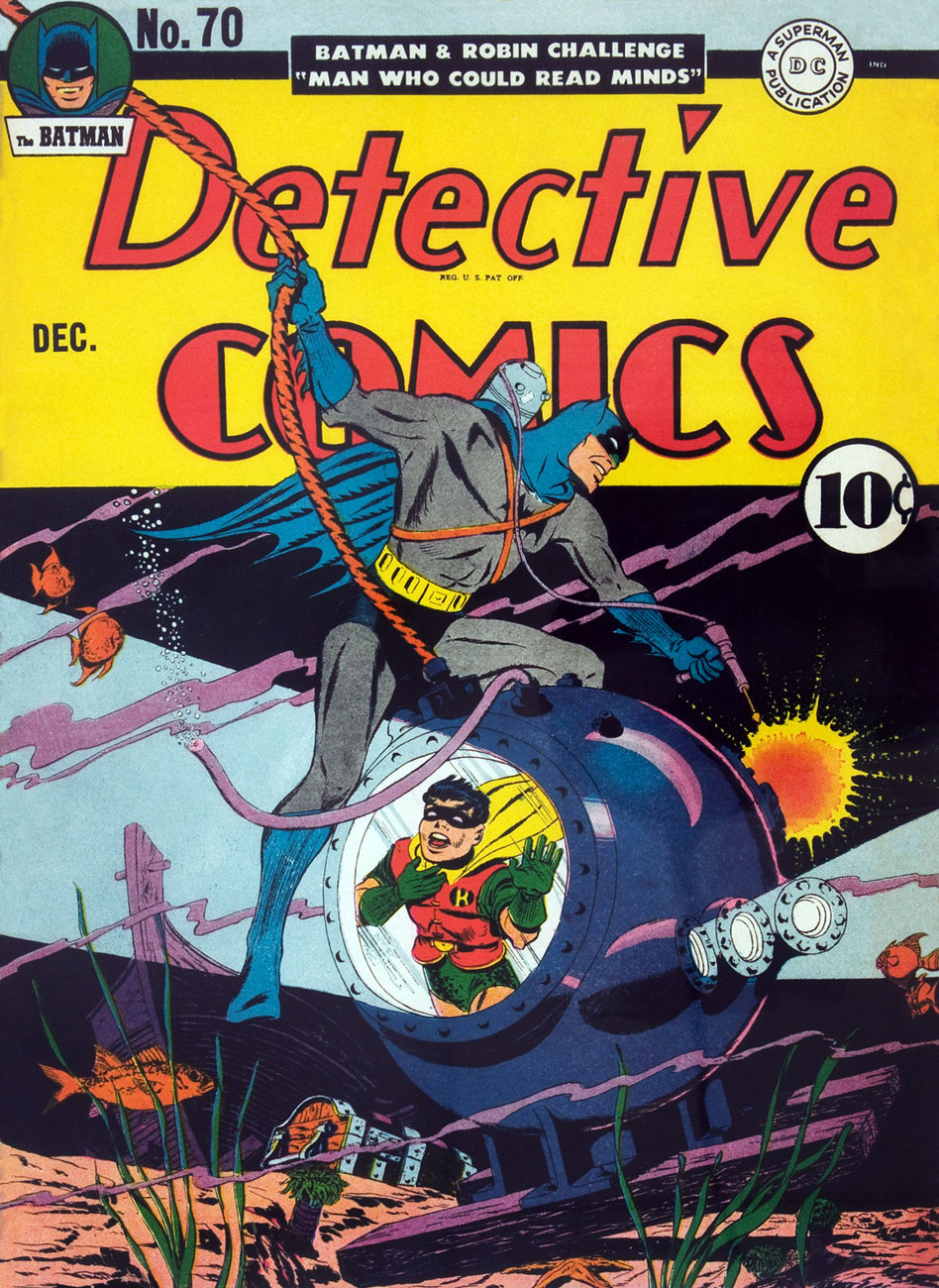
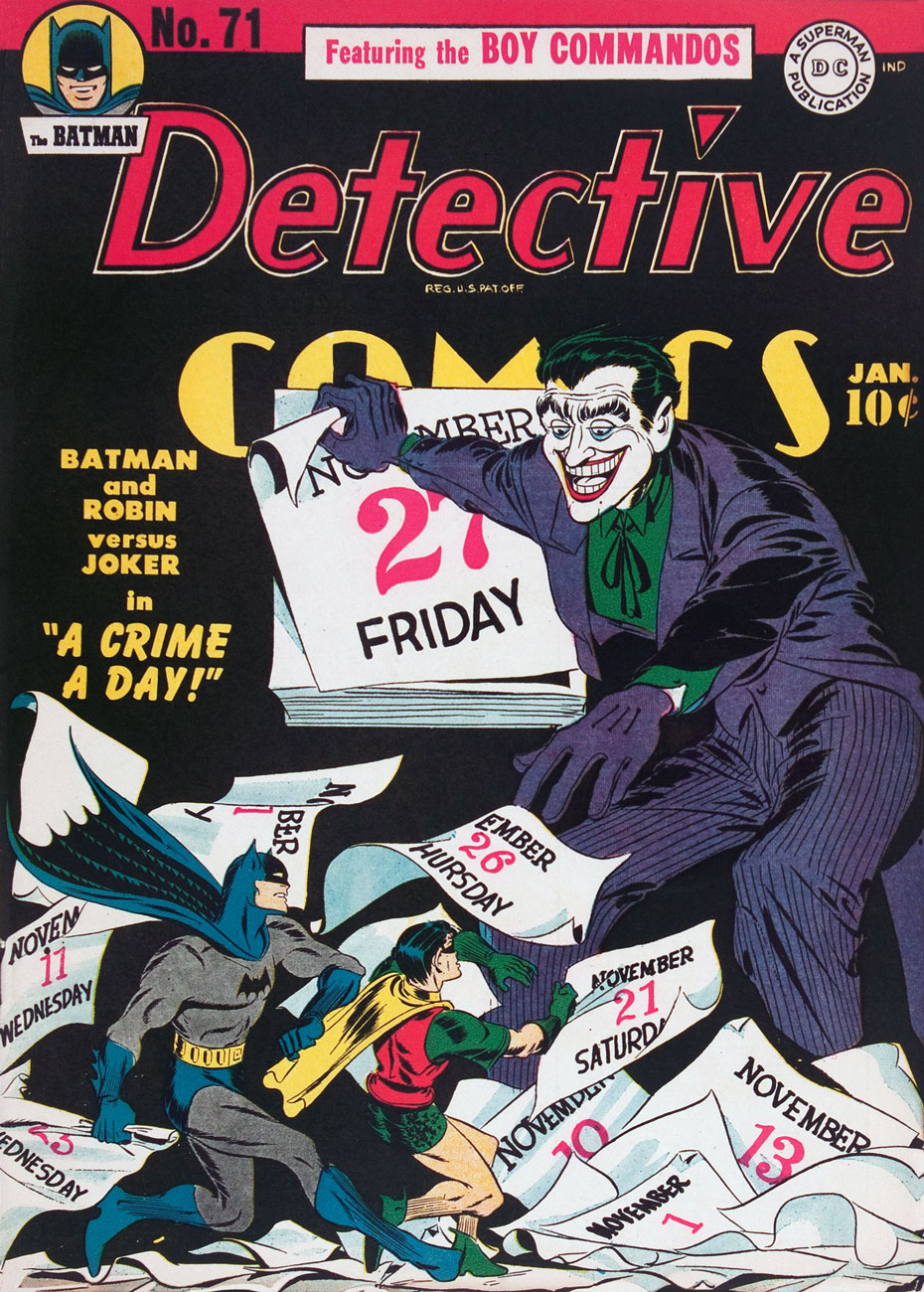
« What about Batman? », you might say. Okay, I admit I don’t have a prayer of getting away with a Jerry Robinson tribute devoid of the caped crusader and his trusty bird-themed sidekick, so here goes!
Detective Comics no. 70 (Dec. 1942). Pencils and inks by Robinson.
Detective Comics no. 71 (Jan. 1943). Pencils and inks by Robinson.






































 Who's Out There?