While I’m a late-blooming romance comics fan — the flamboyant Enrique Nieto drew me in, and I stuck around — I’m strictly a Charlton man: with precious few exceptions, DC’s take on the genre is histrionic and insincere. These were the books no-one at National wanted to be stuck editing. Also, and it’s always worth noting: wayyyy too much Vince Colletta. As for Marvel: Stanley Lieber was, not to put too fine a point on it, relentlessly sexist… ’nuff said?**
It’s not for nothing that Charlton was tops in romance, publishing a dozen or so titles at a time when the Big Two put forth a third of that number at most… with plenty of reprints tossed into the mix. Obviously, given Charlton’s tremendous romance output, it wasn’t all gold… but nuggets turned up with sufficient frequency to justify one’s continued interest.
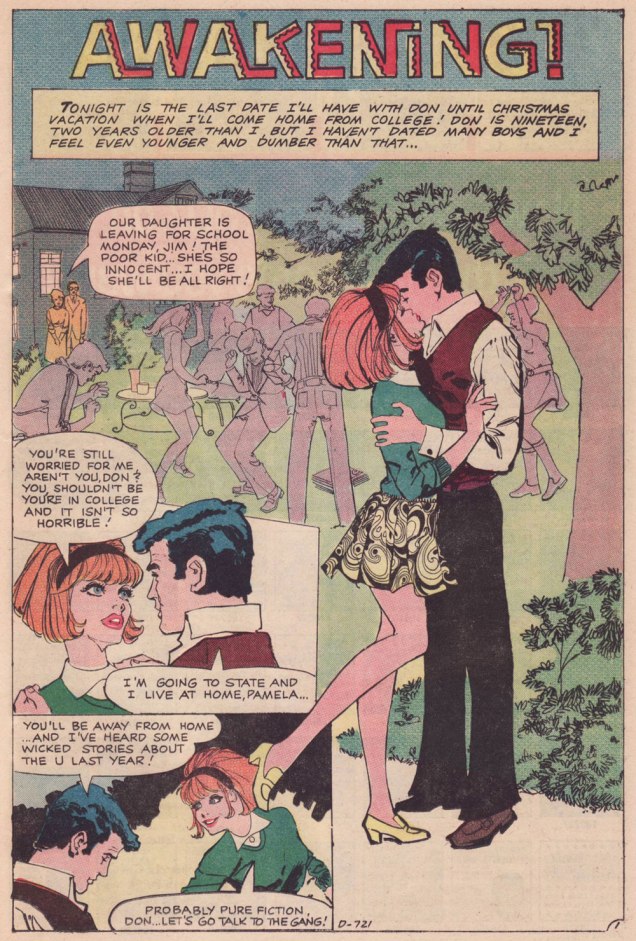
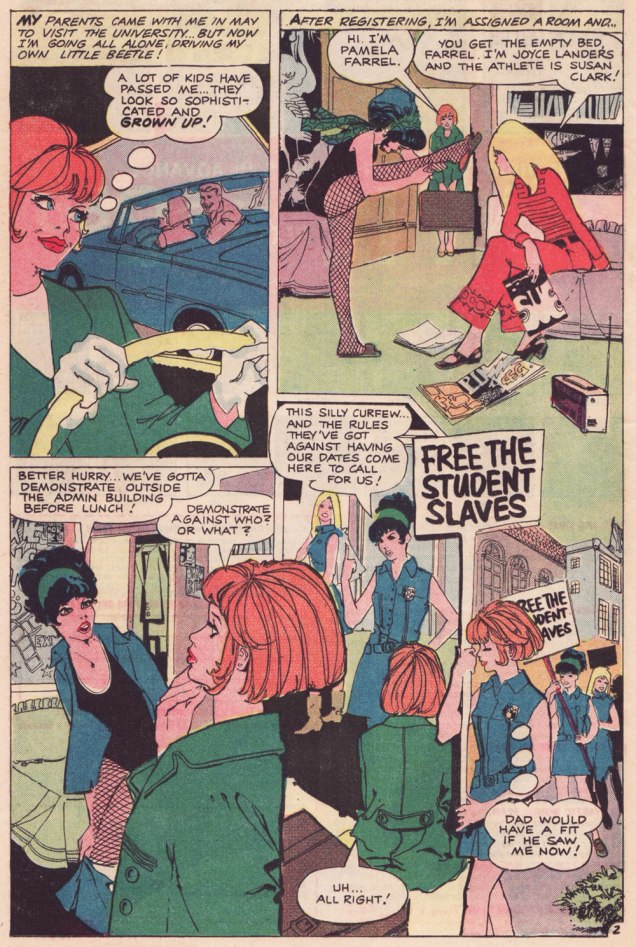
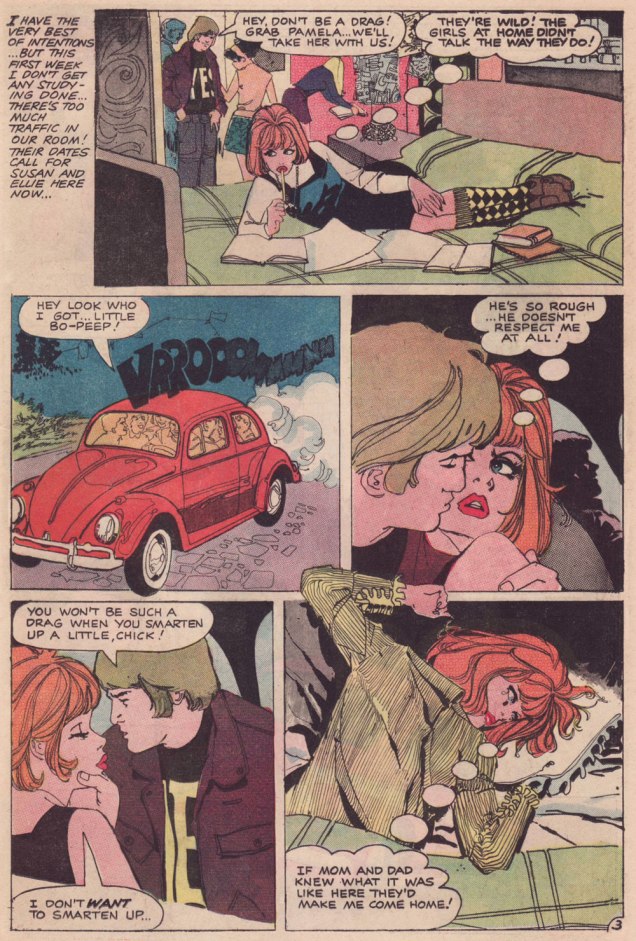
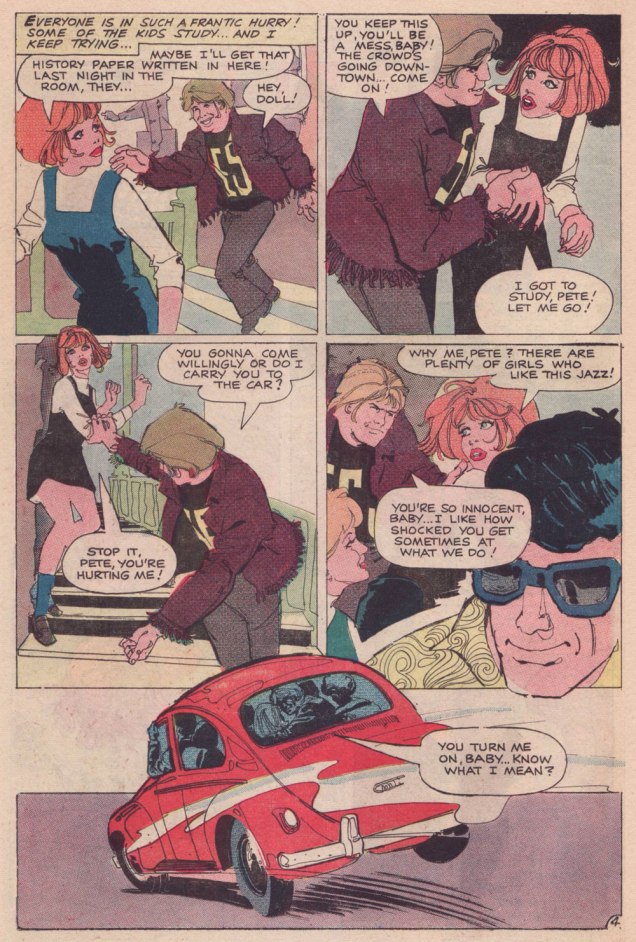
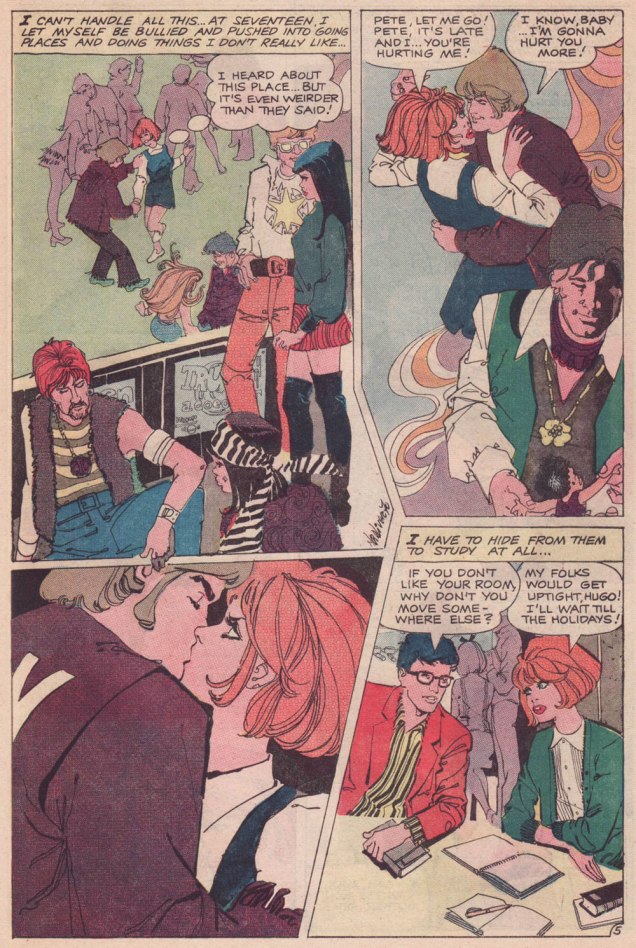
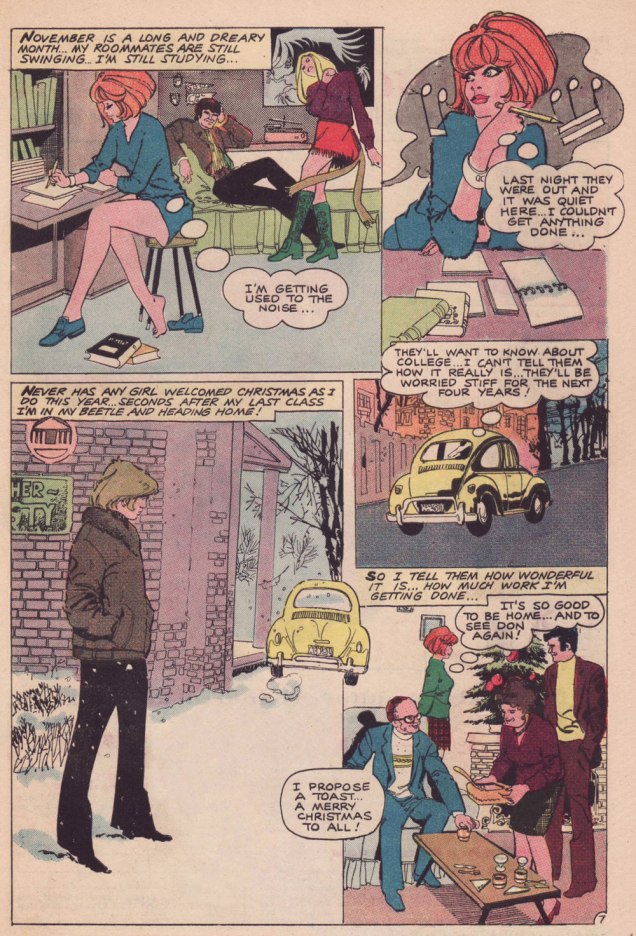
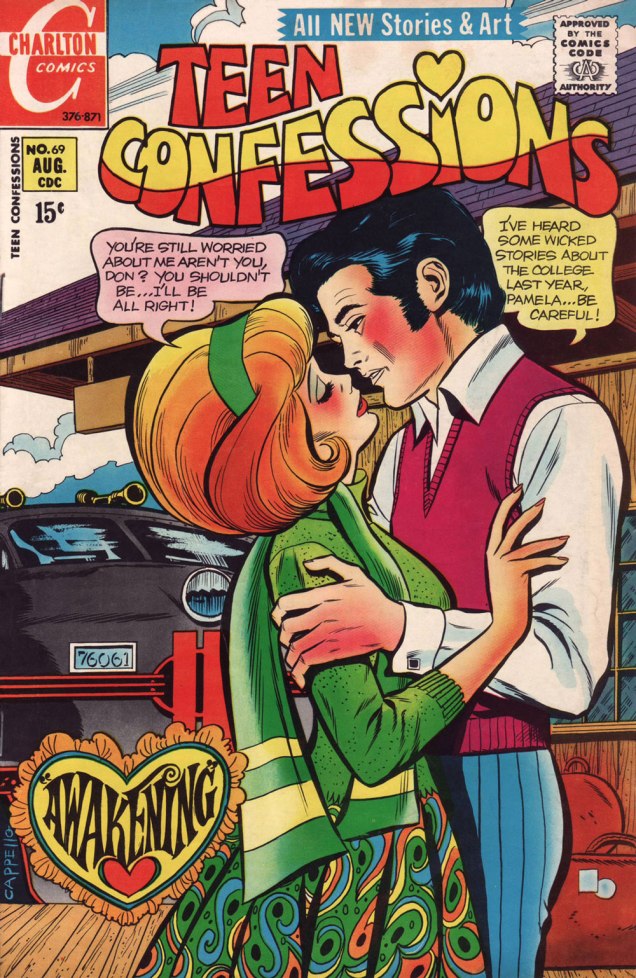
Let us then flash back to 1971, and a nugget from Teen Confessions no. 69 (Aug. 1971, Charlton). Almost certainly written by Joe Gill and definitely pencilled and inked by yet another talented Argentine, Nestor Olivera.***
.
.
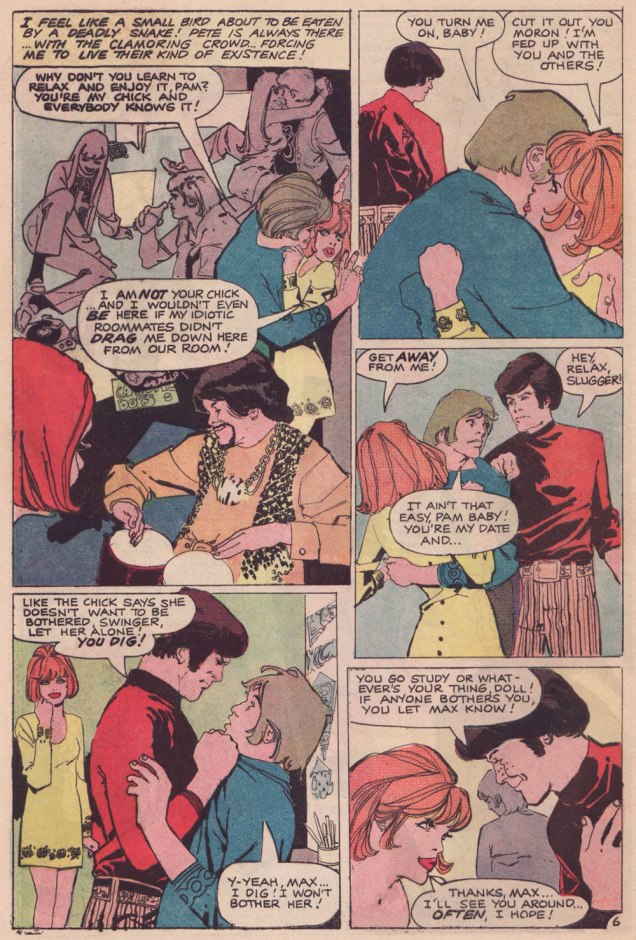
Having the bully/sexual predator wear a big YES on his shirt — though never quite show it — is a cleverly appropriate touch on the part of the artist.
.
A typical Joe Gill touch: a character may be introduced, speak one line, advance the story, reinforce its logic… and never reappear. Take a bow, Hugo.Max makes the most of his chivalrous four-panel rôle; in a refreshing twist, there are no strings attached to his gallant turn.
.
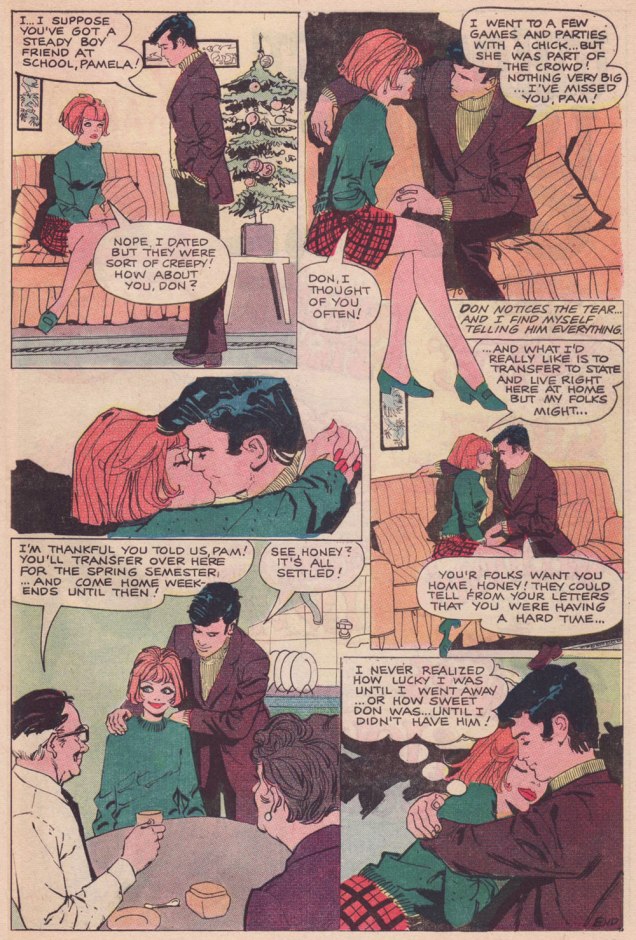
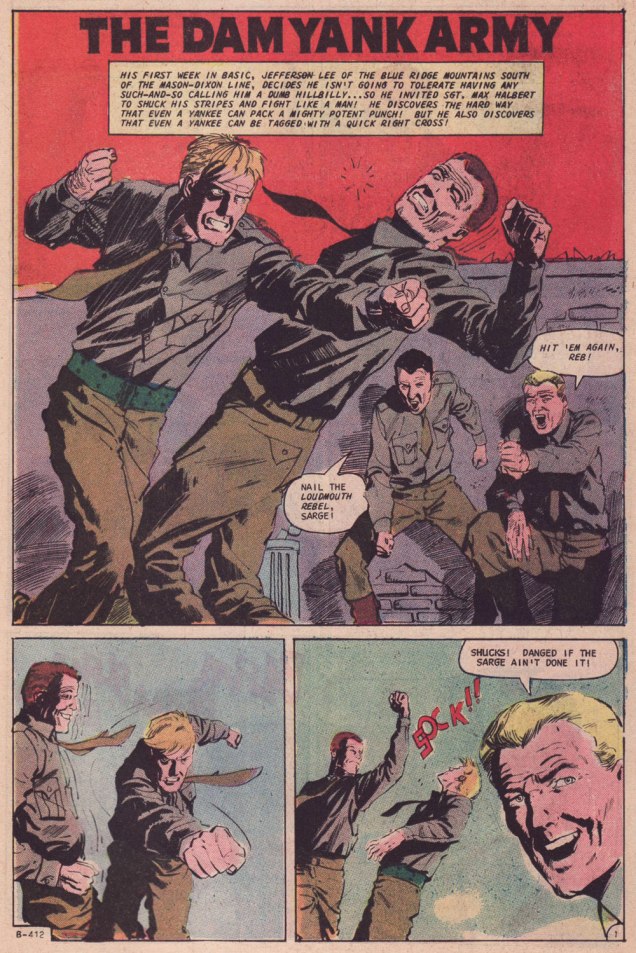
Parents who aren’t utter dimwits also frequently feature in Joe Gill’s romances. Awakening was the cover story. While former Colletta assistant Art Capello is credited — and he signed it, too — I strongly suspect the heavy hand of editor Sal Gentile in the layout and finishes. Why? Because Gentile’s leading men always tended to resemble actor George Chakiris.Compare and contrast: other than romance, the versatile Olivera demonstrated his chops in Charlton’s war titles. This is the opener of The Dam Yank Army, another Joe Gill yarn, cover-featured in Fightin’ Army no. 74 (June 1967; Dick Giordano, editor).
-RG
*By all means read the full interview for some insight (beware!) into Kanigher’s thinking. He continually caroms from insight to delusion, from sagacity to madness… just like his work, one might say.
**Re: Marvel… I may someday devote a post to the question of why early 70s Marvel romance’s dream man was presented as a dead ringer to the, er… controversial Jim Shooter. Probably mere coincidence.
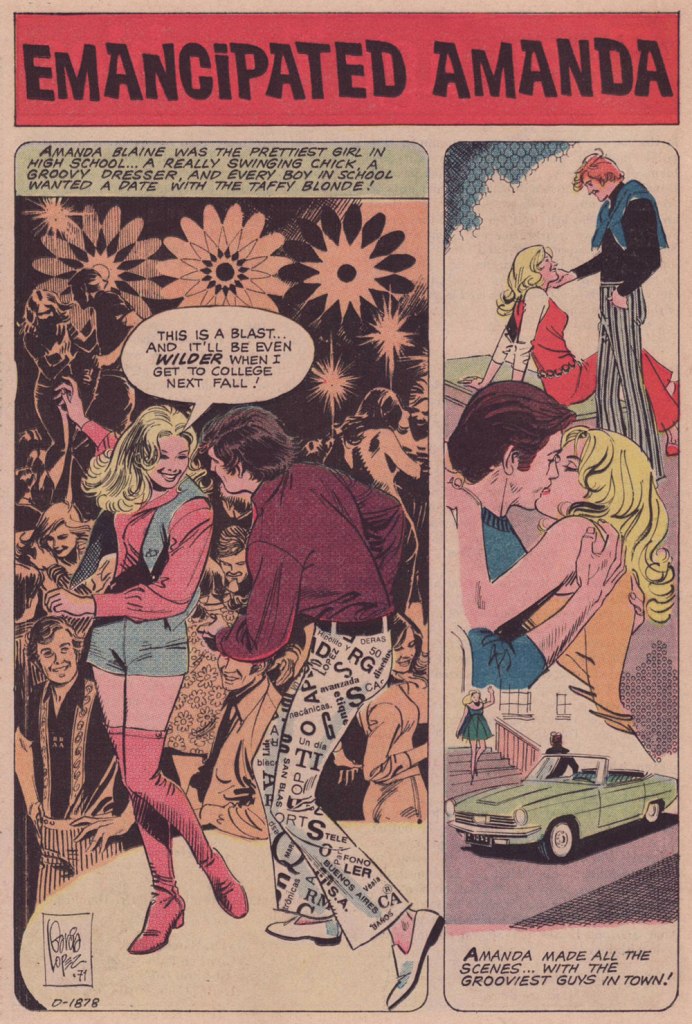
***By ‘talented Argentine’ (Spanish-Argentine, technically), I refer to none other than José Luis García-López. Also from ’71, and in a totally different style, check out his Emancipated Amanda.
« The hardest tumble a man can make is to fall over his own bluff. » — Ambrose Bierce
Today, I’m going totally ‘mainstream’ on you for a change. Last week, I ventured into a movie theatre for the first time since 2019 (Knives Out was my last such outing) to see my first superhero film since 2012 (The Avengers was my last such outing). And so, while the new Superman epic wasn’t perfect, I found much to enjoy about it.
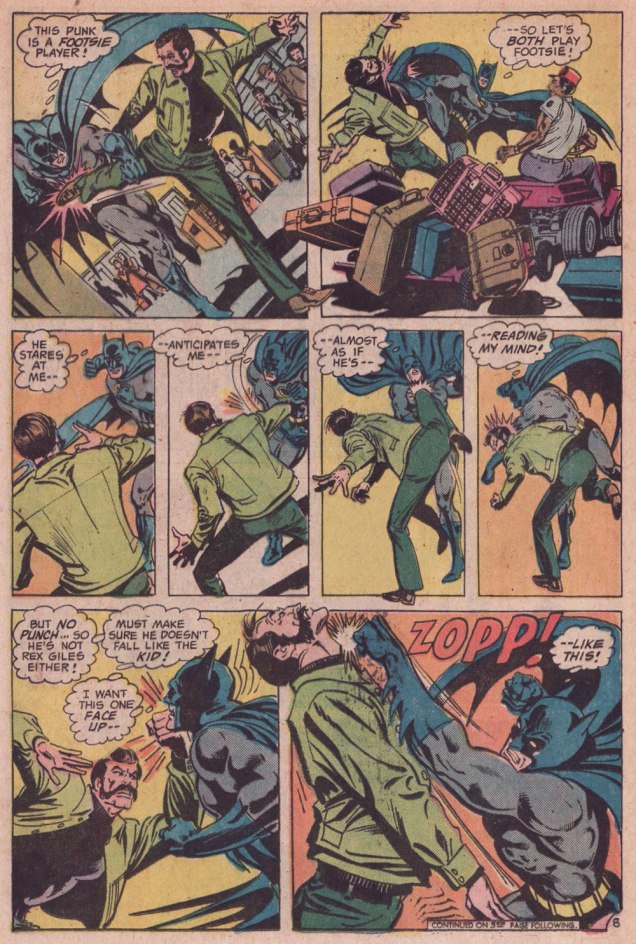
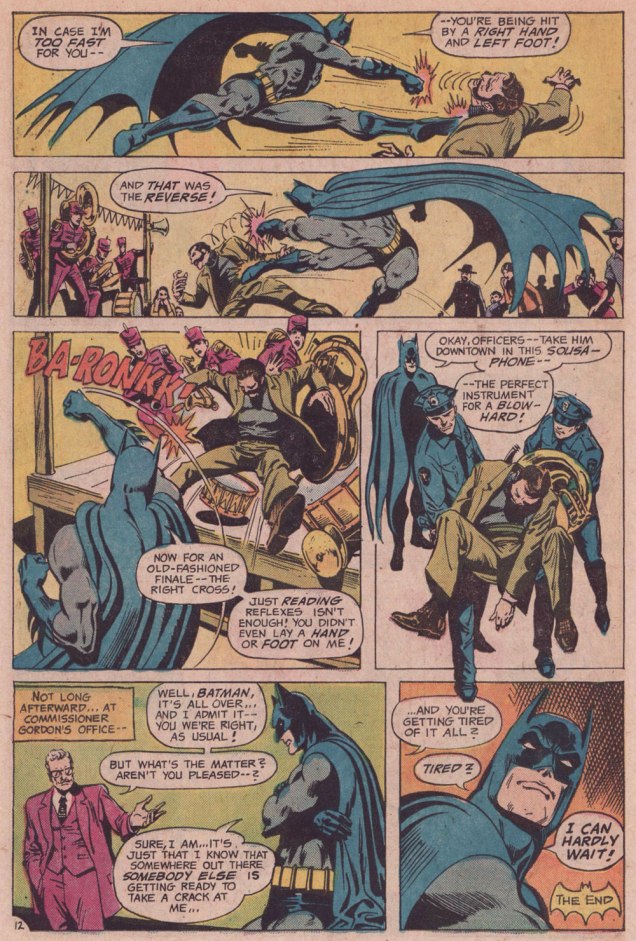
Among the ideas explored in the film was that baddie Lex ‘Elon’ Luthor, from carefully observing The Man of Steel over several years’ worth of skirmishes, had managed to analyse and codify his combat moves, in order to predict and counter them.
I was reminded of that angle serving as the basis of a favourite Batman story by my favourite Batman writer (and hardly anyone else’s, apparently), David Vern Reed (1914-1994). Despite its publication in a popular, long-running title, this tale is obscure to the point of never having been reprinted in English.
I’m terribly fond of the Schwartz-era Batman, especially the 1970s, because it’s relatively light on costumed supervillains, Batman acts like the detective — albeit a remarkably athletic one — he’s supposed to be, and the plots often hinge on ‘ordinary’ (though clever) criminals striving to outsmart Bats. A favourite example: Vern’s « The Underworld Olympics ’76! » (Batman 272-275, Feb.-May 1976) tetraptych. I think I can safely rule out childhood nostalgia: in my small town, distribution was quite spotty, so I never even *saw* those issues at the time, encountering them instead as an adult, decades on.
If I have a quibble about the art, it’s that Ernie Chan’s finishes mesh poorly with García-López’s usual rock-solid breakdowns. Perhaps it’s because Chan likes to have more to do; given that García-López, his own best inker, typically turns out pencil renderings that are utterly complete and tight as a drum, the job is quite unlike, say, Chan inking a Big John Buscema Conan job — as he so often did — wherein Chan has to do 80 percent of the work over Buscema’s sparse breakdowns, stock poses and rote shortcuts. In contrast, inking García-López essentially reduces the task to tracing over his flawless pencils, which can’t be all that stimulating, educational as it may be.
Speaking of Garcia-Lopez, a priceless anecdote: writer Andrew Helfer, a frequent collaborator, recalled, in his introduction to TwoMorrows’ Modern Masters Volume Five (2007): « … it was Jean Giraud, aka Mœbius, and he was staring at a drawing of Wonder Woman by José Luis García-López. « This García-López », he asked in a heavy French accent. « He uses models, no? » « No, » I answered, smiling. « Son of a bitch! » Mœbius hissed.
« The history of men’s opposition to women’s emancipation is more interesting perhaps than the story of that emancipation itself. » — Virginia Woolf
It has dawned on me that we’ve been neglecting the romance genre of late, and so the time has come to remedy this regrettable situation. To that end, I’ve opted to spotlight some early work by Spanish-Argentine master José Luis García-López (born 1948, Pontevedra, Spain).
If you ask me, Mr. García-López is far under-appreciated. His graceful but unassuming virtuosity, and the seeming ease with which he wields it, makes it too easy to take him for granted. And while he’s tackled just about every major character (and many a minor one) in the DC Comics stable, much of it has been behind the scenes, in the way of style sheets and promotional artwork.
Meanwhile, in comic books, he’s mostly made pedestrian scripts* shine more brightly than they deserved. But there’s only so much, er… polishing one can do.
As it stands, my favourite portion of his œuvre is the romance comics he illustrated for Charlton early in his career, roughly 1968-74, before he moved to New York to launch his North American phase. While my predilection for his romantic material is a minority opinion, I’m not alone in this, I’m relieved to report.
It seems to me that, as a man who can clearly draw anything at all, JLGL’s chops are largely squandered on superheroes and such. But, in comics as in life, romance is hard. As Mr. García-López confirmed in the definitive interview he granted in 2010 to the championne of romance comics, Sequential Crush‘s Jacque Nodell: « Even now, I consider romance stories the most difficult genre to illustrate properly. » Bingo.
If you’ve at all read comics from the early 70s, romance or otherwise, you’ll have noticed that clothing and hair fashions can generally be termed (charitably) ‘of their time’. Not so much here. Have we come full circle, or does JLGL have a secret? He confides (do read the full entrevista… it’s well worth it):
« In those years we also had photo-novel magazines (like the foto-romanzo or fumetti in Italy) and they were very useful to design the characters and for the romantic scenes. Doing a good kiss without a good reference was very hard, honest. Besides, I was lucky to have two kindly girl friends that helped me with fashion advice and suggestions and even posed for me. That period was full of learning experiences – there is no better way to learn to draw than from a living model. »
Where can I get myself a pair of those snazzy Letraset pants?
Writer unknown, incidentally. Which is a shame.
Now, artwork aside, why am I fond of this particular story?
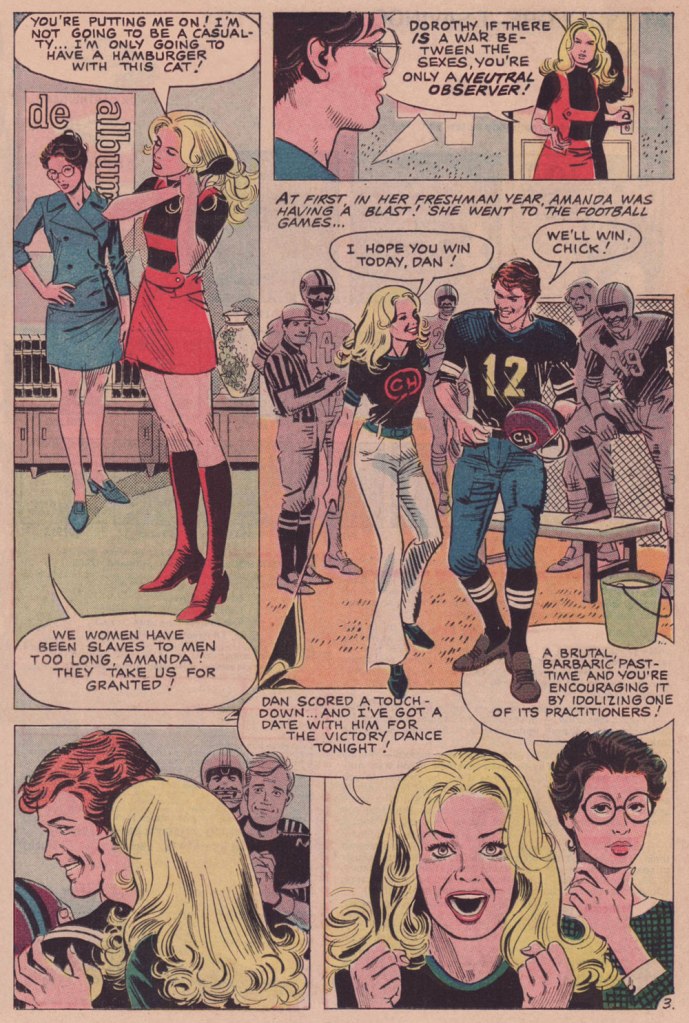
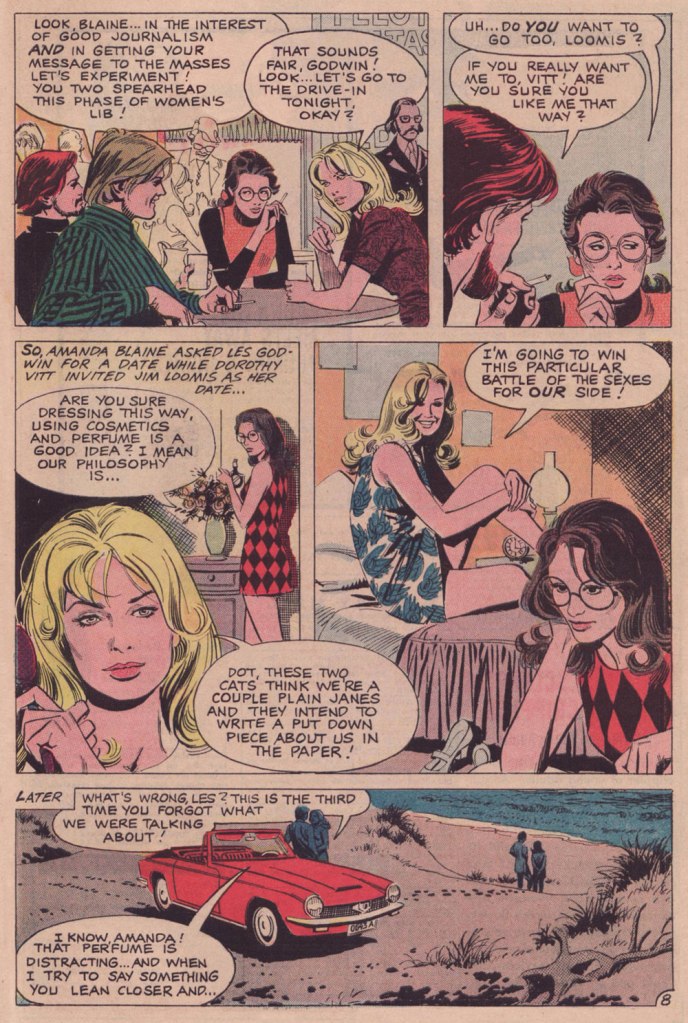
I love the mise-en-scène: characters are introduced in the background and without dialogue before they enter the stage. Namely Dorothy in the first panel of page 2 and ‘that beanpole’, Jim Loomis in the first panel of page 6. His first line comes in the final panel of page 7, but he and Dorothy have been staring holes into each other from the start. That’s great staging, not to mention something that, arguably, only the comics medium can achieve effectively.
I also enjoy the evolution of Amanda and Dorothy’s friendship; at first testy and tentative, Amanda’s calling her roommate ‘Dot’ by page 7. And they learn from, and support, each other. No cheap betrayal in this one.
It’s a lovely change of page for the genre that, once gridiron ‘hero’ and BMOC Dan Sruba commits his inevitable transgression… he’s gone (save for a passing mention from Les): no ‘second chance’, no confrontation, no revenge, no melodrama.
Despite the headline, I’m reading this as the story of Dot and Jim’s romance. Amanda’s interest in Les, beyond playing matchmaker for her roommate, is uncertain.
My wife was disappointed in the ending, and I can certainly see why: will Dorothy lose her fire and her beliefs? I prefer to think not — she was looking for an equal, respectful relationship, and I do think she’s found it with Loomis. And she had him well before word one, and she was clad in glasses, picket sign and dungarees. The guy seems like a keeper to me. They’re both quiet, thoughtful observers, for the most part. I like their odds.
There are a few glitches here and there, but given that the script had to first be translated into Spanish (Mr. García-López claims to still not speak English to this day… technically) to be illustrated, there may have been here and there a nuance missed, a description gone astray. Loomis isn’t quite a beanpole, and neither is Dorothy, for that matter. And ‘Plain Janes’? (page 8) And I scarcely think that Les and Jim were planning a hatchet piece (given Jim’s evident interest in Dorothy, for one), no-one would mistake these two for Plain Janes. Well, that’s always been a systemic weakness of the romance genre, in comics and elsewhere: the plain one, the skinny one, the rejected one? Still gorgeous.
This is I Love You no. 95 (Jan. 1972, Charlton). For a variety of factors, distance chief among them, Garcia-Lopez never drew an original cover for Charlton, but the publisher often creatively recycled story panels, a task handled exceptionally well in the present case.
What’s that? Oh, right. Fine, here’s that « FREE Pin-Up Poster of David Cassidy » already.
« Is the spring coming? » he said. « What is it like?» «It is the sun shining on the rain and the rain falling on the sunshine…»| Frances Hodgson Burnett, The Secret Garden
Having been meaning for a while now to concentrate on tentacled plant life, I was hitherto stopped by the idea that it’s somewhat unseemly to talk about flora when most of our readership is buried in snow and ice. But now, well! – today was the first day of the year suitable for wearing shorts, and green shoots are popping up wherever one’s gaze happens to land.
We have waited for quite a long time before co-admin RG managed to get his hands on this issue… and it turned out that the insides vary from ‘lacklustre’ to ‘wow, that’s ugly!’ Still, the wonderful, striking cover makes it worth owning, I believe.
Horror: The Illustrated Book Of Fears no. 2 (February 1990, Northstar). Cover by Mark Bernal.
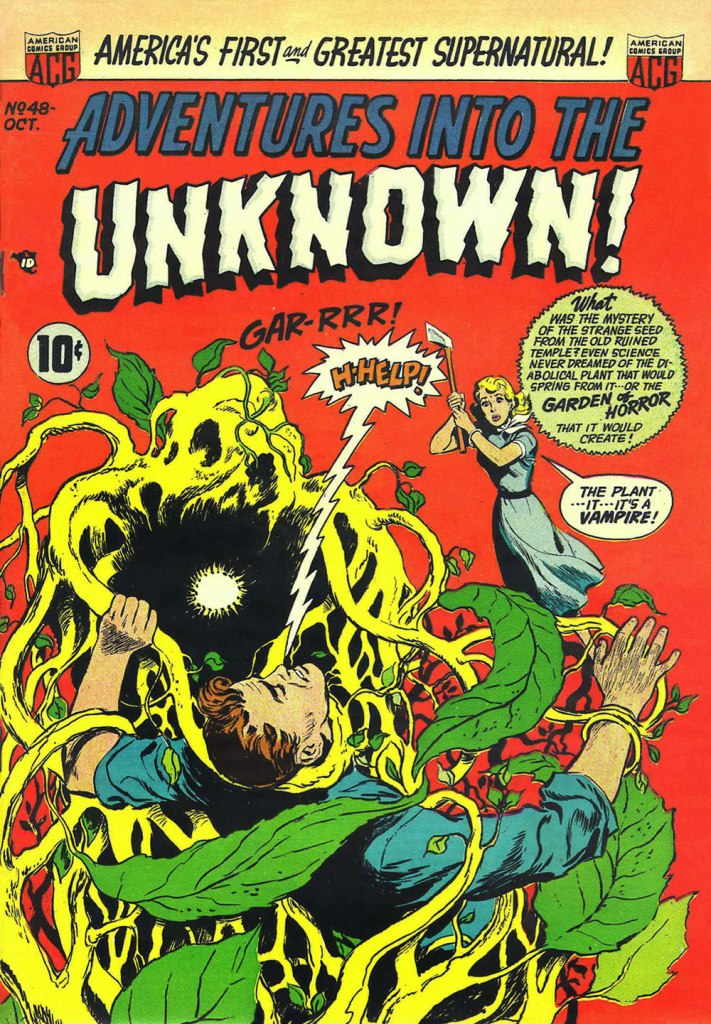
ACG got its tentacle parade in Tentacle Tuesday: ACG’s Adventures Into the Tentacles, but as usual, some material didn’t quite fit the theme, and I saved the following cover for a more appropriate occasion. This, I do believe, is the moment.
Adventures into the Unknown no. 48 (October 1953, ACG), cover by Ken Bald.
Speaking of adventures, let’s delve into Strange Adventures for a bit. The following story has a rather peculiar plot – « Star Hawkins is down on his luck and has to pawn Ilda, his robot secretary. Luckily, Star is hired to locate a fugitive who’s thought to be hiding on Vesta, an asteroid mining settlement, in the Red Jungle. But with a little tracking skill and the help of the creepy vegetation of the Red Jungle, he nabs the fugitive, gets his prisoner, and gets Ilda back from the pawn shop, promising never to pawn her again. »
Page from The Case of the Martian Witness!, scripted by John Broome, pencilled by Mike Sekowsky and inked by Bernard Sachs, published in Strange Adventures no. 114 (March 1960, DC).
Here’s another Earthman (who has dreamed of this moment, by his own admission!) struggling with some coquettish plant tentacles that just want to be friends.
A page from Super-Athlete from Earth!, scripted by Gardner Fox, pencilled by Gil Kane and inked by Bernard Sachs, published in Strange Adventures no. 125 (February 1961, DC).
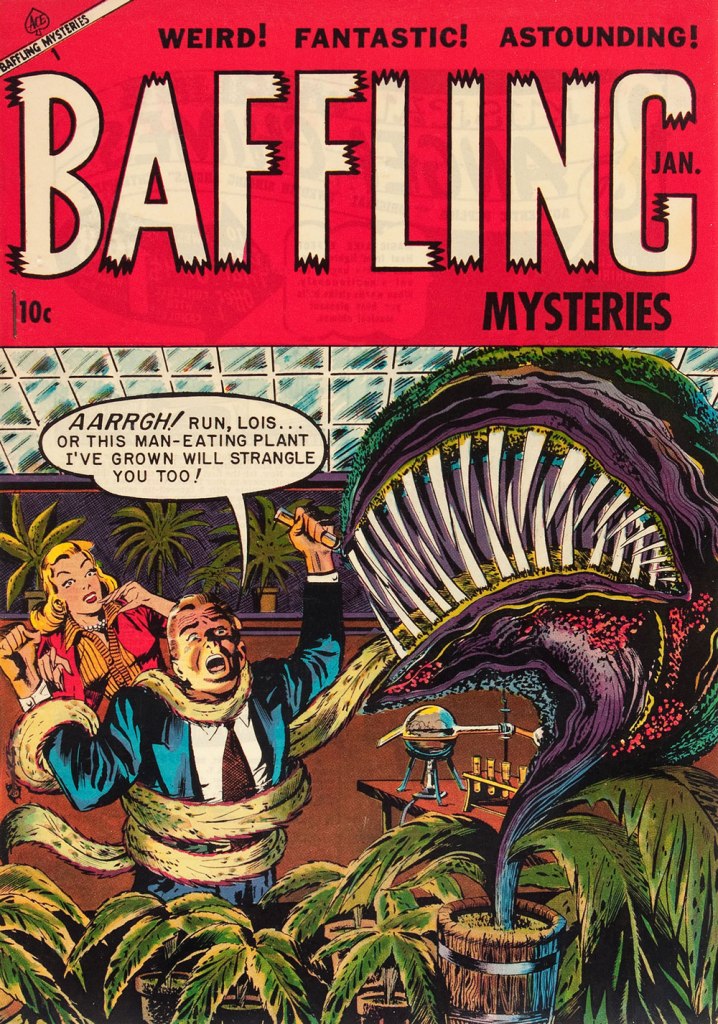
The next thing after adventures is, naturally, mysteries. If they’re strange, puzzling mysteries, even better… what’s that word I’m looking for… ah, yes: baffling! Another day, yet another ravenous man-eating plant.
Baffling Mysteries no. 19 (January 1954, Ace Magazines). Cover is presumed to be by George Roussos. I think strangulation is not even the worst option here.
One more happy tromp through the jungle? Sure, why not!
The following image was originally created as a cover for House of Mystery no. 251 (1977, DC), but was nixed in favour of another, Neal Adams-penned illustration, which we’ve already featured in a previous post (Tentacle Tuesday: Plants Sometimes Have Tentacles, Too). I prefer this gruesome version (complete with skeleton being digested!… also more detail, more dynamic layout and better anatomy of all involved), pencilled by José Luis García-López and inked by Bernie Wrightson.