Treasured Stories: “The Monster Maker of Madison Avenue!” (1967)

« I’ve learned that any fool can write a bad ad, but that it takes a real genius to keep his hands off a good one. » — Leo Burnett

Given that they’re often referred to as comics, or funnybooks, mainstream American comic books haven’t been nearly as funny as one might reasonably expect… particularly the ones that set out to be humorous.

In the scope of the Ages of Gold and Silver, the selfsame Pantheon of Exceptional Providers of Hilarity pops up as if on cue: Carl Barks (Uncle Scrooge), John Stanley (Little Lulu, Melvin Monster, Dunc and Loo), Basil Wolverton (Powerhouse Pepper), Jack Cole (Plastic Man), Harvey Kurtzman (Mad). Pray note that these are all writer-artists*, hardly a negligible factor.

Humour being subjective, of course everyone will have their own favourite to contribute. The gist of my argument, however, is that comics books fail to raise guffaws to a level that, say, newspapers strips, animated cartoons and Franco-Belgian bandes dessinées routinely** do.

Meanwhile, DC Comics arguably boasted their singular genius humorist in Sheldon Mayer (Sugar and Spike). DC’s editors loved to divide and conquer, rarely allowing solo creators to take root, let alone flourish, in their tidy corporate garden patch. Given Mayer’s crucial early importance to the publisher’s rise, he was granted free(er) rein. Which leads one to ponder whether the assembly-line method, then, might not be utterly detrimental to quality humour.

So it was to my elated surprise that I came upon an authentically amusing (imho) tale betwixt the misaligned staples of a 1967 issue of Strange Adventures… what is more, uncredited. A mystery.

Which brings us ’round to another exceptional talent, a writer this time: long-time American Comics Group (ACG) editor Richard E. Hughes, who scripted most of the company’s mid-to-late output under an impressive array of aliases*** with a dry, deadpan, absurdist wit, most memorably deployed through the adventures of Herbie Popnecker, ably illustrated by Ogden Whitney.

In 1967, Hughes found himself at leisure with ACG’s demise (the final issues of its remaining titles, Adventures Into the Unknown and Unknown Worlds, were cover-dated August ’67). He passed through DC, scripting a smattering of stories for Superman czar Mort Weisinger (one might surmise that Kurt Schaffenberger, who worked for both editors, acted as the go-between), for Hawkman editor George Kashdan and Ghosts editor Murray Boltinoff before exiting the field. According to Wikipedia, « His final job appears to have been for Gimbel’s department store, composing response letters to customer complaints. » At least he’s received some posthumous recognition, as he was a 2015 recipient of the Bill Finger Award for Excellence in Comic Book Writing.

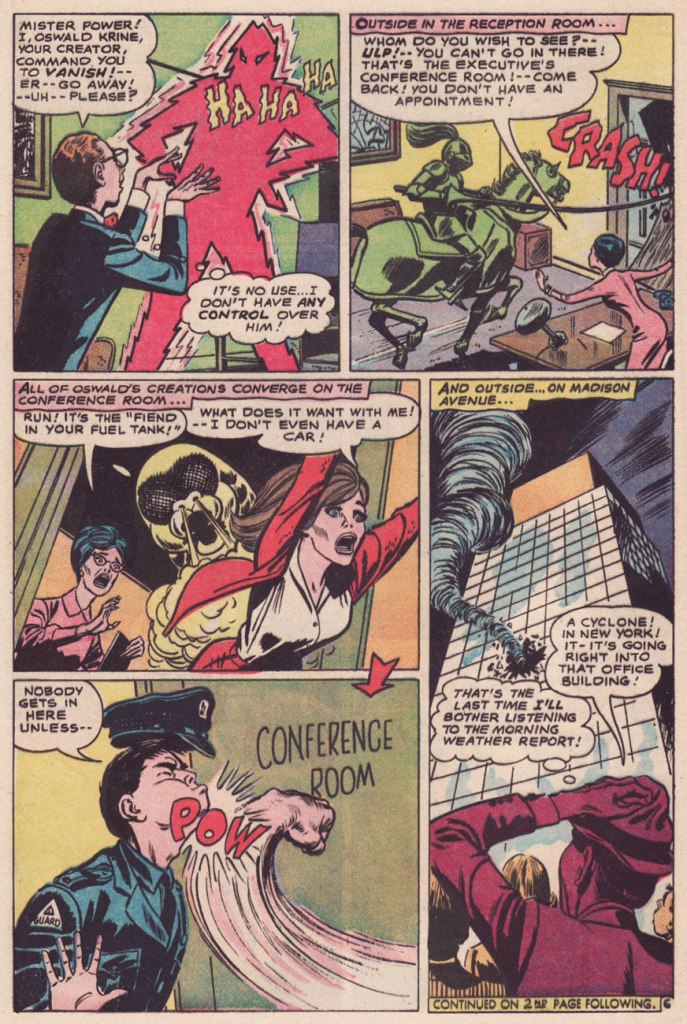
I do believe I can detect the Hughes cadence in The Monster Maker of Madison Avenue! According to GCD, the uncredited story is scripted by one Dennis Marks, an animation writer working for Filmation’s The Batman/Superman Hour at the time… but I just don’t know. It would be Marks’ sole comic book credit, and a speculative one at that. Besides, GCD attributes the artwork to Joe Orlando, which is flat-out, laughably wrong. A frequent problem of self-styled art experts is that they wear genre blinders. Most would never be caught dead reading, say, a romance comic, so they wouldn’t recognize (though they should!) the distinctive stylings of Jay Scott Pike (1924-2015).

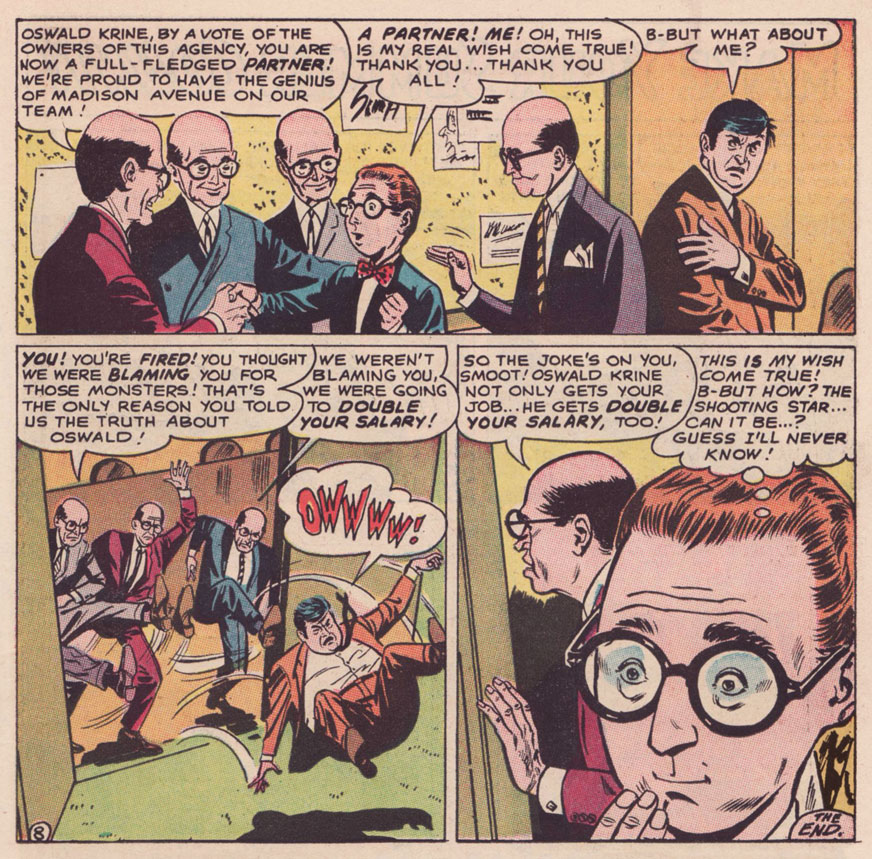
On with our tale, which originally saw print in Strange Adventures no. 202 (July 1967, DC).

As for the ads parodied therein, I’m no expert, but I can hazard a few guesses: The Fiend in Your Fuel Tank refers to Esso’s famous Put a Tiger in Your Tank campaign; the housewive bluntly bestowing cleaning tips to her neighbour brings to mind Bold Detergent; The Green Knight surely lampoons Ajax’s White Knight; as for Popso Kooler’s Mister Power, it’s anybody’s guess. Pepsi commercials of the period looked great, but nary featured an animated lightning man. Anyone?

-RG

*Yes, Kurtzman (and Stanley) often worked with others to increase their output (and for the love of collaboration), but they fully controlled the mise-en-scène.

** They make it look easy… but it’s quite a feat.

***His imaginary roster comprised Pierre Alonzo, Ace Aquila, Brad Everson, Lafcadio Lee, Kermit Lundgren, Shane O’Shea, Greg Olivetti, Kurato Osaki, Pierce Rand, Bob Standish, Zev Zimmer… Fittingly, even Richard E. Hughes was a pseudonym: he was born Leo Rosenbaum.
Tentacle Tuesday: Wrap Your Brain Around This!

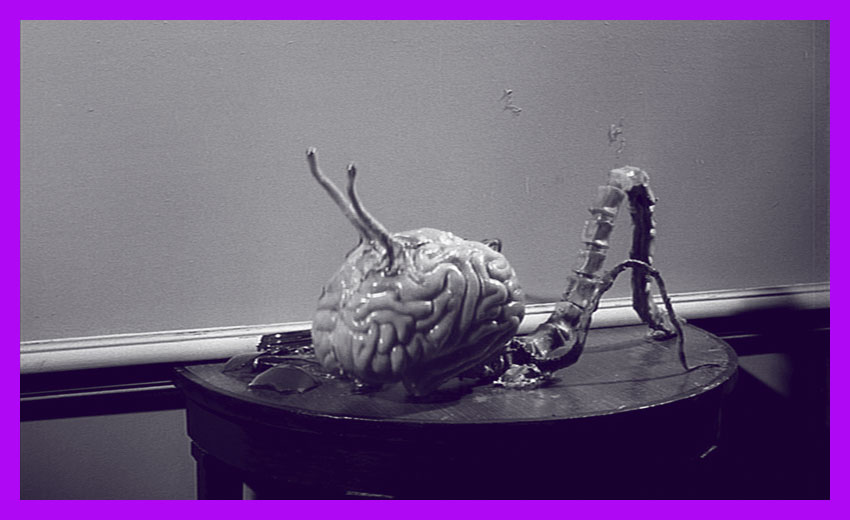
The brain-with-tentacles is curled up at the comfy intersection of two beloved tropes, the Brain Monster and the Tentacled Terror. Through some clever combining, one is guaranteed a truly horrendous creature that’s at least 25% more appalling than either of its step-parents. It’s the favourite of many a filmmaker and comic artist, and the toast of this particular post!

It may be a little too early to wrap yourself around a drink (at least in this part of the world), so you’ll have to enjoy this Tentacle Tuesday sober.

A friendly critter from Fiend Without a Face, a British movie from 1958.

One has to pay one’s dues to the classics: Basil Wolverton‘s The Brain Bats of Venus, originally published in Mister Mystery no. 7 (September 1952), is unquestionably indispensable, so I could hardly turn a blind eye to it. In case you were out that night and missed it, you can read the whole story at The Horrors of It All blog.

WolvertonBrainBatsA

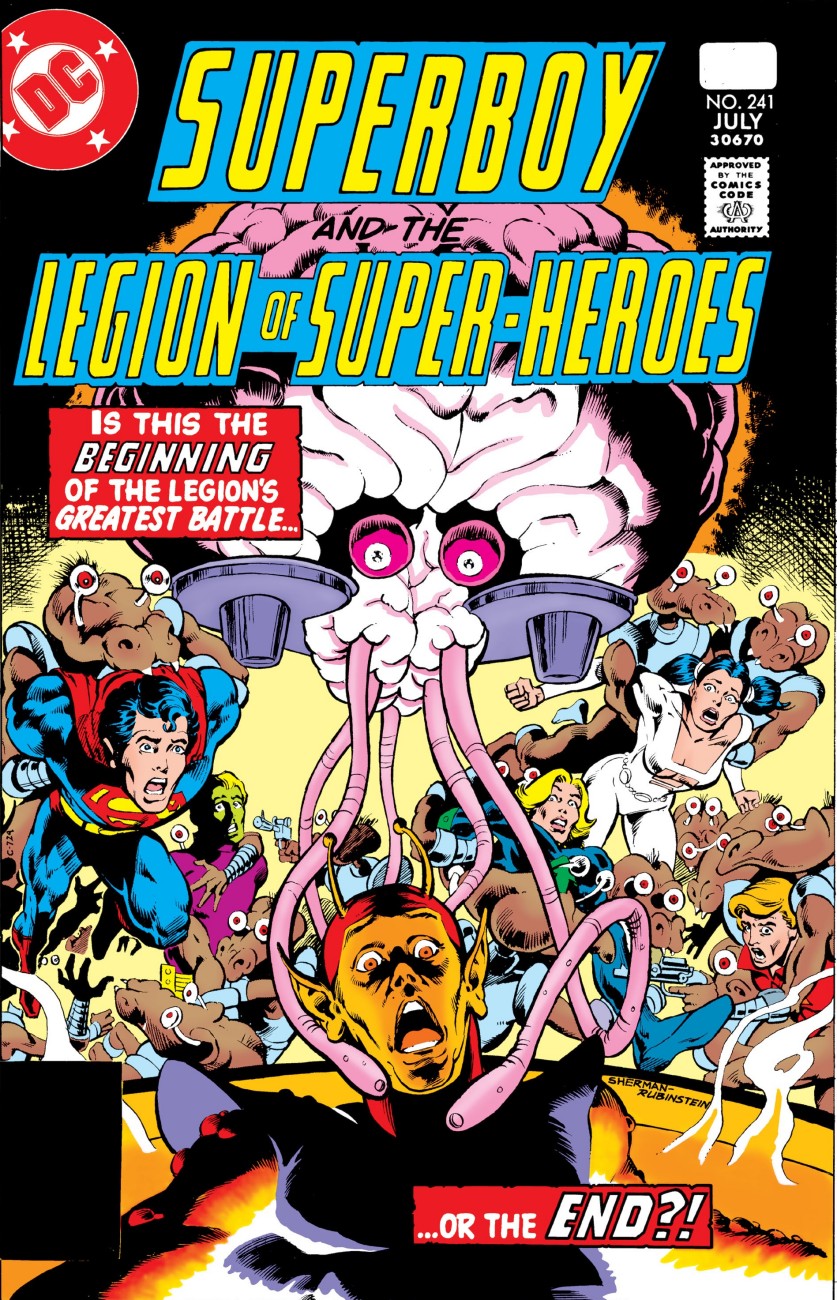
The tentacled brain has several means of locomotion at its disposal, and while crawling around spasmodically is a great mood-setter, floating around gives one much better scope of movement. The following is one of those floaters, aided by some mechanical gizmos.

Superboy-LegionoftheSuperheroes241-JamesSherman-JoeRubinstein

Superboy & the Legion of Super Heroes no. 241 (July 1978). Cover pencilled by James Sherman and inked by Joe Rubinstein.

The cover story, Prologue to Earthwar is scripted by Paul Levitz, pencilled by James Sherman and inked by Bob McLeod:

Superboy241-3
It’s just the worst when a brain launches into a tedious monologue after attacking you.

Superboy241--prologuetoearthwar.jpg

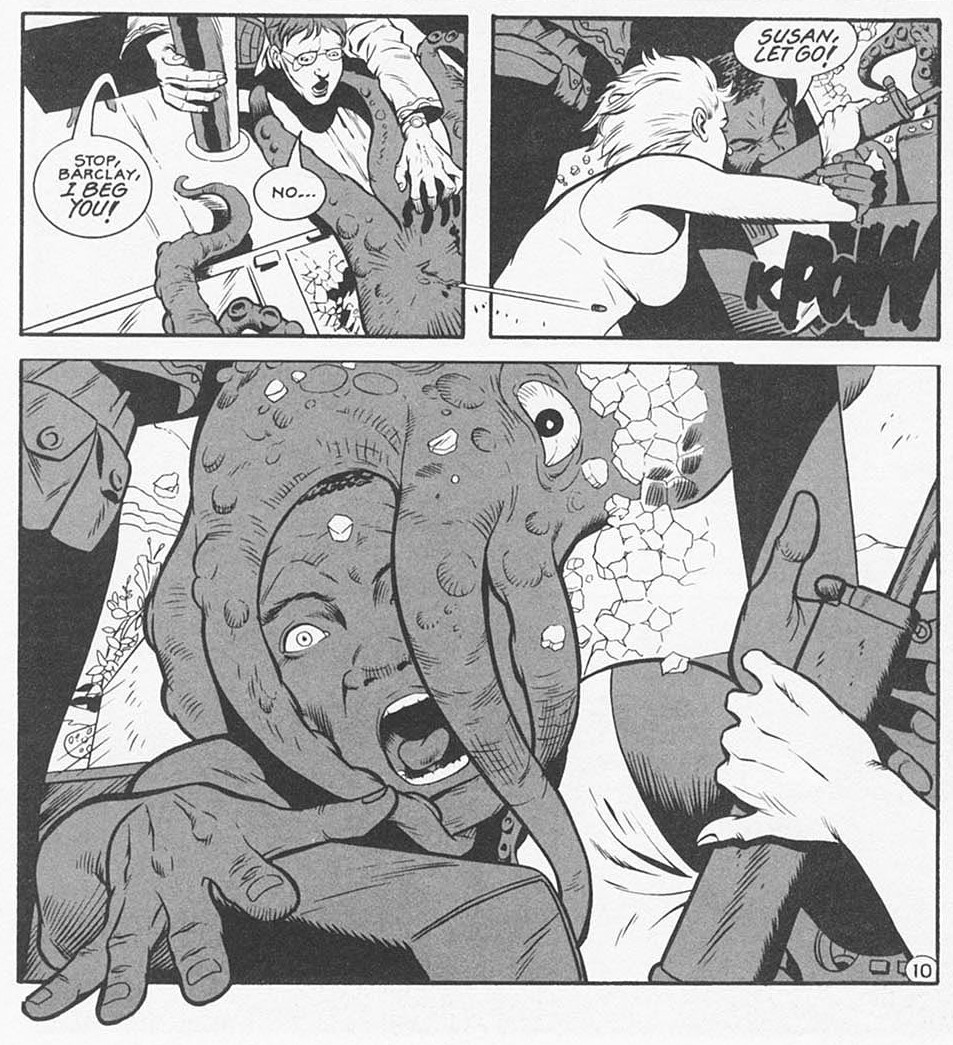
As implicitly suggested earlier by that panel from Brain Bats of Venus, some brain-monsters latch onto their victims’ brains, either sucking them out like you’d do with a coconut and a straw, or taking over people’s minds by puncturing some unsavoury holes I’d rather not think about too closely. A character in the following issue of World Below, when it is kindly suggested to her that perhaps it would be a sound idea to sever her ties with the tentacled thing on her head, mentions that « it hurts them to release — terribly. And it’s hard to reconnect, too. Like surgery without anaesthesia.» The implications are… unpleasant.

PaulChadwick-WorldBelow2-Deeper-Stranger
The World Below: Deeper and Stranger no. 2 (January 2000), cover by Paul Chadwick. Say, that’s a stylish hat you’ve got there, fella!

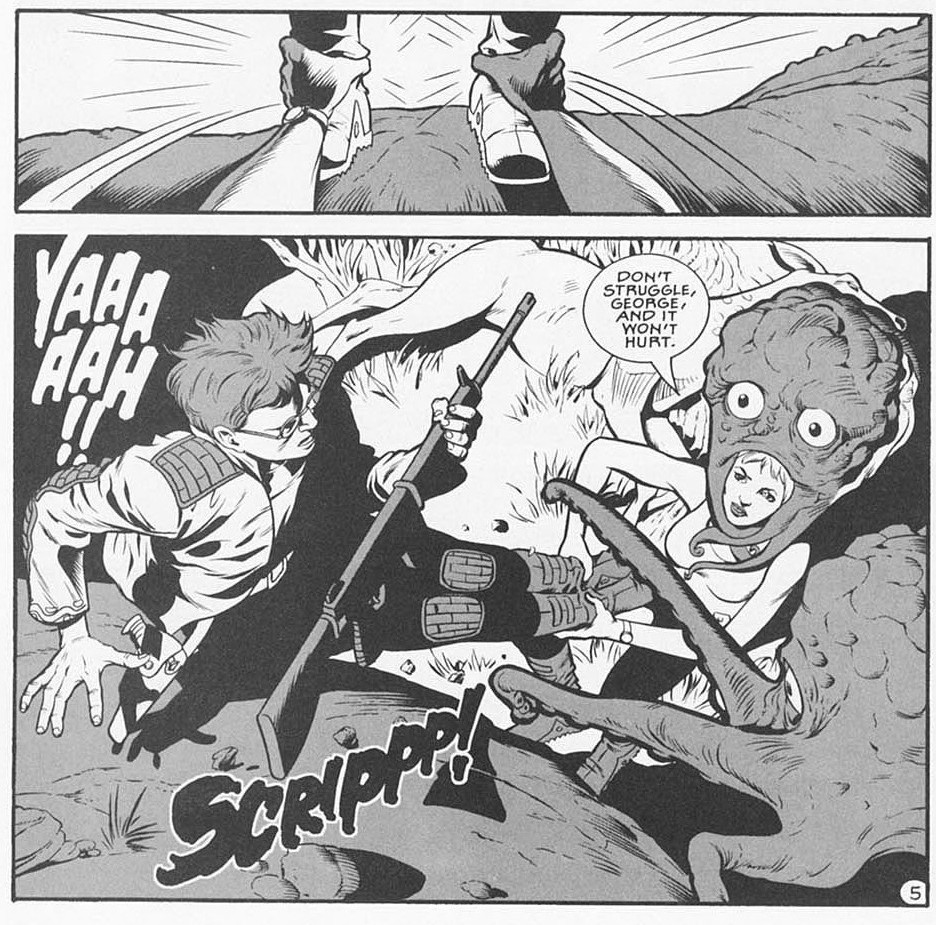
Zombies! is scripted and pencilled by Paul Chadwick and inked by Ron Randall, with grey tone separations by Jason Hvam:

PaulChadwick-WorldBelow2-Deeper-Stranger-Zombies
I would recommend not taking advice from women with a cephalopod on their heads.


PaulChadwick-WorldBelow2-Deeper-Stranger-Zombies2.jpg
The headaches this hat must cause… just think of the neck pressure from having to support 40 pounds of octopus-flesh.


PaulChadwick-WorldBelow2-Deeper-Stranger-Zombies4
Oops, that doesn’t look like it’s going to end well.

Moving along to goofier pastures…

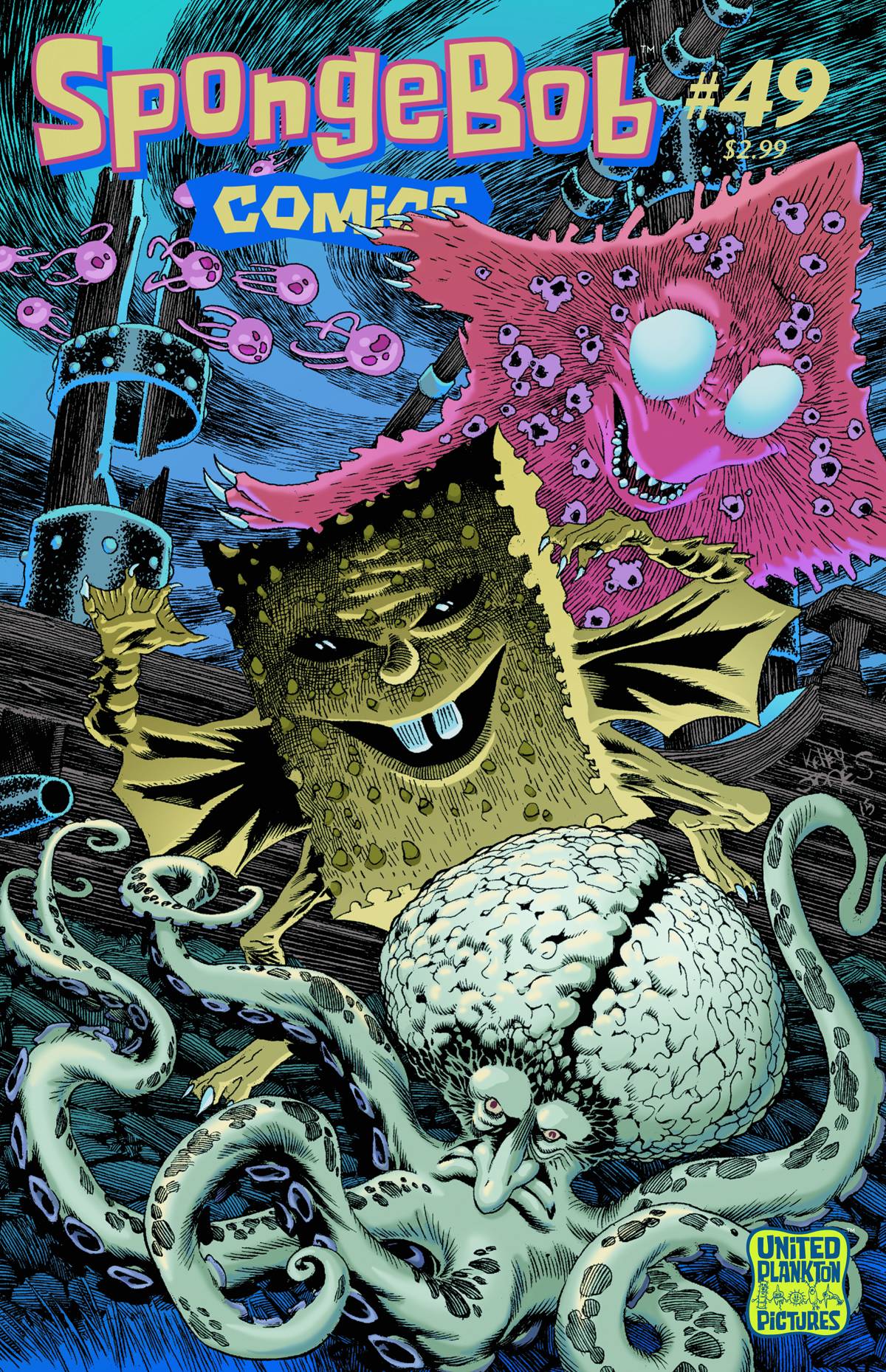
SpongeBob49-Comics
SpongeBob Comics no. 49 (October 2015). Cover by Kelley Jones.

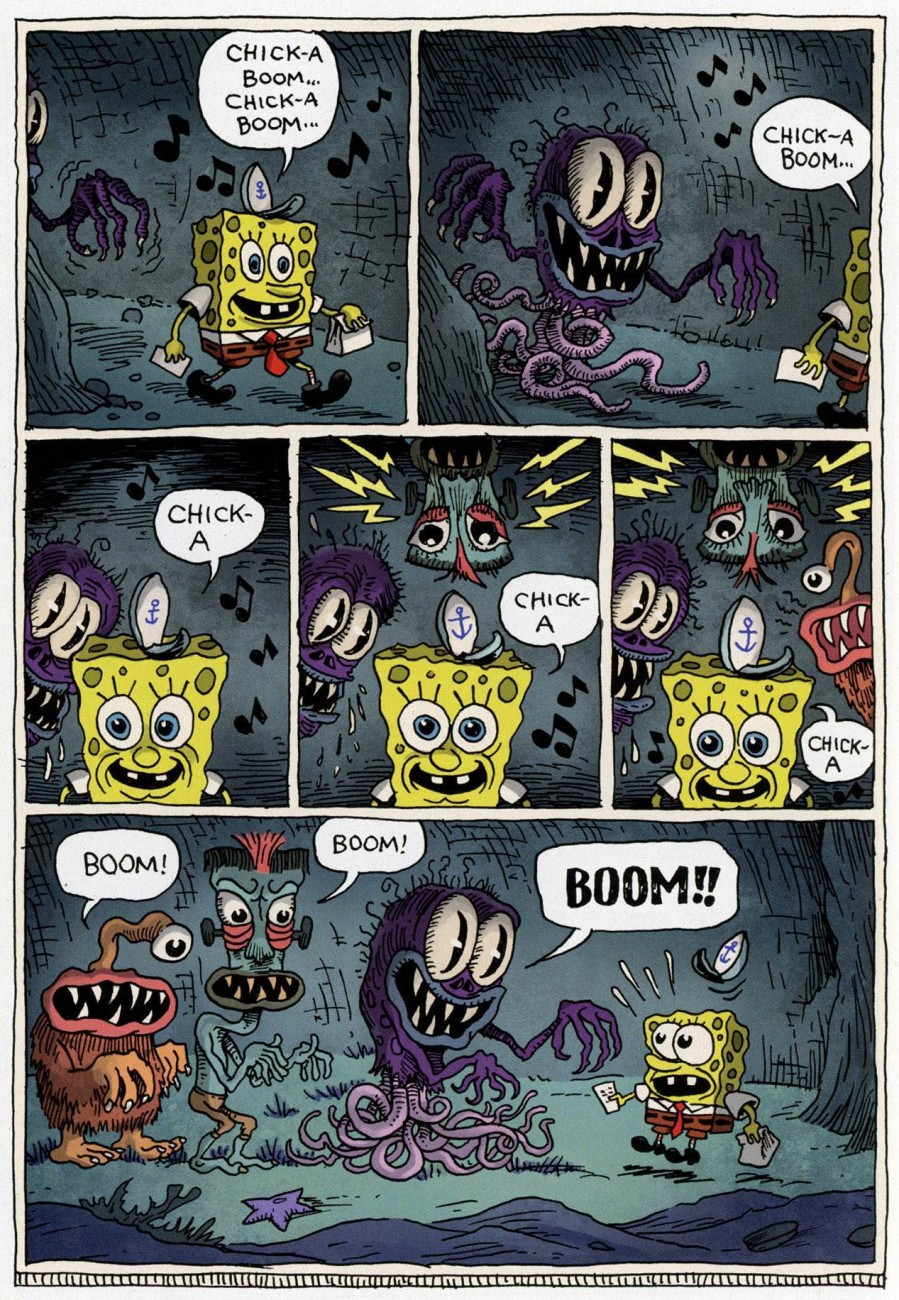
This is perhaps getting ever-so-slightly beyond the parameters of today’s brain theme, but the inside of this issue hides a gem in its otherwise dull pages (although I have to be fair: the stuff is much better than I expected). Behold: Spongebob in Monster Canyon, written by Kaz and drawn by Tony Millionaire, both favourites of this blog. With such excellent parentage, one expects something wonderful, and one is not disappointed.

spongebob49-story1.jpg

spongebob49-story2

Keep a close eye on your brains, folks, lest they be transformed into mindless mush by brainy aliens with tentacles with a taste for grey matter. I’d also stay away from TV, just in case… 

∋∈ ds

Tentacle Tuesday: The Menace of the Mechanical Octopus

« The tentacles of  my followers shall seek you out and destroy your swiftly! »

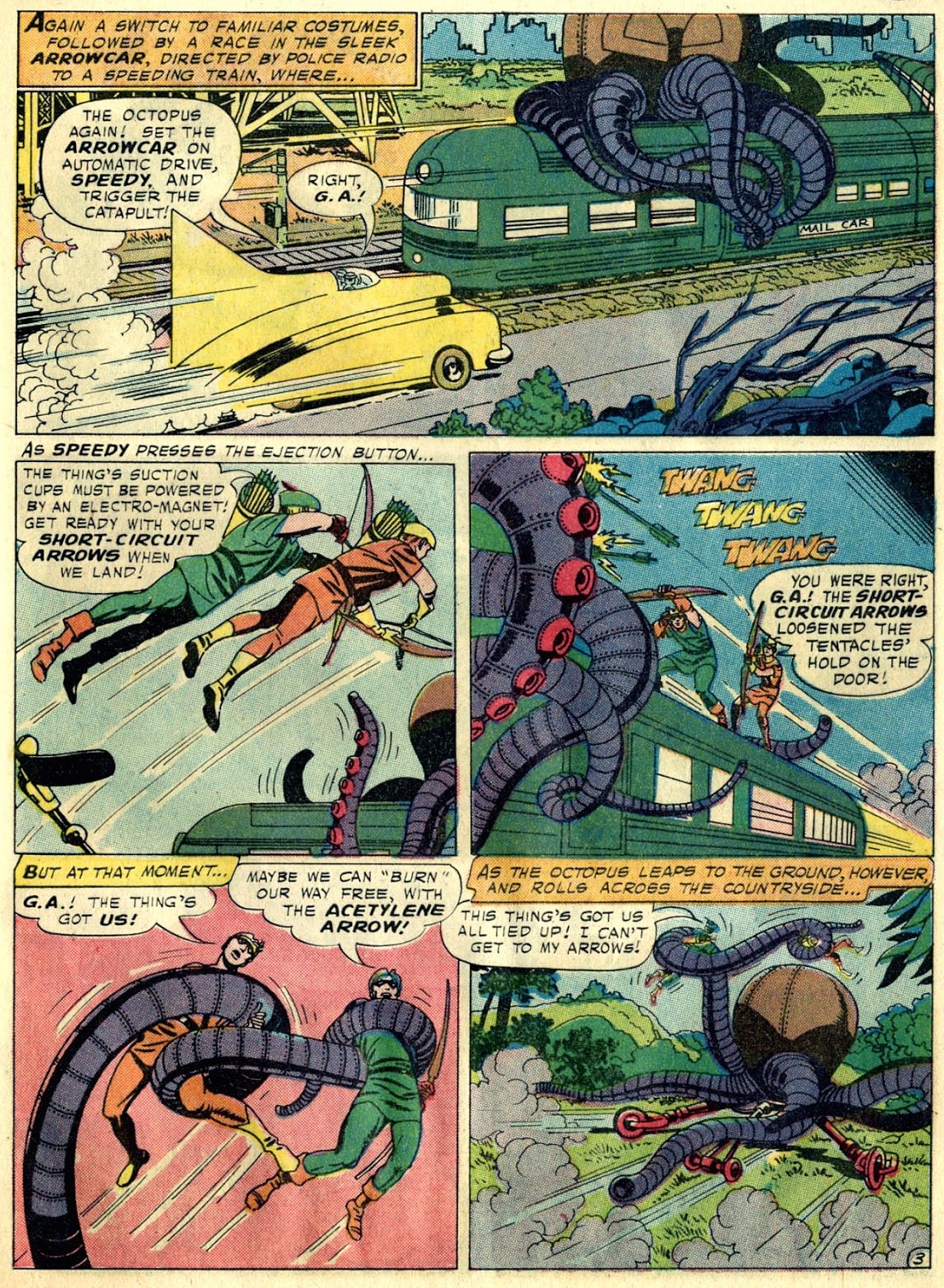
If you like joyous nonsense, this post is for you! As if humanity wasn’t besieged enough by actual cephalopods, evil-but-brilliant minds insist on creating machines with tentacles to horrify and maim. Pain to some, amusement for us!
First, some definite eye candy. The following story is not only convincingly illustrated, but also makes some sense on a scientific basis. The Menace of the Mechanical Octopus was scripted by Ed Herron, and pencilled and inked by Jack Kirby. It was published in Word’s Finest Comics no. 97 (October 1958).
World'sFinestComics97-JackKirby-TheMenaceoftheMechanicalOctopus

World'sFinestComics97-JackKirby-TheMenaceoftheMechanicalOctopus2

World'sFinestComics97-JackKirby-TheMenaceoftheMechanicalOctopus3

Now we move on to that goofy-yet-fun series, DC’s House of Mystery.  I will readily admit that I’m not always a fan. At worst, some of the stories published within its pages have plots so random that amusement becomes irritated incredulity. But keep an open mind, and there are also very creative (sometimes “were these people on drugs?” creative) plots to be enjoyed and great art to be relished.

House-of-mystery-96
House of Mystery no. 96 (March 1960), cover is pencilled by Dick Dillin and inked by Sheldon Moldoff.

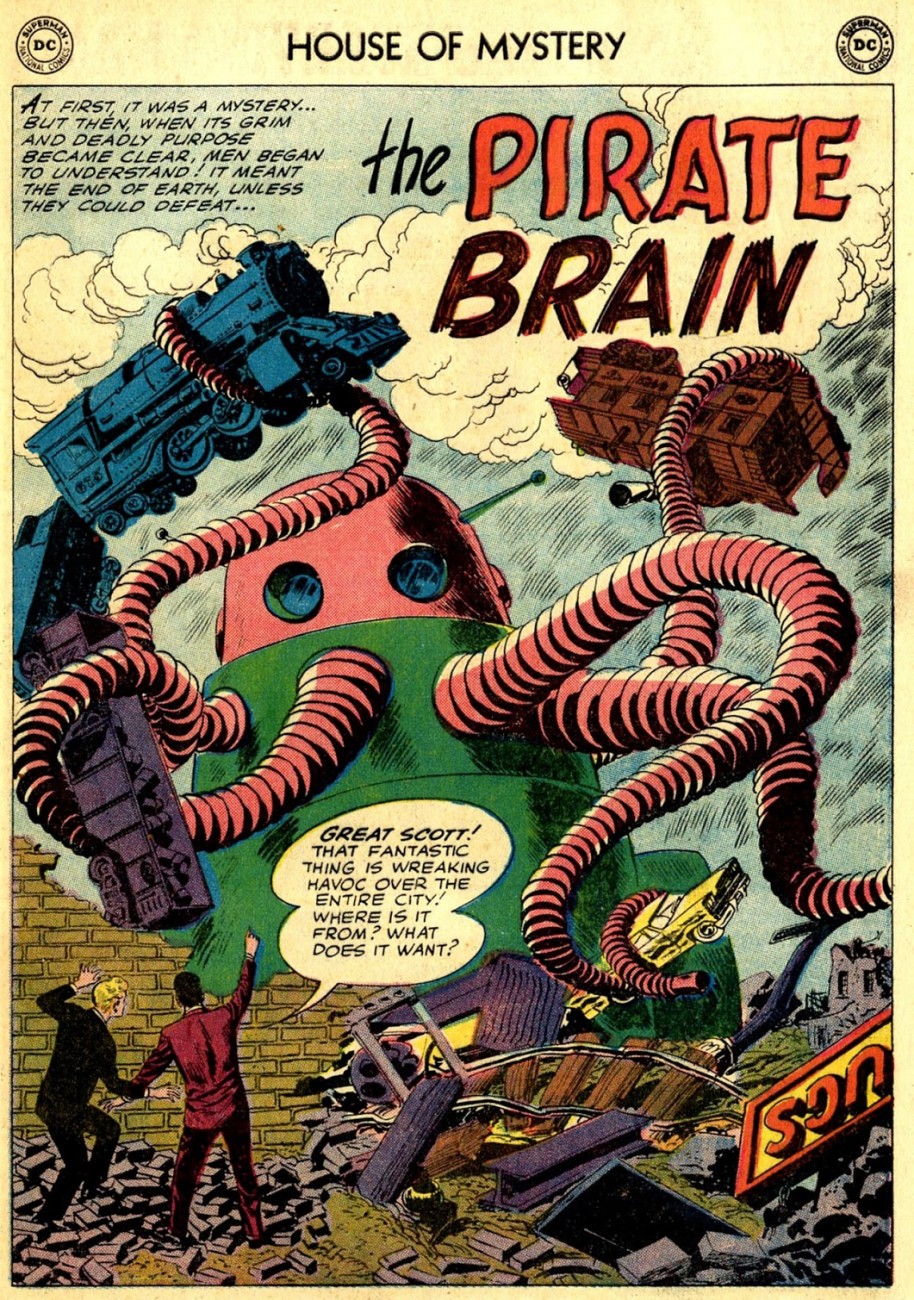
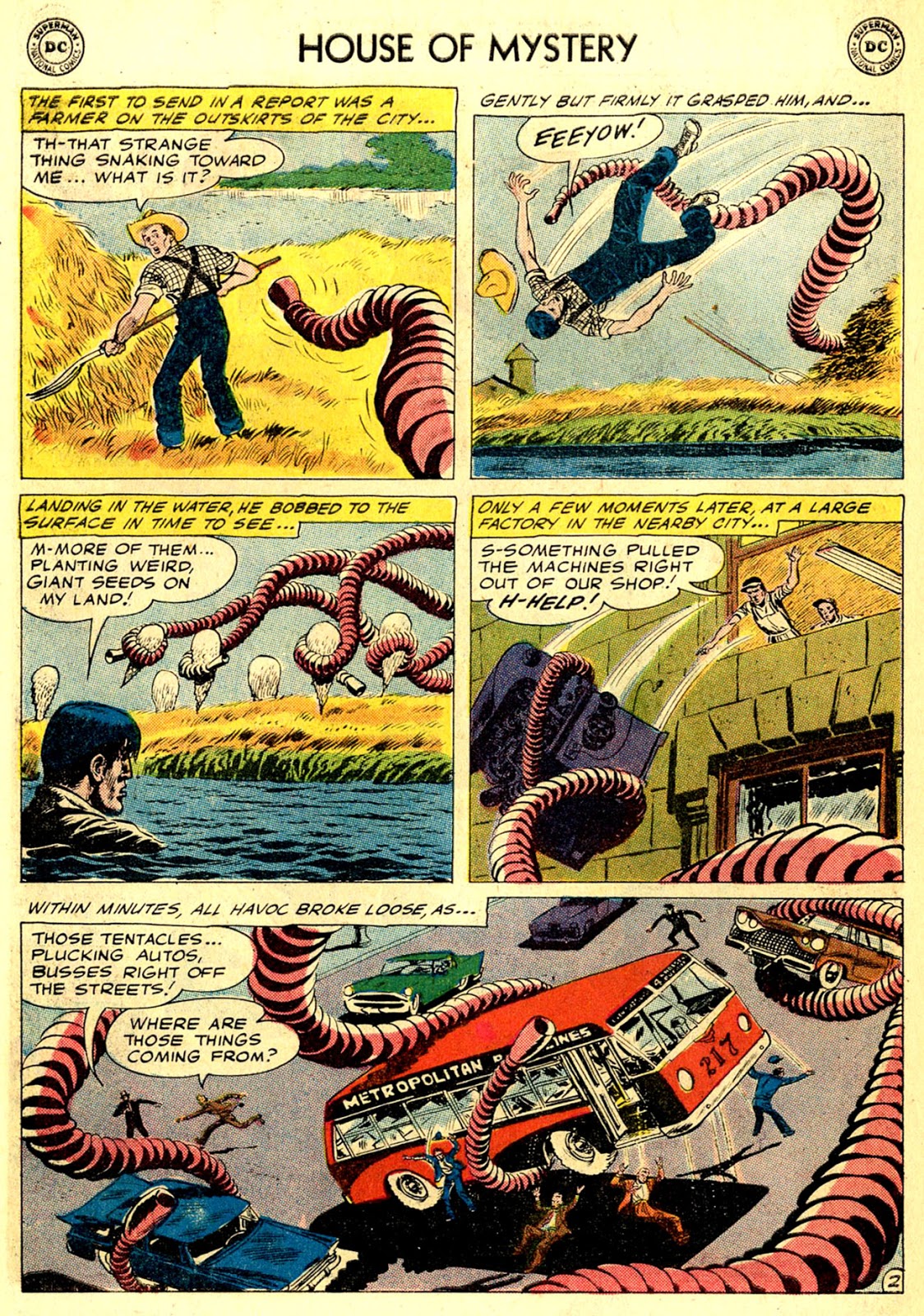
The cover story, The Pirate Brain, was illustrated by Lee Elias:

House-of-mystery-96-thepiratebrain

House-of-mystery-96-thepiratebrain-2
The ‘weird, giant seeds’ look remarkably like ice cream cones.

House-of-mystery-96-thepiratebrain-3

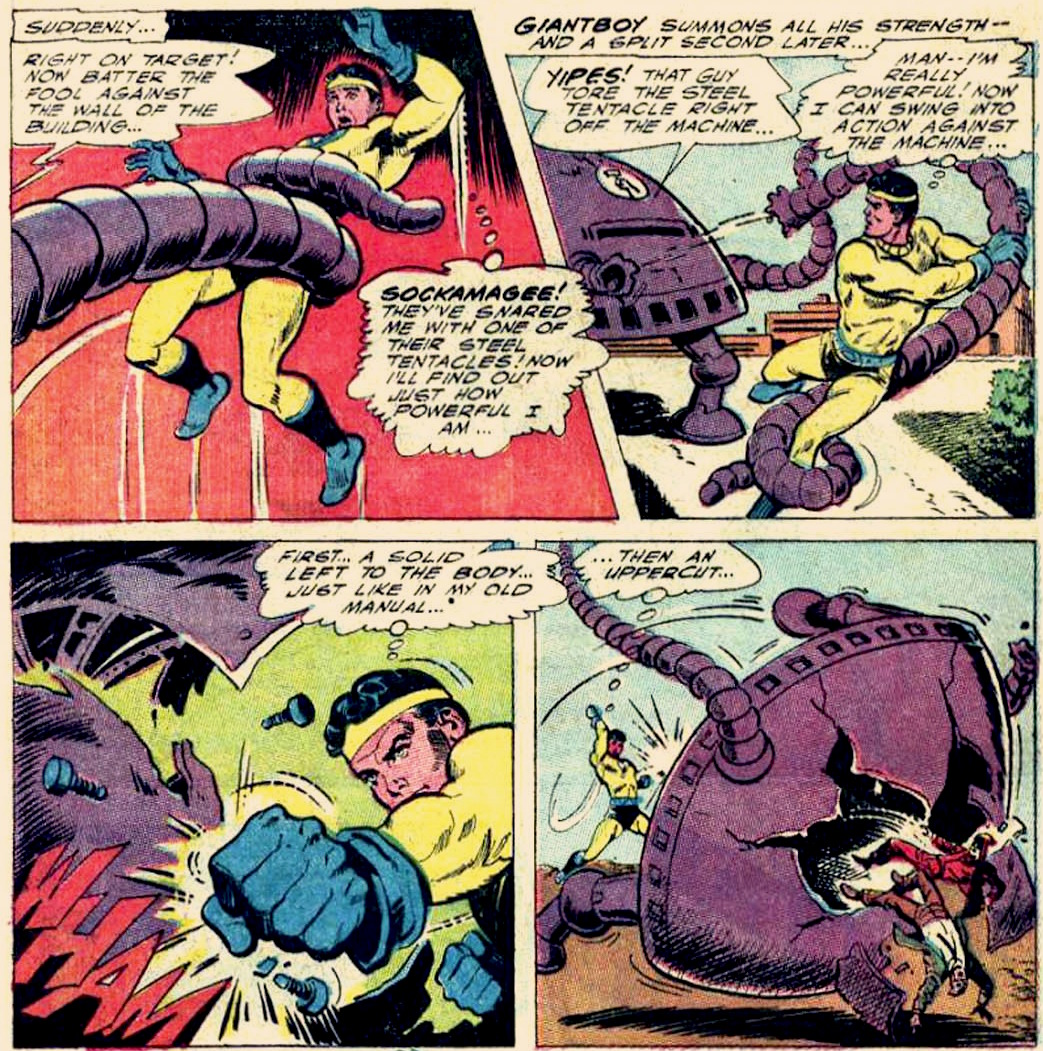
Our next stop concerns Robby Reed, the original owner of the Dial H for Hero gizmo, and his epic (of course) battle with… well, a whole bunch of villains. House of Mystery no. 156 (January 1966) is where he made his début, transforming into the Cometeer, Giantboy and the Mole. So many adventures, all in one (half) issue! This story was scripted by Dan Wood and illustrated by Jim Mooney:

House-of-mystery-156-Giantboy-comeeter-andthe-mole

HouseofMystery156-Giantboy-comeeter-andthemole2

From Giantboy we move on to Colossal Boy, more precisely to Colossal Boy’s One-Man War, scripted by Jerry Siegel, pencilled by Curt Swan, and inked by Sheldon Moldoff. It was published in Adventure Comics no. 341 (February 1966).

Adventures_341-theWeirdoLegionnaire

Adventures_341-theWeirdoLegionnaire2
A story in which everybody talks way too much, and only in clichés.

Skipping ten years ahead, we end up in Marvel territory –

Amazing_Adventures_31-Killraven
Amazing Adventures no. 31 (July 1975). The cover is by Philip Craig Russell with modifications by John Romita; lettering by Gaspar Saladino.

The cover story, The Day the Monuments Shattered, is scripted by Don McGregor and illustrated by Russell:

Amazing_Adventures_31-TheDaytheMonumentsShattered-CraigRussell
Not Russell’s best work, I think we can safely say.

As a final note, here are some indubitably mechanical, yet not-quite-tentacles – a worthy addition to this post, as far as I’m concerned.

Challengers11A
Challengers of the Unknown no. 11 (Dec 1959 – Jan 1960). Cover by Bob Brown, with colours and grey tones by Jack Adler. I love the perturbed flying dinosaur, whose hooves suggest that he has some cow ancestors.

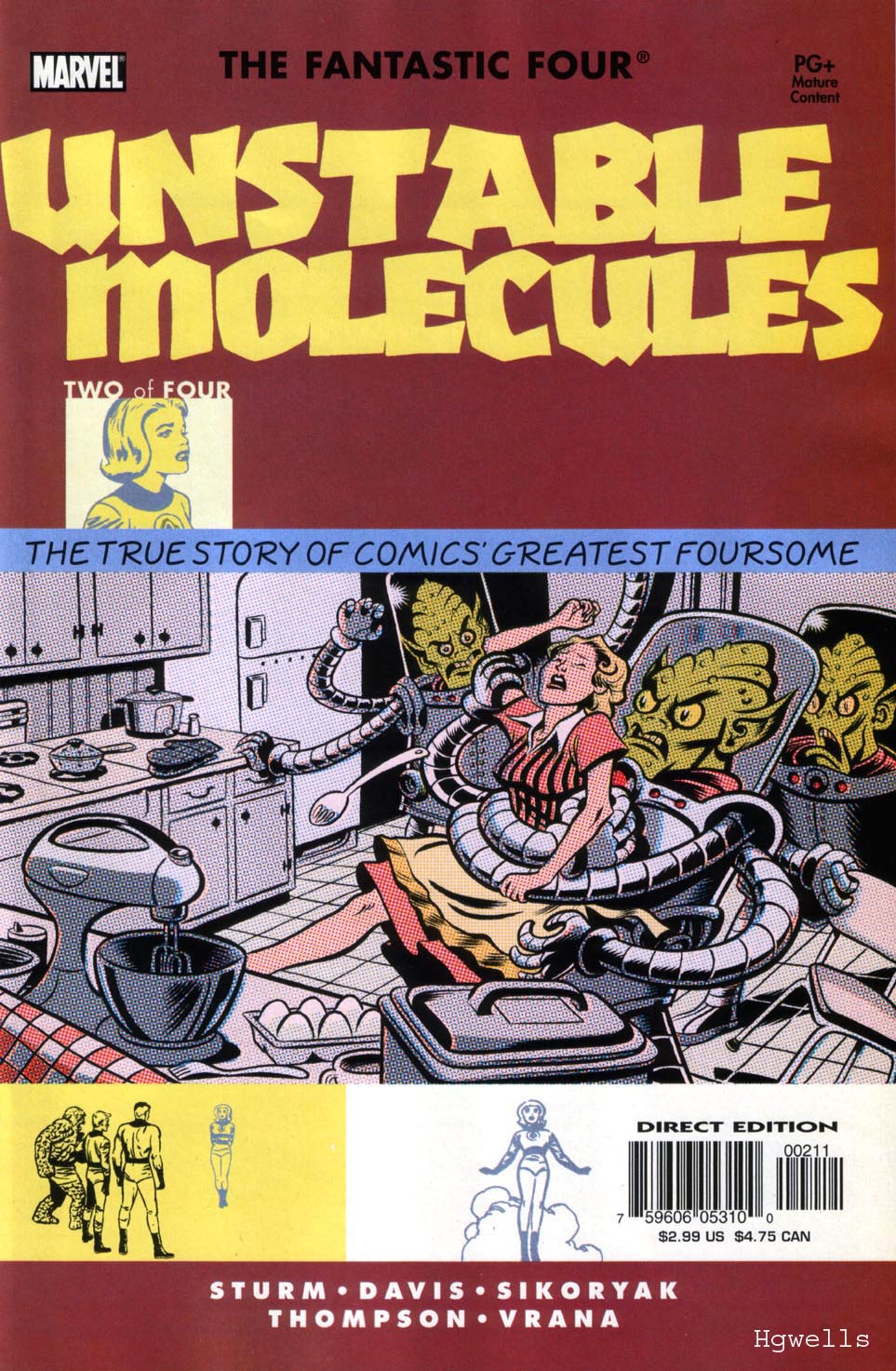
FantasticFour-Unstable_Molecules2
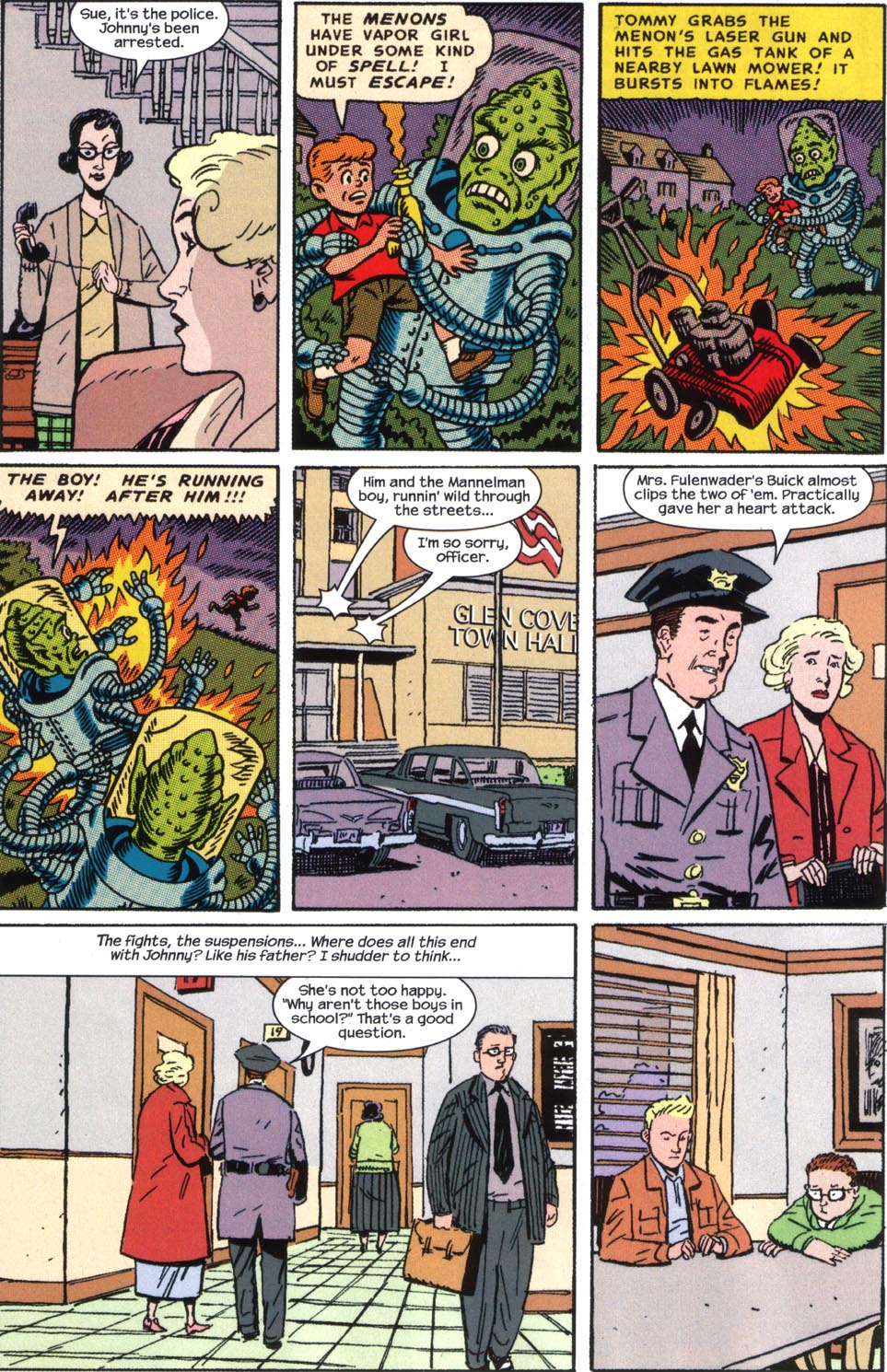
Startling Stories: Fantastic Four – Unstable Molecules no. 2 (April 2003). The cover is by Craig Thompson.

FantasticFour-Unstable_Molecules2-2
Disappearing Acts is scripted by James Sturm and illustrated by Guy Davis with assistance from James Sturm. The Vapor Girl insertions (imaginary alien escapades) are by Robert Sikoryak.

If you liked this post, don’t forget to visit Tentacle Tuesday: Mechanical Tentacles, too!

≈ ds

Hot Streak: Joe Kubert’s Son of Tomahawk

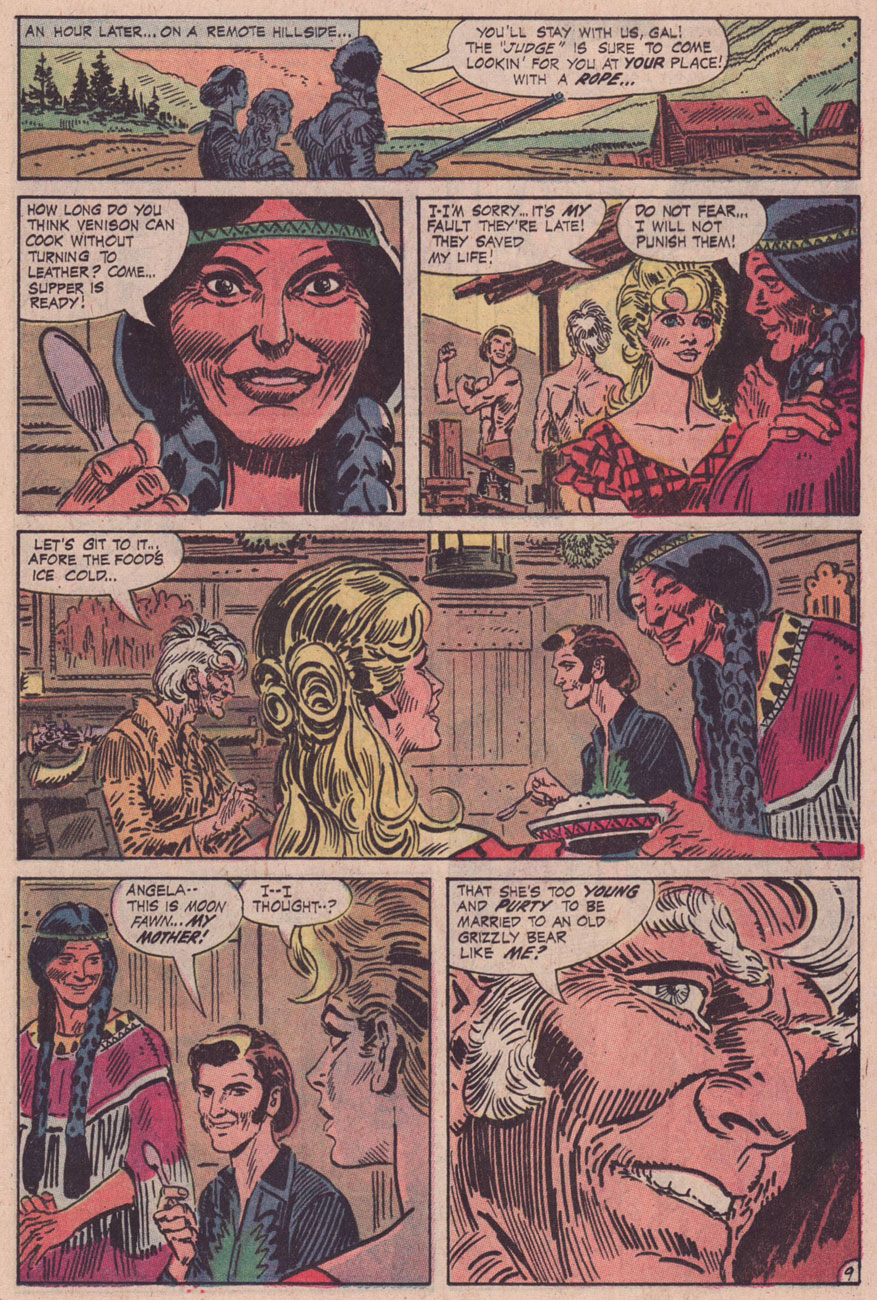
« Who are these men, Tomahawk? » « My Rangers! We fought against renegades… from Pennsylvania to Kentucky! When the country got too crowded, Moon Fawn and I moved out West… where a man has room to breathe! » — Tom Hawk sums up his change of station.

Tomahawk was created in 1947 by writer Joe Samachson (later co-creator, with Joe Certa, of J’onn J’onzz, Manhunter from Mars) and artist Edmund Good. The series was distinguished by its setting, the American Revolutionary War (1775-1783), and it appeared both as a back-up in Star Spangled Comics (until it switched to an all-bellicose format and became Star Spangled War Stories in 1952) and in World’s Finest (at first intermittently, from 1949, then steadily from 1953 to 1959). And Tomahawk had been spun off into his own book in 1950.

Inevitably, with the Silver Age and its superhero reascendancy, to the eventual detriment of all other genres, the historical adventure strip’s slow decline set in.

As Don Markstein put it:

« Toward the latter part of the ’50s, practically all DC comics ran aliens, monsters and other goofy sci-fi stuff on the covers, no matter how badly it clashed with the title’s subject matter — even war comics often sported dinosaurs in that position. And so, all through the late 1950s and early to mid ’60s, Tomahawk fought gigantic tree men, miraculously-surviving dinosaurs, mutated salamanders, and other menaces that seem somehow to have escaped the history books. There was even a giant gorilla among them, and putting a gorilla on the cover was also a contemporary trend at DC. »

It all comes down to the editor, and Tomahawk was long edited by Jack Schiff, who just adored that sort of (admittedly fun) claptrap, then by his associate Murray Boltinoff, who at least was more flexible.

To wit, with issue 116 (May-June 1968) came a change and a relative return to the feature’s roots. First, Neal Adams was brought in to provide covers, and the more outré aspects were phased out. With issue 119 (Nov.-Dec. 1968), the book’s final creative team was brought aboard: writer Robert Kanigher and illustrator Frank Thorne (1930-2021), eventual creator of Moonshine McJugs. Thorne replaced Fred Ray (1920-2001) who, while he wasn’t a Tomahawk originator, had been chronicling the mountain lion’s share of his exploits since 1947. He would draw a handful of short pieces for DC’s war books before leaving the comics field in the early 1970s, writing historical non-fiction and art directing and illustrating for publications Civil War Times Illustrated, American History Illustrated, True Frontier, The West and Yank (despite the title, not a porno mag).

With the heart of the creative team in place, it was a change of editors that prompted Tomahawk’s final mutation, and arguably its most interesting: Joe Kubert took over the editorial reins, and the action was moved four decades or so forward in time. Tom ‘Tomahawk’ Hawk had settled down with a Native woman, Moon Fawn, sired a pair of sons, and was by then a lanky, crotchety old coot, but not quite helpless. His elder son Hawk was the protagonist, and they encountered frontier-style prejudice, greed, corruption, tribalism, paranoia… you guessed it: it was a ‘socially-relevant‘ comic, but hardly the cringe-fest that was the concurrent Green Lantern/Green Arrow. I daresay that Kubert and Kanigher’s respective politics were rather too complex for that.

Tomahawk131A
This is Tomahawk no. 131 (Nov.-Dec. 1970, DC). Inside: Hang Him High!, written by Robert Kanigher and illustrated by Frank Thorne. I like how nonplussed Hawk is at the prospect of doing the Brand New Tennessee Waltz..

Tomahawk132A
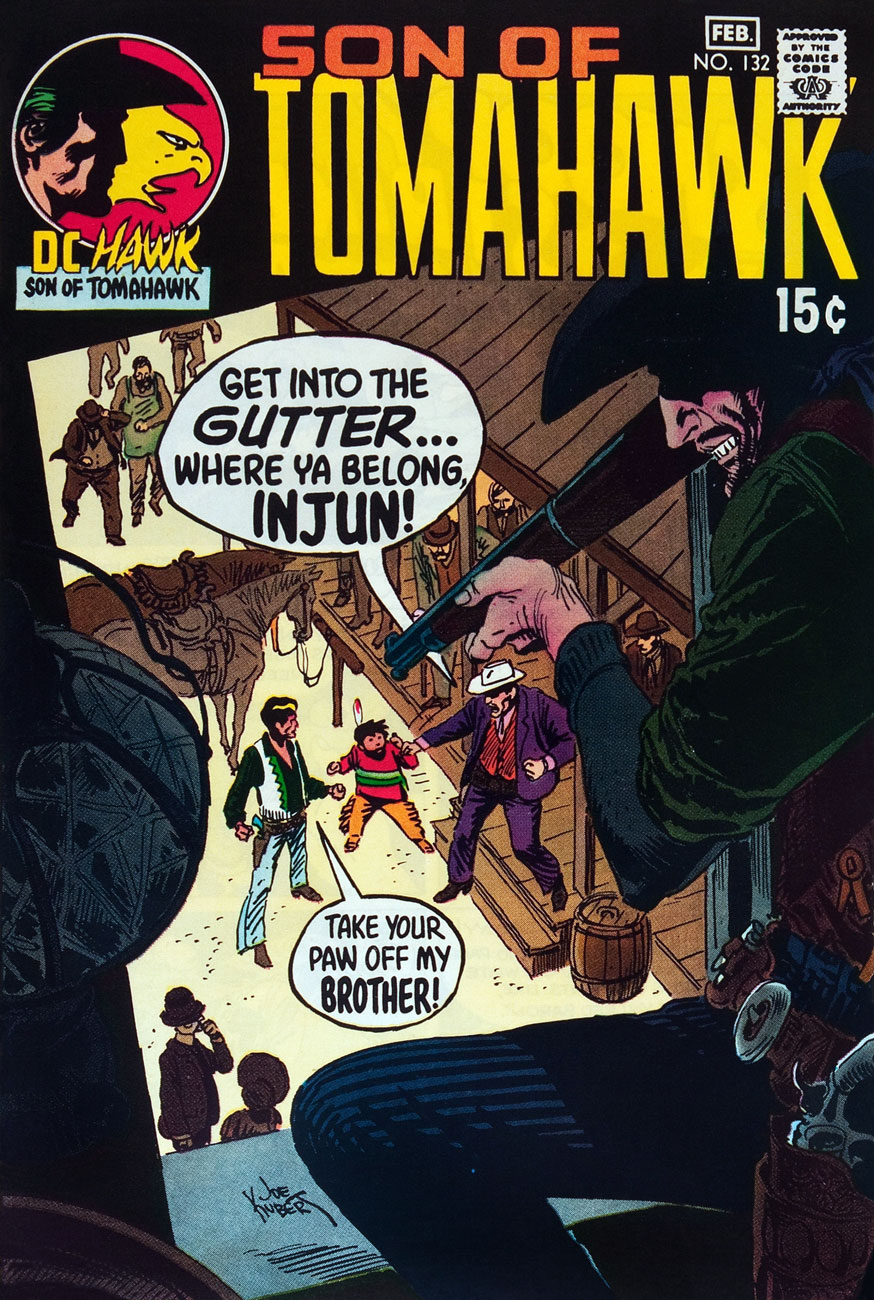
This is Tomahawk no. 132 (Jan.-Feb. 1971, DC). Inside: Small Eagle… Brother Hawk!, written by Robert Kanigher and illustrated by Frank Thorne.

Tomahawk133A
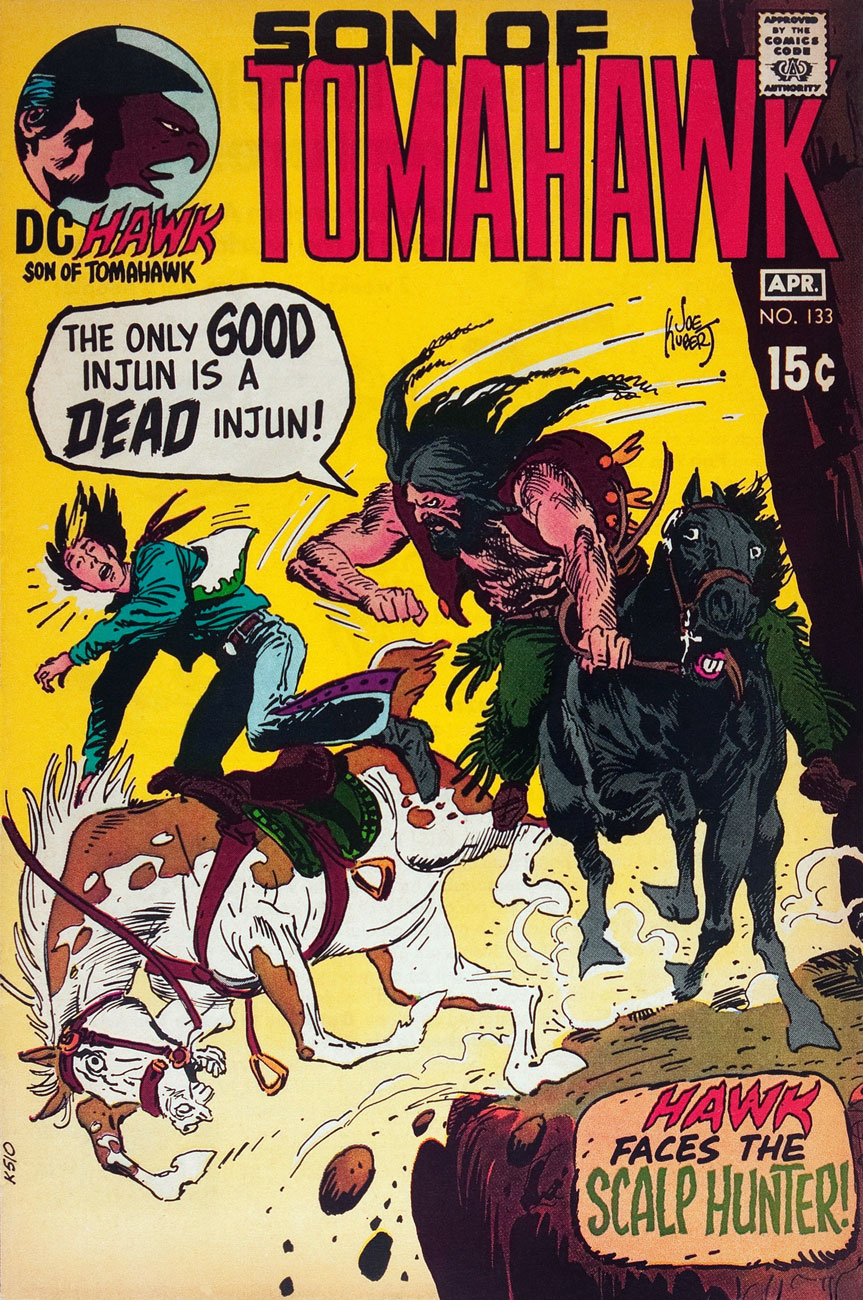
This is Tomahawk no. 133 (Mar.-Apr. 1971, DC). Inside: Scalp Hunter, written by Robert Kanigher and illustrated by Frank Thorne.

Tomahawk134A
This is Tomahawk no. 134 (May-June 1971, DC). Inside: The Rusty Ranger, written by Robert Kanigher and illustrated by Frank Thorne.

Tomahawk135A
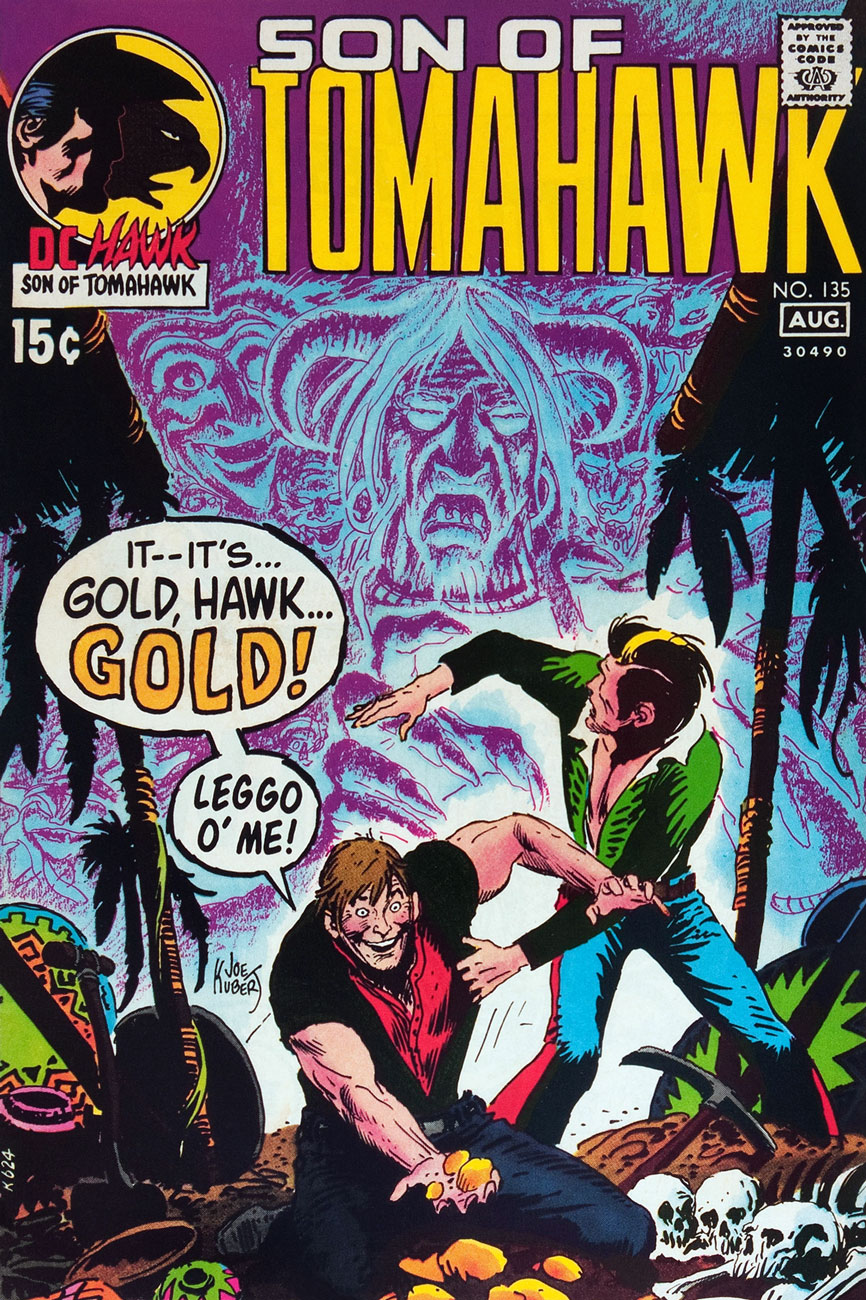
This is Tomahawk no. 135 (July-Aug. 1971, DC). Inside: Death on Ghost Mountain!, written by Robert Kanigher and illustrated by Frank Thorne, and the powerful Spoilers, written by Jerry DeFuccio and illustrated by John Severin. This was my admittedly random introduction to the series.

Tomahawk136A
This is Tomahawk no. 136 (Sept.-Oct. 1971, DC). Inside: A Piece of Sky!, written by Robert Kanigher and illustrated by Frank Thorne, plus an extraordinary Firehair tale by Kubert… but then they all are.

Tomahawk137A
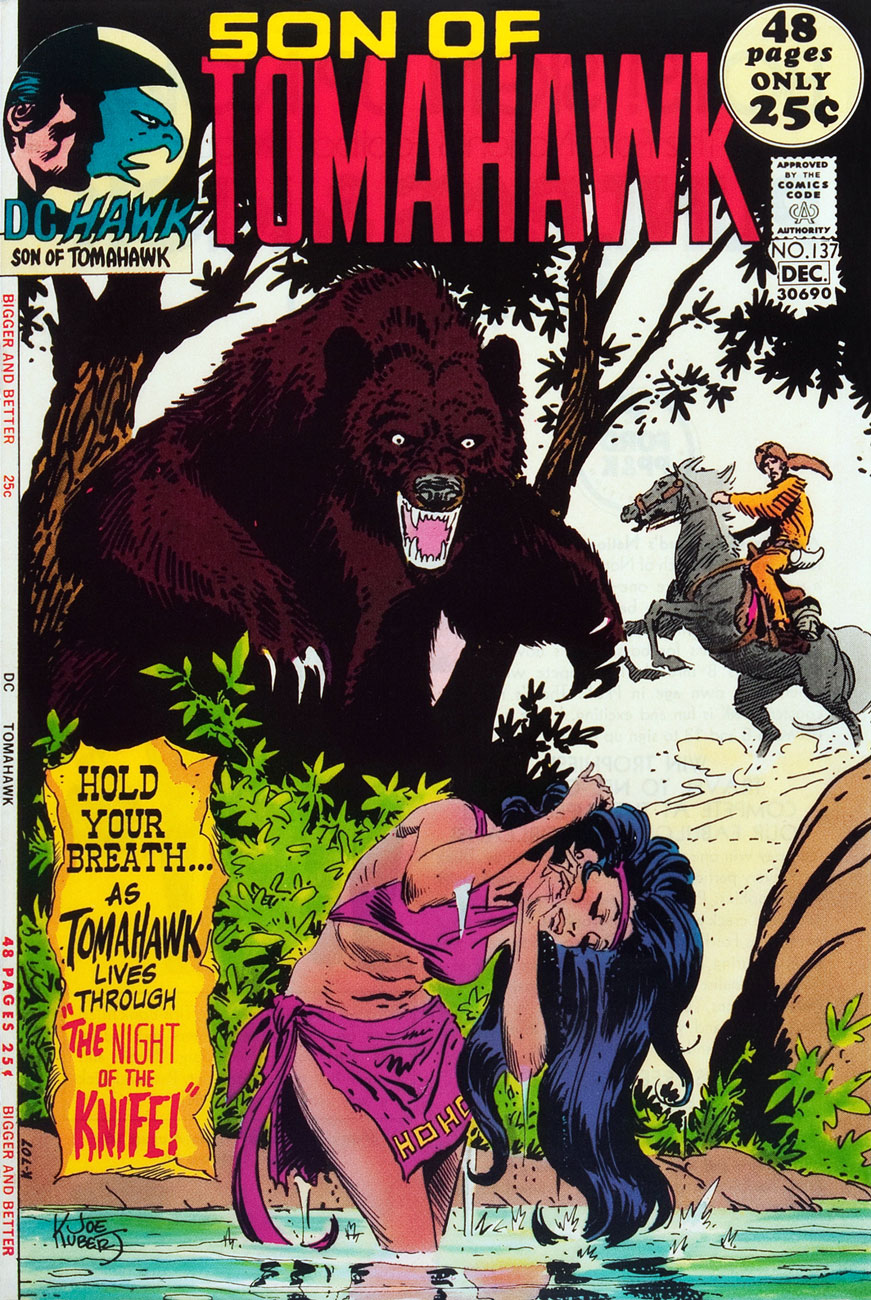
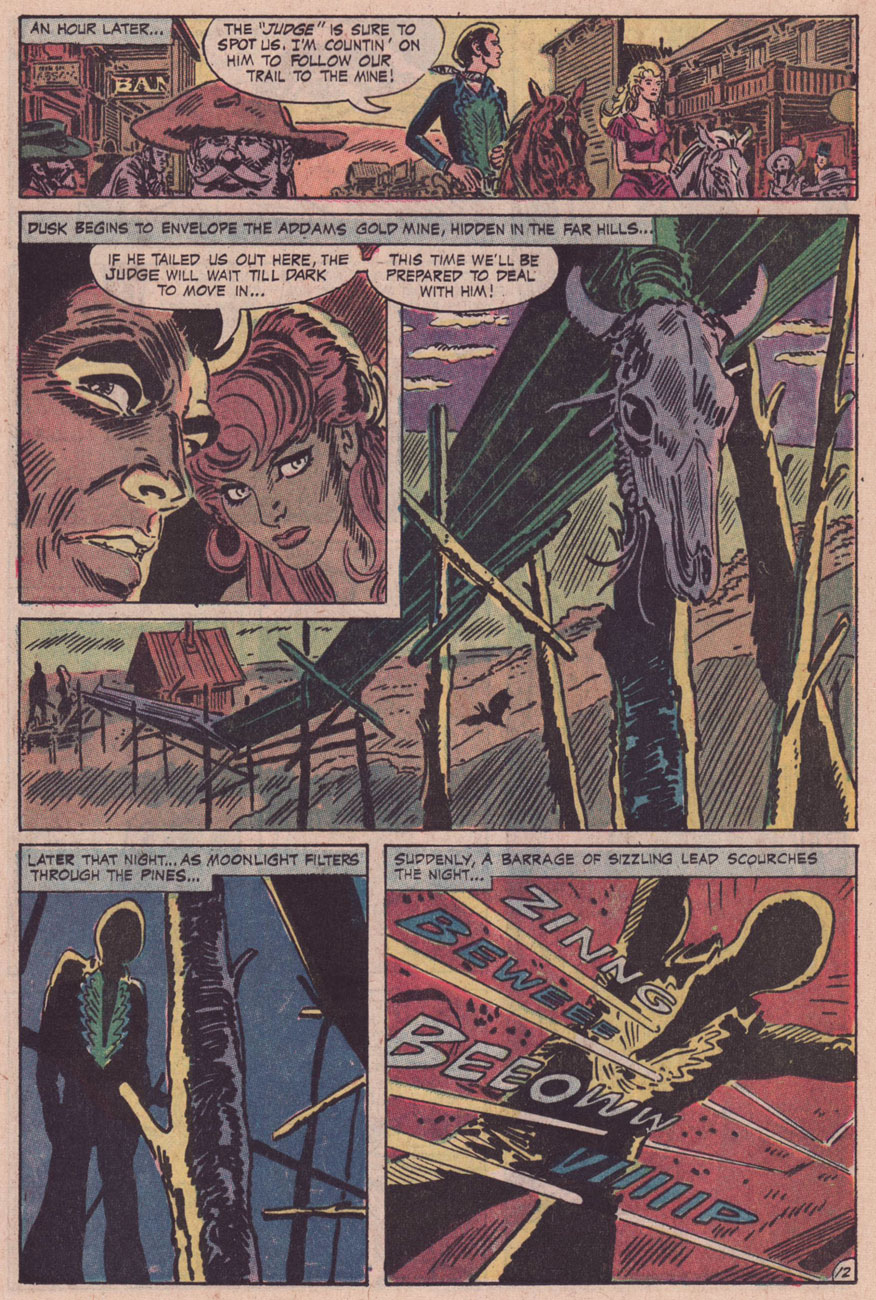
This is Tomahawk no. 137 (Nov.-Dec. 1971, DC). Inside: Night of the Knife!, written by Robert Kanigher and illustrated by Frank Thorne, plus a selection of fine reprints.

Tomahawk138A
This is Tomahawk no. 138 (Jan.-Feb. 1972, DC). Inside: Christmas, written by Robert Kanigher and illustrated by Frank Thorne, as well as an assortment of worthy reprints boasting artwork by Nick Cardy, Sam Glanzman, Norman Maurer and Mort Drucker.

Tomahawk139A
This is Tomahawk no. 138 (Mar.-Apr. 1972, DC). Inside: Death Council, written by Robert Kanigher and illustrated by Frank Thorne, plus a clutch of reprints illustrated by Fred Ray, Gil Kane, and none other than Frank Frazetta.

Tomahawk140A
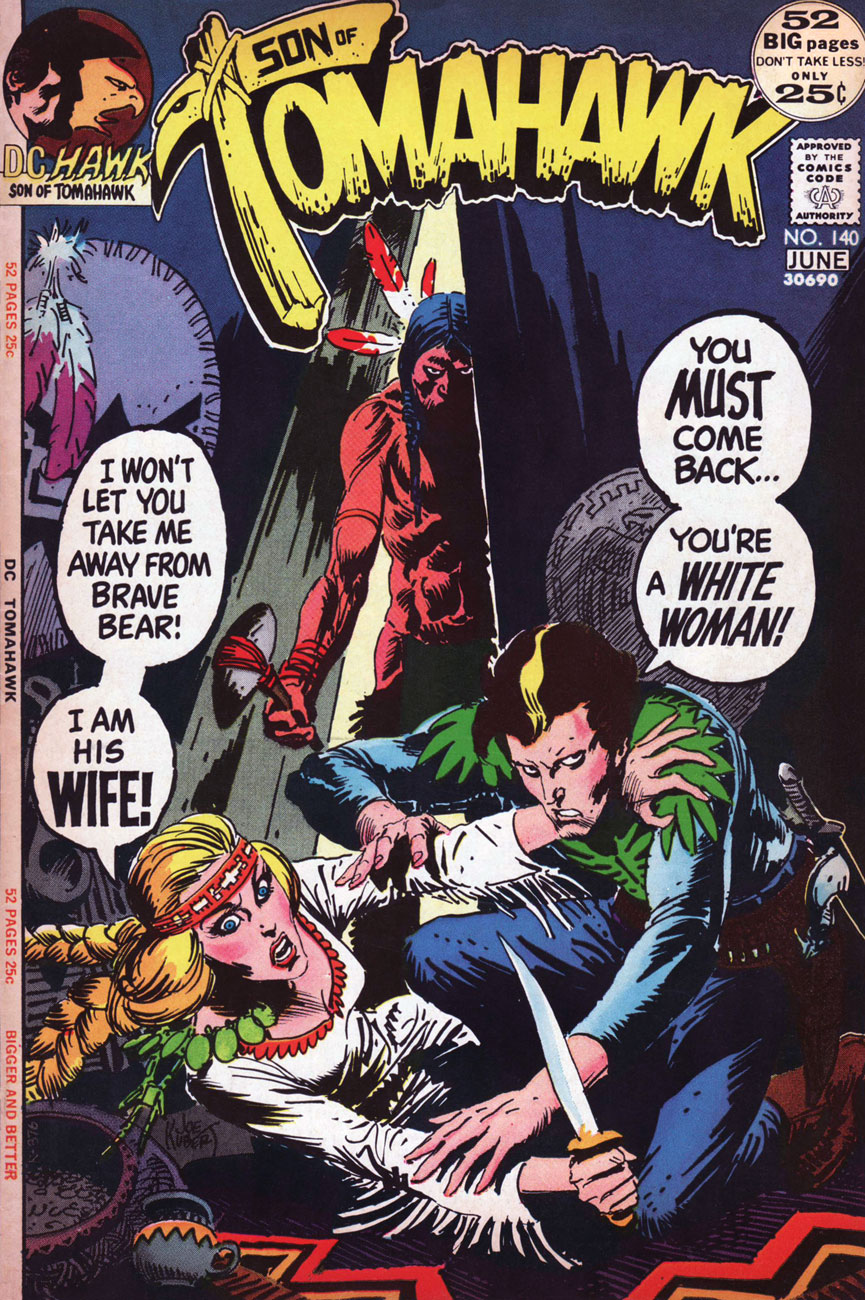
This is Tomahawk no. 140 (May-June 1972). Inside: The Rescue!, written by Robert Kanigher and illustrated by Frank Thorne. Gaspar Saladino‘s brand new logo, a rare misfire, was unveiled just in time for the book’s cancellation.

As for the interior art, I’d say it’s Frank Thorne’s finest work. The notorious Alexander Toth would of course disagreed, far preferring Thorne’s work when Thorne’s style bore a heavy… Toth influence (here’s an example from 1957.) For comparison, here’s a pair of interior pages from Tomahawk no. 131‘s Hang Him High!

ThorneTomahawk131_09

ThorneTomahawk131_12A
Thanks to their production manager, Jack Adler, DC had the finest, most nuanced colouring in the field in the late 60s and early 70s.

Toth would, in (final) conversation with The Comics Journal publisher Gary Groth, in 1996, froth forth:

« I repeatedly warned Frank: “For Christ’s sake, get the hell away from Kubert. He’s not doing you any good. His influence on you is negative, not positive, so get the hell away from him and stop aping his style and stop putting on all that shit that you lived without for years. You did nice, clean, hard-lined stuff, and it’s been detrimental to your work.” He confessed: “Yes, Joe Kubert and his style are hard to resist.” So, yes he had the influence, and he liked it. Well, good luck. »

DC attempted an update of the character back in 1998. It wasn’t *atrocious*, but basically a rehash of Jeremiah Johnson with a sheen of ‘Magical Native American‘ sprinkles.

-RG

Tentacle Tuesday: Secrets, Both Sinister and Domestic

Random fact of the day: in Mandarin Chinese, secret is “mimi”, whereas in French “mimi” means something like “cute”. Today’s post is not cute, but it is very much about secrets – DC secrets, to be more precise.

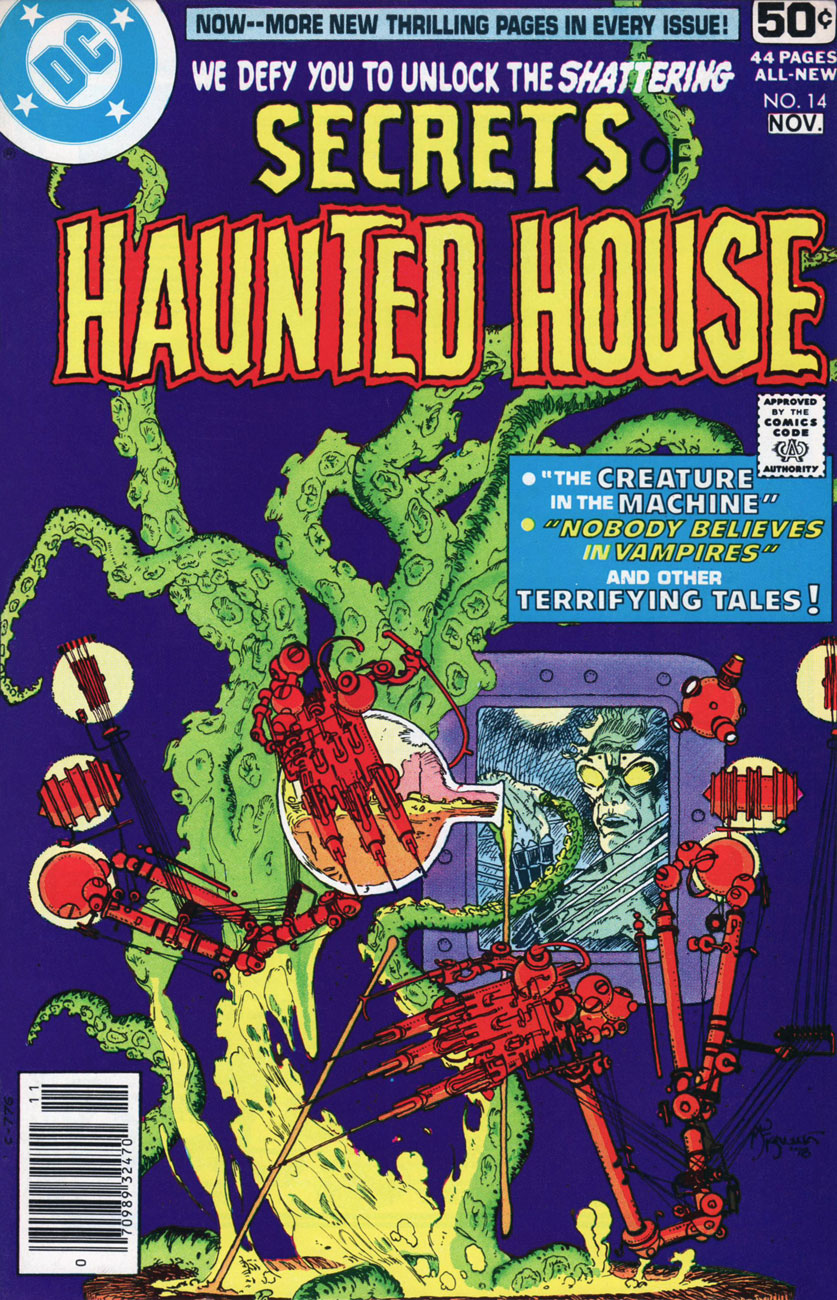
KalutaSOHH14A
Secrets of Haunted House no. 14 (Oct-Nov 1978). Cover by Mike Kaluta.

The original art for this cover feels a little less cluttered:

SOHH_ORIG_A

Taking a peek at the insides, we will find that they have little to do with the cover, but tentacles are still present. The Discovery is scripted by Jay L. Zilber, pencilled by Juan Ortiz, and inked by Vince Colletta:

SecretsofHauntedHouse14-mechanical

Tentacles also rudely intrude in Selina, a story scripted by Nicola Cuti and elegantly illustrated by Ramona Fradon and Bob Smith

Selina-SecretsofHauntedHouse14

Selina-SecretsofHauntedHouse14-2
The thing about masks was too topical to not include.

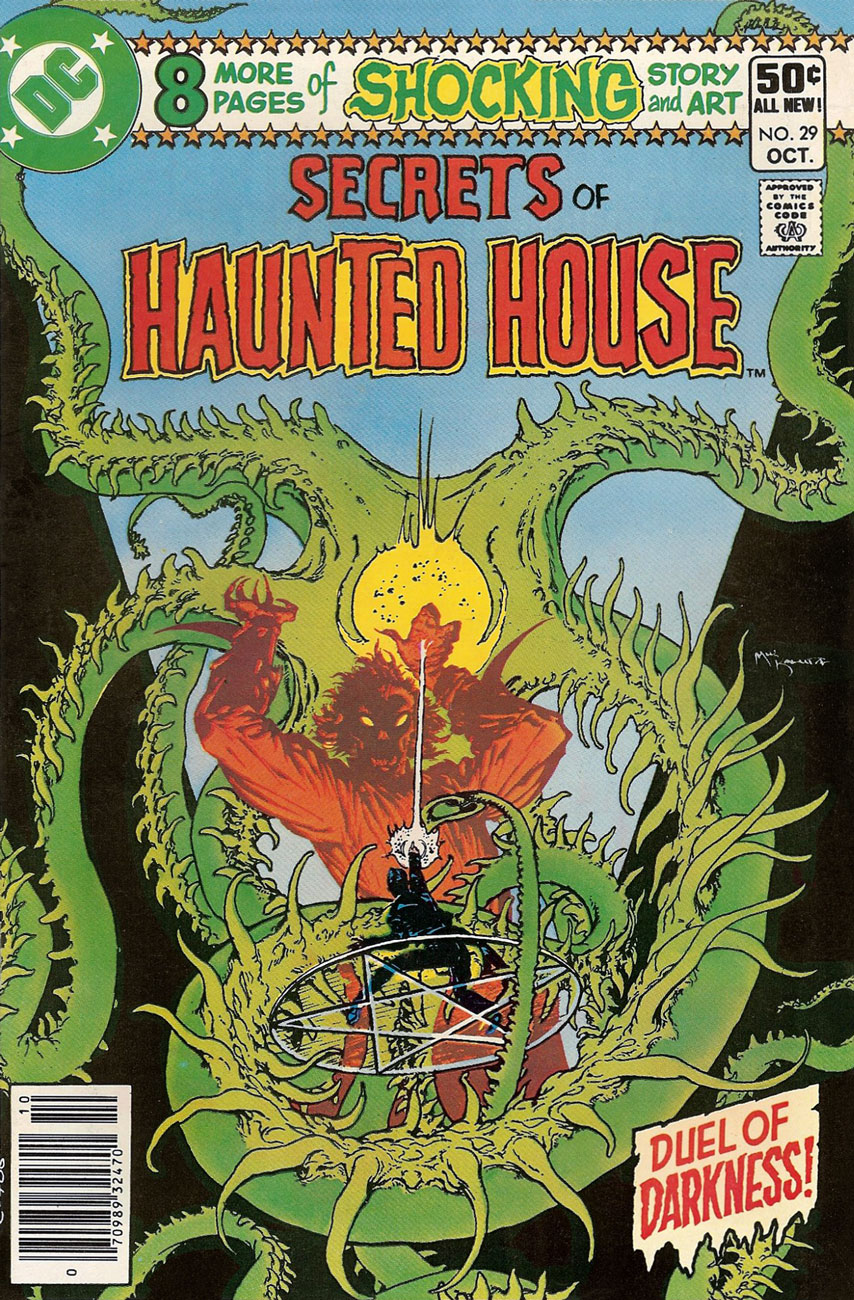
KalutaSOHH29A
Secrets of Haunted House no. 29 (October 1980), cover by Mike Kaluta.

SecretsofHauntedHouse36A
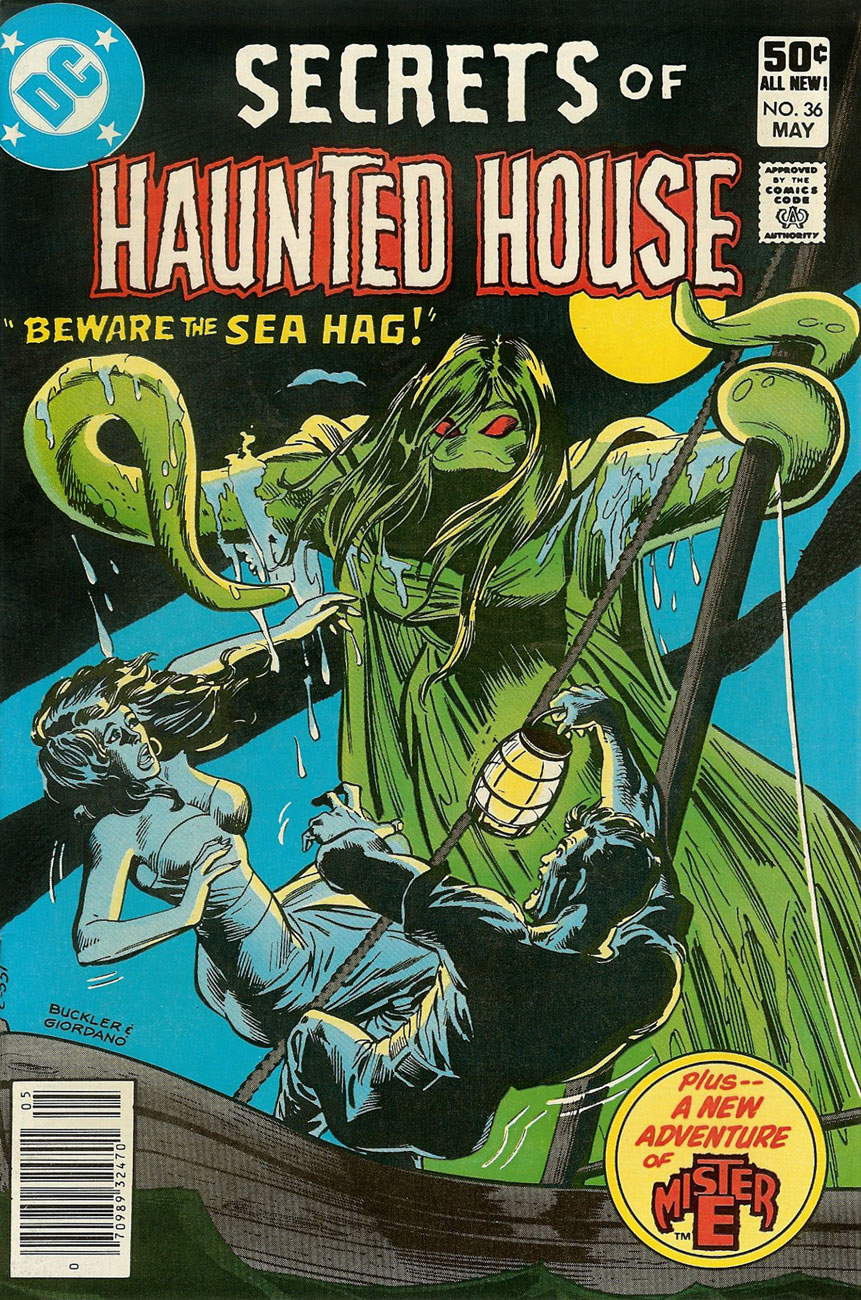
Secrets of Haunted House no. 36 (May 1981), cover pencilled by Rich Buckler and inked by Dick Giordano.

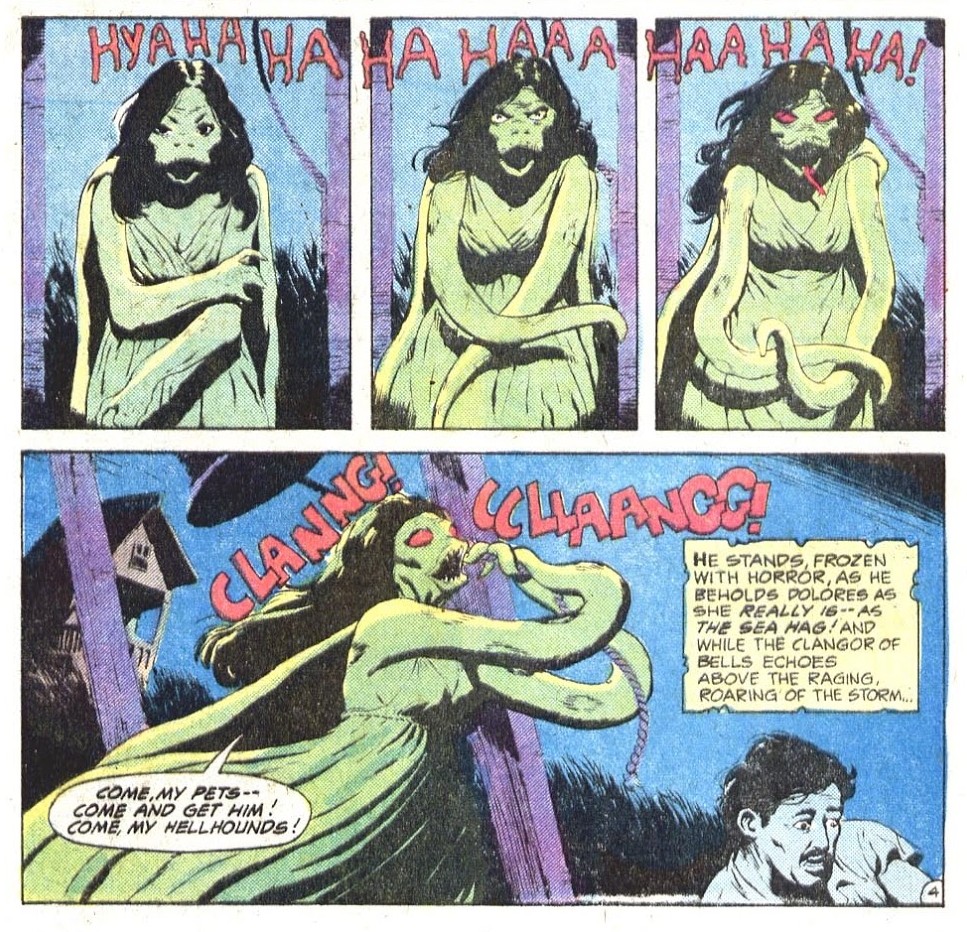
Beware the Sea Hag, the cover story,  is scripted by Carl Wessler and drawn by Wade Hampton:SecretsofHauntedHouse36-bewareoftheseahag

SecretsofHauntedHouse36-bewareoftheseahag2

But, wait, this is not what the Sea Hag normally looks like! This is more like it:

SagendorfPopeye73A
Popeye the Sailor no. 73 (August 1964), cover by Bud Sagendorf. I wonder if the Sea Hag realises how much spinach reduces under heat.

Shifting to another sort of secrets (these are sinister rather than haunted), we have another tentacle apparition —

SecretsofSinisterHouse11-MonsterofDeathIsland
The Monster of Death Island is scripted by Maxene Fabe and drawn by Ruben Yandoc (i.e. Rubeny). It was published in Secrets of Sinister House no. 11 (April 1973).

This story, a sort of take on Bluebeard, is well worth reading, for the plot as well as the stunning art. I don’t want to reveal spoilers – you can read it here.

SecretsofSinisterHouse11-MonsterofDeathIsland-2-Rubeny

Since we’re discussing secrets, I might as well throw in The House of Secrets… I will willingly admit that I have the hardest time keeping track of which is which.

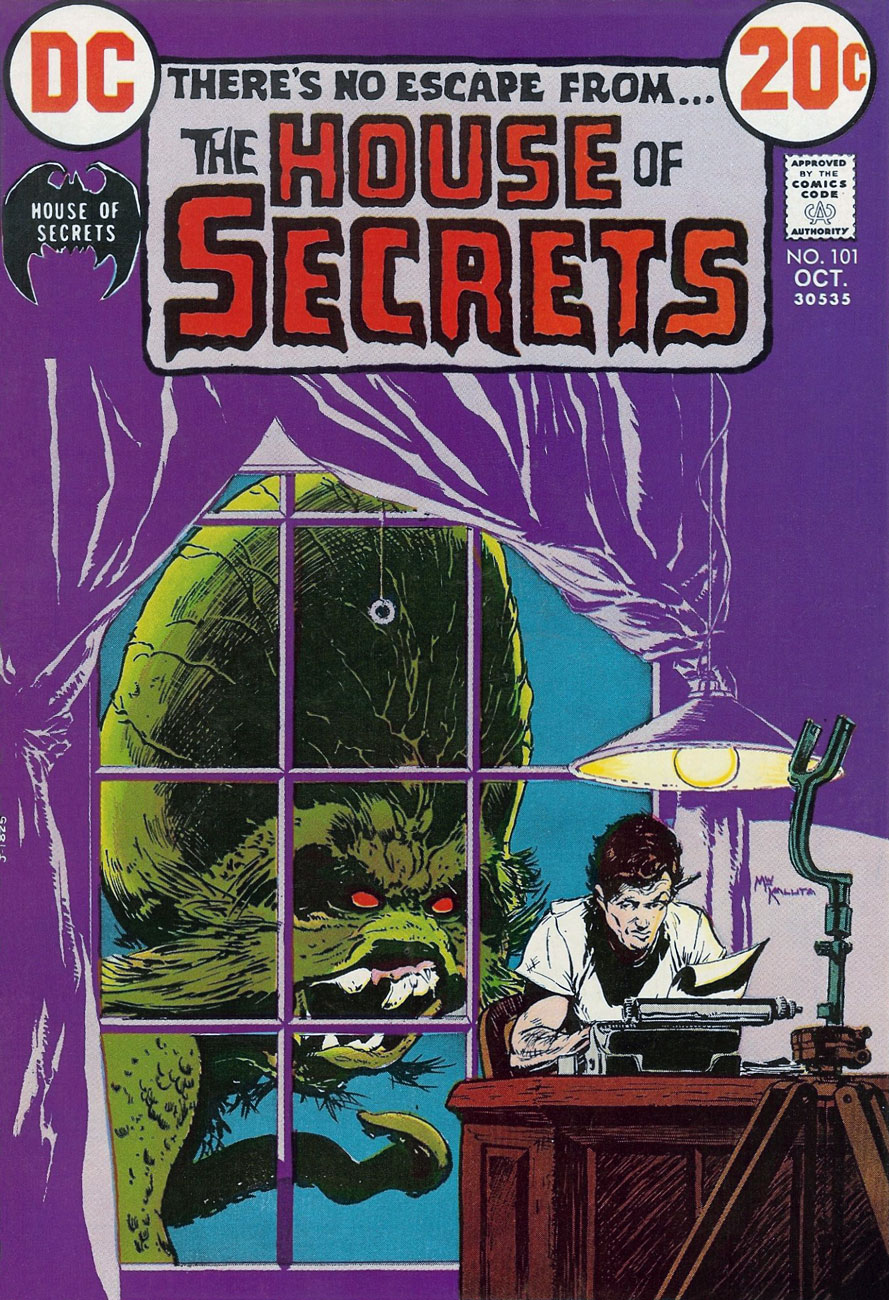
HouseOfSecrets101A
House of Secrets no. 101 (October 1972), cover by Mike Kaluta. This could have been a Mike Kaluta Tentacle Tuesday!

HouseofSecrets100-Abel'sFables
From House of Secrets no. 100 (September 1972). This page of Abel’s Fables is by Lore Shoberg.

house of secrets 103
Cain & Abel by Sergio Aragonés, printed in House of Secrets no. 103 (December 1972).

∼ ds

Tentacle Tuesday: Sea Breezes

« Il vente — C’est le vent de la mer qui nous tourmente… »

Yesterday, I finished reading an excellent book by French author Pierre Mac Orlan, best known for Quai des brumes (Port of Shadows), written in 1927 and transformed into a movie in 1938. In other words, a while ago! The title of the novel I joyously devoured is Le chant de l’équipage (1918), and it’s a grand tale of swashbuckling adventure on the high seas. Well, actually it’s a lot more complex than that, and it’s beautifully written. As it’s in the public domain, you can read it online here (but in French only, I’m afraid). As I’m still digesting scenes from the novel, so to speak (no, the équipage did not encounter an octopus on its journey), my mind’s eye is focused on the far-away sea… so today’s Tentacle Tuesday has been rerouted from its original concept into everything nautical. Let’s spend a little time inhaling the healthy sea-breeze, in a world of handsome ships and the people who make them sail.

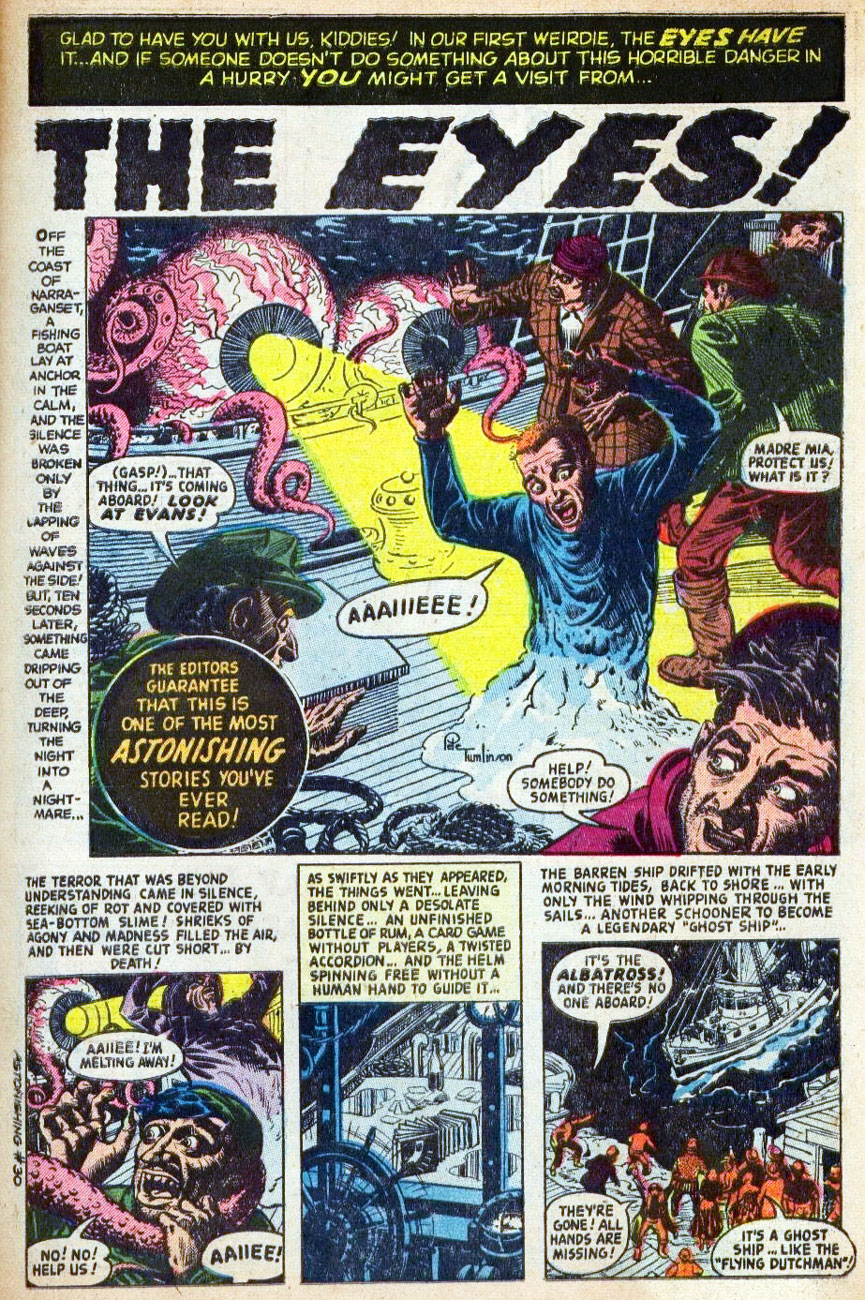
Perhaps the following story does not depict your standard encounter with an octopus… but it’s indubitably a seafaring tale. The Eyes, illustrated by Pete Tumlinson, was published in Astonishing no. 30 (February 1954, Atlas):

Eyes-Atlas-Comics-Astonishing30-inside

Eyes-Atlas-Comics-Astonishing30-inside2
In the next page, the octopus-balls steal a lot of sunglasses (their discovery that ears are needed to wear glasses is off-panel, though).

Monsters from a Thousand Fathoms, scripted by Carl Wessler and illustrated by the Redondo Studio (RG: with a heavy dose of E.R. Cruz), was published in The Unexpected no. 185 (May-June 1978, DC):

Unexpected185-Monster-of-a-thousand-fathoms

Unexpected185-Monster-from-a-thousand-fathoms-2

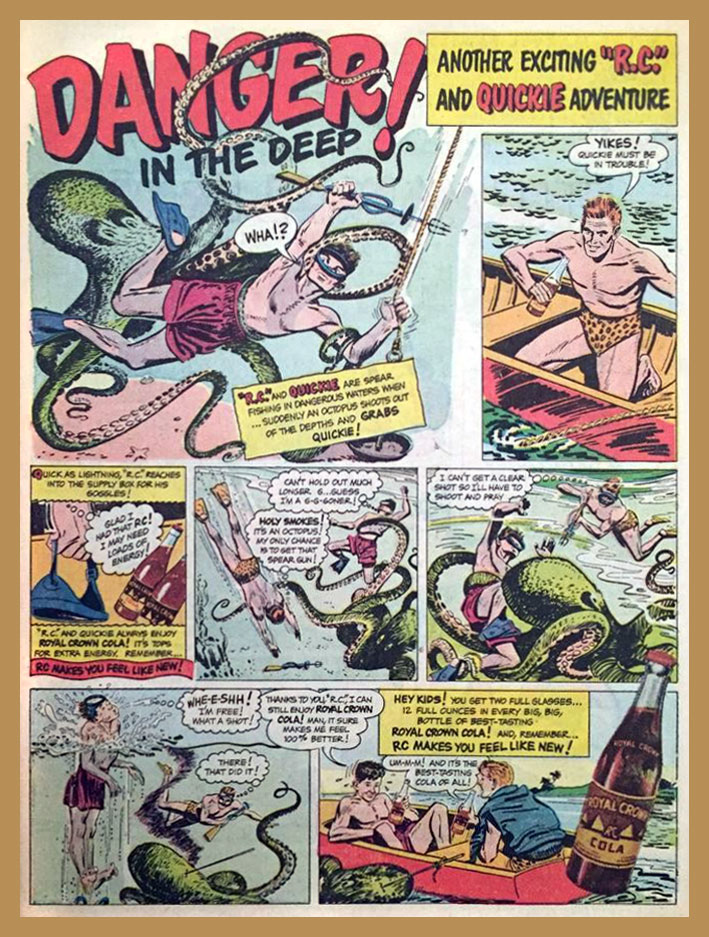
Ads endeavouring to put the viewer into the shoes of an action-type he-man to sell some nonsense is nothing new. And yet, through this hackneyed jungle, sometimes a glimmer of real excitement comes through:

1951_Marvel-Family-60A
An ad published in The Marvel Family no. 60 (June 1951, Fawcett). Never mind the Cola (it’s still around, incidentally), but that fight scene was pretty well orchestrated, if you ask me!

Those of us who like to dream of adventure, but preferably from the comfort of our own homes, I have this strip:

Newspaper-1967-08
You can read all about the comic strip The Tracy Twins by Dik Browne in a lovely article from Hogan’s Alley.

Since the aforementioned The Tracy Twins got its wings in a colour supplement of monthly scouting magazine Boys’ Life in 1952, I will now smoothly segue into a related topic, or a bit of warning, if you like.

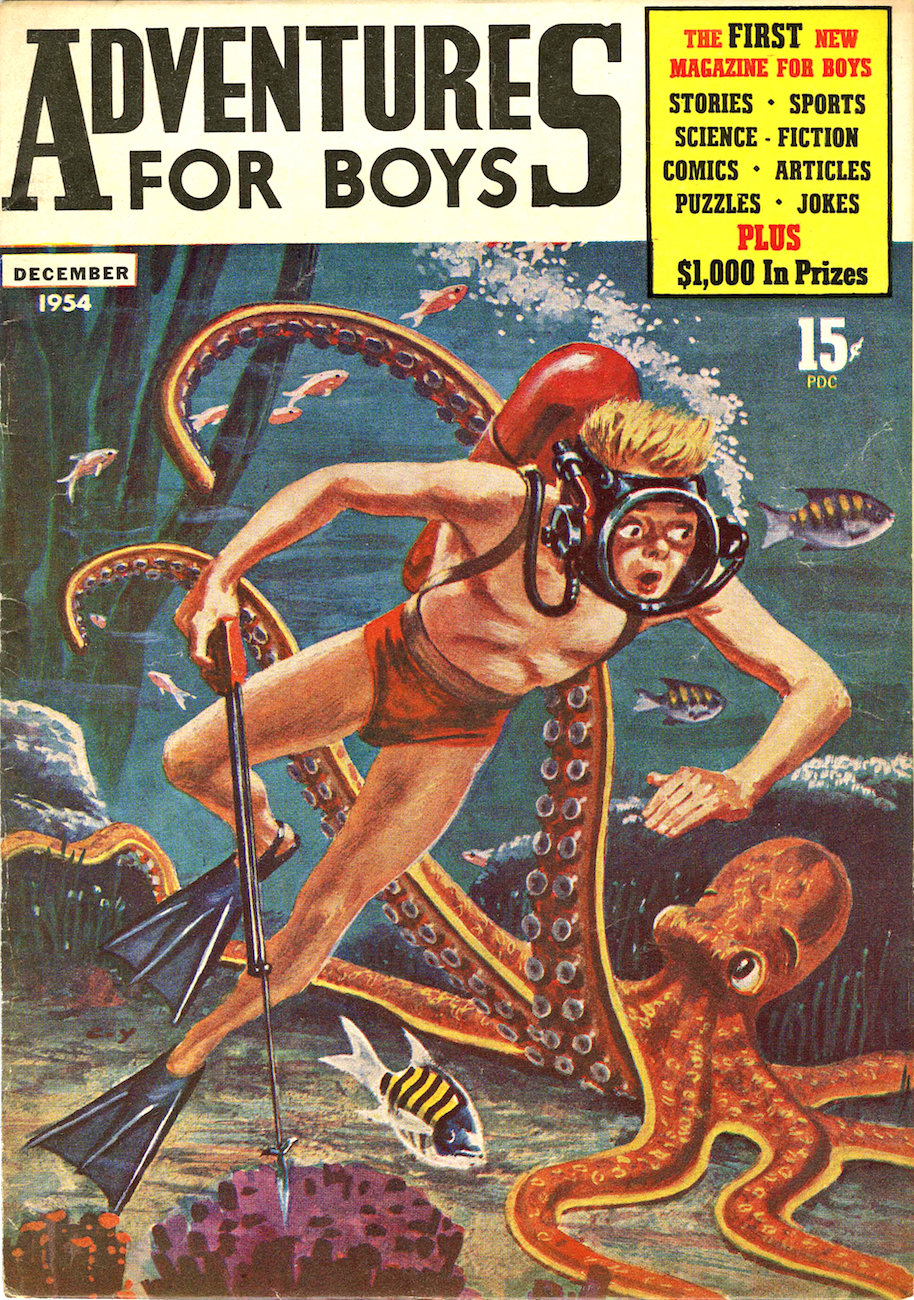
If you start out as a wide-eyed kid in search of sea-faring thrills, and meet an octopus, just like this:

AdventuresForBoys-December1954-Octopus
An issue of Adventures for Boys (December 1954, Bailey Enterprises).

You might end up, many years down the road, growing up to be, well… a little peculiar, shall we say.

MenA
I’m sure several parts of that 25-point check-list for sexual normalcy involves cephalopods. This is Men vol. 2 no. 8 (Aug. 1953, Atlas). Cover by Robert Emil Schulz.

And if that wasn’t sufficient, the same doctor has further advice for his readers in this slightly subsequent issue:

MenVol2No11A
Men vol. 2 no. 11 (Nov. 1953, Atlas). Cover by Robert Emil Schulz.

∼ ds

Tentacle Tuesday: Spring Has Sprung… Its Snare!

« In the spring, at the end of the day, you should smell like dirt. » – Margaret Atwood

Our neighbours are certainly following this sage piece of advice, crawling out with shovels and rakes, clad in rubber boots and – a new development this year – face masks. As far as I’m concerned, the flu virus can’t be transmitted by plants, so one is quite safe in the garden or backyard, as far as that goes… but how about proper protection against plant-tentacles? ♪♪ Whether on land or under the sea, tentacles are coming for you and me… ♫♫ I promise to stay away from song-writing in the future. But now, for the comics!

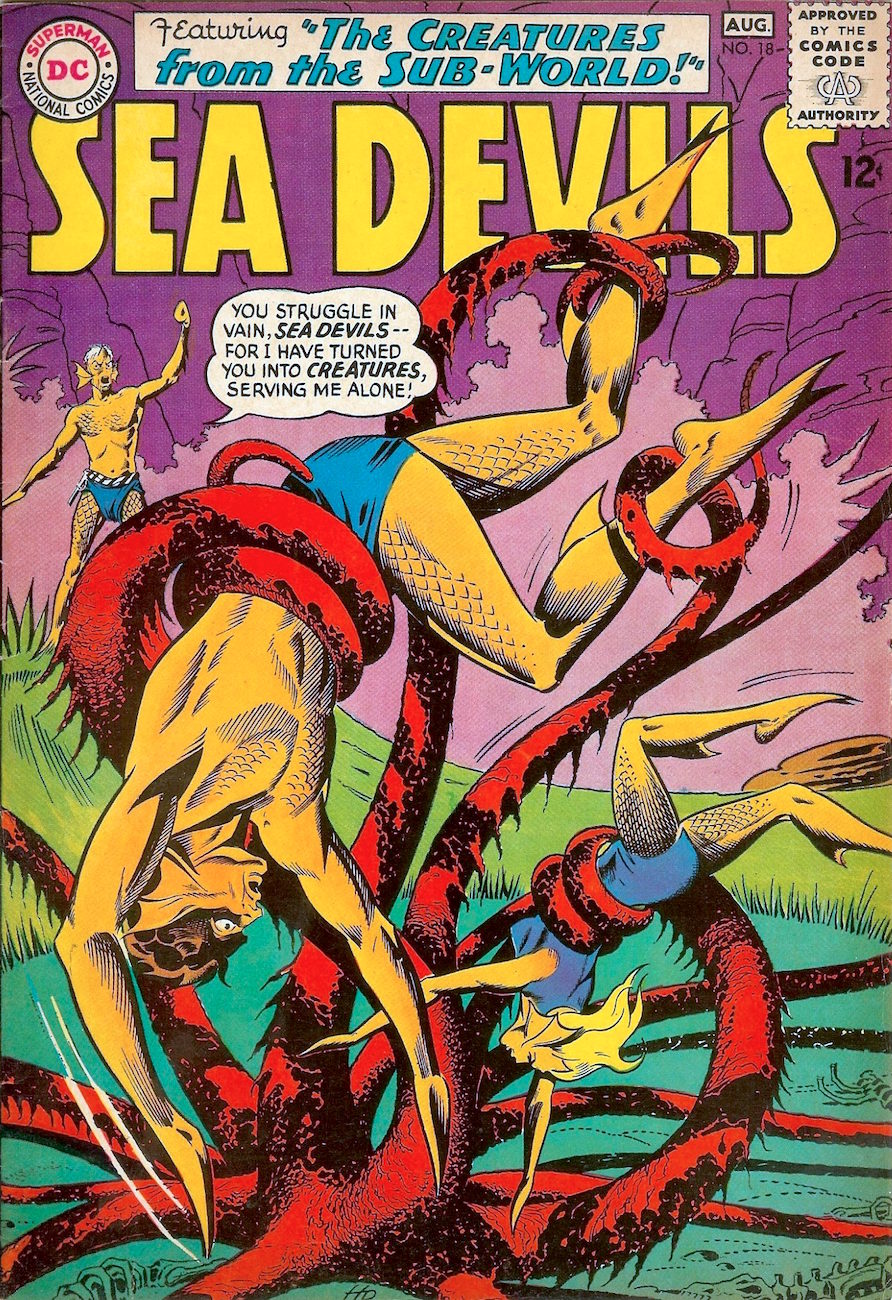
SeaDevils18-SheldonMoldoff
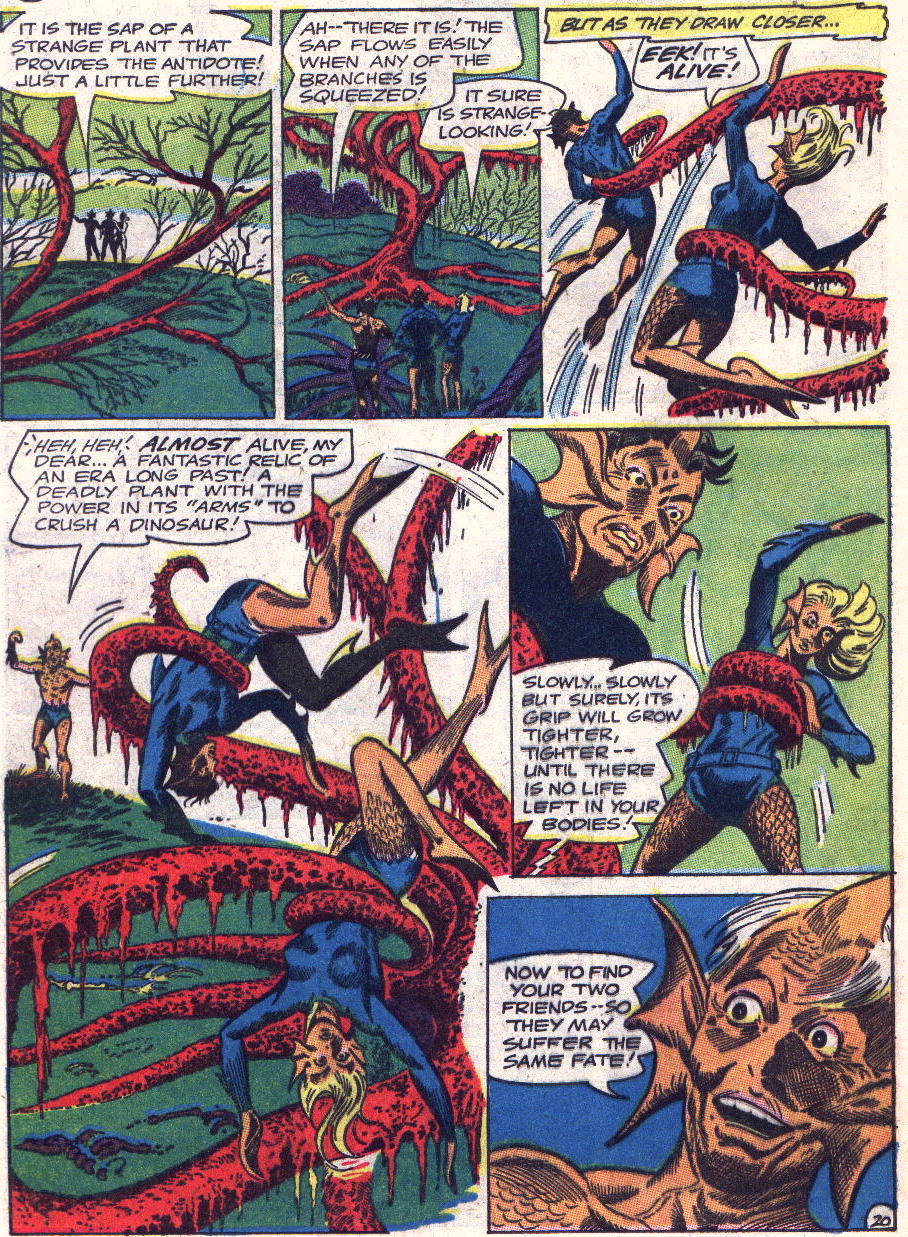
Sea Devils no. 18 (July-August 1964). Cover by Howard Purcell. The Sea Devils grapple with tentacles quite a lot, so they had a whole Tentacle Tuesday: Ahoy, Sea Devils! to themselves.

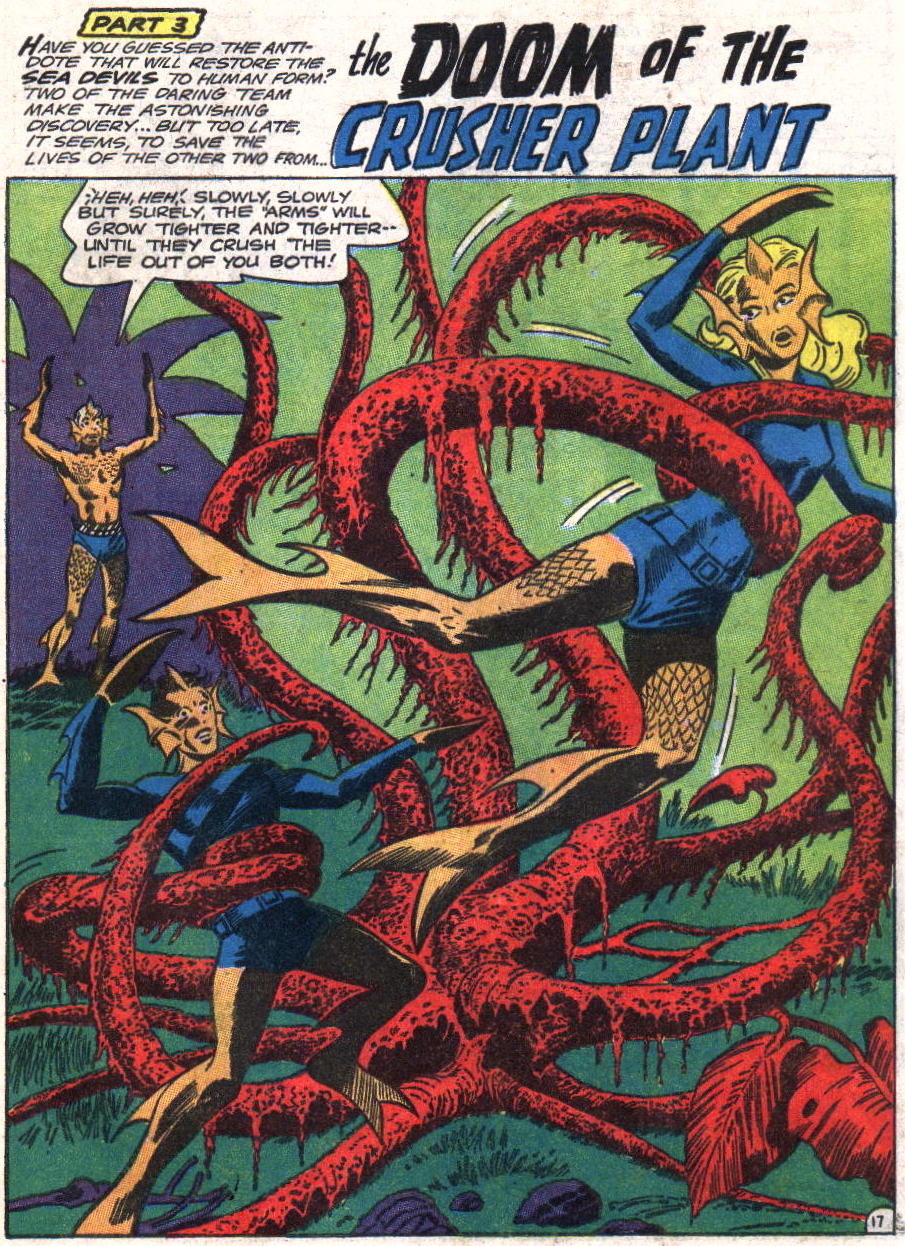
The art inside is quite nice, with pencils by Howard Purcell and inks by Sheldon Moldoff (read the whole issue here):

SeaDevils18-DoomoftheCrusherPlant

SeaDevils18-DoomoftheCrusherPlant-2

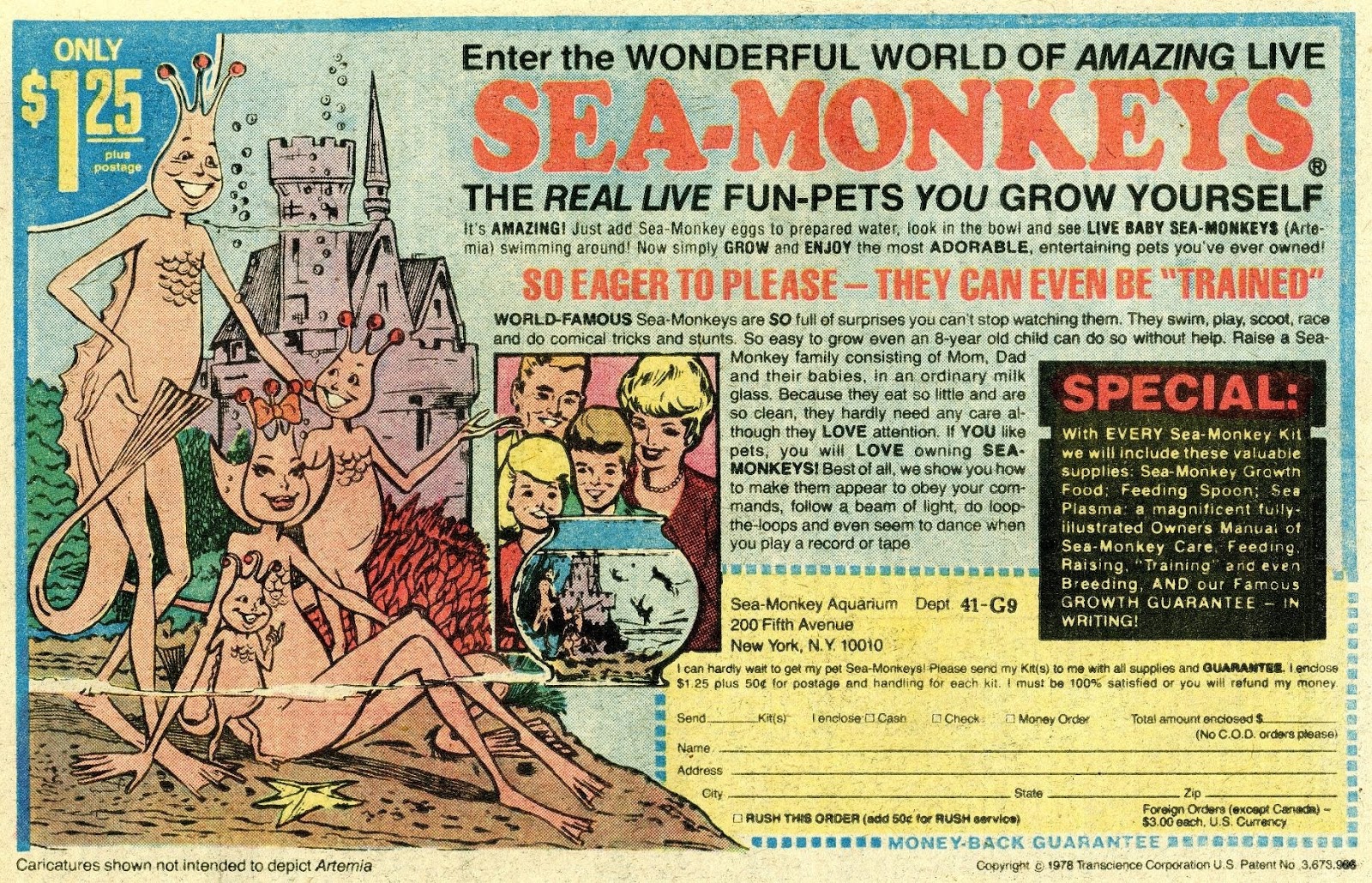
Incidentally, co-admin RG pointed out that the Sea Devils were basically turned into Sea-Monkeys – and minus the tail, he’s perfectly right!

iu
Remember these? 😉 For those wondering what they looked like in reality (how many of us actually ordered them?), take a gander at Sea Monkeys: False Advertising of Science Can Still Be Fascinating!

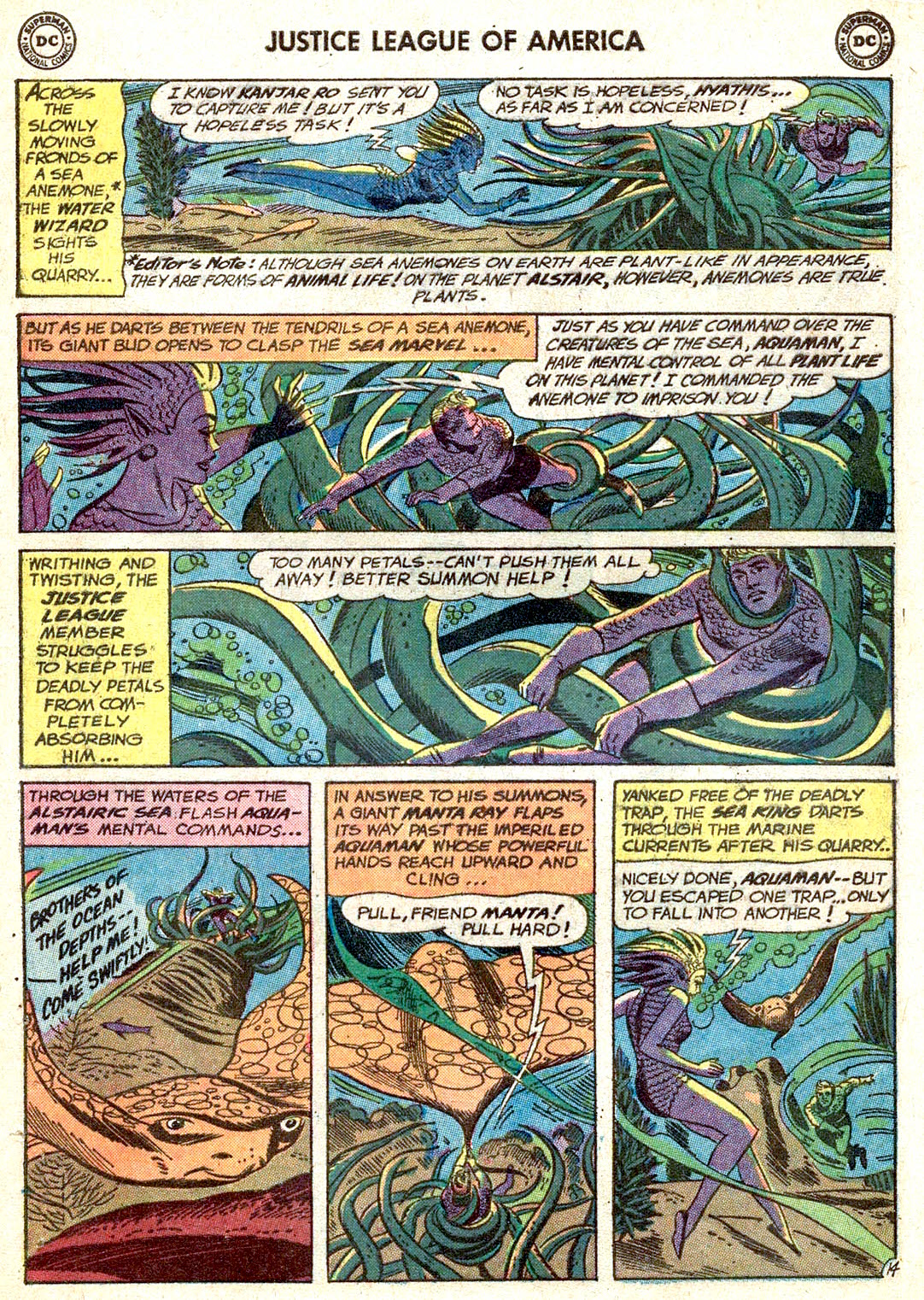
Many people are highly wary of seaweed – and this story proves them right. Remember, eat seaweed, but don’t let seaweed eat you!

plants-jla3-slaveshipofspace
Page from The Slave Ship of Space!, scripted by Gardner Fox, pencilled by Mike Sekowsky and inked by Bernard Sachs. This story was published in Justice League of America no. 3 (Feb-March 1961). I wonder why the author decided to make anemones into “true” plants, when he could have simply incorporated actual seaweed into this story.

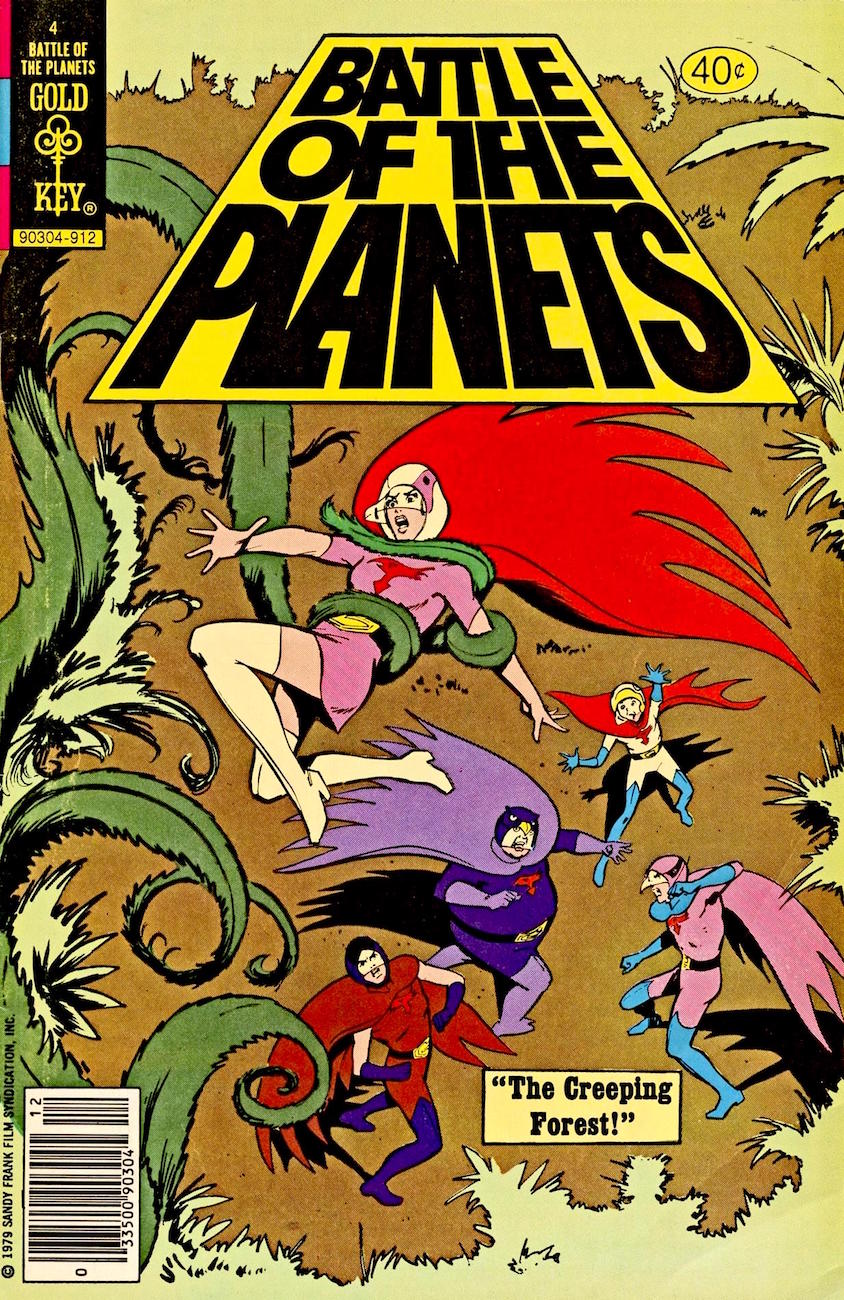
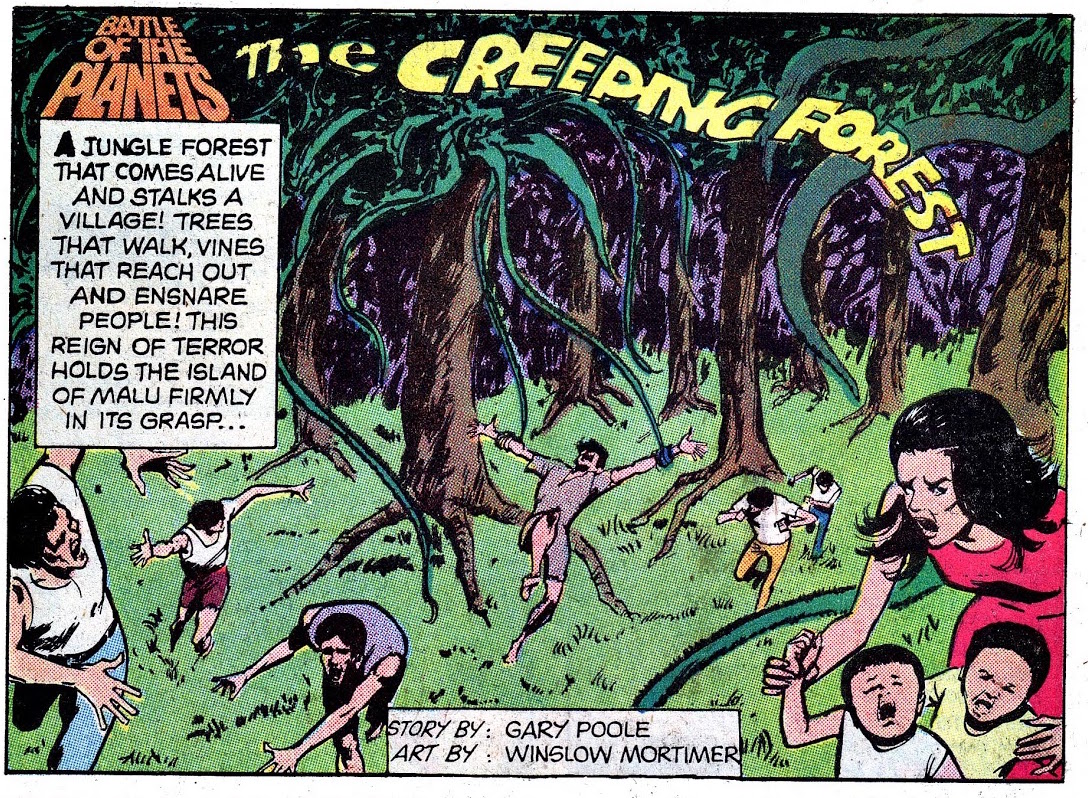
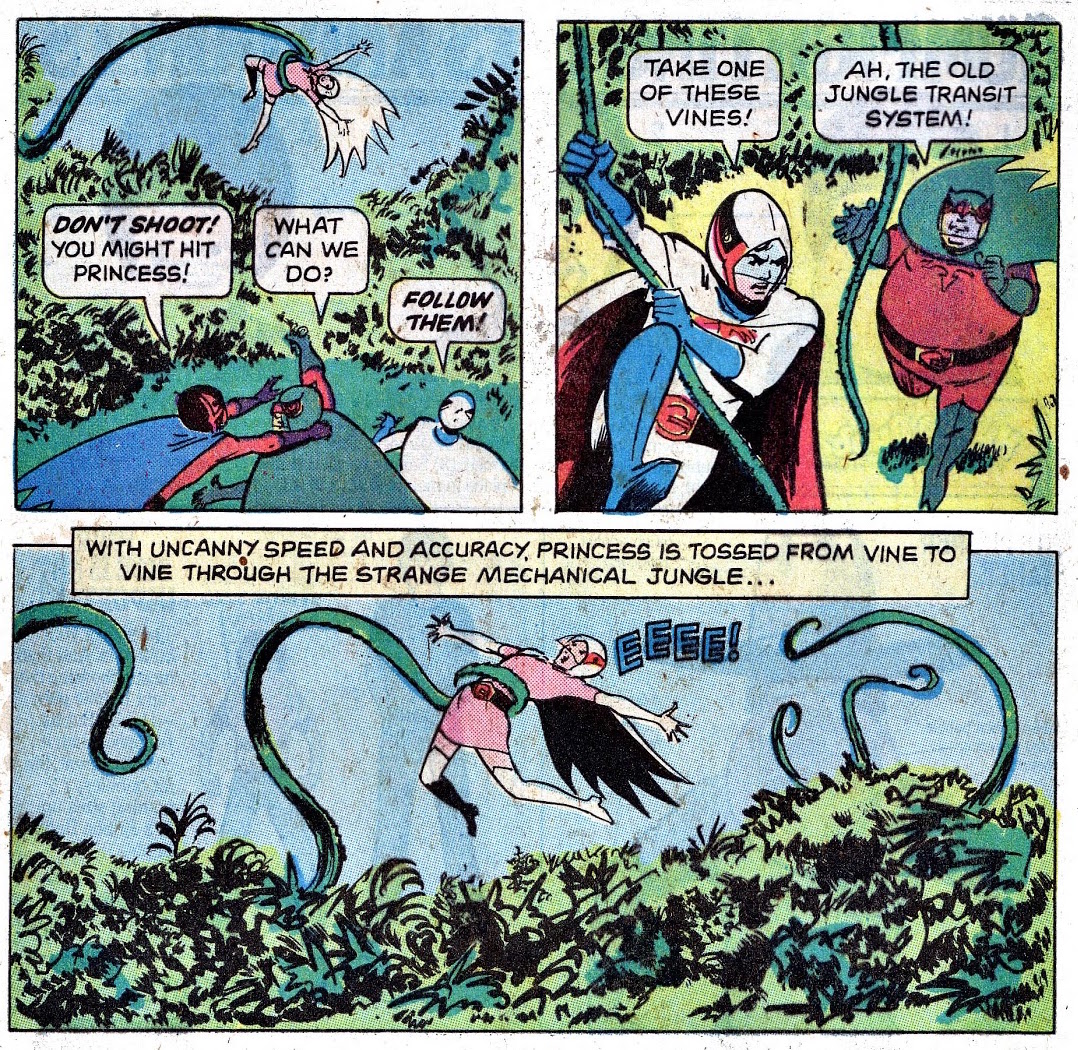
Back on land, and not even on a different planet, we have a story featuring hungry, hungry vines *and* the novel sport of “princess-tossing”:

BattleofthePlanets-GoldKey copy
Battle of the Planets no. 4 (December 1979), cover by Win Mortimer.

The Creeping Forest is scripted by Gary Poole and illustrated by Win Mortimer:

BattleofthePlanets-GoldKey-TheCreepingForest

BattleofthePlanets-GoldKey-TheCreepingForest2

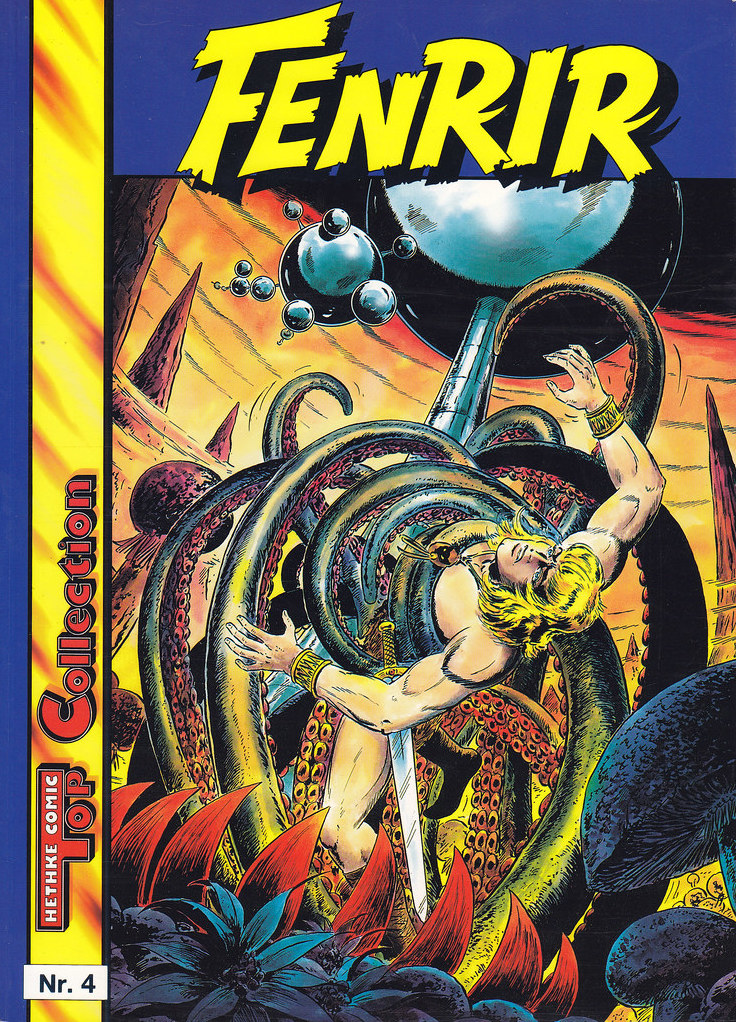
Of (relatively) recent vintage, a philosophical young man pondering the mysteries of life while held in the tender embrace of this, err, plant:

Fenrir4
Fenrir no. 4 (Norvert Hethke Verlag, 1988).

Previous botanical Tentacle Tuesdays can be perused here.

⇒⇒ ds

Tentacle Tuesday: Rise, the Demon Etrigan!!

« Challenge Merlin and be a fool! — Challenge a demon — and be destroyed! »

Suddenly having so much time on my hands (courtesy of COVID-19) is an eerie, though by no means unpleasant, experience. While I could crochet mini couches for my cats or enrol my partner’s help to re-create some favourite classic paintings, I prefer to catch up on books I’ve been meaning to read for a while. Case in point: in April, I’ve been joyously absorbing Jack Kirby’s Fourth World saga, reprinted in a handsome 4-tome omnibus (and to which I have easy access, thanks to co-admin RG’s vast library). That ended all too soon, and I moved on to a collection of Etrigan the Demon. It was a somewhat underwhelming experience, especially given the epic scope of Fourth World, but of course still worth a read.

The red-eyed, yellow-skinned creature called Etrigan came into existence in 1972. Mark Evanier, in his introduction to Jack Kirby’s The Demon, explains: « There was, at the time, a feeling around DC that perhaps superheroes were on the way out again. Ghost and mystery comics like House of Mystery and Phantom Stranger seemed to be selling, and some in the office felt the next trend was what Joe Orlando, who edited most of them, dubbed “weird adventure” comics. A few weeks later, [Carmine] Infantino asked Jack to whip up something in that category… »

Kirby accepted the challenge and, despite his lack of interest in horror, created The Demon, patterning his face on a a detail from Hal Foster‘s Prince Valiant strip as an inside joke.

As great a storyteller Kirby is, I think being asked to write about a subject he wasn’t particularly into had its repercussions. Although he clearly tried to give Etrigan a stimulating playground of supernatural rogues of varying degrees of viciousness to bat around, the overall result is rather underwhelming by Kirby standards. I’ve seen quite a few people in comic forums expressing their undying love for the Demon – if you’re one of them, I’m open to being convinced!

I actually first encountered Etrigan the Demon in a Swamp Thing issue written by Alan Moore. He first made an appearance in Swamp Thing no. 26 (July 1984) and then came back for the 14-issue storyline American Gothic that ran from June 1985 to July 1986. In Moore’s hands, Etrigan cut a dashing, mysterious figure, and he spoke in rhyme, which was a really nice touch. I admit I was disheartened to find out that he really wasn’t that exciting in his original form.

However, he *did* encounter tentacles, and more than once!

KirbyDemon05p22A
I was rather hoping the Somnambula would stick around, but it came and went in one page. Merlin’s Word… Demon’s Wrath! was published in The Demon no. 5, January 1973.

KirbyDemon15A
The spoiled and malicious brat Klarion and his cat/pussycat-princess Teekl are my favourite characters of the series. The One Who Vanished!! was published in The Demon no. 15 (December 1973), the penultimate issue. This scene is reminiscent of a sequence from the 1961 movie Night Tide.

KirbyDemon16p18A
In the following (and final) issue, tentacles reared their grabby suckers yet again. Immortal Enemy! was published in Demon no.16 (January 1974). One more complaint from me – Kirby’s use of the philosopher stone (which Warly is clutching on this page) as a sort of Deus ex machina, that can be used for accomplishing pretty much everything (some examples: it produces the ultimate cold or demon flame, shields the owner from thousand-volt electricity or brings people back form the dead, turns people into vultures or an Egyptian mummy or a chair into flowers, randomly makes objects levitate, etc.) This makes one wonder why Jason bothers running around at all, instead of elegantly waving the stone about and solving all problems instantly.

The three pages above are Etrigan’s encounters with actual tentacles, but we have an honorary mention of almost-tentacles-but-not-quite, which I wanted to include in the spirit of thoroughness.

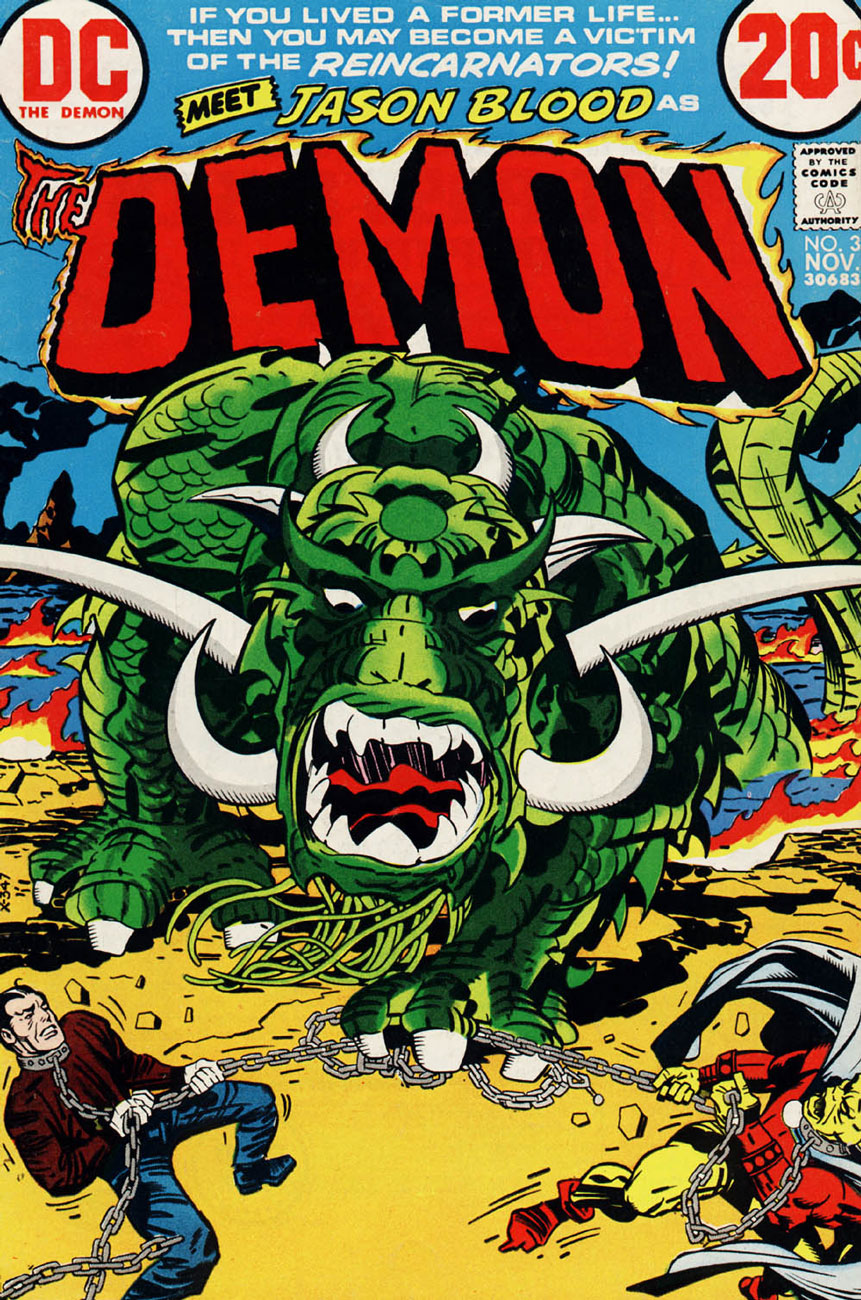
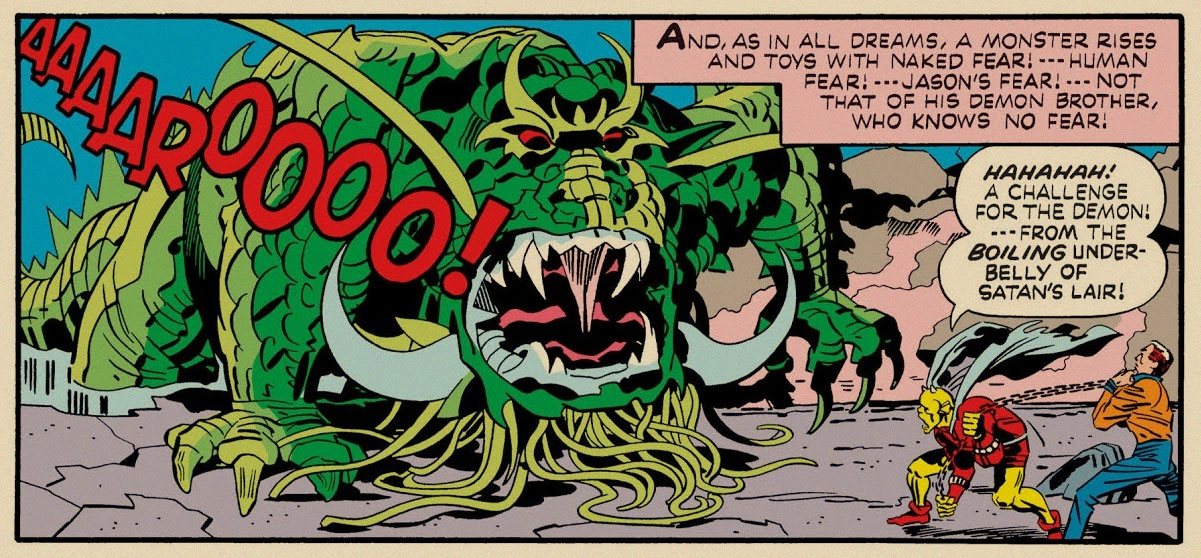
Can the following creature’s beard tentacles be used to grab anything? We never learn if they’re prehensile or not, because the fear-monster doesn’t stick around long enough.

KirbyDemon03A
The Demon no. 3 (November 1972). This little baby is one of my favourite monsters of the series, despite just being part of Jason Blood/Etrigan’s nightmare – one can really felt its crushing weight. Besides, it’s probably a preview of the Kamara, a creature that becomes what the person fears most, and an awe-inspiring enemy.

KirbyDemon03p6A
A panel from Reincarnators.

In case anyone is interested, I am currently re-reading Kamandi: the Last Boy on Earth, which was my first exposure to Kirby.

≈ds

Tentacle Tuesday: All Aboard the Batmarine!

« Even without the benefit of philosophical reflection, anyone who has spent some time in an enclosed space with an excited bat knows what it is to encounter a fundamentally alien form of life. » (Thomas Nagel, What is it like to be a bat?)

Bats and octopuses, now there’s a combination that doesn’t often occur in nature – while both are admirable, fascinating animals, they’re not linked by lifestyle or environment, and neither is the other’s prey. Batman, on the other hand, has definitely tangled with many tentacled monsters in his time (which proves that he’s not a bat). I’m sure today’s post didn’t unearth *all* the octopuses that Batman has had the pleasure of defeating, especially those of a more modern vintage (with mostly horrible art, which is why I’m not too worried)… but today’s selection, you will have to admit, is quite fair.

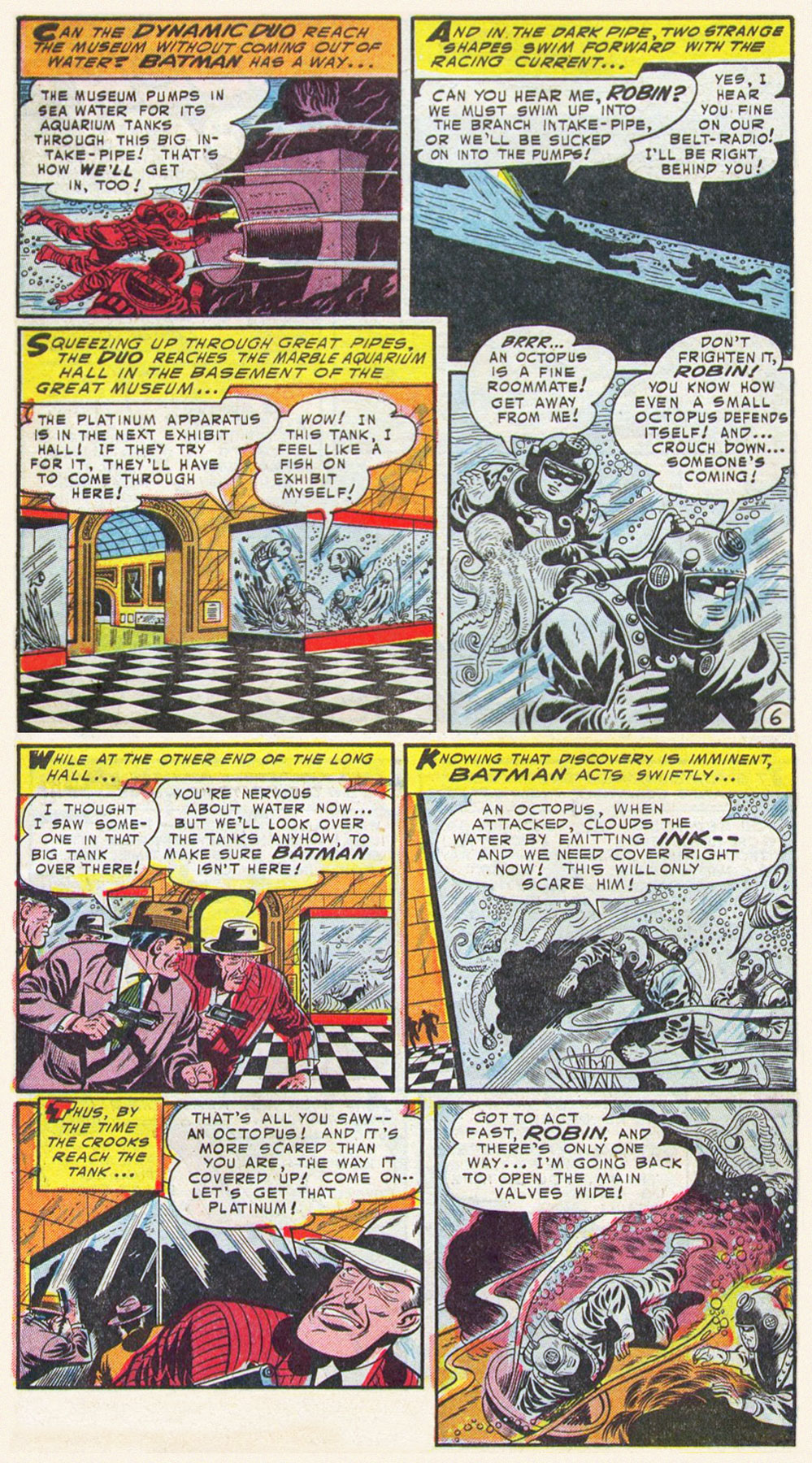
The Voyage of the First Batmarine!, scripted by Edmond Hamiton, pencilled by Dick Sprang and inked by Charles Paris, was published in Batman no. 86 (September 1954).

Batman86A

Bat-Mite Meets Mr. Mxyzptlk (he must be from Poland, with a name like that), scripted by Jerry Coleman, pencilled by Dick Sprang, and inked by Sheldon Moldoff, was published in World’s Finest Comics no. 113 (November 1960):

World'sFinestComics113
I totally squee-ed when I saw this panel.

World'sFinestComics113-2

Justice League of America no. 27 (May 1964), with the cover pencilled by Mike Sekowsky and inked by Murphy Anderson:

JusticeLeagueofAmerica027A

The inside story, The “I” Who Defeated the Justice League! is scripted by Gardner Fox, pencilled by Mike Sekowsky, and inked by Bernard Sachs:

SekowskyJLA27A

Batman no. 357 (March 1983). Cover pencilled by Ed Hannnigan and inked by Dick Giordano:

Batman357A

The cover story, Squid, is scripted by Gerry Conway, pencilled by Don Newton, and inked by Alfredo Alcala:

Batman357-SquidA

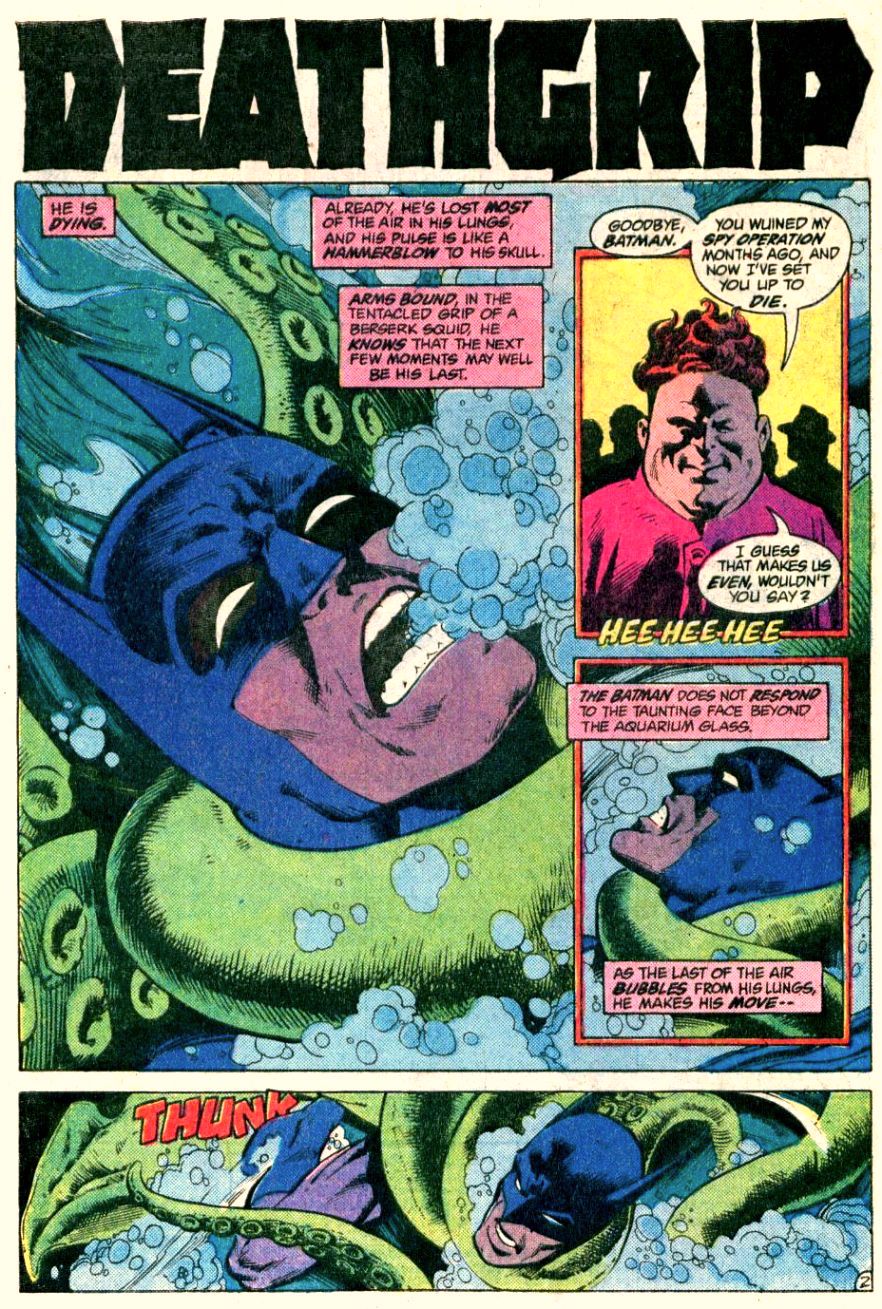
Since they threatened us with the continuation of the story, I followed up, and dug up more tentacles. Deathgrip, scripted by Gerry Conway, pencilled by Don Newton and inked by Dick Giordano, was published (as promised) in Detective Comics no. 524 (March 1983):

DetectiveComics524

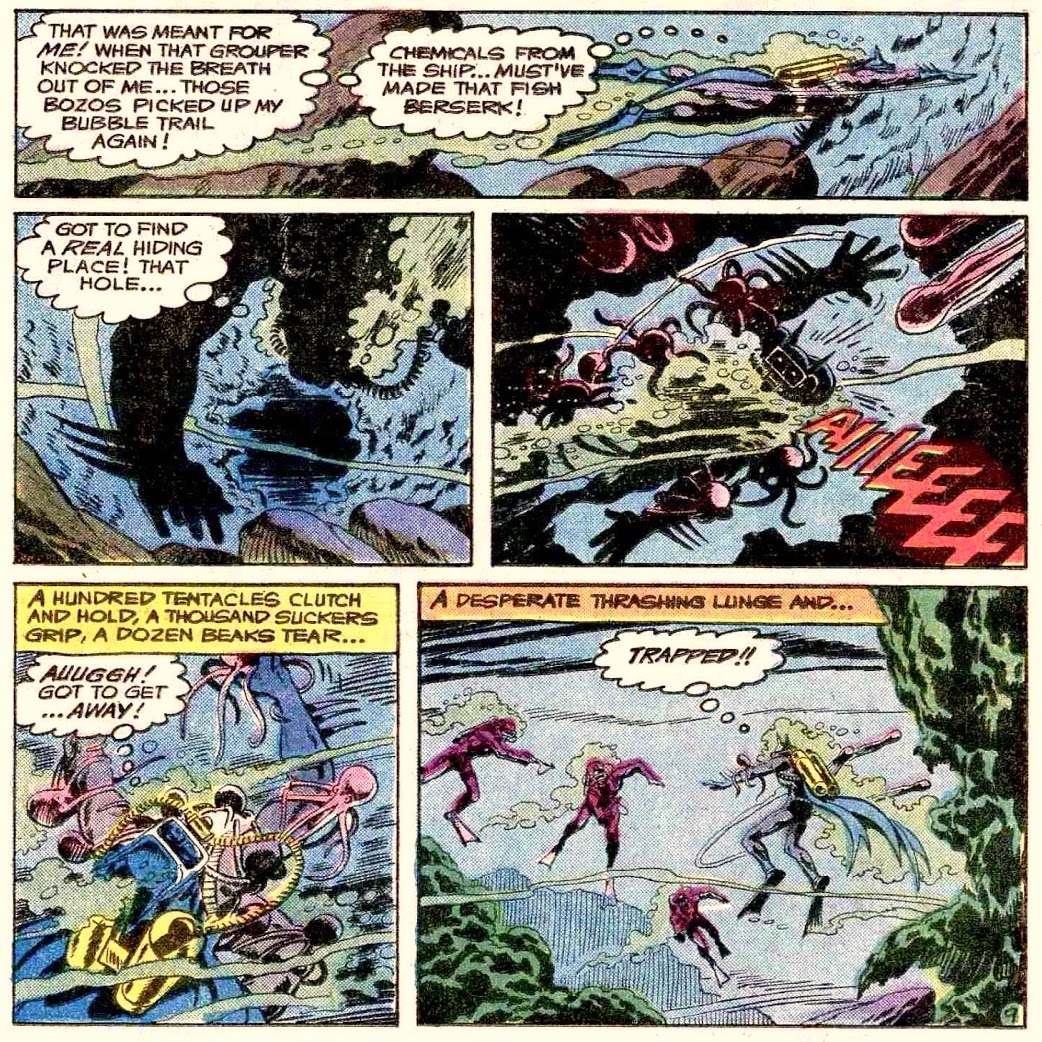
Enigma of the Death-Ship!, scripted by Bob Haney and illustrated by Jim Aparo, was published in The Brave and the Bold no. 142 (July-August 1978):

BraveandtheBold142

I mentioned modern comics, earlier – I’ve chosen two examples published relatively recently, with passable art.

The pompously titled Leaves of Grass, Part 3: Comedown!, scripted by Alan Grant, pencilled by Dave Taylor and inked Stan Woch, was published in Batman: Shadow of the Bat no. 58 (January 1997):

Batman-shadowofthebat58

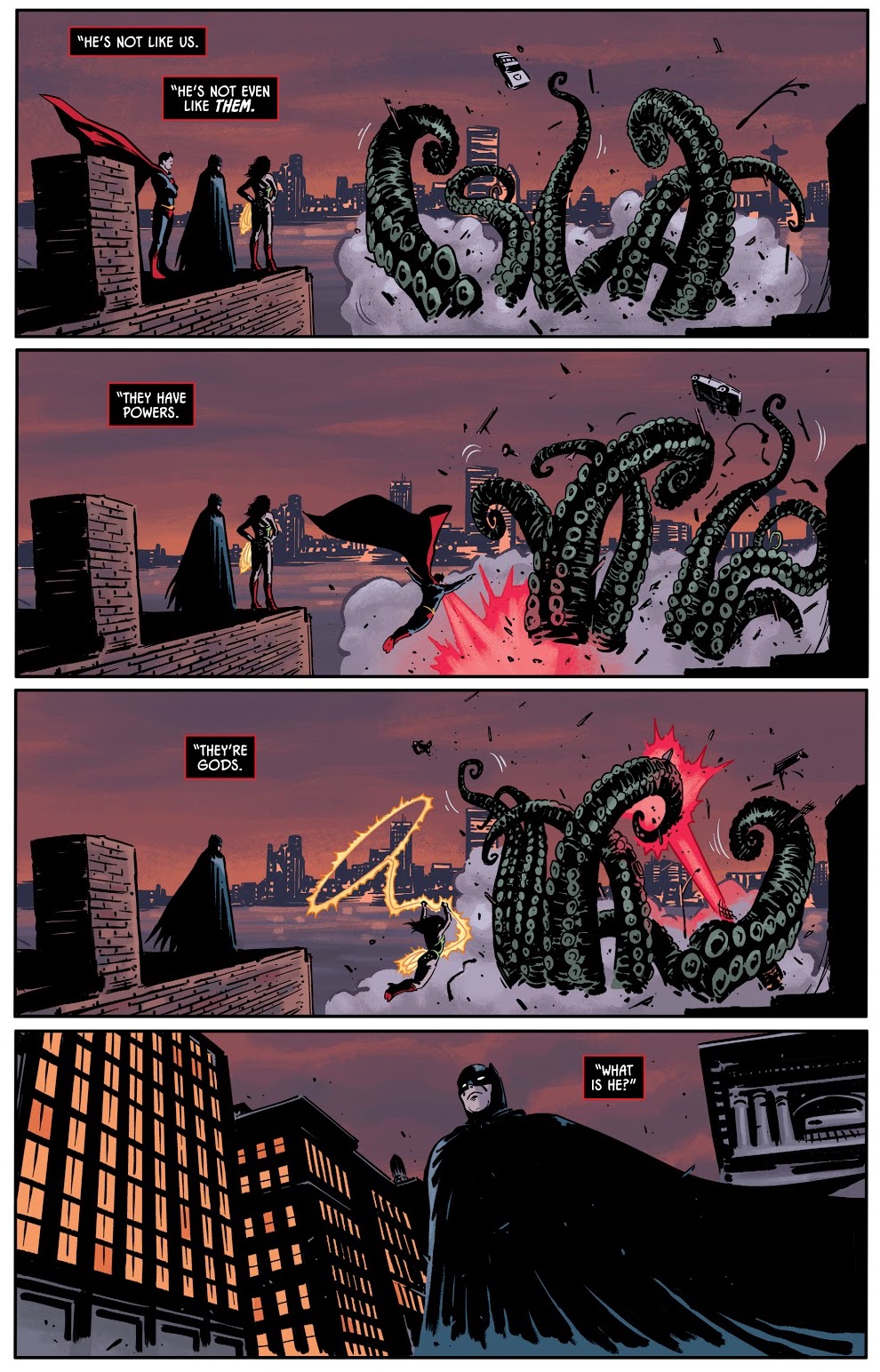
Knightmares, Part 4, scripted by Tom King and illustrated by Jorge Fornes, was published in Batman no. 66 (May 2019):

Batman66-Jorge Fornes

To conclude on a more pleasant note…

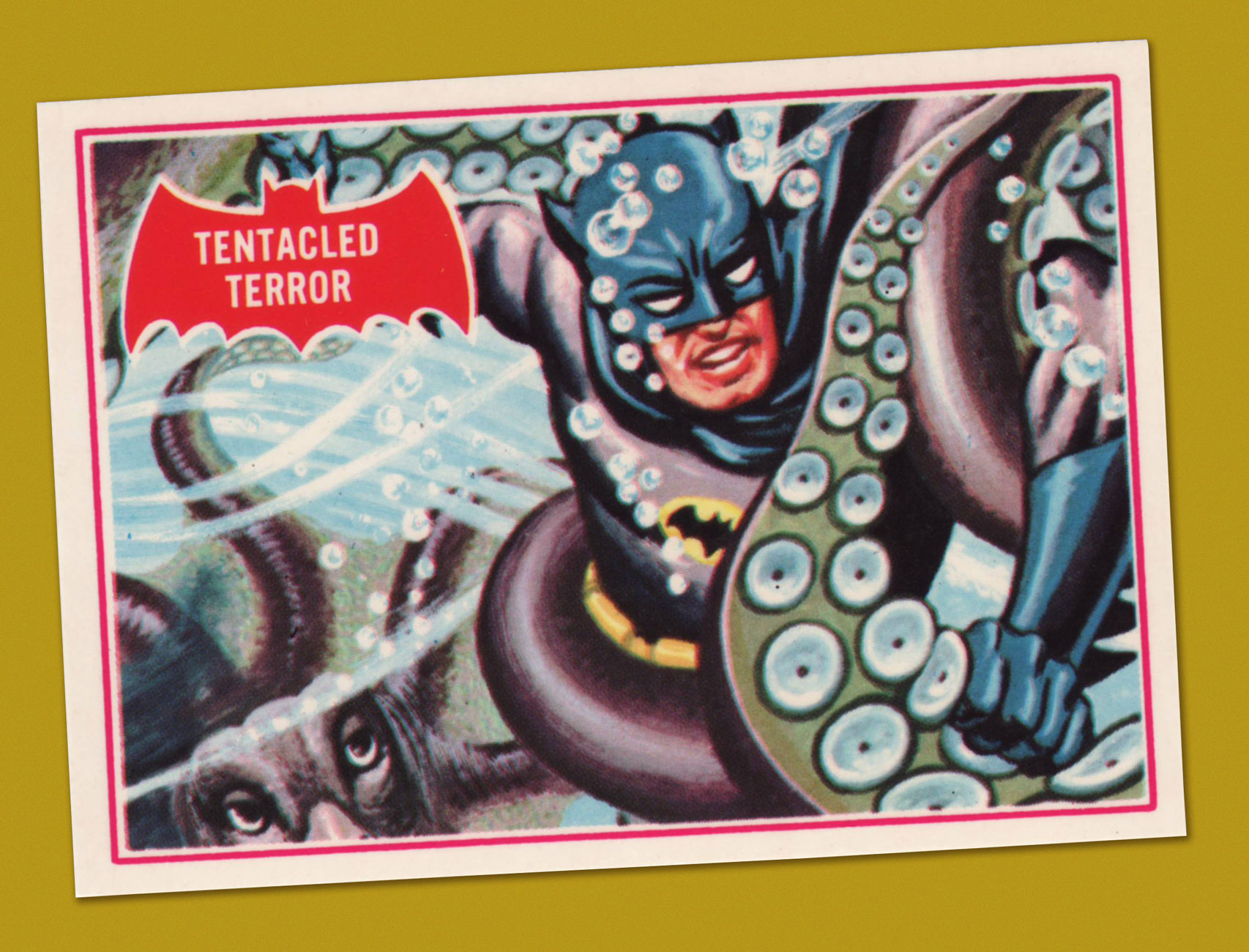
Tentacled Terror, number 8 in Topps‘ 1966 Batman ‘Red Bat’ trading card set, boasting painted artwork by Norman Saunders.

SaundersBatmanCardA

∼ ds

Birthday Boy Bernard Baily

« … drawn by a terrible hypnotic fascination, the gangster peers deep into Jim’s dark eyes and glimpses — DEATH! » — “The Spectre”, More Fun Comics no. 52 (Feb. 1940)

Today, we salute Bernard Baily (April 5, 1916 – January 19, 1996), recalled nowadays as co-creator of The Spectre (with Jerry Siegel) and Hourman (with Ken Fitch) and conjurer of many of the 1950s most notorious comics covers… but there’s much more. Let’s take a look, shall we?

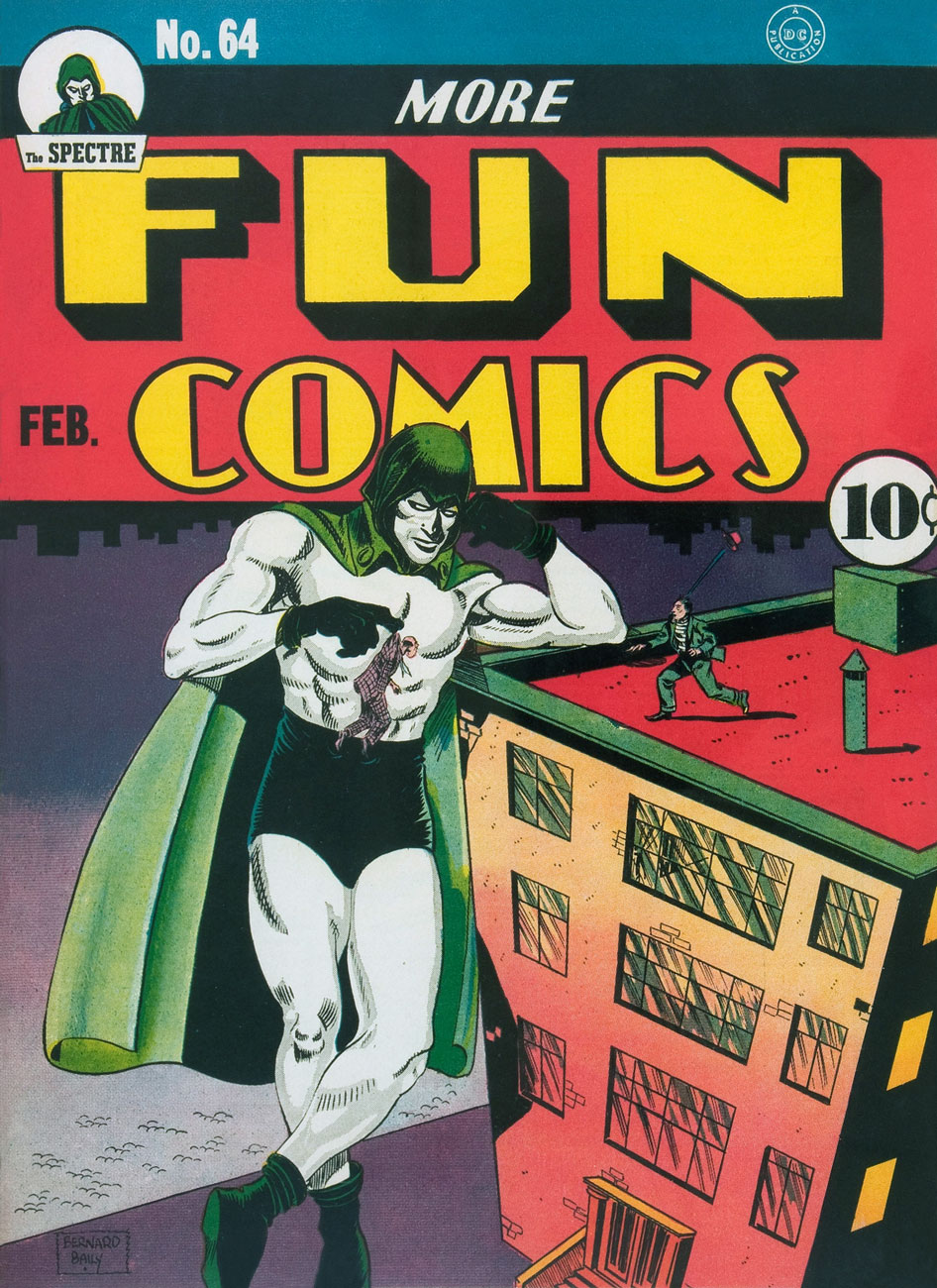
MoreFun60A
More Fun Comics no. 64 (Feb.1941, DC); It’s curious that the Golden Age’s arguably most merciless avenger would wind up in the pages of “More Fun”. « The Spectre… was notable in the character’s original run for imposing violent retribution against evildoers. In Siegel and Baily’s first story, Jim Corrigan, upon being introduced, is immediately killed by being encased in cement and thrown into a river. A God-like figure intervenes and returns Corrigan to Earth to combat evil as The Spectre. In that first outing, The Spectre uses the power of his mind to skin an assassin alive, leaving only a skeleton. » [ source ] Read The Spectre’s nasty origin tale!
To my knowledge, there aren’t a lot of Golden Age superheroes whose costumes were so perfectly designed in the first place that no change whatsoever has been required over time. The Spectre has to be exhibit number one in that case.

WeirdMysteries2A
This is Weird Mysteries no. 2 (Dec. 1952, Stanley Morse); Read it here!

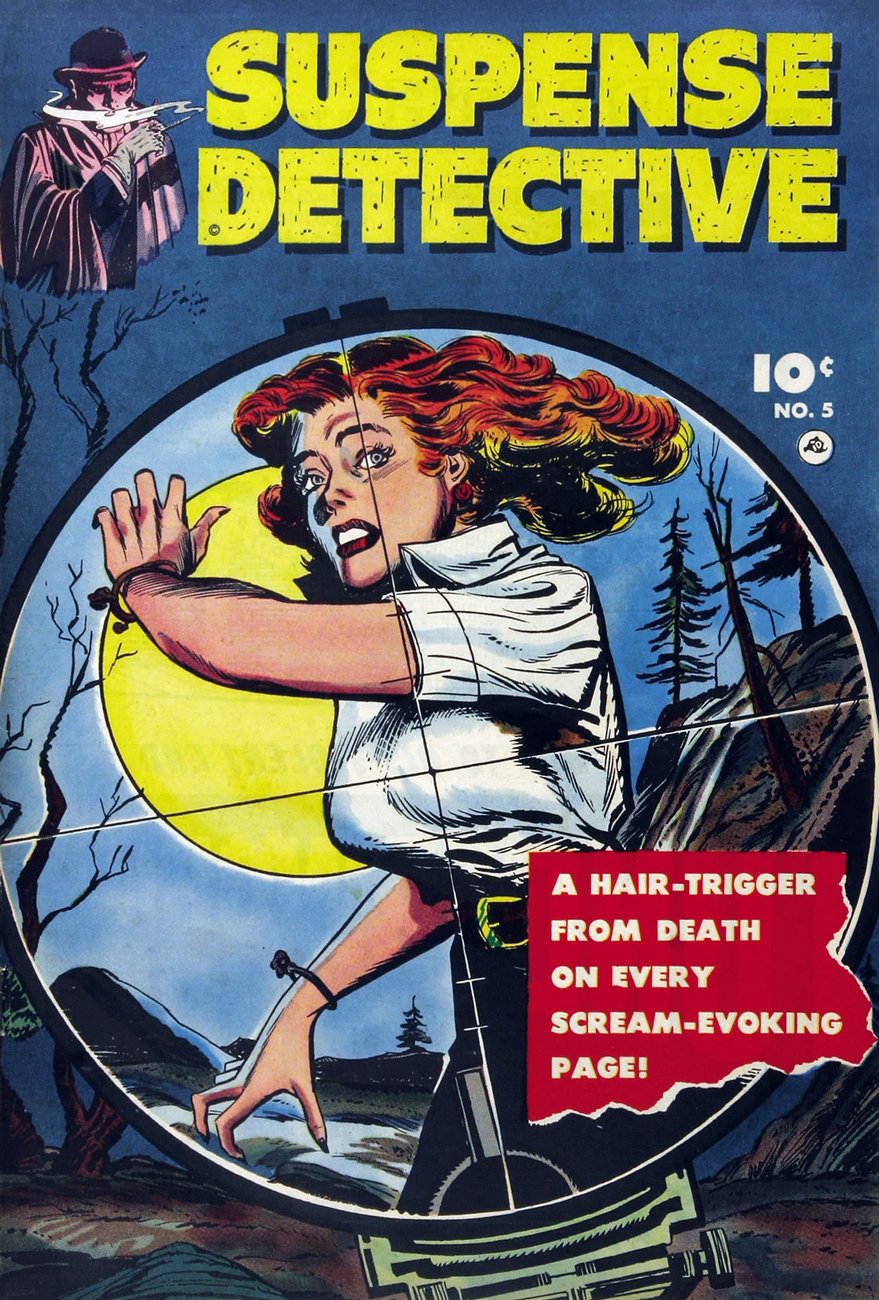
SuspenseDetective5A
« Be assured that the death certificate will read… death from natural causes! Yes — hah hah, natural causes! » Baily provides a strikingly modern cover for the final issue of Fawcett’s Suspense Detective, no. 5 (March, 1953). The insides are also top-notch, with thrillers by Baily and Mike Sekowsky. Read it here!

WeirdTalesFuture07A
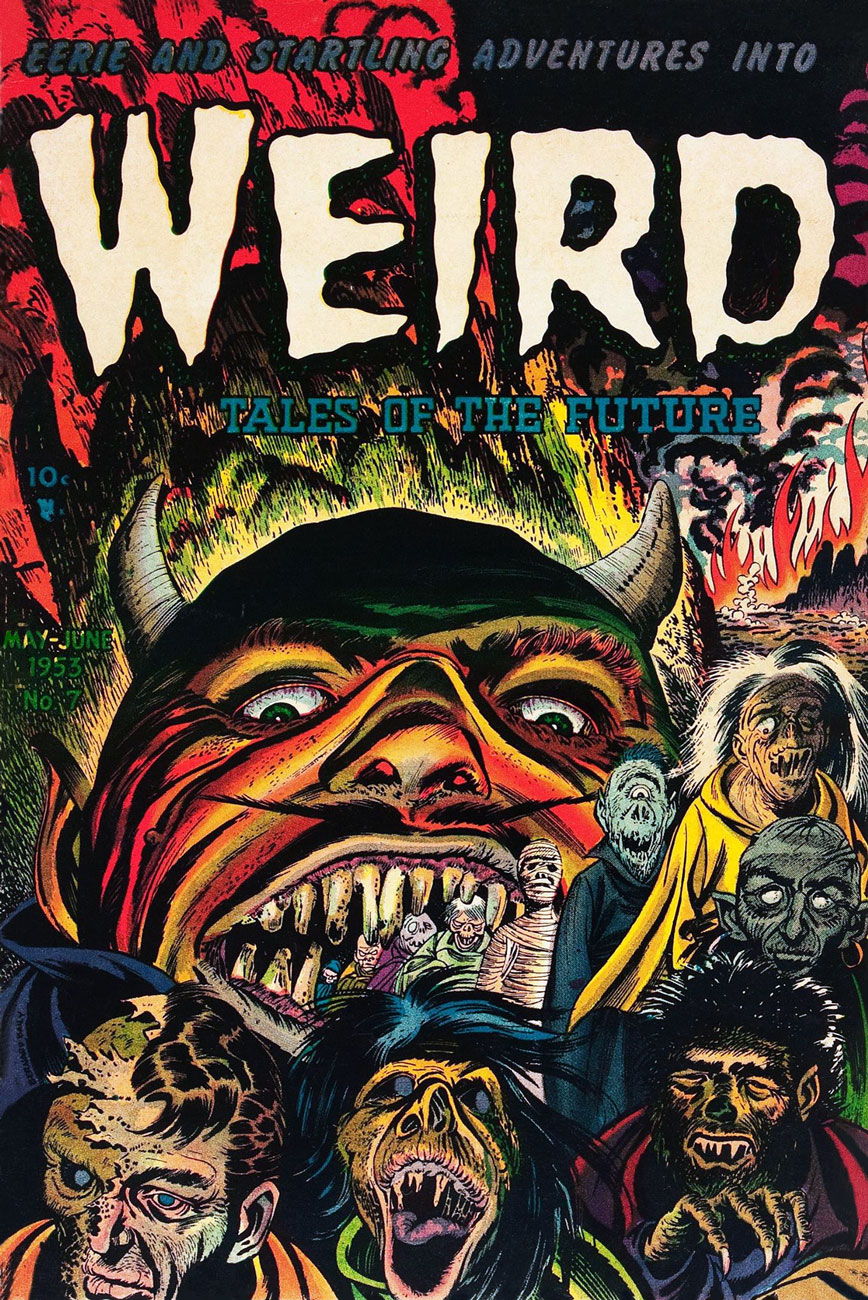
Here’s Weird Tales of the Future no. 7 (May 1953, Stanley Morse); The stench is palpable, Bernie.

BailyMisterMystery12A
One of the images that most undermined the comics industry’s case during the 1950’s furor over horror comics, this is Baily’s eye-searing cover for Mister Mystery no. 12 (July 1953, Stanley Morse). Injury-to-eye motif, the censors (or was it the collectors?) termed it. « Don’t worry, Mac, the sharp stick’s hot to make sure yer peeper don’t get infected. Now hold still! »

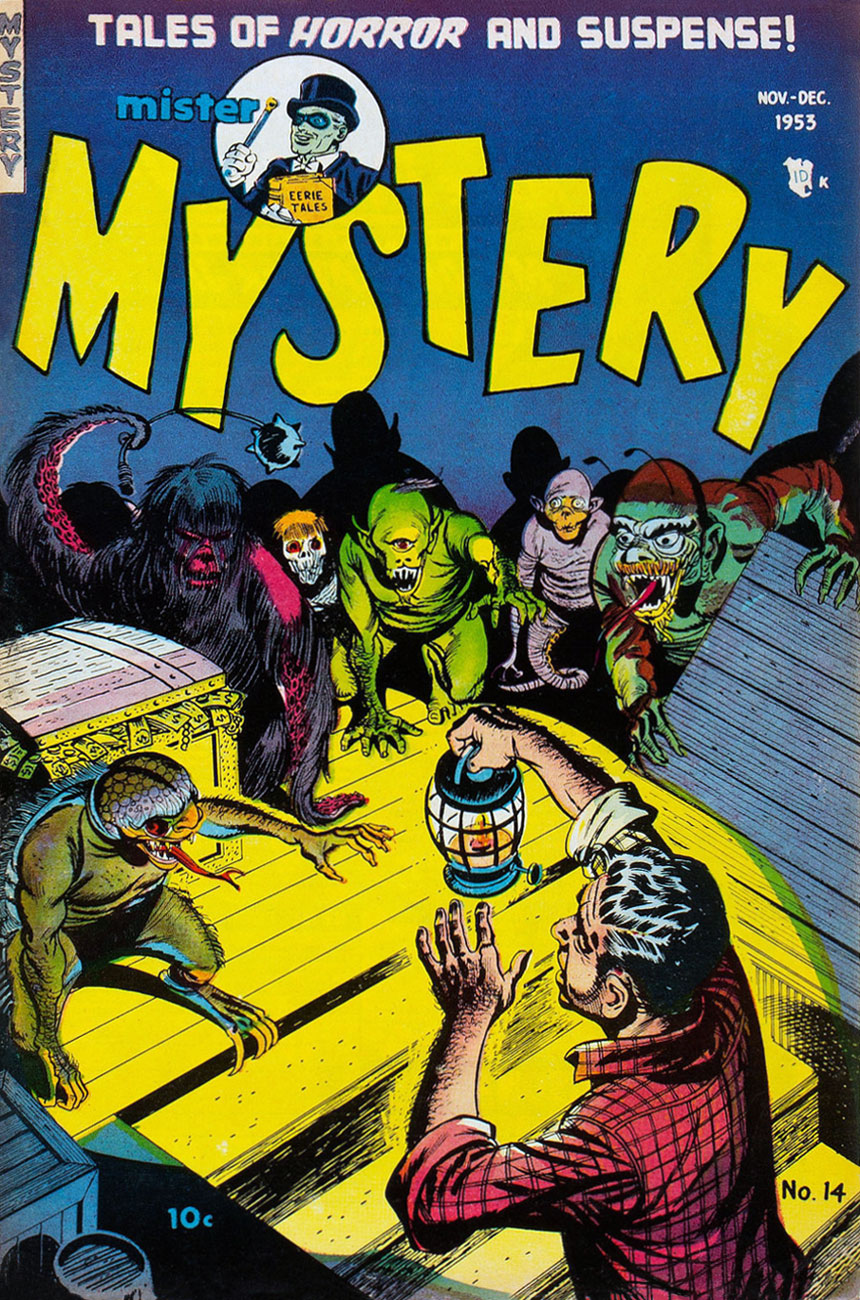
MisterMystery14A
Behold Mister Mystery no. 14 (Nov. 1953, Stanley Morse); this one rarely turns up in any condition. Hey, tentacles!

B&B56A
In the Silver Age, Baily was back at DC, but straight superheroics weren’t his thing; here’s a rare exception. I must say, his Flash looks great, with the appropriate runner’s physique. This is The Brave and the Bold no. 56 (Oct.-Nov. 1964, DC), featuring Raid of the Mutant Marauders, scripted by Bob Haney and illustrated by Baily. George Kashdan, editor.

StrangeAdventures186A
Baily’s bread-and-butter during the Silver Age was SF and fantasy stories for DC’s anthology titles. Utter balderdash, but often highly entertaining, thanks to that very ‘anything goes’ approach and a solid cadre of artists. This is Strange Adventures no. 186 (Mar. 1966, DC); read it here, you’ll see what I mean.

BailyBrotherhoodA
Whither National Brotherhood Week? Baily was also editor Jack Schiff‘s go-to guy for a series of public service ads that ran throughout the DC line during the Silver Age. This one, What’s Your B. Q.*? (*Brotherhood Quotient) appeared in books dated April and May 1966); Love those control questions.

BailyDrautWerewolf01A
By the 1970’s, Baily’s work was seen as quaint and outmoded. Editors sometimes experimented with inkers, in this case Bill Draut, whose own style, while out of vogue, produced interesting results when paired with DC’s most outré pencillers (e.g. Jerry Grandenetti, Ric Estrada…) This Baily-Draut splash appeared in Secrets of Sinister House no. 8 (Dec. 1972, DC); lettering by Ben Oda, ‘Auntie’ Eve and her birdie by Michael Kaluta.

BailyHOS107A
« Lousy, filthy, stinking hobo! He’s no better than
the rats themselves! He’s in a class with them! » Grizzled Baily showed fine form in this late-career corker published in House of Secrets no. 107 (April, 1973, DC). Evidently inspired by Stephen Skeates‘ squalid tale of a rising flood, greed, murder and musophobia, the veteran artist lovingly rendered the precarious, musty milieu of Winner Take All!. In fact, the entire issue sets a high water mark for HOS: beyond a so-so Berni Wrightson cover, the book unusually contains two Alfredo Alcala yarns, one rendered in his realistic style and written by Jack Oleck, the other drawn in his delicious cartoony fashion and scripted by Arnold Drake. Read the issue here! « Whew! A lot more going on back then than even I realized! », commented Mr. Skeates upon being reminded of this story, a few years ago.

BailyMadhouse02A
Another lovely late-period job was A Night in a Madhouse; it appeared in The Unexpected no. 148 (July 1973, DC), scripted by Carl Wessler. Read it here!

-RG