Tentacle Tuesday: These Were Your Grandparents’ Tentacles

« Tentacles lashing wildly with pain… the squirming squid releases a sudden gush of inky-black liquid… »

Just look at that… yet another Tentacle Tuesday has come crawling (unless it prefers to travel by jet propulsion) out! Today our handy time machine brings us, once again, to the Golden Age of comics (1930s to 1956), when war was very much on people’s minds, and tentacles were very much part of every decent comic artist’s repertoire.

morefuncomics#83
More Fun Comics no. 83 (September 1942). Cover by George Papp, co-creator of Green Arrow and Congo Bill (with, respectively, Mort Weisinger and Whitney Ellsworth), and one of the main artists on DC’s Superboy feature between 1958 and 1968.
MoreFunComics#83-TheFiveArrows-GeorgePapp
Panels from « The Five Arrows », scripted by Joseph Greene and drawn by George Papp.

tentacletuesdayicon

During WWII, it was not unusual to find the Axis powers represented by an octopus in caricatures and political cartoons. As a matter of fact, as The Octopus, a Motif of Evil in Historical Propaganda Maps argues, the octopus, scrawled onto all manners of maps by caricaturists, has represented the spread of evil since the 19th century. I highly recommend at least glancing through the aforementioned essay – aside from being fascinating from a historical perspective, it also has tentacles galore. Anyway, the following comic eschews any subtlety and depicts Hitler himself as the Octopus of Evil:

BlueCircle3A
Blue Circle Comics no. 3 (September 1944), cover by Harold DeLay. That’s Maureen Marine bomb-diving into Hitler’s sorry ass. She has an interesting backstory, actually: a captain’s daughter who drowned when her dad’s ship was sunk by a Nazi U-boat, she was revived by Neptune (he must have liked her blonde hair) and became Queen of Atlantis, protector of the ocean, especially against despised Nazis.

There’s a great essay about Blue Circle Comics on Four Color Glasses. To quote, « Enwil’s “flagship” title was called Blue Circle Comics. It was a fairly common for publishers to use a color in conjunction with a shape or symbol for their comic book titles: Blue Circle, Red Circle, Red Band, Red Seal, Blue Ribbon, and Gold Medal were all titles from the Golden Age. In the case of Blue Circle Comics, though, the title did actually feature a character called the Blue Circle. » Read it here!

TentacleTuesdayIcon

A recurring theme of octopus adventures is that there’s some treasure involved. I bet the lady would prefer to stay with the octopus troupe and their tender nuzzles than to be rescued by this odd assortment of cut-throats in sailor costumes… The chick en question is Harvey Comics’ Black Cat.

speed-comics-40
Speed Comics no. 40 (November 1945), cover by Rudy Palais.

The title story turned out to be nothing but text… Though for readers with a decent imagination, a “score of octopi” and “bubbling moans” is definitely more than enough.
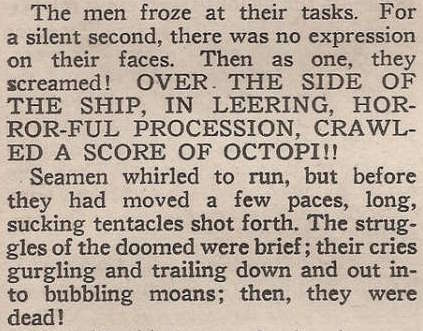
Speed Comics #40-tentacles

I bet you’re wondering how all this ends. Well, « Still, the octopi flopped forward!! CAPTAIN FREEDOM yanked the controls and the ship’s whirling airscrews roared into the octopi, sharp blades ripping tentacles from their bodies with murderous force! » Goodbye, trained octopi (which is not even the correct pluralization of an octopus).

tentacletuesdayicon

StrangeWorlds2AvonA
Strange Worlds no. 2 (April 1951). Cover by Gene Fawcette.

« They were like octopuses — they scurred along on huge rubbery tentacles, and their bodies were nothing but huge heads in the midsts of these. Monstrous squawking beings coming at us from all directions! » Lovely writing, isn’t it? Nevermind that “scurred” is not an actual word. The title tale is actually an illustrated text story titled « Octopus-Kings of the Lost Planet », scripted by W. Malcolm White. Well, “scripted” is a bit strong.
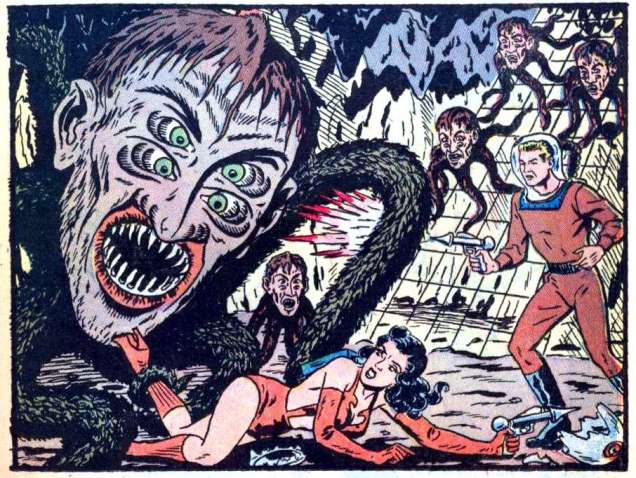
StrangeWorlds2-Octopus-Kings of the Lost Planet
« We decided that these descendants of a mighty but inhuman race had gone backwards in the course of the lost centuries. There were the Octopus-Kings of a Lost Planet — they had been rulers — but their own folly had lost them even the dignity of a solid body! »

tentacletuesdayicon

Airboy, a.k.a. David Nelson, has been in some truly bizarre scraps in his time, so a fight to the death with tentacled monsters who want (as usual) to take over Earth is strictly routine. Created by writer Charles Biro and artist Al Camy, Airboy not only used his expertise in aviation to fight off Nazis, but also all manner of fantastical monsters. A quick look through the covers of Airboy Comics will reveal crazy scientist machinery, rabid tigers, gladiator fights, giant amœbas, pterodactyls, minotaurs, insect-shaped aliens, an invasion of man-eating rats, and so on. Pure entertainment! Airboy’s most memorable (and prettiest, by far) foe (and love interest) is Teutonic aviatrix Valkyrie, who eventually defected to the Allies’ side. She barely seems like a Golden Age creation – with her blouse splitting until her navel and her skin-tights pants, her costume leaves little to the imagination.

airfighterscomics-airboy-valkyrie

She was sexualized further in later incarnations – Dave Stevens’ version of her for Eclipse Comics is probably the hottest – but the Golden Age Valkyrie is more charming and earnest (IMHO), devoid of the nymphomaniacal arrogance appended to her personality in later years. Anyway, back to the topic:

AirboyV9N7A
Airboy Comics no. 102 (August 1952). The octopus seems to be wearing glasses. « Excuse me, Sir, have you seen my book? »
Airboy102-Invasion-of-the-Tentacles
The title story, modestly titled « Invasion of the Tentacles » (no beating around the bush!), is drawn by Ernest Schroeder.

TentacleTuesdayIcon

Weird-Fantasy-no.-21
Weird Fantasy no. 21 (September-October 1953). Cover by Al Williamson and Frank Frazetta. The fur-trimmed boots are a nice touch!

The title story, « My Home… », scripted by Al Feldstein and drawn by Joe Orlando, is emotionally manipulative… and succeeds very well in breaking the readers’ hearts (or pissing them off, depending on your temperament). Read a synopsis of the plot, if you wish, or read the whole story here – who am I to give spoilers to those who don’t want ’em?

TentacleTuesdayIcon

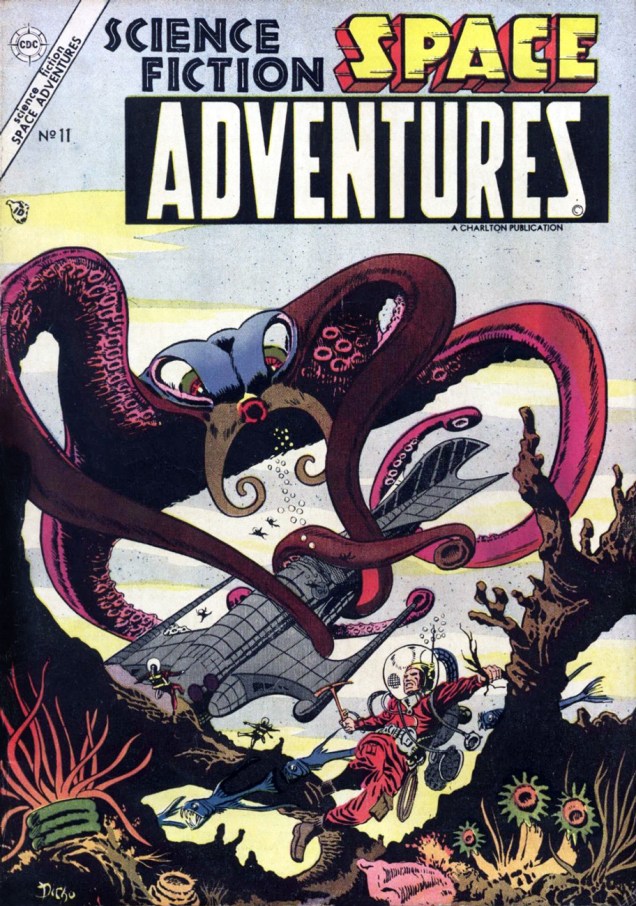
Space-Adventures-11
Space Adventures no. 11 (May-June 1954), cover by Steve Ditko.
Space Adventures no. 11-interplanetarySafari
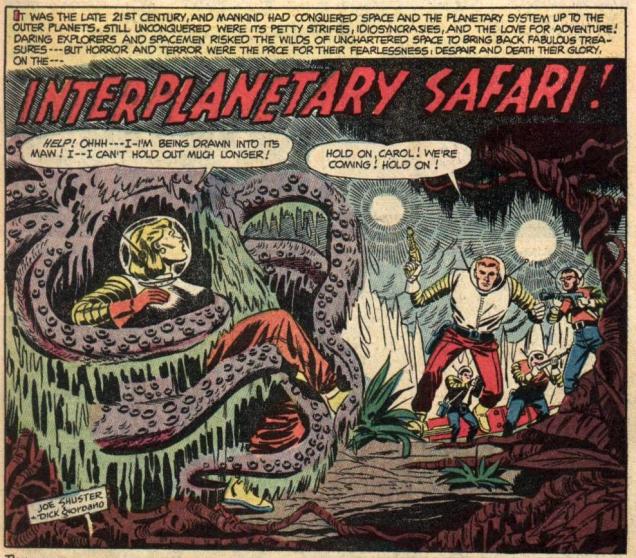
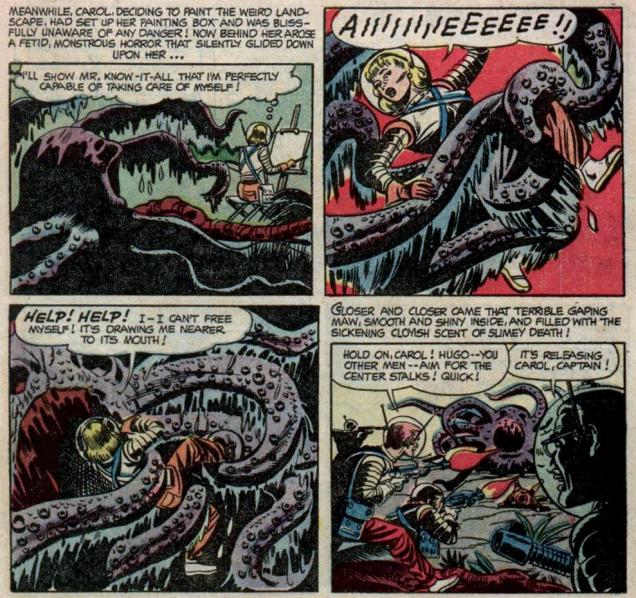
Ron Adams, explorer extraordinaire and famous hunter, goes to planet Xarto to capture a giant carnivorous plant (but if you called it an octopus, nobody would bat an eye). Panels from «  Interplanetary Safari! », penciled by Bill Molno and inked Dick Giordano.

Space Adventures no. 11-interplanetarySafari2

TentacleTuesdayIcon

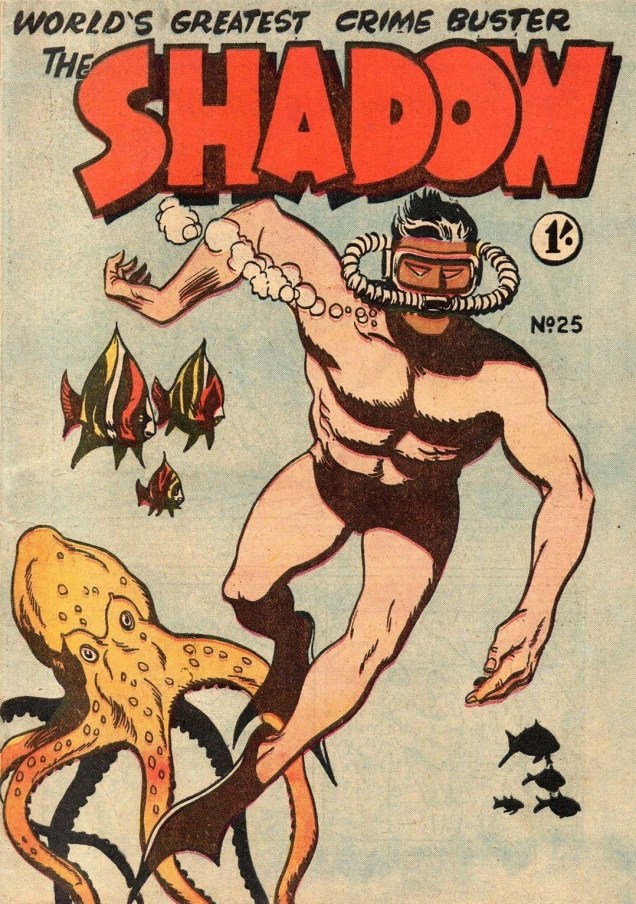
TheShadow25
The Shadow no. 25 (September 1956), the child of Australian comic book publisher Frew Publications. The Australian Shadow has nothing to do with « Who knows what evil lurks in the hearts of men? »– this is just a guy who puts on a mask… and takes off his pants. The octopus seems astonished at the sight of bare man-flesh (if there are Speedos there, they’re well camouflaged).

Golden Age tentacles have cropped up many times before in my Tentacle Tuesday posts, but check out specifically Tentacle Tuesday: The Golden Age of Grabbery and Tentacle Tuesday: Planet of Tentacles. Until next time, toodle-oo!

~ ds
Treasured Stories: “Dragstrip Paved With Gold” (1968)

« Alcohol is for drinking, gas is for cleaning parts, and nitro is for racing! » — Don Garlits

At this time each year, Montréal is beset by its own plague of greedy locusts: it’s Formule 1 Grand Prix time! While our fair city offers other crowd-pleasing events (for instance le Festival international de jazz de Montréal and le Festival Juste pour rire / Just for Laughs), the most glaring distinction between the Grand Prix and the others is that it essentially draws just one type of visitor, a Las Vegas/Florida Spring Break/Nascar sort of randy, aggressive, would-be Alpha Male yob. Imagine hosting the Republican National Convention year upon year, and at eardrum-tormenting sonic levels. Time and time again, the newspapers run the same stories about rampant prostitution and criminal exploitation and how the event only benefits bar, hotel, restaurant and cab operators and variegated pimps… and shafts everyone else. The usual one-percenter bait-and-switch appeal to everyday avarice, it never fails.

Oddly enough, despite my distaste for racing culture proper, I’m paradoxically quite fond of hot rod comics. I was as surprised as anyone when I chanced, several years past, to read an odd issue of Drag n’ Wheels that had come into my possession decades earlier in the midst of an assorted lot (this was no. 46, April 1971)… and greatly enjoyed it. Gripping stuff, as it turned out!

Now, there’s no question that the number one driver of Charlton Comics’ hot-rod line* was Jack Keller (1922-2003), a Golden Age artist who found his true niche with car comics. Around 1967, he was offered an exclusive contract with Marvel to work on their western titles, but Keller declined in order to focus on his Charlton account, where he could write, pencil, ink and letter his own stuff… without having to redraw anything. Moreover, he claimed to favour horsepower over horses.

Keller’s car stories are often a delight, full of knowing detail, clever humour and plenty of thrills. However, if Keller had produced the entire line on his own (as he did, in fact, when it was whittled down to a pair of titles in its final years), the growing bleakness in his work could have become wearying. Drawing from his direct involvement in the racing scene, Keller packed his stories with pompous asses, dangerous egomaniacs, slimy backstabbers, sociopathic glory hogs, and other representatives of a bloodthirsty, mean-spirited mob.

Charlton’s main writer, Joe Gill, filled out the rest of the book, aided by a rotating crew of artists, among them Don Perlin, the tireless Charles Nicholas ‘n’ Vince Alascia duo, Tony Tallarico, Bill Montes, Dick Giordano, Bill Molno, et al.

But in the line’s peak years (1964-1969, also an aesthetic apogee in automotive design), the number two illustrator in Charlton’s racing stable was Edd Ashe (1908-1986), another journeyman from the Golden Age of comics.

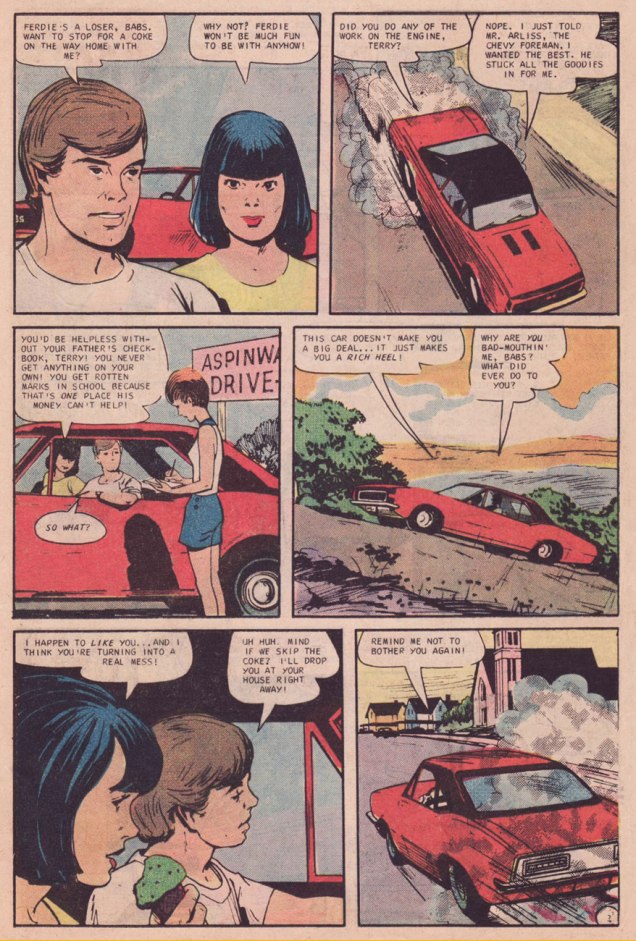
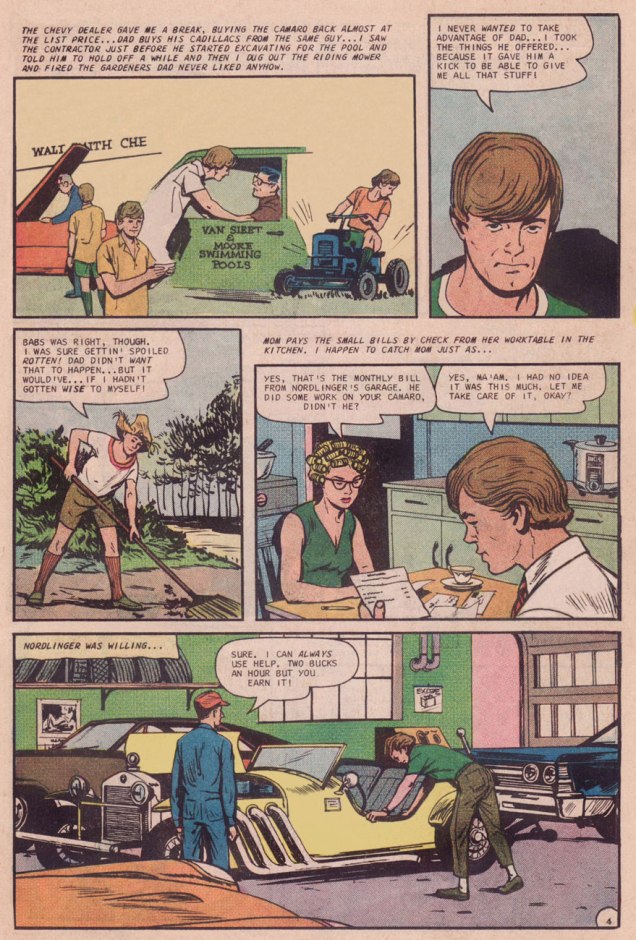
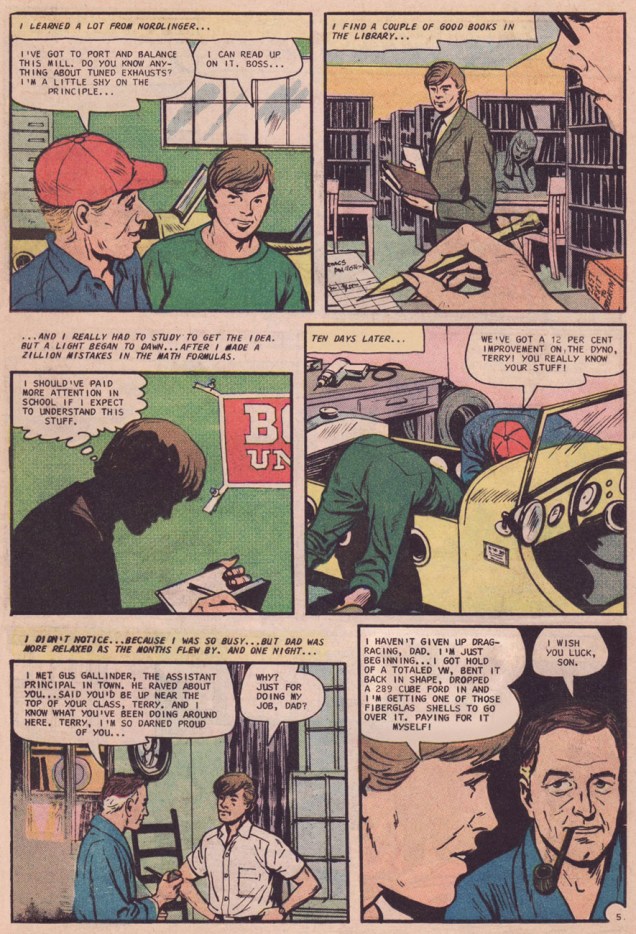
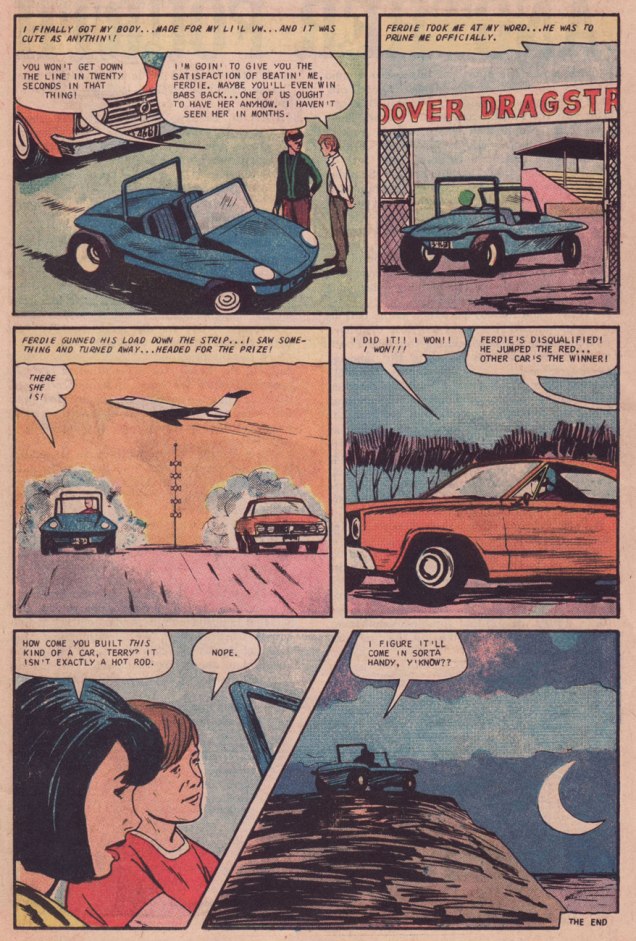
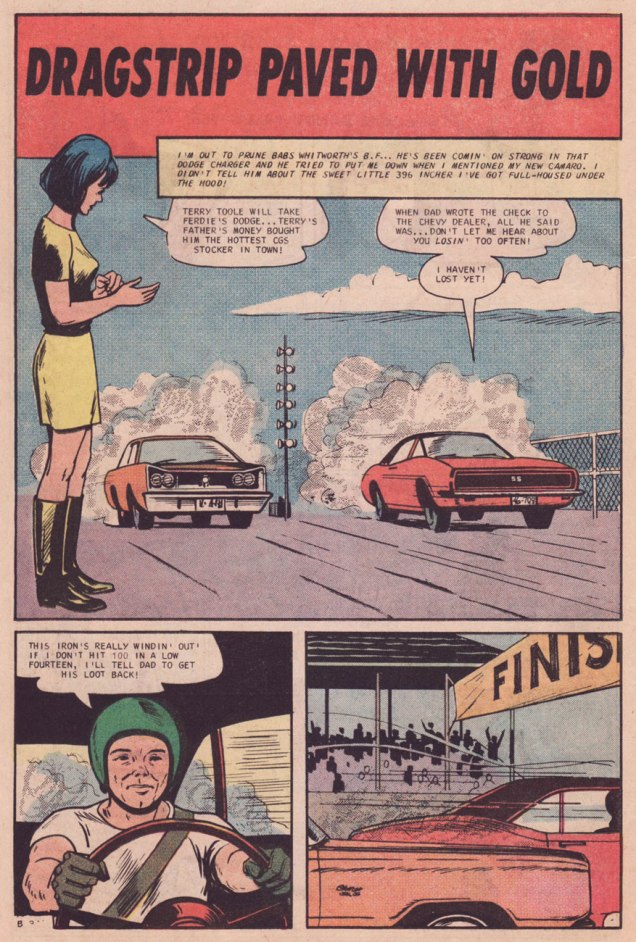
Here, at last, are some actual comics. Dragstrip Paved With Gold appeared in Hot Rods and Racing Cars no. 90 (June 1968, Charlton Comics), and was written by Joe Gill, pencilled by Edd Ashe, and inked by the mysterious and likely pseudonymous T. Roots.

AsheDragstrip01AAsheDragstrip02AAsheDragstrip03AAsheDragstrip04AAsheDragstrip05AAsheDragstrip06A

It might be easy to miss some of the more unusual nuances of Gill’s tale. When faced with the daily task of coming up with material grounded in genres with a limited number of available plots (say, romance, war, horror, hot rods, sports), Gill kept the plot basic and tidy, but enriched his stories with unusual characterization, pertinent technical details, vernacular and jargon… and sometimes moral values quite at odds with the prevailing societal mores. In this story for instance, note that the ladies in Terry and Jim’s lives provide the voices of reason, prodding them gently away from blind ambition, excessive materialism and showboating and toward self-preservation and enlightened self-respect. Dead men can’t keep up with the Joneses… or rather ahead, in this case.

WhoThereLogotype

As a bonus, I’ve compiled a complete-as-far-as-I-know bibliography of Mr. Ashe’s contributions to Charlton hot rod comics (1964-1969); wherever available**, follow the links to read the issue on comicbookplus.com!

Hot Rod Racers 1 : Local Champ / The Compact Cavaliers / Back-Road Champ
Hot Rod Racers 2: The Avenger / Joe’s Jalopy / The Driver, not the Car
Hot Rod Racers 10: Quarter King
Hot Rod Racers 11: Fast Loser
Hot Rod Racers 12: Wrecks to Riches
Hot Rod Racers 13: The Spoiler
Hot Rod Racers 14: The Day the Creampuff Won
Hot Rod Racers 15: You Never Know!

Grand Prix 16: Bossin’ the Turns
Grand Prix 17: Twins’ Trouble / Constant Loser
Grand Prix 18: Gentleman Driver
Grand Prix 19: The Eagles Scream
Grand Prix 20: For Money or Marbles
Grand Prix 21: The Town Wreckers

Drag-Strip Hotrodders 2: Tamed Tiger / Falcon Flyer / Little Eliminator
Drag-Strip Hotrodders 3: English Cousin / 1320 in 13.20 / S/S King
Drag-Strip Hotrodders 5: Great Moments in Racing History: “Rods Across the Sea”
Drag-Strip Hotrodders 10: The Furious 40! / 200 Plus!
Drag-Strip Hotrodders 11: Match Champ
Drag-Strip Hotrodders 12: I’m a Lemon (A Car’s Own Story)
Drag-Strip Hotrodders 13: Speed in All Seasons
Drag-Strip Hotrodders 14: Playin’ the Role!
Drag-Strip Hotrodders 15: “Mighty Mustang”
Drag-Strip Hotrodders 16: Speed at Any Price

World of Wheels 17: Modified Madness
World of Wheels 18: The Astro Rod
World of Wheels 19: “Speedy”
World of Wheels 20: Beast From the East
World of Wheels 21: The Rat Pack
World of Wheels 23: The Wild Ones (Parents)
World of Wheels 27: The Sissy Wagon
World of Wheels 28: Home Town Driver / Lemon at Le Mans (Vince Colletta inks)

Hot Rods and Racing Cars 70: Nightmare at Le Mans
Hot Rods and Racing Cars 72: Farmboy at Le Mans
Hot Rods and Racing Cars 73: Outlaw Hot-Rod / 300 MPH Flying Jet / The Novice / Hold It!
Hot Rods and Racing Cars 74: Final Test (Colletta inks)
Hot Rods and Racing Cars 75: Great Moment in Racing History: “Race to the Sky”
Hot Rods and Racing Cars 78: Great Moment in Racing History: Sebring ’65
Hot Rods and Racing Cars 79: Mille Miglia of 1952
Hot Rods and Racing Cars 80: Great Moment in Racing History: The Vanderbuilt Cup Race of 1937
Hot Rods and Racing Cars 83: The Digyard Demon
Hot Rods and Racing Cars 85: Fast and Furious
Hot Rods and Racing Cars 86: Backyard Grand Prix
Hot Rods and Racing Cars 87: The Pigeon / Just a Country Boy
Hot Rods and Racing Cars 88: Wild Willie & the Black Baron
Hot Rods and Racing Cars 89: The Mighty Midgets
Hot Rods and Racing Cars 90: Dragstrip Paved With Gold
Hot Rods and Racing Cars 91: Piston Head
Hot Rods and Racing Cars 92: Dirt Track Digger
Hot Rods and Racing Cars 93: Tomboy Tornado
Hot Rods and Racing Cars 94: A Friendly Little Car
Hot Rods and Racing Cars 99: The New Breed

Teenage Hotrodders 15: Great Moment in Racing History: The World 600
Teenage Hotrodders 16: Great Moment in Racing History: The Detroit Special
Teenage Hotrodders 17: Great Moment in Racing History: Le Mans 24 Hour Race 1959
Teenage Hotrodders 21: His Big Dream
Teenage Hotrodders 23: Flying Failure

Top Eliminator 25: The Pigeon
Top Eliminator 27: RedLight Express / Mad for Matches
Top Eliminator 28: Blow-Up
Top Eliminator 29: Scarface and the Get Away Gasser

Drag ‘n’ Wheels 32: Weird Willy’s Wild Wagen
Drag ‘n’ Wheels 33: Smoked In
Drag ‘n’ Wheels 34: Wastin’ Time
Drag ‘n’ Wheels 35: The Firecracker 500

– RG

*These were Hot Rods and Racing Cars (1951-1973); Speed Demons (1957-58); Dragstrip Hotrodders / World of Wheels (1963-1970); Teenage Hotrodders / Top Eliminator / Drag ‘n’ Wheels (1963-1973); Hot Rod Racers / Grand Prix (1964-1970); and Surf ‘n’ Wheels (1969-1970).

**Until they wised up sometime in 1968, Charlton didn’t bother to copyright their publications; therefore, they wound up in the Public domain.

Tentacle Tuesday: a Treasure Trove of Charlton Tentacles

I wasn’t around in the 70s. (Literally, as in “I hadn’t been born yet”.) So when somebody – in, oh, say 2008 or so – handed me a copy of some ghost comics printed by Charlton Comics (I don’t remember what exactly), that was my first exposure to this publishing company. I wasn’t aware that I wasn’t « supposed » to like this stuff… and by the time some kind soul pointed out that it’s not exactly orthodox to seek out Charlton publications, it was too late to change my mind. Clearly, that’s how monsters with no taste are created.

Charlton Comics had the reputation for inferior printing (as one of my friends put it, « godawful colours and reproduction and paper ») and low quality control. I’d say that when one contemplates the variety of artistic styles and the dizzying panoply of artists published by them, the quality of the printing distinctly becomes a less important consideration. Charlton paid badly, sure, but since when do people decide what they like and what they don’t based on how artists are treated? (Just look around – companies that trample on creators’ rights are doing very well indeed.) It seems like a knee-jerk reaction; I often wonder if people who automatically react with sneers to the very mention of Charlton have actually read any of the comics this company printed. Or perhaps they’re scared by some of the artists’ styles which are just too wild, too squiggly, just not clean enough. (Sloppy line work! Anathema to any comic book lover worth his salt, right?)

Anyway, Charlton’s « loose editorial oversight » meant there was no house style to speak of, and artists with highly idiosyncratic styles could let their eccentricities shine.

You may notice some names are conspicuously absent from today’s post. Tom Sutton, exhibit A of the “chaotic, scratchy art” category, will get a Tentacle Tuesday post all to himself at a later date. Some beloved artists just didn’t draw any tentacles for Charlton (as far as I know!): Warren Sattler, Don PerlinSam Glanzman, Don Newton, Rocco Mastroserio, etc. Wayne Howard is already part of a Tentacle Tuesday (see Plant Tentacle Tuesday), as is Enrique Nieto (Tentacle Tuesday: Spunky Skirmishes).

Without further ado, but with lots of tentacles…

First, two beauties from Steve Ditko (if you’d like more Ditko – and who wouldn’t? – visit my co-admin RG’s lovely posts about him: Ditko’s Ghostly Haunts and Happy 90th birthday, Mr. Ditko!), both featuring “70s Ditko green“. (It’s that characteristic green hue that often appears on his covers, a fitting term coined by erudite Professor Fester.)

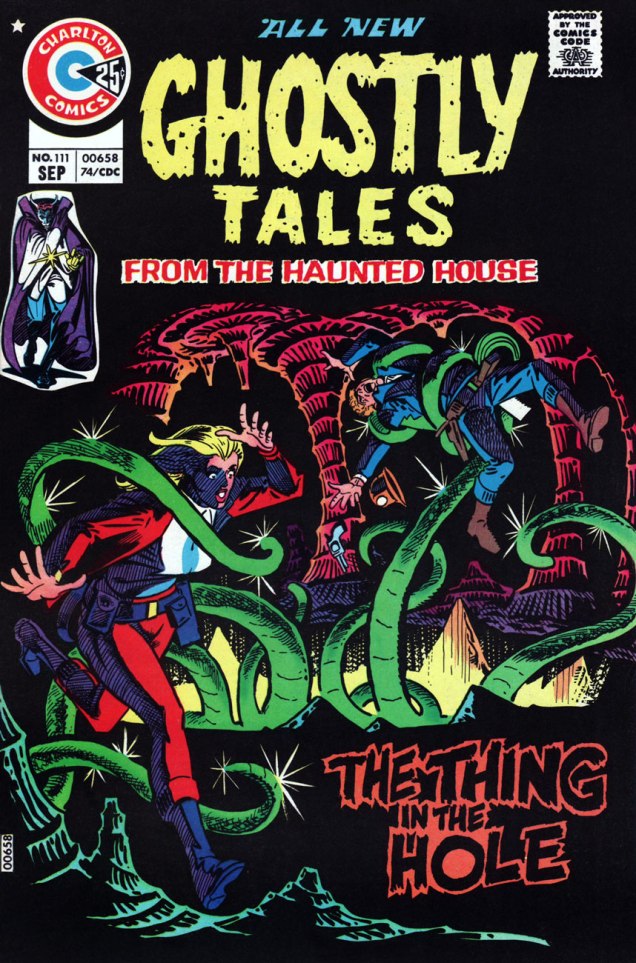
GhostlyTales#111-SteveDitko
Ghostly Tales no. 111 (September 1974), cover by Steve Ditko. « The Thing in the Hole » is a really cool story, but it’s written and drawn by Tom Sutton, and as such it’s off-limits for now (I’m hoarding material for a different post.)
GhostlyTales#122-SteveDitko
Ghostly Tales no. 122 (August 1976), cover by Steve Ditko.
GhostlyTales#122-inside
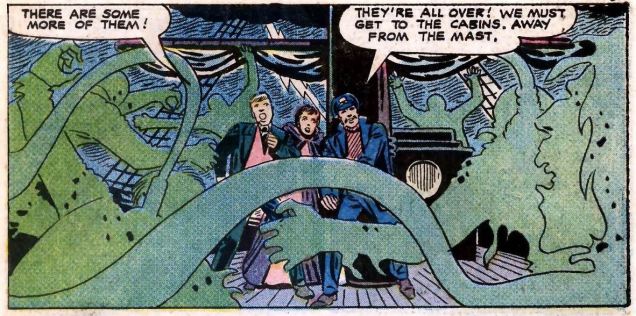
Do these green noose-appendage-things count as tentacles? Sure they do! Panel from The Crew That Was Hanged!, illustrated by Steve Ditko and written by Joe Gill.

And moving on to other series, other artists:

Haunted#8-JackAbel
Haunted no. 8 (October 1972), cover by Jack Abel (1927-1996), perhaps best known as an inker for DC and Marvel.
Haunted#13-WrongTurn-PeterMorisi
Newly-weds that are half-squid, half-fly, but newly-weds nonetheless. Page by Peter A. Morisi (1928-2003), who went by the nom de plume of PAM (or, since his signature’s M looks like a triple “I”, “PAIII!”). He was a NYC police officer, and moonlighted as a comics artist. I really like his calm, easily recognizable style and the way his characters seem to be frozen in each panel. There’s something quite effective about this stillness, a pleasing contrast between the drama and action of a story and the way people are staring off-panel in quiet contemplation, even when terrified. This story is called “Wrong Turn” and comes from Haunted no. 13, 1973.
BaronWeirWulf'sHauntedLibrary#28-MikeZeck
(Baron Weirwulf’s) Haunted (Library) no. 28 (July 1976), cover by Mike Zeck, whose career actually started at Charlton (he later moved on to Marvel to work on Master of Kung Fu, Captain America, etc.).
Haunted#28-FrankBolle-TheSource
« The creature’s tendril closed so gently around his leg, he didn’t notice it at first. Then a second grasped his arm! » The Source is the cover story of Haunted no. 28. Is old Thomas Willet mad? Well, he just has unusual taste in pets, that’s all (and, as tradition demands, he will pay dearly for his extravagance). Pencils and inks by Frank Bolle(1924-2020), who worked for Gold Key and Charlton, illustrated horror stories for Warren titles, and also had a hand in several newspaper strips (Winnie Winkle, Apartment 3-G, Stan Drake’s The Heart of Juliet Jones, and Gil Thorp).
GhostManor#1-PatBoyette
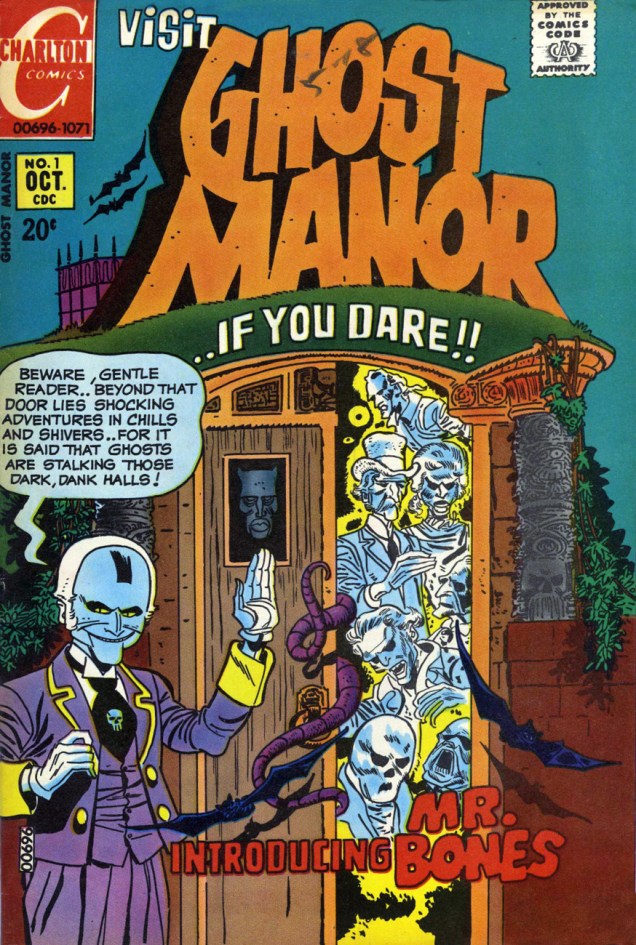
Ghost Manor no. 1 (October 1971), cover by the ever-masterful Pat Boyette (1923-2000), who’s a big favourite at Who’s Out There. Go read a whole story by him: Pat Boyette — Hillbilly Makes Good

We couldn’t find a good enough scan of this issue online, and it’s one of the rare Ghost Manors co-admin RG doesn’t actually own, so here’s a cover photostat (slightly coloured):

GhostManor58ProdA
Ghost Manor no. 58 (August 1981), cover by the Recreo Studio.
GhostlyHaunts#48-RichLarson
Ghostly Haunts no. 48 (February 1976), cover by Rich Larson (we’ve seen him before in Haunted House of Lingerie — see Tentacle Tuesday: a Day at the Beach).
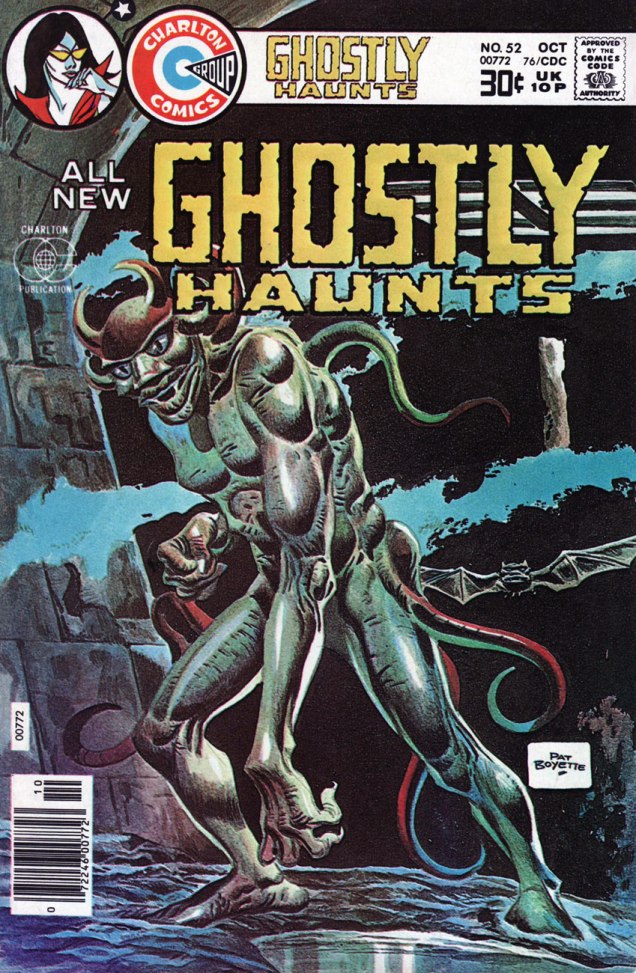
GhostlyHaunts52A
Ghostly Haunts no. 52 (October 1976), another cover by Pat Boyette, this time gorgeously painted.
BeyondtheGrave#11-MitchOConnell
Beyond the Grave no. 11 (October 1983), cover by Mitch O’Connell (also present in Have Tentacles, Will Space Travel).

~ ds

Tentacle Tuesday: Ha-Ha and Coo-Coo With Frolicsome Animals

The Golden Age of comics proffered quite a lot of anthropomorphic animals to its readers. The stuff on offer ran the gamut of different definitions of humour, from inane slapstick to pleasant goofiness, all the way to batshit surrealism. There’s at least one common streak running through this zoological revelry – tentacles!

tentacletuesdayicon

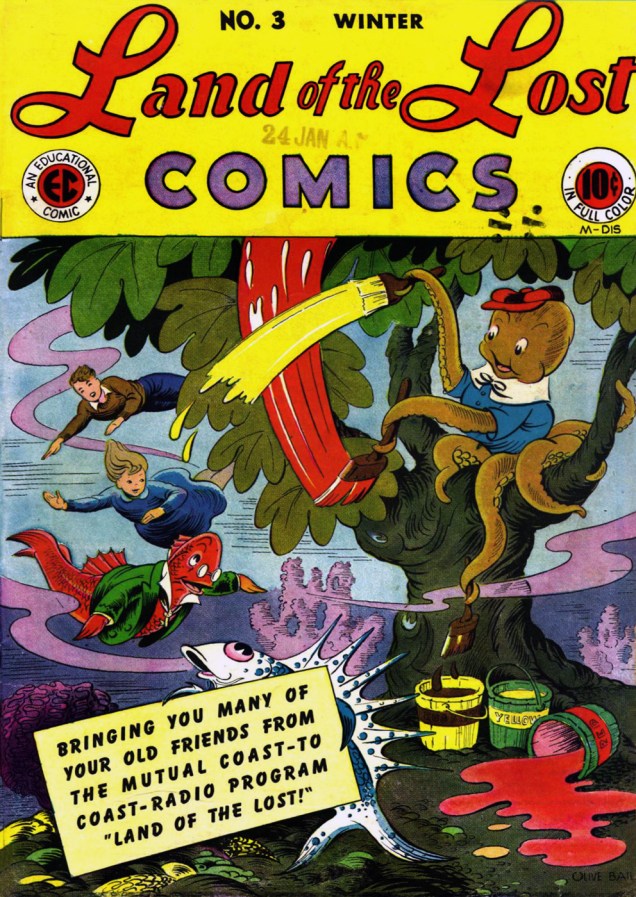
Our first exhibit is a charming comic from the 40s. Land of the Lost was a radio series broadcast from 1943 to 1948 on Mutual Broadcasting System and ABC, written, produced and narrated by Isabel Manning Hewson. Each episode started with the line « In that wonderful kingdom at the bottom of the sea… », and presented a new under-the-sea adventure of Isabel and Billy, two kids lucky enough to have an adorable avuncular fish for an underwater guide. (The fish was called Red Lantern, and was most notably voiced by Art Carney.) You can listen to an episode from 1945 here.

landofthelostcomics-isabelmanninghewson

Coming back to our beloved cartoons: in 1946, EC Comics started publishing Land of the Lost Comics, a series that lasted for 9 issues. Hewson remained the writer, and the art was handled by Olive Bailey (not the Olive Bailey who helped crack Germans’ Enigma cipher machine in WWII.) The result was impressive: these comics are delectable, combining beautiful art with inventive plots that may be goofy, but have a solid internal logic. Hewson gave her sea-creatures vibrant personalities, and it’s so much fun to dive (not pun intended) into this world.

LandoftheLostComics#3
Land of the Lost Comics no. 3 (winter 1946), cover by Olive Bailey. Read the whole issue here…  and then read other issues, too. Somebody needs to publish a collection of this stuff.

The following panels are from “Jack Frost“, scripted by Isabel Manning Hewson and drawn by Olive Bailey, published in Land of the Lost Comics no. 3.

OliveBailey-landofthelostcomics2-panel3
Squidlet goes out of control, like all young octopuses are prone to doing.

OliveBailey-landofthelostcomics3-panel3

Thank you, cool ladies, for all the fun!

IsabelManningHewson-OliviaBailey

Land of the Lost also became an animated cartoon as part of Famous Production Studios‘ Noveltoon series: Land of the Lost (1948), Land of the Lost Jewels (1950) and Land of Lost Watches (1951). I find the animation to be definitely subpar to the comics or the radio show, but I’ll let you judge for yourselves. (Jack Mercer is in it, albeit briefly!)

tentacletuesdayicon

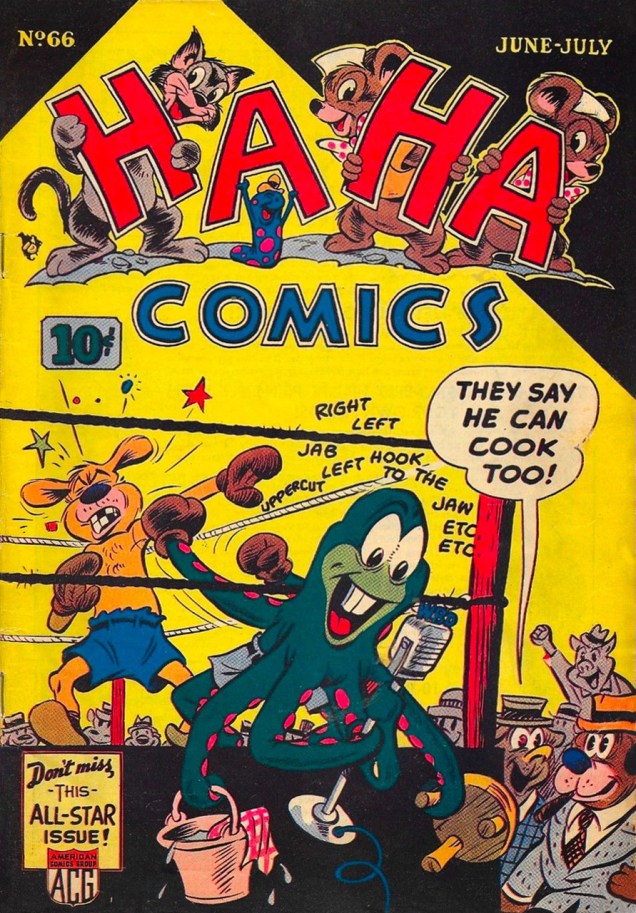
Did you know octopuses love to box? This implausible situation is definitely part of the lazy artist’s roster. To wit:

HaHaComics66
Ha Ha Comics no. 66 (June-July 1949), cover by Dan Gordon. It was really hard to find a scan of this issue in decent condition (thanks to co-admin RG), and comicbookplus doesn’t even have it in its database (you can read pretty much all the other issues of Ha Ha Comics, though).

Ha Ha Comics, a sister anthology of Giggle Comics, was published by ACG. (With issue #100, Ha Ha became Teepee Tim, going from animal hijinks to young Indian shenanigans for all of… three issues.) It’s quite a the playground of anything goes, but upon careful inspection, one easily finds good art shining among the dirt-pile of mediocrity, and diverting storytelling among hackneyed yarns.

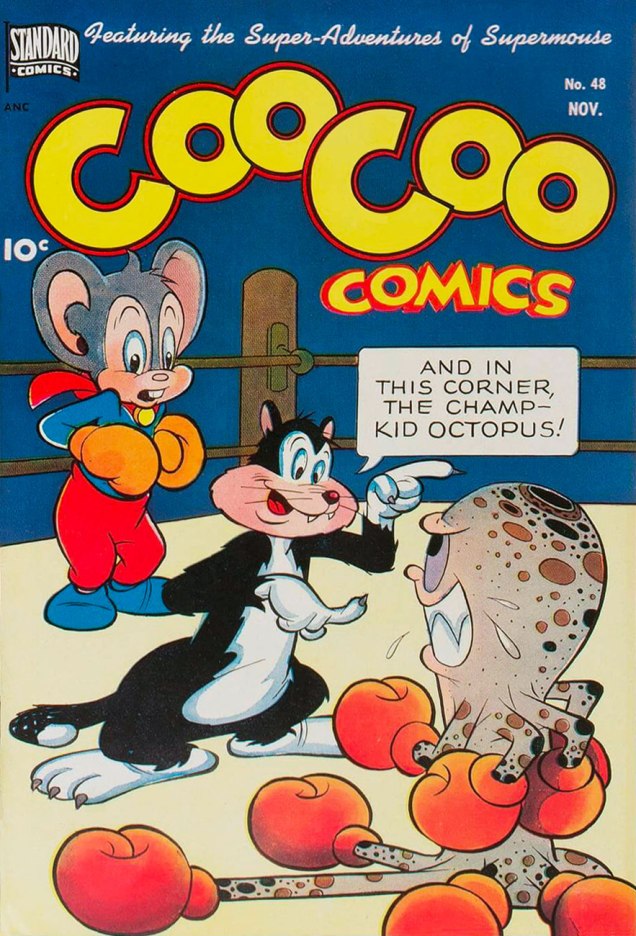
CooCooComics48
Coo Coo Comics no. 48 (November 1949), cover by Carl Wessler. Published by Standard Comics under the imprint of Pines (from Ned L. Pines, publisher).  Read the issue here (no tentacles whatsoever, though).

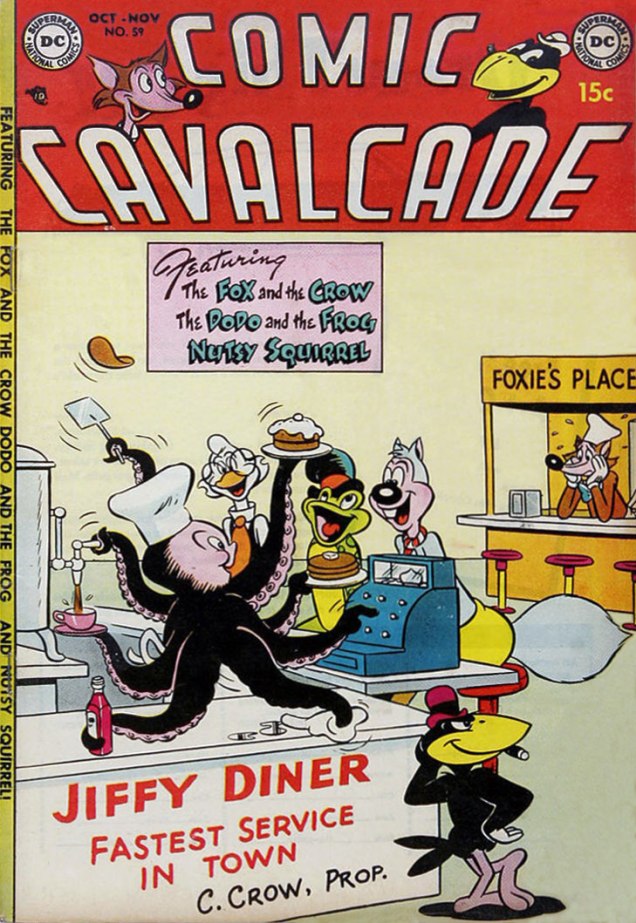
How many arms does the fellow up above have, nine? I suppose that’s why he’s the champ!

tentacletuesdayicon

Comic Cavalcade went all funny-animals only with issue 30 (Dec-Jan 1948), when superheroes faded from popularity (oh man, that’s hard to imagine now, isn’t it?) It lasted until 1954, by which time it shrank from its original 96 pages to 76, however retaining its 15-cent cover price.

ComicCavalcade59A
Comic Cavalcade no. 59 (Oct-Nov 1953), art probably by Rube Grossman. Read it here.
DinkyDuck10
Dinky Duck  no. 10 (July 1954). WTF is a Dinky Duck? Terrytoons’ answer to Daffy Duck, says Toonopedia; or, tout simplement, a smaller-than-average duck. The poor duckling never caught on, but the cartoons did result in a comic series, published by Pines and then St. John.
AtomicMouse25
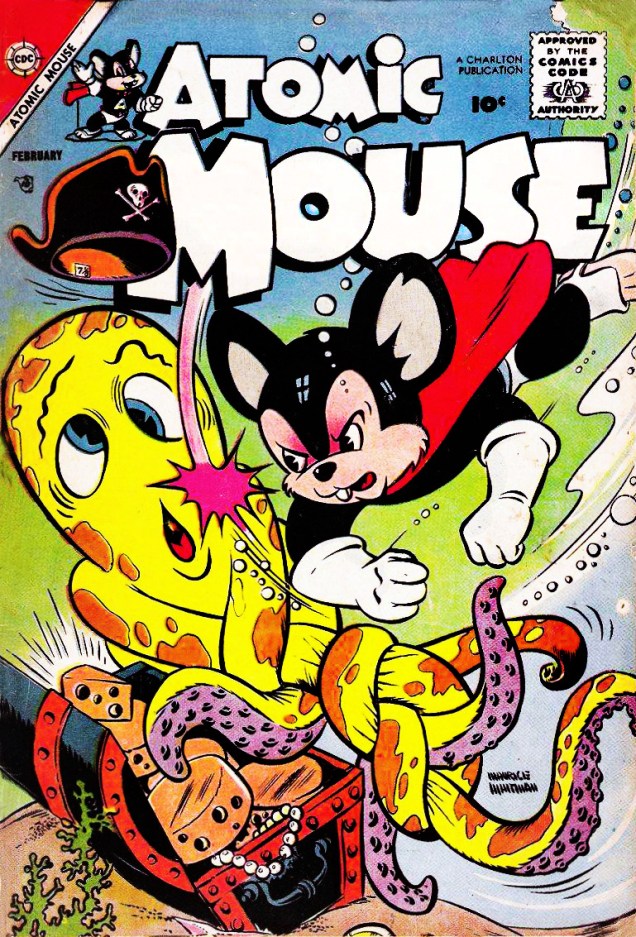
Atomic Mouse no. 25 (February 1958), cover by Maurice Whitman. Atomic Mouse was created in 1953 for Charlton Comics by Al Fago, their first animal superhero. The series was published for ten years (!), between 1953 and 1963, so it must have had at least a modicum of popularity.

That’s all folks!

~ ds

Hot Streak: Steve Ditko’s Ghostly Haunts

« There’s no room for professional jealousy around the graveyard, chums… life is too short, as they say… but what comes after that short life may stretch into all eternity! »

I could carry on endlessly (or so it would seem) on any number of obscure topics, but it’s healthy, every once in a while, to take a deep breath, empty one’s mind of its flotsam and jetsam, and reach for an old favourite.

I hadn’t yet written anything about Steve Ditko‘s passing, as I figured it would get lost in the mad shuffle of tributes. That base was well-covered. Still, while I’d known all along the day would come, it was hard to imagine a world without that reclusive genius, likely my very first artistic inspiration.

I didn’t see much of Ditko’s 60s Marvel work until the late 70s pocket book reprints (the period equivalent of watching a movie on one’s cellphone), but the Charlton ghost books grabbed me at a tender age. And so…

As my candidate for Steve Ditko’s finest cover run, at any company, I submit issues 22-27 and 29-30 (curse you for the interruption, Joe Staton!), from January 1972 to March 1973, final year of Ditko’s peak period, imho.

ghostlyhaunts22a
Ghostly Haunts no. 22 (Jan. 1972), an excellently-balanced all-around winner, with the whimsical “Wh-Who’s in Th-There?” (w: Joe Gill p: Charles Nicholas i: Vince Alascia), “Witch’s Brew“, a taste of creepy suburbia with a whiff of Rosemary’s Baby brimstone (w: Joe Gill, p/i Pat Boyette) and our headliner, “The Night of the Lonely Man!” by Gill and Ditko. Read the whole pamphlet here, folks.
ghostlyhaunts23a
Ghostly Haunts no. 23 (Mar. 1972), offers two Gill-Ditko stories: “Treasure of the Tomb” and the cover-featured “Return Visit!“… and I’d be hard-pressed to pick the superior entry. The reader wins. Ah, you cast the deciding vote: read them both here.
ghostlyhaunts24a
Ghostly Tales no. 24 (Apr. 1972), another strong issue, thanks to Gill and Boyette’s “The Other One!” and of course Ditko illustrating “A Man Who Was Here“, Joe Gill’s parable about a Tennessee mountain man displaced, but not entirely, by the construction of a modern superhighway. Read the entire issue here, ladies and gentlemen.
ghostlyhaunts25a
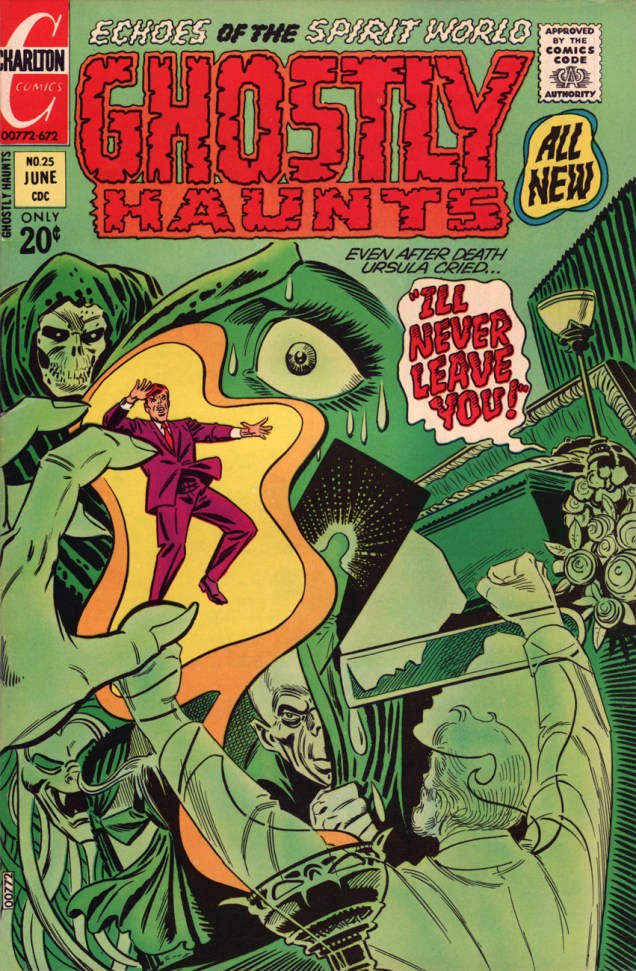
« The butler’s a real monster! » Ghostly Tales no. 25 (June 1972) is where Mr. Ditko demonstrates his unmatched virtuosity in the delicate task of incorporating several elements of a tale without winding up with the dog’s breakfast. Compositional alchemy of the highest order! The cover tale aside, Joe Gill’s wonderfully-titled “What Will Lance Surprise Us with This Time?“, illustrated by Fred Himes, is loads of fun. Read “I’ll Never Leave You!here.
ghostlyhaunts26a
Roger C. Feeney, Indian Affairs bureaucrat from Washington, DC, appears to have stumbled onto the wrong sacred Hopi cave. Uh-oh, Roger, it appears you’ve been noticed by… something. This is Ghostly Haunts no. 26 (Aug. 1972). Beyond the classy Ditko cover, it’s just an okay issue.
ghostlyhaunts27a
« Why does it happen each year? Citizens of Trappton don’t know it, but it always begins right here… at an unmarked grave… » Presumably bearing no direct relation to the 1967 Michael Winner- Orson Welles – Oliver Reed film, I’ll Never Forget What’s-His-Name“, the Gill-Ditko cover story is a classic, the tale of a forgotten man, Bertram Crumm, who merely wanted his existence recognized by the town that spurned him during his lifetime.
It’s too bad Charlton only occasionally featured mystery host Dr. Graves in active (rather than narrative) roles, because when they did, the results were pretty gripping. Unusually, Graves guests outside his own book and in Winnie’s, and we find ourselves with a classic on our hands. This is Ghostly Haunts no. 27 (Nov. 1972). Read the Gill-Ditko story here, but don’t miss the fabulously oddball “The Mine’s All Mine!” by Gill and Stan Asch, featured right here.
ghostlyhaunts29a
« Maybe I’m going mad! I keep imagining I hear his voice! » Ghostly Haunts no. 29 (Jan. 1973) features a striking (gold) exercise in fearful symmetry announcing the Joe Gill – Ditko saga of two untrustworthy acolytes in the Canadian North. Check out “Partners!here.
ghostlyhaunts30
« Ugh! It’s really hideous! Is it a self-portrait of the real you?»  We put the finishing touches on our tour of Steve Ditko covers from 1971-72 with Ghostly Haunts no. 30‘s “Fear Has Three Dimensions” (Mar. 1973). Despite a theme right in Ditko’s wheelhouse, none of his art appears within; the cover feature is handled by Wally Wood disciple Wayne Howard, and the other tales are deftly told by Fred Himes and Warren Sattler.

That just about wraps it up. For further reading on the topic, I recommend you check out Ben Herman’s perspective on some of these very stories, and on Ditko’s spooky Charlton work of the 70s in general.

« Poor Agatha Wilson still has screaming fits! »

-RG

Hallowe’en Countdown II, Day 4

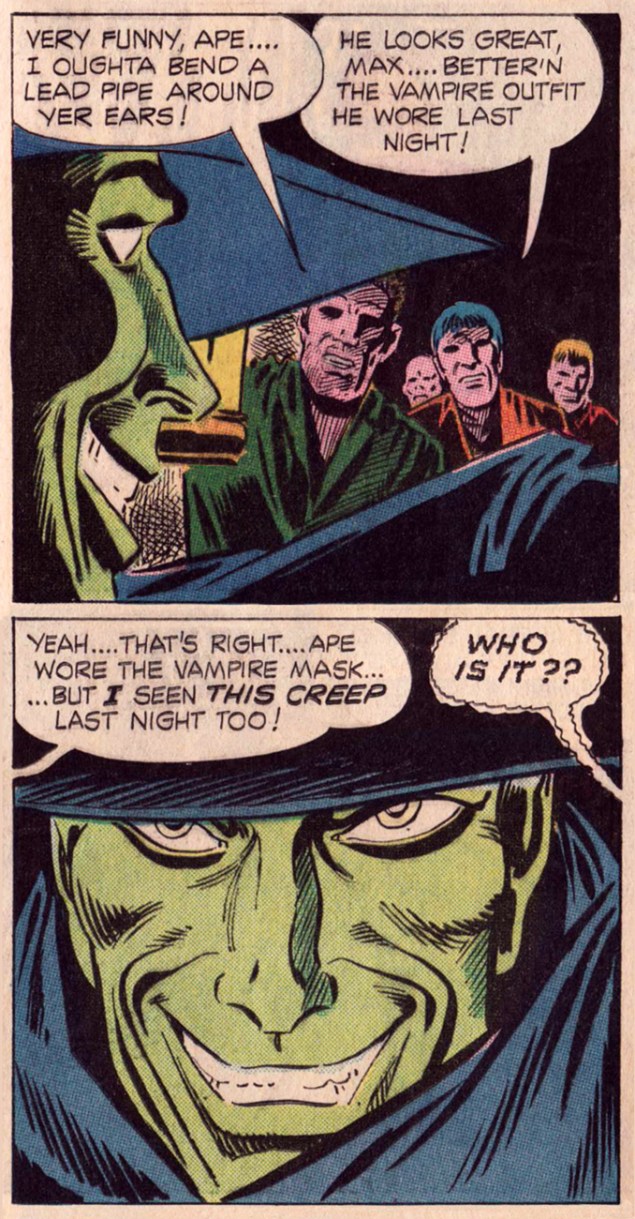
« Ape is real spooked, guys! He’s always imaginin’ he sees someone in there! »

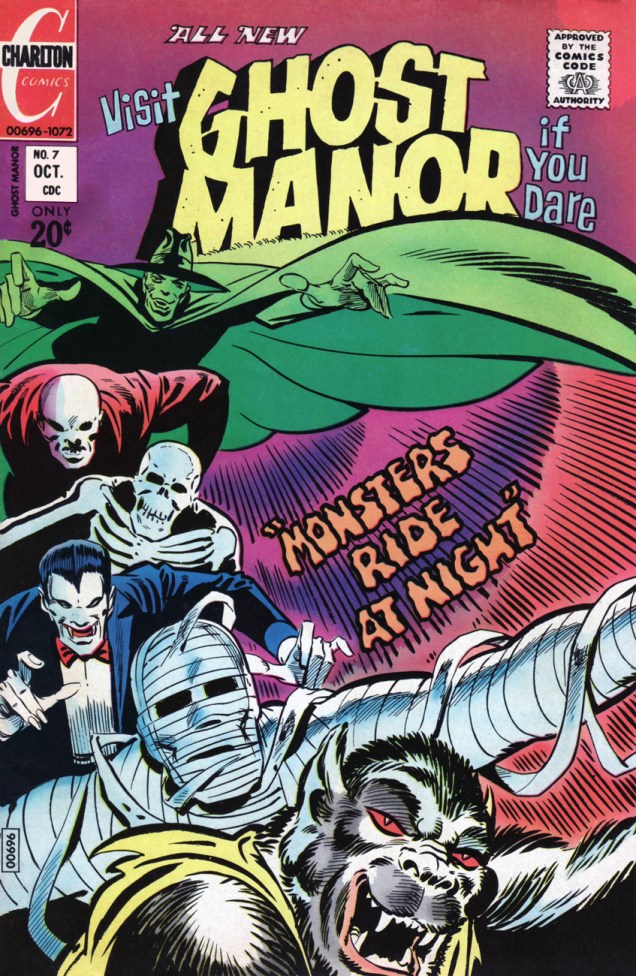
Here we have an evocative Steve Ditko cover, solid evidence of his tremendous design chops, from Charlton’s Ghost Manor (no. 7, second series, October 1972). A collaboration between Joe Gill and Ditko, « The Monsters Ride at Night » is an elegant bit of storytelling legerdemain, a fairly basic yarn that retains its mystery past the conclusion and whose deliciously dusty mood lingers in the mind. Well, in mine, at any rate. Back in the late ’70s, I traded a copy of Amazing Spider-Man 121 (acquired at a garage sale in a two-for-five-cents deal) for this one. I know I came out ahead in the deal*.

Ghost-Manor7A

Again, I had every intention of providing the whole spooky shebang right here, but seeing as how I was preceded in this particular enthusiasm by a sinister confrère, it seems unnecessary. Just dim the light, settle in, point your browser to Destination Nightmare, pour yourself a noggin of your preferred poison, and savour this fine vintage.

Ghost-Manor7WhoIsA

I’m particularly fond of the mid-tale interlude, where our esteemed host, Mr. Bones, seizes the occasion to poke around the cobwebs a bit, a narrative game that the Gill-Ditko duo excelled at. DC and Warren’s hosts (with the obvious exception of Vampirella) never got to play such an active rôle in their respective recitals.

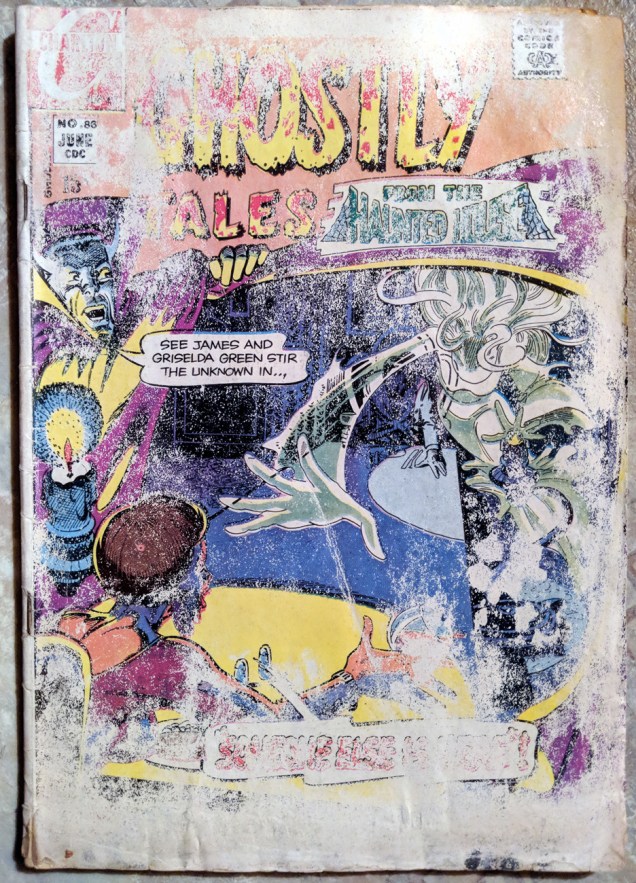
Oh, and since we’re on the topic of early 70s Charlton ghost books, here’s one I picked up just this afternoon, in the 50 cents box of the local comic book shop in Wolfsville, NS. It clearly had been through such hardships, I couldn’t resist giving it a home.

GhostlyTales86Beater.jpg
This is (or used to be) Ghostly Tales no. 86 (June, 1971), featuring three Joe Gill tales: « Return to Die » (illustrated by Pete Morisi), « Ghost Town » (illustrated by Pat Boyette), and « Someone Else Is Here! » (illustrated by Steve Ditko.) If books could speak…

-RG

*I had an extra copy, what do I care?

Warren Sattler’s Travels With El Chivito

« They’re drinkin’ red-eye, playin’ stud poker, and havin’ a high old time! I’ll just hang around awhile… »

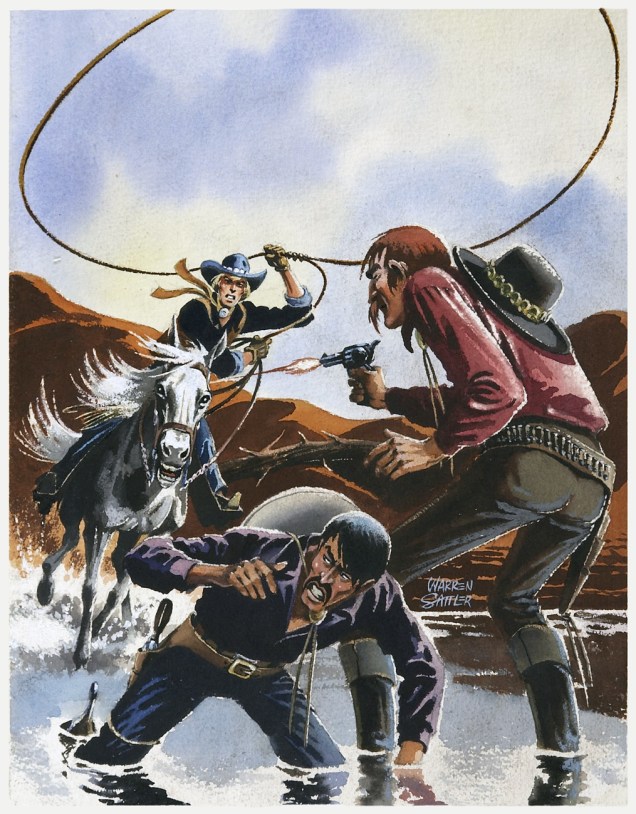
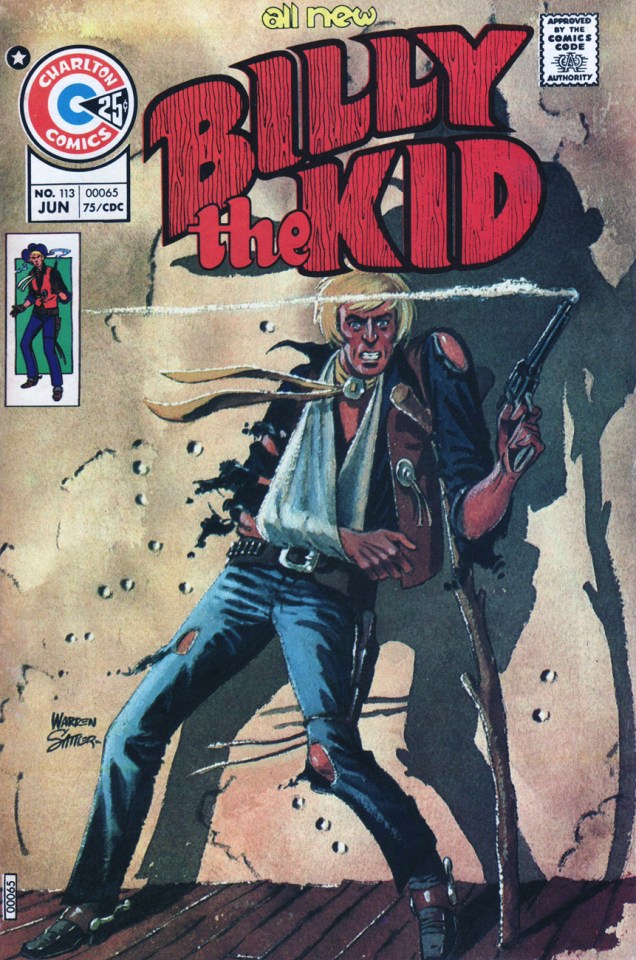
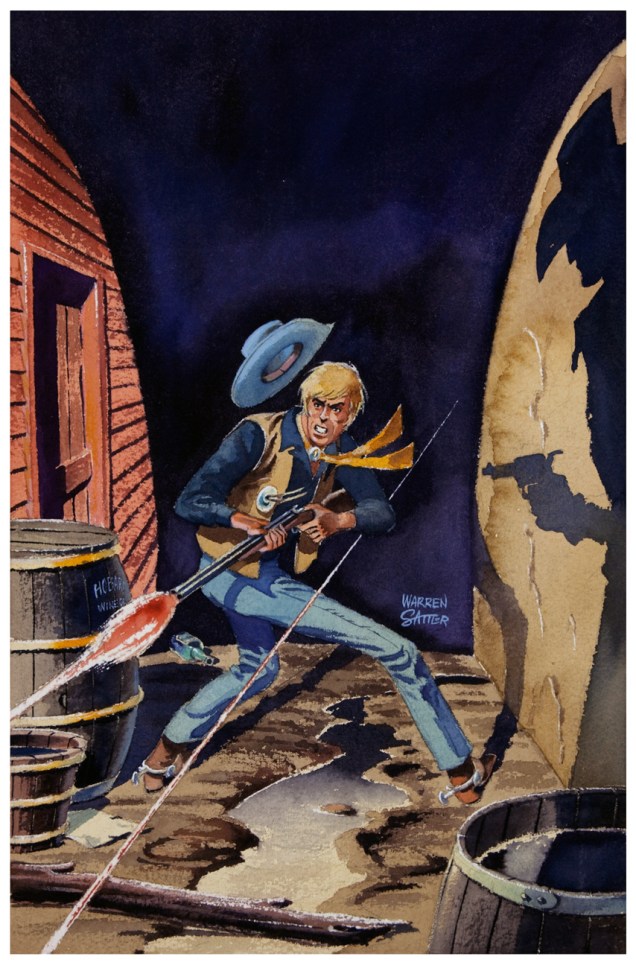
In the mid-1970s, thanks to Pat Boyette’s connections in Texas, Charlton Publications found themselves able to affordably produce painted covers, a development that several members of their iconoclastic stable of artists took full and glorious advantage of. Tom Sutton, Don Newton and Boyette were naturals, but Warren Sattler often gets unfairly sidelined from that esteemed lot… perhaps because he rarely worked for Charlton’s ghost books. Each of his cover paintings was produced for the publisher’s western / martial art adventure series, Yang, House of Yang, and Billy the Kid. And he alone worked in that most unforgiving of media, watercolours, wherein, unlike oils or acrylics, one requires unerring confidence and dexterity if you’re aiming to come up with anything above a muddy mess.

Today, Mr. Sattler (born September 7, 1934, in Meriden, Connecticut, where he resides to this day) celebrates his eighty-fourth birthday. Let’s wish him all the best!

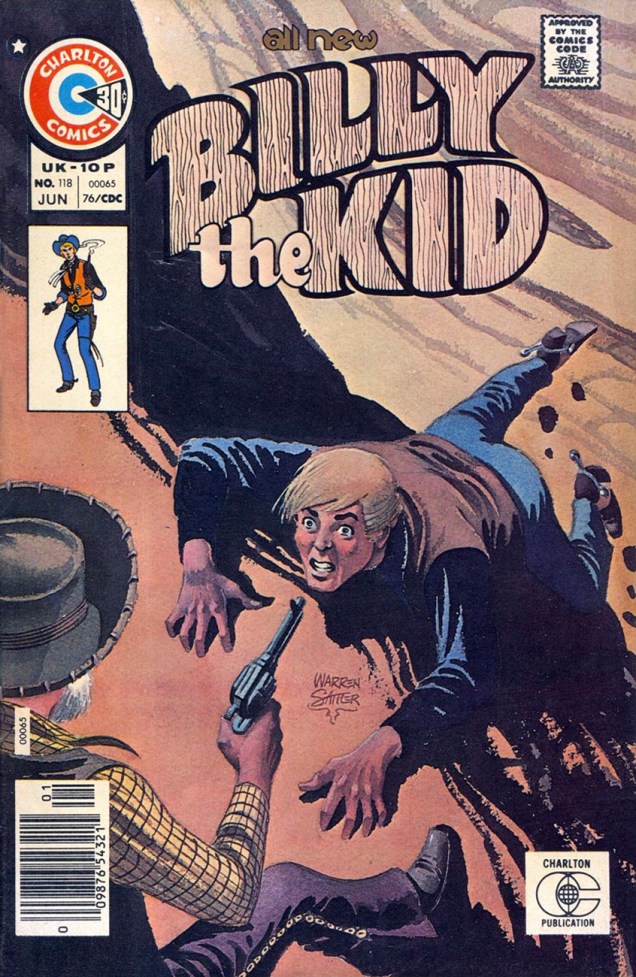
Over the years, I’ve become quite enthused with Charlton’s long-running Billy the Kid series (1957-1983!), which featured over the years the artwork of such luminaries as John Severin, Maurice WhitmanRocco “Rocke” MastroserioJosé Delbo and of course Mr. Sattler. As far as I know, Joe Gill just about wrote the entire series, which is one of its chief pleasures: over a hundred issues of consistent characterization of young Bill Bonney as a peace-loving, unprejudiced champion of the underdog whom his amigos in Old México fondly nicknamed « El Chivito ». I know, hardly the real-life Bill Bonney, but what could one expect under the Comics Code Authority‘s heavy thumb?

Several of Mr. Sattler’s cover paintings have, thank goodness, survived destruction. They have to be viewed in person to be fully appreciated. For the nonce, we’ll make do with mere digital reproductions.

BTK112ORIG_A
For his first painted comic book cover (or second, Yang no. 7 appeared that same month), I believe Mr. Sattler got the proportions slightly wrong, so the cover art was cropped fairly tight horizontally, which still made for a striking, action-packed cover, but since we’ve got the original…
BTK113A
Two Billy adventures appear in this one: the cover-featured “The Good Life” and “The Spoilers!”
BTK114ORIG_A
This one was featured as the cover of Billy the Kid no. 114 (Oct. 1975), illustrating Gill and Sattler’s “Killers in the Shadows!”
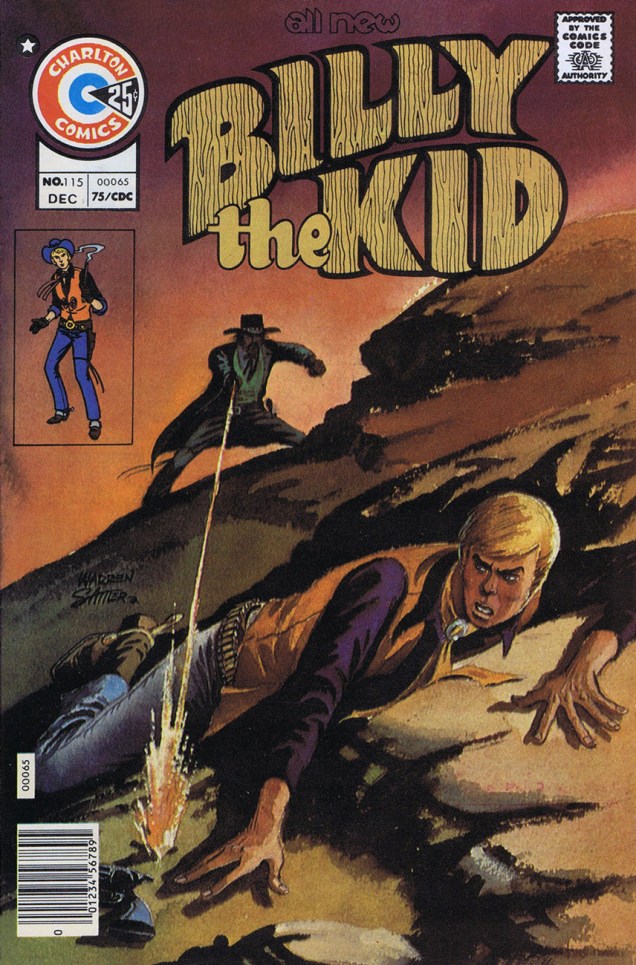
BTK115A
I’m sure Billy would be admiring the lovely light of dusk if he wasn’t being ambushed. Such a splendid and unusual (for comics) palette!
BTK116ORIG_A
The printed version of this painting, which appeared on the cover of Billy the Kid no. 116 (Feb. 1976), lost quite a bit of its subtlety in translation, so I’m happy to show you the original. I love that bit of yellow in the clouds, echoed in the bushwhacker’s shirt. For the first time, a solo Sattler Billy the Kid tale, “The Treasure”.

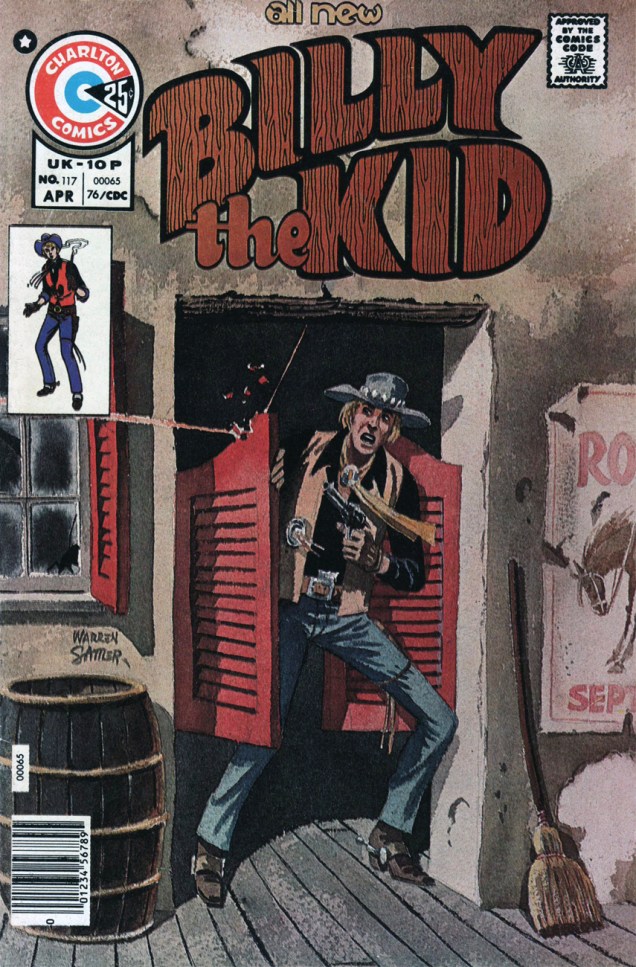
BTK117A

BTK118A
Beautiful composition, and an effective and economical way to convey height and distance. Note the cattle horns in the artist’s signature.
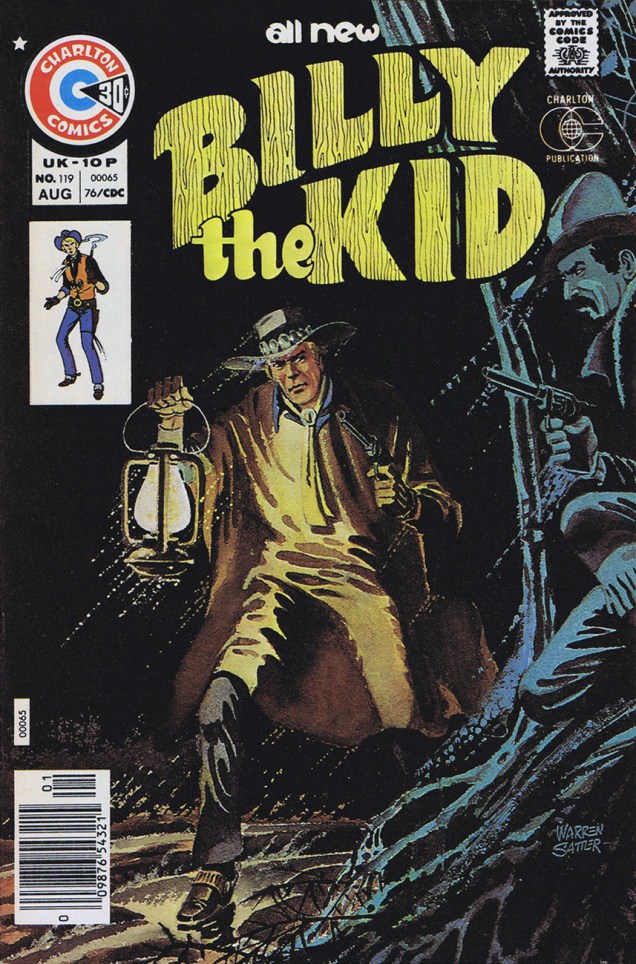
BTK119A
This one’s mood and palette bring to mind the work of Doug Wildey. A good thing, you understand. Excellent use of the « dry brush » technique for texture.
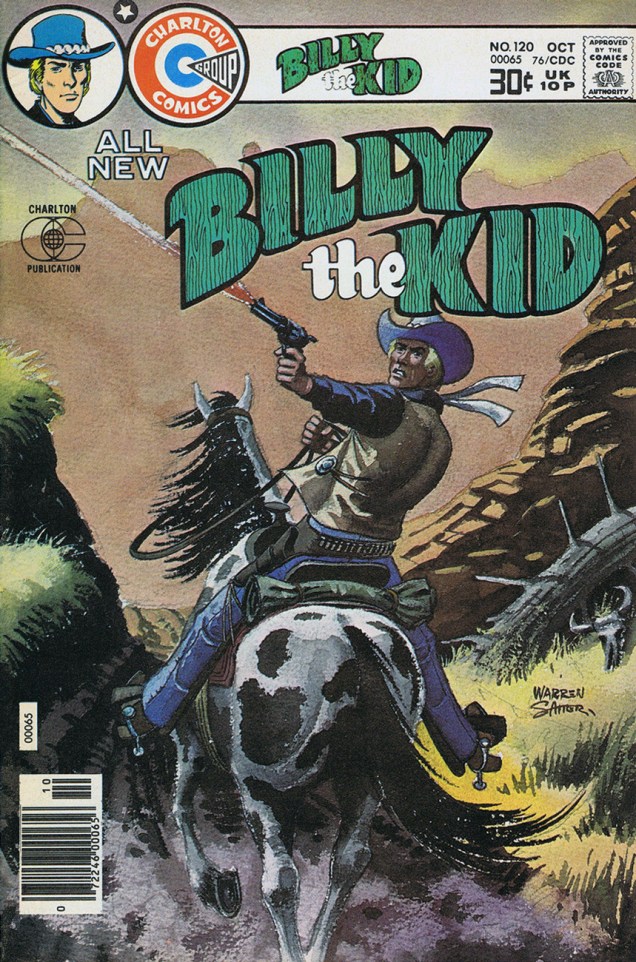
BTK120A
After several issues’ absence from the insides, Mr. Sattler reunites with Joe Gill on “Three for the Money!”
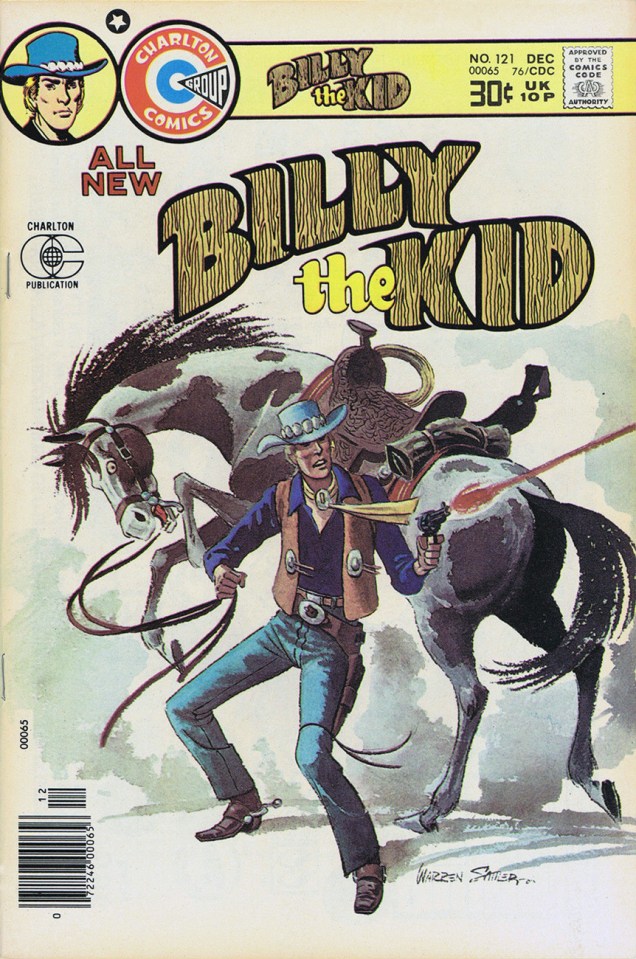
BTK121A
One final painted cover before Charlton rode off into the sunset…. for the first time.


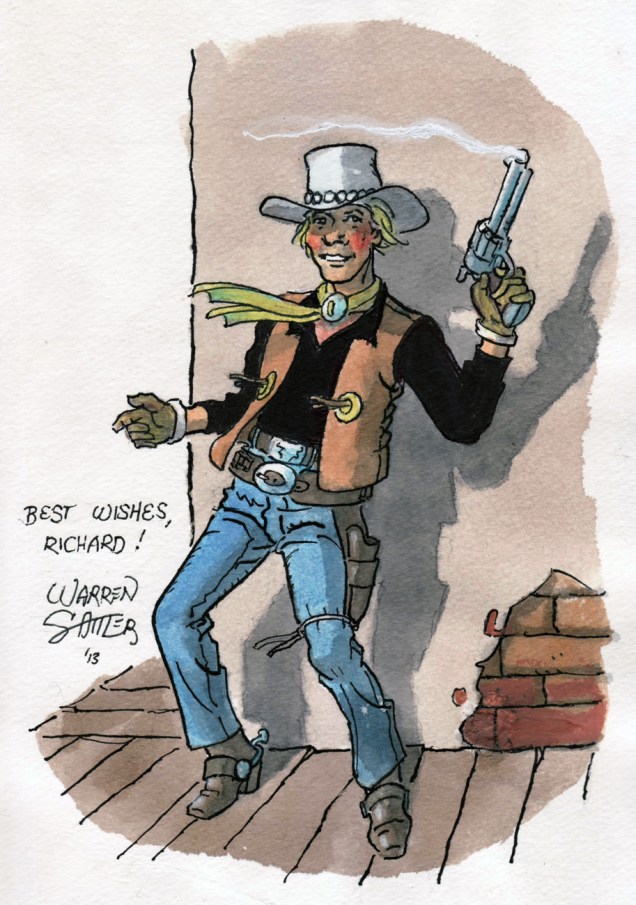
SattlerBillyA
Mr. Sattler, a true prince of a man, created this piece especially for me a few years ago… without any request on my part! But you can bet I’ll always be grateful for this touching act of generosity and kindness.

As El Chivito’s many friends across the border would surely say, « ¡Que cumplas muchos más! », and thanks for everything!

-RG

Treasured Stories: “The Night Dancer!” (1972)

« If i should sleep with a lady called death… » – E.E. Cummings

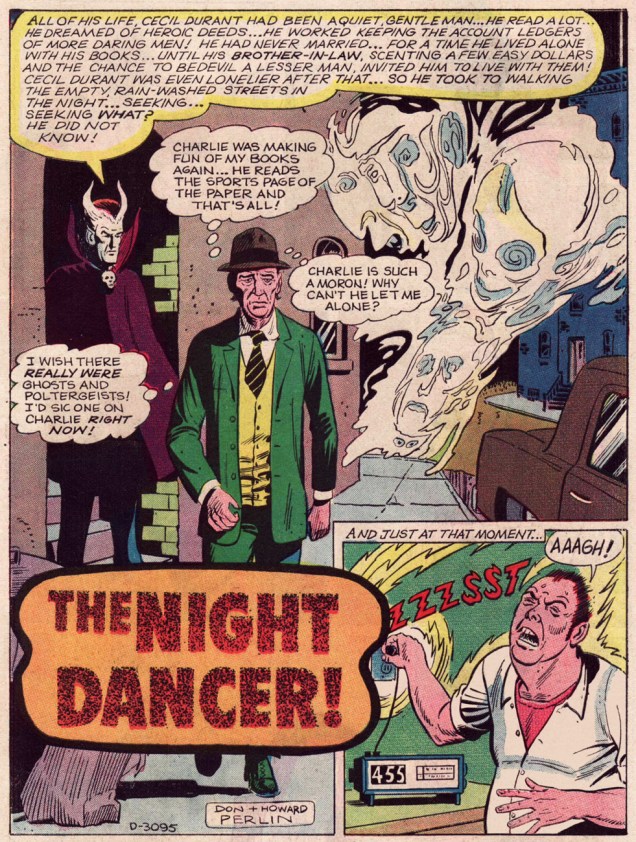
This time out, I’ve plucked a delicate story that’s resonated with me since our first encounter… somehow, the tragic plight of a lonely, vulnerable old man touched me deeply, even if I couldn’t have been more than ten years old when first I read it.

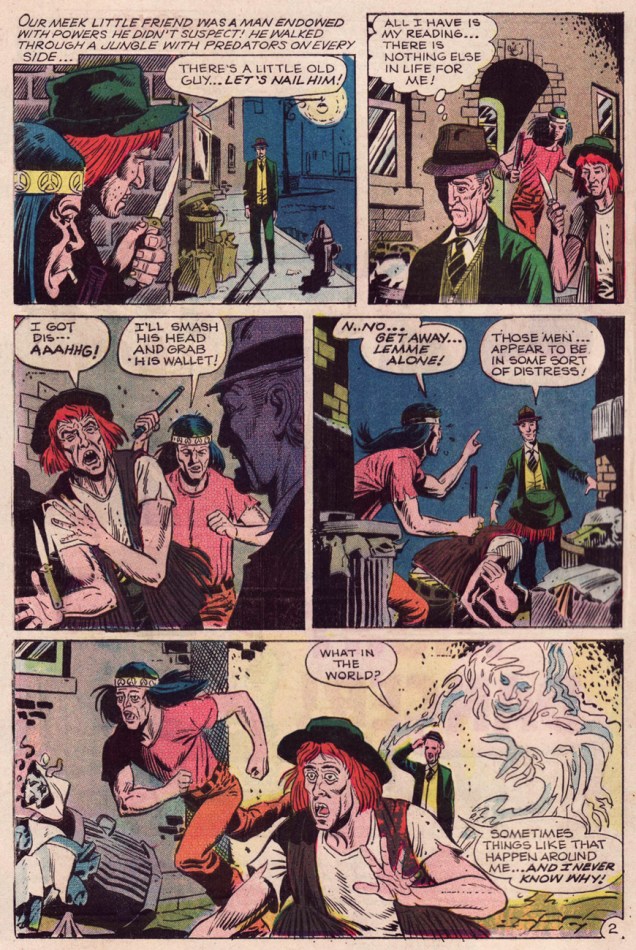
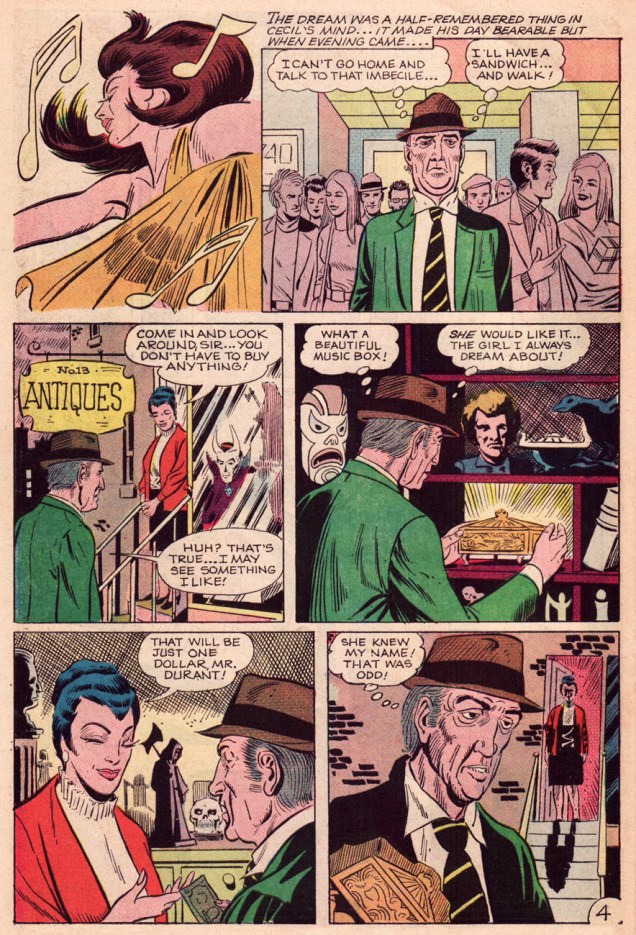
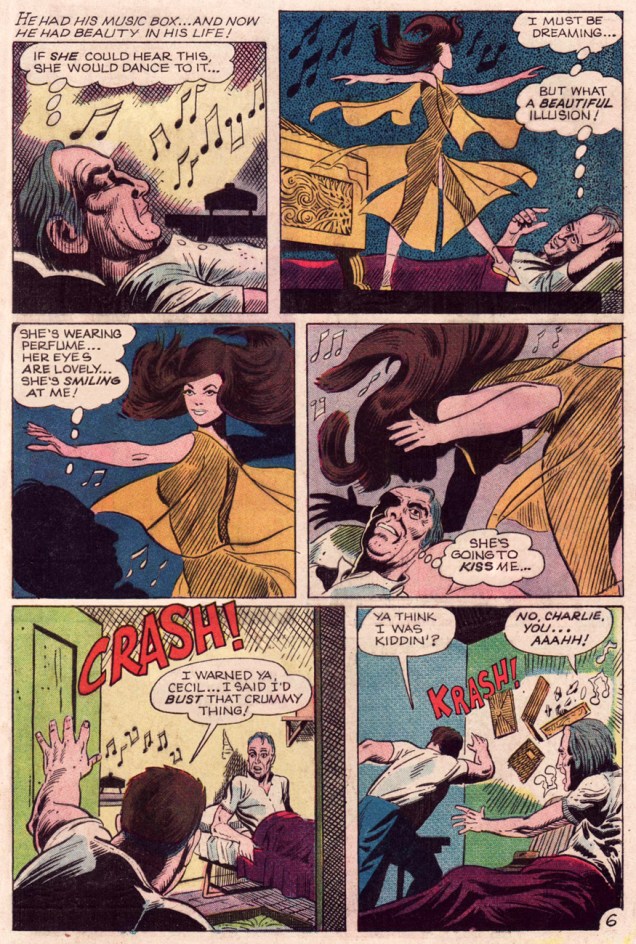
In the intervening years, witnessing the rise of elder abuse, the growing fragility of my own parents, and the sometimes desperate loneliness of acquaintances, old friends and strangers alike, Joe Gill and Don Perlin‘s The Night Dancer! (Ghostly Tales no. 99, Nov. 1972, Charlton) has steadily gained in poignancy. Its spirit, theme and mood remind me of some very fine tales by Joseph Payne Brennan*, who conveyed all too convincingly the quiet desperation of a near-destitute life lived with scant hope or companionship.

On a more cheerful note, it happens that (okay, it’s no accident) ‘Dauntless’ Don Perlin celebrates his eighty-ninth anniversary on this very day. While he’s most appreciated for his runs on Werewolf By Night, Ghost Rider, Moon Knight (his co-creation with writer Doug Moench) and The Defenders at Marvel Comics, I steadfastly cling to the notion that his finest efforts were brought to bear on hot rod and ghostly yarns for Charlton at the dawn of the 1970s. Judging by the results, I’d venture that he’s especially inspired by adventures set in the American Southwestern desert country. I’ll return to this topic in due time and present my case.

Without further tarrying ‘n’ foot dragging, meet our hapless protagonist, Cecil Durant… and his tormentors and benefactors.

PerlinDancer01APerlinDancer02APerlinDancer03APerlinDancer04APerlinDancer05APerlinDancer06APerlinDancer07APerlinDancer08A

While Mr. Perlin never became a superstar (and I suspect it never was his goal), the longevity of his career is easily explained: solid craft, excellent storytelling skills, a clean, unfussy line, and of course that supreme asset: reliability. Incidentally, co-credited Howard Perlin was Don’s young son, who was helping dad out around the studio that day.

Yom hu’ledet sameach, Mr. Perlin… and many happy returns!

– RG

*particularly The Way to the Attic (1967) and Mrs. Clendon’s Place (1984)

Pat Boyette — Hillbilly Makes Good*

« That young fella must be the college kid who’s going to work for my paper! Those two prairie wolves will pick him clean… it’ll be an excellent lesson to him, I reckon! » — Max Cogswell, editor-publisher of The Boothill Gazette

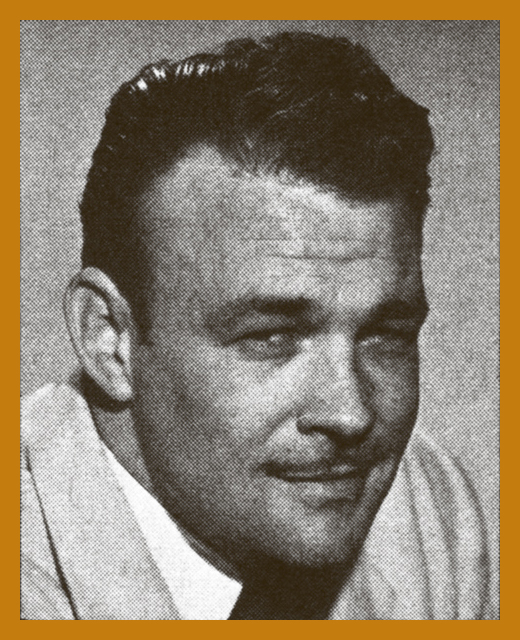
Today marks what would have been the ninety-fifth birthday of suave Texan Renaissance man Aaron P. “Pat” Boyette (July 27, 1923 – January 14, 2000). The Golden-voiced Mr. Boyette was in turn actor, radio announcer, cinematic auteur and of course a far-beyond-fine painter and cartoonist. Ah, and if anything could speak more eloquently of his worth as a human being, he was best man at Gus Arriola‘s wedding.

PatBoyettePortraitA
Didn’t I say he was suave?

Now, I could have focussed on any number of his remarkable projects: his 1966-67 run on The Peacemaker (« A man who loves peace so much that he is willing to fight for it! »), his tour-de-force fill-ins on DC’s Blackhawk (issues 242-43, from 1968), his lavishly-detailed work for Warren Magazines (1968-72), his brilliant, but admittedly controversial, run on The Phantom at Charlton (1970-73), his far-better-than-its-source adaptation of Hanna Barbera’s Korg 70,000 B.C., his intense The Tarantula for Atlas-Seaboard (with Michael Fleisher, 1975), his fun revival of Spencer Spook for ACE Comics in the 1980s, or any of his moody work for Charlton’s ghostly anthologies… but I won’t, at least not this time.

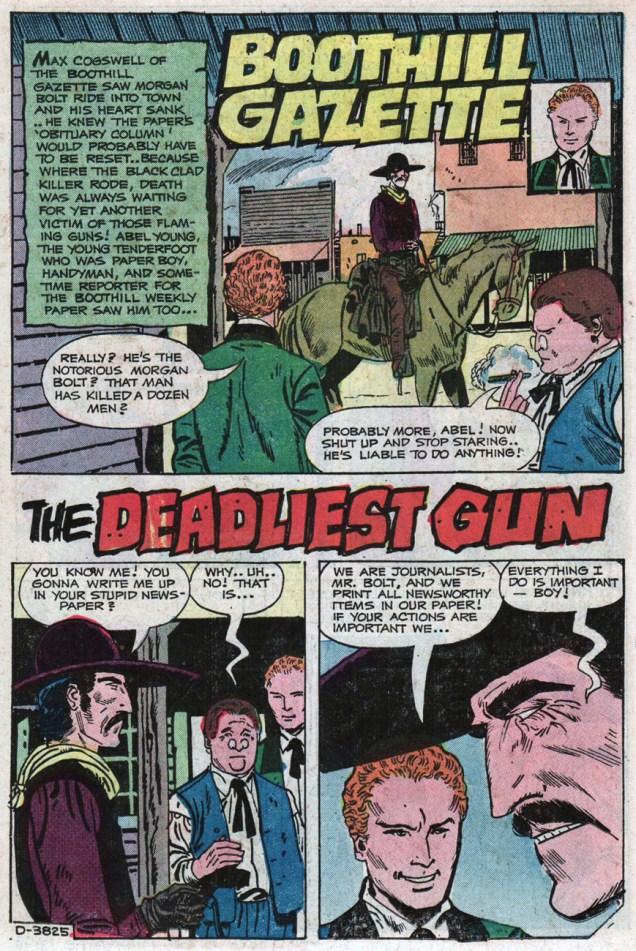
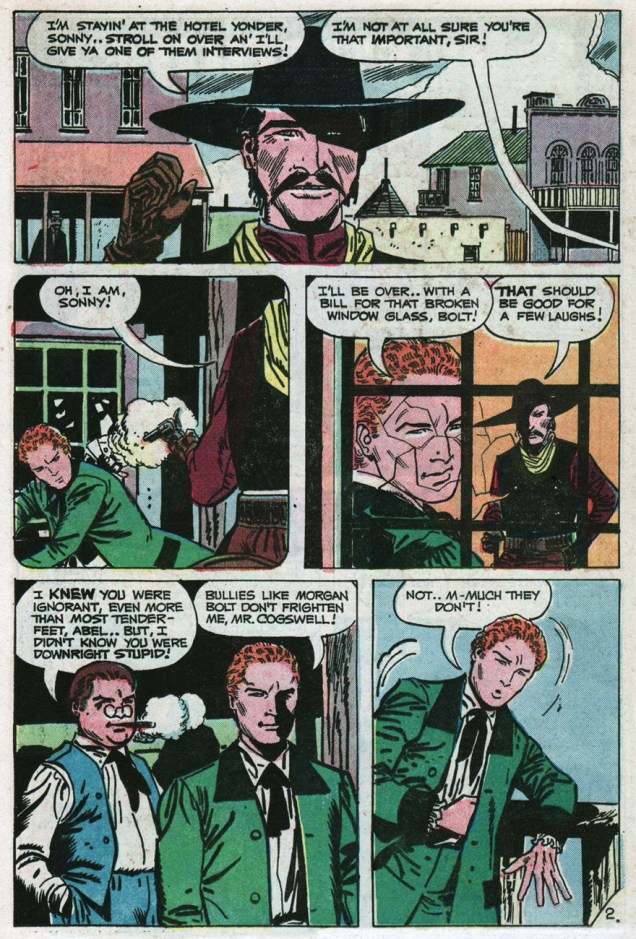
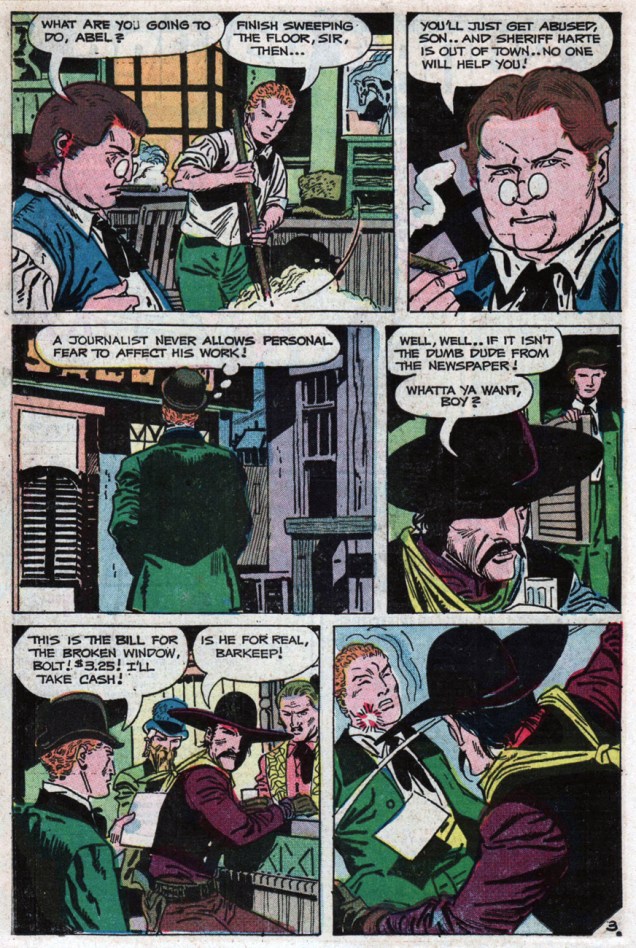
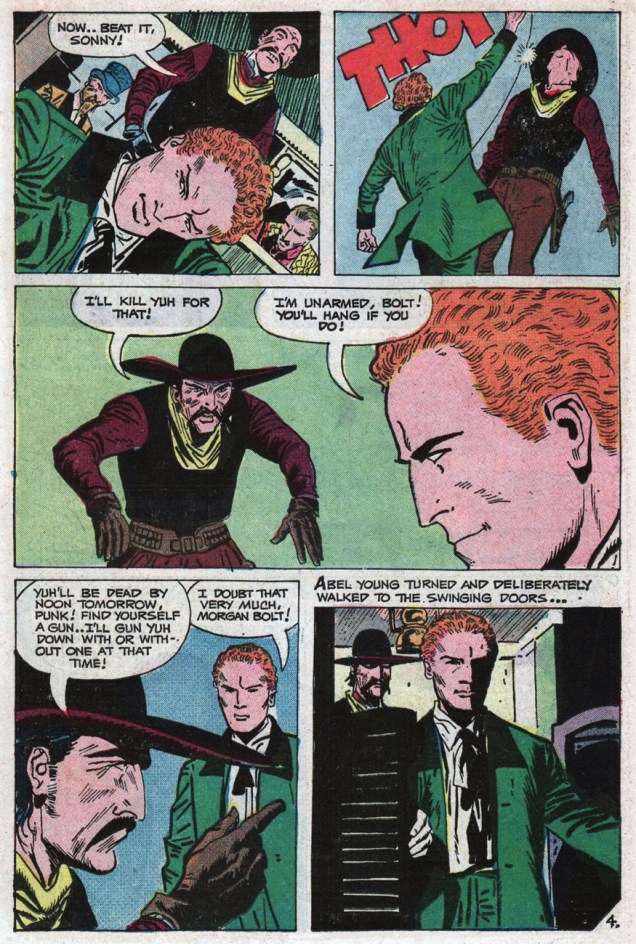
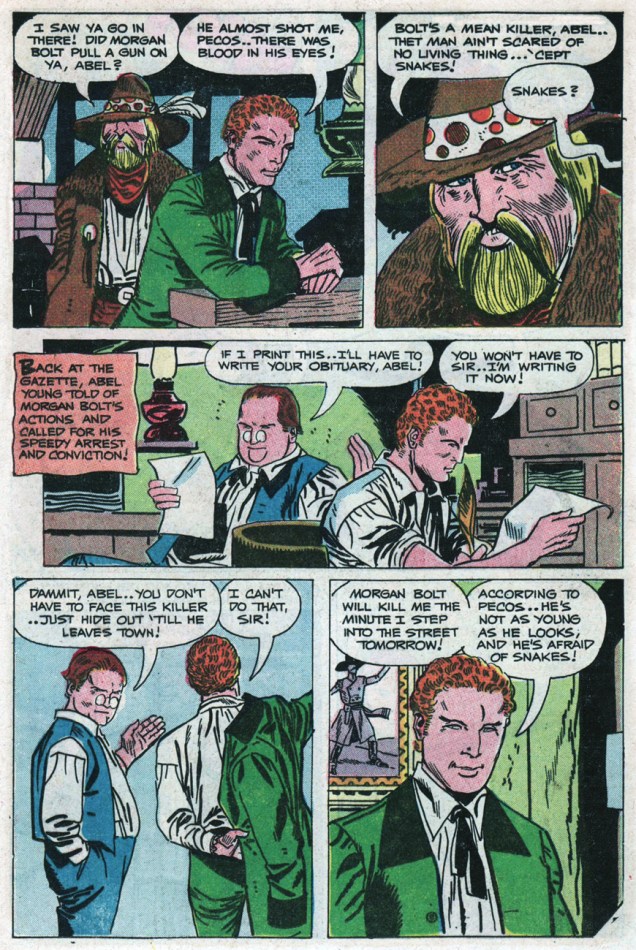
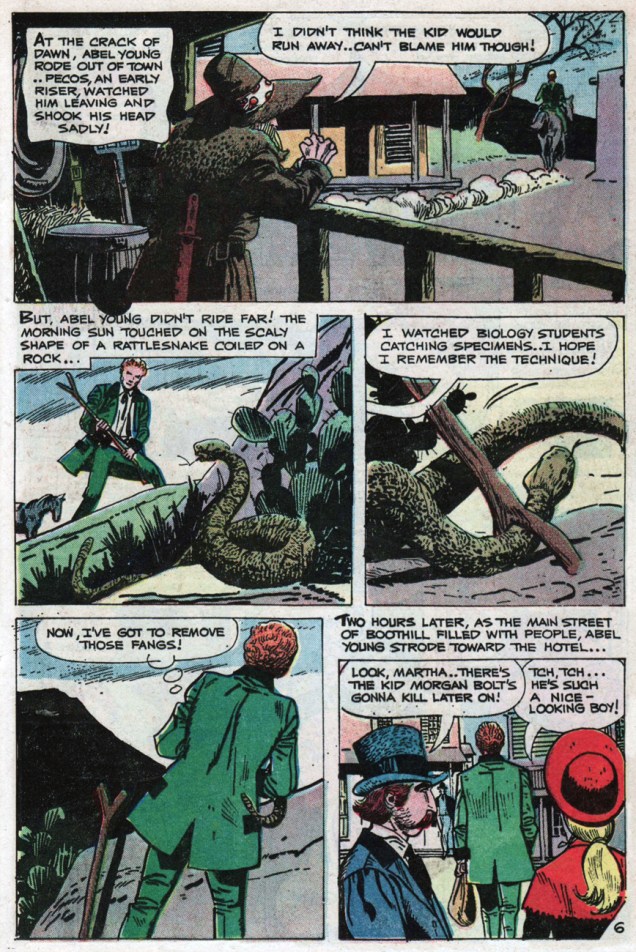
Instead, if you’ll bear with me, we’ll take a gander at a fine, fine backup series he co-created with Joe Gill for the pages of Charlton’s long-running Billy the Kid. Mr. Young of the Boothill Gazette (BTK 88, Dec. 1971, to BTK 110, Dec. 1974). Abel Young, bereft of sharp-shooting or pugilistic skills, is a true hero: a fool, an idealist, a stubborn cuss who acts nobly even when he’s scared spitless. His is a charming strip, full of graceful humour and humanity.

Here, then, is my selection: the series’ thirteenth episode, originally published in Billy the Kid no. 100 (March, 1973, Charlton).

BoyetteBoothill01ABoyetteBoothill02ABoyetteBoothill03ABoyetteBoothill04ABoyetteBoothill05ABoyetteBoothill06ABoyetteBoothill07A

Happy birthday, Mr. Boyette. The world needs more gentlemen of your ilk.

-RG

*so proclaimed the headline of a Boyette profile published in Creepy no. 33 (June 1970, Warren).

Tentacle Tuesday: Plants Sometimes Have Tentacles, Too

The topic of today’s Tentacle Tuesday is based on a plant-based mishap. I was walking along an alley, minding my own business, when some sort of climbing plant with especially long and vicious tentacle-vines, swinging from from a nearby fence,  grabbed my arm. The result were scratches that felt like burns.*

So today’s gruesome offerings are mostly cousins of the Venus Flytrap, if the latter had tentacles to assist its quest for prey. (Let’s breathe a sigh of relief that it doesn’t.)

MidnightTales6-HowardWayne
Midnight Tales no. 6 (November 1973), cover by Wayne Howard. I am a big fan of Midnight Tales and its blend of humour and adventure. Note the “created by Wayne Howard” announcement on the cover, which wasn’t exactly typical for its time – comic book companies didn’t use to acknowledge the creators of their “content” so openly and insistently.

Midnight Tales often offer moments of “wait, how did that get through the Comics Code?” Arachne (Professor Coffin’s undeniably attractive niece) is frequently more sexually provocative than one would expect from a kid-appropriate comic, crimes committed are nastier than surmised, and the plots go from morbid to surreal… with some comedy thrown in. Oh, sure, there’s some terrible clunkers, as every issue has three or four stories linked by a common theme and illustrated by different artists, but overall the quality remains high throughout its 18-issue run.

I’ve seen people online saying that Howard shamelessly plagiarized Wally Wood’s style – perhaps people more erudite than I see that, but I don’t. “Influenced” is one thing – but one can build on those beginnings to create a recognizable style of one’s own, right? Those who like Wayne Howard frequently classify him as a “guilty pleasure”, and proceed to insult his art while they’re explaining why they like it. To quote, for instance, from Atomic Avenue, who follow the unspoken rule – just mentioning Charlton Comics warrants a condescending tone, and any acknowledgement of their quality has to be tempered by mockery. 

Creator Wayne Howard blatantly imitated the style of comic art great Wally Wood right down to his gothic signature, but at least he aimed high in his plagiarism. Consequently, Midnight Tales had the look of a seedy, off-register knock-off of an EC horror comic—putting it at the top of Charlton’s quality spectrum.

Another opinion from Cap’n’s Comics:

In my world of geek’n out over all this great art, Wayne Howard is one of my biggest guilty pleasures. He loves to draw like Wally Wood, but he’s no Wally Wood. His females usually look like Wally’s women after a really bad day, and his males are just plain fugly. His Wood machinery is close to the background machinery behind the awesome machinery, and everything shouts fan art VS pro art, but… Luvittopieces

Ah, well. I won’t be apologetic about liking Howard’s art, and Midnight Tales will be proudly presented as a favourite series on a need-to-know basis. Fortunately, there’s some nice articles about him, too – a sort of obituary for a great African-American artist who died at only 58.

TentacleTuesdayIcon

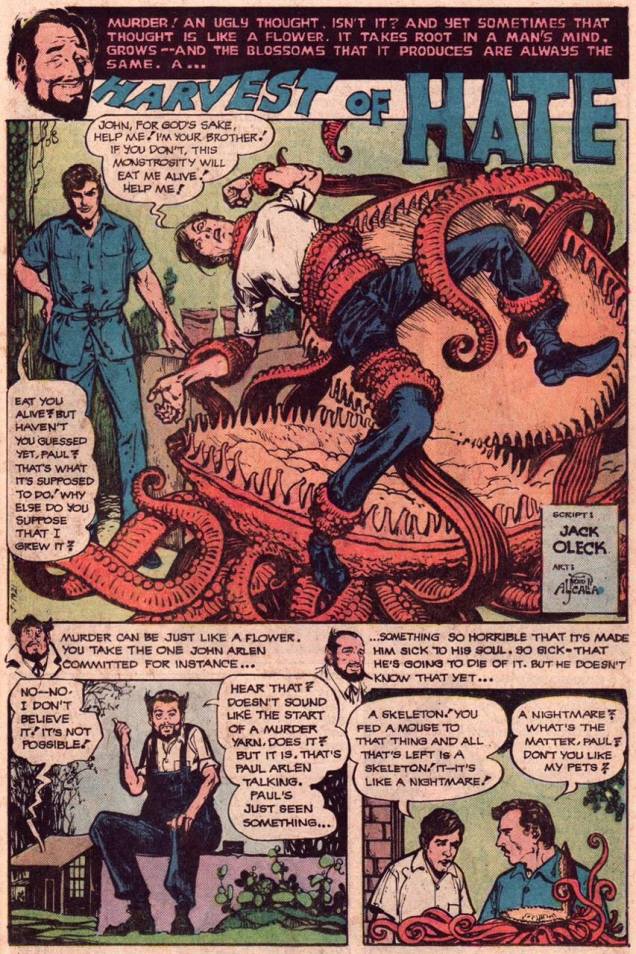
Another Flytrap for your enjoyment, in this tale of brotherly rivalry:

HouseofMystery251-HarvestofHate1
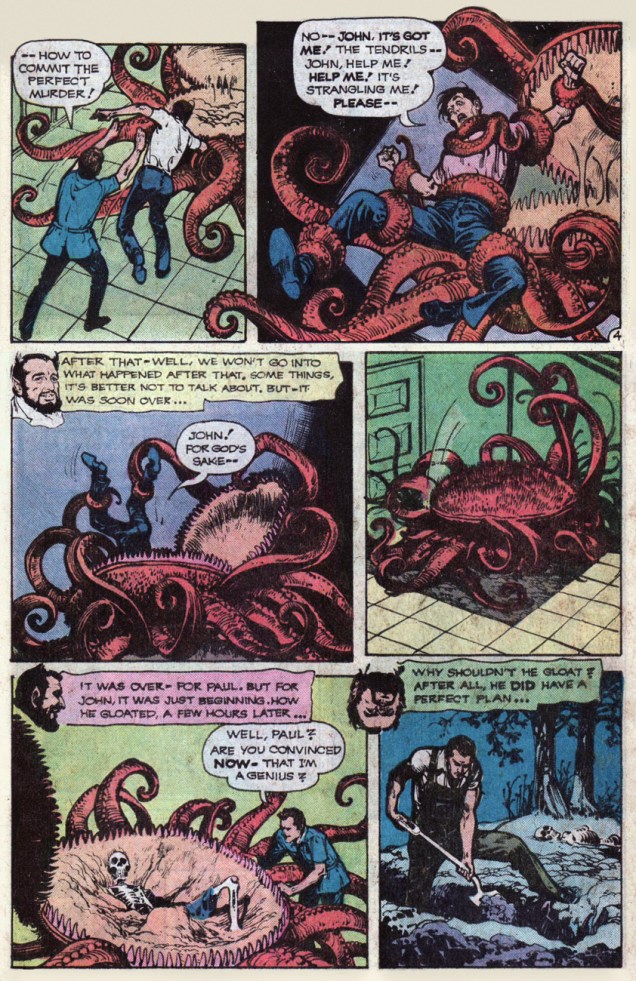
“Harvest of Hate” was scripted by Jack Oleck and drawn by Alfredo Alcala (speaking of whom, I still can’t get over how beautiful his signature is.) Page scanned from House of Mystery no. 251 (March-April 1977).
HouseofMystery251-HarvestofHate2
Don’t worry, the “gardener” who fed his brother to this man-devouring monstrosity gets his comeuppance, all right.

The cover of this issue of House of Mystery is also a good exhibit of plant tentacles, even if the children are a superfluous addition:

HouseofMystery251-NealAdams
House of Mystery no. 251 (March-April 1977), cover by Neal Adams.

TentacleTuesdayIcon

Here’s something more recent – published on some almost-thirty years ago, instead of forty – the tentacular adventures of Doctor Gorpon! I hope these guys count as plants (even if they’re slightly more mobile) – they’re the right shade of green!

DoctorGorpon#2-MarcHansen
Doctor Gorpon no. 2 (July 1991) by Marc Hansen. The little guy in the right bottom corner is extra-cute – if only all children looked at their parents with the same sense of admiration and awe! It’s “Ooze Me, Baby!”

I only finished reading this three-issue series today, and I must say, it was an exciting ride. Highly recommended (if you can find it, that is).

DoctorGorpon3-MarcHansen-Splash
A panel from the aptly-titled “Big Eyeballs!”, published in Doctor Gorpon no. 3 (August 1991).
Gorpon2-MarcHansen-Doofus
A page from “Big Eyeballs!”, published in Doctor Gorpon no. 3 (August 1991).

~ ds

*
Plantburns