« I know what’s the matter with your comic artists, they’re all crazy. »
« Of course they’re crazy, they wouldn’t be worth a whoop if they weren’t crazy. »
Today we commemorate the birthday of Popeye creator Elzie Crisler Segar (December 8, 1894 – October 13, 1938). The man succumbed to leukaemia and liver disease at the distressingly early age of 43… but not before making his everlasting mark on the world of cartooning and the world at large.
In this Popeye Sunday strip dated August 14, 1938, J. Wellington Wimpy ably demonstrates his solid-gold mooching wiles.
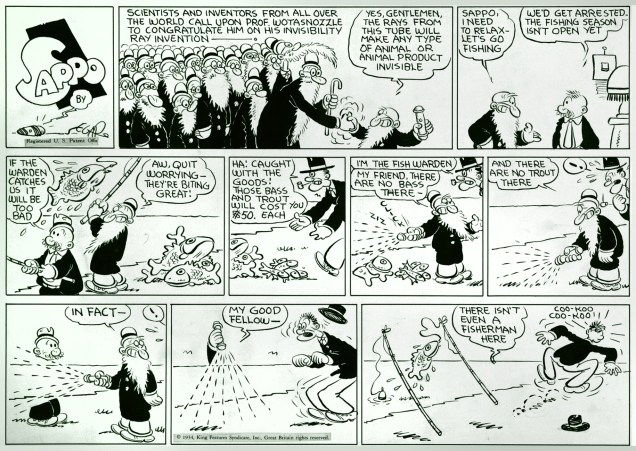
And for dessert, have a chaser of Segar’s even more endearing (in my opinion) companion strip, Sappo, featuring his delightfully bonkers Professor O. G. Wotasnozzle.
Sappo appeared as Thimble Theatre / Popeye’s “topper” on Sundays. This out of sight entry appeared on April 8, 1934.
Happy Birthday and bon appétit, Mr. Segar, wherever you are!
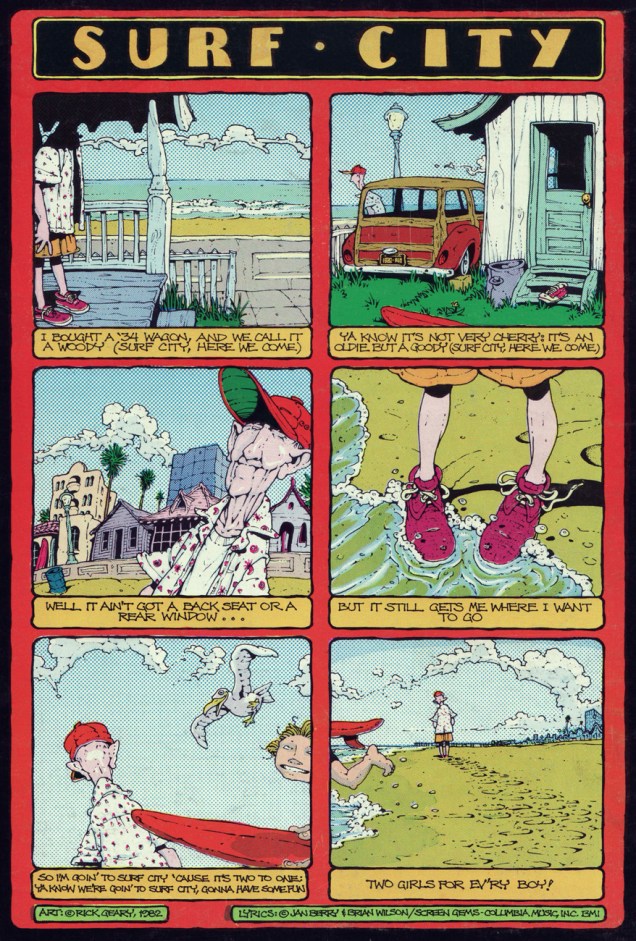
Rail-Bangin’ Rick Geary gives us a not-entirely-literal, yet oddly fitting visual representation of Brian Wilson and Jan Berry’s timeless classic, a number one hit for Jan & Dean in the Spring of 1963. Wilson’s original working title for the tune was “Goody Connie Won’t You Come Back Home“, perhaps a tad less catchy appellation.
Surf City, the strip, appeared on the back cover of the lone issue of Bop, “America’s First & Only Music Comix Magazine“ (1982, Kitchen Sink Press.) Edited by Catherine Yronwode.
Let’s start with something hair-raising. Well, not really – we’re a blasé audience, and it takes something special to truly scare us. Yet can you deny the foul-smelling, palpable sense of foreboding, the billowing and swirling nightmare that beckons from the elegant inks of this page?
« She boiled up out of the sea that hellish night — a monstrous hideous creature, she was, with the craggy face of an evil eyed witch! » Giant-Size Chillers no. 1 (February 1975). The cover promises a « frightful, fearful first issue! » Does it deliver? Eh, not really. Here’s a page of the best story in it, The Gravesend Gorgon, scripted by Carl Wessler and pencilled + inked by Alfredo Alcala.
Gravesend is an ancient town in northwest Kent, England; as for the gorgon part, it’s not entirely accurate, but it’s clear that comic writers cannot resist an alliteration.
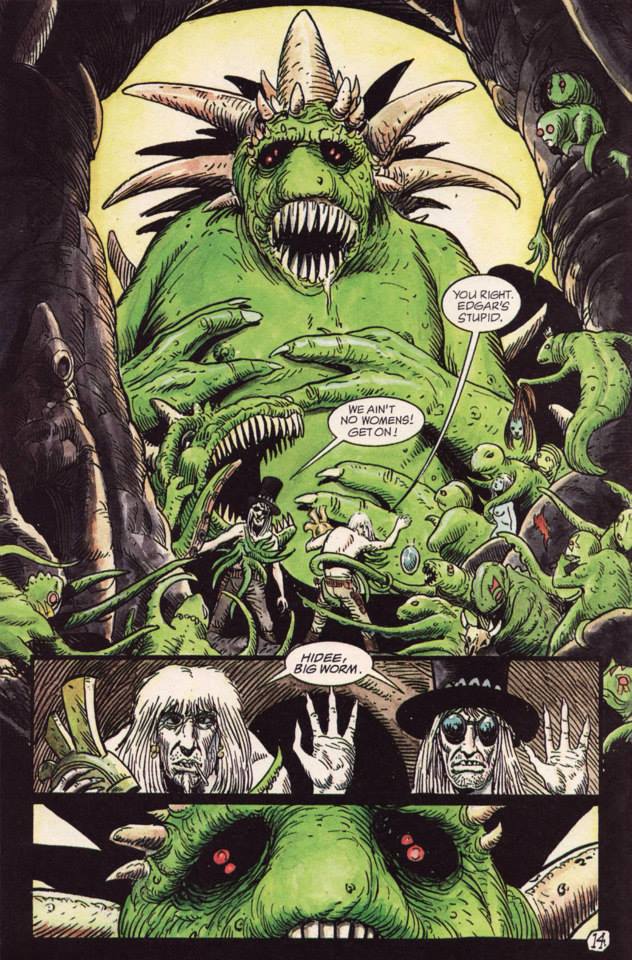
On a slightly more humorous front (unless one is directly involved with this green monstrosity, in which case the situation would quickly lose its humour), here’s a page that hails from Jonah Hex: Riders of the Worm and Such no. 4, (June 1995). The story features the half-worm, half-human albino Autumn Brothers, whom you can see here greeting the big worm-momma. Texas blues rockers Johnny and Edgar Winter attempted to sue, but the suit was dismissed after a judge begrudgingly ruled that « the First Amendment dictates that the right to parody, lampoon and make other expressive uses of the celebrity image must be given broad scope. » Thank you, Los Angeles court. Frankly, it seems that the brothers are more remembered for the lawsuit than their music.
« Sure like to make big worm happy, whatever she want. Not care much for tentacle down throat. » Jonah Hex: Riders of the Worm and Such no. 4, June 1995. Scripted by Joe R. Lansdale, pencils by Timothy Truman, inks by Sam Glanzman.
Jonah Woodson Hex, created by writer John Albano and artist Tony DeZuniga in 1971, curmudgeonly and disfigured but bound by a personal code of honour, is a favourite character of mine, although I only like the way he is written for DC’s Weird Western Tales. Well, with one exception, this one! I most tentacularily recommend Jonah Hex: Shadows West, a collection of the three Vertigo-published mini-series scripted by Lansdale and illustrated by Tim Truman and Sam Glanzman, containing the stories Two-Gun Mojo, Shadows West and Riders of The Worm and Such.
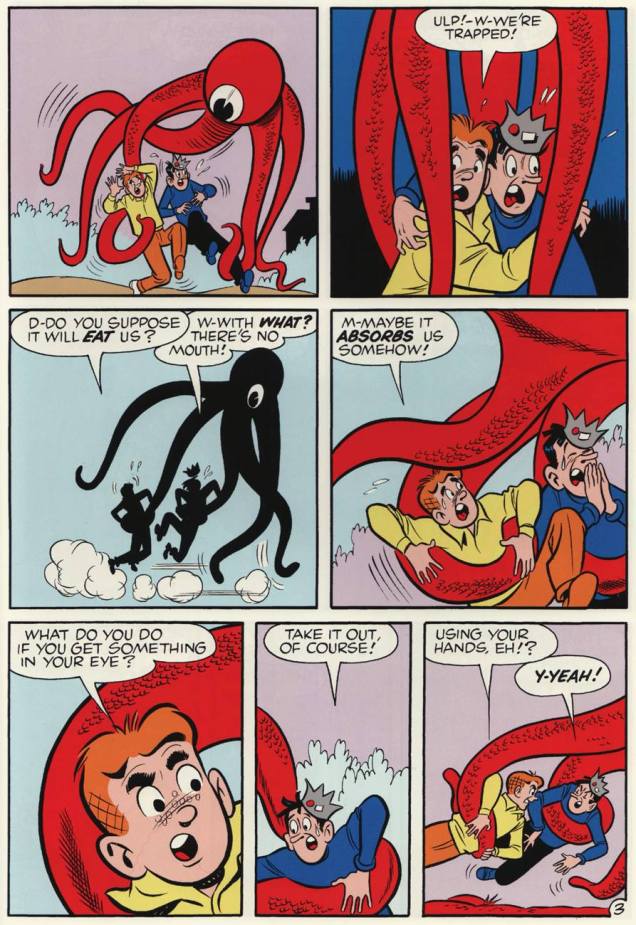
And to wrap this up, on an even goofier note, here’s Jughead getting into yet another weird situation, which is pretty standard for him.
This page from The Eyes Have It comes from Jughead no. 77 (October 1961). Script by George Gladir, pencils by Samm Schwartz, inks by Marty Epp. Schwartz is absolutely the best Archie artist to draw tentacles; most everybody else would have made a mess of it.
« In the big wrinkled world, it would be like looking for a straw in a needle stack…»
Based upon, but with savvy improvements, Peter Sellers‘ Inspecteur Jacques Clouseau from the popular series of films launched with 1963’s “The Pink Panther“, the animated Inspector and the titular feline (who first appeared in the opening credits of the film) were spun off into a pair of successful series of animated shorts. Produced by DePatie-Freleng Enterprises, these series have earned their place as highlights of 1960s animation, though the competition was pretty toothless, compared to prior decades.
As for funnybooks, Gold Key’s “The Pink Panther and the Inspector” title was a solid success, lasting 84 issues (73 under the GK imprint, then 11 more under Whitman, 1971-1984), leading to a solo spinoff for The Inspector (19 issues, 1974-78). This is surprisingly witty stuff, written and drawn with assurance and verve. Comic strip great Warren Tufts (creator of Casey Ruggles) was reportedly involved, though when it comes to Gold Key and Dell, credits are at best sketchy.
This is issue 2 of The Inspector (Oct. 1974, Gold Key.)Speaking of the « Case of the Stolen Kiss », here’s a rather… daring public display of affection! This being Gold Key, the material was not submitted for approval to the industry’s censorship body, the Comics Code Authority.
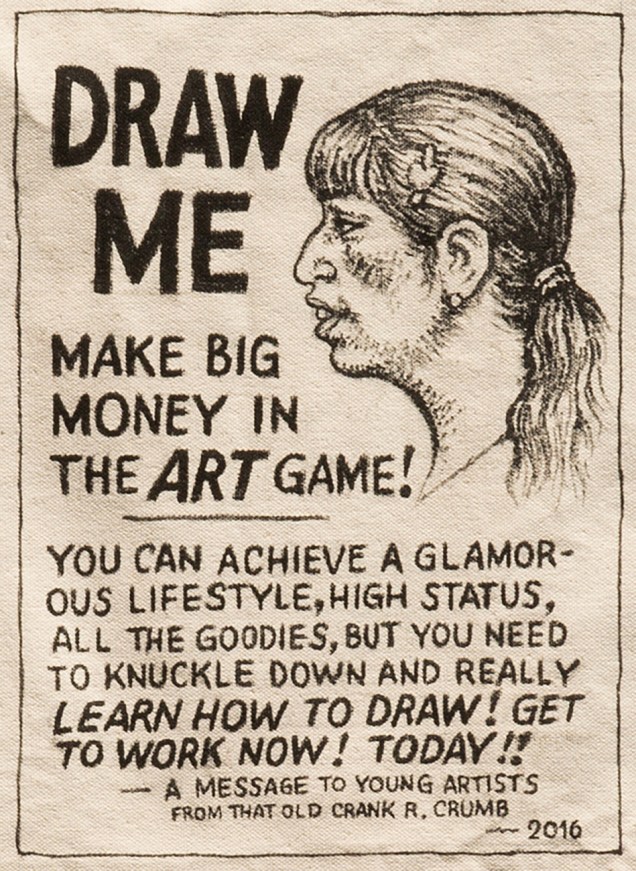
A couple of days ago, I came upon a recent piece by the one-and-only Robert Crumb, one that’s currently up for (well-heeled) grabs through the auspices of Heritage Auctions.
Quoting Heritage’s description: « Robert Crumb and Others – ‘Spike and Mike’ Jam Mural on Canvas (2015-16). An approximately 80″ x 60″ sheet of canvas, with sketches on both sides. Chief among them is a “Draw Me” ad parody by Robert Crumb. Getting Mr. Crumb’s involvement was not easy; it took a friend lugging this oversized piece of canvas around Europe to track down the elusive artist, but the results were worthwhile. Crumb’s art measures 8″ x 11″, and is on the “unfinished” (cream-colored) side of the canvas, with several other sketches. »
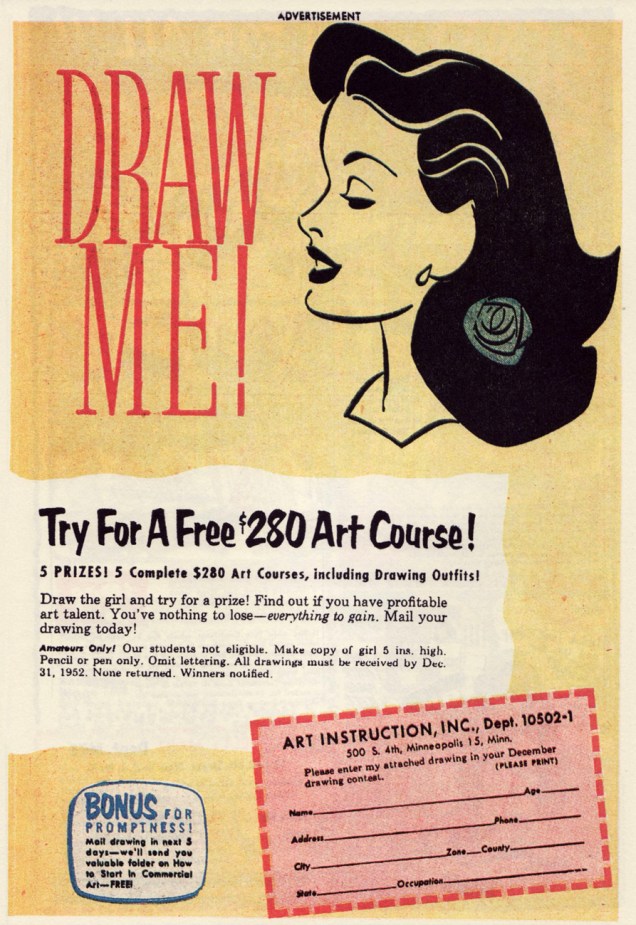
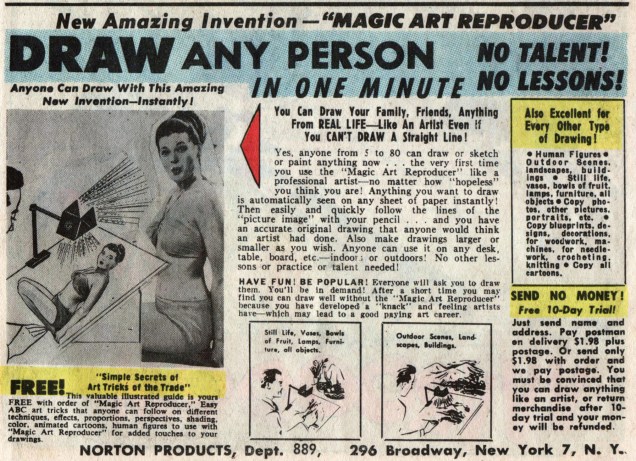
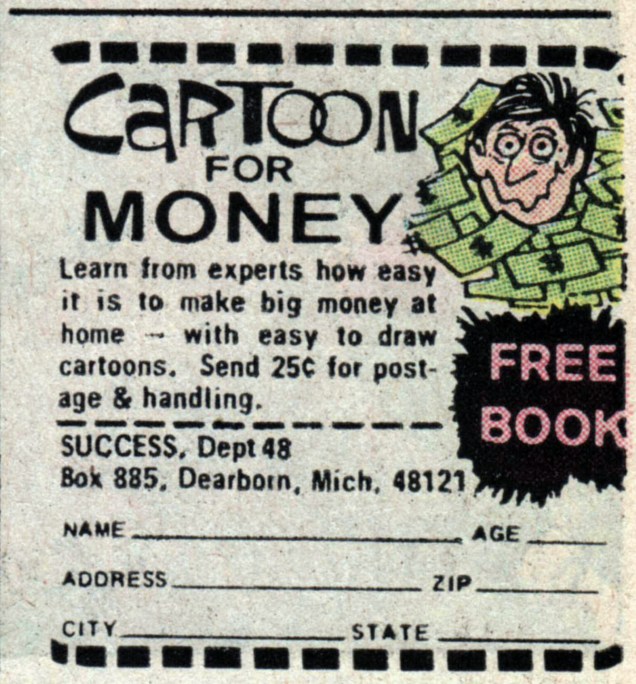
It brought to mind the rich, if often sordid, history of art lessons offered in comic book ad spaces. Here’s a sampling.
The face that launched a thousand backroom businesses, and the object of Crumb’s homage/parody (1952). Note the sharp bit of self-serving credibility-boosting: « Amateurs Only! Our students not eligible. » The implication being that, naturally, their students are now all successful, seasoned pros… but you still need to tell them to butt out of the contest. The beautifully-drawn girl anticipates Jaime Hernandez‘s stripped-down style, if you ask me.Apparently a dry run (1954) for the great Joe Kubert’s School of Cartoon and Graphic Art (established in 1976, and still around); its (early) graduates include Stephen Bissette, Rick Veitch and Timothy Truman. Joe’s then-partner Norman Maurer, aside from being a fine cartoonist himself, was the son-in-law of Stooge Moe Howard, for which Maurer produced many 3 Stooges cartoons and comic books. Maurer and Kubert were also co-originators (with Leonard Maurer) of 3D Comics in 1953.Well, if you can’t draw… there’s always tracing; though even there, talent is an asset (1963.) According to Kirk Demarais‘ excellent book, Mail-Order Mysteries, this was « a rip-off. »This little ad was quite ubiquitous in 1970s comics. Was the product offered worth a damn? The mystery endures; well, that and the newly-wealthy cartoonist’s memorably frazzled expression.Roy Wilson’s book can still be found with a little digging. It certainly boasts a great cover. I’d mark this one as an honest enterprise (1973.)According to Kirk Demarais, You received « A thirty-two page booklet that teaches you, not only to draw monsters, but how to draw, period. Art history and artists’ tools and techniques are covered, along with a gruesome collection of creeps. It’s all presented with a healthy dose of encouragement for young pencil bearers. » Monsterman (aka Harry Borgman) earned himself a thumbs-up verdict from Mr. Demarais: « In a sea of shysters, Borgman is the real deal. » (1975)Mail Sack, Inc.? Still, a quarter doesn’t seem like too much of a gamble… (1971)Corner-cutting maestro and Marvel yes-man Big John B.’s art class gave the world such enduring talents as… er, Bob Hall. (1976)For some reason, this one leaves me… somewhat skeptical (1978.) Nice perspective, chump.And of course, we can’t leave out the cream of the crop (1982.)
Mr. Crumb is right, of course: the bottom line is that « You need to knuckle down and really learn how to draw! »
Welcome to Tentacle Tuesday! We now have an official logo for T.T., courtesy of my husband and fellow blogger. It’s brand-spanking new, so here it is in a fairly high resolution.
Give him a round of applause… oh, what’s that, it’s hard to applaud with tentacles? Okay, a round of « squish, squish », then.
Let’s begin (proper) with « The Thing on the Roof », adapted by Roy Thomas from a story by Robert E. Howard. The latter was a member of the renowned Lovecraft circle, so the Chthulian vibe of this is no accident. It’s illustrated by Frank Brunner, who does a bang-up job – the man was asked to draw the love child of a dragon and an octopus, and he did not disappoint!
The Thing on the Roof from Chamber of Chills no. 3 (May 1973, Marvel.)
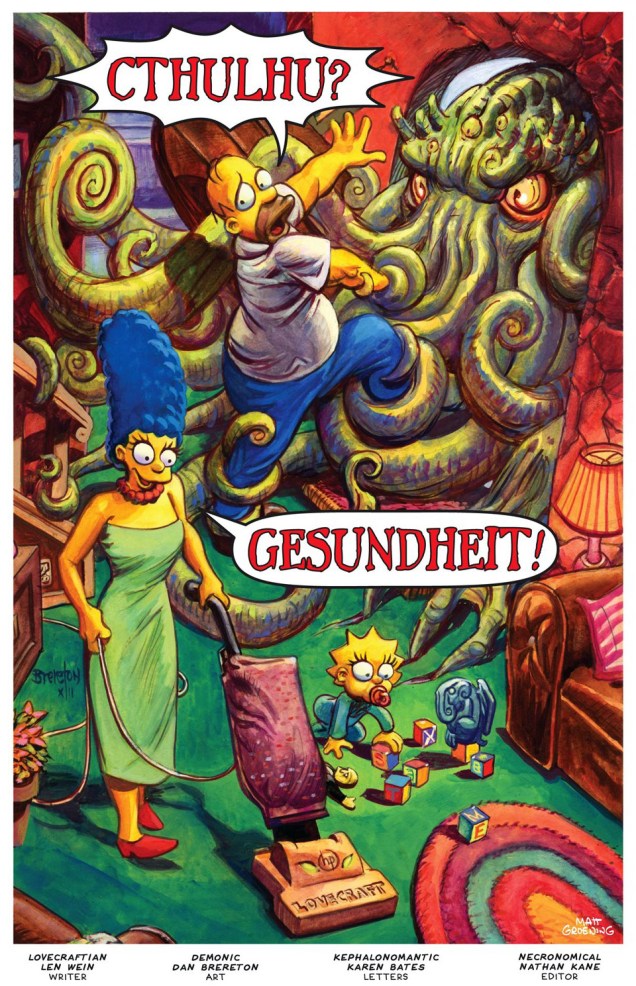
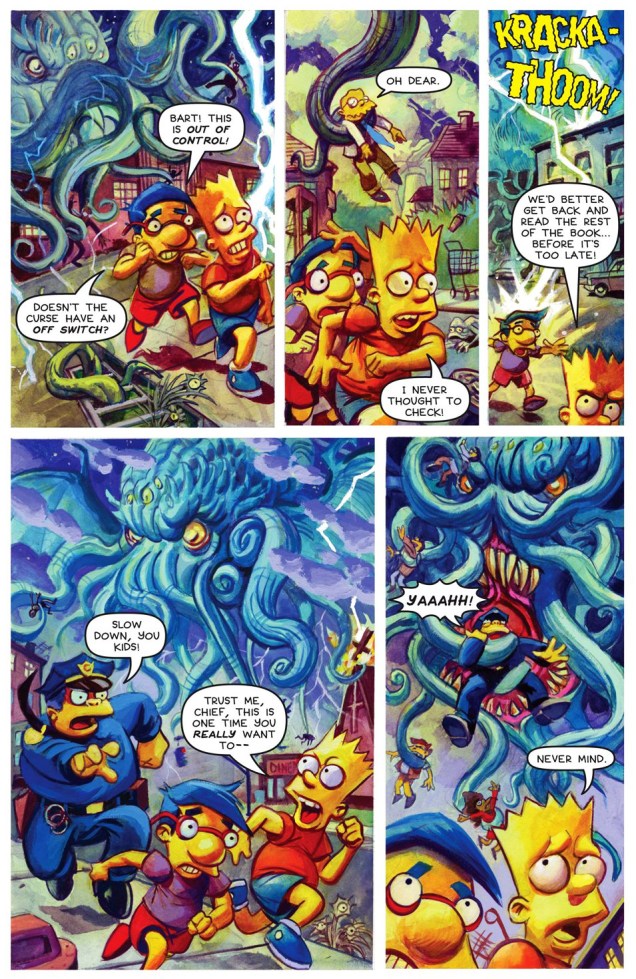
Continuing in a similar vein (but fast-forwarding 40 years), here’s a terrific story from Bart Simpson’s Treehouse of Horror #19 (September 25th, 2013) which is so chock-full of tentacles that it could be a post all by itself. Written by Lovecraftian Len Wein and illustrated by Demonic Dan Brereton, it ranks as one of the top Treehouse comic stories as far as I’m concerned… but then I might be slightly biased. Or possessed by Chthulhu, whichever.
I want a Lovecraft vacuum cleaner. *hint, hint*In this story, *everything*, animate and inanimate, sprouts tentacles.The dramatic/sublime/ludicrous wrap-up! Sorry to give the plot away. Yum, they even remembered to stick an apple in Milhouse’s mouth (it keeps him from screaming, I suppose). Did Lisa forget she’s a vegetarian?
I couldn’t help but post at least three pages of this story – hell, I was tempted to post it in its entirety – but I’ll let you do the work. Go read the whole thing here.
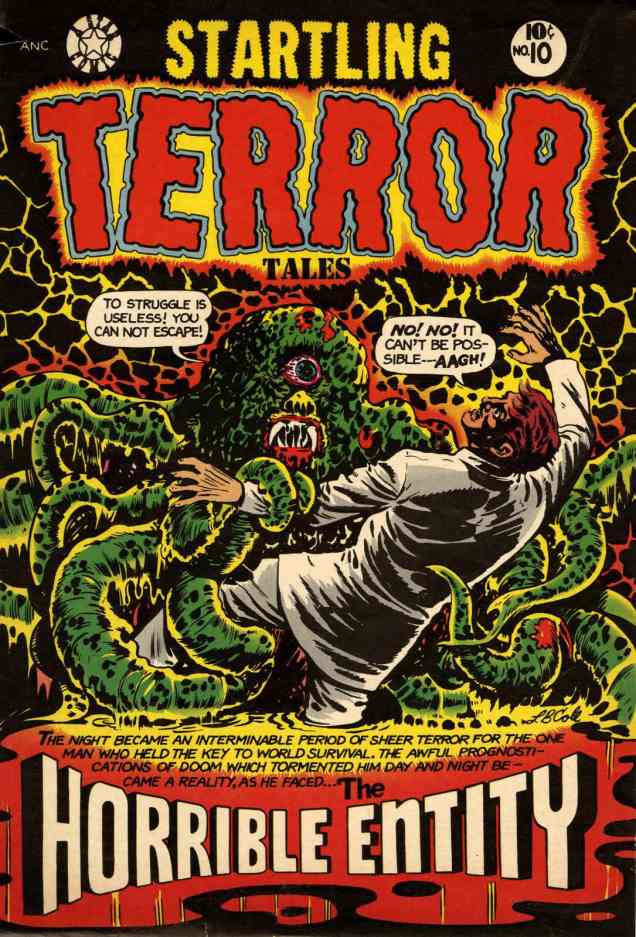
And to wrap up, let’s go back half a century or so, to the Miss Horrible Entity 1954.
This striking cover is by L.B. Cole, who can always be relied on to provide us with some eye-popping colours. He’s also got a knack for depicting especially disgusting, moist and fleshy tentacles, don’t you think? Startling Terror Tales no. 10 (August 1954).
What I want to know is who, upon being startled by a cephalopod cyclops with vampire fangs and one very bloodshot eye, describes it as an “entity”? “Monster”, sure, even “beast” or “demon” or “creature”, but “entity” (defined as “a thing with distinct and independent existence” by Webster’s)? If you’re going to be *that* stuffy, maybe you deserve to get eaten.
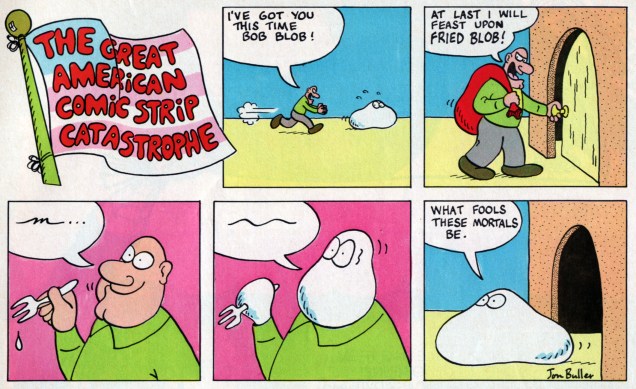
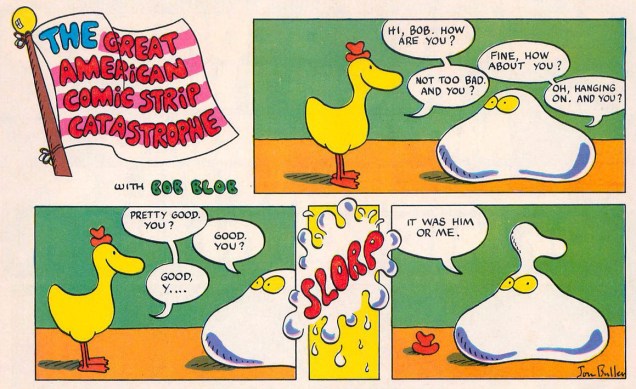
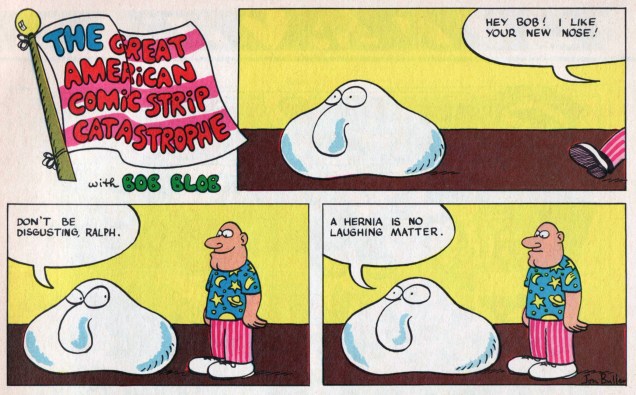
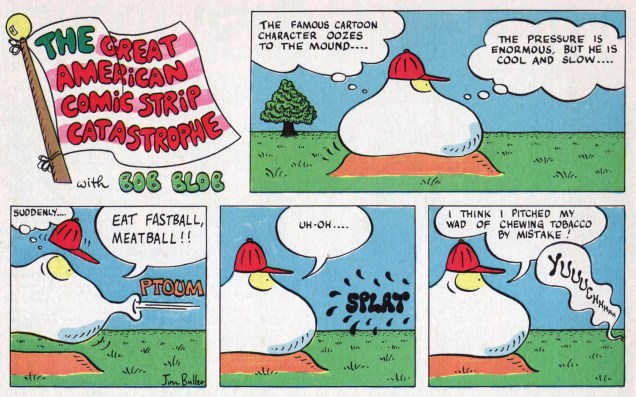
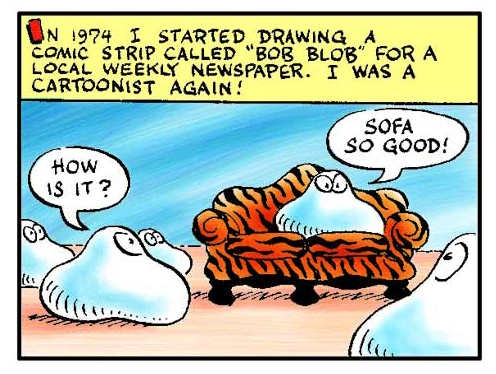
If you’ll just bear with me, we’ll take a peek at a bit of an obscurity, one that’s struck a resonant chord in me. It’s called Bob Blob, and I first encountered it in the June, 1978 issue of Marvel’s Dynamite Magazine knockoff, Pizzazz (1977-79). “The Great American Comic Strip Catastrophe” had been part of the magazine’s lineup since its inaugural issue, but had pretty thoroughly failed to live up to the promise of its title. With issue 9, the magazine’s “First National Edition“, Jon Buller‘s Bob Blob oozed into view and relieved readers from the pedestrian ‘funny animal’ antics just taking up space and failing to bring about the announced, and hoped-for, comic strip catastrophe.
For its final four issues, Pizzazz adopted as its motto “Humor in the Marvel Manner“. If you ask me, that’s what dragged the magazine down: Dr. Doom knock-knock jokes? Er, no thanks. It’s when the humour veered away from said ‘Marvel Manner’ that Pizzazz acquired some actual pizzazz. Bob Blob was at once hi-concept and lowbrow, and one gets the sense that Jon Buller could have spun endless, increasingly surreal variations on his theme, but the magazine lasted but a scant sixteen issues, and ran only eight Bob strips.
Here they are, in order of publication and everything!
This particular strip anticipates Larry Cohen‘s cautionary horror satire The Stuff (1985).
According to Jon Buller, Bob was born… well, let him tell the story:
Read in full Jon Buller’s story in cartoon form, of which this is panel 8 of 13 (go ahead, it’s concise, splendidly told, and well worth your time)
Buller went on to illustrate countless books (sixty at last count!) written by his equally talented wife, Susan Schade. To name but a few: Riff Raff Sails the High Cheese, Anne of Green Bagels, Dracula Marries Frankenstein, No Tooth, No Quarter!, Baseball Camp on the Planet of the Eyeballs, Ron Rooney and the Million Dollar Comic…
November is pretty much the last month of the year when you can find some edible mushrooms around. We’ve been picking (and eating) all the wild mushrooms we could get our hands on, and it must have been through sheer luck that I haven’t encountered *this* guy yet…
This fearsome fungus comes to us from the talented pen of Ken Reid (1919-1987), a British comic artist and writer, who may have been ingesting a few mushrooms himself when he drew this.
Reid drew three sister series (World Wide Weirdies, Creepy Creations and Wanted Posters) for IPC, The International Publishing Corporation, one of the three largest comics publishers in Britain in the 20th century. I’d say he specialized in depicting ugly mugs… and their loathsome, grotesque bodies were a bit of an afterthought. After all, Reid’s the creator of Faceache, a comic about Ricky Rubberneck, the boy with a « bendable bonce » who could scrunge his face into anything! (By the way, « Faceache: The First Hundred Scrunges », the first and only collection of Faceache strips, is about to be released, and with an introduction by Alan Moore, to boot.)
Oh, heck, since we’re on the topic, let’s look at a snapshot of the other sisters.
Creepy Creations were displayed in all their colourful glory on the back cover of each copy of Shiver & Shake (an IPC magazine that ran from March 1973 to October 1974, a total of 83 issues), and were based on ideas submitted by readers, lucky bastards, who not only got to see their monster sketch re-drawn by the talented pen of a professional comics artist, but also got a 2 pound cash prize for their trouble).
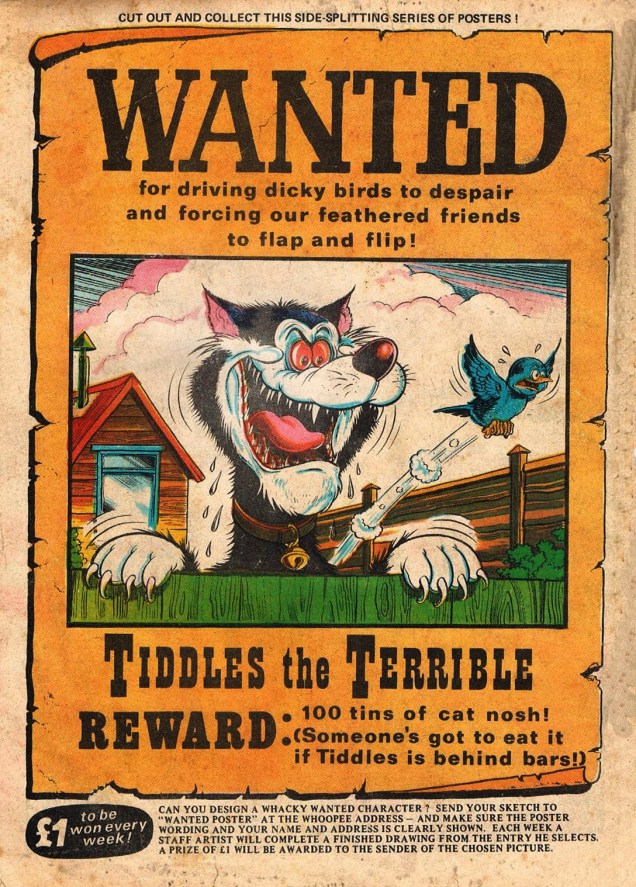
Shiver & Shake was merged with Whoopee! in 1974, and Ken Reid continued in a similar vein with Wide World Weirdies until 1978. As for Wanted Posters, they were published in Whoopee, too, and were based on a similar premise (namely, readers contribute sketches for monetary compensation… though I suspect the kids were chuffed to have their work published even without the pecuniary prize).
Page from Whoopee! no. 5, March 6th, 1974. Er, guys… have you ever seen a cat before?
« What’s that noise comin’ up from the cellar? It’s the restless bones of Boris and Bela* »
It’s a cinch that William Henry Pratt, back when he was eking out a living in Canada, digging ditches or driving a truck, never suspected that his name, his stage name that is, would still elicit shivers of recognition long after his passing. Here we are, a whole hundred and thirty years past his birth, in Camberwell, South London, on Wednesday, November 23, 1887.
From his ascent to stardom in the early 1930s until his passing in 1969, he certainly lived to see his likeness appear in a bewildering array of toys and games and bedsheets and mugs and a zillion knicknacks and gewgaws, a parade that continues to this day. But he was likely never represented more consistently and abundantly than he was in comic books.
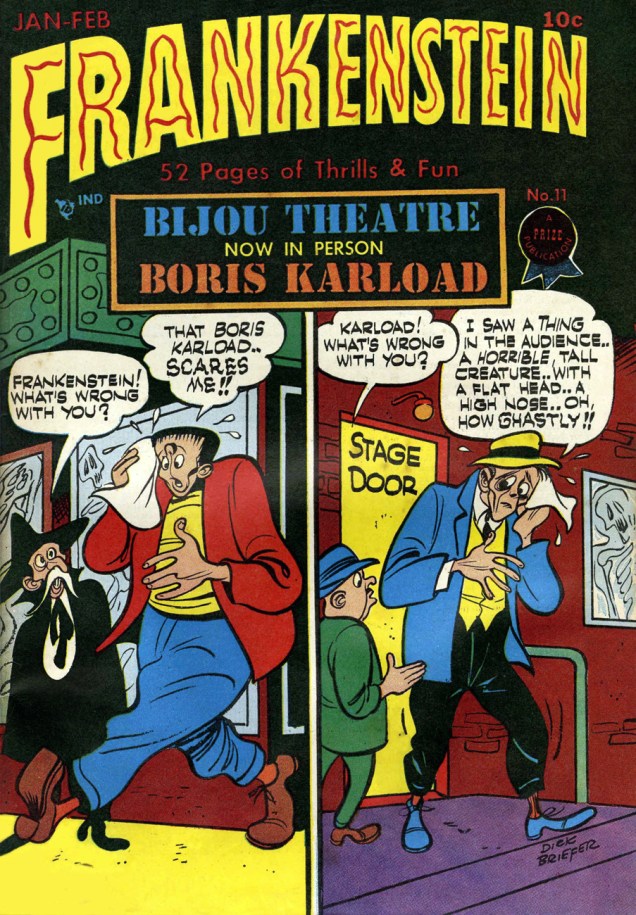
Here, the Monster meets his… inspiration, in « Boris Karload, Master of Horror ». Dick Briefer‘s Frankenstein is a definite highlight of the Golden Age of comics. This is Frankenstein no. 11 (Jan.-Feb. 1948, Prize Comics). Read it here: http://comicbookplus.com/?dlid=39937 And if you, er… dug that, treat yourself to Craig Yoe‘s selection of Briefer’s rendition(s) of the Famous Monster. It’s a great package, and Mr. Yoe can always use the money… to unleash further wonders.
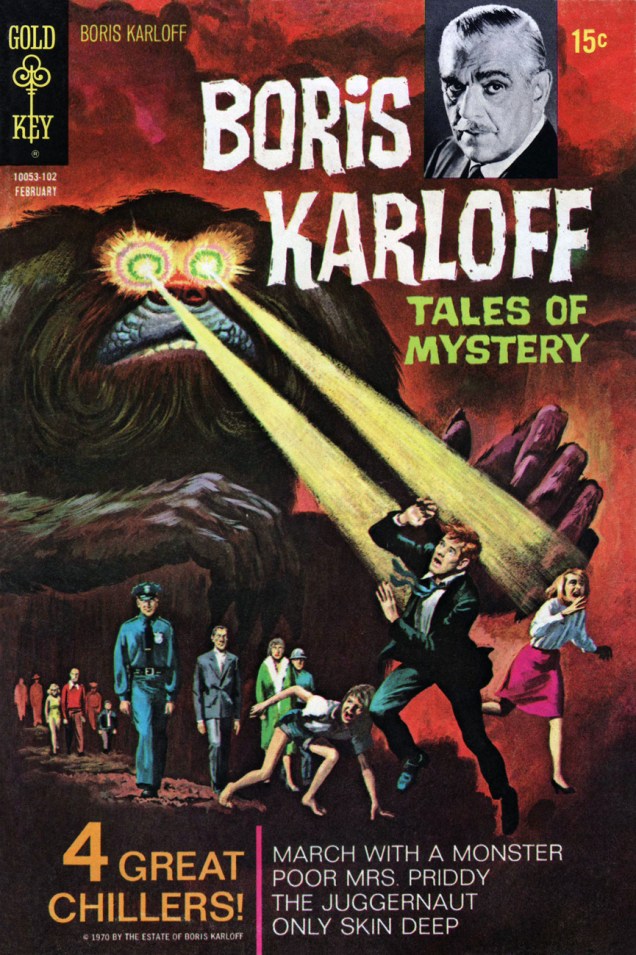
Here’s a gallery of cover highlights from Gold Key Comics’ long-running Boris Karloff Tales of Mystery (95 issues, 1962-80).
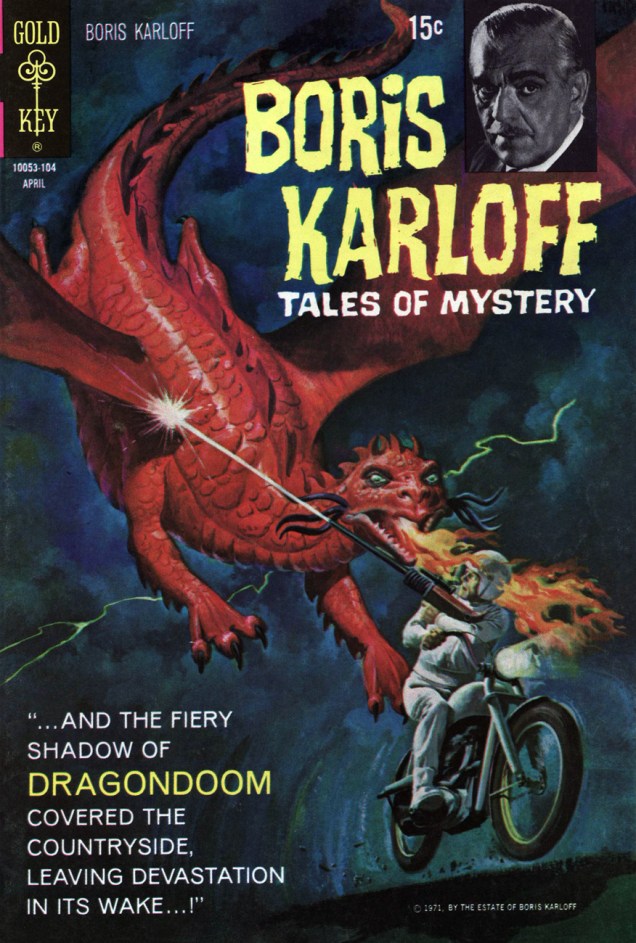
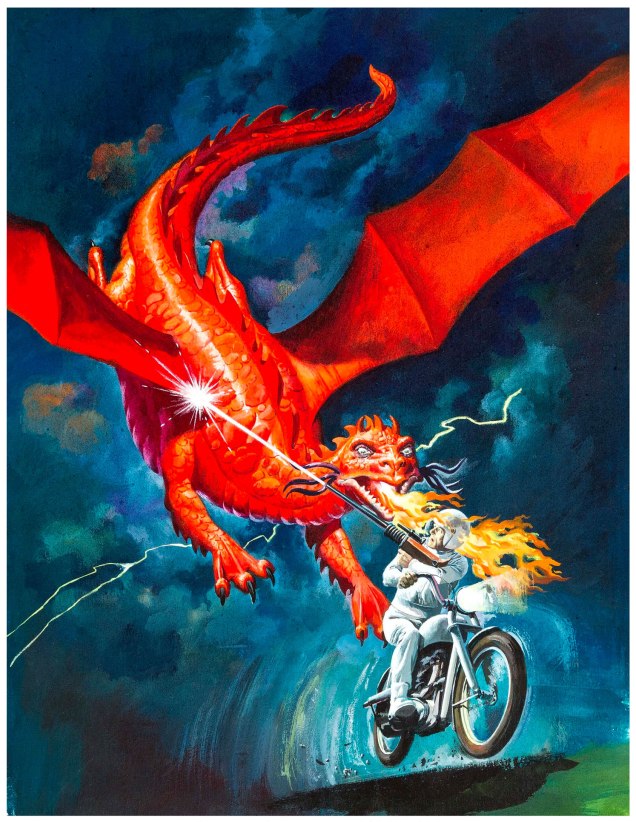
Before there was called Boris Karloff Tales of Mystery, there was, for two issues, Thriller, based on the by-then-cancelled NBC series. Gold Key were often quite slow in making their licensing moves. The TV Thriller was often terrifying (“Pigeons From Hell”, “The Hungry Glass”…), but the comic book never scaled such heights, even sans the emasculating influence of the Comics Code Authority.« You know that one sideways glance from that bug-eyed banshee can turn your brains to prune-whip! » Boris Karloff Tales of Mystery no. 33 (Feb. 1971), Cover painted by George Wilson, illustrating Len Wein, Tom Gill and John Celardo’s March with a Monster.« I’m being scorched by something that shouldn’t even exist! » A laser cannon-equipped Evel Knievel tussling with a badass reptilian nightmare? That’s the Seventies for you. Gold Key’s mystery comics were generally pretty tame fare, but their covers, such covers! This one’s painted by Saint George Wilson. Boris Karloff Tales of Mystery no. 34 (April 1971.) You just know that Dragondoom is written by Lein Wein, because its damsel-in-distress shares his wife’s name, Marvel and DC colourist Glynis.A look at Mr. Wilson’s original painting gives us an idea of just how much was lost in the transition from brush to print. Sometimes it’s better *not* to know.« Feast your eyes upon them, mortal! Do they satisfy your appetite for witchcraft? Hee Hee! » Wayne Howard conjures up some decent monsters inside, but Psychotomimetic George Wilson, who painted this mind-melting cover, shows how it’s *really* done. Boris Karloff Tales of Mystery no. 43 (Oct. 1972.)« The car — being sucked in by this blasted fetid swamp! Goodbye car… goodbye, convention! » Roadside George Wilson strikes again! Boris Karloff Tales of Mystery no. 49 (March 1973.)
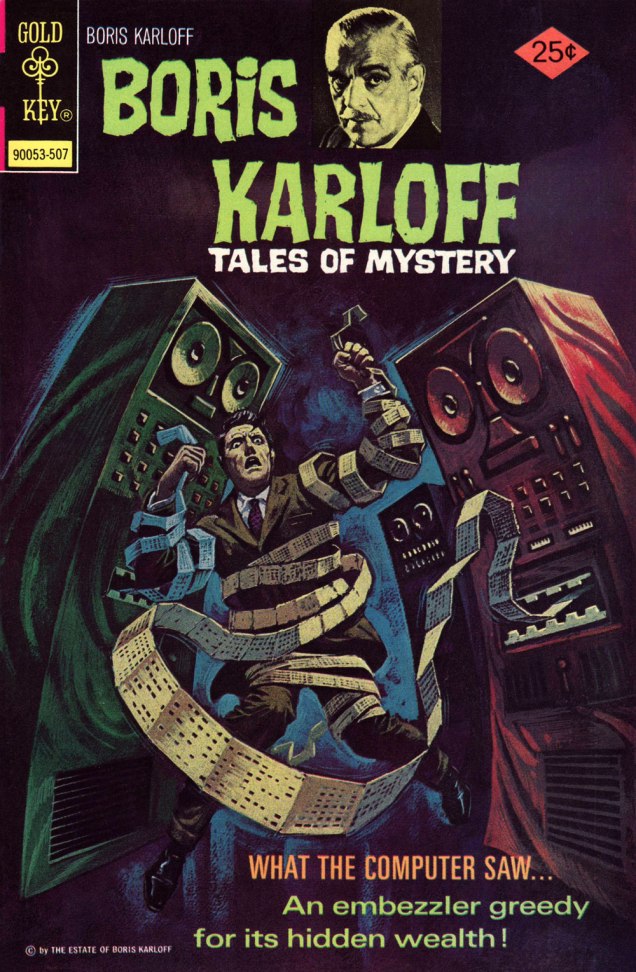
« These computer cards are wonderful… almost as if they were alive! They tell me everything! » Boris Karloff Tales of Mystery no. 62 (July 1973). Luis Angel Dominguez‘s painted cover depicts a scene from Arnold Drake‘s witty It’s in the Cards.
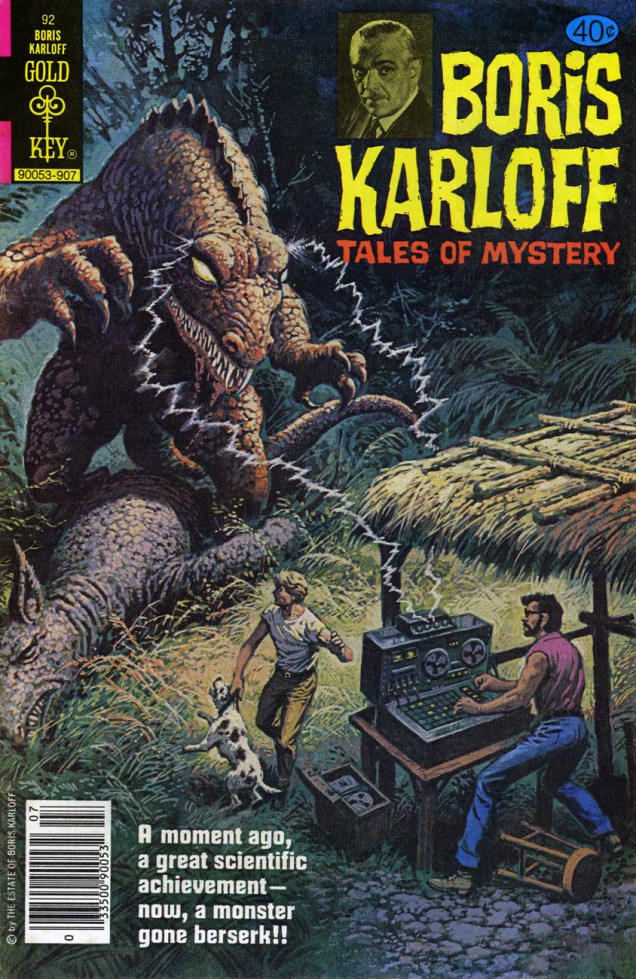
« G-g-get away, B-Bobby! There’s a living horror out there! » « Aww, gee, dad! I’m sorry about that! It’s just my sea monster! » Meet The Mail-Order Monster, a gem from an uncredited scripter (likely Arnold Drake, if the sparkling wit is any indication), and illustrated by Ed Robbins. It’s a fabulously wacky yarn, combining to fine effect good old Sea-Monkeys (brine shrimp, really) and a generous sampling of Ray Bradbury’s Boys! Raise Giant Mushrooms in Your Cellar! This is Boris Karloff Tales of Mystery no. 65 (Dec. 1975), edited by Paul Kuhn. Also within: Don’t Put It on Paper, another of the handful of jobs José Luis García-López did for Gold Key, before settling down at DC later that year. The plot is basically that of Clark Dimond/Terry Bisson & Steve Ditko’s The Sands That Change! (Creepy no. 16, Aug. 1967, Warren), but with a much gentler outcome.« But — why would anyone create something so — so terrifying? » One thing you can nearly always count on in any given issue of BKToM: “scientific” experiments always go awry, and they nearly always yield rampaging monsters. Fitting! Luis Angel Dominguez provides this electrifying cover for issue no. 92 (July, 1979.) The man had such a peerless colour sense.
Let’s reserve our closing words for the man (monster) himself: « Certainly I was typed. But what is typing? It is a trademark, a means by which the public recognizes you. Actors work all their lives to achieve that. I got mine with just one picture. It was a blessing. »
« One of these days, some driver will run me off the road… just because his chick recognizes me! »
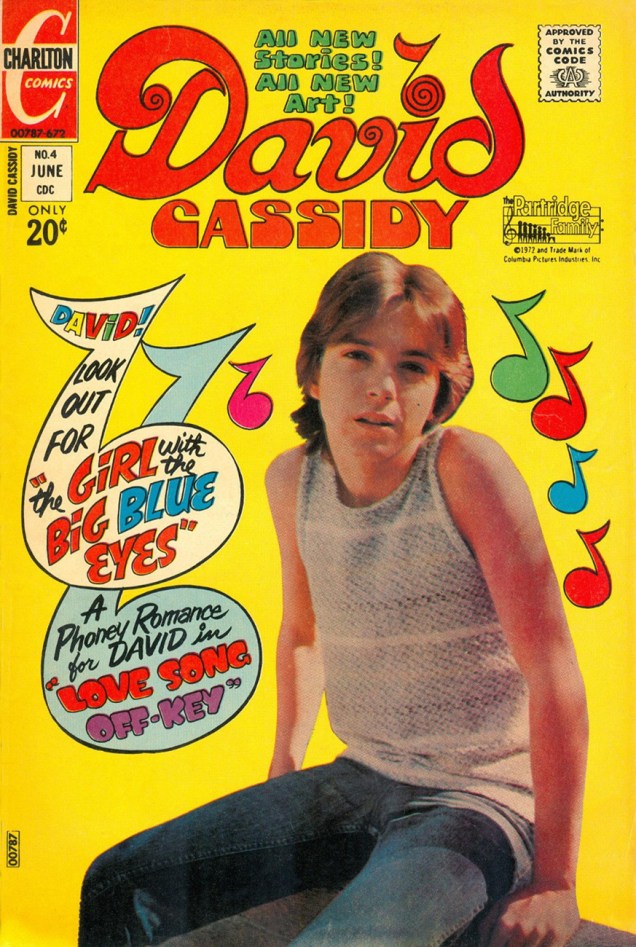
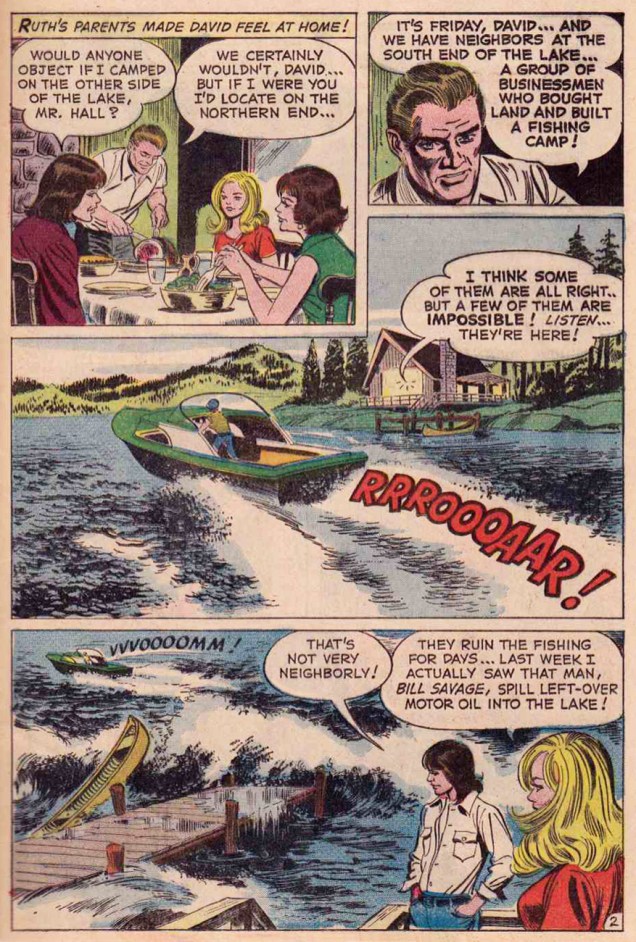
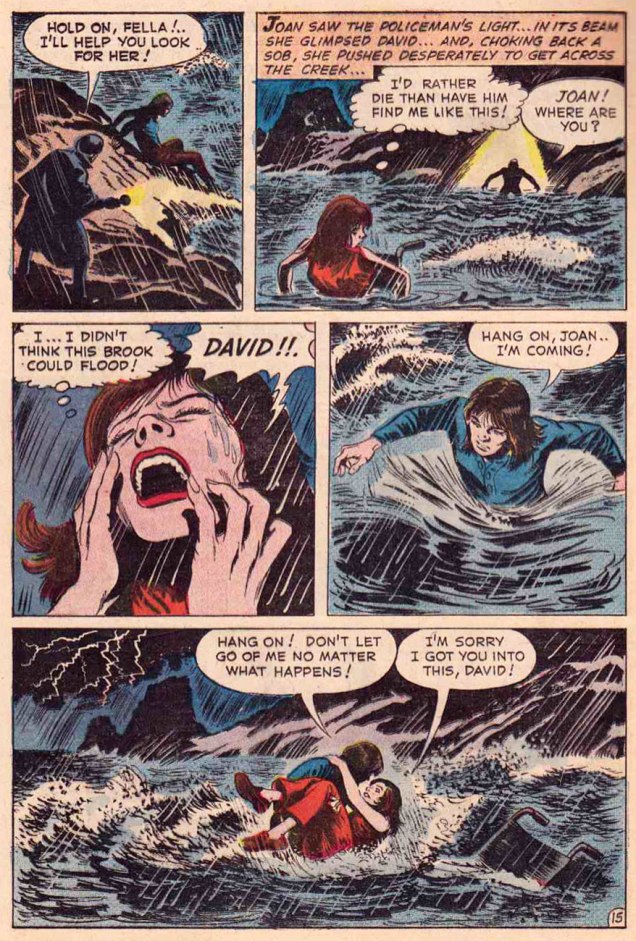
You may have heard the news… sorry to be the bearer of sad tidings if you haven’t. David Cassidy, who rose to fame as The Partridge Family tv show’s Keith Partridge in 1970, has passed away on November 21, 2017, at the age of 67. If this makes you want to pull out your old PF records and read some comics while grieving your lost innocence, let me help you with a word of warning: Charlton published two separate series based on the exploits of the acclaimed teen idol and his boob tube kith and kin, and they’re hardly in the same league. The Partridge Family (21 issues, March 1971 – November 1973), was utter dreck, the handiwork of infamous photo tracer and corner cutter Don Sherwood. The other, David Cassidy (14 issues, February 1972 – September 1973), was an altogether racier breed of cat, thanks to the lush artwork of the truly underrated Turkish-born master Sururi Gümen (1920-2000), who toiled anonymously for many years on the long-running Kerry Drake comic strip (there’s a special pit in hell reserved for folks like Alfred Andriola), but also produced some very fine work for Charlton. More on that later!
David Cassidy no. 4 (June 1972, Charlton Comics.)A sample from This Was Paradise from David Cassidy no. 3 (May 1972, Charlton Comics), presumably written by Joe Gill and definitely illustrated by Sururi Gümen. According to his son, illustrator-filmmaker-actor Murad, «… it was Charlton – and David Cassidy comics – that sent my sister to college.»A moody one from David Meets His No. 1 Fan!, the other story from David Cassidy no. 3 (May 1972, Charlton Comics), also scripted by Joe Gill and illustrated by Sururi Gümen.



















 Who's Out There?