Will Eisner’s The Spirit at Harvey and…

« It was long past midnight on a hot, wet June night many years ago… Central City lay choking for breath in an eerie fog… »

In this, part three of our chronicle following as we can the meandering and sometimes mystifying odyssey of Will Eisner’s The Spirit, we reach the most outré segments of the former Denny Colt’s road.

In a unique twist, The Spirit’s next residence, nearly a decade after his Fiction House run, had nothing at all to do with Will Eisner… in terms of securing his assent, that is.

It was down to the fabulously sketchy Israel Waldman, one of those fringe-dwelling characters who made the comics industry such a colourful snake pit. To quote the Grand Comics Database: « I.W. Publications (1958-1964) was part of I.W. Enterprises, and named for the company’s owner, Israel Waldman. Reportedly, Waldman came into possession of a printing company and among the assets were the production materials for several hundred comic books previously published by various publishers as well as a limited amount of previously unpublished material. Waldman equated possession of production materials as the right to reprint and I.W. became notable for publishing unauthorized reprints of other companies’ comics, often with new covers, as Waldman’s windfall did not often include the production materials for covers. The later half of the company’s existence, it published comics under the Super Comics name. Usually these companies were out of business, but not always. »
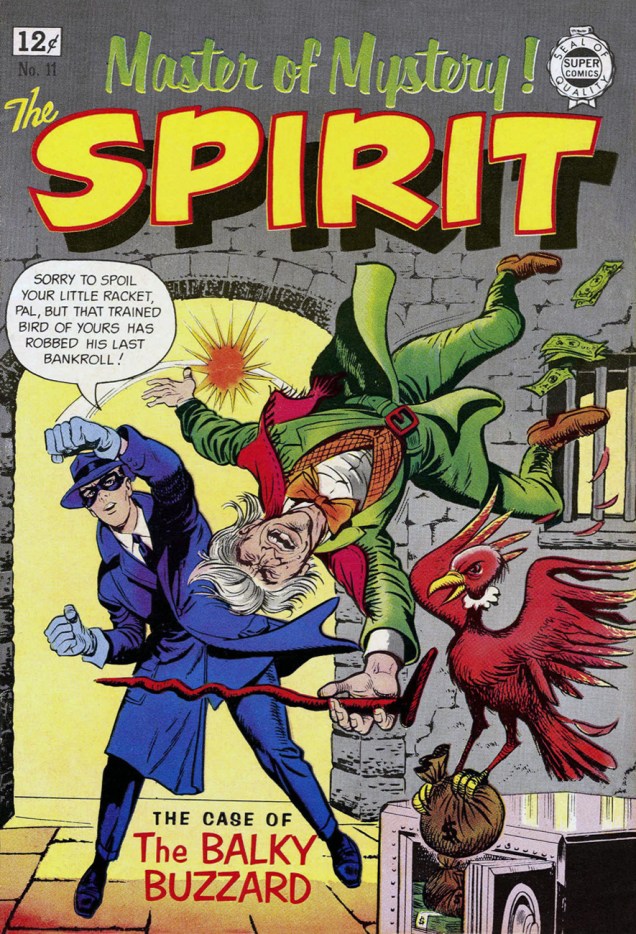
IWThe-Spirit11A
This is The Spirit no. 11 (1963), featuring The Man Who Killed The Spirit (Mar. 24, 1946), cover-featured The Case of the Balky Buzzard (Apr. 21, 1946), Carrion’s Rock (May 19, 1946), all scripted by Eisner, as well as Honeybun and Flatfoot Burns shorts. Cover by Joe Simon (“Joe, did you even read the story you’re depicting?“). This one was well worth one’s hard-earned twelve pennies. Read it here.
IWThe-Spirit12A
This is The Spirit no. 12 (1964), featuring, this time, a trio of WWII-era Spirit stories scripted by Manly Wade Wellman and Bill Woolfolk and illustrated by Lou Fine, rounded off with a pair of Flatfoot Burns shorts by Al Stahl . Cover again by Joe Simon. Read it here.

If memory serves, Waldman’s comics craftily bypassed the Comics Code (another exception!) and the newsstands, being exclusively sold in sealed bags of three in bargain-basement department stores. To bait the hook, Waldman paid top dollar for new cover artwork, approaching established pros like Ross Andru (who actually delivered some fun stuff, unlike his unforgivably atrocious turn as DC’s main cover artist in the late 1970s), John Severin, Jack Abel, and in these two cases, Jacob Kurtzberg‘s old partner, Joe Simon.

Unsurprisingly, Waldman skimped on all other materials, particularly the paper his comics were printed on, which means that I.W./Super Comics are pretty hard to come by these days in any kind of decent state, so they’re ironically pricey.

A few years later, Eisner struck a deal with another rascal (albeit one with cleaner fingernails), Alfred Harvey of Harvey Comics, Stan Lee‘s only credible competition in the credit-usurping, I created-the-Universe stakes. Again, two issues, but this time with some new Eisner material, including origin stories for The Spirit (his third, but definitive one), and his arch-nemesis Zitzbath Zark, which you may know as purple glove enthusiast The Octopus.

HarveySpirit1A
Harvey’s The Spirit no. 1 (Oct. 1966), featuring the new Origin of the Spirit by Eisner, and classics Lorelei Rox (Sept. 19, 1948), Two Lives (Dec. 12, 1948), Agent Cosmek/Visitor (Feb. 13, 1949), The Story of Rat-Tat the Toy Machine Gun (Sept. 4, 1949), Ten Minutes (Sept. 11, 1949), Thorne Strand (Jan. 23, 1949), Gerhard Shnobble (Sept. 5, 1948), all scripted by Eisner, save Ten Minutes, which hails from the mind of Jules Feiffer.
Spirit2A
Harvey’s The Spirit no. 2 (March, 1967) features the brand-new Octopus: The Life Story of the King of Crime and 2-pager The Spirit Lab, plus a generous helping of fine oldies, namely Plaster of Paris (Nov. 7, 1948), The Deadly Comic Book (Feb. 27, 1949), Rudy the Barber (Oct. 22, 1950), The Story of Sam, the Saucer That Wanted to Fly (Sept. 17, 1950), Sam Chapparell (Oct. 10, 1948), La Cucaracha (Nov. 19, 1950), The Halloween Spirit of 1948–Ellen Meets Hazel (Oct. 31, 1948), all scripted by Eisner… the book wraps up with a preview of the next issue, which never saw print. And so it goes…

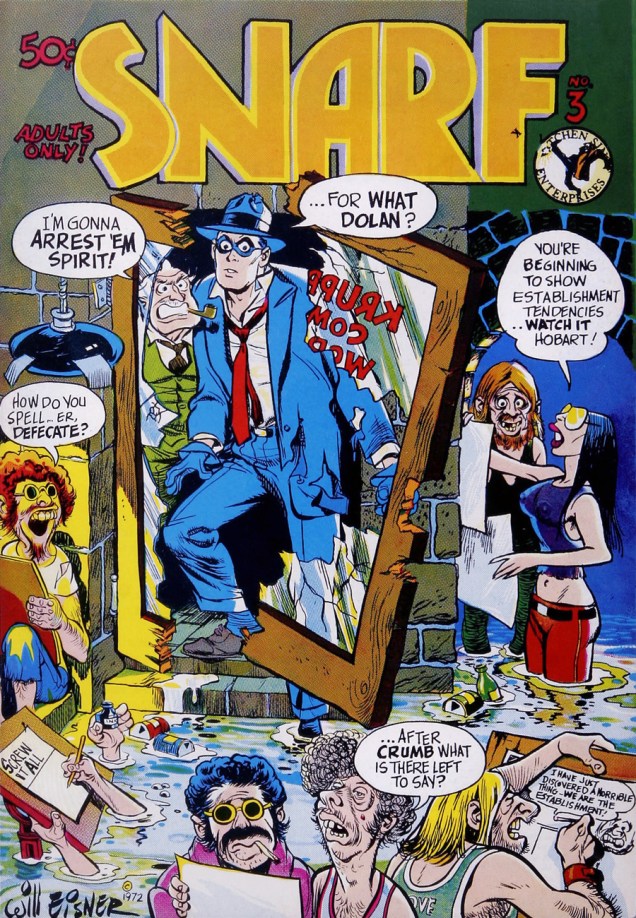
Mr. Eisner then finally had the good fortune to run into an honest man, who would prove in time to be his most steadfast ally: Mr. Denis Kitchen. Their first collaborations were a bit tentative, but quite sympathiques, with Eisner kind of slouching towards the Underground, his creation even cover-featured on Kitchen’s long-running humour anthology Snarf.
Snarf3EisnerA
This is Kitchen Sink Enterprises’ Snarf no. 3 (Nov. 1972), featuring an original Eisner cover.
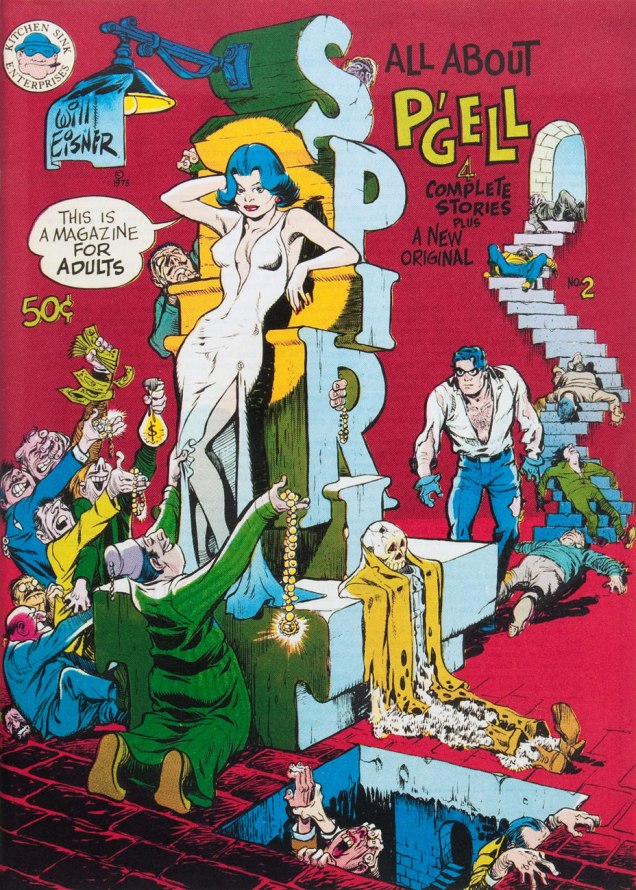
SpiritKitchenSink1A
Another two-issue run! Kitchen Sink’s The Spirit no. 1 (Jan. 1973), featuring a new cover by Eisner, and precious relics Max Scarr’s Map (Apr. 14, 1946), Caramba (Nov. 10, 1946), Return to Caramba (Nov. 17, 1946), The Rubber Band (June 23, 1946), plus a few brand-new short pieces.
SpiritKitchenSink2A
Kitchen Sink’s The Spirit no. 2 (Nov. 1973), featuring a new Eisner cover, an original four-pager, The Capistrano Jewels, and, as boasts the cover, all about P’Gell, with Meet P’Gell (Oct. 6, 1946), The School for Girls?? (Jan. 19, 1947), Competition (Aug. 3, 1947) and The Duce’s Locket (May 25, 1947).

Next time out: some interesting times with Warren.

-RG
Tentacle Tuesday: the Savagery of Conan’s Savage Sword

Marvel’s looong-running Savage Sword of Conan (published 1974 – 1995) was not restrained by the Comics Authority Code, being a magazine. So what did the illustrators and writers involved do with all this freedom? They heaped piles of gore and violence (badass violence) into the stories, and they made sure most Conan covers contained (1) naked damsels; (2) a heroic chopping-off-things-with-my-sword pose; (3) tentacles. If there was a shortage of cephalopods that month, other tentacle-like props would be happily used: elephant trunks, serpents ‘n’ snakes, dragon tails, and other grabby appendages.

I recommend reading The 10 Most Brutal Moments from Savage Sword of Conan the Barbarian! f̶̶̶o̶̶̶r̶̶̶ ̶̶̶a̶̶̶ ̶̶̶g̶̶̶o̶̶̶o̶̶̶d̶̶̶ ̶̶̶g̶̶̶i̶̶̶g̶̶̶g̶̶̶l̶̶̶e̶̶̶ for a good look at just how, erm, badass and savage and brutal Conan is. And when you’re done with that, take a gander at today’s line-up of tentabulous and tentarrific covers in which Mr. Conan slashes and hacks his way through rapacious monsters!

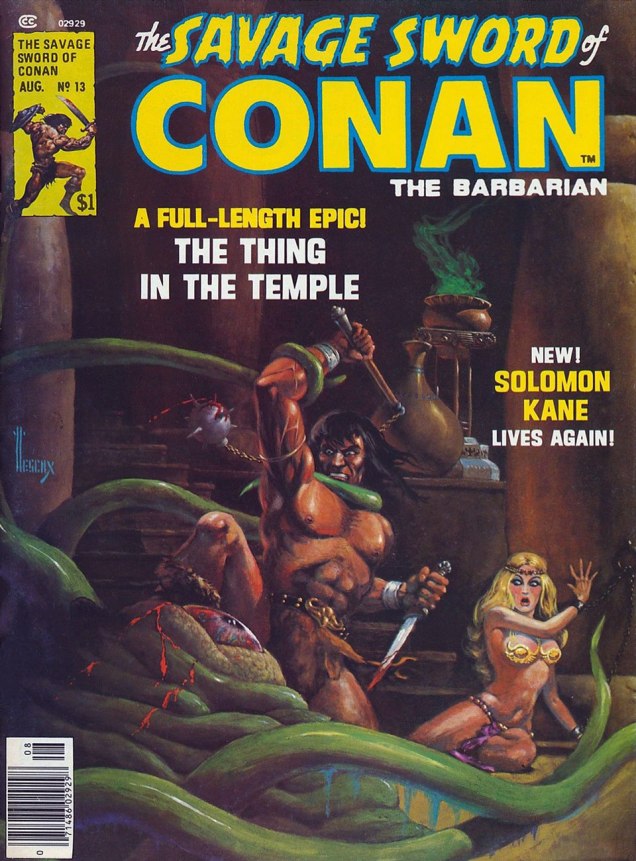
SavageswordofConan13
The Savage Sword of Conan #13 (July 1976), painted by Richard Hescox. Mostly undressed cutie (who may actually be a drag queen?): check. Bloody knife: check. Murderous, glazed-over eyes, a mask of hate and sadism on Conan’s face: double check. Poor scared octopus who was minding his own business… sigh, I’m afraid he’s mincemeat.
TheSavageSwordOfConan20
The Savage Sword of Conan #20 (July 1977), cover painted by Earl Norem. Braless beauty: check. Interestingly, Conan seems to have only one nipple. The sword hasn’t been plunged it, yet, but I’m sure it will take no time at all.

Incidentally, this is what our Slithering Shadow looks like from another angle:

Barbarian-“The Slithering Shadow,”
Pencils by John Buscema, inks by Alfredo Alcala.
SavageSwordofConan23
The Savage Sword of Conan #23 (October 1977), cover painted by Earl Norem. It’s a little-known fact that if you squeeze a woman by the midriff, her boobs pop out. At least Red Sonja is a little more feisty than the average helpless maiden.
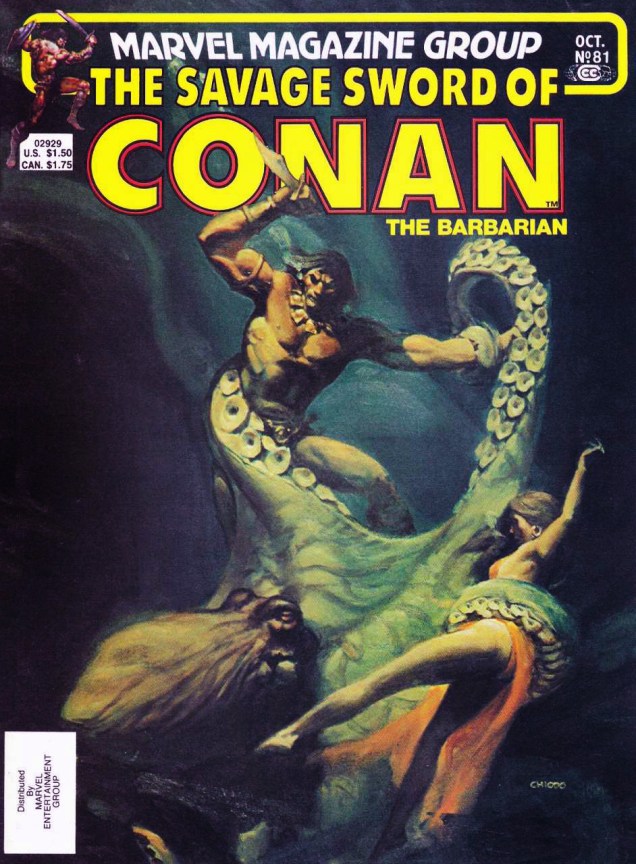
The-Savage-Sword-of-Conan-#81
The Savage Sword of Conan #81 (October 1982), painted by Joe Chiodo. Completely exposed woman in lingerie: check. Has she wandered in from a gothic romance in which she was roaming the halls at night, dressed in naught but a flimsy nightie? Oh, sorry, wrong trope.
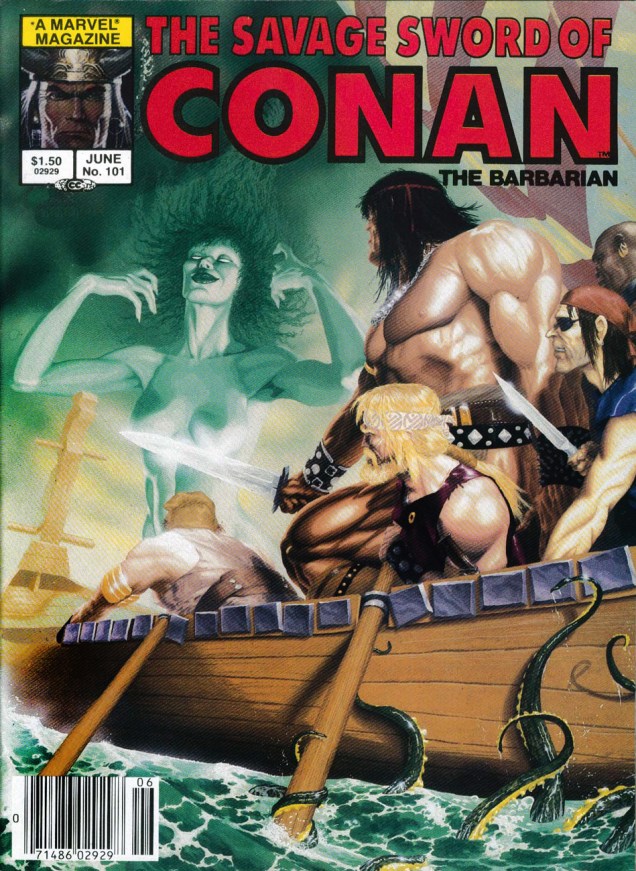
The-Savage-Sword-of-Conan-#101
The Savage Sword of Conan #101 (June 1984), painting by Michael Golden (‘when in doubt– smudge!‘). Man, Conan has a heck of a square, prominent chin. I almost didn’t include this cover because of the ridiculous anatomy – the front guy’s arm looks like a bovine leg (complete with hoof??), and Conan’s thigh and its bulging muscles don’t seem to be attached to his body – but the tentacles beckoned.

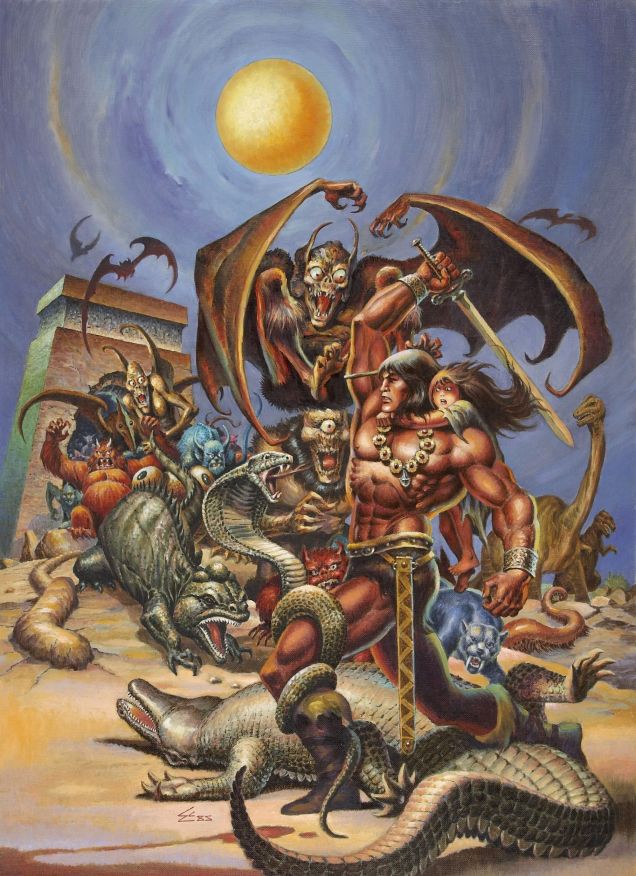
The following may be my favourite cover of today’s post, so here’s the original painting so we can admire the myriad details properly. For a second, I was worried that it couldn’t become part of today’s roster for lack of tentacles, but a scene of this type just *had* to have at least one tentacled creature. This has several, I am happy to report, though sometimes it’s hard to tell who’s who (and what’s what) in this glorious tangle of tails, wings and appendages.

The Savage Sword of Conan #123
Original painting for the cover of The Savage Sword of Conan #123 (April 1986). Painted by Ernie Chan. Note that there is no, I repeat no naked woman on this cover, just a scared child of indeterminate gender. And Conan doesn’t look like a complete asshole. Ernie Chan, you made my day. ❤ ❤
TheSavageSwordofConan178
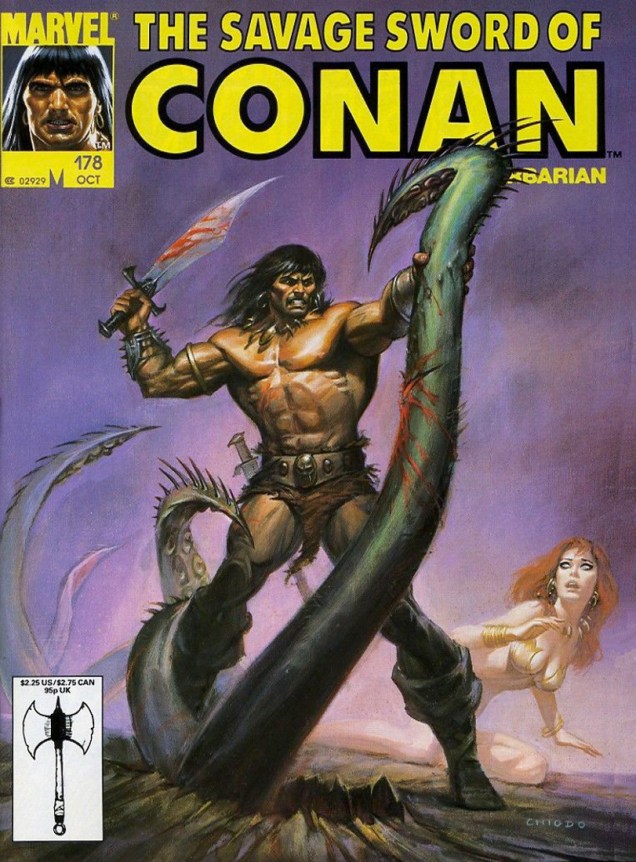
The Savage Sword of Conan #178 (October 1990), painted by Joe Chiodo. Back to our regular program: violent He-Man hero, ghostly mostly-naked chick (who doesn’t have an ass at all, it seems, while her legs are mysteriously floating in the mist generated by the animal heat and moisture given off by Conan).
The Savage Sword of Conan #190.jpg
The Savage Sword of Conan #190 (October 1991), cover painted by Earl Norem. Wait, Conan is wearing a vest? And he looks younger and almost scared? What’s happening?

~ ds

An Inconvenient Prescience: Harvey Pekar’s “Stupid Capitalists!” (2000)

« And it’s worse when I try to remember
When I think about then and now
I’d rather see it on the news at eleven
Sit back, and watch it run straight down »
Warren Zevon, Run Straight Down (1989)

Just a brief little post today, with a thought to our friends in the USA who have an important opportunity coming up tomorrow.

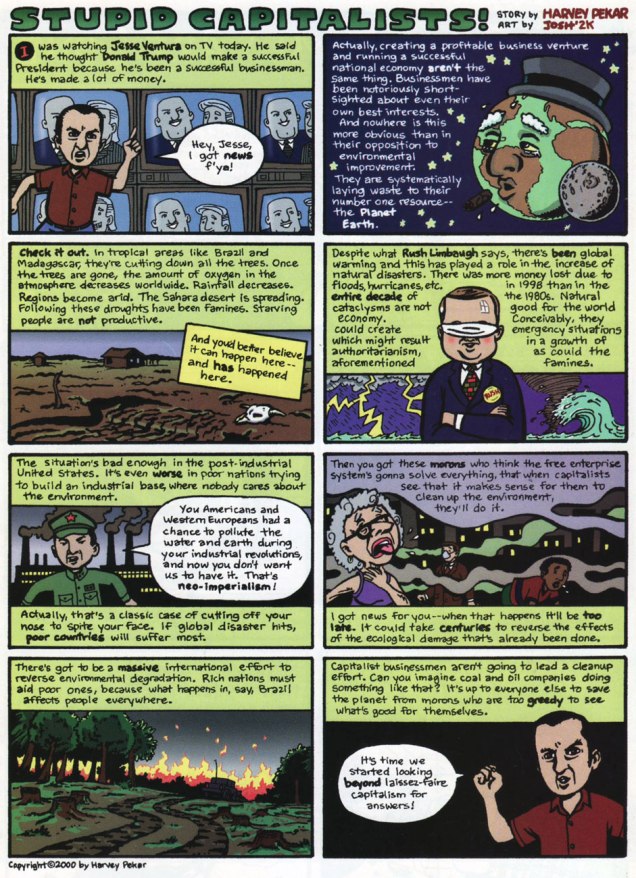
Despite the vividness of his ‘cranky old man’ image, Harvey Pekar (1939-2010) wasn’t some coot screaming at the kids to get off his lonke or ranting about aliens in the drinking water. He was a keen-eyed observer with astounding perspective. Witness this unnervingly accurate and oh-so timely piece from eighteen years ago. Illustrated by Josh Neufeld, it was published as the back cover of the one-shot American Splendor: Bedtime Stories (2000, Dark Horse, edited by Diana Schutz).

PekarCapitalistsAHigh time for a muzzling of a certain tiny fingered, Cheeto-faced, ferret wearing shitgibbon, wouldn’t you say? Make America Splendid again… do it for old Harv, do it for yourselves.
-RG

The Demons and Rockets of L.B. Cole

There’s probably no need to write a panegyric on Leonard Brandt Cole, 1918-1995. (But did you know he had a doctorate in anatomy and physiology?) The first thing that springs to mind is his use of primary colours over frequently black backgrounds, what he referred to as “poster colours”. Indeed, most L.B. Cole covers would, and occasionally do, make great posters. Going into biographical detail, one might also mention his publishing company, Star Publications, founded in 1949 and singled out in Fredric Wertham’s 1954 exposé Seduction of the Innocent for the “grisly” nature of its published horror titles. Then there’s his work as art director and editor at Dell in the early 1960s… but as usual, I’ll let others get to the nitty-gritty of his life and career. Here are some of my very favourite L.B. Cole covers, in chronological order.

LBCole-Mask2
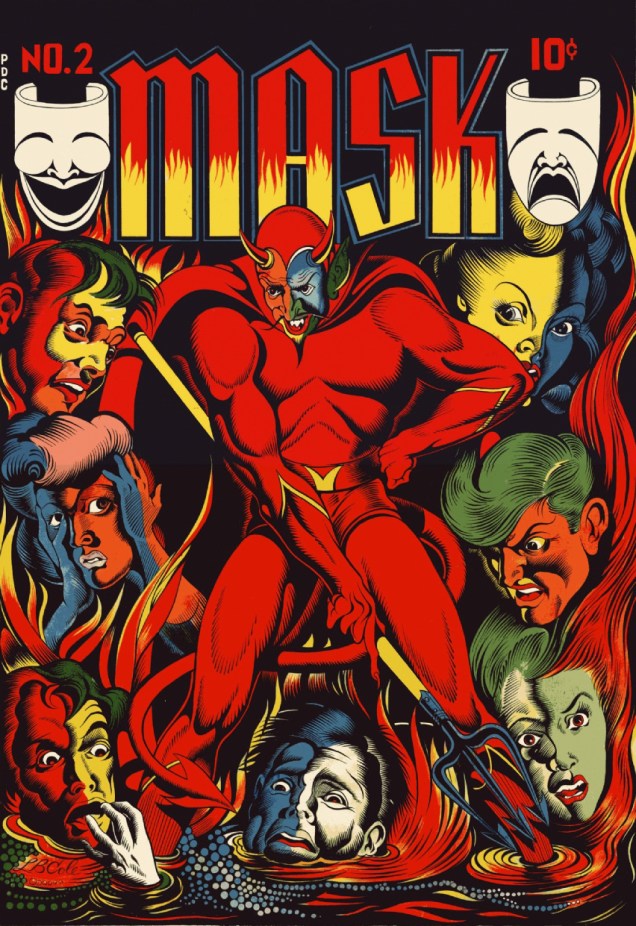
Mask Comics no. 2, April-May 1945 (Rural Home). Read it here. The classically-oriented study of human expressions had me smitten even before I noticed the devil’s muscular thighs.
LBCole-GreatComics1
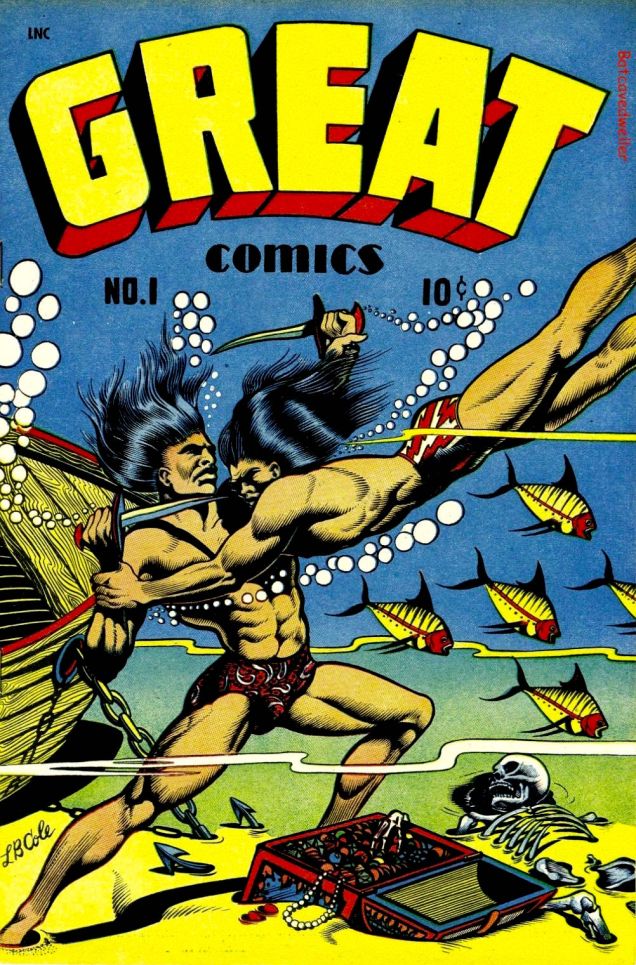
Great Comics no. 1, 1945 (Novack Publishing). Read it here.

« An avid science fiction fan, Cole was known for slipping in sci-fi elements even when they weren’t appropriate, such as rocket ships and ray guns appearing on the covers of Captain Flight Comics and Contact Comics. Both titles were supposed to be devoted to contemporary aviation. » (source) Fuck being appropriate, I say!
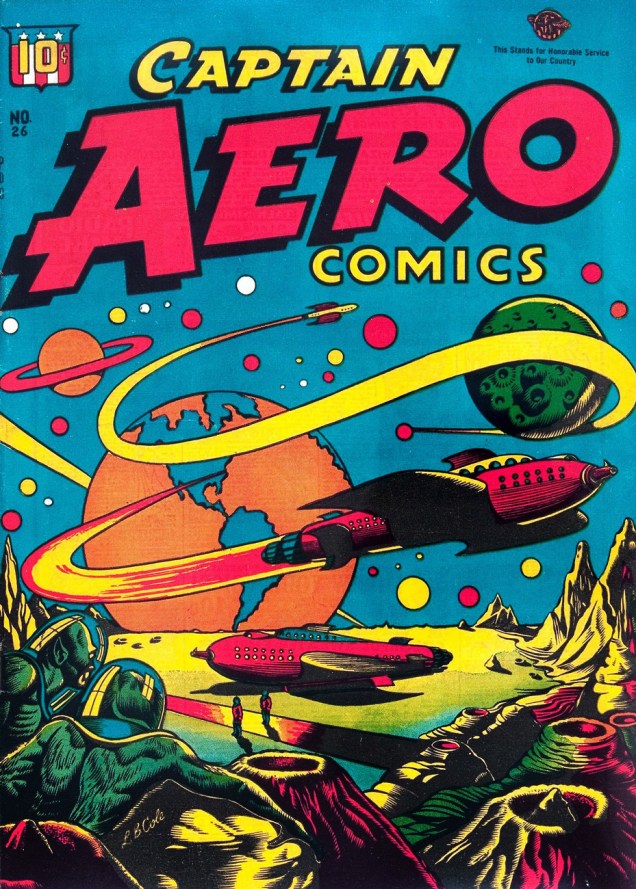
LBCole-CaptainAeroComics26-1946
Captain Aero Comics no. 26, August 1946 (Continental Magazines). Read it here. This is like a Soviet poster in overdrive.
LBCole-CatmanComics31
Cat-Man Comics no. 31, June 1946 (Continental Magazines). A great scene, isn’t it? Though shoddily printed, the tension of the moment comes through loud and clear, and I love the dots of snow in the darkness. Cat-man isn’t to be confused with Catman, a supervillain and enemy of Batman (first appearance in Detective Comics in 1963). Catman: a professional trapper of jungle cats turned to crime for the usual reason (i.e. boredom) after procuring himself a costume made out of ancient African cloth (?!) Cat-man: raised by a tigress to be an upstanding member of society and scourge of criminals, with 9 lives, super-strength and night vision at his disposal. The moral – be kind to tigers! Read the issue here.
LBCole-CatmanComics32
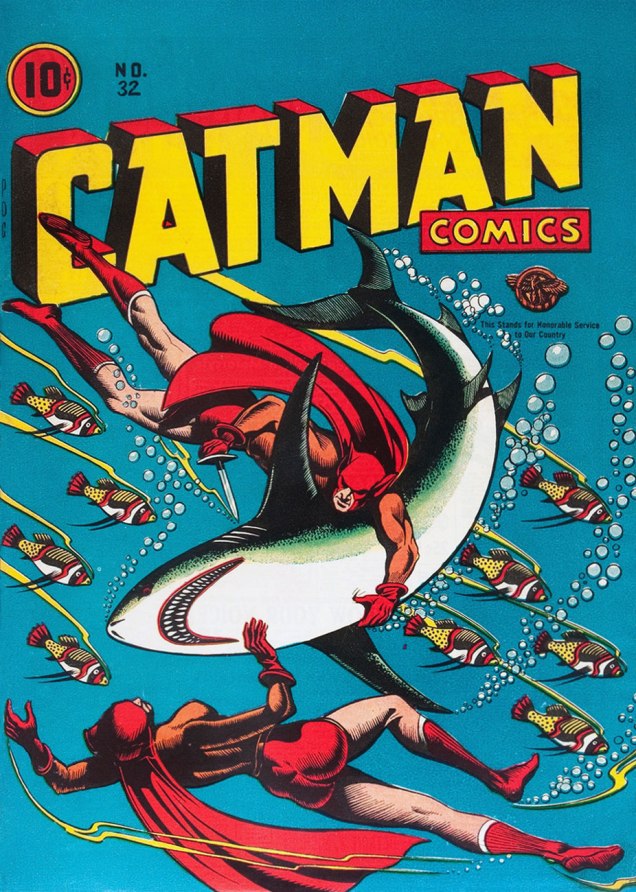
Cat-Man Comics no. 32, August 1946 (Continental Magazines). Cat-Man (created by Irwin Hasen), usually paired up with sidekick Kitten (created by Charles M. Quinlan), a former circus acrobat. That’s them frolicking underwater on this cover – tigers love water, by the way. This is the last issue of Cat-Man, so Kitten, who was 11 years old when her association with son-of-tigress began, is at her shapeliest. Mr. Cole wasn’t well-versed in anatomy for nothing. Read it here.
LBCole-JeepComics3
Into its gurgling ghastliness goes Peep… sailing blithely in the rocket car...” I somehow imagine that read out loud with a British accent. And yes, there’s a character named “Peep” in the story. Jeep Comics no. 3, March-April 1948 (Spotlight Publishers). Read the issue here.
LBCole-GunsAgainstGansters
Guns Against Gangsters vol. 1 no. 6, July-August 1949 (Premium). Read the issue here. Another cover with that blue-green-yellow gradation, and while I love these colours together, it’s the cartoony shark that gets my vote (and sympathy). Sadly, when one pits a woman in high heels and a miniskirt against a huge shark, the latter will always lose.
LBCole-BlueBolt105-1950
Blue Bolt no. 105, April-May 1950 (Star Publications). I can’t resist the combination of a dragon/bird flown straight out of a Slavic fairy-tale with stylish space opera.
LBCole-BlueBoltWeirdTalesofTerror113
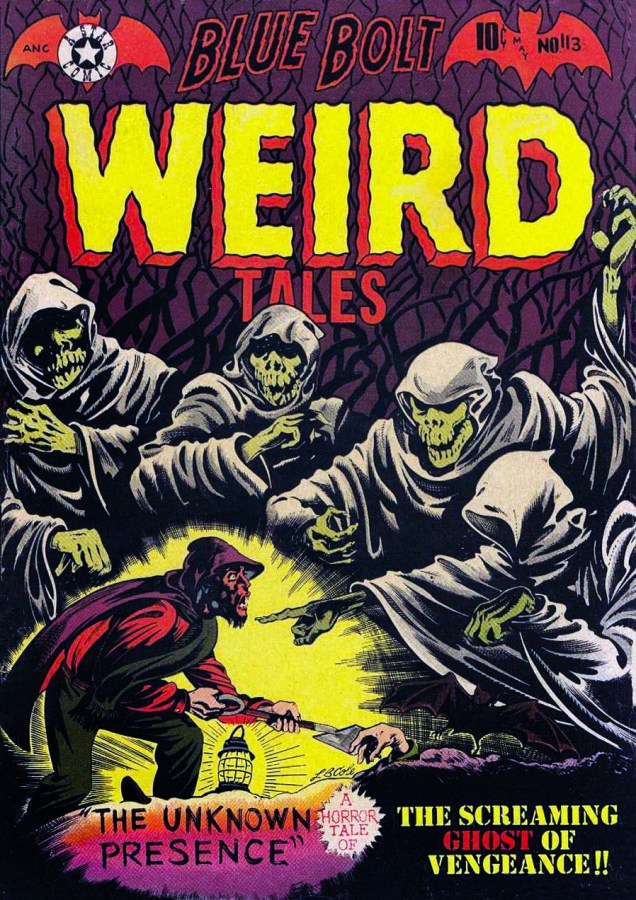
Blue Bolt Weird Tales of Terror no. 113, May 1952 (Star Publications). A genuinely spooky cover.
LBCole-BlueBoltWeirdtalesofterror114
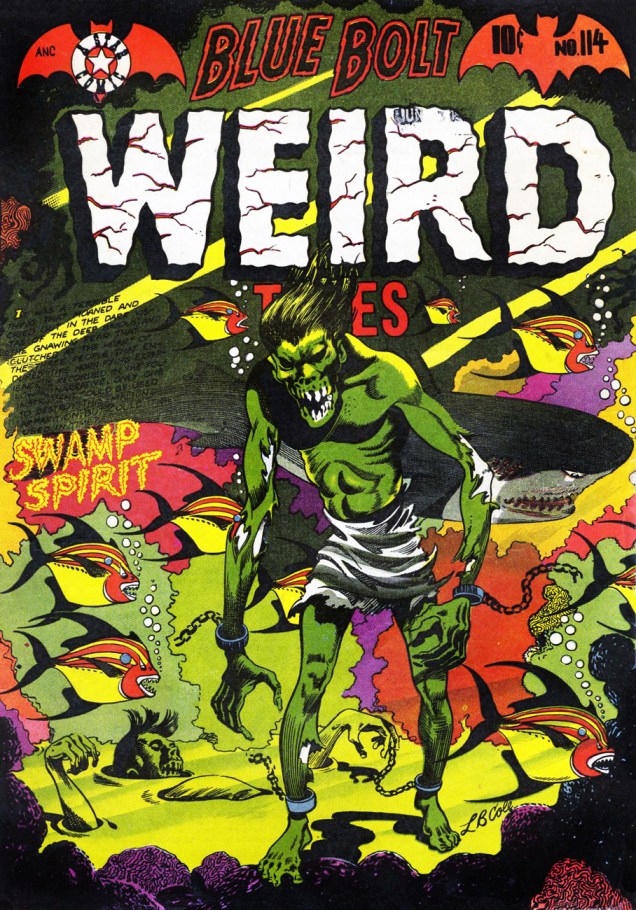
Blue Bolt Weird Tales of Terror no. 113, August 1952 (Star Publications). « It was a terrible thing that moaned and cried out in the dark vistas  of the deep bayous… » This cover is busy, no doubt about it, but I think it works. That slow, grotesque shuffle through water… brrr! Say what you will about L.B. Cole’s style or his propensity for using reds and greens, but the guy knew what he was doing.

~ ds

Hallowe’en Countdown II, Day 31

« Here, plainly, was a guy for whom cartooning held no mysteries. He was more than a master; he was a virtuoso, a source, an innovator whose style was completely natural and original and flexible enough to embrace dashed-off vulgarity and painstaking elegance, often in the same panel. » — Jim Woodring on Jack Davis

Here we are, coming to the end of our countdown (or count-up, depending on your point of view), and who better to convey the magic of Hallowe’en than the late, great Jack Davis (1924-2016)? Don’t answer that. 😉

DavisMonsterRallyA
Detail from Monster Rally (1959).

A 1959 collection of humorous horror songs by Alice Pearce and Hans Conried, Monster Rally (LPM/LSP-1923) sports a classic Davis painting – blending horror and humor into what amounts to a cutely-weird piece of art. Davis has mentioned that this scene is one he really enjoying doing and that he was quite pleased with. An ad for this album in issues of Famous Monsters of Filmland from back then read:

An insane and fantastically entertaining album featuring Hans Conried and Alice Pearce, singing and screaming ghoulish new songs like ‘Monster Rally’, ‘The Thing‘, ‘The Invisible Man‘, ‘Not of This Earth‘ and others. The album cover by Jack Davis is a masterpiece – suitable for framing.

[ Excerpted from Dick Voll‘s article Just for the Record: The LP Cover Art of Jack Davis (Fanfare no. 5, Summer 1983; edited and published by Bill Spicer). ]

And here are a mittful of extras, since I’m more inclined to treat than to trick on this special day.

DavidHorrorPicsA
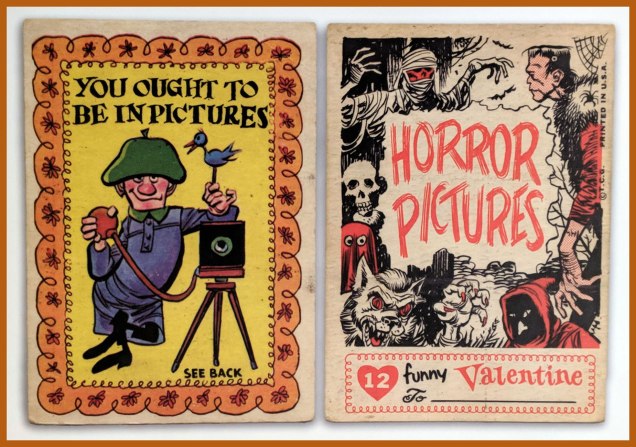
« From approximately ’59, Davis did a huge quantity of work for Topps Gum Co. Over the years, he did ‘Funny Monster Cards’, ‘Wanted Posters’, ‘Funny Valentines’, ‘Batty Book Covers’, ‘Wacky Packs’, ‘Silly Stickers’ as well as standard baseball and football tradings cards. » — Hank Harrison, The Art of Jack Davis (1986, Stabur Press). This, incidentally, is one of the ‘Funny Valentines’.

DavisSlimDracA

DavisSlimWolfA
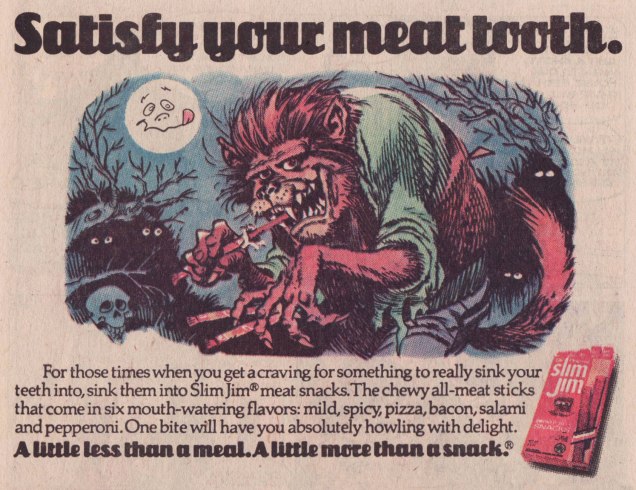
Davis’ classic Slim Jim commercials of the late 1970s. Of course. Can you believe they ran these earlier… with the bold-type, all-caps slogan of WHAT TO SINK YOUR TEETH INTO WHEN YOU’RE HUNGRY AND YOU’RE NOT A WEREWOLF… but sans Davis art? Thankfully, some bright kid at the ad agency saw the opportunity and managed to be convincing enough.

In closing, thanks for bearing with all my divagations through this second edition of WOT’s Hallowe’en Countdown, and let me wish you a most spooky Hallowe’en, one and all!

-RG

Tentacle Tuesday: Lovey-dovey Octopuses

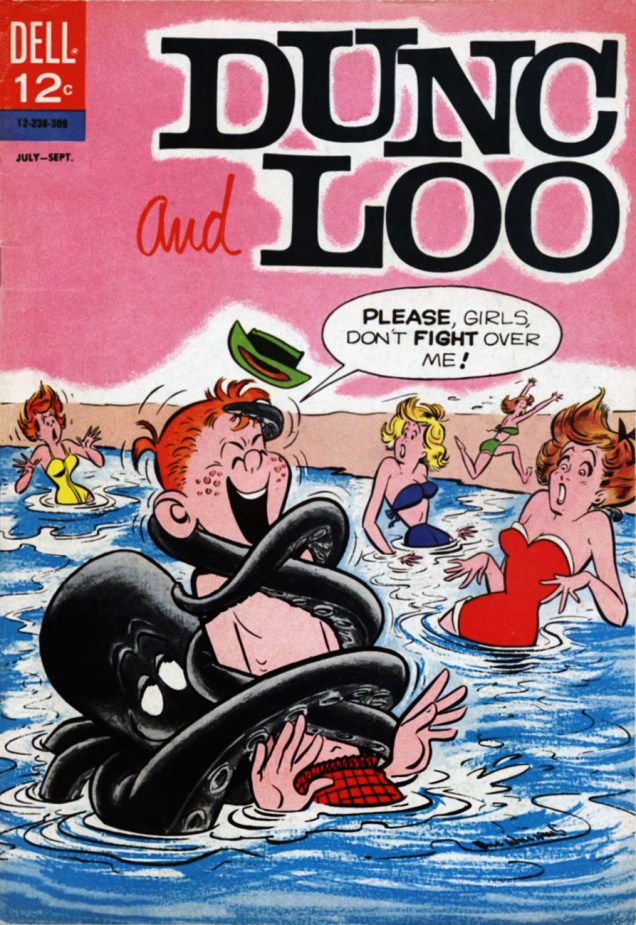
Dunc and Loo (which was called « Around the Block with Dunc & Loo » for the first three issues) was a comic written and story-boarded by John Stanley. (See our initial post about John Stanley, including more D&C covers.) The finished art for the series was provided by Bill Williams. This combination worked perfectly to provide readers with (only eight, alas) hilarious issues of teenage high-jinks and other silliness.

Dunc-and-Loo7
Dunc and Loo no. 7, July-September 1963, art by Bill Williams.

You can read the whole issue over at Comic Book Plus – no tentacles, I’m afraid, but some gorgeous art and zany stories. It’s well worth the detour!

TentacleTuesdayIcon

Hey, octopuses like surfing, too. Or maybe this one just wanted the blonde for himself…

Adventures-of-Bob-Hope94
The Adventures of Bob Hope no. 94, 1964. Art by Bob Oksner… I think.

The Adventures of Bob Hope were published by National Periodical Publications from 1950 to 1968, for a total of 109 issues. The main stories centred around comedian Bob Hope (or his misadventures, rather); the cover stories often featured some other film-related characters. The original artist of the series was Owen Fitzgerald, with Cal Howard as the writer. Official credits aren’t really available, but these two seemed to provide much of the content for the first 60 issues. In #61, however, Mort Drucker (on main stories) and Bob Oksner (on back-ups) made their debut, and continued on their merry way until, oh, 1967 or so. In case you’re interested, Neal Adams did the last 4 covers for the series (eek).

TentacleTuesdayIcon

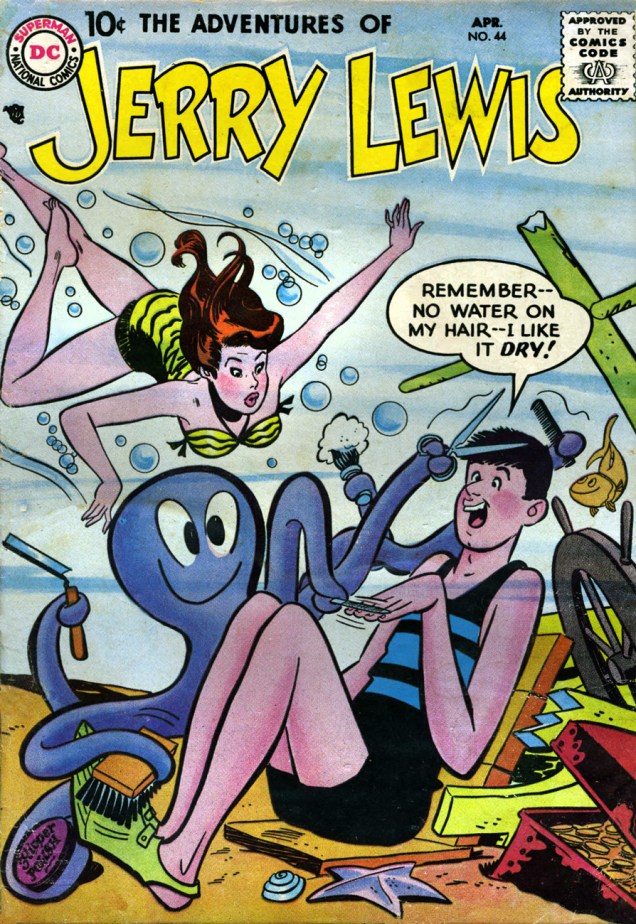
Here’s another series that followed a pretty similar path (unsurprisingly – same publishing house, comparable years, same subject matter): The Adventures of Dean Martin & Jerry Lewis (July-August 1952 – October 1957) that became The Adventures of Jerry Lewis with #41 (November 1957). The art, handled mostly by Owen Fitzgerald in the beginning, gradually landed increasingly into the more-than-capable hands of Bob Oksner, who stayed around until the end with issue #124 (June 1971). Here, also, Neal Adams stuck his nose in, this time for three issues (covers of #102 through to #104).

JerryLewis44
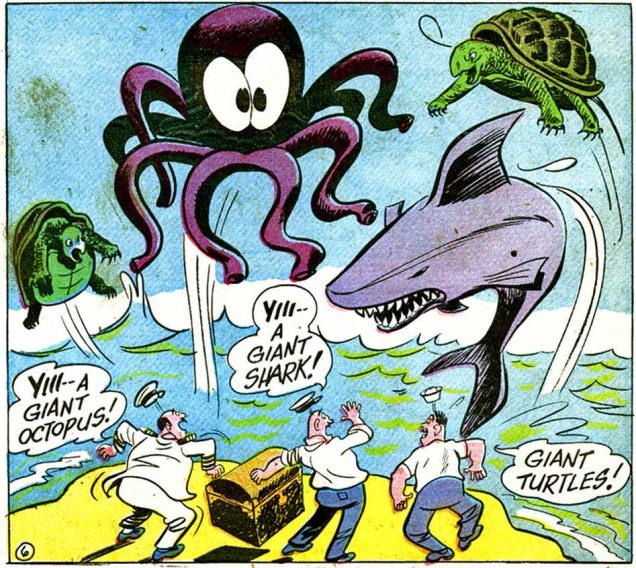
The Adventures of Jerry Lewis no. 44 (April 1958). Art is, presumably, by Bob Oksner, though GCD tentatively attributes it to Owen Fitzgerald.

Read this issue over at Ominous Octopus Omnibus (what could be more appropriate on Tentacle Tuesday?)

JerryLewis44-panel

~ ds

Hallowe’en Countdown II, Day 30

« I hate war, Steve! I hate the people who cause it and I hate them with very atom of my being! So I pretend to respect the enemy, even like him. I try to minimize him with love! » — Gen. Maximillian R. Hart, The Zanti Misfits

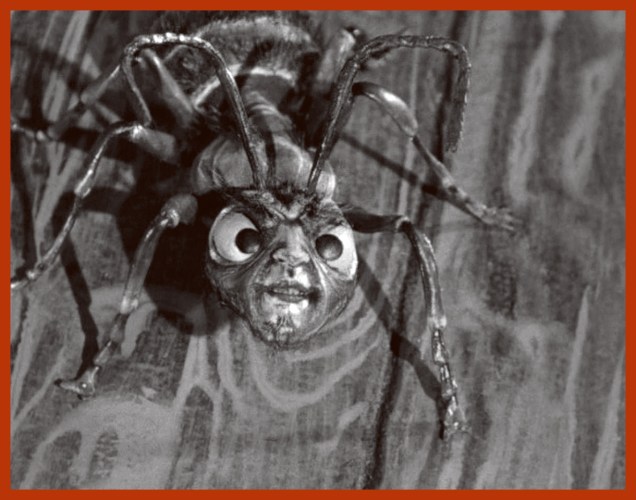
Feast your rheumy peepers on Bernard Baily‘s (co-creator, with Jerry Siegel, of The Spectre) famous cover for issue 4 of Gilmore Publications’ Weird Mysteries, April 1953. The cover’s creepy promise was squandered, since Baily’s friendly lil’ fella never appears within the issue.

WeirdMysteries4A
This one also contains a classic, though rather thin, Basil Wolverton story, « The Man Who Never Smiled ».
WeirdMysteries4OriginalA
A few years ago, the cover’s original artwork was auctioned off for the tidily respectable sum of $33,460.00.

It fell to the American Comics Group (ACG) to follow up on the notion, about a year later in the pages of its Forbidden Worlds No.30 (June, 1954) and the cover-featured « The Thing on the Beach! » by the unknown scripter, and artist Harry Lazarus (not the Harry Lazarus, but one of the three Lazarus brothers working in the comics industry in the Golden Age.)

LazarusThingA
« It started with brutal murder… until nature decreed a weird revenge! »

Rogers was a right mother from the start, but when his captain had his fill of his homicidal shenanigans, dropping him off on a remote island to cool him off, a funny thing happened. He found nothing in the place save ants, which had made short work of the unlucky goat population and the local flora. So what did the crazy bastard do? He gobbled ants. For weeks. And became a giant ant himself, it follows. You are what you eat, right?

Anyway, Rogers has got to be the most pragmatic villain ever, quite content, in the end, to be The Thing on the Beach!

Which brings me back to where I started: some say (okay, well, I do) that Baily’s WM4 cover may have inspired The Outer Limits’ ultra creepy The Zanti Misfits. Or maybe they’re just oddball products of the same era.

You be the judge.

ZantiMisfitA
One of the carnivorous, Don Knotts-headed creepy crawlies in question. Incidentally, The Zanti Misfits was shot in one of the most popular filming locations of all, Vasquez Rocks. Check out which of your favourites were set there!
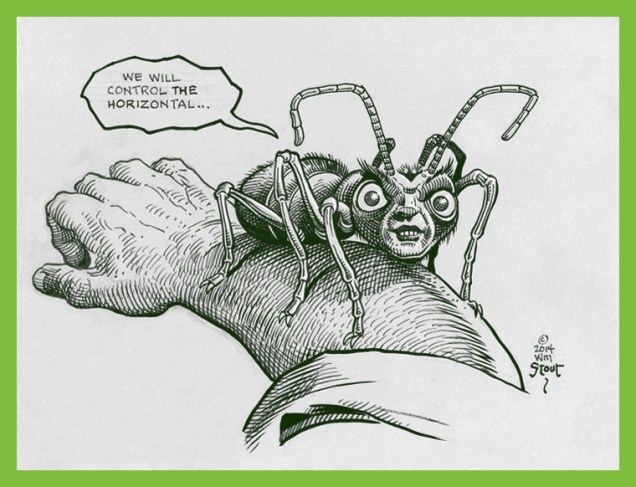
StoutZantiA
In 2014, the extraordinary William Stout created a series of drawings showcasing some of the most memorable Projects UnlimitedBears” from The Outer Limits.

-RG

Hallowe’en Countdown II, Day 29

« Here it is, Halloween again, and all the ghouls, goblins and other beasties are coming out of their secret lairs to frighten little kiddies… who are also emerging in weird, wild costumes to frighten the grown-ups, the stay-at-homes who hand over candy or whatever ransom is demanded in the traditional Halloween challenge! » — Joe Gill, « Trick or Treat »

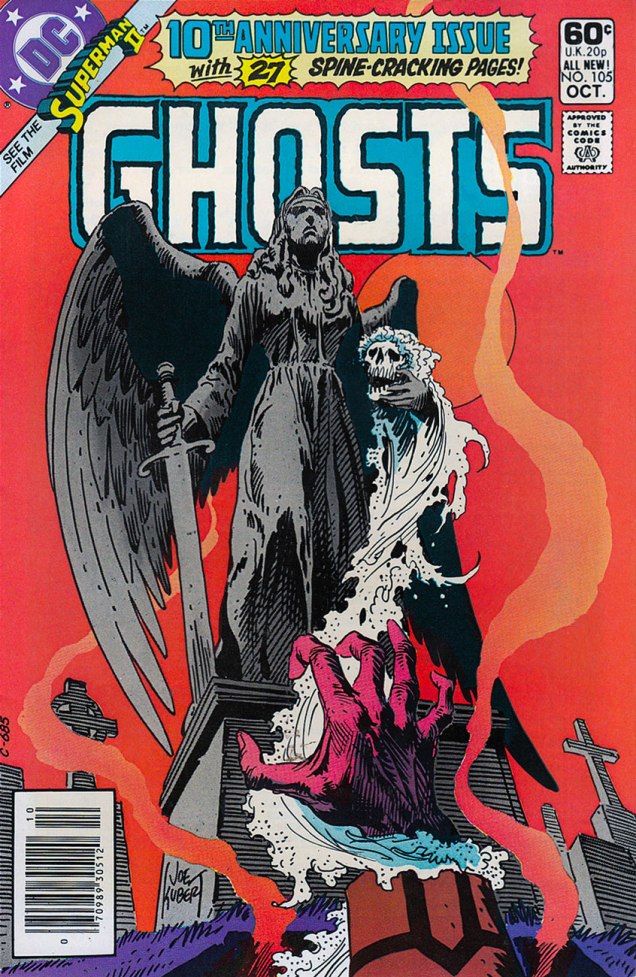
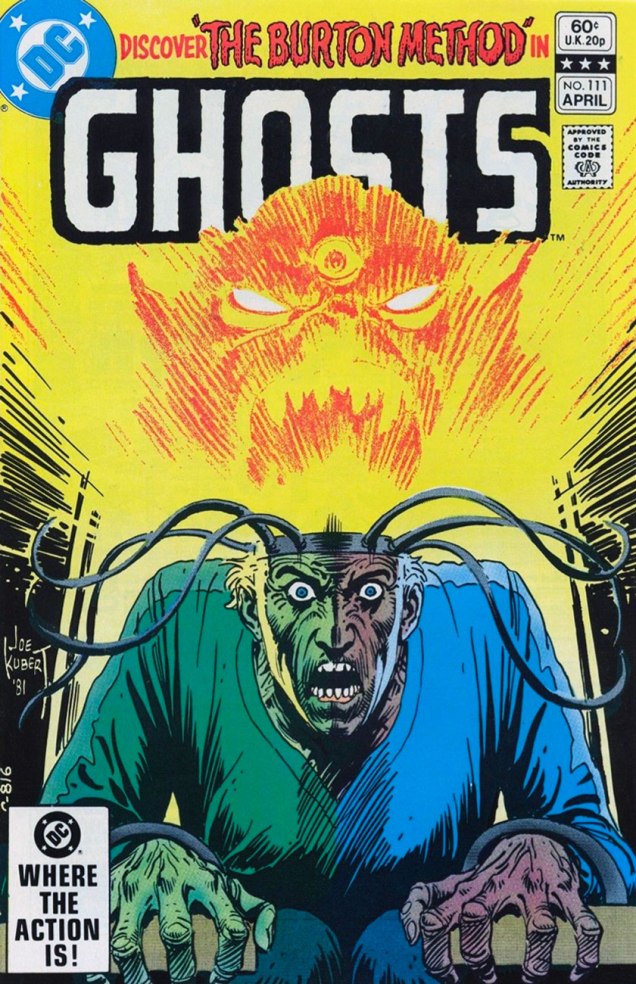
It was the early 1980s, and DC’s mystery books, in decline since the mid-70s, were running their final mile. They’d hardly ever risen to greatness, writing-wise, and the visuals had, for too long, borne far more of their share of the pact. And when you switch art directors from Nick Cardy to Vince Colletta, it’s got to hurt *bad*. By 1980, the strongest stylists had moved on, replaced for the most part by bland youngsters champing at the bit to move on to superhero work. The farm league, basically.

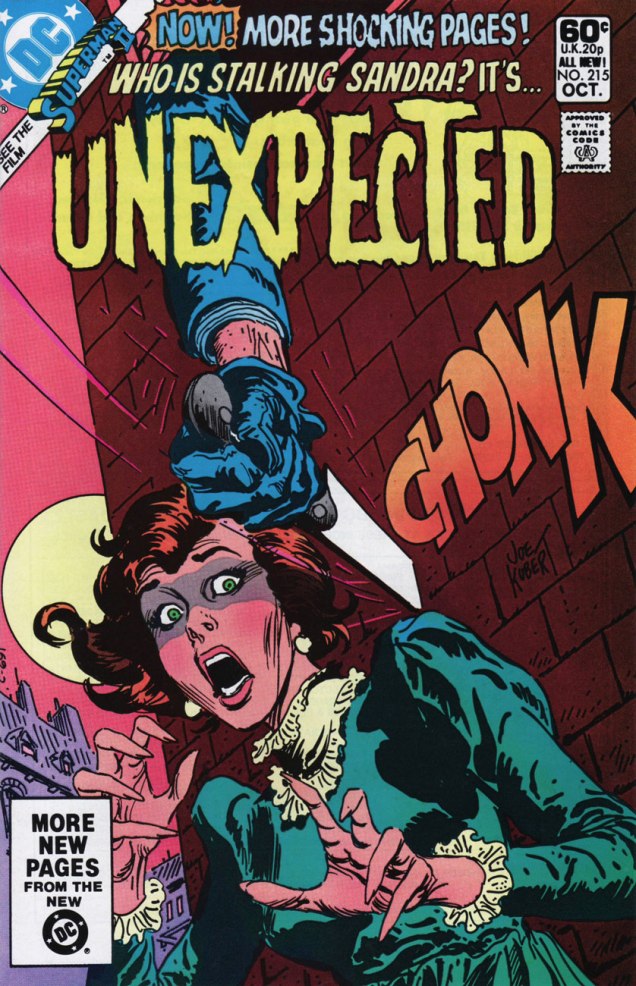
So the vultures were circling. In the midst of all the bad or lazy decisions, the most heartening exception was the frequent use of Joe Kubert‘s all-but-boundless skills on the covers. I suspect they gave him free rein… it certainly appears that way. Technical skill, thematic originality, « mysterioso », even a deftly humorous touch… it’s all there. Bravo.

Ghosts108AKubert285HOMAUnexpected204AGhosts105AUnexpected214AGhosts111AUnexpected215A

As even most comics fans of the period might be surprised that the mystery books were still around, I think it safe to assume that these pieces may be unfamiliar even to devoted Kubert fans. Enjoy!

– RG

Hallowe’en Countdown II, Day 28

« No matter what scientists say, lumbermen of the West insist that the monster exists… Believe it or Not! » — the standard Ripley’s line, from The Beast of the Humboldt

In the early 1960s, former industry leader Dell Publishing suffered a crushing blow when Western Publishing, who had been producing Dell’s comics for them since 1938, decided to handle their own distribution, which left Dell with, well… just about zilch*. But that’s neither here nor there.

Dell had opted out of the Comics Code Authority, and Western’s subsequent comics, under the Gold Key banner, also enjoyed that advantage, not that they abused the privilege much, though the exceptions are among the finest comic books ever issued: Ghost Stories No.1 and the one-shot giant Tales From the Tomb, both from the phenomenal mind of John Stanley and published by Dell in the fall of 1962.

By the mid-1960s, Warren Magazines had pounced through the loophole of the magazine format, unregulated by the Code, to bring back monsters forbidden under the CCA’s rule. Gold Key required no such stratagem.

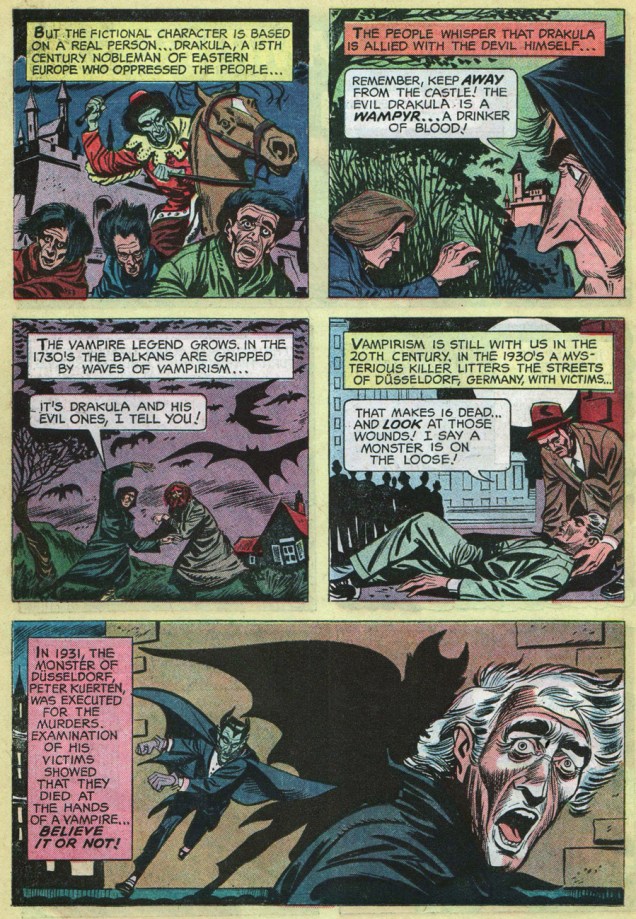
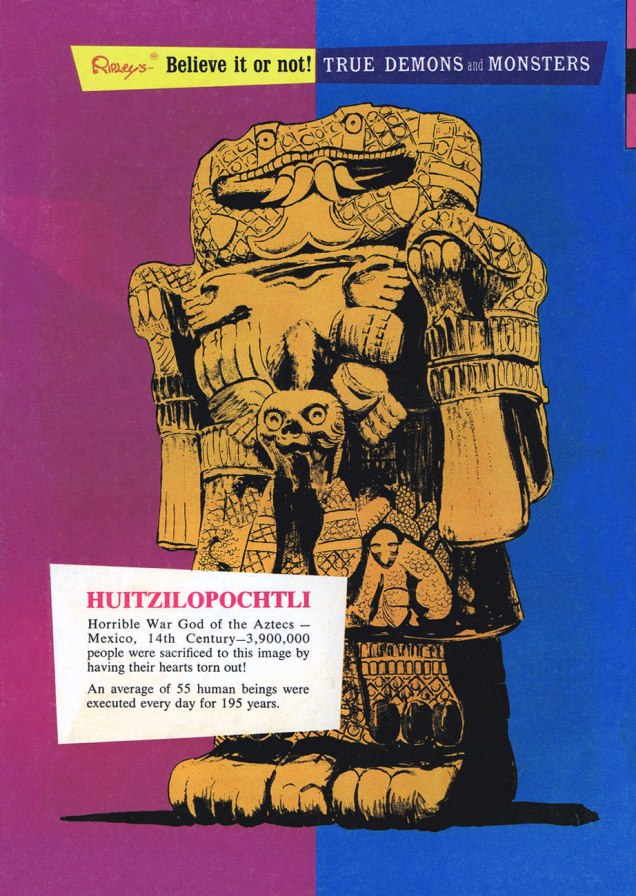
At first, GK’s long-running (1965-1980, 94 issues) Ripley’s Believe It or Not! * couldn’t decide on a focus: 14 of its initial 26 issues were devoted to « True Ghost Stories », two related « True War Stories », two shared « True Weird Stories », and six tackled « True Demons and Monsters ». With issue 27, the title stuck to ghosts, if not to the strict truth.

CertaVamp01A

CertaVamp02A

This is an excerpt from Ripley’s Believe It or Not! no. 4 (April, 1967), featuring the work of the much underrated Joe Certa (1919-1986), who began his comics career in the mid-1940s, working in just about every genre for a score of publishers, settling with Gold Key in the mid-60s and staying on until his retirement in 1980. He’s most remembered for his co-creation (with writer Joseph Samachson) of, and lengthy stint on J’onn J’onzz, the Martian Manhunter (1955-68), as well as for drawing every single issue of Gold Key’s loose adaptation of television’s first supernatural soap, Dark Shadows (35 issues, 1969-76). By this time, Certa’s style had evolved from a fairly mainstream style to a wonderfully blocky, angular and shadowy style that left him ill-suited to the depiction of standard superheroics… but prepared him well for moodier fare.

Ripley's4A
Issue 4’s front cover. Most of them featured often-splendid paintings by George Wilson, Jack Sparling or Luis Angel Dominguez, but the occasional effective photo cover crept in.
Ripley's4VersoA
Here’s a harsh factoid that makes vampires seem cuddly by comparison.

– RG

*the one priceless creative asset that Dell managed to hold onto was John Stanley, not that they appreciated him. When he left the industry, it wasn’t with a carefree grin and a spring in his step.

** « Ripley’s Believe It or Not! is a franchise, founded by Robert Ripley, which deals in bizarre events and items so strange and unusual that readers might question the claims. The Believe It or Not panel proved popular and was later adapted into a wide variety of formats, including radio, television, comic books, a chain of museums and a book series. »


Hallowe’en Countdown II, Day 27

« It only hurts when I exist »

Another astonishing madman from the Playboy magazine stable, Bernard Kliban (1935-1990) is mainly remembered for his much-merchandised « Cat » cartoons, but he was a true master of a vein of absurdist humour that few mine with such success. It’s high time for a collected œuvre or at the very least a comprehensive anthology. Fantagraphics, are you listening?

KlibanMonsterA
« Since when do we use the red thread on a green monster? »
KlibanMonsterWifeA
« I’m the monster’s wife… can I help you? »
KlibanStartledA
« Harry, you startled me! »
Kliban20YearsA
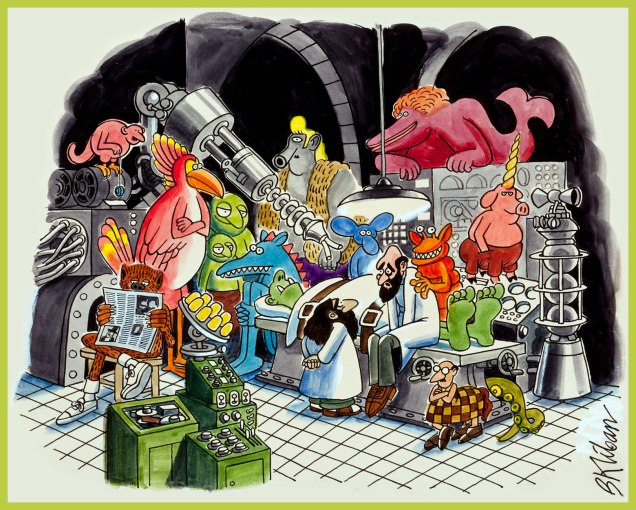
« I spend twenty-seven years making monsters and what does it get me? A roomful of monsters! »
KlibanMonsterLivesA
« Look, Igor, the monster lives! … and not badly, either! »

These pieces were gathered in the Playboy’s Kliban collection (1979) and its sequel, Playboy’s New Kliban (1980). Every single one of the man’s books (of which only the Cat books remain in print, I believe) is assuredly worth seeking out, but fair warning: left to his own devices, and away from the Playboy ethos, Kliban goes much farther afield into (extremely inspired) absurdity and abstraction.

-RG