« Quodo seemed to be a paradise. It was a lush green planet of peace and solitude. Then the pilot met the blonde… » — Nicola Cuti, “Weird World”
Kenneth Smith (1943-), the fantasy artist, inhabits the same body as Kenneth Smith, the retired philosophy professor and incorrigible obfuscator. Whereas someone like, say, Bertrand Russell would make his point clearly and concisely, Kenneth would just pile it higher and higher, leaving the reader entangled in a maze of syntax and syllogism.
Since you may not be familiar with the man’s infamous column in The Comics Journal, Dramas of the Mind, here’s a typical quotation from the man, where he, er… takes on “obscurantism”:
« In characterizing realities no less than in taking positions on issues, consciousness generalizes, i.e. genericizes: in articulating or formulating, it reduces things, even our own selves, to forms, abstractions, idealizations, types, archetypes, simplisms. “Thinking” is an activity that ultimately grounds or resolves itself in the satisfying, self-certain form of orthodoxies, preconceptions, uncriticized and imperative norms; and it is overwhelmingly inept to recognize just how pathetic, parasitic or placental is its relation to its “own” fundamental norms of understanding and valuation. Rarely if ever does any act of thinking grow so laserlike or iconoclastically intensive as to escape from the dense miasma of what is acceptable. To think what actually is is even more contranatural for humans than to see what actually is: as subjectivizing as “seeing” is, “thinking” is many degrees or magnitudes more saturated with conditioned biases, delusions, self-deceptions. A program of hygiene or asepsis for the sanity, acuity and clarity of syncretic or wholesided thinking—a discipline of orthotics for sobering, grounding and polemicizing of well-formed gnoseonoesis—is needless to say unknown in modernity. Not just language but virtually all of intellect, education, culture, etc. have been adapted into utilities, tools whose very aspectivity militates against the nakedness of “evidence,” which is to say, against candor and against truth: regardless of what it may be called, “evidence,” even the most obvious and blatant, is in actuality not so “evident” to most people, and the modern development of “sophistication” or “education” typically worsens the obscurantism. »
For all that, I’ll take a guy with such an overflowing abundance of vocabulary and ideas that he doesn’t know when to quit… over most of the boneheads frequently passing for writers nowadays. Still, if you don’t mind, we’ll (mostly) stick to his Warren artwork today.
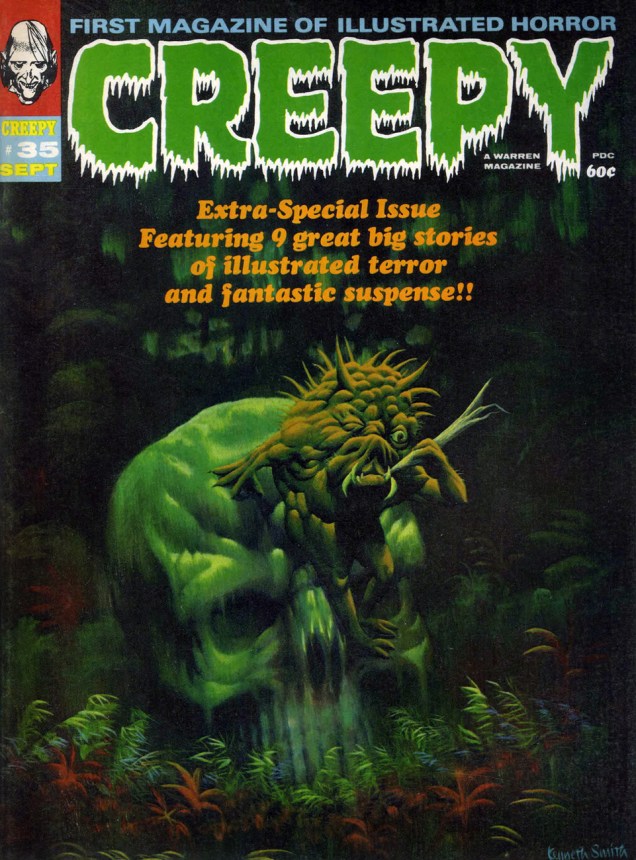
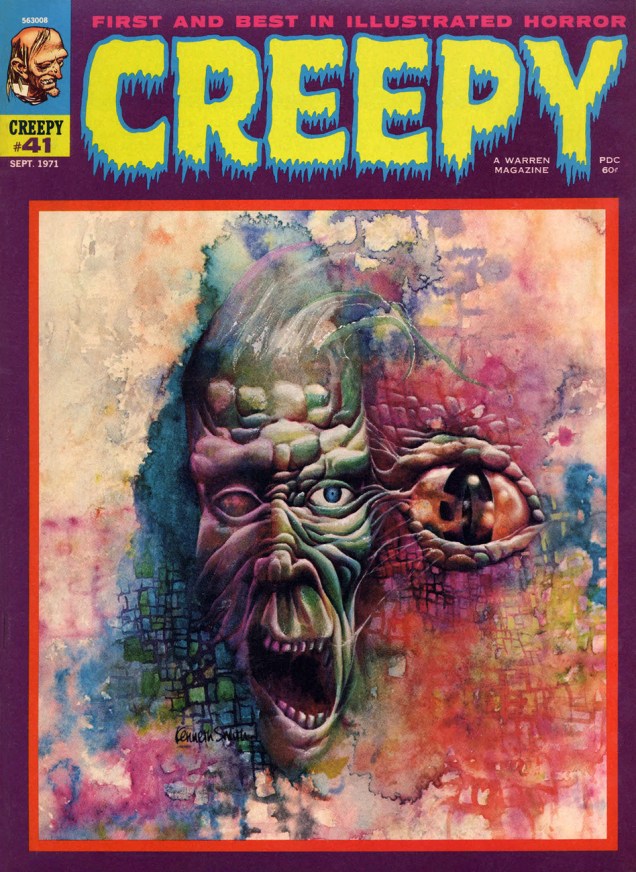
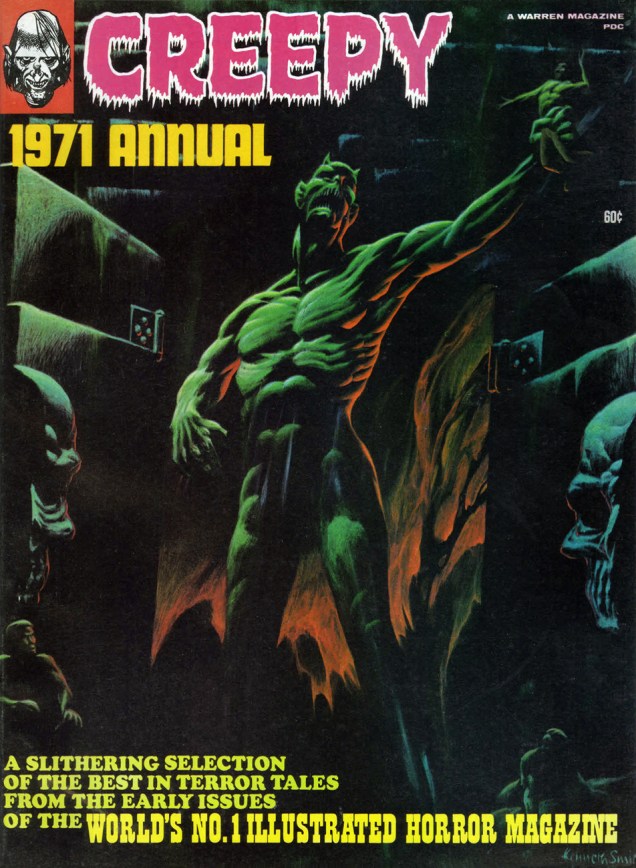
Creepy no. 35 (Sept. 1970). Regardless of its month of release, its lovely shades of emerald bring thoughts of springtime to mind.Creepy no. 36 (Nov. 1970), unique amidst Smith’s Warren covers in that it presents the human form in a somewhat less… grotesque fashion.This is Creepy no. 41 (Sept. 1971). Owing to its lower than usual print run, this ranks amongst the scarcest Warren issues.This is Creepy 1971 Annual, all reprints, but quite a choice roster of them: Ditko, Toth, Boyette, Craig, Crandall, Sutton, Adams, and Torres.And here we have Mr. Smith’s last, and arguably least, Warren cover. Only a detail of the full painting was used. Eerie 1971 Annual also features naught but reruns.And this is the original painting in its entirety. Sorry about the glare, but this is likely the only publicly available image of this privately-owned piece.
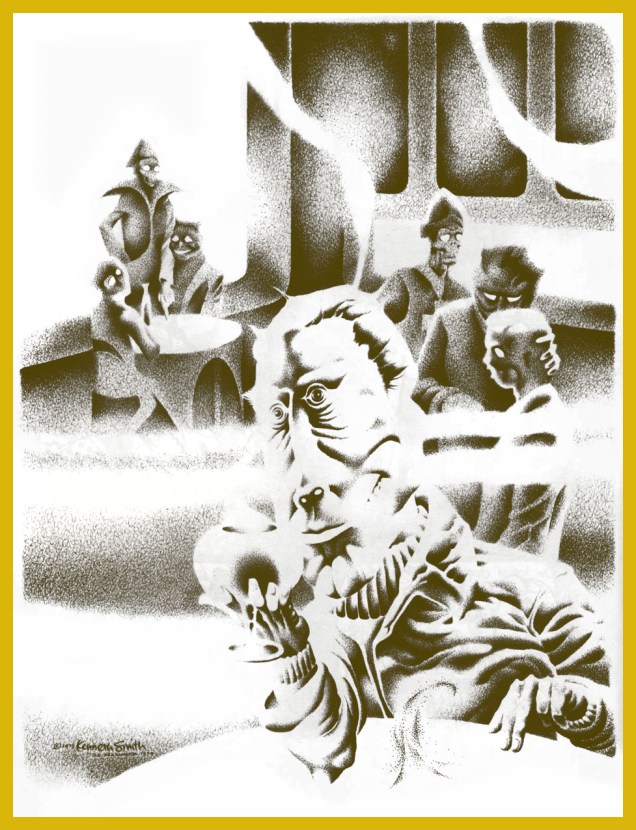
Bonus time: Mr. Smith created this lovely piece to illustrate R.A. Lafferty‘s masterful short story Mr. Hamadryad. I first encountered them* in the anthology Prime Cuts no. 1 (Jan. 1987, Fantagraphics). Hey, any fan of Old Man Lafferty’s is someone I’d happily clink glasses with. Cul sec, Mr. Smith!
« I believe that Mr. Hamadryad was the oddest-looking person I had ever seen. Surprisingly I regarded him so, for I first became aware of him in The Third Cataract Club in Dongola, and some very odd-looking gentlemen came into The Third Cataract. If you cock an eyebrow at someone in that place, then he’s really odd. » — R.A. Lafferty
*Smith’s illustration first graced Lafferty’s tale in the limited edition (1000 copies) collection Golden Gate and Other Stories (1982, Corroboree Press, MN). However, “Mr. Hamadryad” first turned up in STELLAR I (Judy-Lynn Del Rey, ed., 1974).
Kitchen Sink Press, a trailblazing publisher of underground comix that grew out of Denis Kitchen’s successful attempts at self-publishing, has seen its share of tentacles. (For a detailed story of how Kitchen Sink grew from a modest artists’ cooperative into a force to be reckoned with, as well as a discussion of its 30-year legacy, pay Comixjoint a visit.)
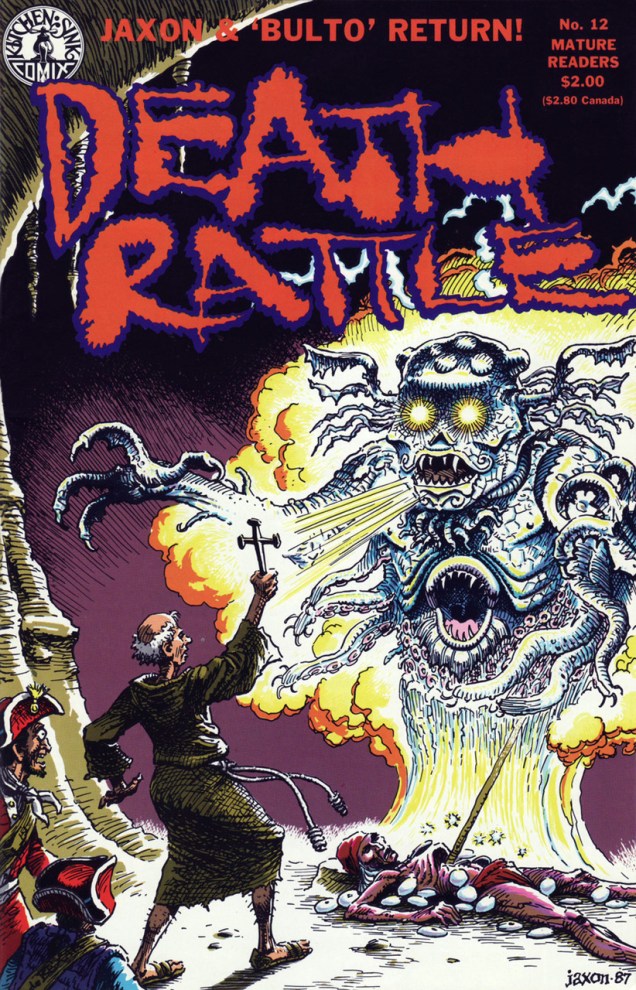
First we have a pair of entries from the Death Rattle catalogue. There were 3 “volumes” (series, if you will) published, and my favourite is volume 2, consisting of 18 issues coming out between October 1985 and October 1988, starting out in glorious colour but reverting to black-and-white with issue 6 (which was fine, actually). It’s a remarkably consistent anthology nearly devoid of clunkers, and featuring awesome stories and art by Rand Holmes, Jaxon, Tom Veitch, Al Williamson, Wally Wood, Steve Stiles, etc. It’s also where Mark Schultz’ Xenozoic Tales series was introduced (Death Rattle no. 8, December 1986)!
Death Rattle no. 4 (April 1986), cover by Rand Holmes, who’s already ascended to the rank of Tentacle Tuesday Master.Death Rattle no. 12 (September 1987), cover by Jaxon (Jack Jackson). The cover belongs to Jaxon’s “Bulto… The Cosmic Slug“, an epic eleven-parter that I really enjoyed reading (and not only because of its manifold tentacles). We’ll talk about that again.
Speaking of Jaxon, I’d like to quote from General Jackson, a tribute written by Margaret Moser (who dated him on-and-off through the years).
« The last time I saw Jack was a humid, late summer night in 2005 at the South Austin Museum of Popular Culture. His hair was nearly white and had lost its red-brown burnish, but his mustache was bushy as ever, and he resembled God Nose himself. He was a little grumpy, probably feeling bad, and I was with my boyfriend, so I didn’t sit on his lap. I did kiss his leathery cheek and fetch him a beer. He smelled like cigarette smoke and maybe of Old Spice.
On Wednesday, June 7, just three weeks after his birthday, Jack Jackson took his life at the graves of his parents outside Stockdale. His diabetes and arthritis were getting worse, affecting his ability to draw, and he’d been diagnosed with prostate cancer. Unwilling to face a debilitating course of chemo treatment, he put down his pen forever and made his own kind of peace with the unforgiving future. »
On to something more cheerful! Next, we have a bit of a non sequitur in this otherwise horror-centric post, although one might argue that being grabbed by an octopus is a traumatic experience. What’s The Spirit doing in here, you might ask?
« Kitchen Sink continued publishing multiple undergrounds and alternative comics through the ’80s and ’90s, but also expanded into publishing non-underground comics, graphic novels and extensive anthologies, most notably by Will Eisner, Al Capp, Milton Caniff and Harvey Kurtzman. » |source|
The Spirit no. 34 (August 1987), cover by Will Eisner.Page from “A Day at the Beach“, drawn and scripted by Will Eisner and inked by André Leblanc, printed in The Spirit no. 34 (August 1987). Somehow I’m not surprised that Eisner draws a mean-yet-elegant octopus.
All rested now? Okay, back to horror.
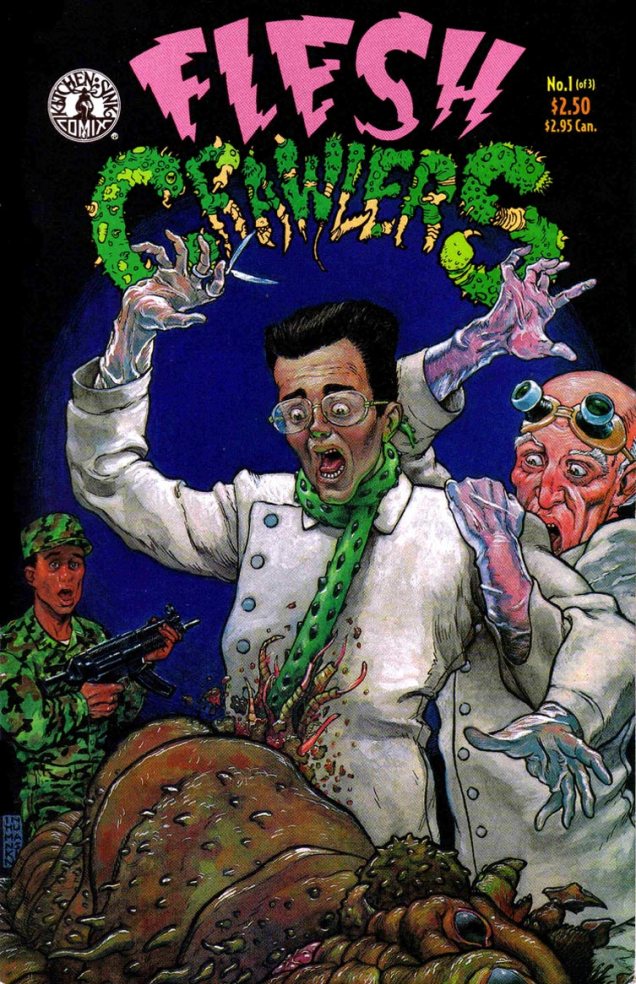
Flesh Crawlers no. 1 (1993), written by Richard Rainey and illustrated by Michael Dubisch. A quick look at the latter’s catalogue shows that Dubisch happily adds tentacles to whatever he’s drawing.
The scientist seems to have been preparing to dissect the specimen – turnabout is fair play! This cover reminds me of this, actually:
Barney & Clyde is a syndicated newspaper strip with jokes that are actually funny and characters that you can get attached to, a rarity these days. You can read it online.
Back on topic, another attack of the Flesh Crawlers:
Flesh Crawlers no. 3 (1993), written by Richard Rainey and illustrated by Michael Dubisch.
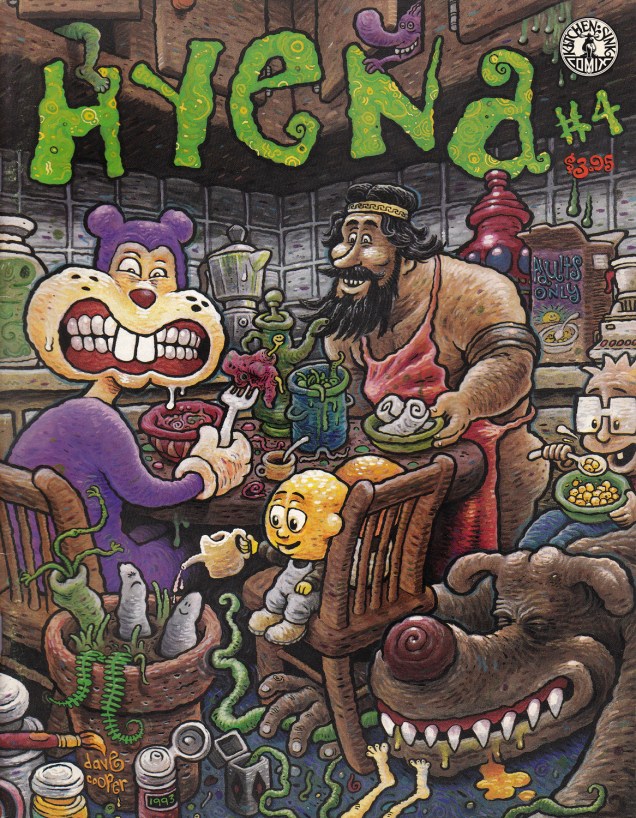
My final submission for today involves a cozy family scene where Frank is peacefully having breakfast with, err… Potted turnip babies and an almost-nude greek serial killer. I think.
Hyena no. 4 (1993, Tundra), cover by Dave Cooper. If Jim Woodring’s work frequently creeps me out, Cooper’s comics are viscerally repulsive to me (I think he goes for “nauseating” on purpose, but I’m not in the camp of people who like to experience strong emotions by watching disgusting, repulsive things happen). This cover, though, is all right.
« Calm down, Harris… this is no teleportational phenomenon we’re dealing with… » — Hawkman, “Yo-Yo Hangup in the Sky!”.
In 1968, though DC was still handily outselling Marvel, the industry leader was beginning to feel the heat. Now, to be fair, not nearly as much as revisionists would surmise: Marvel’s top-seller, The Amazing Spider-Man, was only in twelfth place. Of course, Marvel was hobbled by distribution issues, but that problem would come to an end that very year.
Anyway, as neither of DC’s solo titles The Atom (38 issues, June-July 1962 – Aug.-Sept. 1968) nor Hawkman (27 issues, Apr.-May 1964 – Aug.-Sept. 1968) were doing all that well (both of them missed the top sixty in 1968), it was decided to attempt to merge the books in order to perhaps save them. Well, it didn’t work, but some splendid covers were created, and that’s what brings us here.
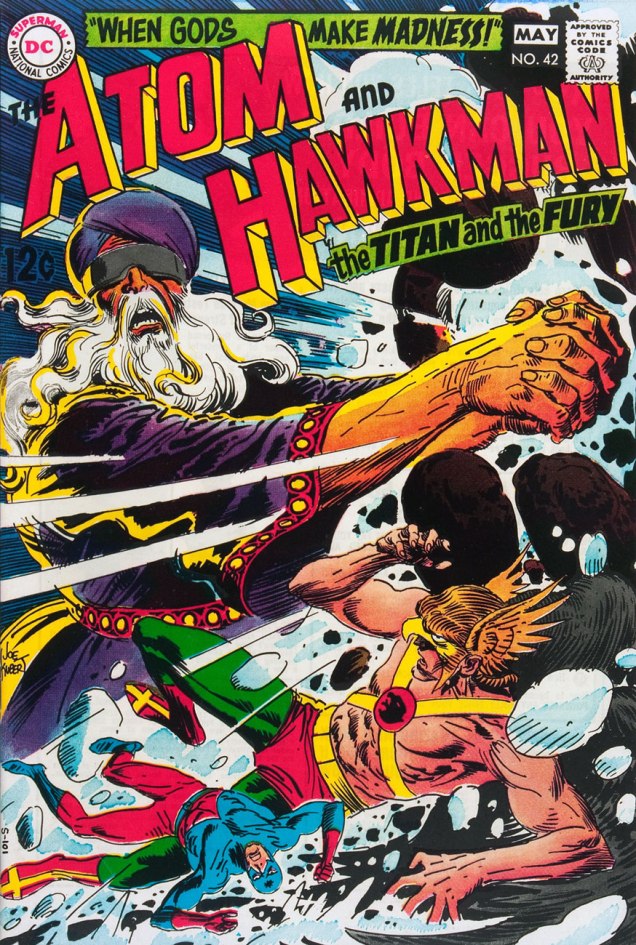
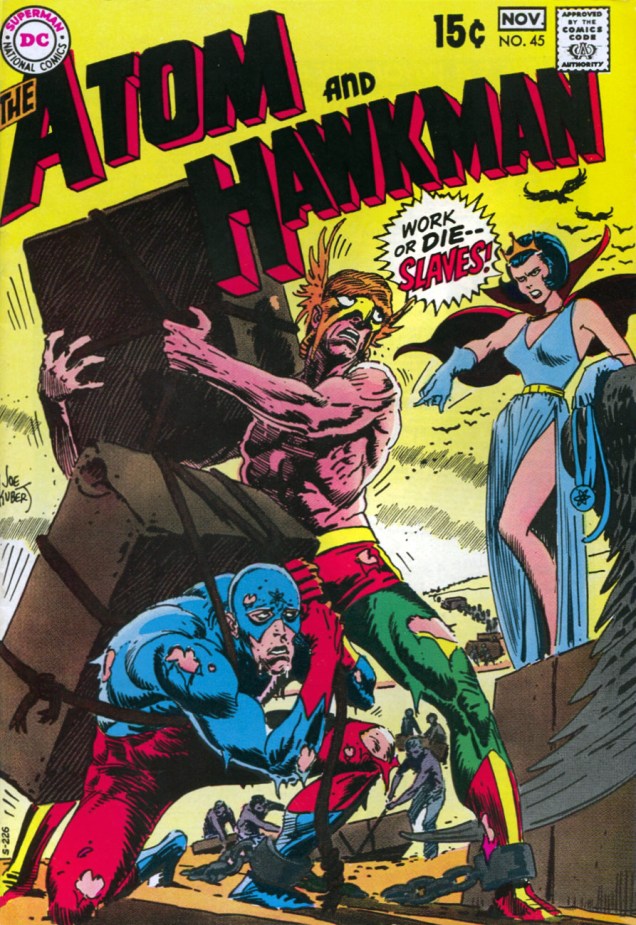
The Atom and Hawkman no. 39 (numbering continued from Atom’s book, not Hawkman’s), November 1968. Insides by Robert Kanigher, Murphy Anderson and Joe Giella. Which one’s the Titan and which the Fury? They take turns. Check it out here.The Atom and Hawkman no. 40 (Jan. 1969) holds a rare treat: a highly unusual pairing, one that was only repeated once to my knowledge (in the following issue): Joe Kubert on pencils and Murphy Anderson on inks. The tale is The Man With an Inbuilt Panic Button, scripted by Gardner Fox. Peruse it here while you can.My candidate for the slightest cover of the Atom/Hawkman combo title, but only since the competition is so fierce, and well, it’s kind of busy. This is The Atom & Hawkman no. 41 (Feb.-Mar. 1969), edited by Julius Schwartz and featuring Return of the Seven-Year-Dead Man, written by Gardner Fox, pencilled by Dick Dillin and inked by Sid Greene, and Yo-Yo Hangup in the Sky!, written by Fox, illustrated by Kubert and Anderson. Feast your eyes here.This is The Atom and Hawkman no. 42 (Apr.-May 1969). Read it here!Robert Kanigher & Joe Kubert’s Gentleman Ghost, first appeared (so to speak) in Flash Comics no. 88 (Oct. 1947) had not been seen (hee hee) since the Golden Age, and he returned to pester Hawkgirl and Hawkman in Come to My Hanging, scripted by Kanigher and illustrated by Murphy Anderson. Meanwhile, The Atom stars in Buzzin’, Buzzin’ — Who’s Got the Buzzin’?, scripted by Dennis O’Neil, pencilled by Dick Dillin and inked by Sid Greene. This is The Atom and Hawkman no. 43 (June-July 1969). Read it here!Kubert clearly relished delineating his Gentleman Ghost, and who could blame him? That sticky-fingered filcher is one snazzy-looking felon. This is The Atom and Hawkman no. 44 (Aug.-Sept. 1969). Read it here!This is The Atom and Hawkman no. 45 (Oct.-Nov. 1969), featuring Queen Jean, Why Must We Die?, by Denny O’Neil, Dick Dillin and Sid Greene, whereas our heroes are enslaved by Ray “The Atom” Palmer’s girlfriend, Jean Loring. It was a common theme in DC Comics, just ask Superman and Green Lantern, for starters. Anyway, read the whacked-out tale here.
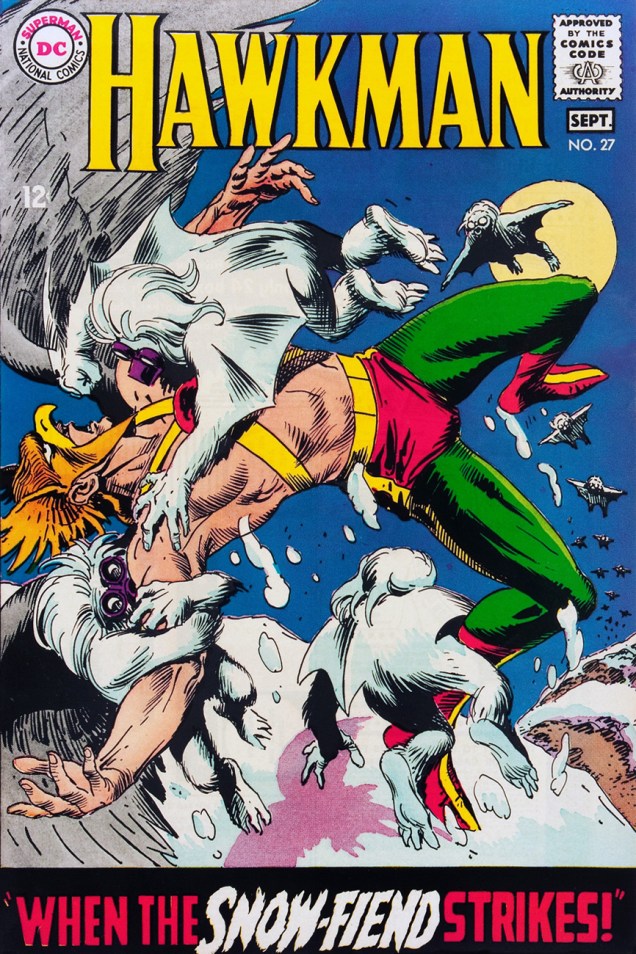
As a bonus, one could consider the final issue of Hawkman (no. 27, Aug.-Sept. 1968), the first entry in Kubert’s streak. Well, I do, and that’s that.
It is said that late each year, Thanagarians mark the winter solstice by taking to the snowy skies to join cuddly flying Yeti in frolic. Look at them cute lil’ buggers. When the Snow-Fiend Strikes! is scripted by Raymond Marais, pencilled by Dick Dillin and inked by Chuck Cuidera.
Poor Wonder Woman has gone through quite a few transformations during her lifetime. You can read about her kinky-yet-feminist beginnings elsewhere (for an interesting article about how this character was created, read The Surprising Origin Story of Wonder Woman at the Smithsonian; or take a gander at Wonder Woman, the sexualized superhero for a great discussion of how a character can be objectified or empowered by being portrayed in a sexy way) – today I’m concentrating on some goofy Silver Age covers from DC’s long-running Wonder Woman series.
My interest is twofold. On the positive side, I like the team that worked on WW covers in these days – Ross Andru on pencils and Mike Esposito inking. (All covers in this post are by them.) On a more sour note, I have a whole boneyard to pick with writer Robert Kanigher, whose scripts I generally like… as long as they don’t involve women. Who had the bright idea of choosing a hardened misogynist as writer of a major female superhero? (Purely a rhetorical question, I assure you.) Kanigher took over the scripting with Wonder Woman no. 98 (May 1958), “revamping” (as Wiki gracefully puts it) the character, giving her a new origin story and a new cast. It’s not that I object to the idea in principle, but this so-called revamping involved continually trying to marry the intrepid Amazon off to some schmuck, sticking her into stories that don’t make a lick of sense, making her burst into tears randomly – Like a Real Woman™ does – and forcing her to make Sophie’s choices between the lives of boyfriends and family, on random shuffle.
So here’s a gallery of covers I like and cover stories I don’t.
Wonder Woman no. 125 (October 1961).
Well, Mer-Man clearly doesn’t have a leg to stand on in this competition. Come to think of it, neither does Amœba-Man. How are these two even standing? And how would either of these consummate the marriage?
The cover story is Wonder Woman — Battle Prize, a good example of the “marrying Wonder Woman off” theme. “Ages of Heroes, Eras of Men” (by Julian C. Chambliss) explains that sort of thing is designed to « affirm [the super heroines’] proper femininity by regularly demonstrating their heterosexuality“. Now he’s right and all, but for that purpose one could easily come up with something more appealing than a romance with an amoeba, a unicellular organism that reproduces mostly by fission. Stay away from pseudopods and fishy scales, Wonder Woman.
Wonder Woman no. 143 (January 1964).
The Terror Trees (old Bob clearly liked alliteration) are trees that can move and attack, found on a “sinister, uncharted island”. For some reason there’s a Sun Sword (another alliteration) stuck in one of them, which Wonder Woman must retrieve to defeat some nasty alien invaders. At some point, a tree attempts to crush her, leading to an epic scene in which she whirls her head around, using her tiara (made of “amazonium… hardest metal known…”) like a “circular saw” and slicing her way out of the “ruthless tree”. I’m not even going to summarize the rest of this nonsense, but suffice it to say, the story ends – as it always does – on a happy note. Who’s the lizard on the cover, you may ask? No fucking idea, he’s not part of the plot.
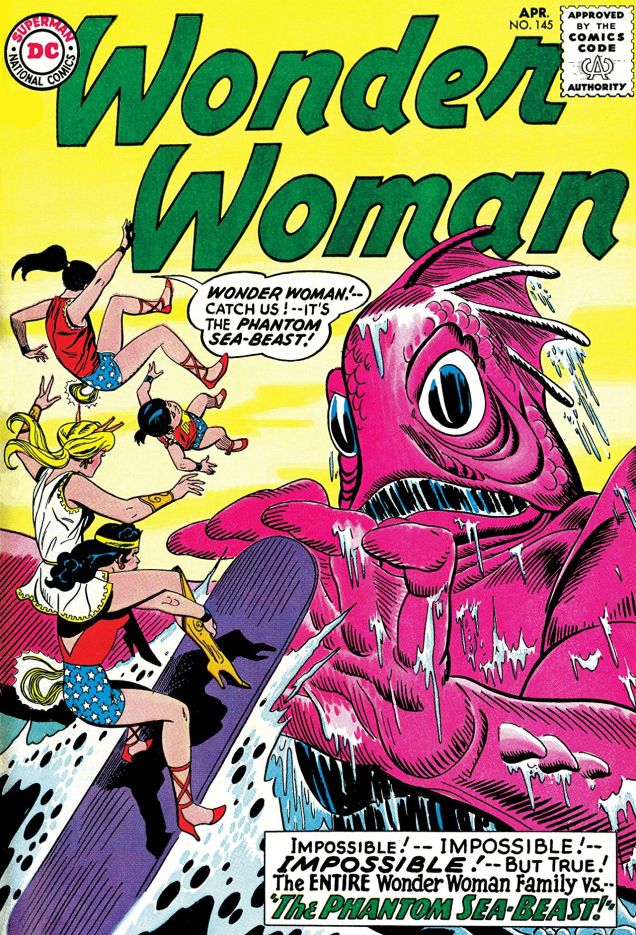
Wonder Woman no. 145 (April 1964).
The Phantom Sea-Beast is just such a tangled mess of claptrap that I don’t even know how to summarize it. It also involves some romance between Mer-Mite and Wonder Tot (in which the former tries to trick the latter into marriage), which is a good representation of what Kanigher seems to think as a Jolly Good Time. Bald zoo-keepers! A fight with a T-Rex! Go read Carol A. Strickland’s review of it, from which I shall quote a paragraph:
« Wonder Tot had just gotten out of the whale. As Wonder Tot surfs alone back to Paradise, she sees her family diving off a cliff and goes to meet them. They practice acrobatic stunts. Not only is Diana surfing in heels, as she is wont to do, but Wonder Girl conveniently wears a Wonder Woman tiara as she has never worn (she’ll need it later in the story). The queen’s pointy crown does not impale her daughter’s head. And even more oddly, gravity does not affect Hippolyta’s skirt. What can I say? It’s just a dream.»
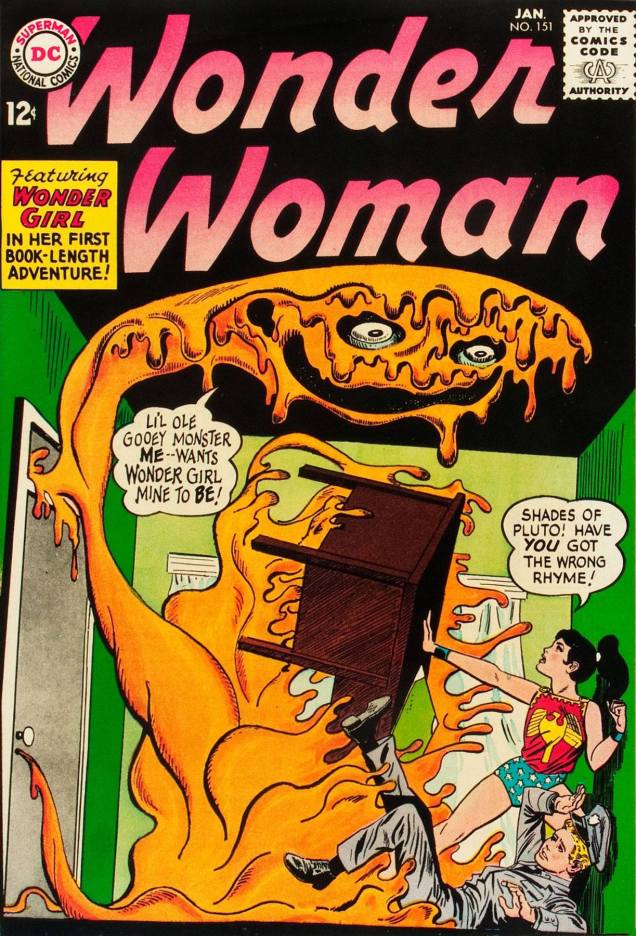
Wonder Woman no. 151 (January 1965).
In “Wonder Girl vs the Teenage Monster!“, the Glop, a blob-like alien, swallows 100 rock’n’roll records and proceeds to serenade Wonder Girl with regurgitated lyrics, coming up with gems like “Glop… glop… I’m not a mop! I want my pearl – wonder girl!” And by the way, it was all a dream (a convenient cop-out that Kanigher resorts to far too often): Wonder Girl fell asleep while looking through a photo album with Wonder Woman’s “boyfriends” and mourning her own romantic troubles. We hear you loud and clear, Sir Kanigher: women’s pretty little heads can only think of men and all manner of frilly, sweet things, even if the woman in question possesses great power and even greater intelligence.
That being said, this is probably my favourite cover of the lot. I just melt when presented with a blob of goo!
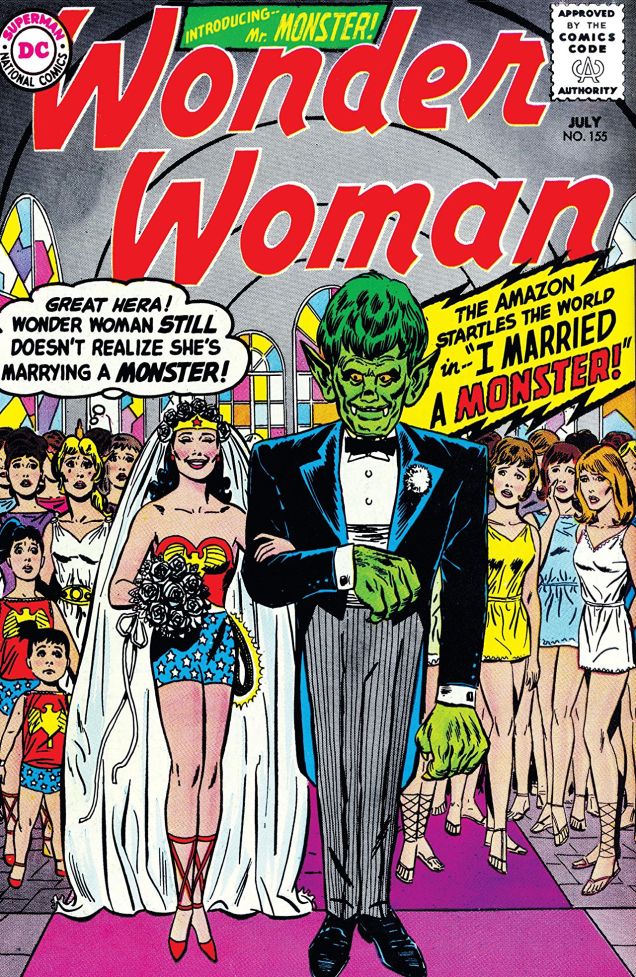
Wonder Woman no. 155 (July 1965).
Groan. Here we go again with this ridiculous obsession of marrying Wonder Woman off. After Wonder Woman is hounded by her usual three beaus who practically threaten her with matrimony (including the awesome line, uttered by Steve Trevor, “When are you going to marry me! Better hurry! Before you’re an old maid!“), she encounters Monster Prince, who, as it turns out later in the story, is handsome when he does good, and ugly when he does evil.
A sample of the romantic dialogue that leads to the altar for these two lovebirds:
Monster Prince: « Stop pretending I’m an ordinary man! You almost sacrificed yourself like a driver taking pity on a dog on the road — and risking her life to avoid hitting him!»
WW: « Only a man who thinks like a giant — could have defied a whole army of Amazons as you did before! You raged like a storm! You were magnificent! Anyone who married you — would be lucky! »
And that’s it, they’re betrothed! Except that the Prince ditches her at the altar, claiming that he doesn’t want a beautiful girl to sacrifice her life to a monster like him. Err…?? More nonsense follows. It becomes painfully evident that Wonder Woman is attracted to bipolar assholes who make her feel inadequate. It reminds us once again that according to you-know-who, women are emotional weaklings who need an overbearing male hand to tell them what to do (or where to get off). Brr. Read the full synopsis, if you dare, over here.
Wonder Woman no. 169 (April 1967).
You know how sometimes a restaurant proclaims to have a dish so original that it’s only on offer at that particular joint? It sounds like hype, but occasionally the claim is actually accurate… because the recipe in question combines elements that clash so badly that no normal person would think of combining them. This “most unique villain ever created” is in that category: he’s a bloody stupid idea. He’s not terrifying, he’s silly… though I did develop a headache while trying to figure out how he got into that tight outfit with his 8 sets of arms and 7 sets of legs.
Joanna Sandsmark, who wrote a hilarious review of the Crimson Centipede (be sure to read it here!), remarks that « I am thoroughly convinced that the germ of the story came to Bob Kanigher when his wife had a run-in with a centipede. Somehow, he thought it would be a good idea to have Wonder Woman afraid of it, as his wife was. Apparently, he forgot that Diana was a superhero who had all kinds of powers. Lucky for him, she was female. Problem solved! » (I think I’m not the only one who has a low opinion of Kanigher’s female-depicting prowess.)
So there we have it. Is this bigoted balderdash worthy of a man who co-created Sergeant Rock, or Enemy Ace or the Unknown Soldier? Nope. What do these have in common? There’s no women in these series, or at least no recurring female characters. (Well, okay, the other commonality is Joe Kubert.) Metal Men could have been great… but the presence (and more significantly, characterization) of a female character, Platinum, kills it for me. There’s no doubt that Kanigher *could* wrote emotionally resonant stories with complex characters and excellent internal logic. In the case of the Wonder Woman series, he just chose not to, preferring instead to produce a lot of hooey with giant plot holes and pepper it with sad clichés. It’s a pity.
Has this ever happened to you? You’re sailing along, just minding your business, concentrating on fishing or just taking a pleasure cruise, when suddenly you’re abruptly attacked by shifty tentacles. What do you do? Defend yourself with a tickle assault!
Page from “Little Dot Meets Uncle Gill”, printed in Little Dot no. 5 (Harvey, 1954). Art is by Steve Muffatti. Little Dot is never at loss in any situation, but I’m surprised the octopus isn’t covered in polka dots.Panel from “Little Dot Meets Uncle Gill”, printed in Little Dot no. 5 (Harvey, 1954). Art by Steve Muffatti. No harm done!
Some octopuses sneak onboard to be helpful…
Original art for a Felix the Cat Sunday comic strip from July, 1934. Art by Otto Messmer.
… And some are just pissed off about their dwindling food supply. (Or perhaps that fish was a personal friend.)
Marmaduke Mouse no. 2 (Summer 1946). Artist unknown.
If there’s any moral to these tales, it’s that fishing is hazardous business.
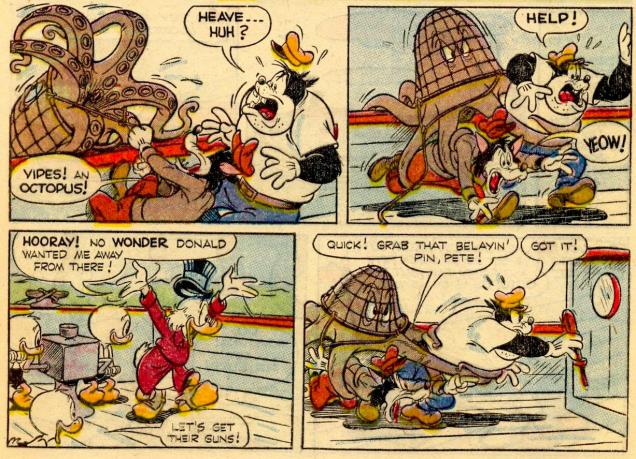
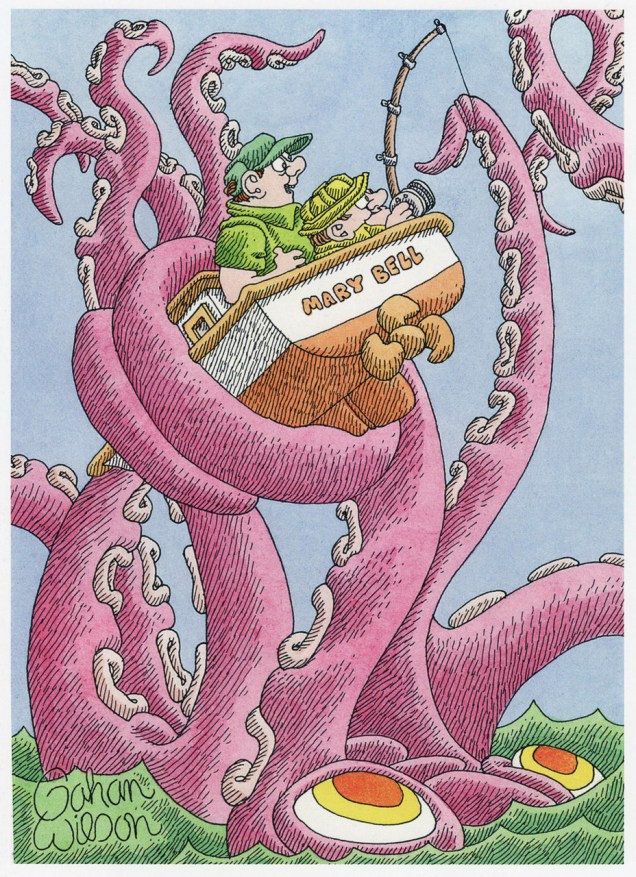
Walt Disney’s Donald Duck Beach Party no. 1 (July 1955). The story is “Sea Breeze Sailors”, scripted and drawn by Dick Moores.« Don’t let it get away! » Cartoon by Gahan Wilson.
« Painstaking drawings with an eloquent orchestration of hatchings and tickings, marvelous details of period and setting, a narrative that leapfrogs from the precise to the unexplained, a tone of vague delights in both visual and linguistic oddities. » — ‘Mr. Earbrass Jots Down a Few Visual Notes: The World of Edward Gorey’ by Karen Wilkin (1994)
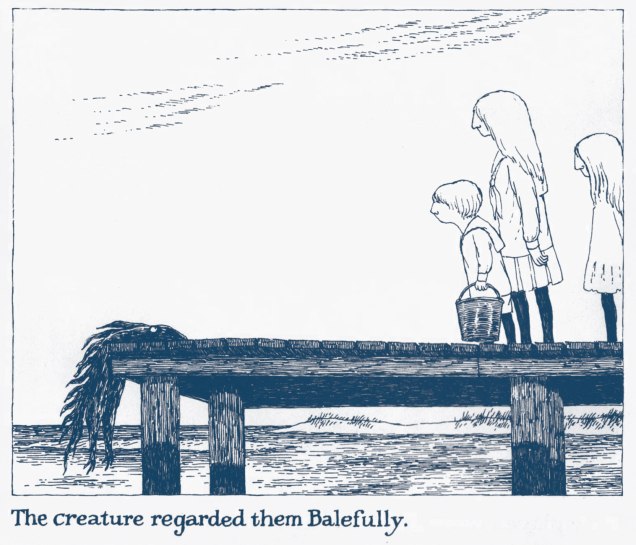
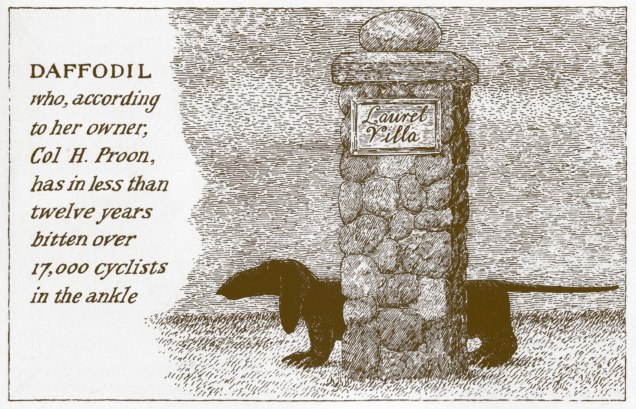
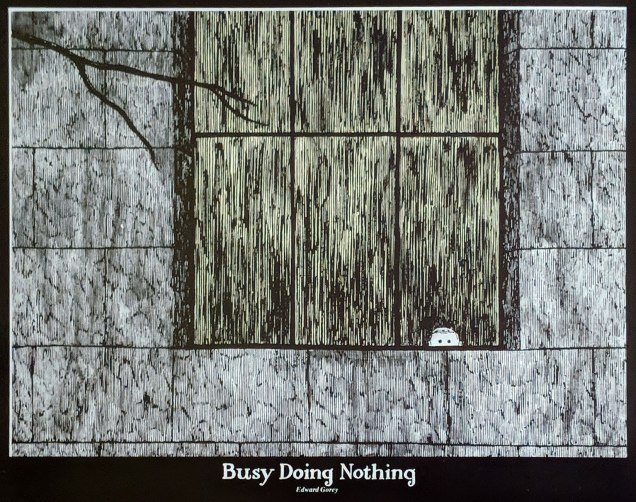
So very much has already been written and said, in all media, about Edward St. John Gorey (February 22, 1925 – April 15, 2000) that there seems little of substance to add. As his work’s ultimate appeal rests in its enduring, expertly wrought sense of mystery, it should be in the Master’s spirit to show rather than tell. Consequently, here’s a gallery of favourite extracts from Gorey’s voluminous œuvre. I’ve omitted both my personal pick, The Willowdale Handcar or The Return of the Black Doll (1962) and the too-obvious-by-half The Ghashlycrumb Tinies or After the Outing (1963), the former because I’m planning to examine it more leisurely in the future, while the latter… still manages to squeak in, after a fashion. See our bonus at the end.
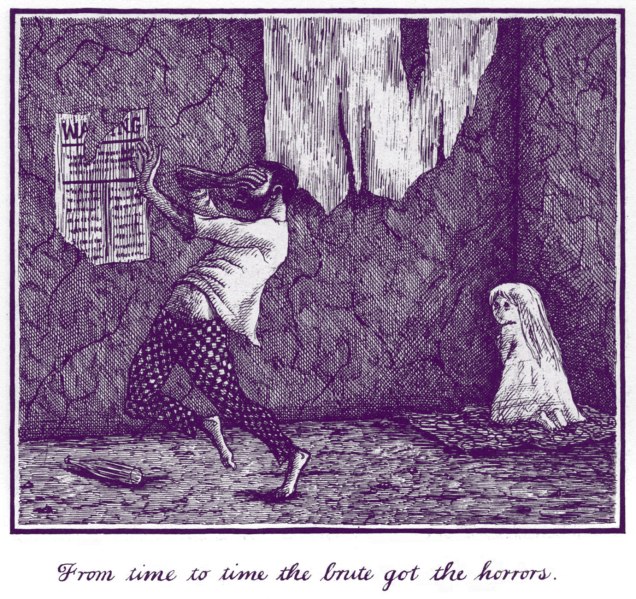
The Doubtful Guest (1958).The Hapless Child (1961).The Wuggly Ump (1963).The Osbick Bird (1970).The Disrespectful Summons (1971).The Glorious Nosebleed (1975).The Broken Spoke (1976).The Broken Spoke (1976).The Loathsome Couple (1977).The author and his creature in New York City, 1958.Bonus bits: An entry from The Ghashlycrumb Tinies (« N is for Neville, who died of ennui ») turned up, of all places, in Byron Preiss‘ splendid The Beach Boys (1979), which chronicled the band’s history up to that point through reams of quotations and illustrations, matching a gazillion visuals artists with a favourite BB tune. Gorey’s entry (reprinted and détournée with the author’s consent) was the setup for a dyptich. It provides a visual for Busy Doin’ Nothing (1968) one of Brian Wilson‘s finest compositions from his years in the wilderness; well before Seinfeld, it’s a song about nothing, set to a lilting bossa beat. Hey, get the mug!I generally have little use for Walt Simonson‘s work, which I find overly-mannered and illegible, but I give him full marks here for wit, creativity and musical discernment. His contribution to Byron Preiss’ book focused on Brian Wilson’s bucolic I Went to Sleep (also 1968), a companion to Busy Doin’ Nothing and a fascinating miniature that gives a sense of Brian’s eventual creative direction had he not been forced to stick with the tried-and-true, official Beach Boys sound to this day. Simonson does a very effective Gorey pastiche, don’t you think?
« You know, the kids had quarrelled, so they’re taken off to see a corpse, which is decayed and completely hanging. It was parody. » — Gorey, interviewed by Clifford Ross (1994)
Oh, and if you should find yourself in the vicinity of in Yarmouth, Massachusetts, do drop by the Edward Gorey House!
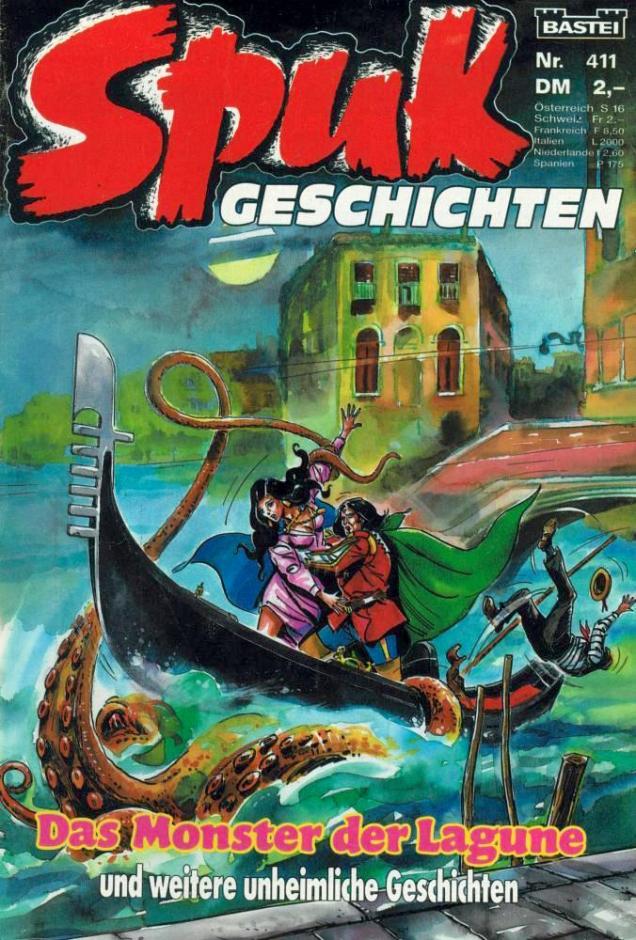
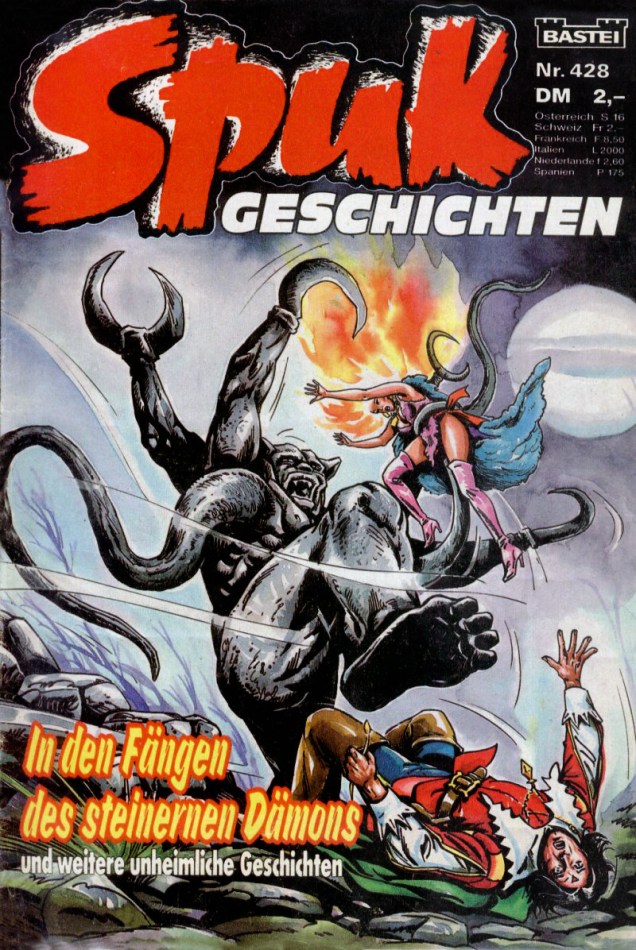
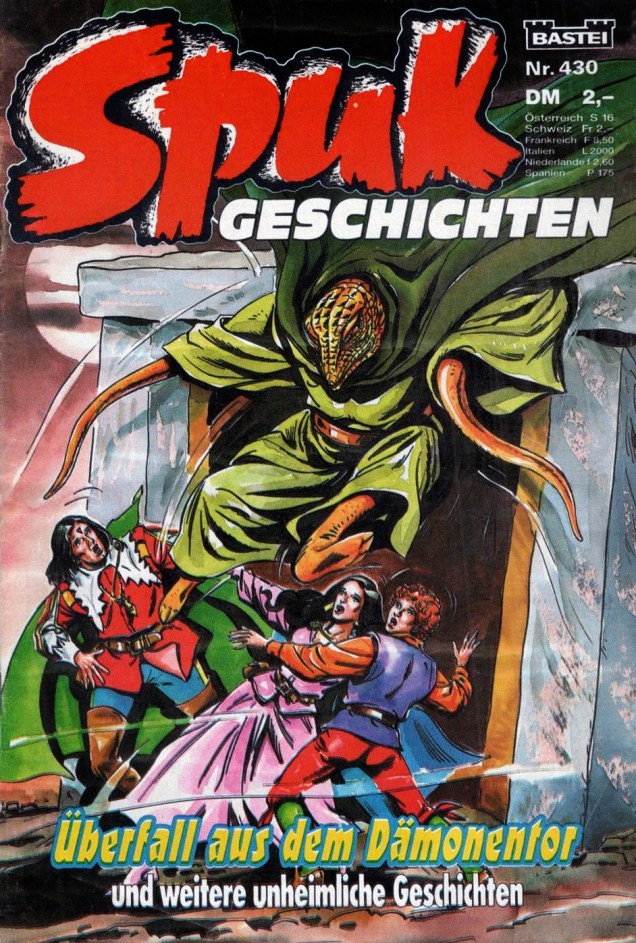
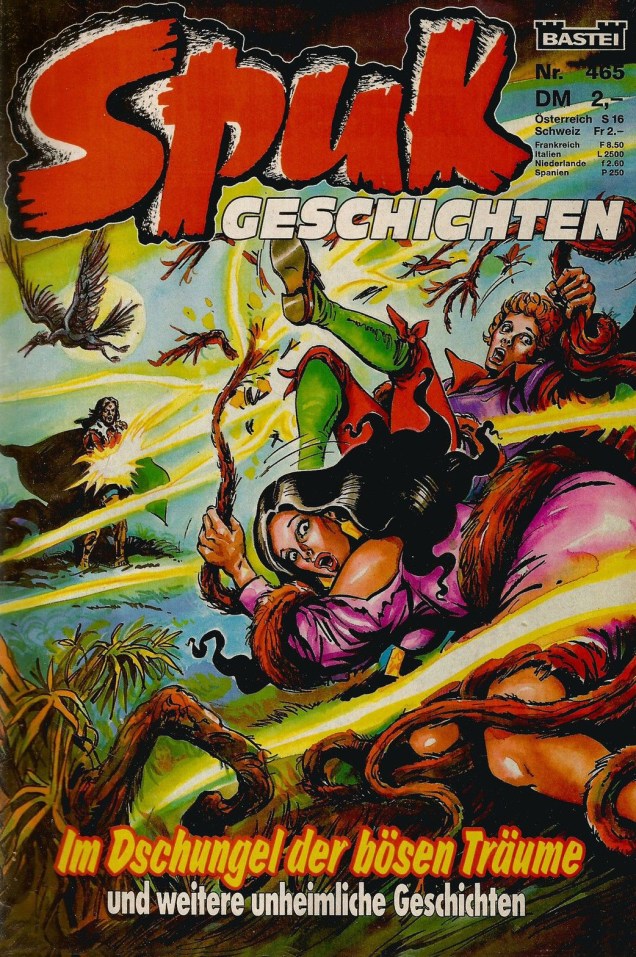
When one thinks of tentacles, one generally thinks of Japan. Did you know that Germans appear to be equally obsessed with them? “Obsession” is the only way I can explain the following post, in which the same hero trips over tentacles with depressing regularity. And I thought Conan encountered tentacles too often for statistical probability (see here and here).
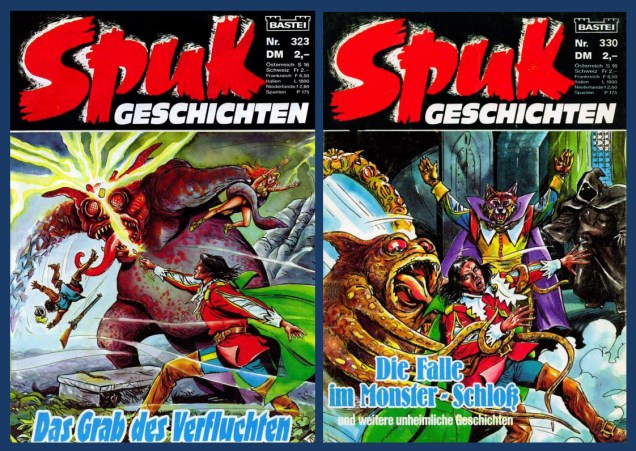
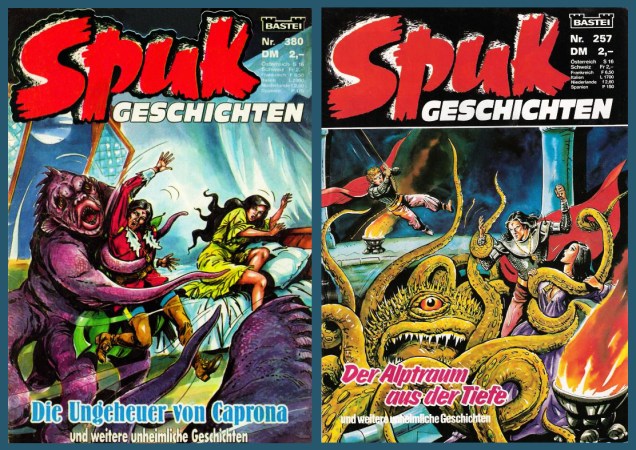
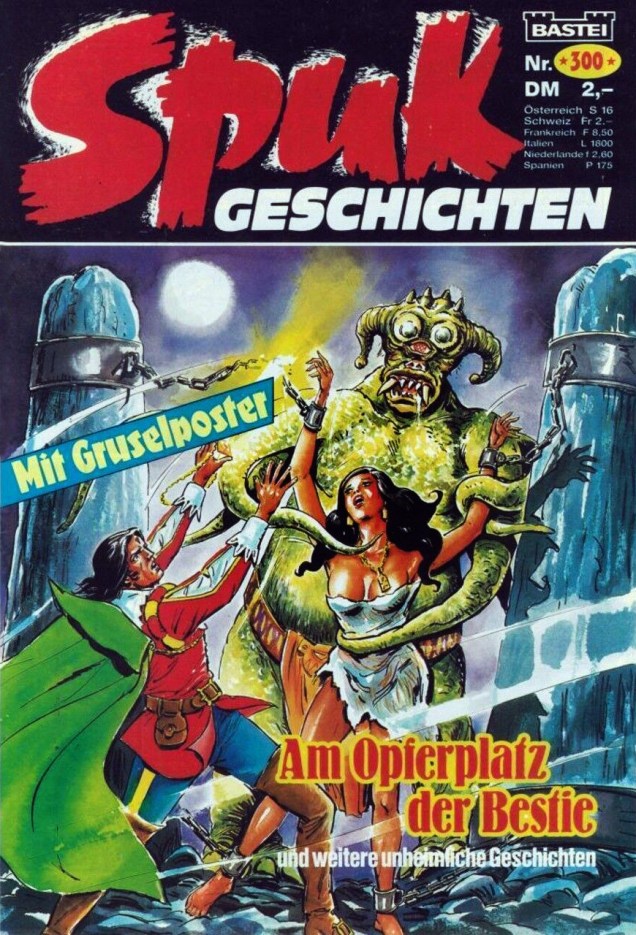
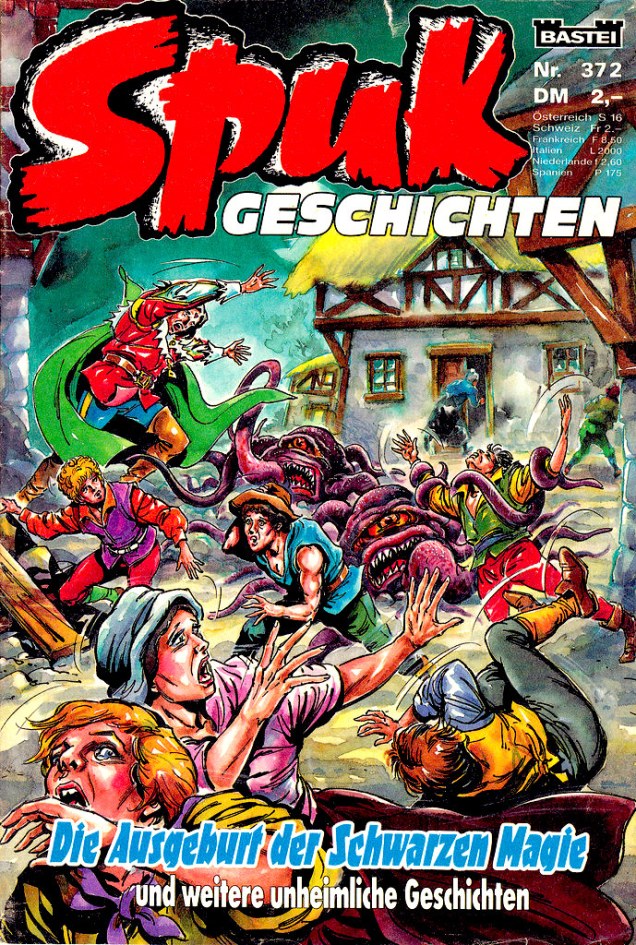
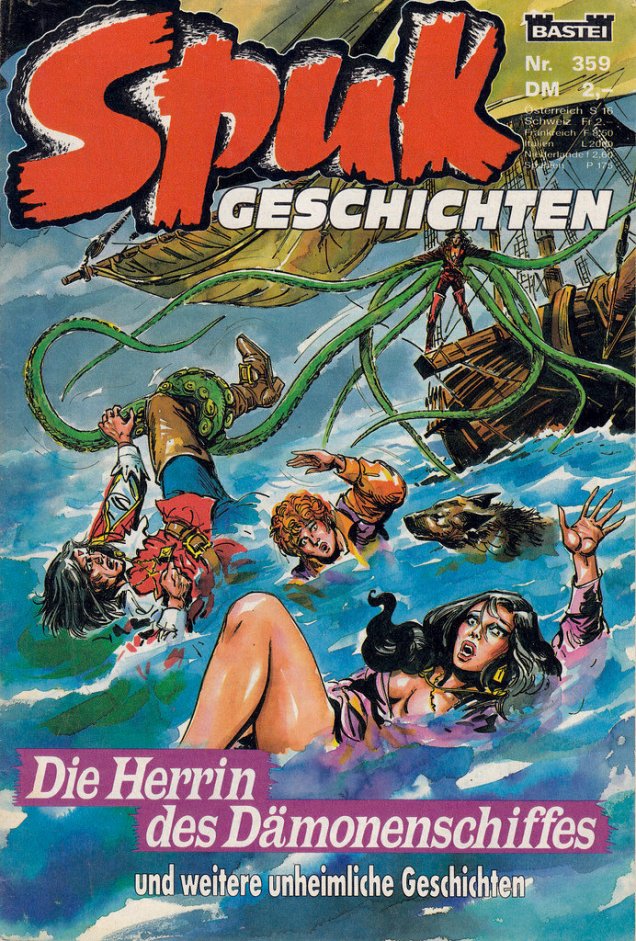
When Gespenster Geschichten (ghost stories), a major comic book series from the publishing house Bastei Verlag, proved to be an unqualified success, it was decided to bring a second horror child into the world in the shape of Spuk Geschichten (spooky stories). The latter, though not quite as long-lived as its sibling, still spanned an impressive 492 issues running between between 1978 and 1995. (For comparison, Gespenster Geschichten lasted from 1974 to 2006.)
Both series are easy to recognize thanks to brightly coloured, if not to say garish, covers. The insides, as far as I’ve been able to ascertain, were a mixed bag: some reprints (mostly of American material), some original stories by German artists and writers. I’m rather fond of the loud, red SPUK that’s part of the Spuk Geschichten logo. Rather than reminding me of the English “spook”, it seems like an onomatopoeia: “spuk!”, goes the tentacle slapping some yielding female flesh, “SPUK!”, as it smacks a young man across his chest and sends him flying, topsy-turvy, into the bushes.
Onward to the gallery of Tentakel! We’ve got green, vaguely apelike monsters…
And a whole family of purple, tentacled atrocities….
And other assorted tentacular nonsense: gorillas, plants, lizards, female sailors with multiple grabby appendages…
Through all this, why is the main character still surprised to see a monster with tentacles? One would think he would be profoundly blasé about the whole thing by now, elegantly fending off tentacled creatures while politely covering his yawn with a carefully manicured hand. You think I’ve exhausted the tentacle arsenal of Spuk Geschichten? Ha!
And there’s more, but I’m running out of time, space, and, frankly, any interest. In terms of attaching tentacles to completely inappropriate creatures – and a lot of people have tried -, I think Spuk Geschichten reigns supreme in diversity and just, well, sheer numbers.
~ ds
*as usual, writing about comics written in a language I mostly do not understand is tricky. If I’ve committed any faux-pas, please correct me, dear readers!
« Sepulveda Von Lovely looks much better in a handlebar, if I do say so myself! » — ‘Bumps’ (2004)
Since the 1980s, when it came to carrying the torch of Good Duck Man supreme Carl Barks, there have been three clear contenders, namely Daan Jippes, Don Rosa and William Van Horn. All three are outstanding talents, and honestly, no single being can take the place of Barks. In the end, Van Horn is my pick, because he’s the most complete package*, possessing his own lively, economical style in both writing and drawing (and that includes his expressive lettering, a perennially underrated art form). His work is just a pure joy to read, while Jippes is arguably too close to the model and Rosa’s stories sometimes feel like continuity-saddled homework. Van Horn is a natural.
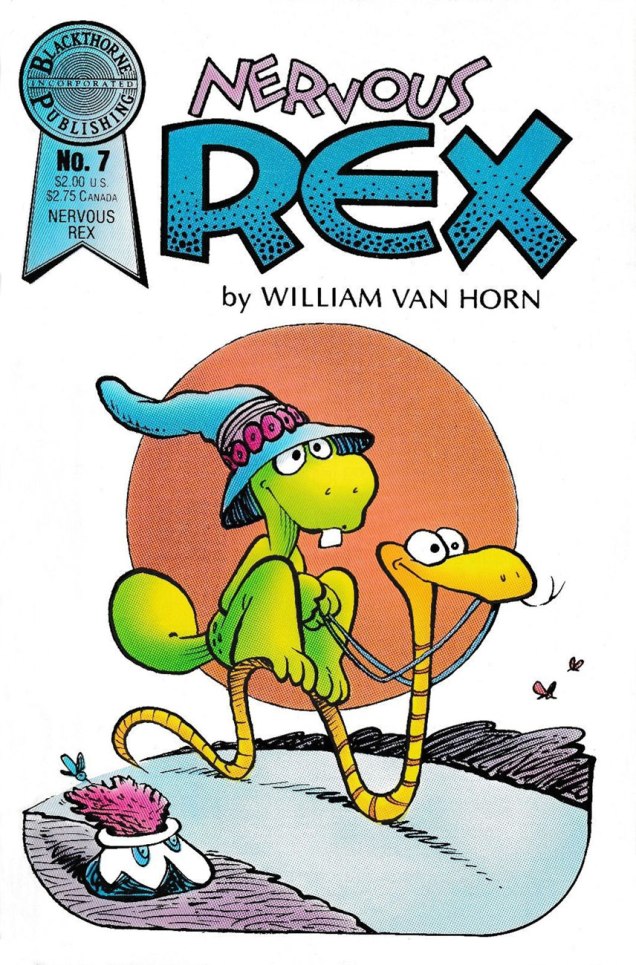
On the occasion of Mr. Van Horn’s eightieth birthday (he was born on February 15, 1939, and is thankfully still with us), here’s a modest Van Horn comics sampler, opening with his first comics series after decades of work in animation and children’s books, Nervous Rex, and continuing into his work for Danish Disney comics packager Egmont**.
From Don Markstein’s Toonpedia: « Cartoonist William Van Hornecreated the series, which lasted ten bimonthly issues (September, 1985 through March, 1987). Like Russell Myers, creator of Broom Hilda, he used a style clearly inspired by George Herriman’s Krazy Kat, without being a slavish imitation. Van Horn, who had made his living for decades in commercial art and children’s book illustration, had earlier come to the attention of the comics community with a couple of minor series in Critters, a funny animal anthology published by Fantagraphics Books. »
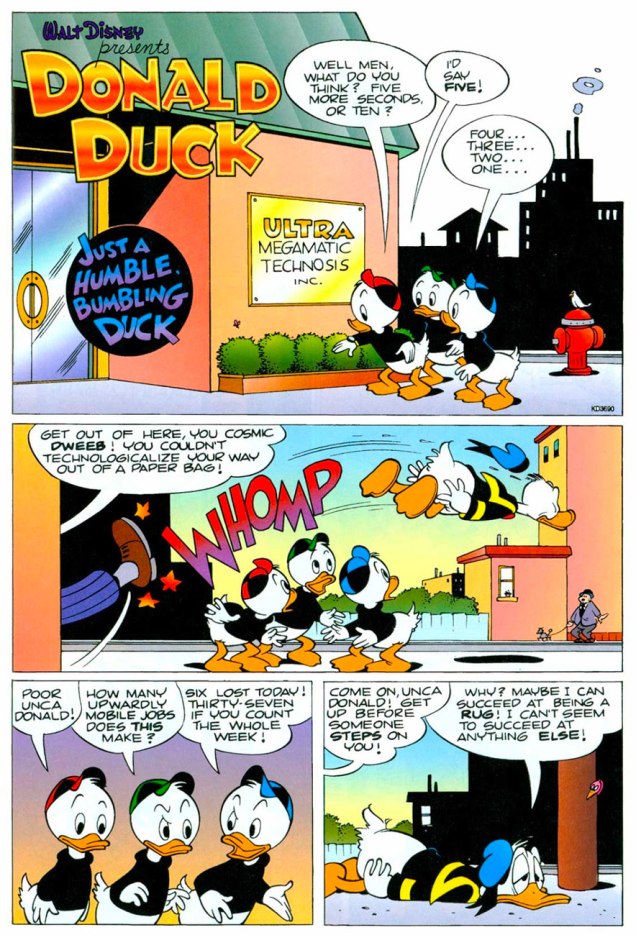
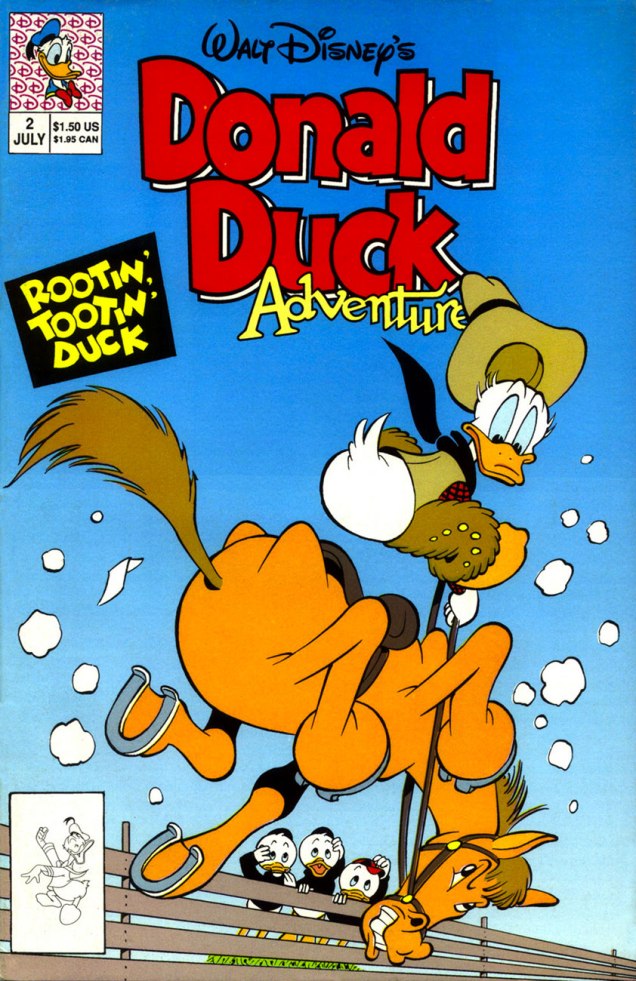
Here’s the opening of a twelve-pager, Just a Humble, Bumbling Duck, published in Walt Disney’s Donald Duck Adventures no. 13 (June, 1991). Written, drawn and lettered by Van Horn and coloured by Susan Daigle-Leach. Read the issue right here.Donald Duck Adventures no. 2 (July 1990, Disney), illustrating Van Horn’s “Rootin’, Tootin’ Duck”. Read it here. You can tell when a soul’s worked in animation. Nary a hint of stiffness.Donald Duck Adventures no. 18 (Nov. 1991, Disney), illustrating Van Horn’s “That Ol’ Soft Soap”. read it here.Walt Disney’s Comics & Stories no. 616 (Sept. 1997, Gladstone), featuring Van Horn’s “Catch of the Day”. Read it here.Uncle Scrooge no. 322 (Oct. 2003, Gemstone), illustrating Van Horn’s “The Utter Limits”. Read the issue here.Walt Disney’s Comics & Stories no. 655 (Apr. 2005, Gemstone), featuring Van Horn’s “Full Circle”. Read it here.Walt Disney’s Comics & Stories no. 680 (May 2007, Gemstone), featuring Van Horn’s “In a Minor Key”. Read it here.
A most joyous 80th anniversary to you, Mr. Van Horn! Fittingly, I leave the last word to our humble birthday boy: « Let’s create our own classics if we can… but heaven help us if we think we’re doing that. We should follow Barks’ lead and regard these stories as something to pay the rent and buy the pot roast. »
**speaking of Egmont, this sobering note from Van Horn, from a brief interview conducted by John Iatrou in 2010: « Disney comic books in North America have been virtually a dead issue (no pun intended) for over a decade, possibly two. Sales here hover around 4000 copies a month! This on a continent of over 350 million people! Egmont has never tried to publish here. They thought about it years ago and decided it wasn’t worth the effort. » So there you have it. Van Horn and Don Rosa have been producing their ducks for the European market, to be then reprinted, with piddling print runs, in North America. Nul n’est prophète en son pays… On the other hand, if you’ll forgive me for saying so, most European Disney comics are utter garbage, and have been for decades. If you like endless arrays of Donald as a superhero, Donald as Michael Jackson or Indiana Jones, Rappin’ Donald… you’ll be in hog heaven. “Opera Mundi crap“, we used to call it.
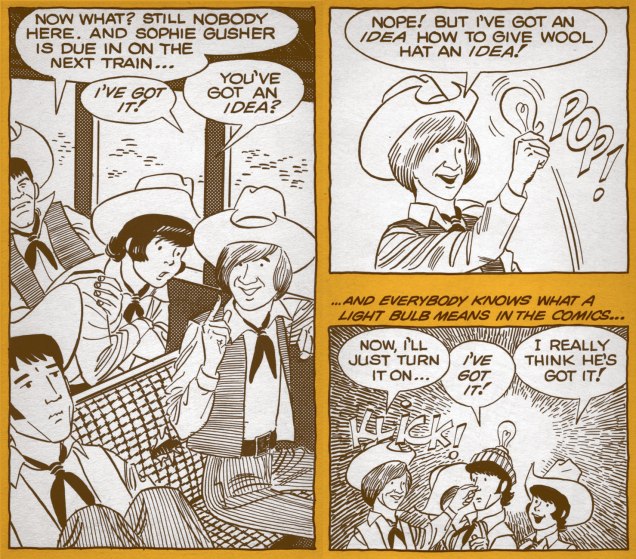
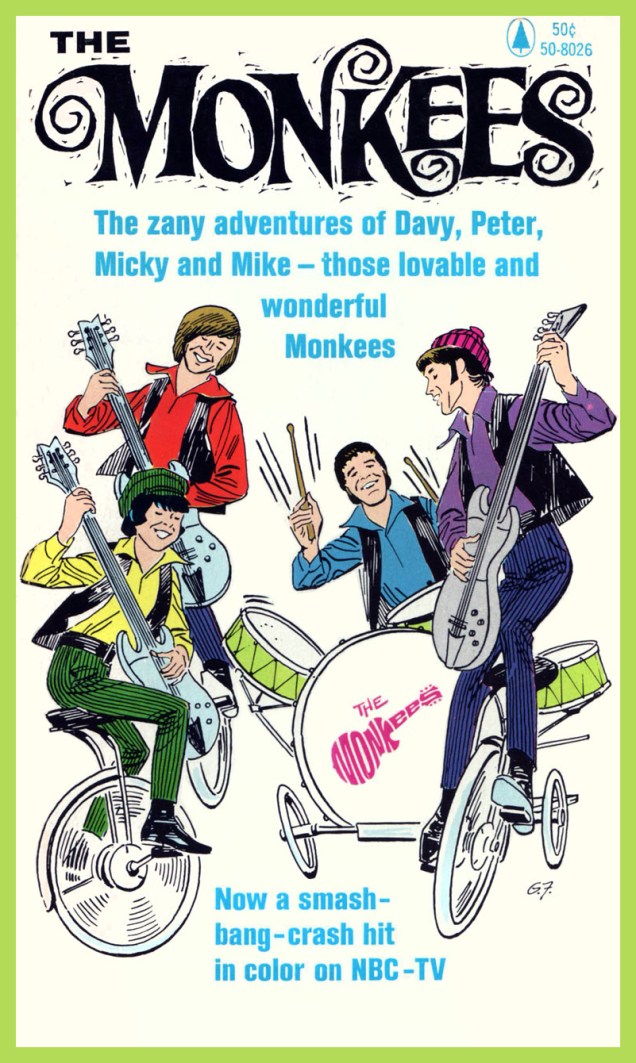
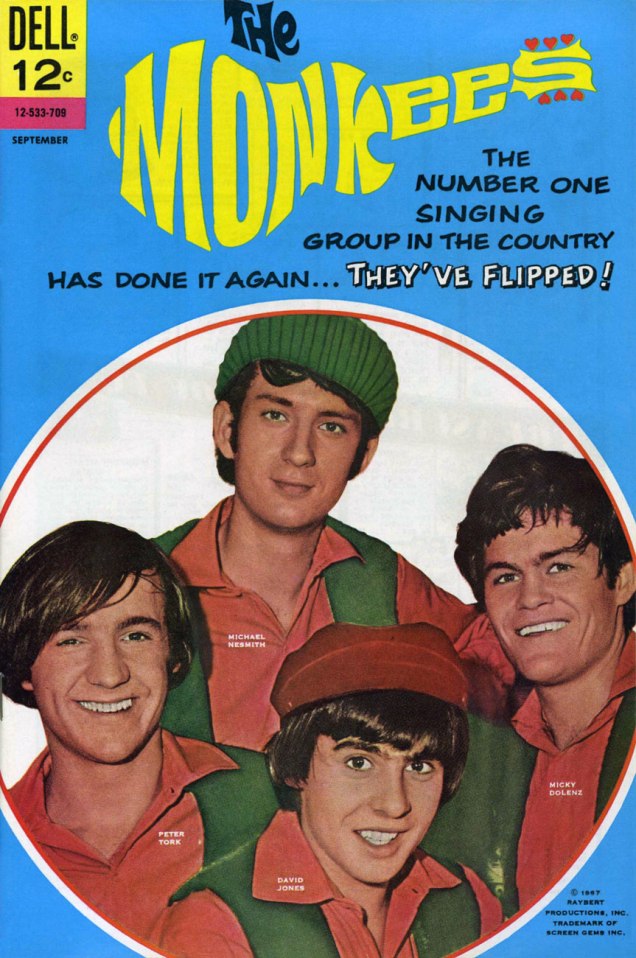
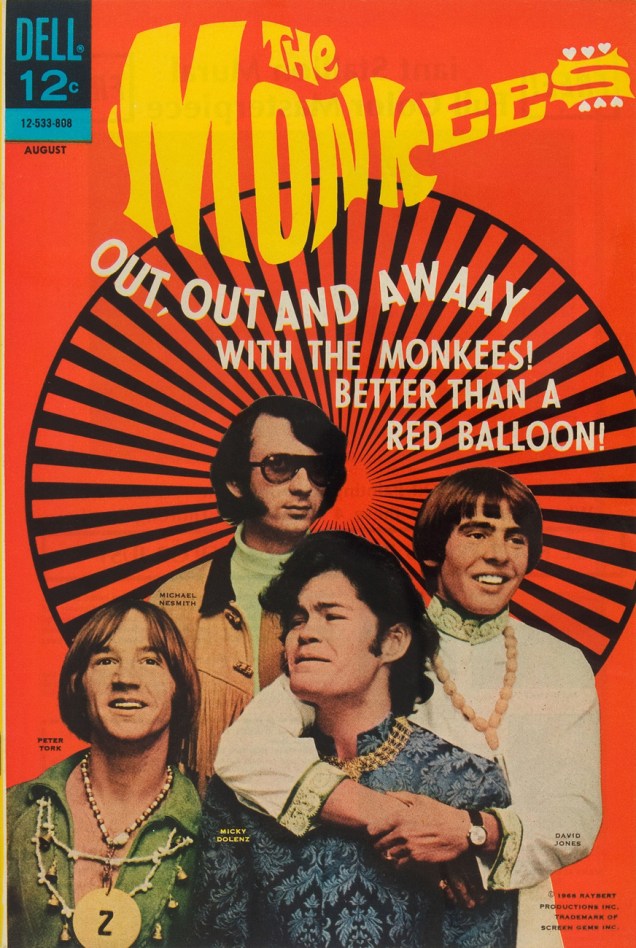
Pete was born in Washington, D.C. on February 13, 1942, which makes him the doyen of the group. Like Mike “Wool Hat” Nesmith, he was a musician first, likely the group’s most instrumentally proficient. Peter wound up auditioning for the tv show after his name was suggested by Stephen Stills, who wasn’t quite right for the part… but definitely a good sport.
Peter and his fellow Monkees were featured in their own Dell comic book (is there any greater honour?), which lasted from March, 1967 to October, 1969, seventeen issues in all (with some reprinting.) That was one of Dell’s few savvy moves in their waning days, and one of their few readable titles outside John Stanley‘s output.
Peter the muse. From ‘Way-Out’ West, The Monkees (1966, Popular Library). See below!This cute lil’ volume contained a bunch of fun (what else) Monkees romps written by Howard Liss and ably illustrated by Eisner- Iger Studio veteran Gene Fawcette.José Delbo‘s splash page from Beezle, Beezle, Who’s Got the Beezle?, The Monkees no. 8 (Jan. 1968, Dell). Scripter unknown… but he’s pretty good.The issue in question: The Monkees no. 8 (Jan. 1968, Dell)The Monkees no. 4 (Sept. 1967, Dell)The Monkees no. 14 (Oct. 1968, Dell)Ah, but Dan Clowes has known it all along! From Eightball no. 13 (Apr. 1994, Fantagraphics)
Update: Peter Tork passed away on Thursday, February 21, 2019, barely a week beyond his 77th birthday. Au revoir, Peter!
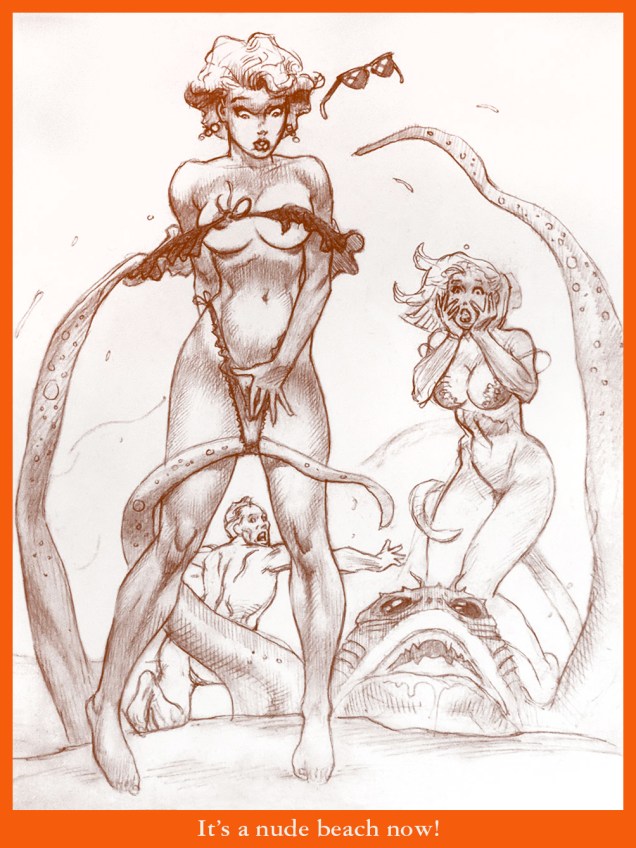
I am on vacation! (Or I will be, by the time this post is published.) I have no idea what sort of beaches I will have the pleasure to encounter, but I doubt it’s the kind that’s depicted below.
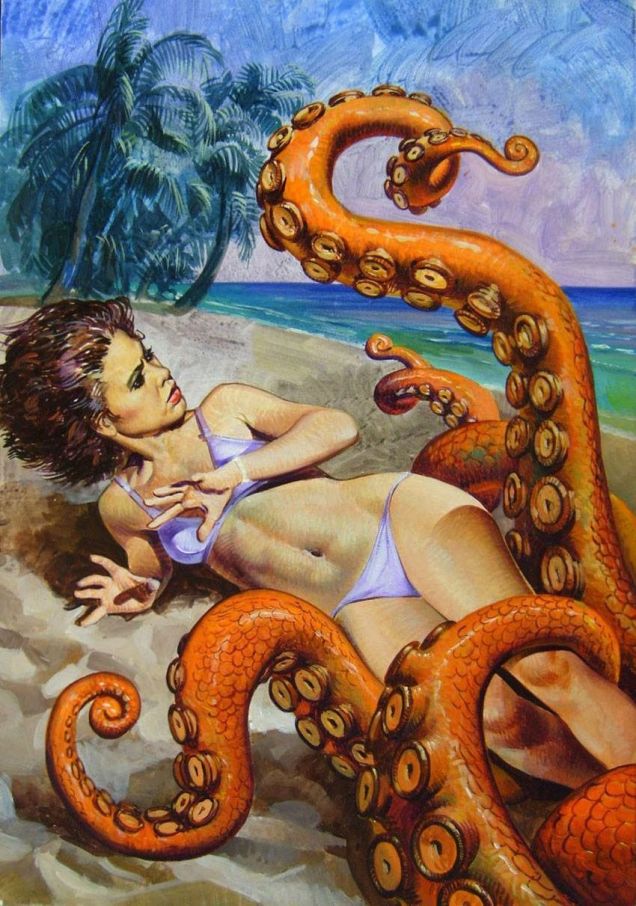
And now, everyone to the beach! Orrore sulla spiaggia!
Page from Rich Larson‘s Haunted House of Lingerie, Vol. 2 (July 1999). I’m pleased to see that the octopus seems to have undressed the man as well.This is the original art for the cover of Sukia no. 89. Art by Emanuele Taglietti, whose specialty was sex and horror! Sukia, already part of one T.T. roster (see Tentacle Tuesday: Euro Tentacles Unto Horror), was an erotic Italian comic that ran from 1978 to 1986, published, as is often the case for such things, by Edifumetto. Sukia’s alluring form is based on that of actress Ornella Muti, though it’s probably somewhat less obvious from this cover.
I’m getting carried away here with sun-tanning and babe-centric pastures and whatnot. People also go fishing on vacation, right?
A panel from “Lord Octopus Went to the Christmas Fair”, a poem by Stella Mead. Art by Walt Kelly; published in Santa Claus Funnies n° 2, 1943. Slightly unseasonal, sorry.
Or just flingin’ an octopus about… The local authorities might object, however.
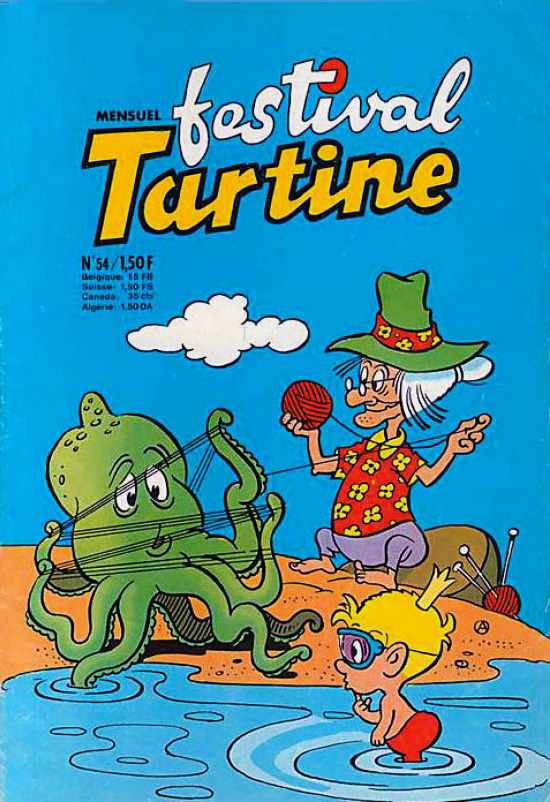
Festival Tartinen° 54 (November 1971). Grand-mother Nonna Abelarda, created in 1953 by Italian Giulio Chierchini, came to France in 1956 and was renamed Tartine Mariol. This intrepid granny appeared in Presto and in Arc en Ciel until her popularity prompted the publishers to give her her own series in 1957.
~ ds
P.S. A little bonus, though only involving an off-screen sighting of an octopus:




































 Who's Out There?