Bill Everett’s Restless Nights of Dread

Today, 102 years ago (!), on May 18th, 1917, William Blake Everett came into the world. He did not become a poet like his ancestor William Blake, nor a politician like Richard Everett, another famous forebear, who founded the city of Springfield, Massachusetts. Bill Everett’s father wanted him to become a cartoonist, and his wish came true, though the elder Mr. Everett died long before before the rebellious Bill found his place in the comics industry.

Bill Everett is best known for creating Namor the Sub-Mariner (visit out Tentacle Tuesday: Prince Namor for an overview of this character’s story and adventures… or read The Brilliance of Bill Everett’s Sub-Mariner, Marvel’s Superman, a great article from Sequart Magazine), but he also had his hand in the creation of Daredevil and Simon Garth, Zombie. Everett excelled in many genres – superheroes, horror, fantasy, science-fiction – but today, since there are far too many covers to feature, I will force myself to focus on horror. Welcome to the ghoulish gallery of my favourite Bill Everett covers! (They’re not necessarily the goriest or scariest – sometimes it’s a mood of quiet menace or a striking composition that sways me.)

BillEverett-Venus19
Venus no. 19 (April 1952). The silent, smirking watchers in the corner are far creepier than the skeleton embracing her!
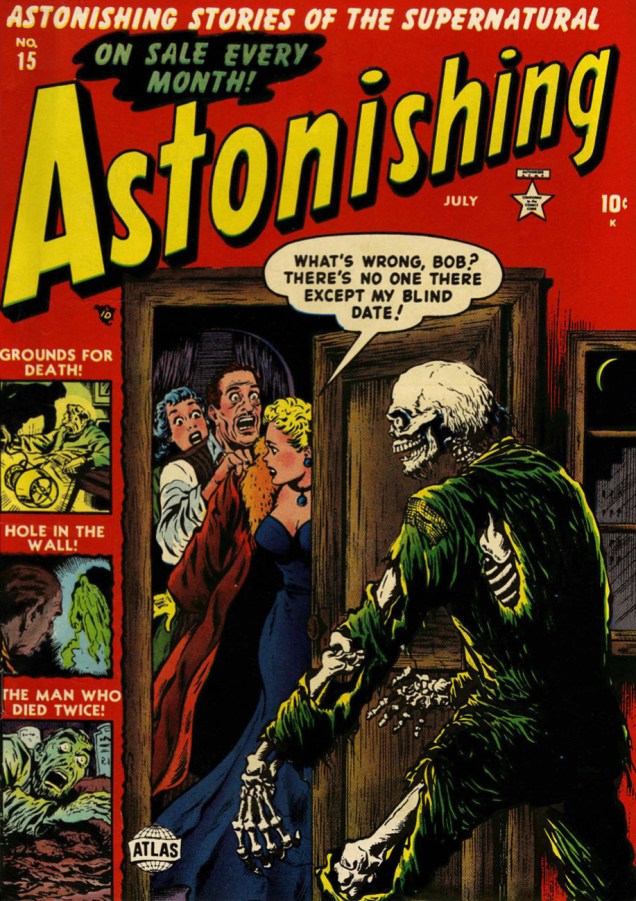
EverettAstonishing15A
Astonishing Tales no. 15 (July 1952). Do a lot of daughters address their fathers by their first name?
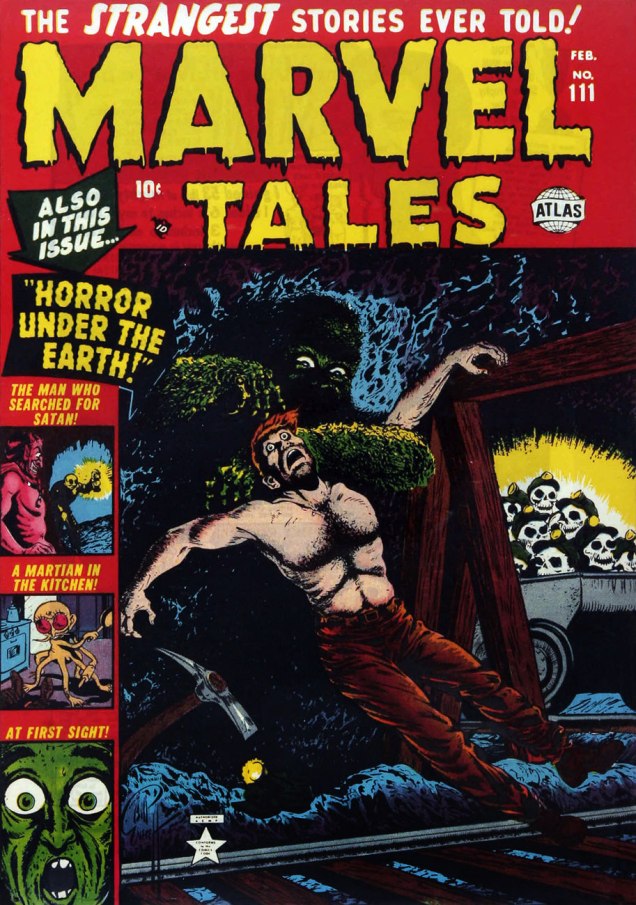
BIllEverett-Marvel-Tales111A
Marvel Tales no. 111 (February 1953)
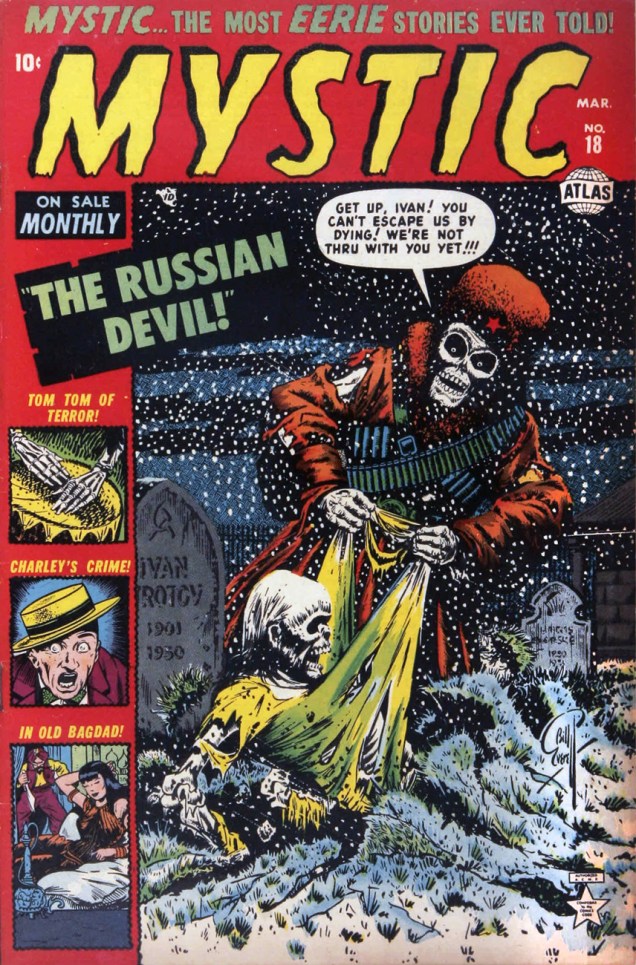
BillEverett-Mystic-#18
Mystic no. 18 (March 1953).
BillEverett-JourneyIntoMystery9A
Journey Into Mystery no. 9 (June 1953)
BillEverett-Marvel-Tales117A
Marvel Tales no. 117 (August 1953)
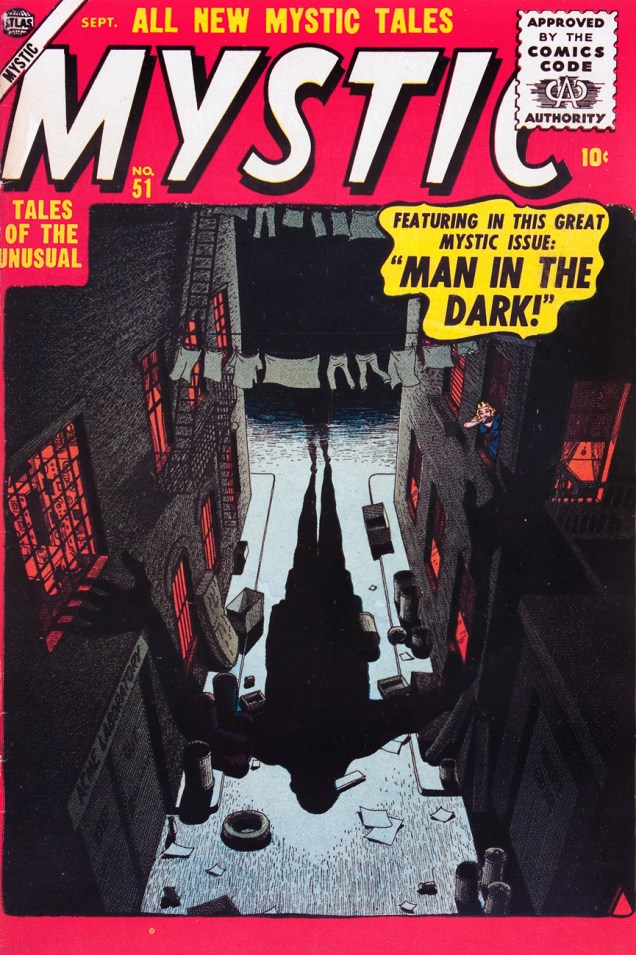
BillEverett-Mystic-#51-(Atlas,-1956)
Mystic no. 51 (September 1956). I love these silent covers where the menace is suggested rather than shown in detail.
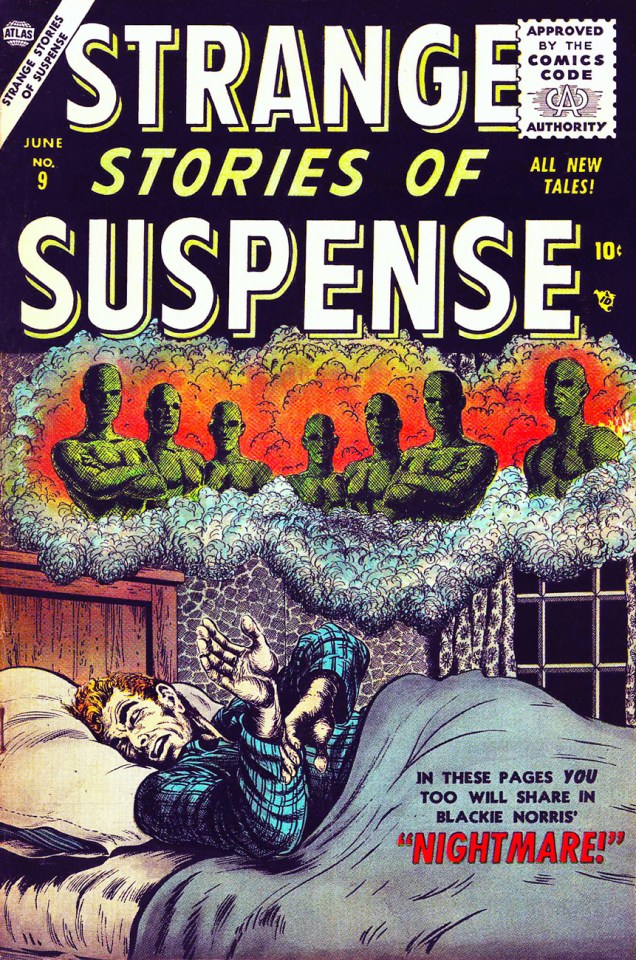
BillEverett-Strange-Stories-of-Suspense-#9
Strange Stories of Suspense no. 9 (June 1956)
BillEverett-MarvelTales151A
Marvel Tales no. 151 (October 1956). Here it’s the composition I especially like – the giant hair isn’t that scary.
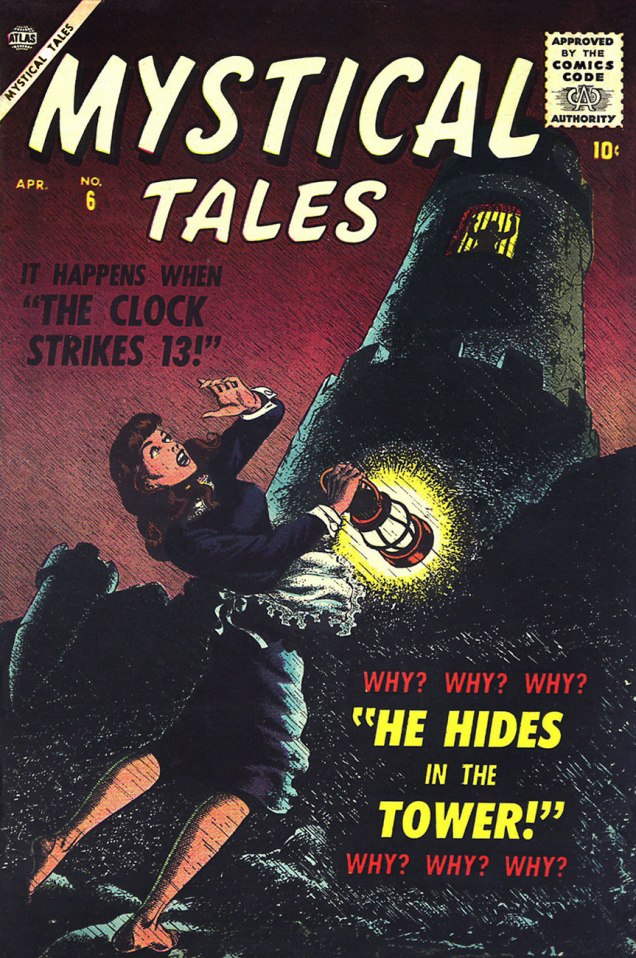
BillEverett-Mystical-Tales-6A
Mystical Tales no. 6 (April 1957). I admit the WHY? WHY? WHY? amuses me WHY? WHY? WHY?; – one inquiry should have sufficed. Speaking of “WHY?”… Why is she barefoot? Those rocks have to be treacherously slippery at the best of times, let alone in a rainstorm.

If you’d like more, you can visit Scott’s Classic Comics Comics Corner: Top 13 Bill Everett Horror Covers – only two of his entries overlap with my own selection, which shows how opinions vary and just how rich this vein is.

~ ds

“Just a feminine hygiene version of Pee-Wee’s Playhouse”: Russo & Wong’s ‘Rancid Plotte’ (1993)

« We’re not very accepting of people who act strangely. » — Chester Brown

Scott Russo’s Jizz, published by Fantagraphics in 1991-93 (10 issues in all), was a fearless, often downright incendiary and frequently fascinating repository of vitriol from the heart and soul of Mr. Russo. As his own drawing style was pretty rudimentary (but clean and distinctive), the auteur drew upon collage, détournement and plain old text pieces for variety. Russo may have been embittered and misanthropic, but the entertainment he proffered was quite deliberate; a fine, dexterous trick to pull off.

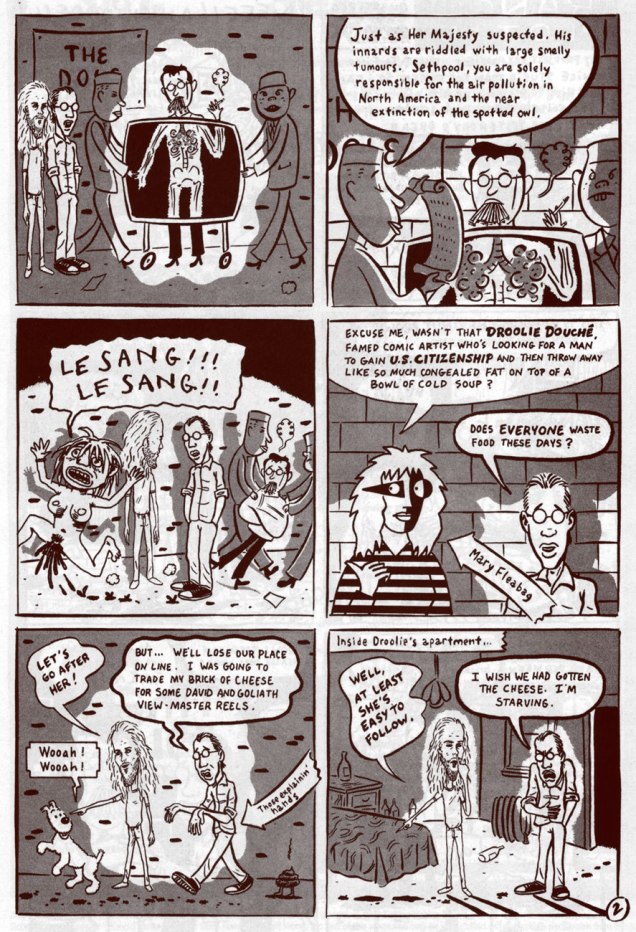
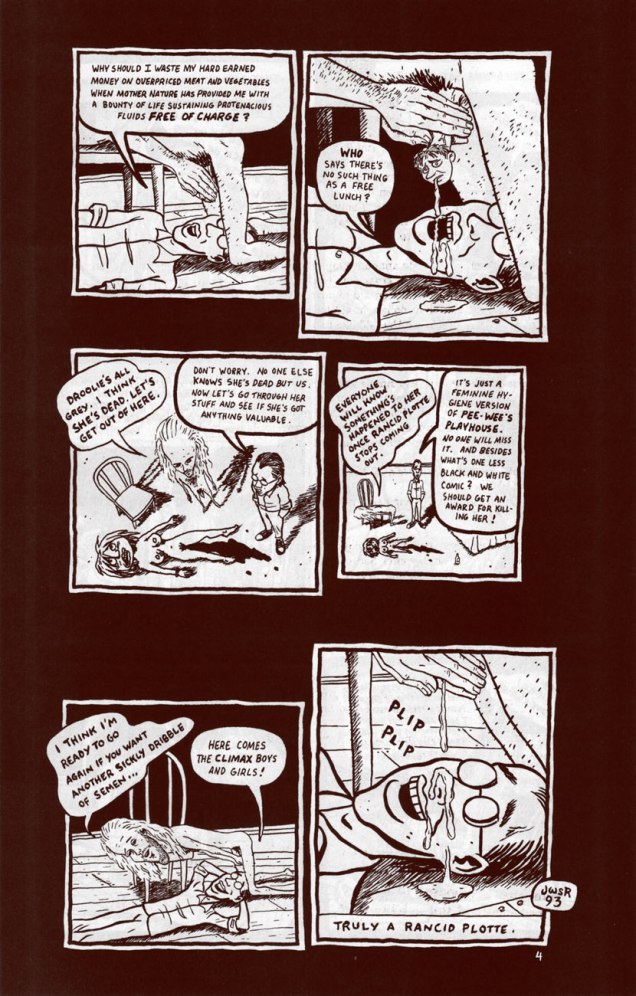
Here, from Scott Russo’s Jizz no. 10 (March 1993, Fantagraphics), is his merciless but spot-on takedown of publisher Drawn & Quarterly‘s stable of neurotics: Julie Doucet, Joe Matt, Chester Brown and Seth, rendered in a breathtakingly accurate facsimile blend of their respective styles and schticks. Script by Russo, art by his trusted confederate ‘Master’ Jeff Wong. Not particularly ‘safe for work‘, I should say.

RussoRancidPlotte01ARussoRancidPlotte02ARussoRancidPlotte03ARussoRancidPlotte04A

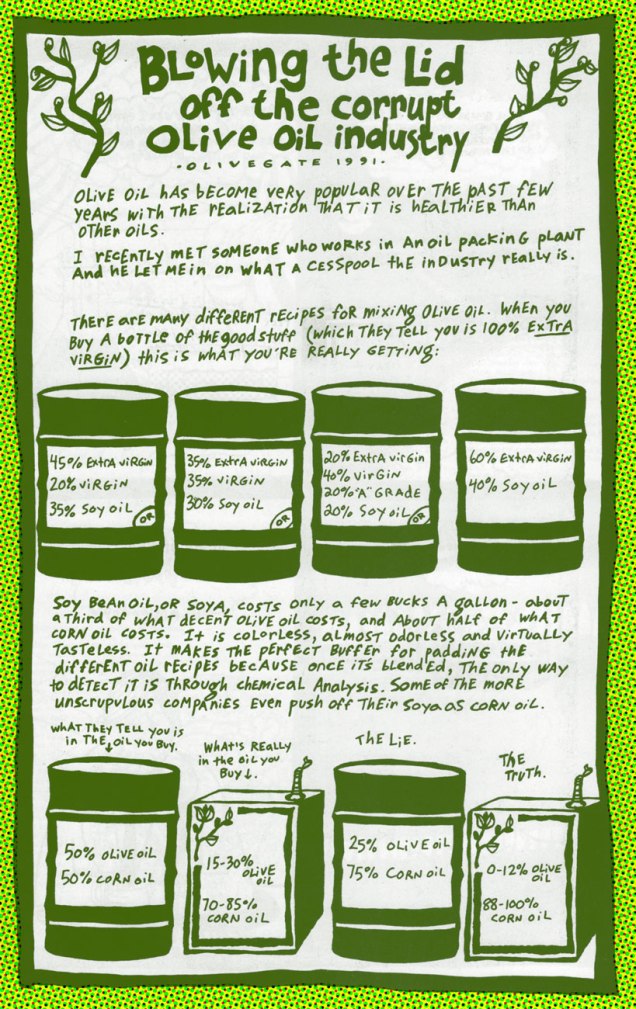
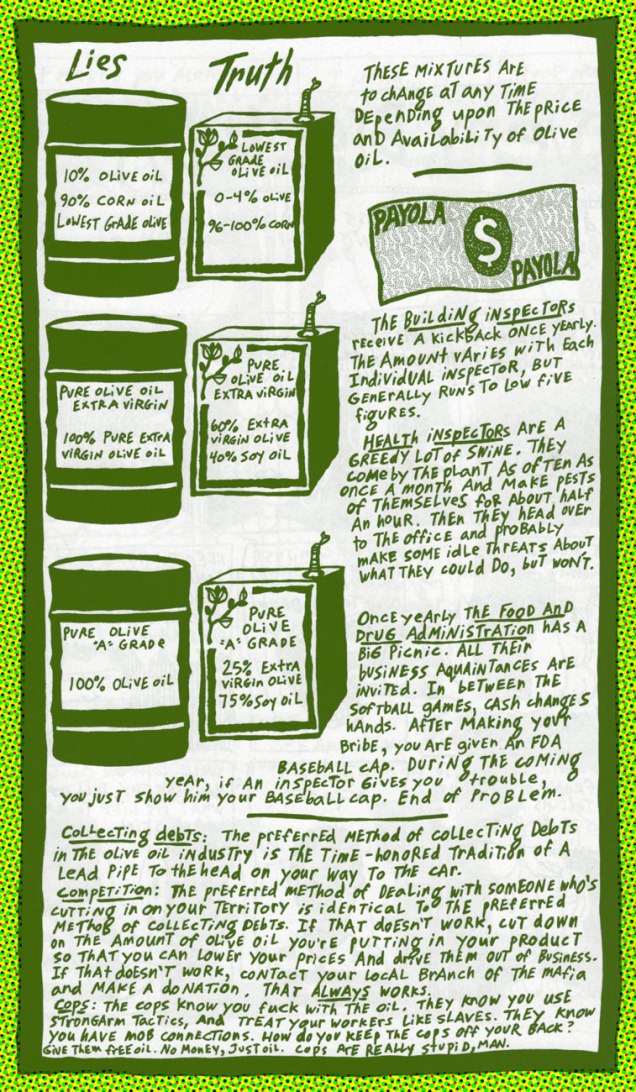
Russoolive01A

Russoolive02A
From Scott Russo’s Jizz no. 7 (Sept. 1991, Fantagraphics). I’ll always be grateful to Mr. Russo for this scathing exposé of the Olive Oil industry. My girlfriend at the time was taking a chemistry class at McGill University, during which they subjected various brands of olive oil to chemical analysis and essentially confirmed Russo’s claims. Now I merely snicker and shrug when I see someone shell out big bucks for the stuff… sometimes there’s no sense in trying to convince anyone.

-RG

Tentacle Tuesday: Let’s Get Bizarro

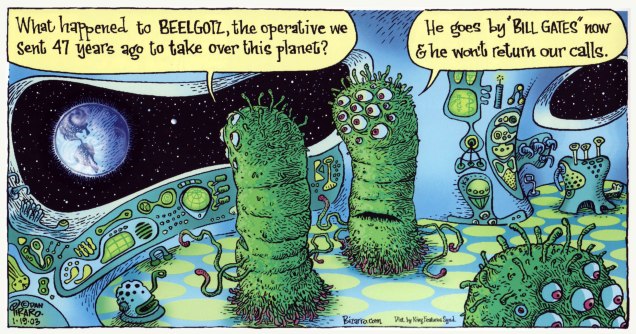
Dan Piraro‘s Bizarro is a ubiquitous newspaper comic that usually doesn’t need much in the way of introduction. Favourite strips are widely shared by fans – cut out or photocopied from newspapers (or, more recently, printed from a website) to be pasted on office doors, cubicle walls and school binders. As a matter of fact, that’s where I spotted my first Bizarro strip: scotch-taped to the office door of my college English teacher. Oh, I’ve seen them before, of course, but this was the first time I consciously noticed one of them. Teachers of all stripes seem to have a thing for Bizarro – I had a university psychology professor once who actually collaborated with Piraro on some strips, an achievement of which he was justifiably proud.

Bizarro-DanPiraro-p.20161015

As usual, one can rely on the intrepid Tom Heintjes of Hogan’s Alley to conduct a worthwhile interview with whichever artist one is interested in. Read it here: Mondo Bizarro: The Dan Piraro Interview. I’m not going to compete with Heintjes’ ability to summarize, so I’ll just quote:

« Since Bizarro’s January 22, 1986, debut, Piraro has taken his panel in directions simultaneously surreal and topical. In a comic universe where world-weary talking dogs exist alongside nihilistic housewives, Piraro gives his cartoons heft by skewering his own bêtes noires: wasteful consumerism, environmental destruction, corporate greed and sheeplike people, to name a few.  Though his humor is never didactic, Piraro’s work is remarkable in its unwillingness to pander, even when the occasional panel borders on the inscrutable. For example, he once used the Etruscans as a punchline; if you skipped history class that day, tough. Since sustained excellence like Bizarro‘s is rare in any medium, his willingness to shepherd his panel into its third decade is great news for comics fans and for the more than 200 papers that carry the strip. Though Piraro maintains that Bizarro is a comic strip for people who don’t read comic strips, we all know better: Bizarro is a comic strip for people who love comic strips. »

Bizarro-supportanimal-DanPiraro.jpeg

Piraro is not the only cartoonist spoofing social conventions, endowing animals with the gift of human speech or forging surreal situations out of everyday occurrences… but he does it consistently well. His easily recognizable, flowing art style is the frosting on the cake, and very nice frosting it is, too. Yet who can grasp the scope of such prodigious output? Bizarro collections (there have been thirteen of them – fitting number, isn’t it?-, all quite out of print) generally end up in the discount bin of bookstores (often neighbours to disheveled anthologies of Gary Larson‘s The Far Side, another omnipresent yet somehow underappreciated strip). For all my affection for Piraro’s goofy world, I only own Bizarro and Other Strange Manifestations of the Art of Dan Piraro (Harry N. Abrams Publisher, 2006). Some of the strips in this post have been scanned from it (others were found in the trackless depths of the Internet.)

Pleasantly, Piraro wears his politics, heart and sympathies on his (rather accommodatingly large) sleeve:

BizarroAliens02A

BizarroAliens01A

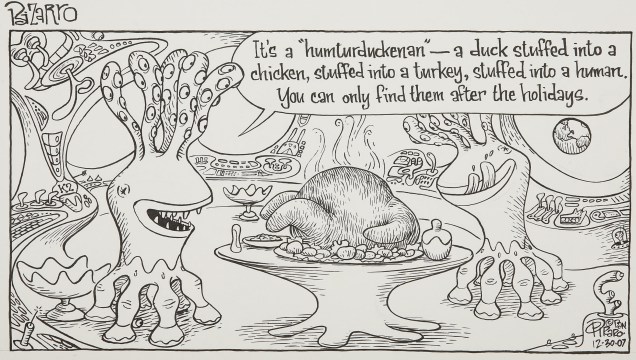
Bizarro-DanPiraro-Stuffed

Most Bizarro cartoons feature a recurring object or creature (added value for a comic strip that’s already rich in detail). Some of my favourites: the Eyeball of Observation, the Pie of Opportunity (a piece of pie – blueberry, I think), the Dynamite of Unintended Consequences, or Firecracker of Pop (a dynamite stick), the Fish of Humility (or at least its tail), and my very favourite, the Bunny of Exuberance. One can just tell that Piraro enjoys his work. What kind of jerk still enjoys drawing the same strip after 30 years*?!

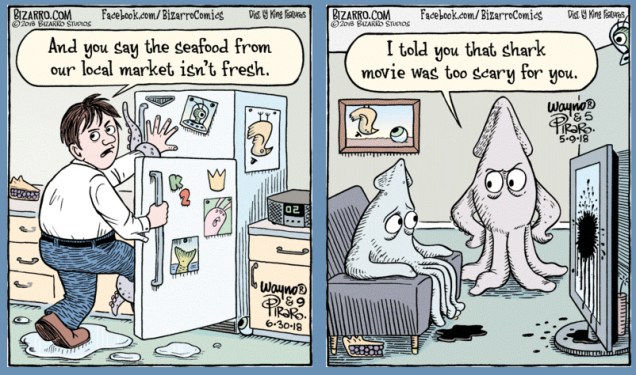
Bizarro-Freshfood

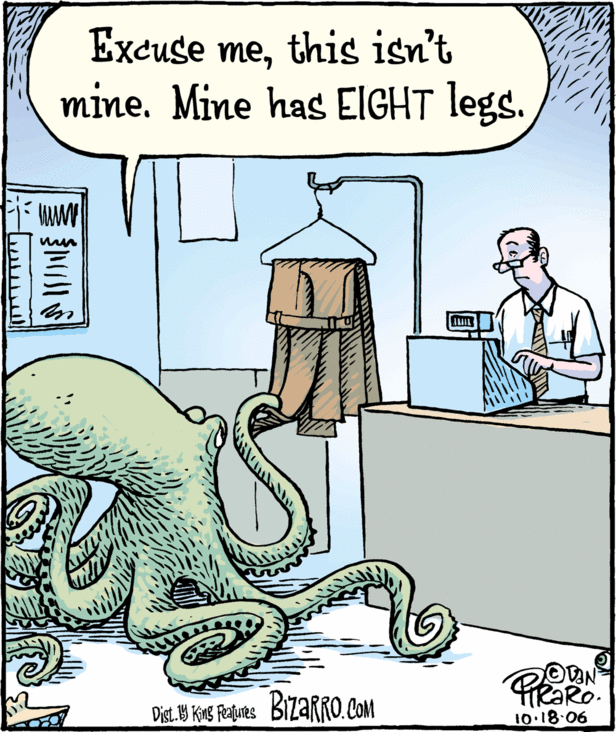
bizarrooc18-2006

Don’t forget to visit Bizarro’s official website!

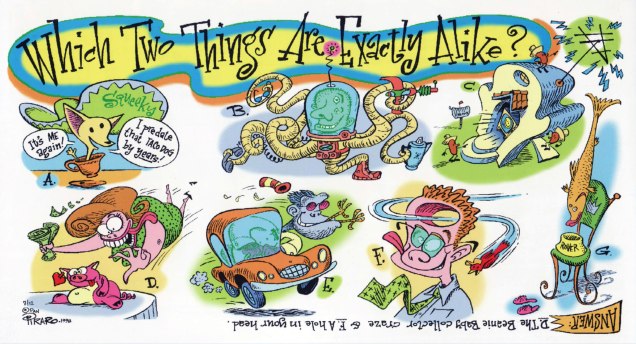
BizarroTwoThingsAlikeA

~ ds

*Since 2018, Piraro’s pal Wayno has been drawing the dailies, with Piraro keeping the Sundays all to himself.

Marooned in Time With Paul Gillon

« We all have our time machines. Some take us back, they’re called memories. Some take us forward, they’re called dreams. » — Jeremy Irons

Today, we note the birth anniversary of the powerful French bédéiste Paul Gillon (May 11, 1926- May 21, 2011). Working in a classical, realistic style, he began his career in comics with the weekly Vaillant. For daily newspaper France-Soir, he co-created the daily soap opera strip 13, rue de l’Espoir (1959-1962, scripted by Jacques Gall and François Gall), strongly inspired by Elliot Caplin and Stan Drake’s The Heart of Juliet Jones, but set in Paris.

Then, in 1964, for the short-lived bédé newspaper Chouchou (an eight-pager published for a mere 14 issues, a tragedy!), Gillon co-created, with scripter J.C. Valherbe (alias Jean-Claude Forest, of Barbarella fame), one of the great classics of French science-fiction comics, Les naufragés du temps (“Castaways of Time”). Several wonderful features (for instance, Georges Pichard‘s Ténébrax) were left stranded by Chouchou’s demise, including (literally) Les naufragés.

Fortunately, its authors deemed its premise too worthy to let the matter drop forever. Nearly a decade on, Gillon tweaked the saga’s opening pages and resumed the narrative, which France-Soir published. Forest scripted the first four collections (1974-76), then Gillon took full command of the strip, which found a warm new home in Métal hurlant from 1977 right to the end of the series with Le cryptomère (The Cryptomeria), collected in 1989.

GillonNaufragés01AGillonNaufragés02AGillonNaufragés03A

Les naufragés’ premise is this: In 1990, a man (Chris) and a woman (Valérie) are placed into suspended animation. A thousand years hence, the man is picked up and woken. Where’s the woman?, he wants to know. A futuristic bout of cherchez la femme ensues, to make a long story short.

Forest, wrote, in 1967, of his original plans for the saga: « Chris was searching for an image. After many adventures, he manages to find Valérie only to realize that this image no longer fitted that of his dream. »

The sequence presented here comprise the second, third and fourth pages of the first tale, as they appeared in Chouchou in 1964. Say, that cool metal creature reminds me of one of the most ridiculous Marvel super-baddies of the 1960s, disgruntled government employee Alexander Gentry, aka… (see below for the answer).

GillonNaufragésÉtoileA
The first album in the series, L’étoile endormie (The Sleeping Star) – 1974
GillonNaufragésCannibaleA
The fourth album in the series, L’univers cannibale (The Cannibal Universe) – 1976
GillonNaufragésChimèreA
The fifth album in the series, Tendre chimère (Sweet Illusion) – 1977

A peek at a page of original art from album 3, Labyrinthes (1976):

NaufragésOriginalA

More about the series: http://www.coolfrenchcomics.com/naufragesdutemps.htm

… and you can read the entire series here (if you can read French) or, if not, just admire the artwork.

– RG

… and here’s your answer:

TTA48PorcupineA
Stan Lee and Don Heck‘s The ‘Dreaded’ (ha!) Porcupine, or what happens when neither Steve Ditko nor Jack Kirby are on hand to design your costume (and ghost-write your story). Incidentally, Stan, porcupines don’t project their quills. Here he is depicted by Kirby, from the cover of his inaugural appearance, in Tales to Astonish no. 48 (October, 1963).

Tentacle Tuesday Masters: Michael T. Gilbert and the Flamboyant Mr. Monster

« Yet another bloodthirsty alien invasion, led by a mad dictator with a brain harvested from a 60 year-old corpse. I get one of those every third Thursday… »

D’you know what today is? Well, Tentacle Tuesday, obviously. It’s also Radio Day. More relevantly to this post, however, May 7th is also the birthday of one Michael Terry Gilbert, confidant to the formidable Mr. Monster (a.k.a. Strongfort “Doc” Stearn) and fellow tentacle lover (at least judging from how many cephalopod-shaped creatures appear in his stories).

We’ve briefly mentioned Mr. Monster in Tentacle Tuesday: Superheroes Redux; now is the time to joyfully gallop through some more tentacle offerings from the merry crew of psychotic artists led by that sagacious shepherd, Michael T. Gilbert. Many happy returns, Sir!

DocStearn...mr.monster-Michael T. Gilbert
Doc Stearn… Mr. Monster no. 1 (Eclipse, January 1985). Cover by Michael T. Gilbert.

MrMonster05
Doc Stearn… Mr. Monster no. 5 (Eclipse, February 1986), cover by Michael T. Gilbert. The unwritten rules dictates that Mars inhabitants *must* have tentacles, and Gilbert clearly has respect for venerable traditions. Plus, they’re much cuter this way. Coochie-coochie-coo…

« The original Doc Stearne was a two-fisted adventurer along the lines of pulp hero Doc Savage, of whom he may have been intended as a knock-off. He was created by cartoonist Fred Kelly, whose other known credits are somewhere between sparse and nonexistent. Kelly did him for a small, virtually unremembered Canadian publisher called Bell Features (probably not related to Bell Syndicate, distributor of Mutt & Jeff, Don Winslow of the Navy and more). When Gilbert was asked to contribute to Vanguard Illustrated, the apparent purpose of which was to develop new properties for Pacific Comics to exploit, he drew on Kelly’s character as inspiration. The first new Mr. Monster story appeared in the seventh issue, which came out in 1984 without a specific cover date. Gilbert’s version was a fanatical monster hater, extreme not only in his attitude, but in his design and in every move he made. » |from Don Markstein’s Toonopedia|

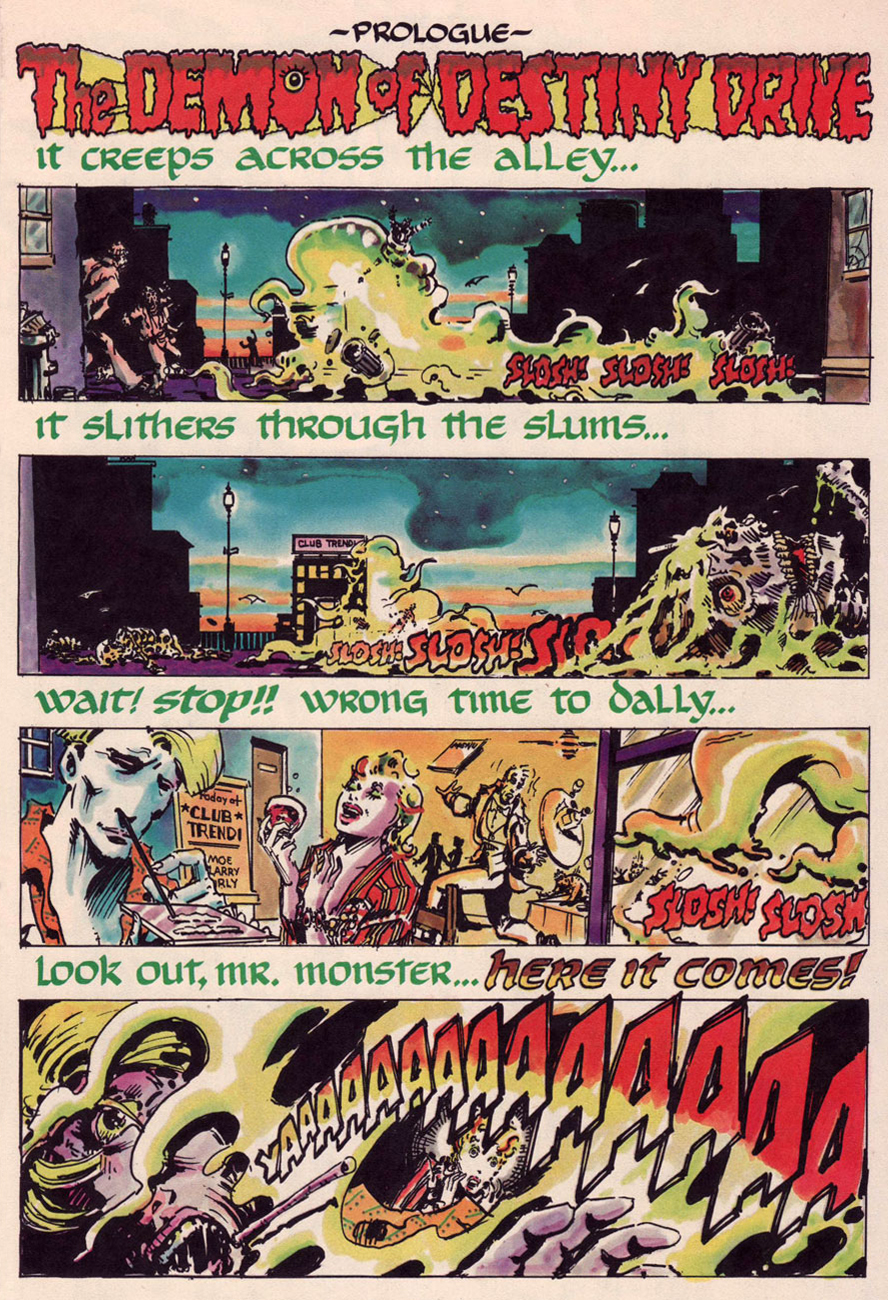
Doc Stearn...Mr. Monster 5-DemonDestinyDrive01A
« The Demon of Destiny Drive », art by Michael T. Gilbert, published in Doc Stearn… Mr. Monster no. 5 (Eclipse, February 1986).

Mr.MonsterMailboxA
« Mr. Monster’s Atomic Condenser » by Michael T. Gilbert was published in Doc Stearn…Mr. Monster no. 10 (Eclipse, June 1987).

DocStearn...Mr.Monster#10-MichaelTGilbert
Is that an Oculothorax, by any chance? « Terror in 6-D », with script and layouts by Michael T. Gilbert and pencils and inks by Don Simpson, was published in Doc Stearn…Mr. Monster no. 10 (Eclipse, June 1987). Read the issue here.

As you’ve probably surmised, Mr. Monster cycled through quite a few publishers, from Pacific Comics to the aforementioned Eclipse Comics to Dark Horse passing through Fantagraphics, Image Comics and  Tundra publications. Some Tundra-published material for your pleasure, as always rife with tentacles:

Mr. Monster Attacks!#1
« Wish You Were Here »,  script and layout by Michael T. Gilbert,  inks by Dave Gibbons, was printed in Mr. Monster Attacks! no. 1 (Tundra, August 1992).

Mr. Monster Attacks!#1-WishYouWereHere
Want to know whether Mr. Bulletproof Monster ever gets back with Rosie? Read Mr. Monster Attacks! no. 1 (Tundra, August 1992) here.

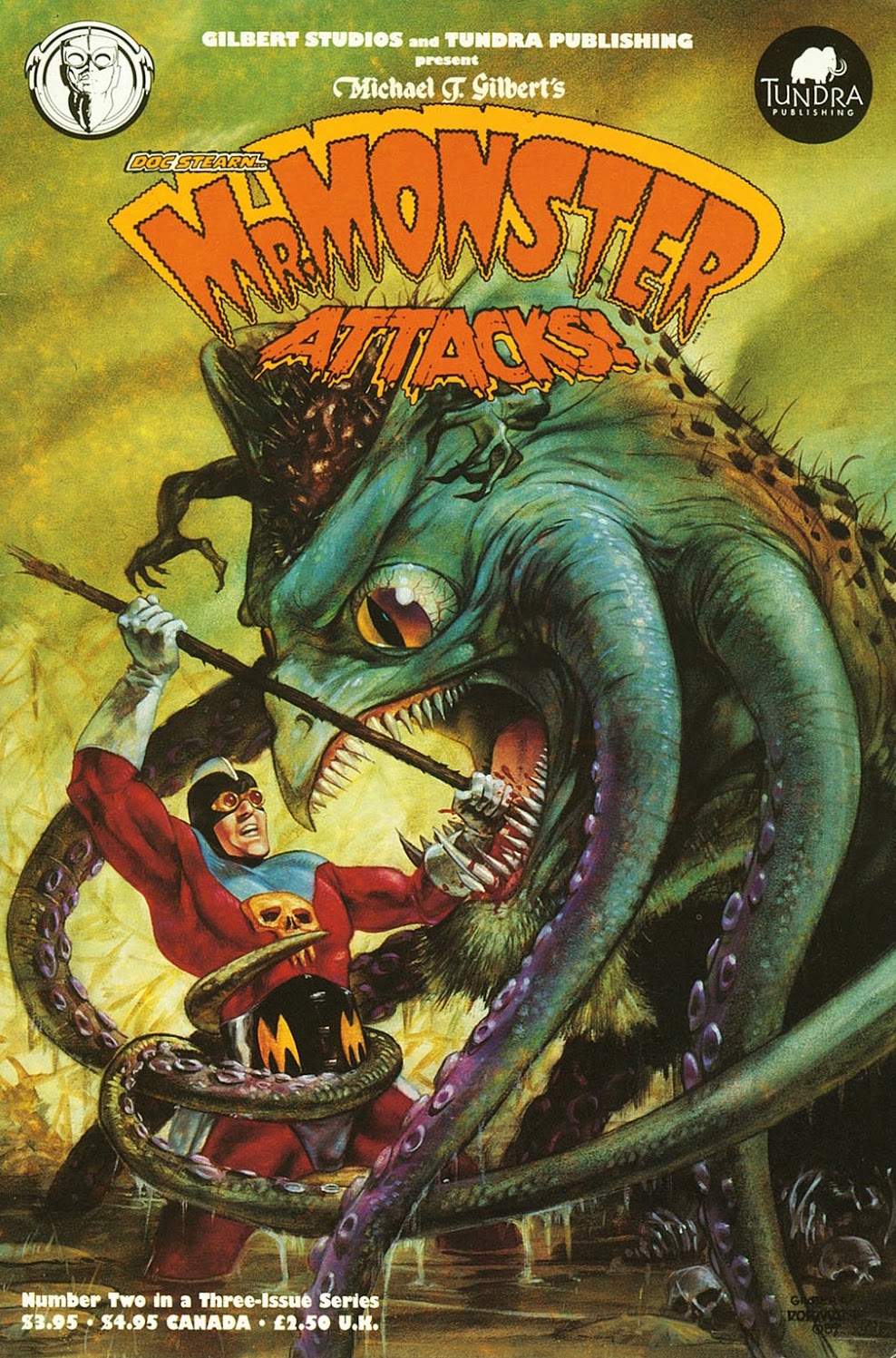
Mr. Monster Attacks!#2
Mr. Monster Attacks no. 2 (Tundra, September 1992), cover pencilled by Michael T. Gilbert, and painted by Dave Dorman.

Mr. Monster Attacks#2-backcover
Back cover of Mr. Monster Attacks no. 2 (Tundra, September 1992), drawn by Bernie Wrightson and Michael T. Gilbert. Read the issue here.

Mr. Monster Attacks!#3
« Lair of the Lizard Ladies », written and laid out by Michael T. Gilbert, and pencilled, inked and coloured by Simon Bisley, was printed in Mr. Monster Attacks! no. 3 (October 1992).

Mr. Monster Attacks!#3 -JustDesserts
Kelly, Mr. Monster’s Girl Friday, has been touched by his noodly appendage in this story featuring murderous tentacle spaghetti. « Just Desserts », scripted by Janet Gilbert (wife of Michael T. Gilbert) and drawn by Tom Buss, was printed in Mr. Monster Attacks! no. 3 (Tundra, October 1992). Read the full issue here.

« Ulp! That reminds me. I’m late for my 4:00! There’s a giant man-eating eyeball about to devour Cleveland! So if you’ll excuse me… »

~ ds

Treasured Stories: “I Wonder Who’s Squeezing Her Now?” (1979)

« When a man steals your wife, there is no better revenge than to let him keep her. » — Sacha Guitry

Here’s my contender for the most adult thing ever published in a Warren Magazine, as opposed to adolescent. It was also Wally Wood’s final significant contribution to his bibliography (though it was created around 1971); by the time of its belated publication Wood’s work had degenerated into depressing, crude porn before he tragically took his own life in November, 1981. As Witzend sadly proved, most comics creators, when handed a creative carte blanche, would merely regurgitate the same old thing they were doing for the mainstream, but with the addition of tits and/or gore. This, however, whilst featuring a generous dollop of T&A, is another breed of beast. It was published, of all places, in Warren’s SF anthology 1984 (issue 5, Feb. 1979). Go figure.

IWonderWho01AIWonderWho02AIWonderWho03AIWonderWho04AIWonderWho05AIWonderWho06AIWonderWho07AThe marvellous Bhob Stewart queried Nick Cuti about the story during a roundtable gathering of former Wood assistants in Derby, Connecticut, in July 1985. The discussion later appeared in Against the Grain: MAD Artist Wallace Wood, edited by Stewart (2003, TwoMorrows Publishing)

Bhob: You worked on “Last Train to Laurelhurst“? [the story’s original title]
Cuti: « As a matter of fact, I’m in it on the opening page. That’s me — right there [points to foreground figure in splash.] I used to wear muttonchops in those days. We wrote that together; Woody came up with the basic storyline, and I wrote a lot of dialogue. I hated his ending. I said, ‘Woody, you really ought to change the ending.’ The ending was that the guy blasted his faithless wife and her lover and then walked away. I said, ‘Gee, that’s what he’s intending to do in the very beginning. There’s no switch at the end. If you change it around somehow, it would make it a little bit more surprising.’ So he went home and rewrote the ending. I thought that the ending he came up with was far superior and made it a really brilliant story, to really tell you what life can be like.

Ernie Colón did the pencils. It was Woody’s idea, and I wrote some of the script, I don’t know how much because we used to toss things back and forth all the time when I was at the studio.It was for a magazine called Pow that never came to be. [Jim] Warren had approached Wood to do an adult humor magazine which would have had serious stories, very sexy, something that adults would enjoy reading. Unfortunately, Woody and Warren had diametrically opposed personalities, and they couldn’t seem to get together on it.

There was a funny story: Ernie had done the pencils with a soft pencil, and Woody and I were wondering what the heck we could do to make sure it didn’t get smudged. I was very carefully going over the pencils with an eraser to get out the smudges. I came in the next day with the pencils and said, ‘I found the perfect way to avoid smudging the pencils.’ Woody said, ‘What?’ And I said, ‘I sprayed them.’ Woody’s face dropped, and he almost reached over the strangle me before I stopped him and said, ‘Hey, Woody, I’m only kidding!’ [laughter] Because when you spray something, you can’t erase the pencils any more. You would have ink and pencil on the same paper. He almost had a heart attack right there; his mouth dropped open, and he said, ‘Oh, no!’ Then he started laughing after I told him it was only a joke. Later, when I walked into the house, and Marilyn said, ‘Oh, Woody, Nick’s here. You know, the fellow who sprays all your pencils?’ Obviously, he had thought enough of the joke to tell her about it. »

Speaking of Pow, here’s a cover sketch Wood did in 1971.WallyWoodPowRoughAAn adult humour magazine? I guess they hadn’t quite settled on the tone.

-RG

Tentacle Tuesday: With One Magic Word…

« A slithering tentacle now seizes Billy, and a shuddery voice pours into his ears! »

Previously, we’ve talked about Captain Marvel (the original, the best, the… dare I say, unique!) in a post about his co-creator C.C. Beck. Today, I’ll concentrate on the World’s Mightiest Mortal’s exploits with all manner of tentacled monsters.

All C.C. Beck quotes in this post come from An Interview with C.C. Beck conducted in the late 1980s (shortly before Beck’s death in 1989) by the talented Tom Heintjes of Hogan’s Alley.

« When I looked at the first Captain Marvel story, I knew at once that here was a story worth illustrating. It had a beginning, a carefully constructed development of plot and characters leading to a climax and an ending, and nothing else. There was no pointless flying around and showing off, no padding, no “Look, Ma, I’m a superhero!” Out of 72 panels, Captain Marvel appeared in 18, or one-fourth. »

Whiz-Comics4A
« March, ye scalliwag, or I’ll curdle yer giblets! » Follow Captain Marvel’s fine example – don’t forget to hug a tree, folks! Although it will be better if you can find one without spines and prehensile appendages. This  is Whiz Comics no. 5 (May 1940), cover by C. C. Beck. Captain Marvel may “crash through”, but the cover story, « Beautia for President », contains no tentacles whatsoever… just a hypnotically beautiful woman, that some may settle for (not me). You may note that the cover has « number 4 » written on it, but 5 was the number reported to the Copyright Office, so go figure.

Whiz-Comics60A
Whiz Comics no. 60 (November 1944), cover by C. C. Beck. Paper tentacles? I think they count! The main story is adorably goofy, in the best Otto Binder tradition… but unfortunately comicbookplus.com has only a seriously blurry scan of this issue (read it here, but it may cause headaches).

WhizComics146-CCBeck-CaptainMarvel
Whiz Comics no. 146 (June 1952), cover by Pete Costanza. Speaking of the latter and quoting (again) from C.C. Beck, « Pete Costanza was the first artist hired to assist me when Fawcett’s comic department started to expand in the latter part of 1940. We later went into partnership, and Pete was in charge of our studio in Englewood, New Jersey, while I operated out of our New York City office. Pete was an established illustrator at an early age, and I learned as much from him about story illustration as he learned from me about cartooning. »

The green, proudly toupée-d fellow appears in the opening panel of Terror Stalks the World’s Fair, but as it turns out, he has nothing to do with the rest of the story, really.

WhizComics#146-TerrorStalkstheWorld'sFair
Terror Stalks the World’s Fair is scripted by Otto Binder and drawn by Kurt Schaffenberger.

WhizComics155-CaptainMarvel
« A sinister mystery hangs over the city! Each night, screams are heard… human screams that gurgle away into deathly silence! » Whiz Comics no. 155 (June 1953), the final issue of Whiz Comics, cover by C.C. Beck.

The cover story features an actual kraken with evil, myopic eyes! I rejoiced.

WhizComics#155-BattlesTheLegendHorror
Page from Captain Marvel Battles the Legend Horror, scripted by Otto Binder and drawn by Kurt Schaffenberger.

In an interesting plot twist, it is revealed that gigantic vampire bats and the Kraken (who has the gift of speech, sounding like somebody’s rather eccentric uncle) have struck up a partnership.

WhizComics#155-BattlesTheLegendHorror-vampirebats
Poor Kraken must get cold, consuming all those frozen bodies…

While we’re at it, Captain Marvel Battles the Legend Horror is a perfect demonstration of a point C.C. Beck made well:

« Billy Batson was the real hero of all the Captain Marvel stories, from the first issue until the last.  Without Bill Batson, Captain Marvel would have been merely another overdrawn, one-dimensional figure in a ridiculous costume, running around beating up crooks and performing meaningless feats of strength like all the other heroic figures of the time who were, with almost no exceptions, cheap imitations of Superman. In fact, I have always felt that flying figures in picture form are silly and unbelievable, and I would much sooner have never drawn them, but the publisher insisted on them. Most of the time Captain Marvel’s ability to fly had little or nothing to do with the plots of the stories in which he appeared. Billy Batson started every story and ended every story. In between, Captain Marvel appeared when he was needed, disappeared when he was not needed. The stories were about Billy Batson, not about the cavortings of a ridiculous superhero for whom the writers had to concoct new and more impossible demonstrations of his powers for each issue. »

WhizComics#155-BattlesTheLegendHorror-Water
A terrible end for any creature, even a malevolent one.

And our last encounter with tentacles for today…

Captain-Marvel-Adventures65A
Captain Marvel Adventures no. 65 (September 1946), cover by C. C. Beck.

The Invasion From Outer Space, plotted by Otto Binder and drawn by C. C. Beck, offers us lots of cute little alien guys:

CaptainMarvel65-The Invasion From Outer Space
As usual, they wanna take over the world, but they’re cute, anyway. There’s that toupée again, this time (alien) flesh-coloured! That’s a mighty suggestive tentacle wiggle, Zelog-Zunn Sir.

CaptainMarvel65-The Invasion From Outer Space2

Have more time to kill? Visit The World’s Mightiest Mortal, a blog dedicated to the ol’ big red cheese.

~ ds

The Case of the Cackling Conjurer!

« Never keep up with the Joneses. Drag them down to your level. » — Denis Charles Pratt (1908-1999)
Longtime companions Bruce and Alex, who spend their days tracking down and investigating “queer events”, presumably for a guide they’re putting together, happen to drive near Oakville, where a gleeful oldster is on a tear.

BailyQueer1A

I’m thinking Quentin Crisp, because his fellow raconteur and bon vivant Sir Noël Coward wasn’t especially into large, floppy hats.

QuentinCrispA
« The very purpose of existence is to reconcile the glowing opinion we hold of ourselves with the appalling things that other people think about us. » — Quentin Crisp ( Denis Charles Pratt)

BailyStraightLineA
You don’t say, Bruce! Let’s face it, screwball ideas hardly ever fail to bear fruit in these zany yarns.

BaileyQueer2A
More action-packed merriment with Bruce & Alex, roving queerness inquirers!

Alex has a plan, and Bruce grasps instantly what Bruce has in mind. It’s like they’ve done this before. Somehow, Alex’s brainstorms always involve Bruce disrobing, and, judging from his expression, he’s unfailingly eager to comply.

This saga is that of The Cackling Conjurer (Strange Adventures no. 201, June 1967, DC), writer regrettably unknown, art by that magnificent oddball Bernard Baily. Edited, of course, by Jack Schiff; he may have screwed DC out of Jack Kirby’s talent throughout the 1960s, and nearly drove the Batman titles over the cancellation cliff, but he certainly produced some perversely entertaining crap. Incidentally, Schiff retired from comics two issues after this one, but surely that’s mere coincidence.

StangeAdventures201A
As you can see, the rest of the issue was quite mundane and utterly devoid of eccentricity. Cover by Carmine Infantino and George Roussos. That’s a rather… intimate hold the Mod Gorilla Boss has on Animal-Man, don’t you think?

– RG

Tentacle Tuesday: the Putrid, Gunky Insides of Death Rattle

Death rat·tle (/ˈdeTH ˈˌradl/), noun: a gurgling sound heard in a dying person’s throat.

Greetings! Today we explore Kitchen Sink‘s mostly-black-and-white horror anthology (drum roll, please) Death Rattle, which ran between 1972 and 1996 in three distinct “volumes” (please don’t forget your professional spelunking gear, things might get messy). For the pedants in the audience (and let’s be honest, that’s probably the majority of us comic-loving freaks), the break-down goes like this:

Volume 1, 3 issues published between June 1972 until June 1973 under the Krupp Comic Words imprint; volume 2, 18 issues published between October 1985 and October 1988 under Kitchen Sink Comix; finally, volume 3, five issues published between December 1995 and June 1996, also under Kitchen Sink Comix. I must admit that that my favourite period is Volume 2, and it’s from these issues that most material presented below has been drawn.

There is already a Tentacle Tuesday devoted to Kitchen Sink (see Tentacle Tuesday: The Kitchen Sink Touch) featuring, among other things, two splendid Death Rattle covers. We have also previously ogled some DR inside art in Tentacle Tuesday Masters: Rand Holmes. Today we take a longer peek into the stories promulgated by this fantabulous anthology. Get ready for some nasty fun!

(Man, I’ve got to tone down my build-ups…)

DeathRattle3-SteveStiles-MindSiege-Sure-Is-BigA
Panel from Mind Siege! by Steve Stiles, published in Death Rattle no. 3 (February 1986). The “my god!! so BIG!!” alien has the power to telepathically send mind-shattering hallucinations, eventually driving (nearly) everyone on earth insane. This issue also provides the first installment of Jaxon’s epic series Bulto… the Cosmic Slug (collected as Secret of San Saba: A Tale of Phantoms and Greed in the Spanish Southwest in 1989, for those interested).

DeathRattle3-SteveStiles-MindSiege
The last soldier on earth killed it! …Or did he? Panel from Mind Siege! by Steve Stiles, published in Death Rattle no. 3 (February 1986).

The first 5 issues of Death Rattle volume 2 appeared in glorious colour, after which the series reverted to its standard black-and-white (financial hurdles). Issue 7 came out proudly bearing the slogan “too gruesome for color!” Issue 5 gave more details of the change to come:

« It will still be printed on quality paper, so you archivists out there won’t have trouble preserving disintegrating, rotting, putrid copies that look like they’ve just risen zombified from a Graham Ingels story. We’ll still be printing atmospheric stories of the unusual, the eerie, the — dare we say it — ghastly. So let’s rejoice, not mourn. »

I remember being vaguely disappointed for just a little while (it was nice to have colour), but the high quality of (most) stories made it easy to get used to the switch, and I really liked the unapologetic way Kitchen Sink confronted their audience, making a good thing out of a bad thing.

DeathRattle7-SteveStiles-OldHouse-2
Polite monsters knock before smashing noisily through the window. Page from Old House, scripted by Kenneth Whitfield and drawn by Steve Stiles, published in Death Rattle no. 7 (October 1986).

DeathRattle7-SteveStiles-OldHouse
Page from Old House, scripted by Kenneth Whitfield and drawn by Steve Stiles, published in Death Rattle no. 7 (October 1986).

I didn’t realize it immediately, but this post ends up being some sort of cephalopod love song to Steve Stiles. Speaking of the latter, I’d like to mention that he doesn’t get enough credit for his work on Mark Schultz’s Xenozoic Tales, even though he drew Schultz-scripted back-up stories for no fewer than 13 issues of XT – and, frankly, did an excellent job. Instead of getting interrupted smack in the middle of an intoxicating story, Xenozoic Tales could have continued to thrill us if Schultz scripted and Stiles illustrated. ‘Nuff said. Visit Stiles’ website – it has tons and tons of stuff.

If I may be allowed a slight digression, here are two examples of Stiles’ recent (and computer-coloured, I’m afraid) work taken from his Tumblr blog – I think tentacles still prey heavily upon his mind! 😉

SteveStiles-blog-ghastly

SteveStiles-Blog-inthewronghell

Okay, no more distractions. Back to our regularly scheduled program:

DeathRattle8-SteveStiles-LastExit
Last Exit by Steve Stiles, published in Death Rattle no. 8 (December 1986). Comics *definitely* teach us that guns are useless against tentacles.

DeathRattle11-EricVincent-MirrorsA
« Savoring my growing fear and horror… the crawl and prickle of my flesh.. waiting to feel the rapid feather-flutter or antennae… the clammy weight of tentacles… the jolt of pain as mandibles grip with steady pressure…» Panel from Mirrors by Eric Vincent, published in Death Rattle no. 11 (June 1987).

DeathRattle12-JaxonBultoA
Page from Bulto – The Cosmic Slug (part 5) by Jaxon, published in Death Rattle no. 12 (September 1987). There simply isn’t anything Jaxon can’t ace: a lot of artists have no trouble depicting curvy vixens, few artists can draw an anatomically correct horse, and even fewer would be able to create a blood-curdling scene with a manic priest and a convincing Elder God.

DeathRattle12-SteveStiles-Arrivals
Panel from The Arrivals by Steve Stiles, published in Death Rattle no. 12 (September 1987). Watch who you’re calling filthy, kid – soon you’ll be one of them.

DeathRattle2-1995-TonyMillionaire-EarMiteA
A bit of comic relief: panel from Dr. Stodge Rimperton, Otologist by Tony Millionaire, published in Death Rattle no. 2 (volume 3), December 1995.

« Yes, you may find yourself raving in the aisles when you read Death Rattle, although we sincerely hope not. We hope it will thrill, chill, slice, dice and possibly even amuse you. » (introduction from Death Rattle no. 4)

~ ds
Earth Day With Jim Woodring and Friends

« Oh Beautiful for smoggy skies, insecticided grain,
For strip-mined mountain’s majesty above the asphalt plain.
America, America, man sheds his waste on thee,
And hides the pines with billboard signs, from sea to oily sea. » ― George Carlin

On this day, the forty-ninth edition of Earth Day, we feature some little-seen work (by his usual audience, at any rate) by Jim Woodring and his collaborator Scott Deschaine*. Given the current political climate, an increasingly dire state of affairs, I’ll (mostly) skip the chit-chat and make with the visual riches.

WoodringGreenTreeA
Among the Woodring / Deschaine collaborations, One Green Tree (1990) is the masterpiece, and the only full-on Woodring, visually-speaking, with its expressive inks, unsimplified art and lush palette.

WoodringTreeЗ5A
An interior (in more than one sense) page from One Green Tree, a sixteen-pager. Full marks to Deschaine, a science popularizer of the first order, and a cartoonist himself, which goes a long way in explaining the success of these collaborations.

WoodringUnderwoodA
Incidentally, Woodring drew himself into the story as the friendly guide, Mr. Underwood.

WoodringElephantLifeA
As it happens, Earth Day 2019’s theme is « Protect Our Species », and few species need more protection than the gentle elephant.

WoodringElephantsA
An excerpt from An Elephant’s Life (1999), written by Mike Benton and Scott Deschaine, illustrated by Woodring.

WoodringSoil_A
Search for Soil (2000, Discovery Comics) features Woodring in a simpler style, but it’s still gorgeous and effective. And hey, a Tiny Perfect Mole!

WoodringNorthwestA
And for those of you who may find this all too earnest, cute and family-friendly, I’ve saved a Woodring piece to soothe your savage brow. This is the one-shot Northwest Cartoon Cookery (1995, Starhead Comix), also featuring fine work by J.R. Williams, Donna Barr, Ellen Forney, Roberta Gregory, Michael Dougan, Mark Zingarelli… and a couple of pages of Ed Brubaker’s dismal artwork.

« What we are doing to the forests of the world is but a mirror reflection of what we are doing to ourselves and to one another. » ― Chris Maser, Forest Primeval: The Natural History of an Ancient Forest

-RG

*French family names, after spending some time in English-speaking lands, tend to distort in interesting ways: “Deschaine” makes no grammatical sense. It likely started out as “Deschaînes” (of the chains), or its homonym, Deschênes ou Duchêne (of the Oaks or the Oak). Sometimes, the name gets so badly distorted that it’s quite unpronounceable: Shia LaBeouf  (Leboeuf, the ox) or Cara Delevingne (Delavigne, of the vine)… not that I’d want to utter these names, save perhaps as curses.