Tentacle Tuesday: Dark Tendril of Contagion

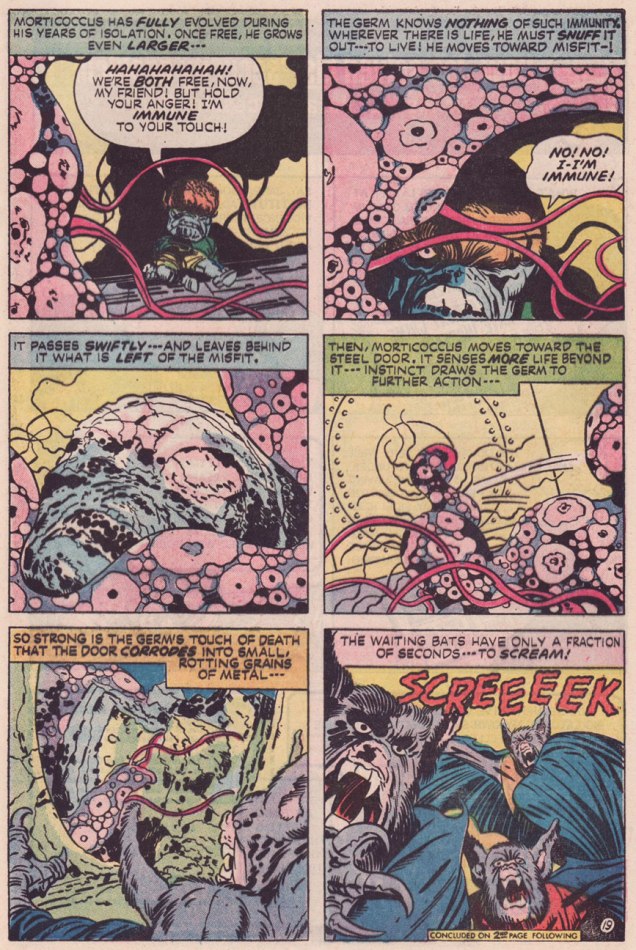
« Morticoccus is overpoweringly large and sinister! In this new world he can live — only if he destroys all other life around him — kingdoms and empires would crumble to dust at his deadly touch! Morticoccus waits in his prison — he waits to get out — and breed!! »

I apologize, but according to co-admin RG (whose sense of humour is apparently more morbid than mine) this is Contagion Week on Who’s Out There? Well, I suppose tentacled microbes and germs are as good a topic as any right now…

Our first foray into germs is This Beachhead Earth, scripted by Roy Thomas, penciled by Neal Adams and inked by Tom Palmer, published in The Avengers no. 93 (November 1971). The Vision collapses, the Avengers send Ant-Man into his body to figure out what’s amiss. I made an earnest attempt at following the plot, but the bad dialogue made my head hurt. Did you know that the scream of an ant « is like the wailing of a forsaken child »?  The story includes gems like « frankly, my dear, I don’t give an hydroelectric dam» and « therein lies the only true superiority of the educated man — that he analyzes — dissects — probes — reconstructs ». Oh, the glorious mix of bad puns and pompous lines!

TheAvengers93

TheAvengers93-2

You can read this « paltry prologue to the most portentous Avengers saga of all! », the work of a fellow who’s just a little too fond of calembours and his thesaurus, here.

Continuing on a grand scale – this time, it’s the grandest scale there is! – we pay a visit to the aforementioned Morticoccus (sinister a’plenty, you shall surely agree), arguably the most fatal disease known to mankind, or at least the deadliest to spring from Jack Kirby‘s fertile mind (ouch) . As for me, I really like the giant, lethal bats.

KirbyKamandi10p18A
Kamandi, The Last Boy on Earth no. 10 (October 1973). Killer Germ! is written and pencilled by Jack Kirby, and inked by Mike Royer, with whom co-admin RG has conducted an interview. 
KirbyKamandi10p19A

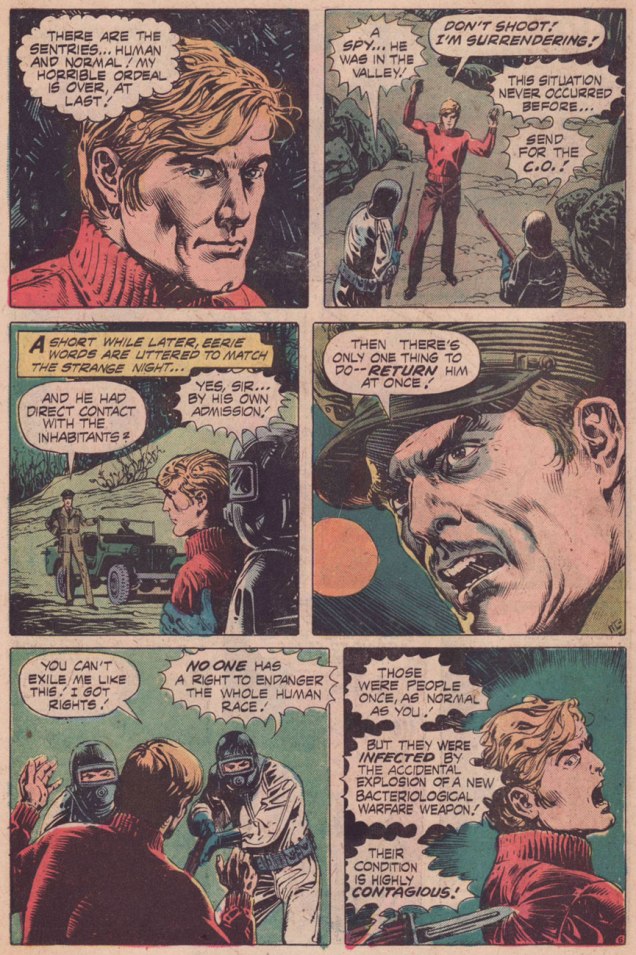
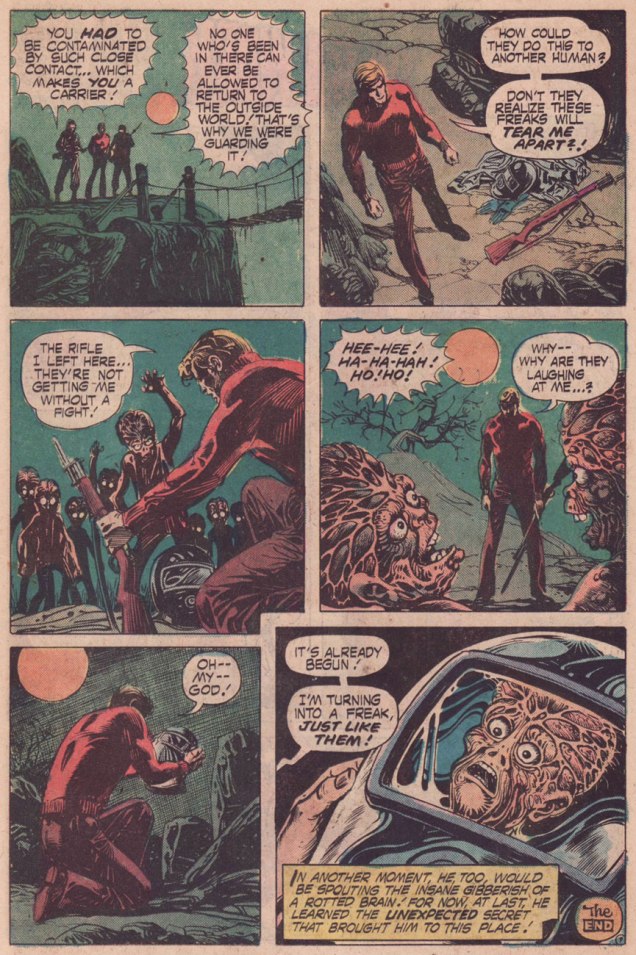
Our third medical study is a little case of fungoid infection that even boasts a name. M’Nagalah had a rather complicated birth. Created by British horror writer Ramsey Campbell for his cycle of H.P. Lovecraft pastiches (to be more precise, the creature first appeared in the short story The Inhabitant in the Lake in 1964), it was soon adopted by DC Comics, after doubtlessly being bowled over by its puppy eyes while visiting a no-kill shelter of the Great Old Ones. It was first borrowed for Swamp Thing no. 8 (1974) and afterwards used as per the Russian idiom “a plug for every barrel“. Just look at this mess.

Challengers of the Unknown no. 82 (August-September 1977), scripted by Gerry Conway, pencilled by Michael Netzer, and inked by Joe Rubinstein, starts off with a just mild (if disgusting) contamination…

LegacyoftheDamned-ChallengersoftheUnknown82

That fast progresses to the old “unspeakable, indescribable horror” (yawn).

TheSoulPredator-ChallengersoftheUnknown82

Swamp Thing gets dragged in, and professor Mark Haley blooms prettily in the beginning of Challengers of the Unknown no. 82 (October-November 1977), also scripted by Gerry Conway, but this time pencilled by Keith Giffen and inked by John Celardo

ChallengersoftheUnknown83

It is soon explained that this is actually some Elder God trying, as usual, to take over the planet, blah blah blah.

ChallengersoftheUnknown83-2-GerryConway

Wishing everyone health and bon courage in these trying times, especially to our poor American friends who seem to be caught in the middle of the virus vortex… And a last strip to end on a more positive note:

CalvinHobbes-StomachMicrobes
Calvin & Hobbes strip from February 7, 1993. May our worst encounter with microbes be of the digestive variety!

Oh, all right, one more:

UncleScrooge359
Page from The Incredible Shrinking Tightwad, published in Uncle Scrooge no. 359 (November 2006). Story by Don Rosa, of course!

∞ ds

A Hot Batch of Dan Gordon’s Cookies

« Take it easy, Shakespeare — TA-AKE it easy! Ya’ll dislocate an iambic, an’ THEN where’ll ya be? » — Cookie raises a fair point

It’s one of the field’s small, fortuitous victories that monumentally multi-faceted animator Dan Gordon (Superman, Popeye, The Flintstones, Huckleberry Hound…) happened to drift into comics from 1943 to the early ’50s, and his output from that period demonstrates he was having a ball as a solo performer, surely a break from the often frustrating assembly-line constraints of the animation world. While it certainly wasn’t the money that lured him to funny books (and his books *were* funny), this is no mere case of slumming or professional doldrums.

He mostly worked for Ben W. Sangor‘s American Comics Group (aka ACG), first on a profusion of ‘funny animals‘ features (Superkatt, Anthony the Rogue, Hubert Hound, Squirmy, Chickie, Scallawag Scottie, Huey Longears…) for such ACG anthologies as Giggle Comics and Ha-Ha Comics, but then…

« Gordon soon expanded his work with human characters when he created high school student Cookie O’ Toole. Marking his debut in the April 1945 issue of Topsy-Turvy Comics, Cookie received his own series of magazines the following year. Unlike the Archie comics that typified the teen humor genre in comics, Gordon’s Cookie stories possessed a strong vitality with a satirical edge. » [ source ]

TopsyTurvy01A
Cookie’s introduction in the one-shot Topsy-Turvy no. 1 (Apr. 1945, R. B. Leffingwell and Co.) Read it here!

Gordon’s Cookie stories are full of vitality and knockabout visual effervescence. The very colloquial dialogue’s pretty titter-worthy also. And you know, you can read each and every issue of Cookie right here, thanks to the assiduous efforts of the kind folks at comicbookplus.com.

Today, however, I really wanted to salute Gordon’s Cookie cover art, which first drew my attention to his comics work. Here, then, is a gallery of my picks.

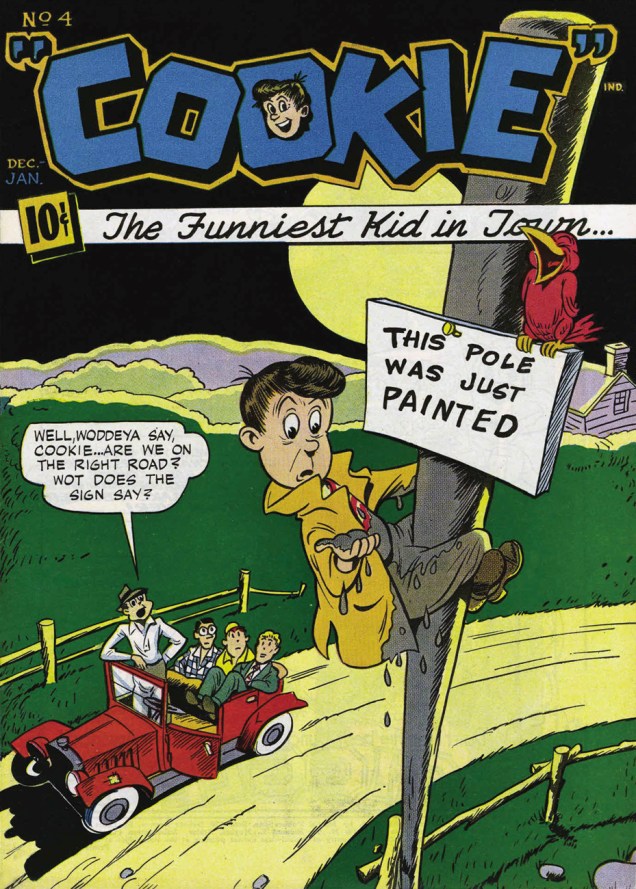
Cookie04A
This is Cookie no. 4 (Dec. 1946-Jan. 1947, American Comics Group). Cover by Dan Gordon. The entertained birdie is a lovely touch.
MorseBazookaWetPaintA
I’ve always loved that joke, even if it makes very little sense. Here’s where I first encountered it, through Wesley Morse‘s 1962 version.
Cookie05A
This is Cookie no. 5 (Feb.-Mar. 1947, American Comics Group). Cover by Dan Gordon. Incidentally, Cookie’s sweetheart is Angelpuss. With a name like that…
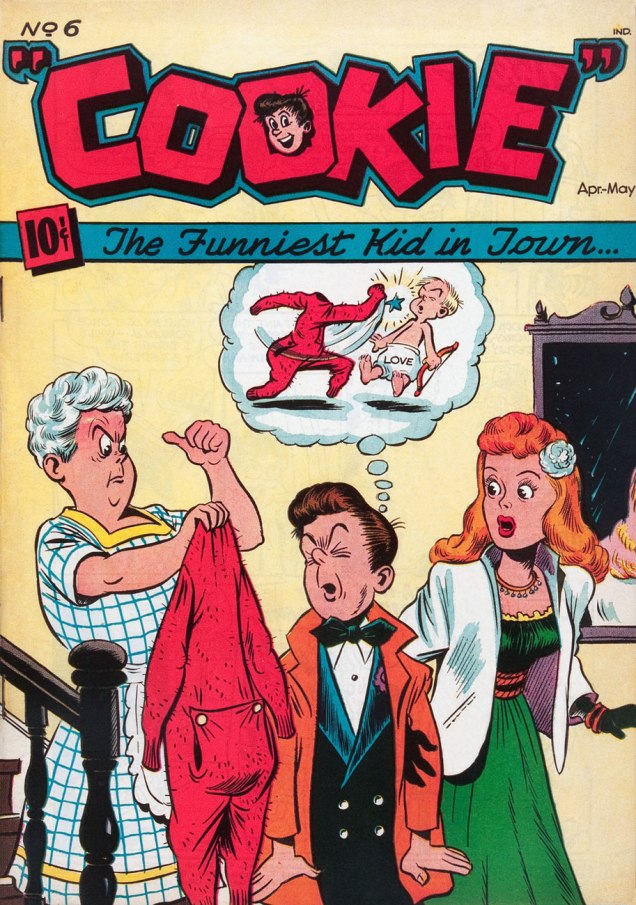
Cookie06A
« Aw, ma! » This is Cookie no. 6 (Apr.-May 1947, American Comics Group). Cover by Dan Gordon.
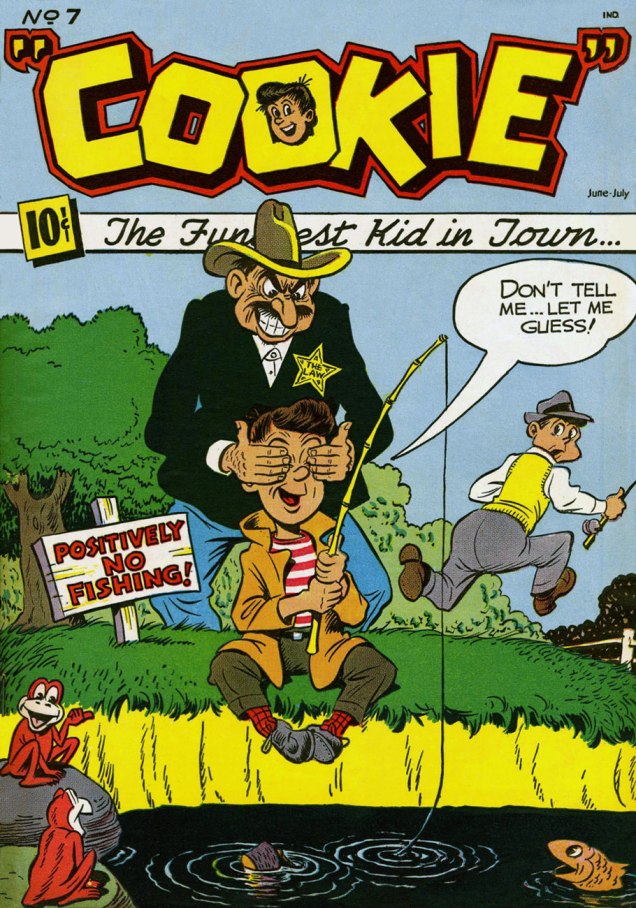
Cookie07A
This is Cookie no. 7 (June-July 1947, American Comics Group). Cover by Dan Gordon. « Well, I looked for support from the rest of my friends / For their vanishing trick they get ten out of ten. »
Cookie08A
This is Cookie no. 8 (Aug.-Sept. 1947, American Comics Group). Cover by Dan Gordon.
Cookie09A
This is Cookie no. 9 (Oct.-Nov. 1947, American Comics Group). Cover by Dan Gordon. Angelpuss is a singularly understanding lass, bless her heart.
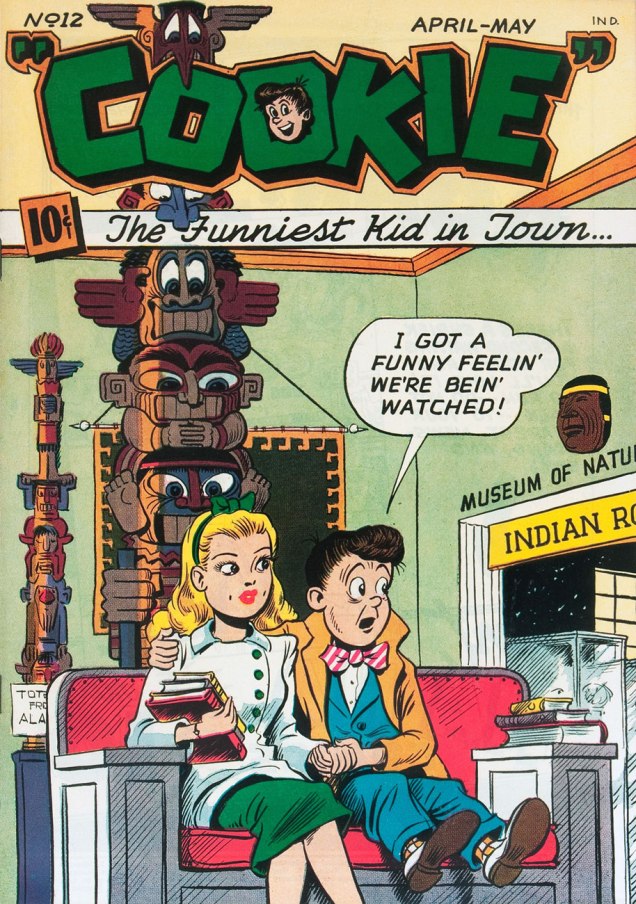
Cookie12A
This is Cookie no. 12 (Apr.-May 1948, American Comics Group). Cover by Dan Gordon. Design-wise, this one’s a particular standout. The totem gets a real workout!
Cookie20A
This is Cookie no. 20 (Aug.-Sept. 1949, American Comics Group). Cover by Dan Gordon.

… and before you go, check out Gordon’s action-packed cover for Ha Ha Comics no. 66, which my partner ds featured one bright Tentacle Tuesday last year. « They say he can cook too! »

-RG

Tentacle Tuesday: Matchboxes and Woodblocks

Much like fish painstakingly climbed out of the water and became mammals aeons ago, humorous representations of life, artists’ flights of whimsical fancy or taut fight scenes from centuries gone by morphed, over time, into something that resembled more and more what everyone now recognizes as comics. Me, I like blurred lines, the point at which several trees become a forest. What fun is it to live in a world where everything is well-defined, sorted into tidy little piles? Today’s Tentacle Tuesday stretches this blog’s comics-bound raison d’être just a teensy-weeny little bit. But I believe that the kinetic energy hidden within the following illustrations, the jump-off-the-page personality of these octopuses makes them close cousins to their more modern counterparts who dwell in the seas of sequential panels and images.

Just mentally add a speech bubble or two, if you must!

First of all, I have three woodblock prints, all three from the Edo period (Edo being the old name for Tokyo). The latter term refers to the period between 1603 and 1868 in the history of Japan, and is of interest  because it was characterized, among other things, by a flourishing interest in culture, be it music, poetry, theatre, or, more relevantly to the current post, art. That famous woodblock print, the Dream of the Fisherman’s Wife, which I have no need to include because of its ubiquity, was not the first painting featuring a woman in the embrace of an octopus. Yet it’s probably the most influential one, precursor of the hentai now so entrenched in popular culture…. and it was created during the aforementioned Edo era by Katsushika Hokusai (who, incidentally, also brought into existence the ever-popular The Great Wave off Kanagawa, ensuring the relative immortality of his art.)

Collectively, the work crafted during the Edo era (not necessarily woodblock prints, although these seemed to predominate, but also paintings) is referred to as Ukiyo-e, which in Japanese vaguely means something like “images of a floating world”. Poetic as usual, the Japanese.

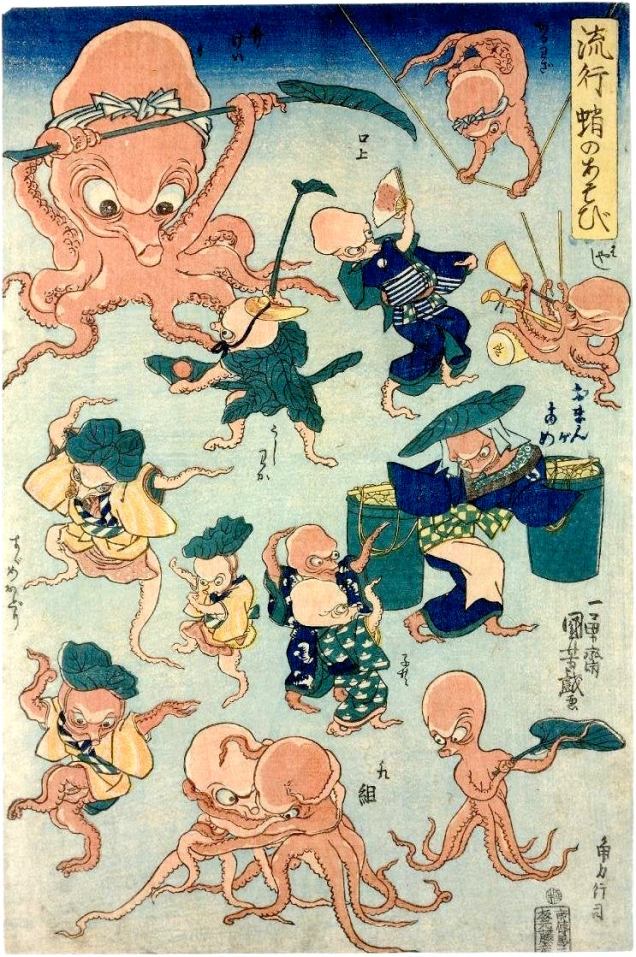
The fist woodblock print is entitled “Ryuko tako no asobi“, or The Fashionable Octopus Games. The British Museum (which seems to currently own this piece) describes it as « Octopuses re-enacting human amusements, such as the fight between Ushiwakamaru and Benkei on Gojo Bridge (top left) and sumo wrestling (bottom centre), dance, sword play, music, acrobatics, and other activities. » The artist is Utagawa Kuniyoshi.

Utagawa Kuniyoshi-OctopusGames

The second one, a triptych, is called One Hundred Turns of the Rosary and belongs to the One Hundred Wildernesses series, which shows « a procession of demons who appear throughout the night, offering a spectacular visual encyclopedia of supernatural creatures of premodern Japanese folklore » (description from the website of The Metropolitan Museum of Art). The artist is Kawanabe Kyosai.

Kawanabe Kyosai-one-hundred-wildernesses

My favourite is the following woodblock print by Utagawa Kuniyoshi, who had a great fondness for cats and inserted them seemingly everywhere. Visit this gallery of his cat-themed art over at the Great Cat blog, from which I’ll quote a paragraph for those who aren’t inclined to follow links:

« Utagawa Kuniyoshi was a great cat lover, and it was said that his studio was full of them. Often he could be seen working with a kitten snuggled up in his kimono. An apprentice, Yoshimune, reported that when one of Kuniyoshi’s cats died, he would have it sent to a nearby temple, and a Buddhist altar for his deceased cats was erected in his home. There he kept tablets with the cats’ Buddhist names on the altar. Kuniyoshi’s love of his felines spilled over into his art. Cats fill many of his compositions and he even began to give Kabuki actors cat faces. Kuniyoshi’s Ume no haru gjusantsugi was performed in 1835. A cat has shape-shifted into an old woman while a cat wearing a napkin dances while a cat licks the lamp. The cloth on the cat’s head represents the folk belief that cats would steal napkins and would dance together and howl “Neko ja!” (We are cats!). Cats often times licked Japanese lamps of the period because they were fueled with fish oil. »

A_cat_dressed_as_a_woman_tapping_the_head_of_an_octopus

I’ll doubtlessly howl “Neko ja!” at the next available opportunity.

Moving on, we have two illustrations from Japanese matchboxes.

First, a Japanese matchbox from around 1920s-40s. This little guy comes from a collection posted by Jane McDevitt, who’s passionate about matchbox art. I also really enjoyed her Eastern European matchbox label collection, which you can admire here.

Japanese-Matchbook-Tentacles

Of further interest on this topic is this comic strip by Roz Chast about her predilection for collecting matchbox art, published in the April 4, 2016 issue of New Yorker Magazine. As it turns out, Chast rejects the hassle of actually owning them, preferring to keep her collection as digital files. I suppose I am a collector, for I definitely prefer “owning” the physical version of things that interest me, but to each her own!

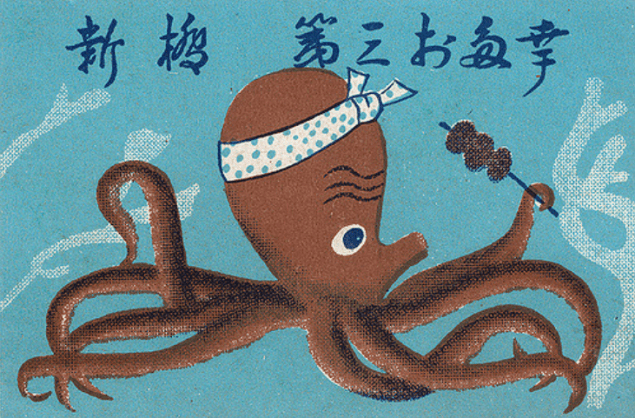
And another matchbox octopus from the 1950s:

Japanese-matchbox-1950

And it’s « goodnight from me »!

– ds

Stan Mack and the Delicate Art of Eavesdropping

« There’s nothing like eavesdropping to show you that the world outside your head is different from the world inside your head. » — Thornton Wilder

I’ve always been drawn to the more observational areas of cartooning, and Stan Mack (b. May 13, 1936) surely counts among the preeminent practitioners of the form, thanks to his long-running strip (in the pages of The Village Voice for a couple of decades!), Stan Mack’s Real Life Funnies.

Therein was to be found the cartoonist’s bold pledge: « Guarantee: All Dialogue Reported Verbatim ». Oh, it might seem easy, but I’m quite convinced it was anything but.

In point of fact, here’s some insight on Mr. Mack’s modus operandi, from the horse’s mouth:

« Carry a little pad and pencil. Dress to blend in quietly. Get to the destination with enough time to case the joint. It helps to be not too tall, not too short, not too dark, not too handsome, not too ugly, not too old and not too young.

When I arrive, if I find that everybody knows each other, I make a quick exit and forget it. Otherwise, the system continues: smile and keep your ears open. Find the men’s room (always good for a line), find coffee and food, which is very helpful unless you are trying to take notes. Look for a few convenient corners in which to hide. Learn to walk backwards in order to get closer to groups. Learn to stand in the middle of a mob and like it. And, finally, learn to change direction suddenly in order to follow a good line floating by.

Appear preoccupied. If you are engaged in conversation, pay no attention to what you are saying. Say anything. Fake it. You can’t listen and think at the same time. Float through the event. Each has its own particular current. Professional wrestlers and East Side gallery-hoppers move at different speeds.

When I start to draw a strip, I sit with my deadline approaching and a pad full of quotes and doodles. I try to draw the kind of people who actually said the lines.

I don’t know why some comments seem important and others dull, but I know that it isn’t until I begin to edit that material that the story emerges. It’s often a surprise.

It’s the unexpected that makes it work. Therefore it helps to approach everything with an open mind and no preconceptions, whether it involves policemen or transsexuals or frisbee addicts. »

« I hear words I couldn’t make up. I think, ”that’s something I would never have thought of. I’ll just write it down.” I work out of other people’s heads. »

StanMackDivorceA
Stan Mack’s Real Life Funnies, The Divorce (March, 1977, The Village Voice).
StanMackSuburbiaA
Stan Mack’s Real Life Funnies, An Art Sale in Suburbia (April, 1977, The Village Voice).
StanMackAccessoriesA
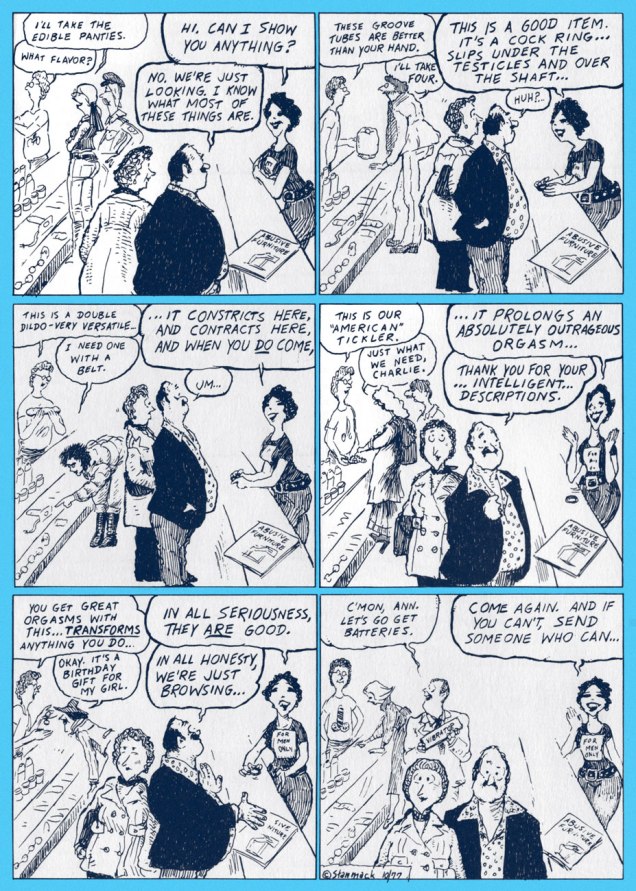
Stan Mack’s Real Life Funnies, Sex Accessories (October, 1977, The Village Voice).
StanMackAlbanianA
Stan Mack’s Outtakes, The Sting (Adweek, 1983)
StanMackPhonyA
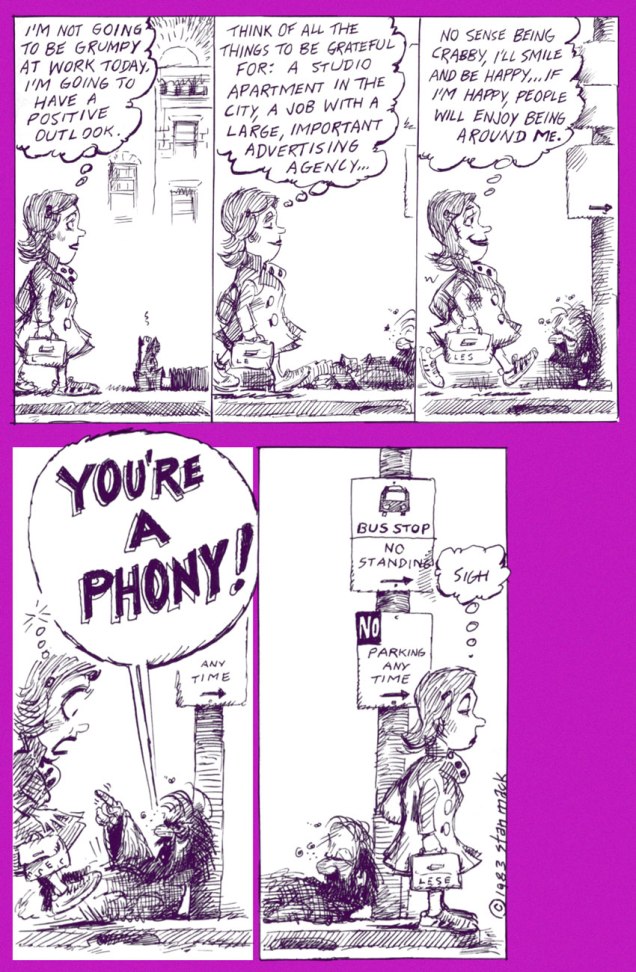
Stan Mack’s Outtakes, What a Bummer (Adweek, 1983)

« So, what’s he done lately? », you may ask. Well, you will nowadays find him in the pages of The American Bystander, where the cream of America’s extant cartooning geniuses gather to keep warm. Rick Geary, R.O. Blechman, Sam Gross, Drew Friedman, P.S. Mueller, Tom Hachtman, M.K. Brown… and these are just some of *my* favourites. Do them (and yourself) a favour, check it out!

StanMackAlleyA
Stan Mack’s Chronicles, Up His Alley (The American Bystander no. 7, Winter 2017).

Astute Mack-o-philes (and I’ve every reason to believe that they are astute) might point out that I neglected to bring up the artist’s splendidly surreal early ’70s National Lampoon feature, Mule’s Diner; fear not, its time in the limelight will soon(ish) be at hand, so stay tuned.

-RG

Tentacle Tuesday: Slidin’ Down the Cinema Sewer

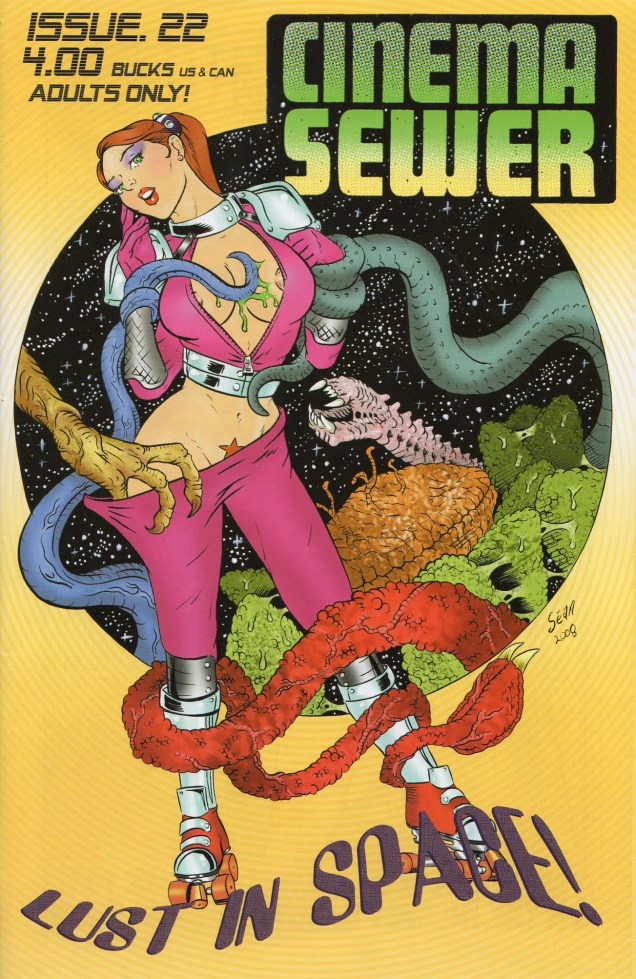
Due to unforeseen computer troubles (are those ever anticipated?), the program I was planning for today is postponed, as I don’t quite have access to the needed files. It’s Robin Bougie (Canadian “artist, writer, publisher and general sleaze visionary“) to the rescue! His film (maga)zine Cinema Sewer boasts a panoply of fun covers by a sturdy cadre of illustrators. To this I might add that this naughty publication doesn’t nearly receive all the lovin’ it deserves, so I’m all in favour of (well-earned) hype.

In case you’ve never heard of it, here’s a review by Richelle Charkot of a random issue (no. 28, if you should ask), which is representative of the whole series in general:

« Robin Bougie does it again with another enthralling and disgusting chapter in the Cinema Sewer series. This set of fascinating essays on cult films, genre films, vintage porn and their attendant subcultures is meticulously assembled as usual, with hand-written text and amazingly sultry illustrations largely written, drawn, laid out and published by Bougie himself. Cinema Sewer is so readable that it could potentially be quite easy to burn through, but thanks to Bougie’s wealth of dirty knowledge, there is plenty to *ahem* chew on, so you won’t destroy the issue too quickly. The zine covers everything from the life of pornographic photographer Johnny Castano (of which Bougie describes his work as “an artform”), to Lili Marlene, aka ‘The Forgotten Anal Princess’, with dozens and dozens of alt-cinema reviews to peruse through. As with its previous installments, Cinema Sewer is definitely an acquired taste, and many may be offended by Bougie’s tendency to be incredibly crass and fast and loose with colloquial genital terms that might unsettle some readers. But for those who are not weak of heart and possess a desire to learn, let this series be your quintessential guide to the underbelly of film. »

00
Cinema Sewer no. 16 (2005). Cover by Danny Hellman, who not only has a peculiar sense of humour (it’s a compliment, Danny!), but is also an excellent tour guide through the wilds of Brooklyn.
Cinema Sewer17
Cinema Sewer no. 17 (2005), cover by Mike Hoffman. This scene raises far more questions than could possibly be answered.
CC00
Cinema Sewer no. 22 (2009), with a cover by Sean Donahue. Her expression seems to be saying “ah, come on, you guys…” There’s some mysterious link between roller skates and tentacles – just take a gander at John Pound’s cover for Commies from Mars no. 3.
CinemaSewer26A
Cinema Sewer no. 26 (2013), cover by Canadian comics artist James Stokoe. I find his work (and colours) to be a bit hit or miss, but I loved his (currently unfinished) Orc Stain and quite enjoyed Wonton Soup.
CinemaSewer31A
Cinema Sewer no. 31 (2018). Cover by William Skaar, who clearly entertains a certain fondness for both tentacles and big-chested girls (just take a peek at his website or his Kickstarter project). Well, don’t we all? 😉

– ds

Treasured Stories: “Spawns of Satan” (1973)

« Hugs can do great amounts of good, especially for children. » — Diana, Princess of Wales

Today’s entry is a tale of vampirism from the typewriter of Jack Oleck (1914-1981). In the late 1940’s Mr. Oleck’s career in comics began promisingly with his brother-in-law Joe Simon and his partner Jack Kirby‘s Prize (Young Romance, Strange Worlds of Your Dreams, Black Magic and other anthologies), followed by a stint with EC late in the publisher’s classic, pre-Mad Magazine-only run (Crime SuspenStories, Shock SuspenStories, Vault of Horror, Incredible Science-Fiction, et al), along with assignments with Hillman, Atlas, Charlton and Harvey… among others.

Finding the décor of the Code-regimented funnybook industry a bit austere to his taste, he devoted the years of 1957 to 1969 to publishing and editing the magazine Decorator News and authoring the odd novel.

In 1969, he sauntered over to DC, where he cranked out quite a caboodle of scripts over the following decade-or-so, mostly in the horror (as it couldn’t be and shouldn’t be called under The Code) genre (“Mystery”, they called it), but also the occasional bit of romance, science-fiction and adventure. I’d like to say he was great, but frankly, he was pretty much a page-filling hack.

This is probably his finest script from this most prolific period, and it’s still full of plot holes and other inconsistencies. But that’s market reality for you: Oleck was consistently readable, he was fairly competent, he turned in his work on time, and he got along with the editors. Sometimes that’s all you need.

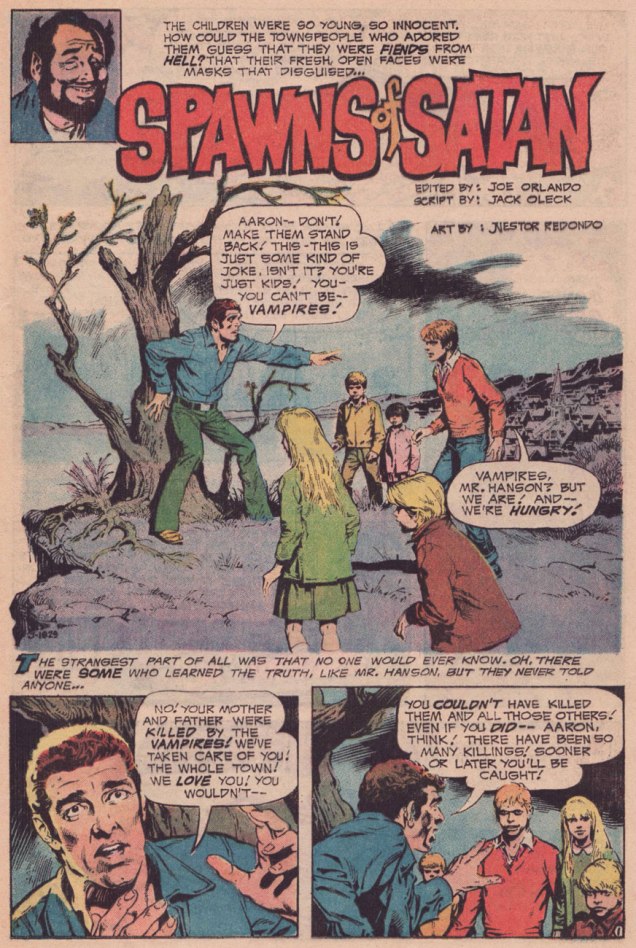
So why am I featuring Spawns of Satan if I seem to think so little of it? Well, obviously, there’s the luxurious grace of Nestor Redondo‘s art, granted here a specially generous setting to display its virtues. The middle act of the story is virtually mute, and all the more effective for it.

Read it first, then I’ll tell you more.

RedondoSpawns01A
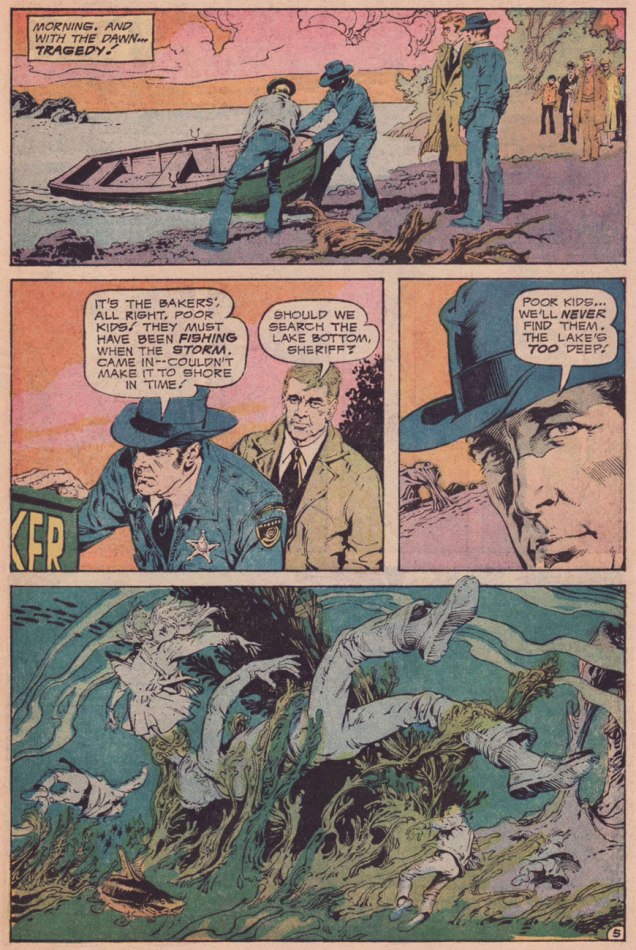
Okay, if the town’s taken care of them, how come no-one’s found it unusual that the kids aren’t around during the daytime? Doesn’t anyone go to school?
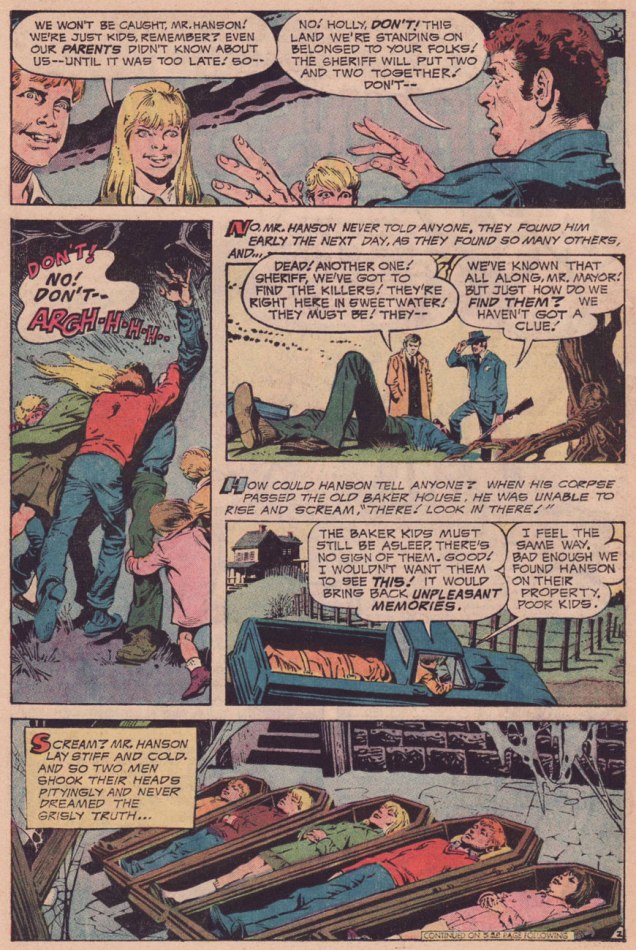
RedondoSpawns02A
It certainly tips the scale in the miscreants’ favour that the sheriff just shrugs and admits he hasn’t a clue. I guess it just wasn’t an election year.
RedondoSpawns03A
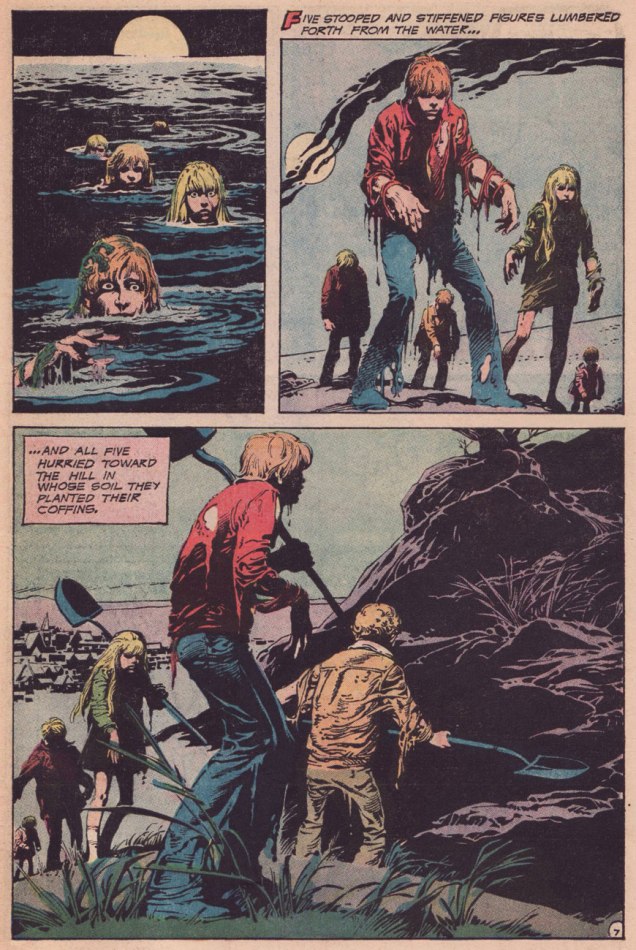
Wait… kids (with one or two tackling most of the grunt work) burying five coffins on grassy ground, and “not a sign that the ground’s been disturbed“? Mighty vampire powers, I say! And can you imagine the torment and frustration of the little ones, knowing they’ll never grow up, never get to take charge or be taken seriously? This story is just honeycombed with potential avenues of exploration.
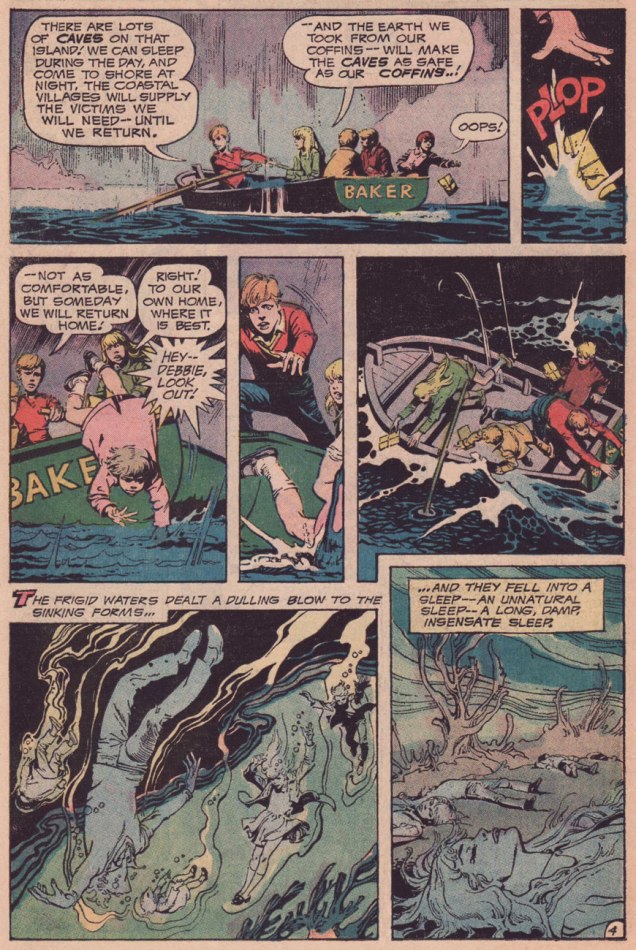
RedondoSpawns04A
One slight problem: hypothermia should not affect undead creatures without a beating heart nor, necessarily, blood circulation. A little too convenient, Mr. Oleck. But fine, you’ve got them to the bottom of the lake.

RedondoSpawns05ARedondoSpawns06ARedondoSpawns07ARedondoSpawns08A

RedondoSpawns09A
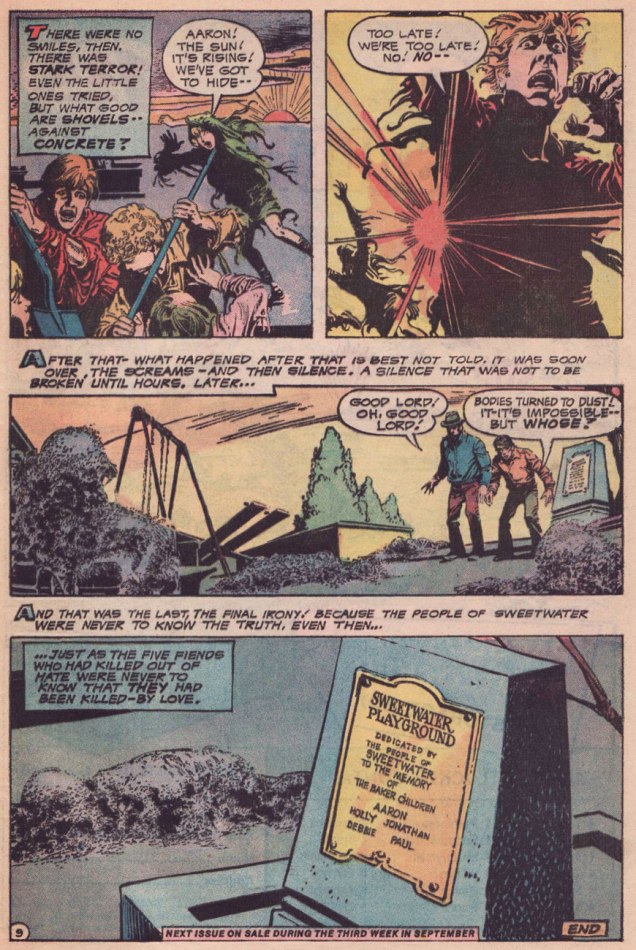
For me, one of the tale’s chief assets had been Aaron’s characterization. Now how is it that suddenly, this cool-headed and calculating leader just loses his shit and gives up*? As depicted earlier, Aaron would have ordered a retreat to the lake and formulated another plan. But no, there had to be a ‘sting in the tail’. Also, if the town knew full well they were dealing with vampires, why do bodies turned to dust suddenly seem “impossible”? Finally, did you get the impression that the Baker kids killed out of hate (well, except for Holly; that girl had a bad attitude), as stated in the final panel? I think not: the clan was portrayed as a predator pack, who merely killed to survive, no sentiment allowed.

SOS is otherwise mainly notable in its introduction of themes and ideas that would be brought to full miasmic flowering by (of course) Alan Moore in issues 38 and 39 of Swamp Thing (July and August, 1985), namely the family unit of underwater vampires. Moore’s set of toothsome nasties was more-or-less introduced, but not fully-fleshed out, by his predecessor, Martin Pasko, in July, 1982’s Saga of the Swamp Thing no. 3‘s A Town Has Turned to BloodMoore’s keen eye caught the spark of potential and set the hills ablaze. However, it seems unlikely that Moore’s research hadn’t trailed back a few years to the lacustrine lair of the parasitical Baker brood.

While slaughterous children were all the rage from the late 50s (John Wyndham’s The Midwich Cuckoos, its filmic adaptation Village of the Damned and its sequel, Children of the Damned) and into the 70s, Oleck’s Spawns still preceded Stephen King’s ‘Salem’s Lot (1975), The Omen (1976) and the 1976 Spanish shocker ¿Quién puede matar a un niño? / Les révoltés de l’an 2000 (boy, did that one scar me as a kid), and given the comics field’s penchant for cribbing ideas *after* they had run their course, that’s another feather in Oleck’s fedora.

Speaking of editors, I’ve long suspected that this particular issue of House of Secrets was the dumping ground of an aborted experiment by its editor, Joe Orlando. Orlando had clearly been trying to shake things up a bit, running two longer, less compressed stories per issue instead of the usual three… as DC’s available story page count had dropped from 24 to 20 (and would reach a woeful 17 by 1976!); the two-story practice lasted but a few issues. After no. 117, it was jettisoned. It would appear that at least one of House of Secrets 113’s stories had been scheduled and delayed: eight months earlier, Jack Sparling’s grey-tone lovely cover for House of Secrets no. 105 (Feb. 1973) was a perfect illustration for Doug Moench‘s, Mike Sekowsky and Nick Cardy‘s fascinating ‘Not So Loud– I’m Blind’… which finally turned up in this issue as the lead story. Sombre and rambling, Moench’s likely first sale to DC lacks the usual forced twist ending, opting instead to trail off into darkness. In fact, when I first read it, I thought my copy was missing a page.

Moench went off to be arguably (well, he’s my pick) Marvel’s most consistent writer of the 1970s, and only returned to DC in the ensuing decade.

-RG

*short answer: The Comics Code Authority.

Tentacle Tuesday: Tropical Foliage!

Greetings! I am on vacation this week – on vacation from work, that is, but never from tentacles! Stowed away on a tropical island (with a WiFi connection, ça va de soi),  hoping to glimpse an octopus going about his business in the ocean, enjoying the tropical foliage… Speaking of the latter, some of the plants that grow around here are distinctly tentacular in nature.

PlantTentacleDS

So you see, I really had very little choice in regards to the topic of today’s Tentacle Tuesday installment! I’ve decided to stick to the 40s and 50s, as there are really many more cannibal plants out there than one could possibly shake a stick at.

Quite a few of these offerings are taken from the pages of Planet Comics, and if it rubs your fancy, our Tentacle Tuesday: Planet of Tentacles, courtesy of Fiction House post might be worth a visit.

PlanetComics14-RedComet-Joe-Doolin
This installment of Red Comet is illustrated by Joe Doolin, and published in Planet Comics no. 14 (September 1941). Frankly, these things seem a little too bulky to carry about with you. Just imagine if somebody tried to walk around carrying a triffid.
PlanetComics14-RedComet-Joe-Doolin-2
I believe the Red Comet had the ability to explode things with his mind, but clearly there were some restrictions.
PLanetComics28
A page from an installment of Gale Allen and the Girl Squadron, illustrated by Fran Hopper. Gasp, a woman comics artist! A rare thing indeed, back in the Golden Age. Published in Planet Comics no. 28 (January 1944). Gale Allen ends up in this very position quite often, though tentacles aren’t always involved.

Incidentally, may I just point out that the Girl Squadron’s costumes (as they go on their intergalactic, dangerous missions) wouldn’t be out of place in a modern music video? Fran Hopper could draw cute girls with no trouble at all – and she also seemed aware that breasts are affected by gravity (but just a little bit, one wouldn’t want to be *too* realistic).

planetcomics28-galeallen-girl-squadron
The ruler of Carnivoria not only has poor taste in titles (most lands are governed by meat-eaters of one kind or another – in that sense, Canada could be called Carnivoria with the same degree of accuracy), but also poor taste in clothing: is that goofy hat supposed to be regal?

For a chuckle, visit the post about Gale Allen And Her Girl Squadron on the Stupid Comics blog, featuring fun images like this one:

gams6
From the usual team: written by Douglas McKee and illustrated by Fran Hopper.

Eye candy for men *and* women readers! 😉

Back to tentacles… and on to Fred Guardineer, who also drew cuties of both sexes:

SpaceAce0702-TheHarpofDeath
The Harp of Death! is illustrated by Fred Guardineer. Printed in Manthunt no. 7 (April 1948).
SpaceAce0702-TheHarpofDeath2
Evil Guy has the body of an eagle (with hands and feet, though), and raises deadly cannibal plants that respond to whistling. Does that seem a tad… random to you?
Beware12
A page from Appetite for Death, drawn by Henry Kiefer. Published in Beware no. 12 (November 1954).
Beware12-2
There’s something distinctly wrong with the guy’s anatomy.

~ ds

Glenn Dakin’s Alter Ego, Abraham Rat

« What’s the point in eternity… if nothing ever changes? » — White Ant gets in the final bon mot (Captain Oblivion no. 1)

In the mid-1980s, the surprise success of Kevin Eastman and Peter Laird‘s Teenage Mutant Ninja Turtles touched off a veritable avalanche of ever crappier, hastily-assembled and cheaply-produced knockoffs — at least Eastman and Laird initially meant their creation as a joke. Oh, there were some real gems amidst the rubbish, but as Sturgeon’s Law tells us, the bad greatly outweighed the good, let alone the great. This is now known as the Great 1980s Black and White Comics Glut.

Among the good-to-great (well, to my taste) were a score of short-lived onomatopoeic humour anthologies such as !Gag! (Harrier), Honk! (Fantagraphics), Splat! (Mad Dog Graphics), Bop, Buzz, Twist (along with the venerable Snarf, all from Kitchen Sink)… the mutant progeny of Zap Comix, I suppose.

It was within the pages of Honk! that I was greeted by such across-the-pond talent as Eddie Campbell, Glenn Dakin, Phil Elliott and Paul Grist. Their work provided a sorely-needed gust of English country air to the superhero-fatigued reader, though one had to keep both eyes open, as alternative comics publishing in the ’80s was a maddening mixture of whack-a-mole and ‘throw stuff at the wall and see what sticks‘.

Now that the stage is set, I’ll share some of my favourite Dakin strips. He’s been a busy chap, creating several solo series: Temptation, Captain Oblivion/Abe Rat, Robot Crusoe; collaborations: Paris: the Man of Plaster (with Steve Way), Mr. Day and Mr. Night, The Man From Cancer and Greenhouse Warriors (all with Phil Elliott), as well as YA novels (the spooky Candle Man) and animation (the astonishing Shaun the Sheep).

Today, I’ll focus of my very favourite Dakin creation (his most understated and personal), the fancifully autobiographical Abe Rat.

DakinMeetAbe01A

DakinMeetAbe02A
The author introduces his creature, and who better to do it? From the sterling compendium Abe – Wrong for All the Right Reasons (2001, Top Shelf).

DakinSpring01A

DakinSpring02A
A Song of Spring was originally published in Fast Fiction no. 14 (April 1985, Fast Fiction).
DakinCapOblivionA
As this Captain Oblivion one-shot was left out of the Abe collection (the original artwork was lost!), the completist will want this one as well… and will not be disappointed nor go broke in the process. This is Captain Oblivion no. 1 (Aug. 1987, Harrier). Cover colours by Mr. Phil Elliott.

DakinAbeTrialDeath01ADakinAbeTrialDeath02ADakinAbeTrialDeath03A

Dakin’s comrade-in-ink Eddie Campbell (Abe’s his fave Dakin strip too) provides the introduction to the collection, and therein shares these thoughts: « Back when we were doing our little photocopied comics (what I term ‘small press’) in the ’80s, we constantly challenged each other to take the comics form in new directions. Dakin evolved in exciting ways in his Abe stories. The were autobiographical, but more concerned with the inner life than the physical one. He arrived at an approach which I termed ‘discourse’. He would devise characters and symbols, and borrow others, combining them in argumentative juxtapositions. There would be passages where he’d use a character from history or a novel to push his contemplation towards a resolution. Once he even called a halt to proceedings and ran a variant ending. »

Thanks for reading, hope you enjoyed making Abe’s acquaintance.

-RG

Tentacle Tuesday: By the Sign of the Jack-in-the-Box Harlequin

As Tentacle Tuesday creeps by once again, we found ourselves knee-deep in ghosts and devils – adorable, baby-featured ones. As a matter of fact, if you’re the kind who breaks out in hives when exposed to an overdose of cuteness, I would suggest skipping this week’s installment.

harveycomicslogo

The best-known titles published by Harvey Comics, whether comic book adaptations of an animated cartoon (for instance, Casper the Friendly Ghost or Baby Huey, both adapted from Paramount’s Famous Studios cartoons) or original series, are certainly no passion of mine for the simple reason that the stories are, for the most part, quite boring. Their strained slapstick elicits, at best, a semi-chuckle: each character is so tied to a shtick that the whole thing becomes predictable very quickly. Hot Stuff, the little devil with temperature regulation problems, constantly burns through and/or melts stuff. Little Dot draws polka dots on everything – or hangs out with giraffes. Little Lotta demolishes all food in sight à la Garfield. Richie Rich swims in money, eats money, inhales money. Wendy the Good Little Witch is nauseatingly boring (I disagree with that being a viable definition of “good”).

All of these characters have redeeming features – their heart is in the right place and they enthusiastically come to the aid of friends and animals. The Harvey Girls, as they’re called (Little Lotta, Little Dot and Little Audrey) are clever and enterprising, if spoiled and headstrong, which is a pleasant change from females in need of rescuing. I wouldn’t go as far as calling their antics “proto-feminist”, notwithstanding the lofty claim made to that effect in the introduction to the Dark Horse Harvey Girls anthology.

One can hem and haw about it all day, but there is one redeeming and indisputably striking feature, and it’s one to contend with: the covers are beautiful! Lovingly designed, gorgeously coloured, they’re pure eye candy.

We have artist and art editor Warren Kremer, who worked at Harvey for some 35-odd years starting in 1948, to thank for that. See my colleague’s Little Dot’s Playful Obsession and his spotlight on Spooky the Tuff Little Ghost for more details. Me? I shall simply concentrate on tentacles.

CasperandNightmare21
Casper & Nightmare no. 21 (1968). Casper the Friendly Ghost was adapted from Famous Studiosanimated cartoon, and soon gave birth, so to speak, to a score of spinoffs, such as Spooky the Tuff Little Ghost and Wendy the Good Little Witch.
Richie-Rich-128
Richie Rich no. 128 (September 1974). Richie Rich, yet another Warren Kremer character, debuted in Little Dot. Don’t you just love the super-bashful octopus?
DevilKids-Starring-HotStuff-67
Devil Kids Starring Hot Stuff no. 67 (December 1974). Hot Stuff the Little Devil is another Kremer character.
RichieRichProfits5
Richie Rich Profits no. 5 (June 1975)
CasperDigest2A
Casper Digest no. 2 (December 1986). This would be a far nicer image sans all the page-cluttering copy (and bar code)!

~ ds

What! You Call This Cold Weather?

« Polar exploration is at once the cleanest and most isolated way of having a bad time which has been devised. » ― Apsley Cherry-Garrard, The Worst Journey in the World (1922)

Here’s what happened: I was leafing through Paul C. Tumey‘s splendid comics anthology Screwball! The Cartoonists Who Made the Funnies Funny (2019, The Library of American Comics/IDW) when I came across a wonderful sample of Gene Ahern‘s Room and Board (1936-58) wherein the strip’s central figure, Judge Homer Puffle, feeds another boarder a steady line of bull in that grand, booming Baron Munchausen — Captain Geoffrey Spicer-SimsonColonel Heeza Liar Commander McBragg tradition.

Room-And-Board1937A
Gene Ahern‘s Room and Board (March 17, 1937, King Features).

Of course, it’s all piffle and bunk, but it brought to mind a passage from a favourite article on weather peculiarities in Siberia, Marcel Theroux‘s The Very, Very, Very Big Chill (published in Travel & Leisure in 2000):

« Local people told me that at minus 60 and below, a dense fog settles in the streets, and pedestrians leave recognizable outlines bored into the mist behind them. A drunkard’s tunnel will meander and then end abruptly over a prone body. At minus 72, the vapor in your breath freezes instantly and makes a tinkling sound called ‘the whisper of angels.’ »

Then I thought: « all very nice, but that makes for a rather meagre post »… so I decided to toss in a few bonus images featuring that venerable recurring motif… and got carried away.

Astonishing36A
This is Astonishing no. 36 (Dec. 1954, Atlas), the title’s penultimate pre-Code issue… not that Atlas ever crossed the line into gruesome. The cover-featured yarn is The Man Who Melted!, an amusing load of utter rubbish you can read here. Cover art by Carl Burgos.
ChamberChills10MarvelA
This is Chamber of Chills no. 10 (May, 1974, Marvel), and most everything’s the same, save for the colour palette and the now-hostile expression on the caveman’s mug.
ChamberChills10HarveyA
And this is also Chamber of Chills no. 10 (July, 1952, Harvey)… the original, whose title Harvey Comics left curbside for Marvel to recycle when they went all kid-friendly in the Comics-code-ruled Silver Age. Cover designed and art-directed by Warren Kremer and illustrated by Lee Elias. For some insight into these collaborators’ working methods on the horror titles, here’s our post on that very topic. Incidentally, what’s up with the hifalutin Lord Byron quote, Harvey folks? This wacky fare is quite plainly fiction… what’s your point? [Read it here.]
Unexpected101A
This is Tales of The Unexpected no. 101 (June-July 1968, DC). Layout and pencils by Carmine Infantino, inks by George Roussos. Infantino, promoted the previous year to editorial director (he would soon rise to the rank of publisher), brought in the versatile Nick Cardy to serve as his right-hand man on the artistic front; together, they designed all of DC’s covers until both men stepped down in 1975.
HOM199A
This is House of Mystery no. 199 (February, 1972, DC), illustrating Sno’ Fun! a rare (possibly unique, really) collaboration between Sergio Aragonés (script) and Wally Wood (pencils and inks). Cover designed by Infantino and Nick Cardy, pencilled and inked by Neal Adams and coloured by Jack Adler.
Unexpected142A
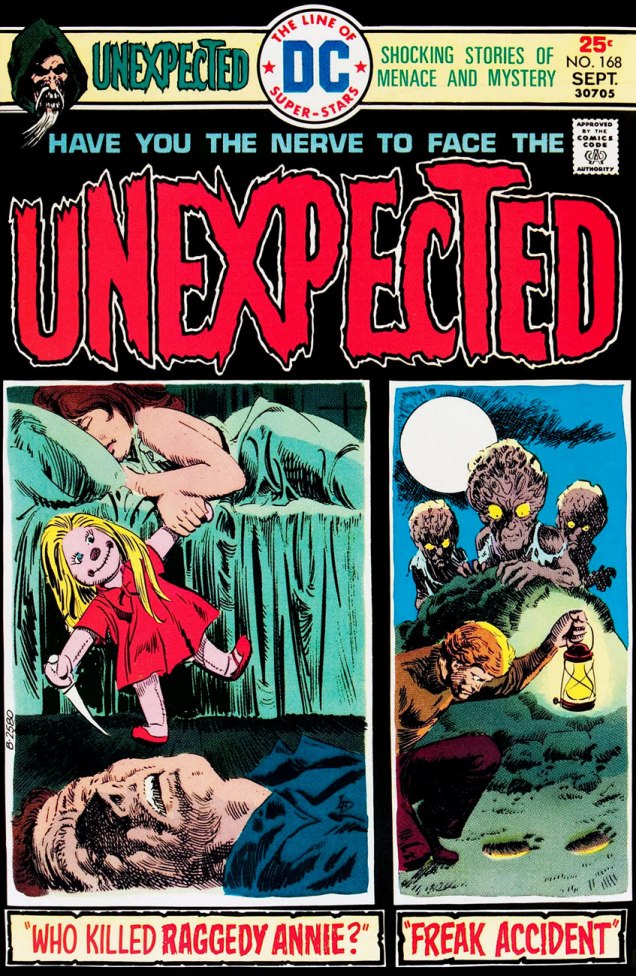
This is Unexpected no. 142 (Dec. 1972, DC); cover art by Nick Cardy.
Unexpected147A
This is Unexpected no. 147 (June, 1973, DC); cover art by Nick Cardy.
Unexpected150A
This is Unexpected no. 150 (Sept., 1973, DC); cover art by Nick Cardy.
SuttonHaunts36A
« Hey, look! The critter is frozen whole… it’s in pretty good shape! » Tom Sutton vibrantly sells Joe Gill and Steve Ditko‘s cautionary tale of arctic drilling gone awry, The Ancient Mine. Also in this issue: Steve and Pete Morisi‘s Surprise!, and Gill and Fred Himes’ touching Pipe Dream. This is Haunted no. 37, (Jan., 1974, Charlton), presented by the publisher’s blue-skinned, green-haired answer to Nana Mouskouri, Winnie the Witch.
HulkHaunted37A
« … that face haunts me… was it a man or a beast? » Ah, the Seventies. Left dazed and frazzled by his whirlwind life of slow-mo violence, glamorous excess and substance abuse, not to mention radiation poisoning, the inevitable occurs: The Hulk wanders onto the wrong set, as well as the wrong publisher’s! Against all odds, he handles the rôle with aplomb and commendable gravitas. A page from Gill and Ditko’s The Ancient Mine. Read it here!
Ghosts37A
This is Ghosts no. 37 (April, 1975, DC), featuring Luis Dominguez‘s first (or many) cover for the title, a passing of the torch from Nick Cardy, who’d handled nearly every one of the preceding three dozen…. minus two: number 7’s cover was the work of Michael Kaluta and number 16‘s that of Jack Sparling.

Oh, and since I wouldn’t want any of you superhero aficionados to think I’m freezing you out, here’s another demonstration of Mr. Infantino‘s “encased in ice” idée fixe.

Detective373A
Mr. Freeze, who first popped up in Batman no. 121 in 1959, initially known as, er… Mr. Zero (Celsius, Fahrenheit or Kelvin?) before being revamped and renamed for the mid-60s Batman TV show, a makeover that carried over to the comics, but tragically didn’t include his outfit. This is Detective Comics no. 373 (March, 1968, DC); layout by Infantino, finishes by Irv Novick. [ read it here!]
… and I can just about hear the « but what about Cap? » troops tromping down the hall, so…

KirbyCap112A
Namor goes all First Commandment on some poor Inuits (surely they’ve seen frozen bodies before?), displaying an unseemly level of insecurity for someone of his standing. This recap hails from King Kirby’s sensational feat of deadline rescue on the behalf of a tardy Jim Steranko (to be fair, it was worth the wait). George Tuska‘s inks are a surprisingly good fit! This is Captain America no. 112, Lest We Forget! (April 1969, Marvel). [ read it here!]
My co-admin ds was just telling me yesterday about a client who, upon remarking to a succession of winter-kvetchers that actually, we’d had a pretty mild January, was invariably met with goggling bafflement, as if he’d just then grown a second head. In related news, it was just announced that said month of January was, indeed, the planet’s warmest on record. There is, naturally, an xkcd strip about this sort of circular denialism.

-RG