« Mister X has always puzzled me. I’ve never been exactly certain where he came from. It seems like he has always been present — maybe not skulking through the perplexing shadows of the city so much as through some kind of collective unconsciousness. » — Dean Motter (1986)
On this day, back in 1953, the celebrated art director, graphic designer, writer-illustrator and cartoonist Dean Motter was born in Berea, Ohio, not far from Cleveland.
Over the course of his illustrious career, Motter has flitted in and out of comics, often in tandem with a rather remarkable array of collaborators, among them Jaime Hernandez, Paul Rivoche, Seth, Ty Templeton and Michael Lark… but just as frequently on his own.
As you’ll see, though he is quite adept in a vast range of media and techniques, nearly all of his mature work is lovingly filtered through his abiding interest in Will Eisner’s The Spirit, film noir, Art Deco, German Expressionism, with, I’d say, a soupçon of Soviet Propaganda art… resulting in a surprisingly cogent and coherent retro-futurist vision. The future as seen from the past, in short. And that’s just the visuals.
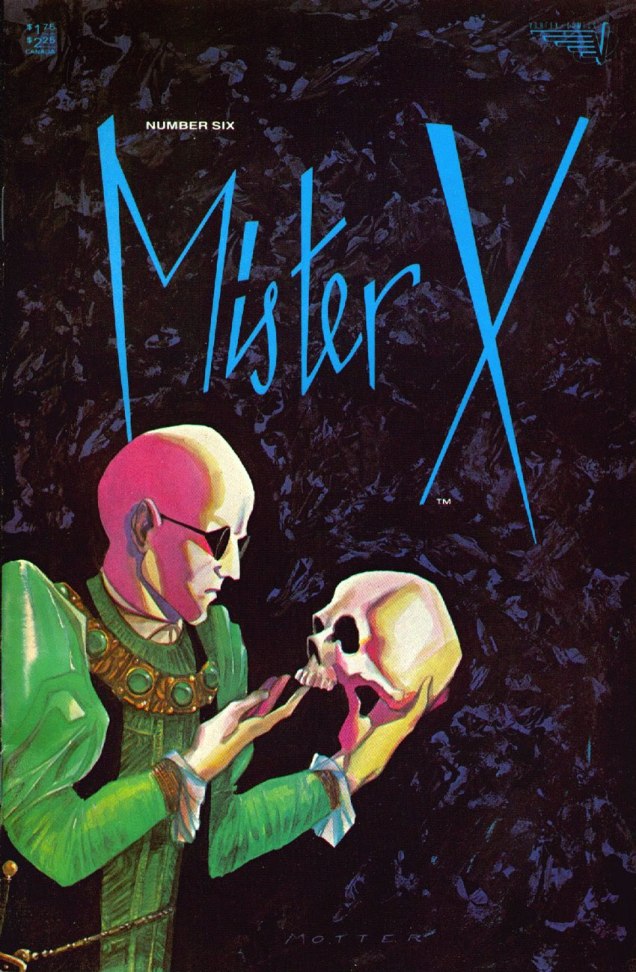
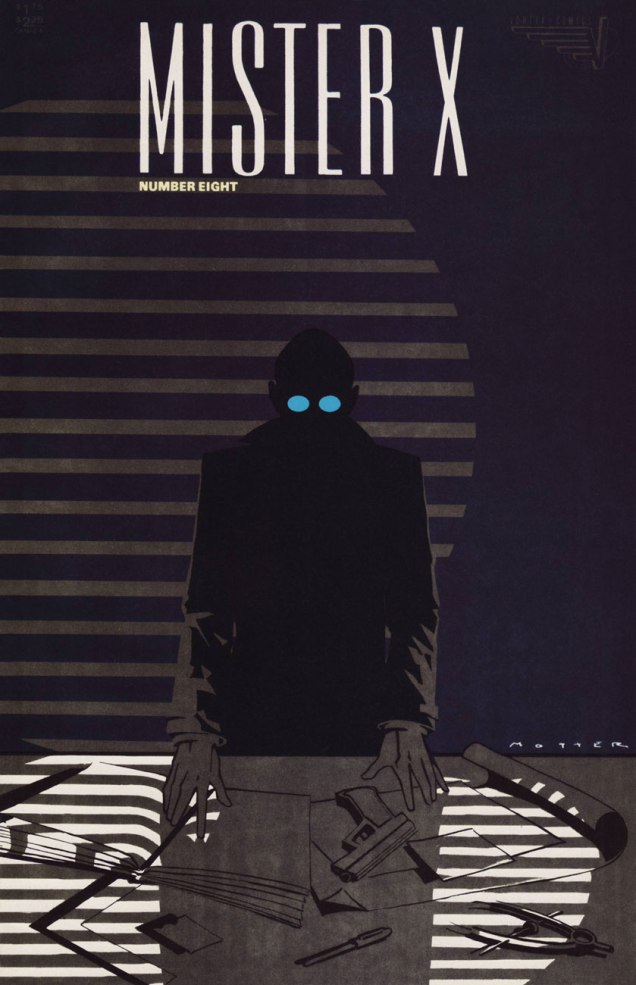
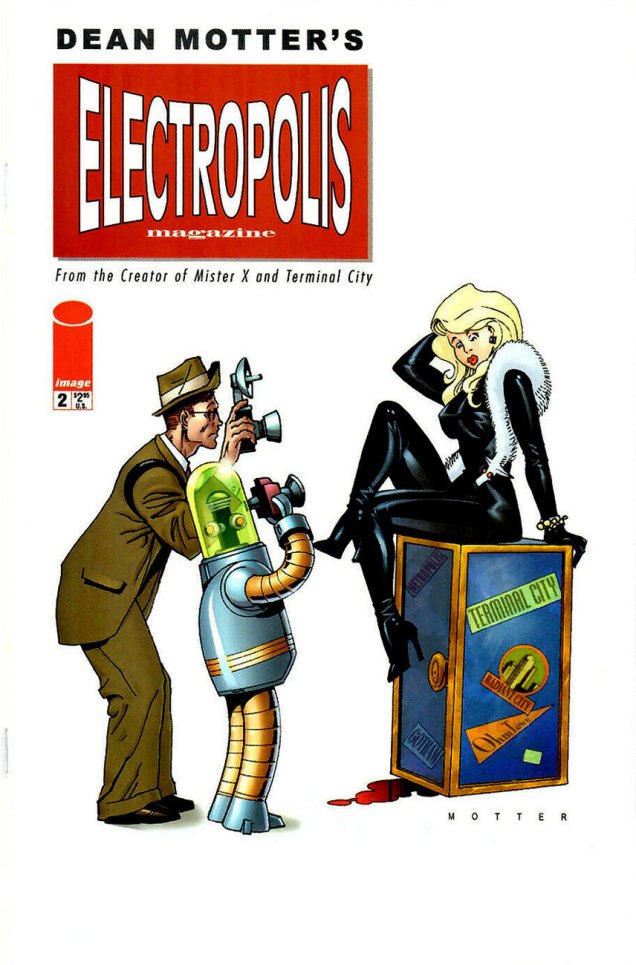
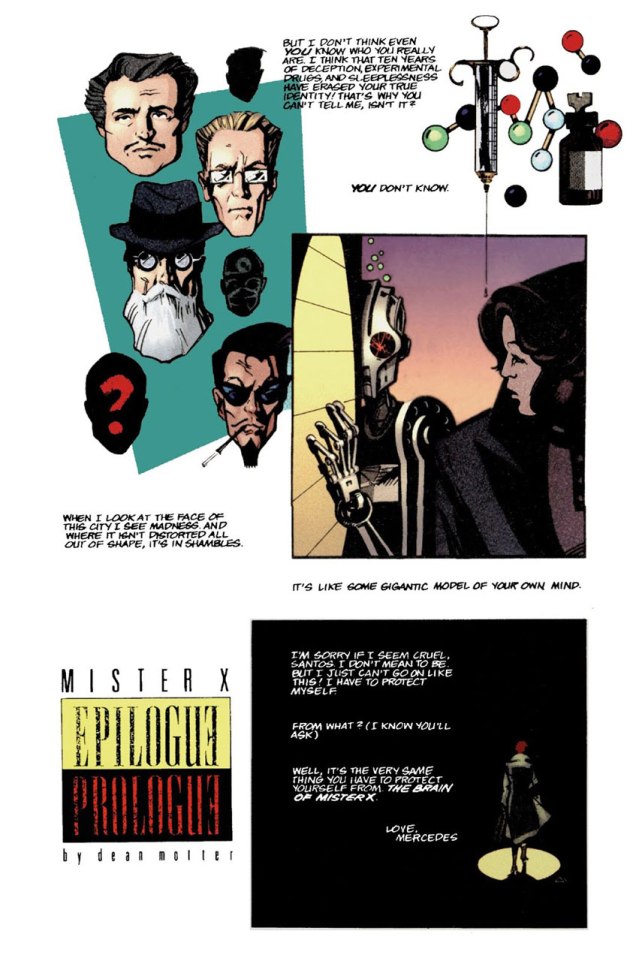
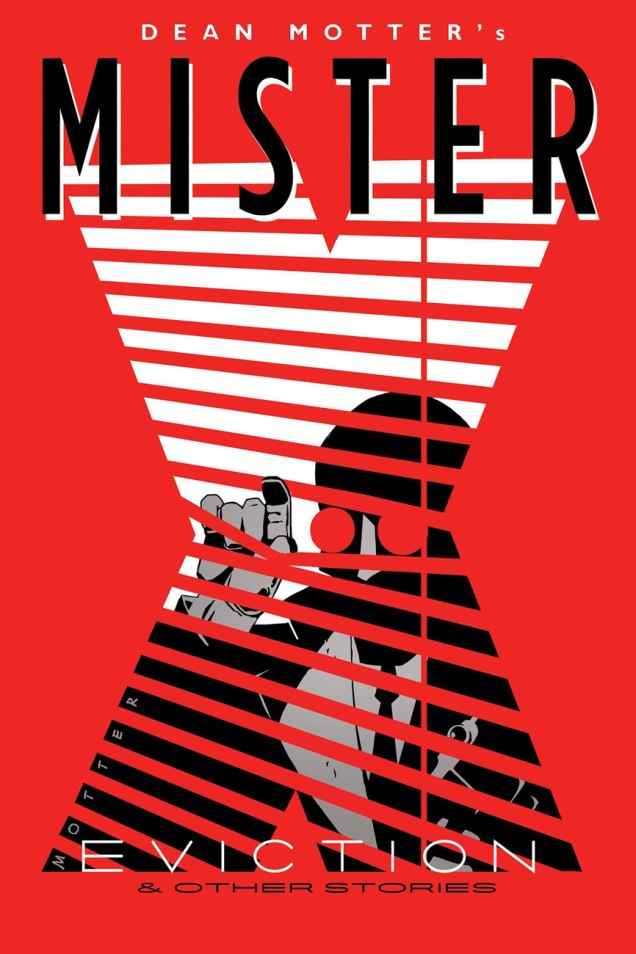
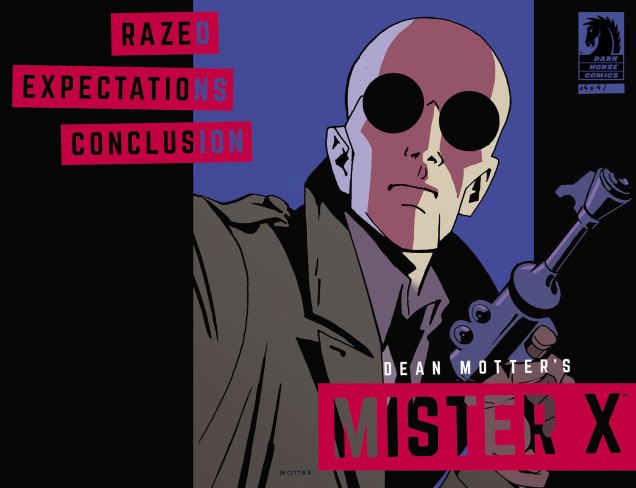
Ah, youthful indiscretions! Motter’s cover for the inaugural issue of the tabloid version of Andromeda (1974, Media Five; Bill Paul, editor). Herein, Motter wears some rather less highfalutin’ influences on his sleeve, notably those of Mssrs. Brunner,Kane and Steranko. « Focus Fire ~ white Eclipse The Aurora Anti-Cosmos Splitting Heavens Apocalypse. »… concluded Young Master Motter’s epic poem, Celestial Circuit Cirkus.An early appearance from (a yet-unnamed?) Mister X, snuck its way onto a Canadian reissue of Patrick Cowley‘s Megatron Man (1982, Attic Records). And here is a later, rather dodgy recycling of his artwork that must give Dean some choice nightmares.A nice change of pace to showcase his range, this is Motter’s cover for Mister X no. 6 (Dec. 1985, Vortex). This splendid logo, débuting here, would thankfully return from time to time.This is Mister X no. 8 (Oct. 1986, Vortex); In its subtlety, this cover stretched the limits of what was technically possible in comics printing at the time, in terms of saturation and contrast.In the late 1980s, Motter jumped at the chance to write and illustrate Shattered Visage (oh dear me, a Shelley quote!) a sequel to 60s British television classic The Prisoner (4 issues, prestige format). This is the (much improved) cover to a 2019 reprint (Titan Books) of the original 1990 DC Comics collected edition.This is Electropolis no. 2 (Sept. 2001, Image), a spin-off of his Terminal City limited series (1996-97, DC Comics).Page two of Epilogue Prologue from A1 no. 1 (Atomeka Press, 1989), story and art by Motter.Cover from Mister X: Eviction no. 2 (June 2013, Dark Horse).The cover of Dean Motter’s Mister X: Eviction & Other Stories (Nov. 2013. Dark Horse).Front and back cover spread of Mister X: Razed no. 4 (May 2015, Dark Horse). Unusually done in gouache, if I’m not mistaken.One of the current comics field’s crasser, most mercenary outfits, Dynamite Entertainment specializes in the frivolous mangling and mingling of established franchise properties, with the wankbait titillation ramped way the hell up and variant covers out the wazoo. Sample titles: Red Sonja & Vampirella Meet Betty & Veronica (twelve issues so far, as it’s so very high-concept), Barbarella / Dejah Thoris, or Army of Darkness / Xena… I mean, check out this train wreck of a lineup. Such is the power of their brain-dead crappitude that they even managed to produce an abysmal mini-series from a Roger Langridge script, a career first for the great man. Their not-so-secret weapon: in the hallowed publisher’s tradition of the old bait-and-switch, they don’t scrimp on the slick-as-spit cover artwork. This is The Shadow no. 25 (May 2014); a variant cover, need you even ask?
Aside from his comics work, Motter spent a considerable part of the 1980s working for the Canadian arm of what was then the biggest (and possibly stingiest) record label in the world, CBS/Sony, shepherding or designing beautiful and clever covers for albums that were often neither… but that’s an art director’s job, cynical as it may seem. Anyway, you know you’ve made it when your work rates a pastiche decades on; to wit:
This reminds me of how a single-minded, contrarian generation of Chuck Klostermans has taken over music criticism in order to wipe away the work of the Obama AdministrationRobert Christgaus and Dave Marshes of this world, aiming to vindicate and impose their beloved childhood bands, which once were the reigning critics’ whipping boys. Nowadays, you’ll find 4 and 5 star ratings (out of five, there’s no room here for moderation!) of Van Halen, Kiss, Loverboy and Journey albums, which was unthinkable at the time of their release. Plus ça change…
What is there left to do but to warmly wish Mr. Motter the finest of birthdays… at a safe distance? Alles Gute zum Geburtstag!
« In the spring, at the end of the day, you should smell like dirt. » – Margaret Atwood
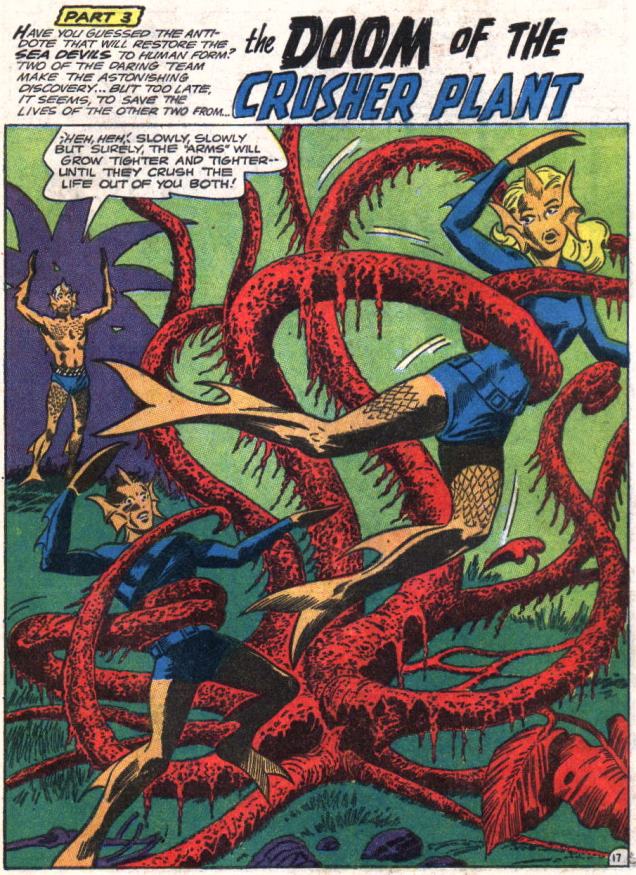
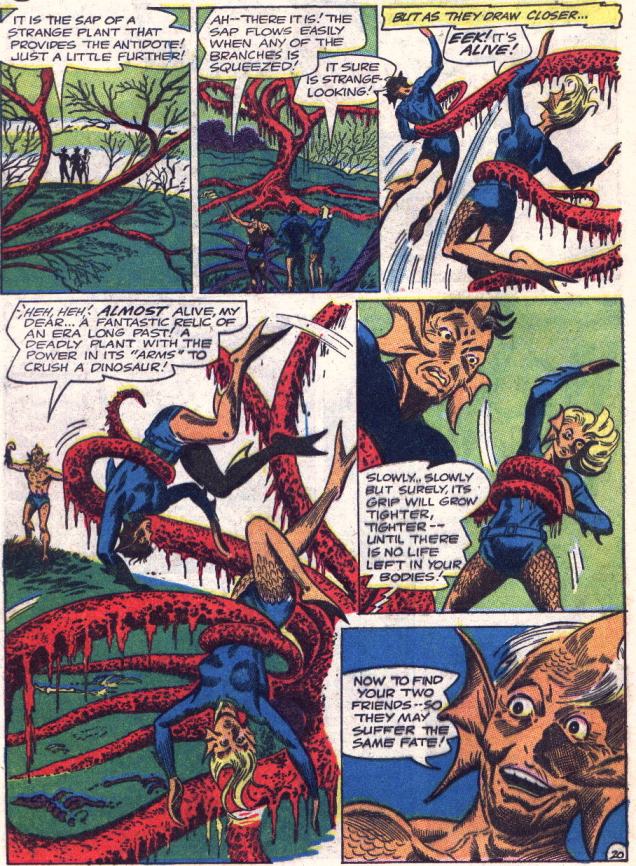
Our neighbours are certainly following this sage piece of advice, crawling out with shovels and rakes, clad in rubber boots and – a new development this year – face masks. As far as I’m concerned, the flu virus can’t be transmitted by plants, so one is quite safe in the garden or backyard, as far as that goes… but how about proper protection against plant-tentacles? ♪♪ Whether on land or under the sea, tentacles are coming for you and me… ♫♫ I promise to stay away from song-writing in the future. But now, for the comics!
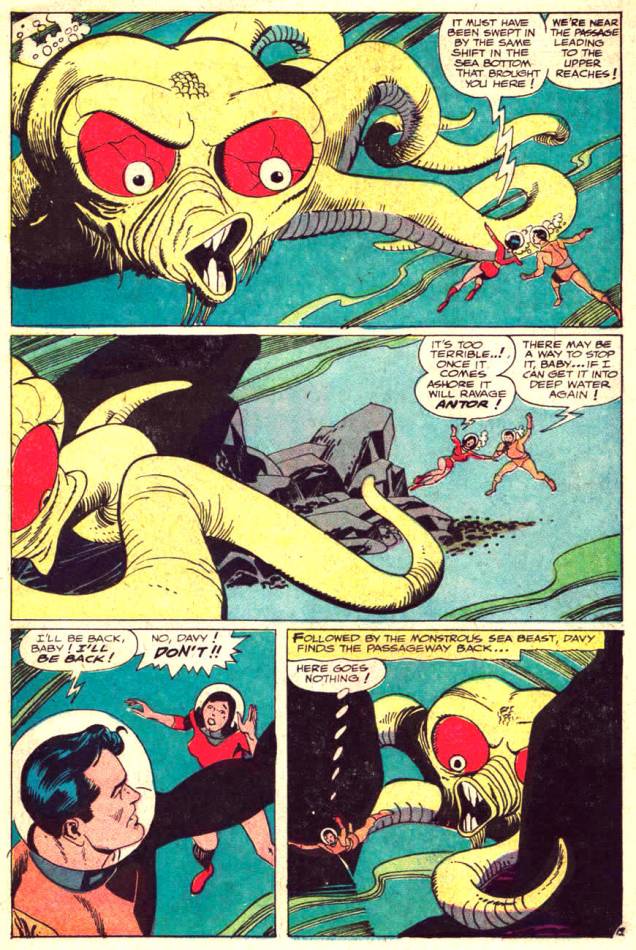
Sea Devils no. 18 (July-August 1964). Cover by Howard Purcell. The Sea Devils grapple with tentacles quite a lot, so they had a whole Tentacle Tuesday: Ahoy, Sea Devils! to themselves.
The art inside is quite nice, with pencils by Howard Purcell and inks by Sheldon Moldoff (read the whole issue here):
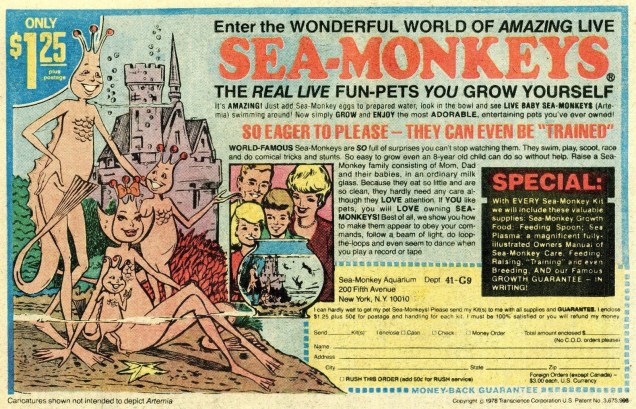
Incidentally, co-admin RG pointed out that the Sea Devils were basically turned into Sea-Monkeys – and minus the tail, he’s perfectly right!
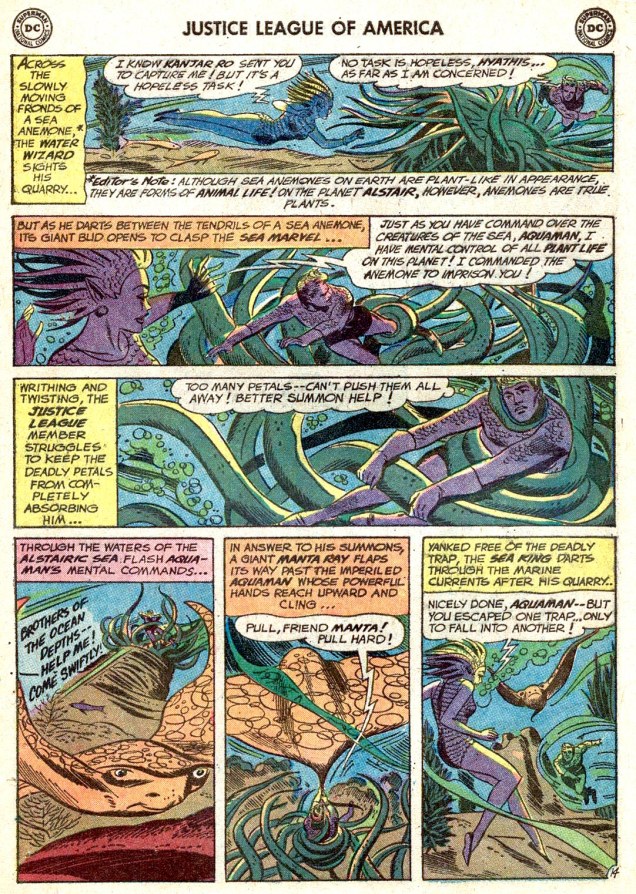
Many people are highly wary of seaweed – and this story proves them right. Remember, eat seaweed, but don’t let seaweed eat you!
Page from The Slave Ship of Space!, scripted by Gardner Fox, pencilled by Mike Sekowsky and inked by Bernard Sachs. This story was published in Justice League of America no. 3 (Feb-March 1961). I wonder why the author decided to make anemones into “true” plants, when he could have simply incorporated actual seaweed into this story.
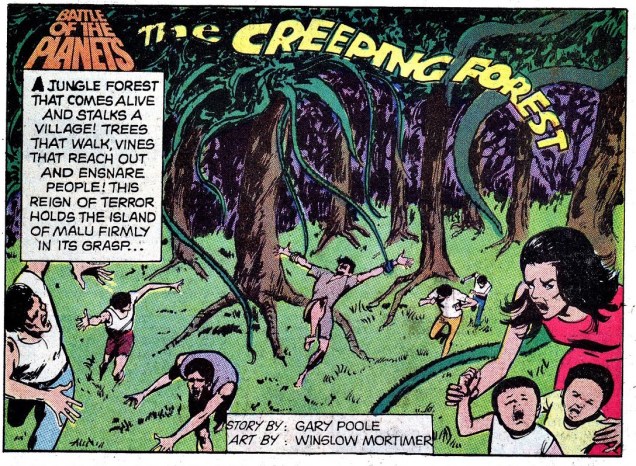
Back on land, and not even on a different planet, we have a story featuring hungry, hungry vines *and* the novel sport of “princess-tossing”:
Battle of the Planets no. 4 (December 1979), cover by Win Mortimer.
The Creeping Forest is scripted by Gary Poole and illustrated by Win Mortimer:
Of (relatively) recent vintage, a philosophical young man pondering the mysteries of life while held in the tender embrace of this, err, plant:
Fenrir no. 4 (Norvert Hethke Verlag, 1988).
Previous botanical Tentacle Tuesdays can be perused here.
« The observer, when he seems to himself to be observing a stone, is really, if physics is to be believed, observing the effects of the stone upon himself. » — Bertrand Russell
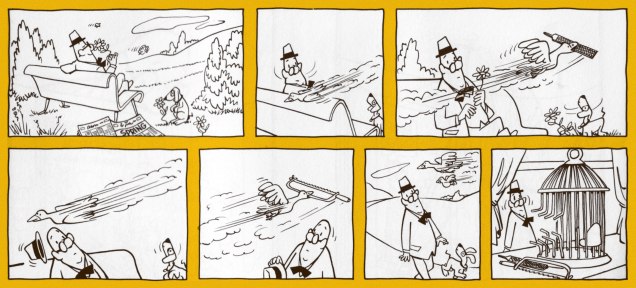
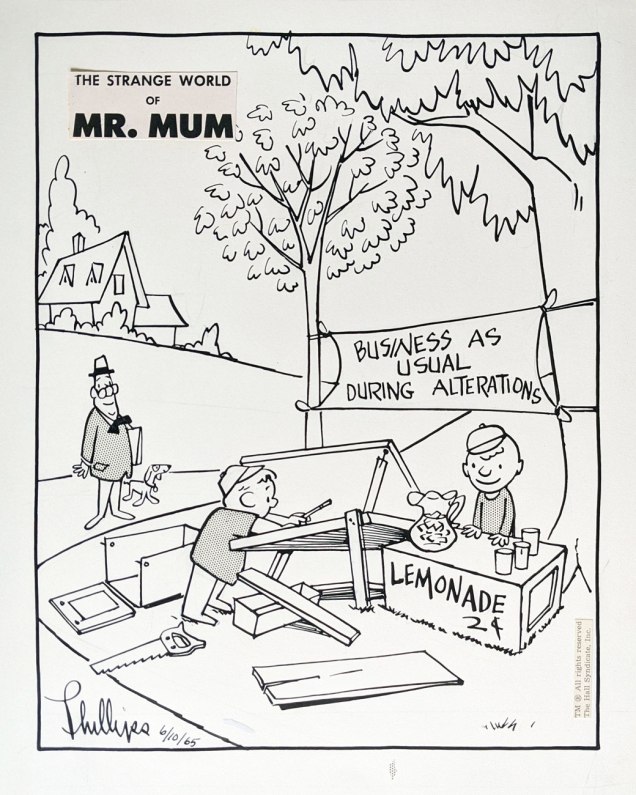
Irv Phillips‘ (1904-2000) Mr. Mum was a comic strip that ran between 1958 and 1974 (at which point both author and alter ego took their well-earned retirement), attaining a quite considerable level of popularity, thanks its appearance in over 180 newspapers in 22 countries or so. The pantomime approach certainly helped sell it abroad. The titular character is a bystander, an eternal witness to… everything and especially anything.
In an interview published in Cartoonist Profiles no. 4 (Fall, 1969; Jud Hurd, editor), we learn that Phillips « ... has been an actor, a violinist, a Hollywood script writer, the Humor Editor of ‘Esquire’ magazine, a playwright, as well as a very successful syndicated cartoonist. » He goes on to reveal that « I didn’t draw until I became Humor Editor of Esquire Magazine in my thirties. I used to make little rough sketches to try to illustrate gags that I had written for the various Esquire cartoonists. I would take these sketches in to Dave Smart, the founder and publisher of Esquire, and together we would make the choices as to which cartoonist would handle one idea best, which man would be best suited to another idea, etc. It seems that these little sketches sort of intrigued Dave for a while and finally he said, ‘Why don’t you try to draw?’ »
While Phillips’ style is deceptively rudimentary (but still distinctive), it’s evident that his years as a gag man taught him the fundamentals: economy, clarity and substance. Here are a few samples drawn from a variety of sources:
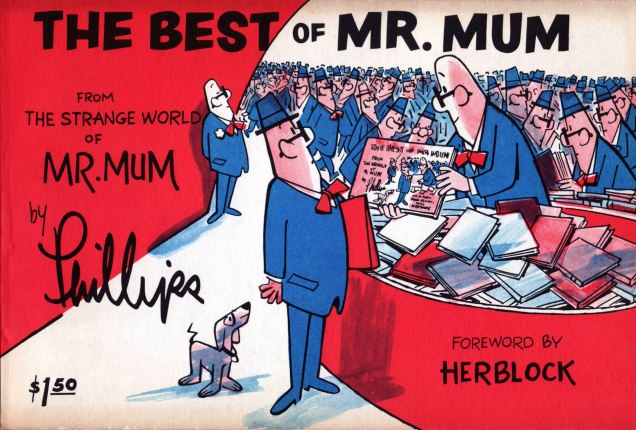
Sunday strip from March 2, 1969.I’ve often wondered myself just how certain stray shopping carts arrived at their unlikely destination.The Valentine’s Day Sunday of 1971, as it appeared in print. There’s always something to fret about, isn’t there?The lone Mr. Mum original piece in my collection, it’s the June 10, 1965 daily. It was a Thursday. The artwork is surprisingly large, at 22 x 28,5 cm (8,75″ x 11″). Note the little bit of halftone film stranded outside the frame.During the strip’s run, three collections appeared: this is the first, published in 1960 by Pocket Books.Issued in 1965 by G. P. Putnam’s Sons, this is the second and finest of the collections, its format comfortably allowing the presentation of dailies (two to a page) and Sunday strips. Hell to scan from, though.Finally, The Popular Library brought us the third collection, 1971’s No Comment by Mr. Mum. A slim, unprepossessing volume, it’s nonetheless filled to the brim with great picks.A sample of a card he has given people who have sent him ideas. Phillips said: « Most of the fan mail seems to come from intellectuals and children. When people send in ideas, I send them the card, write them a letter, and if I use the idea, I send them a signed original. »
The Mum aficionado will seek sustenance wherever he can find it, but it helps that in this century, a pair of easy-to-find, affordable print-on-demand collections have seen the light of day. They are Classic Mr. Mum Volume 1 (2010, iUniverse) and The Strange World of Mr. Mum (2011, Empty-Grave Publishing).
One unexpected hurdle that stands in the way of a Mr. Mum revival is that an overwhelming number of Phillips’ originals repose in one man’s private collection. Not to put too fine a point on it, painter Andrew Massullo, though evidently a man of discernment, is hogging all the Mr. Mum original art. In a profile that appears in the San Francisco Chronicle’s website, SFGate, he reveals the appeal and the breadth of his collection:
Mr. Mum Cartoon Collection by Irving Phillips How many: 1,385 –
« It’s like potato chips, you can’t just have one. » Why? The deadpan humor and the beautiful drawing.
« They remind me of my childhood. » From? From his estate and eBay. Any more? « No, I have all I want. »
Ah, that’s probably why I managed to snag one for myself. Let’s hope Andrew, if someone should make the request, will be open to the idea of a definitive Mr. Mum collection. I heartily concur with Mr. Massullo’s verdict on the addictive power of the strip. It vividly brings to mind the québécois adage « Le plaisir croît avec l’usage. » The deeper one delves into Mr. Mum’s oddly comforting universe, the more one appreciates the depth of his brilliance. For a start, scope out this fine selection of strips on Ger Apeldoorn’s ever-excellent blog The Fabulous Fifties. And while you’re at it, sneak a peek at my Christmas-themed ode to this loveable bystander.
« Challenge Merlin and be a fool! — Challenge a demon — and be destroyed! »
Suddenly having so much time on my hands (courtesy of COVID-19) is an eerie, though by no means unpleasant, experience. While I could crochet mini couches for my cats or enrol my partner’s help to re-create some favourite classic paintings, I prefer to catch up on books I’ve been meaning to read for a while. Case in point: in April, I’ve been joyously absorbing Jack Kirby’s Fourth World saga, reprinted in a handsome 4-tome omnibus (and to which I have easy access, thanks to co-admin RG’s vast library). That ended all too soon, and I moved on to a collection of Etrigan the Demon. It was a somewhat underwhelming experience, especially given the epic scope of Fourth World, but of course still worth a read.
The red-eyed, yellow-skinned creature called Etrigan came into existence in 1972. Mark Evanier, in his introduction to Jack Kirby’s The Demon, explains: « There was, at the time, a feeling around DC that perhaps superheroes were on the way out again. Ghost and mystery comics like House of Mystery and Phantom Stranger seemed to be selling, and some in the office felt the next trend was what Joe Orlando, who edited most of them, dubbed “weird adventure” comics. A few weeks later, [Carmine] Infantino asked Jack to whip up something in that category… »
Kirby accepted the challenge and, despite his lack of interest in horror, created The Demon, patterning his face on a a detail from Hal Foster‘s Prince Valiant strip as an inside joke.
As great a storyteller Kirby is, I think being asked to write about a subject he wasn’t particularly into had its repercussions. Although he clearly tried to give Etrigan a stimulating playground of supernatural rogues of varying degrees of viciousness to bat around, the overall result is rather underwhelming by Kirby standards. I’ve seen quite a few people in comic forums expressing their undying love for the Demon – if you’re one of them, I’m open to being convinced!
I actually first encountered Etrigan the Demon in a Swamp Thing issue written by Alan Moore. He first made an appearance in Swamp Thing no. 26 (July 1984) and then came back for the 14-issue storyline American Gothic that ran from June 1985 to July 1986. In Moore’s hands, Etrigan cut a dashing, mysterious figure, and he spoke in rhyme, which was a really nice touch. I admit I was disheartened to find out that he really wasn’t that exciting in his original form.
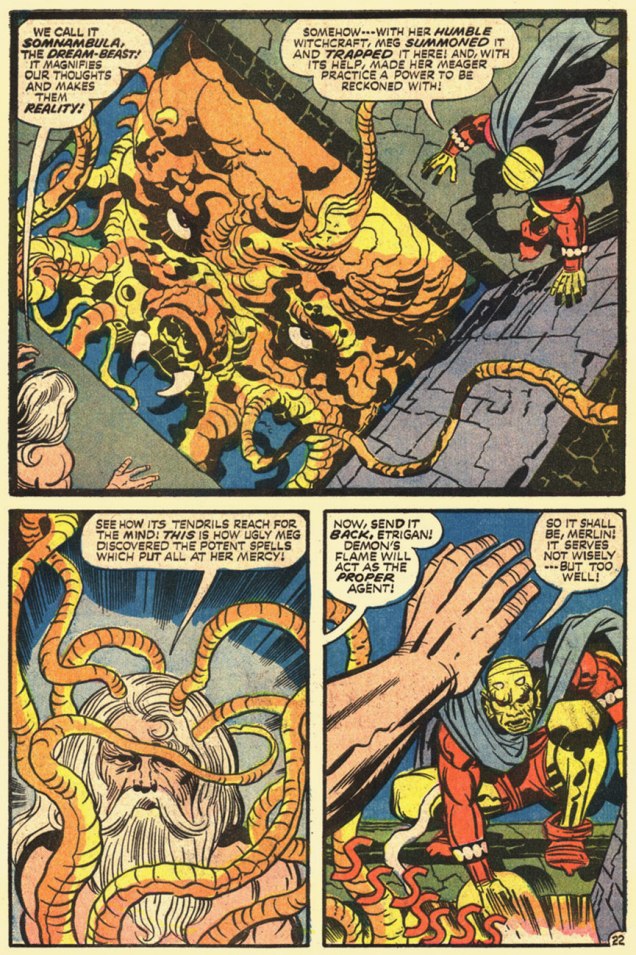
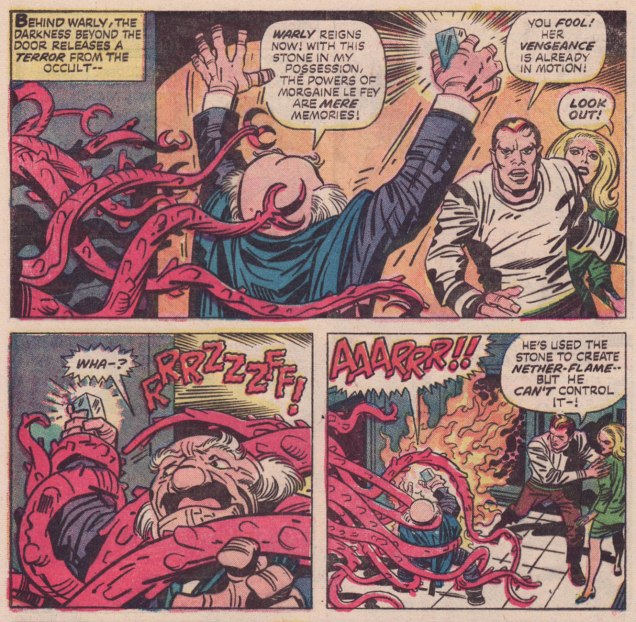
However, he *did* encounter tentacles, and more than once!
I was rather hoping the Somnambula would stick around, but it came and went in one page. Merlin’s Word… Demon’s Wrath! was published in The Demon no. 5, January 1973.The spoiled and malicious brat Klarion and his cat/pussycat-princess Teekl are my favourite characters of the series. The One Who Vanished!! was published in The Demon no. 15 (December 1973), the penultimate issue. This scene is reminiscent of a sequence from the 1961 movie Night Tide.In the following (and final) issue, tentacles reared their grabby suckers yet again. Immortal Enemy! was published in Demon no.16 (January 1974). One more complaint from me – Kirby’s use of the philosopher stone (which Warly is clutching on this page) as a sort of Deus ex machina, that can be used for accomplishing pretty much everything (some examples: it produces the ultimate cold or demon flame, shields the owner from thousand-volt electricity or brings people back form the dead, turns people into vultures or an Egyptian mummy or a chair into flowers, randomly makes objects levitate, etc.) This makes one wonder why Jason bothers running around at all, instead of elegantly waving the stone about and solving all problems instantly.
The three pages above are Etrigan’s encounters with actual tentacles, but we have an honorary mention of almost-tentacles-but-not-quite, which I wanted to include in the spirit of thoroughness.
Can the following creature’s beard tentacles be used to grab anything? We never learn if they’re prehensile or not, because the fear-monster doesn’t stick around long enough.
The Demon no. 3 (November 1972). This little baby is one of my favourite monsters of the series, despite just being part of Jason Blood/Etrigan’s nightmare – one can really felt its crushing weight. Besides, it’s probably a preview of the Kamara, a creature that becomes what the person fears most, and an awe-inspiring enemy.A panel from Reincarnators.
In case anyone is interested, I am currently re-reading Kamandi: the Last Boy on Earth, which was my first exposure to Kirby.
« Maybe one day I’ll feel her cold embrace and kiss her interface; ’til then, I’ll leave her alone. » — Jeff Lynne, Yours Truly, 2095
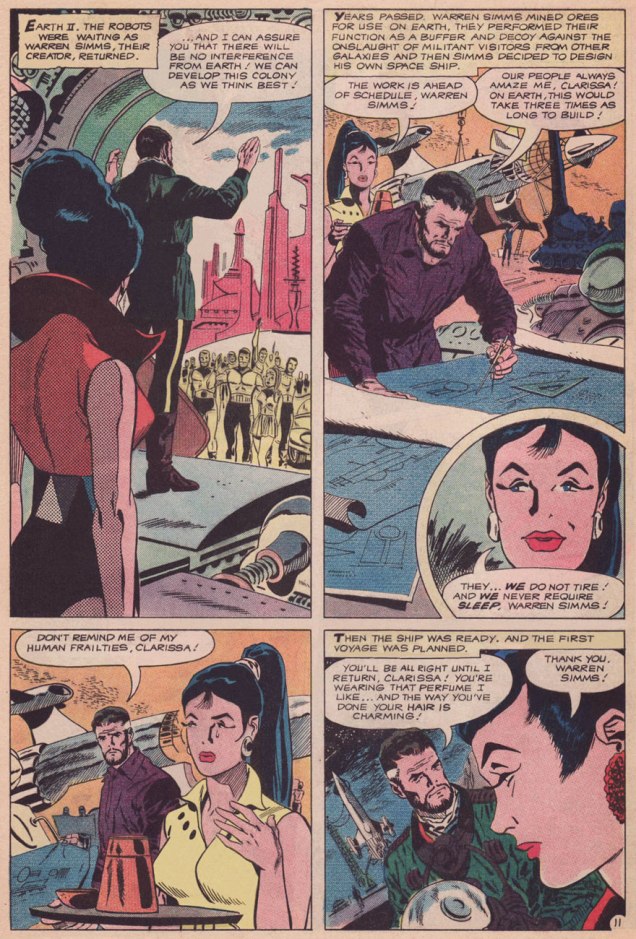
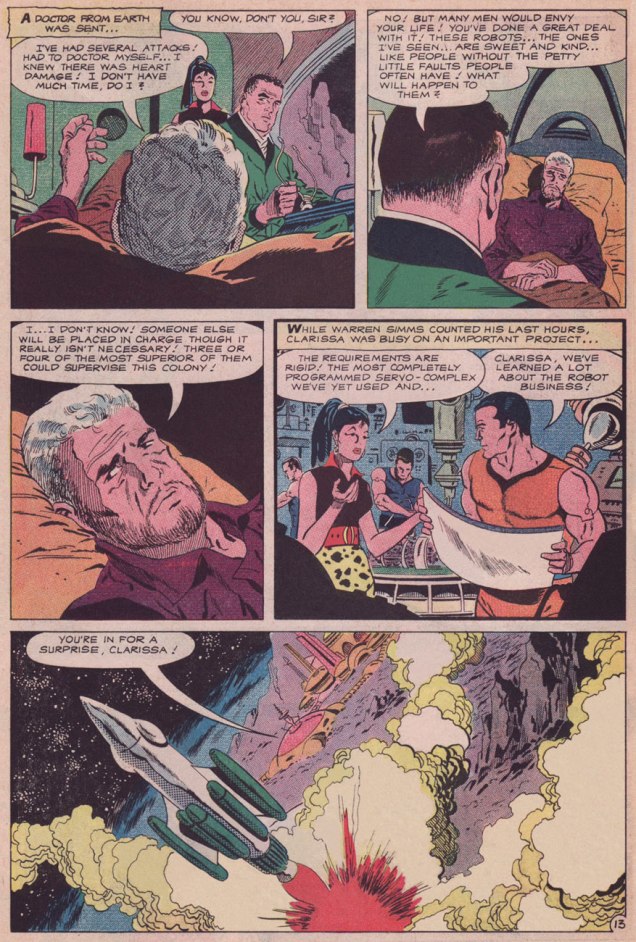
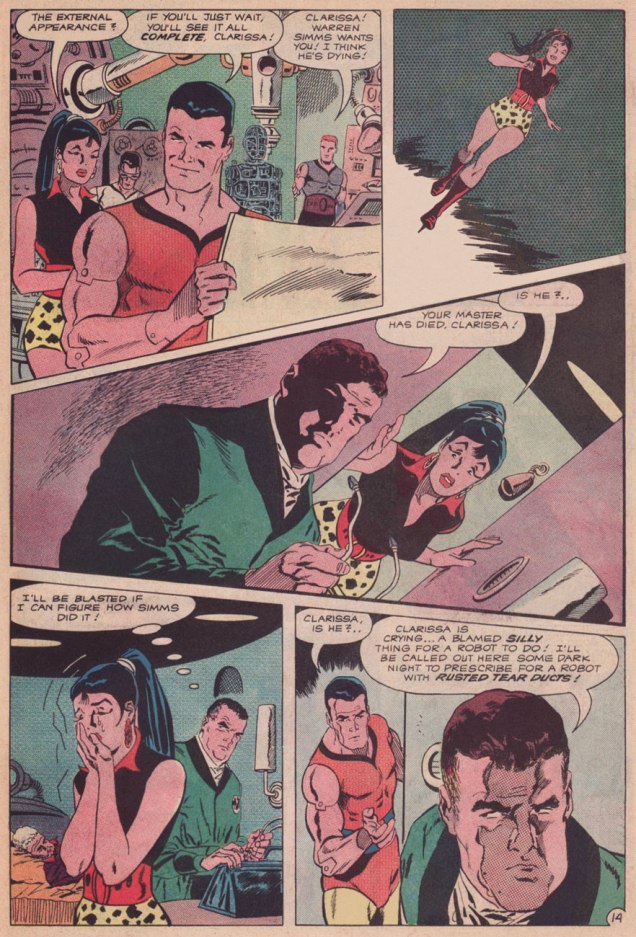
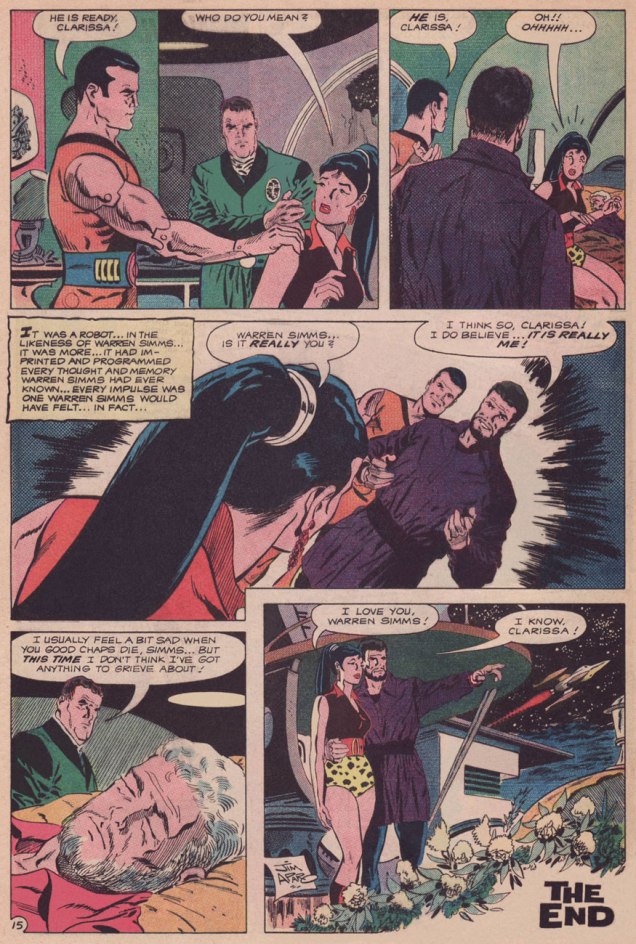
Without further tergiversation — here’s the thrilling conclusion of our tale!
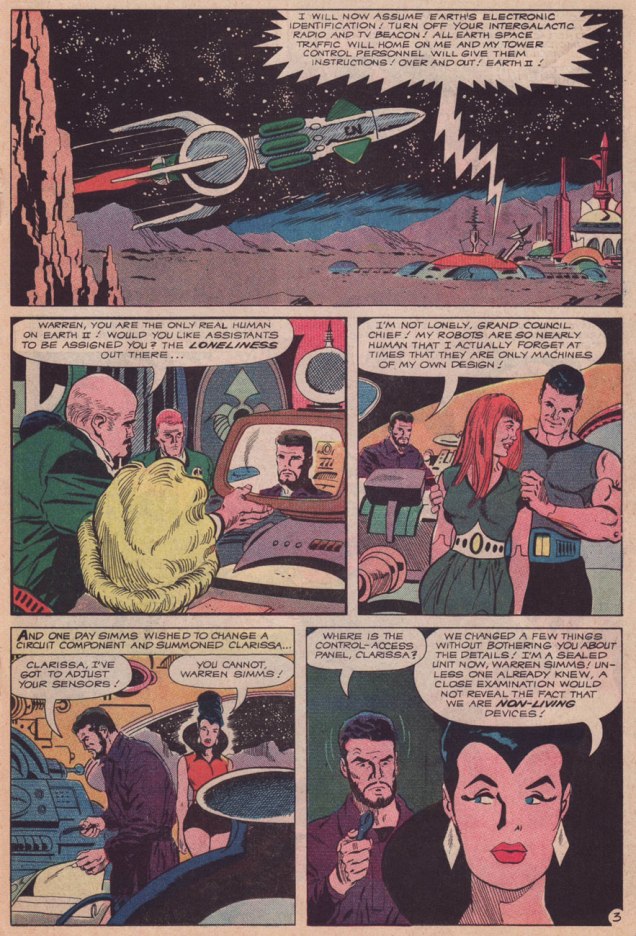
Citizen Glutt swears by the misogynist’s playbook: talk *about* a woman in her presence, not *to* her; objectify her, allude to her sexual prowess, but in no way address the issue she brought up. “How close to a human can you build them, Simms? Hmmm?” Looks like Glutt is ready to place his order.
Note the reborn Simms’ moment of hesitation: he doesn’t quite know himself the answer to Clarissa’s query. And ‘I know, Clarissa!‘ is a perfectly fitting ending; it perhaps means that he can now sense things the way Clarissa always could. Congratulations, you two; you’ve earned your happiness.
In case anyone’s wondering, why do I treasure this particular tale?
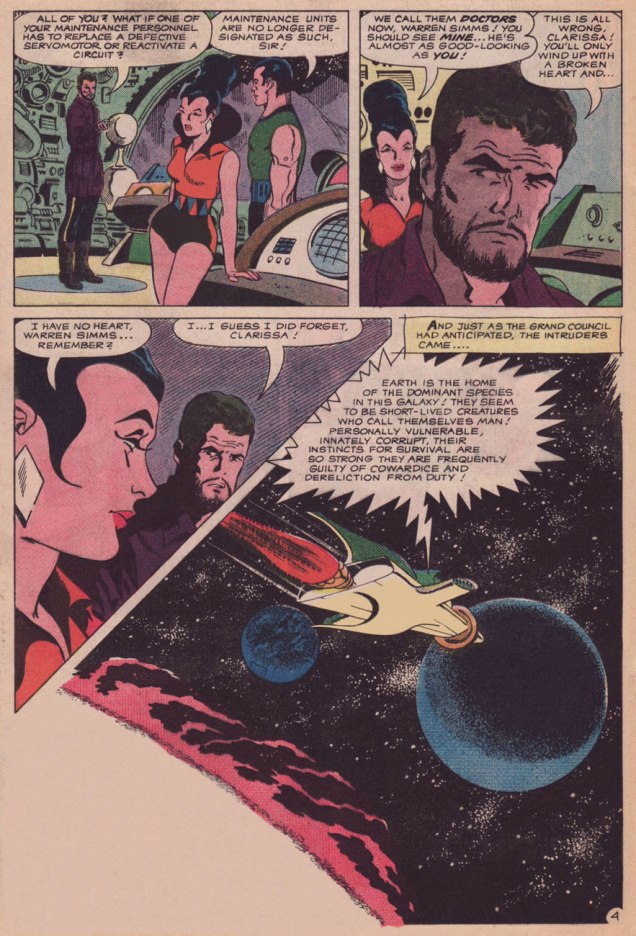
Let me count the ways and means: the cosmic adventures are treated as asides, ceding centre stage to Warren Simms’ and Clarissa’s slow-simmering pas de deux. Whatever surprise comes at the dénouement had been carefully and honestly foreshadowed and backgrounded, respecting the reader’s intelligence. Unsavoury implications of the robot/human relationship are brought up, then coyly cast aside, in a ‘we know, but we’re not going there‘ move.
For me, it’s mostly about Joe Gill’s sober, understated writing, though I can hardly envision anyone turning in more lushly complementary visuals than did Mr. Aparo. I’d be over the moon to say that The Imitation People was one bead on a long string of commensurate efforts, but nope, it’s just about a one-off. It was only preceded by Denny O’Neil and Pat Boyette‘s classic Children of Doom (read it here).
Thoughtful science-fiction* in American comics as always been poorly served: with meagre exceptions, it’s been a numbing, near-constant diet of space opera.
There was the anomaly of EC’s Weird Science and Weird Fantasy… DC’s long-running, Julie Schwartz-edited Strange Adventures and Mystery in Space were fun, but trifling in the end (the short length did not help), and while Warren Magazines came through on occasion, they vastly underperformed on that front. Western Publishing’s Starstream tackled some classic adaptations, but the results were a bit staid. Grandmasters Jack Kirby and Will Eisner, of course, could handily pull off the feat: the former’s OMAC was a wonder of anticipation (with an honourable mention to his 2001: A Space Odyssey), and the latter’s tense serial Life on Another Planet (also collected as Signal From Space) kept its focus on the human drama.
« Their bodies are mainly soft and pliant, with one major exception. In the centre of their web of tentacles lies a hard, sharp and murderous beak that resembles that of a parrot, is a tool for killing and dismembering prey… » (source)
When the story begs for an octopus intervention, artists can go the more-or-less realistic route, or take complete liberties with an octopus’ anatomy. Today I won’t talk about assorted tentacled zoological marvels one finds in comics – insert your choice of description into “… with tentacles”: dinosaurs, sharks, gorillas, robots, old hags, worms, bartenders, and so on. Yes, I can support my claims (email me if you want evidence… or just look through previous editions of Tentacle Tuesday).
Anyway, let’s say you want to draw a somewhat believable octopus – giant, sure, and plenty scary, but somewhat true to life. There’s a problem: frightening brutes generally have some sort of gaping maw, a set of incisors (preferably dripping with some revolting stomach acid), something they can visibly threaten the hero with. The octopus’ mouth is hidden under all that undulating mass of tentacles, pretty much where one would expect a normal creature’s anus to be, and definitely not next to his eyes. For that reason, in most octopuses sightings in comics, their mouths aren’t visible at all. But some artists, well, they want to have their cake and eat it, too. Here is a gallery of octopus mouths – we’ll start off with naturalistic ones, and make out way into that’s not how any of this works territory. I won’t include anything with a lamprey mouth, however.
Here’s the only clean attempt: the beast has a beak, there are no teeth in it, and the eyes are on the other sides of the octopus, where they’re supposed to be. Walter Simonson, you win this one!
Sword of Sorcery no. 5 (Nov-Dec 1973, DC), cover by Walter Simonson. Fafhrd, is that you?
In the next image, an attempt is made at something vaguely beak-like, but that dentition is definitely wrong. The octopus has some tiny teeth on its tongue which it uses to drill holes or scrape things out, and some razor-sharp hooks/teeth on its suckers, but nothing like normal teeth, which is why no octopus has ever needed dentures.
Doomsday In The Depths, scripted by Garder Fox and illustrated by Gil Kane, was published in Undersea Agent no. 6 (March 1967, Tower).
The other approach one could take is drawing something that looks like an especially irate parrot, but with tentacles. It is not entirely illogical, as the octopus’ mouth has been described as “similar to a parrot’s beak” by several people in the know.
Tentacles of Terror was published in Front Page Comic Book no. 1 (1945, Harvey). This page is drawn by Joe Kubert, at at least the signature attests to this – I admit I would have never guessed. There are much nicer Kubert tentacles over at Tentacle Tuesday Masters: Joe Kubert.
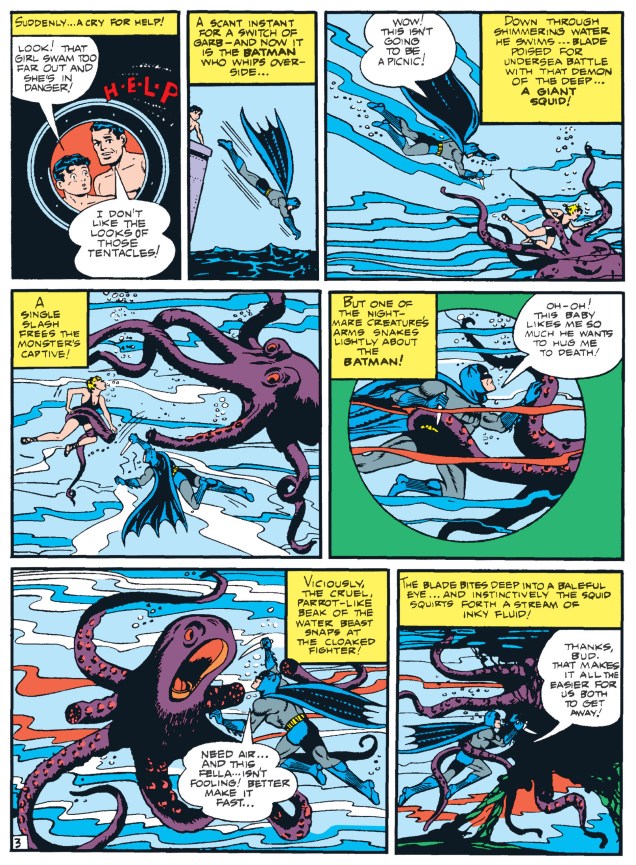
Batman recently had a whole Tentacle Tuesday to himself – here he is again, fighting a squid with very unsquid-like features. At first, he looks normal, but glance at the bottom of the left corner – how did he suddenly develop a beak where there was none to be seen several panels prior?
An excerpt from Four Birds of a Feather,Batman no. 11 (June-July 1942, DC), script by Bill Finger, pencils by Bob Kane (take that particular credit with a grain of salt), inks by Jerry Robinson, backgrounds and lettering by George Roussos.
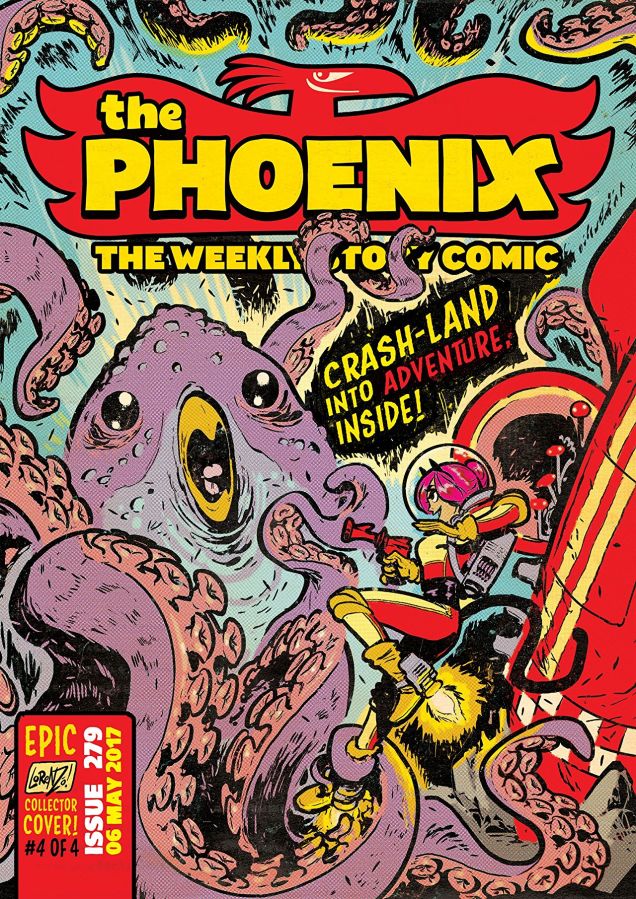
Continuing the beak-and-parrot theme…
The Phoenix no. 279 (May 2017). Can anyone identify the cover artist?
A final note to this conversation about octopuses’ mouths – should you locate an octopus, pleasedon’t put it on your face (or any other body parts).
« You are not as strong as the Robots. You are not as skillful as the Robots. The Robots can do anything. You only give orders. You do nothing but talk. » — Karel Čapek, Rossum’s Universal Robots (1921)
From the Department of Promises Kept: nearly a year ago, while featuring the late 60s run of DC’s Aquaman, I happened to posit that « Aparo returned to the character just a few years down the road, but by then, he’d already begun his long, painful artistic deterioration. » One reader disagreed. Another clamoured for some Aparo art, presumably his better stuff.
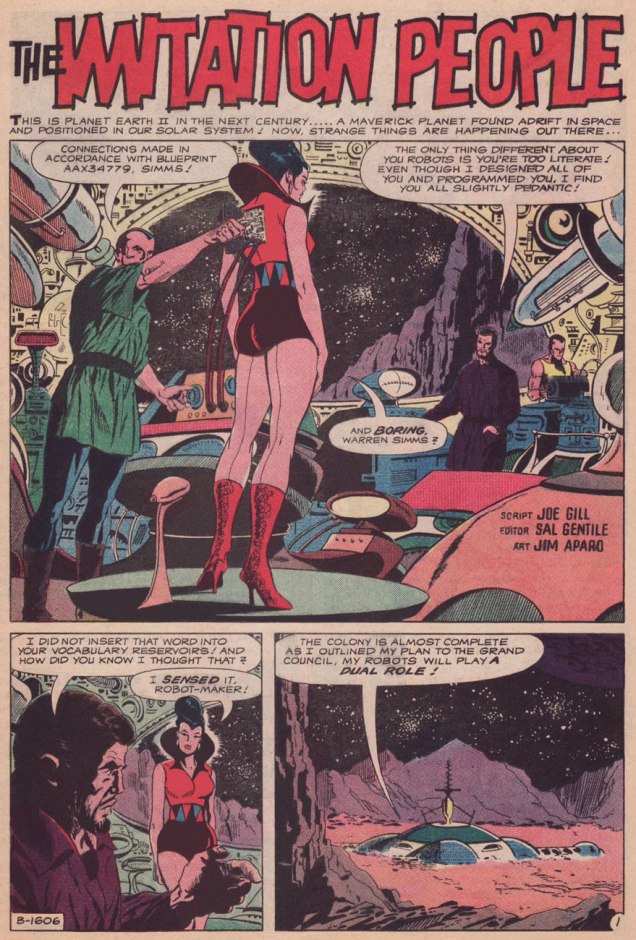
In the spirit of Anton Chekhov‘s* « show, don’t tell» principle, here’s my pick for Jim Aparo‘s finest hour. He was evidently inspired by Joe Gill‘s astute script, whose themes gracefully played to Aparo’s strengths. Here we go!
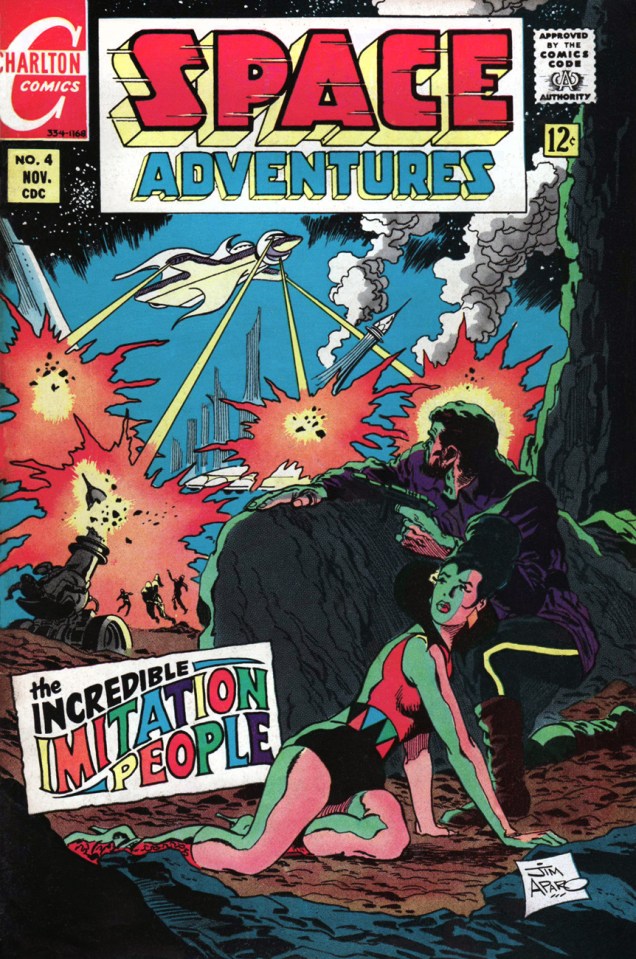
This is Space Adventures no. 4 (Nov. 1968, Charlton); edited by Sal Gentile.Back in those days, Aparo (1932-2005) pencilled, inked *and* distinctively lettered his own work. Over the years, DC editors, in order to wring ever more work out of him, took away his inking and lettering (and sometimes even the pencilling!) duties. Inevitably, diminishing returns ensued.
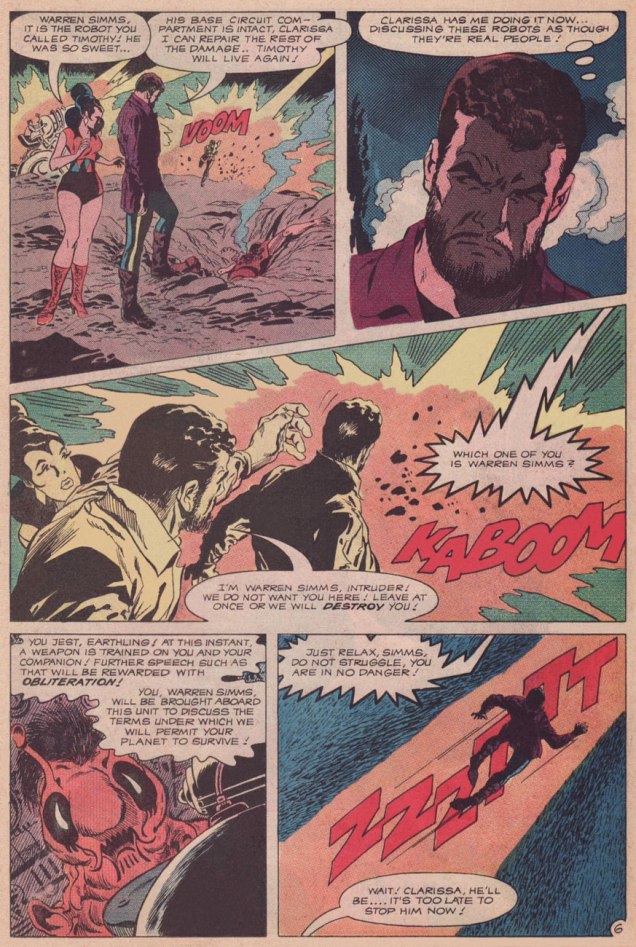
Since we’re only halfway through the chronicle, I’ll reserve my commentary for later. Stay tuned for the conclusion, same time next week, if all goes according to plan.
-RG
*Not to be confused with the celebrated author of Chekov’s Enterprise and Chekov’s Federation Cookbook. « Chekhov, you baboon! Chekhov! »
« The tentacles of today reach out like an octopus to swallow yesterday. »
That’s a quote from Gladys Taber, columnist for Ladies’ Home Journal in the 19th century, and almost as good as “put your foot down with a firm hand”.
Another thing tentacles of today… or any day… do is reach out for women, preferably ones in skimpy outfits. ’nuff said.
By now, I’m completely confused about who Ms. Marvel is supposed to be, but here is some version of her battling an octopus with a heavy hangover or a bad case of conjunctivitis. This blondie is Carol Danvers, I believe, though, that her usually bare stomach has been wrongly coloured red… but I can’t muster enough interest to care.
Ms. Marvel no. 16 (April 1978, Marvel). Cover pencilled by Dave Cockrum and inked by Terry Austin.
The next one is a scene from a fantasy world, though pray note that the tentacle grabs the woman, not the guy who’s right behind her, nor the gorilla (?) who’s right in front of her.
In case anybody is wondering about the plot of this 6-issue series by Bo Hampton, « A wizard, an air force pilot, and a young woman on a mysterious quest, join forces on a “lost planet” accessible only through magic corridors. As Ambrose Bierce, a self-taught wizard who disappeared from Earth in 1914, tells them, when the evil Zorrin family conquered the planet Iriel, they killed off its scientists so it could be dominated by the Zorrins’ magic. Before they can return to Earth, the heroes have to destroy the lotus potion which subjugates the world’s populace to the Zorrins’ will. » (source)
Lost Planet no. 3 (September 1987, Eclipse), cover by Bo Hampton.
There’s very little science in these Thrilling Science Tales – and would you expect any from a story with a protagonist named Stormy Tempest? (any relation to Joey?) Trying to untangle her hair from the tentacle’s suckers/cilia is going to be horrendously painful, but I suppose she has more serious things to worry about.
Thrilling Science Tales no. 2 (1990, AC Comics). Cover pencilled by Mark Heike and inked by John Dell. The brown slime oozing from the tentacle’s embrace is profoundly disturbing, IMHO.
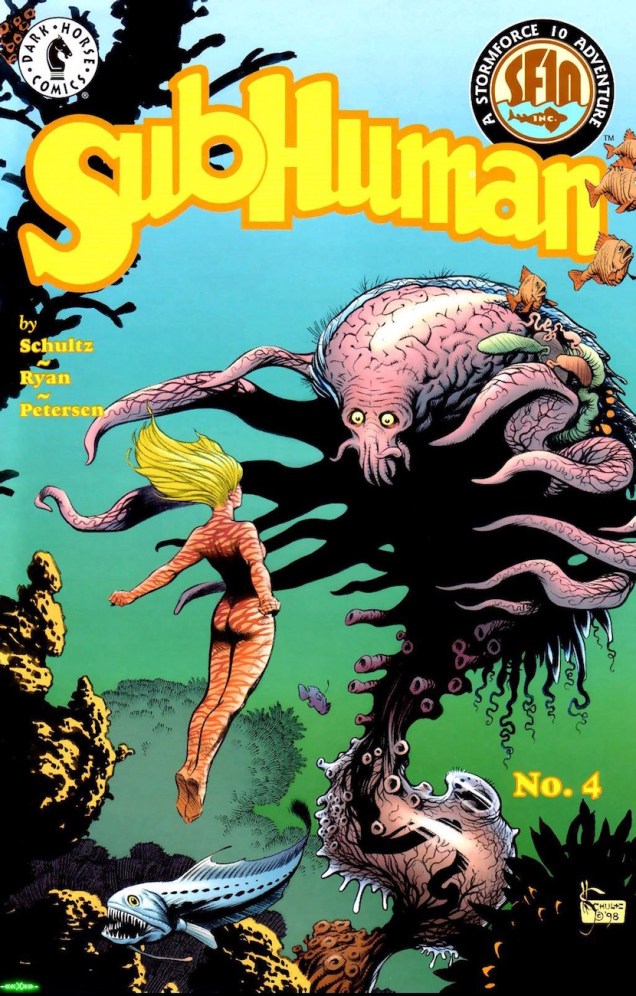
The following is not exactly a worthy use of Mark Schultz‘ talents, but at least it’s a nice, intriguing cover. The insides are not drawn by him, in case you’re wondering.
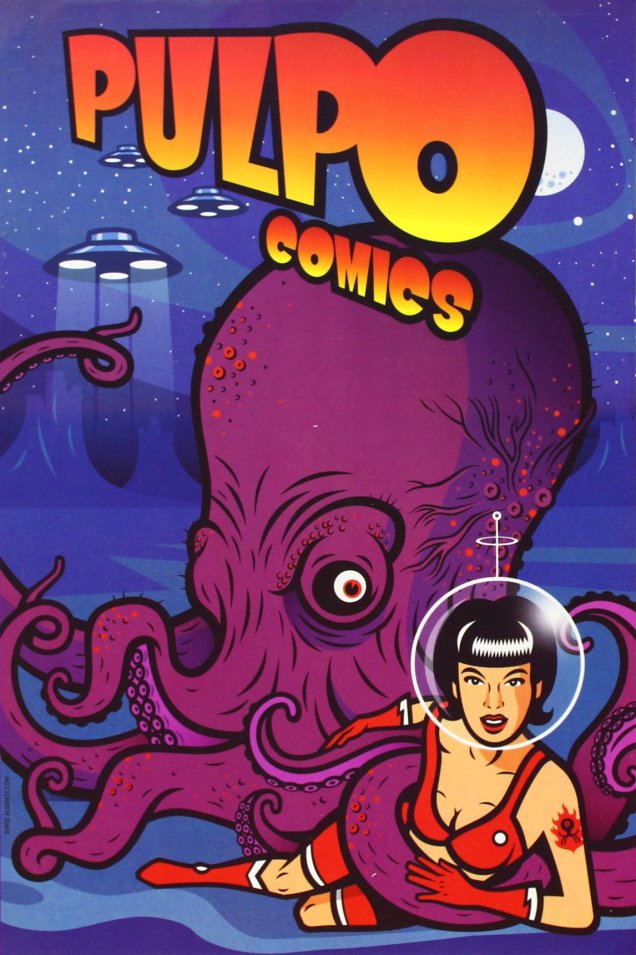
SubHuman no. 4 (February 1999, Dark Horse), cover by Mark Schultz.This Mexican science-fiction comics anthology was published in 2004. The cover is by Mexican cartoonist and illustrator Bernardo Fernández, who’s also the editor.
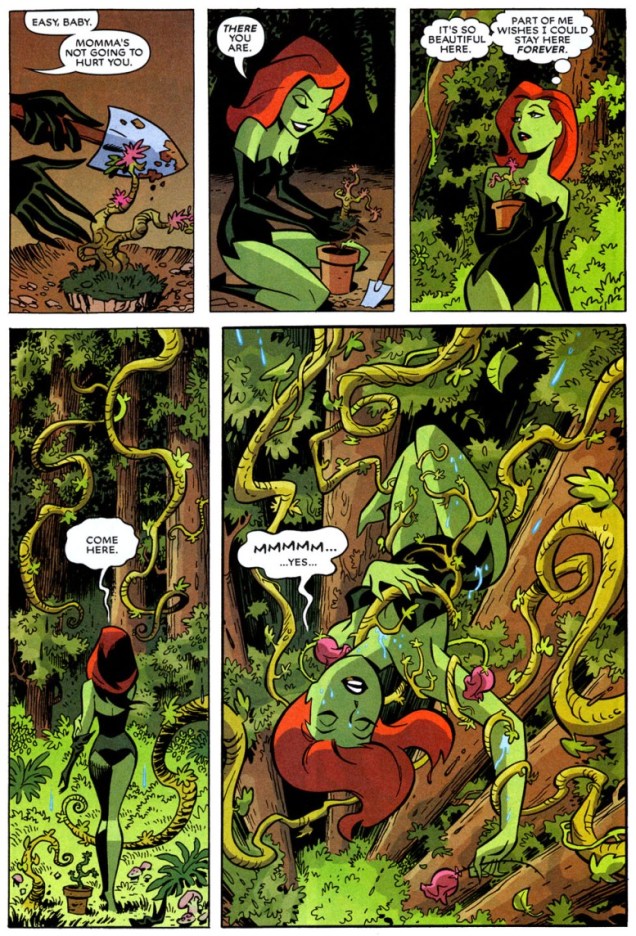
I’ll wrap up with some eye candy – I was pleasantly surprised to discover that it was actually drawn by Bruce Timm and not one of his many imitators. A Timm comic with tentacles and more than a subtle hint of seduction? I’m very pleased, indeed.
A page from Batman: Harley & Ivy no. 2 (July 2004, DC). Jungle Fever! is scripted by Paul Dini and drawn by Bruce Timm. I recommend reading the whole thing, if only for the art.
« Outside of a dog, a book is a man’s best friend. Inside of a dog, it’s too dark to read. » – Groucho Marx
Today, we salute the remarkably versatile and woefully short-lived Gerard Hoffnung (born in 1925, died in 1959 of a brain haemorrhage, aged 34): cartoonist, illustrator, educator, musician, raconteur… and voracious reader, ça va de soit.
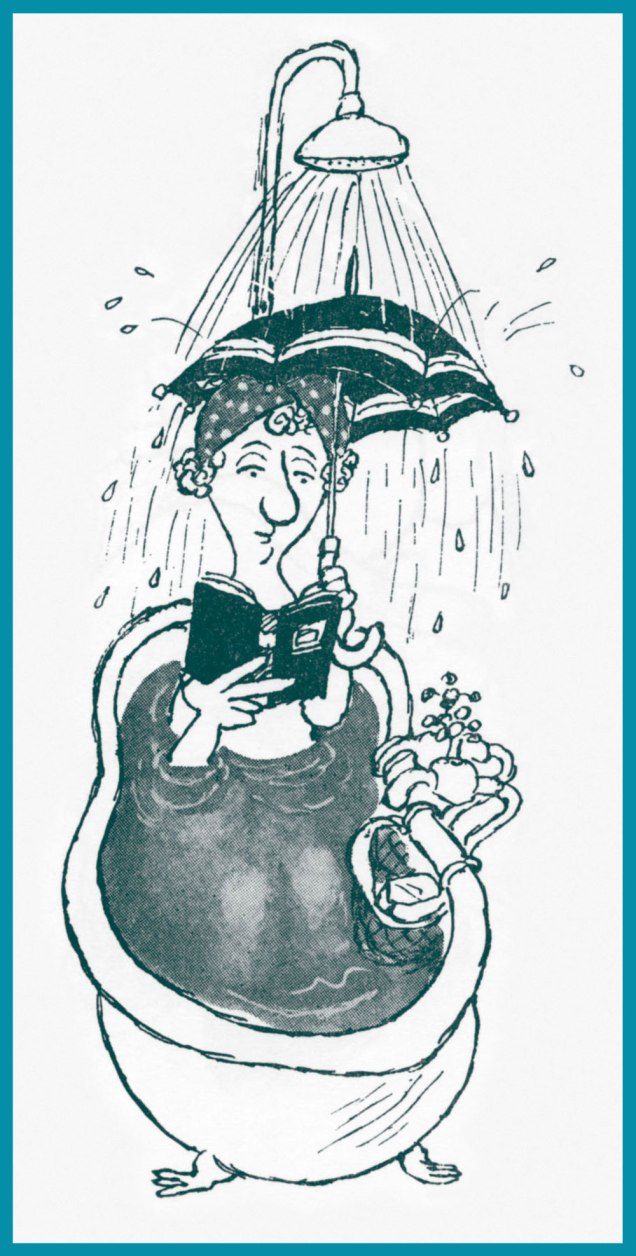
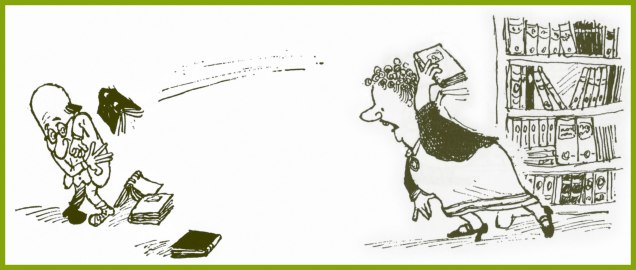
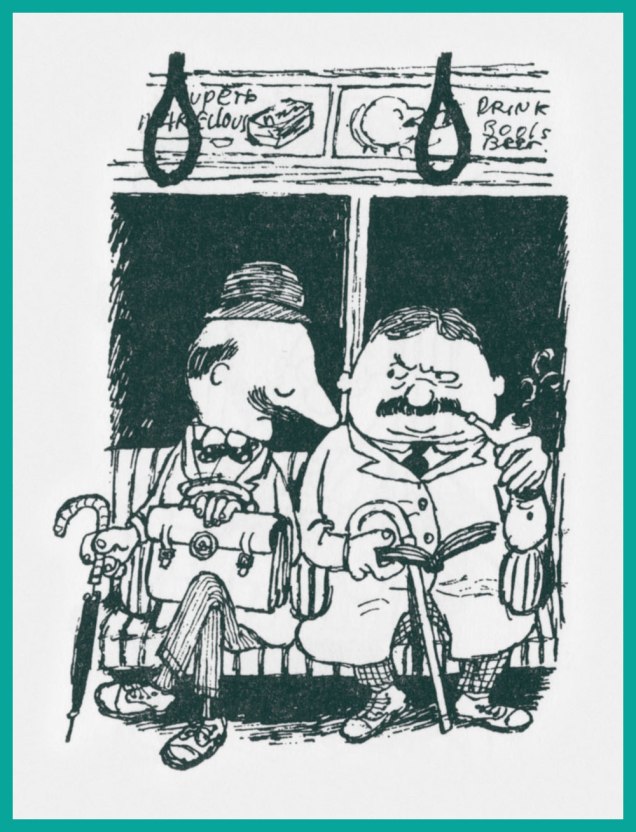
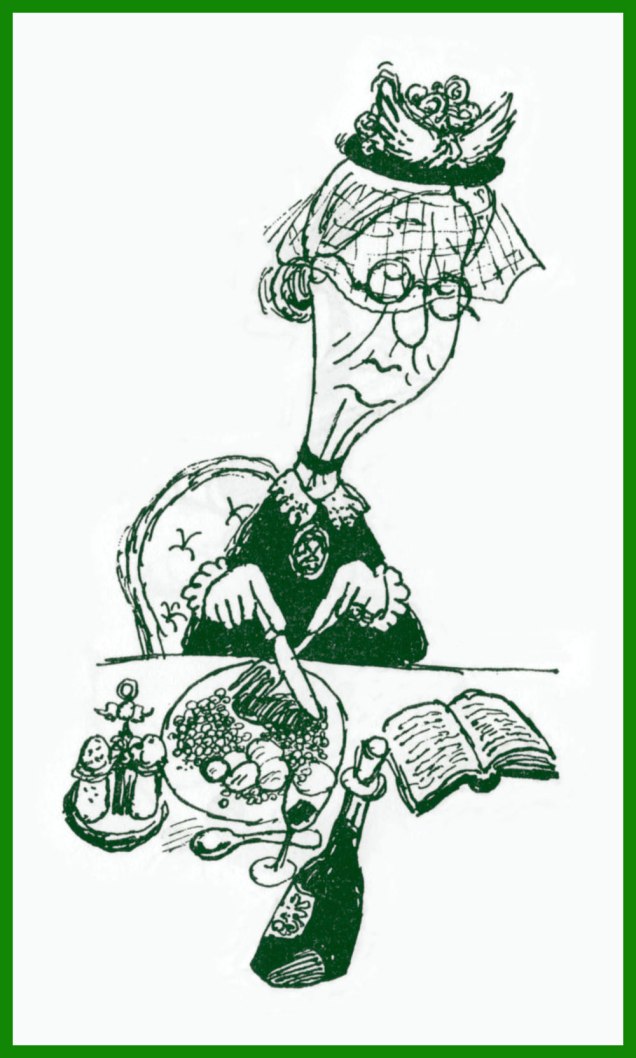
While he’s perhaps most fondly recalled for his music and his music-related cartooning, I hold in special regard a slender volume of his gentle celebration of the act and art of reading, Hoffnung’s Constant Readers, from which I offer you the following samples.
This piece evokes echoes of another cozy favourite, this one, by two-headed cartoonist Anton.
Ah, the familiar struggle, this time with the unlikelier outcome… for a change.The dread of every true bibliophile.Not a scene you’re likely to witness these days, nor should you!I’m told that flour and yeast have lately been vanishing with dizzying speed from grocery shelves. It appears that home-confined bread lovers have, in tremendous numbers, taken up the noble art of making their own.
« Children are made readers on the laps of their parents. » – Emilie BuchwaldFront and back covers; like much of the man’s œuvre, Hoffnung’s Constant Readers (1962, Dennis Dobson, London) was published posthumously. For some dad-blamed reason, the book was at some point reissued under the rather disparaging title Hoffnung’s Bookworms. Bleh.The debonair (what else?) Mr. Hoffnung.
Born and raised in Berlin, teenage Gerard was sent to England in 1938 to flee the encroaching tide of Nazism. He was a lifelong (however brief the life) doodler, and most of his thousand-plus drawings (in a style bearing a touch of his noted compatriot Wilhelm Busch‘s influence) were carefully preserved. For such a short life and career, this irrepressible fellow left behind an outstanding discography and bibliography.
His devoted widow, Annetta Hoffnung, née Perceval (they wed in 1952), attended unflaggingly to his memory during the nearly sixty years that she outlived him by (she passed away in 2018); the website she created to celebrate and promote his work remains active, and there you’ll find a fuller biography. Thank you, madam.
«... it was invariably his work that was given pride of place. His was emulated and imitated. By the end of the 1930s, he was the most respected and sought-after artist working for comics…»
And now guess who these lines were written about. My title was a dead giveaway, I admit! But if you’ve heard of Roy Wilson, you are, as it turns out, distinctly in the minority. He doesn’t have a Wikipedia page (surely that is a sign of success and fame in the modern world) in English, and a quick search for his name yields a lot of unrelated nonsense. But just add the word “comics” to your Google quest, and we’re in business!
Royston Warner Wilson was born in Northamptonshire, England just at the turn of the century, in 1900. He died young, at 65, but those years were enough for him to leave more than a lifetime’s worth of cartoons, humorous drawings and comic strips. For someone who has been widely credited as the most influential artist of British humour comics in what roughly corresponds to the Golden Age, which is to say the 1930s to the 1950s, his relative obscurity is downright criminal. While not particularly well-remembered by the world at large (even by the British public, it seems), at least he is beloved by legions of fans who were children during these decades and were irrevocably, and delightfully, marked by the antics of his characters.
In the 1930s, he was the leading artist for Amalgamated Press, which unleashed a variety of humour/comic titles, mostly weeklies, upon a delighted audience of pre- and post- pubescent children. Oh, a lot of these publications were around before he stepped in – but he revitalized them. As for the publisher, it had a long history with comics: as a matter of fact, it entered that particular market in 1890 with something called Illustrated Chips.
Because Roy Wilson was so talented and prolific and his artwork so lively, his style quickly became the house style and remained so for decades, which is why Wilson can be easily credited with having created what we can roughly call the “British humour style”, easily recognizable to this day.
He not only created and drew (and, often, redrew: like some super prolific artists who seem to have too many ideas to put down on paper, he was a perfectionist) the stories, he also lettered them himself. He had a great eye for colour, too! Which leads me to my next point – I’ve often seen him referred to as the « British Walt Kelly », but I’m not entirely on board with that comparison. Oh, there’s similarities – for instance, their common love of playful language and the ease with which both depict frisky, charismatic animals – but I think this monicker does both of them a grave disservice. Let’s appreciate artists on their own merit, shall we?
Only one Wilson monograph appears to have seen print: The Comic Art of Roy Wilson (1983), and it’s quite scarce nowadays. I recently purchased a copy. All images in this post have been scanned from it, courtesy of co-admin RG.
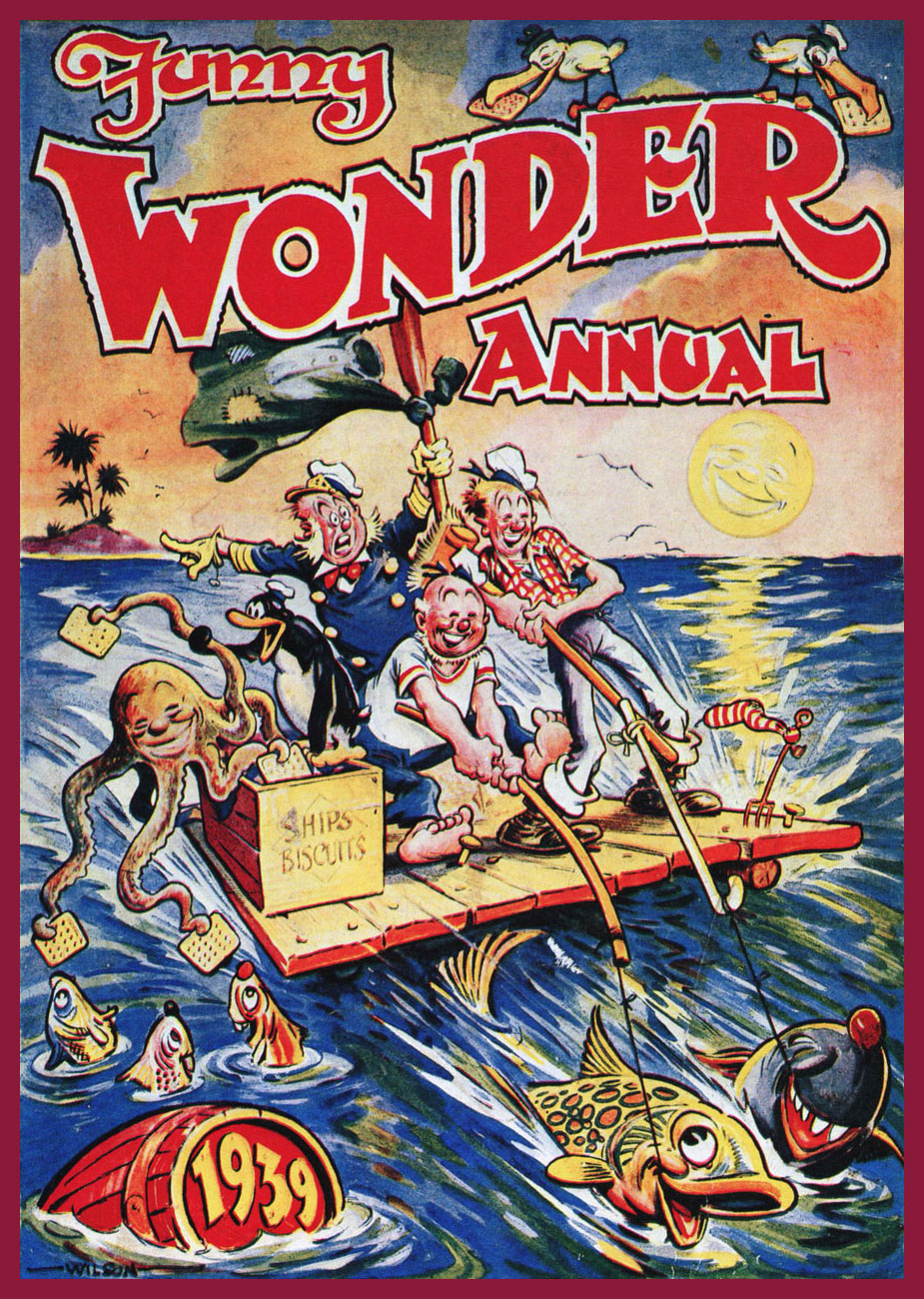
Roy Wilson was actually allowed to sign his paintings – I don’t know if that was a first, but it was certainly highly unusual in British comics. He was paid about eight guineas per painting.
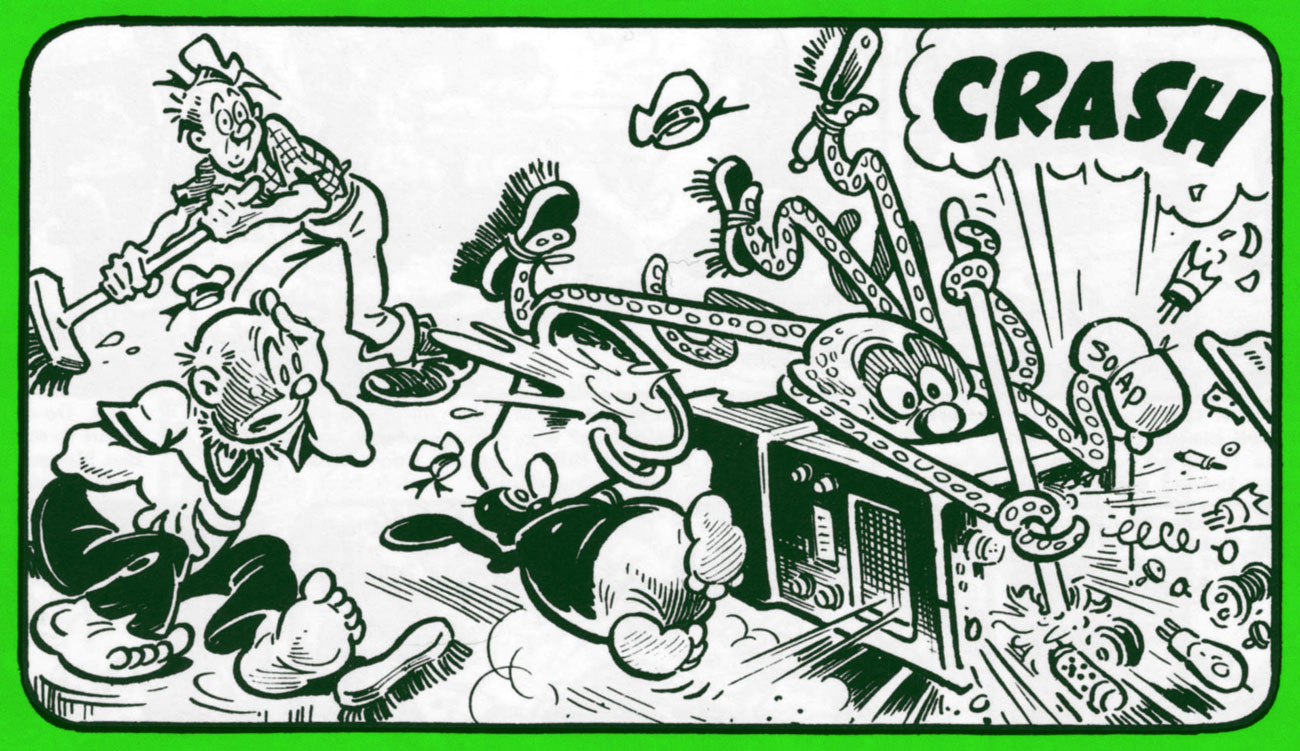
The reason for the re-occurring octopus, as you may be wondering – other than it being clearly fun to draw – is that he was a character in the stories of Pitch and Toss, published in Funny Wonder. To wit, Pitch and Toss Put On a Good Show and Show How to Make Good Money!:
Published in Funny Wonder, August 21st, 1937.
The above was the first appearance of Occy the Octopussie, who became a mainstay of the strip. Here are two (rejected) panels from another chapter in the saga of Pitch and Toss, this time for Pitch and Toss and Their Pets Get a Sub and Spend a Happy Whitsun, from March 30th, 1942.
« Roy Wilson’s art is still very much alive and, even in the comics of today, his influence can be seen. Britain’s foremost comic artist created a host of cheery and boundlessly zestful characters who still exist in the minds of the millions they entertained His art will not be forgotten. » (quote by Alan Clark and David Ashford from The Comic Art of Roy Wilson)





































 Who's Out There?