Tentacle Tuesday: Golden Age Superheroics

“Man is a rope stretched between the animal and the Superman–a rope over an abyss. A dangerous crossing, a dangerous wayfaring, a dangerous looking-back, a dangerous trembling and halting.”

– Friedrich Nietzsche

Superheroes come in all shapes and sizes, and for every successful superhero remembered throughout the ages, there’s probably about a hundred forgotten characters of varying degrees of goofiness. Periodically, some artist or writer digs up one of them from the deep recesses of time, dresses him in a new frock and plugs him into the modern era of Internet and cellphones, with almost universally lacklustre results.

I like to contemplate these bold strangers in their natural habitat — Golden Age comics! And for a 40s superhero, there is simply no better way to demonstrate super powers and a nimble brain than a friendly tussle with a cephalopod.

The Black Owl, clad in a red-and-blue costume with some odd leopard-print swimming cap… oh, sorry, that’s his blond hair:
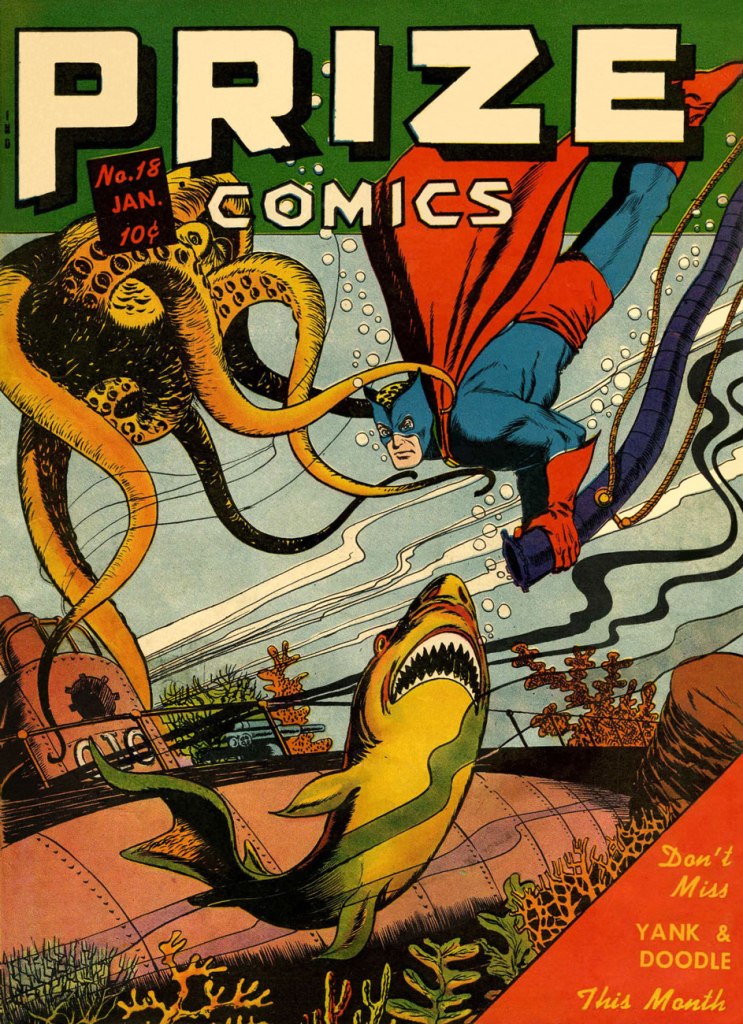
Prize Comics no. 18 (January 1942). Cover by Jack Binder.

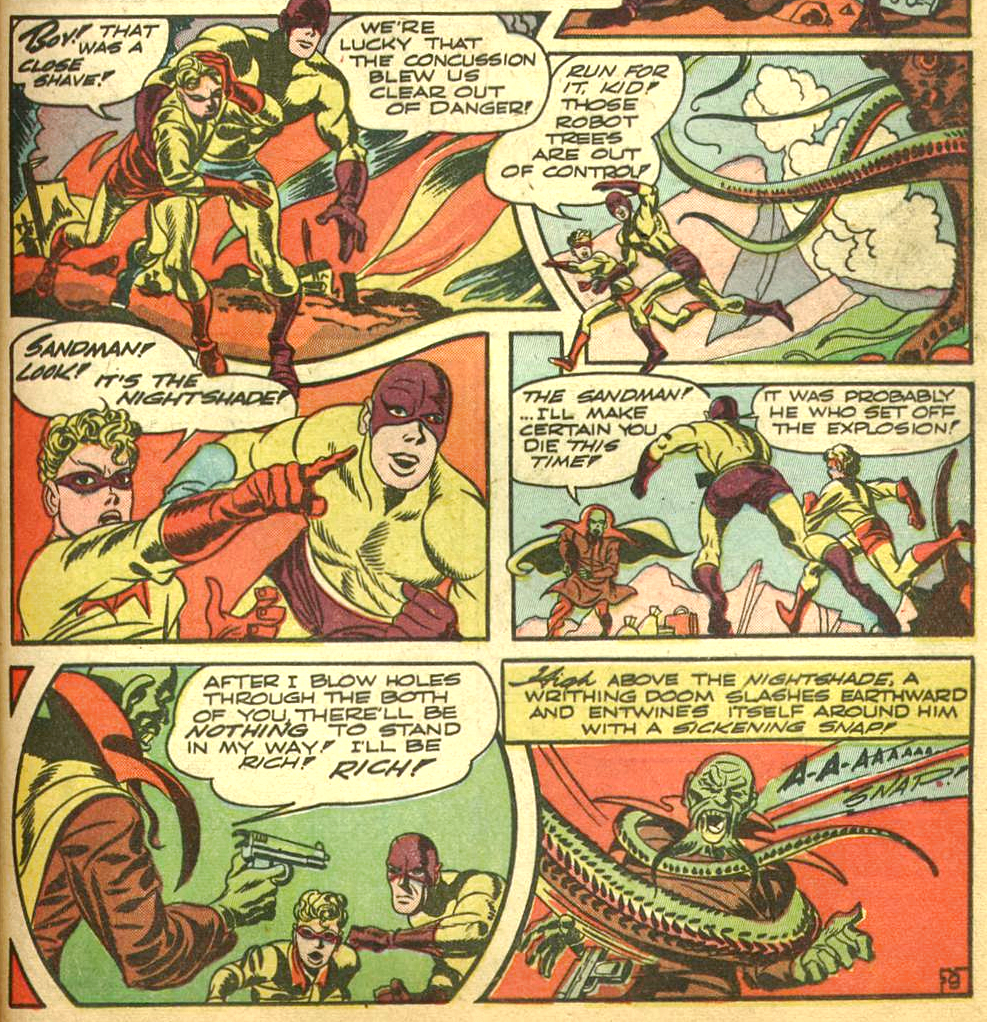
The Sandmanoh shoot, which one? Remember we have both feet firmly planted in the 40s in this post. This Sandman is Wesley Dodds, created by artist Bert Christman and writer Gardner Fox. Accompanied by his sidekick Sandy, this superhero-cum-detective wielded a special gun that could put criminals to sleep or act as a sort of truth serum.

The Adventure of the Magic Forest, published in World’s Finest Comics no. 6 (Summer 1942, DC), was scripted by Jack Kirby (Tentacle Tuesday Master!), pencilled by the King and inked by Joe Simon.

You’re not convinced that those are tentacles? Shame on you. Take a gander at this:
The next superhero (technically with no super powers, but managing beautifully all the same thanks to his lightning-fast reflexes and superior fighting skill) is my personal favourite Green Turtle, a Chinese superhero who fought against Japanese invaders in WWII. Unfortunately, the publisher wouldn’t let creator and artist Chu Fook Hing make his creation obviously Chinese, so the Green Turtle was never seen without a mask. It’s okay, we can read between the lines!
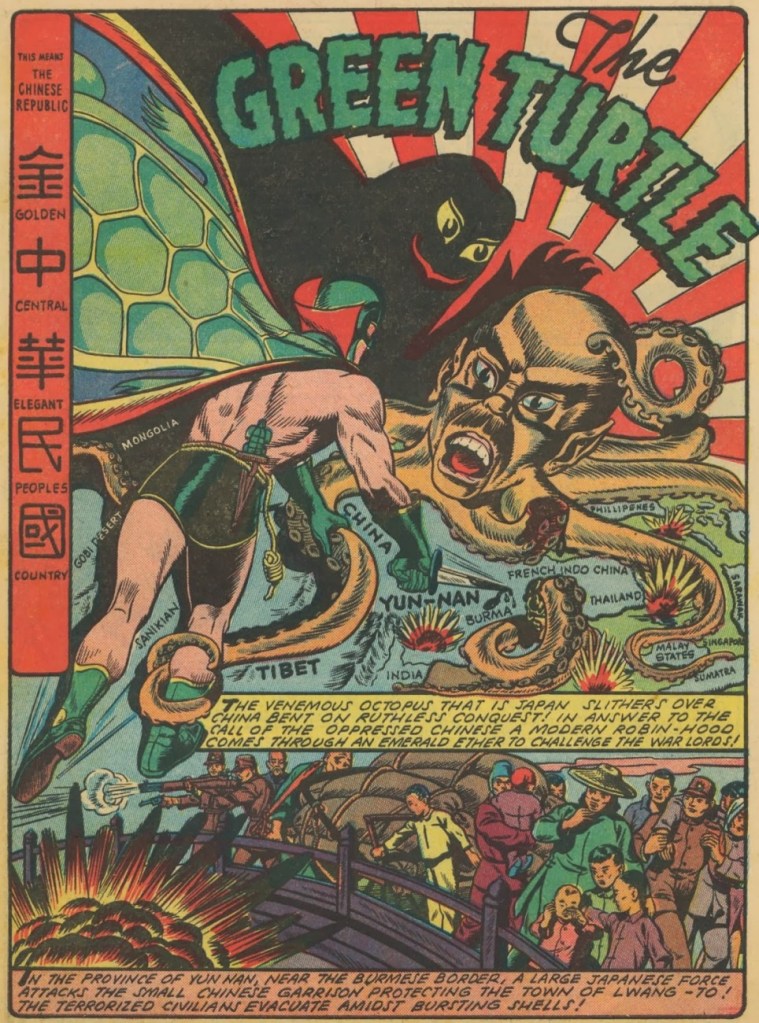
This Green Turtle adventure was scripted and illustrated by Chu F. Hing and published in Blazing Comics no. 1 (June 1944, Rural Home). With apologies to our Japanese readers.

Magno the Magnetic Man has, believe it or not, magnetic powers (though I imagine it’s not helping him much in this particular skirmish). He’s irresistible to women (maybe they have metal parts?), impervious to harm, and is accompanied by his side-kick Davey, whom he periodically magnetizes to ensure that the little whippersnapper also has access to magnetic powers.

Super-Mystery Comics vol. 5 no. 4 (February 1946, Ace Magazines). Cover by the sudorific Rudy Palais.

~ ds

Philosophy From the Foxholes: Bill Mauldin

« Wherever despotism abounds, the sources of public information are the first to be brought under its control. Where ever the cause of liberty is making its way, one of its highest accomplishments is the guarantee of the freedom of the press. » — Calvin Coolidge

Ah, the pitfalls of anchoring yourself to the news cycle: given the shocking news, last week, of the impending, unjustified closure of one of the greatest American journalistic institutions, the independent military daily newspaper The Stars and Stripes (founded in 1861!). I was all set to cobble together a series of posts showcasing the work of S&S’s greatest cartoonists, but then the massively unpopular decision was just as abruptly reversed. For now.

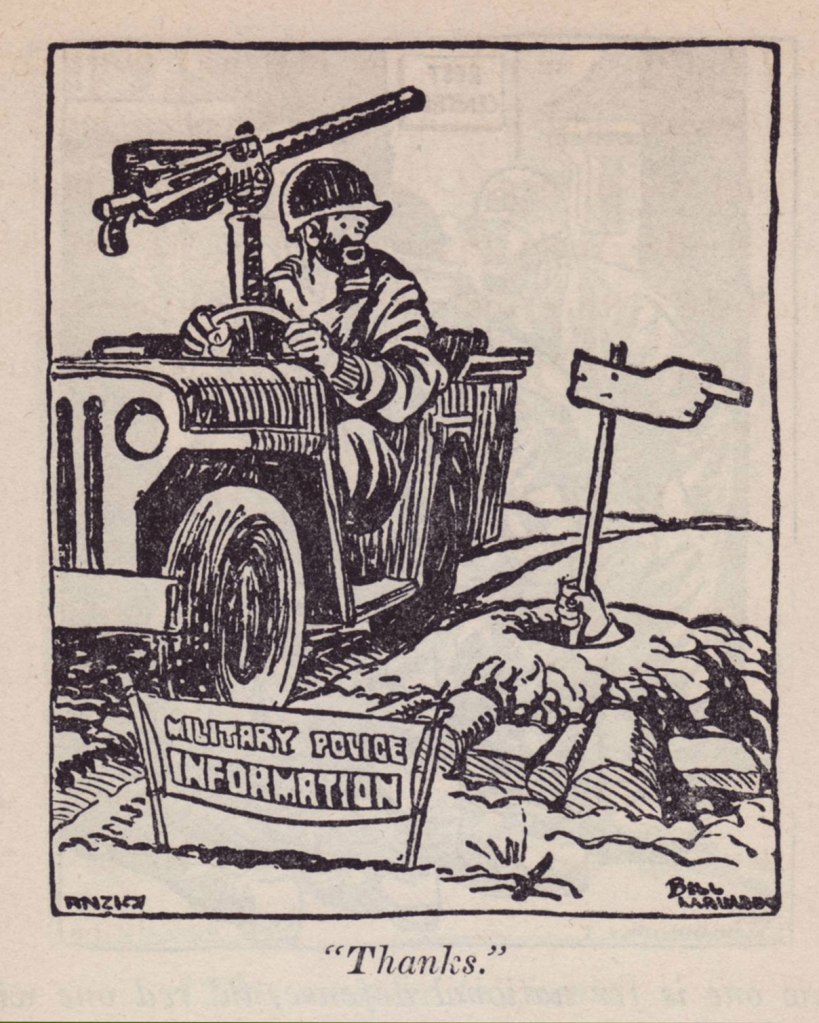
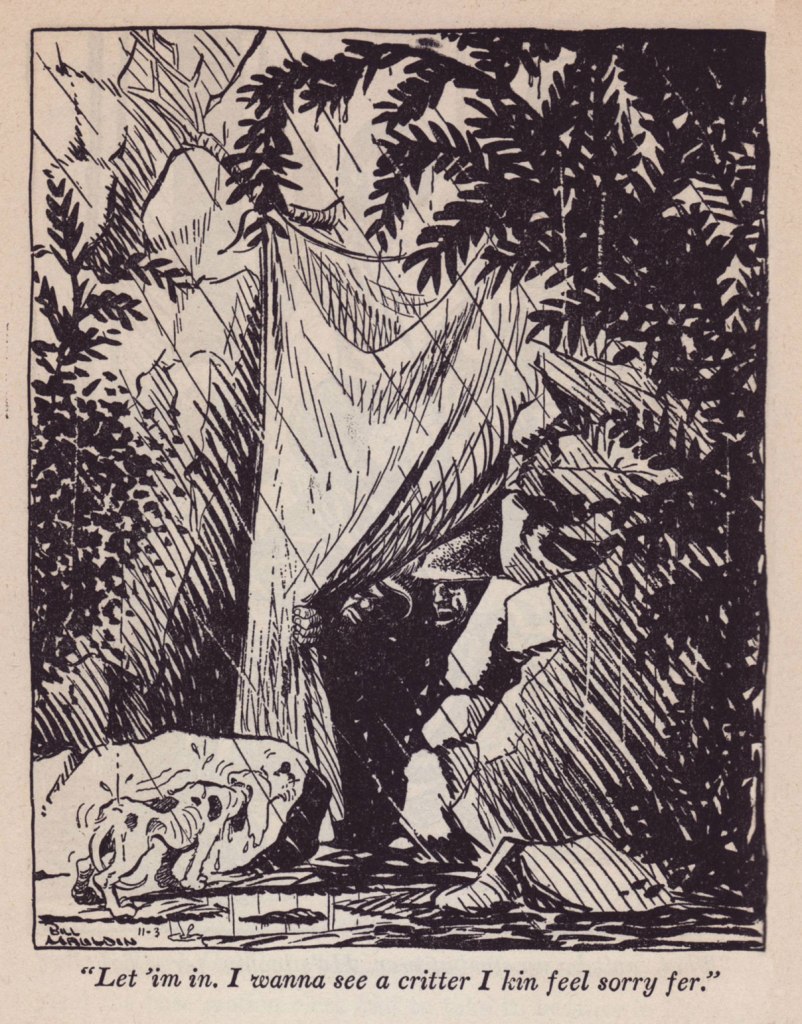
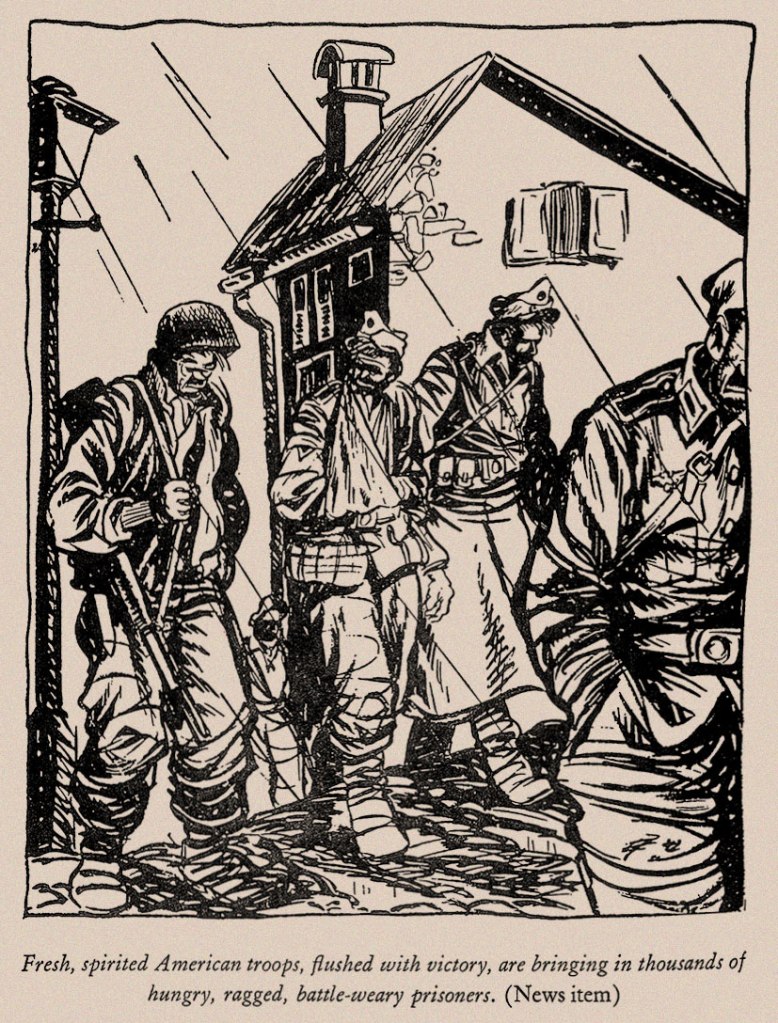
So I’ll stick to one post for the nonce (Shel and Tom will have to wait) and feature one of history’s greatest soldier cartoonists, William Henry “Bill” Mauldin (1921-2003), twice recipient of the Pulitzer Prize (1945, 1958), the Legion of Merit… and a host of other distinctions, both military and civilian.

Our baby-faced artist photographed during WWII.

With but a single exception, the following are samples from his essential Up Front collection (1945), which Mauldin humbly opens with: « My business is drawing, not writing, an this text is pretty much background for the drawings. »

But such a background! Mauldin is, naturally, funny and insightful, but there’s much to learn therein, not merely about men in war, but just about everything under the sun. While so many nowadays mix up freedom and privilege, it’s good to be gently reminded of the high price of both.

« Until some intelligent brass hat repaired a big brewery in Naples and started to send beer to Anzio, the boys at the beach-head were fixing up their own distilleries with barrels of dug-up vino, gasoline cans, and copper tubing from wrecked airplanes. The result was a fiery stuff which the Italians called grappa. The doggies called it ‘Kickapoo Joy Juice’, and took the name from the popular ‘Li’l Abner’ comic strip which Stars and Stripes printed daily. It wasn’t bad stuff when you cut it with canned grapefruit juice. »
Mauldin’s biographer, Todd DePastino, wrote, in his Bill Mauldin: A Life Up Front: « First published on October 13, 1944, this cartoon made the 23-year-old Bill Mauldin the youngest Pulitzer Prize winner in history. Both he and his editors at Stars and Stripes were astonished by the selection, which did not seem to them particularly noteworthy. »

For a deeper dive into Mauldin’s war through the eyes of his ragged infantrymen, scrounge yourself a copy of Fantagraphics’ glorious Willie & Joe: The WWII Years (2008).

In closing, shall we hear from another president?

« I have great respect for the news and great respect for freedom of the press and all of that. » — Donald J. Trump

-RG

Tentacle Tuesday: Passive Protoplasm, Active Protoplasm

The thing kept coming.
“Die, die!” Parke screamed, his nerves breaking.
But the thing came on, grinning broadly.
“I like quiet protoplasm,” the thing said as its gigantic mouth converged on Parke.
“But I also like lively protoplasm.”
It gulped once, then drifted out the other side of the field. 
— excerpt from The Last Weapon by Robert Sheckley
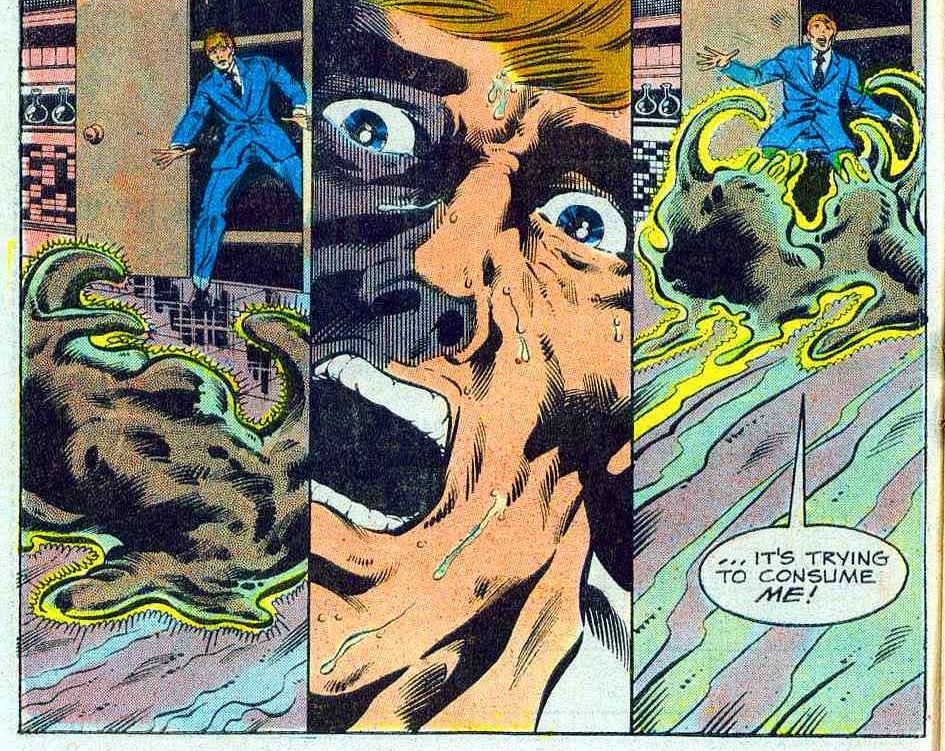
I Am the Living Ghost!, illustrated by Steve Ditko, was published in Tales of Suspense no. 15 (Mar. 1961, Marvel). I came across a reprint of this story while looking for Draculian tentacles (which you can see in Tentacle Tuesday: Dracula Drops In).

Call it goo, label it as a giant amoeba, christen it ectoplasm or protoplasm, but when it starts crawling your way, do remember to beat a hasty retreat.

Oh, yeah, and keep your fingers away from it, too.

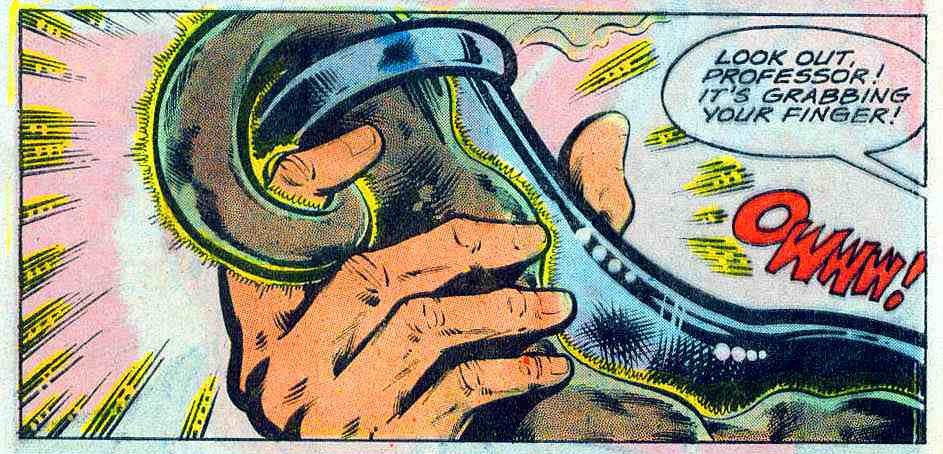
Coo! this page has everything: a prehensile amoeba, tentacled plants, aliens with cephalopod appendages…

Spawn of Venus was scripted by Bill Gaines and Al Feldstein, and illustrated by the latter. It was published in Weird Science no. 6 (Mar.-Apr. 1951, EC).

… but it’s the amoeba that’s of current interest to us (yes, the one devouring everything in its path, including dawdling professors).

Continuing our literary delusions, a peek at the adventures of a ‘star vampire’, from a (somewhat lackluster) comic book adaptation of a Robert Bloch short story:

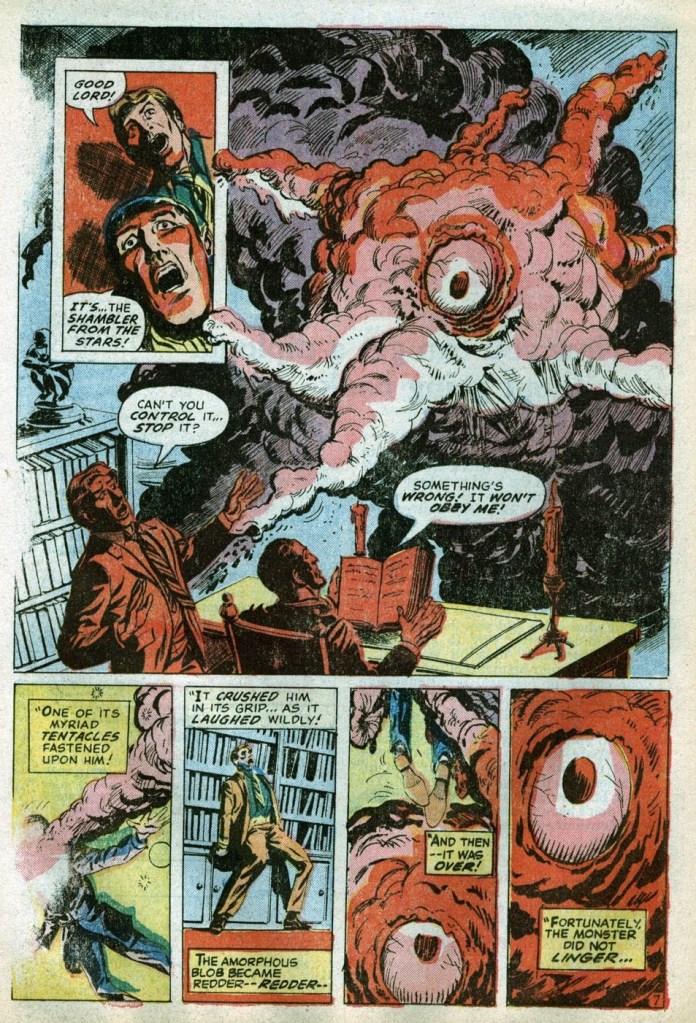
The Shambler from the Stars!, based on a story by Robert Bloch, was adapted by Ron Goulart, pencilled by Jim Starlin and inked by Tom Palmer. It was published in Journey into Mystery no. 2 (Feb. 1973, Marvel). An amorphous red blob is not a dog to be ordered around, which explains the poor results.

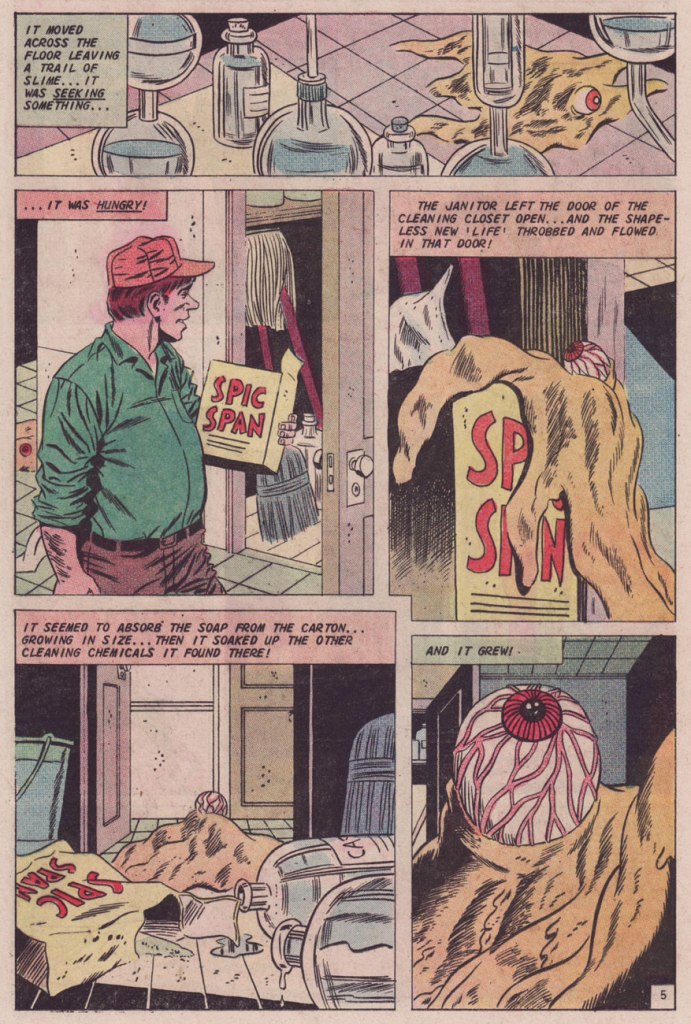
If a tentacled amoeba is scary, just think of how startling it is to run into an amoeba with a single bloodshot eyeball (that feeds on soap, among other things).

A page from Creator of Life, published in Ghost Manor no. 11 (Apr. 1973, Charlton). This story was written by Joe Gill and illustrated by Charles Nicholas and Wayne Howard.
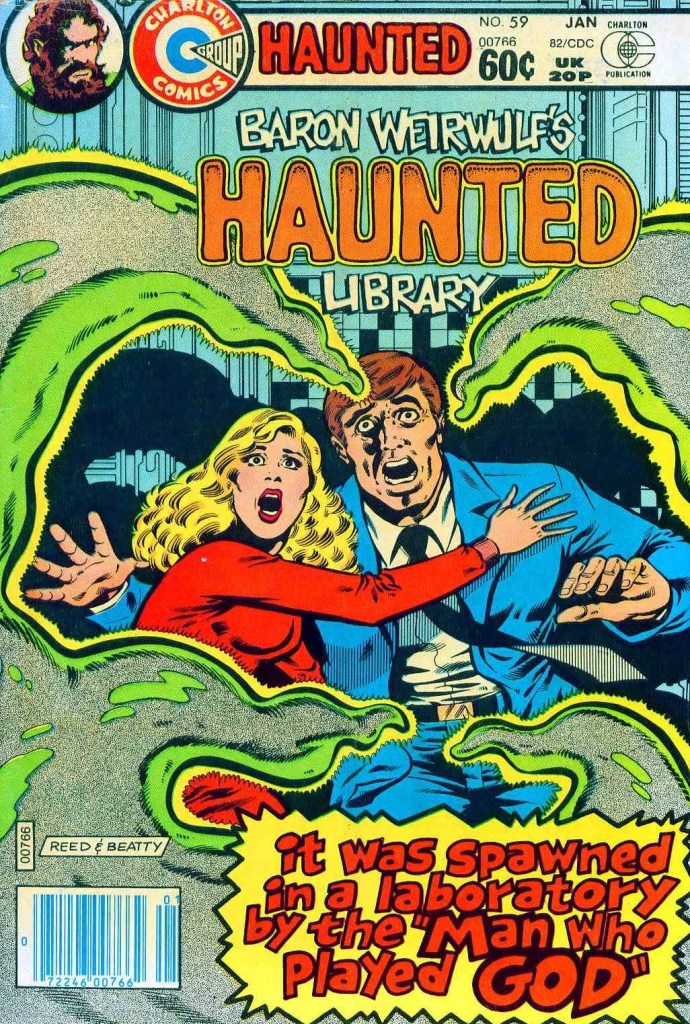
An eyeball in a turtleneck! Scary stuff.
Haunted no. 59 (January 1982), pencilled by Dan Reed and inked by John Beatty.

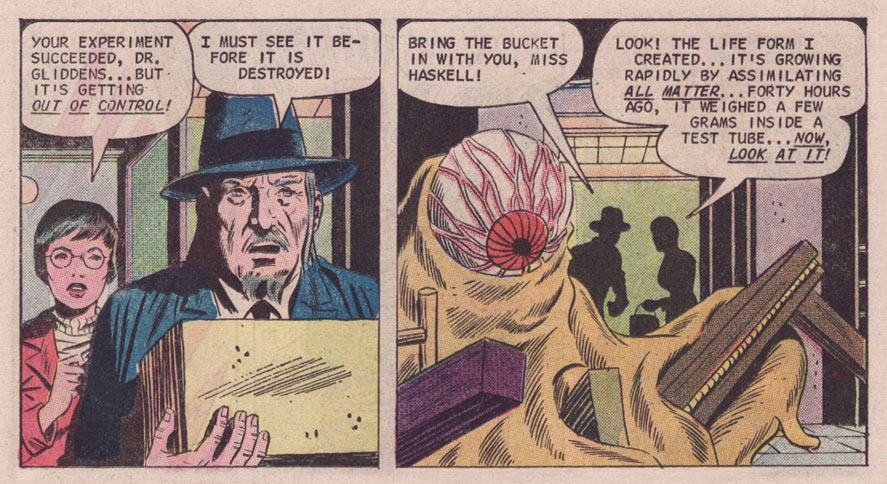
Not only does this monstrosity go after the scientist, instead of pursuing his absurdly attractive assistant…

The Man Who Played God was scripted by Joe Gill (again), pencilled by Dan Reed and inked by John Beatty.

But she’s also the one who saves the situation. Joe Gill, ladies and gentlemen!

I love his tough-guy stance at the end. He surely would have punched the amoeba out, if only the meddling female hadn’t interfered!

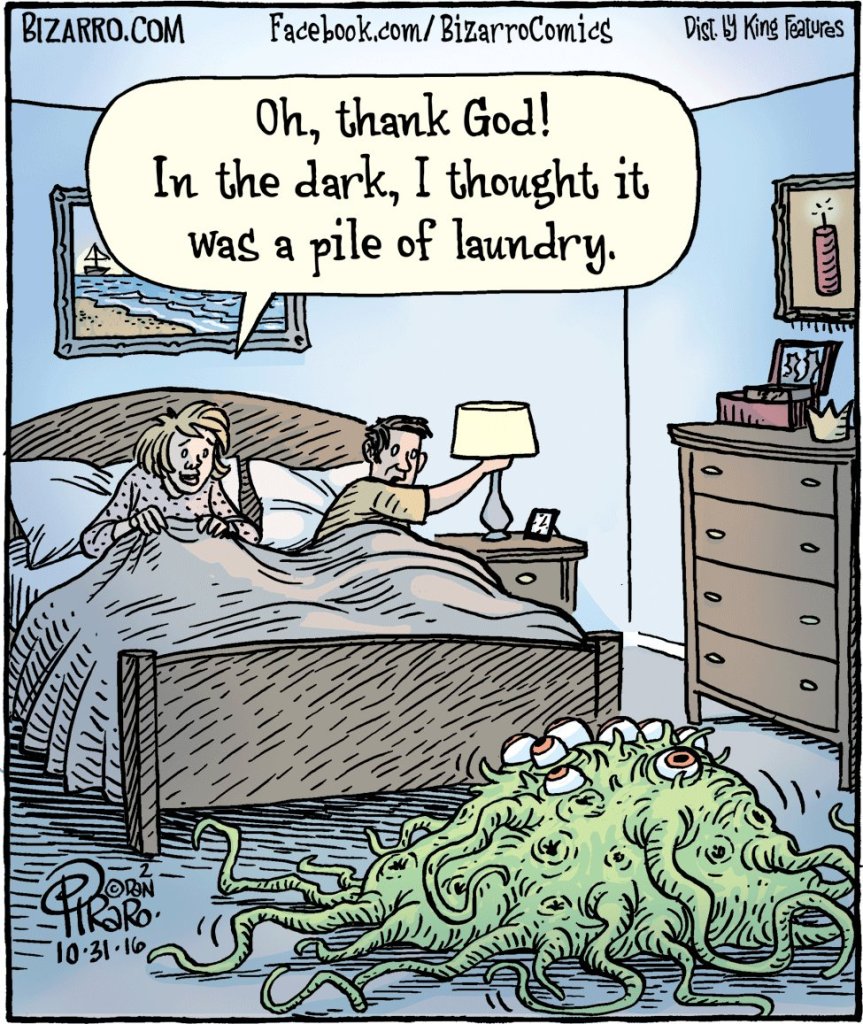
I’ll end this post with a woman with priorities:

Dan Piraro, unquestioned Tentacle Tuesday Master.

℘ ds

Éric et Artimon: Some Choice Bubblegum!

« Flattery is like chewing gum. Enjoy it but don’t swallow it. » — Hank Ketcham

Going way back: When I was a wee lad (still in the single digits), my mother would accompany me to our area’s oldest and finest bookstore (Chicoutimi’s long-gone Librairie régionale). At the time, I had been purchasing bound collections of Belgian bédé publisher’s Spirou, the earlier the better. Even at that tender age, I held the conviction that things had already peaked.

A friendly employee ushered us into the restricted area of the bookstore’s top floor, a vast warehouse I never got a tour of… but it was immense! I was led to an aisle where, high above, dozens of older Spirou collections were kept, dating all the way back to 1962. I can afford to be specific, because I bought the oldest issue they had on hand (Album Spirou no. 84). At ten dollars a pop, they were reasonably-priced, but still costly for a child with a 1970s-scale allowance. For my parents, a reliable source of ideal birthday and Christmas gifts, however!

It was in their pages (no. 90, see below!) that, along with the established Spirou magazine series (Spirou et Fantasio, Boule et Bill, Buck Danny, Benoît Brisefer, Tif et Tondu, Gil Jourdan…), I encountered scads of unfamiliar entries. Of these, an early album caught mid-tale one that truly stuck with me through decades and therefore is the object of today’s post.

This is Album Spirou no. 90 (Sept. 1963, Dupuis), collecting the bédé weekly’s issues n° 1316 to 1328. Cover by André Franquin, depicting a scene from a Spirou adventure, the troubled production that was QRN sur Bretzelburg (under its original title, QRM sur Bretzelburg).

I’d be squandering time and space to retrace Belgian master Willy ‘Will’ Maltaite‘s biography, as Lambiek covers the topic in great detail and with the requisite visual profusion.

In short, though, here’s what’s relevant in this case: from 1949 to 1987 (with a pause between ’59 and ’63), Will illustrated the adventures of Tif et Tondu, characters owned by Éditions Dupuis, its publisher. Still, he longed to draw characters of his own, which wasn’t an idle whim, given that most of his colleagues and collaborators did just that, enjoying more latitude and far greater financial rewards. In 1962, he got the chance to try his hand at an original series, Éric et Artimon, conceived with versatile scripter-cartoonist Raymond Antoine, alias Vicq. And the result was outstandingly charming, light-hearted and hilarious.

The 1976 (and only, so far) edition of Toute la gomme. Still, I'm grateful for its existence: I was finally able to read the whole story, though without colour.
The 1976 (and only, so far) edition of Toute la gomme. Still, I’m grateful for its existence: I was finally able to read the whole story, though without colour.

A mere two long adventures (44 pages each) were produced (Le tyran en acier chromé, 1962, and Toute la gomme, 1963, plus a six-pager, Et mine de rien, in 1967), and Dupuis never bothered to collect or reprint them. Instead, well down the pike, two separate, smaller publishers licensed the rights and issued small black and white runs of, respectively, Toute la gomme (Espace Édition, 1976) and Le tyran… (Magic Strip, 1983).

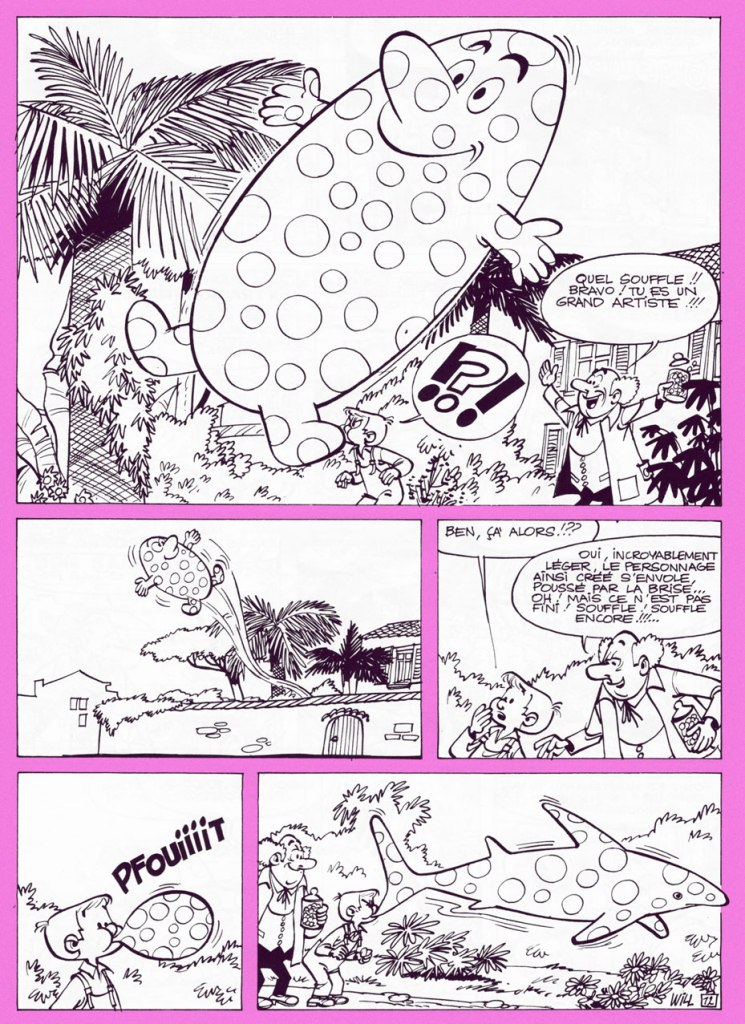
Candy aficionado Éric visits his main supplier, loveable eccentric Monsieur Grosoison, at his confiserie ‘Au bambin vorace’ (‘The Voracious Toddler’). The old man, also a brilliant inventor, shows off his new creation to his best and most loyal customer. The stuff’s not only downright magical, it’s also exquisitely delicious.
« Such lungs! Bravo! You are a great artist! »
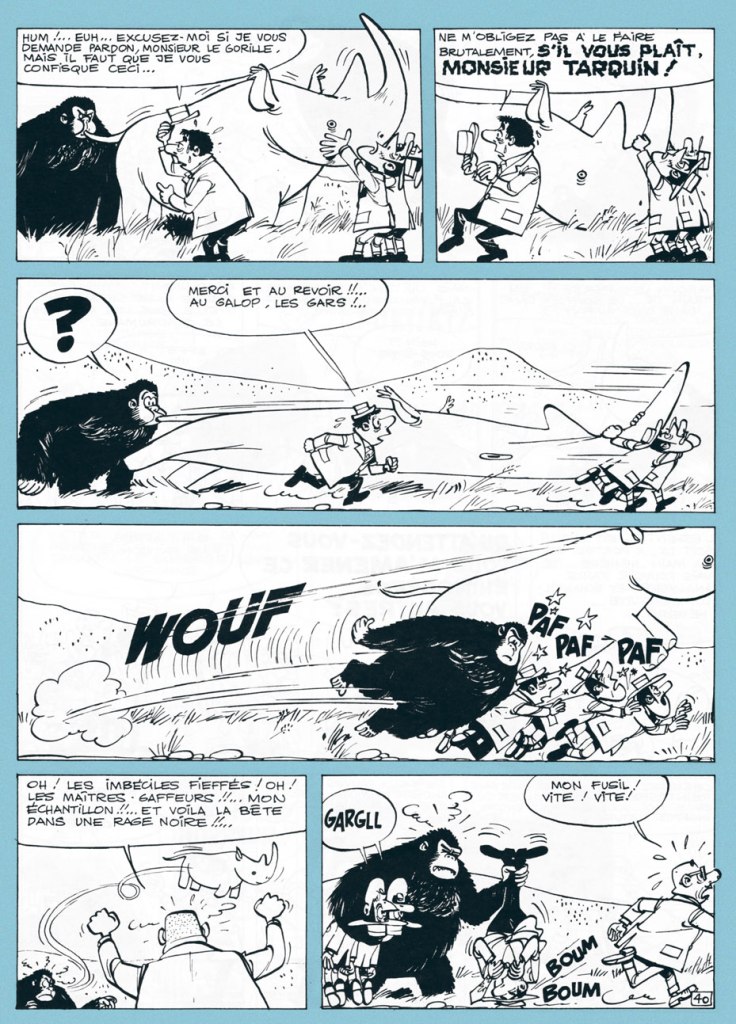
However, Tarquin doesn’t like his good-natured fun interrupted.
The back cover of Espace’s Toute la gomme, wherein Éric employs ingenious means to escape a rooftop.
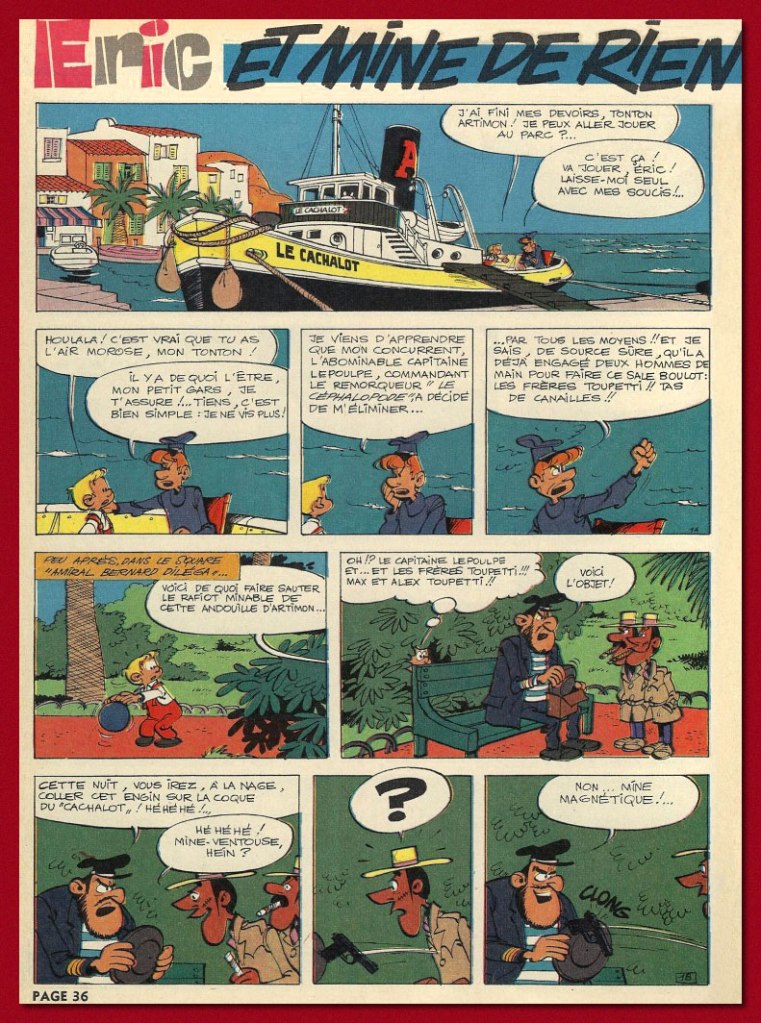
The opening page to the short concluding episode of the boy and the captain’s adventures, Et mine de rien (Spirou n° 1506, 1967).
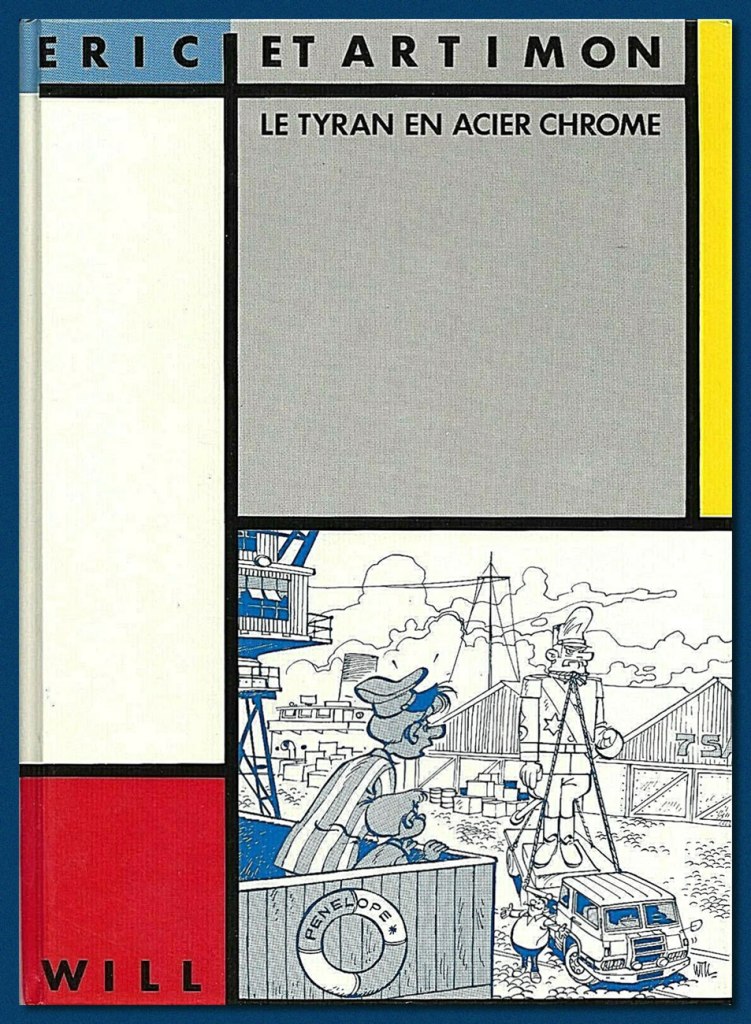
And here’s the fancy 1983 edition of Le tyran en acier chromé, scarce and fairly pricey nowadays, unlike Toute la gomme.
Thankfully, Éric et Artimon haven’t been entirely forgotten, despite the shabby treatment they received at the hands of their original publisher. Here’s a signed lithograph produced in the early 1990s by Belgian bookstore Chic-Bull. Note the fancy silver ink on the statue. Mine’s number 48!

I’ll be spotlighting Will’s other creator-owned series, Isabelle, at some point during this year’s Hallowe’en Countdown!

-RG

Tentacle Tuesday: Where in the World?

« Well, she sneaks around the world from Kiev to Carolina
She’s a sticky-fingered filcher from Berlin down to Belize
She’ll take you for a ride on a slow boat to China
Tell me, where in the world is Carmen Sandiego? »*

Today’s Tentacle Tuesday is for globe-trotters only – but don’t let this post give you an itch for actual travelling: that’s verboten right now.

MogaMobo3.jpg
This Teutonic tentacled cutie appeared on the cover of Moga Mobo no. 3 (1995). The wraparound cover is the work ofJonas Greulich, one of the co-founders of this German comics magazine that began publication in 1994  (the other two artists involved are Titus Ackermann and Thomas Gronle).

Speaking of German comics, does anybody know where this page and its German Captain Nemo come from?
45783563025_4e1c2ce075_b

On the topic of Jules Verne, here’s a page from a Spanish take on his novel Twenty Thousand Leages Under the Sea.

20.000 leguas de viaje submarino, de Oesterheld y Regalado
20.000 Leguas de viaje submarino was adapted by Héctor Oesterheld and illustrated by Roberto Regalado. This 23-page story was published in Argentine Billiken Magazine (Editorial Atlantida) in 1974. For those who can read Spanish or would just like to see more images, head over to this article.

One would be remiss in not paying at least a brief visit to Asia:

HONG KONG BATMAN #19-wild-octopus
The cover of a comics anthology from Hong Kong, probably from the 1960s.

And back to Germany at a staggering speed (watch out for whiplash)!

Petziunddertintenfisch
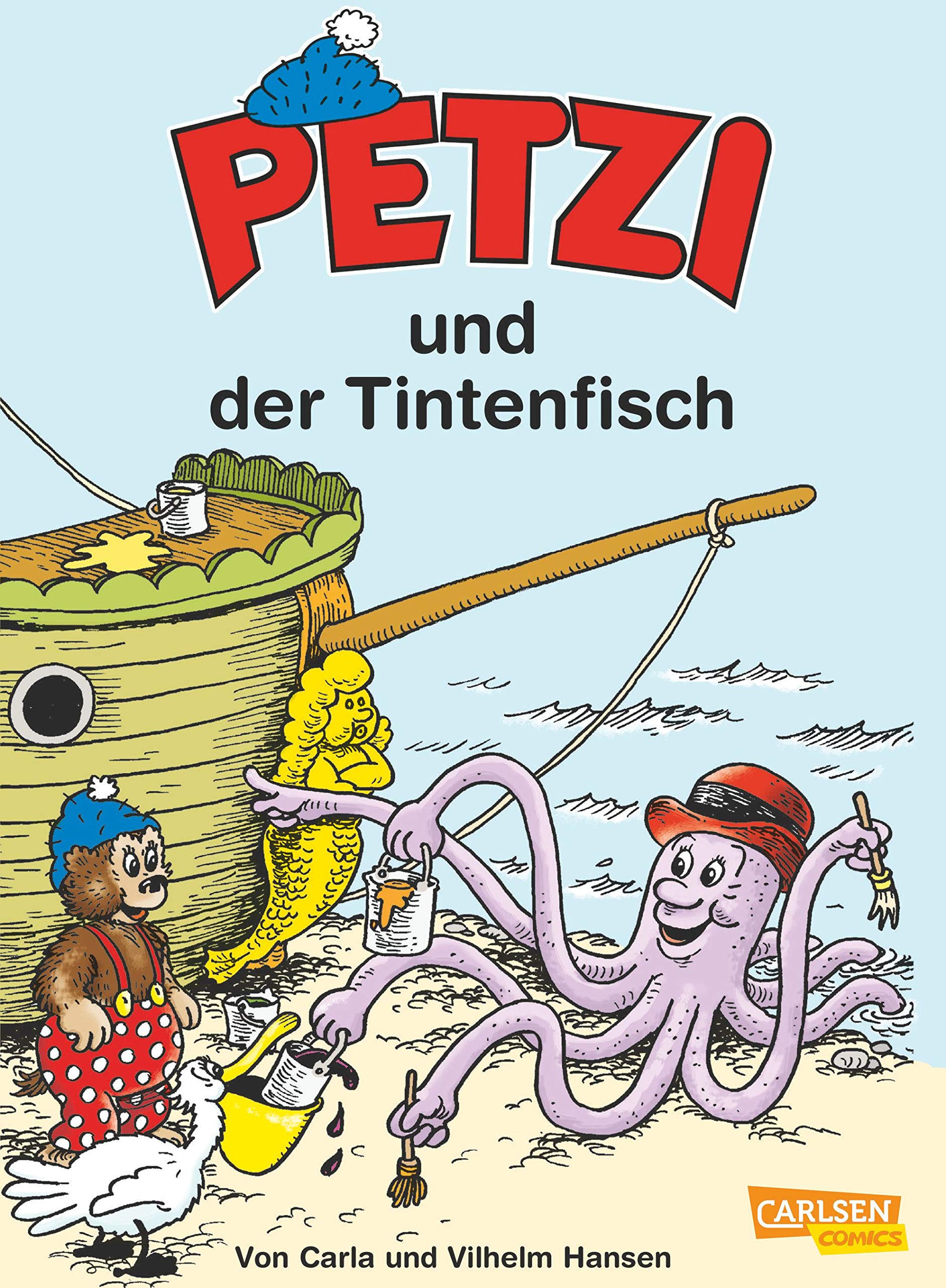
Petzi is actually a translated version of a Danish character named Rasmus Klump, created by a husband-and-wife team Carla and Vilhelm Hansen in 1951. The adventures of the lovable bear cub were popular enough to be translated into many languages, but a hefty price had to be paid – namely, a name change. Rasmus became Petzi in French, German, Italian, Portuguese and Vietnamese, and I’m slightly amazed that such different countries could agree on one name. In English, you will no doubt be familiar with Barnaby Bear. This is Petzi no. 40 (July 2008), a reprint of older material published by Carlsen Comics.

∼ ds

* She’ll go from Nashville to Norway, Bonaire to Zimbabwe
Chicago to Czechoslovakia.. and back!

Treasured Stories: “The Monster Maker of Madison Avenue!” (1967)

« I’ve learned that any fool can write a bad ad, but that it takes a real genius to keep his hands off a good one. » — Leo Burnett

Given that they’re often referred to as comics, or funnybooks, mainstream American comic books haven’t been nearly as funny as one might reasonably expect… particularly the ones that set out to be humorous.

In the scope of the Ages of Gold and Silver, the selfsame Pantheon of Exceptional Providers of Hilarity pops up as if on cue: Carl Barks (Uncle Scrooge), John Stanley (Little Lulu, Melvin Monster, Dunc and Loo), Basil Wolverton (Powerhouse Pepper), Jack Cole (Plastic Man), Harvey Kurtzman (Mad). Pray note that these are all writer-artists*, hardly a negligible factor.

Humour being subjective, of course everyone will have their own favourite to contribute. The gist of my argument, however, is that comics books fail to raise guffaws to a level that, say, newspapers strips, animated cartoons and Franco-Belgian bandes dessinées routinely** do.

Meanwhile, DC Comics arguably boasted their singular genius humorist in Sheldon Mayer (Sugar and Spike). DC’s editors loved to divide and conquer, rarely allowing solo creators to take root, let alone flourish, in their tidy corporate garden patch. Given Mayer’s crucial early importance to the publisher’s rise, he was granted free(er) rein. Which leads one to ponder whether the assembly-line method, then, might not be utterly detrimental to quality humour.

So it was to my elated surprise that I came upon an authentically amusing (imho) tale betwixt the misaligned staples of a 1967 issue of Strange Adventures… what is more, uncredited. A mystery.

Which brings us ’round to another exceptional talent, a writer this time: long-time American Comics Group (ACG) editor Richard E. Hughes, who scripted most of the company’s mid-to-late output under an impressive array of aliases*** with a dry, deadpan, absurdist wit, most memorably deployed through the adventures of Herbie Popnecker, ably illustrated by Ogden Whitney.

In 1967, Hughes found himself at leisure with ACG’s demise (the final issues of its remaining titles, Adventures Into the Unknown and Unknown Worlds, were cover-dated August ’67). He passed through DC, scripting a smattering of stories for Superman czar Mort Weisinger (one might surmise that Kurt Schaffenberger, who worked for both editors, acted as the go-between), for Hawkman editor George Kashdan and Ghosts editor Murray Boltinoff before exiting the field. According to Wikipedia, « His final job appears to have been for Gimbel’s department store, composing response letters to customer complaints. » At least he’s received some posthumous recognition, as he was a 2015 recipient of the Bill Finger Award for Excellence in Comic Book Writing.

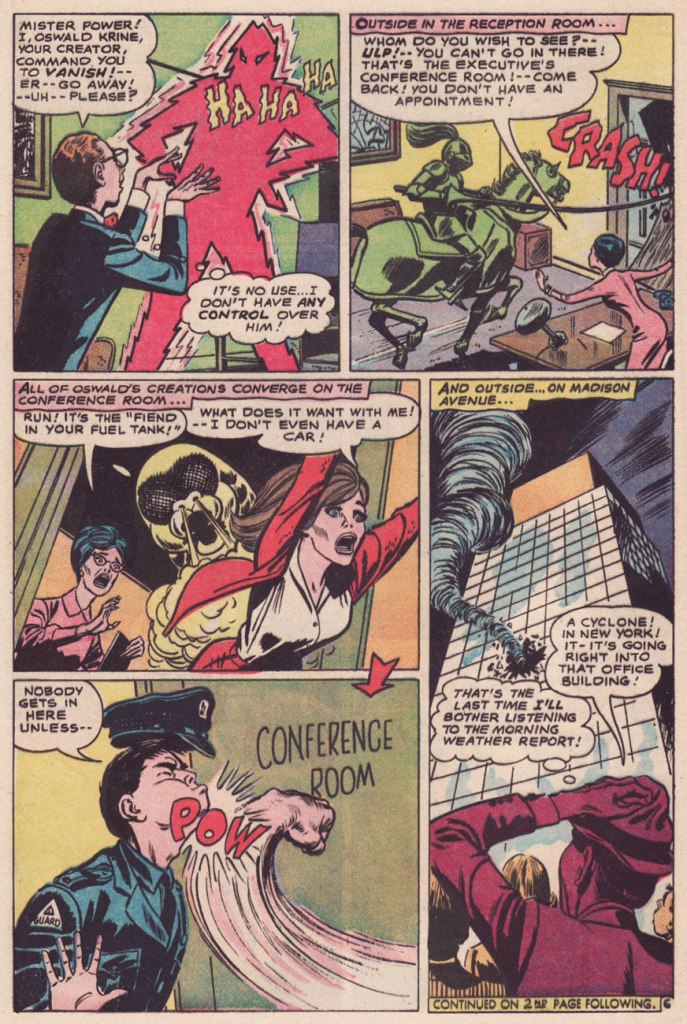
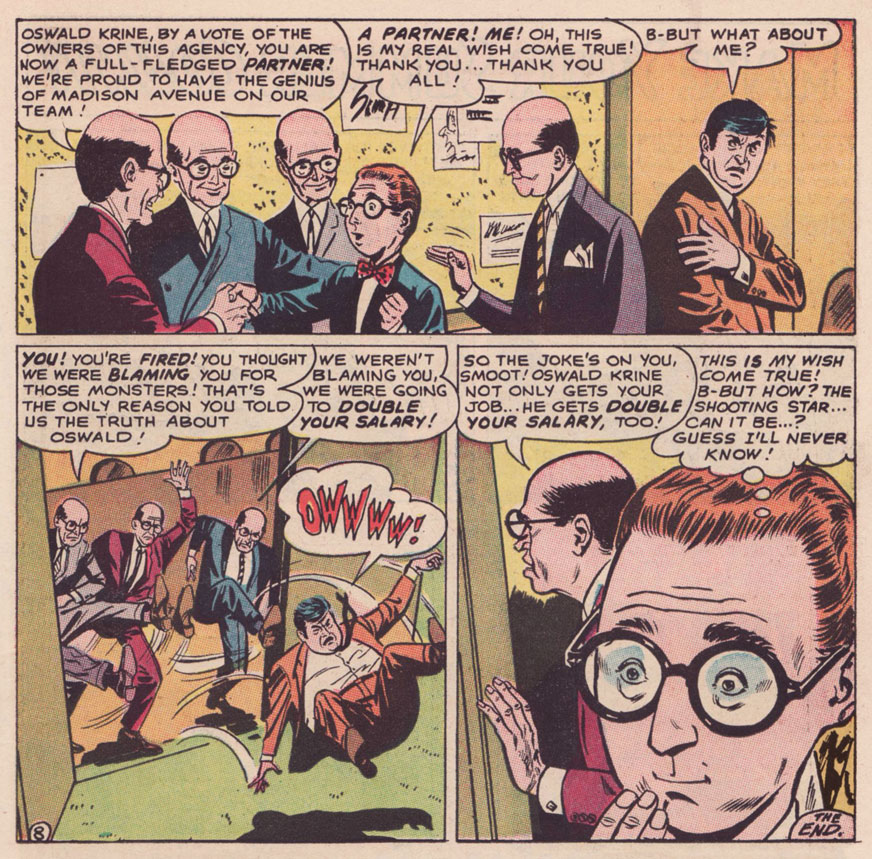
I do believe I can detect the Hughes cadence in The Monster Maker of Madison Avenue! According to GCD, the uncredited story is scripted by one Dennis Marks, an animation writer working for Filmation’s The Batman/Superman Hour at the time… but I just don’t know. It would be Marks’ sole comic book credit, and a speculative one at that. Besides, GCD attributes the artwork to Joe Orlando, which is flat-out, laughably wrong. A frequent problem of self-styled art experts is that they wear genre blinders. Most would never be caught dead reading, say, a romance comic, so they wouldn’t recognize (though they should!) the distinctive stylings of Jay Scott Pike (1924-2015).

On with our tale, which originally saw print in Strange Adventures no. 202 (July 1967, DC).

As for the ads parodied therein, I’m no expert, but I can hazard a few guesses: The Fiend in Your Fuel Tank refers to Esso’s famous Put a Tiger in Your Tank campaign; the housewive bluntly bestowing cleaning tips to her neighbour brings to mind Bold Detergent; The Green Knight surely lampoons Ajax’s White Knight; as for Popso Kooler’s Mister Power, it’s anybody’s guess. Pepsi commercials of the period looked great, but nary featured an animated lightning man. Anyone?

-RG

*Yes, Kurtzman (and Stanley) often worked with others to increase their output (and for the love of collaboration), but they fully controlled the mise-en-scène.

** They make it look easy… but it’s quite a feat.

***His imaginary roster comprised Pierre Alonzo, Ace Aquila, Brad Everson, Lafcadio Lee, Kermit Lundgren, Shane O’Shea, Greg Olivetti, Kurato Osaki, Pierce Rand, Bob Standish, Zev Zimmer… Fittingly, even Richard E. Hughes was a pseudonym: he was born Leo Rosenbaum.

Tentacle Tuesday: Wrap Your Brain Around This!

The brain-with-tentacles is curled up at the comfy intersection of two beloved tropes, the Brain Monster and the Tentacled Terror. Through some clever combining, one is guaranteed a truly horrendous creature that’s at least 25% more appalling than either of its step-parents. It’s the favourite of many a filmmaker and comic artist, and the toast of this particular post!

It may be a little too early to wrap yourself around a drink (at least in this part of the world), so you’ll have to enjoy this Tentacle Tuesday sober.

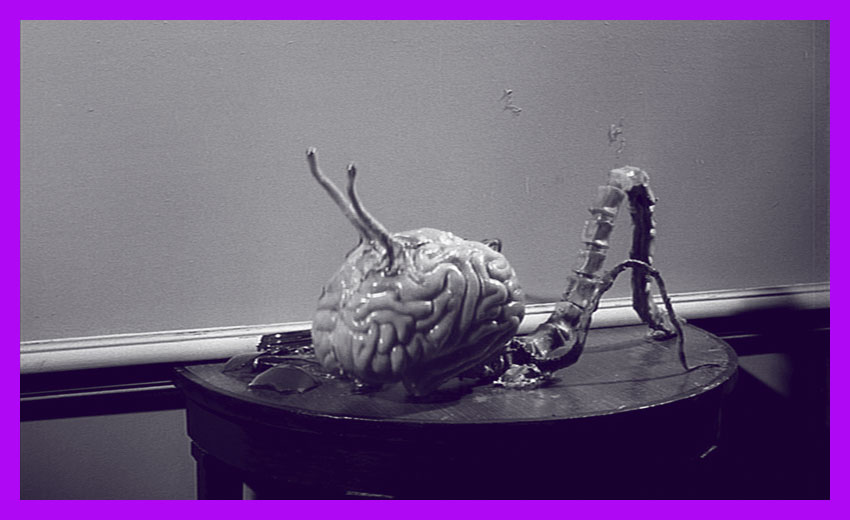
A friendly critter from Fiend Without a Face, a British movie from 1958.

One has to pay one’s dues to the classics: Basil Wolverton‘s The Brain Bats of Venus, originally published in Mister Mystery no. 7 (September 1952), is unquestionably indispensable, so I could hardly turn a blind eye to it. In case you were out that night and missed it, you can read the whole story at The Horrors of It All blog.

WolvertonBrainBatsA

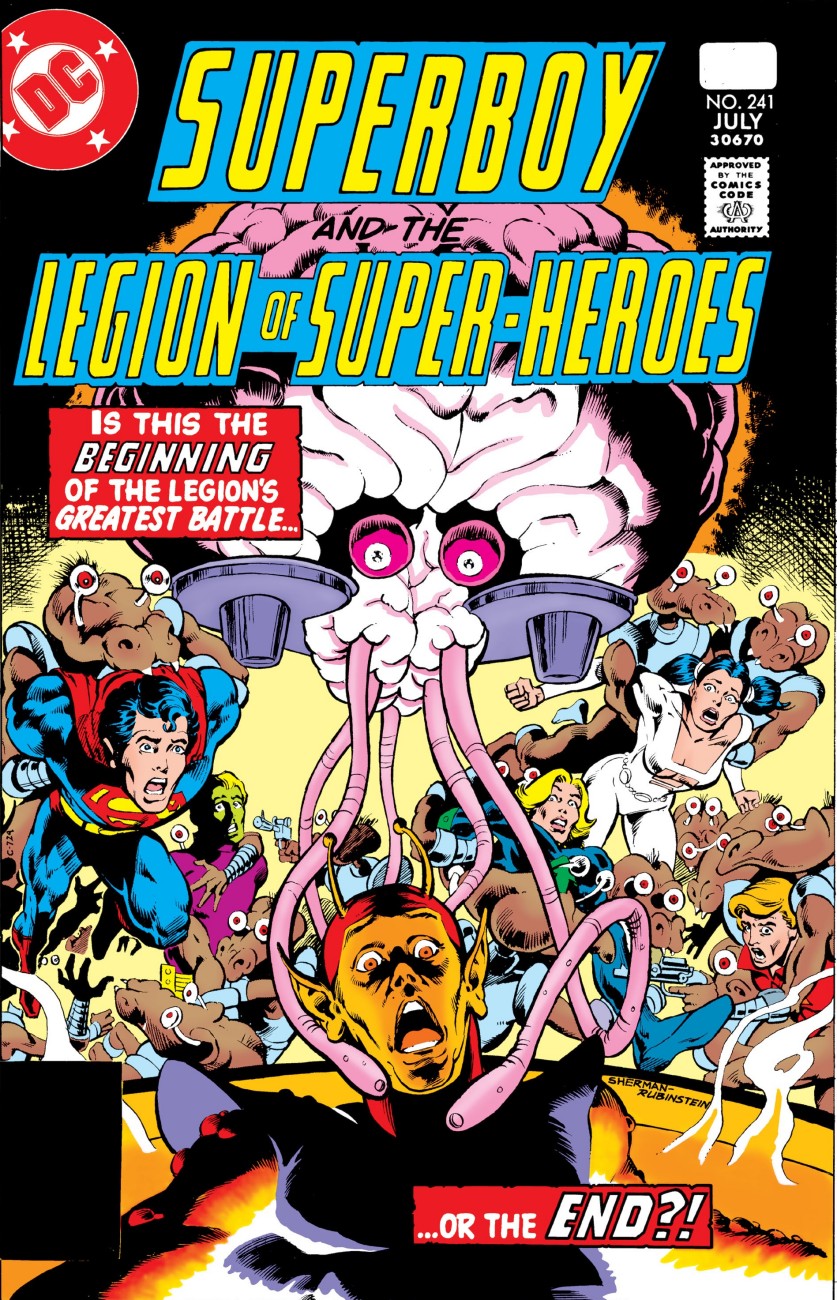
The tentacled brain has several means of locomotion at its disposal, and while crawling around spasmodically is a great mood-setter, floating around gives one much better scope of movement. The following is one of those floaters, aided by some mechanical gizmos.

Superboy-LegionoftheSuperheroes241-JamesSherman-JoeRubinstein

Superboy & the Legion of Super Heroes no. 241 (July 1978). Cover pencilled by James Sherman and inked by Joe Rubinstein.

The cover story, Prologue to Earthwar is scripted by Paul Levitz, pencilled by James Sherman and inked by Bob McLeod:

Superboy241-3
It’s just the worst when a brain launches into a tedious monologue after attacking you.

Superboy241--prologuetoearthwar.jpg

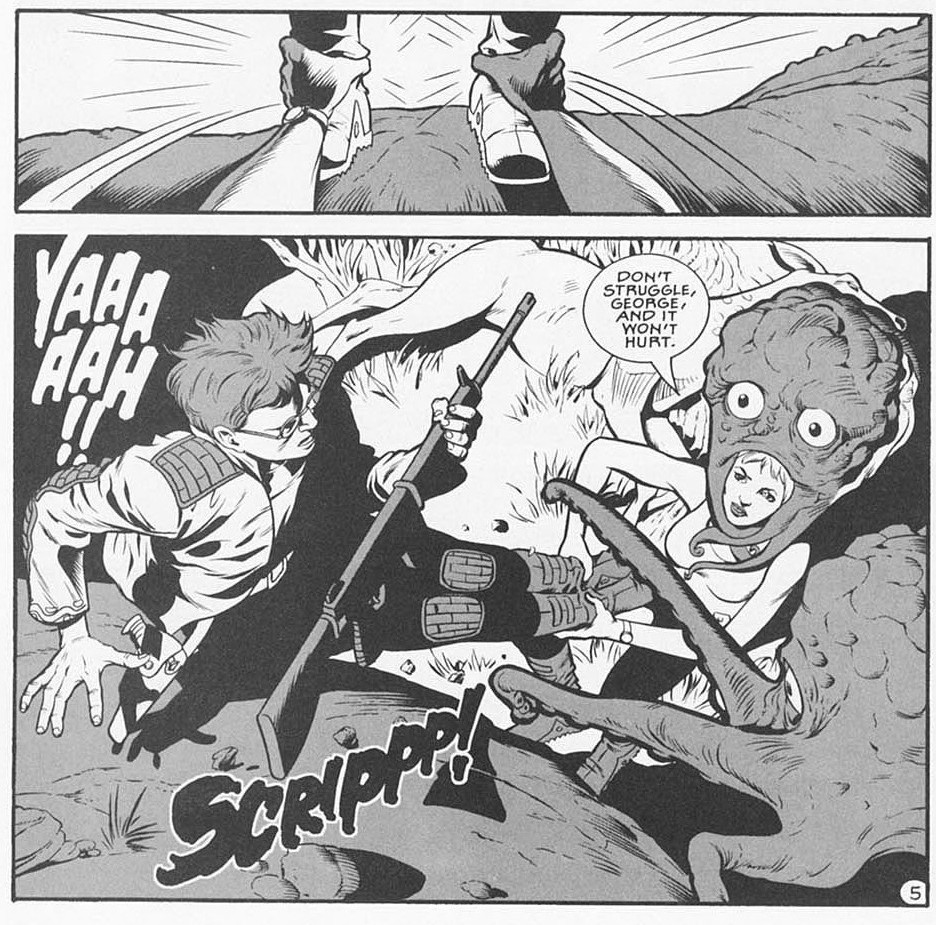
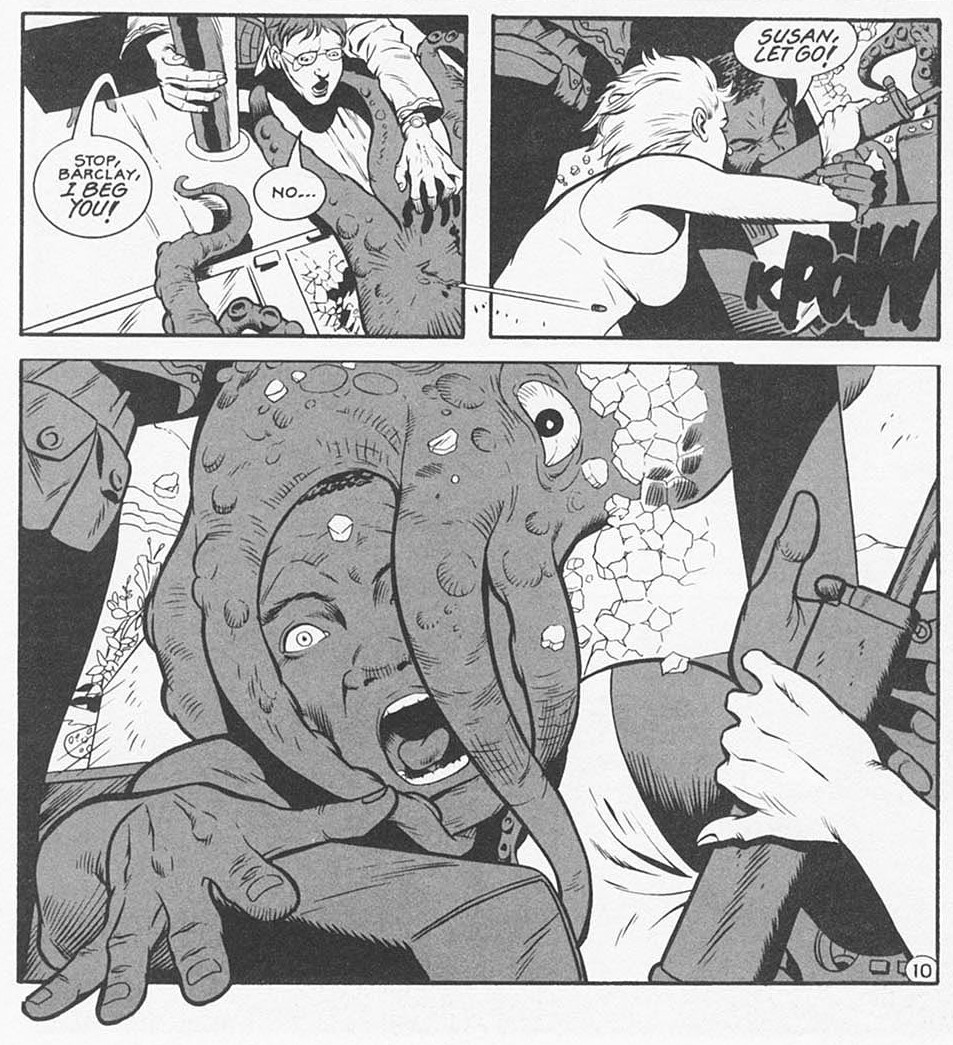
As implicitly suggested earlier by that panel from Brain Bats of Venus, some brain-monsters latch onto their victims’ brains, either sucking them out like you’d do with a coconut and a straw, or taking over people’s minds by puncturing some unsavoury holes I’d rather not think about too closely. A character in the following issue of World Below, when it is kindly suggested to her that perhaps it would be a sound idea to sever her ties with the tentacled thing on her head, mentions that « it hurts them to release — terribly. And it’s hard to reconnect, too. Like surgery without anaesthesia.» The implications are… unpleasant.

PaulChadwick-WorldBelow2-Deeper-Stranger
The World Below: Deeper and Stranger no. 2 (January 2000), cover by Paul Chadwick. Say, that’s a stylish hat you’ve got there, fella!

Zombies! is scripted and pencilled by Paul Chadwick and inked by Ron Randall, with grey tone separations by Jason Hvam:

PaulChadwick-WorldBelow2-Deeper-Stranger-Zombies
I would recommend not taking advice from women with a cephalopod on their heads.


PaulChadwick-WorldBelow2-Deeper-Stranger-Zombies2.jpg
The headaches this hat must cause… just think of the neck pressure from having to support 40 pounds of octopus-flesh.


PaulChadwick-WorldBelow2-Deeper-Stranger-Zombies4
Oops, that doesn’t look like it’s going to end well.

Moving along to goofier pastures…

SpongeBob49-Comics
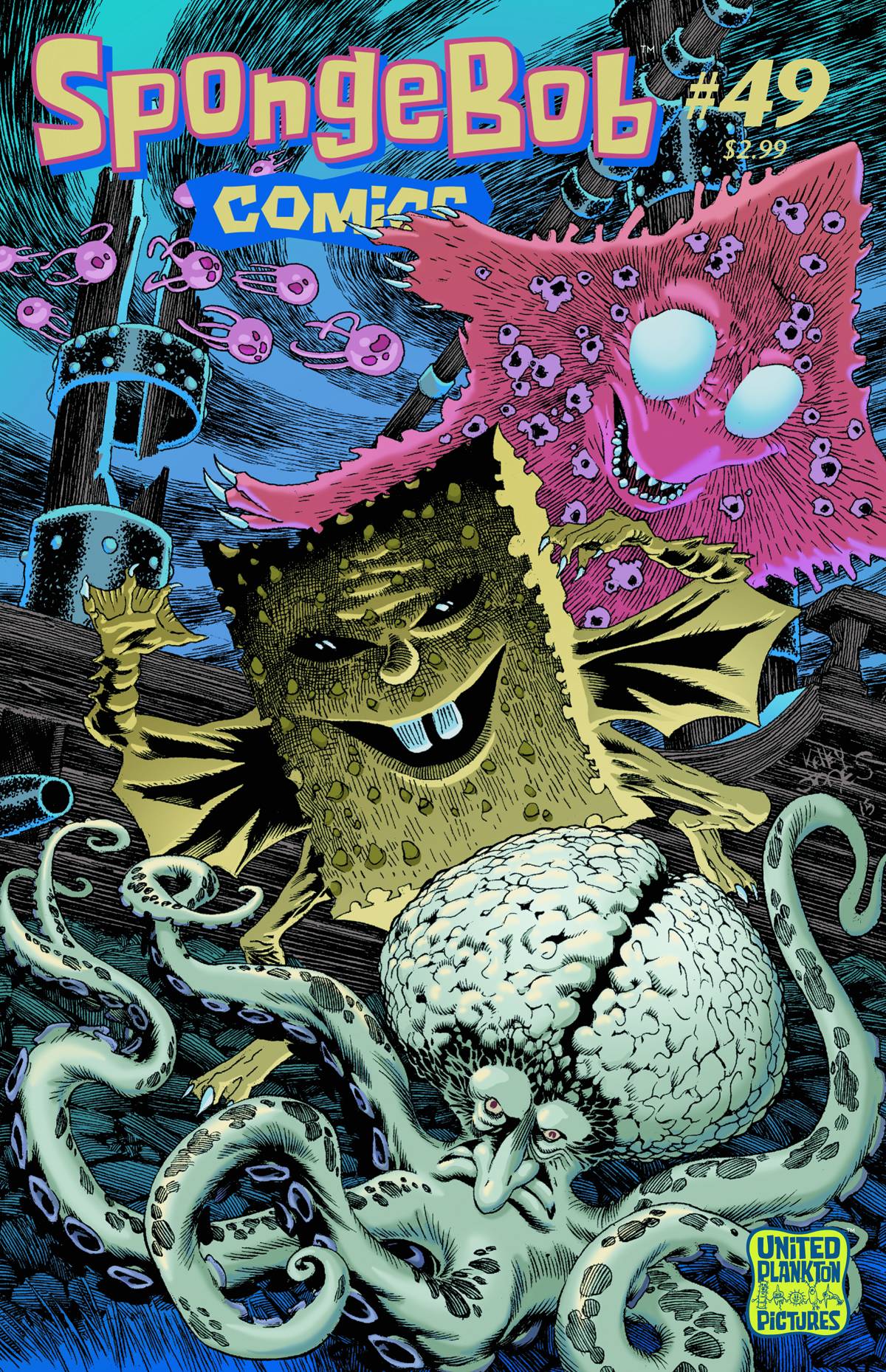
SpongeBob Comics no. 49 (October 2015). Cover by Kelley Jones.

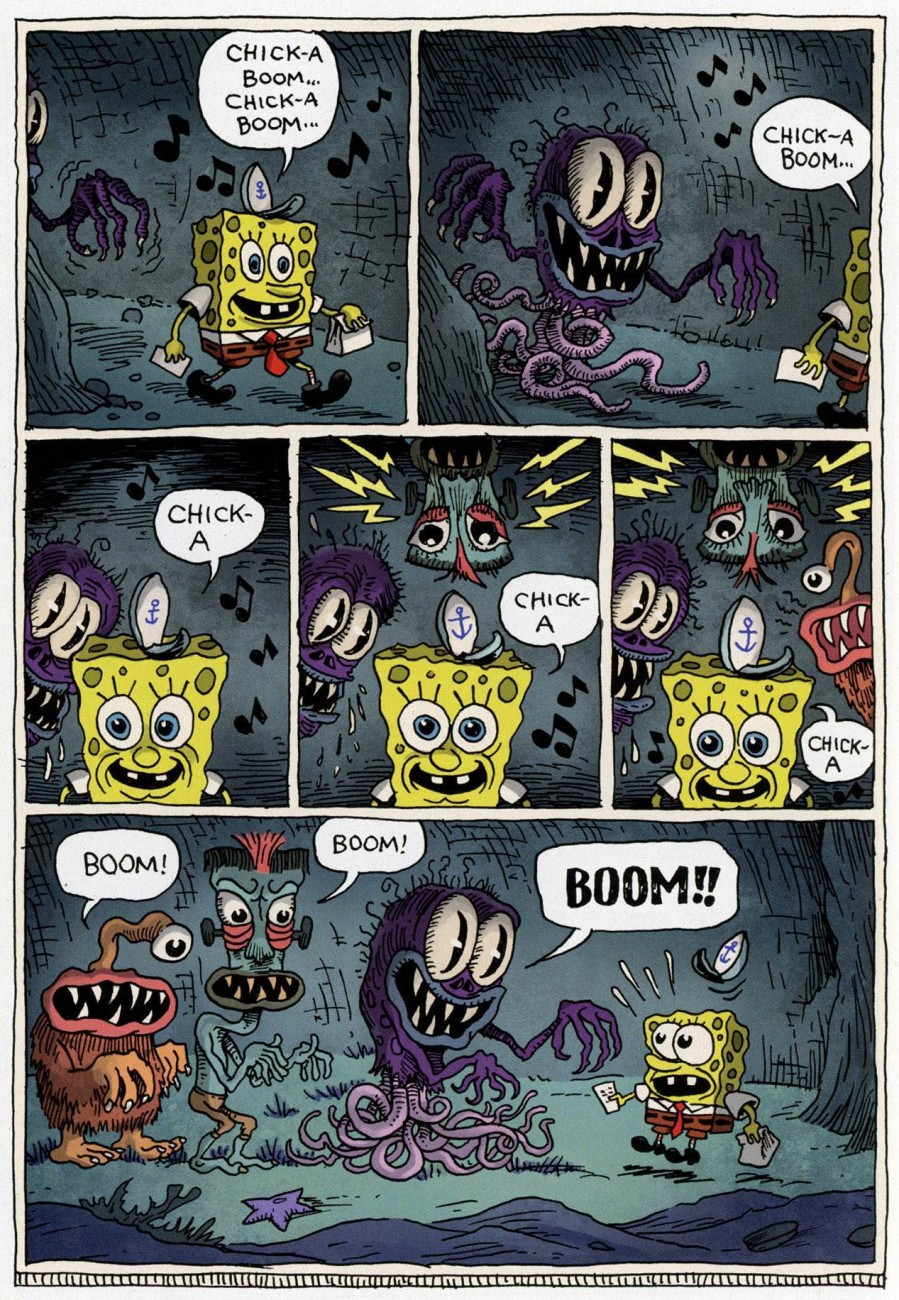
This is perhaps getting ever-so-slightly beyond the parameters of today’s brain theme, but the inside of this issue hides a gem in its otherwise dull pages (although I have to be fair: the stuff is much better than I expected). Behold: Spongebob in Monster Canyon, written by Kaz and drawn by Tony Millionaire, both favourites of this blog. With such excellent parentage, one expects something wonderful, and one is not disappointed.

spongebob49-story1.jpg

spongebob49-story2

Keep a close eye on your brains, folks, lest they be transformed into mindless mush by brainy aliens with tentacles with a taste for grey matter. I’d also stay away from TV, just in case… 

∋∈ ds

The Mad Peck Strikes!

« Ideas improve. The meaning of words participates in the improvement. Plagiarism is necessary. Progress implies it. It embraces an author’s phrase, makes use of his expressions, erases a false idea, and replaces it with the right idea. » — Guy Debord

Well, after our brush with Surrealism, let’s hazard a brief detour amidst the Letterists. As we all surely know, The Letterist International was « a Paris-based collective of radical artists and cultural theorists between 1952 and 1957. » I’ll spare you a dry discourse about schools of thought, art and politics and their numerous and acrimonious (perhaps not so dry after all!) schisms.

The main point of interest, in this case, is the Letterists’ pioneering of the rousingly subversive artistic technique of détournement, which involves “taking preexisting images and mixing them together to highlight the underlying ideology of the original image.

This brings us to the storied career of Providence, Rhode Island’s finest son, John Peck (1942-2025), alias The Mad Peck.

Les Daniels and The Mad Peck Studios’ 1971 Comix was a pretty fair early crack at recounting the history of the comic book up to the peak of the Undergrounds.
A-ha! On the back cover, The Mad Peck indulged his penchant for détournement, repurposing an early 1950’s ad for hair loss reversal scammers Ward Laboratories in a fashion that is in no way relevant to our current, media-savvy, ethically-enlightened world.

In his 1987 retrospective, Peck recalls « Yeah, Comix was good. Maybe a little too good. It’s been stolen from every public library I’ve ever been in. »

By then, he was working steadily for Boston-based music magazine Fusion (1967-74), “doing short reviews of the records nobody else wanted to do.” This one liberally swipes from DC’s long-running Fox and the Crow series (which of course borrows its premise from dear old Aesop’s immortal fable), with a smidgen of Fritz the Cat for the frisky finale.

Fast-forward to 1978, and Peck’s much-improved comix-style capsule reviews are appearing regularly in Creem and The Village Voice.

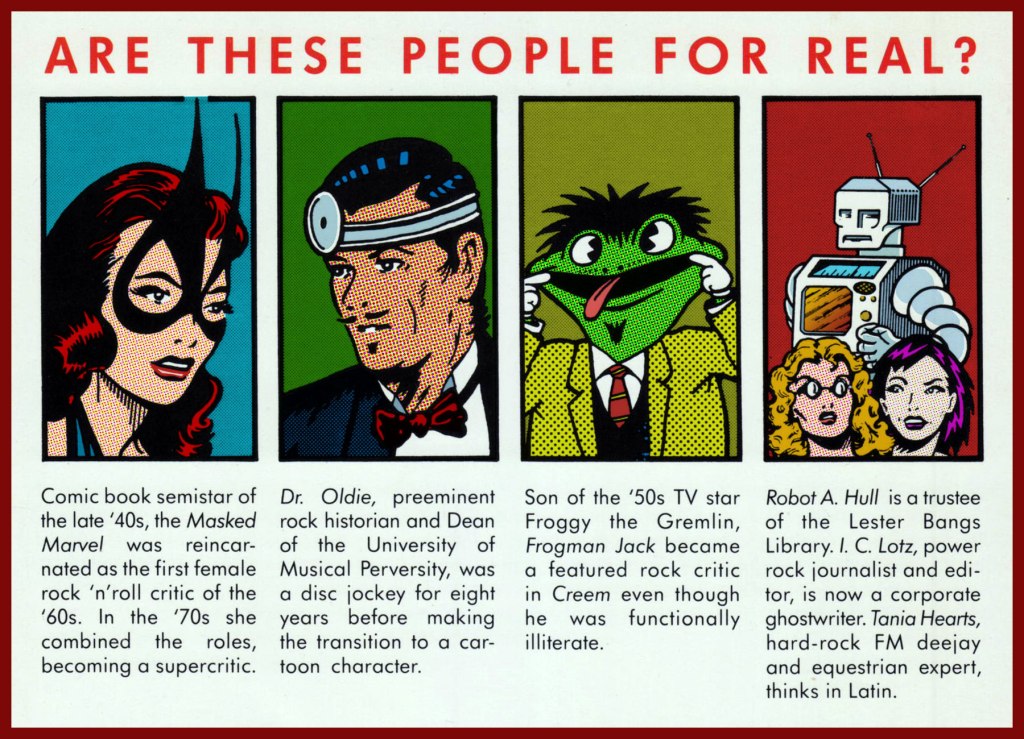
Ah, but she wasn’t a comic book semistar of the *late* 40s… she arrived on the scene in 1941, four months before Wonder Woman, even! Who dat? Why, The Masked Marvel is none other than Golden Age heroine The Black Cat, whose repurposing surely constitutes The Mad Peck’s most brazen act of détournement!
This is Black Cat Comics no. 3 (Dec. 45 – Jan. 46, Harvey); cover art by the lady’s creator, Al Gabriele. ‘Action that’ll make you pop your monocle!
The Mad Peck really stood out in the landscape of rock criticism in that he wasn’t a rockist snob (“It’s not rock, therefore it’s crap!“), and that his taste was wide-ranging and often surprising, evidence of a true music lover well-versed in all its strata and permutations.
And still, these Jefferson Airplane alumni had yet to hit bottom (knee-deep in the hoopla, so to speak)!
The Slickee BoysManganese Android Puppies; MadnessThe Prince; Prince BusterMadness.
The EaglesHeartache Tonight; The Sugarhill GangRapper’s Delight; The EaglesThe Disco Strangler.
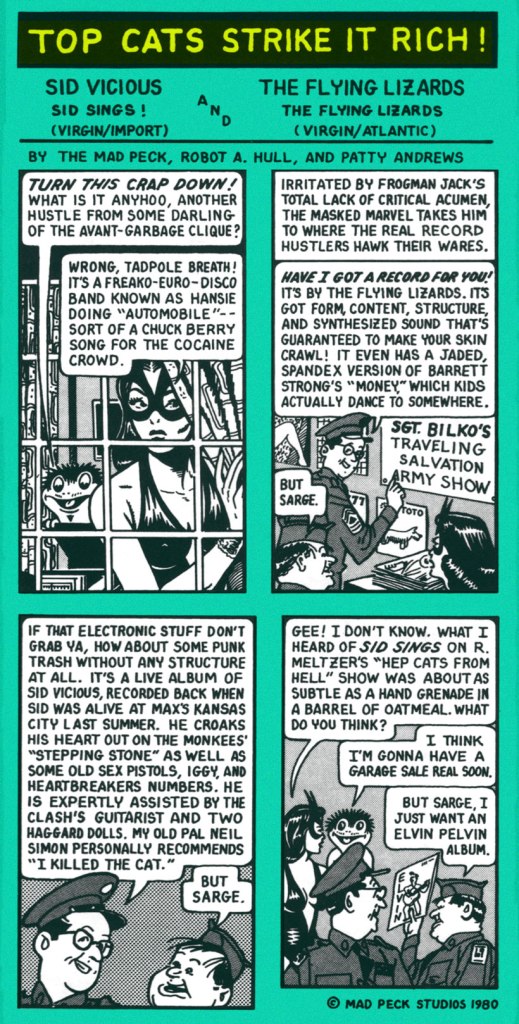
HansiAutomobile; The Flying LizardsMoney; Sid Vicious(I’m not Your) Stepping Stone.
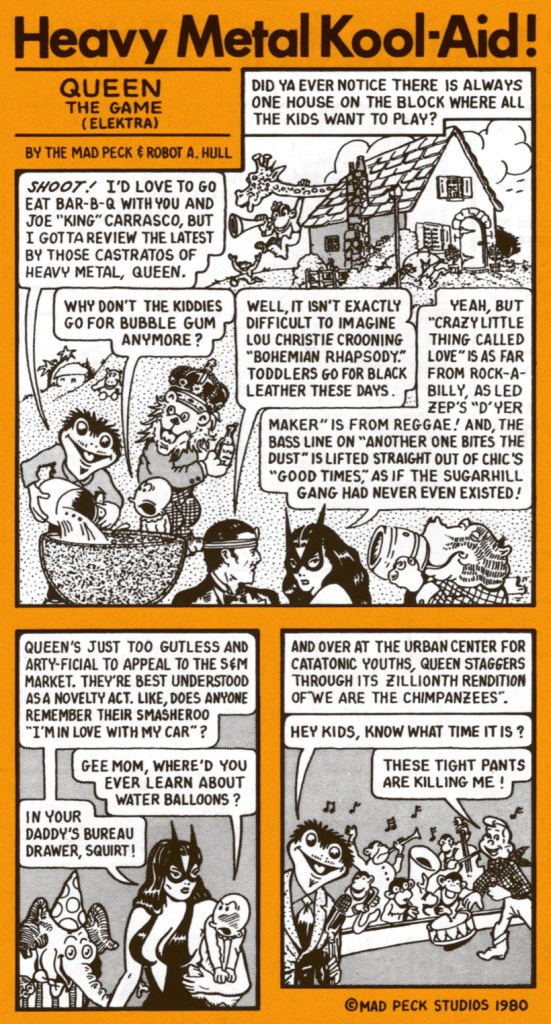
Joe “King” CarrascoParty Weekend; QueenCrazy Little Thing Called Love; ChicGood Times.

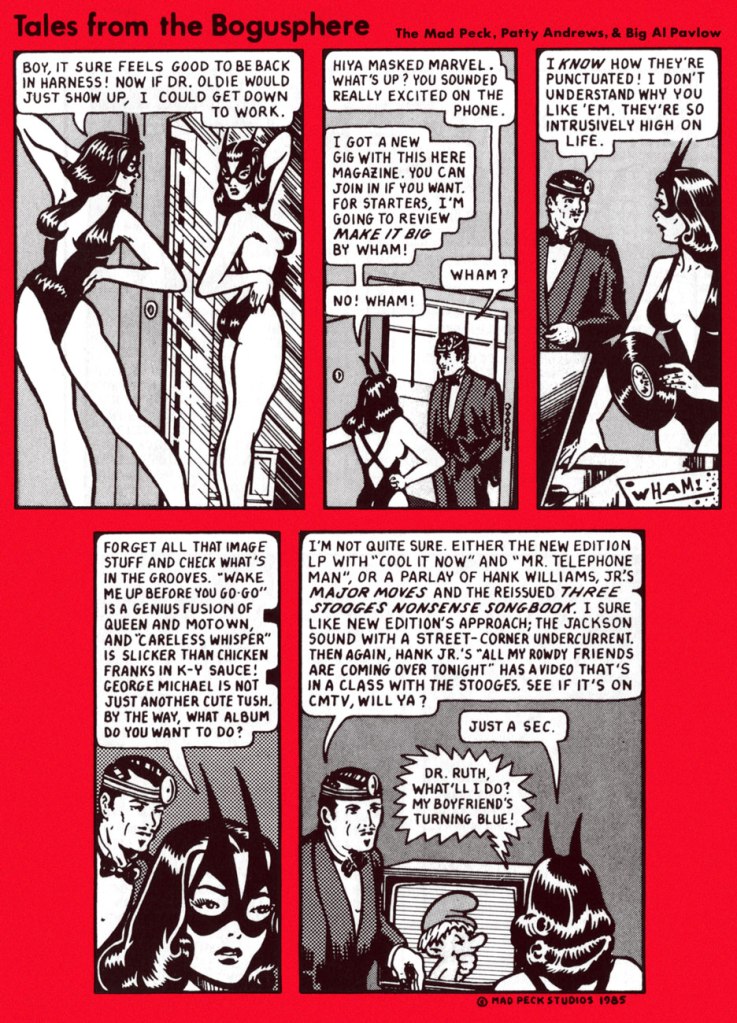
Then ahead to the mid-80s and Bob Guccione Jr.’s Spin (est. 1985), and a short run with a new title, Tales From the Bogusphere. Meanwhile, The Masked Marvel had been sidelined by legal hassles. As the heroine recalls:

I took an extended vacation in 1980 when Marvel Comics threatened to sue Peck after reading ‘Ms. Marvel’ in the Eagles cartoon that led off Creem’s review section in February. I hightailed it before the corporation had me roped into a team-up book with She-Hulk, but Peck had to stick it out while they tried to stick it to him. What really teed me off was that Ms. Marvel, who had oozed out of Marvel’s bullpen in the early ’70s, was such a dynamic concept that her book died almost instantly.

Words to live and listen by: « Forget all that image stuff and check what’s in the grooves » WhamWake Me Up Before You Go-Go; New EditionCool It Now; Hank Williams Jr.All My Rowdy Friends Are Coming Over Tonight.

Peck’s experience as a critic left him with an encyclopedic knowledge of doo-wop and early R&B. When financing from rock publications got thin, Peck practiced the art of rock ‘n’ roll arbitrage: buying records at flea markets and “backwater Woolworths” and trading them at statewide record collectors’ conventions that he organized himself.

Peck spun his best finds on his popular WBRU radio show, “Dr. Oldie’s University of Musical Perversity.” Wary of semi-fame, Peck still makes an occasional public appearances in disguise as Dr. Oldie, complete with lab coat and head mirror. [ source ]

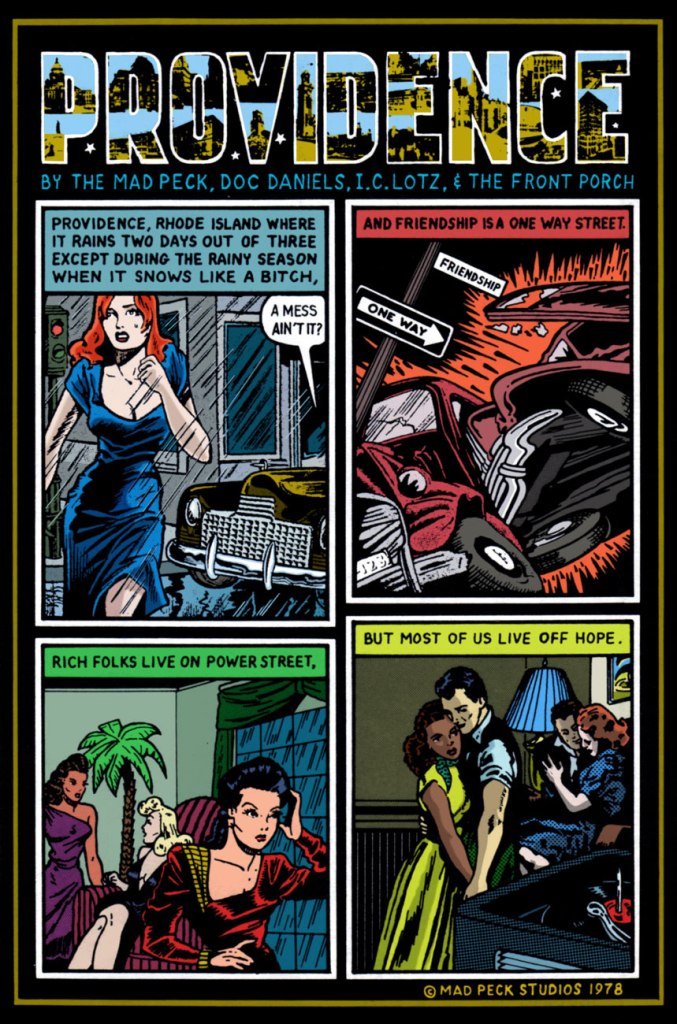
As a bonus, here’s The Mad Peck’s greatest commercial success, a piece first commissioned by Providence’s The Humbox Press for the inaugural issue of its poetry journal Loose Art. A fluke hit, it spawned postcards and posters “and is still keeping the Mad Peck in Camels.”

« In 1978, Peck designed the famous Providence Poster, a composite of witty one-liners that he and Daniels had uttered over the years about their beloved city. » I must confess I could not resist the urge to recolour it.

Channeling a credo he gleaned from a chance encounter with comic book artist Wally Wood — “Don’t draw what you can trace, and don’t trace what you can paste” — Peck made his name as a comic book artist despite an inability to draw anything more complex than psychedelic hand lettering. Most of his characters are swiped from the works of an obscure Golden Age comic artist, Matt Baker.

I can buy that most of his characters were swiped from Baker (hello there, Canteen Kate!), but he also begs, steals and borrows from, namely… Al Feldstein, George Carlson, Phil Davis, Jim Davis (no relation to Phil, and not the Garfield guy either), Bob Oksner, Don Flowers, and a gazillion anonymous advertising and animation toilers. And it works!

As a trailblazer of this particular approach, you might say he was Yesterday’s Tom Tomorrow.

-RG

Tentacle Tuesday: The Menace of the Mechanical Octopus

« The tentacles of  my followers shall seek you out and destroy your swiftly! »

If you like joyous nonsense, this post is for you! As if humanity wasn’t besieged enough by actual cephalopods, evil-but-brilliant minds insist on creating machines with tentacles to horrify and maim. Pain to some, amusement for us!

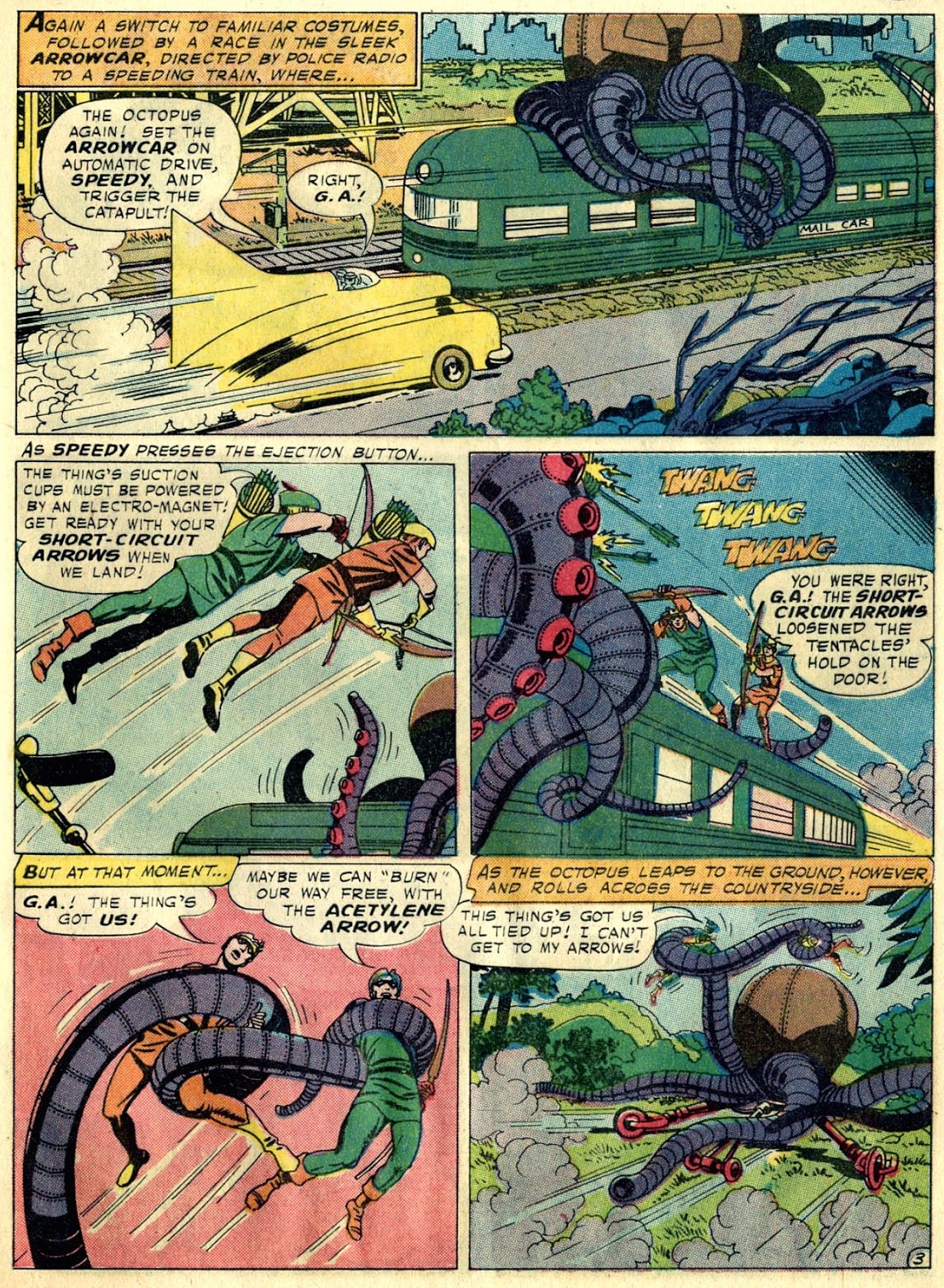
First, some definite eye candy. The following story is not only convincingly illustrated, but also makes some sense on a scientific basis. The Menace of the Mechanical Octopus was scripted by Ed Herron, and pencilled and inked by Jack Kirby. It was published in Word’s Finest Comics no. 97 (October 1958).

World'sFinestComics97-JackKirby-TheMenaceoftheMechanicalOctopus

World'sFinestComics97-JackKirby-TheMenaceoftheMechanicalOctopus2

World'sFinestComics97-JackKirby-TheMenaceoftheMechanicalOctopus3

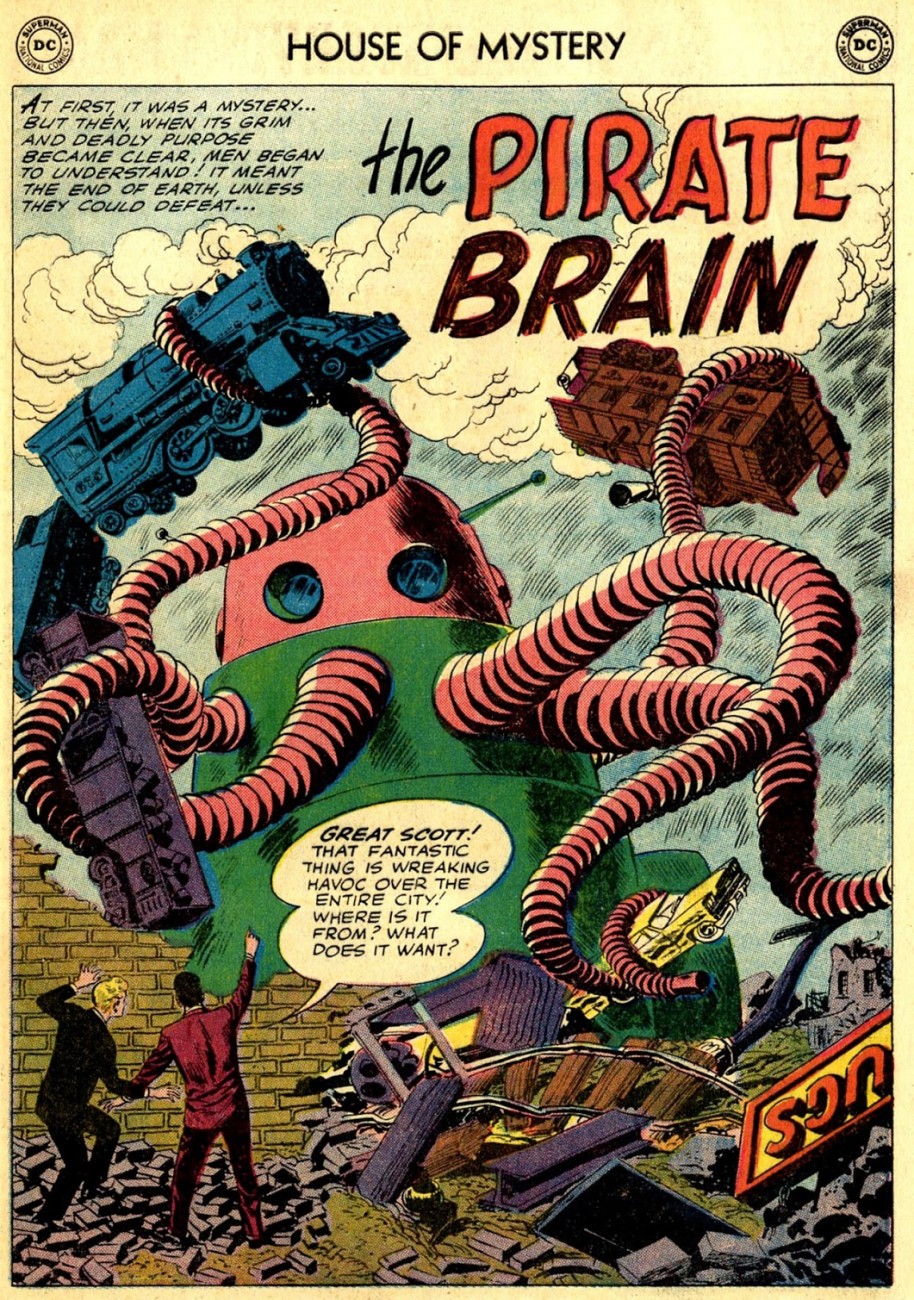
Now we move on to that goofy-yet-fun series, DC’s House of Mystery.  I will readily admit that I’m not always a fan. At worst, some of the stories published within its pages have plots so random that amusement becomes irritated incredulity. But keep an open mind, and there are also very creative (sometimes “were these people on drugs?” creative) plots to be enjoyed and great art to be relished.

House-of-mystery-96
House of Mystery no. 96 (March 1960), cover is pencilled by Dick Dillin and inked by Sheldon Moldoff.

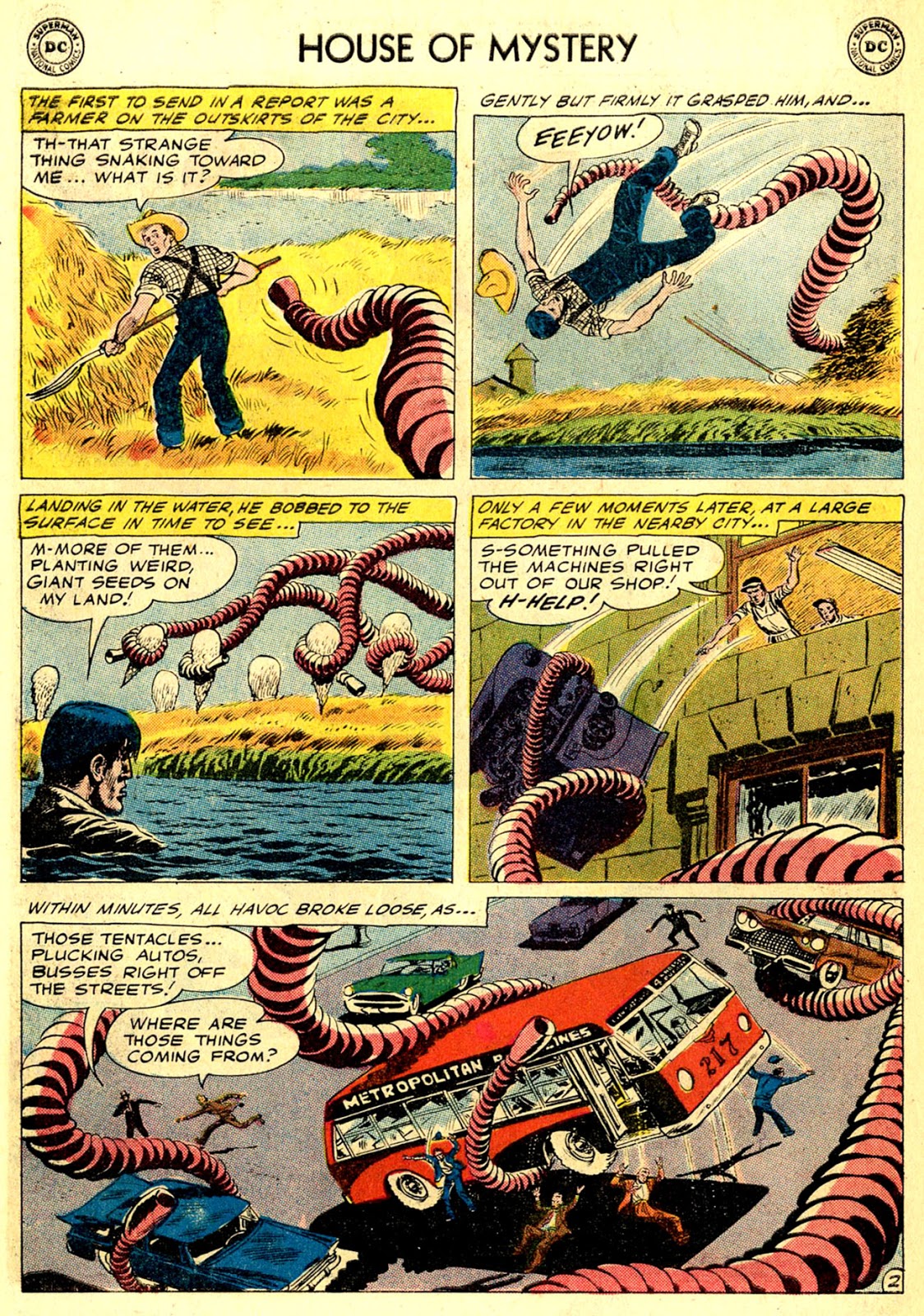
The cover story, The Pirate Brain, was illustrated by Lee Elias:

House-of-mystery-96-thepiratebrain

House-of-mystery-96-thepiratebrain-2
The ‘weird, giant seeds’ look remarkably like ice cream cones.

House-of-mystery-96-thepiratebrain-3

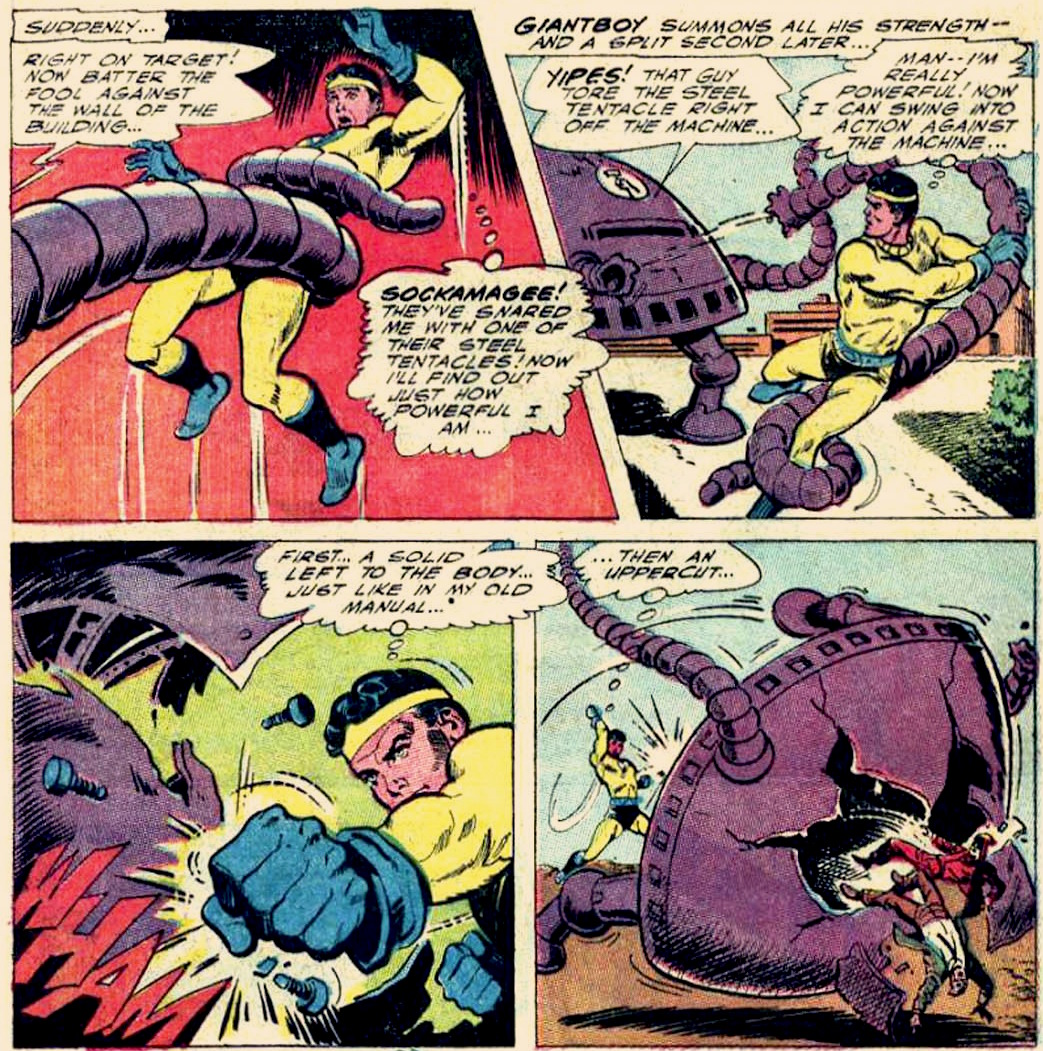
Our next stop concerns Robby Reed, the original owner of the Dial H for Hero gizmo, and his epic (of course) battle with… well, a whole bunch of villains. House of Mystery no. 156 (January 1966) is where he made his début, transforming into the Cometeer, Giantboy and the Mole. So many adventures, all in one (half) issue! This story was scripted by Dan Wood and illustrated by Jim Mooney:

House-of-mystery-156-Giantboy-comeeter-andthe-mole

HouseofMystery156-Giantboy-comeeter-andthemole2

From Giantboy we move on to Colossal Boy, more precisely to Colossal Boy’s One-Man War, scripted by Jerry Siegel, pencilled by Curt Swan, and inked by Sheldon Moldoff. It was published in Adventure Comics no. 341 (February 1966).

Adventures_341-theWeirdoLegionnaire

Adventures_341-theWeirdoLegionnaire2
A story in which everybody talks way too much, and only in clichés.

Skipping ten years ahead, we end up in Marvel territory –

Amazing_Adventures_31-Killraven
Amazing Adventures no. 31 (July 1975). The cover is by Philip Craig Russell with modifications by John Romita; lettering by Gaspar Saladino.

The cover story, The Day the Monuments Shattered, is scripted by Don McGregor and illustrated by Russell:

Amazing_Adventures_31-TheDaytheMonumentsShattered-CraigRussell
Not Russell’s best work, I think we can safely say.

As a final note, here are some indubitably mechanical, yet not-quite-tentacles – a worthy addition to this post, as far as I’m concerned.

Challengers11A
Challengers of the Unknown no. 11 (Dec 1959 – Jan 1960). Cover by Bob Brown, with colours and grey tones by Jack Adler. I love the perturbed flying dinosaur, whose hooves suggest that he has some cow ancestors.

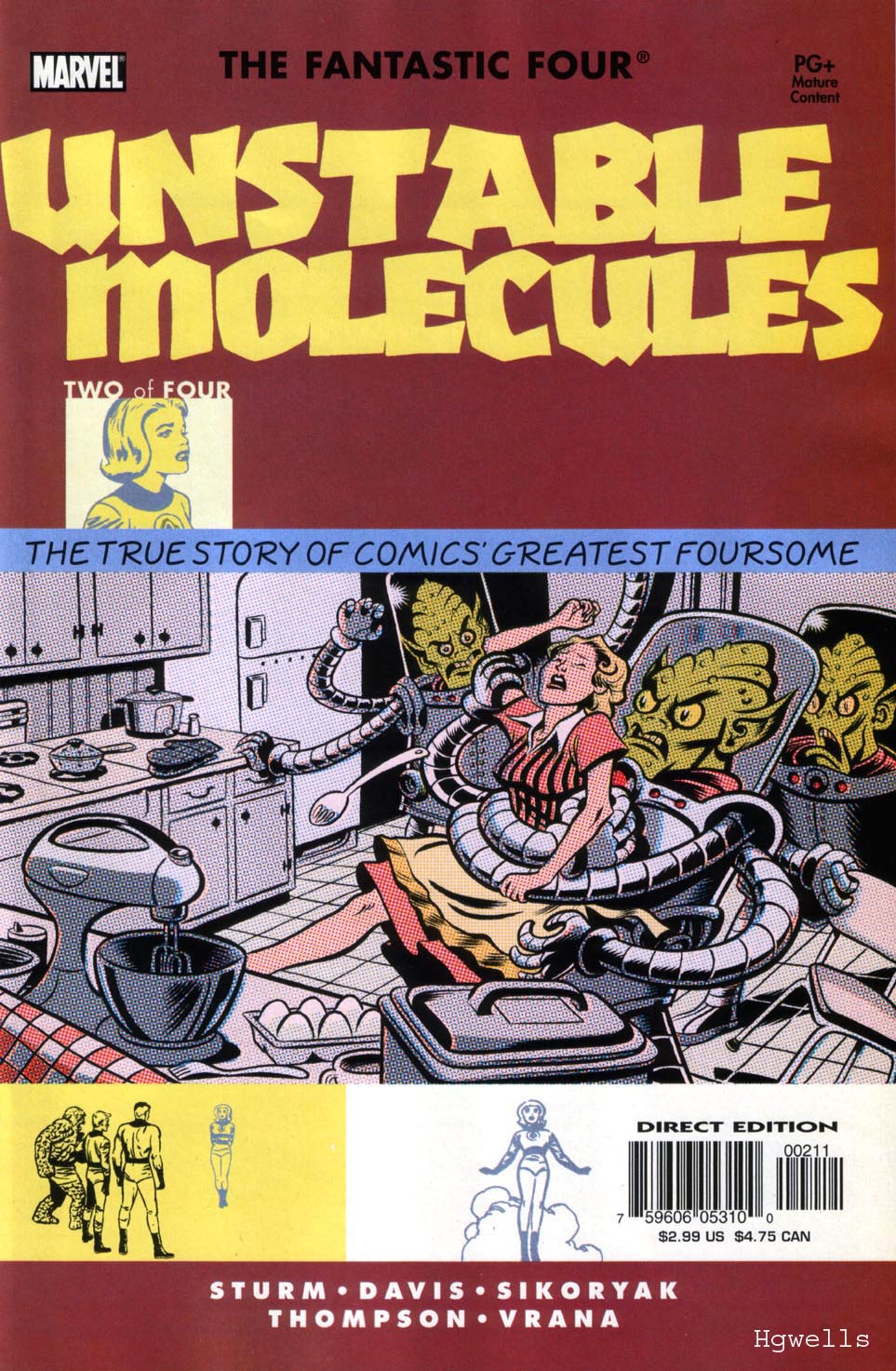
FantasticFour-Unstable_Molecules2
Startling Stories: Fantastic Four – Unstable Molecules no. 2 (April 2003). The cover is by Craig Thompson.

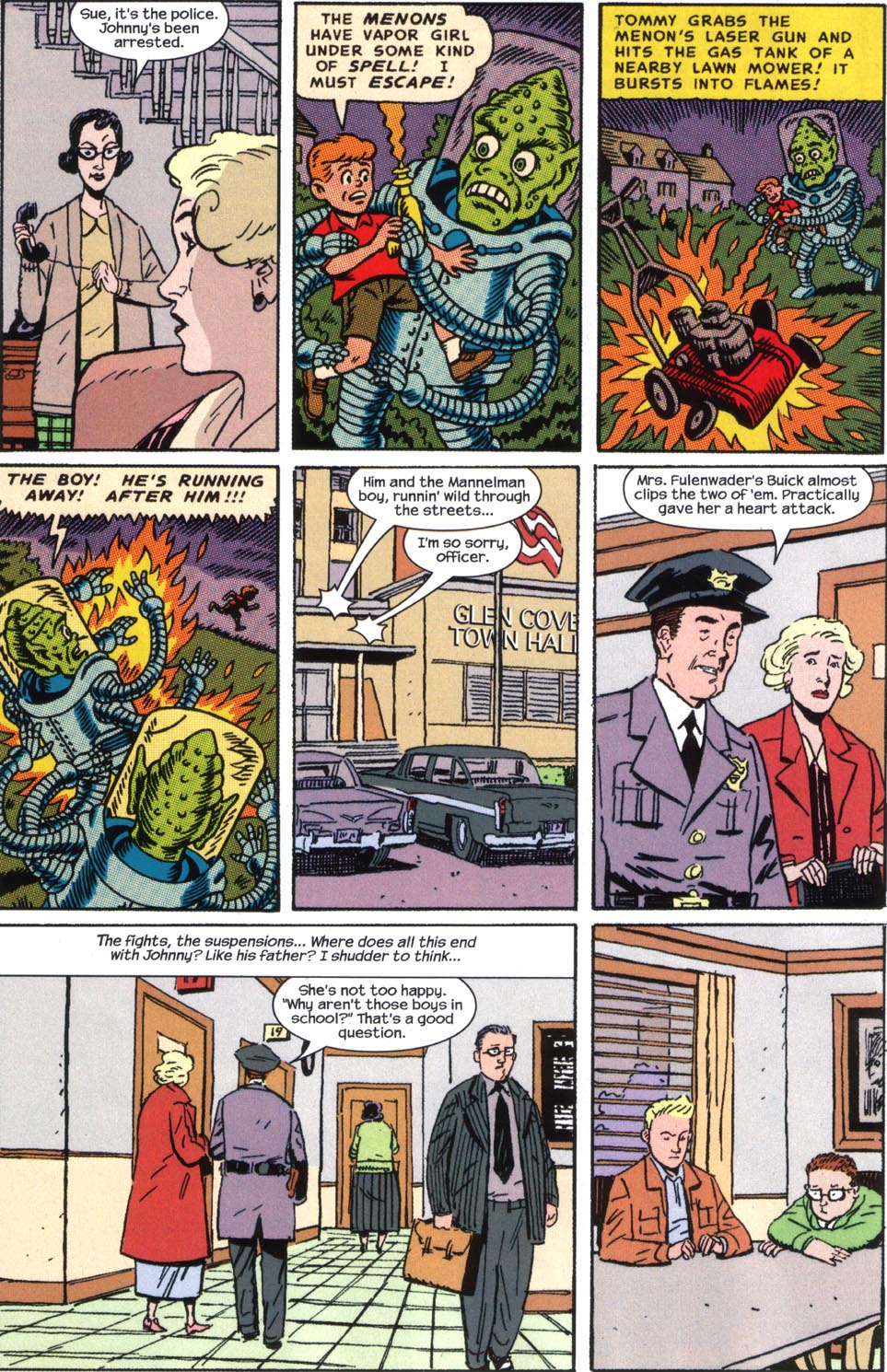
FantasticFour-Unstable_Molecules2-2
Disappearing Acts is scripted by James Sturm and illustrated by Guy Davis with assistance from James Sturm. The Vapor Girl insertions (imaginary alien escapades) are by Robert Sikoryak.

If you liked this post, don’t forget to visit Tentacle Tuesday: Mechanical Tentacles, too!

≈ ds

Maurice Henry: Make Way for Surrealism

« The man who cannot visualize a horse galloping on a tomato is an idiot. » ― André Breton

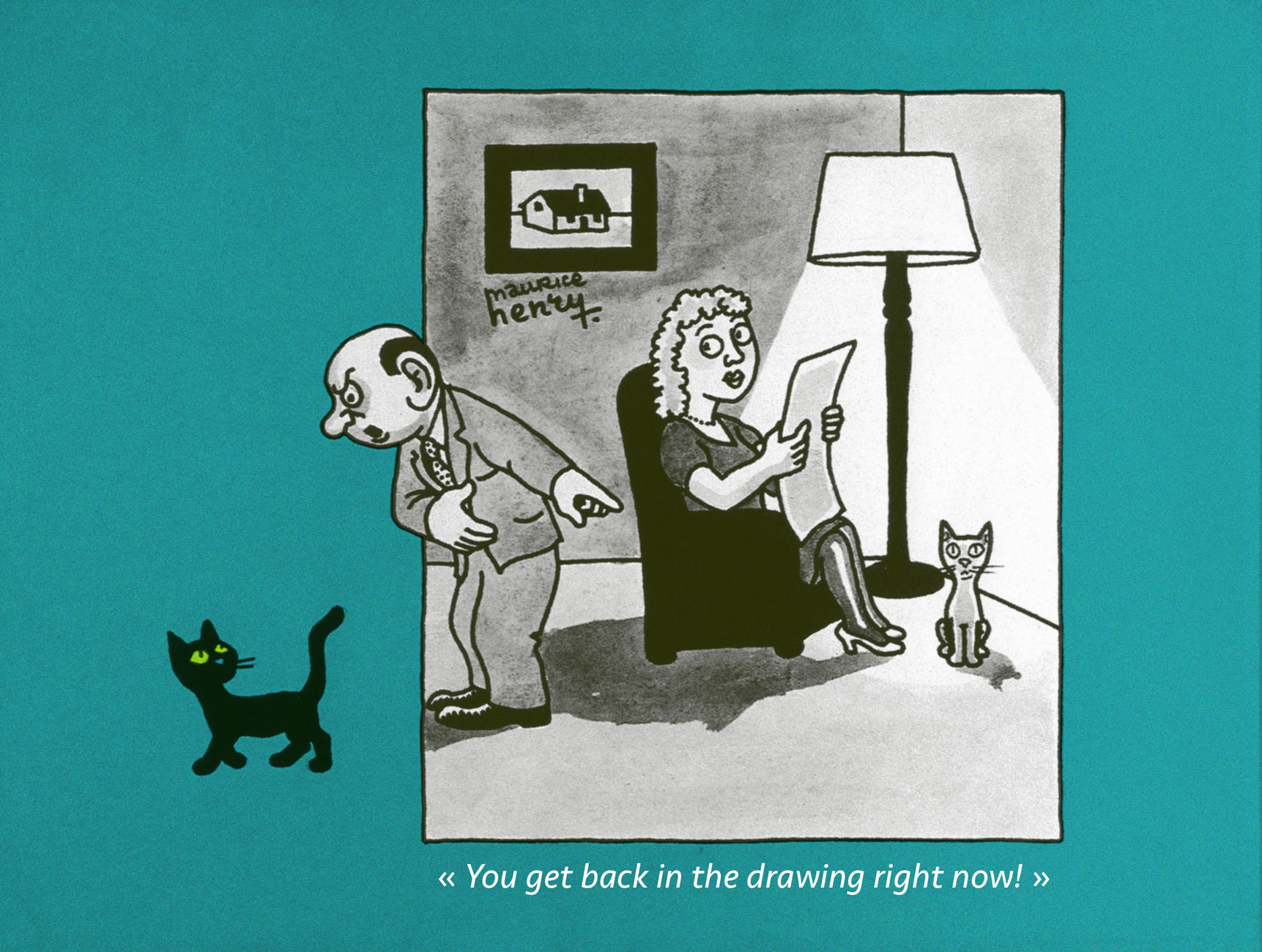
What is one to do, in a mere blog post, with a polymorphous artist such as Maurice Henry (1907-1984)?

Here’s a handy bit of compressed biography, from his Lambiek page:

Henry was a French painter, poet, filmmaker, as well as a cartoonist. Between 1930 until his death, he published over 25,000 cartoons in 150 newspapers and a dozen books. His cartoons were generally surrealistic and satirical.

In 1926, he co-founded the magazine Le Grand Jeu with René Daumal, Roger Gilbert-Lecomte and Roger Vaillard, with whom he formed the “Phrères simplistes” collective. Henry provided poems, texts and drawings, while also making his debut as a journalist in Le Petit Journal.

He left Le Grand Jeu in 1933 to join André Breton’s group of Surrealists and their magazine Surréalisme au service de la Révolution. He also worked with the artist and photographer Artür Harfaux on the screenplay of twenty films, including ones starring the comic characters ‘Les Pieds Nickelés’ and ‘Bibi Fricotin’. Maurice Henry spent the final years of his life making paintings, sculptures and collages. He passed away in Milan, Lombardy, in 1984.

The answer? My default solution, which is to focus on some small parcel of the much greater whole. A number of Henry’s works bear revisiting (for instance, Les métamorphoses du vide [1955], a truly groundbreaking picture book about the world of dreams; À bout portant [1958], a collection of literary portraits; or Les 32 positions de l’androgyne [1961, also issued in the US in 1963], a chapbook of… gender recombinations) and deserve a turn in the spotlight.

To quote co-anthologists Jacques Sternberg and/or Michael Caen in their indispensable Les chefs-d’oeuvre du dessin d’humour (1968, Éditions Planète, Louis Pauwels, director):

Surrealism — he was part of the group before 1930 — left its mark on him and it’s because he was already well-cultured as he launched his career that he was among the first, in the desert that was the publishing world of the 1930s, to attempt unusual drawings calling upon often startling ingredients, such as poetry, black humour, the fantastic and the absurd. He caused no less of a surprise by doing away with captions, at a time when bawdy jabbering was the fashion all over. In short, Maurice Henry was indisputably a pioneer of that grey and stinging brand of humour that would explode like an H-bomb some fifteen years later.

HenriEscapeeA
A lovely bit of conceptual humour from 1938. A rare one bearing a caption, but the joke called for it. At this early stage, you won’t be wrong to point out a certain stylistic debt (it’s the roundness and simplicity of line!) to his contemporary and compatriot Jean Effel. Henry was indeed a fan. Do check out my co-admin ds’ fine post spotlighting the good Monsieur Effel.

HenryMinotoréadorA
An example of what enlightened creators such as Henry were fighting for: making room for cartoons that weren’t just about the cheap chuckles. Consider, for instance, the existential plight of the Minotoreador . Published in K. Revue de la poésie no. 3 (“De l’humour à la terreur”, May 1949).

HenriGendarmeA
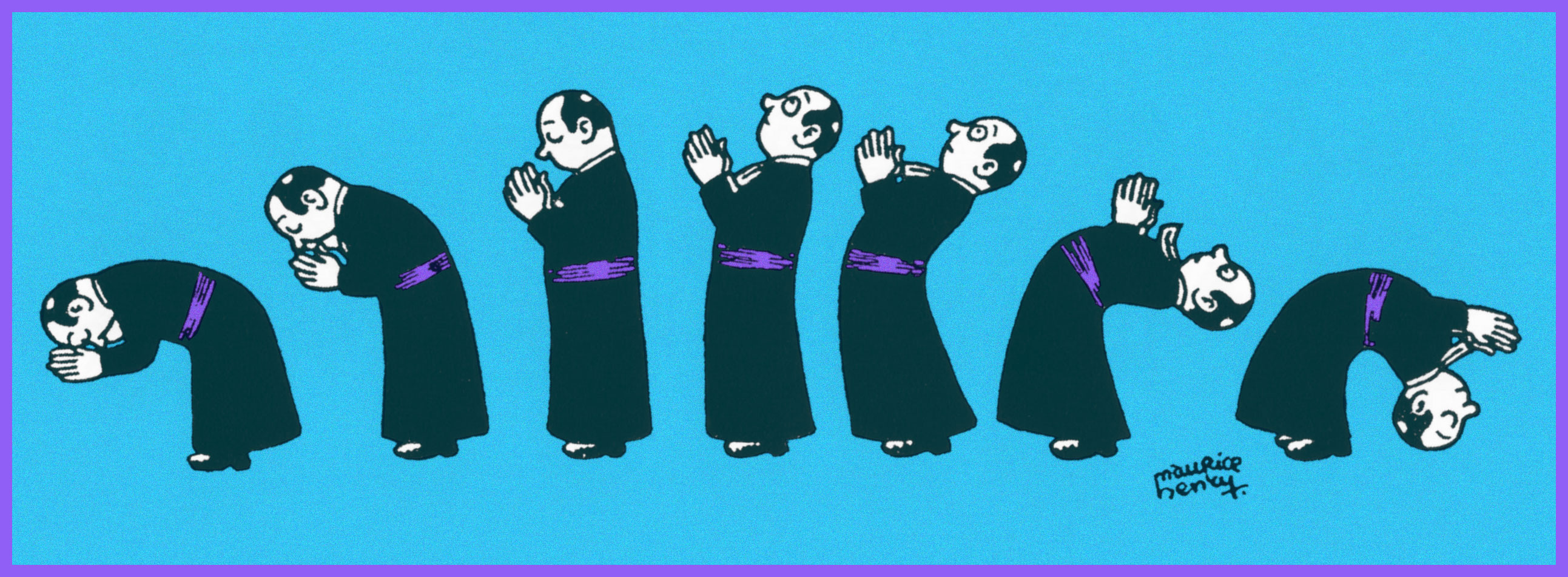
The Military, Government, Constabulary and Clergy were favourite targets, naturally. When it was (barely) tolerated. It helped to be ambiguous, even if one wasn’t ambivalent (1951).

HenryPrieurA
Here’s one for the clergy; though mocking, it’s hardly what you’d call hostile. From the first issue of epochal surrealist magazine Bizarre (1955-1968).

HenriCèneA
Yes, it’s Card Sharp Jesus entertaining, confounding (and possibly fleecing) his disciples. Note the ace up his right sleeve (1941).

HenriSkiNautiqueA
Walking on water was clearly just the beginning (1948).

HenriJesusMuscleA
Henry’s Jesus seems like a swell fellow, really. A bit on the roguish side, which is fine by me (1958).

Easter'sCancelledDarkness
See? A case of a joke’s that’s more than a half-century old still finding echoes in the present day. Cover from The Darkness‘ prophetic 2019 album, Easter Is Cancelled.

HenryCanons02A
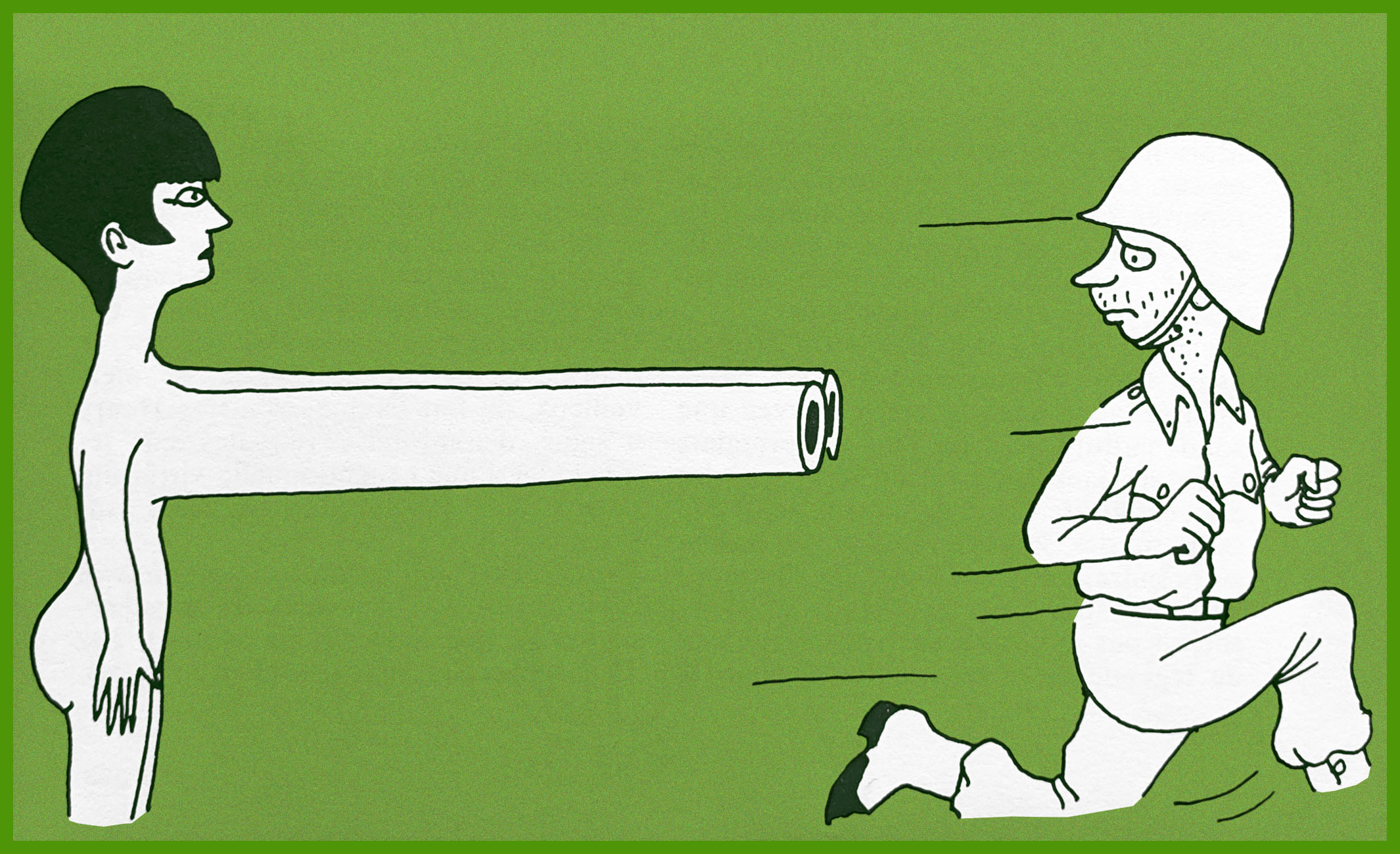
That soldier’s scared yet dismayed expression brings to mind Futurama’s hapless Philip J. Fry.

HenryCanons01A
That’s one relaxed elephant.

HenryPoursuiteA
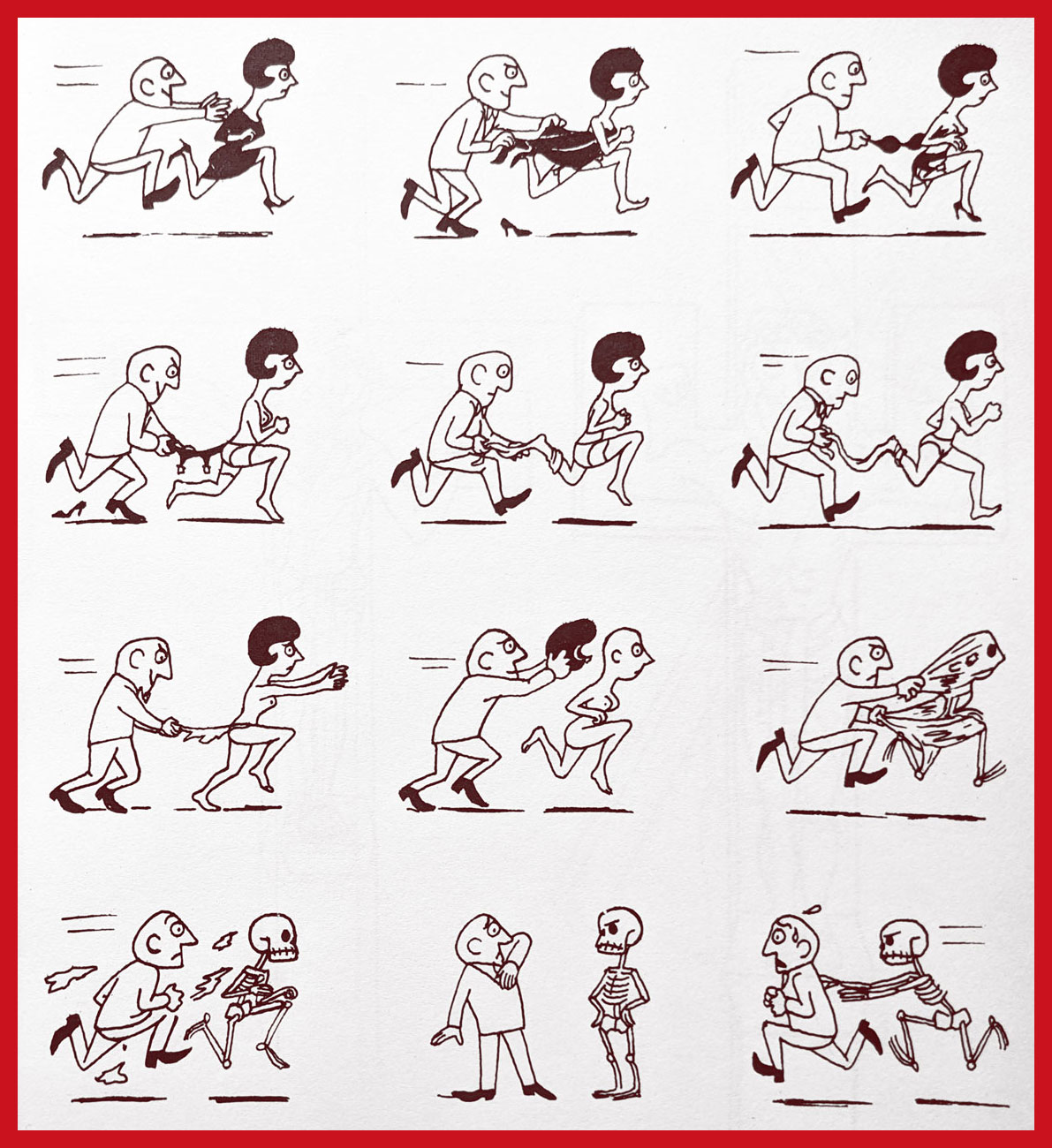
Another illusion shattered.

HenryVoitureA

HenryAutophageA
The little hand wave at the end really makes this one.

MauriceHenryLoupeA
The artist in 1935, photographed by his friend and frequent co-conspirator Arthur Harfaux.

-RG