« A detective sees death in all the various forms at least five times a week. » — Salvatore Albert Lombino, aka Ed McBain, aka Evan Hunter
Spanning nearly a full century since yesterday’s instalment, we now move ahead to a recent work from my favourite European bédéiste of the past quarter-century, David Beauchard, better known as David B. (b. 1959).
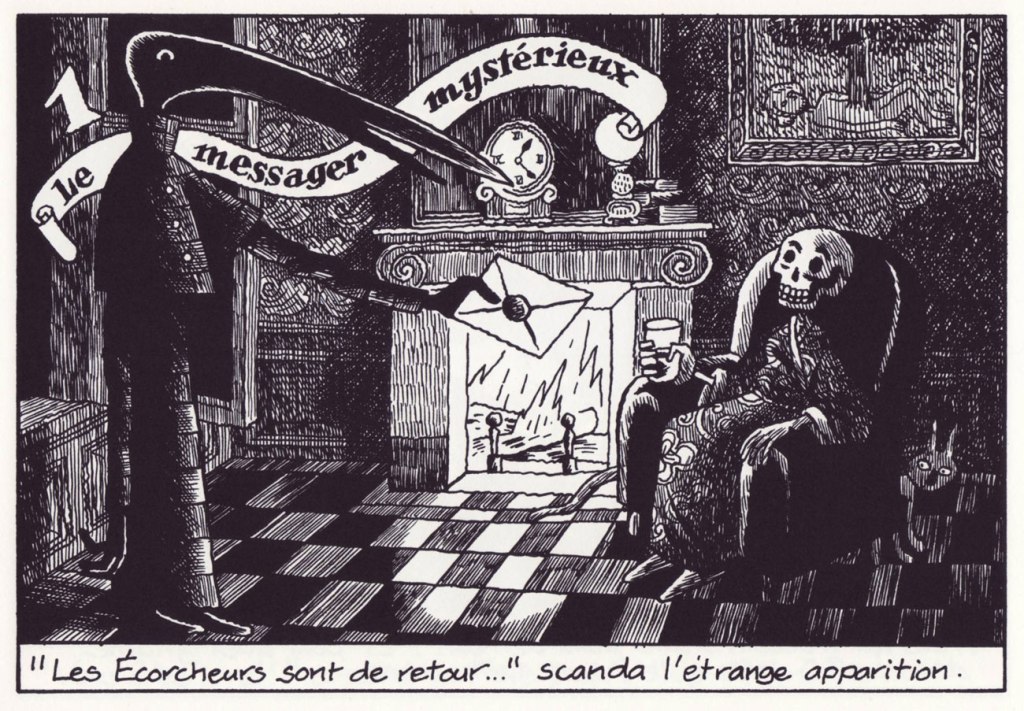
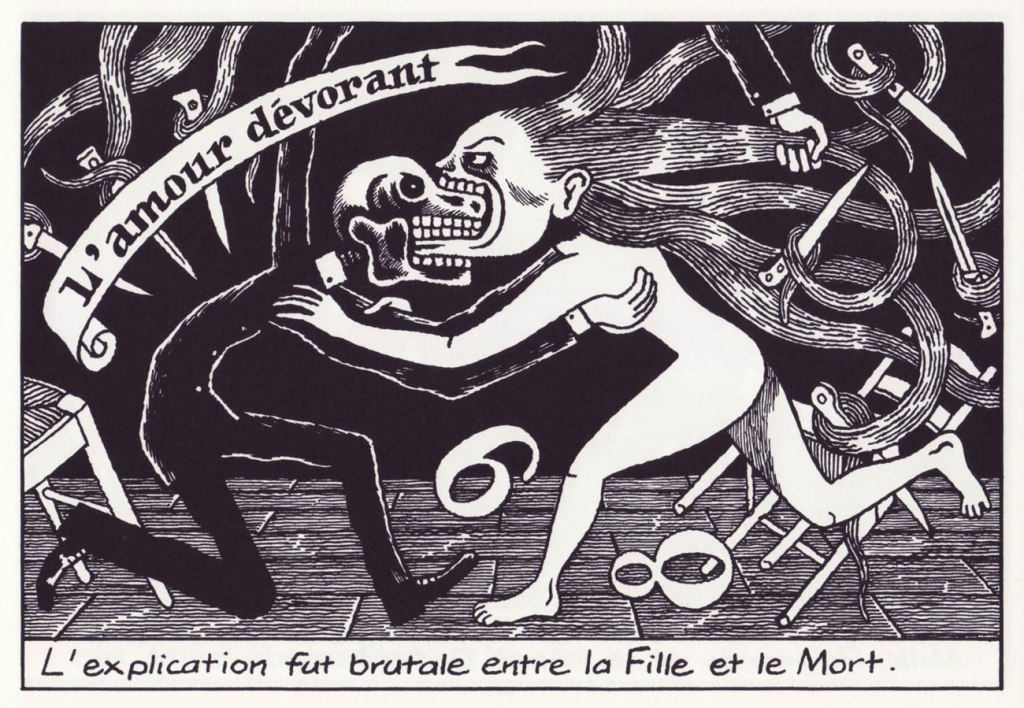
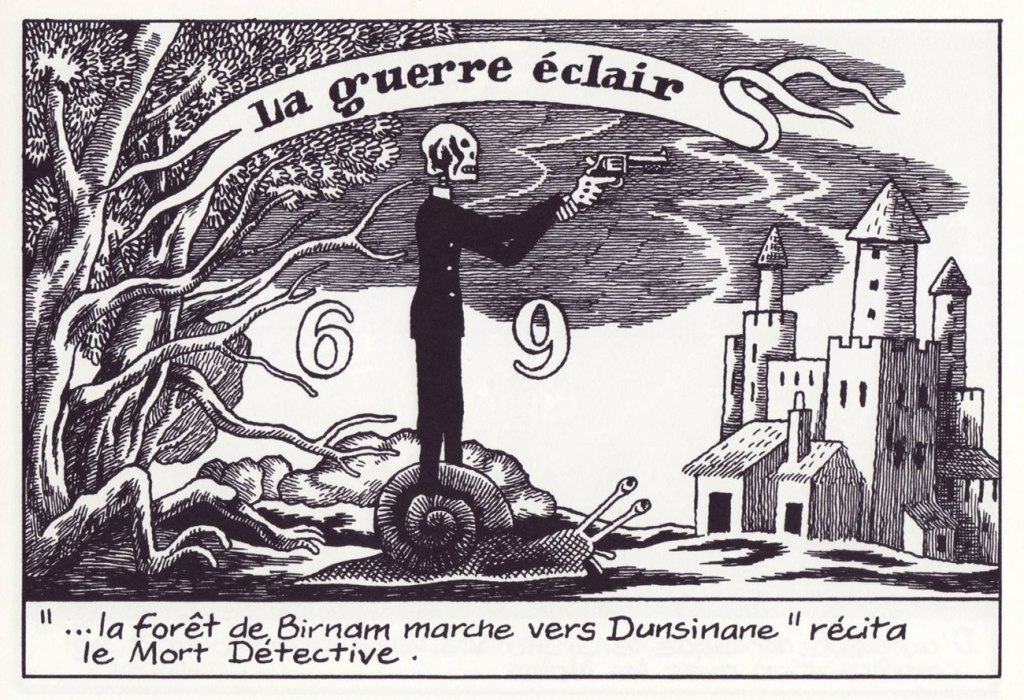
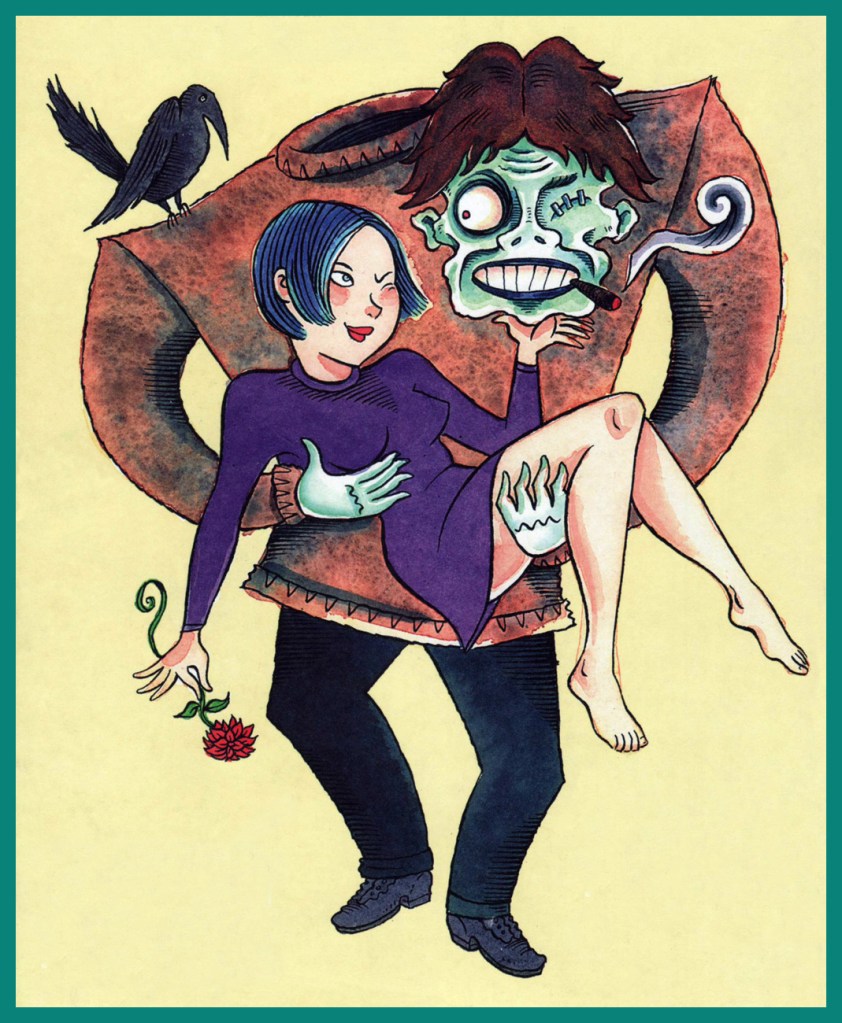
Among the traits I most admire in Monsieur Beauchard are his artistic integrity and his explorative drive. To wit, here he evokes the grimy spirit of late 19th century feuilleton serials, providing a narrative consisting of illustrated chapter headings… devoid of the main text. The reader is left to fill in the narrative gaps, enlisted in a bold compact with the artist and required to draw upon his own imagination.
A few choice excerpts (I left out the bits with tentacles… it’s not my department, after all!):
Le mort détective was issued just last year (yes, roughly an eternity ago) by rightly-celebrated French publisher L’Association.
So it begins… with the title page, naturally.
1 – The mysterious messenger: “The Flayers have returned…‘ chanted the strange apparition”.
2 – The skinned dwarf: “But who needs a dwarf’s skin… and to what ignoble purpose?“, panted the Dead Detective…
6 – The dwarf-skin coat: “The Great Old Man is a priest of the Yellow Dwarf God‘, murmured the Dead Detective to the Girl of a Thousand Daggers…”
10- The macabre post: “The Bad Postman distributes mysterious mailings.”
11- The word from the Hereafter: “The severed head exhaled a terrifying prophecy.”
22- The mass grave: “The Girl of a Thousand Daggers has sent a bouquet.“, he said in a dying voice.
41 – “The altar of fear: “Let’s flee!‘, exclaimed the Girl of a Thousand Daggers.”
68 – “The Devouring Love: Explanations were brutal between the Girl and the Dead One.”
69 – “The Flash War: … ‘Birnam Forest walks towards Dunsinane‘, recited the Dead Detective.”
« I have stuck to my simple art style while the smart illustrative men were snapping in their shadows all around me, because I believe that my story is more clearly told with a minimum of picture distraction. » — the wise, but absurdly humble Frank King (1959)
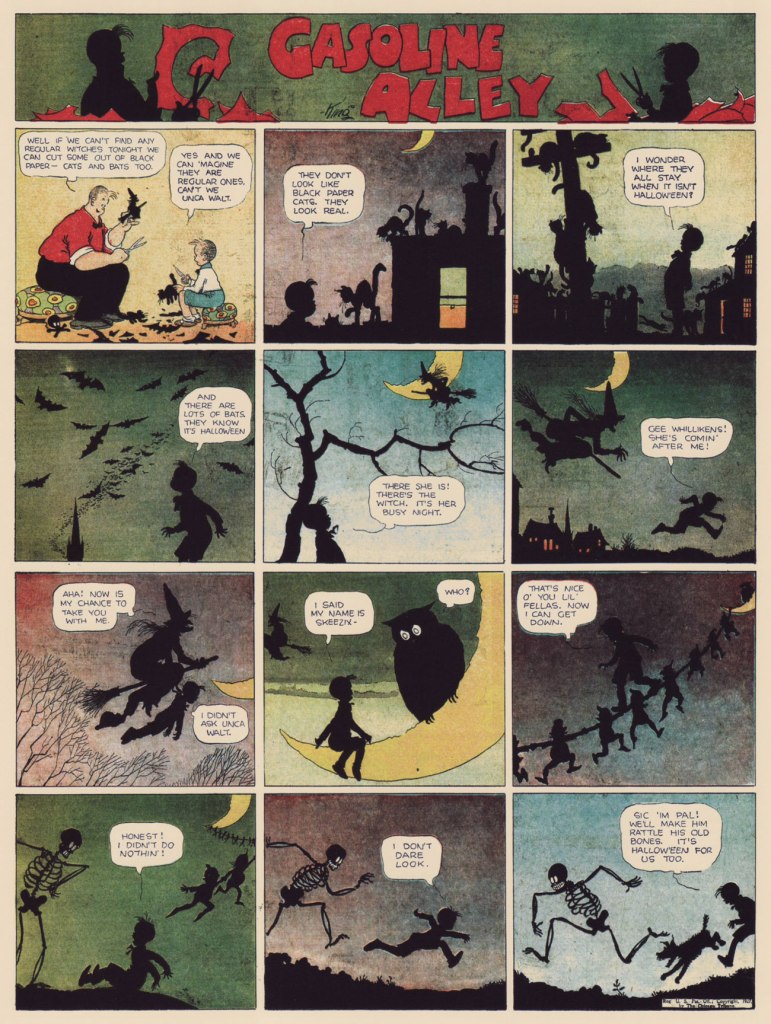
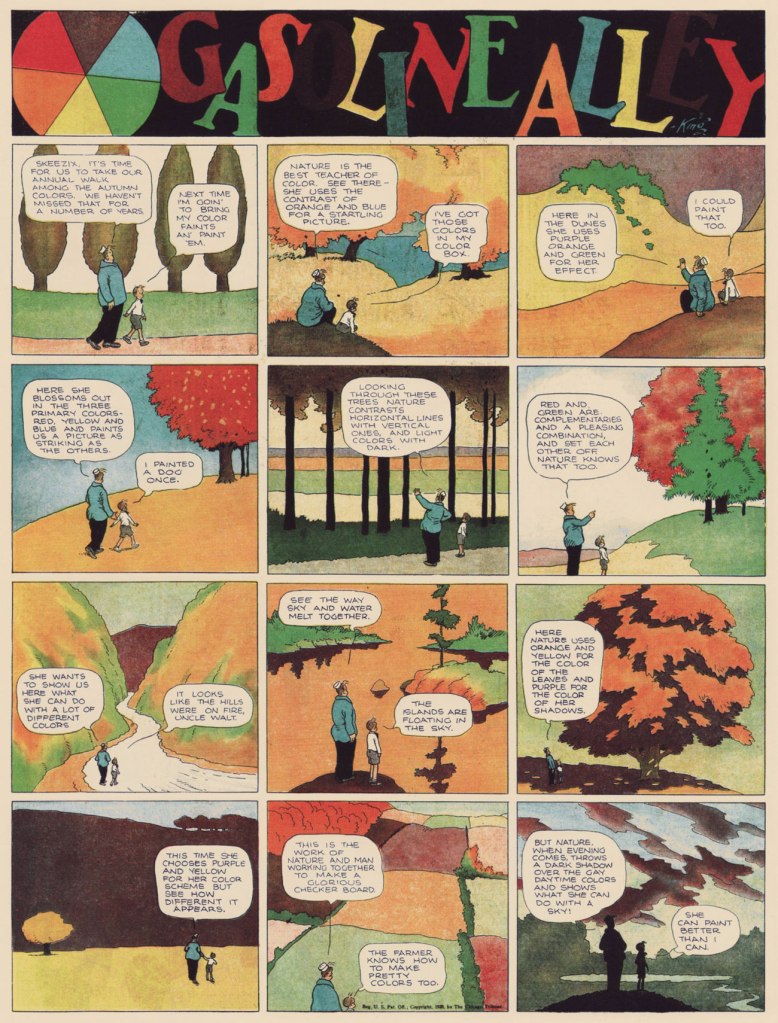
Gasoline Alley (1918-) is the second longest-running comic strip of them all. The Katzenjammer Kids (1897-2006) still tenuously clings to first place, but Gasoline Alley, boasting the advantage of still being around, should overtake it by 2027. Of course, that’s all academic and fairly irrelevant to us, because the strip’s originator, Frank Oscar King (1883-1969), is no longer guiding its destiny.
The collective memory being woefully short, if Gasoline Alley is likely to be remembered, it will be for its central innovation: characters age in real time, growing up and old and passing away, its cast and its world ever changing and evolving, in a small-town America sort of fashion. However, the strip’s original star, Walt Wallet, is still around, well into his second century.
Today, we’re digging deep, returning to those long-ago dinosaur days when newspapers were gigantic and so were the comic strips they featured, particularly on Sundays. And the Sunday Gasoline Alley was indeed something special.
I couldn’t possibly put it better than Chris Ware did in 2000, in tribute to King:
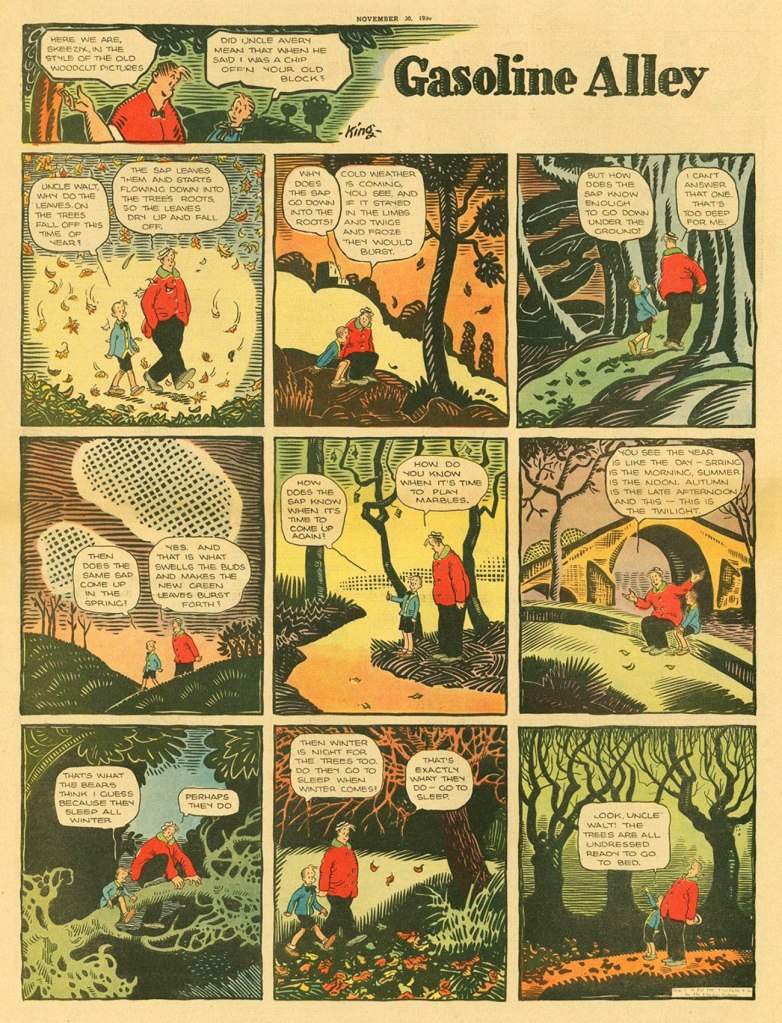
« Reserving his five daily strips for more complicated storylines, King’s full-color Sunday pages often presented Walt and Skeezix simply wandering the countryside of America, idly remarking about natural landmarks, the quality of the sky, or the colors of the seasons.
Frequently, these pages were richly-textured experiments in form and style, often having no joke or ‘punchline’ at all, only a quiet, sustained tone of serenity and gentleness. »
Halloween 1928!
Halloween 1931.
Halloween 1933.
And you know, since these are so gorgeous and just as seasonal, let’s be indulgent, broaden our scope the tiniest bit and take in some of King’s paeans to sweetest Autumn.
Autumn, 1926. Pro-squirrel, too. Good man!
Autumn, 1928.
And finally, the Autumn of 1930. Phew!
Incidentally, a lovely collection (designed by Mr. Ware!) of King’s finest Gasoline Alley Sundays from the strip’s first fifteen years was published a couple of decades ago: Sundays with Walt and Skeezix (2000, Sunday Press)… and, wonder of wonders, it’s still available from the publisher.
« Listen, youse guys — we’ve had enough of dis horsin’ around! When do we grab the dough? » — a hood craves action, from Haunted Halloween! (Flash Comics no. 78)
Superheroes, back when they weren’t all wrapped up in their grimness and grittiness, took a bit of time to properly enjoy the holidays.
This is Flash Comics no. 78 (Dec. 1946, All-American Comics), featuring Haunted Halloween!, scripted by Gardner Fox and illustrated by Everett Edward Hibbard… plus four more stories for your dime. Edited by Sheldon Mayer, with a cover by Hibbard.
And here’s All-American Comics no. 61 (Oct. 1944, All-American Comics), featuring The Green Lantern (and Doiby Dickles!) squaring off against a gruesome new foe, Solomon Grundy, in a tale entitled Fighters Never Quit!, written by none other than Alfred Bester (later the author of The Demolished Man andThe Stars My Destination) and illustrated by Paul Reinman. Edited by Sheldon Mayer, with a Reinman cover.
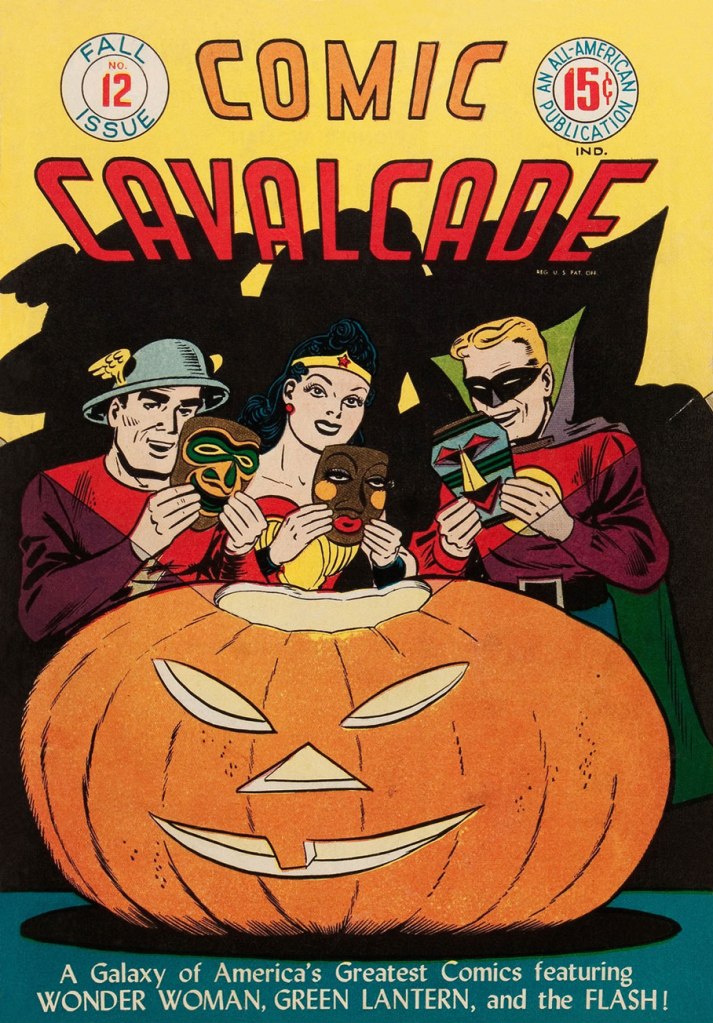
And this is Comic Cavalcade no. 12 (Fall, 1945, All-American Comics), where we catch both The Flash and Wonder Woman about to indulge in some blackface. Edited, you guessed it, by Sheldon Mayer. Cover by E. E. Hibbard (The Flash), H.G. Peter (Wonder Woman) and Martin Naydel (Green Lantern).
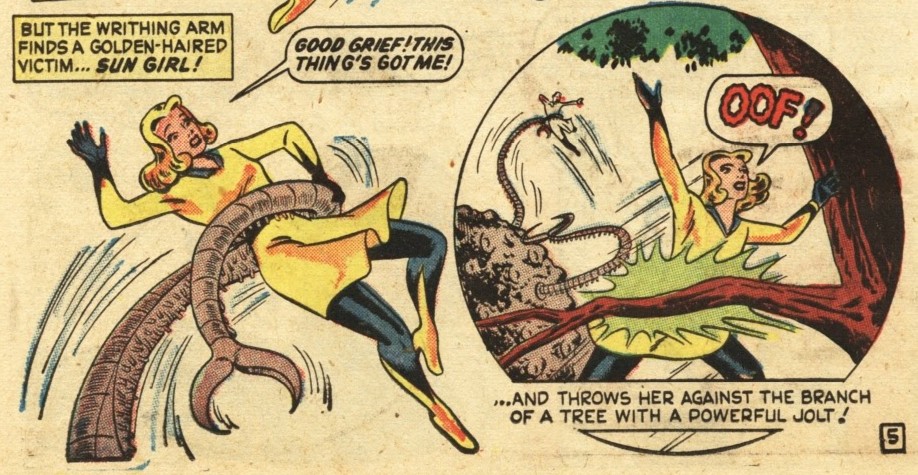
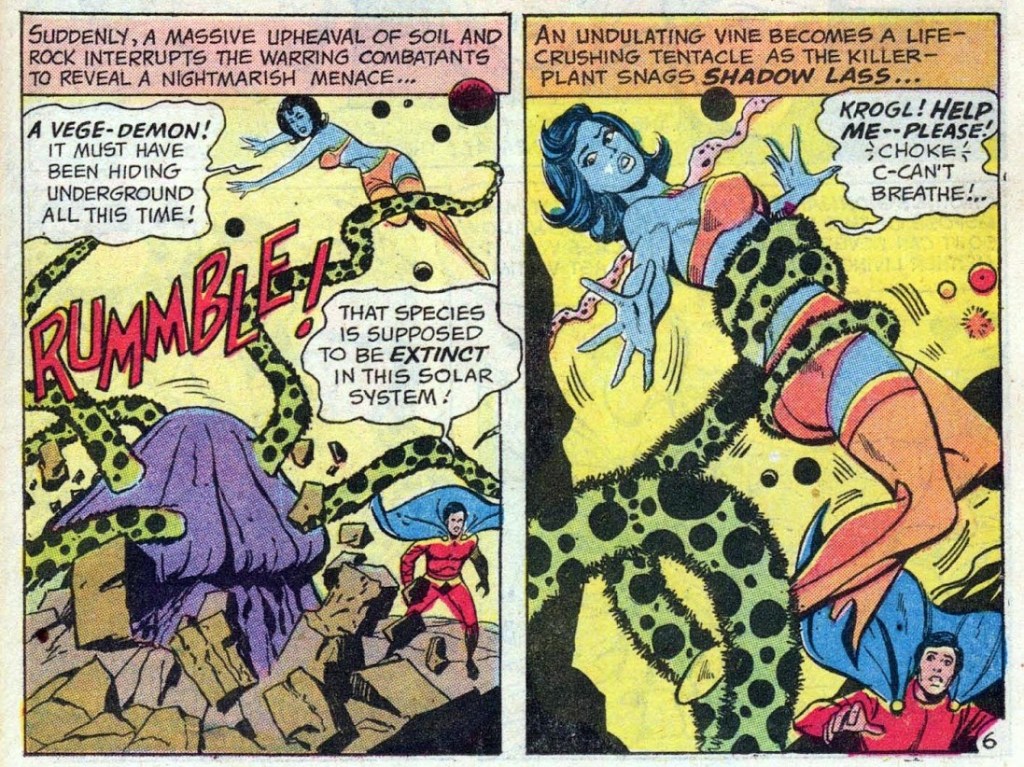
It occurs to me that I haven’t focused on the good old mademoiselle-embraced-by-tentacles cliché in a while. If today has a further theme, it’s of women (both human and alien) being grabbed by the midriff. Polka-dotted tentacles in a swamp and furry tentacles on Venus, whether they’re latching on to a humanoid woman with four breasts or a blue-skinned Talokian, all basically behave the same way.
As usual, this is a chronological progression that takes us from early Golden Age days all the way to mid flamboyant 80s.
The Robot Masters of Venus, illustrated by Max Plaisted (of Spicy Mystery fame!), was published in Exciting Comics v. 1 no. 3 (June 1940, Pines).
The Vengeance of the Space Monster!, pencilled by Ken Bald and inked by Syd Shores (both names are, however, guesses), was published in Marvel Mystery Comics no. 90 (February 1949, Atlas).
I agree that having one’s ribcage crushed does not help with breathing, but still, I am not sure why Shadow Lass is choking on the panel on the right when the vege-demon has her by the midriff.
War of the Wraith-Mates!, scripted by Cary Bates, pencilled by George Tuska and inked by Vince Colletta, was published in Superboy no. 183 (May 1972, DC).
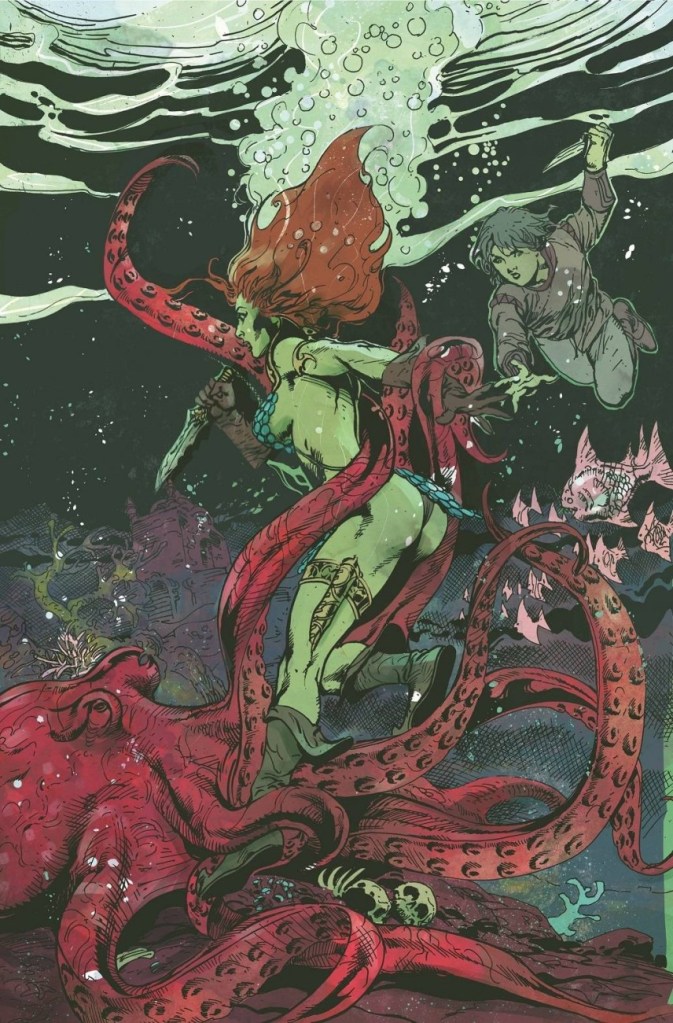
For a little variety, I’m also including the following warrior vixen as a pleasant exception to the rule – she is not only not being grabbed, but also has an octopus for an obedient pet.
Girl on Octopus by Brian Lewis, painted sometime in the mid 1970s.
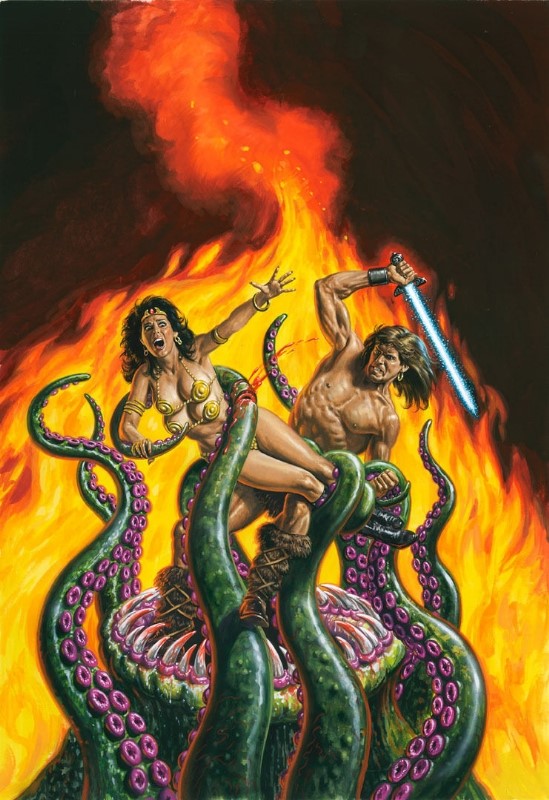
Our next stop is a proposed illustration for the 1984 movie The Warrior and the Sorceress, painted by Bob Larkin. The movie in question (which I have never seen) is apparently “noted chiefly for containing extensive nudity and violence and for being one of the more extreme examples of the sword-and-sorcery genre. It is also considered by some to be a cult classic.“
The sorceress has 4 breasts – a logistical nightmare when selecting a bikini, no doubt.
As… questionable… as this is, the illustration that was chosen in the end is in a whole other class of cheesiness. The sorceress has also died her hair blonde, presumably because she wants to have (even more) fun! We also lost the cephalopod, unfortunately, but the maxim “one can’t have everything” comes to mind – and David Carradine in a pearly loincloth is plenty.
Art by Joanne Daley, who at least makes some sort of attempt at designing a functional four-breast-bra.
After *that*, the following cover looks quite humdrum by comparison. It’s difficult to imagine how Red Sonja will extricate herself from this situation…
Red Sonja no. 5 (January 1985, Marvel). The cover is by Pat Broderick.
Incidentally, there are tons of Red Sonja cover with tentacles, mostly of recent vintage, and most of them are ugly as sin. This one is decent:
The cover art for Red Sonja no. 21 (April 2007, Dynamite). This is a variant cover by Roberto Castro.
« When the mind is thinking, it is talking to itself. » — Plato
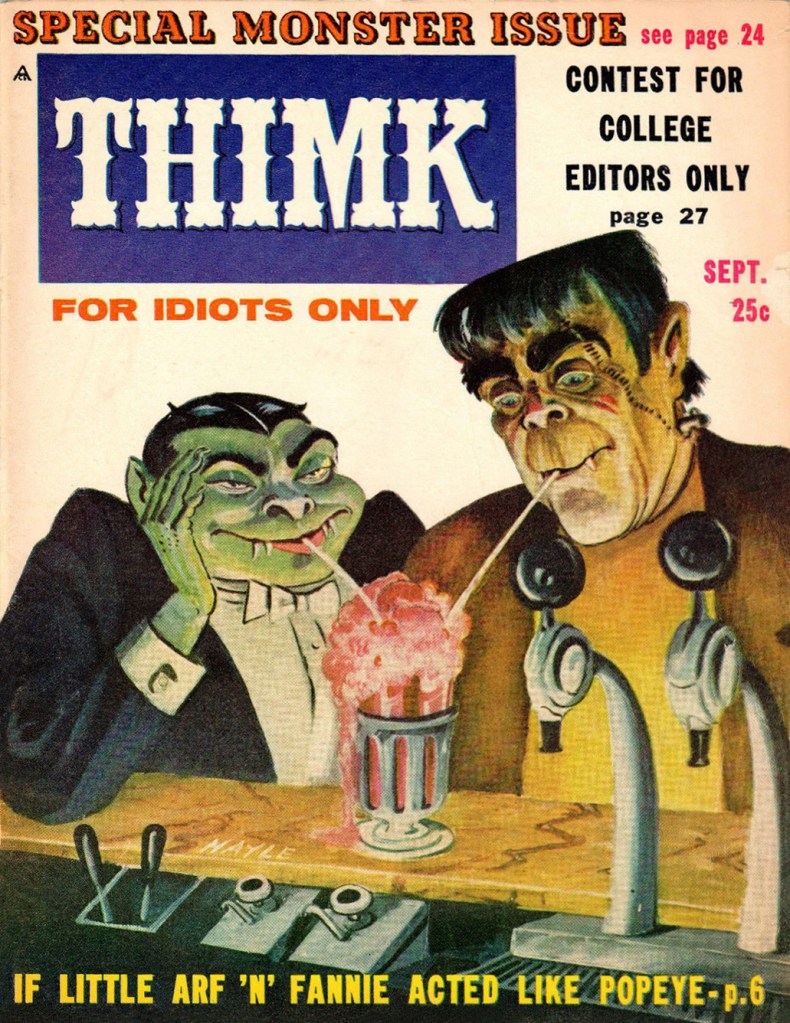
The waning years of the 1950’s marked the beginning of the monster craze, which coincided with Mad Magazine’s ripest period of influence. Here, then, is a publication that sought to capitalize on both occurrences. Alas, chasing fads too eagerly always did land you all-too-promptly in the cultural ditch. Still… Thimk had its moment.
This is Thimk no. 3 (Sept. 1958, Counterpoint). Edited by Alan Whitney, cover by Sam Hayle (1911-1996), who later did a bit of work for Cracked.
This is Thimk no. 4 (Dec. 1958, Counterpoint); cover by Sam Hayle. Elvis finds out first hand how fickle teenyboppers can be, and how a two-year army hitch might as well be an eternity, as far as they’re concerned. Uneasy lies the head that wears a crown!
Thimk was a short-lived (6 issues, 1958-59) would-be Mad, also in the black and white magazine format.
One holiday gleefully bleeds into another… this is Thimk no. 5 (Feb. 1959, Counterpoint). “Free… for 25 cents!”
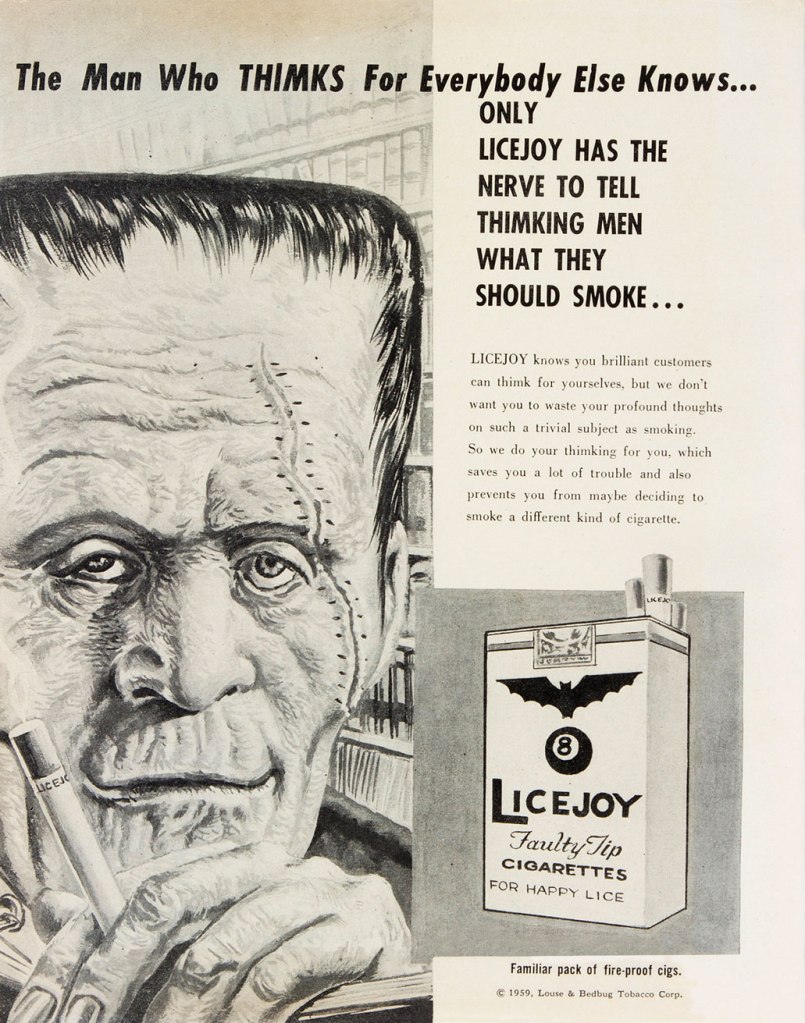
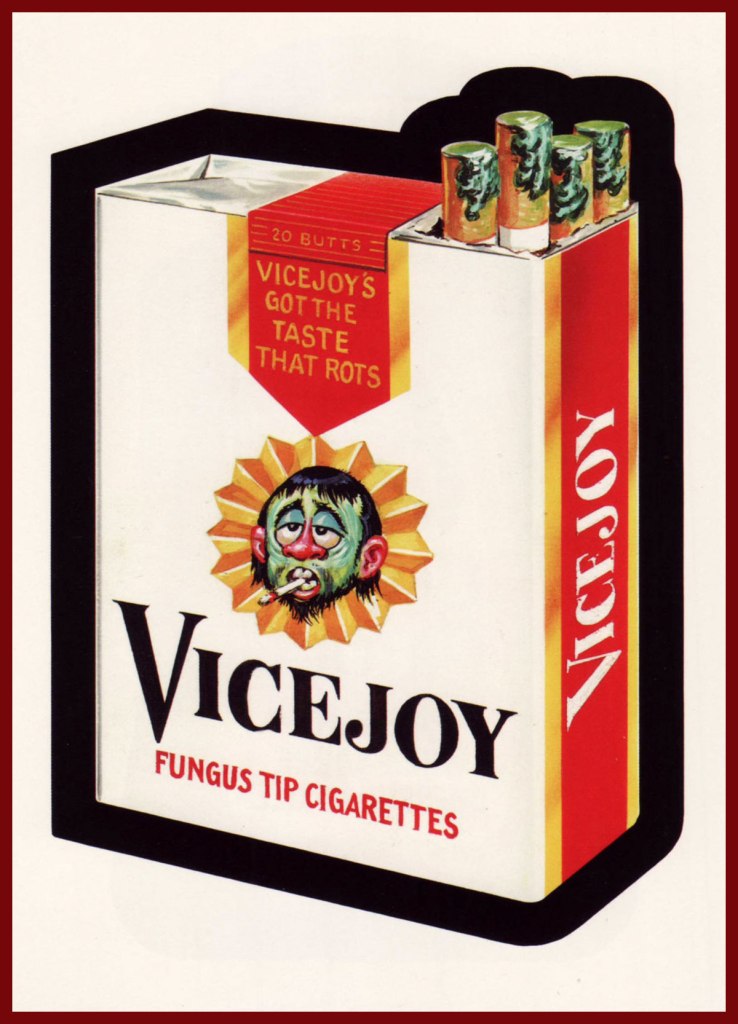
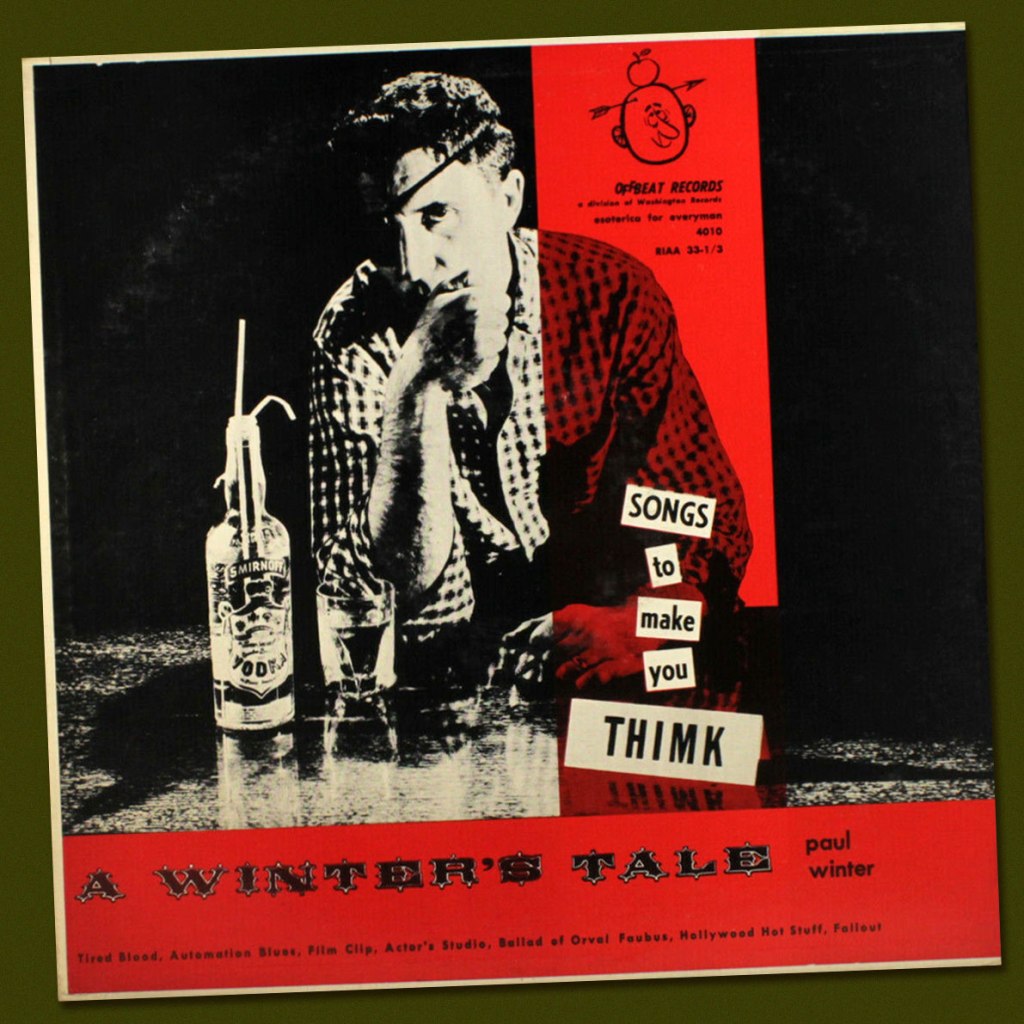
Thimk no. 5‘s back cover… a well-aimed barb at Viceroy Cigarettes.And some samples (there were many, many more!) from the object of parody, Viceroy’s The Man Who Thinks for Himself ad campaign. Lookit all them deep thinkers! (Martin Fry, cancer survivor, bottom left).And it wasn’t to be the last Viceroy parody, either: the brand was also an early Wacky Packages target. This entry hails from Series 1, featuring a rough concept by Art Spiegelman painted by Norman Saunders (1973, Topps). Heads up, Marlon… some… thing is about to cut in for a dance. Is his date dismayed or delighted? Last call: Thimk no. 6 (May 1959, Counterpoint) was the final issue. Cover art, again, by Sam Hayle.From Think to Thimk in one easy step. What began as a ubiquitous IBM slogan soon, inevitably, led to parodic counterpunches.During the late 50s, it spread seemingly everywhere.Legendary Detroit DJ Paul Winter (station WXYZ) got in on the act early (1957). Here’s a sample, Fallout, featuring Charlie Byrd on guitar!And of course, the great Steve Ditko took the slogan to heart (and mind), famously making his own sign. I wonder where it is now.
«I think it’s safe to surmise that Mr. Church viewed his comics as his own private passion, and wanted to share them with no one. Is it any wonder that his heirs didn’t show any fondness for them? » — Charles ‘Chuck’ Rozanski
Let’s give a little love and a spooky cheer to the greatest comics collector of them all, Coloradoan Edgar Church (1888 – 1978), who also happened to be a pretty terrific illustrator. When he passed away, it turned out that his collection comprised a whopping 18 to 22 thousand comics books, mostly in the high grades. Ouch.
With that out of the way, let’s take a step back and admire some of the man’s halloween-themed illustrations over the years.
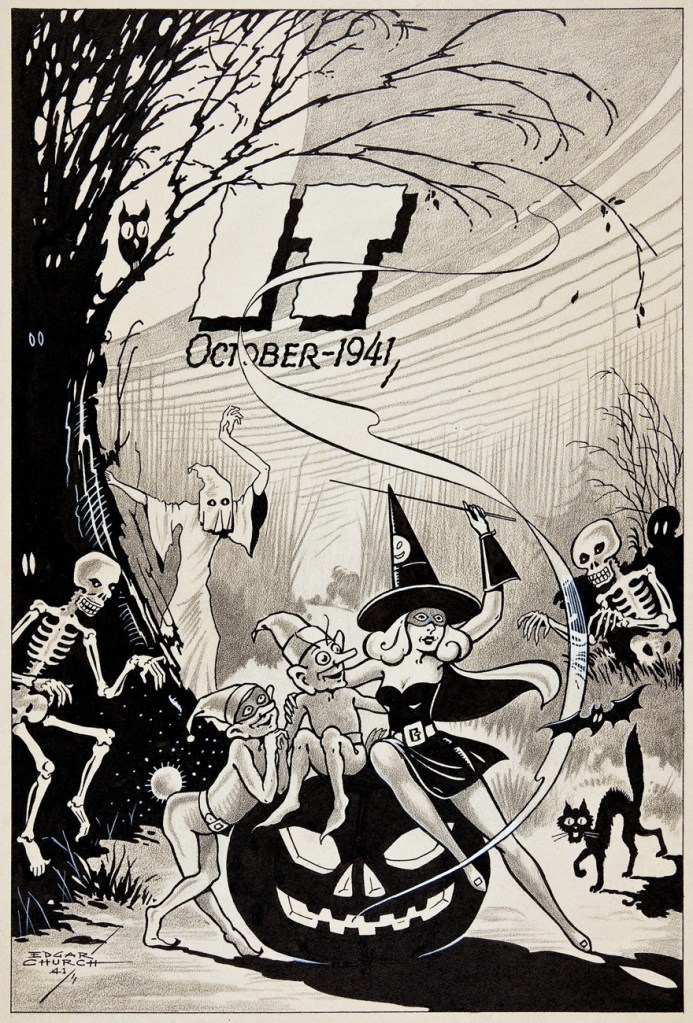
As it plainly states, this piece was created to commemorate 1941’s eeriest holiday. Isn’t “IT” a beauty?
Another IT peace from the same era, which I admit to colouring a bit, in what I like to consider good taste and restraint. « Not only was Church an important collector of first-generation comic books — he also ran a busy advertising-design studio in Denver and served as an illustrator for that city’s Smith-Brooks Printing Co. A marginal note identifies this splendid composition as an inside-back cover — likely for a Smith-Brooks magazine called It, to which Church was a frequent contributor. »
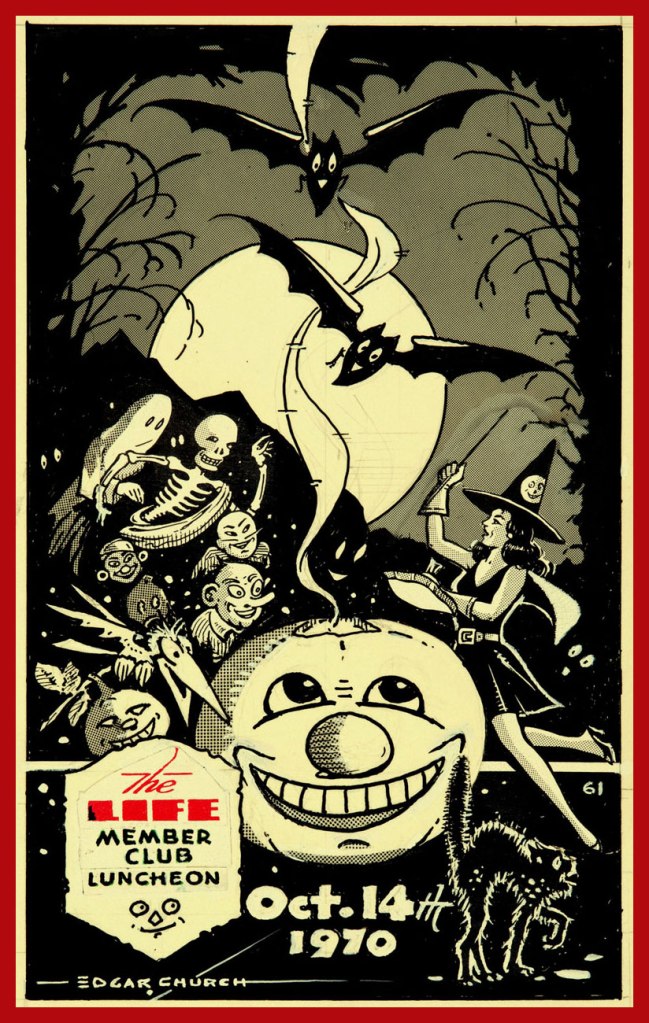
If those Life Member Luncheons were half a fun as Church’s ads made them seem, they must have been the highlight of Denver’s social season.
Featuring a wee bit of recycling, Church’s ad for the 1970 do. Interestingly, these shindigs were held on Wednesday nights, so they may not have been quite as debauched as one might have expected.
« Feminism encourages women to leave their husbands, kill their children, practice witchcraft, destroy capitalism and become lesbians. » — Pat Robertson
Truly one of the crown jewels of Franco-Belgian comics, Isabelle (1969-1995) has quite a pedigree: it was conceived by scripters Yvan Delporte, Raymond Macherot and illustrator Willy Maltaite, alias Will. When Macherot took ill, the legendary André Franquin stepped in, and the series took on a slightly more sombre shade, and its characterisations gained further depth. The best of all possible worlds, truly.
Brimming with magic, poetic grace, wit and atmosphere, Isabelle gave us, for a change, a level-headed and resourceful little girl in a world of infinite possibilities. I can’t stress this point enough: unlike every other little girl character in supernatural fantasy tales I’ve ever encountered, Isabelle doesn’t trip over roots, gasp loudly or drop a glass at the wrong time; she doesn’t disobey solemn, life-or-death instructions against all common sense. And yet she’s just an ordinary little girl, not a secret ninja or a princess in hiding. Truly refreshing. After reading Isabelle, most of what passes for fantasy is shown for the formulaic, stock dreck that it is. This is the genuine article.
In the mid-90s, publisher Les Éditions Dupuis brought the series to an unceremonious end, judging its sales numbers insufficient. Ah, but Isabelle has its fans, and a tenacious lot they are. Dupuis’ rival, Les éditions du Lombard (home of Tintin, and now merged with Dargaud, home of Astérix et Obélix) collected the entire series in 2007, in three stunning volumes rife with priceless documentary extras. Absolute bande dessinée nirvana. Good luck getting copies these days, sadly.
The cover of weekly Spirou no. 1929 (Apr. 3, 1975, Dupuis), beginning the serialization of the seventh Isabelle story (and her third album), Les maléfices de l’oncle Hermès (collected in book form in 1978). This is where two of the series’ pivotal characters, the titular Oncle Hermès and his eventual paramour, sexy witch Calendula, were introduced, not to mention her evil ancestress (the original) Calendula, the series’ archfiend.
The album in question, in its original edition (1978).
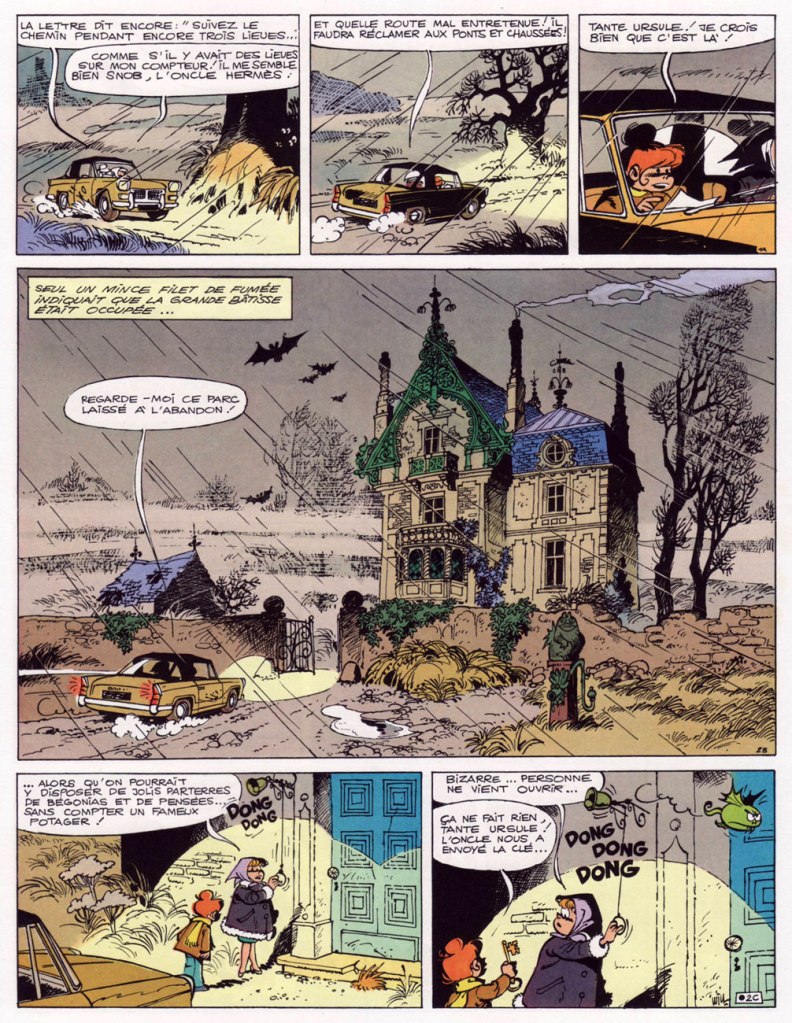
Page 2 of Les maléfices de l’oncle Hermès. During a long career shackled to characters he didn’t own (i.e. Tif et Tondu), Will was thrilled to work on a series of his own, one closer to his own interests and preoccupations. Dig that mood!
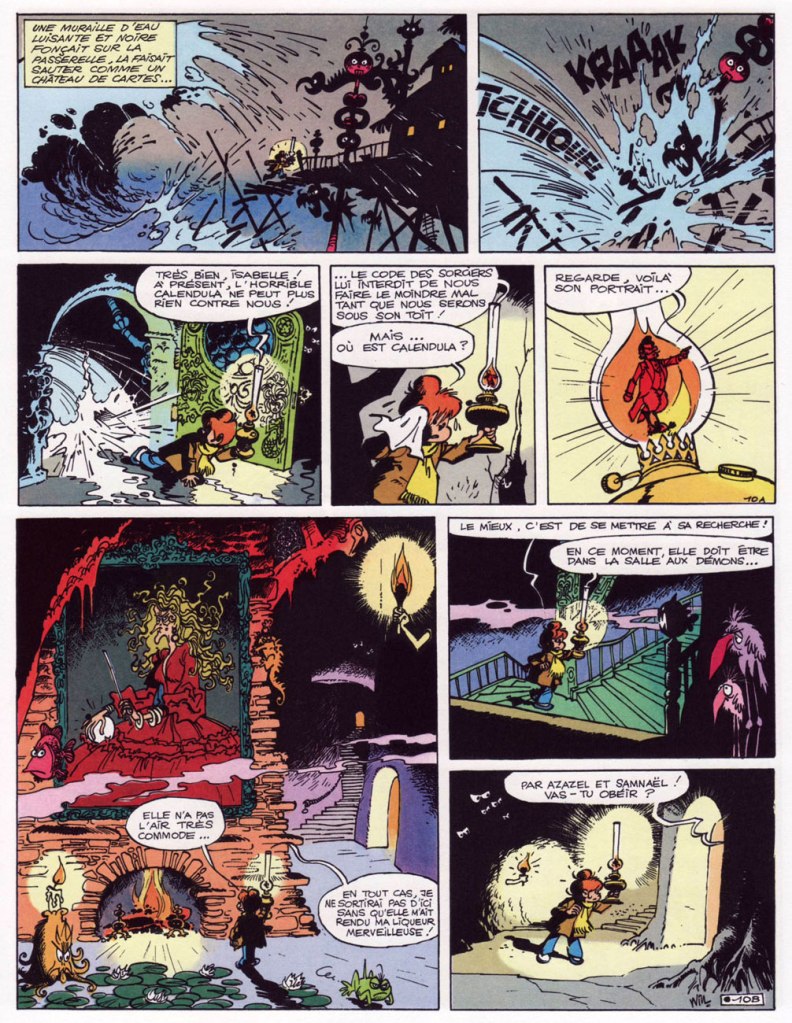
Page 10 of Les maléfices de l’oncle Hermès. Cloven-hoofed Oncle Hermès, the victim of a centuries-old curse, is trapped in a flame, and his great-great-great-great (etc.) niece Isabelle is endeavouring to set him free.
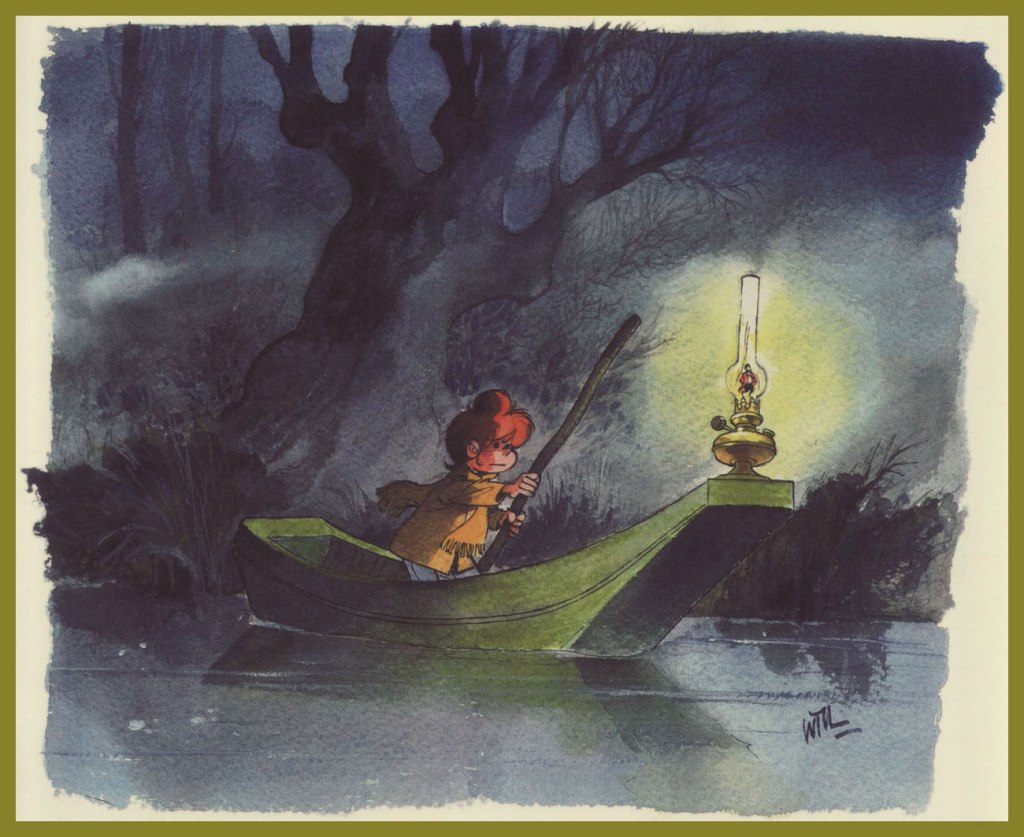
The journey is, of course, quite perilous… and the visuals gorgeous.
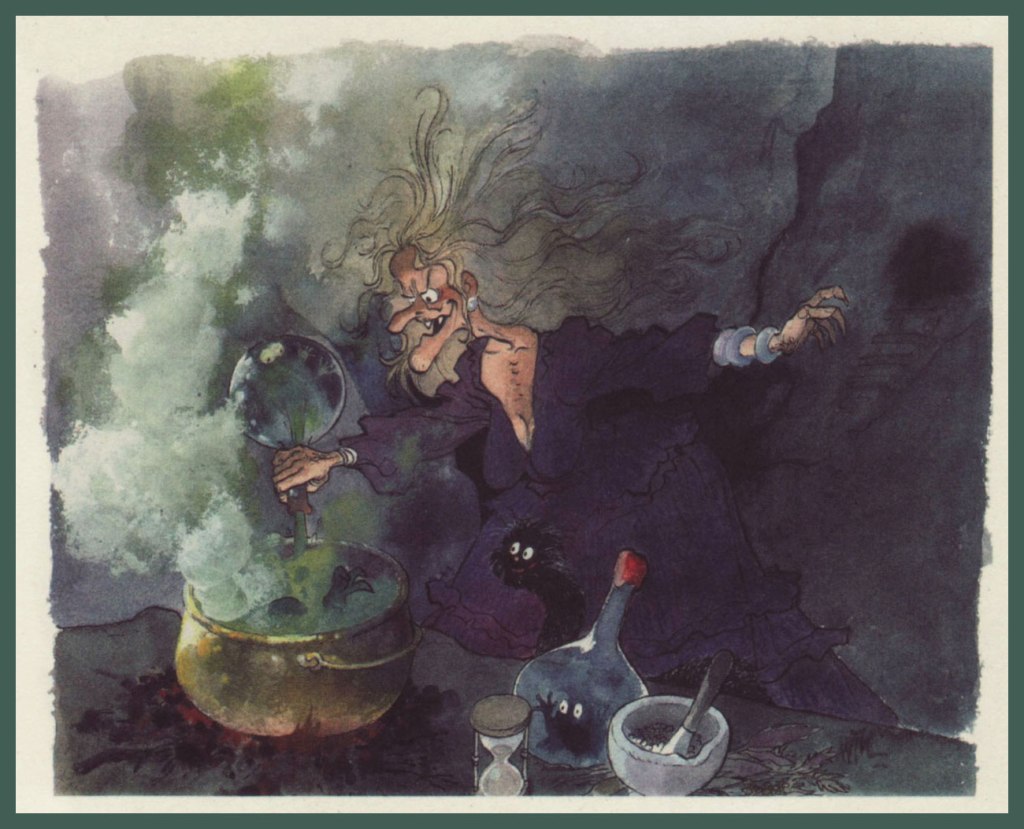
This is the original spell-caster, malevolent Calendula.
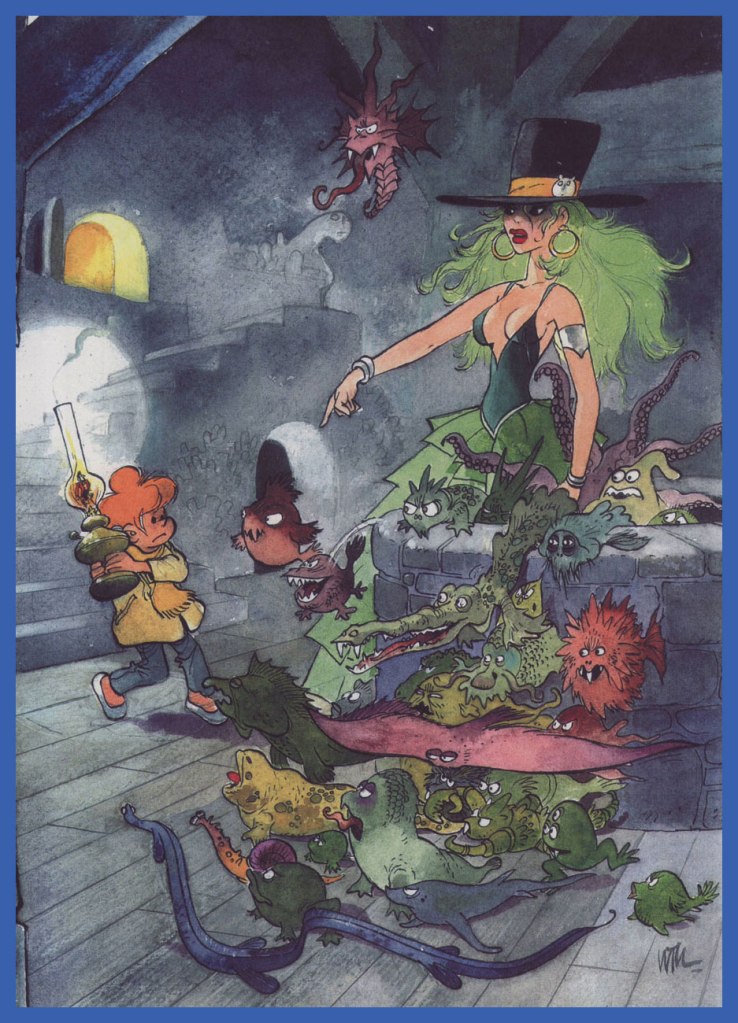
And this is her descendant of the same name, on the side of good, though she does have a temper.
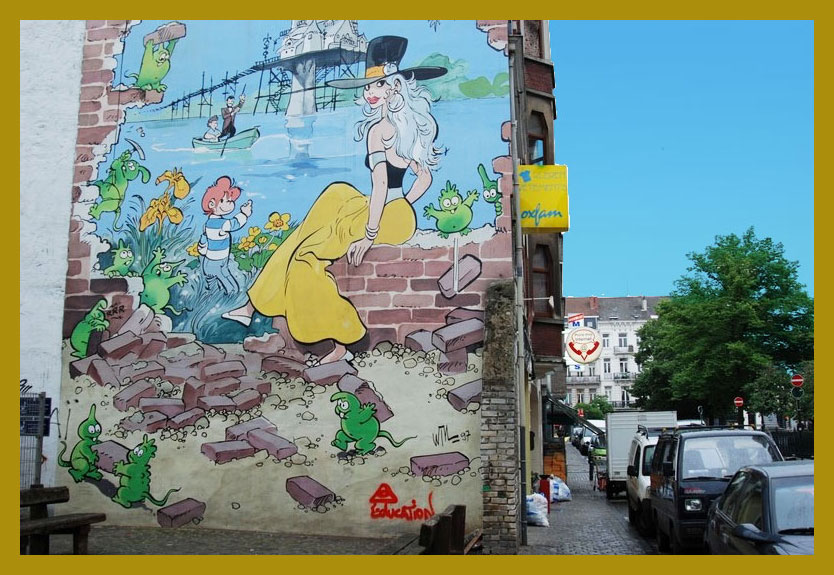
Isabelle and Calendula (and friends) feature as part of Brussel’s delirious Parcours BD. Does your hometown appreciate its comics this effusively and concretely? (update: The Isabelle mural was painted over in 2016, I regret to say.)
« I would rather sit on a pumpkin and have it all to myself, than be crowded on a velvet cushion. » — Henry David Thoreau
Have you picked out that special pumpkin for your fast incoming (dark, presumably) celebrations? If not, better get on it — someone (or something) else may be casting covetous glances and about to call dibs.
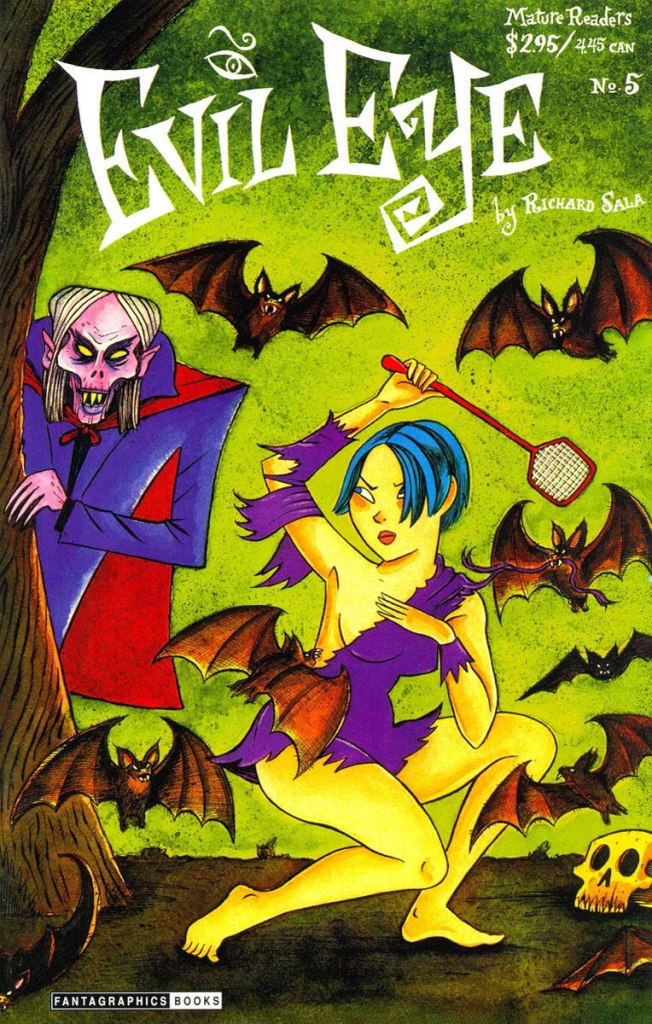
The lovely barefoot damsel is Richard Sala’s plucky heroïne (well, one of them!) Peculia. She was the star of Sala’s showcase title Evil Eye (1998-2004, Fantagraphics), as well as the graphic novel Peculia and the Groon Grove Vampires (2005). Fret not, she can fend for herself.
This is Evil Eye no. 2 (Oct. 1998, Fantagraphics).
This is Evil Eye no. 3 (Apr. 1999, Fantagraphics).
This is Evil Eye no. 5 (Mar. 2000, Fantagraphics).
As you may or may not have heard, Mr. Sala was one of the many notables we lost over the course of this nearly unparalleled Annus horribilis. Let’s remember him through this heartfelt eulogy penned by his closest friend and esteemed colleague, Mr. Daniel Clowes.
A fetching pinup from the back cover of the 2002 Peculia collection (2002, Fantagraphics).
« Then — when O’Flaherty turned on the light, his blood crystallized! »
This is Unknown World no. 1 (June 1952, Fawcett); cover painted by the rightly fabled Norman Saunders.
Its classic cover aside, this Fawcett one-shot is barely worth reading, save for the utterly bizarre Footprints on the Ceiling.
Synopsis:
The gangsters O’Flaherty and Flitcher train a revived dead dog to be a trick dog on stage. But they have to fight off hordes of skeletal zombies coming after them to bring the dog where it belongs – in the province of the dead.
Who came up with that scenario? (it’s not merely a rhetorical question: no one seems to officially know). Might its loopiness have in some small way inspired Bob Burden’s gonzo Flaming Carrot epic The Dead Dog Leaped Up and Flew Around the Room? It’s not such a stretch, given that Burden is no stranger to Golden Age comics, having been a-dealing in such goods, with a marked (and healthy) predilection for the oddball. Obviously.
Diving right into the splashy fray, here’s the immortal tale’s opening, from Flaming Carrot Comics no. 12 (May 1986, Renegade Press).
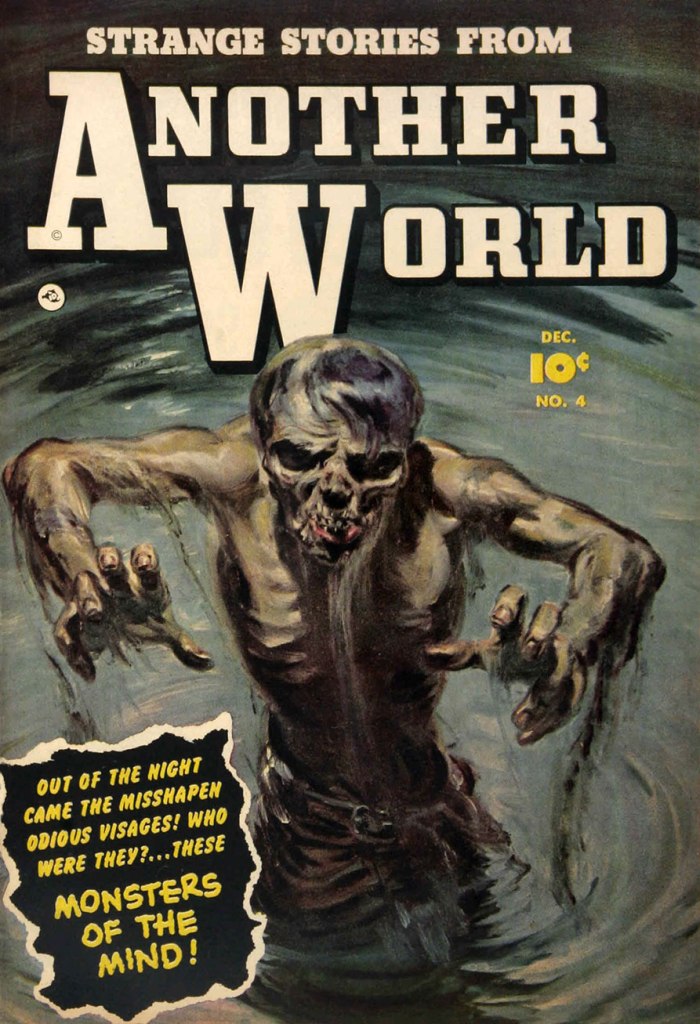
And here’s a bonus one from Mr. Saunders which, thanks to its decidedly muted palette, looks more like a pulp cover than a comic book. This is Strange Stories From Another World no. 4 (Dec. 1952, Fawcett), and you can read it here!
And after all these dead dogs, what do you say we enjoy the sight of a curious and healthy live one?
« He was homicidal. He was a real nut, a really tooty-fruity nut… he killed for fun… now society is avenged… avenged avenged avenged… and minus expensive court costs too… » — writer-editor Al Hewetson loved ellipses
For a few years in the early 70s, longtime Atlas/Marvel production manager Sol Brodsky joined forces with canny schemer Israel Waldman in order to give monster mag publisher James Warren a good scare, and it worked. During its relatively brief existence (1970-75), brassy upstart Skywald Publications gave Warren pause and cause to nervously peer over his shoulder and strong incentive to improve his product, which was hardly at its peak in 1970.
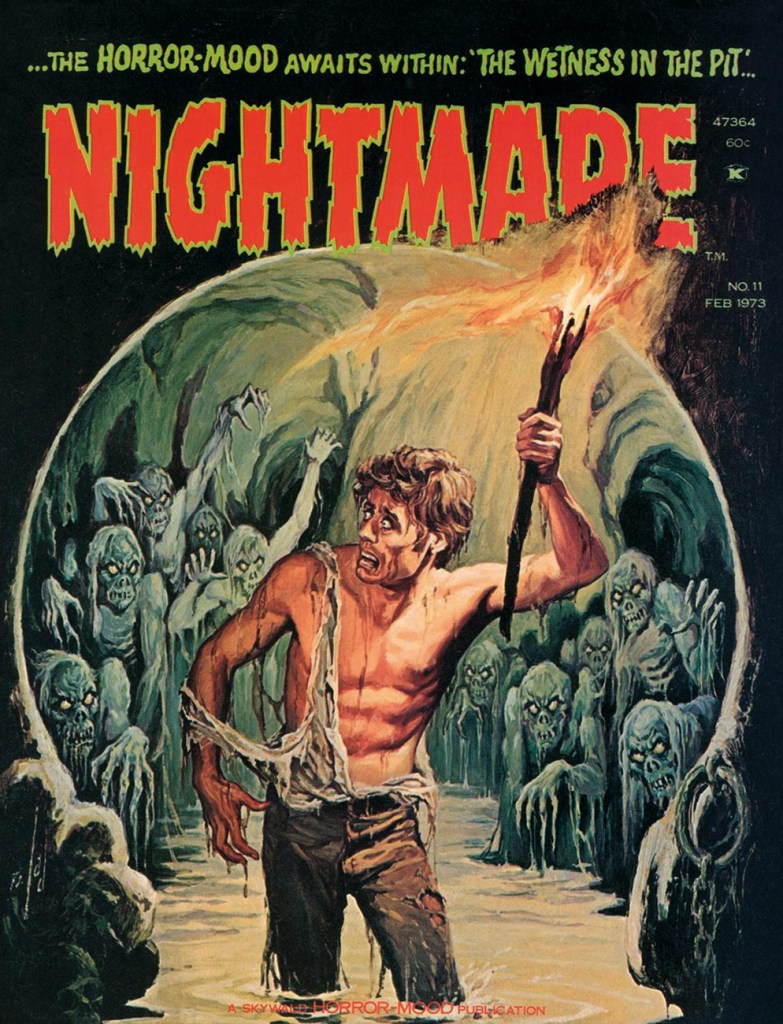
This is Nightmare no. 11 (February, 1973, Skywald). The spooky, claustrophobic cover is the brushwork of José Antonio Domingo, who also contributed a handful of painted covers to Marvel’s concurrent b&w magazine line.
By all means, do read this intriguing issue, which is available in its entirety right… here.
Oh, and why not? Here’s the finest of Domingo’s Marvel covers, à mon avis… despite the rather inept text placement.






























 Who's Out There?