Tentacle Tuesday: Lurkers in the Newsprint

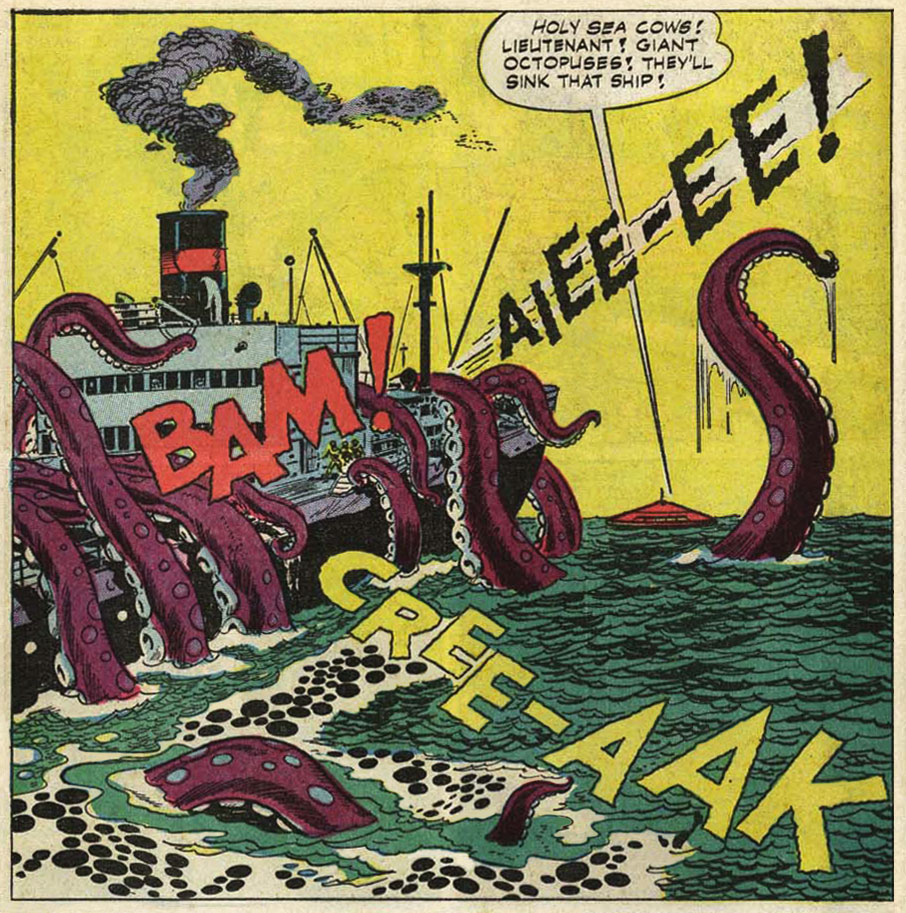
Greetings, tentacle aficionados! Phew, this post started out as just a couple of images and spun somewhat out of control. My thanks to co-admin RG for cleaning up, re-arranging and even colourizing the following scans and photographs. Today we gaze at cephalopod apparitions in newspapers strips from the 40s and 50s. There are actually few things I like better: there is something comforting about the smell of an old newspaper (even if we have to imagine it!), the aesthetic appeal of yellowed paper, the concerns of imaginary characters who lived so long ago and yet who seem so close to us. Irrelevant to the modern age? Not at all. Look past the technological trimmings and you’ll find people who have lived and loved and struggled much like we do today. On a lighter note, the techniques of fighting off tentacles haven’t changed much, either!

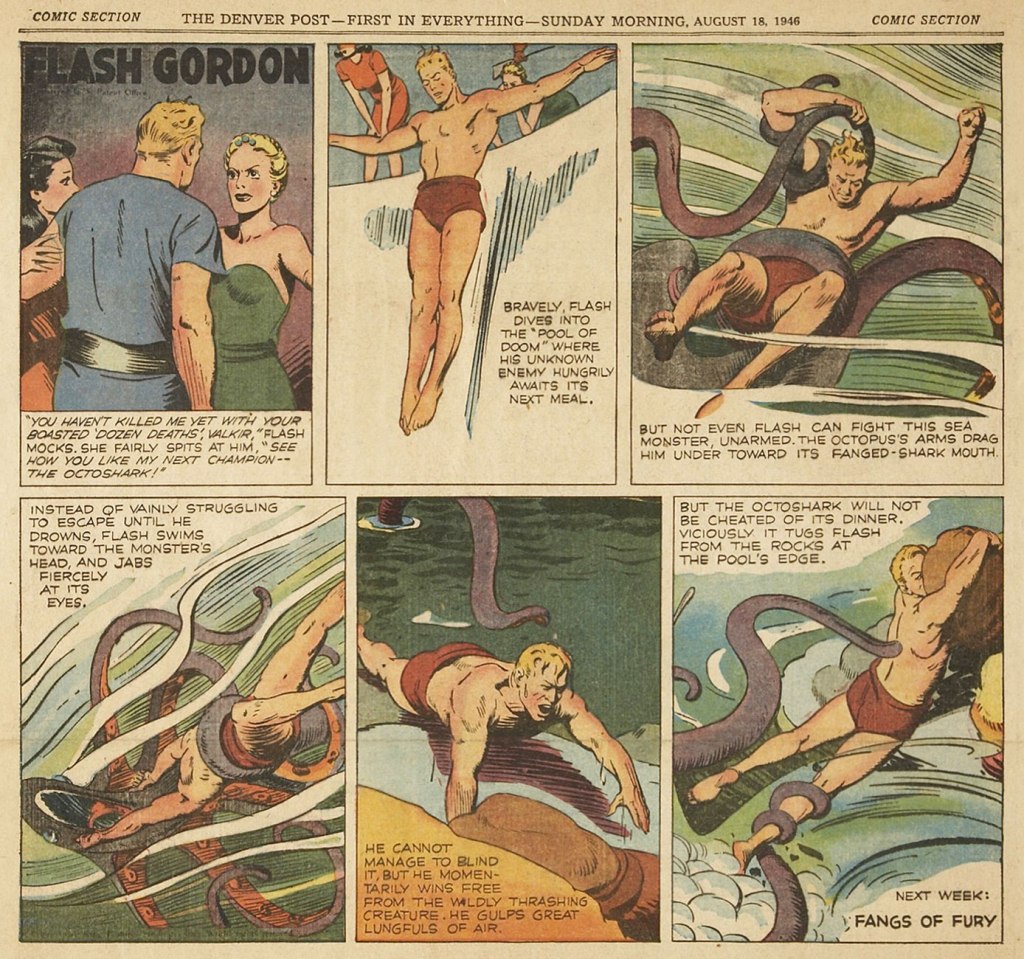
Flash Gordon, created in 1934 by Alex Raymond for King Features Syndicate to compete with the Buck Rogers newspaper strip, was immensely popular, witnessed by both its longevity – the strip continued all the way into 2003 – and multiple licensed products on offer for starry-eyed kids who wanted a spaceship or ray gun to call their own. Raymond left in 1944 to join the US Marines, and Austin Briggs, who up to that point was drawing the Flash Gordon dailies (introduced in 1941 to capitalize on the popularity of Raymond’s Sunday strips), switched to drawing Sundays, the dailies now cancelled. The following is from August 18th, 1946, art by Austin Briggs.

In 1951, King Features reinstated the Flash Gordon dailies and put Dan Barry in charge, famously assisted by Harvey Kurtzman and Harry Harrison on scripts, and a bevy of ghost-drawing writers.

The following are two Flash Gordon dailies from 1954. These reprints hail from Flash Gordon: Dan Barry Vol. 2: The Lost Continent, which collects dailies from October 26th 1953 to October 29th 1955.

Frank Robbins created Johnny Hazard for King Features Syndicate in 1944. What I find impressive is that the strip continued, with no other writers or artists involved, all the way until 1977 – contrast that with other newspaper adventure strips from around that time. Robbins must have been a powerhouse. To quote from the no-longer-updated (its creator, Donald Markstein, died in 2012), but still kindly maintained by relatives Toonopedia, « … Unlike many fictional two-fisted adventurers, [Johnny Hazard] matured — not as quickly as real people, but after a third of a century or so, he was quite gray at the temples. And a third of a century was as long as the strip ran. It was popular enough at first, and ran far longer than most post-war adventure strips, but the times were against it. Newspaper editors were more interested in daily gags than continuous stories, and Johnny Hazard succumbed to the trend in 1977. Robbins went to work for DC Comics, where he drew Batman, and Marvel, where he drew The Invaders, and never again created his own feature. » Eventually, Robbins is said to have retired, moved to Mexico, and devoted himself to painting – where he remained his death in 1994. This daily is from July 1951.

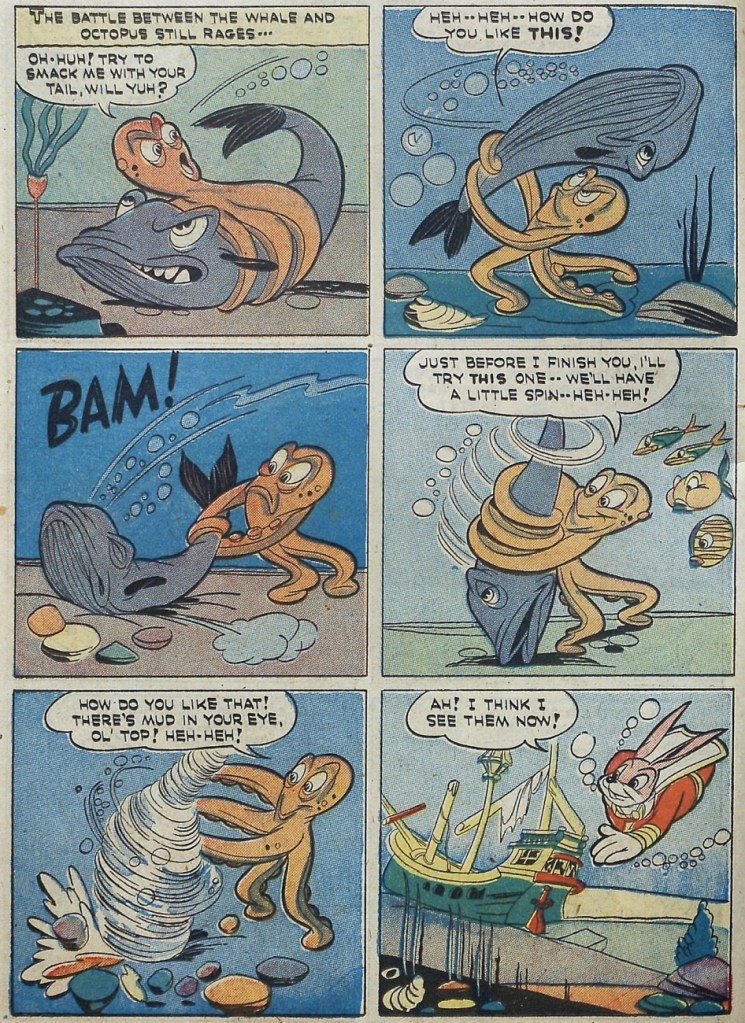
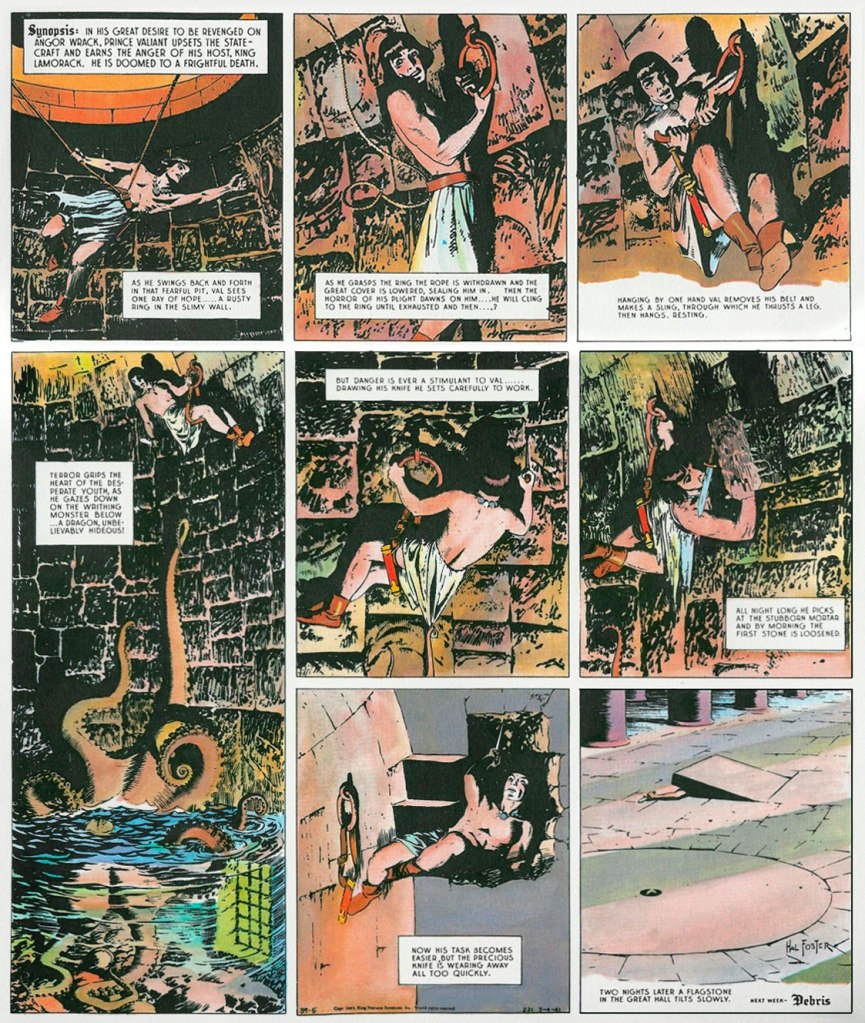
Prince Valiant is one of those newspaper strips institutions that most readers will have heard of, though some, kind of like me, may be uncertain about about the who, the when, and the hows of it. It was created by Canadian Hal Foster (1892-1982) – who, while illustrating the Tarzan newspaper strip (more about this a little further down!), developed a craving to work on his own oeuvre. He pitched his medieval adventure idea to William Randolph Hearst, who was so impressed that he even gave Foster ownership of the strip. It’s still ongoing (after a little more than 4000 Sundays!) This magnum opus has been credited with plenty, as the « greatest contribution to English literature in the past hundred years », « the pinnacle of comic strip adventure storytelling »,  and so on. I feel a little bad for being bored to tears by it, but as the Russians say, ‘и на старуху бывает проруха‘, more-or-less directly translated ‘even a crone can blunder’, or in other words, even Homer nods. The following Sundays are from April-May 1941 – spending two nights in a well, instead of trying to fight off the octopus, is an interesting approach, and I’m sure both man and animal were immensely frustrated.

I promised to say more about Tarzan – ah, the very, very long-running Tarzan strip. Started in 1929 with an adaptation of Edgar Rice BurroughsTarzan of the Apes illustrated by the aforementioned Hal Foster, syndicated by the United Feature Syndicate, it went on (and on…) all the way until 1995, with quite the cast of different artists over the years. The following Sunday is from the Burne Hogarth years, and is part of a story cycle called Tarzan and N’ani, which was published between December 14th 1947 and May 9, 1948. As for Hogarth, he seemed to hold the distinction of being the only artist with two runs on Tarzan: he drew the strip from 1937 to 1945, and again from 1947 to 1950.

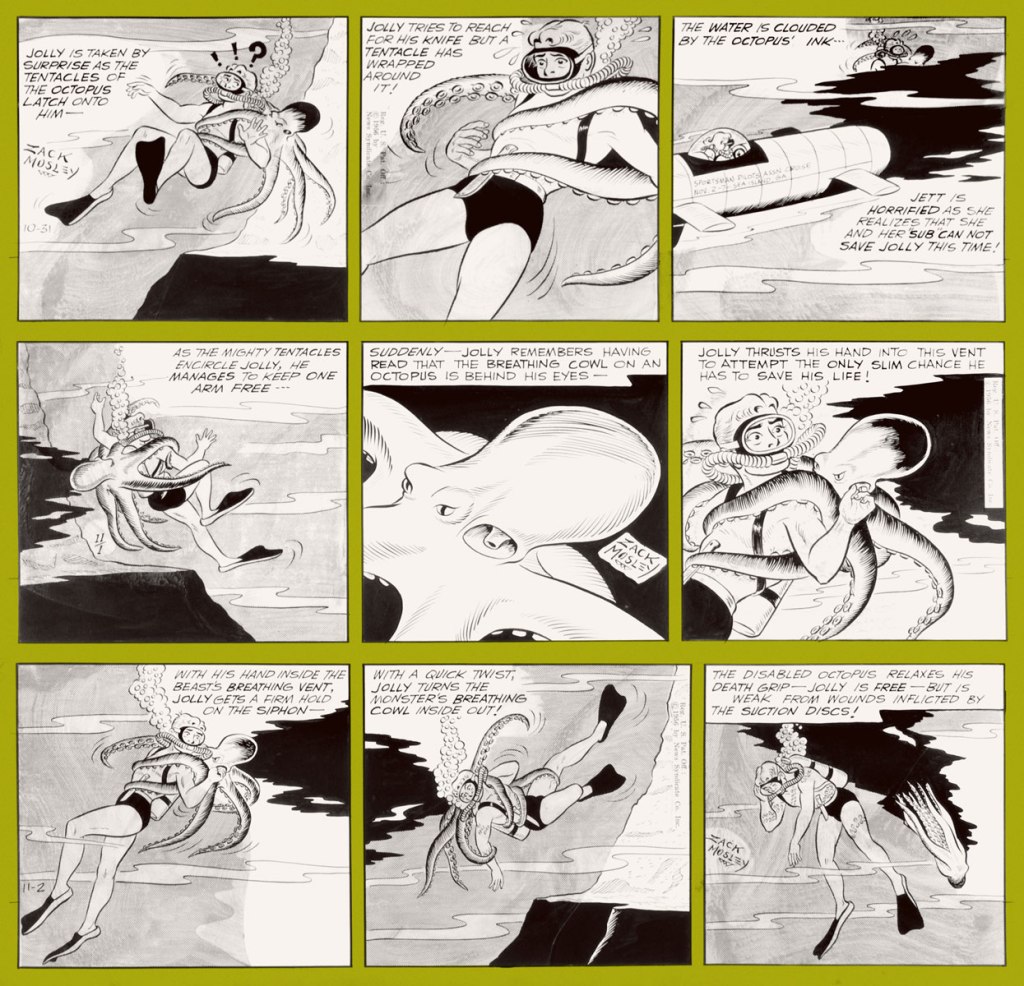
The Adventures of Smilin’ Jack, distributed by the Chicago Tribune Syndicate, ran from 1933 to 1973. I know that doesn’t sound as impressive because all strips discussed so far had crazily long runs, and yet: Smilin’ Jack, as it came to be called a little later on, lasted a good fifty years, which is partially explained by this strip’s motley cast of endearing supporting characters, but also by the realism with which Jack’s flying adventures were depicted – Zack Mosley, the creator, was an aviation enthusiast and licensed pilot with a true love of everything aeroplane. The following three dailies are from November 1956. You’ll be happy to learn that Mosley, upon retiring at 67, spent the rest of his days flying his own plane.

Created by George Shedd, a former Al Capp assistant, for the Post-Hall Syndicate, Marlin Keel ran between 1953 and 1954. Very little information about it survives – from what I understood, Shedd first wrote and drew this newspaper strip by himself, and later relinquished the illustration to assistants. Most notable (and what seems to be motivating rare collectors) is the involvement of Alvin Carl Hollingsworth (1928-2000), one of the few African-Americans working in the field at the time, who started by helping out (not sure to what degree) and became the official illustrator of Markin Keel towards the end of its run. Hollingsworth, who’s often mentioned as Joe Kubert‘s classmate at NYC’s High School of Music & Art – a fact that, albeit cool, underplays Hollingsworth’s talent and career – seems to have always maintained an interest in painting. Later in life, in the 1970s, he abandoned the comics field in favour of becoming a (fine) painter – you can see some of his paintings here. This is the original art for a 1954 Sunday strip.

The octopus may be off-camera, but my appreciation of Bob Montana made me include this strip in today’s roster. That’s right, it’s not my fault! This is an Archie daily from July 24th, 1953.

I hope you enjoyed this walk down history’s lanes and byways!

~ ds

Hot Streak: Gil Kane’s Green Lantern

« It was exactly an assembly line. You could look into infinity down these rows of drawing tables. » — Gil Kane

Some of our more sensitive readers may have noticed that we’ve been none too gentle with Gil Kane (1926-2000) in the past, dealing him some rather rough lumps at times. But that’s not the whole story: in taking stock of such a protracted and prolific (dare I say profligate?) career as his, much of it inevitably spent on autopilot, one must be discerning. In other words, I like some of Kane’s work, but there’s plenty of it I don’t care for. Still, WOT’s rule of thumb is that if we altogether loathe an artist and/or his work, we’ll just turn a blind eye.

And speaking of the sense of sight, what makes a great comic book cover? Must be my art school training and subsequent work in advertising tipping the scales, but to me, design and layout reign primordial as ingredients… as values. I’m often dismayed at many a would-be critic’s apparent method of assessing an image’s artistic worth, namely: how many popular characters does it feature? Is it action-packed? Is the issue sought-after and expensive? Does it feature a famous character’s début? Is it drawn by a fan-favourite artist who unquestionably can do no wrong… because he’s a fan-favourite artist who unquestionably can do no wrong? (and how dare you claim otherwise!)

Gil Kane reportedly generated around eight hundred covers for Marvel in the 1970s… of all levels of craft and quality. With that kind of frenzied output, it’s impressive that most were perfectly serviceable, given that there certainly was no time for meticulous, sober planning. They were generally over-captioned (not Kane’s fault!) and crassly sensationalistic, but that’s what Marvel sought and settled for.

It’s a shame that Kane and his former classmate at the School of Industrial Art (back in the early 40s!), DC lynchpin Carmine Infantino didn’t get on too well, because their Silver Age collaborations had a special spark… must have been the animosity. It had been noted by the DC brass, as early as the late 50s, that Carmine’s covers reliably caught prospective buyers’ attention and dimes. And so, by 1967, he was unofficially designing most of the publisher’s covers, and certainly the covers of all titles edited by Julius Schwartz. Green Lantern was among these.

So we turn today’s spotlight on a hot streak of seven. Kane gets his name in the title, but it would be more accurate to say they were Infantino-designed, Gaspar Saladino-lettered, Jack Adler-coloured, Gil Kane-pencilled and Murphy Anderson and Sid Greene-inked covers. The streak begins after Green Lantern no. 54’s downright poor cover, and ends with the interruption of Kane’s impressively long run of consecutive issues.

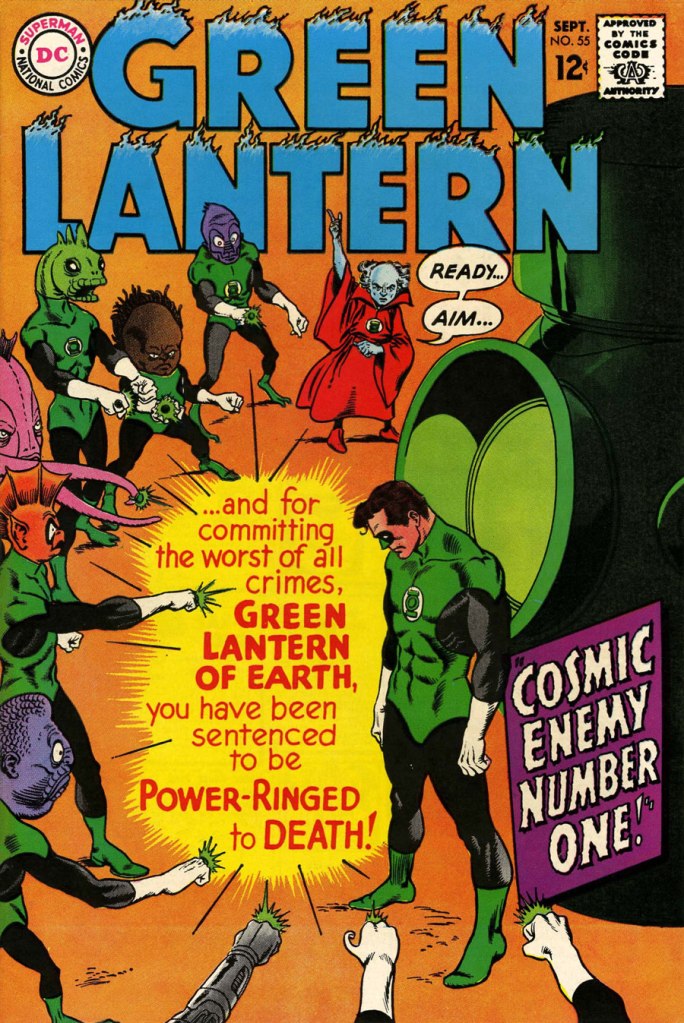
We begin with Green Lantern no. 55 (Sept. 1967, DC). Harmonious, easy-to-parse arrangement of numerous elements and exemplary integration of text. Design by Infantino, pencils by Kane, inks by Murphy Anderson, lettering by Gaspar Saladino, colours by Jack Adler. Oh, and lest we forget: logo designed by Ira Shnapp (circa 1964), classic Green Lantern uniform designed by Kane (circa 1959).
This is Green Lantern no. 56 (Oct. 1967, DC). Kane was never much for varying his monsters (see below). Pencils by Kane, inks by Anderson.
For a bit of comparison on how things were done from company to company, this is Tales to Astonish no. 91 (May, 1967, Marvel). This is what happens when there’s no planning or attention to detail: in an already-crowded cover, did we really need that ugly box advising us of the presence of The Abomination? He’s right there! (maybe the abomination refers to the cover itself). And the foreshortening nightmare that is the baddie’s left arm was so dire that, when a fan commissioned Arthur Adams to produce a recreation of this cover (which, things being as they are, many surely consider ‘iconic’)… he wisely corrected the anatomy and tweaked the poor composition. Interesting how Marvel’s heavy-fingered yes-man, art director John Romita Sr., was always game to “fix” Ditko and Kirby art, but saw nothing wrong with this one.
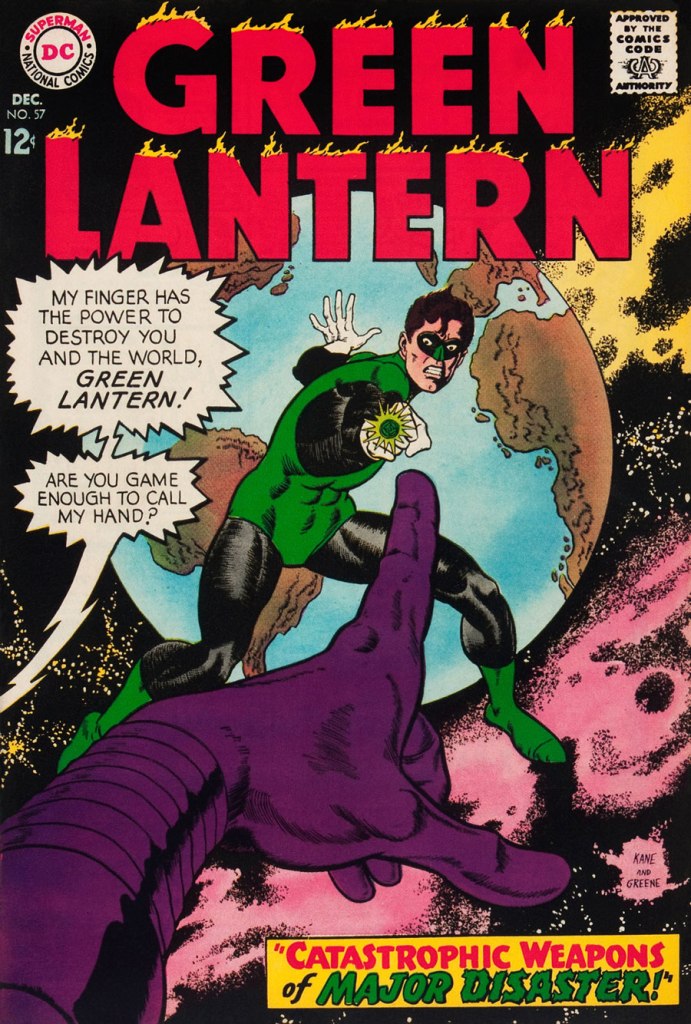
This is Green Lantern no. 57 (Dec. 1967, DC), featuring Catastrophic Weapons of Major Disaster!, written by Gardner Fox, pencilled and inked by Kane. Cover by Kane and Greene… love the placement of the signatures!
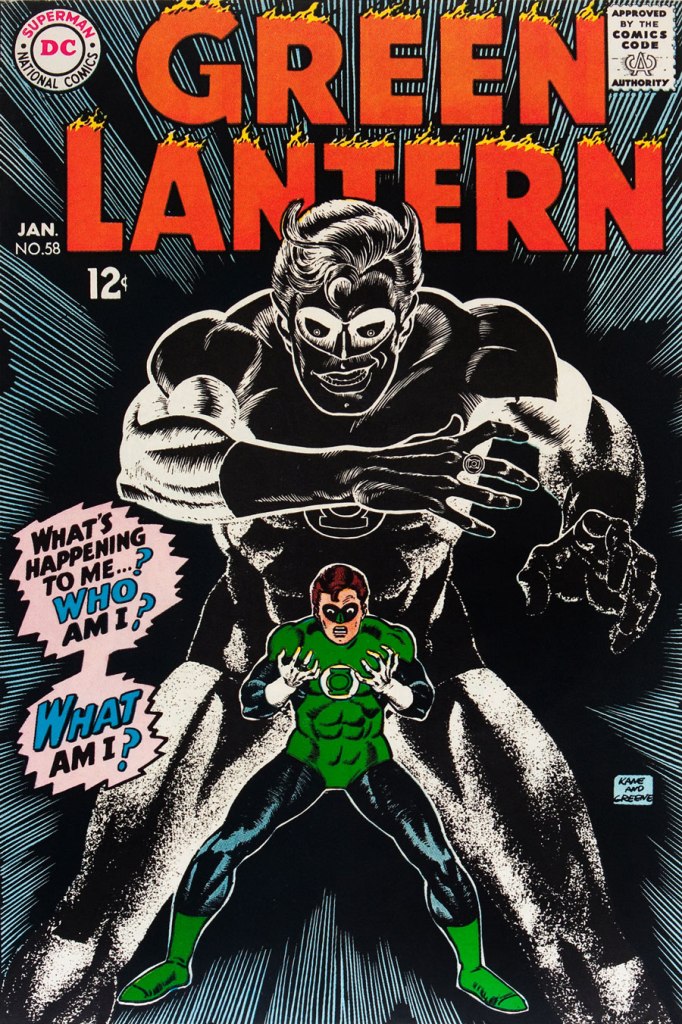
This is Green Lantern no. 58 (Jan. 1968, DC), featuring Peril of the Powerless Green Lantern! (a Julius Schwartz title if there ever was one), written by Gardner Fox, pencilled by Kane and inked by Greene. I’m not overly fond of the Kane-Greene mix, but Sid Greene, as a penciller-inker did some splendid work on the Star Rovers series (1961-64), co-created and scripted by Gardner Fox.
An issue whose price few can afford unless they bought it off the racks, this is Green Lantern no. 59 (March 1968, DC); pencils by Gil Kane, inks by Murphy Anderson. Featuring the introduction of GL alternate Guy Gardner, who was to be dubiously re(jack)-booted in the 1980s, by Steve Englehart and Joe Staton, as a jackass with an ugly uniform and a worse haircut. Notwithstanding the fact that the Green Lantern Corps would never bestow power and stewardship on such an immature and pompous loose cannon.
This is Green Lantern no. 60 (April 1968, DC); an evident Infantino design, with pencils by Kane and inks by Anderson… which interestingly ends up producing a prototype of Brian Bolland‘s distinctive style… a decade early.
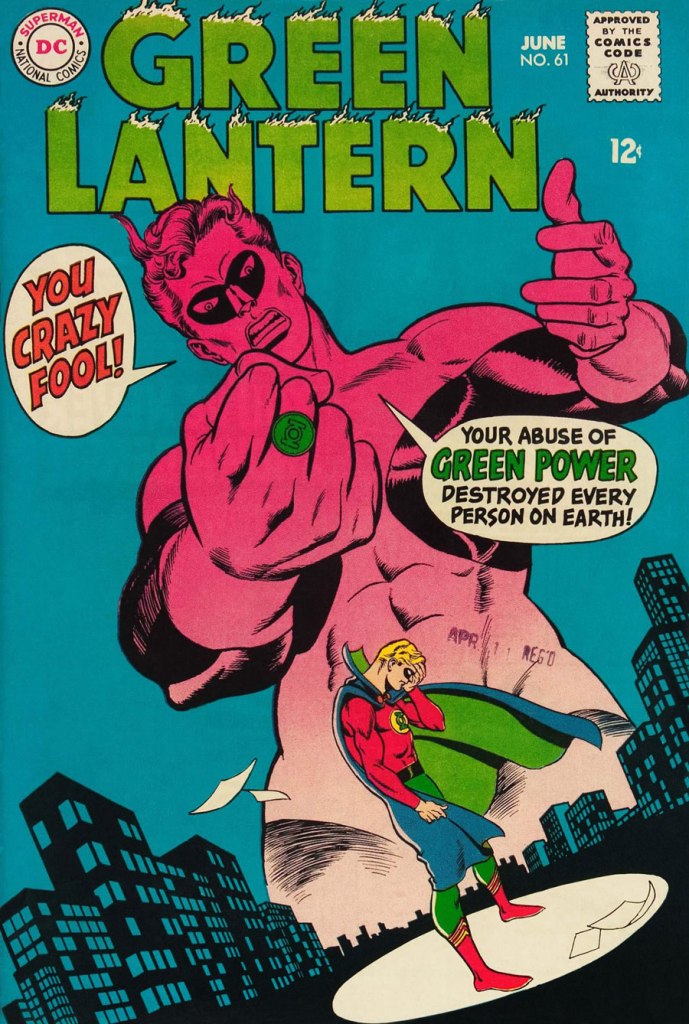
This is Green Lantern no. 61 (June 1968, DC); pencils by Kane, inks by Greene, and featuring (groan) Thoroughly Modern Mayhem!, scripted by Mike Friedrich, pencilled by Kane and inked by Greene. Co-starring Alan Scott, the Golden Age Green Lantern.

-RG

Tentacle Tuesday: Hand Me My Helmet, Harry

The first helmets were used by Assyrian soldiers in 900 B.C., and they were made of thick leather and bronze to protect the head from blunt objects, swords and arrows during combat. Research shows that helmets can significantly reduce the severity of injuries sustained from head trauma. That’s why it’s so important to always wear a helmet when taking part in a potentially dangerous activity.

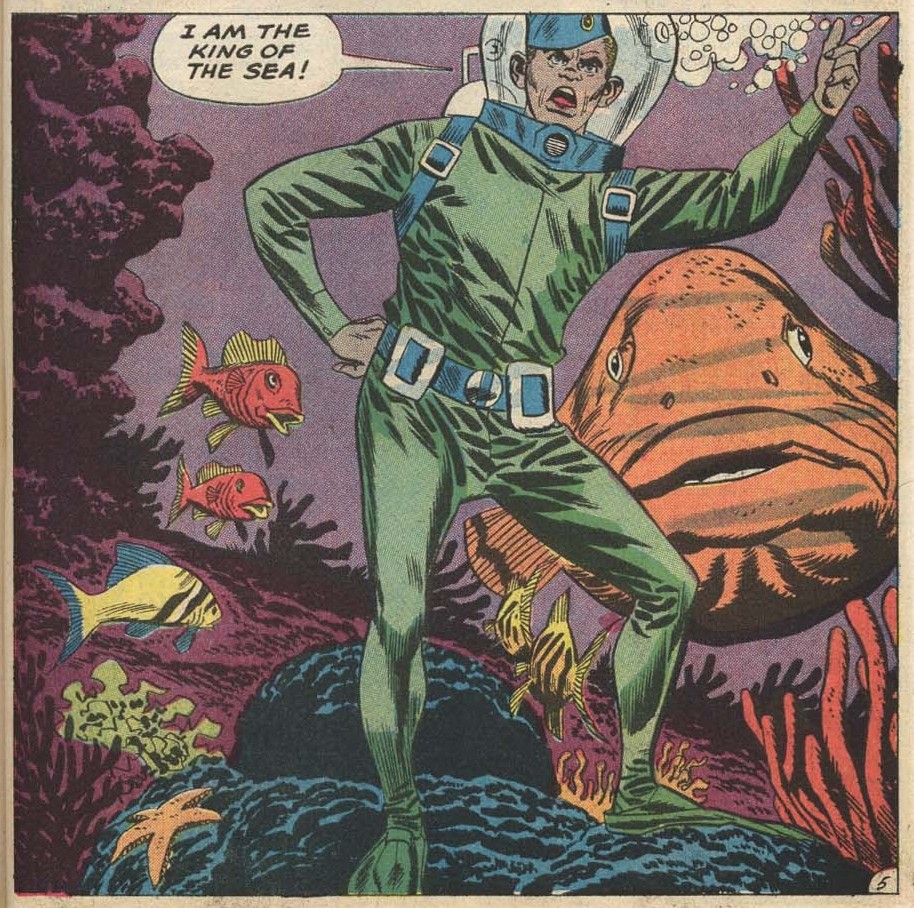
You may argue that helmets are just a way to be able to breath underwater, a compromise between the bulky scaphandre (less elegantly ‘diving suit’ in English) and the scuba diving mask. Breathing, ha, that’s just a distraction to the real purpose of a helmet during an octopus encounter: it makes the diver’s head look a little like an octopus’ head, thus confusing him and giving a much necessary advantage.

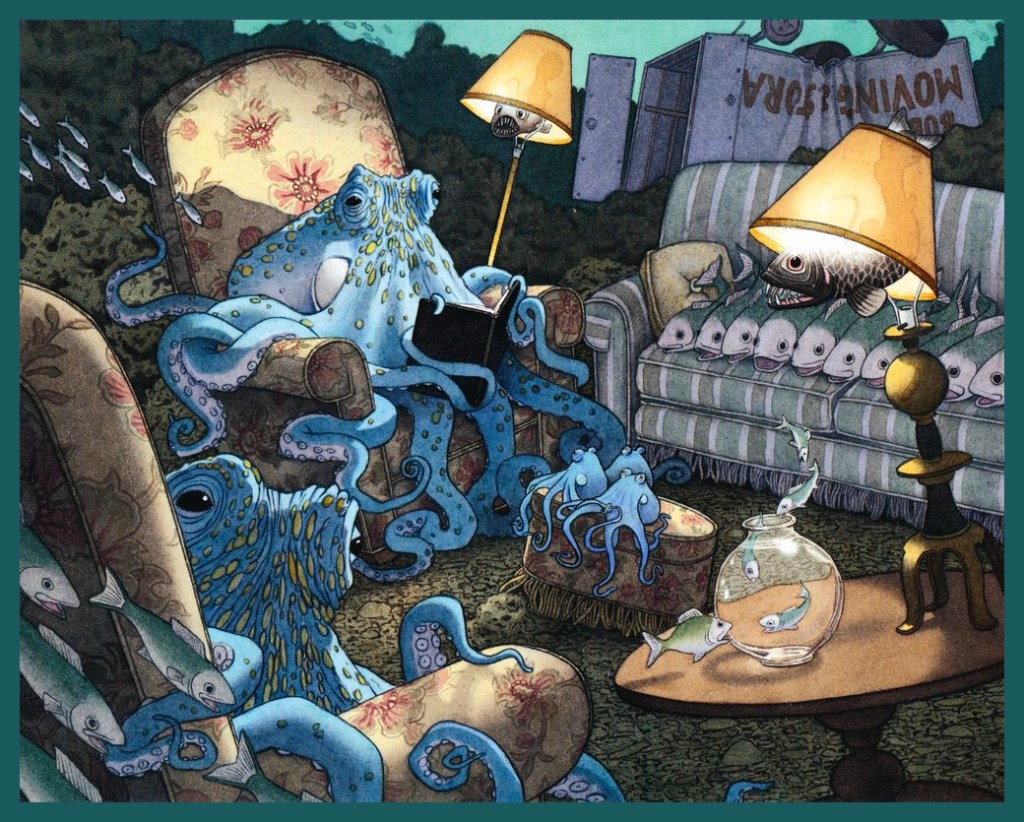
Install yourself comfortably following the example of this happy family of cephalopods, and let’s have a look…

I first encountered David Wiesner when I bought his Mr. Wuffles! book on a whim (it had cats!), but Flotsam, a collection of underwater life illustrations published in 2006, is also clearly of some interest.

Out first helmet of the day is a reasonable imitation of a diving suit! The following page is from Prisoner of the Undersea World!, scripted by Gardner Fox, illustrated by Sid Greene, and published in Strange Adventures no. 155 (August 1963, DC).

I am not sure how he could drink and eat without taking his helmet off, and taking it off would surely mean drowning – luckily, the frogs were smarter than him!

I am pleased to report that not only did the octopus come out of that encounter in one piece, no frog denizens were seriously harmed, either (which makes this tale pretty special, since human heroes tend to go and annihilate anything they don’t understand).

Actual attempts at establishing communication? Colour me impressed!

Our second is a helmeted beauty (albeit twisting in a way that isn’t anatomically feasible) and some of her teammates from U.N.D.E.R.S.E.A. (or United Nations Department of Experiment and Research Systems Established at Atlantis).

Undersea Agent no. 2 (April 1966, Tower Comics), pencilled by Mike Sekowsky and inked by Frank Giacoia.

The cover story is rife with tentacles, but unfortunately doesn’t feature the scene depicted above at all.

Panel from The Return of Dr Fang, scripted by D. J. Arneson, pencilled by Ray Bailey and inked by Sheldon Moldoff.

On the other hand, Buried Under the Sea, a fun read nicely illustrated by Mike Sekowsky on pencils and Joe Giella and Frank Giacoia on inks, has plenty of sea-helmets… but no cephalopods. One can’t have everything, alas!

One easily understands why she made it onto the cover of the comic!

From helmets that are actually connecting to some diving equipment and oxygen canisters, we move on to ones which are just like an upside-down fish bowl somehow magically sitting on the wearer’s shoulders. Style always takes priority over silly things like actually being able to breathe. For more Adam Strange, scoot over to Tentacle Tuesday: Tangles with Adam Strange!

DC Super Stars no. 8 (October 1976, DC), cover by Ernie Chan (signing as Ernie Chua). This issue features a bunch of reprints, mainly reprinted stories from Mystery in Space.

Speaking of Mystery in Space, no. 21 (August-September 1954) has a very appropriate story… proving that the ol’ anti-cephalopod helmet can be used out of water. This is a page from Interplanetary Merry-Go-Round, scripted by Otto Binder and illustrated by Sy Barry… who’s still with us and about to celebrate his 93rd birthday!

Maybe the Martian monster is going ‘beserk’ (sic) because it’s a sentient creature who’s been chained and used for the amusement of stupid crowds?

~ ds

When Rosy Baffled the Kids

« I believe that the Belgians do possess some surrealistic gene. » — Eddy de Clercq

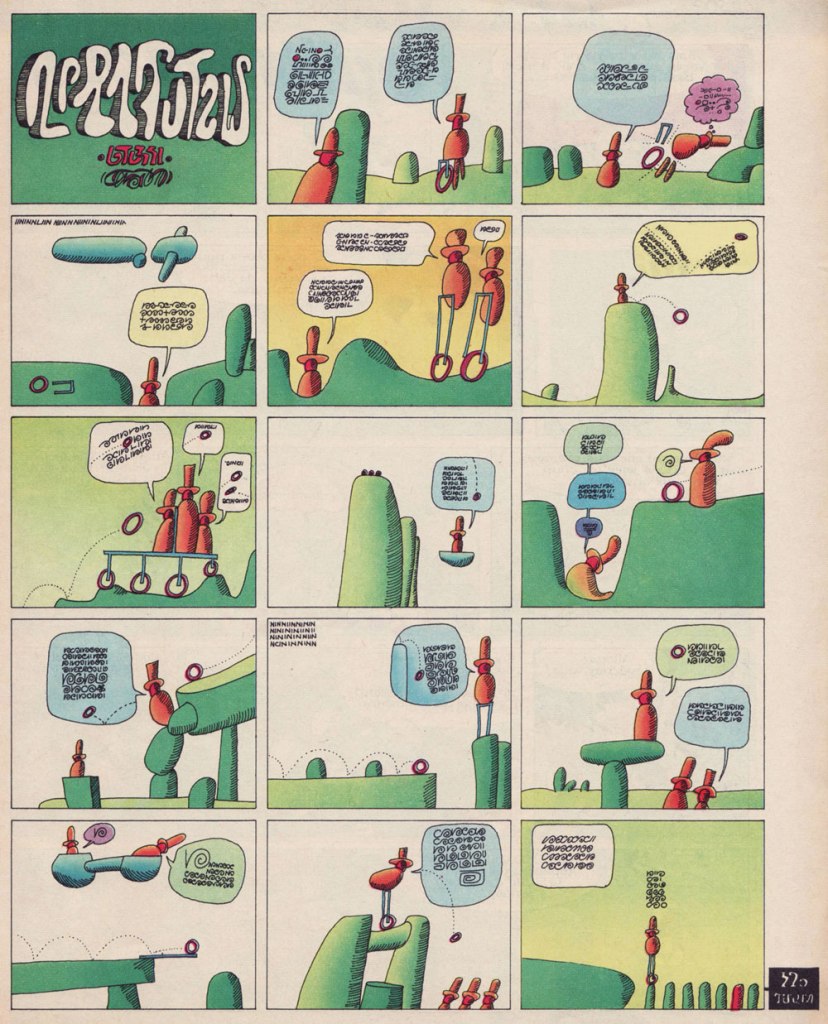
I’m afraid we’re back into surrealism territory, folks. Our focus today is on a single piece by polymath Maurice Rosy (1927-2013, Fontaine-l’Évêque, Belgium), published in bédé weekly Spirou in 1966, in the midst of Rosy’s tenure as the magazine’s co-art director (with Yvan Delporte) and boundless idea generator (1956-73, for the record… the period widely hailed as Spirou’s golden age).

As for the story in question… it was, shall we say, ahead of its time. And still is.

Nonetheless, its value was recognized almost immediately (less than one year on, for the record) by connaisseurs Jacques Sternberg, Michael Caen (co-founder of the epochal Midi-minuit fantastique) and Jacques Lob‘s essential Les trésors de la bande dessinée (1967, Éditions Planète), wherein they wrote:

Intrigued by oriental philosophies and General Semantics*, jazz pianist in the modern idiom, art director of the publishing house that produces Spirou, hilarious storyteller, Rosy has had drawings published in Paris-Match and Adam, all the while crafting (with Pol Deliège) tales of Bobo. He is also the author of the most bizarre story ever to appear in a kids’ magazine, which earned its publisher and author an especially venomous stream of insulting letters. Geniuses are always unsung.

Rosy has the sharp smile of a Steve McQueen and a picturesque language all his own.

You be the judge, He looked winningly impish, all right!

And now, the item in question:

From the next page over, a detail from more typical fare, namely Peyo’s La Schtroumpfette. Rosy, art director to the hilt, had opted to further mess with the readers’ minds by tampering with the magazine’s standard À suivre (to be continued) box.

When Rosy was interviewed for a deluxe, 16-volume reprinting (begun in 2007) of the adventures of Tif et Tondu (with Will as illustrator, Rosy served as writer/metteur en scène on the feature for many of its glory years, 1954-67), the notorious one-shot was touched upon:

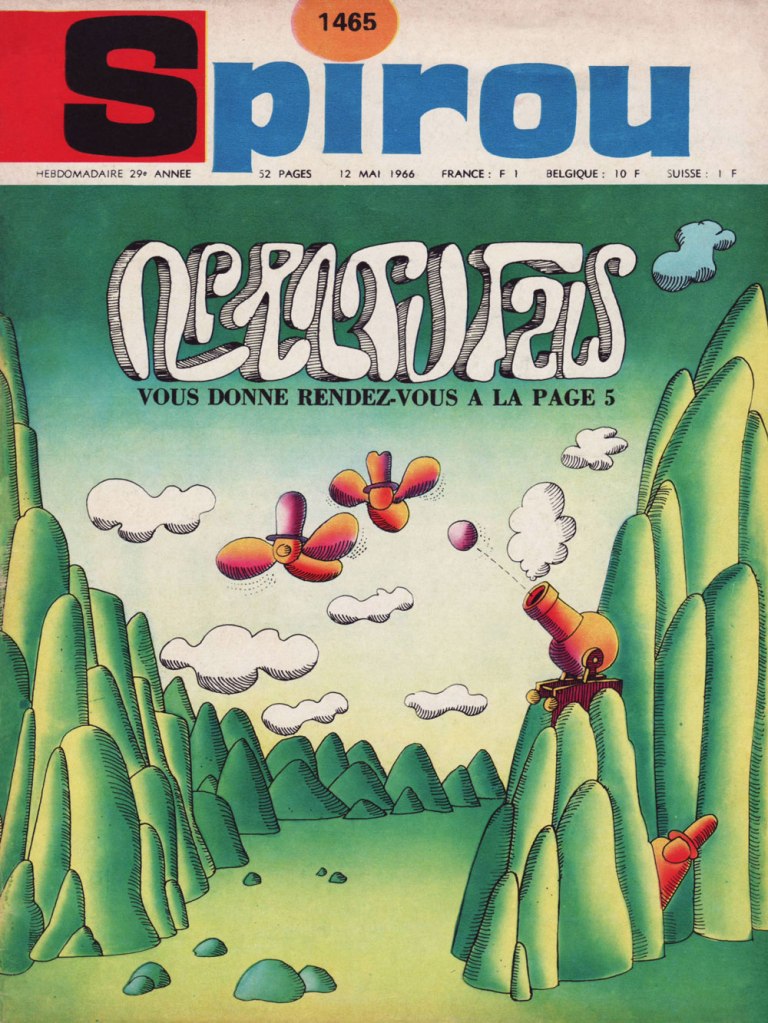
In 1966, you created a strip with an unreadable, and therefore unpronounceable name, which even made it onto the magazine’s cover: are we deep into Herriman* territory?

Rosy: That’s weird, people say that, but at the time, there was no such conscious homage. It was rather a reflection of the state of mind that I was in. I was increasingly bearing the marks of (and anguished by) the absurdity of certain facets of life.

«… awaits you on page 5. » Rosy’s cover for Spirou no. 1465 (May 12, 1966, Éditions Dupuis).

-RG
*Philosopher Alfred Korzybski‘s General Semantics, that is; most famous for its premise that « the map is not the territory ».

**In the same way that people with an insufficient frame of reference wrongly compare every musician they hear to The Beatles, the under-informed tend to ascribe any sign of whimsy or absurdity in the comics medium to Krazy Kat progenitor George Herriman. Yes, both were deeply influential, but come on, there are limits. In Rosy’s case, I’d posit that, if there was influence at work there, it was more likely that of the mighty Saul Steinberg.

Tentacle Tuesday: Unpopular Mechanacles

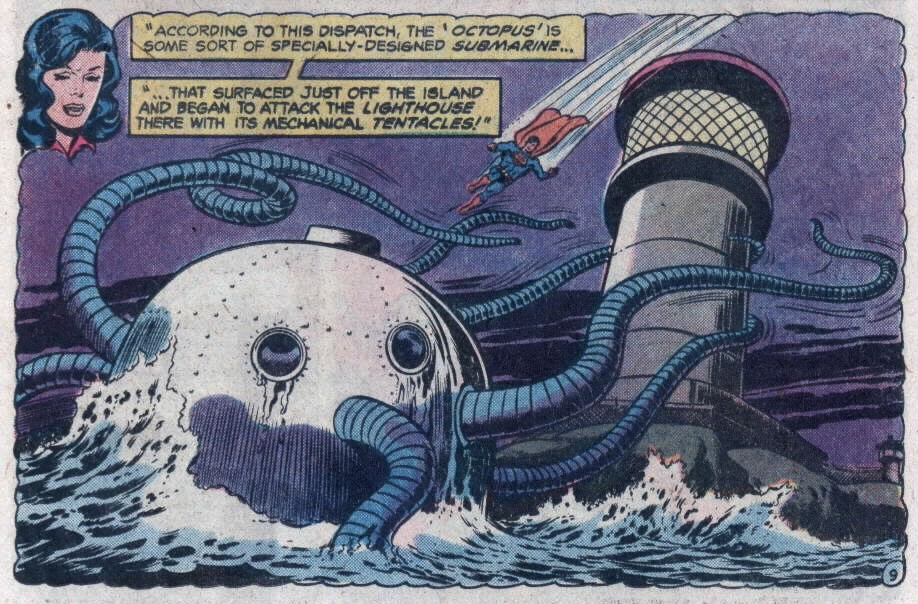
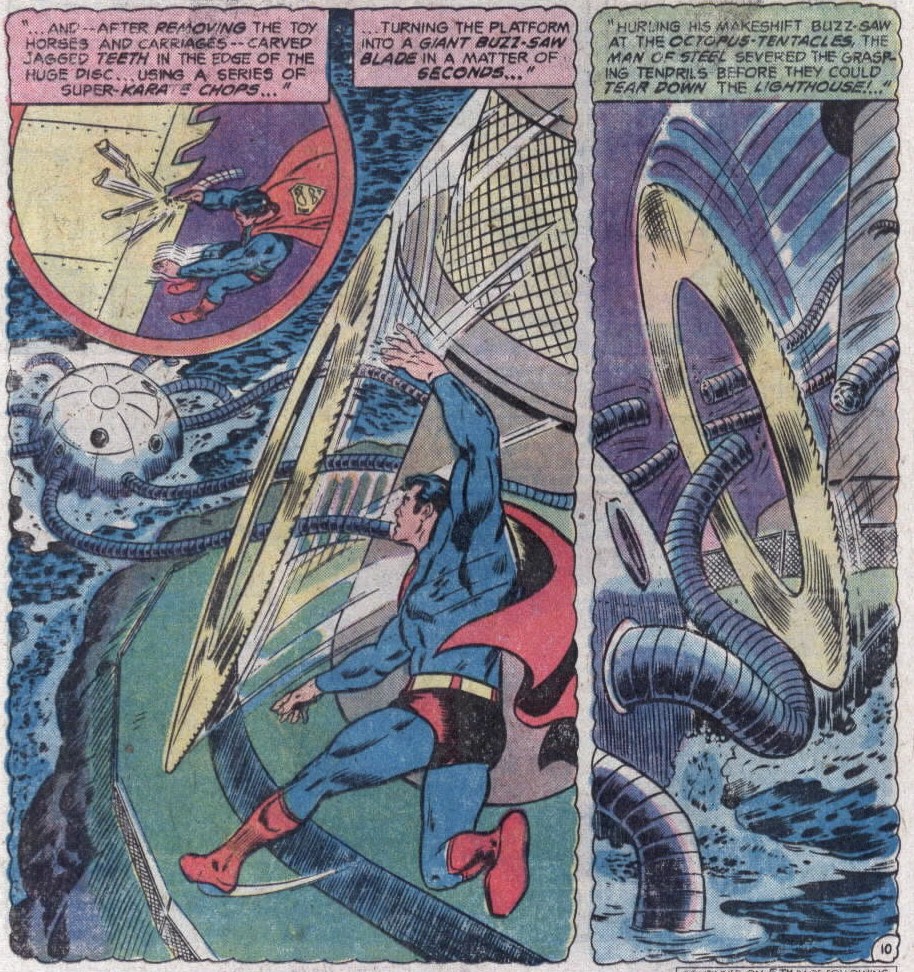
Greetings, tentacle lovers! After a hearty breakfast of cephalopod pancakes (no octopuses harmed), one can sit down with a quiet cup of tea and enjoy today’s crop of mechanical tentacles.

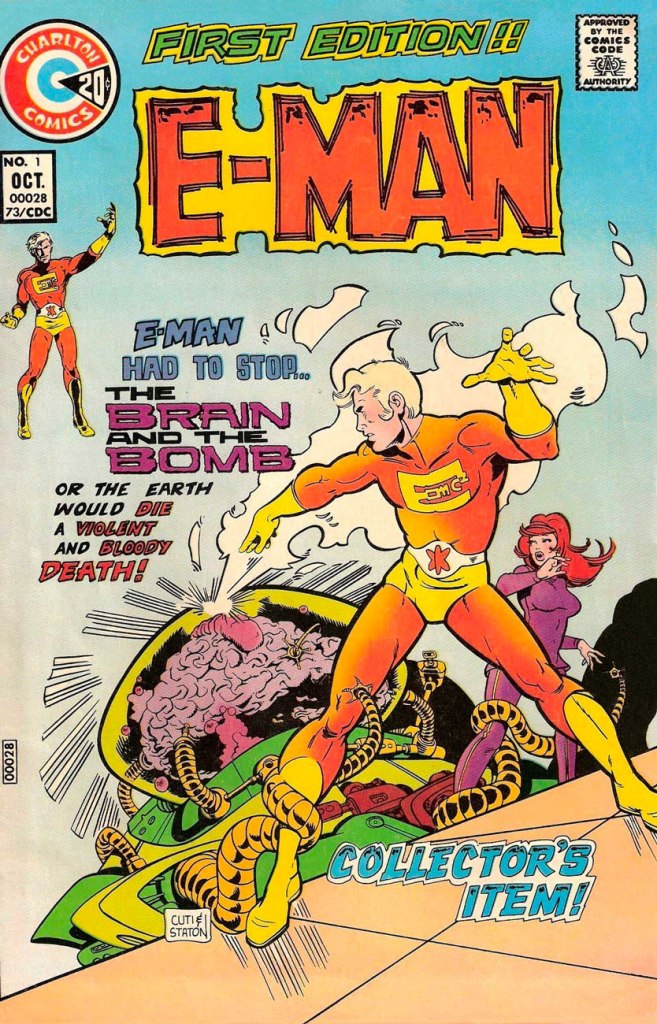
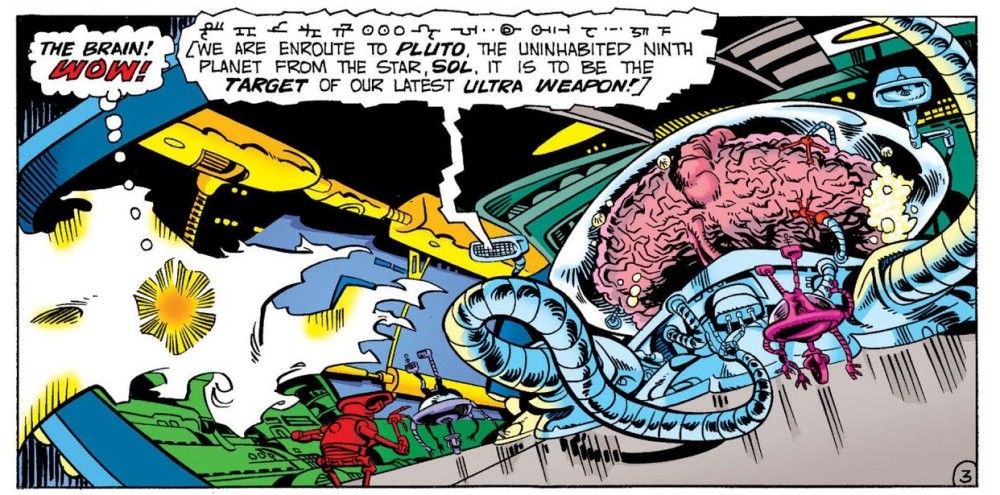
I tend to follow a chronological order, so our first is E-Man no. 1 (October 1973, Charlton Comics). The cover aside, these images have been taken from a recent reprint, which accounts for the somewhat garish colours. I am hardly a fan of Joe Staton, so this is starting off on a somewhat less aesthetically pleasing foot, but mechanical tentacles are en flagrant délit in the cover story. Besides, E-Man has a certain innocent charm.

The cover story is The Beginning, scripted by Nicola Cuti and illustrated by Joe Staton:

Going towards a much darker note (both in terms of printing and content – and to be honest, I by far prefer this dark-ish colour palette to the rainbow of E-Man colours), here is The Absolute Power-Play of the Parasite!, scripted by Martin Pasko, pencilled by Curt Swan, and inked by Frank Chiaramonte, and published in Superman no. 320 (February 1978, DC):

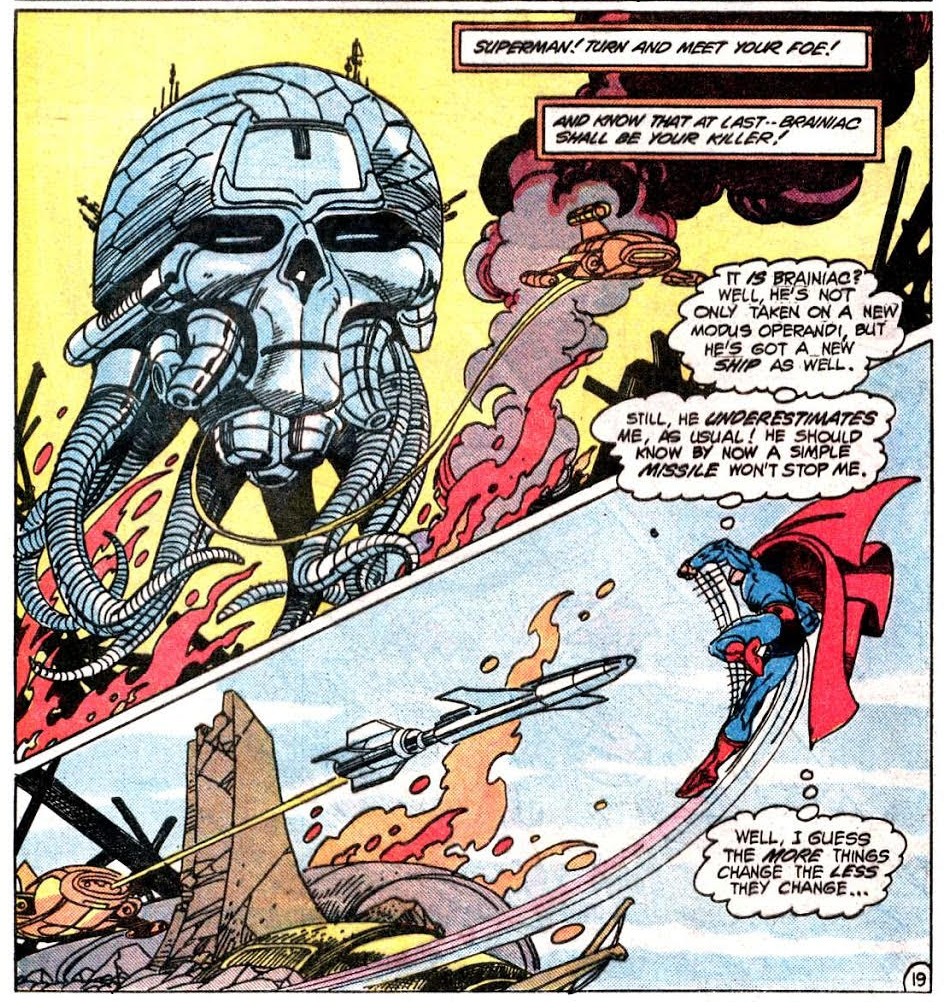
Next, dramatic Rebirth!, scripted by Marv Wolfman and drawn by Gil Kane (Tentacle Tuesday Dabbler!), published in Action Comics no. 544 (June 1983, DC):

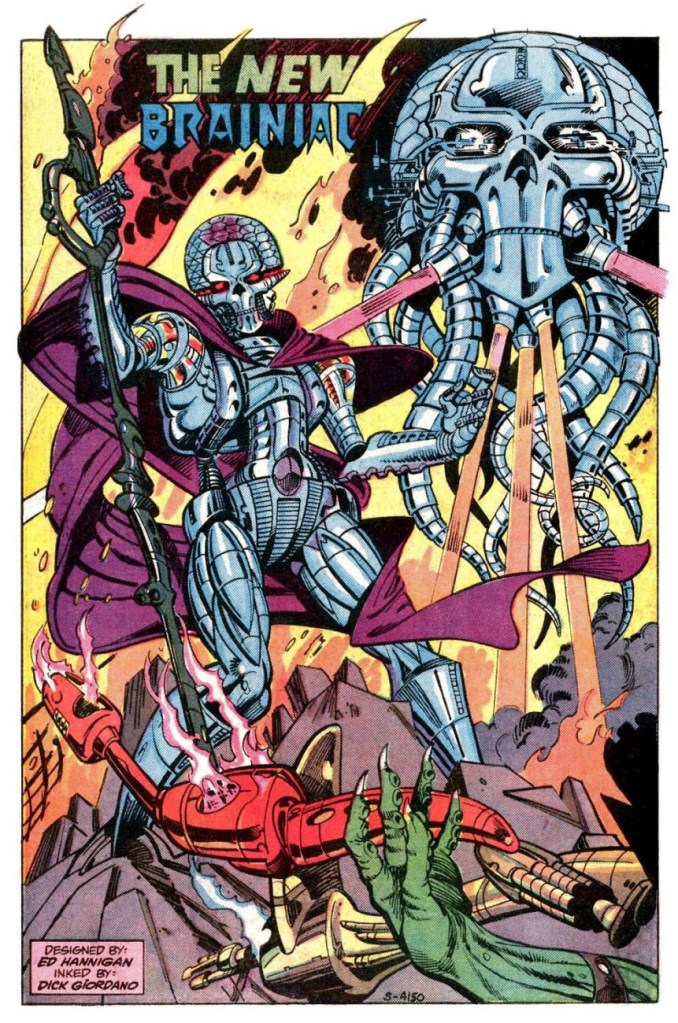
There’s even a sort of pin-up in that issue: The New Brainiac, pencilled by Ed Hannigan and inked by Dick Giordano.

So much flair and poise!

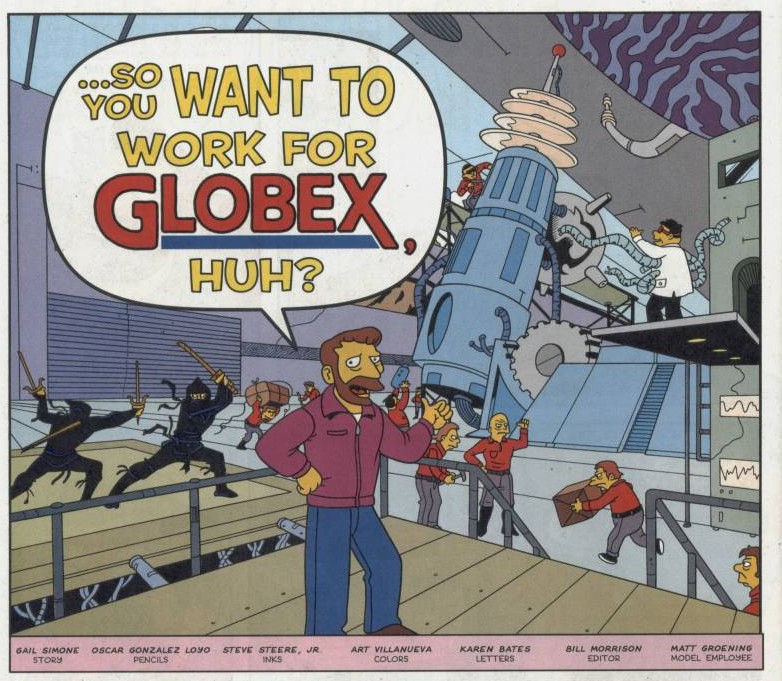
In a previous post (Tentacle Tuesday: Mechanical Tentacles) I promised that I would stick to but a few instances of Doctor Octopus and ne’er again return to him. However, I would like to point out this familiar fellow in the lab coat (top right):

…So You Want to Work for Globex, Huh?, scripted by Gail Simone, pencilled by Óscar González Loyo and inked by Steve Steere Jr., was published in Simpsons Comics no. 66 (January 2002, Bongo). Sometimes Simpsons comics are real fun to read, and this is one of those instances.

~ ds

Treasured Stories: “Smalltown Stardom” (1999)

« I’m going down to the Dew Drop Inn / See if I can drink enough / There ain’t much to country living: sweat, piss, jizz and blood » — Warren Zevon, Play It All Night Long

Kevin Nowlan (b. 1958, Chandron, NE) is one of those artists whose style I’ve always admired, and I’m far from alone in this sentiment. However, when it comes to what I think he should be applying his tremendous talent to, I’m squarely in the minority. Most people would evidently have him drawing Batman or the X-Men or other spandex fanboy favourites… but I feel there’s far more to him. He’s too good for the mainstream comics industry as it exists.

Always a meticulous artist he’s slow as (anti-gravity?) molasses in February, but while that’s led to a relatively modest body of work, it’s all solid. Even early in his career, his path was set, as evidenced by this bit of biography that appeared along with the opening instalment of his short-lived fantasy series, Grimwood’s Daughter (written by Jan Strnad) in Dalgoda no. 2 (Dec. 1984, Fantagraphics):

He discovered that working as gun-for-hire, illustrating scripts for which he had no respect, turning out more art than he could comfortably (and conscientiously) handle, and being forced by publishing schedules to allow as four artists to ink a single story, was artistically debasing and depersonalizing.

Like other creators (say, Adam Hughes and Frank Frazetta, for instance) of the popular but leisurely persuasion, he’s got imitators that can produce at five times his rate of speed. Good; let them take care of the superhero stuff.

Nowlan’s always possessed a sure hand with wry understatement, but he’s not a writer, and that’s a thorny problem when lacking a reliable accomplice to handle that part of the equation. So Nowlan’s done more than his share of covers, pinups and inking jobs.

Ah, but then along came Alan, whom you’ve all met. That hirsute prankster from Northampton understood. He had in his mind’s eye just what Mr. Nowlan needed to truly stretch out and shine, the absurd deeds of Jack B. Quick, Boy Inventor.

JBQ was supposed to be one of a quartet of regular features appearing in the Moore-scripted anthology title Tomorrow Stories, but Nowlan didn’t last long on a schedule, and there are but a handful of JBQ tales, all excellent, capped by the fitting double-length finale, I, Robert. (Tomorrow Stories Special no. 1, Jan. 2006). The feature was (for the most part) replaced by an unfunny waste of Hilary Barta‘s talent, a woeful would-be Plastic Man ersatz, Splash Brannigan. Alan Moore can wring humour out of nearly anything, but as Splash and (even worse) The First American show, superhero parodies are his Waterloo.

JBQ, on the other hand, provides values rarely encountered, let alone appreciated, in mainstream American comics: deadpan, understated humour, surreal but non-cloying whimsy, and a rigorous, steadfast adherence to the mechanics of internal logic, no matter how outlandish things get. In prose, one might chance upon that sort of approach in the works of Marcel Aymé or R.A. Lafferty. But even there, it’s hardly routine. Oh, and given that it’s Alan Moore we’re dealing with, it’s a huge bonus that the JBQ stories are quite rape-free!

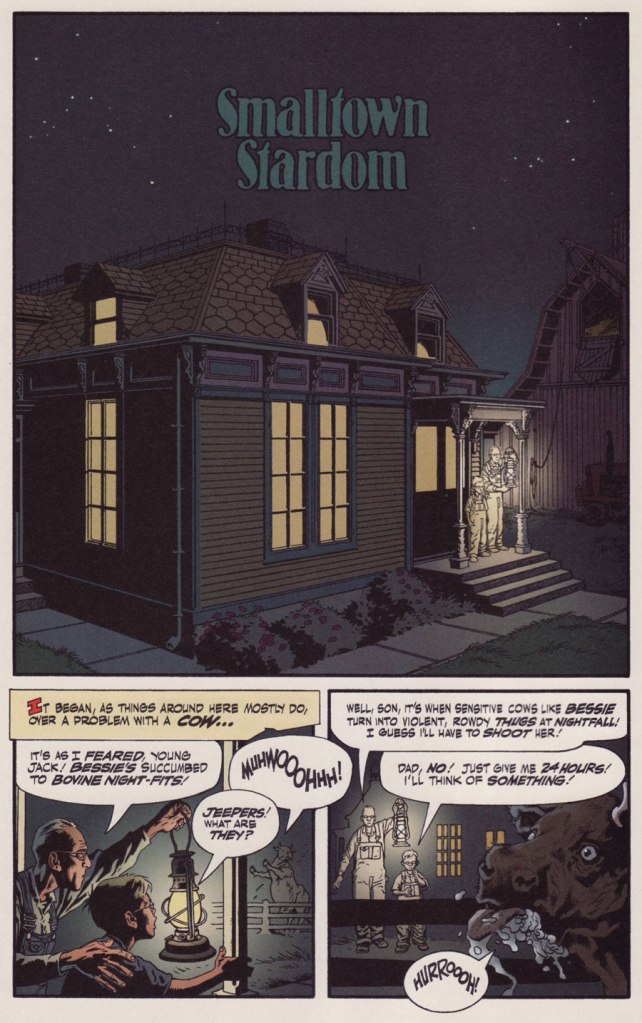
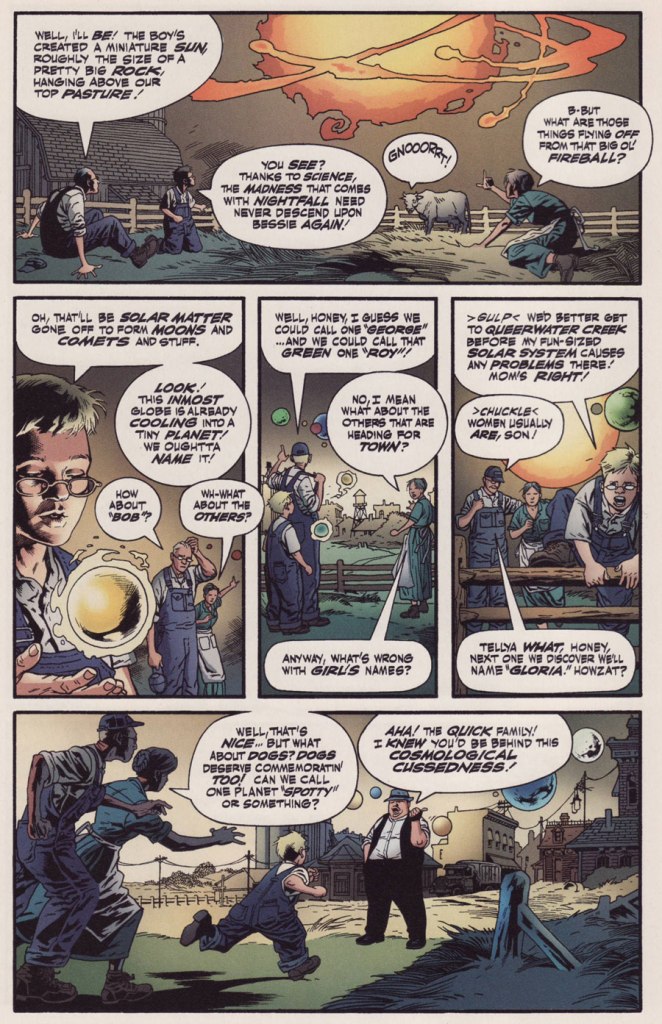
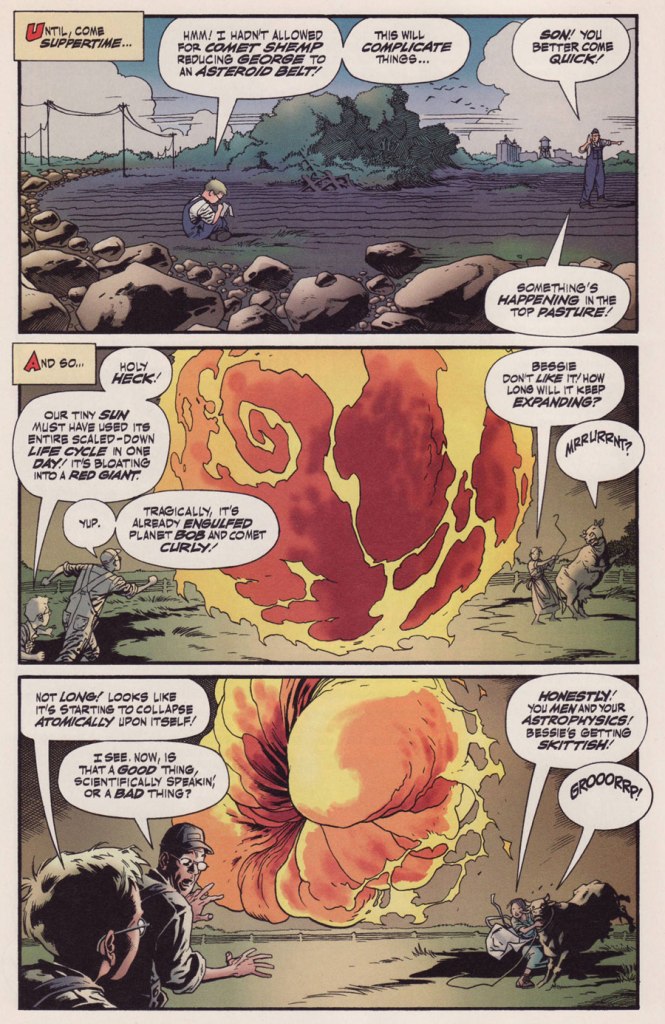
But let’s commence from the top, with the dizzying tale of Smalltown Stardom (Tomorrow Stories no. 1, Oct. 1999, America’s Best Comics). No need to shove, there’s plenty of room at the trough!

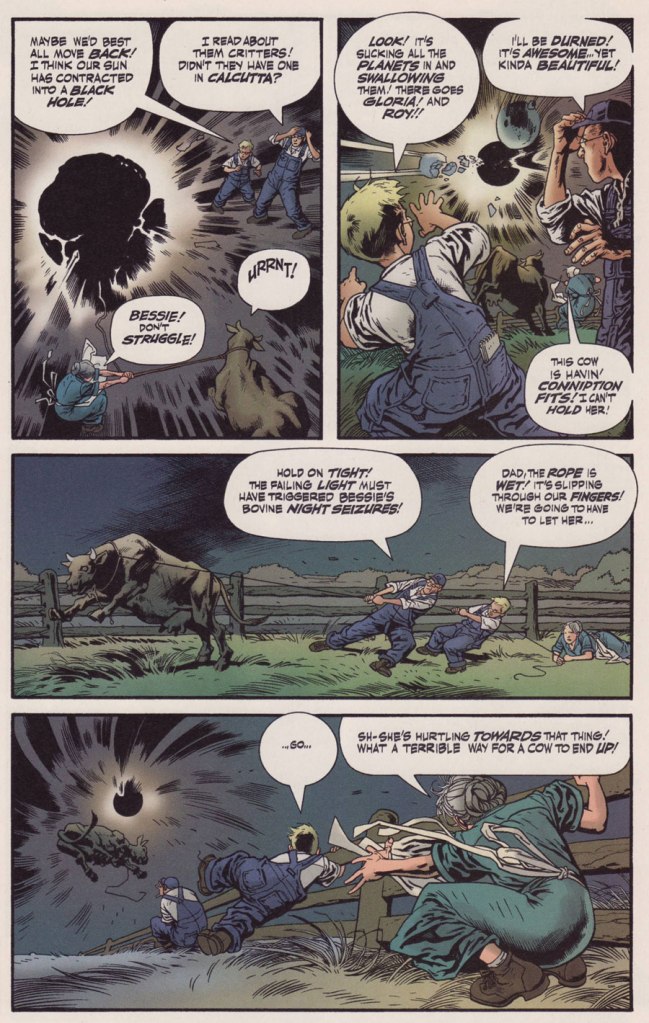
Find out more about the infamous Black Hole of Calcutta!

Is it just me, or can you also picture Thomas Dolby as a grown-up Jack?

-RG
Tentacle Tuesday: That Bizarro Look in Your Eye

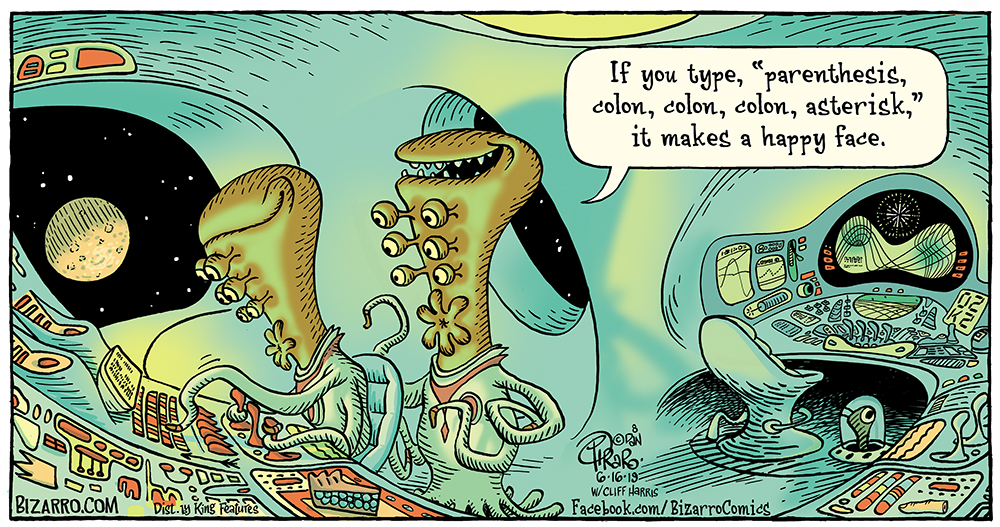
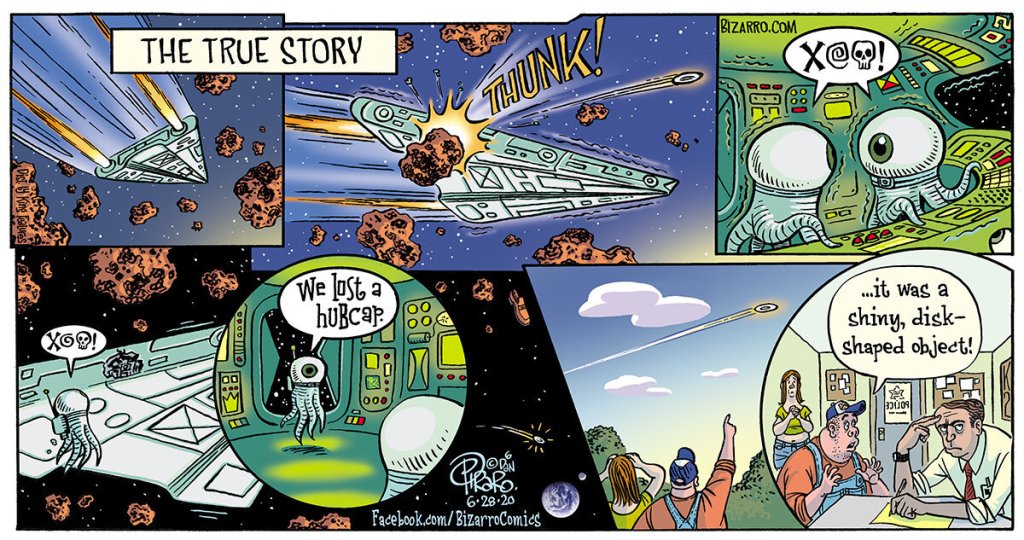
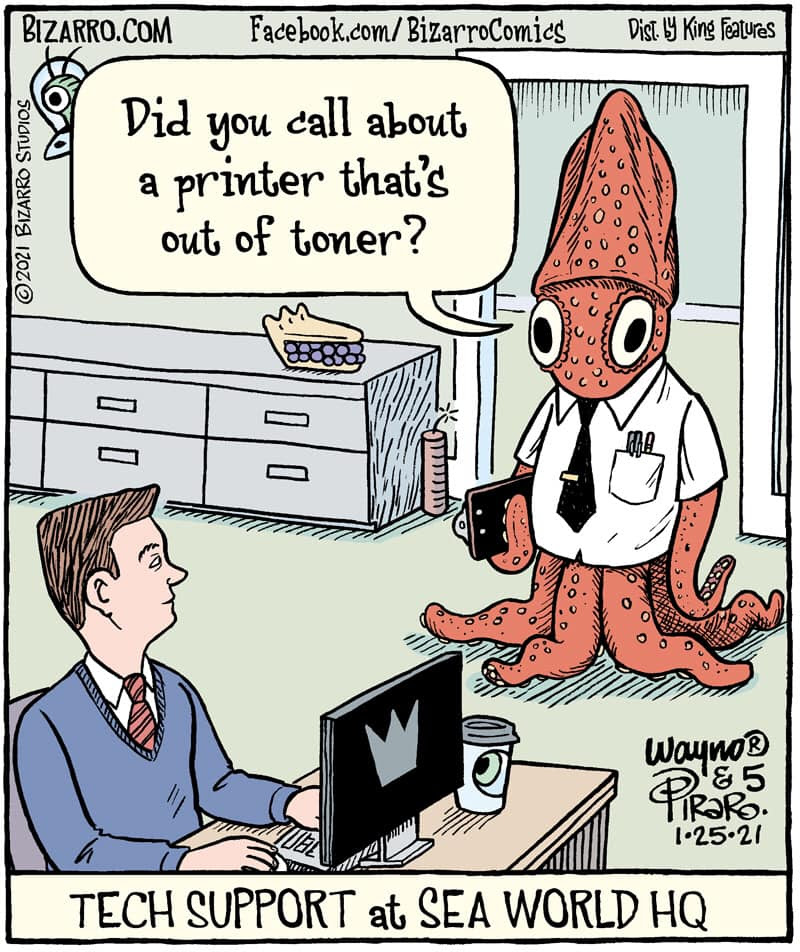
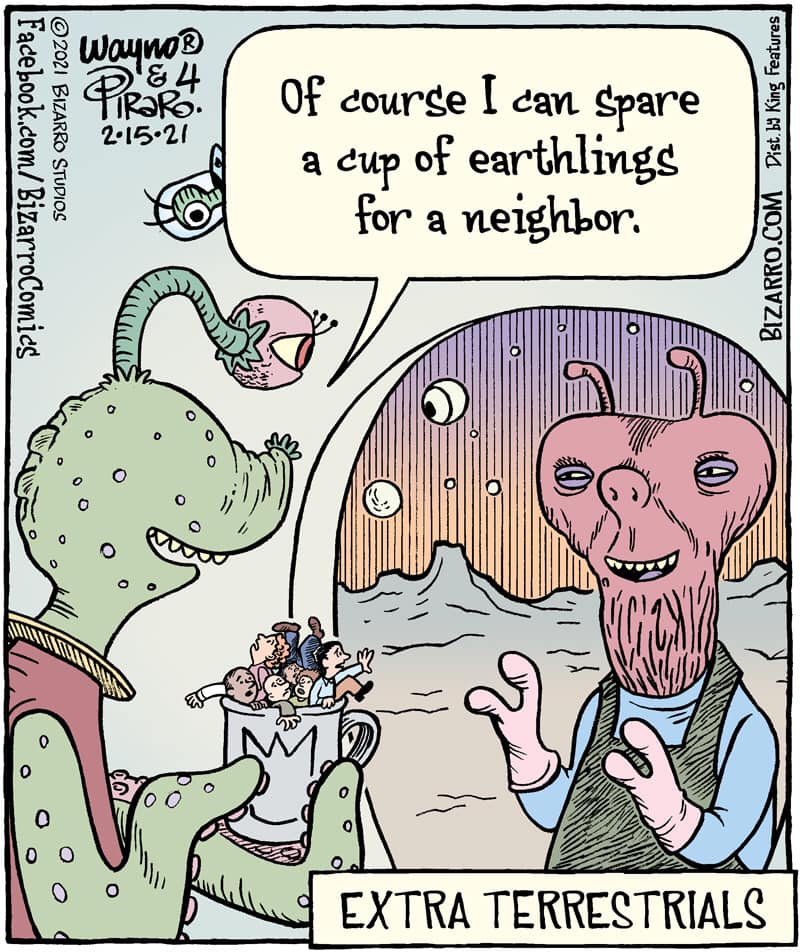
Today’s Tentacle Tuesday is a continuation of previous post that’s close to my heart. In a little less than a year, I have accumulated a new batch of tantalizing tentacles from the pens and minds of that intrepid team, Wayno and Dan Piraro. The initial post can be found here: Tentacle Tuesday: Let’s Get Bizarro. The loveliest thing is that some of these are from 2021 – I am not taking for granted the fact that these guys just keep going on, with no loss in quality, year after year. Without further delay…

First, some Dan Piraro Sundays – Wayno has been part of the team since 2018, but only on the dailies.

And now, on to the aforementioned dailies! Wayno straddles the line between continuing the Bizarro aesthetic and keeping his own drawing style beautifully, I think.

As a bonus, 3 older Piraro dailies, artfully collated by co-admin RG. Wouldn’t you like to hang this in your home? I know I would.

~ ds

Herluf Bidstrup: The Goal of Satire Is to Speak the Truth

I’d like to talk about Danish Herluf Bidstrup (1912 – 1988), yet another talented artist of some renown during his lifespan, but who soon sank into the oblivion of time. His wild popularity in the Soviet Union at the height of his artistic prowess not only resulted in honourable mentions in various works of Russian literature, but also in the printing of a bevy of collections both old and new. He has also received numerous awards from the USSR (most notably, the Lenin Peace Prize – a bit of a contradiction in terms – and the Order of the Red Banner of Labour). Now he’s forgotten by most everyone… except by Russians, who still carry a torch for his cartoons, and publish new collections of his work to this day. He produced around five thousand cartoons during his lifetime, so there’s certainly plenty of material to collect!

In Moscow, circa 1953.

The openly anti-fascist Bidstrup had been contributing humorous drawings to various publications since 1935, but he truly found his voice in the underground (and illegal) newspaper, Land og folk, the offshoot of Denmark’s (also illegal) Communist party, which Bidstrup joined in 1943. While his work was also appreciated and published in East Germany, his obvious political stance significantly limited the scope of what could be printed. It even affected his career in his home country, as Denmark was economically dependent on then-Fascist Germany. Bidstrup himself considered that he was most accurately represented in the Soviet press, not only before and during WWII, but also after the war. In 1953, in a letter to his friend Soviet journalist Mikhail Kosov, translator of his work and main enthusiast, he wrote that « all Soviet anthologies which we have prepared together are a hundred times better than collections published in other countries… in the German version, I become more and more of a harmless humourist, and a completely toothless satirist. »

Bidstrup’s sketch of the Cathedral of Vasily the Blessed.

In a sense, Bidstrup can be compared to his contemporary, French artist Jean Effel (also a favourite of Soviet citizens): both were openly communists whose work confronted social injustice and inequality. But at the end of the day, artists aren’t much remembered for their ‘social conscience’: it’s their keen eye for everyday detail and sense of humour that allows cartoons to pass unscathed through decades, to touch and amuse us some seventy years on. In that sense, Bidstrup’s cartoons are arguably more ‘dated’, more tied to his politics than Effel’s, which perhaps explains why one encounters mentions of the latter a little more often. Still, there’s plenty there to admire and chuckle at.

Bidstrup Herluf: Drawings (2017, Mesheriakov Publishing House); such a nice shade of green.

The following images have been selected from the collection seen above and kindly scanned and framed by co-admin RG.

«The circle closes.»
« On the wings of Pegasus. »
« Amateur photographer »
« Self-criticism »
« Direct hit »
« Life’s journey »
« Wife of a jazzman »
« Solitude »
« Fished out »
«The mirror of the soul »
« An extended game »
« A perfect example »

Finally, here is a charming cartoon that Soviet animation director Lev Atamanov produced in collaboration with Bidstrup during one of his many visits to the USSR.

I hope your enjoyed this walk down history’s lane. And if you’d like to see more, while Herluf Bidstrup may be relatively obscure, you can still see a nice collection of his cartoons here and here.

~ ds

Behold… the Great Shnozzola!

« That’s the conditions that prevail! » — Jimmy Durante

Today, we salute noted vaudevillian, piano player, comedian, singer, film and radio star, raconteur and unlikely comics legend James Francis “Jimmy” Durante, born on this day, February 10, in 1893 (as it was a Friday, the family presumably fasted or had fish for dinner). He truly was a master of all media, as you’ll witness.

This early bit of biography appeared in Juke Box Comics no. 4 (Sept. 1948, Eastern Color); it was illustrated by Ed Moore. Hear Cantor and Durante reminisce about their early days on this 1947 episode of The Jimmy Durante Show.
A passing mention of old Jimmy, from Nyoka the Jungle Girl no. 24 (Oct. 1948, Fawcett). Writer and artist unknown.
An early cover by Dick Ayers (1924-2014), this is Jimmy Durante Comics no. 1 (Oct. 1948, Magazine Enterprises).
The second and final issue of Jimmy Durante Comics (Winter 1948-49, Magazine Enterprises).
Mr. Durante rates a smashing musical appearance in this Rube Goldberg Device daily strip (Apr. 14, 1951, King Features Syndicate)… by Rube Goldberg, naturally.
And here’s the Shnozzola in the midst of a carnal melée of his fellow Old Hollywood legends (can you name them all, cinephiles?) This is Bill Griffith‘s cover for The Tiajuana Bible Revival Volume Two: Under the Stars in Hollywood (1977, Hooker, California: Paramounds Prod.). This was « An anthology reprinting 1930’s Tijuana Bibles, some of which were obscene parodies of popular newspaper comic strips of the day. Others made use of characters based on popular movie stars and sports stars of the day, such as Mae West and Joe Louis, sometimes with names thinly changed. Before the war, almost all the stories were humorous and frequently were cartoon versions of well-known dirty jokes that had been making the rounds for decades. » [ source ]
Pointillist-satirist Drew Friedman‘s immortal Jimmy Durante Boffs Young Starlets first saw print in National Lampoon vol. 2 no. 78 (Jan. 1985).
Durante briefly pops up (with the Checkered Demon!) in the second half of a truly all-star underground comix jam involving R. Crumb, Steve Clay Wilson (1941-2021… he left us just three days ago, aged 79… RIP), Victor Moscoso, Spain Rodriguez, Rick Griffin, Robert Williams and Gilbert Shelton. It appeared in Zap Comix no. 12 (1989, Last Gasp). Cartoonists are generally fond of the Schnozzola, but Underground cartoonists are just mad about him.
And finally, on a gentler note… here’s a clearly affectionate caricature (a preliminary sketch) of the esteemed Signor Durante (aw, he’s blushing!) by the amazing Sam Berman (crayon on onionskin paper, 1947). Berman (1907-1995) was, deservedly, quite a big deal in his day; as the erudite Drew Friedman told Print Magazine in his quality of co-curator of the 12 Legendary Caricaturists You’ve (probably) Never Heard Of exhibition at NYC’s Society of Illustrators, Berman « was indeed famous and celebrated in his day. Beginning his career in the late 1930s, he created iconic sculpted caricature covers for Esquire featuring their new mascot “Esky” (created by Berman) for an entire year. He created the sculpted caricatures of the leading actors (Fredric March, Carole Lombard, etc.) for the opening titles of the 1937 classic screwball comedy Nothing Sacred, did huge amounts of work for all the top magazines and newspapers of the day, including for Mark Hellinger’s popular column, created close to 60 amazing full-color portraits for the 1947 booklet The NBC Parade of Stars, drew children’s books, and arguably his most famous creation, the opening caricature of Jackie Gleason rising over Brooklyn for “The Honeymooners,” although he was never credited on the show for drawing that image, nor in any books. He then inexplicably went into map-making and faded quietly into obscurity. »

To wrap things up, here’s Jimmy D. and Frankie S. duetting in Russian. And why not? Happy birthday, Jimmy, wherever you are (and do say hello to Mrs. Calabash!)

-RG

Tentacle Tuesday: Barbarian Fatigue

Greetings all! Today we play whack-a-mole with a few warriors in loincloths – or at least that’s how I felt when looking for material in this post. Every time I found an instance of tentacles in some Conan the barbarian or Kull the destroyer tale, there was yet another one just an issue or a couple down the line. Let’s then consider this the end of a story begun with Tentacle Tuesday: the Savagery of Conan’s Savage Sword and continued with Tentacle Tuesday: Conan-o-rama: after this, I’ll be all Conan-ed out for a few years to come. So drink a shot of some concoction you like (be it coffee or the potent Zombie), and join me for this last foray into the dark, mysterious, predictable world of sword-and-sorcery heroes who run around half-naked (for better freedom of movement, no doubt).

Poor octopus, by far the most tragic figure of this story… These two pages are from The Dweller in the Dark, scripted by Roy Thomas and illustrated by Barry Smith, was published in Conan the Barbarian no. 12 (December 1971, Marvel).
You can’t have it both ways – praising a woman for exhibiting quintessentially ‘feminine’ characteristics and then getting pissed off at her dismay and fright when grabbed by a murderous monster.
The Sunken Land, scripted by Denny O’Neil (from a short story by Fritz Leiber), is pencilled by Walter Simonson and inked by Al Milgrom. This story was published in Sword of Sorcery no. 5 (Nov-Dec 1973, DC). I like Leiber, and I’ve been meaning to get to the Gray Mouser for a while – but I’m reading Andrzej Sapkowski’s Witcher right now, and one sword-and-sorcery saga at a time seems reasonable.
Page from Flame Winds of Lost Khitai!, scripted by Roy Thomas, pencilled by John Buscema and inked by Ernie Chan, published in Conan the Barbarian no. 32 (November 1973, Marvel). Interestingly, barbarians seem to universally abhor striking a woman; an attempt at primitive ethics from the part of the scripters.

One more Conan before we move on to Kull…

Page from Isle of the Dead, scripted by Bruce Jones and illustrated by Val Mayerik, published in Conan the Barbarian no. 138 (September 1982, Marvel). This page has the rare distinction of having the warrior-hero being less clothed than the girl he’s with.

As promised, here’s Kull the destroyer, engaged in battle with an eighties octopus (check out that mohawk!)

Two pages from The Thing from Emerald Darkness, scripted by Doug Moench, pencilled by Ed Hannigan and inked by Alfredo Alcala. This story was published in Kull, the Destroyer no. 17 (October 1976, Marvel). Why does a traitor (that’s not ‘traiter’) deserve better than to die from tentacles? That seems like no worse a death than any other in battle.
A page from City of the Crawling Dead, scripted by Don Glut, pencilled by Ernie Chan, and inked by Rick Hoberg. It was published in Kull, the Destroyer no. 21 (June 1977, Marvel).

Just before you pass out from over-consumption of alcoholic drinks (I’m having a gin and tonic over here!), I’d like to enliven this parade of humdrum tentacles a bit with this Conan pin-up:

This scene by Mike Zeck featured on the cover of long-running ad zine Rocket’s Blast Comicollector no. 119 (June 1975, James Van Hise).

~ ds