Here Come the Flakes!

« It’s quiet snow that I remember best… snowfall and Brahms on November nights. » — Rod Mckuen, Midnight Walk

While Autumn is easily my favourite season, much of its magic and colours are gone by the purgatory that is the month of November, and I find myself longing for snow to brighten the relentlessly longer and gloomier evenings.

And then, yesterday, as I was still mulling over this post, I woke up to this view from my front door.

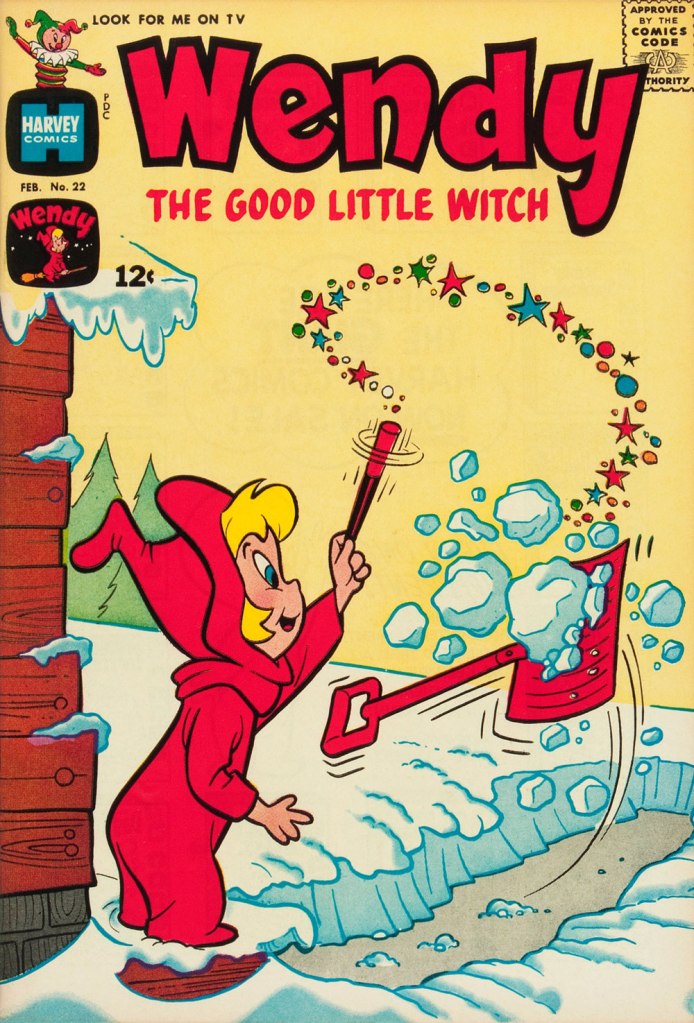
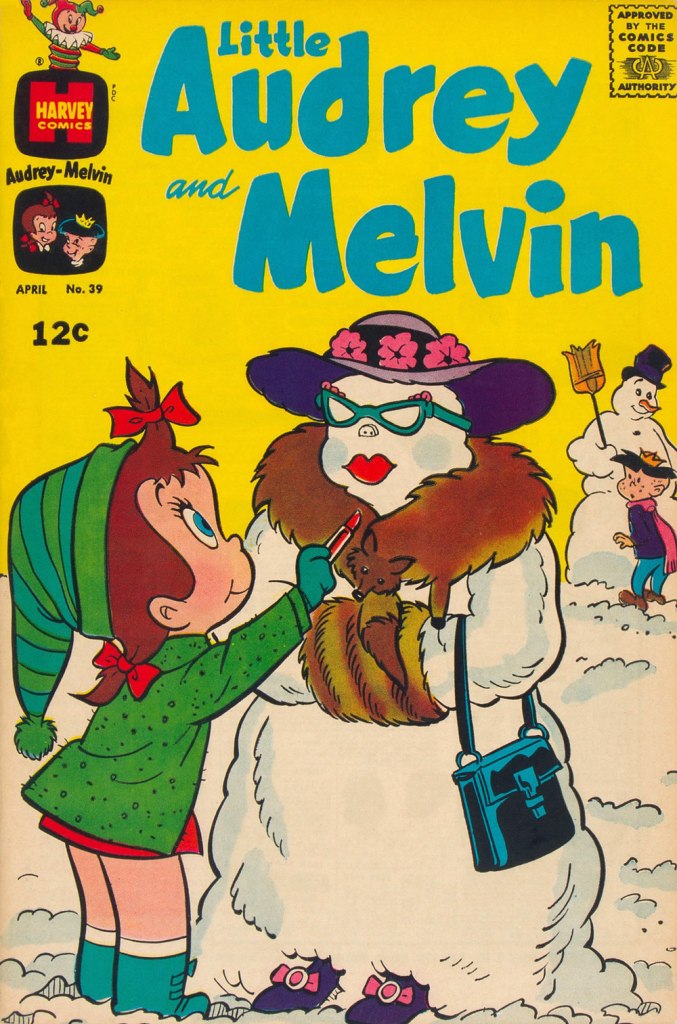
Well, then! This post consists of a(nother) gallery of Warren Kremer‘s delightful Harvey covers, this time with a snowy theme. Never truly ‘ha ha’ funny, they get along on charm and crafty, limpid conception and execution.

This is Little Dot no. 15 (Jan. 1956, Harvey). While most of Harvey’s efforts were channeled into their ‘Big Two’, Casper and Richie Rich, I always found these too bland (in the former’s case) or kind of deplorable (in the latter’s). I was more attuned to the line’s (slightly) bad boys, Spooky and Hot Stuff (Donald Ducks to Casper and Richie’s Mickey Mice), but really, the genuine interest resided in art director Kremer’s nimble design gymnastics and thematic acumen on Little Dot covers. By this time, these have improbably (but happily) inspired designers all over the globe. Nevertheless, a big juicy pox on the article’s author for failing to acknowledge Warren Kremer even once.
This is Spooky no. 73 (Apr. 1963, Harvey). Those 1960s Harveys were so beautifully uncluttered in their design, with the bonus of Kremer’s marked and ongoing contempt for the Comics Code Authority stamp. Oh, and here’s our earlier selection of Spooky covers.
This is Wendy, the Good Little Witch no. 22 (Feb. 1964, Harvey).
Richie Rich no. 23 (May 1964, Harvey). What have you been eating, Richie?
This is Little Audrey and Melvin no. 23 (Mar. 1966, Harvey). As you can see, Audrey’s sidekick Melvin shares a former fedora with our dear friend Forsythe Pendleton ‘Jughead’ Jones. That particular chapeau is called a Whoopee Cap.
This is Richie Rich no. 55 (Mar. 1967, Harvey).
This is Casper, the Friendly Ghost no. 116 (Apr. 1968, Harvey). Variations on skiing through solid objects is quite the cartooning wellspring.
This is Little Audrey and Melvin no. 39 (Apr. 1969, Harvey).
This is Hot Stuff, the Little Devil no. 93 (Oct. 1969, Harvey). For more Hot Stuff covers, check out Who Will Change the Devil’s Nappy?
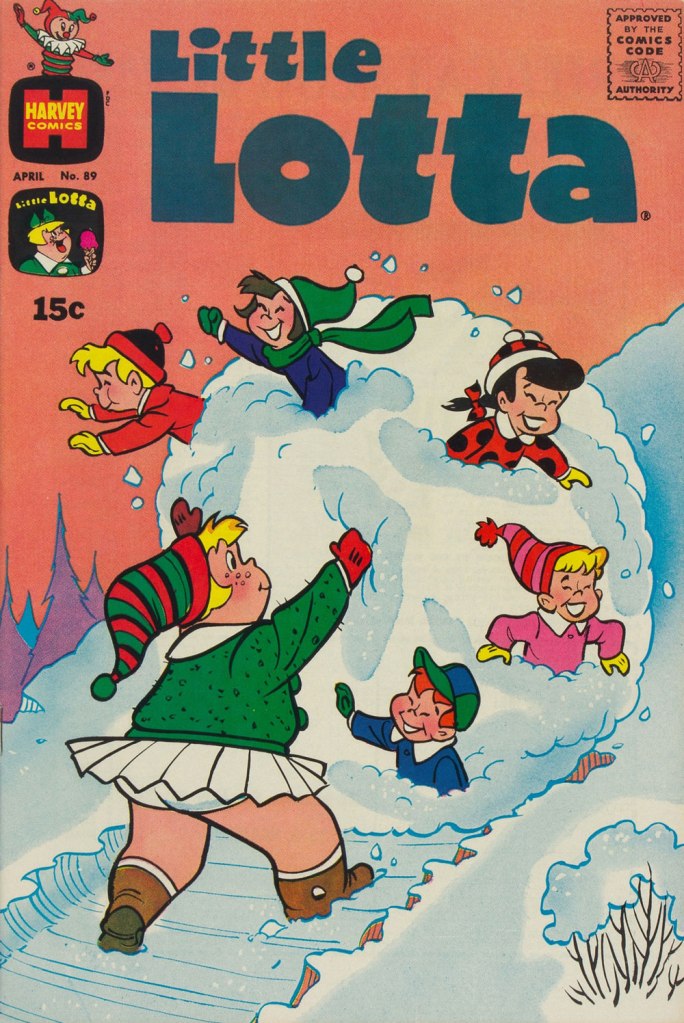
This is Little Lotta no. 89 (Apr. 1970, Harvey). And they didn’t find the local children’s mangled bodies until the following spring thaw.

-RG

Boop-Oop-a-Doop Like It’s the Thirties!

« Her surname, a familiar catchphrase of the time, was inspired by the inter-lyric expostulations of a nationally famous Paramount Pictures songbird, Helen Kane. ‘Boop Boo a Doop!’ was the chant she sang in her sweet, high-pitched voice, a flippant raspberry to the jazz age. Somehow these nonsense syllables seemed to embody the spirit of the waning days of the twenties… »
I think everybody knows Betty Boop, though probably not that many have seen the original cartoons from the 1930s. She was ‘created’ by Max Fleischer orchestrating a team of animators – as with any gestalt creation, one can argue about who was responsible for what until one is blue in the face, but it has been convincingly argued (by Bill Blackbeard, for example) that Grim Natwick was the actual creator, probably with a stable of other animators.

In 1930, Betty, then still nameless, made her first appearance in (the pleasantly weird) Dizzy Dishes as a supporting character, as a seductive canine anthropomorph with dog ears and human curves. She acquired more personality once she was matched up with Bimbo, another doggo, in Bimbo’s Initiation (1931) – which is an even stranger cartoon, a tale of hazing by a bunch of creatures with pulsating buttocks and candles on their heads pursuing Bimbo with chants of ‘wanna be a member? wanna be a member?’, to which Bimbo always responds ‘no!’ to get sent to yet another chamber of tortures. I would suggest not psychoanalysing that too closely. Watch for the grand WTF finale:

By 1932, Betty, who now had a stable position as Bimbo’s regular girlfriend and a name to call her own, had jettisoned her dog attributes, floppy dog ears quite seamlessly transformed into big hoop earrings. Though she was a’booping from the very beginning, she acquired her hallmark Boop surname with Betty Boop Limited (1932). The aforementioned Helen Kane* was not pleased, and there were, as Blackbeard explains in his introduction to Betty Boop’s Sunday Best: The Complete Color Comics, 1934-1936 (Kitchen Sink Press, 1995), ‘threats of lawsuits, various legal manœuvres, and demands for creator royalties, all without result‘.

In 1933, Hearst’ King Features Syndicate started negotiating terms for a Betty Boop comic strip, and in 1934 the strip, drawn by Bud Counihan, appeared. However, this was not exactly the same unhinged, hip-jiggling Betty of earlier years. King Features wanted to appeal to more conservative audiences, and Betty’s sexuality was toned down a notch. The animated Betty didn’t fare much better – as usual, guardians of Moral Purity™stuck their fingers in the pie, and from June 1934, the Motion Picture Production Code kicked into effect, forcing Betty to leave behind her carefree flapper days to become either a career girl, or some generic housewife.

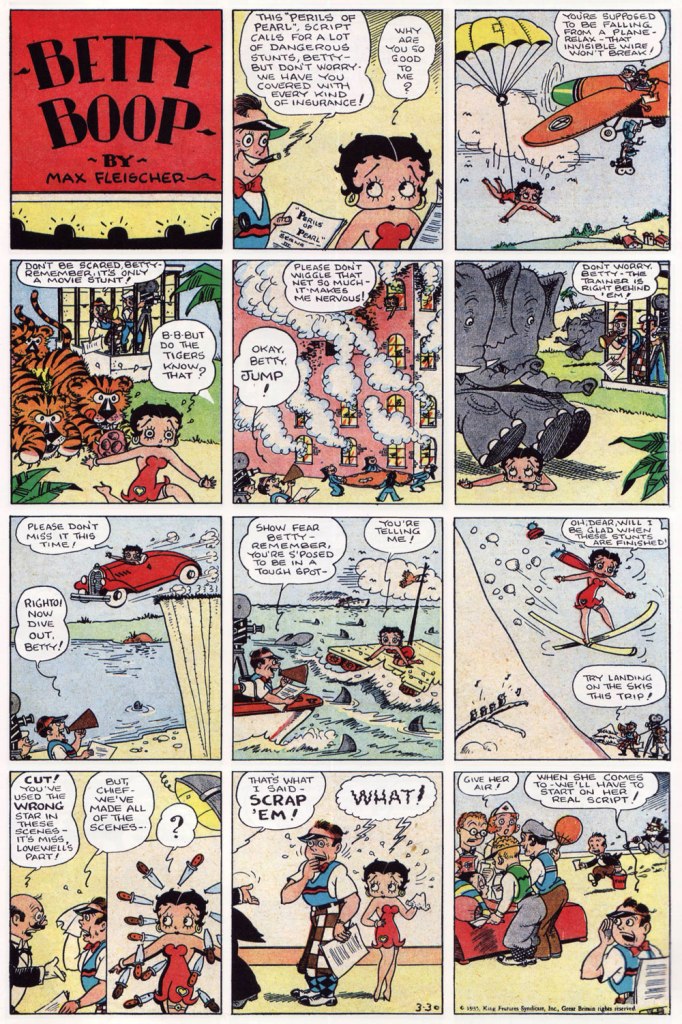
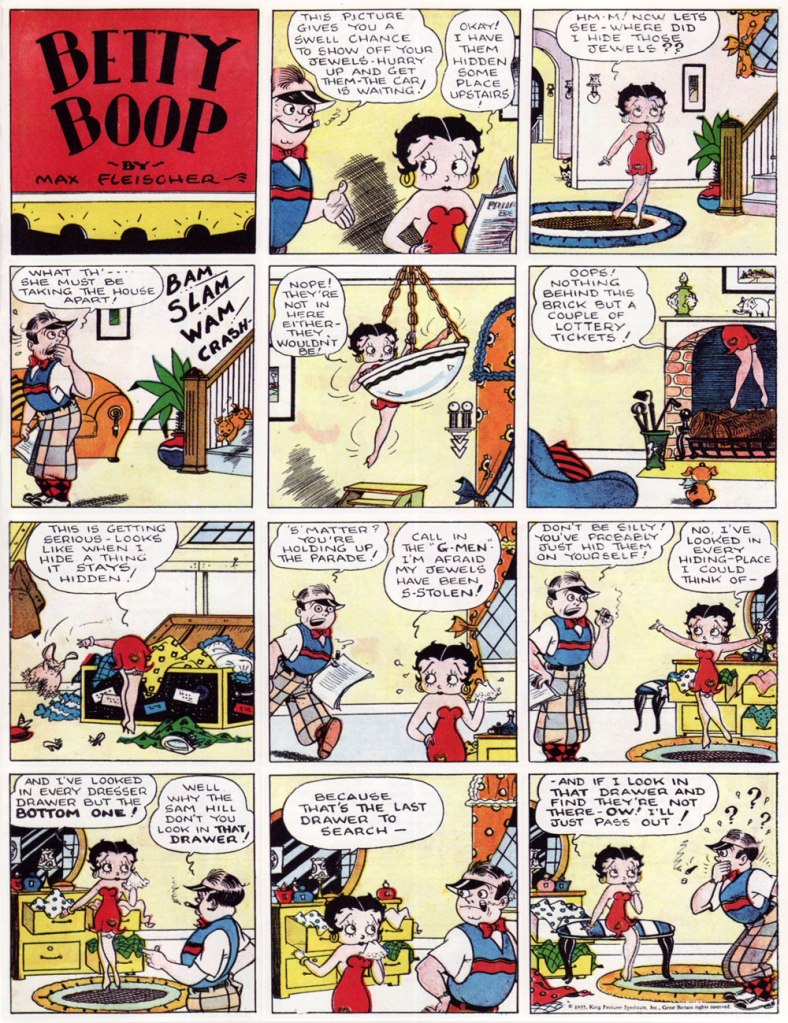
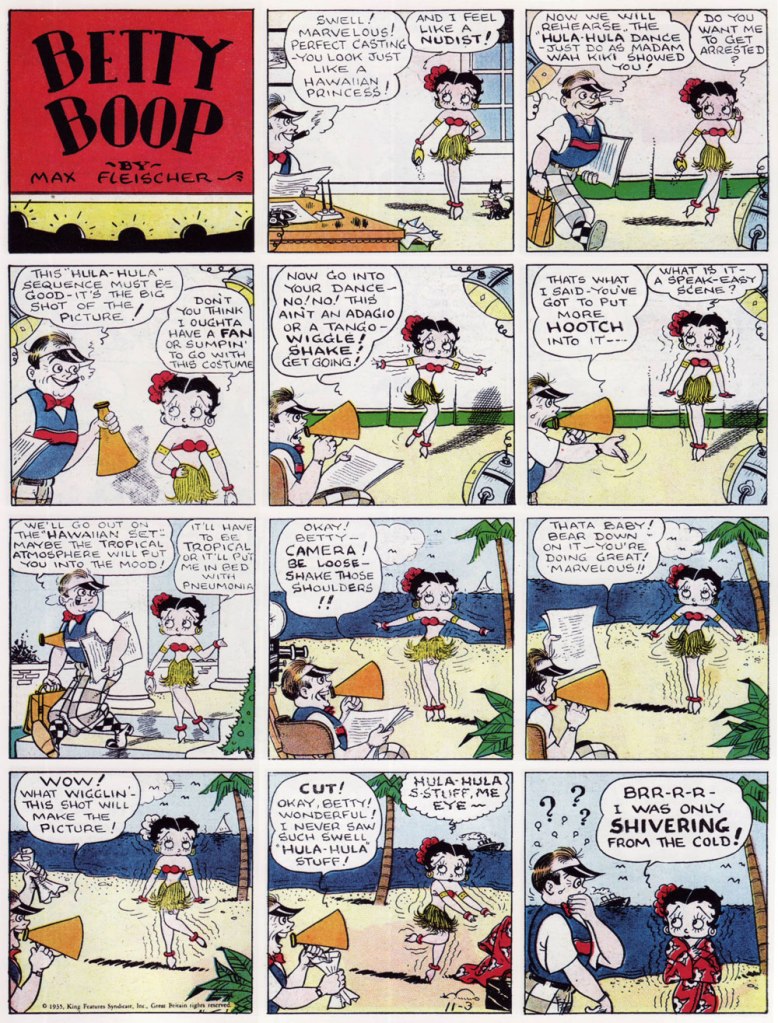
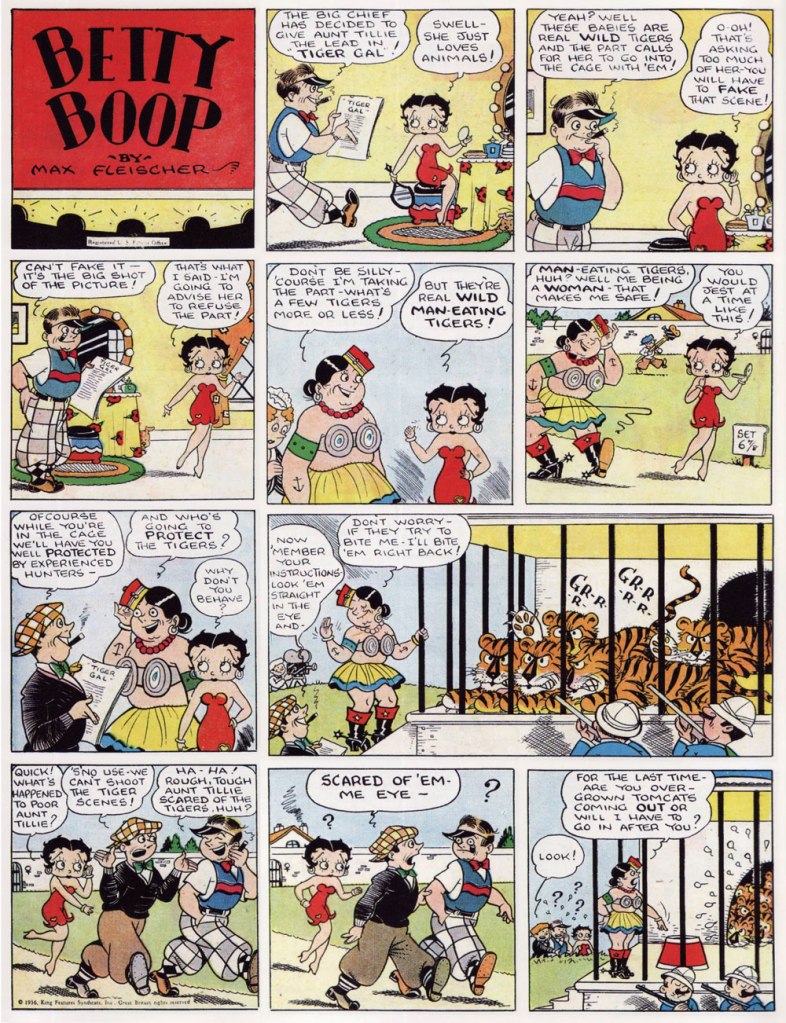
Oh, but there was still plenty fun to be had. Besides, the comic strip Betty was not quite as smothered – while the latter was nursing babies and whatnot in a long dress, the former was still running around in her risqué red number, occasionally even kissing men and living the life of a spoiled movie star. Here are a few Sunday strips – thanks for co-admin RG for scanning these unscannables.

Sunday strip from March 1935. Counihan’s tigers are consistently adorable.
Sunday strip from 1935, and a few different perspectives on Betty’s legs and derrière.
Sunday strip from 1935. That’s a more fun version of a police line-up…
Sunday strip from 1935. Mentions of nudism come up more often than one would expect (and yet Betty is never particularly undressed, at least not by modern standards).
Sunday strip from 1936. In the later years, Betty’s indomitable aunt Tillie monopolized much of the action. She may have not had Betty’s sex appeal, but she was kind of fun to watch – a generous woman (also generous with her fists in cases of disagreement). Have I mentioned the tigers?

Blackthorne Publishing, known for their reprints of classic titles, issued three 72-page collections of Betty Boop reprints, comprising a mix of dailies and Sundays.

Blackthorne Comic-Strip Preserves nos. 1 and 2 (both published in January 1986). Covers by Bud Counihan.

There are a lot of modern conversations about the meaning of Betty Boop**. Was she but a sex symbol, bent to the lascivious male gaze that created her? Or perhaps an early example of a feminist icon, in control of her own sexuality? Her combination of innocence and feminine wiles actually reminds me of Sally the Sleuth (see Here Comes Sally the Sleuth… and There Goes Her Dress!), as Betty effortlessly runs around half naked, thwarting rape attempts without losing an ounce of her cheerfulness. These questions mostly address a pre-1934 Betty, as her identity in the public eye seems to have been formed in those few years of unhinged actions and symbolism… as well as BB merchandise in the 1980s, as she was rediscovered by makers of all manner of goods (note that it was still her sexier form that was used on cups, lamps, t-shirts, keychains, and whatever else you can think of).

From recent attempts to revive the character, Gisele Lagacé and Roger Langridge‘s comic series comes to mind – more as a traumatic experience rather than a pleasure, despite being hyped as ‘insanely entertaining‘. Langridge is a WOT favourite, but in this case even his script cannot save Lagacé’s insipid art (‘Lagace’s art is amazing. Her characters emote in ways I didn’t think two-dimensional cartoons could.’ says The Court of Nerds) or the flat colours by Maria Victoria Robado (who normally opts for colourful images, so I’m thinking that the drabness was imposed upon her by the artist). At least some of the covers of this 4-issue series were nice…

Betty Boop no. 4 (January 2017), cover by Roger Langridge.

*In recent years, it has come out that Kane was probably aping the act of black vaudeville performer Esther ‘Baby’ Jones.

**See, for example, The Forgotten Black Woman Behind Betty Boop.

~ ds

Hallowe’en Countdown VI, Day 31

« Clocks in disagreement are worse than no clock at all. » — David Mitchell

There’s simply nothing that gets me more into the proper Hallowe’en spirit than a spectral Joe GillSteve Ditko yarn.

Back in 1999, Mr. Ditko shared this intriguing insight about his most frequent — and preferred — collaborator:

« Joe Gill is one comic book story/script writer who understands a comic panel. Many other writers believe a single panel is a long, continuing strip of a movie film, containing numerous, changing, point-of-view frames. »

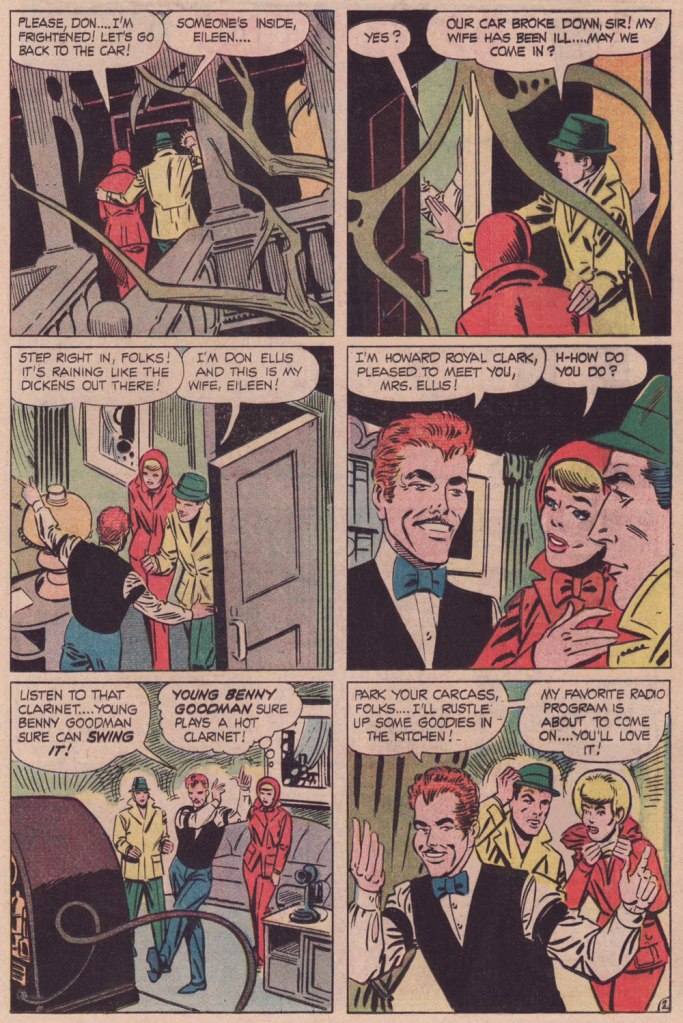
Here, then, is a moody tale that originally saw print in Haunted no. 7 (Aug. 1972, Charlton).

I could be wrong, but this, to my recollection, is the only Charlton ghost story wherein Ditko gave us a full-page splash.
Incidentally, the pint-sized ghostly narrator is Impy, a Ditko creation who later had the dubious honour of being evicted from his own book (with issue 21, Apr. 1975) by one Baron Weirwulf. Bah, I liked Impy better.

A few notes: The title design is among the best I’ve seen from Charlton; it wasn’t generally their forte.

I’m wondering whether I’m just imagining the Benny Goodman / Don Ellis jazz subtext. Joe Gill is just the type of guy to surreptitiously toss that into the mix. Goodman, the ‘King of Swing’ was an paradigm of the big band school of jazz, while Ellis, though he began his career with Glenn Miller’s band, soon fell in with the avant-garde side of things. I see a natural dichotomy at work here… though I’m a fan of both myself.

Also, this seems to me like another instance of the suave villain / obnoxious hero setup (think Night of the Demon)… I mean, who would you rather spend an evening with, dapper Howard R. Clark, or with those two boorish, meddlesome stuffed shirts? Oops, I think I’ve given my bias away.

For a bit of mood setting, listen to some of those fabulous Lights Out radio shows that Mr. Clark so rightly digs.

And here’s a swingin’ Miller performance, circa 1937, of the Louis Prima standard Sing, Sing, Sing. And to balance things out, here’s Don Ellis performing his Bulgarian Bulge in 1969. Now, now.. can’t we all just get along?

So we’re done, countdown-wise, for another year. If that’s not enough to satisfy your odious cravings, take a stroll through our voluminous-by-now archives, at this point one hundred and eighty-six posts strong (or at least long!):

Hallowe’en Countdown VI

Hallowe’en Countdown V

Hallowe’en Countdown IV

Hallowe’en Countdown III

Hallowe’en Countdown II

Hallowe’en Countdown I

Wishing you all a bloodcurdling Hallowe’en — thanks for tuning in!

-RG

Hallowe’en Countdown VI, Day 30

« It is a privilege to be the master of destinies, and director of every urge and event in the lives of such a group of folks. They may be dream folks, but the responsibilities are real because I know these characters are real to many thousands of readers. » — Frank King

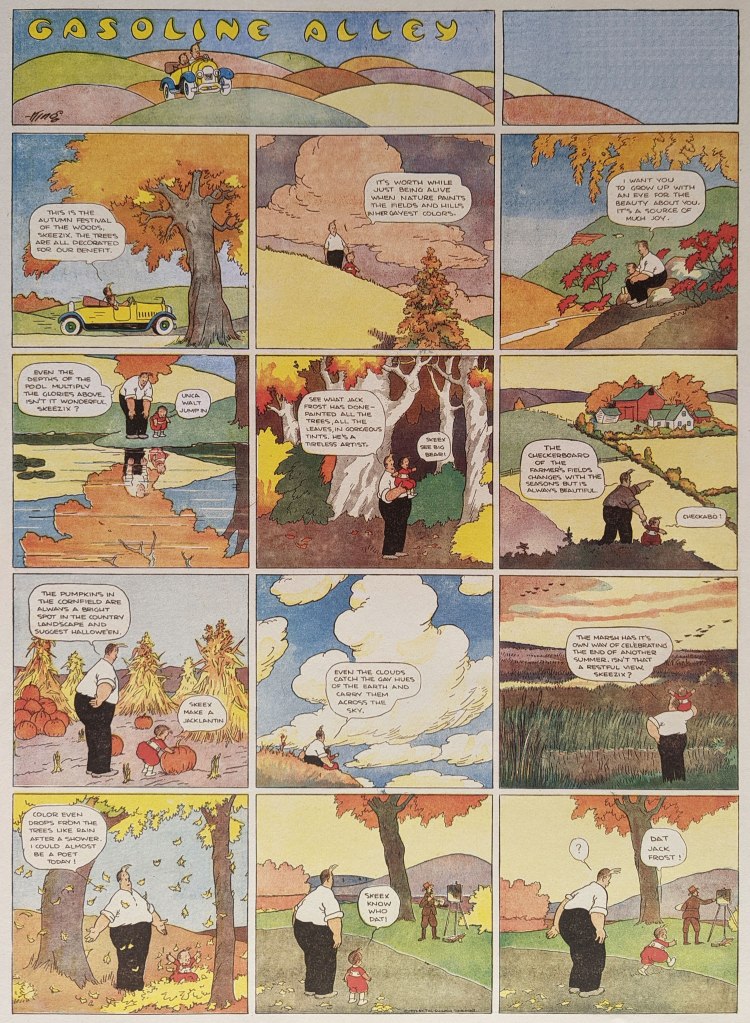
This post is but a simple sequel: a couple of countdowns ago, I shared some of Frank King‘s Halloween and Autumn-themed Gasoline Alley Sundays… but it turned out that, King manifestly being a fiend on the topic, there were more of these placidly poetic beauties. And so here are some of them.

The November 30, 1921 strip.
The October 21, 1923 strip.
The October 28, 1923 strip.
The November 1st, 1925 strip.
The October 29, 1933 strip. Horsepower!

Pray note that, as these were originally published at a rather gigantic size — especially if you compare it to the lilliputian space allotted in newspapers for today’s comic strips — I consequently posted these images in a larger format than is my custom. And so, open in a separate tab to get the larger (and fuller) picture!

-RG

Hallowe’en Countdown VI, Day 29

« I’m alone with the ghost of the swamp, somewhere near the weeping willows. » — Steven Herrick

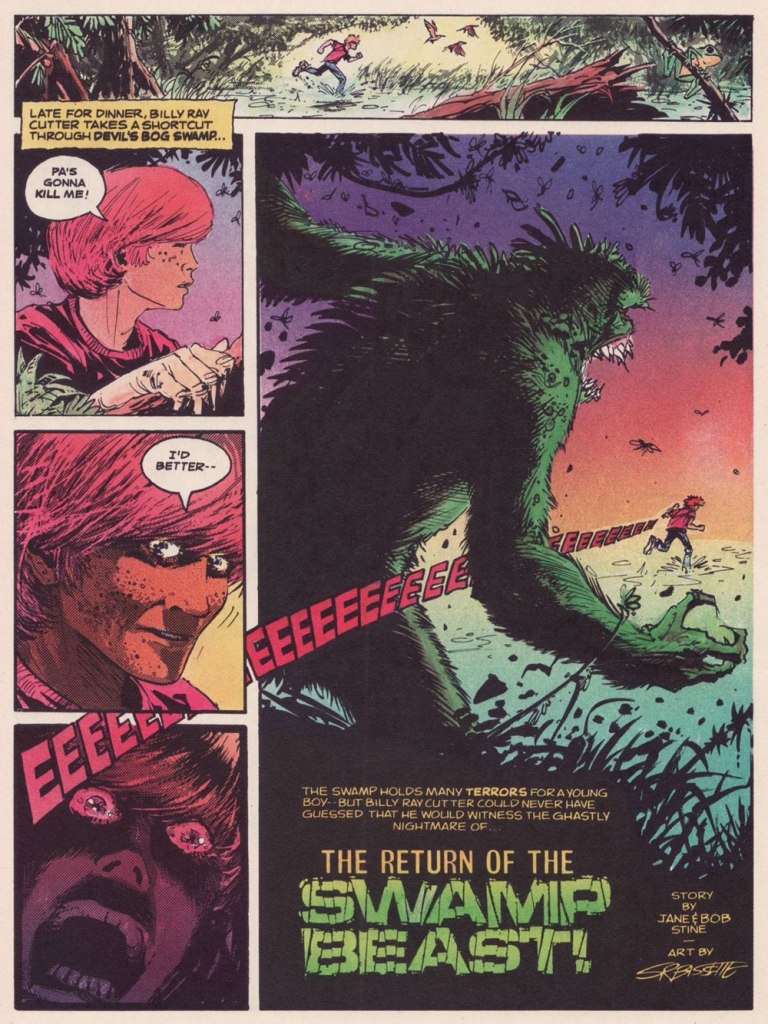
Today, we pull on our wellies and boldly venture into the depths of the mysterious swamp, but not entirely unprepared: on this occasion, I turn the microphone over to an acknowledged expert en la matière visqueuse, Mr. Stephen R. Bissette. I queried Steve about his early work for Scholastic and he most munificently lifted the veil on those wild days of youth:

« Well before my stint on Swamp Thing, I drew two swamp monster stories (one of which I’d also scripted) for Weird Worlds for Scholastic Magazines back in the day. The magazine’s editors were Bob and Jane Stine (Bob aka R.L. Stine), who wrote the first of the two stories; the magazine art director was Bob Feldgus, who was always a joy to work with, and trained me well.

The story titles are counter-intuitively reversed, in a way. “The Return of the Swamp Beast” was originally published in Weird Worlds no.3 (October 1979) in black-and-white, colored for its reprint in Yearbook no.1 (and only, 1986). Enjoy! »

The Return of the Swamp Beast was coloured by Brendan McDonough.

« These were among my favorite early freelance gigs, and remain my favorite magazine account and people I was fortunate enough to work with and for. The Stines and Bob Feldgus extended the best, most gracious, most responsive relations with this freelancer of any I had in those formative early years; it also was the best-paying of all the early freelance gigs, extending the greatest freedom for me to do the work itself, and they boasted the best production and printing of any publisher I worked for then (even better than Heavy Metal).

My entry into the Scholastic freelance pool was via a one-shot horror story for Scholastic’s then-new zine Weird Worlds. Joe Kubert brought me into his studio/office in the Baker Mansion (which has long since been the dorm for the Kubert School rather than its headquarters and main building, as it was during its first few years) and asked if I’d be willing to draw a short (three pages, if memory serves) horror story for a magazine intended for schools; I would be doing the whole art job working from a silly but fun script by Bob and Jane Stine, co-editors of the zine, and my name would not go on the job, it would be credited to The Joe Kubert School of Cartoon and Graphic Art, Inc. Fair enough! I was still a student after all, and this was my shot at doing something different.

I was overjoyed to have the shot, and did my best on it. Part of the appeal, mind you, was drawing a horror comic for schools. During my early ’60s childhood, any comics brought to school were verboten and usually confiscated, horror comics above (or beneath, in the minds of my teachers) all. So, drawing a horror story that was intended for distribution to junior high students—sanctioned horror comics for school!—was a hoot and a bit of karmic comeuppance I was happy to be part of.

Joe was delighted with what I did with the script, as was Scholastic. I wanted to do more. One of (many) great acts of generosity Joe extended my way was gifting me with the account with Scholastic when I graduated in the spring of 1978 from the Kubert School, and thus began my happy few years of working with Scholastic—an account that often paid the rent and kept me working when work in comics was hard to come by.

Scholastic treated me like a prince. They paid well, paid promptly upon delivery of the finished pages, and were always a joy to work with. Like all good things, this passed: Weird Worlds was cancelled after a few issues, and after a couple of jobs for Bananas I moved on to other things, including pencilling Saga of the Swamp Thing beginning in 1983. But I always loved working with and for Bob and Bob, and I miss ’em both. I eventually collected some of my work for Scholastic for two comicbooks in the late ’80s, and did so with Scholastic’s permission. »

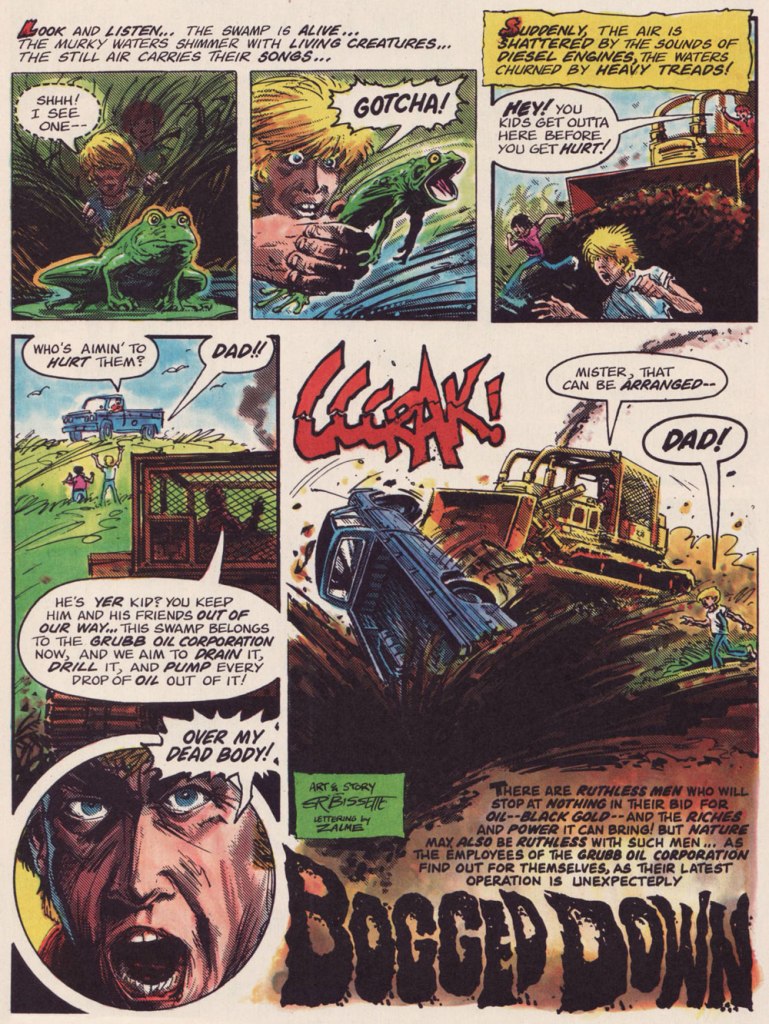
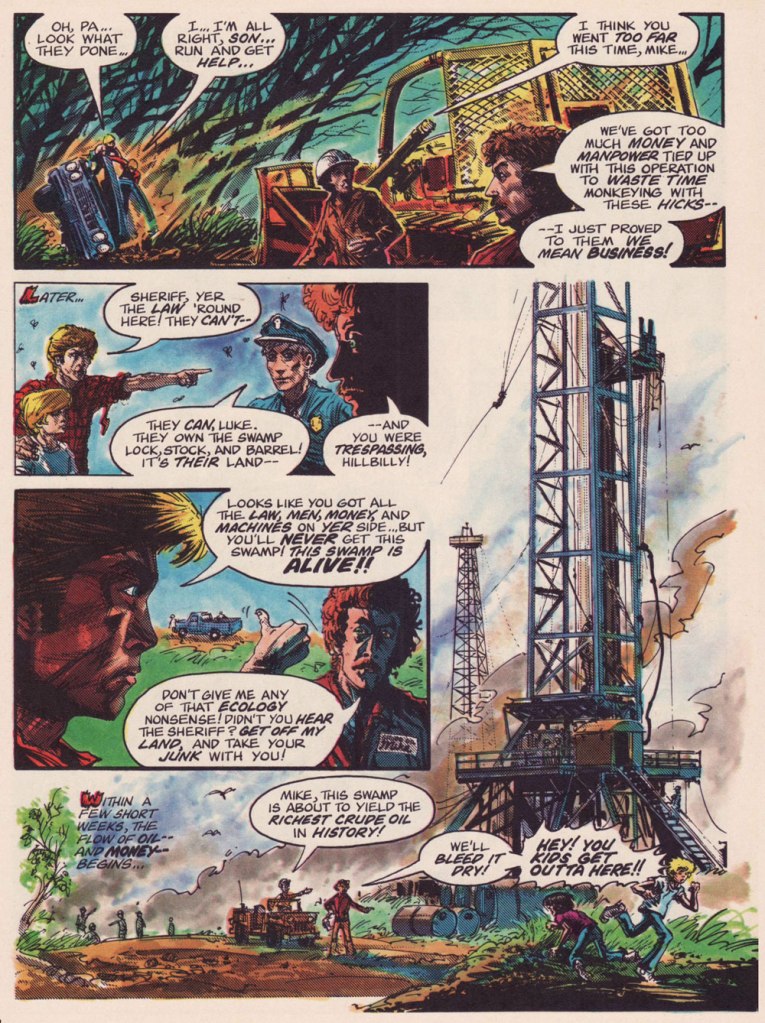
That source, Bissette & Veitch’s Fear Book (Apr. 1986, Eclipse) is the one we tapped for this post, and the most affordable solution should one crave more of these sharp little tales. Here’s another, this one a Bissette solo (including the colouring), originally from Weird Worlds no. 7 (Jan. 1981, Scholastic).

« Who remembers these magazines? Bananas and Weird Worlds seem to be lost in the limbo of all school zines; no comics sites acknowledge them or offer back issues for sale (none I can find, anyway), and general online searches turned up little. Back in 1995, The New York Times ran an interview/article on Bob Stine when his Goosebumps TV series was about to debut, making mention of Bananas magazine. There’s a number of online sites dedicated to Stine’s famous and beloved Goosebumps books series, but Bananas and Weird Worlds are less than footnotes in the long shadow of Goosebumps.

There’s a handful of affordable back issues of Weird Worlds available on various online venues and auction sites; I’m in almost every issue. One cautionary note: If you go looking on eBay, though, don’t confuse the Scholastic media zine Weird Worlds with the lurid, gore-splattered Eerie Publications 1970s newsstand horror comic magazine Weird Worlds. Those are fun in their way, too, but you won’t find me in there—just my eye-tracks from reading ’em three decades+ ago.

I’ve long wished to convince Scholastic to consider a collected edition of this body of work, but each & every attempt to engage has fallen on deaf ears. I’m still proud of this work, and as a precursor to the very successful R. L. Stine Goosebumps franchise & Scholastic graphic novels of today, can still hope that one day someone at Scholastic will have the “lightbulb” moment… »

I truly can’t thank Steve enough for this bounty of information — you just can’t beat going straight to the source, particularly with a source this friendly and eloquent!

-RG

Hallowe’en Countdown VI, Day 28

Most readers will be familiar with the East European witch Baba Yaga, she of the giant mortar, pestle, and chicken-legged-house. The Slavic tradition is rich in heroes and villains, but Baba Yaga is my definite favourite. Perhaps it’s because of her dichotomous nature – undeniably evil, kidnapping children to eat them and such, she also lends a very helpful hand to those she likes… depending on the vintage of the tale and who’s the narrator, and sometimes within the same story. Potato, pota-toh, right? She’s the kind of hag that cool women aspire to become when they’re old: a cantankerous, wise beldam who does whatever she pleases, lives alone in the middle of a forest with her cat, and tells anybody she doesn’t like to fuck off (or transforms them into something nasty to teach them a lesson).

Introduction to Vasilissa the Beautiful, illustrated by Ivan Bilibin, 1931. That’s Baba Yaga flying on top.

Interpretations of what she actually stands for abound, but to be honest I am not interested in her narrative origins, just the storytelling. She is a character who lives and breathes; it rather seems impolite to ask too many questions, lest one ends up in her oven, on the way to becoming dinner.

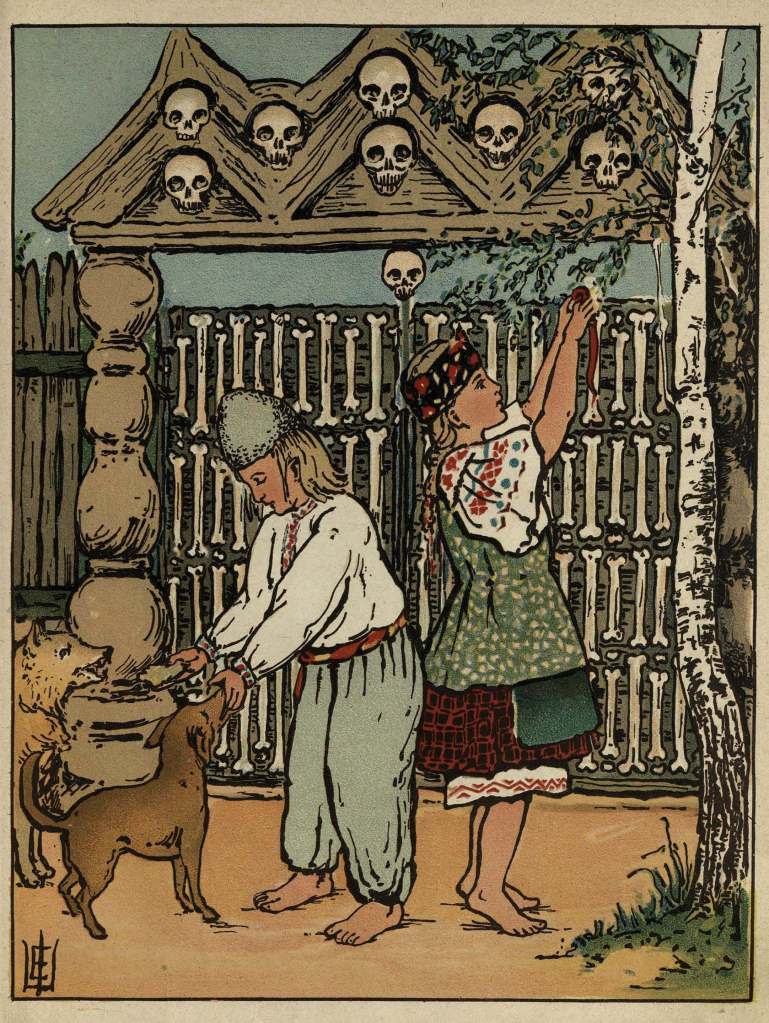
Folklorist Vladimir Propp‘s theory is probably the best regarded, and argues that she’s the guardian of the kingdom of the dead, with her house representing a grave (people of yore were buried in special houses built on top of tree trunks, with roots resembling chicken legs). She might have once been a deity of hills and forests, kind protector of villagers; or perhaps a goddess of harvest, punished by other gods who removed her beauty and left her a crone. Viy (yes, that Viy) is her father, and Koschei the Immortal (sometimes pictured as riding naked on his favourite horse) is either her son or her nephew. The fence around her house is built from human bones. I think she deserves her place in this year’s Halloween pantheon.

Anyway, here are a few of my favourite visual renditions of her…

Ivan Bilibin (1876-1942), co-founder of the Union of Russian Artists, is mostly remembered for his illustrations to Russian folk tales. His was the first version of Baba Yaga I was introduced to a a small child (as a matter of fact, I still have a collection of tales illustrated by him lying around somewhere). His style is easy to recognize, and full of details – while tsars and beautiful maidens get clothed in robes painstakingly adorned with golden filigree, forest scenes are crowded with branches, leaves, and mushrooms, giving the slightly claustrophobic impression of the trees closing in on the viewer. This is no civilised forest. This is a wild, slightly malicious entity that does not take kindly to strangers.

Baba Yaga in her natural habitat, the flying pestle. Ivan Bilibin, 1900.

The following book from 1915 does not credit its illustrator, and I’m not knowledgeable enough to interpret their memorable signature (seen in the inside illustrations, bottom left).

Baba Yaga (this book was originally published in 1908, using the same painting, but with fewer background details; this edition is from 1915, illustrator still unknown).

Two illustrations from the inside, showing off Baba Yaga’s frequently present black cat, and her fence of human bones and skulls. Admire the decorative ‘devils dancing’ panel inside her hut. The cat can be easily bribed, and in one of the classic tales helps out the would-be victim get the best of Baba Yaga, after the young girl gives him some ham out of the kindness of her heart.

In the Western world, illustrator Nicolai Kochergin (1897-1974) is famous for his Soviet propaganda posters, but he is beloved by Russians who grew up around the so-called ‘golden age’ (1950s-1960s) of children’s book illustrations in the USSR. See a selection of the latter over at Tom Cochien’s Monster Brains Blog. WOT habitué Barney might be interested in his first-ever illustrated book, a Soviet translation of Twain’s A Connecticut Yankee in King Arthur’s Court, published in instalments in a magazine in 1928.

Although I technically grew up much after these illustrations were published, I think I can count myself lucky that my parents mostly surrounded me with old books.

~ ds

Hallowe’en Countdown VI, Day 27

« Now these men have no need for words… they know! » — Anonymous

Now I won’t claim that Dick Ayers (1924-2014) was all that great an artist. In the early Sixties at Marvel, as an inker of Jack Kirby’s pencils, he was at best neutral, more likely than not to defuse much of the explosive excitement of the King’s pencils*.

However, Ayers’ chief strengths lay elsewhere: it was demonstrated time and time again that he could quickly put together dynamic and easy to parse — don’t laugh, it’s no cakewalk — layouts, and if you paired him with a dominant inker (such as John Severin (on Sgt. Fury) Alfredo Alcala (on Kamandi), Jack Abel (on Freedom Fighters) or Gerry Talaoc (on The Unknown Soldier), you’d get some quite presentable results — and quickly at that. Guys like Ayers should be saluted instead of dismissed, because they were the glue that held the funnybook business together and operating more or less smoothly.

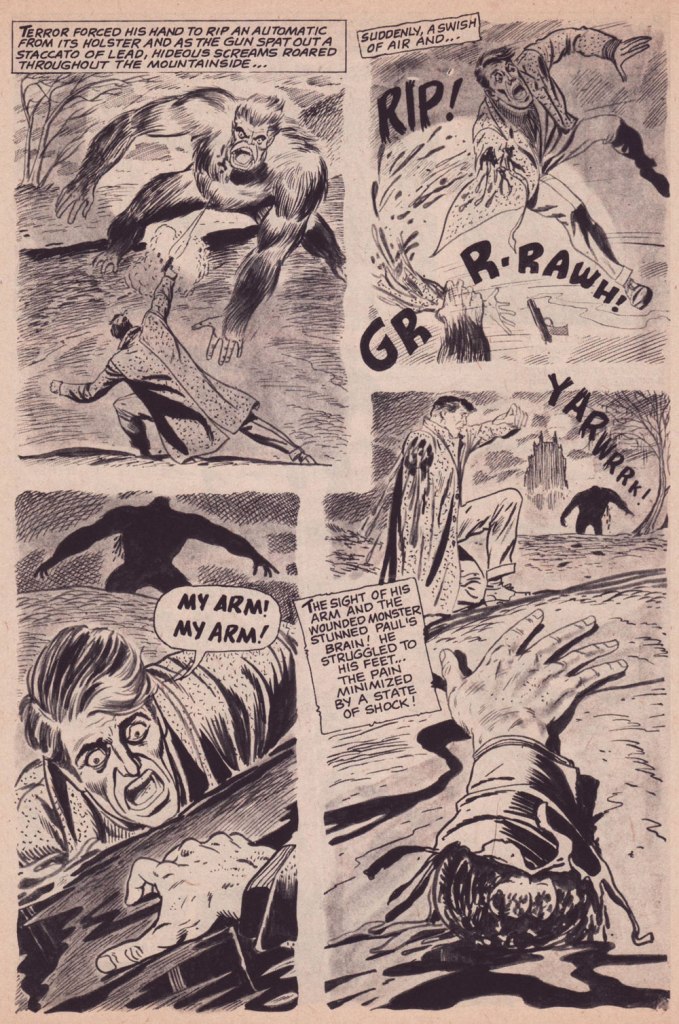
I won’t claim either that Eerie Pubs’ product was anything but shoddy, shlocky goods, but I won’t deny that it can be fascinating… in small doses. While still working for Marvel, Ayers produced a memorable bunch of stories for a pair of former Timely/Atlas colleagues, publisher Myron Fass and editor Carl Burgos (creator of the Golden Age Human Torch). This is Ayers’ first published effort for those rascals. It appeared in Horror Tales v.2 no. 1 (Jan. 1970, Eerie Pubs). Brace yourselves!

«… Dick Ayers understood what ‘Carl and Myron’ were asking for and gave it to them in spades. They wanted gore? They got it! Ripped-off limbs, lolling tongues, gouts of blood and oh my… those popping eyes! Ayers’ trademark was the eye-poppin’. Socket just couldn’t contain ’em! » — from Mike Howlett‘s definitive study The Weird World of Eerie Publications (2010, Feral House).

« House of Monsters » is a Grand Guignol remake of « The Castle of Fear », from Weird Mysteries no. 3 (Feb. 1953, Stanley Morse). Read it here! Myron Fass held the rights to a lot of old inventory, so he had the old stories touched up or redrawn, some of them multiple times. Grotesqueness aside, I do prefer the original version. It had a better monster and a stronger ending… but you be the judge!

I came across this saucy bit of Ayers carnage in 1976, in one of the first Eerie Pubs mags to surface following a hiatus imposed by a severe contraction of the black and white horror mag market (thanks, Marvel). At the time, it just seemed like the oddest item: at once something of another, earlier time (it was an all-reprint affair), but also extremely garish in its goriness, even by slack contemporary standards.

Here’s my beat-up original copy of Weird vol. 9 no. 3 (Sept 1976, Eerie Pubs). Cover by Bill Alexander. I didn’t realise at the time that it was a bit of an Eerie’s Greatest Hits collection, so every other Eerie mag subsequently encountered rather paled in comparison.

-RG

*But then, with the splendid exception of Steve Ditko (and that was a waste of precious resources), I’d argue that virtually all of the inkers he was saddled… er, paired with before Joe Sinnott were rather underwhelming.

Hallowe’en Countdown VI, Day 26

« I was already doing a lot of splendid research reading all the books about ghosts I could get hold of, and particularly true ghost stories – so much so that it became necessary for me to read a chapter of Little Women every night before I turned out the light – and at the same time I was collecting pictures of houses, particularly odd houses, to see what I could find to make into a suitable haunted house. » — Shirley Jackson

This one’s from the department of historiated text. What text? “those fiction pieces that nobody read” in comic books, prose pages mandated by the United States Postal Service. The USPS insisted that comic books «… have at least two pages of text to be considered a magazine and qualify for the cheaper magazine postage rates. »

By the Sixties, most of these pages consisted of letters to the editor, but not every company followed this practice. After EC pioneered the letters page idea in the early 1950s, ACG, DC, Archie and Marvel followed suit. But not Dell/Gold Key, Harvey and Charlton.

For its mystery titles, Gold Key naturally opted for a ‘unusual history’ format, enlisting, to provide spot illustrations, veteran cartoonist Joe Certa, best known for his co-creation of and long run (1955-1968!) on J’onn J’onzz, the Martian Manhunter and his stylish run on Gold Key’s Dark Shadows comic book series (1969-76). While Certa started out with a pretty mainstream approach, as the Sixties wore on, his style got increasingly angular, spare and expressive. Personally, I love it… but I know it’s not for all palates.

This one appeared in Boris Karloff Tales of Mystery no. 17 (Mar. 1967, Western); « It was more than two centuries ago when the monstrous creature known simply as ‘the Beast’ appeared in the province of Auvergne, in France. » Perhaps you’ve seen the action-packed, *slightly* fictionalised cinematic account of the events, 2001’s Le pacte des loups, aka Brotherhood of the Wolves.
This one’s from Boris Karloff Tales of Mystery no. 28 (Dec. 1969, Western); « When Gustave Labahn appeared in Munich, Germany in 1890, he was indeed a man of mystery. Nothing was known of his except that he was tall, lithe and powerful, with strangely hypnotic eyes, and a possessor of unlimited wealth. »
This one, from Boris Karloff Tales of Mystery no. 28 (Dec. 1969, Western) states: « He was a man of a hundred names and countless identities. No one knew his true origin. It was said he was descended from an evil medieval warlock. Others said he was a reincarnation of the Count de St-Germain… a man who claimed to be more than 2,000 years old. He called himself Raoul Plessy, but his followers he was known as La bête… The Beast. »
Appearing in Boris Karloff Tales of Mystery no. 50 (Oct. 1973, Western), this one concerns the 1793 murder of French revolution leader Jean-Paul Marat by Charlotte Corday. Exceptionally, the art on this one is the work of John Celardo, a lovely, delicate composition.
One from Grimm’s Ghost Stories no. 5 (Aug. 1972, Western). The cat’s name is Satan, we are told.
From Ripley’s Believe It or Not! no. 8 (Feb. 1968, Western), this piece tells the story of a coffin that found its way home to one of my favourite places, Canada’s Prince Edward Island. Here’s a more sober account of the legend.
From Ripley’s Believe It or Not! no. 15 (Feb. 1968, Western), this one concerns the purported haunting of Scotland’s Meggernie Castle.
A cozy one from Ripley’s Believe It or Not! no. 21 (Aug. 1970, Western): « In the northeastern corner of Mississippi, near the town of Aberdeen, lies a stretch of deserted country road which has lately become known as one of the most haunted spots in the United States. »
A great drawing from Ripley’s Believe It or Not! no. 41 (July 1973, Western); The text opens with « Ash Manor House in Sussex, England, was over six hundred years old when bought in 1934 by a man named Keel. Mr. Keel did not believe in ghosts. Neither did his attractive wife. »
This hails from Ripley’s Believe It or Not! no. 42 (Aug. 1973, Western). The piece recounts anecdotes about such thespians as Burl Ives, Jackie Gleason, Rudolph Valentino and our beloved Vincent Price.
And here are a couple of samples of full pieces to give you an idea of how they looked in print. This thoroughly seasonal one saw print in Grimm’s Ghost Stories no. 6 (Nov. 1972, Western).

One more? Here’s a favourite from The Twilight Zone no. 42 (Mar. 1972, Western):

-RG

Hallowe’en Countdown VI, Day 25

« The thing to do was kill it. Obviously. » — Ira Levin, Rosemary’s Baby

Last year, in the course of my post celebrating Luís Dominguez’s life and covers, I noted in passing, about The House of Mystery no. 235 (Sept. 1975, DC), that it held the only DC ‘horror’ story I ever found actually scary.

Since I’d hate to just leave you with such a tease, here it is, so you can be your own judge of the yarn’s merits (or its failings, however the chips may fall).

Don’t ever fall for the notion that cartoony and scary are inversely proportional. Brr.

That poor, fragile, lonely woman! It’s not enough to be trapped in a loveless marriage with the world’s coldest fish, but any sympathy and hope she seems to receive from anyone is mere pretence in the process of gaslighting her. Of course, the plot is redolent of Rosemary’s Baby and The Exorcist and other, and much needed, contemporary critiques of the obligations and ambivalences of motherhood — unthinkable in earlier days — but it has its own points to make.

This is, to my knowledge, one of the few horror stories in mainstream comics of that period to be both written and illustrated by women: Maxene Fabe and Ramona Fradon, respectively. While Fradon is justly celebrated for her defining work on Aquaman in the 1950s and on Metamorpho in the 1960s, Ms. Fabe’s is likely a less familiar name to most comics readers. In the 1970s, she wrote around twenty-five scripts for DC comics, almost exclusively short horror and humour pieces for editor Joe Orlando. Of these, four are Fabe and Fradon collaborations: the (almost) equally dark conte cruel Last Voyage of the Lady Luck in House of Secrets no. 136 (Oct. 1975, DC); the more conventional The Swinger in Secrets of Haunted House no. 3 (Aug.-Sept. 1975, DC), working from a plot by Mike Pellowski, and finally, the sardonically humorous Bride of the Pharaoh in House of Mystery no. 251 (Mar.-Apr. 1977, DC).

-RG

Hallowe’en Countdown VI, Day 24

« I love the scents of winter! For me, it’s all about the feeling you get when you smell pumpkin spice, cinnamon, nutmeg, gingerbread and spruce. » — Taylor Swift

It occurred to me, just the other day that I’d failed to feature, over the course of five and three-quarters countdowns, anything by Gene Colan. And this despite the fact that I’ve always enjoyed his work and his undeniable adroitness within the horror genre.

Still, I decided to sidestep the obvious touchstone, his monumental run on The Tomb of Dracula, and opted instead for another of his big series at Marvel: Howard the Duck.

I was a fervent fan of the series as a kid, but I honestly haven’t returned to it in decades. Which is not to say that I’ve forgotten it. There’s no doubt that I should give it a fresh look — I’d probably get more of Steve Gerber‘s jokes than I did as a twelve-year-old — but in the interim, let’s focus on a couple of pertinent issues.

This is Howard the Duck no. 6 (Nov. 1976, Marvel); cover pencils by Gene Colan, inks by the recently departed Tom Palmer (1941-2022).
Colan’s style meshes surprisingly well with Mr. Gerber‘s madcap comedy… he plays it straight, and that’s why it clicks. Savvy move.
I wasn’t sure about Steve Leialoha‘s appropriateness as a Colan inker at the time, but I really don’t see what I could have objected to.
Let’s see, what have we here? The Addams Family, Shelley’s Frankenstein, gothic romances, Nathaniel Hawthorne, religious sects… in this case the reverend Sun Myung Moon‘s Unification Church, better known as The Moonies

I won’t leave you in suspense! On to the following issue…

This is Howard the Duck no. 7 (Dec. 1976, Marvel); pencils by Colan, inks by Palmer.

And that’s it! Steve Gerber had a refreshing knack for subverting and upending the Marvel formula: instead of some drawn-out, epic standoff, Howard disposes of the threat — a threat worth two cover features! — in a couple of panels, then the story moves on… to another range of targets.

– RG