« There are no innocent bystanders… what are they doing there in the first place? » — William S. Burroughs
I’ve sung the praises of The American Bystander before, and I do believe it could still use whatever publicity it can get. And so here are some choice excerpts from the magazine’s Hallowe’en-themed issue — no. 13 (naturally), Fall 2019… starting with its unfathomably gorgeous double-spread by Armando Veve.
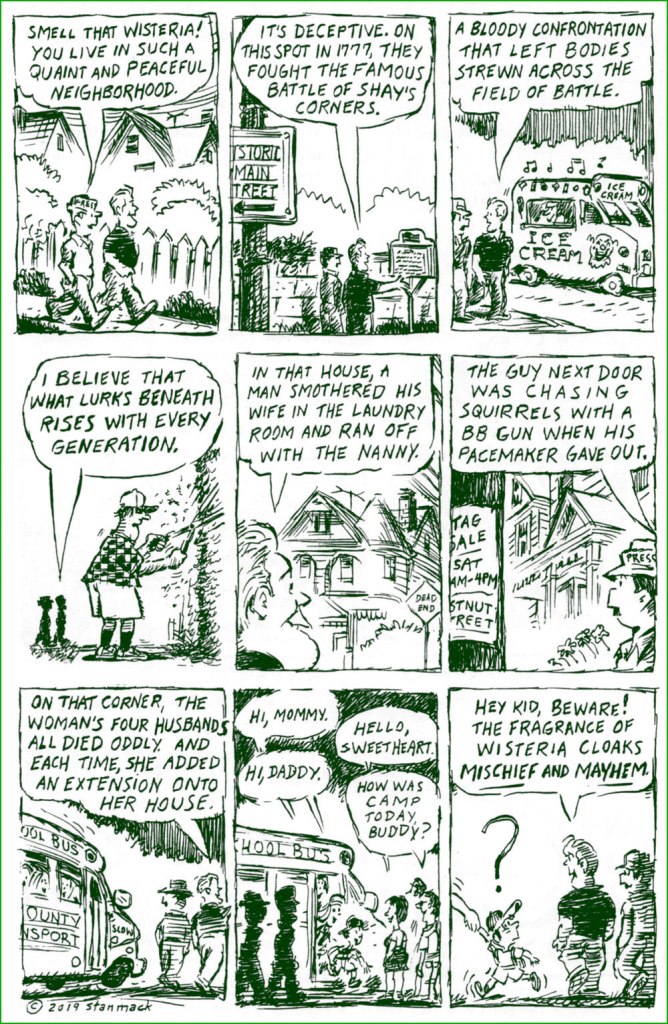
The editor wrote: « Some of our covers are so good they could conjure an entire book, and when Armando Veve delivered his art, a whole story blossomed in my brain. This wired witch is speeding to her digs downtown, a well-appointed brownstone on West 11th between Bleeker and West 4th. She received the deed some years ago from a grateful secretary of state Seward, in exchange for “Mr. Stonewall Jackson’s unfortunate accident.” More recently, she’s occupied herself by magically manipulating the stock market; she delights in dropping enormous, anonymous college scholarships into the laps of earnest high school Wiccans. Most afternoons she can be found at Tartine, eating pastries and slipping love potions into unsuspecting patrons’ teacups. She agrees that the neighborhood isn’t what it used to be but — being 227 — knows it never was. » Horror is around all the year ’round… we just celebrate it more fervently in the Fall. A strip by Brandon Hicks.I certainly hope that’s not Joltin’ Joe DiMaggio‘s spectre on the right, since he couldn’t handle that scene in real life. A cartoon by Matt Percival.I love that extra second-level chuckle (hint… ‘spell’). A cartoon by The New Yorker cartoonist Mick Stevens.A low-key guide to lethal passion in the suburbs from WOT? favourite Stan Mack. And I’m with the squirrels; that neighbour got what he deserved.The kids’ grapevine is utterly unforgiving. If you’re very fortunate, your ill repute will turn over with the next generation. A strip by Jim Siergey (b. 1949).
« I see a wolf-like thing coming over a dark river — at the shallows — just above a waterfall, the starlight shining up his pelt. I see a brown oak leaf blowing far up in the sky. I see a small bat flying. I see many other things, running under the forest trees and slipping through the highest branches; and they’re all coming this way! » — Ray Bradbury, The Homecoming (1946)
In the early 1960s, before Warren Magazines handled the task more decisively, there was a minor reunion of EC alumni — Joe Orlando, Reed Crandall, George Evans, Wally Wood, Williamson and Torres — at Gold Key. It resulted in some lovely art but minor, toothless stories. Even without the Comics Code, Gold Key’s material was safe as milk.
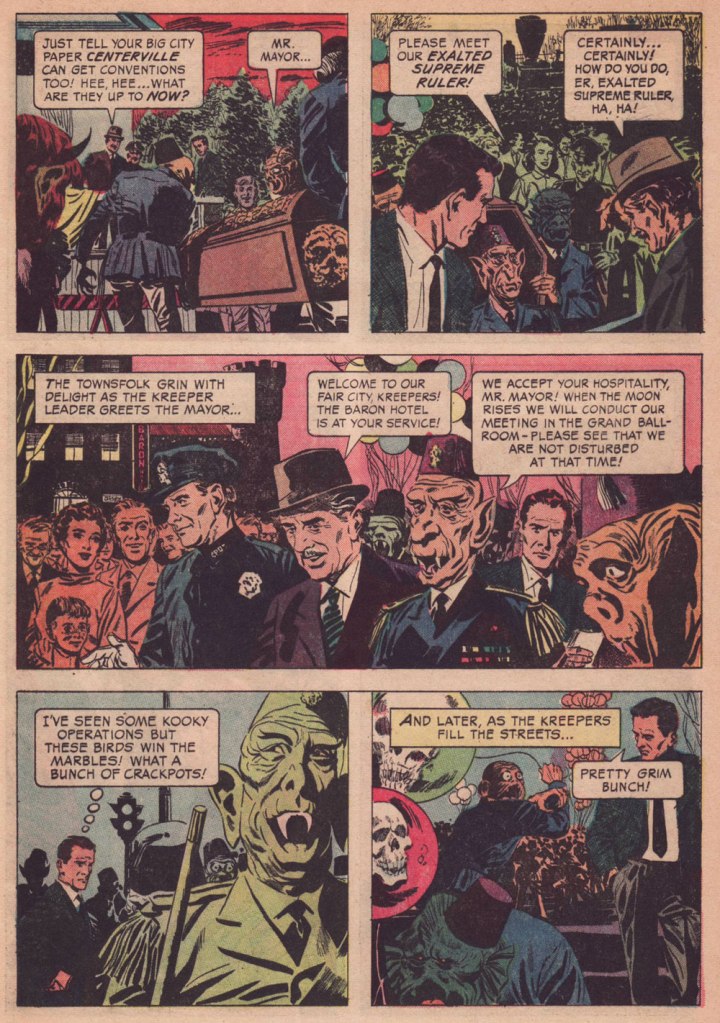
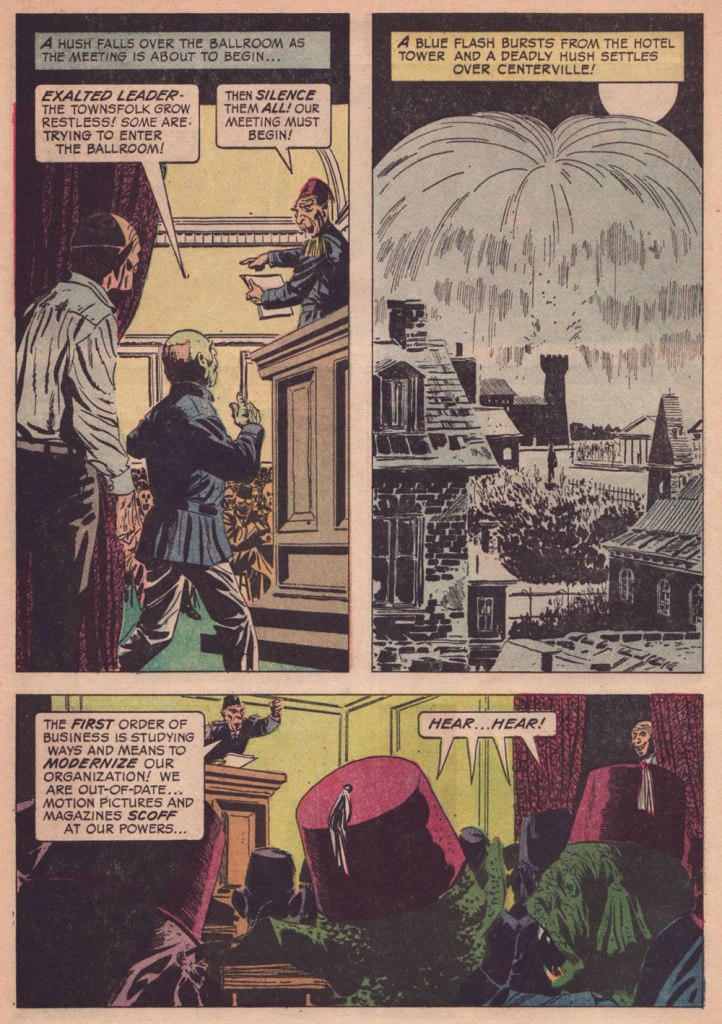
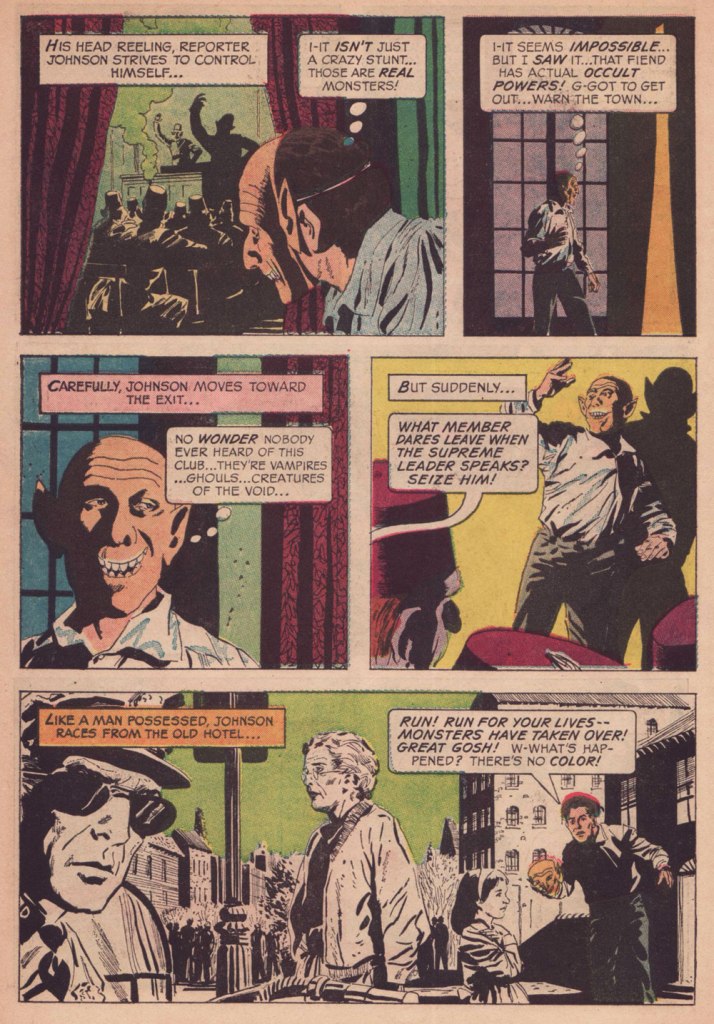
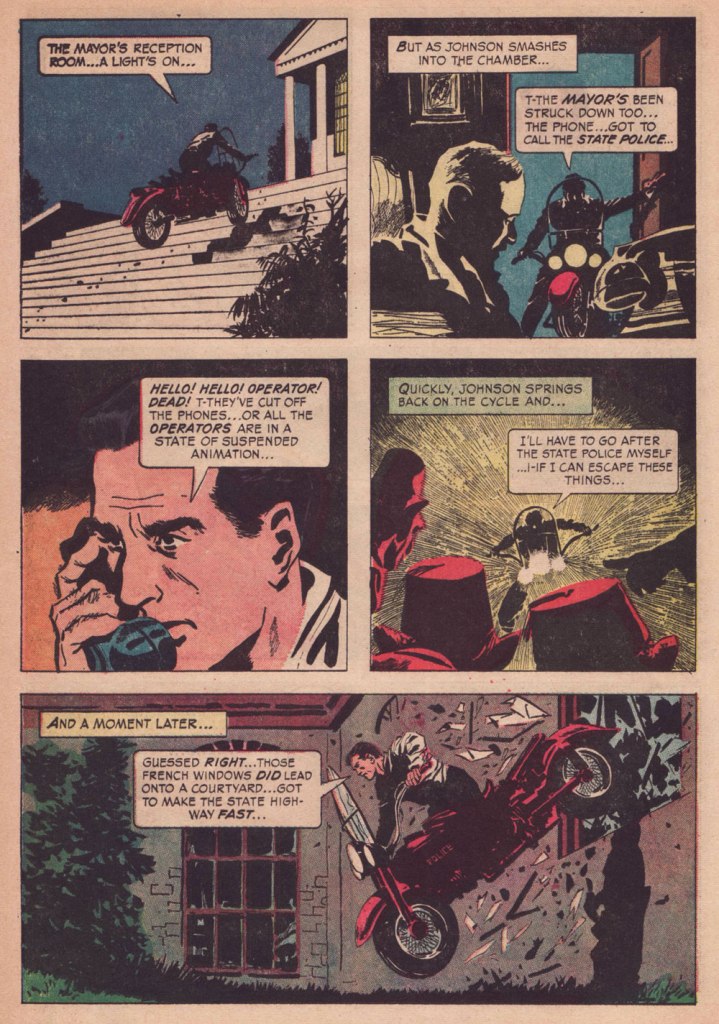
Here’s my favourite of the lot, a tale published in Boris Karloff Tales of Mystery no. 12 (Dec. 1965, Gold Key). I’ve probably tipped my hand with my choice of quote: “The Convention” reminds me of Mr. Bradbury’s timeless The Homecoming [ read it here ].
I like the point the story makes about how most towns — particularly their elected officials — will put up with a lot of obnoxiousness and outright toxicity if it fills up the hotels, bars, restaurants… and whorehouses.Really, a burning cross to vanquish evil… in 1965, given the headlines of the day? By the way, Angelo, that’s not a good Karloff.
Typically for Gold Key comics of that period, no credits are provided, but I’m strongly inclined to attribute authorship to Dave Wood (1926-1974), who happened to work for both Gold Key and DC at the time. It’s his kind of plot. Furthermore, as we’ve learned from the case of Steve Skeates, Julius Schwartz and The Spectre, there are instances when editorial changes to your original plot are significant enough that you can sell it again to someone else… and mum’s the woid.
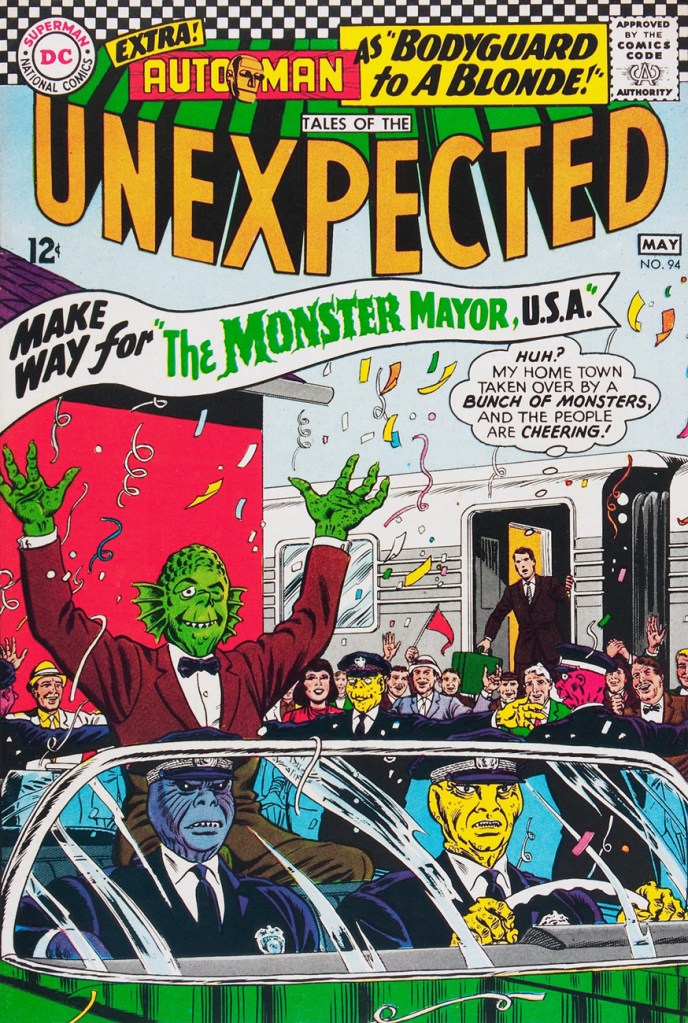
What am I getting at? Why, our bonus, a cover-featured Dave Wood gem from the following year and with a quite familiar theme.
« Our appearance makes little difference… so long as we are in power! » Evidently, political cynicism is nothing new. DC’s Jack Schiff-edited “mystery” titles were a lot of utter bushwah, but oddly mesmerising if one surrendered to the spirit of the thing. And to a Bernard Baily and Mort Meskin fan, they offered a pretty sweet cornucopia. “The Monster Mayor, U.S.A.” is one of a series of oddball situations triggered by an invisible (but green!) sentient cloud from outer space called “The Green Glob“. The sort-of series ran in TOTU 85 to 98, then 100, 102 and 103. Weirdies!
This is Tales of the Unexpected 94 (April-May, 1966). Cover by Murphy Anderson.
-RG
*One might reasonably argue that Tatjana Wood (née Weintraub in 1926), who anonymously assisted her then-husband on some EC stories, is also eligible. She’s ninety-seven if she’s a day!
As a few of our readers may know, we used to have a Facebook page dedicated to comics… the day we switched to a blog format was a blessed one, as dealing with FB’s daft algorithms, restrictions and stupidities would give the most resistant trooper a headache. However, occasionally we pilfer material from those earlier years – but while co-admin RG can practically quote his past self verbatim, I find myself often disagreeing with my opinion from, say, 10 years ago, from which I can only deduce that I am prone to bouts of fickleness.
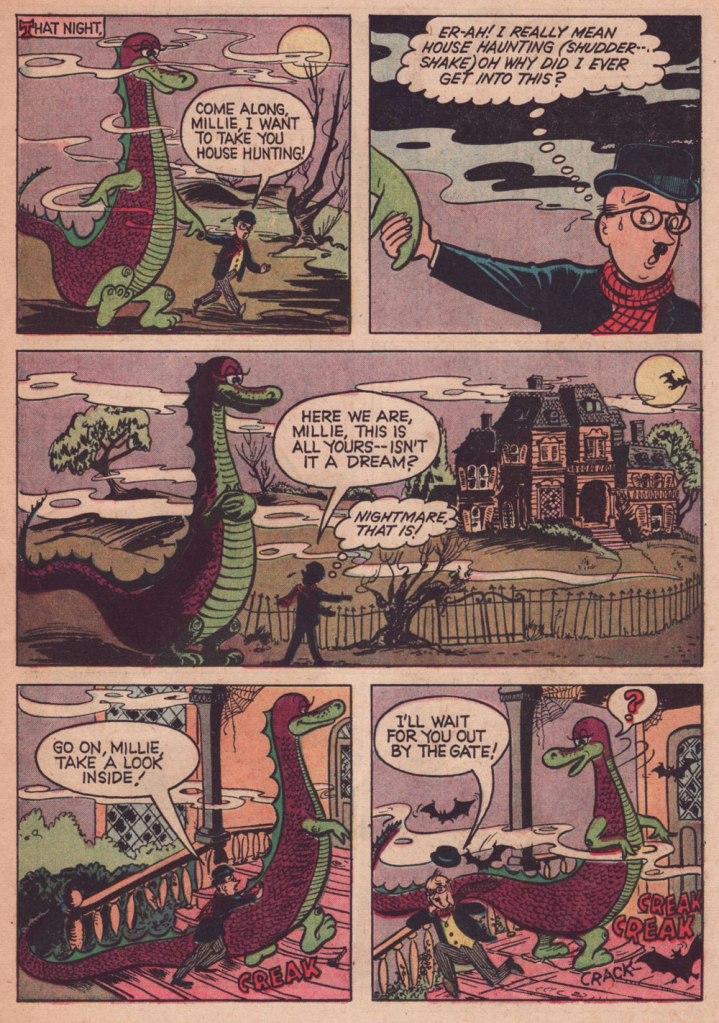
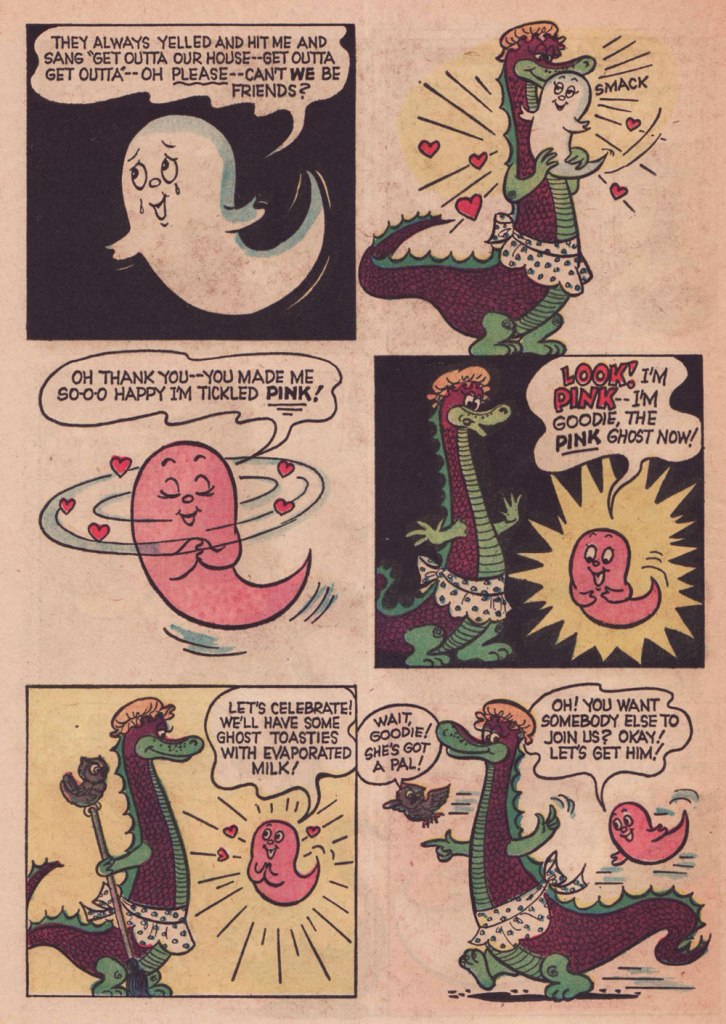
Case in point, in 2014, I called Millie The Lovable Monster (whom I tend to refer to as Modern Monster Millie, getting slightly confused with Thoroughly Modern Millie, a movie from 1967) wholesome, wacky, and syrupy-sweet. Rereading it today, I think it perhaps sailed away from ‘lovable nonsense’ a long time ago, though it didn’t quite moor at the port of ‘balderdash’. It is, however, extremely well-meaning, and virtuous to the highest degree, which in a world which favours the spectacle of back-stabbing and various unethical shenanigans is, well, not exactly refreshing, but a nice change of diet. It is also not that easy to come up with proper randomness that’s equal parts fun and puzzling. Finally, this comic is likely oriented towards young readers, who have a considerably sweeter tooth than adults.
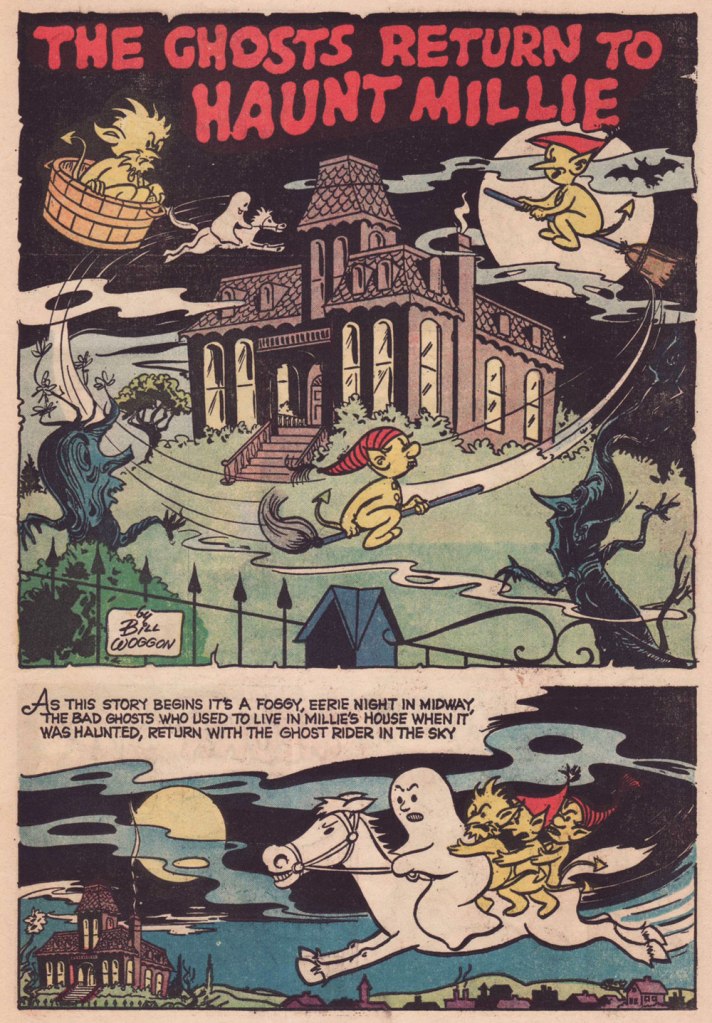
For proper historical details, head over to Toonopedia – I shall just mention that this strip was created by Bill Woggon (1911-2003) of Katy Keene fame (which I talked about a bit in Tentacle Tuesday: Splashing With the Octopus), and that Millie’s arguably entertaining romps lasted by 3 issues (1962-1964).
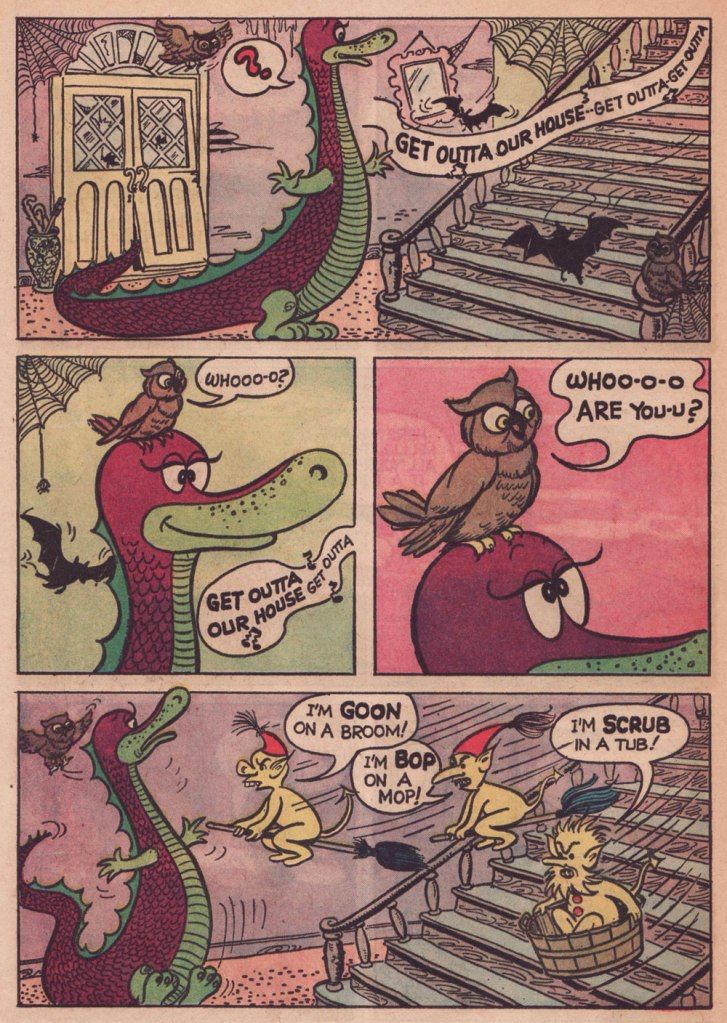
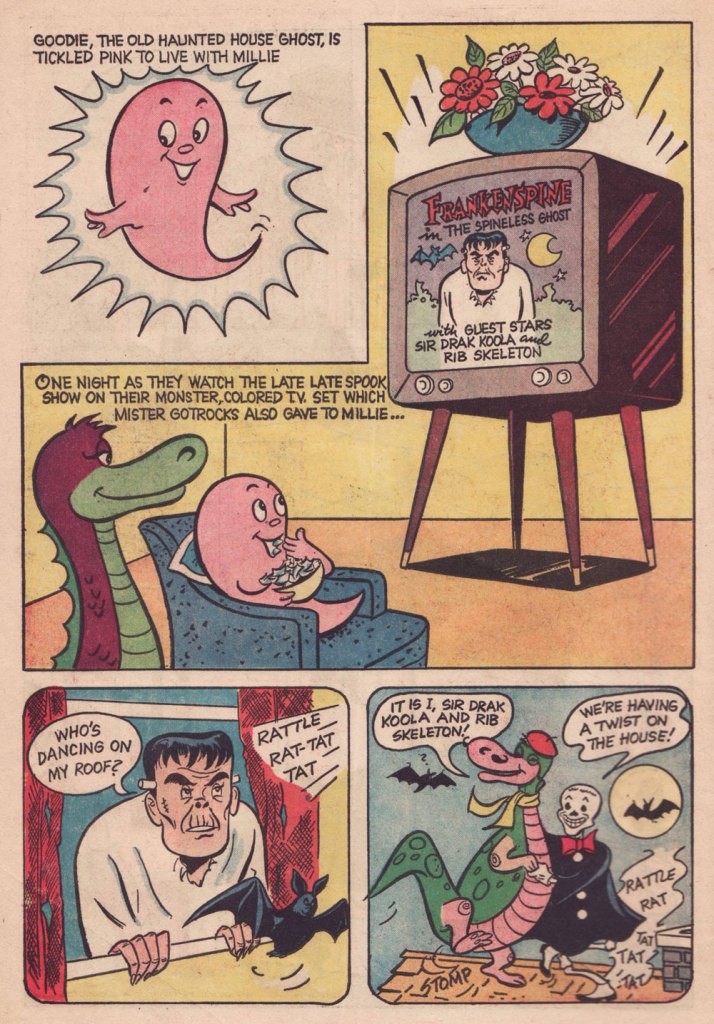
Thanks to a friend, I am the proud (?) owner of a full Millie collection. Here are some excerpts of Halloween-appropriate material, which doesn’t necessarily showcase the depth of absurdity this comic can attain (moments that linger in my memory include Millie riding a horse that’s about a third of her size; Millie promenading her pet tiger while showing off a series of new outfits – she’s quite the fashion maven; and especially Millie playing guitar for a bunch of singing cows performing Cry Me a River that cause a flood with their tears).
Whatever one can say about Woggon, he had a cute style.
White = bad, pink = good, is that the moral we’re supposed to derive here? Though the new colour does make Goodie look less like a spermatozoid.
On the other hand, ‘tea is the solution to any situation’ is a moral I can get behind.
I kinda want to know what Goodie is eating there.
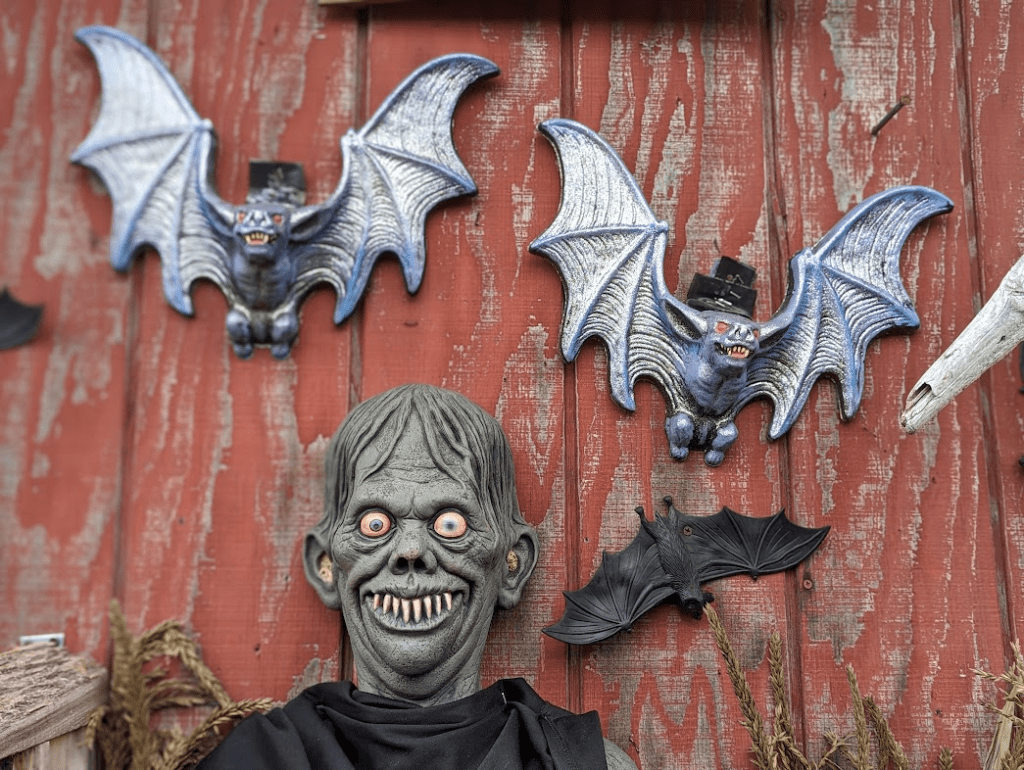
Since this is distinctly Halloween related, here is a picture from our long-Thanksgiving-weekend trip (taken at J & P’s Farm Market, in Trenton, Maine).
« The last I saw of Count Dracula was his kissing his hand to me, with a red light of triumph in his eyes, and with a smile that Judas in hell might be proud of. » — Bram Stoker
Comics fans of my generation might be forgiven for not fully appreciating Lee Elias‘ artistic assets if they encountered him, say, in Mystery in Space when he took over its lead feature, Adam Strange, from visionary Carmine Infantino. The series was mercifully soon discontinued, the victim of a game of editorial musical chairs designed to save the Batman titles, then — believe it or not — facing cancellation thanks to Jack Schiff‘s mismanagement.
While I do have a soft spot for Elias’ work on Ultra, the Multi-Alien (in Mystery in Space) and Eclipso (in House of Secrets), it wasn’t until I found out about his earlier, far edgier pre-Code shenanigans at Harvey Comics (with art director/designer/co-conspirator Warren Kremer) and, more directly and subtly his handful of stories for editor Murray Boltinoff‘s spooky titles (Ghosts, The Unexpected, The Witching Hour) in the 1970s, that I came to discern his light.
Boltinoff wisely played to Elias’ strengths in interests, handing him historical gothics to play with, and he delivered some of the finest work of his career.
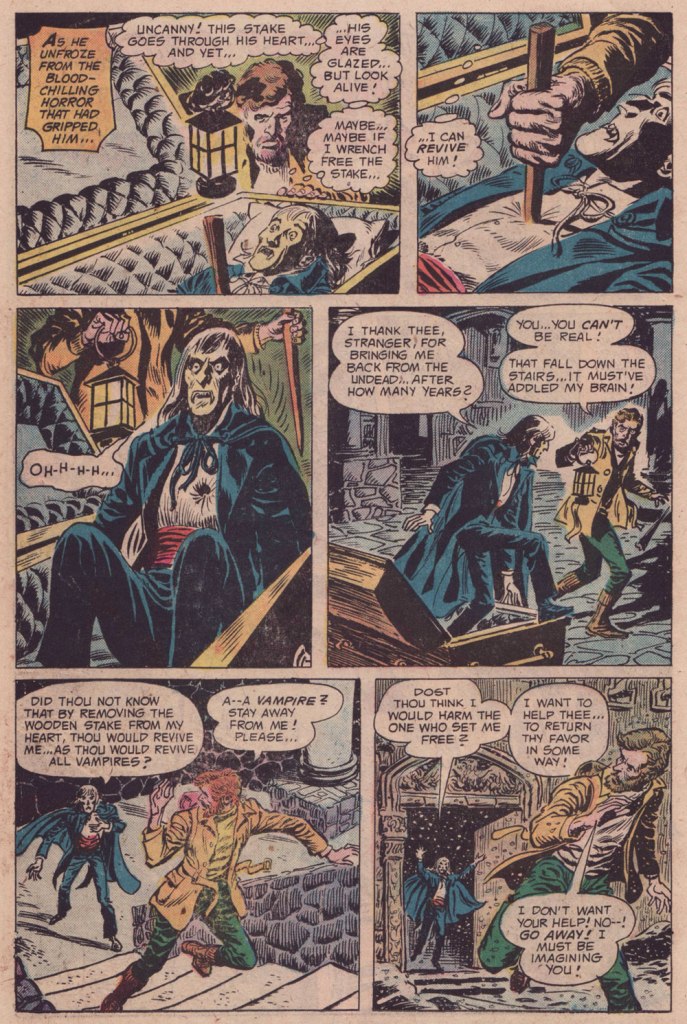
Written by George Kashdan, The Most Fearful Villain of the Supernatural was published in Ghosts no. 50 (Nov.-Dec. 1976, DC).
Editor Boltinoff had this amusing idée fixe, commissioning purported ‘true’ stories wherein famous authors were “inspired” to pen their immortal works by some supernatural encounter earlier in life. From what I recall, Mary Shelley, Charles Dickens, Robert Louis Stevenson and — in this case — Bram Stoker were among the elected.
« Epitaph: a memorial that usually lies about the one below. » — Unknown
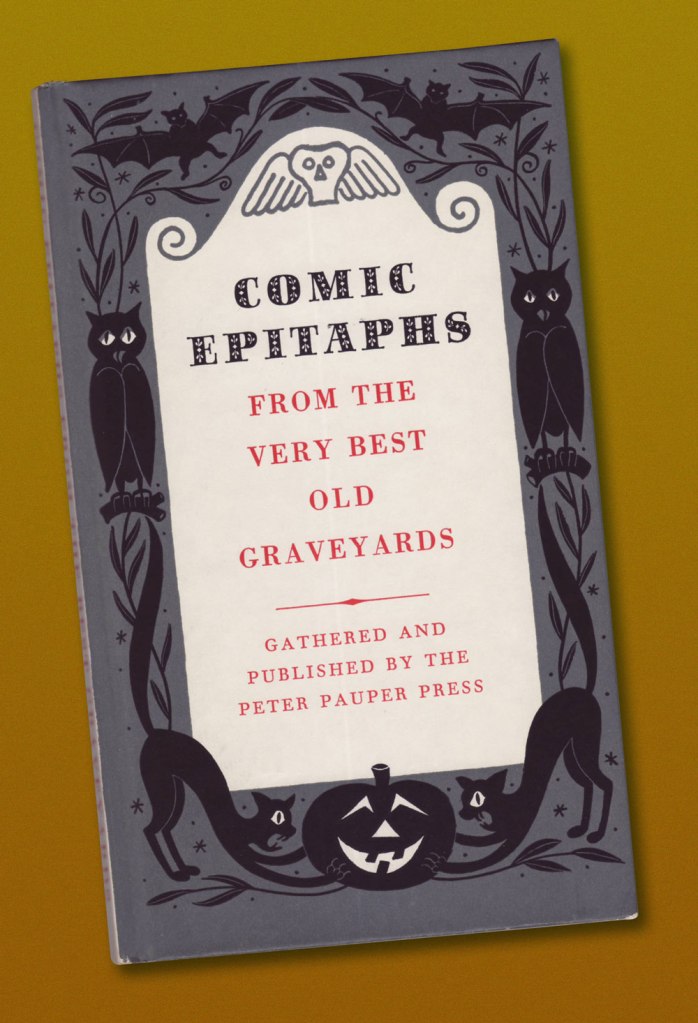
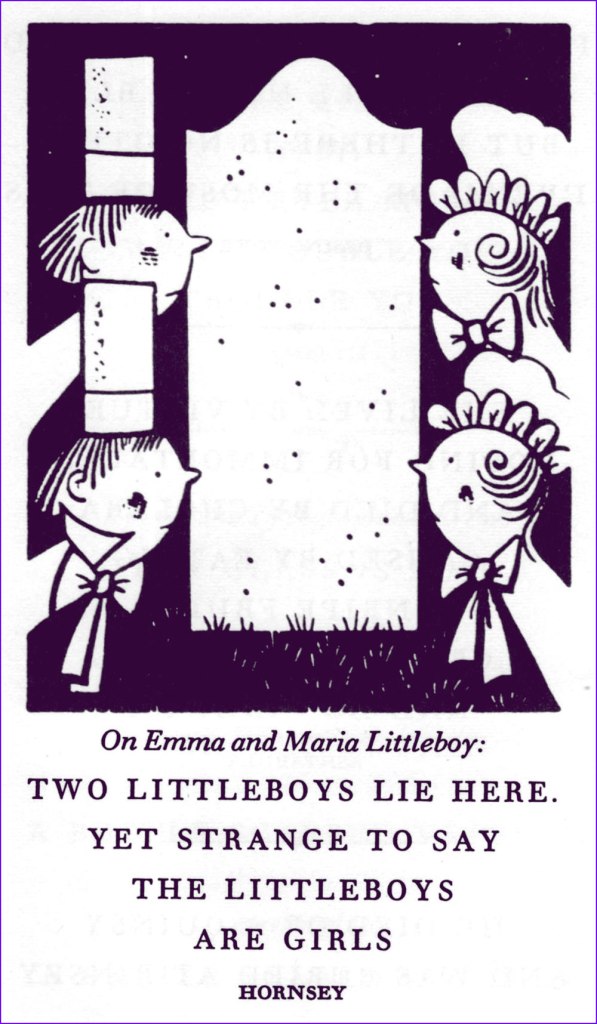
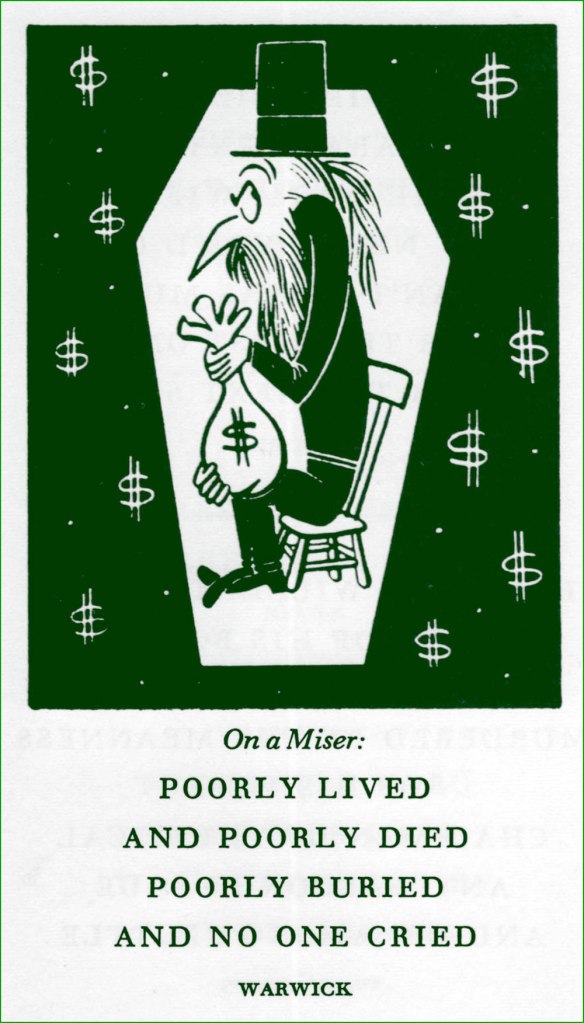
Ah, those lovely Peter Pauper Press books! They once were far easier to find*, but time marches on. This one’s a lightly macabre old favourite from 1957, wryly illustrated by long-time New Yorker cartoonist Henry R. Martin.
It is prefaced with this caveat: « The following collection of gravestone inscriptions is hardly a serious historical one. Most of the items are genuine, but many are suspect, and a few are frankly contrived. In some cases genuine inscriptions have been somewhat altered, and the place names are not reliable. Scholars are therefore warned not to find fault; but all men — and also any women who choose — are invited to read further for a little ghoulish amusement. »
-RG
*confirmed — anecdotally, I’ll grant you — by a visit, yesterday, to Maine’s spectacular Big Chicken Barn, where I didn’t stumble onto a single, solitary PPP title.
« Then hear this, and never forget it. Any fool with fast hands can take a tiger by the balls, but it takes a hero to keep on squeezing. » ― Stephen King, The Dark Half
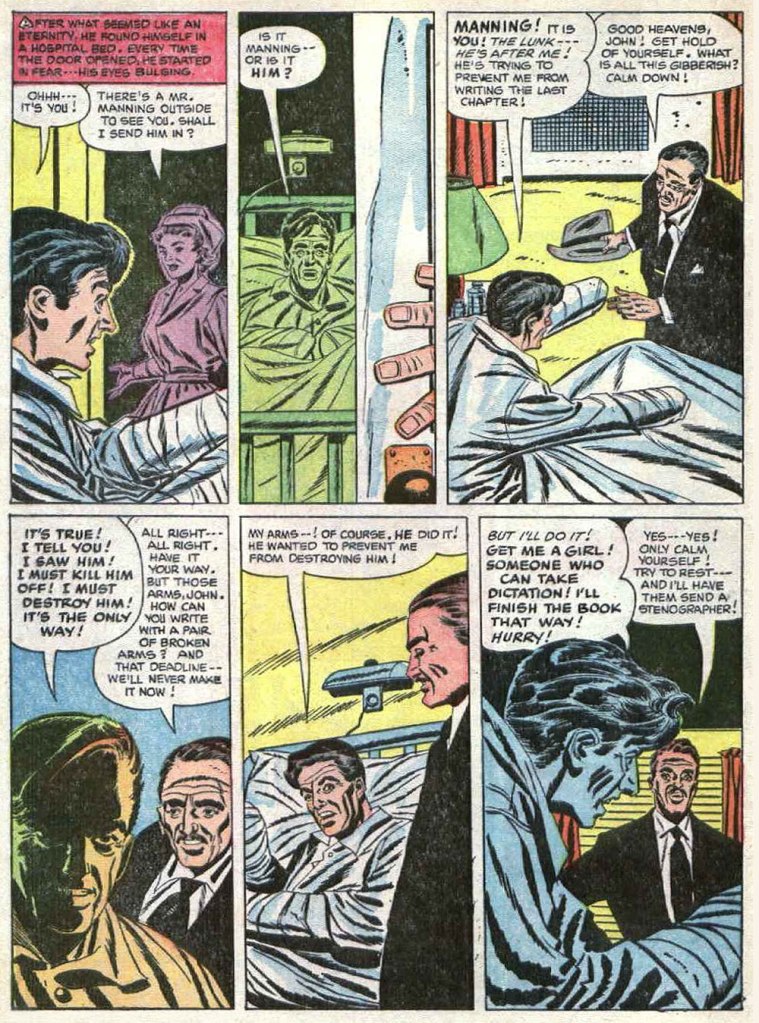
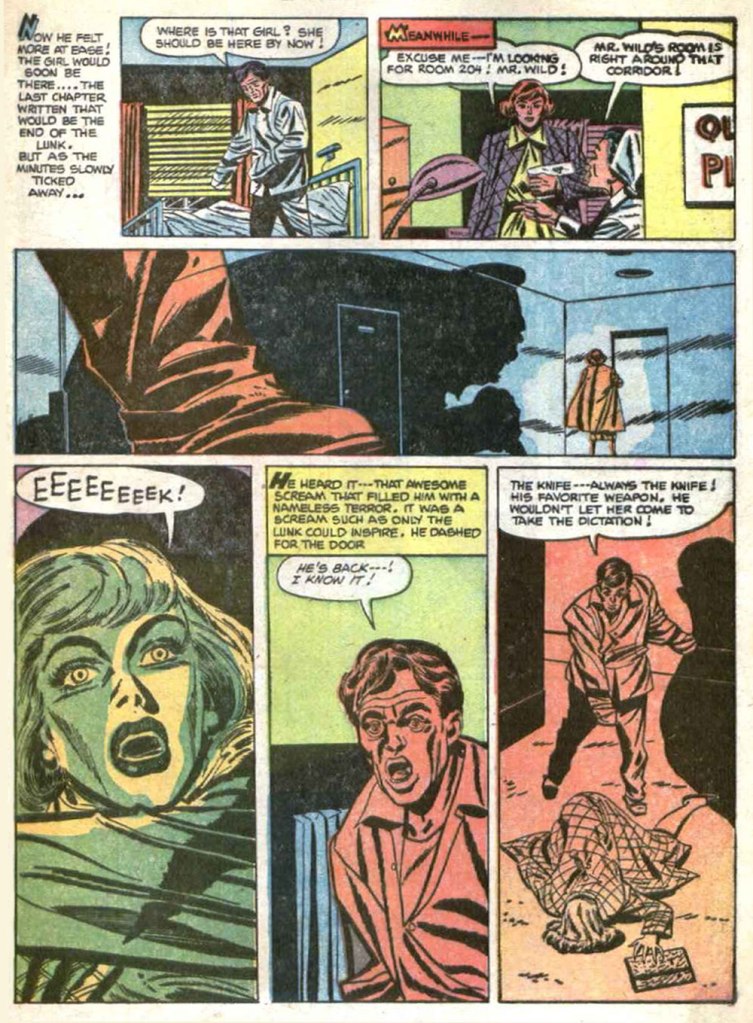
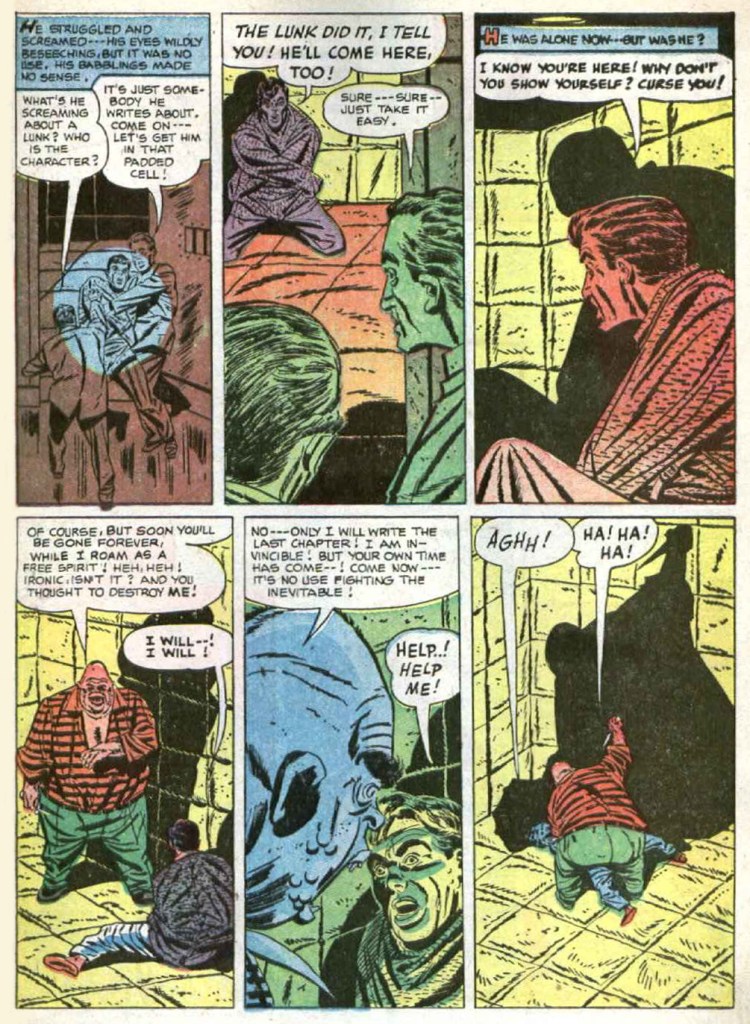
A couple of years back, I was reading, through idle curiosity, a ranking of Stephen King’s books*. I came upon the article author’s précis for King’s 1993 novel The Dark Half:
« The premise is simple and ingenious: a literary author “kills” off the pseudonym whose popular fiction has been paying the bills, only for that alter ego to take murderous, corporeal form. Within the killing spree that ensues, King offers some profound observations about the schism between high art and popular culture, while also exposing his own worries about legacy. » I like King’s perhaps a bit too cute allusion to Donald Westlake’s troubles with his better-selling, pulpier pseudonym Richard Stark — The Dark Half’s antagonist is named George Stark.
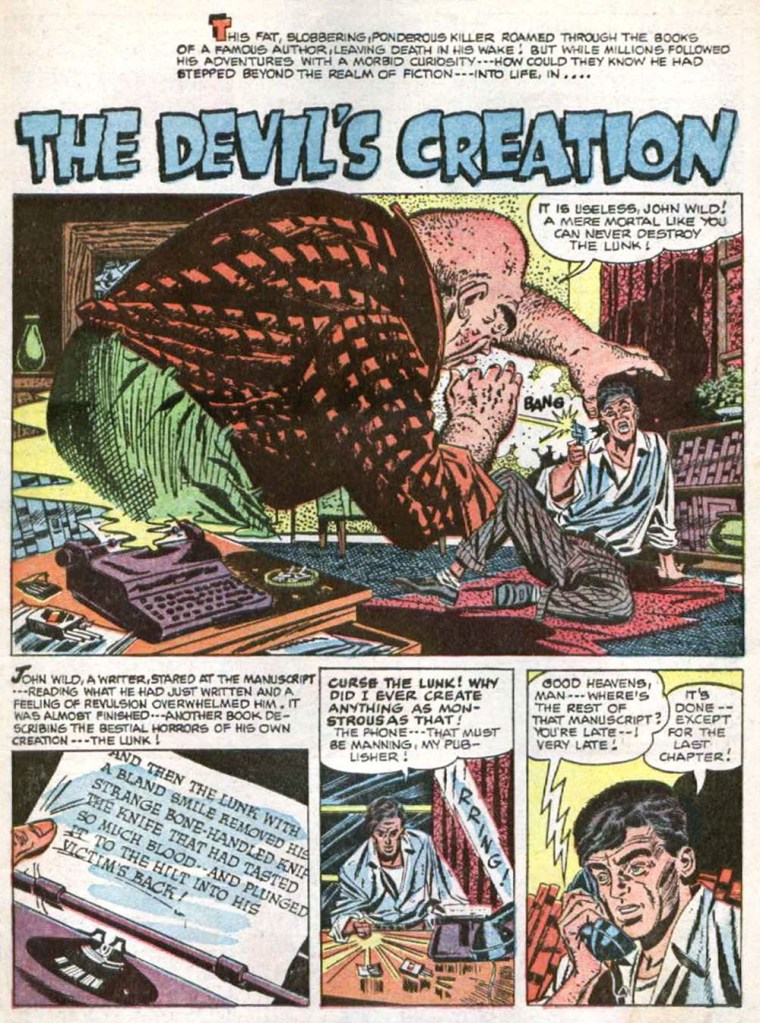
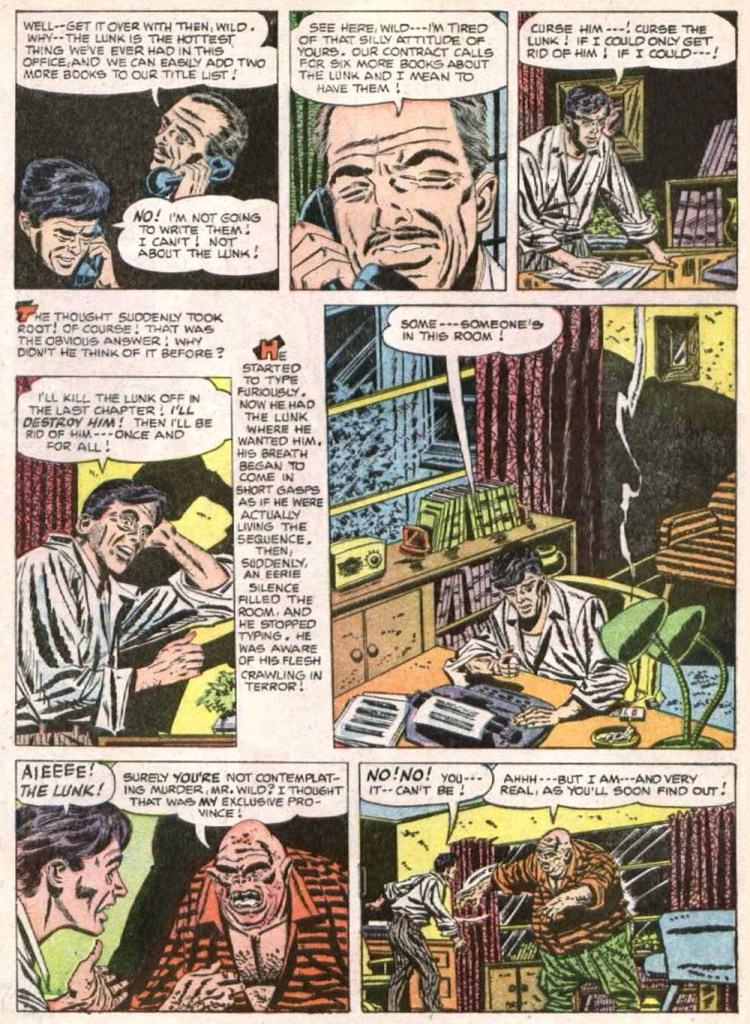
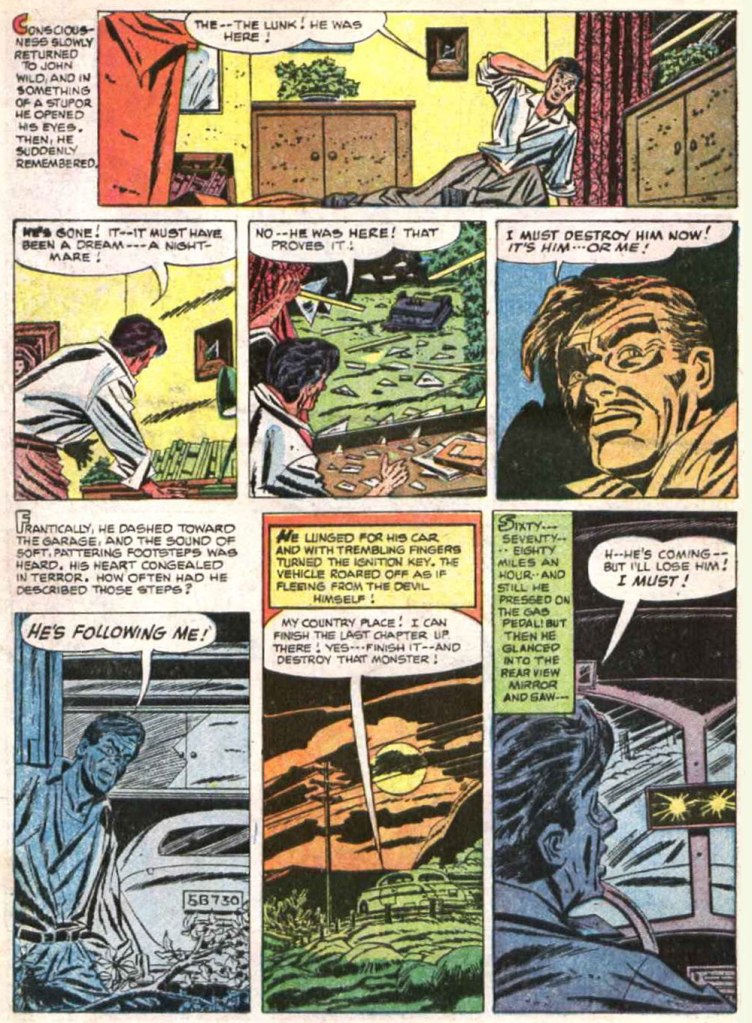
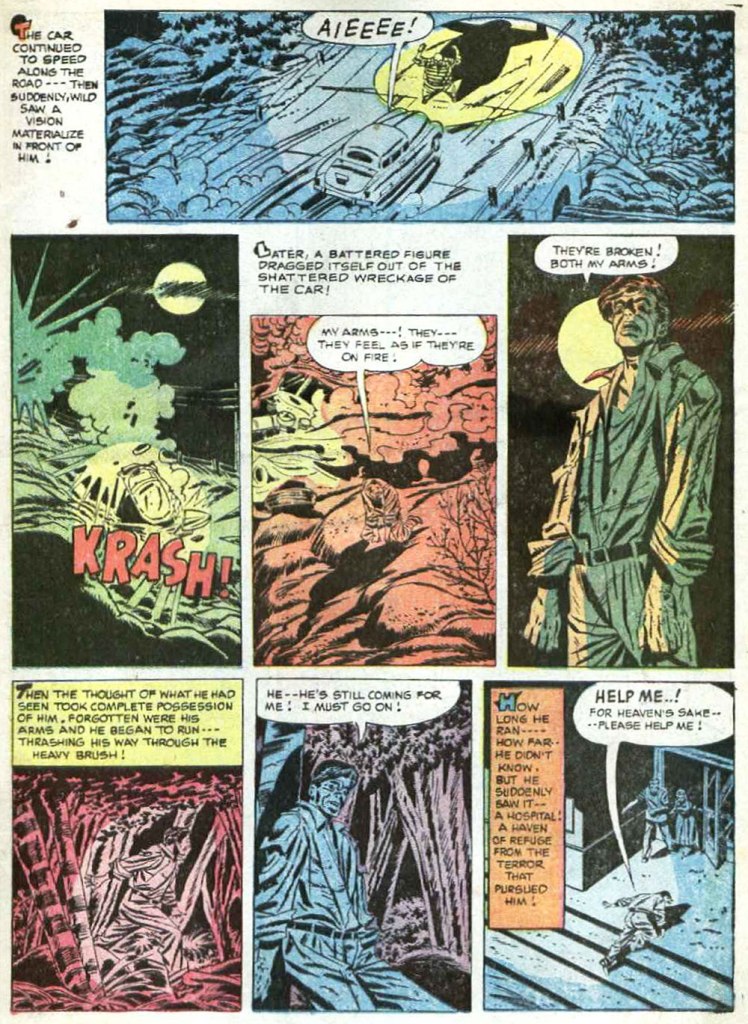
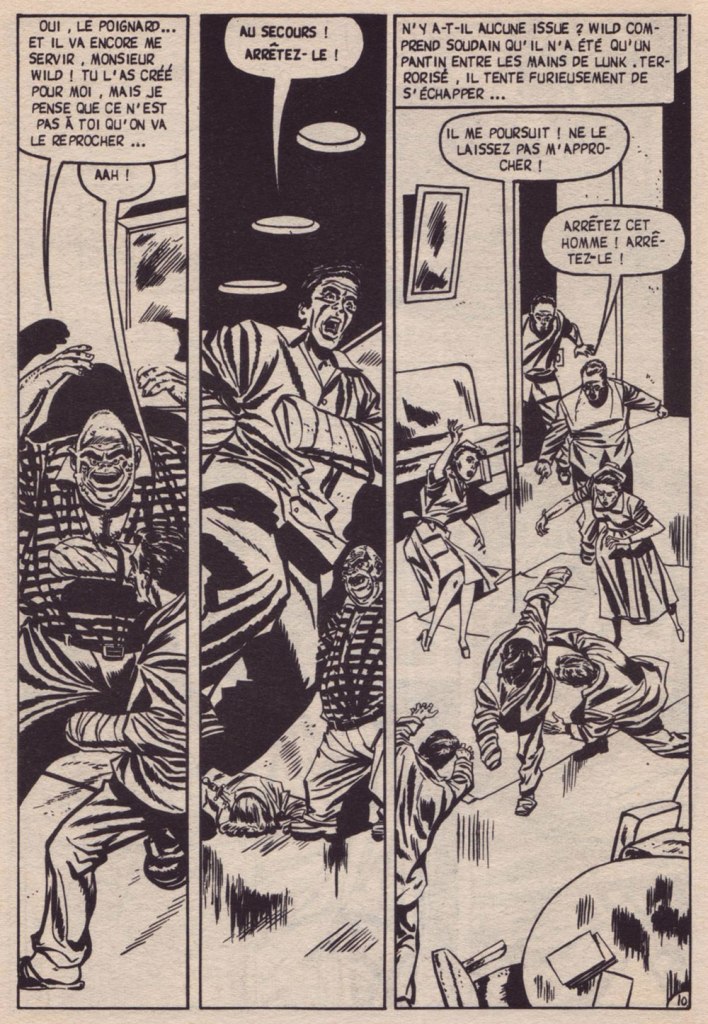
Anyway, that essential premise reminded me vividly of a harrowing comic book story I’d encountered as a child. Here it is — poorly reproduced, I’m afraid — and I’ll provide a bit of context afterwards.
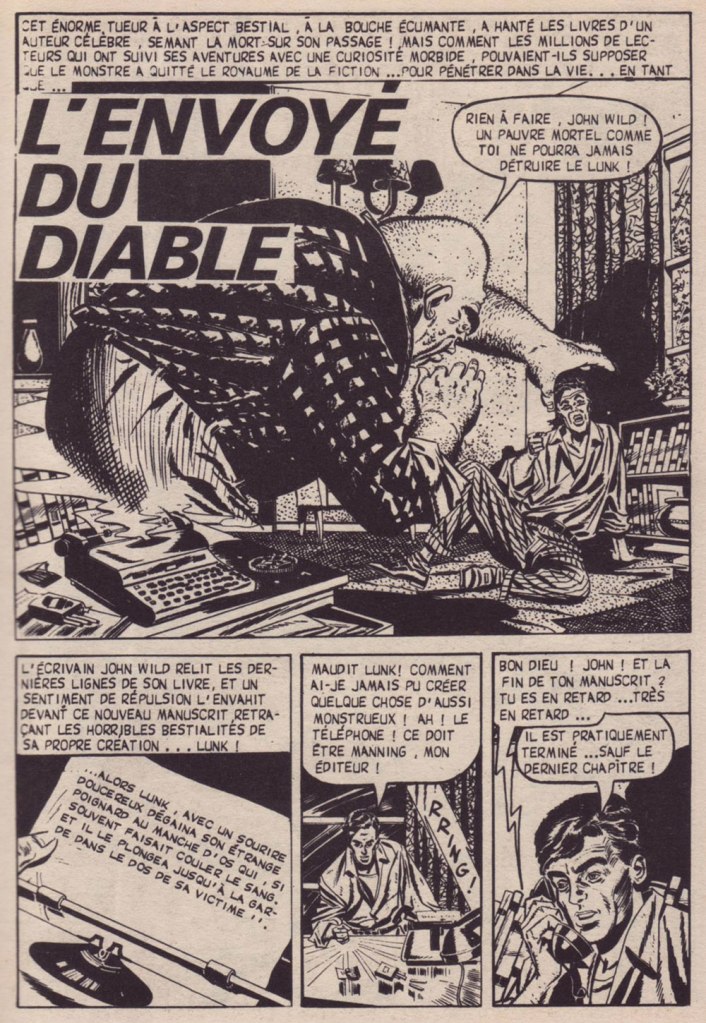
The Devil’s Creation originally saw print in Beware! Terror Tales no. 2 (July 1952, Fawcett). Scripter unknown, art by Mike Sekowsky (1923-1989).On a small town kid’s budget, some US comic books were highly unlikely to turn up on my local spinner rack. Besides, I didn’t even know English yet. But these French digests (162 pages for 35 cents!) could be a godsend. This one came out slightly before my time, but I somehow landed a second-hand copy. This is my dog-eared Eclipso no. 9 (Oct.-Dec. 1970, Arédit); I was, within its pages, introduced to — besides Eclipso — Deadman, The Spectre, The Doom Patrol, The T.H.U.N.D.E.R. Agents and Mark Merlin.
Amid all this fine, but sanitised Silver Age fare, here was one short story that sharply stood out by its merciless brutality. I’m still mystified at how this seemingly random story, which hasn’t even been reprinted once in North America, so incongruously landed in this collection. Amusingly, Sekowsky appears elsewhere in the issue, pencilling the light-hearted A Day in the Life of Dynamo (from Dynamo no. 1, Aug. 1966, Tower). Say what you will, the man was versatile.
Notice how they took away his gun? Censorship was pretty strict in France when it came to publications for youth. In reformatting stories for a different size and ratio, this publisher’s efforts were often pretty dismal; this, however, was an exception. I daresay the pacing was even improved. You simply never know!
-RG
*Not having made it through much of his oeuvre, my favourite King is the non-fiction Danse Macabre (ranked his 51st best book). Fun fact: ill-advisely, the French have retitled King’s famous short story collection Night Shift (ranked no. 13)… Danse macabre. The real DM was retitled Anatomie de l’horreur (‘Anatomy of Horror’). Now I’m sure that didn’t confuse anyone.
« In old New York it was Turkey Mike, Muggsy and the Big Six. In San Francisco, Baby Bull, Stretch, and the Say Hey Kid. Then came the Count, the Hackman, Jack the Ripper and Will the Thrill. Barry and Jeff Kent, but a dearth of nicknames, that is, until… The Giants got the Panda. » — Scott McCaughey, “Panda and The Freak“
In those callow days of youth when I still cared about big league baseball — having lost interest in such matters when Montréal lost its team — the post season was over and done by, say, the 20th of October. Nowadays, with all the extra teams and trimmings, it just seems to go on and on.
I long for the days when only ball players and little kids wore baseball caps, to be honest. Ah, but the sport yet holds some fond memories for me. I recall most fervently the rather outré facets of it, fostered and amplified by the sport’s scads of iconoclasts and loonies*.
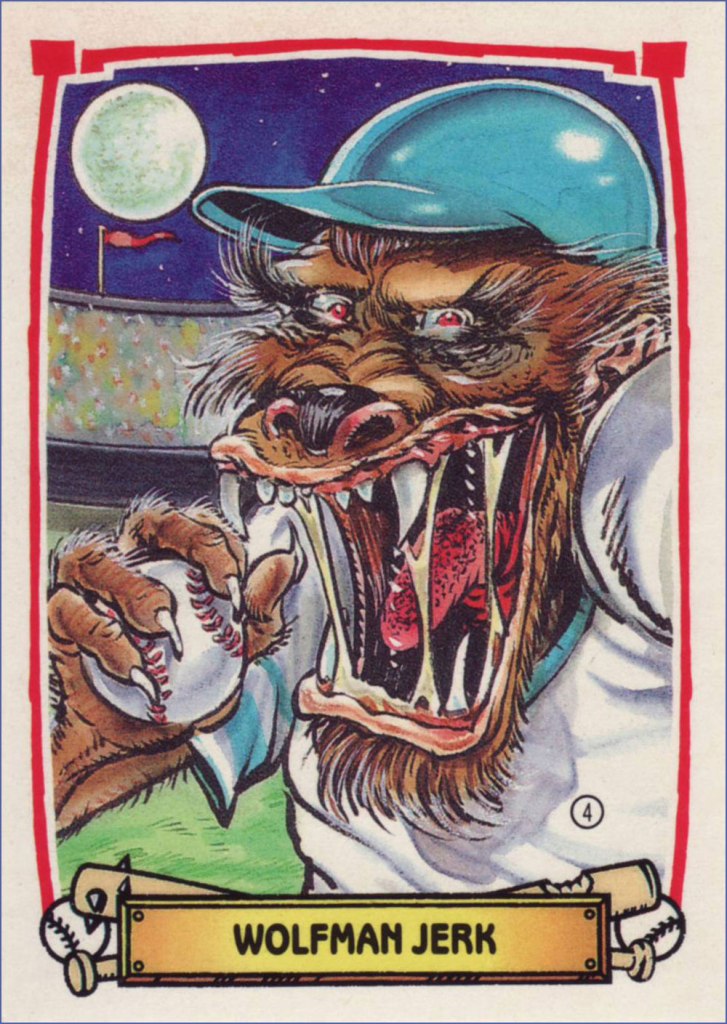
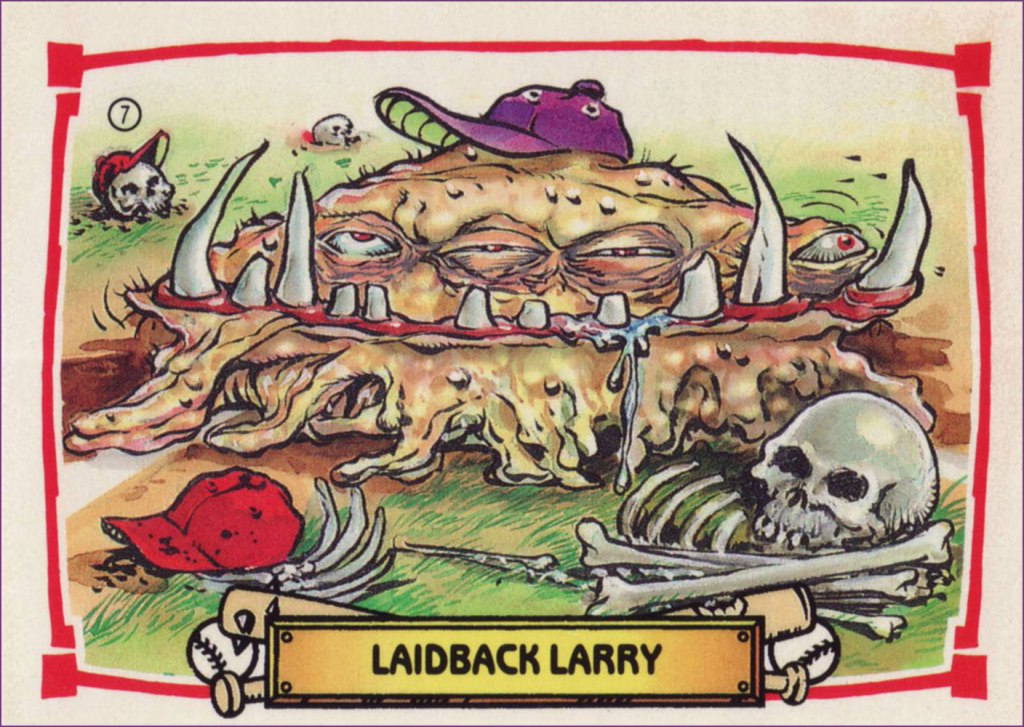
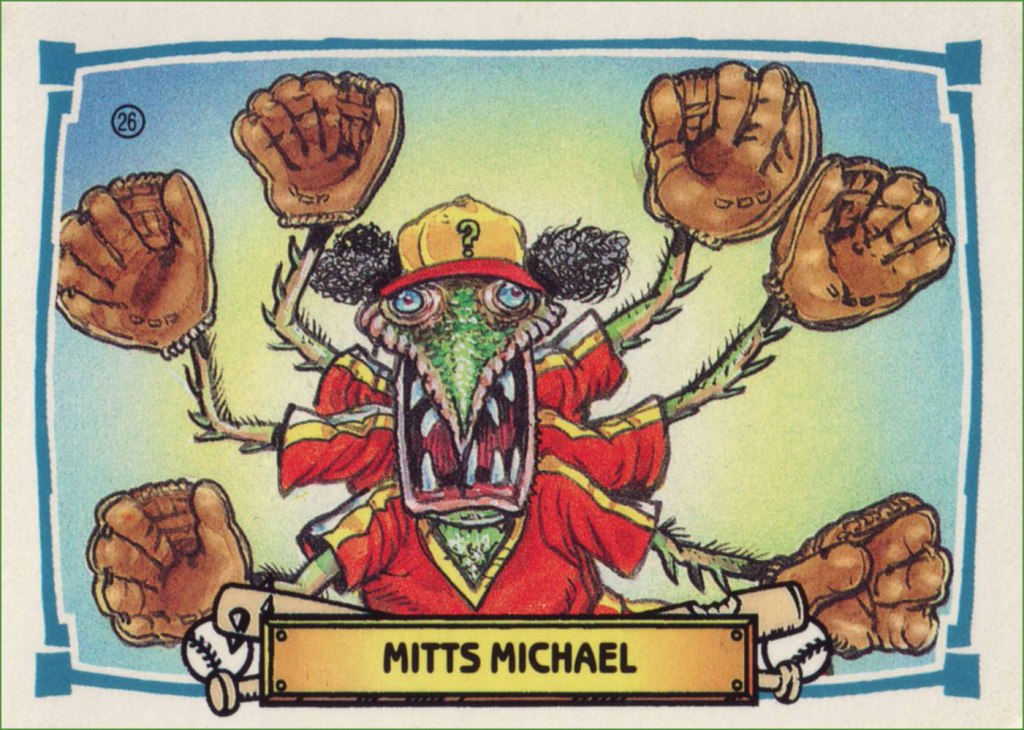
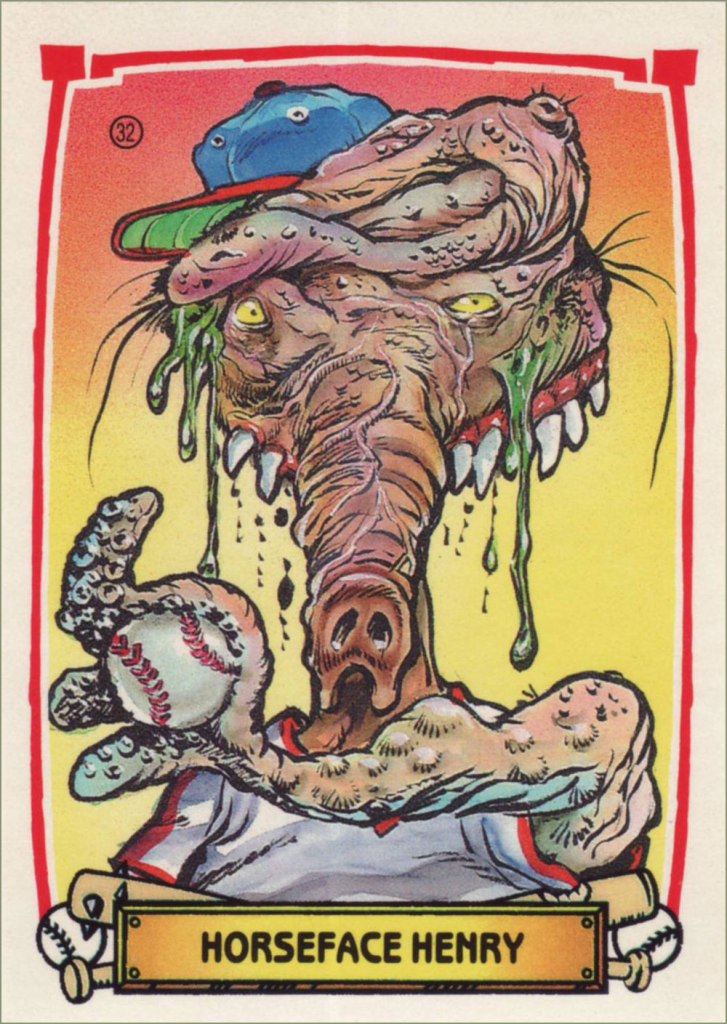
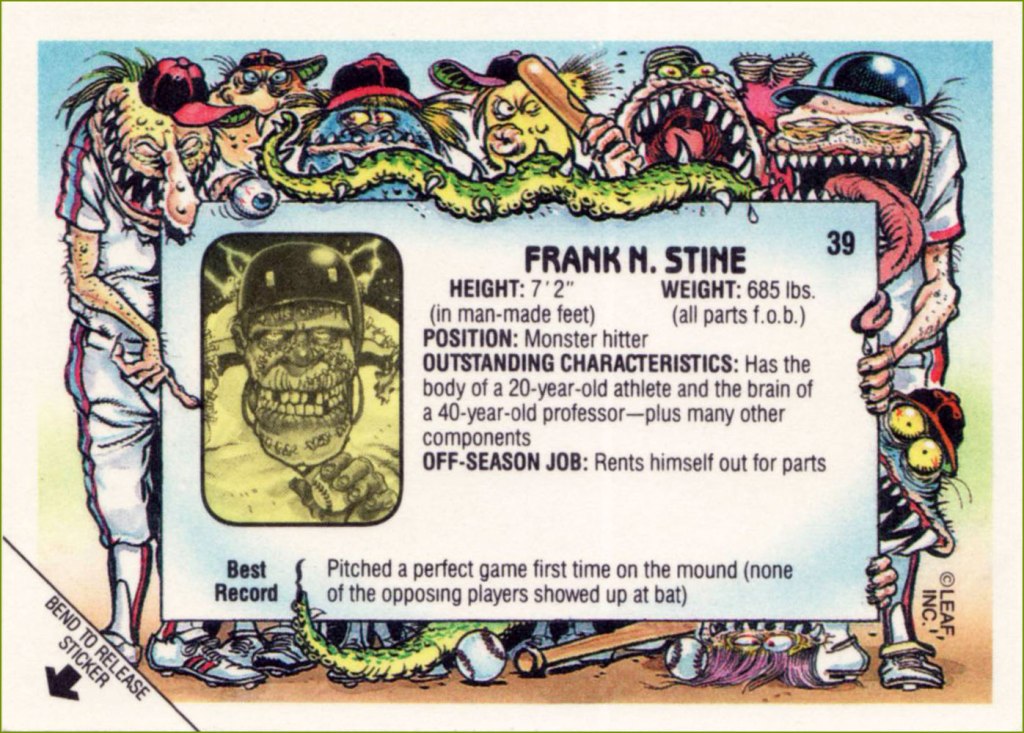
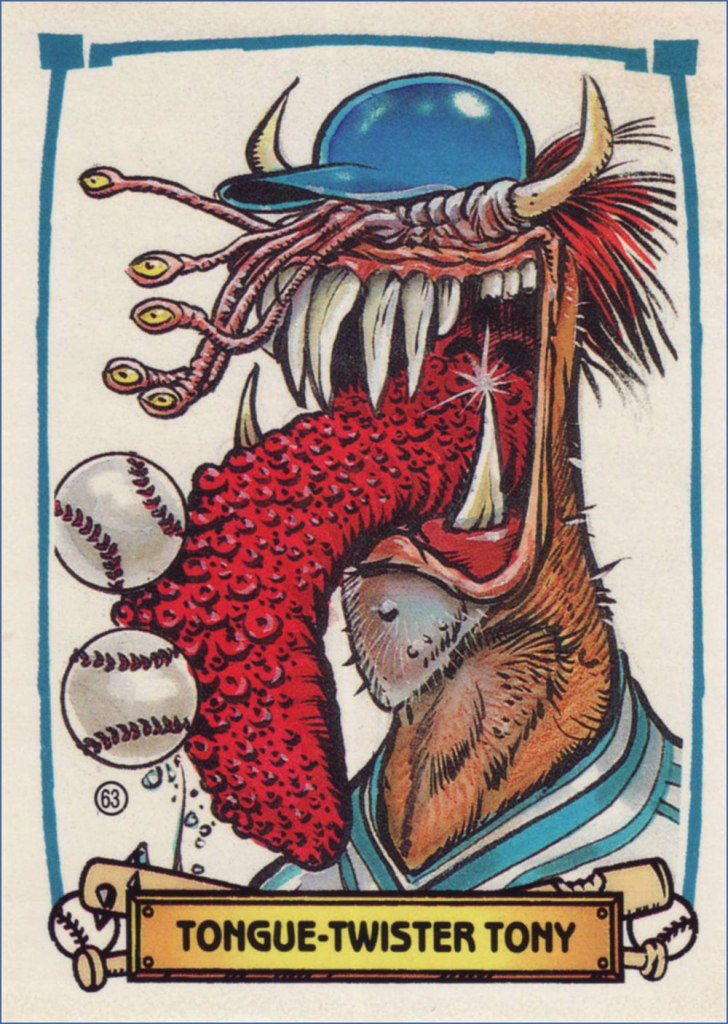
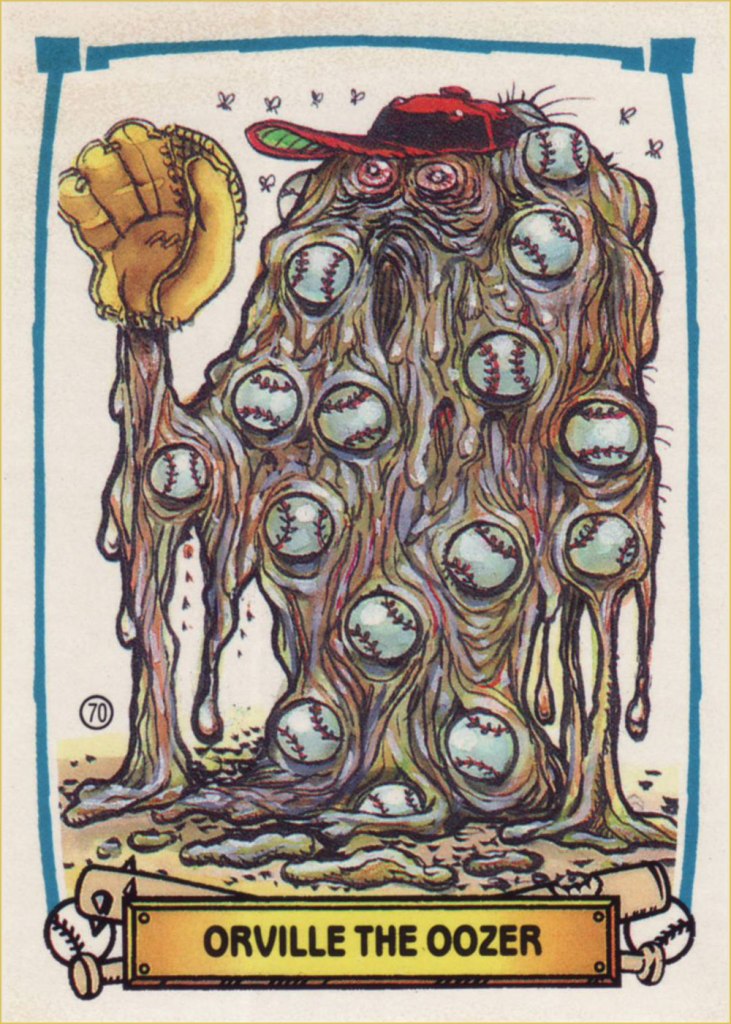
And while we’re on the subject, here are some highlights of Leaf/Donruss‘ 1988 card set Baseball’s Greatest Grossouts, illustrated by the busy yet ever-dazzling B. K. Taylor (Sick Magazine, The National Lampoon, The Muppet Show — he designed Dr. Teeth! — Sesame Street, Dynamite, Mulan…).
I’m mostly featuring the front of the cards, but the backs were also a treat. Love that grotesque wraparound artwork!
-RG
*splendidly — and catchily! — eulogised by supergroup The Baseball Project, featuring members of REM, The Young Fresh Fellows and Dream Syndicate. Four albums on, and their latest, Grand Salami Time!, may just be their finest hour. End of commercial, play ball!
« the escape from the black widow spider / is a miracle as great as art. / what a web she can weave / slowly drawing you toward her… » — Charles Bukowski, The Escape
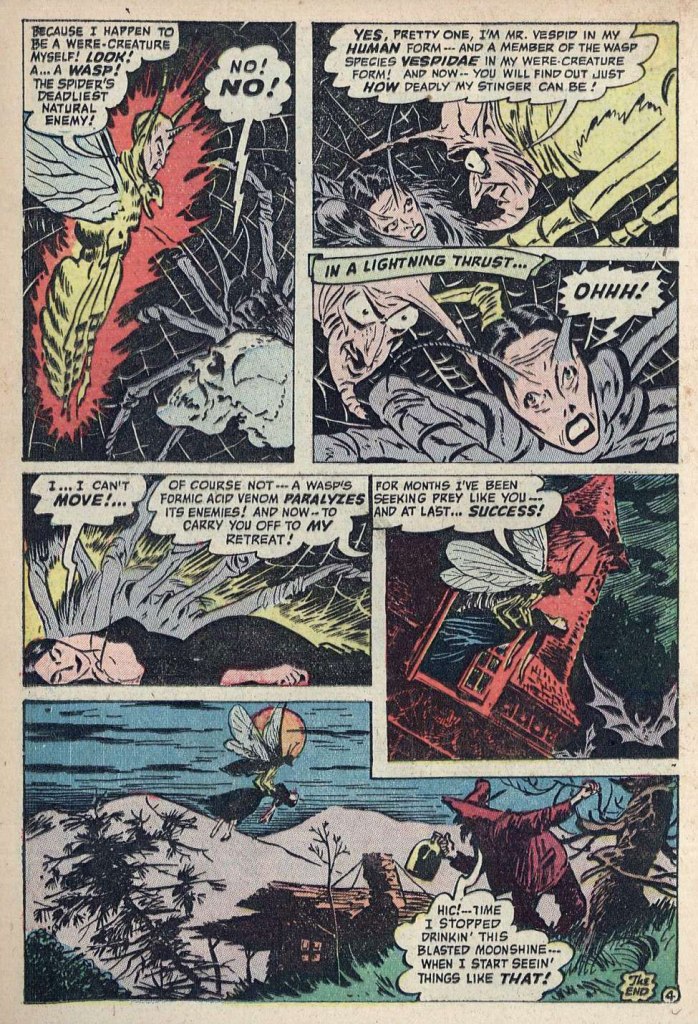
This time around, here’s an over-the-top gem from ACG. No matter what anyone might think, I hold that the sloshed neighbourhood yokel bookending the tale is its star.
The striking artwork is by the mysterious King Ward.
I’d be inclined to say that the « In a lightning thrust… » panel surely wouldn’t have passed muster with the censors… but this was pre-Code horror, after all!
Incidentally, that bit about wasps and spiders, while essentially factual, smacks of your typical comic book oversimplification. Here’s the real-world lowdown.
It wasn’t the cover story — good thing, too: how much more of the plot could they have given away? — but said cover’s a nice one by Ken Bald (1920-2019), so I’m throwing in it. This is Forbidden Worlds no. 12 (Dec. 1952, ACG).
« … so I’d work on it until three or four o’ clock in the morning — that is the time to do Loevecraftian machinations. » — Tom Sutton (2001)
If you ask me, Marvel’s attempts at humour never came off*, being both strained and generally directed at superheroes, who are ridiculous in the first place. It’s like mocking pro wrestling — What’s the point?
Marvel did half-try its clammy hand at a horror humour comic book midway through the 70s, and while much of it looked decent, it was consistently unfunny. You can give it your best Will Elder, but it won’t stick if you don’t have that rare magic comical gene.
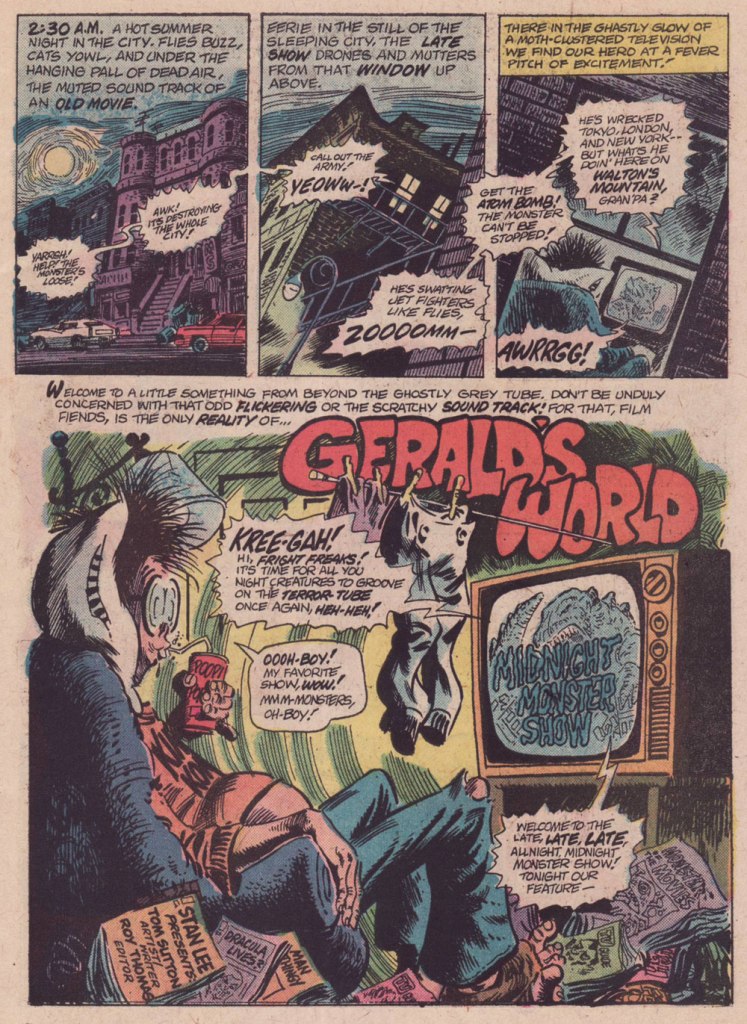
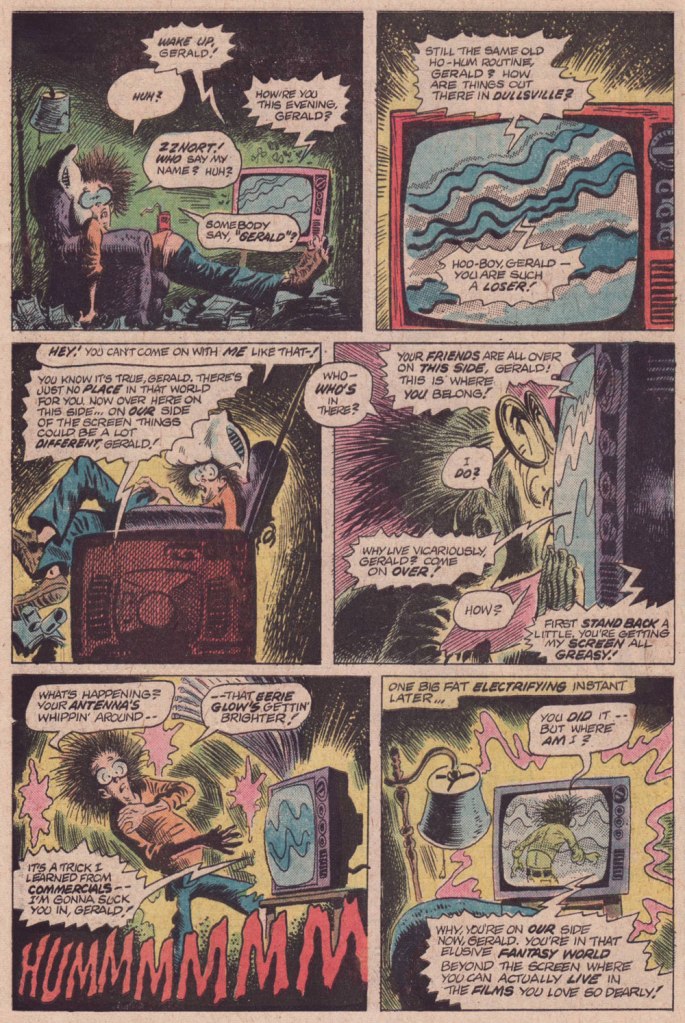
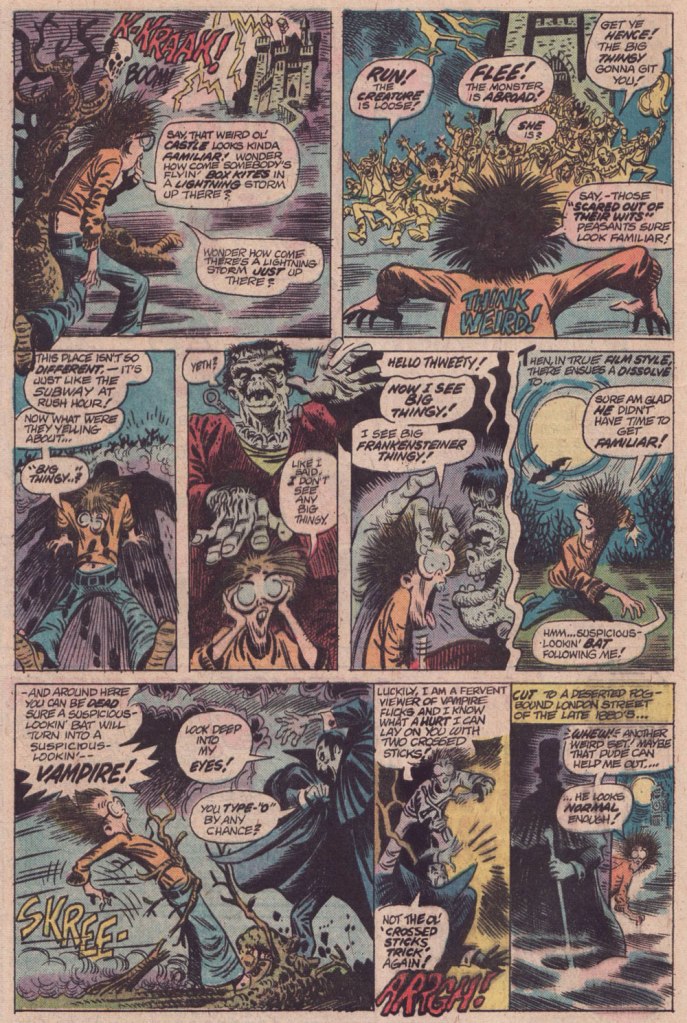
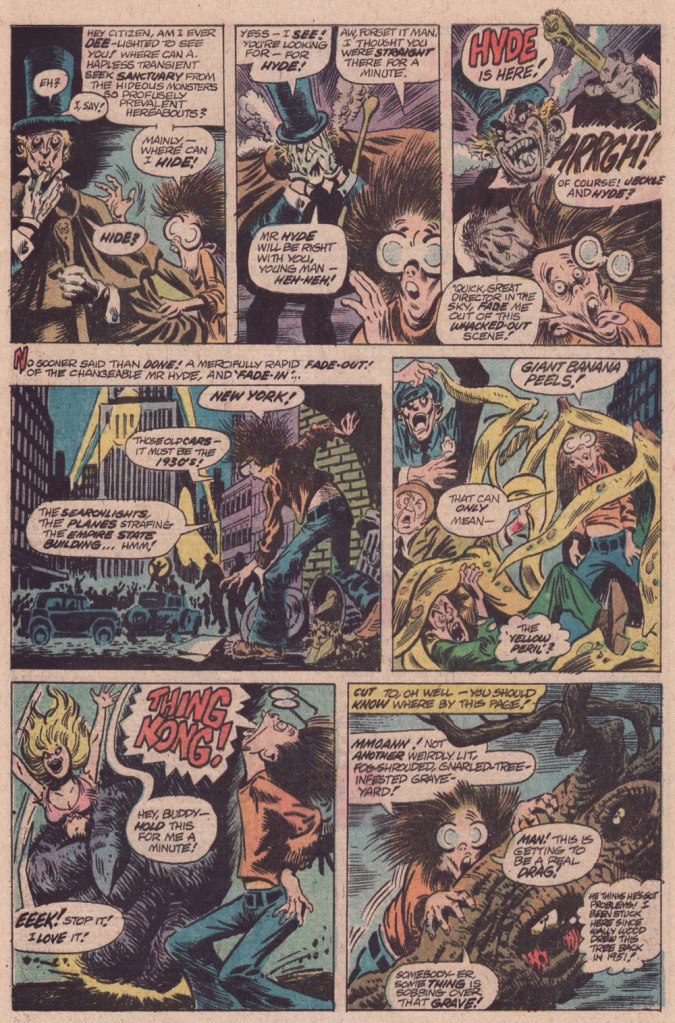
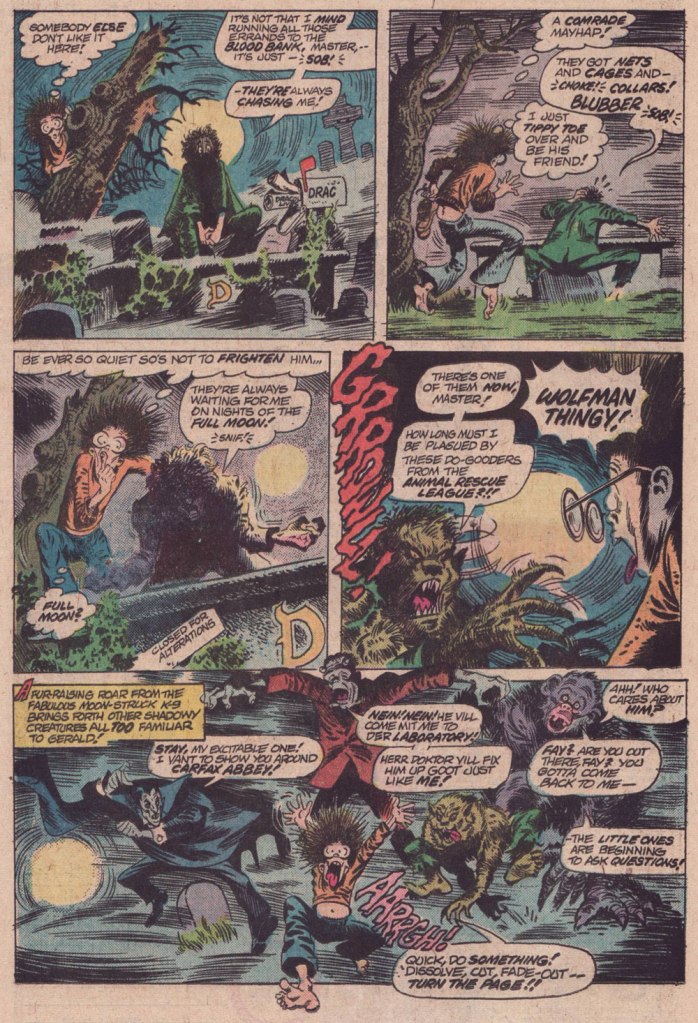
And while I’d love to say that Tom Sutton (1937-2002) had it, I’m afraid he didn’t. But Gerald’s World was a story close to his heart, to the point where he actually remembered creating it and having fun doing so.
« Right, and I did “Gerald”, who stayed up all night watching Fay Wray or something like that. I had fun with those! You know there were people who really didn’t like those things? » (Comic Book Artist no. 12, 2001)
It’s overstuffed, but it’s brimming with mood and solid craft. Take it away, Tom!
For a dose of real-life, depressing horror, read the definitive, late-in-life Tom Sutton interview, ‘An Odd Man Out‘. I’m afraid it’s unlikely to leave you swooning with affection and goodwill for the comic book industry.
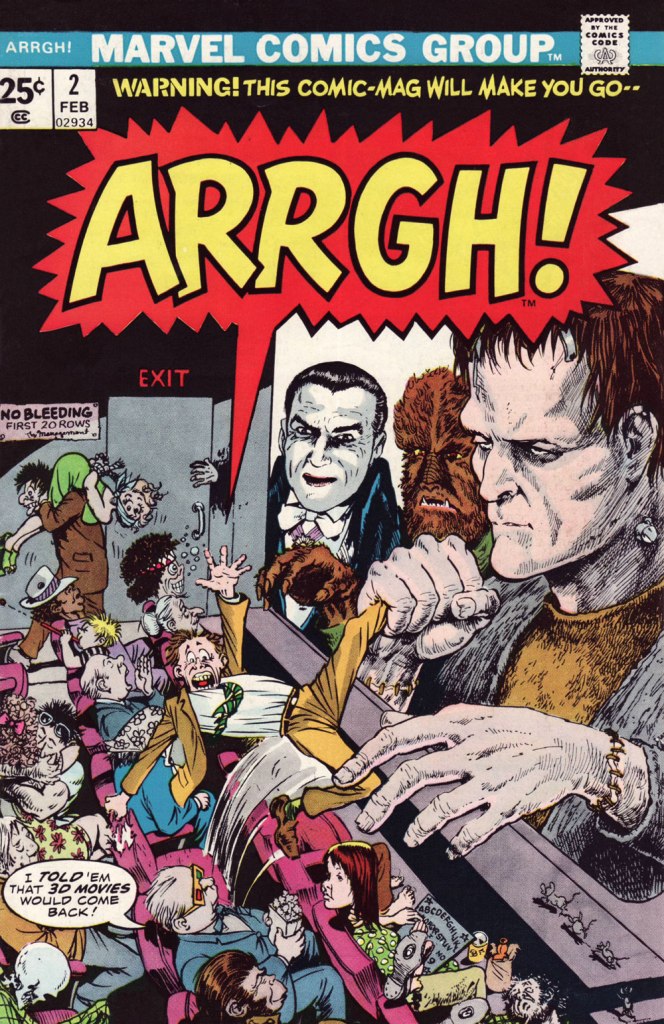
And here’s Marie Severin‘s cover for that issue. This is Arrgh! no. 2 (Feb. 1975, Marvel). By issue five, the final one, Marvel were down to licencing 1954 Get Lost! material from Ross Andru and Mike Esposito.
-RG
*there’s always an exception, isn’t there? I’ll proudly vouch for Scott Gray and Roger Langridge‘s Fin Fang Four stories, circa the late Oughties. Recommended? You bet.
Hi there! Co-admin RG asked for some assistance with his Halloween count-down (admittedly, 31 posts in a row is a bit much), so I’m here each Tuesday for the month to come, a throw-back to the Tentacle Tuesdays of yesteryear.
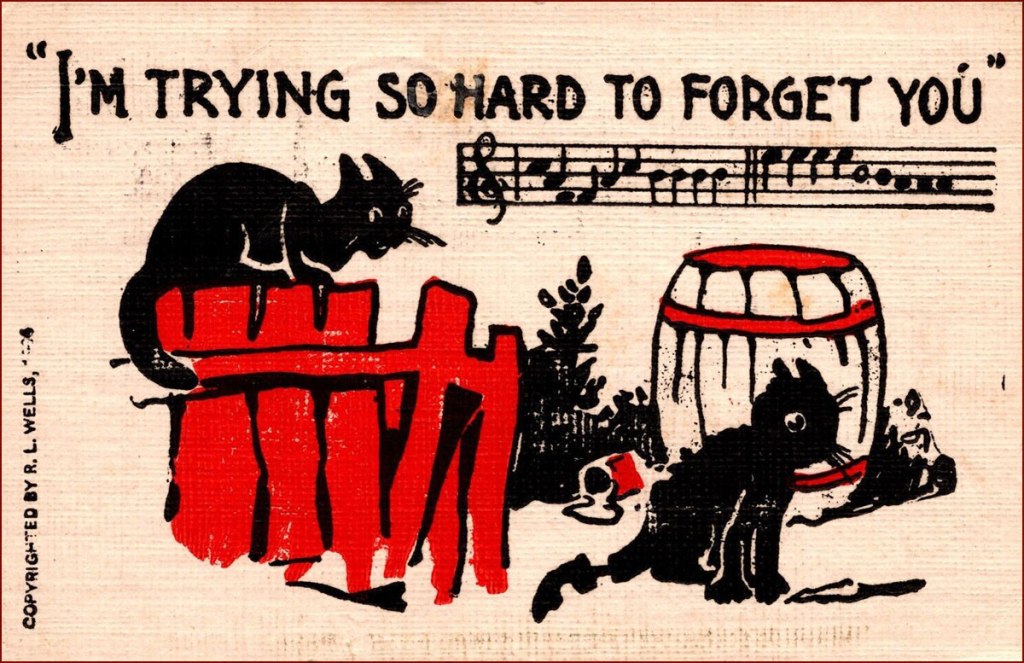
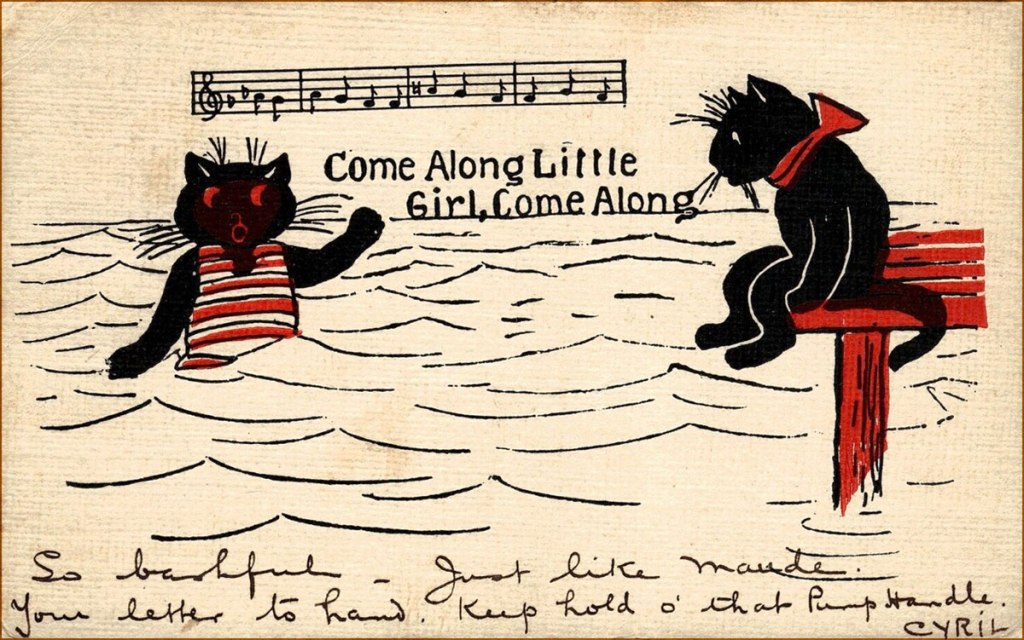
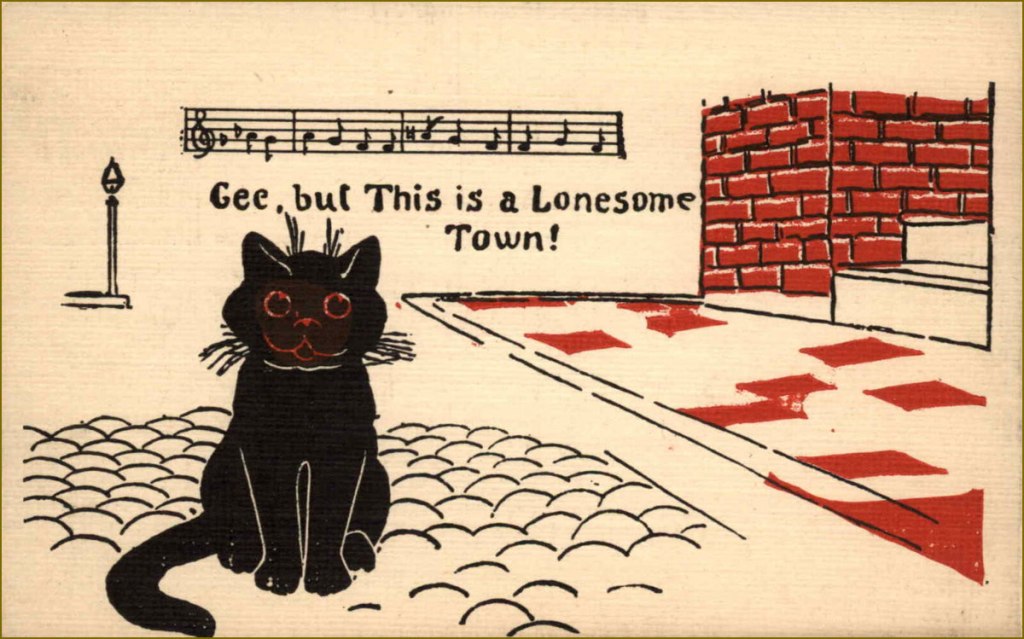
As you probably noticed, we like supposed bad omens around here, and lean into superstitions, too. I consider a black cat crossing my path is as a definite stroke of luck, as is having one of those beautiful silky beasts at home at all times (we are blessed with one such beast). The anglophone world has long had a tortuous relationship with black felines. Harbinger of luck or malevolent pawn of Satan? Flip a coin. Nevertheless, in the 20th century black cats seemed to have had a charmed streak, and appeared in many postcards as definite auguries of good luck. For my own self, I am sympathetic to witches (though not to the point of actually believing in their existence) and also of anarchism, of which the black cat has been adopted as a symbol from the late 19th century. Whatever way you look at it, black cats are cool.
Here are some postcards from the very early 20th century, say around 1905-1906. Unfortunately I cannot say who R. L. Wells is, other than noting that they have a very district style and seem to have created a wide array of postcards.
Our very own silky black beast. My camera usually has trouble focusing on his blackness, so this is a rare decent — and most recent! — photo.
And the following postcards are by the equally mysterious H. M. Rose (or is my Google-fu weak as water, today?), from 1913.
For a great selection of vintage black cat postcards, affix your peepers on this collection, among which is found this cat, my absolute favourite for its strangely human teeth and dazed expression of sorrow mixed with euphoria.