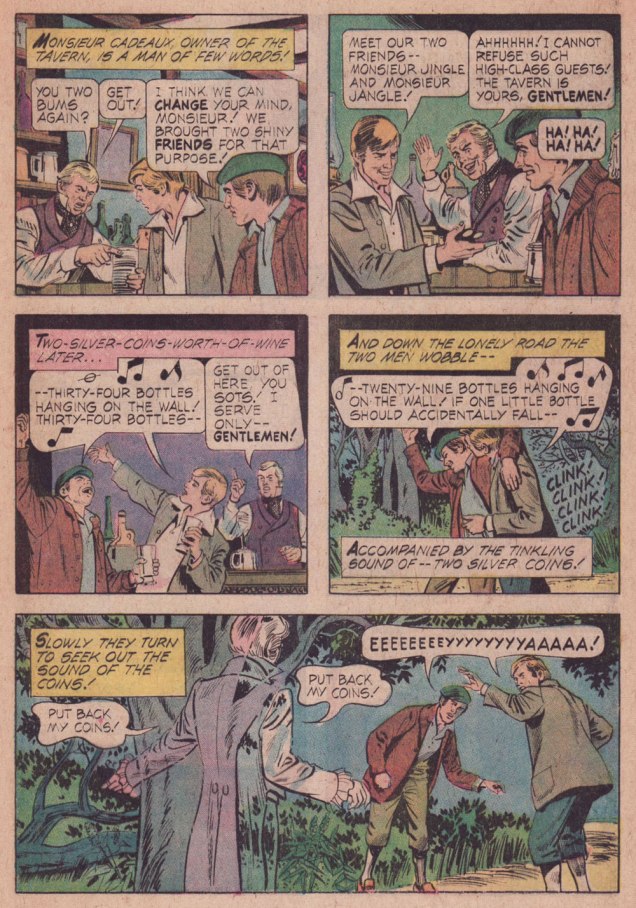
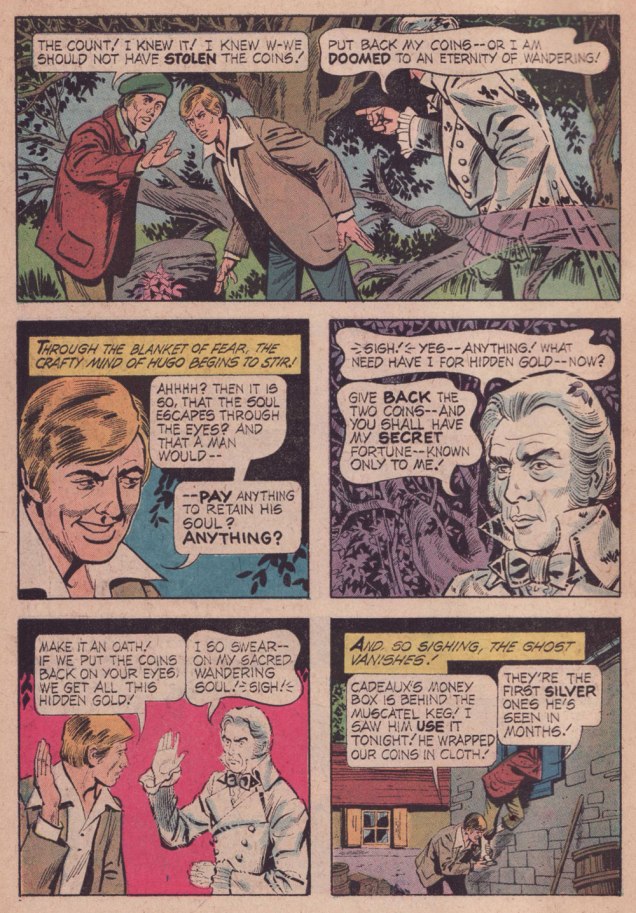
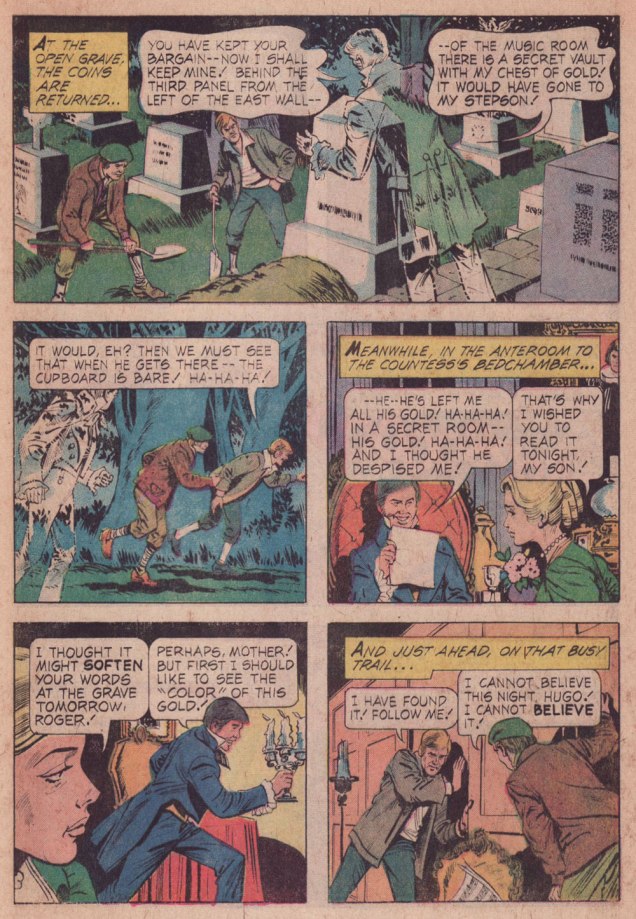
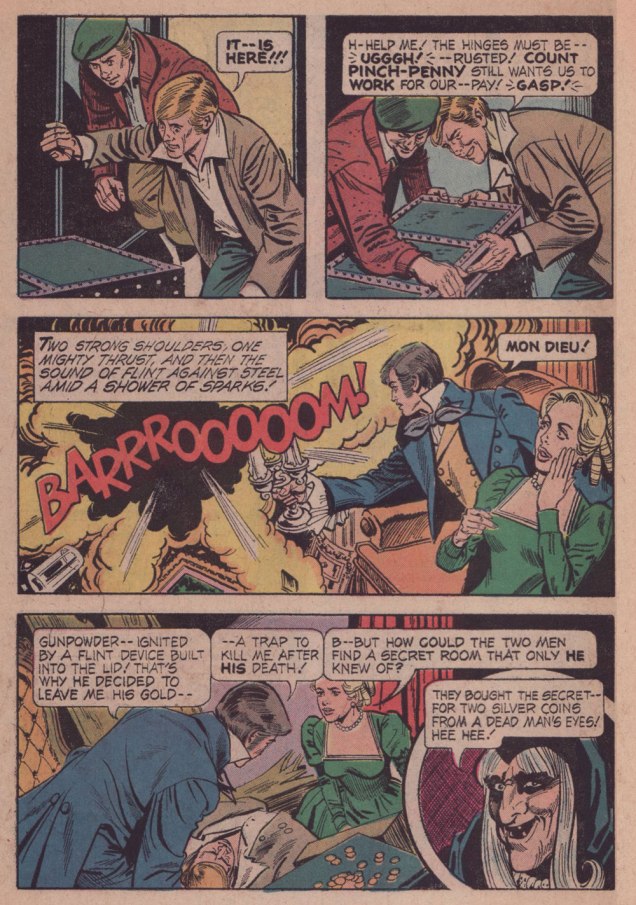
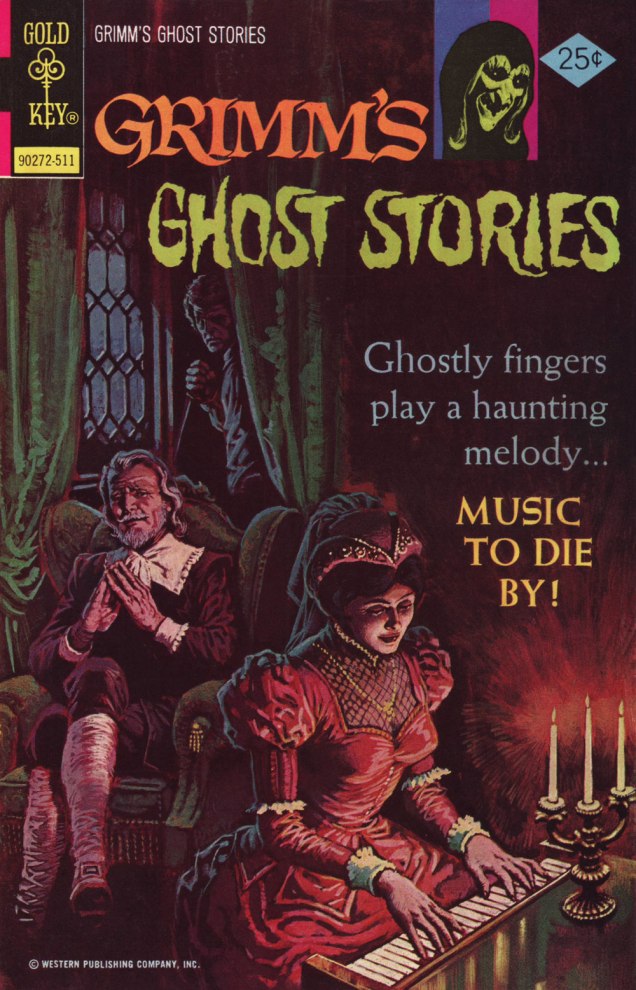
Grimm’s Ghost Stories (60 issues, 1972-1982, Gold Key/Whitman) is a title I’ve been, in my usual fashion, lazily collecting for decades. I’ve always found in the Gold Key ambiance a soothing respite from the obsessive continuity and slam bam histrionics of DC and (the chief offender) Marvel.
While writer Arnold Drake‘s numerous credits at DC (and, to a lesser degree, Marvel) are well documented, his passage at Western/Gold Key in the mid-to-late 1970s is unjustly shrouded in obscurity. Let’s just say he — along with his young colleague Freff — brought complexity, warmth and wit to the publisher’s frankly formulaic fare.
.
.
.
.
.
.
This isn’t the spookiest ghost story of them all, far from it, but that’s hardly the point, is it? Fun fact: the practice of putting coins on the deceased’s peepers was poetically called ‘Charon’s Obol‘.
I love the well-developed characters… despite the tale’s brevity. The willful stepson whose only sin is that of being a free thinker; the grave-robbers who can keep their wits about them in all circumstances; and the pragmatic miser’s spectre who’ll trade one act of revenge for another in a pinch.
While ‘Silver’ wasn’t the cover-featured story, I wouldn’t pass up the chance to spotlight such a fine, understated Luis Domínguez painting. This is Grimm’s Ghost Stories no. 27 (Nov. 1975, Gold Key). For our gallery of this Argentine master’s finest, check out Luis Domínguez (1923-2020): A Farewell in Twelve Covers.
« The hardest tumble a man can make is to fall over his own bluff. » — Ambrose Bierce
Today, I’m going totally ‘mainstream’ on you for a change. Last week, I ventured into a movie theatre for the first time since 2019 (Knives Out was my last such outing) to see my first superhero film since 2012 (The Avengers was my last such outing). And so, while the new Superman epic wasn’t perfect, I found much to enjoy about it.
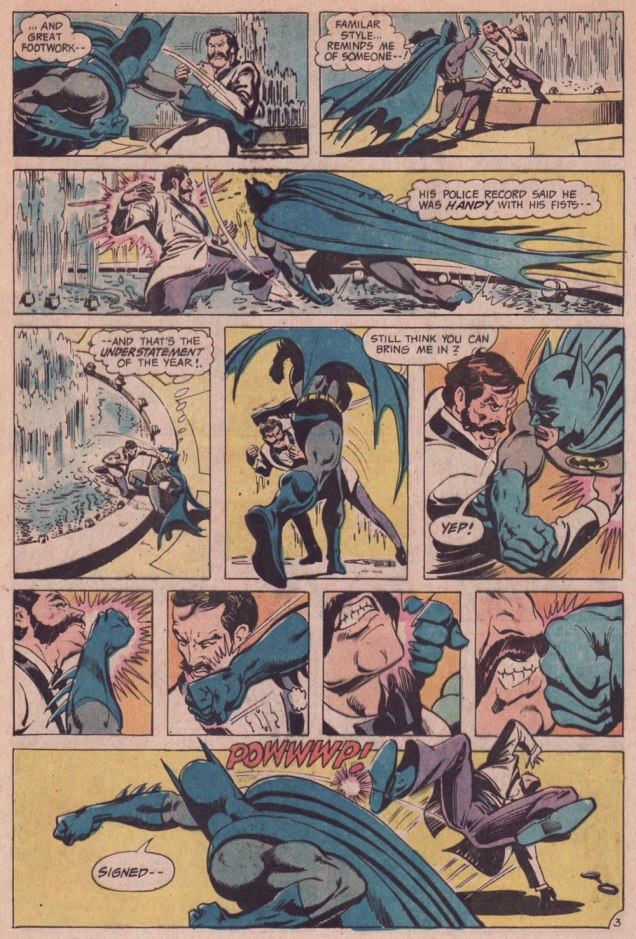
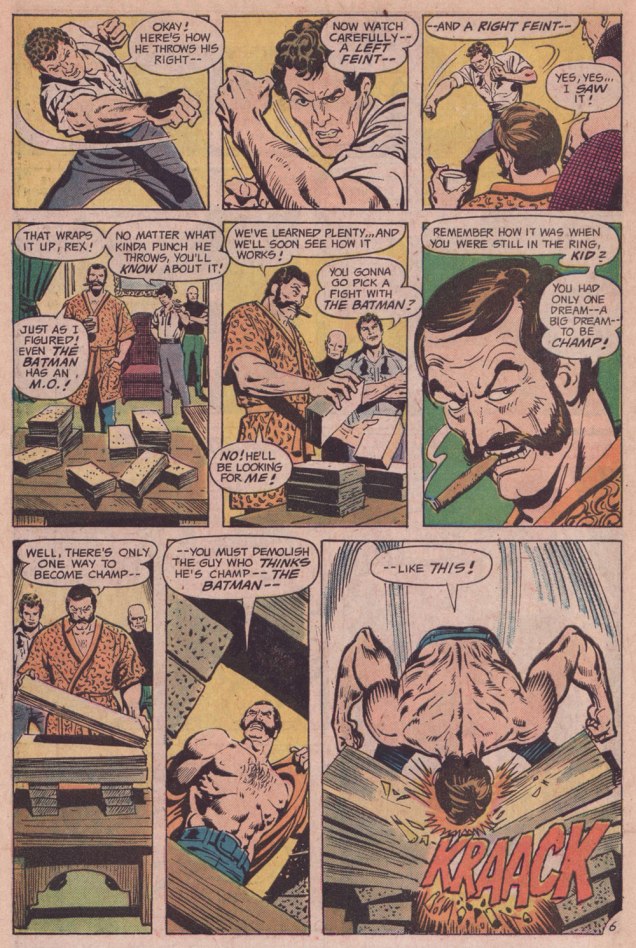
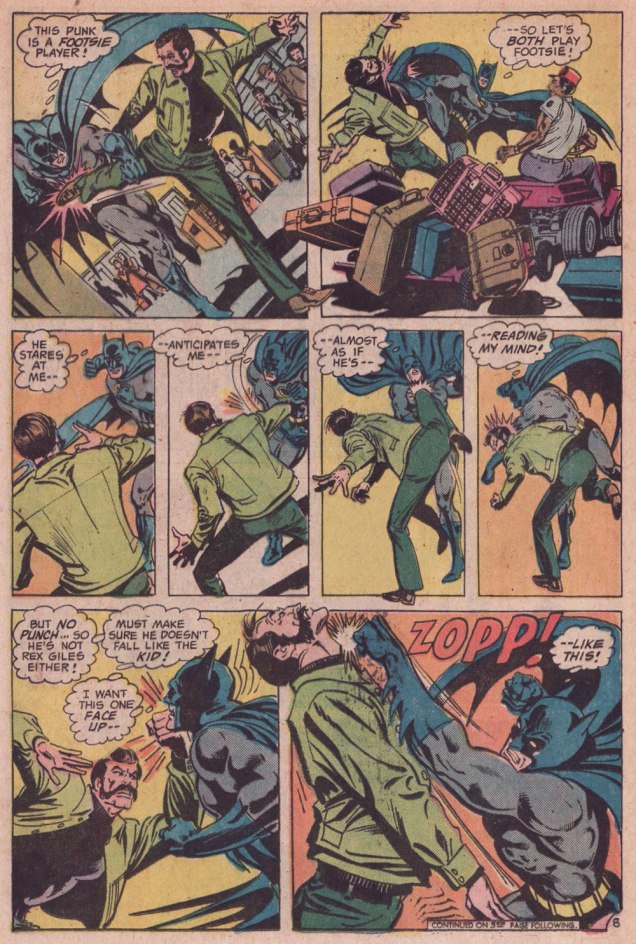
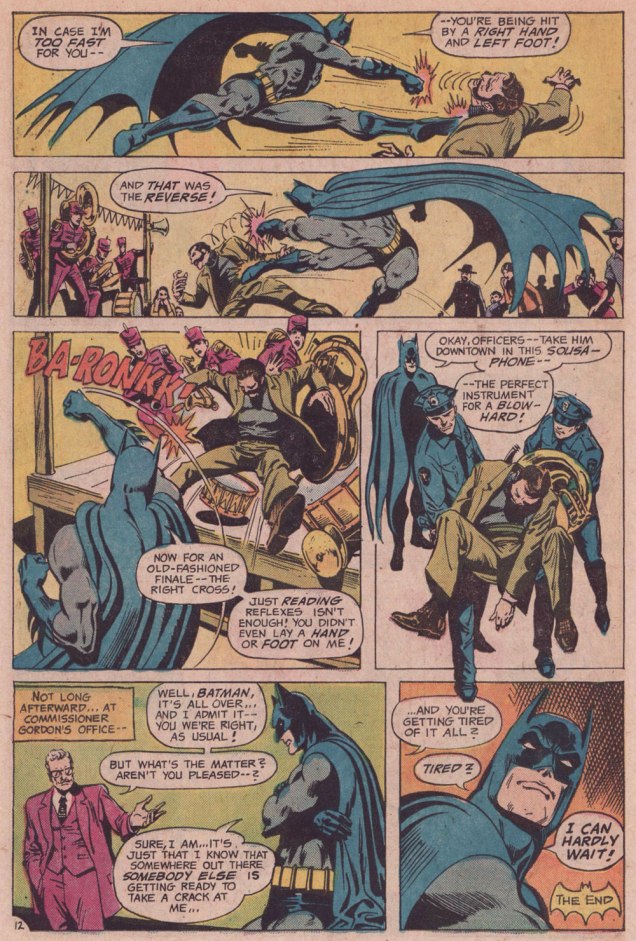
Among the ideas explored in the film was that baddie Lex ‘Elon’ Luthor, from carefully observing The Man of Steel over several years’ worth of skirmishes, had managed to analyse and codify his combat moves, in order to predict and counter them.
I was reminded of that angle serving as the basis of a favourite Batman story by my favourite Batman writer (and hardly anyone else’s, apparently), David Vern Reed (1914-1994). Despite its publication in a popular, long-running title, this tale is obscure to the point of never having been reprinted in English.
I’m terribly fond of the Schwartz-era Batman, especially the 1970s, because it’s relatively light on costumed supervillains, Batman acts like the detective — albeit a remarkably athletic one — he’s supposed to be, and the plots often hinge on ‘ordinary’ (though clever) criminals striving to outsmart Bats. A favourite example: Vern’s « The Underworld Olympics ’76! » (Batman 272-275, Feb.-May 1976) tetraptych. I think I can safely rule out childhood nostalgia: in my small town, distribution was quite spotty, so I never even *saw* those issues at the time, encountering them instead as an adult, decades on.
If I have a quibble about the art, it’s that Ernie Chan’s finishes mesh poorly with García-López’s usual rock-solid breakdowns. Perhaps it’s because Chan likes to have more to do; given that García-López, his own best inker, typically turns out pencil renderings that are utterly complete and tight as a drum, the job is quite unlike, say, Chan inking a Big John Buscema Conan job — as he so often did — wherein Chan has to do 80 percent of the work over Buscema’s sparse breakdowns, stock poses and rote shortcuts. In contrast, inking García-López essentially reduces the task to tracing over his flawless pencils, which can’t be all that stimulating, educational as it may be.
Speaking of Garcia-Lopez, a priceless anecdote: writer Andrew Helfer, a frequent collaborator, recalled, in his introduction to TwoMorrows’ Modern Masters Volume Five (2007): « … it was Jean Giraud, aka Mœbius, and he was staring at a drawing of Wonder Woman by José Luis García-López. « This García-López », he asked in a heavy French accent. « He uses models, no? » « No, » I answered, smiling. « Son of a bitch! » Mœbius hissed.
« Losing my mind, but I don’t care I see Donna everywhere Down by the lakeside, in a lawn chair Donna, Donna everywhere » — Too Much Joy
Today’s featured tale hails from Charlton’s groundbreaking anthology title Midnight Tales (1972-1976). It differs from the rest of the publisher’s mystery line in that it largely served as a vehicle and spotlight for Wayne Howard (1949-2007), who even received a ‘created by’ mention on the covers. My partner ds delved deeper into Midnight Tales minutiae in her Tentacle Tuesday entry « Plants Sometimes Have Tentacles, Too ».
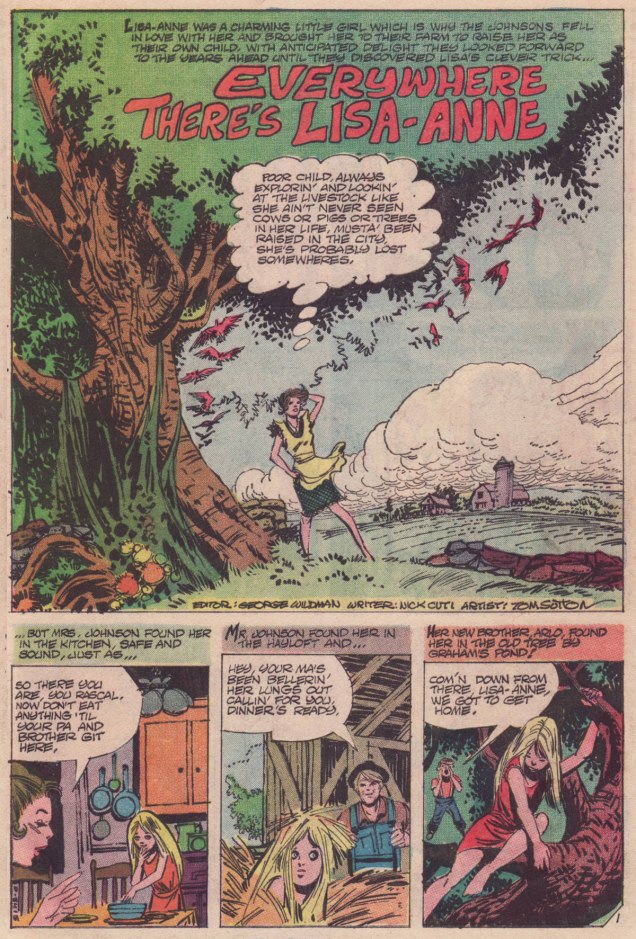
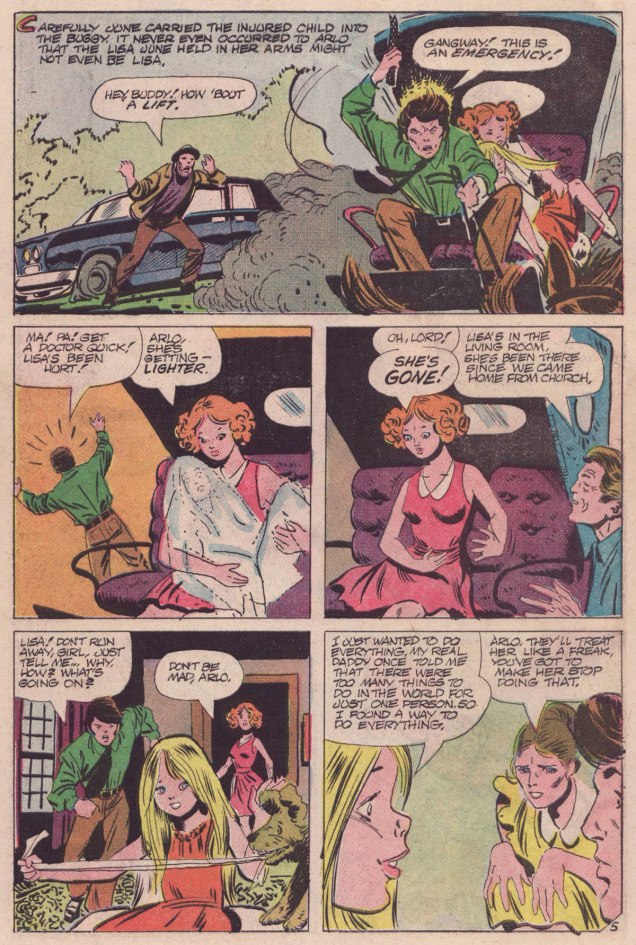
« Everywhere There’s Lisa-Anne » saw print in Midnight Tales no. 6 (Nov. 1973, Charlton). It was written by Nicola Cuti, Howard’s co-conspirator (they had both apprenticed with Wally Wood), who provided the lion’s share of Midnight Tales scripts. It was illustrated by Tom Sutton and coloured by Mr. Howard.
What I enjoy about this snappy little tale is its graceful economy: it packs a lot of context and characters into its mere six pages, but flows so efficiently that it never feels rushed. It doesn’t attempt to explain what doesn’t need explaining, nothing is overstated, and none of the characters is a convenient idiot. No patronising hand-holding, just straight-ahead storytelling.
Let’s hope, for the Johnsons’ sake, that Lisa-Anne’s very convincing and the sheriff no laggard!
Lisa-Ann’s ubiquity reminds me of a favourite Cul de Sac Sunday strip… and any excuse to trot out the Richard Thompson is to be seized eagerly!
« All realities, all dimensions are open to me! » — Prince
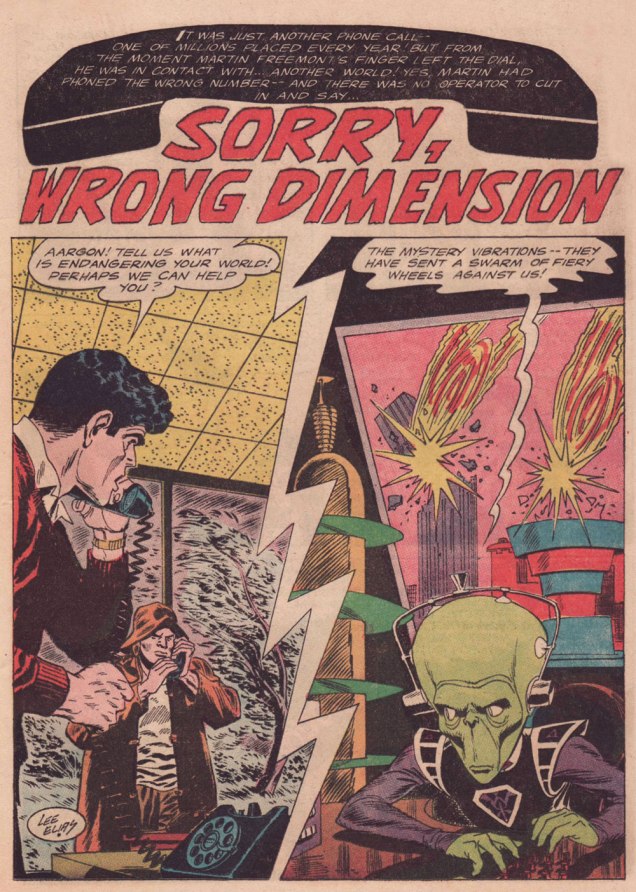
Growing up, Lee Elias (1920-1998) never was a particular favourite of mine. A handful of stories in DC’s mystery titles aside — and I’ve grown to love those — I probably came across his work for Marvel’s Human Fly series, and I was always disappointed when Elias, not my beloved Frank Robbins, turned up in the credits. For the record, Elias drew ten of the nineteen HF issues, and Robbins drew six, plus five covers.
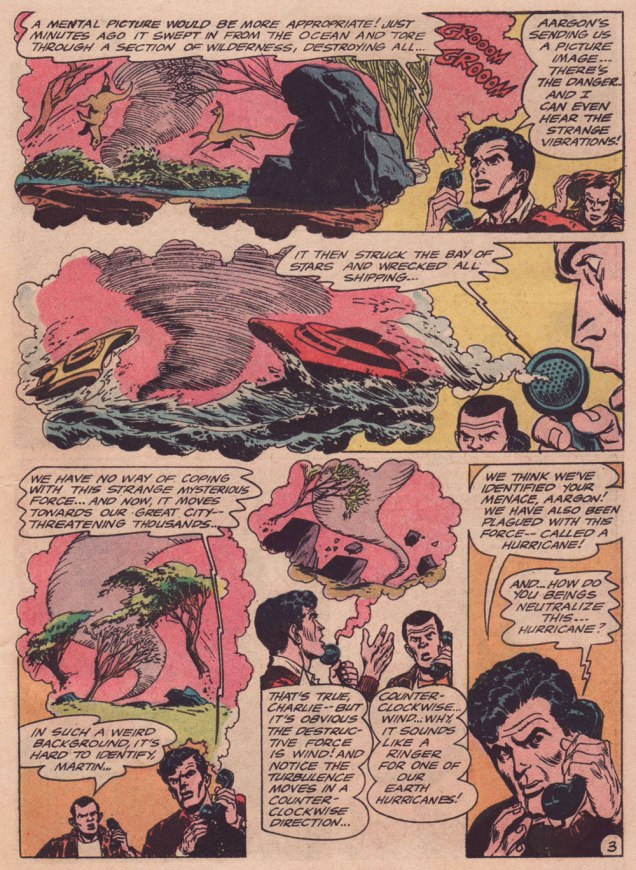
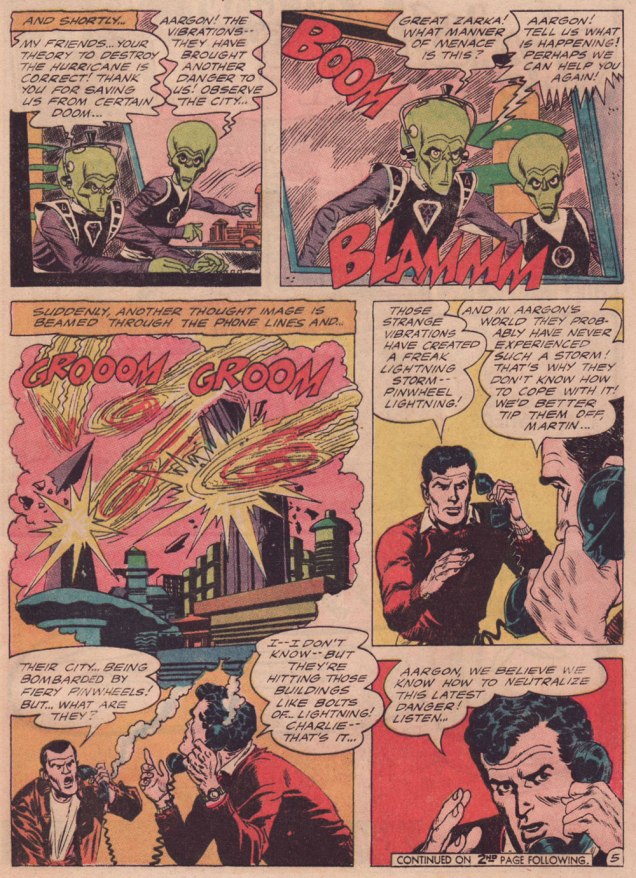
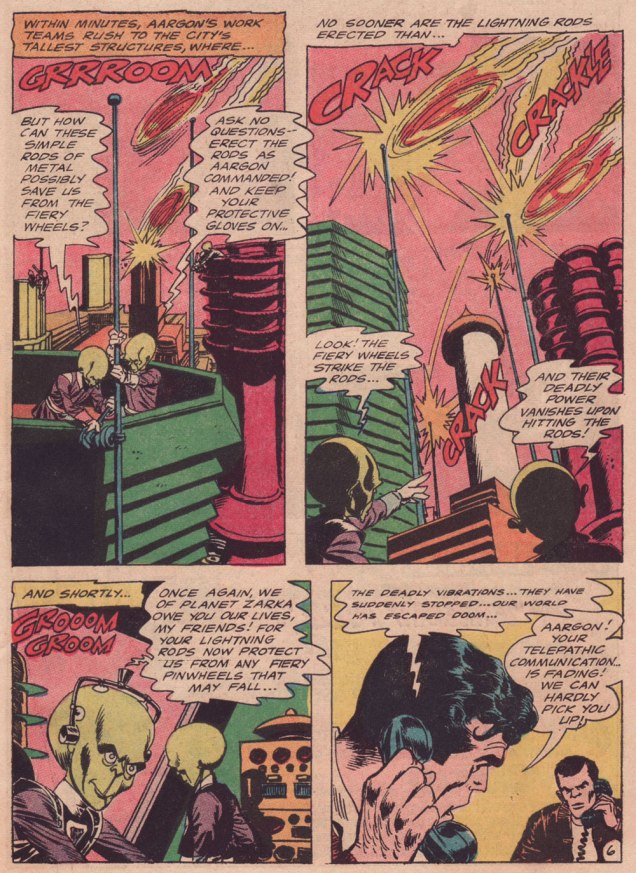
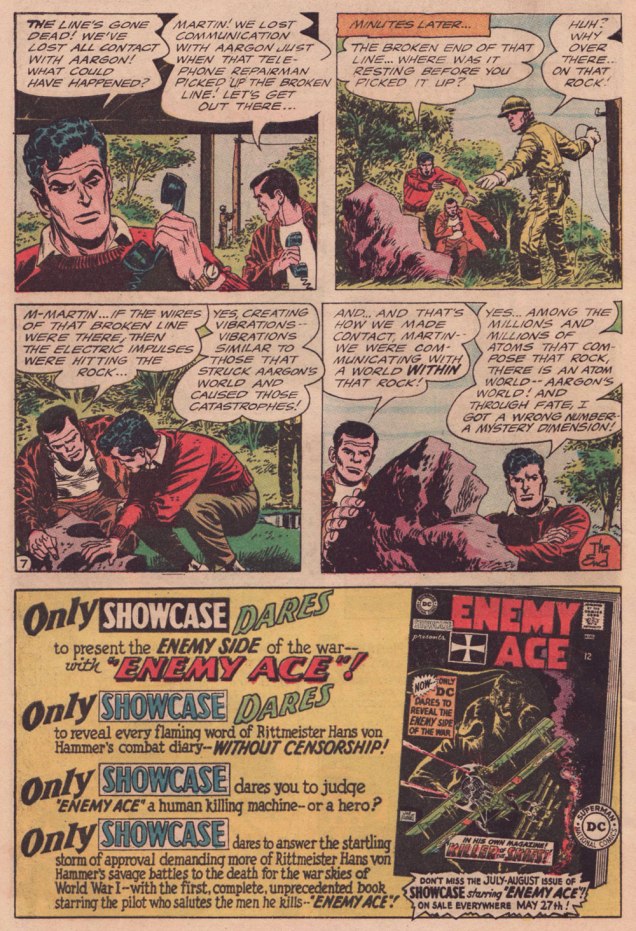
Over time, I noticed his gloriously gruesome cover work with art director-designer Warren Kremer for Harvey’s Pre-Code Horror titles of the early 1950s. His work on DC’s Adam Strange in the mid-1960s is best forgotten — there is only one Adam Strange, and it’s Carmine Infantino‘s (with trusty inker Murphy Anderson along for the Zeta Beam ride, of course). However, I adore Elias’ brief run (with writer Dave Wood) on Ultra the Multi-Alien, the splendidly wacky feature that replaced Adam Strange in Mystery in Space (issues 103 to 110, 1965-66).
Why am I so fond of this particular story? It’s the little things: for once, a story in a Jack Schiff-edited title makes some semblance of adhering to scientific — or at least science-fictional — principles; here, Elias designed an alien race that, given their grumpy, unprepossessing mugs, would typically have been cast as villains, but instead turn out perfectly honourable; the story’s human protagonists give aid to strangers in need, never asking for a thing in return: no Zarkan mineral rights, no salacious dirt on J’onn J’onzz, just selfless dedication to doing the right thing and the satisfaction of averting a crisis. How refreshingly old-fashioned, a cooling balm for these harrowing times.
-RG
p.s. my partner ds should return to our blog soon… she’s at present battling a mild case of writer’s block, so I’m filling in.
« I was a peaceful sedentary man, a lover of a quiet life, with no appetite for perils and commotions. But I was beginning to realise that I was very obstinate. » — John Buchan
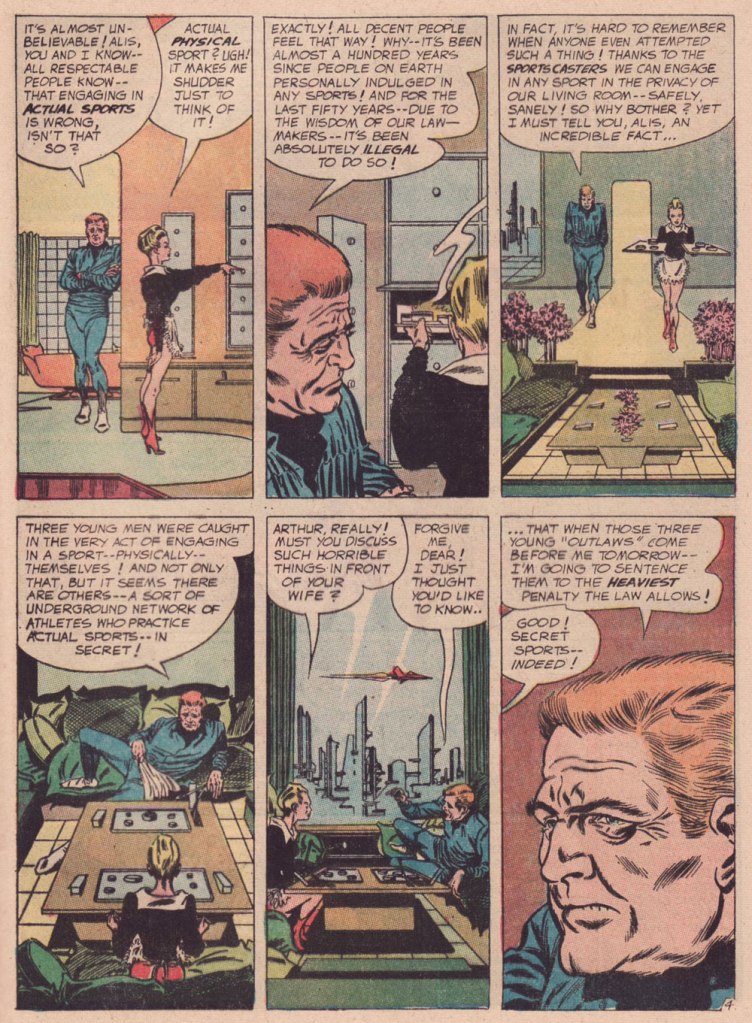
Over the course of several posts, I’ve extolled at length Carmine Infantino‘s skill as a cover designer. Yet the ability to envision and execute a single static image does not automatically translate into the skill of clearly and tidily breaking down a story into a suite of sequential panels, in much that same way that a superbly dexterous surgeon may be incapable of writing legibly. It pleases me to declare that Mr. Infantino’s no one-way specialist.
Infantino describes the evolution of his visual thinking: « The use of negative and positive shapes inside the panel had to mean something. So, to me, if the shapes didn’t draw the eye in, then they weren’t worthwhile. I had to move and change the shape to make it work for me. And that’s what I did. For me beforehand, the figure was the most important thing, and nothing else in the panel mattered. But later on, I found out that it was the total figure I had to worry about. » (all Infantino quotes excerpted from The Amazing World of Carmine Infantino: an Autobiography (2000, Vanguard Productions; edited by J. David Spurlock)
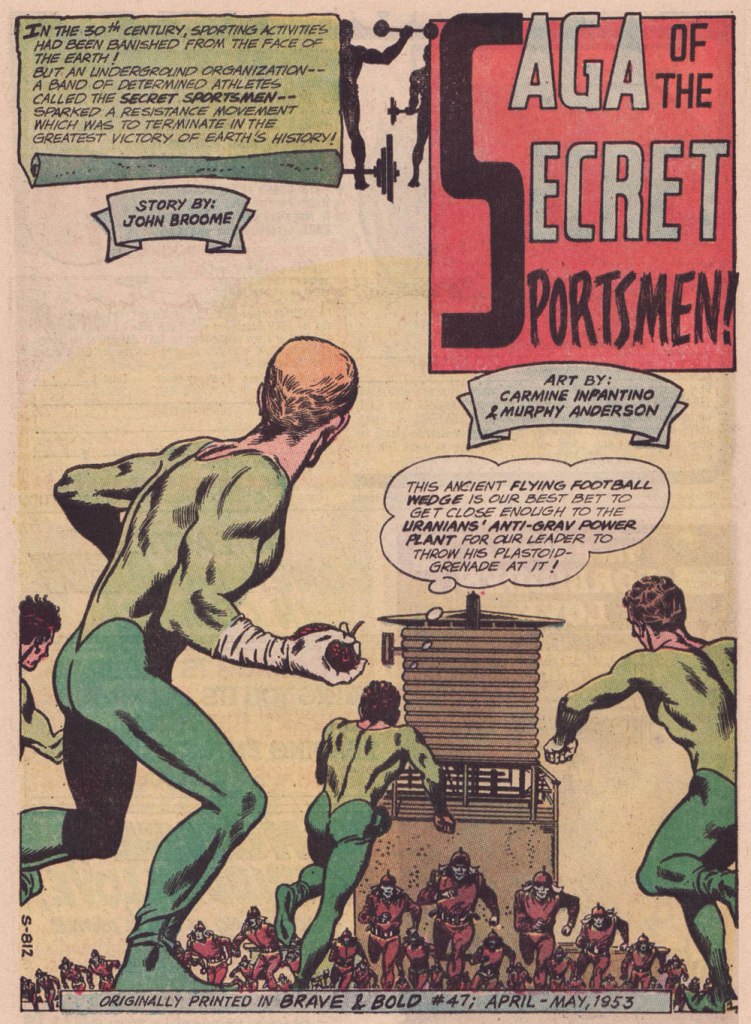
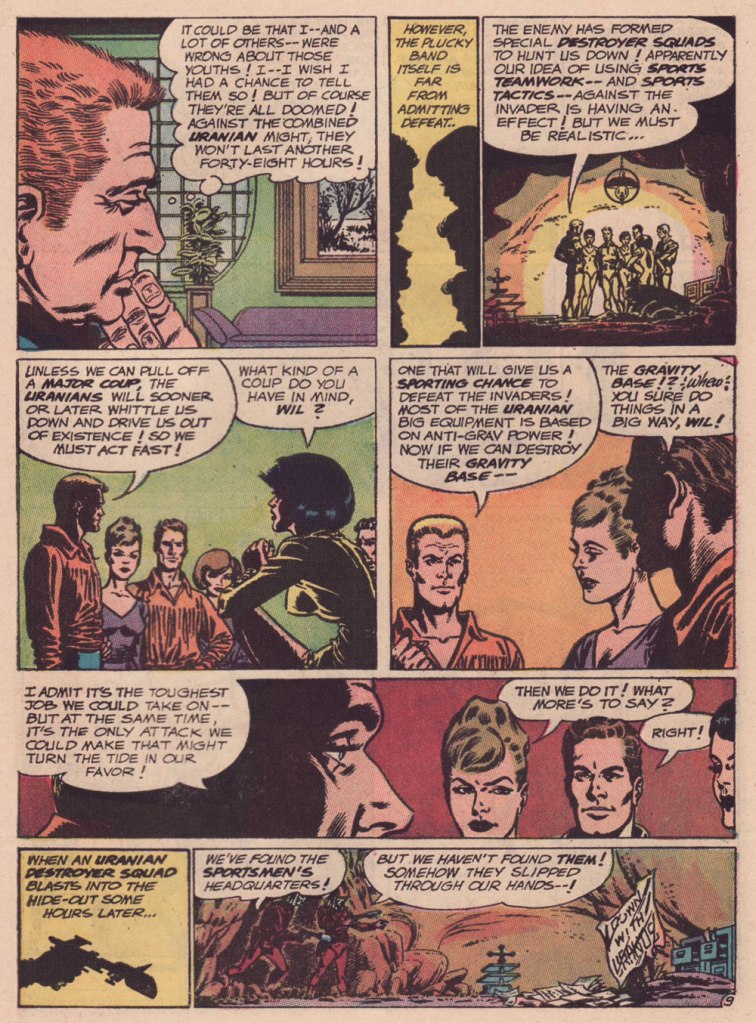
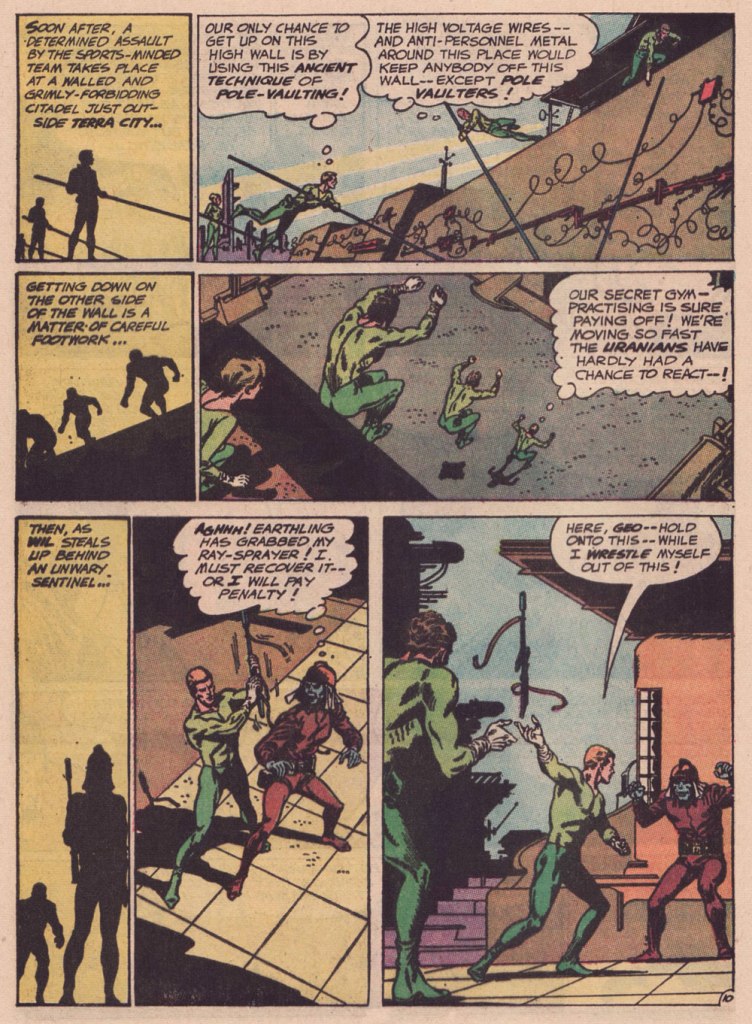
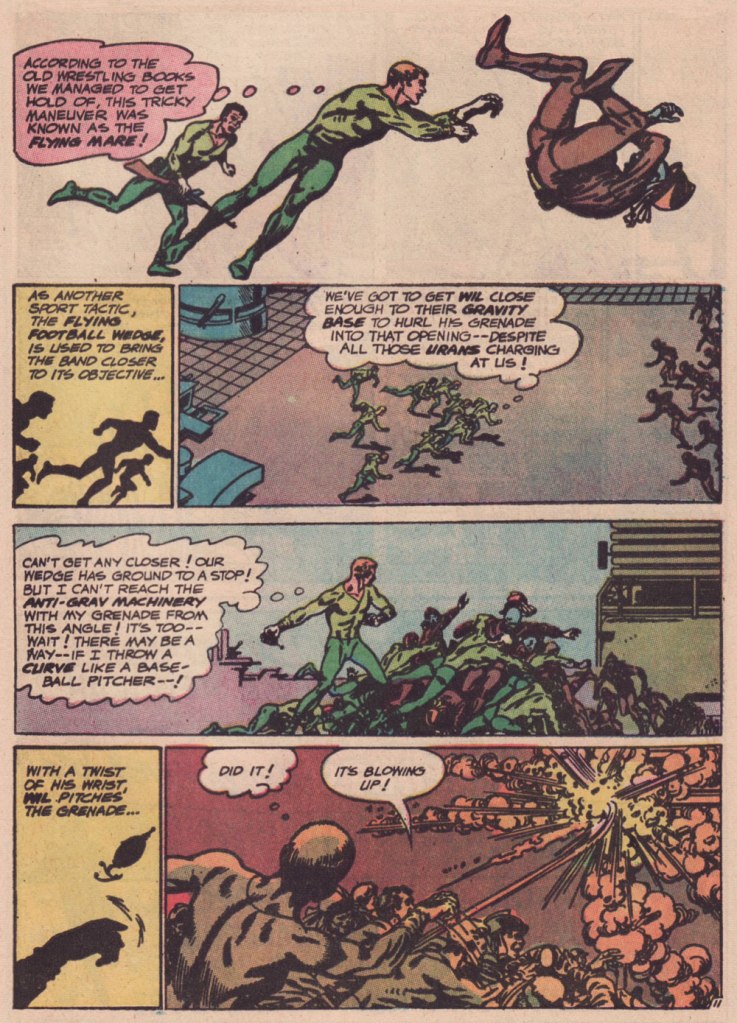
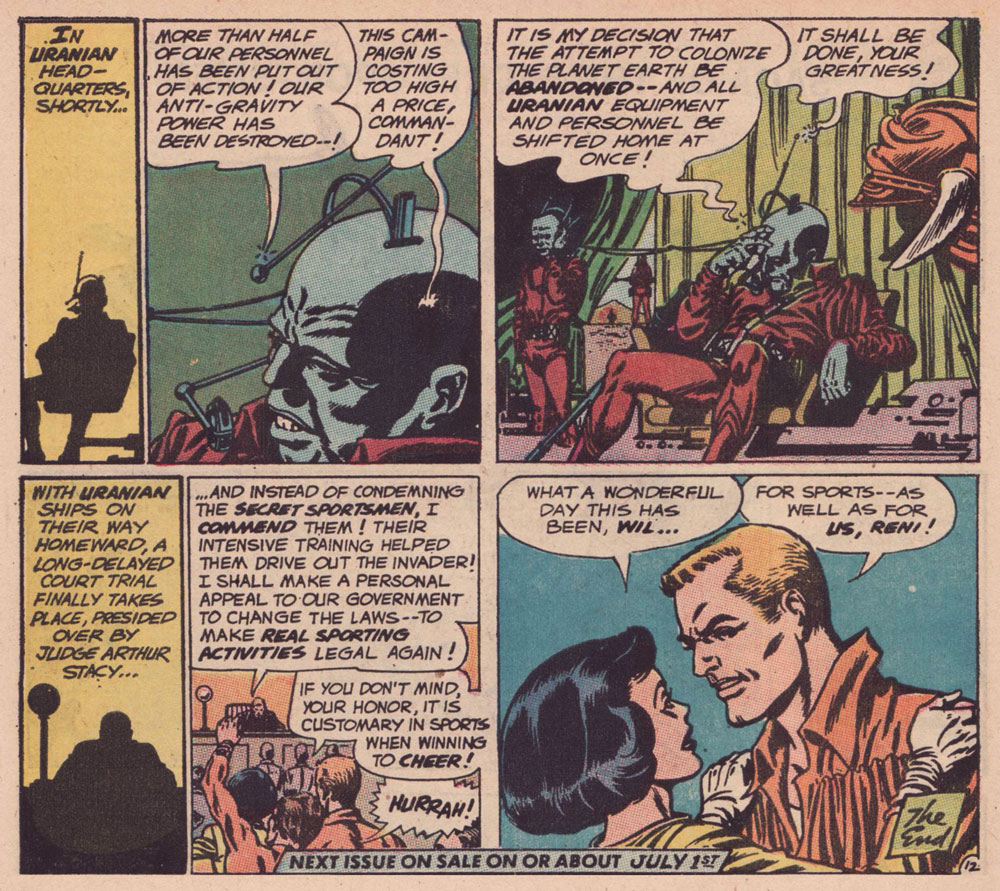
I’ve long wanted to feature this particular tale… for both script and artwork reasons. However, my copy was in Mysteries in Space: The Best of DC Science Fiction Comics (Apr. 1980, Simon and Schuster/Fireside; Michael Uslan, editor)… and I’d be all-but-guaranteed to destroy this beloved book in any attempt to scan from it. But — aha! — I’ve recently acquired a copy of DC Special no. 13 (Jul.-Aug. 1971), which granted the tale its first encore. Game on!
Someone slightly goofed here : The Brave and the Bold no. 47 was published in April-May 1963, not 1953.
.
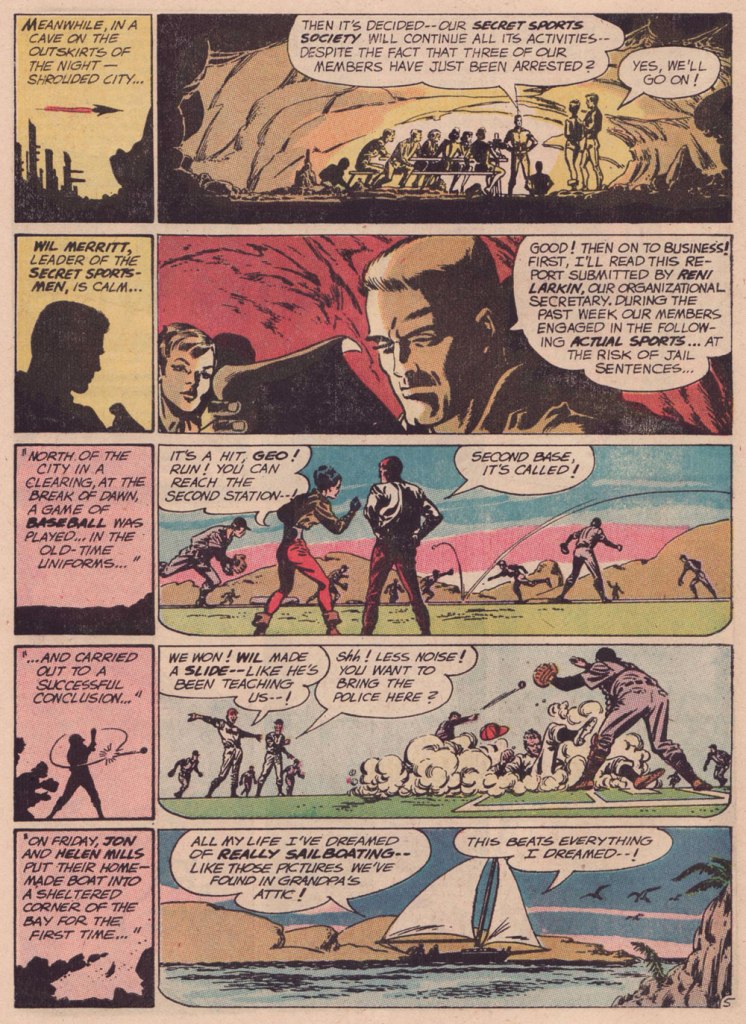
« The silhouettes I used in ‘Strange Sports Stories‘ [featured in The Brave and the Bold nos. 45-49] were innovations. Julie [editor Julius Schwartz] gave me the script and said, ‘We want this book to look different.” That’s all he said, and I went home and what I devised to make it look different was by using silhouettes as a dramatic device. The action starts in the silhouette, and then you go to the conventional panel, and the action follows through. One might almost call it an animated treatment. »
.
.
.
.
.
.
.
.
.
As smooth and effective as the Infantino-Anderson pairing looks, there was some friction behind the scenes. Infantino explains: « I was beginning to experiment at the time and I threw anatomy out in favor of a higher level of design. Murphy was an excellent draftsman and I’d try to explain what I was trying to achieve to him but this was quite contrary to his own sensibilities. The more stylized I became, the more he thought the work had to be ‘fixed up‘. At one point, he asked for a raise because he had to change my work so much. What he thought he had to ‘fix‘ was the new style I was most excited about. »
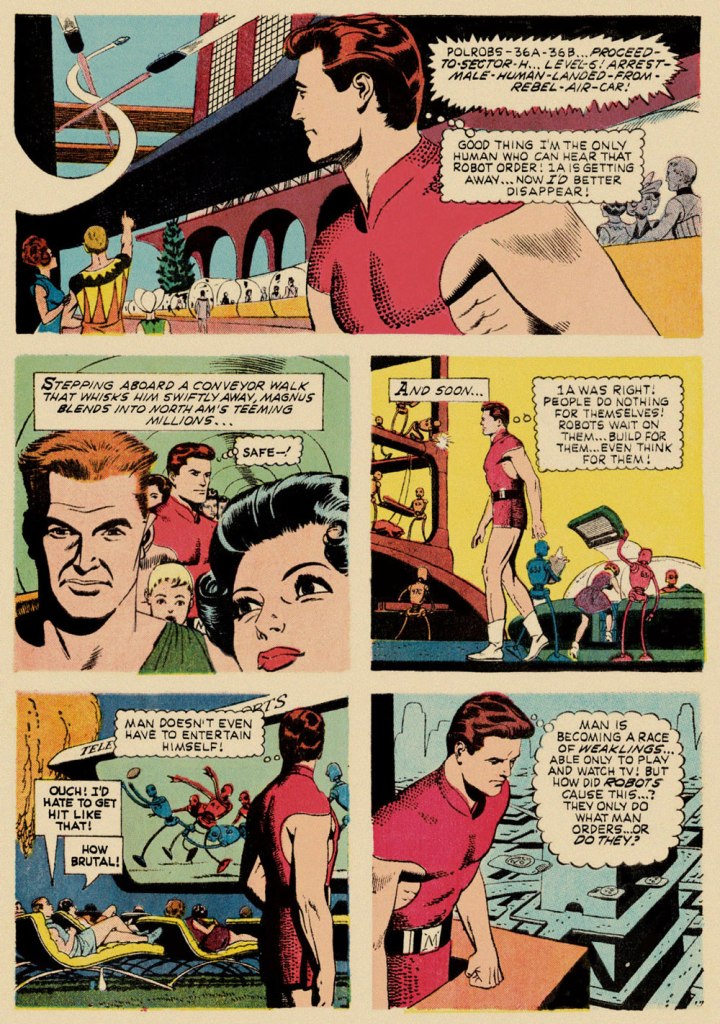
Our featured story shares a central perspective with Russ Manning‘s rightly celebrated Magnus, Robot Fighter, whose inaugural issue had come out a mere two months earlier — though with that close a gap, it’s most likely a simple case of coincidence.
A relevant page from Magnus, Robot Fighter 4000 A.D. no. 1 (Feb. 1963, Gold Key); story and art by Manning, with input from editor Craig Chase, who initially pitched the idea of a SF hero to the publisher.
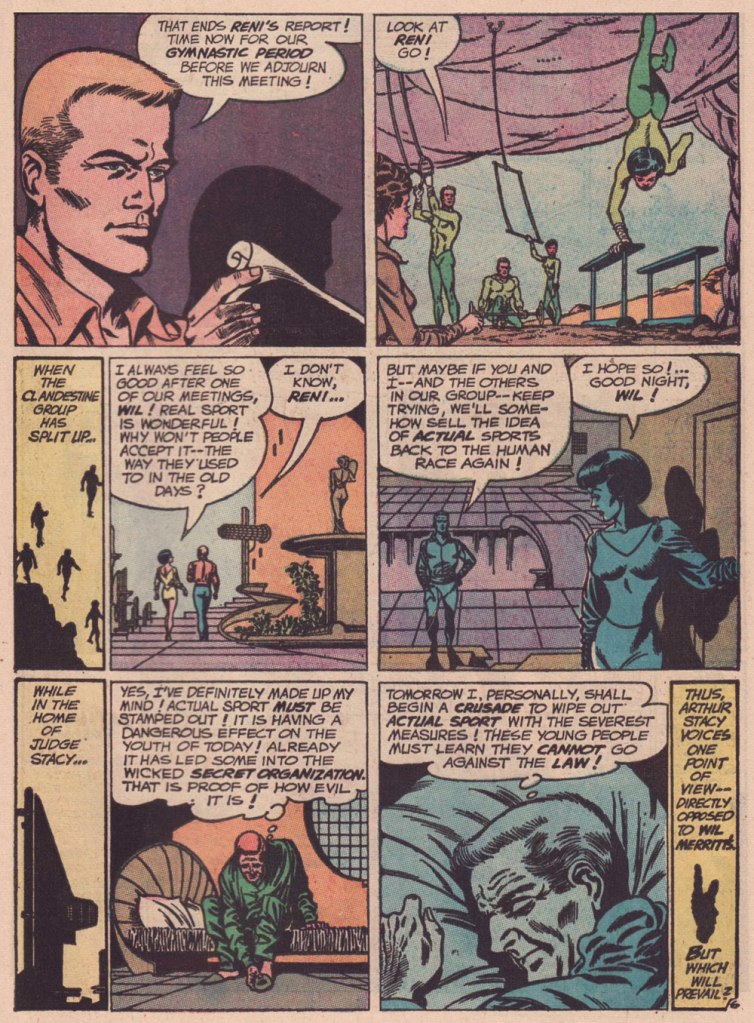
Are we getting less physically able with every succeeding generation, as our elders have been claiming for eons? Is it just a mistaken, shallow assessment arising from tone-deaf obduracy and bad faith — or have our forerunners all been correct about a general and ongoing decline?
« I wish I could blend into the background / I’ve no excuses for my lack of guts / What is it about me that draws attention? » — Kevin Godley & Lol Creme, Punchbag
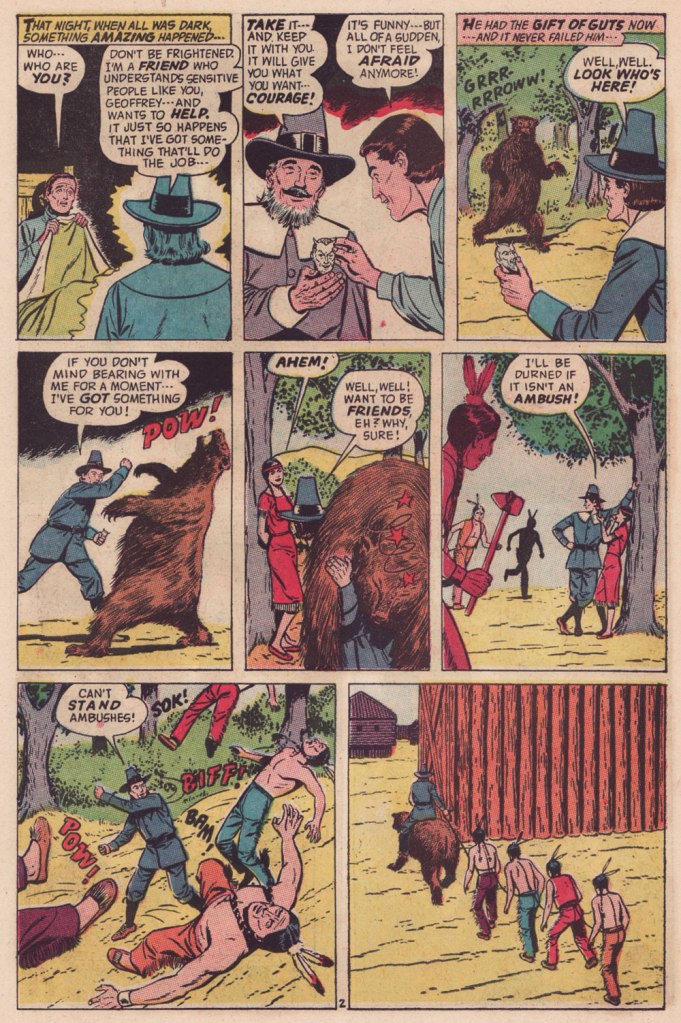
Today, let’s delve into the little-frequented wilds of that underrated little publisher that could, American Comics Group (ACG), 1943-67. The brand is chiefly recalled today for a pair of notable features: ACG pioneered the ‘horror’ anthology comic book with its Adventures Into the Unknown (1948-1967, 174 issues) and, in 1958, brought Herbie Popnecker, Richard Hughes and Ogden Whitney‘s ‘little fat nothing‘ to an unwary and undeserving world. ACG was co-founded and, briefly, co-owned by one of the field’s great villains, Harry Donenfeld.
But that’s all trivia in the end. ACG’s special appeal rests for the most part on the shoulders of one man of many monikers: writer-editor Richard E. Hughes (1909-1974).
I’ve already enumerated the man’s bona fides a couple of years back, when I featured one of his most celebrated (by ACG readers) tales, The People Versus Hendricks!, so I refer you to that particular entry.
As Hendricks’ tale was a rather tragic one, and since his dry wit ranked high among Hughes’ preeminent attributes, what do you say we set him loose for a demonstration of said lighter side?
Though many a notable illustrator passed through ACG’s doors — under his given name or otherwise — it’s undeniable that Hugues’ most consistently effective comrade-in-arms was the forenamed Mr. Whitney. Don’t let his low-key, ‘square’ approach deceive you: here’s a master storyteller at play.
Read on, febrile friends of ol’ Faust!
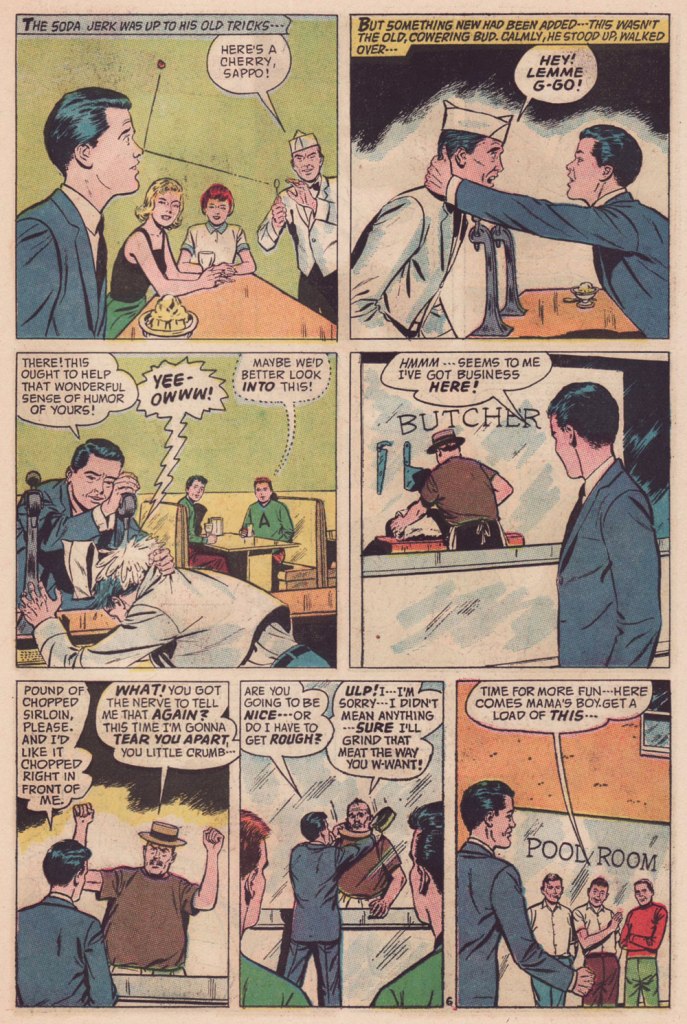
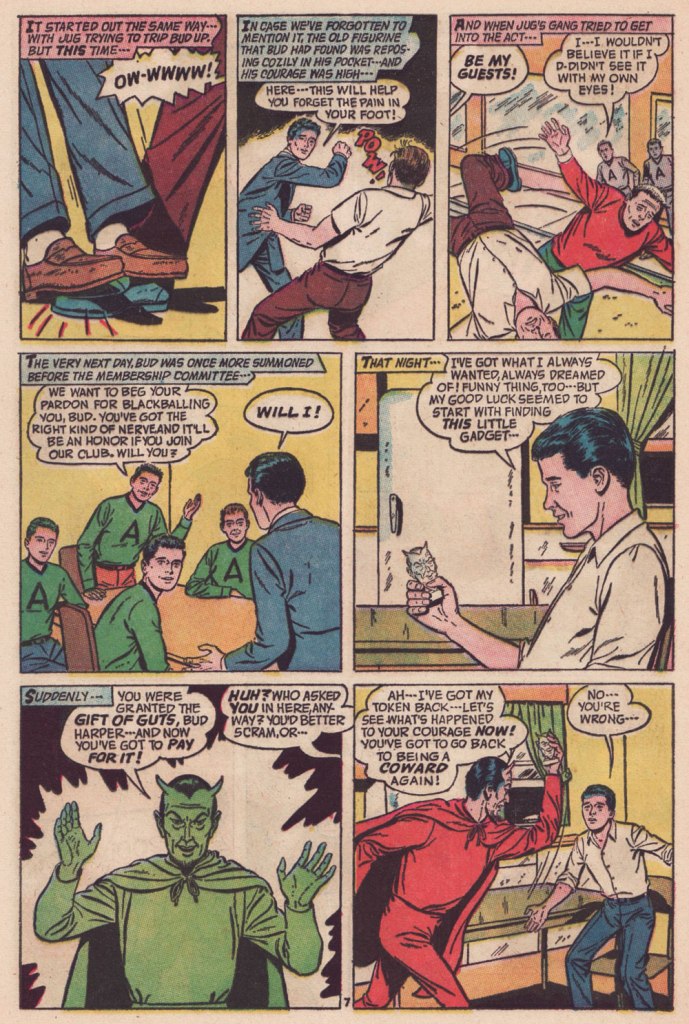
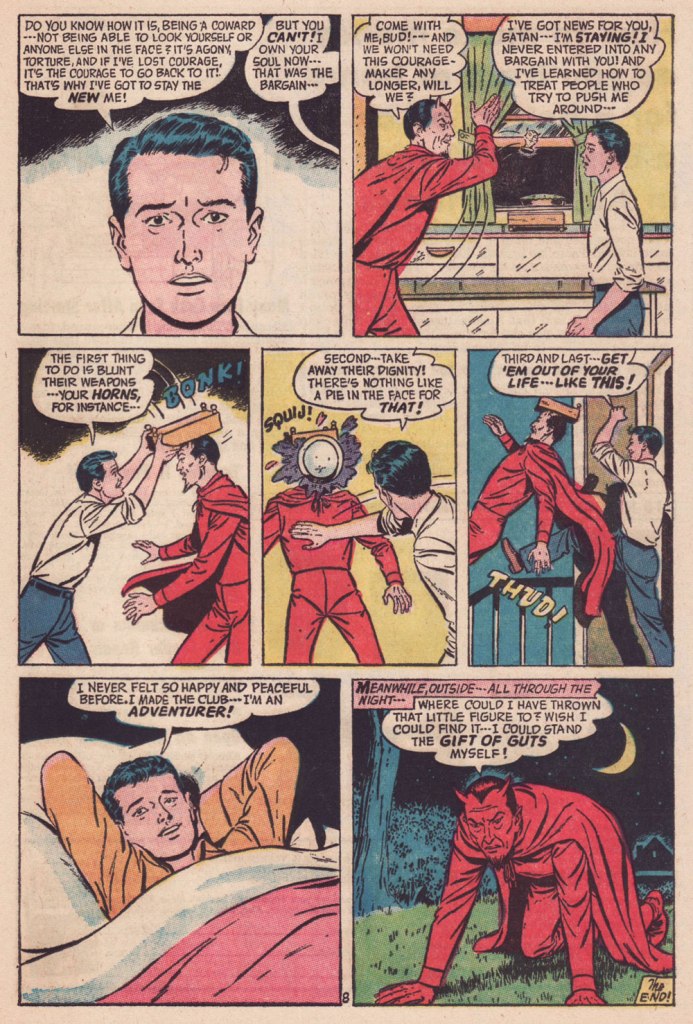
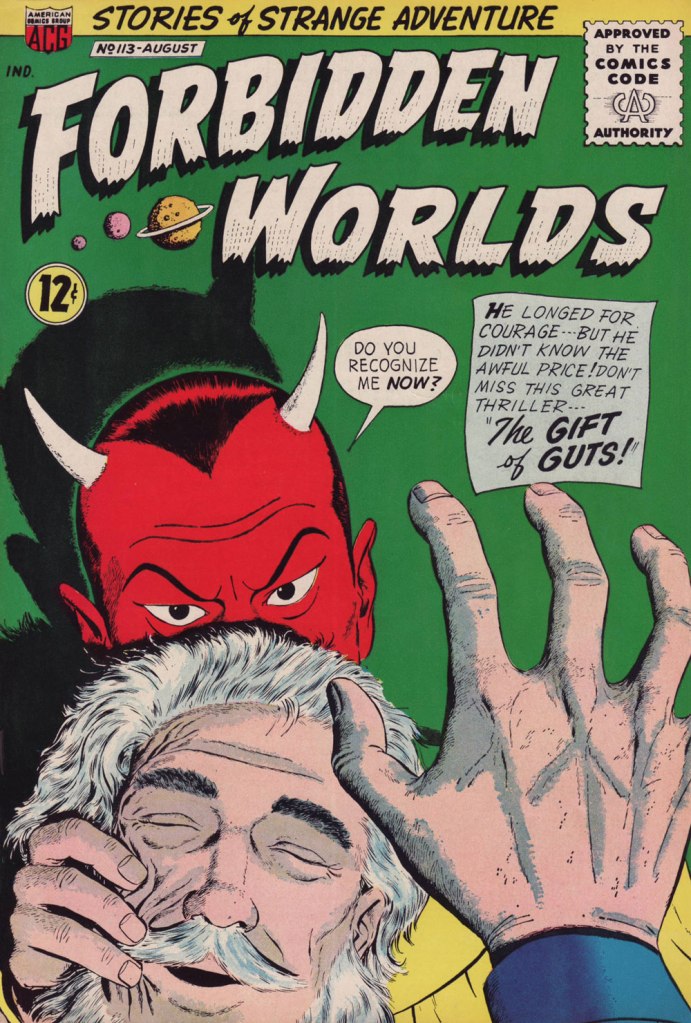
« Squij! » is now one of my favourite sound effects.The Gift of Guts was cover-featured in Forbidden Worlds no. 113 (Aug. 1963, ACG). Pencils and inks by Ogden Whitney.
« We never knew his name; we only knew him as “the good artist”. But his style spoke for him. He was instantly recognizable despite his anonymity — at once different from the other funny animal artists and better. » — Dwight R. Decker
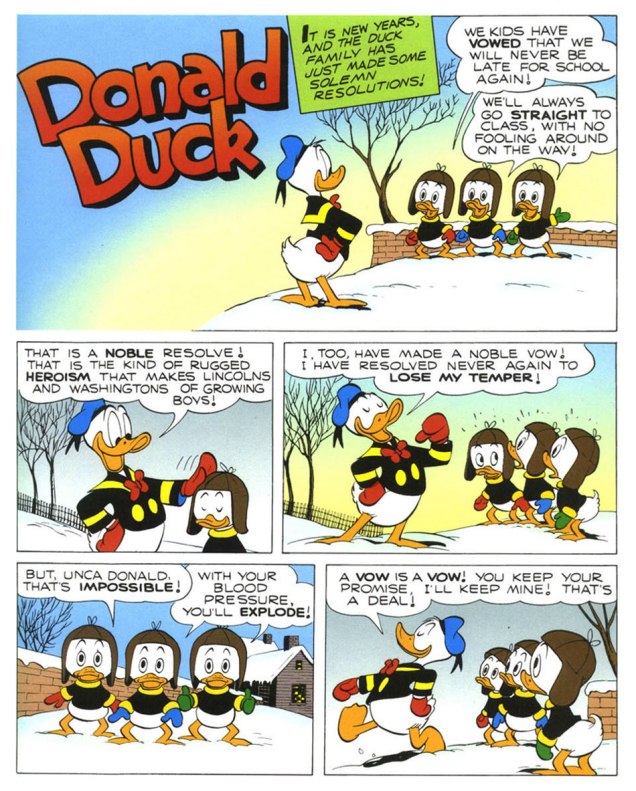
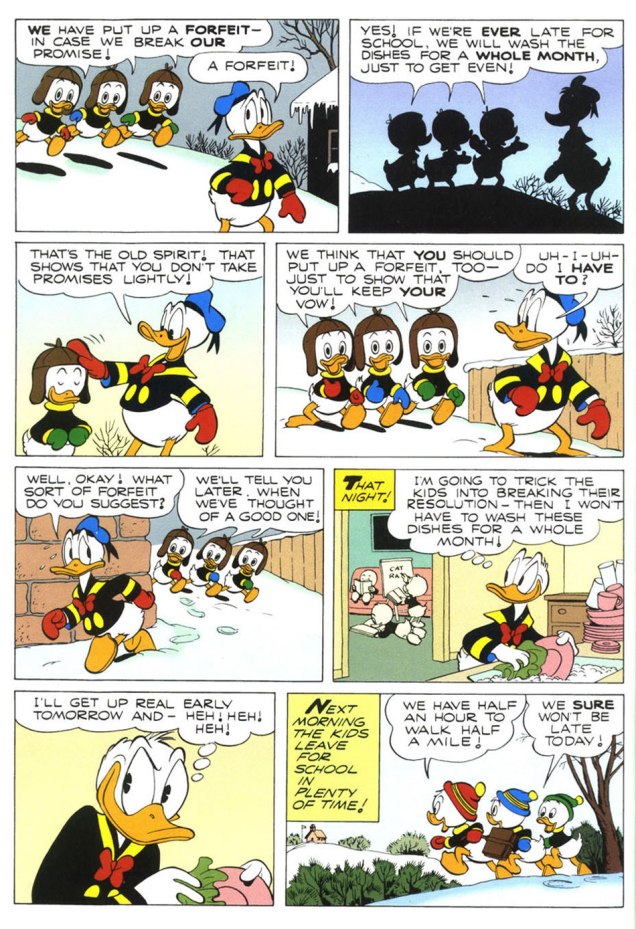
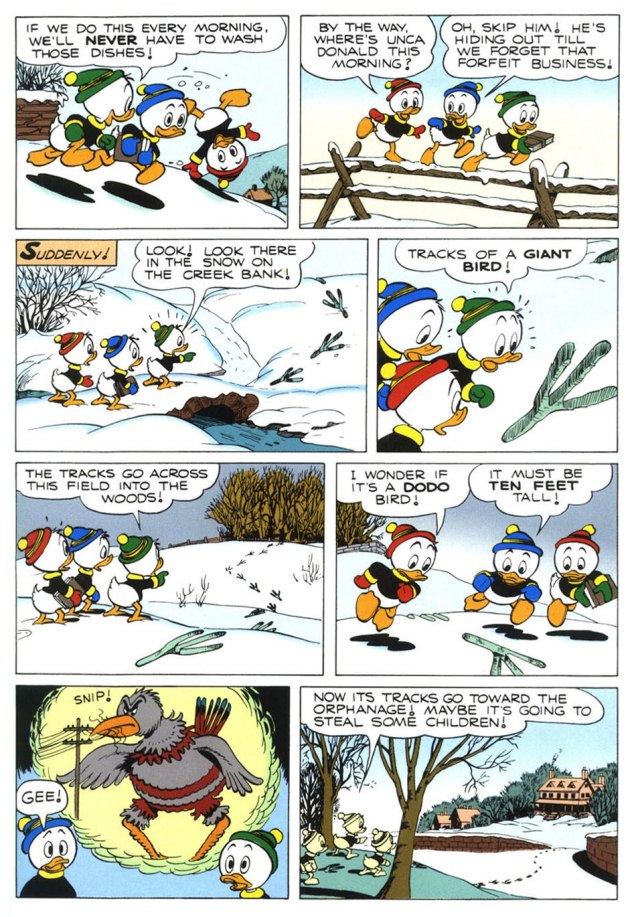
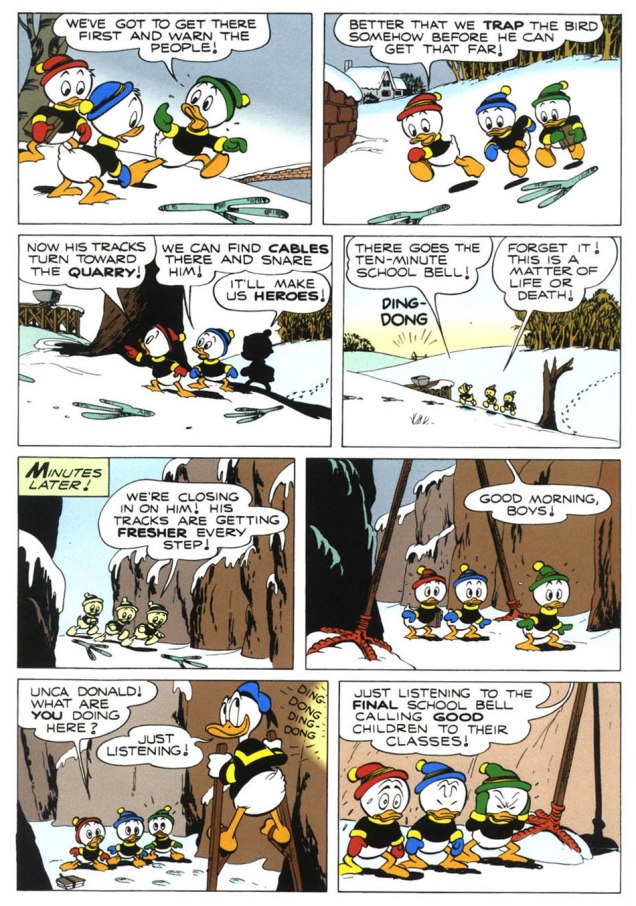
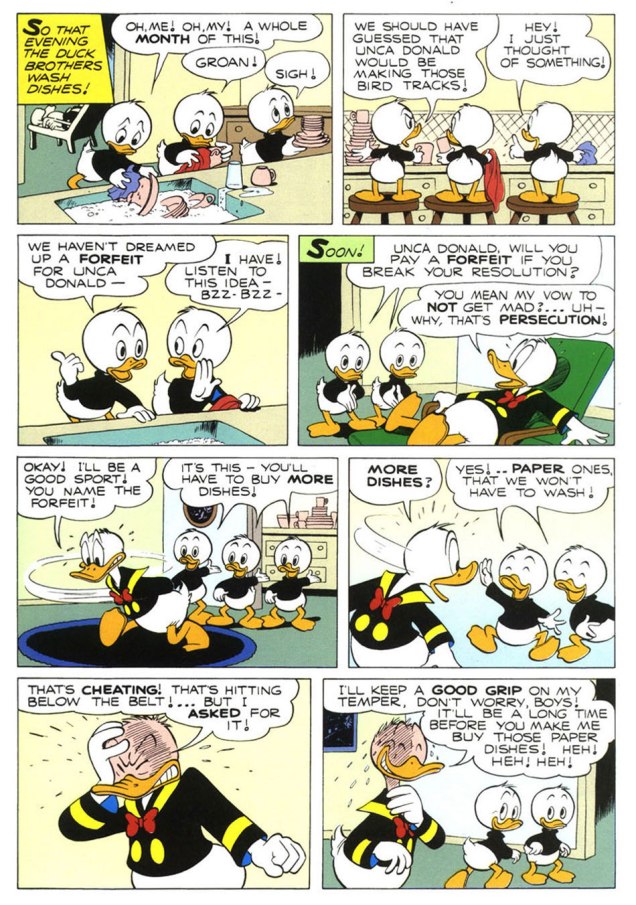
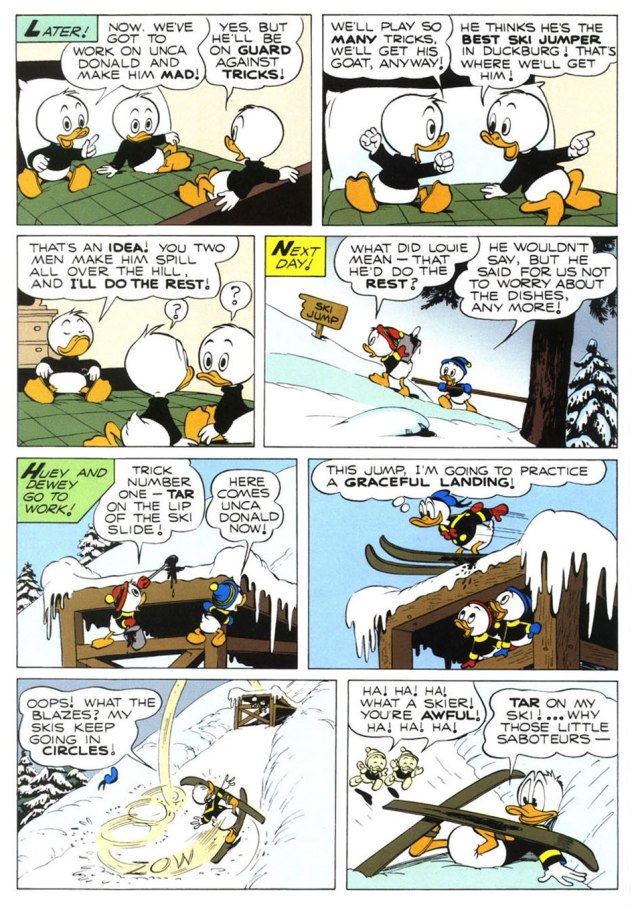
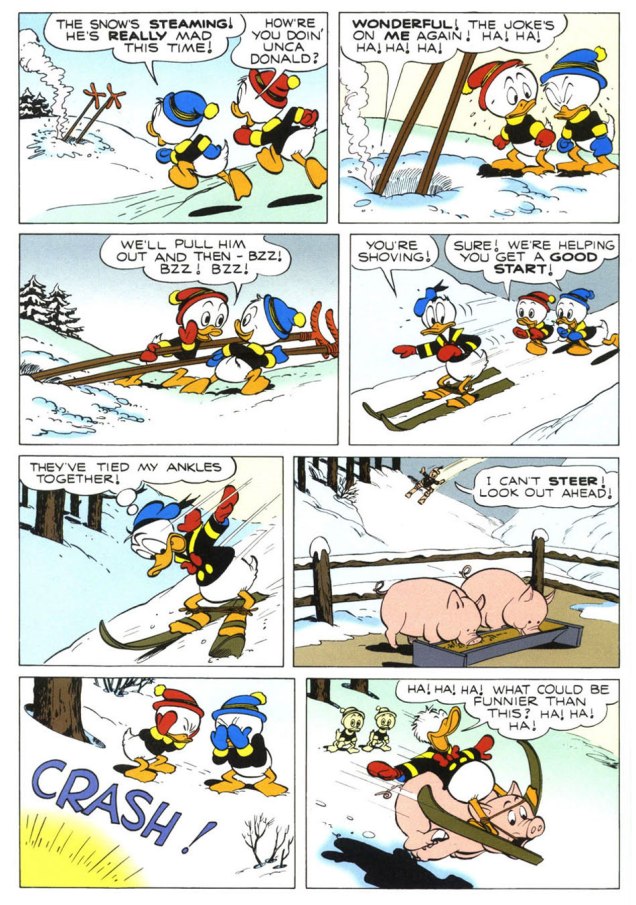
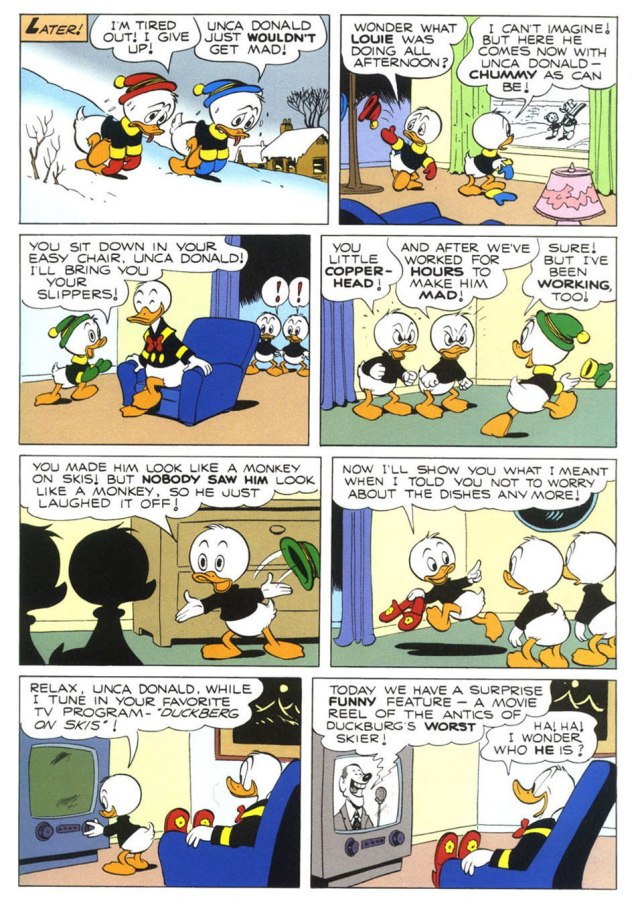
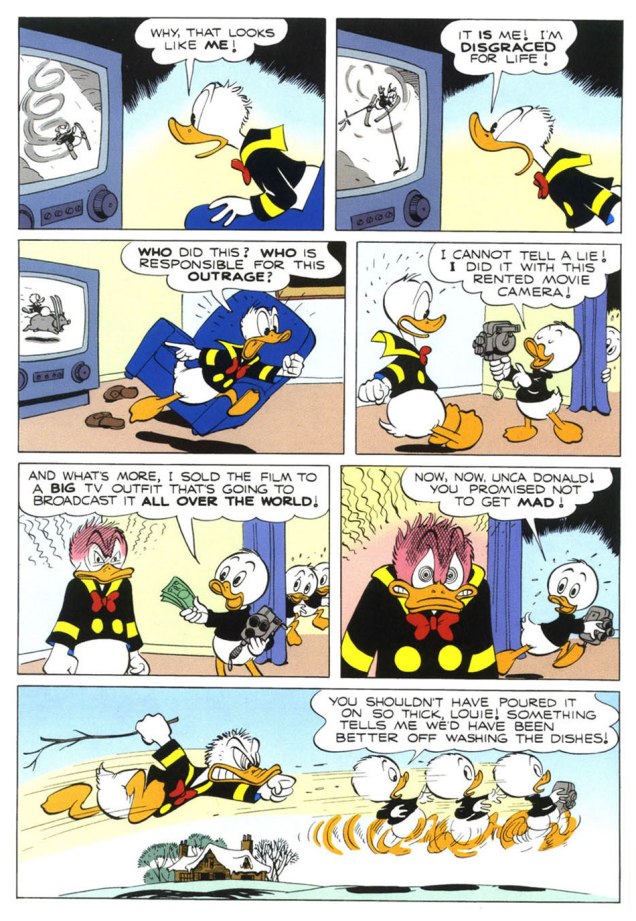
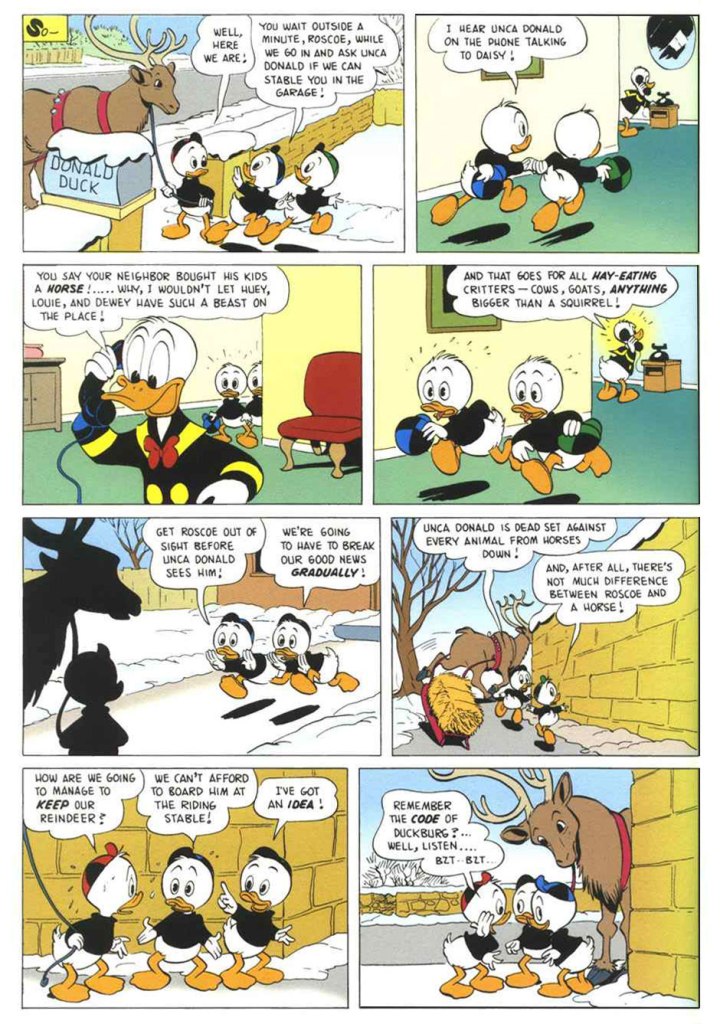
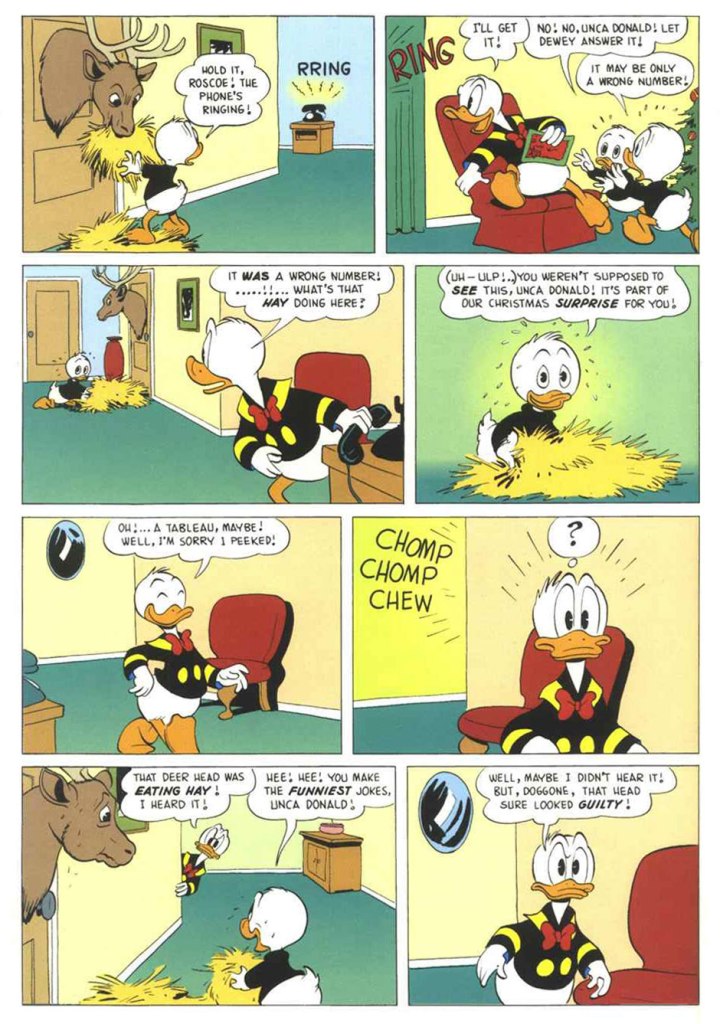
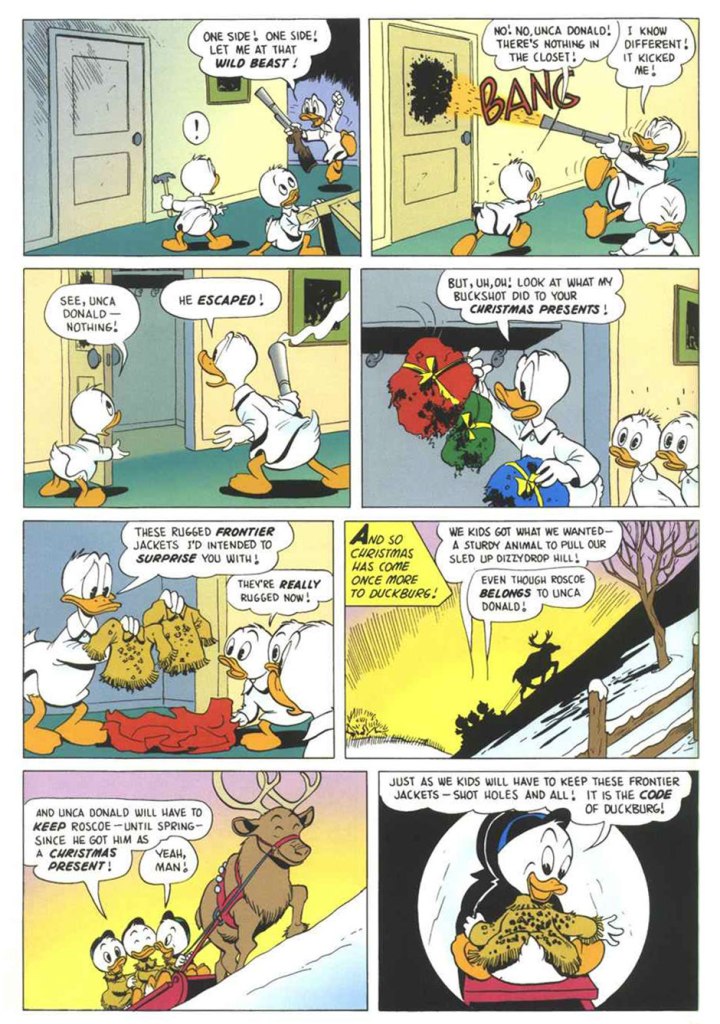
The great Duck Man, Carl Barks, despite having little interest in the holiday, drew over two dozen Christmas-themed stories featuring Donald and his relatives (and wrote the bulk of them). Now, so very much has been written and said about Barks that I won’t bother to add much here. I’ll just let his work speak for itself and breathe. I opted for a lesser-known ten-pager, not coincidentally one of my favourites. “The Code of Duckburg” originally saw print in Walt Disney’s Comics and Stories no. 208 (Jan. 1958, Dell), but I’m using a more contemporary issue boasting better printing and a commendably tasteful colouring job, from Walt Disney’s Uncle Scrooge no. 317 (Jan. 1999, Gladstone). It must be said that the folks at Gladstone did right by the ducks — it was more of a labour of love than a strictly commercial venture.
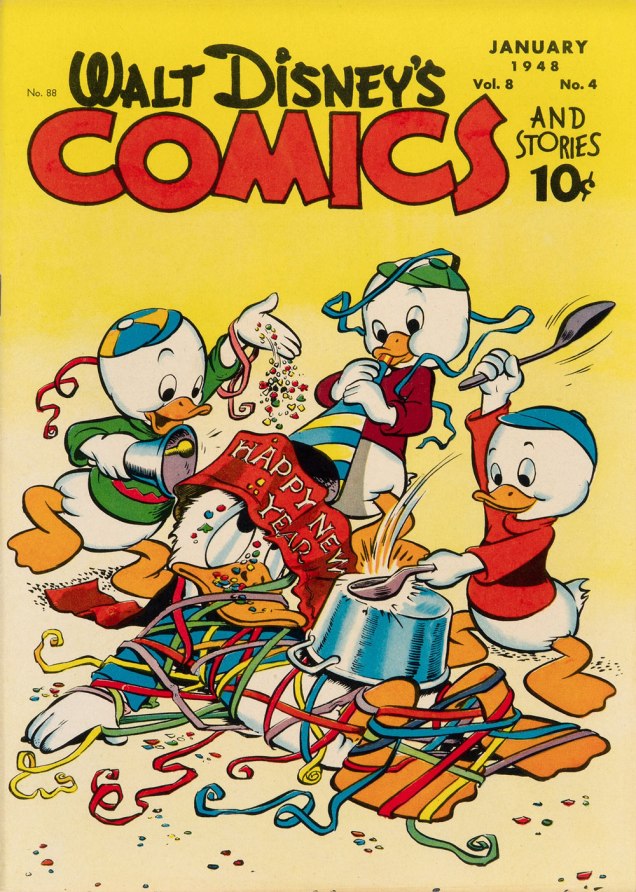
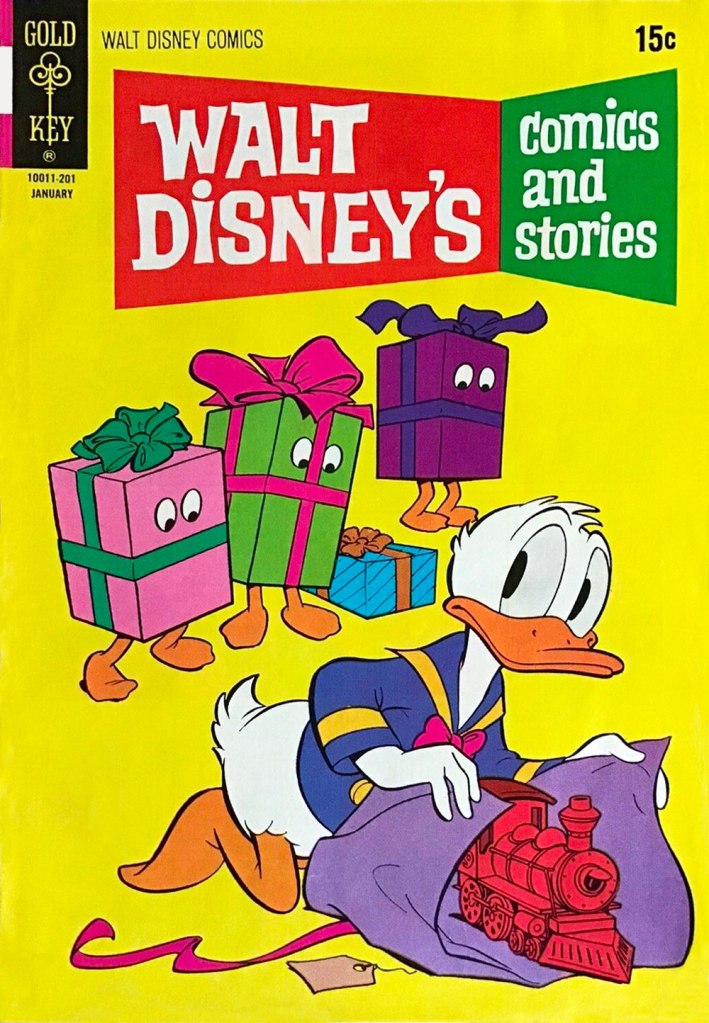
Here’s a closer peek at a panel from page 3: just look at the joy on Roscoe’s face. Unlike Donald, his nephews are unfailingly kind to (other) animals, great and small. That’s what makes them such sterling exemplars of the Junior Woodchucks. The issue of WDC&S where our story first appeared didn’t have a Holiday-themed cover, but this one reprinting it did. This is Walt Disney’s Comics and Stories no. 376 (Jan. 1972, Western); pencils by Tony Strobl and inks by Larry Mayer.
And as a bonus (there has to be a bonus!), here’s a look at a Barks model sheet. « The Barks sense of whimsy extended even to the model sheets he drew for other artists to follow. » I made it a larger image so that all the small details remain discernible. Happy Holidays, everyone!
I was all set to write about a certain topic… but one hurdle stopped me cold: having recently moved, we are (mostly me, I confess) still somewhat living in boxes. So… where’s that other book? In any one of a hundred or more boxes. Fortunately, I try to always have a backup plan.
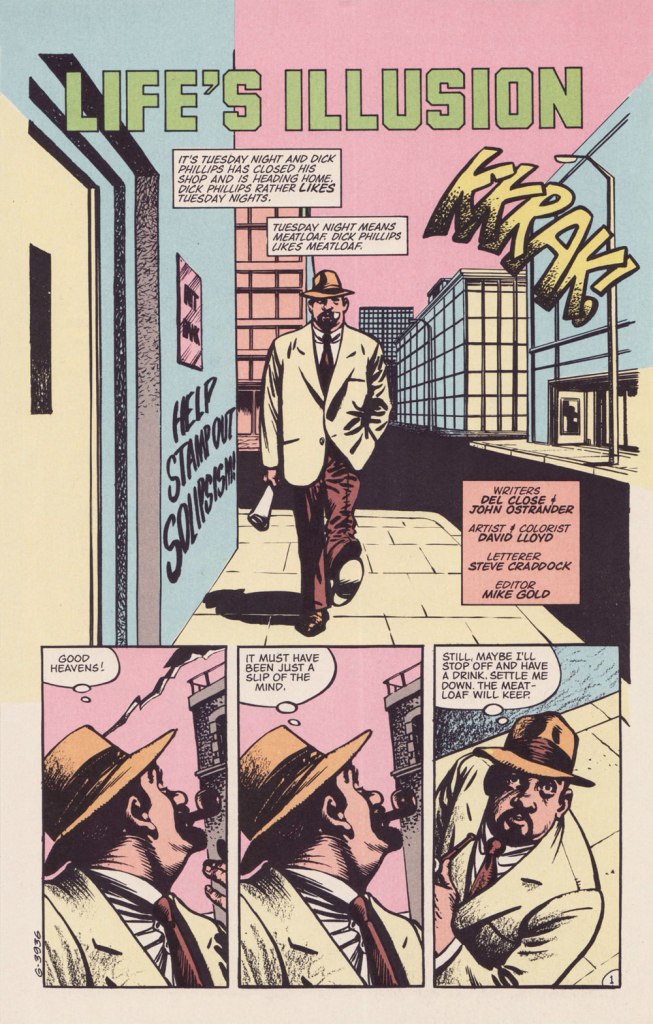
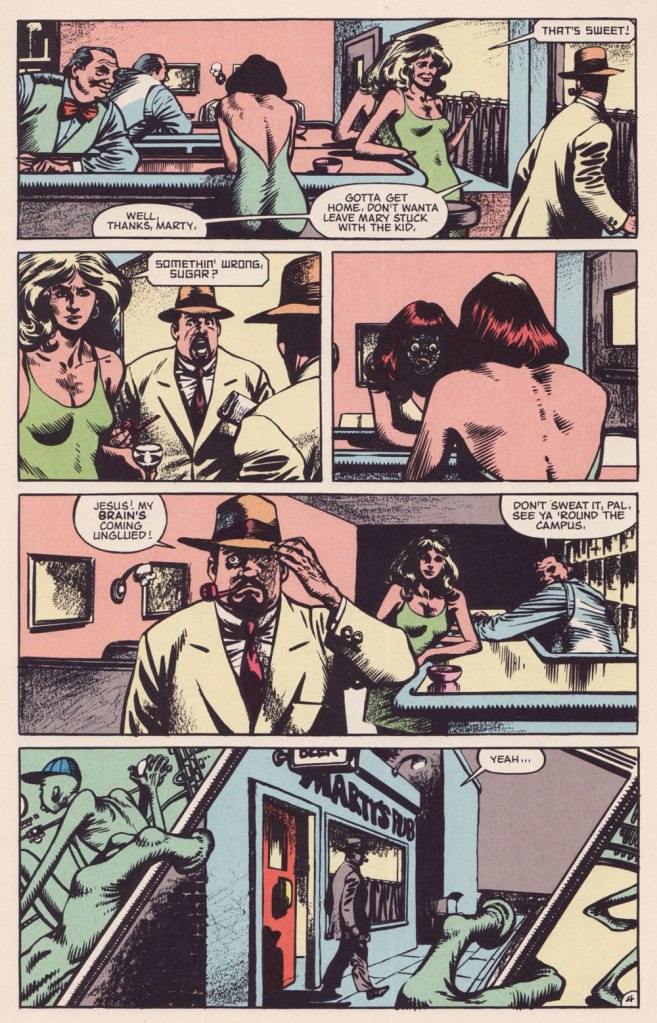
This isn’t the first time I draw attention to an offering from DC’s ambitious but ill-fated Wasteland (1987-88) under the Treasured Stories rubric. See also Foo Goo and American Squalor for more details and to (beware!) suffer a case of thematic whiplash. Whatever warts and blemishes Del Close and John Ostrander‘s Wasteland creations may have borne, they weren’t interchangeable.
Today’s yarn is a spot-on homage to author Philip K. Dick (1928-82), down to the name and occupation. The ‘real’ PKD may have been fond of meat loaf as well, for all I know.
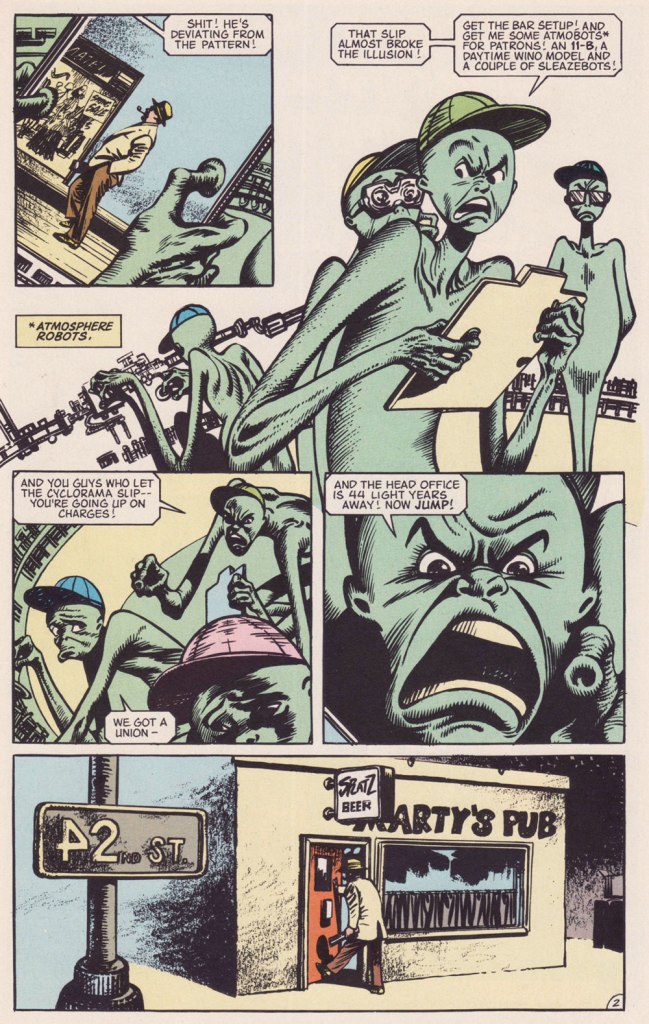
Possibly a reference to PKD’s 1966 novel The Crack in Space?Another cute detail: « From 1948 to 1952, he worked at Art Music Company, a record store on Telegraph Avenue » (in Oakland, CA). Oh, and Robin Williams was a Del Close fan… and vice versa.Life’s Illusion appeared in the final semi-decent issue of Wasteland, no. 10 (Sept. 1988, DC)… beyond that point, it was a painful slide into the abyss. Anyway, I love how this story is able to deftly juggle its elements of comedy, tragedy and Dickian metaphysics without dropping the ball. Poor Mary.
PKD had been on my mind lately. Last fall, while rambling around town, I came upon a Little Library housing one of his books, a French-language edition of 1964’s The Three Stigmata of Palmer Eldritch. I’d read the original paperback edition in 1992, but wasn’t sure I quite grasped its dénouement, and had no-one to compare notes with.
Somewhere, eons ago, I’d read that Dick’s manuscripts for his 1960s paperback originals were abridged (i.e. gutted) to fit the publishers’ format and predetermined page count. But this might be apocryphal. As it stands, I can find no trace of such a claim. The story went on to say that publishers in Belgium and France, where the author was more of a draw than in North America, based their renditions upon Dick’s unexpurgated manuscripts, leading to, unusually for translations, results hewing closer to the writer’s intent. It helps that Dick, not given to extravagant stylistic flourishes, is relatively easy to translate.
« This is an illusion ». Here’s the tome in question, published in 1977 by Belgium’s Éditions Marabout, using Guy Abadia’s 1969 translation. Despite the fact that the book’s been retranslated since, I’ve no quibble with this version, save for the lack of credit for the cover illustrator.
I’m currently halfway through, and so far all is clear; I may have to confer with my younger self to explain the plot to him, poor thing.
« I lived on a houseboat in Amsterdam for a year. It was intense, and it’s possible that I even had a few blackouts. » — Wolfgang Beltracchi
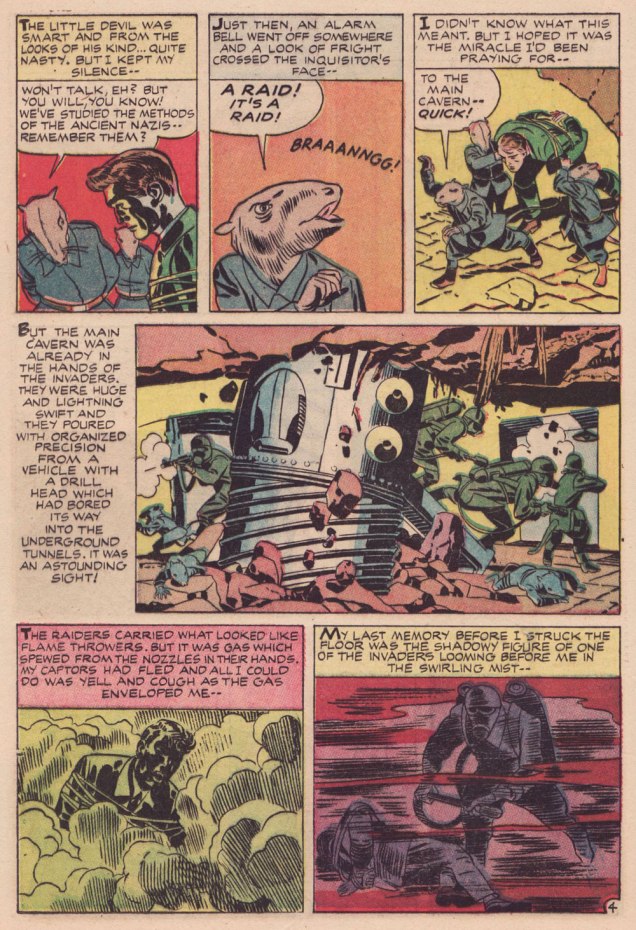
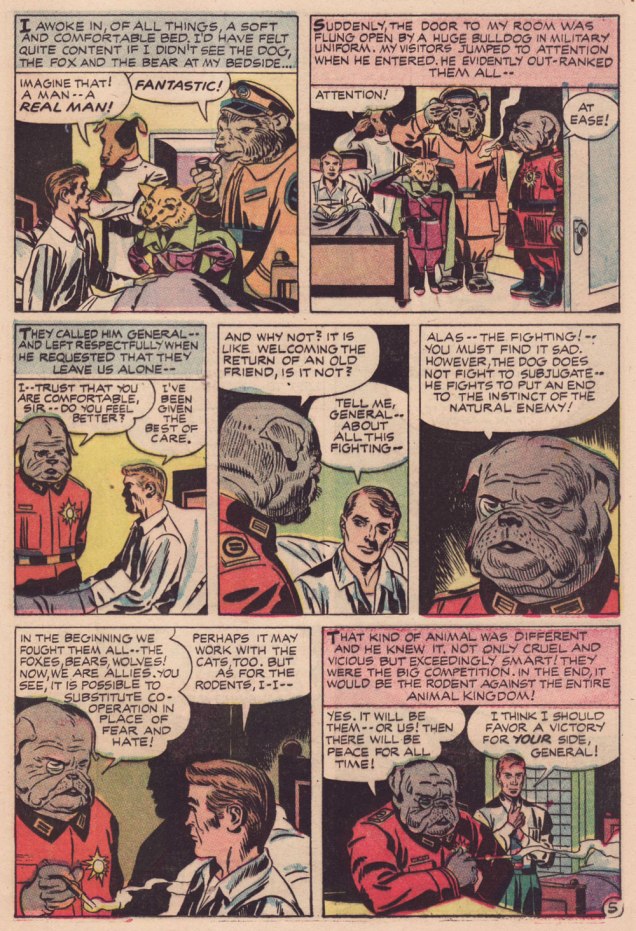
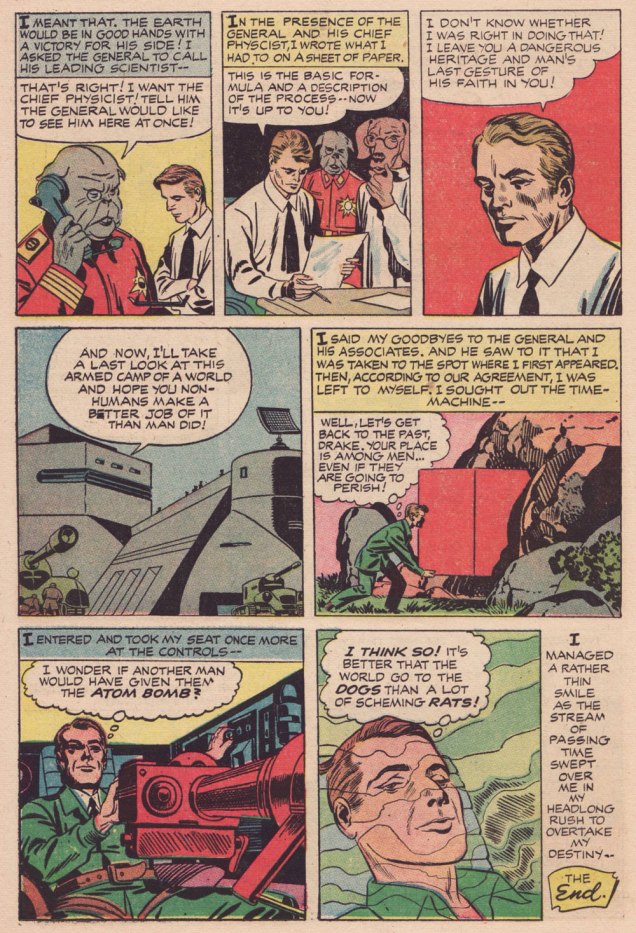
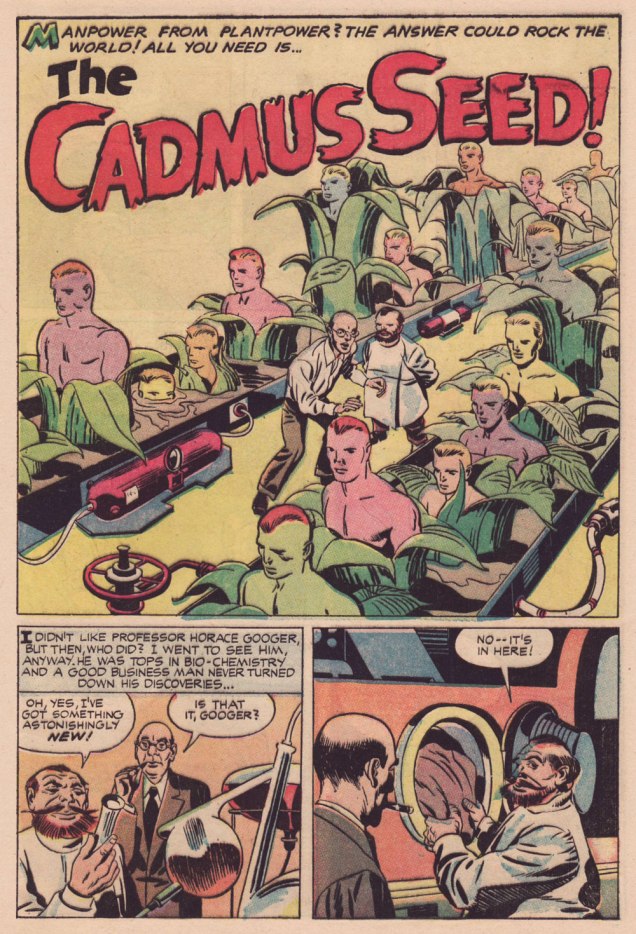
Today’s featured tale is an old favourite illustrated by one of American comics’ perennial mal-aimés, the much-maligned Jack Sparling (1916-1997), a prolific, reliable, distinctive stylist who toiled for just about every publisher on the block. Of course, he’s persona non grata with the superhero set (a compliment in my book!) but his chief strengths lay just about everywhere else, in humour, horror, crime and adventure… you name it.
I love how cosy — that pervasive, foggy ambience! — yet harrowing this tale is. Nice to see one of those insufferable, know-it-all ‘ghost busters’ get his bitter requital. And who knew that some witches were so neat, so domestically inclined? Work that mop, boy!
The writer’s uncredited, and that’s a shame, because this is anything but formulaic — and DC’s mystery books were formulaic to a fault, especially under Joe Orlando‘s guidance. I suspect the author to be editor Murray Boltinoff — he often pitched in, under sundry bynames.This is It’s Midnight… The Witching Hour!no. 21 (June-July 1972, DC), edited by Murray Boltinoff and with cover art by Nick Cardy.
People have quite a range of definitions as to what constitutes romance. For some it’s novels of werewolf romance, others prefer completely mind-boggling Fabiosa stories (‘Unborn triplets crashed my husband’s love‘), and some ship (I learned this term from a younger colleague) characters from whatever TV show happens to be in vogue.
If you were a teenager in the ’50s, 60s, or 70s, you probably would have read romance comics, immensely popular at the time. Charlton Comics published a whole bevy of them, and co-admin RG has amassed a respectable collection. For weeks now I’ve been reading issues of Teen-Age Love during my lunch hour, specifically for their Jonnie Love stories. Introduced in Teen-Age Love no. 61 (November 1968) as the ‘new teen swinger’ – ‘he has a way with a guitar and a way with girls!’, Jonnie lingered within its pages for quite a while, having all kinds of adventures, hanging out with new conquests and lost souls in every issue. As advertised, he was indeed good with a guitar. Joe Gill, who was scripting the stories, wrote him as a kind of chevalier errant, wandering from town to town (with the ultimate goal of going back to his hometown, which he never achieves), offering a helpful hand to damsels in distress who are running away from predatory men, disciplinarian fathers, or just the solitude of a small town.
Jonnie Love stories appeared in 31 issues overall, but I’m most intrigued by those published in Teen-Age Love issues numbers 61-74, as they were created by the same tip-top team: scripted by Joe Gill, pencilled by Bill Fraccio and inked by Tony Tallarico (see RG’s (Fondly) Remembering Tony Tallarico).
It was actually rather difficult which tale to feature, for they’re all pretty good, and I had to decide on some sort of optimal concomitance of a good plot and how the story was told visually. The final decision was Jonnie Love and the Go-Go Girls, published in Teen-Age Love no. 63 (April 1969), which I think strikes a good balance between plotting and interesting art, and is a fairly typical example of Jonnie’s behaviour in general.
Cover illustrated by the Bill Fraccio and Tony Tallarico combo. Dig the classy tattoo on the girl’s leg, courtesy of the previous owner of this comic (where are you now, Mamie?) The kissing couple in the top left corner is a preview of another story drawn by Vince Colletta. The protagonist is a brunette, whereas Jonnie often consorts with blondes (perhaps a sort of a short-hand for an attractive woman).
This story has several things going for it – an entertainingly evil manager, a grotty dance club, the go-go-dancers, and of course the protagonist, a farmer’s daughter who ran away from her parents to make it big in showbiz (the lines dreaming of glory/twitching like a finger on a trigger of a gun‘ come to mind). ‘Cute‘, notes Jonnie, ‘but there are tens of thousands with as much talent‘. Some romance stories set out to stun their readers with ritzy places, glamorous dates, and finding a rich prince charming; others feature women who give up a life of success for simpler living – a small town, a farm, a cabin in the woods. The latter moral always feels a bit stilted, even aside from me feeling bad for women who have to give up a career they worked so hard to achieve (mostly because such plots are retrograde, and it’s all-too-seldom considered that a woman can marry and continue working).
In Jonnie Love yarns, there is a strong undercurrent of returning ~Home~, home from which one foolishly ran away and which beckons lonesome wanderers back to its comforting womb. The plots are imbued with bittersweet longing for this homecoming, and that is what lingers most in one’s mind after finishing the stories. Yet the people depicted in them are outcasts; Jonnie himself was outed as a weirdo in both dress and thoughts by the people in his home town, which is why he left it in the first place. Returning is hardly the panacea it’s supposed to be (unless one is willing, this time around, to ‘fit in’ properly), and while some of these nomads do manage to make it back, our main character is doomed to forever roam strange towns, sleep in fields, and share sweet kisses with girls he knows he’ll never see again. Rather a tragic figure, really.