Tentacle Tuesday: These Were Your Grandparents’ Tentacles

« Tentacles lashing wildly with pain… the squirming squid releases a sudden gush of inky-black liquid… »

Just look at that… yet another Tentacle Tuesday has come crawling (unless it prefers to travel by jet propulsion) out! Today our handy time machine brings us, once again, to the Golden Age of comics (1930s to 1956), when war was very much on people’s minds, and tentacles were very much part of every decent comic artist’s repertoire.

morefuncomics#83
More Fun Comics no. 83 (September 1942). Cover by George Papp, co-creator of Green Arrow and Congo Bill (with, respectively, Mort Weisinger and Whitney Ellsworth), and one of the main artists on DC’s Superboy feature between 1958 and 1968.
MoreFunComics#83-TheFiveArrows-GeorgePapp
Panels from « The Five Arrows », scripted by Joseph Greene and drawn by George Papp.

tentacletuesdayicon

During WWII, it was not unusual to find the Axis powers represented by an octopus in caricatures and political cartoons. As a matter of fact, as The Octopus, a Motif of Evil in Historical Propaganda Maps argues, the octopus, scrawled onto all manners of maps by caricaturists, has represented the spread of evil since the 19th century. I highly recommend at least glancing through the aforementioned essay – aside from being fascinating from a historical perspective, it also has tentacles galore. Anyway, the following comic eschews any subtlety and depicts Hitler himself as the Octopus of Evil:

BlueCircle3A
Blue Circle Comics no. 3 (September 1944), cover by Harold DeLay. That’s Maureen Marine bomb-diving into Hitler’s sorry ass. She has an interesting backstory, actually: a captain’s daughter who drowned when her dad’s ship was sunk by a Nazi U-boat, she was revived by Neptune (he must have liked her blonde hair) and became Queen of Atlantis, protector of the ocean, especially against despised Nazis.

There’s a great essay about Blue Circle Comics on Four Color Glasses. To quote, « Enwil’s “flagship” title was called Blue Circle Comics. It was a fairly common for publishers to use a color in conjunction with a shape or symbol for their comic book titles: Blue Circle, Red Circle, Red Band, Red Seal, Blue Ribbon, and Gold Medal were all titles from the Golden Age. In the case of Blue Circle Comics, though, the title did actually feature a character called the Blue Circle. » Read it here!

TentacleTuesdayIcon

A recurring theme of octopus adventures is that there’s some treasure involved. I bet the lady would prefer to stay with the octopus troupe and their tender nuzzles than to be rescued by this odd assortment of cut-throats in sailor costumes… The chick en question is Harvey Comics’ Black Cat.

speed-comics-40
Speed Comics no. 40 (November 1945), cover by Rudy Palais.

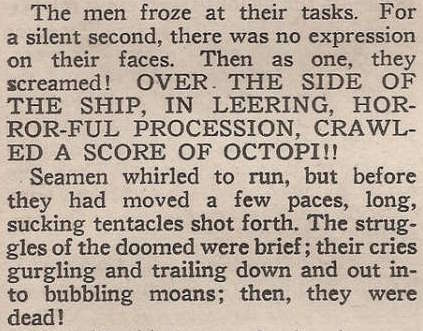
The title story turned out to be nothing but text… Though for readers with a decent imagination, a “score of octopi” and “bubbling moans” is definitely more than enough.
Speed Comics #40-tentacles

I bet you’re wondering how all this ends. Well, « Still, the octopi flopped forward!! CAPTAIN FREEDOM yanked the controls and the ship’s whirling airscrews roared into the octopi, sharp blades ripping tentacles from their bodies with murderous force! » Goodbye, trained octopi (which is not even the correct pluralization of an octopus).

tentacletuesdayicon

StrangeWorlds2AvonA
Strange Worlds no. 2 (April 1951). Cover by Gene Fawcette.

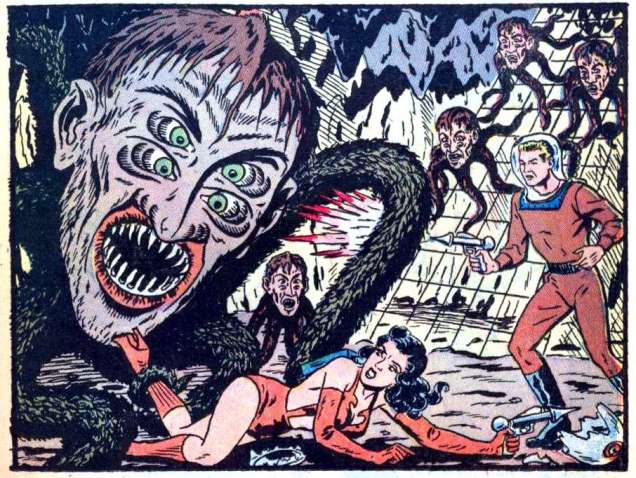
« They were like octopuses — they scurred along on huge rubbery tentacles, and their bodies were nothing but huge heads in the midsts of these. Monstrous squawking beings coming at us from all directions! » Lovely writing, isn’t it? Nevermind that “scurred” is not an actual word. The title tale is actually an illustrated text story titled « Octopus-Kings of the Lost Planet », scripted by W. Malcolm White. Well, “scripted” is a bit strong.
StrangeWorlds2-Octopus-Kings of the Lost Planet
« We decided that these descendants of a mighty but inhuman race had gone backwards in the course of the lost centuries. There were the Octopus-Kings of a Lost Planet — they had been rulers — but their own folly had lost them even the dignity of a solid body! »

tentacletuesdayicon

Airboy, a.k.a. David Nelson, has been in some truly bizarre scraps in his time, so a fight to the death with tentacled monsters who want (as usual) to take over Earth is strictly routine. Created by writer Charles Biro and artist Al Camy, Airboy not only used his expertise in aviation to fight off Nazis, but also all manner of fantastical monsters. A quick look through the covers of Airboy Comics will reveal crazy scientist machinery, rabid tigers, gladiator fights, giant amœbas, pterodactyls, minotaurs, insect-shaped aliens, an invasion of man-eating rats, and so on. Pure entertainment! Airboy’s most memorable (and prettiest, by far) foe (and love interest) is Teutonic aviatrix Valkyrie, who eventually defected to the Allies’ side. She barely seems like a Golden Age creation – with her blouse splitting until her navel and her skin-tights pants, her costume leaves little to the imagination.

airfighterscomics-airboy-valkyrie

She was sexualized further in later incarnations – Dave Stevens’ version of her for Eclipse Comics is probably the hottest – but the Golden Age Valkyrie is more charming and earnest (IMHO), devoid of the nymphomaniacal arrogance appended to her personality in later years. Anyway, back to the topic:

AirboyV9N7A
Airboy Comics no. 102 (August 1952). The octopus seems to be wearing glasses. « Excuse me, Sir, have you seen my book? »
Airboy102-Invasion-of-the-Tentacles
The title story, modestly titled « Invasion of the Tentacles » (no beating around the bush!), is drawn by Ernest Schroeder.

TentacleTuesdayIcon

Weird-Fantasy-no.-21
Weird Fantasy no. 21 (September-October 1953). Cover by Al Williamson and Frank Frazetta. The fur-trimmed boots are a nice touch!

The title story, « My Home… », scripted by Al Feldstein and drawn by Joe Orlando, is emotionally manipulative… and succeeds very well in breaking the readers’ hearts (or pissing them off, depending on your temperament). Read a synopsis of the plot, if you wish, or read the whole story here – who am I to give spoilers to those who don’t want ’em?

TentacleTuesdayIcon

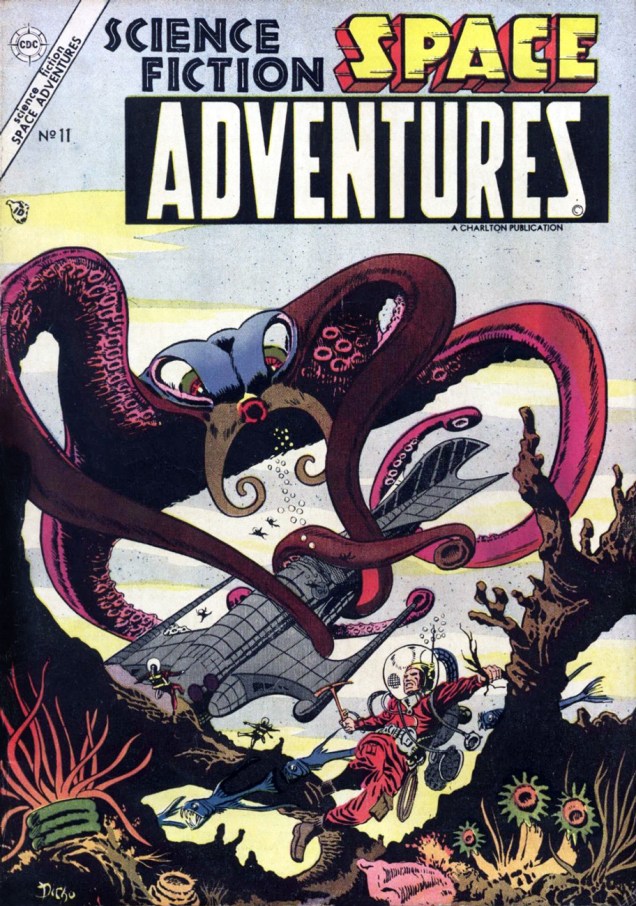
Space-Adventures-11
Space Adventures no. 11 (May-June 1954), cover by Steve Ditko.
Space Adventures no. 11-interplanetarySafari
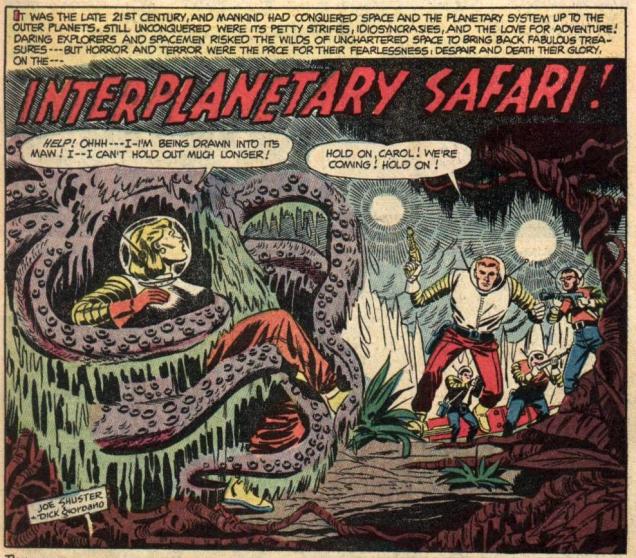
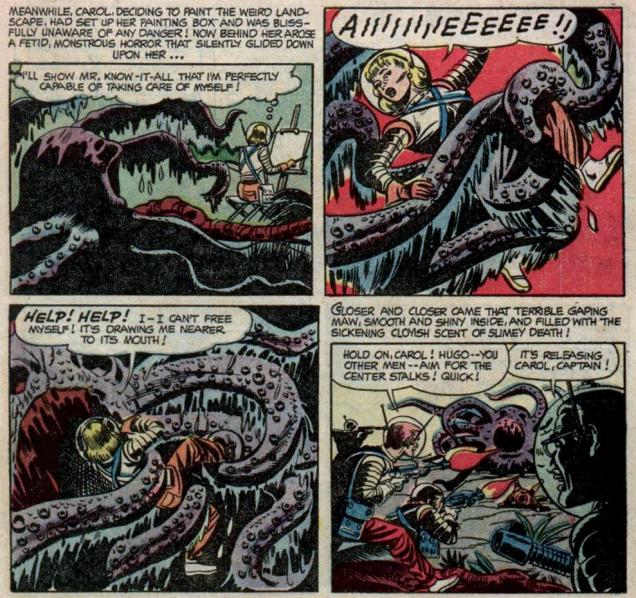
Ron Adams, explorer extraordinaire and famous hunter, goes to planet Xarto to capture a giant carnivorous plant (but if you called it an octopus, nobody would bat an eye). Panels from «  Interplanetary Safari! », penciled by Bill Molno and inked Dick Giordano.

Space Adventures no. 11-interplanetarySafari2

TentacleTuesdayIcon

TheShadow25
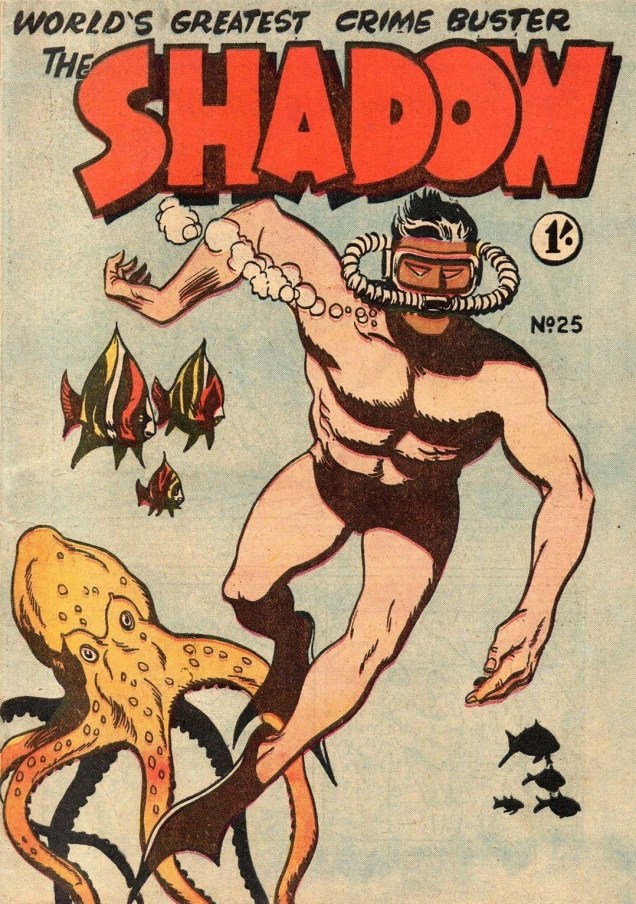
The Shadow no. 25 (September 1956), the child of Australian comic book publisher Frew Publications. The Australian Shadow has nothing to do with « Who knows what evil lurks in the hearts of men? »– this is just a guy who puts on a mask… and takes off his pants. The octopus seems astonished at the sight of bare man-flesh (if there are Speedos there, they’re well camouflaged).

Golden Age tentacles have cropped up many times before in my Tentacle Tuesday posts, but check out specifically Tentacle Tuesday: The Golden Age of Grabbery and Tentacle Tuesday: Planet of Tentacles. Until next time, toodle-oo!

~ ds

Tentacle Tuesday: The Jungle Queens

« Beware, bwana — beware its tentacles! »

Cue in the taut, frantic jungle drums! Picture this: through a thick tangle of brush and tropical vegetation, prances a fair maiden who is quite unaffected by spiky plants or venomous insects. She’s the staunch defender of jungle animals, friend to jaguar or hippo (or whatever other animal the artist’s imagination conjures, even if it’s entirely inappropriate to a jungle… but who cares about zoological accuracy?) One creature this wild child is definitely not a friend to, however, is the octopus: anything with tentacles gets stabbed and killed, as expediently as possible. That’s little cause for concern, however – the real octopus, who lives only in oceans, has little use for a jungle… so whatever’s getting killed must be an impostor or a mutant.

I am amused by jungle comics, which perhaps require an even more dramatic suspension of disbelief than many an equally action-oriented genre.  The female protagonists, usually clad in some sort of leopard/jaguar skin (which makes one wonder why big felines even want to hang out with someone wearing their relatives’ pelt), are usually portrayed as guardians of the wilderness… but some of them kill an awful lot of animals for supposed protectors of the feral kingdom. The blonde Sheena (first female comic book character with her own series), equally blonde Lorna the Jungle Girl (Atlas-published, a rival to Fiction House’s Sheena), Avon’s Taanda – White Princess of the Jungle, Camilla – Wild Girl of the Congo (a case of Fiction House knocking off their own Sheena)… the list definitely goes on. That’s quite a few jungle queens bouncing around, dealing with hostile tribesmen getting uppity, lethal white hunters up to no good and would-be Romeos perpetually being held hostage. Sometimes they even have cat fights and overthrow one another. Very amusing indeed. Pepper the dialogue with lots of bwanas, toss in an epic rescue of hapless natives, and you’re all set.

To be fair, however, some Golden Age jungle comics boast fetching art and compelling stories in which natives are their own agents and her Royal Highness gets to show off her wits (and her gams) to best advantage. It’s hard to dislike stories in which a strong, clever woman gets to save the day.

Without further ado, I present Jungle Queen vs Octopus!

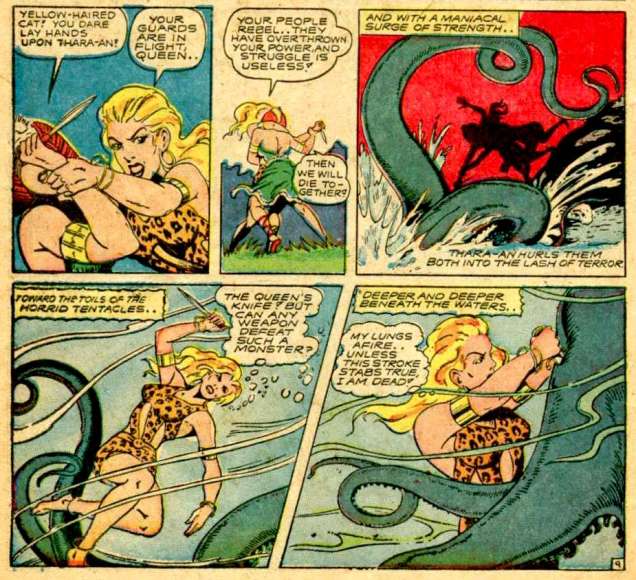
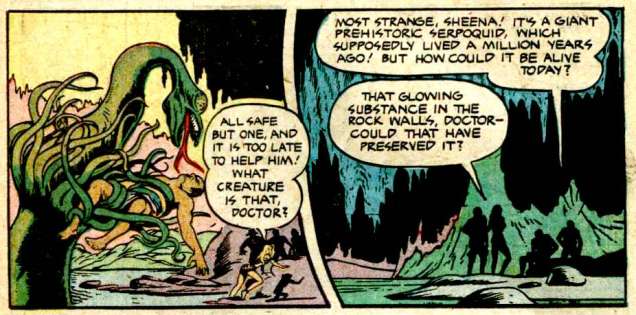
First up, there’s Sheena, who has struggled with quite a few tentacles in her day:

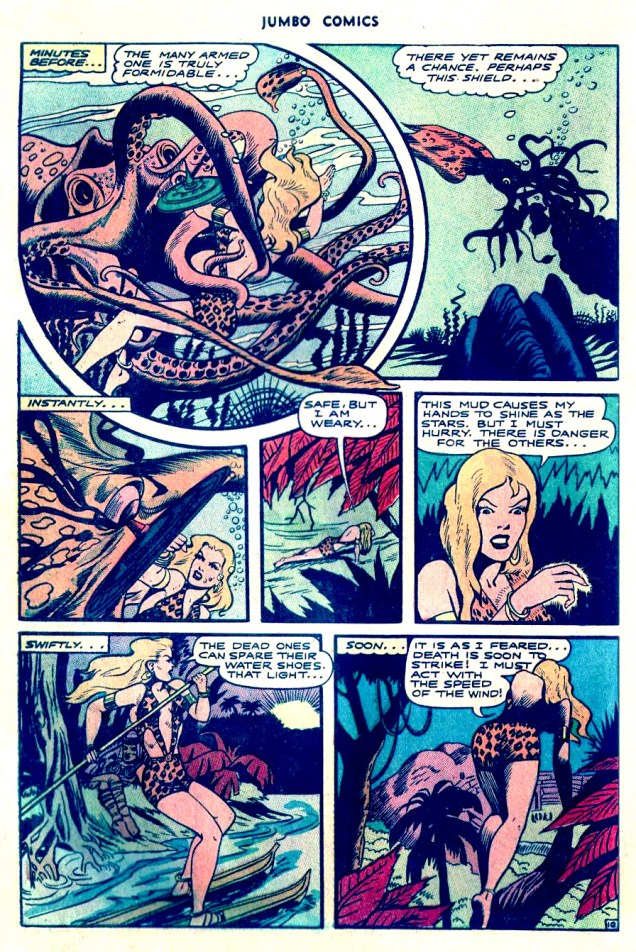
Jumbo Comics #31-Sheena-Voodootreasureofblackslavelake
Page from «Voodoo Treasure of Black Slave Lake», scripted by W. Morgan Thomas, pencilled by Robert Webb, and inked by David Heames, published in Jumbo Comics no. 31 (September 1941, Fiction House).
Jumbo Comics #87
«Sargasso of Lost Safaris», pencilled by Robert Webb and inked by Ann Brewster, published in Jumbo Comics no. 87 (May 1946, Fiction House). What the heck does the Sargasso sea have to do with a jungle? I’d like to know.
Sheena, Queen of the Jungle #5
Untitled story from Sheena, Queen of the Jungle no. 5 (Summer 1949, Fiction House). Art by Robert Webb.
Sheena, Queen of the Jungle #12
Panels from «The Beasts That Dawn Begot!» drawn by Robert Webb, published in Sheena, Queen of the Jungle no. 12 (Summer 1951, Fiction House).

Time for other queens to borrow Sheena’s spotlight:

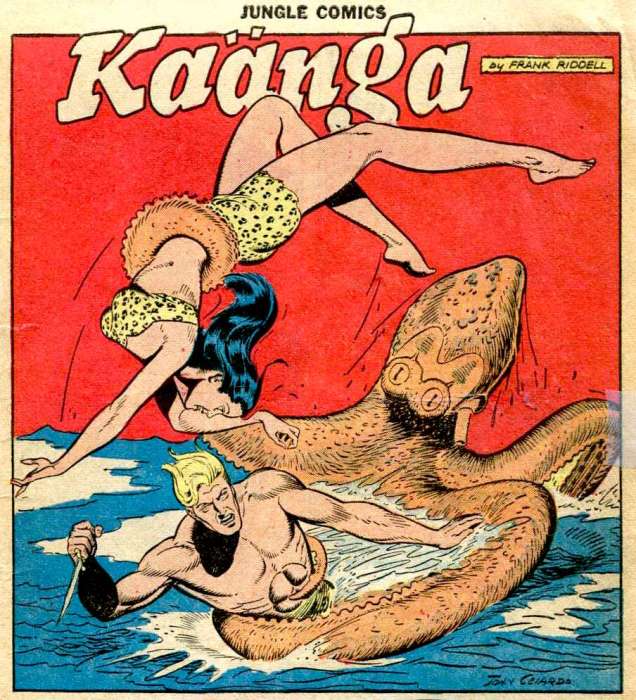
Jungle Comics #105-JohnCelardo
«The Red Witch of Ubangi-Shan», with art by John Celardo, published in Jungle Comics no. 105 (September 1948, Fiction House). Technically, this inclusion goes against my main theme – for Käanga has a very stupid mate who has to be rescued at every turn. She may wear a leopard bikini, but she’s nothing but a Damsel in Distress. Boo.

This Camilla story was scripted by Victor Ibsen and drawn by Ralph Mayo, and was published in Jungle Comics no. 144 (1951, Fiction House):

Jungle Comics #144

Jungle Comics #144 -2
A raft full of musclebound men and Camilla has to be the one to stab the octopus. Her contempt is well justified, as Asheley is clearly a loser.

We’ve had a lot of blondes so far, how about a redhead?

White-Princess-of-the-Jungle-#4
White Princess of the Jungle no. 4 (August 1952, Avon), cover by Everett Raymond Kinstler.

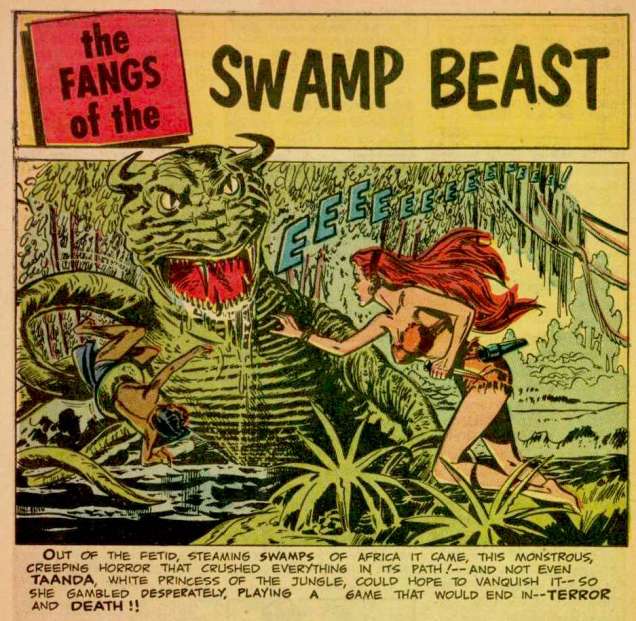
The cover story, «Fangs of the Swamp Beast»:

White Princess of the Jungle #4-swampbeast

White Princess of the Jungle #4-1

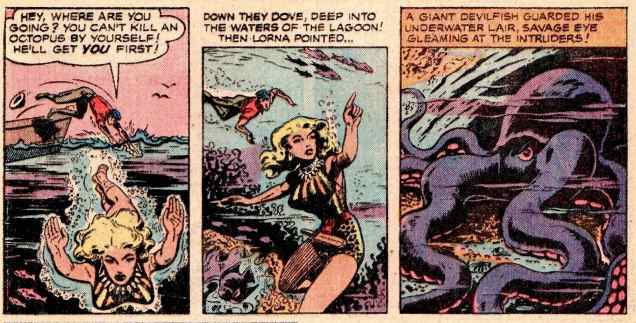
Back to our regularly scheduled blonde heroine! This is «The Devil’s Lagoon», scripted by Don Rico and drawn by Werner Roth, published in Lorna the Jungle Queen no. 4 (December 1953, Atlas):

Lorna the Jungle Queen #4-devil's lagoon
Lorna has the talent of plunging into water boobs first, and using them to optimize buoyancy.
LornaTheJungleQueen#4-devil'slagoon-savageye
Again with the bust-ridiculously-stuck-out pose in the first panel.

LornaTheJungleQueen#4-2

For a chuckle, read Stupid Comics‘ critique of Devil’s Lagoon here. Moving on, I have no wish to be unfair to brunettes, especially given that I generally prefer them:

AllTop16A
All Top Comics no. 16 (March 1949, Fox). Cover by Matt Baker. Sure features plenty of top, doesn’t it? That’s Rulah, by the way – you guessed it, Rulah, the Jungle Goddess (well, at least she’s not a queen), one of those run-amok women who has no qualms killing animal or human.

Here’s a rather amusing explanation for Rulah’s raison d’être from Toonopedia: «One day, while piloting a small plane across Darkest Africa, she crash-landed where civilization had scarcely been heard of. Her clothes were damaged to the point of leaving her butt naked (“like Eve in the Garden,” she mused), modesty preserved only by shadows and strategically-placed vegetation — yet, her skin wasn’t noticeably scratched or abraded. Fortunately, her plane had whacked a giraffe on the way down, so she skinned it and skillfully fashioned a fetching bikini from the raw, uncured pelt. Her uncovered parts were no more bothered by thorns, rough bark, poison ivy and the like, than were her bare feet. Next, she saved a tribe from the local tyrant, a white jungle queen much like herself, and was proclaimed its ruler — provided she could prove herself by killing a starving leopard with nothing but a dagger, which she did.»

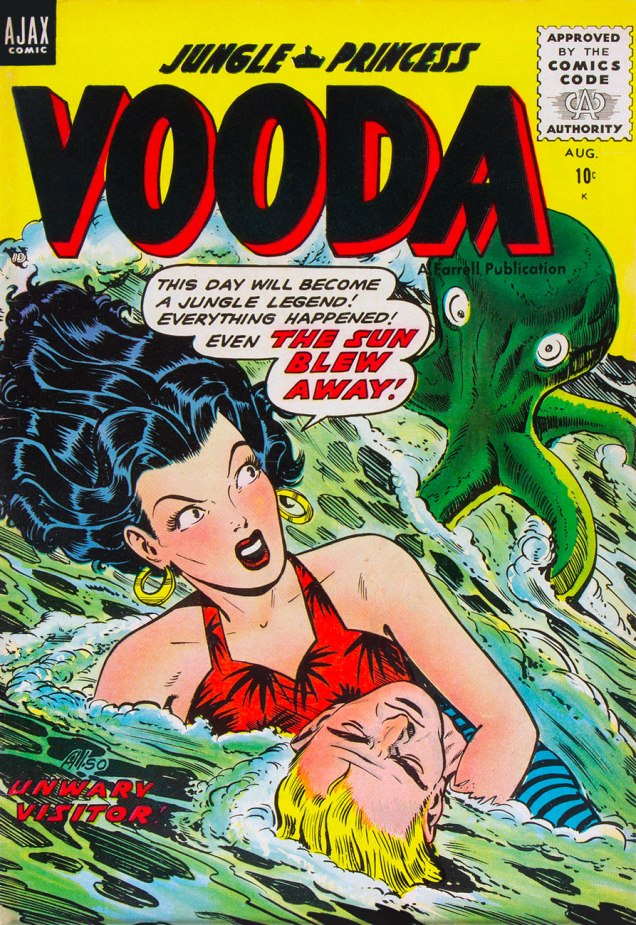
Vooda22A
Another brunette! Vooda no. 22 (August 1955, Farrell). Note that Jungle Queens are only allowed to have hoop earrings, preferably gold.

Phew, that tromp through the jungle wore me out! Until next Tentacle Tuesday…

~ ds

Bill Everett’s Restless Nights of Dread

Today, 102 years ago (!), on May 18th, 1917, William Blake Everett came into the world. He did not become a poet like his ancestor William Blake, nor a politician like Richard Everett, another famous forebear, who founded the city of Springfield, Massachusetts. Bill Everett’s father wanted him to become a cartoonist, and his wish came true, though the elder Mr. Everett died long before before the rebellious Bill found his place in the comics industry.

Bill Everett is best known for creating Namor the Sub-Mariner (visit out Tentacle Tuesday: Prince Namor for an overview of this character’s story and adventures… or read The Brilliance of Bill Everett’s Sub-Mariner, Marvel’s Superman, a great article from Sequart Magazine), but he also had his hand in the creation of Daredevil and Simon Garth, Zombie. Everett excelled in many genres – superheroes, horror, fantasy, science-fiction – but today, since there are far too many covers to feature, I will force myself to focus on horror. Welcome to the ghoulish gallery of my favourite Bill Everett covers! (They’re not necessarily the goriest or scariest – sometimes it’s a mood of quiet menace or a striking composition that sways me.)

BillEverett-Venus19
Venus no. 19 (April 1952). The silent, smirking watchers in the corner are far creepier than the skeleton embracing her!
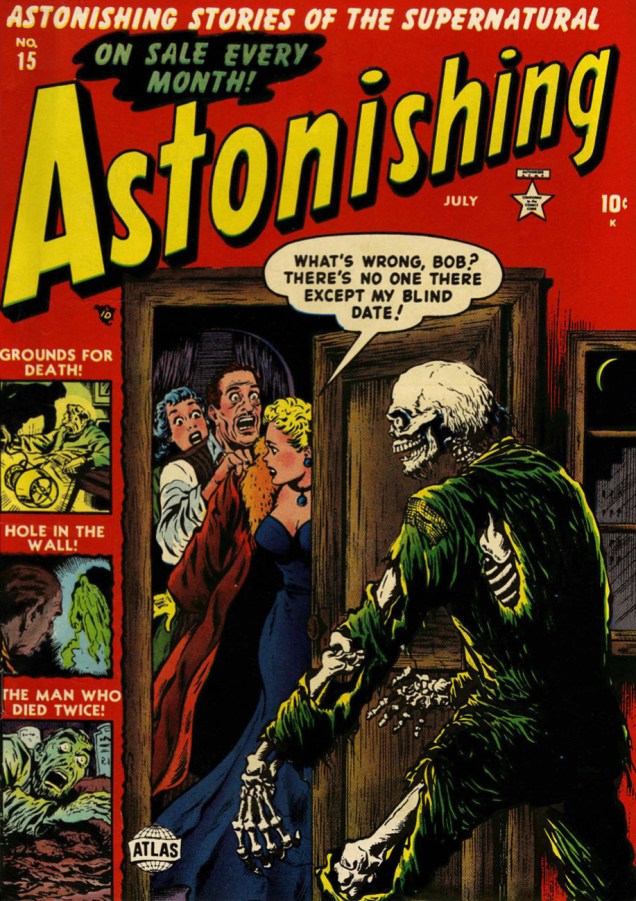
EverettAstonishing15A
Astonishing Tales no. 15 (July 1952). Do a lot of daughters address their fathers by their first name?
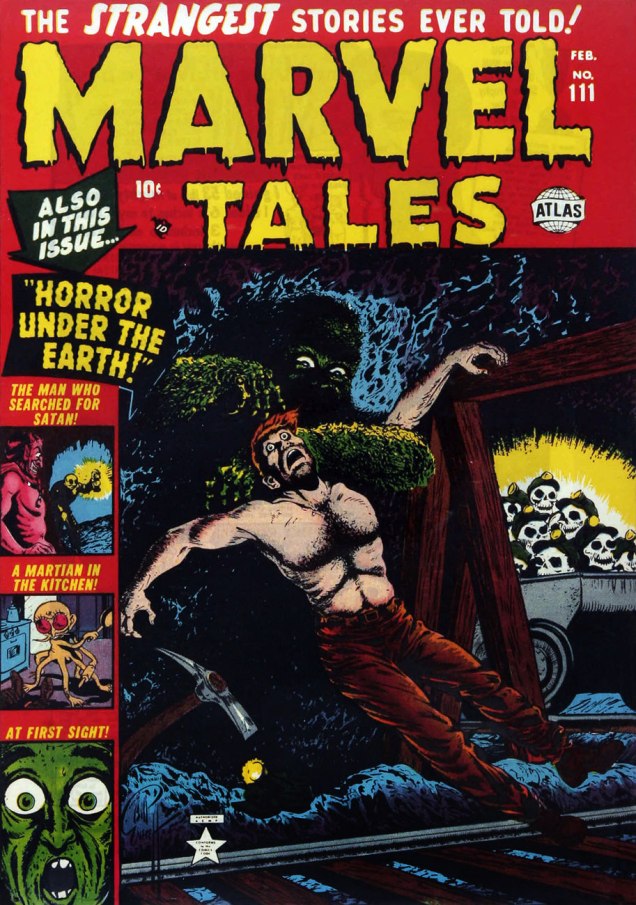
BIllEverett-Marvel-Tales111A
Marvel Tales no. 111 (February 1953)
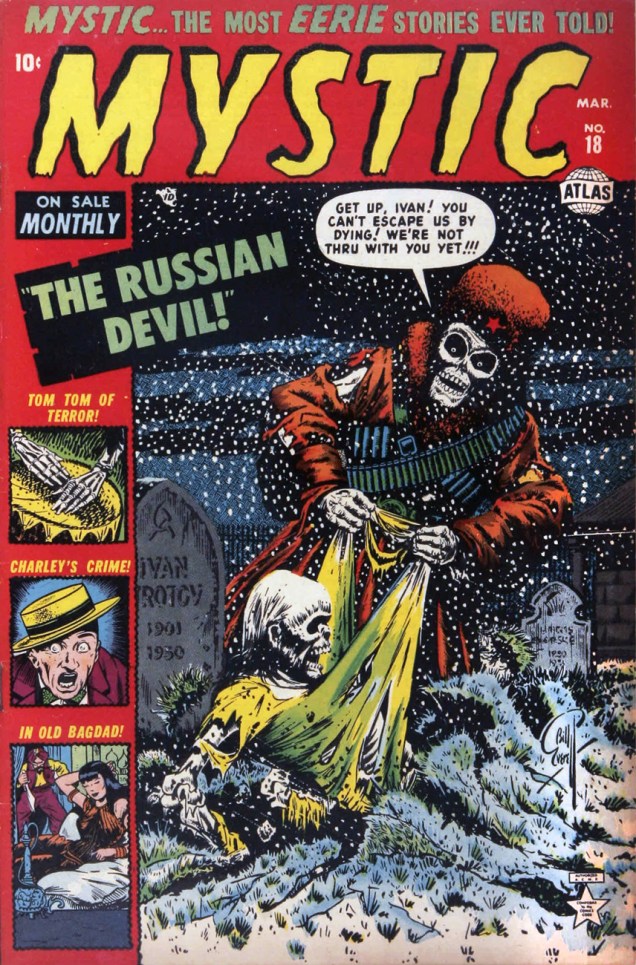
BillEverett-Mystic-#18
Mystic no. 18 (March 1953).
BillEverett-JourneyIntoMystery9A
Journey Into Mystery no. 9 (June 1953)
BillEverett-Marvel-Tales117A
Marvel Tales no. 117 (August 1953)
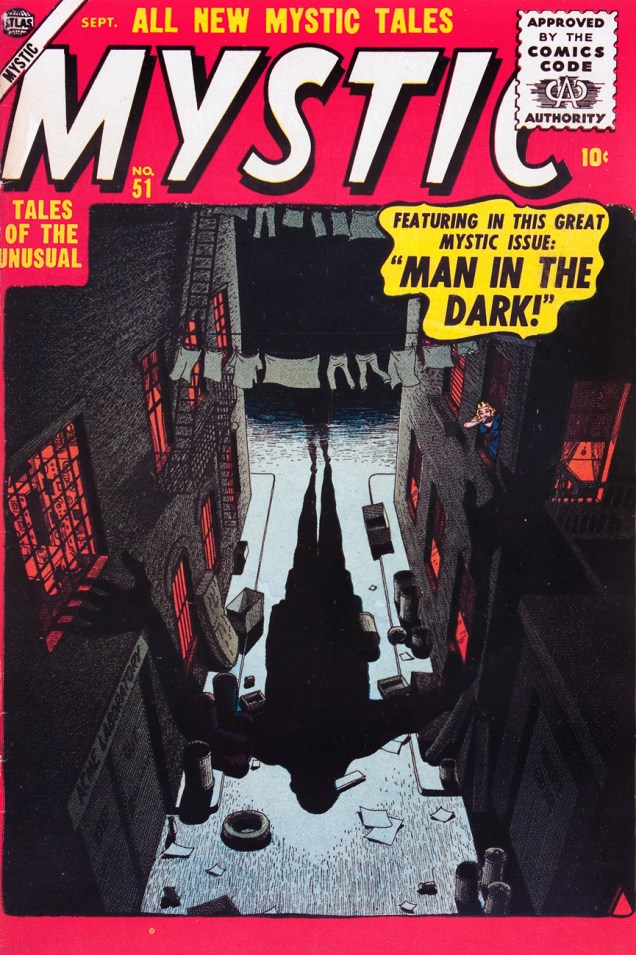
BillEverett-Mystic-#51-(Atlas,-1956)
Mystic no. 51 (September 1956). I love these silent covers where the menace is suggested rather than shown in detail.
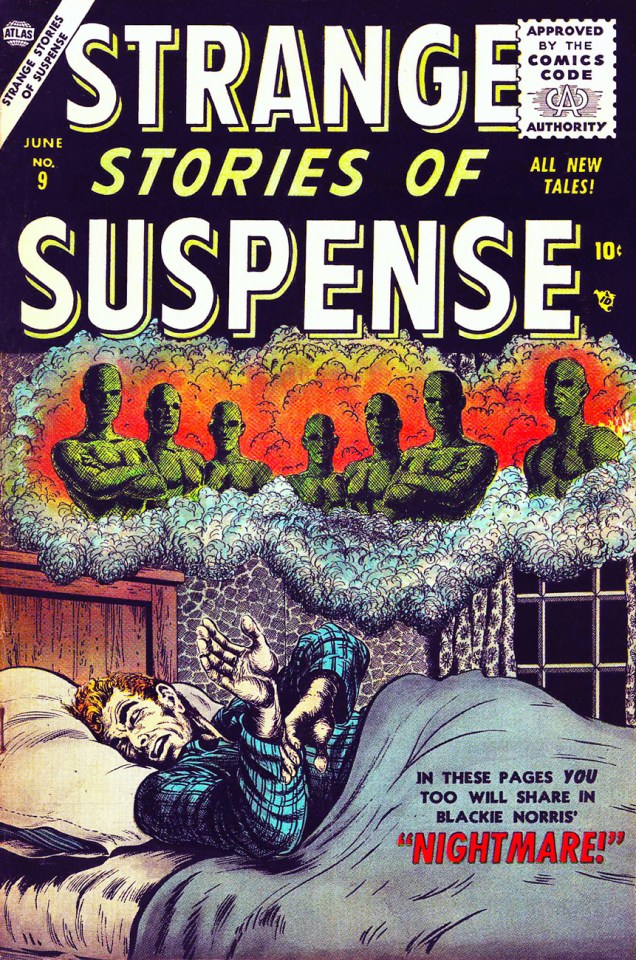
BillEverett-Strange-Stories-of-Suspense-#9
Strange Stories of Suspense no. 9 (June 1956)
BillEverett-MarvelTales151A
Marvel Tales no. 151 (October 1956). Here it’s the composition I especially like – the giant hair isn’t that scary.
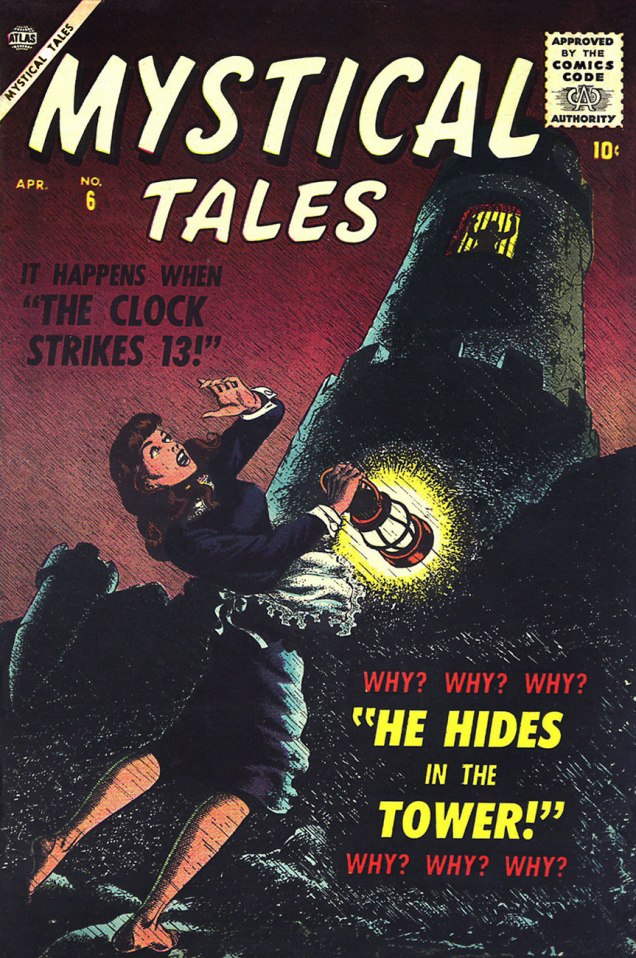
BillEverett-Mystical-Tales-6A
Mystical Tales no. 6 (April 1957). I admit the WHY? WHY? WHY? amuses me WHY? WHY? WHY?; – one inquiry should have sufficed. Speaking of “WHY?”… Why is she barefoot? Those rocks have to be treacherously slippery at the best of times, let alone in a rainstorm.

If you’d like more, you can visit Scott’s Classic Comics Comics Corner: Top 13 Bill Everett Horror Covers – only two of his entries overlap with my own selection, which shows how opinions vary and just how rich this vein is.

~ ds

Tentacle Tuesday: With One Magic Word…

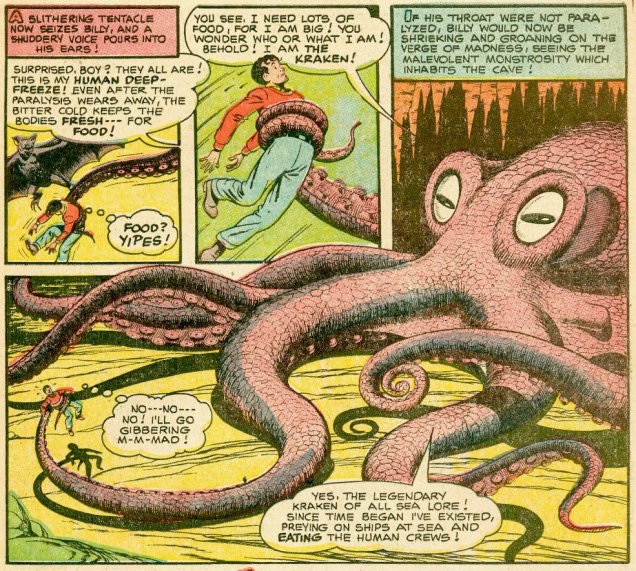
« A slithering tentacle now seizes Billy, and a shuddery voice pours into his ears! »

Previously, we’ve talked about Captain Marvel (the original, the best, the… dare I say, unique!) in a post about his co-creator C.C. Beck. Today, I’ll concentrate on the World’s Mightiest Mortal’s exploits with all manner of tentacled monsters.

All C.C. Beck quotes in this post come from An Interview with C.C. Beck conducted in the late 1980s (shortly before Beck’s death in 1989) by the talented Tom Heintjes of Hogan’s Alley.

« When I looked at the first Captain Marvel story, I knew at once that here was a story worth illustrating. It had a beginning, a carefully constructed development of plot and characters leading to a climax and an ending, and nothing else. There was no pointless flying around and showing off, no padding, no “Look, Ma, I’m a superhero!” Out of 72 panels, Captain Marvel appeared in 18, or one-fourth. »

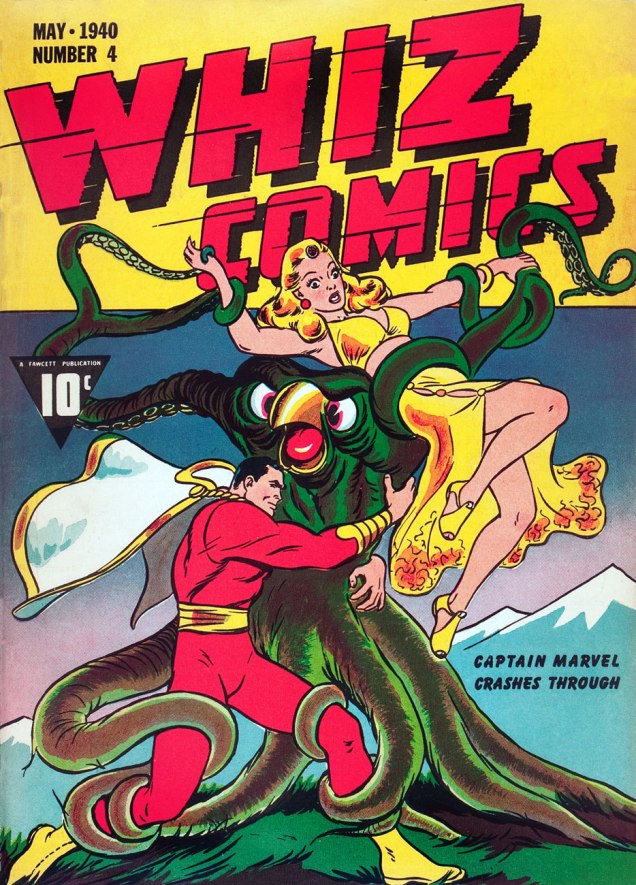
Whiz-Comics4A
« March, ye scalliwag, or I’ll curdle yer giblets! » Follow Captain Marvel’s fine example – don’t forget to hug a tree, folks! Although it will be better if you can find one without spines and prehensile appendages. This  is Whiz Comics no. 5 (May 1940), cover by C. C. Beck. Captain Marvel may “crash through”, but the cover story, « Beautia for President », contains no tentacles whatsoever… just a hypnotically beautiful woman, that some may settle for (not me). You may note that the cover has « number 4 » written on it, but 5 was the number reported to the Copyright Office, so go figure.
Whiz-Comics60A
Whiz Comics no. 60 (November 1944), cover by C. C. Beck. Paper tentacles? I think they count! The main story is adorably goofy, in the best Otto Binder tradition… but unfortunately comicbookplus.com has only a seriously blurry scan of this issue (read it here, but it may cause headaches).
WhizComics146-CCBeck-CaptainMarvel
Whiz Comics no. 146 (June 1952), cover by Pete Costanza. Speaking of the latter and quoting (again) from C.C. Beck, « Pete Costanza was the first artist hired to assist me when Fawcett’s comic department started to expand in the latter part of 1940. We later went into partnership, and Pete was in charge of our studio in Englewood, New Jersey, while I operated out of our New York City office. Pete was an established illustrator at an early age, and I learned as much from him about story illustration as he learned from me about cartooning. »

The green, proudly toupée-d fellow appears in the opening panel of Terror Stalks the World’s Fair, but as it turns out, he has nothing to do with the rest of the story, really.

WhizComics#146-TerrorStalkstheWorld'sFair
Terror Stalks the World’s Fair is scripted by Otto Binder and drawn by Kurt Schaffenberger.
WhizComics155-CaptainMarvel
« A sinister mystery hangs over the city! Each night, screams are heard… human screams that gurgle away into deathly silence! » Whiz Comics no. 155 (June 1953), the final issue of Whiz Comics, cover by C.C. Beck.

The cover story features an actual kraken with evil, myopic eyes! I rejoiced.

WhizComics#155-BattlesTheLegendHorror
Page from Captain Marvel Battles the Legend Horror, scripted by Otto Binder and drawn by Kurt Schaffenberger.

In an interesting plot twist, it is revealed that gigantic vampire bats and the Kraken (who has the gift of speech, sounding like somebody’s rather eccentric uncle) have struck up a partnership.

WhizComics#155-BattlesTheLegendHorror-vampirebats
Poor Kraken must get cold, consuming all those frozen bodies…

While we’re at it, Captain Marvel Battles the Legend Horror is a perfect demonstration of a point C.C. Beck made well:

« Billy Batson was the real hero of all the Captain Marvel stories, from the first issue until the last.  Without Bill Batson, Captain Marvel would have been merely another overdrawn, one-dimensional figure in a ridiculous costume, running around beating up crooks and performing meaningless feats of strength like all the other heroic figures of the time who were, with almost no exceptions, cheap imitations of Superman. In fact, I have always felt that flying figures in picture form are silly and unbelievable, and I would much sooner have never drawn them, but the publisher insisted on them. Most of the time Captain Marvel’s ability to fly had little or nothing to do with the plots of the stories in which he appeared. Billy Batson started every story and ended every story. In between, Captain Marvel appeared when he was needed, disappeared when he was not needed. The stories were about Billy Batson, not about the cavortings of a ridiculous superhero for whom the writers had to concoct new and more impossible demonstrations of his powers for each issue. »

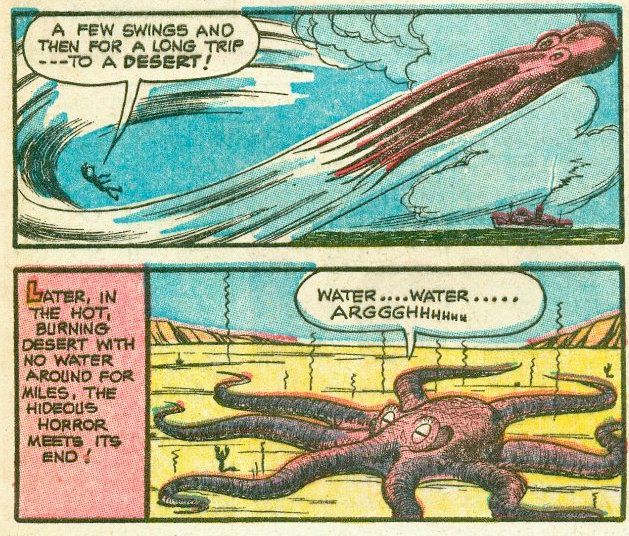
WhizComics#155-BattlesTheLegendHorror-Water
A terrible end for any creature, even a malevolent one.

And our last encounter with tentacles for today…

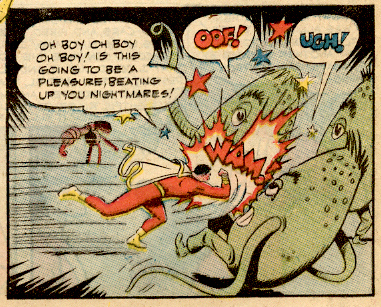
Captain-Marvel-Adventures65A
Captain Marvel Adventures no. 65 (September 1946), cover by C. C. Beck.

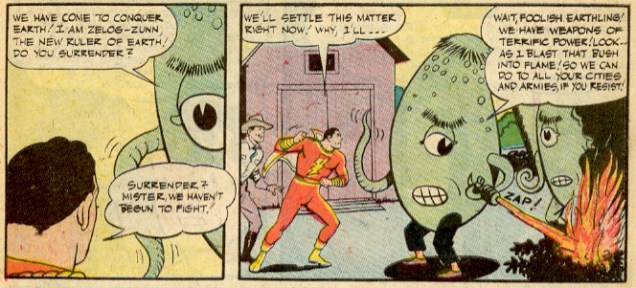
The Invasion From Outer Space, plotted by Otto Binder and drawn by C. C. Beck, offers us lots of cute little alien guys:

CaptainMarvel65-The Invasion From Outer Space
As usual, they wanna take over the world, but they’re cute, anyway. There’s that toupée again, this time (alien) flesh-coloured! That’s a mighty suggestive tentacle wiggle, Zelog-Zunn Sir.

CaptainMarvel65-The Invasion From Outer Space2

Have more time to kill? Visit The World’s Mightiest Mortal, a blog dedicated to the ol’ big red cheese.

~ ds

Will Eisner’s The Spirit at Kitchen Sink (pt. 1)

« Hello… Times? … I want to place an ad in your Situation Wanted column! Wanted… dangerous assignment… will go anyplace, anywhere, anytime… contact The Spirit, Box 35! » – The Spirit, Apr. 30, 1950

If you’ve followed our series dogging the steps of The Spirit, you won’t be in the least surprised that, after a sixteen (plus colour special) residency with Warren Publishing (Apr. 1974 – Oct. 1976), the late Dennis Colt found himself, after a year’s break, updating his mailing address once more. As returning publisher (and later, also Eisner’s agent) Denis Kitchen put it Kitchen Sink’s inaugural magazine issue (no. 17, Winter 1977):

« Welcome back, SPIRIT fans! Several years ago, we launched an experiment, publishing Will Eisner’s SPIRIT in ‘underground’ format. The experiment was so successful that Eisner arranged for Warren Magazines to publish his stories in a larger format, distributed on a national scale. 

Seventeen issues later, we once again have the rights to THE SPIRIT. We will continue publishing stories never before reprinted, on a quarterly basis. In addition, we are adding new features, virtually eliminating the ad pages, and upgrading the quality of the paper. We hope you like the difference and will continue to support THE SPIRIT. »

Well, the first issue was all right, but looked a bit shoddy, a surprise, given the usually-solid production hand of KS’s peerless production man, Pete Poplaski. With the following, er… quarterly issue (five months later), all the kinks had been worked out, and every subsequent entry looks sharp and terrific.

Ah, but there’s the rub: Kitchen Sink’s magazine ran for 25 issues, most of them boasting spectacular, brand-new wraparound watercolour paintings by Eisner. Some brutal excisions had to be made, to say nothing of the backbreaking process of smoothly collating the front and back halves (we have standards!). Hence the necessity of “pt. 1”. Will you settle for my dozen picks of the twenty-five? I’m afraid you’ll have to.

Spirit18A
This is The Spirit no. 18 (May, 1978), featuring a half-dozen Spirit tales, namely: “The Seventh Husband” (May 20, 1951); “Thanksgiving Spirit” (Nov. 20th, 1949); “Future Death” (Jan. 21, 1951); “Barkarolle” (July 18th, 1948); “Mad Moes” (Feb. 9, 1947); “Fan Mail” (Jan. 1, 1950), as well as some vintage Clifford one-pagers by Jules Feiffer.
Spirit19A
This is The Spirit no. 19 (Oct. 1978), featuring five Spirit tales, namely: “Money, Money” (Nov. 23, 1947); “April Fool” (Mar. 30 1947); “Gold” (Oct. 10, 1948); “The Chapparell Lode” (Nov. 14, 1948); “Halloween” (Oct. 31, 1948), as well a pair of Clifford one-pagers by Jules Feiffer, a Lady Luck four-pager by Klaus Nordling, and part one of Eisner’s brand-new, hard-hitting serial, Life on Another Planet (eventually coloured and collected as Signal From Space).
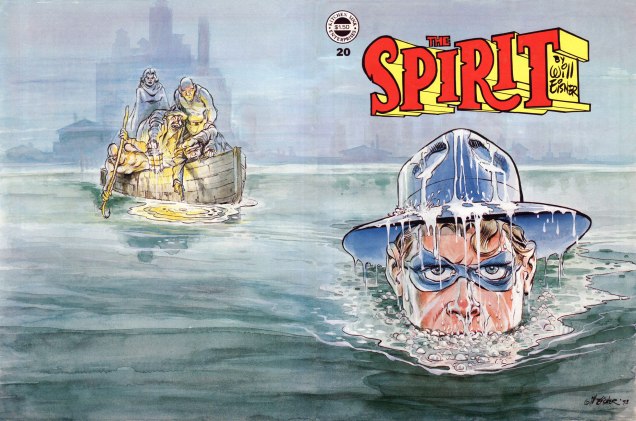
Spirit20A
This is The Spirit no. 20 (Mar. 1979), featuring five Spirit tales, namely: “Quirte” (Nov. 21, 1948); “Cromlech Was a Nature Boy!” (July 4, 1948); “War Brides” (Mar. 14, 1948); “Time Bomb” (Apr. 15, 1951); “Census ’50” (June 25, 1950); and “[Mission… the Moon]” (Aug. 3, 1952), plus part two of Eisner’s Life on Another Planet and some informative articles.
Spirit24A
This is The Spirit no. 24 (May 1980), featuring five Spirit tales, namely: “Boombershlag” (Mar. 23, 1941); “Beauty” (June 9, 1946); “Cargo Octopus” (July 14, 1946); “A River of Crime” (Nov. 30, 1947); “Rescue” (Aug. 24, 1952), plus a chapter of Life on Another Planet and a host of other features, including a Spirit checklist
Spirit27A
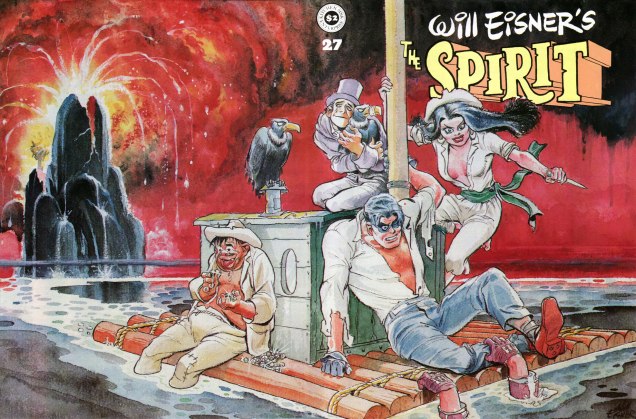
This is The Spirit no. 27 (Feb. 1981), featuring six Spirit tales, namely: “The Devil’s Shoes” (Feb. 1, 1942); “M.U.R.D.E.R.” (July 19, 1942); “Montabaldo” (Jan. 25, 1948); “Rife” (Jan. 14, 1951); “The Amulet of Osiris” (Nov. 28, 1948), “The Return” (Sept. 21, 1952), plus a new Eisner ‘Big City’ nine-pager, “The Treasure of Avenue ‘C‘”… and more.
Spirit29A
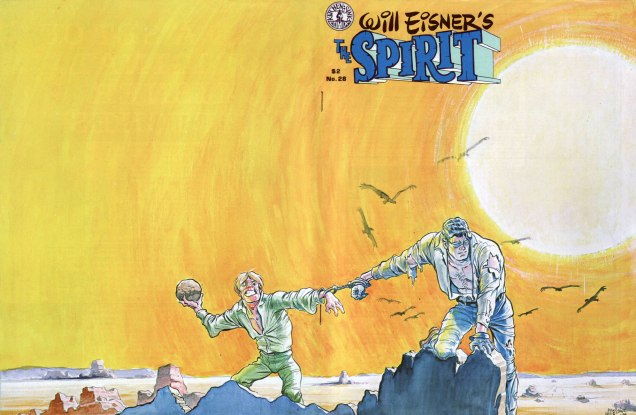
This is The Spirit no. 28 (Apr. 1981), featuring six Spirit tales, namely: “Sphinx & Satin” (Oct. 5, 1941); “Professor Pinx” (Aug. 2, 1942, with Lou Fine); “Survivor” (July 16, 1950); “Deadline” (Dec. 31, 1950); “Return From the Moon” (Sept. 28, 1952), “The Martian” (Oct. 10, 1952), plus a Feiffer Clifford one-pager, a ‘Shop Talk’ discussion between Eisner and Gil Kane, and so forth.

If you’ve just joined us mid-programme, fret not: simply rewind to our earlier instalments, if you will:

… or simply click on its general category, That’s THE SPIRIT!, and find yourself with everything at your blue-gloved fingertips.

-RG

Tentacle Tuesday: Mangled, Pulverized and Slashed Tentacles

« Men!! They are a worse menace than any octupus [sic] or shark that ever swam… »

Oh, poor octopuses. Authors use them as a (not very original) symbol of a terrifying, all-powerful force, and then get them (not very creatively) destroyed. An octopus is lucky to “just” get stabbed; everything seems to be fair play in this violent spree – dynamite, torpedoes, even freakin’ nuclear weapons. In most cases, the problem is definitely Man: man who enslaves sea creatures and makes them do his bidding with varied gadgets, man who intrudes on the octopus’ territory, man who sticks his nose where only tentacles should be.

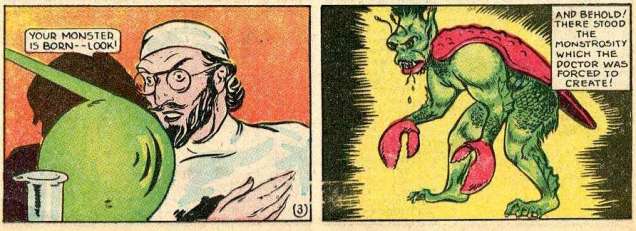
« I only have to give him the claws of the killer lobster… the teeth of the tiger shark… and the heart of the barracuda! That is all! » Because any normal doctor has this stuff just lying around his operating theatre, obviously.

BlueRibbonComics#3-detail-edd-ashe

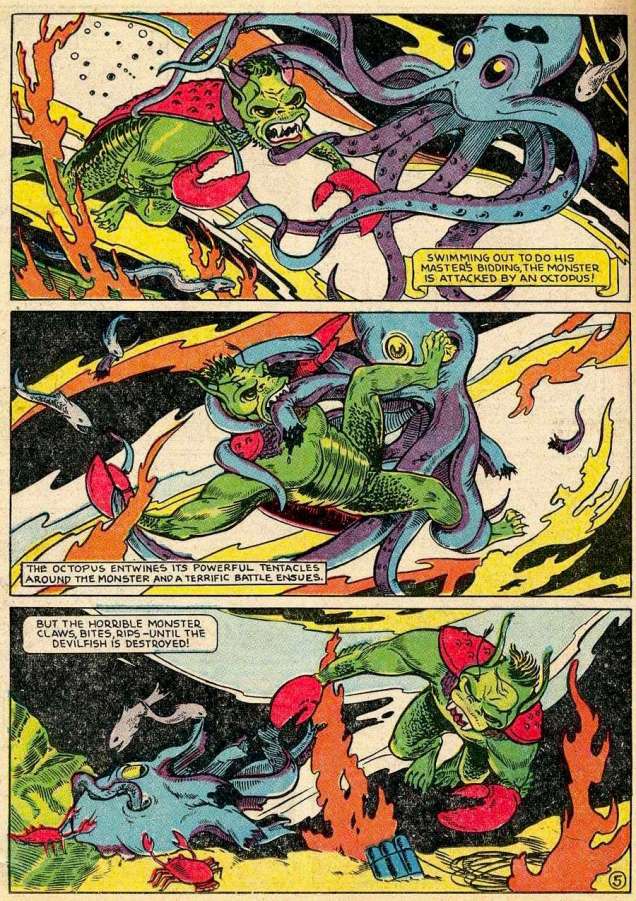
Spectacular, deadly monster created? Next thing to do is to rip an octopus to shreds, in a particularly gory eyeball-wrenching, tentacle-mincing scene.

BlueRibbon Comics#3-EddAshe
Seriously, just look at that eyeball getting pulled out by toes… Page from “Devils of the Deep”, scripted by George Nagle and drawn by Edd Ashe, published in Blue Ribbon Comics no. 3 (January 1940).

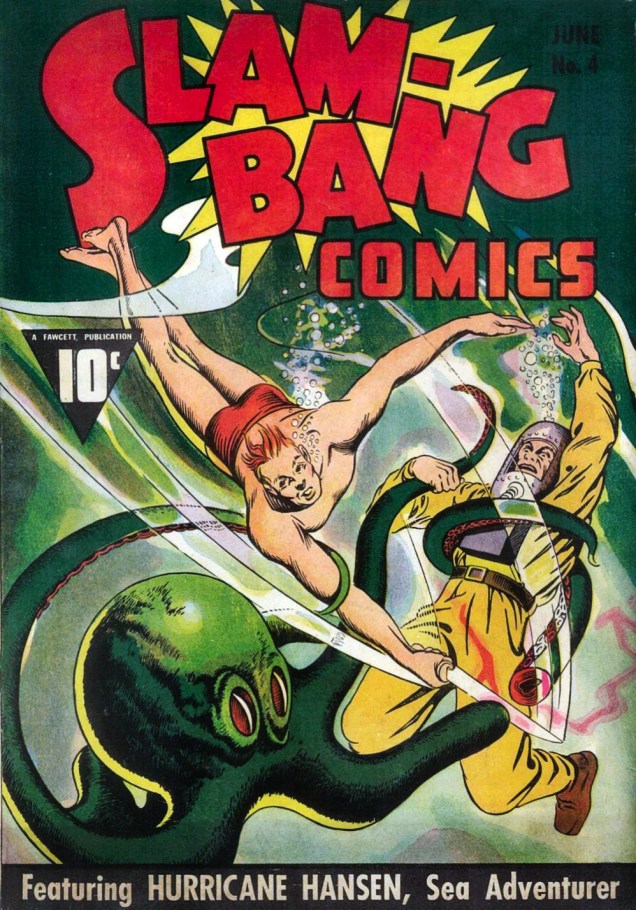
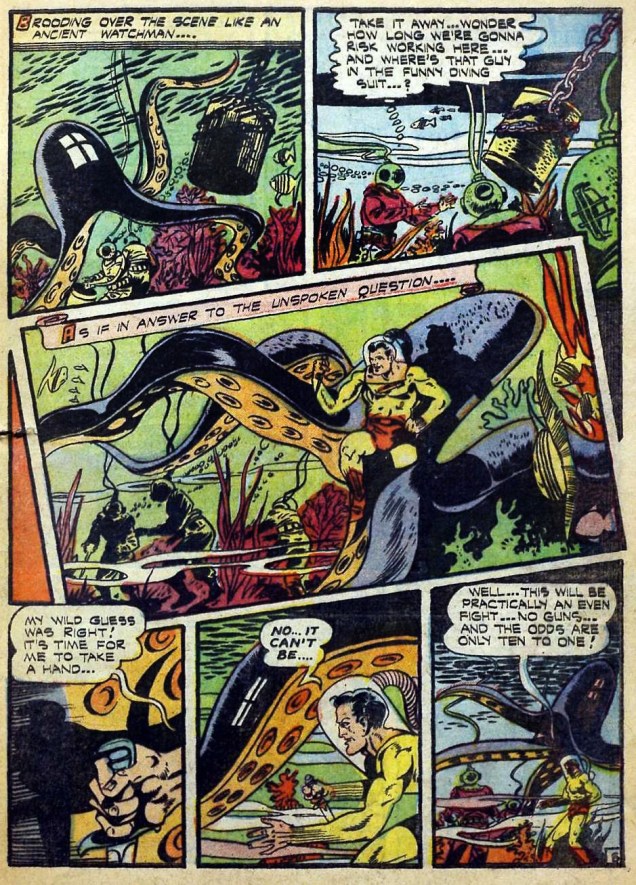
Next up, your standard slashing-at-tentacles-with-a-kitchen-cleaver. The guy must have been stashing it in his swimming trunks; there’s really no need for wearing an actual diving suit. That sap getting squeezed by a tentacle wore one… and look at all the good it did him.

Slam-Bang-Comics-#4
Slam-Bang Comics no. 4 (June 1940), cover by Gus Ricca.
Don-Winslow-of-the-Navy-#36
Don Winslow of the Navy no. 36 (July 1946). Created by Lieutenant Commander Frank V. Martinek as a newspaper strip, Don Winslow was meant to underline Naval courage and inspire American youth to orient their career paths in that direction. I dunno, maybe this particular issue was responsible for a new generation of oceanographers.

I love the idea of an eight tentacled obstacle, and shall aspire to insert that phrase into completely irrelevant conversations.

Don Winslow of the Navy #36-withthemarines
The story is called “With the Marines”, artist unknown.

I have to admit that Don Winslow (not the author) is the kindest octopus handler we’ve seen today. It must be part of those Naval traditions and courage Martinek insisted on. (He was quoted as saying “Since Don Winslow of the Navy is approved by the Navy Department, I cannot allow him to do anything that is contrary to the ideals, traditions or motives of the Navy.“)

Don Winslow of the Navy #36-withthemarines2
Blinding the beastie instead of stabbing – you go, Sir.

It takes cold, raw courage to step up to… This is the grandfather of all octopus… or is it octopi…?” Only a true hero starts fretting about the properness of his English while in proximity to a giant octopus. Are you wondering why that octopus looks distinctly fake? He’s actually made out of rubber, as Don Wallace, a.k.a. Torpedo Man discovers when he punctures the counterfeit cephalopod.

Blue-Bolt-Weird-Tales-of-Terror-#112-
Blue Bolt Weird Tales of Terror no. 112 (Feb 1952). This is a page from “Strange Tale of the Sea Monster”.

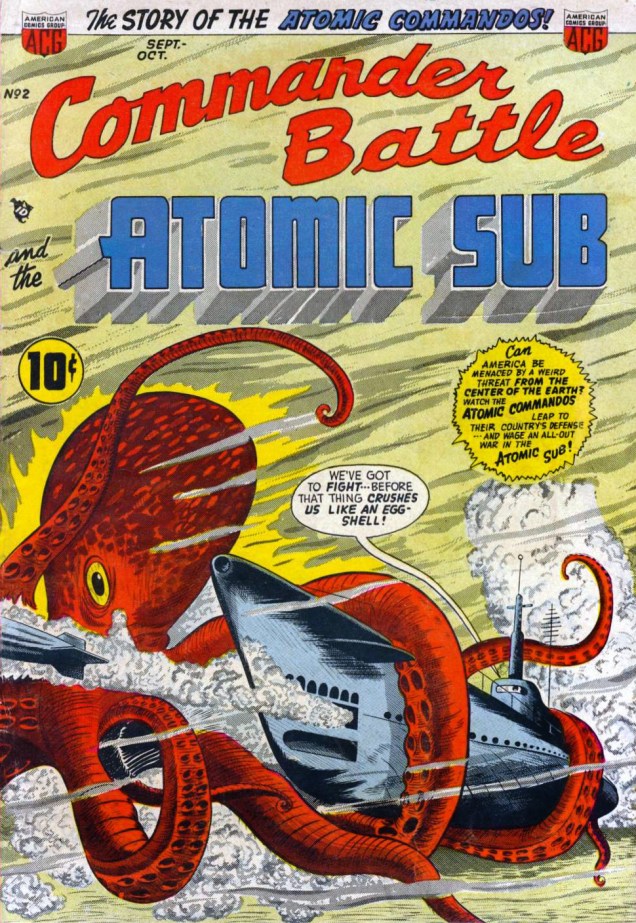
In the 1950s, “atomic” was distinctly a cool word, which clearly inspired the creation of this Atomic Submarine (nuclear powered, that is) and its Atomic Commandos… a crew of, like, four people. To quote Toonopedia, “The real atomic sub was apparently a bit more complex and challenging to deal with than the comic book one. Commander Battle’s got along with only four men aboard — Bill Battle (the boss), Champ Ruggles (“the most powerful man on the American continent”, and maybe even the other American continent as well), Doc Blake (the scientific genius) and Tony Gardello (only mildly ethnic).

Commander-Battle-and-the-Atomic-Sub-#2
Commander Battle and the Atomic Sub no. 2 (Sept-Oct 1954), Cover by Ogden Whitney and Sheldon Moldoff.

The atomic commandos didn’t know that the way to the island was barred by an awful defender… by a gigantic nightmare creature that staggered the imagination! They didn’t see it as it rose from the depths behind them, flaring tentacles ready to pounce, clutch…” The octopus went from red to green – is that for better camouflage?

Commander Battle and the Atomic Sub #2-SheldonMoldoff2
Panels from the rather lengthy, 2-part story titled “Fight for Survival!”, drawn by Sheldon Moldoff.

The weird threat from the center of the earth is actually a nation of sea-dwellers who demand humans cease using atomic weapons, threatening to burn Earth’s surface if this is not done (and unleashing their almost-indestructible octopus, as well). When Commander Battle triumphs at the end of the story, all the “giant attackers” die from a radioactive cloud.  “And so it came to an end, this civilization of titans at the center of the earth… for now, not a single on was left alive! Let it be said that they were not evil! Destiny had willed it that they cross man’s path...” In today’s Tentacle Tuesday, this story takes the cake for its number of gratuitous deaths.

As for the octopus, he gets blown to smithereens…

Commander Battle and the Atomic Sub #2-SheldonMoldoff3

~ ds

Tentacle Tuesday: Prince Namor, the Sub-Mariner

Created by Bill Everett, Namor the Sub-Mariner first appeared in Marvel Comics no. 1 (October 1939). The offspring of a human sea captain and a princess of Atlantis (and thus proudly bearing the title of Prince), he possessed the aquatic talents one expects of a regular merman and the exceptional strength of a carnival strongman. The cool thing about Namor is that right off the bat, he was a rather negative character – to be more precise, he was an Enemy of the United States (Everett didn’t mince words or characters, huh?) As Les Daniels states in his Marvel: Five Fabulous Decades of the World’s Greatest Comics (1991), « Namor was a freak in the service of chaos. Although the Sub-Mariner acted like a villain, his cause had some justice, and readers reveled in his assaults on civilization. His enthusiastic fans weren’t offended by the carnage he created as he wrecked everything from ships to skyscrapers. » This chaos culminated in an epic fight with Human Torch in 1941 when Namor took things a little too far and threatened to inundate the whole island of Manhattan. This little skirmish didn’t prevent him from joining the Allies’ side once World War II started, however, which gave a more constructive outlet for his somewhat destructive energies.

Right from the beginning, the Sub-Mariner was a complex character who just wouldn’t fit into the standard good guy/bad guy dichotomy. He underwent through quite a few transformations, disappearing for a bit right after WWII like many of his super-and-anti hero compatriots (but never for more than a couple of years at a time) and resurfacing during the Silver Age as a slightly different character. Namor’s concern about encroaching technology and hate of humanity, his fierce independence, made him a likeable character for those of us who like mavericks. He is a tragic character, a king without a kingdom who finds that Atlantis and its people have been destroyed by nuclear testing. After that, who wouldn’t hold a grudge? Anyway, if you’d like a more cogent overview of the Sub-Mariner’s history, visit The Great Comic Book Heroes.

To get back on topic, given how much time Namor spends underwater, it’s hardly surprising that he quite frequently encounters tentacles.

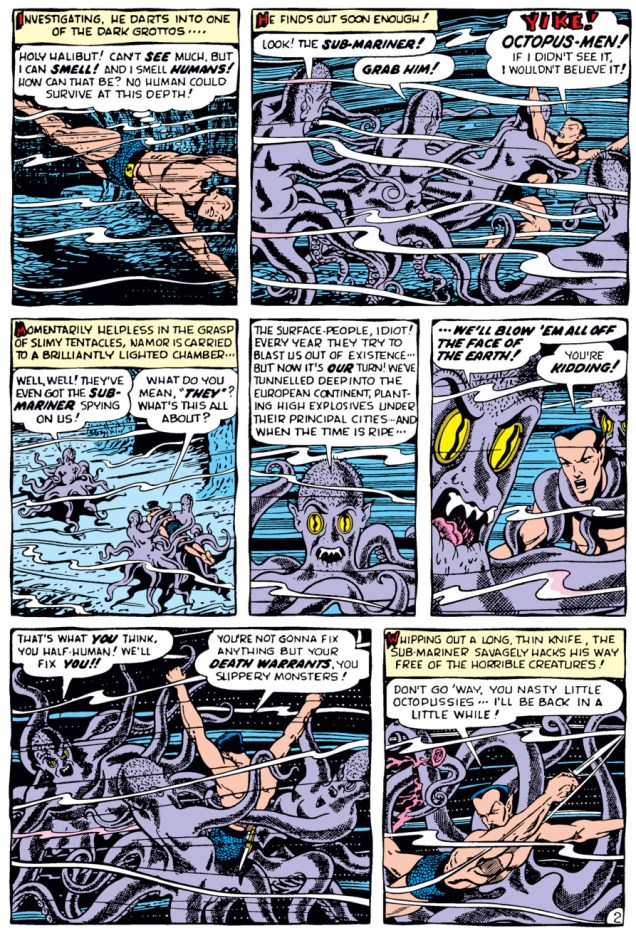
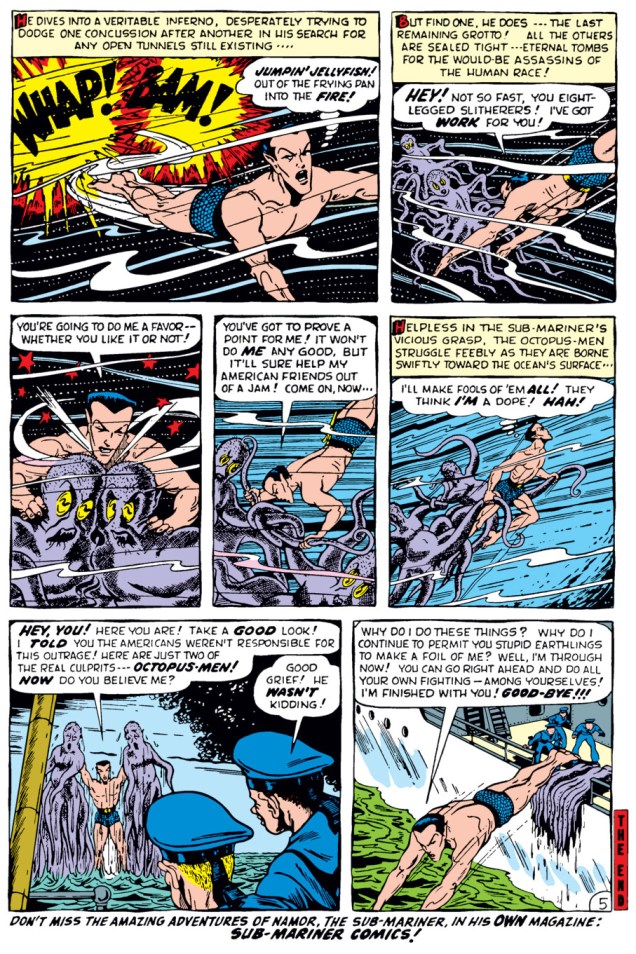
First, a story scripted and drawn by Bill Everett – who better to introduce the character than his creator? This is “The Octopus-Men!”, printed in The Human Torch no. 38 (August 1954).

BillEverett-Submariner-TheHumanTorch38-1
« The Original Aquaman » ? My, aren’t we testy. Now, now, you boys both belong to a long, storied tradition.

BillEverett-Submariner-TheHumanTorch38

BillEverett-Submariner-TheHumanTorch38-2

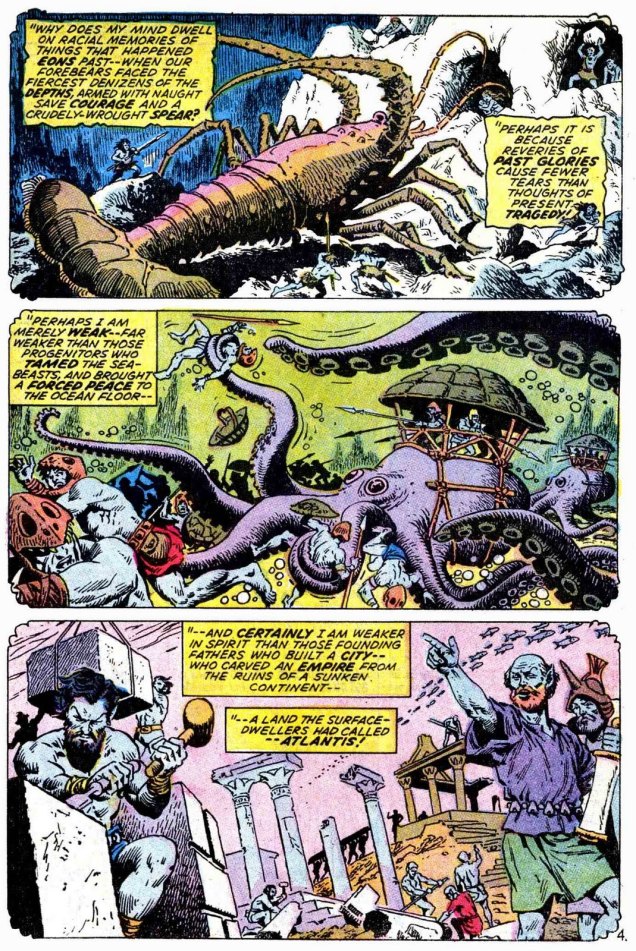
Skipping ahead some twenty years, a page from “Namor Agonistes!”, scripted by Roy Thomas, pencilled by Ross Andru and inked by John Severin, printed in Sub-Mariner no. 38 (June 1971). This is sort of an origin story of the Sub-Mariner. Lovely art, n’est-ce pas?

Submariner38-RossAndru-JohnSeverin

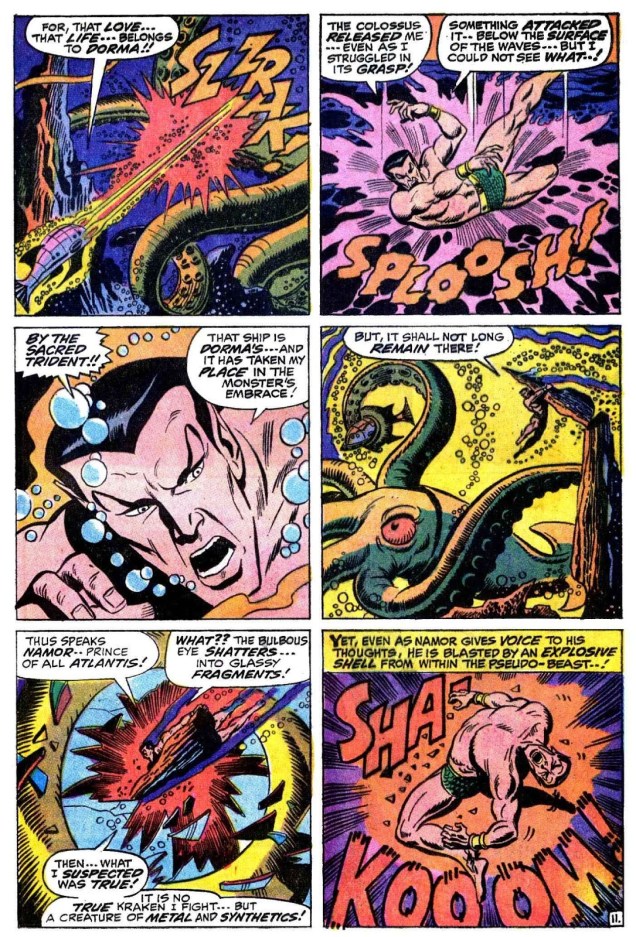
A page from “When Wakes the Kraken!”, scripted by Roy Thomas, pencilled by Sal Buscema and inked by Mike Esposito, printed in Sub-Mariner no. 27 (July 1970):

Sub-Mariner #27-SalBuscema-RoyThomas

Oh, let’s have a couple of covers, too.

Sub-Mariner13
A rather random assortment of creatures, isn’t it? Sub-Mariner no. 13 (May 1969), pencils by Marie Severin and inks by Joe Sinnott.
Sub-Mariner54
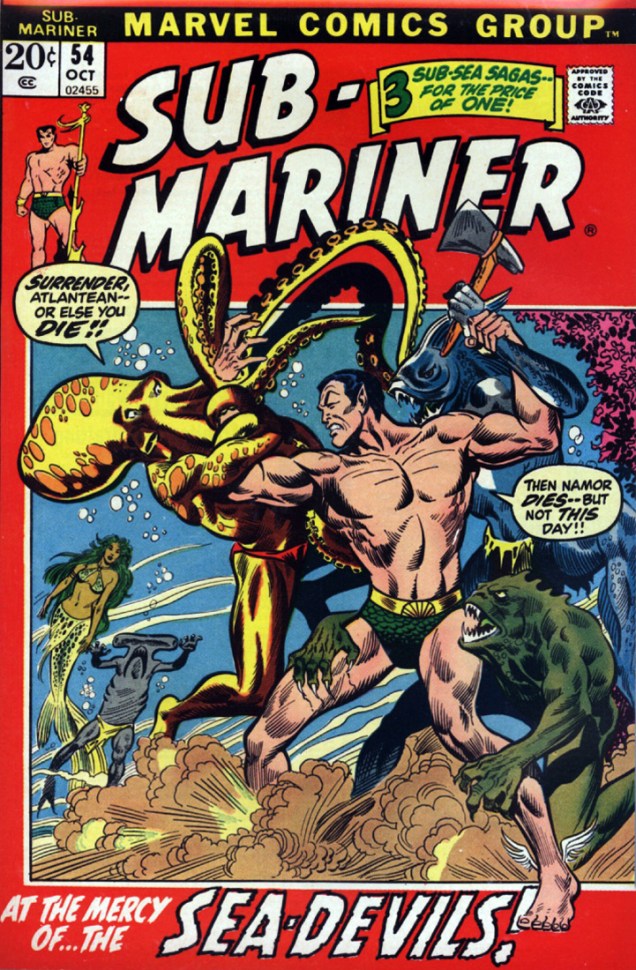
Umm… why is a piranha wielding an axe? Sub-Mariner no. 54 (October 1972), pencilled by Alan Weiss and inked by Frank Giacoia.

I mostly sneer at modern “reboots” of Golden or Silver Age characters, but Namor’s appearance in the excellent Thor the Mighty Avenger (Marvel, 2010) was completely à propos. (The series is a happy union of an absorbing story with great graphics – it’s written by Roger Langridge with art by Chris Samnee.) Here’s a page from “Thursday Morning“, published in Thor the Mighty Avenger no. 5 (December 2010).

ThorTheMightAvenger

~ ds

Tentacle Tuesday: Ha-Ha and Coo-Coo With Frolicsome Animals

The Golden Age of comics proffered quite a lot of anthropomorphic animals to its readers. The stuff on offer ran the gamut of different definitions of humour, from inane slapstick to pleasant goofiness, all the way to batshit surrealism. There’s at least one common streak running through this zoological revelry – tentacles!

tentacletuesdayicon

Our first exhibit is a charming comic from the 40s. Land of the Lost was a radio series broadcast from 1943 to 1948 on Mutual Broadcasting System and ABC, written, produced and narrated by Isabel Manning Hewson. Each episode started with the line « In that wonderful kingdom at the bottom of the sea… », and presented a new under-the-sea adventure of Isabel and Billy, two kids lucky enough to have an adorable avuncular fish for an underwater guide. (The fish was called Red Lantern, and was most notably voiced by Art Carney.) You can listen to an episode from 1945 here.

landofthelostcomics-isabelmanninghewson

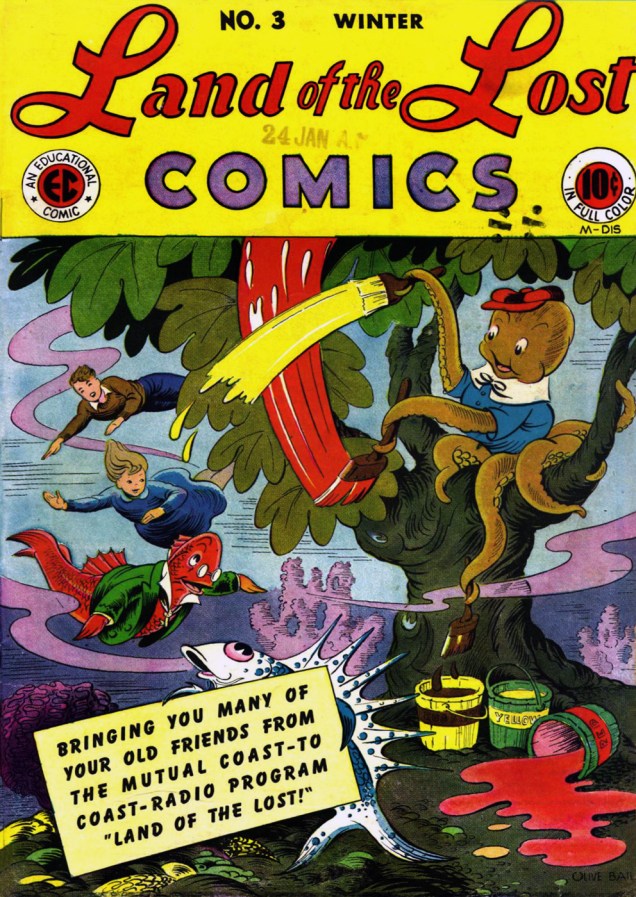
Coming back to our beloved cartoons: in 1946, EC Comics started publishing Land of the Lost Comics, a series that lasted for 9 issues. Hewson remained the writer, and the art was handled by Olive Bailey (not the Olive Bailey who helped crack Germans’ Enigma cipher machine in WWII.) The result was impressive: these comics are delectable, combining beautiful art with inventive plots that may be goofy, but have a solid internal logic. Hewson gave her sea-creatures vibrant personalities, and it’s so much fun to dive (not pun intended) into this world.

LandoftheLostComics#3
Land of the Lost Comics no. 3 (winter 1946), cover by Olive Bailey. Read the whole issue here…  and then read other issues, too. Somebody needs to publish a collection of this stuff.

The following panels are from “Jack Frost“, scripted by Isabel Manning Hewson and drawn by Olive Bailey, published in Land of the Lost Comics no. 3.

OliveBailey-landofthelostcomics2-panel3
Squidlet goes out of control, like all young octopuses are prone to doing.

OliveBailey-landofthelostcomics3-panel3

Thank you, cool ladies, for all the fun!

IsabelManningHewson-OliviaBailey

Land of the Lost also became an animated cartoon as part of Famous Production Studios‘ Noveltoon series: Land of the Lost (1948), Land of the Lost Jewels (1950) and Land of Lost Watches (1951). I find the animation to be definitely subpar to the comics or the radio show, but I’ll let you judge for yourselves. (Jack Mercer is in it, albeit briefly!)

tentacletuesdayicon

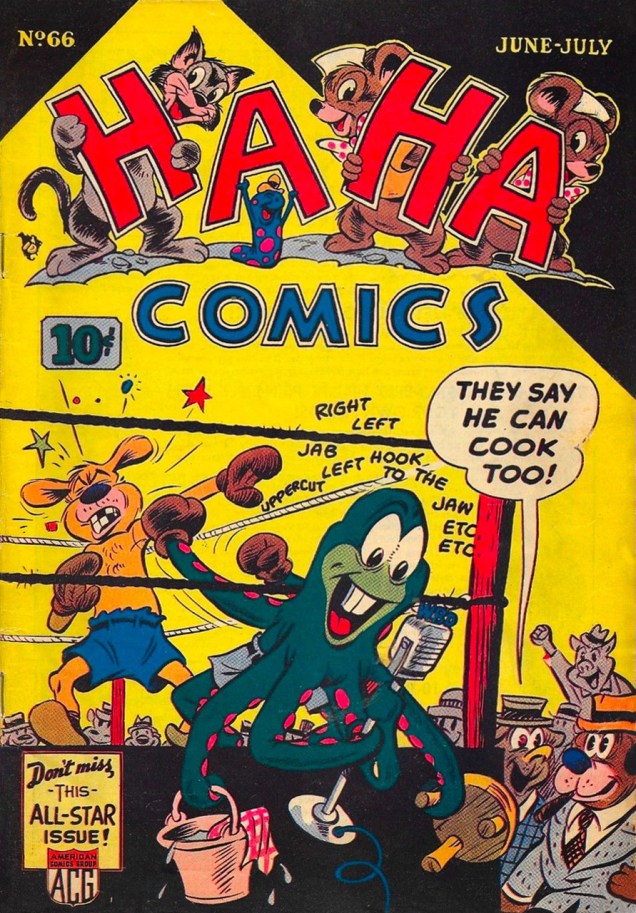
Did you know octopuses love to box? This implausible situation is definitely part of the lazy artist’s roster. To wit:

HaHaComics66
Ha Ha Comics no. 66 (June-July 1949), cover by Dan Gordon. It was really hard to find a scan of this issue in decent condition (thanks to co-admin RG), and comicbookplus doesn’t even have it in its database (you can read pretty much all the other issues of Ha Ha Comics, though).

Ha Ha Comics, a sister anthology of Giggle Comics, was published by ACG. (With issue #100, Ha Ha became Teepee Tim, going from animal hijinks to young Indian shenanigans for all of… three issues.) It’s quite a the playground of anything goes, but upon careful inspection, one easily finds good art shining among the dirt-pile of mediocrity, and diverting storytelling among hackneyed yarns.

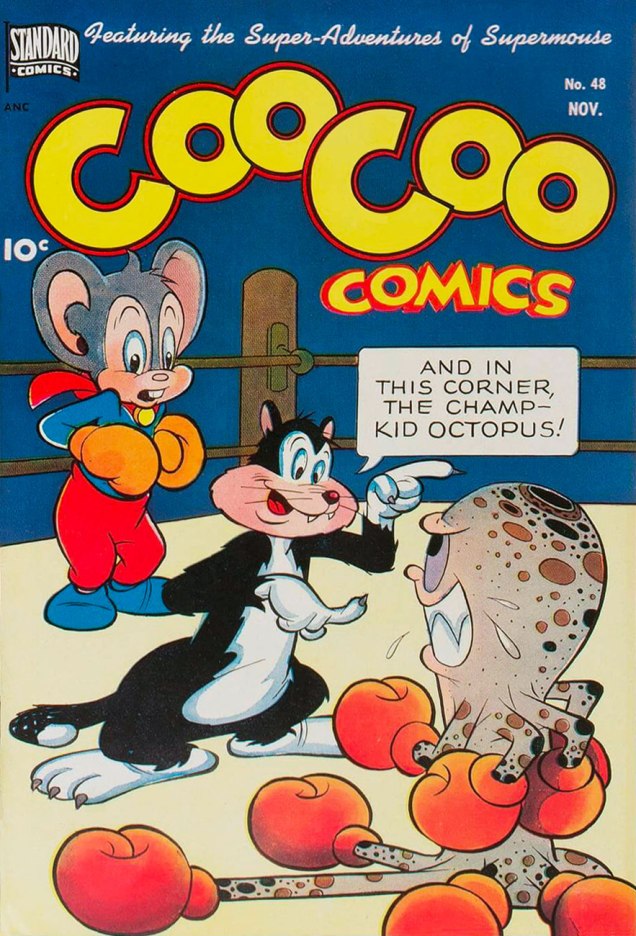
CooCooComics48
Coo Coo Comics no. 48 (November 1949), cover by Carl Wessler. Published by Standard Comics under the imprint of Pines (from Ned L. Pines, publisher).  Read the issue here (no tentacles whatsoever, though).

How many arms does the fellow up above have, nine? I suppose that’s why he’s the champ!

tentacletuesdayicon

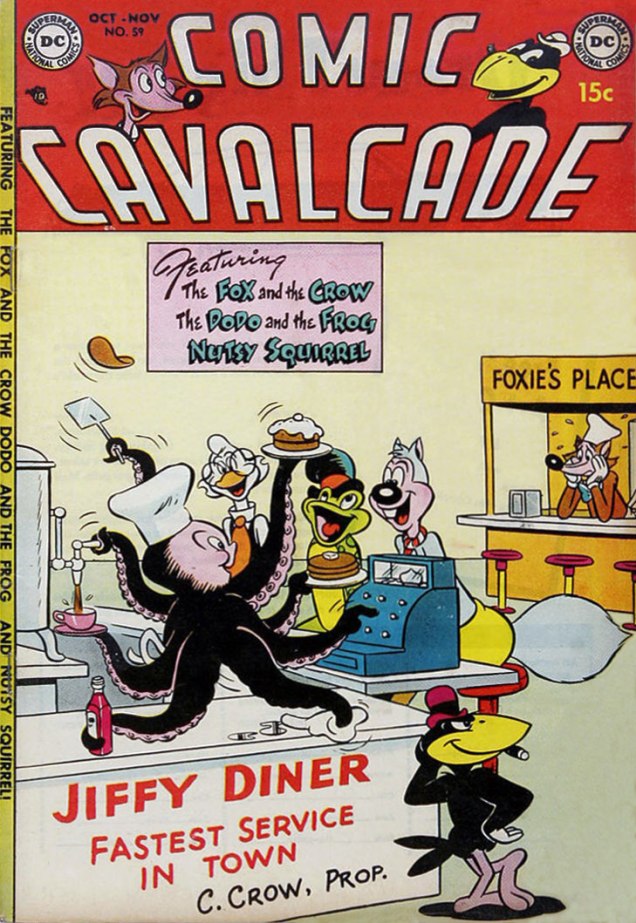
Comic Cavalcade went all funny-animals only with issue 30 (Dec-Jan 1948), when superheroes faded from popularity (oh man, that’s hard to imagine now, isn’t it?) It lasted until 1954, by which time it shrank from its original 96 pages to 76, however retaining its 15-cent cover price.

ComicCavalcade59A
Comic Cavalcade no. 59 (Oct-Nov 1953), art probably by Rube Grossman. Read it here.
DinkyDuck10
Dinky Duck  no. 10 (July 1954). WTF is a Dinky Duck? Terrytoons’ answer to Daffy Duck, says Toonopedia; or, tout simplement, a smaller-than-average duck. The poor duckling never caught on, but the cartoons did result in a comic series, published by Pines and then St. John.
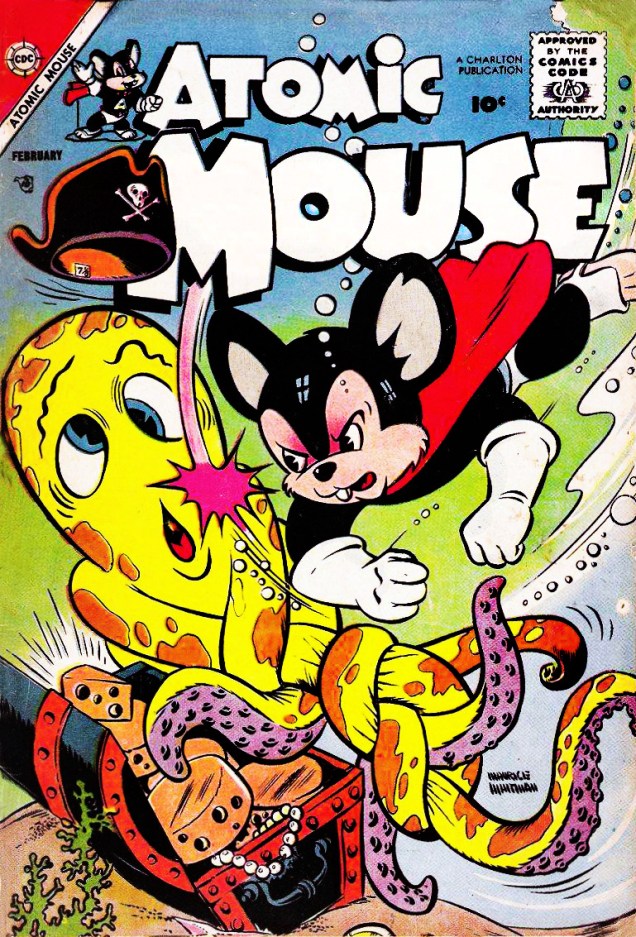
AtomicMouse25
Atomic Mouse no. 25 (February 1958), cover by Maurice Whitman. Atomic Mouse was created in 1953 for Charlton Comics by Al Fago, their first animal superhero. The series was published for ten years (!), between 1953 and 1963, so it must have had at least a modicum of popularity.

That’s all folks!

~ ds

Tentacle Tuesday: All Aboard

Has this ever happened to you? You’re sailing along, just minding your business, concentrating on fishing or just taking a pleasure cruise, when suddenly you’re abruptly attacked by shifty tentacles. What do you do? Defend yourself with a tickle assault!

LittleDotTickle
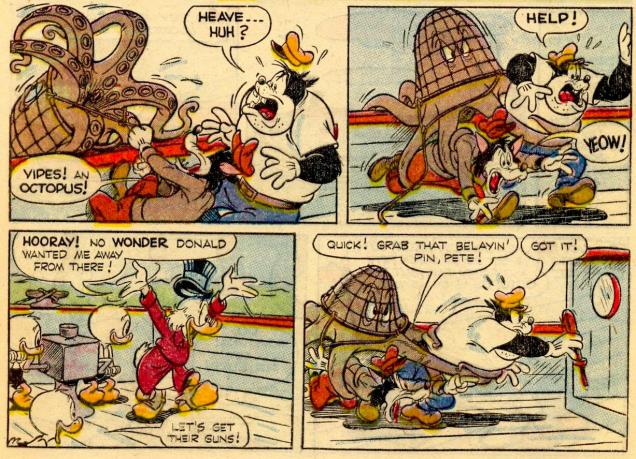
Page from “Little Dot Meets Uncle Gill”, printed in Little Dot no. 5 (Harvey, 1954). Art is by Steve Muffatti. Little Dot is never at loss in any situation, but I’m surprised the octopus isn’t covered in polka dots.
LIttleDot7-steve-muffatti
Panel from “Little Dot Meets Uncle Gill”, printed in Little Dot no. 5 (Harvey, 1954). Art by Steve Muffatti. No harm done!

Some octopuses sneak onboard to be helpful…

Felix8-5-34KingFeature1934
Original art for a Felix the Cat Sunday comic strip from July, 1934. Art by Otto Messmer.

… And some are just pissed off about their dwindling food supply. (Or perhaps that fish was a personal friend.)

MarmadukeMouse#2
Marmaduke Mouse no. 2 (Summer 1946). Artist unknown.

If there’s any moral to these tales, it’s that fishing is hazardous business.

Donald Duck Beach Party #1
Walt Disney’s Donald Duck Beach Party no. 1 (July 1955). The story is “Sea Breeze Sailors”, scripted and drawn by Dick Moores.
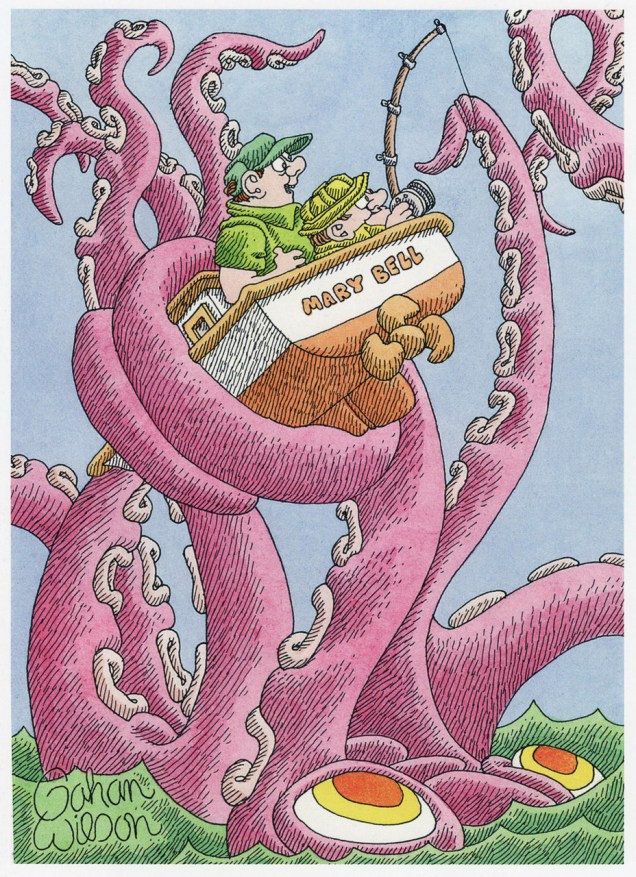
GahanTentaclesA
« Don’t let it get away! » Cartoon by Gahan Wilson.

~ ds
Tentacle Tuesday: EC’s Weird Tentacles

Today’s Tentacle Tuesday delves into William Gaines’ EC and the glorious 50s (well, glorious for *some* things, at any rate). “Weird”, you say? Why, weird simply must include tentacles!

It’s a mixed bag: those of you who dislike Al Feldstein (and I know my co-admin RG would raise his hand readily) may be terribly annoyed by this post, but patience, my friends! there’s a lot of Wally Wood (a Tentacle Tuesday master, by the way!) in here, too, and who in their right mind would admit to detesting Wally Wood?

(As for myself, in case somebody is wondering, I like Feldstein’s artwork just fine.)

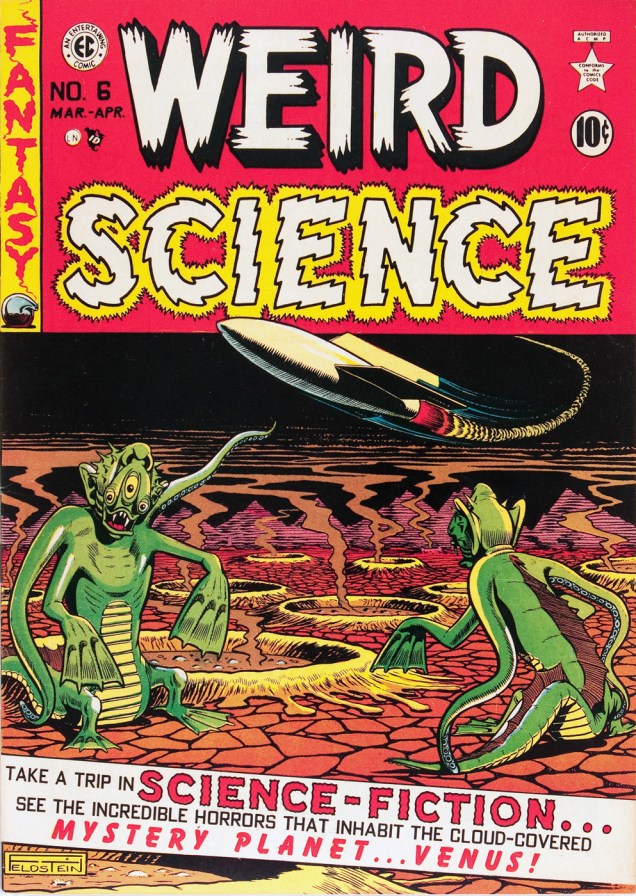
WeirdScience#6
Weird Science no. 6 (March-April 1951). Cover by Al Feldstein.

« EC’s flaws are pretty obvious: even when the artists were striving for greater seriousness than the ironic gore of the horror stories or the outrageous early sci-fi plots or even the clever but predictable crime and suspense stories, the writing was often overwrought, prolix, and ham-fisted, and the artists were straightjacketed by EC’s rigid visual grid. They were Entertaining Comics first and foremost, but they also seemed compelled to break out of their commercial formulas, however finely realized, and publish stories that were fiercely honest, politically adversarial, visually masterful, and occasionally formally innovative…» (source: Gary Groth’s Entertaining Comics)

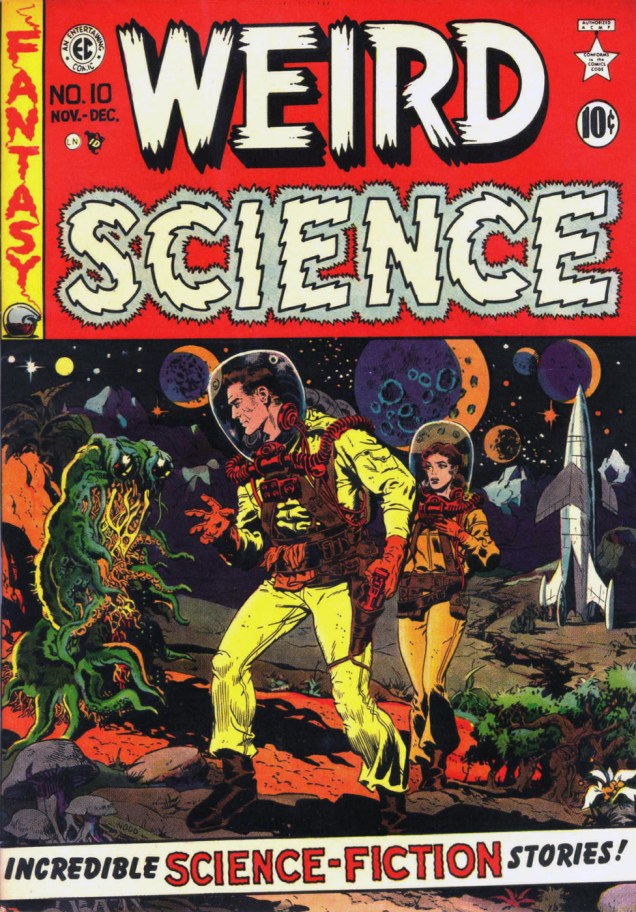
WeirdScience#10
Weird Science no. 10 (November-December 1951), art by Wally Wood.
WeirdFantasy#15
Weird Fantasy no. 15 (Sept-Oct 1952). Cover by Al Feldstein. The best cover that Feldstein has ever drawn? Quizás, quizás, quizás! The monster is doing a traditional Slavic dance, I think.

« While [Feldstein was] freer than most writers of his era to indulge his fantasies, he was also more punitive toward the characters who acted them out. John Updike tormented adulterers with depression and guilt. Feldstein lopped off their heads or burnt them alive. If they received a scarlet letter, it was branded on their flesh. In real life, sexual misbehavior might have cost one alimony. Feldstein made Shahira law seem like Thomas Jefferson had drafted it. Feldstein reflected a society which, while fascinated by sex, was terrified or ashamed of this fascination. » (source: Bob Levin in Let Us Now Praise Al Feldstein)
WeirdScienceFantasyAnnual#1
Weird Science-Fantasy Annual no. 1 (1952), art by Al Feldstein.
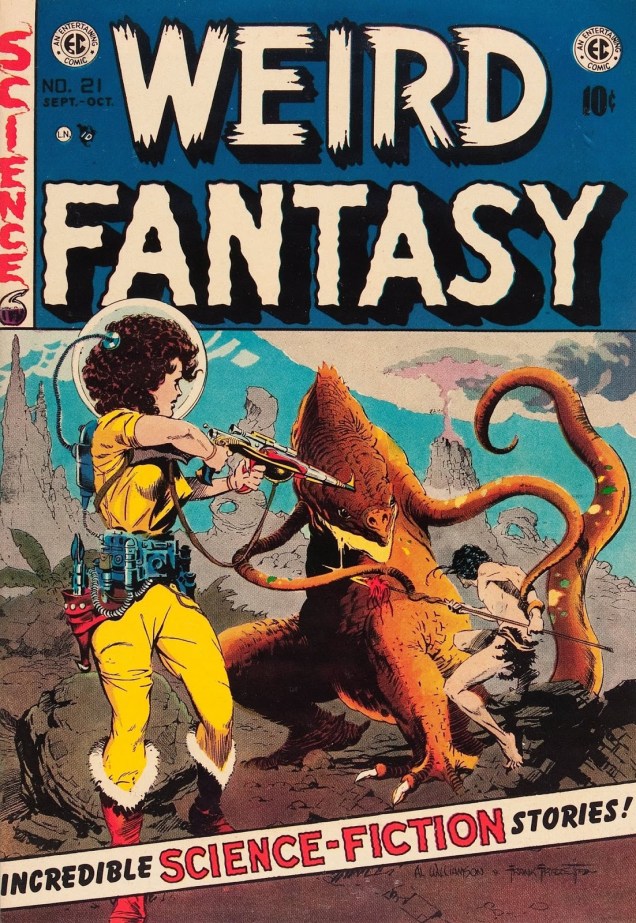
Weird Fantasy #21
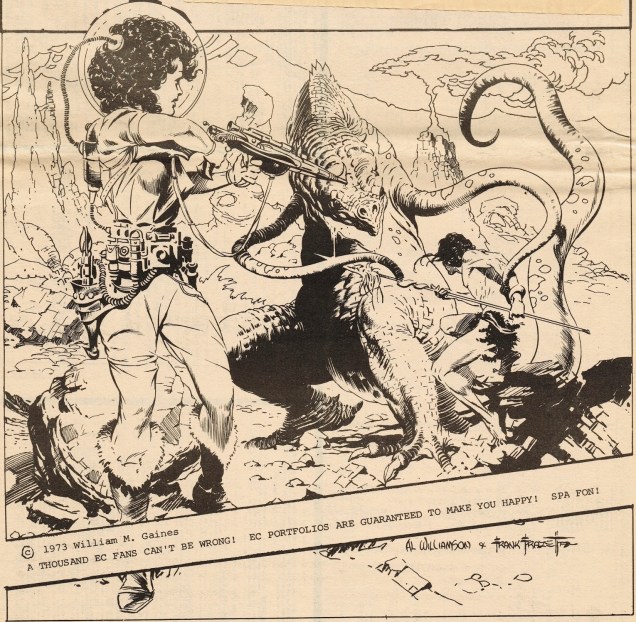
Weird Fantasy no. 21 (Sept-Oct 1953). Cover by Al Williamson and Frank Frazetta.

Weird Fantasy #21-detail

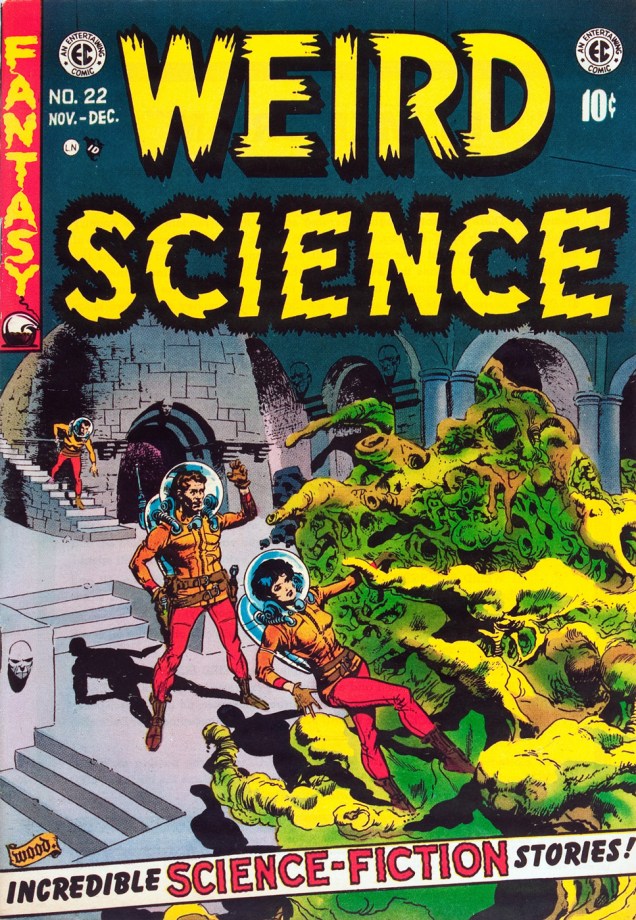
WeirdScience#22
Weird Science no. 22 (November-December 1953), cover by Wally Wood.
WeirdScience22detail
Detail from the title story, “My World”, scripted by Al Feldstein and drawn by Wally Wood. You can read the story over at Mars Will Send No More.
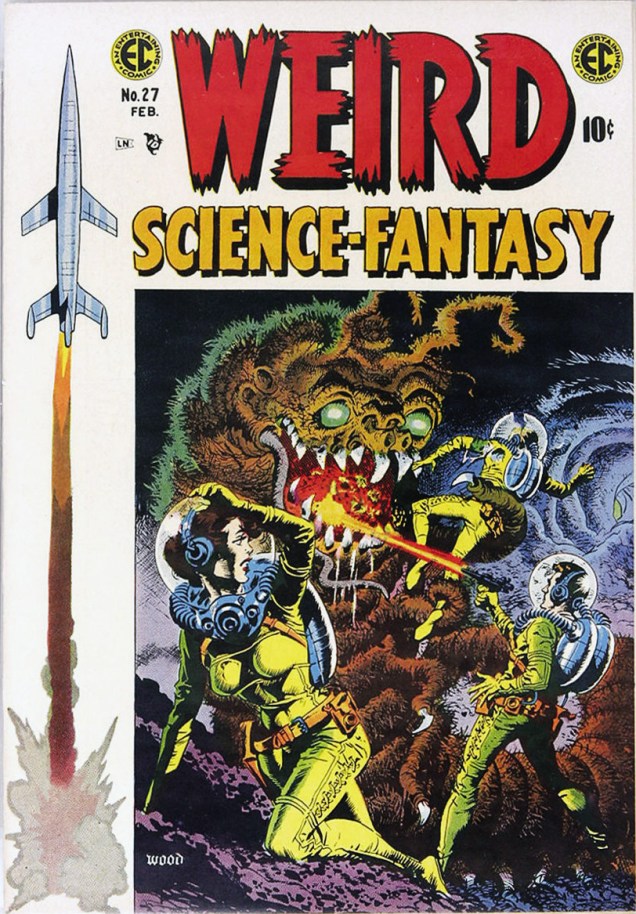
WeirdScienceFantasy#27
Weird Science-Fantasy no. 27 (January-February 1955), art by Wally Wood.

~ ds