Panning the murky old print stream for the odd glimmering nugget
They Called It… The Golden Age!
That’s the period opening with the advent of the first comic books, in the early 30s, and ending with the release of Showcase no. 4 in 1956 (introducing the new Flash), which signals the passage to the next era, the Silver Age, of course.
« I have learned to live each day as it comes, and not to borrow trouble by dreading tomorrow. It is the dark menace of the future that makes cowards of us. » — Dorothy Dix
Menace was a short-lived (11 issues, 1953-54, Atlas) horror anthology title that’s mostly remembered*, if at all, for its one-shot introduction of a zombi by the name of Simon Garth. Because Atlas never really played the gore card, its successor Marvel was able to mine most of its Pre-code material as cheap filler in their 1970s bid to flood the market. Don’t get me wrong, though; these titles were still a lot of primitive fun, and in most cases, I’d pick an issue of Weird Wonder Tales, Where Monsters Dwell or Uncanny Tales From the Grave over the latest Fantastic Four or Spider-Man.
The writing was by no means daring or even coherent, but the artwork was frequently rather fine, with none quite finer than Bill Everett‘s, particularly his covers, which elegantly straddled the line between fearsome and goofy.
I’d be tempted to say that Everett (1917-1973) was at his peak when he created these, but the bittersweet fact of it is that Everett was still at the height of his artistic powers, even as he was slowly dying in the early 1970s.
This particular hot streak ends not because Everett turned in a lesser job, but because other hands provided covers for the rest of the run. Talented hands, at that (Carl Burgos, Gene Colan, Russ Heath, Harry Anderson), but none of the other Menace covers are a patch on Everett’s mighty half-dozen.
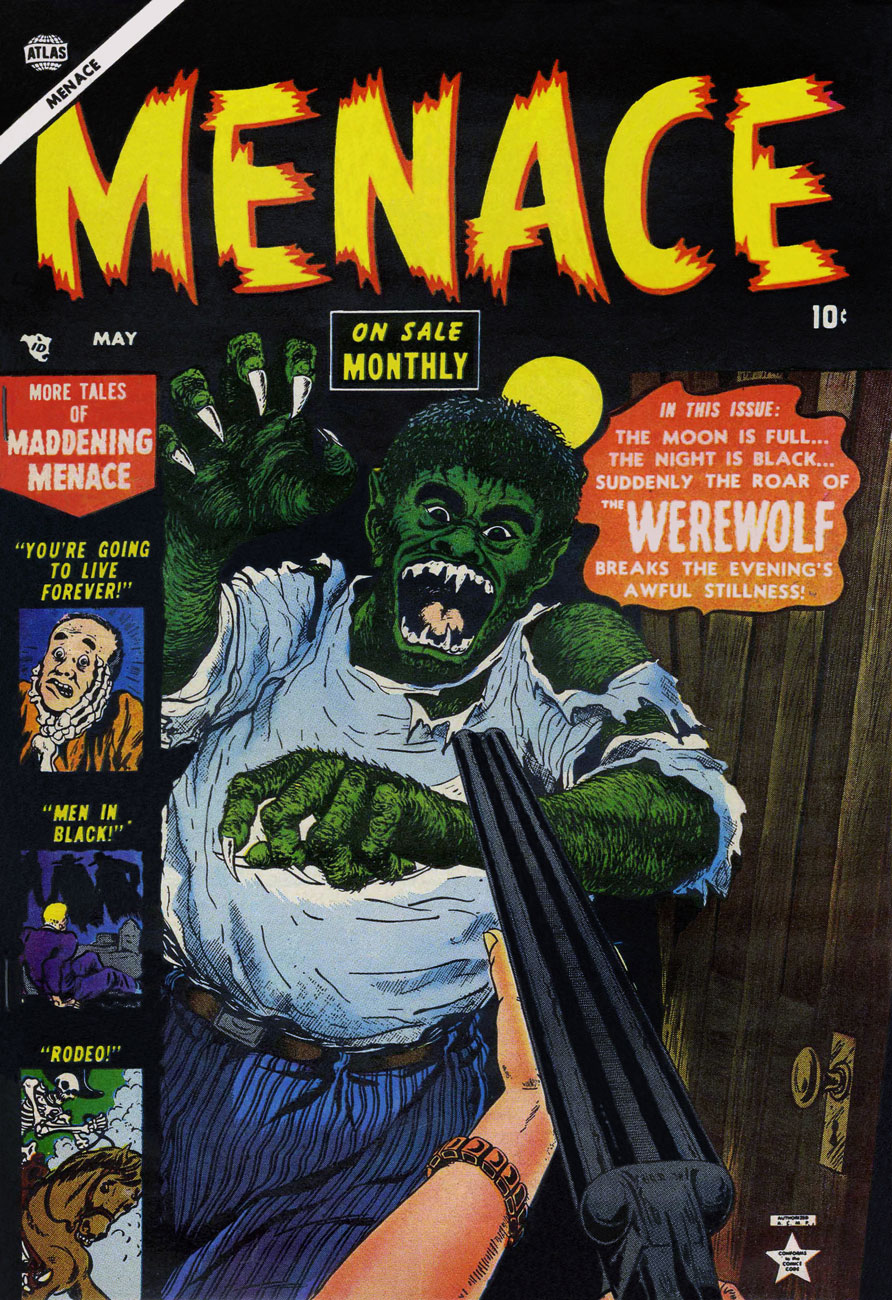
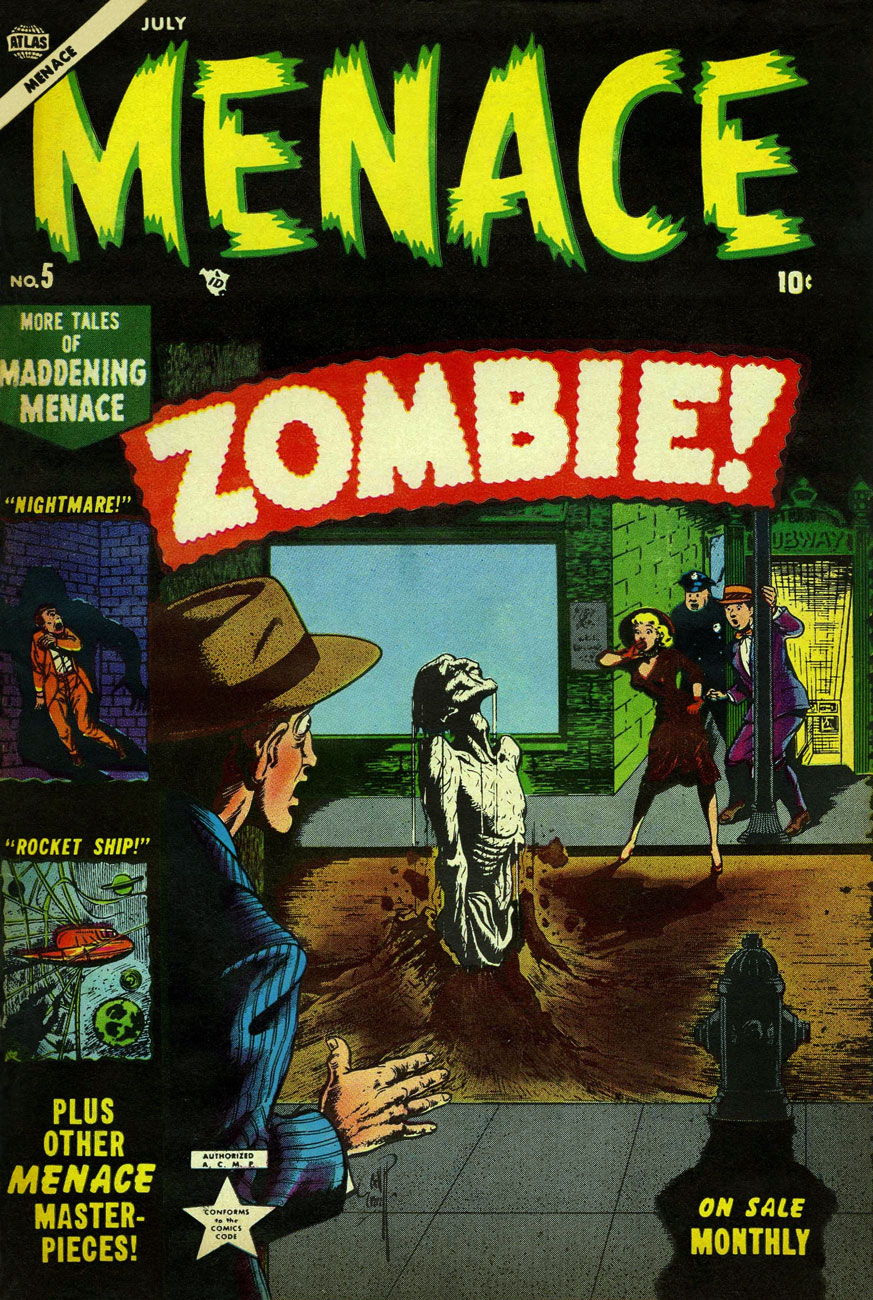
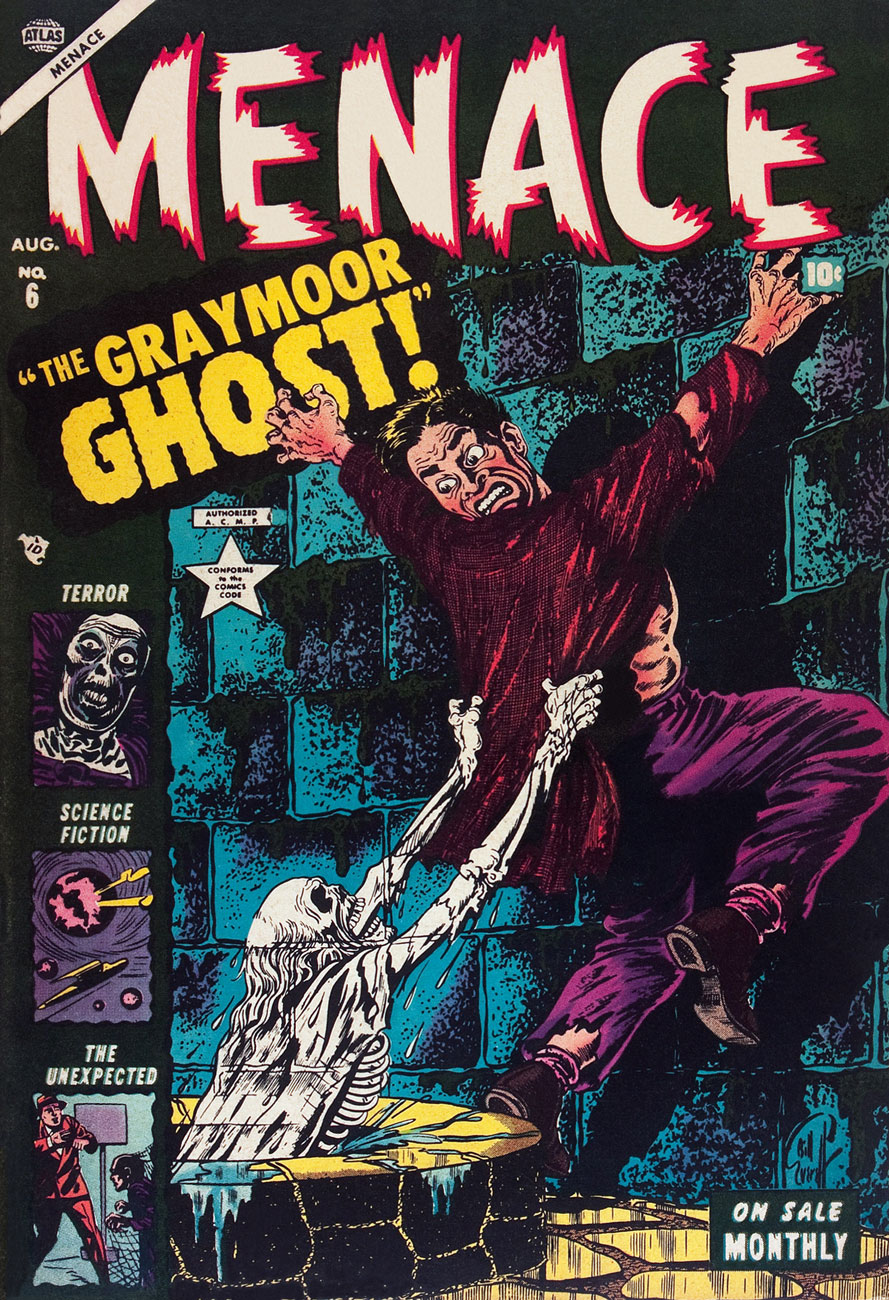
These monsters look kind of playful and kooky, don’t they? This is Menace no. 1 (March 1953, Atlas). Inside we find Everett, George Tuska, Russ Heath and Werner Roth art. Oh, and Stan Lee stories. Colours by Stan Goldberg.This is Menace no. 2 (April 1953, Atlas). Colours by Stan Goldberg.This is Menace no. 3 (May 1953, Atlas). Colours by Stan Goldberg. Was the title’s monthly schedule truly supposed to be a selling point?This is Menace no. 4 (June 1953, Atlas). Colours by Stan Goldberg.If you think that’s impressive, you should see what mushrooms can do to asphalt!** This is Menace no. 5 (July 1953, Atlas). Simon Garth was dug up (sorry) in 1973, likely at the behest of continuity addict Roy Thomas, to star (if you can call it that) in his own black & white magazine, Tales of the Zombie (10 issues, 1973-75). Like The Man-Thing, he was essentially mindless and shambling, and so mostly a pawn or an uncomprehending witness to others’ tragedies. The best of the mangy lot is, imho, The Blood-Testament of Brian Collier (TotZ no.7… read it here.) It’s not great, but it sure looks pretty, thanks to the sublime Alfredo Alcala, who’s quite in his element here.Don and Warren also met Simon. Read Lee and Everett’s 1953 Zombie!This is Menace no. 6 (August 1953, Atlas). Colours by Stan Goldberg.
That strange compulsion that’s creeping over you, that ungodly craving for more Bill Everett, cannot quite be slaked without incurring a terrible cost, be it in human lives, the forfeiting of your immortal soul, or both. But do check out my co-admin ds’ earlier tribute to Mr. Everett’s nightmares, Bill Everett’s Restless Nights of Dread, it might tide you over until dawn.
-RG
*these babies are rare, in any condition.
**Here’s an example:
« A bump in the garage floor turned into a half meter of mushrooms in little more than three days. It crushed its way through five centimetres of asphalt in Åge Reppes garage in Stord, western Norway. It is the water pressure in the cells of the fungus that makes it able to crack the asphalt, says a biologist at the local university. » [ source ]. These are inky caps. Edible, but some species are toxic when consumed with alcohol. These are commonly known as ‘tippler’s bane‘.
« Drosera’s snap tentacles — which can sense moving prey — catapult insects directly onto the glue tentacles at the plant’s center, where the prey is digested. What’s more, the catapult system is very effective—the insect almost never escapes. » (source)
Which child hasn’t passed through a temporary fascination with Venus flytraps in particular, and carnivorous plants in general? From there it only takes a tiny shift of the imagination to arrive at man-eating plants, which grab their victims with murderous tentacle-like tendrils, crawling vines and grabby creepers. Today we delve into one of my favourite sub-categories of tentacle obsession: plant tentacles.
This spine-chilling greenery often deploys its lethal vines in some remote corner of the Earth (well, in comics, at any rate). This, I firmly believe, is far scarier than the idea of other planets harbouring these carnivorous forms of life. After all, our chances of landing on Mars or somesuch are slim, and we’re a lot more (though not very) likely to wind up in some mysterious jungle.
But first, we deal with that old trope about a power-mad scientist breeding some man-devouring monstrosity in a pot, garden or greenhouse.
Shadow Comics v. 2 no. 8 (November 1942, Street & Smith), cover by Vernon Greene.
Page from Horror House, the cover story, scripted by Walter Gibson and illustrated by Jack Binder.
The Botanist of Death, scripted by Joe Blair and illustrated by Lin Streeter, was published in Blue Ribbon Comics no. 19 (December 1941, Archie)
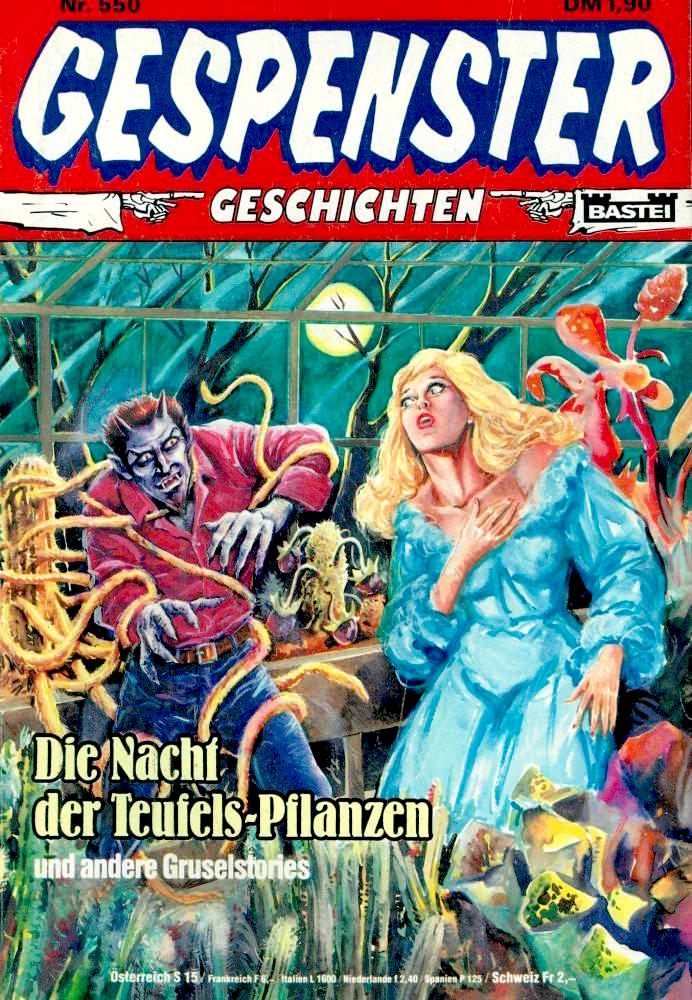
Gespenster Geschichten no. 550. One would think that a vampire getting restrained by a carnivorous plant is actually a *good* thing, but the lady seems unimpressed. Maybe she wanted to get bitten?
When I was a wee girl, my dad would give me piles of adventure books to read. Quite a few of them involved some intrepid explorers discovering (or literally falling into) a jungle (often hidden in some volcanic crater) in which prehistoric creatures had somehow survived (among the novels I remember reading were Sannikov Land and Plutonia by Vladimir Obruchev, The Lost Worldby Conan Doyle,Journey to the Center of the Earth by Jules Verne, The Land That Time Forgot by Edgar Rice Burroughs, etc.) Cue dinosaurs and woolly mammoths! As I loved dinosaurs, I didn’t mind this recurring theme, which by now seems a little, shall we say, hackneyed.
Turok, Son of Stone no. 26 (Dec. 1961-Feb. 1962, Dell), cover by George Wilson.
The cover story, The Deadly Jungle, is scripted by Paul S. Newman, penciled by Giovanni Ticci and inked by Alberto Giolitti.
Very much on topic is this installment of Land Unknown(a comic adaption of the 1957 science fiction movie), scripted by Robert Ryder and illustrated byAlex Toth, published in Four Color no. 845 (August 1957, Dell).
By the way, the Drosera plant (more precisely, a genus that includes about 152 species) – called Sundew in common parlance – is not only lethal, but beautiful, too.
A real-life plant tentacle in action – goodbye, little insect.
I’m always happy to revisit Wonder Woman in her glorious young days of being depicted by H. G. Peter, whose expressive, dynamic art I just can’t get enough of. The stories are none too shabby, either! In my earlier post, Tentacle Tuesday: H.G. Peter and Wonder Woman lend a hand, I overlooked a few choice cuts. Well, having spent a few delightful hours going through WW stories originally published in Wonder Woman, Sensation Comics or Comic Cavalcade, it is my pleasure to remedy my previous oversight, and I can possibly even claim that these two posts are a pretty definitive list of Wonder Woman’s tentacular entanglements.
Do you have a few hours to waste – pardon – dedicate to research, too? Here you can read the entirety of DC’s Wonder Woman: Golden Age multiple-volume omnibus. Personally I think the graphic designers responsible overamped the contrast when they cleaned up the images, and much prefer reading these stories in their original colour… but nothing beats having all of this stuff on one website for convenience.
All stories are written by William Moulton Marston with art by Harry G. Peter.
Demon of the Depths, printed in Wonder Woman no. 7 (winter 1943):
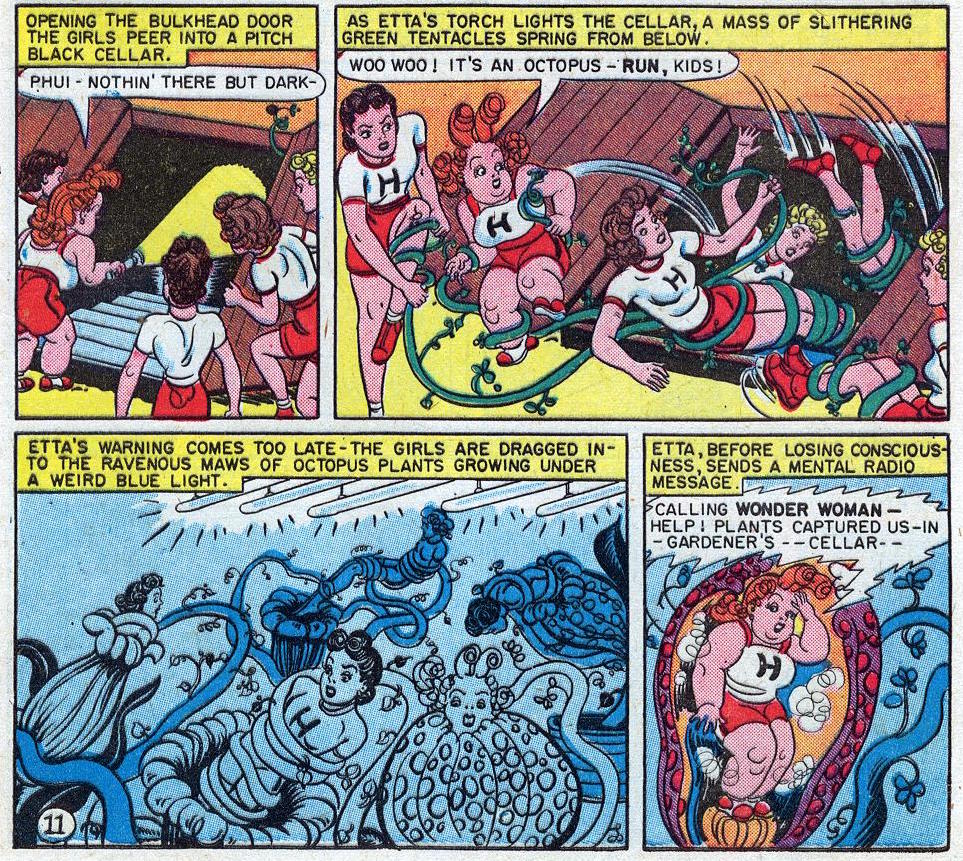
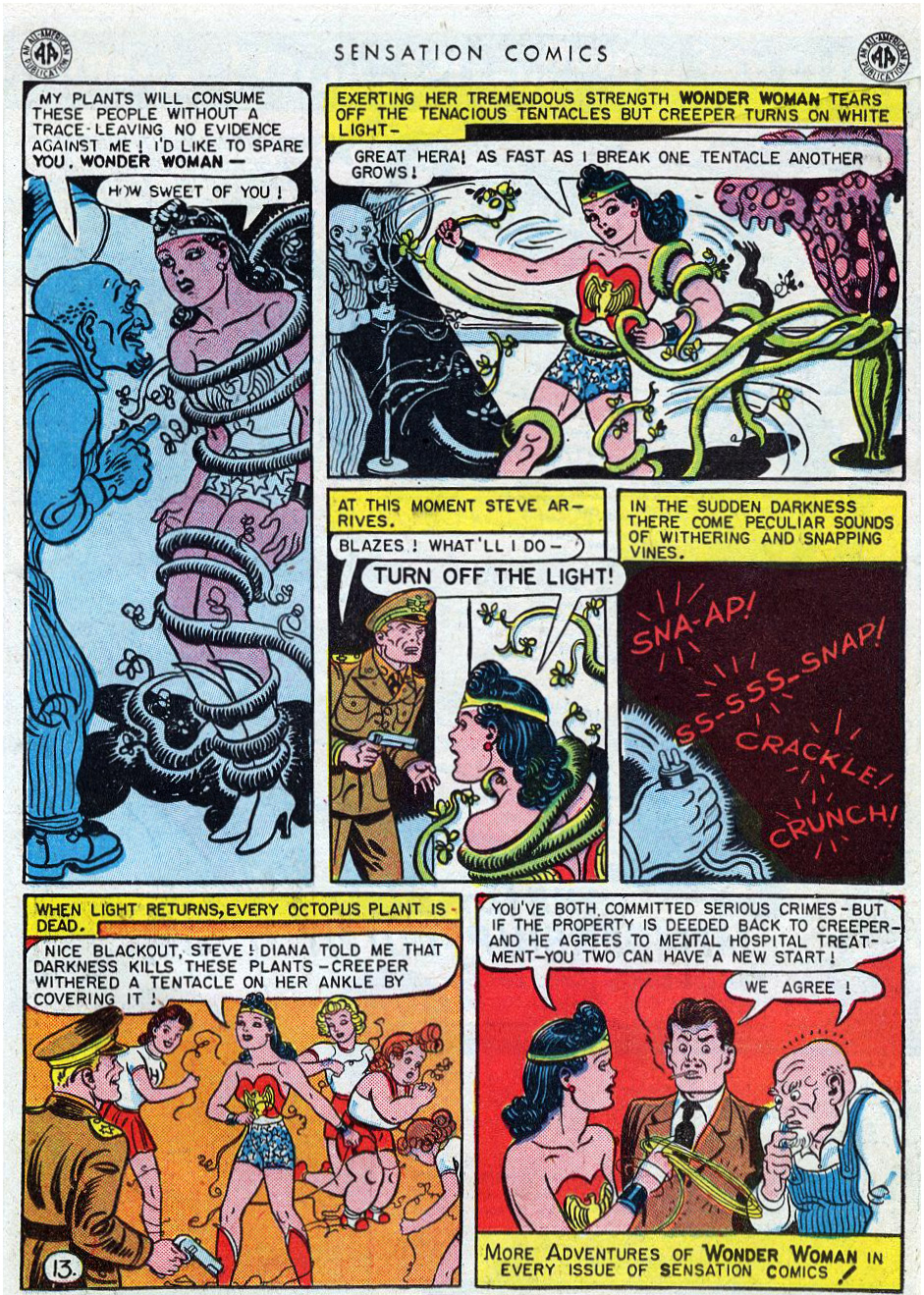
The Adventure of the Octopus Plant!, printed in Sensation Comics no. 41 (May 1945):
This is not strictly tentacle-related, but I would also like to share a few choice panels that I’ve stumbled upon while looking for tentacles. Gorgeously weird, they remind us just how strange, inventive and subversive Wonder Woman was in her glory days of yore!
Etta is my favourite character, and this is a great showcase for her sense of humour! Sensation Comics no. 5 (May 1942)
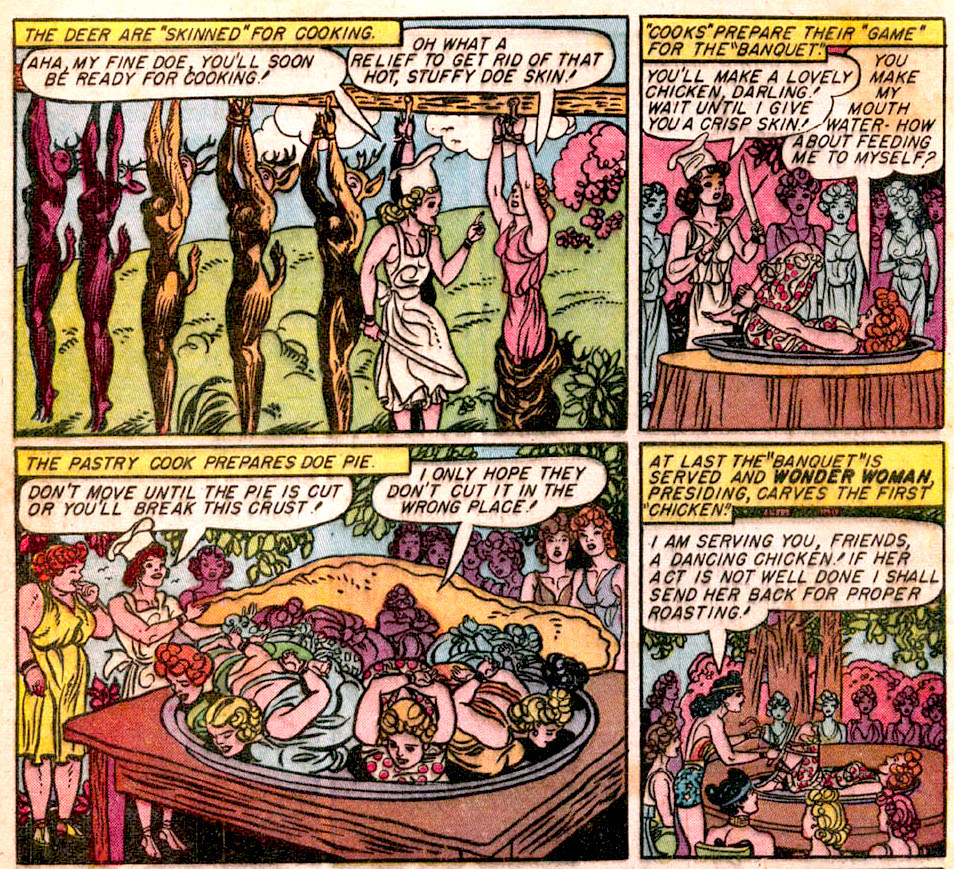
This is apparently a standard Amazonian ceremony – the girls dress as deer, are hunted and captured, and then cooked and consumed. Wonder Woman no. 3 (February-March 1943)
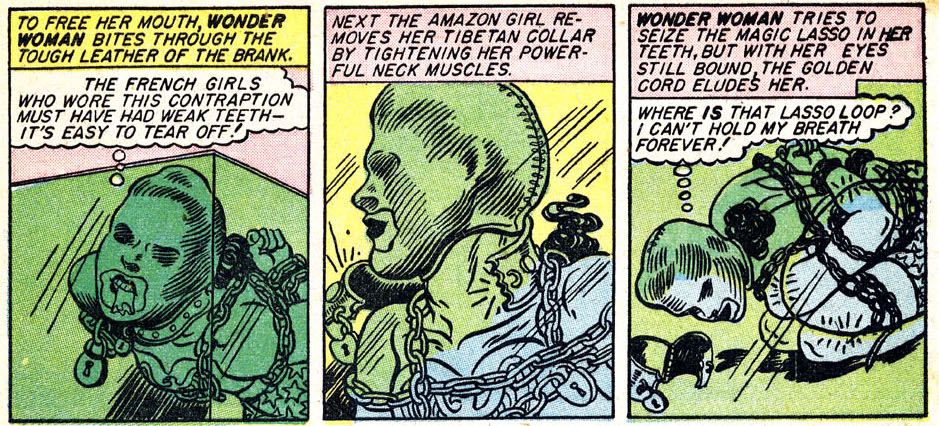
I had to use at least one scene of bondage, right? I was mostly amused by the quip about French girls. Wonder Woman no. 6 (Fall 1943).
Sensation Comics no. 41 (May 1945)
And voilà! But don’t fret, we will see Wonder Woman in the tender embrace of an octopus again… this time in the 60s, Robert Kanigher and all.
Wonder Woman versus the Saboteurs, printed in Sensation Comics no. 5 (May 1942)
« And something horrible is going on in Foley’s body! Come at once! Come quickly! »
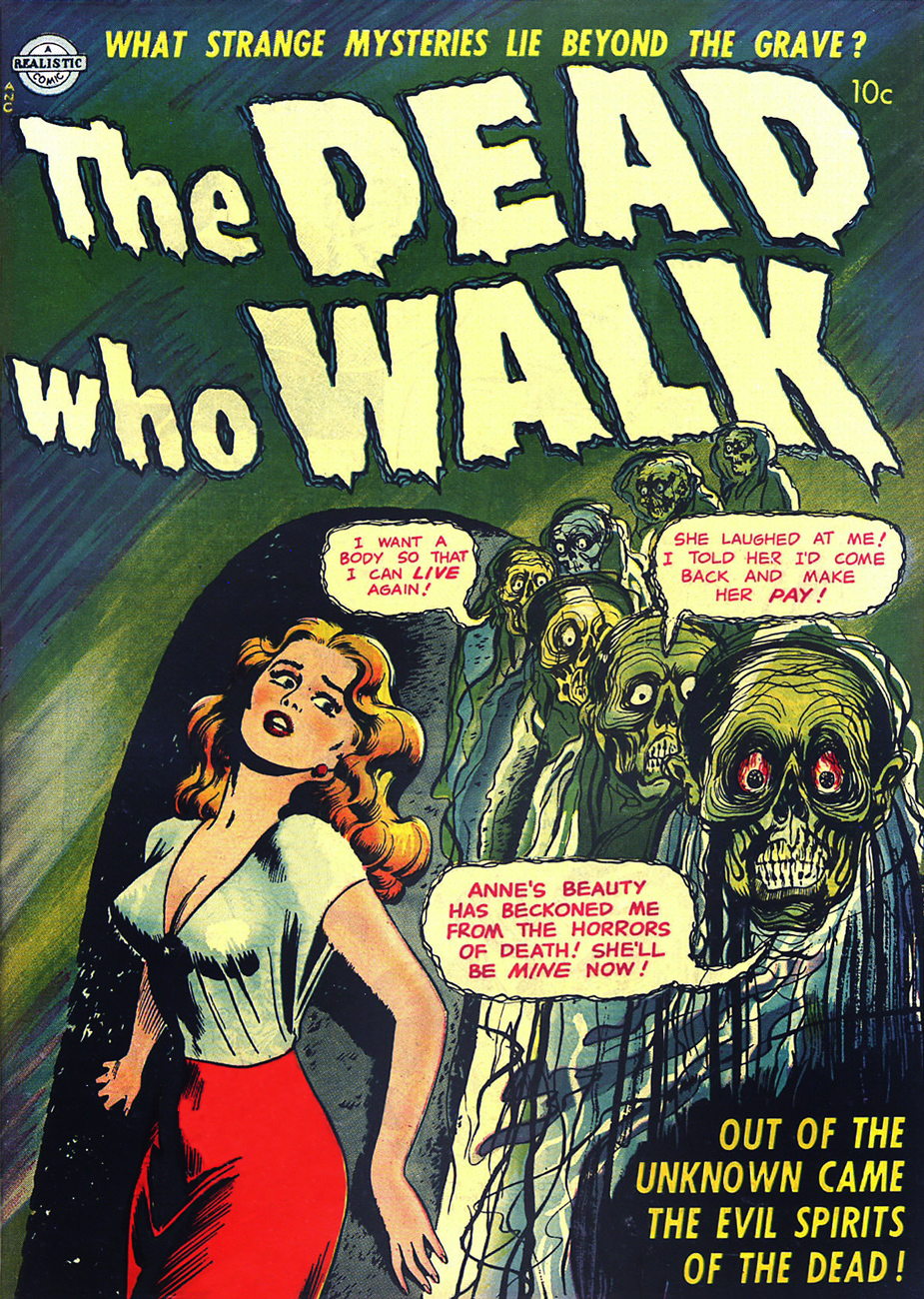
The Dead Who Walk is a mysterious one-shot from 1952. It was issued by Realistic Publications, an ephemeral publishing arm of Avon Books, during the decade that they haphazardly dabbled in the funnybook field.
Boy, whatever you can say about Anne, she certainly made an impression.
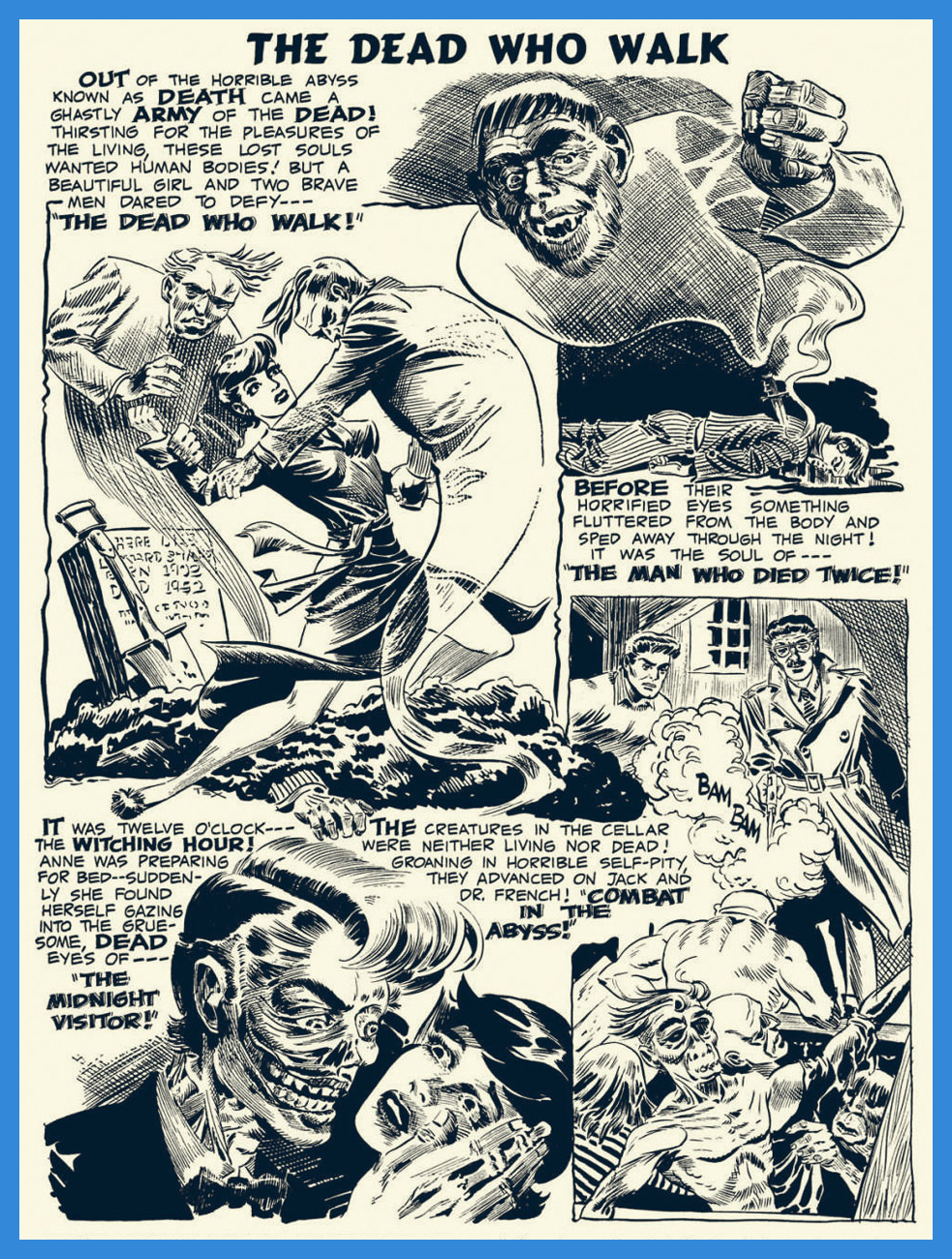
The pungent dialogue and its implications aside, what fascinates me about this lavishly grotesque cover is the jarring schism in art styles: the damsel in peril is of the classically-buxom Matt Baker–Nick Cardy species, while the revenants belong to an expressively oddball Edvard Munch–Manny Stallman–Jerry Grandenetti school. As far as I know, the cover artist(s)’s identity is lost to time and obscurity. It has been established, thanks to a signature, that the insides were provided by longtime jobber Tex Blaisdell… a rather stiff and workaday performance, regrettably. But the cover assuredly isn’t his, no matter what the good ol’ GCD says.
The most accomplished interior page, in my view, is the inside front cover intro. Art by Tex Blaisdell.
A favourite trope of tentacular obsession in comics is populating stories with monsters boasting exceptionally long arms (sometimes more than one pair) that they can wind around stuff with ease. In other words, monsters with tentacle forelimbs. You’d have to abstain from comics altogether to never encounter that of which I speak (or stick to slice-of-life comics, I guess). A little demonstration is in order.
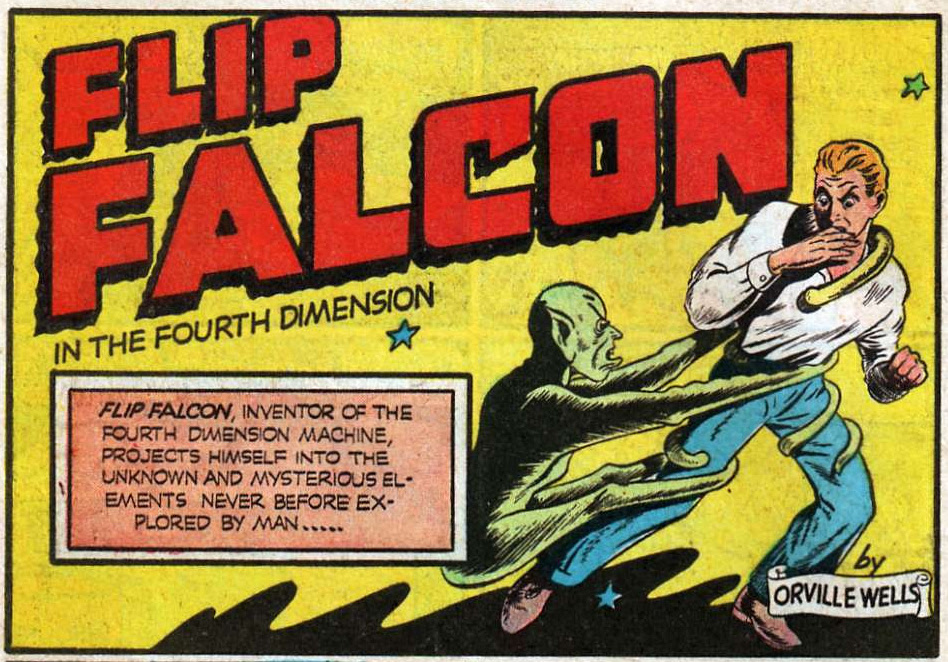
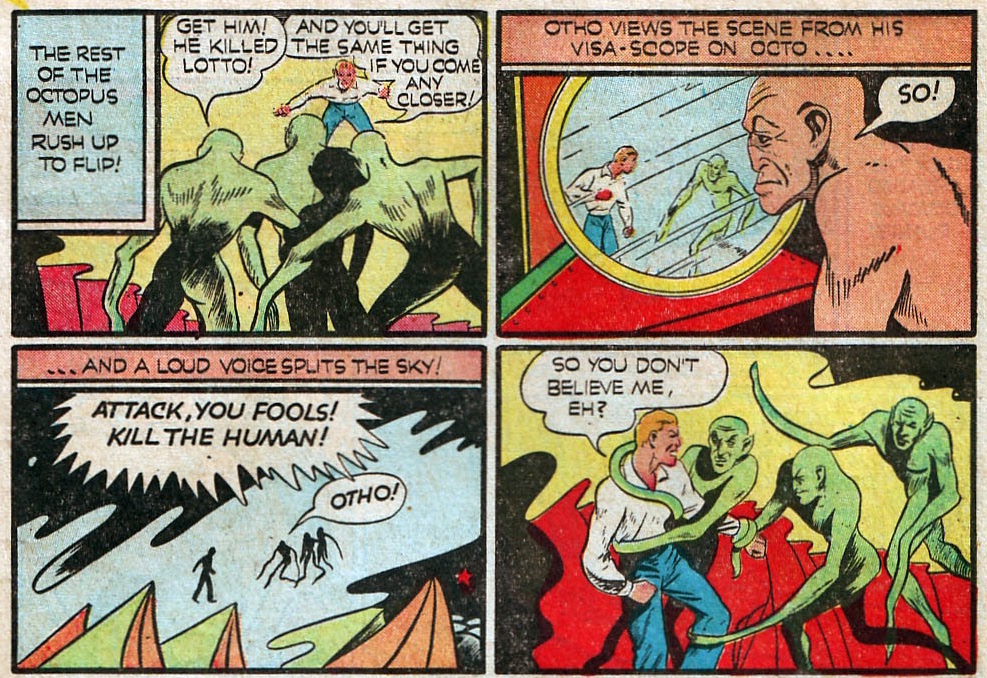
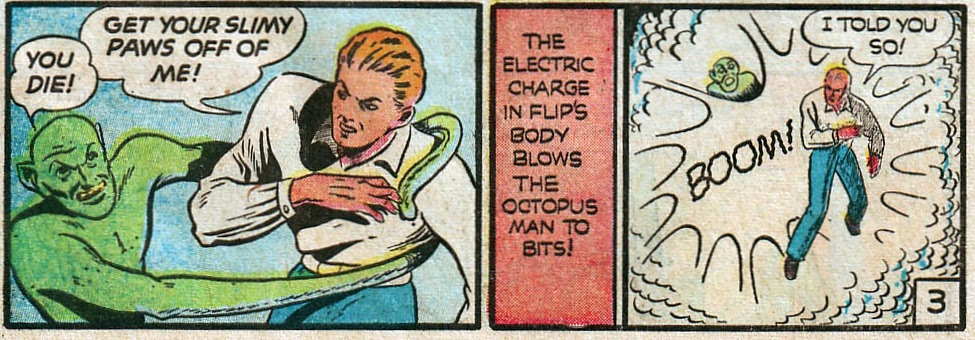
Here’s a trick question: what kind of being lives on planet Octo? Duh: Octo-men! The following Flip Falcon story, illustrated by Don Rico (and not “Orville Wells”, despite claims to the contrary), was printed in Fantastic Comics no. 17 (April 1941).
Interesting that “dog” is used as a slur even on planet Octo, despite there clearly being no canines around.
Nasty little brutes, aren’t they?
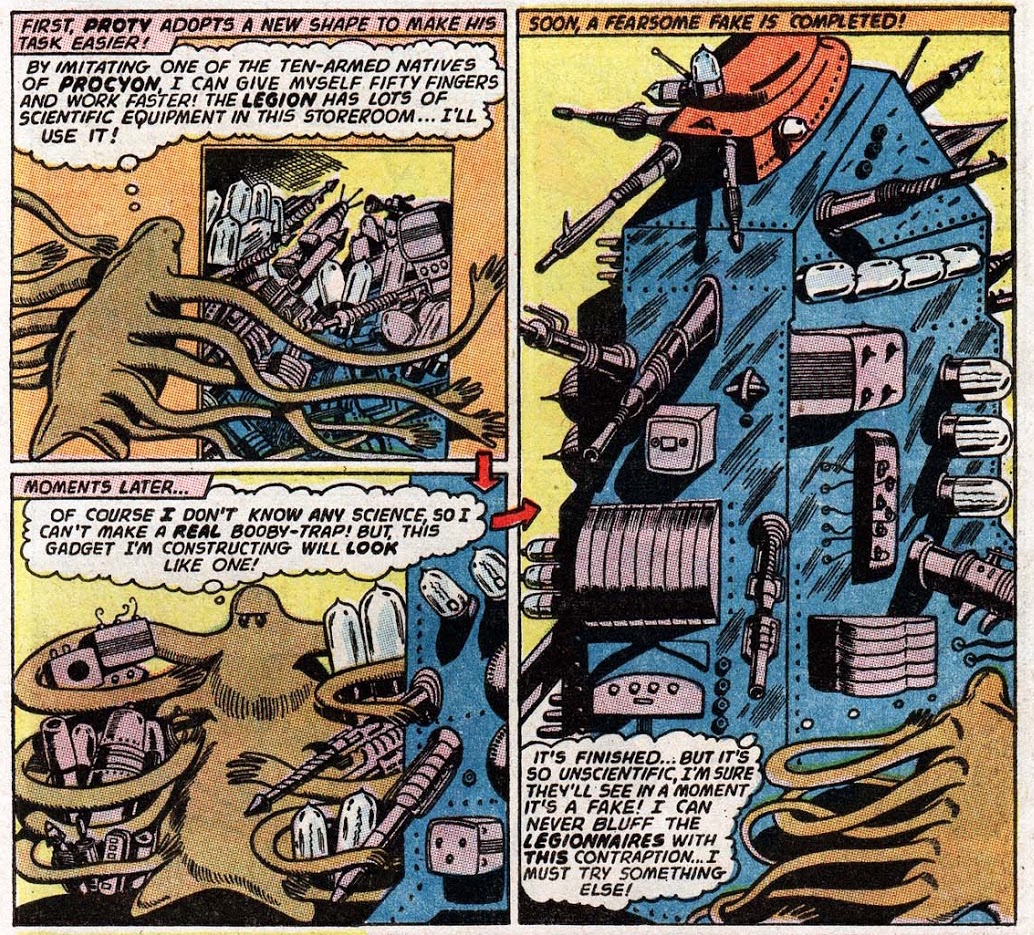
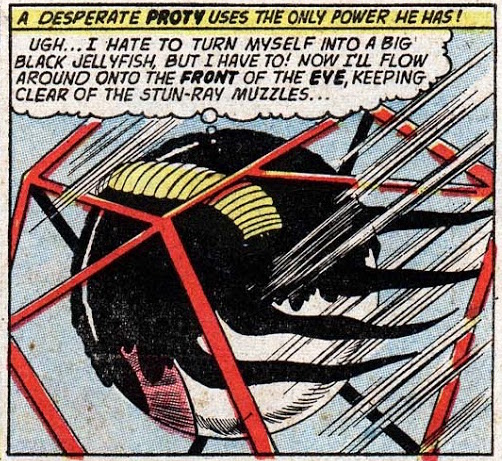
The Super-Tests of the Super-Pets! (scripted by Edmond Hamilton, penciled by John Forte and inked by Sheldon Moldoff) is every bit as goofy as it sounds. I actually enjoyed reading it, much to my own amazement. Anyway, while Proty II (Chameleon Boy’s pet) transforms into quite a few creatures to pass the super-test, he clearly favours tentacular forms (and who could blame him?) This was published in Adventure Comics no. 322 (July 1964).
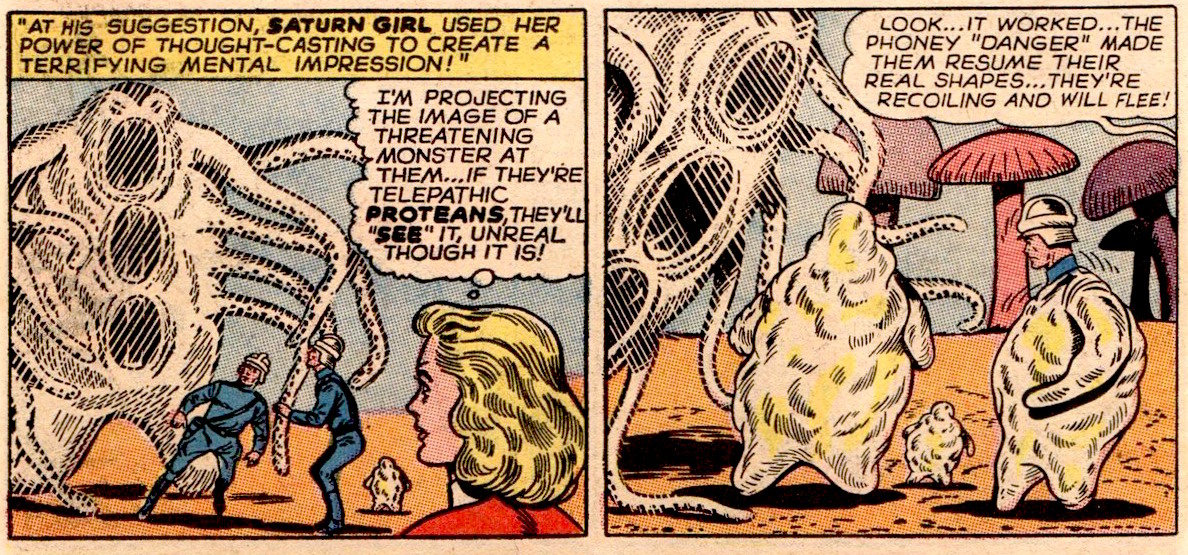
Speaking of Proty II and ectoplasm, a dozen issues later, the Legion decides to visit his home planet, which is just full of these jello-marshmallow doughboys, Protean citizens all. Part I: The Unknown Legionnaire and Part II: The Secret of Unknown Boy! (both parts scripted by Edmond Hamilton, penciled by John Forte and inked by Sheldon Moldoff) were published in Adventure Comics no. 334 (July 1965).
To terrify Proteans, whose appendages are borderline tentacles, Saturn Girl decides to conjure up a… monster with tentacles.
In case you didn’t believe me that Proteans have “tentacles”.
The shape-shifting Proteans turn into more streamlined versions of themselves, with more pronounced tentacles. I swear, everyone is obsessed.
Next, I’d like to regale you with a fight scene illustrated by Murphy Anderson (yum!): Scourge of the Human Race!, scripted by Gardner Fox and published in Hawkman no. 15 (August-September 1966).
Isn’t it a lovely last panel?
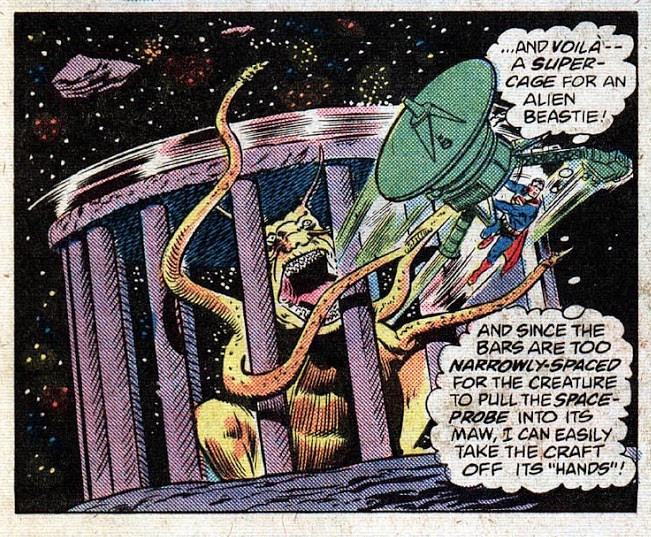
If I Can’t Be Clark Kent… Nobody Can!, published in Action Comics no. 524 (October 1981), scripted by Martin Pasko, penciled by Curt Swan and inked by Frank Chiaramonte, offers us a nice helping of tentacles.
If I should see an octopus Lift its arms out of the sea Or see its shadow rising up Cross the rooftops above the streets I’d follow those dancing limbs To the spinning edge of the sky Where all the boats fall off the world Into the octopus’s eye
« Behind every tree there’s a new monster. » — Todd Rundgren
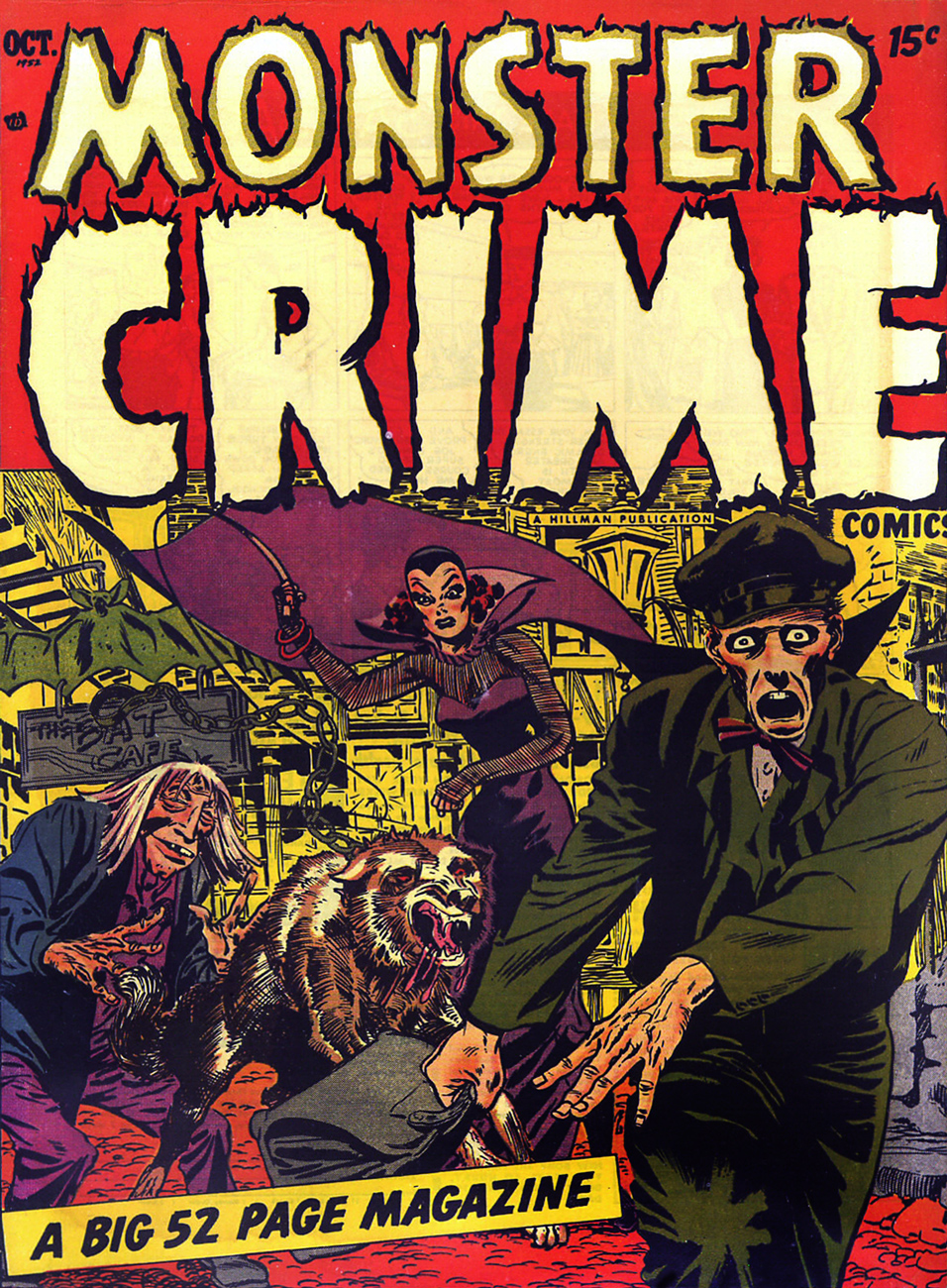
Now how can you go wrong with a genre-melding title like this? Did publisher Hillman Periodicals decide it was entirely too much of a good thing, and nip it in the bud? Who wrote and drew the darn thing? Nearly seventy years on, these are not easily-answered questions.
Anyway, the lone, unnumbered issue of Monster Crime Comics rolled off the presses in the fall of 1952, it’s a pretty scarce item, as they say in the trade, and it features the sordid tales of The Crutch to Paradise, Another Hallowe’en, The Boss of Ice Alley, Oregon Tiger, The Canvas Tomb, The Cold Doorstop, and The Two-Legged Newspaper.
« A low print run and high price for the time (15 cents!) combined to make this one-shot among the rarest of the era’s crime comics, with perhaps 20-100 copies surviving. The over-the-top cover contributes to the book’s fame, particularly because it has nothing to do with the contents. Pre-Code crime comics from Hillman, possibly printed to clear out a backlog before the publisher ended its comics lineup a few months later. » [source]
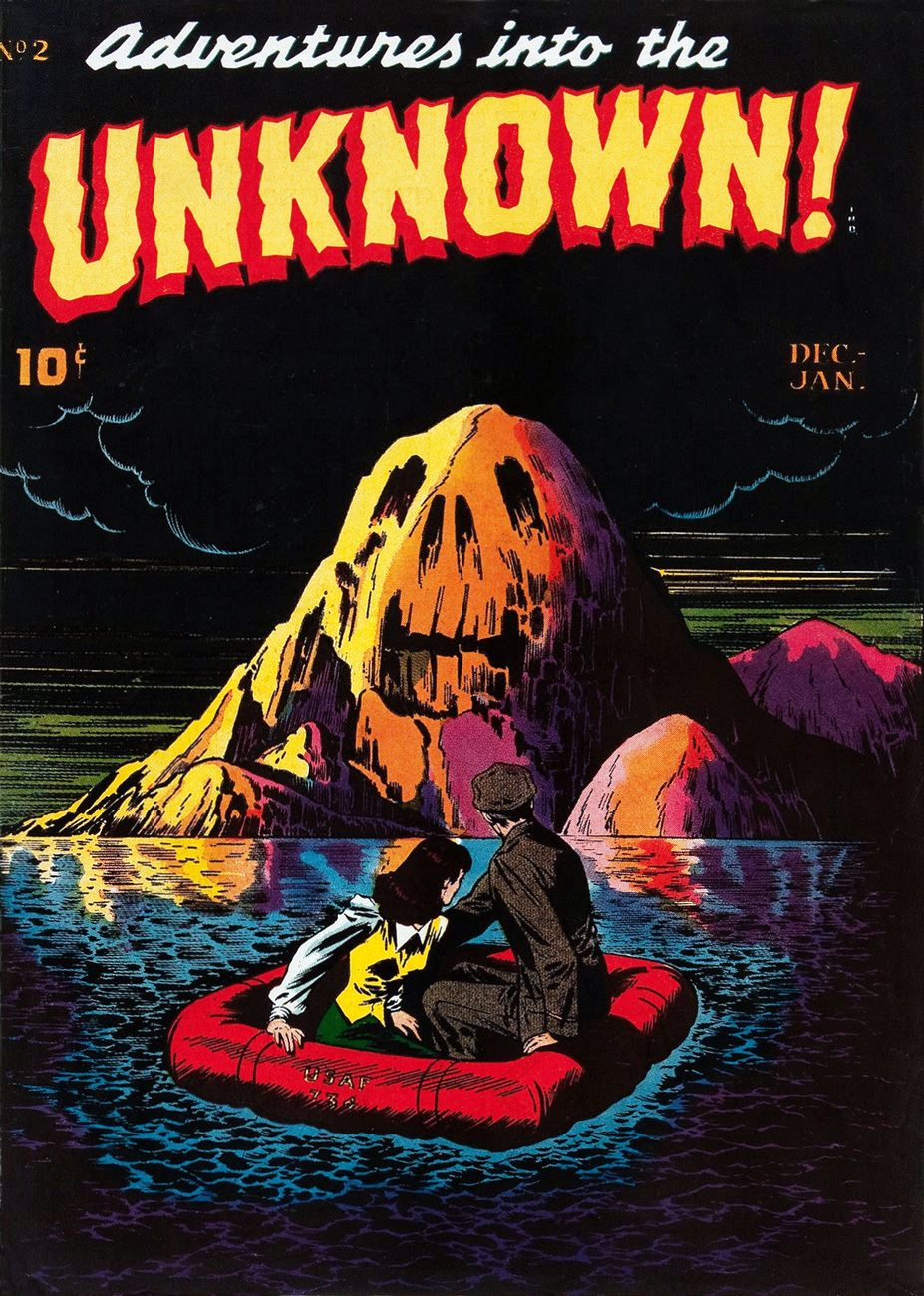
« Spine-chilling tales of suspense, horror, and the supernatural—prepare yourself for Adventures into the Unknown! »
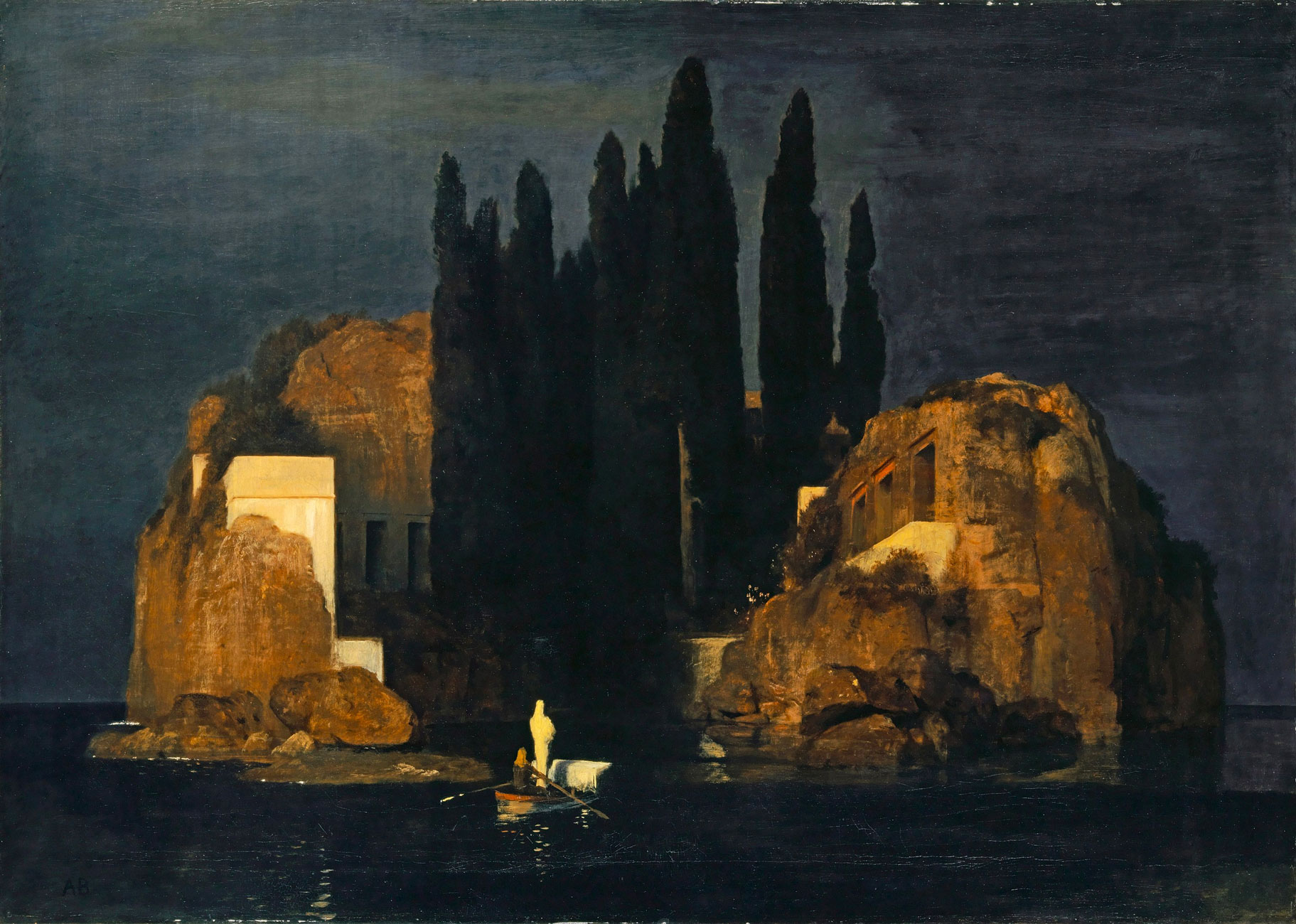
This American Comics Group (ACG) entry is generally considered the first title fully committed to the supernatural genre in the history of US comics. And this arresting, Isle of the Dead-styled tableau graces the cover of the title’s second issue (December, 1948). Art by Edvard Moritz. Most of the stories were scripted by horror legend and H.P. Lovecraft disciple Frank Belknap Long (read his The Hounds of Tindalos and forfeit your soul!) Speaking of which, the entire issue’s contingent of chills and thrills is available right here for your pleasure and leisure.
This is Adventures Into the Unknown! no. 2 (Dec. 1948 – Jan. 1949, ACG).
Sometimes I stumble upon a comic with a fight-to-the-death scene in which something-or-other- with-tentacles plays the role of a lethal enemy for our hero – but upon closer inspection, in turns out that the ferocious creature is… gosh-darned cute. I mean, how can you kill anything that has adorable whiskers, or tufted eyebrows like Oscar the Grouch?
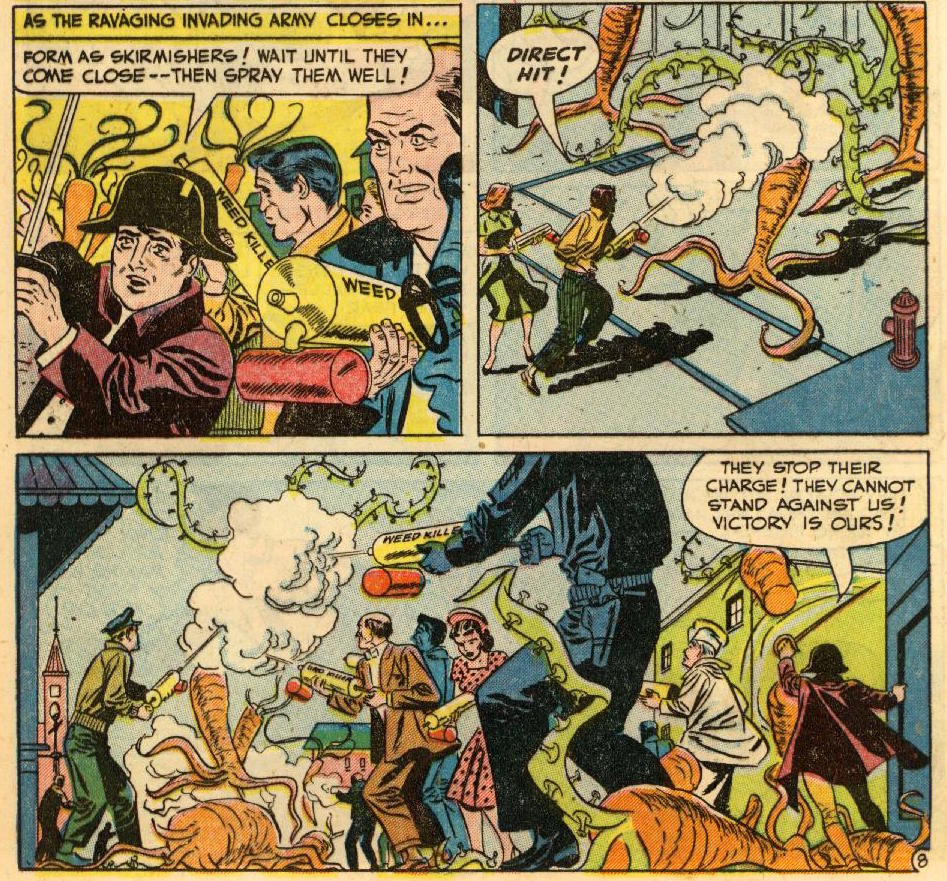
When your attackers are carrots with tentacles, and they really get on your nerves (although I think Ann is safer with them than with Dr. Maylor), I’d suggest throwing them into a nice big pot of soup, maybe… but if you please, do consider abstaining from flinging acid at them.
I do believe that prehensile vegetables fit into the category of “cute” – just look at their precious little root-legs! Page from Heroes Out of Time!, scripted by Manly Wade Wellman (hey, cool!), with some very stylish art by Bob Oksner on pencils and Bernard Sachs on inks, printed in Mystery in Space no. 3 (August-September 1951).
While we’re on that topic: things get delightfully wacky and madcap (not much) later in the story. Namely, Napoleon Bonaparte and Benjamin Franklin are summoned for help against the tentacled carrot-horde.
The Flaming Carrot would not be pleased by this massacre. If only to admire the art, you can read Heroes Out of Time!here.
Thank you kindly for suppressing your urge to sock the creature sporting a unibrow and bloodshot eyes worthy of Christopher Lee; it’s also not his fault he got lumbered with such a shaggy wig.
Detail from the cover of The Marvel Family no. 80 (February 1953), pencils by C. C. Beck and inks by Pete Costanza.
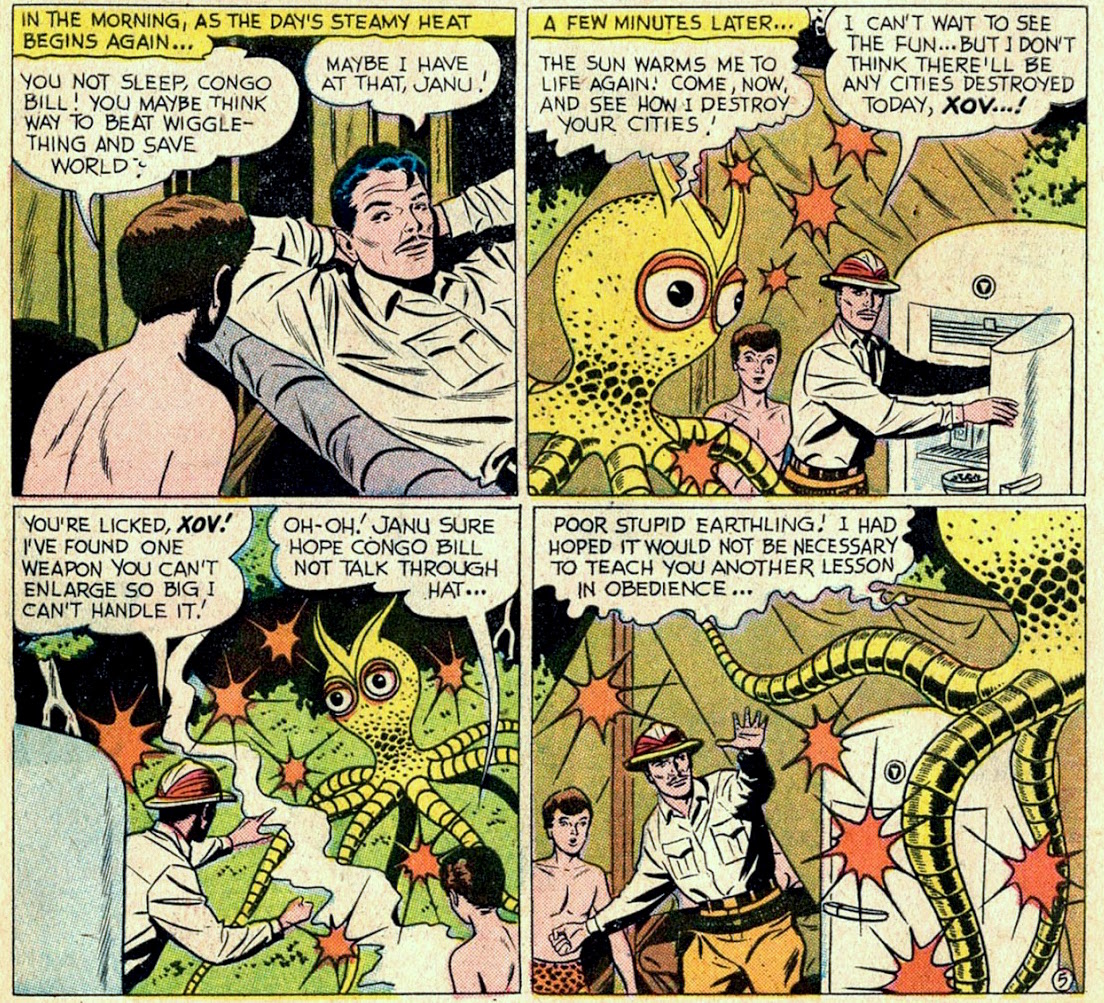
Have the goodness to think twice before pitching lethal ice cubes at an owl, even if it somehow grows metal tentacles and threatens to make mince-meat of humanity, because owls are the very cutest.
Panels from The Man-Ape Skin Diver!, scripted by Robert Bernstein and drawn by Howard Sherman, published in Action Comics no. 257 (October 1959).
“Wiggle-thing”? Excuse me?
Pray, don’t kill anything that looks like it’s wearing a dragon wearing a really bad disguise, including a moustache that looks like a pile of hay.
A panel from Fate is the Killer (a preview of a Masters of the Universe story), scripted by Paul Kupperberg, pencilled by Curt Swan and inked by Dave Hunt, published as a promotional bonus in several DC titles cover-dated November, 1982.
If you would be so good as to spare the creature that looks like a mashup of a seal and a mole, especially if it gazes at you mournfully with world-weary sadness.
Masters of the Universe: The Vengeance of Skeletor! (1982), cover by Alfredo Alcala.
« The stranger’s face was entirely obscured by a broad-brimmed felt hat bent downward over his features; and the long, black coat looked almost like part of the thickening fog. » –Harry Vincent first encounters his future employer. (Shadow Magazine, April/June, 1931)
We note today the birth anniversary of Walter B. Gibson (September 12, 1897 – December 6, 1985), an extremely prolific writer and professional magician. Gibson is best known for developing the radio character of The Shadow, through nearly three hundred stories he wrote under the collective nom de plume of Maxwell Grant.
The Shadow’s had an interesting and varied career in comics, but Gibson’s novels (and the radio shows… Orson Welles!) are where it’s at. Still, let’s take a look around, shall we?
This is The Shadow Comics Vol. 3, no. 12 (March, 1944, Street and Smith); cover possibly by Vernon Greene. That Thade seems like a friendly sort, mayhap a tad overly so.
This is The Shadow Comics Vol. 7, no. 12 (March, 1948, Street and Smith); cover by Bob Powell.
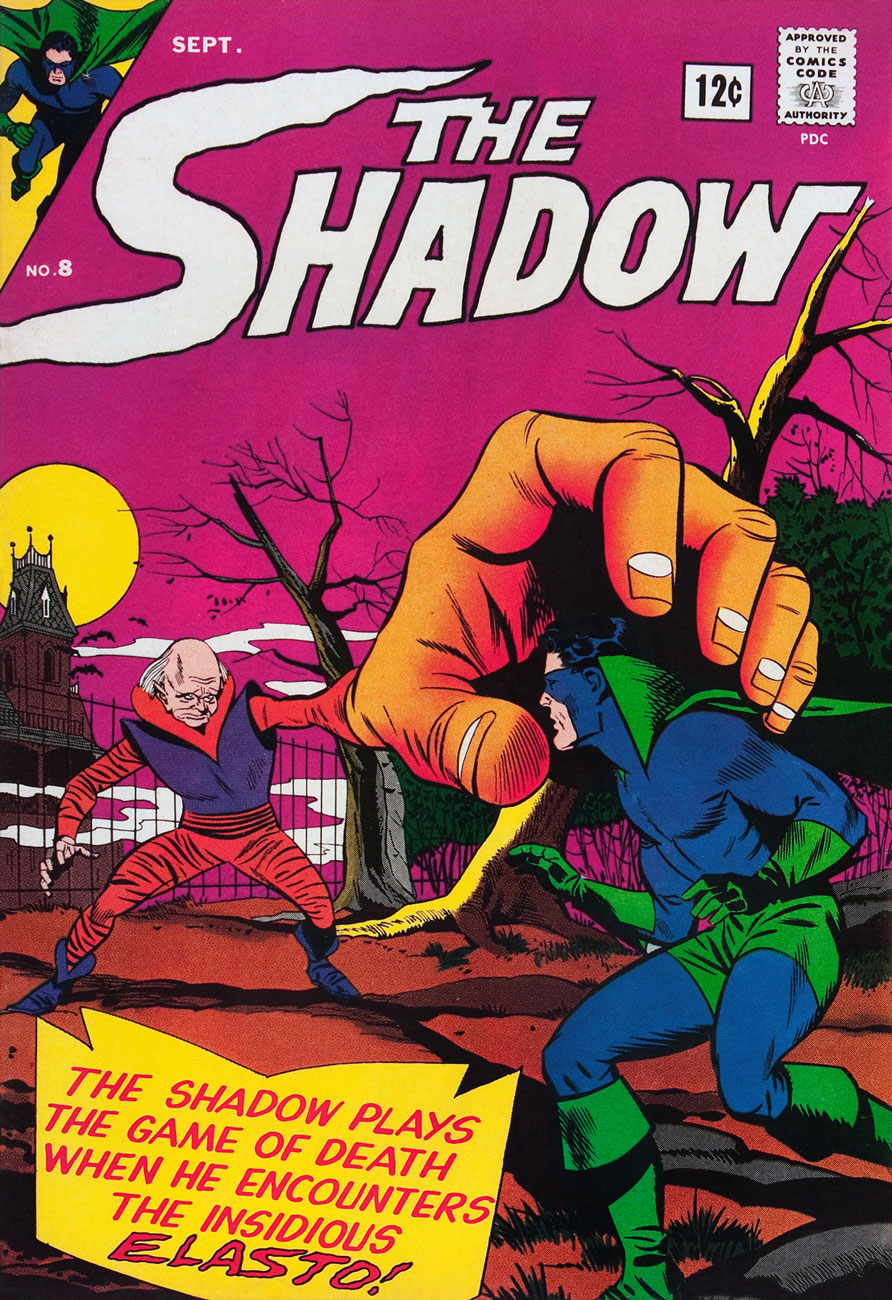
Now why were Archie Comics allowed to take such ridiculous (though I’ll grant, perversely entertaining) liberties with The Shadow? Must have been a lull in the revival market, I suppose. This is The Shadow no. 1 (August, 1964, Archie), cover by Paul Reinman. You just wait until the subsequent issues…
This, however, is not quite how Gibson envisioned and portrayed the mysterious Shadow. This off-model rendition hails from Archie Comics’ 8 issue, 1964-65 run, helmed by Superman co-creator Jerry Siegel and Golden Age journeyman Paul Reinman. This be The Shadow no.8 (September, 1965).
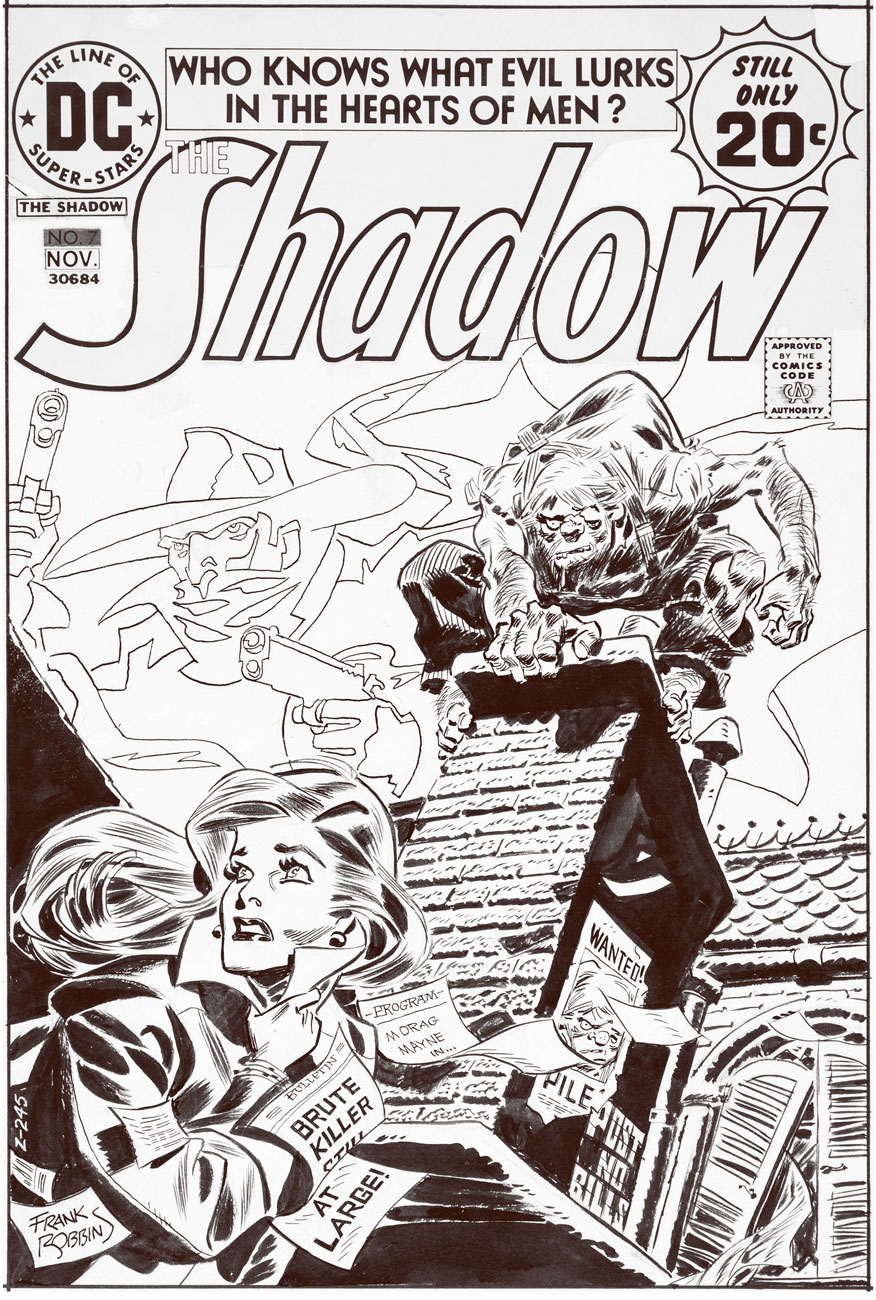
A privileged peek at Frank Robbins‘ original cover art for The Shadow no.7 (Nov. 1974), second of his four (or so) covers for DC, featuring Night of the Beast!, scripted by Denny O’Neil. Yummy… but too short.
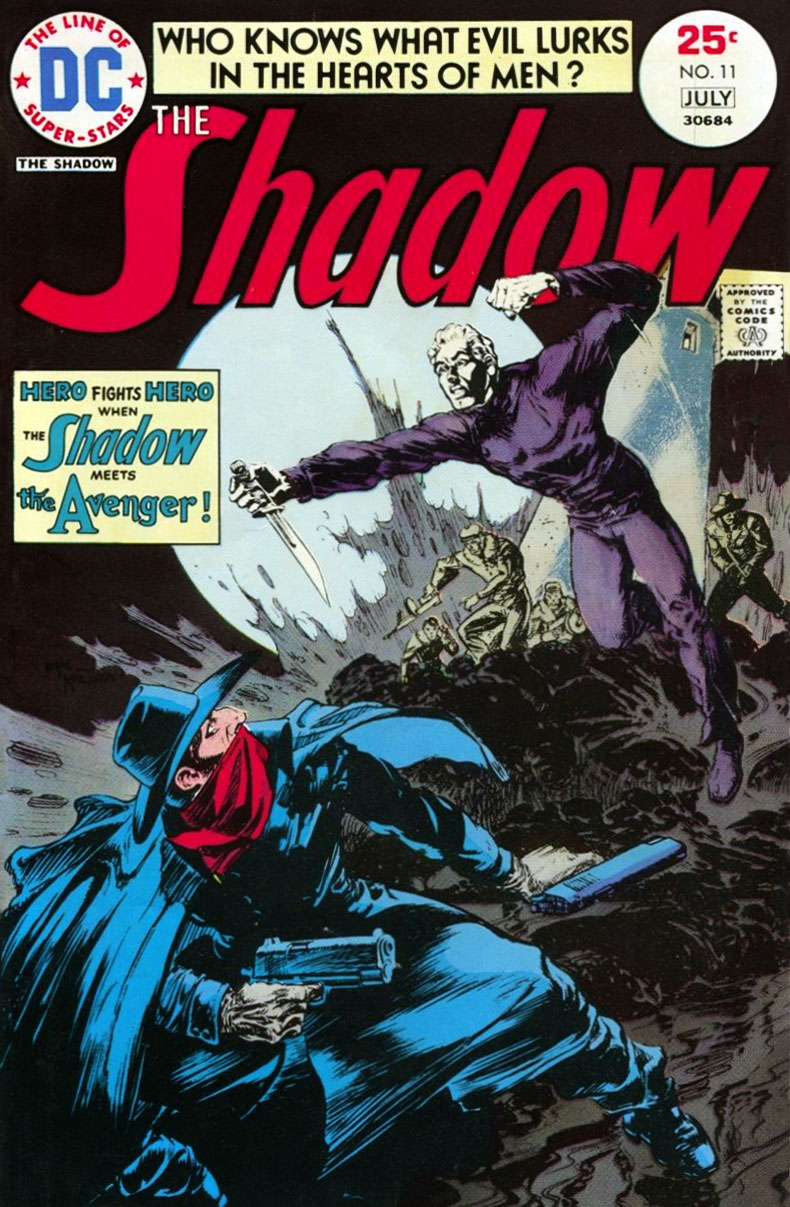
Two great Street & Smith pulp heroes face off! Mr. Kaluta takes some artistic license here, however, since Ike (as The Avenger calls his throwing knife), is supposed to be small and almost needle-like, not a freakin’ butcher knife. Come to think of it, the Shadow’s trusty automatics look like something a Rob Liefeld character would wield. One doesn’t encounter often the final three issues of DC’s initial run of The Shadow. Post-Kaluta (save the covers) and post-Robbins, the art was handled by Filipino artist E.R. Cruz, who did a commendable job, while series regular Denny O’Neil (who wrote all issues except for number 9 and 11, Michael Uslan ably filling in) stayed until the curtain was drawn.
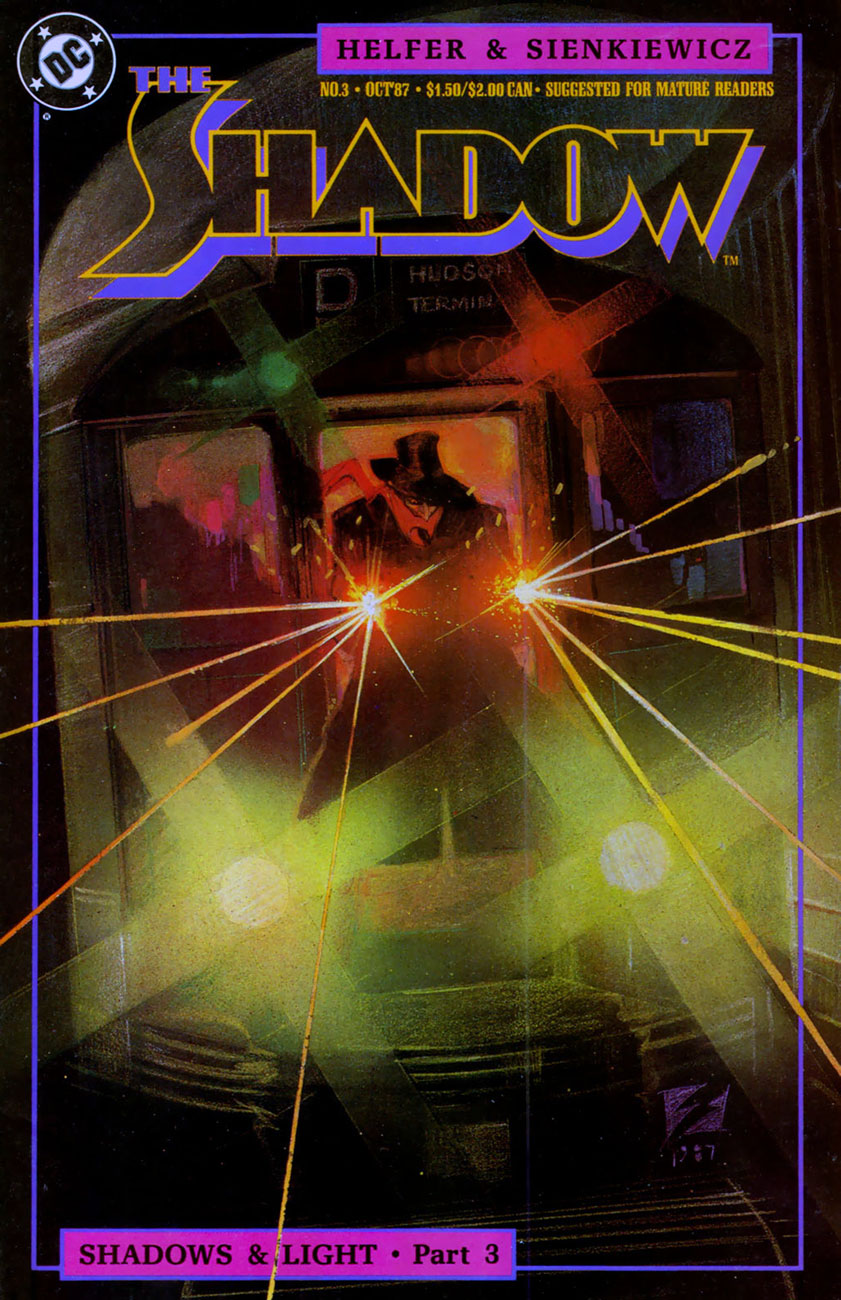
Skipping the heinous Howard Chaykin revival, in which he delighted in sadistically dispatching The Shadow’s aged former operatives in gruesome ways (why do these people always call themselves fans of the original series?), we move on to the Andrew Helfer-Bill Sienkiewicz regular book. Better, but still not great. This is The Shadow no. 3 (Oct. 1987). Cover by Bill Sienkiewicz.
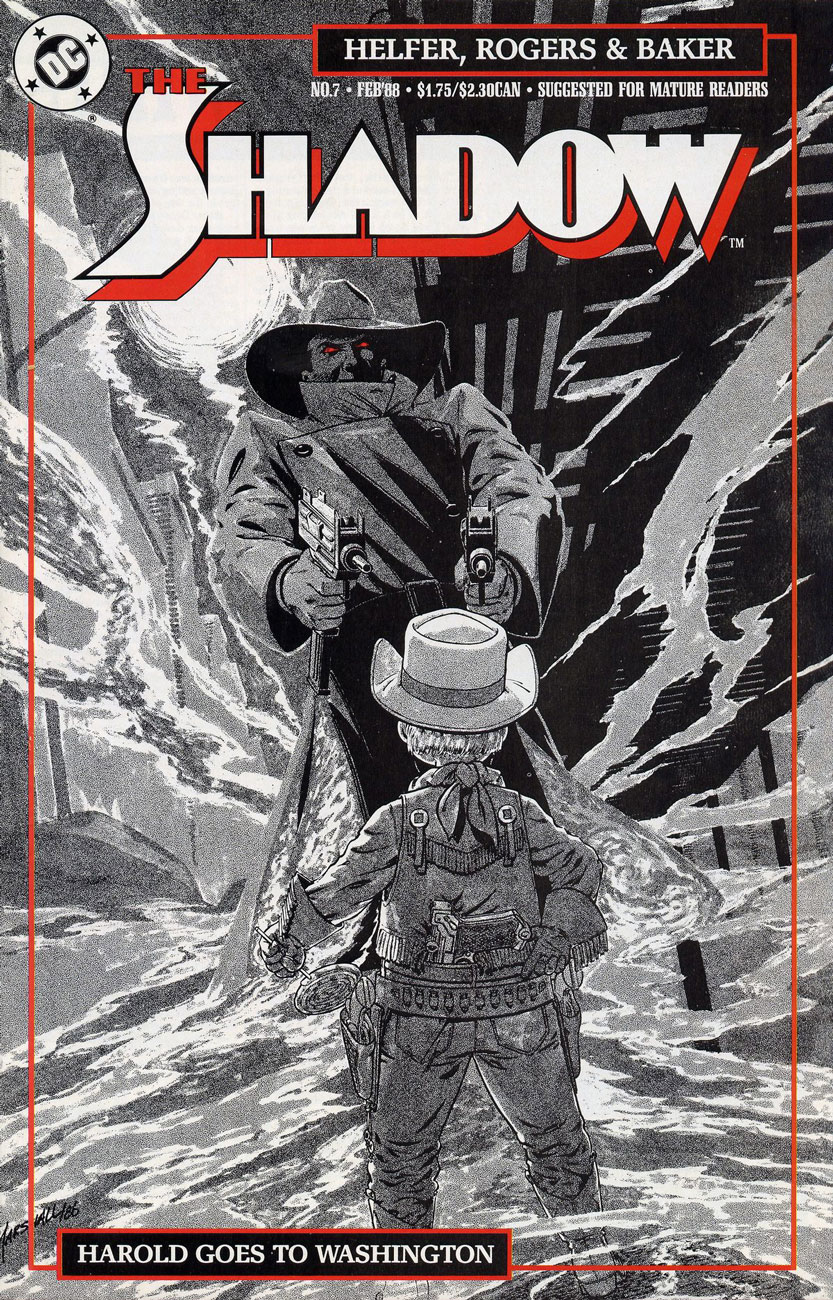
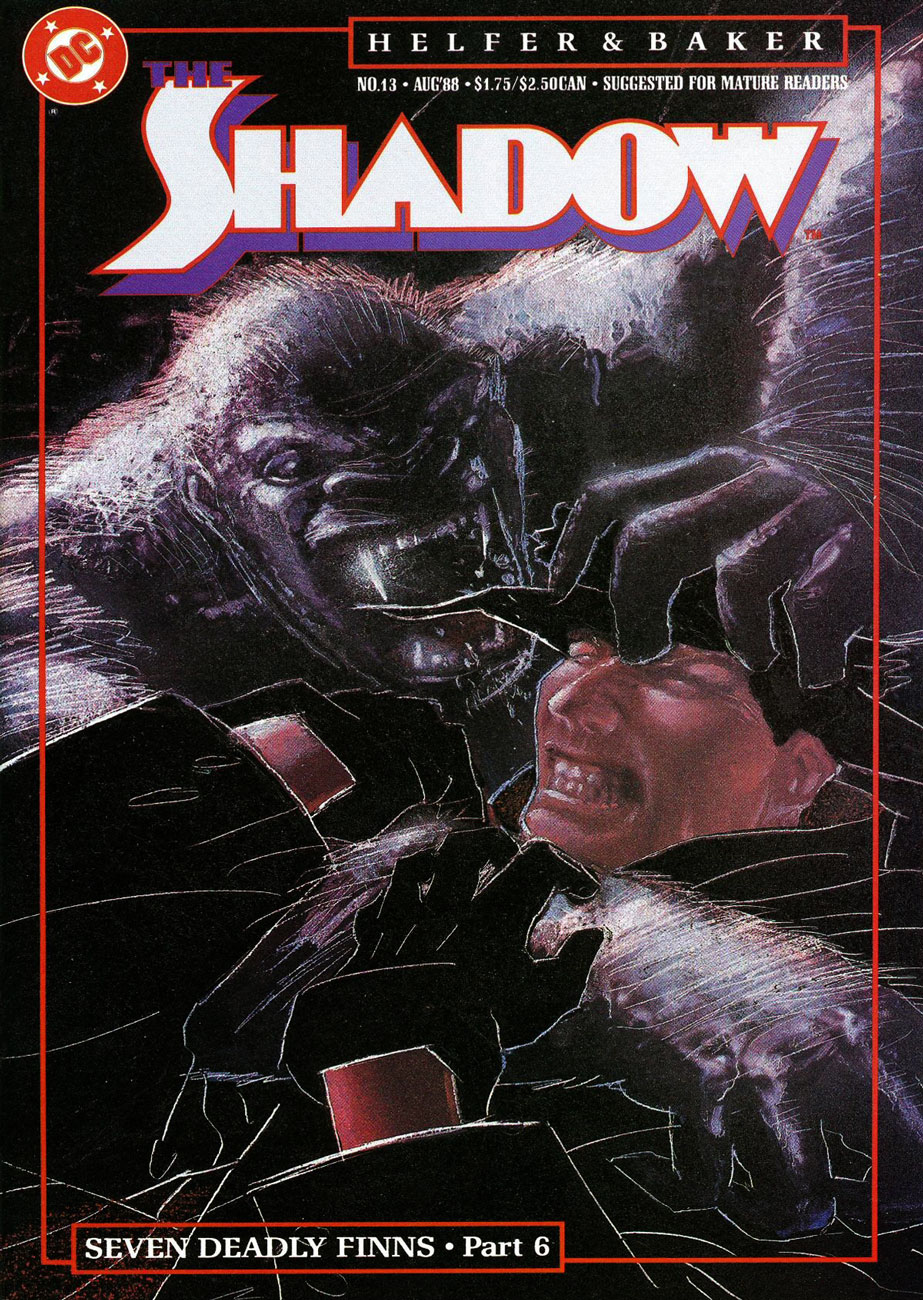
This is Kyle Baker’s cover for the finale of his and scripter Andrew Helfer’s thrilling and hilarious Seven Deadly Finns saga (no. 13, March 1988) that made The Shadow such a must-read title. To quote Kate Bush, « What made it special made it dangerous », and the folks at Condé Nast, who hold the rights to the classic Street & Smith characters (also including Doc Savage and The Avenger) reportedly got twitchy* at the reckless liberties the Helfer-Baker team were taking and pulled the plug after issue 19, where a beheaded Shadow gets a big action robot body. The Shadow was rebooted the following year in more obedient hands, with quite pedestrian results.
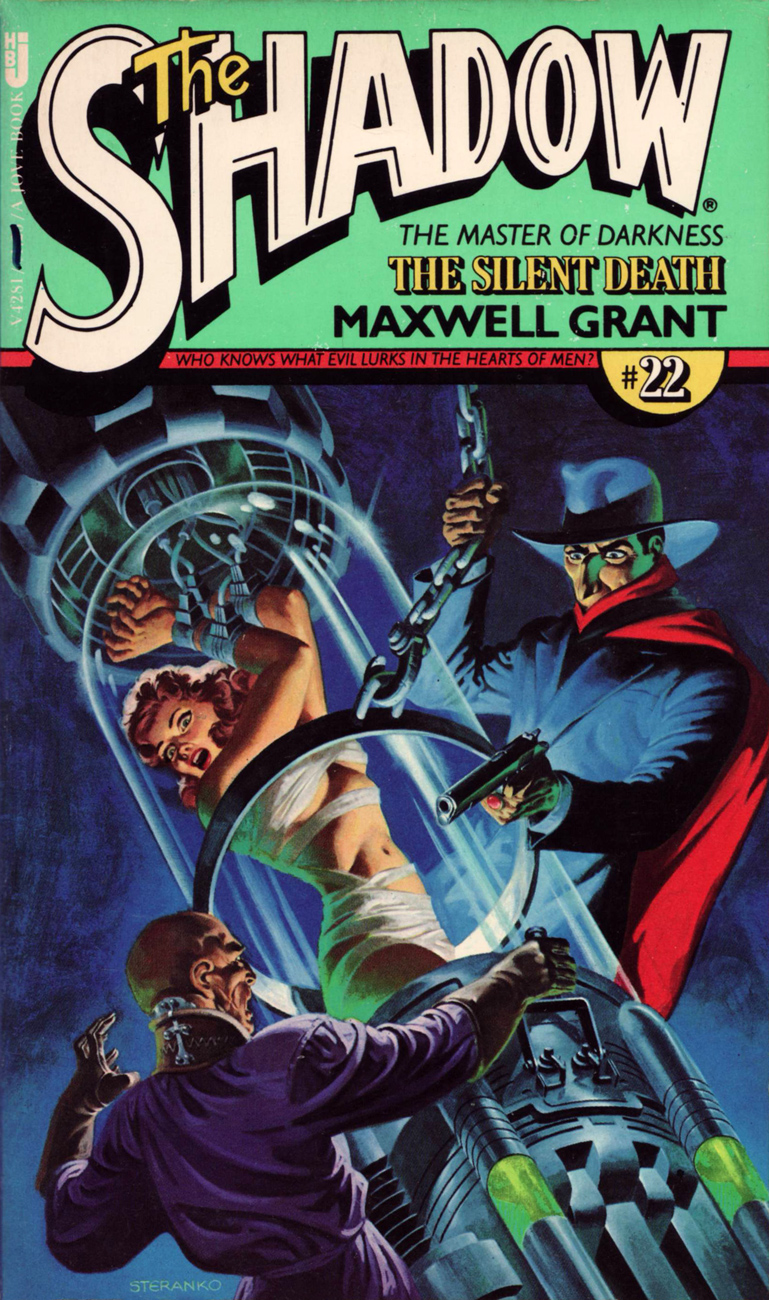
As a bonus, let’s slightly depart from comics proper and admire a couple of paperback reissues from the brush of noted fabulist James Steranko.
Steranko comes up with one of his subtlest, most unctuously moody covers for Pyramid’s 1974-78 series of Shadow paperbacks that introduced these classic pulp adventures to a new audience, picking up where its predecessors Belmont (1966-67) and Bantam (1869-70) had left off. Pyramid had one extra trick in its bag, though: Jim Steranko, who painted tantalizing covers for each of Pyramid/Jove’s twenty-three volumes. This particular case file, MOX, « from The Shadow’s annals as told to Maxwell Grant » originally appeared in The Shadow Magazine vol. 7, no. 6 (November, 1933).
Natty dresser Jim Steranko has built up, over the years, quite a biography for himself. Of his numberless and prodigious accomplishments, my favourites are those that actually happened, such as a stunning series of cover paintings for Pyramid Books’ reprints of vintage Shadow pulps from the 30s and 40s. This one, twenty-second in a set of twenty-three, was published in March of 1978. The Silent Death initially saw print in The Shadow Magazine, Vol. 5, no. 3 (April 1, 1933.)
One of the oft-recurring themes of tentacles-in-comics-land is one of aggressive invasion. No, I don’t mean body cavity invasions, you creepos! I mean the large-scale kind: cephalopodian aliens who insidiously infiltrate human ranks, hypnotize or control people’s minds with all sorts of high-tech hanky panky, or just plain deploy their far-out weapons and open martial festivities without as much as a how-do-you-do. Their goal is, naturally, full dominion and control of planet Earth. Sometimes it’s because our planet has something they want (water, minerals, or just plain real estate), occasionally they want to feed on us… or they just got out on the wrong side of the bed and are cranky and territorial.
Let’s see a few case scenarios on this installment of Tentacle Tuesday!
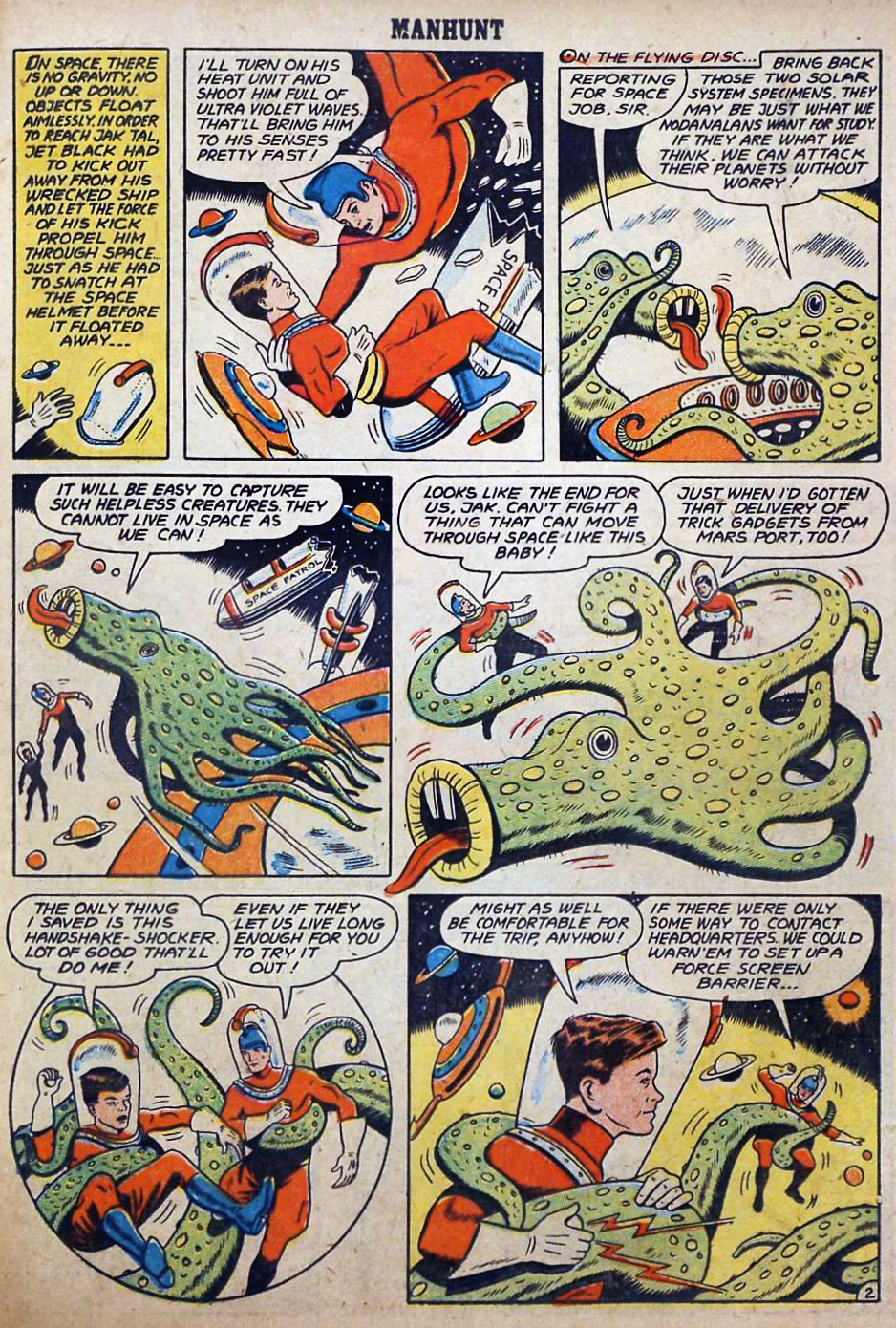
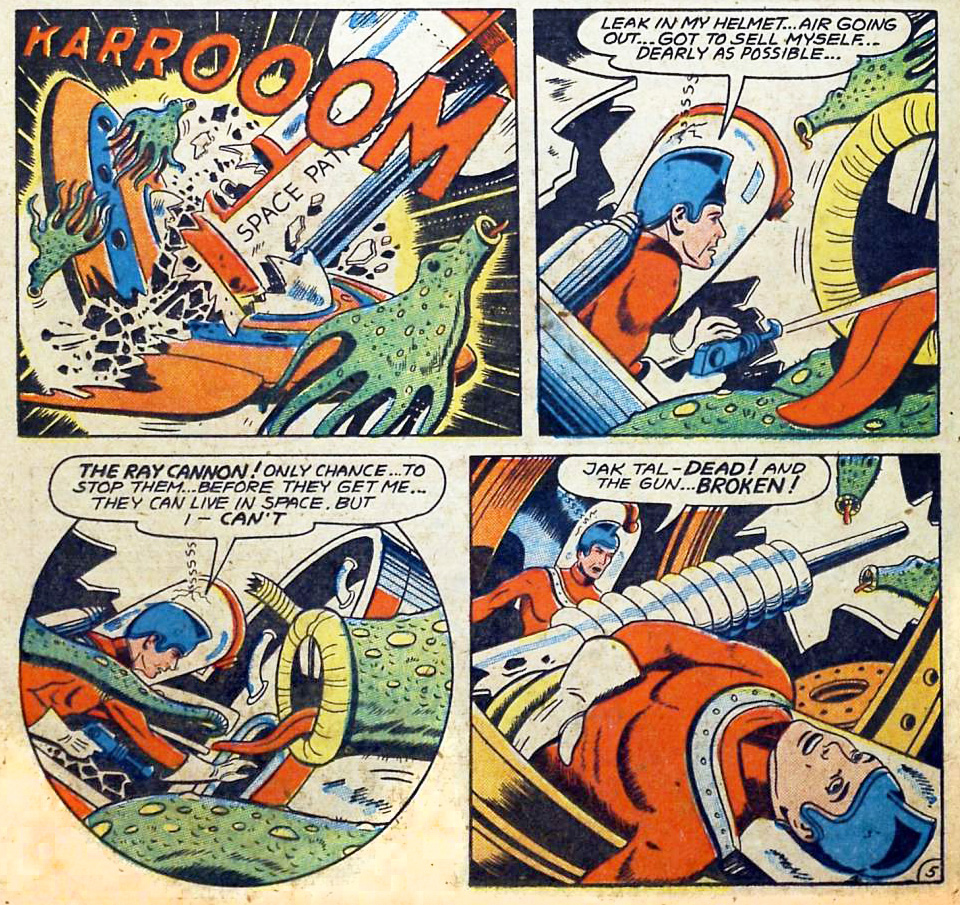
Our first story doesn’t explain why the aliens want to attack the planet or capture humans, but their nefarious scheme threatens life as we know it! Jet Black and Jak Tal, patrolmen of the 21st century, encounter some space-dwelling aliens who are up no good at all. Though they’re cute as can be, it can’t be too practical to have one’s tongue hanging out all the time… The Men from Deep Space, illustrated by Fred Guardineer, was published in Manhunt no. 6 (March 1948).
In example number two, the tentacled Organus is after humans because he has the munchies. Well, I suppose that’s as good a reason as any to propel your tongue towards somebody else’s face in the middle of a conversation. The Soul-Thief from the Stars, scripted by Paul Levitz, pencilled by Pat Broderick and inked by Bruce Patterson, was published in The Legion of Super-Heroes no. 284 (February 1982).
Get a room, you two.
Let’s move on to the next instance of grabby critters wanting supremacy over humans, shall we?
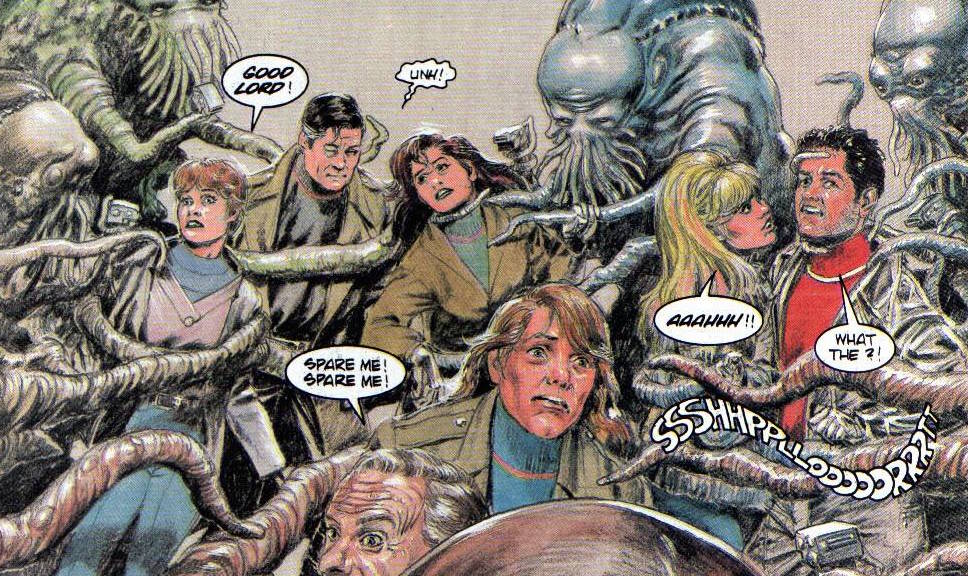
One long-winded, epic story of tentacled ones began in 1993, with Lost in Space: Voyage to the Bottom of the Soul. The story has everything that makes one of those invasion yarns entertaining – cruel cephalopod captors, barbaric vivisection experiments, computer codes assigned to every prisoner for better monitoring…. The bulk of this happens in the pages of Lost in Space: Voyage to the Bottom of the Soul no. 13 (August 1993) and Lost in Space: Voyage to the Bottom of the Soul no. 14 (September 1993), scripted by Bill Mumy (the original Will Robinson himself) and illustrated by by Michal Dutkiewicz.
Oh yeah, I also mentioned insidious infiltration, a sly, Machiavellian approach to alien invasion. The Seeds of Jupiter, written and drawn by Al Feldstein and published in Weird Science no. 8 (July-August 1951), fits *that* particular bill.
By the way, apparently the following scene inspired the “alien bursting out of some poor sod’s chest” sequence in the 1979 movie Alien.
What? You don’t believe that it’s truly an invasion? You say the seeds ended up on earth by accident? Well, listen to the man with funny hair*. He does not lie.




























 Who's Out There?