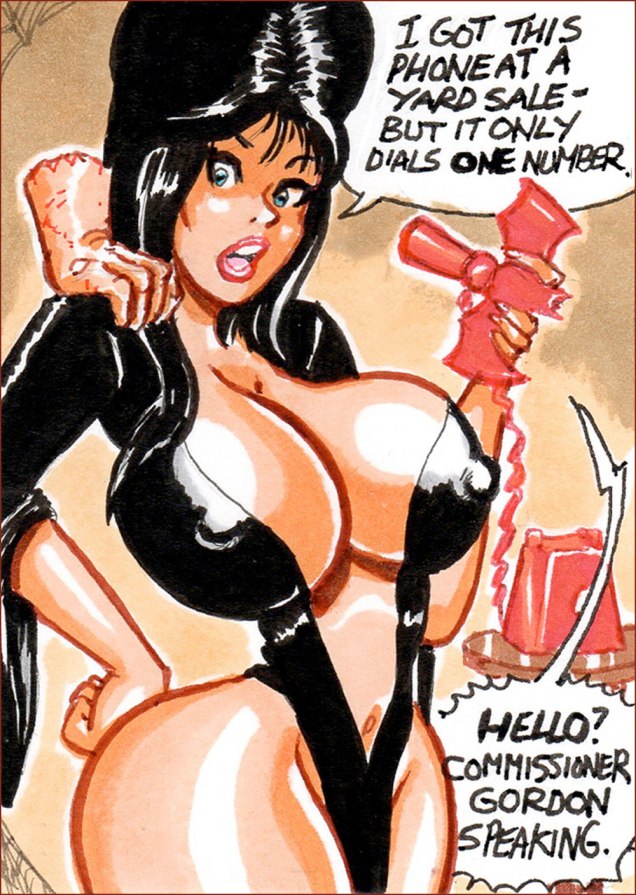
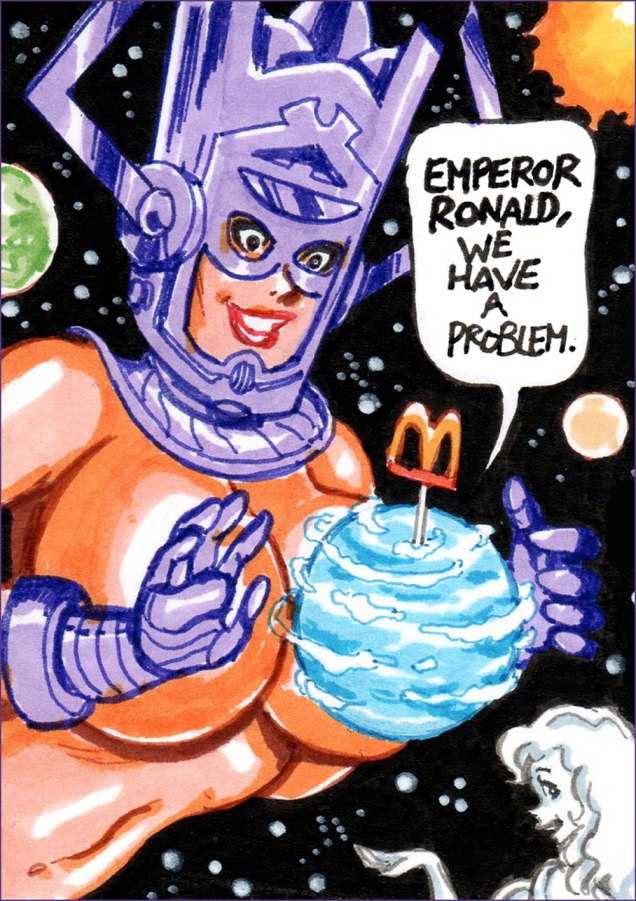
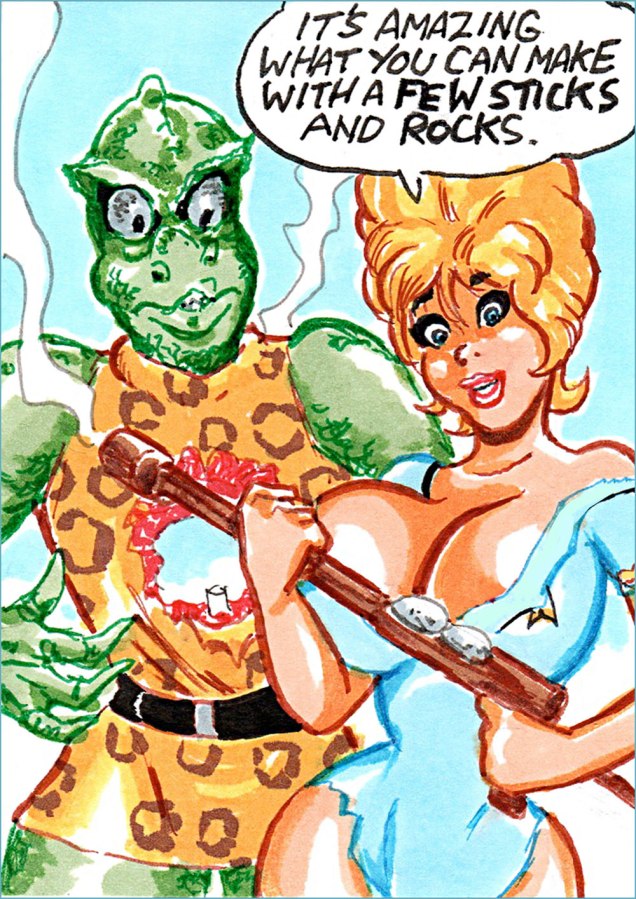
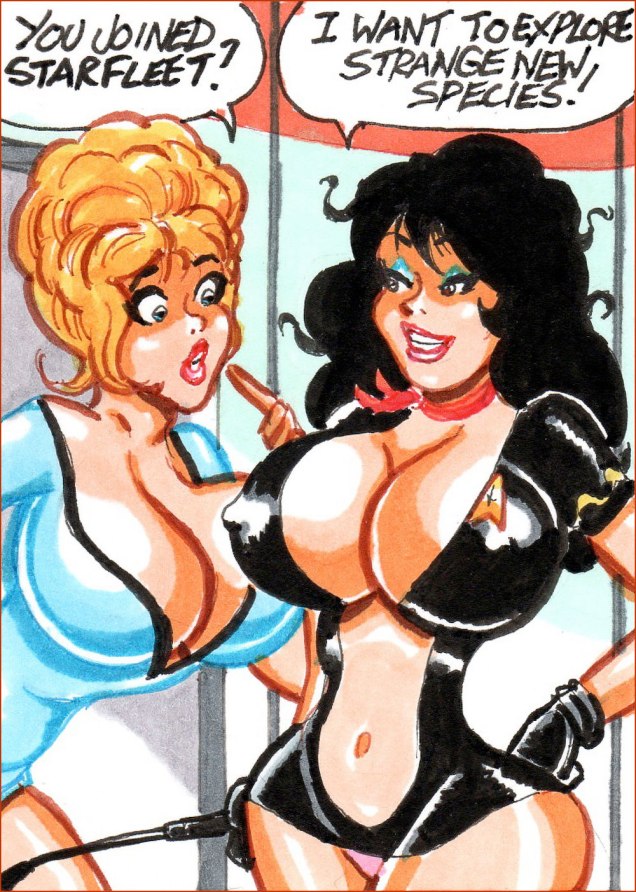
Panning the murky old print stream for the odd glimmering nugget
The Twilight World of Girlie Cartoons
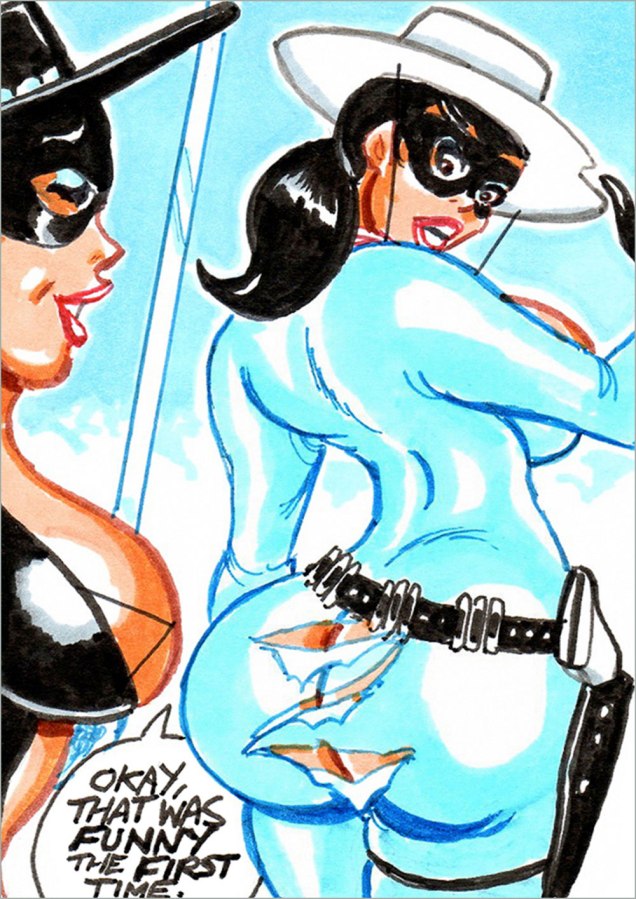
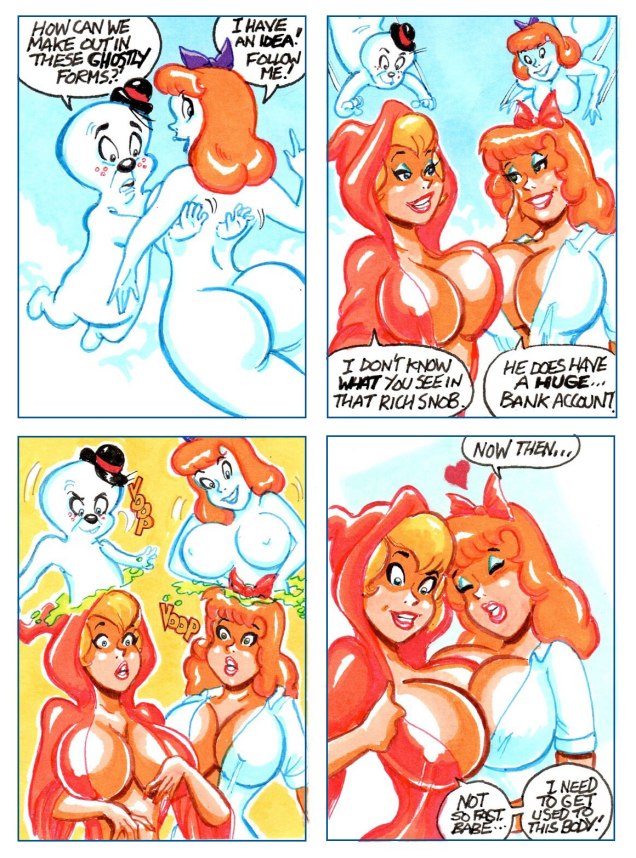
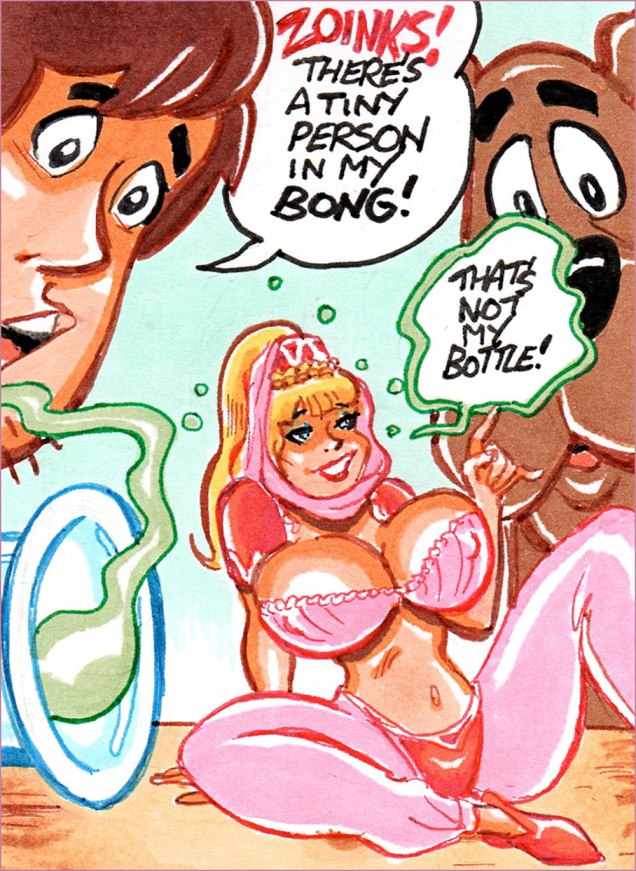
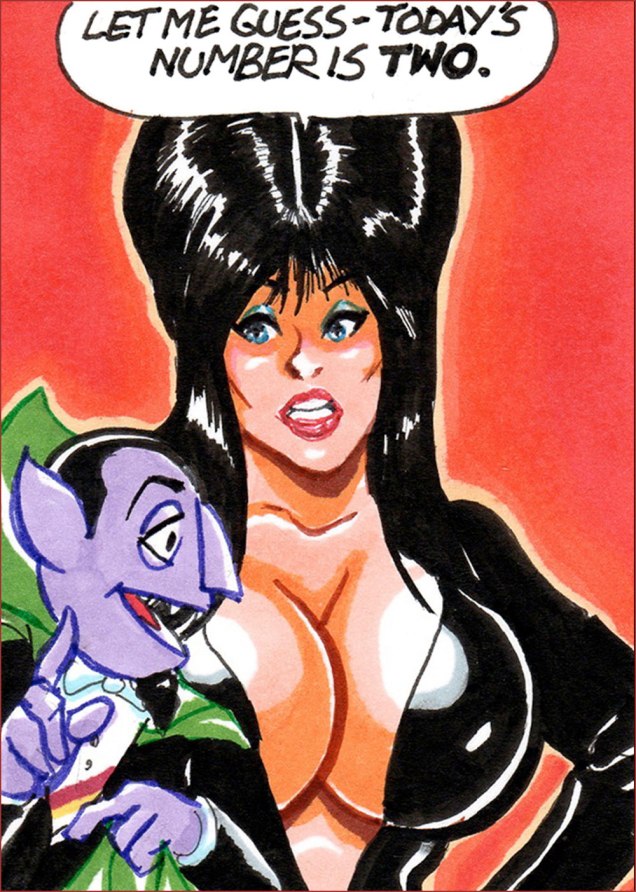
Back in the 40s and 50s, this stuff constituted a real cottage industry of disposable and often interchangeable product. However dismal the pay and shabby the presentation, some real gems (and some real howlers) were created by the odd first-rate talent in third-rate circumstances. Let’s take a peek behind the beaded curtain… -RG
« Better to have a lousy character than no character at all. » — Alain Delon (Nov. 8, 1935 – Aug. 18, 2024)
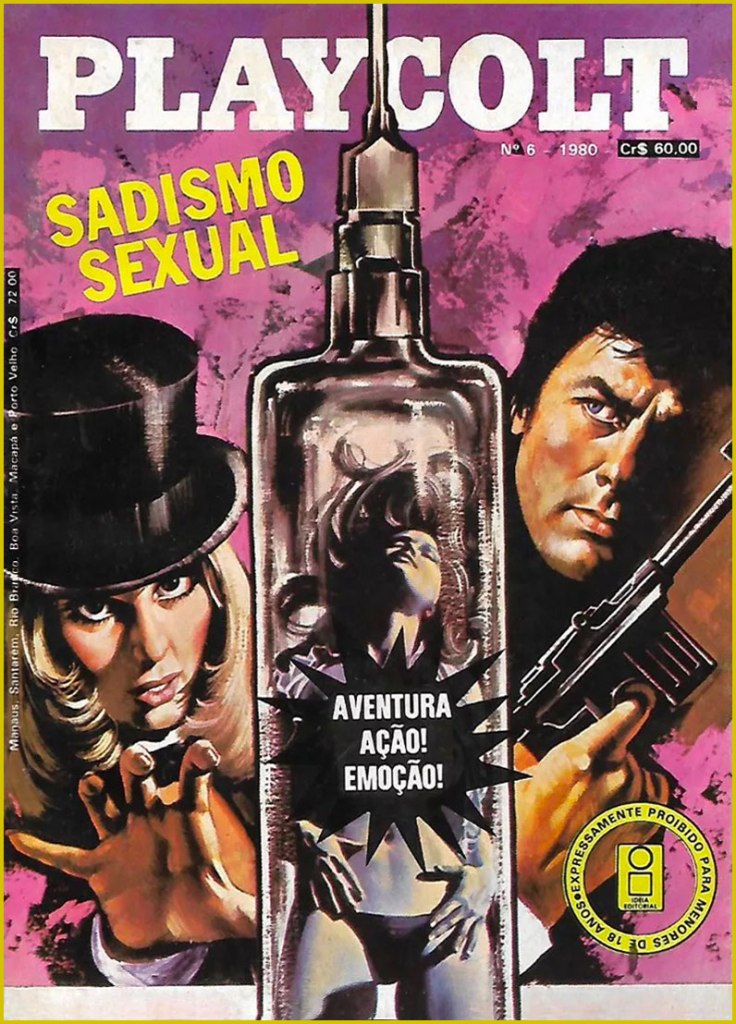
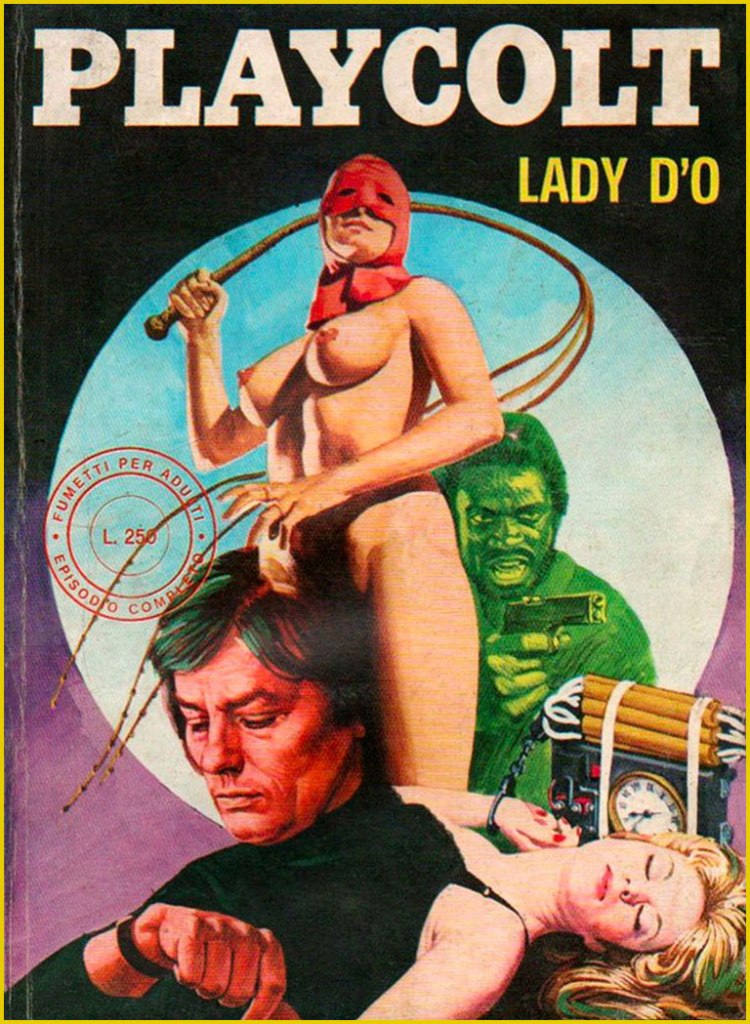
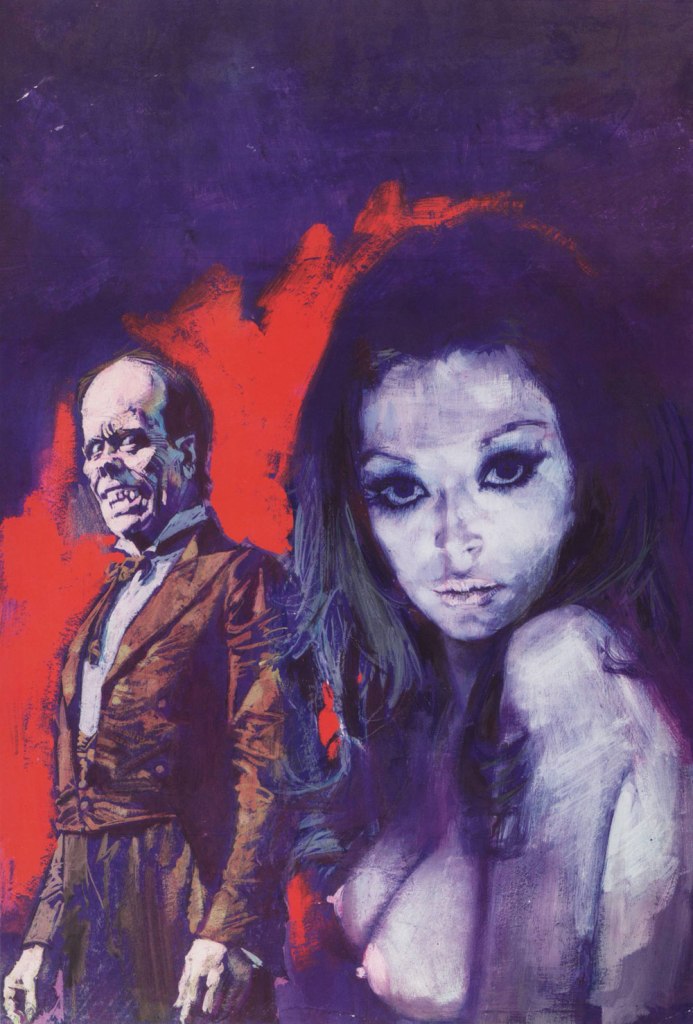
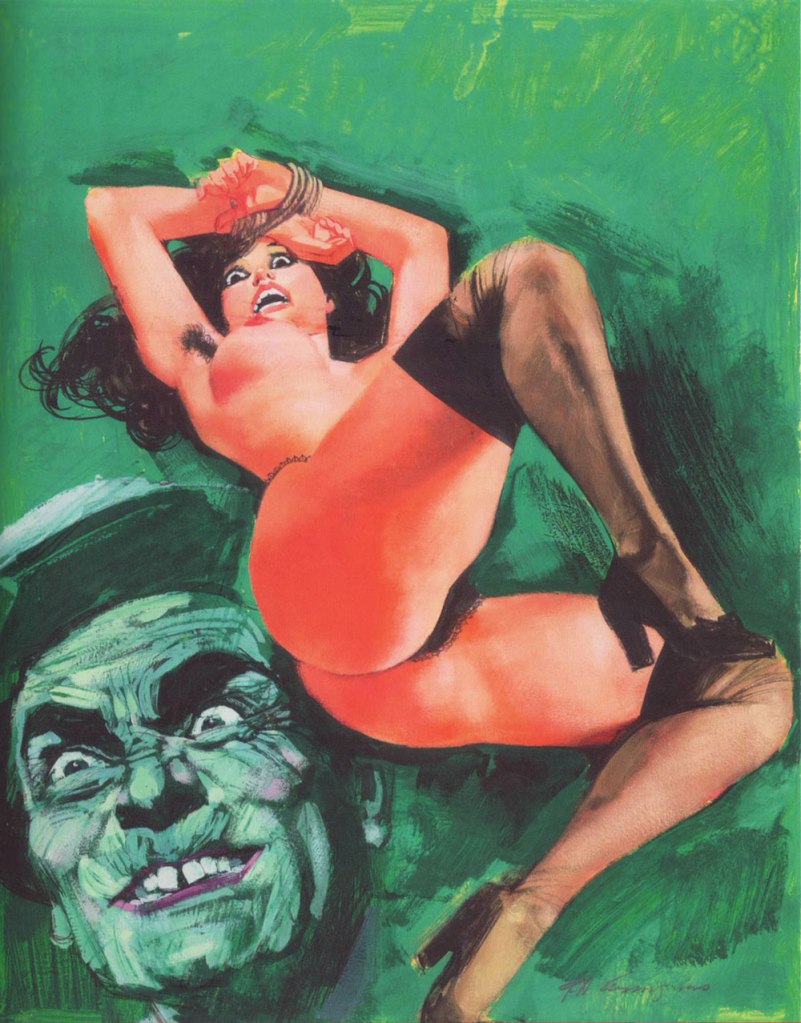
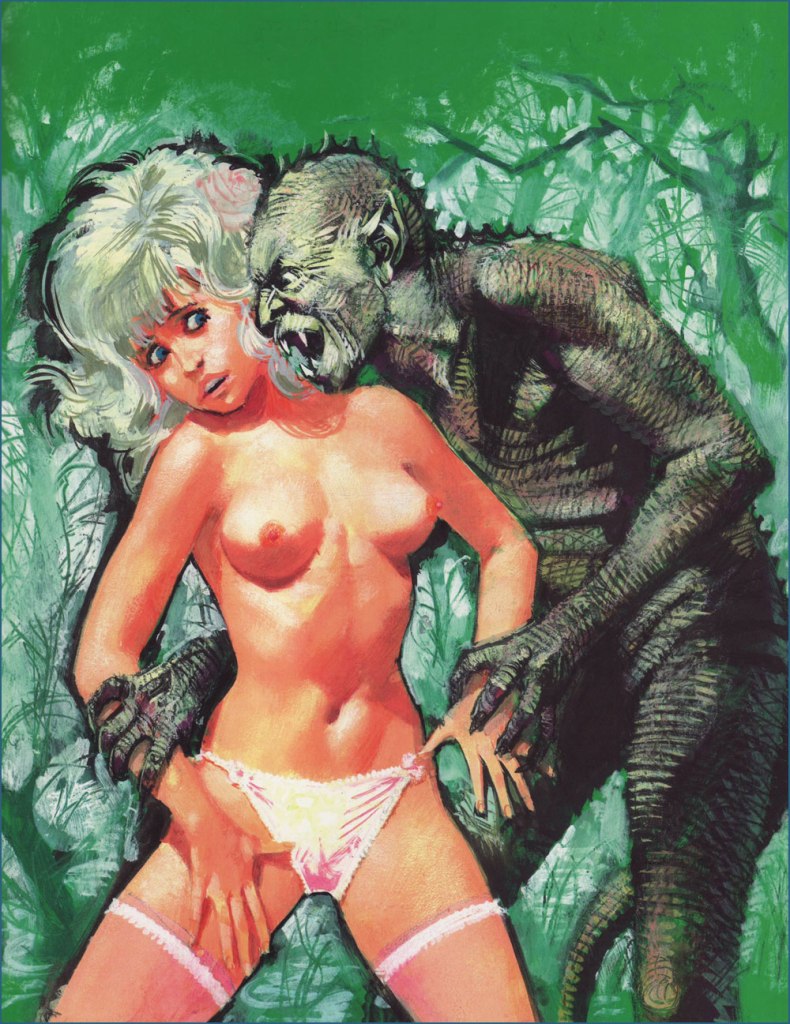
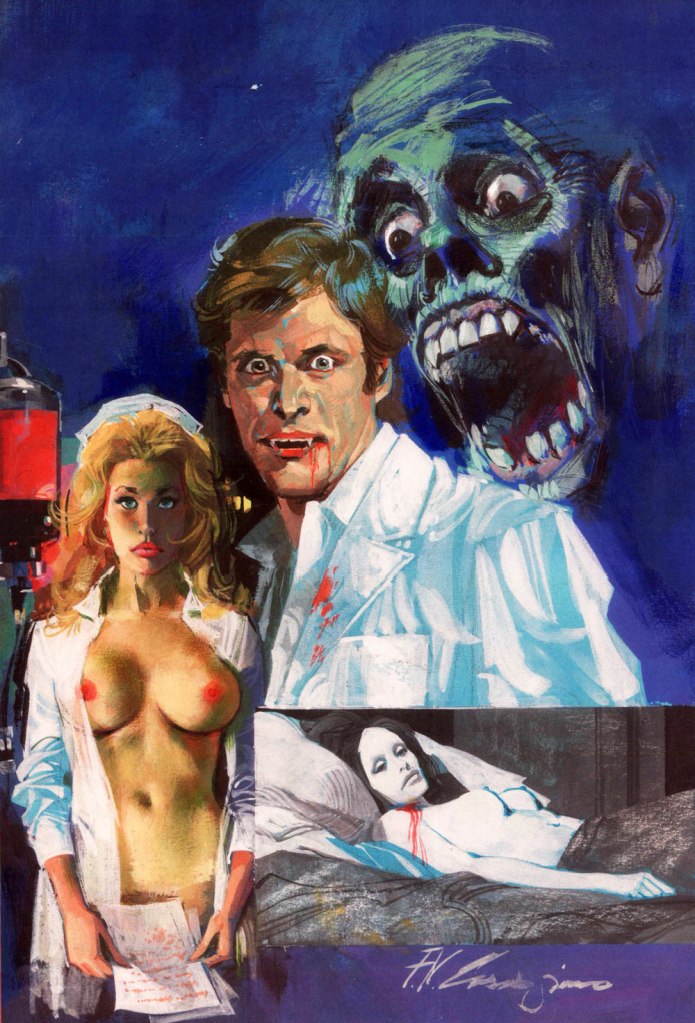
Quite recently, we lost monstre sacréAlain Delon. He was a complicated man, a bit of a prickly bastard, but he sure made a lot of great movies*. But comics, you ask? Well, I’m sure he never asked for it, but like many a celebrity (Jean-Paul Belmondo, Ornella Muti…) his famous countenance was appropriated by those incorrigible rascals at Edifumetto and Ediperiodici.
So Alain Delon became… « Alain Velon, a billionaire playboy who lives on an island “a 3-hour flight from New York“. He spends his private life conquering women in a continuous stream even if he is already engaged to the film actress Lizzy Scarlett, but “due to his innate sense of justice” he periodically transforms into Playcolt, a sort of superhero. His enemy is Linda Darnel, also a billionaire: sadistic and fetishist, she turns into the anti-heroine Za the Dead. Another historical rival is the always sadistic but lesbian Mandrakka. »
Now don’t get me wrong: these are virtually unreadable, poorly drawn, sadistic, illogical, reactionary misogynistic claptrap. But the covers are fascinating in their gonzo way, randomly cobbling together purloined bits from famous likenesses to established logos. You’d think this brazen wave of wholesale filching would have led to swift and decisive legal action from several stars’ solicitors, not to mention Hugh Hefner’s… but it seems not. This was, after all, the Italy that gave us Silvio Berlusconi.
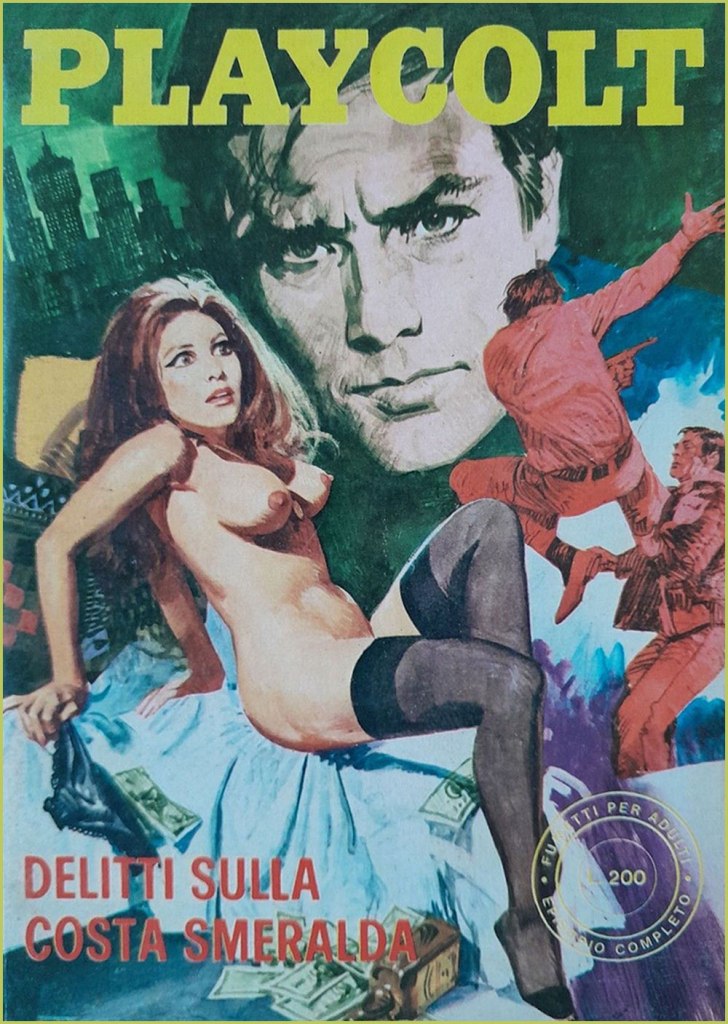
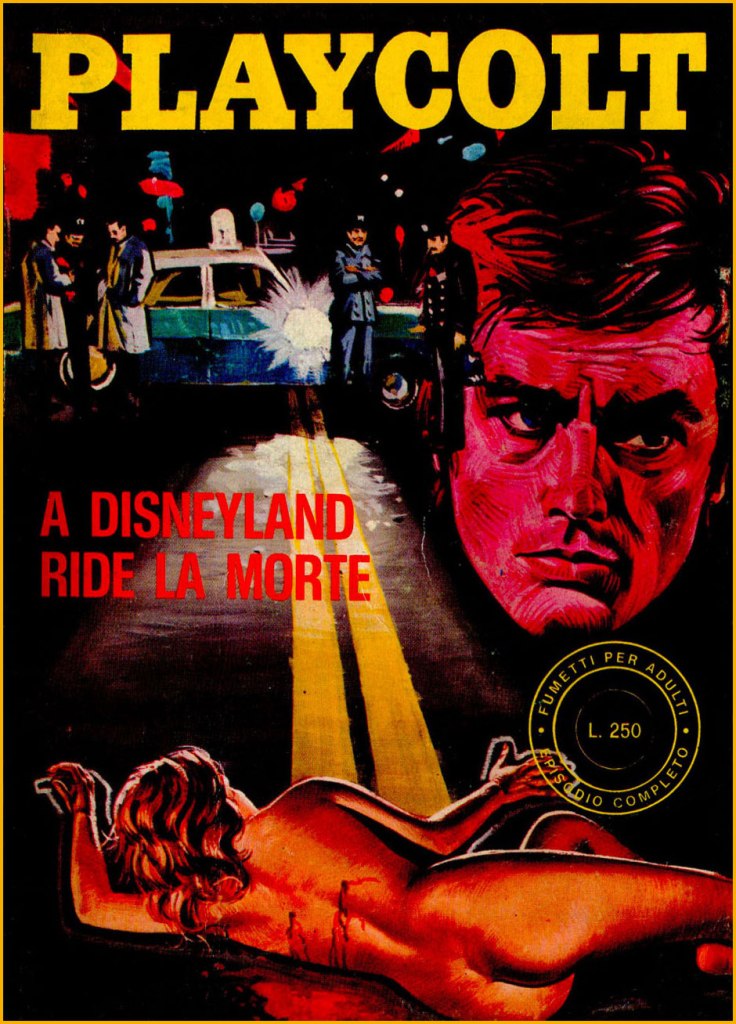
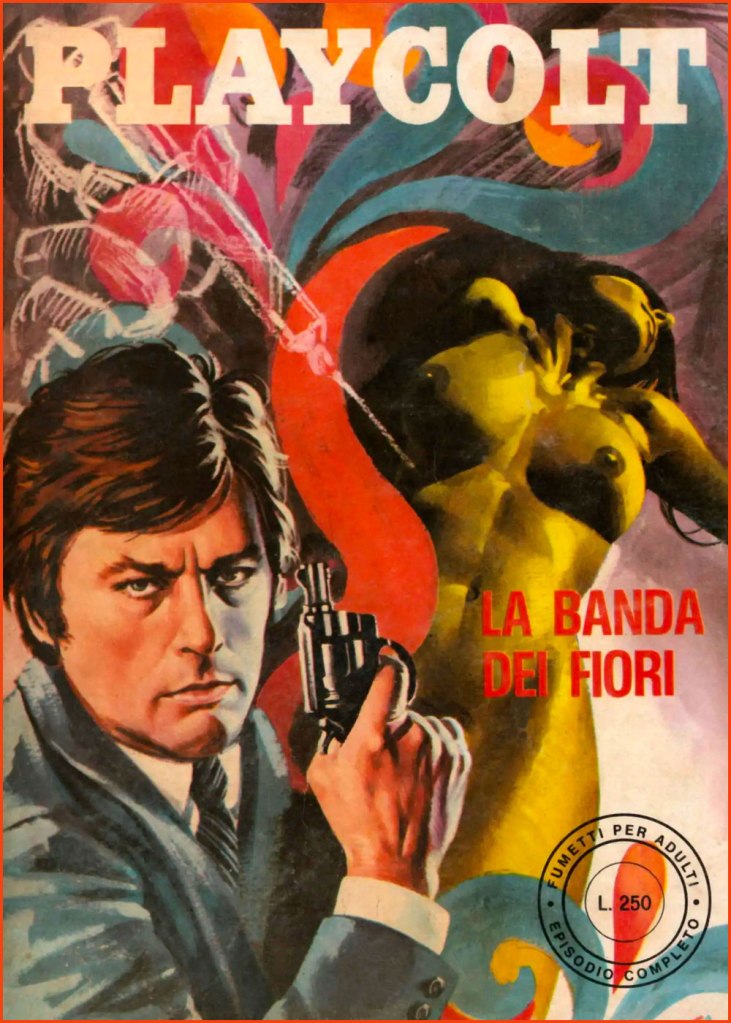
« To the Sound of Punches »; this is Playcolt Series II no. 9 (Nov. 1973, Edifumetto). Cover art by Carlo Jacono, a nice piece, but celebrity likenesses evidently weren’t among his strong suits.« Crimes on the Emerald Coast »; this is Playcolt Series II no. 14 (Aug. 1973, Edifumetto). This one’s *possibly* the work of Alessandro Biffignandi… or his studio.« The Golden Rain » (ahem); this is Playcolt Series II no. 23 (Dec. 1973, Edifumetto). Another Jacono, another botched likeness.« The Divine Sadist »; this is Playcolt Series III no. 1 (July 1974, Edifumetto). « Death laughs in Disneyland »; this is Playcolt Series III no. 11 (June 1974, Edifumetto). « There’s a mess in the middle of the sea »; a 1980 Brazilian edition reprinting Playcolt Series III no. 18 (Sept. 1974) in Portuguese. « The Flower Gang »; this is Playcolt Series III no. 22 (Nov. 1974, Edifumetto). I have no concrete evidence, but the technique displayed here reminds me strongly of British illustrator-cartoonist Ron Embleton (1930-1988), co-creator of Oh, Wicked Wanda! and illustrator of the immortal Captain Scarlet closing credits.No need for a translation, is there? A 1980 Brazilian edition reprinting Playcolt Series IV no. 1 (Jan. 1975) in Portuguese. « Operation Puzzle »; this is Playcolt Series IV no. 12 (Nov. 1975, Edifumetto). Cover painted by the prolific Emanuele Taglietti, who handled quite a few covers in this series. Here’s an impressive gallery of these.« The White Shark »; this is Playcolt Series IV no. 35 (May 1976, Edifumetto). Sharks were all the rage that year.« To Love a Hole »; a 1980 Brazilian edition reprinting Playcolt Series IV no. 2 (Jan. 1975). Dig that strategic blurb placement; the Italian edition was not so coy. Clearly a reference to the previous year’s hit ‘erotic’ film, L’histoire d’O; this is Playcolt Series IV no. 27 (Jan. 1976, Edifumetto). It’s funny how the Delon photos used span his career up to that point, which yields visual whiplash when you go from the Delon of Plein Soleil to the jaded, grizzled one of, say, Monsieur Klein or La mort d’un pourri from one issue to the next.« Terror in California »; this is Playcolt Series IV no. 44 (Oct. 1976, Edifumetto). The obligatory Jaws cash-in. Say what you will, those Italians didn’t miss a trick.
There was, concurrently, another Delon homage in Jean Ollivier and Raffaele Carlo Marcello‘s successful Docteur Justice, a humane but hard-hitting series about a physician and expert judoka who roams the globe’s trouble spots for the World Health Organization. There was even a film adaptation in 1975, with John Phillip Law essaying the title role… and co-starring Delon’s ex — and only — wife, Nathalie. Among Pif Gadget’s adventure series, it was only bested in popularity by the prehistoric blond heartthrob Rahan. I’ll tell you more about it one of these days.
-RG
*So claims the Russian pop song entitled Взгляд с экрана, and who are we to doubt it?
« Looking for love is tricky business, like whipping a carousel horse. » — George Cukor
As I’ve noticed that we’ve been dwelling strictly in the cartoonier suburbs of late, allow me to gently nudge us into the realm of high-end draftsmanship and bravura technique for a change. In so doing, let us turn the clock back a century or thereabouts.
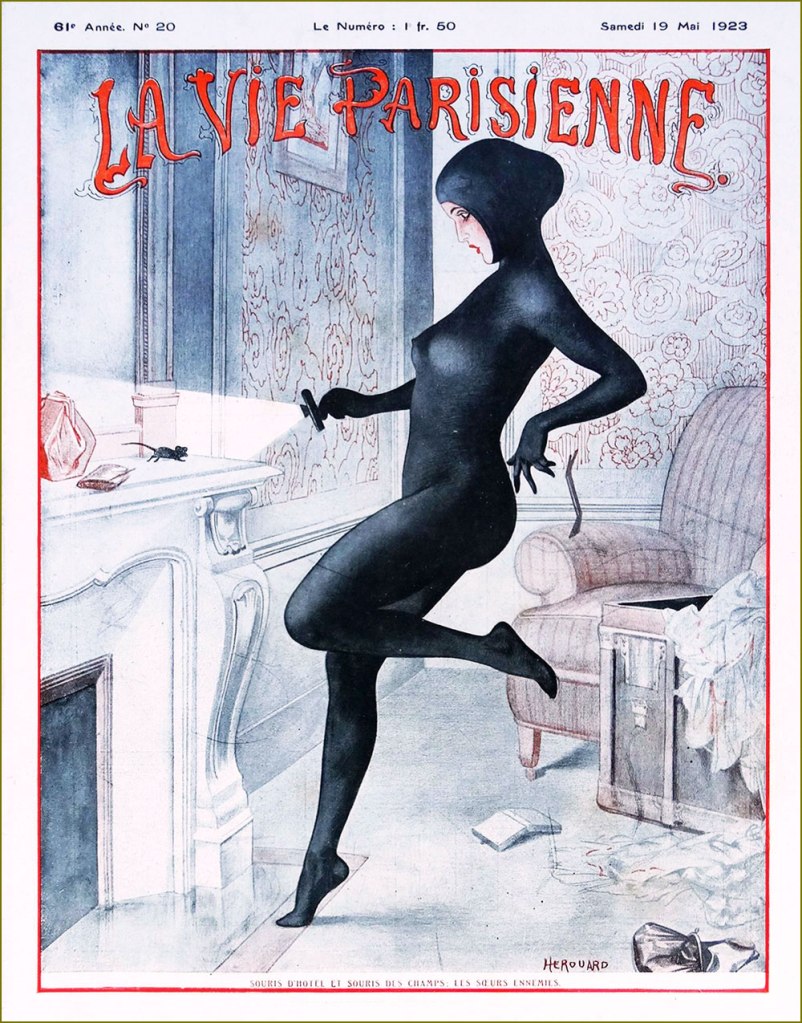
French cartoonist-illustrator Chéri Hérouard, né Chéri-Louis-Marie-Aimé Haumé (1881-1961) is mostly renowned for his lengthy and fruitful (1910-1940) association with the ‘mildly risqué’ weekly La Vie parisienne. It is said that « During World War I, General Pershing personally warned American servicemen against purchasing the magazine, which boosted its popularity in the United States. » There always was — and let’s hope there always shall be! — considerable difference between the French and American mindsets.
« The Nightmare of Coal », Hérouard’s cover for La vie parisienne’s November 1st, 1919 edition. For those interested, there’s a classy hardcover collection entitled La vie parisienne: Covers & Cartoons 1917-1922 (Dover/Calla Editions, 2018). The art restoration is flawlessly executed and the translation is often hilariously botched. La vie parisienne’s May 19, 1923 issue. « The hotel mouse and the field mouse: enemy sisters ». A ‘souris d’hôtel’ was a thief that plied her trade in chic hotels. A cat burglar of a sort. This sleekly sexy look is clearly based on Musidora‘s legendary turn as Irma Vep in pioneering cinéaste Louis Feuillade‘s epic 1915 serial Les Vampires.
Like many of the best and most free-spirited cartoonists, Hérouard illustrated books and magazines aimed at both innocent and decidedly roué readerships…
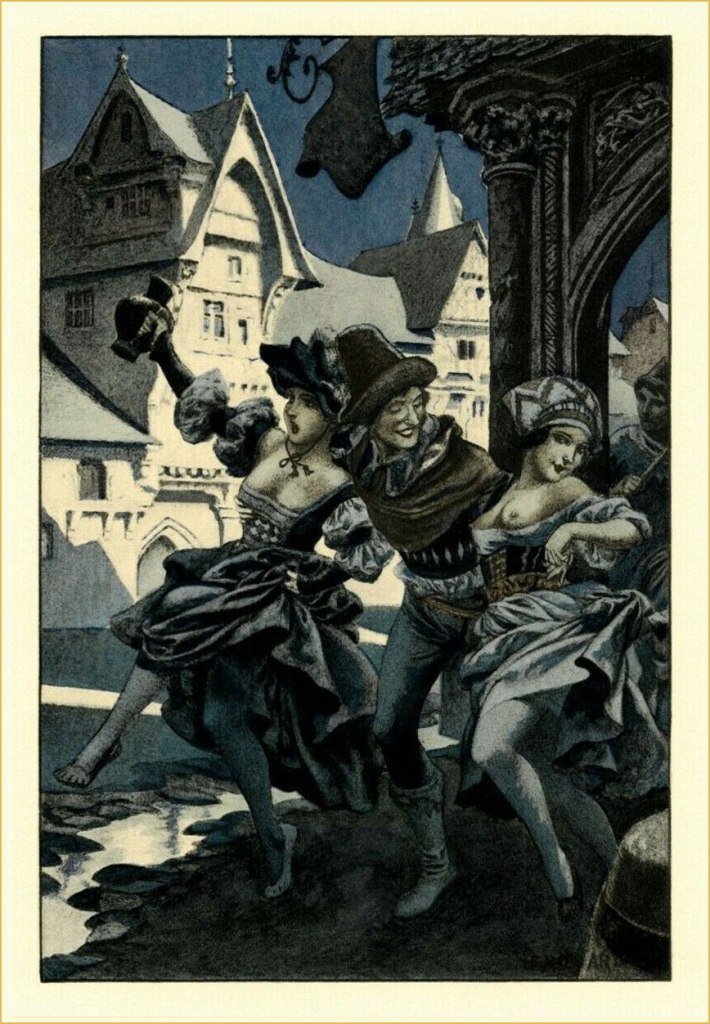
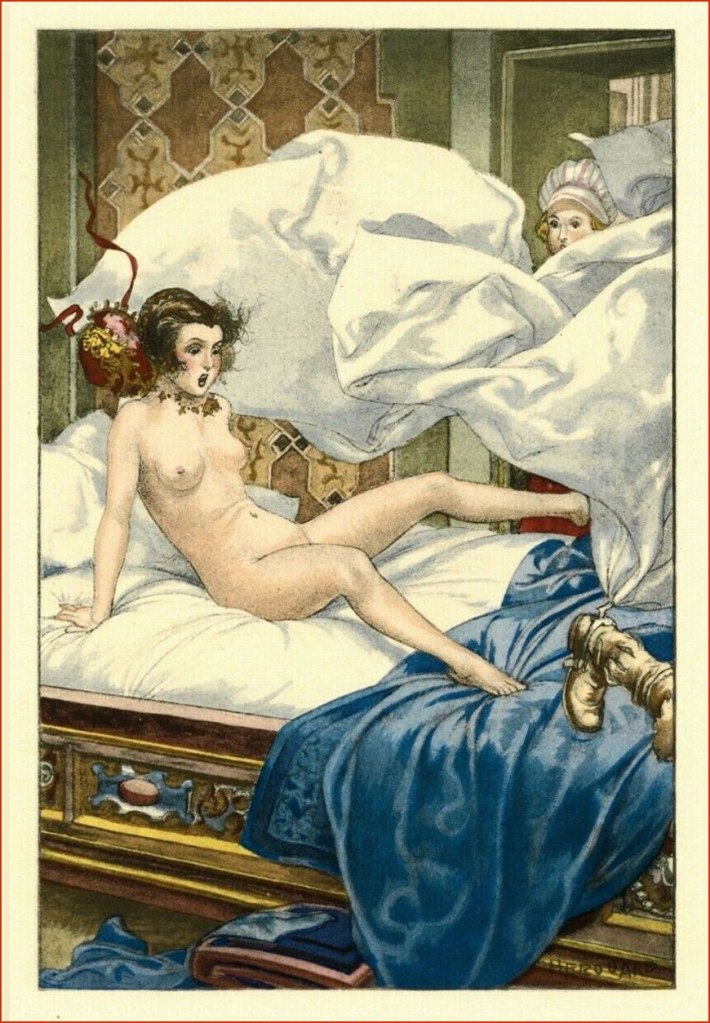
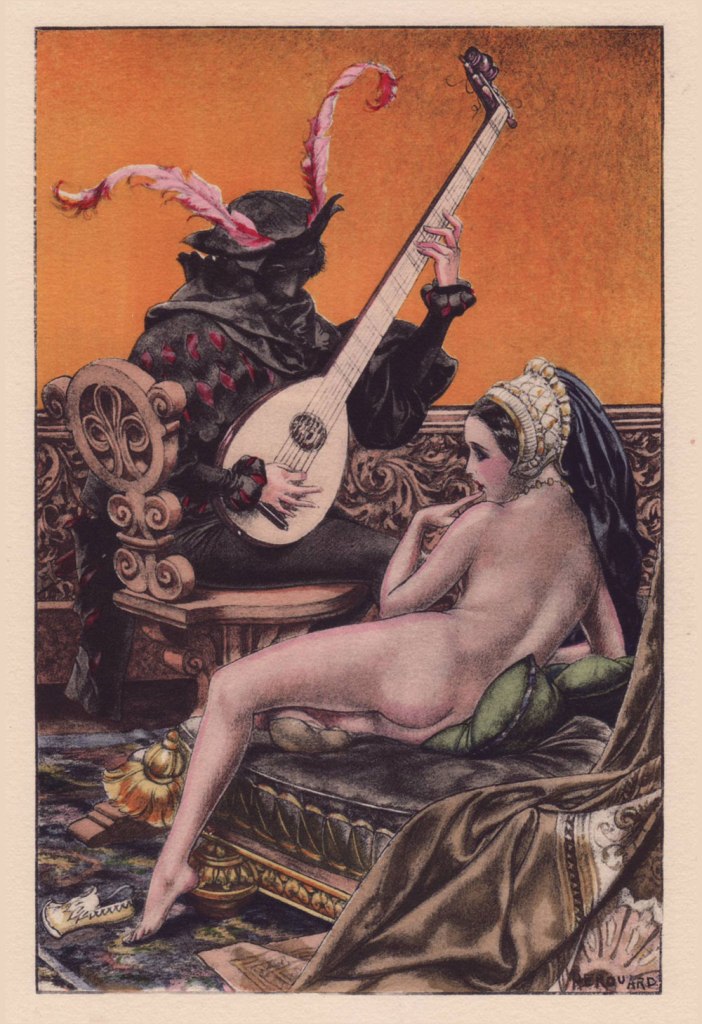
To wit, Hérouard produced sixty-four illustrations for a four-volume set of ribald historical tales entitled L’Heptaméron des Nouvelles de la Reine de Navarre — which is to say Marguerite de Navarre (1492–1549) — in a rather exclusive print run of 1540 copies (Javal et Bourdeaux, Paris, 1932). It was quite a challenge to pick just a handful. If you want them all, here’s a copy for sale while it lasts!
.
Even with a limited colour palette, Hérouard was a master of light and shadow.
.
.
.
.
.
Admire the depth of field in this image… so many planes, and yet it never feels cluttered. That’s composition (among other things).
In addition to the book, hand-coloured engravings of the illustrations were produced in a run of five hundred. I recently acquired my very favourite of the lot, and the kind seller graciously included an uncoloured version for comparison. And so, before:
… and after!
Some background on the technique of stencil colouring: the stencil is created using a zinc sheet one-tenth of a millimetre thick. Using a very sharp metal blade, previously traced openings are cut into the zinc sheet, according to the drawing and colour required. The stencil is then applied upon the printed proof (e.g. engraving, lithograph or phototype). For faithful reproduction, the necessary number of stencils must be traced and cut (an average of fifteen to forty stencils, sometimes up to sixty for more delicate works). In the course of the tracing, one must determine the range of values of each colour, beginning with the lightest, and define with precision the shape and location of the gradations, keeping in mind the effects of superposition. For each stencil, the colour must be prepared, taking care to maintain its tonal intensity throughout the printing process. This colour — be it gouache, watercolour, India ink or wash — will be applied using a special round hog bristle brush. In the case of certain stencils, the colour will be softened after its application, mixed and blended using a small softening brush.
Oof! Given the immensity and delicateness of the task, it must be noted that the colourist in question was one ‘Jacomet’, presumably Daniel Jacomet (1894-1966). Bravo!
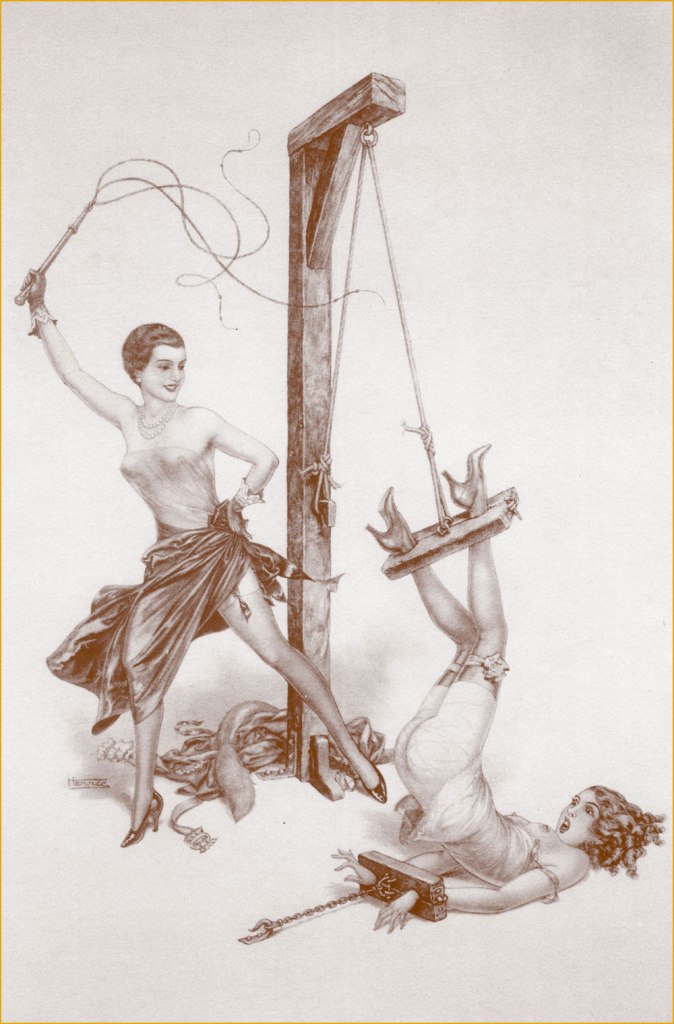
And finally, here’s a… striking quartet of sepia rotogravure etchings, which were discreetly sold as a set in the years just preceding the second world war. For these, Hérouard adopted the transparent pseudonym of ‘Herric’… but the style is unmistakable.
« After the horrors of 14-18, the healthy pleasures of peace. »
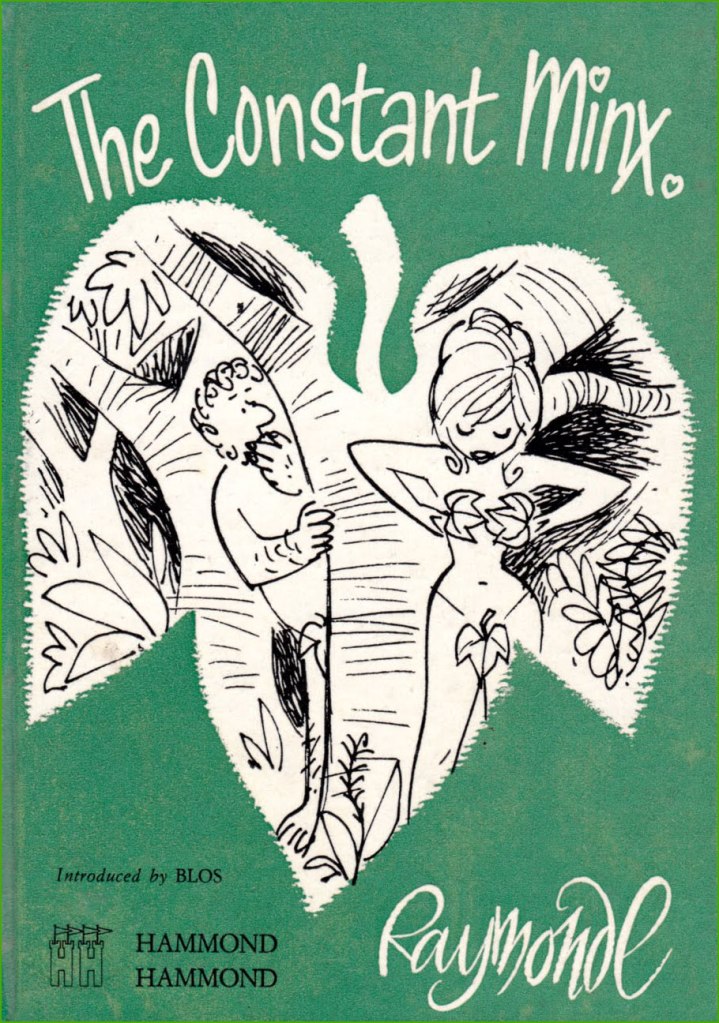
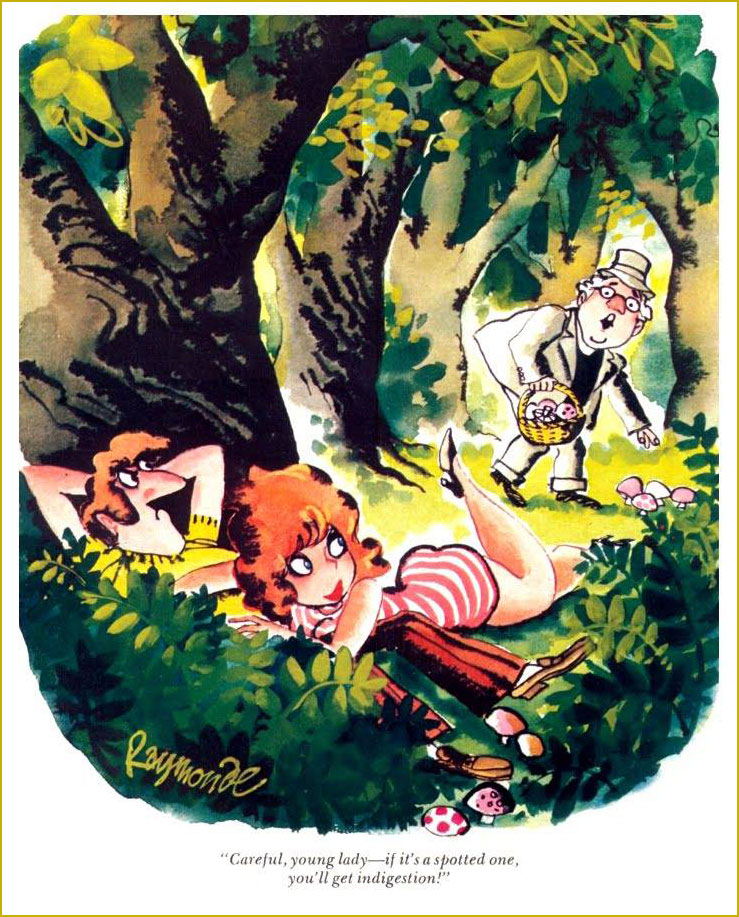
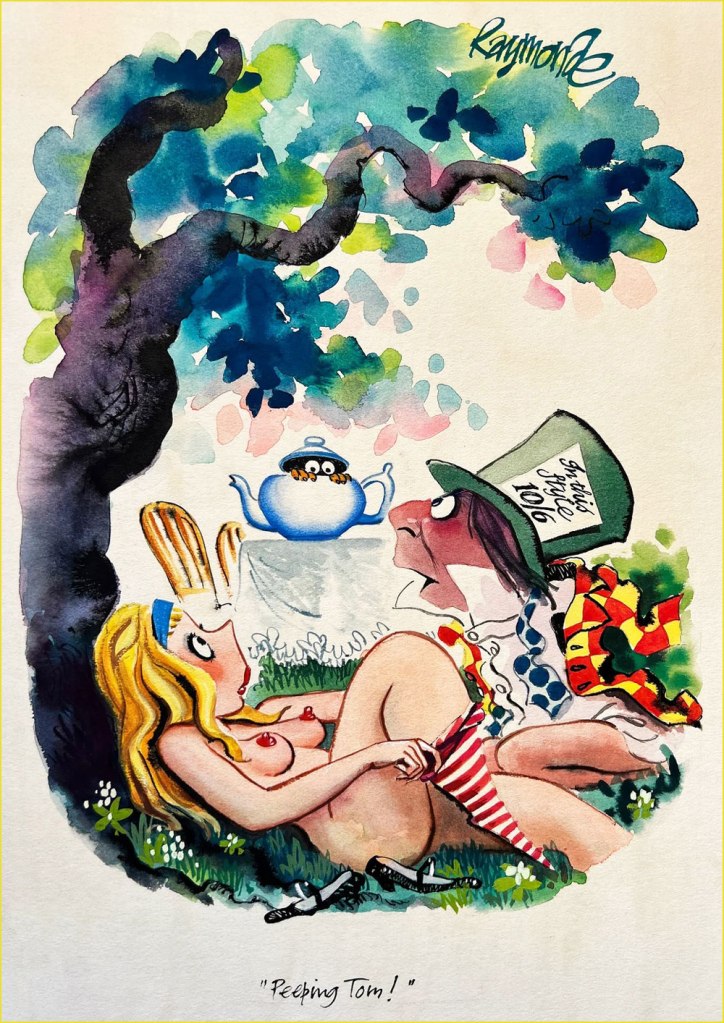
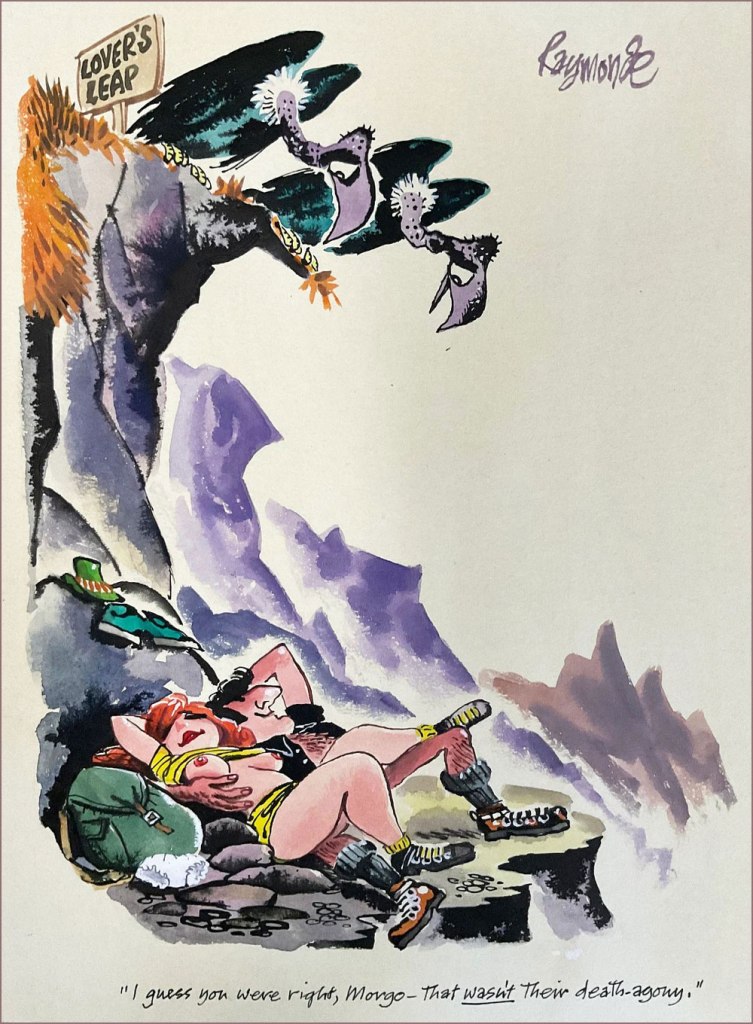
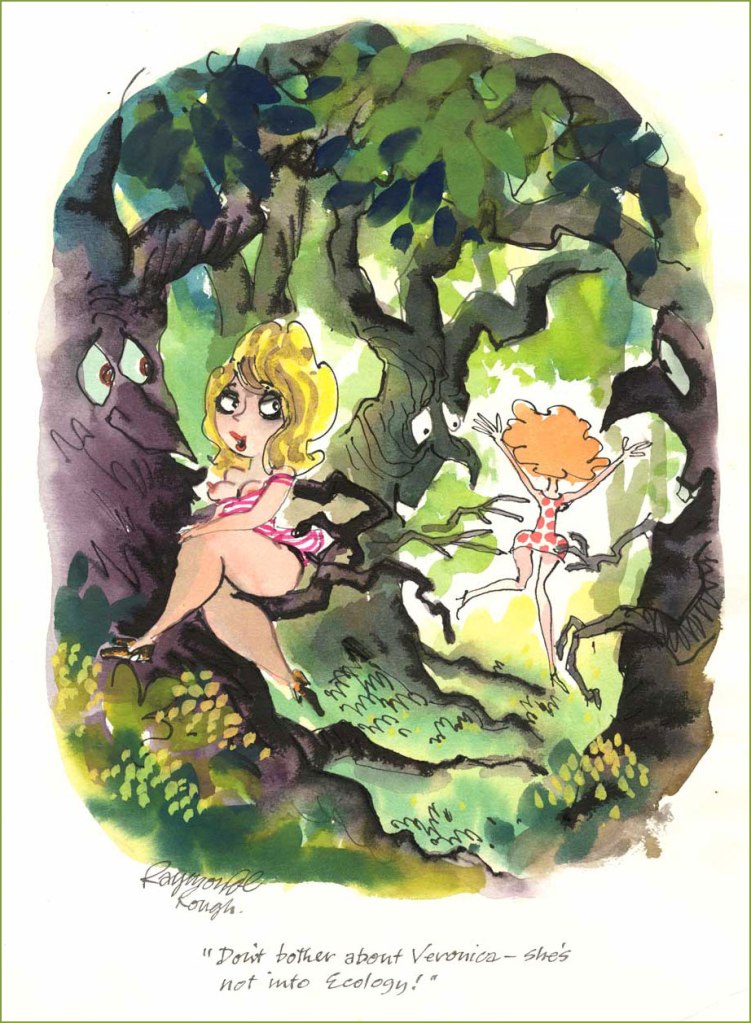
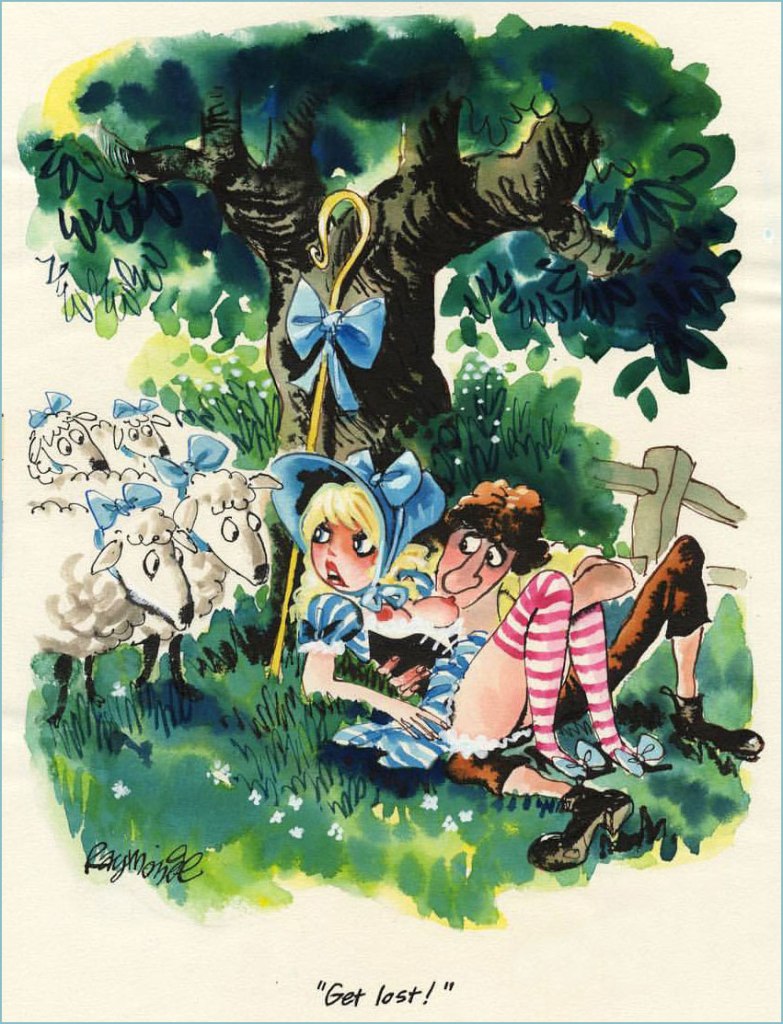
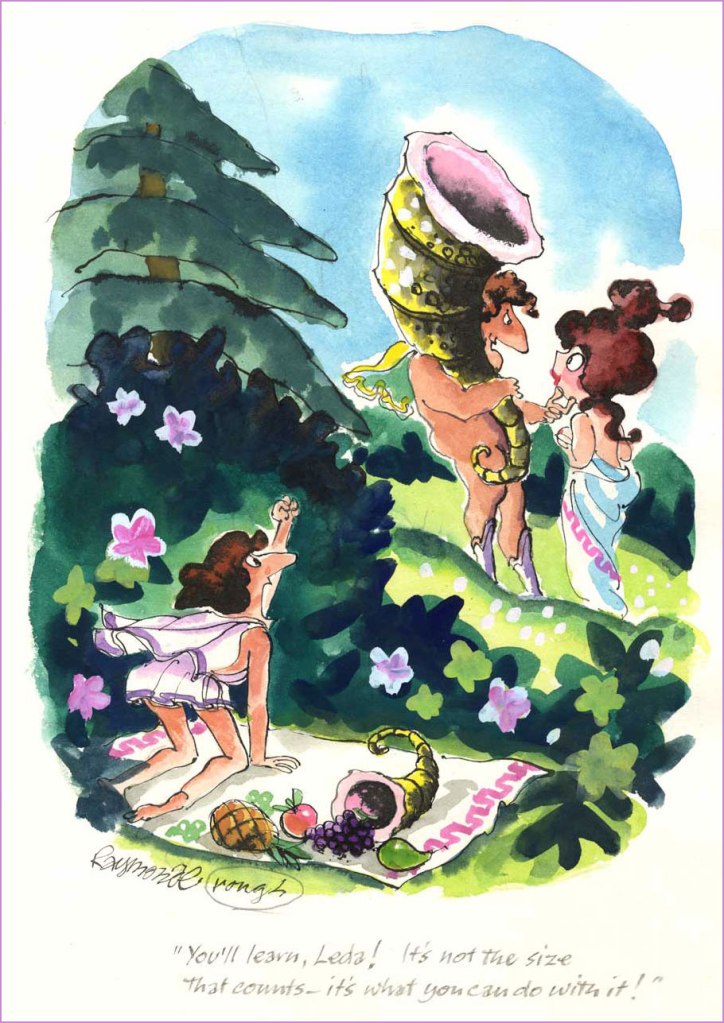
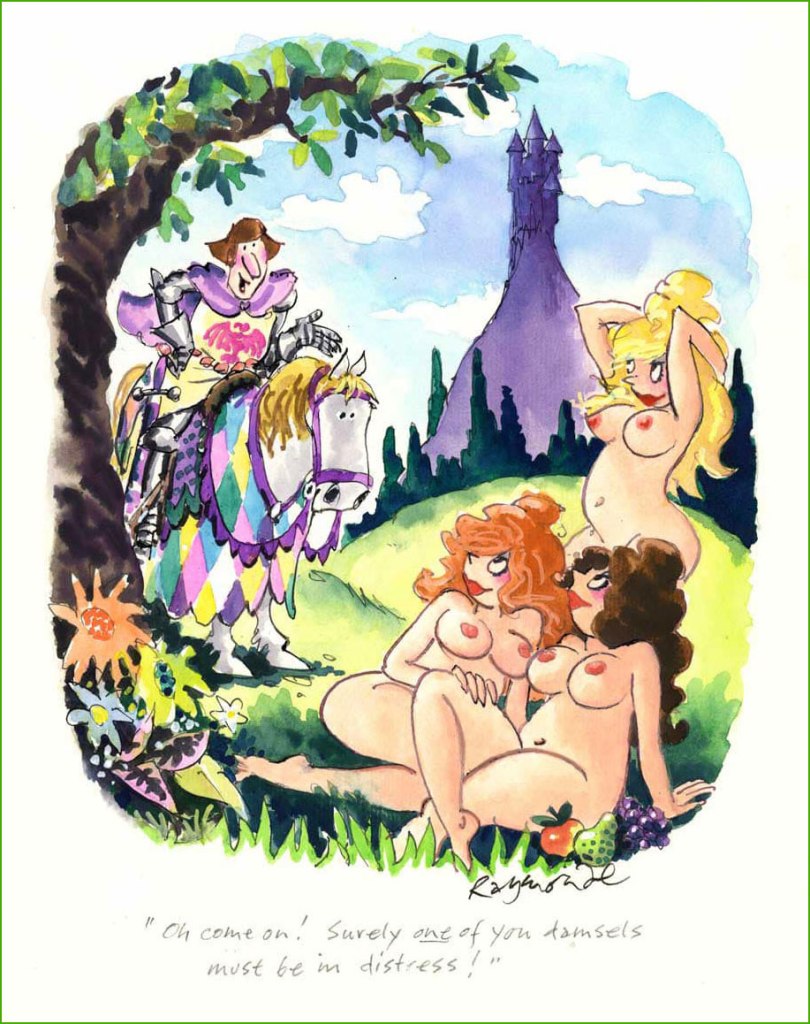
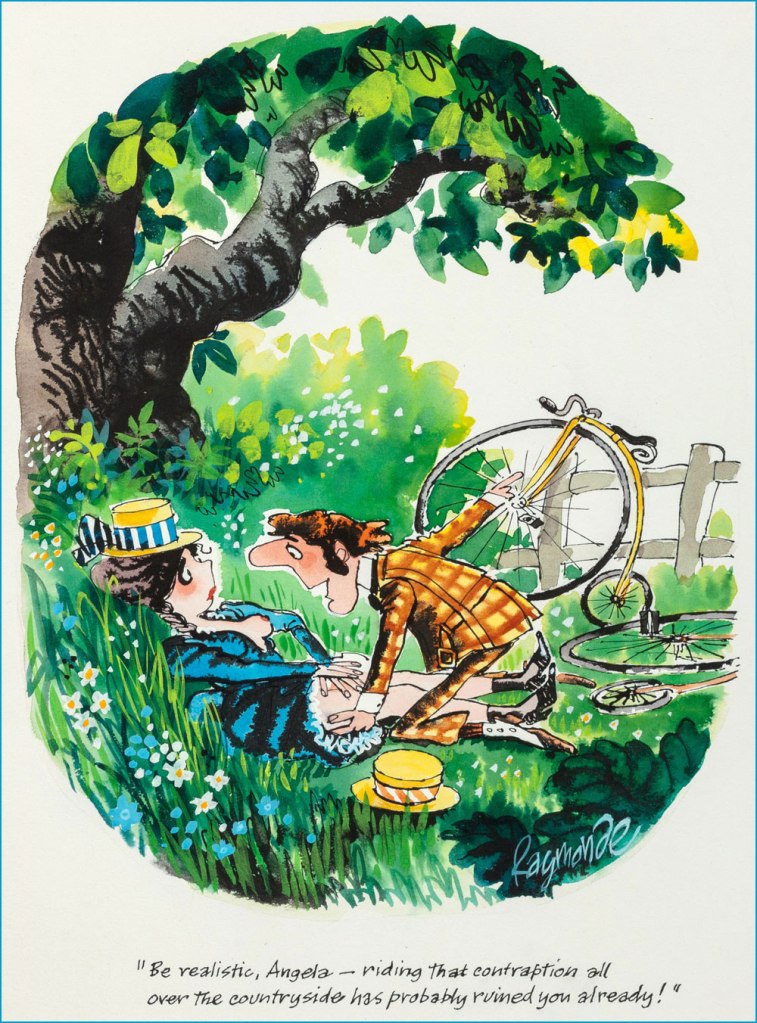
British cartoonist Roy Stuart Raymonde, who died in 2009 at 79 years old, first intrigued me with vivid watercolours and episodes oftimes set in mushroomy forests or secluded glens dotted with babbling brooks. Our anglophilically-minded readers may recall his work for Punch Magazine, and the rest of us will recognize him from the pages of Playboy, to which he contributed a monthly full-colour page for some 30 years.
The rambunctious Raymonde started out in advertising, cushioning his finances by freelancing as a cartoonist, mostly notably for Tit-Bits, a British tabloid-type magazine with an amusing name which reminds me of this George Carlton sketch. By 1960, Raymonde had amassed enough contacts to become a full-time cartoonist.
A collection of Raymonde cartoons published in 1961. Head over here to see some of the insides.
July 1974. This is the cartoon that first attracted my attention… with mushrooms, naturally.
I didn’t know this until writing this post, but delightfully Raymonde was friends with WOT favourite Gerard Hoffnung (see co-admin RG’s posts Gerard Hoffnung’s Constant Readers and Off to the Isle of Cats — and Back by Teatime!), whom he met at the Harrow School of Art (a subdivision of University of Westminster) in 1944, when RR was but 15. The two became lifelong friends, with Hoffnung, then a junior tutor (on his way to becoming a schoolmaster) a mere four years his senior, playing the role of Raymonde’s mentor. This friendship was cut abruptly short by Hoffnung’s premature death, so they were not able to re-enact Simon & Garfunkel’s Bookends, alas. I wasn’t able to find the exact source of this quote, as various websites just parrot the same paragraph over and over, but it seems that Raymonde was nearly expelled after adding funny captions to one of Hoffnung’s instructional drawings, a story hopefully as true as it is hilarious. Hoffnung (never bereft of a sense of humour) came to his defense and argued that this act was a sign of talent.
September 1972. What kind of Brit cartoonist worth his Yorkshire Pudding hasn’t spoofed Alice in Wonderland?
1973.
Preliminary sketch of unknown vintage.
Another preliminary sketch.
Given his evident love for the outdoors, I wasn’t surprised to find out that Raymonde bought a thatched cottage at the age of 34 and lived there for the rest of his life, voyages to Japan (where his work was very appreciated, to the point of winning the Gold Prize at the Kyoto International Cartoon Festival in 1996) and such notwithstanding.
1997.
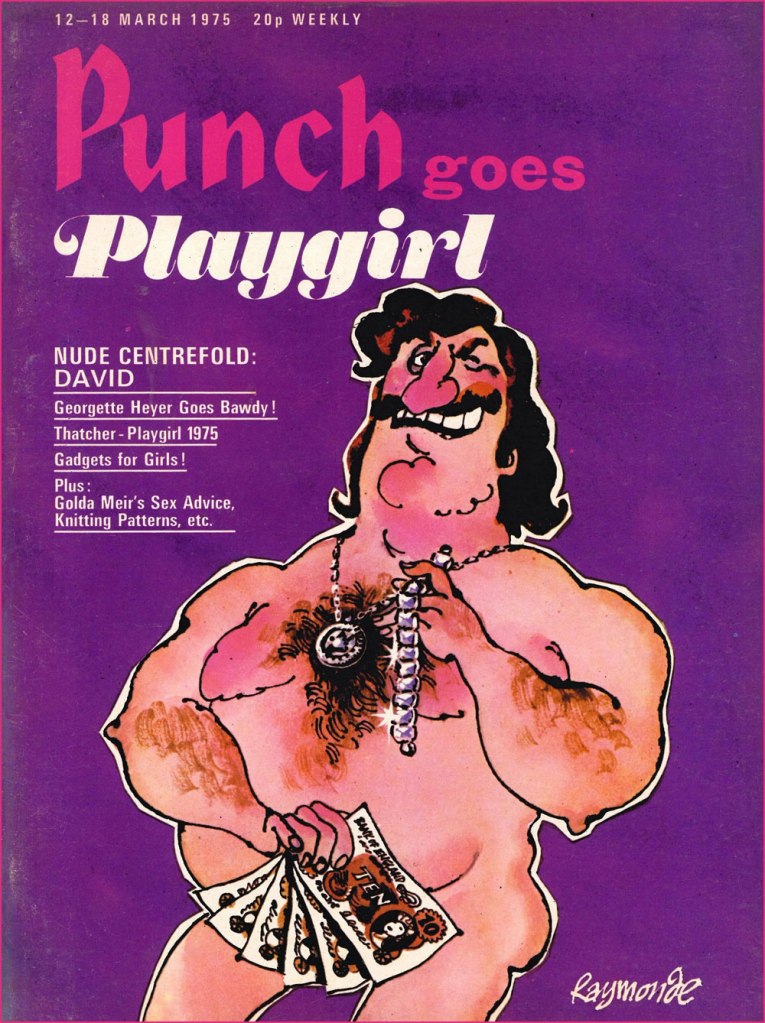
Punch Does Playgirl, March 1975. Raymonde created quite a few covers for Punch… as to the guy depicted, he’s like something out of a Charles Rodrigues sketchbook (see Charles Rodrigues’ Pantheon of Scabrous Humour).
July 1974.
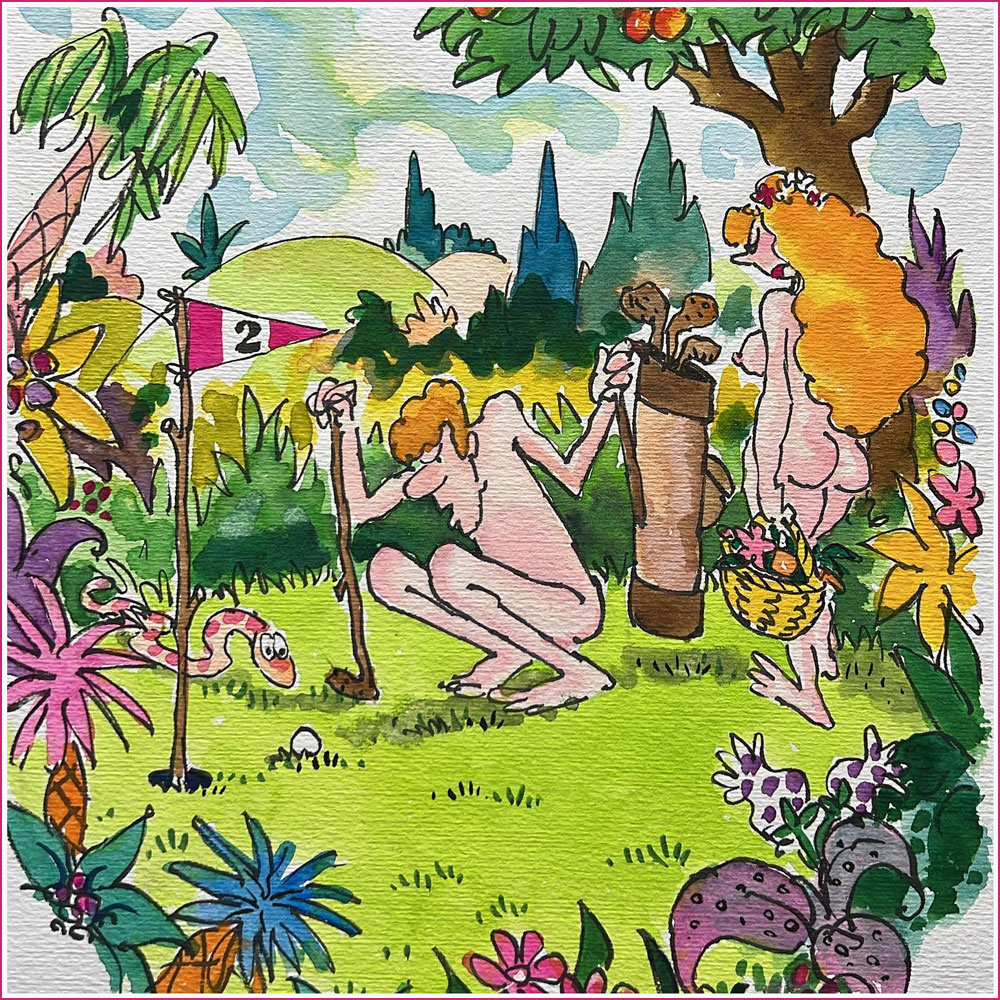
A cartoon used in Fore Play: The Very Best of Playboy’s Classic Golf Humor Paperback (January 1, 1995).
Want to see more? Head over here… and don’t forget to rest your weary head in some spring grass while you’re at it (perhaps with a friendly companion).
« We all know interspecies romance is weird. » — Tim Burton
It’s Bill Ward‘s birthday! No, not Black Sabbath’s Bill Ward — that’s on the 5th of May — save the date, as the suits say. It’s also Will Eisner’s anniversaire, but as he holds a category of his own, let’s let ol’ Bill have his turn, shall we?
Now, while most of the attention devoted to Ward (1919-1998) centres on his enormous output for Marvel founder (and Stan and Larry‘s uncle) Moe ‘Martin’ Goodman, I’m more intrigued by the brief period of his career when he truly seemed invested in his work, namely his passage at Quality Comics, where his craft rivalled that of such illustrious stablemates as Eisner, Jack Cole, Reed Crandall and Lou Fine.
While he worked on such features as Blackhawk and Doll Man, Ward clearly preferred — was it ever in doubt? — depicting beautiful women dressed to the nines, a passion most readily indulged in romance comics, a genre then in its infancy, Joe Simon and Jack Kirby having just set it on its way with 1947’s Young Romance.
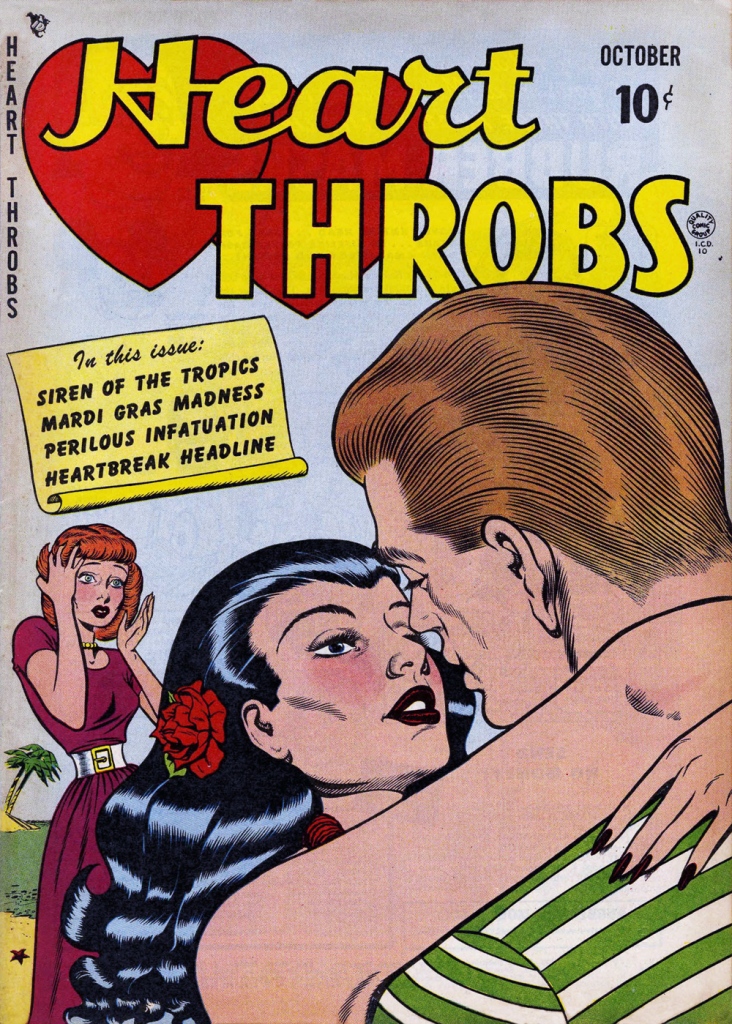
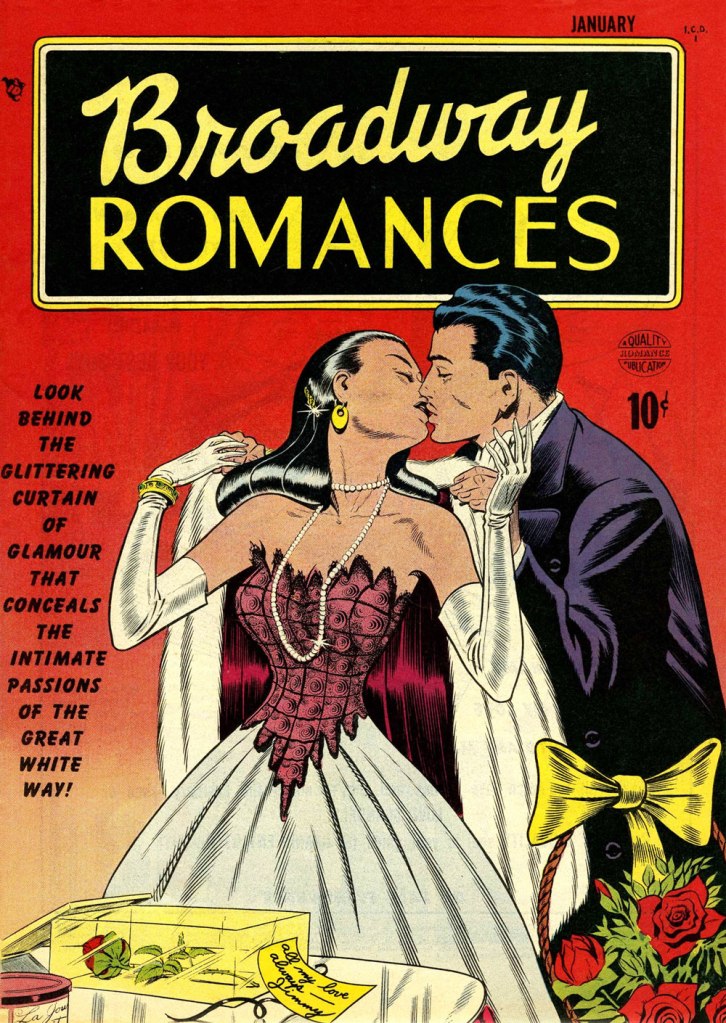
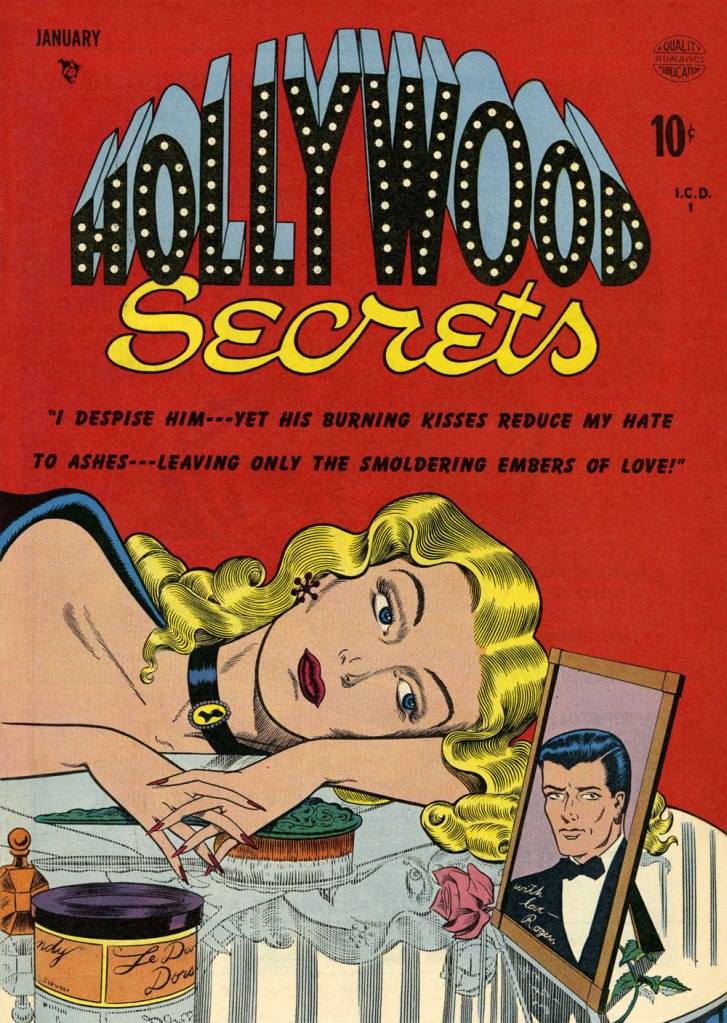
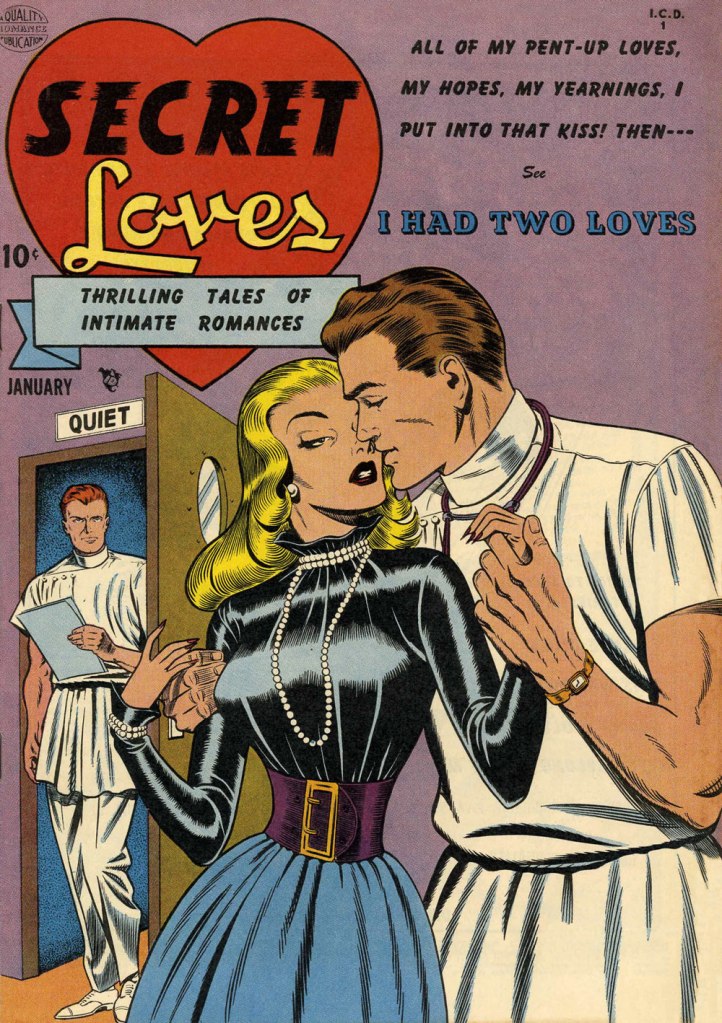
This is Heart Throbs no. 1 (Aug. 1949, Quality). Ever the fetishist, Bill never could resist a well-fitted pair of opera gloves.This is Heart Throbs no. 2 (Oct. 1949, Quality). Quality’s flagship romance title, Heart Throbs lasted one hundred issues, 46 published by Quality, and an even hundred by DC (1956 to 1972) after they picked up what remained of the publisher’s assets, among them Blackhawk, Plastic Man, Doll Man, Uncle Sam, Phantom Lady, and some war (G.I. Combat) and romance titles.This is Hollywood Secrets no. 1 (Nov. 1949, Quality). An unusual colour scheme!This is Campus Loves no. 1 (Dec. 1949, Quality).This is Flaming Love no. 1 (Dec. 1949, Quality). The gloating guy is the prototypical Ward creep.This is Broadway Romances no. 1 (Jan. 1950, Quality). It’s so refreshing to see Ward devote the same level of attention to detail to background items as to the female figure and her accoutrements.This is Hollywood Secrets no. 2 (Jan. 1950, Quality).This is Love Letters no. 2 (Jan. 1950, Quality). Interesting how all these romance covers — the majority of Ward’s production in that genre — all came out within the span of a year or so.This is Secret Loves no. 2 (Jan. 1950, Quality). Ward liked his women to have tiny, needle-like digits — I mean, just compare the lovers’ respective paws!This is Torchy no. 5 (July 1950, Quality), Ward’s signature creature. With the years, as his women grew ever more buxom, his men became ever more grotesque — these are some of the archetypes, but noses got longer, legs got skinnier and shorter, bellies more bulging — until men and women in no way seemed to belong to the same species. While that device of exaggeration was a mainstay of « girlie » art, Ward took it further than just about anyone.
Over the years, things got more… pneumatic. And then some more.
One from an issue of Zip (1967, Marvel); that particular cartoon had probably been around the block a few times by then… it sure doesn’t scream ‘1967!’
Incidentally, the elaborate background textures found in Ward cartoons were achieved by a technique called rubbing, or frottage, « … a reproduction of the texture of a surface created by placing a piece of paper or similar material over the subject and then rubbing the paper with something to deposit marks, most commonly charcoal or pencil. » Not to be confused with the *other* kind of frottage, although, come to think of it, that’s also quite relevant to Ward cartoons.
One of Ward’s ‘Phone Girls’, she saw print in Snappy no. 24 (1958, Marvel)… and likely numerous times thereafter.
« When asked if they would like to have sex with me, 30 per cent said, “Yes”, while the other 70 per cent replied, “What, again?” — Silvio Berlusconi
A certain subset of Italian Fumetti— namely the sex and horror digests of the 1970s — constitutes a quagmire of oft-truly repellent material in which indisputable gems yet glimmer bright. Mostly the covers… designed to lure the sailor — or reader — to his doom.
While several of the most prolific artists of the medium were evidently talented fellows, only a couple (Averardo Ciriello being the other one) truly draw my interest, since, despite low pay and a breakneck production pace, they didn’t swipe much… or at all — unlike their colleagues. For most of the industry and society, consent and copyright appeared to be pretty fuzzy, casually dismissed notions.
I favour the work of Fernando Carcupino (1922-2003) over that of his contemporaries because he always knew how to keep things light, bright and original — never wallowing in poor taste or sadism, even when the subject matter called for it, and I thank him for it. Here are some highlights from his illustrious career.
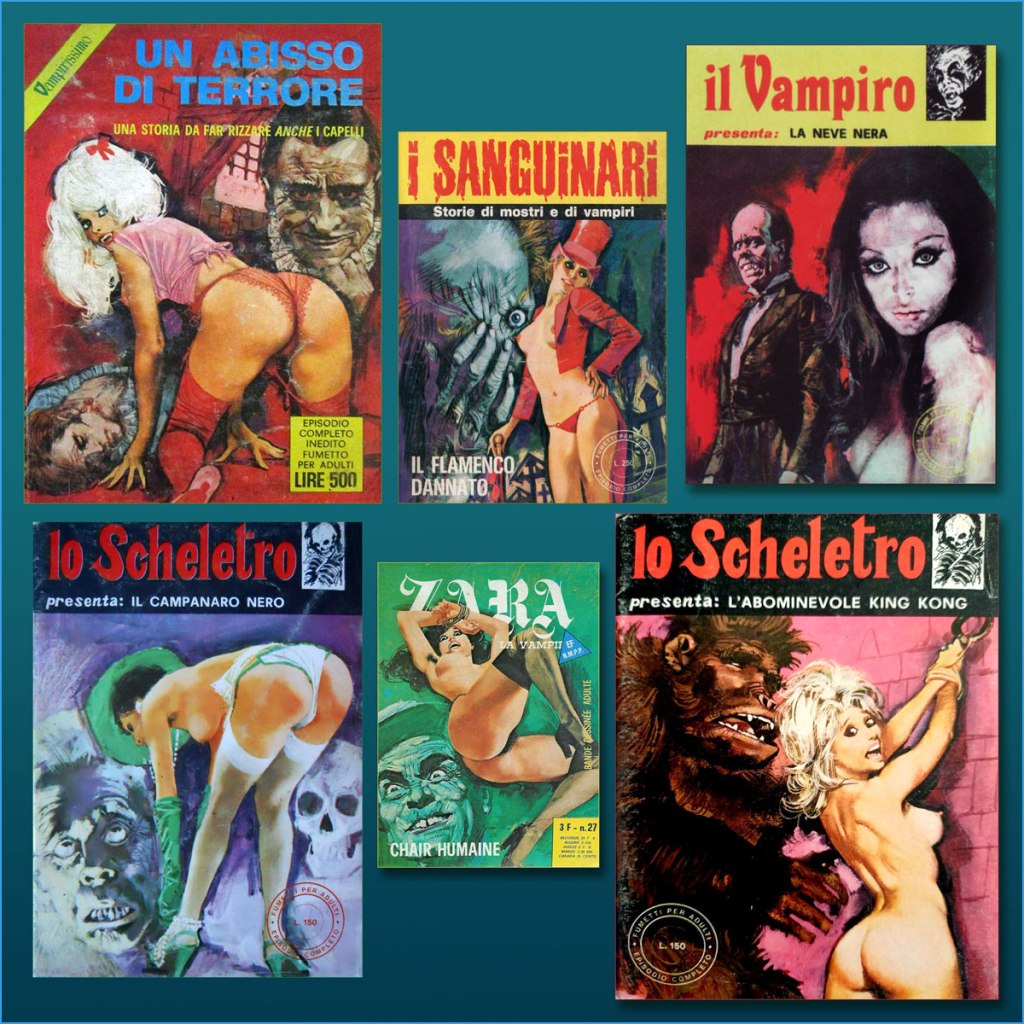
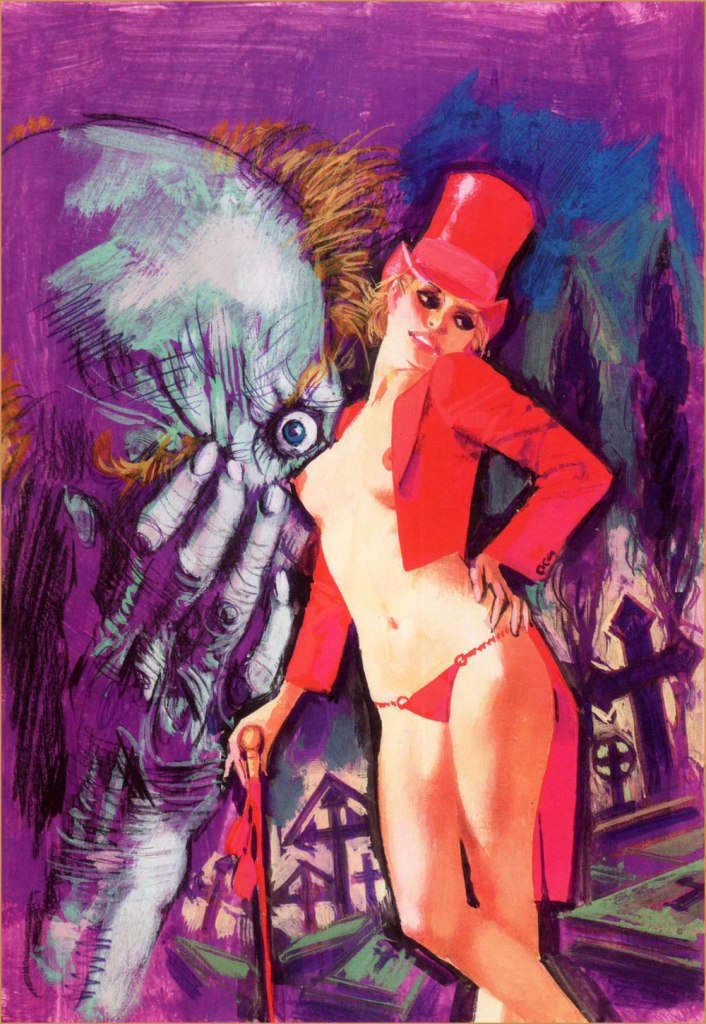
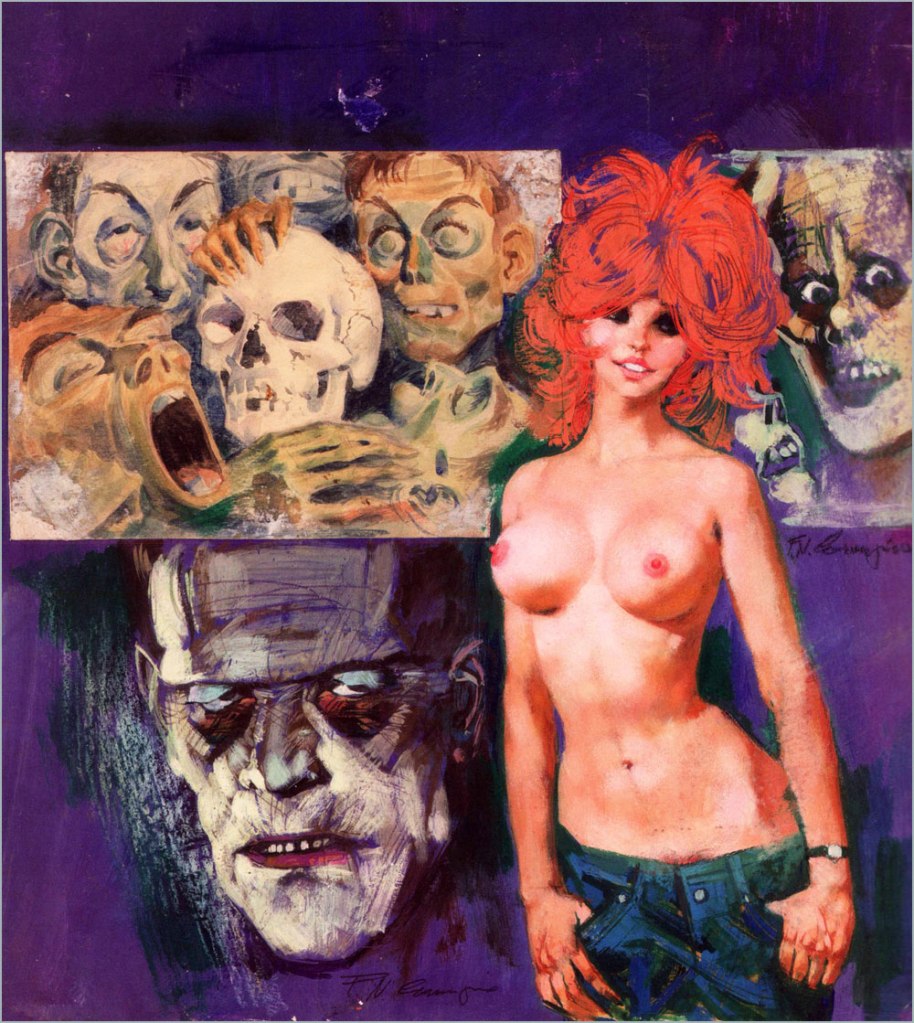
A piece from La Settimana Umoristica no. 5 (Apr. 1954) entitled “Celluloid Terror”. All the classic ghouls are there, even that very year’s Creature From the Black Lagoon. Carcupino could spot an enduring classic from a long way off!A selection of our fine products, as they appeared in print. Vampirissimo no. 11(Nov. 1975, Edifumetto). “An Abyss of Terror”.Leaned in too close and got poked in the eye! I Sanguinari no. 9 (July 1975, Edifumetto). “Flamenco of the Damned”. Il Vampiro no. 5 (March 1974, Edifumetto). “The Black Snow”. Why, hello, Mr. Chaney!Lo Scheletro no. 13 (July 1974, Edifumetto). “The Grim Bell Ringer”. Zora la Vampira no. 1 (Jan. 1974, Edifumetto) — “Human Flesh” In French, Zora became ‘Zara‘, for some reason.Lo Scheletro no. 3 (March 1975, Edifumetto). “The Abominable King Kong”. Tabù no. 23 (Oct. 1975, Edifumetto). “Please Don’t Bite My Butt”. I Notturni no. 9 (Sept. 1973, Edifumetto). “Peter the Fornicator”. Impressive, given his mug. Vampirissimo no. 8 (Aug. 1974, Edifumetto). “Death by Fright”. Oh, he’s a spooky one, all right. Vampirissimo no. 7 (July 1974, Edifumetto). “Monster Dimension”. This is the sort of composition and treatment that Bill Sienkiewicz would “introduce” to mainstream comics a decade later, blowing the minds of Marvel Zombies who’d consumed naught but the House of Ideas’ offal, just as Jim Steranko had blown their older brothers’, a decade prior. Lo Scheletro no. 7 (Apr. 1974, Edifumetto). “Demon in Love”. This fine* monograph from Korero Press (2019) spotlights a certain facet of Carcupino’s œuvre, though it’s pretty light on the horror, which is fine by me. The narrow thematic focus (on sex, the other half of the equation) does manage to render the proceedings a tad tedious after a while, but that’s to be expected. For a better sense of the man’s versatility, check out his website.
-RG
*marred somewhat by the usual “We Italians...” introduction, yet another variation on the line of “we are so passionate, we love women so much, we can’t control ourselves” bullshit. I guess it’s perfectly commonplace, for some people, to confuse misogyny with love . Right…
Today’s post is dedicated to shapely posteriors, a particularly estival apparition. Cleavages can be admired year-round, but butts tend to put up an appearance during the season of bumblebees, swim-suit malfunctions, and summer dresses blown about by a warm breeze. There’s no need to take sides in the old battle of boob-man-vs-butt-man (which also entirely ignores the preferences of lesbians etc.), each shall have their day!
«It isn’t often one sees a bowler these days. » A cartoon by Peter Arno published in The New Yorker on August 9th, 1952. The asses may be hidden, but we know they’re there!
«Where the hell where you when I was down here skindiving?» There are many theories about a mermaid’s anatomy, and this particular interpretation opted to emphasize her butt cheeks. This is a Playboy cartoon by Arv Miller, published in May 1957.
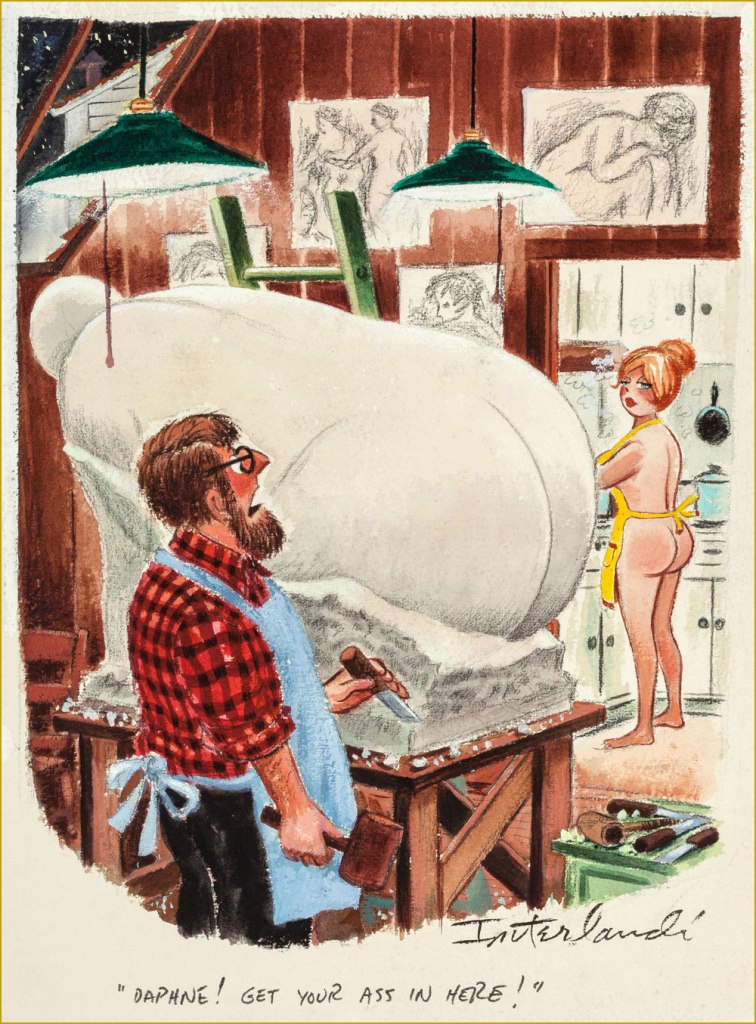
Cartoon by Phil Interlandi (1924-2002), a frequent contributor to Playboy.
Another one by Mr. Interlandi.
Playboy cartoon by Austrian-born Erich Sokol (1933-2003). The secretary could consider no longer choose her undergarments according to the calendar…
Cartoon by Donald Gordon Addis (1935 – 2009), who created several syndicated newspaper strips. He was staunchly anti-religious and a prominent member of the Freedom From Religion Foundation, the latter releasing a retrospective of his work in 2019, Cartoons for the Irreverent.
Presumably I couldn’t get away with a post about asses without featuring some spanking scene. Cartoon by British cartoonist Michael ffolkes 1925-1988, who contributed to a variety of British and American newspapers and magazines and also illustrated an impressive number of children’s books (with a particular proclivity for Roald Dahl ones).
Cartoon by Alden Erikson, about whom not much is known.
«Today We Will Examine the Primary Male Erogenous Zones, Thanks to Dr. Simpson of the Social Sciences Department » . Another cartoon by Erikson, published in September 1966. I had to include a male ass for variety!
Not long ago, I chanced upon this passage from an interview with the lovely Ramona Fradon, wherein she touches upon her mid-70s work for Joe Orlando‘s ‘mystery’ comics at DC.
« Those were all Joe’s productions, and there was nothing he liked better than to get around the Comics Code. The fact that my drawing was comic helped him get away with more than he could with other artists. He was always pushing the envelope. »
To understand what she means, I refer you to this particular story, which I showcased last fall.
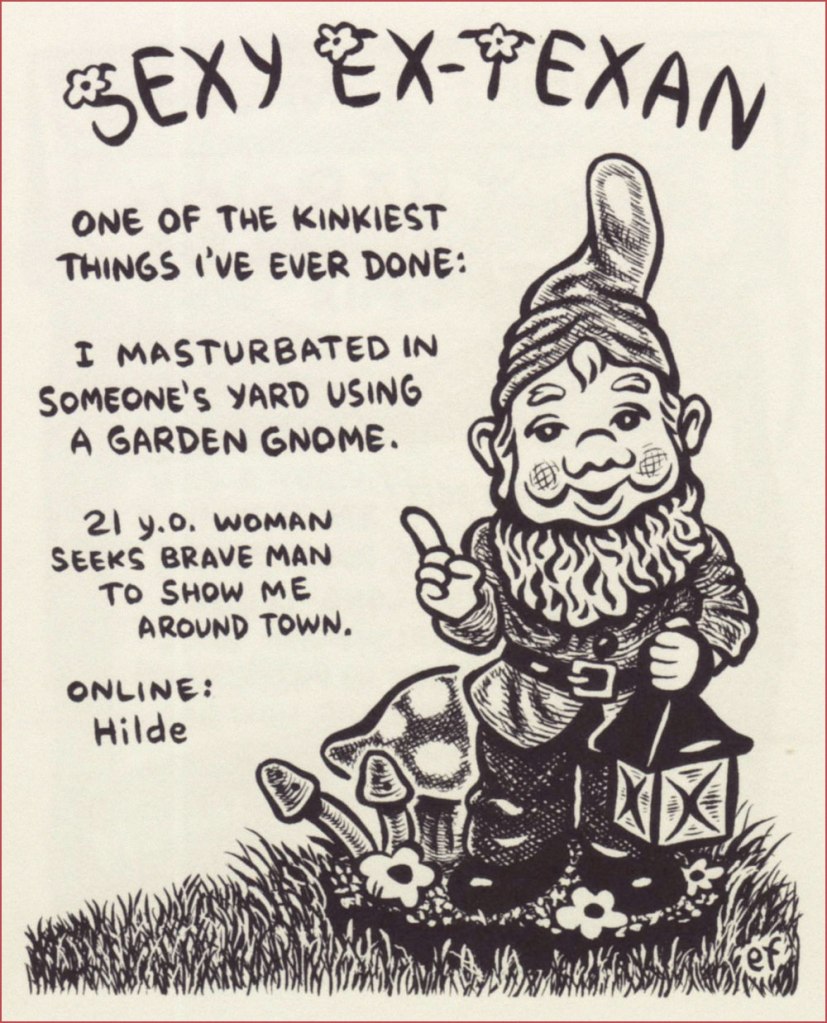
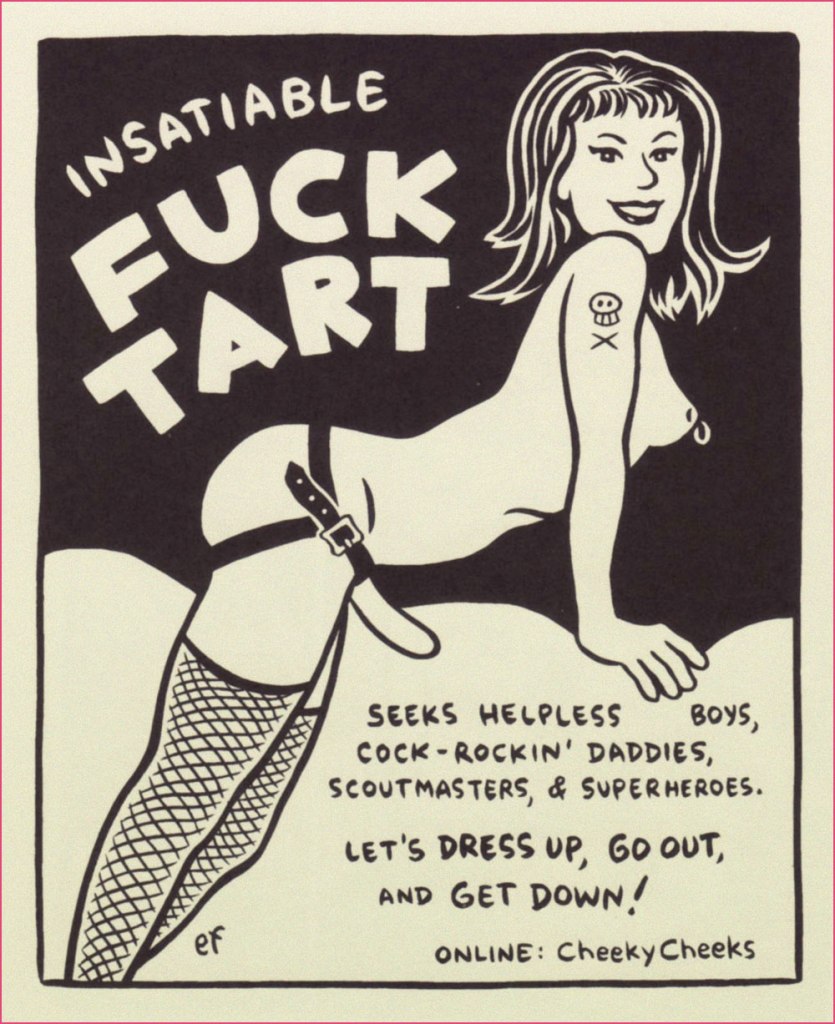
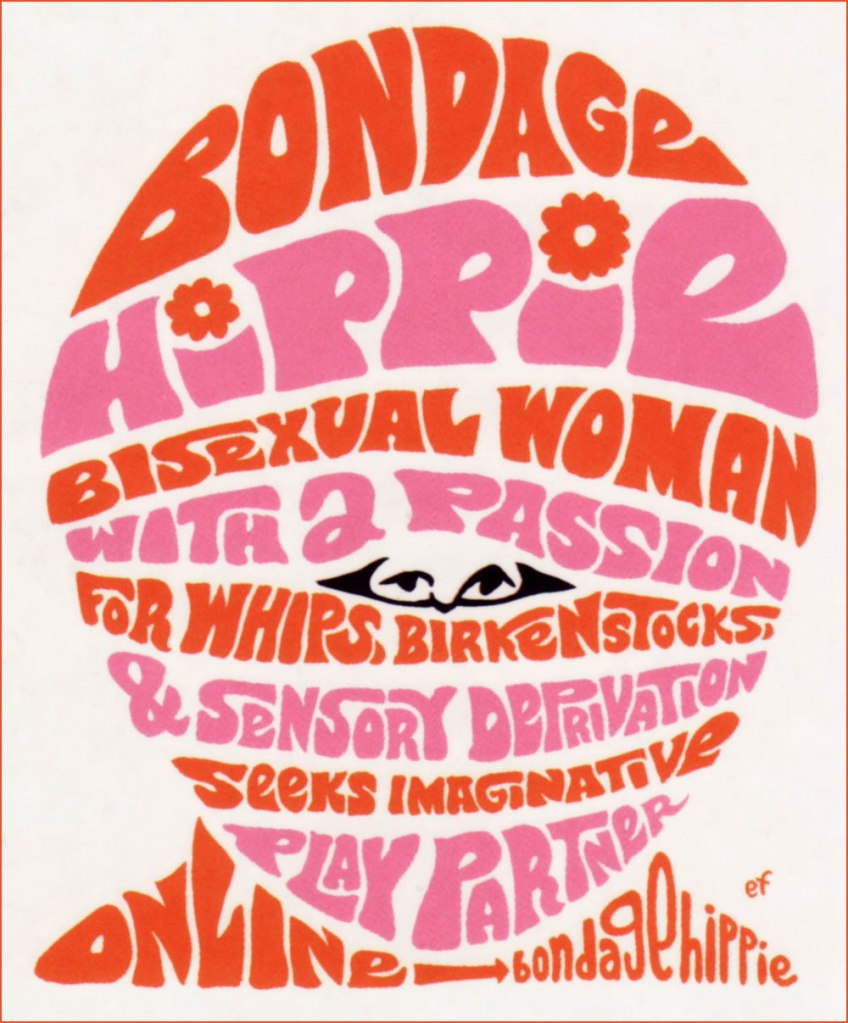
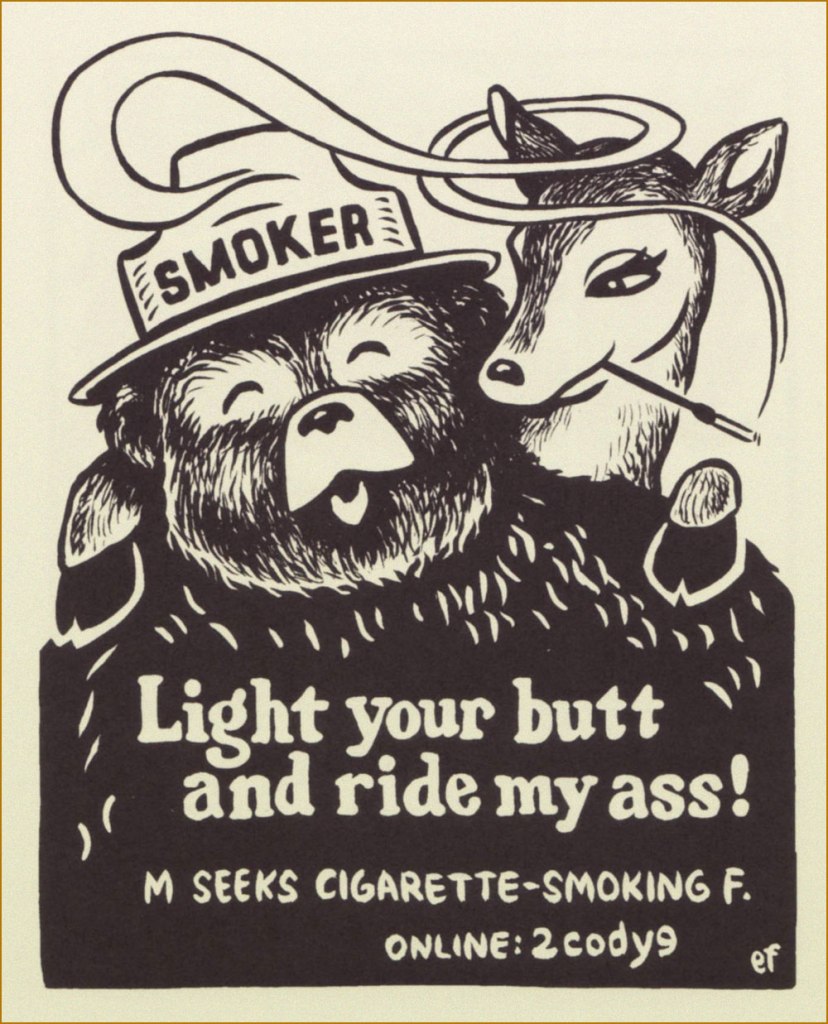
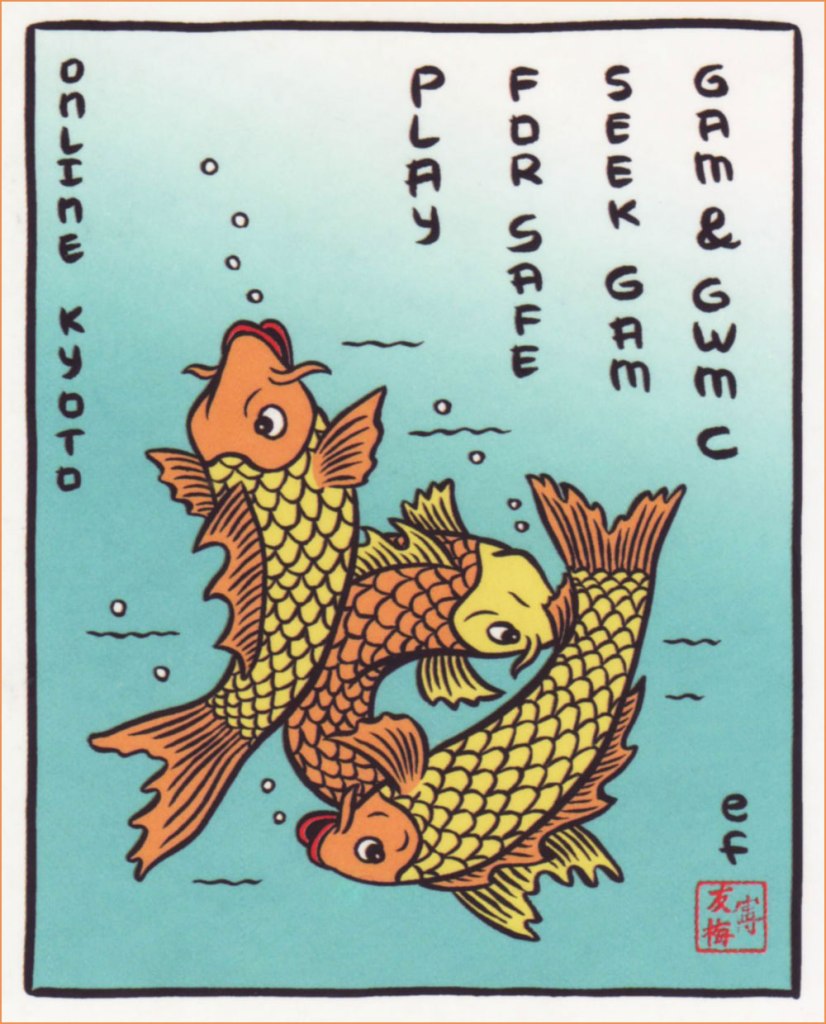
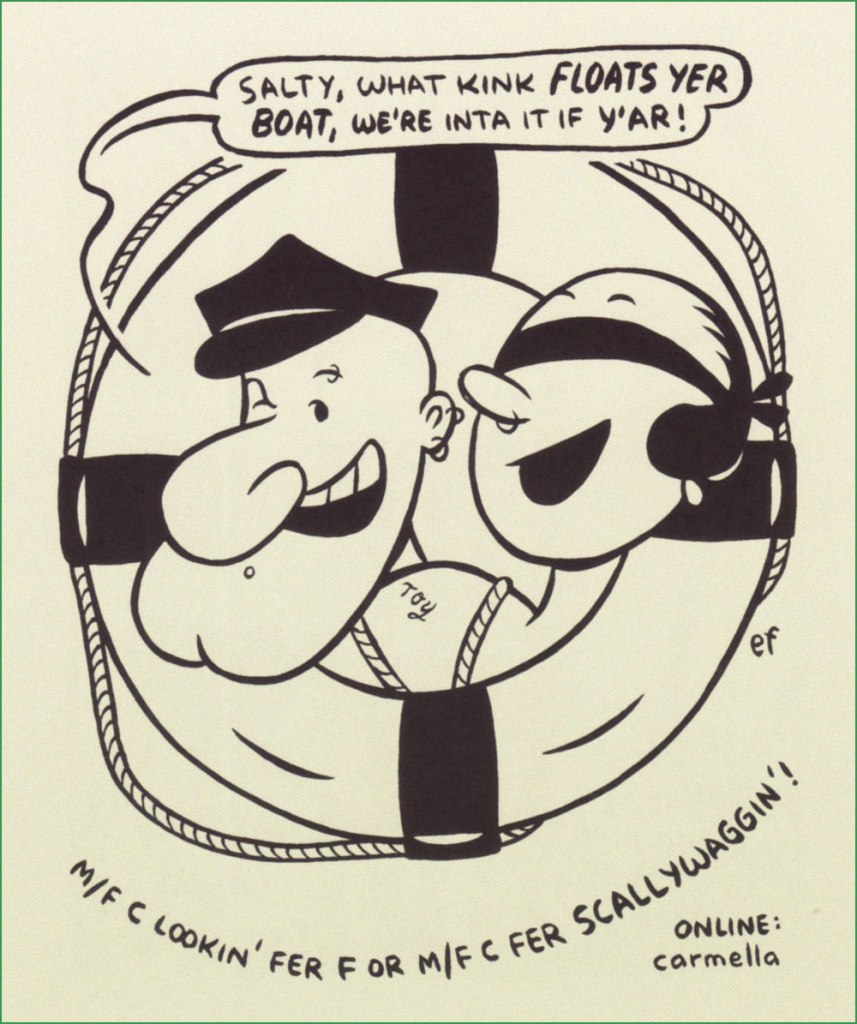
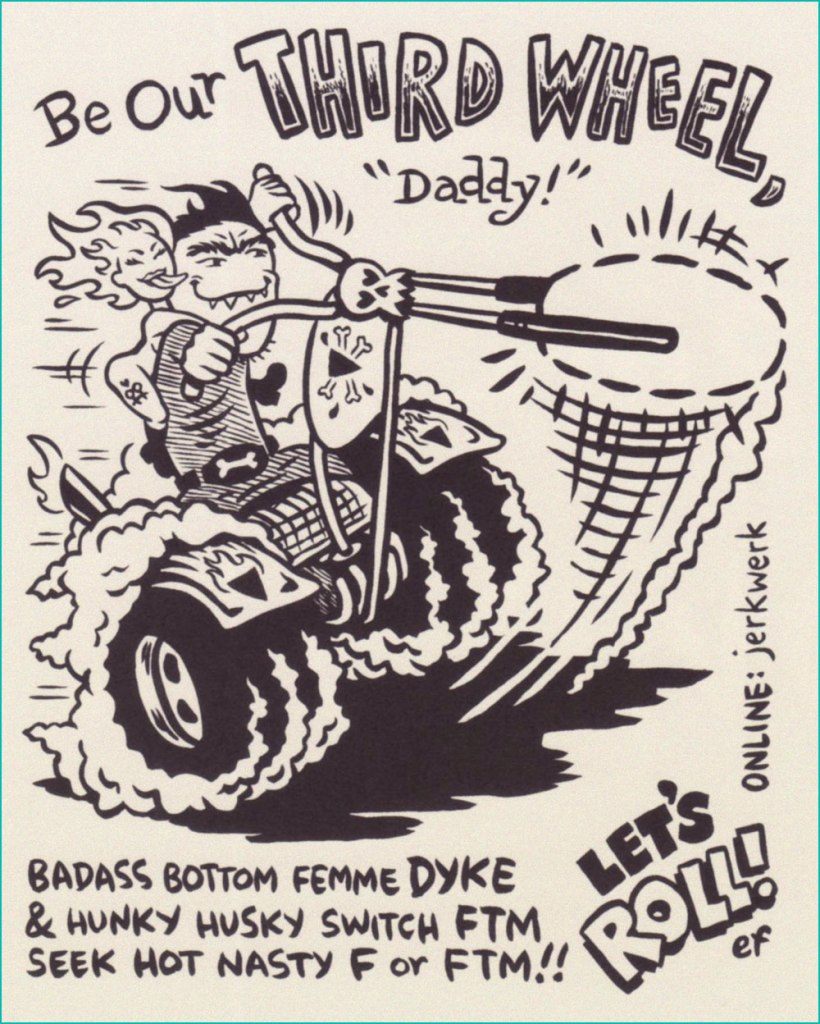
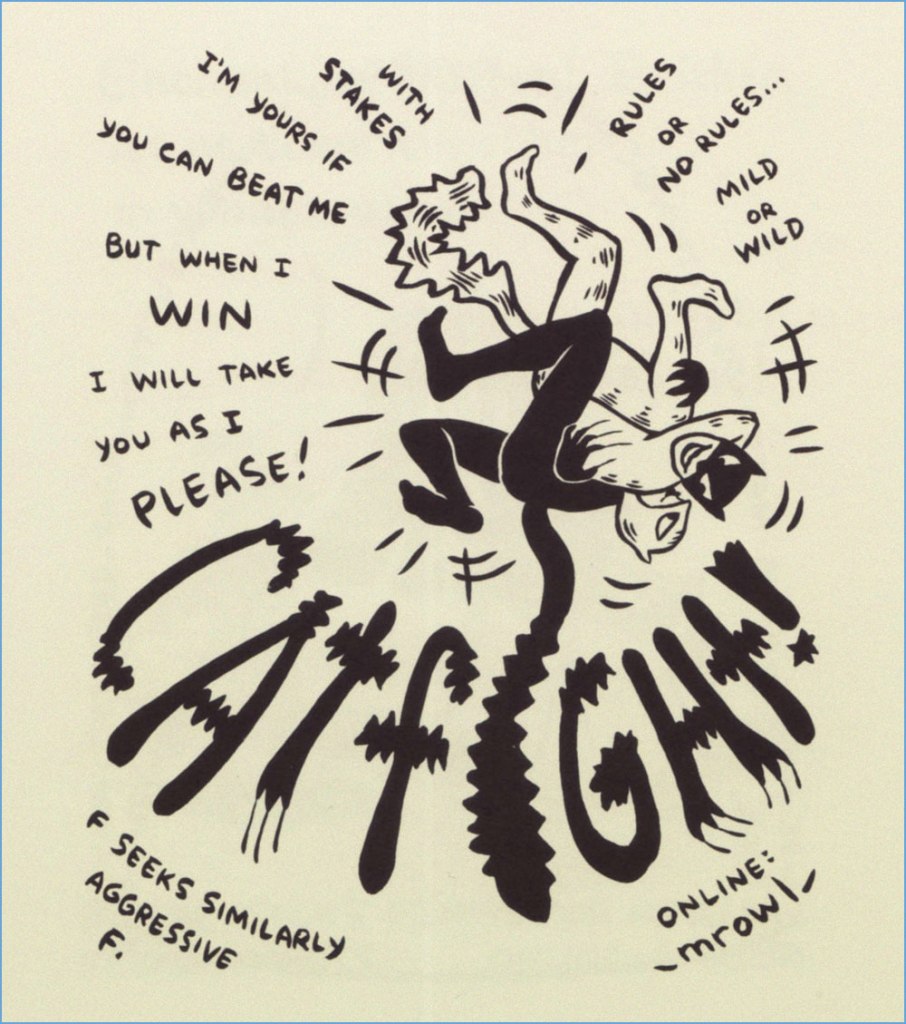
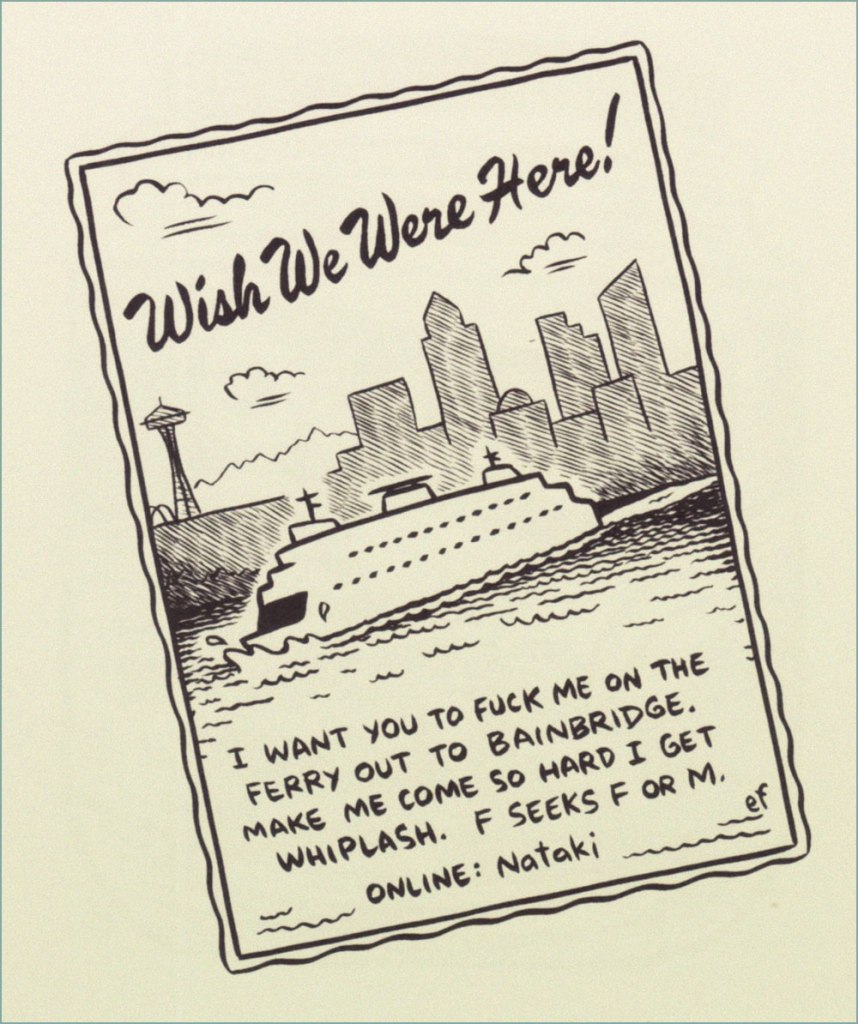
« So when we decided to start running a weekly illustrated personal ad — ‘Lustlab Ad of the Week’ — we knew right away what we didn’t want. We didn’t want to sensationalize what was already pretty sensational, thanks. And we didn’t want to hyper-sexualize what was already plenty sexual. We wanted an artist who could take short, pithy personal ads — short, pithy, filthy personal ads — and infuse them with the kind of playfulness that true kinksters bring to their sex lives. We wanted someone that could make someone into whips and chains and hoods look like someone you could take home to meet your parents.
We wanted Ellen Forney. »
Just like Ramona Fradon, Ms. Forney wields a friendly, extremely engaging and accessible style (as you’ll witness). Here, then, is a modest sampling from the four-year frolic of the ‘Lustlab Ad of the Week’, circa 2004-2007. Feel free to browse.
The feature’s highlights have been collected, in fine fashion, in a snazzy little hardcover entitled ‘Lust‘. (Feb. 2008, Fantagraphics). While it’s out of print by now, affordable copies appear to still be available. If it floats your boat at all, do not hesitate!
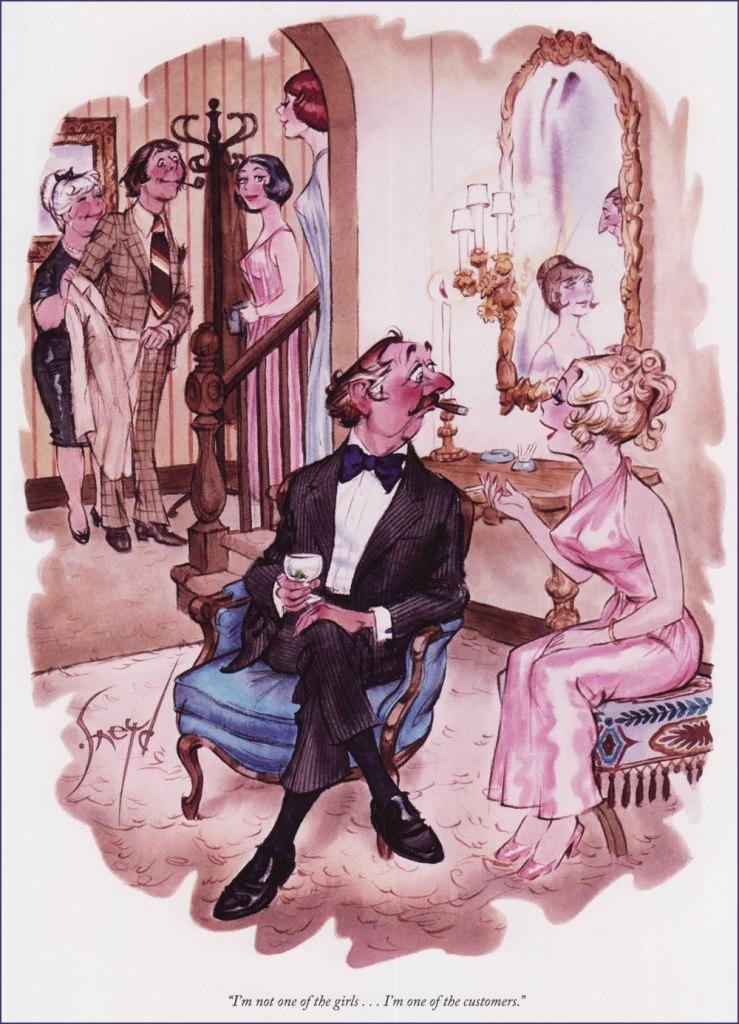
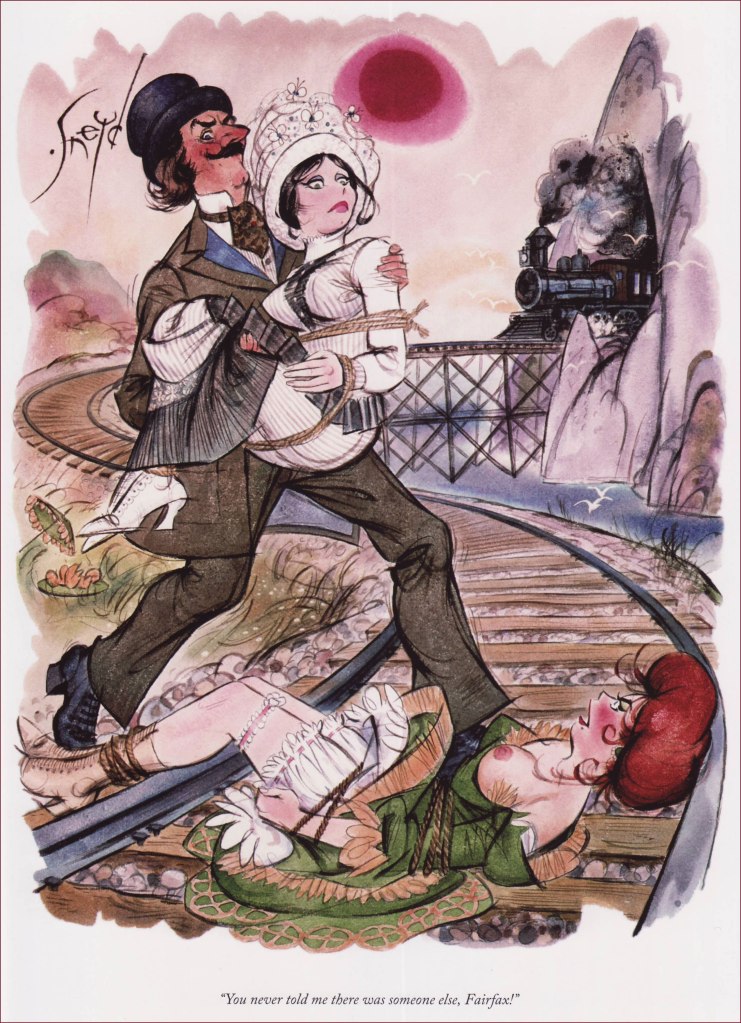
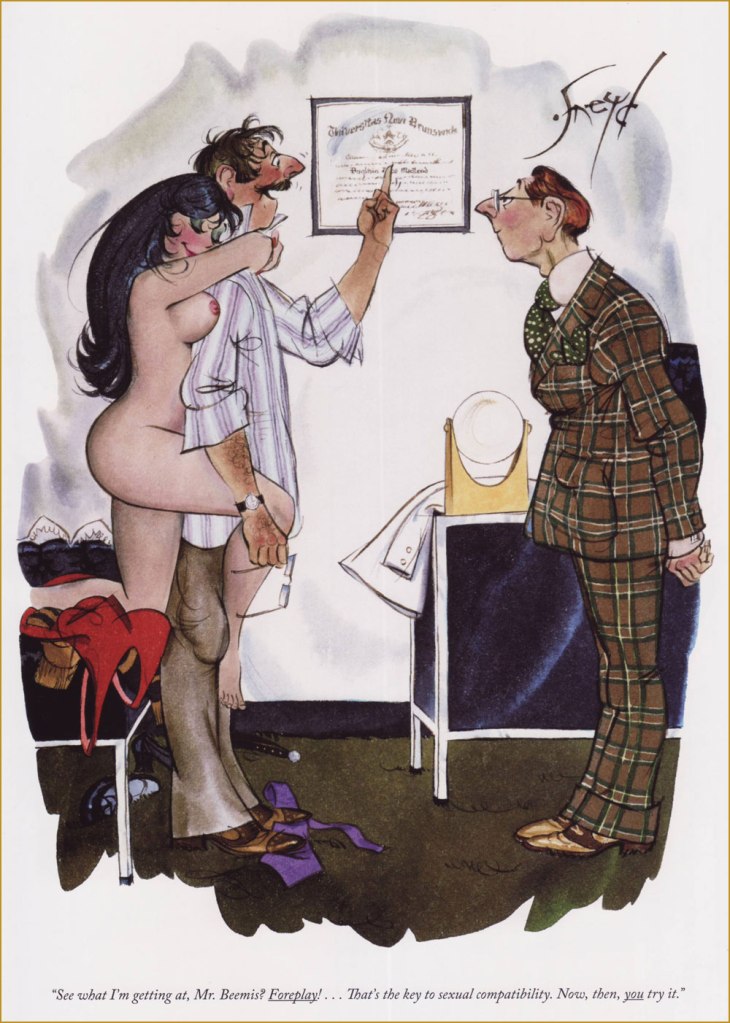
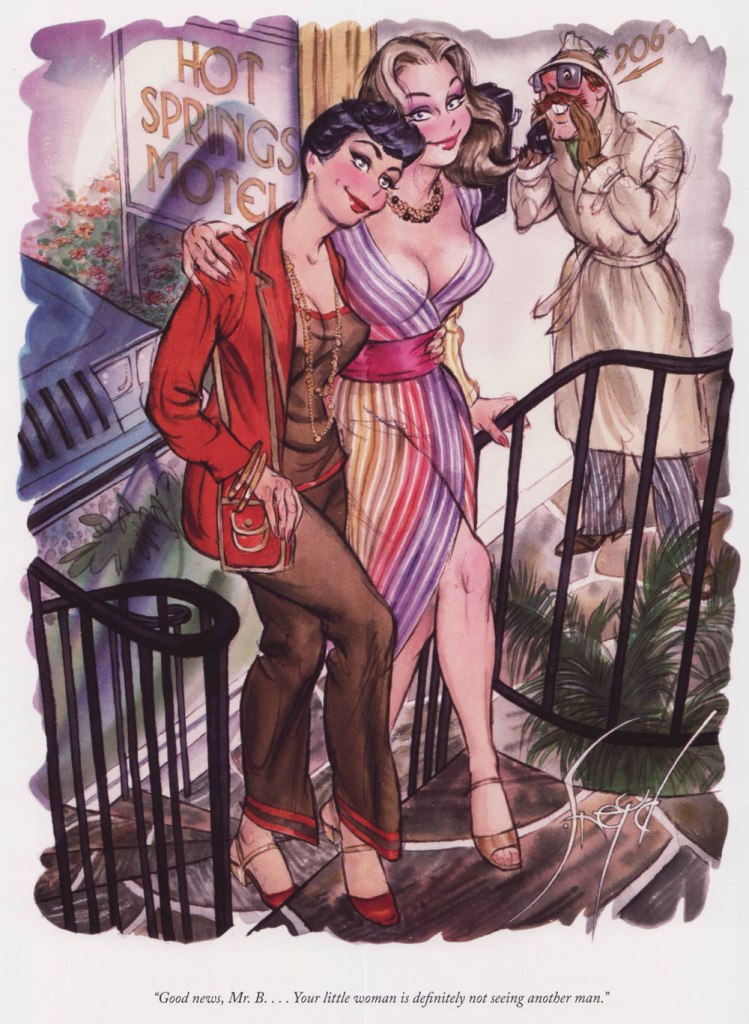
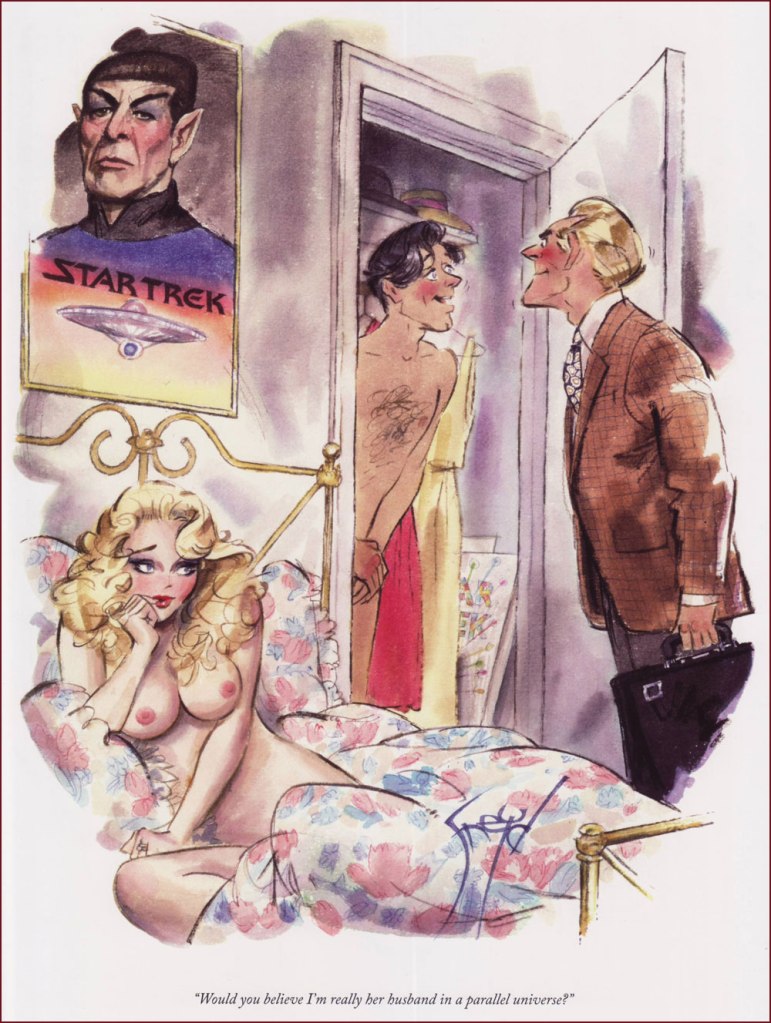
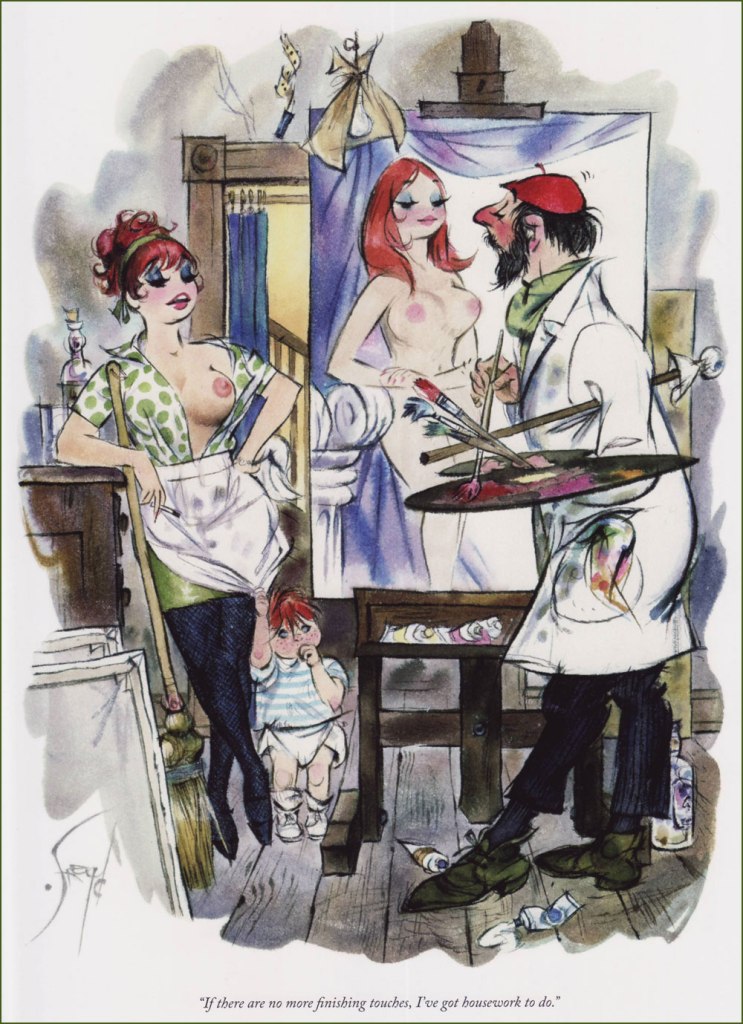
You probably remember Ontarian artist Doug Sneyd from Playboy magazine (well, those of you who read it for the cartoons!), which he began drawing for in 1964. Co-admin RG is distinctly not a fan… and as for me, well, it depends on my mood. I like his watercolour technique, and the way he draws noses and mouths* somewhat less so. There is such a bevy of wonderful Playboy artists that one is a bit spoiled for choice (for a few favourites, see previous posts, for example Happy Birthday to Eldon Dedini, Don Madden’s Luxuriant Oasis of Dames and Dogs, or Dink Siegel’s Swingin’ Roommates), but one can always use some more cheesecake.
Somehow I ended up with The Art of Doug Sneyd: A Collection of Playboy Cartoons (2016, Dark Horse Books) without even noticing. Like most similar monographs, it’s now out of print, so one could perhaps consider it an investment of sorts! Canada is proud of Sneyd, who was born in Guelph, Ontario and spent most of his time in NYC-wannabe Toronto – a bunch of his cartoons are included in the National Archives of Canada, thirty of them from Playboy.
Here are a few examples from the aforementioned collection – I tried to go for a combination of the visually interesting** with a decent gag. It can perhaps be argued that all such cartoons can’t age well by virtue of their very nature, but many have passed through decades with considerably more dignity and grace than Sneyd’s. I suppose it depends on whether the jokes is at the expense of the woman involved and whose side the sympathies lie. Anyway, here we go!
« Bah! » — our old fiend (and dashing all-Canadian villain) Snidely Whiplash would never sink so low!
This one is my favourite, because the therapist/professor looks really likable and goofy, and the girl seems to be genuinely floating on cloud nine.
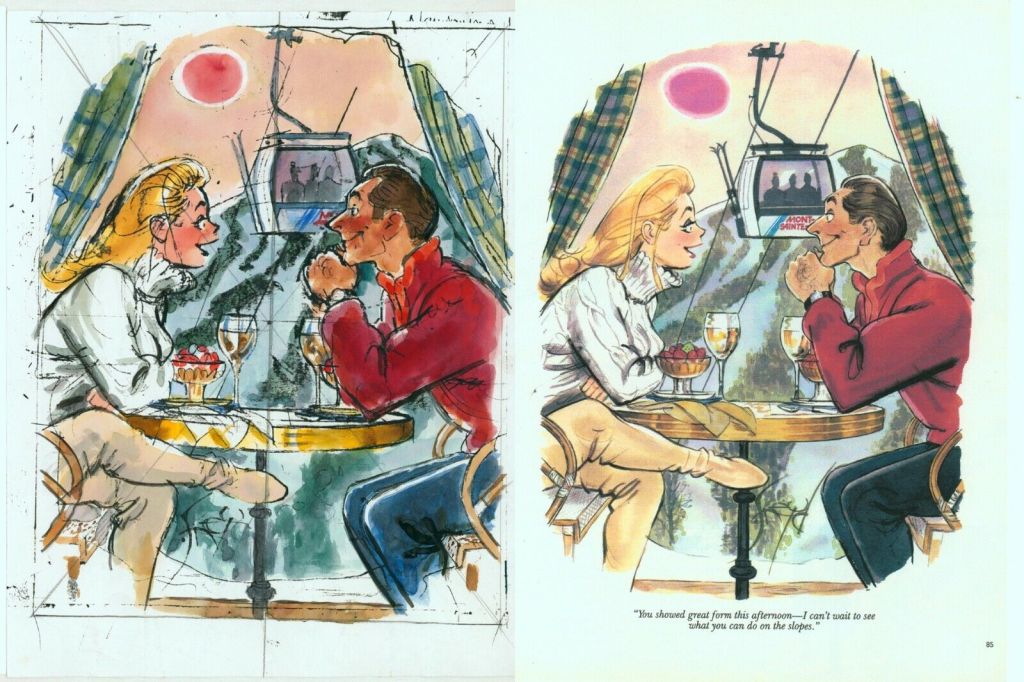
A comparison between the preliminary sketch and the final rendition. This strip from 1997 has a cute story – Sneyd used the backdrop of Mont-Sainte-Anne (a ski resort in the Laurentians) for this cartoon since he had recently visited it. When the cartoon was published, the management of the resort was apparently quite enchanted to get this free publicity.
~ ds
* Speaking of wide ‘fish’ mouths and no noses, I generally prefer Erich Sokol.
** I distinctly object to the claim that ‘he is by far the best cartoonist Playboy magazine has seen‘ (source), and scoff in dismay at the idea that ‘all [of his cartoons] are beautifully drawn, richly colored, and very very funny, and each one is an exceptional work of art‘ (introduction to The Art of Doug Sneyd by Lynn Johnston — pushing Canuck solidarity quite a bit too far.
**********************************************
Update: Mr. Sneyd « … died on January 21, 2025 at Soldiers’ Memorial Hospital in Orillia. »
One of this blog’s unexpected hits (pow!) has been Let’s All Go Down to the Catfights!. Though published in 2018, this post still generates a lot of interest on a practically daily basis – I knew people liked to spectate women fighting, of course, but I didn’t realize just to which extent. I mean, we have a whole THE TWILIGHT WORLD OF GIRLIE CARTOONS category, it’s not like that post was the only instance of us featuring half-or-entirely-naked women.
I’ve been meaning to do a part 2 for a long time now, gradually accumulating choice material, to finally spring it on you when you least suspect it (yes, that’s me cackling in the corner). When dealing with a potpourri of styles and decades, I usually try to go in chronological order. If this cavalcade through the years demonstrates something, it’s that our tastes haven’t evolved much. Plus ça change…
Page from The Last Curtain, illustrated by Sheldon Moldoff and published in Sensation Comics no. 22 (Oct. 1943, All-American/DC).
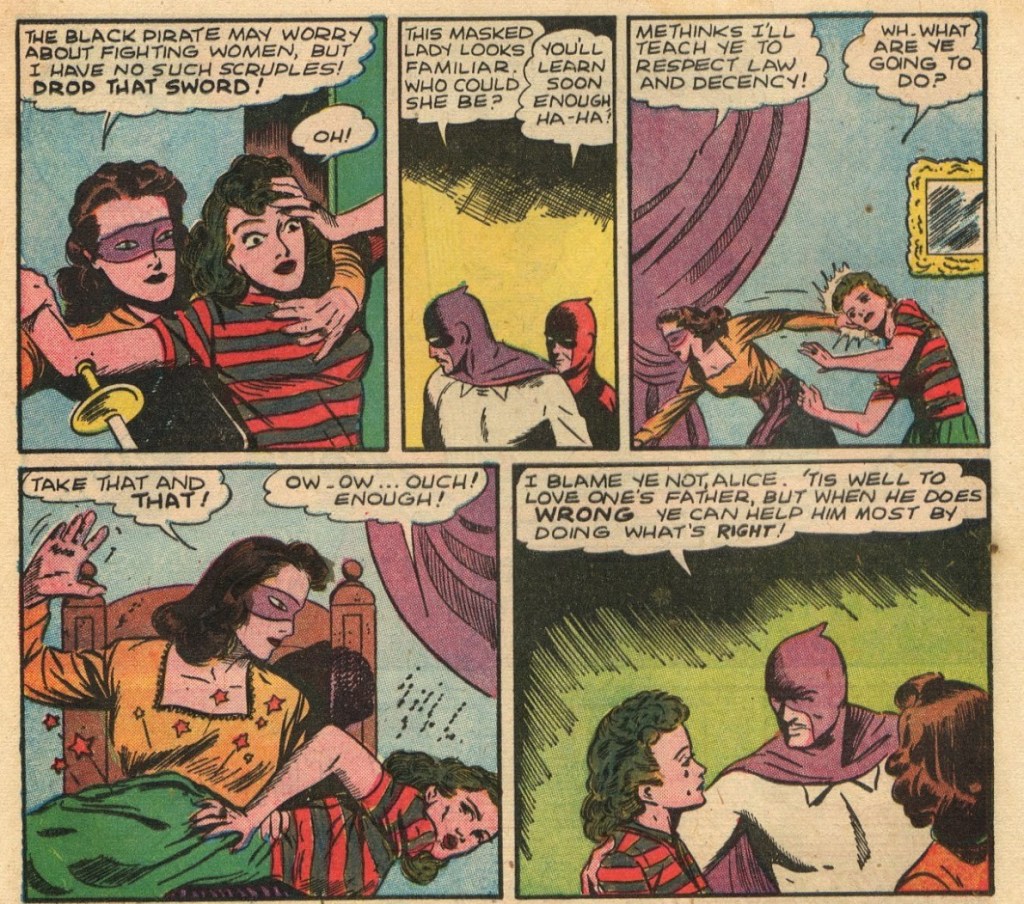
Page from Condemned Venus!, scripted by ‘Gregory Page’ (who’s probably Ruth Roche), and tastily illustrated by Matt Baker. This story was published in Phantom Lady no. 14, 1947.
Jumbo Comics no. 105 (November 1947), with a cover by Joe Doolin.
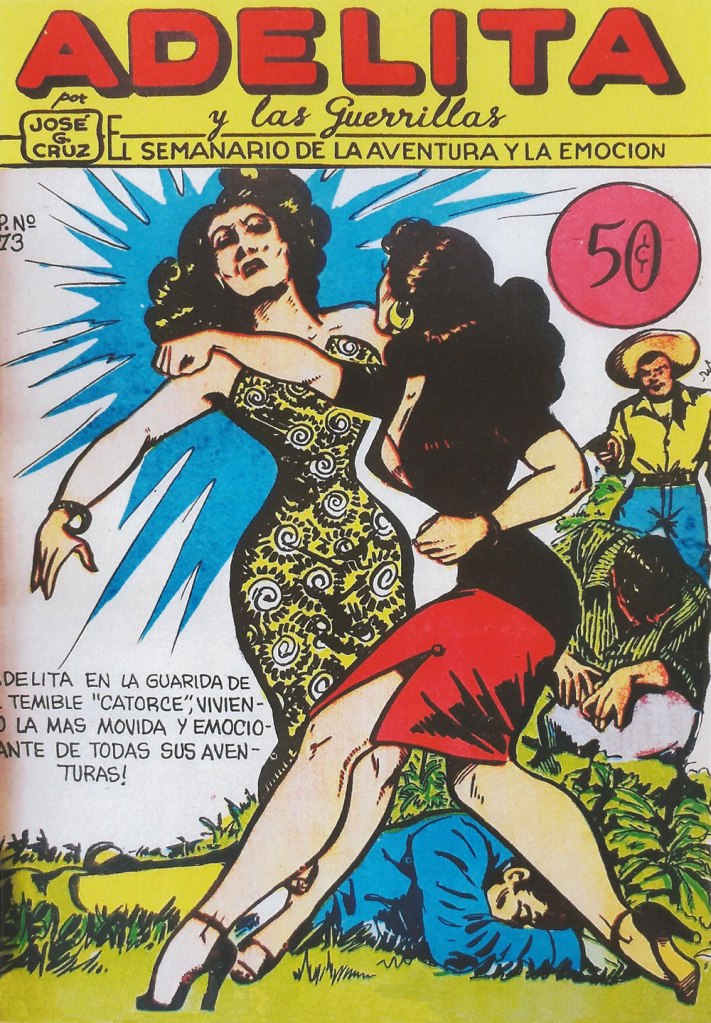
Adelita y las Guerrillas no. 73 (1953, Ediciones José G. Cruz). This is a Mexican Western comic series created cartoonist José G. Cruz in 1936, initially published in Paquito magazine. I’m not sure whether here Adelita is fighting her nemesis, Tigresa del Bajio, or just punching around some other woman.
Crimes by women, on women? Read an entertaining overview of this dime comic book published by Fox Features Syndicate on Criminal Element.
Crimes by Women no. 6 (April 1949). Is a cheap frill the same thing as a cheap floozy?
Crimes by Women no. 16 (December 1949). ‘Crime never pays’, they always remind the reader, who’s probably too interested in the catfight to believe it.
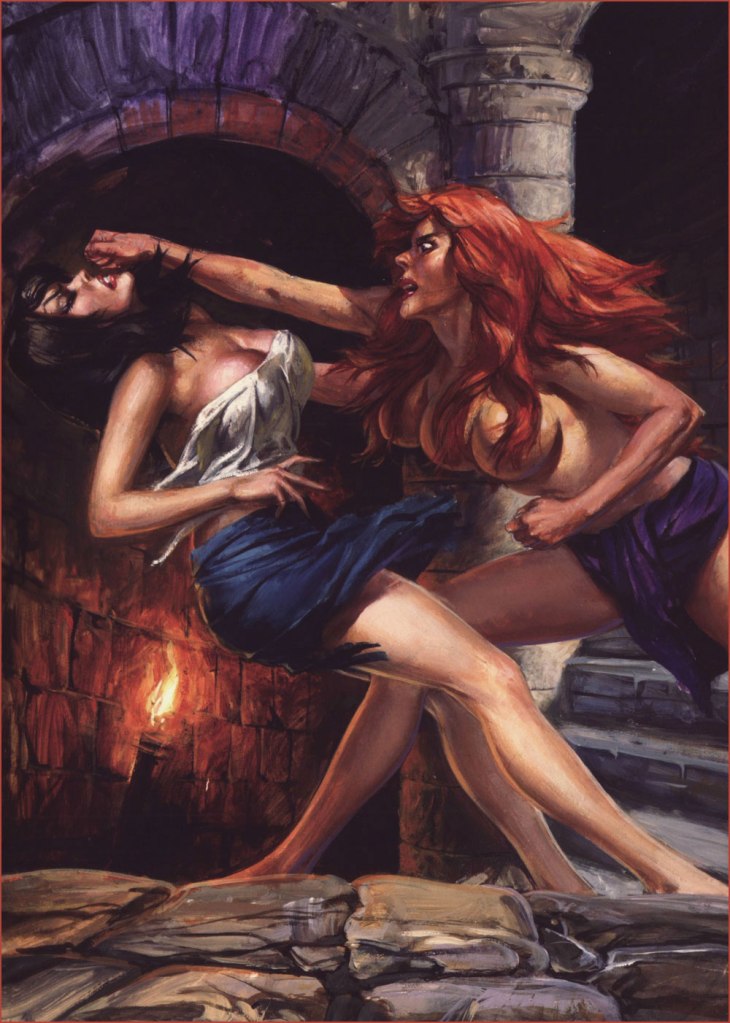
We have a heavy Italian contingent today! Co-admin RG recently wrote a post about Averardo Ciriello, Sitting Pretty: Averardo Ciriello’s Maghella. As he pointed out, Ciriello lent his art to many an erotic series — here’s his cover depicting Lucifera fighting a woman with three breasts (?) I mean, nobody can say you don’t get your money’s worth from this blog… 😉
Lucifera no. 165, 1980.
And here is the original painting, for comparison purposes:
Ciriello wasn’t the only one working in that vein.
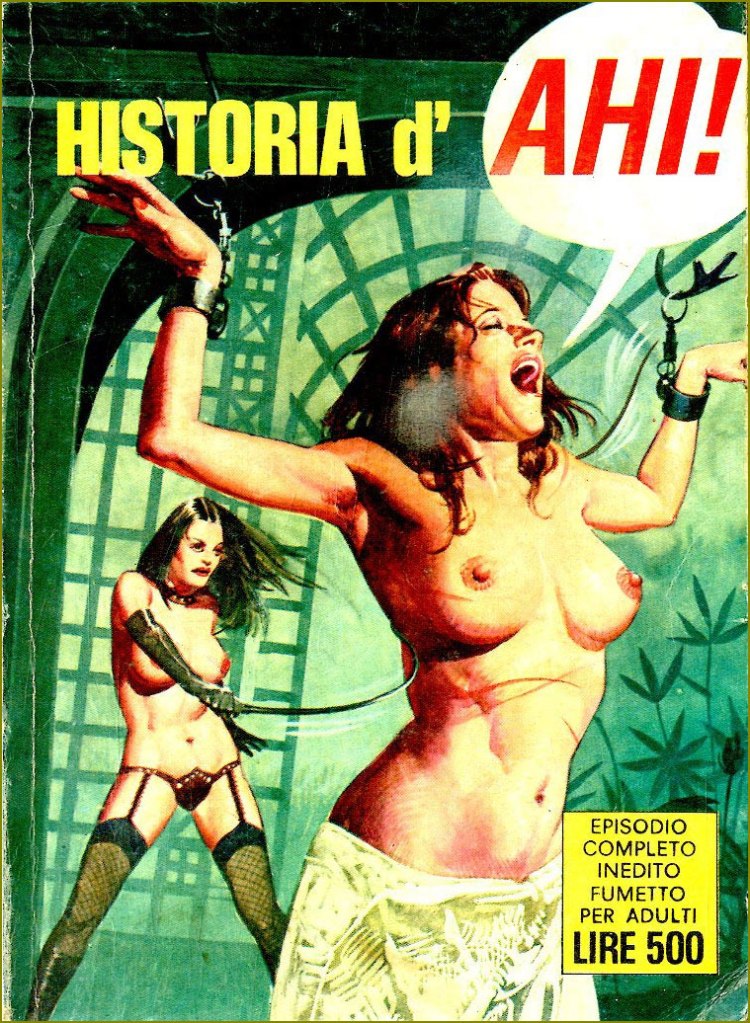
Historia d’Ahi!, a one-shot published by Edifumetto, presumably in the 1970s. Episodio Completo Inedito Fumetto… cashing in on Histoire d’O.
Storie Blu Special no. 12 — L’astronave dei mille tormenti (1983, Ediperiodici).
How about some dubious plot involving a fight between an impeccably fair-skinned maiden and an exotic black woman clad in some sort of tribal garb? Uh, sure.
A page from Royal Hunt, scripted (cringingly overwritten, frankly) by Chris Claremont and illustrated by John Bolton. Marada the She-wolf finds herself a ‘worthy’ adversary in Epic Illustrated no. 12 (June 1982, Marvel).
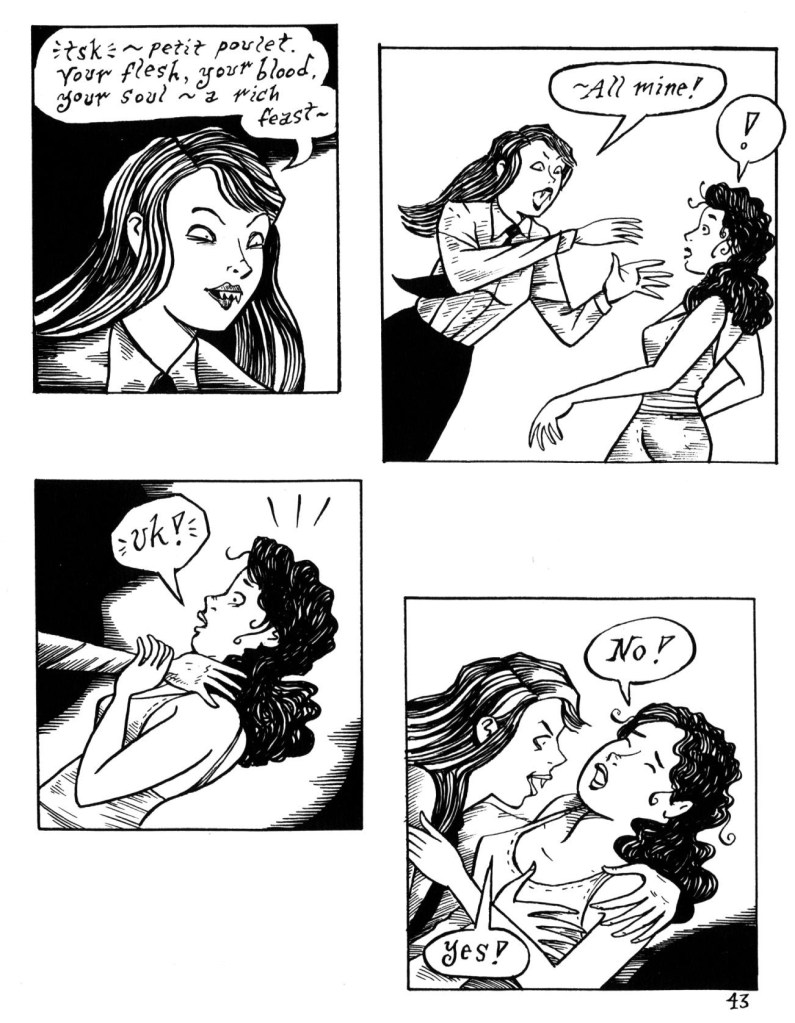
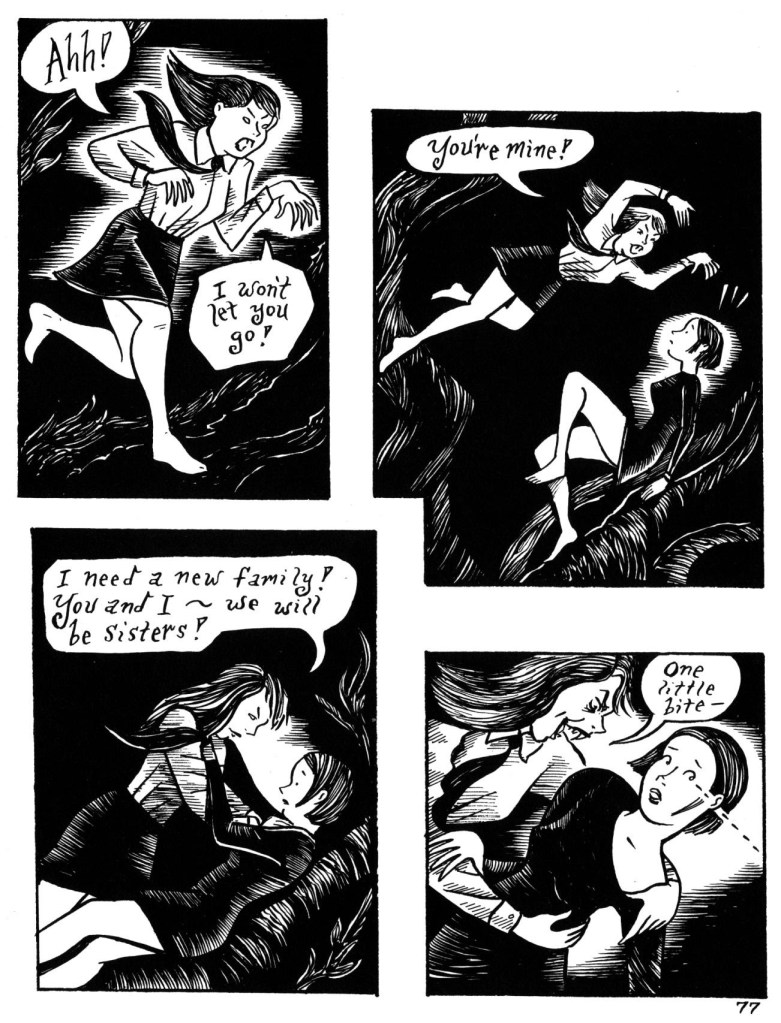
For a slight change of pace and style, I offer you some horror from Tentacle Tuesday MasterRichard Sala, two pages from Peculia and the Groon Grove Vampires, published in Evil Eye no. 13 (August 2005, Fantagraphics):
~ ds
P.S. Here’s a Tik Tok video of a female martial artist who has a rather interesting way of showing different self-defense techniques. It seemed relevant!
« Italy hasn’t had a government since Mussolini. » — Richard M. Nixon
Today, let’s bask in some purely visual glory. Let’s take a gander at a small corner of the mind-boggling œuvre of Averardo Ciriello (1918 – 2016). As you can see from these dates, he was a long-lived fellow, and I’m delighted to report that he was healthy, hearty and active well into his nineties.
He was one of those illustrators who truly delighted in their craft, and so produced an enormous body of work that bore every sign of inspiration and enthusiasm. Since my plan is to focus on a specific period of his career, I’ll skip most of his early work — though it’s well worth returning to — and give you a couple of famous pieces to give you as a sense of his success and importance in his field.
It’s fair to say that Ciriello excelled across the board, likenesses included. This is the Italian poster for 1956’s Forbidden Planet. And this one for 1965’s Bond adventure Thunderball. Since the Bond movies were as much Italian as British production (if not moreso), it’s no surprise that producer Cubby Broccoli did not scrimp, tapping Ciriello for the series’ Italian promotional campaign.
Now for the heart of it: I frankly marvel at Ciriello’s willingness to provide hundreds of cover paintings for cheap, mass market erotica fumetti. The way I see it, it’s evidence that he greatly enjoyed the assignment, and that the money was but a secondary concern at best. We’ve briefly touched upon the Maghella series (in our all-time most popular post, as it happens), but here’s some more.
This is Maghella no. 1 (Nov. 1974, Elvifrance).This is Maghella no. 15 (Oct. 1975, Elvifrance).This is Maghella no. 22 (Mar. 1976, Elvifrance). ‘Gode’, aside from being a city in Ethiopia and a species of fish, is the abbreviation of godemichet, which is to say… a dildo.This is Maghella no. 24 (Apr. 1976, Elvifrance).This is Maghella no. 41 (Apr. 1977, Elvifrance). Since you’re bound to ask, here’s a recipe for Salade russe, which actual Russians call ‘Salade Olivier‘. DS made it for lunch a couple of days ago, and it was delicious.This is Maghella no. 42 (May 1977, Elvifrance). Unlike most artists specialising in ‘erotica’, Ciriello could draw anything, in any style, and effortlessly mix sensuality with comedy with horror with angst. A true master — sorry, maestro. This is Maghella no. 66 (Jan. 1979, Elvifrance).This is Maghella no. 77 (Feb. 1980, Elvifrance). I assure you, those pun-based titles are utterly untranslatable.Censorship inevitably got into the act. Here’s one of several instances, the before (with imposed editorial revision indicated) and after of Maghella no. 110 (Sept. 1978, Publistrip); said censorship seems to have driven up the cover price, to boot. This precious bit of info gleaned from a lovely monograph of the artist, Gianni Brunoro and Franco Giacomini’s Ciriello: Una Vita per l’illustratione(2016, Edizioni Di).