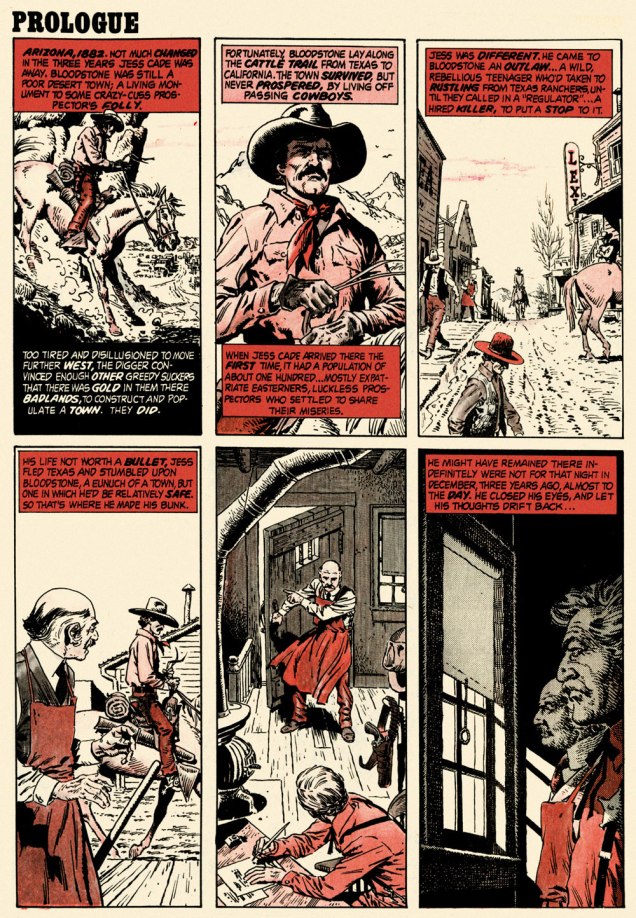
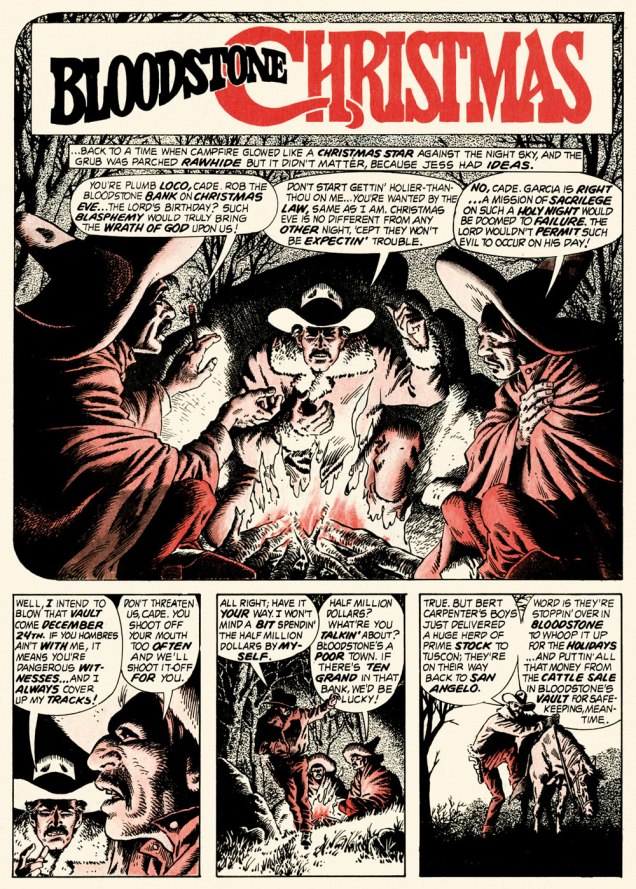
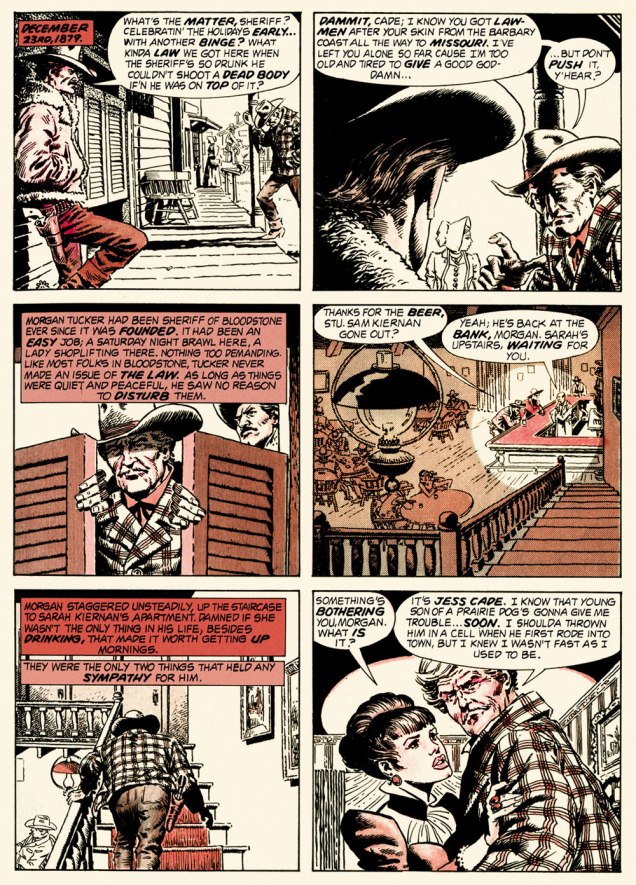
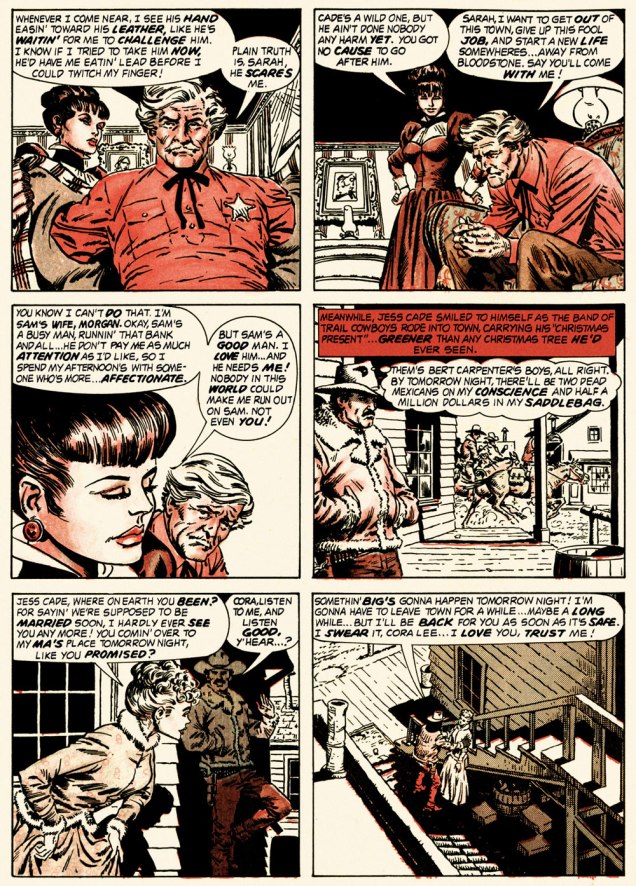
« May the man who has his finger on the button have a lovely day today / Hope nothing hangs him up or ticks him off or bums him out in any way / Lord, help him keep his cool cause he could pull the final curtain on my play / May the man who has his finger on the button have a lovely day today. » — Larry Wilkerson (as warbled by Bobby Bare)
The idea for this post came to me a couple of days ago, and this afternoon, while cobbling together the visual components, it dawned on me that today’s Memorial Day (Remembrance Day for Canadians, and ‘Victory Day‘ for those afflicted with brain worms and/or syphillis), and therefore quite à propos.
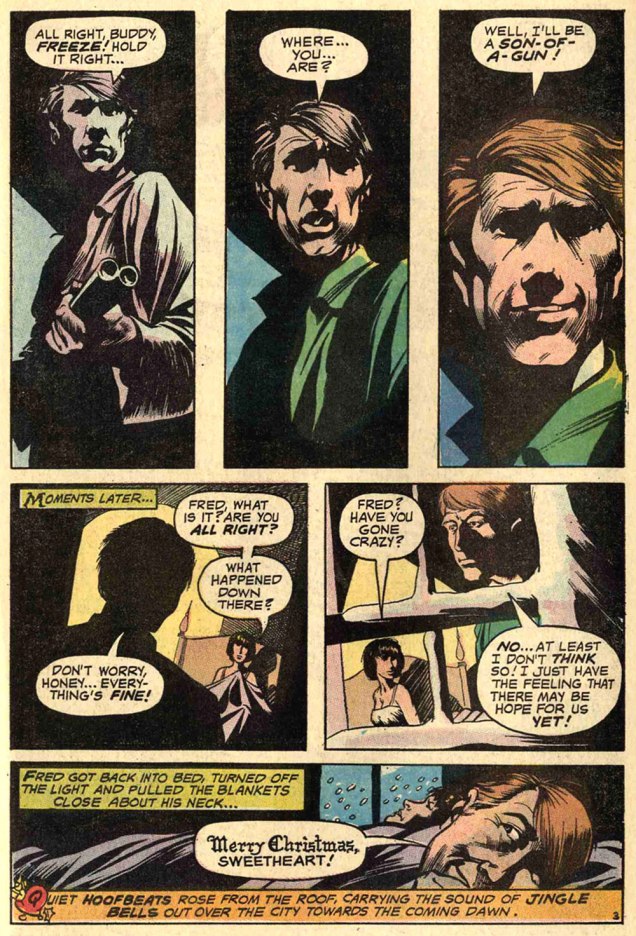
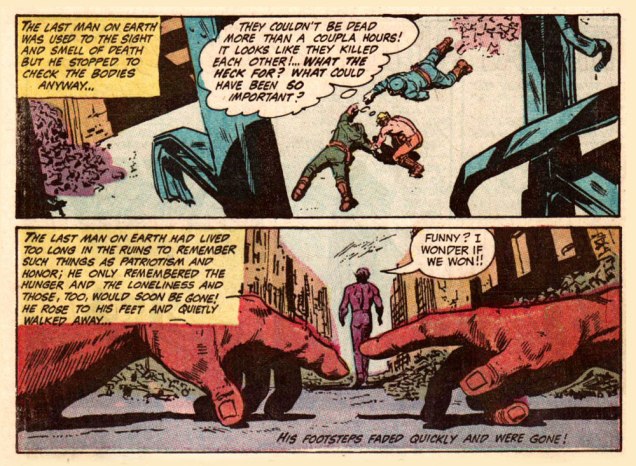
DC’s The Day After Doomsday series first turned up — of all places — in the pages of The Witching Hour, a page and a half bit of filler fluff by Len Wein and Jack Sparling. It must have struck a chord, if not with readers, then with its creators, for the feature stubbornly kept a-rising from its post-apocalyptic grave.
In spite of its episodic and arguably slight nature, TDBD enjoyed surprising longevity. It truly found its home in the Joe Orlando-edited Weird War Tales (1971-1983, DC’s gateway title for war fans into ‘horror’ and vice versa), where most of its dispatches saw print. You never know what’s going to catch on with the unwashed masses.
A most humble beginning for a series, this brief scene appeared in The Witching Hour no. 9 (June/July 1970, DC). Script by Wein, art by Jack Sparling (1916-1997). Dick Giordano, editor.
.
Humour rears its homely head in the concurrently appearing second instalment — too close to call! — this one from House of Secrets no. 86 (June/July 1970, DC). Same creative team.
.
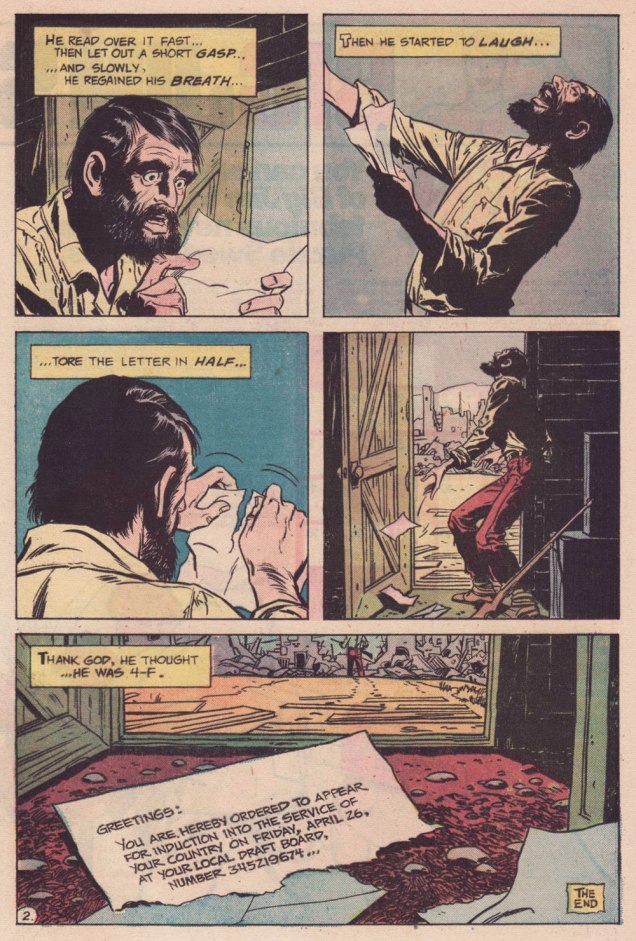
My candidate for the series’ finest hour, this episode elegantly riffs both on the Vietnam War Draft and on Fredric Brown‘s classic 1948 short-short ‘Knock‘, wherein « The last man on Earth sat alone in a room. There was a knock on the door… » 4-F, incidentally, signifies « Registrant not acceptable for military service. To be eligible for Class 4-F, a registrant must have been found not qualified for service in the Armed Forces by an MEPS under the established physical, mental, or moral standards. » And let’s hear it for perennially under-appreciated artiste Bill Draut (1921-1993!
That issue had a splendid cover, and so here it is!
This is Weird War Tales no. 30 (Oct. 1974, DC); cover pencils and inks by Luis Domínguez, from a probable design by publisher Carmine Infantino.
.
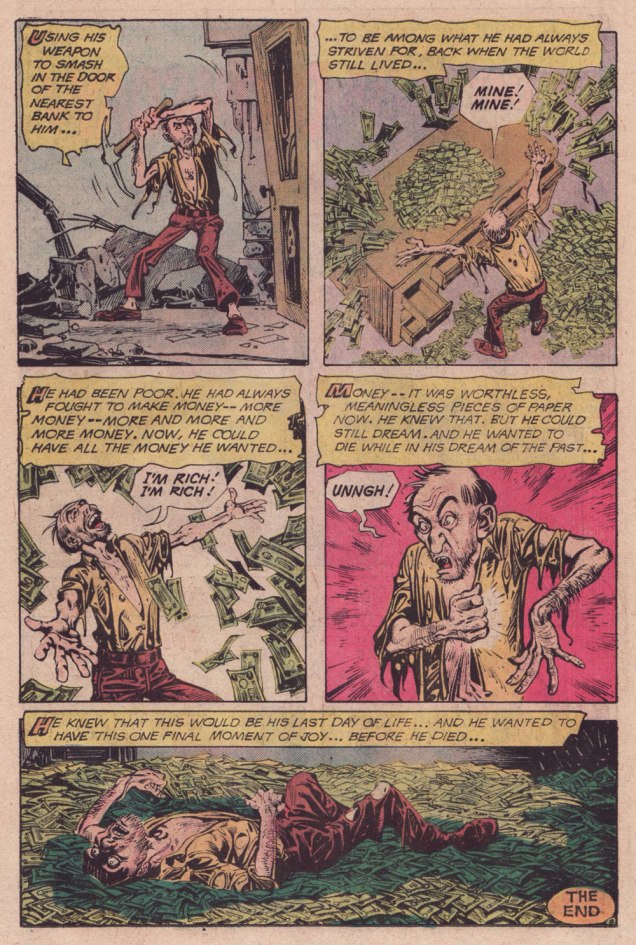
A scroogey teaming of WOT? favourites Steve Skeates and Alfredo Alcala, this turned up in Weird War Tales no. 35 (March 1975, DC). I’ll bet they had trouble deciding whether to run it in Plop! or WWT.
.
Finally, this one appeared in Weird War Tales no. 48 (Sept./Oct. 1976, DC). Script by Skeates, art by Buddy Gernale.
Grimm’s Ghost Stories (60 issues, 1972-1982, Gold Key/Whitman) is a title I’ve been, in my usual fashion, lazily collecting for decades. I’ve always found in the Gold Key ambiance a soothing respite from the obsessive continuity and slam bam histrionics of DC and (the chief offender) Marvel.
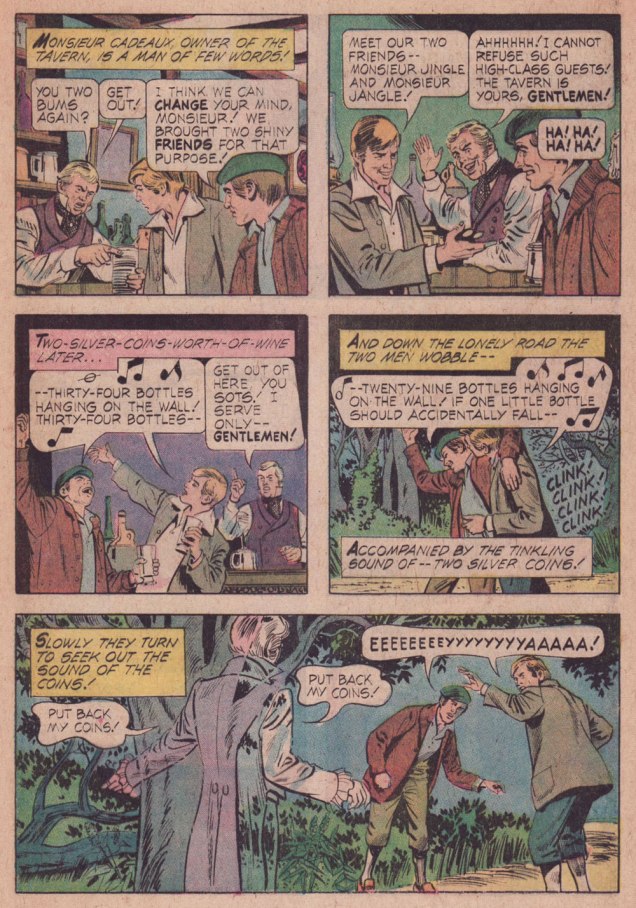
While writer Arnold Drake‘s numerous credits at DC (and, to a lesser degree, Marvel) are well documented, his passage at Western/Gold Key in the mid-to-late 1970s is unjustly shrouded in obscurity. Let’s just say he — along with his young colleague Freff — brought complexity, warmth and wit to the publisher’s frankly formulaic fare.
.
.
.
.
.
.
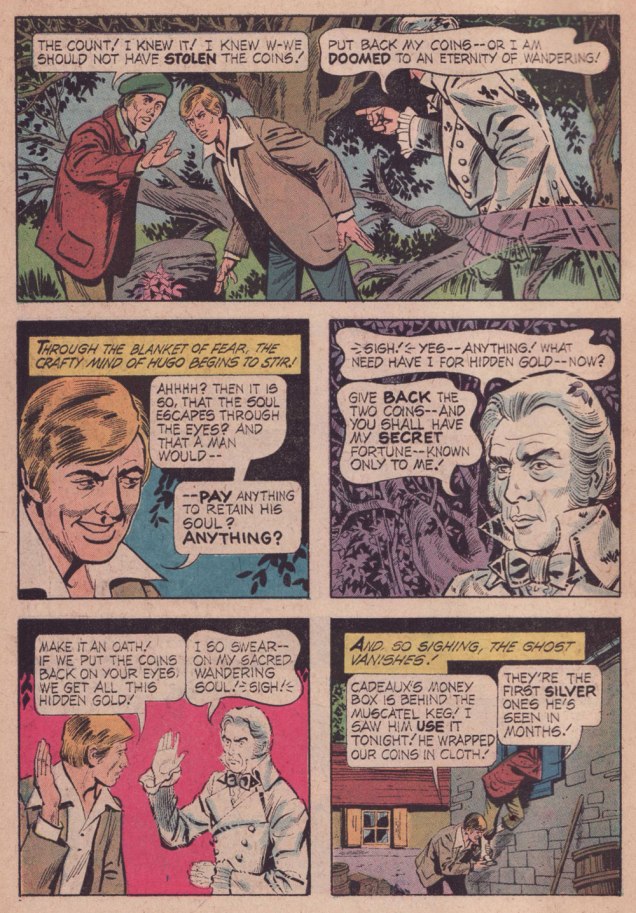
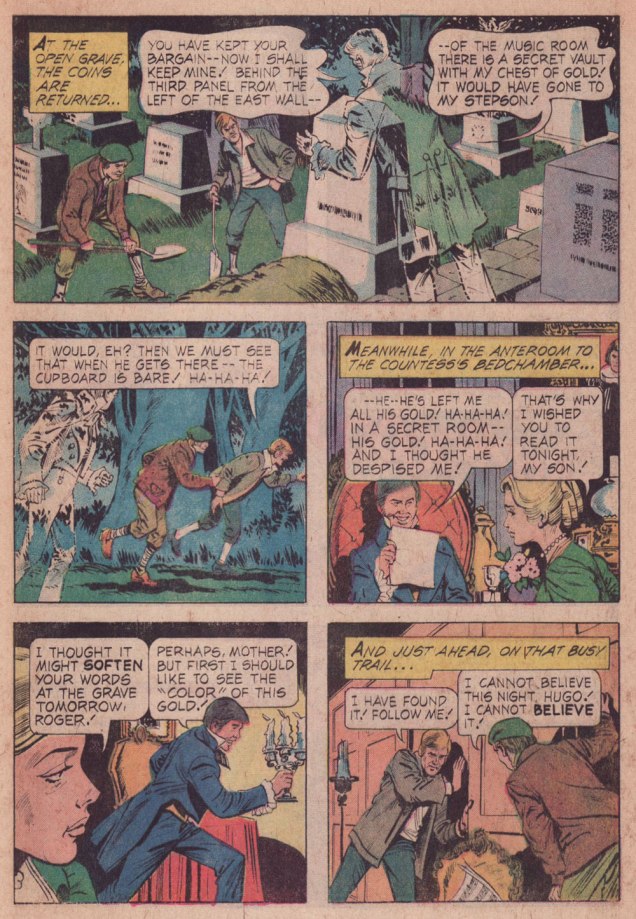
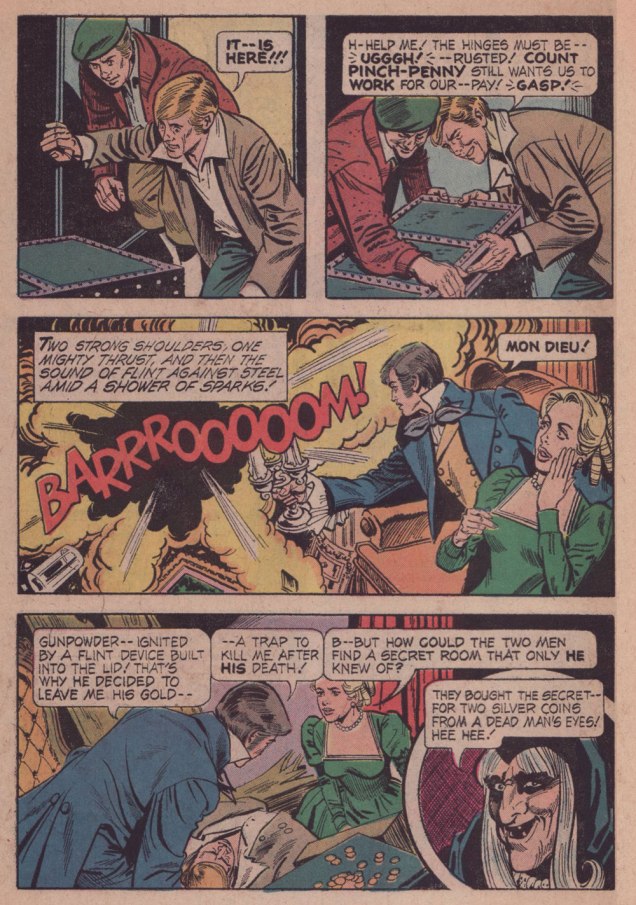
This isn’t the spookiest ghost story of them all, far from it, but that’s hardly the point, is it? Fun fact: the practice of putting coins on the deceased’s peepers was poetically called ‘Charon’s Obol‘.
I love the well-developed characters… despite the tale’s brevity. The willful stepson whose only sin is that of being a free thinker; the grave-robbers who can keep their wits about them in all circumstances; and the pragmatic miser’s spectre who’ll trade one act of revenge for another in a pinch.
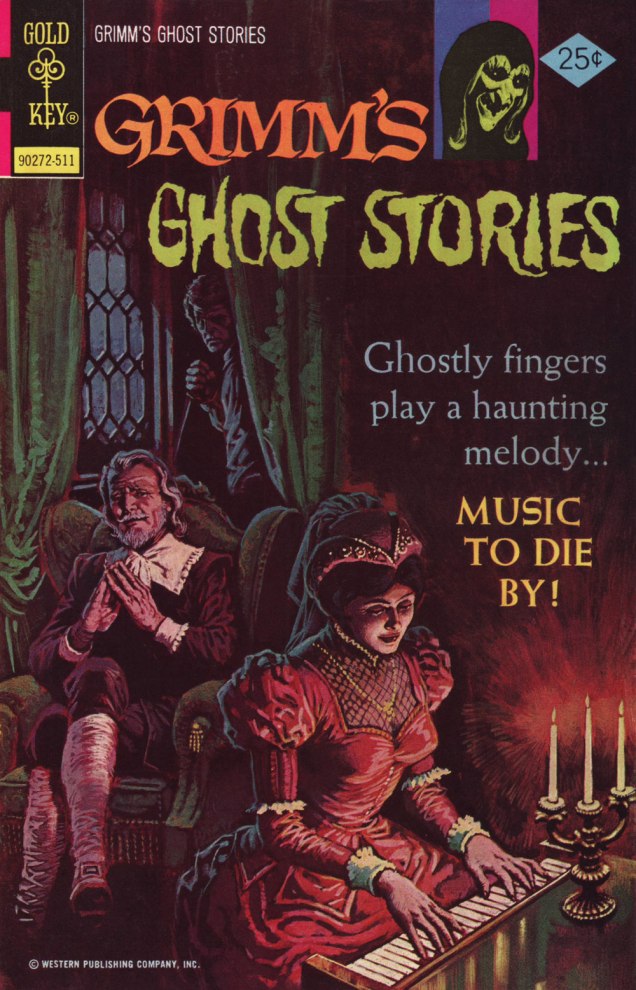
While ‘Silver’ wasn’t the cover-featured story, I wouldn’t pass up the chance to spotlight such a fine, understated Luis Domínguez painting. This is Grimm’s Ghost Stories no. 27 (Nov. 1975, Gold Key). For our gallery of this Argentine master’s finest, check out Luis Domínguez (1923-2020): A Farewell in Twelve Covers.
« Losing my mind, but I don’t care I see Donna everywhere Down by the lakeside, in a lawn chair Donna, Donna everywhere » — Too Much Joy
Today’s featured tale hails from Charlton’s groundbreaking anthology title Midnight Tales (1972-1976). It differs from the rest of the publisher’s mystery line in that it largely served as a vehicle and spotlight for Wayne Howard (1949-2007), who even received a ‘created by’ mention on the covers. My partner ds delved deeper into Midnight Tales minutiae in her Tentacle Tuesday entry « Plants Sometimes Have Tentacles, Too ».
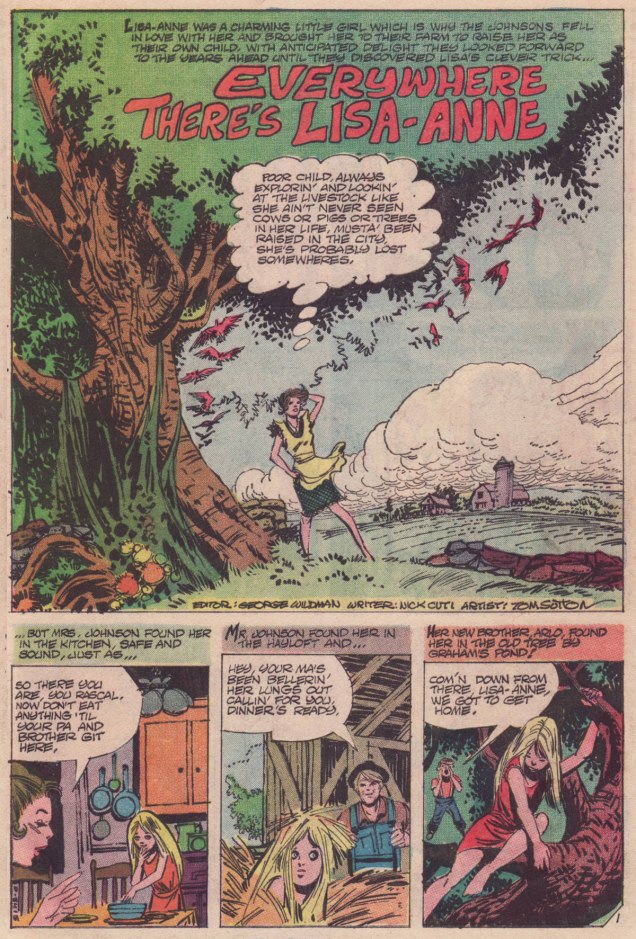
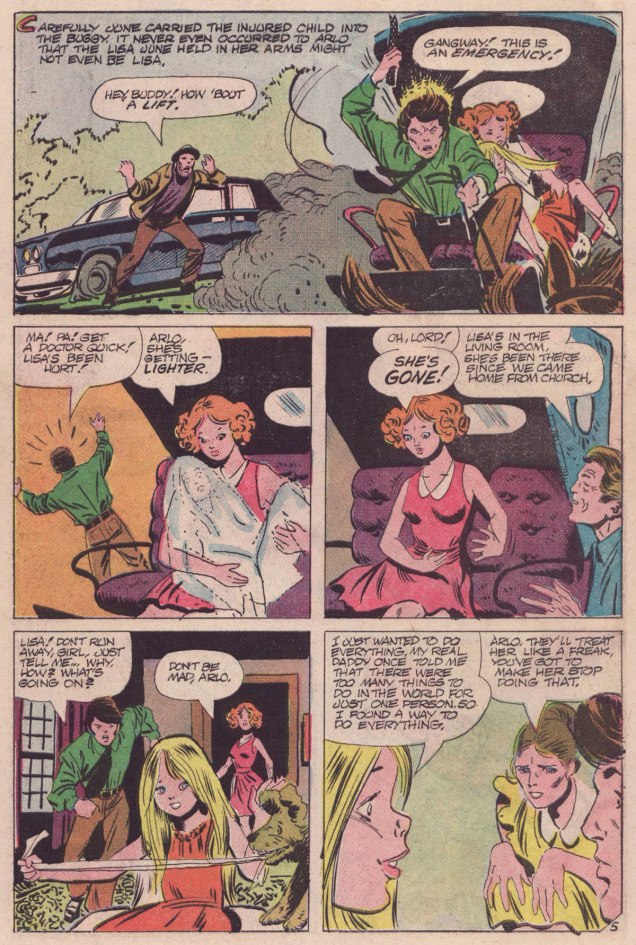
« Everywhere There’s Lisa-Anne » saw print in Midnight Tales no. 6 (Nov. 1973, Charlton). It was written by Nicola Cuti, Howard’s co-conspirator (they had both apprenticed with Wally Wood), who provided the lion’s share of Midnight Tales scripts. It was illustrated by Tom Sutton and coloured by Mr. Howard.
What I enjoy about this snappy little tale is its graceful economy: it packs a lot of context and characters into its mere six pages, but flows so efficiently that it never feels rushed. It doesn’t attempt to explain what doesn’t need explaining, nothing is overstated, and none of the characters is a convenient idiot. No patronising hand-holding, just straight-ahead storytelling.
Let’s hope, for the Johnsons’ sake, that Lisa-Anne’s very convincing and the sheriff no laggard!
Lisa-Ann’s ubiquity reminds me of a favourite Cul de Sac Sunday strip… and any excuse to trot out the Richard Thompson is to be seized eagerly!
« A dead body revenges not injuries. » — William Blake
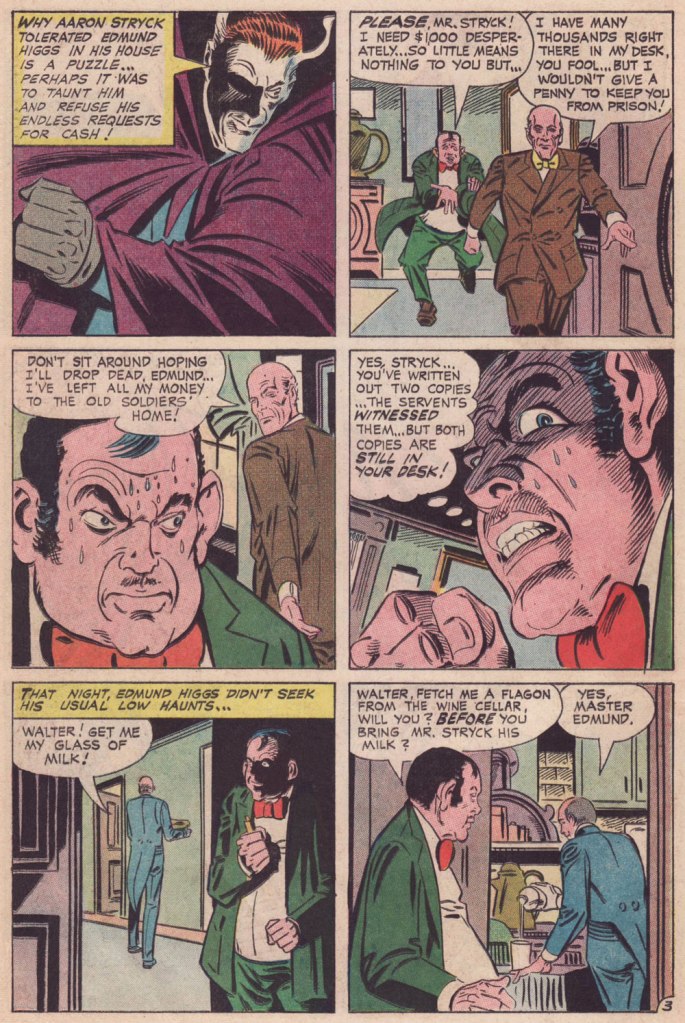
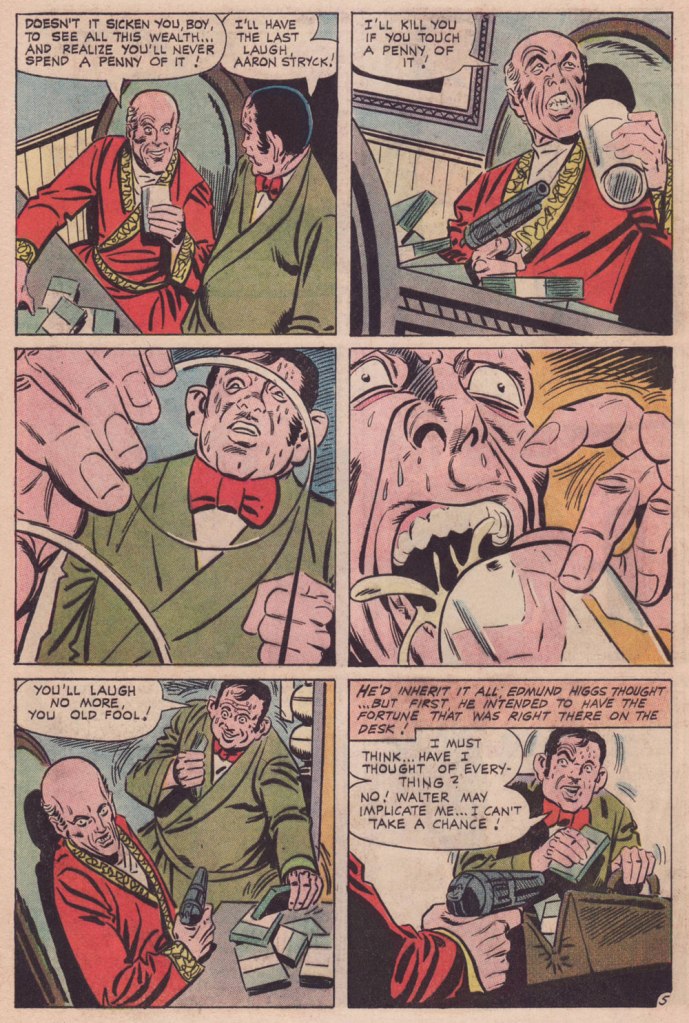
« Do you end every Hallowe’en Countdown with Steve Ditko? », ds reasonably asked me last month. Well, no, I replied, but it generally plays out that way since, by my reckoning, nothing embodies the spirit of this finest of holidays quite like a sepulchral Joe Gill – Steve Ditko yarn.
My heartfelt thanks to all our guests — visitors, readers and contributors — who made this breakneck endeavour possible… in particular ds, who shouldered a significant part of the load and came through with flying, but appropriately sombre, colours.
Take it away, Messrs Gill, Ditko and Dedd!
Yes, it’s your basic ‘greedy relative’ plot, but perfectly executed. And the late Mr. Strick would surely concur about the ‘perfectly executed’ part. And since the cover gives away a bit too much, here it is, after the story. This is Ghostly Tales no. 103 (Apr. 1973, Charlton). Cover by Steve Ditko, naturally.
And we have one more countdown concluded against soul-searing odds. Now, if you’re craving more, you insatiable ghouls, feel free — could we stop you even if we tried? — to slobber amidst our back pages, at this point numbering two hundred and forty-eight posts :
Today’s offering features plenty of colour… which in my humble opinion does not detract in the slightest from a sombre, autumnal atmosphere with chills as palpable as thick mist. While you would not be amiss in deciding that this art comes from a European hand, it’s not a French one, despite the language most of the following pages are in.
Josep Maria Beà i Font, usually shortened to and credited as José Beá, is a Spanish comics artist — born in 1942 — who’s happily still with us. Fans of Warren-published comics may recognize his distinctive style, as he wrote *and* illustrated quite a few (around thirty) stories published in Vampirella, Creepy and Eerie, starting with The Silver Thief and the Pharoah’s Daughter published in Vampirella no. 13 (Sept. 1971). It seems that he is another of those love-’em-or-hate-’em artists, as while doing some research for this post, I stumbled upon more than one instance of opinions such as ‘my least favourite Warren artist‘ or ‘passable art‘. This is fortunately balanced out by those who seek out Beà’s stories, going as far as delving into Spanish comics while not being able to speak the language.
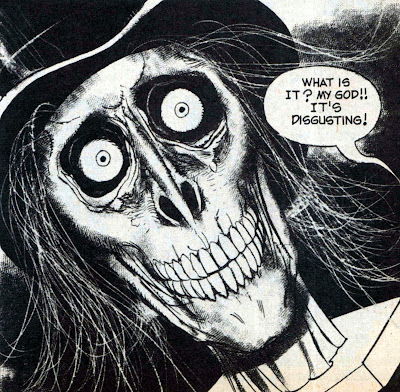
A panel from the terrifically gruesome story Head Shop, illustrated by Beá and written by Don Glut and published in Eerie no. 39 (April 1972)
Beá’s collaboration with Spanish publishing house Buru Lan Ediciones starting in 1970 marked his return to comics after a 8-year break taken to focus on his painting. Specifically, it’s within the pages of its anthology Dráculathat Beá started first scripting his own stories. These became available to an anglophone audience when The New English Library reprinted a number of its issues under the name Dracula(now there’s an easy translation).
The cover of a Dracula Annual from 1973, published by The New English Library. I found this image on the lovely When Churchyards Yawn blog, go pay their post a visit! The illustration is by Esteban Maroto, a frequent face at Warren in the 1970s.
« New English Library issued 12 English-language versions of the publication, which was originally produced by Buru Lan in Spain. The New English Library publication ended after 12 issues, although it continued for many issues afterwards in Spain. Only the first 6 issues were included in the Dracula book produced by Warren, but one can probably track down the remaining 6 English language issues if they try hard enough. »
The following pages are taken from a French-reprint collection title Les nuits de l’épouvante, published by Dargaud in 1973 (I stumbled upon it years ago in a used bookshop, and instantly took to the art despite having no idea who Beá was). The dates I provide for their publication in English are from The New English Library’s Dracula, not the Spanish Drácula.
The following two pages are taken from Le serpent (written by Beà and Sadko*, illustrated by Beà), or The Snake, originally published in Dracula no. 3 (Oct. 1972):
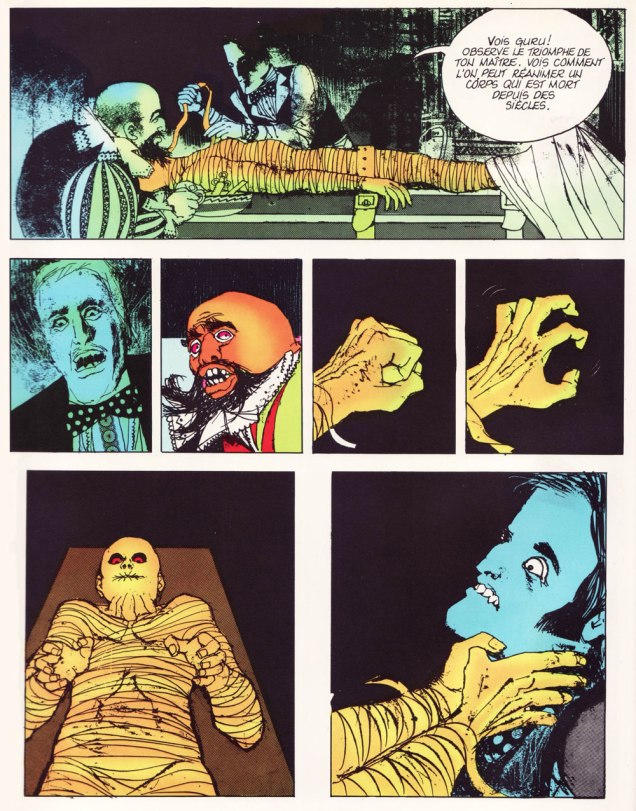
La momie (written by Maroto, illustrated by Beà), or The Mummy, published in Dracula no. 4 (Nov. 1972) features some more memorable strangling scenes:
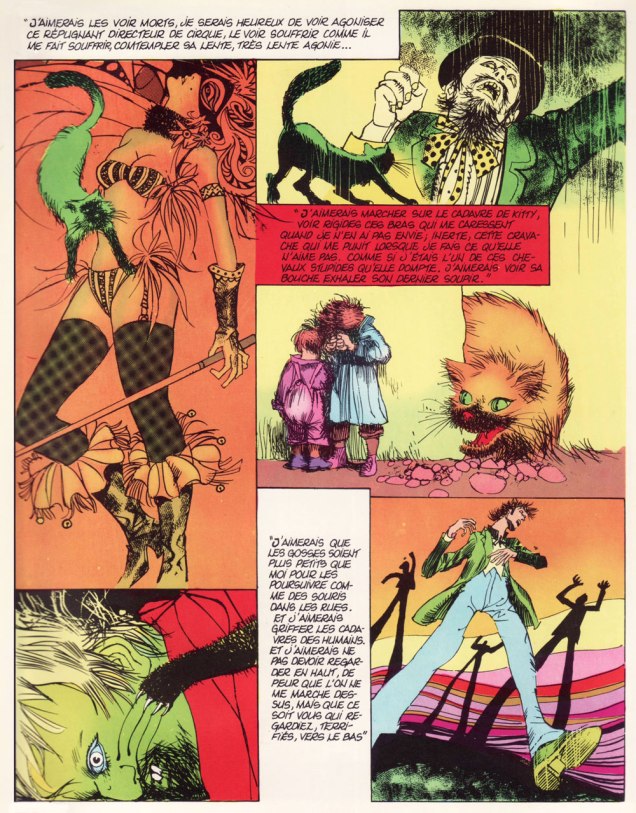
Finally, I would be remiss not to include some pages from Beà’s Sir Leo series, originally created for Drácula. Handsome Sir Leo is an English aristocrat who, in typical fashion, has walked away from his birthright… and walked into the arms of the supernatural, many dangerous adventures ensuing. The following two pages are from Sir Leo – le chat (written by Luis Vigil, illustrated by Beà), or The Cat, originally published in Dracula no. 8 (Dec. 1972). Read it here.
« Sooner or later we all sit down to the banquet of consequences. » — Robert W. Frank, paraphrasing Robert Louis Stevenson
Today, we ask: who was Peter Randa? I’m asking because I read one of his books at random — actually, the comics adaptation, and was deeply impressed with its quality. Randa, né André Duquesne (1911-1979) in Marcinelle, Belgium, wrote some 300 hundred novels in various genres over a mind bogglingly productive quarter-century under a myriad of pseudonyms, namely Jean-Jacques Alain, Urbain Farrel, Herbert Ghilen, Jules Hardouin, Jim Hendrix (!), Henri Lern, André Ollivier, H.T. Perkins, F.M. Roucayrol, Diego Suarez, Jehan Van Rhyn and Percy Williams. There may be others. He dealt in the genres of science-fiction, horror, espionage, crime, and erotica (with over fifty novels written in the early 1970s).
Two more covers (respectively 1955 and 1973) painted by the also miraculously prolific French illustrator Michel Gourdon. Here’s a segment from a French TV show touching upon the scope of his career, on the occasion of the auctioning of his vast trove of original art. Hope it all found good homes.
Well, here’s the basic plot, taken from the current e-book edition (which I’m grateful exists at all, as even outstanding work often languishes in utter obscurity or downright oblivion): « Archie Leggatt is a madman, a real one. He believes himself the Devil, had kidnapped three young women and terrorised a fourth. A run-of-the-mill serial killer? Perhaps… but when such an un assassin boasts supernatural powers and leaves more than the scent of brimstone behind, physicians and investigators begin to wonder and ask themselves questions with terrifying implications. Can one truly hope to put Satan behind bars? »
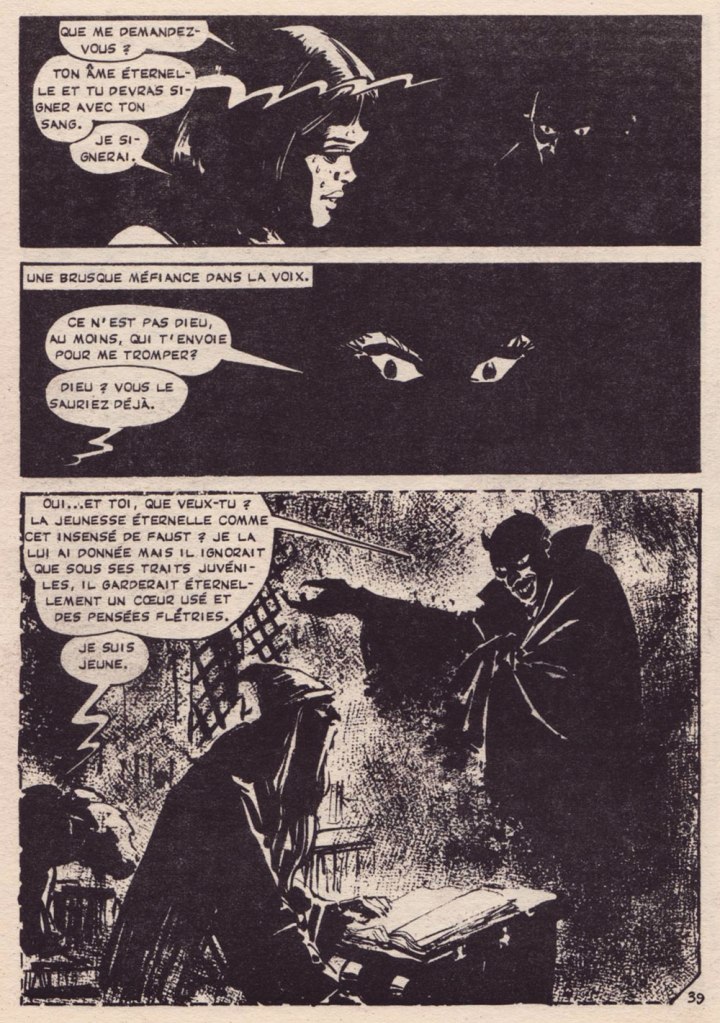
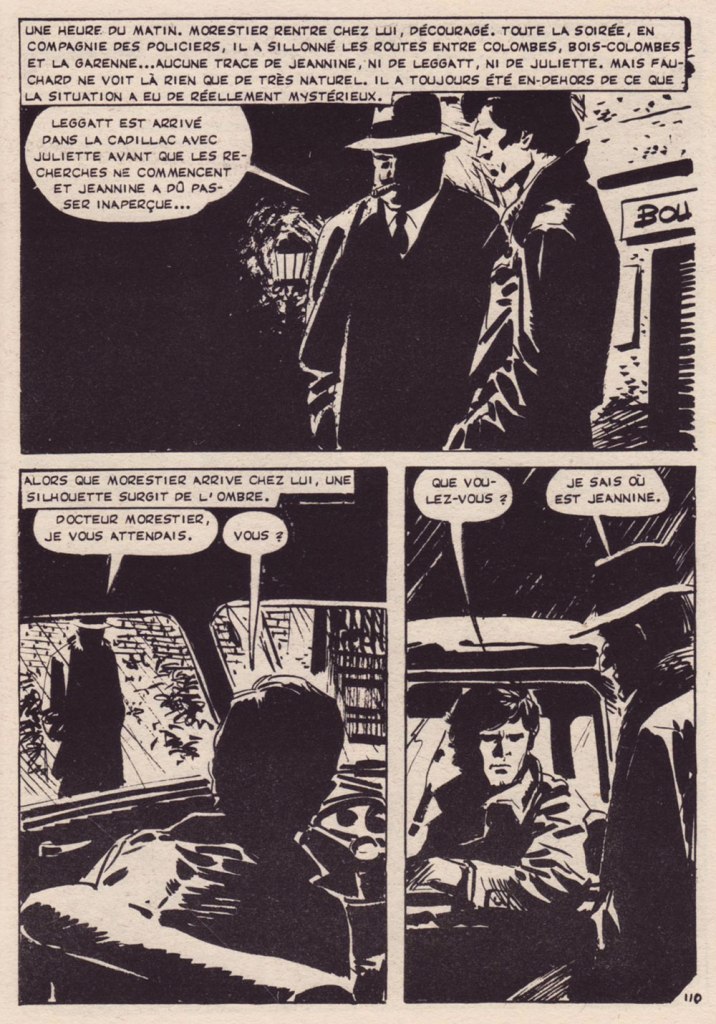
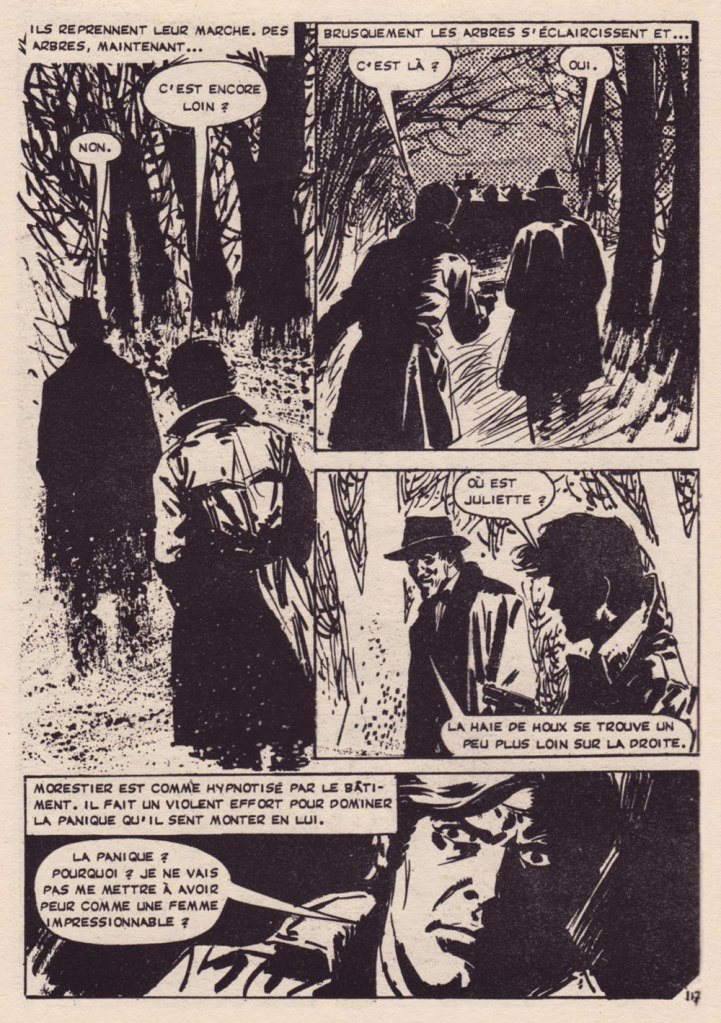
Illustrator unknown, wouldn’t you know it? Given his skill, style and stamina, I’m guessing he’s Spanish, but beyond that, I’m drawing a blank. Still, kudos to this anonymous artistic practitioner.I know, I know: it’s Warren’s Uncle Creepy with a pencil moustache. Jeannine agrees to the Faustian deal Leggatt proposes.A handsome doctor thinks he can save the woman he loves. Randa sets up the usual scenario, all the better to kick the reader’s legs out from under him. Le banquet des ténèbres — the bédé adaptation — saw print in Eclipso no. 30 (June 1973, Arédit). Amusingly, mycomicshop.com’s archivist describes Eclipso as ‘French publication reprinting comics from various Marvel properties.’ Well, not exactly. The title should clue you in: the anthology started out reprinting DC series such as Eclipso, Deadman, Mark Merlin, Challengers of the Unknown, Hawkman, Doom Patrol… while also dipping into Tower’s T.H.U.N.D.E.R. Agents, for instance. Marvel got stirred into the mix in the early 1970s, then came a period of French novel adaptations, then back to US comics, mostly from Marvel. The ride ended in 1983.
What fascinated me about Le banquet is its steady ambiguity between possible mental aberration, hypnotic suggestion, and the outright supernatural. This precarious balance — and slow-burning tension — is maintained right to the end, which is no mean feat. Is Leggatt just a regular madman, a consummate mesmerist, or a temporary, occasional shell for Old Nick? I’m reminded of a similar exploit accomplished by Arturo Pérez-Reverte in his 1993 novel El Club Dumas (The Club Dumas), wherein one didn’t know for certain whether there was anything actually uncanny going on… until the conclusion. Sadly, Roman Polanski fumbled his cinematic adaptation (as The Ninth Gate), starting with the absurd casting of Johnny Depp as the presumably intelligent book detective protagonist. When Polanski’s wife starts flying, the jig is up, I’m afraid.
You see, there were these two competing comics publishers…
… which is to say DC Thomson and the dystopian-monikered International Publishing Corporation (IPC); between them, they dominated the UK comics market. By the late 1970s, said market had surpassed circulation of ten million copies, its rosiest sales outlook ever.
To be perfectly cynical, the rival publishers’ editorial vision was mostly to copy one another’s successes. Same mouldy old dough.
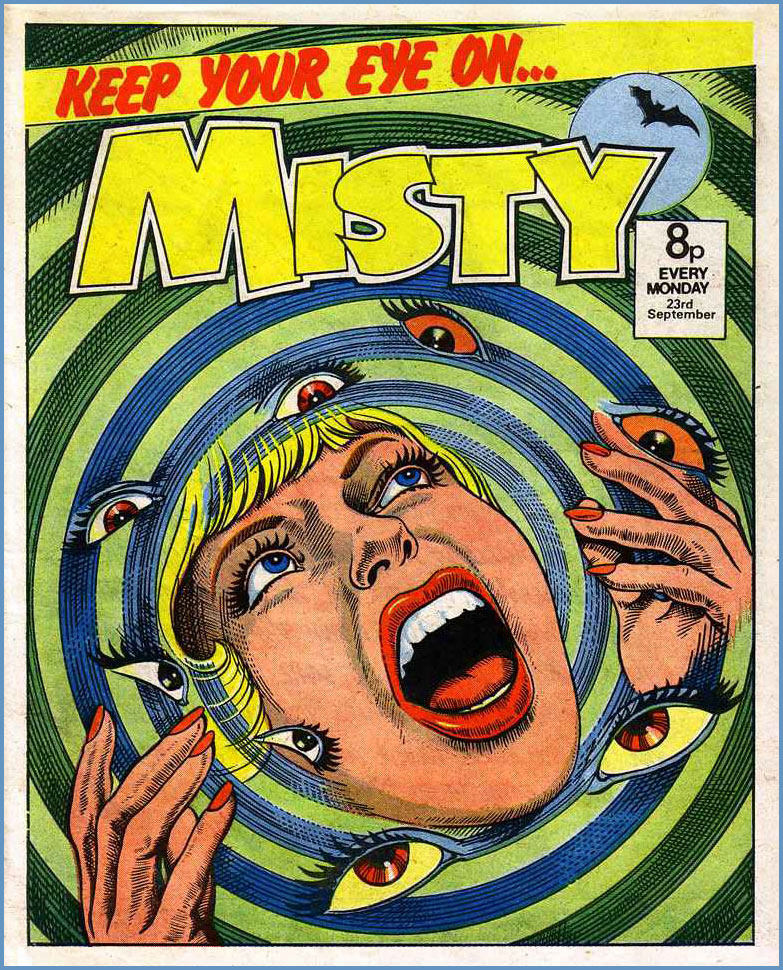
In 1977, « Freelance writer Pat Mills had an idea for a girls’ horror comic* that would use his 2000 AD approach — longer stories, bigger visuals, with adaptations of stories from big name writers… Misty was about to be born. »
This, of course, is the Stan Lee version of an ‘idea’, for what IPC was commissioning, and Mills was providing, was a copy of DC Thomson’s existing Spellbound. However, since Mills was asking for a piece of the pie, he was sacked before the new magazine’s launch, and replaced with a perhaps more pliable sancho.
In terms of timing, Spellbound happened to cease publication (after 69 issues) just a few weeks before its clone’s launch. For its part, Misty lasted 101 issues before being folded** into the more reliably successful Tammy; a common practice in England for underperforming magazines that still have a following. After all, Spellbound, upon its own cancellation, had been whisked into Debbie.
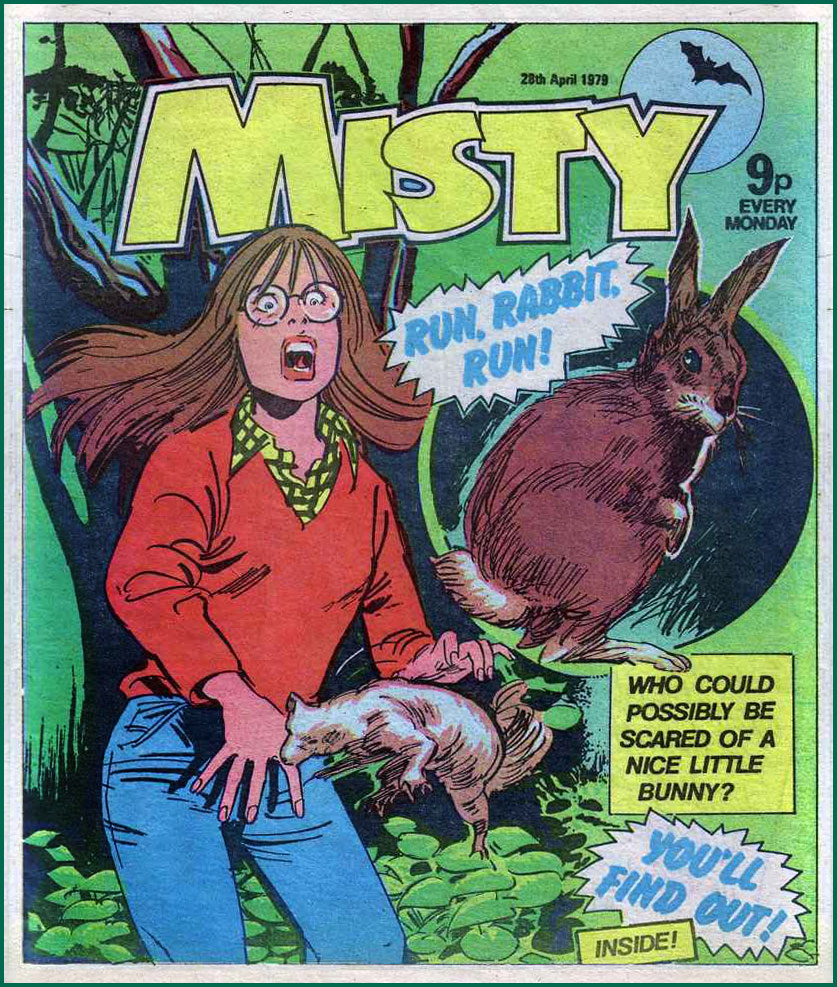
This is Misty No. 22 (July 1st 1978, IPC). This one I can credit: Jordi Badía Romero (1958-1984).This is Misty No. 28 (Aug. 12 1978, IPC).This is Misty No. 34 (Sept. 23 1978, IPC).This is Misty No. 64 (Apr. 28 1979, IPC).This is Misty No. 94 (Nov. 24 1979, IPC).
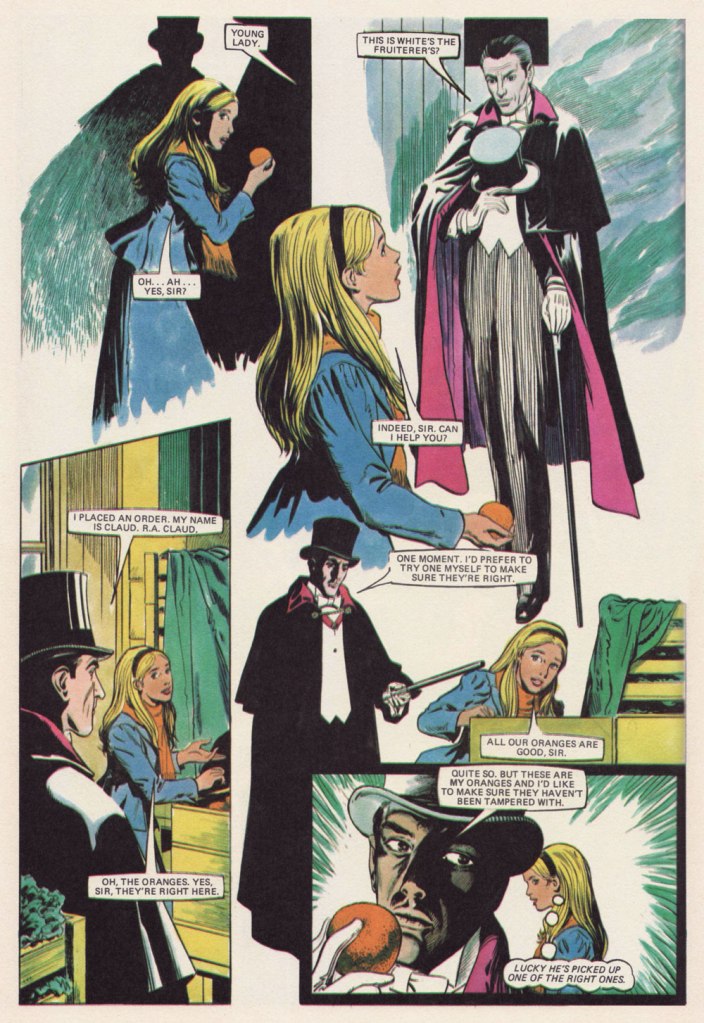
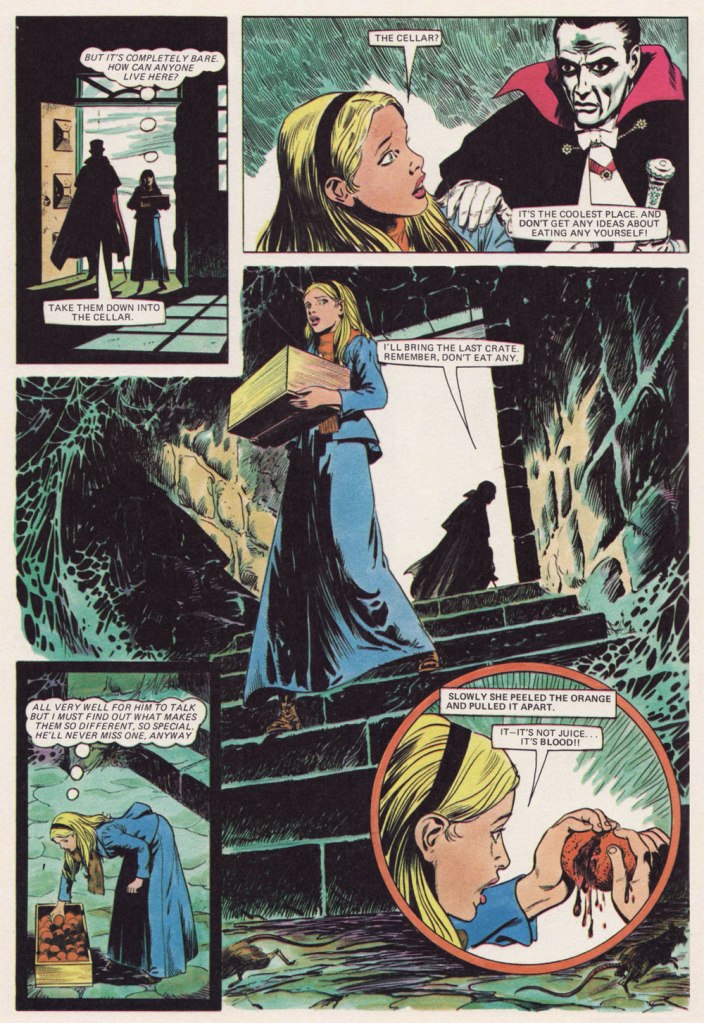
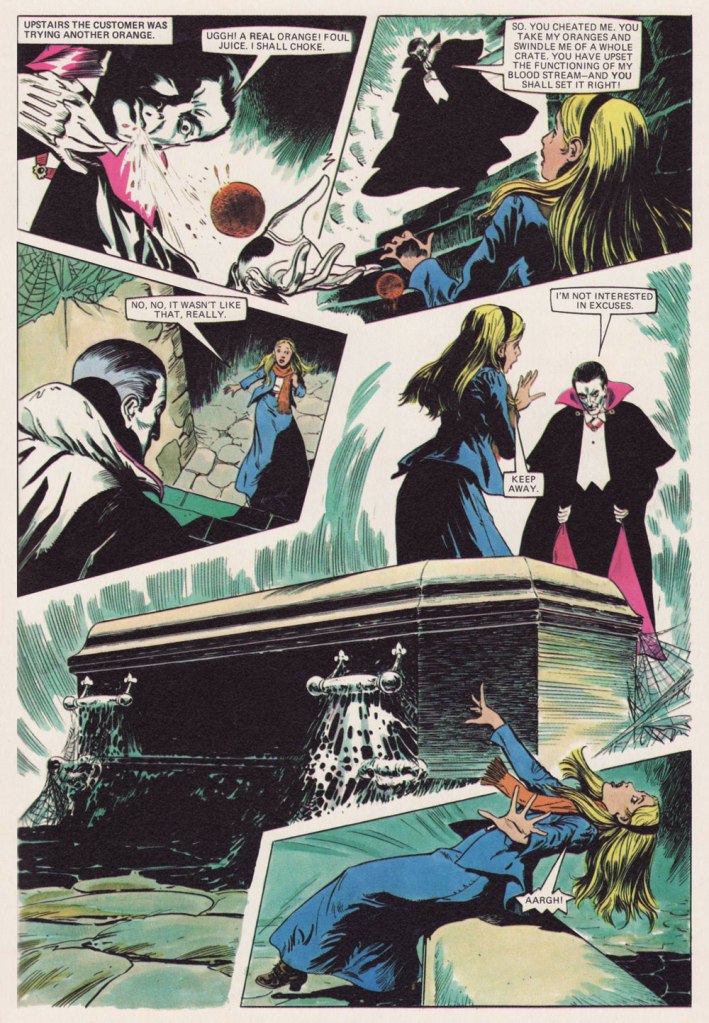
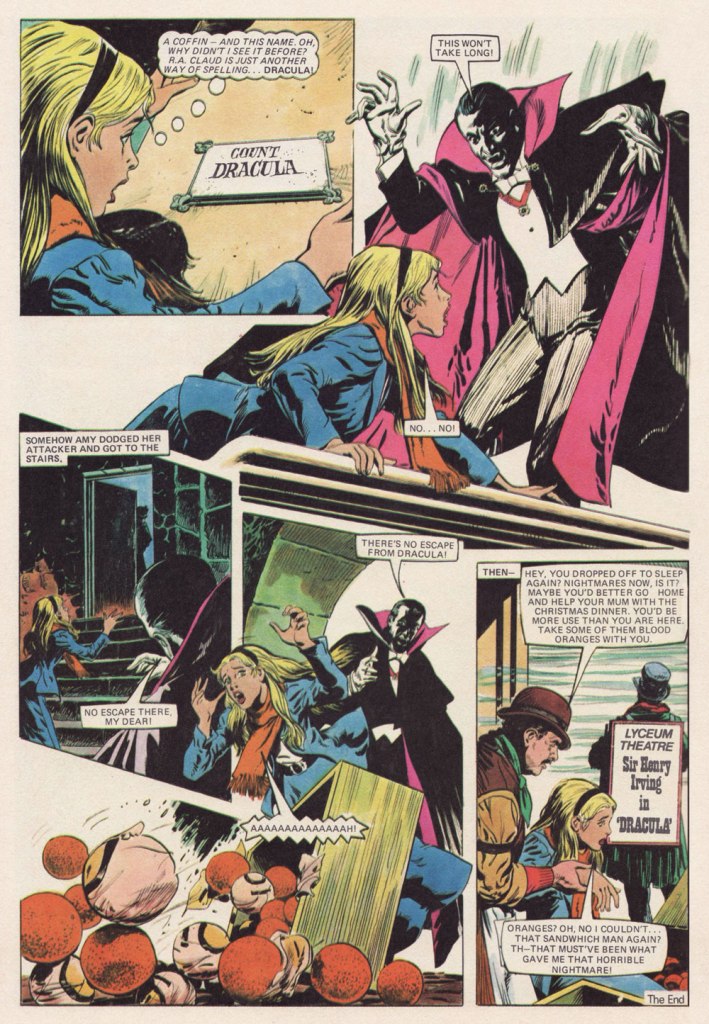
And here’s a short story.
Dr. Julia Round recalls, in her foreword to Misty: 45 Years of Fear (2023, Rebellion): « Misty is perhaps best remembered for its one-shot stories, which were vicious cautionary tales in which characters would be brutally punished for a mistake or misdeed. There was a strong sense of dramatic irony in these stories — wishes backfire, magical items that are gained dishonestly turn on the owner, and unkindness to animals or nature sees girls transformed into bugs or plants. » This particular example is gentler, obviously.
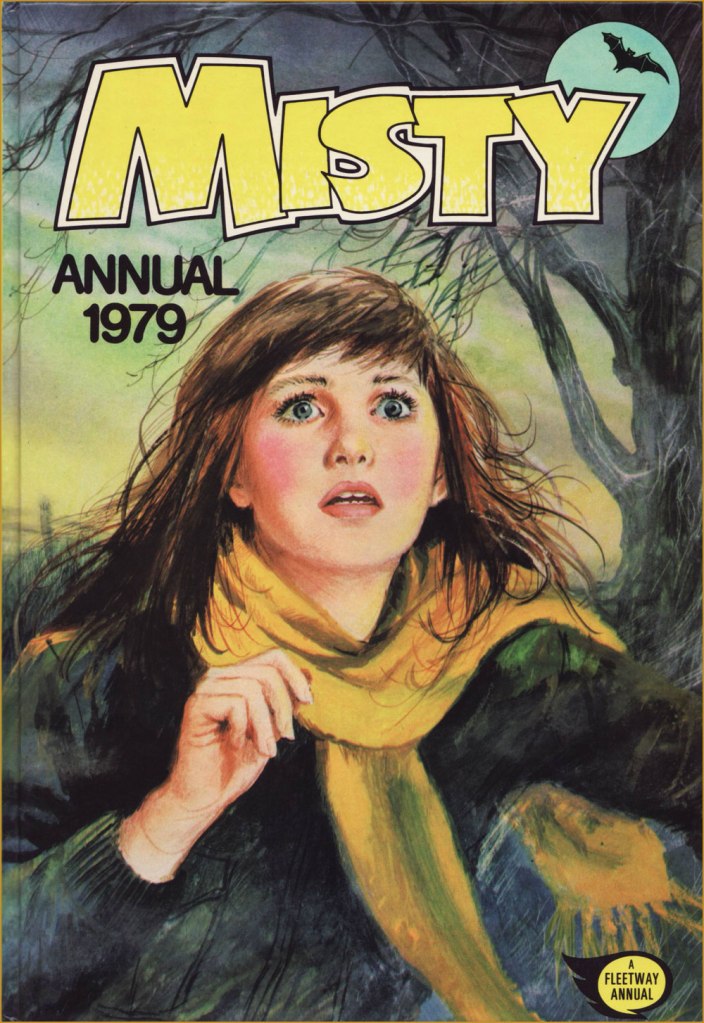
Blood Orange was published in Misty Annual 1979. No credits whatsoever, thank you very much.
-RG
*It’s worth noting — with a shudder — that UK comics were both stringently gender *and* genre specific.
** « Most titles were folded when they got down to about 200,000 sales. They said is was not viable, but can you imagine now, having a circulation of 200,000? » — Wilf Prigmore
« With pen and ink, I can achieve a scratchy, foggy effect that is appropriate. It was a continual process of learning. » — Nick Cardy
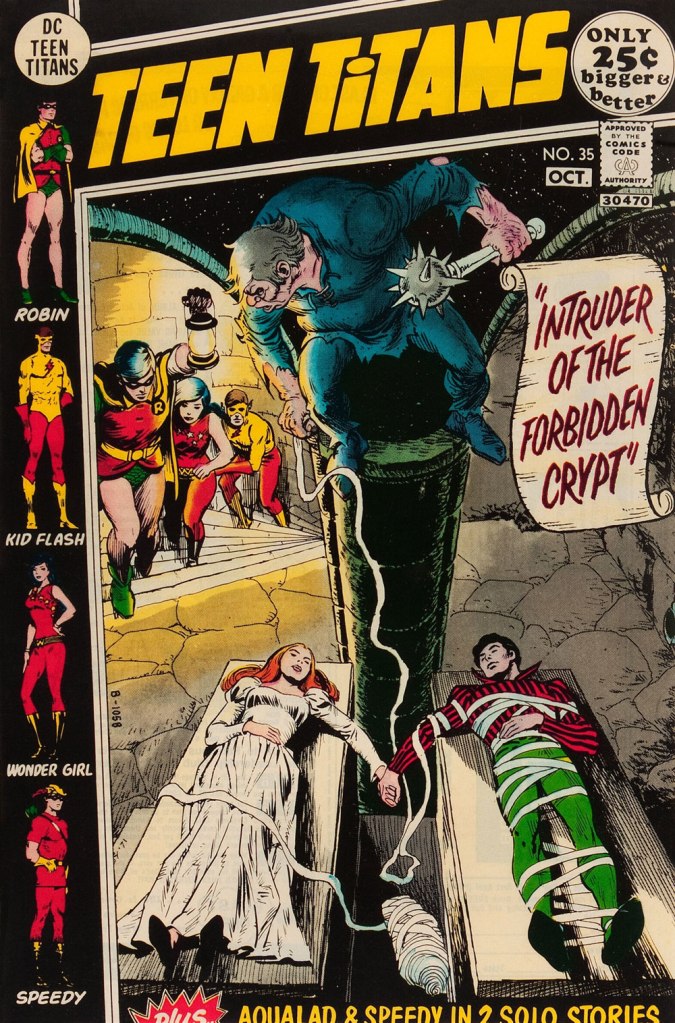
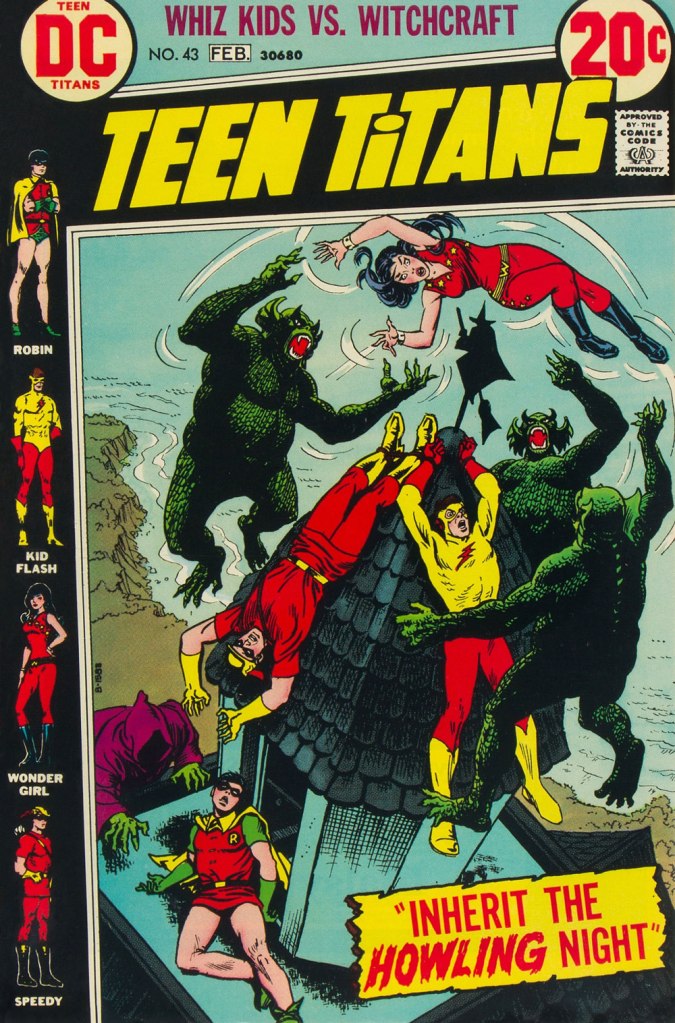
While WOT? favourite Nick Cardy (1920-2013) — who would turn one hundred and four years old today! — spent a lot of time chronicling the undersea adventures of Aquaman, his lingering true love, despite his busy schedule as DC’s premier cover artist, was the Teen Titans — he contributed, either as penciller, inker… or cover artist — to all forty-three issues of the original series.
And what I loved most about editor Murray Boltinoff‘s books is that they were packaged as horror books even when they nominally featured superheroes, a welcome respite. The costumes seemed an afterthought, a most unusual and refreshing attitude. Here, then, is a gallery of Mr. Cardy’s moodiest, most sinister Teen Titans cover artwork.
This is Teen Titans no. 33 (May-June 1971, DC). This is Teen Titans no. 34 (July-Aug. 1971, DC). Lettering by Ben Oda.This is Teen Titans no. 35 (Sept.-Oct. 1971, DC).This is Teen Titans no. 36 (Nov.-Dec. 1971, DC).This is Teen Titans no. 41 (Sept.-Oct. 1972, DC).This is Teen Titans no. 42 (Nov.-Dec. 1972, DC).This is Teen Titans no. 43 (Jan.-Feb. 1973, DC).
« Religion is like a blind man looking in a black room for a black cat that isn’t there, and finding it. » — Oscar Wilde
We certainly can’t have an Hallowe’en countdown without at least one black cat, can we?
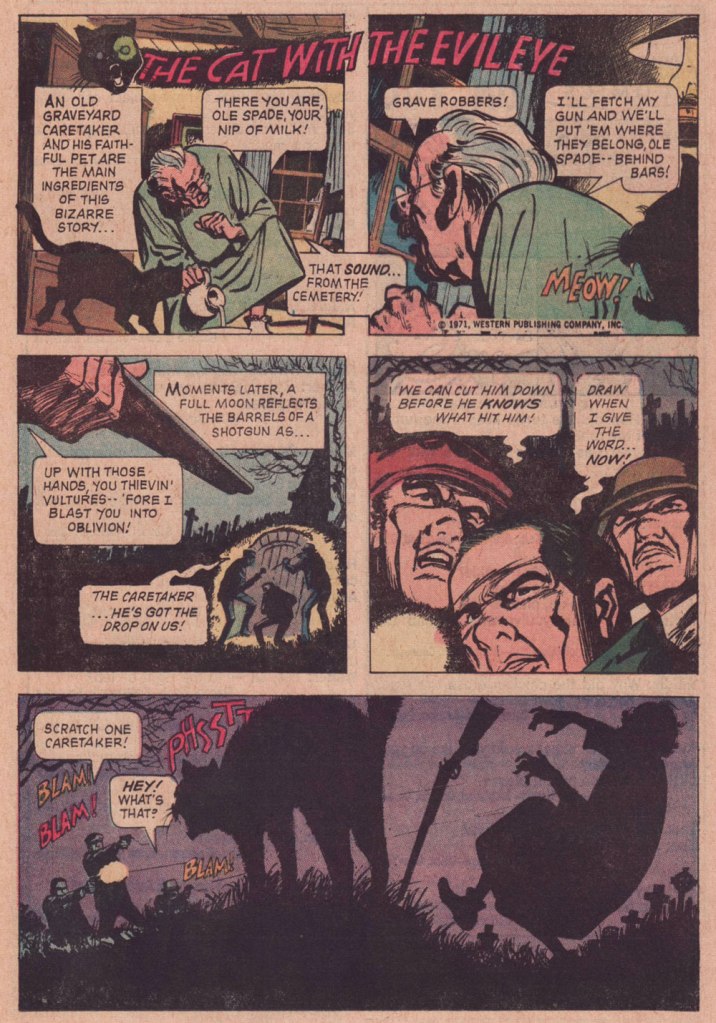
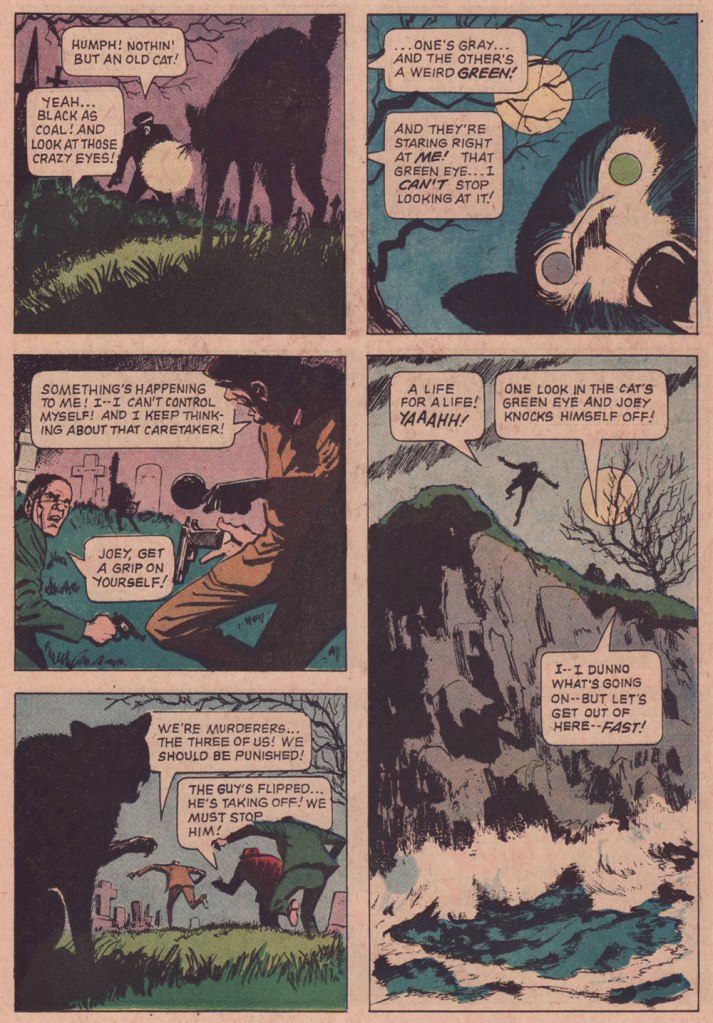
Here we have Hamilton, Ontario’s Win Mortimer (1919-1998) at his most stylish. A competent craftsman, he drew a lot of Superman and Batman for DC in the Golden Age, and may be most remembered by readers of a certain generation for his work on Marvel and The Children’s Television Workshop‘s Spidey Super Stories (57 issues, 1974- 1982). As for me, I was always fondest of his work for Gold Key’s mystery titles, where he seemed to be having more fun.
And never did he cut loose more expressively than with this tale of « The Cat with the Evil Eye », from The Twilight Zone no. 38 (July 1971, Western). Working from a barebones scenario by the über-prolific Paul S. Newman, Win messes around with shapes and textures at a breakneck pace. Four pages flicker by and it’s all over but the mournful yowling.
« True terror is to wake up one morning and discover that your high school class is running the country. » — Kurt Vonnegut
Tonight, we’re slumming it up on the cheap side of the tracks. If you thought — and I quite understand you on that point — that Myron Fass’ Eerie Publications were scraping the bottom of the barrel for their market share, then you likely weren’t aware of his fellow cheapjack opportunist Stanley Morse. For a bit of background on Fass, check out these entries from previous countdowns: Hallowe’en Countdown II, Day 1; and Hallowe’en Countdown VI, Day 27… so I don’t have to repeat myself.
Furthermore, here’s my brief introduction to the dodgy wonders of Morse’s ‘Stanley Publications’. I recently came upon all the short-lived line’s covers and was struck by their certain je ne sais quoi. Doubting my senses a little, I queried ds, and she concurred: it’s raw, it’s primitive, but not devoid of a bizarre sort of charm.
Here, then… is a gallery of the entire run of Stark Terror!
This is Stark Terror no. 1 (Dec. 1970, Stanley); cover art by Frank Carin (né Carino).This is Stark Terror no. 2 (Feb. 1971, Stanley); cover art by Carin.This is Stark Terror no. 3 (Apr. 1971, Stanley); cover art by Mexican illustrator Héctor Castellón .This is Stark Terror no. 4 (June 1971, Stanley); cover art by Carin.This is Stark Terror no. 5 (Aug. 1971, Stanley); cover art by Carin. Just in time for cancellation, a new logo, possibly by Ben Oda.As a bonus, here’s the surviving original art to the publisher’s Ghoul Tales no. 1 (Nov. 1970, Morse); artwork, again, by Mr. Frank Carin.
« Veteran genre-crosser Carin delivered this new-for-1970 cover, insinuating troll-like creeps into a mad-doctor/torture-chamber situation. (The published version contains a touch of self-censorship, obscuring one conspicuous element of nudity with layers of color.) Carin is an enigmatic figure in midcentury comics, traversing the idioms of Funny Animals, Good Girl Art, adventure, and lurid shock value. » [ source ]