Back When ‘Hipster’ Wasn’t a Dirty Word: Gene Deitch’s The Cat

« It was a fanatic’s world, and I was one of the fanatics » – Gene Deitch

Say, for a bit of a twist, let’s pay tribute to a living* legend. I’m referring to none other than Gene Deitch (born ninety-four years and change ago: August 8, 1924 in Chicago, Illinois).

GeneDeitchSelfA
A recent self-portrait of the master.

This fascinating man has led a life of such distinction, achievement and all-around coolness that I’m tripping all over myself trying to boil it down to a few highlights. Art director of legendary jazz mag The Record Changer, animator-director-scenarist for UPA, Terrytoons, MGM… Academy Award winner for his direction of his animated adaptation of Jules Feiffer‘s Munro (watch it right here), creator of Sidney the Elephant, John Doormat, Clint Clobber, Gaston Le Crayon… and co-creator of Simon, Seth and Kim Deitch. Some fine artistic genes, to be sure!

YoungGeneA
The stylish young Master Deitch.

If you don’t terribly object, I’ll sidestep the pitfall of ambition and restrict this post to a single facet of Mr. Deitch’s orbit, namely his jazzy cartoons of the 1940s and 50s. Incidentally, these succulent needles have been collected, in their usual, exemplary fashion, by the Fantagraphics team. If you dig these, and the odds are good, you’ll need to acquire, dentro de poco, their The Cat on a Hot Thin Groove (2013).

DeitchRCJan46A
« I had just recently, for the first time, heard the magnificent pipe organ recordings of Fats Waller and imagined a portly black church janitor setting down his mop and bucket and rolling out some mighty blues in the midnight of an empty church on an elaborate organ most likely sanctified for an entirely different kind of music. This drawing was reproduced many times over  the years without anyone ever asking permission, and I was tickled to find it once on an actual Fats Waller album cover!** »
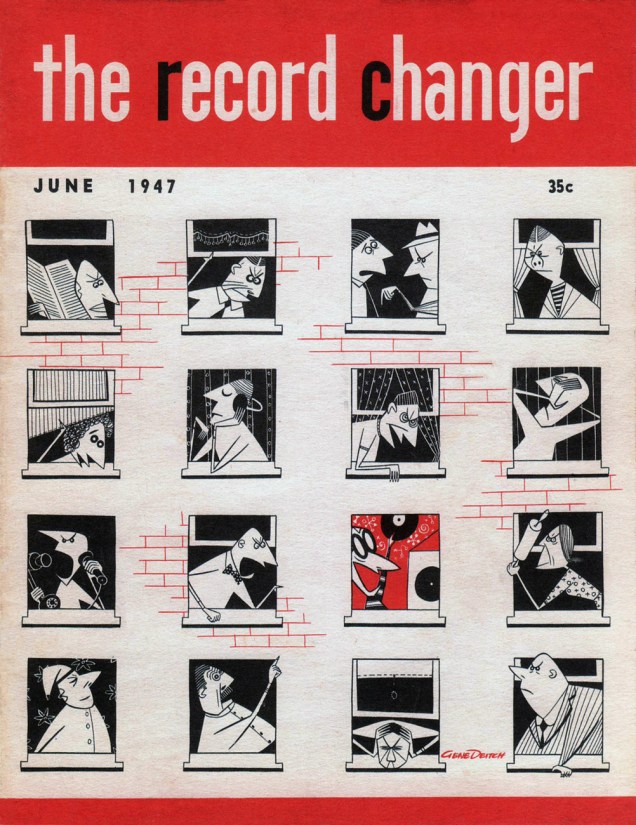
DeitchRCJun47A
« The cover shows that having a loud, jazz-playing Cat as an apartment house neighbor is not all that rosy. »
DeitchRCOct47A
« My cover show the devoted bass player protecting his beloved instrument from the pouring rain by covering it with his own coat and hat. If a musician’s livelihood depended on his instrument – often expensive or hard to come by – he did everything possible to keep it from harm. »
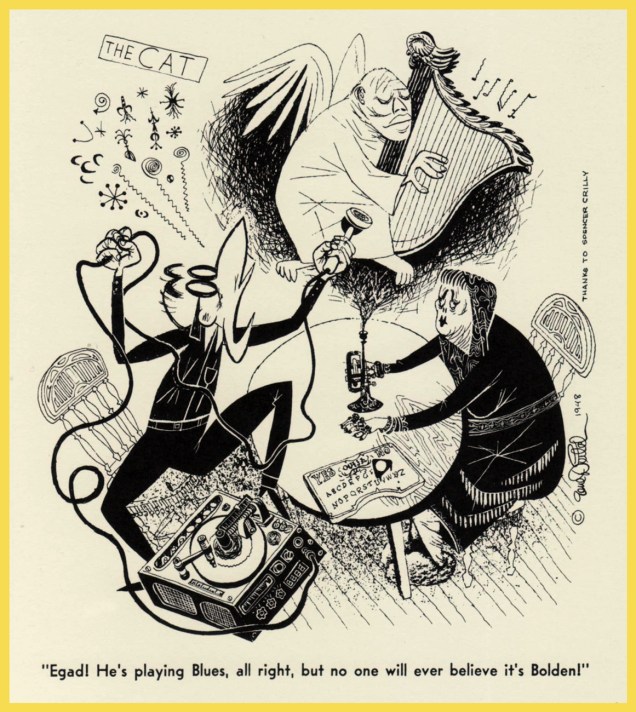
GeneDeitchSéanceA
From The Record Changer (August, 1948). « The search for a recording by the legendary pioneer New Orleans trumpeter Buddy Bolden has never subsided. In this issue, The Cat has actually managed to record him from the Great Beyond, but egad, he’s playing a harp instead of a horn! »
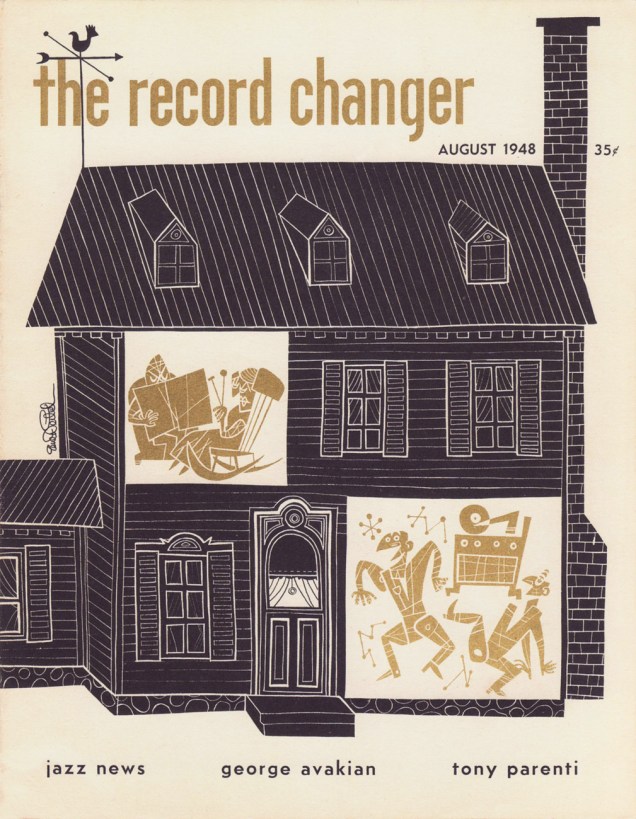
DeitchRCAug48A
« The cover design suggests the unlikely coexistence of a quiet elderly couple and a jazz record maniac within the thin walls of a single boarding house. »
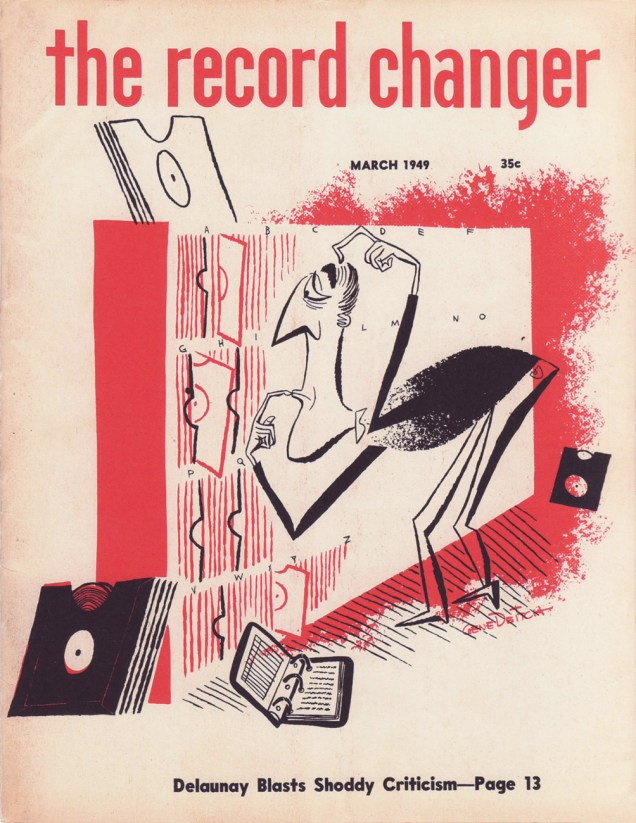
DeitchRCMar49A
« The cover showed that even with the most careful cataloging it was still mainly guess work to find the record you were looking for. »
DeitchRCJul49A
« Earlier that year I moved from Hollywood to Detroit, to take up an offer from a commercial film studio there that would give me a chance to become a director. My cover for July was inspired by the hazards of moving the most precious commodity of all. OK, I had two kids, but I let my wife arrange their things for the moving, and the moving men could do what they wanted with our furniture. But I didn’t let them touch my record collection! I schlepped every box full of discs myself, and carefully placed them in the safest positions. I was proud that my entire collection arrived in Detroit unscathed. »
GeneDeitch109A
From The Record Changer (August, 1949). « This may be the very best Cat-toon of all. It says everything I ever wanted to say about this character. What is a mere soul in comparison to a 100% complete jazz record collection? Spencer Crilly, wherever you are, I thank you for suggesting this gag! » Perhaps the proverbial catch in the Faustian deal is that, without his soul, a cat can’t appreciate jazz any longer. You can never win.
GeneDeitchBeardA
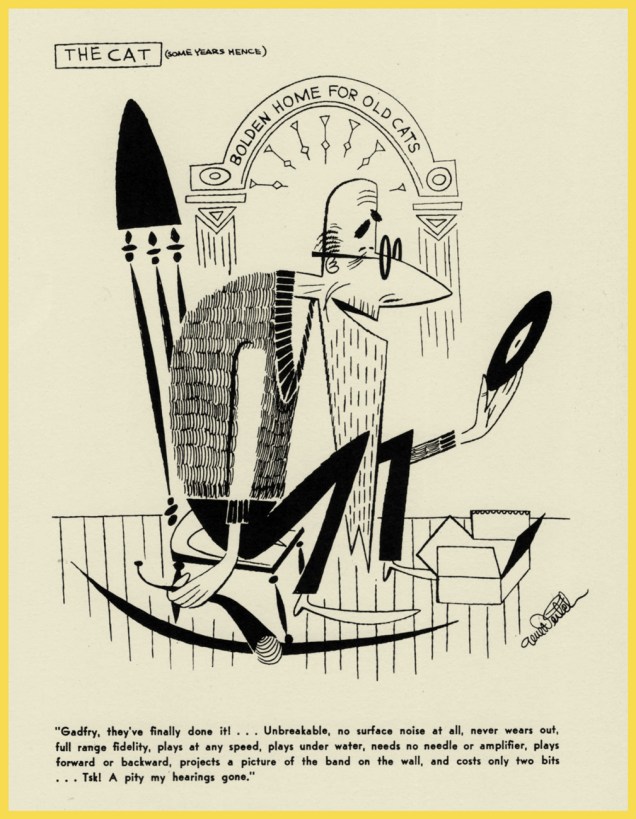
From The Record Changer (January, 1950). « The Cat, seen as a dodderer in the Buddy Bolden Home for Old Cats, basically predicts the CD and DVD records to come 50 years hence! »

For a fascinating overview of Mr. Deitch’s life in Prague and in animation, by all means check out Bryan Thomas’ « Gene Deitch: An American animation giant who lived and worked behind Prague’s iron curtain for over 40 years ». Phew!

-RG

*A sad but inevitable update: Gene Deitch passed away in Prague on April 16, 2020.

**I’m looking, I’m looking!
Happy Birthday to Eldon Dedini

Amidst all the (justified) doom and gloom that this week has brought us, there is one bright spot that comes just in time to save this week from being a complete downer. It’s Eldon Dedini’s birthday! (He was born in 1921, on June 29th.) Yes, I know that he died in 2006… but his joyous, delightfully hedonistic art lives on. As a Russian whose father once started a rowdy party because it was Mozart’s birthday, I claim the privilege of celebrating Dedini’s jour de naissance by raising my glass of rosé (satyr-approved, of course) in his honour.

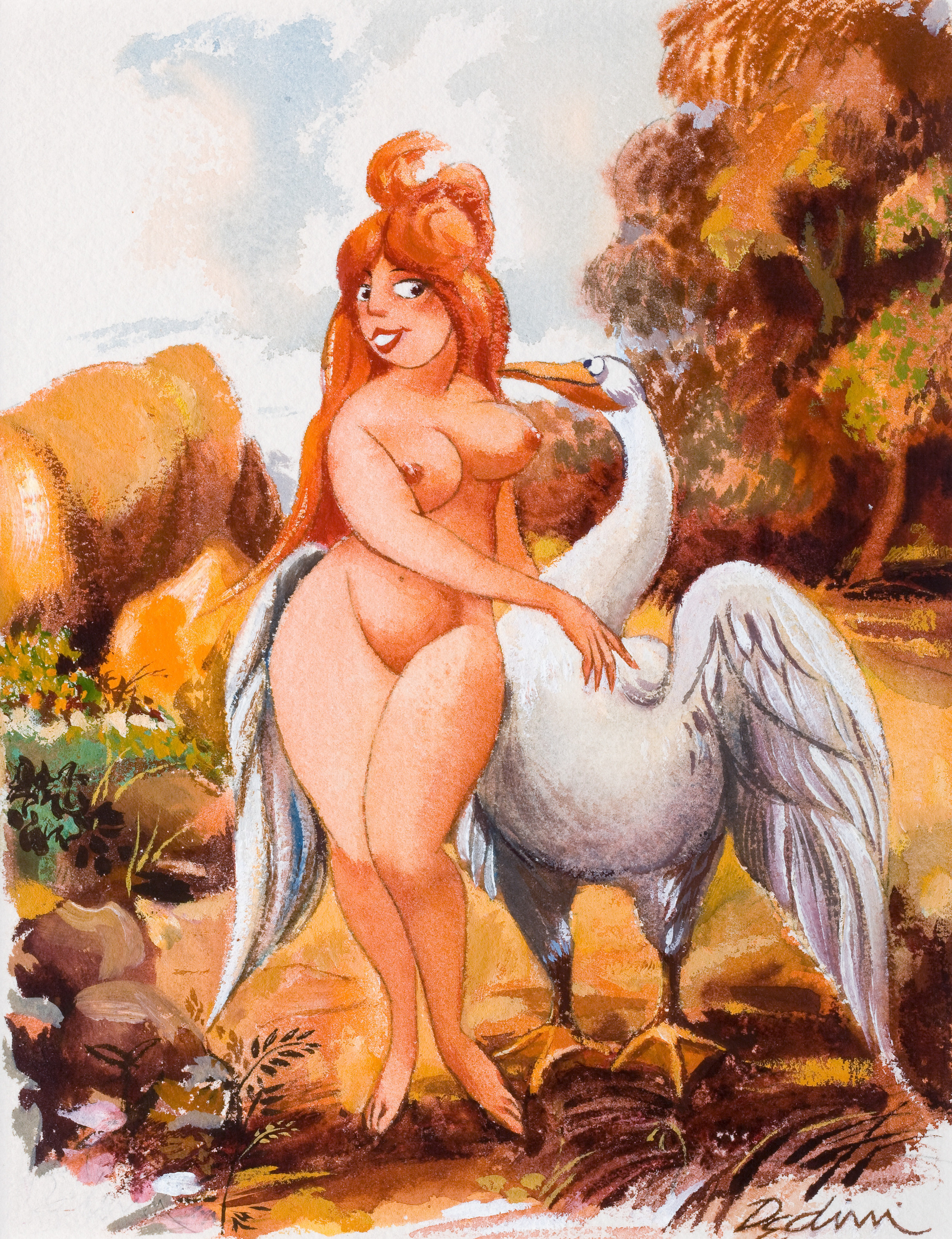
Dedini-Swan
“That’s all very well for you, but I’m the one who’ll have to sit on the eggs”.

He was one of Gus Arriola’s closest friends. To quote Arriola, «calling Eldon a cartoonist just christens the tip of an impressive iceberg. Beneath the surface is a superb painter, a remarkably inventive illustrator, philosopher, and humorist—a keen observer, revealing life’s little truths with his unerring brush. His chief reward was the viewer’s invariable burst of laughter. He was a walking repository of eclectic knowledge about art, history, jazz, wine—you name it. I gave up using my encyclopedia on a subject search: it was faster to pick up the phone and call Eldon.» By the way, I pulled this quote out of a R.C. Harvey article published in the Comics Journal titled “Viewing Life Through a Twinkle”, which gives you an idea of what a fun read it is.

The first thing that comes to mind when one thinks of Dedini is merrily frolicking satyrs, closely followed (or preceded) by unapologetically buxom women, all of this merry crowd looking to have some fun of the most basic kind. It’s not all randy woodland gods, though; there’s also room for lascivious gnomes, salacious wolves and whatever other lechery comes to mind. (Most of these were published in Playboy Magazine.)

Dedini-Satyr-Balzac
« Remember what Balzac said – ‘it is easier to be a lover than a husband for the simple reason that it is more difficult to be witty every day than to say pretty things from time to time.‘ »
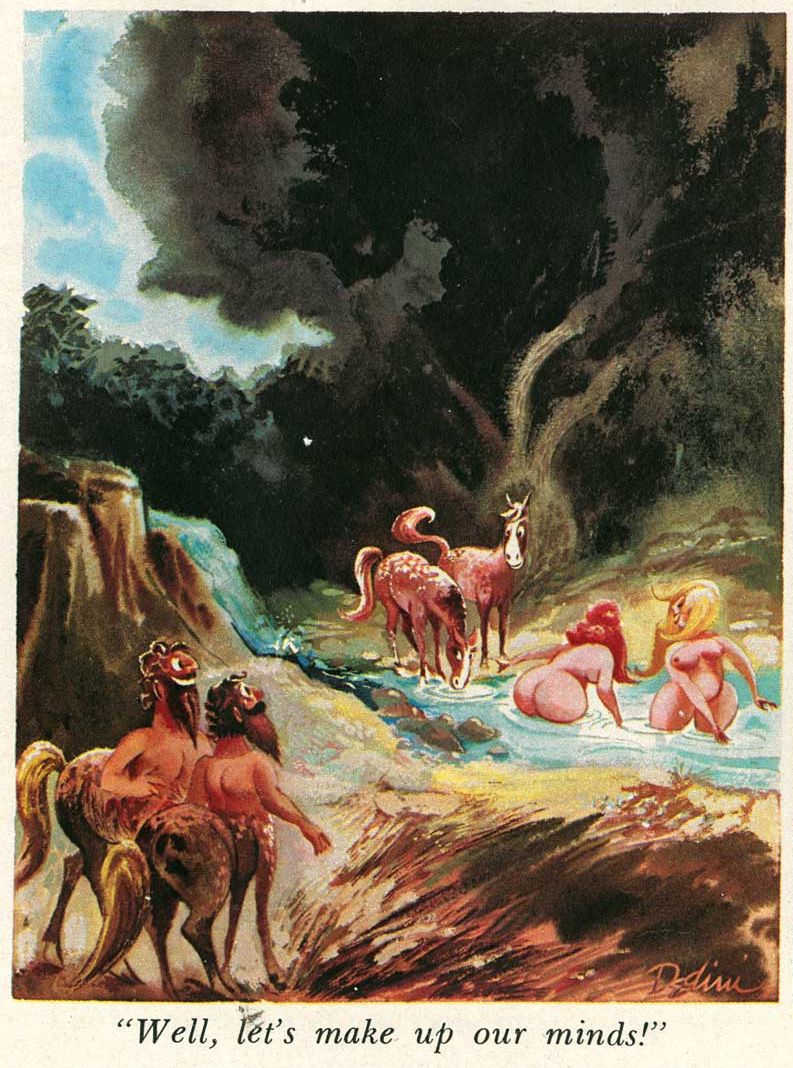
Dedini-MakeUpOurMinds
Ooh, tough choice.
Dedini-MushroomScene
« Either we start pushing birth control or we’re going to be up to our asses in little people. »

DediniWolfA« But will you love me when I’m old and gray? » From Playboy’s August, 1971 issue.
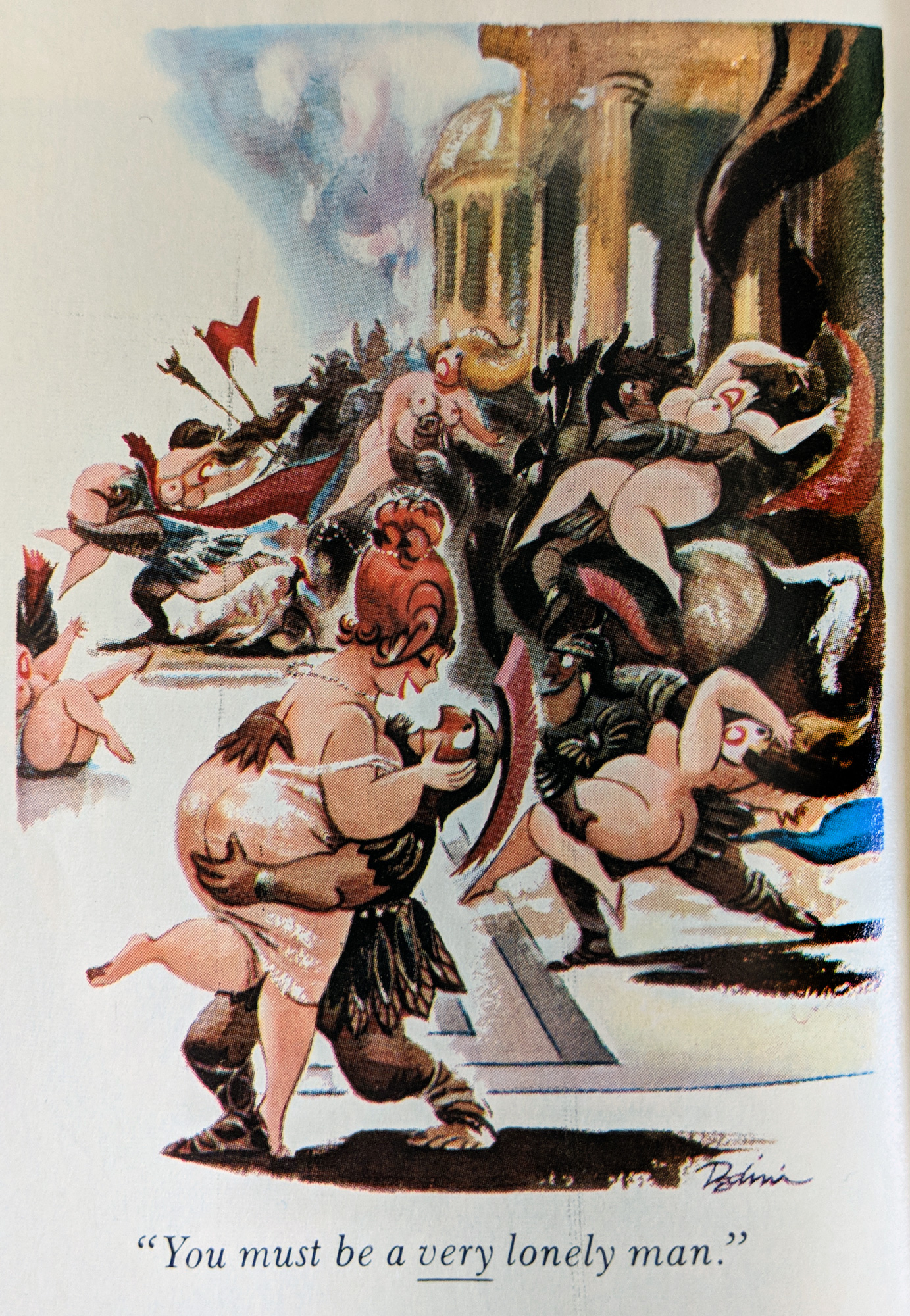
Dedini-LonelyMan
Nothing like taking the proactive role, huh?

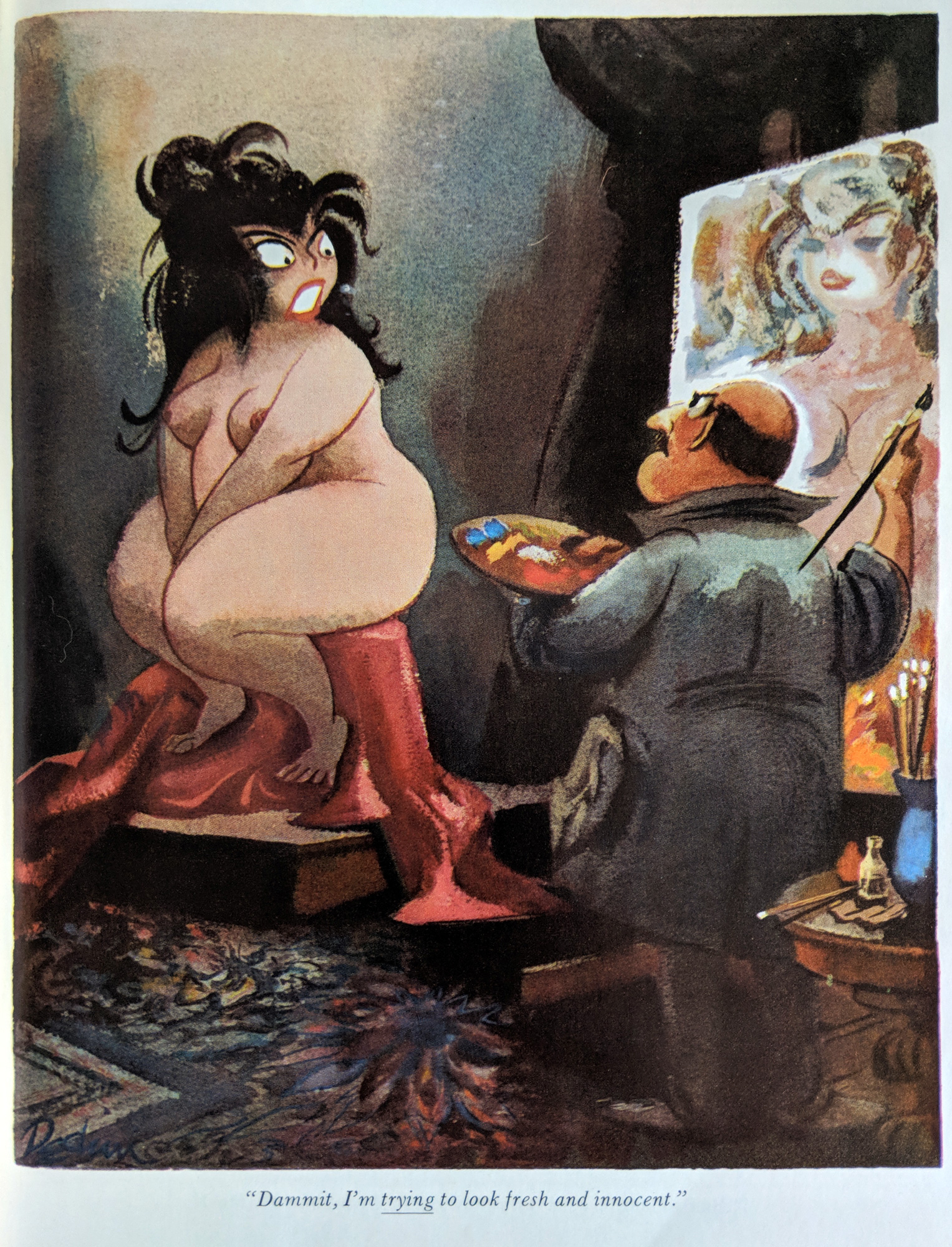
Although it’s easy to be blown away by Dedini’s take on Grecian and Roman mythology – I think fabled creatures gave him an easy outlet for his joie de vivre – he could seemingly draw anything he wanted to, stunning forest landscapes or historical costumes, capturing carpet textures, clothing accessories or musical instruments with equal ease.

Dedini-FreshandInnocent

Dedini-ThunderWoman

Dedini-RockBand
« Well, I guess it goes to prove that not all God’s children got rhythm. » Note the name of the band, which made me snort into my tea.


Dedini-Religion
Whatever religion *that* is, I want to join it!

To wrap up, here’s a sweet anecdote from the aforementioned Viewing Life Through a Twinkle:

During an intermission at one year’s Festival, Dedini and some other PBL members went up on stage to have their photograph taken. Duke Ellington was still on stage, seated at the piano, putting eye drops in his eyes. When Dedini was introduced as “a cartoonist who sometimes draws jazz cartoons,” Ellington got up and, without saying a word, pulled out his wallet and started looking through it as he meandered, aimlessly, around the platform. Finally, he found what he was looking for, a folded up magazine clipping. He carefully unfolded it and spread it out on the piano: it was a cartoon Dedini had done for Collier’s. The cartoon depicted two Russians in Red Square, one of whom is obviously a dealer in blackmarket phonograph records: he has opened his coat to show the other fellow the record that he has tucked inside, saying, “ … Cootie Williams, trumpet; Johnny Hodges, alto sax; Barney Bigard, clarinet; Harry Carney, baritone sax; Duke Ellington, piano …” Said Dedini: “Ellington loved that cartoon because when he toured Russia the people of Russia loved his music, but they couldn’t buy the records.” For years thereafter, Ellington sent Dedini a Christmas card. “I have about twenty,” Dedini said. “He sends them in June.”

~ ds

Gahan Paints What He Sees!

Another day, another birthday, it would seem. Well, I feel this one’s of particular importance… Gahan Wilson, born February 18, 1930, turns 88 today. As you may know, many an artist burns bright and burns fast, enjoying a peak of a handful of years followed by a settling into habit or mediocrity. That’s not our Mr. Wilson, who’s been prolific, reliable and versatile for over a half-century. That makes him, I suppose, easy to take for granted. Let’s not, shall we?

Most visibly, he’s built up a splendiferous body of work at Playboy, which was collected in exemplary fashion (2010), for your convenience, by the fine folks at Fantagraphics (in case you don’t have room for the entire magazines.) With the possible exception of Shel Silverstein, Gahan was perhaps the only cartoonist Hugh Hefner didn’t habitually encourage to throw in some buxom females.

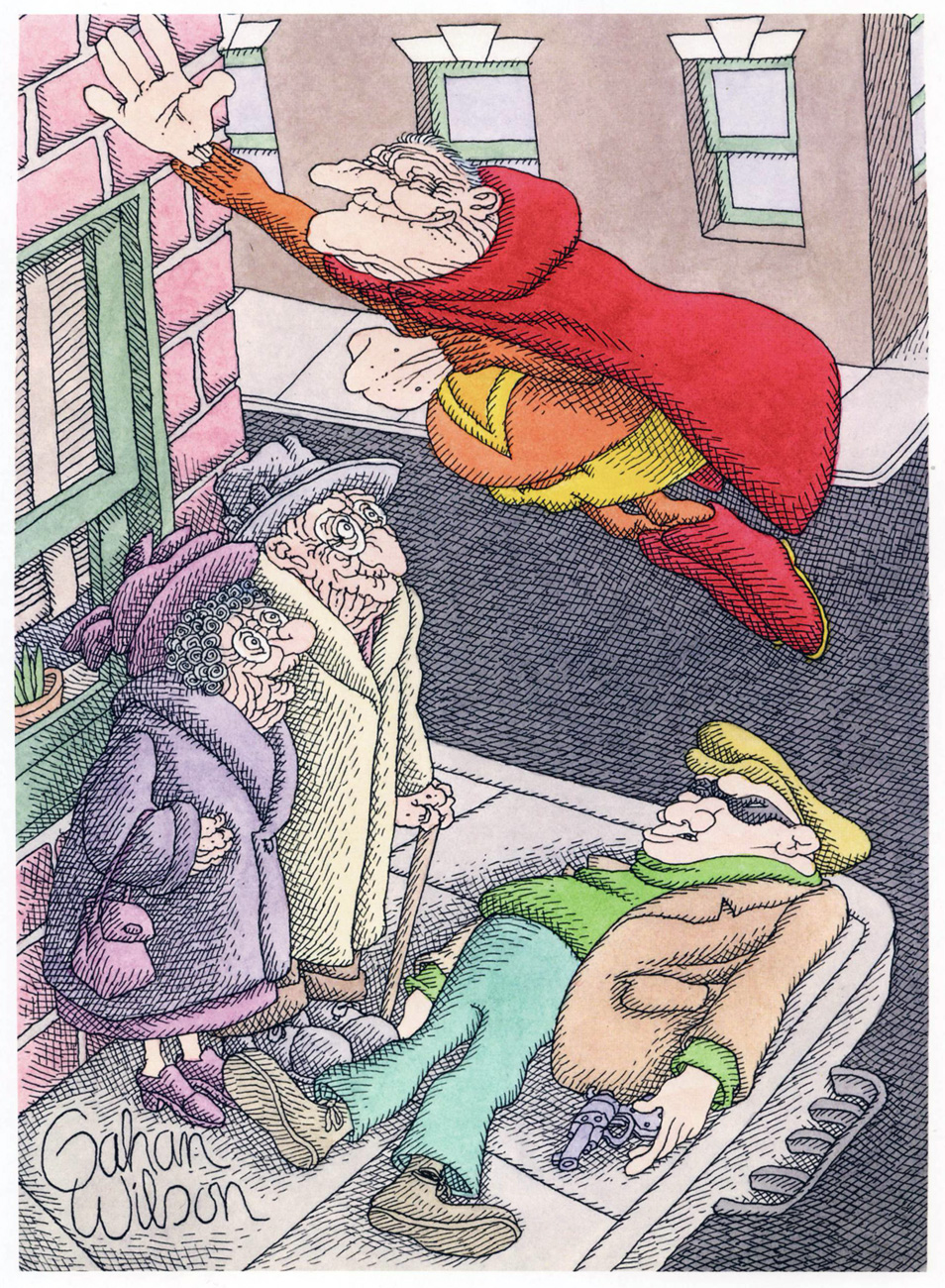
GahanGeriatricHeroA
« Well, it certainly is nice to know someone’s looking out for us old folks! » (Playboy, November, 1987.)

He’s also been a regular contributor to The Magazine of Fantasy & Science Fiction since 1964, again gathered by the reprobates at Fantagraphics, this time in a tome entitled « Gahan Wilson’s Out There » (2016). Significantly, the book includes Wilson’s prose works for the magazine, gems of concision and dark wit.

GahanPlugA

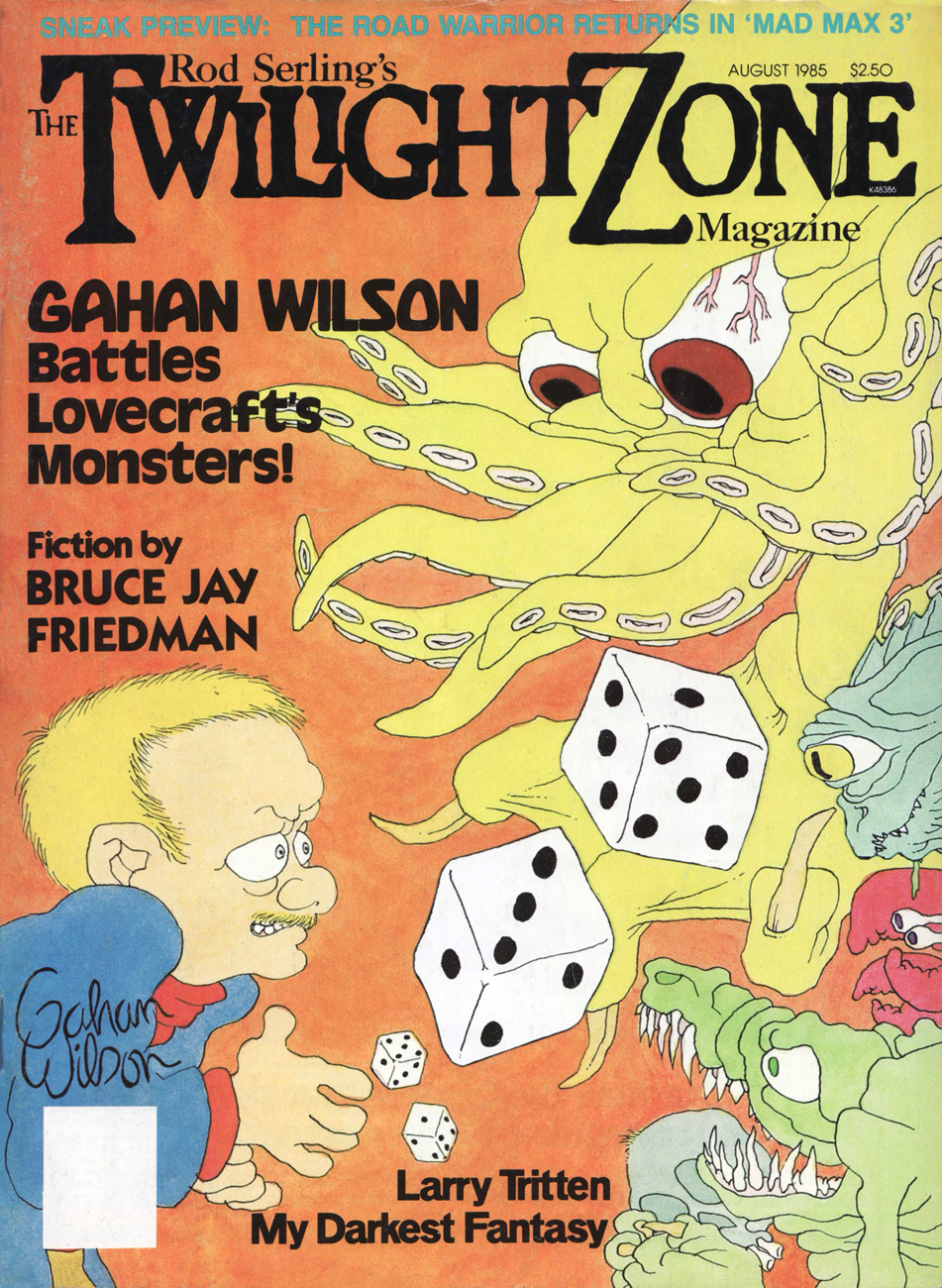
Which brings us to another facet of Gahan’s œuvre: his writing. I greatly enjoyed his regular film column in Twilight Zone magazine (1981-89). For the publication’s August, 1985 issue, he provided, in addition to his regular contribution, an eye-catching (watch out!) cover illustration and a feature article « I Hear You Callin’ Cthulhu », a review of the role-playing game Call of Cthulhu. « Hot on the trail of Dagon, the shoggoths, and other Lovecraftian horrors, the noted cartoonist (and intrepid TZ columnist) finds himself drawn into a labyrinth of secret caverns, sinister intruders, tentacled monstrosities — and a terrifying thing called the Insanity Table. »

GahanTwilightZone85A

GahanDice1A
« Our intrepid gamesman gathers his courage… »

GahanDice2A
« … tests his luck against the dark gods… »

GahanDice3A
« … reads his fate in the faces of the dice… »

GahanDice4A
« … and when the smoke clears, is seen no more. »

Happy Birthday, and thanks for all the tentacles, Mr. Wilson!

– RG

“Has It Got a Message?”

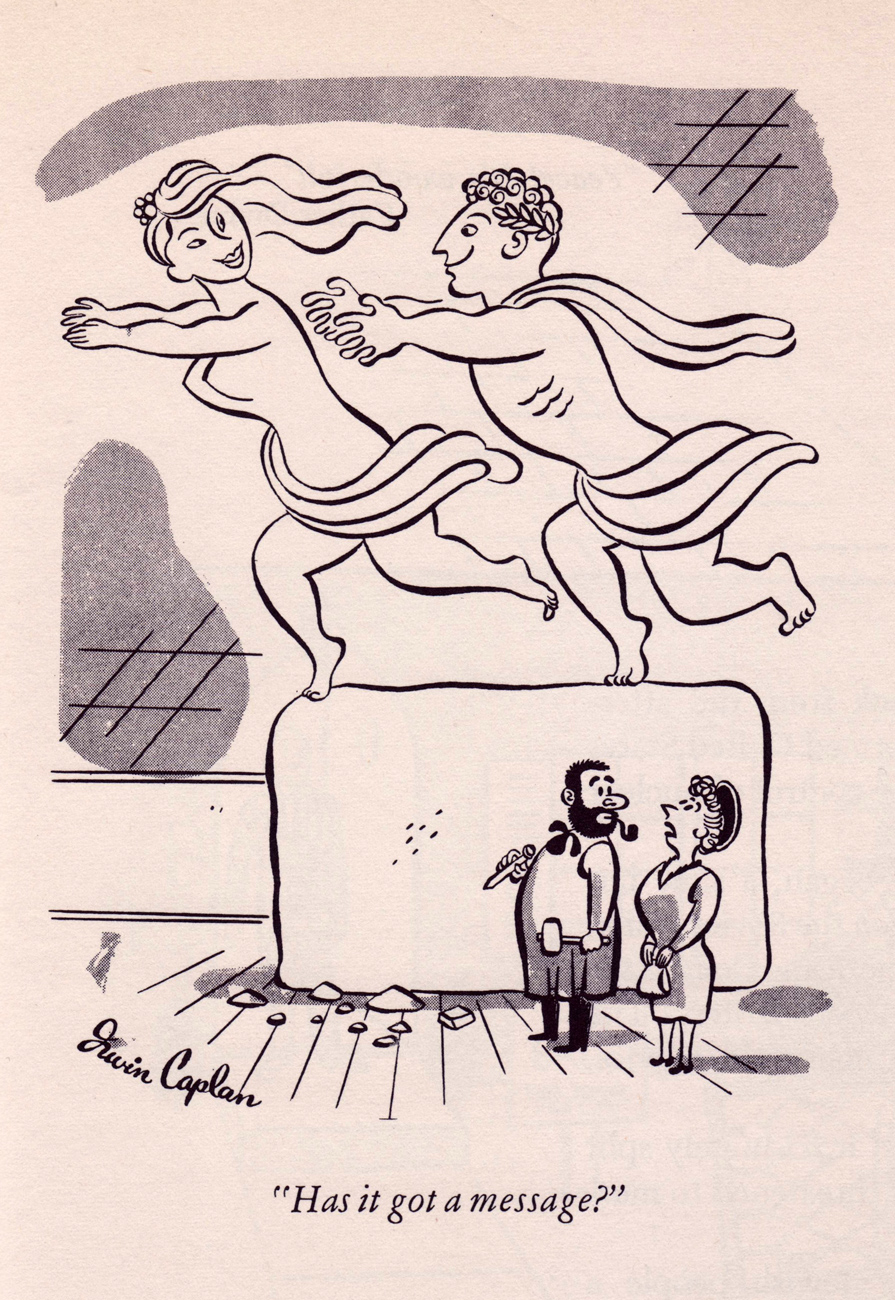
Here’s a merrily libidinous one (who’s chasing whom, really?) from Irwin Caplan (1919-2007), originally published in Liberty Magazine in 1946.

MessageA

From the 1940 to the early 1960s, Caplan’s work appeared regularly in all the big ones: Collier’s, Liberty, The Saturday Evening Post (with his strip “Famous Last Words”), Parade, Life, the Sunday supplement This Week, and so forth. For my money, his early work is his finest, boasting a crisper line and more distinctive in style and substance.

Caplan was also a successful fine art painter, art director, advertising illustrator and graphic designer… which may have somewhat watered down his legacy. Nevertheless, what matters is the strength of his œuvre, and the fact that he had a varied and rewarding career.

Here’s an obituary from the Seattle Times (he was born in Washington and remained a lifelong resident of The Evergreen State) that provides a fuller account of this jovial man’s life and times.

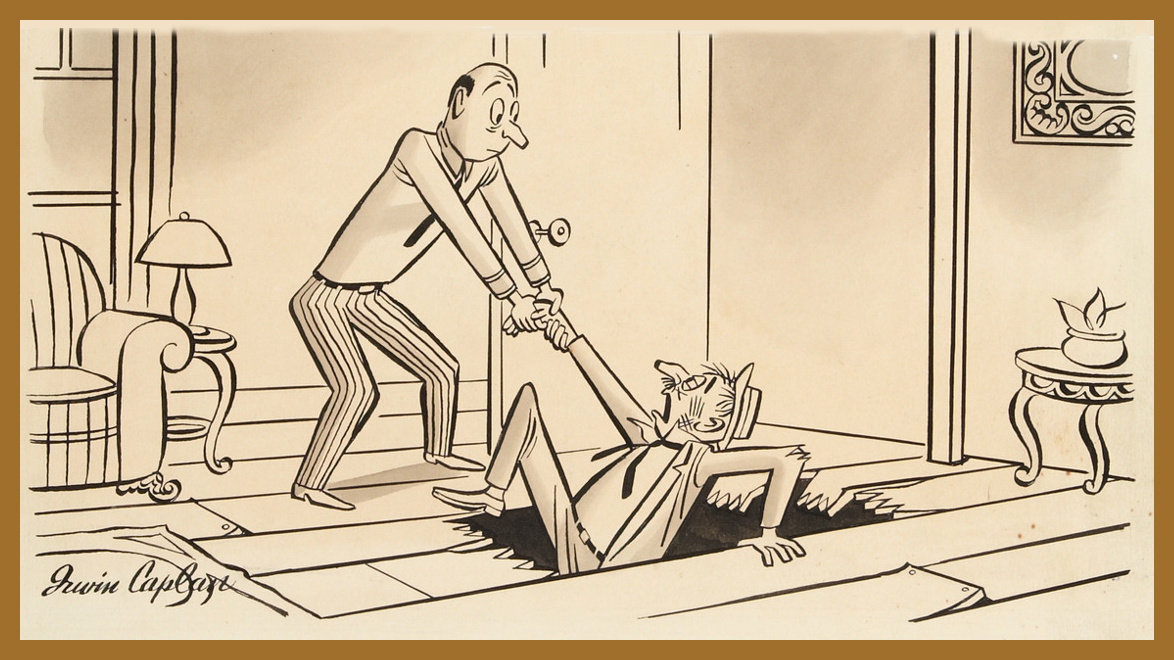
As a bonus, a Caplan cartoon of undetermined vintage and publication history… but a timeless one, you’ll surely agree.

CaplanRentIncrease
« I was saying, Sir, in view of recent improvements, I am raising your rent. »

– RG

Spending Some Quality Time With Barbara Shermund’s ‘New Woman’

Although it’s tempting (but lazy) to assume so, men didn’t *altogether* corner the risqué cartoon niche.

It would be quite an injustice to count out the magnificent Barbara Shermund (1899-1978), prolific contributor to The New Yorker (including eight covers) and Esquire magazines, and so much more.

Far too little is known about this pioneering artist, but here’s an insightful piece aiming to rectify the situation, at least a little, written by Caitlin McGurk:

https://library.osu.edu/blogs/cartoons/2012/03/27/womens-history-month-barbara-shermund-1899-1978/

ShermundVersatile
Nothing new under the sun! Frankly, that situation hasn’t gained a wrinkle since this cartoon’s appearance in The New Yorker‘s July 21, 1928 edition.

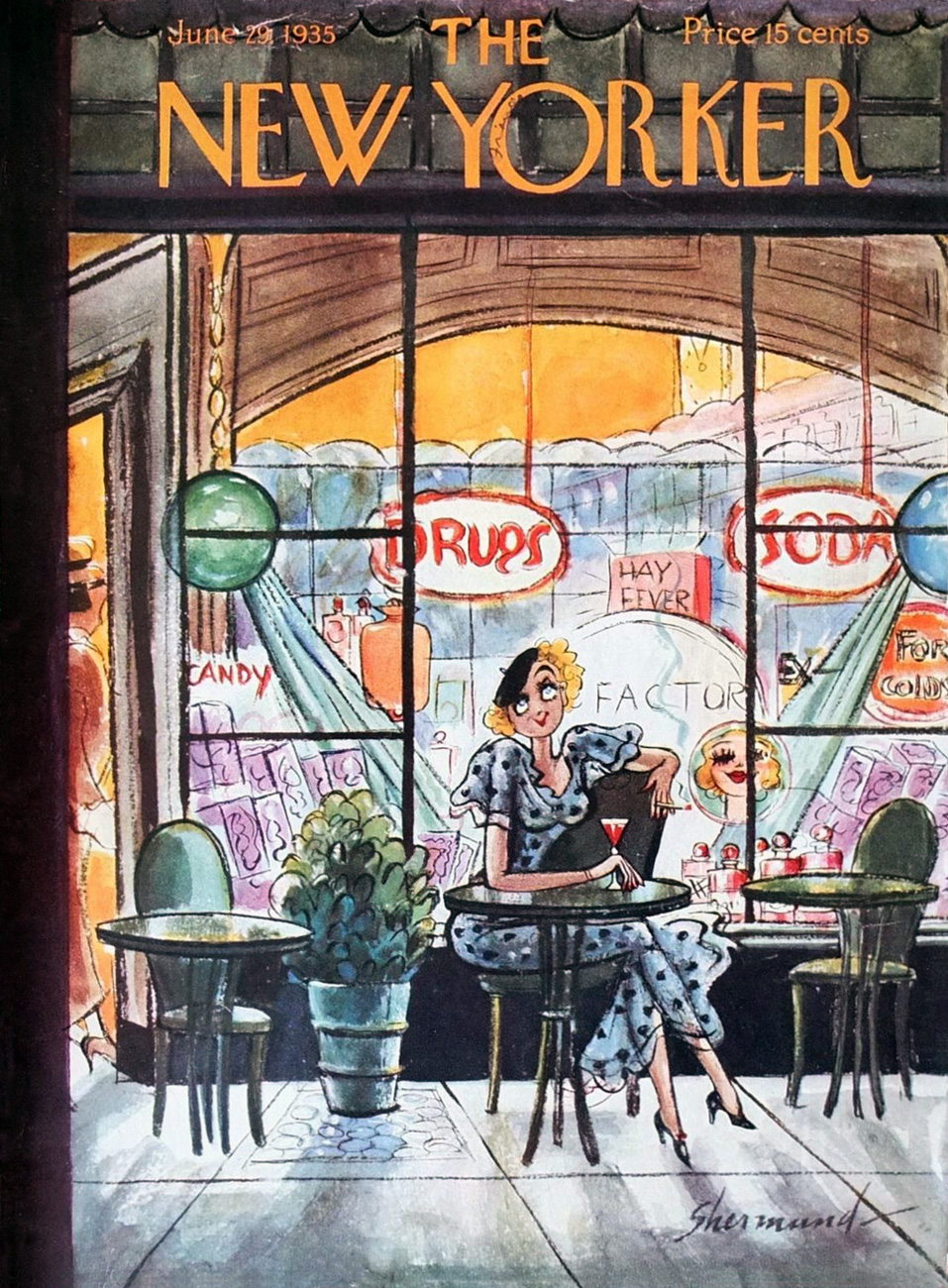
NewYorker1935A
One of Ms. Shermund’s aforementioned New Yorker covers, from the June 29, 1935 edition.

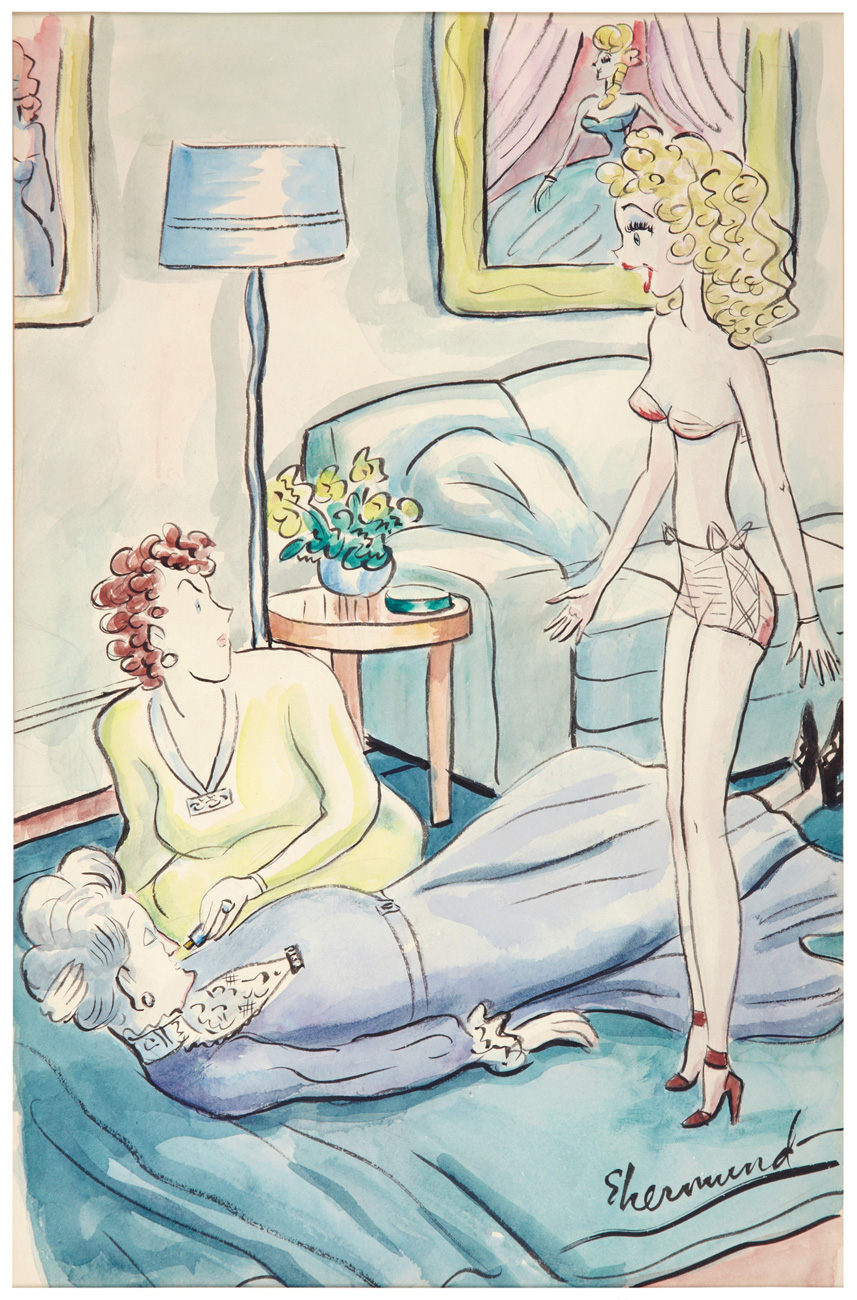
ShermundGrannyFaintA
« All I said was, ‘Granny, how do you like my new bathing suit?’ » Undated piece in ink and watercolour.

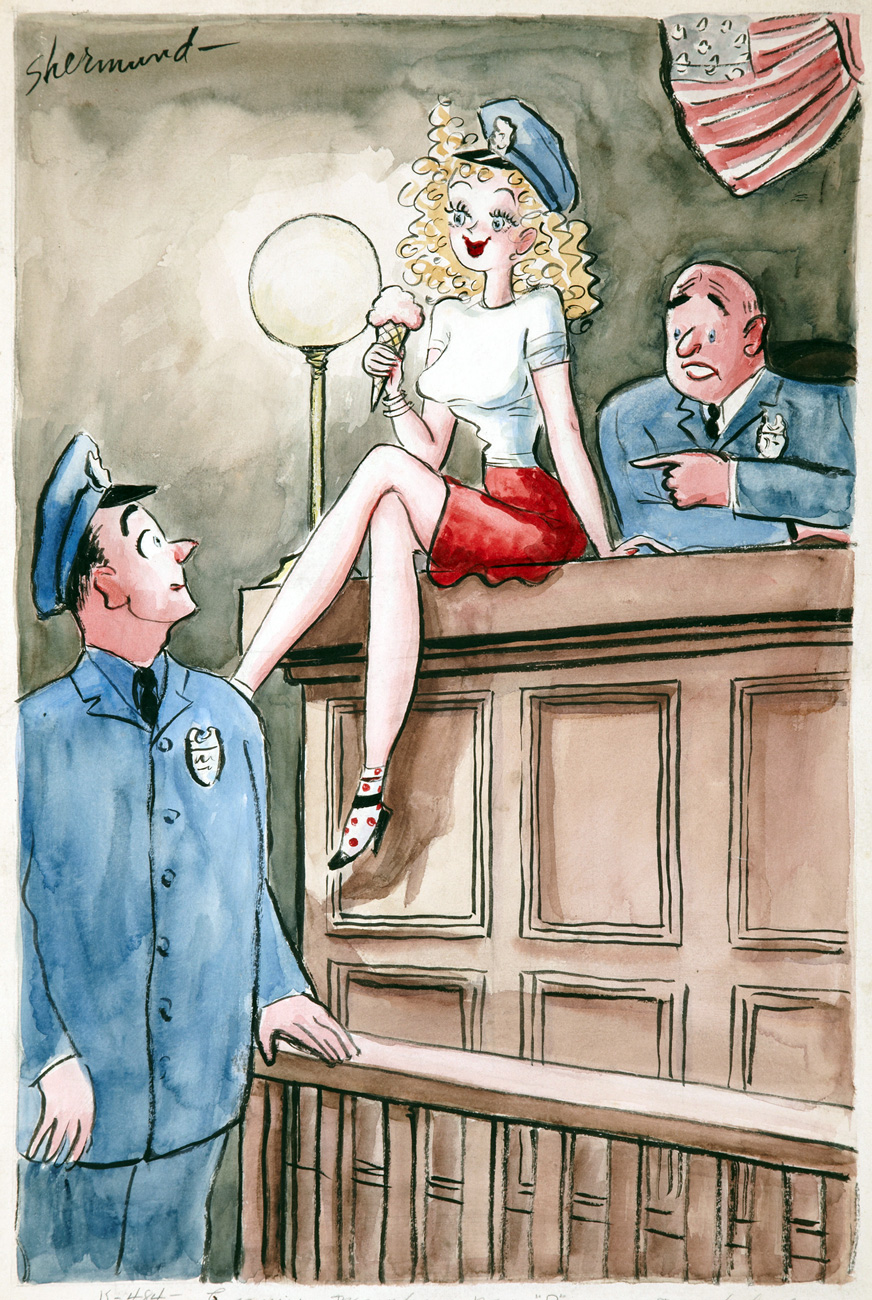
ShermundLostA
« She’s lost! » Esquire, 1944. Ink and watercolour.

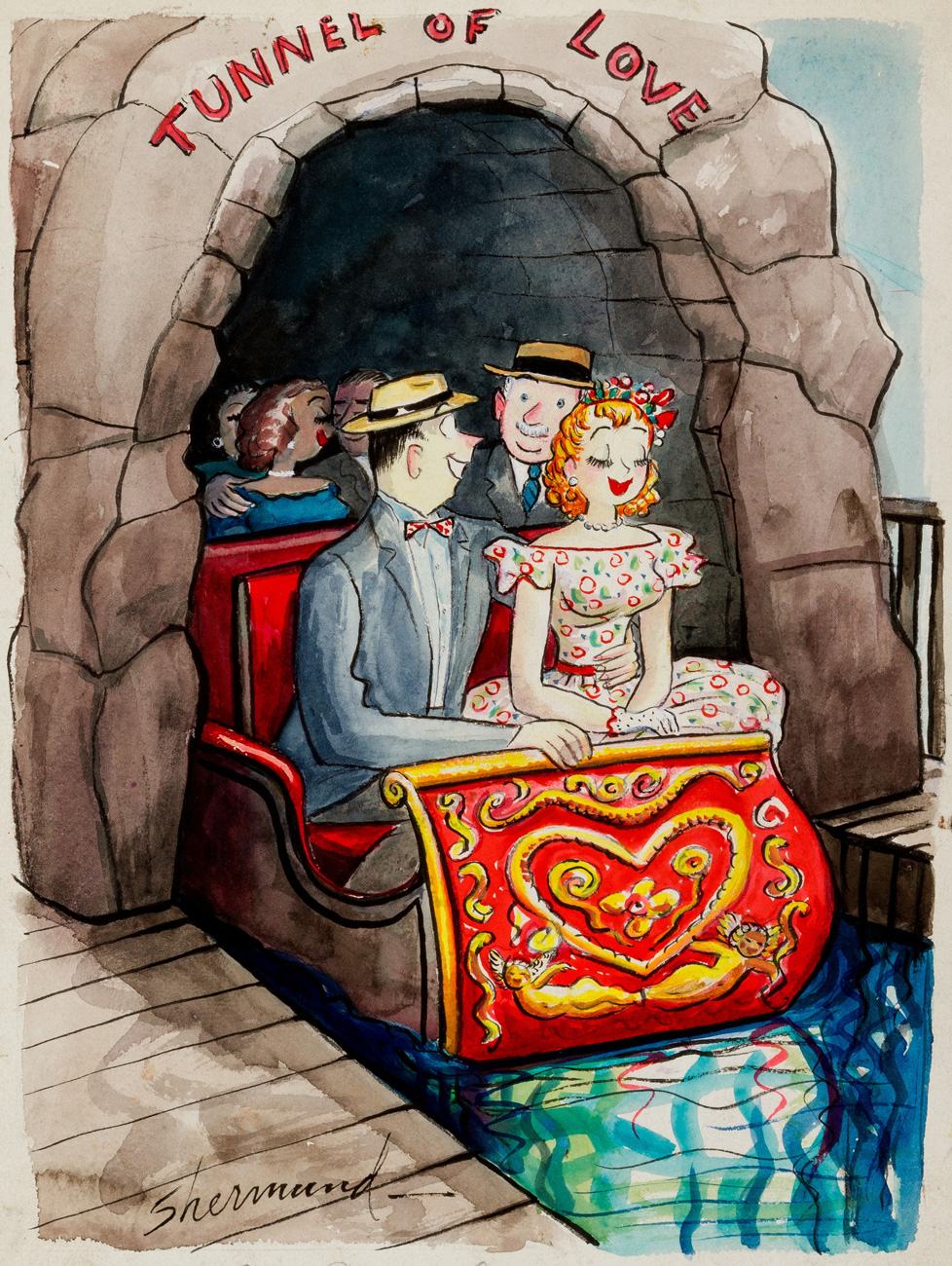
ShermundTunnelA
« Mr. Dillon, I’d like to ask your daughter’s hand in marriage. » (1953, ink and watercolour.)

ShermundApeA
« Who was that fellow I saw you with at Ciro’s last nite? » (Cheering Section, 1955. Ink and watercolour.)

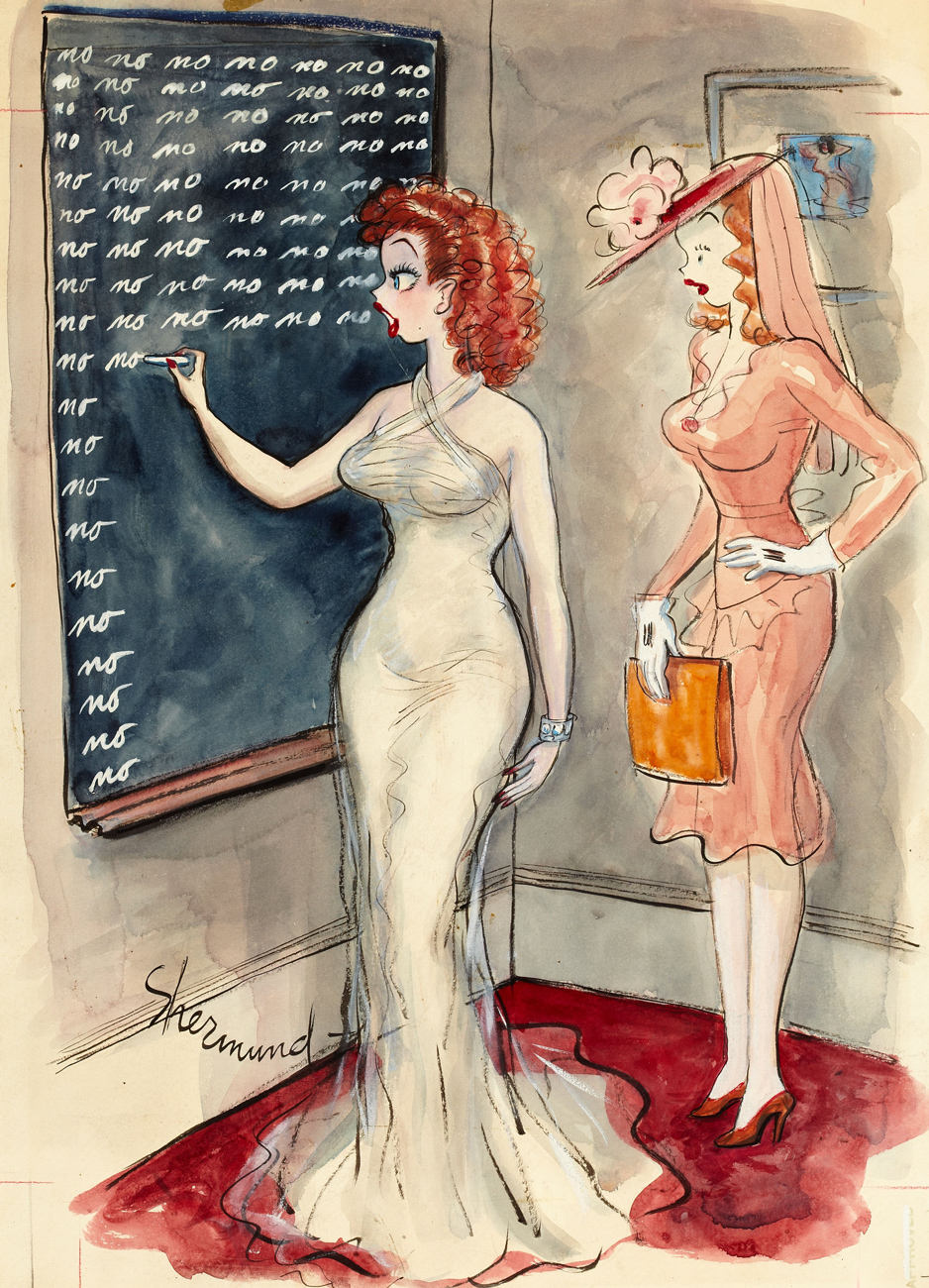
BarbShermundNoA
« Mother always makes me write it five hundred times before I go out with Mr. Parker » Esquire, publication date unknown, ink and watercolour.

ShermundCowboyIndianA
« Let’s play cowboy and indian! » (Cheering Section, 1959. Ink and watercolour.)

I can’t help but be reminded, by that final piece, of Jack Cole‘s rather more trenchant take on a similar power imbalance, published a year earlier.

ColeUncleSamMaidenA
« Well, there’s history repeating itself. » (Jack Cole, from Playboy, January, 1958.)

A postscript: in March, 2022, Ms. Shermund was the subject of an article in the New York Times’ ‘Overlooked No More’ series, comprising belated obituaries for notable folks whose departure flew under the radar, so to speak. In this case, we learned that:

« Shermund lived out her last years drawing at her home in Sea Bright, N.J., and swimming at a beach nearby. She died on Sept. 9, 1978, at a nursing home in Middletown, N.J.

In 2011, a niece, Amanda Gormley, decided to research her family’s history and was surprised to find that Shermund’s ashes had been left unclaimed in a New Jersey funeral home since 1978.

In May 2019, Gormley raised money through a GoFundMe campaign and, with the contributions of many artists and cartoonists, saw to it that Shermund’s ashes were buried alongside her mother’s grave in San Francisco. »

– RG

Tentacle Tuesday: Educated Cephalopod Seeks Damsel in Distress

This is the slimiest, creepiest day of the week: Tentacle Tuesday. Hurrah, hurrah, all hail the Chthonians.

It would be a long post indeed if I tried making an exhaustive list of comics in which buxom females are being groped by grabby tentacles. Still, let’s make a (small) dent in this category. Here’s three candies with sweet fillings of adventure, fun, and sex.

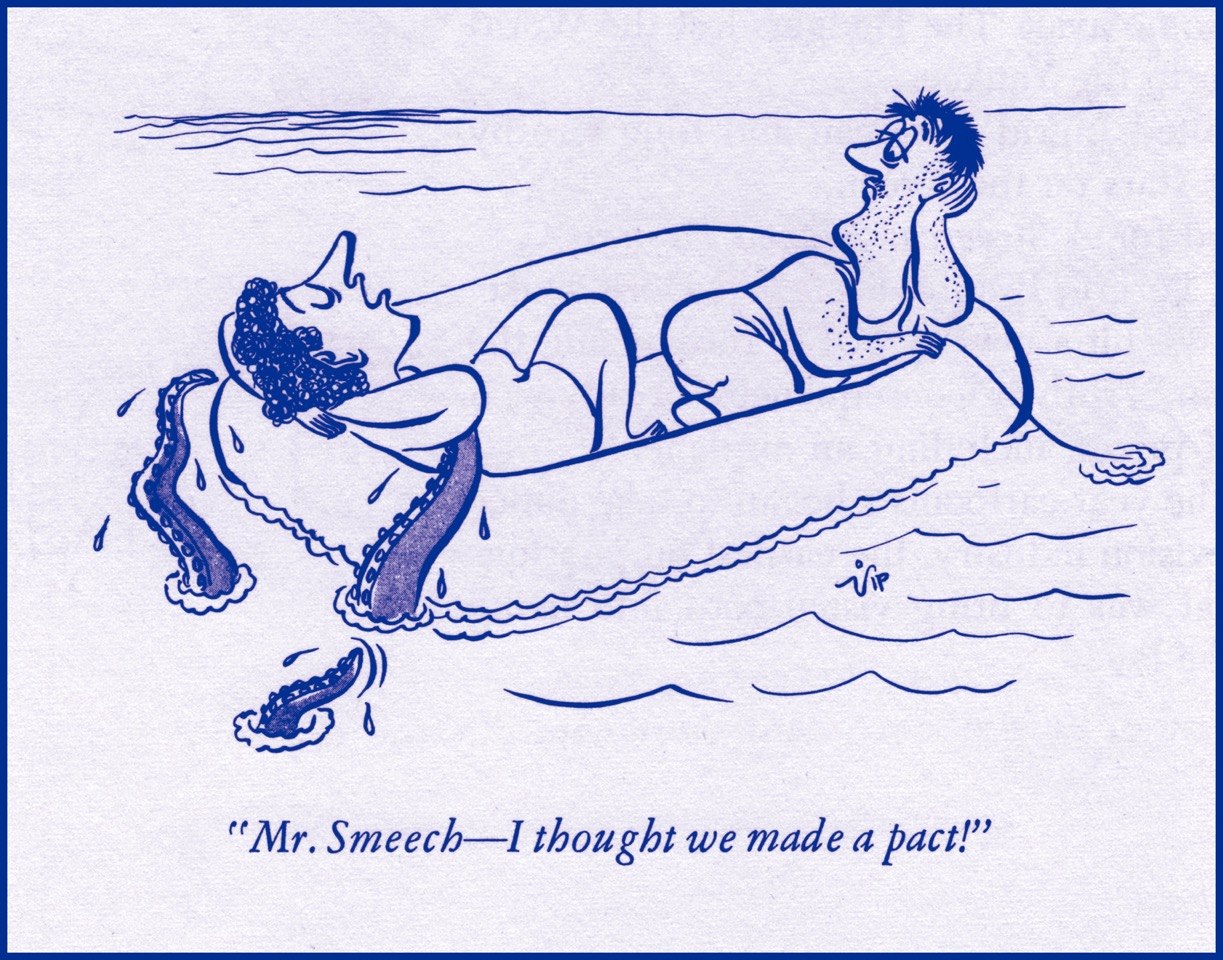
Let’s start things slow (but entertaining) with this playful octopus from Virgil Partch‘s madcap pen.

VIP1946Tentacles
Liberty Magazine, 1946. Frankly, I think she’s better off with tentacles than with the unshaven and blasé Mr. Smeech.

Next up, we have Brenda Buckler who seems to be rather enjoying her captivity. Tous les goûts sont dans la nature!

EerieN60
« It’d been a long time since anyone touched Brenda. As the dry, scaly tentacle encircled her body, it touched something deeper than flesh… »  Eerie no. 60 (September 1974), painted cover by Ken Kelly (a gallery of his paintings can be found here).

Plot spoiler: the tentacled monster is actually her husband! Ain’t nothing wrong with bestiality as long as it’s sanctioned by the holy institution of matrimony. Brenda is the protagonist of the cover story, “The Man Hunters”, written by Gerry Boudreau and illustrated by Wally Wood (with colours by Michele Brand). Don’t worry, though: there’s a happy ending in store for her (aside from the whole “watching your shipmates eaten alive by a giant monster” thing). Moral of the story, never underestimate the erotic potential of “filth-encrusted tentacles”.

A coloured (and quite colourful) version of “The Man Hunters” was reprinted in Warren’s Comix International no. 2 (1975), and you can read it here: http://diversionsofthegroovykind.blogspot.ca/2010/02/ec-in-ya-wood-and-crandall-in-color.html

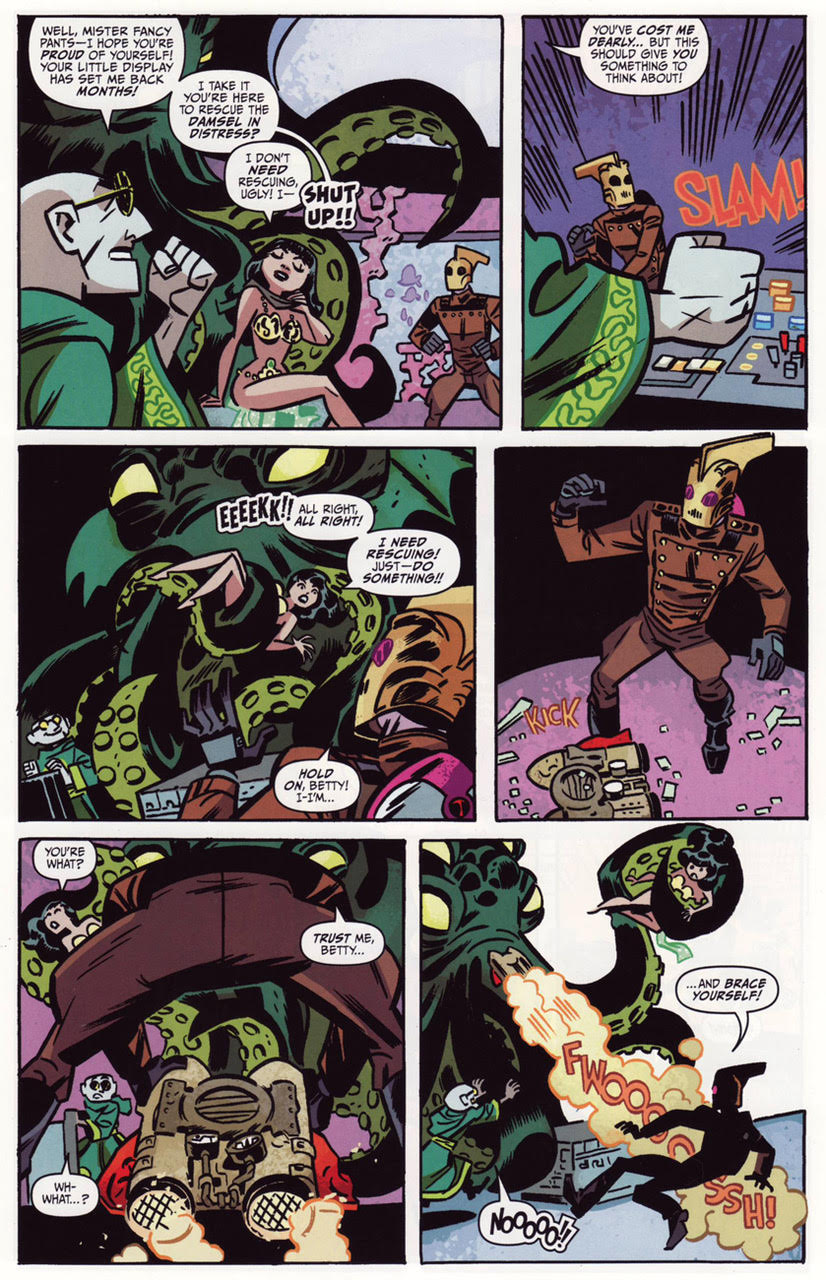
The wrap-up for today is scanned from a comic series I just finished reading, The Rocketeer: Hollywood Horror by Roger Langridge as author and J. Bone as illustrator. It was published in 2012, and collected as a paperback and hardcover in 2013. Aside from the healthy helping of tentacles it serves its readers, this comic features some top-notch writing from Langridge and some nice art. I don’t pretend this stuff is deep, but it’s a pleasurable romp with pretty girls, evil scientists, and a goofy-but-lovable hero. Recommended for some fun reading (although I admit I spoiled it a bit by featuring two of the main action pages)…

TheRocketeerRogerLangridge
I like a girl who can admit when she needs rescuin’.

TheRocketeerRogerLangridge2
Am I the only one that feels sorry for the monster, even if it *is* a robot?

Tentacularly yours,

~ ds

On This Day: November 16, 1902

A cartoon appears in the Washington Post, prompting the Teddy Bear Craze, after President Teddy Roosevelt refused to kill a captive bear tied up for him to shoot during a hunting trip to Mississippi.

Boy, American presidents sure were different back in those days.

TeddyRooseveltBerryman1902A
The history-making cartoon by Pulitzer Prize–winning cartoonist Clifford K. Berryman (1869-1949), who worked with the Washington Post from 1891-1907, then with the Washington Star from 1907-1949.

Which brings us to Teddy Bears (as they became known henceforth) returning the favour of protecting the vulnerable and innocent.

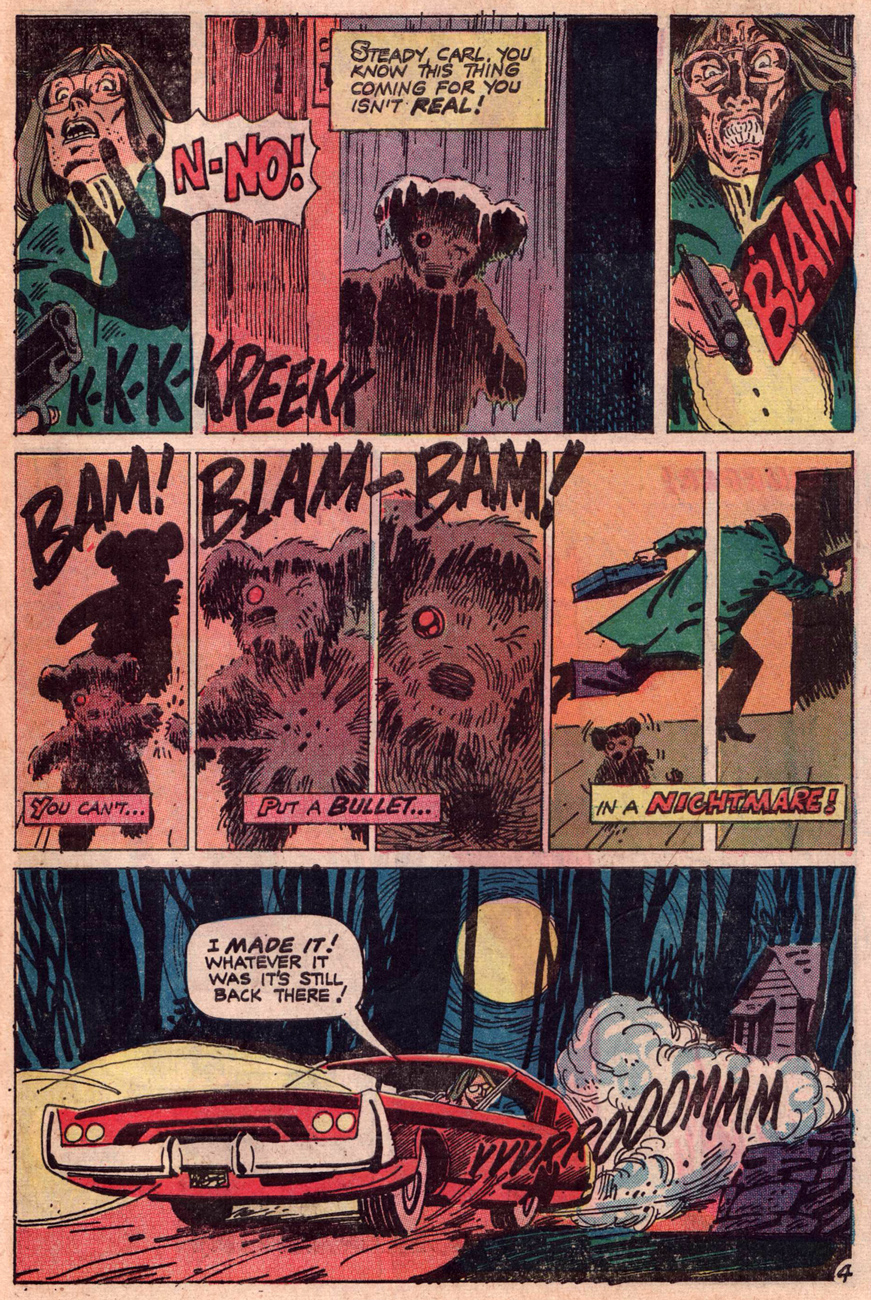
The earliest instance that comes to mind is Johnny Craig and “Ghastly” Graham Ingels’ holiday charmer, Shoe-Button Eyes!, which appeared in The Vault of Horror no. 35 (Feb.-Mar. 1954, EC), wherein a blind, put-upon little boy gets a new set of peepers… the hard way.

Post-Code, this sort of harsh poetic justice had to be handled very gingerly, if at all. The vengeful bear turned up again in Nicola Cuti and Jack Abel’s elegantly-told The Teddy Bear, in Haunted no. 15 (Nov. 1973, Charlton.)

TeddyAbelA
Quoth the plush companion: « I was sent to you to protect you and I will! » Spoiler alert: the butler did it.

A couple of years down the pike, “Grisly”* Tom Sutton took up the gauntlet with his «Terrible Teddy!», from Ghost Manor no. 23 (May 1975, Charlton). Here it is, presented in its glorious entirety (including Sutton’s gnarly painted cover).

Ghost-Manor23A

TerribleTeddy1ATerribleTeddy2ATerribleTeddy3ATerribleTeddy4ATerribleTeddy5ATerribleTeddy6A

– RG

*perhaps more appropriately “Grizzly”, in this instance.

On a Quest for an Original Tattoo

Looking for a one-of-a-kind tattoo, now that everyone has ’em?

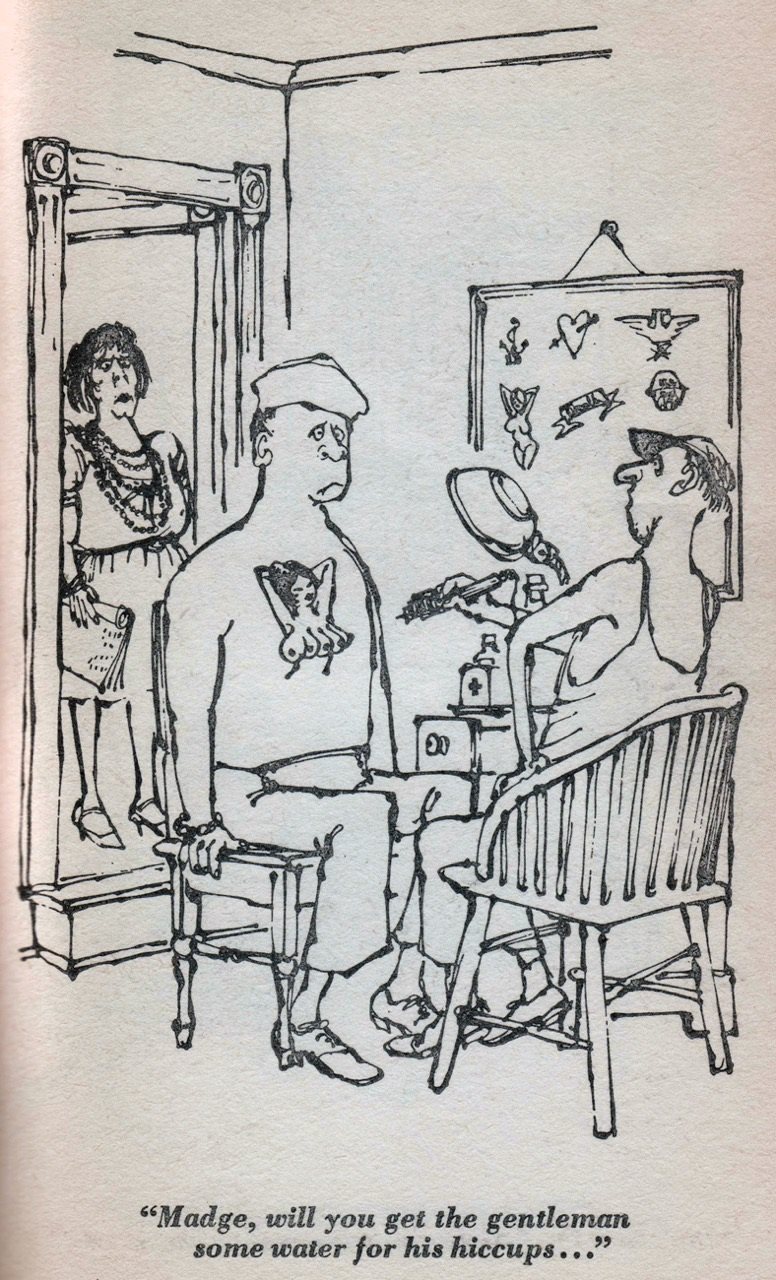
I bet you didn’t think of hiccups as a possible solution, but anything’s worth a try at least once. So keep in mind these handy tips for inducing hiccups: have a large meal; do something really exciting (like buying a new comic, for instance); forget to breathe properly while laughing (which can also be achieved by buying a new comic, as long as it’s funny); swallow your food whole like an owl, or drink water like you’re a cow in hot weather (76 litres a day!) Is it working yet?

CharlesRodriguezBoobs

This Charles Rodrigues cartoon comes from a nifty little collection titled Spitting On the Sheriff and Other Diversions, first published in 1966. “Do you dig“, it asks the potential reader, « Crazy graveyards? Hilarious hangings that really swing? Sick medical humor? Screamingly funny torture-chamber gags? » What kind of stupid questions are those? Of course we dig!

If you’re hungry *hic* for more material from this collection without having to actually hunt it down, this blog has twenty or so other examples of Rodrigues’ sick, sick sense of humour.

http://learning2share.blogspot.ca/2009/01/more-cartoons-by-charles-rodrigues.html

~ ds

Edgar wakes up while snakes eat oatmeal

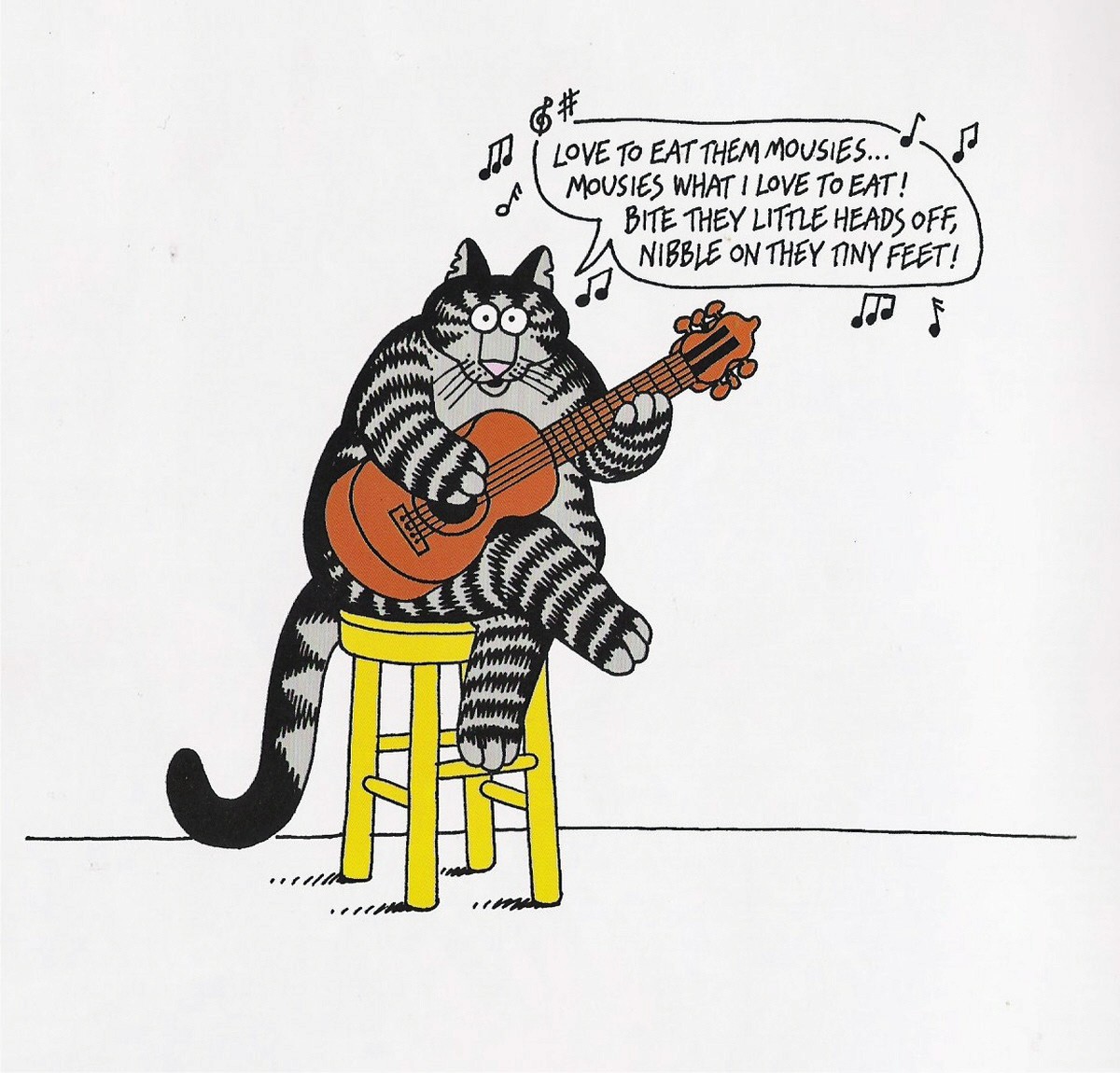
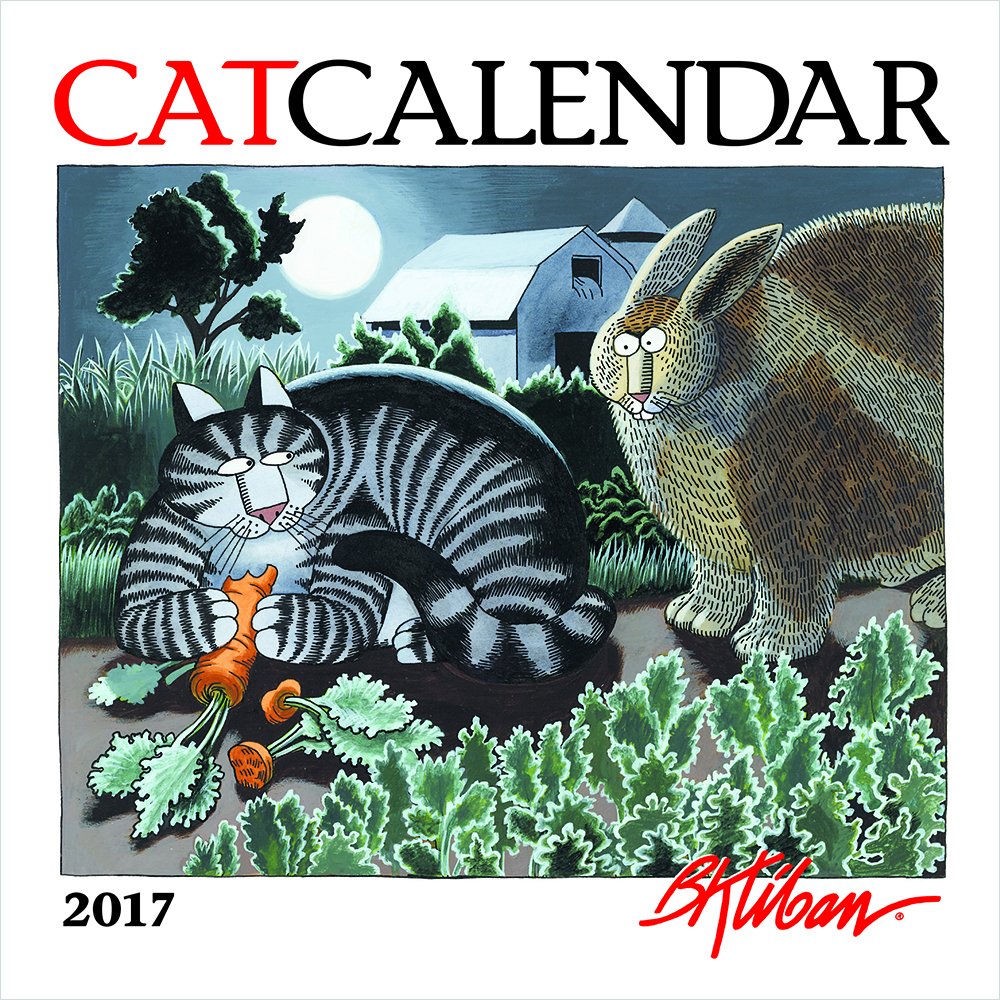
B. Kliban may not be a name that’s familiar to many (unless you’re one of those people who pays attention to the signature beneath a painting), but his cats will certainly ring a few bells, so to speak. They can be found on stickers and greeting cards, mugs and t-shirts, and, above all, calendars. Kliban’s Cat, a collection of cat cartoons that was published in 1975, was an instant hit, and its popularity hasn’t waned since.

KilibanMousies
One of the felines inhabiting the original Kliban’s Cat. Catchy little ditty, isn’t it? The official B. Kliban website is http://www.eatmousies.com/ – which is a very cute move.

One would expect something that’s been around for so long to be terrible and generic and banal (just think of Garfield merchandise – yuck!), yet each year a new calendar comes out, and each year it’s still stunningly beautiful. Kliban lamentably and tragically died in 1990, at only 55. Either he left behind an impressive number of cat paintings, or his ghost still comes out from retirement from time to time to continue the tradition. I mean, look:

KlibanCats2017

« People assume I’m gaga about cats. I like them, but I’m not silly about them. Cats look like cartoons. There’s something funny and vulnerable and innocent about them. » (from a 1978 interview.)

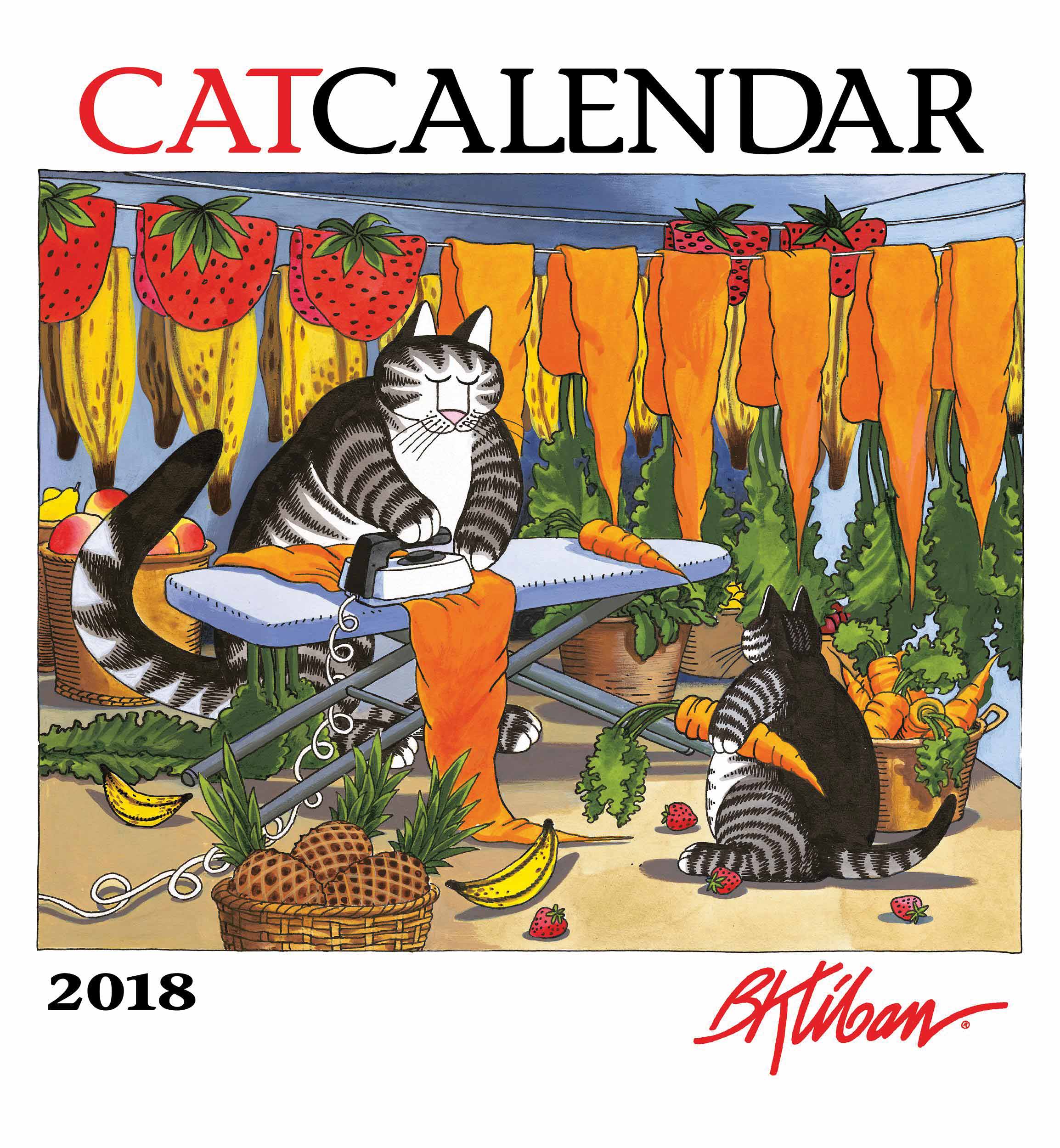
Kliban2018
Okay, the late 2010s seem to have some sort of carrot theme…

Maybe these images are created by a dedicated team of artists hell-bent on imitating Kliban’s style as closely as possible, adroitly channeling his absurd sense of humour, dressing in the Kliban uniform (jeans and sandals) to increase their precision. After all, if talented art forgers can copy a Vermeer or Picasso so meticulously that it confuses the experts…

As lovely as his felines are, it’s too really too bad that Kliban’s other books (most of them published by Workman Publishing) have been swallowed by the hungry maw of obscurity. His peculiar sense of humour, his love of puns and his unorthodox approach to everything from relationships to kitchen implements wonderfully combine with stylish art to create a glorious mindfuck in cartoon form. His books – Never Eat Anything Bigger Than Your Head, and Other Drawings (1976), Whack Your Porcupine, and Other Drawings (1977), Tiny Footprints, and Other Drawings (1978), Playboy’s Kliban (1979), Two Guys Fooling Around With the Moon (1982) and Luminous Animals (published by Penguin Books in 1983) – will make you wonder if Kliban ever underwent psychoanalysis, whether his doctor managed to hold on to *his* sanity after their sessions, and whether you should get psychoanalysed, too, because why else would you be enjoying these cartoons so much? The NY Times did a tribute to Kliban when he died in 1990, and all the author of the piece could say, somewhat diplomatically, is that « the books that followed Cat consisted mostly of extremely bizarre cartoons that find their humour in their utter strangeness and extremely unlikely environments. »
« Please », the journalist seemed to be saying, « can I go back to talking about cats already and skip over the weird shit? »

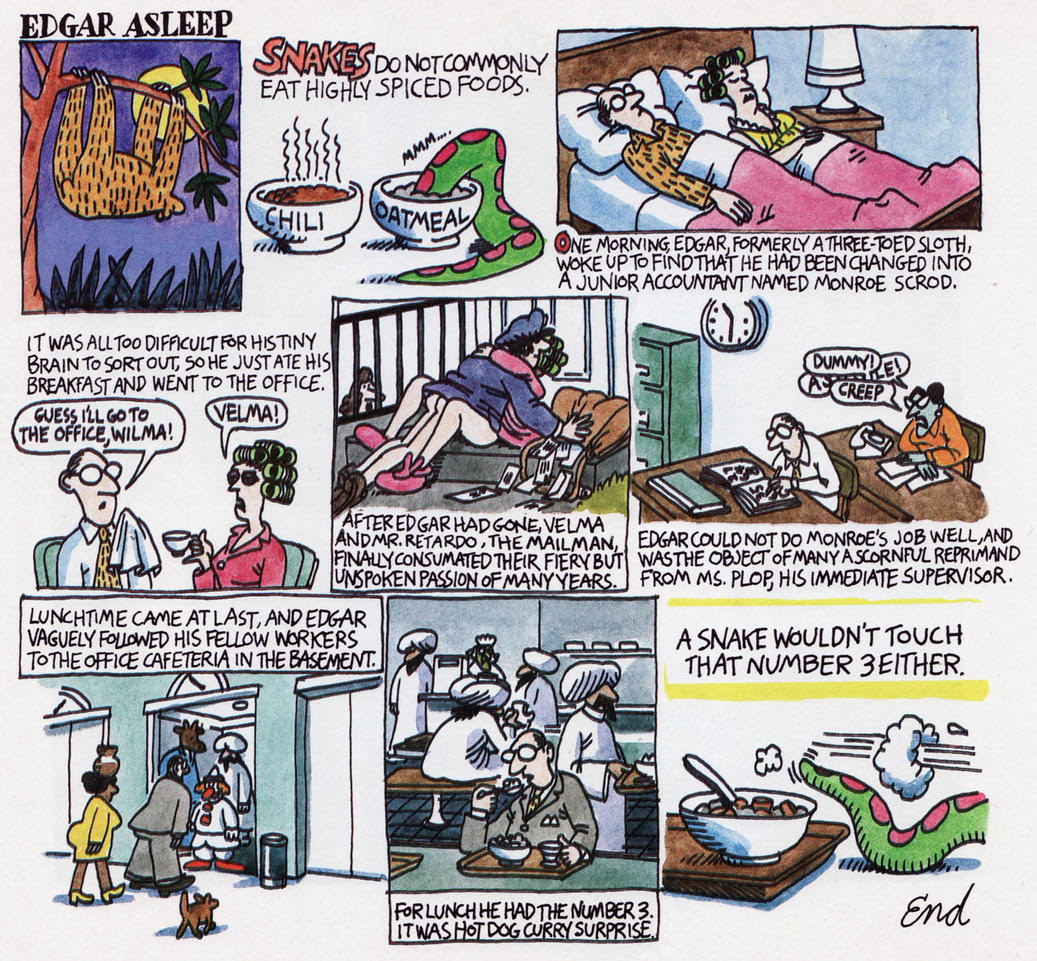
So here’s an example of some pleasurable weirdness:

EstherSleepsKliban
Edgar Asleep has been scanned from Luminous Animals and Other Drawings (1983).

Kliban’s other work has certainly been overshadowed by cats, but at least it gave him financial security… and a life full of cats, drawn and otherwise, which is not that bad a thing.

KlibanMonsters
« I spend twenty seven years making monsters and what does it get me?… A room full of monsters! » (Playboy, June 1972)

~ ds

Hallowe’en Countdown, Day 28

« I hope I will not be accused of undue vanity if I publicly thank Mr. Addams for immortalizing me in the person of the witch’s butler, to say nothing of the rather hairy gentleman whose clothes are strangely cut and who appears to subsist on a diet of bananas. » — Boris Karloff, from his foreword to the Addams collection Drawn and Quartered (Random House, 1942)

At the risk of being obvious, the ghoulish wit of Charles Addams brings us Hallowe’en on any old day of the year… but it’s no reason to take him for granted when the proper season slinks into view. Here’s a small selection of favourites. I’ve noticed that many latter-day collections have been plagued by terrible reproduction (heads should roll for that particular crime against art!), so I’ve gone back to the original collections in my library. Enjoy, fiends!

AddamsWitchesA
A lovely piece originally featured on the cover of The New Yorker‘s November 2, 1963 issue. This logo-free version was reprinted in The Groaning Board (Simon and Schuster, 1964.)
AddamsBusA
Addams at his understated best. A 1953 cartoon collected in Homebodies (1954, Simon and Schuster.)
AddamsSewerA
« Well, here’s where I say good night. » A Morticia prototype from an undated cartoon collected in the first Addams collection, Drawn and Quartered (Random House, 1942.)

AddamsSqueakyA
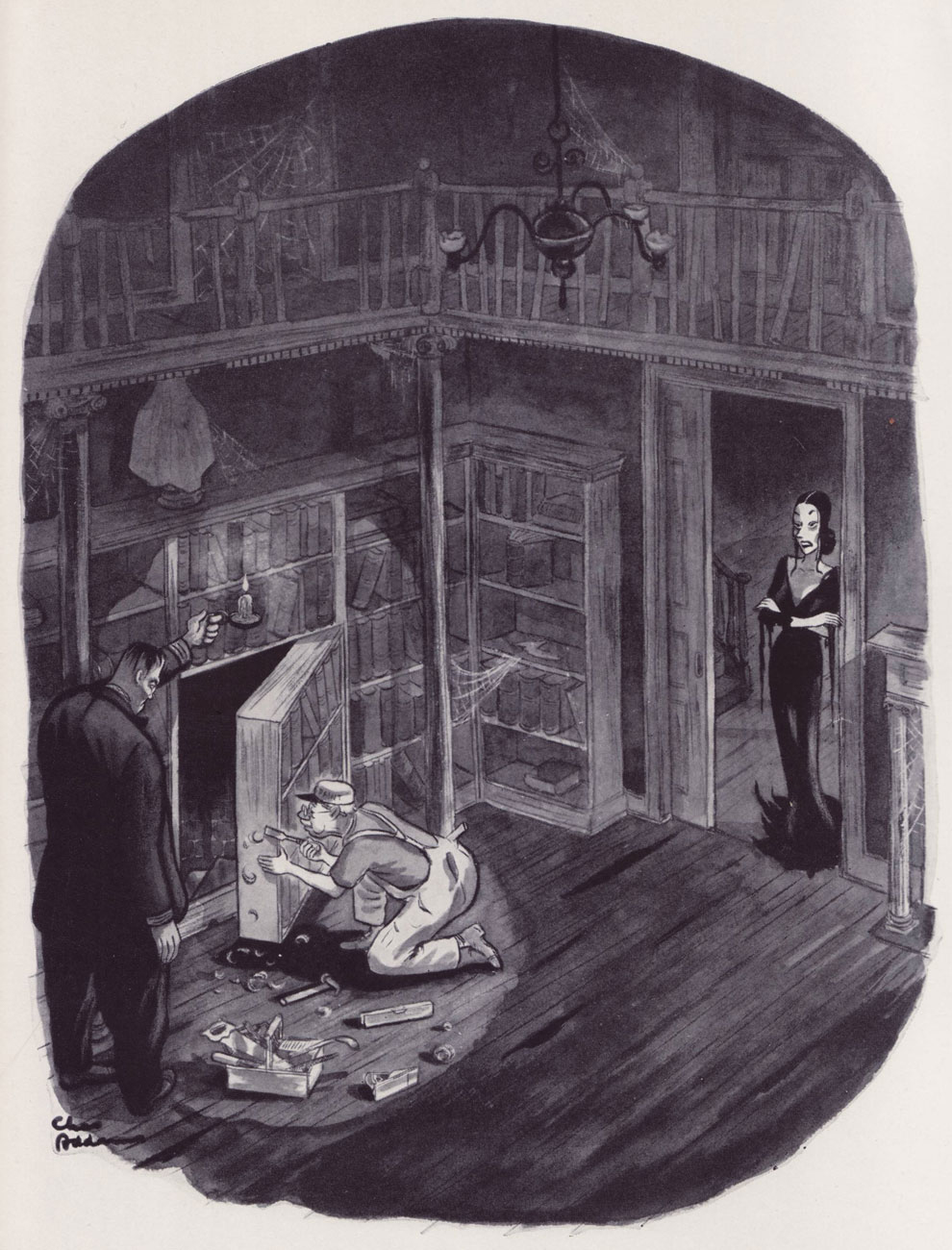
« While you’re here, there’s a squeaky trap-door I’d like you to look at. » That’s the Morticia we’ve come to know. Also reprinted in Drawn and Quartered (Random House, 1942.)

-RG