A Smutty Little Holiday

Holiday,
Oh what a lovely day today,
I’m so glad they sent me away,
To have a little holiday
.*

Today we embark on a V̶i̶c̶t̶o̶r̶i̶a̶n̶ r̶o̶m̶a̶n̶c̶e̶** romance set in 1889, seasoned with more than a dash of steampunk, all in the name of sweet (and currently very much needed) escapism. Expect NSFW, in case it matters.

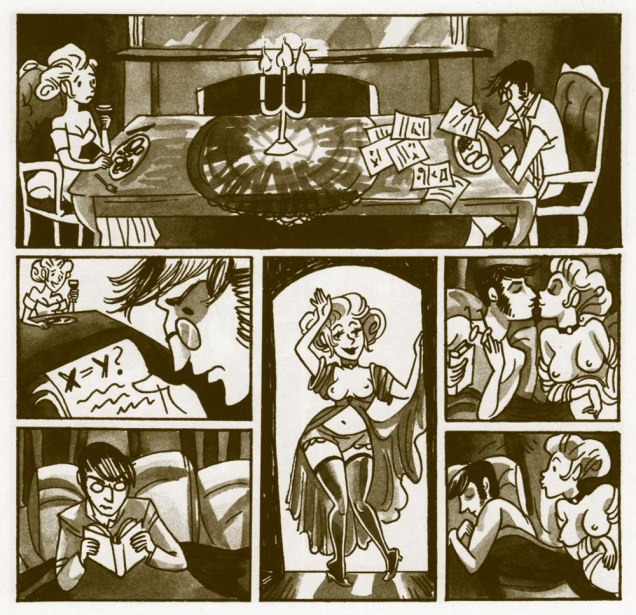
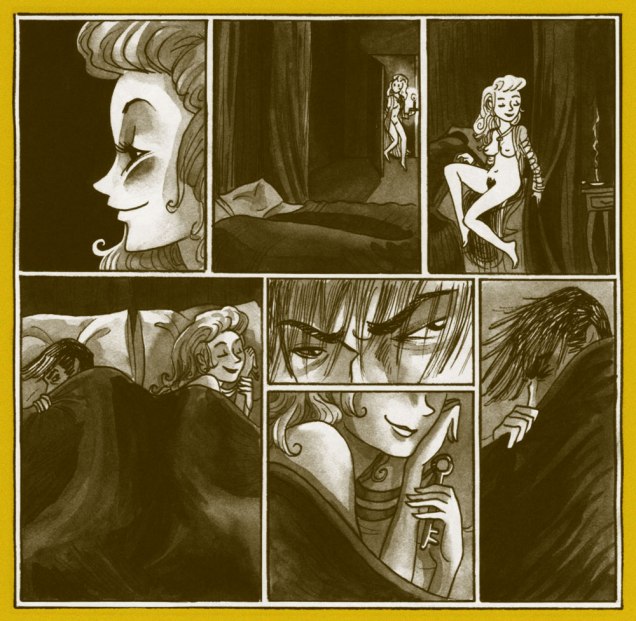
Chester 5000 (Top Shelf, 2011) is a typical love story: boy meets girl, boy loses interest in girl sexually and so builds her a sex robot, girl falls in love with robot, boy gets jealous. The mechanical turn of the plot does in no way impede the emotional progression and, as a matter of fact, one finds oneself distinctly rooting for the very sweet Chester. Really, the fact that he’s a robot only comes into play to show off his many pleasure-centred tool attachments, not to mention his ability to hold a lover in mid-air for extended periods of time.

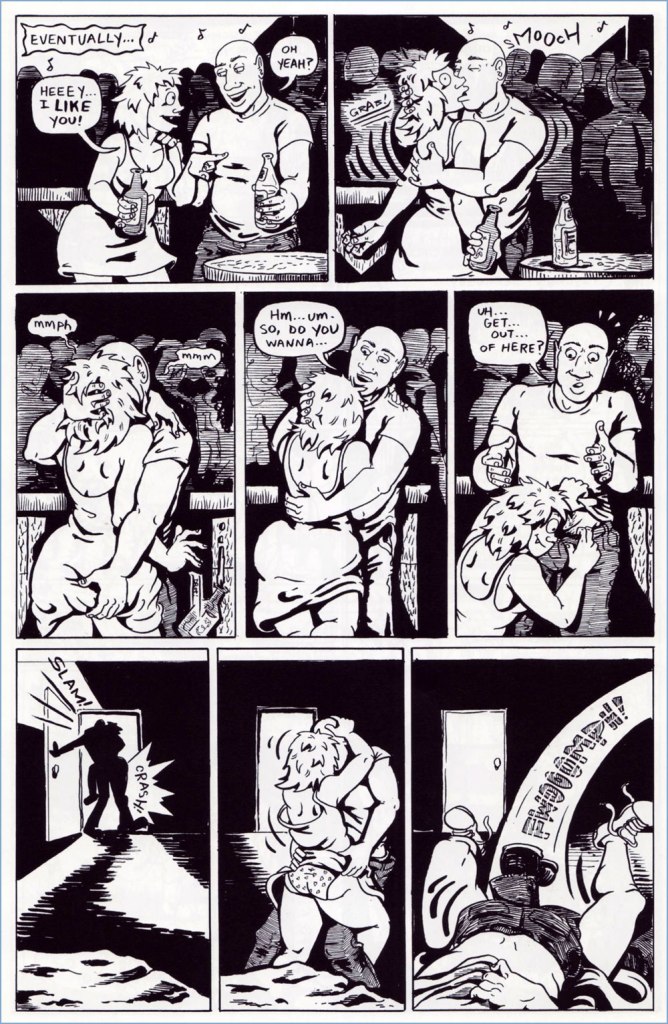
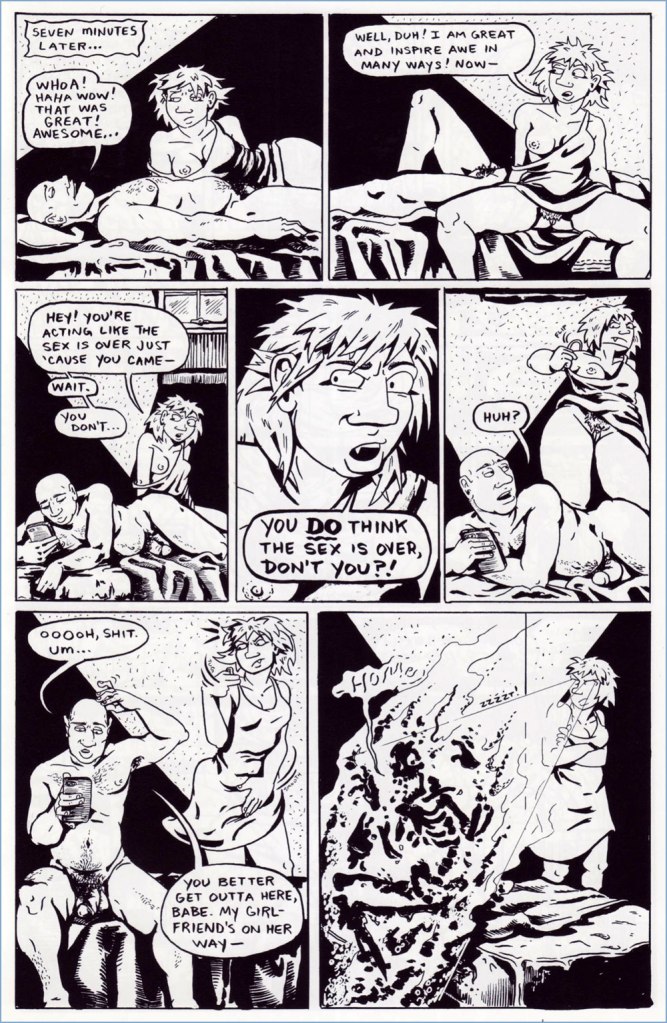
This comic is entirely mute, told in little vignettes which make it quite clear how the characters are feeling. American cartoonist Jess Fink has been singled out for her titillating talent of depicting luscious breasts, and I quite agree (and extend that compliment to the rest of female anatomy). Here are a few of the tamer scenes —

« Jess Fink’s “erotic, robotic Victorian romance” Chester 5000 XYV, an ongoing Web comic that’s recently been collected into a graphic novel by Top Shelf, is utterly of the zeitgeist. It has enough gadgets to entice the steampunk crowd, enough heat (tempered by romance) to seduce the yaoi*** crowd, enough sex-positivity for the feminist crowd, and enough craft for any “but girls can’t draw” naysayers. » (source: TCJ)

One might say this graphic novel is part of a wave of woman-penned, sex-positive, body-diverse comics — and indeed, Fink has several contributions to the anthology Smut Peddler. As for the anthology, I respect it as an admirable initiative, but is not something I collect because sadly most art within rubs me (ha, ha) the wrong way. I had purchased the 2014 edition because of Fink’s How You Gonna Keep ‘Em Down on the Farm story, but I gave it away to a rather stunned older man who came to pick up a box of random books I no longer wanted. Well, he said he wanted to read something new for a change (while his eyes goggled) — I hope he enjoyed it.

~ ds

*Holiday

** Co-admin RG would like to point out that this isn’t really Victorian other than in costume, and so objects to that categorisation. I’ll leave the reader to decide whether works of fiction set in a specific period (well before the author’s lifetime) deserve that era’s label or not. The Professor’s Daughter (discussed in Félicitations, Emmanuel Guibert!) was described in a review as ‘a love letter to Victorian London’ despite having been brought to life by two men from the late 20th century, but it was better researched than Chester 5000 — though the latter still has historical details, especially in the second volume, and Fink clearly knows a lot about Victorian costumes, as evidenced by this fun interview. If you want smut from the actual Victorian era, I’d like to point you in the direction of Victerotica – A Carnal Collection, volumes 1 and 2. RG also points out a certain plot similarity to La poupée sanglante, a 1923 novel by Gaston Leroux (author of Le fantôme de l’opéra).

***Speaking of yaoi, volume 2 of the series, Chester 5000 book 2: Isabelle & George (also published by Top Shelf), has some nice mann-gegen-mann action.

Hallowe’en Countdown VIII, Day 28

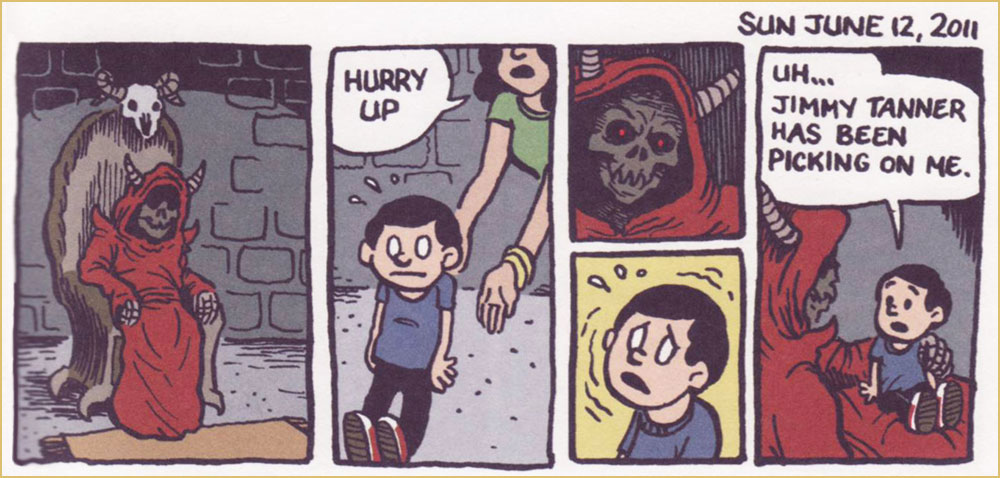
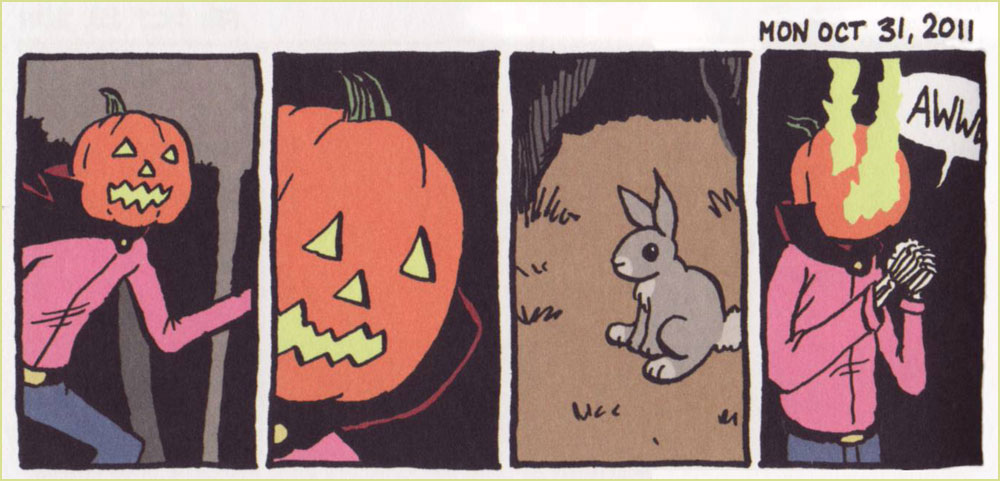
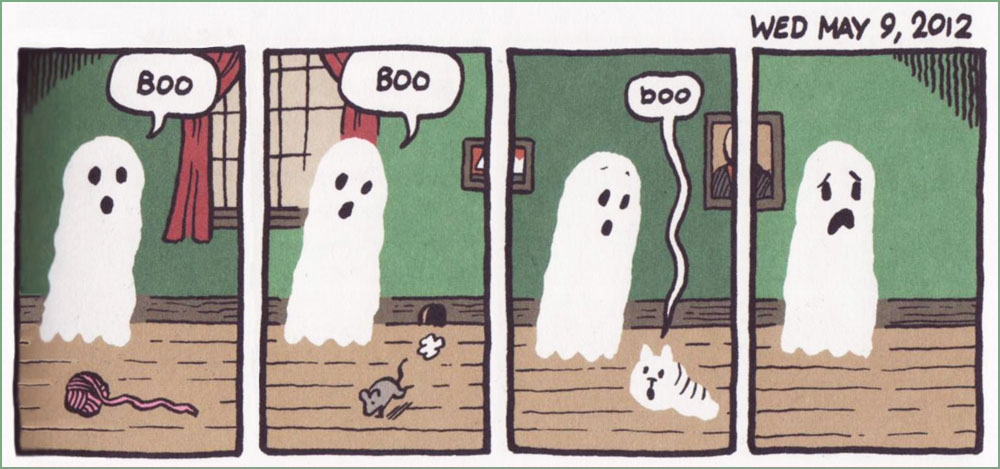
« You weren’t really supposed to see these comics… » — Dakota McFadzean

« And just who is this Mr. McFadzean? » you may ask.

« Dakota McFadzean is a Canadian cartoonist who has been published by MAD Magazine, The New Yorker, The Best American Comics, and Funny or Die. He has also worked as a storyboard artist for DreamWorks and Netflix. McFadzean is an alumnus of The Center for Cartoon Studies (2012).

He has three books available from Conundrum Press: Other Stories and the Horse You Rode in On (2013), Don’t Get Eaten by Anything (2015), and To Know You’re Alive (2020). McFadzean was a co-editor/co-founder of the comics and art anthology Irene, and distributes his own short stories in his ongoing minicomic series, Last Mountain. He currently lives in Regina, Saskatchewan with his wife and two sons. »

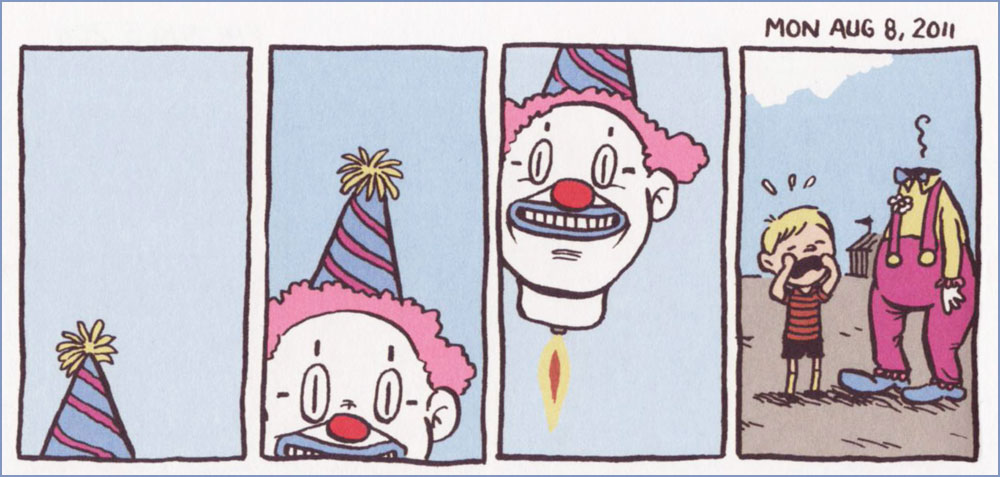
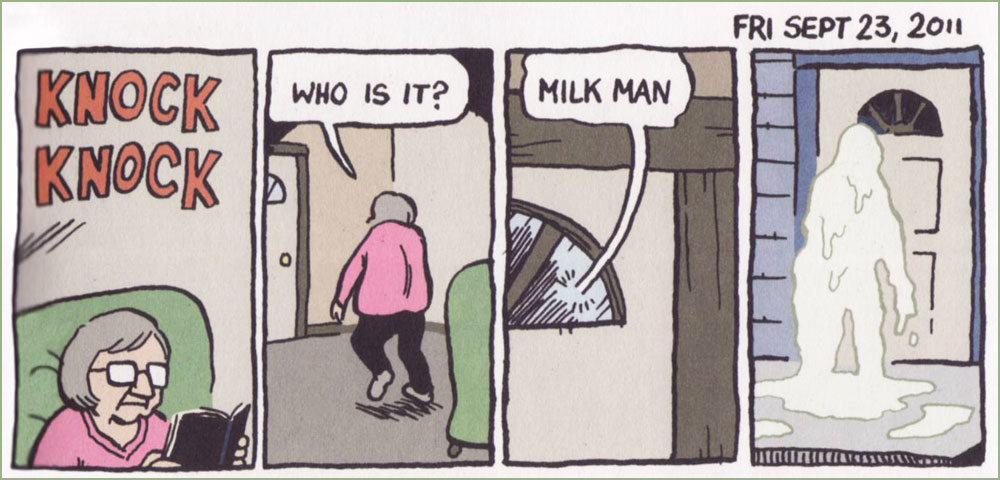
My chance encounter with Mr. McFadzean’s work came through the above-named 2015 collection, and while a daily webcomic is by design uneven, this one scales impressive heights far more often than the law of averages would predict. I’ll say this for him, he’s mighty skilled in conjuring up and expressing existential angst… adroitly melding the waggish and the distressing.

All strips excerpted from Don’t Get Eaten by Anything: a Collection of “The Dailies” 2011-2013 (Conundrum Press, 2015).

-RG
Hallowe’en Countdown VIII, Day 22

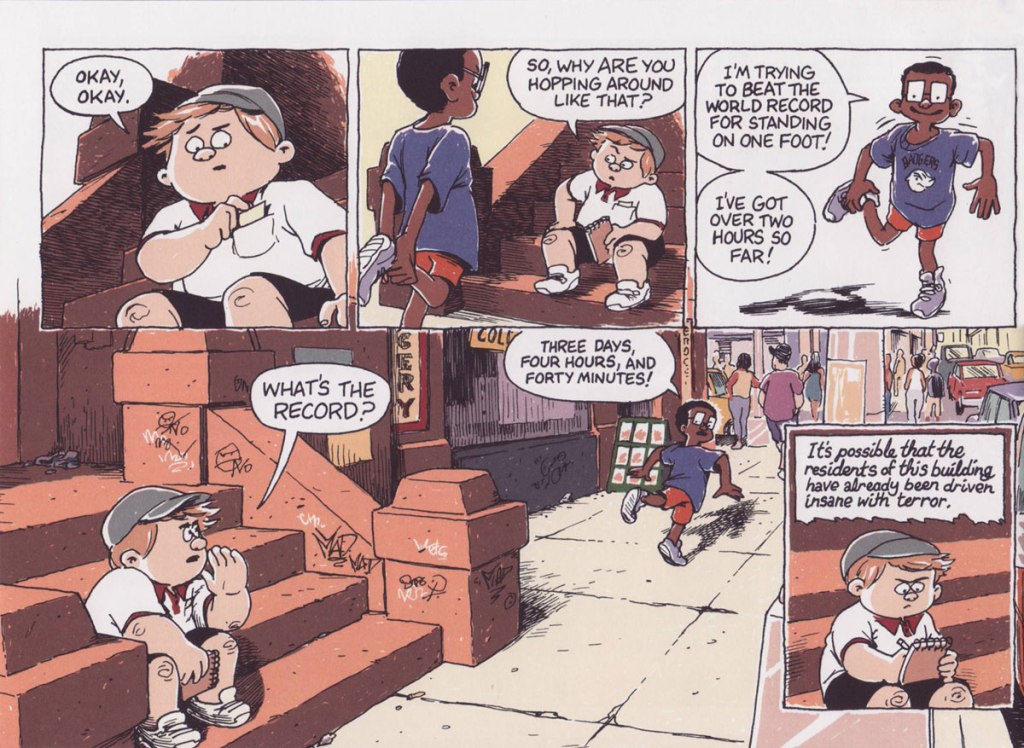
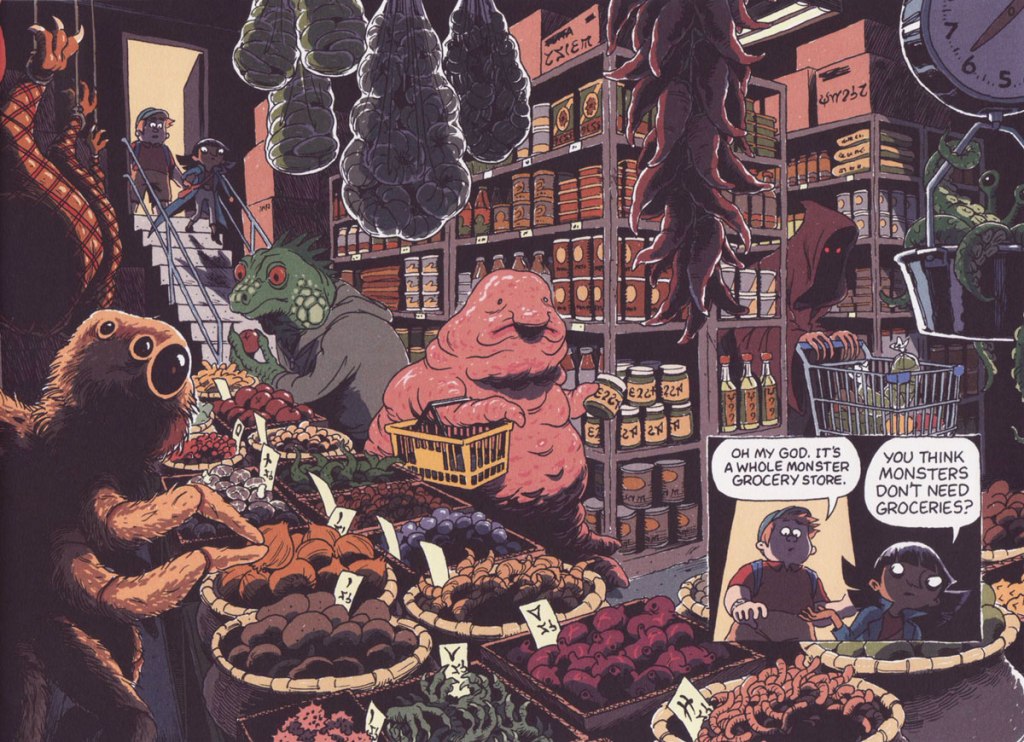
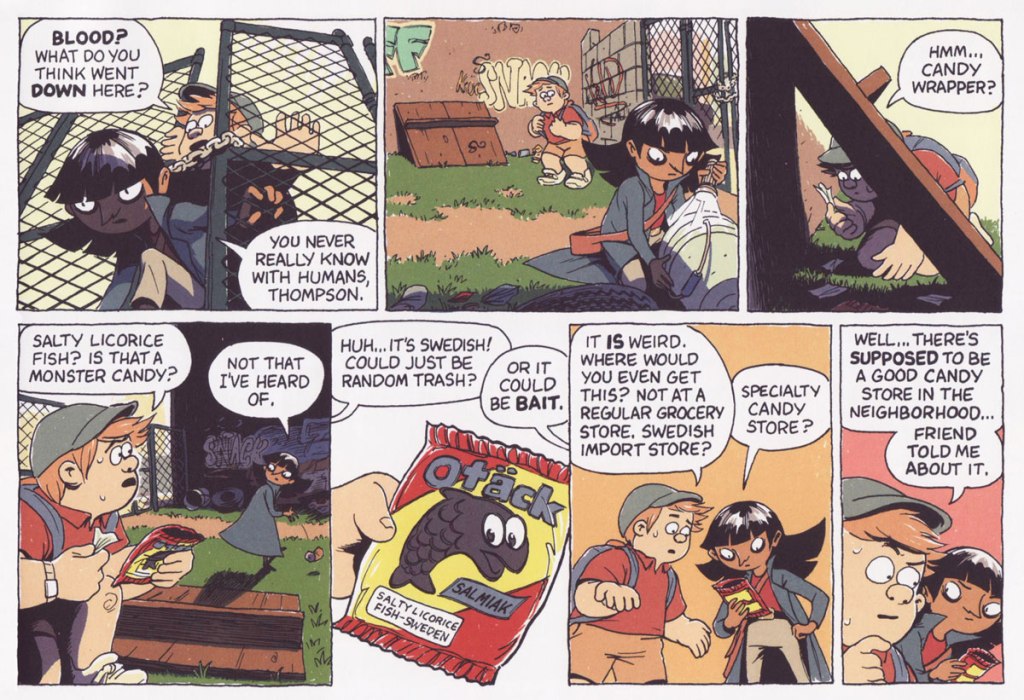
What’s an enterprising kid to do when he’s plucked out of his small home town and dropped into a big city? Worry about getting mugged, first of all, then dodge his hippy-ish parents’ attempts to make him eat big-city-weird-food (kimchi or paneer spinach? ew*)… but eventually get his bearings and go exploring. Our intrepid protagonist Charles fancies himself a reporter, so when he’s surprised by a monster at night (‘huge! fangs! hair!’), he heads out to investigate and eventually runs into Margo Maloo, ‘monster mediator’. Surely she needs a sidekick… or does she?

The Creepy Case Files of Margo Maloo, a webcomic by American cartoonist Drew Weing, has so far been collected in 3 volumes, although I didn’t even know it was a webcomic until writing this post, having come directly to the printed books by way of Weing’s debut graphic novel Set to Sea (Fantagraphics, 2014). No regrets at all — Margo Maloo’s adventures bundle up my favourite elements (teamwork and friendship, to name a few) into an alluringly drawn and coloured package. Weing’s writing is smart; while his kids function as archetypes of specific personalities, this does not feel constraining or predictable; on the contrary, they feel like real people that one would like to hang out with. It also helps that they traipse around a fully-fleshed out city that’s more than just a static background.

Chubby Charles reads like a Daniel Pinkerwater character, given his obsession with junk food and an immense curiosity about the world that overrides his fears. This is high praise indeed, as both admins here are enthusiastic DP fans.

The salty licorice fish is an actual thing. I’d be curious… if licorice wasn’t pretty much the only flavour I can’t stand.

You can start reading the adventure here.

~ ds

* Let it be known I’m actually a big fan of kimchi and spinach (paneer, considerably less so).

Hallowe’en Countdown VIII, Day 3

« If men had wings and bore black feathers, few of them would be clever enough to be crows. » (source)

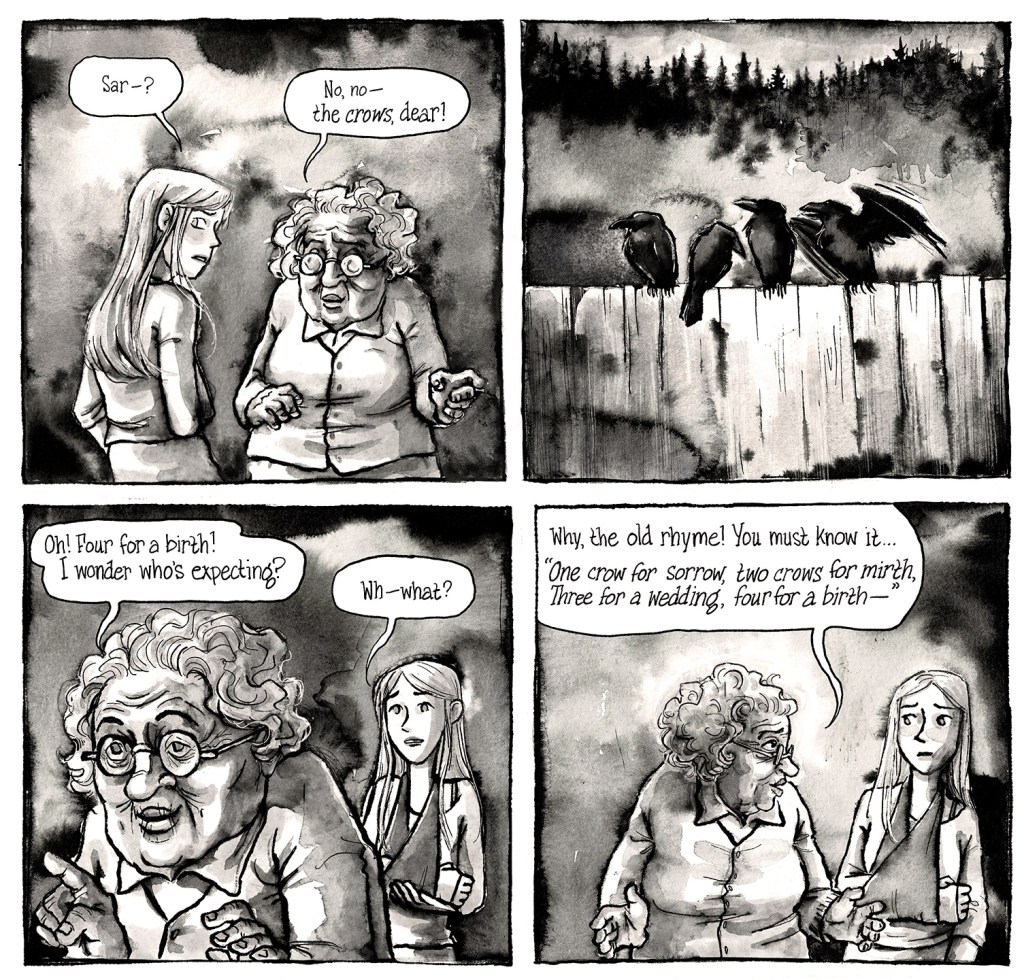
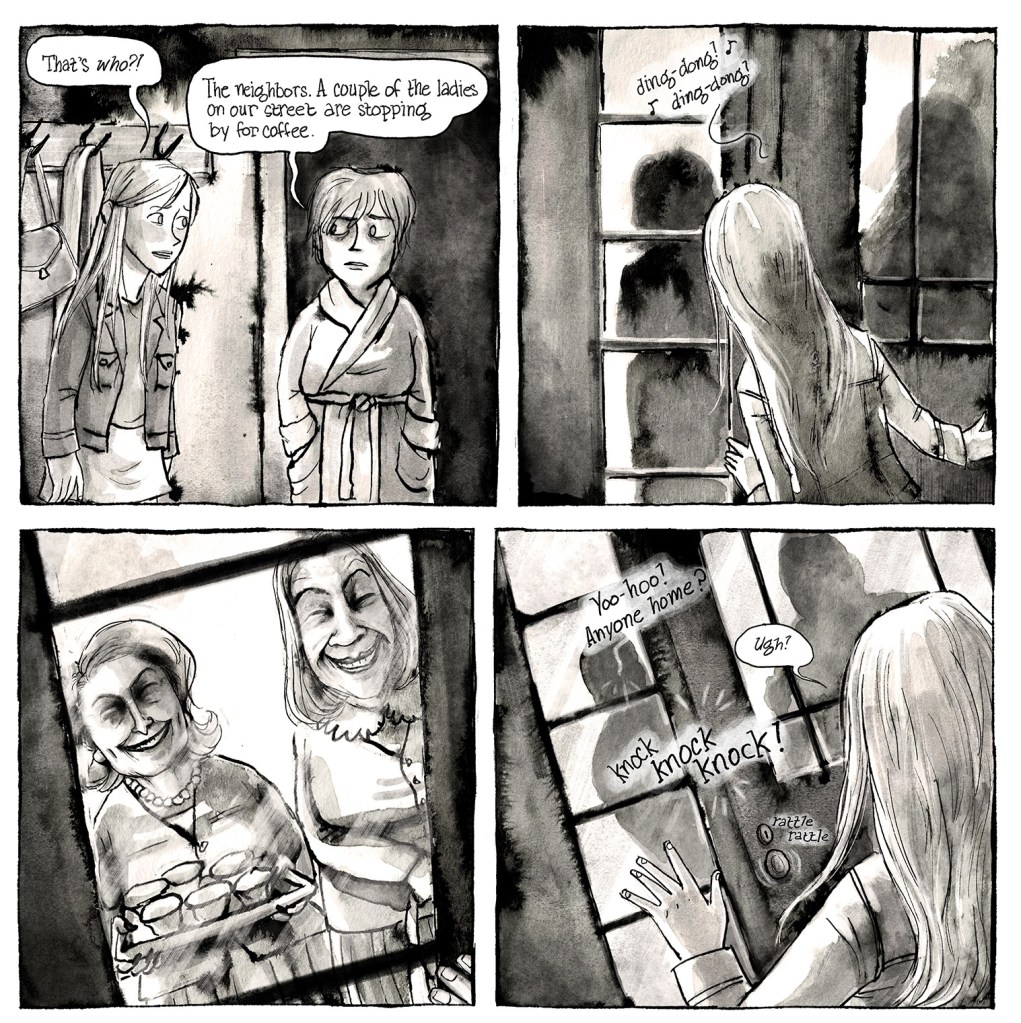
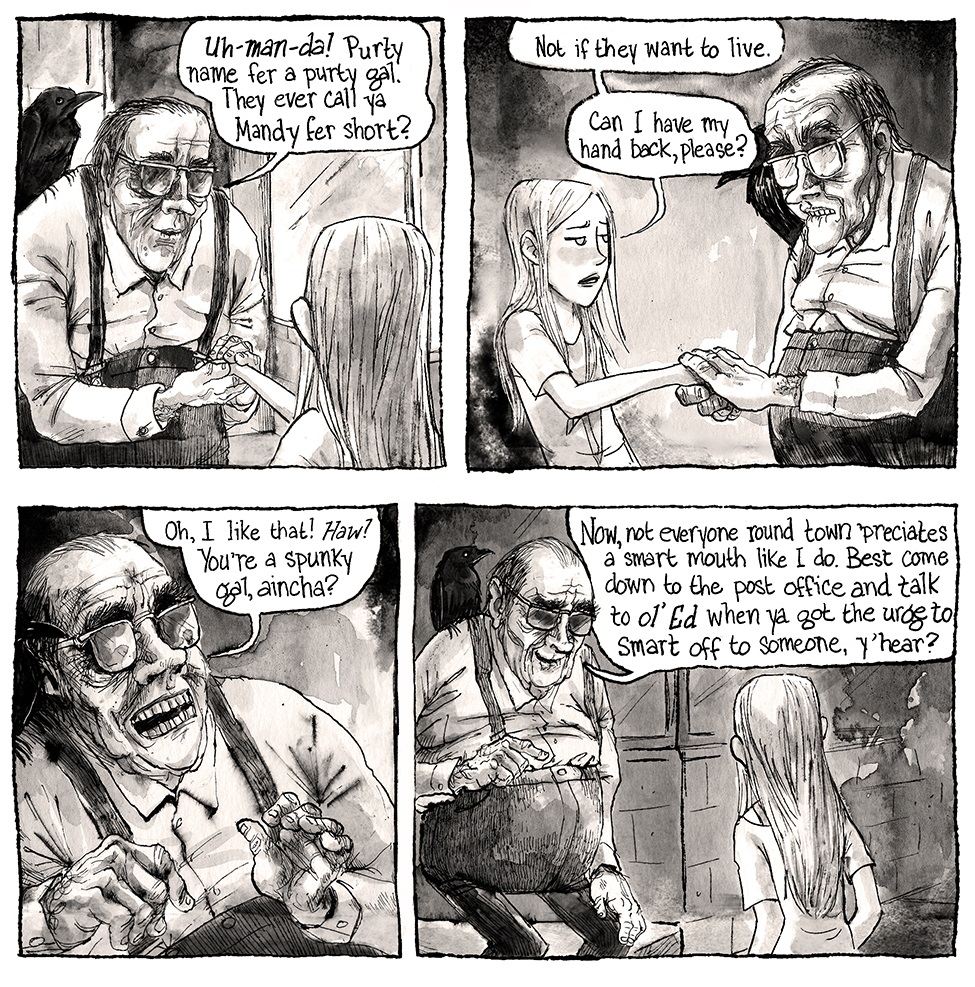
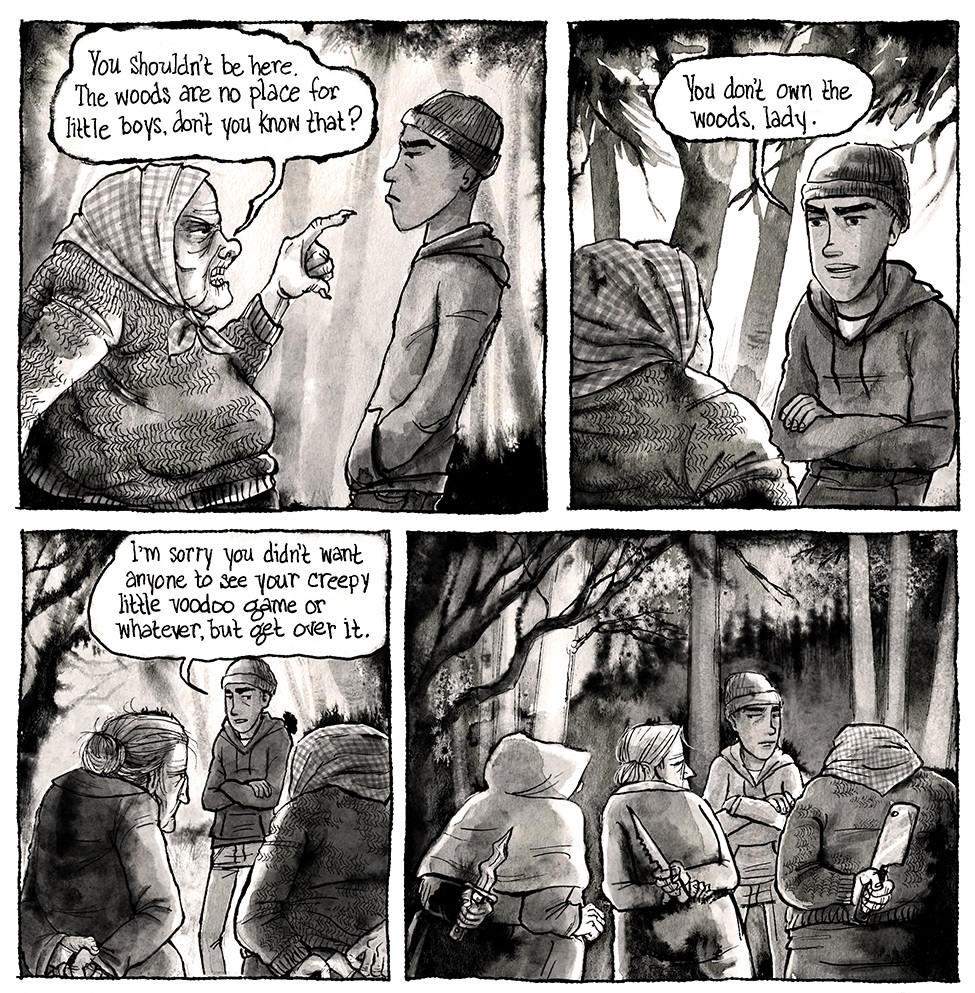
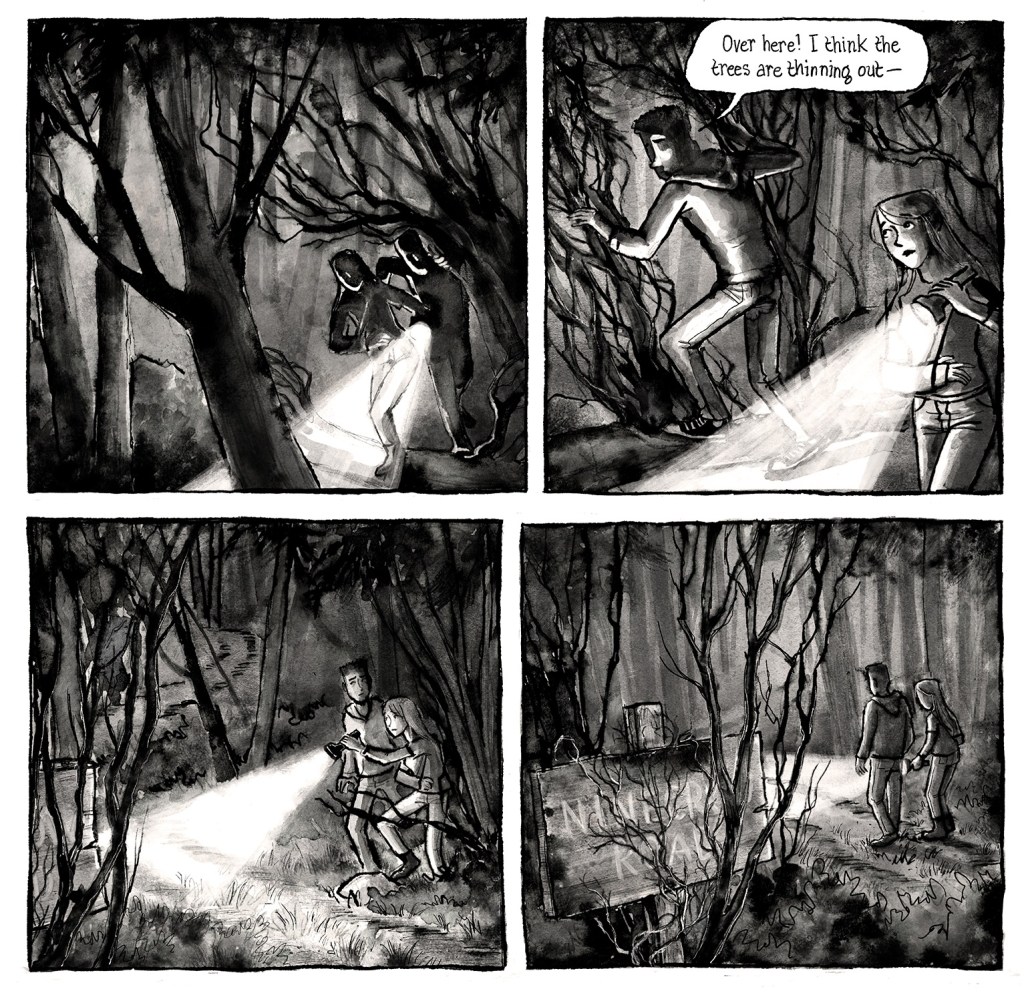
Today’s titillating offering deals in tropes that horror devotees will readily recognize – a Town with a Dark Secret ensnaring The Plucky Girl in its mysteries and underlying violence. Mysterious disappearances, the proverbial ageing small-town creep whose smile hides uncomfortable truths, oblivious locals… it’s been surely done before, yet the graphic novel Ninecrow by Dora M. Mitchell , initially posted as a biweekly webcomic that ran from 2020 to 2022, succeeds in creating an unnerving story out of these readily available narrative blocks.

Amanda, a teenager whose divorced mom relocates them to a town in the middle of nowhere (shades of Eerie Indiana et al.), does her best to adapt to her new life, but her new place of residence is, well… alarming in a number of ways.

Lovingly drawn in mostly black-and-white watercolours, Ninecrow offers the reader plenty of visual enjoyment peppered with hair-raising details faintly glimpsed in shadowy corners. The hand-lettering is also worth a mention, especially given that modern graphic novels often dispense with this element in favour of a computer-generated font. Both art and letters remind me of the tragically departed Patrick Dean, especially some of his work like Underwhelming Lovecraft Monsters.

Aside from its crow population, the town is also abundantly stocked with disquieting old people in various stages of brain fog. Aside from Amanda and a couple of others, everybody seems to be middle-aged going on ‘soon dead’, and not of the pleasant fluffy-grandparent variety, either.

I bought the print version of Ninecrow on Kickstarter because I much prefer reading books in a physical format (you can still buy the deluxe version on the publisher’s Etsy page), but you can still read the full thing story online on the website: https://ninecrowcomic.com/

Enjoy the traipse through the woods!

~ ds

Brimstone Bureaucracy, Bah! Hyena Hell’s Demons

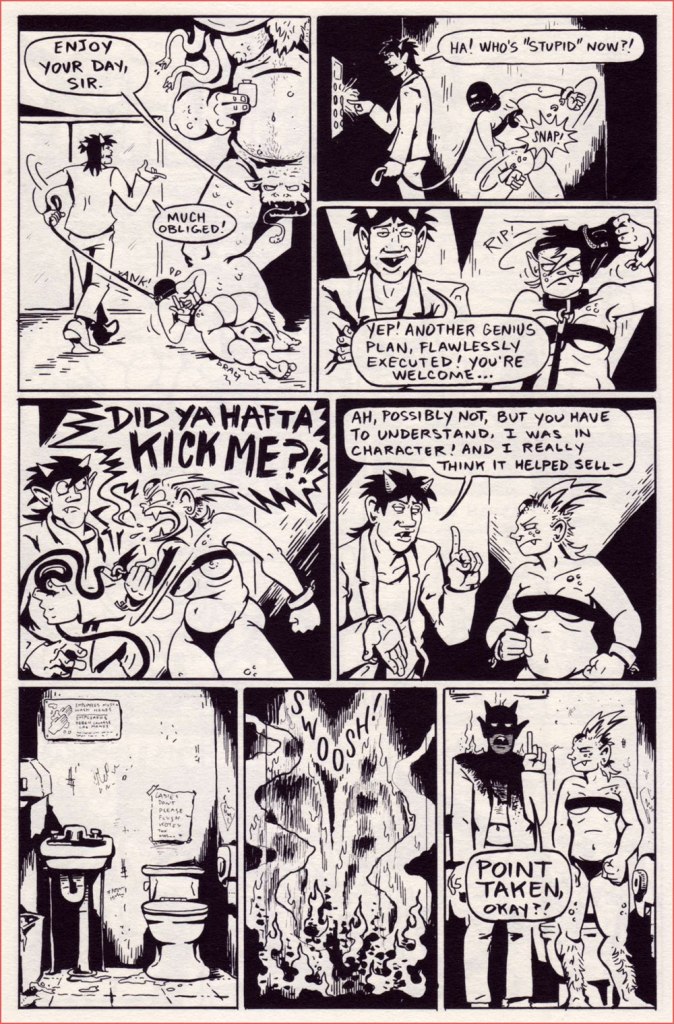
I was very excited to come across the comics of Hyena Hell. I don’t even remember where I got No Romance in Hell (2020), but it was cheap and intriguing. A funny comic about a cantankerous dick-driven demoness that also is excellently drawn? Well, sign me up, and pronto. Anyway, I read it, enjoyed it greatly, and stuck it on a shelf (after pursuing co-admin RG with it for a bit to get him to read it, which I’m still not sure he has done*). Recently, I discovered that there are two more instalments — Demons: To Earth and Back (2021) and Demons: Bloodlust (2022), and devoured them with great delight, one recent Sunday afternoon.

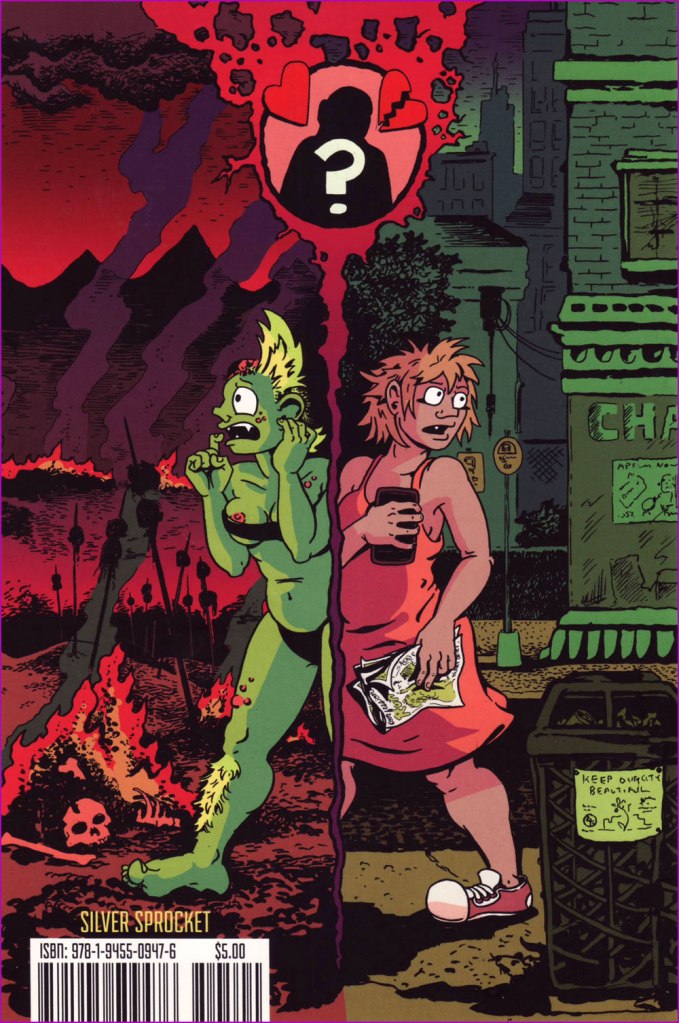
The transition from demon-girl to normal-girl and back again – back cover of No Romance in Hell.

HH’s art is dynamic and convincing – bodies have real weight and a variety of shapes. There is also stuff happening in the background, so the reader feels like these are real… well, err, maybe not people, but real creatures walking on real streets (and equally tangible depths of hell). I love her main characters, fully-fleshed, quick-witted, and flawed in a way that makes one sympathise even when they’re being irrational. No Romance in Hell is a jaunty (if violent) romp with great social commentary on the state of the dating scene, happily skewering the endless parade of ‘nice’ guys who think life owes them.

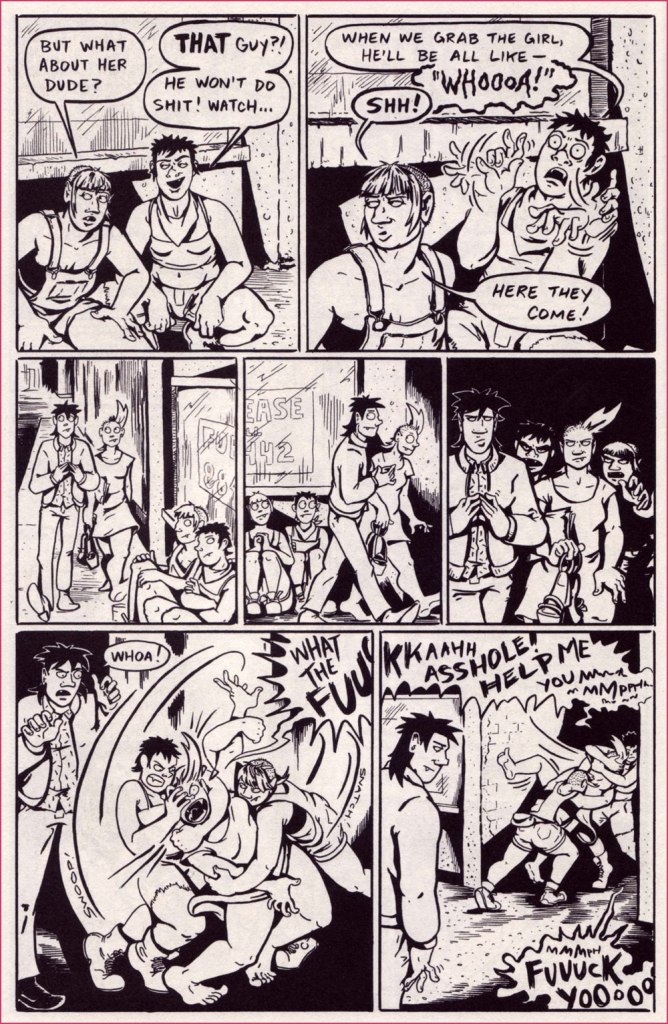
If that’s how it is… Maybe I’ll just LEAVE then!‘ — and our heroine makes her way to the surface to see whether humans can give her satisfaction where the demon failed.

After a cavalcade of brief dates with men spouting the usual nonsense (distinctly not sex-worthy material), Bug finally comes across a contender…

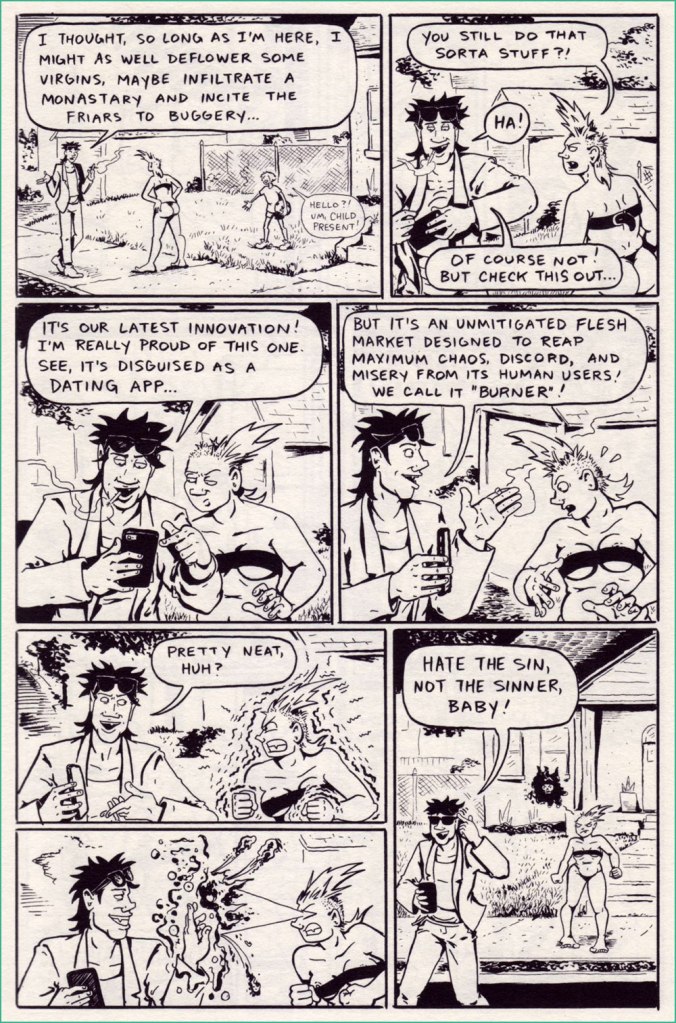
As much as I enjoyed No Romance in Hell, I was even happier to find that Demons: To Earth and Back featured a longer story and more glimpses into the organisation of the pits of Hell, home sweet home. When Bug needs to rescue her demon sweetie from his forced summoning to earth, Bug’s sibling Skud comes up with a plan to sneak her out of Hell, since obviously the former is built on the solid foundation of bureaucracy and endless pencil-pushing —

Hyena Hell says she has a tough time with spelling, but ‘monastery’ is the only typo I noticed.
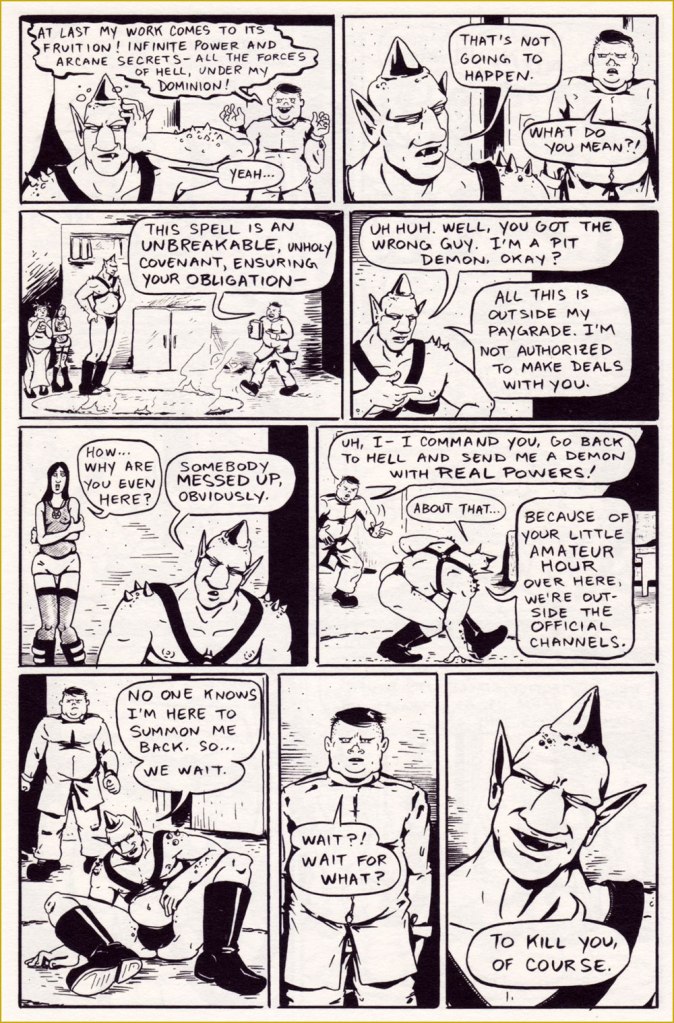
This demon’s actually pretty bright-eyed and bushy-tailed, aside from badly wanting a cup of coffee. The pimple-faced fascist teenage jerk who summoned him, however, is in distinct danger of having his face smashed in.

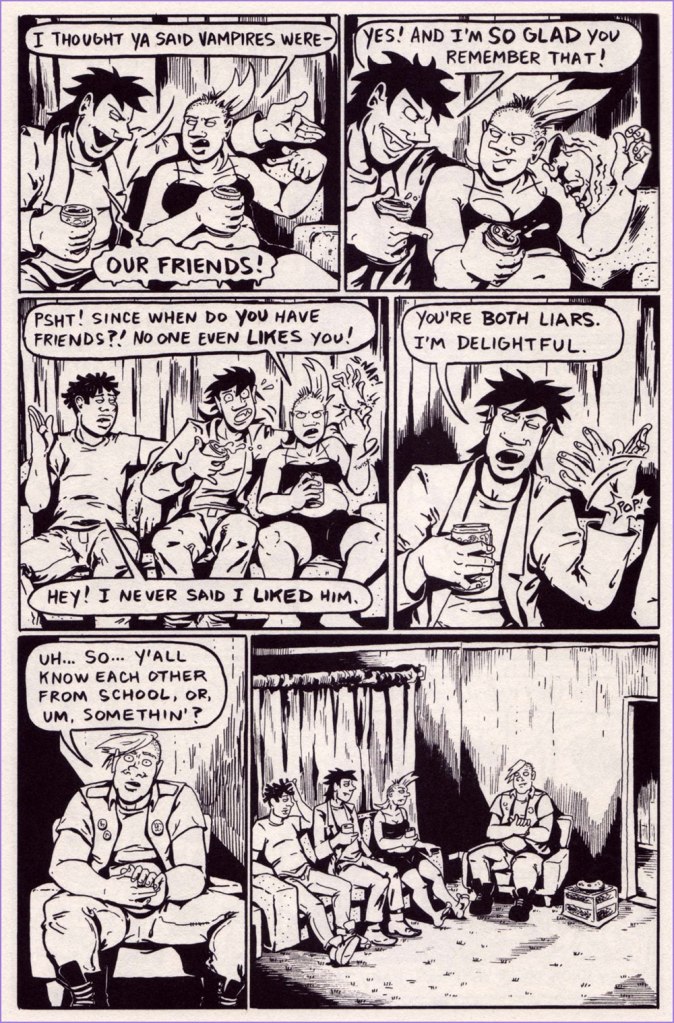
Demons: Bloodlust is even more ambitious, telling the gruesome (with many incinerations) tale of Bug and Skud embarking on a vampire-annihilating mission (and introducing a vampire trio of old friends whom I would love to hang out with).

Social anxiety, the vampire/demon edition.

At the end of the story, we are treated to a couple of ages of Cass, Marco and Baby Jay answering questions, which is possibly my favourite bit of the whole thing.

There is a fourth Demons book in production as we speak — follow HH on instagram to get a peek of the pages she’s working on. Also pay a visit to The Comics Journal for a sampling of the Fair Warning – Hyena Hell interview.

~ ds

* Given that he was kind enough to scan a bunch of pages for me, I’m sure he’s read some while scanning, at the very least.

Southern Ontario Gothic: Emily Carroll’s Forest

It came from the woods. Most strange things do.

I’ve mentioned Canadian artist Emily Carroll before in Of Ducks, Russian Folklore, and the Mysterious Gamayun. While her illustrations for children’s series are quite lovely, I think her strength (and obvious interest) really lies in horror.

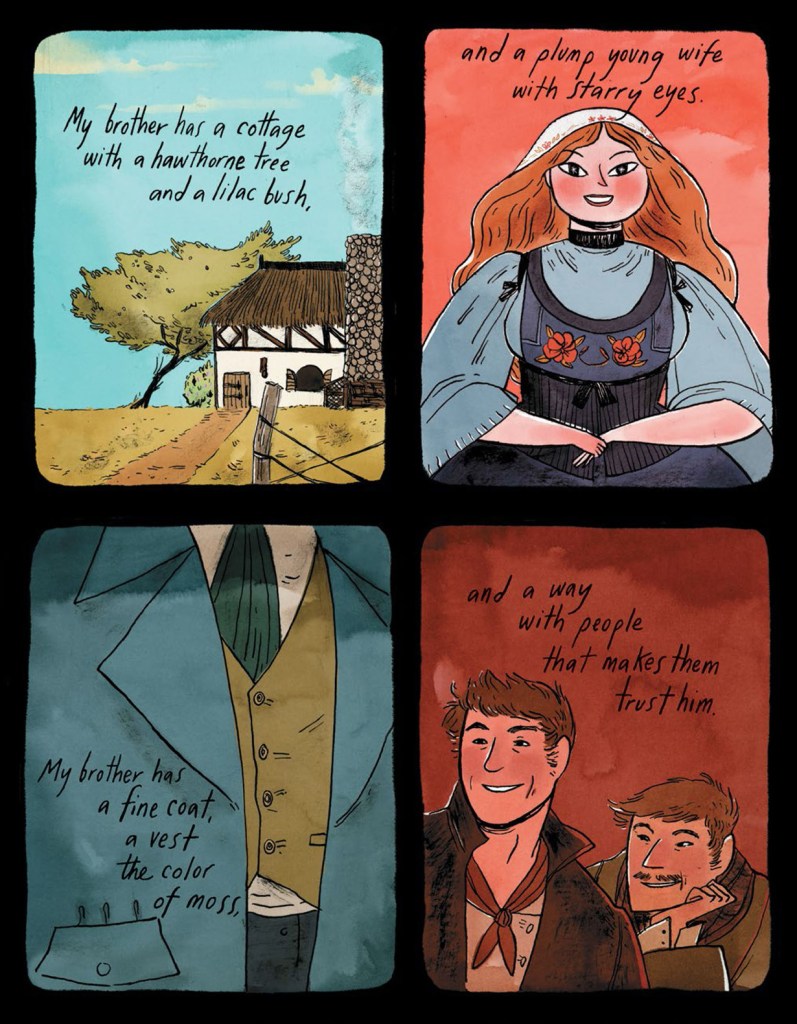
Today I’d like to feature a few selections from the 2015 collection Through the Woods, which received a few awards and a lot of compliments. While the stories within are generally lauded by critics and readers, I have seen a few reviews complaining that they’re not scary. I suspect that kind of reviewer is the same type of person who starts grumbling that there’s not enough action in Dostoevsky’s Crime and Punishment* (only one murder! gimme Midsomer Murders’ body count!)

Emily Carroll is excellent at conjuring the kind of slow dread that makes one skin’s crawl (which is not to say that she shies away from gore). This is not horror where a serial killer is chasing his victim around with a chainsaw – I think the latter is a lot easier to set up than conjuring a fragile, haunting atmosphere of menace and stalking shadows. Carroll’s work can be visually stunning, with bright colours and swanky layouts, but it can also be sepia-coloured, quiet, intimate and unsettling. She combines these two settings to great contrast and advantage, sometimes within the same story.

A page from His Face All Red, arguably Carroll’s breakout comic that she posted online in October 2010 and which went viral. Read it here. In now occurs to me that her art is sometimes a bit Richard Sala-esque.
Page from A Lady’s Hands Are Cold. Carroll’s hand lettering contributes to a lot of the atmosphere. In a world of typeset speech bubbles that spoil the mood, it’s really nice to come across comics where the text is part of the design.
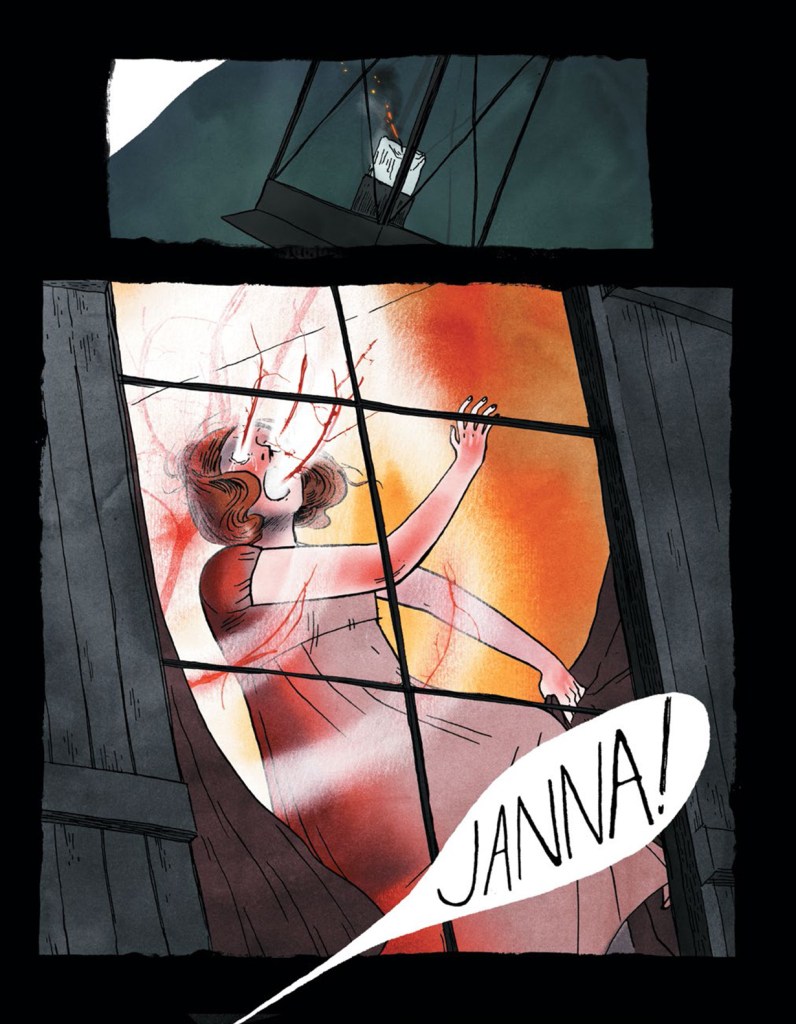
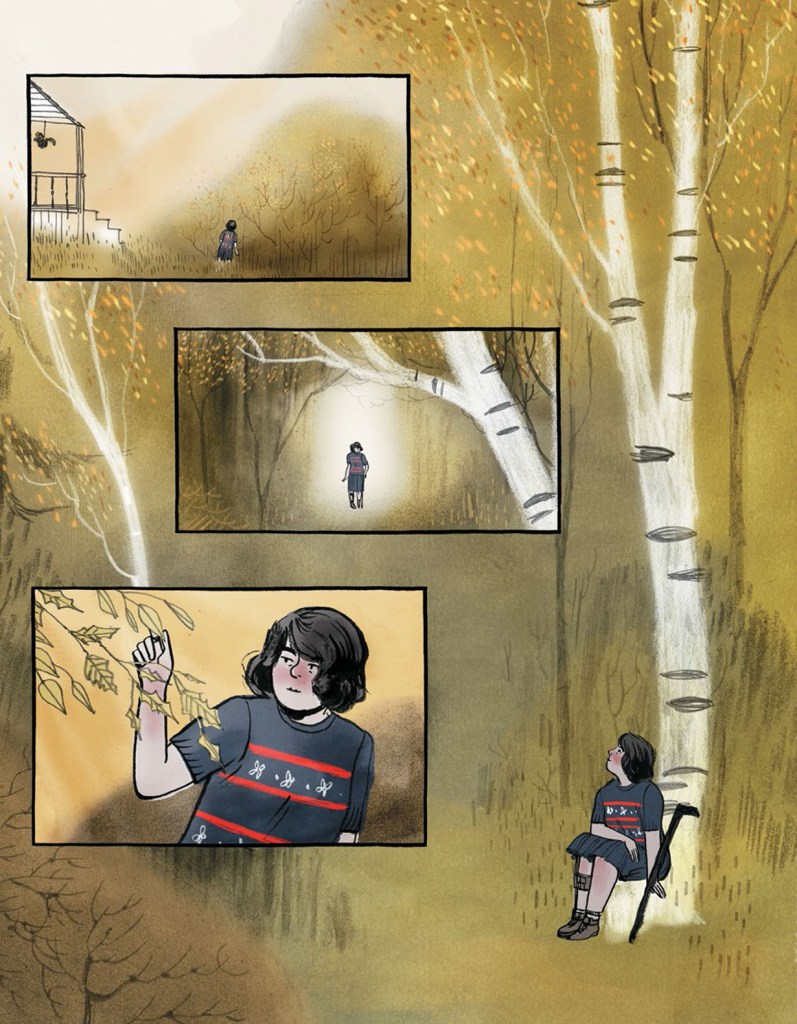
A page from My Friend Jenna, a story of two friends who conduct fake séances…
… and get a little, shall we say, embroiled in the lives of the dead. It was difficult to decide which pages to include, as I don’t want end up spoiling the plot.

Nightmares about losing teeth are very common (apparently, they’re ‘one of the most universal dream themes‘), so perhaps that explains why The Nesting Place is especially unsettling. Here is a sample of a few pages:

Carroll’s tales often feature somebody who is not what they seem, the unusual or scary hiding behind the veneer of a normal human being. Those wiggling teeth are fucking creepy.
A definite plot spoiler, sorry.

Finally, two pages from In Conclusion, which wraps up this collection with a brightly coloured epitaph:

Don’t forget to visit her website, with plenty more comics to read. A lot of her work is accessible online only, and makes great use of this medium** – for example, in A Pretty Place, you can select the room you want to visit in a sort of Clue-ish set-up; in Margot’s Room, you can click on objects (a mirror, some dried flowers, the window…) to learn their story. Definitely read the sexy, creepy, gory Writhe*** – it’s available for free download. Read her smart interview with Sean T. Collins for The Comics Journal here, or check out her latest book (not yet published), A Guest in the House, here.

Self-portrait.

~ ds

* To be fair, I am no fan of Crime and Punishment, as I thought it was quite a slog to get through… but not because only one person gets killed. Have a gander at some entertaining reviews of it here.

** She talks at length about designing a comic to be read online in An interview with Emily Carroll: A Fairy-Tale Teller in the Digital Age.

*** When I Arrived at the Castle, published in 2019, strikes a similar vibe, featuring a blood-laden love/horror story between a sort of cat girl and a vampiric Countess, all of it wrapped up in the heavy, shifting logic of a dream you want to escape from but can’t.

America’s ‘Most Visible Cartoonist’, Jim Benton

« I’m not saying I’m cool. That’s your job. » — Happy Bunny

When it comes to Jim Benton‘s work, it seems I got in on the ground floor, thanks to a friend’s shrewdly chosen gift of the man’s first cartoon collection, ‘Dealing With the Idiots in Your Life‘, twenty-nine years ago this Christmas. Yikes!

In a way, Benton’s nearly too obvious a subject for a post: his work is everywhere you turn, but such a large audience seems to have been reached at the cost of relative anonymity. In other words, people know his work, but they may not know his name. I’m sure his name does, however, enjoy some currency with a couple of generations of younger readers familiar with his Dear Dumb Diary (nearly 10 million sold!) and Franny K. Stein (over five million sold) series.

Given his intimidatingly formidable output, I’ll stick to material from his first collection, which I like best anyhow… which is not to say, echoing what all and sundry tell Sandy Bates in Stardust Memories, that I strictly prefer “the early, funny ones“. Mr. Benton is possibly even funnier — or at least more sophisticated — today than he was at the dawn of his career, but these early cartoons are less ubiquitous than this century’s crop.

At this stage, Benton’s style — both in concept and execution — still wore some heavy influences, namely that of Bernard Kliban.
It wouldn’t surprise me one bit if this cartoon had near-universal appeal, given the fearful hold of cognitive dissonance: after all, most of us think others have a tenuous grasp on reality.
Cute Citizen Kane reference.
A timeless and oddly poignant state of affairs.
Some of you will likely have occasion to muse over this very question during the Holidays.
This one’s *very* Kliban-esque.
In this one, I see a bit of his fellow Scholastic alum Tom Eaton‘s touches. All for the good.
More Kliban (surely intentional!) but with sprinklings of Nicole Hollander and perhaps Scott Adams.
Taking Will Rogers’ famous bon mot to its, er… logical conclusion.
Here’s a jolly one for the season.

In closing, a bonus one from quite recent days. While I’m less fond of the digital tablet aesthetic of his latest work, his writing has acquired some even sharper edges. Sadly, this strip will likely be relevant only to medieval citizens of the German town of Hamelin, right?

For more Benton, right from the source, note the address: https://www.instagram.com/jimbentonshots/

-RG

Subnormality: Walls of Text, not Concise Little Quips

I’ve been interested in comics for as long as I can remember, but didn’t really have easy access to them in my teenage years (meaning, I was far too shy to actually walk into a comic book store). So I turned to webcomics, keeping bookmarks organized by days of updates, faithfully opening 20+ tabs every time I turned on my computer to read a new instalment of the dailies. I’ve drifted away from all this over the years – partially because I’m a big girl now, but mostly because most webcomics really aren’t very good, the gems scattered in a murky swamp of badly drawn slice-of-life peppered with Star Wars jokes… not to mention the mind-numbingly boring takes on fantasy/science-fiction/elves-with-big-boobs. A few I’ve retained an affection for, a few have my respect and gratitude (and live rent-free in my head*).

*I’ve only encountered this idiom in a positive context (somebody cooing over a picture of a cute capybara, for example), but I just discovered that it’s supposed to be an insult. Apparently it can be used as either; I associate ‘rent-free’ not with loafers on welfare, but, say, our cats’ lifestyle.

One of the leftovers of that era is Subnormality, created in 2007, priding itself in being a ‘comix with too many words‘. While it can certainly be accused of being quite heavy-handed at times, not to mention self-consciously ponderous, it can also be genuinely touching, portraying society’s outcasts (and supposed bimbos, and successful businessmen…) with unflagging empathy and understanding. Its author is Winston Rowntree, who I believe lives in Toronto, Canada, and is very evasive on the subject of himself.

Subnormality not only has a lot of words, it also has sprawling expanses of panels, so that sometimes reading a comic feels like playing a board game. For that reason, as much as I would love to have a printed version of the stuff, I realize that it would be impossible to fit all that inside physical pages, lest somebody springs for an edition where each page folds out to a poster. It was quite difficult to choose which strips to feature, but below are a few examples that are on the smaller and less wordy side (for an example of the aforementioned mushrooming sequence of panels or prolixity, have a look at no. 244, Subnormality Tells the Truth, or no. 98, 7 Dichotomies in a Bar).

Rowntree also occasionally writes for CRACKED, has two published books (Finding Jesus, 2014, in which you have to locate Jesus in a crowd à la Waldo, and the graphic novel Watching, 2016) and recently-ish (2017 is recent, right?) started an animated web series, People Watching, that’s now in its second season.

No. 42, Sphynx III. An early appearance of the Sphynx, shown in company of other monsters, whereas in latter strips she is usually hanging out with (or devouring) humans.
No. 79, In Defense of Weird
No. 63, Mrs Smith Is a Nasty Piece of Work
No. 104, There Are Two Kinds of PeopleUs and them/ and after all, we’re only ordinary men
No. 97, The Further Adventures of the Sphynx. She may be a man-eater, but she’s a very personable one, and one of many recurring characters who’s considerably fleshed out (heh, heh) as the series goes on.
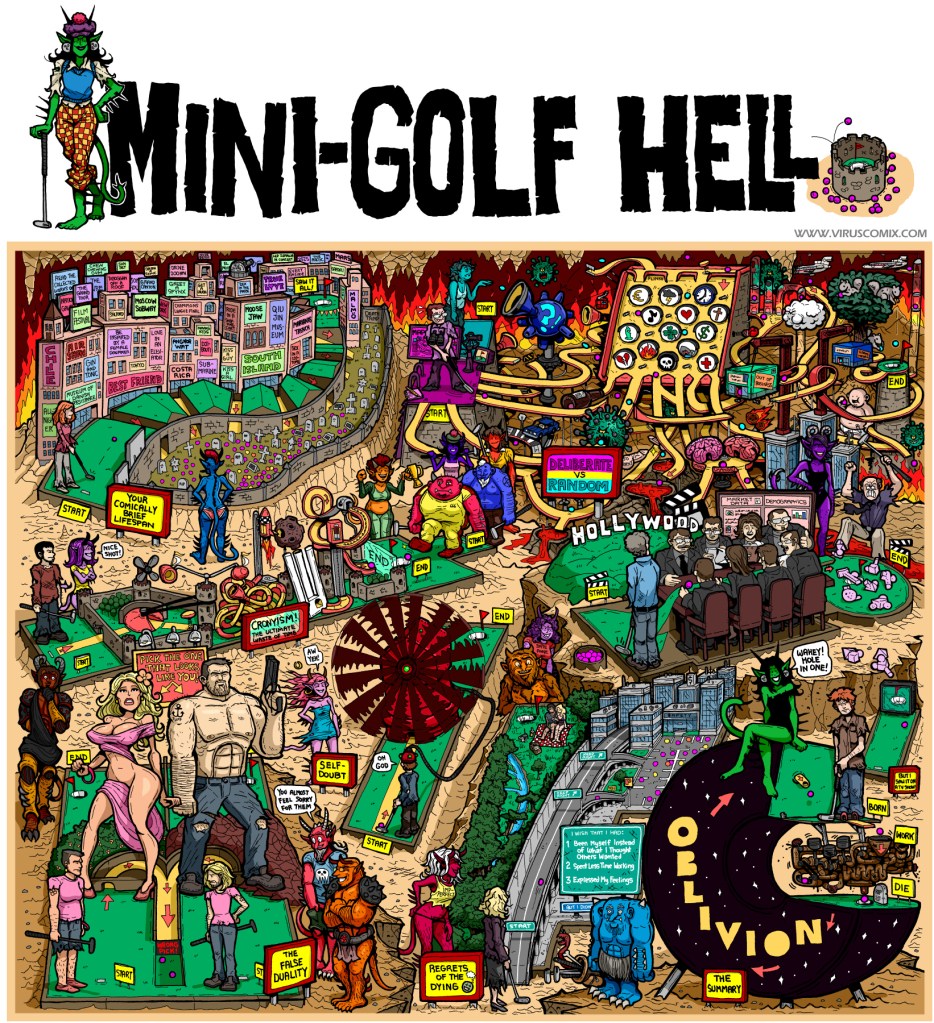
No. 198, Mini-Golf Hell. The green demon lady (sitting on top of Oblivion) is also a recurring character.
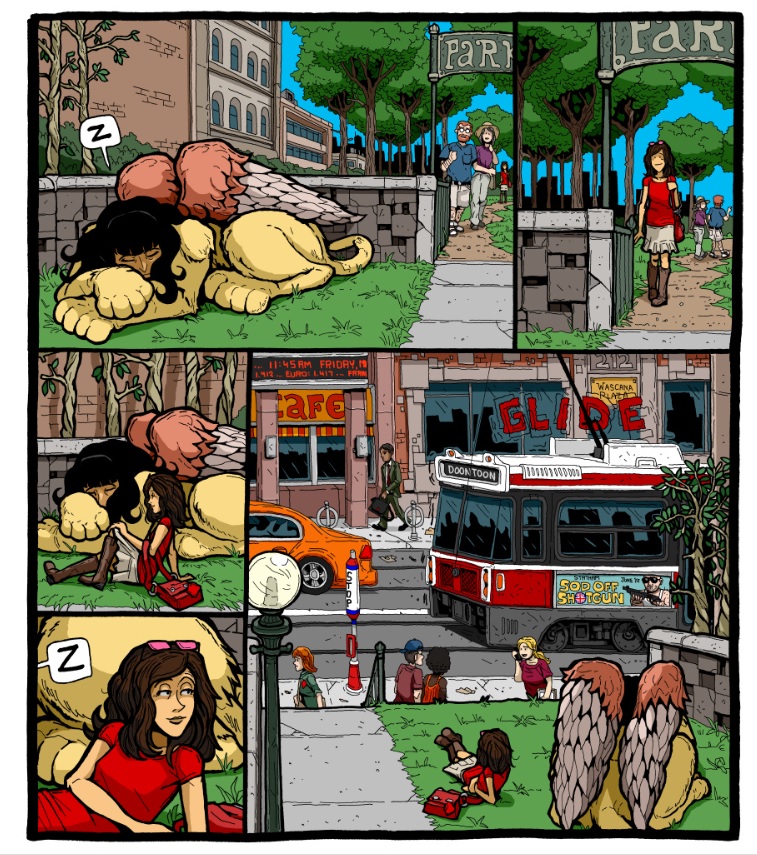
One of my favourites, no. 199 (titled ‘…’), in which two friends hang out and watch the world go by. Read the full thing here.

New strips do come out, though not often (which is understandable, given all the other projects Rowntree is engaged in, not to mention the sheer size of latter-day instalments) – follow Subnormality’s Facebook page, or keep abreast of recent developments on his Twitter.

~ ds

Plastic Dog in a Plastic Age*

Given that I grew up in the days when PC games were just starting to be a thing (what a pleasure it is to reminisce about Secret Agent, Crystal Caves, or Jill of the Jungle…), anything pixelated immediately gives me a warm rush and a sense of pleasant nostalgia, be it the quiet appeal of Toyoi Yuuta‘s art or modern ‘pixel art’ games that go for that retro feel (the dark glory of Blasphemous, the cozy feel of Stardew Valley!). As for comics, I suspect most are drawn on a computer these days, but few of them use pixel art per se. One look at Plastic Dog, and it was puppy love, especially given its acerbic sense of humour.

Henning Wagenbreth, born in 1962 in East Germany (which is perhaps what partially gave him a lifelong anti-totalitarian stance), is an illustrator/graphic designer who actually excels in a number of techniques. Lambiek Comiclopedia touts him as ‘German pioneer in comics created with the computer‘; I don’t know enough about the development of electronically-drawn comics specifically in that part of the world to state that with certainty, although this is as good a time as any to mention that Peter B. Gillis and Mike Saenz‘ wonderful Shatter (1985-1988) is usually credited as the first significant comic book created on computer. Topic for another day, no doubt.

Be as it may, Wagenbroth did something interesting: he designed the strip Plastic Dog in 2000 specifically for perusal on early pocket computers (such as Pocket PC or Palm OS), which had a black and white screen of 160×160 pixels. In 2004, colourized versions migrated to weekly newspaper Die Zeit, printed within its pages, but also available as downloads on their website.

The French publisher L’Association released a 26-page collection of Plastic Dog strips, translated into French from German by Eugénie Pascal. As far as I know, no official English translation exists, aside from maybe one or two random strips (probably translated by Wagenbreth himself). The following pages are scans from this French edition.

Dead Wood. Plastic Dog calls the police to report a stolen wooden cabinet, to find that it’s been removed by the Tree Liberation Army, who bury their ‘felled, deported, dismembered and abused’ friend in the tree cemetery.
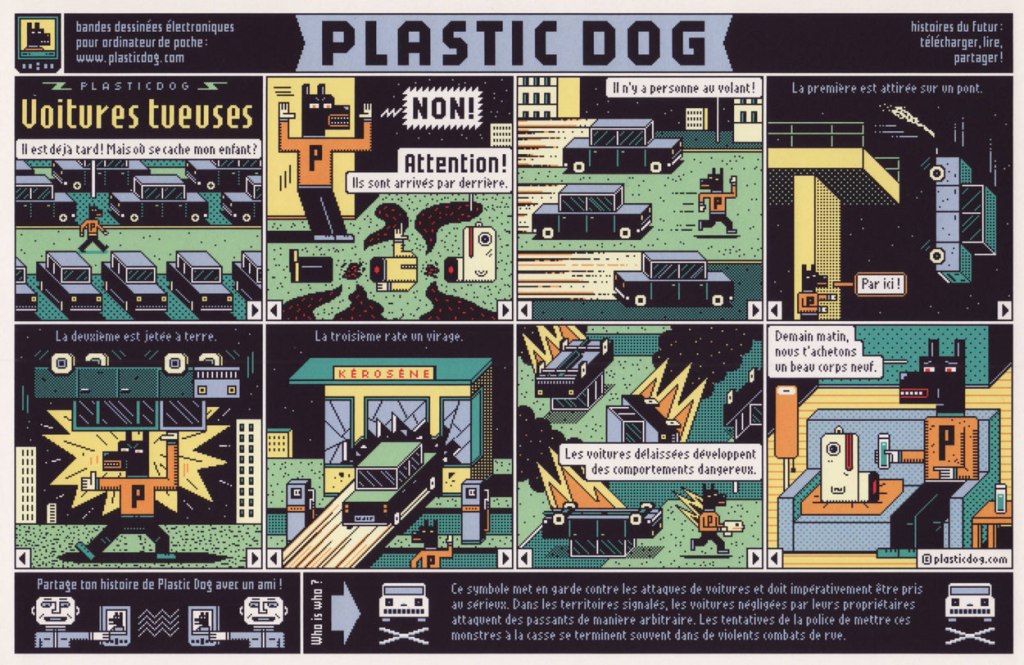
The Killer Cars. Plastic Dog goes out to search for his missing child, to find the latter in pieces after being attacked by driverless cars gone rogue. In the final panel, PD says ‘tomorrow, we’ll buy you a nice new body’.
Nothing Ever Happens. ‘A grey day, pure boredom’, bemoans Plastic Dog, ‘I am always in the wrong place at the wrong time, and everything is so predictable…’
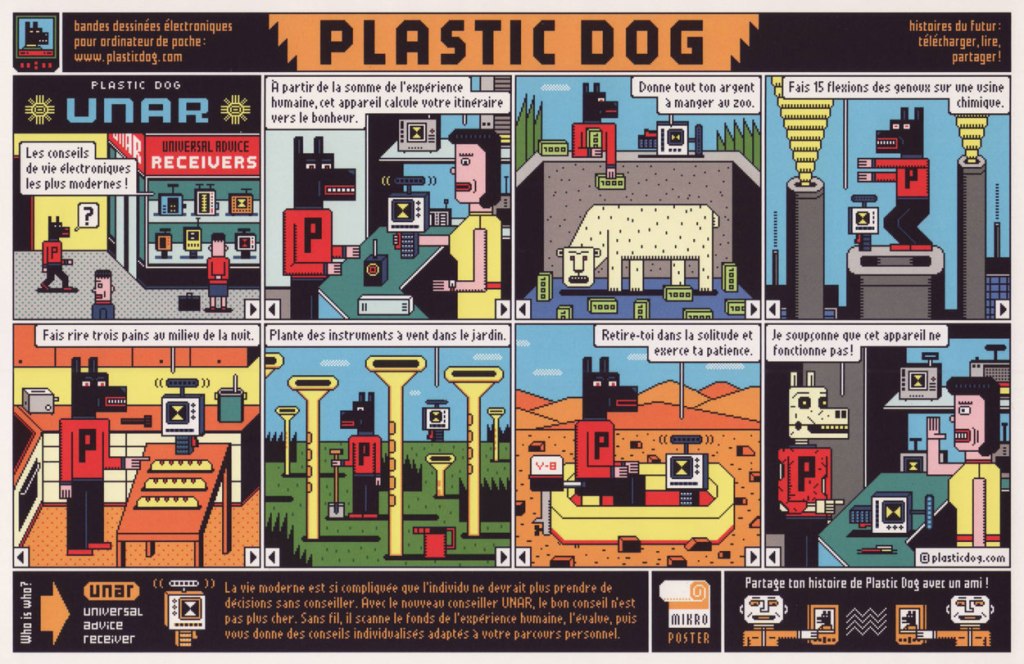
In his never-ending search for new experiences, Plastic Dog stumbles upon a device that proffers guidelines to achieve maximum happiness. Its instructions are not devoid of poetry: ‘give all your money to be eaten by zoo animals’, ‘do 15 squats on top of a chemical factory’, ‘make three loafs of bread laugh in the middle of the night’, ‘plant wind instruments in the garden’. The final piece of advice (‘withdraw into solitude and practice patience’) is what seems to defeat PD’s enthusiasm (seems like in his world, getting lost in the desert is the only way to solitude…)

The following is the last PD strip, and readers are thanked at the bottom for their many emails and downloads. There’s also something about a free TV as a reward, but I wouldn’t bank on it 😉

A family visit to the zoo! Touted as the last surviving specimens by the guide, these animals may not quite be what they seem. The flamingo complains, ’12 hours standing on the same leg!’, but Plastic Dog argues that having to constantly hang upside down is much worse.

Wagenbreth recently had an exhibition at Montréal’s UQAM university, which to my regret I completely missed… due to finding out about it far too late (i.e. now). Here is the poster for it:

~ ds

* « Every day my metal friend
Shakes my bed at 6am
Then the shiny serving clones
Run in with my telephones »

Customer Service Wolf: How May I Assist You?

« Thank you for calling customer service. If you’re calm and rational, press 1. If you’re a whiner, press 2. If you’re a hot head, press 3. » — Randy Glasbergen

Comedy oriented towards employees who work in retail is its own breed of humour. I remember my ex-boss warning me early on that ‘the public is stupid’ – and that’s certainly the impression one gets, being confronted (day in, day out) by customers unable to read signs (no matter how big and prominent one makes them), pulling on doors that are meant to be pushed, and asking questions so inane that it feels slightly surreal.

There are myriad comics poking fun at the daily frustrations of retail… most of them making observations of a rather obvious nature, though frustrated employees will still chuckle at them (it feels nice to be ‘seen’!) I have mixed feelings about all the people leaping from ‘look, I doodle in my spare time’ to ‘I am an Artist who has a Webcomic!’, but that’s a topic for another day. Occasionally one stumbles onto a gem amidst all the ugly pebbles.

There are several things going for Customer Service Wolf, drawn by Australian illustrator Anne Barnetson. Its immediate appeal is that it’s beautifully drawn, of course. I am impressed at the variety of animals, convincingly depicted. It’s also very self-aware and funny, appending the usual ‘customers are destructive/insane’ stories with an unexpected recurring punchline (hint: it involves a wolf’s sharp jaws). A bookstore is a backdrop for a very special kind of lunacy, and Barnetson has clearly has had her share of it.

The following have been scanned from the collection (2019), but you can view all of them at the Customer Service Wolf tumblr.

One of this strip’s strengths is periodically pointing out that we the employees are not so different from the customers we mock.

And I kept a really sweet one for the end:

~ ds