Panning the murky old print stream for the odd glimmering nugget
Oh, the Horror: the 1950s
The 1950s, as we all know, brought us the acme (and nadir) of horror comics. A zillion publishers, most of them long gone, got into the gore game before the censors stepped in. Let’s take a look at what led to the neutering of the comics industry…
« Before he can become a wolf, the lycanthrope strips naked. If you spy a naked man among the pines, you must run as if the Devil were after you. » — Angela Carter (1940-1992)
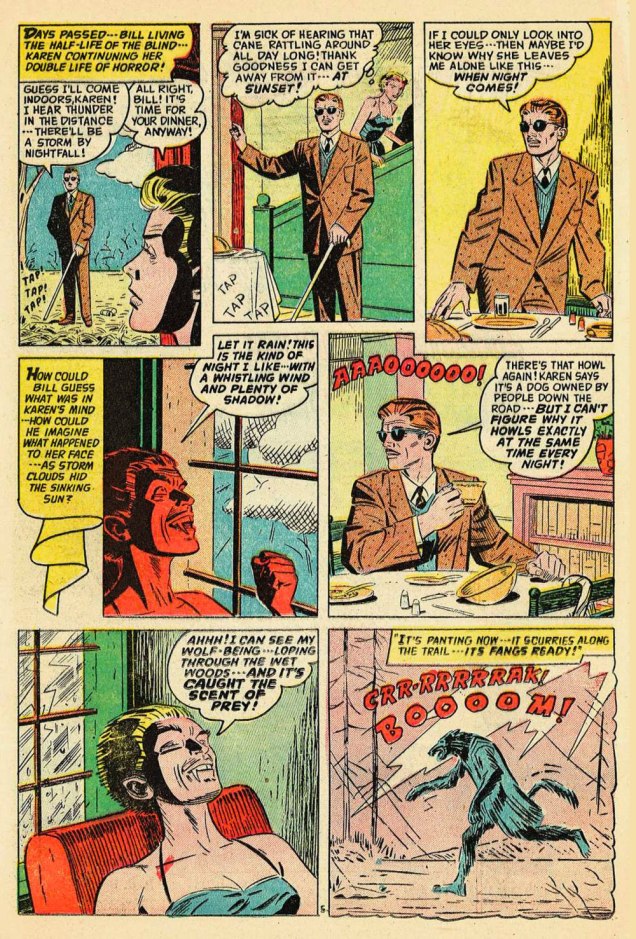
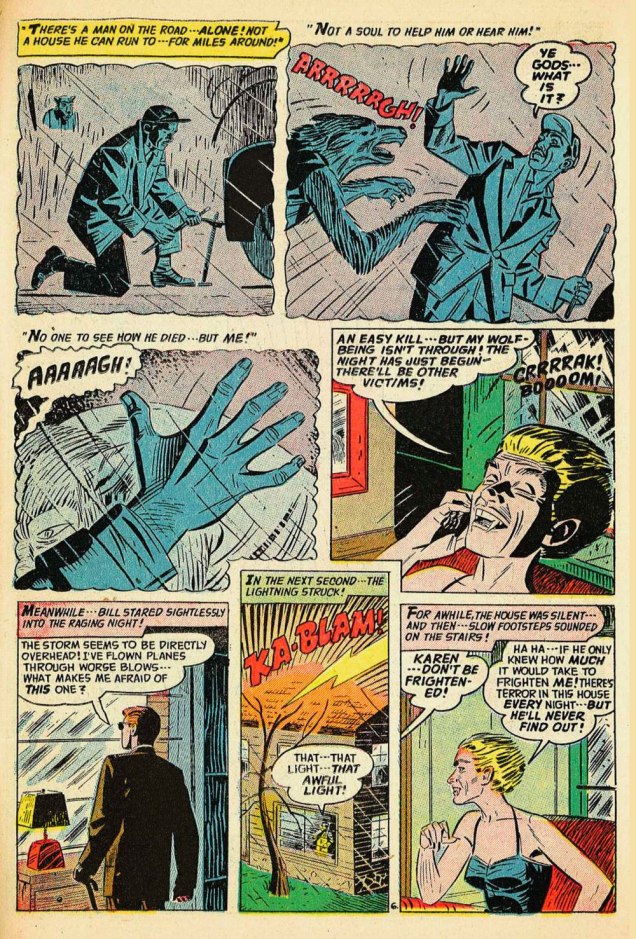
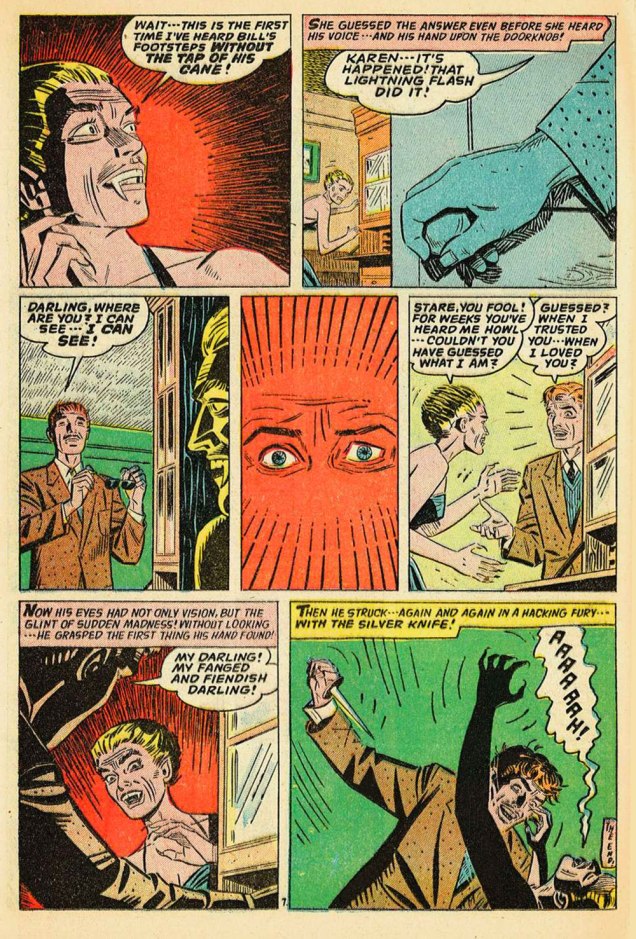
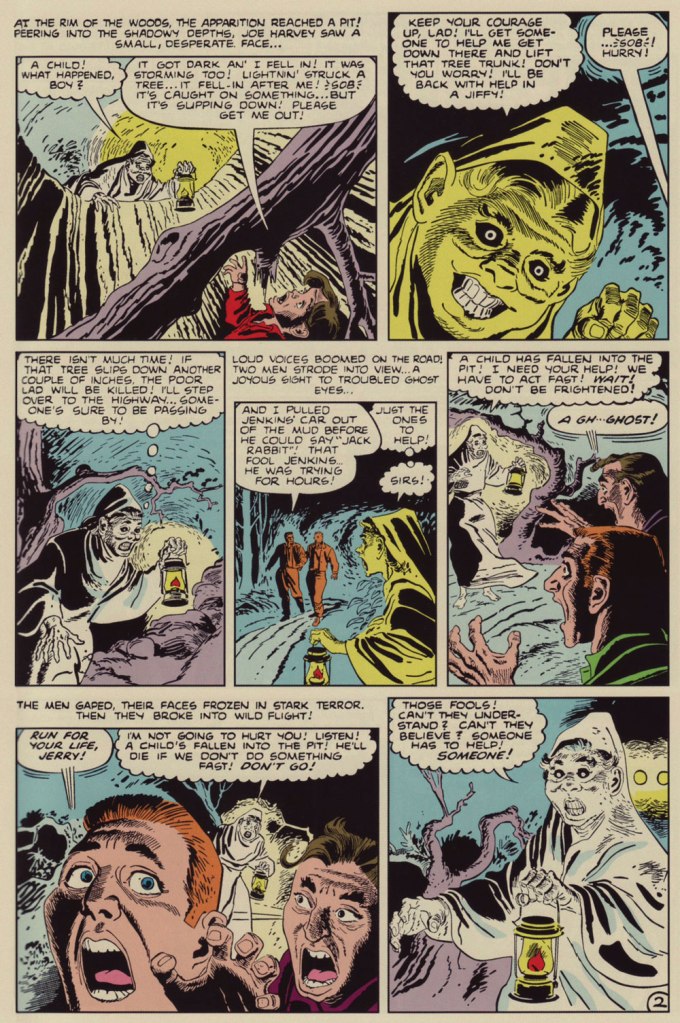
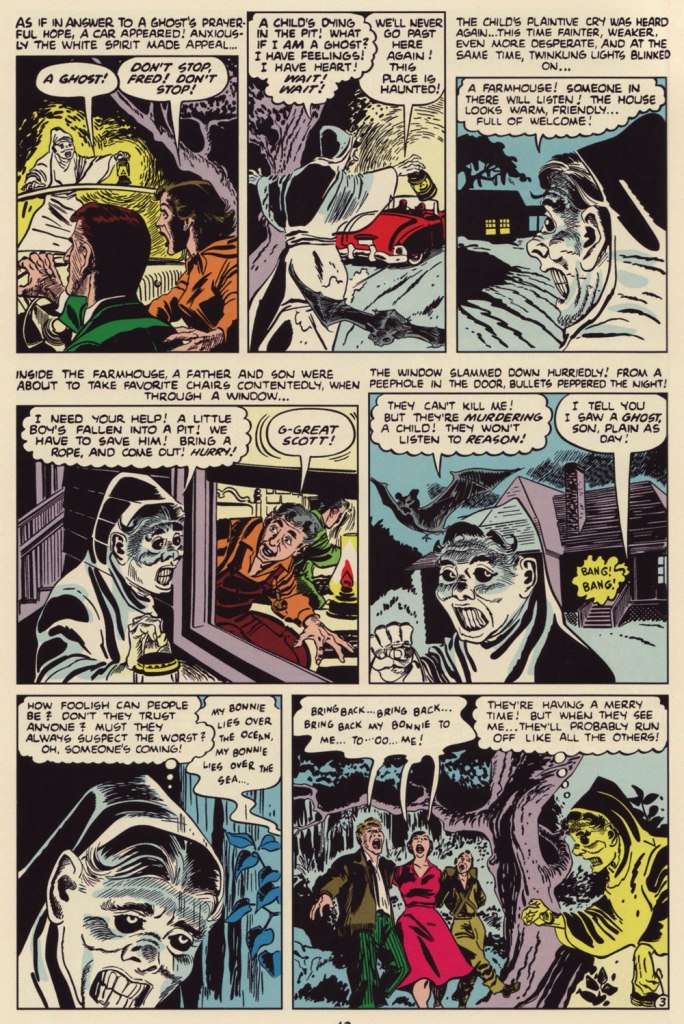
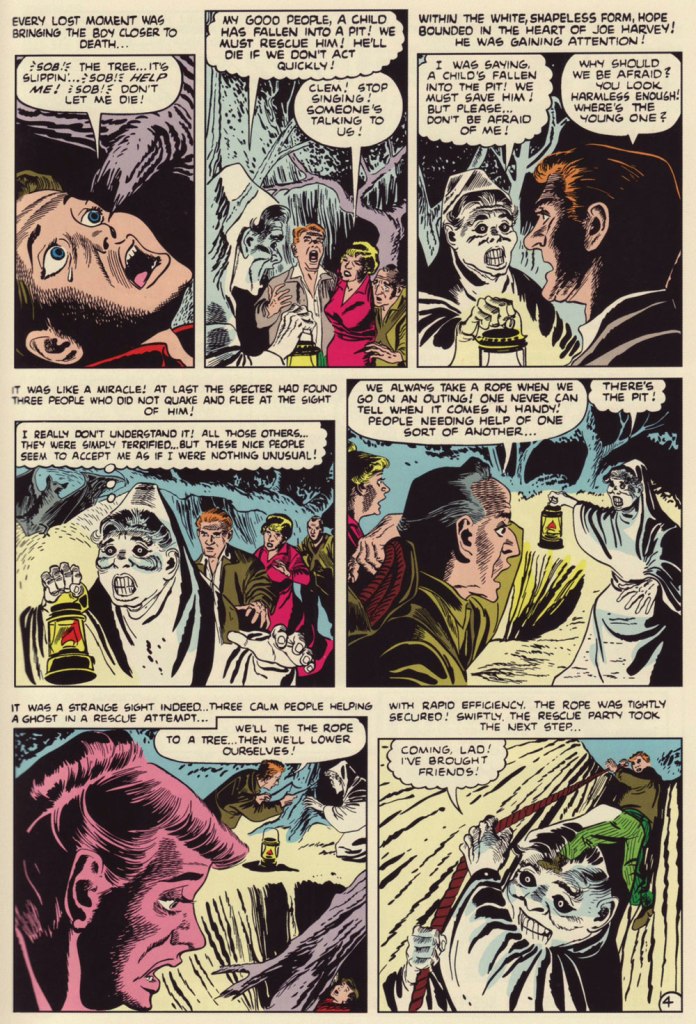
First of all, Happy Hallowe’en! On this finest of occasions, I bring you a wonderfully novel take on the hoary theme of the werewolf, handled by one of the truly unsung — save, it would seem, but some of his most distinguished peers* — draughtsmen of the Golden Age, namely Emil Gerswhin (1922-1999).
And yes, *that* George. Just like, say… the Partches, Virgil and Harry, genius clearly ran rich throughout the Gershwin line.
.
.
.
.
.
.
I wasn’t alone (Steve Bissette saw it too) in concluding that the terrific Mitch O’Connell just has to be Mr. Gershwin’s most direct — and worthiest — artistic progeny.
*By « distinguished peers », I mean the likes of Alex Toth, Al Williamson and Stephen Bissette. The latter wrote, in his introduction (essential reading alert!) to PS Artbooks’ Adventures Into the Unknown Volume 4 (March 2013, PS Artbooks): « Like almost all of the ACG horror comics, Gershwin’s work was the antithesis of the festering, tactile rot that made celebrated Pre-Code genre artists like Graham Ingels, Jack Davis, and Basil Wolverton so indelibly iconic: horror comics you could almost smell. Gershwin’s imagery is comparably sterile, even antiseptic, but his storytelling is as direct and no-nonsense noir as the best of Johnny Craig, his energetic pen-and-brush work as crisp and razor-sharp as Jack Davis‘ (sans the grit and grue and bits of meat and dirt spattering every motion), his staging as audacious as that of any cartoonist of his day. »
Bissette goes on to quote Williamson on Gershwin: « Oh, God, Gershwin was good. … he and [Ogden]Whitney were their best ever! A real draftsman, a solid cartoonist all-around. You should look him up, you could learn a few things. »
As for Toth, check out — his handwriting’s always a treat to see — what he wrote to Emil’s daughter Nancy over the course of their correspondance.
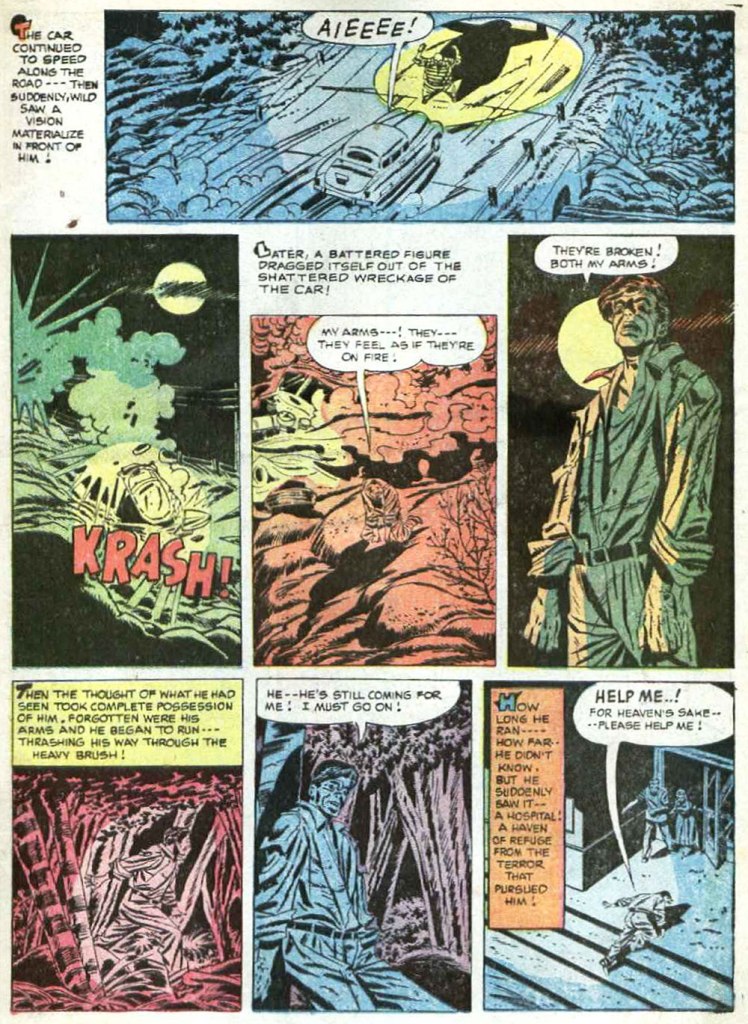
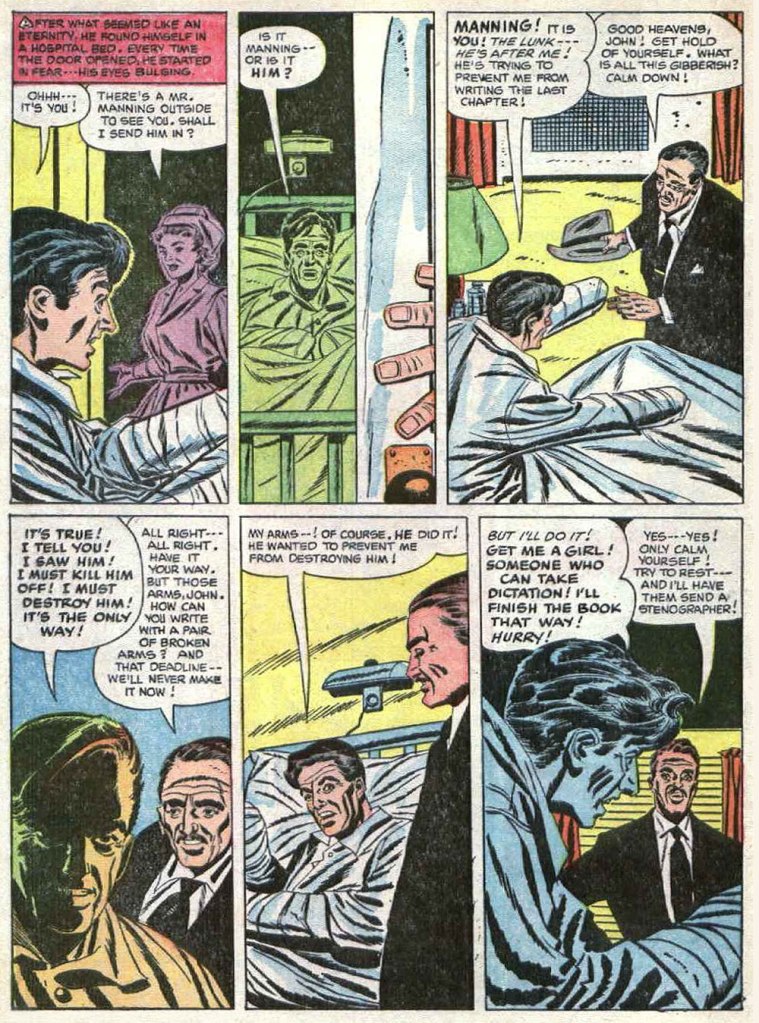
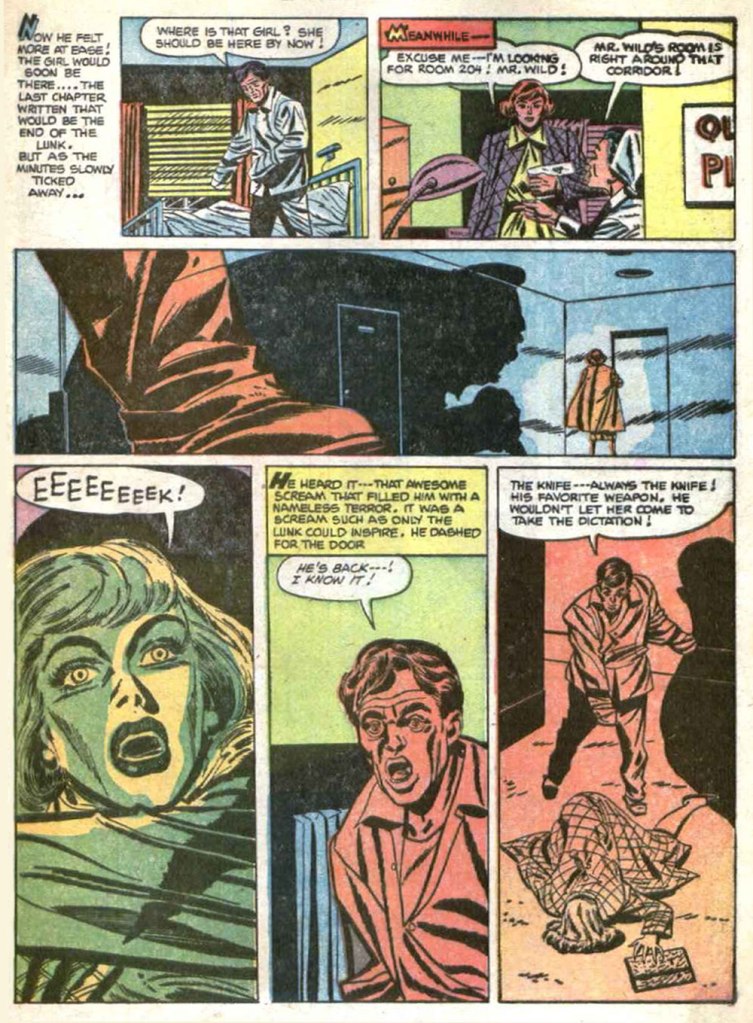
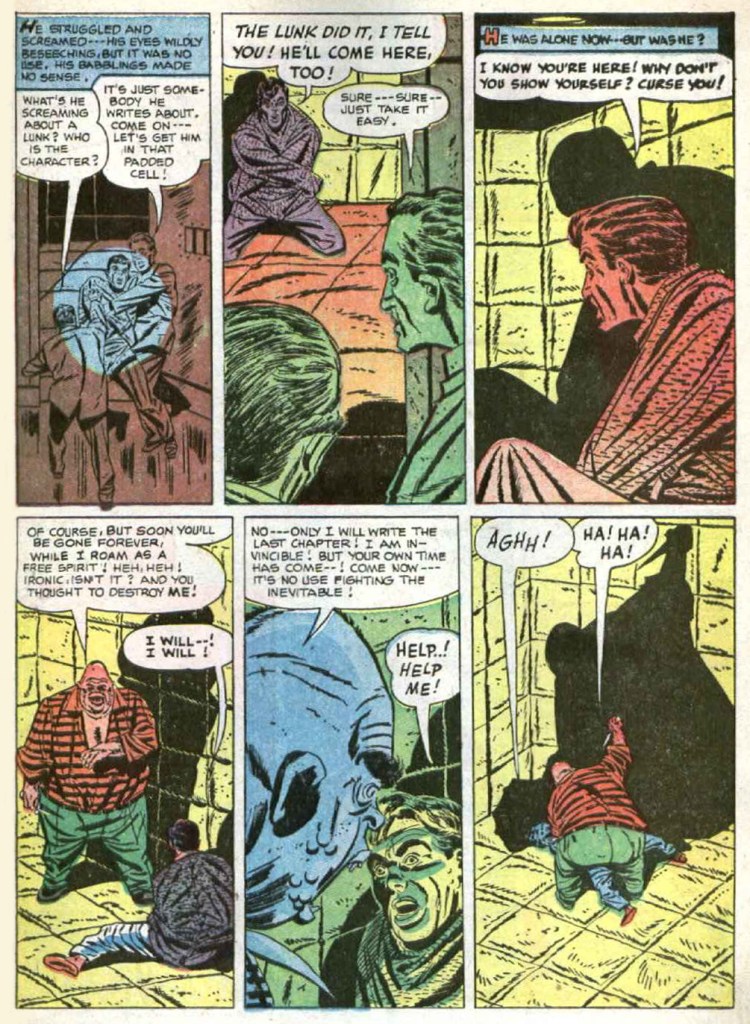
Again, our spotlighted tale isn’t the cover feature, but I nonetheless felt it my sacred duty to share this unusual beauty by Ken Bald (1920-2019). This is Forbidden Worlds no. 34 (Nov.-Dec. 1954, ACG), the title’s final Pre-Code issue. In 1955, FW would return to the stands after nine-month hiatus and take its final bow in 1967 after a sprightly run of 145 issues.
-RG
P.s. And while I dodged the headache of our traditional countdown this year, nothing — least of all me — is preventing you from raiding the boneyard of our past efforts, shameless ghouls that you are. Here are some handy links to put you into Hallowe’en orbit for a good long while :
« The sacred is found boring by many who find the uncanny fascinating. » — Mason Cooley
I’ve expressed many a time my ambivalent affection for Golden Age Atlas horror comics: in short, despite their slapdash, often incoherent writing, they had a solid stable of artists (which makes the thin writing all the more disappointing); but most of all, they generally had eye-catching covers, splendidly coloured (easy a task to underestimate!) and blessed with a light touch absent on the insides.
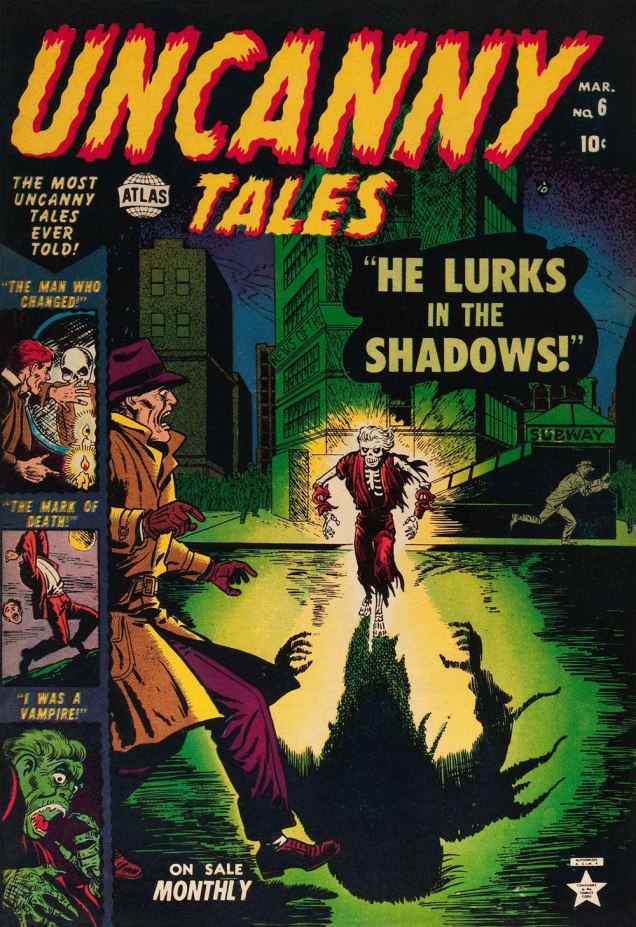
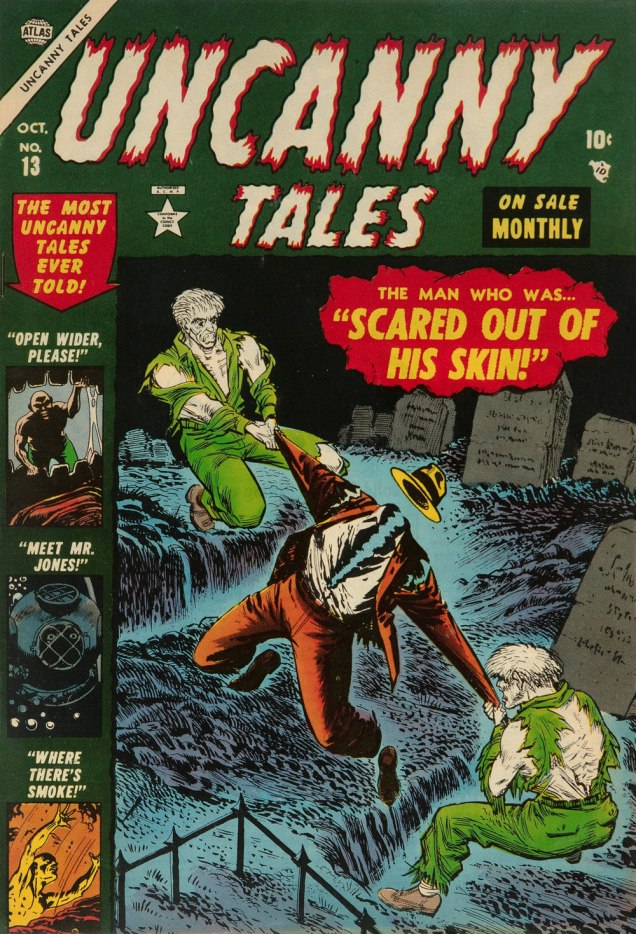
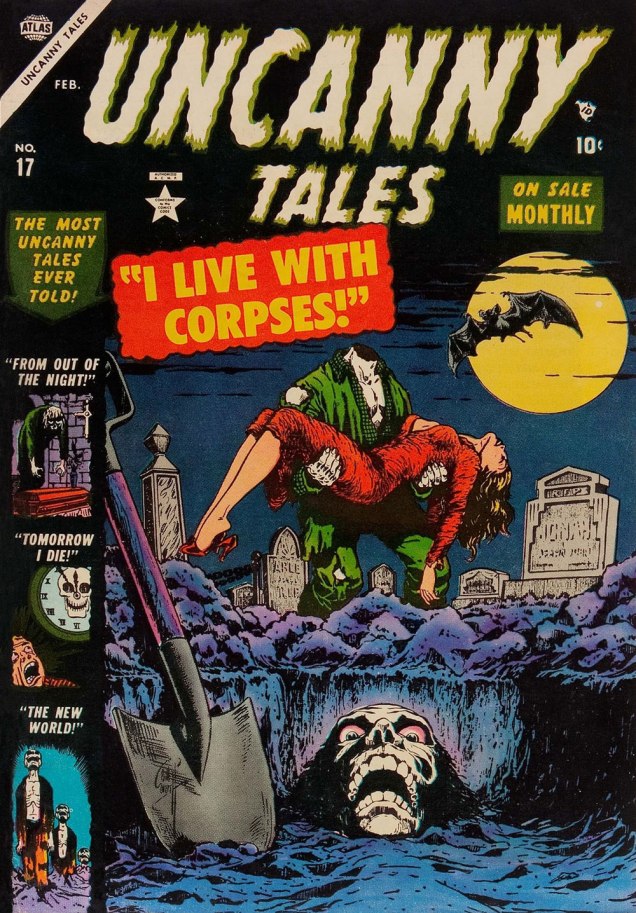
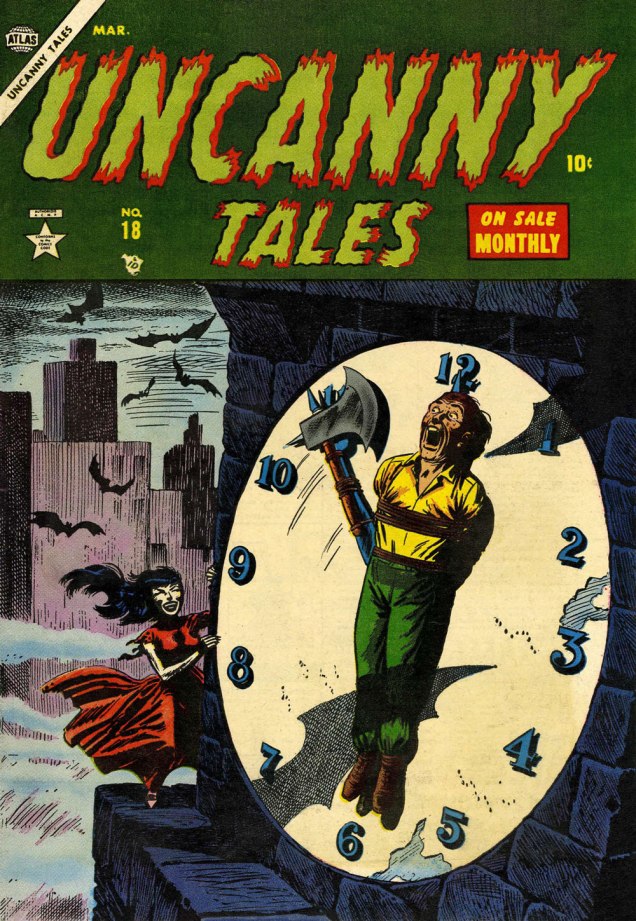
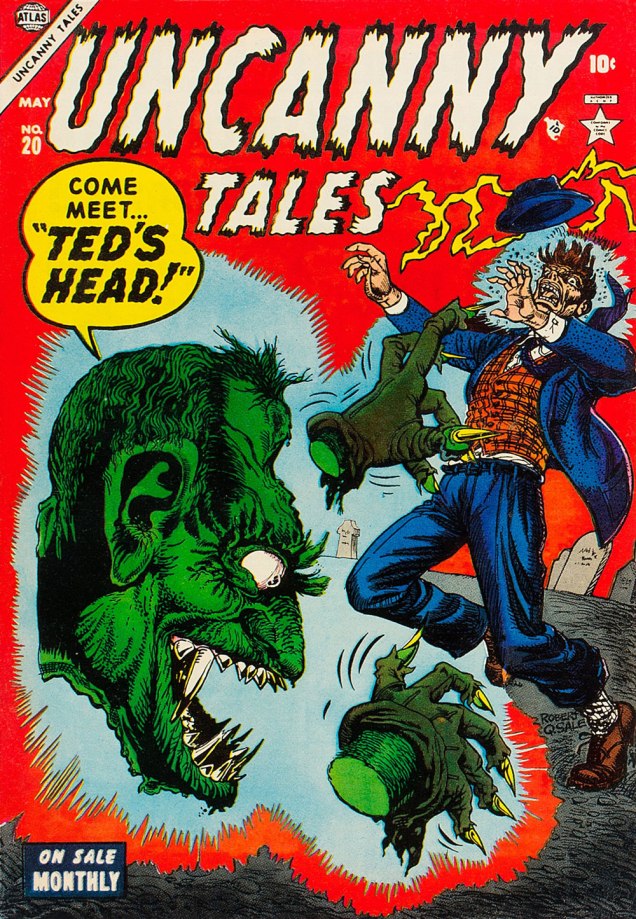
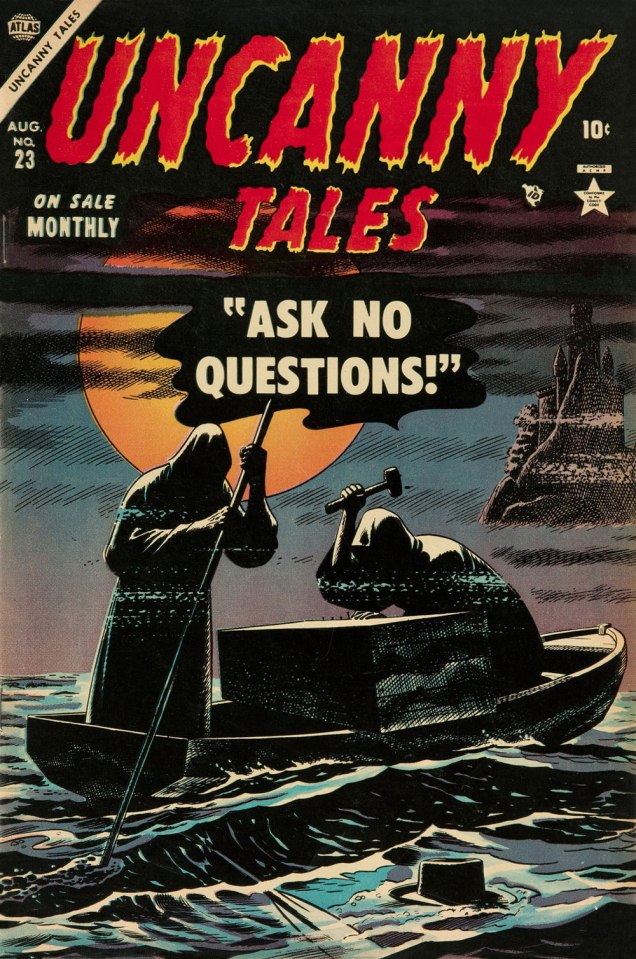
Today, I’ve picked out my favourite covers from Uncanny Tales (fifty-six issues, 1952-57). Enjoy!
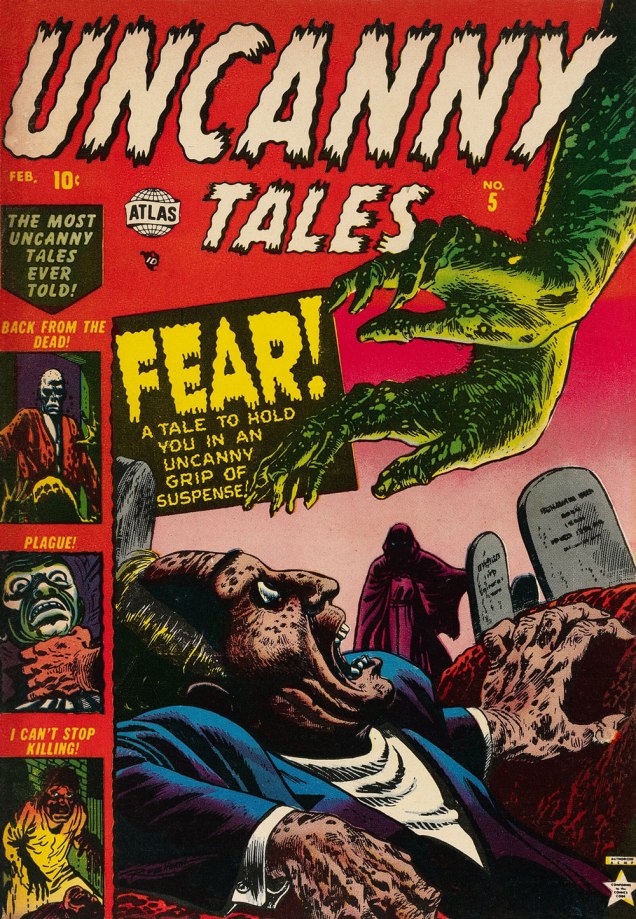
This is Uncanny Tales n. 5 (Feb. 1953, Atlas), cover art by Bill Everett, colours — consistently fine! — presumably by Stan Goldberg in all cases.This is Uncanny Tales n. 6 (Mar. 1953, Atlas), cover art by Bill Everett.This is Uncanny Tales n. 13 (Oct. 1953, Atlas), cover art likely a collaboration by Sol Brodsky and Carl Burgos.This is Uncanny Tales n. 17 (Feb. 1954, Atlas), cover art by Bill Everett.This is Uncanny Tales n. 18 (Mar. 1954, Atlas), cover art by Russ Heath. For a gallery of further Heath spookies, check out this entry from last year. This endearingly goofy one is Uncanny Tales n. 20 (May 1954, Atlas), with cover artist Robert Q. Sale giving it his best Joe Maneely imitation.Surely the leading candidate for “Most understated Marvel cover of the 1950s”… if not of all time. Stan must have been away from the office. This is Uncanny Tales no. 23 (Aug. 1953, Atlas); Art by Russ Heath. I’m understandably reminded of that old-timey jibe, « Walk East until your hat floats ».This is Uncanny Tales n. 27 (Dec. 1954, Atlas), cover art by Max ‘Carl Burgos‘ Finkelstein.And one post-Code entry, since it’s so outstanding. This is Uncanny Tales no. 48 (Oct. 1956, Atlas), Another subtle one by Russ Heath, but in a totally different register. Kudos!
« His deadline-flouting attention to detail was so ambitious that, whenever one of his jobs was delivered, editor Archie Goodwin reported, everyone gathered around to see what “that crazy bastard Heath” had done. » — Michael Dean
In my opinion, Atlas comics generally weren’t very good. But they remain fascinating because of one impressive asset: the line boasted no less than four absolutely top-notch cover artists, namely Joe Maneely, Bill Everett, John Severin… and Russ Heath. It may seem like nothing, but that was a truly phenomenal assemblage of talent in one place at one time. However, the writing was pedestrian and the second-stringers were, well… second-rate. But oh, some of those covers…
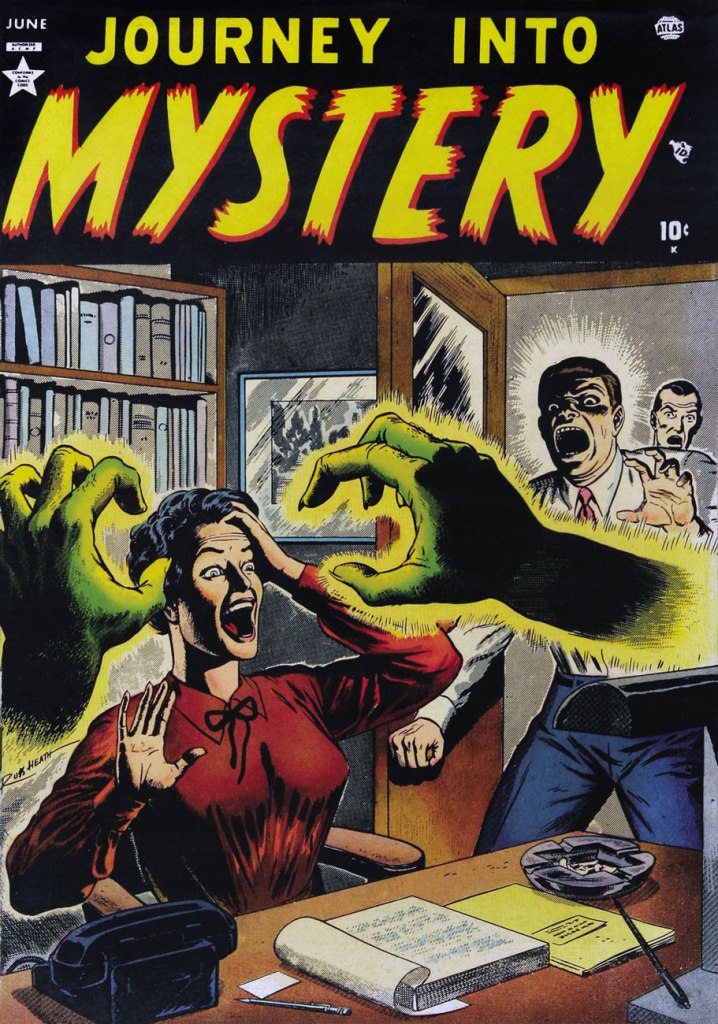
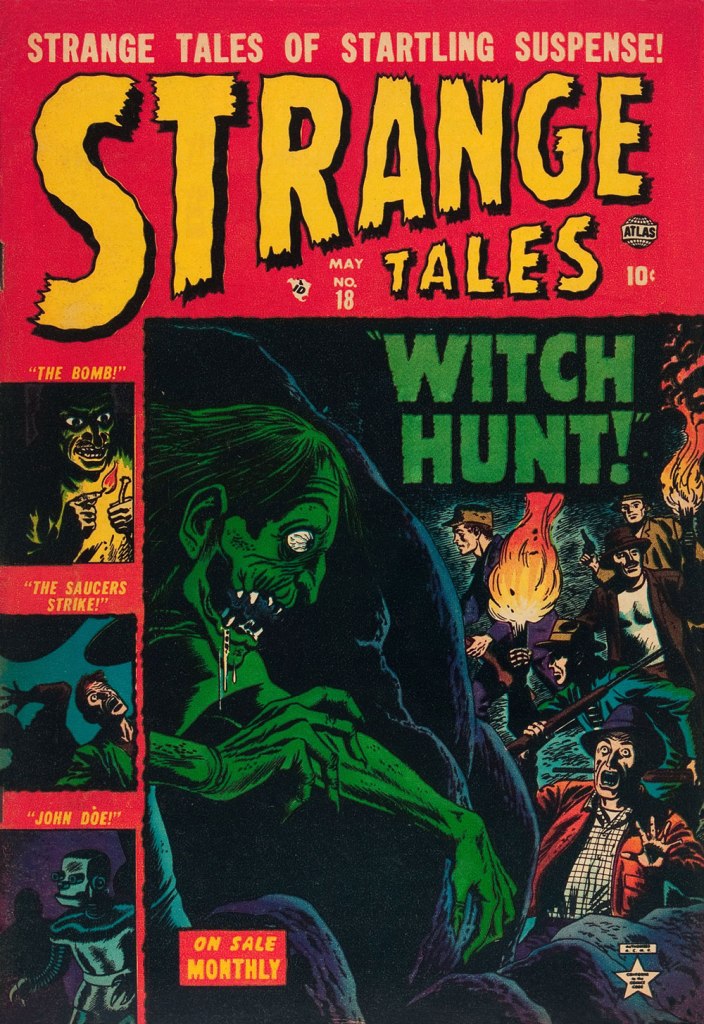
Today, we’ll coyly peek at some of Mr. Heath’s horror covers.
This is Marvel Tales no. 104 (Dec. 1951, Atlas); colours, in every case, by Stan Goldberg.This is Astonishing no. 9 (Feb. 1952, Atlas).This is Suspense no. 14 (Feb. 1952, Atlas). This one’s especially intriguing: there’s so much going on, yet it’s not overly busy… the mark of a first-rate cover designer.This is Journey into Mystery no. 1 (June 1952, Atlas). By now, I have a sneaking suspicion that Mr. Heath liked his ladies… on the buxom side.This is Adventures into Terror no. 11 (Aug. 1952, Atlas).This is Spellbound no. 3 (May 1953, Atlas). Yes, it’s the worm.This is Strange Tales no. 18 (May 1953, Atlas).
« Poison’s not bad. It’s a matter of how much. » — Keith Richards
Regular readers of this blog will perhaps recall my fondness for those little Peter Pauper Press books of Mount Vernon, NY — at least those of the publisher’s halcyon years (1928-1981). I’ve cast a light on their edition of Ambrose Bierce’s The Devil’s Dictionary and, in the course of last year’s countdown, their Comic Epitaphs From the Very Best Old Graveyards.
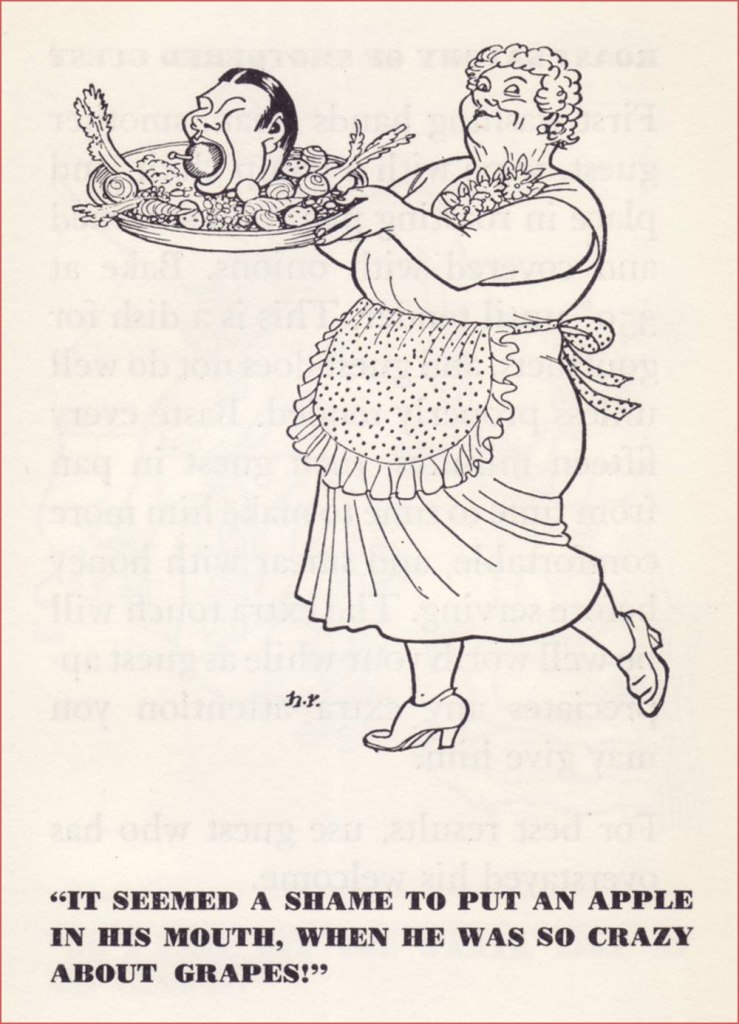
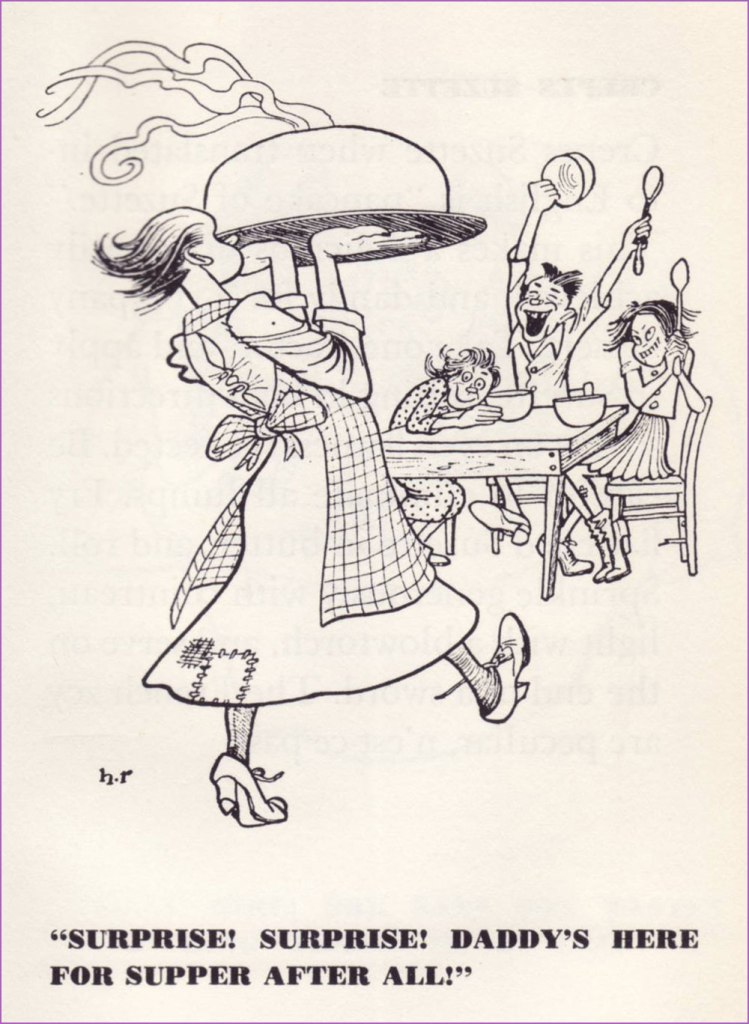
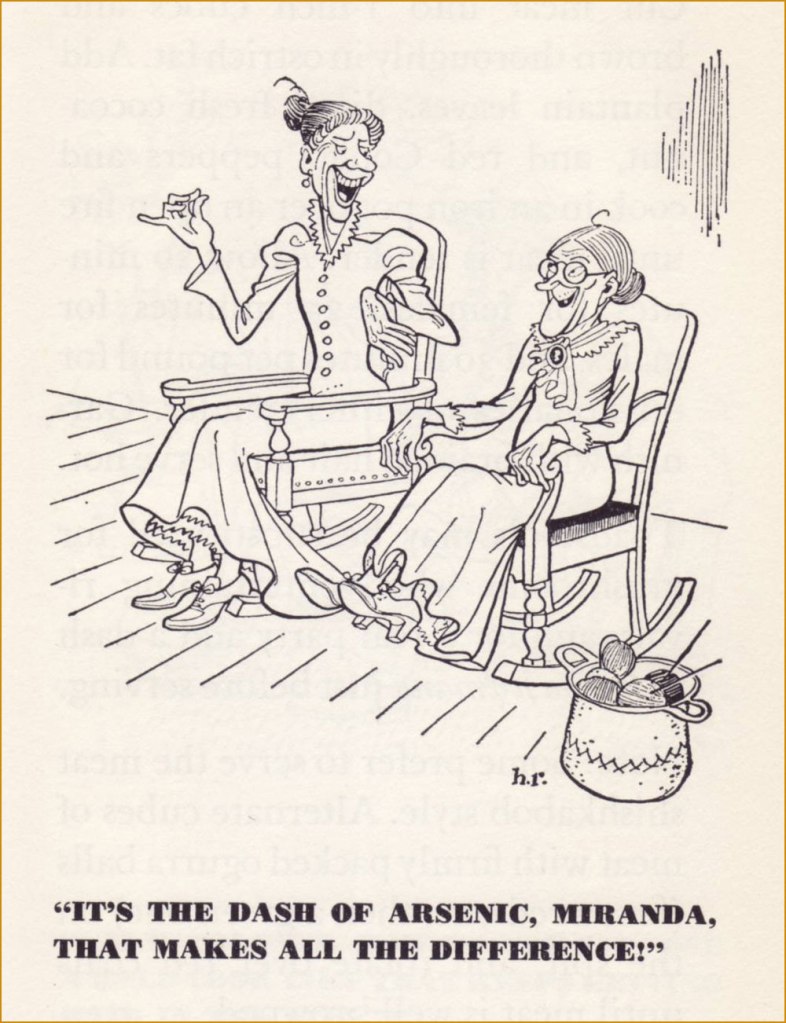
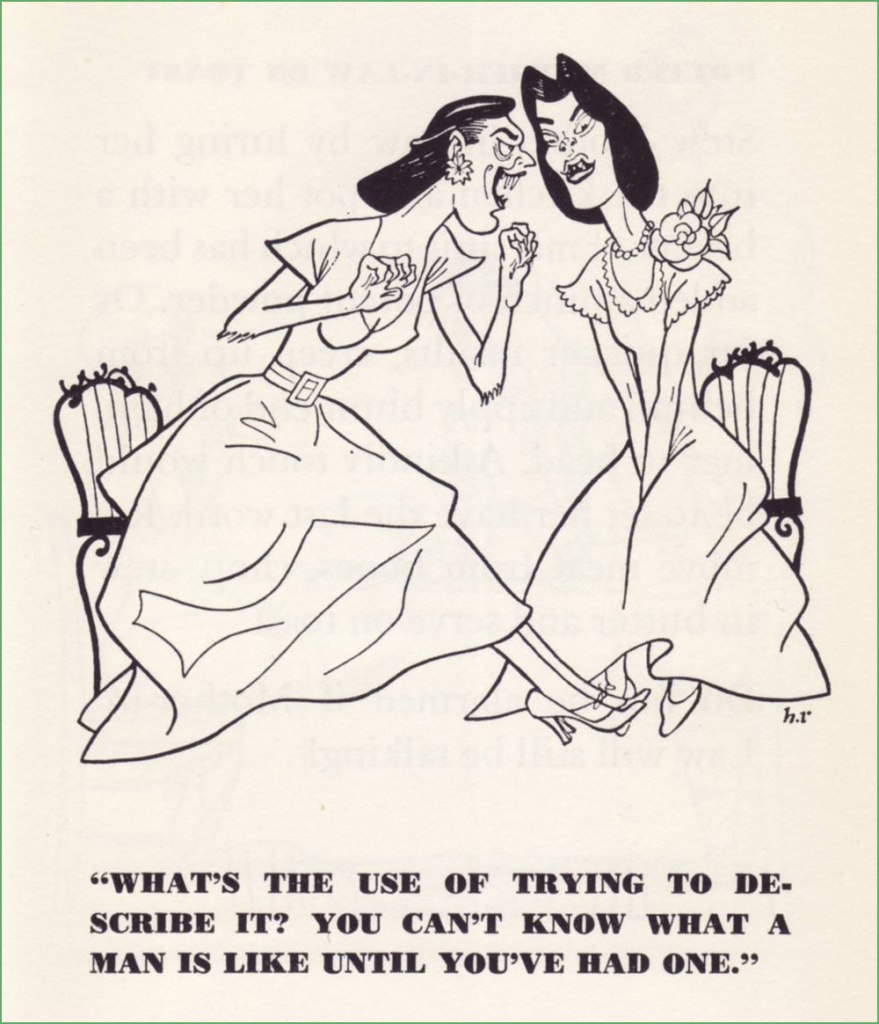
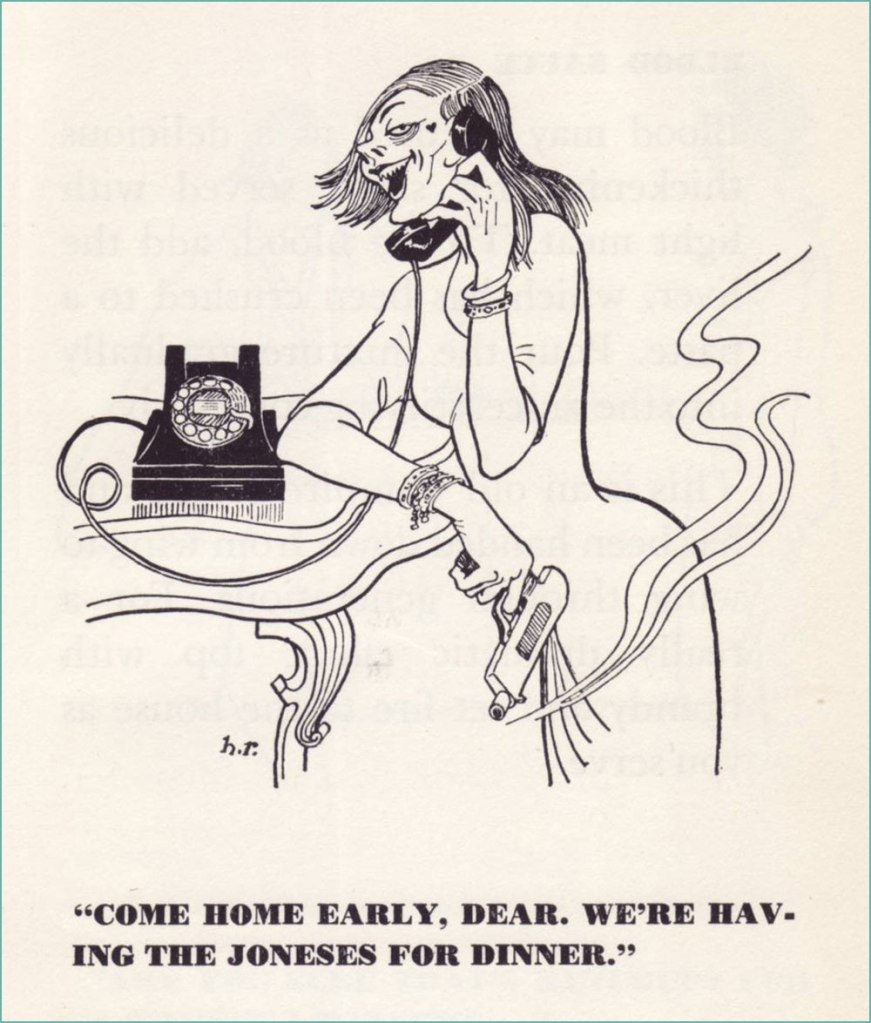
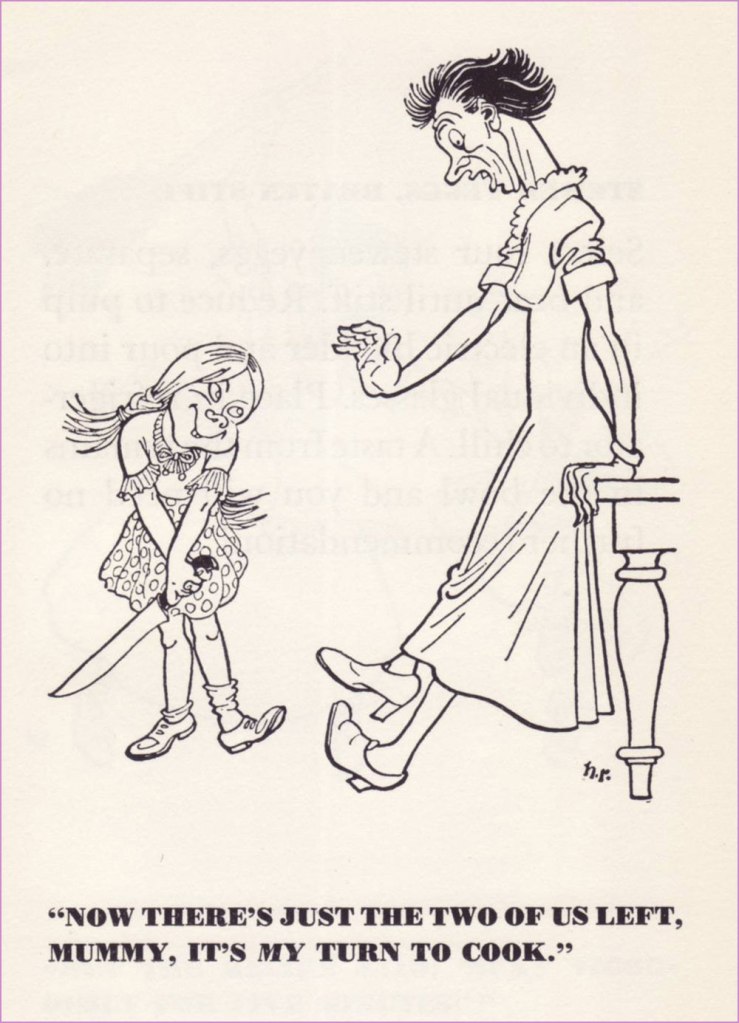
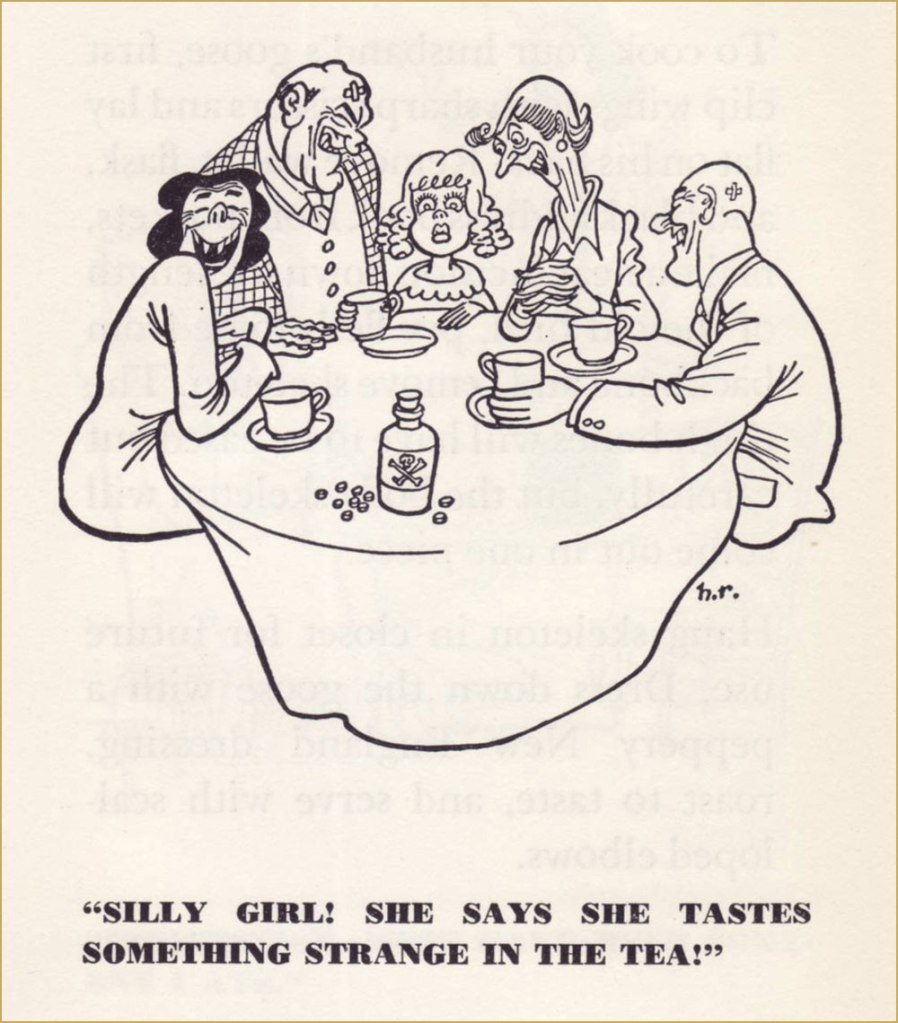
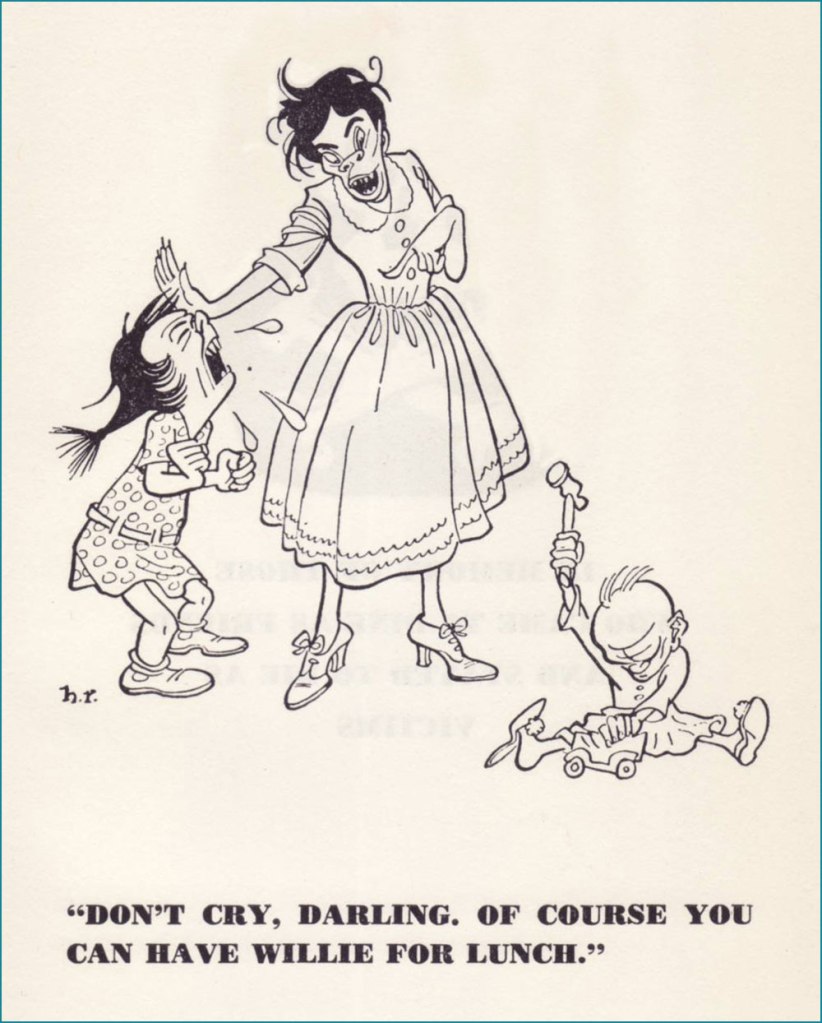
This time around, I’m tackling one of the rare and fairly expensive ones* — that I’m aware of — Cooking to Kill: the Poison Handbook (1951), which proposes « Comic recipes for the Ghoul, Cannibal, Witch & Murderer. Stewing and potting mothers-in-law. Tested recipes for spoiled brats, business rivals, and strayed lovers. »
« Anybody can kill vulgarly. But we should be above the brutal, the direct, the unappetizing approach. This little book will teach you to tickle the palates of your guests so that they will be happy to linger at your table, charmed to malinger, and grateful to take off for the Great Adventure with the taste of your superlative cooking still on their lips! » — from Prof. Ebezener Murgatroyd’s preface to his ‘gentle reader’.
The book is magnificently illustrated by Herb Roth (1887-1953), who spent much of his career toiling as H.T. Webster‘s assistant and ghost. Roth enjoyed a long association with the Peter Pauper Press, illustrating its very first two books, Faithless Sally Brown and Faithless Nellie Gray.
« Head Cheese garni à la Salomé » « Tomato Surprise (Asp in the Grass): this luncheon delicacy should be served only to ladies, as you will find their charming soprano shrieks particularly rewarding. »It’s hard to not think of Joseph Kesselring’s fabled Arsenic and Old Lace, written in 1939.« Walnut Balls: smash nuts with a hammer, fashion into balls and fry in deep fat until a golden brown. Delicious withcoq au vin. »« Chocolate Noose… will help you to execute a crime of considerable chic, and will add a je ne sais quoi to the court proceedings. »« Stuffed Spoiled Brat: select a fine specimen which has been spoiling for a good long time, and capture at opportune moment. » « Crêpes Suzette: take one tractor, and apply to Suzette, rolling in both directions so that an even flatness is achieved. Be careful to eliminate all lumps. Fry flattened Suzette in butter, and roll. Sprinkle generously with Cointreau, light with a blowtorch, and serve on the end of a sword. The French zey are peculiar, n’est-ce pas? »« Marinated Leeks: take a leek, marinate in French dressing, and combine with tender green peas. Serve with asparagus for a very special flavour. Sprinkle with cyanide for that final touch! »« Potted Mother-in-Law: stew Mother-in-law by luring her into the kitchen and pot her with a beaker of martinis to which has been added a pinch of potent powder. Or for quicker results, creep up from behind and apply blunt end of hammer to head. A kindly touch would be to let her have the last word. Remove meat from bones, chop, stew in butter and serve on toast. »This brings to mind those gleefully morbid rhymes about Little Willie, essentially the original Gashlycrumb Tiny. A sample: Willie saw some dynamite/Couldn’t understand it quite/Curiosity never pays/It rained Willie seven days.Why, some enterprising soul has even created these exclusive earrings! Just don’t sport them during the investigation and/or trial. Nobody likes a braggart.
-RG
*the single most sought-after PPP entry is without question Kathryn Paulsen‘s Witches’ Potions and Spells (1971). Just try getting your hands on a cheap copy!
I’ve always had a soft spot for Tony DiPreta’s striking style. When it came to Atlas’ material, it was generally a case of lousy writing and interesting art. But DiPreta could somehow lend credence to the dodgiest semblance of a plot, because he could smartly provide it with just the right tone. I’ve featured this unfairly obscure illustrator a couple times in the past, so you may want to start there: first, the sublimely ridiculous The Hidden Vampires, then the Tinseltown satire Skull-Face.
I was pleased, in reading a rare interview with the artist, to hear him confide that « In the 1950s I did some comic book work for Stan Lee and others. That was pre-Code horror stuff and I loved it. Some of the illustration I did for crime and horror stories in that period is among the best work I’ve ever done. » Amen!
Aside from an expensive, low print run ‘Marvel Masterworks’ hardcover, this story has never been accessibly reprinted. And so enjoy this scarce gem!
The original appearance: this is Journey Into Mystery no. 12 (Sept. 1953, Atlas). Cover art by Max «Carl Burgos » Finkelstein.
« Addams’ idea of a bracing day’s outing is to visit an insane asylum. He takes a kind and friendly interest in the inmates and will chat with them unselfconsciously by the hour. “They have a refreshing conversational approach,” he says. » — John Kobler
For this, the penultimate entry in this year’s Hallowe’en, I’ve reached for one of the most prized items in my collection: a book I apparently picked up for 10 dollars in the 1990s… it’s a bit hazy. It was originally given to (or by) one ‘Sadleir’ on December 25, 1950.
Coming upon the tome while browsing the general humour section, I vaguely recall being intrigued by its title, ‘Afternoon in the Attic’, and upon realising that it was illustrated by Charles Addams, the deal was sealed.
Since most of you won’t make it past the paywall, here’s part of the author’s New York Times obituary:
« John Kobler, a writer whose early days on the crime beat resounded in an enduring biography of Al Capone, died on Monday in Manhattan. He was 90.
He was born in Mount Vernon, N.Y., and was a 1931 graduate of Williams College. He worked for various news organizations as a reporter before editing the crime reportage of PM, a 1940’s New York tabloid.
In World War II he was a civilian intelligence officer posted to North Africa, Italy and France, where he was attached to the United States Embassy. He returned to freelance for The New Yorker, Colliers, Vanity Fair and The Saturday Evening Post. His first book, published in 1938, was ”The Trial of Ruth Snyder and Judd Gray.’‘ It interwove trial testimony with commentary about a notorious 1927 murder case. ”Some Like It Gory” (1940) and ”Afternoon in the Attic” (1950) were collected essays about bizarre crimes and creepy characters. ”Afternoon’‘ was illustrated by Charles Addams.
He was best known for ”Capone: The Life and World of Al Capone,” a biography published in 1971 and reissued most recently in 1992 by Da Capo Press. It remains in print, as does ”Ardent Spirits: The Rise and Fall of Prohibition” (Da Capo, 1993).
He also wrote biographies about Henry Luce (1968), John Barrymore (1977) and Otto Kahn (1989), the banker and arts patron. His favorite among them was ”The Reluctant Surgeon: A Biography of John Hunter’‘ (1960), the 18th-century Scottish anatomist and precursor of modern surgery (1960). » [ source ]
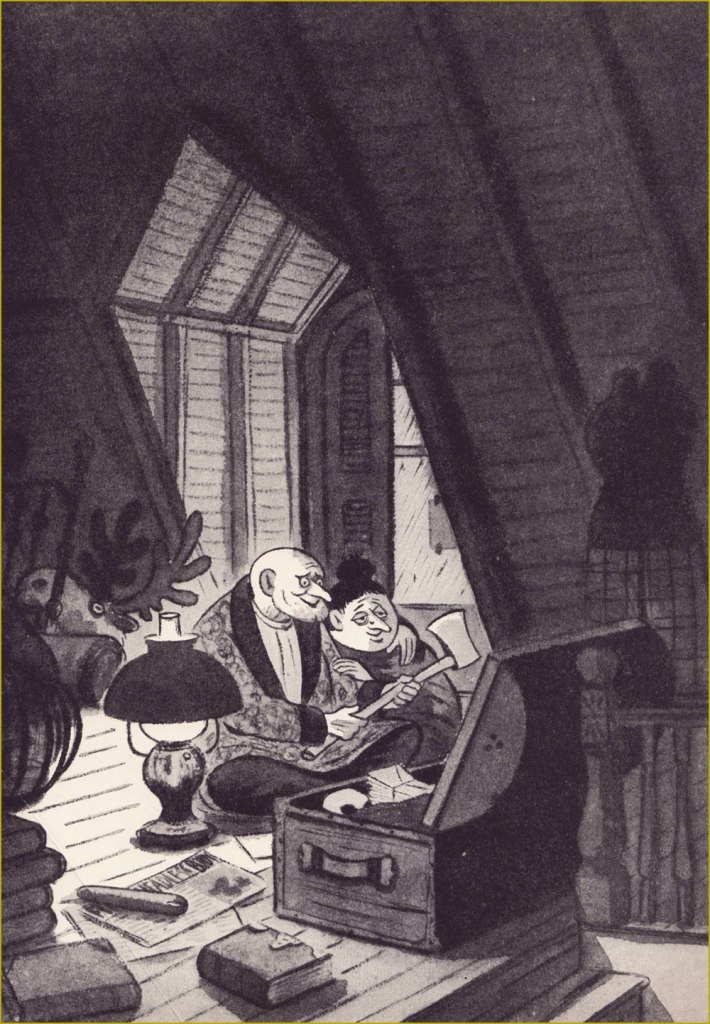
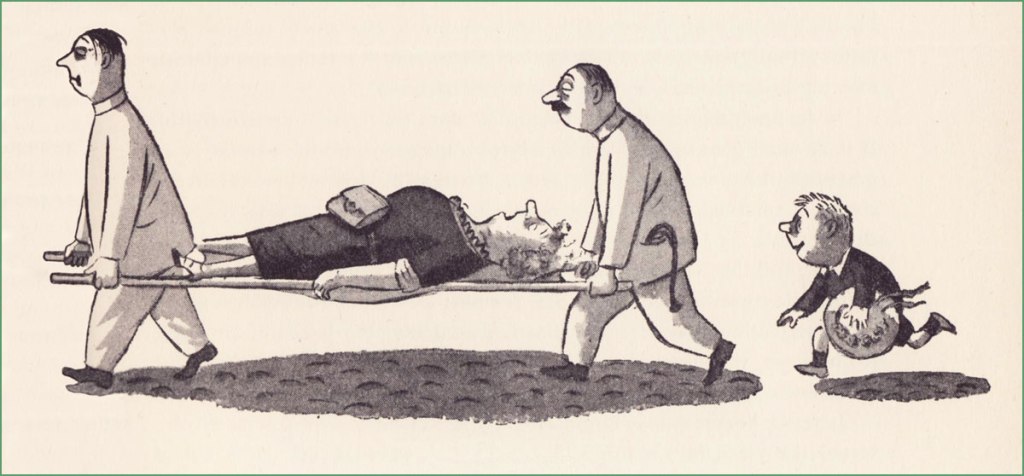
My copy had already shed its dust jacket by the time it came into my possession, but the cover image was also used as a frontispiece.While Kobler provides what’s likely the definitive biographical essay on Charles Addams (at 10 1/2 pages), Addams, in return, gives us this picture presumably worth the proverbial thousand words.
For this post, I’ll stick to a single essay, the one entitled « Next Week: Murder in a Madhouse ».
The introductory illustration…« Satisfied customers », quips the caption.
« The seats in front of me were occupied by an American family — father, mother, two girls and a small boy. “I just can’t bear it,” mother was saying, “I just won’t look.” The girls were chewing their programs which bore the Grand Gignol trade mark – a bat with a man’s head. The small boy, who I felt sure was a connoisseur of American comics, sat unruffled and superior. “Kid stuff,” he snarled. “Quiet!” said father, who seemed uncertain what his proper attitude ought to be. “The curtain’s going up.”
The climax bursts with all the restraint of a fire alarm. While Hunchback and Normandy Woman pinion Louise’s arms, One-Eye goes after the cuckoo bird with a knitting needle. Blood splashes all over everybody. (“Heavens!” mother gasped, forgetting not to look.) Louise’s screams shiver the scenery.
But a super climax is yet to come. Hunchback and Normandy Woman, suddenly fearful of what they have done, turn on One-Eye and force her face down upon a hot stove where it sizzles in a jet of smoke and flame like a barbecued mutton chop…
That was enough for father. He herded his family through the exit amid the shrill protests of the small boy who did not want to miss the rest of the program. What he missed included a maniac who disembowels small boys, a woman who gets shot in the head by a gangster and, sandwiched between for comic relief, a bedroom farce with lines never intended for little pitchers to hear, all of it staged with determined realism. »
My curiosity about this title was piqued at an early age, when tiny-but-alluring reproductions of some of its covers ran in editions of The Overstreet Comic Book price guide.
Here they all are, nice and big and colourful. Oh, and you can read them all here for free!
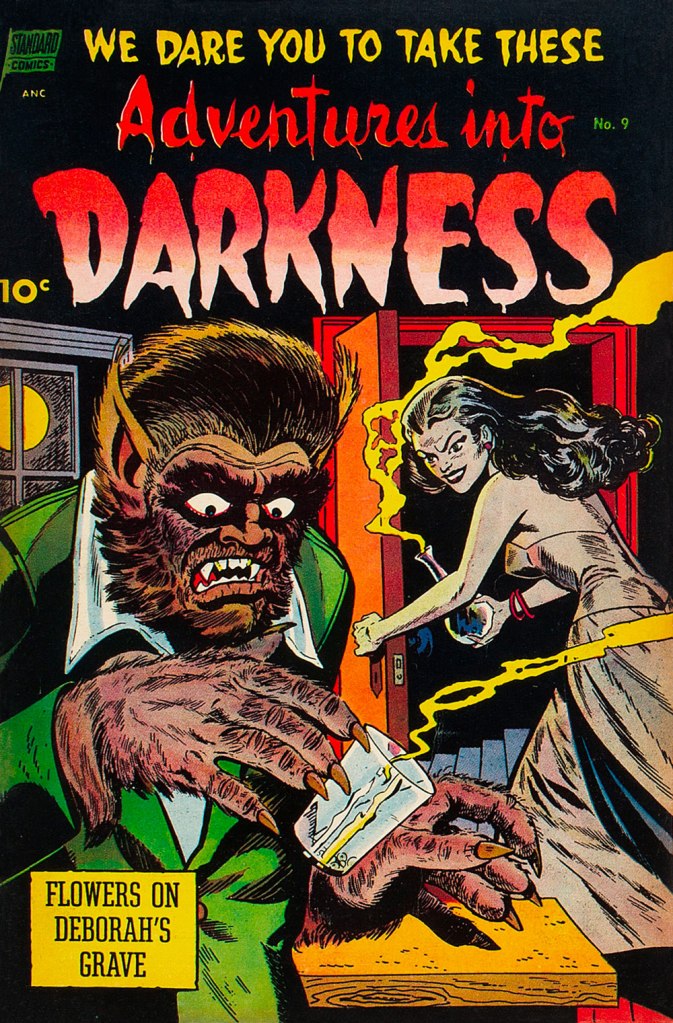
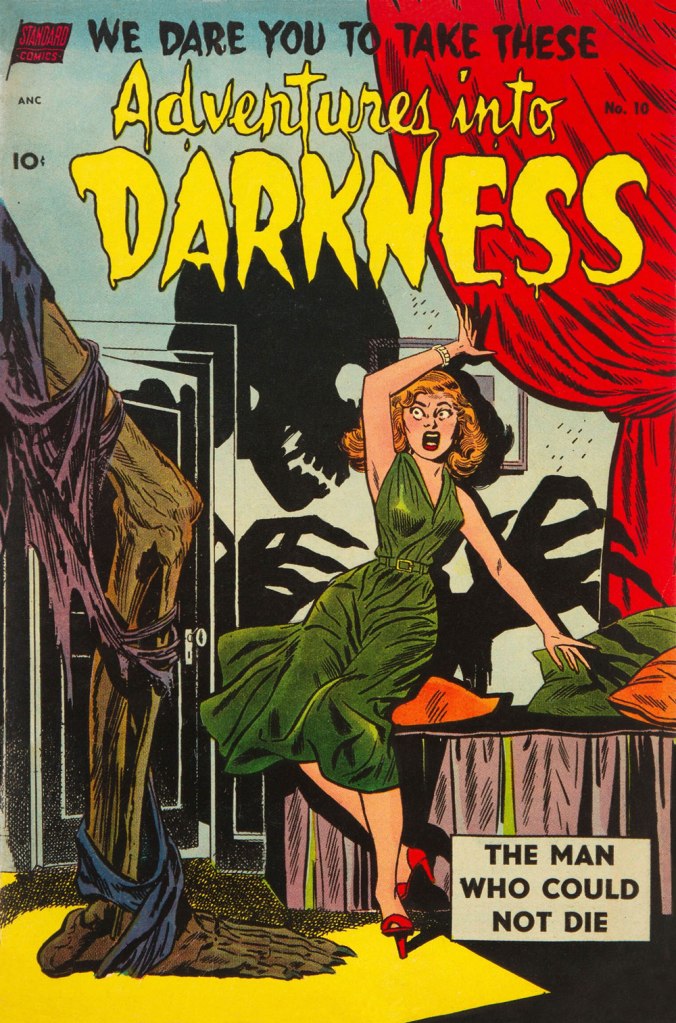
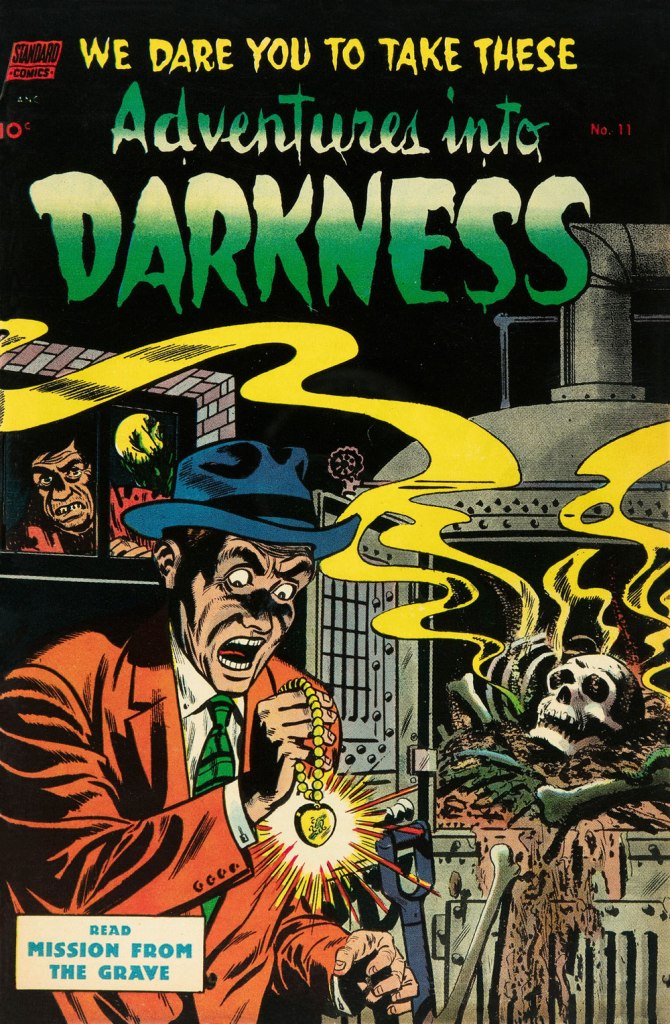
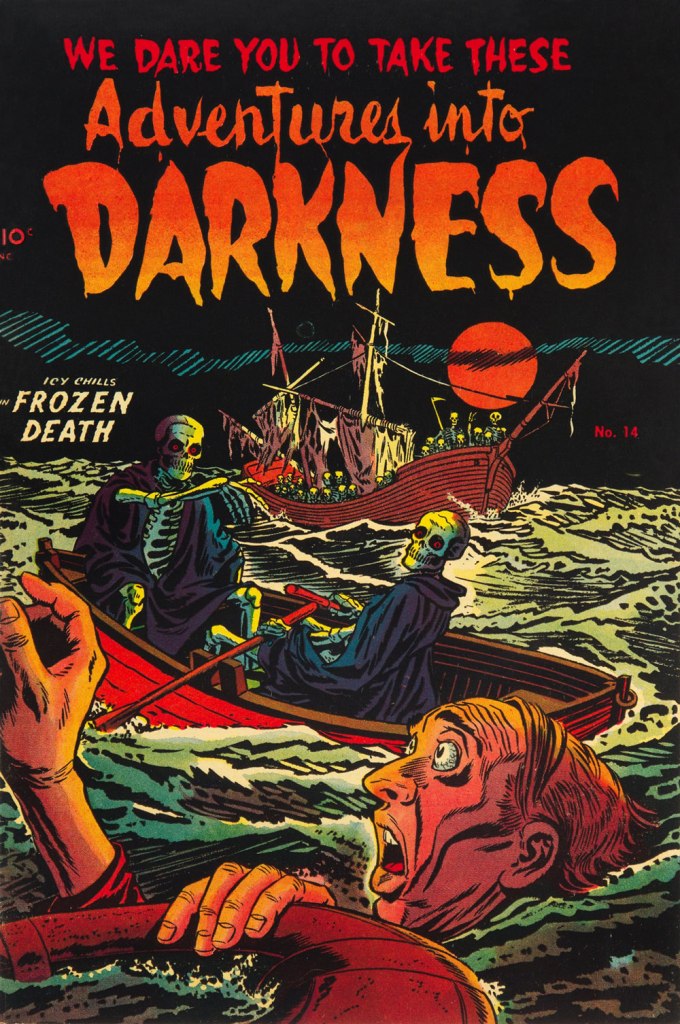
This is Adventures Into Darkness no. 5 — the first issue — don’t ask — (Aug. 1952, Standard). Cover by George Roussos (1915-2000).This low-key entry is Adventures Into Darkness no. 6 (Oct. 1952, Standard). Cover by George Roussos. Though unspectacular, this theme would be taken up and imitated (with variations) a bunch of times, which goes to demonstrate some folk’s morbid fear of marriage.This is Adventures Into Darkness no. 7 (Dec. 1952, Standard). Cover by the remarkably driven Jack Katz (b. 1927)… a most interesting man.This is Adventures Into Darkness no. 8 (Feb. 1953, Standard). Cover by future Charlton Comics pillar Rocco “Rocke” Mastroserio, already showing his tremendous potential as a cover creator. One of my all-time favourite bloggers (et cetera!) Jason Willis, loved this cover so much that he used it to create a bonafide animated commercial for the issue! Bless you, Jason!This is Adventures Into Darkness no. 9 (Apr. 1953, Standard). Cover artist unknown… and what’s going on here? Did the femme fatale turn her unsuspecting victim into a werewolf, or did she doom him with a deadly dose of acid or some other poison?This is Adventures Into Darkness no. 10 (June 1953, Standard). Cover by Ross Andru… possibly my very favourite cover of his — lord knows he dragged his reputation through forty miles of bad road with his dire late 1970s work at DC.This is Adventures Into Darkness no. 11 (Sept. 1953, Standard). And we’re back to Mr. Roussos, who provides more of a crime comic cover this time around. Still grisly, though!This is Adventures Into Darkness no. 12 (Dec. 1953, Standard). Cover by Mike Sekowsky… those cute little caps the mine demons are wearing are a bit of a Sekowsky trademark.
We skip over issue thirteen, not through superstition, but because it’s already been featured in our Mike Sekowsky spotlight — and with good cause, as it’s a spiffy one!
And finally, this is Adventures Into Darkness no. 14 (June 1954, Standard). Cover tentatively attributed to Ross Andru.
A fifteenth (well, eleventh, really) issue had been in the offing, but as censorship tore the comics industry apart in 1954, plans to publish it were abandoned… which brings us full circle to one of our earliest countdown posts on that very topic.
« Then hear this, and never forget it. Any fool with fast hands can take a tiger by the balls, but it takes a hero to keep on squeezing. » ― Stephen King, The Dark Half
A couple of years back, I was reading, through idle curiosity, a ranking of Stephen King’s books*. I came upon the article author’s précis for King’s 1993 novel The Dark Half:
« The premise is simple and ingenious: a literary author “kills” off the pseudonym whose popular fiction has been paying the bills, only for that alter ego to take murderous, corporeal form. Within the killing spree that ensues, King offers some profound observations about the schism between high art and popular culture, while also exposing his own worries about legacy. » I like King’s perhaps a bit too cute allusion to Donald Westlake’s troubles with his better-selling, pulpier pseudonym Richard Stark — The Dark Half’s antagonist is named George Stark.
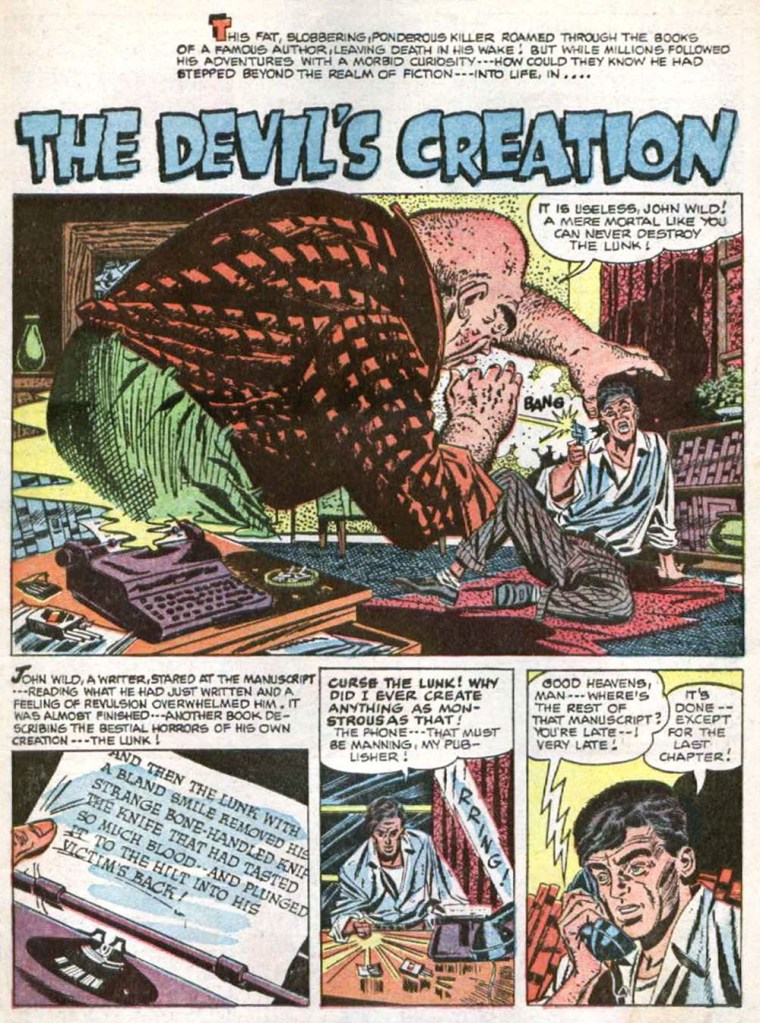
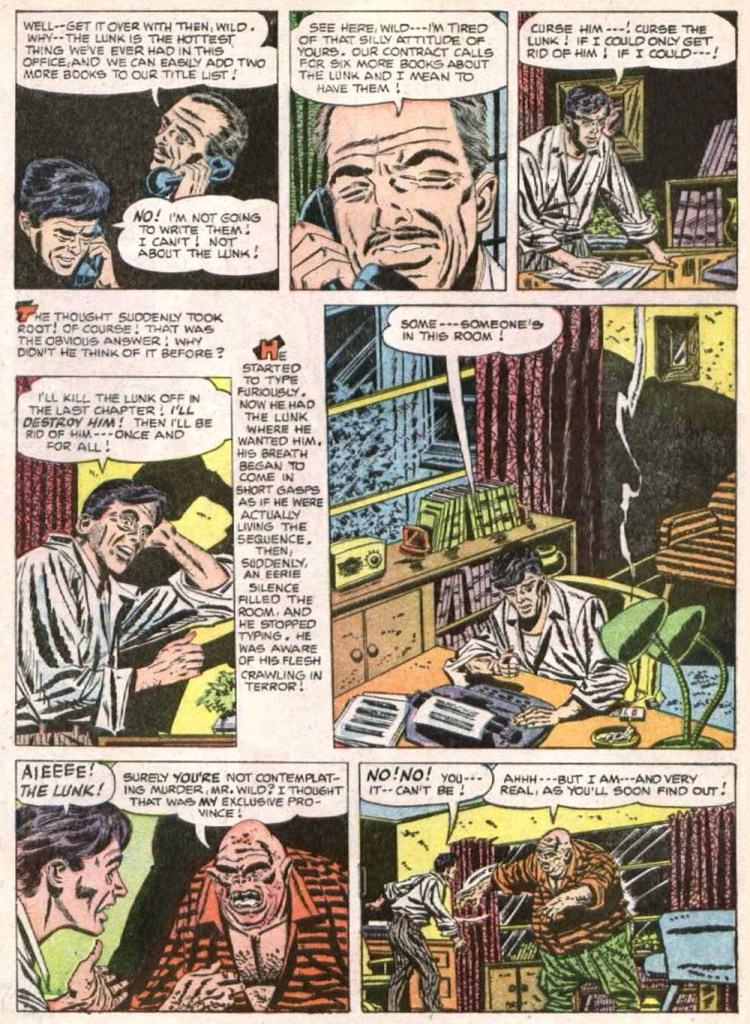
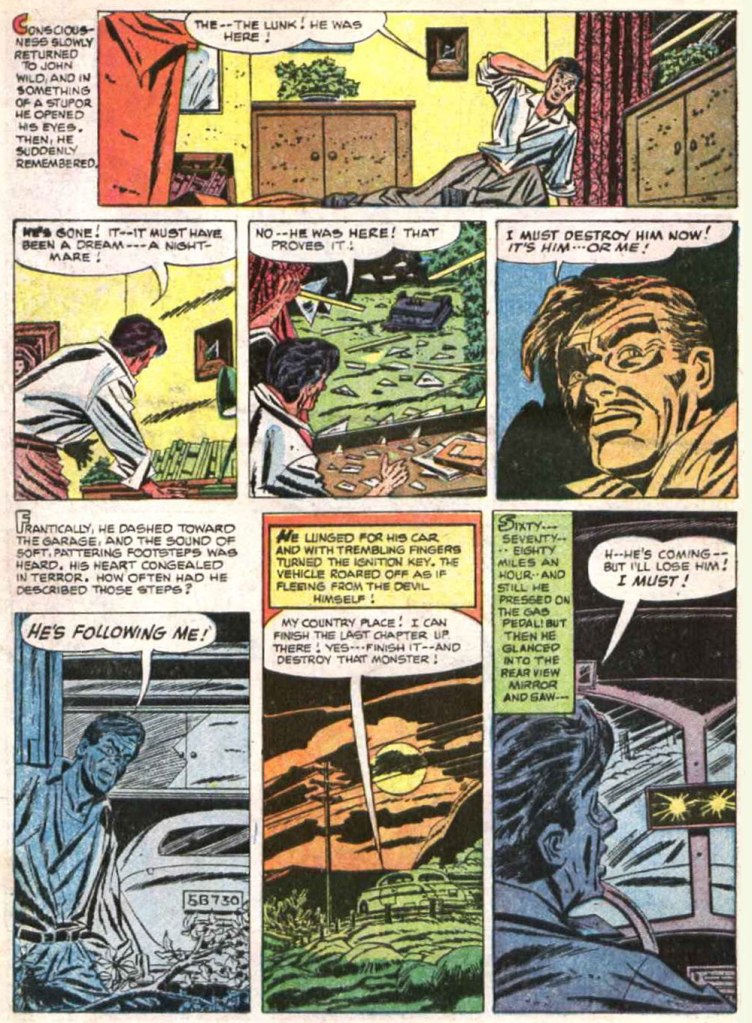
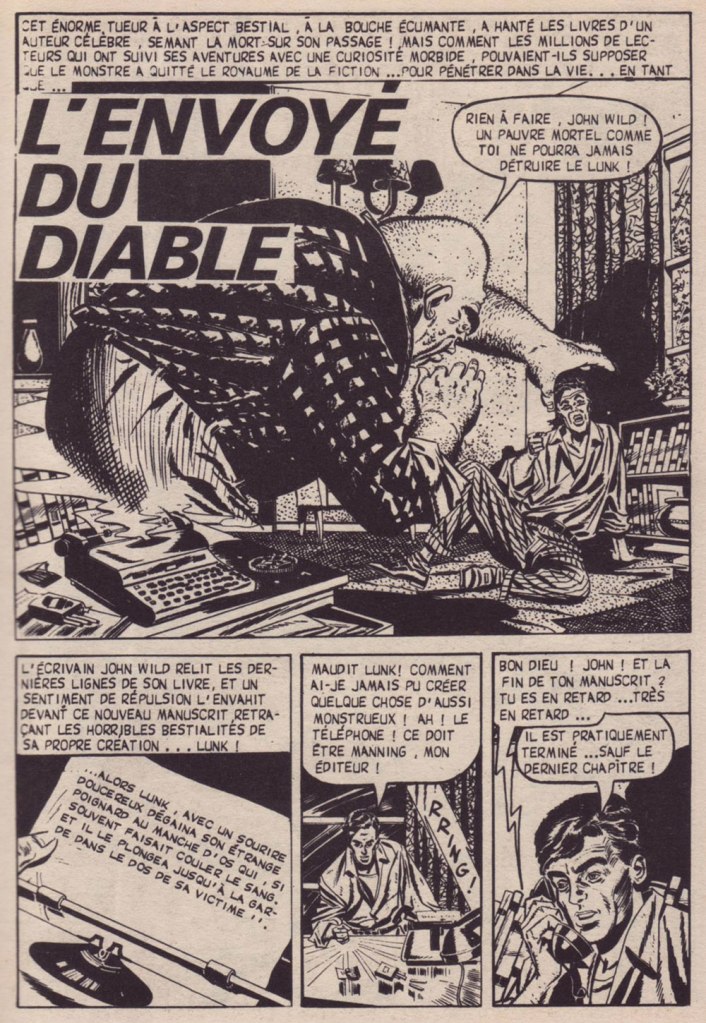
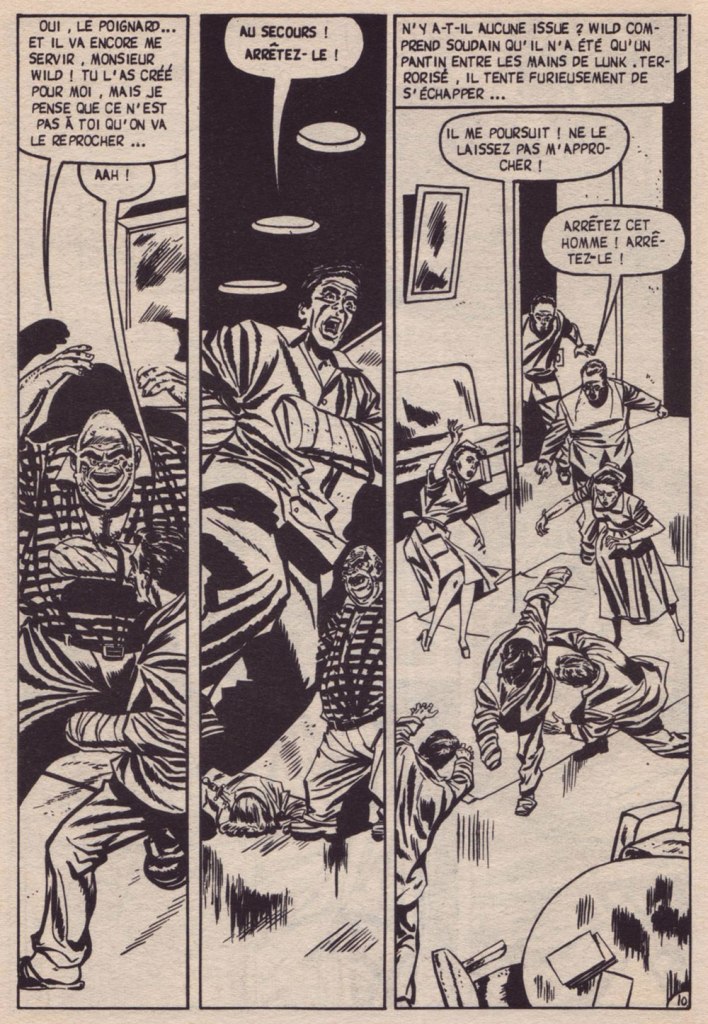
Anyway, that essential premise reminded me vividly of a harrowing comic book story I’d encountered as a child. Here it is — poorly reproduced, I’m afraid — and I’ll provide a bit of context afterwards.
The Devil’s Creation originally saw print in Beware! Terror Tales no. 2 (July 1952, Fawcett). Scripter unknown, art by Mike Sekowsky (1923-1989).On a small town kid’s budget, some US comic books were highly unlikely to turn up on my local spinner rack. Besides, I didn’t even know English yet. But these French digests (162 pages for 35 cents!) could be a godsend. This one came out slightly before my time, but I somehow landed a second-hand copy. This is my dog-eared Eclipso no. 9 (Oct.-Dec. 1970, Arédit); I was, within its pages, introduced to — besides Eclipso — Deadman, The Spectre, The Doom Patrol, The T.H.U.N.D.E.R. Agents and Mark Merlin.
Amid all this fine, but sanitised Silver Age fare, here was one short story that sharply stood out by its merciless brutality. I’m still mystified at how this seemingly random story, which hasn’t even been reprinted once in North America, so incongruously landed in this collection. Amusingly, Sekowsky appears elsewhere in the issue, pencilling the light-hearted A Day in the Life of Dynamo (from Dynamo no. 1, Aug. 1966, Tower). Say what you will, the man was versatile.
Notice how they took away his gun? Censorship was pretty strict in France when it came to publications for youth. In reformatting stories for a different size and ratio, this publisher’s efforts were often pretty dismal; this, however, was an exception. I daresay the pacing was even improved. You simply never know!
-RG
*Not having made it through much of his oeuvre, my favourite King is the non-fiction Danse Macabre (ranked his 51st best book). Fun fact: ill-advisely, the French have retitled King’s famous short story collection Night Shift (ranked no. 13)… Danse macabre. The real DM was retitled Anatomie de l’horreur (‘Anatomy of Horror’). Now I’m sure that didn’t confuse anyone.
« the escape from the black widow spider / is a miracle as great as art. / what a web she can weave / slowly drawing you toward her… » — Charles Bukowski, The Escape
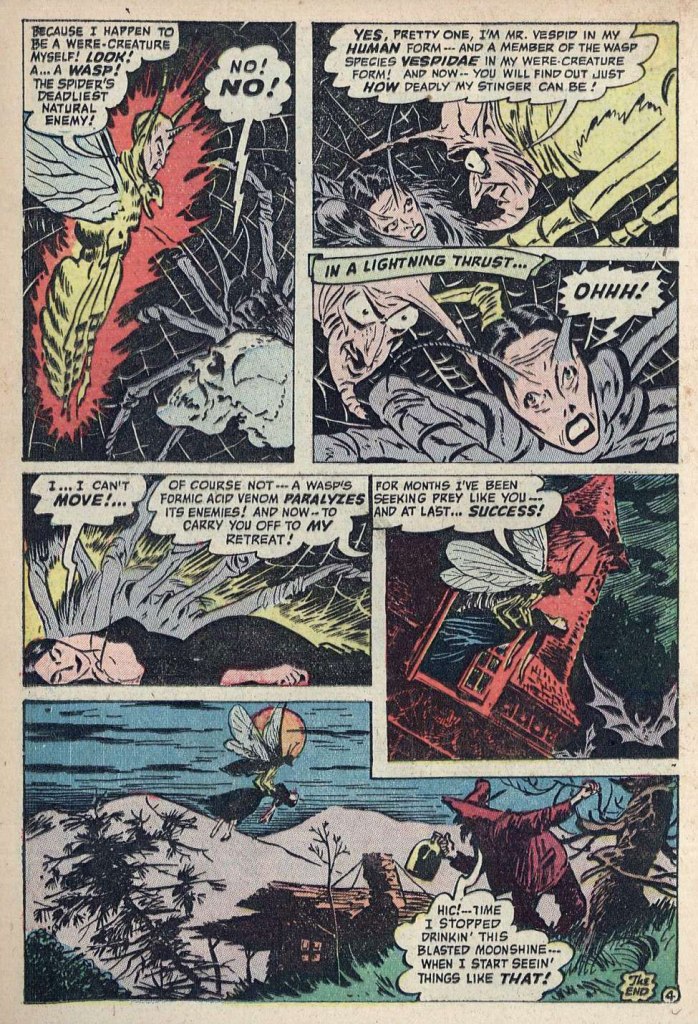
This time around, here’s an over-the-top gem from ACG. No matter what anyone might think, I hold that the sloshed neighbourhood yokel bookending the tale is its star.
The striking artwork is by the mysterious King Ward.
I’d be inclined to say that the « In a lightning thrust… » panel surely wouldn’t have passed muster with the censors… but this was pre-Code horror, after all!
Incidentally, that bit about wasps and spiders, while essentially factual, smacks of your typical comic book oversimplification. Here’s the real-world lowdown.
It wasn’t the cover story — good thing, too: how much more of the plot could they have given away? — but said cover’s a nice one by Ken Bald (1920-2019), so I’m throwing in it. This is Forbidden Worlds no. 12 (Dec. 1952, ACG).
« Master of puppets, I’m pulling your strings / Twisting your mind and smashing your dreams / Blinded by me, you can’t see a thing / Just call my name ’cause I’ll hear you scream / Master, master! » — Metallica
I’ve never been a Jim Mooney (1919-2008) fan, though he’s undeniably had a long and respectable career as a penciller (Tommy Tomorrow, Supergirl, Dial H for Hero, Omega the Unknown) and inker (Spiderman, Thor… and countless others). I’ve always found his work a bit stodgy and lightweight.
As these things usually go, however, if you keep an open mind, you’re bound to come up with exceptions, and here’s one.
While Atlas’ pre-Code horror comics were generally saddled with indifferent or nonsensical writing, the artwork on offer was often surprisingly wild. I mean… they even got straight-laced Joe Sinnott to go downright weird on a couple of occasions.
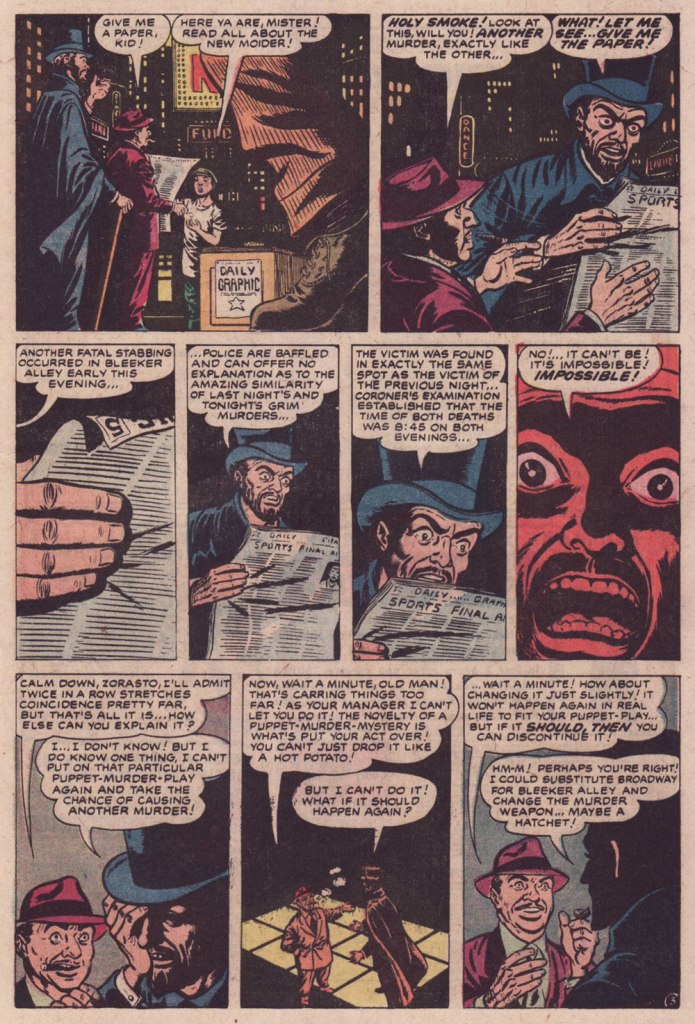
Here’s a short story that’s compellingly sombre, sinister and paranoid, and Mooney perfectly conveys its oppressive mood.
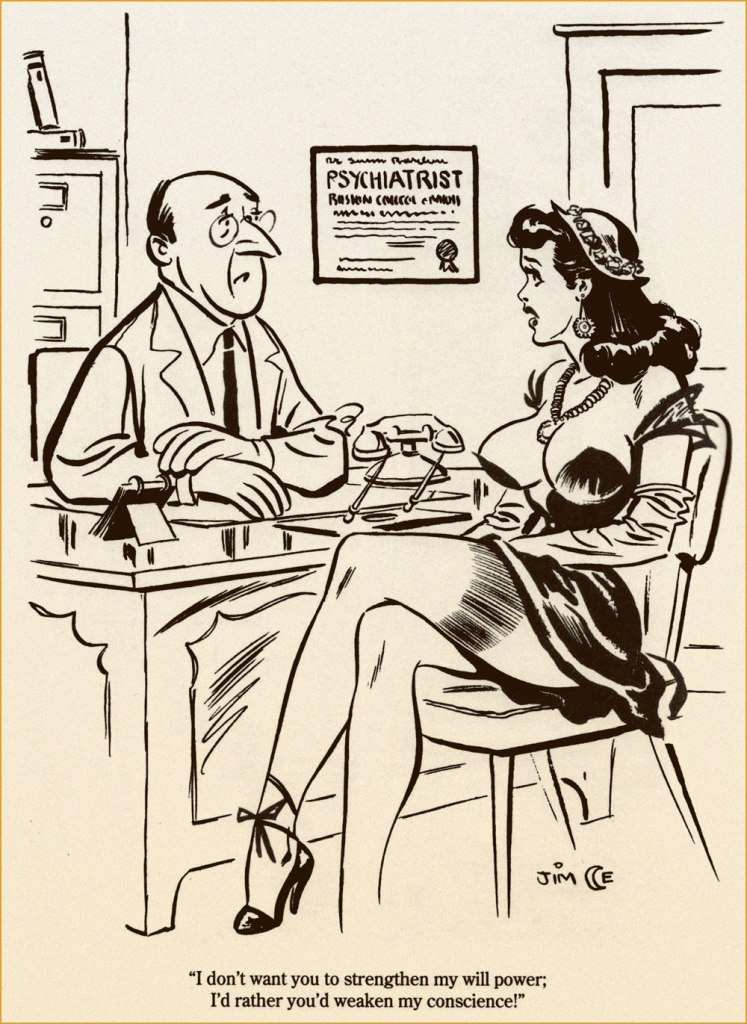
The ending is daft… and at the same time, inspired lunacy that takes it to another level. While I’m drawing from a 1974 reprint, here’s the cover from its original publication, Spellbound no. 13 (March 1953, Atlas); cover pencilled and inked by Carl Burgos, colours by Stan Goldberg. Working in the Goodman Family salt mines (in this case, the Humorama line of ‘girlie’ digests, at ten bucks a cartoon, writing included), Mooney was probably more in his element, nimbly bridging the cartoonish and more academic semi-realism, not a common skill!































 Who's Out There?