Matt Howarth‘s heroïneKēif Llama (pronounced keef yamma) has already been bestowed an exhaustive spotlight by my partner ds, so I shan’t rehash what she said. But since there are no tentacles involved in this case, I feel I’m on safe ground to take a peek at the spookiest bits of one of our favourite Xenotech’s startling interstellar encounters.
This is Keif Llama Xenotech Vol. 2.4 (Jan. 2006, Mu Press/Aeon), and despite what some have claimed, *not* a reprint of the also-recommended Fantagraphics series bearing the same name and logo.
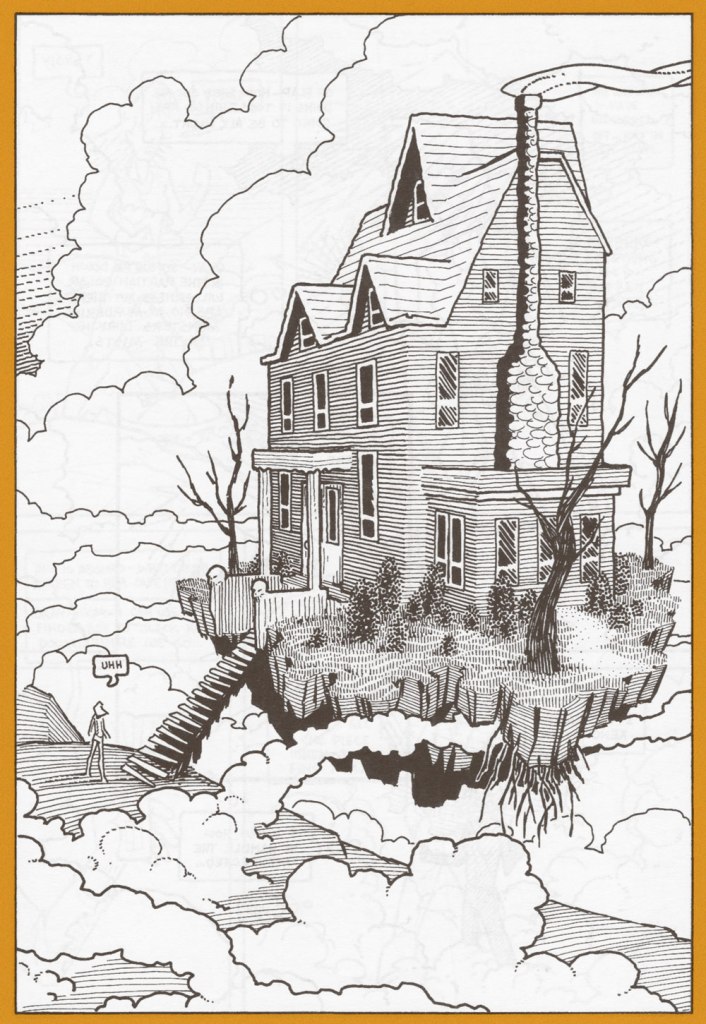
For once, someone was thoughtful enough to provide stairs for those of us still subject to the law of gravity.
… then you will die. Sounds reasonable.
An earlier recorded instance of a Haunted House in Space, from It’s Midnight… the Witching Hour no. 14 (Apr.-May 1971, DC). Layout by Carmine Infantino, pencils and inks by Neal Adams — both presumably drawing closely on Al Williamson‘s opening splash for the cover story (right down to the deer!), which you can read here!
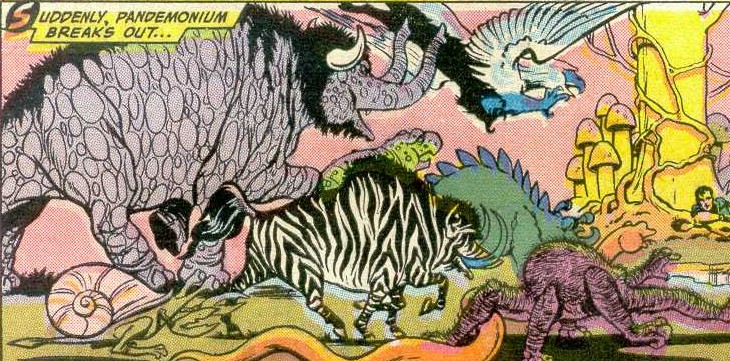
DC’s Tales of the Unexpected offer quite a ménagerie of strange looking creatures! Any peculiar combination of animals you can think of, you’ll find somewhere within the pages of this series. This possibly deserves its own post, as it’s quite entertaining to see artists combining, say, an elephant with a tiger. That being said, I tend to get annoyed at artists who can’t visualize anything truly alien-looking, thus resorting to carving up earth animals and stitching different body parts together… but that’s a different conversation.
Art by Lou Cameron.
Occasionally the artists will also add tentacles, a sure shortcut to make something mundane look properly alien, and this is today’s area of interest! For more questionable monsters, have a gander at Tentacle Tuesday: Convoluted Critters.
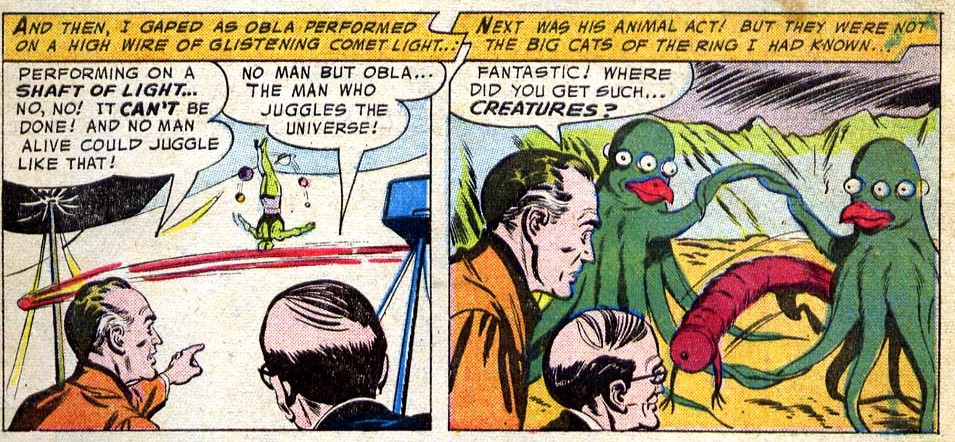
And now, onto ‘unexpected’ tentacles, even if the result of this ends up looking like badly-made puppet with a tacked-on beak…
The Strangest Show on Earth, illustrated by Jim Mooney, was published in Tales of the Unexpected no. 10 (February 1957).
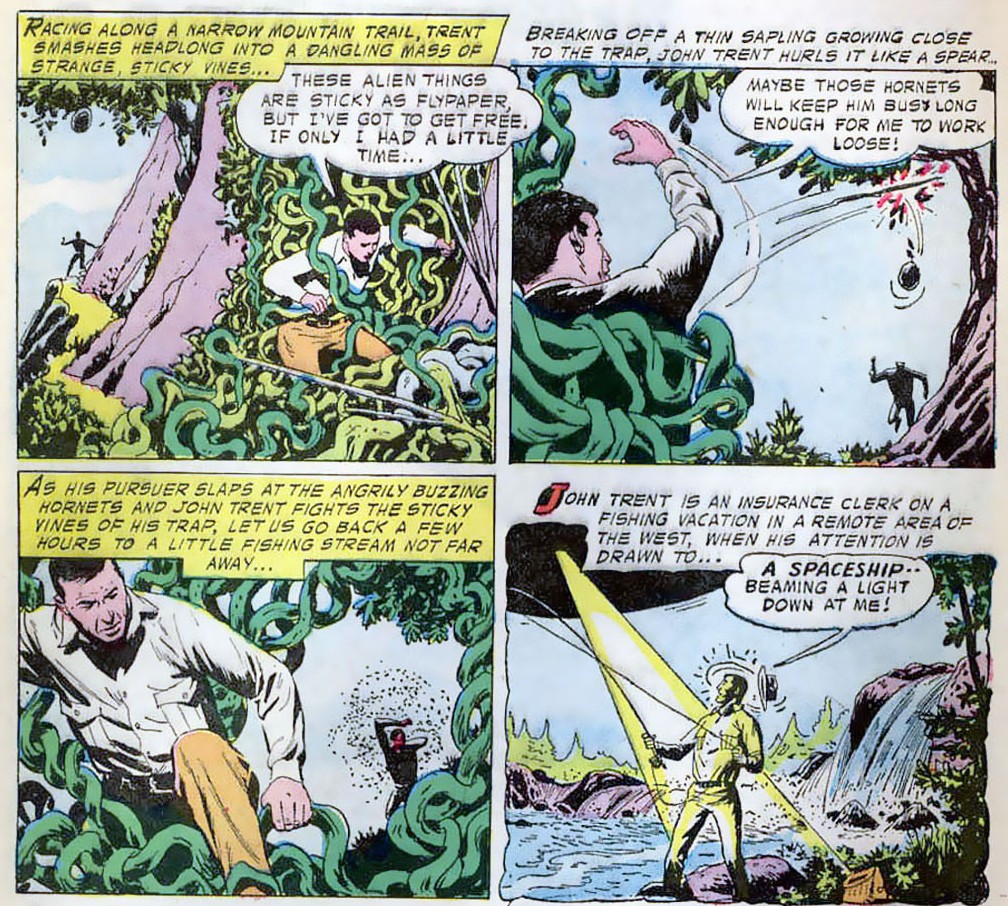
Of course one can’t discount the lasting power of classic vine-tentacles.
The Earth Gladiator, illustrated by Nick Cardy, was published in Tales of the Unexpected no. 20 (December 1957).
Whereas these mini-planets gone bonkers with tentacles-cum-hair bring to mind, but anticipate, something by Junji Ito.
The Alien Earthmen, illustrated by Ruben Moreira, was published in Tales of the Unexpected no. 62 (June 1961).
The idea of an interplanetary veterinarian makes little sense for its assumption that life on other planets would have similar physiology to ours (even limiting the scope of action to only planet earth would be too ambitious – ask a doctor to treat a sick jellyfish and see how well he would do), but here we have the satisfaction of a sweet little scene of inter-species succor.
Creature Doctor of Space, illustrated by George Roussos, was published in Tales of the Unexpected no. 63 (July 1961).
Some 30 issues later, we have another case of rabid tree-tentacles… this time composed of rubber (or something that behaves like rubber, at any rate).
Prisoners of Hate Island, illustrated by George Roussos, was published in Tales of the Unexpected no. 93 (Feb-March 1966).
Finally, this tentacled purple gorilla (so his tail is more dinosaur than gorilla, so what?) will no doubt please a regular reader of this blog!
Tales of the Unexpected no. 71(June-July 1962). Cover by Bob Brown.
« Doublethink means the power of holding two contradictory beliefs in one’s mind simultaneously, and accepting both of them. » — George Orwell
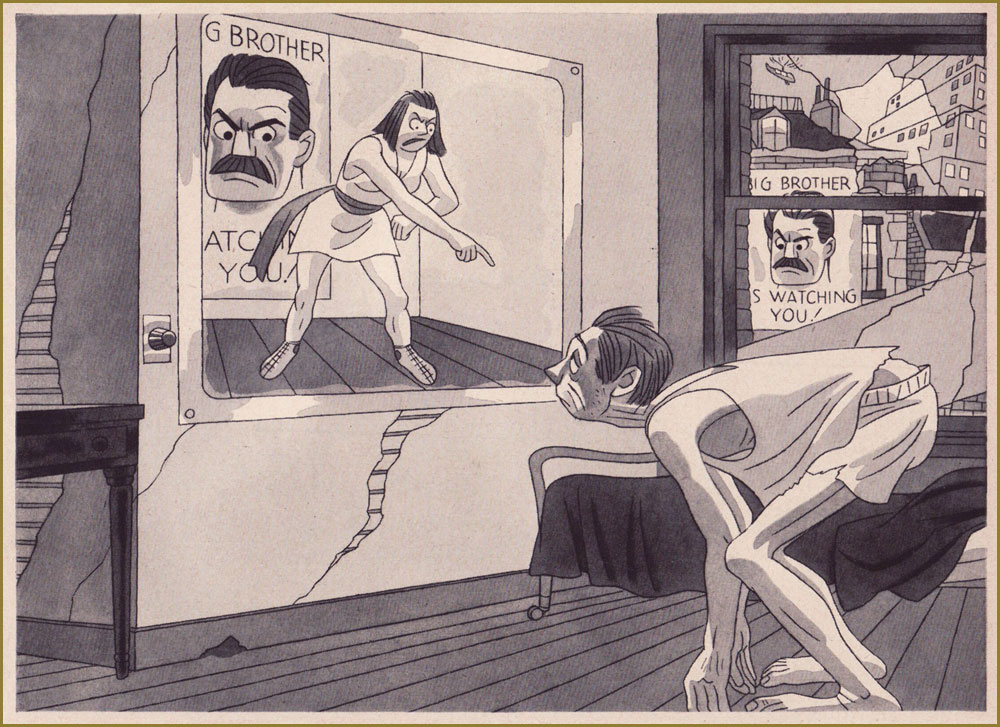
For its July 4, 1949 issue, Life Magazine pulled a couple of rather unusual moves: it featured an elaborate preview of George Orwell’s just-published novel Nineteen Eighty-Four and, as if that wasn’t weird enough, it called upon the services of renowned cartoonist Abner Dean to (copiously) illustrate the article.
Typically, given the USA’s usual political temperament and the then-prevailing climate of McCarthyism and the Red Scare, Life resorted to some choice bits of disinformation and misdirection to sell Orwell and his book to its decidedly whitebread readership. No irony whatsoever.
« British novelist George Orwell, 46, who fought in the Spanish Civil War, saw firsthand what the Communists were up to and has since devoted all his talents to warning the world of the fate which awaits it if it confuses liberalism with regimentation. His new novel, Nineteen Eighty-Four, is a terrifying forecast of what the world of human beings may be like 35 years hence. It is a July selection of the Book-of-the-Month Club and will be condensed in the September Reader’s Digest. It is guaranteed to make the flesh creep on anything except brass monkeys and commissars. »
Dean’s huge (52 cm x 24 cm) spread ushering readers into The Strange World of 1984. It’s hard to do it justice at this reduced size, but open it in a separate tab for a closer look.
Let’s see, now. Orwell fought in the Spanish Civil War. Fair enough. Let’s dwell on that detail for a bit. Which side was he on?
« In December 1936, Orwell went to Spain as a fighter for the Republican* side in the Spanish Civil War that was provoked by Francisco Franco’s Fascist uprising. He did not join the International Brigade as most leftist did, but the little known Marxist POUM. In conversation with Philip Mairet, editor of New English Weekly, Orwell said: ‘This fascism… somebody’s got to stop it’. To Orwell, liberty and democracy went together, guaranteeing, among other things, the freedom of the artist; the present capitalist civilization was corrupt, but fascism would be morally calamitous.
He joined the Independent Labour Party contingent, which consisted of some twenty-five Britons who had joined the militia of the Workers’ Party of Marxist Unification (POUM – Partido Obrero de Unificación Marxista), a revolutionary communist party. The POUM, and the radical wing of the anarcho-syndicalist CNT (Catalonia’s dominant left-wing force), believed General Franco could be defeated only if the Republic’s working class overthrew capitalism — a position at fundamental odds with the Spanish Communist Party, and its allies, which (backed by Soviet arms and aid) argued for a coalition with the bourgeois parties to defeat the fascist Nationalists. » [ source ]
So… Orwell was not merely a communist, but a Marxist advocating the overthrow of capitalism. Just like your average Reader’s Digest subscriber, obviously!
« THE TELESCREEN dominates the lives of Party members; it is a kind of television set which can never be turned off, and which can pick up as well as receive images. Over it the members hear what they are supposed to do and believe — and from the other end the dreaded Thought Police can see everything they do and hear everything they say. » Prophetic? Now don’t be silly.
« TWO MINUTES HATE is a daily institution designed to keep Party members in a frenzy of excitement and rage against the Party’s enemies. »
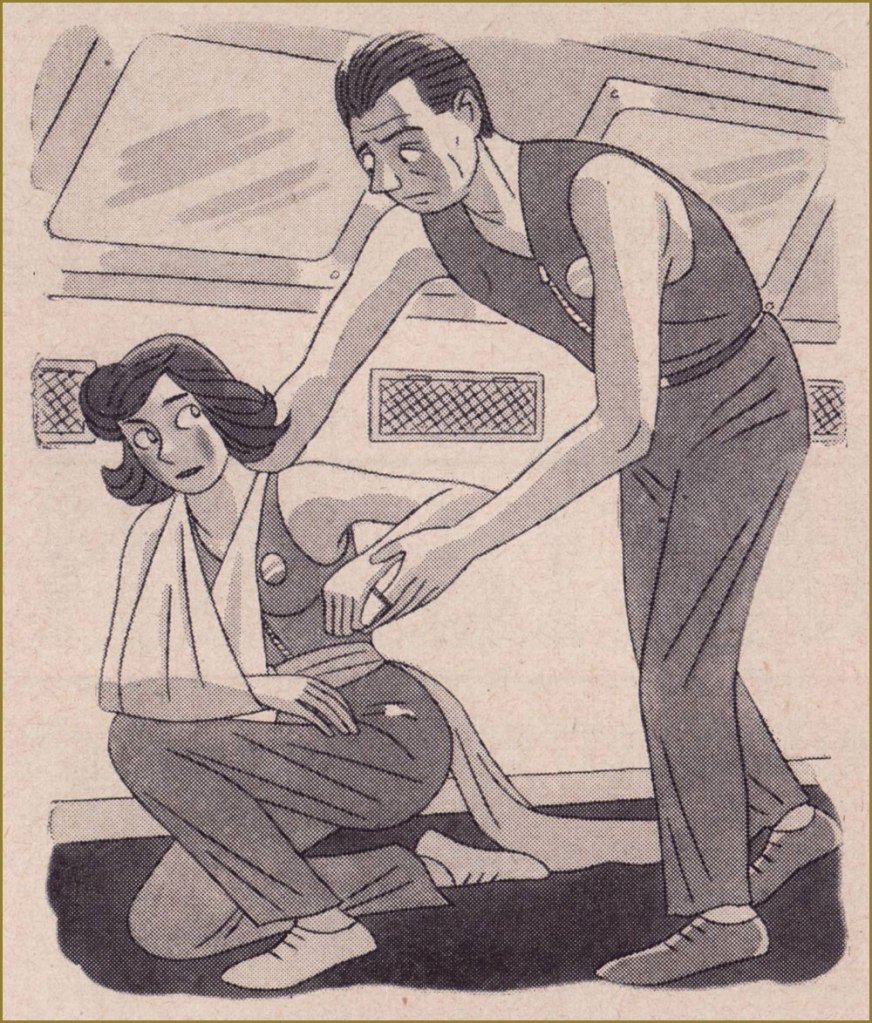
A LOVE AFFAIR in six panels. Spoilers galore. Protagonist Winston Smith meets Julia.
Julia hands Winston a note, which he drops into the memory hole (basically an incinerator) as a precaution.
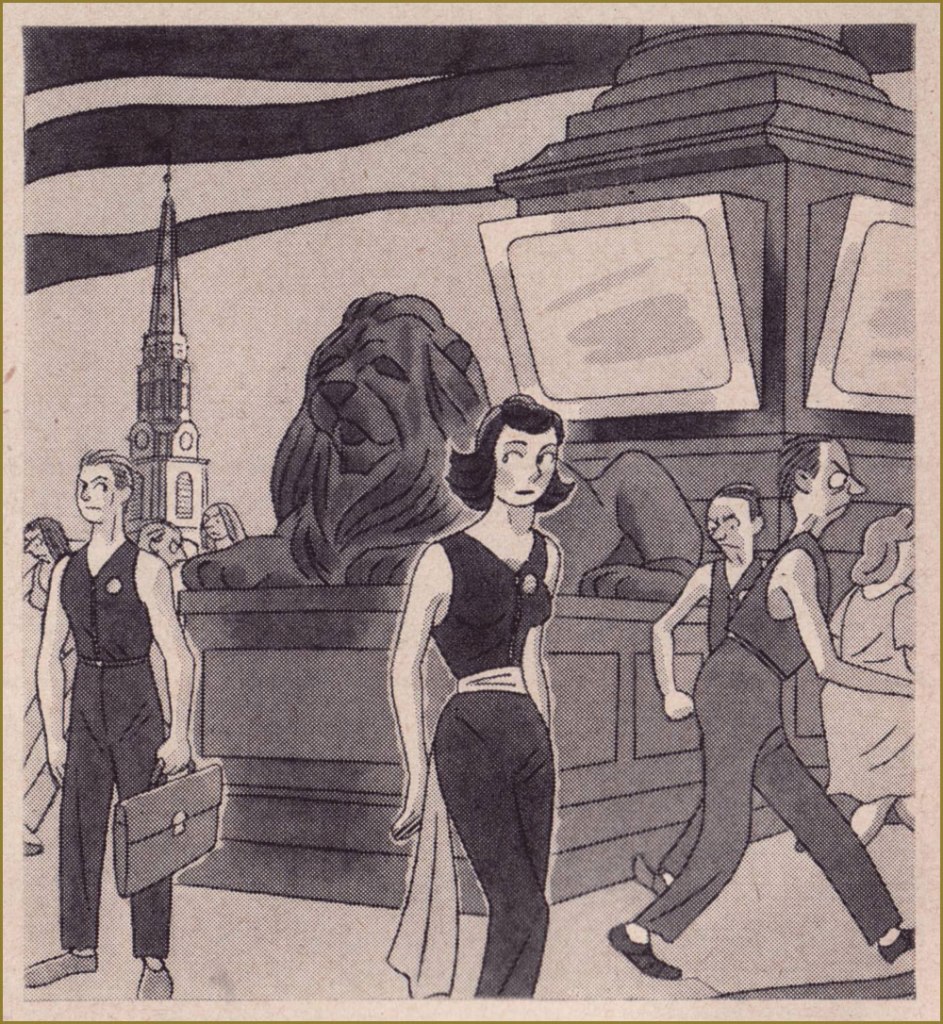
They meet in the midst of a crowd in Victory Square, and Julia whispers some instructions to Winston.
« Now, in a trysting place beneath the trees he finds a kindred soul in the rebellious Julia; she removes the hateful sash of the Anti-Sex League and they enter upon one of the most furtive and pathetic little love affairs in all literature. » The anonymous author of the article does not seem to approve.
« Julia is good at smuggling forbidden pleasures; they have real coffee (not the ersatz ‘Victory’ mixture) and chocolate, and Julia adorns herself with cosmetics and perfumes which no Party member is ever supposed to see. »
« But eventually, the Thought Police catch up with them. For the unspeakable crime of indulging in a human emotion they are arrested and hauled away to repent their sins in the horrible confines of the Ministry of Love. » I did warn you about spoilers: indeed, Winston Smith Takes It on the Jaw!
It’s intriguing that LIFE would devote this much space to such a controversial topic, but hardly surprising that it would stack the deck. It’s a regrettable hallmark of blind hubris to believe that only ‘the opposition’ is capable of totalitarian atrocities, when allowed unchecked power. Benevolent dictators have always been very, very scarce. To quote Margaret Atwood, a lady who knows her way around a dystopia, « ‘1984’ is not a wonder tale. Not only could it happen, but it has happened, but under different names. »
« Competition brings out the best in products and the worst in people. » — David Sarnoff
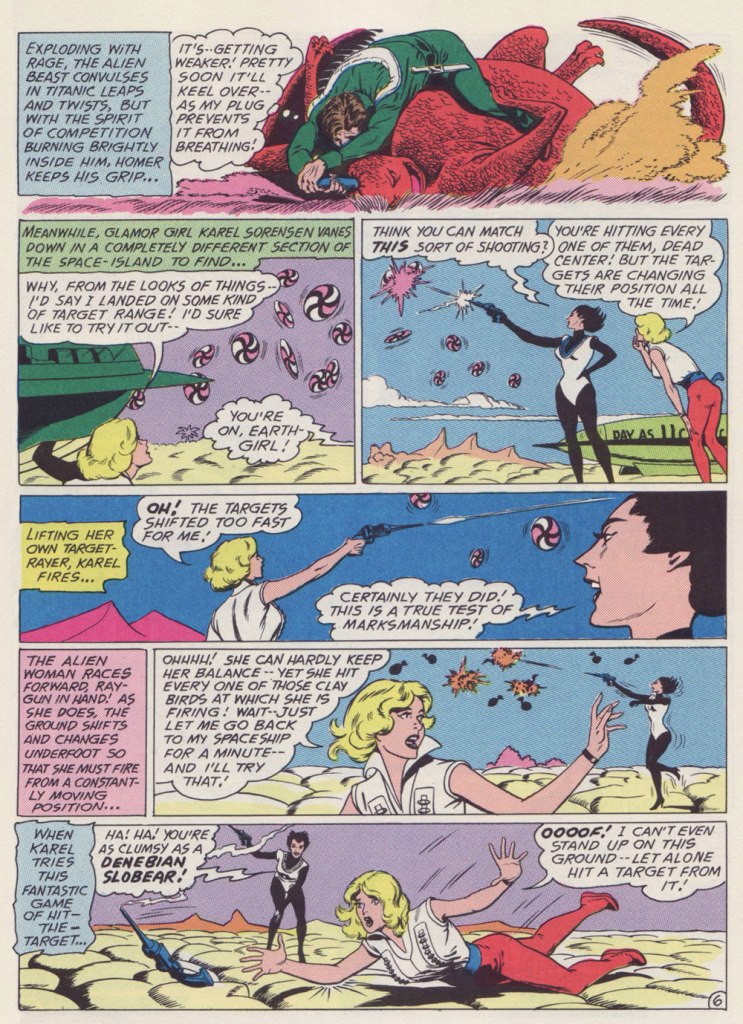
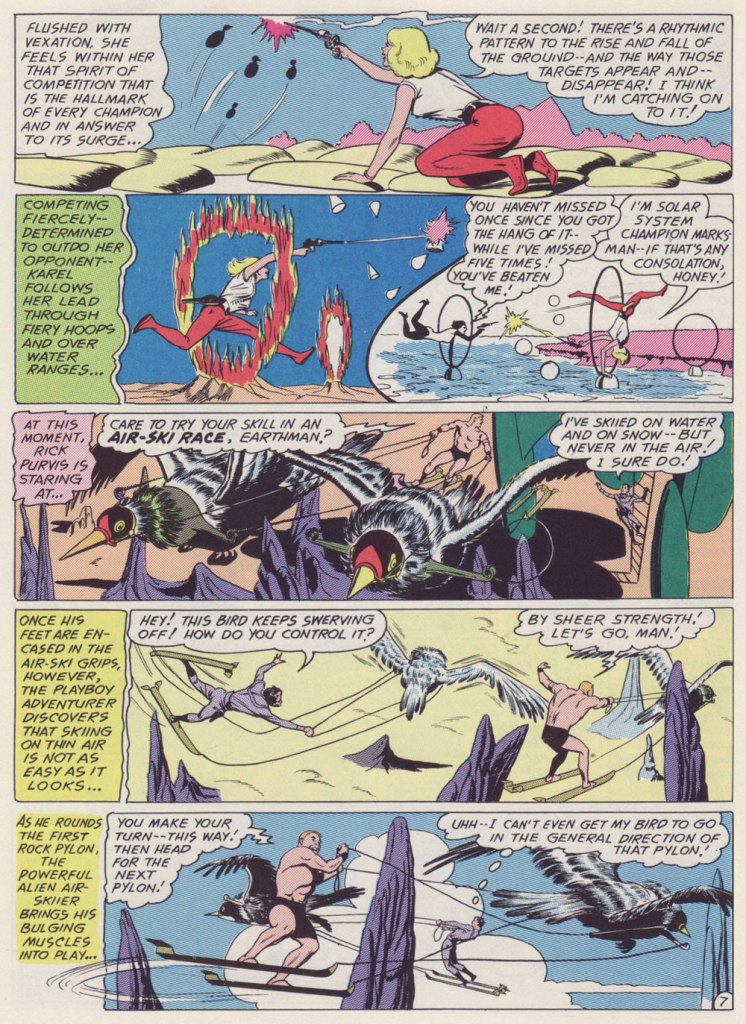
The other day, my partner was trying out a video game whose soundscape seemed exceptionally judicious and well-integrated to the action. At one point, she noticed that the optimal way to play was by matching one’s pace and movements to the musical rhythm. I said, “Oh, it’s just like that Star Rovers story!”
And now for a bit of context: The Star Rovers was a short-lived series that sporadically appeared in the back of DC’s Julius Schwartz-edited titles, mainly Mystery in Space, backing main feature Adam Strange.
As Michael Uslan beautifully puts it, in his introduction to Mysteries in Space: The Best of DC Science-fiction Comics (Fireside/Simon and Schuster, 1980):
« The Star Rovers were a whole other category of space heroes, typical of the kind of originality demanded by Julius Schwartz. A transgalactic trio of playboy, glamor-girl and novelist-thrill-seeker, they rarely agreed about anything and were rarely right about anything even when they did agree. »
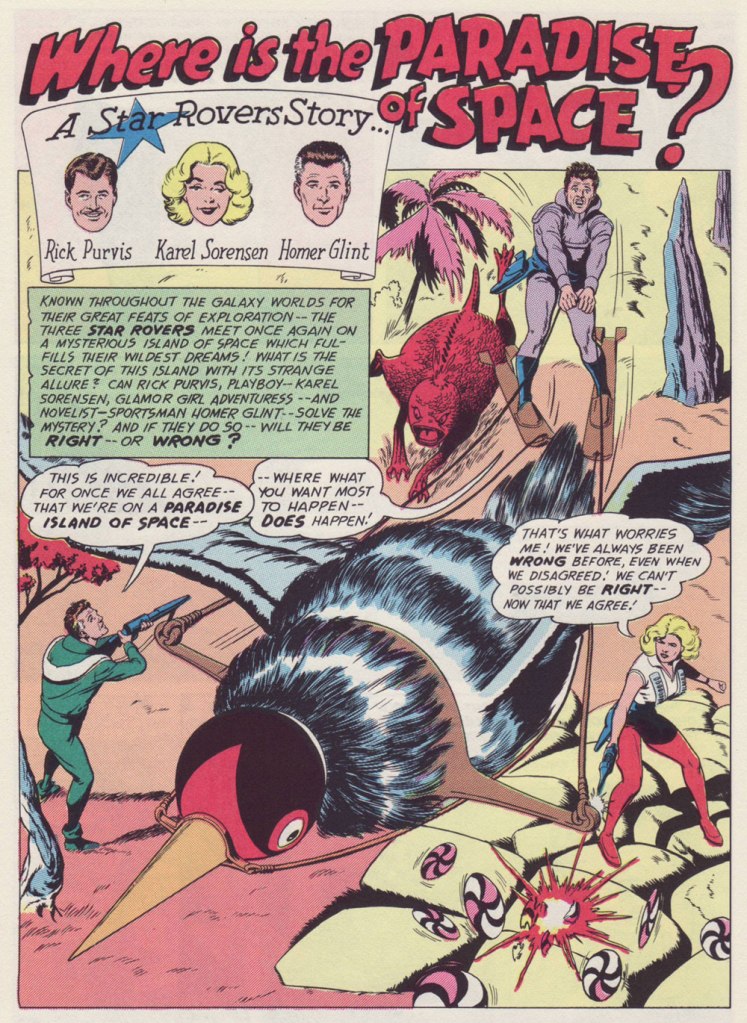
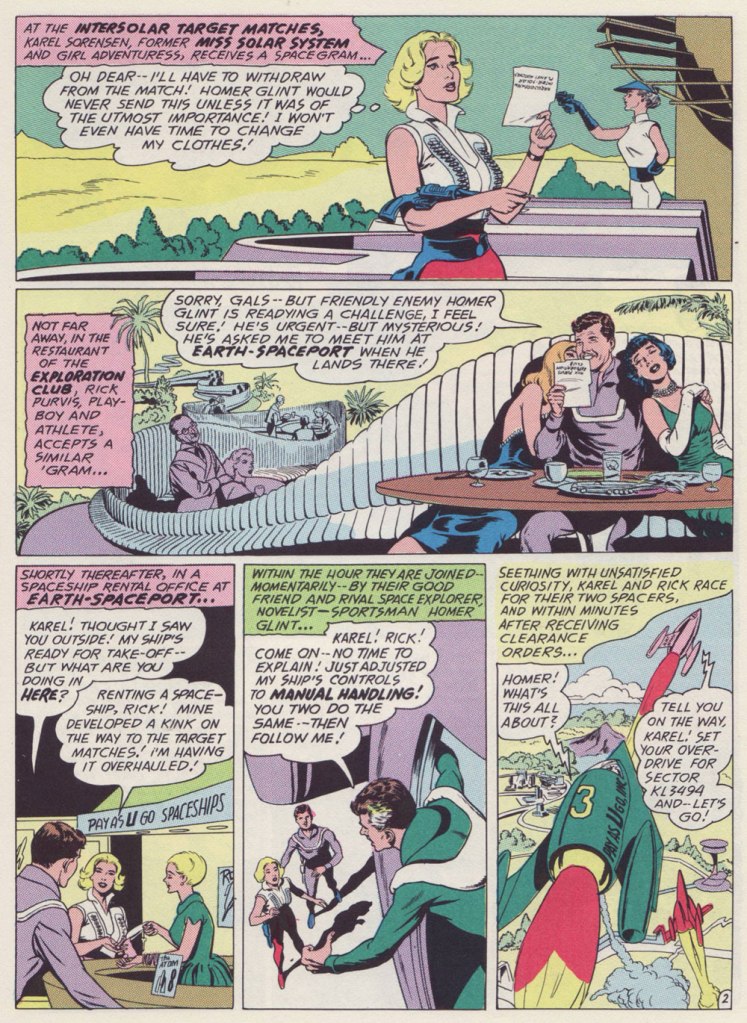
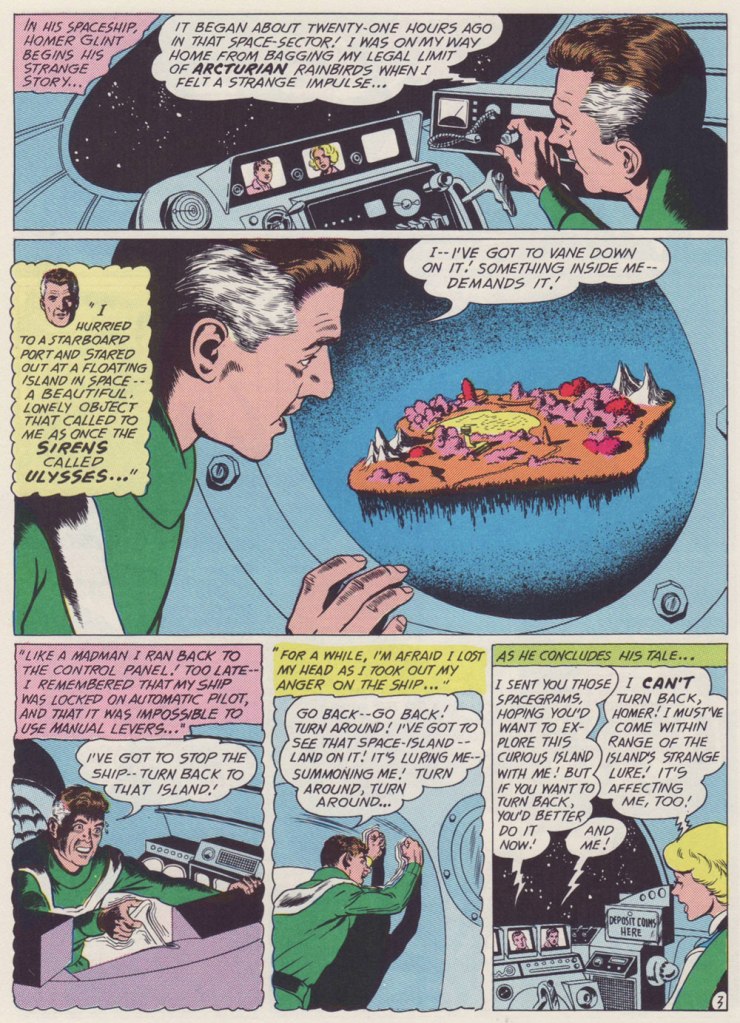
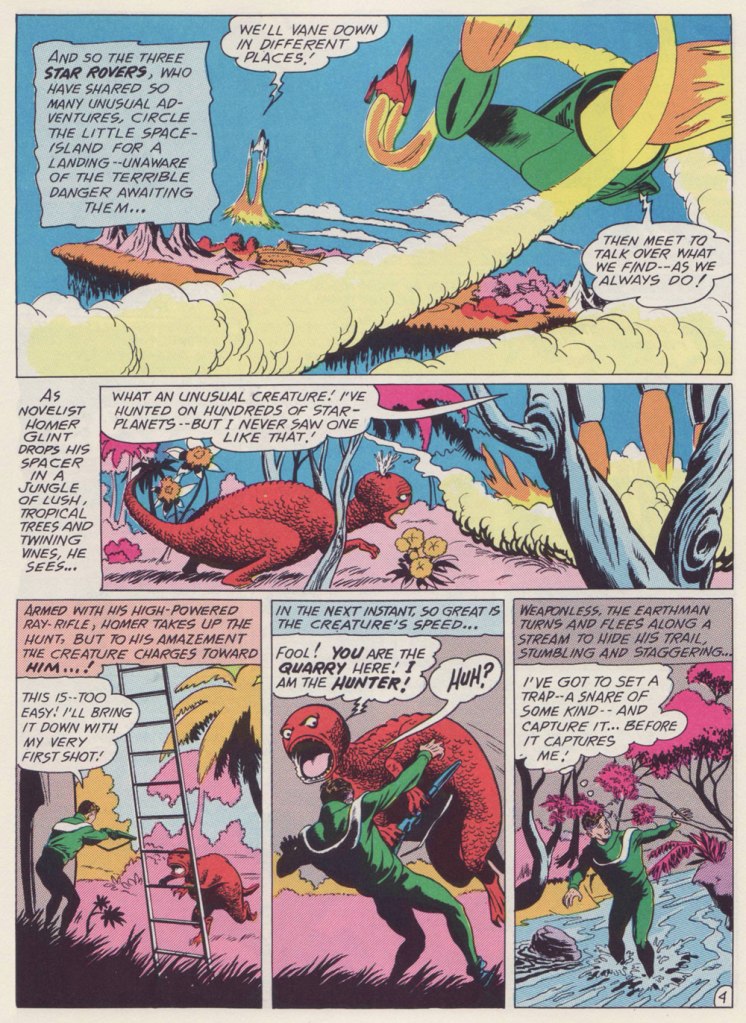
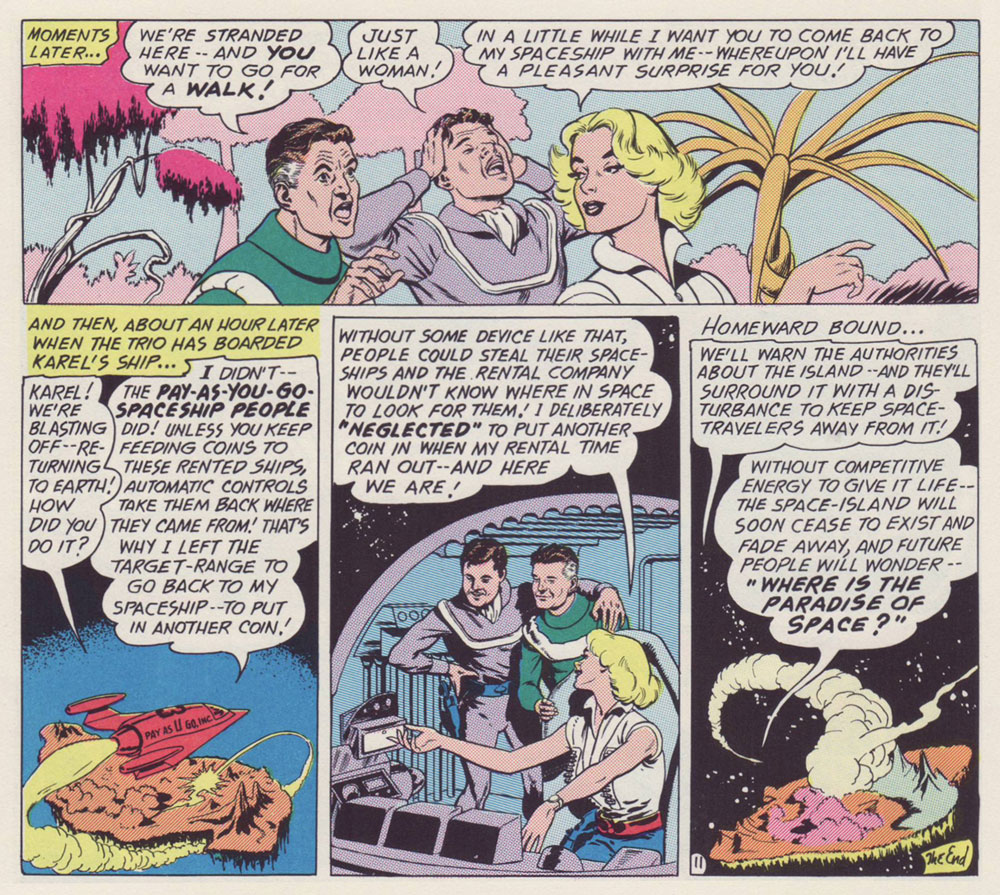
This is the third Star Rovers episode, Where Is the Paradise of Space?, from Mystery in Space no. 74,Mar. 1962, DC).
This is the sequence that brought this story to my mind.
One of the most charming aspects of the Star Rovers is the protagonists’ equal footing. In this case, Karel is a bit more than the fellows’ equal, but the series is mostly exempt of the sexism you’d expect from the period of its creation.
Much of the appeal of the Star Rovers is that they’re not a team: they’re friendly rivals, ‘frienemies’, as we’d call them these days. Aside from matching wits and theories, they never directly compete, as differences in their fields of endeavour would make the exercice pointless. There’s a light, jovial tone to these mysteries, yet they can still be taken seriously as intriguing puzzles.
All nine episodes were edited by Schwartz, scripted by Gardner Fox, and illustrated by Sid Greene (1906-72). The latter, a veteran of the comics industry with published work going back to 1940, arguably turned in the finest work of his busy career, and likely would have kept on doing so had it not been for… Batman’s troubles.
To make a long story short, as the Batman titles were shedding readers like there was no tomorrow (making it possible that there would, indeed, be no tomorrow), DC bigwigs opted to switch things around a bit, pulling editor (and Jack Kirby blackballer) Jack Schiff off Batman and Detective Comics and handing him the reins of Schwartz’s SF titles Strange Adventures and Mystery in Space. He ran those into the ground, but in goofily entertaining fashion, at least. Unlike the bat-books, there were expendable to DC.
As the ultimate Star Rovers tale appeared in the final issue of the Schwartz-edited Strange Adventures before the changeover, it seems likely that the series would have carried on under a Schwartz régime. But the Rovers weren’t at all in Schiff’s wheelhouse: the delicate premise called for deft, intricate plotting and wit, qualities not to be found within Schiff’s stable of writers. Gardner Fox and Greene were among Schwartz’s trusted confederates, and talent poaching was rarely allowed within DC’s editorial enclaves.
After this editorial switch, Greene was, with few exceptions, put to work inking the pencils of Schwartz’s big three: Carmine Infantino on Batman and The Elongated Man, Gil Kane on Green Lantern and The Atom, and Mike Sekowsky on Justice League of America. The problem, at least as I see it: Greene’s inks didn’t mesh well with any of these pencillers’ styles. Oh well — it’s a living. At least Greene was able to return to full pencil and ink duties on a handful of short stories for editor Murray Boltinoff, mostly in the pages of The Unexpected. Better late than never.
Finally, for your edification and amusement, here’s a Star Rovers checklist:
Who Caught the Loborilla? (Mystery in Space no. 66, Mar. 1961) What Happened on Sirius-4? (Mystery in Space no. 69, Aug. 1961) Where Is the Paradise of Space? (Mystery in Space no. 74, Mar. 1962) Where Was I Born– Venus? Mars? Jupiter? (Mystery in Space no. 77, Aug. 1962) Who Saved the Earth? (Mystery in Space no. 80, Dec. 1962) Who Went Where– and Why? (Mystery in Space no. 83, May 1963) When Did Earth Vanish? (Mystery in Space no. 86, Sept. 1963) Will the Star Rovers Abandon Earth? (Strange Adventures no. 159, Dec. 1963) How Can Time Be Stopped? (Strange Adventures no. 163, Apr. 1964).
« When I was a young writer if you went to a party and told somebody you were a science-fiction writer you would be insulted. They would call you Flash Gordon all evening, or Buck Rogers. » —Ray Bradbury
We’ve talked about newspaper strip Flash Gordon in Tentacle Tuesday: Lurkers in the Newsprint, and now it’s time for its comic book version! Although I normally have very little interest in FG, this is no second-rate Tentacle Tuesday: there is some prime tentacular material to be enjoyed.
We first concern ourselves with the Flash Gordon Charlton Comics run, which picked up the count where King Comics had left it in 1967. From 1969 until 1970, Charlton published issues 12 to 18, all of which but the first had glorious covers and cover stories by Pat Boyette, an absolute WOT favourite ( you can visit co-admin RG’s Pat Boyette — Hillbilly Makes Good* for a deeper exploration of his career).
The cover of issue 14 has an octopus shortage (a serious flaw affecting many, many comic book covers!), but the monster o’nine-tentacled-tails the ’emotionless killers’ encounter is a beauty. The following page is also a good example of Boyette’s imaginative page layouts, in which things are kept dynamic, but never engender confusion about who is doing what and to whom.
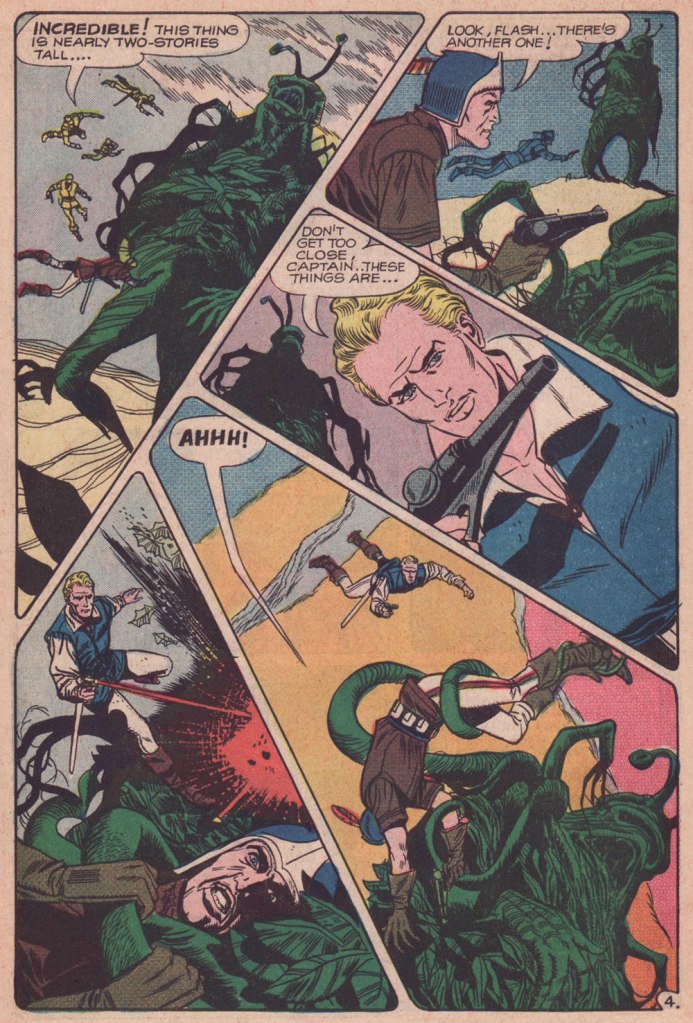
Page from Rancor and the Seven Shadows of Flash Gordon, scripted by Bill Pearson and illustrated by Pat Boyette, was published in Flash Gordon no. 14 (June 1969).
Then we come to a real bevy of Boyette tentacles a few issues later –
Flash Gordon no. 17 (Charlton, November 1969). Cover by Pat Boyette.
The Creeping Menace, the cover story, is scripted by Joe Gill and illustrated by Pat Boyette. I am including two pages (and a panel) because it’s too difficult to choose between them – all boast the aforementioned dynamic layouts and striking tentacles.
Isn’t this a lovely, stylish panel? I want it on a t-shirt.
The publishing history of comic-book Flash Gordon was an interesting relay race: Gold Key Comics resumed the run with issue 19 (1978), and kept it up until issue 27 (1979); finally, issues 28 to 37 were published under its Whitman imprint between 1980 and 1982. The latter category offers two tentacled covers, and some inside goodies.
Original art (sadly by an unknown artist) for the cover of Flash Gordon no. 29 (Whitman, May 1980).
The cover story The Deadly Depths is scripted by John Warner and illustrated by Carlos Garzón. Oh, this thing is not hostile… just hungry.
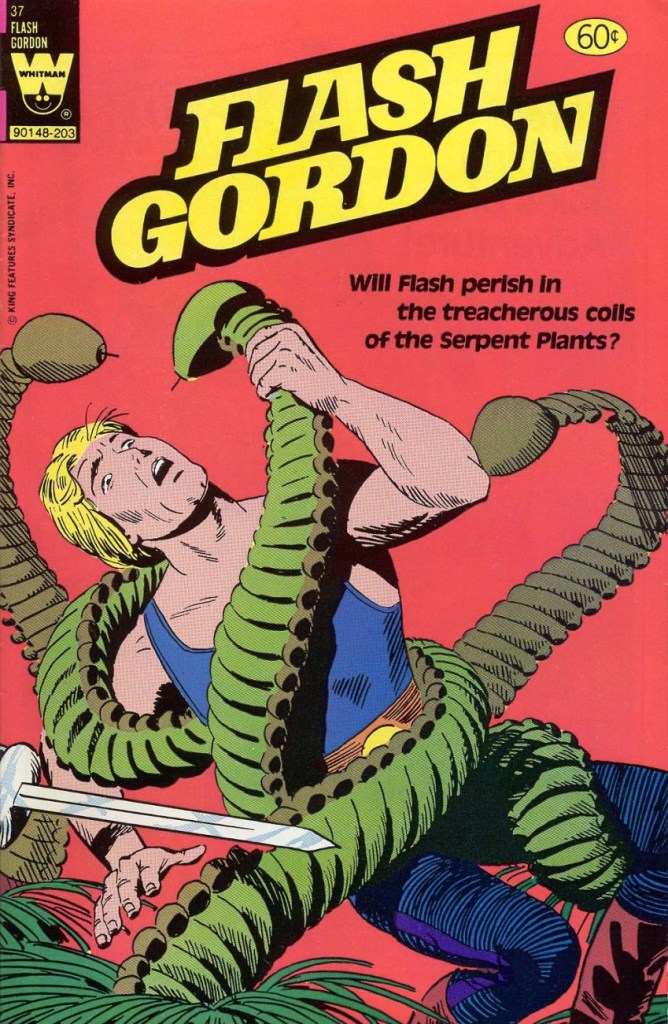
The last Whitman issue also is of some interest, though on the cover Flash looks like he’s fighting caterpillars with an martini olive for a head.
Flash Gordon no. 37 (Whitman, March 1982). Cover by Gene Fawcette.
Cover story My Friend, My Killer! is scripted by George Kashdan and illustrated by Gene Fawcette and features cute serpent plants that look like they’re wearing little hula skirts.
And that concludes our tour of Flash Gordon tentacles in the Silver Age (and with some forays into Bronze).
« I have argued flying saucers with lots of people. I was interested in possible. They do not appreciate that the problem is not to demonstrate whether it’s possible or not but whether it’s going on or not. » — Richard P. Feynman
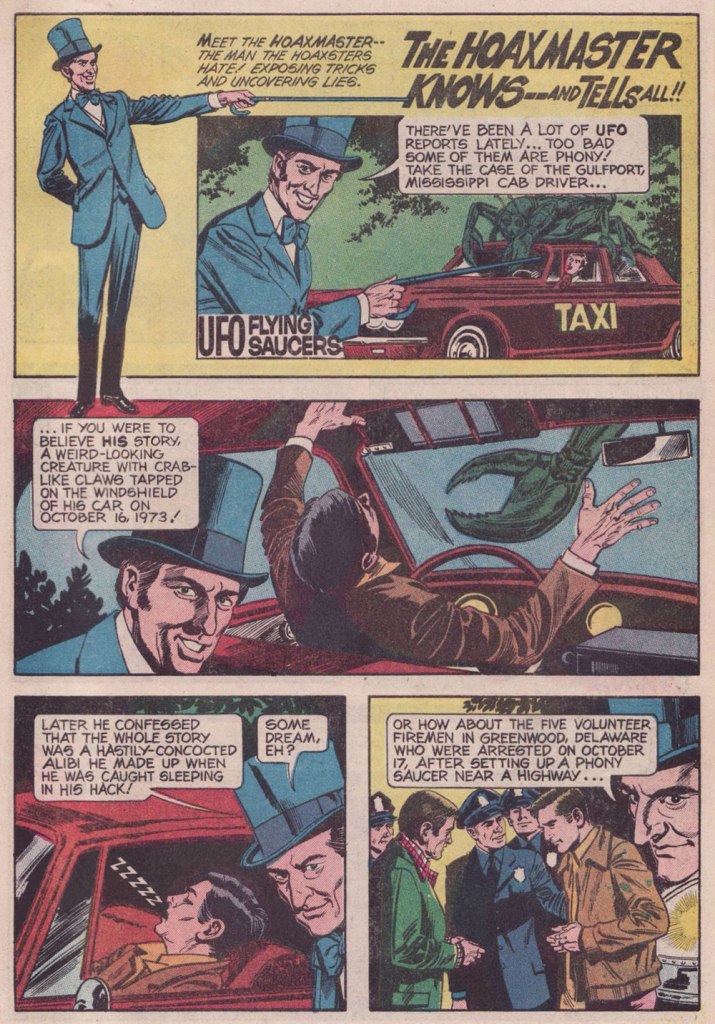
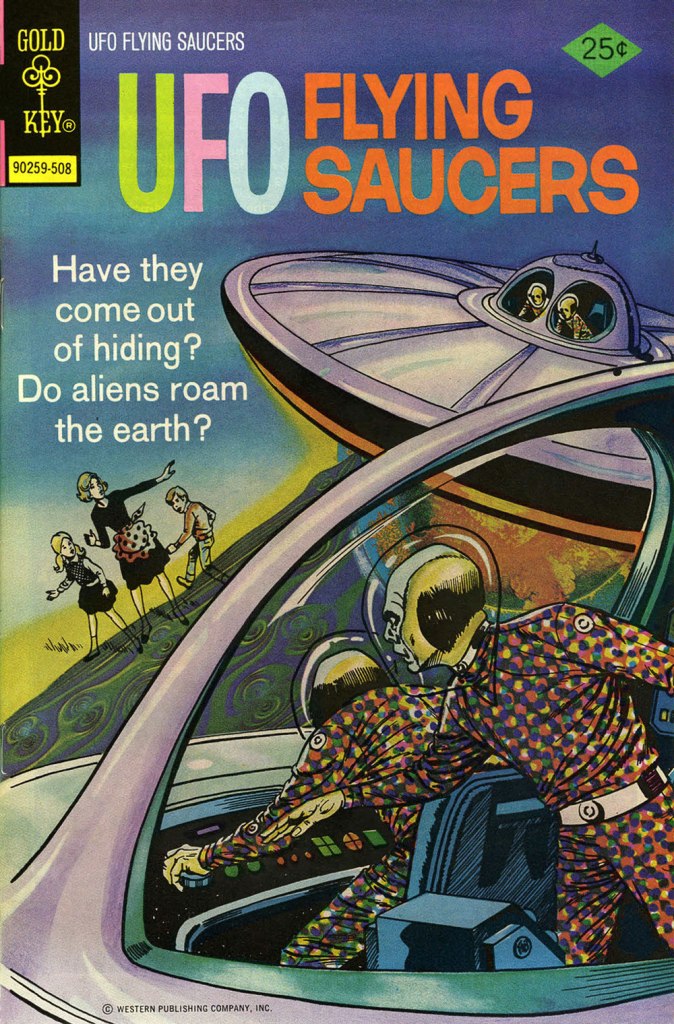
You can follow the rising pitch with the publishing frequency of Gold Key’s UFO Flying Saucers: after its premiere issue hits the stands in 1968, two full years elapsed until the second, then another two until the third… and again to the fourth. It’s fair to presume that the title had been intended as a one-shot, and that encouraging sales led the way to a regular, if sparse schedule. Then the pace picked up after issue four (Nov. 1974), and so ten issues appeared in the span of just over three years. There was a brief hiatus, a retitling to UFO & Outer Space and a further dozen issues saw print, two of them reprints. By late 1979, the series sputtered to a halt.
They may not have been to everyone’s taste, but Gold Key comics provided their audience with a soothing respite and change of pace from Marvel’s endless manic brutality and insipid crossovers. Even amidst the GK line, UFO Flying Saucers stood out. It did a stellar job of covering the flying saucer craze of the Cold War years, thanks to a sober, documentary-style narrative tone and strong artwork, led by Frank Bolle, who fit the template to a T. The tone was surprisingly even-handed (far more so than most modern media; j’accuse, History Channel!) They even tossed a scrumptious pinch of skepticism into the mix now and again, and it’s this delicacy that we’ll be sampling.
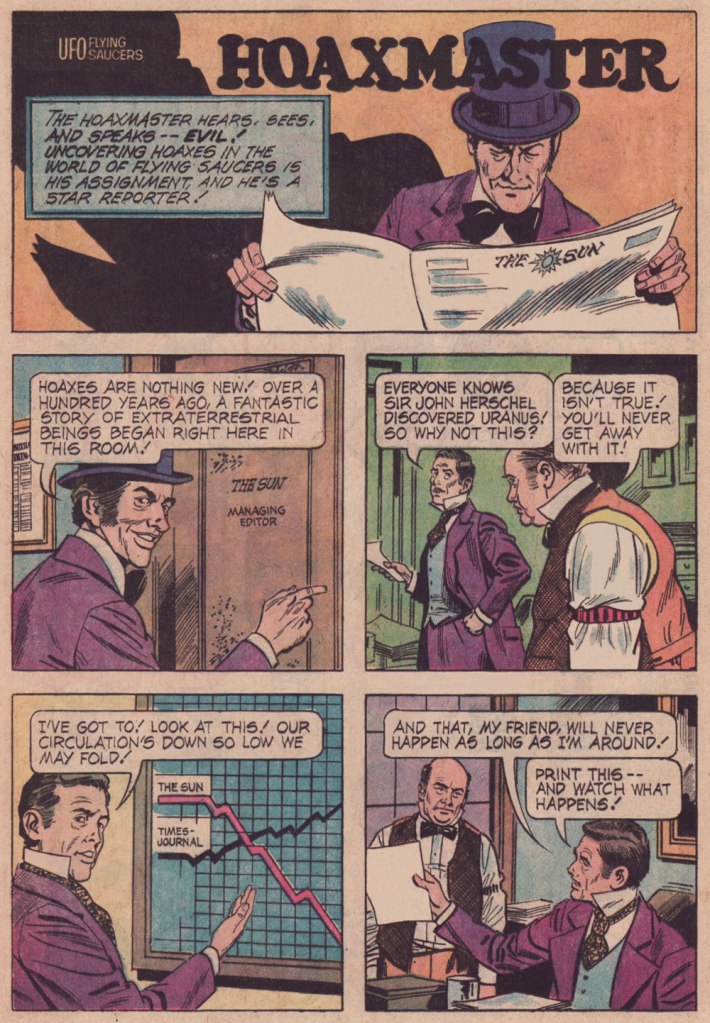
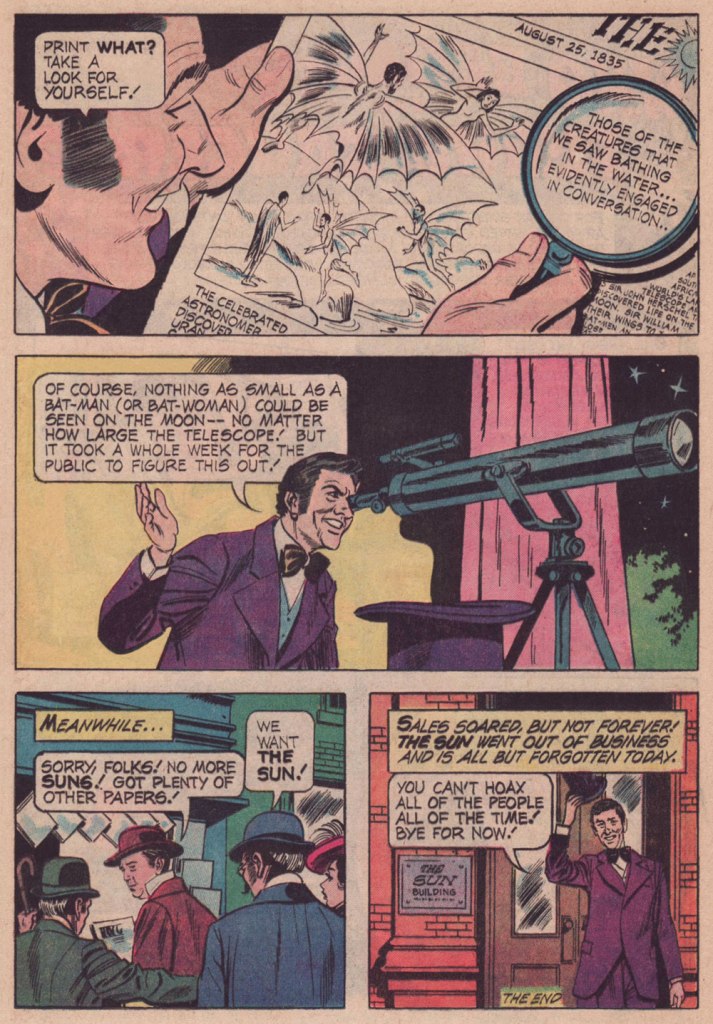
The modern skeptical* movement was spearheaded by the 1952 publication of mathematician and science writer Martin Gardner‘s fascinating In the Name of Science (thereafter better known as Fads & Fallacies in the Name of Science), answering the need for an organised response to a (still) rising tide of irrationality, superstition and scientific illiteracy. When UFO Flying Saucers introduced its series featuring The Hoaxmaster, the skeptics’ flagship publication, The Skeptical Inquirer, was still a couple of years away from being launched. That auspicious occasion came in the fall of 1976, under its original title of The Zetetic: Journal of the Committee for the Scientific Investigation of Claims of the Paranormal.
The introduction of The Hoaxmaster, from UFO Flying Saucers no. 4 (Nov. 1974, Gold Key).
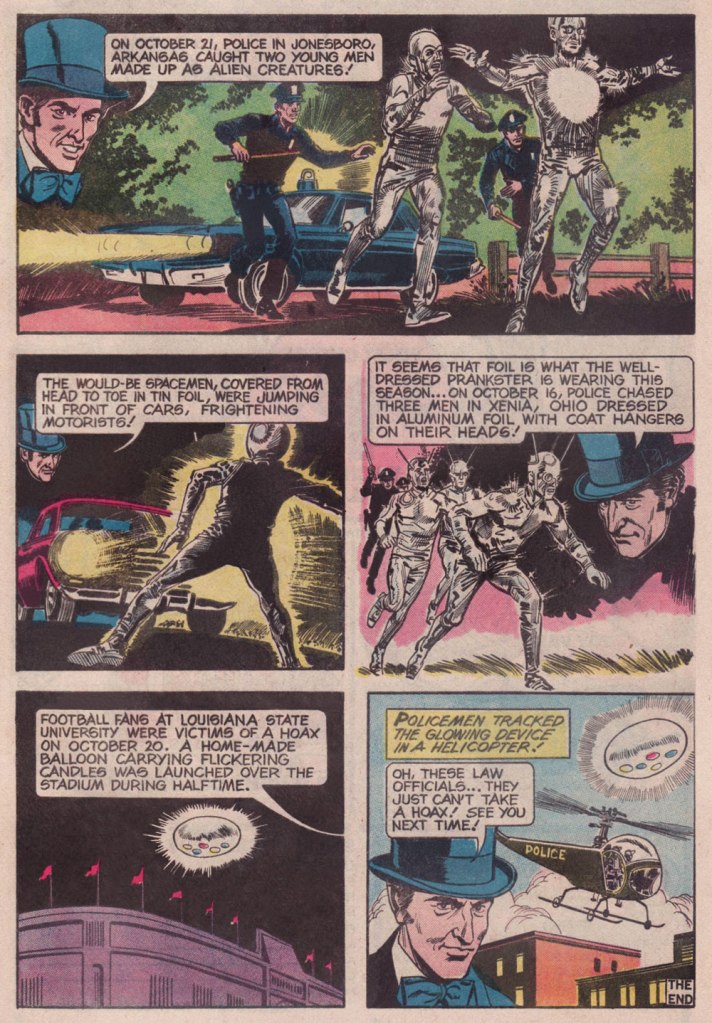
And such fakery has only become far, far easier… from UFO Flying Saucers no. 6 (May 1975, Gold Key).
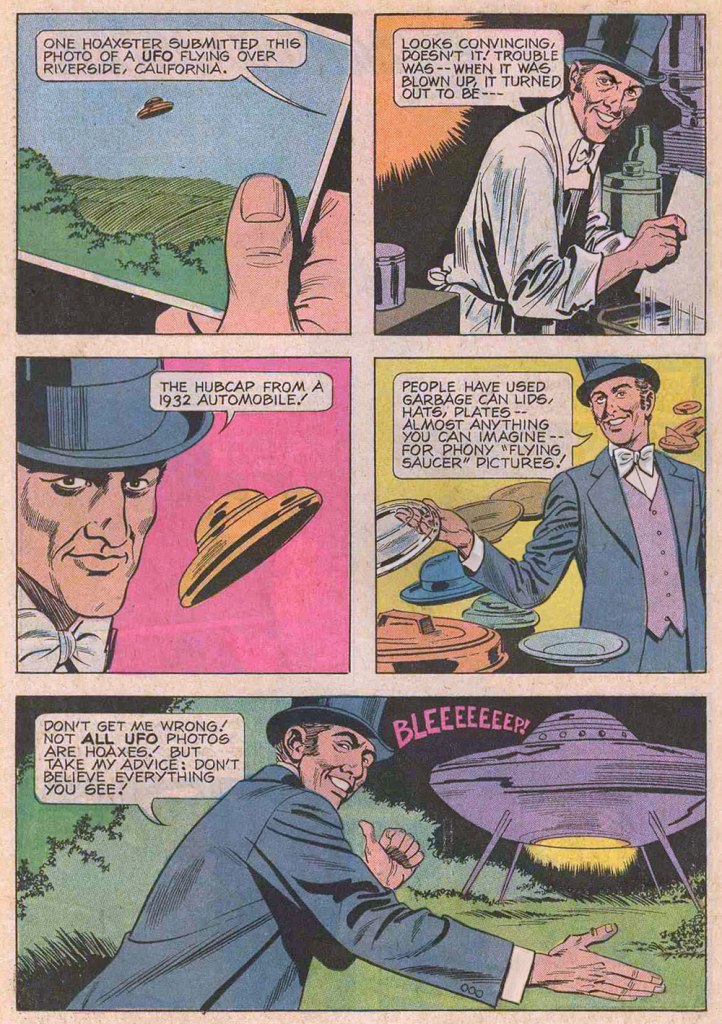
Ah, that John and Marsha/Marcia routine never gets old! From UFO Flying Saucers no. 7 (Aug. 1975, Gold Key).
Mr. Bolle provided just one cover to the series, and while it’s hardly the best one, it certainly stands out amidst the lot. Again, this is UFO Flying Saucers no. 7 (Aug. 1975, Gold Key).
Say, what have we here? Could it be… fake news? From UFO Flying Saucers no. 8 (Nov. 1975, Gold Key).
Sadly, The Hoaxmaster series bears no writing credit. The only writer ever credited in the title is Western Publications staffer Patricia Fortunato, a former story editor of The Golden Magazine. If that’s your work, Pat, take a bow!
In comparison, artist identification is a cinch: the steady hand of Frank Bolle, who left us just last year, at the most venerable age of 95, is instantly recognizable. Artistically active right to the wire, he drew the final leg (1999-2015) of soap opera comic strip Apartment 3-G‘s 54-year-run. Over the course of his singularly long career, he worked for just about every comics publisher… and then some! His reliable proficiency at providing just the right tone to illuminate that delicate borderline between science fact and science fiction made him the ideal choice to adapt John Christopher‘s early young adult post-apocalyptic The Tripods trilogy (The White Mountains, The City of Gold and Lead,and The Pool of Fire), serialised in Boys’ Life magazine in the 1980s. Check it out here!
Well, that’s roughly half of the Hoaxmaster strips. If you’d like to see the rest, let us know… I can probably time it with the next edition of World Contact Day. To sign off on a musical note, here’s its catchy, Canadian-made anthem. Remember, “we are your friends“.
-RG
*as opposed to ‘denialism’, of course. It’s a crucial distinction: know the difference!
Occasionally, I like going with the flow when selecting the topic for a Tentacle Tuesday. I recently traded for a Junji Ito book I’d never heard of, Remina, and as one of its highlights (um… possibly the only highlight, but more about this later) is the profusion of tentacles within, it seemed like a natural fit for a topic of discussion.
We have only mentioned Junji Ito once before (in Tentacle Tuesday: Octopods Dig Manga!), but I am a fan of his work – or at least of the best of his work. In my assessment, that would be the genuinely disturbing Gyo (with the catchy subtitle of ‘The Death-Strench Creeps‘) and the haunting Uzumaki, as well as a handful of excellent short stories.
I’m by no means a horror manga pundit, but I’ve sampled a certain number of works by mangakas whose work has been translated to English, and found most of these œuvres quite unappealing, be it because of incompetent art, more human cruelty than I can stomach, far too much soap-opera-style drama, or glaring plot loopholes. Ito is not without his flaws, but something sets him apart from other authors working in a similar vein: he can depict stomach-churning gore and moments of quiet dread with equal aplomb. Cartoonists who rely on carnage to horrify their readers are ten a penny, those with a more subtle approach are few; those who can effortlessly transition from one to the other are something special.
As in that old joke about the horse that always takes its rider to the nearest pub, Ito does have a favourite approach: he starts with a most mundane object or incident, elicits a delectably menacing atmosphere out of it, and then gives it all a good twirl until the spiralling events send the protagonists (and sometimes the whole country, if not the whole planet as well) into the welcoming arms of total, uncompromising Armageddon. One might argue that he does that because it’s easier to finish it all than to think of a ‘proper’ ending, but it gives his work a certain surreal quality I really appreciate – everybody is going to die, and now that this little matter is out of the way, we can concentrate on the creative ways this is going to happen.
Remina was serialized in Big Comics Spirits from September 2004 to July 2005. The English volume (released by Viz Media, who have published the bulk of Ito material in English, slowly making their way through his whole bibliography in excellently designed hardcover editions) was released in December 2020. The plot concerns itself with a scientist who discovers a new planet and names it Remina in honour of his beautiful daughter. Of course, the planet turns out to be hurtling towards Earth at physics-defying speeds, annihilating everything in its path (which the main scientist somehow is completely unaware of, until his many lab assistants inform him of the latest developments).
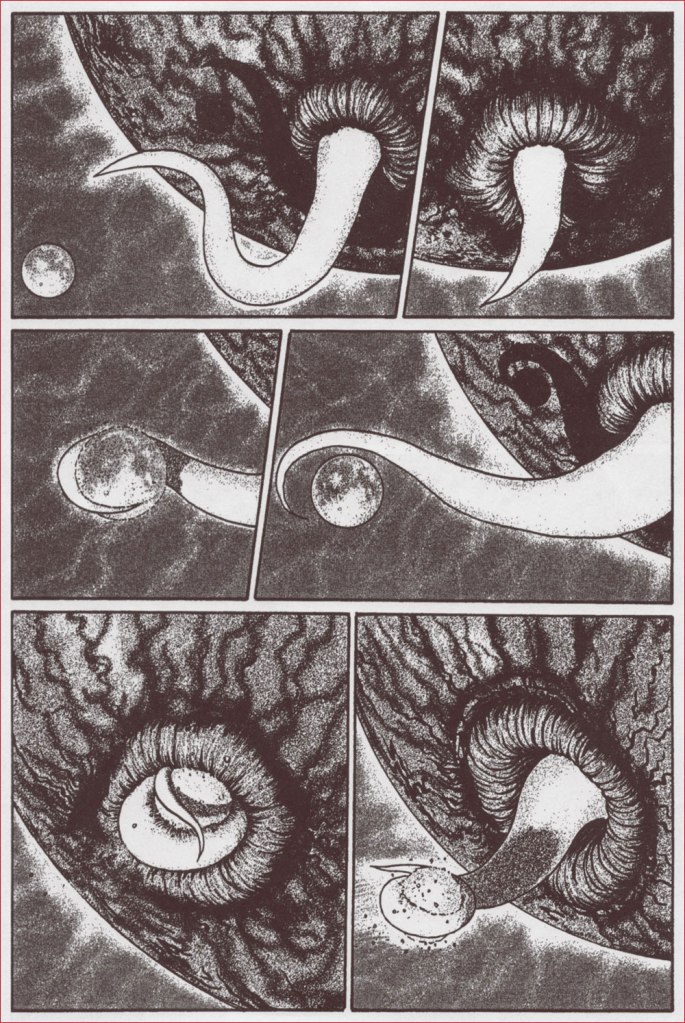
And here it is, eating one of the planets in our Solar System with as much grace as an aristocratic lady carefully nibbling on a sliver of tomato.
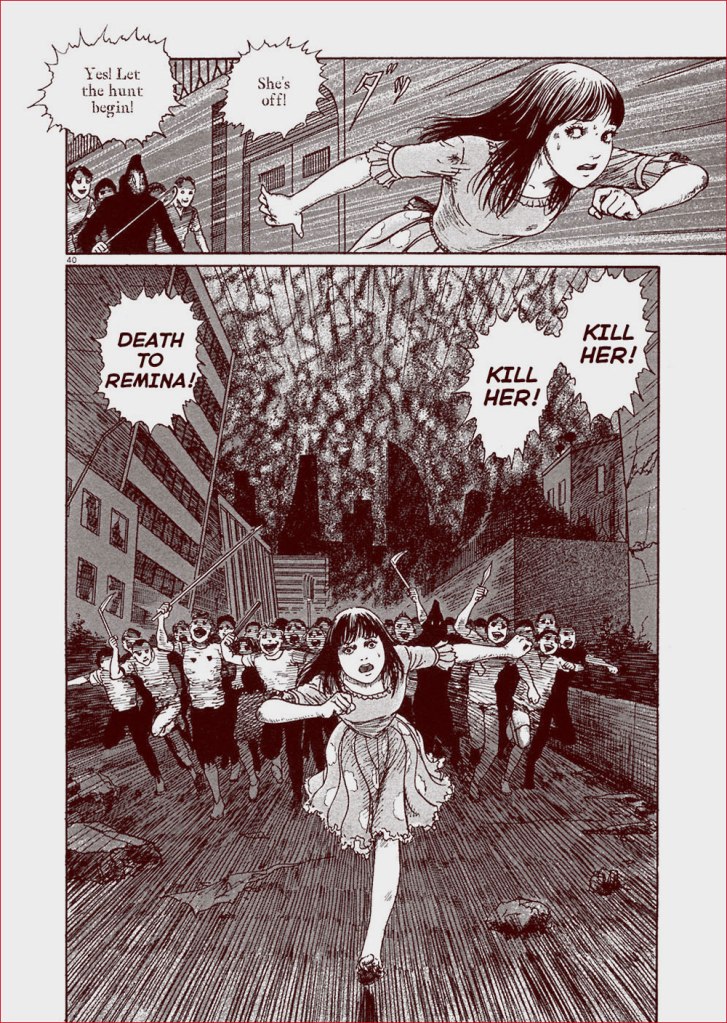
In (not entirely unbelievable) leap of logic, Japanese citizens decide that the impending destruction is caused by Remina, previously an immensely popular and celebrated girl, and that executing this ‘witch’ is going to solve the problem. What follows is a series of chase scenes, with a giant crowd pursuing Remina throughout the progressively more and more destroyed city. Remina’s three protectors (the president of her fan club, her manager, and some uber-rich fanboy who tries to rape her later in the book) drag her around, trying to keep her safe from the murderous crowd, but they don’t do such a great job – she gets crucified next to her dad but survives, set free, captured again, flogged, tortured, crucified again, and so on.
It doesn’t help that Remina, like a lot of Ito’s pretty creations, doesn’t really have a personality. She just sobs, screams for her daddy and her lost love (the manager, who apparently she was profoundly in love with), and implores people to just leave her alone. Scenes of crucifixion and the creepy robes worn by her pursuers indeed suggest religious fervour – as the earth’s gravity changes, cities are destroyed, volcanoes erupt etc., the only thing almost everybody is interested in is Remina’s mutilation and dismemberment.
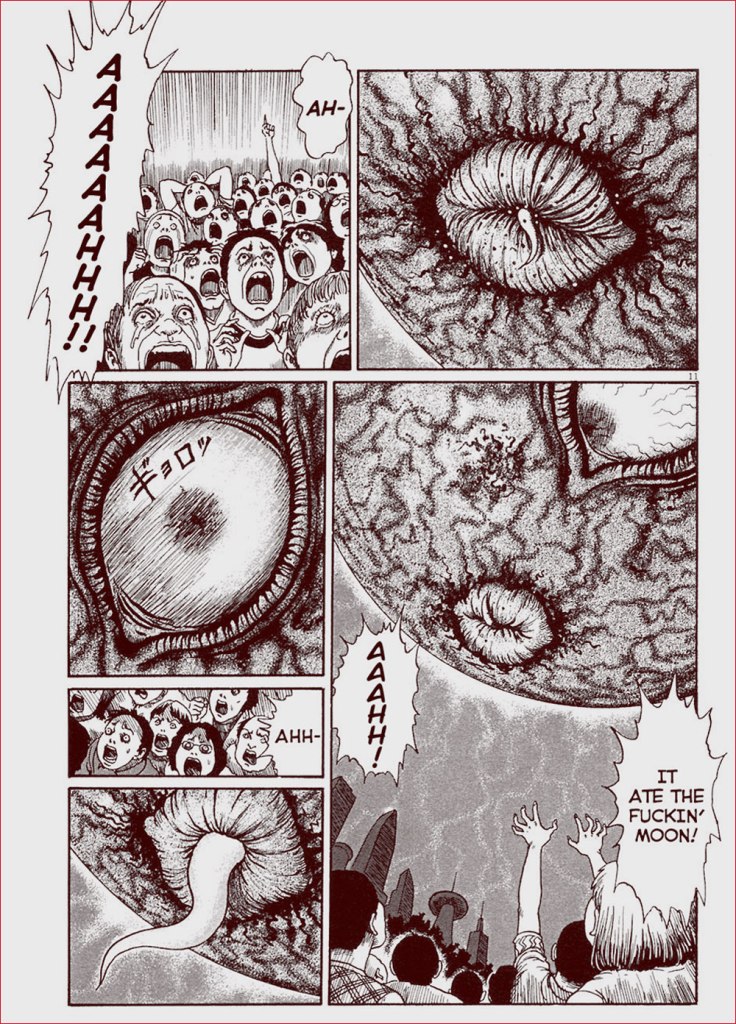
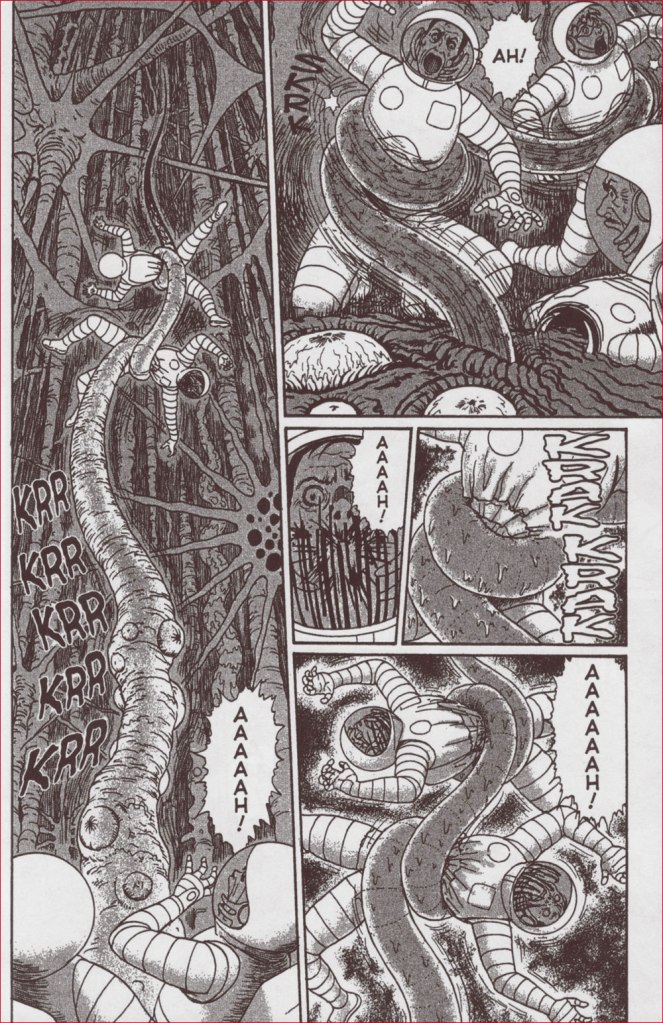
Still, there are some fun moments, most of these involving tentacles! Remina the planet has a giant eye and a coquettish, tentacular tongue that it flicks out to swallow the moon just as Remina the human is about to be killed.
One of more iconic images of Remina, the moment before the moon gets swallowed….
This is a scan from a previous edition of Remina, where the translators were a little looser with language. In the book I have, a laconic ‘it ate the moon‘ is substituted for ‘it ate the fuckin’ moon!‘.
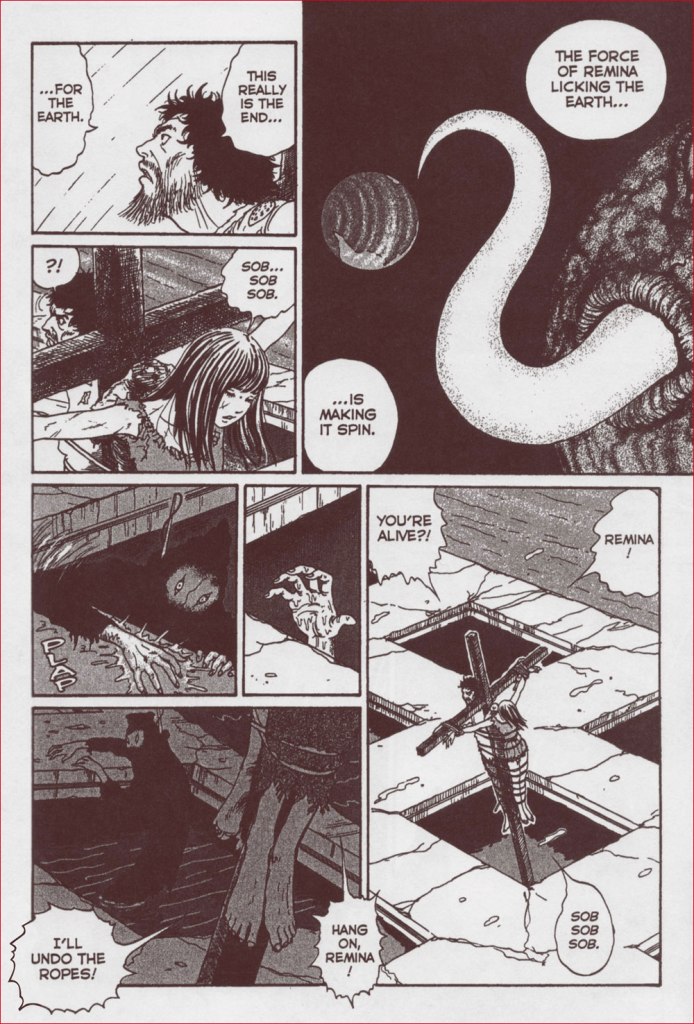
It uses the same ‘tongue’ to lick Earth and accelerate its spinning…
Typical Remina dialogue: “SOB SOB SOB.” Note that this is the second time Remina gets crucified. It is distinctly some sort of unhealthy obsession.
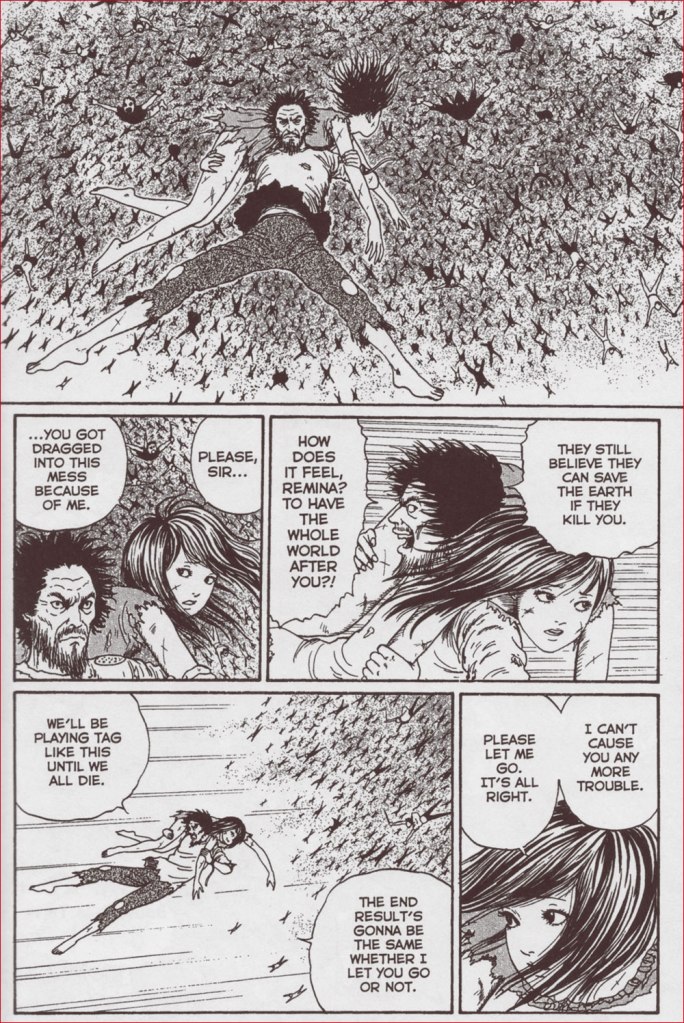
… which sends everyone airborne, and gives rise to funny kung-fu-in-the-air scenes as yet another protector kicks the collective asses of Remina’s would-be executioners.
Then there’s planet Remina’s surface, all writhing tentacles, acid pools and noxious fumes. That’s where most of the tentacle enjoyment lies.
Somewhat atypically, there is even a happy ending, albeit one involving some of the main characters floating around in space in an atomic shelter bunker with a year’s worth of provisions (and hopefully oxygen?)
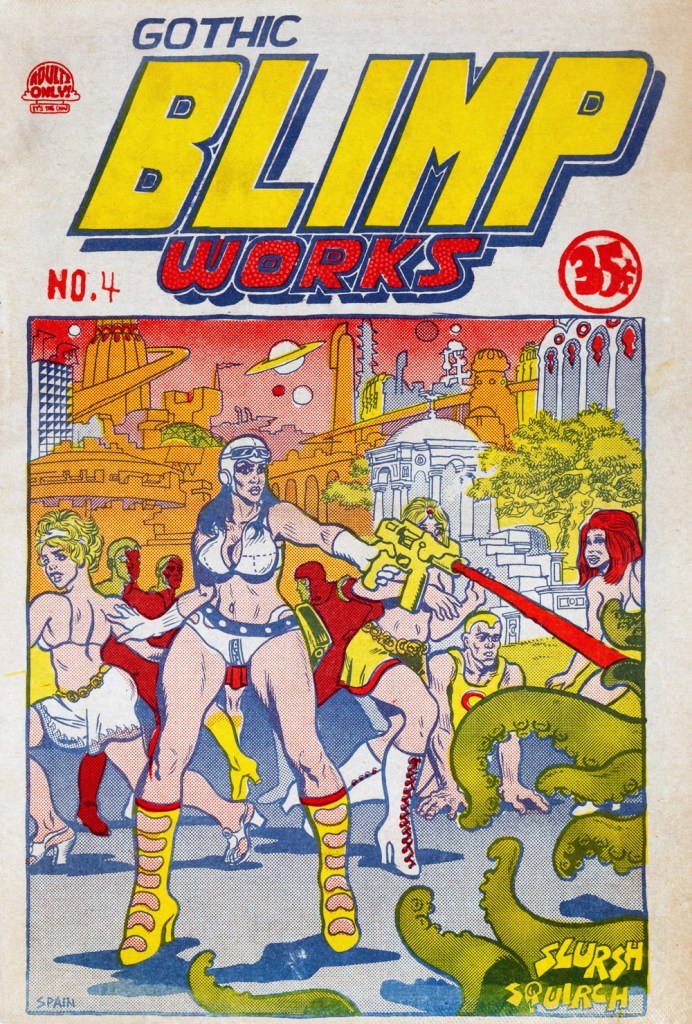
Greetings to saddle sniffers, subterranean dwellers and lovers of nasty fun! Today we take a little trip into the underground, where tentacles squirm in anticipation! Through some quirk, all of today’s covers involve aliens and spaceships – underground artists clearly also liked to speculate about the possibilities of inter-planetary travel.
Tentacle Tuesday opens up with a Nicola Cuti cover, whose cutesy style, albeit not particularly original, is pretty recognizable (for example, take a look at his Weirdlings, which has really grown on me over the years). His big-breasted, doe-eyed « intergalaxtic nymph » was not devoid of charm, although she only appeared in three issues (and issue no. 3 had a print run of a hundred copies, so I don’t think many people have seen it…) For more details about Moonchild Comics, consult the ever-useful Comixjoint.
Gothic Blimp Works no. 4 (Spring 1969, East Village Other). Cover by Spain Rodriguez.
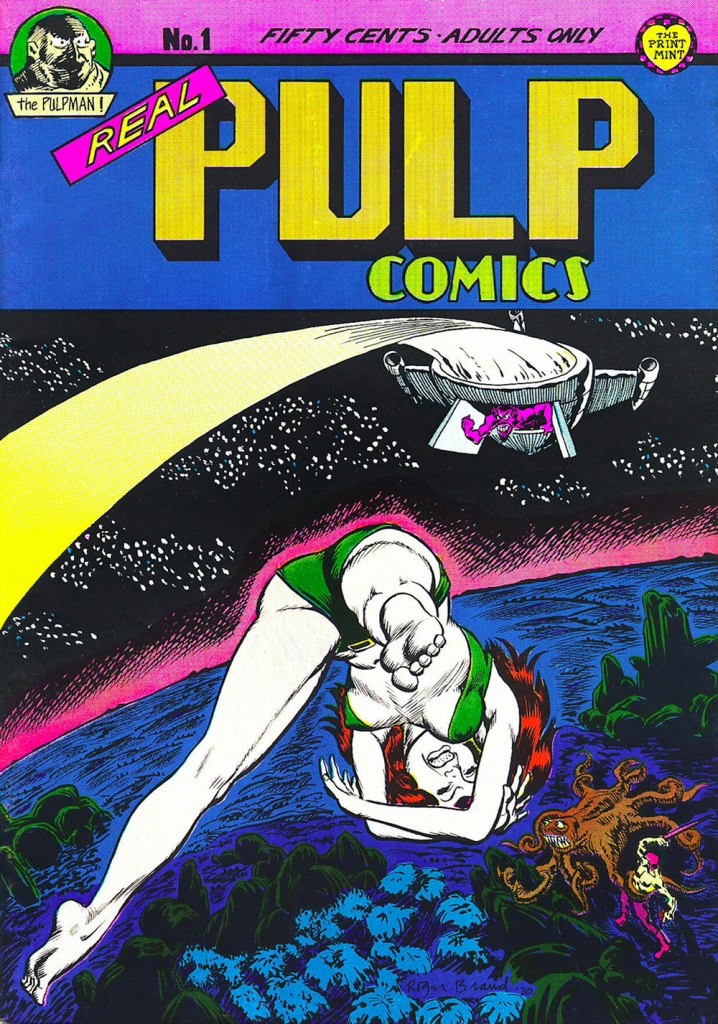
The next cover is on a similar theme: mostly naked female, tentacled alien, the shaboodle, with an interesting choice of perspective to boot. And by “to boot” I mostly mean that it looks like somebody gave her a good kick on the shapely derrière.
Real Pulp Comics no. 1 (January 1971, The Print Mint). Cover by Roger Brand, who tragically died at 42 – read a heartfelt panegyric from Kim Deitch in A Lousy Week for Woods (Remembering Roger Brand).
Staying with the same publishing house (The Print Mint was a major publisher/distributor of underground comix in their heyday in the San Francisco Bay Area!) and the same theme, another damsel in the clutches of a (pretty cute, actually) alien. She’s wearing red, which of course is the traditional colour for cephalopod attacks.
Yellow Dog no. 20 (July 1971, The Print Mint). Cover by Trina Robbins, who designed the original Vampirella costume.
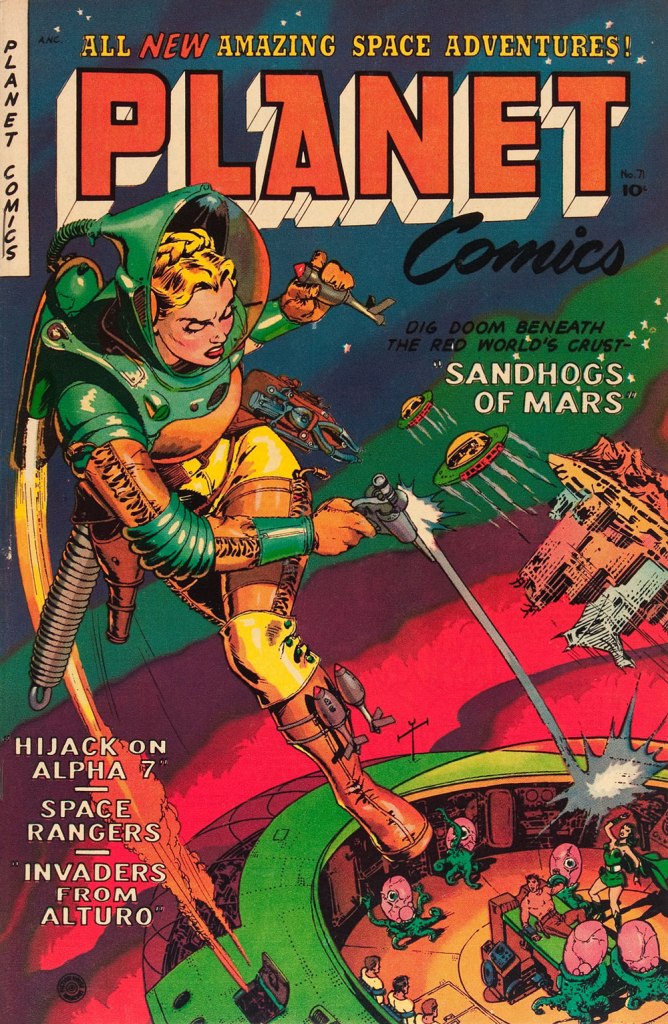
It was high time to finish what I started! Here is part two of Tentacle Tuesday: Planet of Tentacles, courtesy of Fiction House. I doubt I will exhaust Planet Comics’ source of tentacles when it comes to inside stories, but at least we’ll be able to say that we’ve completed our tour of its tentacle-bearing covers.
Planet Comics no. 2 (February 1940). Cover by, believe it or not, Will Eisner, a mere 23 at the time. If it’s meant to be scary, it is! Though perhaps the garish colours have something to do with it.
Planet Comics no. 15 (November 1941). Cover by Dan Zolnerowich, under his nom de plumeZolne Rowich.
Planet Comics no. 52 (January 1948). Cover by Joe Doolin.
Honestly, I wasn’t quite sure whether these were tentacles or what, but one look at the cover story dispelled my doubts. Does anybody care that the monsters inside look nothing like the ones on the cover? Naaah.
Mystery of the Time Chamber! was scripted by Ross Gallun and illustrated by Maurice Whitman.
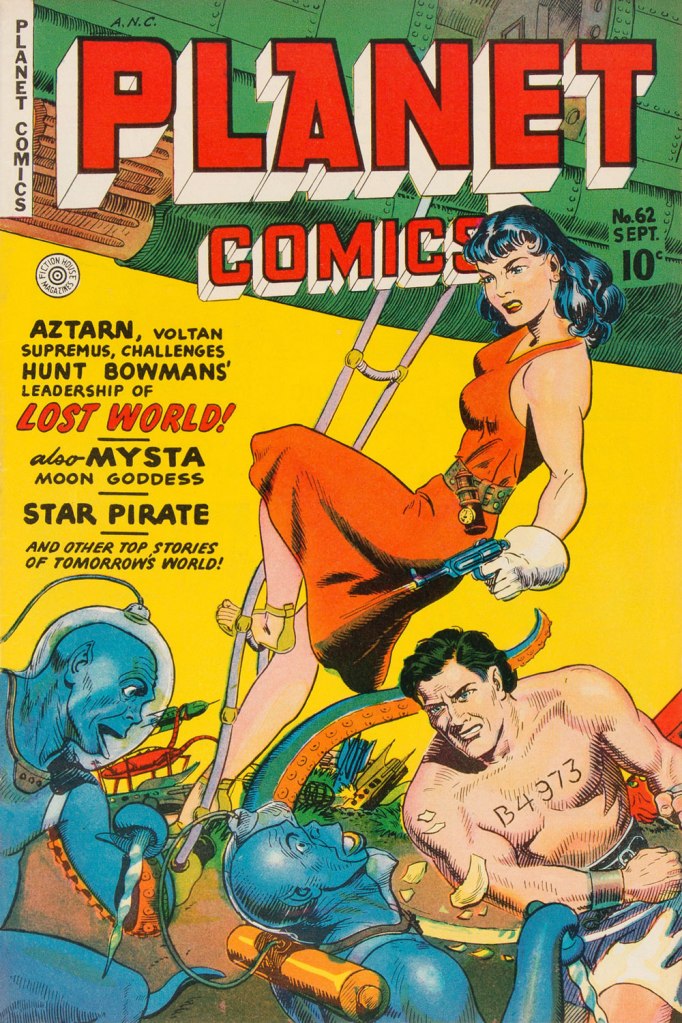
Planet Comics no. 62 (September 1949). Cover pencilled by Joe Doolin and inked by John Celardo.
And, last but not least, look at these baby cephalopods! So cute.
« Is the spring coming? » he said. « What is it like?» «It is the sun shining on the rain and the rain falling on the sunshine…»| Frances Hodgson Burnett, The Secret Garden
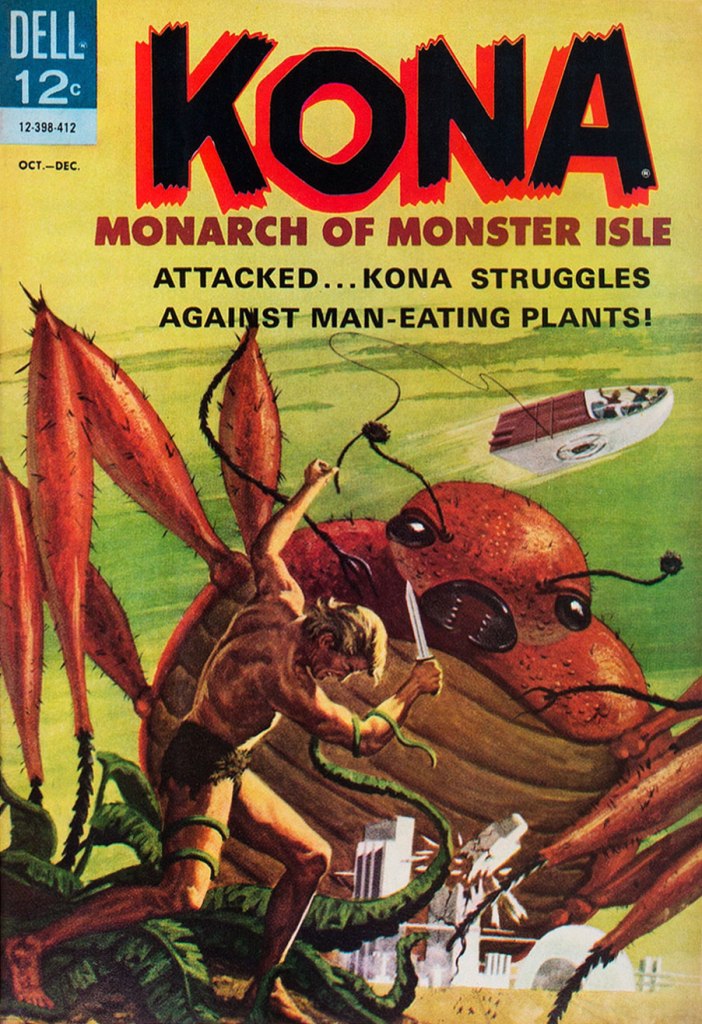
Having been meaning for a while now to concentrate on tentacled plant life, I was hitherto stopped by the idea that it’s somewhat unseemly to talk about flora when most of our readership is buried in snow and ice. But now, well! – today was the first day of the year suitable for wearing shorts, and green shoots are popping up wherever one’s gaze happens to land.
We have waited for quite a long time before co-admin RG managed to get his hands on this issue… and it turned out that the insides vary from ‘lacklustre’ to ‘wow, that’s ugly!’ Still, the wonderful, striking cover makes it worth owning, I believe.
Horror: The Illustrated Book Of Fears no. 2 (February 1990, Northstar). Cover by Mark Bernal.
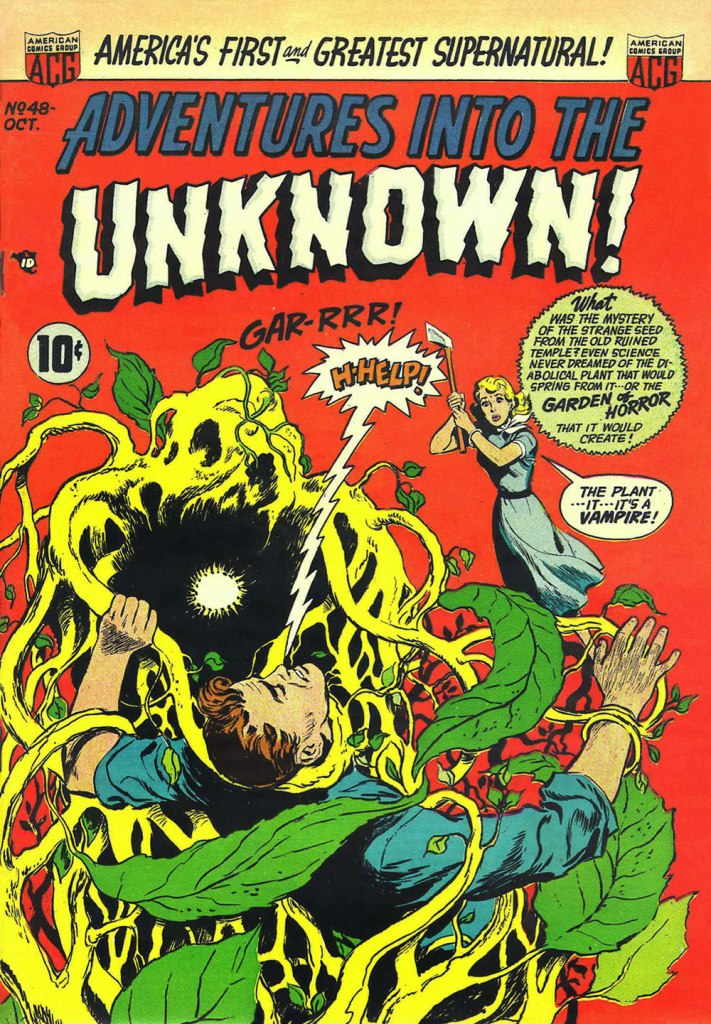
ACG got its tentacle parade in Tentacle Tuesday: ACG’s Adventures Into the Tentacles, but as usual, some material didn’t quite fit the theme, and I saved the following cover for a more appropriate occasion. This, I do believe, is the moment.
Adventures into the Unknown no. 48 (October 1953, ACG), cover by Ken Bald.
Speaking of adventures, let’s delve into Strange Adventures for a bit. The following story has a rather peculiar plot – « Star Hawkins is down on his luck and has to pawn Ilda, his robot secretary. Luckily, Star is hired to locate a fugitive who’s thought to be hiding on Vesta, an asteroid mining settlement, in the Red Jungle. But with a little tracking skill and the help of the creepy vegetation of the Red Jungle, he nabs the fugitive, gets his prisoner, and gets Ilda back from the pawn shop, promising never to pawn her again. »
Page from The Case of the Martian Witness!, scripted by John Broome, pencilled by Mike Sekowsky and inked by Bernard Sachs, published in Strange Adventures no. 114 (March 1960, DC).
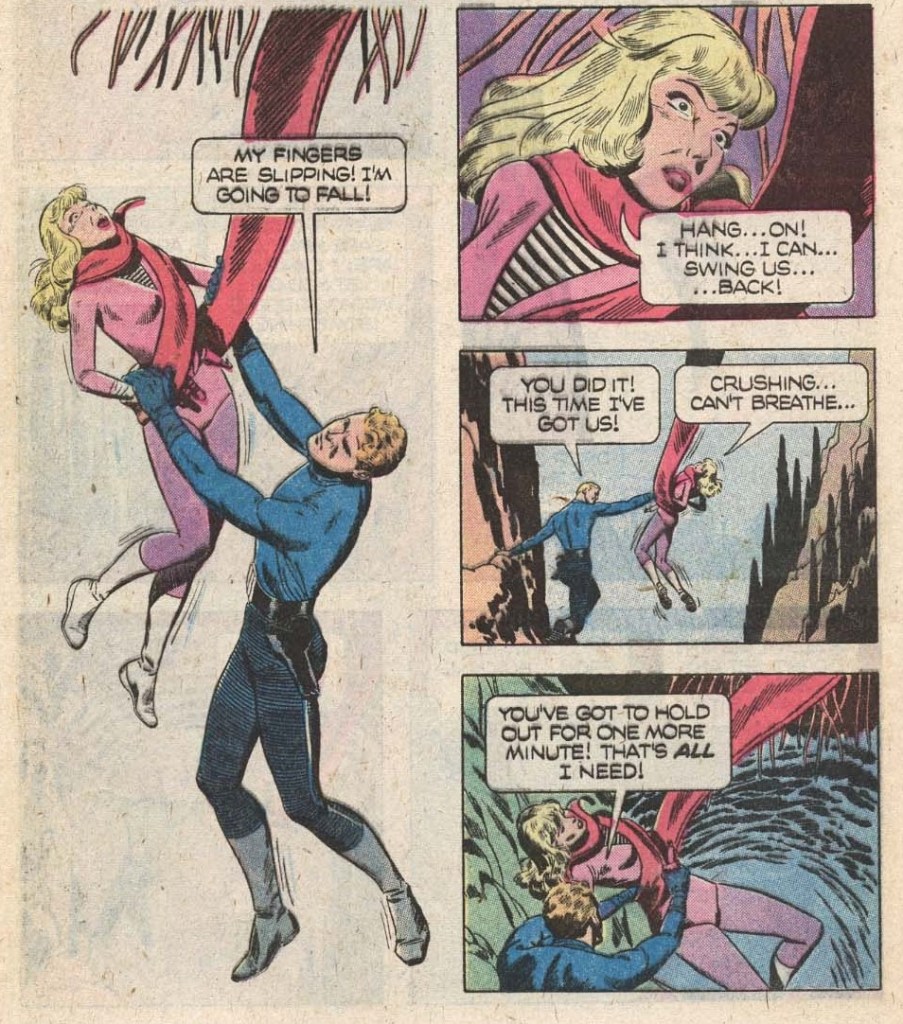
Here’s another Earthman (who has dreamed of this moment, by his own admission!) struggling with some coquettish plant tentacles that just want to be friends.
A page from Super-Athlete from Earth!, scripted by Gardner Fox, pencilled by Gil Kane and inked by Bernard Sachs, published in Strange Adventures no. 125 (February 1961, DC).
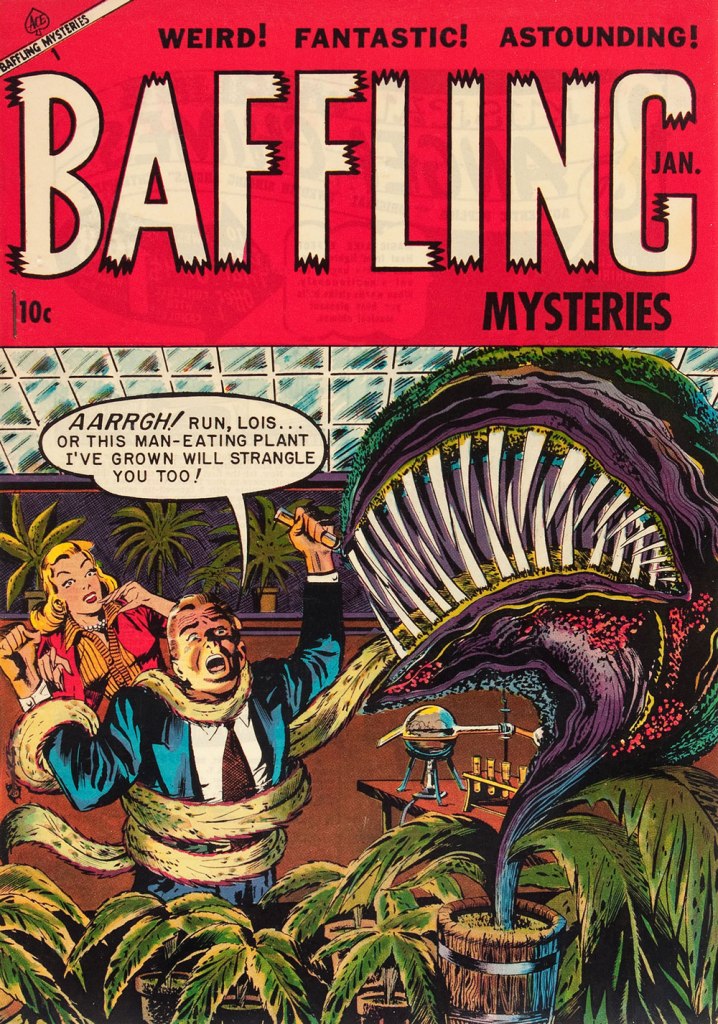
The next thing after adventures is, naturally, mysteries. If they’re strange, puzzling mysteries, even better… what’s that word I’m looking for… ah, yes: baffling! Another day, yet another ravenous man-eating plant.
Baffling Mysteries no. 19 (January 1954, Ace Magazines). Cover is presumed to be by George Roussos. I think strangulation is not even the worst option here.
One more happy tromp through the jungle? Sure, why not!
The following image was originally created as a cover for House of Mystery no. 251 (1977, DC), but was nixed in favour of another, Neal Adams-penned illustration, which we’ve already featured in a previous post (Tentacle Tuesday: Plants Sometimes Have Tentacles, Too). I prefer this gruesome version (complete with skeleton being digested!… also more detail, more dynamic layout and better anatomy of all involved), pencilled by José Luis García-López and inked by Bernie Wrightson.

































 Who's Out There?