« I’ve never been to Texas but I’ve heard Willie Nelson Sing. » — Mark Ballard
I’ve just heard of the recent, untimely passing of cartoonist Michael Dougan (1958-2023). Well, perhaps former cartoonist would be more accurate, but if so — he said his piece, made his mark, and moved on — and that’s cool. But can cartooning truly ever be left behind?
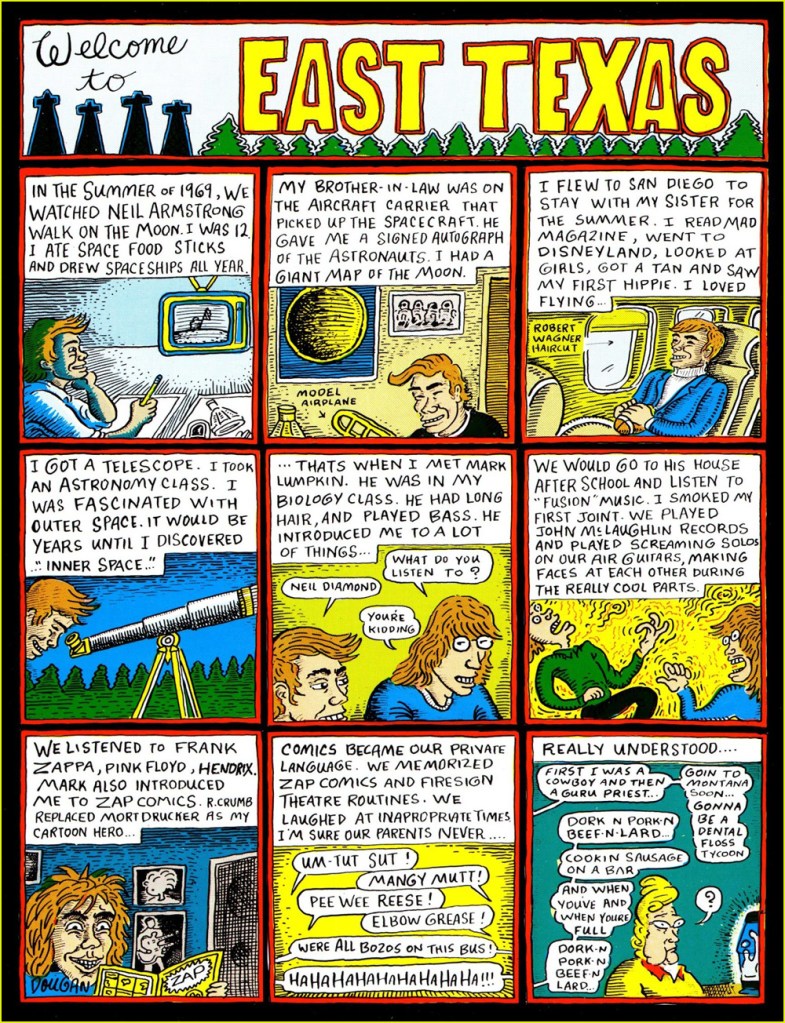
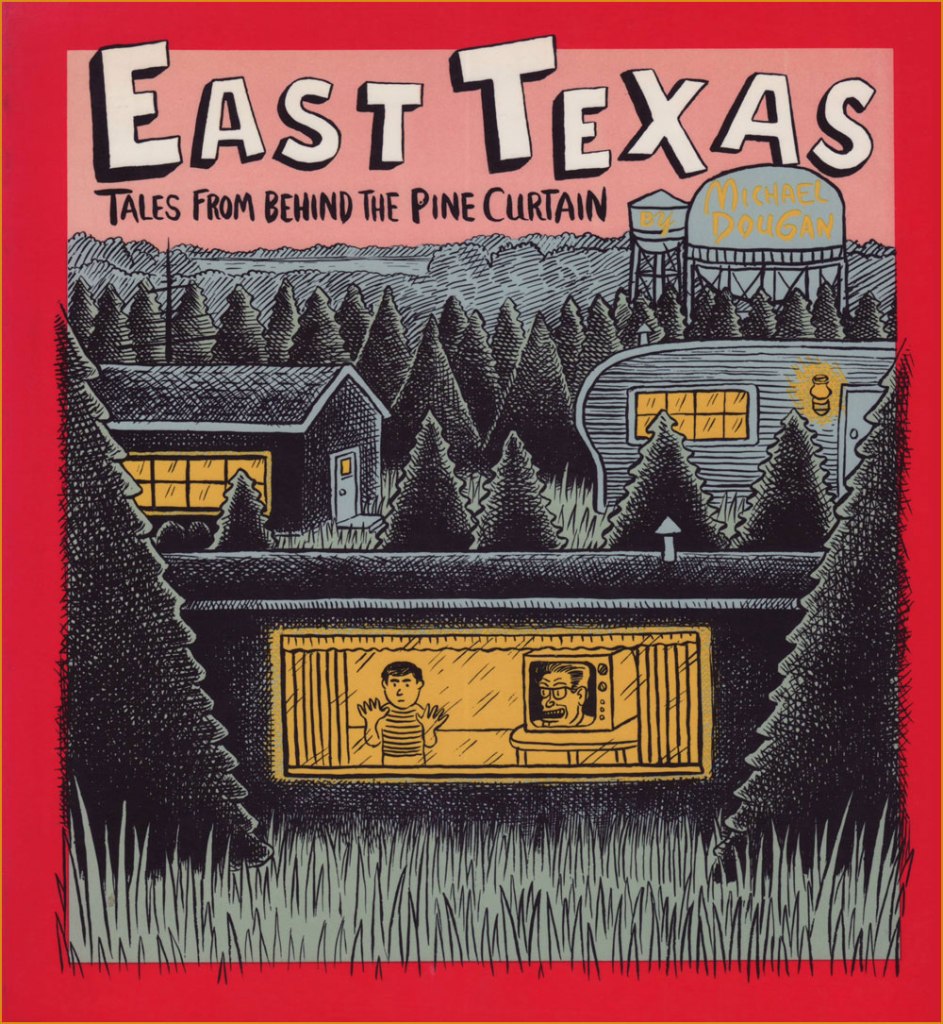
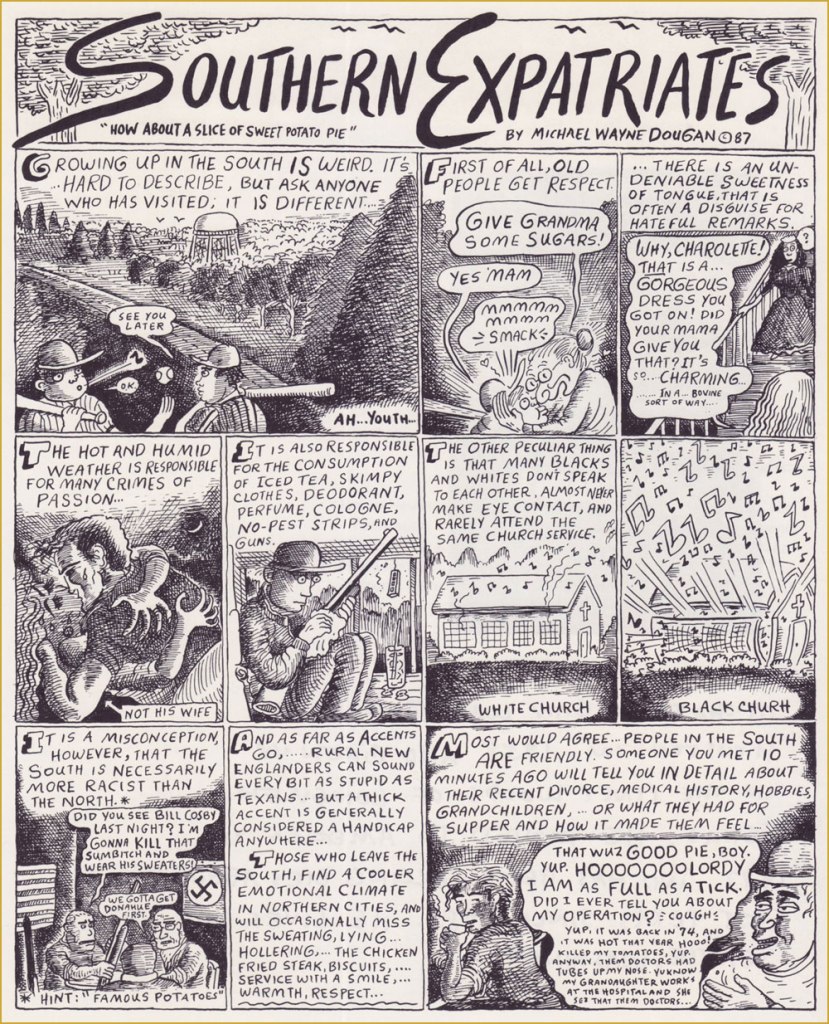
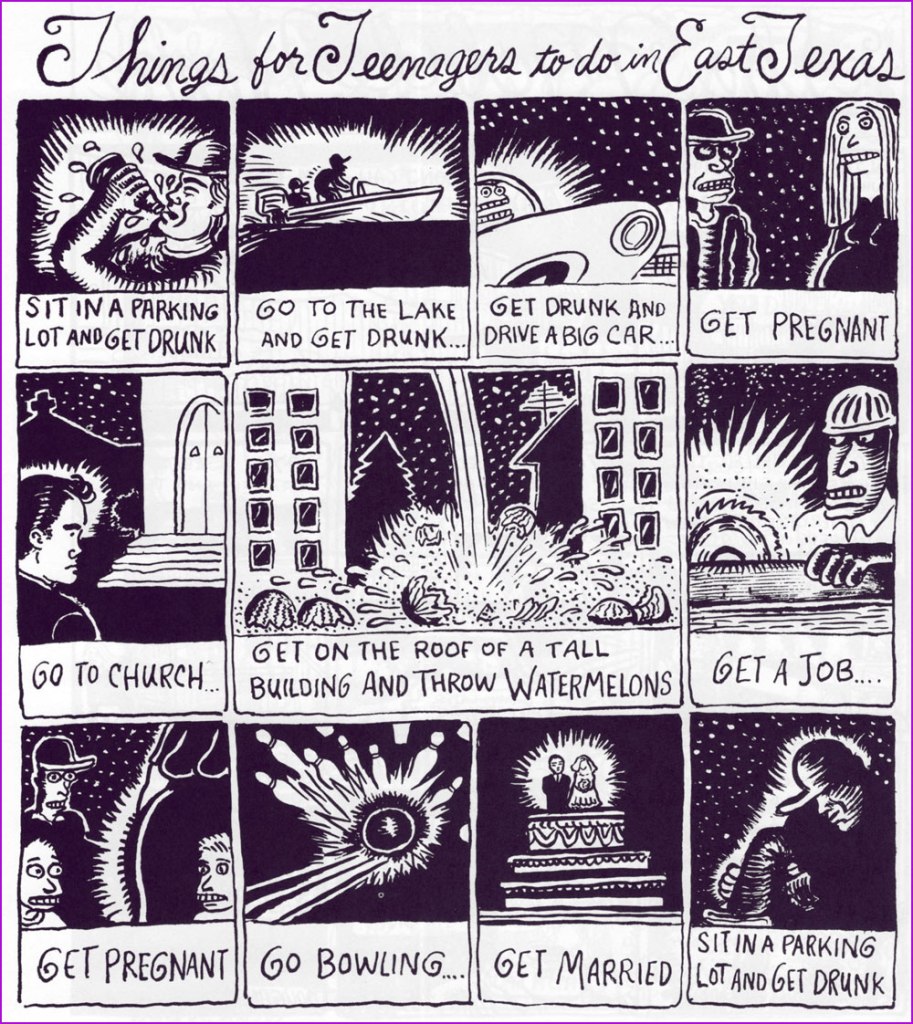
Dougan made his début in comics on the back cover of my very favourite issue of Weirdo, no. 17 (Summer 1986, Last Gasp), which also housed my pick for Robert Crumb‘s greatest short-form achievement, The Religious Experience of Philip K. Dick, and a cover among his finest *and* most provocative. See both story and cover here!Dougan’s first collection appeared the following year, published by Seattle’s fabled The Real Comet Press. The back cover was festooned with eloquent-upon-eloquent quips from his peers. For instance, Gary Panter wrote: « Dougan’s work is clear and he is not afraid. He is a big storyteller and a good liar. In East Texas the wire fences, orange colored tufts of grass, pine trees, tire tracks, piles of wood, and water towers are the best parts. The stories are about human desperation, a funny kind of desperation, an air-conditioned kind of desperation. »
And here are a few excerpts from its pages:
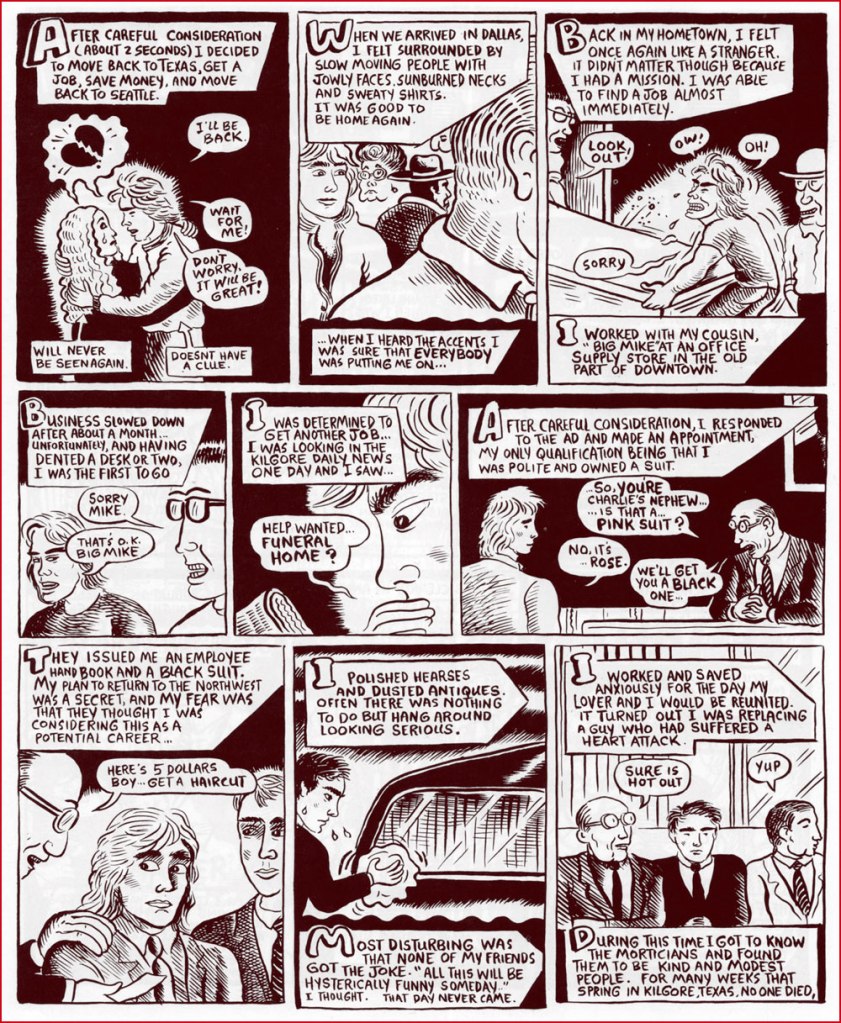
Dougan’s second and final collection, from 1993, was published by Penguin, no less! It featured longer, more ambitious pieces.Kentucky Fried Funeral would have to be my first pick for Dougan’s masterpiece. Unfortunately, it’s around 20 pages long, so it was unfeasible to present it here. Still, here’s the opening splash.A detail, perhaps, but worth noting, I think: Dougan preferred handling his own lettering, finding, like many a visual artist, the look and texture of mechanical text too… well, mechanical. Lovely!
In 2017, some twenty years after his last cartoon (that I’m aware of… Double Booked?, in Fantagraphics’ Zero Zero no.17, June, 1997) Michael and his wife moved to Japan and opened a café-restaurant. Read Michael’s own account of the saga.
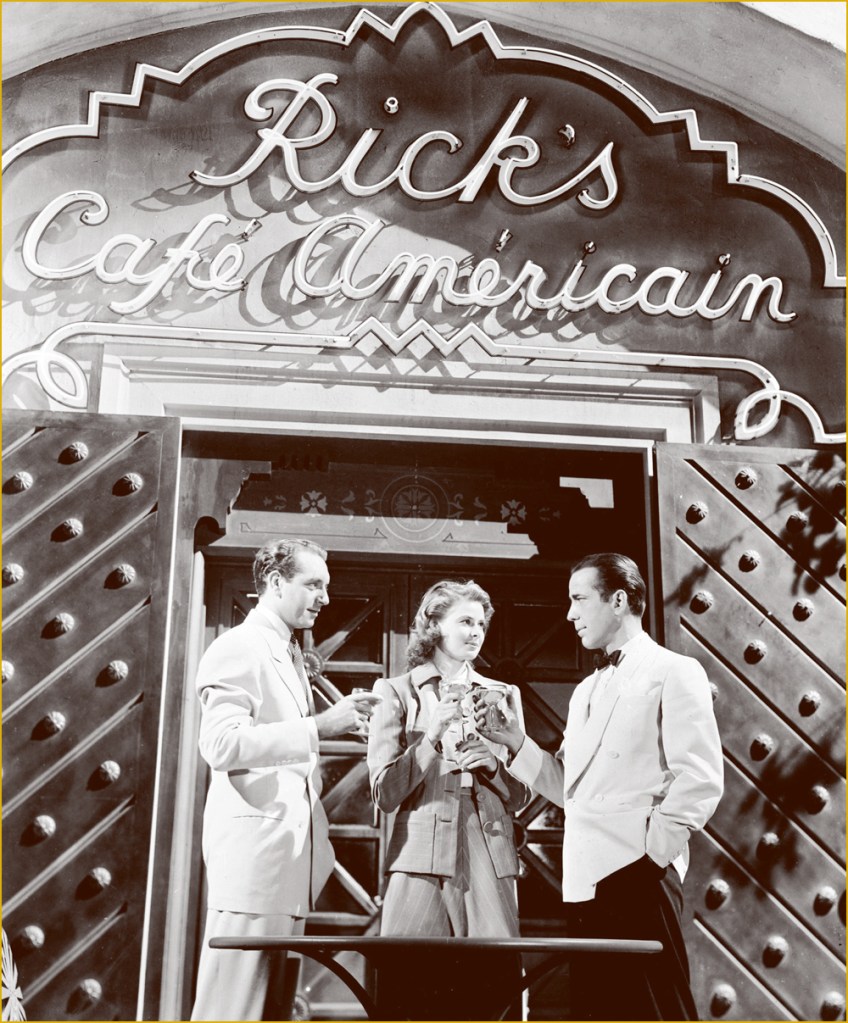
This must be the place.Of course, Dougan named his place after Bogie’s in Casablanca, but not without adding a couple of typos, for that modern touch.
Creative types often get restless, and Michael found himself a little niche answering people’s mostly, and sometimes incredibly, inane questions on Quora, with a potent mixture of withering sarcasm with a side of snide, all the while providing helpful information — whenever possible. Check out his feed, but let me caution you: it’s a bit of a frazzling rabbit hole (or warren, more accurately).
I’m hoping that, once news of Michael’s passing trickles over to his native land, that The Comics Journal will provide a detailed obituary of this notable artist. Farewell, Mr. Dougan.
«“Good grief!” yelled the ones that had stars at the first. “We’re still the best Sneetches and they are the worst. But, now, how in the world will we know,” they all frowned, “if which kind is what, or the other way round?” » — Dr. Seuss‘ The Sneetches (1961)
A few days ago, this news item piqued my interest: « The assistant director of communications for Olentangy Local School District abruptly stopped the reading of the Dr. Seuss book “The Sneetches” to a third-grade classroom during an NPR podcast after students asked about race. »
Naturally, since this sorry episode made its way around the world and rightly gave rise to quite the furore, the school district has since thrown its patsy under the bus.
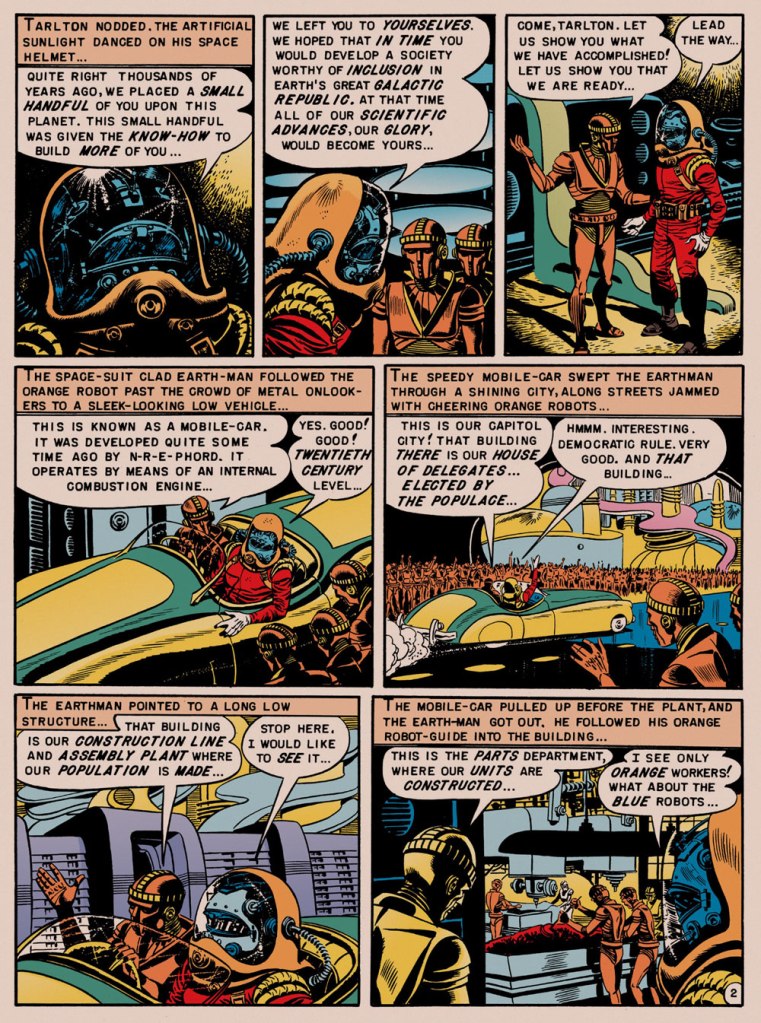
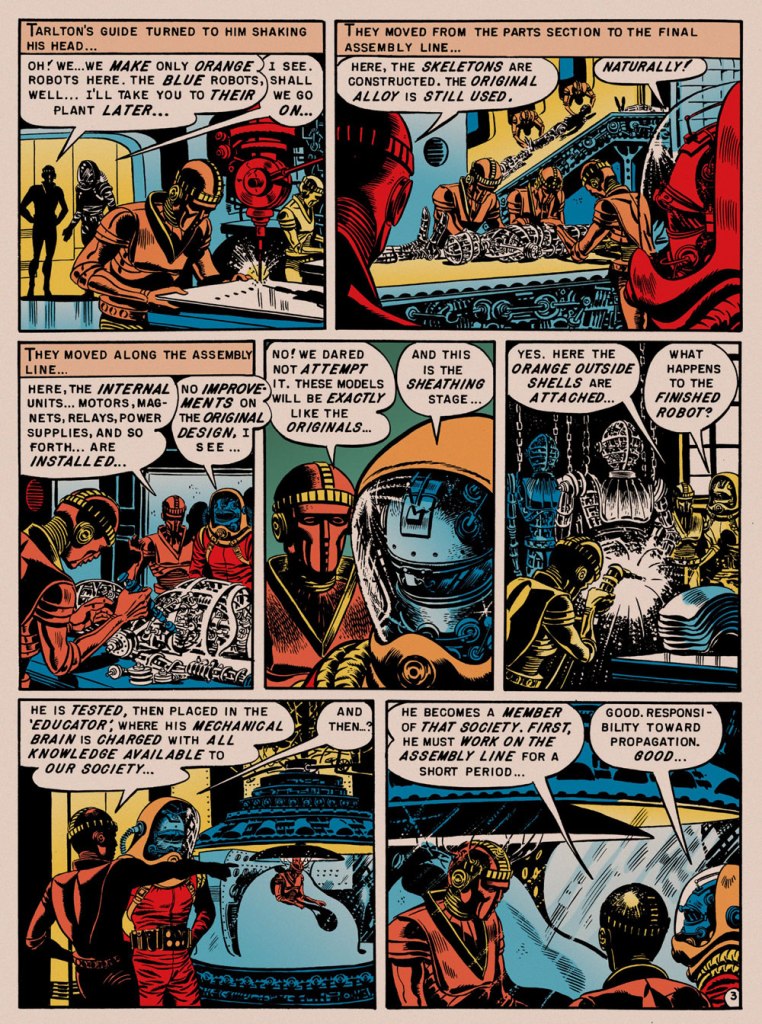
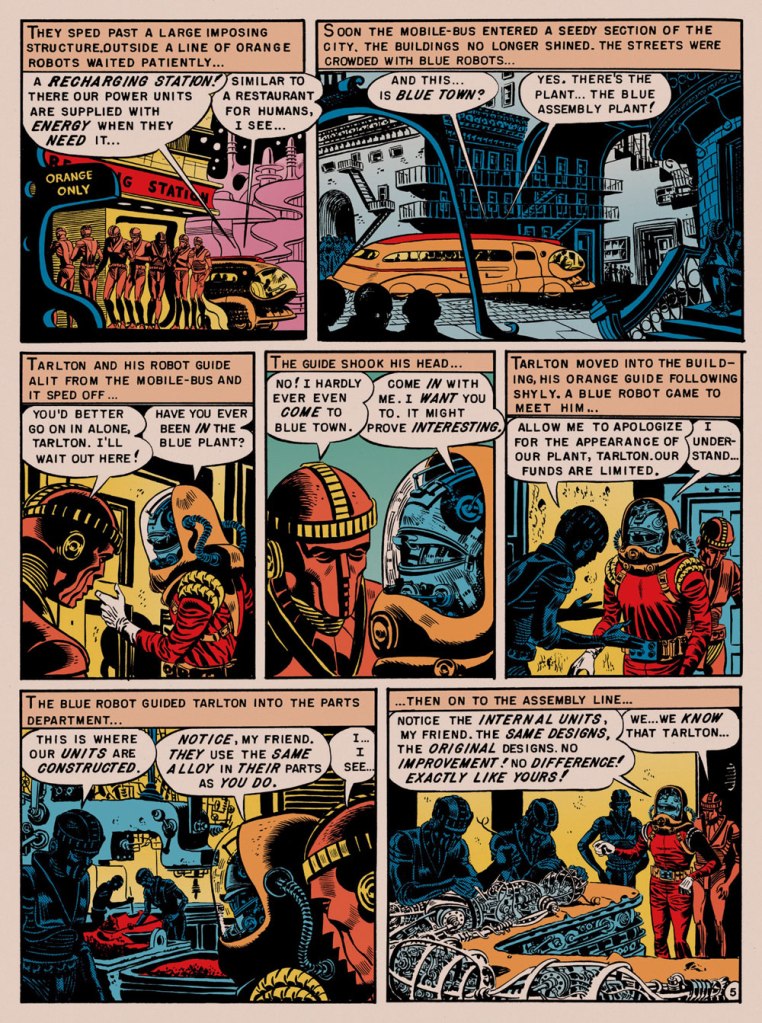
This mention of Dr. Seuss’ timeless classic The Sneetches made me think of another slightly earlier parable of systemic racism, Bill Gaines, Al Feldstein and Joe Orlando‘s Judgment Day (1953), and the similarly telling reaction would-be guardians of bluenose morality had to it.
Initially, I thought posting such an already eminent story as ‘Judgment Day’ was a trifle too obvious. But then again, how famous can a standalone comic book story published seventy years ago be, in the true scale of things? Really, it can never be famous enough.
In the course of an excellent article, CBR.com’s Brian Cronin summed up the skirmish (spoiler alert! you may want to read the story first if you haven’t already):
« The last traditional comic book produced by EC Comics was 1955’s Incredible Science Fiction (a series that had just begun a few months earlier, taking over the numbering from Weird-Science Fantasy) #33.
The last story in the issue, “Eye for an Eye,” had to be pulled at the last minute due to objections by the Comics Code Authority.
So Gaines and editor Al Feldstein decided to reprint “Judgment Day” in its place.
However, Gaines and Feldstein were then told that this replacement story ALSO violated the Comics Code.
Judge Charles Murphy (administrator of the Code) said that they would have to change the astronaut from black to white if they wanted it to be included. This was not part of the Code at the time. Feldstein and Gaines felt that Murphy was just deliberately messing with them.
After being told that, clearly, the color of the astronaut’s skin was practically the whole point of the story, Murphy backed down a bit, but said that they would at least have to get rid of the perspiration on his skin. It could possibly be that Murphy felt that it was exploitative. I do not know, and neither did Feldstein nor Gaines, who only had their suspicions that they were being screwed with.
Feldstein and Gaines both refused to comply (I believe the terms they used included at least one use of the word “fuck“), and Gaines threatened a lawsuit and/or a press conference to shine a light on why exactly the story was objected to.
The story ran as is. »
And so here it is (boasting superior reproduction, thank you, technology):
Originally published in Weird Fantasy no. 18 (Mar.-Apr. 1953, EC). Beautifully understated, it’s easy to understand why its creators considered it a high point of their respective careers.
As is generally the case with such anecdotes, there are other accounts and explanations:
« At least three versions of the story about Gaines’ dispute with the CMAA exist. In an interview, Gaines said a story showing a black astronaut with sweat on his face was rejected because the code forbid ridicule of any religion or race. When he threatened to sue, the code administrator backed down. A second version of the story suggests that Gaines was not able to get approval for the comic, but printed it with the seal anyway. A third account, told by Gaines’ business manager, said the EC story was rejected because it featured robots, which challenged Code Administrator Charles Murphy’s religious beliefs that only man was granted the ability to think. »
I like that, no matter which angle or reality we consider, Judge Murphy never fails to, er… rise to the occasion.
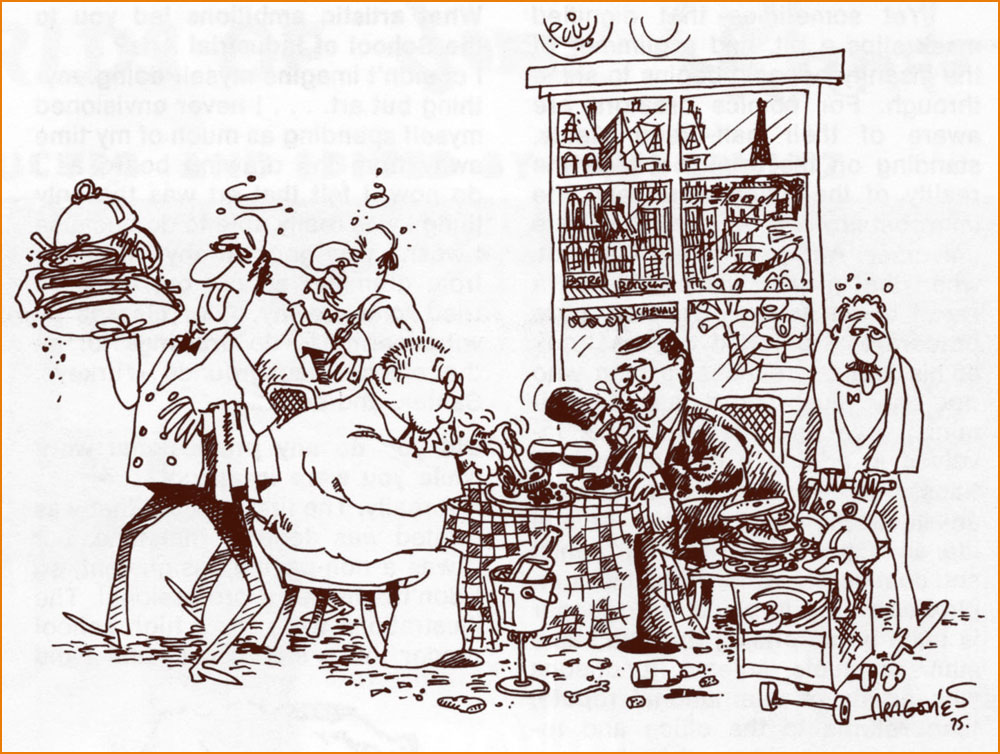
In closing, here’s a scrumptious cartoon anecdote about Messrs. Orlando and Gaines.
« Here’s Sergio Aragones‘ version of one of the many outings Joe Orlando and his publisher/pal Bill Gaines made to the best restaurants in Paris. While on one of the now famous MAD trips, Joe and Bill would eat 4 or 5 times a day! They went from restaurant to restaurant, always ordering the specialty of the house — with appropriate wines, of course! Yep — they’ve been on a very strict diet since (… but it hasn’t helped!) » Originally published in The ‘Special Joe Orlando Issue‘ of Amazing World of DC Comics (no. 6, May-June 1975, DC).
I’ve recently given in to a long-time interest (‘a fool’s dream is realized‘) and purchased one of those pretty miniature book nook kits. In case you are not familiar with them, they’re usually the size of a big hardcover book once assembled, and are meant to be inserted on a bookshelf and provide a bibliophile with an intriguing glance into an urban landscape, a Victorian street, a bookshop, a train station, or whatever it is bookworms tend to go for. One painstakingly (and crookedly, at least in my case) glues together furniture and houses, cuts out tiny pieces of paper or slices of fruit, and connects wires to provide background illumination. The one I’m currently working on is a peaceful Japanese street with a sushi shop, a tea store, and lots of cherry blossoms.
I’m clearly not alone in my love for house miniatures or drawn isometric projections of a room. One can do without too much unnecessary psychoanalysis (perhaps it allows us to feel organised and in control when real lives and houses are quite messy), but most of us find such things soothing. Placing a tiny plate on a tiny table is profoundly satisfying; the 2021 game Unpacking makes good use of this, consisting of pulling various objects from a box and placing them where you want through different rooms of the house.
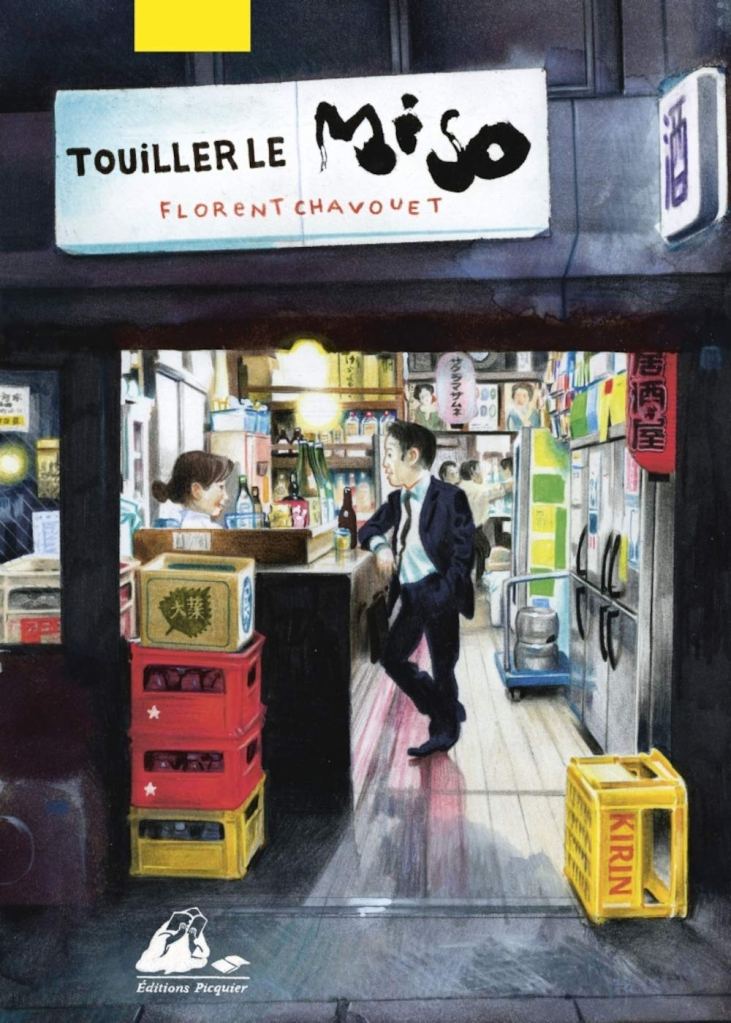
The art of French artist Florent Chavouet (see my earlier post Spotlight on Florent Chavouet) hits a similar note for me. His love of isometric projection and his elaborate sketches of storefronts and people’s rooms immediately attracted me, though at the time I didn’t think to verbalise the reason for it. I concentrated on his excellent graphic novel Petites coupures à Shioguni last time, so here are more glimpses of his other books.
Tokyo Sanpo : Promenades à Tokyo (2009, Philippe Picquier)
Manabé Shima (2010, Philippe Picquier)
L’île Louvre (2015, Futuropolis)
Touiller le miso (2020, Philippe Picquier), his latest book (which I haven’t bought yet, shame on me!)
On a more seasonal note, two of his window panoramas drawn for the famous Galeries Lafayette in 2022:
Another thing I really love is imaginary food (which is why the duo of comic artists James Stokoe and Brandon Graham is going to be a post topic sometime in the future), and Chavouet did a beautiful job with his Gloutisphère, a map of the best food in the world… completely made up. Enjoy it on his blog!
« I was already doing a lot of splendid research reading all the books about ghosts I could get hold of, and particularly true ghost stories – so much so that it became necessary for me to read a chapter of Little Women every night before I turned out the light – and at the same time I was collecting pictures of houses, particularly odd houses, to see what I could find to make into a suitable haunted house. » — Shirley Jackson
This one’s from the department of historiated text. What text? “those fiction pieces that nobody read” in comic books, prose pages mandated by the United States Postal Service. The USPS insisted that comic books «… have at least two pages of text to be considered a magazine and qualify for the cheaper magazine postage rates. »
By the Sixties, most of these pages consisted of letters to the editor, but not every company followed this practice. After EC pioneered the letters page idea in the early 1950s, ACG, DC, Archie and Marvel followed suit. But not Dell/Gold Key, Harvey and Charlton.
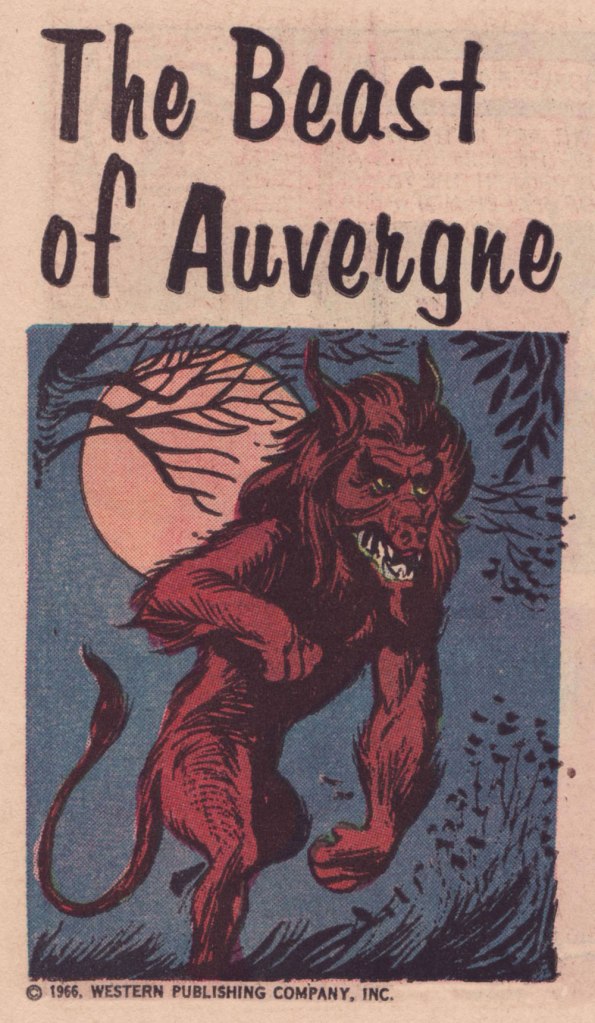
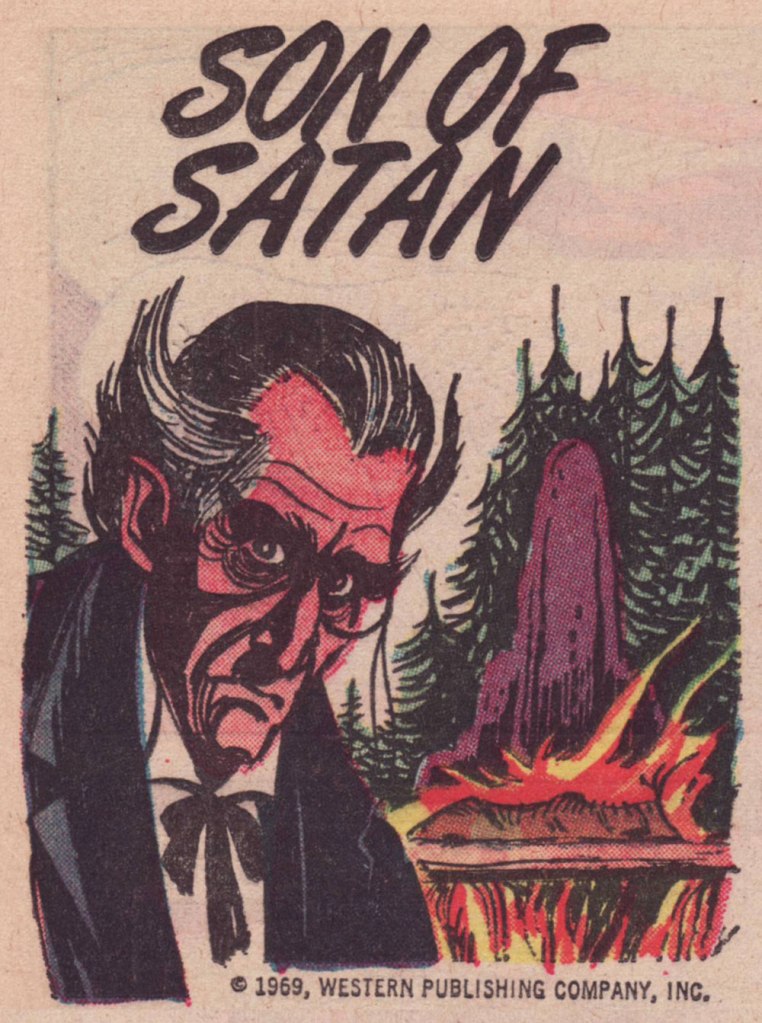
For its mystery titles, Gold Key naturally opted for a ‘unusual history’ format, enlisting, to provide spot illustrations, veteran cartoonist Joe Certa, best known for his co-creation of and long run (1955-1968!) on J’onn J’onzz, the Martian Manhunter and his stylish run on Gold Key’s Dark Shadows comic book series (1969-76). While Certa started out with a pretty mainstream approach, as the Sixties wore on, his style got increasingly angular, spare and expressive. Personally, I love it… but I know it’s not for all palates.
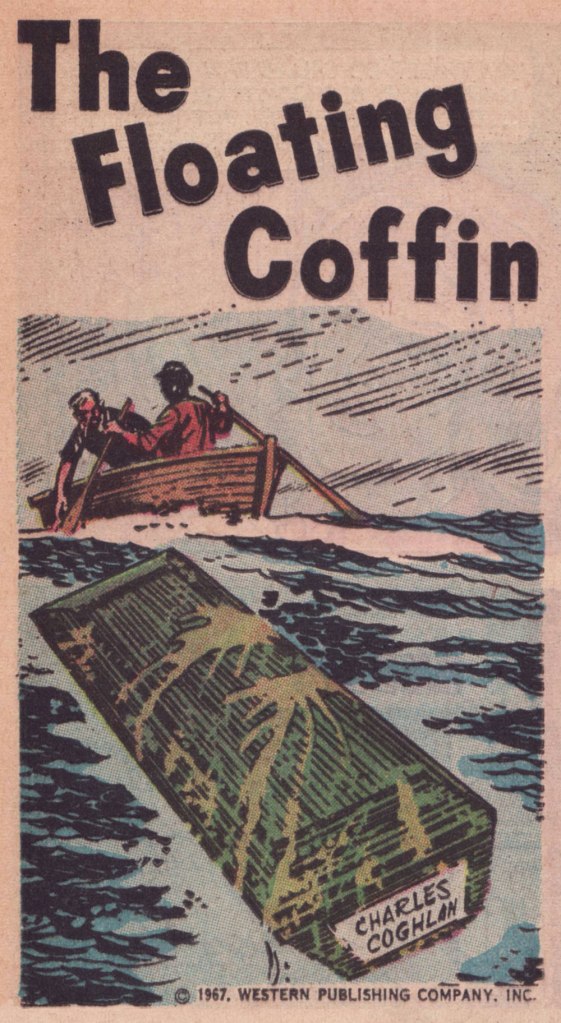
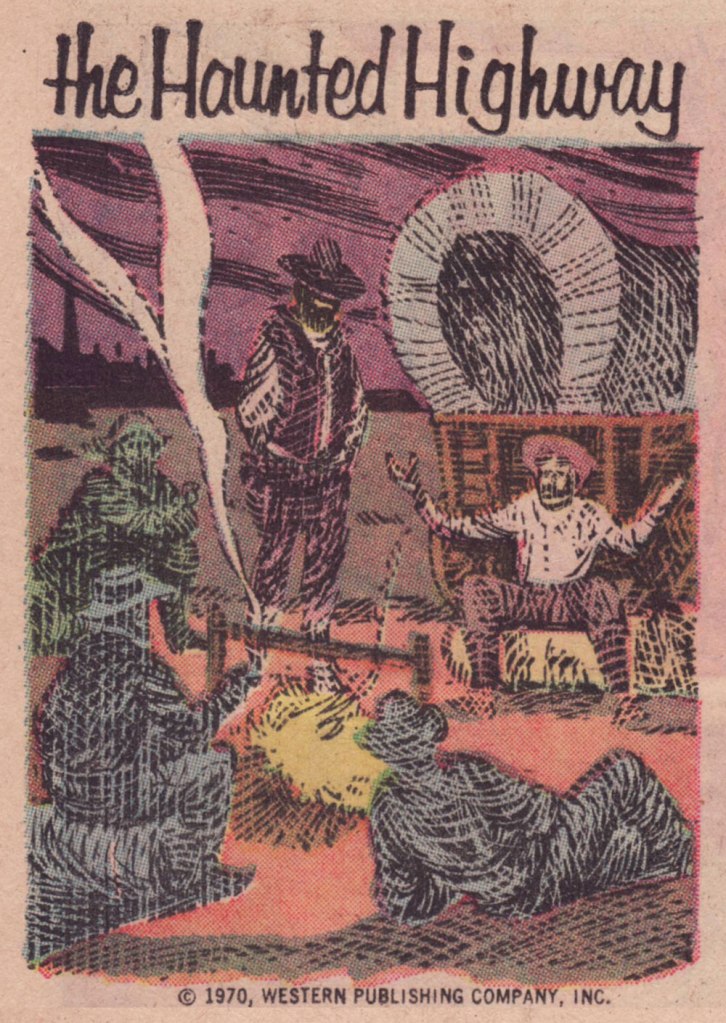
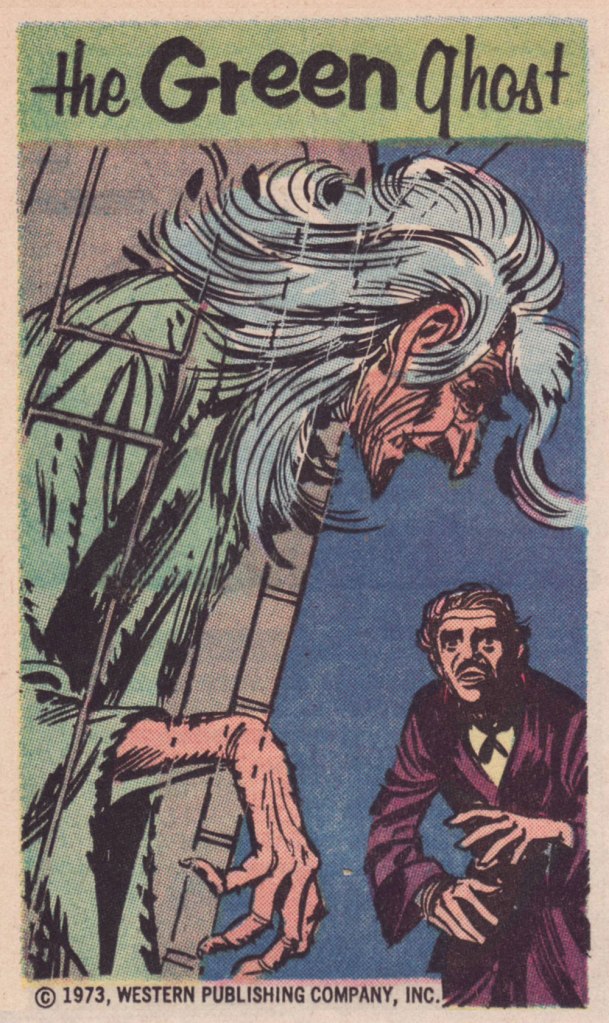
This one appeared in Boris Karloff Tales of Mystery no. 17 (Mar. 1967, Western); « It was more than two centuries ago when the monstrous creature known simply as ‘the Beast’ appeared in the province of Auvergne, in France. » Perhaps you’ve seen the action-packed, *slightly* fictionalised cinematic account of the events, 2001’s Le pacte des loups, aka Brotherhood of the Wolves.This one’s from Boris Karloff Tales of Mystery no. 28 (Dec. 1969, Western); « When Gustave Labahn appeared in Munich, Germany in 1890, he was indeed a man of mystery. Nothing was known of his except that he was tall, lithe and powerful, with strangely hypnotic eyes, and a possessor of unlimited wealth. »This one, from Boris Karloff Tales of Mystery no. 28 (Dec. 1969, Western) states: « He was a man of a hundred names and countless identities. No one knew his true origin. It was said he was descended from an evil medieval warlock. Others said he was a reincarnation of the Count de St-Germain… a man who claimed to be more than 2,000 years old. He called himself Raoul Plessy, but his followers he was known as La bête… The Beast. »Appearing in Boris Karloff Tales of Mystery no. 50 (Oct. 1973, Western), this one concerns the 1793 murder of French revolution leader Jean-Paul Marat by Charlotte Corday. Exceptionally, the art on this one is the work of John Celardo, a lovely, delicate composition.One from Grimm’s Ghost Stories no. 5 (Aug. 1972, Western). The cat’s name is Satan, we are told.From Ripley’s Believe It or Not! no. 8 (Feb. 1968, Western), this piece tells the story of a coffin that found its way home to one of my favourite places, Canada’s Prince Edward Island. Here’s a more sober account of the legend.From Ripley’s Believe It or Not! no. 15 (Feb. 1968, Western), this one concerns the purported haunting of Scotland’s Meggernie Castle.A cozy one from Ripley’s Believe It or Not! no. 21 (Aug. 1970, Western): « In the northeastern corner of Mississippi, near the town of Aberdeen, lies a stretch of deserted country road which has lately become known as one of the most haunted spots in the United States. »A great drawing from Ripley’s Believe It or Not! no. 41 (July 1973, Western); The text opens with « Ash Manor House in Sussex, England, was over six hundred years old when bought in 1934 by a man named Keel. Mr. Keel did not believe in ghosts. Neither did his attractive wife. »This hails from Ripley’s Believe It or Not! no. 42 (Aug. 1973, Western). The piece recounts anecdotes about such thespians as Burl Ives, Jackie Gleason, Rudolph Valentino and our beloved Vincent Price.And here are a couple of samples of full pieces to give you an idea of how they looked in print. This thoroughly seasonal one saw print in Grimm’s Ghost Stories no. 6 (Nov. 1972, Western).
One more? Here’s a favourite from The Twilight Zone no. 42 (Mar. 1972, Western):
« To prevent enabling oppression, we demand that black people be twice as good. To prevent verifying stereotypes, we pledge to never eat a slice a watermelon in front of white people.* » — Ta-Nehisi Coates
On a scorching day last week, we were at home digging into a particularly tasty watermelon.
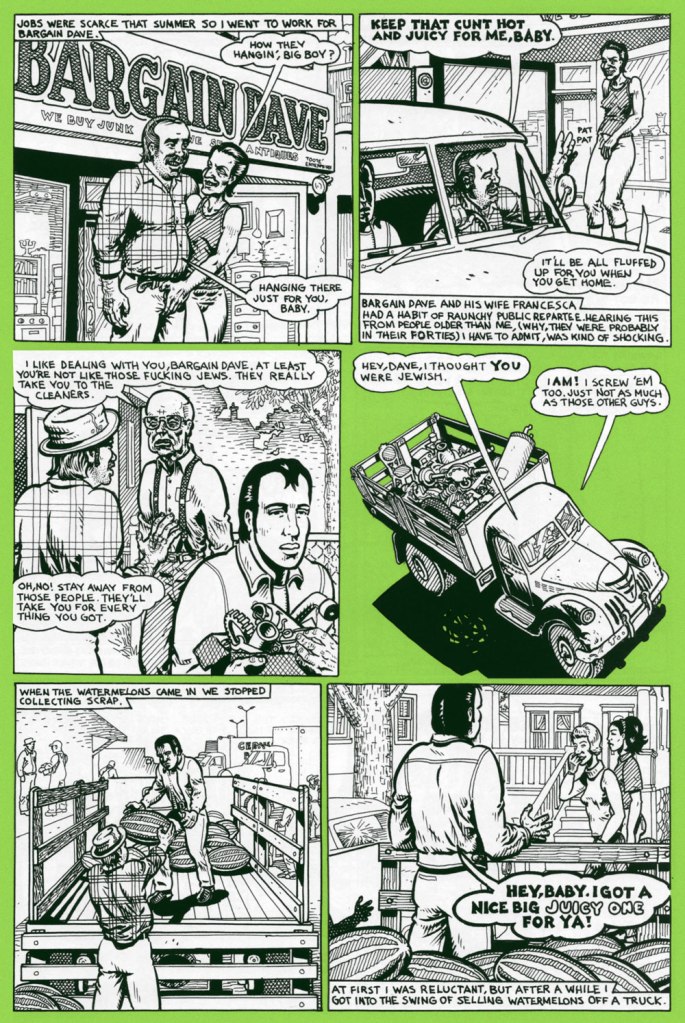
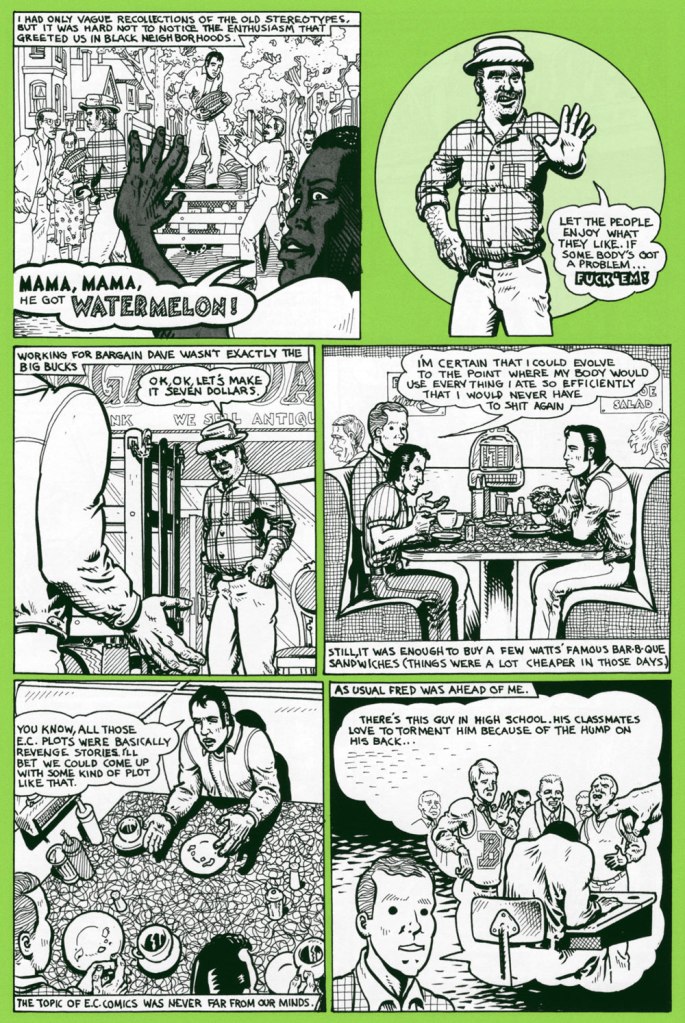
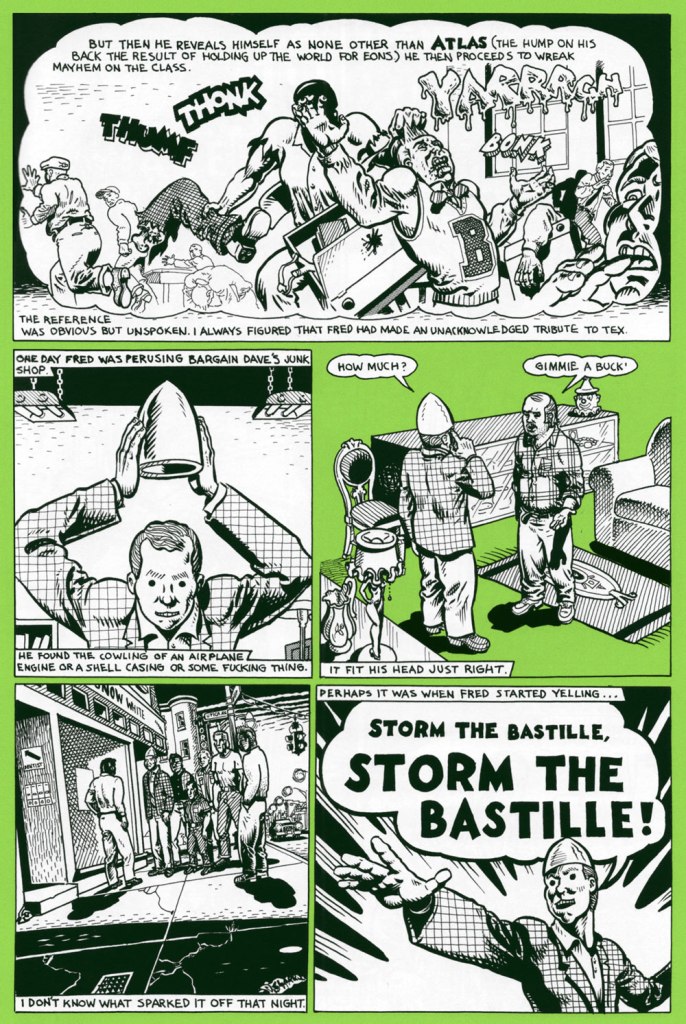
As neither of us grew up in the U.S. of A., the simple act of eating juicy pastèque has not been tainted, as it has for many, by racism and stereotypes. We’ve been allowed to appreciate the watermelon for itself, as a healthy, refreshing, tasty treat. A lightbulb came on as I recalled a relevant sequence in one of Spain Rodriguez‘s ‘Fred Toote’ stories, set in the 1950’s Buffalo of his youth — and so here it is:
And that’s not all: a few days later, a friend’s news feed presented me with a most insightful, eye-opening *and* heartbreaking tweet:
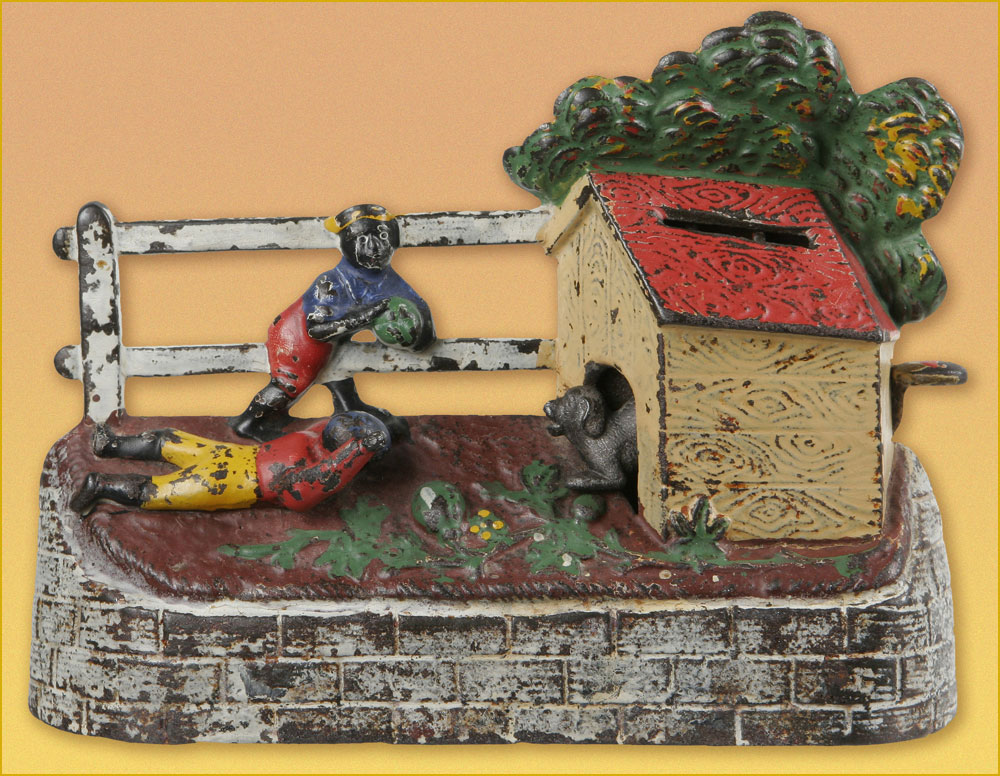
« It seems almost silly to say that watermelons have been racialized, but that is exactly what happened in this culture. » Here’s the full article, a fascinating summary of the issue from Dr. David Pilgrim of Ferris State University’s Jim Crow Museum of Racist Memorabilia, written in response to the rather hostile comment of “Judging from the pictures on your website, you seem to be saying to me that black people don’t like watermelons? Sometimes you liberals make me shake my head.“« Boys Stealing Watermelons Bank. Made by Kyser & Rex of Philadelphia, PA. circa 1894. When a lever is pressed and the coin deposited, a dog runs out to keep the boys from their prize. »Comics pioneer Gustave Verbek (1867-1937), known as Verbeek after he “moved to the United States, where an immigration officer misspelled his name“, tackles a familiar subject in his Upside-Downs strip of Aug. 7, 1904 . Don’t forget to read it upside down for the second half of the story! My warmest thanks to Sunday Press‘ Peter Maresca for providing me with this rare image.
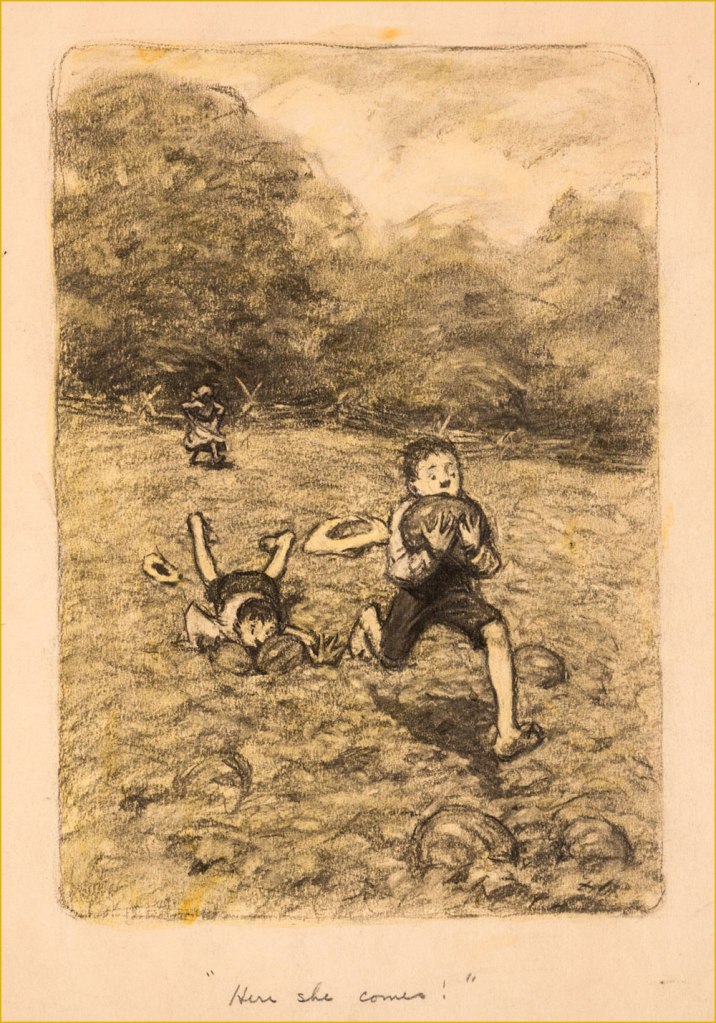
A piece in graphite on manila by James Ellsworth “Worth” Brehm (b. 1883 – d. 1928) illustrating one of Booth Tarkington‘s ‘Penrod’ novels, circa the 1910s. Seems like any and all scamps — of all races — would raid the watermelon patch, given half a chance.
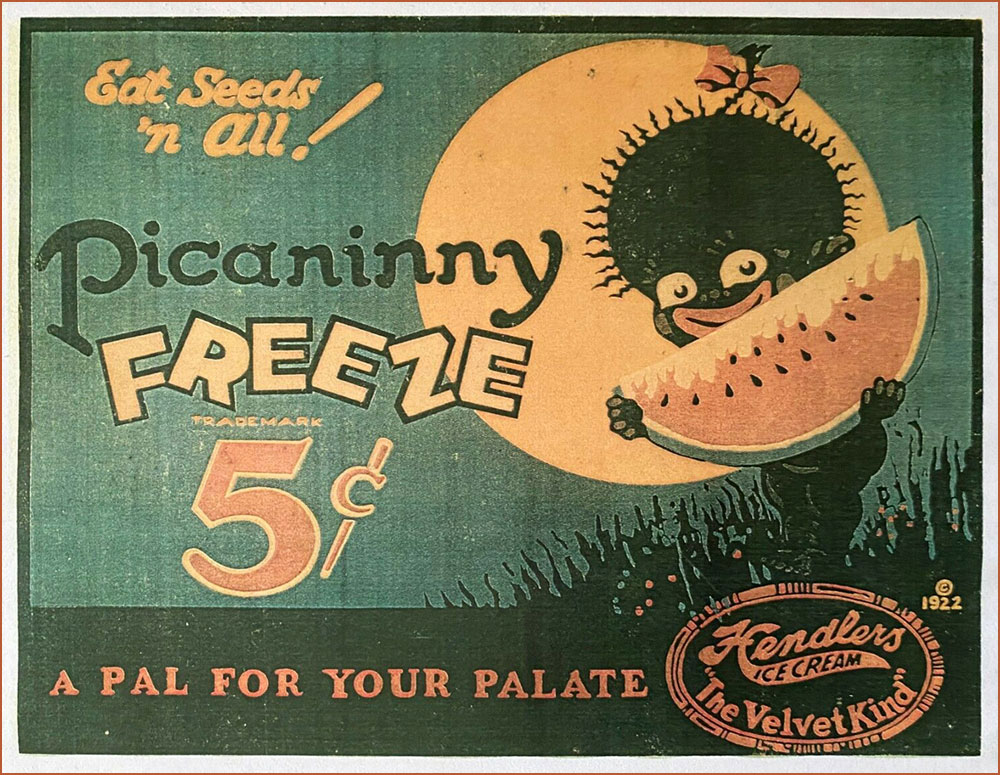
An ice cream advertising sign, circa 1922. If you’ll bear with me, here’s a longish, must-read quote from the indispensable Wicked Words by Hugh Rawson (1989, Crown Publishers, New York):
Pickaninny. A black child. Thus, from a book that was being sold in 1987 in order to raise money for the state of California’s observance of the bicentennial of the United States Constitution. ” If the pickaninnies ran naked it was generally from choice, and when the white boys had to put on shoes and go away to school they were likely to envy the freedom of their colored playmates” (Fred Albert Shannon, essay on slavery, 1934, in The Making of America, W. Clean Skousen, ed., 1985).
Pickaninny arose among slaves in the West Indies, where it was recorded as early as 1653. The original users based the term either on the Portuguese pequenino, little child, or its Spanish equivalent. They employed the term affectionately, of course, and, on the evidence of Captain Frederick Marryat, who was a sensitive recorder of language, applied it to little children generally, regardless of color, e.g. “And den, Mass Easy, you marry wife – hab pickaninny — lib like gentleman” (Mr. Midshipman Easy, 1836).
But no white person can get away with this today. The essential informality of the word makes it seem too condescending, too offensive, to most modern sensibilities. The California Bicentennial Commission, in fact, halted the sale of The Making of America, and issued a formal apology for having authorized it in the first place, after this use of pickaninny was called to their attention (along with other matters, the text also concluding that “slave owners were the worst victims of the system [of slavery].”
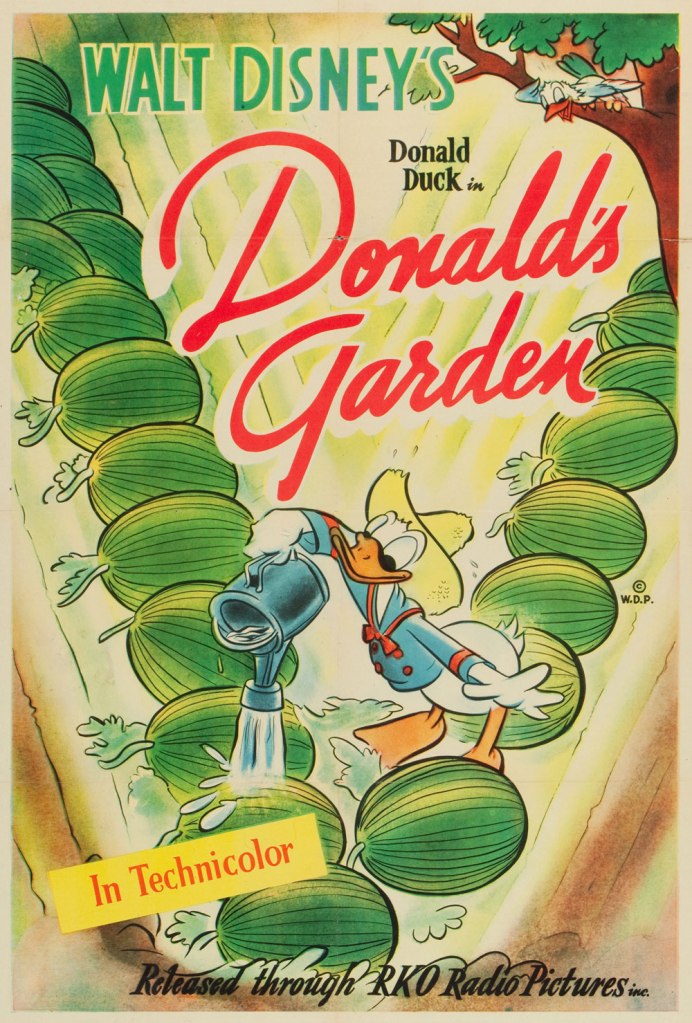
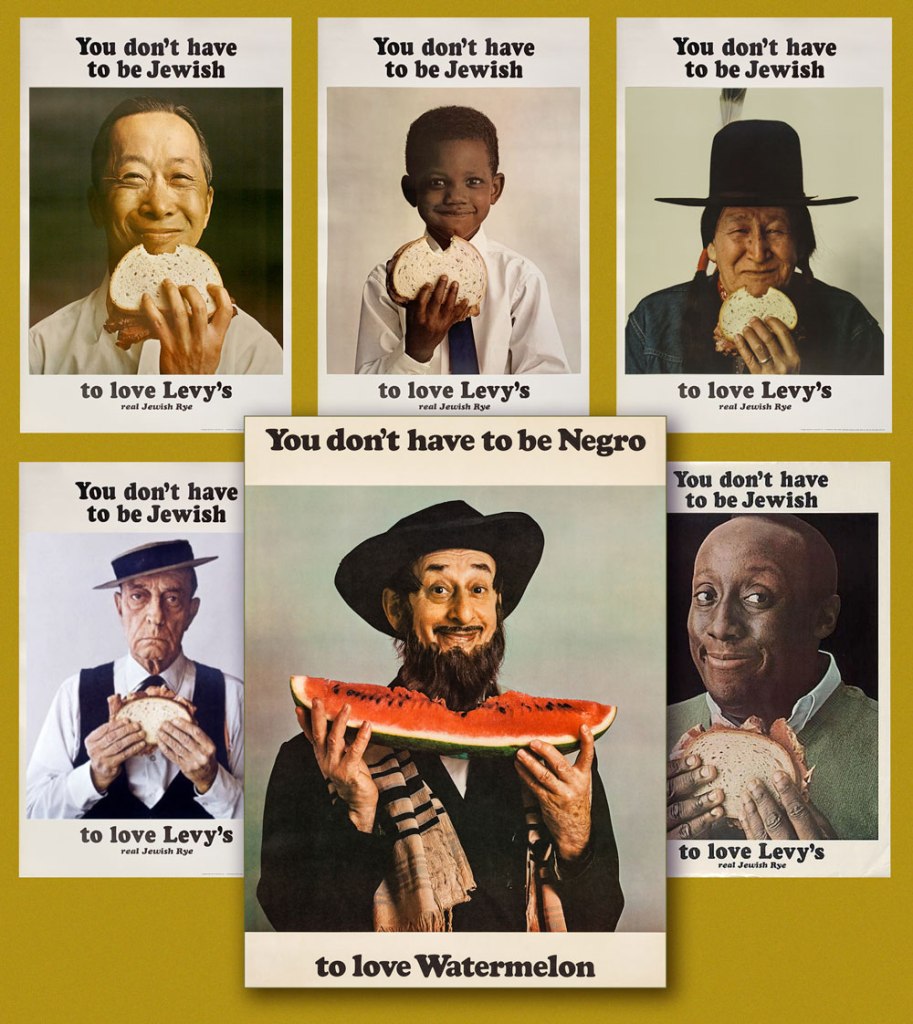
One Sheet poster from Donald’s Garden (RKO, 1942), written by Ralph Wright and directed by Dick Lundy. « During WWII, Americans were expected to help their country in the war effort by participating in “Victory Gardens.” This was a measure to conserve produce domestically so food could be shipped to the troops overseas. » Watch it here!This is Krazy Krow no. 2 (Fall 1945, Timely). Racist stereotype or not? It’s not always the case, as R.C. Harvey soberly argues in an excellent article on Walt Kelly‘s Pogo, Sometimes a Watermelon Is Just a Watermelon. Here’s a sample: Harvey — « This is ultimately a failure to understand what the watermelon stereotype actually entails. Surely you realize that there’s nothing intrinsically degrading in liking to eat watermelon. Watermelon was one of the props in a general stereotype of the African American as filled with infantile enthusiasm, easily distracted and reduced to paroxysms of delight at the rattling of dice, the smell of fried chicken, or the sight of a watermelon. This is not what’s happening in Kelly’s story at all. But then, Andrae hardly seems to have an idea of his own on this subject at all. Rather, he has a grab bag of received notions, incompletely understood and haphazardly applied. Watermelon equals racism, that is all you know and all you need to know. »A slice of Mal Eaton’s delightful Rocky Stoneaxe (né Peter Piltdown); undated, but since it bears the Stoneaxe name, it’s post-1953 and saw print in the pages of Boy’s Life Magazine. Eaton’s a local favourite, and my co-admin ds has twice written about his signature creation. First came Mal Eaton’s Peter Piltdown, then Tentacle Tuesday Masters: Mal Eaton — Peter Piltdown Goes Fishing!And now for something more progressive: called ‘the most successful Jewish ad campaign of all time’ (*explicitly* Jewish would be my caveat), the truly classic Levy’s rye bread campaign was launched in 1961 and lasted into the 1970s, spawning along the way countless imitations, parodies and ripostes, including, circa 1967, the You Don’t Have to be Negro to Love Watermelon seen here front and centre. Keen readers surely will have spotted the unmistakable deadpan mug of the rightly legendary Buster Keaton, bottom left.
According to a New York Times article, « Malcolm X liked the poster featuring the black child so much that he had himself photographed alongside it. »
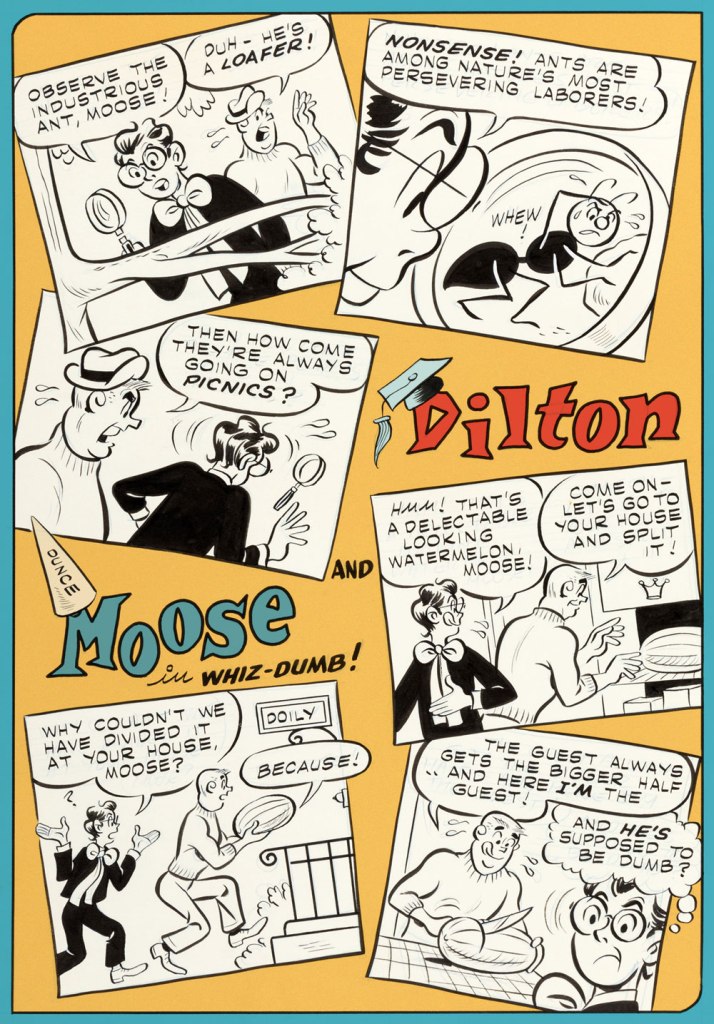
Given the right writer, I’ve always enjoyed the Dilton-Moose pairing more than the Moose-Midge combo. The boy genius and the dunce are genuine friends, while Midge only serves as a vehicle for Moose’s jealousy and as a way to land Reggie in traction. This one appeared in Archie’s Joke Book Magazine no. 46 (May 1960, Archie). Writer unknown, art by Joe Edwards (1921-2207).
A page from Little Audrey and Melvin no. 4 (November 1962, Harvey); kudos to Melvin — I can’t even get a proper boomerang to return to me, let alone a piece of rind used in its stead.
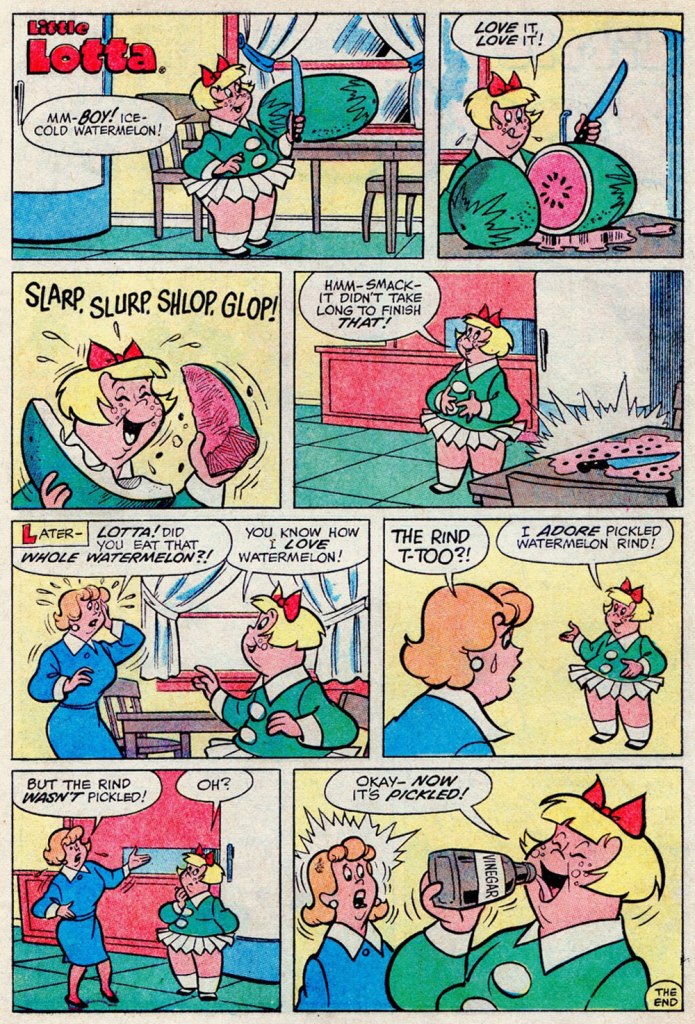
I suppose your stomach acids would have done the trick just as well, Lotta. A page from Little Lotta no. 65 (May 1966, Harvey).
A special watermelon sequence by the Lieber Bros, Stan & Larry, with inks by Mike Esposito (moonlighting as Mikey DeMeo); this is from The Parents of Peter Parker!, published in The Amazing Spider-Man Special no. 5 (Nov. 1968, Marvel).
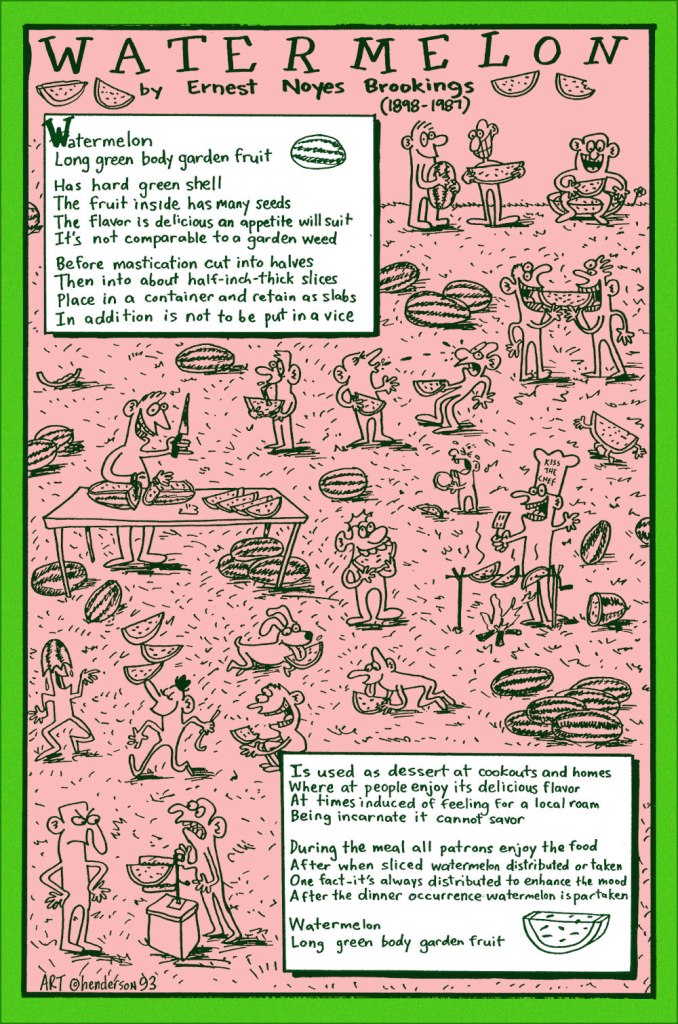
And finally, a collaboration between prankster and cultural scholar Sam Henderson and late-in-life eccentric poet Ernest Noyes Brookings; it appeared in Duplex Planet Illustrated no. 7 (March 1994, Fantagraphics), edited by David Greenberger. And if you’ve enjoyed the visual version, try the 1991 musical adaptation by Maestro Subgum & The Whole!
-RG
*He’s not even slightly exaggerating: the heinous stereotype just won’t die.
« Goodbye—if you hear of my being stood up against a Mexican stone wall and shot to rags, please know that I think that a pretty good way to depart this life. It beats old age, disease, or falling down the cellar stairs. To be a Gringo in Mexico — ah, that is euthanasia. » — Ambrose Bierce, writing to his niece in the fall of 1913.
There’s a profusion of biographical material out there on the topic of Ambrose Gwinnett Bierce (June 24, 1842- ??), but here’s a capsule version to get the preliminaries out of the way:
« Ambrose Bierce was an angry young man who got angrier as he grew older. His strong talent was directed always by bitterness and despair. His wonderful stories were weird, cynical, shocking. His life was restless, his temper outrageous, and his death violent. »
Bearce belongs to a select club of larger-than-life American literary figures (among which we might also encounter Messrs. Poe, Twain, Lovecraft, Hemingway, and perhaps Vonnegut), whose life and work inspired, and continues to inspire, countless adaptations in all media, imitations and parodies, appropriations. You know the drill: works by, works about, works starring the author as protagonist.
In addition to the expected adaptations of varying quality, Bierce’s own nebulous ending inspired both fiction (Gerald Kersh‘s 1957 short story ‘The Oxoxoco Bottle‘, in which the narrator discovers a manuscript, in Bierce’s hand, that recounts the extraordinary events that followed his disappearance) and speculative non-fiction, by which I mean Jake Silverstein‘s fascinating 2002 essay, The Devil and Ambrose Bierce: Well Met in Marfa, which you can read here).
Since there’s so much to take in, I’ll fall back on my usual coping strategy, keeping my focus narrow to avoid (further) losing it. We’re going to explore my two favourite editions of a defining Bierce work, The Devil’s Dictionary, first published in 1906 as The Cynic’s Word Book.
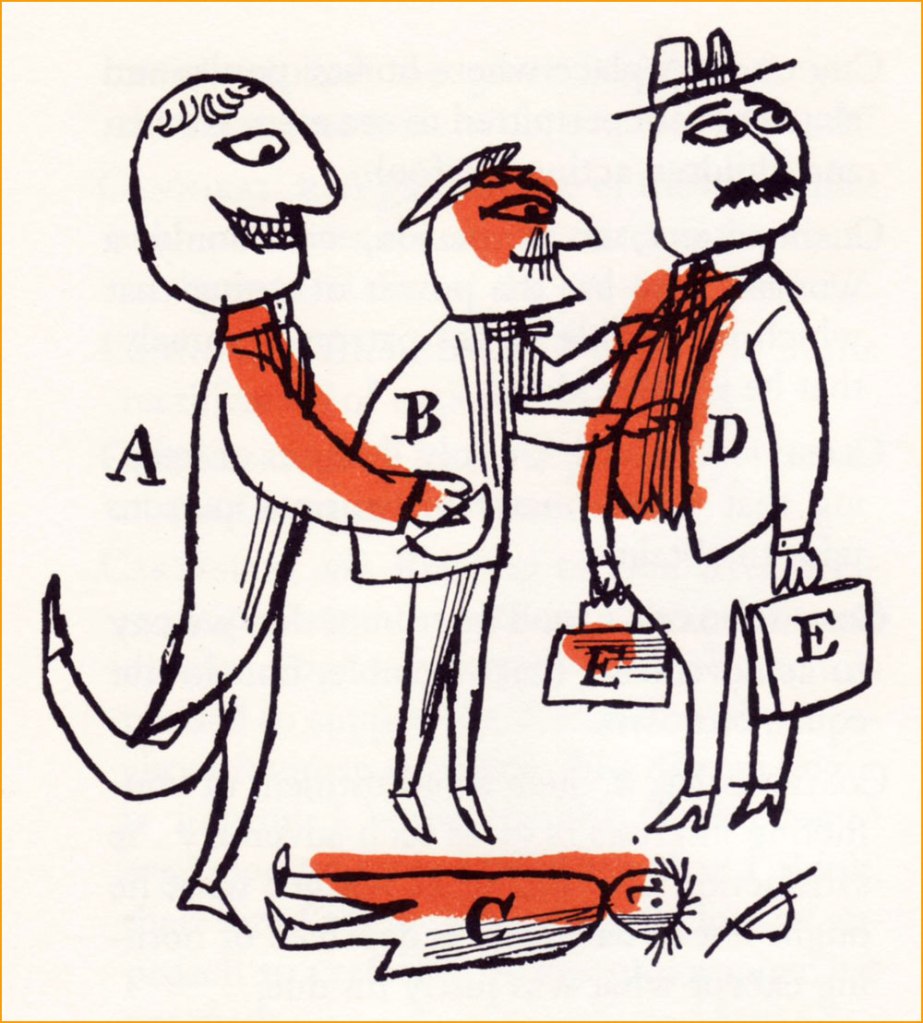
Abasement, n. A decent and customary mental attitude in the presence of wealth or power. Peculiarly appropriate in an employee when addressing an employer.Commerce, n. A kind of transaction in which A plunders from B the goods of C, and for compensation B picks the pocket of D of money belonging to E.Edible, adj. Good to eat, and wholesome to digest, as a worm to a toad, a toad to a snake, a snake to a pig, a pig to a man, and a man to a worm.Prescription, n. A physician’s guess at what will best prolong the situation with least harm to the patient.This lovely edition, featuring illustrations by Joseph Low (1911-2007) was published in 1958 by the Peter Pauper Press of Mount Vernon, NY. This, as it happens, was my introduction to the series, picked up at a long-gone bookstore during a 1992 visit to Victoria, BC, a city that last year finally broke with its proud, longstanding tradition (begun in 1894!) of dumping its raw sewage into the Pacific ocean, surely to the relief of most Seattlites.
Then in 1979 came along a most handsome edition (Thomas Y. Crowell, Publishers) boasting a wealth of illustrations by Egyptian-born force of nature Jean-Claude Suarès (1942-2013).
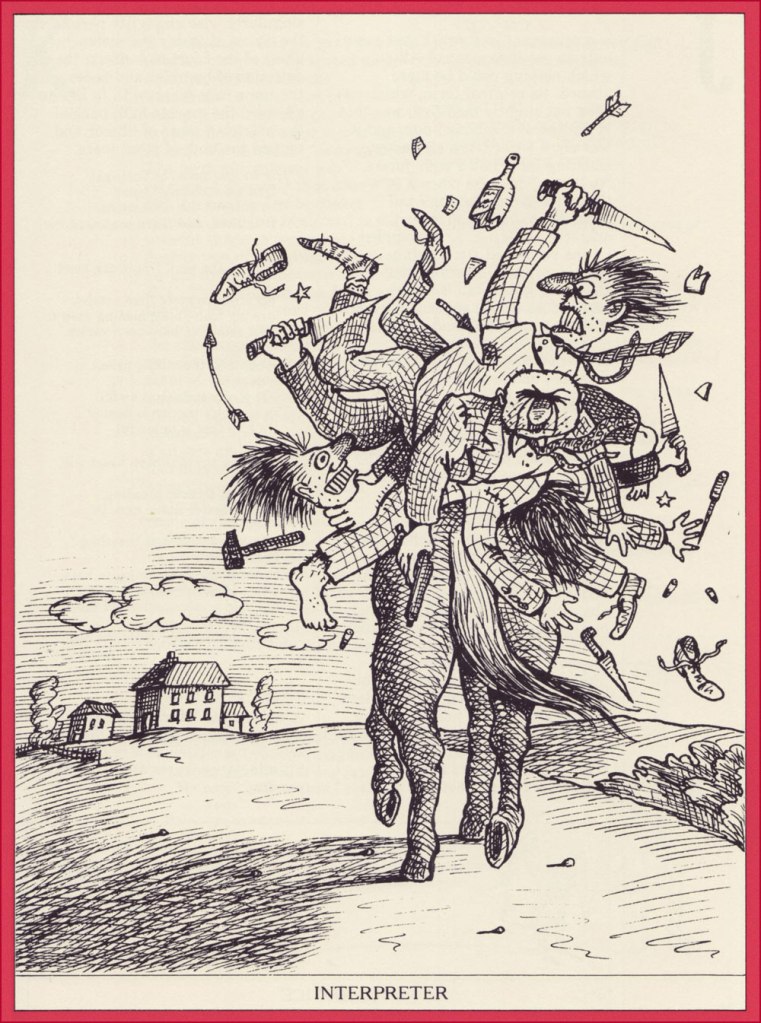
Interpreter, n. One who enables two persons of different languages to understand each other by repeating to each what it would have been to the interpreter’s advantage to have said.Lawyer, n. One skilled in circumvention of the law.Longevity, n. Uncommon extension of the fear of death.
Medicine, n. A stone flung down the Bowery to kill a dog on Broadway.
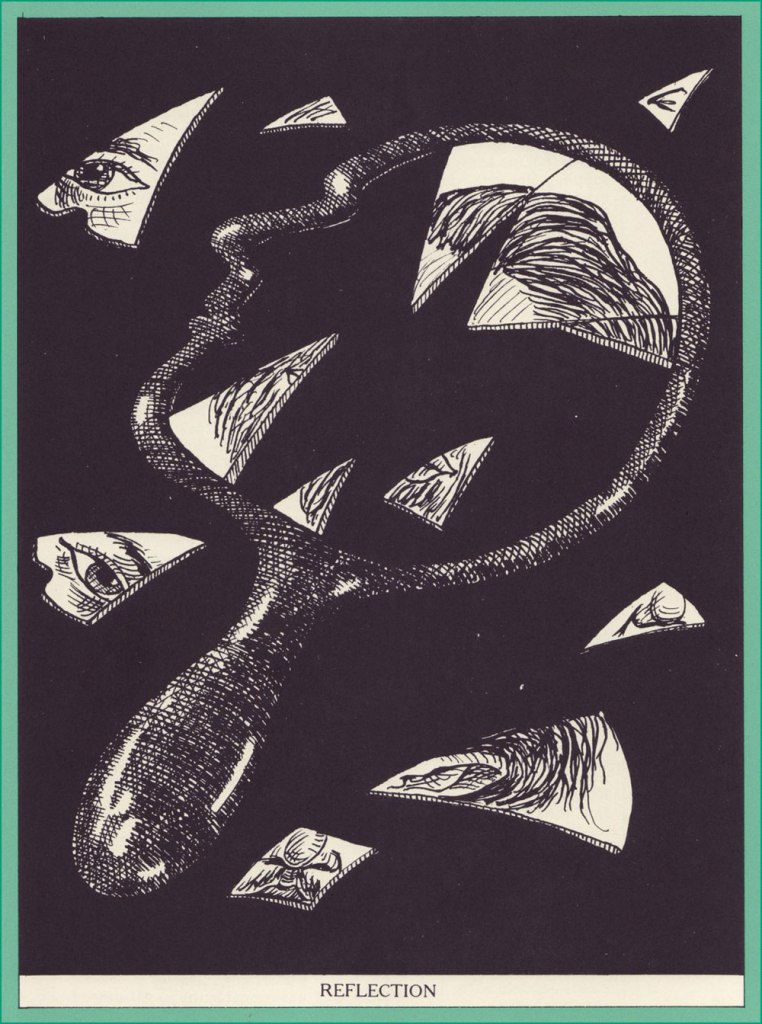
Reflection, n. An action of the mind whereby we obtain a clearer view of our relation to the things of yesterday and are able to avoid the perils that we shall not again encounter.
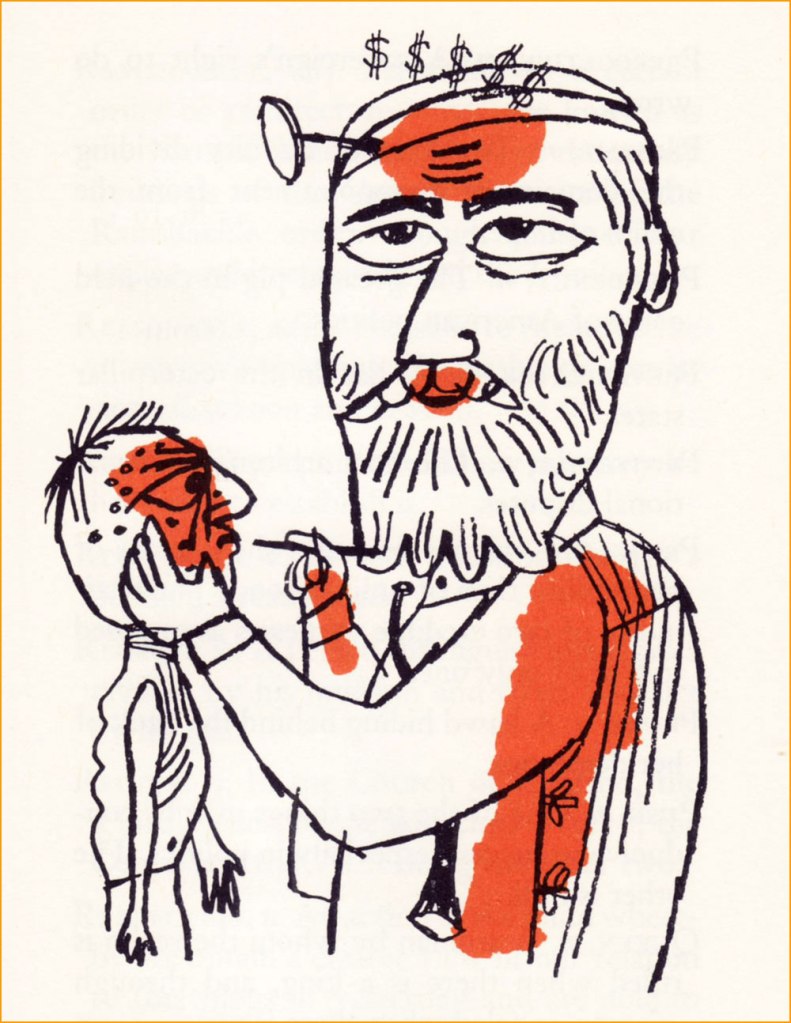
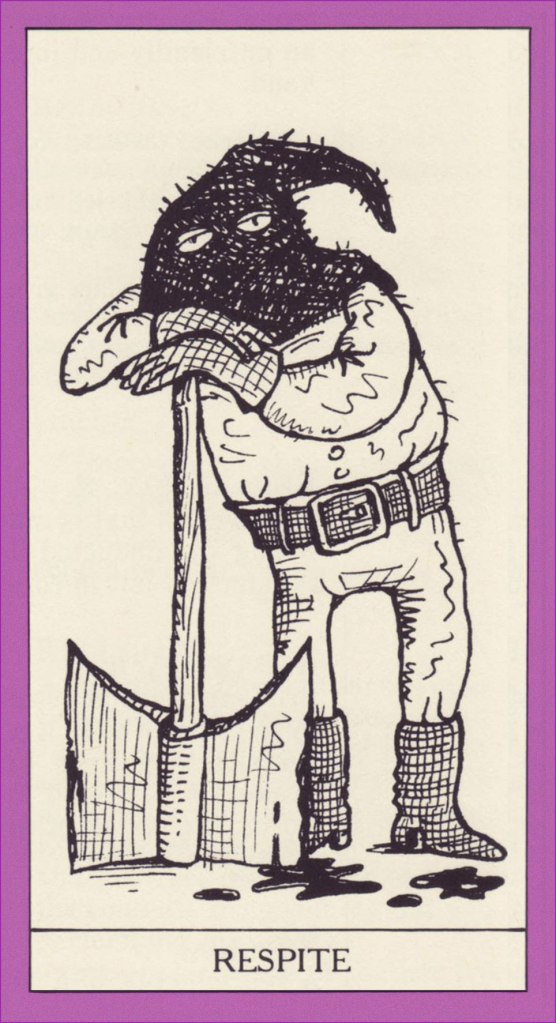
Respite, n. A suspension of hostilities against a sentenced assassin, to enable the Executive to determine whether the murder may not have been done by the prosecuting attorney. Any break in the continuity of a disagreeable expectation.
Witch, n. (1) An ugly and repulsive old woman, in a wicked league with the devil. (2) A beautiful and attractive young woman, in wickedness a league beyond the devil.
For the sake of comparison, here’s Mr. Low’s rendition of same:
.
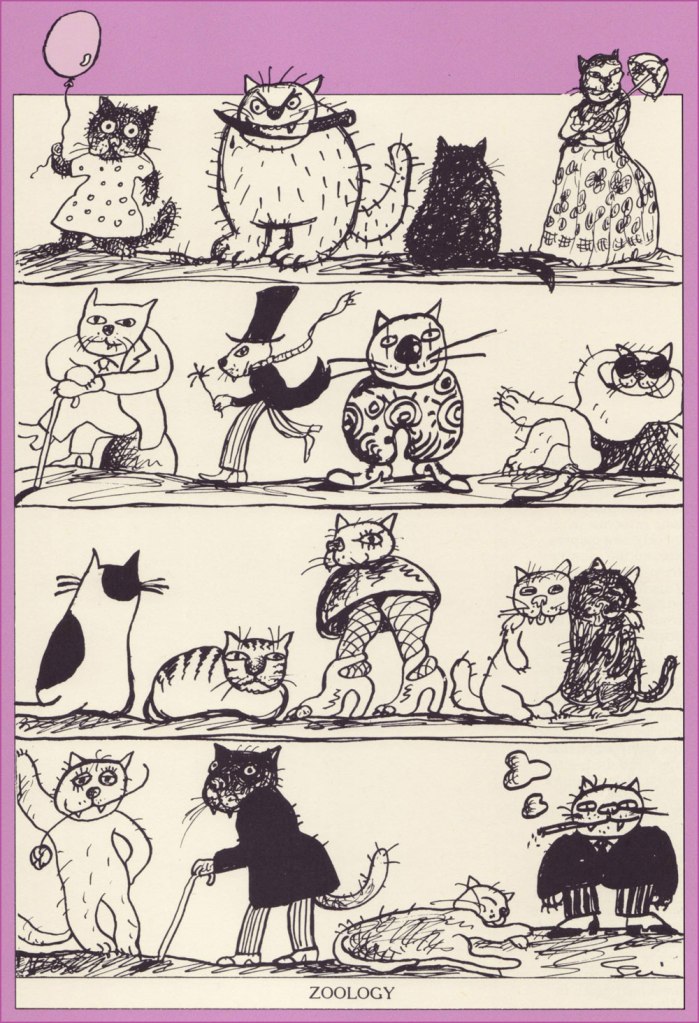
Zoology, n. The science and history of the animal kingdom, including its king, the House Fly (Musca maledicta). The father of zoology was Aristotle, as is universally conceded, but the name of its mother has not come down to us. Two of the science’s most illustrious expounders were Buffon and Oliver Goldsmith, from both of whom we learn (L’histoire générale des animaux and A History of Animated Nature) that the domestic cow sheds its horns every two years.
Happy 180th anniversary, Mr. Bierce, wherever you may roam!
« Bicycles are pieces of art. You get that combination of kinetic engineering, but then, besides the welds, the paint jobs, the kind of the sculpture of it all is quite beautiful. Bikes have such great lines, and all different styles. » — Robin Williams
I’ve been cycling a lot more of late. I’d been using my bike less frequently in recent years, unnerved by the increasingly frantic (and distracted, not a good combo) vehicular traffic of the city. But with my wife taking an interest in the activity, I found myself with a reason to get back in the saddle. This spring, we found a newly opened bike shop, earthy, grimy and unpretentious, where we got our bikes expertly tuned up.
I’ve always loathed those cliquish hipster joints that, in addition to selling overpriced junk, also seem responsible for the ubiquity of those middle-aged, over-equipped, spandex-clad Sunday cyclists, who feel it their sacred duty to pass you, whatever the pace, weather or road conditions, looking for all the world like overstuffed sausages in their lycra casings. The sporting analogue, if you will, of the rich kid who ‘needs’ the most expensive guitar in the shop… never mind that he can’t play a note.
You hopefully will indulge me in this little exercise in nostalgia. I miss the days when our bikes got us around, granted us greater autonomy and kept us in shape. This lifestyle took a backseat in the 1980s, when the BMX craze began to overstate the extreme and the competitive facets of the sport. Now, it’s all ultimate sport this and boot-camp fitness that. Ah, whatever happened to plain old utilitarian fun?
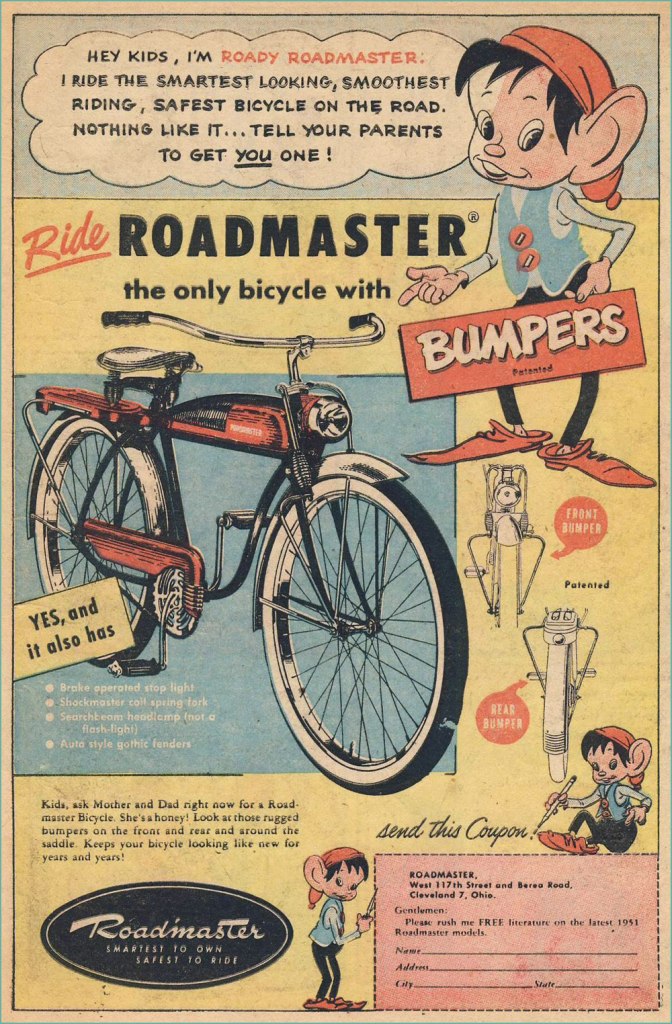
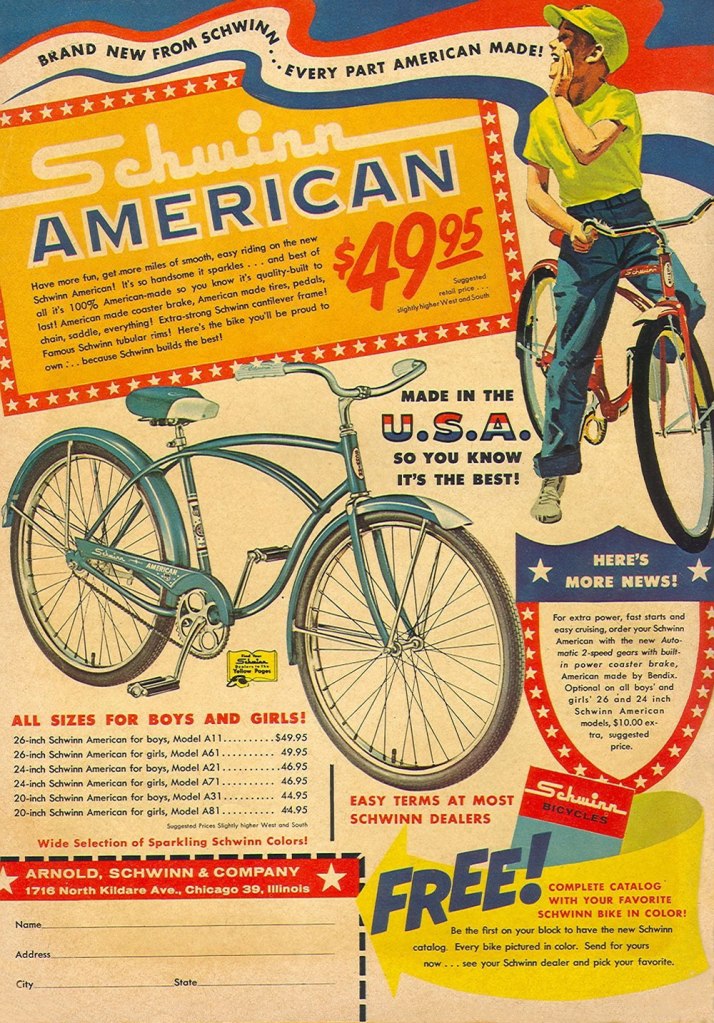
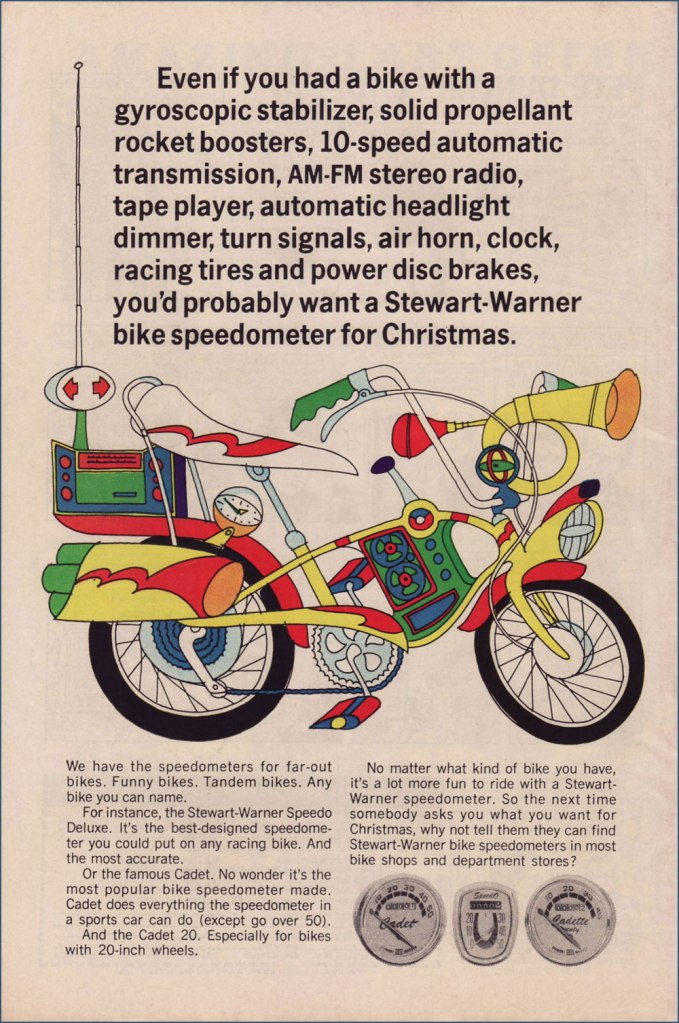
Judging from this ad (circa July, 1951), bicycle makers were trying to make their steeds mimic the clunky look of the era’s motorcycles. Aesthetics would soon improve. Here’s a fairly typical ad, circa 1961. Free catalogue, not to mention a healthy dollop of American jingoism, like it or lump it. Speaking of Schwinn, check out their well-produced promo comics Bicycle Book, from 1949.Ah, yes, the U.S. Royal twins, Roy and Al. In the tradition of the accidentally named Smith Brothers, “Trade” and “Mark”. Unsurprisingly, scouting magazine Boys’ Life was an ideal market for bike-themed ads. This one appeared in the May, 1966 issue. Artist unknown… anyone?You can tell how important the bicycle scene was: not only were manufacturers hawking bicycles, but there was also the ‘aftermarket’ trade of gizmos and doodads. I’ve long supposed ‘speedometer’ to be a dumbed-down term for a tachometer. Even after consulting this ‘helpful’ chart, I’m still not convinced it isn’t. To quote sometime Beach Boys lyricist, DJ and racing enthusiast Roger Christian: “Tach it up, tach it up / Buddy, gonna shut you down.“
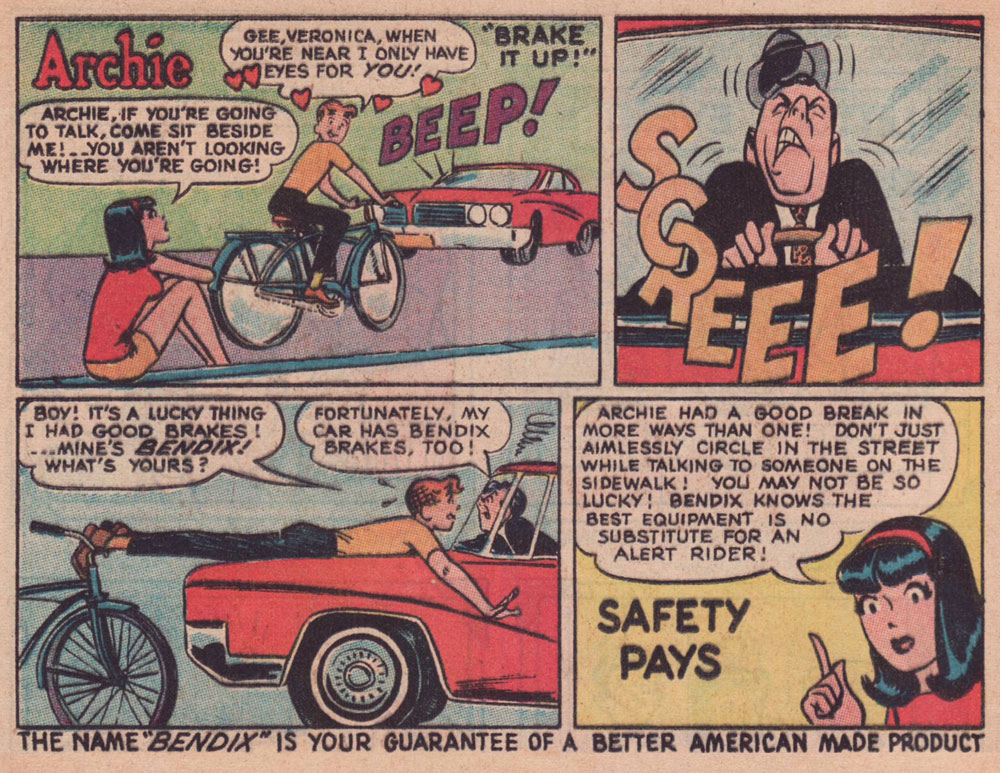
Through much of the 1960s, Bendix (the corporation, not Bill!) commissioned a long-running series of custom ads featuring the Riverdale Gang, illustrated by resident Archie artist Harry Lucey.
This one’s from April, 1965.Archie, the voice of reason? Only in ads and public service announcements. This one’s from October, 1966.This one’s from July, 1968.Ah, that’s more like the Archie Andrews we’re accustomed to. This one’s from August, 1968. I daresay we’ve all encountered too many such ‘cyclists’.An apt reminder that the rich kids always did boast the best, most up-to-date equipment, whatever the sport. Also, I can’t help but think that the cape and tiger tail are just kind of… reckless. Clearly, corporate shill Tigerboy is failing to heed the lessons of Isadora Duncan’s tragic death. Thanks to the ever-thrilling Jack Davis artwork, this is the unsurpassed classic among bicycle ads. It appeared in select DC and Archie titles cover-dated November, 1968. While banana seats may be considered in most quarters as retro kitsch, I earnestly hold that they were bold and cool. Aesthetic and structural experimentation had arrived at the forefront of the cycling industry. This ad appeared in comics cover-dated February, 1969. And here’s a look at a (flawlessly) surviving model. Man, the elegance of those lines!
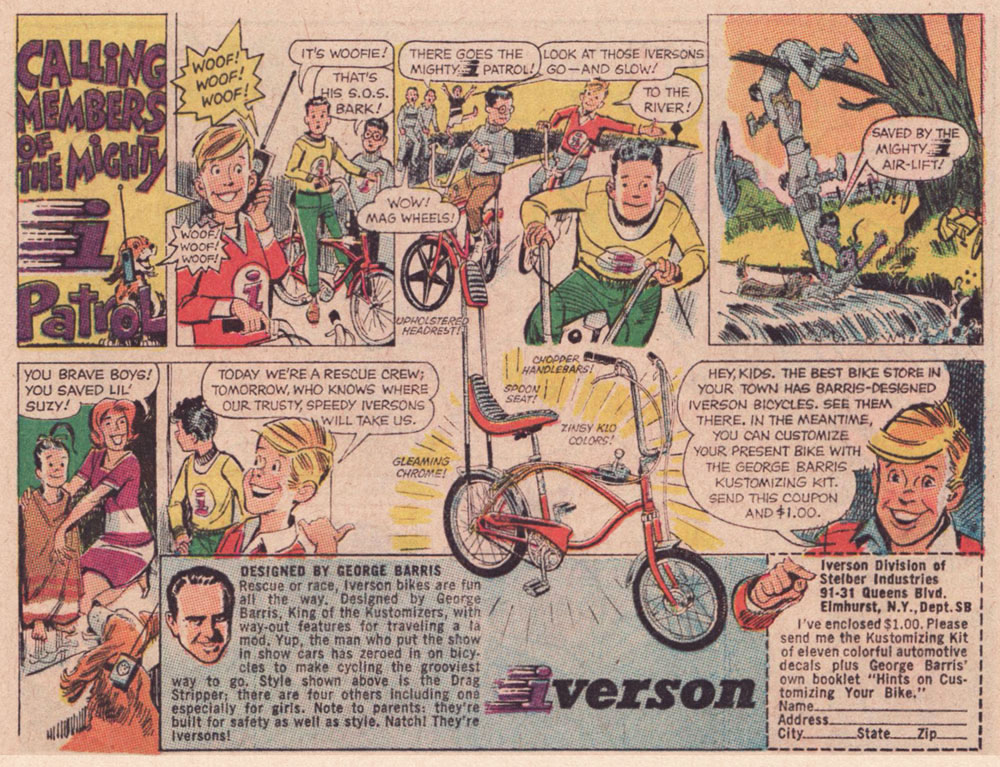
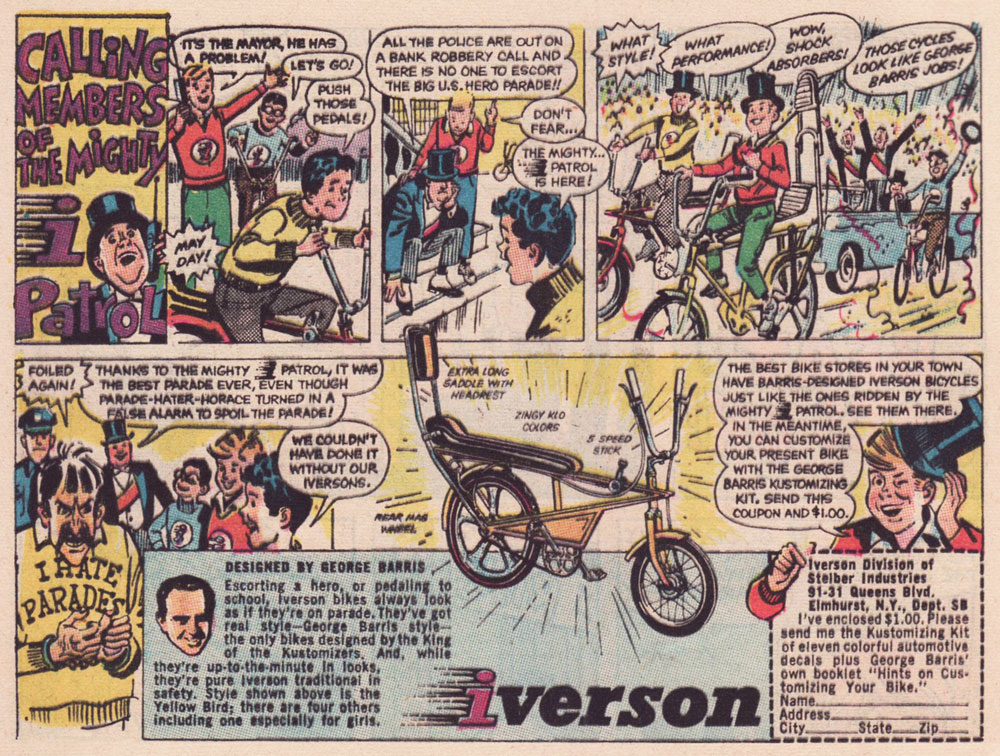
As the 1960s drew to a close, another series of custom comics ads appeared — just under the wire. They spotlight the creations of the famous ‘King of the Kustomizers’, George “Barris” Salapatas (1925-2015), very much in demand thanks to his recent triumph with the Batman tv show’s Batmobile.
This one appeared in various DC titles cover-dated November, 1969. If I had to take a stab at artistic attribution, I would go with the versatile Creig Flessel (1912-2008). Something tells me that in real life, the human chain stunt the Mighty i Patrol pulls would have led to four drowned kids instead of just one — but I’m sure Woofie would have dog-paddled his way to safety.This one appeared in DC titles cover-dated December, 1969. Read a gripping first-hand account of working on the assembly line at the Iverson bicycle factory, circa 1975!I’m assuming that the kid with the sombrero nicked it from Bazooka Joe’s kid brother Pesty. This final adventure saw print in DC titles cover-dated January, 1970.This, however, is the advert that really worked on me. When I got my first grown-up ten speed bike, a few years later, it was a Browning, which lasted me at least a quarter-century, until it snapped right at the load-bearing juncture of the rear fork… the one place where even welding wouldn’t help.
I switched to my backup, a hybrid bike I bought in 1987. It’s still running beautifully. In terms of value for money, a well-maintained bicycle is pretty unbeatable.
My well-thumbed copy of Adventure Cycling in Europe (1981). « Say, Uncle John, did Browning replace you with a pretty-boy model for your comic book ad? » « They sure did, but you know what’s even worse? » « I don’t know, Uncle John, what is? » « I don’t even have a nephew either! » All kidding aside, though it’s over forty years old, it’s still an insightful, entertaining and helpful book. When you go low-tech, change occurs at a slower, more forgiving pace.
I leave you with a song, whence comes the title of this article. It’s from a lesser-known but excellent Donovan album, Open Road, from 1970.
« Trees cause more pollution than automobiles. » — Ronald Reagan
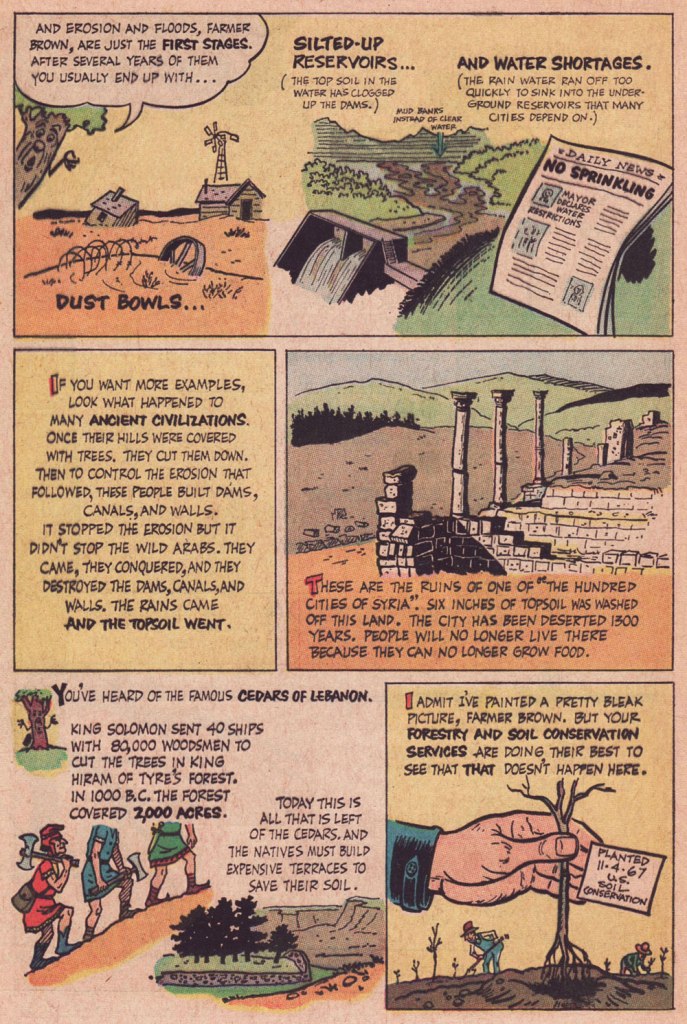
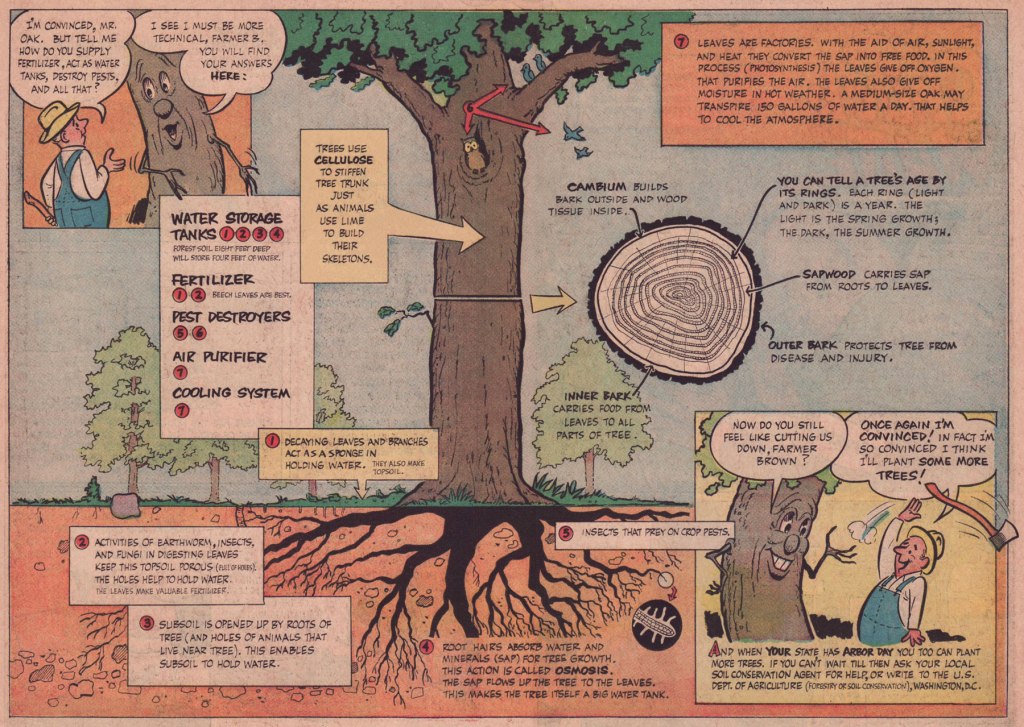
After some of the time-consuming epics we’ve been running lately, I’d been looking for a short piece to help me catch my breath; as it happens, I’d been saving a special piece for this day and occasion.
I’ve always much admired any well-done bit of scientific popularization, and given people’s abysmal ignorance, and even worse, their utter lack of curiosity on the subject of trees (among others!), this one stands out as increasingly timely and poignant. Just yesterday, I stumbled upon an alarming article from Smithsonian Magazine pointing out that the hard lessons of the Dust Bowl were either not learned or simply forgotten. So it goes…
The strip was reprinted in TCOFAF vol. 23 no. 6 (Nov. 16, 1967) with improved colouring, so it’s the version you see here.
The title of this post quotes (with a slight spelling change) a once-famous poem by George Pope Morris (1802-1864), which goes:
Woodman, spare that tree! Touch not a single bough! In youth it sheltered me, And I’ll protect it now. ‘twas my forefather’s hand That placed it near his cot; There, woodman, let it stand, Thy axe shall harm it not!
That old familiar tree, Whose glory and renown Are spread o’er land and sea, And wouldst thou hew it down? Woodman, forbear thy stroke! Cut not its earthbound ties; 0 spare that aged oak, Now towering to the skies!
When but an idle boy I sought its grateful shade; In all their gushing joy Here too my sisters played. My mother kissed me here; My father pressed my hand. . . But let that old oak stand!
My heartstrings round thee cling Close as thy bark, old friend; Here shall the wild bird sing, And still thy branches bend. Old tree! the storm still brave; And, woodman, leave the spot . . . While I’ve a hand to save, Thy axe shall harm it not.
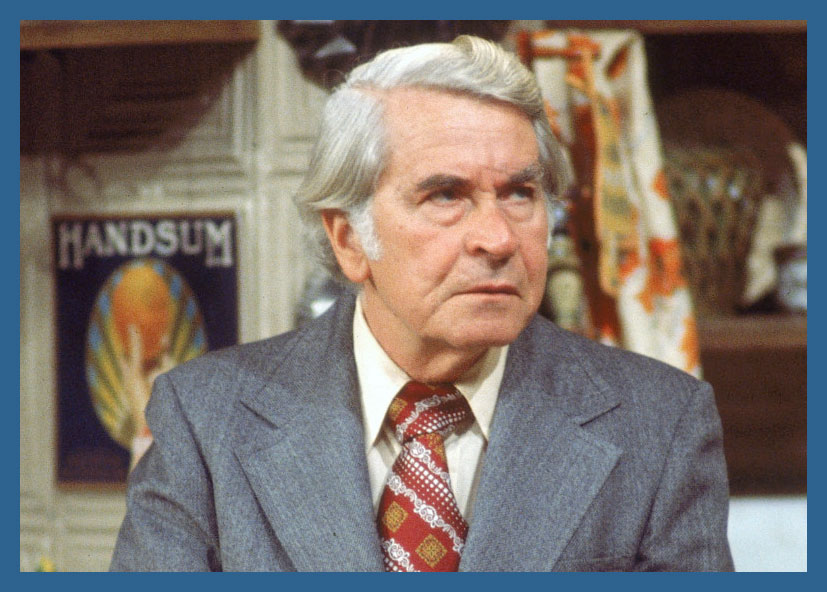
« Now why should I spare that tree, Kotter? What’s in it for me? »
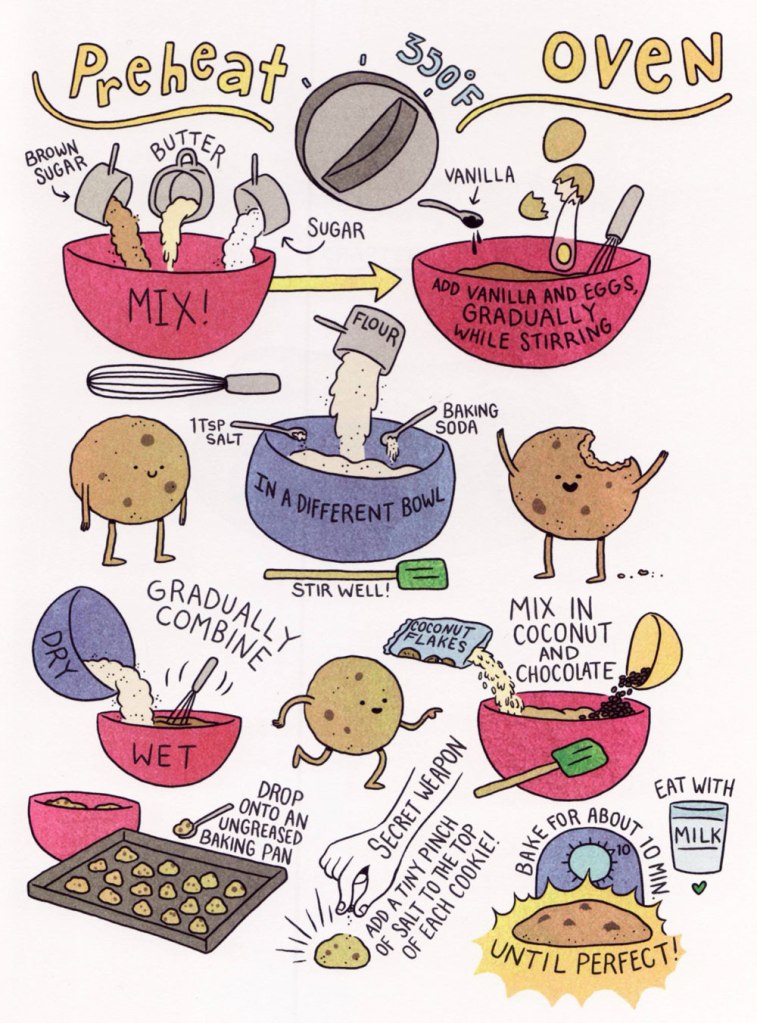
Given my appetite for recipes and the cookbooks they’re published in, it was just a matter of time before I stumbled across the hybrid genre of cooking memoir in comic book form. Needless to say, these two art forms have been friends for a long time: comics have been highlighting food in different ways for probably as long as comics have existed. As for cookbooks, it used to be common practice to include illustrations (maybe even cartoons in the margins!), not the lavishly printed photographs we are used to today, alongside the recipes. A treasured 1930s Soviet cookbook inherited from my grandparents, falling apart but no less charming for it, features little cartoons on every other page, similar to how the drawings of Robert Gring once adorned the pages of Assimil language guides (see co-admin RG’s Robert Gring’s Wits-Sharpening Fun).
But I believe that endeavours to specifically write a whole graphic novel/cooking memoir (replete with recipes!) is a fairly recent phenomenon. I’m not talking about stuff like Stan Lee Presents the Mighty Marvel Superheroes’ Cookbook (1977, complete with recipes for ‘He-Man Pancakes’ and ‘Thor’s Cabbage Rolls’), but a thoughtful examination of food functioning as connective tissue between generations and memories. It also helps when the recipes are actually appetizing.
Why is Captain America lasciviously fondling a meatball when absolutely no meatballs are involved in this recipe? Art by Joe Giella.
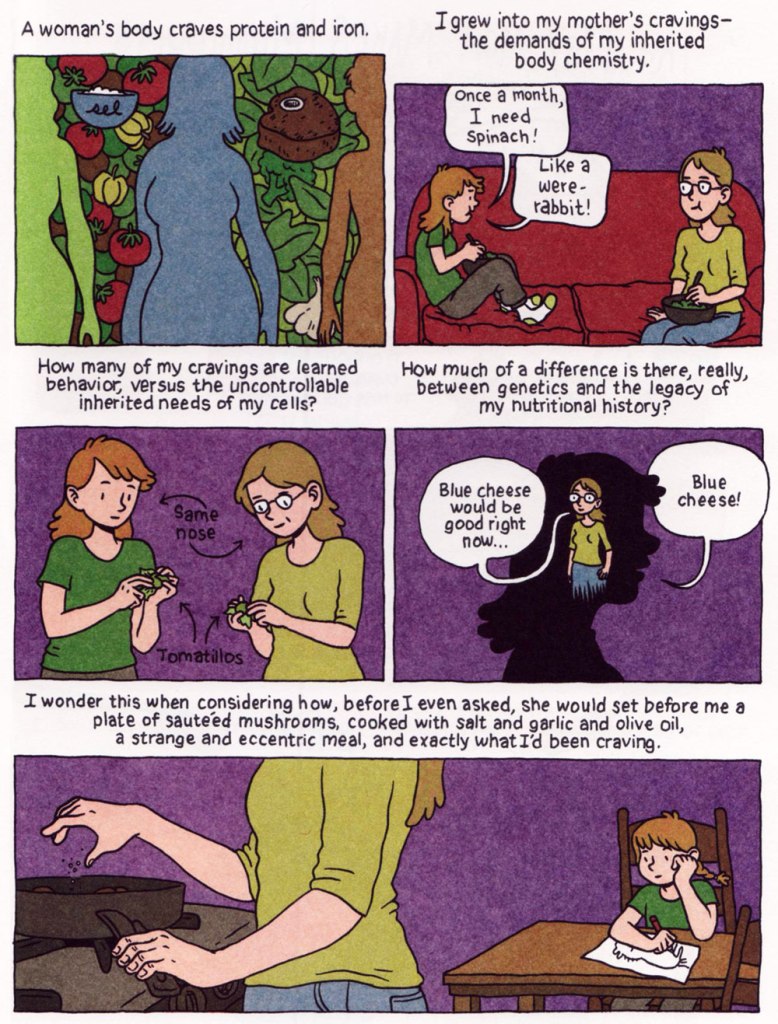
I’m actually not fond of cookbooks that delve into family anecdotes, as that type of narrative tends to get bogged down in saccharine sentiment that obscures the bigger picture, as the narrator collapses into dreamy sighs about how genuine cooking used to be (as compared to the sterile, hurried modern approach, presumably). The visually-oriented nature of comics seems much better suited to emphasise that telling-stories aspect, besides which drawing ingredients and techniques over and over again must get tiresome rather fast, which tilts the stories-to-recipes ratio firmly in favour of the former. Here are some excerpts from books in my library, each taking a slightly different focus on the subject.
An excellent example of memoir-cum-comic-cum-cookbook is Lucy Kingsley‘s joyous Relish: My Life in the Kitchen (2013), probably my favourite example of this subgenre. Its colourful, cartoony style is the perfect backdrop for Kingsley’s pilgrimage through memories – and as the daughter of a professional chef with a penchant towards nature and an aesthete dedicated to fancy gourmet food, she has a great variety of cuisine-related reminiscences to share.
Cook Korean! (2018) by Robin Ha draws strong connections between Ha’s Korean roots and her gradually evolving relationship with her mother. Mothers, as they tend to be the first source of a newborn’s food and the child’s main guide to new flavours, crop up a lot in these recollections, but here the emphasis is more on reconnecting with one’s ancestry through traditional food. I bought this book for the recipes, but I was touched by Ha’s obvious enthusiasm and desire to make this cookbook a fun, easy-going romp through not only a lot of Korean staples, but also people’s attitudes towards them.
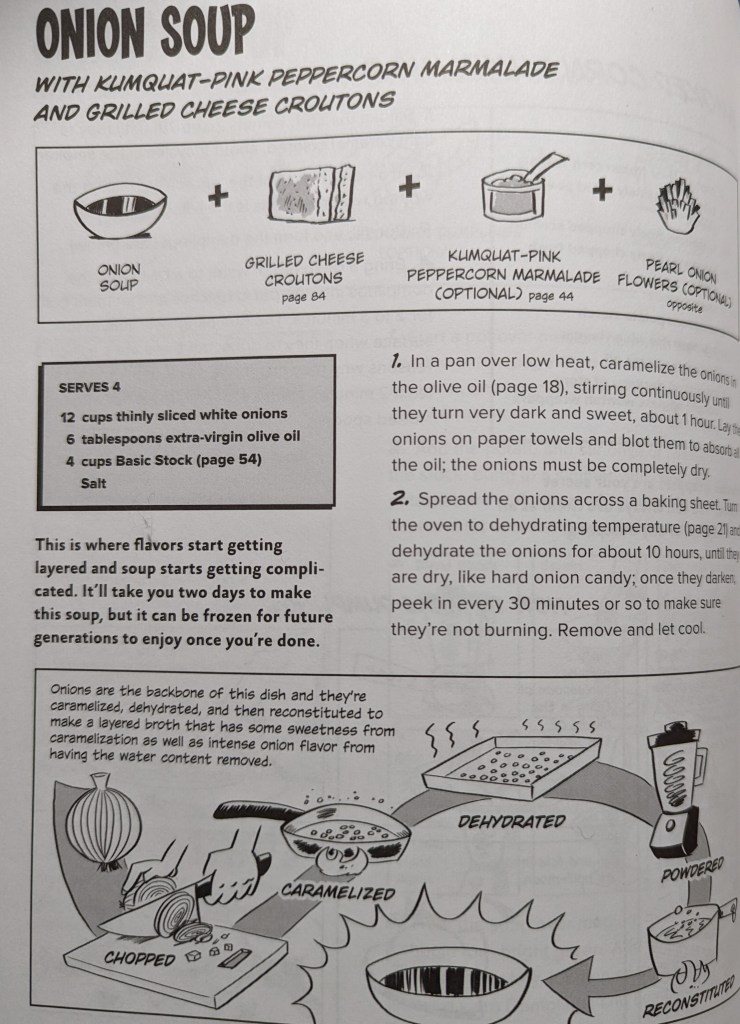
Dirt Candy (2012) by Amanda Cohen and Ryan Dunlavey chronicles the hard life of the chef/owner of a NYC restaurant. While I am not quite on board with Cohen’s claim that vegetables are boring unless they’re treated in very specific and fancy ways, her clear frustration at the reputation of vegetarian (I’m sorry, ‘vegetable‘) cuisine is educational and entertaining, as she spends a chunk of the cookbook discussing the evolution the Americans’ tortuous relationship with vegetables and ‘healthy’ food.
I’m still on the fence about whether I think it’s pretentious or not, but vegetarian cooking with ‘gloopy brown sauce’ is definitely a thing.
I have not tried any Dirt Candy recipes yet, as most of them require a multitude of bowls and techniques, not to mention the sort of time investment I currently reserve for other projects. The culmination of that approach is Cohen’s recipe for onion soup, which demands two days of preparation and would have also required the sacrifice of your first-born, if this hadn’t been a vegetarian (sorry, vegetable…) cookbook.
I applaud bold new ingredient combinations, but I think most of us are perfectly happy to keep our kumquats away from our onion soup.
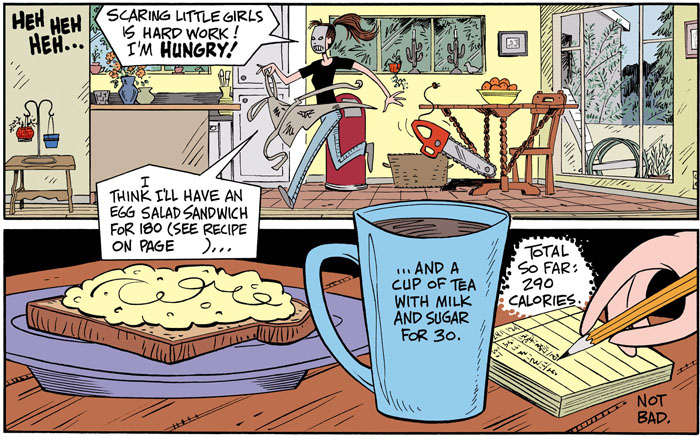
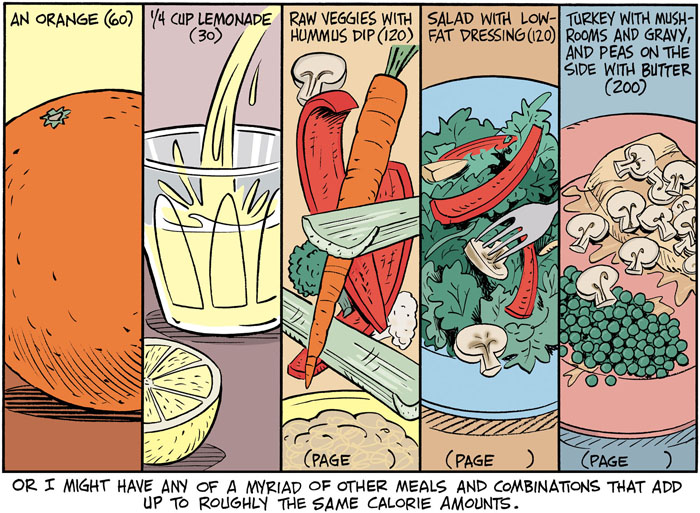
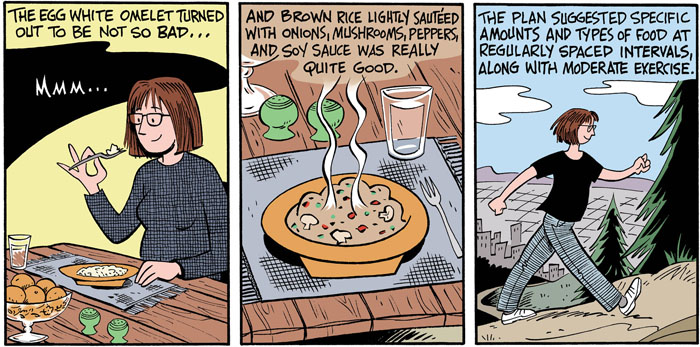
Carol Lay‘s The Big Skinny: How I Changed My Fattitude (2013) recounts her tortured relationship with food and how she finally was able to come to grips with her weight. It’s not that easy to laugh at yourself, and Lay successfully pulls it off, which makes this memoir instantly endearing whether one swears by counting calories or is convinced that it’s the sort of madness psychiatrists make a living on.
~ ds
P.S. I couldn’t write a post about comics and food without mentioning Ben Katchor, a WOT favourite. He has many beautiful perambulations into the territory of food, but one might mention The Dairy Restaurant for starters.
« In Hawaii they say, “aloha.” That’s a nice one, It means both “hello” and “good-bye”, which just goes to show, if you spend enough time in the sun you don’t know whether you’re coming or going. » — George Carlin
By and large, the notorious 1990s trend of autobiographical (at times navel-gazing) comics was undermined by its practitioners’ dearth of meaningful life experience and insight. Obviously, there’s been plenty of notable exceptions, before and since: on the insight front, for one, Canadian David Collier is an undervalued master of the documentary form.
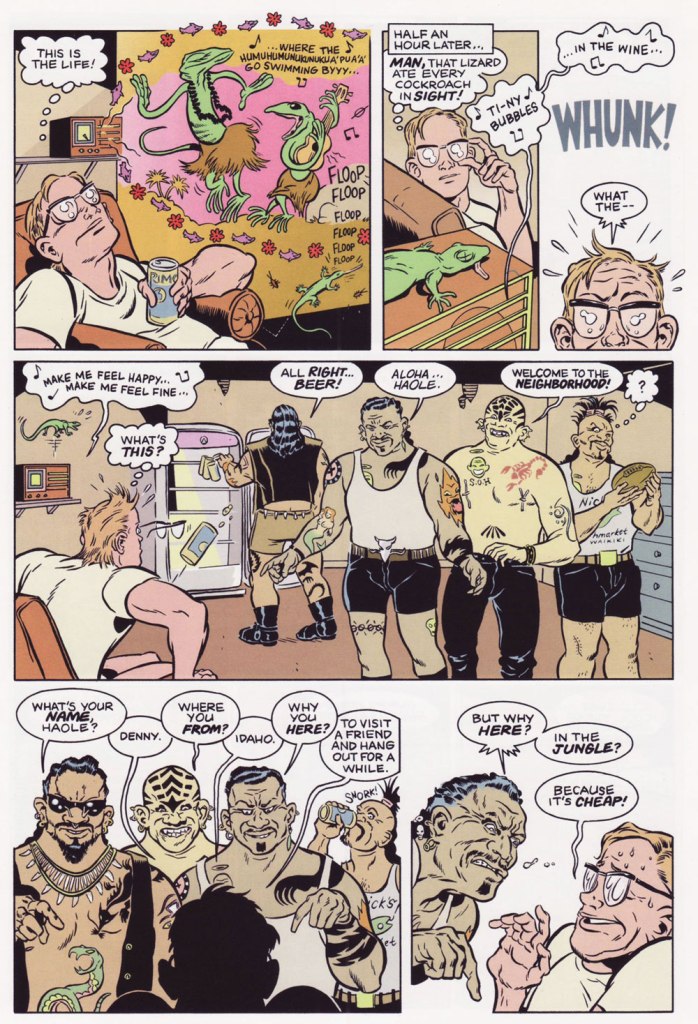
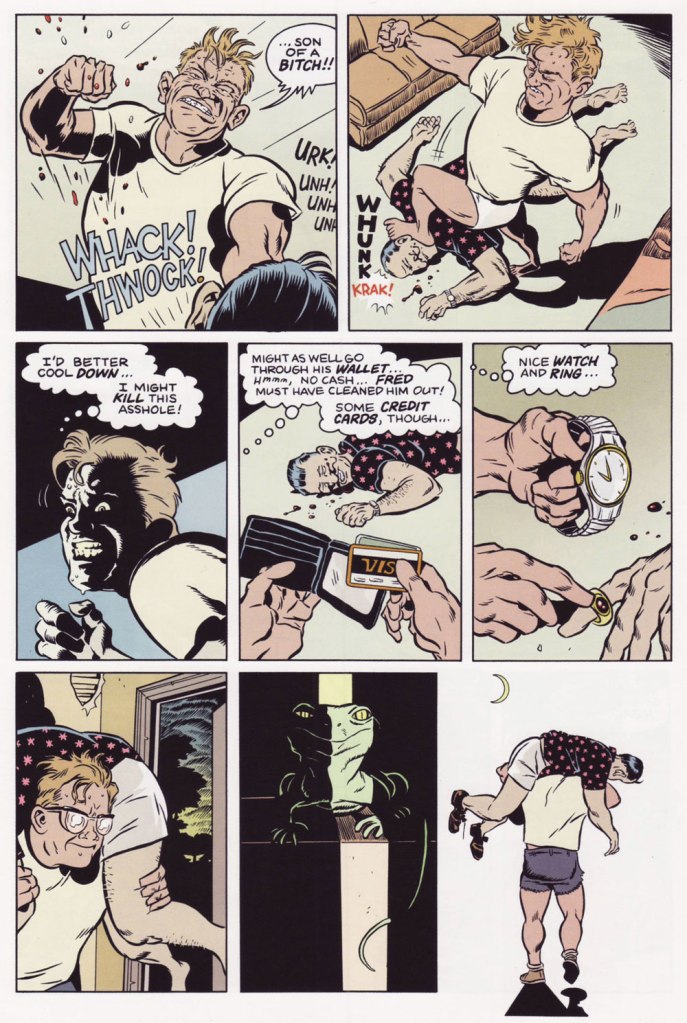
As for life experience, puissant Dennis P. Eichhorn (1945-2015) put all the pasty, effete cartoonists to shame with his spectacularly turbulent, bold-type life. A gifted writer and storyteller, well-versed in the comics medium, he galvanised the creativity of his many collaborators, a broad yet aptly-selected crew of graphic practitioners, many of whom he’d met in the course of his lengthy writing and editorial stint with Seattle’s fabled The Rocket weekly.
I initially assumed I’d run into trouble in settling on the one story to showcase, but nope… right away, I knew just the ticket… a ticket to the Big Island.
Monkey See, Monkey Do, written by Eichhorn and illustrated by Gene Fama, first saw print in Real Stuff no. 11 (Jan. 1993, Fantagraphics); there, it appeared in black and white, but was coloured, presumably by Fama himself, for Swifty Morales Press’ lovingly-done 2004 Real Stuff anthology.The issue originally featured a Charles Burns cover coloured by Jim Woodring (another master of autobiography, en passant). Burns presumably wasn’t too keen on the original palette (whose murkiness, to be fair, rather overwhelmed his drawing), so he recoloured it himself for the anthology. This is the all-Burns version. Compare, if you will, to the Woodring rendition. A candid shot of our fair young author on a visit to Seattle, circa 1992, with Mr. Eichhorn, along with a friendly member of the local ethylic intelligentsia, who successfully lobbied for inclusion in the shot. You decide who’s who.
-RG
p.s. It would be easy to assume that āhole is just a fancy way of saying ‘asshole’, but it isn’t *necessarily* so; to wit:
āholen. An endemic fish (Kuhlia sandvicensis) found in both fresh and salt water. The mature stage is āhole, the young stage āholehole. Because of the meaning of hole, to strip away, this fish was used for magic, as to chase away evil spirits and for love magic. It was also called a “sea pig” (puaʻa kai) and used ceremonially as a substitute for pig. Foreigners were sometimes called āhole because of the light skin of the fish. He āhole ka iʻa, hole ke aloha, āhole is the fish, love is restless [of āhole fish used in love magic]. [ source ]




















































 Who's Out There?
