Jackin’ Tracts and Bobbing for Souls

« Every Chick tract is a proven soul winner » — Jack Thomas Chick (1924-2016)

Before we begin, one must advance past the primordial question: « Who the 𖦹!!!**! is Jack T. Chick? » This simple query has been answered at length elsewhere, so I refer you to the heavy lifting done by others, notably this comprehensive obituary, or Joe McCulloch’s eye-opening article, Life Is Worth Living, both from the pages of The Comics Journal.

Then, of course, since we are ever standing on the shoulders of giants, there’s Daniel Raeburn‘s likely definitive Chick monograph, published in 1998 and today commanding usurious prices on eBay. Ah, but the author, as gracious as he is erudite, lets visitors to his website download The Imp absolutely free of charge. Go for it!
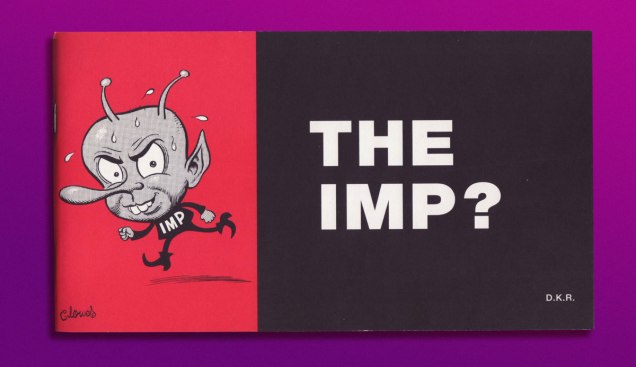
This is The Imp no. 2 (1998), bearing a lovely illustration by Daniel Clowes, who was the subject of the previous — and first — issue.

In 2016, upon Chick’s shuffling off this mortal coil, Raeburn was interviewed on the CBC’s As It Happens show*. He was asked « Now that he has died, what would you say is his legacy? » [ full interview here ]

Raeburn: « I think he did influence our culture. He influenced the counter-culture. I think particularly in the world of underground comics, I think he was the ultimate outsider. He was the most underground of all the underground cartoonists and I think there is a certain amount of grudging respect for him in that regard. He got his work out there with no help from anybody and he did it his way. He had a real DIY aesthetic. He’s sort of like a punk rocker except that he’s not a punk rocker. He was a Christian. But he did embody the punk, do-it-yourself ethos and I think that will be his lasting legacy — that and camp. I mean his comics have long-lasting camp value. They are unintentionally hilarious. »

And it is in this roundabout way that we arrive at today’s subject. Not Chick tracts per se, but a gloriously blasphemous parody thereof.

Jacked Tracts (2026) isn’t the first Chick lampoon, not by any means, but it certainly earns the distinction of being the most ambitious. Says writer-editor-illustrator-conductor Danny Hellman, as to the book’s raison d’être and modus operandi: « We took six notorious Christian comic tracts that traumatized us as children, and asked seventy-four of the world’s most depraved cartoonists to re-interpret the art, page-by-page. New text was then added to the art by this book’s editor. »
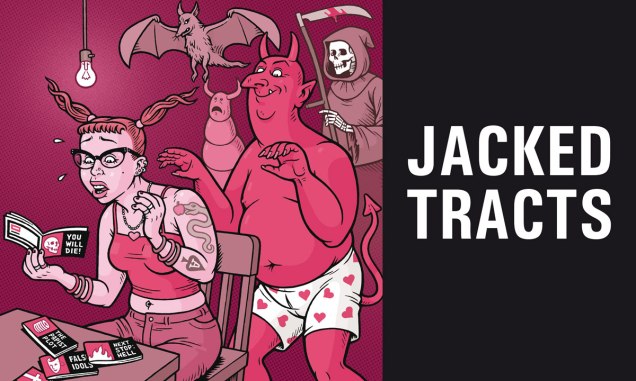
Hellman’s tantalising cover.
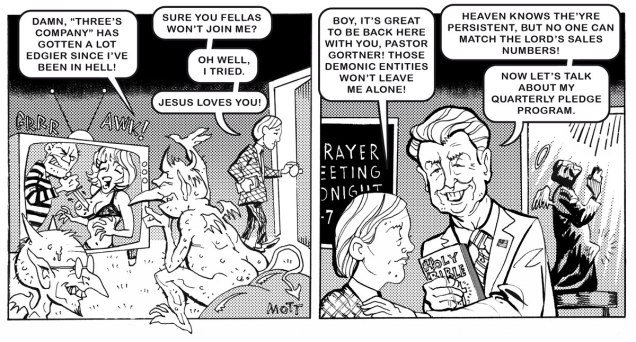
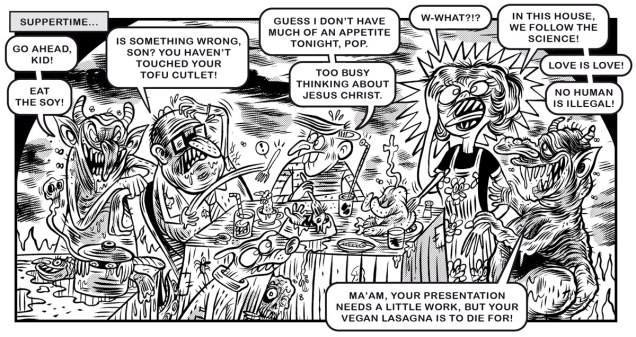
First off, two pages from Sleepless in Sheol, a détournement of A Demon’s Nightmare; Art by Ivan Manuppelli, aka Hurricane Ivan. And if this leaves you with a hankering for vegan lasagna, here’s a mouth-watering recipe!
Art by Cliff Mott.

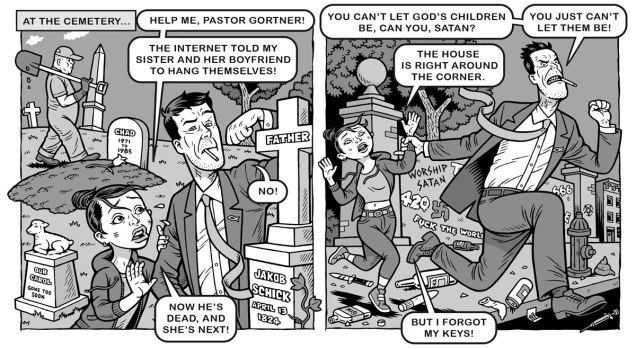
The following two pages hail from Fear the Memes, a reinterpretation of the No Fear tract.
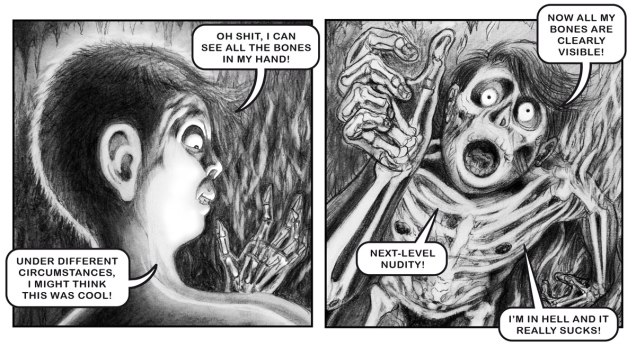
Art by Sandy Jimenez.
Art by Danny Hellman.

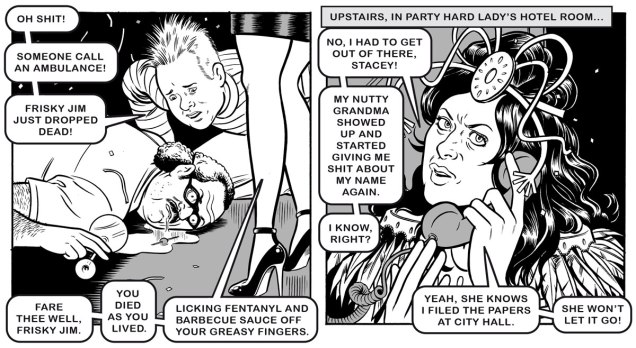
Next up, a pair of samples from Party Hard Lady, a reimagining of Party Girl.
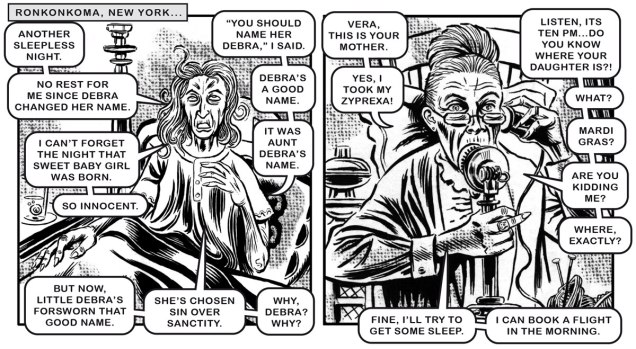
Art by… well, moi. For the character of the sanctimonious granny, I kinda envisioned Jack Kirby’s wonderful Agatha Harkness, as she appeared — and only then — in an early favourite comic book of mine, Fantastic Four no. 94 (Jan. 1970, Marvel).
Art by Soph Franz.

We follow up with two from a retelling of one of the most notorious of Chick’s contes cruels, Somebody Loves Me, rejigged to fine effect into Nobody Loves a Chatty Brat.
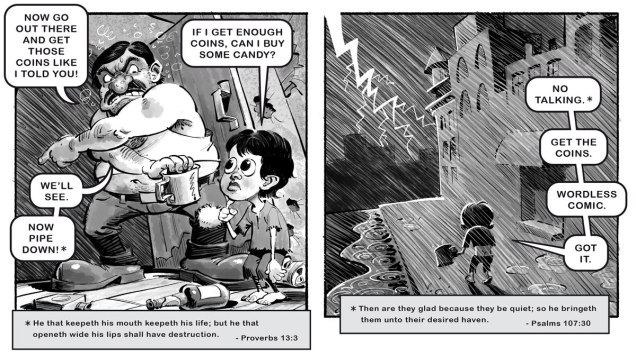
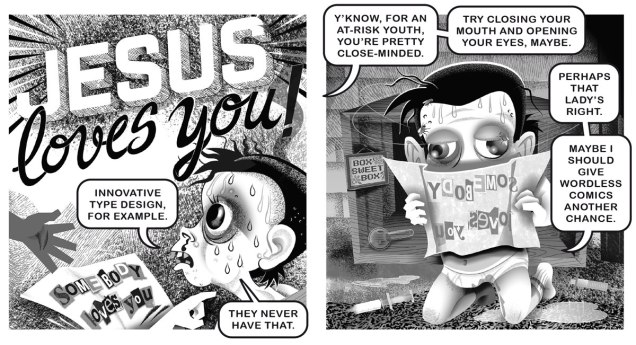
Art by Gideon Kendall. Unlike some people, Danny uses real biblical quotes. Ironically, it’s been claimed, and not without merit, that actually reading the Bible may lead straight to atheism.
Art by Dyna Moe.

Then it’s on to the evils of drugs, with two excerpts from Trust the Pusher in the Sky, a retooling of Trust Me.
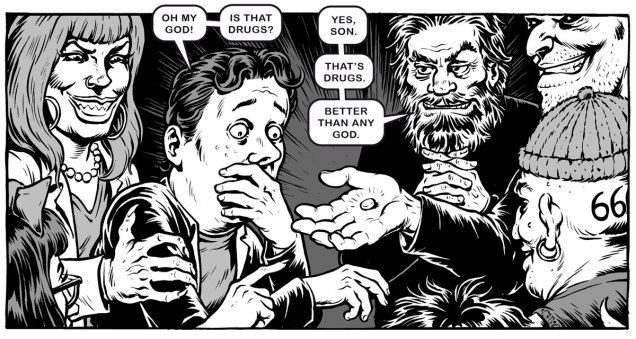
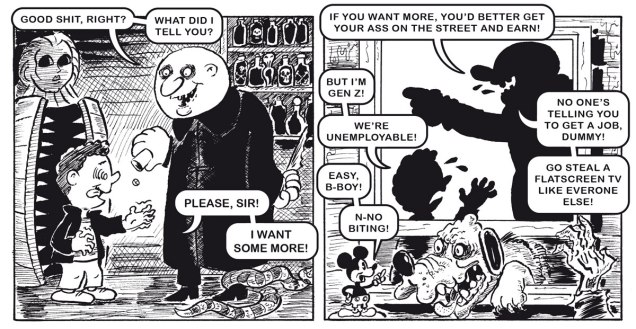
Art by Fufu Frauenwahl.
Art by Denis St. John. Seems perfectly in keeping for ol’ Uncle Fester‘s rascally nature.

And finally, one from Mr Victor Cayro‘s solo tour de force, Boo-Boos for Beelzebub, riffing exuberantly on Chick’s Boo.
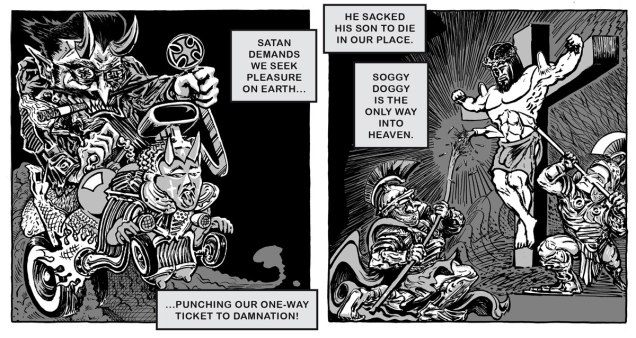
If you’ve got the inclination, feel free to delve into the rabbit hole of the buff Jesus phenomenon.

As you can surely imagine, gathering nearly seventy-five loose cannon cartoonists and shepherding this rabid flock through a project of this magnitude took — never mind the sweat and aggravation and toil — quite some time. Looking at my files, my part in it was drawn in early March, 2021… and the finished book reached my hands just last month.

Just today, while researching this piece, I came upon this quote: « … as we’re less than a year out from Itch.io’s de-listing, re-listing, and continued demonetisation of adult works affecting a number of comics creators seeking to sell their wares online, due to pressure from payment processors and conservative activist groups, and now we’re seeing the same playbook being used on Kickstarter, which is strictly prohibiting “adult-only or sexually explicit content” due to (all together now) pressure from payment processor Stripe, which itself is not exactly free from controversy. » [source]
… which in turn led me to ponder the bumpy road to publication that Jacked Tracts had. So I asked Danny.

DH: « My initial plan with JACKED TRACTS had been to self-publish, which I always find a tough slog, especially when it comes to distribution. I approached the owner of a small press to whose books I’d contributed, and asked if he’d be interested in sub-distributing JACKED TRACTS upon publication. He responded by saying he was much more interested in publishing the book outright under his imprint. After a bit of thought, I decided to partner with him. Some months later, the publisher tearfully told me he had to renege on our agreement, as other artists whose work he published had expressed objections to being in the same imprint with me. Presumably these folks objected to my heterodox politics, although with these sorts of whispering campaigns, it can be hard to know what they’re actually about. I then fell back on my original plan: self-publishing and crowdfunding. »

Danny reportedly has copies available. Just follow this magical link to doom and perdition. What have you — immortal soul aside — got to lose?

-RG

*And speaking of Canada: some Americans have mocked my fair country for banning Chick tracts for being hate speech. Dan Raeburn evidently agrees with that characterisation, stating that « … they are nothing but sanctified hate literature. » There was, for instance, this disingenuous hatchet piece in The Washington Post (remember the WP?)

It’s hard to miss the irony of this jingoistic finger-wagging from the country that repealed its Fairness Doctrine. How’s that worked out for you, guys?

In Canada,” said Ron Cohen, chairman of the Canadian Broadcast Standards Council, “we respect free speech but we don’t worship it. It is one thing we value, but not the only thing.

Of Sneetches and Robots, Orange and Blue

« “Good grief!” yelled the ones that had stars at the first.We’re still the best Sneetches and they are the worst. But, now, how in the world will we know,” they all frowned, “if which kind is what, or the other way round?” » — Dr. Seuss‘ The Sneetches (1961)

A few days ago, this news item piqued my interest: « The assistant director of communications for Olentangy Local School District abruptly stopped the reading of the Dr. Seuss book “The Sneetches” to a third-grade classroom during an NPR podcast after students asked about race. »

Naturally, since this sorry episode made its way around the world and rightly gave rise to quite the furore, the school district has since thrown its patsy under the bus.

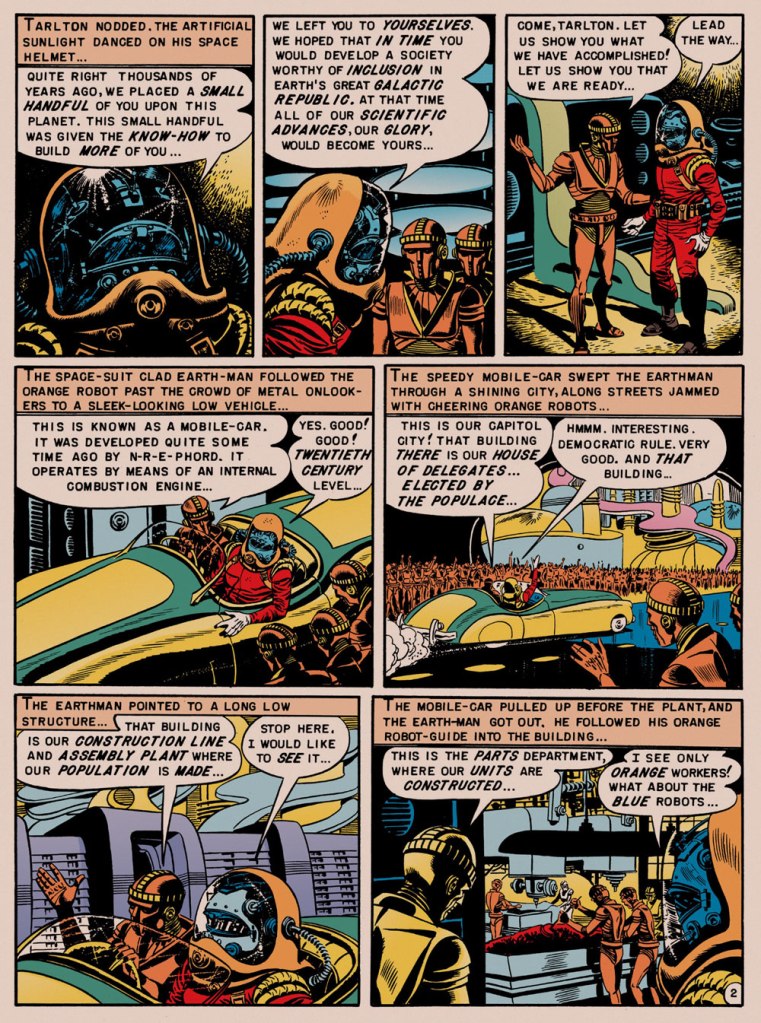
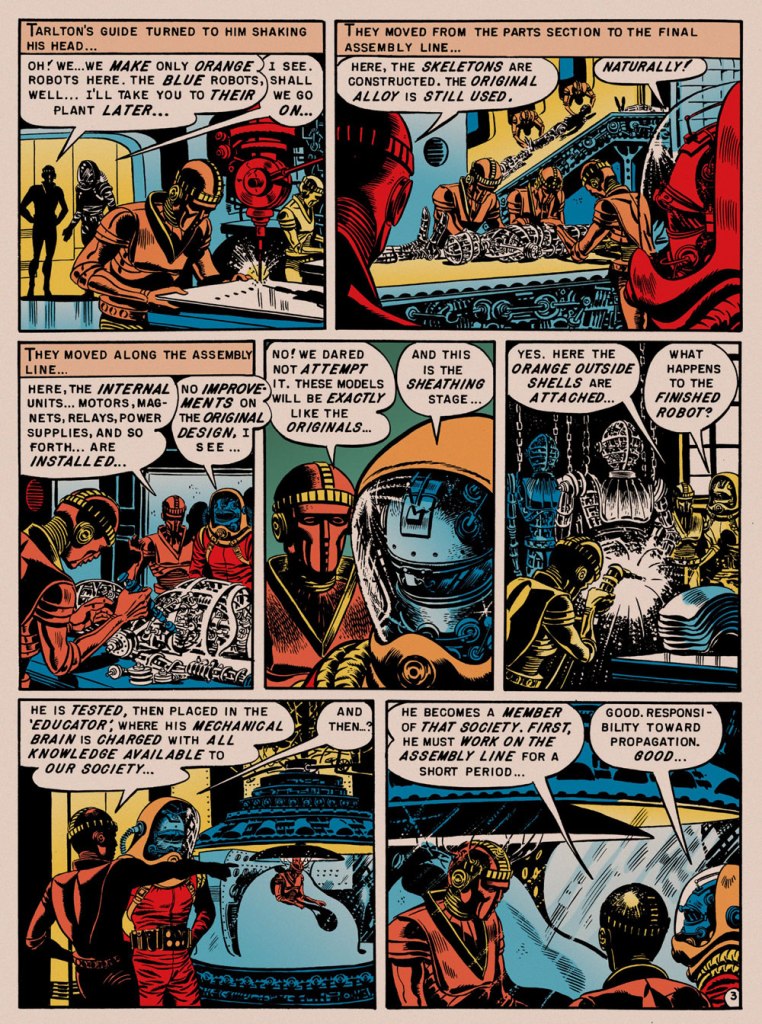
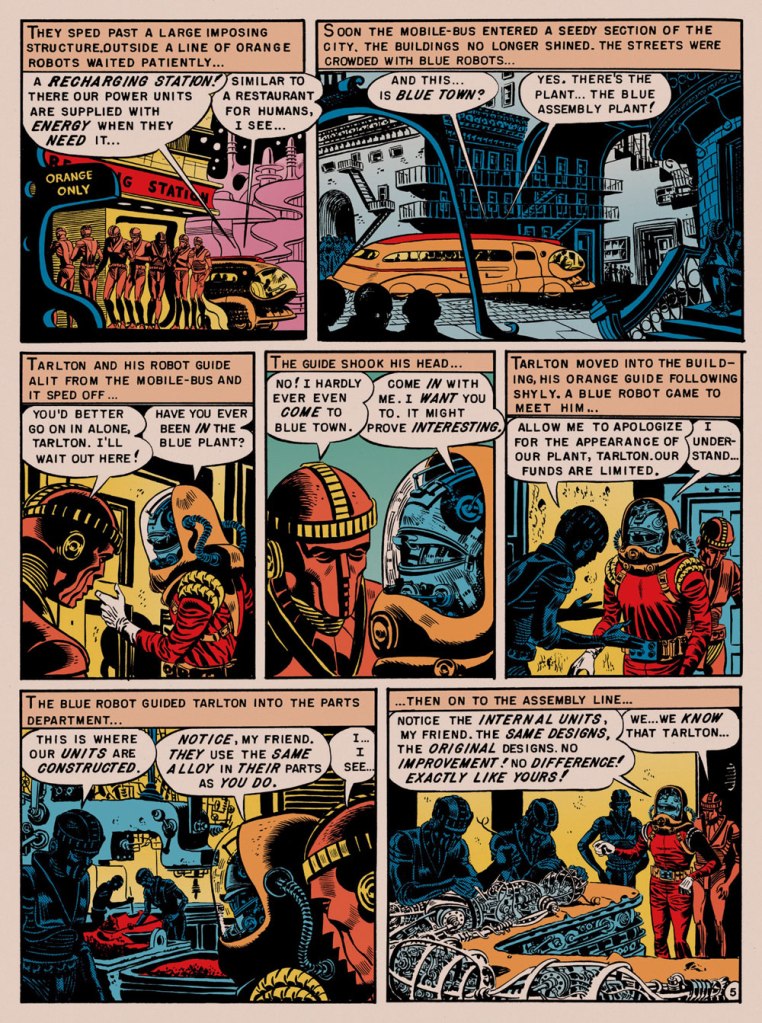
This mention of Dr. Seuss’ timeless classic The Sneetches made me think of another slightly earlier parable of systemic racism, Bill Gaines, Al Feldstein and Joe Orlando‘s Judgment Day (1953), and the similarly telling reaction would-be guardians of bluenose morality had to it.

Initially, I thought posting such an already eminent story as ‘Judgment Day’ was a trifle too obvious. But then again, how famous can a standalone comic book story published seventy years ago be, in the true scale of things? Really, it can never be famous enough.

In the course of an excellent article, CBR.com’s Brian Cronin summed up the skirmish (spoiler alert! you may want to read the story first if you haven’t already):

« The last traditional comic book produced by EC Comics was 1955’s Incredible Science Fiction (a series that had just begun a few months earlier, taking over the numbering from Weird-Science Fantasy) #33.

The last story in the issue, “Eye for an Eye,” had to be pulled at the last minute due to objections by the Comics Code Authority.

So Gaines and editor Al Feldstein decided to reprint “Judgment Day” in its place.

However, Gaines and Feldstein were then told that this replacement story ALSO violated the Comics Code.

Judge Charles Murphy (administrator of the Code) said that they would have to change the astronaut from black to white if they wanted it to be included. This was not part of the Code at the time. Feldstein and Gaines felt that Murphy was just deliberately messing with them.

After being told that, clearly, the color of the astronaut’s skin was practically the whole point of the story, Murphy backed down a bit, but said that they would at least have to get rid of the perspiration on his skin. It could possibly be that Murphy felt that it was exploitative. I do not know, and neither did Feldstein nor Gaines, who only had their suspicions that they were being screwed with.

Feldstein and Gaines both refused to comply (I believe the terms they used included at least one use of the word “fuck“), and Gaines threatened a lawsuit and/or a press conference to shine a light on why exactly the story was objected to.

The story ran as is. »

And so here it is (boasting superior reproduction, thank you, technology):

Originally published in Weird Fantasy no. 18 (Mar.-Apr. 1953, EC). Beautifully understated, it’s easy to understand why its creators considered it a high point of their respective careers.

As is generally the case with such anecdotes, there are other accounts and explanations:

« At least three versions of the story about Gaines’ dispute with the CMAA exist. In an interview, Gaines said a story showing a black astronaut with sweat on his face was rejected because the code forbid ridicule of any religion or race. When he threatened to sue, the code administrator backed down. A second version of the story suggests that Gaines was not able to get approval for the comic, but printed it with the seal anyway. A third account, told by Gaines’ business manager, said the EC story was rejected because it featured robots, which challenged Code Administrator Charles Murphy’s religious beliefs that only man was granted the ability to think. »

I like that, no matter which angle or reality we consider, Judge Murphy never fails to, er… rise to the occasion.

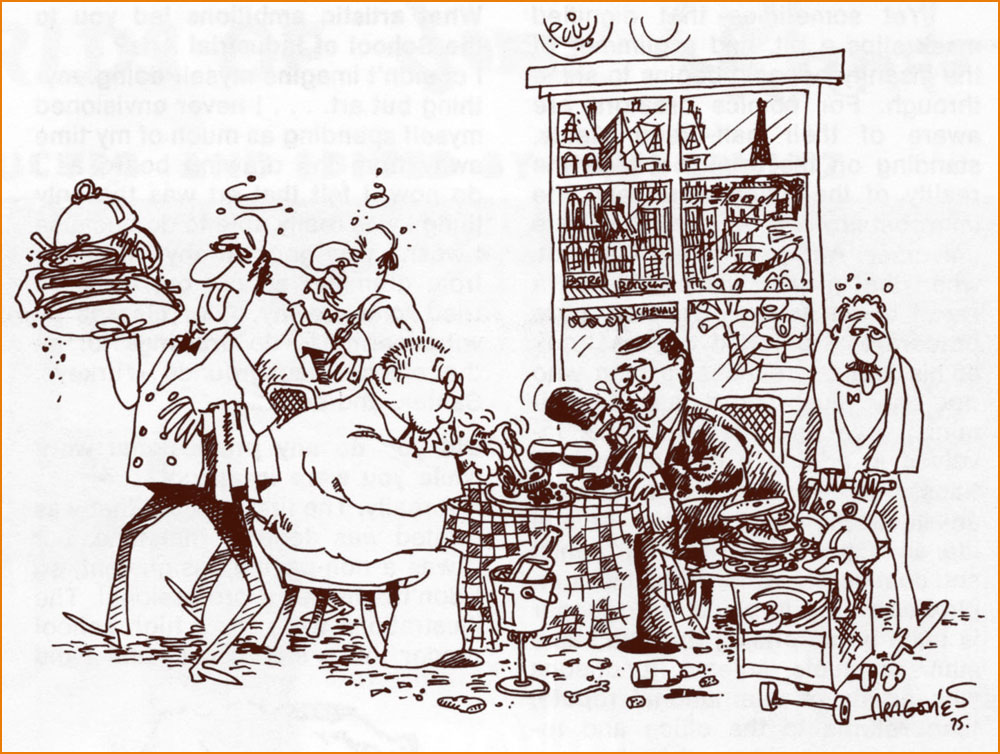
In closing, here’s a scrumptious cartoon anecdote about Messrs. Orlando and Gaines.

« Here’s Sergio Aragones‘ version of one of the many outings Joe Orlando and his publisher/pal Bill Gaines made to the best restaurants in Paris. While on one of the now famous MAD trips, Joe and Bill would eat 4 or 5 times a day! They went from restaurant to restaurant, always ordering the specialty of the house — with appropriate wines, of course! Yep — they’ve been on a very strict diet since (… but it hasn’t helped!) » Originally published in The ‘Special Joe Orlando Issue‘ of Amazing World of DC Comics (no. 6, May-June 1975, DC).

-RG