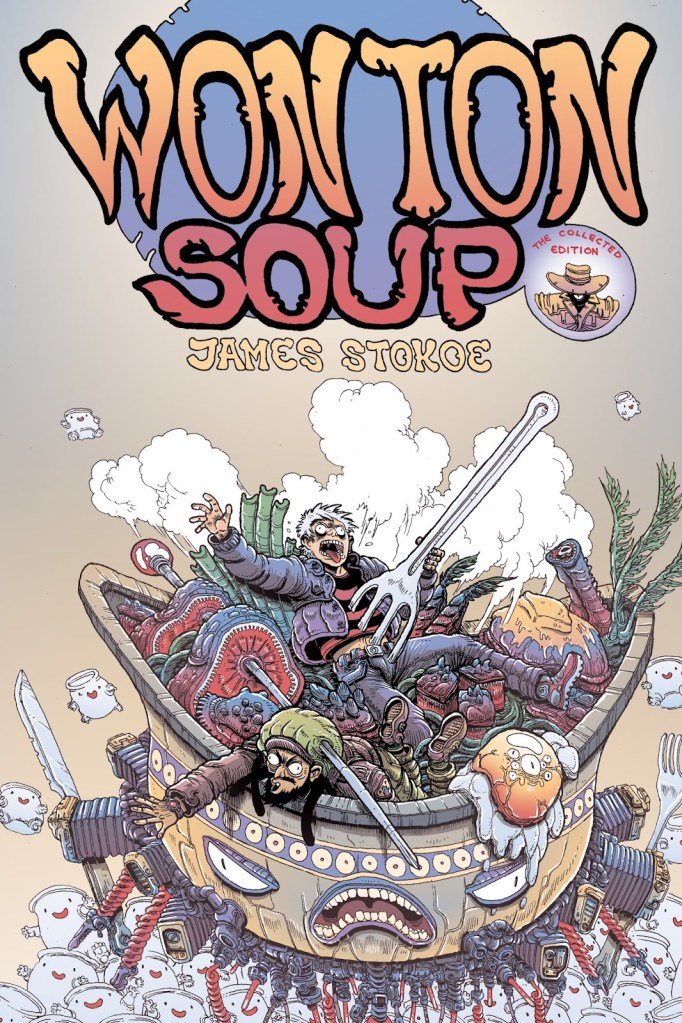
Today I’d like to feature a (chunk of) story by James Stokoe, a contemporary Canadian artist. As is the case in many instances, I discovered his work when I spotted Wonton Soup in an excellent comic book shop in Montréal (now, alas, permanently closed — we miss it and its kind owner). Wonton Soup is in black-and-white, which hides Stokoe’s strength (or weakness, depending on how you feel about this aesthetic) – his liberal use of bright colour gradients.
A splash page from Orc Stain, which currently stands at 7 issues, with more having been promised in 2015 and still eagerly awaited by fans of the series. It’s too bad, I’d love to know what happens to the protagonist…
Stokoe also often uses this combination of lime green and purple, anathema to some artists.
Unlike his close friend comics artist Brandon Graham, whose style is sort of graffiti-ish (not that all graffiti have the same art style, obviously), Stokoe favours tons of detail on everything. Given that he’s often drawing some sort of monster and colouring all of that in (what could be argued) rather garish fashion, the overall result often looks like somebody’s grotesque fever dream.
However, going back to his earlier work, one finds a more stripped-down style without the tons of cross-hatching. Case in point – the aforementioned Wonton Soup, published between 2007 and 2009, and collected into one book (Wonton Soup: Big Bowl Edition) in 2014.
The blurb on the back describes it as ‘[something] that can be pitched in high concept terms as Iron Chef meets John Carpenter‘s 70’s comedy Dark Star‘.
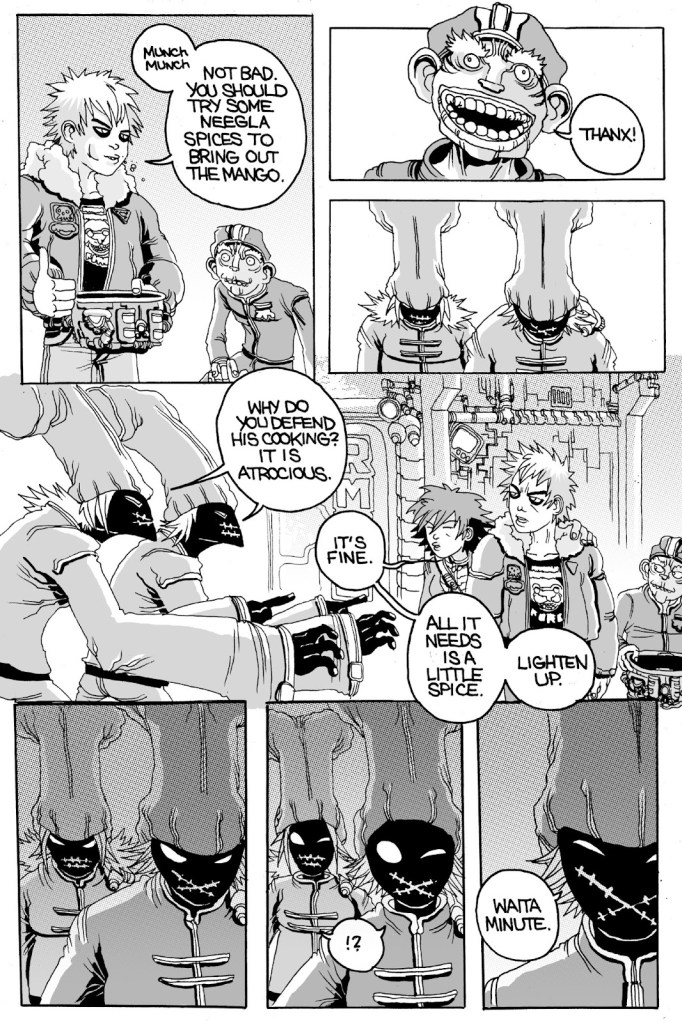
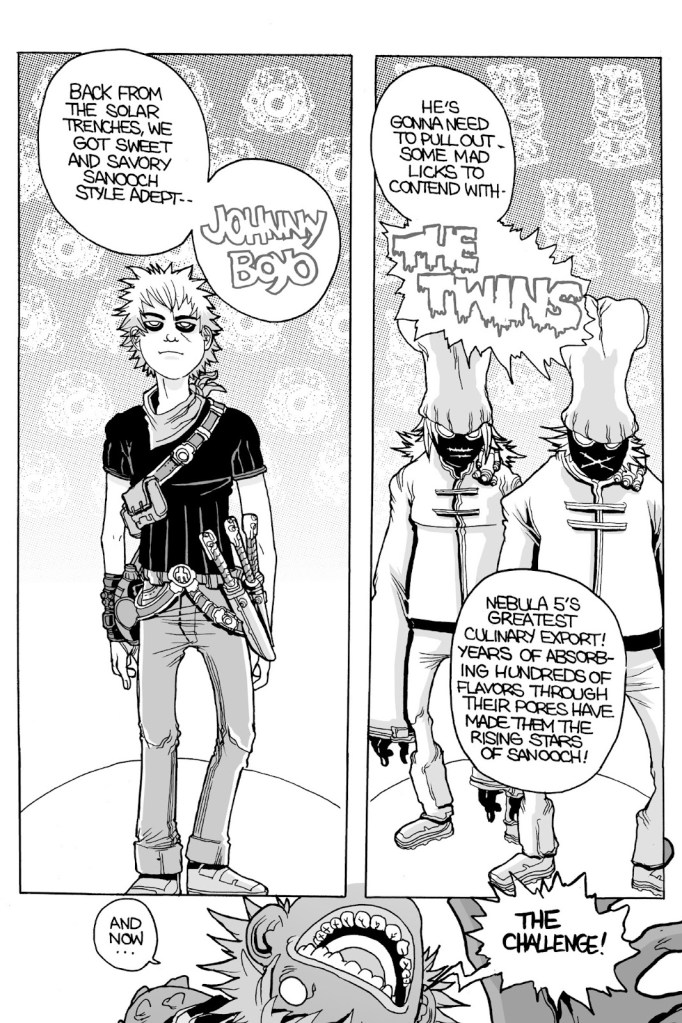
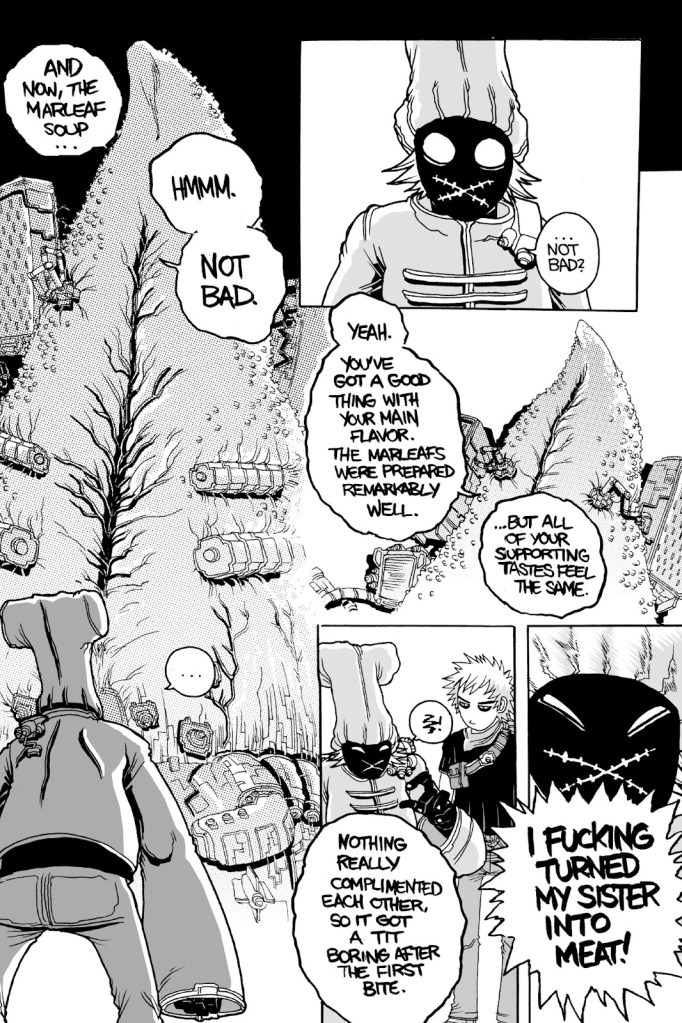
I love made-up food, which is something both Stokoe and Graham’s worlds are rich in, so of course this series was right up my alley of street snacks. Not all of it is great, and the sexual exploits of Deacon, the co-pilot of our ‘space trucker-cum-chef’ protagonist, can get weird, to say the least (I could live without the whole storyline about the sex bear, frankly), but it still makes for really fun reading. Here is my favourite chapter (quite abridged and subsequently summarized). Is this over-the-top? Absolutely. Having recently watched a few episodes of recent Iron Chef, though, I can say that the latter is more bombastic than a competition between a space trucker and hive mind Twingos from Nebula 5, with a giant omniscient tongue for a judge (a vast improvement over judges in Iron Chef, frankly — where do they find these people?)
It starts with Johnny Boyo visiting his old school for chefs, which he quit a year ago to travel and get a taste of what’s out there on other planets….
When he comes upon a student forcibly evicted from one of the kitchens for having prepared a particularly lacklustre mango chutney chili. Jonny catches the bowl that’s flung after the body and tastes the chili —
“I remember you!” exclaim the Twins.
First refusing to participate in the challenge, Johnny reconsiders (after some encouragement from his old teacher).
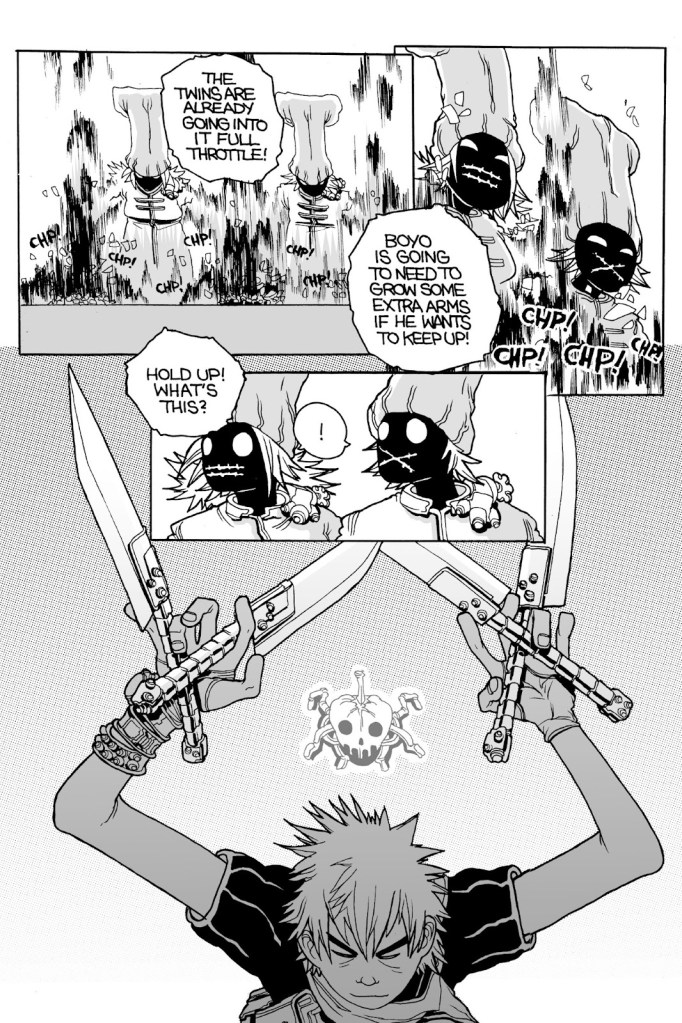
The Twins are faster and fancier, but Johnny has some tricks up his sleeve (or in his holster, at any rate).
One of the twins decides to sacrifice his delicious sister (years of food absorption through pores marinated her deliciously!), but does this help him overpower his adversary?
And there you have it. If you’re of the cross-section of people who love food, comics, and are not averse to vulgarity, I recommend giving this collection a go.
«Babies of course are not human — they are animals, and have a very ancient and ramified culture, as cats have, and fishes, and even snakes: the same in kind as these, but much more complicated and vivid, since babies are, after all, one of the most developed species of the lower vertebrates. » — Richard Hughes
I am fairly neutral about children, and prefer to stay away from them for the most part (although there are some pleasant exceptions to this rule). However, I enthusiastically dig through children’s books when given half a chance, and greatly enjoy comics about ankle biters of the ‘wise far beyond their years’ variety. Some authors’ worlds are so compelling that one wishes to be teleported into them. Who wouldn’t love to hang out with Sugar and Spike, or Cul de Sac’s Alice, or Daniel Pinkwater’s Robert Nifkin?
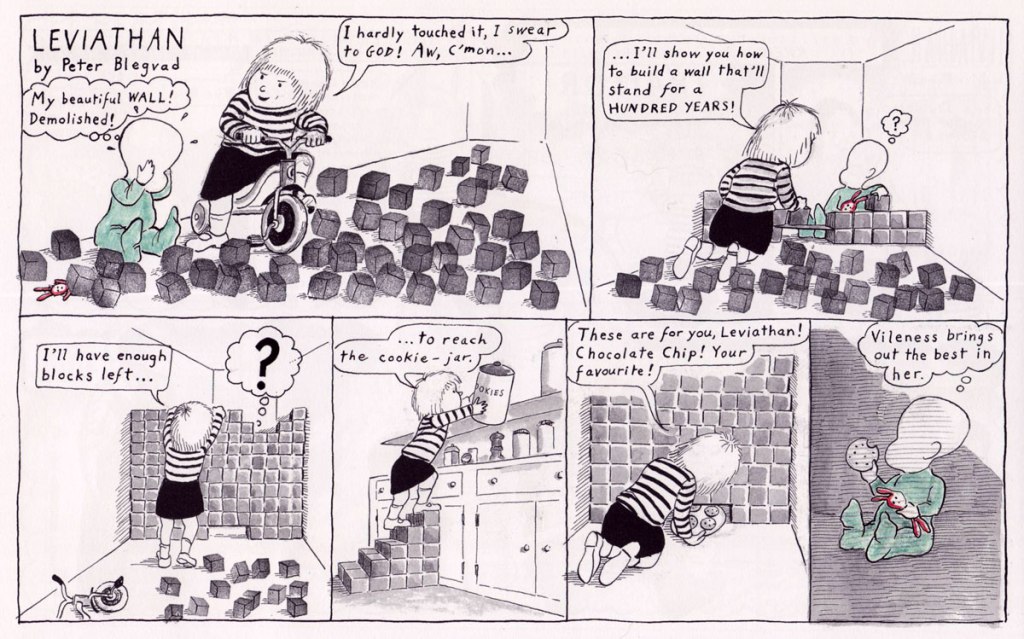
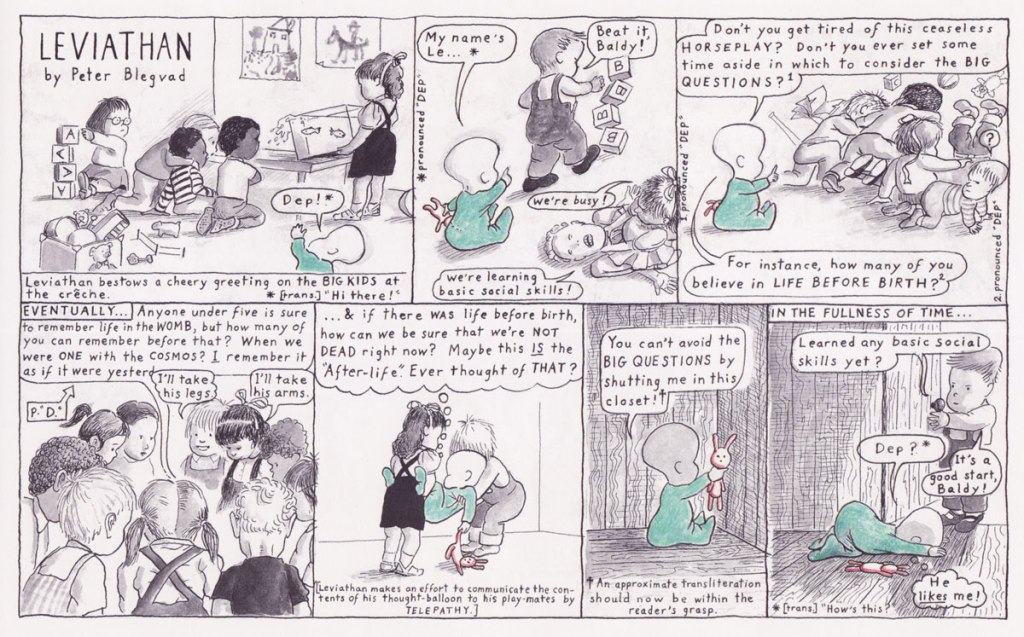
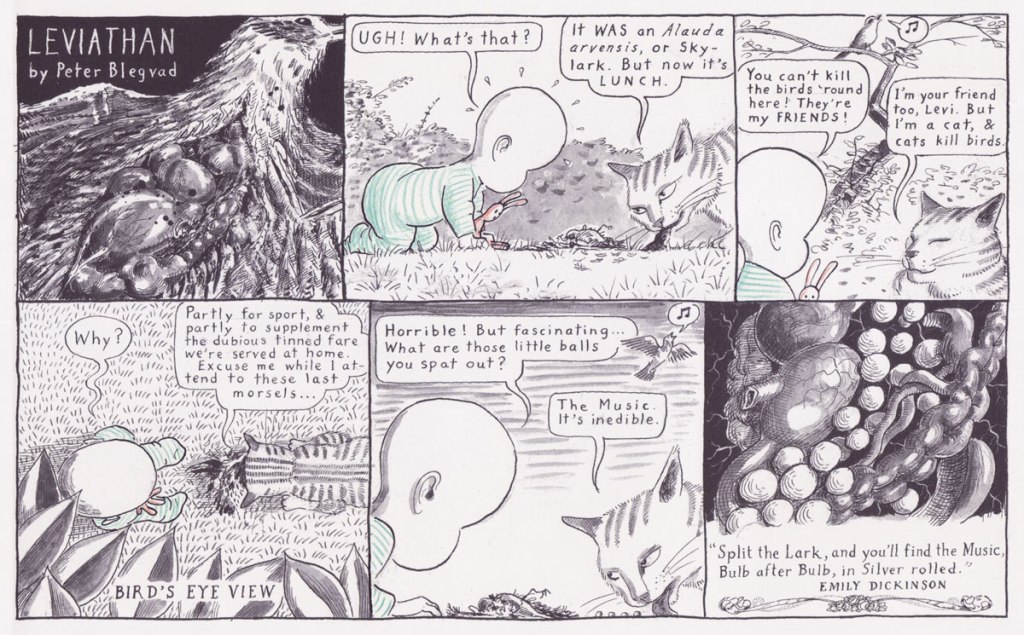
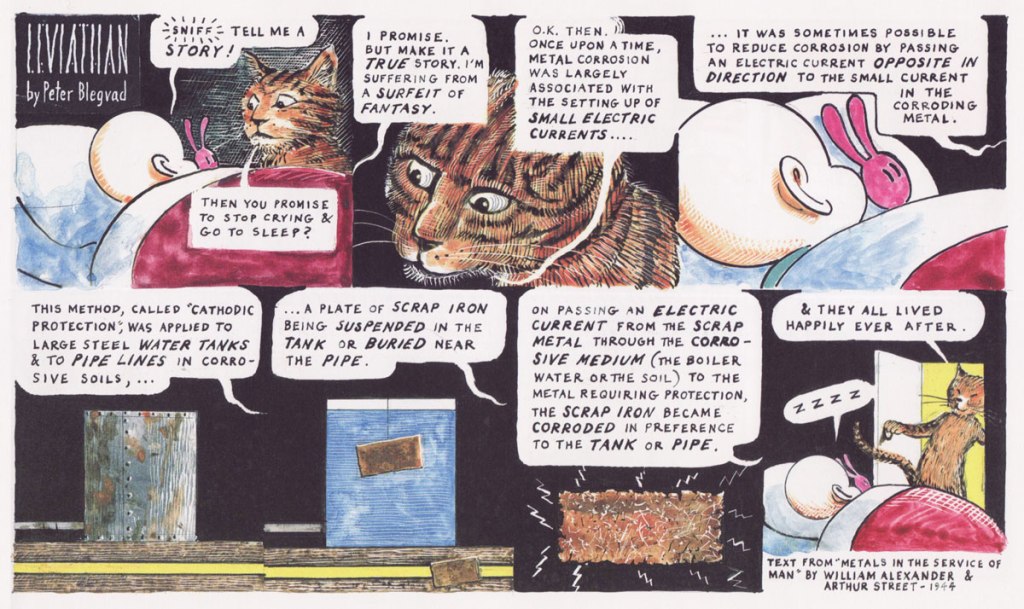
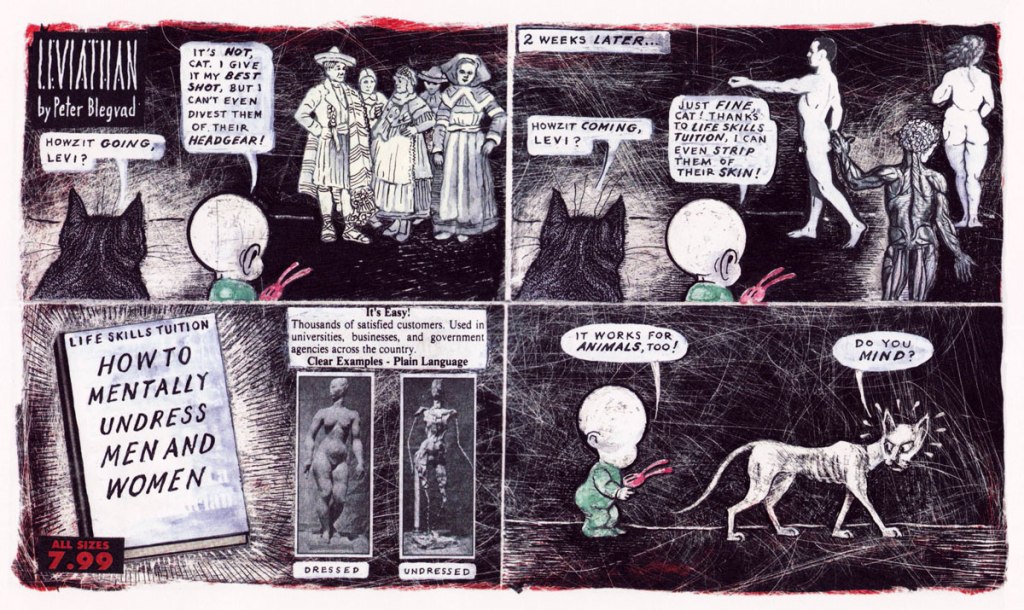
Though I have no such desire to rub elbows with the faceless, introspective Leviathan, his perambulations are great fun to watch. As per his name, he’s more than a little bit of a megalomaniac – as one can argue that all children are. Bred from a long line of ‘more or less faceless neotenic grotesques‘, such as Crockett Johnson’s Barnaby or Walter Berndt’s Smitty, Levi is an infant trying to make sense of the world around him through philosophical musings, an occasional break through the fourth wall, and conversations with his feline companion, Cat.
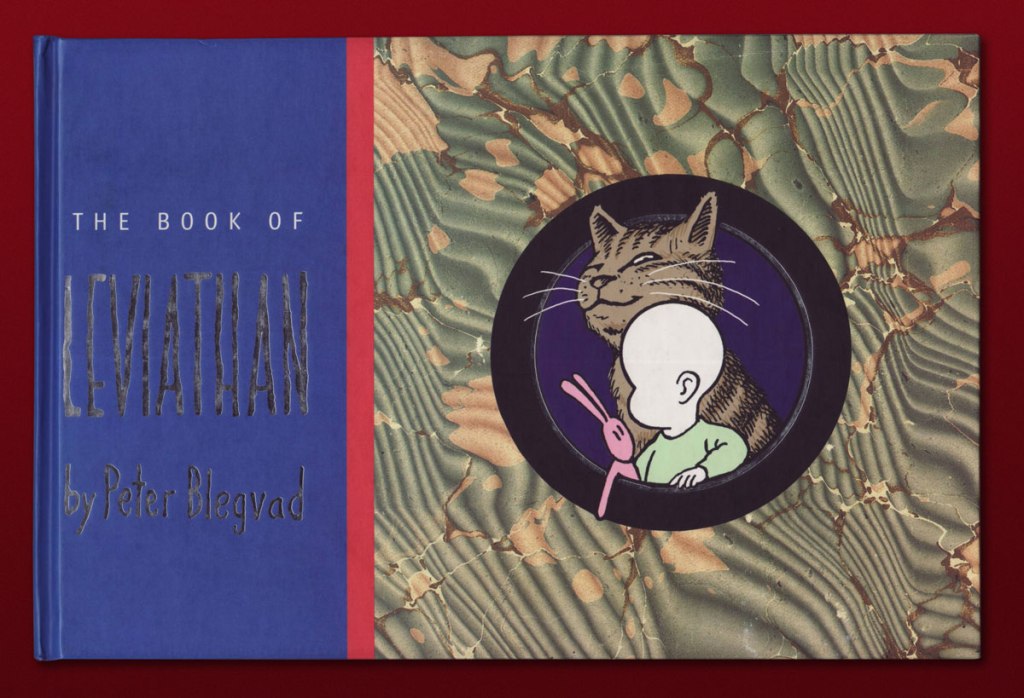
His patriarch is American Peter Blegvad, son of Danish illustrator Erik Blegvad (which accounts for the hard-to-pronounce family name that I tend to misspell as ‘Blevgrad’, since ‘grad’ is a common suffix for a city in Russian*), more known for his musical career than remembered for his cartooning one. Leviathan was published in the Sunday section of British newspaper The Independent** from 1992 to 1999, and some of the strips were collected in The Book of Leviathan, issued in 2000 by The Overlook Press. The latter is how I came across this strip, in the apartment of a friend kind enough to give me his copy when he saw how absorbed I was.
Levi’s big sister Rebecca is a habitual tyrant, though not without a certain charm.
In case you’re wondering re: snow vocabulary, some have disputed this claim as false and stemming from a misunderstanding of Eskimo-Aleut languages, which are agglutinative, and can form new words by combining other words. Here’s a quick article if you’re curious about the specifics.
Like all great observers of children’s rituals, Blegvad clearly had some children around to inspire him.
Q: How did you get the idea of naming a tiny baby Leviathan?
A: From my own kids: they’re both, you bring them home and they’re bigger than anything else in your life.
Q: Why did you switch from Levi’s parents to the Cat?
A: The Cat was easier to draw.
Leviathan seems to invite a hate-or-love kind of response from readers; as Rafi Zabor notes in the introduction to the collection, ‘I have met a few intelligent, literate, artistically sophisticated people who just don’t get it, and their non-response to what is obviously just for starters a classic of its kind, assuming it has a kind, has always puzzled me. ‘ As somebody who belongs in neither camp, I would suggest that this strip sometimes has its head up it arse, and goes so far into self-indulgent metaphysics that it loses its anchor for the sake of willful obfuscation – and sometimes it’s brilliant and very funny. As if to demonstrate the former, Zabor finishes his introduction with ‘Words fail. Times change. Cats meow. Leviathan swims in its native deep, glistening through serial sea-green waters, sending off spectra of intelligible light as it steers with ribbed and radiant fins.’ Nevermind such dubious metaphors – I posit that it’s Leviathan’s playfulness, juggling as it does quotes from long-dead philosophers, questionable puns and surreal vignettes flavoured with Freudio-biblical mythology, is worth the occasional muddle through a high-concept strip that didn’t quite pan out.
~ ds
* I keep misspelling his name as ‘Blevgad’, which would be very unmelodic to Russian ears, as ‘blev‘ means ‘puke’ and ‘gad‘ is sort of like ‘bastard’. I did in fact misspell it several times in this very blog post, until co-admin RG set me straight. Very embarrassing.
** Was this because Leviathan was too erudite and weird for American audiences? Blegvad was born in NYC in 1951, but was raised in England, spent some years in Germany, then returned to NYC in 1977. Given his proclivity for quoting British authors, I think his sensibilities lie more with Albion.
Like many a bibliophile, I enjoy browsing shelves in a used bookshop without any particular goal or author in mind. On one of my last forays, I found the following book:
I had never heard of Aldebert (at that point I was under the misapprehension that ‘Bernard’ was his first name, and ‘Aldebert’ his family name), and the jokes were a bit hit-or-miss, but more than just a few charming cartoons lay within… certainly enough to pick up this book from 1970 for the impressive sum of 12 dollars.
Jean Bernard-Aldebert (1909-1974) was a French illustrator with an interesting, if not devoid of tragedy, life. He started drawing for various satirical publications early on, at 19, and for some fifteen years his career was gradually gaining in traction, his cartoons appearing in such weeklies as in Ric et Rac, Marianne and L’os à mœlle. In 1944, this came to an abrupt halt when he was arrested and deported to a German concentration camp (one of the worst, and the last one to have been liberated by the Allies – Mauthausen) for having depicted Hitler as a chimpanzee in one of his caricatures. Miraculously, he survived, and even set his experiences down on paper – these 50 drawings were published as the album Chemin de Croix en 50 Stations in 1946.
After his return to France, he moved away from satire and caricature (frankly, who could blame him?) and onto more humorous publications like Paris Pin-Up and Fou rire, also illustrating many posters and ads, and drawing two comic strips for Ici Paris (Adonis and GIgolette).
This seemed appropriate, given that spring is clearly in the air!
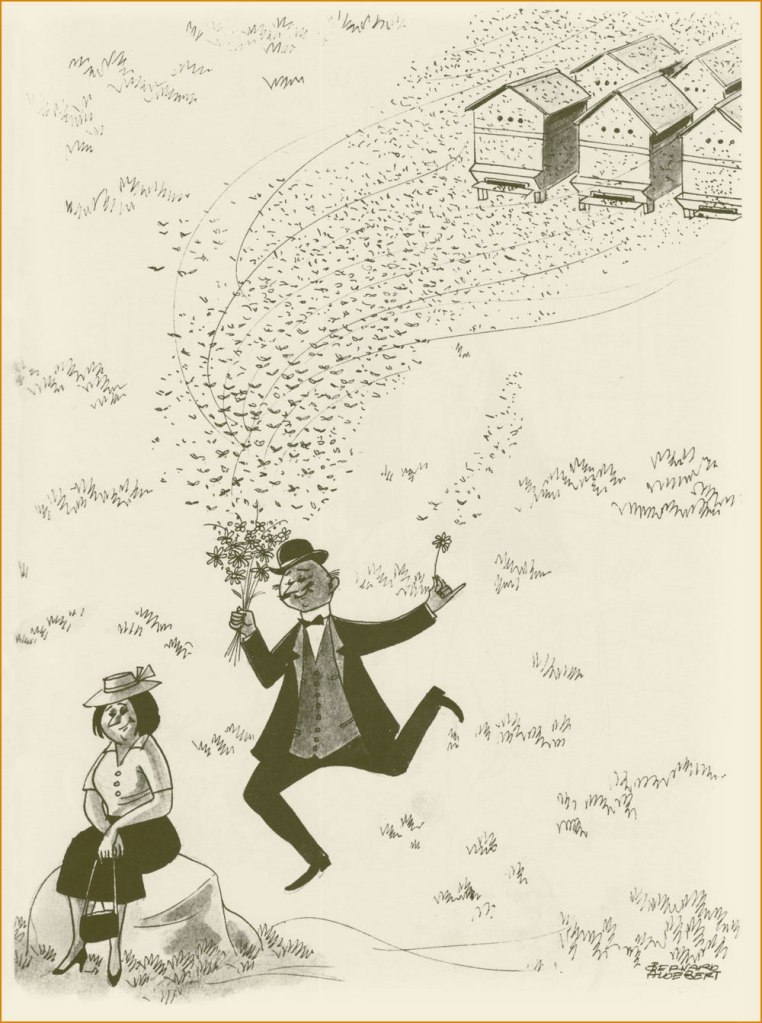
Bernard-Aldebert might have moved away from satirizing serious topics, but it doesn’t mean he lost his sense of observation of the ludicrous aspects of life.
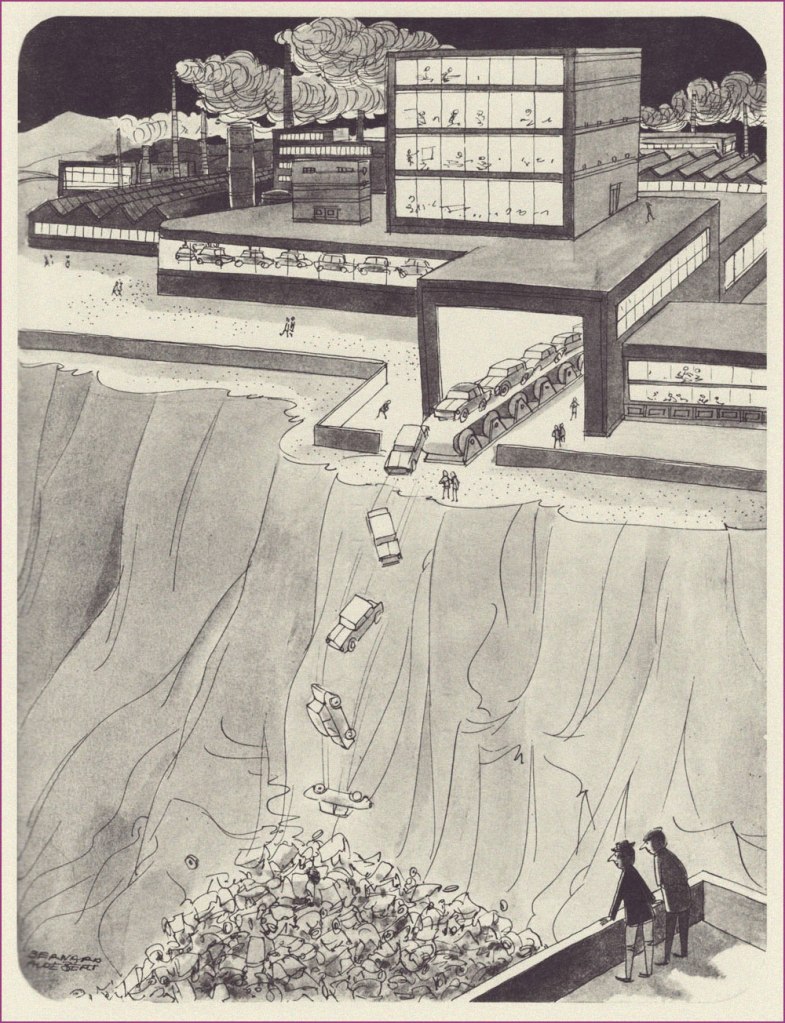
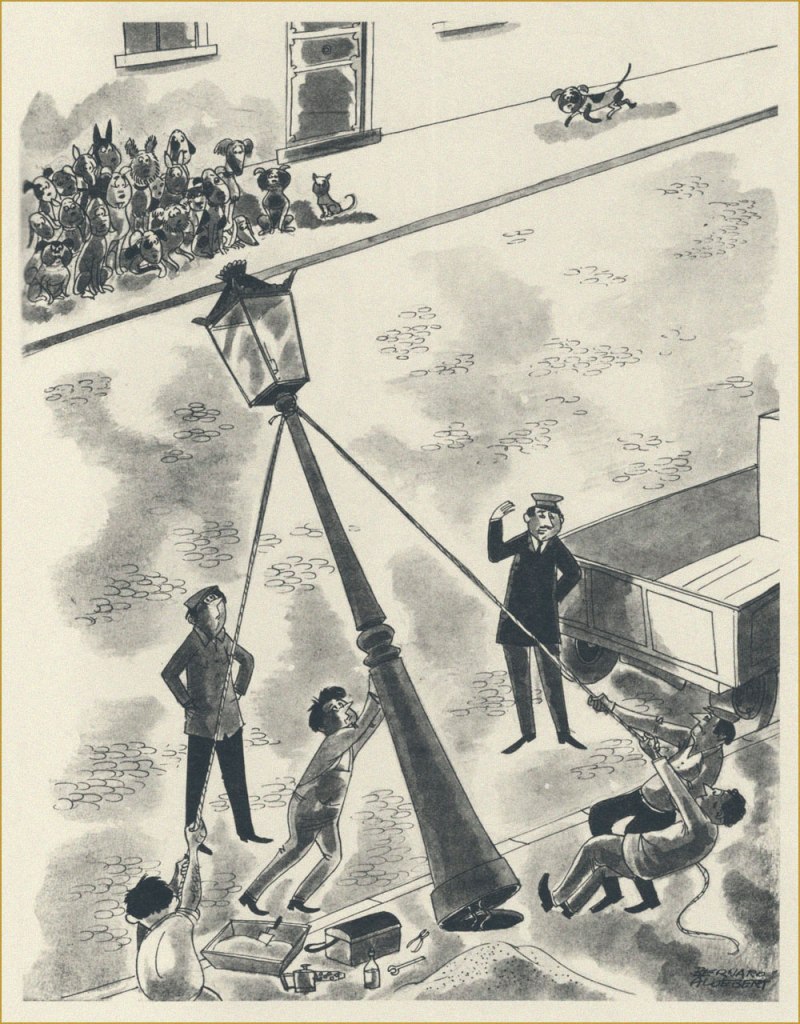
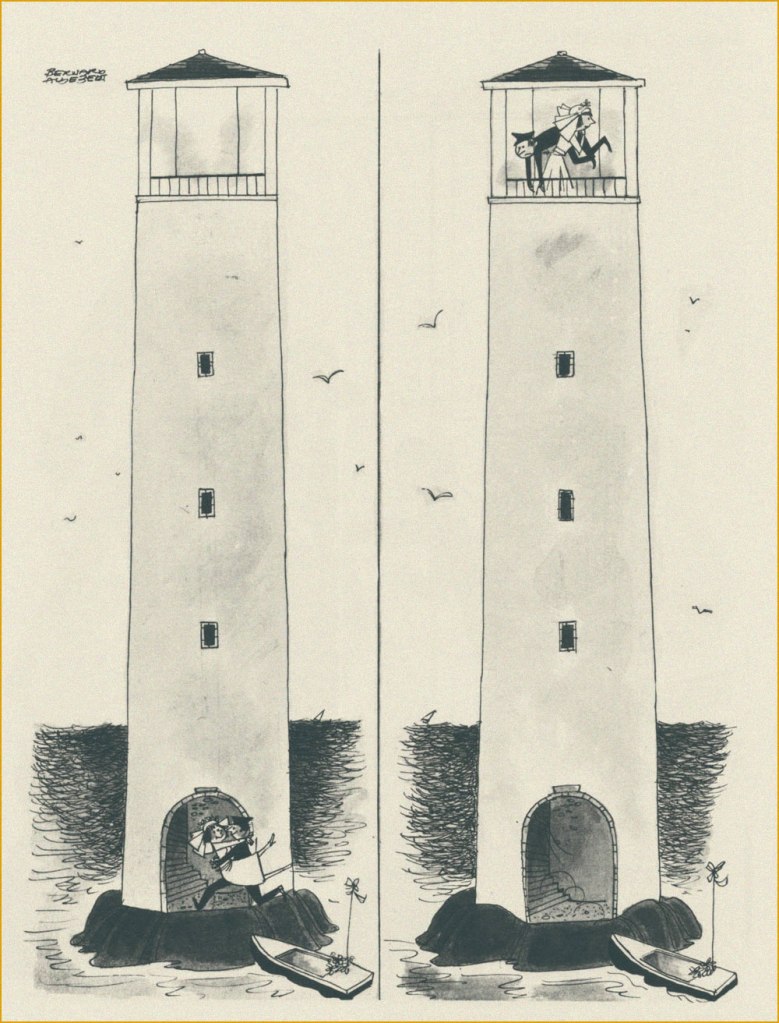
« If you had just a little imagination, you’d come to the beach! » This is my favourite cartoon from this collection.
If people still had to use a sickle, maybe fewer lawns would be tragically over-mown.
I don’t know what year this haunting photograph is from, but I think we can all agree that these eyes look like they’ve seen too much.
« Bonnie and Pepsi are obsessed with sex, but they’re not there for the male gaze. Their desire is frank and straightforward and more than a little demented, and it’s depicted with a bracing honesty that feels less like a political statement and more like Flenniken is reporting from the front lines with no filter, no safety net, and no intention of telling anything but the truth.»*
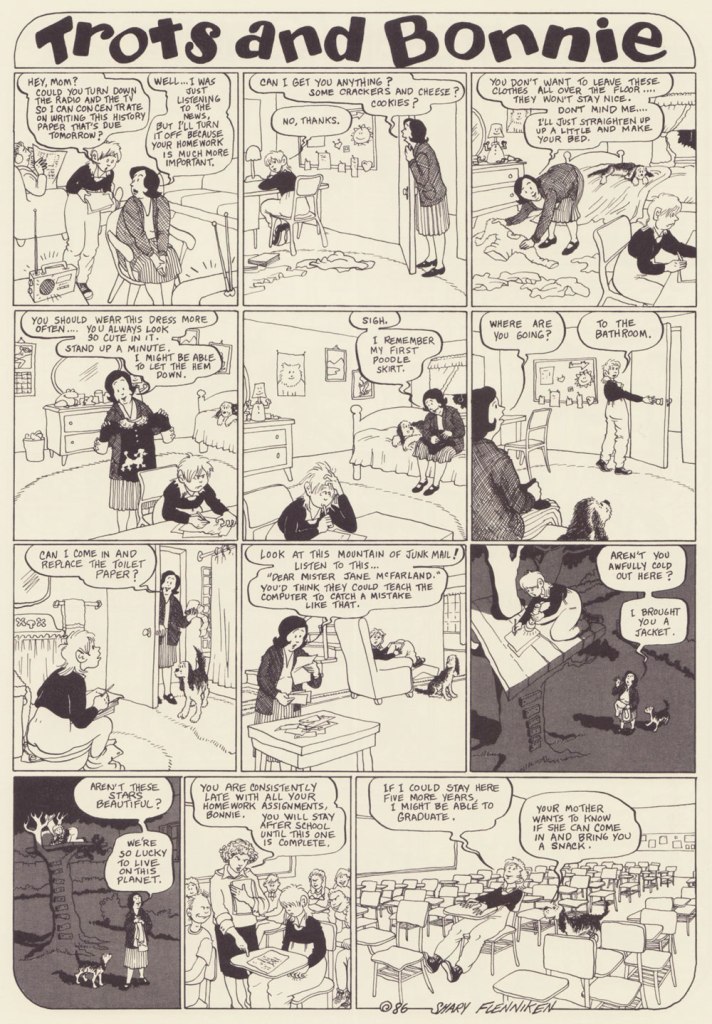
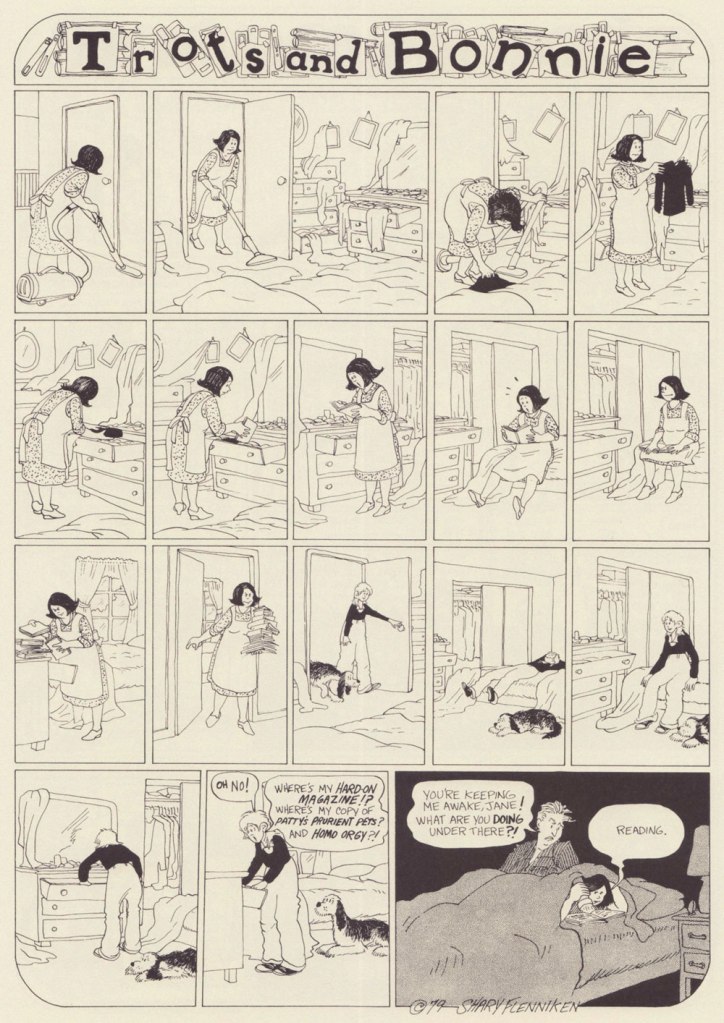
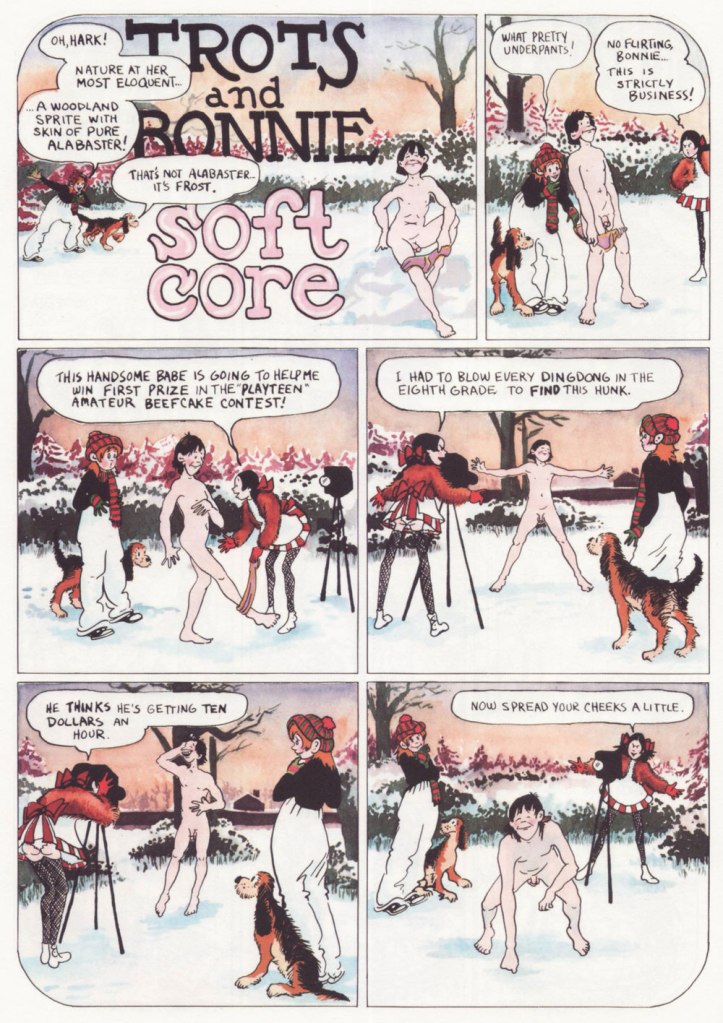
I first came across a Shary Flenniken‘s Trots and Bonnie strip in some random issue of National Lampoon. I can’t even really narrow down the decade**, as it ran within its pages from 1972 all the way to 1990. I was intrigued, but not enough to pursue it.
When New York Review Comics published a Trots and Bonnie collection in 2021, gathering 160 strips in a handsome hardcover volume, I was happy to finally be able to partake of T&B in a more organized fashion. One perplexing thing about this collection is that some strips were omitted due to concerns of misinterpretation***. It was apparently feared that some topics would be too controversial, or that the modern reader has lost the ability to interpret things in context. I would have liked the possibility of deciding what has or hasn’t aged well for myself. As it stands, this collection features strips offering a most varied list of topics to horrify the easily triggered (rape, racial epithets, kids getting shot, electrocuted and castrated – albeit by other kids – and pedophilia), so I am truly curious what the censored strips were about. I guess I am now doomed to collect National Lampoon issues (to be fair, the latter was home to many a great cartoonist – Rick Geary, M.K. Brown, Stan Mack, etc.)
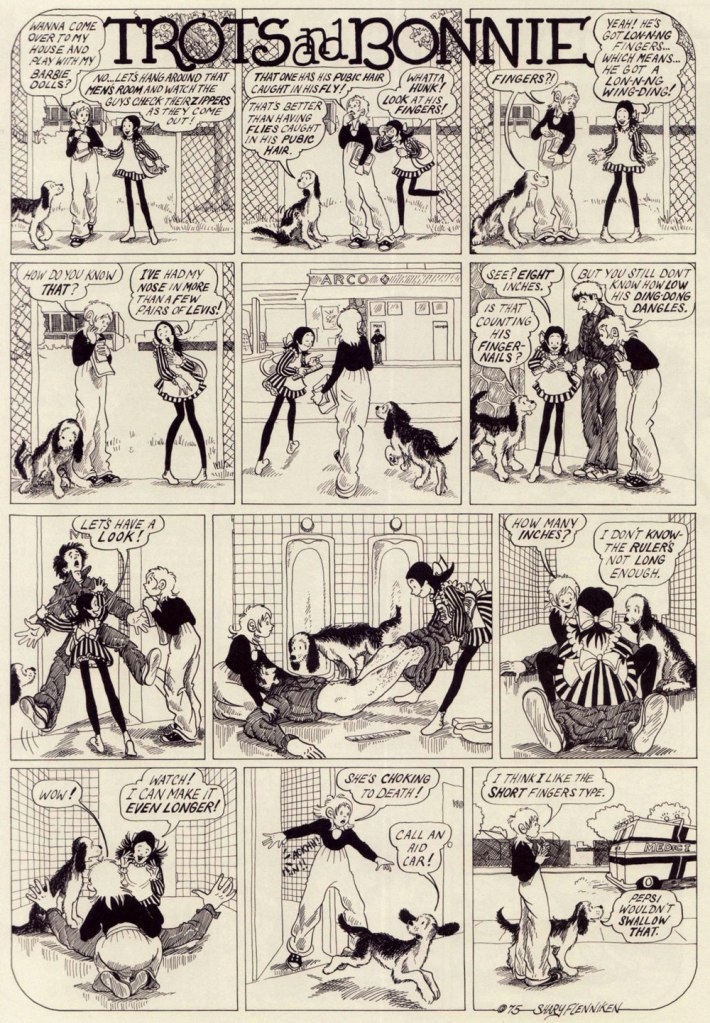
Trots and Bonnie is a hilarious strip, and it’s also quite unsettling in the best of ways. While both cartoonists would surely be offended by this comparison, it makes me think of some of Charles Rodrigues’ work (see Charles Rodrigues’ Pantheon of Scabrous Humour) – the same electrifying unwillingness to shy away from difficult topics, although Flenniken was doing it to make a point, and Rodrigues would do it for sheer perversity. More than once while reading T&B I would start wondering how far a certain storyline would go – and it went all the way to its logical (call it immoral, call it stomach-churning…) conclusion. Just take the Dr. Pepsi’s Vasectomy Clinic from 1974, a panel from which made it as the cover of the collection –
«Two youngish girls, dressed as medical professionals, appear to be playing doctor with a young boy, who lies under a sheet, grinning blankly at the viewer while one of the girls, brandishing a pair of scissors, cheerfully communicates something to the other one. A sweet-looking dog with fancy eyelashes lies at their feet. It’s only once you know the particular strip it comes from, in which Pepsi (the shorter firecracker) and Bonnie (the taller girl) attempt to give neighbor kid Elrod a vasectomy and wind up referring to themselves as a sex-change clinic, that you blanch a bit at the art choice. There you go. That’s “Trots and Bonnie” in a nutshell. » [source]
Boys are sometimes disconcerted by Pepsi’s aggressive style of lechery, but they’re mostly on board. To once again quote Emily Blake, ‘what Flenniken understands and brings gleefully to the page is that adolescent girlhood is positively feral and that teenage girls are both threatened and threats themselves.’ Given that highschools are breeding grounds for boys cruelly bullying flat-chested girls, I can see why Flenniken decided to flip the tables.
There’s so much to unpack here – Trots as the voice of the male gaze, female camaraderie, the hilarious but tragic response of the woman to the suggestion of cream (eliciting a sort semi-guffaw, semi-yelp from this reader), a hint at social unrest caused by police brutality, and that’s just skimming the surface. Flenniken says, ‘You might say I was taking the subject lightly here, but at least I was introducing this to an audience that wasn’t going to see anything like this anywhere else‘. Amen.
It’s also a charming strip, with a heroïne who is refreshingly in no hurry to grow up (despite being prodded into it by her early bloomer friend Pepsi, ‘dressed in incongruously childlike pinafore paired with fishnets, a perfect metaphor for the terrifying underage sex fiend she is’). Bonnie dresses like a tomboy, hates going out with her parents, and collects sex magazines and prophylactics like other kids collect marbles. In a world of sleazy men with a creepy predilection for pre-adolescent flesh, she somehow manages to remain an innocent, and shrug off any unpleasantness in favour of a wide-eyed curiosity about everything, be it boys’ cock sizes or sci-fi movies.
I can 100% relate to the thrill of first seeing a naked man (well, maybe not a dead one, though), and at that age I would probably be running around with a jar of lymph nodes as well, given half a chance.
I’ve included more ‘innocent’ strips to showcase that Bonnie is a normal kid with a normal (if staid as hell, especially for the 70s) set of parents. It seems that Flenniken’s friend Mark Evanier suggested Trots’ punchline.
Will men find this strip as hilarious as I do? No idea. But it reminds me of today’s conversation with a (male, gay) colleague, in which he learned that women usually have two or three categories of underwear and spent the rest of the day marvelling at this fact.
I find it charming that there’s someone for everyone in this scene – neither group is focussing on the one best-looking member (accidental pun) to the exclusion of everybody else, but developing an inclusive cloud of lust.
‘I’m partial to gay male porn. And so is Bonnie’s mom now. If you can’t figure out why, you don’t need to know.’
The ridiculous (and lascivious, yuck – Bonnie’s body language makes it clear she is very much creeped out) approach of the psychiatrist is tempered by the punchline – Trots really can talk!
In case that isn’t clear, I heartily recommend purchasing the Trots & Bonnie collection.
~ ds
* This strip is hard to write about and do justice to, and I could not do any better than Emily Flake’s truly excellent introduction to the T&B collection.
** I found it – it was Women’s Erotic Art Gallery, published in 1975.
*** Flenniken explains, ‘the things that I did that we omitted here in this book, I think we looked at those and went, “oh, that might hurt somebody’s feelings or something.” That was me being naïve when I wrote those. A lot of times I was just exploring a subject rather than having a definitive stance. People are pretty darn outrageous today, more so than me. What has changed is what people think is offensive.‘
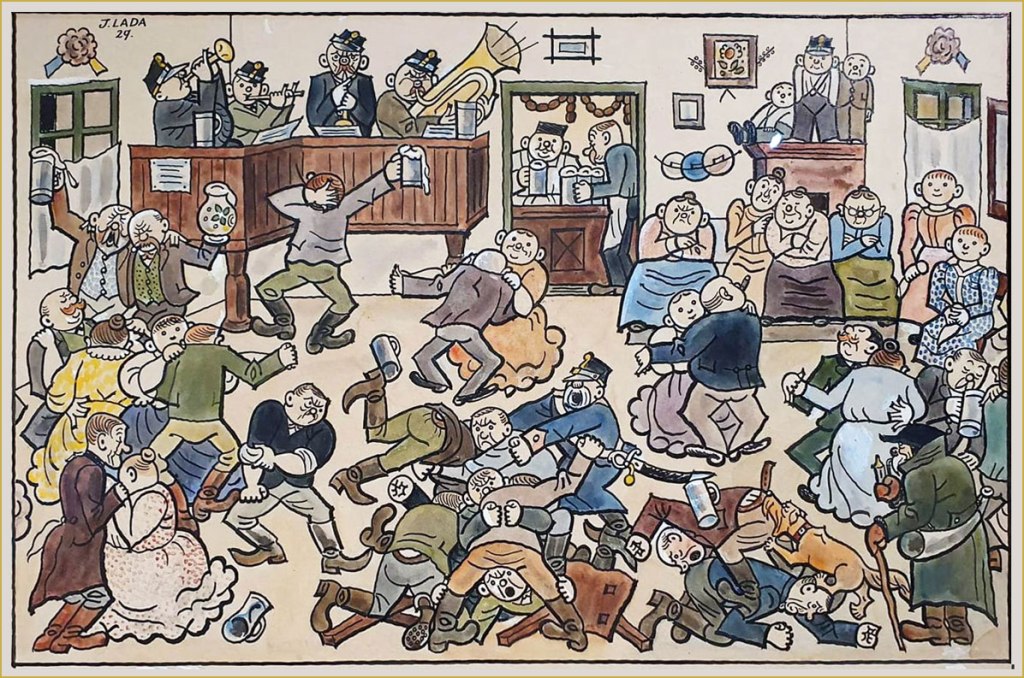
When I looked up Czech painter-caricaturist Josef Lada (1887-1957), I was surprised to find him called ‘one of the best-loved Czech painters of all time‘. There’s no question that Lada’s work remains immensely popular among Czechs, but I suppose the question for context would be « how many painters from that corner of the world are well known outside of outside of the Czech Republic and ex-USSR countries » (probably not many). Lada doubtlessly deserves his lasting fame, at any rate.
My familiarity with his style comes from his illustrations for Jaroslav Hašek‘s sardonically hilarious novel The Good Soldier Švejk, a favourite family book from which we can all quote at length, and which I own in several Russian editions (thanks to inheriting my grandfather’s copy). There have been many adaptations of Švejk, but I can only imagine him the way Lada depicted him. Visit BibliOdyssey for a glimpse of the good soldier.
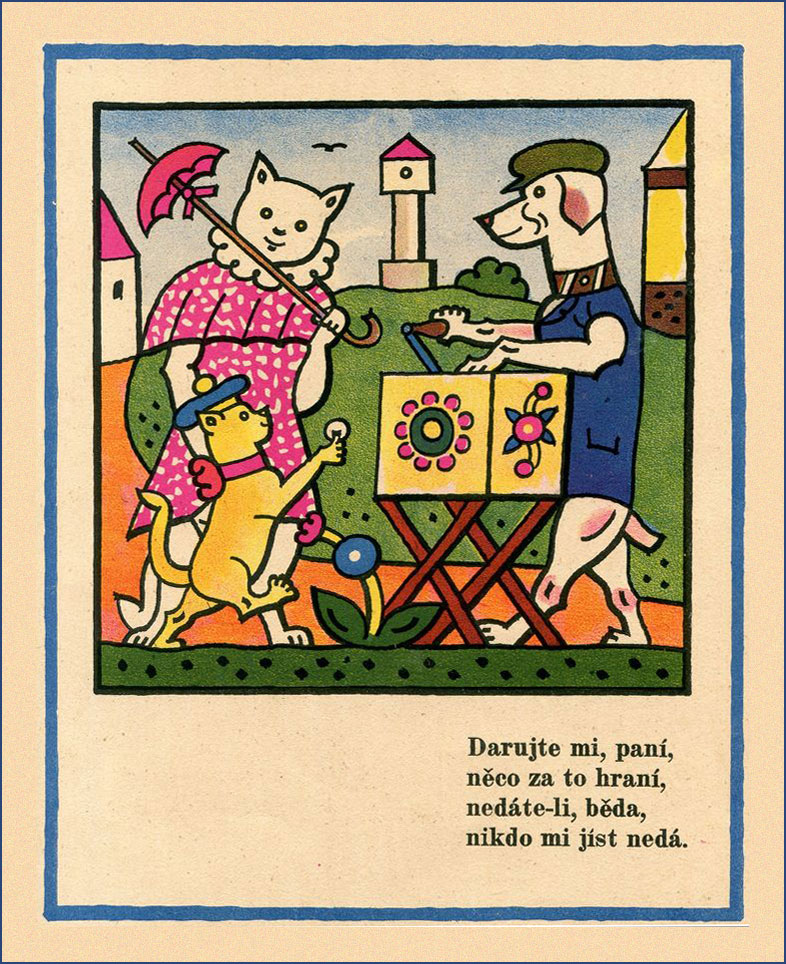
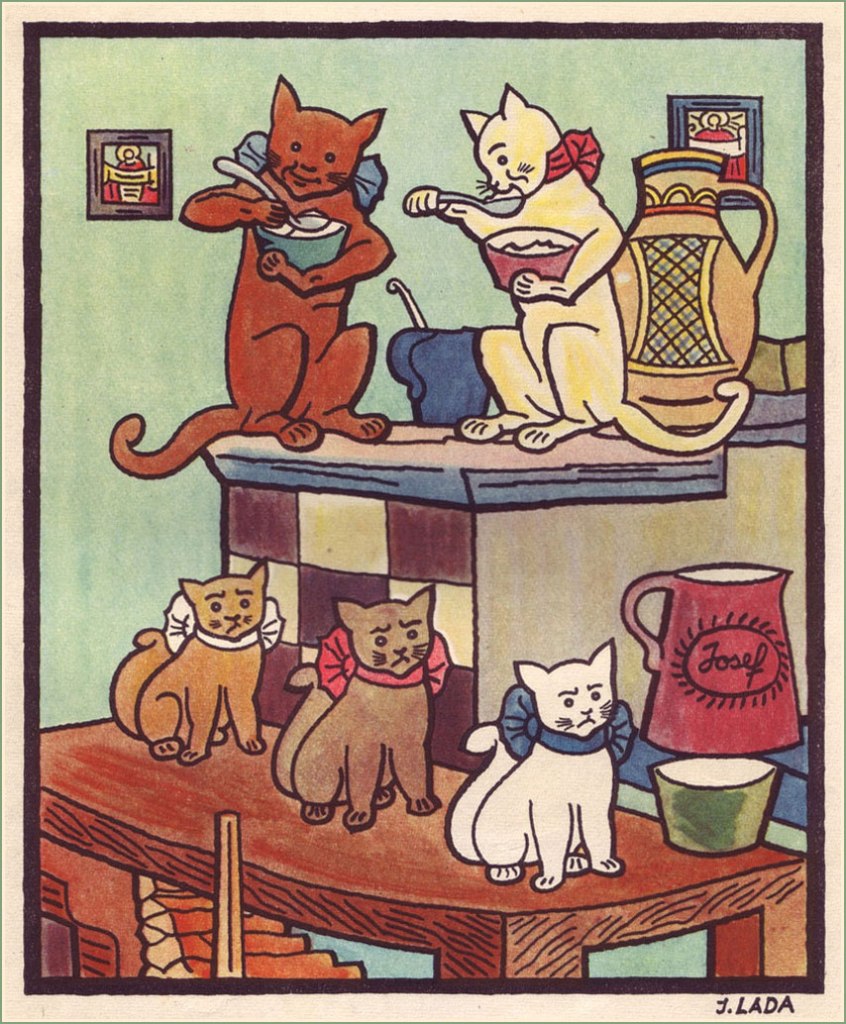
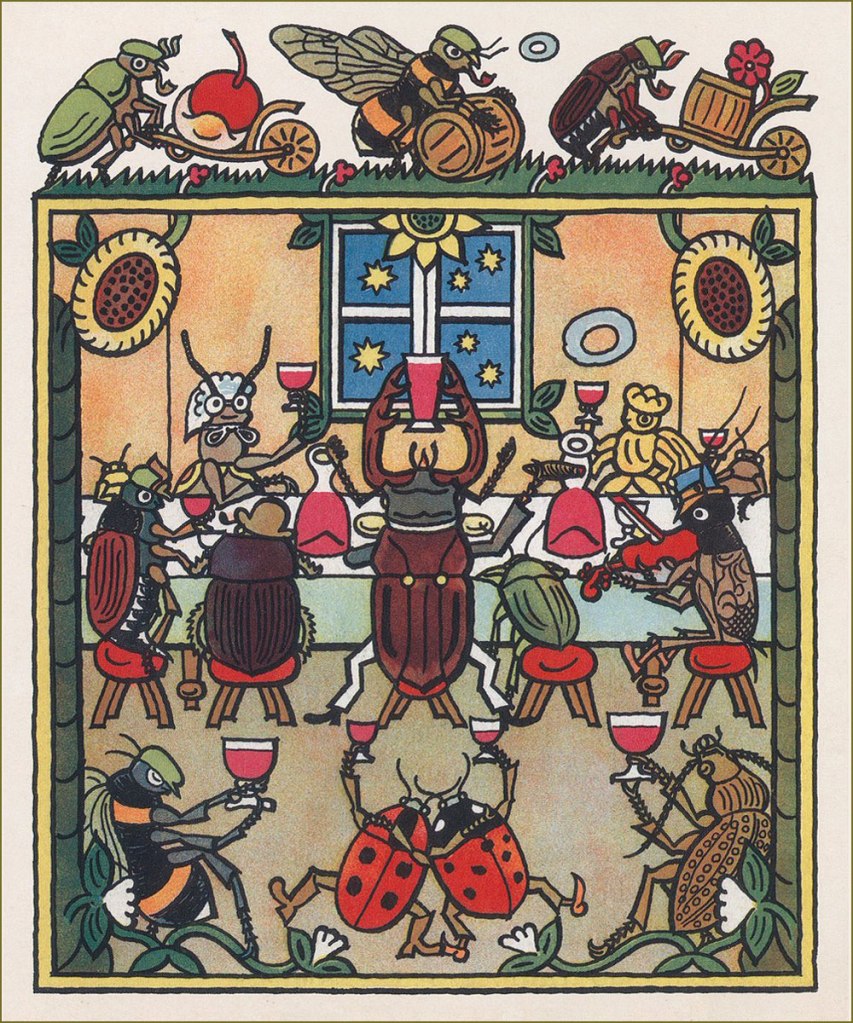
While his renown is assured thanks to his work on Hašek’s magnum opus, the entirely self-taught Lada is also fondly remembered for his illustrations to children’s books (which he occasionally wrote himself), as well as paintings of pastoral life, probably inspired by his childhood in the small village of Hrusice. For a fuller biography, head over to The Genius of Josef Lada, the most complete source of information that I could find online in English.
Here’s an assortment of images from various books – among others, Ezopské bajky (The Fables of Aesop) from 1931; Kocour Mikeš (Tomcat Mikeš), written and illustrated by Lada between 1934 and 1936, and being a sort of a take on Puss in Boots; Nezbedné Pohádky (Naughty Fairy Tales) from 1946 – as well as some postcards and aforementioned village illustrations.
A typical pub night, 1929.
Winter Pleasures, 1936.
« In the first year of his life, [Lada] had a life-altering accident – he fell on his father’s knife and the injuries sustained permanently blinded his right eye. Some art historians later attributed the artist’s flat-perspective painting style to this incident.»
Lada’s depiction of ‘vodnik‘, an evil water spirit.
A page from Zvířátka (which translates to ‘beasts’ or ‘animals’), a book comprising a dozen animal illustrations.
A New Year postcard from 1928.
A collection of Lada’s caricatural cartoons – ‘A Hundred Cheerful Drawings’ – published in 1970. I found this little volume in a used bookstore, and was delighted to find what was clearly the work of the artist who illustrated Švejk – I didn’t know Lada by name, back then. I don’t speak Czech, but it’s still plenty fun to leaf through.
Today we foray into the land of semi-autobiographical, prototypically ‘female’ chronicles – you know the thing, jokes about dieting and weight gain, a never-ending quest for the right boyfriend, hoary chestnuts about opening jars and eating ice cream when sad. The focus may vary a bit – some characters are stuck in humdrum drudgery, potty-training children and husbands, and some are bouncing around on sexy outings (and all of them fretting about becoming their mothers). While I am not automatically dismissive of this genre, it’s difficult to pull it off in an interesting way. For every Sylvia, there are many, many Cathys*.
Anyway, lately French cartoonists who go down that road have tended to opt for a very similar drawing style, similar to the point where one starts wondering who has ripped off whom. One of the artists who stands out a bit more to me is Pénélope Bagieu, whose work, while adopting a lot of tropes inherent to this category, also provides some genuinely interesting moments.
Bagieu might be best known for her 2016 webcomic-turned-best-selling-book Les Culottées (Brazen: Rebel Ladies Who Rocked the World in English) that tells stories of exceptional women of different eras and nationalities. It’s a great idea… that I am not interested in, which can also be said about California Dreamin’, her biography of Mama Cass. However, two of her graphic novels are definitely worth seeking out.
Exquisite Corpse (translated from the French Cadavre exquis, published in 2010, Gallimard) does a great job of depicting the depressing life of Zoe, who shuffles between a mind-numbing job and a lackluster relationship, growing more desperate by the day. Her life takes an altogether different turn when she accidentally meets a recluse who turns out to be a famous author. I don’t want to give any spoilers about the set-up of the ending, but I did not see it coming at all.
Her other graphic novel I like, La page blanche (2012), was written by Boulet and remains untranslated into English. It opens with a young woman sitting on a bench, having no idea how she got there or who she is. The interesting thing is that her amnesia never goes away — she never gets to remember anything about her past life, or discover who she was. All she finds was an apartment full of books that everybody reads and movies everybody watches, as well as shallow friends who are not really friends.
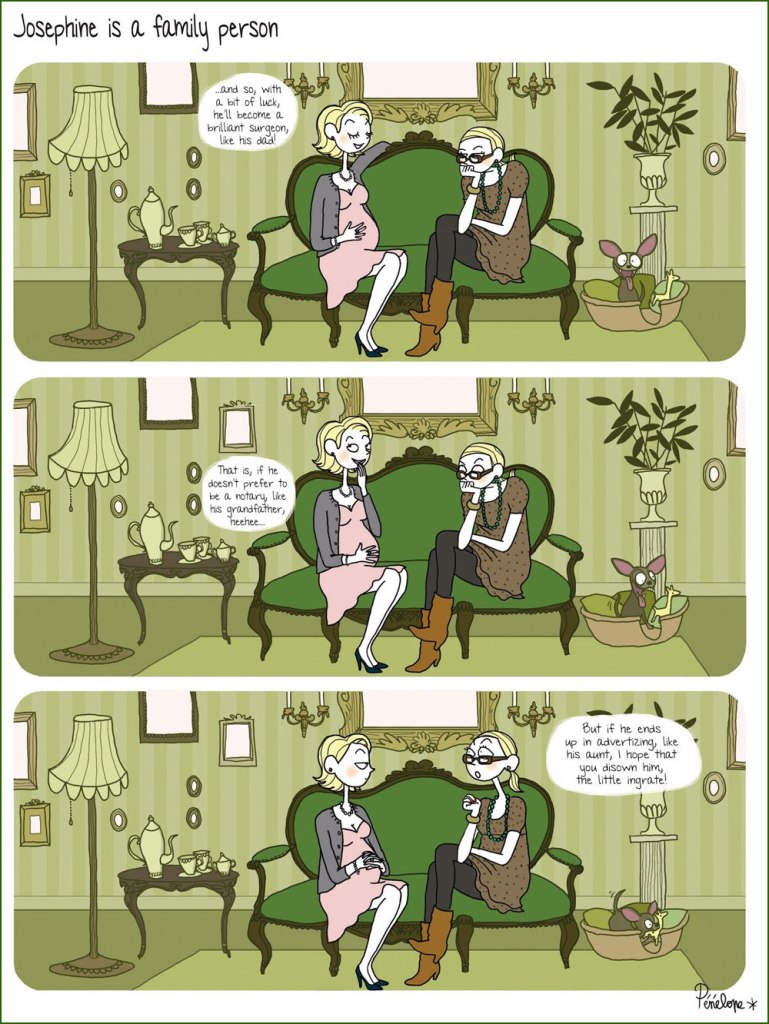
More in ligne with the aforementioned ‘woman seeks partner, settles for ice cream instead’, here are a few pages from the first volume of Joséphine, a series of three albums published between 2008 and 2010:
Joséphine’s only weapon against her holier-than-thou sister is sarcasm.
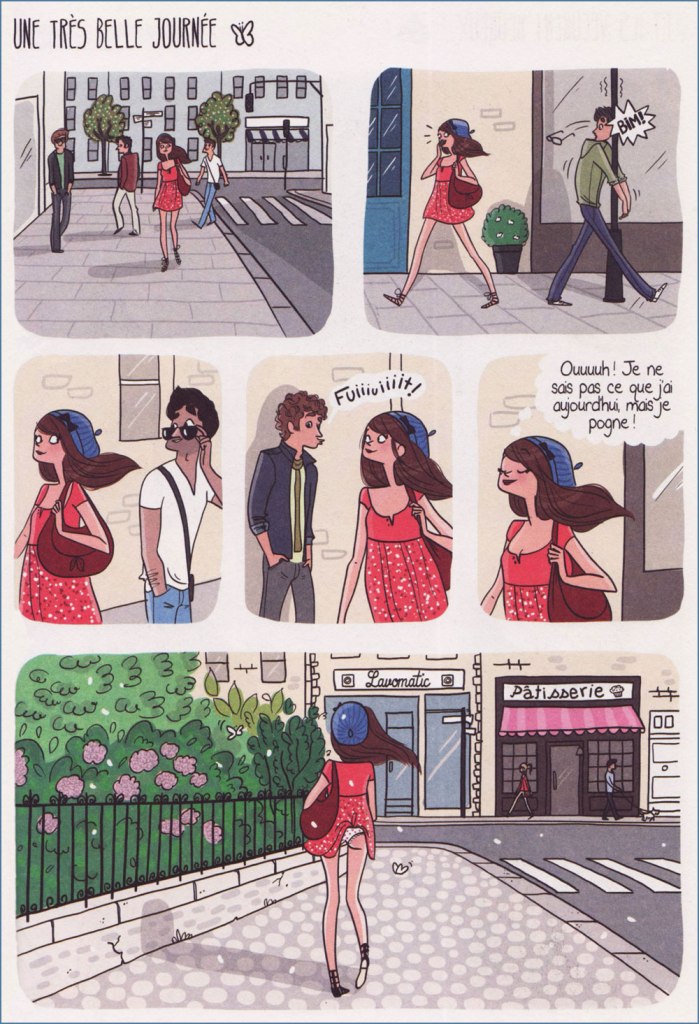
Since I made a point of mentioning artists with similar styles, here’s an example. The following pages have been scanned from La célibataire, written by Quebecoise India Desjardins and illustrated by French Magalie Foutrier (although given how light in storytelling content this book is, and how very French it is, too, I’m not really sure what Desjardins actually contributed):
One of my favourite storylines in this book, about a cat she finds on her balcony one autumnal afternoon. Not sure why she’s bathing it, though. Unlike the very human Joséphine, this gal is always impeccably dressed and perfectly coiffed.
Despite its lack of originality, I like La célibataire a lot for its the bright colours and textured art. Sometimes, ‘it’s pretty’ is a justification to keep something despite multiple attempts at purging the books one doesn’t really need. This one has survived every purge, so far.
That was two examples I actually like — for kind-of-similar-but-no-thank-you, check out Margaux Motin or Nathalie Jomard.
~ ds
*On Hating Cathy over at The Comics Journal is a worthwhile read, though I disagree with its conclusion.
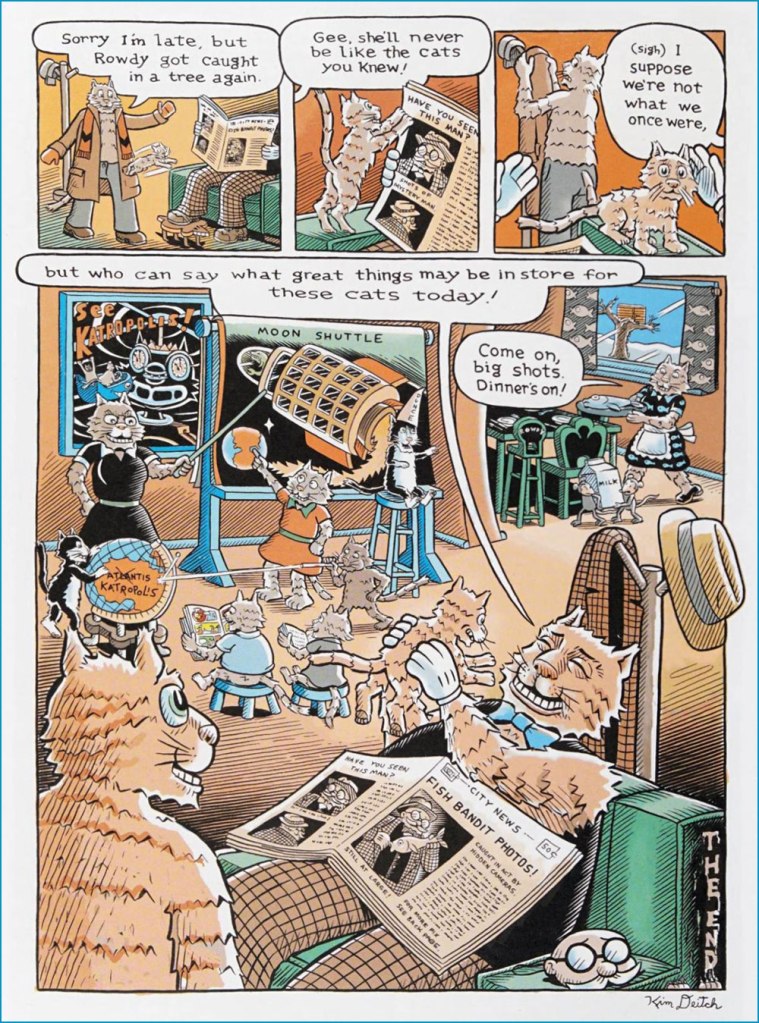
Underground comix artist Kim Deitch probably doesn’t need much of an introduction, other than perhaps to mention that he’s the son of amazing illustrator/animator Gene Deitch, about whom we have talked before (see Back When ‘Hipster’ Wasn’t a Dirty Word: Gene Deitch’s The Cat). For the most part, I respect more than enjoy K. Deitch’s work, appreciating his style and attention to detail, but unable to maintain more than a passing interest in the dream logic of his tales. The story we are sharing today charmed me, as it combines his typical soaring and detail-driven landscapes with a really fun ‘what if?’ plot and a clear appreciation for cats, always an advantage for an artist, in my book.
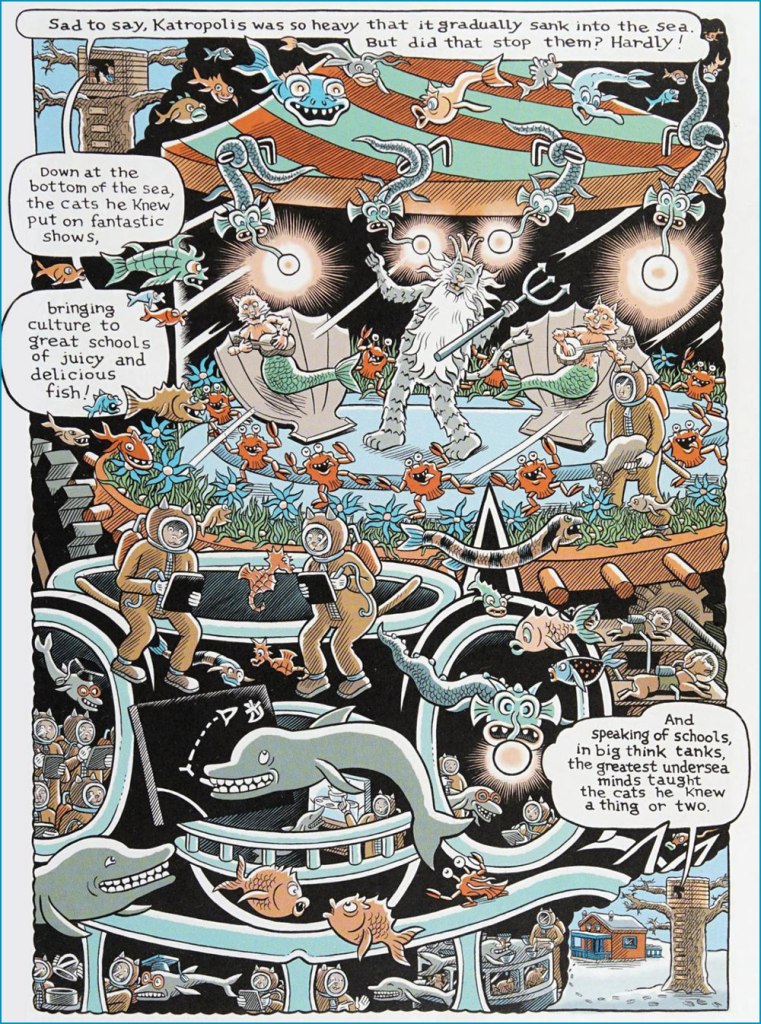
These Cats Today! comes from the pages of Big Fat Little Lit (2006, Puffin), which collects most material from the three volumes of Little Lit, Art Spiegelman and Françoise Mouly’s anthology that featured comics created for children by a varied roster of artists (a lot of whom have collaborated with Spiegelman on RAW), as well as some Golden Age additions by the likes of by Walt Kelly, Crockett Johnson, and Basil Wolverton. School Library Journal described it as ‘a sensational introduction to traditional literature for a visually sophisticated generation‘. If by ‘traditional literature’ they mean ‘traditional folk tales’ (before they got bowdlerized*), then sure. The stories of Big Fat Little Lit are cynical and pleasantly warped; people get beheaded, eaten, and transformed, and often find that what they thought would bring them happiness just engenders its own problems.
Actually, it was quite difficult to select which story to run, as this anthology is packed with wicked goodies, but this whimsical tale won out (my other favourites are by Kaz, Maurice Sendak, Richard Sala and Joost Swarte, and may yet pop up in another post). Note that if you look beyond the surface of These Cats Today!, you’ll find plenty of cruelty in this fun narrative – dogs enslaved to power up the majestic and glittering Katropolis, force-fed stuffed mice**, these details are briefly mentioned, yet in plain view for those perceptive enough to notice. Truly, for its seeming gentleness, this story belongs into the Little Lit line-up.
« Quake in the presence of the stack of bedside books as it grows taller! Gnash your teeth at the ever-moving deadline that the writer never meets! Quail before the critic’s incisive dissection of the manuscript! And most important, seethe with envy at the paragon of creative productivity! »
I hesitated a bit about writing this post, as it seems to me that everybody already knows (and likes) Scottish cartoonist Tom Gauld and therefore it’s a bit like launching into a review of a Beatles album (vaguely embarrassing, and completely unnecessary). I have also previously talked about him in Tentacle Tuesday Masters: Tom Gauld (and you can head over that way, if you want some biographical details of his life). That being said, his art is not nearly as ubiquitous as it deserves to be.
I happily received his latest book, Revenge of the Librarians* (2022, Drawn & Quarterly**), as a Christmas present, and I remain impressed by the scope of Gauld’s wit and his instantly recognisable style. He also has an impeccable sense of composition; each drawing is perfectly framed, often sneakily implying something happening almost out of sight, hinted at by a chunk of wall just at the edge of the panel, a partially seen open door, an alluring bit of tentacle. He’s funny but poignant. I can only imagine how many of his cartoons are pasted over the doors of professors in all fields and walks of research (it’s something people still do, right?) I can consume Gauld’s perfect little microcosms like semechki, but try to read only a few every day to prolong the enjoyment.
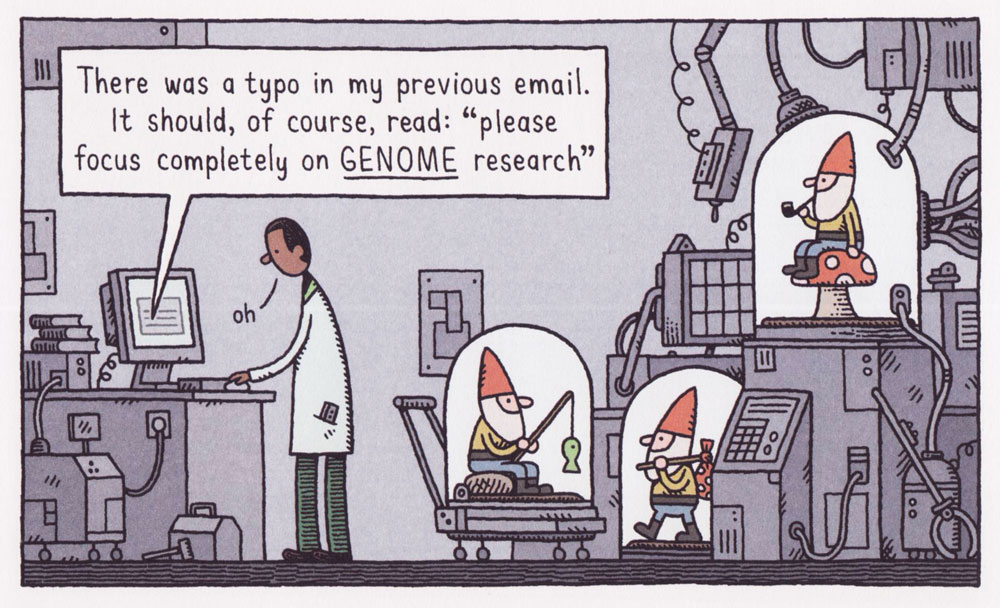
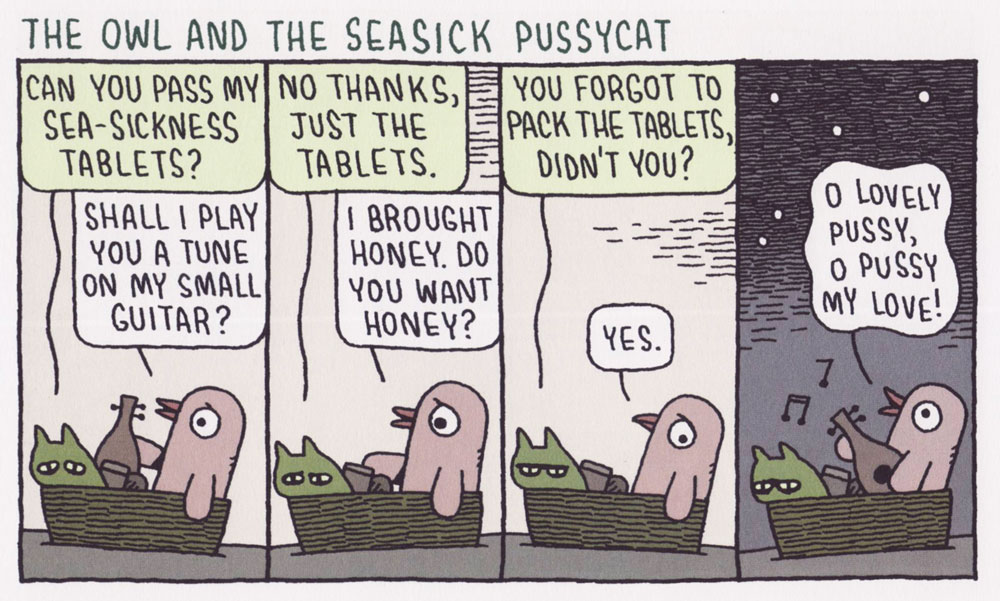
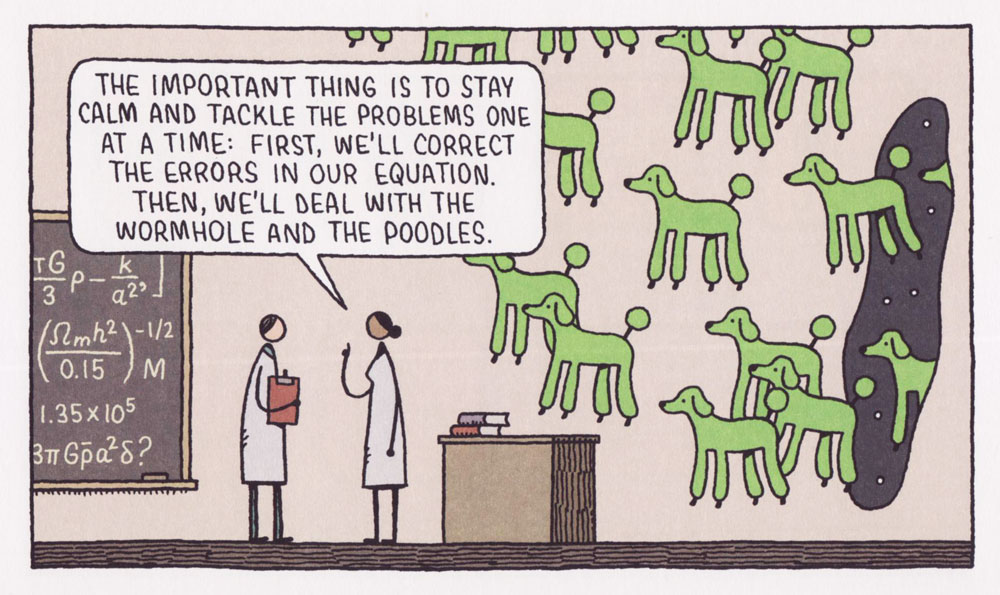
It was really difficult narrowing down today’s selection to ‘just’ 12 strips (I didn’t want to annoy my master-scanner co-admin RG too much). The following have been scanned from the aforementioned Revenge of the Librarians, as well as You’re All Just Jealous of My Jetpack (2013) and Department of Mind-Blowing Theories (2020). Enjoy this sampling, whether you are already a Gauld convert or have never heard of him!
Po-tay, po-tah-toh…
One of my very favourite Gauld strips, though I couldn’t explain why.
A very typical Gauld strip, complete with many options of something that starts out grounded in real life and shoots off into funny social commentary.
There was no way I could skip over this one, given my mushroom leanings… Have I mentioned Gauld’s expert use of colour to highlight important details in an otherwise subdued palette?
** That makes it two worthwhile things that Drawn & Quarterly has published… or is the process of publishing, the other being Tove Jansson’s Moomin stories.
One of this blog’s unexpected hits (pow!) has been Let’s All Go Down to the Catfights!. Though published in 2018, this post still generates a lot of interest on a practically daily basis – I knew people liked to spectate women fighting, of course, but I didn’t realize just to which extent. I mean, we have a whole THE TWILIGHT WORLD OF GIRLIE CARTOONS category, it’s not like that post was the only instance of us featuring half-or-entirely-naked women.
I’ve been meaning to do a part 2 for a long time now, gradually accumulating choice material, to finally spring it on you when you least suspect it (yes, that’s me cackling in the corner). When dealing with a potpourri of styles and decades, I usually try to go in chronological order. If this cavalcade through the years demonstrates something, it’s that our tastes haven’t evolved much. Plus ça change…
Page from The Last Curtain, illustrated by Sheldon Moldoff and published in Sensation Comics no. 22 (Oct. 1943, All-American/DC).
Page from Condemned Venus!, scripted by ‘Gregory Page’ (who’s probably Ruth Roche), and tastily illustrated by Matt Baker. This story was published in Phantom Lady no. 14, 1947.
Jumbo Comics no. 105 (November 1947), with a cover by Joe Doolin.
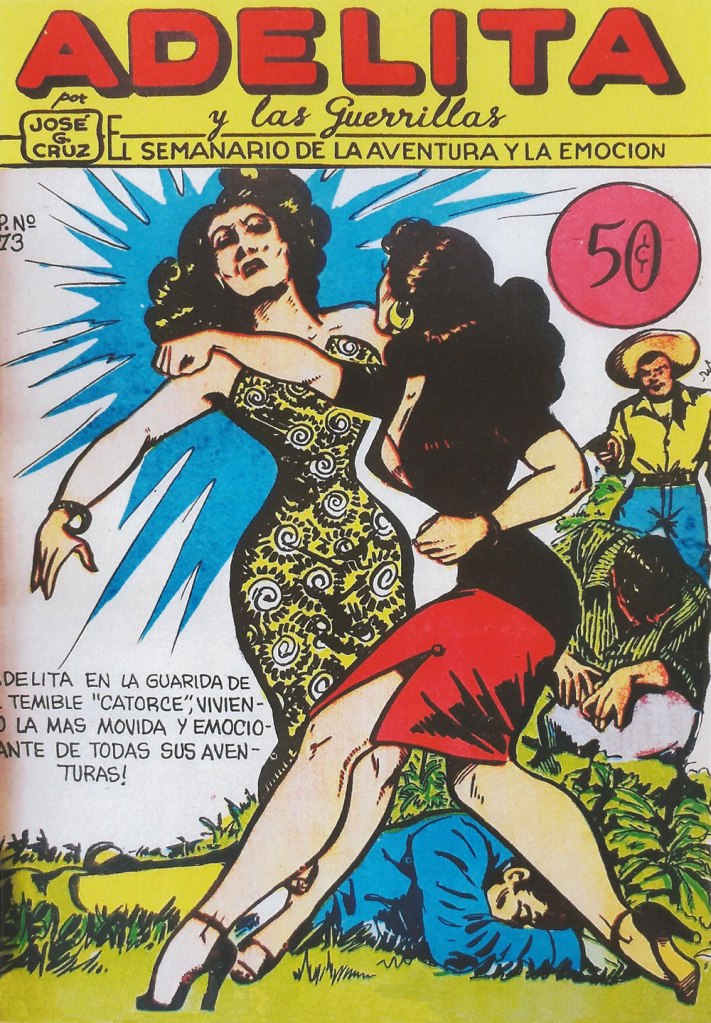
Adelita y las Guerrillas no. 73 (1953, Ediciones José G. Cruz). This is a Mexican Western comic series created cartoonist José G. Cruz in 1936, initially published in Paquito magazine. I’m not sure whether here Adelita is fighting her nemesis, Tigresa del Bajio, or just punching around some other woman.
Crimes by women, on women? Read an entertaining overview of this dime comic book published by Fox Features Syndicate on Criminal Element.
Crimes by Women no. 6 (April 1949). Is a cheap frill the same thing as a cheap floozy?
Crimes by Women no. 16 (December 1949). ‘Crime never pays’, they always remind the reader, who’s probably too interested in the catfight to believe it.
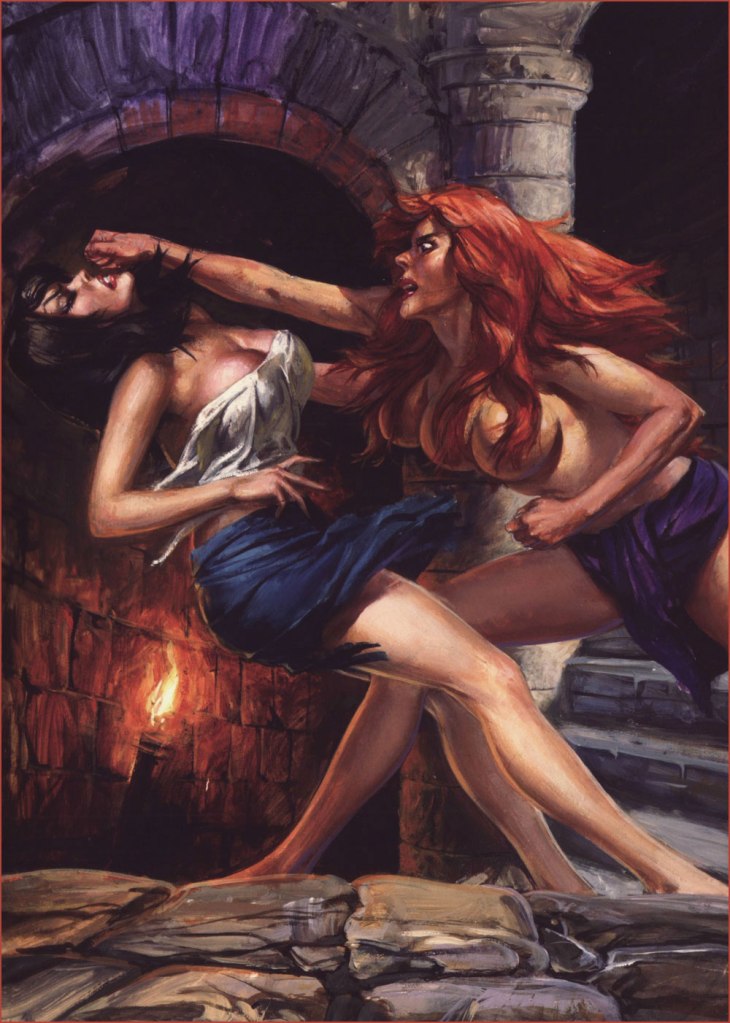
We have a heavy Italian contingent today! Co-admin RG recently wrote a post about Averardo Ciriello, Sitting Pretty: Averardo Ciriello’s Maghella. As he pointed out, Ciriello lent his art to many an erotic series — here’s his cover depicting Lucifera fighting a woman with three breasts (?) I mean, nobody can say you don’t get your money’s worth from this blog… 😉
Lucifera no. 165, 1980.
And here is the original painting, for comparison purposes:
Ciriello wasn’t the only one working in that vein.
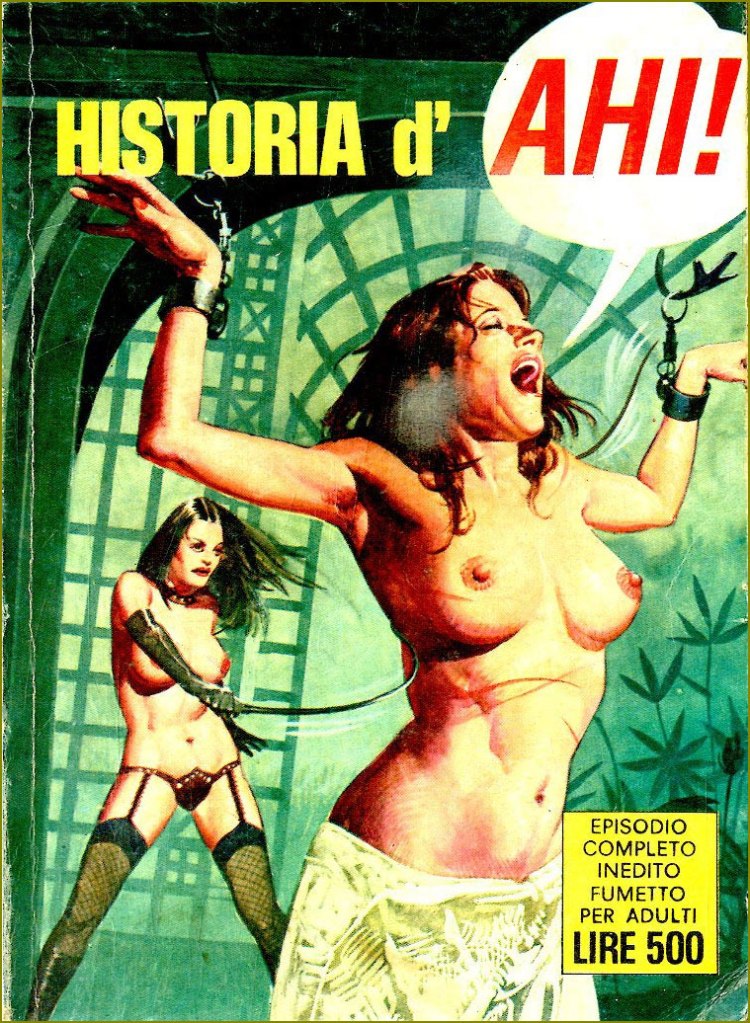
Historia d’Ahi!, a one-shot published by Edifumetto, presumably in the 1970s. Episodio Completo Inedito Fumetto… cashing in on Histoire d’O.
Storie Blu Special no. 12 — L’astronave dei mille tormenti (1983, Ediperiodici).
How about some dubious plot involving a fight between an impeccably fair-skinned maiden and an exotic black woman clad in some sort of tribal garb? Uh, sure.
A page from Royal Hunt, scripted (cringingly overwritten, frankly) by Chris Claremont and illustrated by John Bolton. Marada the She-wolf finds herself a ‘worthy’ adversary in Epic Illustrated no. 12 (June 1982, Marvel).
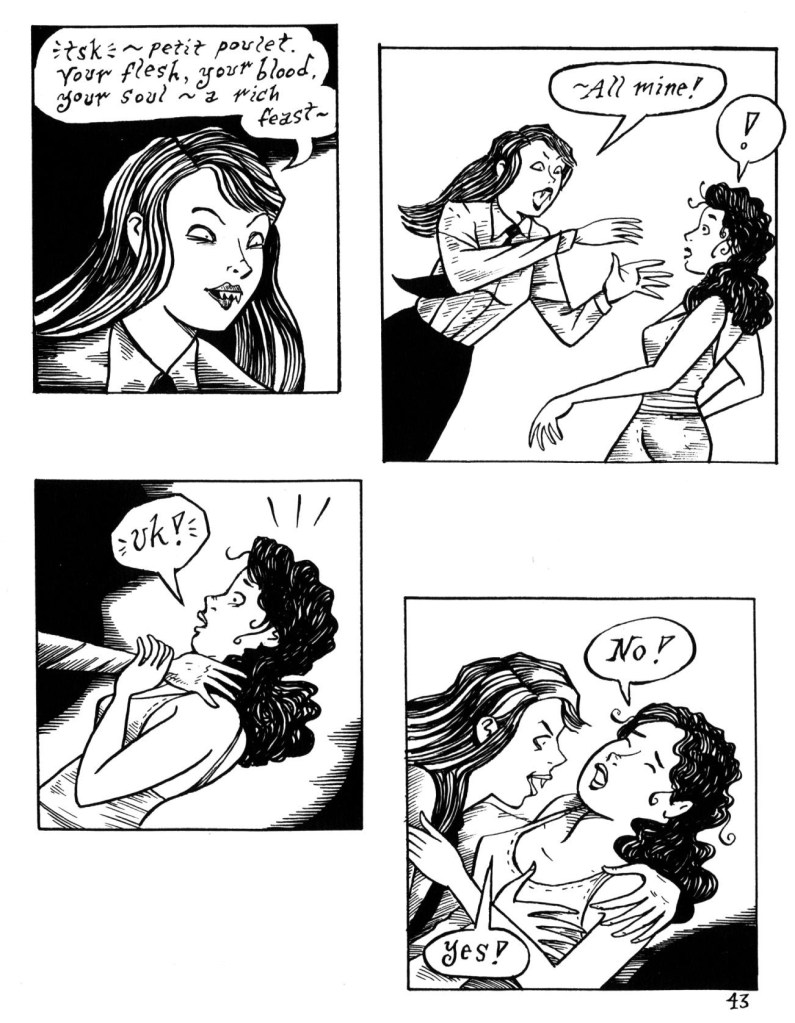
For a slight change of pace and style, I offer you some horror from Tentacle Tuesday MasterRichard Sala, two pages from Peculia and the Groon Grove Vampires, published in Evil Eye no. 13 (August 2005, Fantagraphics):
~ ds
P.S. Here’s a Tik Tok video of a female martial artist who has a rather interesting way of showing different self-defense techniques. It seemed relevant!
I’ve recently given in to a long-time interest (‘a fool’s dream is realized‘) and purchased one of those pretty miniature book nook kits. In case you are not familiar with them, they’re usually the size of a big hardcover book once assembled, and are meant to be inserted on a bookshelf and provide a bibliophile with an intriguing glance into an urban landscape, a Victorian street, a bookshop, a train station, or whatever it is bookworms tend to go for. One painstakingly (and crookedly, at least in my case) glues together furniture and houses, cuts out tiny pieces of paper or slices of fruit, and connects wires to provide background illumination. The one I’m currently working on is a peaceful Japanese street with a sushi shop, a tea store, and lots of cherry blossoms.
I’m clearly not alone in my love for house miniatures or drawn isometric projections of a room. One can do without too much unnecessary psychoanalysis (perhaps it allows us to feel organised and in control when real lives and houses are quite messy), but most of us find such things soothing. Placing a tiny plate on a tiny table is profoundly satisfying; the 2021 game Unpacking makes good use of this, consisting of pulling various objects from a box and placing them where you want through different rooms of the house.
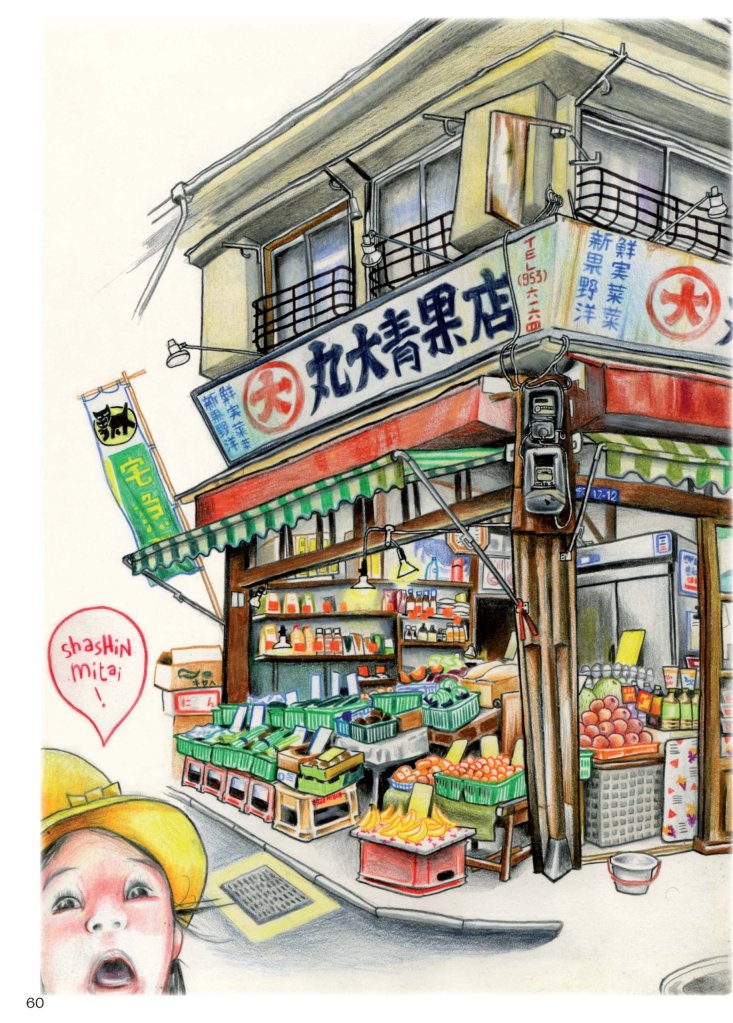
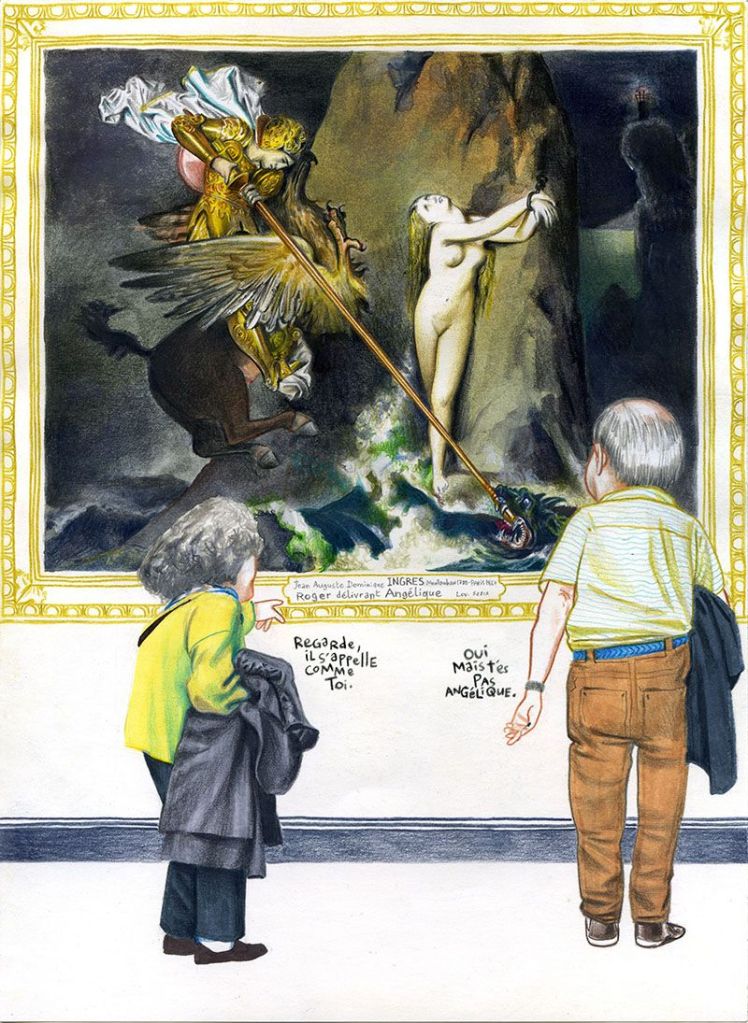
The art of French artist Florent Chavouet (see my earlier post Spotlight on Florent Chavouet) hits a similar note for me. His love of isometric projection and his elaborate sketches of storefronts and people’s rooms immediately attracted me, though at the time I didn’t think to verbalise the reason for it. I concentrated on his excellent graphic novel Petites coupures à Shioguni last time, so here are more glimpses of his other books.
Tokyo Sanpo : Promenades à Tokyo (2009, Philippe Picquier)
Manabé Shima (2010, Philippe Picquier)
L’île Louvre (2015, Futuropolis)
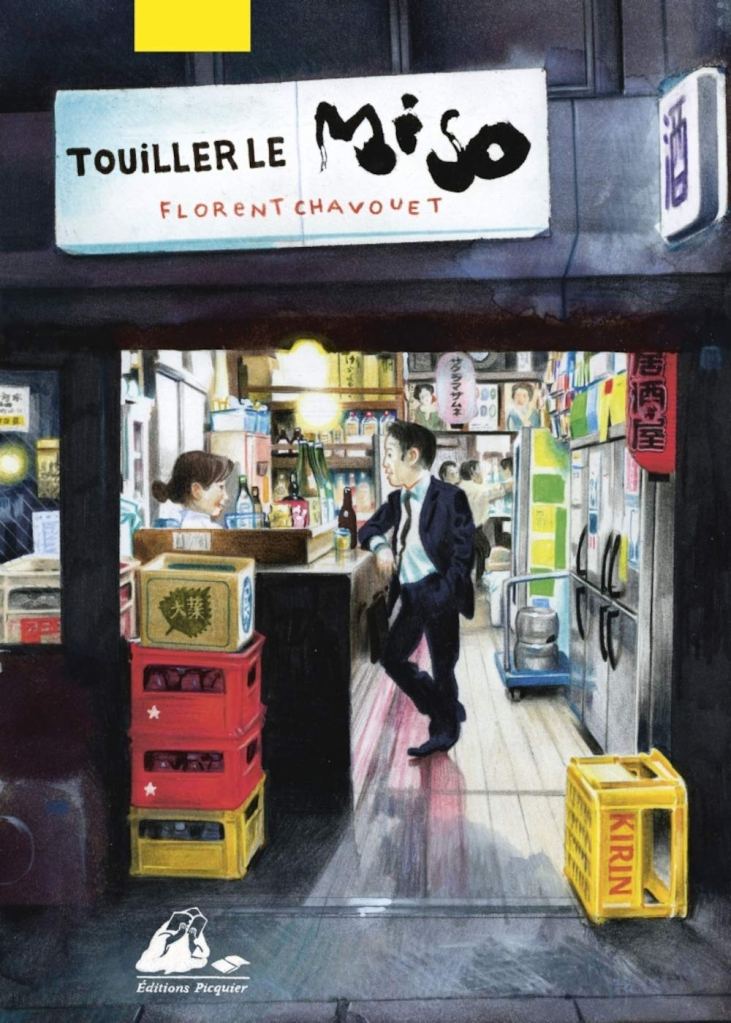
Touiller le miso (2020, Philippe Picquier), his latest book (which I haven’t bought yet, shame on me!)
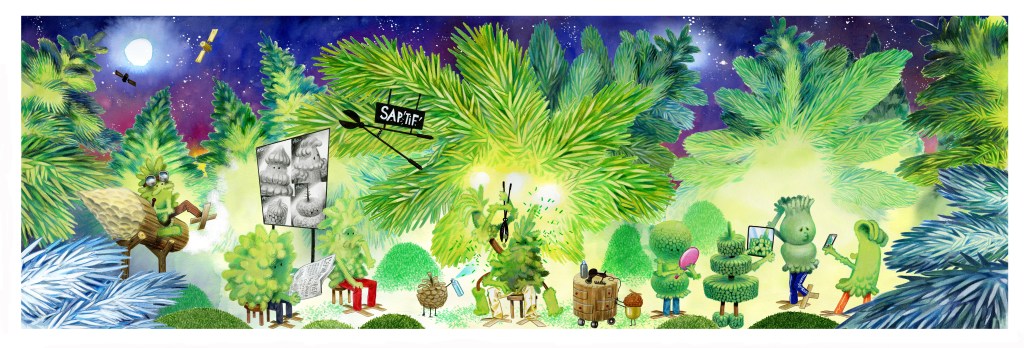
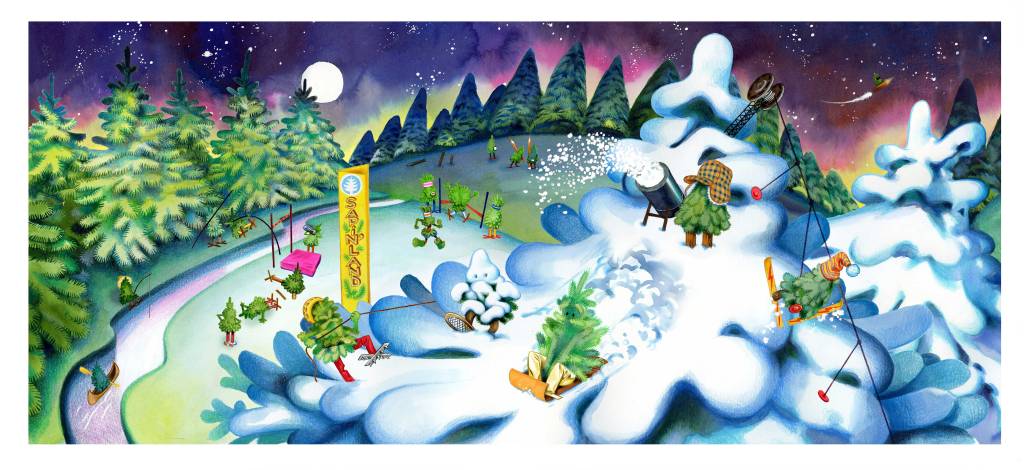
On a more seasonal note, two of his window panoramas drawn for the famous Galeries Lafayette in 2022:
Another thing I really love is imaginary food (which is why the duo of comic artists James Stokoe and Brandon Graham is going to be a post topic sometime in the future), and Chavouet did a beautiful job with his Gloutisphère, a map of the best food in the world… completely made up. Enjoy it on his blog!




















































 Who's Out There?