Georges Pichard’s Distressing Damsels

French comics artist Georges Pichard (1920-2003) specialized in erotic comics, and his work ranged from “just controversial” to “outright banned”. I have a soft spot for his excellently-endowed women with almond-shaped eyes – what they lack in sensuality (to my opinion, at least), they compensate with cantankerous personalities and odd liaisons with deities. Pichard also displays a preoccupation with labour and industrial themes, kind of a communist thing to my mind – his women are called upon (mostly unwillingly) to work with heavy hardware, build railroads, excavate mines, and undertake other menial tasks involving much metal and machinery. This, of course, is accomplished while naked, or nearly naked (shackles are frequently involved.) It doesn’t come off as sadistic or even sexist, however – it’s more like a grotesque comedy or satire. Anyway, I’ll get to all that in just a second.

First I’d like to show a few examples of his earlier work, which wasn’t “pushing moral boundaries” (as an anonymous admirer once put it). His two early series – Ténébrax and Submerman – were collaborations with comics artist Jacques Lob. Although Pichard’s eye for pretty women was already in evidence, his style was much cartoonier, which is lovely.

Ténébrax is an homage of sorts to the roman policier (the French genre of detective stories): a villain uses the Paris subway for his base while he whips his rat army into tip-top shape for world domination, but his heinous plans are foiled by a whodunit writer and his assistant, who manage to throw a spanner into his nefarious schemes.

GeorgePichard-tenebrax
Ténébrax, the first collaboration between scénariste Jacques Lob and Georges Pichard, was published in episodes in the short-lived weekly Chouchou (1964.)
Tenebrax01A
The opening page of Ténébrax. The bottom panel says (or, rather, our human protagonist says), « Who are you? Help! »

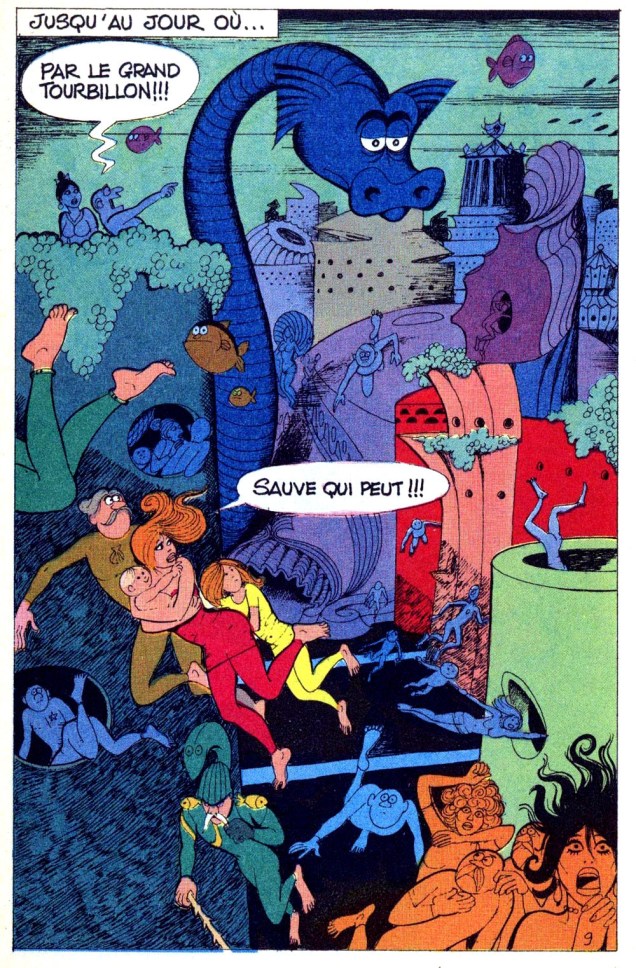
Submerman, on the other hand, is a superhero parody:

Submerman-Pilote1969-Lob-Pichard
A page from Submerman from Pilote n°527 (1969). See all Pilote covers featuring Submerman here. The series was published between 1967 and 1970. People looking for a really obscure Halloween costume, take note of Submerman’s get-up: it wouldn’t be so hard to draw a yellow fish on a red onesie.
GeorgePichard-Lob-Submerman-no4
Submerman: La faune des profondeurs, published in Super Pocket Pilote n°4 (1969). « Sauve qui peut! » translates to « Run for your life! » Interestingly, English doesn’t have a « Save yourselves, those who can », but French and Russian do. I can’t vouch for other languages.

Now, I promised you some of Pichard’s women. An obvious place to start is the series Paulette, scripted by Georges Wolinksi (who, by the way, was killed in the terrorist attack on Charlie Hebdo in 2015) and illustrated by Pichard.

Paulette began in 1970 and chronicled the wild (and ever so slightly improbable) adventures of (who else?) Paulette. She gets kidnapped (more than once, by different parties), wooed, attacked, betrayed, saved, pregnant, communist-icated, converted to capitalism, harem-ed, and so on, not necessarily in that order. The only thing she doesn’t get is left alone. Poor girl. I wouldn’t say the series is entirely light-hearted, however – the authors used their pretty héroïne to ventilate all sorts of issues.

Paulette-en-amazonie-4-Wolinksi-Pichard
Paulette en Amazonie (Éditions du Square, 1975). Is it wrong that I love the drawing of evil Nazis and dumb soldiers a lot more than the damsel in distress? Pichard’s women all looked the same, but his villains had a lot more variety – which is not untypical of artists who are obsessed with the female form, actually. Silly, really; one would think that an obsession would lead one to exploring different shapes and forms, but somehow it rarely works out that way.

« Here she is, ready to climb aboard airplanes that are inevitably hijacked, to wind up in jungles, in wasp nests, in ambushes, to crash through panels, through traps, into the arms of men unworthy of her, and to come through all this with a smile, without blaming anyone, not even Pichard and Wolinski, whose main preoccupation it is to never leave her alone.» (Introduction to Paulette 4, 1975)

An illustration to the political-gone-absurd content of Paulette:

Paulette-Wolinski-Pichard-Communiste
The colours make me think of a black light poster. Here Paulette wakes up her bearded beau (who figures that her « Something terrible has happened to me! » refers to a pregnancy, and responds with « Don’t worry, if you have money that’s nothing, In Switzerland or Morocco… ») to inform him that « I think I am a communist! »

Speaking of bearded beaus: one of my favourite Paulette plots – although I haven’t read the whole series – involves Joseph, the old perv we just saw in bed, whose job is to protect Paulette from… err, himself, I guess?  When Paulette rescues a magical mole, it offers her one wish, and because she is terminally naïve (bordering on the cretinous, if with a heart of gold), she wishes for Joseph to become young again. The mole, however, is myopic like all others of its kin, and mistakes Joseph for a woman, so he gets transformed into a sultry brunette.

Moving on to other oeuvres

GeorgePichard-Borneo Joe
Original art from Bornéo Jo (Dargaud, 1983), with script by Danie Dubos and art by Pichard.
George-Pichard-MarleneetJupiter
Marlène et Jupiter (Yes Company, 1988).
PichardL'UsineA
A panel from L’usine (Glénat, 1979).

And I saved the funniest as a digestif: in the last panel, the man is saying « But what am I supposed to do now? », to which she responds with « Replace your windshield, of course! I’ll give you an address, they’ll give you a ten percent discount if you mention that you were sent by Fairy Motricine – I’m the sister-in-law of Fairy Electricity. » (Note: Motricine was a brand of gas.)

George-Pichard-Surlaroute

~ ds

Tentacle Tuesday: Superheroes Redux

As I pointed out during my initial foray into the tangled relationship between superheroes and tentacled creatures (Superheroes in Octopus Land), even heroic stock characters with extraordinary powers get bested by the occasional octopus, be it of oceanic, mystical, or outright intergalactic origins. Some of these monsters are aliens from proverbial outer space, some swam out from the depths of the sea for reasons they alone comprehend; some are plants, some are mammals – animal, mineral, or vegetable in form and content.

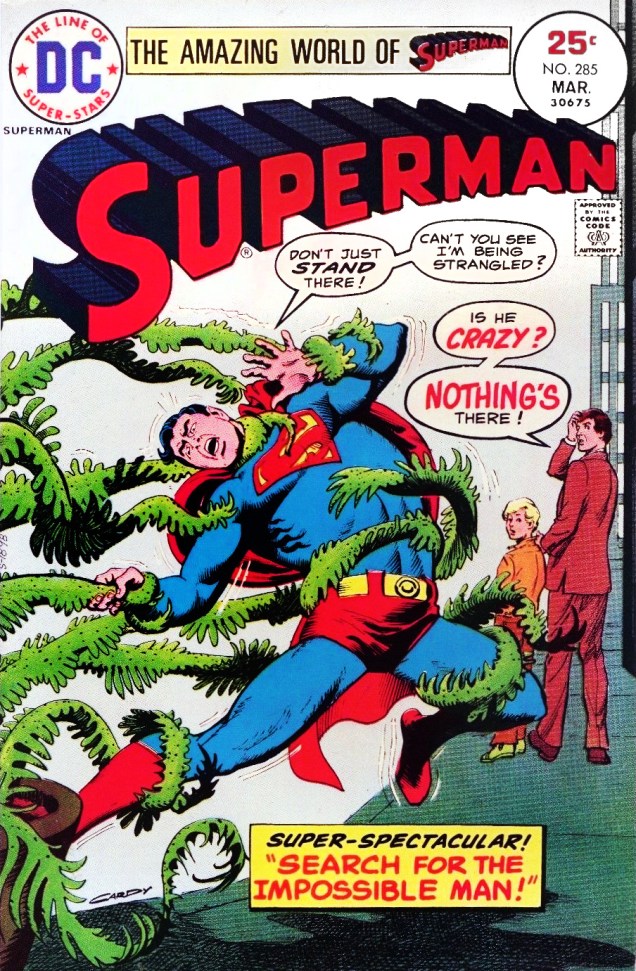
Our first entry is someone who’s faster than a speeding bullet… but requires a passerby’s help to get rid of some pesky plant tentacles. None too impressive for someone of his calibre, the first superhero that comes to mind for most.

Superman285
Superman no. 285 (March 1975). Cover by Nick Cardy.

That’s enough bumbling. I’ll move on to someone who can *really* handle tentacle problems!

TentacleTuesdayIcon

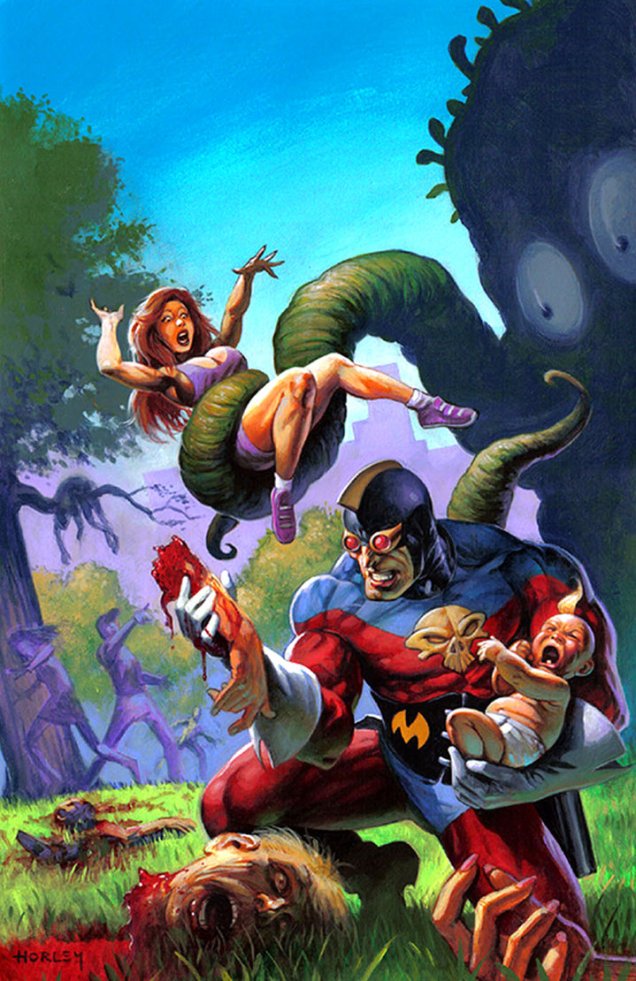
High atop Slaughter Mountain, where the rain never stops, stately Stearn Mansion stands silhouetted against the blood-red moon. This is the home of Dr. Strongfort Stearn, known throughout the world as … Mr. Monster!! From this lofty perch, Doc Stearn peers unflinchingly into the black abyss below. For it is Mr. Monster’s mission to search out evil — and destroy it!” Today Mr. Monster is fighting a cute octopus with googly eyes. Sometimes monsters look most innocuous, you know.

AlexHorley-Mr.Monster
Original art for Mr. Monster: Who Watches the Garbagemen? (2005). Cover by Alex Horley. As usual, the octopus has excellent taste in women.

And this is the way it was published:

Mr.Monster-WhoWatchestheGarbagemen
Mr. Monster: Who Watches the Garbagemen? (2005). Cover by Alex Horley.

TentacleTuesdayIcon

« Since the first simple life-form crawled from the pounding turf, the sea has been laced with legend! From the daring men who faced the raging waves in primitive wooden craft to those who probe the hidden depths today in devices of plastic and steel, fables have been passed, secrets whispered from father to son… » And where there’s sea legends and fables of raging depths, there’s tentacles, you can be sure of that. Can the mysterious Phantom Stranger cope with them?

PhantomStranger18-NealAdams
The Phantom Stranger no. 18, March-April 1972, with art by Neal Adams.

TentacleTuesdayIcon

Maybe saying that starfish have tentacles is stretching it a bit, but just look at the way their arms bend at the ends! Besides, they can “walk” using their tubed appendages, which look like tentacles to all but the most pedantic.

JusticeLeageofAmerica190-BrianBolland
Justice League of America no. 190 (May, 1981); cover by Brian Bolland, with colours by Anthony Tollin. This may not be a fashion statement, but think of all the money people would save on makeup and surgery!

Starro, a.k.a. Starro the Conqueror, was created by Gardner Fox and Mike Sekowsky in 1960. He’s a mean, stubborn alien lifeform with an idée fixe to enslave mankind, which he repeatedly tries to do by scattering his starfishy spores (which grow into clones of himself) over large cities. And, yes, he has prehensile extremities; it’d be difficult to wreak as much havoc without them.

TentacleTuesdayIcon
Technically, Medusa’s got hair, not tentacles, but she expressed the wish to be part of our Tentacle Tuesday line-up… and I am not going to argue with a woman with hair that can knock out an army.

Medusa-FantasticFourAnnual5-Kirby-Giacoia
Created by Jack Kirby, Medusa first appeared In Fantastic Four #36 (1965). This is a pin-up from Fantastic Four Annual #5, November 1967; pencils by Kirby, inks by Frank Giacoia.

TentacleTuesdayIcon

Catwoman-Tentacles-BatmanIncorporated1
A panel from Batman, Inc. no. 1 (January 2011), pencils by Yanick Paquette and inks by Michel Lacombe.

Does anybody have an answer for catty Ms. Kyle? I’ll see you next Tentacle Tuesday – until then, keep away from hungry and horny octopuses.

~ ds

Tentacle Tuesday: Euro Tentacles Unto Horror

Tentacles have no anglophonic bias.  A tasty human morsel is every bit as appetizing when it’s babbling in Italian or German. Join me on a visit to the European side of things, where tentacles are truly horrifying and there’s none of this politely-hold-a-girl’s-leg stuff. It’s gore and revulsion through and through!

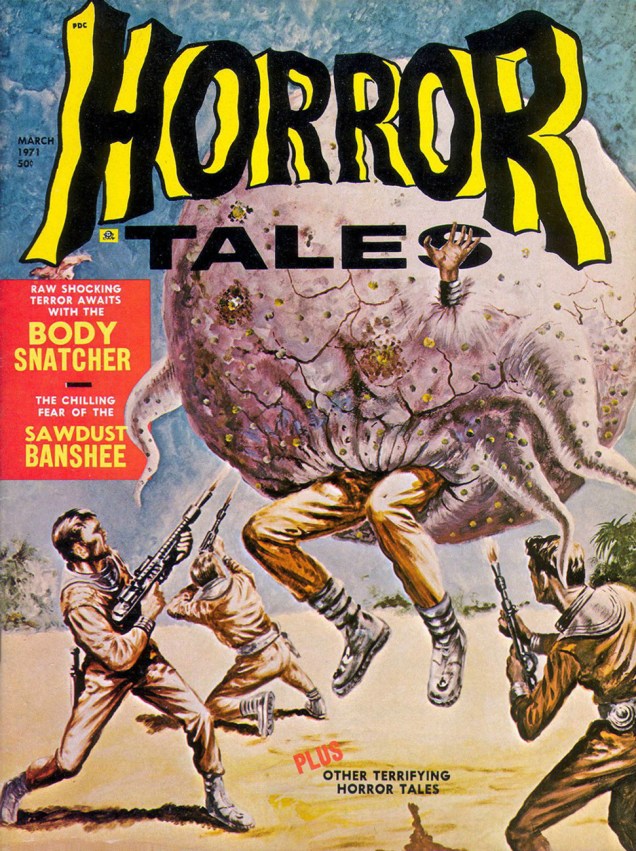
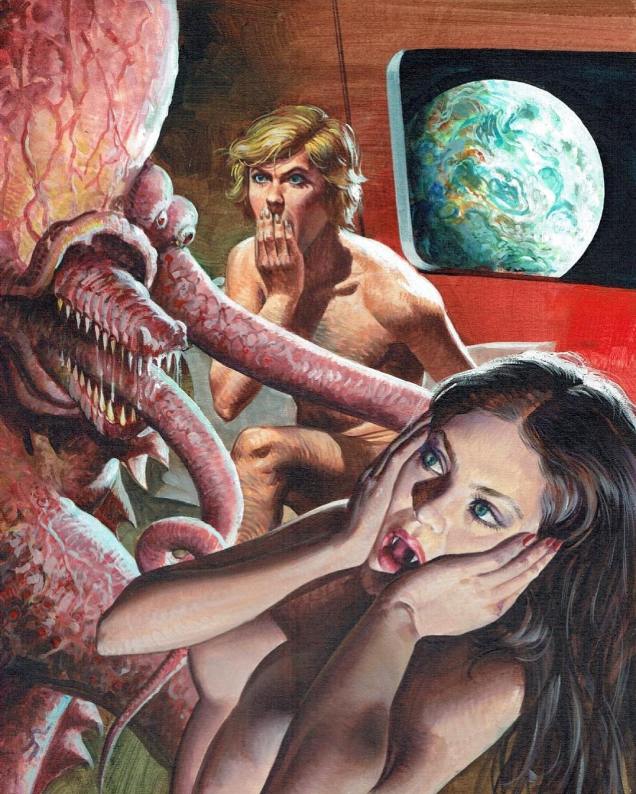
HorrorTalesV3#2A
Horror Tales vol. 3 no. 2 (1971, Eerie Publications). Let’s have a moment of silence for what the poor guy is going through, being swallowed alive by a pulsating pink monstrosity which appears to have the same hole for eating and waste evacuation like some sea anemone (that has that has a single orifice for eating, excreting, and shedding eggs and sperm) and is about as appetizing. No, scratch that, sea anemones are much better.

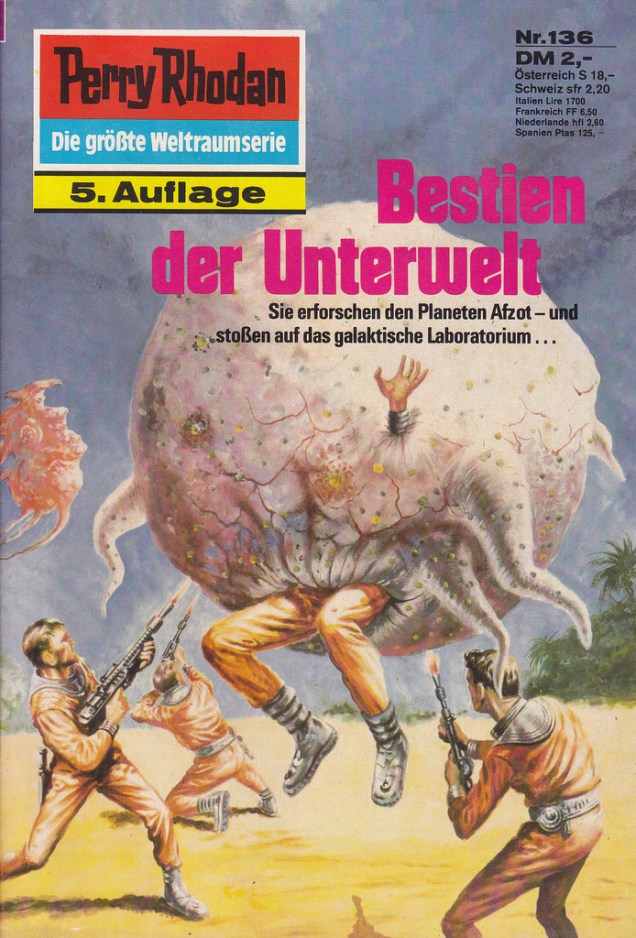
The cover, painted by German artist Johnny Bruck, is a reprint from the German sci-fi series Perry Rhodan, published by Moewig-Verlag starting in 1961. Here is the original:

PerryRhodan136
Perry Rhodan no. 136. « Beasts of the Underworld », if you were wondering.

If the last cover made me vaguely think of an arsehole, this next one clenches, er, *clinches* this unfortunate association.

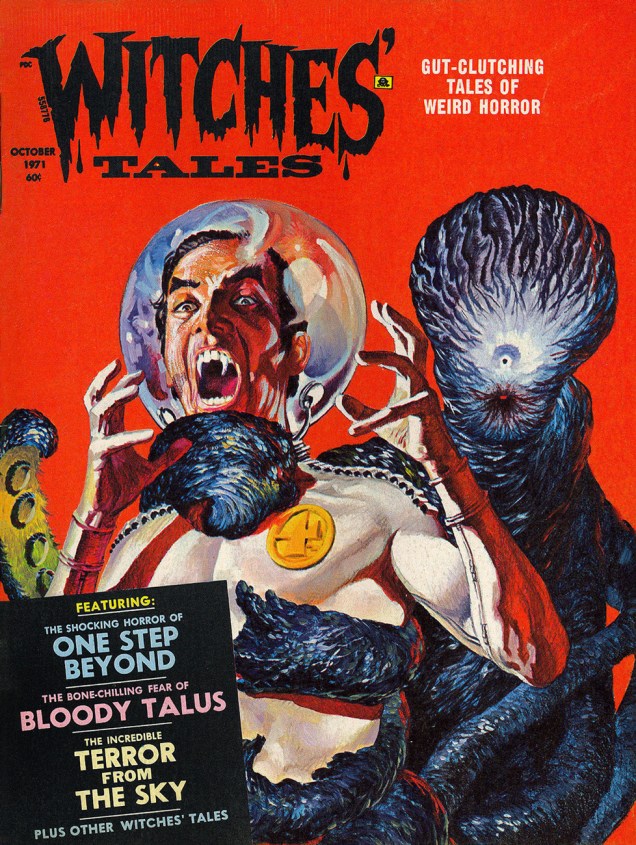
WitchesTalesVol3#5A
Witches’ Tales vol. 3 no. 5 (1971, Eerie Publications). Tentacles that look like furry slugs, a face like a puckered, blood-stained anus… this creature even his mother couldn’t love. And the victim? Why the fuck is a vampire in an astronaut’s helmet? And why a vampire at all – isn’t a tentacled monstrosity scary enough without bringing a blood-sucker into it? This witch is having nightmares.

The cover is by Franz Fernández, a Spanish artist born in Barcelona. He worked for Selecciones Illustrades, a Spanish art agency mostly known for its deal with Warren Publishing, which led to many Spanish artists submitting stories to Warren between 1971 and 1983.

On a somewhat less revolting, yet no less puzzling, note, we have these gorilla dinosaurs with tentacles. Why the hell not? I dedicate this cover to my friend Barney, a fan of silverback gorillas.

Gespenster Geschichten1399
Gespenster Geschichten no. 1399 (1974, Bastei Verlag). Gespenster Geschichten, “Ghost Stories” in German, was a weekly comic book series that ran between March 1974 and March 2006, which certainly gives us a clue as to how successful it was. In the early years, most stories in Gespenster Geschichten were reprints of American horror comics, pretty much what one would expect: lots of appearances from Frank Frazetta, Jack Kirby and Wally Wood, for instance. When the magazine stopped relying on reprints and started featuring new content, Argentine, Spanish, Peruvian and Italian artists provided most of the artwork, together with Yugoslav artists (such as Goran Sudzuka) and a couple of German ones, most noticeably Hans Wäscher, a revered German comics artist (whom Google comically translated as “hans scrubber”). This cover points out that the contents are “neauflage”d (i.e. reprinted).

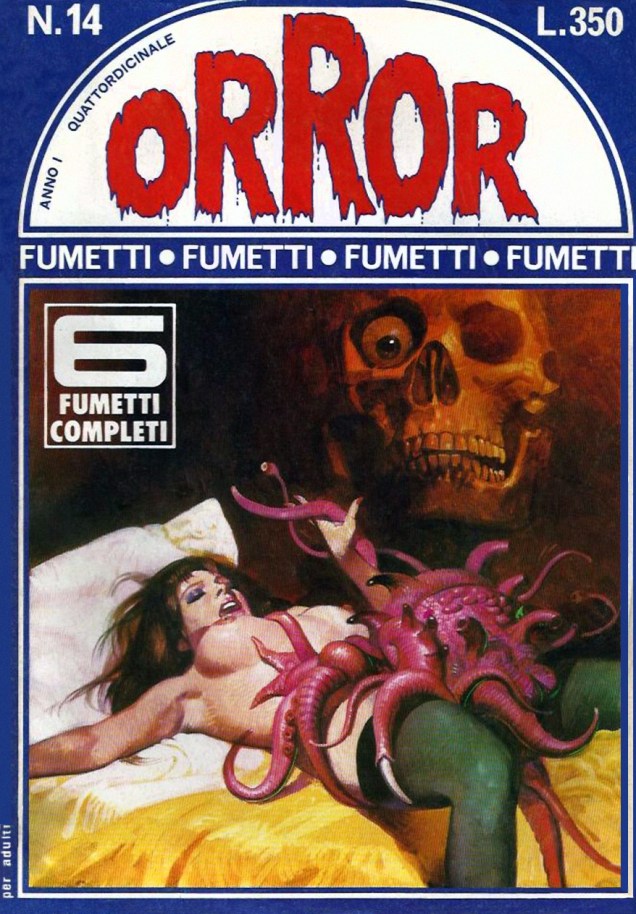
I appear to be utterly incapable of doing a Tentacle Tuesday post without some sort of scantily clad, beautiful maiden joining the fray. Why resist? Here are a couple of precursors of The Possession.

Orror14A
Orror no. 14 (1978, Edifumetto). For once, the monster is kind of cute, as opposed to completely nauseating. Art by Alessandro Biffignandi.
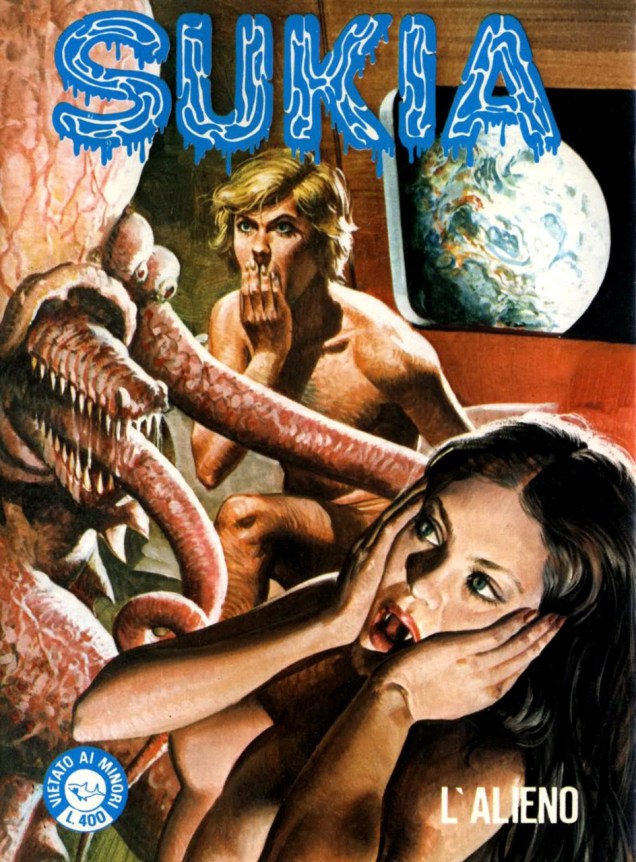
Sukia52-cover
Sukia no. 52 (1980, Edifumetto). Sukia was a joint effort of Renzo Barbieri, founder of Italian publishing house Edifumetto, and Fulvio Bosttoli. Ornella Muti fans, take note.

The original painting allows us to see more detail in the alien’s, err, anatomy. After seeing this, I don’t think anybody needs abstinence speeches.Sukia No. 52 L'alieno 1980

~ ds

Don Flowers, Sadly Neglected Cartoonist

« …the finest line ever to be bequeathed to a cartoonist. It dances; it snaps gracefully back and forth. » (Coulton Waugh in “The Comics”, 1947)

That description was written à propos of Don Flowers (1908 – 1968) and his art. Some of you may remember seeing Glamor Girls in your favourite gazette – at the height of its popularity, this syndicated strip ran in about three hundred newspapers. This story goes thus: Flowers, working for AP Newsfeatures, created a few strips, namely Oh, Diana!, Puffy the Pig, and Modest Maidens. The first two achieved very modest success, but the third one was a huge hit, so much so that newspaper magnate William Randolph Hearst (displaying his usual impeccable taste in comics) offered Flowers double salary if he came to work for Hearst’s King Features. Since AP owned the rights to Modest Maidens, the strip was renamed into Glamor Girls. Flowers drew Glamor Girls, both dailies and Sundays, until his death by emphysema in 1968.

His art is quite lovely – but I don’t expect you to take my word for it. Here are some examples. (All strips below have been published by King Features syndicate between 1958 and 1963.)

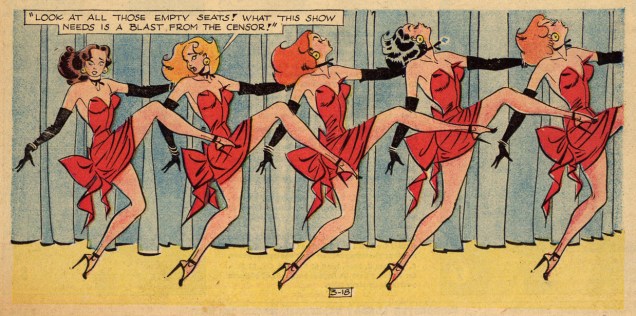
DonFLowers-GlamorGirls-Cancan

« That Flowers is not better known is both a pity and a surprise, especially given his technical expertise and the recent renaissance in the popularity of the pin-up genre. Whether blondes or brunettes, showgirls or housewives, Flowers rendered them flawlessly and elegantly, and always with equal aplomb. » (Alex Chun in Glamor Girls of Don Flowers, Fantagraphics, 2006).

Don-Flowers-GlamorGirls-DumbBlonde

«…There are things that never change, especially the early foundations. For better or worse they become part of your style. And as I continue to draw, every time I look at a page I think to myself, that nose is an Oski nose, that body is a VIP body, and every time I draw a beautiful woman, I think – no, I wish – she is as beautiful as a woman drawn by Don Flowers. » (Sergio Aragonés in his introduction to Glamor Girls of Don Flowers, Fantagraphics, 2006)

DonFlowers-GlamorGirls-Cigarettes

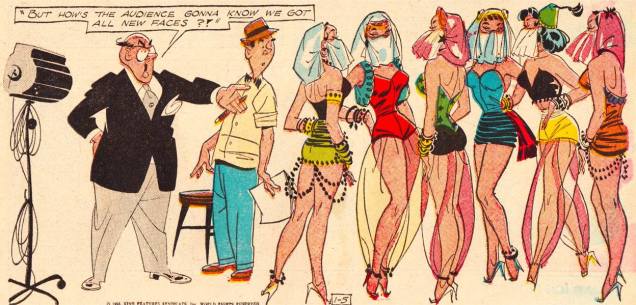
DonFlowers-GlamorGirls-Casting

Flowers’ art looks as good, if not better, in old-fashioned black-and-white, which is often the case with artists who have a fluid inking line. The original art for some Glamor Girls strips allows us to admire details:

DonFlowers-GlamorGirls-5-26-1956

DonFlowers-GlamorGirls-21

DonFlowers_GlamorGirl_WriterGag079_8-27-1963

After his death, Flowers’ son self-published Standing on Ceremony, a collection of marriage-themed cartoons plucked from his vast collection of his father’s original art. You can see some of them here.

~ ds

Tentacle Tuesday: Tangles with Adam Strange

« The menacing tentacles came probing down out of the sky in a fantastic quest for the secret of life! »

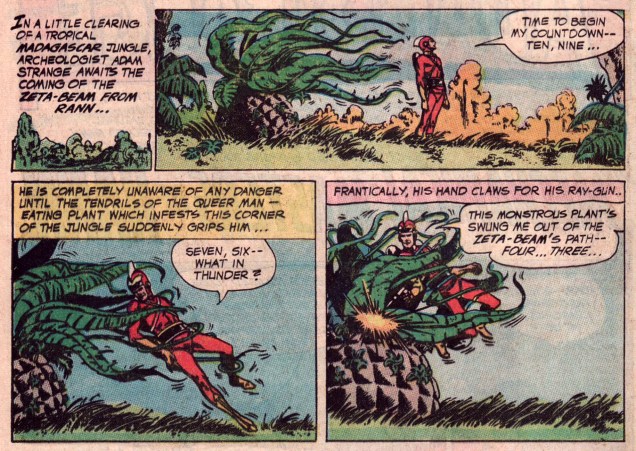
To celebrate Tentacle Tuesday, I’ve planned a visit to the mysterious planet Rann, as seen through the eyes of Adam Strange, that intrepid, quick-witted, teleporting archeologist. (First, a little context: Adam Strange was created by Julius Schwartz, with a costume designed by Murphy Anderson. He first appeared in Showcase #17 (November 1958). At first, Gardner Fox’s scripts were penciled by Mike Sekowsky, but this task was assigned to Carmine Infantino once the character moved to Mystery in Space, with Murphy Anderson inking most of the stories. As much as I like the Infantino + Anderson team, today’s contributions mostly involve other inkers.)

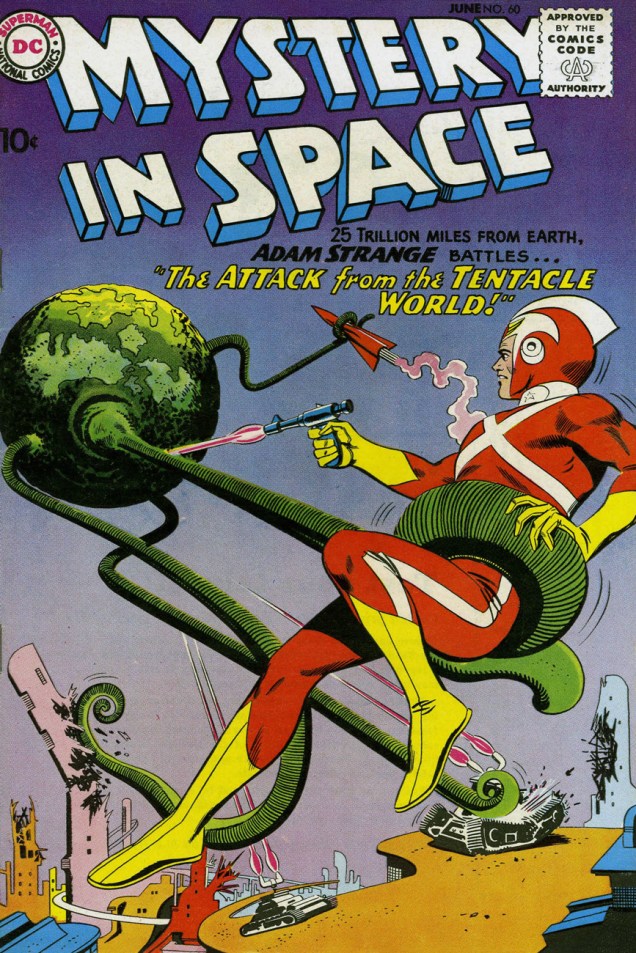
MysteryinSpace60
Mystery in Space no. 60 (June 1960). Cover inked by Carmine Infantino and inked by Joe Giella. “The Attack of the Tentacle World!” is scripted by Garner Fox, pencilled by Infantino and inked by Bernard Sachs.

That green thing? That’s Yggardis, a sentient planet that (who?) craves companionship. Here’s its highfalutin explanation, in that pompous English that Enemies of Mankind use when detailing their raison d’être to their victims: “For uncounted centuries, I have roamed the universe, raiding other worlds for their life-forms, lifting them in my tentacles! Unfortunately no form of living thing which I stole from other planets could live on me more than 24 hours!” The solution to that is (obviously) to steal even more animals for its private, deadly zoo, which is what it proceeds to do on Rann.

Mysteryinspace60-TentacleWorldA

Yggardis’ problem is solved when Adam blows it into carefully calculated smithereens, thus separating its radiation-producing mind from the rest of its inert body. A comparison is made to human surgeons removing deadly tissues and organs from an ailing patient. Uh, yes, surgeons regularly use explosives to sever their patients’ brains from their bodies, thus eliminating the need for expensive medication and such.

MysteryinSpace65
Mystery in Space no. 65 (February 1962), artwork also by Infantino and Giella.

The Mechanimen are anthropoid robots hellbent on protecting humans on Rann, destroying all their weapons on the principle that “weapons breed mistrust! mistrust breeds wars!” When the Mechanimen, while attempting to repel a sneak attack by some hostile aliens, run out of power (they “mechanically never gave a thought to renewing their power” – what?), Adam has to save the day, much like he has to avert disaster every time he sets foot on Rann. How did Rannians ever survive without him around?

AdamStrange-MysteryinSpace65
Adam doesn’t only have to confront mechanical tentacles in this issue: he’s also almost swallowed up by plant tendrils. “The Mechanical Masters of Rann” is scripted by Gardner Fox, pencilled by Infantino and inked by Murphy Anderson (ah, finally).

As you’ve probably noticed, Adam Strange stories tend to have gonzo plots. I *like* goofy stories, but these leave me frustrated: they’re far too far-fetched to make any kind of sense, yet they’re not wacky enough to be properly entertaining. The stories toss around “futuristic” terms like sky-radiation and zeta-beams and altered molecular structures, and provide “scientific” explanations that are supposed to make the plot plausible, except that the plot’s still ridiculous, all the more so after these attempts to shoehorn logic into it. It wouldn’t be so bad if Strange wasn’t over-explaining everything – he’s like your best friend’s pedantic dad, droning on about something while everyone feigns interest, sucking out the joy from topics that would otherwise be fascinating.

The other interesting aspect of Adam Strange is the sexual tension – basically, Adam’s zeta-beam wears off every time he and Alanna share an embrace. (That sends him back to Earth until he catches the next beam and gets teleported back to Rann.) That’s an original way of keeping them apart, I have to admit.

AdamStrangeByeAHe’ll be back soon, he says – as will I, with another Tentacle Tuesday.

~ ds

Let’s All Go Down to the Catfights!

Catfight (noun): A vicious fight between two women that features biting & scratching and often involves clothes being ripped off.

To which I’ll add that if you put two women with different hair colours in one room, it’s like there’s a chemical reaction that makes them instantly aggressive. In comics, at least – and we all know that comics reflect real life accurately, right? The resulting combativeness is especially obvious when the encounter is between a blonde and a brunette. The women involved must also be beauties – presumably, plainer girls resort to verbal assaults when provoked, eschewing physical violence, unlike their flashier counterparts.

Or it could have something to do with the mostly-male audience who actively likes watching belles brawl. (Perhaps “ogle” would be a better description.) Let’s move on to the ogling bit, then!

Undercovergirl-catfight
Err, agreed on the “talking too much” bit. Manhunt no. 9 (Magazine Enterprises, June 1948). That art’s by Ogden Whitney.

“Jeepers! Baldy’s been skewered through the ticker! He’s defunct!” This charming scene with boob grabbery and skirt rippery (I know, don’t I have a way with words?) is from “Off Stage Kill”, a Dan Turner Hollywood Detective story from Crime Smashers no. 7 (Trojan Magazines, 1951).

CrimeSmashers7-DanTurnerHollywoodDetective
Script by Robert Leslie Bellem, pencils and inks by Adolphe Barreaux (who was also the editor). Read the issue here. In case you were wondering, Fifi and Brenda are just acting out a fight scene for a movie, although they do get a little carried away (and accidentally skewer Baldy in the process). How many women have a knife tucked away in their garter belt?

Skipping ahead ten years or so…

EricStanton-Steve Ditko-DivorceAgreement
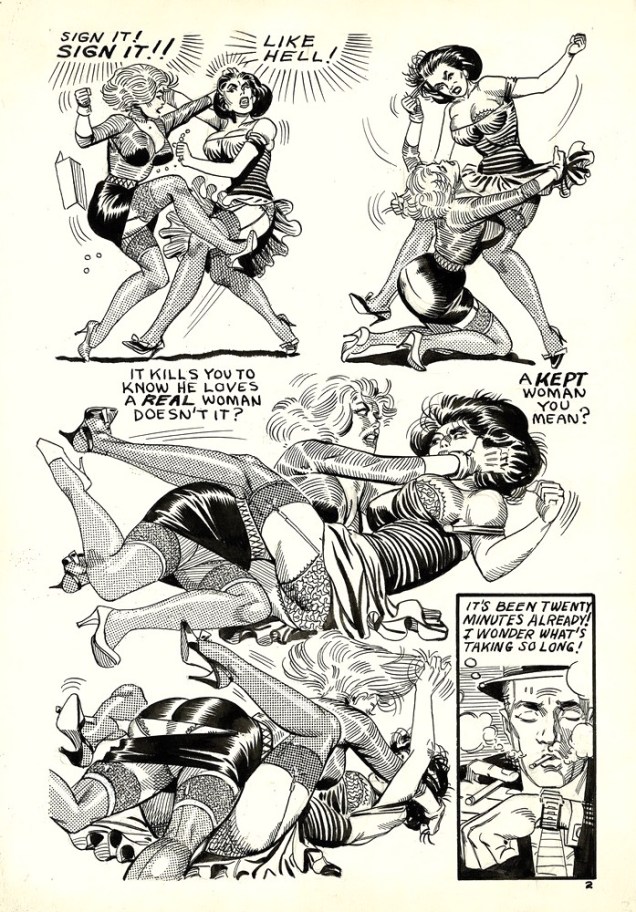
Ditko shared a studio in NYC with artist Eric Stanton between 1958 and 1968, and they collaborated on some bondage comics (or at least it’s commonly assumed that they have – for more information on that, dive into a discussion on the Four Realities blog, or read this excerpt from Fantagraphics’ Dripping with Fear: the Steve Ditko Archives Vol. 5.) This page is from a story published in 1966 and entitled “Divorce Agreement”.

The clothes-shredding and breast-mauling (ouch) continues…

Teena-dailystrip-Dec4th-1966
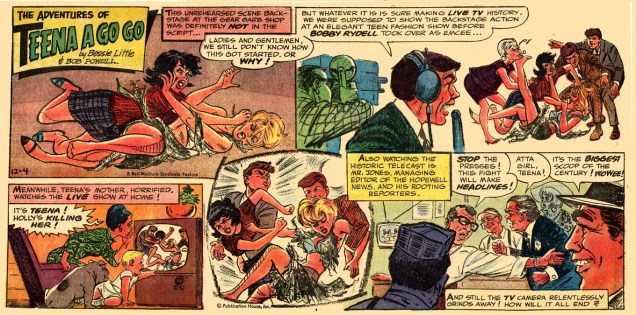
Newspaper comics do it, too! This is Teena A Go Go from December 4th, 1966, written by Bessie Little and illustrated by Bob Powell.

Sometimes Betty and Veronica associations are hard to avoid. These girls also made sure to wear contrasting costumes while fighting, for maximum visual appeal, proving it’s possible to be fashion-conscious even in prehistoric times.

Anthro6A
Anthro (the happy teenager watching this scene, and normally a redhead) will marry the victorious maiden… but the fight is a draw, and so he has to marry both in this “The Marriage of Anthro” story. This is Anthro no. 6 (July-Aug. 1969). Pencils by Howard (Howie) Post (who created Anthro, the “first boy”, a Cro-Magnon born to Neanderthal parents) and inks by Wally Wood. Let it be mentioned that Anthro is an immensely fun series, and that I love Howie Post’s art with or without Wood’s beautifying influence.

Women of other cultures aren’t immune from this phenomenon, by the way. Witness Italian chicks fighting:
Maghella13-Averardo Ciriello.
Maghella no. 13 (Elvifrance, 1975), cover by Averardo Ciriello. ” The title is something like “a scalded pussy doesn’t fear cold water”, a play on “chat échaudé craint l’eau froide“, an idiom that means roughly “twice bitten, once shy” or “a burnt child dreads the fire” and translates literally to “a scalded cat fears cold water”.

Italian erotica can be so entertaining! Maghella means a “young witch” in Italian. “The girl is identified by two braids of black hair and giant breasts with unspecified powers“, reads Wikipedia… Odd, I would have thought that her breasts have very specified powers, indeed. 😉

Moving on to French damsels…

LeTreizièmeApôtre-NatachaHôtessedel_Air
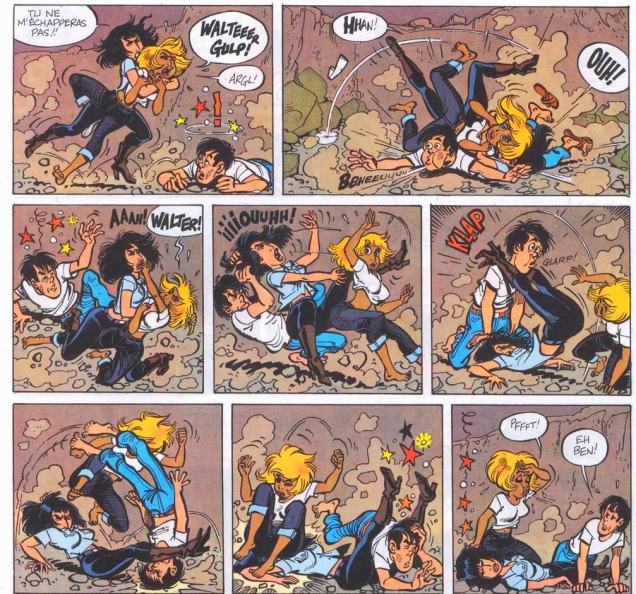
Natacha (hôtesse de l’air) is a Franco-Belgian comics series, created by François Walthéry and Gos.  This page is from an adventure (one of the final stories scripted by the great Maurice Tillieux) called Le treizième apôtre (The Thirteenth Apostle), published in 1978. The blonde is Natacha, our heroïne.

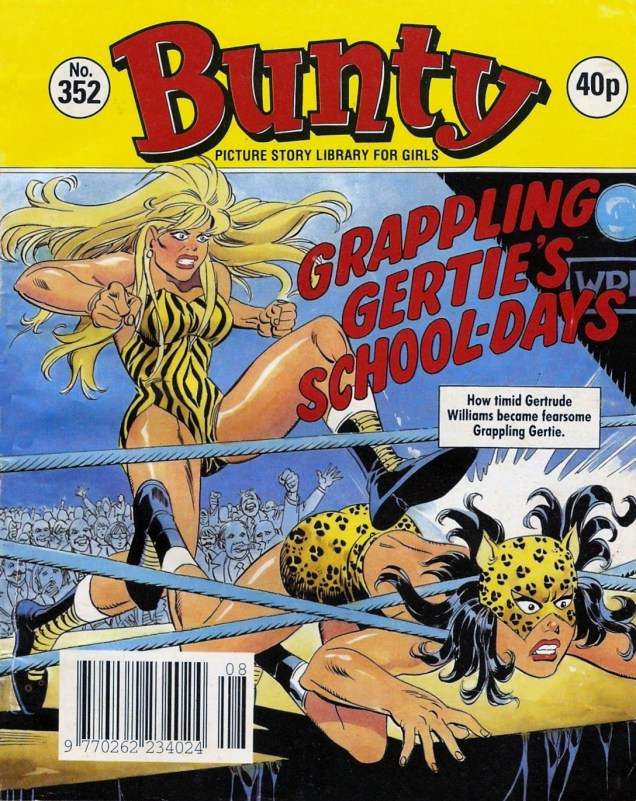
If you want to emphasize the catfight aspect, dress your girls in feline-motif outfits. Oh, I’m sorry – this is no quotidian quarrel, it’s professional wrestling!

Bunty352-WomenWrestlingComic
Bunty no. 352 (1992) – unfortunately, I don’t know who did the cover. British Picture Story Library was a 62 page a comic digest, published weekly. If you’d like to know how Leopard Lily overcame Tiger Tina, visit Assorted Thoughts from an Unsorted Mind.
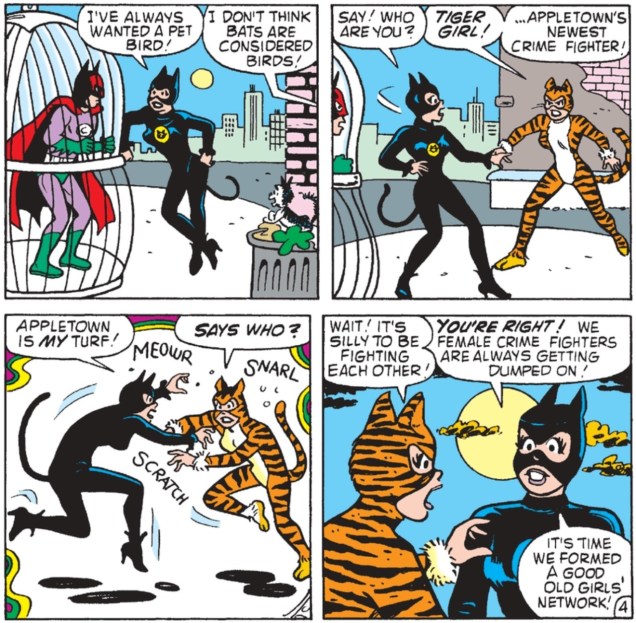
I think we need one even more literal interpretation of “cat fight”:

BettyandVeronica-TigerGirl-DandeCarlo
A snippet from “Meow Row”, published in Betty and Veronica no. 59 (January 1993). Script by George Gladir, pencils by Dan DeCarlo, inks by Alison Ford. Now guess who is who. (It’s obvious: Tiger Girl is Betty, and Veronica gets Meow Girl’s sexier costume.)

This is a fairly inexhaustible topic, but one must quit sometime. Cold shower, anyone?

~ ds

Update from January 2023 – now we also have Let’s All Go Down to the Catfights — Again!

Tentacle Tuesday: Warren and Its Many Tentacles, Part II

Greetings, tentacle lovers! I’m here with a new batch of Warren-published tentacles – this time, some he-men macho types get tangled up in them, though damsels predominate as usual. Don’t forget to visit part I: Tentacle Tuesday: Warren and Its Many Tentacles.

One thing that can easily be generalized from tentacular covers is that women frequently have a lot more fun on them than their male counterparts. To wit:

Vampirella39
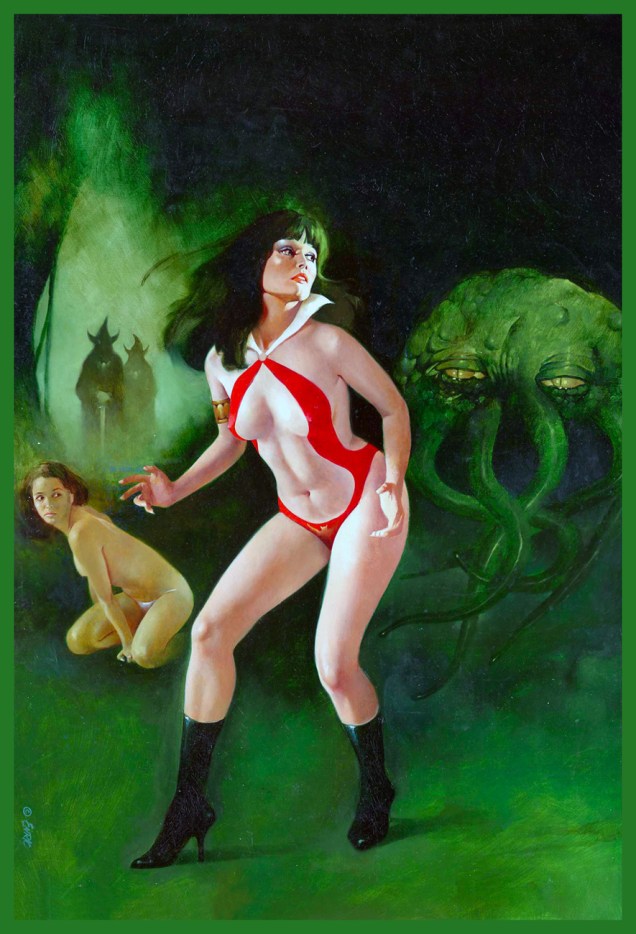
Vampirella no. 39 (January 1975). Cover by Ken Kelly. The gal may not be Vampirella, but damn, she’s enjoying herself. I admit that having tentacle-shaped fingers would be… practical.

TentacleTuesdayIcon

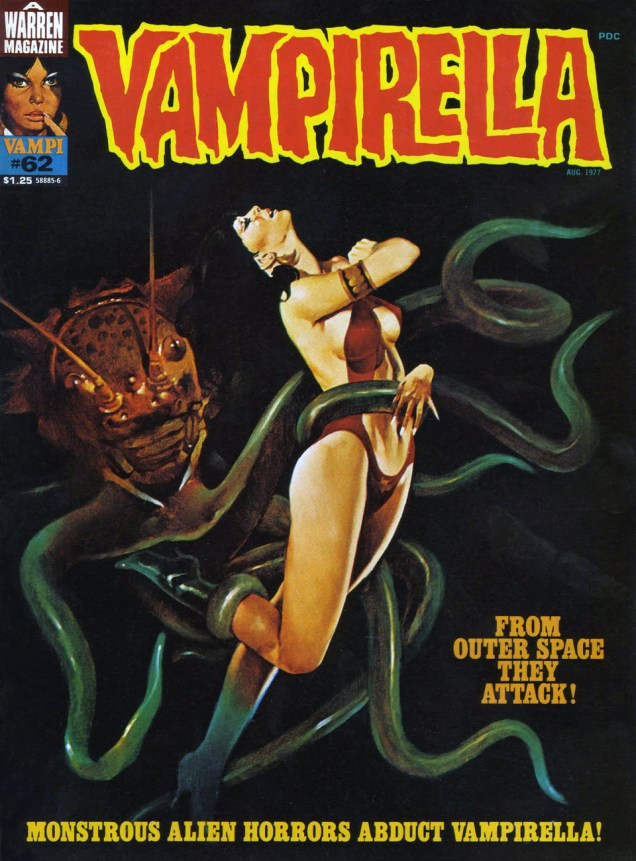
As for poor Vampi, she seems to encounter tentacles wherever she goes.

Vampirella62
Vampirella no. 62 (August 1977), cover by Spanish artistEnrich, whose real name was Enrique Torres-Prat.

The cover story, Starpatch Quark & Mother Blitz (scripted by Bill DuBay and illustrated by Jose Gonzalez), contains some spectacular, spiky, nasty tentacles.

Vampirella62-TentacleDetail
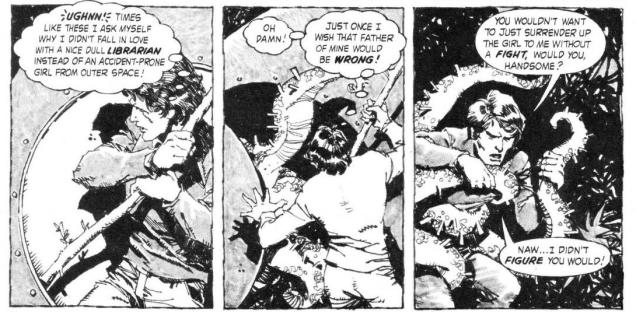
I tried saying « prasptam… hoodjum… billigam… POOT! », but no tentacled creature materialized. How very disappointing. I’d also like to know what kind of slap makes a « SPAKKT! » noise.
Vampirella62-TentacleDetail-2
The non-librarian girl in question is Vampi. Her eyeballs get ripped out by some vengeful queen and get accidentally conjured onto the desk of some random girl with an abusive husband, during which time blind, suffering Vampi is kidnapped by aliens while a handsome youth uses his father’s psychic connection with Vampi’s eyes to watch through them as they are retrieved by a tentacled monster, and… oh, never mind. Go read the story yourself.

TentacleTuesdayIcon

Vampirella105-originalart
The original cover art of Vampirella no. 105 (May 1982), painted by Enrich. It was printed much darker, so one can barely see tentacles. Fuck that, I say! Let us admire the green creature in its full glory! (And its unfortunate slight family resemblance to Jabba the Hutt…) His gaze seems to be appraising Vampirella – “hm, I wonder if she would be as tasty a snack as she looks?”
Vampi105A
The printed version of said issue.

The cover story sounds like fun… let’s take a peek.

Vampirella105-perfecttentacles
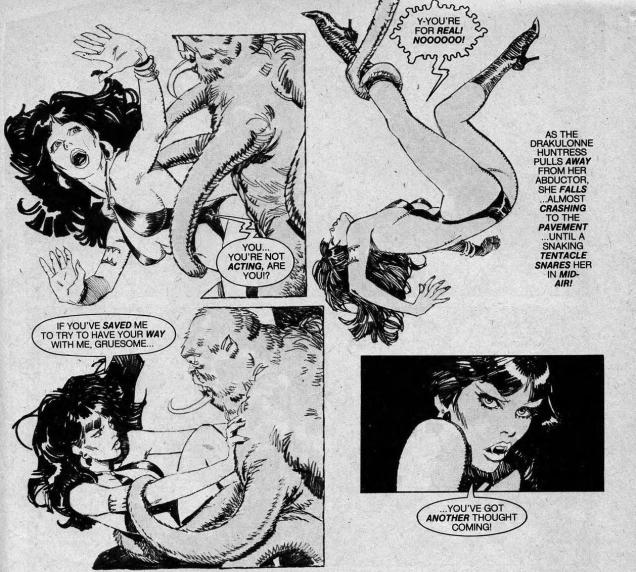
I’m sorry, but that is not what “Blobs and Behemoths” made me think of. I was expecting something in the class of Cthulhu, not an overweight human walrus with tentacles! Panel from “Horrors of Heartache City”, scripted by Bill DuBay and illustrated by Jose Gonzales (apparently this team specializes in tentacles).

« You’re worried that little Orphee is thinking of making a meal of that luscious girl…? He’s turned down everything from the choicest prime rib to the slimiest of insects, which leads me to believe that he filters nourishment from the very air! »

Vampirella105-wartything-tentacles

So much for scientific theories.

TentacleTuesdayIcon

I think I promised you some men fighting tentacles. Sigh, so be it.

Eerie66
Eerie no. 66 (June 1975), cover by Manuel Sanjulian.
Eerie111A
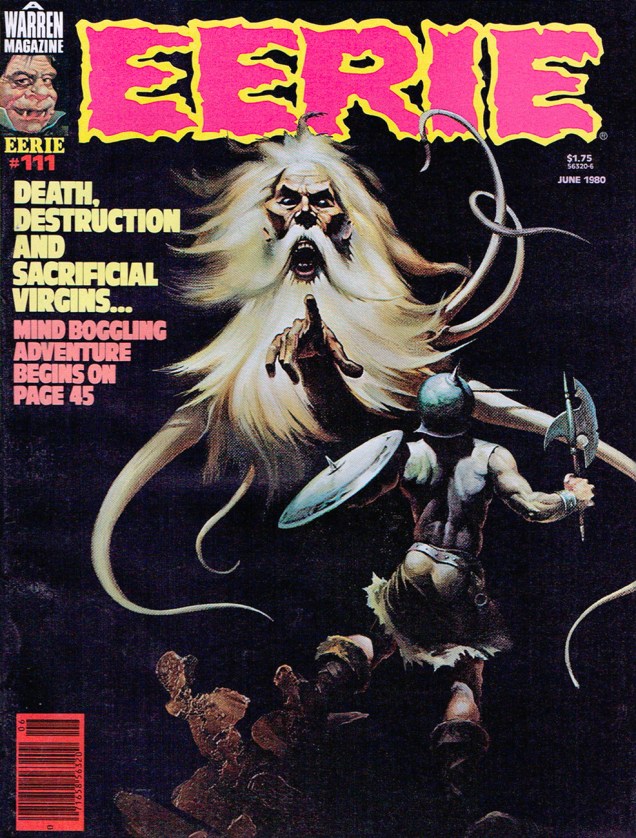
Eerie no. 111 (June 1980), cover by Ken Kelly. What’s scarier than an old wizard with a majestic beard whipping in the wind? An old wizard whose head is attached to tentacles, obviously.
1994-number19
1994 no. 19 (June 1981), cover by Jordi Penalva. I am totally fascinated by the girl’s expression. Whatever the tentacles behind her are doing, they’re doing it right. As for the guy, he looks like a sanctimonious asshole, from his scowl to his hairy legs.

I had to know what the hell is “The Holy Warrior” about. “Godless commie heathens”? Oh, very subtle, 1994. Given the mention of kicking the living crud out of ’em, it’s tempting to assume that this is satire… unless the author has an amputated sense of humour. I couldn’t find any scans of the story online, but someone on a Very Creepy Blog kindly summarized it as:

“Third is “The Holy Warrior!” by Delando Niño (art) and John Ellis Sech & Bill DuBay (story). This story takes place in a future where there are Jesus clones. Our hero, the Holy Warrior, is seeking to rescue one, which is just a child, from communist enemies. He is able to do so, but the two of them are so hungry that he ends up killing the clone and eating him! Quite a bizarre and heretical ending for this story.”

And I thought that Vampi story was written by someone on drugs. Same author, mind you (Bill DuBay) – there’s definitely a pattern… of nonsense, balderdash and malarkey.

By the way, you can read a bunch of Warren publications online – for free! – here.

~ ds

Tentacle Tuesday Masters: Joe Kubert

As Tentacle Tuesday lazily unfurls its slimy appendages yet again, we come face-to-face with one of the comic greats, Joe Kubert. And, as luck would have it, his ability to draw pretty much anything extends to depictions of cephalopods.

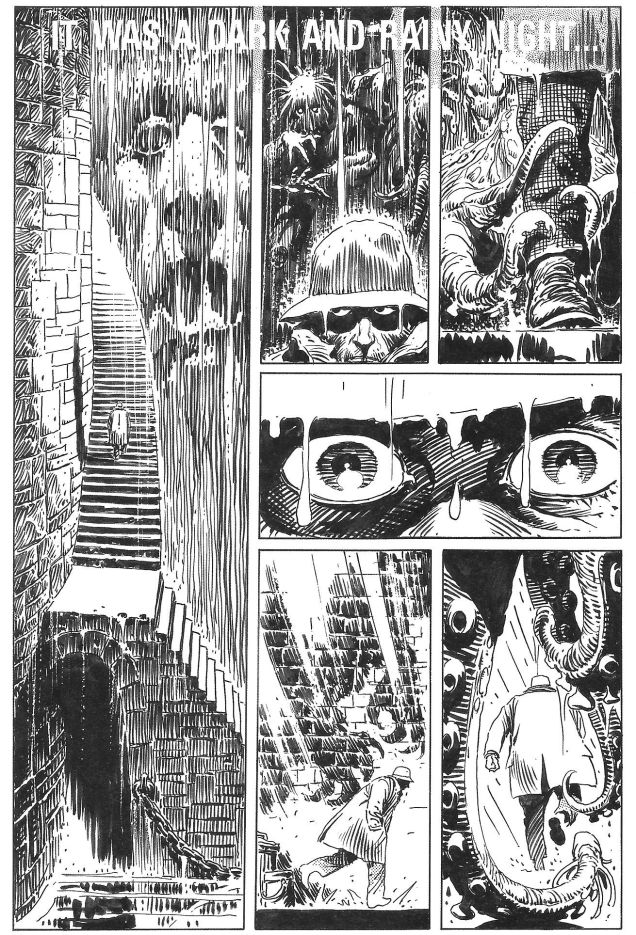
JoeKubert-HeavyMetalSpecialEditionvol11n2-1997
Page from “It Was a Dark and Heavy Night…”, published in Heavy Metal Special Edition Vol. 11, no. 2 – 20 Years (January 1997).

I’m less engrossed with Kubert’s work on prehistoric cavemen, archetypical feral youngsters or troglodyte adventurers (my interests lie more in the direction of Enemy Ace or Unknown Soldier, as well as Kubert’s solo projects like Abraham Stone). Nevertheless, Korak, his father Tarzan, and the unrelated Tor have all encountered tentacles in their eventful careers of dinosaur skirmishes and vine-swinging. (I also have to admit that if anybody could make me inquisitive about this sort of thing, it would be Kubert. I may yet reconsider, especially in the case of Tor, a comic Kubert both drew and plotted.)

JoeKubert-Tor3-1954
Page from Tor no. 3 (May 1954). Read the whole issue here. The adorable monkey Tor is talking to is Chee Chee, his pet gibbon.
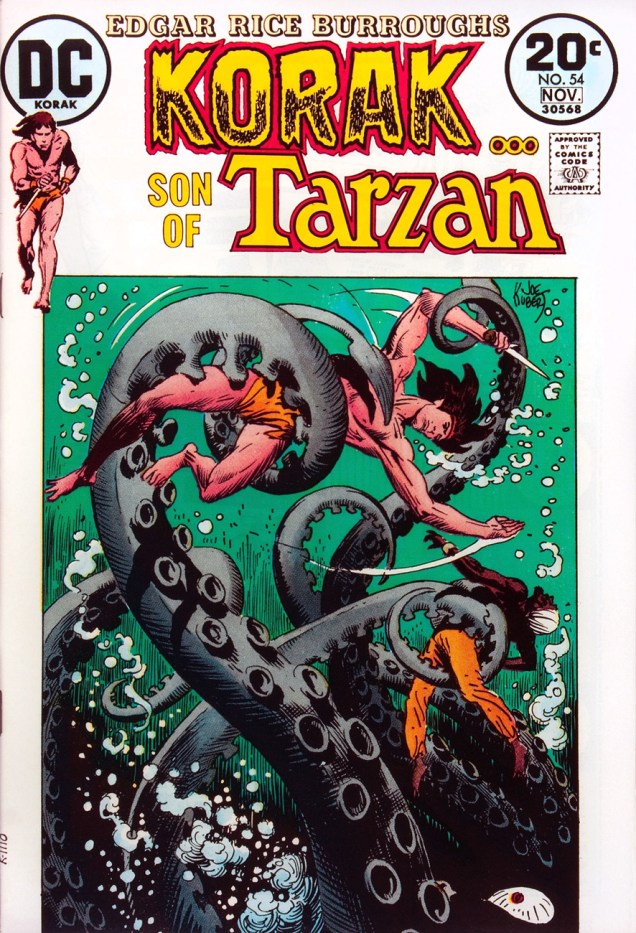
JoeKubert-Korak54
See Korak wrestle tentacles on this aquatic Joe Kubert cover! Korak (the ape name for “Killer”) was created by Edgar Rice Burroughs for his Tarzan novels. (Korak was the hero of The Son of Tarzan from 1915; in other novels he was but a young boy, incidental to the plot). This is Korak, Son of Tarzan no. 54 (October-November 1973). This issue has Robert Kanigher and Murphy Anderson on the main story.

It’s not only prehistoric men who have to put up with tentacles – Scandinavian royalty has to deal with them, too.

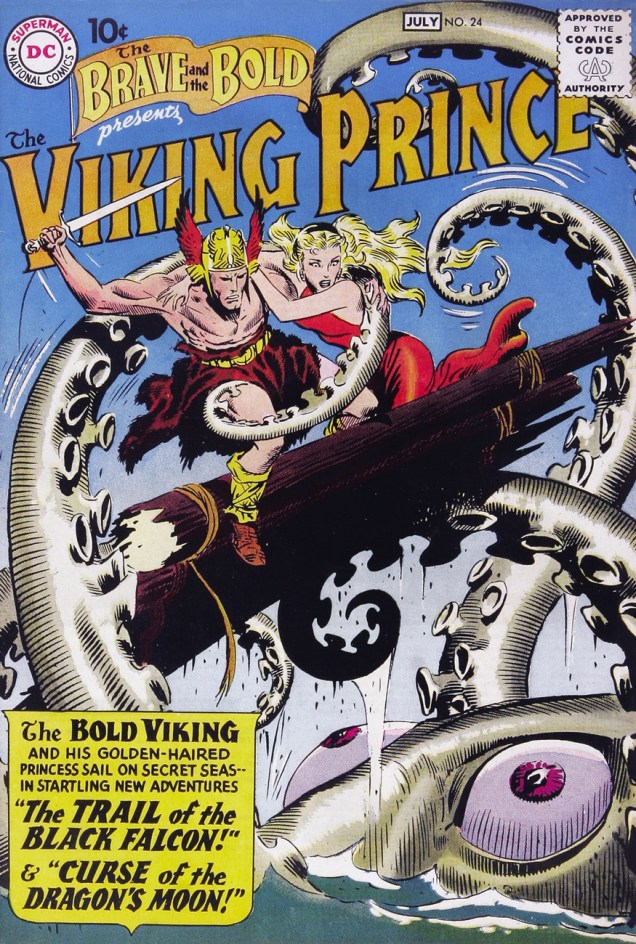
JoeKubert-BraveandBold24
The Brave and the Bold no. 24 (June-July 1959). The main two stories, “The Trail of the Black Falcon” and “Curse of the Dragon’s Moon”, both scripted by Bob Haney and drawn by Kubert, are frankly silly.

Moving into a slightly different direction….

JoeKubert-MysteryinSpace115
Mystery in Space no. 115 (January 1981). In a Kubert illustration, even monsters have soulful, anguished eyes.
JoeKubert-WeirdWarTales77
Weird War Tales no. 77 (1979). Do all three dooms involve tentacles, by any chance?
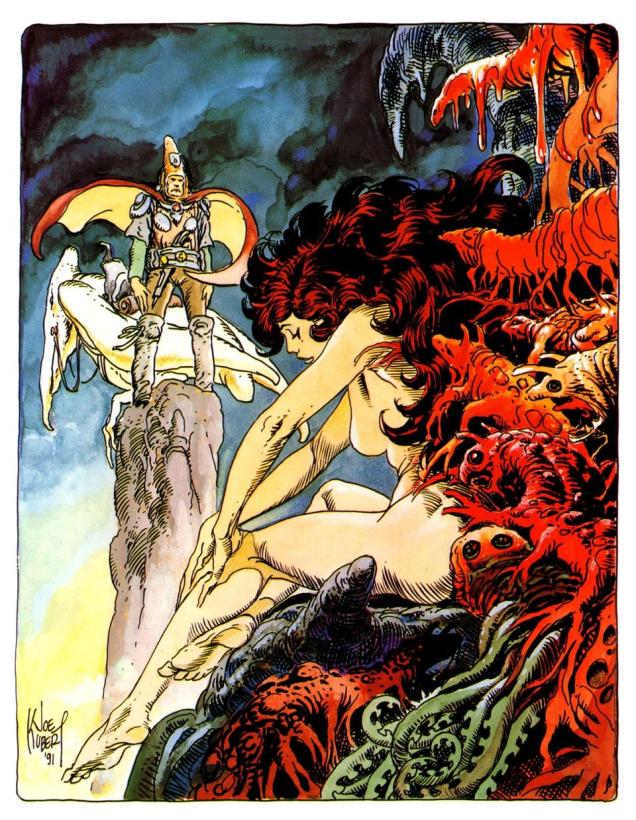
JoeKubert-Arzach-1991
Kubert’s tribute to Arzach, a comic series by Mœbius. Interesting to see Kubert sort-of imitating someone else’s style – however, the feet, hands and tentacles are obviously his.

~ ds

Spotlight on Florent Chavouet

Once in a while, I come across an artist I’ve never heard of before but whose work I really like. It’s always a delight to stumble upon an elegant boat afloat daintily on a sea of crap. (Life is full of new things to love that we just haven’t discovered yet, but the trick is to discover them amidst all the noise.)

FlorentChavouet-PetitesCoupuresAShioguni-Chef
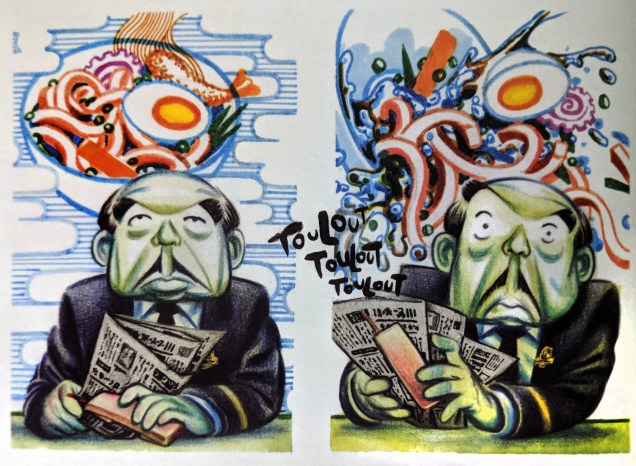
The chief of police dreams of food… but will he be able to find a tasty bowl of udon before all the noodle stalls close for the night? Panels from Petites coupures à Shioguni (Éditions Philippe Picquier, 2015).

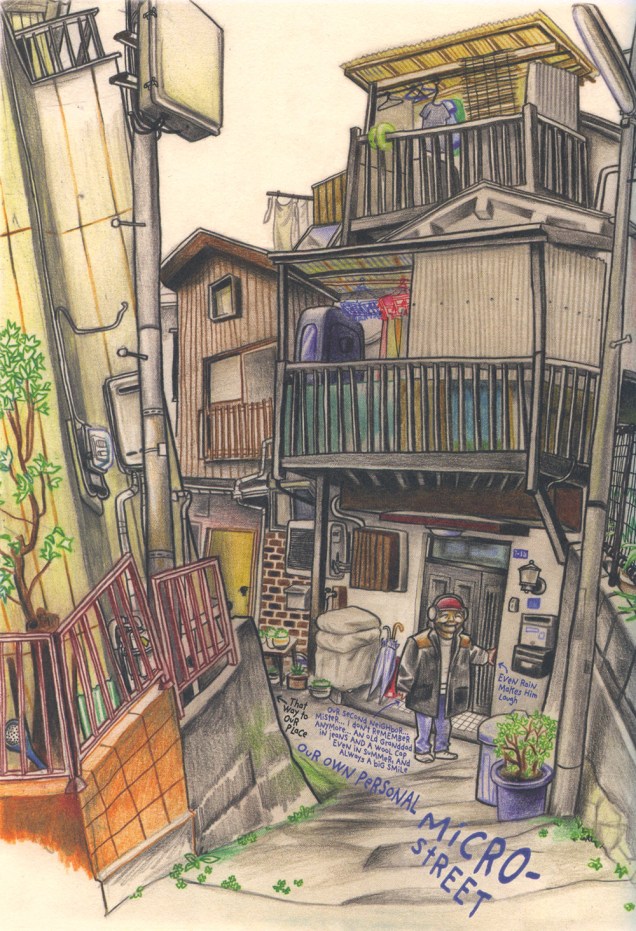
Florent Chavouet is an accomplished artist who prefers bright colours, which predisposed me to liking his art before I even considered the potency of his storytelling. He mostly draws in a cute, cartoony style that’s perfect for all the travelling-around-Japan chronicling he has done. However, architecture doesn’t stump him at all – a lot of his drawings are successful, detailed sketches of streets and apartments – and he’s amply capable of realism when the situation calls for it. And he’s an excellent storyteller, to boot.

My favourite book of his (so far) is my most recent acquisition: Petites coupures à Shioguni (Éditions Philippe Picquier, 2015), a complex story involving many characters and the ways their lives intersect and influence one another during a typical night in Japan. (Well, maybe not typical.) As the story unfolds after sunset, we get treated to a lot of pop-right-out-of-the-book, light-on-dark-background scenes, something Chavouet excels at. The art is his most accomplished yet; his latest book came out in 2016 (L’île Louvre), but I haven’t read it so far. I think we can say with certainty that he’s still developing his talents!

FlorentChavouet-PetitesCoupuresAShioguni-TaxiDriver
The cab driver has distinctly bad luck on that night. Petites coupures à Shioguni (Éditions Philippe Picquier, 2015).
FlorentChavouet-PetitesCoupuresAShioguni-Knife
Another lovely feature of Petites coupures à Shioguni (Éditions Philippe Picquier, 2015) is the hand-lettered dialogue – it’s an integral part of the artwork.
FlorentChavouet-PetitesCoupuresaShioguni-Cover
A promotional presentation of Petites coupures à Shioguni (Éditions Philippe Picquier, 2015).

This graphic novel hasn’t been translated to English yet, so non-French speakers will have to wait for a bit until it is.

Going back in time, but remaining in Japan, here are a few samples from Tokyo on Foot: Travels in the City’s Most Colorful Neighborhoods (Tuttle Publishing, 2011).

FlorenceChavouet-CharacterSketch
A page from Tokyo on Foot: Travels in the City’s Most Colorful Neighborhoods (Tuttle Publishing, 2011); it came out in the original French in 2009. You’ll be encountering scores of intriguing characters if you take Chavouet along as your guide.
FlorentChavouet-Map
Tokyo on Foot is full of such isometric-projection layouts of people’s apartments.
FlorentChavouetFireworks
Tokyo on Foot also has plenty of beautifully rendered night scenes.
FlorentChavouet-TokyoSanpo
Page from Tokyo Sanpo (Éditions Philippe Picquier, 2009).

Visit Chavouet’s blog here – if you don’t speak French, you can admire the art (though you’ll be missing the stories he likes to make up for each of his drawings/paintings).

FlorentChavouet-yokai7
An example of the critters you’ll encounter – which Chavouet calls Yokai, the Japanese word for demons or monsters – on his blog.

~ ds

Tentacle Tuesday: Gold Key’s Octopian Plenitude

Today’s tentacle adventure brings us a bounty of Gold Key covers.

TheCloseShavesOfPaulinePeril#2
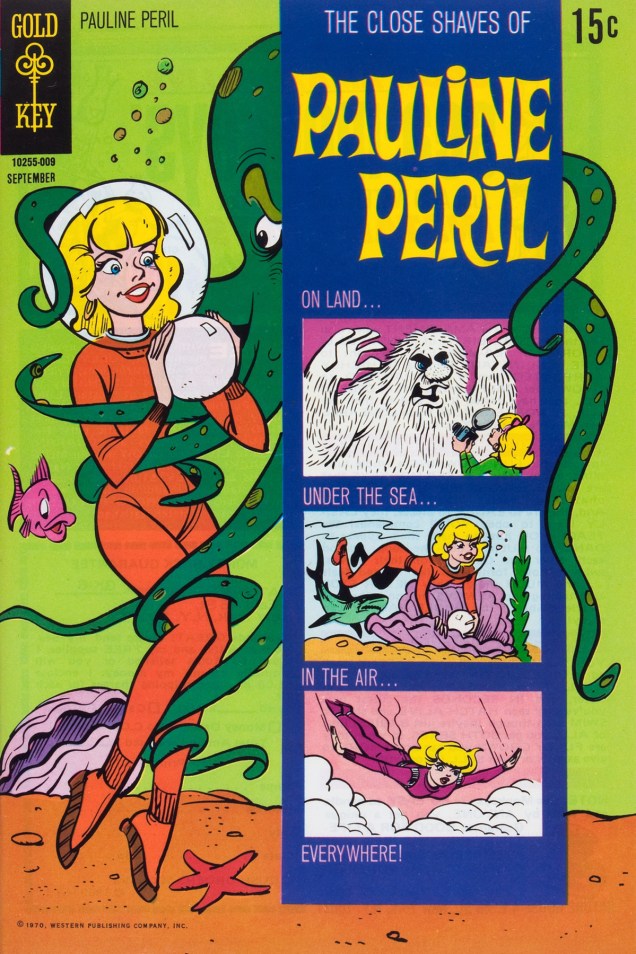
The Close Shaves of Pauline Peril no. 2 (September 1970). Cover by Jack Manning. I love the Pauline Peril series – it’s such loveable nonsense, with dynamic art and fusillade-style dialogue. However tempting it may be to jump to that conclusion, It’s not a comic-book adaptation of a TV cartoon. Read a whole issue (number four, to be more precise, the last one) at, appropriately, the Ominous Octopus Omnibus blog.
HannaBarbera- The Addams Family3
Hanna-Barbera The Addams Family no. 3 (April 1975). The adorable cover is by Bill Ziegler. Is there anything groovier than a froggy belt-buckle? I think not.
LooneyTunes11-GoldKey
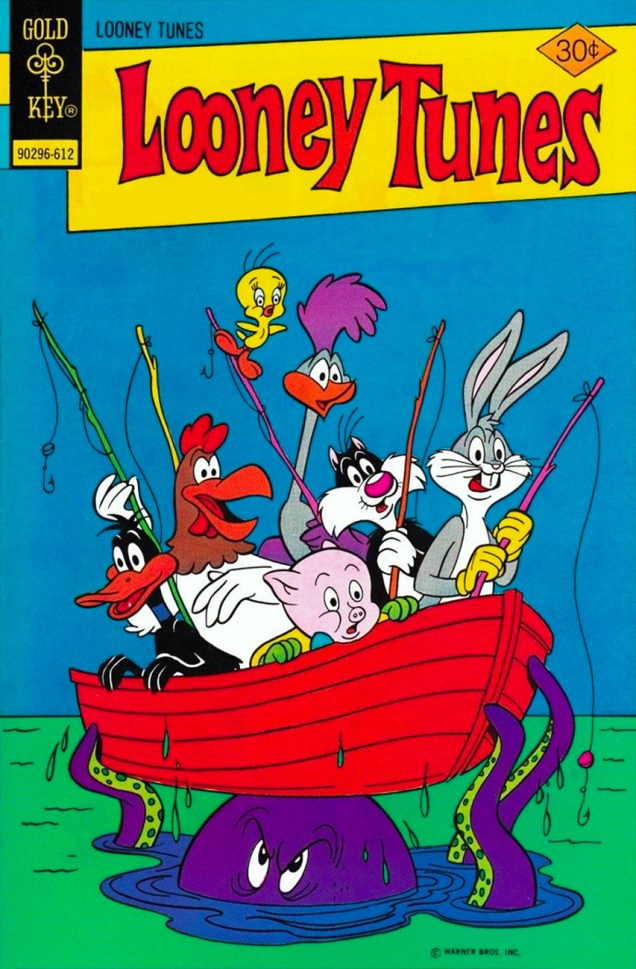
Looney Tunes no. 11, 1976. Cover artist unknown. The boat has been filled beyond legal capacity, and no-one’s wearing their mandatory Mae West. The Safety Octopus is here to ensure that the offending parties are brought up to standards (or at least given a tentacle slap on the wrist).

And just to offset all the cartoony, cutesy stuff, here’s a cover featuring an epic struggle, a life-or-death situation, a decisive skirmish between Man and Beast. (I’ll let you guess which is which, though.)

BorisKarloff-TalesofMyster37
Boris Karloff Tales of Mystery no. 37 (October 1971), cover by George Wilson. Here we have a tentacled creature – “Sea-Beast” for friends – defending a village of innocent people against some sort of flaming monstrosity by shooting water from its tentacles (trunks?) at the flames. Hey, somebody should hire it as a firefighter!

~ ds