Once in a while, I come across an artist I’ve never heard of before but whose work I really like. It’s always a delight to stumble upon an elegant boat afloat daintily on a sea of crap. (Life is full of new things to love that we just haven’t discovered yet, but the trick is to discover them amidst all the noise.)
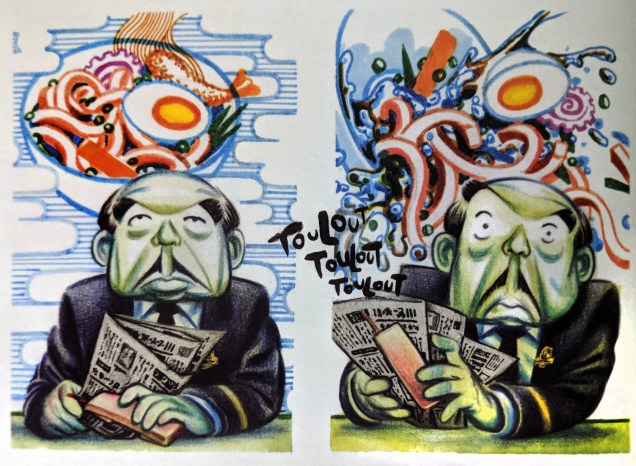
The chief of police dreams of food… but will he be able to find a tasty bowl of udon before all the noodle stalls close for the night? Panels from Petites coupures à Shioguni (Éditions Philippe Picquier, 2015).
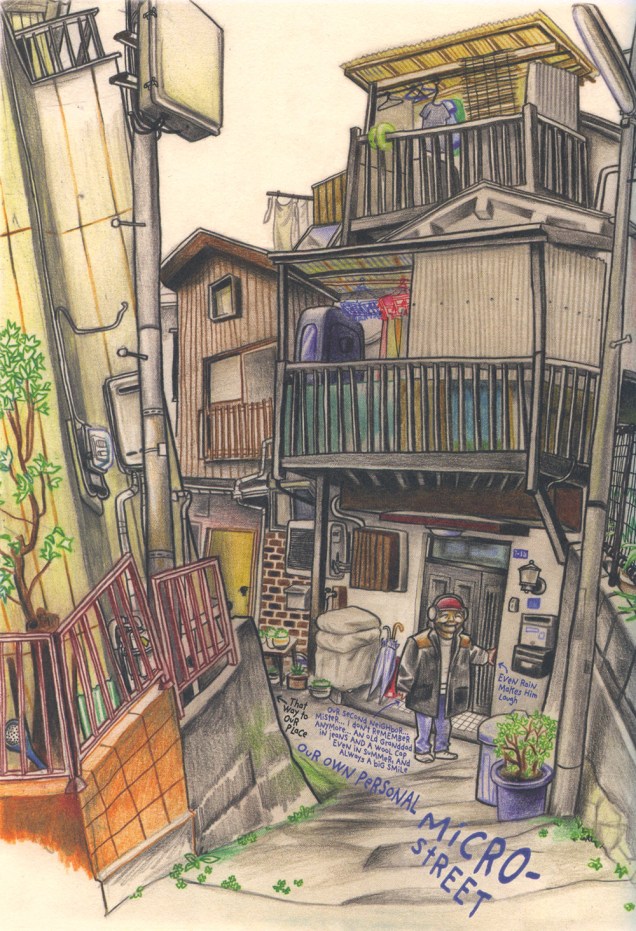
Florent Chavouet is an accomplished artist who prefers bright colours, which predisposed me to liking his art before I even considered the potency of his storytelling. He mostly draws in a cute, cartoony style that’s perfect for all the travelling-around-Japan chronicling he has done. However, architecture doesn’t stump him at all – a lot of his drawings are successful, detailed sketches of streets and apartments – and he’s amply capable of realism when the situation calls for it. And he’s an excellent storyteller, to boot.
My favourite book of his (so far) is my most recent acquisition: Petites coupures à Shioguni (Éditions Philippe Picquier, 2015), a complex story involving many characters and the ways their lives intersect and influence one another during a typical night in Japan. (Well, maybe not typical.) As the story unfolds after sunset, we get treated to a lot of pop-right-out-of-the-book, light-on-dark-background scenes, something Chavouet excels at. The art is his most accomplished yet; his latest book came out in 2016 (L’île Louvre), but I haven’t read it so far. I think we can say with certainty that he’s still developing his talents!
The cab driver has distinctly bad luck on that night. Petites coupures à Shioguni (Éditions Philippe Picquier, 2015).Another lovely feature of Petites coupures à Shioguni (Éditions Philippe Picquier, 2015) is the hand-lettered dialogue – it’s an integral part of the artwork.A promotional presentation of Petites coupures à Shioguni (Éditions Philippe Picquier, 2015).
This graphic novel hasn’t been translated to English yet, so non-French speakers will have to wait for a bit until it is.
Going back in time, but remaining in Japan, here are a few samples from Tokyo on Foot: Travels in the City’s Most Colorful Neighborhoods (Tuttle Publishing, 2011).
A page from Tokyo on Foot: Travels in the City’s Most Colorful Neighborhoods (Tuttle Publishing, 2011); it came out in the original French in 2009. You’ll be encountering scores of intriguing characters if you take Chavouet along as your guide.Tokyo on Foot is full of such isometric-projection layouts of people’s apartments.Tokyo on Foot also has plenty of beautifully rendered night scenes.Page from Tokyo Sanpo (Éditions Philippe Picquier, 2009).
Visit Chavouet’s blog here – if you don’t speak French, you can admire the art (though you’ll be missing the stories he likes to make up for each of his drawings/paintings).
An example of the critters you’ll encounter – which Chavouet calls Yokai, the Japanese word for demons or monsters – on his blog.
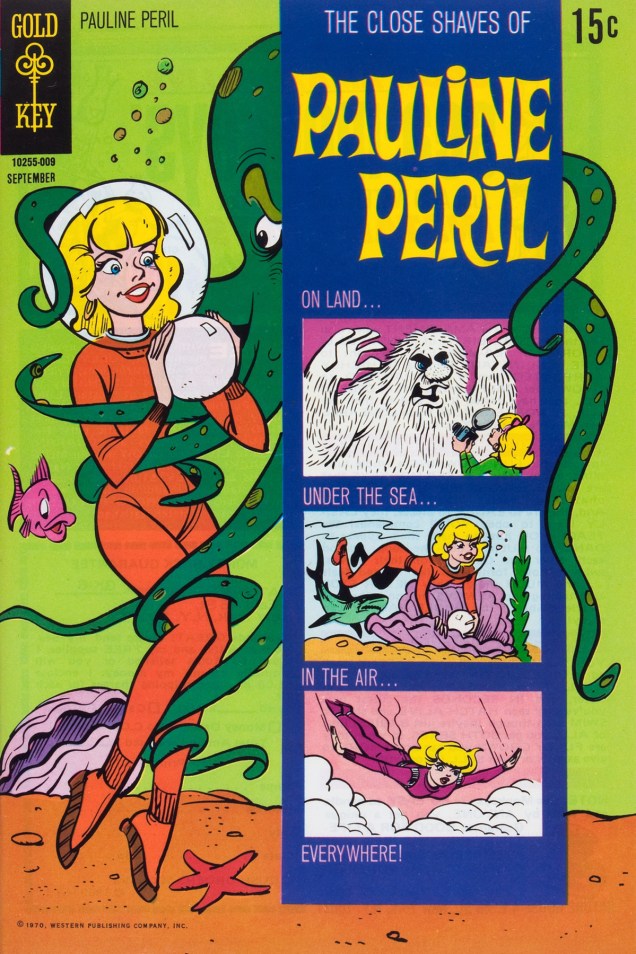
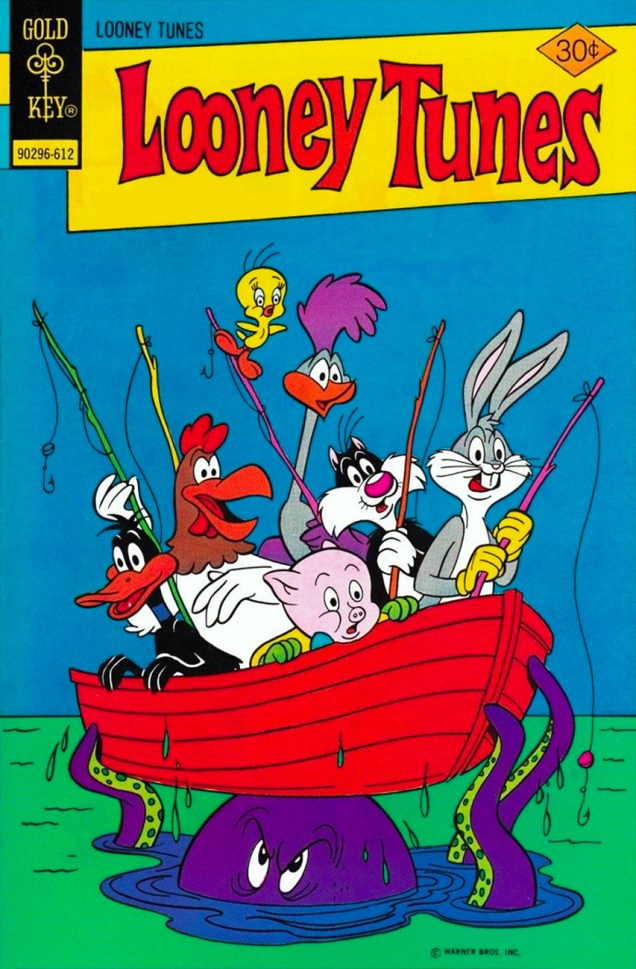
Today’s tentacle adventure brings us a bounty of Gold Key covers.
The Close Shaves of Pauline Peril no. 2 (September 1970). Cover by Jack Manning. I love the Pauline Peril series – it’s such loveable nonsense, with dynamic art and fusillade-style dialogue. However tempting it may be to jump to that conclusion, It’s not a comic-book adaptation of a TV cartoon. Read a whole issue (number four, to be more precise, the last one) at, appropriately, the Ominous Octopus Omnibus blog.Hanna-BarberaThe Addams Family no. 3 (April 1975). The adorable cover is by Bill Ziegler. Is there anything groovier than a froggy belt-buckle? I think not.Looney Tunes no. 11, 1976. Cover artist unknown. The boat has been filled beyond legal capacity, and no-one’s wearing their mandatory Mae West. The Safety Octopus is here to ensure that the offending parties are brought up to standards (or at least given a tentacle slap on the wrist).
And just to offset all the cartoony, cutesy stuff, here’s a cover featuring an epic struggle, a life-or-death situation, a decisive skirmish between Man and Beast. (I’ll let you guess which is which, though.)
Boris Karloff Tales of Mystery no. 37 (October 1971), cover by George Wilson. Here we have a tentacled creature – “Sea-Beast” for friends – defending a village of innocent people against some sort of flaming monstrosity by shooting water from its tentacles (trunks?) at the flames. Hey, somebody should hire it as a firefighter!
*That’s Not Safe For Work, for those unfamiliar with the acronym. Turn back while you still can!
We all know that tentacles are often used in comics as a substitute for other, err, organs. Tentacle porn is nothing new. Still, occasionally I stumble upon something that’s just outstandingly odd and perhaps even depraved. Would one be able to find stuff online that’s far stranger and more degenerate? Indubitably. Still, within the context of Tentacle Tuesday, I’d like to think that the following offerings are firmly in the realm of “well, that was strange…”
Our first example of WTF is this cover, drawn by good ol’ William Stout.
Bizarre Sex no. 10 (December 1982, Kitchen Sink Press), cover by William Stout. I imagine the Earthman quivered in horror and became as flaccid as flaccid can be, though who knows what turns people on? The alien creature seems to have its eyes resolutely shut in grim desperation, so perhaps she’s not enjoying it much, either.
« One of the great series in underground history, Denis Kitchen’s Bizarre Sex was launched in May, 1972. One could discern that this would be a “no-holds-barred” type of publication upon perusing the first issue, as the first two stories were about brother/sister incest and interracial homosexuality. Bizarre Sex became best known for issue #9, which introduced Omaha the Cat Dancer with a story that took up the whole book. After another appearance in Bizarre Sex #10, Omaha moved on to its own successful serial. The great thing about Bizarre Sex is the series matured through the years, evolving from a comic book about atypical sex into more of an in-depth review of sexual relations and the human condition. »
As this is no. 10, the last issue of Bizarre Sex, presumably that “in-depth review of the human condition” part is applicable here. The cover could have fooled me… If anyone out there has read it, do let me know!
Chester Brown has always been one sick puppy. If by now his work is creepy and boring, back in the earlier days of his career, his stories were often fascinating… for those of us who enjoy a good mindfuck and have a strong stomach, that is. As for me, I never liked his stuff: far too disturbing, in a viscerally-uncomfortable kind of way. A good demonstration of his typical sense of humour is the following 2-pager with a characteristic blend of onanism, body fluids and irony. This instalment of Adventures in Science was published in Yummy Fur no. 4 (1984).
A little bit of comic relief: a cartoon from “How the Animals Do It” by Larry Feign. Make sure to visit this page for a little video preview of this book: a little animated tale of the barnacle’s super long penis and what s/he does with it, including the brilliant quote « if no resistance is met, in it goes ».
Okay, I’ll bite. Why did the chicken cross the road? Why did the male octopus lose an arm due to sexual promiscuity?
« Male octopuses have a big problem: female octopuses. Each male wants to mate and pass on his genes to a new generation. The trouble is, the female is often larger and hungrier than he is, so there is a constant risk that, instead of mating, the female will strangle him and eat him. The males have a host of tricks to survive the mating process. Some of them can quite literally mate at arm’s length. Others sneak into a female’s den disguised as another gal, or sacrifice their entire mating arm to the female and then make a hasty retreat. » [source: Mystery of Cannibal Octopus Sex ]
Next time we encounter difficulties with our romantic entanglements, let’s remember not to complain.
Our last entry is a little more standard from the perspective of shokushu goukan. The blend of sex-and-religion is also nothing new, although some people seem to be labouring under the impression that it still has some sort of shock value in this day and age (My sleazy ex-boss from the framing store, I’m looking at you.) However, I think these scaly tentacle-penises are a reasonably original take on the theme, and I also like the choreographed sisters, who seem to be doing some sort of interpretative dance while a-waiting to be ravaged.
Page from The Convent of Hell (published in Spanish in 1987, in English in 1998), written by Ricardo Barreiro and illustrated by Ignacio Noé.
You can read the whole thing here – very NSFW, obviously.
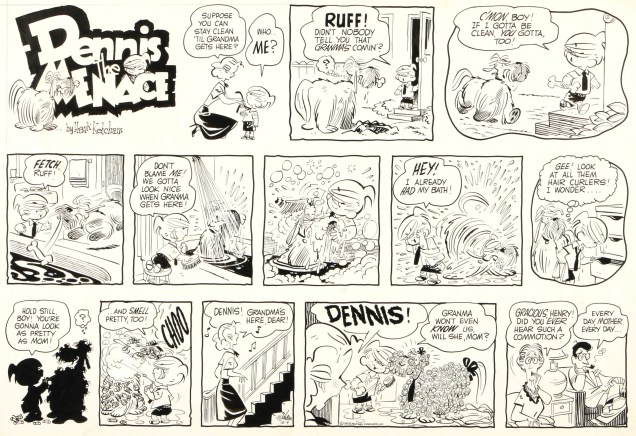
Dennis the Menace, the syndicated strip about a monstrous little kid and the mayhem he gets up to, was created by Hank Ketcham in 1951. The strip was inspired by Ketcham’s son Dennis, who was 4 years old at the time; the title was coined by Ketcham’s then-wife, Alice Louise Mahar, who’s said to have exclaimed in exasperation “Your son is a menace!” (Interestingly, she’s supposed to have said “your son“, even though Dennis was her child, too. She died of a drug overdose in 1959, when the real Dennis was 12. I really hope there’s no connection between the cause of her death and Dennis’ rambunctiousness.)
Wikipedia describes Dennis as “precocious but lovable”. I find him to be an irritating little prick who delights in tormenting his poor parents; the kind of kid who grows up to be a sociopath, happily wrecking people’s lives and then feigning complete ignorance. Tomato, tomat-oh! 😉
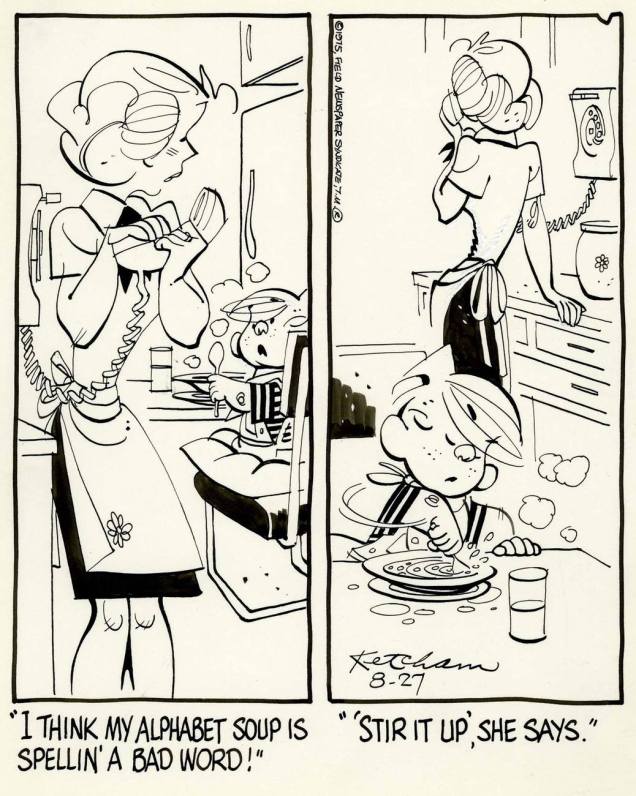
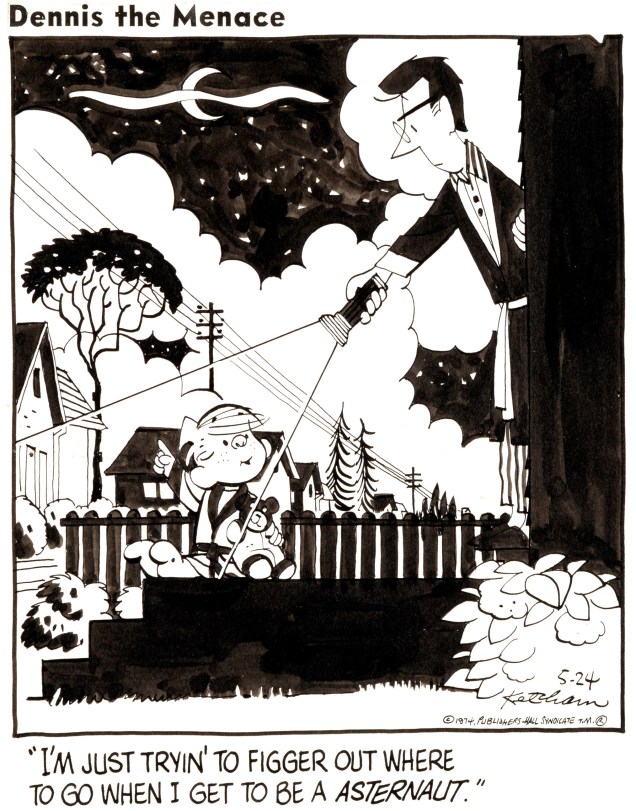
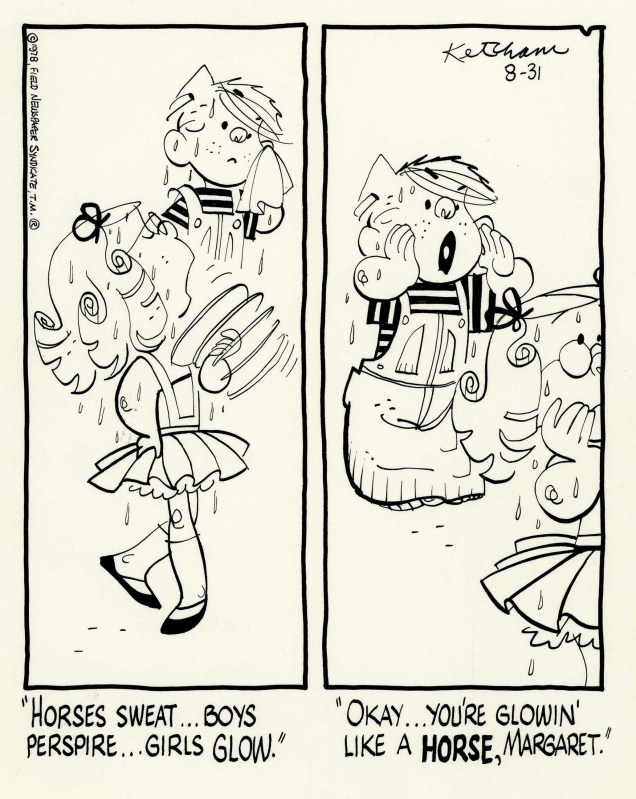
I had zero interest in Dennis until I stumbled upon a scan of the original art of a daily strip… and discovered that Ketcham’s art is stunning. I could happily stare at it for hours. Bonus: as it turns out, the stories can be quite interesting, especially the ones that don’t pivot as much around Dennis’ self-centered behaviour.
Here are a few strips for your consideration – a couple of dailies, a couple of Sundays. I much prefer looking at them in black and white, as I find that colour detracts from the purity and dynamism of Ketcham’s inking.
October 4th, 1953.August 27, 1975. May 24th, 1974.August 31st, 1978. Margaret is quite the thorn in Dennis’ side… but a dainty, girly thorn.November 8th, 1979.July 28th, 1987.A page from Ketcham’s autobiography “The Merchant of Dennis the Menace” (Fantagraphics, 2005). Visit Michael Sporn Animation to read a whole chapter of this book, complete with entertaining anecdotes involving Virgil Partch, a friend of Ketcham’s. (Small world… especially in the sphere of cartooning.)
Dennis the Menace became a hit very quickly, and Ketcham started using assistants fairly early on. In the late 1950s and 60s, the strip was ghosted by Al Wiseman. (Speaking of which, do visit this website maintained by Wiseman’s grand-daughter, who doesn’t think it’s fair that the rôle her grandad played in the creation and success of this strip is so downplayed.)
After Wiseman moved on, Ketcham hired Marcus Hamilton to help out with dailies and Ron Ferdinand to work on Sunday strips; Ketcham presided over their work until his official retirement in 1994, after which they inherited the proverbial driver’s seat. He passed away in 2001, but the strip yet continues. To quote from the Dennis the Menace website, “Hank handed over the reins to Ron Ferdinand and Marcus Hamilton… two artists totally committed to carrying forward the Ketcham legacy, and keeping Dennis’ fans entertained for decades to come. Scott Ketcham (son of Hank) joined the Dennis team in 2010, helping to keep their creative finger on the pulse of current contemporary trends.” Anytime someone expresses a desire to keep a finger on “the pulse of current contemporary trends”, I get worried. Besides, their eagerness to stay relevant to modern life is conflicting with the attempt to keep things static. That’s the thing about newspaper strips that outlast their creators by decades… They get stuck in some bizarre time-warp, but with all the humour leached out. I bravely went through 50 or so dailies to figure out how Dennis the Menace was “Staying Modern”, so you wouldn’t have to. The results are much as expected: the family roles are exactly the same, with apron-ed mothers in skirts serving lunch or cleaning up, fathers working in offices, playing golf or having a beer in front of the TV (the mere three options available to men, apparently). However, now the family has a flat TV screen and a laptop, the babysitter has her nose stuck in a cellphone, and cars have some automated features. Oh, and lest I forget: women very occasionally wear jeans, a true sign of progress.
I don’t necessarily like to contemplate this fact of life, but octopus flesh gets eaten a lot (in some countries more than others). However, comic artists are mostly a classy lot: they tend to like cephalopods, so it’s not too often that one runs across a depiction of them as a foodstuff. An octopus slashed in battle is one thing, but disgraced and transformed into a dish? What kind of person would want to illustrate *that*? Perverts, that’s who!
These bold souls who have drawn the forbidden, mentioned the unmentionable, shall surely be punished by the Elder Gods.
Let’s have a cautious peek (don’t forget to leave a sacrifice at the altar of the Octopus God, however).
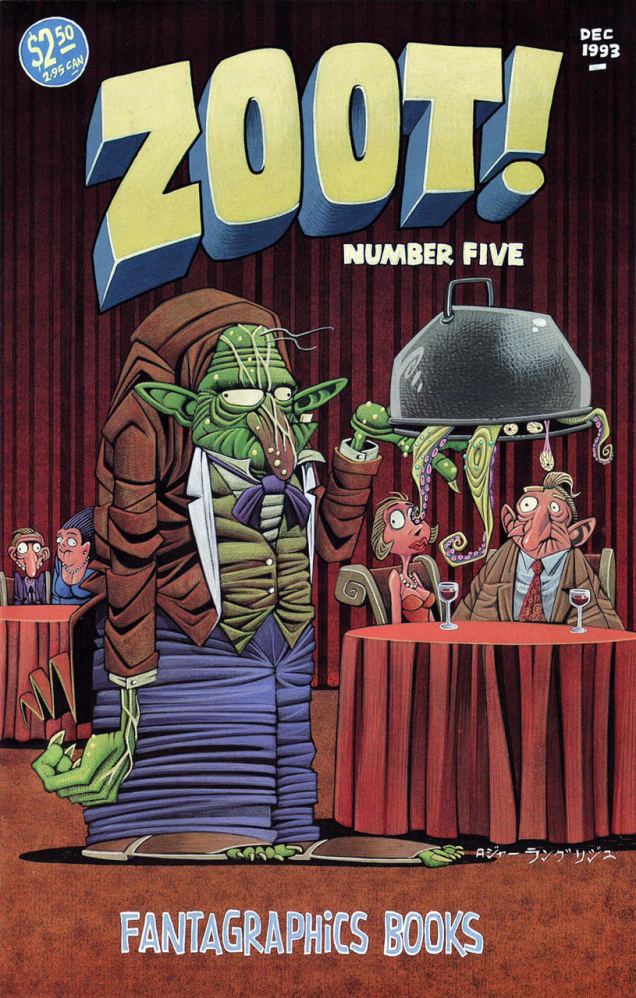
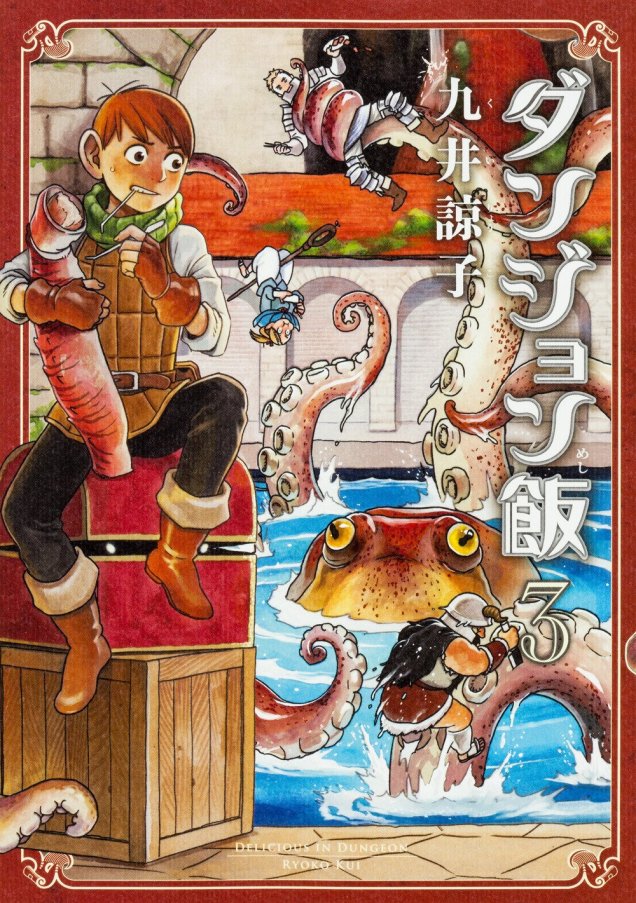
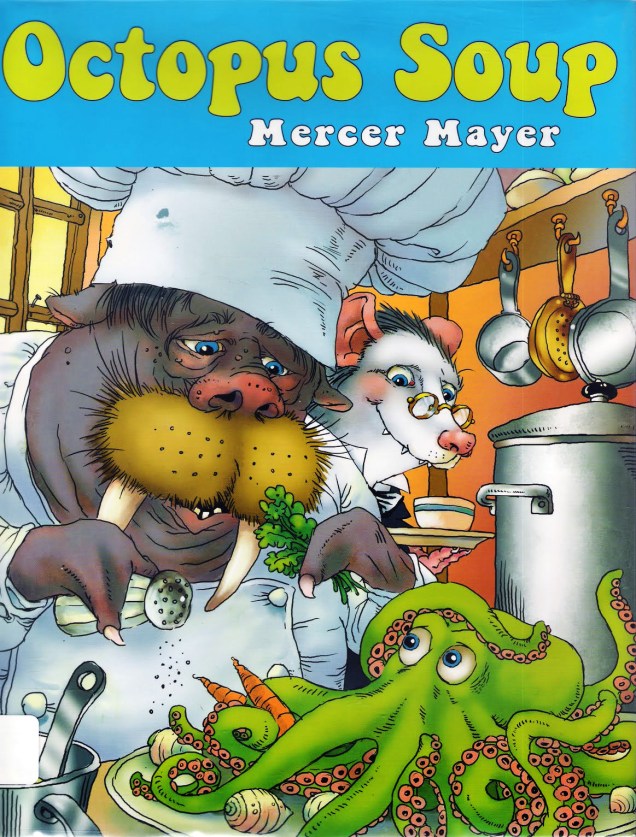
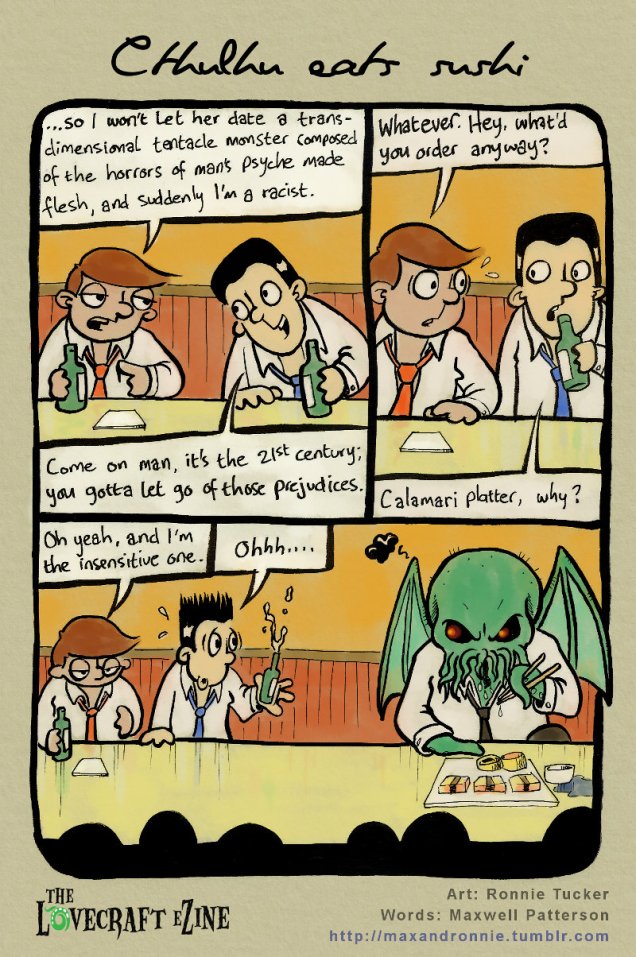
Zoot no. 5 (December 1993, Fantagraphics). Cover by Roger Langridge.Originally called “Ernie” (the name of its main character), the strip was renamed “Piranha Club” presumably because it’s a much catchier title. No, or few, pirañas are involved, but you are guaranteed to encounter Quacko the Human Duck, his wife the Bearded Lady, Effie (who often cooks octopus, much to the dismay of her husband), Bob the zombie, and a host of other irrelevant and quirky characters. Who’s responsible for all this mayhem? Bud Grace, the creator of this strip. If you haven’t heard of Piranha Club, slither over here.Delicious in Dungeon Vol. 3 (November 2017). This manga series by Ryōko Kui involves a few characters tromping around a dungeon, consuming all and any monsters they find within. “Slimes, basilisks, and even dragons… none are safe from the appetites of these dungeon-crawling gourmands!“Octopus pie, again? Is it as inedible as tuna casserole, the frequent butt of jokes in all sorts of sitcoms? This is Mom’ Homemade Comics no. 1, October 1969, cover (and everything else) by Denis Kitchen. Visit Comixjoint for the riveting tale of how this underground classic came to be published, as well as a review of its three issues.Octopus Soup by Mercer Mayer (2011, Two Lions). Technically a book for kids, but I’d highly recommend it for octopus lovers of any age.Another peek at Octopus Soup…Cthulhu Does Stuff no. 4, by Ronnie Tucker and Maxwell Patterson. Visit their website.
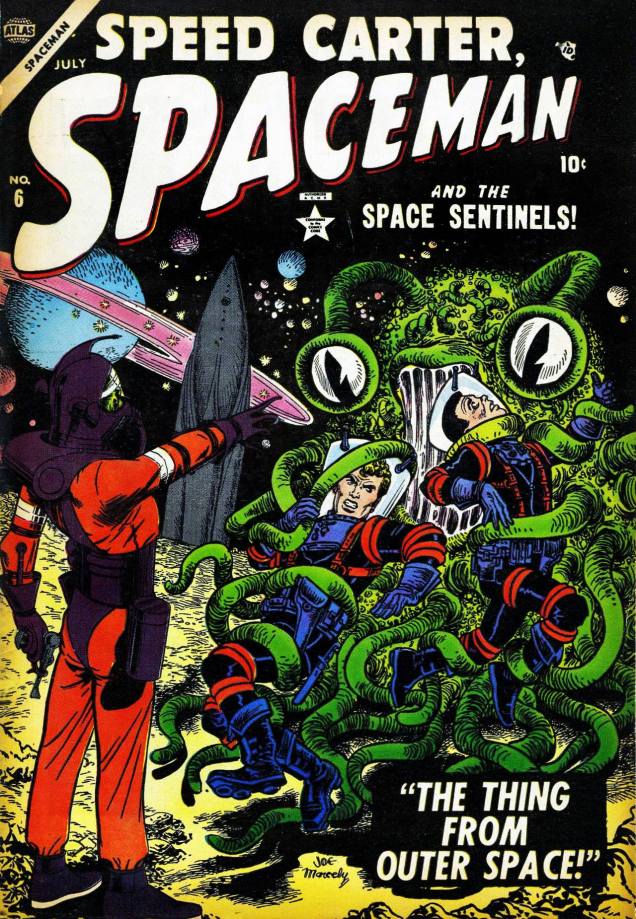
Aliens inevitably have tentacles. It’s a simple fact of life for any space explorer. Although I’m sure you wouldn’t dream of doubting my words, here are a few exhibits for your pleasure.
We’ll start off with a tentacle bonanza! This is what happens when you cross an octopus with a centipede.
Spaceman no. 6 (July 1954), cover by always-enjoyable Joe Maneely. “Speed Carter, Spaceman” only lasted six issues, which is unfortunate – the stories are a lot of fun, with great art and intelligent-but-humorous scripts.
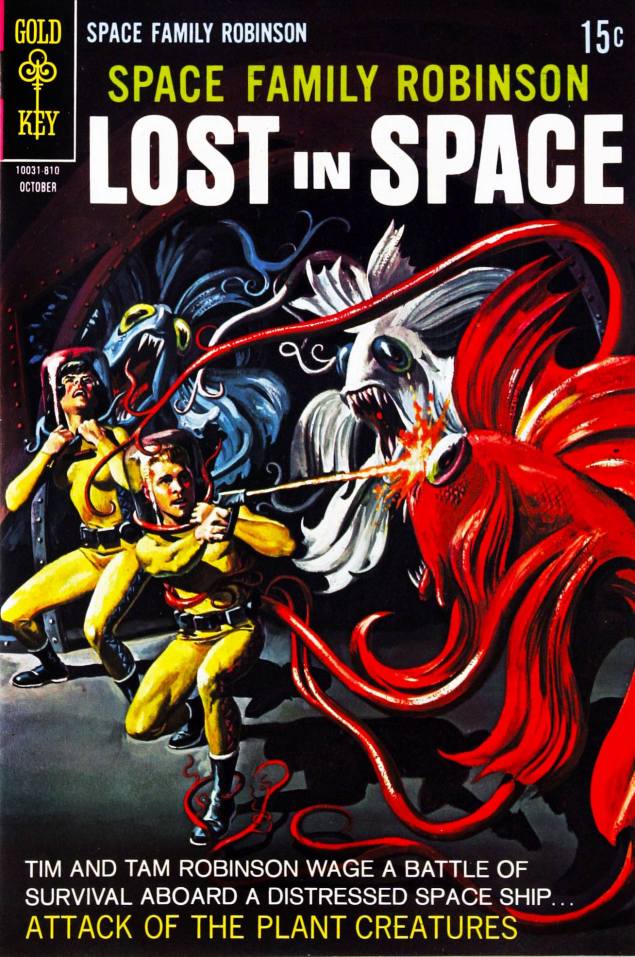
When “plant creatures” (who look remarkably like toothy goldfish) gone berserk deploy their tentacles to strangle you – in space, no less – , it must be Tentacle Tuesday.
Space Family Robinson Lost in Space no. 30 ( Gold Key Comics, October 1968). Cover by George Wilson, whose paintings are usually quite well executed (and this is no exception). The tentacle story, titled “Attack of the Plant Creatures”, is scripted by Gaylord Dubois and illustrated by Dan Spiegle. Incidentally, Space Family Robinson was an original science-fiction comic by Gold Key, and predates the Lost in Space TV series.
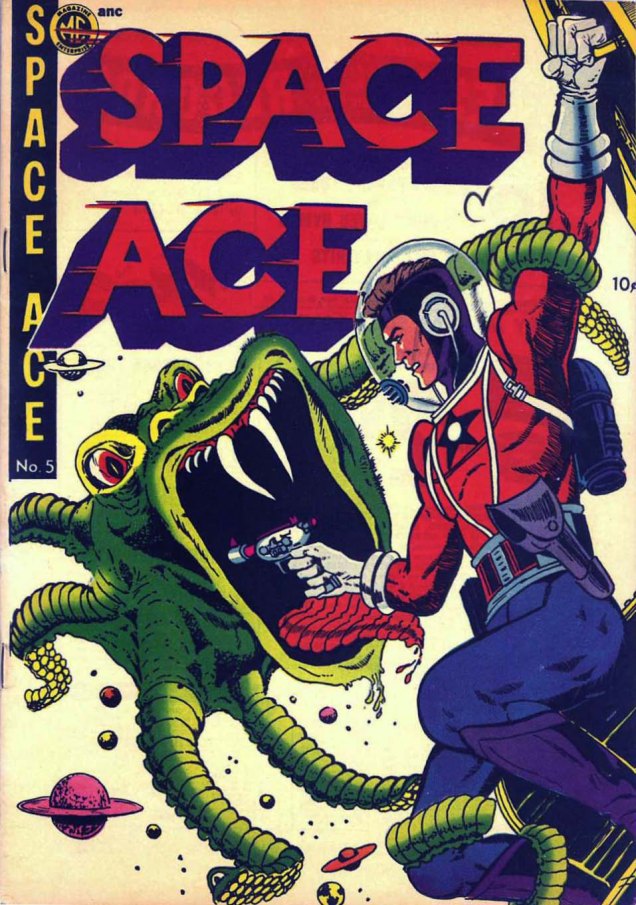
Seriously, who keeps stranding these vicious octopuses in space?
Space Ace no. 5 (1952, Magazine Enterprises), cover by Dick Ayers. I like these elegant space suits of the 50s, where naught but a small glass bubble and a tiny tank provided all the air one might need, and the costumes were tight enough to show off the guy’s muscles. The tentacle wrapped around the astronaut’s leg looks severed.Just watch Solar-Brain nimbly dismantle an expensive piece of machinery with its tentacles. Tsk, tsk. These panels are from “The Living Gun”, a story from Metal Men no. 7 (April-May 1964) written by Robert Kanigher, pencilled by Ross Andru and inked by Mike Esposito.
Since I like pointing things like that out, please note that all the plot points of “The Living Gun” that concern Platinum (the only girl on the team) are fucking inane. She gets jealous when Doc Magnus is wooed by a beautiful model; participates in a beauty pageant while everybody else continues with their scientific research; attacks her team-mates when she’s disqualified from the pageant for not being human; quits the Metal Men in a huff and barely makes it into the epic battle pitting Magnus and his Metal Men against the murderous, power-grabbing Solar Brain. Girls will be girls… at least when a certain writer with the initials R.K. is around.
I’m reading a play by Anton Chekhov these days. What relevance does this have to comics? Let me explain. I don’t know about the so-called « mysterious Russian soul », but this particular play is histrionic. And the chief cause of drama, of course, is love. One woman tries to poison herself upon discovering her husband has a mistress and is preparing to run off with yet another man’s wife; others literally crawl around while trying to convince the rascal they’ve fallen in love with to condescend to granting them a small sign of affection; small children are threatened with deadly diseases; men launch into hair-tearing monologues, intermittently planning suicide or murder but never actually getting around to it; money is borrowed, and is immediately tossed in the air, friendships are shattered, insults are hurled and then profuse apologies proffered… and everybody, and I do mean everybody, goes hysterical.
Which brings us to Golden Age romance comics. Ha!
I’m not intending to suggest that *all* of them are ridiculously over the top. However, a lot of them are plotted like your average soaper – understandably, as these stories were written with a drama-hungry, lovelorn audience in mind. « Boy meets girl, everything goes well, they’re happy together » is not the kind of thing that moves copies.
Here’s a selection of covers I really like (for various reasons), depicting some common situations in a young woman’s life – like getting back-stabbed or pawed or pregnant while dreaming of some Perfect Love.
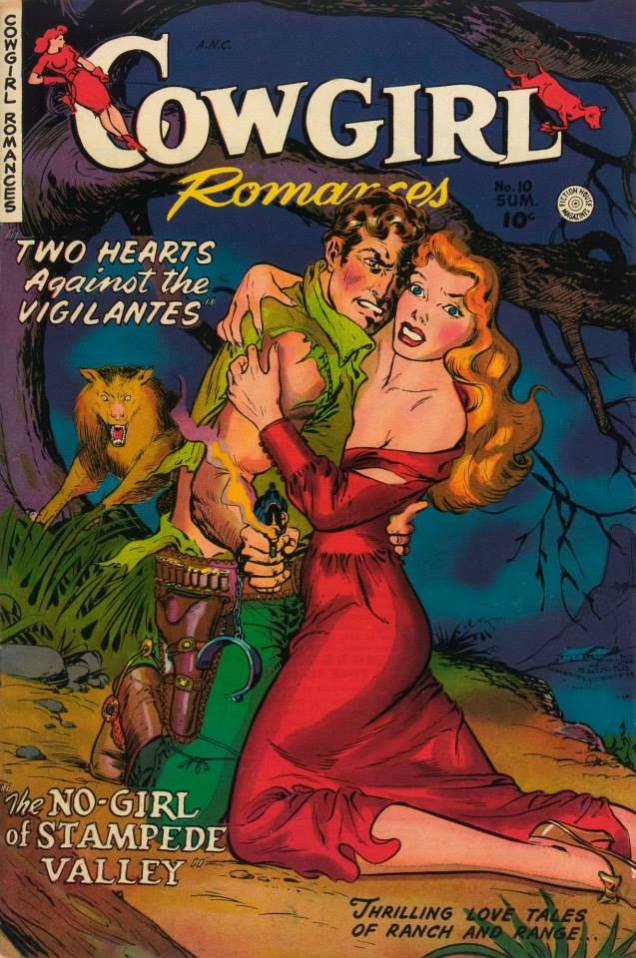
Some gals don’t merely have to contend with vigilantes, but also wolves (of the animal *and* human varieties).
Cowgirl Romances no. 10 (1950, Fiction House). Cowgirl Romances lasted for 12 issues, and usually featured strong heroines capable of defending themselves… although this one looks like she might need a bit of help. Read it here.Oh, never mind – she doesn’t need help after all. It’s a refreshing change from women who stand by doing nothing while their loved one gets pummelled… or try to help and end up conking the wrong man.
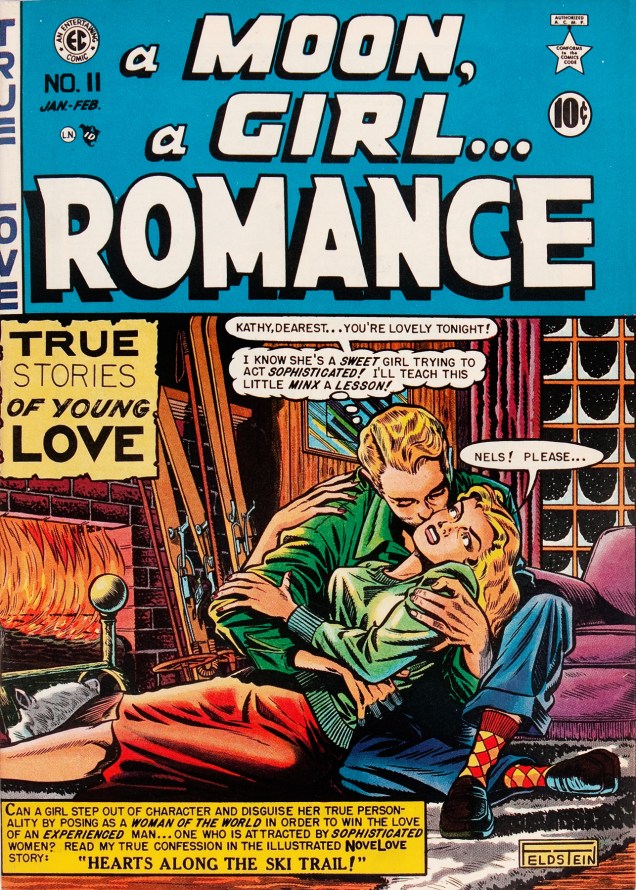
Speaking of wolves, we have this cozy scene with distinctly creepy overtones. Anytime someone mentions an “experienced man”, run the other way.
A Moon, a Girl…Romance no. 11 (January-February 1950, EC). Cover by Al Feldstein.
“Julie fought, but now she fought as much against her own hungry response as against his muscles. Try as she would, she could not keep herself from returning that kiss with all the fiery ardor of her wild loneliness.” Untamed Love is quite racy, as the title promises, and as much over-the-top as one could wish for. The cover story is about an evil seductress, but the rest of the tales all concern themselves with a love triangle of another kind, one in which a girl has to choose between two guys. This one’s for the ladies – it’s hunks galore!
Untamed Love no. 1 (January 1950, Quality Comics). Cover by Bill Ward. “Scary” comes to mind more than “ravishing”! Read the issue here.
Here’s the “ravishing creature” in action, in case you’re interested:
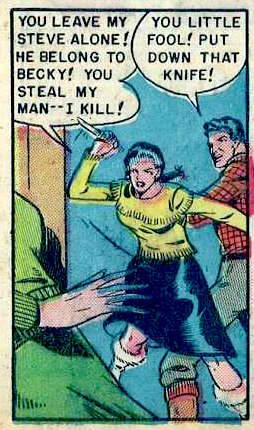
Alaskan beauties don’t understand English grammar, but they dig the language of love! Panel from “The Wrong Road to Love”: “Julie falls in love with truck driver Steve, but he moves to Alaska to become a fisherman. She follows him there, only to discover local resident Becky considers Steve “her man.” Julie is consoled by Steve’s partner Hank. Steve and Becky run off, taking all the money Steve and Hank have earned. Julie decides to go home, but Hank says she can stay — as his wife.”
Another sentimental overload (though one would think that being at war was dramatic enough)? The redhead in the square on the right is in love with a gay man! (She was in love with a man’s fiancé, after all.) The girl at the dance is struggling to get away from a grabby asshole! (Unfortunately, all-too-common even today.) The girl in the green dress is faking it because she’s too polite to say no! (Ditto.)
Wartime Romances no. 10 (October 1952, cover by Matt Baker).
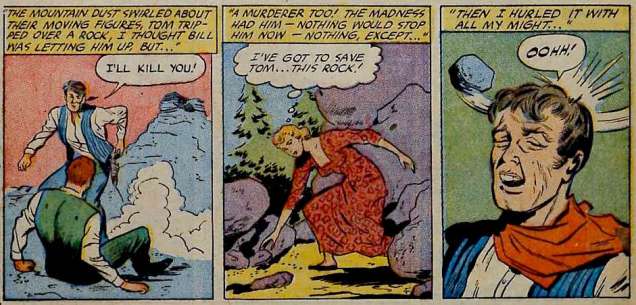
“They were like two jailers, my pa and my brother Bill! At 18, I hadn’t tasted the sweetness of courtin’! And I was hungry for it… bitter hungry…” Things quickly get out of hand in this issue of First Love – a young maiden meets a charming young man who kills her brother (by accident), after which she gets shot by her dad (also by accident). The story concludes with the two lovebirds reuniting while the father realizes that “his soul is black with sin“. Geez, the things some people have to go through to reach a happy ending in a comic story.
First Love Illustrated no. 34, 1953. Read the issue here.
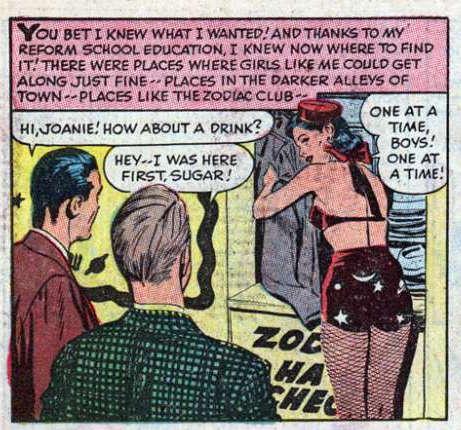
This issue has plenty more “man-starved” maidens up for grabs…
Panel from “Bad Girl”, illustrated by John Prentice.
… and one memorable male character, Alan, “the gay, vital, gloriously-alive lover”.
Page from “My Heart Cried Out”, pencils by John Giunta, inks by Manny Stallman.
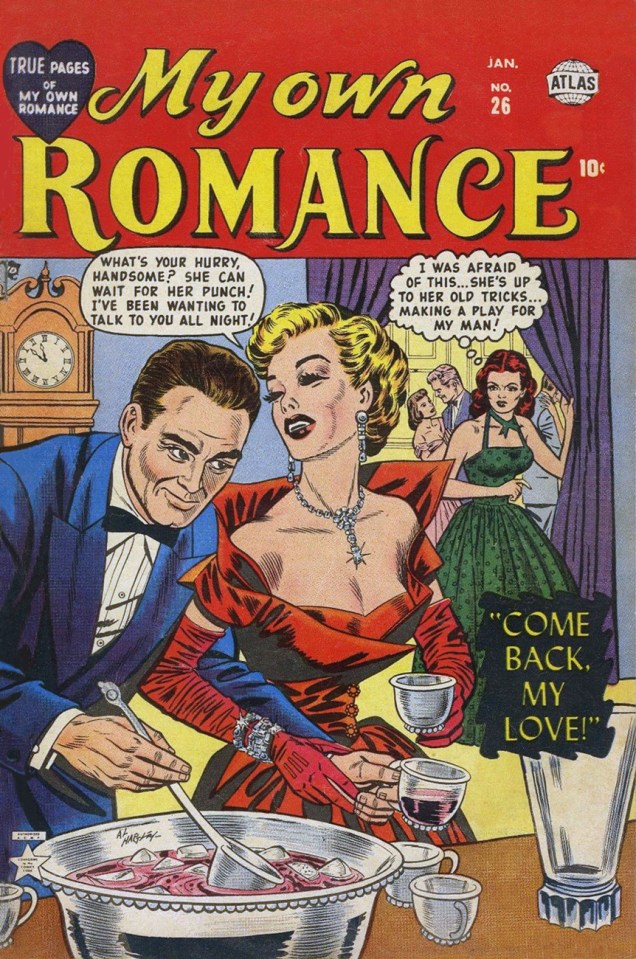
The next cover reminds us to never send our dates for refreshments (punch, you say? looks more like something out of a witch’s cauldron), for this is where femmes fatales lurk in hopes of snaring fresh prey.
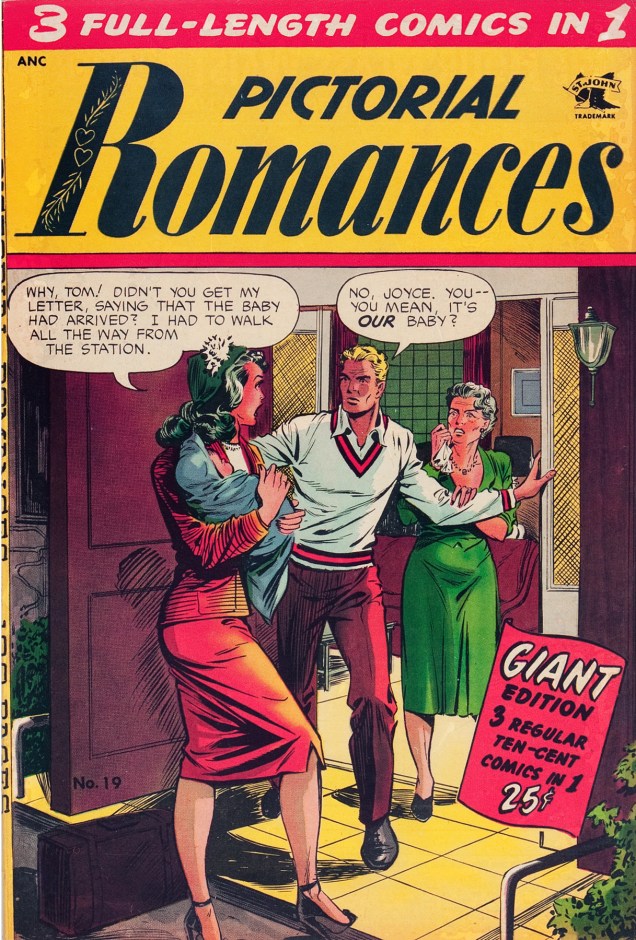
My Own Romance no. 26 (January 1953, Marvel). The irresistible team-up of two comic-field professionals who would later become terrible Archie artists: Al Hartley (art) and Stan Goldberg (colours). Is that teacup floating in her hand or what?Pictorial Romances no. 19 (May 1953, St. John). Cover by Matt Baker. Read the issue here. If I had to recommend only one issue out of today’s roster, it would be this one: there’s nice art, and the stories are actually detailed and interesting, and even boast a certain internal logic.It’s important to know the difference in different tinned meats. Art by Matt Baker.
If you want a lover who doesn’t resist, put her in a trance, first, and then Miss Smith won’t be able to help but say “yes!”
Lovers no. 50 (June 1953, Atlas). This, again, is the handiwork of those two buffoons, Hartley and Goldberg. Look, she’s still holding the chloroform-dosed handkerchief he used to knock her out!
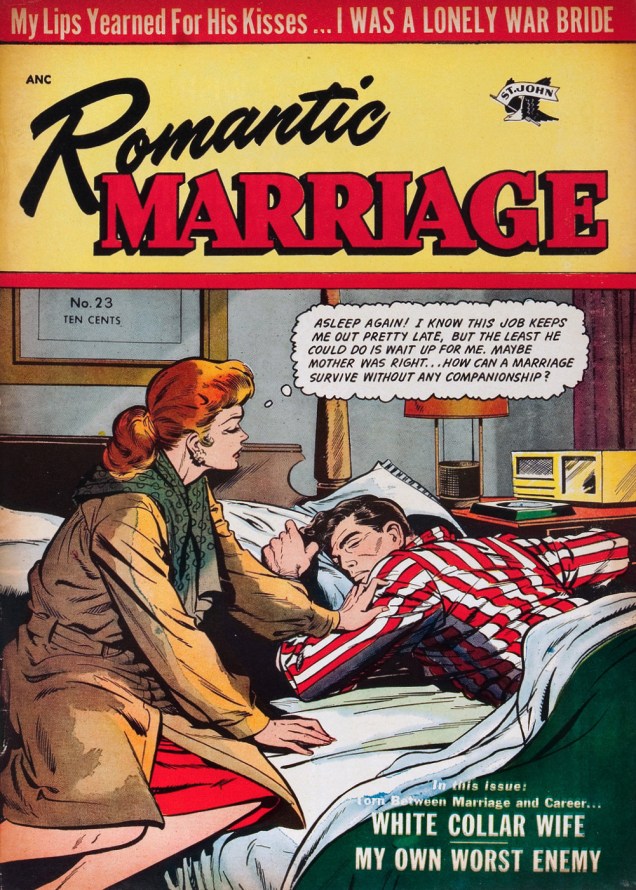
Romance comics love to pit a woman’s career against everything a female should strive for (i.e. marriage). Am I carping that romance comics weren’t very progressive in the 1950s? Ah, I wouldn’t be, if I didn’t know for a fact that Silver Age romance comics often don’t do that much better in that department.
Romantic Marriage no. 23 (July 1954, St. John), cover by Matt Baker. “Companionship”, eh? Read the issue here.
What do we have here? Despite what one would tend to think, this necklace was stolen, not given as a romantic offering. Such are true life secrets: kleptomania, clandestine children, and double-crossed partners.
True Life Secrets no. 25 (March 1955, Charlton). Read the issue here.
Ahoy, landlubbers! Today’s Tentacle Tuesday goes back to the good ol’ days of nautical journeys, ships crushed by mighty tentacles, and brave men who end their lives as snacks for the mighty cephalopod.
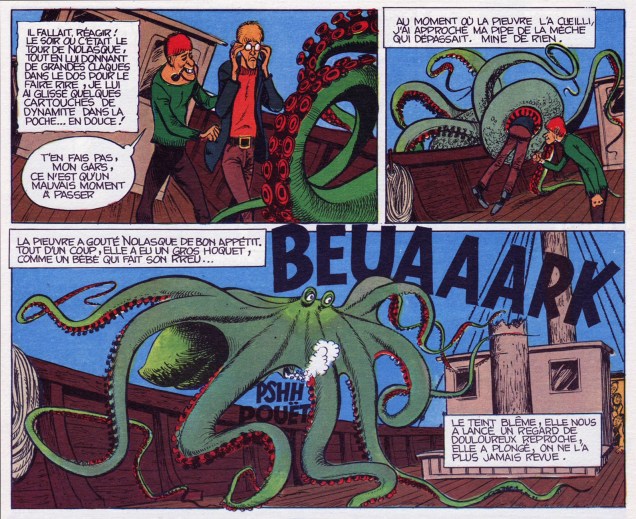
Printed in Pilote Hors série aventure no 17 bis (October 1975, Dargaud). The story is titled L’Antoinette Pécuchet, from the cycle Les histoires de Pemberton, written and illustrated by Sirius (real name Max Mayeu, Belgian cartoonist).After most of the crew is swallowed up by the starving octopus, our narrator gets the bright idea to stick some dynamite into the pocket of the next sacrificial lamb and lights it just before he’s eaten. “The octopus savoured Nolasque with a healthy appetite. Suddenly, she hiccuped loudly, like a burping baby… Pale, she threw us a glance of bitter reproach, and dove into the water, never to be seen again.”
Speaking of the Sargasso Sea (frequently depicted in fiction as a perilous area where ships go to die, mired in Sargassum seaweed, unable to escape), here’s another vignette about that mysterious spot. Incidentally, it is the only sea that doesn’t have land boundaries, enclosed by the Gulf Stream on the west side, the Canary Current on the east, the North Atlantic Current on the North and the North Atlantic Equatorial Current on the South. No wonder people thought it was full of mystery and danger! Even I, more or less immune to the siren’s call of wild maritime adventure, feel a little thrill at its mention. *Ahem* back to comics.
Boris Karloff Tales of Mystery no. 29 (March 1970), painted cover by George Wilson.
As is often the case, the original painting has a lot more detail than the printed version:
The original painting for “Creature of the Sargasso Sea” by George Wilson.
What does this peculiar, one-eyed beast look like closer up, one might ask? Something like this:
A page from Creature of the Sargasso Sea, pencils by John Celardo and inks by Sal Trapani. Furry octopuses are my favourite!
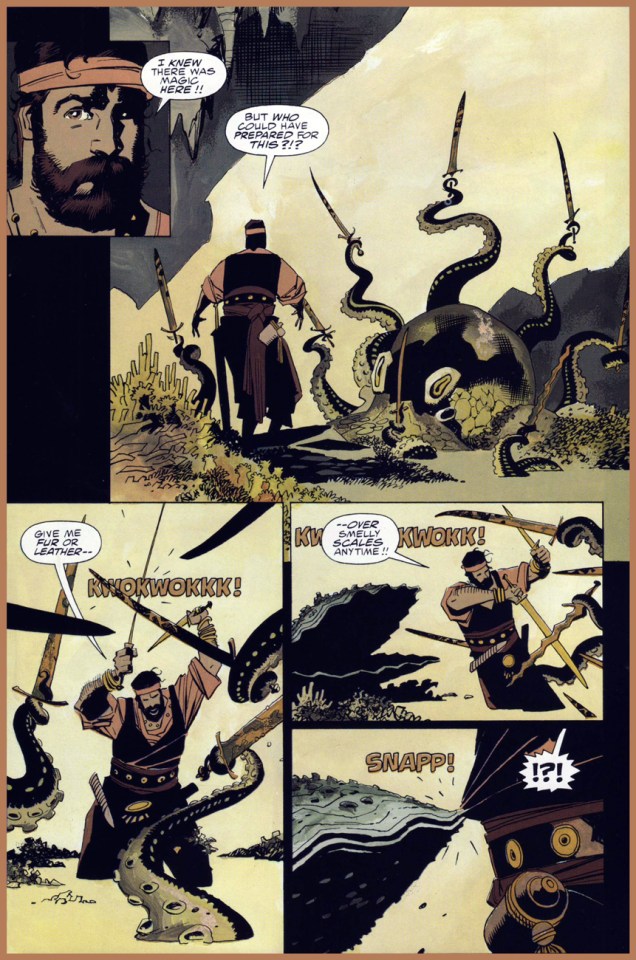
The sea can bring many (other) strange things, including a sword-wielding octopus… who should have stayed in the water, where he had the home advantage, instead of attempting to wage battle on sort-of land.
A couple of pages from Fafhrd and The Gray Mouser, a comic adaptation of Fritz Leiber’s cycle of sword-and-sorcery stories. Adaptation by Howard Chaykin, art by Mike Mignola, who’s inked by Al Williamson. This 4-issue series was anthologized in 2007 by Dark Horse; these pages were scanned from Book 4, published in 1992 by Epic Comics.One can only hope to be as stylish while fighting a many-tentacled monster.
We’d like to wish a happy birthday to Mexican cartoonist and animator Gustavo “Gus” Arriola, creator of beautiful, experimental, charming (am I running out of superlatives yet?) comic strip Gordo, published for an impressive some-forty-odd years (between 1941 and 1985, to be exact). Arriola was born on July 17th, 1917 and died in 2008, when he was 90 years old.
Gordo was designed to be a Mexican version of Li’l Abner, but Arriola quickly realized that his strip was relying on stereotypes of Mexican culture as seen through American eyes. He strove to make it truer to his mother culture, making Gordo (the main character – his real name being Perfecto Salazar Lopez, with his nickname more or less translating to « Fatso ») “an accidental ambassador” for Mexican mores.
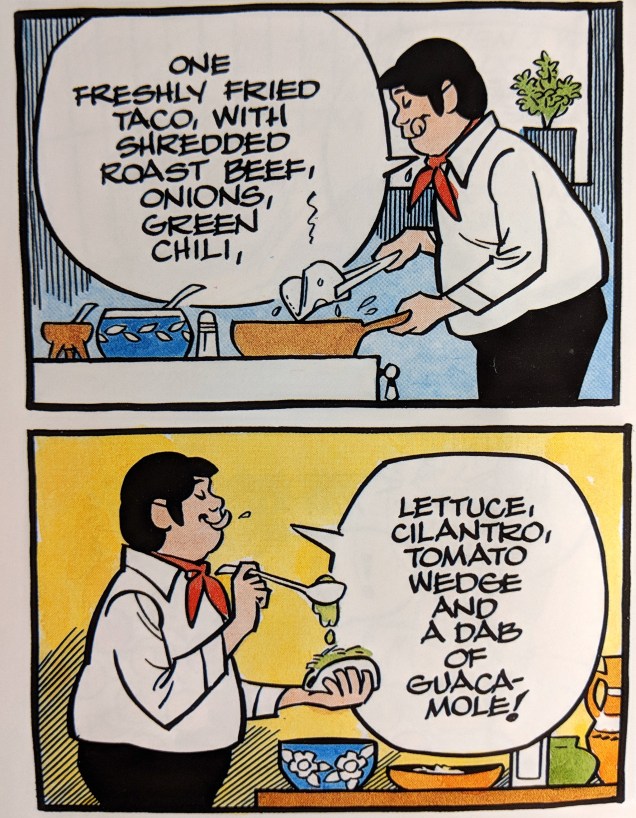
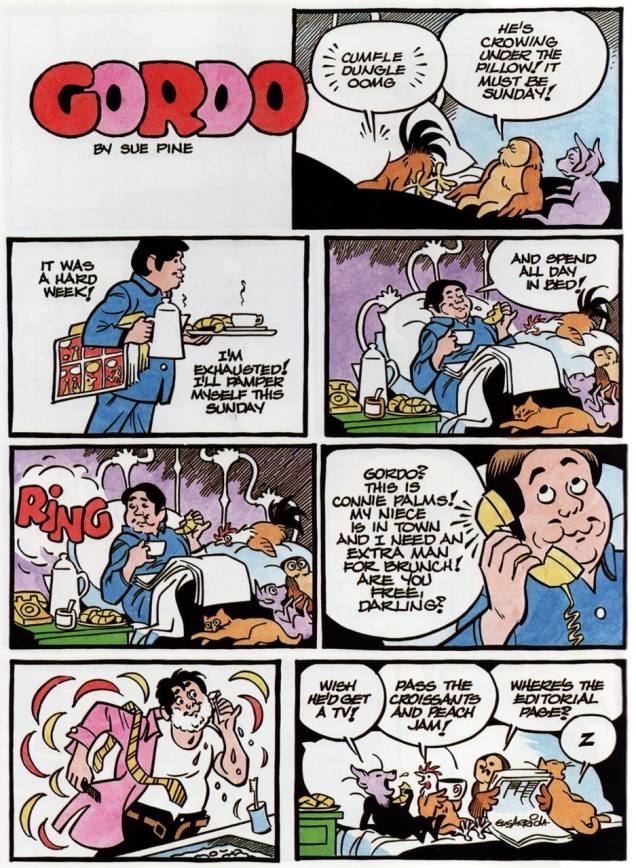
The strip featured a lot of animals, and its plotlines often pivoted around concerns about the environment. It also regularly included recipes. For instance, Gordo’s beans and cheese recipe from a strip in 1948 got the comic strip into 60 extra newspapers. And, significantly, Gordo also had gorgeous, inventive art!
This sweet strip was scanned from a collection of Gus Arriola strips, “Gordo’s Critters: The Collected Cartoons”, published in 1989 and sadly out of print. Gus Arriola had a wonderful drawing style and a bouncy imagination, but it’s his sense of humour I like best: gently philosophical, hilarious but always kind to its characters.Sunday strip from January 25th, 1959.
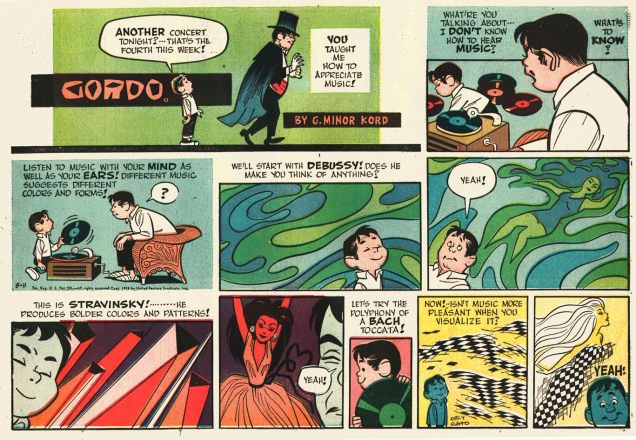
Aside from being a music aficionado, Gus Arriola was also a great connaisseur of art. R.C. Harvey, the editor/writer of “Accidental Ambassador Gordo: The Comics Strip Art of Gus Arriola” mentions Arriola’s love for jazz: “[he] finally [settled] in Carmel, where he met his life-long friend and fellow cartoonist, Eldon Dedini, and they both became fixtures at Doc’s Lab, where Hank Ketcham and other habitués of the place met weekly to admire jazz and tell stories.” Read the rest of his lovely article here.
Sunday from June 11th, 1958.
In 1999, Arriola was interviewed by John Province for Hogan’s Alley no. 6 – it’s well worth a read if you’ve got some spare quality time! You can read the interview here.
Sunday from 1958.
Want to see more? Head over to the Fabulous Fifites blog, where many scans of Sundays strips are available for perusal. (Ger Apeldoorn, the blog’s author, did a monumental job of scanning newspaper strips for our enjoyment.)
Heigh-ho, it’s off to work we go. Octopuses have to work, too (at least occasionally). (And while they work, they have to restrain from grabbing unwilling passersby, as they don’t want to get slapped with a sexual assault lawsuit. I present to you a list of some of the professions that cephalopods excel at… no hanky-panky involved.
They’re musicians!
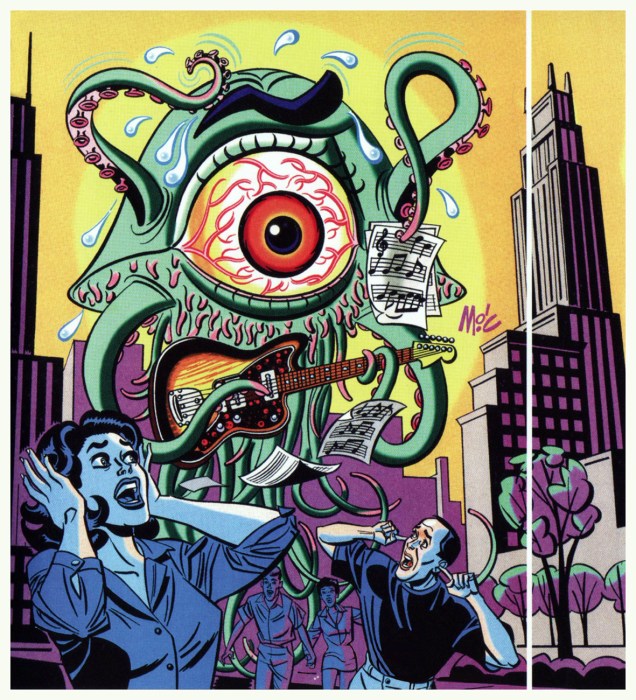
Budding guitar players rejoice: octopuses sometimes have trouble getting all the notes right, too. This was scanned from “Mitch O’Connell: the World’s Best Artist” (Last Gasp, 2014) by, obviously, Mitch O’Connell, who does not mince words when referring to his mad talent. Check out our other post about Dr. Mitch here.
Cooks!
This poor overworked fella is drawn by Paul Mavrides (he of the Furry Freak Brothers and Church of the SubGenius fame!) An excerpt from « Skull Farmer », Tundra Sketchbook Series #10 (1991, Tundra).
Entertainers!
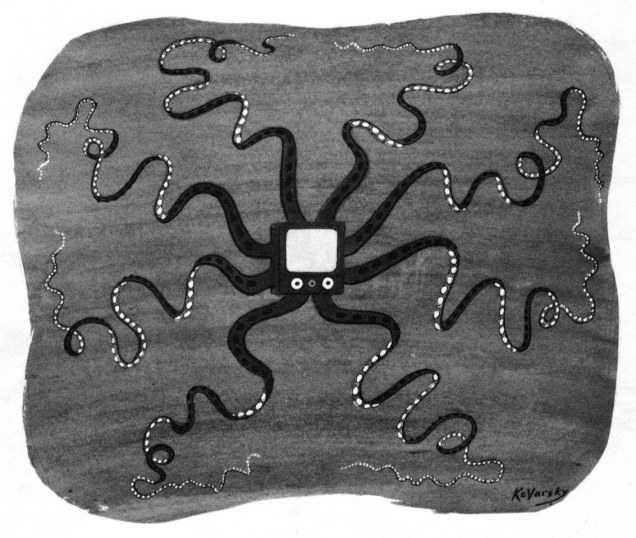
Octopus by Anatol Kovarsky (born 1919 in Moscow to Jewish parents, passed away in 2016), who had a long career (nearly 300 drawings and almost 50 covers) in The New Yorker’s pages.