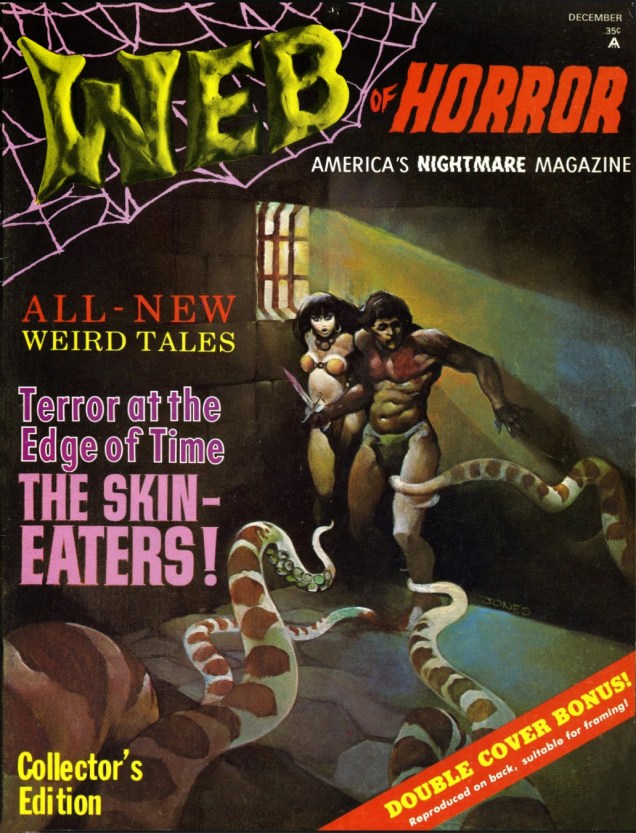
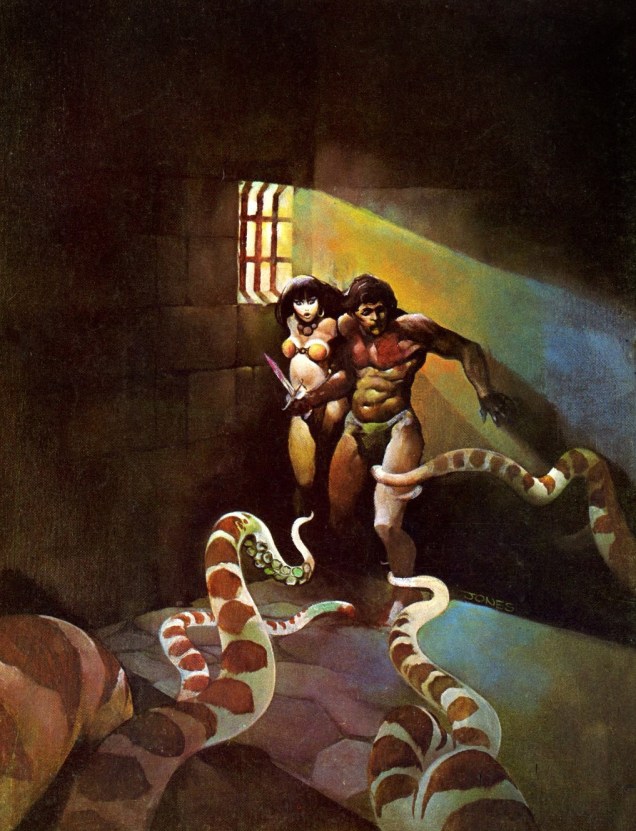
Web of Horror no. 1 (Major Magazines, December 1969). Painting by Jeff Jones.
I understand that the artist left quite a lot of empty space on purpose – to be filled with pointless text – but still, was it necessary to plaster nearly every inch of the image with captions yellow, red and purple? (I do like how the WEB seems to be made out of plasticine… and likely was.) Here’s the cover without all that wordy fluff:
The Rook no. 4 (Warren, August 1980). Cover by Nestor Redondo.
The Rook couldn’t quite kill the fishy brute’s whole family in #4, so he had to confront its slightly more colourful cousin in issue 7:
The Rook no. 7 (Warren, February 1981). Cover by Jordi Penalva. It’s nice to see that men (not exclusively Doc Savage) get strategically ripped shirts, too, sometimes. Eye candy!
Co-admin RG suggested I check Eclipse Magazine‘s tentacular offerings for this post, and he was correct, there was one issue involving an octopus used as a coffee table.
Eclipse Magazine no. 4 (Eclipse, January 1982). Cover by Carl Potts. I went snorkeling a few months ago and the scene was not dissimilar (minus, sadly, the mermaid).
Marvel’s Epic Illustrated, with its 70-odd pages per issue, surely offered something for everyone. The aforementioned offerings were quite hit-or-miss, but the occasional presence of Stephen Bissette, Rick Veitch, Basil Wolverton (in reprints), Berni Wrightson, Ernie Colón, P. Craig Russell, et al. makes it worthwhile to go through its 34 issues (okay, maybe not all in one sitting, unless you have quite a few thermoses of tea prepared – or something stronger).
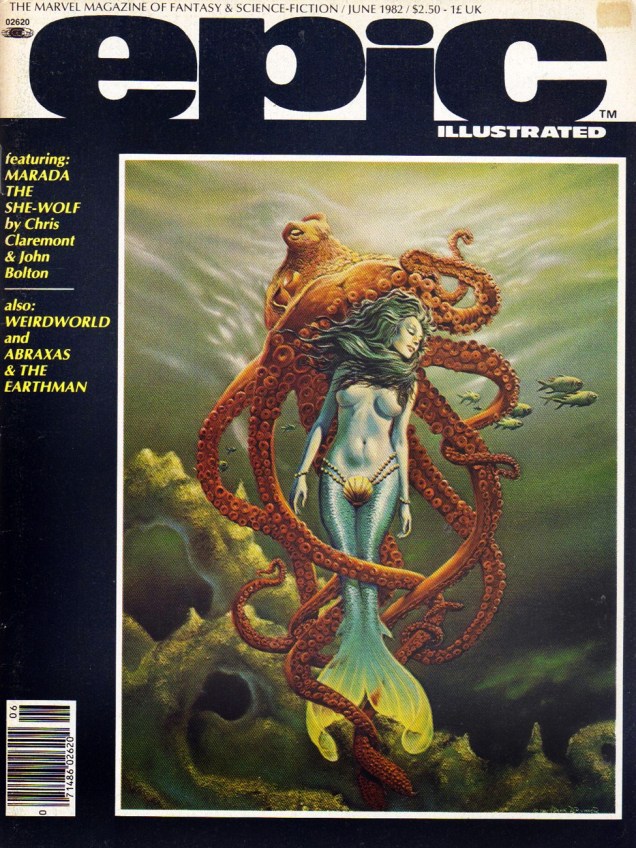
Epic Illustrated no. 12 (Marvel, June 1982), cover by Frank Brunner. You can read the whole issue here.
Brunner’s painting is rather nice – the mermaid and her friendly octopus both look so serene! – that here it is again. And read an interview with him while you’re at it: Legendary Feathers: Interview with Frank Brunner. (I apologize for linking to a website titled Fanboy Nation, though. Erk.)
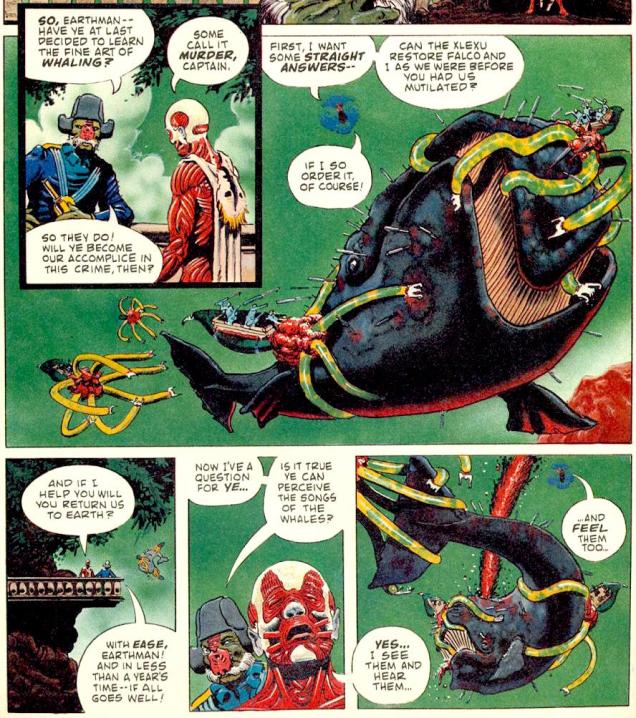
Issues 10 to 17 of Epic Illustrated featured Rick Veitch’s Abraxas and the Earthman, a purported retelling of Moby Dick (although frankly, aside from a vengeful squid, the similarities are not striking). Naturally, tentacles abound. Really freaky, creepy tentacles, much like the rest of the story.
Page from “The Hunt: Chapter Three”, written and drawn by Rick Veitch, printed in Epic Illustrated no. 12.Epic Illustrated no. 17 (Marvel, April 1983), cover by Tim Conrad. Read it here.
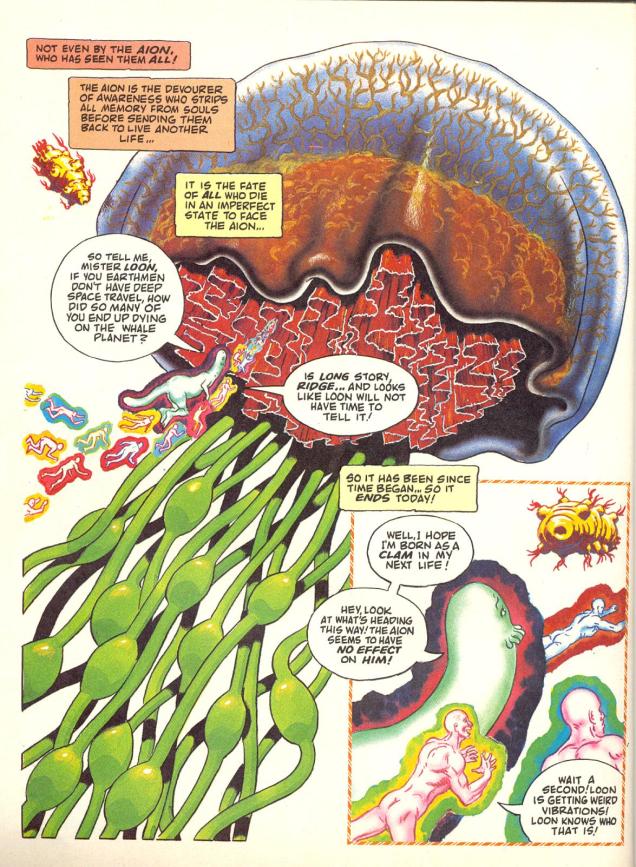
Veitch’s fucked-up (I mean that as a compliment), imaginative tale continues with “Man and Whale (Chapter Eight)”, the final installment. Alongside a plethora of sea-creatures (no longer in the sea), there’s this Devourer of Awareness, Bearer of Tentacles:
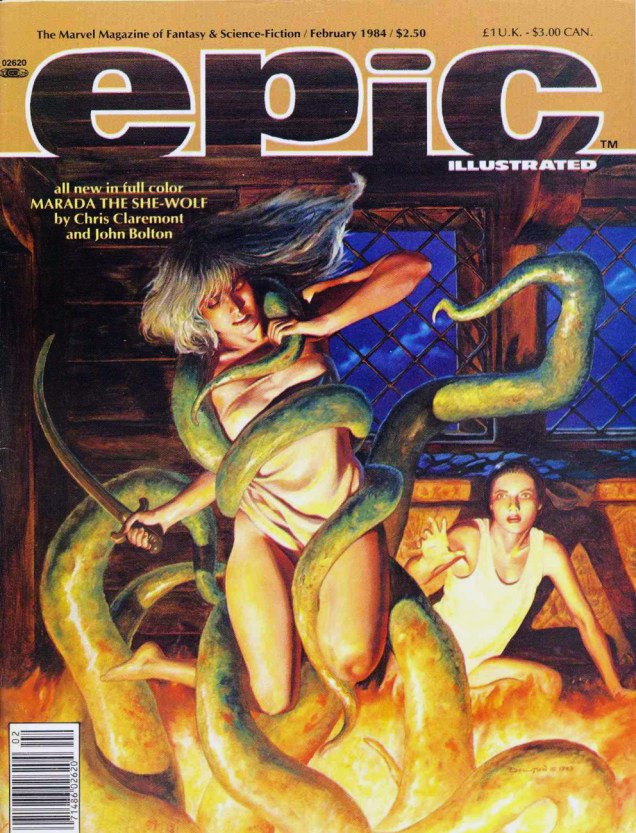
Epic Illustrated no. 22 (Marvel, February 1984). Cover by John Bolton. Read the issue here. It’s a bad, unconvincing cover, but hey, this is an inclusive post.
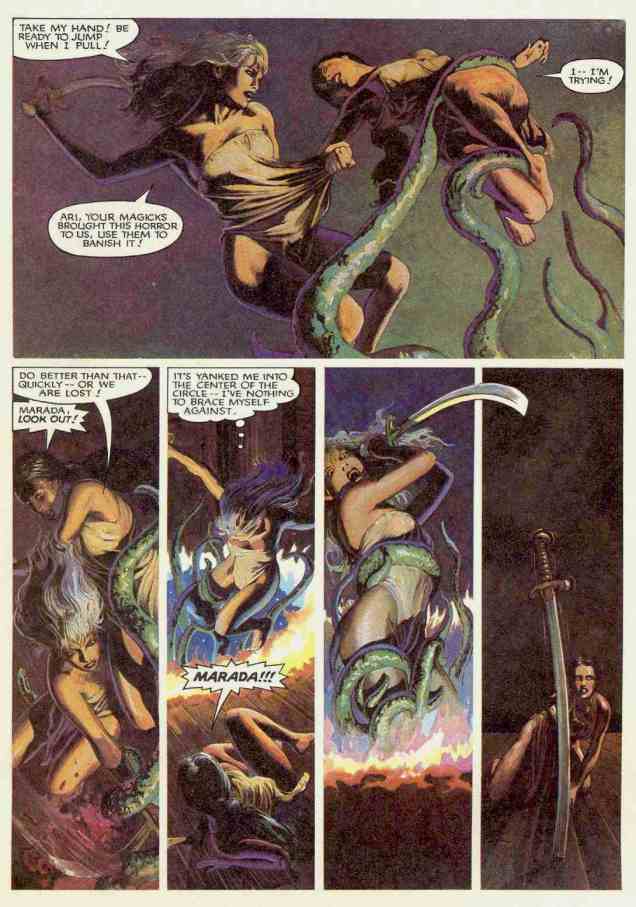
Speaking of Bolton, he drew “Wizard’s Masque” (another chapter in the cycle of Marada the She-Wolf), a story scripted by Christopher Claremont.
« Knock it off, squiddo! You couldn’t make a class-B horror picture on earth — you’re not even good for a milk shudder! Better skeddadle, or I’ll tie your tentacles into a bow! »
Tentacles are no cause for levity, you say? Ha! Their place in all manner of spoofs and parodies (and other silliness) is ensured. Peppered with a barrage of puns (never undersell puns, please!), whimsical tentacular entanglements abound in literature… err, comic literature, at any rate, and that’s good enough for me.
I meant “entanglements” very literally. Story published in Not Brand Echh no. 11 (December 1968, Marvel); script by Arnold Drake, art by Marie Severin.Say, did I hear some barely restrained giggling over “20 000 leaks under the sea?” (This story, written and drawn by Jay Disbrow, was reprinted in 2000 by Fantagraphics in a collection called The Sincerest Form of Parody: The Best 1950s MAD-Inspired Satirical Comics.) Unsane no. 15 (June 1954, Star Publications), cover by L.B. Cole.
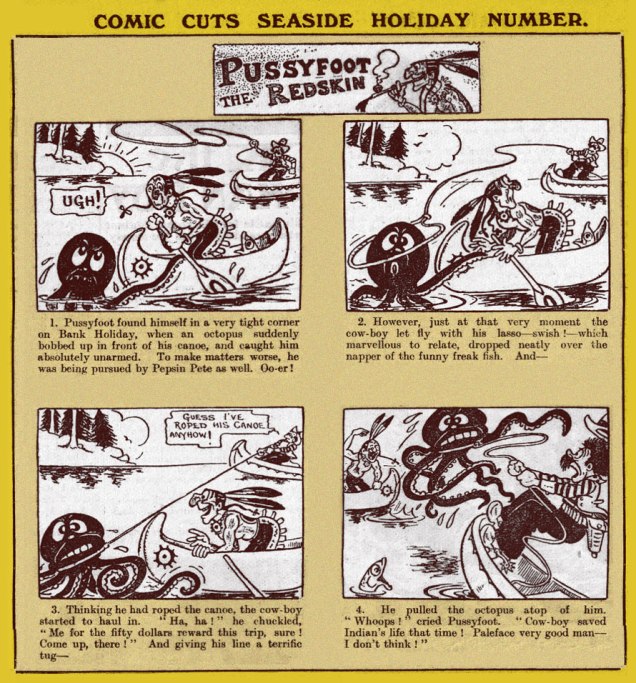
Even some 100 years ago (well, a little less), some unfortunate octopus could easily become a Figure of Fun if he wasn’t careful.
The story doesn’t say what happened to the freaking octopus, though. This edition of Pussyfoot the Redskin was printed in Comic Cuts no. 1735 (August 1923). Visit BLIMEY! The Blog of British Comics for more Comic Cuts.
I can’t mention équivoques and wordplay without mentioning Pogo, Walt Kelly‘s keenly intelligent comic strip. Sadly, this was the only appearance of Octopots, as far as I know (and I long to be corrected).
From Figmentality, from The Pogo Sunday Parade (1958). Art by Walt Kelly, of course!
In the competitive world of jokes in bad taste, the man from SRAM probably takes the cake. It’s lucky that he has no qualms about hitting females, or the world would be doomed… although his mirthless monologue would probably kill the creature with sheer ennui.
Madhouse in Hollywood (Man from SRAM), scripted by Otto Binder and drawn by Carl Pfeufer, published in Jigsaw no. 2 (December 1966, Harvey).
On the other hand, Superman‘s creative insults can easily shame a thin-skinned Tentacled Terror (was his spaghetti-and-meatball crack some sort of early Flying Spaghetti Monster reference, even though the latter was only officially created in 2005?)
Superman no. 184 (February 1966). The story is The Demon Under the Red Sun!, scripted by Otto Binder (again; he clearly has some unhealthy attraction to tentacles, like the best of us) and drawn by Al Plastino. Figure out what’s going on in this story (or not, for there’s not a lot of logic to be found, anyway) at Mark’s Super Blog.
«Men!! They are a worse menace than any octupus [sic] or shark that ever swam…»
Oh, poor octopuses. Authors use them as a (not very original) symbol of a terrifying, all-powerful force, and then get them (not very creatively) destroyed. An octopus is lucky to “just” get stabbed; everything seems to be fair play in this violent spree – dynamite, torpedoes, even freakin’ nuclear weapons. In most cases, the problem is definitely Man: man who enslaves sea creatures and makes them do his bidding with varied gadgets, man who intrudes on the octopus’ territory, man who sticks his nose where only tentacles should be.
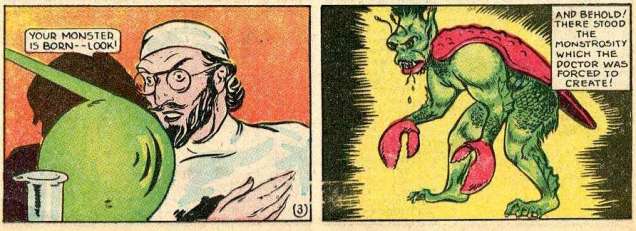
« I only have to give him the claws of the killer lobster… the teeth of the tiger shark… and the heart of the barracuda! That is all! » Because any normal doctor has this stuff just lying around his operating theatre, obviously.
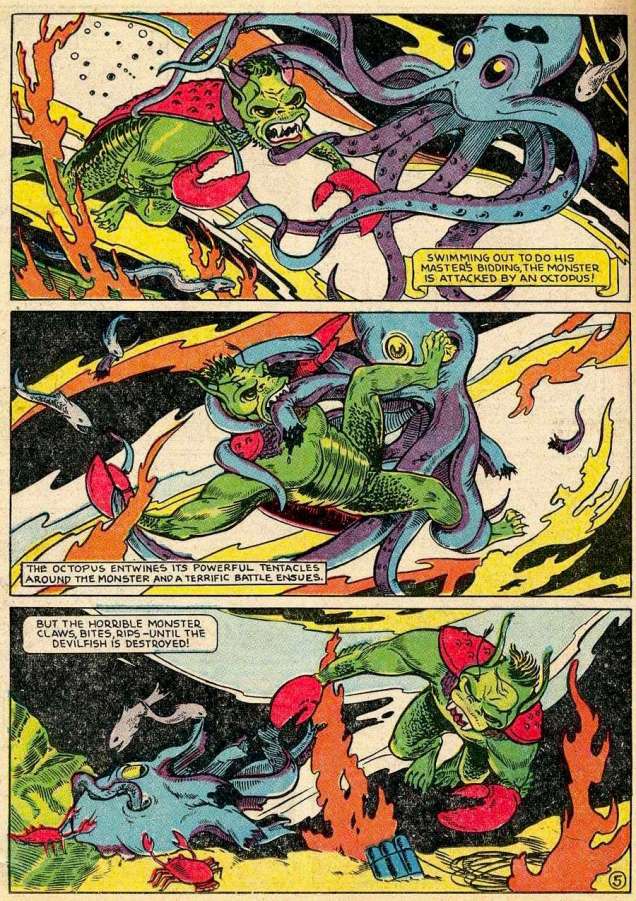
Spectacular, deadly monster created? Next thing to do is to rip an octopus to shreds, in a particularly gory eyeball-wrenching, tentacle-mincing scene.
Seriously, just look at that eyeball getting pulled out by toes… Page from “Devils of the Deep”, scripted by George Nagle and drawn by Edd Ashe, published in Blue Ribbon Comics no. 3 (January 1940).
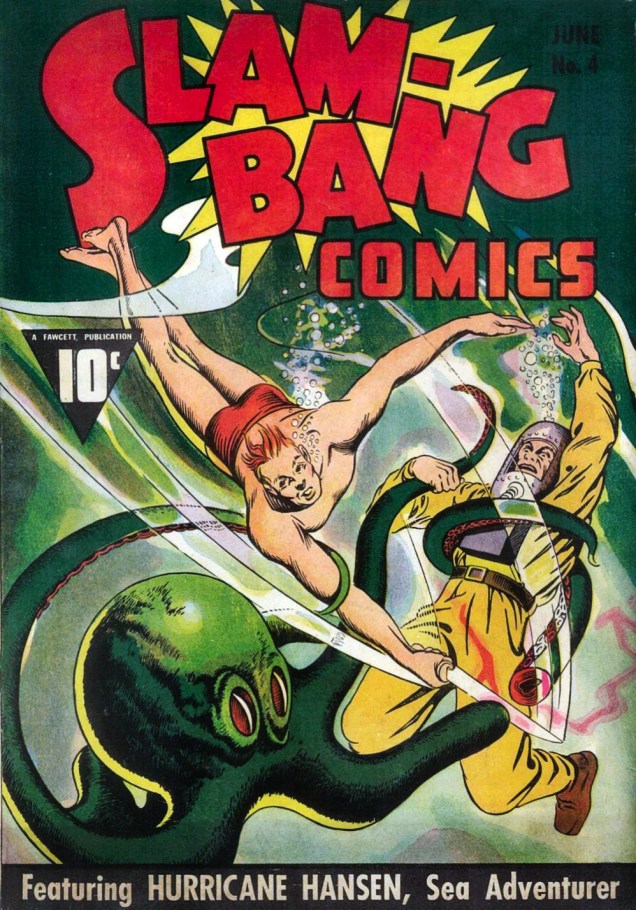
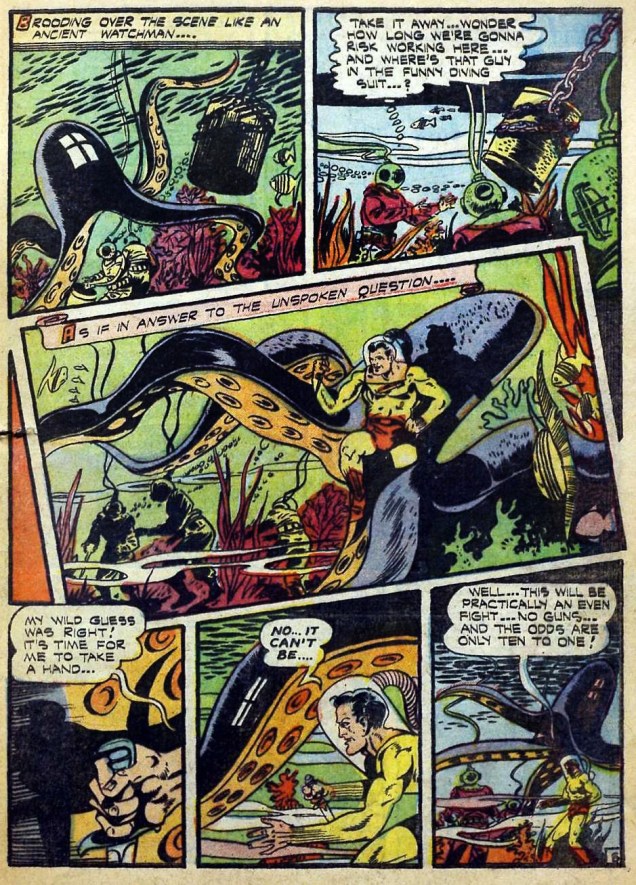
Next up, your standard slashing-at-tentacles-with-a-kitchen-cleaver. The guy must have been stashing it in his swimming trunks; there’s really no need for wearing an actual diving suit. That sap getting squeezed by a tentacle wore one… and look at all the good it did him.
Slam-Bang Comics no. 4 (June 1940), cover by Gus Ricca.Don Winslow of the Navy no. 36 (July 1946). Created by Lieutenant Commander Frank V. Martinek as a newspaper strip, Don Winslow was meant to underline Naval courage and inspire American youth to orient their career paths in that direction. I dunno, maybe this particular issue was responsible for a new generation of oceanographers.
I love the idea of an eight tentacled obstacle, and shall aspire to insert that phrase into completely irrelevant conversations.
The story is called “With the Marines”, artist unknown.
I have to admit that Don Winslow (not the author) is the kindest octopus handler we’ve seen today. It must be part of those Naval traditions and courage Martinek insisted on. (He was quoted as saying “Since Don Winslow of the Navy is approved by the Navy Department, I cannot allow him to do anything that is contrary to the ideals, traditions or motives of the Navy.“)
Blinding the beastie instead of stabbing – you go, Sir.
“It takes cold, raw courage to step up to… This is the grandfather of all octopus… or is it octopi…?” Only a true hero starts fretting about the properness of his English while in proximity to a giant octopus. Are you wondering why that octopus looks distinctly fake? He’s actually made out of rubber, as Don Wallace, a.k.a. Torpedo Man discovers when he punctures the counterfeit cephalopod.
Blue Bolt Weird Tales of Terror no. 112 (Feb 1952). This is a page from “Strange Tale of the Sea Monster”.
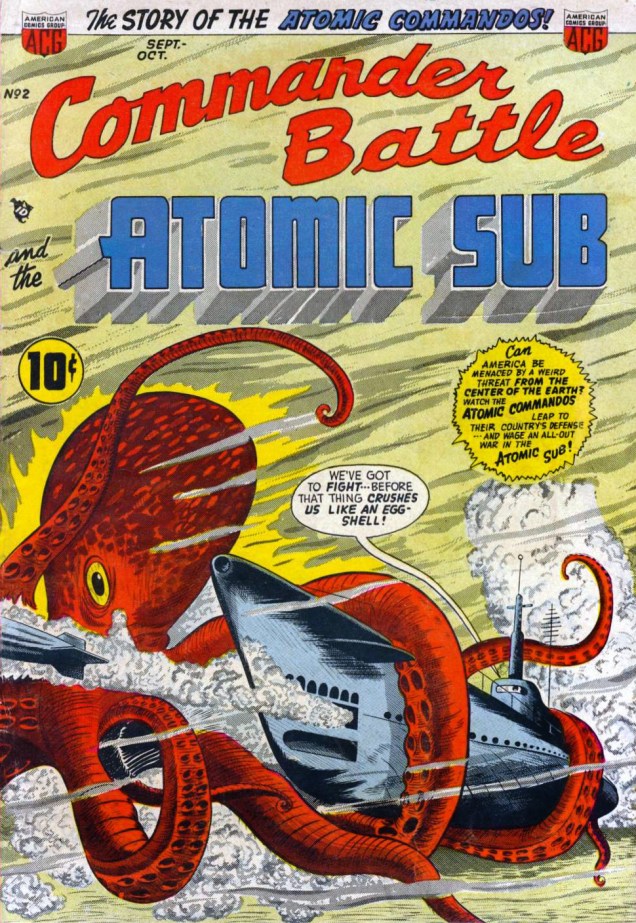
In the 1950s, “atomic” was distinctly a cool word, which clearly inspired the creation of this Atomic Submarine (nuclear powered, that is) and its Atomic Commandos… a crew of, like, four people. To quote Toonopedia, “The real atomic sub was apparently a bit more complex and challenging to deal with than the comic book one. Commander Battle’s got along with only four men aboard — Bill Battle (the boss), Champ Ruggles (“the most powerful man on the American continent”, and maybe even the other American continent as well), Doc Blake (the scientific genius) and Tony Gardello (only mildly ethnic).”
“The atomic commandos didn’t know that the way to the island was barred by an awful defender… by a gigantic nightmare creature that staggered the imagination! They didn’t see it as it rose from the depths behind them, flaring tentacles ready to pounce, clutch…” The octopus went from red to green – is that for better camouflage?
Panels from the rather lengthy, 2-part story titled “Fight for Survival!”, drawn by Sheldon Moldoff.
The weird threat from the center of the earth is actually a nation of sea-dwellers who demand humans cease using atomic weapons, threatening to burn Earth’s surface if this is not done (and unleashing their almost-indestructible octopus, as well). When Commander Battle triumphs at the end of the story, all the “giant attackers” die from a radioactive cloud. “And so it came to an end, this civilization of titans at the center of the earth… for now, not a single on was left alive! Let it be said that they were not evil! Destiny had willed it that they cross man’s path...” In today’s Tentacle Tuesday, this story takes the cake for its number of gratuitous deaths.
I wasn’t around in the 70s. (Literally, as in “I hadn’t been born yet”.) So when somebody – in, oh, say 2008 or so – handed me a copy of some ghost comics printed by Charlton Comics (I don’t remember what exactly), that was my first exposure to this publishing company. I wasn’t aware that I wasn’t « supposed » to like this stuff… and by the time some kind soul pointed out that it’s not exactly orthodox to seek out Charlton publications, it was too late to change my mind. Clearly, that’s how monsters with no taste are created.
Charlton Comics had the reputation for inferior printing (as one of my friends put it, « godawful colours and reproduction and paper ») and low quality control. I’d say that when one contemplates the variety of artistic styles and the dizzying panoply of artists published by them, the quality of the printing distinctly becomes a less important consideration. Charlton paid badly, sure, but since when do people decide what they like and what they don’t based on how artists are treated? (Just look around – companies that trample on creators’ rights are doing very well indeed.) It seems like a knee-jerk reaction; I often wonder if people who automatically react with sneers to the very mention of Charlton have actually read any of the comics this company printed. Or perhaps they’re scared by some of the artists’ styles which are just too wild, too squiggly, just not clean enough. (Sloppy line work! Anathema to any comic book lover worth his salt, right?)
Anyway, Charlton’s « loose editorial oversight » meant there was no house style to speak of, and artists with highly idiosyncratic styles could let their eccentricities shine.
You may notice some names are conspicuously absent from today’s post. Tom Sutton, exhibit A of the “chaotic, scratchy art” category, will get a Tentacle Tuesday post all to himself at a later date. Some beloved artists just didn’t draw any tentacles for Charlton (as far as I know!): Warren Sattler, Don Perlin, Sam Glanzman, Don Newton, Rocco Mastroserio, etc. Wayne Howard is already part of a Tentacle Tuesday (see Plant Tentacle Tuesday), as is Enrique Nieto (Tentacle Tuesday: Spunky Skirmishes).
Without further ado, but with lots of tentacles…
First, two beauties from Steve Ditko (if you’d like more Ditko – and who wouldn’t? – visit my co-admin RG’s lovely posts about him: Ditko’s Ghostly Haunts and Happy 90th birthday, Mr. Ditko!), both featuring “70s Ditko green“. (It’s that characteristic green hue that often appears on his covers, a fitting term coined by erudite Professor Fester.)
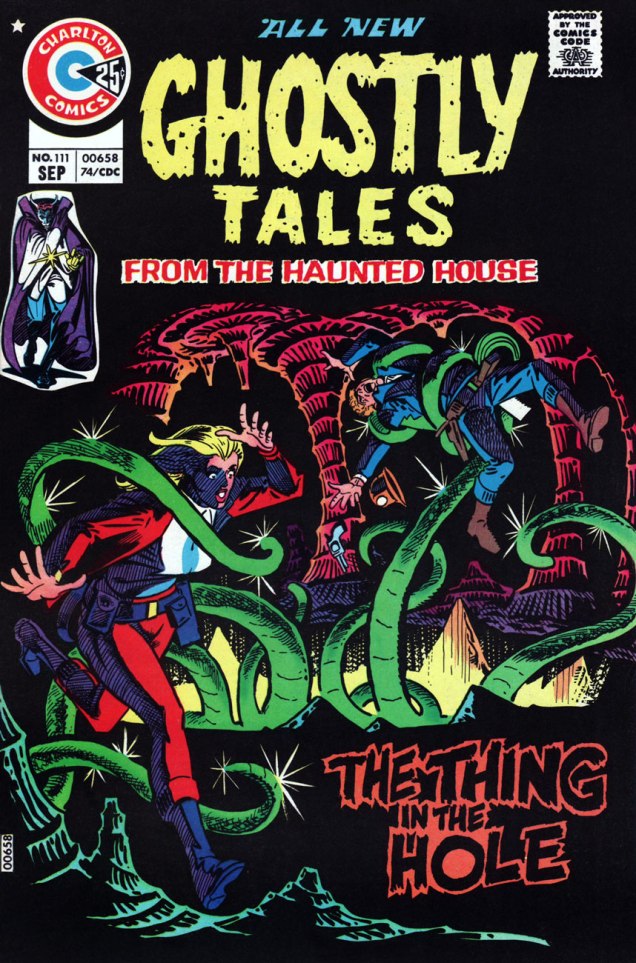
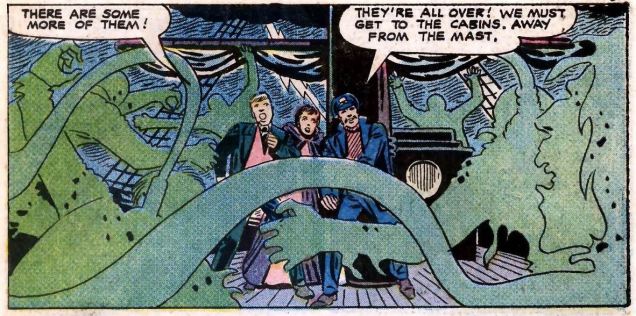
Ghostly Tales no. 111 (September 1974), cover by Steve Ditko. « The Thing in the Hole » is a really cool story, but it’s written and drawn by Tom Sutton, and as such it’s off-limits for now (I’m hoarding material for a different post.)Ghostly Tales no. 122 (August 1976), cover by Steve Ditko.Do these green noose-appendage-things count as tentacles? Sure they do! Panel from The Crew That Was Hanged!, illustrated by Steve Ditko and written by Joe Gill.
And moving on to other series, other artists:
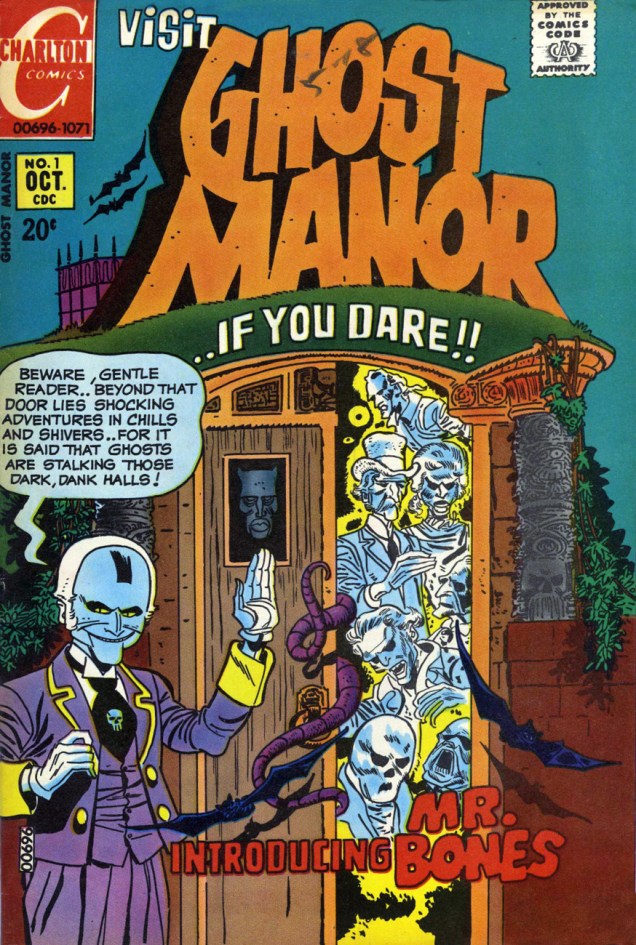
Haunted no. 8 (October 1972), cover by Jack Abel (1927-1996), perhaps best known as an inker for DC and Marvel.Newly-weds that are half-squid, half-fly, but newly-weds nonetheless. Page by Peter A. Morisi (1928-2003), who went by the nom de plume of PAM (or, since his signature’s M looks like a triple “I”, “PAIII!”). He was a NYC police officer, and moonlighted as a comics artist. I really like his calm, easily recognizable style and the way his characters seem to be frozen in each panel. There’s something quite effective about this stillness, a pleasing contrast between the drama and action of a story and the way people are staring off-panel in quiet contemplation, even when terrified. This story is called “Wrong Turn” and comes from Haunted no. 13, 1973.(Baron Weirwulf’s) Haunted (Library) no. 28 (July 1976), cover by Mike Zeck, whose career actually started at Charlton (he later moved on to Marvel to work on Master of Kung Fu, Captain America, etc.).« The creature’s tendril closed so gently around his leg, he didn’t notice it at first. Then a second grasped his arm! »The Source is the cover story of Haunted no. 28. Is old Thomas Willet mad? Well, he just has unusual taste in pets, that’s all (and, as tradition demands, he will pay dearly for his extravagance). Pencils and inks by Frank Bolle(1924-2020), who worked for Gold Key and Charlton, illustrated horror stories for Warren titles, and also had a hand in several newspaper strips (Winnie Winkle, Apartment 3-G, Stan Drake’s The Heart of Juliet Jones, and Gil Thorp).Ghost Manor no. 1 (October 1971), cover by the ever-masterful Pat Boyette (1923-2000), who’s a big favourite at Who’s Out There. Go read a whole story by him: Pat Boyette — Hillbilly Makes Good
We couldn’t find a good enough scan of this issue online, and it’s one of the rare Ghost Manors co-admin RG doesn’t actually own, so here’s a cover photostat (slightly coloured):
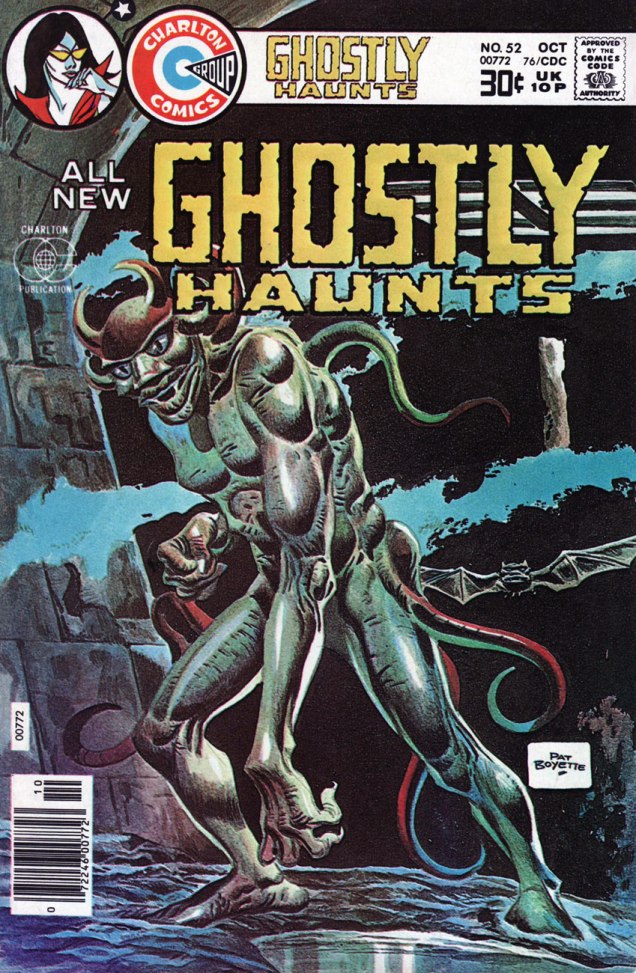
Ghost Manor no. 58 (August 1981), cover by the Recreo Studio.Ghostly Haunts no. 48 (February 1976), cover by Rich Larson (we’ve seen him before in Haunted House of Lingerie — see Tentacle Tuesday: a Day at the Beach).Ghostly Haunts no. 52 (October 1976), another cover by Pat Boyette, this time gorgeously painted.Beyond the Grave no. 11 (October 1983), cover by Mitch O’Connell(also present in Have Tentacles, Will Space Travel).
Created by Bill Everett, Namor the Sub-Mariner first appeared in Marvel Comics no. 1 (October 1939). The offspring of a human sea captain and a princess of Atlantis (and thus proudly bearing the title of Prince), he possessed the aquatic talents one expects of a regular merman and the exceptional strength of a carnival strongman. The cool thing about Namor is that right off the bat, he was a rather negative character – to be more precise, he was an Enemy of the United States (Everett didn’t mince words or characters, huh?) As Les Daniels states in his Marvel: Five Fabulous Decades of the World’s Greatest Comics (1991), « Namor was a freak in the service of chaos. Although the Sub-Mariner acted like a villain, his cause had some justice, and readers reveled in his assaults on civilization. His enthusiastic fans weren’t offended by the carnage he created as he wrecked everything from ships to skyscrapers. » This chaos culminated in an epic fight with Human Torch in 1941 when Namor took things a little too far and threatened to inundate the whole island of Manhattan. This little skirmish didn’t prevent him from joining the Allies’ side once World War II started, however, which gave a more constructive outlet for his somewhat destructive energies.
Right from the beginning, the Sub-Mariner was a complex character who just wouldn’t fit into the standard good guy/bad guy dichotomy. He underwent through quite a few transformations, disappearing for a bit right after WWII like many of his super-and-anti hero compatriots (but never for more than a couple of years at a time) and resurfacing during the Silver Age as a slightly different character. Namor’s concern about encroaching technology and hate of humanity, his fierce independence, made him a likeable character for those of us who like mavericks. He is a tragic character, a king without a kingdom who finds that Atlantis and its people have been destroyed by nuclear testing. After that, who wouldn’t hold a grudge? Anyway, if you’d like a more cogent overview of the Sub-Mariner’s history, visit The Great Comic Book Heroes.
To get back on topic, given how much time Namor spends underwater, it’s hardly surprising that he quite frequently encounters tentacles.
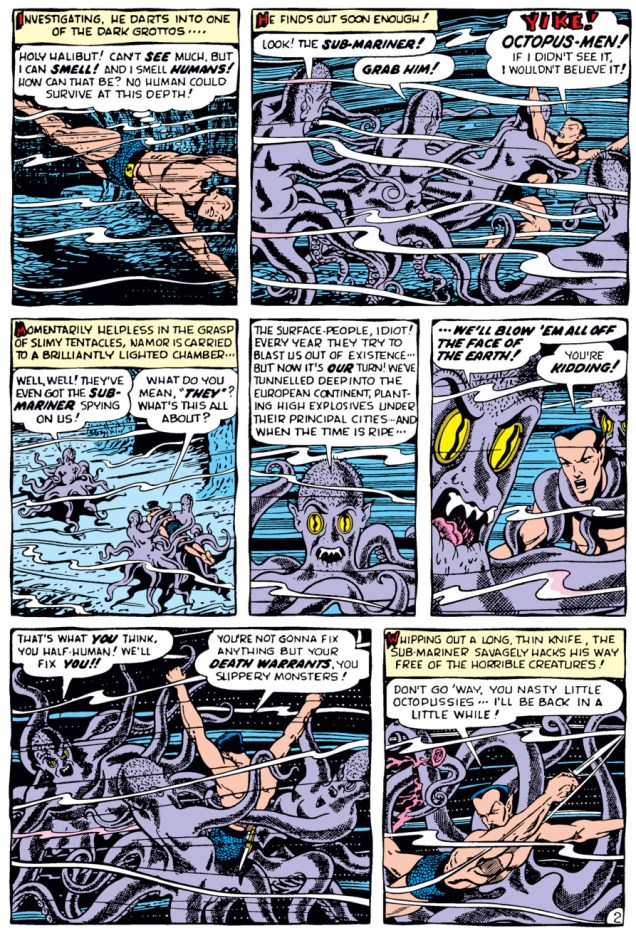
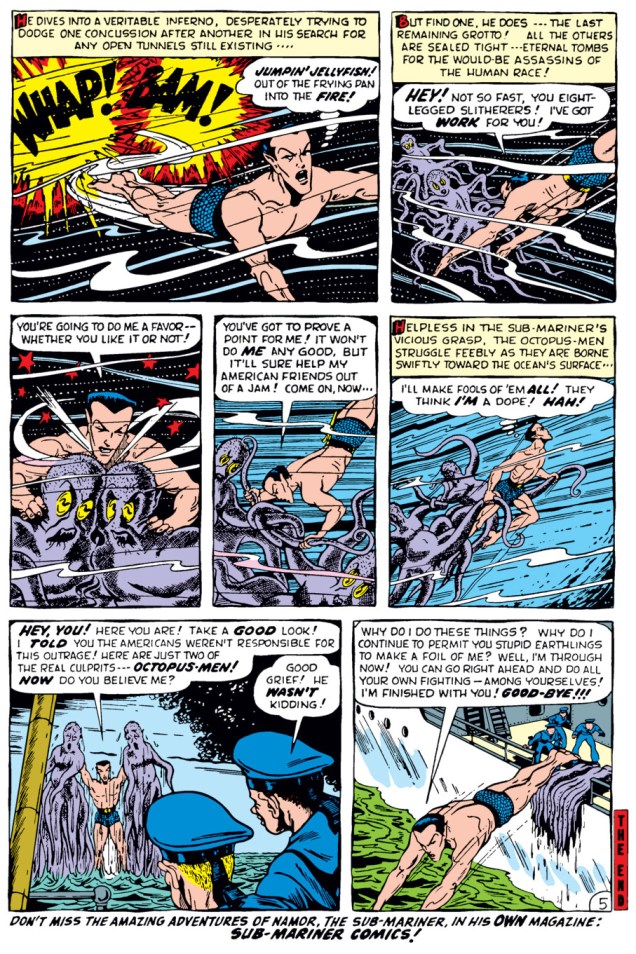
First, a story scripted and drawn by Bill Everett – who better to introduce the character than his creator? This is “The Octopus-Men!”, printed in The Human Torch no. 38 (August 1954).
« The Original Aquaman » ? My, aren’t we testy. Now, now, you boys both belong to a long, storied tradition.
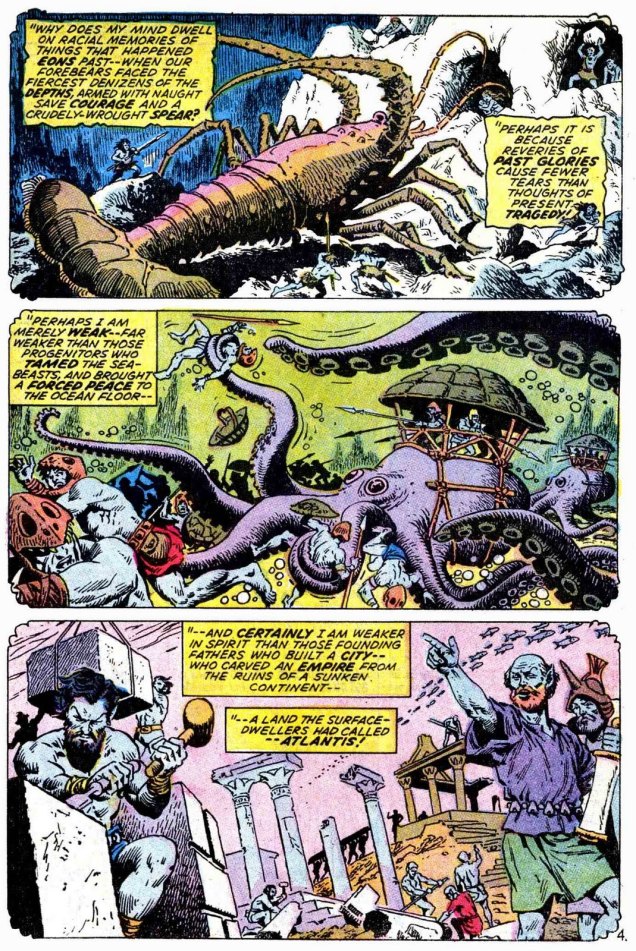
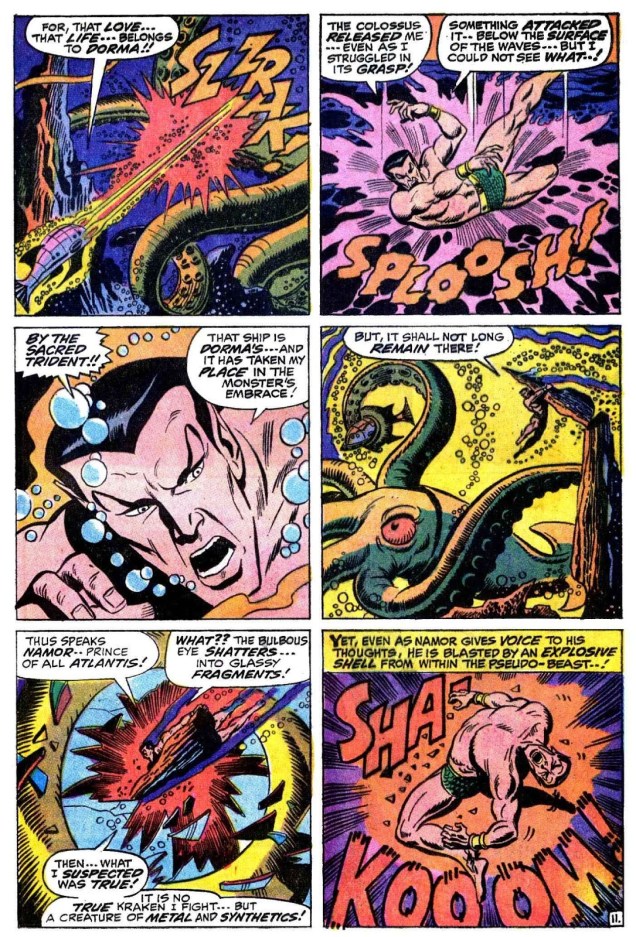
Skipping ahead some twenty years, a page from “Namor Agonistes!”, scripted by Roy Thomas, pencilled by Ross Andru and inked by John Severin, printed in Sub-Mariner no. 38 (June 1971). This is sort of an origin story of the Sub-Mariner. Lovely art, n’est-ce pas?
A page from “When Wakes the Kraken!”, scripted by Roy Thomas, pencilled by Sal Buscema and inked by Mike Esposito, printed in Sub-Mariner no. 27 (July 1970):
Oh, let’s have a couple of covers, too.
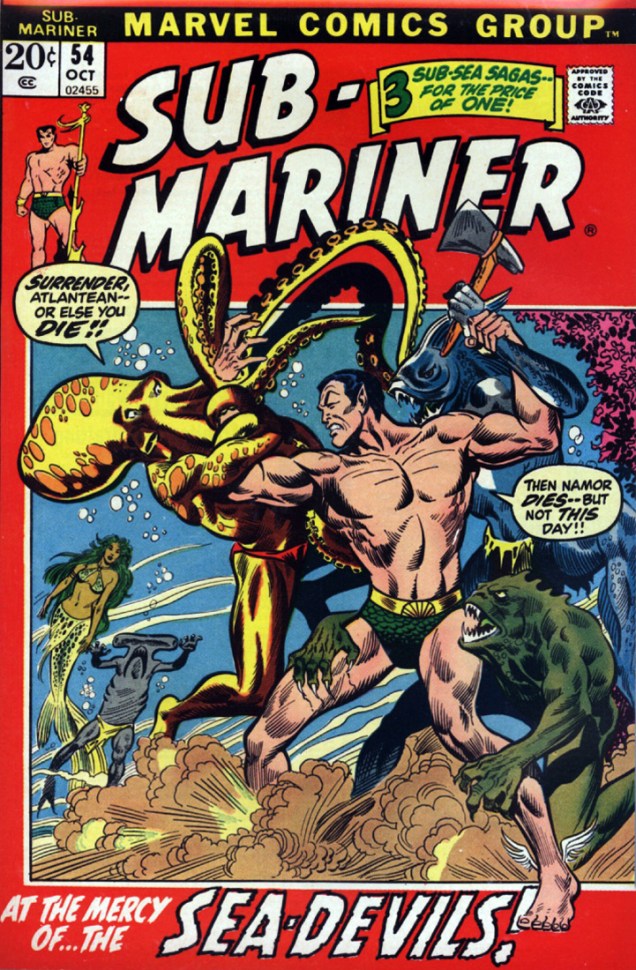
A rather random assortment of creatures, isn’t it? Sub-Mariner no. 13 (May 1969), pencils by Marie Severin and inks by Joe Sinnott.Umm… why is a piranha wielding an axe? Sub-Mariner no. 54 (October 1972), pencilled by Alan Weiss and inked by Frank Giacoia.
I mostly sneer at modern “reboots” of Golden or Silver Age characters, but Namor’s appearance in the excellent Thor the Mighty Avenger (Marvel, 2010) was completely à propos. (The series is a happy union of an absorbing story with great graphics – it’s written by Roger Langridge with art by Chris Samnee.) Here’s a page from “Thursday Morning“, published in Thor the Mighty Avenger no. 5 (December 2010).
This year, spring officially begins on March 20th, so it’s still a few days away… but the vernal bevy of birthdays has already started. Al Jaffee is still our first Spring Birthday Boy – he was always precocious, you know! Born in 1921 on March 13th, he turns 98 today, and that’s a truly impressive age, even for the oldest working cartoonist. Break out the bubbly!
Take my hand as we gallop through Jaffee’s career at a fast clip. In chronological order, then…
Original art for “Pain Relief Speed Test On Actual People In Actual Pain“, published in Humbug no. 7 (February 1958).
The New York Herald Tribune Syndicate published Tall Tales from 1957 to 1963. Al Jaffee came up with the idea of this strip’s format (one vertical panel for dailies, and a series of vertical panels for Sundays) when he was in financial straits – its unorthodox configuration ensured that newspaper editors would be able to squeeze it in *somehow*.
Sunday Tall Tales strip from 1960.
Visit The Fabulous Fifties blog for more – the amazing Ger Apeldoorn has scanned tons of Tall Tales from old newspapers, a monumental (and much appreciated) endeavour.
Sunday Tall Tales strip from 1961.
« The world is full of bloviators. And this kind of stuff, when there’s someone on the public scene who’s really going beyond his duties as a politician or a religious leader or a sportsman, he’s fair game. The main thing is to keep your eyes and ears open and when you hear something that’s clearly baloney, such as “eight out of 10 doctors smoke Chesterfield cigarettes” – these are ads that actually ran! One of the tobacco companies had the nerve to claim that doctors prefer their cigarettes. So it’s easy to shoot down that kind of bull. But you do it with a gentle hand, you don’t preach and say “tobacco kills! How can these doctors do that?!” No, you just go them one step further and say, “In addition to eight out of 10 doctors smoking this brand of cigarette, in their time off, they each drink a gallon of bourbon, which also has health benefits.” » |source|
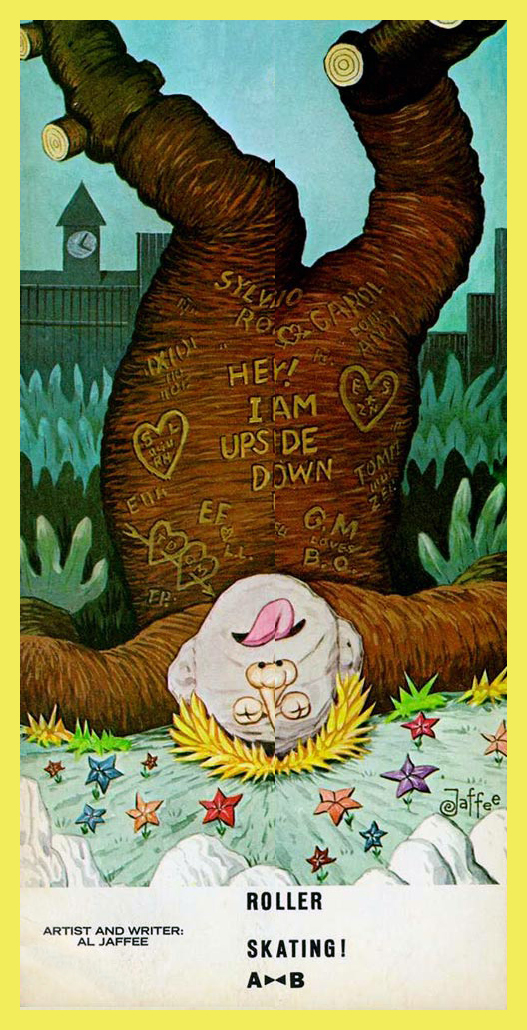
« Thanks a lot for ignoring my recent request for a house call, Doc! You saved me ten bucks!! It went toward the funeral!!! » Now, isn’t this a happy vernal scene? (Look at the pretty flowers!) Al Jaffee painted this “Get Mad” picture postcard for publication in The Worst From Madno. 12 (1969).First edition of Mad’s Al Jaffee Spews Out More Snappy Answers to Stupid Questions, (Signet, February 1972).
« I’m not an educator or a preacher. I think the important thing, in my line of work anyway, is that you’re helping the reader to think for himself. It’s not just about getting a chuckle from them. When you expose hypocrisy or nonsense or plain ol’ stupidity, you want to do it in a way that makes the reader connect the dots. Don’t tell the joke, just hint at the joke. If you over-explain it, it’s no good. » /source/
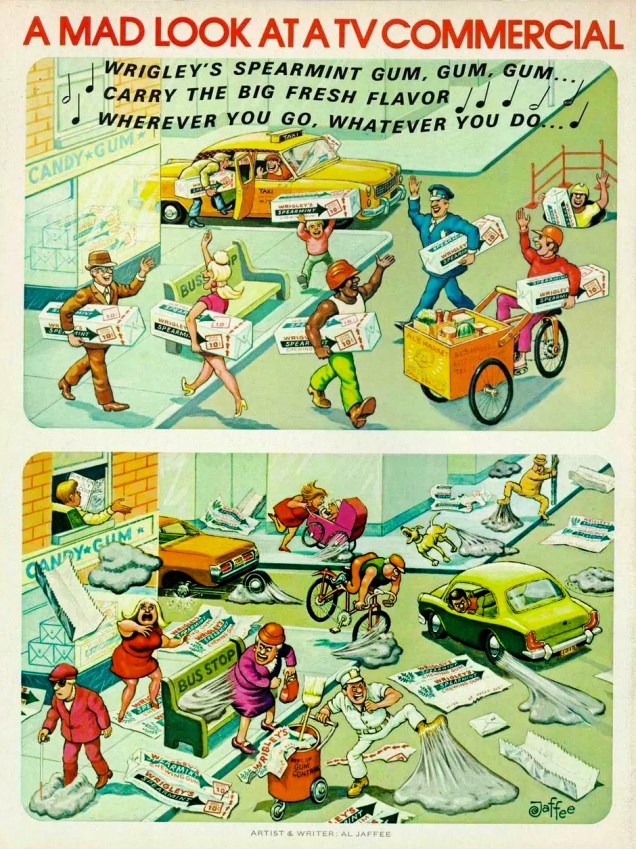
This painting (layout by Harvey Kurtzman, art by Al Jaffee) was designed to accompany an Esquire article from April 1972 about Elaine’s, a hip restaurant in NYC that was known for attracting writers, actors, and other prominent New Yorkers. Incidentally, Elaine Kaufman, the owner of this establishment, was a barrel of laughs (I’m not saying that sarcastically, either). « Kaufman was known for not mincing her words, for booting less-favored customers to seat new arrivals and for forbidding hamburgers to be served in her restaurant. She was once arrested after a physical altercation with a visiting Texan. Elaine also once had a fist fight with the actress Tara Tyson, and also chased away the notorious paparazzo Ron Galella by hurling two garbage can lids at him and exclaiming, “Beat it, creep… you’re bothering my customers”. » Ah, the people you knew at Elaine’s…The back cover of Mad no. 170 (October 1974), “A Mad Look at a TV Commercial“.
You might be wondering if Mr. Jaffee’s art and wit were any good much later in his career, say in the 90s. Stupid question, bub. Of course they were!
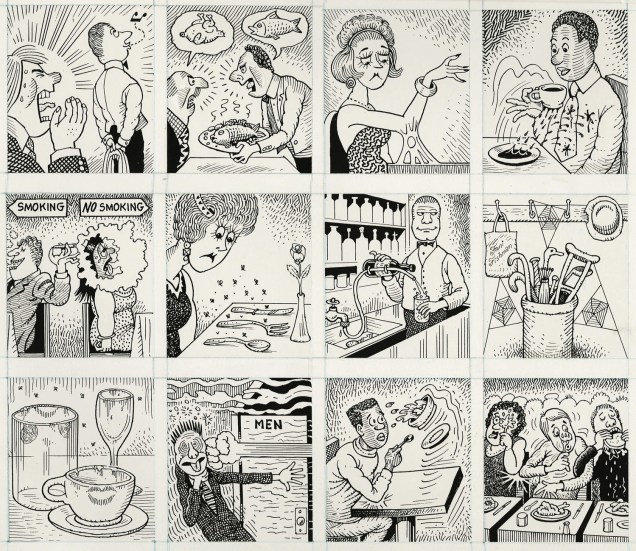
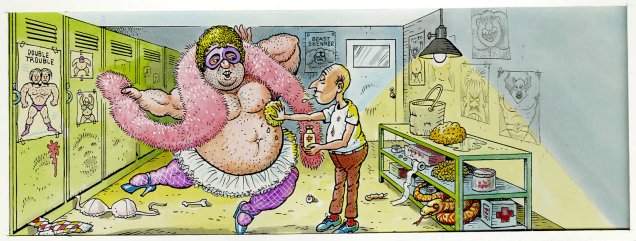
Original art from Mad’s Restaurant Survival Guide (Mad no. 300, January 1991).Art from a 1998 issue of Mad Special illustrating yet another round of Snappy Answers to Stupid Questions. When I said ’round’, I meant it: these are stupid questions asked at a wrestling programme. This one was probably “does this pink boa make me look fat?”
Have you ever wondered what Al Jaffee is like in person? Here’s your chance to find out:
“But you haven’t even mentioned MAD fold-ins!”, you might exclaim in dismay. Hey, I’m not gonna repeat myself… visit A MAD Dash… Inside for that and more Jaffee silliness.
Oh, fine, you guys. Just one, though, ’cause otherwise we’ll be here for another couple of hours, and frankly I’ve got hungry cats to feed.
What new way are people falling head over heels these days?, published in Mad no. 216 (July 1980).
You say you’re having trouble folding your screen? Geez, do we have to do *all* the work around here?
Many happy returns, Mr. Jaffee! <3<3<3
Mr. Jaffee and his wife Joyce in 2016, when he was but 95 years old. When he once quipped «Serious people my age are dead», he meant it as gospel. 😉
The Golden Age of comics proffered quite a lot of anthropomorphic animals to its readers. The stuff on offer ran the gamut of different definitions of humour, from inane slapstick to pleasant goofiness, all the way to batshit surrealism. There’s at least one common streak running through this zoological revelry – tentacles!
Our first exhibit is a charming comic from the 40s. Land of the Lost was a radio series broadcast from 1943 to 1948 on Mutual Broadcasting System and ABC, written, produced and narrated by Isabel Manning Hewson. Each episode started with the line « In that wonderful kingdom at the bottom of the sea… », and presented a new under-the-sea adventure of Isabel and Billy, two kids lucky enough to have an adorable avuncular fish for an underwater guide. (The fish was called Red Lantern, and was most notably voiced by Art Carney.) You can listen to an episode from 1945 here.
Coming back to our beloved cartoons: in 1946, EC Comics started publishing Land of the Lost Comics, a series that lasted for 9 issues. Hewson remained the writer, and the art was handled by Olive Bailey (not the Olive Bailey who helped crack Germans’ Enigma cipher machine in WWII.) The result was impressive: these comics are delectable, combining beautiful art with inventive plots that may be goofy, but have a solid internal logic. Hewson gave her sea-creatures vibrant personalities, and it’s so much fun to dive (not pun intended) into this world.
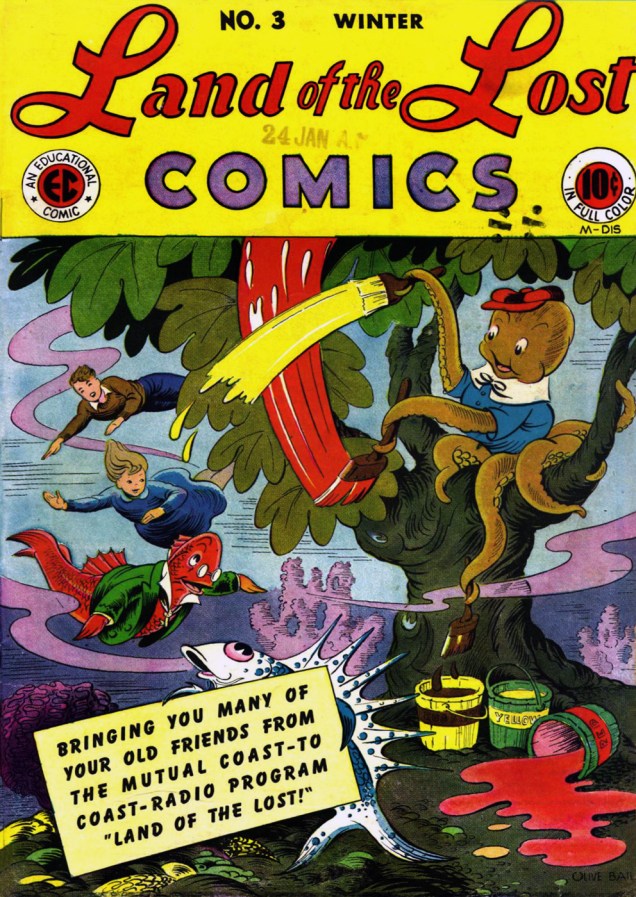
Land of the Lost Comics no. 3 (winter 1946), cover by Olive Bailey. Read the whole issue here… and then read other issues, too. Somebody needs to publish a collection of this stuff.
The following panels are from “Jack Frost“, scripted by Isabel Manning Hewson and drawn by Olive Bailey, published in Land of the Lost Comics no. 3.
Squidlet goes out of control, like all young octopuses are prone to doing.
Thank you, cool ladies, for all the fun!
Land of the Lost also became an animated cartoon as part of Famous Production Studios‘ Noveltoon series: Land of the Lost (1948), Land of the Lost Jewels (1950) and Land of Lost Watches (1951). I find the animation to be definitely subpar to the comics or the radio show, but I’ll let you judge for yourselves. (Jack Mercer is in it, albeit briefly!)
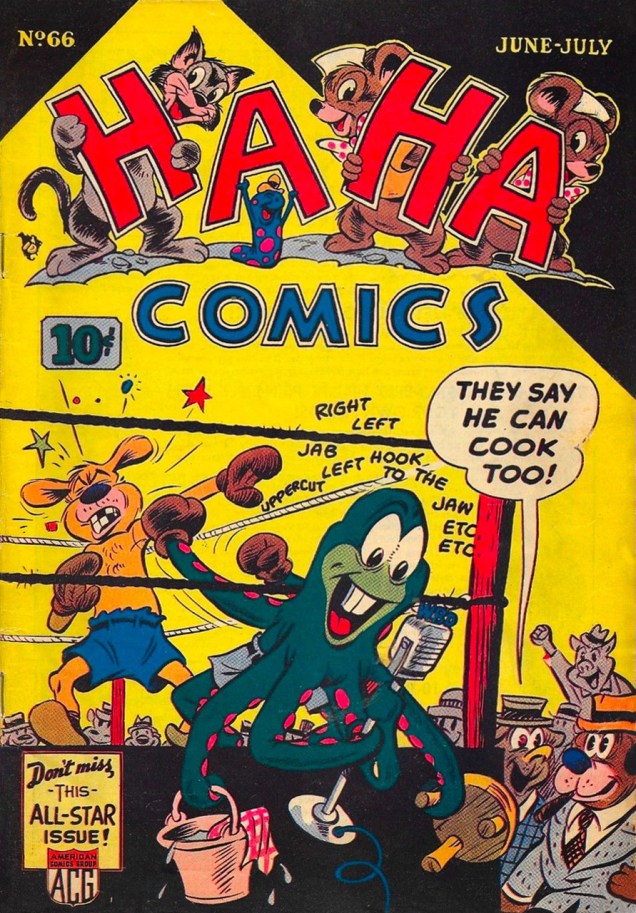
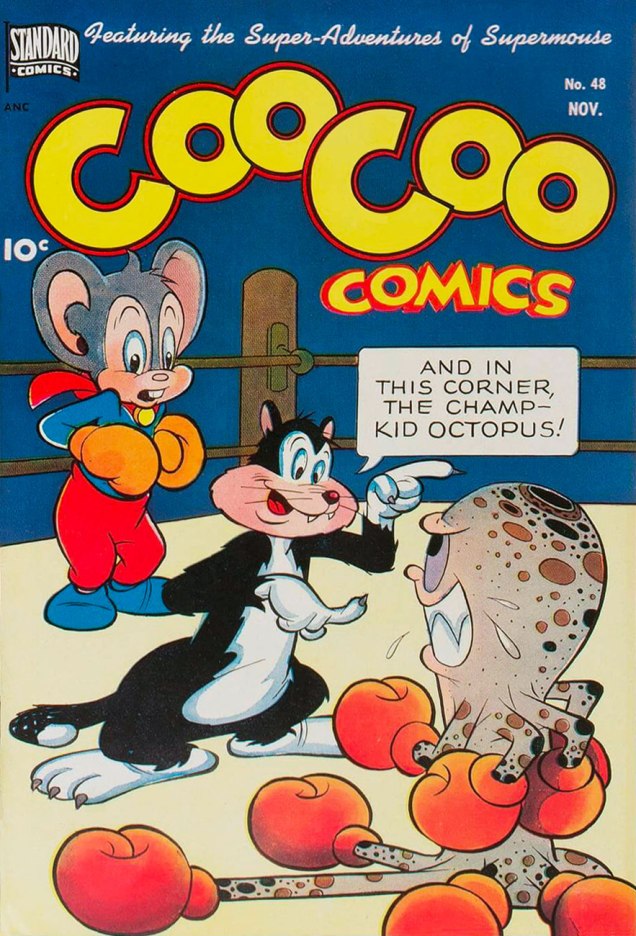
Did you know octopuses love to box? This implausible situation is definitely part of the lazy artist’s roster. To wit:
Ha Ha Comics no. 66 (June-July 1949), cover by Dan Gordon. It was really hard to find a scan of this issue in decent condition (thanks to co-admin RG), and comicbookplus doesn’t even have it in its database (you can read pretty much all the other issues of Ha Ha Comics, though).
Ha Ha Comics, a sister anthology of Giggle Comics, was published by ACG. (With issue #100, Ha Ha became Teepee Tim, going from animal hijinks to young Indian shenanigans for all of… three issues.) It’s quite a the playground of anything goes, but upon careful inspection, one easily finds good art shining among the dirt-pile of mediocrity, and diverting storytelling among hackneyed yarns.
Coo Coo Comics no. 48 (November 1949), cover by Carl Wessler. Published by Standard Comics under the imprint of Pines (from Ned L. Pines, publisher). Read the issue here (no tentacles whatsoever, though).
How many arms does the fellow up above have, nine? I suppose that’s why he’s the champ!
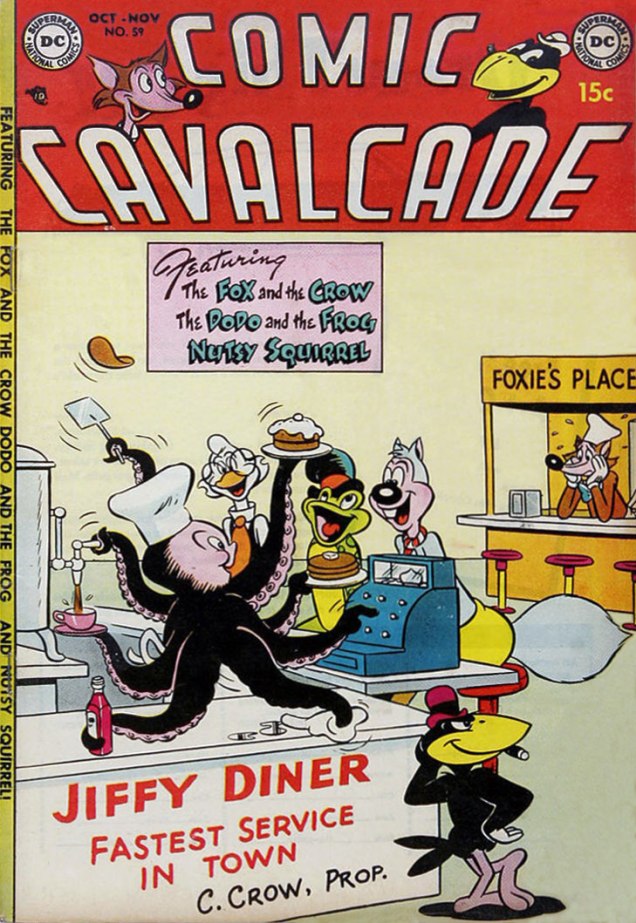
Comic Cavalcade went all funny-animals only with issue 30 (Dec-Jan 1948), when superheroes faded from popularity (oh man, that’s hard to imagine now, isn’t it?) It lasted until 1954, by which time it shrank from its original 96 pages to 76, however retaining its 15-cent cover price.
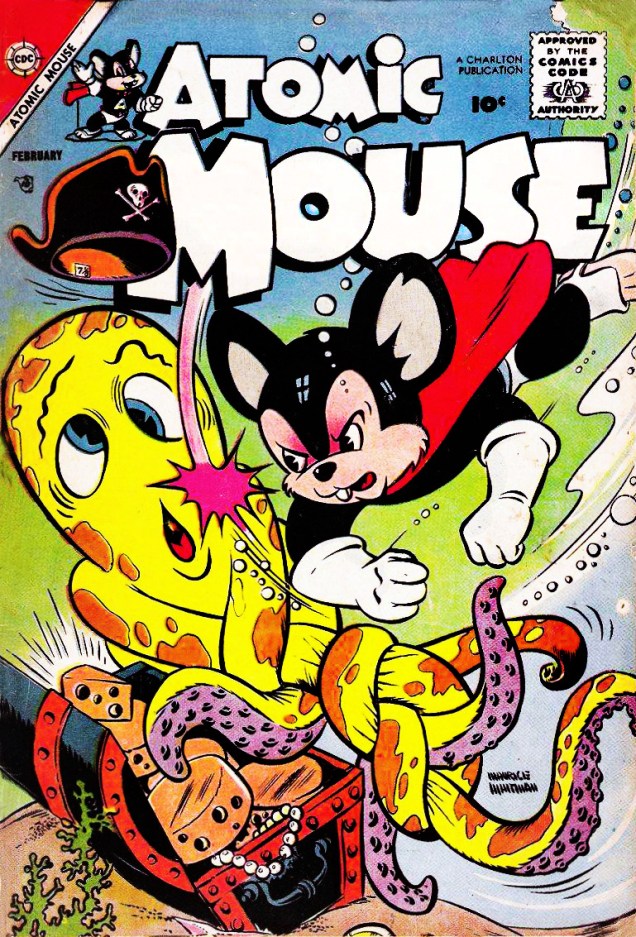
Comic Cavalcade no. 59 (Oct-Nov 1953), art probably by Rube Grossman. Read it here.Dinky Duck no. 10 (July 1954). WTF is a Dinky Duck? Terrytoons’ answer to Daffy Duck, says Toonopedia; or, tout simplement, a smaller-than-average duck. The poor duckling never caught on, but the cartoons did result in a comic series, published by Pines and then St. John.Atomic Mouse no. 25 (February 1958), cover by Maurice Whitman. Atomic Mouse was created in 1953 for Charlton Comics by Al Fago, their first animal superhero. The series was published for ten years (!), between 1953 and 1963, so it must have had at least a modicum of popularity.
Kitchen Sink Press, a trailblazing publisher of underground comix that grew out of Denis Kitchen’s successful attempts at self-publishing, has seen its share of tentacles. (For a detailed story of how Kitchen Sink grew from a modest artists’ cooperative into a force to be reckoned with, as well as a discussion of its 30-year legacy, pay Comixjoint a visit.)
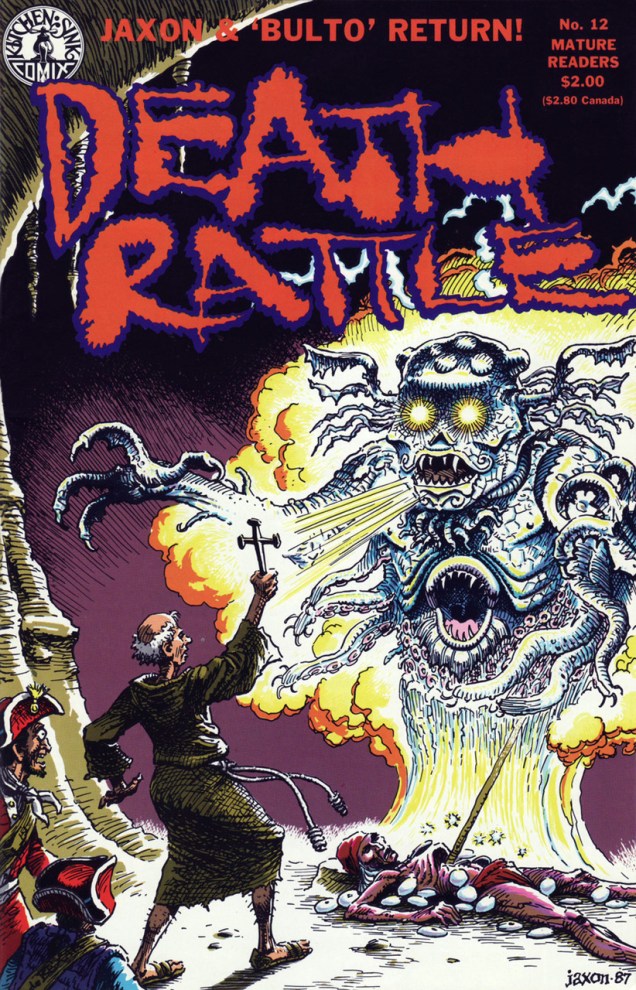
First we have a pair of entries from the Death Rattle catalogue. There were 3 “volumes” (series, if you will) published, and my favourite is volume 2, consisting of 18 issues coming out between October 1985 and October 1988, starting out in glorious colour but reverting to black-and-white with issue 6 (which was fine, actually). It’s a remarkably consistent anthology nearly devoid of clunkers, and featuring awesome stories and art by Rand Holmes, Jaxon, Tom Veitch, Al Williamson, Wally Wood, Steve Stiles, etc. It’s also where Mark Schultz’ Xenozoic Tales series was introduced (Death Rattle no. 8, December 1986)!
Death Rattle no. 4 (April 1986), cover by Rand Holmes, who’s already ascended to the rank of Tentacle Tuesday Master.Death Rattle no. 12 (September 1987), cover by Jaxon (Jack Jackson). The cover belongs to Jaxon’s “Bulto… The Cosmic Slug“, an epic eleven-parter that I really enjoyed reading (and not only because of its manifold tentacles). We’ll talk about that again.
Speaking of Jaxon, I’d like to quote from General Jackson, a tribute written by Margaret Moser (who dated him on-and-off through the years).
« The last time I saw Jack was a humid, late summer night in 2005 at the South Austin Museum of Popular Culture. His hair was nearly white and had lost its red-brown burnish, but his mustache was bushy as ever, and he resembled God Nose himself. He was a little grumpy, probably feeling bad, and I was with my boyfriend, so I didn’t sit on his lap. I did kiss his leathery cheek and fetch him a beer. He smelled like cigarette smoke and maybe of Old Spice.
On Wednesday, June 7, just three weeks after his birthday, Jack Jackson took his life at the graves of his parents outside Stockdale. His diabetes and arthritis were getting worse, affecting his ability to draw, and he’d been diagnosed with prostate cancer. Unwilling to face a debilitating course of chemo treatment, he put down his pen forever and made his own kind of peace with the unforgiving future. »
On to something more cheerful! Next, we have a bit of a non sequitur in this otherwise horror-centric post, although one might argue that being grabbed by an octopus is a traumatic experience. What’s The Spirit doing in here, you might ask?
« Kitchen Sink continued publishing multiple undergrounds and alternative comics through the ’80s and ’90s, but also expanded into publishing non-underground comics, graphic novels and extensive anthologies, most notably by Will Eisner, Al Capp, Milton Caniff and Harvey Kurtzman. » |source|
The Spirit no. 34 (August 1987), cover by Will Eisner.Page from “A Day at the Beach“, drawn and scripted by Will Eisner and inked by André Leblanc, printed in The Spirit no. 34 (August 1987). Somehow I’m not surprised that Eisner draws a mean-yet-elegant octopus.
All rested now? Okay, back to horror.
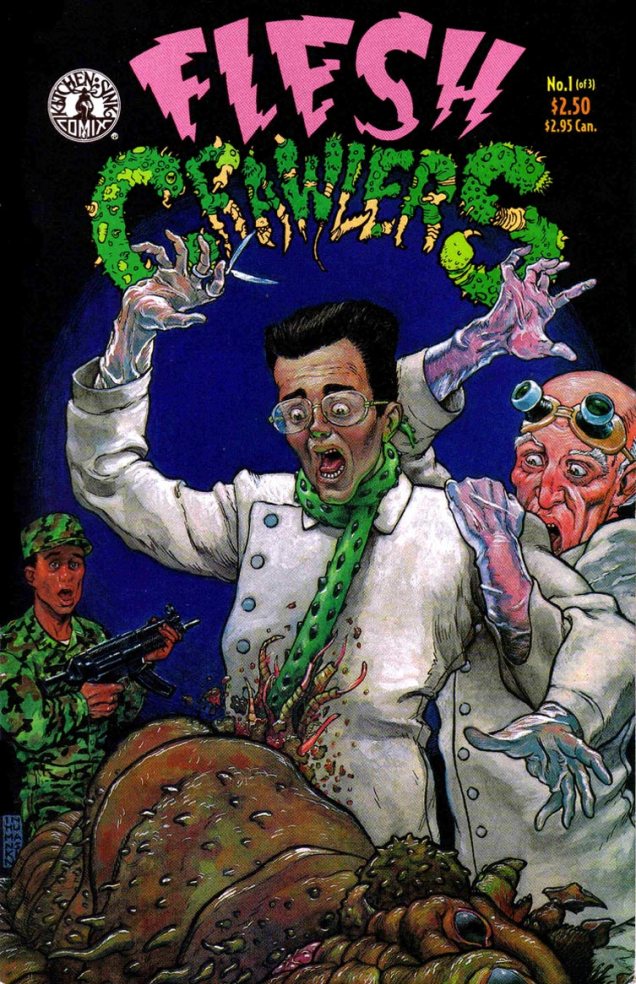
Flesh Crawlers no. 1 (1993), written by Richard Rainey and illustrated by Michael Dubisch. A quick look at the latter’s catalogue shows that Dubisch happily adds tentacles to whatever he’s drawing.
The scientist seems to have been preparing to dissect the specimen – turnabout is fair play! This cover reminds me of this, actually:
Barney & Clyde is a syndicated newspaper strip with jokes that are actually funny and characters that you can get attached to, a rarity these days. You can read it online.
Back on topic, another attack of the Flesh Crawlers:
Flesh Crawlers no. 3 (1993), written by Richard Rainey and illustrated by Michael Dubisch.
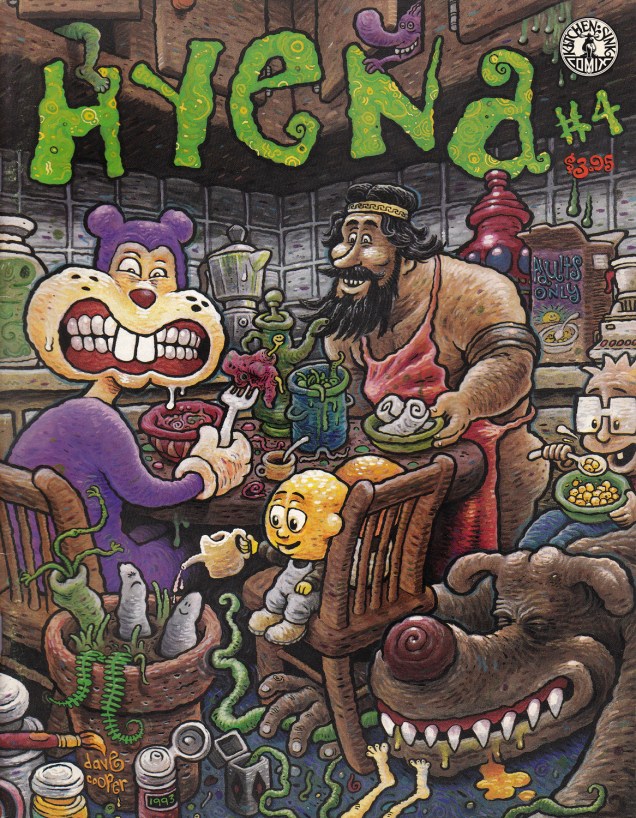
My final submission for today involves a cozy family scene where Frank is peacefully having breakfast with, err… Potted turnip babies and an almost-nude greek serial killer. I think.
Hyena no. 4 (1993, Tundra), cover by Dave Cooper. If Jim Woodring’s work frequently creeps me out, Cooper’s comics are viscerally repulsive to me (I think he goes for “nauseating” on purpose, but I’m not in the camp of people who like to experience strong emotions by watching disgusting, repulsive things happen). This cover, though, is all right.
Poor Wonder Woman has gone through quite a few transformations during her lifetime. You can read about her kinky-yet-feminist beginnings elsewhere (for an interesting article about how this character was created, read The Surprising Origin Story of Wonder Woman at the Smithsonian; or take a gander at Wonder Woman, the sexualized superhero for a great discussion of how a character can be objectified or empowered by being portrayed in a sexy way) – today I’m concentrating on some goofy Silver Age covers from DC’s long-running Wonder Woman series.
My interest is twofold. On the positive side, I like the team that worked on WW covers in these days – Ross Andru on pencils and Mike Esposito inking. (All covers in this post are by them.) On a more sour note, I have a whole boneyard to pick with writer Robert Kanigher, whose scripts I generally like… as long as they don’t involve women. Who had the bright idea of choosing a hardened misogynist as writer of a major female superhero? (Purely a rhetorical question, I assure you.) Kanigher took over the scripting with Wonder Woman no. 98 (May 1958), “revamping” (as Wiki gracefully puts it) the character, giving her a new origin story and a new cast. It’s not that I object to the idea in principle, but this so-called revamping involved continually trying to marry the intrepid Amazon off to some schmuck, sticking her into stories that don’t make a lick of sense, making her burst into tears randomly – Like a Real Woman™ does – and forcing her to make Sophie’s choices between the lives of boyfriends and family, on random shuffle.
So here’s a gallery of covers I like and cover stories I don’t.
Wonder Woman no. 125 (October 1961).
Well, Mer-Man clearly doesn’t have a leg to stand on in this competition. Come to think of it, neither does Amœba-Man. How are these two even standing? And how would either of these consummate the marriage?
The cover story is Wonder Woman — Battle Prize, a good example of the “marrying Wonder Woman off” theme. “Ages of Heroes, Eras of Men” (by Julian C. Chambliss) explains that sort of thing is designed to « affirm [the super heroines’] proper femininity by regularly demonstrating their heterosexuality“. Now he’s right and all, but for that purpose one could easily come up with something more appealing than a romance with an amoeba, a unicellular organism that reproduces mostly by fission. Stay away from pseudopods and fishy scales, Wonder Woman.
Wonder Woman no. 143 (January 1964).
The Terror Trees (old Bob clearly liked alliteration) are trees that can move and attack, found on a “sinister, uncharted island”. For some reason there’s a Sun Sword (another alliteration) stuck in one of them, which Wonder Woman must retrieve to defeat some nasty alien invaders. At some point, a tree attempts to crush her, leading to an epic scene in which she whirls her head around, using her tiara (made of “amazonium… hardest metal known…”) like a “circular saw” and slicing her way out of the “ruthless tree”. I’m not even going to summarize the rest of this nonsense, but suffice it to say, the story ends – as it always does – on a happy note. Who’s the lizard on the cover, you may ask? No fucking idea, he’s not part of the plot.
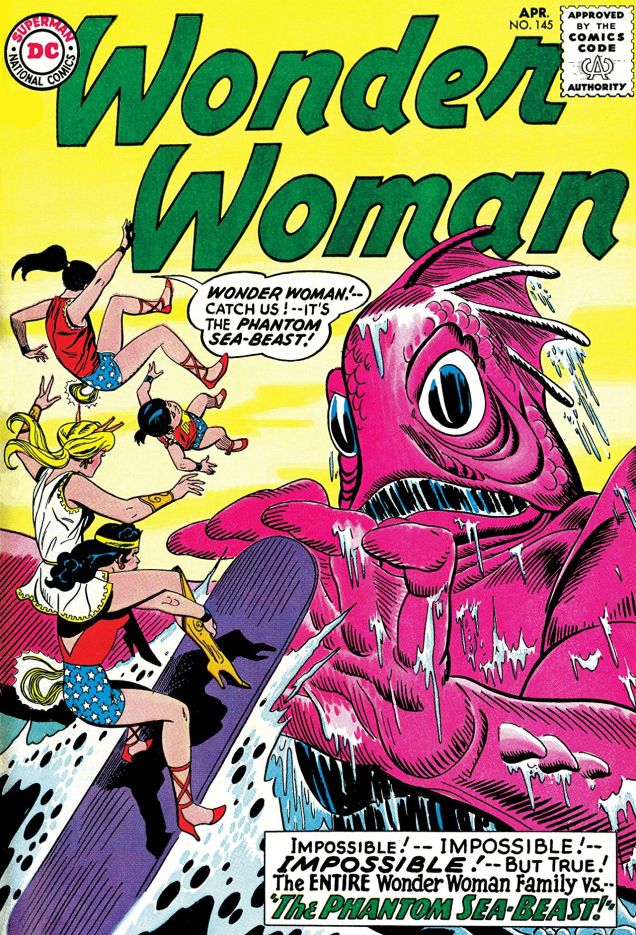
Wonder Woman no. 145 (April 1964).
The Phantom Sea-Beast is just such a tangled mess of claptrap that I don’t even know how to summarize it. It also involves some romance between Mer-Mite and Wonder Tot (in which the former tries to trick the latter into marriage), which is a good representation of what Kanigher seems to think as a Jolly Good Time. Bald zoo-keepers! A fight with a T-Rex! Go read Carol A. Strickland’s review of it, from which I shall quote a paragraph:
« Wonder Tot had just gotten out of the whale. As Wonder Tot surfs alone back to Paradise, she sees her family diving off a cliff and goes to meet them. They practice acrobatic stunts. Not only is Diana surfing in heels, as she is wont to do, but Wonder Girl conveniently wears a Wonder Woman tiara as she has never worn (she’ll need it later in the story). The queen’s pointy crown does not impale her daughter’s head. And even more oddly, gravity does not affect Hippolyta’s skirt. What can I say? It’s just a dream.»
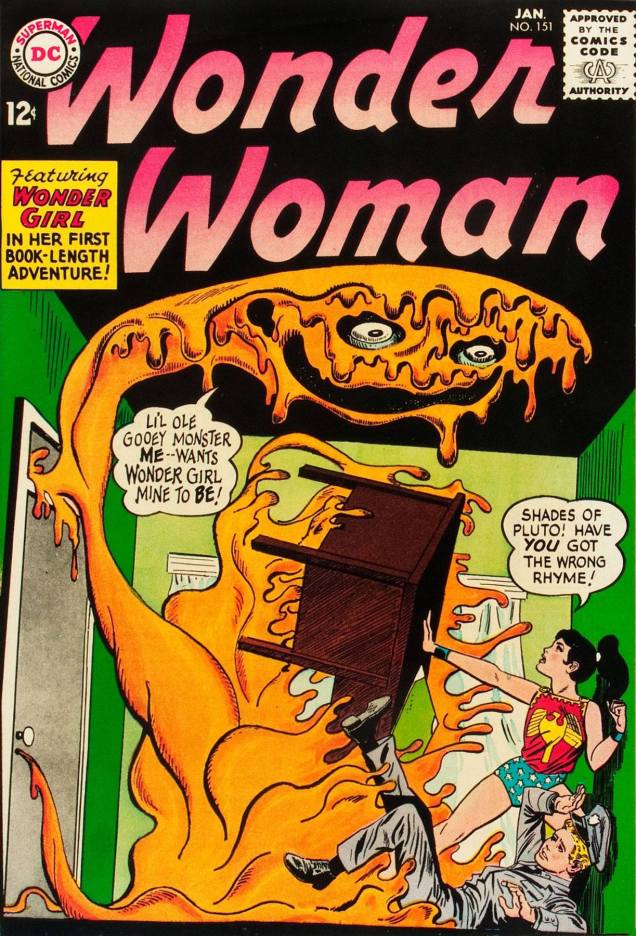
Wonder Woman no. 151 (January 1965).
In “Wonder Girl vs the Teenage Monster!“, the Glop, a blob-like alien, swallows 100 rock’n’roll records and proceeds to serenade Wonder Girl with regurgitated lyrics, coming up with gems like “Glop… glop… I’m not a mop! I want my pearl – wonder girl!” And by the way, it was all a dream (a convenient cop-out that Kanigher resorts to far too often): Wonder Girl fell asleep while looking through a photo album with Wonder Woman’s “boyfriends” and mourning her own romantic troubles. We hear you loud and clear, Sir Kanigher: women’s pretty little heads can only think of men and all manner of frilly, sweet things, even if the woman in question possesses great power and even greater intelligence.
That being said, this is probably my favourite cover of the lot. I just melt when presented with a blob of goo!
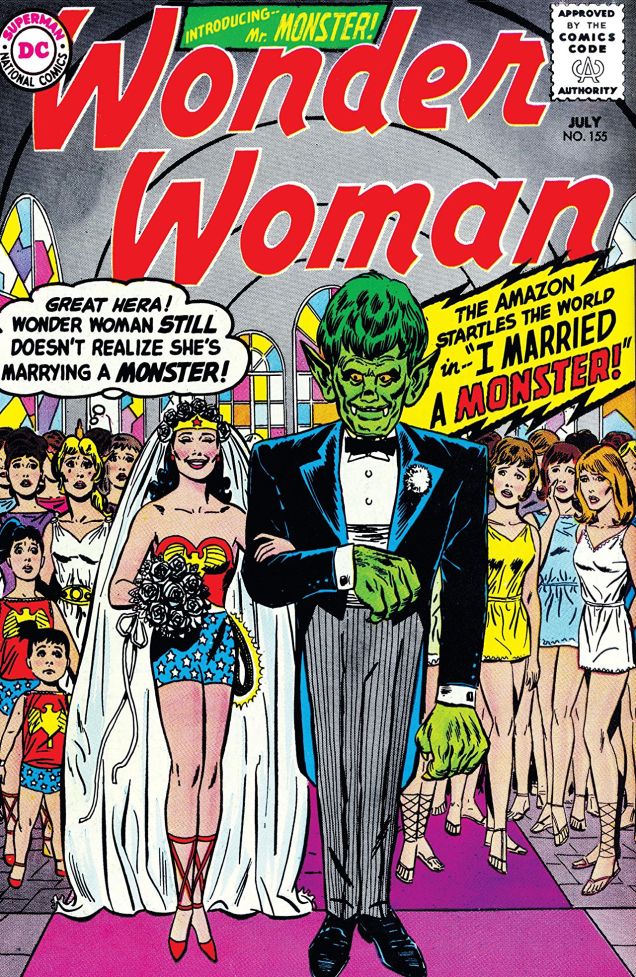
Wonder Woman no. 155 (July 1965).
Groan. Here we go again with this ridiculous obsession of marrying Wonder Woman off. After Wonder Woman is hounded by her usual three beaus who practically threaten her with matrimony (including the awesome line, uttered by Steve Trevor, “When are you going to marry me! Better hurry! Before you’re an old maid!“), she encounters Monster Prince, who, as it turns out later in the story, is handsome when he does good, and ugly when he does evil.
A sample of the romantic dialogue that leads to the altar for these two lovebirds:
Monster Prince: « Stop pretending I’m an ordinary man! You almost sacrificed yourself like a driver taking pity on a dog on the road — and risking her life to avoid hitting him!»
WW: « Only a man who thinks like a giant — could have defied a whole army of Amazons as you did before! You raged like a storm! You were magnificent! Anyone who married you — would be lucky! »
And that’s it, they’re betrothed! Except that the Prince ditches her at the altar, claiming that he doesn’t want a beautiful girl to sacrifice her life to a monster like him. Err…?? More nonsense follows. It becomes painfully evident that Wonder Woman is attracted to bipolar assholes who make her feel inadequate. It reminds us once again that according to you-know-who, women are emotional weaklings who need an overbearing male hand to tell them what to do (or where to get off). Brr. Read the full synopsis, if you dare, over here.
Wonder Woman no. 169 (April 1967).
You know how sometimes a restaurant proclaims to have a dish so original that it’s only on offer at that particular joint? It sounds like hype, but occasionally the claim is actually accurate… because the recipe in question combines elements that clash so badly that no normal person would think of combining them. This “most unique villain ever created” is in that category: he’s a bloody stupid idea. He’s not terrifying, he’s silly… though I did develop a headache while trying to figure out how he got into that tight outfit with his 8 sets of arms and 7 sets of legs.
Joanna Sandsmark, who wrote a hilarious review of the Crimson Centipede (be sure to read it here!), remarks that « I am thoroughly convinced that the germ of the story came to Bob Kanigher when his wife had a run-in with a centipede. Somehow, he thought it would be a good idea to have Wonder Woman afraid of it, as his wife was. Apparently, he forgot that Diana was a superhero who had all kinds of powers. Lucky for him, she was female. Problem solved! » (I think I’m not the only one who has a low opinion of Kanigher’s female-depicting prowess.)
So there we have it. Is this bigoted balderdash worthy of a man who co-created Sergeant Rock, or Enemy Ace or the Unknown Soldier? Nope. What do these have in common? There’s no women in these series, or at least no recurring female characters. (Well, okay, the other commonality is Joe Kubert.) Metal Men could have been great… but the presence (and more significantly, characterization) of a female character, Platinum, kills it for me. There’s no doubt that Kanigher *could* wrote emotionally resonant stories with complex characters and excellent internal logic. In the case of the Wonder Woman series, he just chose not to, preferring instead to produce a lot of hooey with giant plot holes and pepper it with sad clichés. It’s a pity.
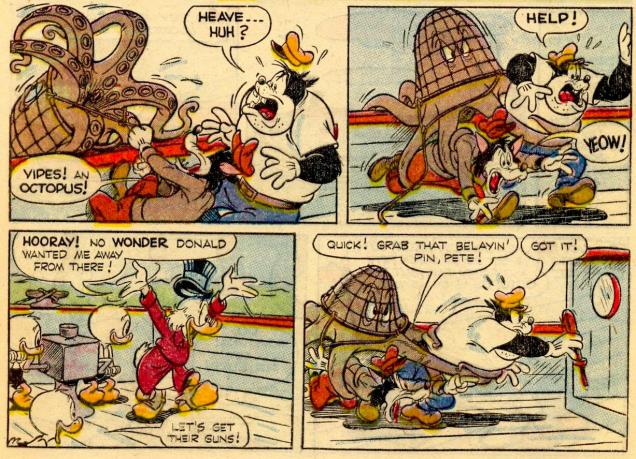
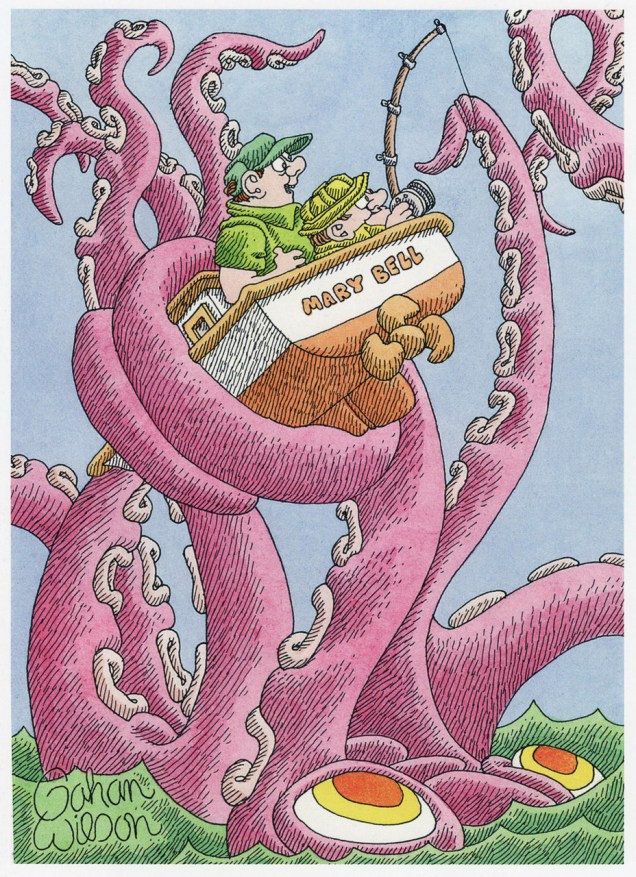
Has this ever happened to you? You’re sailing along, just minding your business, concentrating on fishing or just taking a pleasure cruise, when suddenly you’re abruptly attacked by shifty tentacles. What do you do? Defend yourself with a tickle assault!
Page from “Little Dot Meets Uncle Gill”, printed in Little Dot no. 5 (Harvey, 1954). Art is by Steve Muffatti. Little Dot is never at loss in any situation, but I’m surprised the octopus isn’t covered in polka dots.Panel from “Little Dot Meets Uncle Gill”, printed in Little Dot no. 5 (Harvey, 1954). Art by Steve Muffatti. No harm done!
Some octopuses sneak onboard to be helpful…
Original art for a Felix the Cat Sunday comic strip from July, 1934. Art by Otto Messmer.
… And some are just pissed off about their dwindling food supply. (Or perhaps that fish was a personal friend.)
Marmaduke Mouse no. 2 (Summer 1946). Artist unknown.
If there’s any moral to these tales, it’s that fishing is hazardous business.
Walt Disney’s Donald Duck Beach Party no. 1 (July 1955). The story is “Sea Breeze Sailors”, scripted and drawn by Dick Moores.« Don’t let it get away! » Cartoon by Gahan Wilson.






































 Who's Out There?